EP4043466B1 - Inhibiteurs de prc2 - Google Patents
Inhibiteurs de prc2 Download PDFInfo
- Publication number
- EP4043466B1 EP4043466B1 EP22165237.3A EP22165237A EP4043466B1 EP 4043466 B1 EP4043466 B1 EP 4043466B1 EP 22165237 A EP22165237 A EP 22165237A EP 4043466 B1 EP4043466 B1 EP 4043466B1
- Authority
- EP
- European Patent Office
- Prior art keywords
- equiv
- methyl
- mmol
- mixture
- heterocyclyl
- Prior art date
- Legal status (The legal status is an assumption and is not a legal conclusion. Google has not performed a legal analysis and makes no representation as to the accuracy of the status listed.)
- Active
Links
Classifications
-
- C—CHEMISTRY; METALLURGY
- C07—ORGANIC CHEMISTRY
- C07D—HETEROCYCLIC COMPOUNDS
- C07D487/00—Heterocyclic compounds containing nitrogen atoms as the only ring hetero atoms in the condensed system, not provided for by groups C07D451/00 - C07D477/00
- C07D487/02—Heterocyclic compounds containing nitrogen atoms as the only ring hetero atoms in the condensed system, not provided for by groups C07D451/00 - C07D477/00 in which the condensed system contains two hetero rings
- C07D487/04—Ortho-condensed systems
-
- A—HUMAN NECESSITIES
- A61—MEDICAL OR VETERINARY SCIENCE; HYGIENE
- A61K—PREPARATIONS FOR MEDICAL, DENTAL OR TOILETRY PURPOSES
- A61K31/00—Medicinal preparations containing organic active ingredients
- A61K31/33—Heterocyclic compounds
- A61K31/395—Heterocyclic compounds having nitrogen as a ring hetero atom, e.g. guanethidine or rifamycins
- A61K31/495—Heterocyclic compounds having nitrogen as a ring hetero atom, e.g. guanethidine or rifamycins having six-membered rings with two or more nitrogen atoms as the only ring heteroatoms, e.g. piperazine or tetrazines
- A61K31/505—Pyrimidines; Hydrogenated pyrimidines, e.g. trimethoprim
- A61K31/519—Pyrimidines; Hydrogenated pyrimidines, e.g. trimethoprim ortho- or peri-condensed with heterocyclic rings
-
- A—HUMAN NECESSITIES
- A61—MEDICAL OR VETERINARY SCIENCE; HYGIENE
- A61P—SPECIFIC THERAPEUTIC ACTIVITY OF CHEMICAL COMPOUNDS OR MEDICINAL PREPARATIONS
- A61P35/00—Antineoplastic agents
Definitions
- the present invention relates to compounds that inhibit the Polycomb Repressive Complex 2 (PRC2).
- the present invention relates to compounds, pharmaceutical compositions comprising the compounds and methods for use therefor.
- references in the description to methods of treatment refer to the compounds, pharmaceutical compositions and medicaments of the present invention for use in a method of treatment of the human (or animal) body by therapy (or for diagnosis).
- the Polycomb Repressive Complex 2 is a multiprotein complex that contributes to the epigenetic silencing of target genes to regulate development and homeostasis.
- the PRC2 complex is comprised of three core subunits: enhancer of zeste homolog 2 (EZH2), embryonic ectoderm development protein (EED), and suppressor of zeste 12 (SUZ12).
- EZH2 enhancer of zeste homolog 2
- EED embryonic ectoderm development protein
- SUZ12 suppressor of zeste 12
- EZH2 the catalytic subunit of the PRC2 complex, is a histone methyltransferase that functions to silence target genes by tri-methylating lysine 27 of histone H3 (H3K27me3).
- EED is partially responsible for the recognition of trimethylated histone H3 lysine 27 and serves as scaffold protein for the assembly of the PRC2 complex.
- the interaction between EZH2 and EED subunits is essential for PRC2 complex histone methyltransferase activity and function (e.g., see Denisenko et al., (1998) Mol. Cell Biol. 18:5634-5642 ).
- EZH2 Aberrant PRC2 expression has been reported in several cancers.
- EZH2 is overexpressed in aggressive solid tumors, including the prostate, breast, skin, bladder, liver, pancreas, and head and neck cancers.
- EZH2 transcript and protein were shown to be consistently elevated in invasive breast carcinoma compared with normal breast epithelia and were strongly associated with breast cancer aggressiveness.
- Overexpression of EZH2 in immortalized human mammary epithelial cell lines promotes anchorageindependent growth and cell invasion.
- EZH2-mediated cell invasion required an intact SET domain and histone deacetylase activity ( Kleer et al., (2003) Proc. Natl Acad. Sci USA 100(20):11606-11611 ).
- There also is a greater risk of recurrence after prostatectomy in tumors expressing high levels of EZH2 Varambally et al, (2008) Science 322:1695-1699 ).
- Somatic activating and inactivating mutations of the EZH2 subunit have been reported. Somatic activating mutations in EZH2 have been identified in follicular lymphoma and diffuse large B-cell lymphomas that result in increased levels of H3K27me3 (for a review, see Helin and Dhanak (2013) Nature 502:480-488 ; Pasqualucci et al., (2011) Nature Genet. 43(9):830-837 ). These mutations taken together with overexpression of EZH2 in various solid tumors suggests that mis-regulation of EZH2 can lead to silencing of genes by the PRC2 complex that are important to tumor growth and survival.
- WO 2017/221092 A1 (Novartis AG) describes certain compounds of the following structural formula, which allegedly are useful in treating a PRC2-mediated disease or disorder:
- the compounds of the present invention offer potential therapeutic benefit as inhibitors that bind to the EED subunit that may be useful for negatively modulating the activity of PRC2 in a cell or for treating various forms of cancer.
- the compounds and compositions of the present invention advantageously overcome one or more of these shortcomings by providing potent, selective and orally active compounds that bind to EED and inhibit PRC2 activity irrespective of EZH2 mutation status or expression levels.
- a first aspect of the invention is a compound of Formula (I): or a pharmaceutically acceptable salt thereof wherein:
- R 3 is fluorine
- R 1 is aryl optionally substituted with one or more R 4 .
- R 1 is phenyl substituted with one, two or three R 4 .
- R 1 is heteroaryl optionally substituted with one or more R 4 .
- the heteroaryl is pyrazolyl, imidazolyl, oxazolyl, isoxazolyl, thiazolyl, triazinyl, pyridyl, pyridinyl-2-one, pyrazinyl, pyridazinyl, pyrimidinyl, isoindolinyl, naphthyridinyl, 1, 2, 3, 4-tetrahydroisoquinolinyl, or 5,6-dihydro-4H-pyrrolo[1, 2-b]pyrazolyl.
- the heteroaryl is pyrazolyl, imidazolyl, oxazolyl, isoxazolyl, thiazolyl, triazinyl, pyridyl, pyrazinyl, pyridazinyl, or pyrimidinyl.
- the heteroaryl is pyrazolyl optionally substituted with one R 4 independently selected from hydroxyalkyl, heteroalkyl, haloalkyl, -Y 1 -C1 - C6 alkyl, -L-N(R 5 ) 2 , L-heterocyclyl, and L-heteroaryl, wherein the heteroaryl of the L-heteroaryl or the heterocyclyl portion of the L-heterocyclyl is optionally substituted with one or more R 7 .
- the heteroaryl is pyridyl optionally substituted with one R 4 independently selected from cyano, halogen, alkoxy, hydroxyalkyl, heteroalkyl, haloalkyl, -Y 1 -C1 - C6 alkyl, -L-N(R 5 ) 2 , -Y 1 -N(R 5 ) 2 , -L-cycloalkyl, and -L-heterocyclyl optionally substituted with one or more R 7 .
- the compound is: or a pharmaceutically acceptable salt thereof.
- the compound is: or a pharmaceutically acceptable salt thereof.
- a second aspect of the present invention is a compound that is: or a pharmaceutically acceptable salt thereof.
- a third aspect of the invention is a pharmaceutical composition, comprising:
- a fourth aspect of the invention is a compound of Formula (I) according to the first aspect, or a pharmaceutically acceptable salt thereof, or
- a fifth aspect of the invention is a pharmaceutical composition according to the third aspect, for use in a method for treating cancer.
- the cancer is a PRC2-associated cancer.
- the cancer is prostate cancer, breast cancer, skin cancer, bladder cancer, liver cancer, pancreatic cancer, or head and neck cancer.
- the cancer is prostate cancer.
- the cancer is breast cancer.
- the cancer is lymphoma.
- the cancer is sarcoma.
- the cancer is lung cancer.
- the cancer is ovarian cancer.
- Also described herein are methods for inhibiting PRC2 activity in a in a cell comprising contacting the cell with a compound of Formula (I).
- the contacting is in vitro. In one embodiment, the contacting is in vivo.
- Also described herein is a method of inhibiting cell proliferation, in vitro or in vivo, the method comprising contacting a cell with an effective amount of a compound of Formula (I), or a pharmaceutically acceptable salt thereof, or a pharmaceutical composition thereof as defined herein.
- Also described herein are methods for treating cancer in a patient comprising administering a therapeutically effective amount of a compound or pharmaceutical composition of the present invention or a pharmaceutically acceptable salt thereof to a patient in need thereof.
- Also described herein is a method for treating cancer in a patient in need thereof, the method comprising (a) determining that the cancer is associated with PRC2 mutation (e.g., a PRC2-associated cancer); and (b) administering to the patient a therapeutically effective amount of a compound of Formula (I), or a pharmaceutically acceptable salt thereof, or a pharmaceutical composition thereof.
- PRC2 mutation e.g., a PRC2-associated cancer
- Also described herein is a use of a compound of Formula (I), or a pharmaceutically acceptable salt or solvate thereof, as defined herein in the manufacture of a medicament for the inhibition of activity of PRC2.
- Also described herein is the use of a compound of Formula (I), or a pharmaceutically acceptable salt or solvate thereof, as defined herein, in the manufacture of a medicament for the treatment of a PRC2-associated disease or disorder.
- the present invention relates to PRC2 inhibitors.
- the present invention relates to compounds that bind to EED to inhibit PRC2 activity, pharmaceutical compositions comprising a therapeutically effective amount of the compounds, and methods of use therefor.
- references in the description to methods of treatment refer to the compounds, pharmaceutical compositions and medicaments of the present invention for use in a method of treatment of the human (or animal) body by therapy (or for diagnosis).
- a bivalent linking moiety can be "alkyl,” in which case those skilled in the art will understand the alkyl to be a divalent radical (e.g., -CH 2 -CH 2 -), which is equivalent to the term “alkylene.”
- alkyl a divalent radical
- aryl a divalent moiety that is required and is stated as being “aryl”
- All atoms are understood to have their normal number of valences for bond formation (i.e., 4 for carbon, 3 for N, 2 for O, and 2, 4, or 6 for S, depending on the oxidation state of the S).
- Polycomb Repressive Complex 2 or “PRC2 complex” refers to a mammalian multiprotein complex comprising three core subunits: enhancer of zeste homolog 2 (EZH2), embryonic ectoderm development protein (EED), and suppressor of zeste 12 (SUZ12) and two additional non-essential subunits, AEBP2, and RbAp48.
- EZH2 enhancer of zeste homolog 2
- EED embryonic ectoderm development protein
- SUZ12 suppressor of zeste 12
- EED refers to the embryonic ectoderm development protein subunit of the PRC2 complex.
- EZH2 or "EZH2 enzyme” refers to a mammalian histone methyltransferase, which is the catalytic subunit of the Polycomb Repressive Complex 2 (PRC2), and functions to silence target genes by tri-methylating lysine 27 of histone H3 (H3K27me3).
- PRC2 Polycomb Repressive Complex 2
- an "PRC2 inhibitor” refers to compounds of the present invention that are represented by Formula (I) as described herein. These compounds are capable of negatively modulating or inhibiting all or a portion of the enzymatic activity of the PRC2 complex. While not wanting to be bound by any theory, we theorize that the inhibitors of the present invention may inhibit PRC2 enzymatic activity by binding to EED to prevent assembly of the PRC2 complex on histone H3 tails thereby inhibiting its activity.
- PRC2-associated disease or disorder refers to diseases or disorders associated with or mediated by or having an activating EZH2 mutation and/or aberrant expression of PRC2.
- a non-limiting example of an PRC2-associated disease or disorder is a PRC2-associated cancer.
- amino refers to -NH 2 .
- acetyl refers to "-C(O)CH 3 .
- acyl refers to an alkylcarbonyl or arylcarbonyl substituent wherein the alkyl and aryl portions are as defined herein.
- alkyl refers to straight and branched chain aliphatic groups having from 1 to 12 carbon atoms. As such, “alkyl” encompasses C 1 , C 2 , C 3 , C 4 , C 5 , C 6 , C 7 , C 8 , C 9 , C 10 , Cn and C 12 groups. Examples of alkyl groups include, without limitation, methyl, ethyl, propyl, isopropyl, butyl, isobutyl, sec-butyl, tert-butyl, pentyl, and hexyl.
- alkenyl as used herein means an unsaturated straight or branched chain aliphatic group with one or more carbon-carbon double bonds, having from 2 to 12 carbon atoms. As such, “alkenyl” encompasses C 2 , C 3 , C 4 , C 5 , C 6 , C 7 , C 8 , C 9 , C 10 , C 11 and C 12 groups. Examples of alkenyl groups include, without limitation, ethenyl, propenyl, butenyl, pentenyl, and hexenyl.
- alkynyl as used herein means an unsaturated straight or branched chain aliphatic group with one or more carbon-carbon triple bonds, having from 2 to 12 carbon atoms.
- alkynyl encompasses C 2 , C 3 , C 4 , C 5 , C 6 , C 7 , C 8 , C 9 , C 10 , Cn and C 12 groups.
- alkynyl groups include, without limitation, ethynyl, propynyl, butynyl, pentynyl, and hexynyl.
- alkylene is an alkyl, alkenyl, or alkynyl group, as defined hereinabove, that is positioned between and serves to connect two other chemical groups.
- alkylene groups include, without limitation, methylene, ethylene, propylene, and butylene.
- alkenylene groups include, without limitation, ethenylene, propenylene, and butenylene.
- alkynylene groups include, without limitation, ethynylene, propynylene, and butynylene.
- alkoxy refers to -OC1 - C6 alkyl.
- cycloalkyl as employed herein is a saturated and partially unsaturated cyclic hydrocarbon group having 3 to 12 carbons.
- cycloalkyl includes C 3 , C 4 , C 5 , C 6 , C 7 , C 8 , C 9 , C 10 , Cn and C 12 cyclic hydrocarbon groups.
- Examples of cycloalkyl groups include, without limitation, cyclopropyl, cyclobutyl, cyclopentyl, cyclopentenyl, cyclohexyl, cyclohexenyl, cycloheptyl, and cyclooctyl.
- heteroalkyl refers to an alkyl group, as defined hereinabove, wherein one or more carbon atoms in the chain are independently replaced with O, S, or NR x , wherein R x is hydrogen or C1 - C3 alkyl.
- heteroalkyl groups include methoxymethyl, methoxyethyl and methoxypropyl.
- aryl is a C 6 -C 14 aromatic moiety comprising one to three aromatic rings.
- aryl includes C 6 , C 10 , C 13 , and C 14 cyclic hydrocarbon groups.
- An exemplary aryl group is a C 6 -C 10 aryl group.
- Particular aryl groups include, without limitation, phenyl, naphthyl, anthracenyl, and fluorenyl.
- an “aralkyl” or “arylalkyl” group comprises an aryl group covalently linked to an alkylene group wherein the moiety is linked to another group via the alkyl moiety.
- An exemplary aralkyl group is -(C1 - C6)alkyl(C6 - C10)aryl, including, without limitation, benzyl, phenethyl, and naphthylmethyl.
- a “heterocyclyl” or “heterocyclic” group is a mono- or bicyclic (fused or spiro) ring structure having from 3 to 12 atoms, (3, 4, 5, 6, 7, 8, 9, 10, 11 or 12 atoms), for example 4 to 8 atoms, wherein one or more ring atoms are independently -C(O)-, N, NR 5 , O, or S, and the remainder of the ring atoms are quaternary.
- heterocyclic groups include, without limitation, epoxy, oxiranyl, oxetanyl, azetidinyl, aziridinyl, tetrahydrofuranyl, tetrahydropyranyl, tetrahydrothiophenyl, pyrrolidinyl, piperidinyl, piperazinyl, imidazolidinyl, thiazolidinyl, thiatanyl, dithianyl, trithianyl, azathianyl, oxathianyl, dioxolanyl, oxazolidinyl, oxazolidinonyl, decahydroquinolinyl, piperidonyl, 4-piperidonyl, thiomorpholinyl, dimethyl-morpholinyl, and morpholinyl. Specifically excluded from the scope of this term are compounds having adjacent ring O and/or S atoms.
- L-heterocyclyl refers to a heterocyclyl group covalently linked to another group via a linker L, where L is a bond or C1 - C4 alkylene.
- heteroaryl refers to a group having 5 to 14 ring atoms, preferably 5, 6, 10, 13 or 14 ring atoms; having 6, 10, or 14 ⁇ electrons shared in a cyclic array; and having, in addition to carbon atoms, from one to three heteroatoms that are each independently N, O, or S.
- Heteroaryl also includes fused multicyclic (e.g ., bicyclic) ring systems in which one or more of the fused rings is non-aromatic, provided that at least one ring is aromatic and at least one ring contains an N, O, or S ring atom.
- heteroaryl groups include acridinyl, azocinyl, benzimidazolyl, benzofuranyl, benzo[d]oxazol-2(3H)-one, 2H-benzo[b][1, 4]oxazin-3(4H)-one, benzothiofuranyl, benzothiophenyl, benzoxazolyl, benzthiazolyl, benztriazolyl, benztetrazolyl, benzisoxazolyl, benzisothiazolyl, benzimidazolinyl, carbazolyl, 4aH-carbazolyl, carbolinyl, chromanyl, chromenyl, cinnolinyl, furanyl, furazanyl, imidazolinyl, imidazolyl, 1H-indazolyl, indolenyl, indolinyl, indolizinyl, indolyl, 3H-indo
- a “L-heteroaryl”, “heteroaralkyl” or “heteroarylalkyl” group when L is C1 - C4 alkylene, comprises a heteroaryl group covalently linked to another group via an alkylene linker.
- heteroaralkyl groups comprise a C 1 - C 6 alkyl group and a heteroaryl group having 5, 6, 9, or 10 ring atoms.
- heteroaralkyl groups include pyridylmethyl, pyridylethyl, pyrrolylmethyl, pyrrolylethyl, imidazolylmethyl, imidazolylethyl, thiazolylmethyl, thiazolylethyl, benzimidazolylmethyl, benzimidazolylethyl quinazolinylmethyl, quinolinylmethyl, quinolinylethyl, benzofuranylmethyl, indolinylethyl isoquinolinylmethyl, isoinodylmethyl, cinnolinylmethyl, and benzothiophenylethyl. Specifically excluded from the scope of this term are compounds having adjacent ring O and/or S atoms.
- arylene is a bivalent aryl, heteroaryl, or heterocyclyl group, respectively, as defined hereinabove, that is positioned between and serves to connect two other chemical groups.
- a moiety e.g., cycloalkyl, aryl, heteroaryl, heterocyclyl, urea, etc.
- substituents it is meant that the moiety comprises a group with no substituents and groups having from one to four, preferably from one to three, more preferably one or two, non-hydrogen substituents.
- halogen or "halo" as employed herein refers to chlorine, bromine, fluorine, or iodine.
- haloalkyl refers to an alkyl chain in which one or more hydrogens have been replaced by a halogen.
- exemplary haloalkyls are trifluoromethyl, difluoromethyl, flurochloromethyl, chloromethyl, and fluoromethyl.
- hydroxyalkyl refers to an alkyl chain, as defined herein, wherein at least on hydrogen of the alkyl chain has been replaced by hydroxyl.
- an effective amount of a compound is an amount that is sufficient to negatively modulate or inhibit the activity of PRC2 complex.
- a "therapeutically effective amount" of a compound is an amount that is sufficient to ameliorate or in some manner reduce a symptom or stop or reverse progression of a condition, or negatively modulate or inhibit the activity of PRC2 complex. Such amount may be administered as a single dosage or may be administered according to a regimen, whereby it is effective.
- treatment means any manner in which the symptoms or pathology of a condition, disorder or disease in a patient are ameliorated or otherwise beneficially altered.
- amelioration of the symptoms of a particular disorder by administration of a particular compound or pharmaceutical composition refers to any lessening, whether permanent or temporary, lasting or transient, that can be attributed to or associated with administration of the composition.
- Z is O
- X is C(R 5 ) 2' n is one
- - - is a single bond.
- R 1 is aryl, which is optionally substituted with one or more R 4 .
- the aryl is phenyl, which is optionally substituted with one or more R 4 .
- the aryl is substituted with a single R 4 group. In one embodiment, the aryl is substituted with two R 4 groups. In one embodiment, the aryl is substituted with three R 4 groups. Exemplary aryl R 4 groups include halogen, hydroxyl, haloalkyl, -Y 1 -C1 - C6 alkyl, Y 2 -C1 - C6 alkyl, -L-N(R 5 ) 2 , -Y 1 -N(R 5 ) 2 , - Y 2 -N(R 5 ) 2 , Y 2 -haloalkyl, L-heterocyclyl, or Y 1 -heterocyclyl, wherein the heterocyclyl portion of the L-heterocyclyl, or Y 1 -heterocyclyl is optionally substituted with one or more R 7 .
- R 1 is phenyl substituted with - Y 2 -C1 - C6 alkyl.
- Y is a bond and the C1 - C6 alkyl is methyl, ethyl or isopropyl.
- R 1 is phenyl substituted with the Y 2 -C1 - C6 alkyl, wherein Y 2 is -SO 2 - and the C1- C6 alkyl is methyl.
- R 1 is phenyl, which is disubstituted with methyl and Y 2 -C1 - C6 alkyl, wherein Y 2 is -SO 2 - and the C1- C6 alkyl is methyl.
- R 1 is phenyl substituted with at least one R 4 , wherein R 4 is -L-N(R 5 ) 2 .
- L is a bond.
- L is methylene.
- each R 5 is independently hydrogen.
- each R 5 is independently C1 - C3 alkyl.
- each C1 - C3 alkyl is methyl.
- one R 5 is C1 - C3 alkyl and the other is hydrogen.
- the one C1 - C3 alkyl is methyl.
- R 1 is phenyl substituted with one R 4 , wherein R 4 is -Y 1 -N(R 5 ) 2 .
- Y 1 is -C(O)- and each R 5 is C1 - C3 alkyl.
- each C1 - C3 alkyl is methyl.
- Y 1 is -C(O)-and each R 5 is hydrogen.
- Y 1 is -C(O)- and one R 5 is C1 - C3 alkyl and the other is hydrogen.
- the one C1 - C3 alkyl is methyl.
- R 1 is phenyl substituted with the Y 2 -haloalkyl, wherein Y 2 is -S- or -SO 2 - and the haloalkyl is trifluoromethyl.
- R 1 is phenyl substituted with at least one -L-heterocyclyl or -Y 1 -heterocyclyl, each heterocyclyl optionally substituted with one or more R 7 .
- R 1 is phenyl substituted with one R 4 , wherein R 4 is -Y 1 -heterocyclyl optionally substituted with one or more R 7 .
- Y 1 is -C(O)- and the heterocyclyl is piperazinyl optionally substituted with C1 - C3 alkyl.
- the R 4 group is L-heterocyclyl optionally substituted with one or more R 7 .
- L is methylene and the heterocyclyl is pyrrolidinyl, piperidinyl, piperazinyl or 4-methyl-piperazinyl.
- L is methylene and the heterocyclyl is azetindyl, pyrrolidinyl, piperidinyl, piperazinyl, piperazinone, tetrahydropyranyl, morpholinyl, thiomorpholinyl or diazapanyl, each optionally substituted with one or more R 7 .
- Exemplary R 7 groups include oxo, halogen, hydroxyalkyl and C1 - C3 alkyl.
- R 1 is phenyl substituted with Y 1 -heterocyclyl optionally substituted with one or more R 7 .
- Y 1 is - C(O)- and the heterocyclyl is azetidinyl, pyrrolidinyl, piperidinyl, piperazinyl or 4-methyl-piperazinyl, each optionally further substituted with one or more halogen.
- R 1 is heteroaryl, which is optionally substituted with one or more R 4 .
- the heteroaryl is pyrazolyl, imidazolyl, oxazolyl, isoxazolyl, thiazolyl, triazinyl, pyridyl, pyridinyl-2-one, pyrazinyl, pyridazinyl, pyrimidinyl, or 5, 6-dihydro-4H-pyrrolo[1, 2-b]pyrazolyl, each of which is optionally substituted with one or more R 4 .
- the heteroaryl is substituted with a single R 4 group. In one embodiment, the heteroaryl is substituted with two R 4 groups. In one embodiment, the heteroaryl is substituted with three R 4 groups.
- Exemplary heteroaryl R 4 groups include amino, cyano, halogen, alkoxy, hydroxyalkyl, heteroalkyl, haloalkyl, Y 2 -haloalkyl Y 1 -C1 - C6 alkyl, Y 2 -C1 - C6 alkyl, L-cycloalkyl, L-heteroaryl, L-heterocyclyl, Y 1 -heterocyclyl, -L-N(R 5 ) 2 , or -Y 1 -N(R 5 ) 2 , wherein the ring of the L-cycloalkyl, L-heteroaryl, L-heterocyclyl or Y 1 -heterocyclyl is optionally substituted
- R 7 is hydroxyl, cyano, alkoxy, or halogen.
- R 7 is C1 - C3 alkyl.
- R 7 is halogen, wherein the halogen is fluorine or chlorine.
- R 7 is alkoxy, wherein the alkoxy is methoxy or ethoxy.
- R 7 is cycloalkyl, wherein the cycloalkyl is cyclopropyl.
- R 1 is heteroaryl and each R 4 is independently hydroxyalkyl, heteroalkyl or haloalkyl.
- the hydroxyalkyl is hydroxymethyl, hydroxyethyl or 2-methyl, 2-hydroxypropyl.
- the heteroalkyl is methoxymethyl or methoxyethyl.
- the haloalkyl is fluoromethyl, difluoromethyl, trifluoromethyl, fluoroethyl, difluoroethyl, or trifluoroethyl.
- R 1 is heteroaryl and R 4 is - Y 1 -C1 - C6 alkyl, wherein Y 1 is a bond and the C1 - C6 alkyl is methyl, ethyl or isopropyl.
- R 4 is -Y 1 -C1 - C6 alkyl, wherein Y 1 is a -C(O)- and the C1 - C6 alkyl is methyl, ethyl or isopropyl.
- Y 1 is -NHC(O)- and the C1 - C6 alkyl portion is methyl.
- R 1 is heteroaryl and R 4 is -Y 2 -C1 - C6 alkyl, wherein Y 2 is -SO 2 - and the C1 - C6 alkyl is methyl.
- R 4 is -Y 2 -C1 - C6 alkyl, wherein Y 2 is -S- and the C1 - C6 alkyl is methyl.
- R 1 is heteroaryl and R 4 is -Y 1 -heterocyclyl, which is optionally substituted with one or more R 7 .
- Y 1 is a bond.
- Y 1 is -C(O)-.
- Y 1 is a bond and the heterocyclyl is azetidinyl, oxetanyl, tetrahydrofuranyl, tetrahydropyranyl, pyrrolidinyl, piperidinyl, piperazinyl or 4-methyl-piperazinyl.
- R 7 is C1 - C3 alkyl. In one embodiment, R 7 is halogen.
- the heteroaryl is substituted with at least one R 4 that is -L-heterocyclyl, which is optionally substituted with one or more R 7 .
- L is ethylene and the heterocyclyl is pyrrolidinyl, piperidinyl, piperazinyl or 4-methyl-piperazinyl.
- L is methylene and the heterocyclyl is azetindyl, pyrrolidinyl, piperidinyl, piperazinyl, piperazinone, tetrahydropyranyl, morpholinyl, thiomorpholinyl or diazapanyl, each optionally substituted with one or more R 7 .
- the R 7 is independently -L-N(R 5 ) 2 , hydroxyl, cyano, alkoxy, or halogen.
- R 7 is C1 - C3 alkyl.
- R 7 is halogen, wherein the halogen is fluorine or chlorine.
- R 7 is alkoxy, wherein the alkoxy is methoxy or ethoxy.
- R 7 is cycloalkyl, wherein the cycloalkyl is cyclopropyl.
- R 7 is -L-N(R 5 ) 2 .
- L is a bond.
- L is methylene.
- each R 5 is independently hydrogen. In one embodiment, each R 5 is independently C1 - C3 alkyl. In one embodiment, each C1 - C3 alkyl is methyl. In one embodiment, one R 5 is C1 - C3 alkyl and the other is hydrogen. In one embodiment, the one C1 - C3 alkyl is methyl.
- R 1 is heteroaryl and R 4 is -L-N(R 5 ) 2 .
- L is a bond.
- L is methylene, ethylene or propylene.
- each R 5 is independently C1 - C3 alkyl.
- each C1 - C3 alkyl is methyl.
- one R 5 is C1 - C3 alkyl and the other is hydrogen.
- the one C1 - C3 alkyl is methyl.
- each R 5 is independently hydrogen.
- R 1 is heteroaryl and R 4 is L-heteroaryl, which is optionally substituted with one or more R 7 .
- L is a bond.
- L is C1 - C3 alkylene.
- the C1 - C3 alkylene is methylene.
- the heteroaryl of the L-heteroaryl is pyrazolyl, pyridyl, pyrimidinyl, pyrazinyl, triazinyl, thiazolyl or pyridazinyl.
- the heteroaryl of the L-heteroaryl is pyridyl.
- R 1 is heteroaryl which is substituted with two R 4 groups independently selected from two -Y 1 -C1 - C6 alkyl groups; - Y 1 -C1 - C6 alkyl and alkoxy; -Y 1 -C1 - C6 alkyl and cycloalkyl; -Y 1 -C1 - C6 alkyl and haloalkyl; -Y 1 -C1 - C6 alkyl and amino; two alkoxy groups; alkoxy and halogen; alkoxy and cyano, and amino and haloalkyl.
- R 4 is -Y 1 -C1 - C6 alkyl, wherein each Y 1 is a bond and each C1 - C6 alkyl is methyl, ethyl or isopropyl.
- the cycloalkyl is cyclopropyl.
- the alkoxy is methoxy.
- the halogen is fluorine or chlorine.
- the haloalkyl is trifluoromethyl or trifluoroethyl.
- R 2 is cyano
- n is one and R 3 is halogen.
- the halogen is fluorine or chlorine. In one embodiment, the halogen is fluorine.
- R 6 is hydrogen, C1 - C3 alkyl, halogen, haloalkyl, hydroxyalkyl, or heteroalkyl. In certain embodiments, R 6 is hydrogen. In other embodiments, R 6 is methyl, ethyl or propyl.
- the cyclyl portion of R 4 group is substituted with one R 7 group.
- R 7 is oxo, hydroxyl, alkoxy, halogen, haloalkyl, hydroxyalkyl, heteroalkyl, cycloalkyl, -L-N(R 5 ) 2 or C1 - C3 alkyl.
- R 7 is C1 - C3 alkyl, wherein the C1 - C3 alkyl is methyl, ethyl or isopropyl.
- R 7 is halogen, wherein the halogen is fluorine or chlorine.
- R 7 is oxo.
- the cyclyl portion of R 4 group is substituted with two R 7 groups.
- the two R 7 groups are each halogen, wherein each halogen is fluorine.
- the compound is:
- the compound is:
- compositions comprising a PRC2 inhibitor according to the invention and a pharmaceutically acceptable carrier, excipient, or diluent.
- Compounds of the invention may be formulated by any method well known in the art and may be prepared for administration by any route, including, without limitation, parenteral, oral, sublingual, transdermal, topical, intranasal, intratracheal, or intrarectal.
- compounds of the invention are administered intravenously in a hospital setting.
- administration may preferably be by the oral route.
- compositions according to the invention may contain, in addition to the inhibitor, diluents, fillers, salts, buffers, stabilizers, solubilizers, and other materials well known in the art.
- diluents fillers, salts, buffers, stabilizers, solubilizers, and other materials well known in the art.
- the preparation of pharmaceutically acceptable formulations is described in, e.g., Remington's Pharmaceutical Sciences, 18th Edition, ed. A. Gennaro, Mack Publishing Co., Easton, Pa., 1990 .
- salts refers to salts that retain the desired biological activity of the above-identified compounds and exhibit minimal or no undesired toxicological effects.
- examples of such salts include, but are not limited to acid addition salts formed with inorganic acids (for example, hydrochloric acid, hydrobromic acid, sulfuric acid, phosphoric acid, nitric acid, and the like), and salts formed with organic acids such as acetic acid, oxalic acid, tartaric acid, succinic acid, malic acid, ascorbic acid, benzoic acid, tannic acid, pamoic acid, alginic acid, polyglutamic acid, naphthalenesulfonic acid, naphthalenedisulfonic acid, and polygalacturonic acid.
- inorganic acids for example, hydrochloric acid, hydrobromic acid, sulfuric acid, phosphoric acid, nitric acid, and the like
- organic acids such as acetic acid, oxalic acid, tartaric acid, succinic
- the compounds can also be administered as pharmaceutically acceptable quaternary salts known by those skilled in the art, which specifically include the quaternary ammonium salt of the formula --NR+Z-, wherein R is hydrogen, alkyl, or benzyl, and Z is a counterion, including chloride, bromide, iodide, --O-alkyl, toluenesulfonate, methylsulfonate, sulfonate, phosphate, or carboxylate (such as benzoate, succinate, acetate, glycolate, maleate, malate, citrate, tartrate, ascorbate, benzoate, cinnamoate, mandeloate, benzyloate, and diphenylacetate).
- R is hydrogen, alkyl, or benzyl
- Z is a counterion, including chloride, bromide, iodide, --O-alkyl, toluenesulfonate, methylsulfonate,
- the active compound is included in the pharmaceutically acceptable carrier or diluent in an amount sufficient to deliver to a patient a therapeutically effective amount without causing serious toxic effects in the patient treated.
- a dose of the active compound for all of the above-mentioned conditions is in the range from about 0.01 to 300 mg/kg, preferably 0.1 to 100 mg/kg per day, more generally 0.5 to about 25 mg per kilogram body weight of the recipient per day.
- a typical topical dosage will range from 0.01-3% wt/wt in a suitable carrier.
- the effective dosage range of the pharmaceutically acceptable derivatives can be calculated based on the weight of the parent compound to be delivered. If the derivative exhibits activity in itself, the effective dosage can be estimated as above using the weight of the derivative, or by other means known to those skilled in the art.
- compositions comprising compounds of the present invention may be used in the methods described herein.
- Also described herein are methods for inhibiting PRC2 activity in a cell comprising contacting the cell in which inhibition of PRC2 activity is desired with an effective amount of a compound of Formula (I), pharmaceutically acceptable salts thereof or pharmaceutical compositions containing the compound or pharmaceutically acceptable salt thereof.
- compositions and methods provided herein are particularly deemed useful for inhibiting PRC2 activity in a cell.
- a cell in which inhibition of PRC2 activity is desired is within a mammalian (e.g., human) body and the body is administered a therapeutically effective amount of a compound of Formula (I) to negatively modulate the activity of PRC2.
- a therapeutically effective amount of pharmaceutically acceptable salt or pharmaceutical compositions containing the compound of Formula (I) may be used.
- the methods are designed to restore normal cellular transcription expression patterns, e.g., by altering methylation pattern of H3K27, to inhibit undesired cellular proliferation resulting from enhanced PRC2 activity within the cell.
- the cells may be contacted in a single dose or multiple doses in accordance with a particular treatment regimen to affect the desired negative modulation of PRC2.
- the degree of mono- and dimethylation of histone H3K27 may be monitored in the cell using well known methods, including those described in Example A below, to assess the effectiveness of treatment and dosages may be adjusted accordingly by the attending medical practitioner.
- Also described herein are methods of treating cancer comprising administering to a patient having cancer a therapeutically effective amount of a compound of Formula (I), pharmaceutically acceptable salts thereof or pharmaceutical compositions comprising the compound or pharmaceutically acceptable salts thereof.
- compositions and methods provided herein may be used for the treatment of a wide variety of cancer including tumors such as prostate, breast, brain, skin, cervical carcinomas, testicular carcinomas, etc More particularly, cancers that may be treated by the compositions and methods of the invention include, but are not limited to tumor types such as astrocytic, breast, cervical, colorectal, endometrial, esophageal, gastric, head and neck, hepatocellular, laryngeal, lung, oral, ovarian, prostate and thyroid carcinomas and sarcomas.
- tumor types such as astrocytic, breast, cervical, colorectal, endometrial, esophageal, gastric, head and neck, hepatocellular, laryngeal, lung, oral, ovarian, prostate and thyroid carcinomas and sarcomas.
- the concentration and route of administration to the patient will vary depending on the cancer to be treated.
- the compounds, pharmaceutically acceptable salts thereof and pharmaceutical compositions comprising such compounds and salts also may be coadministered with other anti-neoplastic compounds, e.g., chemotherapy, or used in combination with other treatments, such as radiation or surgical intervention, either as an adjuvant prior to surgery or post-operatively.
- Other anti-neoplastic compounds e.g., chemotherapy
- other treatments such as radiation or surgical intervention
- the degree of mono- and dimethylation of histone H3K27 may be monitored in the patient using well known methods, including those described in Example A below, to assess the effectiveness of treatment, along with other prognostic or biological factors, and dosages may be adjusted accordingly by the attending medical practitioner.
- the compounds of the present invention may be prepared using commercially available reagents and intermediates in the synthetic methods and reaction schemes described herein, or may be prepared using other reagents and conventional methods well known to those skilled in the art.
- R 2 -ester substituted imidazo[1, 2-c]pyrimidine A is coupled to R 3 optionally substituted intermediate amine B by nucleophilic substitution to yield Intermediate C.
- a boronic acid derivative (Y)-R 1 D is coupled via a Suzuki reaction with halogen substituted Intermediate C in the presence of a suitable base, e.g., sodium carbonate, and the R 2 ester is converted to the acid by saponification with NaOH to generate intermediate acid E.
- the acid is converted to the corresponding amide, which is dehydrated to form title compound nitrile G.
- Halogenated Intermediate C containing a suitable R 2 reactant, e.g., an ester, in the presence of a suitable base is converted to acid intermediate by saponification, then treated with NH 4 Cl in the presence of HATU to form the amide which is subsequently dehydrated to form nitrile Intermediate H.
- R 1 is coupled to Intermediate H via a Suzuki reaction using boronic acid derivative (Y) in the presence of base.
- Y boronic acid derivative
- the nitrile group of R1-containing compound G may further be hydrolyzed in the presence of acid and water to afford compound amide F.
- An exemplary Intermediate A, Intermediate A-1 may be used to synthesize compounds of Formula (I).
- a mixture of 6-amino-5-bromo-1 H -pyrimidin-2-one (2.00 g, 10.5 mmol, 1.00 equiv) and ethyl 3-bromo-2-oxo-propanoate (3.12 g, 16.0 mmol, 2.00 mL, 1.52 equiv) in DMF (20.0 mL) was stirred at 80 °C for 3 h. The mixture was concentrated in vacuo to give a residue. To the residue was added water (50.0 mL), the mixture was extracted with ethyl acetate (80.0 mL ⁇ 3) and the organic layer was concentrated in vacuo.
- a second exemplary Intermediate A, Intermediate A-2 also may be used to synthesize compounds of Formula (I).
- ethyl 8-bromo-5-oxo-6 H -imidazo[1, 2-c]pyrimidine-2-carboxylate (3.00 g, 10.2 mmol, 1.00 equiv) in MeOH (60.0 mL) was added NaOH (1 M, 30.5 mL, 3.00 equiv).
- the resultant mixture was stirred at 60 °C for 1 h. Subsequently, the reaction mixture was concentrated and the pH was adjusted to 4 with 1M aq HCl at which time a precipitate formed.
- Intermediate A-2 may be prepared on a large scale as follows: To a solution of cytosine (300 g, 2.70 mol, 1.00 equiv) in DMF (1.5 L) was added NBS (480 g, 2.70 mol, 1.00 equiv). The mixture was stirred at 25 °C for 10 h at which time the crude 1 H NMR spectrum indicated that the reaction was complete. The reaction mixture was filtered and the filter cake was washed with water (1 L ⁇ 4). The solid was collected and dried under reduced pressure to afford 5-bromocytosine (480 g, 2.53 mol, 93.6% yield) as a white solid.
- An exemplary Intermediate B, Intermediate B-1 may be used to synthesize compounds of Formula (I) wherein Z is O, n is one, X is C(R 5 ) 2 , and - - is a single bond.
- reaction mixture was diluted with petroleum ether (100 mL) and washed with brine (50.0 mL ⁇ 4), dried over anhydrous sodium sulfate, filtered and concentrated under reduced pressure to give a residue.
- the crude material was purified by column chromatography (petroleum ether) to afford 1-bromo-3-(2, 2-diethoxyethoxy)benzene (17.0 g, 48.2 mmol, 83.4% yield, 82.0% purity) as a light yellow oil.
- a reference Intermediate B, Intermediate B-2 may be used to synthesize reference compounds analogous to Formula (I) wherein Z is O, n is one, X is CR 5 , ------ is a double bond and one R 3 is fluorine.
- a third exemplary Intermediate B, Intermediate B-3 may be used to synthesize compounds of Formula (I) wherein Z is O, n is one, X is C(R 5 ) 2 , ------ is a single bond and one R 3 is chlorine.
- the vessel was evacuated and purged with hydrogen several times.
- the mixture was stirred at 25 °C for 12 h under hydrogen (50.0 psi).
- the reaction mixture was filtered and the filtrate was concentrated in vacuo to afford 2, 3-dihydrobenzofuran-4-carboxylic acid (750 mg, 3.66 mmol, 65.9% yield, 80.0% purity) as a white solid.
- a fourth exemplary Intermediate B, Intermediate B-4 may be used to synthesize compounds of Formula (I) wherein Z is O, n is one, X is C(R 5 ) 2 , - - is a single bond and one R 3 is fluorine.
- Z is O
- n is one
- X is C(R 5 ) 2
- - - is a single bond
- one R 3 is fluorine.
- the reaction mixture was diluted with ethyl acetate (500 mL), washed with brine (500 ml ⁇ 5) and concentrated at reduced pressure to provide a residue.
- a reference Intermediate B, Intermediate B-5 may be used to synthesize reference compounds analogous to Formula (I) wherein Z is S, n is one, X is C(R 5 ) 2 , ------ is a single bond and one R 3 is fluorine.
- a reference Intermediate B, Intermediate B-6 may be used to synthesize reference compounds analogous to Formula (I) wherein Z is O, n is two, X is C(R 5 ) 2 , ------ is a single bond and one R 3 is fluorine.
- An exemplary Intermediate C, Intermediate C-1 may be used to synthesize compounds of Formula (I) wherein Z is O, n is one, X is C(R 5 ) 2 , ------ is a single bond and one R 3 is fluorine.
- a reference Intermediate C, Intermediate C-2 may be used to synthesize reference compounds analogous to Formula (I) wherein Z is O, n is one, X is CR 5 , ------ is a double bond and one R 3 is fluorine.
- a reference Intermediate C, Intermediate C-3, may be used to synthesize reference compounds analogous to Formula (I) wherein Z is O, n is one, X is O, and ------ is a single bond.
- a fourth exemplary Intermediate C, Intermediate C-4 may be used to synthesize compounds of Formula (I) wherein Z is O, n is one, X is C(R 5 ) 2 , ------ is a single bond and one R 3 is chlorine.
- Another reference Intermediate C may be used to synthesize reference compounds analogous to Formula (I) wherein Z is O, n is two, X is C(R 5 ) 2 , and - is a single bond.
- DIPEA 207 mg, 1.60 mmol, 279 ⁇ L, 2.00 eq.
- chroman-5-ylmethanamine 170 mg, 1.04 mmol, 1.30 eq.
- Intermediate C-4B may be used to synthesize reference compounds analogous to Formula (I) wherein Z is S, n is one, X is C(R 5 ) 2 , - - - - - - is a single bond and one R 3 is fluorine.
- a fifth exemplary Intermediate C, Intermediate C-5 may be used to synthesize compounds of Formula (I) wherein Z is O, n is one, X is C(R 5 ) 2 , - - - - - - is a single bond and one R 3 is fluorine.
- Intermediate C-5 may be prepared as follows:
- a sixth exemplary Intermediate C, Intermediate C-6 may be used to synthesize compounds of Formula (I) wherein Z is O, n is one, X is C(R 5 ) 2 , - - - - - - is a single bond and one R 3 is fluorine.
- a seventh exemplary Intermediate C, Intermediate C-7 may be used to synthesize compounds of Formula (I) wherein Z is O, n is one, X is C(R 5 ) 2 , - - - - - is a single bond, one R 3 is fluorine and R 1 is heteroaryl which may then be further substituted with one or more R 4 .
- An eighth exemplary Intermediate C, Intermediate C-8 may be used to synthesize compounds of Formula (I) wherein Z is O, n is one, X is C(R 5 ) 2 , - - - - - is a single bond, one R 3 is fluorine and R 1 is heteroaryl which is substituted two R 4 groups, one of which serves as an intermediate to generate various R 4 groups, e.g., L-N(R 5 ) 2 .
- reaction mixture was diluted with water (10.0 mL) and extracted with ethyl acetate (10.0 mL ⁇ 3). The combined organic layer was washed with brine (20.0 mL), dried over anhydrous sodium sulfate, filtered and concentrated under reduced pressure to provide a residue.
- reaction mixture was diluted with water (10.0 mL) and extracted with ethyl acetate (10.0 mL ⁇ 3). The combined organic layer was washed with brine (20.0 mL), dried over anhydrous sodium sulfate, filtered and concentrated under reduced pressure to give a residue.
- the mixture was stirred at 25 °C for 1 h and was subsequently diluted with water (20.0 mL).
- the suspension was filtered and the solid was dried under reduced pressure to give the crude product.
- the crude product diluted with water (60.0 mL) and extracted with ethyl acetate (60.0 mL ⁇ 2).
- reaction was quenched with saturated aqueous potassium fluoride (20.0 mL) and extracted with ethyl acetate (20.0 mL ⁇ 2). The combined organic phase was washed with brine (20.0 mL ⁇ 2), dried over anhydrous sodium sulfate, filtered and concentrated under vacuum to provide a residue.
- the aqueous phase was extracted with ethyl acetate (3.00 mL ⁇ 2).
- the combined organic phase was washed with brine (3.00 mL ⁇ 2), dried with anhydrous sodium sulfate, filtered and concentrated under reduced pressure to afford 8-bromo-5-(((5-fluorobenzo[d][1, 3]dioxol-4-yl)methyl)amino)imidazo[1, 2-c]pyrimidine-2-carbonitrile (50.0 mg, 128 ⁇ mol, 82.5% yield) as a yellow solid.
- An exemplary Intermediate D, Intermediate D-1 may be used to synthesize compounds of Formula (I) wherein R 1 is a disubstituted heteroaryl.
- a second exemplary Intermediate D, Intermediate D-2 may be used to synthesize compounds of Formula (I), wherein R 1 is heteroaryl substituted with two R 4 substituents.
- a third exemplary Intermediate D, Intermediate D-3 may be used to synthesize compounds of Formula (I) wherein R 1 is heteroaryl substituted with two R 4 substituents.
- a fourth exemplary Intermediate D, Intermediate D-4 may be used to synthesize compounds of Formula (I), wherein R 1 is heteroaryl substituted with two R 4 substituents.
- a mixture of sodium (111 mg, 4.82 mmol, 1.00 equiv) in methanol (772 mg, 24.1 mmol, 975. ⁇ L, 5.00 equiv) was stirred at 25 °C for 0.5 h.
- To this solution was added 5-bromo-2-chloro-4-methyl-pyrimidine (1.00 g, 4.82 mmol, 1.00 equiv) and the mixture was stirred at 25 °C for 2 h.
- the reaction was quenched upon the addition of water (5 mL).
- a fifth exemplary Intermediate D, Intermediate D-5 may be used to synthesize compounds of Formula (I), wherein R 1 is heteroaryl substituted with two R 4 substituents.
- R 1 is heteroaryl substituted with two R 4 substituents.
- a sixth exemplary Intermediate D, Intermediate D-6 may be used to synthesize compounds of Formula (I), wherein R 1 is aryl substituted with two R 4 substituents.
- R 1 is aryl substituted with two R 4 substituents.
- NaSMe 869 mg, 5.29 mmol, 1.00 equiv. The mixture was stirred at 50 °C for 12 h.
- a seventh exemplary Intermediate D, Intermediate D-7 may be used to synthesize compounds of Formula (I), wherein R 1 is aryl substituted with an R 4 substituent.
- R 1 is aryl substituted with an R 4 substituent.
- pyrrolidine (1.79 g, 25.1 mmol, 2.10 mL, 5.00 equiv) in methanol (16.0 mL) was added NaBH 3 CN (347 mg, 5.53 mmol, 1.10 equiv). The mixture was stirred at 20 °C for 24 h.
- the reaction mixture was stirred at 105 °C for 2 h under an atmosphere of nitrogen.
- the mixture was concentrated in vacuo to give a residue.
- the crude material was purified by column chromatography (petroleum ether/ethyl acetate, 1/0 to 1/1) to afford 1-[1-[4-(4, 4, 5, 5-tetramethyl-1, 3, 2-dioxaborolan-2-yl)phenyl]ethyl]pyrrolidine (110 mg) as a red oil.
- An eighth exemplary Intermediate D, Intermediate D-8 may be used to synthesize compounds of Formula (I), wherein R 1 is heteroaryl substituted with two R 4 substituents.
- R 1 is heteroaryl substituted with two R 4 substituents.
- n-butyllithium 2.50 M, 1.80 mL, 1.00 equiv
- i -PrMgCl 2.50 M, 1.12 mL, 0.500 equiv
- reaction mixture was quenched by the addition of satd aq ammonium chloride (20.0 mL) at 20 °C and was extracted with ethyl acetate (20.0 mL ⁇ 3). The combined organic layers were washed with brine (10.0 mL), dried over anhydrous sodium sulfate, filtered and concentrated under reduced pressure to afford 4-chloro-2-methoxy-5-(4, 4, 5, 5-tetramethyl-1, 3, 2-dioxaborolan-2-yl)pyridine (1.00 g, 3.71 mmol, 82.5% yield) as a gray solid, which used for the next step without further purification.
- a ninth exemplary Intermediate D, Intermediate D-9 may be used to synthesize compounds of Formula (I), wherein R 1 is heteroaryl substituted with three R 4 substituents.
- a tenth exemplary Intermediate D, Intermediate D-10 may be used to synthesize compounds of Formula (I), wherein R 1 is heteroaryl substituted with two R 4 substituents.
- An eleventh exemplary Intermediate D, Intermediate D-11 may be used to synthesize compounds of Formula (I), wherein R 1 is heteroaryl substituted with three R 4 substituents.
- R 1 is heteroaryl substituted with three R 4 substituents.
- (2S)-2-methyloxirane (392 mg, 6.75 mmol, 473 ⁇ L, 15.0 equiv) was added cesium carbonate (29.3 mg, 90.1 ⁇ mol, 0.20 equiv).
- the reaction mixture was stirred at 50 °C for 16 h and was subsequently concentrated under vacuum to give a residue.
- a twelfth exemplary Intermediate D, Intermediate D-12 may be used to synthesize compounds of Formula (I), wherein R 1 is aryl substituted with two R 4 substituents.
- R 1 is aryl substituted with two R 4 substituents.
- DIEA 490 mg, 3.79 mmol, 660 ⁇ L, 3.00 equiv
- N, N-dimethylamine (2.00 M in THF, 1.27 mL, 2.00 equiv) in DMF (3.00 mL) was added HATU (727 mg, 1.91 mmol, 1.50 equiv).
- a thirteenth exemplary Intermediate D, Intermediate D-13 may be used to synthesize compounds of Formula (I), wherein R 1 is aryl substituted with two R 4 substituents.
- a fourteenth exemplary Intermediate D, Intermediate D-14 may be used to synthesize compounds of Formula (I), wherein R 1 is aryl substituted with one R 4 substituent.
- R 1 is aryl substituted with one R 4 substituent.
- ammonia 7 N in MeOH, 224 ⁇ L, 1.57 mmol, 2.00 equiv.
- the reaction mixture was stirred at 25 °C for 30 min.
- the mixture was concentrated in vacuo to provide a residue that was poured into water (10.0 mL).
- Tributyl(chloro)stannane (602 mg, 1.85 mmol, 498 uL, 1.00 equiv) was added drop-wise and the reaction was stirred at -78 °C for another 30 min.
- the reaction mixture was partitioned between ethyl acetate (5.00 mL) and saturated ammonium chloride (5.00 mL).
- the organic phase was separated, washed with brine (5.00 mL), dried over sodium sulfate, filtered and concentrated under reduced pressure to give tributyl-(2-cyclopropylpyrazol-3-yl)stannane (1.00 g, crude) as a colorless oil which used for the next step without further purification.
- D-41 tert- butyl ( R )-2-(4-(4,4,5,5-tetramethyl-1,3,2-dioxaborolan-2-yl)phenyl)pyrrolidine-1-carboxylate LCMS [M-55]: 318.2.
- D-42 1-methyl-2-(4-(4,4,5,5-tetramethyl-1,3,2-dioxaborolan-2-yl)phenyl)azetidine LCMS [M+1]: 274.1.
- D-43 4-(4-(4,4,5,5-tetramethyl-1,3,2-dioxaborolan-2-yl)phenyl)azetidin-2-one LCMS [M+1]: 274.1.
- the precipitate was filtered to provide the crude material (80 mg) as a brown solid.
- the crude material was purified by prep-HPLC(column: Phenomenex Synergi C18 150 ⁇ 25 ⁇ 10 ⁇ m;mobile phase:[water (0.1 %TFA) - ACN]; B%: 12% - 42%, 10 min) to afford 5-(((5-fluorobenzofuran-4-yl)methyl)amino)-8-(2-methylpyridin-3-yl)imidazo[1, 2-c]pyrimidine-2-carboxylic acid (10.0 mg, 99.7 % purity) as a gray solid.
- reaction mixture was diluted with ethyl acetate (10.0 mL) and washed with water (10.0 mL ⁇ 3). The organic layer was dried over anhydrous sodium sulfate, filtered and concentrated at reduced pressure to give a residue.
- the vessel was purged with nitrogen, stirred at 105 °C for 1 h and subsequently concentrated in vacuo to provide a residue.
- the residue was purified by Prep-TLC (SiO 2 , petroleum ether/ethyl acetate, 1/1) to afford ethyl 8-(3, 6-dihydro-2H-pyran-4-yl)-5-(((5-fluoro-2, 3-dihydrobenzofuran-4-yl)methyl)amino)imidazo[1, 2-c]pyrimidine-2-carboxylate (81.0 mg, 77.7% yield, 96.6% purity) as a white solid.
- the resultant mixture was stirred at 0 - 30 °C for 1 h and was subsequently filtered and concentrated to provide the crude residue.
- the residue was purified by prep-HPLC (column: Gemini 150 ⁇ 25 5 u; mobile phase: [water (0.04 %NH 3 H 2 O) - ACN]; B %: 35.0 % - 65.0 %, 10 min) to afford 5-(((5-fluoro-2, 3-dihydrobenzofuran-4-yl)methyl)amino)-8-(tetrahydro-2H-pyran-4-yl)imidazo[1, 2-c]pyrimidine-2-carbonitrile (26.0 mg, 63.1 ⁇ mol, 92.7% yield, 95.5% purity) as a yellow solid.
- reaction mixture was cooled to rt and quenched with sat aq potassium fluoride (2.00 mL).
- the mixture was extracted with ethyl acetate (2.00 mL ⁇ 3) and the combined organic layer was washed with brine (2.00 mL ⁇ 2), dried over sodium sulfate, filtered and concentrated under reduced pressure to give a residue.
- the filtrate was diluted with water (3.00 mL) and extracted with ethyl acetate (5.00 mL ⁇ 3). The combined organic phase was washed with aqueous sodium sulfite solution (2.00 mL), brine (2.00 mL), dried over anh sod sulfate, filtered and concentrated to provide the crude material.
- the reaction mixture was quenched with water (5.00 mL) and filtered to afford the crude product.
- the crude product was triturated with methanol (5.00 mL) and collected by filtration to provide 5-(2-cyano-5-(((5-fluoro-2, 3-dihydrobenzofuran-4-yl)methyl)amino)imidazo[1, 2-c]pyrimidin-8-yl)-N, 1-dimethyl-1H-pyrazole-3-carboxamide (130 mg, 256 ⁇ mol, 74.0% yield, 88.0% purity) as a yellow solid.
Landscapes
- Chemical & Material Sciences (AREA)
- Organic Chemistry (AREA)
- Health & Medical Sciences (AREA)
- Veterinary Medicine (AREA)
- General Health & Medical Sciences (AREA)
- Medicinal Chemistry (AREA)
- Public Health (AREA)
- Pharmacology & Pharmacy (AREA)
- Life Sciences & Earth Sciences (AREA)
- Animal Behavior & Ethology (AREA)
- Epidemiology (AREA)
- General Chemical & Material Sciences (AREA)
- Nuclear Medicine, Radiotherapy & Molecular Imaging (AREA)
- Chemical Kinetics & Catalysis (AREA)
- Pharmaceuticals Containing Other Organic And Inorganic Compounds (AREA)
- Nitrogen Condensed Heterocyclic Rings (AREA)
- Plural Heterocyclic Compounds (AREA)
- Nitrogen And Oxygen Or Sulfur-Condensed Heterocyclic Ring Systems (AREA)
- Heterocyclic Carbon Compounds Containing A Hetero Ring Having Nitrogen And Oxygen As The Only Ring Hetero Atoms (AREA)
Claims (25)
- Composé de Formule (I) :
 ou un sel pharmaceutiquement acceptable de celui-ci,dans lequel :Z est O ;X est C(R5)2 et - - - - - - est une liaison simple ;soit : R1 est un aryle facultativement substitué par un ou plusieurs R4,dans lequel chaque R4 est un halogène, un hydroxyle, un halogénoalkyle, -Y1-alkyle en C1 - C6, un Y2-alkyle en C1 - C6, -L-N(R5)2, -Y2-N(R5)2, -Y2-N(R5)2, un Y2-halogénoalkyle, un L-hétérocyclyle ou un Y1-hétérocyclyle, dans lequel la portion hétérocyclyle du L-hétérocyclyle ou du Y1-hétérocyclyle est facultativement substituée par un ou plusieurs R7 ;soit : R1 est un hétéroaryle facultativement substitué par un ou plusieurs R4,dans lequel chaque R4 est un amino, un cyano, un halogène, un alcoxy, un hydroxyalkyle, un hétéroalkyle, un halogénoalkyle, un Y2-halogénoalkyle, un Y2-alkyle en C1 - C6, un Y2-alkyle en C1 - C6, un L-cycloalkyle, un L-hétéroaryle, un L-hétérocyclyle, un Y1-hétérocyclyle, -L-N(R5)2 ou -Y1-N (R5)2, dans lequel le noyau du L-cycloalkyle, du L-hétéroaryle, du L-hétérocyclyle ou du Y1-hétérocyclyle est facultativement substitué par un ou plusieurs R7 ;R2 est un cyano ;R3 est un halogène ;L est une liaison ou un alkylène en C1 - C4 ;Y1 est une liaison, -C(O)- ou -NHC(O)- ;Y2 est une liaison, -S-, -SO-, -SO2- ou -NR5SO2- ;chaque R5 est un hydrogène ou un alkyle en C1 - C3 ;R6 est un hydrogène, un alkyle en C1 - C3, un halogène, un halogénoalkyle, un hydroxyalkyle ou un hétéroalkyle ;chaque R7 est un oxo, un cyano, un hydroxyle, un alcoxy, un halogène, un halogénoalkyle, un hydroxyalkyle, un hétéroalkyle, un cycloalkyle, -L-N(R5)2, un alkyle en C1 - C6 ou -Y1-hétérocyclyle ; etn vaut 1.
 - Composé selon la revendication 1, ou un sel pharmaceutiquement acceptable de celui-ci, dans lequel :
R3 est un fluor. - Composé selon la revendication 1 ou 2, ou un sel pharmaceutiquement acceptable de celui-ci, dans lequel :
R1 est un aryle facultativement substitué par un ou plusieurs R4. - Composé selon la revendication 1 ou 2, ou un sel pharmaceutiquement acceptable de celui-ci, dans lequel :
R1 est un phényle substitué par un, deux ou trois R4. - Composé selon la revendication 4, dans lequel :(i) R4 est -Y1-alkyle en C1 - C6 et Y1 est une liaison et l'alkyle en C1 - C6 est un méthyle, un éthyle, un isopropyle, un butyle ou un pentyle ;(ii) R4 est -L-N(R5)2 et L est une liaison et chaque R5 est un hydrogène, chaque R5 est un méthyle ou un R5 est un méthyle et un R5 est un hydrogène ;(iii) R4 est -L-N(R5)2 et L est un méthylène ou un éthylène et chaque R5 est un hydrogène, chaque R5 est un méthyle ou un R5 est un méthyle et un R5 est un hydrogène ;(iv) R4 est -Y1-N (R5)2, Y1 est -C(O)- et chaque R5 est indépendamment un hydrogène, chaque R5 est indépendamment un méthyle ou un R5 est un méthyle et un R5 est un hydrogène ;(v) R4 est -Y2-N(R5)2, Y2 est -SO2- et chaque R5 est indépendamment un hydrogène, chaque R5 est un méthyle ou un R5 est un méthyle et un R5 est indépendamment un hydrogène ;(vi) R4 est -Y1-hétérocyclyle et Y1 est -C(O)- et la portion hétérocyclyle du -Y1-hétérocyclyle est un pipérazinyle ou un 4-méthyl-pipérazinyle ;(vii) R4 est -L-hétérocyclyle et L est une liaison et la portion hétérocyclyle du L-hétérocyclyle est un azétidinyle, un oxétanyle, un pyrrolidinyle, un tétrahydrofuranyle, un pipéridinyle, un pipérazinyle ou un 3-azabicyclo[3.1.0]hexanyle, chacun facultativement substitué par un ou plusieurs R7 choisis parmi un oxo, un alkyle en C1 - C3, un alcoxy, un hydroxyle et un halogène ; ou
 (viii) R4 est -L-hétérocyclyle, dans lequel L est un méthylène et la portion hétérocyclyle du L-hétérocyclyle est un azétidinyle, un oxétanyle, un pyrrolidinyle ou un pipéridinyle, chacun facultativement substitué par un ou plusieurs R7 choisis parmi un alkyle en C1 - C3, un alcoxy, un hydroxyle et un halogène.
 - Composé selon la revendication 1 ou 2, ou un sel pharmaceutiquement acceptable de celui-ci, dans lequel :
R1 est un hétéroaryle facultativement substitué par un ou plusieurs R4. - Composé selon la revendication 6, ou un sel pharmaceutiquement acceptable de celui-ci, dans lequel :
l'hétéroaryle est un pyrazolyle, un imidazolyle, un oxazolyle, un isoxazolyle, un thiazolyle, un triazinyle, un pyridyle, une pyridinyl-2-one, un pyrazinyle, un pyridazinyle, un pyrimidinyle, un isoindolinyle, un naphtyridinyle, un 1,2,3,4-tétrahydroisoquinolinyle ou un 5,6-dihydro-4H-pyrrolo[1,2-b]pyrazolyle. - Composé selon la revendication 6, ou un sel pharmaceutiquement acceptable de celui-ci, dans lequel :
l'hétéroaryle est un pyrazolyle, un imidazolyle, un oxazolyle, un isoxazolyle, un thiazolyle, un triazinyle, un pyridyle, un pyrazinyle, un pyridazinyle ou un pyrimidinyle. - Composé selon la revendication 8, ou un sel pharmaceutiquement acceptable de celui-ci, dans lequel :
l'hétéroaryle est un pyrazolyle facultativement substitué par un R4 indépendamment choisi parmi un hydroxyalkyle, un hétéroalkyle, un halogénoalkyle, -Y1-alkyle en C1 - C6, -L-N(R5)2, un L-hétérocyclyle et un L-hétéroaryle, dans lequel l'hétéroaryle du L-hétéroaryle ou la portion hétérocyclyle du L-hétérocyclyle est facultativement substitué par un ou plusieurs R7. - Composé selon la revendication 9, ou un sel pharmaceutiquement acceptable de celui-ci, dans lequel :(i) R4 est -L-hétéroaryle et L est un méthylène où l'hétéroaryle est un pyridyle facultativement substitué par un ou plusieurs R7 ;(ii) R4 est -L-hétérocyclyle facultativement substitué par un ou plusieurs R7 où L est une liaison et la portion hétérocyclyle du L-hétérocyclyle est un oxétanyle, un tétrahydrofuranyle, un tétrahydropyranyle, un pipérazinyle ou un 4-méthylpipérazinyle ;(iii) R4 est -L-hétérocyclyle facultativement substitué par un ou plusieurs R7 où L est un méthylène et la portion hétérocyclyle du L-hétérocyclyle est un azétidinyle, un oxétanyle, un pyrrolidinyle, une pyrrolidinone, un tétrahydrofuranyle, un tétrahydropyranyle, un morpholinyle, un pipérazinyle ou un 4-méthylpipérazinyle ;(iv) R4 est -L-N(R5)2 où L est un méthylène et chaque R5 est indépendamment un hydrogène, chaque R5 est indépendamment un alkyle en C1 - C3 ou un R5 est un alkyle en C1 - C3 et un R5 est un hydrogène ;(v) R4 est -Y1-alkyle en C1 - C6 où Y1 est une liaison et l'alkyle en C1 - C6 est un méthyle, un éthyle ou un isopropyle ; ou(vi) l'hétéroaryle est un pyrazolyle facultativement substitué par deux groupes R4 chacun indépendamment choisi parmi un hydroxyalkyle, un hétéroalkyle, un halogénoalkyle et -Y1-alkyle en C1 - C6.
- Composé selon la revendication 8, ou un sel pharmaceutiquement acceptable de celui-ci, dans lequel :
l'hétéroaryle est un pyridyle facultativement substitué par un R4 indépendamment choisi parmi un cyano, un halogène, un alcoxy, un hydroxyalkyle, un hétéroalkyle, un halogénoalkyle, -Y1-alkyle en C1 - C6, -L-N(R5)2, -Y1-N(R5)2, -L-cycloalkyle et -L-hétérocyclyle facultativement substitué par un ou plusieurs R7. - Composé selon la revendication 1, dans lequel le composé est :


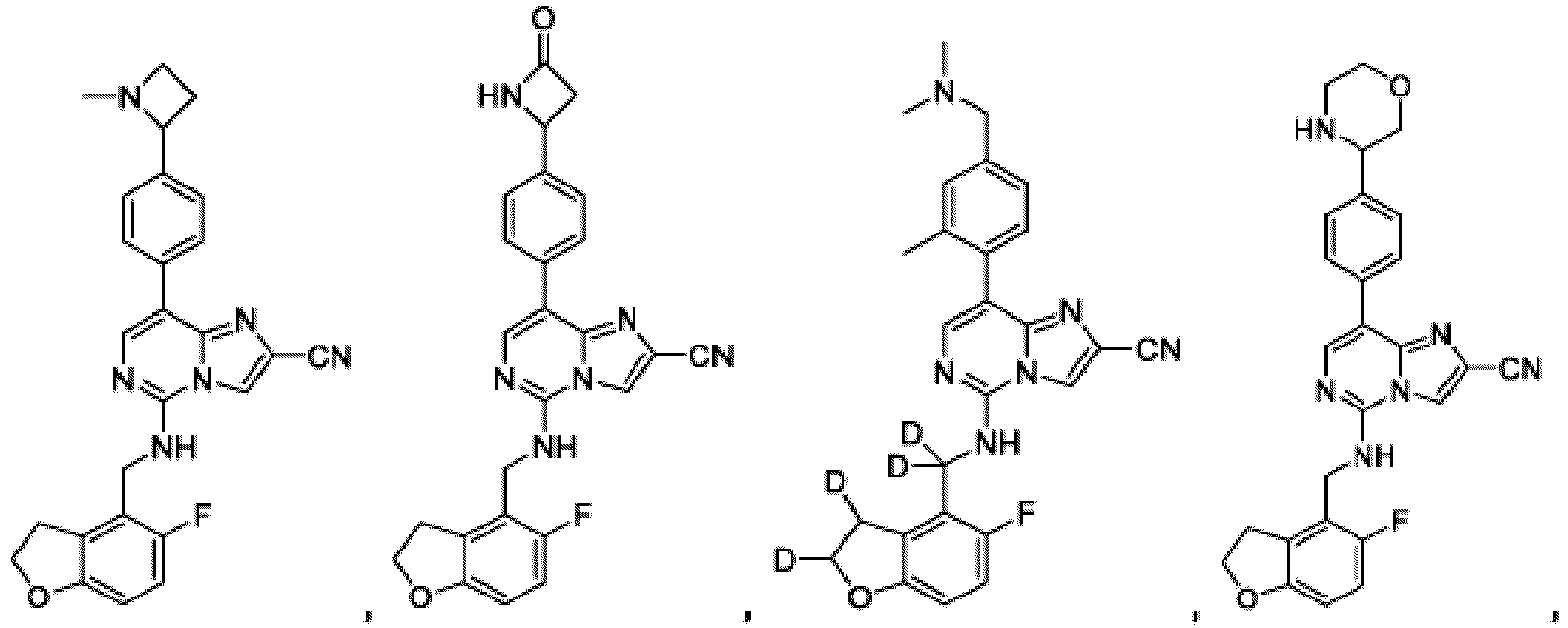

- Composé selon la revendication 1, dans lequel le composé est :


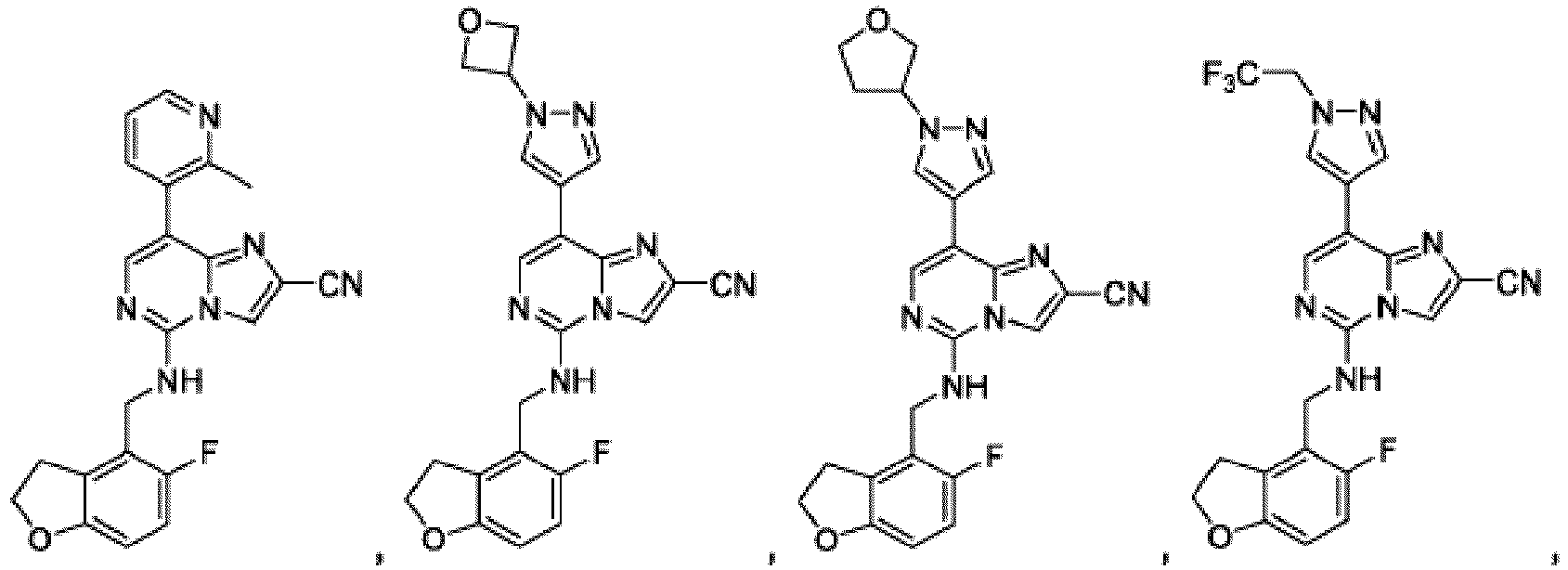


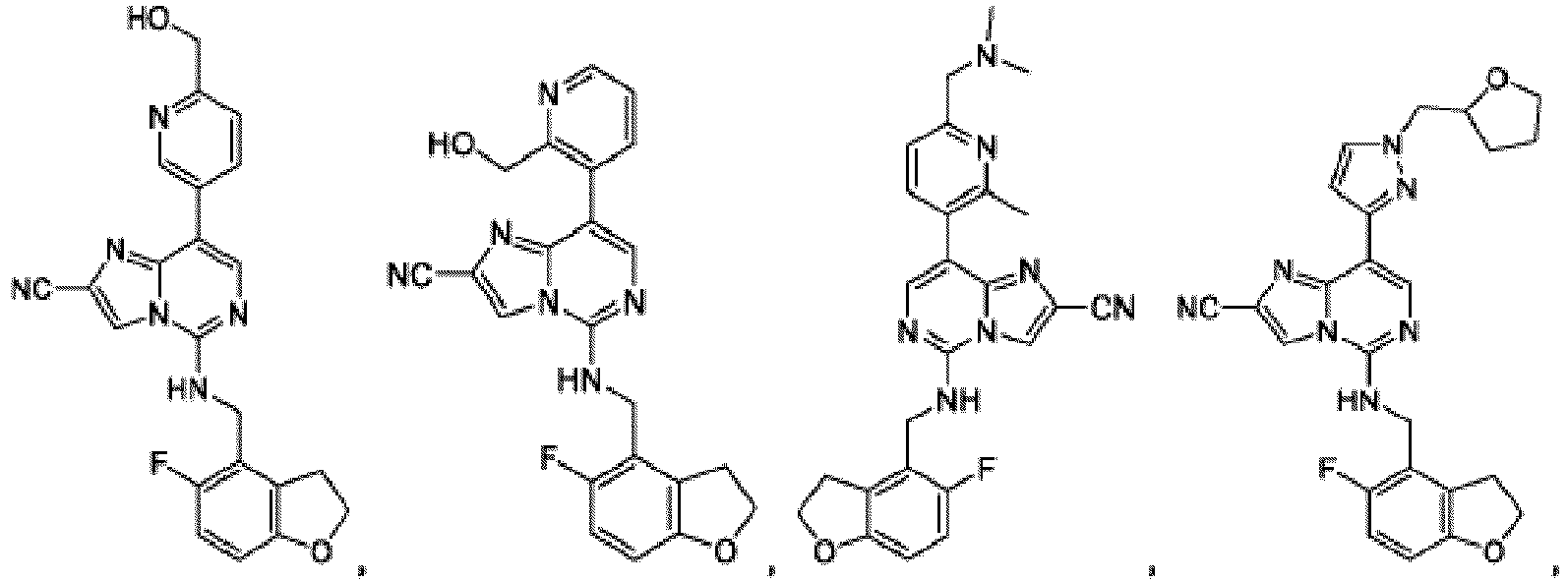


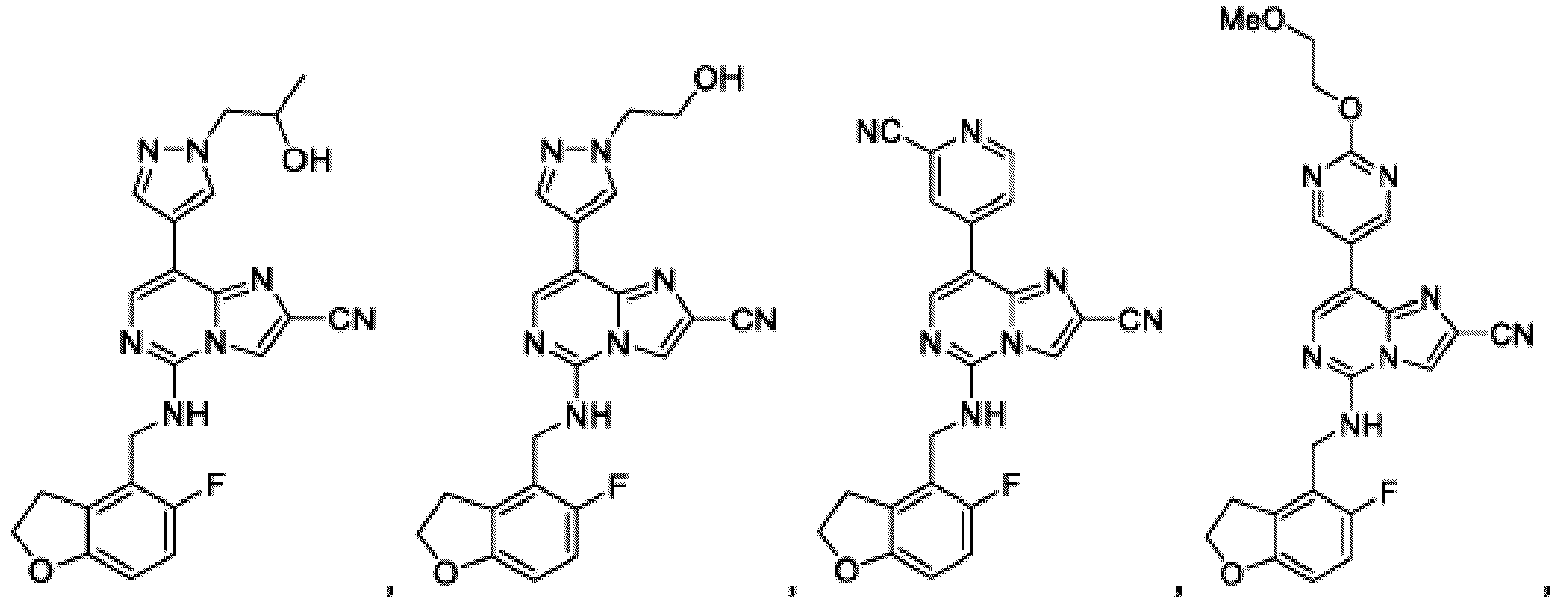


- Composé qui est :


- Composition pharmaceutique, comprenant :une quantité thérapeutiquement efficace d'un composé de Formule (I) selon l'une quelconque des revendications 1 à 13, ou d'un sel pharmaceutiquement acceptable de celui-ci ; ouune quantité thérapeutiquement efficace d'un composé selon la revendication 14, ou d'un sel pharmaceutiquement acceptable de celui-ci ;et un excipient pharmaceutiquement acceptable.
- Composé de Formule (I) selon l'une quelconque des revendications 1 à 13,ou un sel pharmaceutiquement acceptable de celui-ci, ouun composé selon la revendication 14,ou un sel pharmaceutiquement acceptable de celui-ci,seul ou combiné à un support, excipient ou diluant pharmaceutiquement acceptable, pour une utilisation dans un procédé de traitement d'un cancer.
- Composition pharmaceutique selon la revendication 15,
pour une utilisation dans un procédé de traitement d'un cancer. - Composé ou sel pour une utilisation selon la revendication 16, oucomposition pour une utilisation selon la revendication 17,dans lequel le cancer est un cancer associé à PRC2.
- Composé ou sel pour une utilisation selon la revendication 16, oucomposition pour une utilisation selon la revendication 17,dans lequel le cancer est un cancer de la prostate, un cancer du sein, un cancer de la peau, un cancer de la vessie, un cancer du foie, un cancer du pancréas, ou un cancer de la tête et du cou.
- Composé ou sel pour une utilisation selon la revendication 16, oucomposition pour une utilisation selon la revendication 17,dans lequel le cancer est un cancer de la prostate.
- Composé ou sel pour une utilisation selon la revendication 16, oucomposition pour une utilisation selon la revendication 17,dans lequel le cancer est un cancer du sein.
- Composé ou sel pour une utilisation selon la revendication 16, oucomposition pour une utilisation selon la revendication 17,dans lequel le cancer est un lymphome.
- Composé ou sel pour une utilisation selon la revendication 16, oucomposition pour une utilisation selon la revendication 17,dans lequel le cancer est un sarcome.
- Composé ou sel pour une utilisation selon la revendication 16, oucomposition pour une utilisation selon la revendication 17,dans lequel le cancer est un cancer du poumon.
- Composé ou sel pour une utilisation selon la revendication 16, oucomposition pour une utilisation selon la revendication 17,dans lequel le cancer est un cancer de l'ovaire.
Applications Claiming Priority (5)
| Application Number | Priority Date | Filing Date | Title |
|---|---|---|---|
| US201862624176P | 2018-01-31 | 2018-01-31 | |
| US201862672701P | 2018-05-17 | 2018-05-17 | |
| US201862747736P | 2018-10-19 | 2018-10-19 | |
| PCT/US2019/015677 WO2019152419A1 (fr) | 2018-01-31 | 2019-01-29 | Inhibiteurs de prc2 |
| EP19710816.0A EP3746446B1 (fr) | 2018-01-31 | 2019-01-29 | Inhibiteurs de prc2 |
Related Parent Applications (2)
| Application Number | Title | Priority Date | Filing Date |
|---|---|---|---|
| EP19710816.0A Division EP3746446B1 (fr) | 2018-01-31 | 2019-01-29 | Inhibiteurs de prc2 |
| EP19710816.0A Division-Into EP3746446B1 (fr) | 2018-01-31 | 2019-01-29 | Inhibiteurs de prc2 |
Publications (2)
| Publication Number | Publication Date |
|---|---|
| EP4043466A1 EP4043466A1 (fr) | 2022-08-17 |
| EP4043466B1 true EP4043466B1 (fr) | 2024-08-21 |
Family
ID=65763738
Family Applications (2)
| Application Number | Title | Priority Date | Filing Date |
|---|---|---|---|
| EP22165237.3A Active EP4043466B1 (fr) | 2018-01-31 | 2019-01-29 | Inhibiteurs de prc2 |
| EP19710816.0A Active EP3746446B1 (fr) | 2018-01-31 | 2019-01-29 | Inhibiteurs de prc2 |
Family Applications After (1)
| Application Number | Title | Priority Date | Filing Date |
|---|---|---|---|
| EP19710816.0A Active EP3746446B1 (fr) | 2018-01-31 | 2019-01-29 | Inhibiteurs de prc2 |
Country Status (19)
| Country | Link |
|---|---|
| US (5) | US11485738B2 (fr) |
| EP (2) | EP4043466B1 (fr) |
| JP (3) | JP7025556B2 (fr) |
| KR (2) | KR102776492B1 (fr) |
| CN (1) | CN112004816B (fr) |
| AU (2) | AU2019214861B2 (fr) |
| BR (1) | BR112020015583B1 (fr) |
| CA (1) | CA3089639C (fr) |
| DK (2) | DK3746446T3 (fr) |
| ES (2) | ES2991317T3 (fr) |
| FI (1) | FI4043466T3 (fr) |
| HU (2) | HUE069170T2 (fr) |
| IL (2) | IL276156B (fr) |
| MX (2) | MX2020007974A (fr) |
| NZ (1) | NZ766447A (fr) |
| PL (2) | PL3746446T3 (fr) |
| PT (2) | PT4043466T (fr) |
| WO (1) | WO2019152419A1 (fr) |
| ZA (2) | ZA202004453B (fr) |
Families Citing this family (14)
| Publication number | Priority date | Publication date | Assignee | Title |
|---|---|---|---|---|
| MX2020007974A (es) | 2018-01-31 | 2020-09-07 | Mirati Therapeutics Inc | Inhibidores de complejo represivo polycomb 2 (prc2). |
| EP3889153A4 (fr) * | 2018-11-30 | 2022-09-07 | Tuojie Biotech (Shanghai) Co., Ltd. | Pyrimidine et dérivé hétérocycle pentagonal de nitrogène, leur procédé de préparation et applications médicales |
| US12421228B2 (en) | 2019-04-22 | 2025-09-23 | Mirati Therapeutics, Inc. | Naphthyridine derivatives as PRC2 inhibitors |
| EP3980422A1 (fr) | 2019-06-05 | 2022-04-13 | Mirati Therapeutics, Inc. | Dérivés d'imidazo [1,2-c]pyrimidine utilisés comme inhibiteurs de prc2 pour le traitement du cancer |
| US12583870B2 (en) | 2019-08-22 | 2026-03-24 | Shanghai Blueray Biopharma Co., Ltd. | Azaheteroaryl compound and application thereof |
| CN113004233B (zh) * | 2019-12-18 | 2022-12-20 | 南京优氟医药科技有限公司 | 一种用于制备prc2抑制剂的化合物、其制备方法和用途 |
| CN114907385A (zh) * | 2021-02-10 | 2022-08-16 | 上海青煜医药科技有限公司 | 氮杂芳基化合物、其制备方法及应用 |
| EP4404932A4 (fr) * | 2021-09-24 | 2025-07-23 | Oric Pharmaceuticals Inc | Inhibiteurs de prc2 destinés à être utilisés dans le traitement de troubles sanguins |
| CN120187730A (zh) * | 2022-09-14 | 2025-06-20 | 欧瑞克制药公司 | Prc2抑制剂的物理形式 |
| GB202216323D0 (en) | 2022-11-02 | 2022-12-14 | Cerevance Ltd | Novel compounds |
| WO2024123669A1 (fr) * | 2022-12-05 | 2024-06-13 | Oric Pharmaceuticals, Inc. | Traitement du cancer de la prostate ayant des variants du récepteur des androgènes |
| WO2024148008A1 (fr) * | 2023-01-03 | 2024-07-11 | Oric Pharmaceuticals, Inc. | Traitement du cancer de la prostate neuroendocrinien |
| WO2024215699A1 (fr) * | 2023-04-11 | 2024-10-17 | Oric Pharmaceuticals, Inc. | Traitement du lymphome à lymphocytes t |
| IL326327A (en) * | 2023-08-04 | 2026-04-01 | Oric Pharmaceuticals Inc | Prostate cancer treatment |
Family Cites Families (74)
| Publication number | Priority date | Publication date | Assignee | Title |
|---|---|---|---|---|
| US6921762B2 (en) | 2001-11-16 | 2005-07-26 | Amgen Inc. | Substituted indolizine-like compounds and methods of use |
| WO2010021381A1 (fr) | 2008-08-22 | 2010-02-25 | 武田薬品工業株式会社 | Dérivé hétérocyclique fusionné et son utilisation |
| EA023788B1 (ru) | 2010-05-07 | 2016-07-29 | ГЛЭКСОСМИТКЛАЙН ЭлЭлСи | Производные индола и фармацевтические композиции на их основе |
| JP5864546B2 (ja) | 2010-05-07 | 2016-02-17 | グラクソスミスクライン・リミテッド・ライアビリティ・カンパニーGlaxoSmithKline LLC | インダゾール |
| US9175331B2 (en) | 2010-09-10 | 2015-11-03 | Epizyme, Inc. | Inhibitors of human EZH2, and methods of use thereof |
| US20130310379A1 (en) | 2010-11-19 | 2013-11-21 | Constellation Pharmaceuticals | Modulators of methyl modifying enzymes, compositions and uses thereof |
| EP2646455A4 (fr) | 2010-12-03 | 2014-04-02 | Epizyme Inc | Modulateurs d'histone méthyltransférase et leurs procédés d'utilisation |
| WO2012118812A2 (fr) | 2011-02-28 | 2012-09-07 | Epizyme, Inc. | Composés hétéroaryles bicycliques substitués condensés en 6,5 |
| JO3363B1 (ar) | 2011-04-13 | 2019-03-13 | Epizyme Inc | مركبات بنزين مستبدلة بأريل أو أريل غير متجانس |
| TW201733984A (zh) | 2011-04-13 | 2017-10-01 | 雅酶股份有限公司 | 經取代之苯化合物 |
| KR20140033377A (ko) | 2011-05-10 | 2014-03-18 | 길리애드 사이언시즈, 인코포레이티드 | 나트륨 채널 조절제로서의 융합된 헤테로시클릭 화합물 |
| CA2850570A1 (fr) | 2011-09-30 | 2013-04-04 | Glaxosmithkline Llc | Methodes de traitement du cancer |
| CA2853501A1 (fr) | 2011-10-27 | 2013-05-02 | Memorial Sloan-Kettering Cancer Center | Inhibiteurs de methyltransferase pour traiter le cancer |
| US9051269B2 (en) | 2011-11-18 | 2015-06-09 | Constellation Pharmaceuticals, Inc. | Modulators of methyl modifying enzymes, compositions and uses thereof |
| EP2780014A4 (fr) | 2011-11-18 | 2015-07-01 | Constellation Pharmaceuticals Inc | Modulateurs d'enzymes de modification par méthylation, compositions et utilisations associées |
| JP5989805B2 (ja) | 2012-02-10 | 2016-09-07 | コンステレーション・ファーマシューティカルズ・インコーポレイテッドConstellation Pharmaceuticals,Inc. | メチル基変更酵素の調節物質、組成物及びその使用 |
| SG10201608579UA (en) | 2012-04-13 | 2016-12-29 | Epizyme Inc | Combination therapy for treating cancer |
| US9562041B2 (en) | 2012-05-16 | 2017-02-07 | Glaxosmithkline Llc | Enhancer of zeste homolog 2 inhibitors |
| US9105490B2 (en) | 2012-09-27 | 2015-08-11 | Taiwan Semiconductor Manufacturing Company, Ltd. | Contact structure of semiconductor device |
| CA2884848C (fr) | 2012-09-28 | 2017-08-22 | Pfizer Inc. | Composes de benzamide et heterobenzamide |
| CA2887243C (fr) | 2012-10-15 | 2024-04-09 | Epizyme, Inc. | Methodes de traitement du cancer |
| PE20150887A1 (es) | 2012-10-15 | 2015-06-04 | Epizyme Inc | Compuestos de benceno sustituidos |
| KR20150095779A (ko) | 2012-12-13 | 2015-08-21 | 글락소스미스클라인 엘엘씨 | 제스트 인핸서 상동체 2 억제제 |
| UA111305C2 (uk) | 2012-12-21 | 2016-04-11 | Пфайзер Інк. | Конденсовані лактами арилу та гетероарилу |
| CA2894222A1 (fr) | 2012-12-21 | 2014-06-26 | Epizyme, Inc. | Composes heteroaryles bicycliques 1,4-pyridone |
| WO2014100646A1 (fr) | 2012-12-21 | 2014-06-26 | Epizyme, Inc. | Composés 1,4-pyridones |
| MA38341B1 (fr) | 2013-02-11 | 2018-11-30 | Constellation Pharmaceuticals Inc | Modulateurs d'enzymes de modification par méthylation, compositions et utilisations associées |
| CA2903572A1 (fr) | 2013-03-15 | 2014-10-23 | Epizyme, Inc. | Composes de benzene substitues |
| US9045477B2 (en) | 2013-03-15 | 2015-06-02 | Epizyme, Inc. | Substituted 6,5-fused bicyclic heteroaryl compounds |
| US9745305B2 (en) | 2013-03-15 | 2017-08-29 | Constellation Pharmaceuticals, Inc. | Modulators of methyl modifying enzymes, compositions and uses thereof |
| US9243001B2 (en) | 2013-03-15 | 2016-01-26 | Epizyme, Inc. | Substituted benzene compounds |
| US9776996B2 (en) | 2013-03-15 | 2017-10-03 | Epizyme, Inc. | Substituted 6,5-fused bicyclic heteroaryl compounds |
| WO2014177982A1 (fr) | 2013-04-30 | 2014-11-06 | Glaxosmithkline Intellectual Property (No.2) Limited | Activateur d'inhibiteurs de l'homologue 2 de zeste |
| EP3004096A1 (fr) | 2013-06-06 | 2016-04-13 | Glaxosmithkline Intellectual Property (No. 2) Limited | Activateur d'inhibiteurs de l'homologue 2 de zeste |
| AU2014288839B2 (en) | 2013-07-10 | 2017-02-02 | Glaxosmithkline Intellectual Property (No.2) Limited | Enhancer of Zeste Homolog 2 inhibitors |
| EP3022195A2 (fr) | 2013-07-19 | 2016-05-25 | Epizyme, Inc. | Composés hétéroaryles bicycliques substitués condensés en 6,5 |
| WO2015010049A1 (fr) | 2013-07-19 | 2015-01-22 | Epizyme, Inc. | Composés de benzène substitués |
| US9969716B2 (en) | 2013-08-15 | 2018-05-15 | Constellation Pharmaceuticals, Inc. | Indole derivatives as modulators of methyl modifying enzymes, compositions and uses thereof |
| US9738630B2 (en) | 2013-11-19 | 2017-08-22 | Bristol-Myers Squibb Company | Inhibitors of lysine methyl transferase |
| US9822103B2 (en) | 2013-11-22 | 2017-11-21 | Bristol-Myers Squibb Company | Inhibitors of lysine methyl transferase |
| US20160361309A1 (en) | 2014-02-26 | 2016-12-15 | Glaxosmithkline Intellectual Property (No.2) Limited | Methods of treating cancer patients responding to ezh2 inhibitor gsk126 |
| EP3114125A1 (fr) | 2014-03-07 | 2017-01-11 | Glaxosmithkline Intellectual Property (No. 2) Limited | Activateur d'inhibiteurs de l'homologue 2 de zeste |
| LT3121175T (lt) | 2014-03-17 | 2020-03-10 | Daiichi Sankyo Company, Limited | 1,3-benzodioksazolo dariniai, kaip ezh1 ir (arba) ezh2 inhibitoriai |
| TN2016000529A1 (en) | 2014-06-17 | 2018-04-04 | Pfizer | Substituted dihydroisoquinolinone compounds |
| WO2015193768A1 (fr) | 2014-06-17 | 2015-12-23 | Pfizer Inc. | Lactames à fusion aryle à utiliser en tant que modulateurs ezh2 |
| BR112017008840A2 (pt) | 2014-10-28 | 2017-12-19 | Glaxosmithkline Ip No 2 Ltd | intensificador de inibidores do homólogo 2 de zeste |
| WO2016073956A1 (fr) | 2014-11-06 | 2016-05-12 | Dana-Farber Cancer Institute, Inc. | Inhibiteurs d'ezh2 et leurs utilisations |
| US20190000860A1 (en) | 2014-11-06 | 2019-01-03 | Dana-Farber Cancer Institute, Inc. | Use of compositions modulating chromatin structure for graft versus host disease (gvhd) |
| AR102767A1 (es) | 2014-12-05 | 2017-03-22 | Lilly Co Eli | Inhibidores de ezh2 |
| WO2016102493A1 (fr) | 2014-12-22 | 2016-06-30 | Bayer Pharma Aktiengesellschaft | Inhibiteurs d'ezh2 de type imidazopyridine |
| UY36462A (es) | 2014-12-23 | 2016-07-29 | Novartis Ag | Compuestos de triazolopirimidina y usos de los mismos |
| IL236420A (en) * | 2014-12-23 | 2016-06-30 | Ron Schneider | Methods and systems for producing an enlarged 3D image |
| WO2016123387A1 (fr) | 2015-01-30 | 2016-08-04 | Genentech, Inc. | Composés thérapeutiques et leurs utilisations |
| WO2016130396A1 (fr) | 2015-02-13 | 2016-08-18 | Constellation Pharmaceuticals, Inc. | Modulateurs d'enzymes de modification méthylique, compositions et utilisations associées |
| TW201718598A (zh) | 2015-08-27 | 2017-06-01 | 美國禮來大藥廠 | Ezh2抑制劑 |
| RS59763B1 (sr) | 2015-11-19 | 2020-02-28 | Jiangsu Hengrui Medicine Co | Derivati benzofurana, postupci njihove pripreme i njihova upotreba u medicini |
| EP3386513A2 (fr) | 2015-12-07 | 2018-10-17 | Epizyme Inc | Inhibiteurs d'ezh2 et leur utilisation |
| WO2017174023A1 (fr) | 2016-04-08 | 2017-10-12 | 南京明德新药研发股份有限公司 | Composé biphényle servant comme inhibiteur de l'ezh2 |
| JP7493304B2 (ja) | 2016-04-22 | 2024-05-31 | ダナ-ファーバー キャンサー インスティテュート, インコーポレイテッド | Ezh2インヒビターおよびそれらの使用 |
| KR20190003699A (ko) | 2016-05-05 | 2019-01-09 | 글락소스미스클라인 인털렉츄얼 프로퍼티 (넘버 2) 리미티드 | 제스트 인핸서 상동체 2 억제제 |
| US9957274B2 (en) | 2016-05-06 | 2018-05-01 | Abbvie Inc. | Indane inhibitors of EED and methods of their use |
| WO2017210395A1 (fr) | 2016-06-01 | 2017-12-07 | Epizyme, Inc. | Utilisation d'inhibiteurs de ezh2 pour le traitement du cancer |
| EP3471830A4 (fr) | 2016-06-17 | 2020-02-26 | Epizyme Inc | Inhibiteurs d'ezh2 pour traiter le cancer |
| ES2975263T3 (es) | 2016-06-20 | 2024-07-04 | Novartis Ag | Formas cristalinas de un compuesto triazolopirimidínico |
| EP3472166A1 (fr) | 2016-06-20 | 2019-04-24 | Novartis AG | Composés d'imidazopyrimidine utiles pour le traitement du cancer |
| WO2017221092A1 (fr) | 2016-06-20 | 2017-12-28 | Novartis Ag | Composés de triazolopyridine et leurs utilisations |
| US10266542B2 (en) | 2017-03-15 | 2019-04-23 | Mirati Therapeutics, Inc. | EZH2 inhibitors |
| WO2019062435A1 (fr) | 2017-09-28 | 2019-04-04 | 中国科学院上海药物研究所 | Utilisation de triazolopyrimidine, de composés de triazolopyridine et d'une composition de ceux-ci pour le traitement de maladies médiées par prc2 |
| CN109942556A (zh) | 2017-12-21 | 2019-06-28 | 上海青煜医药科技有限公司 | 嘧啶酮化合物及其应用 |
| MX2020007974A (es) | 2018-01-31 | 2020-09-07 | Mirati Therapeutics Inc | Inhibidores de complejo represivo polycomb 2 (prc2). |
| CN110156787B (zh) | 2018-02-13 | 2021-11-02 | 中国科学院上海药物研究所 | 一种三氮唑并嘧啶衍生化合物、包含其的药物组合物及其用途 |
| CN110563722A (zh) | 2018-06-06 | 2019-12-13 | 上海青煜医药科技有限公司 | 吡啶或哒嗪并环化合物及其应用 |
| US12421228B2 (en) | 2019-04-22 | 2025-09-23 | Mirati Therapeutics, Inc. | Naphthyridine derivatives as PRC2 inhibitors |
| EP3980422A1 (fr) | 2019-06-05 | 2022-04-13 | Mirati Therapeutics, Inc. | Dérivés d'imidazo [1,2-c]pyrimidine utilisés comme inhibiteurs de prc2 pour le traitement du cancer |
-
2019
- 2019-01-29 MX MX2020007974A patent/MX2020007974A/es unknown
- 2019-01-29 EP EP22165237.3A patent/EP4043466B1/fr active Active
- 2019-01-29 NZ NZ766447A patent/NZ766447A/en unknown
- 2019-01-29 PL PL19710816.0T patent/PL3746446T3/pl unknown
- 2019-01-29 FI FIEP22165237.3T patent/FI4043466T3/fi active
- 2019-01-29 CN CN201980011176.8A patent/CN112004816B/zh active Active
- 2019-01-29 HU HUE22165237A patent/HUE069170T2/hu unknown
- 2019-01-29 CA CA3089639A patent/CA3089639C/fr active Active
- 2019-01-29 ES ES22165237T patent/ES2991317T3/es active Active
- 2019-01-29 PT PT221652373T patent/PT4043466T/pt unknown
- 2019-01-29 PT PT197108160T patent/PT3746446T/pt unknown
- 2019-01-29 BR BR112020015583-7A patent/BR112020015583B1/pt active IP Right Grant
- 2019-01-29 KR KR1020227034197A patent/KR102776492B1/ko active Active
- 2019-01-29 WO PCT/US2019/015677 patent/WO2019152419A1/fr not_active Ceased
- 2019-01-29 AU AU2019214861A patent/AU2019214861B2/en active Active
- 2019-01-29 ES ES19710816T patent/ES2923290T3/es active Active
- 2019-01-29 HU HUE19710816A patent/HUE059536T2/hu unknown
- 2019-01-29 EP EP19710816.0A patent/EP3746446B1/fr active Active
- 2019-01-29 DK DK19710816.0T patent/DK3746446T3/da active
- 2019-01-29 PL PL22165237.3T patent/PL4043466T3/pl unknown
- 2019-01-29 US US16/966,708 patent/US11485738B2/en active Active
- 2019-01-29 JP JP2020541557A patent/JP7025556B2/ja active Active
- 2019-01-29 KR KR1020207024436A patent/KR102451529B1/ko active Active
- 2019-01-29 DK DK22165237.3T patent/DK4043466T3/da active
-
2020
- 2020-07-20 IL IL276156A patent/IL276156B/en unknown
- 2020-07-20 ZA ZA2020/04453A patent/ZA202004453B/en unknown
- 2020-07-29 MX MX2021012501A patent/MX2021012501A/es unknown
- 2020-12-09 US US17/116,270 patent/US11091495B2/en active Active
-
2021
- 2021-03-31 US US17/219,379 patent/US11220509B2/en active Active
- 2021-08-04 IL IL285354A patent/IL285354B/en unknown
- 2021-10-13 ZA ZA2021/07835A patent/ZA202107835B/en unknown
- 2021-11-12 AU AU2021266351A patent/AU2021266351B2/en active Active
-
2022
- 2022-02-10 JP JP2022019319A patent/JP7288527B2/ja active Active
- 2022-08-26 US US17/822,667 patent/US12371435B2/en active Active
-
2023
- 2023-05-26 JP JP2023086866A patent/JP7495555B2/ja active Active
-
2025
- 2025-05-22 US US19/215,627 patent/US20250282787A1/en active Pending
Also Published As
Similar Documents
| Publication | Publication Date | Title |
|---|---|---|
| EP4043466B1 (fr) | Inhibiteurs de prc2 | |
| KR20220027933A (ko) | 암을 치료하기 위한 prc2 억제제로서의 이미다조[1,2-c]피리미딘 유도체 | |
| US20240398811A1 (en) | Prc2 inhibitors for use in treating blood disorders | |
| HK40077182B (en) | Prc2 inhibitors | |
| HK40077182A (en) | Prc2 inhibitors | |
| HK40039589B (en) | Prc2 inhibitors | |
| HK40039589A (en) | Prc2 inhibitors | |
| WO2025043191A1 (fr) | Inhibiteurs de prc2 destinés à être utilisés dans le traitement de la drépanocytose | |
| EA043605B1 (ru) | Ингибиторы prc2 |
Legal Events
| Date | Code | Title | Description |
|---|---|---|---|
| PUAI | Public reference made under article 153(3) epc to a published international application that has entered the european phase |
Free format text: ORIGINAL CODE: 0009012 |
|
| STAA | Information on the status of an ep patent application or granted ep patent |
Free format text: STATUS: THE APPLICATION HAS BEEN PUBLISHED |
|
| AC | Divisional application: reference to earlier application |
Ref document number: 3746446 Country of ref document: EP Kind code of ref document: P |
|
| AK | Designated contracting states |
Kind code of ref document: A1 Designated state(s): AL AT BE BG CH CY CZ DE DK EE ES FI FR GB GR HR HU IE IS IT LI LT LU LV MC MK MT NL NO PL PT RO RS SE SI SK SM TR |
|
| STAA | Information on the status of an ep patent application or granted ep patent |
Free format text: STATUS: REQUEST FOR EXAMINATION WAS MADE |
|
| REG | Reference to a national code |
Ref country code: HK Ref legal event code: DE Ref document number: 40077182 Country of ref document: HK |
|
| 17P | Request for examination filed |
Effective date: 20230215 |
|
| RBV | Designated contracting states (corrected) |
Designated state(s): AL AT BE BG CH CY CZ DE DK EE ES FI FR GB GR HR HU IE IS IT LI LT LU LV MC MK MT NL NO PL PT RO RS SE SI SK SM TR |
|
| P01 | Opt-out of the competence of the unified patent court (upc) registered |
Effective date: 20230509 |
|
| GRAP | Despatch of communication of intention to grant a patent |
Free format text: ORIGINAL CODE: EPIDOSNIGR1 |
|
| STAA | Information on the status of an ep patent application or granted ep patent |
Free format text: STATUS: GRANT OF PATENT IS INTENDED |
|
| INTG | Intention to grant announced |
Effective date: 20230714 |
|
| GRAJ | Information related to disapproval of communication of intention to grant by the applicant or resumption of examination proceedings by the epo deleted |
Free format text: ORIGINAL CODE: EPIDOSDIGR1 |
|
| STAA | Information on the status of an ep patent application or granted ep patent |
Free format text: STATUS: REQUEST FOR EXAMINATION WAS MADE |
|
| INTC | Intention to grant announced (deleted) | ||
| GRAP | Despatch of communication of intention to grant a patent |
Free format text: ORIGINAL CODE: EPIDOSNIGR1 |
|
| STAA | Information on the status of an ep patent application or granted ep patent |
Free format text: STATUS: GRANT OF PATENT IS INTENDED |
|
| INTG | Intention to grant announced |
Effective date: 20240104 |
|
| GRAJ | Information related to disapproval of communication of intention to grant by the applicant or resumption of examination proceedings by the epo deleted |
Free format text: ORIGINAL CODE: EPIDOSDIGR1 |
|
| STAA | Information on the status of an ep patent application or granted ep patent |
Free format text: STATUS: REQUEST FOR EXAMINATION WAS MADE |
|
| GRAP | Despatch of communication of intention to grant a patent |
Free format text: ORIGINAL CODE: EPIDOSNIGR1 |
|
| STAA | Information on the status of an ep patent application or granted ep patent |
Free format text: STATUS: GRANT OF PATENT IS INTENDED |
|
| INTC | Intention to grant announced (deleted) | ||
| INTG | Intention to grant announced |
Effective date: 20240327 |
|
| GRAS | Grant fee paid |
Free format text: ORIGINAL CODE: EPIDOSNIGR3 |
|
| GRAA | (expected) grant |
Free format text: ORIGINAL CODE: 0009210 |
|
| STAA | Information on the status of an ep patent application or granted ep patent |
Free format text: STATUS: THE PATENT HAS BEEN GRANTED |
|
| AC | Divisional application: reference to earlier application |
Ref document number: 3746446 Country of ref document: EP Kind code of ref document: P |
|
| AK | Designated contracting states |
Kind code of ref document: B1 Designated state(s): AL AT BE BG CH CY CZ DE DK EE ES FI FR GB GR HR HU IE IS IT LI LT LU LV MC MK MT NL NO PL PT RO RS SE SI SK SM TR |
|
| REG | Reference to a national code |
Ref country code: GB Ref legal event code: FG4D |
|
| REG | Reference to a national code |
Ref country code: CH Ref legal event code: EP |
|
| REG | Reference to a national code |
Ref country code: IE Ref legal event code: FG4D |
|
| REG | Reference to a national code |
Ref country code: DE Ref legal event code: R096 Ref document number: 602019057717 Country of ref document: DE |
|
| REG | Reference to a national code |
Ref country code: DK Ref legal event code: T3 Effective date: 20240924 |
|
| REG | Reference to a national code |
Ref country code: NL Ref legal event code: FP |
|
| REG | Reference to a national code |
Ref country code: PT Ref legal event code: SC4A Ref document number: 4043466 Country of ref document: PT Date of ref document: 20241014 Kind code of ref document: T Free format text: AVAILABILITY OF NATIONAL TRANSLATION Effective date: 20241004 |
|
| REG | Reference to a national code |
Ref country code: FI Ref legal event code: FGE |
|
| REG | Reference to a national code |
Ref country code: SE Ref legal event code: TRGR |
|
| REG | Reference to a national code |
Ref country code: DE Ref legal event code: R081 Ref document number: 602019057717 Country of ref document: DE Owner name: MIRATI THERAPEUTICS, INC., PRINCETON, US Free format text: FORMER OWNER: MIRATI THERAPEUTICS, INC., SAN DIEGO, CA, US |
|
| RAP4 | Party data changed (patent owner data changed or rights of a patent transferred) |
Owner name: MIRATI THERAPEUTICS, INC. |
|
| REG | Reference to a national code |
Ref country code: ES Ref legal event code: FG2A Ref document number: 2991317 Country of ref document: ES Kind code of ref document: T3 Effective date: 20241203 |
|
| REG | Reference to a national code |
Ref country code: SK Ref legal event code: T3 Ref document number: E 45078 Country of ref document: SK |
|
| REG | Reference to a national code |
Ref country code: LT Ref legal event code: MG9D |
|
| REG | Reference to a national code |
Ref country code: GR Ref legal event code: EP Ref document number: 20240402623 Country of ref document: GR Effective date: 20241209 |
|
| PG25 | Lapsed in a contracting state [announced via postgrant information from national office to epo] |
Ref country code: LV Free format text: LAPSE BECAUSE OF FAILURE TO SUBMIT A TRANSLATION OF THE DESCRIPTION OR TO PAY THE FEE WITHIN THE PRESCRIBED TIME-LIMIT Effective date: 20240821 |
|
| PG25 | Lapsed in a contracting state [announced via postgrant information from national office to epo] |
Ref country code: IS Free format text: LAPSE BECAUSE OF FAILURE TO SUBMIT A TRANSLATION OF THE DESCRIPTION OR TO PAY THE FEE WITHIN THE PRESCRIBED TIME-LIMIT Effective date: 20241221 |
|
| PG25 | Lapsed in a contracting state [announced via postgrant information from national office to epo] |
Ref country code: HR Free format text: LAPSE BECAUSE OF FAILURE TO SUBMIT A TRANSLATION OF THE DESCRIPTION OR TO PAY THE FEE WITHIN THE PRESCRIBED TIME-LIMIT Effective date: 20240821 |
|
| PG25 | Lapsed in a contracting state [announced via postgrant information from national office to epo] |
Ref country code: RS Free format text: LAPSE BECAUSE OF FAILURE TO SUBMIT A TRANSLATION OF THE DESCRIPTION OR TO PAY THE FEE WITHIN THE PRESCRIBED TIME-LIMIT Effective date: 20241121 |
|
| PG25 | Lapsed in a contracting state [announced via postgrant information from national office to epo] |
Ref country code: RS Free format text: LAPSE BECAUSE OF FAILURE TO SUBMIT A TRANSLATION OF THE DESCRIPTION OR TO PAY THE FEE WITHIN THE PRESCRIBED TIME-LIMIT Effective date: 20241121 Ref country code: LV Free format text: LAPSE BECAUSE OF FAILURE TO SUBMIT A TRANSLATION OF THE DESCRIPTION OR TO PAY THE FEE WITHIN THE PRESCRIBED TIME-LIMIT Effective date: 20240821 Ref country code: IS Free format text: LAPSE BECAUSE OF FAILURE TO SUBMIT A TRANSLATION OF THE DESCRIPTION OR TO PAY THE FEE WITHIN THE PRESCRIBED TIME-LIMIT Effective date: 20241221 Ref country code: HR Free format text: LAPSE BECAUSE OF FAILURE TO SUBMIT A TRANSLATION OF THE DESCRIPTION OR TO PAY THE FEE WITHIN THE PRESCRIBED TIME-LIMIT Effective date: 20240821 |
|
| REG | Reference to a national code |
Ref country code: HU Ref legal event code: AG4A Ref document number: E069170 Country of ref document: HU |
|
| PG25 | Lapsed in a contracting state [announced via postgrant information from national office to epo] |
Ref country code: SM Free format text: LAPSE BECAUSE OF FAILURE TO SUBMIT A TRANSLATION OF THE DESCRIPTION OR TO PAY THE FEE WITHIN THE PRESCRIBED TIME-LIMIT Effective date: 20240821 |
|
| PGFP | Annual fee paid to national office [announced via postgrant information from national office to epo] |
Ref country code: BG Payment date: 20250115 Year of fee payment: 7 |
|
| PG25 | Lapsed in a contracting state [announced via postgrant information from national office to epo] |
Ref country code: EE Free format text: LAPSE BECAUSE OF FAILURE TO SUBMIT A TRANSLATION OF THE DESCRIPTION OR TO PAY THE FEE WITHIN THE PRESCRIBED TIME-LIMIT Effective date: 20240821 |
|
| REG | Reference to a national code |
Ref country code: DE Ref legal event code: R097 Ref document number: 602019057717 Country of ref document: DE |
|
| PLBE | No opposition filed within time limit |
Free format text: ORIGINAL CODE: 0009261 |
|
| STAA | Information on the status of an ep patent application or granted ep patent |
Free format text: STATUS: NO OPPOSITION FILED WITHIN TIME LIMIT |
|
| 26N | No opposition filed |
Effective date: 20250522 |
|
| REG | Reference to a national code |
Ref country code: CH Ref legal event code: U11 Free format text: ST27 STATUS EVENT CODE: U-0-0-U10-U11 (AS PROVIDED BY THE NATIONAL OFFICE) Effective date: 20260201 |
|
| PGFP | Annual fee paid to national office [announced via postgrant information from national office to epo] |
Ref country code: NL Payment date: 20260126 Year of fee payment: 8 Ref country code: LU Payment date: 20260127 Year of fee payment: 8 |
|
| PGFP | Annual fee paid to national office [announced via postgrant information from national office to epo] |
Ref country code: HU Payment date: 20260109 Year of fee payment: 8 |
|
| PGFP | Annual fee paid to national office [announced via postgrant information from national office to epo] |
Ref country code: SE Payment date: 20260127 Year of fee payment: 8 |
|
| PGFP | Annual fee paid to national office [announced via postgrant information from national office to epo] |
Ref country code: GB Payment date: 20260127 Year of fee payment: 8 |
|
| PGFP | Annual fee paid to national office [announced via postgrant information from national office to epo] |
Ref country code: ES Payment date: 20260202 Year of fee payment: 8 Ref country code: MC Payment date: 20260105 Year of fee payment: 8 |
|
| PGFP | Annual fee paid to national office [announced via postgrant information from national office to epo] |
Ref country code: NO Payment date: 20260128 Year of fee payment: 8 Ref country code: DK Payment date: 20260126 Year of fee payment: 8 Ref country code: IE Payment date: 20260127 Year of fee payment: 8 Ref country code: DE Payment date: 20260128 Year of fee payment: 8 |
|
| PGFP | Annual fee paid to national office [announced via postgrant information from national office to epo] |
Ref country code: AT Payment date: 20260128 Year of fee payment: 8 |
|
| PGFP | Annual fee paid to national office [announced via postgrant information from national office to epo] |
Ref country code: RO Payment date: 20260113 Year of fee payment: 8 Ref country code: FI Payment date: 20260126 Year of fee payment: 8 Ref country code: BE Payment date: 20260127 Year of fee payment: 8 Ref country code: IT Payment date: 20260121 Year of fee payment: 8 |
|
| PGFP | Annual fee paid to national office [announced via postgrant information from national office to epo] |
Ref country code: FR Payment date: 20260126 Year of fee payment: 8 |
|
| PGFP | Annual fee paid to national office [announced via postgrant information from national office to epo] |
Ref country code: TR Payment date: 20260116 Year of fee payment: 8 |
|
| PGFP | Annual fee paid to national office [announced via postgrant information from national office to epo] |
Ref country code: PT Payment date: 20260113 Year of fee payment: 8 Ref country code: CH Payment date: 20260201 Year of fee payment: 8 Ref country code: CZ Payment date: 20260108 Year of fee payment: 8 |
|
| PGFP | Annual fee paid to national office [announced via postgrant information from national office to epo] |
Ref country code: GR Payment date: 20260127 Year of fee payment: 8 Ref country code: PL Payment date: 20260108 Year of fee payment: 8 |
|
| PGFP | Annual fee paid to national office [announced via postgrant information from national office to epo] |
Ref country code: SK Payment date: 20260102 Year of fee payment: 8 |