EP4218580A1 - Dispositif et systèmes de surveillance physiologique sans fil - Google Patents
Dispositif et systèmes de surveillance physiologique sans fil Download PDFInfo
- Publication number
- EP4218580A1 EP4218580A1 EP23161870.3A EP23161870A EP4218580A1 EP 4218580 A1 EP4218580 A1 EP 4218580A1 EP 23161870 A EP23161870 A EP 23161870A EP 4218580 A1 EP4218580 A1 EP 4218580A1
- Authority
- EP
- European Patent Office
- Prior art keywords
- data
- patient
- signal
- cardiac
- machine
- Prior art date
- Legal status (The legal status is an assumption and is not a legal conclusion. Google has not performed a legal analysis and makes no representation as to the accuracy of the status listed.)
- Pending
Links
Images









Classifications
-
- G—PHYSICS
- G16—INFORMATION AND COMMUNICATION TECHNOLOGY [ICT] SPECIALLY ADAPTED FOR SPECIFIC APPLICATION FIELDS
- G16H—HEALTHCARE INFORMATICS, i.e. INFORMATION AND COMMUNICATION TECHNOLOGY [ICT] SPECIALLY ADAPTED FOR THE HANDLING OR PROCESSING OF MEDICAL OR HEALTHCARE DATA
- G16H40/00—ICT specially adapted for the management or administration of healthcare resources or facilities; ICT specially adapted for the management or operation of medical equipment or devices
- G16H40/60—ICT specially adapted for the management or administration of healthcare resources or facilities; ICT specially adapted for the management or operation of medical equipment or devices for the operation of medical equipment or devices
- G16H40/67—ICT specially adapted for the management or administration of healthcare resources or facilities; ICT specially adapted for the management or operation of medical equipment or devices for the operation of medical equipment or devices for remote operation
-
- A—HUMAN NECESSITIES
- A61—MEDICAL OR VETERINARY SCIENCE; HYGIENE
- A61B—DIAGNOSIS; SURGERY; IDENTIFICATION
- A61B5/00—Measuring for diagnostic purposes; Identification of persons
- A61B5/0002—Remote monitoring of patients using telemetry, e.g. transmission of vital signals via a communication network
- A61B5/0004—Remote monitoring of patients using telemetry, e.g. transmission of vital signals via a communication network characterised by the type of physiological signal transmitted
- A61B5/0006—ECG or EEG signals
-
- A—HUMAN NECESSITIES
- A61—MEDICAL OR VETERINARY SCIENCE; HYGIENE
- A61B—DIAGNOSIS; SURGERY; IDENTIFICATION
- A61B5/00—Measuring for diagnostic purposes; Identification of persons
- A61B5/0002—Remote monitoring of patients using telemetry, e.g. transmission of vital signals via a communication network
- A61B5/0015—Remote monitoring of patients using telemetry, e.g. transmission of vital signals via a communication network characterised by features of the telemetry system
- A61B5/0022—Monitoring a patient using a global network, e.g. telephone networks, internet
-
- A—HUMAN NECESSITIES
- A61—MEDICAL OR VETERINARY SCIENCE; HYGIENE
- A61B—DIAGNOSIS; SURGERY; IDENTIFICATION
- A61B5/00—Measuring for diagnostic purposes; Identification of persons
- A61B5/02—Detecting, measuring or recording for evaluating the cardiovascular system, e.g. pulse, heart rate, blood pressure or blood flow
- A61B5/0205—Simultaneously evaluating both cardiovascular conditions and different types of body conditions, e.g. heart and respiratory condition
-
- A—HUMAN NECESSITIES
- A61—MEDICAL OR VETERINARY SCIENCE; HYGIENE
- A61B—DIAGNOSIS; SURGERY; IDENTIFICATION
- A61B5/00—Measuring for diagnostic purposes; Identification of persons
- A61B5/24—Detecting, measuring or recording bioelectric or biomagnetic signals of the body or parts thereof
- A61B5/25—Bioelectric electrodes therefor
- A61B5/251—Means for maintaining electrode contact with the body
- A61B5/257—Means for maintaining electrode contact with the body using adhesive means, e.g. adhesive pads or tapes
-
- A—HUMAN NECESSITIES
- A61—MEDICAL OR VETERINARY SCIENCE; HYGIENE
- A61B—DIAGNOSIS; SURGERY; IDENTIFICATION
- A61B5/00—Measuring for diagnostic purposes; Identification of persons
- A61B5/24—Detecting, measuring or recording bioelectric or biomagnetic signals of the body or parts thereof
- A61B5/25—Bioelectric electrodes therefor
- A61B5/251—Means for maintaining electrode contact with the body
- A61B5/257—Means for maintaining electrode contact with the body using adhesive means, e.g. adhesive pads or tapes
- A61B5/259—Means for maintaining electrode contact with the body using adhesive means, e.g. adhesive pads or tapes using conductive adhesive means, e.g. gels
-
- A—HUMAN NECESSITIES
- A61—MEDICAL OR VETERINARY SCIENCE; HYGIENE
- A61B—DIAGNOSIS; SURGERY; IDENTIFICATION
- A61B5/00—Measuring for diagnostic purposes; Identification of persons
- A61B5/24—Detecting, measuring or recording bioelectric or biomagnetic signals of the body or parts thereof
- A61B5/25—Bioelectric electrodes therefor
- A61B5/279—Bioelectric electrodes therefor specially adapted for particular uses
- A61B5/28—Bioelectric electrodes therefor specially adapted for particular uses for electrocardiography [ECG]
-
- A—HUMAN NECESSITIES
- A61—MEDICAL OR VETERINARY SCIENCE; HYGIENE
- A61B—DIAGNOSIS; SURGERY; IDENTIFICATION
- A61B5/00—Measuring for diagnostic purposes; Identification of persons
- A61B5/24—Detecting, measuring or recording bioelectric or biomagnetic signals of the body or parts thereof
- A61B5/316—Modalities, i.e. specific diagnostic methods
-
- A—HUMAN NECESSITIES
- A61—MEDICAL OR VETERINARY SCIENCE; HYGIENE
- A61B—DIAGNOSIS; SURGERY; IDENTIFICATION
- A61B5/00—Measuring for diagnostic purposes; Identification of persons
- A61B5/24—Detecting, measuring or recording bioelectric or biomagnetic signals of the body or parts thereof
- A61B5/316—Modalities, i.e. specific diagnostic methods
- A61B5/318—Heart-related electrical modalities, e.g. electrocardiography [ECG]
- A61B5/33—Heart-related electrical modalities, e.g. electrocardiography [ECG] specially adapted for cooperation with other devices
-
- A—HUMAN NECESSITIES
- A61—MEDICAL OR VETERINARY SCIENCE; HYGIENE
- A61B—DIAGNOSIS; SURGERY; IDENTIFICATION
- A61B5/00—Measuring for diagnostic purposes; Identification of persons
- A61B5/24—Detecting, measuring or recording bioelectric or biomagnetic signals of the body or parts thereof
- A61B5/316—Modalities, i.e. specific diagnostic methods
- A61B5/318—Heart-related electrical modalities, e.g. electrocardiography [ECG]
- A61B5/333—Recording apparatus specially adapted therefor
- A61B5/335—Recording apparatus specially adapted therefor using integrated circuit memory devices
-
- A—HUMAN NECESSITIES
- A61—MEDICAL OR VETERINARY SCIENCE; HYGIENE
- A61B—DIAGNOSIS; SURGERY; IDENTIFICATION
- A61B5/00—Measuring for diagnostic purposes; Identification of persons
- A61B5/24—Detecting, measuring or recording bioelectric or biomagnetic signals of the body or parts thereof
- A61B5/316—Modalities, i.e. specific diagnostic methods
- A61B5/318—Heart-related electrical modalities, e.g. electrocardiography [ECG]
- A61B5/346—Analysis of electrocardiograms
-
- A—HUMAN NECESSITIES
- A61—MEDICAL OR VETERINARY SCIENCE; HYGIENE
- A61B—DIAGNOSIS; SURGERY; IDENTIFICATION
- A61B5/00—Measuring for diagnostic purposes; Identification of persons
- A61B5/24—Detecting, measuring or recording bioelectric or biomagnetic signals of the body or parts thereof
- A61B5/316—Modalities, i.e. specific diagnostic methods
- A61B5/318—Heart-related electrical modalities, e.g. electrocardiography [ECG]
- A61B5/346—Analysis of electrocardiograms
- A61B5/349—Detecting specific parameters of the electrocardiograph cycle
- A61B5/352—Detecting R peaks, e.g. for synchronising diagnostic apparatus; Estimating R-R interval
-
- A—HUMAN NECESSITIES
- A61—MEDICAL OR VETERINARY SCIENCE; HYGIENE
- A61B—DIAGNOSIS; SURGERY; IDENTIFICATION
- A61B5/00—Measuring for diagnostic purposes; Identification of persons
- A61B5/24—Detecting, measuring or recording bioelectric or biomagnetic signals of the body or parts thereof
- A61B5/316—Modalities, i.e. specific diagnostic methods
- A61B5/318—Heart-related electrical modalities, e.g. electrocardiography [ECG]
- A61B5/346—Analysis of electrocardiograms
- A61B5/349—Detecting specific parameters of the electrocardiograph cycle
- A61B5/361—Detecting fibrillation
-
- A—HUMAN NECESSITIES
- A61—MEDICAL OR VETERINARY SCIENCE; HYGIENE
- A61B—DIAGNOSIS; SURGERY; IDENTIFICATION
- A61B5/00—Measuring for diagnostic purposes; Identification of persons
- A61B5/24—Detecting, measuring or recording bioelectric or biomagnetic signals of the body or parts thereof
- A61B5/316—Modalities, i.e. specific diagnostic methods
- A61B5/318—Heart-related electrical modalities, e.g. electrocardiography [ECG]
- A61B5/346—Analysis of electrocardiograms
- A61B5/349—Detecting specific parameters of the electrocardiograph cycle
- A61B5/364—Detecting abnormal ECG interval, e.g. extrasystoles, ectopic heartbeats
-
- A—HUMAN NECESSITIES
- A61—MEDICAL OR VETERINARY SCIENCE; HYGIENE
- A61B—DIAGNOSIS; SURGERY; IDENTIFICATION
- A61B5/00—Measuring for diagnostic purposes; Identification of persons
- A61B5/24—Detecting, measuring or recording bioelectric or biomagnetic signals of the body or parts thereof
- A61B5/316—Modalities, i.e. specific diagnostic methods
- A61B5/318—Heart-related electrical modalities, e.g. electrocardiography [ECG]
- A61B5/346—Analysis of electrocardiograms
- A61B5/349—Detecting specific parameters of the electrocardiograph cycle
- A61B5/366—Detecting abnormal QRS complex, e.g. widening
-
- A—HUMAN NECESSITIES
- A61—MEDICAL OR VETERINARY SCIENCE; HYGIENE
- A61B—DIAGNOSIS; SURGERY; IDENTIFICATION
- A61B5/00—Measuring for diagnostic purposes; Identification of persons
- A61B5/48—Other medical applications
- A61B5/4836—Diagnosis combined with treatment in closed-loop systems or methods
- A61B5/4839—Diagnosis combined with treatment in closed-loop systems or methods combined with drug delivery
-
- A—HUMAN NECESSITIES
- A61—MEDICAL OR VETERINARY SCIENCE; HYGIENE
- A61B—DIAGNOSIS; SURGERY; IDENTIFICATION
- A61B5/00—Measuring for diagnostic purposes; Identification of persons
- A61B5/68—Arrangements of detecting, measuring or recording means, e.g. sensors, in relation to patient
- A61B5/6801—Arrangements of detecting, measuring or recording means, e.g. sensors, in relation to patient specially adapted to be attached to or worn on the body surface
- A61B5/683—Means for maintaining contact with the body
- A61B5/6832—Means for maintaining contact with the body using adhesives
-
- A—HUMAN NECESSITIES
- A61—MEDICAL OR VETERINARY SCIENCE; HYGIENE
- A61B—DIAGNOSIS; SURGERY; IDENTIFICATION
- A61B7/00—Instruments for auscultation
- A61B7/02—Stethoscopes
- A61B7/04—Electric stethoscopes
-
- G—PHYSICS
- G16—INFORMATION AND COMMUNICATION TECHNOLOGY [ICT] SPECIALLY ADAPTED FOR SPECIFIC APPLICATION FIELDS
- G16H—HEALTHCARE INFORMATICS, i.e. INFORMATION AND COMMUNICATION TECHNOLOGY [ICT] SPECIALLY ADAPTED FOR THE HANDLING OR PROCESSING OF MEDICAL OR HEALTHCARE DATA
- G16H40/00—ICT specially adapted for the management or administration of healthcare resources or facilities; ICT specially adapted for the management or operation of medical equipment or devices
- G16H40/60—ICT specially adapted for the management or administration of healthcare resources or facilities; ICT specially adapted for the management or operation of medical equipment or devices for the operation of medical equipment or devices
- G16H40/63—ICT specially adapted for the management or administration of healthcare resources or facilities; ICT specially adapted for the management or operation of medical equipment or devices for the operation of medical equipment or devices for local operation
-
- G—PHYSICS
- G16—INFORMATION AND COMMUNICATION TECHNOLOGY [ICT] SPECIALLY ADAPTED FOR SPECIFIC APPLICATION FIELDS
- G16H—HEALTHCARE INFORMATICS, i.e. INFORMATION AND COMMUNICATION TECHNOLOGY [ICT] SPECIALLY ADAPTED FOR THE HANDLING OR PROCESSING OF MEDICAL OR HEALTHCARE DATA
- G16H50/00—ICT specially adapted for medical diagnosis, medical simulation or medical data mining; ICT specially adapted for detecting, monitoring or modelling epidemics or pandemics
- G16H50/20—ICT specially adapted for medical diagnosis, medical simulation or medical data mining; ICT specially adapted for detecting, monitoring or modelling epidemics or pandemics for computer-aided diagnosis, e.g. based on medical expert systems
-
- G—PHYSICS
- G16—INFORMATION AND COMMUNICATION TECHNOLOGY [ICT] SPECIALLY ADAPTED FOR SPECIFIC APPLICATION FIELDS
- G16H—HEALTHCARE INFORMATICS, i.e. INFORMATION AND COMMUNICATION TECHNOLOGY [ICT] SPECIALLY ADAPTED FOR THE HANDLING OR PROCESSING OF MEDICAL OR HEALTHCARE DATA
- G16H50/00—ICT specially adapted for medical diagnosis, medical simulation or medical data mining; ICT specially adapted for detecting, monitoring or modelling epidemics or pandemics
- G16H50/30—ICT specially adapted for medical diagnosis, medical simulation or medical data mining; ICT specially adapted for detecting, monitoring or modelling epidemics or pandemics for calculating health indices; for individual health risk assessment
-
- G—PHYSICS
- G16—INFORMATION AND COMMUNICATION TECHNOLOGY [ICT] SPECIALLY ADAPTED FOR SPECIFIC APPLICATION FIELDS
- G16H—HEALTHCARE INFORMATICS, i.e. INFORMATION AND COMMUNICATION TECHNOLOGY [ICT] SPECIALLY ADAPTED FOR THE HANDLING OR PROCESSING OF MEDICAL OR HEALTHCARE DATA
- G16H80/00—ICT specially adapted for facilitating communication between medical practitioners or patients, e.g. for collaborative diagnosis, therapy or health monitoring
-
- A—HUMAN NECESSITIES
- A61—MEDICAL OR VETERINARY SCIENCE; HYGIENE
- A61B—DIAGNOSIS; SURGERY; IDENTIFICATION
- A61B2560/00—Constructional details of operational features of apparatus; Accessories for medical measuring apparatus
- A61B2560/02—Operational features
- A61B2560/0204—Operational features of power management
- A61B2560/0209—Operational features of power management adapted for power saving
-
- A—HUMAN NECESSITIES
- A61—MEDICAL OR VETERINARY SCIENCE; HYGIENE
- A61B—DIAGNOSIS; SURGERY; IDENTIFICATION
- A61B2560/00—Constructional details of operational features of apparatus; Accessories for medical measuring apparatus
- A61B2560/04—Constructional details of apparatus
- A61B2560/0406—Constructional details of apparatus specially shaped apparatus housings
- A61B2560/0412—Low-profile patch shaped housings
-
- A—HUMAN NECESSITIES
- A61—MEDICAL OR VETERINARY SCIENCE; HYGIENE
- A61B—DIAGNOSIS; SURGERY; IDENTIFICATION
- A61B2560/00—Constructional details of operational features of apparatus; Accessories for medical measuring apparatus
- A61B2560/04—Constructional details of apparatus
- A61B2560/0462—Apparatus with built-in sensors
- A61B2560/0468—Built-in electrodes
-
- A—HUMAN NECESSITIES
- A61—MEDICAL OR VETERINARY SCIENCE; HYGIENE
- A61B—DIAGNOSIS; SURGERY; IDENTIFICATION
- A61B2562/00—Details of sensors; Constructional details of sensor housings or probes; Accessories for sensors
- A61B2562/02—Details of sensors specially adapted for in-vivo measurements
- A61B2562/0219—Inertial sensors, e.g. accelerometers, gyroscopes, tilt switches
-
- A—HUMAN NECESSITIES
- A61—MEDICAL OR VETERINARY SCIENCE; HYGIENE
- A61B—DIAGNOSIS; SURGERY; IDENTIFICATION
- A61B5/00—Measuring for diagnostic purposes; Identification of persons
- A61B5/02—Detecting, measuring or recording for evaluating the cardiovascular system, e.g. pulse, heart rate, blood pressure or blood flow
- A61B5/024—Measuring pulse rate or heart rate
- A61B5/02416—Measuring pulse rate or heart rate using photoplethysmograph signals, e.g. generated by infrared radiation
-
- A—HUMAN NECESSITIES
- A61—MEDICAL OR VETERINARY SCIENCE; HYGIENE
- A61B—DIAGNOSIS; SURGERY; IDENTIFICATION
- A61B5/00—Measuring for diagnostic purposes; Identification of persons
- A61B5/02—Detecting, measuring or recording for evaluating the cardiovascular system, e.g. pulse, heart rate, blood pressure or blood flow
- A61B5/024—Measuring pulse rate or heart rate
- A61B5/02438—Measuring pulse rate or heart rate with portable devices, e.g. worn by the patient
-
- A—HUMAN NECESSITIES
- A61—MEDICAL OR VETERINARY SCIENCE; HYGIENE
- A61B—DIAGNOSIS; SURGERY; IDENTIFICATION
- A61B5/00—Measuring for diagnostic purposes; Identification of persons
- A61B5/24—Detecting, measuring or recording bioelectric or biomagnetic signals of the body or parts thereof
- A61B5/316—Modalities, i.e. specific diagnostic methods
- A61B5/318—Heart-related electrical modalities, e.g. electrocardiography [ECG]
- A61B5/332—Portable devices specially adapted therefor
-
- A—HUMAN NECESSITIES
- A61—MEDICAL OR VETERINARY SCIENCE; HYGIENE
- A61B—DIAGNOSIS; SURGERY; IDENTIFICATION
- A61B5/00—Measuring for diagnostic purposes; Identification of persons
- A61B5/68—Arrangements of detecting, measuring or recording means, e.g. sensors, in relation to patient
- A61B5/6801—Arrangements of detecting, measuring or recording means, e.g. sensors, in relation to patient specially adapted to be attached to or worn on the body surface
- A61B5/683—Means for maintaining contact with the body
- A61B5/6832—Means for maintaining contact with the body using adhesives
- A61B5/6833—Adhesive patches
-
- A—HUMAN NECESSITIES
- A61—MEDICAL OR VETERINARY SCIENCE; HYGIENE
- A61B—DIAGNOSIS; SURGERY; IDENTIFICATION
- A61B5/00—Measuring for diagnostic purposes; Identification of persons
- A61B5/68—Arrangements of detecting, measuring or recording means, e.g. sensors, in relation to patient
- A61B5/6801—Arrangements of detecting, measuring or recording means, e.g. sensors, in relation to patient specially adapted to be attached to or worn on the body surface
- A61B5/6843—Monitoring or controlling sensor contact pressure
-
- A—HUMAN NECESSITIES
- A61—MEDICAL OR VETERINARY SCIENCE; HYGIENE
- A61B—DIAGNOSIS; SURGERY; IDENTIFICATION
- A61B5/00—Measuring for diagnostic purposes; Identification of persons
- A61B5/72—Signal processing specially adapted for physiological signals or for diagnostic purposes
- A61B5/7235—Details of waveform analysis
- A61B5/7264—Classification of physiological signals or data, e.g. using neural networks, statistical classifiers, expert systems or fuzzy systems
-
- A—HUMAN NECESSITIES
- A61—MEDICAL OR VETERINARY SCIENCE; HYGIENE
- A61B—DIAGNOSIS; SURGERY; IDENTIFICATION
- A61B5/00—Measuring for diagnostic purposes; Identification of persons
- A61B5/72—Signal processing specially adapted for physiological signals or for diagnostic purposes
- A61B5/7271—Specific aspects of physiological measurement analysis
- A61B5/7282—Event detection, e.g. detecting unique waveforms indicative of a medical condition
Definitions
- Abnormal heart rhythms may cause various types of symptoms, such as loss of-consciousness, palpitations, dizziness, or even death.
- An arrhythmia that causes such symptoms is often an indicator of significant underlying heart disease. It is important to identify when such symptoms are due to an abnormal heart rhythm, since treatment with various procedures, such as pacemaker implantation or percutaneous catheter ablation, can successfully ameliorate these problems and prevent significant symptoms and death.
- monitors such as Holter monitors and similar devices are currently in use to monitor heart rhythms.
- Embodiments described herein are directed to a physiological monitoring device that may be worn continuously and comfortably by a human or animal subject for at least one week or more and more typically two to three weeks or more.
- the device is specifically designed to sense and record cardiac rhythm (for example, electrocardiogram, ECG) data, although in various alternative embodiments one or more additional physiological parameters may be sensed and recorded.
- cardiac rhythm for example, electrocardiogram, ECG
- Such physiological monitoring devices may include a number of features to facilitate and/or enhance the patient experience and to make diagnosis of cardiac arrhythmias more accurate and timely.
- an electronic device for monitoring physiological signals in a mammal comprises: at least two flexible wings extending laterally from a rigid housing, wherein the flexible wings comprise a first set of materials which enable the wings to conform to a surface of the mammal and the rigid housing comprises a second set of materials; a printed circuit board assembly housed within the rigid housing, wherein the rigid housing is configured to prevent deformation of the printed circuit board in response to movement of the mammal; at least two electrodes embedded within the flexible wings, the electrodes configured to provide conformal contact with the surface of the mammal and to detect the physiological signals of the mammal; at least two electrode traces embedded within the wings and mechanically decoupled from the rigid housing, the electrode traces configured to provide conformal contact with the surface of the mammal and transmit electrical signals from the electrodes to the printed circuit board assembly; and, at least one hinge portion connecting the wings to the rigid housing, the hinge portions configured to flex freely at the area where it is joined to the rigid housing.
- each wing may comprise an adhesive.
- the electrodes can be in the same plane as the adhesive.
- each wing comprises at least one rim, wherein the rim is thinner than an adjacent portion of each wing.
- the rigid housing may further comprise dimples configured to allow for airflow between the rigid housing and the surface of the mammal.
- the rim is configured to prevent the release of a portion of the wing from the surface of the mammal.
- an electronic device for monitoring physiological systems may comprise a measuring instrument configured to detect motion signals in at least one axis. This measuring instrument may be an accelerometer that can be configured to detect motion signals in three axes.
- the motion signals can be collected in time with the physiological signals.
- a motion artifact is identified when the physiological signals and the motion signals match.
- Further embodiments may call for an event trigger coupled to the printed circuit board assembly.
- the event trigger input is supported by the rigid housing so as to prevent mechanical stress on the printed circuit board when the trigger is activated which, in turn, can reduce a source of artifact in the recorded signal.
- the event trigger may be concave and larger than a human finger such that the event trigger is easily located.
- the electrode traces are configured to minimize signal distortion during movement of the mammal.
- gaskets may be used as a means for sealable attachment to the rigid housing.
- a method for monitoring physiological signals in a mammal may comprise: attaching an electronic device to the mammal, wherein the device comprises: at least two electrodes configured to detect physiological signals from the mammal, at least one measuring instrument configured to detect secondary signals, and at least two electrode traces connected to the electrodes and a rigid housing; and, comparing the physiological signals to the secondary signals to identify an artifact.
- identification of artifacts comprises a comparison between the frequency spectrum of the physiological signals and the frequency spectrum of the secondary signals.
- the secondary signals comprise motion signals that may be used to derive the activity and position of the mammal.
- the secondary signals are collected in three axes.
- a tertiary signal may also be collected.
- the secondary signals comprise information about the connection between the electronic device and the mammal.
- the secondary signals may be used to detect when the mammal is sleeping.
- a method of removing and replacing portions of a modular physiological monitoring device may comprise: applying the device described above to a mammal for a period of time greater than 7 days and collecting physiological data; using the device to detect a first set of physiological signals; removing the device from the surface of the mammal; removing a first component from the device; and, incorporating the first component into a second physiological monitoring device, the second physiological monitoring device configured to detect a second set of physiological signals.
- the first component is electrically connected to other device components without the use of a permanent connection.
- the device may further comprise spring connections.
- the first component may be preserved for a second use by a rigid housing to prevent damage.
- the first component is secured within a device by a mechanism that is capable of re-securing a second component once the first component is removed.
- Certain embodiments may concern a system for inferring cardiac rhythm information from time-series data of heart beat intervals, as obtained from either consumer wearable or medical device products.
- a further aspect concerns improvements to the system to enable cardiac rhythm information to be inferred in a more robust and/or timely manner through the use of additional sources of data.
- This additional data may include summary statistics or specific signal features derived from an ECG, user activity time series data derived from an accelerometer, information related to user state, or information related to the day/time of the recording.
- a system for selective transmission of electrocardiographic signal data from a wearable medical sensor where QRS refers to the three fiducial points of an ECG recording at the time of ventricle depolarization, may comprise:
- the rhythm filter criteria may be specified by a physician or other medical professional prior to the use of the wearable sensor by a patient.
- the rhythm filter criteria are dynamic and can be updated during the use of the system according to predefined rules. In some embodiments, these predefined rules may describe an adjustment to the filter criteria based on previous findings during use of the system.
- the onset and offset time for each inferred rhythm may be adjusted such that the resulting duration for each rhythm is less than a given maximum permissible duration.
- Computed confidence measures may be an input to the rhythm filter criteria.
- the system comprises inferring cardiac rhythm information from R-R interval time series data.
- the cardiac rhythm inference system is implemented as a cloud service accessible via an API.
- the cardiac rhythm inference system is provided through a software library that can be incorporated into a standalone application.
- the R-R interval values may be are estimated from a photoplethysmography signal.
- the cardiac rhythm inference system computes a confidence score for each type of cardiac rhythm, the method comprising:
- the cardiac rhythm inference system accepts additional sources of data, comprising one or more of:
- a system for monitoring cardiac signal data comprises: a wearable medical sensor, the wearable medical sensor configured to detect cardiac signals from a mammal and estimate the R-peak location within the cardiac signal;
- a system for monitoring cardiac signal data comprises:
- a server for monitoring cardiac signal data comprises:
- a non-transitory storage medium having computer-executable instructions stored thereon, the computer-executable instructions readable by a computing system comprising one or more computing devices, wherein the computer-executable instructions are executable on the computing system in order to cause the computing system to perform operations comprises: receiving, by a computing system through a communication link, physiological sensor data generated by a patient monitoring device, the physiological sensor data associated with a first patient; analyzing, by the computing system, the physiological sensor data to determine whether one or more points in the physiological data that are likely indicative of one or more predetermined set of conditions; and after determining that at least one of the one or more points in the physiological data is likely indicative of at least one of the one or more predetermined set of conditions, generating, by the computing system, an electronic data package for transmission to the patient monitoring device, the electronic data package including location data regarding the at least one of the one or more points in the physiological sensor data that are likely indicative of the at least one of the one or more predetermined set of conditions.
- the physiological sensor data may comprise a sampling of interval data measured from the recorded signal data, the sampling of interval data of a data size less than the recorded signal data.
- a system for monitoring physiological signals in a mammal may comprise: a wearable adhesive monitor configured to detect and record cardiac rhythm data from a mammal, the wearable adhesive monitor configured to extract a feature from the cardiac rhythm data; and wherein the wearable adhesive monitor is configured to transmit the feature to a processing device, the processing device configured to analyze the feature, identify locations of interest, and transmit the locations of interest back to the wearable adhesive monitor.
- a system for assessing physiological sensor data from a patient monitoring device comprises: a computer processor and non-transitory computer-readable media combined with the computer processor configured to provide a program that includes a set of instructions stored on a first server, the set of instructions being executable by the computer processor, and further configured to execute a sensor data inference module of the program; the sensor data inference module of the program storing instructions to: receive physiological sensor data generated by a patient monitoring device, the physiological sensor data associated with a first patient; analyze the physiological sensor data to determine whether one or more points in the physiological data that are likely indicative of one or more predetermined set of conditions; and after determining that at least one of the one or more points in the physiological data is likely indicative of at least one of the one or more predetermined set of conditions, generating an electronic data package for transmission to the patient monitoring device, the electronic data package including location data regarding the at least one of the one or more points in the physiological sensor data that are likely indicative of the at least one of the one or more predetermined set of conditions.
- a computerized method may comprise: accessing computer-executable instructions from at least one computer-readable storage medium; and executing the computer-executable instructions, thereby causing computer hardware comprising at least one computer processor to perform operations comprising: receiving, by a server computer through a communication link, physiological sensor data generated by a patient monitoring device, the physiological sensor data associated with a first patient; analyzing, by the server computer, the physiological sensor data to determine whether one or more points in the physiological data that are likely indicative of one or more predetermined set of conditions; and after determining that at least one of the one or more points in the physiological data is likely indicative of at least one of the one or more predetermined set of conditions, generating, by the server computer, an electronic data package for transmission to the patient monitoring device, the electronic data package including location data regarding the at least one of the one or more points in the physiological sensor data that are likely indicative of the at least one of the one or more predetermined set of conditions.
- a physiological monitoring device may be used, for example, for pulse oximetry and diagnosis of obstructive sleep apnea.
- the method of using a physiological monitoring device may also vary. In some cases, a device may be worn for one week or less, while in other cases, a device may be worn for at least seven days and/or for more than seven days, for example between fourteen days and twenty-one days or even longer.
- cardiac rhythm monitoring is primarily accomplished through the use of devices, such as Holter monitors, that use short-duration (less than 1 day) electrodes affixed to the chest. Wires connect the electrodes to a recording device, usually worn on a belt. The electrodes need daily changing and the wires are cumbersome. The devices also have limited memory and recording time. Wearing the device interferes with patient movement and often precludes performing certain activities while being monitored, such as bathing.
- Holter monitors are capital equipment with limited availability, a situation that often leads to supply constraints and corresponding testing delays. These limitations severely hinder the diagnostic usefulness of the device, the compliance of patients using the device, and the likelihood of capturing all important information. Lack of compliance and the shortcomings of the devices often lead to the need for additional devices, follow-on monitoring, or other tests to make a correct diagnosis.
- cardiac monitoring devices used today are ordered by a cardiologist or a cardiac electrophysiologist (EP), rather than the patient's primary care physician (PCP). This is of significance since the PCP is often the first physician to see the patient and determine that the patient's symptoms could be due to an arrhythmia. After the patient sees the PCP, the PCP will make an appointment for the patient to see a cardiologist or an EP.
- EP cardiac electrophysiologist
- This appointment is usually several weeks from the initial visit with the PCP, which in itself leads to a delay in making a potential diagnosis as well as increases the likelihood that an arrhythmia episode will occur and go undiagnosed.
- a cardiac rhythm monitoring device will usually be ordered.
- the monitoring period can last 24 to 48 hours (Holter monitor) or up to a month (cardiac event monitor or mobile telemetry device).
- the patient typically must return the device to the clinic, which itself can be an inconvenience.
- a report will finally be sent to the cardiologist or EP for analysis. This complex process results in fewer patients receiving cardiac rhythm monitoring than would ideally receive it.
- the assignee of the present application developed various embodiments of a small, long-term, wearable, physiological monitoring device.
- One embodiment of the device is the Zio ® Patch.
- Various embodiments are also described, for example, in U.S. Patent Numbers 8,150,502 , 8,160,682 8,244,335 , 8,560,046 , and 8,538,503 , the full disclosures of which are hereby incorporated herein by reference.
- the physiological patch-based monitors described in the above references fit comfortably on a patient's chest and are designed to be worn for at least one week and typically two to three weeks. The monitors detect and record cardiac rhythm signal data continuously while the device is worn, and this cardiac rhythm data is then available for processing and analysis.
- Patient compliance and device adhesion performance are two factors that govern the duration of the ECG record and consequently the diagnostic yield. Compliance can be increased by improving the patient's wear experience, which is affected by wear comfort, device appearance, and the extent to which the device impedes the normal activities of daily living. Given that longer ECG records provide greater diagnostic yield and hence value, improvements to device adhesion and patient compliance are desirable.
- Signal quality is important throughout the duration of wear, but may be more important where the patient marks the record, indicating an area of symptomatic clinical significance. Marking the record is most easily enabled through a trigger located on the external surface of the device.
- the trigger since the trigger may be part of a skin-contacting platform with integrated electrodes, the patient can introduce significant motion artifacts when feeling for the trigger.
- a desirable device improvement would be a symptom trigger that can be activated with minimal addition of motion artifact.
- the device it is desirable for the device to be simple and cost effective to manufacture, enabling scalability at manufacturing as well as higher quality due to repeatability in process. Simplicity of manufacture can also lead to ease of disassembly, which enables the efficient recovery of the printed circuit board for quality-controlled reuse in another device. Efficient reuse of this expensive component can be important for decreasing the cost of the diagnostic monitor.
- Such an approach could be clinically valuable in providing a long-term, cost-effective screening method for at-risk populations, for example, heart failure patients at risk for Atrial Fibrillation.
- this monitoring approach could be helpful in the long-term titration of therapeutic drug dosages to ensure efficaciousness while reducing side effects, for example, in the management of Paroxysmal Atrial Fibrillation.
- the appropriate analysis of heart rate information could also yield insight into sleep and stress applications.
- both perioperative and post-procedure monitoring can be clinically valuable, and not just for procedures targeted at arrhythmia prevention (for example, the MAZE ablation procedure, or hybrid endo and epicardial procedures, both for treatment of AF), but also for general surgeries involving anesthesia.
- the goal of ambulatory monitoring for Atrial Fibrillation will sometimes be focused on the simple binary question of yes or no - did AF occur in a given time period.
- monitoring a patient following an ablation procedure will typically seek to confirm success, typically defined as the complete lack of AF occurrence.
- monitoring a patient post-stroke will be primarily concerned with evaluating the presence of Atrial Fibrillation.
- AF AF occurs, it may be clinically meaningful to evaluate additional aspects to better characterize the occurrence, such as daily burden (% of time in AF each day), and duration of episodes (expressed, for example, as a histogram of episode duration, or as the percentage of episodes that extend beyond a specified limit, say six minutes), both either in absolute terms or in comparison to prior benchmarks (for example, from a baseline, pre-procedure monitoring result).
- daily burden % of time in AF each day
- duration of episodes expressed, for example, as a histogram of episode duration, or as the percentage of episodes that extend beyond a specified limit, say six minutes
- prior benchmarks for example, from a baseline, pre-procedure monitoring result.
- measuring daily AF burden, evaluating AF episode duration, and reviewing AF occurrence during sleep and waking periods, and evaluating the presence of AF in response to the degree of a patient's physical movement can be important in a variety of clinical scenarios, including evaluating the effectiveness of drug-based treatment for this arrhythmi
- a novel oral anticoagulant drug NOAC
- a further example of this management paradigm is for the patient to be notified of asymptomatic AF - either directly by the device through audible or vibration-based alert, through notification from an application connected to the device, or via phone, email or text-message communication from the managing clinician - for the timely application of a "pill in the pocket" for AF management.
- the theme of timely management and/or intervention is certainly evident in situations where clinically significant arrhythmias are observed, for example, asymptomatic second-degree and complete Heart Block, extended pauses, high-rate supraventricular tachycardias, prolonged ventricular tachycaridas, and ventricular fibrillation.
- arrhythmias for example, asymptomatic second-degree and complete Heart Block, extended pauses, high-rate supraventricular tachycardias, prolonged ventricular tachycaridas, and ventricular fibrillation.
- the clinical scenario where an extended pause or complete heart block causes Syncope is a particularly significant case where the availability of a timely and dependable monitoring method could reduce or even eliminate the need for in-hospital monitoring of at-risk patients.
- the theme can also extend to more subtle changes in morphology, for example, QT prolongation in response to medications, which has been shown to have significant cardiac safety implications. Timely awareness of such prolongation could lead, for example, to early termination of clinical studies evaluating drug safety and effectiveness or
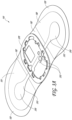
- physiological monitoring device 100 may include a flexible body 110 coupled with a watertight, rigid housing 115.
- Flexible body 110 (which may be referred to as "flexible substrate” or “flexible construct”) typically includes two wings 130, 131, which extend laterally from rigid housing 115, and two flexible electrode traces 311, 312, each of which is embedded in one of wings 130, 131.
- Each electrode trace 311, 312 is coupled, on the bottom surface of flexible body 110, with a flexible electrode (not visible in Figure 1A ).
- the electrodes are configured to sense heart rhythm signals from a patient to which monitoring device 100 is attached. Electrode traces 311, 312 then transmit those signals to electronics (not visible in Figure 1A ) housed in rigid housing 115.
- Rigid housing 115 also typically contains a power source, such as one or more batteries.
- the combination of a highly flexible body 110, including flexible electrodes and electrode traces 311, 312, with a very rigid housing 115 may provide a number of advantages.
- a key advantage is high fidelity signal capture.
- the highly conformal and flexible wings 130, 131, electrodes and traces 311, 312 limit the transmission of external energy to the electrode-skin interface. If motion is imparted to the rigid housing 115, for example, the system of conformal adhesion to the skin limits the extent to which that motion affects the monitored signal.
- Flexible electrode traces 311, 312 generally may help provide conformal contact with the subject's skin and may help prevent electrodes 350 (electrodes 350 are not visible in Figure 1 , but are visible in Figure 6A described below) from peeling or lifting off of the skin, thereby providing strong motion artifact rejection and better signal quality by minimizing transfer of stress to electrodes 350.
- flexible body 110 includes a configuration and various features that facilitate comfortable wearing of device 100 by a patient for fourteen (14) days or more without removal.
- Rigid housing 115 which typically does not adhere to the patient in the embodiments described herein, includes features that lend to the comfort of device 100. Hinge portions 132 are relatively thin, even more flexible portions of flexible body 110.
- Electrode traces 311, 312 are also very thin and flexible, to allow for patient movement without signal distortion.
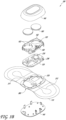
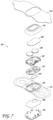
- rigid housing 115 includes an upper housing member 140, which detachably couples with a lower housing member 145. Sandwiched between upper housing member 140 and lower housing member 145 are an upper gasket 370, and a lower gasket 360 (not visible on Figure 1B but just below upper gasket 370). Gaskets 370, 360 help make rigid housing member 115 watertight when assembled. A number of components of monitoring device 100 may be housed between upper housing member 140 and lower housing member 145.
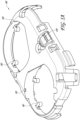
- housing 115 may contain a portion of flexible body 110, a printed circuit board assembly (PCBA) 120, a battery holder 150, and two batteries 160.
- PCBA printed circuit board assembly
- Printed circuit board assembly 120 is positioned within housing 115 to contact electrode traces 311, 312 and batteries 160.
- one or more additional components may be contained within or attached to rigid housing 115.
- Battery holder 150 may hold two batteries (as in the illustrated embodiment), one battery, or more than two batteries. In other alternative embodiments, other power sources may be used.
- battery holder 150 includes multiple retain tabs 153 for holding batteries 160 in holder 150.
- battery holder 150 includes multiple feet 152 to establish correct spacing of batteries 160 from the surface of PCBA 120 and ensure proper contact with spring fingers 235 and 236.
- Spring fingers 235 and 236 are used in this embodiment rather than soldering batteries 160 to PCBA 120.
- soldering may be used in alternative embodiments, one advantage of spring fingers 235 and 236 is that they allow batteries 160 to be removed from PCBA 120 and holder 150 without damaging either of those components, thus allowing for multiple reuses of both. Eliminating solder connections also simplifies and speeds up assembly and disassembly of monitoring device 100.
- upper housing member 140 may act as a patient event trigger.
- a patient event trigger When a patient is wearing physiological monitoring device 100 for cardiac rhythm monitoring, it is typically advantageous for the patient to be able to register with device 100 (for example, log into the device's memory) any cardiac events perceived by the patient. If the patient feels what he/she believes to be an episode of heart arrhythmia, for example, the patient may somehow trigger device 100 and thus provide a record of the perceived event.
- trigger of perceived events by the patient may initiate transmission of data associated with the triggered event.
- trigger of perceived events may simply mark a continuous record with the location of the triggered event. In some embodiments, both transmission of associated data as well as marking of the continuous record may occur.
- the patient's recorded symptom during the perceived event could be compared with the patient's actual heart rhythm, recorded by device 100, and this may help determine whether the patient's perceived events correlate with actual cardiac events.
- One problem with patient event triggers in currently available wearable cardiac rhythm monitoring devices is that a small trigger may be hard to find and/or activate, especially since the monitoring device is typically worn under clothing. Additionally, pressing a trigger button may affect the electronics and/or the electrodes on the device in such a way that the recorded heart rhythm signal at that moment is altered simply by the motion caused to the device by the patient triggering.
- pressing a trigger may jar one or both of the electrodes in such a way that the recorded heart rhythm signal at that moment appears like an arrhythmia, even if no actual arrhythmia event occurred. Additionally, there is a chance that the trigger may be inadvertently activated, for instance while sleeping or laying on the monitoring device.
- rigid housing 115 is sufficiently rigid, and flexible body 110 is sufficiently flexible, that motion applied to housing 115 by a patient may rarely or ever cause an aberrant signal to be sensed by the electrodes.
- the central portion of upper housing member 140 is slightly concave and, when pressed by a patient who is wearing device 100, this central portion depresses slightly to trigger a trigger input on PCBA 120. Because the entire upper surface of rigid housing 115 acts as the patient event trigger, combined with the fact that it is slightly concave, it will generally be quite easy for a patient to find and push down the trigger, even under clothing. Additionally, the concave nature of the button allows it to be recessed which protects it from inadvertent activations. Thus, the present embodiment may alleviate some of the problems encountered with patient event triggers on currently available heart rhythm monitors.
- printed circuit board assembly 120 may include a top surface 220, a bottom surface 230, a patient trigger input 210 and spring contacts 235, 236, and 237.
- Printed circuit board assembly 120 may be used to mechanically support and electrically connect electronic components using conductive pathways, tracks or electrode traces 311, 312.
- PCBA 120 because of the sensitive nature of PCBA 120 and the requirement to mechanically interface with rigid body 115, it is beneficial to have PCBA 120 be substantially rigid enough to prevent unwanted deflections which may introduce noise or artifact into the ECG signal. This is especially possible during patient trigger activations when a force is transmitted through rigid body 115 and into PCBA 120.
- PCBA 120 may also be referred to as, or substituted with, a printed circuit board (PCB), printed wiring board (PWB), etched wiring board, or printed circuit assembly (PCA).
- PCB printed circuit board
- PWB printed wiring board
- PCA printed circuit assembly
- a wire wrap or point-to-point construction may be used in addition to, or in place of, PCBA 120.
- PCBA 120 may include analog circuits and digital circuits.
- Patient trigger input 210 may be configured to relay a signal from a patient trigger, such as upper housing member 140 described above, to PCBA 120.
- patient trigger input 210 may be a PCB switch or button that is responsive to pressure from the patient trigger (for example, the upper surface of upper housing portion 140).
- patient trigger input 210 may be a surface mounted switch, a tactile switch, an LED illuminated tactile switch, or the like.
- patient trigger input 210 may also activate an indicator, such as an LED. Certain embodiments may involve a remotely located trigger such as on a separate device or as a smart phone app.
- the tooth brushing may often introduce motion artifact that causes a recorded signal to appear very similar to Ventricular Tachycardia, a serious heart arrhythmia.
- Adding additional leads (and, hence, vectors) is the traditional approach toward mitigating this concern, but this is typically done by adding extra wires adhered to the patient's chest in various locations, such as with a Holter monitor. This approach is not consistent with a small, wearable, long term monitor such as physiological monitoring device 100.
- device 100 may include a data channel for detecting patch motion.
- an accelerometer or other suitable device may provide patch motion by simply analyzing the change in magnitude of a single axis measurement, or alternatively of the combination of all three axes.
- the accelerometer may record device motion at a sufficient sampling rate to allow algorithmic comparison of its frequency spectrum with that of the recorded ECG signal. If there is a match between the motion and recorded signal, it is clear that the device recording in that time period is not from a clinical (for example, cardiac) source, and thus that portion of the signal can be confidently marked as artifact.
- This technique may be particularly useful in the tooth brushing motion example aforementioned, where the rapid frequency of motion as well as the high amplitude artifact is similar to the heart rate and morphology, respectively, of a potentially life-threatening arrhythmia like Ventricular Tachycardia.
- Other suitable devices described herein this section and elsewhere in the specification may also be utilized to provide motion information.
- using the magnitude of all three axes for such an analysis would smooth out any sudden changes in values due to a shift in position rather than a change in activity.
- there may be some advantage in using a specific axis of measurement such as along the longitudinal axis of the body to focus on a specific type of artifact introduced by upward and downward movements associated with walking or running.
- the use of a gyroscope in conjunction with the accelerometer may provide further resolution as to the nature of the motion experienced. While whole body movements may be sufficiently analyzed with an accelerometer on its own, specific motion of interest such as rotational motion due to arm movement is sufficiently complex that an accelerometer alone might not be able to distinguish.
- an accelerometer tuned to the dynamic range of human physical activities may provide activity levels of the patient during the recording, which can also enhance accuracy of algorithmic true arrhythmia detection.
- arrhythmias that require observation of less prominent waves (for example P-wave) in addition to rate changes such as Supraventricular Tachycardia pose challenges to both computerized algorithms as well as the trained human eye.
- This particular arrhythmia is also characterized by the sudden nature of its onset, which may be more confidently discriminated from a non-pathological Sinus Tachycardia if a sudden surge in the patient's activity level is detected at the same time as the increase in heart rate.
- a single-axis accelerometer measurement optimized to a particular orientation may aid in more specifically determining the activity type such as walking or running. This additional information may help explain symptoms more specifically and thereby affect the subsequent course of therapeutic action.
- an accelerometer with 3 axes may confer advantages beyond what magnitude of motions can provide.
- 3-dimensional accelerometer readings may approximate the tilt of PCBA 120, and therefore body orientation relative to its original orientation.
- the original body orientation can be assumed to be in either an upright or supine position which is required for appropriate positioning and application of the device to the body.
- This information may aid in ruling out certain cardiac conditions that manifest as beat-to-beat morphology changes, such as cardiac alternans where periodic amplitude changes are observed, often in heart failure cases.
- Similar beat-to-beat morphology changes are observable in healthy subjects upon shift in body position due to the shift in heart position relative to the electrode vector, for example from an upright to a slouching position.
- the single-channel device 100 does not have an alternate ECG channel to easily rule out potential pathological shifts in morphology, however, correlation with shifts in body orientation will help explain these normal changes and avoid unnecessary treatment due to false diagnosis.
- the accelerometer may also be used as a sleep indicator, based on body orientation and movement.
- a sleep indicator When presenting clinical events (for example, pauses), it is diagnostically helpful to be able to present information in a manner that clearly separates events that occurred during sleep from those during waking hours.
- certain algorithms such as for ECG-derived respiratory rate only make sense to run when the patient is in a relatively motionless state and therefore subtle signal modulation introduced by chest movement due to breathing is observable. Respiratory rate information is useful as one channel of information necessary to detect sleep apnea in certain patient populations.
- the accelerometer may also be used to detect free-falls, such as fainting.
- device 100 may be able to mark fainting (syncope) and other free-fall events without relying on patient trigger.
- free-fall event triggers may initiate transmission of associated data.
- acquisition of accelerometer readings may be done in bursts, where only interesting information such as a potential free fall is written to memory at a high sampling rate.
- An expansion of this event-trigger concept is to use specific tapping motions on device 100 as a patient trigger instead of or in conjunction with the button previously described.
- tapping sequences may provide better resolution and accuracy into what exactly the patient was feeling, instead of relying on the patient to manually record their symptom and duration in a trigger log after the fact.
- An example of such added resolution is to indicate the severity of the symptom by the number of sequential taps.
- optical sensors may be used to distinguish between device motion and patient body motion.
- the device may not require a button or trigger.
- suitable devices described herein this section or elsewhere in the specification may also be used.
- Another optional data channel that may be added to physiological monitoring device 100 is a channel for detecting flex and/or bend of device 100.
- device 100 may include a strain gauge, piezoelectric sensor or optical sensor to detect motion artifact in device 100 itself and thus help to distinguish between motion artifact and cardiac rhythm data.
- Yet another optional data channel for device 100 may be a channel for detecting heart rate.
- a pulse oximeter, microphone or stethoscope may provide heart rate information. Redundant heart rate data may facilitate discrimination of ECG signals from artifact. This is particularly useful in cases where arrhythmia such as Supraventricular Tachycardia is interrupted by artifact, and decisions must be made whether the episode was actually multiple shorter episodes or one sustained episode.
- Another data channel may be included for detecting ambient electrical noise.
- device 100 may include an antenna for picking up electromagnetic interference. Detection of electromagnetic interference may facilitate discrimination of electrical noise from real ECG signals. Any of the above-described data channels may be stored to support future noise discrimination or applied for immediate determination of clinical validity in real-time.
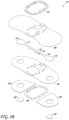
- flexible body 110 may include wings 130, 131, a thin border 133 (or “rim” or “edge”) around at least part of each wing 130, 131, electrode traces 311, 312, and a hinge portion 132 (or “shoulder") at or near a junction of each wing 130, 131 with rigid housing 115.
- upper gasket 370 which is not considered part of flexible body 110 for this description, but which facilitates attachment of flexible body 110 to rigid housing 115.
- Hinge portions 132 are relatively thin, even more flexible portions of flexible body 110. They allow flexible body 110 to flex freely at the area where it is joined to rigid housing 115. This flexibility enhances comfort, since when the patient moves, housing 115 can freely lift off of the patient's skin. Electrode traces 311, 312 are also very thin and flexible, to allow for patient movement without signal distortion. Borders 133 are portions of flexible body 110 that is thinner than immediately adjacent portions and that provide for a smooth transition from flexible body 110 to a patient's skin, thus preventing edge-lift and penetration of dirt or debris below flexible body 110.
- flexible body 110 may include multiple layers. As mentioned previously, in some embodiments, upper gasket 370 and lower gasket 360 are not considered part of flexible body 110 for the purposes of this description but are shown for completeness of description. This distinction is for ease of description only, however, and should not be interpreted to limit the scope of the described embodiments.
- Flexible body 110 may include a top substrate layer 300, a bottom substrate layer 330, an adhesive layer 340, and flexible electrodes 350. Top and bottom substrate layers 300, 330 may be made of any suitable, flexible material, such as one or more flexible polymers.
- Suitable flexible polymers can include, but are not limited to, polyurethane, polyethylene, polyester, polypropylene, nylon, teflon and carbon impregnated vinyl.
- the material of substrate layers 300, 330 may be selected based on desired characteristics. For example, the material of substrate layers 300, 330 may be selected for flexibility, resilience, durability, breathability, moisture transpiration, adhesion and/or the like.
- top substrate layer 300 may be made of polyurethane
- bottom substrate layer 330 may be made of polyethylene or alternatively polyester.
- substrate layers 300, 330 may be made of the same material.
- substrate layer 330 may contain a plurality of perforations in the area over adhesive layer 340 to provide for even more breathability and moisture transpiration.
- physiological monitoring device 100 may be worn continuously by a patient for as many as 14-21 days or more, without removal during the time of wear and with device 100 being worn during showering, exercising and the like.
- the material(s) used and the thickness and configuration of substrate layers 300, 330 affect the function of physiological monitoring device 100.
- the material of substrate layers 300, 330 acts as an electric static discharge (ESD) barrier to prevent arcing.
- ESD electric static discharge
- top and bottom substrate layers 300, 330 are attached to one another via adhesive placed on one or both layers 300, 330.
- the adhesive or bonding substance between substrate layers 300, 330 may be an acrylic-based, rubber-based, or silicone-based adhesive.
- flexible body 110 may include more than two layers of flexible material.
- the dimensions-thickness, length and width-of substrate layers 300, 330 may be selected based on desired characteristics of flexible body 110.
- the thickness of substrate layers 300, 330 may be selected to give flexible body 110 an overall thickness of between about 0.1 mm to about 1.0 mm.
- flexible body 110 may also have a length of between about 7 cm and 15 cm and a width of about 3 cm and about 6 cm.
- flexible body 110 will have a length sufficient to provide a necessary amount of separation between electrodes 350.
- a distance from the center of one electrode 350 to the center of the other electrode 350 should be at least about 6.0 cm and more preferably at least about 8.5 cm. This separation distance may vary, depending on the application.
- substrate layers 300, 330 may all have the same thickness. Alternatively, the two substrate layers 300, 330 may have different thicknesses.
- hinge portions 132 allow the rigid body 115 to lift away from the patient while flexible body 110 remains adhered to the skin.
- the functionality of hinge portions 132 is critical in allowing the device to remain adhered to the patient throughout various activities that may stretch and compress the skin.
- hinge portions 132 allow for significantly improved comfort while wearing the device.
- hinge portions 132 will be sufficiently wide enough to provide adequate lift of rigid body 115 without creating too large of a peel force on flexible body 110.
- the width of hinge portion 132 should be at least about 0.25 cm and more preferably at least about 0.75 cm.
- the shape or footprint of flexible body 110 may be selected based on desired characteristics.
- wings 130, 131 and borders 133 may have rounded edges that give flexible body 110 an overall "peanut" shape.
- wings 130, 131 can be formed in any number of different shapes such as rectangles, ovals, loops, or strips.
- the footprint top substrate layer 300 is larger than the footprint of bottom substrate layer 330, with the extension of top substrate layer 300 forming borders 133.
- borders 133 are made of the same polyurethane material that top layer 300 is made of. Borders 133 are thinner than an adjacent portion of each wing 130, 131, since they includes only top layer 300.
- the thinner, highly compliant rim 133 will likely enhance adherence of physiologic monitoring device 100 to a patient, as it provides a transition from an adjacent, slightly thicker portion of wings 130, 131 to the patient's skin and thus helps prevent the edge of device 110 from peeling up off the skin. Border 133 may also help prevent the collection of dirt and other debris under flexible body 110, which may help promote adherence to the skin and also enhance the aesthetics of device 110. In alternative embodiments, the footprint of substrate layers 300, 330 may be the same, thus eliminating borders 133.
- FIG. 1A-3B While the illustrated embodiments of Figures 1A-3B include only two wings 130, 131, which extend from rigid housing 115 in approximately opposite directions (for example, at a 180-degree angle relative to each other), other configurations are possible in alternative embodiments.
- wings 130, 131 may be arranged in an asymmetrical orientation relative to one another and/or one or more additional wings may be included.
- any suitable configuration and number of wings 130, 131 and electrode traces 311, 312 may be used.
- the embodiments described above have proven to be advantageous for adherence, patient comfort and accuracy of collected heart rhythm data, but in alternative embodiments it may be possible to implement alternative configurations.
- Adhesive layer 340 is an adhesive that is applied to two portions of the bottom surface of bottom substrate layer 330, each portion corresponding to one of wings 130, 131. Adhesive layer 340 thus does not extend along the portion of bottom substrate layer 330 upon which rigid housing 115 is mounted.
- Adhesive layer 340 may be made of any suitable adhesive, although certain adhesives have been found to be advantageous for providing long term adhesion to patient skin with relative comfort and lack of skin irritation.
- adhesive layer 340 is a hydrocolloid adhesive.
- the adhesive layer 340 is comprised of a hydrocolloid adhesive that contains naturally-derived or synthetic absorbent materials which take up moisture from the skin during perspiration.
- each of the two portions of adhesive layer 340 includes a hole, into which one of electrodes 350 fits.
- Electrodes 350 are made of flexible material to further provide for overall conformability of flexible body 110.
- flexible electrodes 350 may be made of a hydrogel 350.
- Electrodes 350 generally provide conformal, non-irritating contact with the skin to provide enhanced electrical connection with the skin and reduce motion artifact.
- hydrogel electrodes 350 may be punched into adhesive layer 340, thus forming the holes and filling them with hydrogel electrodes 350.
- electrodes 350 and adhesive 340 may be replaced with an adhesive layer made of a conductive material, such that the entire adhesive layer on the underside of each wing 130, 131 acts as an electrode.
- Such an adhesive layer may include a hybrid adhesive/conductive substance or adhesive substance mixed with conductive elements or particles.
- such an adhesive layer may be a hybrid of a hydrogel and a hydrocolloid adhesive.
- Rigid housing 115 of Figure 1A also protects the electronics and power source contained in housing 120, enhances the ability of a patient to provide an input related to a perceived cardiac event, and allows for simple manufacturing and reusability of at least some of the contents of housing 115.
- adhesive layer 340 may cover a portion of the underside of lower substrate layer 330, such that at least a portion of the bottom side of flexible body 110 does not include adhesive layer 340.
- hinges 132 may be formed in the flexible body 110 as portions of each wing 130, 131 on which adhesive layer 340 is not applied. Hinge portions 132 are generally located at or near the junction of flexible body 110 with rigid housing 115, and thus provide for flexing of device 100 to accommodate patient movement. In some embodiments, hinge portions 132 may have a width that is less than that of adjacent portions of wings 130, 131, thus giving device 100 its "peanut" shape mentioned above.
- Hinge portions 132 may allow for dynamic conformability to the subject, while the rigidity of rigid housing 115 may allow housing 115 to pop up off the patient's skin during device flexion, thus preventing peeling of the device 100 off of the skin at its edge.
- Flexible body 110 further includes two electrode traces 311, 312 sandwiched between upper substrate layer 300 and lower substrate layer 330.
- Each electrode trace 311, 312 may include an electrode interface portion 310 and an electrocardiogram circuit interface portion 313.
- ECG circuit interface portions 313 are in physical contact with spring fingers 237 and provide electrical communication with PCBA 120 when device 100 or zoomed-in device portion 101 is assembled.
- Electrode interface portions 310 contact hydrogel electrodes 350.
- electrode traces 311, 312 transmit cardiac rhythm signals (and/or other physiological data in various embodiments) from electrodes 350 to PCBA 120.
- electrode traces 311, 312 may include a combination of silver (Ag) and silver chloride (AgCl).
- the silver and silver chloride may be disposed in layers.
- one embodiment of electrode traces 311, 312 may include a top layer of silver, a middle layer of carbon impregnated vinyl, and a bottom (patient-facing) layer of silver chloride.
- both top and bottom layers of electrode traces 311, 312 may be made of silver chloride.
- the top and bottom layers may be applied to the middle layer in the form of silver ink and silver chloride ink, respectively.
- each electrode trace may include only two layers, such as a top layer of silver and a bottom layer of silver chloride.
- the material of a bottom layer of each electrode trace 311, 312, such as AgCl may be selected to match the chemistry of the hydrogel electrodes 350 and create a half-cell with the body of the subject.
- the thickness of the electrode traces 311, 312 may be selected to optimize any of a number of desirable properties.
- at least one of the layers of electrode traces 311, 312 can be of a sufficient thickness to minimize or slow depletion of the material from an anode/cathode effect over time. Additionally, the thickness may be selected for a desired flexibility, durability and/or signal transmission quality.
- top gasket 370 and bottom gasket 360 may be attached upper substrate 300 and lower substrate 330 of flexible body 110.
- Gaskets 360, 370 may be made of any suitable material, such as urethane, which provides a water tight seal between the upper housing member 140 and lower housing member 145 of rigid housing 115.
- top gasket 370 and/or bottom gasket 360 may include an adhesive surface.
- Figure 3E depicts yet another embodiment where top gasket 370 includes tabs 371 that protrude away from the profile of top housing 140 while still being adhered to upper substrate 300. The tabs 371 cover a portion of electrode traces 311, 312 and provide a strain relief for the traces at the point of highest stress where the flexible body meets the rigid housing.
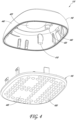
- upper housing member 140 and lower housing member 145 of rigid housing 115 are shown in greater detail.
- Upper and lower housing members 140, 145 may be configured, when coupled together with gaskets 360, 370 in between, to form a watertight enclosure for containing PCBA 120, battery holder 150, batteries 160 and any other components contained within rigid housing 115.
- Housing members 140, 145 may be made of any suitable material to protect internal components, such as water resistant plastic.
- upper housing member 140 may include a rigid sidewall 440, a light pipe 410 to transmit visual information from the LEDs on the PCBA through the housing member, a slightly flexible top surface 420, and an inner trigger member 430 extending inward from top surface 420.
- Top surface 420 is configured to be depressed by a patient when the patient perceives what he or she believes to be an arrhythmia or other cardiac event. When depressed, top surface 420 depresses inner trigger member 430, which contacts and activates trigger input 210 of PCBA 120. Additionally, as discussed previously, top surface 420 may have a concave shape (concavity facing the inside of housing 115) to accommodate the shape of a finger. It is believed that the design of upper housing member 140 isolates activation of the trigger input 210 from electrodes 350, thereby minimizing artifact in the data recording.
- lower housing member 145 may be configured to detachably connect with upper housing member 140 in such a way that housing members 140, 145 may be easily attached and detached for reusability of at least some of the component parts of monitoring device 100.
- a bottom surface 445 (patient facing surface) of lower housing member 145 may include multiple dimples 450 (or “bumps,” “protrusions” or the like), which will contact the patient's skin during use. Dimples 450 may allow for air flow between bottom surface 445 and the patient's skin, thus preventing a seal from forming between bottom surface 445 and the skin.
- dimples 450 improve comfort and help prevent a perception in currently available devices in which the patient feels as if monitoring device 100 is falling off when it housing 115 lifts off the skin and breaks a seal with the skin.
- the bottom surface 445 of lower housing member 450 may include multiple divots (recesses instead of protrusions) to prevent a seal from forming.
- Battery holder 150 may be made of plastic or other suitable material, is configured to be mounted to PCBA 120 and subsequently attached to rigid housing 115, and is capable of holding two batteries 160 ( Figure 1B ). In alternative embodiments, battery holder 150 may be configured to hold one battery or more than two batteries.
- a plurality of protrusions 152 provide a stable platform for batteries 160 to be positioned a fixed distance above the surface of PCBA 120, avoiding unwanted contact with sensitive electronic components yet providing for adequate compression of spring contacts 235 ( Figure 5B ).
- Protrusions 153 lock batteries 160 into position and resist the upward force on the batteries from spring contacts 235.
- Battery holder 150 also positions batteries appropriately 160 to provide for adequate compression of spring contacts 236. Use of battery holder 150 in conjunction with spring contacts 235 and 236 allows for batteries 160 to be electrically connected to PCBA 120 while still having additional electronic components between batteries 160 and PCBA 120 and maintain a very compact assembly.
- Battery holder 150 may include a flexible hook 510 which engages a corresponding rigid hook 440 of upper housing member 140. Under normal assembly conditions the flexible hook 510 remains securely mated with rigid hook 440. For disassembly, flexible hook 510 can be pushed and bent using an appropriate tool passed through top housing 140 causing it to disengage from rigid hook 440 and subsequently allow top housing 140 to be removed.
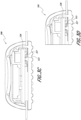
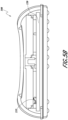
- physiological monitoring device 100 is shown in side view cross-section.
- physiological monitoring device 100 may include flexible body 110 coupled with rigid housing 115.
- Flexible body 110 may include top substrate layer 300, bottom substrate layer 330, adhesive layer 340 and electrodes 350.
- Electrode traces 311, 312 are also typically part of flexible body 110 and are embedded between top substrate layer 300 and bottom substrate layer 330, but they are not shown in Figure 6 .
- Flexible body 110 forms two wings 130, 131, extending to either side of housing 115, and a border 133 surrounding at least part of each wing 130, 131.
- Rigid housing 115 may include an upper housing member 140 coupled with a lower housing member 145 such that it sandwiches a portion of flexible body 110 in between and provides a watertight, sealed compartment for PCBA 120.
- Upper housing member 140 may include inner trigger member 430
- PCBA may include patient trigger member 210.
- lower housing member 145 may include multiple dimples 450 or divots to enhance the comfort of the monitoring device 100.
- PCBA 120 is sufficiently rigid to prevent bending and introducing unwanted artifact into the signal.
- an additional mechanism to reduce and prevent unwanted bending of PCBA 120 may be used. This mechanism is shown in Figure 6B .
- Support post 460 is integral to lower housing 145 and is positioned directly under patient trigger input 210.
- upper housing member 140 is depressed, engaging inner trigger mechanism 430 and transmitting a force through patient trigger input 210 into PCBA 120.
- the force is further transmitted through PCBA 120 and into support post 460 without creating a bending moment, thus avoiding unwanted artifact.
- physiological monitoring device 100 may include one or more additional, optional features.
- monitoring device 100 may include a removable liner 810, a top label 820, a device identifier 830 and a bottom label 840.
- Liner 810 may be applied over a top surface of flexible member 110 to aid in the application of device 100 to the subject.
- liner 810 may help support borders 133 of flexible body 110, as well as wings 130, 131, during removal of one or more adhesive covers (not shown) that cover adhesive surface 340 before use.
- Liner 810 may be relative rigid and/or firm, to help support flexible body 110 during removal of adhesive covers.
- liner 810 may be made of cardboard, thick paper, plastic or the like. Liner 810 typically includes an adhesive on one side for adhering to the top surface of wings 130, 131 of flexible body 110.
- Labels 820, 840 may be any suitable labels and may include produce name(s), manufacturer name(s), logo(s), design(s) and/or the like. They may be removable or permanently attached upper housing member 140 and/or lower housing member 145, although typically they will be permanently attached, to avoid unregulated reuse and/or resale of the device by an unregistered user.
- Device identifier 830 may be a barcode sticker, computer readable chip, RFID, or the like. Device identifier 830 may be permanently or removably attached to PCBA 120, flexible body 110 or the like. In some embodiments, it may be beneficial to have device identifier 830 stay with PCBA 120.
- physiological monitoring device 100 generally includes hinge portions 132 at or near the juncture of each wing 130, 131 with rigid housing 115. Additionally, each wing 130, 131 is typically adhered to the patient via adhesive layers 340, while rigid body 115 is not adhered to the patient and is thus free to "float" (for example, move up and down) over the patient's skin during movement and change of patient position. In other words, when the patient's chest contracts, rigid housing pops up or floats over the skin, thus minimizing stress on device 100, enhancing comfort, and reducing the tendency of wings 130, 131 to peel off of the skin.
- float for example, move up and down
- FIGs 8A and 8B The advantage provided by the combination of the floating rigid body 115 and the adhered wings 130, 131 is illustrated in Figures 8A and 8B .
- Figure 8A a patient is sleeping
- Figure 8B a patient is playing golf.
- monitoring device 100 is squeezed together by the patient's body, causing rigid housing 115 to float above the skin as wings 130, 131 move closer together.
- This advantage of a floating, non-attached portion of a physiological monitoring device is described in further detail in U.S. Patent 8,560,046 , which was previously incorporated by reference.
- a first step of applying device 100 may include removing one or both of two adhesive covers 600 from adhesive layers 340 on the bottom surface of device 100, thus exposing adhesive layers 340.
- the next step may be to apply device 100 to the skin, such that adhesive layer 340 adheres to the skin in a desired location.
- one adhesive cover 600 may be removed, the uncovered adhesive layer 340 may be applied to the skin, and then the second adhesive cover 600 may be removed, and the second adhesive layer 340 may be applied to the skin.
- both adhesive covers 600 may be removed before applying device 100 to the skin.
- liner 810 acts as a support for flexible body 110, provides the physician or other user with something to hold onto, and prevents flexible body 110 and borders 133 of flexible body 110 from folding in on themselves, forming wrinkles, and so forth.
- liner 810 may be made of a relatively stiff, firm material to provide support for flexible body 110 during application of device 100 to the skin. Referring to Figure 9C , after device 100 has been applied to the skin, pressure may be applied to flexible body 110 to press it down onto the chest to help ensure adherence of device 100 to the skin.
- liner 810 is removed from (for example, peeled off of) the top surface of flexible body 110.
- pressure may again be applied to flexible body 110 to help ensure it is adhered to the skin.
- upper housing member 140 may be pressed to turn on physiological monitoring device 140. This described method is only one embodiment. In alternative embodiments, one or more steps may be skipped and/or one or more additional steps may be added.
- a patient may remove physiological monitoring device 100 from the patient's skin, place device 100 in a prepaid mailing pouch, and mail device 100 to a data processing facility.
- device 100 may be partially or completely disassembled, PCBA 120 may be removed, and stored physiological data, such as continuous heart rhythm information, may be downloaded from device 100.
- the data may then be analyzed by any suitable method and then provided to a physician in the form of a report. The physician may then discuss the report with the patient.
- PCBA 120 and/or other portions of device 100, such as rigid housing 115 may be reused in the manufacture of subsequent devices for the same or other patients.
- PCBA 120 may be used first in an adult cardiac rhythm monitor and then may be used a second time to construct a monitor for sleep apnea.
- the same PCBA 120 may additionally or alternatively be used with a differently sized flexible body 110 to construct a pediatric cardiac monitor.
- at least some of the component parts of device 100 may be interchangeable and reusable.
- the monitoring data may be transmitted wirelessly or through other communication mediums to be analyzed, rather than requiring physical shipment of the device for analysis and reporting.
- physiological monitoring device 100 may provide long term adhesion to the skin.
- the combination of the configuration of flexible and conformal body 110, the watertight, low profile configuration of rigid housing 115, and the interface between the two allows device 100 to compensate for stress caused as the skin of the subject stretches and bends.
- device 100 may be worn continuously, without removal, on a patient for as many as 14 to 21 days or more. In some cases, device 100 may be worn for greater or less time, but 14 to 21 days may often be a desirable amount of time for collecting heart rhythm data and/or other physiological signal data from a patient.
- the shape of a particular physiological monitoring device may vary.
- the shape, footprint, perimeter or boundary of the device may be circular, an oval, triangular, a compound curve or the like, for example.
- the compound curve may include one or more concave curves and one or more convex curves.
- the convex shapes may be separated by a concave portion.
- the concave portion may be between the convex portion on the rigid housing and the convex portion on the electrodes.
- the concave portion may correspond at least partially with a hinge, hinge region or area of reduced thickness between the body and a wing.
- the device improvements described herein are not so limited.
- the improvements described in this application may be applied to any of a wide variety of physiological data monitoring, recording and/or transmitting devices.
- the improved adhesion design features may also be applied to devices useful in the electronically controlled and/or time released delivery of pharmacological agents or blood testing, such as glucose monitors or other blood testing devices.
- devices described herein may be used to detect, record, or transmit signals or information related to signals generated by a body including but not limited to one or more of ECG, EEG and/or EMG.
- additional data channels can be include to collect additional data, for example, device motion, device flex or bed, heart rate and/or ambient electrical or acoustic noise.
- the physiological monitors described above and elsewhere in the specification may further be combined with methods and systems of data processing and transmission that improve the collection of data from the monitor. Further, the methods and systems described below may improve the performance of the monitors by enabling timely transmission of clinical information while maintaining the high patient compliance and ease-of-use of the monitor described above.
- the methods and systems of data processing and transmission described herein this section of elsewhere in the specification may serve to extend the battery life of the monitor, improve the accuracy of the monitor, and/or provide other improvements and advantages as described herein this section or elsewhere in the specification.
- the systems and methods described in detail below, in reference to the embodiments of Figures 10 to 17 may selectively extract, transmit, and analyze electrocardiographic signal data and other physiological data from a wearable physiological monitor, such as is described above in relation to Figures 1 through 9 .
- the systems and methods described below can improve the performance of a wearable physiological monitor that simultaneously records and transmits data through multiple means. For example, selective transmission of extracted data allows for decreased power consumption because the wearable patch is not required to transmit all recorded data. By sending extracted data, much of the analysis may be performed away from the wearable device without requiring full on-board rhythm analysis, which can also be highly power consumptive, reducing battery life. Further, remote analysis without the power constraints inherent to a wearable device may allow for greater sensitivity and accuracy in analysis of the data.
- Decreased power consumption serves to improve patient compliance because it prolongs the time period between or even eliminates the need for device replacement, battery changes or battery recharging during the monitoring cycle.
- longer monitoring times may be enabled without device replacement, for example, at least one week, at least two weeks, at least three weeks, or more than three weeks.
- FIG 10 depicts a general overview of an embodiment of a system 900 for inferring cardiac rhythm information from an R-R interval time series 902, as may be generated by a continuous heart rate monitoring device 904.
- the R-R interval time series 902 inputted to the system may include a series of measurements of the timing interval between successive heartbeats. Typically each interval represents the time period between two successive R peaks as identified from an ECG signal. R peaks are part of the QRS complex, a combination of three graphical deflections typically seen on an ECG, representing the depolarization of the left and right ventricles of a mammal's heart.
- the R peak is generally the tallest and most visible upward deflection on an ECG, and thus makes for an appropriate reference point.
- any characteristic ECG fiducial point (such as the QRS complex onset or offset) may be used in place of the R peak to provide an estimate of the R-R interval time series.
- the physical characteristics of the monitoring device are constructed in such a way as to improve signal fidelity, therefore the high signal fidelity allows for a high level of confidence in accurately extracting R-R peak data.
- the R-R interval time series 902 data may be extracted from or received from a dedicated heart rate monitor such as a heart rate chest strap or heart rate watch, or a wearable health or fitness device 906, 908 that incorporates heart rate sensing functionality.
- a dedicated heart rate monitor such as a heart rate chest strap or heart rate watch
- a wearable health or fitness device 906, 908 that incorporates heart rate sensing functionality.
- the R-R interval time series 902 may be derived from a wearable patch designed to measure an ECG signal 904 (for instance, by locating the R peaks in the ECG using a QRS detection algorithm).
- the R-R interval time series 902 may be estimated from an alternative physiological signal such as that obtained from photoplethysmography (PPG). In this scenario, the peak-to-peak interval time series determined from the PPG signal may be used as an accurate estimate of the R-R interval time series.
- PPG photoplethysmography
- a cardiac rhythm inference system 910 is implemented as a cloud service or server-based system that exposes an application programming interface (API) enabling R-R interval time series data or other signal data to be transmitted to the system (for instance, via HTTP) and the resulting cardiac rhythm information to be returned to the calling software.
- the R-R interval time series data 902 or other signal data may be transmitted to the cloud service directly from the heart-rate monitoring device itself, or indirectly via a smartphone 912, tablet or other internet-enabled communication device 914 that can receive data from the heart rate monitoring device in either a wireless or wired manner.
- the R-R interval time series data 902 or other signals may be transmitted from a server 916 that stores the data for a number of users.
- a cardiac rhythm inference system 910 is provided through a software library that can be incorporated into a standalone application for installation and use on a smartphone, tablet or personal computer.
- the library may provide identical functionality to that of the inference service, but with R-R interval time series data 902 or other signal data transmitted directly through a functional call, as opposed to through a web service API.
- a cardiac rhythm inference system may accept a plurality of R-R interval time series measured from devices of a given user 918, in addition to an individual R-R interval time series 902.
- the system computes the frequency and duration of each of the cardiac rhythm types inferred from the collection of time series data. These results may then be used to estimate confidence statistics for each type of cardiac rhythm based on the frequency and duration of occurrence of that rhythm across the various time series.
- the rhythm confidence statistics may be updated in a sequential manner for each separate call of the inference service.
- the cardiac rhythm information inferred by the system may be provided back to the calling software only in the event that the confidence score for a given rhythm type exceeds a pre-determined threshold value.
- a cardiac rhythm inference system 910 may accept additional sources of data, generally described as alternate sensor channels, in addition to R-R interval time series data, to enhance the accuracy and/or value of the inferred results.
- One additional source of data includes user activity time series data, such as that measured by a 3-axis accelerometer concurrently with the R-R interval time series measurements.
- the system may accept other relevant metadata that may help to improve the accuracy of the rhythm analysis, such as user age, gender, indication for monitoring, pre-existing medical conditions, medication information, medical history and the like, and also information on the specific day and time range for each time series submitted to the system.
- the measurement device might also provide some measure of beat detection confidence, for example, for each R-Peak or for sequential time periods.
- the system may accept additional signal features computed from the ECG. These features may include a time series of intra-beat interval measurements (such as the QT or PR interval, or QRS duration), or a time series of signal statistics such as the mean, median, standard deviation or sum of the ECG signal sample values within a given time period.
- a time series of intra-beat interval measurements such as the QT or PR interval, or QRS duration
- a time series of signal statistics such as the mean, median, standard deviation or sum of the ECG signal sample values within a given time period.
- Some embodiments concern a system for selective transmission of electrocardiographic signal data from a wearable medical sensor.
- Current wearable sensors such as the iRhythm ZioPatch TM 904, and further described above in relation to Figures 1-9 , are capable of recording a single-lead electrocardiogram (ECG) signal for up to two weeks on a single battery charge.
- ECG electrocardiogram
- the wearable sensor incorporates either a software, hardware or hybrid QRS detector that produces a real-time estimate of each R-peak location in the ECG.
- the R-peak location data is then used to compute an R-R interval time series that is subsequently transmitted to a smartphone or gateway device according to a predefined schedule (for example, once per hour).
- a time stamp is also transmitted which stores the onset time for the R-R interval time series relative to the start of the ECG recording. Since the R-R interval time series for a given section of ECG is significantly smaller (in terms of bytes occupied) than the ECG signal itself, it can be transmitted with considerably less impact on battery life.
- the R-R interval time series together with the onset time stamp is subsequently transmitted by the smartphone or gateway device to a server.
- the R-R interval time series is used to infer a list of the most probable heart rhythms, together with their onset and offset times, during the period represented by the time series data.
- the list of inferred heart rhythms is then filtered according to specific criteria, such that only rhythms matching the given criteria are retained after filtering.
- a measure of confidence may also be used to assist in filtering the events in a manner that might improve the Positive Predictivity of detection.
- the server transmits to the smartphone or gateway device the onset and offset time for that specific rhythm.
- the onset and offset times may be adjusted such that the resulting duration is less than the maximum permissible duration.
- the onset and offset times received by the gateway are then subsequently transmitted to the wearable sensor, which in turn transmits the section of the recorded ECG signal between the onset and offset times back to the gateway. This section of ECG is then transmitted to the server where it can be analyzed and used to provide diagnostic information to the patient or their physician.
- the system fundamentally allows a device worn for up to about: 14, 21, or 30 days or beyond without battery recharging or replacement (both activities that reduce patient compliance and, therefore, diagnostic value) to provide timely communication of asymptomatic arrhythmia events.
- This development is motivated by technology constraints: in order to enable a small, wearable device that does not require battery change or recharging while providing continuous arrhythmia analysis with high accuracy, it is desirable to limit the complexity of analysis performed on-board. Similarly, streaming of all of the recorded ECG data to an off-board analysis algorithm may not be practical without imposing greater power requirements.
- the system would provide the ability to detect asymptomatic arrhythmias in a timely manner on a wearable, adhesively affixed device that does not require frequent recharging or replacement. This would be used to enhance the value of some current clinical offerings, which only provide clinical insight after the recording is completed and returned for analysis.
- the system would allow actionable clinical insight to be derived from data collected on low-cost, easy-to-use consumer wearable devices that are otherwise only focused on fitness and wellness.
- the technology could be used to create a very effective, low-cost screening tool capable of detecting the presence of Atrial Fibrillation in the at-large population. By using such a tool, not only would patients in need of care be found more easily, but it may be done earlier and more cost effectively, which lead to better outcomes - namely, through reducing stroke risk by identifying AF more quickly.
- the system may provide the service through a downloadable application that, after receiving customer consent for data access and payment approval, would initiate access and analysis of heart beat data stored from wearable devices, either stored locally in a mobile device or in an online repository.
- This data pull and analysis would happen through an Algorithm API, and would result in a clinical finding being sent back to the application to be provided to the user.
- the application would direct them to a cardiologist where a more diagnostically focused offering, for example, the ZIO ® Service, could be provided to support clinical diagnosis and treatment.
- the system may trigger an alarm if a particular measurement and/or analysis indicates that an alarm is needed.
- Additional scenarios of clinical value may include coupling ambulatory arrhythmia monitoring with a blood-alcohol monitor to study the interaction of AF and lifestyle factors.
- ambulatory arrhythmia monitoring could be coupled with a blood-glucose monitor to study the impact of Hypoglycemia on arrhythmias.
- ambulatory arrhythmia monitoring could be coupled with a respiratory rate and/or volume monitor to study the interaction of sleep apnea and breathing disorders.
- there could be evaluation of the high rates of supraventricular ectopic beats as a potential precursor for AF for example, 720 SVEs in 24-hour period).
- FIG 11 is a schematic illustration of an embodiment of a system and method 1000 for a wearable medical sensor 1002 with transmission capabilities, similar to the system and/or method described above in relation to Figure 10 .
- sensor 1002 which may be any type of sensor or monitor described herein this section or elsewhere in the specification, continuously senses an ECG or comparable biological signal 1004 and continuously records an ECG or comparable biological signal 1004.
- the sensing and/or recording steps may be performed intermittently.
- the collected signal 1004 may then be continuously extracted into one or more features 1006, representing example features A, B, and C.
- the features are not intended to be samplings of different temporal sections of the signal, instead (as will be described in greater detail below) the different features may correspond to different types or pieces of data such as R-peak locations or R-peak amplitudes.
- the features of the ECG or comparable biological signal are extracted to facilitate analysis of the signal 1004 remotely.
- features are extracted on a windowed basis, with the window size varying for example between 1 hour or multiple hours to a few seconds.
- the window may be at most: about .1 second, about 1 second, about 2 seconds, about 3 seconds, about 5 seconds, about 10 seconds, about 30 seconds, about 1 minute, about 5 minutes, about 30 minutes, about 1 hour, about 2 hours, about 4 hours, or more than 4 hours.
- the extraction windows may be separated by various amounts of time if they are repeated. For example, the extraction windows may be separated by at least: about 30 seconds, about 1 minute, about 5 minutes, about 30 minutes, about 1 hour, about 3 hours, about 6 hours, about 12 hours, about 24 hours, about 48 hours, or more than three days.
- the windowing sizes may vary depending on the feature extracted. Feature extraction may be limited to one type or various types of features, and features chosen for extraction may vary depending on the nature of the signal observed.
- R-peak locations may be extracted.
- the R-peak locations are extracted via various methods such as: a Pan-Tompkins algorithm (Pan and Tompkins, 1985), providing a real-time QRS complex detection algorithm employing a series of digital filtering steps and adaptive thresholding, or an analog R-peak detection circuit comprising an R-peak detector consisting of a bandpass filter, a comparator circuit, and dynamic gain adjustment to locate R-peaks.
- the RR-intervals may be calculated from peak locations and used as the primary feature for rhythm discrimination.
- an R-peak overflow flag may be extracted.
- a flag may be raised by the firmware.
- Such an extraction may be used to eliminate noisy segments from analysis, on the basis that extremely short intervals of R-R are not physiologically possible.
- an R-peak underflow flag may be extracted to indicate an unrealistically long interval between successive R peaks, provided appropriate considerations for asystole are made in this evaluation.
- the lack of presence of R peaks in a prolonged interval could be associated with a confidence measure, which would describe the likelihood that the interval was clinical or artifact.
- a saturation flag a firmware or hardware-determined indication that the signal saturated during a given time window (for example 1 second). Such an extraction may be used to eliminate noisy segments from analysis.
- P/T-wave locations may be extracted. This is similar to R-peak detection, but tuned to lower frequency waves. R-peak locations may be used to determine the areas of possible wave components.
- Still another example of a feature that may be extracted includes the breathing rate. ECG-derived respiration (EDR) may be derived from studying the amplitude modulation of ECG signal amplitude. EDR may be associated with other clinical indicators of arrhythmia.
- EDR ECG-derived respiration
- R-peak amplitude may be extracted, by measuring the ECG signal amplitude at R-peak locations. This pattern may be studied to discriminate between true and false peak detection, and/or to detect changes in beat morphology.
- the ECG signal amplitude proxy may be extracted.
- This feature may include: the range of the raw signal data during a given time period, the maximum value of the signal during a given time period, or the minimum value of the signal during a given time period.
- This feature may be used as a data point for noise detection or possible changes in morphology of the ECG (for example ventricular ectopy).
- additional ECG signal samples may be extracted. Sampling a few data points at regular intervals or consecutively from a region in-between selected R-peaks will allow for determination of the confidence of rhythm and/or noise classification. Such a selection may be based on R-R interval length. For instance, if the interval is longer than 3 seconds, it may be an indicator of a pause.
- Local ECG signal energy may also be extracted, for example by taking the sum square of signal values within a window centered on a point of interest, for example an R-peak, thereby providing an integral of ECG sample values in a given time window. This information may be used to characterize the morphology of beats (supraventricular tachycardia (SVT) vs. ventricular tachycardia (VT)).
- spectral information may be extracted via extracting statistics from the output from one or more filters, either realized on hardware (during signal acquisition) or firmware.
- Filters may be implemented as a filter bank, such as a short-time Fourier transform (STFT) or wavelet transform. Such information may be used to characterize the morphology of heart beats.
- STFT short-time Fourier transform
- Output from simple machine-learned models may be extracted. For example, the likelihood of a selected ECG signal segment under a probability model, for example Gaussian, given raw collected data values or any combination of features derived from available channels of data may be extracted. The use of a simple machine-learned model may allow transmission of less data.
- the output can directly or indirectly give insight into: the type of underlying rhythm, the presence of ECG features such as a P-wave, the confidence level of R-peak detection, and the presence of noise.
- various features 1008 may then be transmitted 1010 to a processing device/server 1012.
- the features 1008 (and alternate sensor channel data and/or features as described below) are transmitted 1010 at regular intervals to a processor 1012 that is not a physical part of the sensor 1002.
- the interval definition may be pre-set or, configurable with each use, or dynamically configurable.
- Transmission 1010 of features 1008 may also be bundled and sent when another reason for communication exists, such as transmission of symptomatic data (described in greater detail below in relation to Figure 16 ).
- the processing device 1012 may be: a cloud-based server, a physical server at a company location, a physical server at patient or clinic location, a smartphone, tablet, personal computer, smartwatch, automobile console, audio device and/or an alternate device on or off-site.
- the transmission 1010 may utilize short-range RF communication protocols, such as: Bluetooth, ZigBee, WiFi (802.11), Wireless USB, ANT or ANT+, Ultrawideband (UWB), and/or custom protocols.
- the transmission 1010 may be via infrared communication, such as IrDA and/or inductive coupling communication, such as NFC.
- transmission may be accomplished via cellular data networks and/or wired communication protocols, such as: USB, Serial, TDMA, or other suitable custom means.
- the transmitted features 1014 are processed by the remote processor utilizing the data features 1014 to perform analysis via a rhythm inference system 1016 that analyzes and identifies segments/locations 1018 likely to include arrhythmia.
- arrhythmia and ectopy types that may be identified could include: Pause, 2 nd or 3 rd degree AVB, Complete Heart Block, SVT, AF, VT, VF, Bigeminy, Trigeminy, and/or Ectopy. Confidence of determination may be included in the identification of rhythms.
- the rhythm inference system 1016 may also utilize patient demographic data, such as age, gender, or indication to improve accuracy and/or refine confidence in determinations.
- the identified arrhythmia locations 1018 are then transmitted 1020 back to the sensor 1002.
- the transmission 1020 back to the sensor may be accomplished by any communication protocols/technology described herein this section or elsewhere in the specification, for example via Bluetooth.
- the sensor then reads the transmitted identified locations 1022 and accesses 1024 the areas of memory corresponding to the transmitted identified locations 1022 of the ECG.
- the sensor applies additional analysis of the identified segments to further build confidence in the arrhythmia identification.
- This further rhythm confidence determination step 1026 allows for increasing positive predictivity prior to the power-hungry transmission step.
- the confidence exceeds a defined threshold the data segment is transmitted.
- the defined threshold may be a preset value or it may be set per user and monitoring session.
- the defined threshold may be changed dynamically depending on the nature of the rhythm, the history of accurate detection within the monitoring period, and/or the confidence of the rhythm inference system. Additional analysis may also be performed. Examples of possible analysis techniques include any methods disclosed herein this section or elsewhere in the specification, for example: R-peak amplitude, ECG signal amplitude proxy, ECG signal samples, local ECG signal energy, spectral information, and/or output from a simple machine-learned model.
- the sensor 1002 may transmit the requested ECG segments 1028 to the processing device via any transmission means described herein this section or elsewhere in the specification.
- the processing device may complete further analysis on the segments to confirm accuracy of predicted arrhythmia before using data to report to a user and/or physician, as needed.
- Figure 12 is a schematic illustration of an embodiment of a system and method 2000 for a wearable ECG and/or medical sensor 2002 with transmission capabilities very similar to the system and/or method 1000 described above in relation to Figure 11 .
- the system of Figure 12 differs from the system of Figure 11 in that it includes secondary transmitting devices 2004.
- possible secondary transmitting devices include: smartphones, tablets, personal computers, dedicated custom gateways, audio devices, wearable activity monitors, automobile consoles, other devices described herein this section or elsewhere in the specification, and other available devices for passing data.
- Figure 13 is a schematic illustration of an embodiment of a system and method 3000 for a wearable ECG and/or medical sensor 3002 with transmission capabilities, very similar to the system and/or methods described above in relation to Figures 11 and 12 .
- Figure 13 differs from Figures 11 and 12 in that Figure 13 illustrates alternate sensor channels 3004, 3006 producing alternate outputs and/or extraction 3008 of features 3010. Collection of other channels of data may serve to further augment ECG-extracted features. Data from the alternate sensor channels may be sent whole or specific features 3010 of the data channel may be extracted 3008. In certain embodiments, an alternate data channel may record galvanic skin response/impedance.
- This data may indicate whether the sensor 3002 leads are on or off, for example, via a Boolean algorithm indicating whether the leads are in an on/off state during a given time period, based on a preset threshold and built-in hysteresis. This information could be further used to remove periods of non-contact of the device with the body from analysis.
- the collection of more granular impedance data points may provide insight into the change in patient activity levels, due to changes in sweat levels.
- an alternative sensor data channel may be from an accelerometer.
- Such a device may provide free-fall detection via an on-board algorithm to detect free-fall, an indication that the patient may have suddenly fallen due to arrhythmia-induced syncope.
- the magnitude of acceleration detected by the accelerometer may be used to detect periods of sleep, activity levels, types of activity, and/or possibility of motion artifact, all of which may correlate with the prevalence of certain rhythm types.
- raw accelerometer values may be used to determine body orientation given a reference point (for example, whether the patient was upright when they were first patched). Additionally, change in orientation of the accelerometer may be used to distinguish clinically relevant morphology changes vs. not clinically relevant changes, in addition to providing more insight into activity type.
- an alternative data channel may be provided by a pulse oximeter.
- a photoplethysmogram PPG
- the PPG may provide an alternative source for R-peak locations or as a cross-check on R-peak detection by the ECG circuitry.
- the PPG data channel may be combined with multiple PPG/BioZ channels to output confidence of R-peak detection confidence levels.
- Sp02/perfusion via the pulse oximeter may provide further clinical indications of a severe arrhythmia.
- an alternative sensor channel may involve bioimpedance, which may be used to determine heart beat location and/or act as an alternative source for R-peak data.
- temperature data may be provided via an alternative sensor channel. This data can be used in conjunction with other metrics of activity to discern activity type, level, and/or sleep.
- the alternative data channel may provide information from a clock, for example the time of day or an indication of daytime or nighttime.
- the alternative data channel may be provided by a microphone/stethoscope, providing an audible recording of heart beat.
- an alternative data channel may be provided by a flex or bend sensor which may allow for identification of motion artifacts.
- Figure 14 is a schematic illustration of an embodiment of a system and method 4000 for a wearable ECG and/or medical sensor 4002 with transmission capabilities, very similar to the system and/or methods described above in relation to Figures 11 to 13 .
- Figure 14 differs from Figures 11 to 13 because the embodiment of Figure 14 incorporates additional data filters.
- the Processing Device 4004 may also filter rhythms 4006 identified by the rhythm inference system 4008 by applying filter criteria that may derive from multiple sources. For example, filter criteria may be drawn from: physician interest in timely reporting of particular rhythm types, physician interest in viewing a rhythm similar to one that was viewed previously (for example if multiple 3-second pauses were already reported to the physician, changing the threshold of interest to 4- or 5-seconds).
- filtering may include automated filtering to limit repeated retrieval of similar rhythm types and durations.
- Automated filtering can limit repeated retrieval of low positive-predictivity events, for example, a record with high levels of motion artifact where positive predictivity of the rhythm inference engine was low, and may allow automating filtering on subsequent requests.
- Such an approach may utilize confidence intervals assigned by the Rhythm inference system as well as the tracked history of rhythm inference system positive predictivity for a given monitoring session.
- FIG 15 is a schematic illustration of an embodiment of a system 5000 for a consumer wearable device without full ECG detection, with some similarities to the medical sensors of Figures 10 to 14 .
- the sensors 5002 need not be medical-grade ECG sensors, but merely allow detection of beats.
- the sensor 5002 may continuously sense a data channel from which heart beat locations can be derived. Possible data sources include: PPG (optionally with multiple channels to increase accuracy), bio-impedence, and ECG without full implementation due to insufficient signal quality as compared to the sensors of Figures 10 to 14 .
- features may be extracted from this signal, for example: R-peak locations, R-peak overflow flag, saturation flag, breathing rate, PIT wave locations, R-peak amplitude (or proxy), or ECG signal amplitude proxy.
- the data extraction may be performed via any method described herein this section or elsewhere in the specification. In certain embodiments, other channels of data are collected to improve confidence in rhythm assessments.
- the consumer device system 5000 further transmits and processes data via any method described herein this section or elsewhere in the specification. Based on these determinations, the results of the rhythm analysis may be sent to a user.
- the consumer device system 5000 without full ECG sensing advantageously enables arrhythmia analysis using consumer-available heart-rate sensors, thereby reducing the cost and increasing the availability of the device. Consequently, this may enable arrhythmia screening on a larger population, including via over-the-counter screening.
- FIG 16 is a schematic diagram of an embodiment of an ECG monitor system 6000 with symptomatic transmission.
- a wearable ECG sensor similar to the sensors described in relation to Figures 1 to 14 .
- Each symptom trigger by a patient may initiate transfer of an ECG data strip.
- the data strip may vary in temporal location as well as duration, and may be centered around a triggered event.
- the data strip may be biased towards a time period prior to symptom trigger or it may be biased towards time period after symptom trigger.
- the data strip may be of a duration as short as a few heartbeats ( ⁇ 5-10 seconds), or of 60-90 second duration, or longer still ( ⁇ 5-20 minutes).
- the data strip duration may be dynamically changed, either programmatically based on clinical need or auto-adjusting based on patient trigger frequency.
- the ECG data strip may be transmitted via any of the means disclosed herein this section or elsewhere in the specification. If transmission is enabled without need for patient intervention (for example not NFC or wired transmission), data transfer may initiate automatically and opportunistically without requiring further patient interaction beyond symptom trigger.
- the location for data strip analysis may vary. For example, analysis may occur local to the patient on a smartphone, tablet or PC. Alternatively, analysis may occur local to the clinic on a server or other processing device, or analysis may occur local to the ECG analysis service provider on a server or other processing device. Lastly, in embodiments, the analysis may occur using cloud-based distributed processing resources.
- a report may be provided for each symptomatic ECG data strip, however, a report may not be provided if the symptomatic ECG data strip is not determined to be clinically interesting. In some cases, the report may be made available, but notification to the user may be limited to those cases of particular clinical relevance. Offering this option can limit the demands on a user's time.
- the report may be delivered in a variety of ways.
- the report may be delivered: through a website, through a smartphone, tablet or PC application, through an Electronic Health Record (EMR/EHR) system with interoperability and integration into multiple providers' systems, or through automatic messaging such as email, SMS, app-based messaging.
- EMR/EHR Electronic Health Record
- the recipient of the report may vary, in some applications the report recipient may be the patient-user while in other applications, the report recipient may be a clinician.
- the patient when monitoring is complete, the patient removes the device and sends the complete continuous ECG record to a data processing location.
- the method of sending may vary, for example, it may be sent via physical transfer of the entire device, such as mail or bringing the device to the prescribing clinic or it may be sent send via local download of data and subsequent download to a data processing location.
- the patient may not wait to remove the device before sending a partial segment of the continuous ECG record, this would be enabled by transfer methods that do not require removal of the device, for example NFC or ultra-low-power wireless data transfer.
- the data processing location may vary.
- FIG 17 is a schematic diagram of an embodiment of an ECG monitor system 7000 with both symptomatic and asymptomatic transmission.
- the wearable sensor is similar to the sensors described herein this section or elsewhere in the specification.
- each asymptomatic trigger initiates transfer of an ECG data strip such as described above.
- Further physical features of the physiological monitoring device described herein this section or elsewhere in the specification facilitate implementation as described.
- high-fidelity ECG recording as enabled by the designs detailed herein this section or elsewhere in the specification, allows increased confidence in the accuracy of the feature extraction.
- FIG. 18 is a block diagram showing an embodiment in which the computing system 13000 is in communication with a network 13002 and various external computing systems 13004, such as a wearable system 13005, a gateway device 13006, which are also in communication with the network 13002.
- the computing system 13000 may be used to implement systems and methods described herein. While the external system 13004 are shown as grouped it is recognized that each of the systems may be external from each other and/or remotely located.
- the computing system 13000 includes one or more computing devices, for example, a server, a laptop computer, a mobile device (for example, smart phone, smart watch, tablet, personal digital assistant), a kiosk, automobile console, or a media player, for example.
- the computing device 13000 includes one or more central processing units (CPUs) 13105, which may each include a conventional or proprietary microprocessor.
- the computing device 13000 further includes one or more memory 13130, such as random access memory (RAM) for temporary storage of information, one or more read only memory (ROM) for permanent storage of information, and one or more mass storage device 13120, such as a hard drive, diskette, solid state drive, or optical media storage device.
- RAM random access memory
- ROM read only memory
- mass storage device 13120 such as a hard drive, diskette, solid state drive, or optical media storage device.
- the processing device, cloud server, server or gateway device may be implemented as a computing system 1300.
- the modules of the computing system 13000 are connected to the computer using a standard based bus system.
- the standard based bus system could be implemented in Peripheral Component Interconnect (PCI), Microchannel, Small Computer computing system Interface (SCSI), Industrial Standard Architecture (ISA) and Extended ISA (EISA) architectures, for example.
- PCI Peripheral Component Interconnect
- SCSI Small Computer computing system Interface
- ISA Industrial Standard Architecture
- EISA Extended ISA
- the functionality provided for in the components and modules of computing device 13000 may be combined into fewer components and modules or further separated into additional components and modules.
- the computing device 13000 may be controlled and coordinated by operating system software, for example, iOS, Windows XP, Windows Vista, Windows 7, Windows 8, Windows 10, Windows Server, Embedded Windows, Unix, Linux, Ubuntu Linux, SunOS, Solaris, Blackberry OS, Android, or other operating systems.
- operating system software for example, iOS, Windows XP, Windows Vista, Windows 7, Windows 8, Windows 10, Windows Server, Embedded Windows, Unix, Linux, Ubuntu Linux, SunOS, Solaris, Blackberry OS, Android, or other operating systems.
- the operating system may be any available operating system, such as MAC OS X.
- the computing device 13000 may be controlled by a proprietary operating system.
- Conventional operating systems control and schedule computer processes for execution, perform memory management, provide file system, networking, I/O services, and provide a user interface, such as a graphical user interface (GUI), among other things.
- GUI graphical user interface
- the exemplary computing device 13000 may include one or more I/O interfaces and devices 13110, for example, a touchpad or touchscreen, but could also include a keyboard, mouse, and printer.
- the I/O interfaces and devices 13110 include one or more display devices (such as a touchscreen or monitor) that allow visual presentation of data to a user. More particularly, a display device may provide for the presentation of GUIs, application software data, and multimedia presentations, for example.
- the computing system 13000 may also include one or more multimedia devices 13140, such as cameras, speakers, video cards, graphics accelerators, and microphones, for example.
- the I/O interfaces and devices 13110 may provide a communication interface to various external devices.
- the computing device 13000 is electronically coupled to a network 13002, which comprises one or more of a local area network, a wide area network, and/or the Internet, for example, via a wired, wireless, or combination of wired and wireless, communication link 13115.
- the network 13002 can communicate with various sensors, computing devices, and/or other electronic devices via wired or wireless communication links.
- the filter criteria, signals and data are processed by rhythm inferencemodule an application tool according to the methods and systems described herein, may be provided to the computing system 13000 over the network 13002 from one or more data sources 13010.
- the data sources may include one or more internal and/or external databases, data sources, and physical data stores.
- the data sources 13010, external computing systems 13004 and the rhythm interface module 13190 may include databases for storing data (for example, feature data, raw signal data, patient data) according to the systems and methods described above, databases for storing data that has been processed (for example, data to be transmitted to the sensor, data to be sent to the clinician) according to the systems and methods described above.
- the sensor data 14050 may, in some embodiments, store data received from the sensor, received from the clinician, and so forth.
- the Rules Database 14060 may, in some embodiments, store data (for example, instructions, preferences, profile) that establish parameters for the thresholds for analyzing the feature data.
- one or more of the databases or data sources may be implemented using a relational database, such as Sybase, Oracle, CodeBase, MySQL, SQLite, and Microsoft ® SQL Server, and other types of databases such as, for example, a flat file database, an entity-relationship database, and object-oriented database, NoSQL database, and/or a record-based database.
- the computing system includes a rhythm interface module 13190 that may be stored in the mass storage device 13120 as executable software codes that are executed by the CPU 13105.
- the rhythm interface module 13190 may have a Feature Module 14010, an Alternate Data Module 14020, an Inference Module 14030, a Feedback Module 14040, a Sensor Data Database 14050, and a Rules Database 14060.
- These modules may include by way of example, components, such as software components, object-oriented software components, subroutines, segments of program code, drivers, firmware, microcode, circuitry, data, databases, data structures, tables, arrays, and variables. These modules are also configured to perform the processes disclosed herein including, in some embodiments, the processes described with respect to Figures 10 to 17 .
- module refers to logic embodied in hardware or firmware, or to a collection of software instructions, possibly having entry and exit points, written in a programming language, such as, for example, Python, Java, Lua, C and/or C++.
- a software module may be compiled and linked into an executable program, installed in a dynamic link library, or may be written in an interpreted programming language such as, for example, BASIC, Perl, or Python. It will be appreciated that software modules may be callable from other modules or from themselves, and/or may be invoked in response to detected events or interrupts.
- Software modules configured for execution on computing devices may be provided on a computer readable medium, such as a compact disc, digital video disc, flash drive, or any other tangible medium.
- Such software code may be stored, partially or fully, on a memory device of the executing computing device, such as the computing system 13000, for execution by the computing device.
- Software instructions may be embedded in firmware, such as an EPROM.
- hardware modules may be comprised of connected logic units, such as gates and flip-flops, and/or may be comprised of programmable units, such as programmable gate arrays or processors.
- the block diagrams disclosed herein may be implemented as modules.
- the modules described herein may be implemented as software modules, but may be represented in hardware or firmware. Generally, the modules described herein refer to logical modules that may be combined with other modules or divided into sub-modules despite their physical organization or storage.
- Each of the processes, methods, and algorithms described in the preceding sections may be embodied in, and fully or partially automated by, code modules executed by one or more computer systems or computer processors comprising computer hardware.
- the code modules may be stored on any type of non-transitory computer-readable medium or computer storage device, such as hard drives, solid state memory, optical disc, and/or the like.
- the systems and modules may also be transmitted as generated data signals (for example, as part of a carrier wave or other analog or digital propagated signal) on a variety of computer-readable transmission mediums, including wireless-based and wired/cable-based mediums, and may take a variety of forms (for example, as part of a single or multiplexed analog signal, or as multiple discrete digital packets or frames).
- the processes and algorithms may be implemented partially or wholly in application-specific circuitry.
- the results of the disclosed processes and process steps may be stored, persistently or otherwise, in any type of non-transitory computer storage such as, for example, volatile or non-volatile storage
- All of the methods and processes described above may be at least partially embodied in, and partially or fully automated via, software code modules executed by one or more computers.
- the methods described herein may be performed by the computing system and/or any other suitable computing device.
- the methods may be executed on the computing devices in response to execution of software instructions or other executable code read from a tangible computer readable medium.
- a tangible computer readable medium is a data storage device that can store data that is readable by a computer system. Examples of computer readable mediums include read-only memory, random-access memory, other volatile or non-volatile memory devices, CD-ROMs, magnetic tape, flash drives, and optical data storage devices.
Landscapes
- Health & Medical Sciences (AREA)
- Life Sciences & Earth Sciences (AREA)
- Engineering & Computer Science (AREA)
- Biomedical Technology (AREA)
- Medical Informatics (AREA)
- Public Health (AREA)
- Cardiology (AREA)
- General Health & Medical Sciences (AREA)
- Pathology (AREA)
- Physics & Mathematics (AREA)
- Animal Behavior & Ethology (AREA)
- Surgery (AREA)
- Molecular Biology (AREA)
- Heart & Thoracic Surgery (AREA)
- Veterinary Medicine (AREA)
- Biophysics (AREA)
- Primary Health Care (AREA)
- Epidemiology (AREA)
- Computer Networks & Wireless Communication (AREA)
- Physiology (AREA)
- Business, Economics & Management (AREA)
- General Business, Economics & Management (AREA)
- Databases & Information Systems (AREA)
- Data Mining & Analysis (AREA)
- Microelectronics & Electronic Packaging (AREA)
- Acoustics & Sound (AREA)
- Chemical & Material Sciences (AREA)
- Pulmonology (AREA)
- Bioinformatics & Cheminformatics (AREA)
- Medicinal Chemistry (AREA)
- Pharmacology & Pharmacy (AREA)
- Dispersion Chemistry (AREA)
- Measurement And Recording Of Electrical Phenomena And Electrical Characteristics Of The Living Body (AREA)
- Measuring And Recording Apparatus For Diagnosis (AREA)
- Signal Processing (AREA)
- Artificial Intelligence (AREA)
- Computer Vision & Pattern Recognition (AREA)
- Psychiatry (AREA)
- Evolutionary Computation (AREA)
- Fuzzy Systems (AREA)
Applications Claiming Priority (3)
| Application Number | Priority Date | Filing Date | Title |
|---|---|---|---|
| US201462073910P | 2014-10-31 | 2014-10-31 | |
| EP15797505.3A EP3212061B1 (fr) | 2014-10-31 | 2015-10-30 | Système de surveillance physiologique |
| PCT/US2015/058478 WO2016070128A1 (fr) | 2014-10-31 | 2015-10-30 | Dispositif et systèmes sans fil de surveillance physiologique |
Related Parent Applications (2)
| Application Number | Title | Priority Date | Filing Date |
|---|---|---|---|
| EP15797505.3A Division-Into EP3212061B1 (fr) | 2014-10-31 | 2015-10-30 | Système de surveillance physiologique |
| EP15797505.3A Division EP3212061B1 (fr) | 2014-10-31 | 2015-10-30 | Système de surveillance physiologique |
Publications (1)
| Publication Number | Publication Date |
|---|---|
| EP4218580A1 true EP4218580A1 (fr) | 2023-08-02 |
Family
ID=54602012
Family Applications (2)
| Application Number | Title | Priority Date | Filing Date |
|---|---|---|---|
| EP23161870.3A Pending EP4218580A1 (fr) | 2014-10-31 | 2015-10-30 | Dispositif et systèmes de surveillance physiologique sans fil |
| EP15797505.3A Active EP3212061B1 (fr) | 2014-10-31 | 2015-10-30 | Système de surveillance physiologique |
Family Applications After (1)
| Application Number | Title | Priority Date | Filing Date |
|---|---|---|---|
| EP15797505.3A Active EP3212061B1 (fr) | 2014-10-31 | 2015-10-30 | Système de surveillance physiologique |
Country Status (9)
| Country | Link |
|---|---|
| US (11) | US20160120434A1 (fr) |
| EP (2) | EP4218580A1 (fr) |
| JP (4) | JP2018504148A (fr) |
| KR (4) | KR20170075012A (fr) |
| CN (3) | CN113057649B (fr) |
| AU (5) | AU2015338967A1 (fr) |
| CA (1) | CA2966180C (fr) |
| ES (1) | ES2953946T3 (fr) |
| WO (1) | WO2016070128A1 (fr) |
Cited By (1)
| Publication number | Priority date | Publication date | Assignee | Title |
|---|---|---|---|---|
| WO2025082819A1 (fr) * | 2023-10-16 | 2025-04-24 | Spt Vilecon A/S | Système de fixation pour un dispositif pouvant être porté |
Families Citing this family (259)
| Publication number | Priority date | Publication date | Assignee | Title |
|---|---|---|---|---|
| US7520860B2 (en) | 2005-04-13 | 2009-04-21 | Marie G. Johnson | Detection of coronary artery disease using an electronic stethoscope |
| CA2797980C (fr) | 2010-05-12 | 2015-08-18 | Irhythm Technologies, Inc. | Caracteristiques de dispositif et elements de construction pour adherence a long terme |
| CN107376115A (zh) | 2011-11-15 | 2017-11-24 | 神经系统检测公司 | 用于使用经皮电神经刺激减轻疼痛的设备和方法 |
| US10112040B2 (en) | 2011-11-15 | 2018-10-30 | Neurometrix, Inc. | Transcutaneous electrical nerve stimulation using novel unbalanced biphasic waveform and novel electrode arrangement |
| JP6198849B2 (ja) | 2013-01-24 | 2017-09-20 | アイリズム・テクノロジーズ・インコーポレイテッドiRhythm Technologies,Inc. | 生理学的信号をモニターする電子装置、及び該電子装置の部分を除去交換する方法 |
| US10940311B2 (en) | 2013-03-29 | 2021-03-09 | Neurometrix, Inc. | Apparatus and method for button-free control of a wearable transcutaneous electrical nerve stimulator using interactive gestures and other means |
| US10820801B2 (en) | 2013-09-25 | 2020-11-03 | Bardy Diagnostics, Inc. | Electrocardiography monitor configured for self-optimizing ECG data compression |
| US10433748B2 (en) | 2013-09-25 | 2019-10-08 | Bardy Diagnostics, Inc. | Extended wear electrocardiography and physiological sensor monitor |
| US9408545B2 (en) | 2013-09-25 | 2016-08-09 | Bardy Diagnostics, Inc. | Method for efficiently encoding and compressing ECG data optimized for use in an ambulatory ECG monitor |
| US9619660B1 (en) | 2013-09-25 | 2017-04-11 | Bardy Diagnostics, Inc. | Computer-implemented system for secure physiological data collection and processing |
| US10799137B2 (en) | 2013-09-25 | 2020-10-13 | Bardy Diagnostics, Inc. | System and method for facilitating a cardiac rhythm disorder diagnosis with the aid of a digital computer |
| US10736529B2 (en) | 2013-09-25 | 2020-08-11 | Bardy Diagnostics, Inc. | Subcutaneous insertable electrocardiography monitor |
| US10463269B2 (en) | 2013-09-25 | 2019-11-05 | Bardy Diagnostics, Inc. | System and method for machine-learning-based atrial fibrillation detection |
| US9408551B2 (en) | 2013-11-14 | 2016-08-09 | Bardy Diagnostics, Inc. | System and method for facilitating diagnosis of cardiac rhythm disorders with the aid of a digital computer |
| US10736531B2 (en) | 2013-09-25 | 2020-08-11 | Bardy Diagnostics, Inc. | Subcutaneous insertable cardiac monitor optimized for long term, low amplitude electrocardiographic data collection |
| US9345414B1 (en) | 2013-09-25 | 2016-05-24 | Bardy Diagnostics, Inc. | Method for providing dynamic gain over electrocardiographic data with the aid of a digital computer |
| US10806360B2 (en) | 2013-09-25 | 2020-10-20 | Bardy Diagnostics, Inc. | Extended wear ambulatory electrocardiography and physiological sensor monitor |
| US10624551B2 (en) | 2013-09-25 | 2020-04-21 | Bardy Diagnostics, Inc. | Insertable cardiac monitor for use in performing long term electrocardiographic monitoring |
| US10667711B1 (en) | 2013-09-25 | 2020-06-02 | Bardy Diagnostics, Inc. | Contact-activated extended wear electrocardiography and physiological sensor monitor recorder |
| US10433751B2 (en) | 2013-09-25 | 2019-10-08 | Bardy Diagnostics, Inc. | System and method for facilitating a cardiac rhythm disorder diagnosis based on subcutaneous cardiac monitoring data |
| US10251576B2 (en) | 2013-09-25 | 2019-04-09 | Bardy Diagnostics, Inc. | System and method for ECG data classification for use in facilitating diagnosis of cardiac rhythm disorders with the aid of a digital computer |
| US11213237B2 (en) | 2013-09-25 | 2022-01-04 | Bardy Diagnostics, Inc. | System and method for secure cloud-based physiological data processing and delivery |
| US9504423B1 (en) | 2015-10-05 | 2016-11-29 | Bardy Diagnostics, Inc. | Method for addressing medical conditions through a wearable health monitor with the aid of a digital computer |
| US20190167139A1 (en) | 2017-12-05 | 2019-06-06 | Gust H. Bardy | Subcutaneous P-Wave Centric Insertable Cardiac Monitor For Long Term Electrocardiographic Monitoring |
| US9655537B2 (en) | 2013-09-25 | 2017-05-23 | Bardy Diagnostics, Inc. | Wearable electrocardiography and physiology monitoring ensemble |
| EP3741424B1 (fr) | 2014-02-24 | 2022-05-04 | Element Science, Inc. | Défibrillateur externe |
| JP2016047155A (ja) * | 2014-08-27 | 2016-04-07 | セイコーエプソン株式会社 | 生体情報計測装置 |
| US20160120434A1 (en) | 2014-10-31 | 2016-05-05 | Irhythm Technologies, Inc. | Wireless physiological monitoring device and systems |
| JP2016126897A (ja) * | 2014-12-26 | 2016-07-11 | 株式会社東芝 | 取付装置および電子機器 |
| US10485452B2 (en) * | 2015-02-25 | 2019-11-26 | Leonardo Y. Orellano | Fall detection systems and methods |
| CN107408156B (zh) * | 2015-03-09 | 2022-09-20 | 皇家飞利浦有限公司 | 用于从临床文档进行语义搜索和提取相关概念的系统和方法 |
| EP3073400B1 (fr) * | 2015-03-25 | 2022-05-04 | Tata Consultancy Services Limited | Système et procédé permettant de déterminer le stress psychologique d'une personne |
| US10531831B2 (en) * | 2015-05-14 | 2020-01-14 | Abbott Diabetes Care Inc. | Non-rigid wearable devices |
| US10537403B2 (en) | 2015-05-21 | 2020-01-21 | Drexel University | Passive RFID based health data monitor |
| US11712190B2 (en) | 2015-06-12 | 2023-08-01 | ChroniSense Medical Ltd. | Wearable device electrocardiogram |
| US11464457B2 (en) | 2015-06-12 | 2022-10-11 | ChroniSense Medical Ltd. | Determining an early warning score based on wearable device measurements |
| US11160461B2 (en) | 2015-06-12 | 2021-11-02 | ChroniSense Medical Ltd. | Blood pressure measurement using a wearable device |
| US10687742B2 (en) | 2015-06-12 | 2020-06-23 | ChroniSense Medical Ltd. | Using invariant factors for pulse oximetry |
| US10952638B2 (en) | 2015-06-12 | 2021-03-23 | ChroniSense Medical Ltd. | System and method for monitoring respiratory rate and oxygen saturation |
| US11160459B2 (en) | 2015-06-12 | 2021-11-02 | ChroniSense Medical Ltd. | Monitoring health status of people suffering from chronic diseases |
| US10542961B2 (en) | 2015-06-15 | 2020-01-28 | The Research Foundation For The State University Of New York | System and method for infrasonic cardiac monitoring |
| CN106156480A (zh) * | 2015-07-01 | 2016-11-23 | 安徽华米信息科技有限公司 | 一种数据统计方法及装置 |
| EP4678105A3 (fr) | 2015-08-26 | 2026-04-01 | Element Science, Inc. | Dispositifs de défibrillation portables |
| US11622716B2 (en) | 2017-02-13 | 2023-04-11 | Health Care Originals, Inc. | Wearable physiological monitoring systems and methods |
| US11272864B2 (en) | 2015-09-14 | 2022-03-15 | Health Care Originals, Inc. | Respiratory disease monitoring wearable apparatus |
| US20170086684A1 (en) * | 2015-09-28 | 2017-03-30 | Rowan University | Electronic skin patch for health monitoring |
| US11331034B2 (en) | 2015-10-27 | 2022-05-17 | Cardiologs Technologies Sas | Automatic method to delineate or categorize an electrocardiogram |
| US11672464B2 (en) | 2015-10-27 | 2023-06-13 | Cardiologs Technologies Sas | Electrocardiogram processing system for delineation and classification |
| US10779744B2 (en) | 2015-10-27 | 2020-09-22 | Cardiologs Technologies Sas | Automatic method to delineate or categorize an electrocardiogram |
| TWI610657B (zh) * | 2015-11-13 | 2018-01-11 | 慶旺科技股份有限公司 | 藉由心跳相關訊號評估個人心臟健康之穿戴式裝置及其訊號處理方法 |
| KR20170058524A (ko) * | 2015-11-19 | 2017-05-29 | 전자부품연구원 | 스마트 밴드용 유연기판 모듈 |
| USD806250S1 (en) * | 2015-12-07 | 2017-12-26 | Samsung Electronics Co., Ltd. | Medical device |
| US11109809B2 (en) | 2015-12-11 | 2021-09-07 | Valencell, Inc. | Methods and systems for adaptable presentation of sensor data |
| TWI565446B (zh) * | 2015-12-14 | 2017-01-11 | 準訊生醫股份有限公司 | 長時間生理訊號量測貼片 |
| US11000235B2 (en) | 2016-03-14 | 2021-05-11 | ChroniSense Medical Ltd. | Monitoring procedure for early warning of cardiac episodes |
| USD816227S1 (en) * | 2016-03-29 | 2018-04-24 | Sanofi | Electrical stimulation device |
| CA2959919C (fr) * | 2016-04-12 | 2018-04-24 | David Levesque | Methodes de jointage de levres elastomeres et de moniteur portable |
| JP6785446B2 (ja) * | 2016-04-14 | 2020-11-18 | パナソニックIpマネジメント株式会社 | 生体信号計測システム |
| US10750960B2 (en) * | 2016-05-03 | 2020-08-25 | Samsung Electronics Co., Ltd. | Passive arrythmias detection based on photoplethysmogram (PPG) inter-beat intervals and morphology |
| US11549831B2 (en) * | 2016-05-13 | 2023-01-10 | Jentek Sensors, Inc. | Measurement system and method of use |
| US10955269B2 (en) * | 2016-05-20 | 2021-03-23 | Health Care Originals, Inc. | Wearable apparatus |
| US11058314B1 (en) | 2016-07-12 | 2021-07-13 | Mahesh M. Galgalikar | Remote individual monitoring, training and recording system |
| EP3487401A1 (fr) * | 2016-07-20 | 2019-05-29 | Bio Cardiological Computing SRLS | Appareil et procédé pour l'analyse d'un signal ecg |
| US20180103859A1 (en) * | 2016-07-30 | 2018-04-19 | Catalina F Provenzano | Systems, Devices, and/or Methods for Managing Patient Monitoring |
| WO2018035227A1 (fr) * | 2016-08-16 | 2018-02-22 | Braemar Manufacturing, Llc | Déclaration sommaire de fin de services pour télémétrie de patient sortant cardiaque mobile |
| US11419509B1 (en) | 2016-08-18 | 2022-08-23 | Verily Life Sciences Llc | Portable monitor for heart rate detection |
| JP6972523B2 (ja) * | 2016-09-13 | 2021-11-24 | セイコーエプソン株式会社 | 電子機器 |
| US20180092698A1 (en) * | 2016-10-04 | 2018-04-05 | WortheeMed, Inc. | Enhanced Reality Medical Guidance Systems and Methods of Use |
| KR102087583B1 (ko) * | 2016-10-18 | 2020-03-11 | 한국전자통신연구원 | 이상호흡 감지 장치 및 방법 |
| EP3537961B1 (fr) | 2016-11-10 | 2025-06-25 | The Research Foundation for The State University of New York | Système, procédé et biomarqueurs d'obstruction des voies aériennes |
| JP1587574S (fr) * | 2016-11-28 | 2018-01-09 | ||
| JP1587573S (fr) * | 2016-11-28 | 2018-01-09 | ||
| US11406354B2 (en) * | 2016-12-06 | 2022-08-09 | Gerardo Rodriquez | Stand-alone continuous cardiac doppler and acoustic pulse monitoring patch with integral visual and auditory alerts, and patch-display system and method |
| US9736625B1 (en) * | 2016-12-20 | 2017-08-15 | Eko Devices, Inc. | Enhanced wireless communication for medical devices |
| US11235142B2 (en) | 2016-12-23 | 2022-02-01 | Neurometrix, Inc. | “Smart” electrode assembly for transcutaneous electrical nerve stimulation (TENS) |
| JP6815195B2 (ja) * | 2016-12-27 | 2021-01-20 | 日本光電工業株式会社 | 装着テープ及びパルスフォトメトリ用プローブ |
| US10646120B2 (en) * | 2017-01-03 | 2020-05-12 | Vytal Corporation | Body-worn biometric sensor |
| TWD185462S (zh) * | 2017-01-25 | 2017-09-11 | 美盛醫電股份有限公司 | 血壓量測裝置之部分 |
| JP6894252B2 (ja) * | 2017-02-16 | 2021-06-30 | 日本光電工業株式会社 | センサ装置及び見守り装置 |
| TWI669097B (zh) * | 2017-02-22 | 2019-08-21 | 準訊生醫股份有限公司 | 心律監測裝置 |
| USD846133S1 (en) * | 2017-03-31 | 2019-04-16 | Mtg Co., Ltd. | Training apparatus |
| USD847358S1 (en) * | 2017-03-31 | 2019-04-30 | Mtg Co., Ltd. | Training apparatus |
| RU174788U1 (ru) * | 2017-04-24 | 2017-11-02 | Роман Евгеньевич Антипов | Устройство контроля психофизического состояния оператора |
| US10849565B2 (en) * | 2017-05-11 | 2020-12-01 | Pixart Imaging Inc. | Schemes for obtaining estimation of physiological feature of specific user, establishing profile of physiological feature of specific user, and for establishing/managing/grading profiles of different users |
| US11058877B2 (en) | 2017-05-30 | 2021-07-13 | Neurometrix, Inc. | Apparatus and method for the automated control of transcutaneous electrical nerve stimulation based on current and forecasted weather conditions |
| AU2018279147B2 (en) * | 2017-06-07 | 2023-07-27 | Laerdal Medical As | Pulse meter for newborn |
| FI128143B (en) * | 2017-06-15 | 2019-10-31 | Bittium Biosignals Oy | Method and portable control unit for monitoring a person's electrical biosignals |
| USD837394S1 (en) * | 2017-07-11 | 2019-01-01 | Neurometrix, Inc. | Transcutaneous electrical nerve stimulation (TENS) device |
| US11331019B2 (en) | 2017-08-07 | 2022-05-17 | The Research Foundation For The State University Of New York | Nanoparticle sensor having a nanofibrous membrane scaffold |
| US10667724B2 (en) * | 2017-08-09 | 2020-06-02 | Samsung Electronics Co., Ltd. | System and method for continuous background heartrate and heartbeat events detection using a motion sensor |
| CN111433860B (zh) | 2017-08-25 | 2024-03-12 | 皇家飞利浦有限公司 | 用于分析心电图的用户界面 |
| US12102438B2 (en) * | 2017-08-31 | 2024-10-01 | Medicomp, Inc. | Pendant physiological signal monitor and associated systems and methods |
| WO2019060298A1 (fr) | 2017-09-19 | 2019-03-28 | Neuroenhancement Lab, LLC | Procédé et appareil de neuro-activation |
| USD855191S1 (en) * | 2017-09-26 | 2019-07-30 | Koninklijke Philips N.V. | Wearable monitor |
| US10629048B2 (en) | 2017-09-29 | 2020-04-21 | Apple Inc. | Detecting falls using a mobile device |
| US11282362B2 (en) | 2017-09-29 | 2022-03-22 | Apple Inc. | Detecting falls using a mobile device |
| US11527140B2 (en) | 2017-09-29 | 2022-12-13 | Apple Inc. | Detecting falls using a mobile device |
| US11282361B2 (en) * | 2017-09-29 | 2022-03-22 | Apple Inc. | Detecting falls using a mobile device |
| US11282363B2 (en) | 2017-09-29 | 2022-03-22 | Apple Inc. | Detecting falls using a mobile device |
| JP1612991S (fr) | 2017-10-03 | 2018-09-10 | ||
| JP1612992S (fr) * | 2017-10-03 | 2018-09-10 | ||
| ES2951325T3 (es) * | 2017-10-06 | 2023-10-19 | Fund Eurecat | Elemento torácico adaptable al cuerpo para detectar, monitorizar e informar acerca del estado fisiológico de un individuo |
| US11633152B2 (en) * | 2017-10-12 | 2023-04-25 | Purdue Research Foundation | Method of monitoring respiratory rate in a health monitoring device |
| US11284827B2 (en) | 2017-10-21 | 2022-03-29 | Ausculsciences, Inc. | Medical decision support system |
| CN109717894A (zh) * | 2017-10-27 | 2019-05-07 | 贵州骏江实业有限公司 | 一种侦听心跳声音的心跳检测装置及检测方法 |
| US11389063B2 (en) * | 2017-11-20 | 2022-07-19 | Welch Allyn, Inc. | Modular vital signs monitor |
| CN107981858B (zh) | 2017-11-27 | 2020-12-01 | 上海优加利健康管理有限公司 | 基于人工智能的心电图心搏自动识别分类方法 |
| CN107832737B (zh) * | 2017-11-27 | 2021-02-05 | 上海优加利健康管理有限公司 | 基于人工智能的心电图干扰识别方法 |
| USD834719S1 (en) * | 2017-11-29 | 2018-11-27 | Trevor James Theriot | Muscle stimulator |
| US11717686B2 (en) | 2017-12-04 | 2023-08-08 | Neuroenhancement Lab, LLC | Method and apparatus for neuroenhancement to facilitate learning and performance |
| WO2019130296A1 (fr) * | 2017-12-26 | 2019-07-04 | ChroniSense Medical Ltd. | Détermination d'un score d'alerte précoce sur la base de mesures de dispositif portable |
| US12280219B2 (en) | 2017-12-31 | 2025-04-22 | NeuroLight, Inc. | Method and apparatus for neuroenhancement to enhance emotional response |
| US11478603B2 (en) | 2017-12-31 | 2022-10-25 | Neuroenhancement Lab, LLC | Method and apparatus for neuroenhancement to enhance emotional response |
| USD888715S1 (en) * | 2018-01-05 | 2020-06-30 | Peloton Interactive, Inc. | Cap for an electronic device |
| USD876371S1 (en) * | 2018-02-02 | 2020-02-25 | Sunbeam Products, Inc. | Electric controller |
| US11638554B2 (en) | 2018-02-21 | 2023-05-02 | T.J.Smith And Nephew, Limited | Negative pressure dressing system with foot load monitoring |
| US11179106B2 (en) | 2018-03-16 | 2021-11-23 | Cardiac Pacemakers, Inc. | Wearable device to disposable patch connection via conductive adhesive |
| US11364361B2 (en) | 2018-04-20 | 2022-06-21 | Neuroenhancement Lab, LLC | System and method for inducing sleep by transplanting mental states |
| RU183867U1 (ru) * | 2018-04-25 | 2018-10-05 | ФЕДЕРАЛЬНОЕ ГОСУДАРСТВЕННОЕ КАЗЕННОЕ ВОЕННОЕ ОБРАЗОВАТЕЛЬНОЕ УЧРЕЖДЕНИЕ ВЫСШЕГО ОБРАЗОВАНИЯ Военная академия Ракетных войск стратегического назначения имени Петра Великого МИНИСТЕРСТВА ОБОРОНЫ РОССИЙСКОЙ ФЕДЕРАЦИИ | Устройство контроля психофизического состояния оператора |
| JP1625637S (fr) | 2018-04-26 | 2019-03-04 | ||
| EP3804452A1 (fr) | 2018-06-04 | 2021-04-14 | T.J. Smith & Nephew, Limited | Gestion de communication de dispositif dans des systèmes de surveillance d'activité d'utilisateur |
| US12097043B2 (en) | 2018-06-06 | 2024-09-24 | Masimo Corporation | Locating a locally stored medication |
| CN112512406A (zh) | 2018-06-06 | 2021-03-16 | 梅西莫股份有限公司 | 阿片类药物过量监测 |
| JP7309325B2 (ja) * | 2018-06-13 | 2023-07-18 | 日本光電工業株式会社 | センサ、センサモジュール、およびセンサ筐体 |
| US12274562B2 (en) | 2018-06-15 | 2025-04-15 | Otsuka Pharmaceutical Co. Ltd. | Re-wearable physiological monitoring device |
| CN112533535B (zh) | 2018-06-20 | 2023-10-24 | 耐普罗公司 | 一次性健康和生命体征监测贴片及其制作方法 |
| FR3082722B1 (fr) * | 2018-06-21 | 2020-09-25 | Sysnav | Procede d'analyse de foulee d'un pieton en marche |
| CN112384142B (zh) * | 2018-07-06 | 2024-08-20 | 尼普洛株式会社 | 心电测量系统及心电发射器 |
| US11457834B2 (en) * | 2018-07-20 | 2022-10-04 | General Electric Company | System and method for generating ECG reference data for MR imaging triggering |
| US11058340B2 (en) | 2018-07-24 | 2021-07-13 | Baxter International Inc. | Patch-based physiological sensor |
| US11045094B2 (en) | 2018-07-24 | 2021-06-29 | Baxter International Inc. | Patch-based physiological sensor |
| US11026587B2 (en) | 2018-07-24 | 2021-06-08 | Baxter International Inc. | Physiological sensor resembling a neck-worn collar |
| US11064918B2 (en) | 2018-07-24 | 2021-07-20 | Baxter International Inc. | Patch-based physiological sensor |
| US10842392B2 (en) | 2018-07-24 | 2020-11-24 | Baxter International Inc. | Patch-based physiological sensor |
| US11202578B2 (en) | 2018-07-24 | 2021-12-21 | Welch Allyn, Inc. | Patch-based physiological sensor |
| US11039751B2 (en) | 2018-07-24 | 2021-06-22 | Baxter International Inc. | Physiological sensor resembling a neck-worn collar |
| US11116410B2 (en) | 2018-07-24 | 2021-09-14 | Baxter International Inc. | Patch-based physiological sensor |
| US11096590B2 (en) | 2018-07-24 | 2021-08-24 | Baxter International Inc. | Patch-based physiological sensor |
| EP3840642B1 (fr) * | 2018-08-21 | 2024-02-21 | Eko Devices, Inc. | Systèmes pour déterminer un état ou une condition physiologique ou biologique d'un sujet |
| TWM569612U (zh) * | 2018-08-28 | 2018-11-11 | 廣達電腦股份有限公司 | 心電圖裝置 |
| US11452839B2 (en) | 2018-09-14 | 2022-09-27 | Neuroenhancement Lab, LLC | System and method of improving sleep |
| CN112839585A (zh) | 2018-10-10 | 2021-05-25 | 元素科学公司 | 具有一次性部件和可重新使用部件的可穿戴式装置 |
| US11464410B2 (en) | 2018-10-12 | 2022-10-11 | Masimo Corporation | Medical systems and methods |
| JP7295962B2 (ja) * | 2018-10-15 | 2023-06-21 | シーエヌ メディカル リサーチ エルエルシー | 輸液反応性の改善された予測のための方法およびシステム |
| EP3876830B1 (fr) * | 2018-11-11 | 2025-06-25 | Biobeat Technologies Ltd | Appareil portable et procédé de surveillance de propriétés médicales |
| CN109330622A (zh) * | 2018-11-21 | 2019-02-15 | 英华达(上海)科技有限公司 | 智能人体监测系统及其腹部声音监测装置 |
| LT6743B (lt) * | 2018-11-22 | 2020-07-10 | Kauno technologijos universitetas | Poinsultinės būklės pacientų netrukdančios ilgalaikės prieširdžių aritmijų stebėsenos ir charakterizavimo sistema ir būdas |
| WO2020115326A2 (fr) | 2018-12-07 | 2020-06-11 | GSK Consumer Healthcare S.A. | Détermination intelligente d'intensité de stimulation thérapeutique pour une stimulation nerveuse électrique transcutanée |
| USD914218S1 (en) * | 2018-12-31 | 2021-03-23 | Biosense Webster (Israel) Ltd. | Electrical activity monitoring device |
| US11935638B2 (en) | 2018-12-31 | 2024-03-19 | Becton, Dickinson And Company | Systems, apparatuses and methods for medical device communication with one or more remote devices |
| US20200221958A1 (en) * | 2019-01-14 | 2020-07-16 | Sports Data Labs, Inc. | System for measuring heart rate |
| US11850053B2 (en) | 2019-01-14 | 2023-12-26 | Sports Data Labs, Inc. | System for measuring heart rate |
| US11571157B2 (en) | 2019-01-16 | 2023-02-07 | Stmicroelectronics S.R.L. | Wearable sensing device |
| EP3914159A4 (fr) * | 2019-01-25 | 2022-09-14 | Rds | Systèmes et procédés de surveillance de la santé |
| US12016694B2 (en) | 2019-02-04 | 2024-06-25 | Cardiologs Technologies Sas | Electrocardiogram processing system for delineation and classification |
| USD919819S1 (en) * | 2019-02-15 | 2021-05-18 | Biorithm Pte. Ltd. | Wearable pregnancy monitoring apparatus |
| US11484216B2 (en) * | 2019-02-19 | 2022-11-01 | BraveHeart Wireless Inc. | Modular wearable sensor |
| US10694966B1 (en) | 2019-03-08 | 2020-06-30 | The Access Technologies | Leadless ECG monitoring via electrode switching |
| CA3036168A1 (fr) | 2019-03-08 | 2019-05-13 | The Access Technologies | Moniteur d'electrocardiogramme sans fil |
| US12465212B2 (en) | 2019-03-28 | 2025-11-11 | Zoll Medical Corporation | Systems and methods for providing drug prescription information with monitored cardiac information |
| EP3948702A4 (fr) | 2019-03-29 | 2023-07-26 | Saint-Gobain Abrasives, Inc. | Solutions de meulage de performance |
| WO2020206382A1 (fr) | 2019-04-03 | 2020-10-08 | Saint-Gobain Abrasives, Inc. | Article abrasif, système abrasif et procédé d'utilisation et de formation de celui-ci |
| JP7544740B2 (ja) | 2019-05-01 | 2024-09-03 | ティージェイ スミス アンド ネフュー リミテッド | ユーザ活動監視システムにおける通信およびユーザインターフェース制御 |
| TWI729387B (zh) | 2019-05-03 | 2021-06-01 | 華碩電腦股份有限公司 | 穿戴式生理數值偵測裝置 |
| USD915610S1 (en) * | 2019-05-09 | 2021-04-06 | Rpw Technology, Llc | Wearable stimulation device |
| US11786694B2 (en) | 2019-05-24 | 2023-10-17 | NeuroLight, Inc. | Device, method, and app for facilitating sleep |
| US11980792B2 (en) * | 2019-06-05 | 2024-05-14 | Qeexo, Co. | Method and apparatus for calibrating a user activity model used by a mobile device |
| CN110141221B (zh) * | 2019-06-28 | 2021-04-13 | 联想(北京)有限公司 | 一种监测设备、方法及系统 |
| US11096579B2 (en) | 2019-07-03 | 2021-08-24 | Bardy Diagnostics, Inc. | System and method for remote ECG data streaming in real-time |
| US11116451B2 (en) | 2019-07-03 | 2021-09-14 | Bardy Diagnostics, Inc. | Subcutaneous P-wave centric insertable cardiac monitor with energy harvesting capabilities |
| US11696681B2 (en) | 2019-07-03 | 2023-07-11 | Bardy Diagnostics Inc. | Configurable hardware platform for physiological monitoring of a living body |
| JP7522821B2 (ja) * | 2019-07-25 | 2024-07-25 | インスパイア・メディカル・システムズ・インコーポレイテッド | 睡眠呼吸障害(sdb)ケアのための睡眠検出 |
| US11730418B2 (en) | 2019-08-22 | 2023-08-22 | West Affum Holdings Dac | Cardiac monitoring system with supraventricular tachycardia (SVT) classifications |
| US11771360B2 (en) | 2019-08-22 | 2023-10-03 | West Affum Holdings Dac | Cardiac monitoring system with normally conducted QRS complex identification |
| US10878959B1 (en) * | 2019-10-25 | 2020-12-29 | Anexa Labs Llc | Electronic device for monitoring health metrics |
| US12262999B2 (en) | 2019-11-05 | 2025-04-01 | Biosense Webster (Israel) Ltd. | Using statistical characteristics of multiple grouped ECG signals to detect inconsistent signals |
| JP7385300B2 (ja) * | 2019-11-15 | 2023-11-22 | 株式会社カルディオインテリジェンス | 医薬品の用法及び用量の少なくとも一方の決定を支援するための方法、プログラム、装置及びシステム |
| CN111000552B (zh) * | 2019-12-23 | 2021-10-01 | 深圳市凯沃尔电子有限公司 | 一种智能心电图机 |
| JP7767288B2 (ja) | 2019-12-23 | 2025-11-11 | アリメトリー リミテッド | 電極パッチおよび接続システム |
| US11152664B2 (en) * | 2019-12-24 | 2021-10-19 | Anexa Labs Llc | Compact electronics with optical sensors |
| US10813578B1 (en) | 2019-12-26 | 2020-10-27 | Biobeat Technologies Ltd. | Sensor device for optical measurement of biological properties |
| CN113057642A (zh) * | 2019-12-31 | 2021-07-02 | 吴智良 | 生理讯号监测装置 |
| CN113116355B (zh) * | 2019-12-31 | 2024-06-25 | 吴智良 | 生理监测器 |
| WO2021141572A1 (fr) * | 2020-01-06 | 2021-07-15 | Valencell, Inc. | Procédés et systèmes de présentation adaptables de données de capteur |
| NO20200093A1 (fr) * | 2020-01-24 | 2021-07-26 | ||
| US11154204B2 (en) | 2020-01-29 | 2021-10-26 | Anexa Labs Llc | Simultaneous monitoring of ECG and bioimpedance via shared electrodes |
| USD953541S1 (en) * | 2020-02-07 | 2022-05-31 | Koninklijke Philips N.V. | Physiological measurement device |
| JP7406001B2 (ja) * | 2020-02-12 | 2023-12-26 | アイリズム・テクノロジーズ・インコーポレイテッド | 患者の生理学的特徴を推論するための、非侵襲的な心臓モニタ、および記録された心臓データの使用方法 |
| TWD208423S (zh) * | 2020-02-20 | 2020-11-21 | 廣達電腦股份有限公司 | 手持式心電圖量測器 |
| CN113303804A (zh) * | 2020-02-26 | 2021-08-27 | 吴智良 | 生理讯号测量装置动态阈值调校系统 |
| JP7737391B2 (ja) | 2020-03-20 | 2025-09-10 | マシモ・コーポレイション | 非侵襲的な体温測定のためのウェアラブルデバイス |
| JP7050213B2 (ja) * | 2020-03-30 | 2022-04-07 | 日東電工株式会社 | 生体センサ、生体センサシステムおよび生体センサの動作制御方法 |
| GB2596126A (en) * | 2020-06-18 | 2021-12-22 | Prevayl Innovations Ltd | Electronics module |
| US11635785B2 (en) * | 2020-06-18 | 2023-04-25 | Abijith Kariguddaiah | Smartwearables with embedded NFC (near field communication) and vital health sensors with mobile/cloud data and ultra violet germicidal irradiation (UVGI) technologies |
| GB2592694B (en) * | 2020-06-18 | 2022-04-06 | Prevayl Innovations Ltd | Electronics module |
| TWD210071S (zh) * | 2020-06-20 | 2021-02-21 | 廣達電腦股份有限公司 | 手持式心電圖量測器 |
| US12144648B2 (en) * | 2020-06-22 | 2024-11-19 | Owlet Baby Care, Inc. | Infant monitoring device |
| CN113936421A (zh) * | 2020-07-14 | 2022-01-14 | 苹果公司 | 使用移动设备检测跌倒 |
| JP7796108B2 (ja) * | 2020-08-06 | 2026-01-08 | アイリズム・テクノロジーズ・インコーポレイテッド | 生理学的モニタリング装置の電気部品 |
| WO2022032117A1 (fr) * | 2020-08-06 | 2022-02-10 | Irhythm Technologies, Inc. | Dispositif adhésif de surveillance physiologique |
| EP4192354A1 (fr) | 2020-08-10 | 2023-06-14 | Cardiologs Technologies SAS | Système de traitement d'électrocardiogramme pour la détection et/ou la prédiction d'événements cardiaques |
| USD958381S1 (en) | 2020-09-01 | 2022-07-19 | Neurometrix, Inc. | Transcutaneous electrical nerve stimulation (TENS) device |
| EP4218028A2 (fr) * | 2020-09-23 | 2023-08-02 | National University of Ireland, Galway | Dispositif et système de détection d'anomalies de rytme cardiaque |
| CA3197070A1 (fr) * | 2020-09-30 | 2022-04-07 | Cardiologs Technologies Sas | Systeme de traitement d'electrocardiogramme pour la detection et/ou la prediction d'evenements cardiaques |
| EP4681619A3 (fr) | 2020-10-15 | 2026-04-15 | Cortex, Inc. | Systèmes, dispositifs et composants pour détecter les emplacements de sources de troubles du rythme cardiaque dans le c ur d'un patient à l'aide d'électrodes de surface corporelle et/ou de timbres de surveillance cardiaque |
| KR20230110261A (ko) * | 2020-10-19 | 2023-07-21 | 케이피알 유.에스., 엘엘씨 | 멀티파라미터 리드 세트 및 그 이용 방법들 |
| US11327443B1 (en) | 2020-10-23 | 2022-05-10 | Anexa Labs Llc | Wearable device for monitoring health metrics |
| US11911165B2 (en) | 2020-12-08 | 2024-02-27 | Samsung Electronics Co., Ltd. | Systems and methods for atrial fibrillation burden estimation, notification and management in daily free-living scenarios |
| US20220183607A1 (en) * | 2020-12-14 | 2022-06-16 | Zoll Medical Israel Ltd. | Contextual biometric information for use in cardiac health monitoring |
| KR102521116B1 (ko) * | 2020-12-17 | 2023-04-12 | 주식회사 휴이노 | 웨어러블 디바이스를 이용하여 생체 신호를 모니터링하기 위한 방법, 서버, 디바이스 및 비일시성의 컴퓨터 판독 가능 기록 매체 |
| EP4029449B1 (fr) | 2021-01-08 | 2025-03-12 | Cortex, Inc. | Systèmes, dispositifs, composants et procédés pour détecter les emplacements de sources de troubles du rythme cardiaque dans le coeur d'un patient à l'aide de procédés d'écoulement électrographique (egf) amélioré |
| US11141129B1 (en) | 2021-01-28 | 2021-10-12 | Anexa Labs Llc | Multi-sensor auscultation device |
| US11207025B1 (en) * | 2021-01-28 | 2021-12-28 | Anexa Labs Llc | Multi-sided PCB for contact sensing |
| US11116448B1 (en) * | 2021-01-28 | 2021-09-14 | Anexa Labs Llc | Multi-sensor wearable patch |
| US11633112B2 (en) | 2021-03-08 | 2023-04-25 | Medtronic, Inc. | Automatic alert control for acute health event |
| US12232851B2 (en) * | 2021-03-08 | 2025-02-25 | Medtronic, Inc. | Acute health event monitoring |
| JP2024516492A (ja) | 2021-03-08 | 2024-04-16 | メドトロニック,インコーポレイテッド | 急性の健康状態事象の監視及び検証 |
| JP7680688B2 (ja) * | 2021-03-26 | 2025-05-21 | 日本電信電話株式会社 | 状態推定装置、状態推定方法及びプログラム |
| USD985774S1 (en) * | 2021-03-30 | 2023-05-09 | Ascensia Diabetes Care Holdings Ag | Aanalyte monitoring device |
| IT202100008585A1 (it) * | 2021-04-07 | 2022-10-07 | Marco Ceccarelli | Dispositivo di holter ventilatorio |
| WO2022214850A1 (fr) * | 2021-04-07 | 2022-10-13 | Smartcardia Sa | Système de surveillance d'un signe vital |
| EP4088652A1 (fr) * | 2021-05-11 | 2022-11-16 | Implicity | Gestion d'informations à partir d'un dispositif médical implantable actif |
| EP4340704A1 (fr) | 2021-05-21 | 2024-03-27 | IMP Scandinavia ApS | Timbre intelligent |
| USD993425S1 (en) * | 2021-05-24 | 2023-07-25 | Shenzhen Oceanwing Smart Innovations Technology Co., Ltd | Monitor bandage |
| EP4098198B1 (fr) | 2021-06-03 | 2024-05-29 | Ablacon Inc. | Procédés, systèmes, dispositifs et composants pour extraire des signaux auriculaires à partir de complexes qrs et qrst |
| US12209854B2 (en) * | 2021-06-18 | 2025-01-28 | Kla Corporation | Methods and systems for measurement of tilt and overlay of a structure |
| EP4119054A1 (fr) | 2021-07-13 | 2023-01-18 | Ablacon Inc. | Systèmes, dispositifs, composants et procédés de navigation intracardiaque basés sur des biosignaux |
| US20230037187A1 (en) * | 2021-07-28 | 2023-02-02 | Alivecor, Inc. | Smart device led ecg |
| USD973874S1 (en) * | 2021-07-29 | 2022-12-27 | Mar-Med Inc. | Digital tourniquet |
| USD1063079S1 (en) | 2021-08-06 | 2025-02-18 | Irhythm Technologies, Inc. | Physiological monitoring device |
| US12396686B2 (en) | 2021-08-31 | 2025-08-26 | Apple Inc. | Sensing health parameters in wearable devices |
| WO2023054279A1 (fr) * | 2021-09-28 | 2023-04-06 | 日東電工株式会社 | Biocapteur |
| JP7733354B2 (ja) * | 2021-09-29 | 2025-09-03 | 株式会社村田製作所 | 生体情報取得デバイス |
| WO2023114742A1 (fr) | 2021-12-13 | 2023-06-22 | Irhythm Technologies, Inc. | Moniteur cardiaque non invasif et procédés de déduction ou de prédiction d'une caractéristiques physiologiques d'un patient |
| JPWO2023171441A1 (fr) * | 2022-03-07 | 2023-09-14 | ||
| EP4248859A1 (fr) | 2022-03-24 | 2023-09-27 | Ablacon Inc. | Systèmes, dispositifs, composants et procédés de cartographie électroanatomique du coeur à l'aide de reconstructions 3d dérivées de biosignaux |
| EP4514212A4 (fr) * | 2022-04-26 | 2025-07-30 | Purdue Research Foundation | Détection multimodale de crise d'épilepsie |
| EP4272627B1 (fr) | 2022-05-04 | 2024-10-30 | CardioMedive Healthcare SRL | Dispositif médical de surveillance des paramètres de santé d'un patient et procédé de surveillance des paramètres de santé d'un patient |
| TWI865880B (zh) * | 2022-06-20 | 2024-12-11 | 陳崗熒 | 基於心電圖訊號的指標數值之轉化方法及系統 |
| CN115251939B (zh) * | 2022-06-21 | 2025-03-14 | 西南交通大学 | 微觉醒检测方法、装置、设备及可读存储介质 |
| KR20240016012A (ko) | 2022-07-28 | 2024-02-06 | 최석환 | 자동 개폐 타이머 잠금 양문형 가치판단 상자 |
| KR102750123B1 (ko) * | 2022-08-31 | 2025-01-07 | 주식회사 휴이노 | 생체 신호를 모니터링하기 위한 디바이스 |
| US12558549B2 (en) | 2022-10-28 | 2026-02-24 | Medtronic, Inc. | Lead based measurements for tongue movement determination |
| KR102875726B1 (ko) * | 2022-11-02 | 2025-10-24 | 주식회사 뷰노 | 심전도의 추가 측정 유도 방법 |
| CN120152655A (zh) | 2022-11-08 | 2025-06-13 | 意锐瑟科技公司 | 可穿戴光学生理监测设备粘附 |
| US20250040860A1 (en) | 2023-01-31 | 2025-02-06 | Ablacon Inc. | Systems, Devices, Components and Methods for High Resolution Electrographic Flow (EGF) Mapping and Analysis |
| JP2026055817A (ja) * | 2023-02-01 | 2026-04-01 | 日東電工株式会社 | 生体センサ |
| WO2024178152A1 (fr) * | 2023-02-22 | 2024-08-29 | Masimo Corporation | Dispositif de surveillance habitronique |
| WO2024191200A1 (fr) * | 2023-03-13 | 2024-09-19 | 주식회사 메디컬에이아이 | Procédé, programme et dispositif pour identifier une fibrillation auriculaire potentielle sur la base d'un modèle d'intelligence artificielle |
| WO2024203173A1 (fr) * | 2023-03-24 | 2024-10-03 | セイコーグループ株式会社 | Dispositif de mesure de potentiel bioélectrique |
| WO2024200690A1 (fr) * | 2023-03-31 | 2024-10-03 | Koninklijke Philips N.V. | Procédé et système de validation de placement optimal de capteur corporel |
| USD1051410S1 (en) * | 2023-05-16 | 2024-11-12 | Shenzhen Future Electronic Co., Ltd | Knee massager |
| USD1045119S1 (en) * | 2023-06-20 | 2024-10-01 | Shenzhen Keepfit Technology Co., Ltd. | Massage pad |
| USD1124358S1 (en) * | 2023-10-19 | 2026-04-28 | Juno Technologies Inc. | Menstrual pain management device |
| US12582486B2 (en) | 2023-11-10 | 2026-03-24 | Boston Scientific Scimed, Inc. | Controlled constant current systems, devices, components and methods for navigating, positioning, and/or imaging a medical device inside a patient's body |
| TWI887881B (zh) * | 2023-11-30 | 2025-06-21 | 智能人醫科技股份有限公司 | 具有檢傷分類功能的智慧醫療手環及其應用方法 |
| WO2025252509A1 (fr) * | 2024-06-05 | 2025-12-11 | Koninklijke Philips N.V. | Système de surveillance de bébé |
| EP4659661A1 (fr) * | 2024-06-05 | 2025-12-10 | Koninklijke Philips N.V. | Système de surveillance de bébé |
| US20260007463A1 (en) | 2024-07-05 | 2026-01-08 | Cortex, Inc. | Systems, devices, components and methods for near-field differential complex impedance measurements in intracardiac pulsed field ablation catheters |
Citations (6)
| Publication number | Priority date | Publication date | Assignee | Title |
|---|---|---|---|---|
| US20100249625A1 (en) * | 2009-03-27 | 2010-09-30 | Cardionet, Inc. | Ambulatory and Centralized Processing of a Physiological Signal |
| US8150502B2 (en) | 2006-02-06 | 2012-04-03 | The Board Of Trustees Of The Leland Stanford Junior University | Non-invasive cardiac monitor and methods of using continuously recorded cardiac data |
| US8538503B2 (en) | 2010-05-12 | 2013-09-17 | Irhythm Technologies, Inc. | Device features and design elements for long-term adhesion |
| US20130300575A1 (en) * | 2004-05-25 | 2013-11-14 | Medicomp, Inc. | Cooperative processing with mobile monitoring device and computer system |
| US20140058280A1 (en) * | 2011-02-03 | 2014-02-27 | Isansys Lifecare Limited | Health Monitoring |
| WO2014116825A1 (fr) * | 2013-01-24 | 2014-07-31 | Irhythm Technologies, Inc. | Dispositif de surveillance physiologique |
Family Cites Families (797)
| Publication number | Priority date | Publication date | Assignee | Title |
|---|---|---|---|---|
| US1497079A (en) | 1920-08-12 | 1924-06-10 | John S Gullborg | Bath scrubber |
| US2201645A (en) | 1938-11-10 | 1940-05-21 | Epner Daniel | Hand sander |
| US2179922A (en) | 1939-03-02 | 1939-11-14 | Arnold G Dana | Manicure accessory |
| US2311060A (en) | 1940-08-27 | 1943-02-16 | Nathaniel M Lurrain | Depilatory abrasive pad |
| US2444552A (en) | 1945-10-09 | 1948-07-06 | Bruno Martinuzzi | Push button |
| US2500840A (en) | 1947-04-10 | 1950-03-14 | E L Bruce Co | Floor cleaning device |
| US3215136A (en) | 1962-07-06 | 1965-11-02 | Holter Res Foundation Inc | Electrocardiographic means |
| US3547107A (en) | 1968-02-27 | 1970-12-15 | Robert L Chapman | Chest mounted heart tachycardia detector |
| GB1372705A (en) | 1970-11-26 | 1974-11-06 | Sir Soc Italiana Resine Spa | Unsaturated polyester resin compositions |
| US3697706A (en) | 1971-06-23 | 1972-10-10 | Baldwin Co D H | Push type electric switch with contact post, movable coil spring contact and interposed non conductive plunger |
| US3882853A (en) | 1973-02-15 | 1975-05-13 | Cardiodynamics | Biomedical electrode |
| US3870034A (en) | 1973-03-26 | 1975-03-11 | Cyborg Corp | Personal galvanic skin response monitoring instrument |
| US4121573A (en) | 1973-10-04 | 1978-10-24 | Goebel Fixture Co. | Wireless cardiac monitoring system and electrode-transmitter therefor |
| US3911906A (en) | 1974-04-24 | 1975-10-14 | Survival Technology | Dry applied and operably dry electrode device |
| US4023312A (en) | 1975-09-08 | 1977-05-17 | Stickney Jon O | Grill cleaning apparatus |
| US4027664A (en) | 1975-11-17 | 1977-06-07 | Baxter Travenol Laboratories, Inc. | Diagnostic electrode assembly with a skin preparation surface |
| US4274420A (en) | 1975-11-25 | 1981-06-23 | Lectec Corporation | Monitoring and stimulation electrode |
| US4126126A (en) | 1976-07-27 | 1978-11-21 | C. R. Bard, Inc. | Non-metallic pregelled electrode |
| CA1068193A (fr) | 1976-08-20 | 1979-12-18 | Ernst Kinski | Parapluie |
| US4073011A (en) | 1976-08-25 | 1978-02-07 | Del Mar Avionics | Electrocardiographic computer |
| US4082087A (en) | 1977-02-07 | 1978-04-04 | Isis Medical Instruments | Body contact electrode structure for deriving electrical signals due to physiological activity |
| US4202139A (en) | 1978-04-06 | 1980-05-13 | Minnesota Mining And Manufacturing Company | Conformable hand sanding pad |
| JPS5559425U (fr) | 1978-10-18 | 1980-04-22 | ||
| US4438767A (en) | 1978-10-30 | 1984-03-27 | Nelson Priscilla E | Exfoliator disc |
| US4658826A (en) | 1979-02-12 | 1987-04-21 | D. O. Weaver and Company | Skin preparatory composition for use with electrocardiograph and electroencephalograph monitoring electrodes |
| US4280507A (en) | 1979-06-27 | 1981-07-28 | Hewlett-Packard Company | Patient cable with distributed resistance protection in conductors |
| US4274419A (en) | 1979-10-19 | 1981-06-23 | Quinton Instrument Co. | Skin preparation device and method used in the application of medical electrodes |
| US4333475A (en) | 1979-12-06 | 1982-06-08 | Medical Concepts, Inc. | Ambulatory cardiac monitoring system |
| US4381792A (en) | 1980-04-22 | 1983-05-03 | Chesebrough-Pond's Inc. | Compositions, articles and methods for polishing surfaces |
| US4286610A (en) | 1980-06-09 | 1981-09-01 | Sandvik, Ind. | Pedicure implement |
| US4361990A (en) | 1980-11-28 | 1982-12-07 | Linkspiel, Inc. | Sandpaper holder |
| US4712552A (en) | 1982-03-10 | 1987-12-15 | William W. Haefliger | Cushioned abrasive composite |
| US4459987A (en) | 1982-03-10 | 1984-07-17 | William W. Haefliger | Flexible abrasive pad |
| US4537207A (en) | 1982-04-02 | 1985-08-27 | Firma Credo Stahlwarenfabrik Gustav Kracht | Callous-removing skin-file |
| JPS58152770U (ja) | 1982-04-05 | 1983-10-13 | 株式会社東芝 | バツテリホルダ |
| EP0101870A3 (fr) | 1982-08-05 | 1986-09-17 | Kontron-Holding Ag | Appareil électrocardiologique portable |
| GB8306678D0 (en) | 1983-03-11 | 1983-04-20 | Schetrumpf J | Abrasion device |
| JPS6081278A (ja) | 1983-10-12 | 1985-05-09 | Shin Etsu Chem Co Ltd | 撥水撥油剤組成物 |
| US4621465A (en) | 1983-12-12 | 1986-11-11 | Pangburn William E | Flexible file having flexible abrasive sheets mounted on flexible flanges |
| US4622979A (en) | 1984-03-02 | 1986-11-18 | Cardiac Monitoring, Inc. | User-worn apparatus for monitoring and recording electrocardiographic data and method of operation |
| JPH031469Y2 (fr) | 1984-12-01 | 1991-01-17 | ||
| JPS61137539A (ja) | 1984-12-10 | 1986-06-25 | 積水化学工業株式会社 | 医療用導電性粘着剤およびそれを用いた医療用皮膚電極 |
| US4623206A (en) | 1984-12-28 | 1986-11-18 | Fuller James T | Spring battery retainer |
| US4669479A (en) | 1985-08-21 | 1987-06-02 | Spring Creek Institute, Inc. | Dry electrode system for detection of biopotentials |
| US4763660A (en) | 1985-12-10 | 1988-08-16 | Cherne Industries, Inc. | Flexible and disposable electrode belt device |
| US4795516A (en) | 1986-05-21 | 1989-01-03 | Minnesota Mining And Manufacturing Company | Method of continuous production of a biomedical electrode |
| JPS6336640U (fr) | 1986-08-27 | 1988-03-09 | ||
| US4736752A (en) | 1986-11-28 | 1988-04-12 | Axelgaard Manufacturing Co., Ltd. | Transcutaneous medical electrode |
| AU614092B2 (en) | 1987-09-11 | 1991-08-22 | Paul Max Grinwald | Improved method and apparatus for enhanced drug permeation of skin |
| JPH0191826U (fr) | 1987-12-10 | 1989-06-16 | ||
| JPH0440724Y2 (fr) | 1987-12-18 | 1992-09-24 | ||
| US4925453A (en) | 1988-08-10 | 1990-05-15 | Sealed Air Corporation | Absorbent blood wipe pad and method |
| US4855294A (en) | 1988-09-06 | 1989-08-08 | Theratech, Inc. | Method for reducing skin irritation associated with drug/penetration enhancer compositions |
| US5511553A (en) | 1989-02-15 | 1996-04-30 | Segalowitz; Jacob | Device-system and method for monitoring multiple physiological parameters (MMPP) continuously and simultaneously |
| US4981141A (en) | 1989-02-15 | 1991-01-01 | Jacob Segalowitz | Wireless electrocardiographic monitoring system |
| US4938228A (en) | 1989-02-15 | 1990-07-03 | Righter William H | Wrist worn heart rate monitor |
| IL89349A0 (en) | 1989-02-20 | 1989-09-10 | Hadassah Medical Organisation | Pharmaceutical composition for protecting the heart comprising a heterocyclic ethylenediamine derivative and methods for the use thereof |
| DE69030438T2 (de) | 1989-06-07 | 1997-09-18 | Fibrous Keratin Pty Ltd | Wellen der haare |
| DE3924214A1 (de) | 1989-07-21 | 1991-01-24 | Mueller & Sebastiani Elek Gmbh | Verfahren und system zur datenauswertung von langzeit-ekg-geraeten |
| US5027824A (en) | 1989-12-01 | 1991-07-02 | Edmond Dougherty | Method and apparatus for detecting, analyzing and recording cardiac rhythm disturbances |
| US5230119A (en) | 1990-04-13 | 1993-07-27 | M. J. Woods, Inc. | Multilayer laminated pad |
| JPH0636054Y2 (ja) | 1990-10-08 | 1994-09-21 | 正一 野呂 | Alc板段積用移動リフト機 |
| US5341806A (en) | 1991-04-18 | 1994-08-30 | Physio-Control Corporation | Multiple electrode strip |
| US5228450A (en) | 1991-05-03 | 1993-07-20 | Diagnostic Medical Instruments, Inc. | Methods and apparatus for ambulatory physiological monitoring |
| US5205295A (en) | 1991-06-03 | 1993-04-27 | Del Mar Avionics | Method and apparatus for holter recorder with high resolution signal averaging capability for late potential analysis |
| US6605046B1 (en) | 1991-06-03 | 2003-08-12 | Del Mar Medical Systems, Llc | Ambulatory physio-kinetic monitor with envelope enclosure |
| US5226425A (en) | 1991-09-10 | 1993-07-13 | Ralin, Inc. | Portable ECG monitor/recorder |
| US5191891A (en) | 1991-09-10 | 1993-03-09 | Ralin, Inc. | Portable ECG monitor/recorder |
| GB9123638D0 (en) | 1991-11-07 | 1992-01-02 | Magill Alan R | Apparel & fabric & devices suitable for health monitoring applications |
| US5289824A (en) | 1991-12-26 | 1994-03-01 | Instromedix, Inc. | Wrist-worn ECG monitor |
| FI92139C (fi) | 1992-02-28 | 1994-10-10 | Matti Myllymaeki | Ranteeseen kiinnitettävä terveydentilan seurantalaite |
| CA2133424A1 (fr) | 1992-04-03 | 1993-10-14 | Harry Louis Platt | Senseur et systeme de monitorage physiologique |
| US5309909A (en) | 1992-05-22 | 1994-05-10 | Physio-Control Corporation | Combined skin preparation and monitoring electrode |
| JPH05329123A (ja) * | 1992-05-28 | 1993-12-14 | Kazuji Takemoto | 生体電極及びこれを用いた心電計 |
| US5581369A (en) | 1992-09-25 | 1996-12-03 | Ralin, Inc. | Apparatus and method for communicating electrocardiographic data to a facsimile machine |
| US5305746A (en) | 1992-09-29 | 1994-04-26 | Aspect Medical Systems, Inc. | Disposable, pre-gelled, self-prepping electrode |
| US5489624A (en) | 1992-12-01 | 1996-02-06 | Minnesota Mining And Manufacturing Company | Hydrophilic pressure sensitive adhesives |
| JP2631261B2 (ja) | 1993-02-23 | 1997-07-16 | 務 大竹 | 生体電気信号記録具 |
| US5328935A (en) | 1993-03-26 | 1994-07-12 | The Procter & Gamble Company | Method of makig a superabsorbent polymer foam |
| US5406945A (en) | 1993-05-24 | 1995-04-18 | Ndm Acquisition Corp. | Biomedical electrode having a secured one-piece conductive terminal |
| US5458141A (en) | 1993-08-04 | 1995-10-17 | Quinton Instrument Company | Abrasive skin electrode |
| DE4329898A1 (de) | 1993-09-04 | 1995-04-06 | Marcus Dr Besson | Kabelloses medizinisches Diagnose- und Überwachungsgerät |
| US6038469A (en) | 1994-10-07 | 2000-03-14 | Ortivus Ab | Myocardial ischemia and infarction analysis and monitoring method and apparatus |
| US5645068A (en) | 1995-03-20 | 1997-07-08 | Bioscan, Inc. | Methods and apparatus for ambulatory and non-ambulatory monitoring of physiological data using digital flash storage |
| GB2299038A (en) | 1995-03-23 | 1996-09-25 | Minnesota Mining & Mfg | Abrading assembly |
| JP2918472B2 (ja) * | 1995-05-31 | 1999-07-12 | メドトロニック インコーポレーテッド | 植込型除細動器に適用可能な不整脈を識別する装置 |
| US5645063A (en) | 1995-06-05 | 1997-07-08 | Quinton Instrument Company | Skin electrode having multiple conductive center members |
| US6238338B1 (en) | 1999-07-19 | 2001-05-29 | Altec, Inc. | Biosignal monitoring system and method |
| GB9518094D0 (en) | 1995-09-05 | 1995-11-08 | Cardionics Ltd | Heart monitoring apparatus |
| JP2773706B2 (ja) | 1995-10-20 | 1998-07-09 | 日本電気株式会社 | 電気回路内蔵型生体用表面電極 |
| US5626140A (en) | 1995-11-01 | 1997-05-06 | Spacelabs Medical, Inc. | System and method of multi-sensor fusion of physiological measurements |
| US5704364A (en) | 1995-11-08 | 1998-01-06 | Instromedix, Inc. | Concurrent medical patient data and voice communication method and apparatus |
| US5944659A (en) | 1995-11-13 | 1999-08-31 | Vitalcom Inc. | Architecture for TDMA medical telemetry system |
| US5776072A (en) | 1995-12-28 | 1998-07-07 | Cardiac Pacemakers, Inc. | Discrimination of atrial and ventricular signals from a single cardiac lead |
| US6121508A (en) | 1995-12-29 | 2000-09-19 | 3M Innovative Properties Company | Polar, lipophilic pressure-sensitive adhesive compositions and medical devices using same |
| US6032060A (en) | 1996-01-25 | 2000-02-29 | 3M Innovative Properties Company | Method for conditioning skin and an electrode by passing electrical energy |
| US5881743A (en) | 1996-02-21 | 1999-03-16 | Nadel Industries | Co-molded makeup applicator assembly |
| IE960224A1 (en) | 1996-03-15 | 1997-09-24 | Bmr Res & Dev Ltd | An electrode |
| US5690681A (en) * | 1996-03-29 | 1997-11-25 | Purdue Research Foundation | Method and apparatus using vagal stimulation for control of ventricular rate during atrial fibrillation |
| US5730143A (en) * | 1996-05-03 | 1998-03-24 | Ralin Medical, Inc. | Electrocardiographic monitoring and recording device |
| US8079953B2 (en) | 1996-06-17 | 2011-12-20 | Cybernet Systems Corporation | General-purpose medical instrumentation |
| US6050940A (en) | 1996-06-17 | 2000-04-18 | Cybernet Systems Corporation | General-purpose medical instrumentation |
| JP3247837B2 (ja) | 1996-06-21 | 2002-01-21 | 務 大竹 | 生体電気信号記録具 |
| JP2828246B2 (ja) | 1996-12-25 | 1998-11-25 | 群馬日本電気株式会社 | 電極外れ検出回路 |
| US5771524A (en) | 1996-12-31 | 1998-06-30 | M.J. Woods, Inc. | Disposable pad |
| US6169915B1 (en) | 1997-01-13 | 2001-01-02 | Ufz-Umweltforschungszentrum Leipzighalle Gmbh | Device for fastening of sensors to the surface of the skin and a method for detecting the removal of sensors from the surface of the skin |
| US6102856A (en) | 1997-02-12 | 2000-08-15 | Groff; Clarence P | Wearable vital sign monitoring system |
| JPH10234689A (ja) * | 1997-02-24 | 1998-09-08 | Casio Comput Co Ltd | 生体情報記録装置及び生体情報記録装置のコンピュータプログラムを記録した媒体 |
| US6148233A (en) | 1997-03-07 | 2000-11-14 | Cardiac Science, Inc. | Defibrillation system having segmented electrodes |
| US5959529A (en) | 1997-03-07 | 1999-09-28 | Kail, Iv; Karl A. | Reprogrammable remote sensor monitoring system |
| US5772604A (en) | 1997-03-14 | 1998-06-30 | Emory University | Method, system and apparatus for determining prognosis in atrial fibrillation |
| US5931791A (en) | 1997-11-05 | 1999-08-03 | Instromedix, Inc. | Medical patient vital signs-monitoring apparatus |
| US20050096513A1 (en) | 1997-11-11 | 2005-05-05 | Irvine Sensors Corporation | Wearable biomonitor with flexible thinned integrated circuit |
| US20020180605A1 (en) | 1997-11-11 | 2002-12-05 | Ozguz Volkan H. | Wearable biomonitor with flexible thinned integrated circuit |
| DE19749768A1 (de) | 1997-11-11 | 1999-05-12 | Fachhochschule Offenburg | Pflaster mit Datenaufzeichnungsfunktion zur Erfassung und Speicherung von Elektrokardiogramm-Signalen |
| US6161036A (en) | 1997-12-25 | 2000-12-12 | Nihon Kohden Corporation | Biological signal transmission apparatus |
| US6038464A (en) | 1998-02-09 | 2000-03-14 | Axelgaard Manufacturing Co., Ltd. | Medical electrode |
| US7996187B2 (en) | 2005-02-16 | 2011-08-09 | Card Guard Scientific Survival Ltd. | Method and system for health monitoring |
| US7542878B2 (en) | 1998-03-03 | 2009-06-02 | Card Guard Scientific Survival Ltd. | Personal health monitor and a method for health monitoring |
| US7222054B2 (en) | 1998-03-03 | 2007-05-22 | Card Guard Scientific Survival Ltd. | Personal ambulatory wireless health monitor |
| US6136008A (en) | 1998-03-19 | 2000-10-24 | 3M Innovative Properties Company | Skin abrader for biomedical electrode |
| US6013007A (en) | 1998-03-26 | 2000-01-11 | Liquid Spark, Llc | Athlete's GPS-based performance monitor |
| USD408541S (en) | 1998-04-13 | 1999-04-20 | Dunshee Wayne K | Bandage and bandage with carrier |
| US6044515A (en) | 1998-04-13 | 2000-04-04 | Unilever Home And Personal Care Usa | Applicator pad with handle |
| US6223080B1 (en) | 1998-04-29 | 2001-04-24 | Medtronic, Inc. | Power consumption reduction in medical devices employing multiple digital signal processors and different supply voltages |
| US6132371A (en) | 1998-05-20 | 2000-10-17 | Hewlett-Packard Company | Leadless monitoring of physiological conditions |
| TW406018B (en) | 1998-05-21 | 2000-09-21 | Elan Corp Plc | Improved adhesive system for medical devices |
| US6093146A (en) | 1998-06-05 | 2000-07-25 | Matsushita Electric Works, Ltd. | Physiological monitoring |
| US6434410B1 (en) | 1998-06-19 | 2002-08-13 | Aspect Medical Systems, Inc. | Electrode for measuring electrophysiological signals using liquid electrolytic gel with a high salt concentration |
| FI107776B (fi) | 1998-06-22 | 2001-10-15 | Polar Electro Oy | Häiriösuoja |
| DE69939906D1 (de) | 1998-07-14 | 2008-12-24 | Altea Therapeutics Corp | Transdermale transportvorrichtung zum kontrollierten entfernen von biologischen membranen durch pyrotechnische ladung |
| JP4171108B2 (ja) | 1998-07-22 | 2008-10-22 | 日東電工株式会社 | 皮膚貼付材およびその製造方法 |
| US6178357B1 (en) | 1998-08-28 | 2001-01-23 | Agilent Technologies, Inc. | Electrode pad system and defibrillator electrode pad that reduces the risk of peripheral shock |
| USD429336S (en) | 1998-10-01 | 2000-08-08 | Cardionetics Limited | Heart monitoring device |
| SE517169C2 (sv) | 1998-10-23 | 2002-04-23 | Prisell Ab P | Mall och stans för att indikera samt borttaga en bit hud |
| JP2000126145A (ja) | 1998-10-28 | 2000-05-09 | Omron Corp | 心電計測方法及び生体用電極 |
| US6017351A (en) | 1998-11-17 | 2000-01-25 | Street; Vernon D. | Cosmetic method for removing detritus and foreign matter from the epidermis and a cosmetic abrasive pad for scrubbing the epidermis |
| US6493898B1 (en) | 1998-12-09 | 2002-12-17 | M. J. Woods, Inc. | Laminated pads and methods of manufacture employing mechanically folded handles |
| US6117077A (en) | 1999-01-22 | 2000-09-12 | Del Mar Medical Systems, Llc | Long-term, ambulatory physiological recorder |
| US8265907B2 (en) | 1999-03-03 | 2012-09-11 | Card Guard Scientific Survival Ltd. | System and a method for physiological monitoring |
| GB2348707B (en) | 1999-04-07 | 2003-07-09 | Healthcare Technology Ltd | Heart activity detection apparatus |
| US6454708B1 (en) | 1999-04-15 | 2002-09-24 | Nexan Limited | Portable remote patient telemonitoring system using a memory card or smart card |
| US6385473B1 (en) | 1999-04-15 | 2002-05-07 | Nexan Limited | Physiological sensor device |
| US6416471B1 (en) | 1999-04-15 | 2002-07-09 | Nexan Limited | Portable remote patient telemonitoring system |
| US6200265B1 (en) | 1999-04-16 | 2001-03-13 | Medtronic, Inc. | Peripheral memory patch and access method for use with an implantable medical device |
| US6232366B1 (en) | 1999-06-09 | 2001-05-15 | 3M Innovative Properties Company | Pressure sensitive conductive adhesive having hot-melt properties and biomedical electrodes using same |
| FR2795300B1 (fr) | 1999-06-23 | 2002-01-04 | Ela Medical Sa | Appareil de type holter pour l'enregistrement de signaux physiologiques d'activite cardiaque |
| DE19929328A1 (de) | 1999-06-26 | 2001-01-04 | Daimlerchrysler Aerospace Ag | Vorrichtung zur medizinischen Langzeitüberwachung von Personen |
| US6287252B1 (en) | 1999-06-30 | 2001-09-11 | Monitrak | Patient monitor |
| US6248115B1 (en) | 1999-07-01 | 2001-06-19 | Dennis Halk | Depilatory device |
| US7354423B2 (en) | 1999-08-09 | 2008-04-08 | J&J Consumer Co., Inc. | Skin abrasion system and method |
| AU6678500A (en) | 1999-08-26 | 2001-03-26 | Cordless Antistatic Research Inc. | Electric field sensor |
| US6379237B1 (en) | 1999-09-08 | 2002-04-30 | Winston Livingston Gordon | Abrasive sponge grip |
| US6835184B1 (en) | 1999-09-24 | 2004-12-28 | Becton, Dickinson And Company | Method and device for abrading skin |
| WO2001026232A2 (fr) | 1999-10-07 | 2001-04-12 | La Mont, Llc | Appareil de surveillance de signal physiologique et procede |
| US6411840B1 (en) | 1999-11-16 | 2002-06-25 | Cardiac Intelligence Corporation | Automated collection and analysis patient care system and method for diagnosing and monitoring the outcomes of atrial fibrillation |
| US6456871B1 (en) | 1999-12-01 | 2002-09-24 | Cardiac Pacemakers, Inc. | System and method of classifying tachyarrhythmia episodes as associated or disassociated |
| US7478108B2 (en) | 1999-12-06 | 2009-01-13 | Micro Strain, Inc. | Data collection using sensing units and separate control units with all power derived from the control units |
| JP2001057967A (ja) | 2000-01-01 | 2001-03-06 | Advance Co Ltd | 生体用電極の製造方法 |
| US6622035B1 (en) | 2000-01-21 | 2003-09-16 | Instrumentarium Corp. | Electrode for measurement of weak bioelectrical signals |
| US6893396B2 (en) | 2000-03-01 | 2005-05-17 | I-Medik, Inc. | Wireless internet bio-telemetry monitoring system and interface |
| US6871211B2 (en) | 2000-03-28 | 2005-03-22 | Ge Medical Systems Information Technologies, Inc. | Intranet-based medical data distribution system |
| US6496705B1 (en) | 2000-04-18 | 2002-12-17 | Motorola Inc. | Programmable wireless electrode system for medical monitoring |
| US6441747B1 (en) | 2000-04-18 | 2002-08-27 | Motorola, Inc. | Wireless system protocol for telemetry monitoring |
| US6464815B1 (en) | 2000-05-05 | 2002-10-15 | Wallace J. Beaudry | Method of manufacturing laminated pad |
| US6389308B1 (en) | 2000-05-30 | 2002-05-14 | Vladimir Shusterman | System and device for multi-scale analysis and representation of electrocardiographic data |
| GB2362954A (en) | 2000-06-02 | 2001-12-05 | Cardionetics Ltd | Blood pressure measurement |
| FI109520B (fi) | 2000-06-29 | 2002-08-30 | Polar Electro Oy | EKG-elektrodirakenne ja menetelmä EKG-signaalin mittaamiseksi vedessä olevalta ihmiseltä |
| US20030125786A1 (en) | 2000-07-13 | 2003-07-03 | Gliner Bradford Evan | Methods and apparatus for effectuating a lasting change in a neural-function of a patient |
| US7349947B1 (en) | 2000-08-04 | 2008-03-25 | Firelogic, Inc. | System and method for managing, manipulating, and analyzing data and devices over a distributed network |
| US6701184B2 (en) | 2000-09-01 | 2004-03-02 | Del Mar Reynolds Medical, Inc. | Virtual Holter |
| US6690959B2 (en) | 2000-09-01 | 2004-02-10 | Medtronic, Inc. | Skin-mounted electrodes with nano spikes |
| IL154882A0 (en) | 2000-09-20 | 2003-10-31 | Univ Mcgill | Method and system for detection of cardiac arrhythmia |
| WO2002030279A1 (fr) | 2000-10-10 | 2002-04-18 | Alan Remy Magill | Surveillance medicale |
| US7024248B2 (en) | 2000-10-16 | 2006-04-04 | Remon Medical Technologies Ltd | Systems and methods for communicating with implantable devices |
| FI119716B (fi) | 2000-10-18 | 2009-02-27 | Polar Electro Oy | Elektrodirakenne ja sykemittausjärjestely |
| US6510339B2 (en) | 2000-12-06 | 2003-01-21 | Cardiac Pacemakers, Inc. | ECG auto-gain control |
| US6589187B1 (en) | 2000-12-08 | 2003-07-08 | Medtronic, Inc. | Prioritized dynamic memory allocation of arrhythmia episode detail collection |
| US20020087167A1 (en) | 2000-12-29 | 2002-07-04 | Winitsky Kathleen M. | Skin exfoliator |
| US7076287B2 (en) | 2000-12-29 | 2006-07-11 | Ge Medical Systems Information Technologies, Inc. | System and method for detecting new left bundle branch block for accelerating treatment of acute myocardial infarction |
| US7186264B2 (en) | 2001-03-29 | 2007-03-06 | Viacor, Inc. | Method and apparatus for improving mitral valve function |
| US7117031B2 (en) | 2001-04-06 | 2006-10-03 | Lohman Technologies, Llc | Long term cardiac monitor |
| US6453186B1 (en) | 2001-04-13 | 2002-09-17 | Ge Medical Systems Information Technologies, Inc. | Electrocardiogram electrode patch |
| GR1003802B (el) | 2001-04-17 | 2002-02-08 | Micrel �.�.�. ������� ��������� ��������������� ��������� | Συστημα τηλειατρικης. |
| US6694177B2 (en) | 2001-04-23 | 2004-02-17 | Cardionet, Inc. | Control of data transmission between a remote monitoring unit and a central unit |
| US20050119580A1 (en) | 2001-04-23 | 2005-06-02 | Eveland Doug C. | Controlling access to a medical monitoring system |
| US6664893B1 (en) | 2001-04-23 | 2003-12-16 | Cardionet, Inc. | Method for controlling access to medical monitoring device service |
| US6665385B2 (en) | 2001-04-23 | 2003-12-16 | Cardionet, Inc. | Medical monitoring system having multipath communications capability |
| US6569095B2 (en) | 2001-04-23 | 2003-05-27 | Cardionet, Inc. | Adaptive selection of a warning limit in patient monitoring |
| US6801137B2 (en) | 2001-04-23 | 2004-10-05 | Cardionet, Inc. | Bidirectional communication between a sensor unit and a monitor unit in patient monitoring |
| US6615083B2 (en) | 2001-04-27 | 2003-09-02 | Medtronic, Inc. | Implantable medical device system with sensor for hemodynamic stability and method of use |
| US7970450B2 (en) | 2001-05-03 | 2011-06-28 | Halthion Medical Technologies, Inc. | Wireless medical monitoring apparatus and system |
| US7187965B2 (en) * | 2001-05-29 | 2007-03-06 | Bischoff Edward T | Cardiac rhythm monitoring device |
| US6656125B2 (en) | 2001-06-01 | 2003-12-02 | Dale Julian Misczynski | System and process for analyzing a medical condition of a user |
| US6801802B2 (en) | 2001-06-29 | 2004-10-05 | Ge Medical Systems Information Technologies, Inc. | System and method for selecting physiological data from a plurality of physiological data sources |
| US7257438B2 (en) * | 2002-07-23 | 2007-08-14 | Datascope Investment Corp. | Patient-worn medical monitoring device |
| GB0120186D0 (en) | 2001-08-17 | 2001-10-10 | Toumaz Technology Ltd | Integrated circuit |
| AU2002324966A1 (en) | 2001-09-12 | 2003-03-24 | Joon Park | Pedicure implement having a contoured surface |
| US20090182204A1 (en) | 2001-10-04 | 2009-07-16 | Semler Herbert J | Body composition, circulation, and vital signs monitor and method |
| US20030069510A1 (en) | 2001-10-04 | 2003-04-10 | Semler Herbert J. | Disposable vital signs monitor |
| US20050101875A1 (en) | 2001-10-04 | 2005-05-12 | Right Corporation | Non-invasive body composition monitor, system and method |
| US6564090B2 (en) | 2001-10-11 | 2003-05-13 | Ge Medical Systems Information Technologies, Inc. | Method and apparatus for the serial comparison of electrocardiograms |
| US6748254B2 (en) | 2001-10-12 | 2004-06-08 | Nellcor Puritan Bennett Incorporated | Stacked adhesive optical sensor |
| US20030083559A1 (en) | 2001-10-31 | 2003-05-01 | Thompson David L. | Non-contact monitor |
| US7076283B2 (en) | 2001-10-31 | 2006-07-11 | Medtronic, Inc. | Device for sensing cardiac activity in an implantable medical device in the presence of magnetic resonance imaging interference |
| AU2002222820A1 (en) | 2001-11-23 | 2003-06-10 | Medit As | A cluster system for remote monitoring and diagnostic support |
| US20030149349A1 (en) | 2001-12-18 | 2003-08-07 | Jensen Thomas P. | Integral patch type electronic physiological sensor |
| US6711427B1 (en) | 2002-02-13 | 2004-03-23 | Milwaukee Electronics Corporation | Skin abrading medical electrode mounting and packaging system |
| US6957107B2 (en) | 2002-03-13 | 2005-10-18 | Cardionet, Inc. | Method and apparatus for monitoring and communicating with an implanted medical device |
| JP2003275186A (ja) * | 2002-03-27 | 2003-09-30 | Citizen Watch Co Ltd | 心電図モニター装置 |
| US7054677B2 (en) | 2002-04-16 | 2006-05-30 | Venturi Medical Systems | Venturi ECG electrode system |
| FR2840187B1 (fr) | 2002-05-31 | 2005-04-15 | Chru Lille | Methode de traitement frequentiel d'une serie rr, procede et systeme d'acquisition et de traitement d'un signal cardiaque analogique, et application a la mesure de la souffrance foetale |
| US6871089B2 (en) | 2002-06-05 | 2005-03-22 | Card Guard Technologies, Inc. | Portable ECG monitor and method for atrial fibrillation detection |
| US7482314B2 (en) | 2002-07-11 | 2009-01-27 | Orchid Scientific, Inc. | Microdermabrasion composition and kit |
| US20040032957A1 (en) | 2002-08-14 | 2004-02-19 | Mansy Hansen A. | Sensors and sensor assemblies for monitoring biological sounds and electric potentials |
| US7020508B2 (en) | 2002-08-22 | 2006-03-28 | Bodymedia, Inc. | Apparatus for detecting human physiological and contextual information |
| US7422567B2 (en) | 2002-08-29 | 2008-09-09 | Becton, Dickinson And Company | Microabrader with controlled abrasion features |
| US7136691B2 (en) | 2002-09-04 | 2006-11-14 | 3M Innovative Properties Company | Biomedical electrodes |
| JP2004121360A (ja) | 2002-09-30 | 2004-04-22 | Nippon Koden Corp | 生体電位検出装置および生体情報システム |
| US20040063465A1 (en) | 2002-09-30 | 2004-04-01 | Uhlik Christopher R. | Hopping hardware resources during paging in a wireless communications system |
| US20040068195A1 (en) | 2002-10-02 | 2004-04-08 | Louis Massicotte | Method and apparatus for wearable digital wireless ECG monitoring |
| KR20050055072A (ko) * | 2002-10-09 | 2005-06-10 | 보디미디어 인코퍼레이티드 | 인체의 생리 및 컨텍스츄얼 정보를 검출, 수신, 유도 및디스플레이하는 장치 |
| EP1565102A4 (fr) | 2002-10-15 | 2008-05-28 | Medtronic Inc | Synchronisation et etalonnage d'horloges pour dispositif medical et horloge etalonnee |
| GB2394133A (en) | 2002-10-17 | 2004-04-14 | Toumaz Technology Ltd | Radio receiver with reconfigurable filtering arrangement |
| GB2394294A (en) | 2002-10-18 | 2004-04-21 | Cambridge Neurotechnology Ltd | Cardiac sensor with accelerometer |
| GB0224425D0 (en) | 2002-10-21 | 2002-11-27 | Univ Leicester | Method for prediction of cardiac disease |
| GB2395065B (en) | 2002-10-30 | 2005-01-19 | Toumaz Technology Ltd | Floating gate transistors |
| US7477933B2 (en) | 2002-10-31 | 2009-01-13 | Sanyo Electric Co., Ltd. | Portable electrocardiograph, electrocardiogram monitoring system, and electrocardiogram monitoring method using the same |
| US7072708B1 (en) | 2002-12-02 | 2006-07-04 | Inovise Medical, Inc. | Differentiating acute myocardial infarction from other ECG abnormalities |
| US7076289B2 (en) | 2002-12-04 | 2006-07-11 | Medtronic, Inc. | Methods and apparatus for discriminating polymorphic tachyarrhythmias from monomorphic tachyarrhythmias facilitating detection of fibrillation |
| US7031770B2 (en) | 2002-12-31 | 2006-04-18 | Cardiac Pacemakers, Inc. | Distinguishing sinus tachycardia from atrial fibrillation and atrial flutter through analysis of atrial channel wavelet transforms |
| US20050148882A1 (en) | 2004-01-06 | 2005-07-07 | Triage Wireless, Incc. | Vital signs monitor used for conditioning a patient's response |
| US20060142648A1 (en) | 2003-01-07 | 2006-06-29 | Triage Data Networks | Wireless, internet-based, medical diagnostic system |
| US7076288B2 (en) | 2003-01-29 | 2006-07-11 | Vicor Technologies, Inc. | Method and system for detecting and/or predicting biological anomalies |
| EP1443780B1 (fr) | 2003-01-30 | 2013-05-29 | Accenture Global Services Limited | Système d'acquisition et de transmission de données événementielles |
| US7179152B1 (en) | 2003-02-07 | 2007-02-20 | Dermanew, Inc. | Composition suitable for application to human skin |
| US7444177B2 (en) | 2003-03-04 | 2008-10-28 | Alireza Nazeri | EKG recording accessory system (EKG RAS) |
| WO2004084720A2 (fr) * | 2003-03-21 | 2004-10-07 | Welch Allyn, Inc. | Systeme et architecture de surveillance physiologique d'etat personnel et procedes de surveillance connexes |
| US20040187297A1 (en) | 2003-03-27 | 2004-09-30 | E Touch Corporation | Method of fabricating a polymer resistor in an interconnection via |
| US7082327B2 (en) | 2003-04-16 | 2006-07-25 | Medtronic, Inc. | Biomedical signal analysis techniques using wavelets |
| NO20032168L (no) | 2003-05-14 | 2004-11-15 | Wireless Patient Recording Med | Fremgangsmate og anordning for maling, tradlos overforing og analyse av EKG-signal |
| US20040236202A1 (en) | 2003-05-22 | 2004-11-25 | Burton Steven Angell | Expandable strap for use in electrical impedance tomography |
| US7265298B2 (en) | 2003-05-30 | 2007-09-04 | The Regents Of The University Of California | Serpentine and corduroy circuits to enhance the stretchability of a stretchable electronic device |
| USD492607S1 (en) | 2003-06-05 | 2004-07-06 | Swingscope Inc. | Body position sensor device |
| BRPI0414345A (pt) * | 2003-09-12 | 2006-11-07 | Bodymedia Inc | método e aparelho para medição de parámetros relacionados com o coração |
| EP1676895B1 (fr) | 2003-10-20 | 2013-05-08 | Hisamitsu Pharmaceutical Co., Inc. | Patch adhesif a usage externe sur la peau |
| US8626262B2 (en) | 2003-10-30 | 2014-01-07 | Halthion Medical Technologies, Inc. | Physiological data collection system |
| US8620402B2 (en) | 2003-10-30 | 2013-12-31 | Halthion Medical Technologies, Inc. | Physiological sensor device |
| US20050118246A1 (en) | 2003-10-31 | 2005-06-02 | Wong Patrick S. | Dosage forms and layered deposition processes for fabricating dosage forms |
| AU2004305423B2 (en) | 2003-11-26 | 2009-03-26 | Cardionet, Inc. | System and method for processing and presenting arrhythmia information to facilitate heart arrhythmia identification and treatment |
| US7194300B2 (en) | 2004-01-21 | 2007-03-20 | Cardionet, Inc. | Cardiac monitoring |
| DK2611042T3 (en) | 2004-01-27 | 2015-04-20 | Altivera L L C | DIAGNOSTIC RADIO FREQUENCY IDENTIFICATION SENSORS AND APPLICATIONS THEREOF |
| US7587237B2 (en) | 2004-02-02 | 2009-09-08 | Cardionet, Inc. | Biological signal management |
| US7099715B2 (en) | 2004-02-17 | 2006-08-29 | Cardionet, Inc. | Distributed cardiac activity monitoring with selective filtering |
| CN100444784C (zh) | 2004-02-27 | 2008-12-24 | 皇家飞利浦电子股份有限公司 | 用于监测、分析和通信生理状态的可佩带的无线装置 |
| US20050204636A1 (en) | 2004-03-17 | 2005-09-22 | Zion Azar | Abrasive pad |
| US7072709B2 (en) | 2004-04-15 | 2006-07-04 | Ge Medical Information Technologies, Inc. | Method and apparatus for determining alternans data of an ECG signal |
| US20050277841A1 (en) | 2004-06-10 | 2005-12-15 | Adnan Shennib | Disposable fetal monitor patch |
| US9492084B2 (en) | 2004-06-18 | 2016-11-15 | Adidas Ag | Systems and methods for monitoring subjects in potential physiological distress |
| WO2006009767A1 (fr) | 2004-06-18 | 2006-01-26 | Neuronetrix, Inc | Électrode sans fil pour la mesure de biopotentiel |
| US7206630B1 (en) | 2004-06-29 | 2007-04-17 | Cleveland Medical Devices, Inc | Electrode patch and wireless physiological measurement system and method |
| US20060030782A1 (en) | 2004-08-05 | 2006-02-09 | Adnan Shennib | Heart disease detection patch |
| US20060030781A1 (en) | 2004-08-05 | 2006-02-09 | Adnan Shennib | Emergency heart sensor patch |
| US20070299325A1 (en) | 2004-08-20 | 2007-12-27 | Brian Farrell | Physiological status monitoring system |
| US20060047215A1 (en) | 2004-09-01 | 2006-03-02 | Welch Allyn, Inc. | Combined sensor assembly |
| JP4705358B2 (ja) | 2004-10-15 | 2011-06-22 | 公立大学法人会津大学 | 心電図測定装置及び心電図測定システム |
| US8326407B2 (en) | 2004-10-19 | 2012-12-04 | University Of Washington | Long-term monitoring for discrimination of different heart rhythms |
| EP1809173B1 (fr) | 2004-10-19 | 2012-10-10 | University of Washington | Surveillance a long terme en vue de la detection d'une fibrillation auriculaire |
| US7996075B2 (en) | 2004-10-20 | 2011-08-09 | Cardionet, Inc. | Monitoring physiological activity using partial state space reconstruction |
| JP2006136405A (ja) | 2004-11-10 | 2006-06-01 | Harada Denshi Kogyo Kk | 装着型無線伝送式心電計 |
| IL165232A0 (en) | 2004-11-16 | 2005-12-18 | Tapuz Medical Technologies T M | An ergometry belt |
| CN101128149B (zh) | 2004-12-13 | 2010-05-12 | 卡迪科尔实验室公司 | 捕捉的心电图的传输 |
| FI20045503A7 (fi) | 2004-12-28 | 2006-06-29 | Polar Electro Oy | Anturijärjestelmä, asuste ja sykemittari |
| EP1676524A1 (fr) | 2004-12-28 | 2006-07-05 | Instrumentarium Corporation | Agencement de surveillance d'un patient |
| WO2006076498A2 (fr) | 2005-01-13 | 2006-07-20 | Welch Allyn, Inc. | Moniteur de signes vitaux |
| US20060161067A1 (en) | 2005-01-18 | 2006-07-20 | Heartlab, Inc. | Complexity scores for electrocardiography reading sessions |
| US20060161065A1 (en) | 2005-01-18 | 2006-07-20 | Heartlab, Inc. | Similarity scores for electrocardiography |
| US20060161064A1 (en) | 2005-01-18 | 2006-07-20 | Zargis Medical Corp. | Computer-assisted detection of systolic murmurs associated with hypertrophic cardiomyopathy |
| US20060161066A1 (en) | 2005-01-18 | 2006-07-20 | Heartlab, Inc. | Feature-based editing for electrocardiography |
| JP4731936B2 (ja) | 2005-02-09 | 2011-07-27 | 本田技研工業株式会社 | 回転式可変抵抗器 |
| US20080275327A1 (en) | 2005-03-09 | 2008-11-06 | Susanne Holm Faarbaek | Three-Dimensional Adhesive Device Having a Microelectronic System Embedded Therein |
| US7488242B2 (en) | 2005-03-14 | 2009-02-10 | Allway Tools, Inc. | Sanding apparatus with molded elastomeric pad |
| US20060224072A1 (en) | 2005-03-31 | 2006-10-05 | Cardiovu, Inc. | Disposable extended wear heart monitor patch |
| US8067662B2 (en) | 2009-04-01 | 2011-11-29 | Aalnex, Inc. | Systems and methods for wound protection and exudate management |
| US8688189B2 (en) | 2005-05-17 | 2014-04-01 | Adnan Shennib | Programmable ECG sensor patch |
| US9398853B2 (en) | 2005-06-03 | 2016-07-26 | LifeWatch Technologies, Ltd. | Communication terminal, medical telemetry system and method for monitoring physiological data |
| US7387607B2 (en) | 2005-06-06 | 2008-06-17 | Intel Corporation | Wireless medical sensor system |
| WO2006136155A1 (fr) | 2005-06-22 | 2006-12-28 | Ambu A/S | Electrode et procede destines a determiner des biopotentiels electriques |
| FI20055366A0 (fi) | 2005-06-30 | 2005-06-30 | Gen Electric | Elektrodi biopotentiaalisignaalin saamiseksi |
| US20070003695A1 (en) | 2005-06-30 | 2007-01-04 | Alexander Tregub | Method of manufacturing a polymer memory device |
| CN100471445C (zh) | 2005-08-01 | 2009-03-25 | 周常安 | 贴片式生理监测装置 |
| JP4749085B2 (ja) | 2005-08-11 | 2011-08-17 | 日東電工株式会社 | 反射性及び/又は遮光性を有する粘着テープ又はシート |
| US7841039B1 (en) | 2005-09-06 | 2010-11-30 | William Squire | Cleaning implement, cleaning pad, and scrubbing device |
| GB2420628B (en) | 2005-09-27 | 2006-11-01 | Toumaz Technology Ltd | Monitoring method and apparatus |
| JP2007097822A (ja) | 2005-10-04 | 2007-04-19 | Medical Electronic Science Inst Co Ltd | 生体情報モニタシステム |
| US20070088419A1 (en) | 2005-10-13 | 2007-04-19 | Fiorina Mark A | Conductive pad assembly for electrical therapy device |
| US7733224B2 (en) | 2006-06-30 | 2010-06-08 | Bao Tran | Mesh network personal emergency response appliance |
| GB2431785B (en) | 2005-10-27 | 2008-05-07 | Toumaz Technology Ltd | Current mode logic digital circuits |
| EP1782729A1 (fr) | 2005-11-02 | 2007-05-09 | Hosand Technologies S.r.l. | Dispositif de mesure et de stockage de la fréquence cardiaque pendant des activités sportives, des exercices physiques et de la rééducation |
| JP2009517160A (ja) | 2005-11-30 | 2009-04-30 | コーニンクレッカ フィリップス エレクトロニクス エヌ ヴィ | 薄型の医療監視パッチに対する電気機械コネクタ |
| EP1959832A2 (fr) | 2005-12-08 | 2008-08-27 | Koninklijke Philips Electronics N.V. | Capteur medical a electrodes et capteur de mouvement |
| GB2436619B (en) | 2005-12-19 | 2010-10-06 | Toumaz Technology Ltd | Sensor circuits |
| CN1985752A (zh) | 2005-12-19 | 2007-06-27 | 周常安 | 分布式生理信号监测设备 |
| US8572159B2 (en) | 2005-12-23 | 2013-10-29 | Intel Corporation | Managing device models in a virtual machine cluster environment |
| SE529087C8 (sv) | 2006-02-15 | 2007-05-08 | System för trådlös generering av EKG-avledningar av standardtyp | |
| EP1993437A4 (fr) | 2006-02-24 | 2014-05-14 | Hmicro Inc | Système de traitement de signal médical avec capteurs distribués sans fil |
| CA2644483A1 (fr) | 2006-03-03 | 2007-09-13 | Cardiac Science Corporation | Methodes pour quantifier le risque de mort cardiaque au moyen de parametres de variabilite du rythme cardiaque induit par exercice |
| US8002701B2 (en) | 2006-03-10 | 2011-08-23 | Angel Medical Systems, Inc. | Medical alarm and communication system and methods |
| US7729753B2 (en) | 2006-03-14 | 2010-06-01 | Cardionet, Inc. | Automated analysis of a cardiac signal based on dynamical characteristics of the cardiac signal |
| USD645968S1 (en) | 2006-03-24 | 2011-09-27 | Bodymedia, Inc. | Wearable device to monitor human status parameters with wing-type attachment means |
| JP2007296266A (ja) | 2006-05-08 | 2007-11-15 | Physio Trace Kk | 生体センサ装置 |
| US7539532B2 (en) | 2006-05-12 | 2009-05-26 | Bao Tran | Cuffless blood pressure monitoring appliance |
| US8968195B2 (en) | 2006-05-12 | 2015-03-03 | Bao Tran | Health monitoring appliance |
| US8500636B2 (en) | 2006-05-12 | 2013-08-06 | Bao Tran | Health monitoring appliance |
| US7558622B2 (en) | 2006-05-24 | 2009-07-07 | Bao Tran | Mesh network stroke monitoring appliance |
| US8684900B2 (en) | 2006-05-16 | 2014-04-01 | Bao Tran | Health monitoring appliance |
| US7539533B2 (en) | 2006-05-16 | 2009-05-26 | Bao Tran | Mesh network monitoring appliance |
| US8388543B2 (en) | 2007-05-16 | 2013-03-05 | The Research Foundation Of State University Of New York | Photoplethysmography apparatus and method employing high resolution estimation of time-frequency spectra |
| US9962098B2 (en) | 2006-06-02 | 2018-05-08 | Global Cardiac Monitors, Inc. | Heart monitor electrode system |
| FI120482B (fi) | 2006-06-08 | 2009-11-13 | Suunto Oy | Anturointijärjestely |
| US9101264B2 (en) | 2006-06-15 | 2015-08-11 | Peerbridge Health, Inc. | Wireless electrode arrangement and method for patient monitoring via electrocardiography |
| US7979111B2 (en) | 2006-06-15 | 2011-07-12 | Angelo Joseph Acquista | Wireless electrode arrangement and method for patient monitoring via electrocardiography |
| WO2008005016A1 (fr) | 2006-07-05 | 2008-01-10 | Cardiovu, Inc. | timbre de surveillance cardiaque jetable à port prolongé |
| WO2008005015A1 (fr) | 2006-07-05 | 2008-01-10 | Cardiovu, Inc. | PASTILLE PROGRAMMABLE pour sonde ECG |
| WO2008015667A2 (fr) | 2006-07-29 | 2008-02-07 | Cardicell Ltd. | Dispositif pour enregistrement mobile d'électrocardiogramme |
| US8226570B2 (en) | 2006-08-08 | 2012-07-24 | Cardiac Pacemakers, Inc. | Respiration monitoring for heart failure using implantable device |
| US9705239B2 (en) | 2006-08-31 | 2017-07-11 | Objectivision Limited | Flexible electrode assembly and apparatus for measuring electrophysiological signals |
| DE502007005697D1 (de) | 2006-09-07 | 2010-12-30 | Telozo Gmbh | Verfahren zur ableitung und auswertung von herz-kreislauf-informationen aus herzstromkurven, insbesondere für telemedizinische anwendungen |
| US8155735B2 (en) | 2006-09-19 | 2012-04-10 | The Cleveland Clinic Foundation | Prediction and prevention of postoperative atrial fibrillation in cardiac surgery patients |
| US20080091089A1 (en) | 2006-10-12 | 2008-04-17 | Kenneth Shane Guillory | Single use, self-contained surface physiological monitor |
| US7889070B2 (en) | 2006-10-17 | 2011-02-15 | At&T Intellectual Property I, L.P. | Methods, systems, devices and computer program products for transmitting medical information from mobile personal medical devices |
| US8214007B2 (en) | 2006-11-01 | 2012-07-03 | Welch Allyn, Inc. | Body worn physiological sensor device having a disposable electrode module |
| TW200820938A (en) | 2006-11-07 | 2008-05-16 | Leadtek Research Inc | Physiological data measuring device and measuring patch |
| CN101534899B (zh) | 2006-11-13 | 2013-11-20 | 皇家飞利浦电子股份有限公司 | 用于除颤器电极板和释放衬垫的外壳 |
| EP2091424B1 (fr) | 2006-12-07 | 2016-05-04 | Koninklijke Philips N.V. | Détecteur d'ecg portatif repositionnable |
| US8979755B2 (en) | 2006-12-08 | 2015-03-17 | The Boeing Company | Devices and systems for remote physiological monitoring |
| JP5028579B2 (ja) | 2007-02-16 | 2012-09-19 | 国立大学法人東北大学 | 不整脈信号検出装置および除細動装置 |
| US9179852B2 (en) * | 2007-03-12 | 2015-11-10 | Medtronic, Inc. | Heart monitoring systems, apparatus and methods adapted to detect myocardial ischemia |
| GB0706285D0 (en) | 2007-03-30 | 2007-05-09 | You Care Ltd | Precordial device |
| WO2008148067A2 (fr) | 2007-05-24 | 2008-12-04 | Hmicro, Inc. | Capteur sans fil intégré pour suivi physiologique |
| US7830114B2 (en) | 2007-06-14 | 2010-11-09 | Visteon Global Technologies, Inc. | Flex circuit interface for wireless charging |
| US8060175B2 (en) | 2007-06-15 | 2011-11-15 | General Electric Company | System and apparatus for collecting physiological signals from a plurality of electrodes |
| US7996056B2 (en) | 2007-06-15 | 2011-08-09 | The General Electric Company | Method and apparatus for acquiring physiological data |
| USD567949S1 (en) | 2007-06-25 | 2008-04-29 | Vioptix, Inc. | Sensor pad |
| US20090062671A1 (en) | 2007-08-02 | 2009-03-05 | Brockway Brian P | Periodic sampling of cardiac signals using an implantable monitoring device |
| US8417326B2 (en) | 2007-08-02 | 2013-04-09 | The Research Foundation Of State University Of New York | RR interval monitoring method and blood pressure cuff utilizing same |
| WO2009019720A2 (fr) * | 2007-08-07 | 2009-02-12 | Council Of Scientific & Industrial Research | Dispositif non invasif nadi tarangini utilisé pour la détection quantitative de formes d'onde d'impulsion nadi arterielles |
| JP2010536434A (ja) | 2007-08-17 | 2010-12-02 | イシス バイオポリマー エルエルシー | イオン泳動薬物送達システム |
| US8738137B2 (en) | 2007-08-23 | 2014-05-27 | Bioness Inc. | System for transmitting electrical current to a bodily tissue |
| US8926509B2 (en) | 2007-08-24 | 2015-01-06 | Hmicro, Inc. | Wireless physiological sensor patches and systems |
| US20090062670A1 (en) | 2007-08-30 | 2009-03-05 | Gary James Sterling | Heart monitoring body patch and system |
| WO2009036306A1 (fr) | 2007-09-14 | 2009-03-19 | Corventis, Inc. | Moniteur cardiaque adhérent doté de capacités avancées de détection |
| US20090076341A1 (en) | 2007-09-14 | 2009-03-19 | Corventis, Inc. | Adherent Athletic Monitor |
| US9186089B2 (en) | 2007-09-14 | 2015-11-17 | Medtronic Monitoring, Inc. | Injectable physiological monitoring system |
| EP2200499B1 (fr) | 2007-09-14 | 2019-05-01 | Medtronic Monitoring, Inc. | Moniteur multicapteurs pour patient conçu pour détecter une décompensation cardiaque imminente |
| WO2009036327A1 (fr) | 2007-09-14 | 2009-03-19 | Corventis, Inc. | Dispositif adhérent pour la surveillance de la respiration et de troubles respiratoires pendant le sommeil |
| WO2009036348A1 (fr) | 2007-09-14 | 2009-03-19 | Corventis, Inc. | Démarrage automatique d'un dispositif médical au contact d'un tissu d'un patient |
| WO2009036333A1 (fr) | 2007-09-14 | 2009-03-19 | Corventis, Inc. | Couplage dynamique de patients à des passerelles de collecte de données |
| EP2194847A1 (fr) | 2007-09-14 | 2010-06-16 | Corventis, Inc. | Dispositif adhérent avec de multiples capteurs physiologiques |
| WO2009036334A1 (fr) | 2007-09-14 | 2009-03-19 | Corventis, Inc. | Dispositif multicapteur adhérent à surveillance empathique |
| US20090076559A1 (en) | 2007-09-14 | 2009-03-19 | Corventis, Inc. | Adherent Device for Cardiac Rhythm Management |
| US20090076350A1 (en) | 2007-09-14 | 2009-03-19 | Corventis, Inc. | Data Collection in a Multi-Sensor Patient Monitor |
| US20090076397A1 (en) | 2007-09-14 | 2009-03-19 | Corventis, Inc. | Adherent Emergency Patient Monitor |
| EP2207471B1 (fr) | 2007-10-03 | 2018-04-11 | University of Utah Research Foundation | Dispositif miniature de télémétrie biomédicale sans fil |
| US9265435B2 (en) | 2007-10-24 | 2016-02-23 | Hmicro, Inc. | Multi-electrode sensing patch for long-term physiological monitoring with swappable electronics, radio and battery, and methods of use |
| US8261754B2 (en) | 2007-11-26 | 2012-09-11 | Ganghut Ltd. | Nail file having a flexible filing strip |
| WO2009074928A1 (fr) | 2007-12-12 | 2009-06-18 | Koninklijke Philips Electronics N.V. | Appareil et procédé de mesure |
| WO2009088884A1 (fr) | 2008-01-04 | 2009-07-16 | Edge Systems Corporation | Appareil et procédé pour le traitement de la peau |
| USD634431S1 (en) | 2008-01-23 | 2011-03-15 | Cardionet, Inc. | Portable heart monitor |
| WO2009100133A1 (fr) * | 2008-02-04 | 2009-08-13 | University Of Virginia Patent Foundation | Système, procédé et produit de programme d'ordinateur pour détecter des changements d'état de santé et un risque de maladie imminente |
| EP2245568A4 (fr) | 2008-02-20 | 2012-12-05 | Univ Mcmaster | Système expert pour déterminer une réponse d'un patient à un traitement |
| CN101960746A (zh) | 2008-02-28 | 2011-01-26 | 皇家飞利浦电子股份有限公司 | 利用以身体耦合通信进行医疗数据的流传输的无线患者监控 |
| RU2512800C2 (ru) | 2008-03-10 | 2014-04-10 | Конинклейке Филипс Электроникс Н.В. | Водонепроницаемый экг-монитор и пользовательский интерфейс |
| WO2009112979A1 (fr) | 2008-03-10 | 2009-09-17 | Koninklijke Philips Electronics N.V. | Combiné de téléphone cellulaire programmable pour devenir un système de surveillance d'électrocardiogramme |
| BRPI0908741A8 (pt) * | 2008-03-10 | 2018-12-18 | Koninl Philips Electronics Nv | monofone de telefone celular |
| RU2499550C2 (ru) | 2008-03-10 | 2013-11-27 | Конинклейке Филипс Электроникс Н.В. | Система контроля экг с конфигурируемыми пределами включения сигналов тревоги |
| EP2262419B1 (fr) | 2008-03-10 | 2019-06-26 | Koninklijke Philips N.V. | Système de contrôle continu de l'ecg pour des patients externes |
| US20090292193A1 (en) | 2008-03-12 | 2009-11-26 | Ravindra Wijesiriwardana | Electrodes or sensors encapsulating embodiment for wearable physiological information monitoring straps and garments and their construction methods |
| JP5405500B2 (ja) | 2008-03-12 | 2014-02-05 | コーヴェンティス,インク. | 心調律に基づく心代償不全予測 |
| NO328284B1 (no) | 2008-03-26 | 2010-01-25 | Nat Oilwell Norway As | Fremgangsmate for a redusere forskyvningsmomenteffekter i en elektrisk permanentmagnet maskin |
| KR101002020B1 (ko) | 2008-03-27 | 2010-12-16 | 계명대학교 산학협력단 | 실시간 심전도 모니터링 시스템 및 방법, 패치형 심전도측정장치, 통신장치 |
| US8406843B2 (en) | 2008-04-04 | 2013-03-26 | Mark Tiegs | ECG monitoring electrode |
| US8412317B2 (en) | 2008-04-18 | 2013-04-02 | Corventis, Inc. | Method and apparatus to measure bioelectric impedance of patient tissue |
| CN102065751B (zh) | 2008-05-01 | 2015-06-17 | 3M创新有限公司 | 生物医学传感器系统 |
| EP2280645B1 (fr) | 2008-05-02 | 2015-03-18 | Covidien LP | Dispositif pour preparer la peau et capteur de biopotentiel |
| WO2009135197A2 (fr) | 2008-05-02 | 2009-11-05 | Sri International | Spectromètre optique à base de micro-aiguille |
| USD607570S1 (en) | 2008-05-16 | 2010-01-05 | Heartscape Technologies, Inc. | Electrode patch |
| USD600351S1 (en) | 2008-05-16 | 2009-09-15 | Heartscape Technologies, Inc. | Electrode patch |
| US8456851B2 (en) | 2008-05-16 | 2013-06-04 | Apple Inc. | Flex circuit with single sided routing and double sided attach |
| US20090292194A1 (en) | 2008-05-23 | 2009-11-26 | Corventis, Inc. | Chiropractic Care Management Systems and Methods |
| WO2009148595A2 (fr) | 2008-06-03 | 2009-12-10 | Jonathan Arnold Bell | Système électronique vestimentaire |
| GB0810843D0 (en) | 2008-06-13 | 2008-07-23 | Monica Healthcare Ltd | Electrode and electrode positioning arrangement for abdominal fetal electrocardiogram detection |
| JP4771234B2 (ja) | 2008-07-07 | 2011-09-14 | 株式会社グリーンベル | 挟み具 |
| US8301219B2 (en) | 2008-07-16 | 2012-10-30 | The General Hospital Corporation | Patient monitoring systems and methods |
| US20100191310A1 (en) | 2008-07-29 | 2010-07-29 | Corventis, Inc. | Communication-Anchor Loop For Injectable Device |
| US20100030577A1 (en) | 2008-07-30 | 2010-02-04 | eCARDIO DIAGNOSTICS, LLP | System and Business Method for Electrocardiogram Review |
| US20100042113A1 (en) | 2008-08-18 | 2010-02-18 | Mah Pat Y | Manual odor removal structure |
| USD618357S1 (en) | 2008-08-25 | 2010-06-22 | Jeron Navies | Bandage patch |
| US20100056881A1 (en) * | 2008-08-29 | 2010-03-04 | Corventis, Inc. | Method and Apparatus For Acute Cardiac Monitoring |
| US9095274B2 (en) | 2008-08-31 | 2015-08-04 | Empire Technology Development Llc | Real time medical data analysis system |
| US20100051039A1 (en) | 2008-09-02 | 2010-03-04 | Joella Ann Ferrara | Skin treatment device and method for exfoliation and cellulite reduction |
| US8652123B2 (en) | 2008-09-02 | 2014-02-18 | Geoffrey C. GURTNER | Methods and devices for improving the appearance of tissue |
| US7894888B2 (en) | 2008-09-24 | 2011-02-22 | Chang Gung University | Device and method for measuring three-lead ECG in a wristwatch |
| GB0817794D0 (en) | 2008-09-29 | 2008-11-05 | Lrc Products | Skin treating device |
| US8615290B2 (en) | 2008-11-05 | 2013-12-24 | Apple Inc. | Seamlessly embedded heart rate monitor |
| WO2010053766A1 (fr) | 2008-11-07 | 2010-05-14 | Indiana University Research & Technology Corporation | Système et procédé de détection d’arythmies cardiaques à partir d’une activité nerveuse cardiaque |
| DE202008016249U1 (de) | 2008-12-08 | 2009-05-14 | Simon Keller Ag | Sterile Hornhautfeile |
| US9439566B2 (en) | 2008-12-15 | 2016-09-13 | Proteus Digital Health, Inc. | Re-wearable wireless device |
| EP2375968B1 (fr) | 2008-12-15 | 2018-11-14 | Medtronic Monitoring, Inc. | Systèmes et procédés de surveillance de patient |
| US20120123232A1 (en) * | 2008-12-16 | 2012-05-17 | Kayvan Najarian | Method and apparatus for determining heart rate variability using wavelet transformation |
| US8200319B2 (en) | 2009-02-10 | 2012-06-12 | Cardionet, Inc. | Locating fiducial points in a physiological signal |
| US8515529B2 (en) | 2009-02-12 | 2013-08-20 | Braemar Manufacturing, Llc | Detecting sleep disorders using heart activity |
| WO2010104952A2 (fr) | 2009-03-10 | 2010-09-16 | Corventis, Inc. | Systèmes d'affichage pour dispositifs de surveillance de santé portés sur le corps |
| WO2010105203A2 (fr) | 2009-03-12 | 2010-09-16 | Corventis, Inc. | Procédé et appareil de surveillance des soins aux personnes âgées |
| US20100234716A1 (en) | 2009-03-12 | 2010-09-16 | Corventis, Inc. | Method and Apparatus for Monitoring Fluid Content within Body Tissues |
| WO2010107913A2 (fr) | 2009-03-17 | 2010-09-23 | Corventis, Inc. | Dispositif adhésif comprenant un oxymètre et des capteurs physiologiques |
| CH700648B1 (fr) | 2009-03-23 | 2017-12-29 | Mft D'outils Dumont Sa | Brucelles de précision. |
| US10588527B2 (en) | 2009-04-16 | 2020-03-17 | Braemar Manufacturing, Llc | Cardiac arrhythmia report |
| US9510764B2 (en) * | 2009-04-22 | 2016-12-06 | Cardiac Pacemakers, Inc. | Methods for detecting atrial tachyarrhythmia in implantable devices without dedicated atrial sensing |
| US8909330B2 (en) | 2009-05-20 | 2014-12-09 | Sotera Wireless, Inc. | Body-worn device and associated system for alarms/alerts based on vital signs and motion |
| US10973414B2 (en) | 2009-05-20 | 2021-04-13 | Sotera Wireless, Inc. | Vital sign monitoring system featuring 3 accelerometers |
| US8301236B2 (en) | 2009-05-22 | 2012-10-30 | Biomedical Systems Corporation | System and method for high resolution wireless full disclosure ECG episode monitoring and analysis |
| US20100312131A1 (en) | 2009-06-09 | 2010-12-09 | Mihir Naware | Noise detection and response for use when monitoring for arrhythmias |
| TWI474275B (zh) | 2009-06-23 | 2015-02-21 | 元智大學 | 一種即時互動的12-導程心電圖波形量測暨文件編輯資訊系統 |
| USD674009S1 (en) | 2009-08-31 | 2013-01-08 | Konica Minolta Business Technologies, Inc. | Printer |
| US20110066042A1 (en) | 2009-09-15 | 2011-03-17 | Texas Instruments Incorporated | Estimation of blood flow and hemodynamic parameters from a single chest-worn sensor, and other circuits, devices and processes |
| DE112010003689T5 (de) | 2009-09-17 | 2013-01-17 | Marcelo Lamego | Verbesserte Analytüberwachung unter Verwendung eines oder mehrerer Beschleunigungsmesser |
| US9414753B2 (en) | 2009-10-20 | 2016-08-16 | Worcester Polytechnic Institute | Apparatus and method for respiratory rate detection and early detection of blood loss volume |
| WO2011048592A1 (fr) * | 2009-10-20 | 2011-04-28 | Widemed Ltd. | Procédé et système de détection de l'arythmie cardiaque |
| WO2011049854A1 (fr) | 2009-10-21 | 2011-04-28 | Epi-Sci, Llc | Électrodes de surface de peau |
| WO2011050283A2 (fr) | 2009-10-22 | 2011-04-28 | Corventis, Inc. | Détection et surveillance à distance de l'incompétence chronotrope fonctionnelle |
| US20110270112A1 (en) | 2009-11-02 | 2011-11-03 | Applied Cardiac Systems, Inc. | Multi-Function Health Monitor |
| US8688202B2 (en) * | 2009-11-03 | 2014-04-01 | Vivaquant Llc | Method and apparatus for identifying cardiac risk |
| US9414786B1 (en) | 2009-11-03 | 2016-08-16 | Vivaquant Llc | ECG sensing with noise filtering |
| US9339202B2 (en) * | 2009-11-03 | 2016-05-17 | Vivaquant Llc | System for processing physiological data |
| US9706956B2 (en) * | 2009-11-03 | 2017-07-18 | Vivaquant Llc | Method and apparatus for assessing cardiac and/or mental health |
| US20150005854A1 (en) | 2013-06-27 | 2015-01-01 | Hamid Tamim Said | Portable light hair restoration helmet |
| US8156945B2 (en) | 2009-12-09 | 2012-04-17 | Hart Karmen C | Skin care device |
| WO2011074004A2 (fr) * | 2009-12-14 | 2011-06-23 | Tata Consultancy Services Ltd. | Système de surveillance d'activité cardiaque |
| US9451897B2 (en) | 2009-12-14 | 2016-09-27 | Medtronic Monitoring, Inc. | Body adherent patch with electronics for physiologic monitoring |
| US9215987B2 (en) | 2009-12-16 | 2015-12-22 | The Johns Hopkins University | Methodology for arrhythmia risk stratification by assessing QT interval instability |
| EP3150114B1 (fr) | 2009-12-23 | 2022-11-09 | Braemar Manufacturing, LLC | Dispositif de surveillance destiné à être fixé à la surface de la peau |
| GB0922622D0 (en) | 2009-12-24 | 2010-02-10 | Intelesens Ltd | Physiological monitoring device and method |
| USD659836S1 (en) | 2009-12-29 | 2012-05-15 | Cardionet, Inc. | Portable heart monitor |
| US20110160601A1 (en) | 2009-12-30 | 2011-06-30 | Yang Wang | Wire Free Self-Contained Single or Multi-Lead Ambulatory ECG Recording and Analyzing Device, System and Method Thereof |
| US8529448B2 (en) * | 2009-12-31 | 2013-09-10 | Cerner Innovation, Inc. | Computerized systems and methods for stability—theoretic prediction and prevention of falls |
| US9138144B2 (en) | 2010-01-11 | 2015-09-22 | Card Guard Scientific Survival Ltd. | Adhesive bandage and a method for controlling patient information |
| CA2787170C (fr) * | 2010-01-14 | 2018-05-08 | Venture Gain LLC | Indicateur sanitaire base sur des residuels a variables multiples pour la surveillance de la sante d'un etre humain |
| US8909332B2 (en) | 2010-01-26 | 2014-12-09 | Stmicroelectronics S.R.L. | Method and device for estimating morphological features of heart beats |
| US8909333B2 (en) | 2010-02-24 | 2014-12-09 | Stmicroelectronics S.R.L. | Device for measuring impedance of biologic tissues |
| CN102883775B (zh) * | 2010-03-09 | 2014-12-10 | 心脏起搏器股份公司 | 心内心电图时间频率噪声检测 |
| GB201004743D0 (en) * | 2010-03-22 | 2010-05-05 | Univ Leicester | Method and apparatus for evaluating cardiac function |
| EP2552512A1 (fr) * | 2010-04-01 | 2013-02-06 | Alpimed Sàrl | Dispositif de distribution de fluide actionné par induction |
| US8965498B2 (en) | 2010-04-05 | 2015-02-24 | Corventis, Inc. | Method and apparatus for personalized physiologic parameters |
| US8880159B2 (en) | 2010-04-07 | 2014-11-04 | The Johns Hopkins University | Methods for determining risk of ventricular arrhythmia |
| AU2011237661B2 (en) * | 2010-04-08 | 2015-05-21 | The Regents Of The University Of California | Methods, system and apparatus for the detection, diagnosis and treatment of biological rhythm disorders |
| US8473039B2 (en) | 2010-04-15 | 2013-06-25 | LifeWatch Inc. | System and a method for cardiac monitoring |
| EP2571420A4 (fr) | 2010-05-21 | 2018-04-18 | Medicomp, INC. | Moniteur cardiaque multi-usage rétractable |
| US9585584B2 (en) | 2010-05-21 | 2017-03-07 | Medicomp, Inc. | Physiological signal monitor with retractable wires |
| US8594763B1 (en) | 2010-05-25 | 2013-11-26 | Neurowave Systems Inc. | Physiological electrode assembly for fast application |
| US8515522B2 (en) | 2010-05-25 | 2013-08-20 | Neurowave Systems Inc. | Electrode kit for easy and fast deployment in electroencephalogram acquisition and monitoring applications |
| US8509882B2 (en) | 2010-06-08 | 2013-08-13 | Alivecor, Inc. | Heart monitoring system usable with a smartphone or computer |
| EP2608842A4 (fr) | 2010-07-09 | 2014-04-09 | Neurodan As | Système de stimulation de nerfs |
| EP2593001B1 (fr) | 2010-07-14 | 2025-01-29 | Mayo Foundation For Medical Education And Research | Contrôle non invasif de conditions physiologiques |
| CN103025233B (zh) | 2010-07-23 | 2016-08-17 | 优美德思有限公司 | 可贴附并可拆卸的生物信号测量垫以及使用该生物信号测量垫的生物信号测量装置 |
| US20120029306A1 (en) | 2010-07-27 | 2012-02-02 | Carefusion 303, Inc. | Vital-signs monitor with encapsulation arrangement |
| US20120029307A1 (en) | 2010-07-27 | 2012-02-02 | Carefusion 303, Inc. | Vital-signs monitor with spaced electrodes |
| US9017255B2 (en) | 2010-07-27 | 2015-04-28 | Carefusion 303, Inc. | System and method for saving battery power in a patient monitoring system |
| US8473047B2 (en) | 2010-08-03 | 2013-06-25 | Corventis, Inc. | Multifrequency bioimpedence device and related methods |
| IT1407125B1 (it) | 2010-09-07 | 2014-03-28 | Alta Lab S R L | Apparato e metodo per il monitoraggio del rischio di insorgenza della sindrome della morte in culla (sids) e della plagiocefalia posizionale. |
| US20120071730A1 (en) | 2010-09-17 | 2012-03-22 | Stichting Imec Nederland | Adaptive Processing of Ambulatory Electrocardiogram Signals |
| WO2012040402A2 (fr) | 2010-09-21 | 2012-03-29 | Somaxis Incorporated | Procédés pour promouvoir la condition physique en relation avec des données électrophysiologiques |
| US9017256B2 (en) | 2010-09-22 | 2015-04-28 | Milieu Institute, Llc | System and method for physiological monitoring |
| USD639437S1 (en) | 2010-10-08 | 2011-06-07 | Cardiac Science Corporation | Wearable ambulatory electrocardiographic monitor |
| US20120089000A1 (en) | 2010-10-08 | 2012-04-12 | Jon Mikalson Bishay | Ambulatory Electrocardiographic Monitor For Providing Ease Of Use In Women And Method Of Use |
| US9888866B2 (en) | 2010-10-12 | 2018-02-13 | Worcester Polytechnic Institute | System for extracting respiratory rates from a pulse oximeter |
| US8718753B2 (en) | 2010-10-12 | 2014-05-06 | Ki H. Chon | Motion and noise artifact detection for ECG data |
| US20130191035A1 (en) | 2010-10-12 | 2013-07-25 | Ki H. Chon | Method and system for detection and rejection of motion/noise artifacts in physiological measurements |
| JP5576234B2 (ja) * | 2010-10-14 | 2014-08-20 | 株式会社デンソー | 生体状態監視装置 |
| EP2635938B1 (fr) | 2010-11-01 | 2022-09-07 | NIKE Innovate C.V. | Ensemble de dispositif pouvant être porté ayant une fonction athlétique |
| WO2012061509A1 (fr) | 2010-11-02 | 2012-05-10 | Cardionet, Inc. | Appareil de collecte de données médicales |
| US9026190B2 (en) | 2010-11-17 | 2015-05-05 | Rhythm Check, Inc. | Portable physiological parameter detection and monitoring device with integratable computer memory and communication disk, systems and methods of use thereof |
| NL2005740C2 (en) | 2010-11-22 | 2012-05-23 | Tractive Suspension B V | Continuously variable damper device. |
| CN102038497B (zh) * | 2010-12-02 | 2012-07-18 | 广东宝莱特医用科技股份有限公司 | 一种心电信号噪声分析方法 |
| USD682437S1 (en) | 2010-12-13 | 2013-05-14 | Venous Health Systems, Inc. | Constellation of chambers for distributing pneumatic pressure |
| EP2465415B1 (fr) | 2010-12-20 | 2013-07-03 | General Electric Company | Capteurs biomédicaux à usage unique |
| US9375179B2 (en) | 2010-12-23 | 2016-06-28 | Biosense Webster, Inc. | Single radio-transparent connector for multi-functional reference patch |
| US20160022161A1 (en) | 2010-12-28 | 2016-01-28 | Mohammad Khair | Leadless wireless ecg measurement system and method for measuring of bio-potential electrical activity of the heart |
| US8838218B2 (en) | 2010-12-28 | 2014-09-16 | Mohammad Khair | Leadless wireless ECG measurement system for measuring of bio-potential electrical activity of the heart |
| US20120172676A1 (en) | 2010-12-29 | 2012-07-05 | Stichting Imec Nederland | Integrated monitoring device arranged for recording and processing body sounds from multiple sensors |
| US8591599B1 (en) | 2011-01-07 | 2013-11-26 | Infinite Biomedical Technologies, Llc | Electrode assemblies for detecting muscle signals in a prosthetic liner |
| WO2012100175A1 (fr) | 2011-01-21 | 2012-07-26 | Worcester Polytechnic Institute | Surveillance de paramètres physiologiques à l'aide d'un dispositif de communication mobile |
| USD663432S1 (en) | 2011-01-28 | 2012-07-10 | Perfect Cross, Llc | Adhesive body support |
| US20120197150A1 (en) | 2011-01-31 | 2012-08-02 | Medtronic, Inc. | External cardiac monitor |
| US20120220835A1 (en) | 2011-02-14 | 2012-08-30 | Wayne Chung | Wireless physiological sensor system and method |
| US10213152B2 (en) | 2011-02-14 | 2019-02-26 | The Board Of Regents Of The University Of Texas System | System and method for real-time measurement of sleep quality |
| US9510768B2 (en) | 2011-02-23 | 2016-12-06 | Stmicroelectronics S.R.L. | Device for measuring impedance of biologic tissues including an alternating current (AC) coupled voltage-to-current converter |
| JP2014514032A (ja) | 2011-03-11 | 2014-06-19 | プロテウス デジタル ヘルス, インコーポレイテッド | 様々な物理的構成を備えた着用式個人身体関連装置 |
| WO2012139121A1 (fr) | 2011-04-08 | 2012-10-11 | Arrhythmia Research Technology, Inc. | Suivi physiologique en ambulatoire avec analyse à distance |
| WO2012140559A1 (fr) | 2011-04-11 | 2012-10-18 | Medic4All Ag | Mesure d'oxymétrie de pouls déclenchant une mesure d'ecg |
| US9307914B2 (en) | 2011-04-15 | 2016-04-12 | Infobionic, Inc | Remote data monitoring and collection system with multi-tiered analysis |
| USD650911S1 (en) | 2011-04-19 | 2011-12-20 | Zach Odeh | Microfluidic device |
| CN103607945B (zh) | 2011-05-23 | 2016-08-17 | Shl远程医药国际有限公司 | 心电图监测系统及方法 |
| US20120323257A1 (en) | 2011-06-02 | 2012-12-20 | Sutton Bernard S | Soft-pedicare |
| US20120316532A1 (en) | 2011-06-13 | 2012-12-13 | Mccormick Sarah Ann | Disposable Absorbent Article With Topsheet Having A Continuous, Bonded Pattern |
| MX336474B (es) | 2011-07-18 | 2016-01-20 | Empi Inc | Electrodos, sistemas de electrodos y metodos de fabricacion. |
| US8744559B2 (en) * | 2011-08-11 | 2014-06-03 | Richard P. Houben | Methods, systems and devices for detecting atrial fibrillation |
| US8731632B1 (en) | 2011-08-18 | 2014-05-20 | Joel L. Sereboff | Electrocardiogram device |
| JP2014526282A (ja) * | 2011-09-01 | 2014-10-06 | ゾール メディカル コーポレイション | 着用可能モニタリングおよび治療装置 |
| US8954129B1 (en) | 2011-09-10 | 2015-02-10 | Todd T. Schlegel | Wearable for acquisition of resting multi-lead ECG |
| JP5836388B2 (ja) | 2011-11-02 | 2015-12-24 | ニプロ株式会社 | 生体用電極パッド |
| EP2589333A1 (fr) | 2011-11-04 | 2013-05-08 | BIOTRONIK SE & Co. KG | Appareil et système de surveillance cardiaque cutanée à long terme |
| US9084548B2 (en) | 2011-11-07 | 2015-07-21 | Braemar Manufacturing, Llc | Ventricular fibrillation detection |
| US20150057512A1 (en) | 2011-11-16 | 2015-02-26 | Rijuven Corporation | Wearable heart failure monitor patch |
| US8755871B2 (en) | 2011-11-30 | 2014-06-17 | Covidien Lp | Systems and methods for detecting arrhythmia from a physiological signal |
| US8755876B2 (en) | 2011-12-02 | 2014-06-17 | Worcester Polytechnic Institute | Methods and systems for atrial fibrillation detection |
| US20130150698A1 (en) | 2011-12-08 | 2013-06-13 | OP Global Holdings Limited | Event-based bio-signal capturing system |
| US9675501B2 (en) | 2011-12-19 | 2017-06-13 | Kimberly-Clark Worldwide, Inc. | Absorbent article including superabsorbent yarn |
| TWI446895B (zh) | 2011-12-20 | 2014-08-01 | 國立臺灣大學 | 具有表面電位轉換多導程數的即時心臟血管功能評估系統及其心電訊號分析方法 |
| US8606351B2 (en) | 2011-12-28 | 2013-12-10 | General Electric Company | Compression of electrocardiograph signals |
| US9037223B2 (en) | 2012-01-10 | 2015-05-19 | The Regents Of The University Of Michigan | Atrial fibrillation classification using power measurement |
| US20130225967A1 (en) | 2012-02-29 | 2013-08-29 | Anthony Esposito | Small wireless portable ekg system |
| US8782308B2 (en) | 2012-02-29 | 2014-07-15 | Cardionet, Inc. | Connector interface system for data acquisition |
| US9427165B2 (en) | 2012-03-02 | 2016-08-30 | Medtronic Monitoring, Inc. | Heuristic management of physiological data |
| JP2015512754A (ja) * | 2012-04-11 | 2015-04-30 | インパック ヘルス エルエルシー | eカードECGモニタ |
| US11026632B2 (en) | 2012-04-20 | 2021-06-08 | Vital Connect, Inc. | Determining respiratory rate via impedance pneumography |
| US8897863B2 (en) * | 2012-05-03 | 2014-11-25 | University Of Washington Through Its Center For Commercialization | Arrhythmia detection using hidden regularity to improve specificity |
| US9277864B2 (en) | 2012-05-24 | 2016-03-08 | Vital Connect, Inc. | Modular wearable sensor device |
| US9642548B2 (en) | 2012-05-28 | 2017-05-09 | Nipro Corporation | Electrode pad for use on living organism |
| IN2014DN09896A (fr) | 2012-05-31 | 2015-08-07 | Zoll Medical Corp | |
| EP2854937A4 (fr) | 2012-05-31 | 2016-06-15 | Zoll Medical Corp | Electrode biomédicale multifonction pour port à long terme |
| US9005129B2 (en) * | 2012-06-22 | 2015-04-14 | Fitbit, Inc. | Wearable heart rate monitor |
| JP6181356B2 (ja) | 2012-06-28 | 2017-08-16 | 株式会社アイ・メデックス | 生体電極用パッド |
| WO2014018719A1 (fr) | 2012-07-25 | 2014-01-30 | Worcester Polytechnic Institute | Système et méthode permettant d'évaluer quantitativement une neuropathie autonome cardiaque diabétique chez un sujet biologique atteint de diabète de type 1 |
| TWI522571B (zh) | 2012-08-27 | 2016-02-21 | 南臺科技大學 | 照明裝置 |
| WO2014047032A1 (fr) | 2012-09-18 | 2014-03-27 | Worcester Polytechnic Institute | Fabrication et utilisation d'électrodes épidermiques |
| JP3180038U (ja) | 2012-09-19 | 2012-11-29 | 英属維京群島商科裕有限公司 | 平滑性を有する状貼付剤の構造 |
| BR112015006242A2 (pt) | 2012-09-21 | 2017-07-04 | Proteus Digital Health Inc | aparelho vestível sem fio, sistema e método |
| US8755873B2 (en) * | 2012-09-21 | 2014-06-17 | Welch Allyn, Inc. | Evaluation of the quality of electrode contact with a skin surface |
| WO2014051563A1 (fr) | 2012-09-26 | 2014-04-03 | Draeger Medical Systems, Inc. | Berceau de capteur médical |
| WO2014052884A1 (fr) | 2012-09-28 | 2014-04-03 | Cardiac Insight, Inc. | Dispositif de surveillance physiologique flexible et léger |
| US10413251B2 (en) | 2012-10-07 | 2019-09-17 | Rhythm Diagnostic Systems, Inc. | Wearable cardiac monitor |
| US9282894B2 (en) | 2012-10-08 | 2016-03-15 | Tosense, Inc. | Internet-based system for evaluating ECG waveforms to determine the presence of p-mitrale and p-pulmonale |
| KR20140050374A (ko) | 2012-10-19 | 2014-04-29 | 재단법인대구경북과학기술원 | 패치형 심전도 측정 장치 및 방법 |
| US20140128712A1 (en) * | 2012-11-06 | 2014-05-08 | Perminova Inc. | System for electrophysiology that includes software module and body-worn monitor |
| US20140171751A1 (en) | 2012-12-19 | 2014-06-19 | Robert L. Sankman | Electronic bio monitoring patch |
| US9259183B2 (en) | 2012-12-31 | 2016-02-16 | Tosense, Inc. | Body-worn sensor for characterizing patients with heart failure |
| US8620418B1 (en) | 2013-01-04 | 2013-12-31 | Infobionic, Inc. | Systems and methods for processing and displaying patient electrocardiograph data |
| JP2014135987A (ja) * | 2013-01-16 | 2014-07-28 | Nec Corp | 準周期的区切りパルスを含む信号を取得するセンサー端末および信号取得方法 |
| US10194834B2 (en) | 2013-01-16 | 2019-02-05 | Vital Connect, Inc. | Detection of sleep apnea using respiratory signals |
| US10244986B2 (en) | 2013-01-23 | 2019-04-02 | Avery Dennison Corporation | Wireless sensor patches and methods of manufacturing |
| JP6088273B2 (ja) | 2013-02-05 | 2017-03-01 | 日本光電工業株式会社 | 心電図解析装置 |
| KR101408845B1 (ko) | 2013-02-08 | 2014-06-20 | 주식회사 케이헬쓰웨어 | 연속적 자동 맥파 측정 장치 및 혈압 측정 방법 |
| JP2014169895A (ja) * | 2013-03-01 | 2014-09-18 | Seiko Instruments Inc | 携帯型電子機器、表示方法及びプログラム |
| US20140275827A1 (en) * | 2013-03-14 | 2014-09-18 | Pacesetter, Inc. | Method and system for deriving effectiveness of medical treatment of a patient |
| US12453508B2 (en) | 2013-03-15 | 2025-10-28 | Flint Hills Scientific, Llc. | Pathological state detection using dynamically determined body data variability range values |
| CN105377127A (zh) | 2013-03-15 | 2016-03-02 | 皮尔桥健康公司 | 用于基于无线传感器监视数据来监视和诊断病人状况的系统和方法 |
| WO2014168841A1 (fr) | 2013-04-08 | 2014-10-16 | Irhythm Technologies, Inc | Dispositif d'abrasion de peau |
| US9408576B2 (en) | 2013-05-01 | 2016-08-09 | Worcester Polytechnic Institute | Detection and monitoring of atrial fibrillation |
| USD719267S1 (en) | 2013-05-21 | 2014-12-09 | Echo Therapeutics, Inc. | Analyte sensor |
| AU2014274726B2 (en) | 2013-06-06 | 2018-07-19 | Tricord Holdings, L.L.C. | Modular physiologic monitoring systems, kits, and methods |
| KR102164705B1 (ko) | 2013-06-17 | 2020-10-12 | 삼성전자주식회사 | 착탈형 용량성 결합 능동전극을 이용한 생체 신호 측정 장치 및 방법 |
| WO2014205546A1 (fr) | 2013-06-24 | 2014-12-31 | 2340960 Ontario Inc. | Dispositif sans fil d'enregistrement d'événements cardiaques |
| CN105592784A (zh) | 2013-07-18 | 2016-05-18 | 弩莱传感器有限公司 | 用于监测、诊断的医疗数据获取系统和方法 |
| US10888239B2 (en) | 2013-09-25 | 2021-01-12 | Bardy Diagnostics, Inc. | Remote interfacing electrocardiography patch |
| US9364155B2 (en) | 2013-09-25 | 2016-06-14 | Bardy Diagnostics, Inc. | Self-contained personal air flow sensing monitor |
| US9408551B2 (en) | 2013-11-14 | 2016-08-09 | Bardy Diagnostics, Inc. | System and method for facilitating diagnosis of cardiac rhythm disorders with the aid of a digital computer |
| US10799137B2 (en) | 2013-09-25 | 2020-10-13 | Bardy Diagnostics, Inc. | System and method for facilitating a cardiac rhythm disorder diagnosis with the aid of a digital computer |
| US10624551B2 (en) | 2013-09-25 | 2020-04-21 | Bardy Diagnostics, Inc. | Insertable cardiac monitor for use in performing long term electrocardiographic monitoring |
| US9433367B2 (en) | 2013-09-25 | 2016-09-06 | Bardy Diagnostics, Inc. | Remote interfacing of extended wear electrocardiography and physiological sensor monitor |
| US9615763B2 (en) | 2013-09-25 | 2017-04-11 | Bardy Diagnostics, Inc. | Ambulatory electrocardiography monitor recorder optimized for capturing low amplitude cardiac action potential propagation |
| WO2015048194A1 (fr) | 2013-09-25 | 2015-04-02 | Bardy Diagnostics, Inc. | Moniteur personnel autonome de détection du débit d'air |
| US9700227B2 (en) | 2013-09-25 | 2017-07-11 | Bardy Diagnostics, Inc. | Ambulatory electrocardiography monitoring patch optimized for capturing low amplitude cardiac action potential propagation |
| US10463269B2 (en) | 2013-09-25 | 2019-11-05 | Bardy Diagnostics, Inc. | System and method for machine-learning-based atrial fibrillation detection |
| US9730593B2 (en) | 2013-09-25 | 2017-08-15 | Bardy Diagnostics, Inc. | Extended wear ambulatory electrocardiography and physiological sensor monitor |
| US10165946B2 (en) | 2013-09-25 | 2019-01-01 | Bardy Diagnostics, Inc. | Computer-implemented system and method for providing a personal mobile device-triggered medical intervention |
| US9408545B2 (en) | 2013-09-25 | 2016-08-09 | Bardy Diagnostics, Inc. | Method for efficiently encoding and compressing ECG data optimized for use in an ambulatory ECG monitor |
| US9345414B1 (en) | 2013-09-25 | 2016-05-24 | Bardy Diagnostics, Inc. | Method for providing dynamic gain over electrocardiographic data with the aid of a digital computer |
| US9737224B2 (en) | 2013-09-25 | 2017-08-22 | Bardy Diagnostics, Inc. | Event alerting through actigraphy embedded within electrocardiographic data |
| US9504423B1 (en) | 2015-10-05 | 2016-11-29 | Bardy Diagnostics, Inc. | Method for addressing medical conditions through a wearable health monitor with the aid of a digital computer |
| US10433748B2 (en) | 2013-09-25 | 2019-10-08 | Bardy Diagnostics, Inc. | Extended wear electrocardiography and physiological sensor monitor |
| US9717433B2 (en) | 2013-09-25 | 2017-08-01 | Bardy Diagnostics, Inc. | Ambulatory electrocardiography monitoring patch optimized for capturing low amplitude cardiac action potential propagation |
| US10251576B2 (en) | 2013-09-25 | 2019-04-09 | Bardy Diagnostics, Inc. | System and method for ECG data classification for use in facilitating diagnosis of cardiac rhythm disorders with the aid of a digital computer |
| US10433751B2 (en) | 2013-09-25 | 2019-10-08 | Bardy Diagnostics, Inc. | System and method for facilitating a cardiac rhythm disorder diagnosis based on subcutaneous cardiac monitoring data |
| US20150088020A1 (en) | 2013-09-25 | 2015-03-26 | Bardy Diagnostics, Inc. | System and Method For Interactive Processing Of ECG Data |
| US9619660B1 (en) | 2013-09-25 | 2017-04-11 | Bardy Diagnostics, Inc. | Computer-implemented system for secure physiological data collection and processing |
| US9655538B2 (en) | 2013-09-25 | 2017-05-23 | Bardy Diagnostics, Inc. | Self-authenticating electrocardiography monitoring circuit |
| US9433380B1 (en) | 2013-09-25 | 2016-09-06 | Bardy Diagnostics, Inc. | Extended wear electrocardiography patch |
| US9775536B2 (en) | 2013-09-25 | 2017-10-03 | Bardy Diagnostics, Inc. | Method for constructing a stress-pliant physiological electrode assembly |
| US9717432B2 (en) | 2013-09-25 | 2017-08-01 | Bardy Diagnostics, Inc. | Extended wear electrocardiography patch using interlaced wire electrodes |
| US9655537B2 (en) | 2013-09-25 | 2017-05-23 | Bardy Diagnostics, Inc. | Wearable electrocardiography and physiology monitoring ensemble |
| US20150094556A1 (en) | 2013-09-30 | 2015-04-02 | Yacov GEVA | Detachable electrocardiograpey device |
| US10467926B2 (en) | 2013-10-07 | 2019-11-05 | Mc10, Inc. | Conformal sensor systems for sensing and analysis |
| USD744659S1 (en) | 2013-11-07 | 2015-12-01 | Bardy Diagnostics, Inc. | Extended wear electrode patch |
| USD793566S1 (en) | 2015-09-10 | 2017-08-01 | Bardy Diagnostics, Inc. | Extended wear electrode patch |
| JP6711750B2 (ja) | 2013-11-22 | 2020-06-17 | エムシー10 インコーポレイテッドMc10,Inc. | 心臓活動の検知および分析のためのコンフォーマルセンサシステム |
| EP3076855A1 (fr) | 2013-12-06 | 2016-10-12 | Cardiac Pacemakers, Inc. | Prédiction d'un événement d'insuffisance cardiaque à l'aide d'une fusion de classificateurs |
| US20190038148A1 (en) | 2013-12-12 | 2019-02-07 | Alivecor, Inc. | Health with a mobile device |
| EP3079571A4 (fr) | 2013-12-12 | 2017-08-02 | Alivecor, Inc. | Procédés et systèmes de suivi et de notation de l'arythmie |
| US9241650B2 (en) | 2013-12-15 | 2016-01-26 | Lifewatch Technologies Ltd. | Patient specific QRS complex classification for arrhythmia detection |
| US11298075B2 (en) | 2013-12-19 | 2022-04-12 | Apple Inc. | Physiological monitoring method and system |
| US20150193595A1 (en) | 2014-01-08 | 2015-07-09 | IlnfoBionic, Inc. | Systems and methods for reporting patient health parameters |
| ES2903012T3 (es) | 2014-01-14 | 2022-03-30 | Ab Medica S P A | Electrocardiógrafo |
| CN106170246A (zh) | 2014-01-17 | 2016-11-30 | 阿特瑞斯公司 | 用于四维(4d)流磁共振成像的设备、方法和产品 |
| EP3741424B1 (fr) | 2014-02-24 | 2022-05-04 | Element Science, Inc. | Défibrillateur externe |
| US9357939B1 (en) | 2014-04-02 | 2016-06-07 | Farhad David Nosrati | Method and apparatus for a self-programmable wireless medical monitoring device |
| WO2015164404A1 (fr) | 2014-04-21 | 2015-10-29 | Alivecor, Inc. | Procédés et systèmes pour la surveillance cardiaque avec des dispositifs et accessoires mobiles |
| US9986921B2 (en) | 2014-05-01 | 2018-06-05 | Worcester Polytechnic Institute | Detection and monitoring of atrial fibrillation |
| WO2015171764A1 (fr) | 2014-05-06 | 2015-11-12 | Alivecor, Inc. | Dispositif de surveillance de la tension artérielle |
| GB2526105A (en) | 2014-05-13 | 2015-11-18 | Sensium Healthcare Ltd | A method for confidence level determination of ambulatory HR algorithm based on a three-way rhythm classifier |
| CN106659387A (zh) | 2014-05-29 | 2017-05-10 | 森维尔有限公司 | 监测与医疗装置相关的时间段 |
| US10313506B2 (en) | 2014-05-30 | 2019-06-04 | Apple Inc. | Wellness aggregator |
| US9801562B1 (en) | 2014-06-02 | 2017-10-31 | University Of Hawaii | Cardiac monitoring and diagnostic systems, methods, and devices |
| USD759653S1 (en) | 2014-06-13 | 2016-06-21 | Tricord Holdings, L.L.C. | Wearable computing device |
| US9451890B2 (en) | 2014-07-16 | 2016-09-27 | University Of South Florida | Integrated vectorcardiogram system and method of use |
| EP2979623A1 (fr) | 2014-07-28 | 2016-02-03 | Roche Diagnostics GmbH | Ensemble de capteur médical |
| WO2016019181A1 (fr) | 2014-07-30 | 2016-02-04 | Hmicro, Inc. | Timbre d'ecg et procédés d'utilisation |
| USD780914S1 (en) | 2014-09-05 | 2017-03-07 | Tidi Products, Llc | Catheter adhesive device |
| US20160066808A1 (en) | 2014-09-08 | 2016-03-10 | Cardiac Technologies International, Inc. | Method and Device for Patient Monitoring Using Dynamic Multi-Function Device |
| US9526433B2 (en) | 2014-09-12 | 2016-12-27 | Verily Life Sciences Llc | Wrist-mounted electrocardiography device |
| US9478998B1 (en) | 2014-09-12 | 2016-10-25 | Verily Life Sciences Llc | Waterproof micro-USB receptacle |
| US10706485B2 (en) | 2014-09-18 | 2020-07-07 | Preventice Solutions, Inc. | Creating individually tailored care plans |
| US10311211B2 (en) | 2014-09-18 | 2019-06-04 | Preventice Solutions, Inc. | Care plan administration using thresholds |
| US11120911B2 (en) | 2014-09-18 | 2021-09-14 | Preventice Solutions, Inc. | Dynamically adaptive care plans |
| US9662030B2 (en) | 2014-10-01 | 2017-05-30 | Verily Life Sciences Llc | Electrocardiography device for garments |
| US10095841B2 (en) | 2014-10-07 | 2018-10-09 | Preventice Technologies, Inc. | Care plan administration |
| US10467383B2 (en) | 2014-10-07 | 2019-11-05 | Preventice Solutions, Inc. | Derived observations in care plan administration |
| US10691777B2 (en) | 2014-10-07 | 2020-06-23 | Preventice Solutions, Inc. | Care plan administration: patient feedback |
| US20160317057A1 (en) | 2014-10-22 | 2016-11-03 | VivaLnk, Inc. | Compliant wearable patch capable of measuring electrical signals |
| US20160120434A1 (en) | 2014-10-31 | 2016-05-05 | Irhythm Technologies, Inc. | Wireless physiological monitoring device and systems |
| US20160128597A1 (en) | 2014-11-11 | 2016-05-12 | National Chiao Tung University | Thin planar biological sensor |
| CN107105804B (zh) | 2014-11-19 | 2020-10-30 | 耐克创新有限合伙公司 | 具有可移除模块的运动带 |
| US10062958B2 (en) | 2014-11-21 | 2018-08-28 | Qualcomm Incorporated | Wearable electronic patch with antenna enhancement |
| TWI637723B (zh) | 2014-12-09 | 2018-10-11 | 國立交通大學 | 利用三個導程之差動電壓產生十二導程心電圖信號之方法與系統 |
| US9861280B2 (en) | 2015-01-05 | 2018-01-09 | Salutron Inc. | Physiological sensor pod and charging unit |
| TWI547264B (zh) | 2015-01-12 | 2016-09-01 | 李順裕 | 量測貼片裝置 |
| US10285644B2 (en) | 2015-02-09 | 2019-05-14 | Vios Medical, Inc. | Patient worn sensor assembly |
| JP1541180S (fr) | 2015-02-27 | 2016-01-12 | ||
| US10098544B2 (en) | 2015-03-11 | 2018-10-16 | Medicomp, Inc. | Wireless ECG sensor system and method |
| US20160287207A1 (en) | 2015-04-02 | 2016-10-06 | Yan Xue | Smart medical examination and communication apparatus |
| US10433744B2 (en) | 2015-04-09 | 2019-10-08 | Heartbeam, Inc. | Mobile three-lead cardiac monitoring device and method for automated diagnostics |
| US11471107B2 (en) | 2015-04-16 | 2022-10-18 | Los Angeles Biomedical Research Institute At Harbor-Ucla Medical Center | Systems and methods for performing an electrocardiogram |
| US20160310029A1 (en) | 2015-04-23 | 2016-10-27 | Medtronic, Inc. | Method and apparatus for determining a premature ventricular contraction in a medical monitoring device |
| US10251565B2 (en) | 2015-04-30 | 2019-04-09 | Dna Medicine Institute, Inc. | Multi-channel vitals device |
| US20180116513A1 (en) | 2015-05-12 | 2018-05-03 | Monitra Healthcare Private Limited | Wire-free monitoring device for acquiring, processing and transmitting physiological signals |
| CN107847154B (zh) | 2015-05-13 | 2021-07-16 | 阿利弗克公司 | 不一致监测 |
| EP3101712B1 (fr) | 2015-06-04 | 2018-01-10 | Stichting IMEC Nederland | Dispositif fonctionnant sur batterie et procede d'elimination de batterie |
| EP3307535A4 (fr) | 2015-06-15 | 2019-01-30 | Mc10, Inc. | Adhésifs à évacuation de l'humidité pour dispositifs montés sur la peau |
| AU2016315947B2 (en) | 2015-08-31 | 2021-02-18 | Masimo Corporation | Wireless patient monitoring systems and methods |
| WO2017039518A1 (fr) | 2015-08-31 | 2017-03-09 | Apaturambs Ab | Nouveaux procédés et électrodes pour l'électrocardiographie |
| US20180242916A1 (en) | 2015-09-02 | 2018-08-30 | The General Hospital Corporation | Electroencephalogram monitoring system and method of use of the same |
| CN107922795B (zh) | 2015-09-02 | 2021-11-05 | 3M创新有限公司 | 粘合剂制品 |
| CN108135929B (zh) | 2015-09-02 | 2021-10-12 | 梅特罗诺姆中国Ip控股公司 | 使用光-酶分析物传感器进行连续健康监测的系统和方法 |
| US10252070B2 (en) | 2015-09-08 | 2019-04-09 | Zoll Medical Corporation | Secure limited components for use with medical devices |
| USD766447S1 (en) | 2015-09-10 | 2016-09-13 | Bardy Diagnostics, Inc. | Extended wear electrode patch |
| WO2017043603A1 (fr) | 2015-09-11 | 2017-03-16 | フクダ電子株式会社 | Dispositif de mesure d'informations biologiques |
| CN107949323B (zh) | 2015-09-11 | 2021-10-12 | 福田电子株式会社 | 生物信息测定装置 |
| US10327657B2 (en) | 2015-10-05 | 2019-06-25 | Infobionic, Inc. | Electrode patch for health monitoring |
| USD773056S1 (en) | 2015-10-07 | 2016-11-29 | Braemar Manufacturing, Llc | Wearable medical data collection apparatus for collecting ECG data |
| US11331034B2 (en) | 2015-10-27 | 2022-05-17 | Cardiologs Technologies Sas | Automatic method to delineate or categorize an electrocardiogram |
| US10827938B2 (en) | 2018-03-30 | 2020-11-10 | Cardiologs Technologies Sas | Systems and methods for digitizing electrocardiograms |
| US10426364B2 (en) | 2015-10-27 | 2019-10-01 | Cardiologs Technologies Sas | Automatic method to delineate or categorize an electrocardiogram |
| US10779744B2 (en) | 2015-10-27 | 2020-09-22 | Cardiologs Technologies Sas | Automatic method to delineate or categorize an electrocardiogram |
| US9706938B2 (en) | 2015-10-29 | 2017-07-18 | Medtronic Monitoring, Inc. | System and method to determine premature ventricular contraction (PVC) type and burden |
| US10321823B2 (en) | 2015-12-21 | 2019-06-18 | Medtronic Monitoring, Inc. | System and method to flag arrhythmia episodes for urgent review |
| MX2018007805A (es) | 2015-12-23 | 2018-08-15 | Lumiradx Uk Ltd | Un parche monitor de salud. |
| US10130307B2 (en) | 2016-01-06 | 2018-11-20 | Samsung Electronics Co., Ltd. | Electrocardiogram (ECG) authentication method and apparatus |
| USD797943S1 (en) | 2016-03-07 | 2017-09-19 | Donald Long | Adhesive skin insulator |
| WO2017156545A1 (fr) | 2016-03-11 | 2017-09-14 | The Regents Of The University Of California | Antenne à adhésif intégré réglable, flexible et extensible |
| WO2017159635A1 (fr) | 2016-03-15 | 2017-09-21 | Nihon Kohden Corporation | Dispositif de détection et système d'alarme comportant le dispositif de détection |
| JP7112830B2 (ja) | 2016-03-15 | 2022-08-04 | 日本光電工業株式会社 | アラームシステム |
| US10441184B2 (en) | 2016-03-16 | 2019-10-15 | Ventrilink Corporation | Electrocardiogram device and methods |
| EP3432792A4 (fr) | 2016-03-22 | 2019-11-27 | LifeSignals, Inc. | Systèmes et procédés de collecte de signaux physiologiques |
| USD775361S1 (en) | 2016-04-01 | 2016-12-27 | Michael J. Vosch | Electrode patch array |
| CA2959919C (fr) | 2016-04-12 | 2018-04-24 | David Levesque | Methodes de jointage de levres elastomeres et de moniteur portable |
| US9968274B2 (en) | 2016-04-29 | 2018-05-15 | Infobionic, Inc. | Systems and methods for processing ECG data |
| USD798170S1 (en) | 2016-07-08 | 2017-09-26 | LifeLens Technologies, LLC. | Wearable physiological measurement device |
| US20180029719A1 (en) | 2016-07-28 | 2018-02-01 | The Boeing Company | Drag reducing liner assembly and methods of assembling the same |
| USD797301S1 (en) | 2016-08-03 | 2017-09-12 | Shenzhen Tomtop Technology Co., Ltd. | Smart fitness equipment |
| USD823466S1 (en) | 2016-08-03 | 2018-07-17 | Mar-Med Co. | Tourniquet |
| WO2018035227A1 (fr) | 2016-08-16 | 2018-02-22 | Braemar Manufacturing, Llc | Déclaration sommaire de fin de services pour télémétrie de patient sortant cardiaque mobile |
| US10052081B2 (en) | 2016-08-17 | 2018-08-21 | California Institute Of Technology | Enhanced stethoscope devices and methods |
| US10925540B2 (en) | 2016-08-18 | 2021-02-23 | MAD Apparel, Inc. | Garment with conductive thread exposed on both sides |
| EP4400042A3 (fr) | 2016-08-31 | 2024-10-16 | Alivecor, Inc. | Dispositifs, systèmes et procédés de surveillance physiologique |
| US11207021B2 (en) | 2016-09-06 | 2021-12-28 | Fitbit, Inc | Methods and systems for labeling sleep states |
| US10842205B2 (en) | 2016-10-20 | 2020-11-24 | Nike, Inc. | Apparel thermo-regulatory system |
| US10368808B2 (en) | 2016-11-02 | 2019-08-06 | Medtronic Monitoring, Inc. | System and methods of determining etiology of undiagnosed symptomatic events |
| US20180125387A1 (en) | 2016-11-08 | 2018-05-10 | Cardiac Insight Inc. | Ambulatory monitor with conductive adhesive and related methods |
| US20180144241A1 (en) | 2016-11-22 | 2018-05-24 | Mitsubishi Electric Research Laboratories, Inc. | Active Learning Method for Training Artificial Neural Networks |
| CN108113647A (zh) | 2016-11-28 | 2018-06-05 | 深圳先进技术研究院 | 一种心电信号分类装置及方法 |
| USD811611S1 (en) | 2016-12-02 | 2018-02-27 | 3M Innovative Properties Company | Support patch |
| USD811615S1 (en) | 2016-12-02 | 2018-02-27 | 3M Innovative Properties Company | Support patch |
| USD811610S1 (en) | 2016-12-02 | 2018-02-27 | 3M Innovative Properties Company | Support patch |
| USD810308S1 (en) | 2016-12-02 | 2018-02-13 | 3M Innovative Properties Company | Support patch |
| US20180161211A1 (en) | 2016-12-13 | 2018-06-14 | Samuel Beckey | Layered Therapy Bandage |
| US9736625B1 (en) | 2016-12-20 | 2017-08-15 | Eko Devices, Inc. | Enhanced wireless communication for medical devices |
| USD824526S1 (en) | 2016-12-30 | 2018-07-31 | Euromed, Inc. | Adhesive patch system |
| EP3592419B1 (fr) | 2017-03-07 | 2021-07-14 | Cardiac Pacemakers, Inc. | Détection de fibrillation auriculaire post-hoc |
| WO2018165271A1 (fr) | 2017-03-07 | 2018-09-13 | Alivecor, Inc. | Systèmes et procédés d'analyse d'identité d'électrocardiogrammes |
| US10176575B2 (en) | 2017-03-24 | 2019-01-08 | Pie Medical Imaging B.V. | Method and system for assessing vessel obstruction based on machine learning |
| JP6876360B2 (ja) | 2017-04-03 | 2021-05-26 | 株式会社テクサー | 生体信号計測装置用電極及びそれを備える生体信号計測装置 |
| JP7242198B2 (ja) | 2017-05-31 | 2023-03-20 | フクダ電子株式会社 | 除細動システム及び除細動システムにおける接続装置 |
| WO2018218310A1 (fr) | 2017-06-01 | 2018-12-06 | Alerte Digital Health Pte. Ltd. | Système numérique de surveillance de la santé |
| US10866619B1 (en) | 2017-06-19 | 2020-12-15 | Apple Inc. | Electronic device having sealed button biometric sensing system |
| US11311225B2 (en) | 2017-07-11 | 2022-04-26 | General Electric Company | Systems and methods for shielded and adjustable medical monitoring devices |
| US10980433B2 (en) | 2017-07-21 | 2021-04-20 | Livmor, Inc. | Health monitoring and guidance |
| EP3434190A1 (fr) | 2017-07-26 | 2019-01-30 | Koninklijke Philips N.V. | Dispositif pouvant être monté sur la peau et procédé de montage |
| US10602942B2 (en) | 2017-08-25 | 2020-03-31 | Cambridge Heartwear Limited | Method of detecting abnormalities in ECG signals |
| US10987018B2 (en) | 2017-08-28 | 2021-04-27 | Vital Connect, Inc. | Method and system for determining body impedance |
| JP1596476S (fr) | 2017-08-31 | 2018-02-05 | ||
| US10249972B1 (en) | 2017-09-22 | 2019-04-02 | Google Llc | Vertically stacking circuit board connectors |
| US10257933B1 (en) | 2017-09-26 | 2019-04-09 | Google Llc | Transverse circuit board to route electrical traces |
| US11291401B2 (en) | 2017-10-03 | 2022-04-05 | Salutron, Inc. | Arrhythmia monitoring using photoplethysmography |
| CN111194468B (zh) | 2017-10-06 | 2025-02-18 | 阿利弗克公司 | 利用移动装置持续监测用户健康 |
| CN111432720A (zh) | 2017-10-06 | 2020-07-17 | 梅约医学教育与研究基金会 | 基于ecg的心脏射血分数筛查 |
| US11147463B2 (en) | 2017-11-03 | 2021-10-19 | Samsung Electronics Co., Ltd. | Method and apparatus for high accuracy photoplethysmogram based atrial fibrillation detection using wearable device |
| CN207720473U (zh) | 2017-12-15 | 2018-08-10 | 漳州立达信灯具有限公司 | 多档色温切换led电路 |
| US11147459B2 (en) | 2018-01-05 | 2021-10-19 | CareBand Inc. | Wearable electronic device and system for tracking location and identifying changes in salient indicators of patient health |
| US11902369B2 (en) | 2018-02-09 | 2024-02-13 | Preferred Networks, Inc. | Autoencoder, data processing system, data processing method and non-transitory computer readable medium |
| US11062804B2 (en) | 2018-02-16 | 2021-07-13 | Vital Connect, Inc. | Synthetic simulation system for testing of physiological monitoring devices |
| DK180241B1 (en) | 2018-03-12 | 2020-09-08 | Apple Inc | User interfaces for health monitoring |
| EP3764886B1 (fr) | 2018-03-16 | 2024-01-10 | ZOLL Medical Corporation | Surveillance du statut physiologique sur la base d'une analyse de données de biovibration et de radiofréquence |
| US11412972B2 (en) | 2018-03-28 | 2022-08-16 | Livmor, Inc. | Detection of atrial fibrillation |
| US11234658B2 (en) | 2018-03-28 | 2022-02-01 | Livmor, Inc. | Photoplethysmogram data analysis and presentation |
| US20190298209A1 (en) | 2018-03-28 | 2019-10-03 | Livmor, Inc. | Heartbeat detection |
| BR112020019815A2 (pt) | 2018-03-28 | 2021-01-05 | Livmor, Inc. | Análise e apresentação de dados de fotopletismograma |
| JP7335228B2 (ja) | 2018-03-28 | 2023-08-29 | ニプロ株式会社 | 生体用電極パッドと生体信号処理装置との組合せ |
| KR20190114694A (ko) | 2018-03-30 | 2019-10-10 | 삼성에스디에스 주식회사 | 인공지능을 이용한 시계열 데이터 학습 및 분석 방법 |
| KR102550593B1 (ko) | 2018-04-30 | 2023-07-04 | 삼성전자주식회사 | 생체 정보를 검출하는 전자 장치 |
| EP3576019B1 (fr) | 2018-05-29 | 2024-10-09 | Nokia Technologies Oy | Réseaux neuronaux artificiels |
| EP3578096A1 (fr) | 2018-06-07 | 2019-12-11 | Koninklijke Philips N.V. | Dispositif portable |
| US11538585B2 (en) | 2018-06-08 | 2022-12-27 | Cambridge Heartwear Limited | Detecting abnormalities in ECG signals |
| CN112384142B (zh) | 2018-07-06 | 2024-08-20 | 尼普洛株式会社 | 心电测量系统及心电发射器 |
| WO2020013895A1 (fr) | 2018-07-13 | 2020-01-16 | Livmor, Inc. | Surveillance et orientation sanitaire |
| EP3840642B1 (fr) | 2018-08-21 | 2024-02-21 | Eko Devices, Inc. | Systèmes pour déterminer un état ou une condition physiologique ou biologique d'un sujet |
| US11172882B2 (en) | 2018-09-05 | 2021-11-16 | Vital Connect, Inc. | Monitoring system |
| US20200093388A1 (en) | 2018-09-21 | 2020-03-26 | Braemar Manufacturing, Llc | Systems and Methods for Processing and Presenting Arrhythmia Information for the Identification of Neurological Disease |
| EP3626158B1 (fr) | 2018-09-21 | 2023-03-15 | SmartMedics Sp. z o.o. | Patch d'électrode à plusieurs points de mesure |
| WO2020069308A1 (fr) | 2018-09-28 | 2020-04-02 | Zoll Medical Corporation | Dispositif médical portable accouplé par adhésif |
| CN109363659B (zh) | 2018-09-30 | 2023-01-17 | 平安科技(深圳)有限公司 | 基于深度学习的心率监控方法、装置及存储介质 |
| JP7333811B2 (ja) | 2018-10-05 | 2023-08-25 | メドトロニック,インコーポレイテッド | 心臓頻脈性不整脈の多層予測 |
| JP7014129B2 (ja) | 2018-10-29 | 2022-02-01 | オムロン株式会社 | 推定器生成装置、モニタリング装置、推定器生成方法及び推定器生成プログラム |
| US10869610B2 (en) | 2018-12-05 | 2020-12-22 | General Electric Company | System and method for identifying cardiac arrhythmias with deep neural networks |
| US10783632B2 (en) | 2018-12-14 | 2020-09-22 | Spectral Md, Inc. | Machine learning systems and method for assessment, healing prediction, and treatment of wounds |
| EP3669768B1 (fr) | 2018-12-20 | 2024-02-21 | IMEC vzw | Procédé de génération d'un modèle pour générer un ecg synthétique et procédé et système pour l'analyse de l'activité cardiaque |
| EP3914159A4 (fr) | 2019-01-25 | 2022-09-14 | Rds | Systèmes et procédés de surveillance de la santé |
| US12016694B2 (en) | 2019-02-04 | 2024-06-25 | Cardiologs Technologies Sas | Electrocardiogram processing system for delineation and classification |
| US10426634B1 (en) | 2019-02-05 | 2019-10-01 | King Saud University | Expandable intervertebral cage |
| WO2020194036A1 (fr) | 2019-03-28 | 2020-10-01 | Aktiia Ltd | Capteur de ppg ayant un rapport signal sur bruit élevé |
| US11224361B2 (en) | 2019-04-23 | 2022-01-18 | Medtronic Minimed, Inc. | Flexible physiological characteristic sensor assembly |
| US11776691B2 (en) | 2019-05-06 | 2023-10-03 | Medtronic, Inc. | Machine learning based depolarization identification and arrhythmia localization visualization |
| CN111916199B (zh) | 2019-05-07 | 2024-09-20 | 上海笛乐护斯健康科技有限公司 | 基于可穿戴设备的智能健康实时监控系统及其实现方法 |
| EP3991655B1 (fr) | 2019-06-27 | 2024-07-24 | Nipro Corporation | Boîtier de stockage équipé d'une pastille de bioélectrode et dispositif de traitement de signal biologique pourvu d'un boîtier de stockage équipé d'une pastille de bioélectrode |
| CN110491500B (zh) | 2019-08-07 | 2022-08-16 | 王满 | 一种基于心脏功能动态监测与分析的身份识别系统及方法 |
| US11350888B2 (en) | 2019-09-03 | 2022-06-07 | Siemens Healthcare Gmbh | Risk prediction for sudden cardiac death from image derived cardiac motion and structure features |
| US20210085215A1 (en) | 2019-09-22 | 2021-03-25 | Biosense Webster (Israel) Ltd. | Ecg-based cardiac wall thickness estimation |
| US20210085255A1 (en) | 2019-09-25 | 2021-03-25 | Beijing Shunyuan Kaihua Technology Limited | Compression And Mapping Of Physiological Signals For Health Condition Detection |
| US11017902B2 (en) | 2019-10-25 | 2021-05-25 | Wise IOT Solutions | System and method for processing human related data including physiological signals to make context aware decisions with distributed machine learning at edge and cloud |
| CN110890155B (zh) | 2019-11-25 | 2022-10-28 | 中国科学技术大学 | 一种基于导联注意力机制的多类心律失常检测方法 |
| KR102141617B1 (ko) | 2019-11-25 | 2020-08-05 | 주식회사 휴이노 | 인공 신경망을 이용하여 부정맥을 추정하기 위한 방법, 시스템 및 비일시성의 컴퓨터 판독 가능한 기록 매체 |
| CN110766691A (zh) | 2019-12-06 | 2020-02-07 | 北京安德医智科技有限公司 | 一种心脏磁共振影像分析及心肌病预测的方法、装置 |
| CN111067509B (zh) | 2019-12-31 | 2022-10-25 | 成都天奥电子股份有限公司 | 一种室外智能心电监测系统及其工作方法 |
| CN110974217B (zh) | 2020-01-03 | 2022-08-09 | 苏州大学 | 基于卷积自编码器的双阶段心电信号降噪方法 |
| NO20200093A1 (fr) | 2020-01-24 | 2021-07-26 | ||
| JP7406001B2 (ja) | 2020-02-12 | 2023-12-26 | アイリズム・テクノロジーズ・インコーポレイテッド | 患者の生理学的特徴を推論するための、非侵襲的な心臓モニタ、および記録された心臓データの使用方法 |
| US12431224B2 (en) | 2020-03-25 | 2025-09-30 | The Regents Of The University Of Michigan | Coding architectures for automatic analysis of waveforms |
| EP3885974B1 (fr) | 2020-03-28 | 2024-01-03 | Tata Consultancy Services Limited | Procédés et systèmes pour identifier la présence de sons cardiaques anormaux d'un sujet |
| WO2021200764A1 (fr) | 2020-03-30 | 2021-10-07 | 日東電工株式会社 | Biocapteur |
| JP7568370B2 (ja) | 2020-03-30 | 2024-10-16 | 日東電工株式会社 | 生体センサ |
| US12539052B2 (en) | 2020-04-08 | 2026-02-03 | University Of Maryland, College Park | Reconstruction of electrocardiogram from photoplethysmogram signals |
| WO2021205788A1 (fr) | 2020-04-08 | 2021-10-14 | 株式会社カルディオインテリジェンス | Dispositif d'analyse électrocardiographique, procédé d'analyse électrocardiographique et programme associé |
| US20230181080A1 (en) | 2020-04-14 | 2023-06-15 | I Medex Co., Ltd. | Bioelectrode wearable for long time |
| JP7730318B2 (ja) | 2020-05-29 | 2025-08-27 | Jsr株式会社 | ウェアラブル装置 |
| US12572778B2 (en) | 2020-06-01 | 2026-03-10 | Nvidia Corporation | Technique to perform neural network architecture search with federated learning |
| WO2021245203A1 (fr) | 2020-06-03 | 2021-12-09 | Acorai Ab | Système d'évaluation de santé cardiaque non invasif et procédé d'entraînement d'un modèle pour estimer des données de pression intracardiaque |
| US20210378579A1 (en) | 2020-06-04 | 2021-12-09 | Biosense Webster (Israel) Ltd. | Local noise identification using coherent algorithm |
| US20210393187A1 (en) | 2020-06-19 | 2021-12-23 | Biosense Webster (Israel) Ltd. | Ventricular far field estimation using autoencoder |
| US20220022798A1 (en) | 2020-07-23 | 2022-01-27 | Nant Holdings Ip, Llc | Waveform Analysis And Detection Using Machine Learning Transformer Models |
| JP7796108B2 (ja) | 2020-08-06 | 2026-01-08 | アイリズム・テクノロジーズ・インコーポレイテッド | 生理学的モニタリング装置の電気部品 |
| WO2022032117A1 (fr) | 2020-08-06 | 2022-02-10 | Irhythm Technologies, Inc. | Dispositif adhésif de surveillance physiologique |
| EP4193371A1 (fr) | 2020-08-10 | 2023-06-14 | Karl-Heinz Kuck | Systèmes et procédés de génération d'évaluations de risques pour la santé |
| JP7043723B2 (ja) | 2020-08-27 | 2022-03-30 | 株式会社エイティセンス | ユーザ入力と併合された心電図信号を記録する方法及びその心電図測定装置 |
| CA3197070A1 (fr) | 2020-09-30 | 2022-04-07 | Cardiologs Technologies Sas | Systeme de traitement d'electrocardiogramme pour la detection et/ou la prediction d'evenements cardiaques |
| JP7104120B2 (ja) | 2020-09-30 | 2022-07-20 | 旭化成株式会社 | 電位測定デバイス |
| US20230395248A1 (en) | 2020-10-27 | 2023-12-07 | Zoll Medical Corporation | Determination of Cardiac Condition Measure based on Machine Learning Analysis of ECG and/or Cardio-vibrational Data |
| JP2024502335A (ja) | 2021-01-04 | 2024-01-18 | ハートビーム,インク. | 携帯型電子心電図パッチデバイス及び方法 |
| EP4346600A4 (fr) | 2021-05-27 | 2025-04-16 | Georgia Tech Research Corporation | Bioélectronique souple isolée des contraintes pour dispositifs capteurs portables |
| USD988518S1 (en) | 2021-06-04 | 2023-06-06 | Baxter International Inc. | Sensor patch |
| USD1012295S1 (en) | 2021-11-15 | 2024-01-23 | X-Trodes Ltd | Medical electrode patch |
| JP7689485B2 (ja) | 2021-11-17 | 2025-06-06 | Jsr株式会社 | ウェアラブル装置 |
| WO2023114742A1 (fr) | 2021-12-13 | 2023-06-22 | Irhythm Technologies, Inc. | Moniteur cardiaque non invasif et procédés de déduction ou de prédiction d'une caractéristiques physiologiques d'un patient |
| JP2023100210A (ja) | 2022-01-05 | 2023-07-18 | 日東電工株式会社 | 生体センサ |
| JP2024009608A (ja) | 2022-07-11 | 2024-01-23 | フクダ電子株式会社 | 生体情報記録装置及びそれに用いられる方法 |
| US20240041374A1 (en) | 2022-08-02 | 2024-02-08 | Atsens Co.,Ltd. | Bio-signal measurement patch device and method of using the same |
| CN120152655A (zh) | 2022-11-08 | 2025-06-13 | 意锐瑟科技公司 | 可穿戴光学生理监测设备粘附 |
| KR102802002B1 (ko) | 2022-12-19 | 2025-05-02 | 유스테이션 주식회사 | 휴대용 심전도계를 이용한 심전도 측정 서비스 제공방법 및 시스템 |
| JP2024104034A (ja) | 2023-01-23 | 2024-08-02 | 住友ベークライト株式会社 | 柔軟性シート電極、生体センサおよび生体信号測定装置 |
-
2015
- 2015-10-30 US US14/929,125 patent/US20160120434A1/en not_active Abandoned
- 2015-10-30 KR KR1020177014633A patent/KR20170075012A/ko not_active Ceased
- 2015-10-30 CN CN202110297231.3A patent/CN113057649B/zh active Active
- 2015-10-30 AU AU2015338967A patent/AU2015338967A1/en not_active Abandoned
- 2015-10-30 CN CN202310299347.XA patent/CN116530951A/zh active Pending
- 2015-10-30 EP EP23161870.3A patent/EP4218580A1/fr active Pending
- 2015-10-30 EP EP15797505.3A patent/EP3212061B1/fr active Active
- 2015-10-30 KR KR1020217039432A patent/KR102450536B1/ko active Active
- 2015-10-30 CN CN201580059375.8A patent/CN107205679B/zh active Active
- 2015-10-30 KR KR1020197038941A patent/KR102335784B1/ko active Active
- 2015-10-30 US US14/929,121 patent/US9597004B2/en active Active
- 2015-10-30 CA CA2966180A patent/CA2966180C/fr active Active
- 2015-10-30 JP JP2017521561A patent/JP2018504148A/ja active Pending
- 2015-10-30 KR KR1020227033899A patent/KR102608250B1/ko active Active
- 2015-10-30 ES ES15797505T patent/ES2953946T3/es active Active
- 2015-10-30 WO PCT/US2015/058478 patent/WO2016070128A1/fr not_active Ceased
-
2017
- 2017-03-20 US US15/463,944 patent/US9955887B2/en active Active
-
2018
- 2018-04-30 US US15/966,258 patent/US10098559B2/en active Active
- 2018-10-15 US US16/160,173 patent/US10299691B2/en active Active
-
2019
- 2019-05-24 US US16/422,224 patent/US10667712B2/en active Active
- 2019-10-18 JP JP2019191310A patent/JP7022729B2/ja active Active
-
2020
- 2020-06-01 US US16/889,541 patent/US10813565B2/en active Active
- 2020-08-03 AU AU2020213276A patent/AU2020213276B2/en active Active
- 2020-10-23 US US17/078,912 patent/US11605458B2/en active Active
-
2021
- 2021-10-26 JP JP2021174323A patent/JP2022023914A/ja active Pending
- 2021-12-07 US US17/643,160 patent/US11289197B1/en active Active
-
2022
- 2022-02-08 AU AU2022200804A patent/AU2022200804A1/en not_active Abandoned
-
2023
- 2023-03-09 US US18/181,177 patent/US11756684B2/en active Active
- 2023-07-31 US US18/362,843 patent/US12603173B2/en active Active
- 2023-10-23 AU AU2023254865A patent/AU2023254865A1/en not_active Abandoned
-
2024
- 2024-09-06 JP JP2024153915A patent/JP2025000653A/ja active Pending
-
2025
- 2025-08-05 AU AU2025213560A patent/AU2025213560A1/en active Pending
Patent Citations (9)
| Publication number | Priority date | Publication date | Assignee | Title |
|---|---|---|---|---|
| US20130300575A1 (en) * | 2004-05-25 | 2013-11-14 | Medicomp, Inc. | Cooperative processing with mobile monitoring device and computer system |
| US8150502B2 (en) | 2006-02-06 | 2012-04-03 | The Board Of Trustees Of The Leland Stanford Junior University | Non-invasive cardiac monitor and methods of using continuously recorded cardiac data |
| US8160682B2 (en) | 2006-02-06 | 2012-04-17 | The Board Of Trustees Of The Leland Stanford Junior University | Non-invasive cardiac monitor and methods of using continuously recorded cardiac data |
| US8244335B2 (en) | 2006-02-06 | 2012-08-14 | The Board Of Trustees Of The Leland Stanford Junior University | Non-invasive cardiac monitor and methods of using continuously recorded cardiac data |
| US20100249625A1 (en) * | 2009-03-27 | 2010-09-30 | Cardionet, Inc. | Ambulatory and Centralized Processing of a Physiological Signal |
| US8538503B2 (en) | 2010-05-12 | 2013-09-17 | Irhythm Technologies, Inc. | Device features and design elements for long-term adhesion |
| US8560046B2 (en) | 2010-05-12 | 2013-10-15 | Irhythm Technologies, Inc. | Device features and design elements for long-term adhesion |
| US20140058280A1 (en) * | 2011-02-03 | 2014-02-27 | Isansys Lifecare Limited | Health Monitoring |
| WO2014116825A1 (fr) * | 2013-01-24 | 2014-07-31 | Irhythm Technologies, Inc. | Dispositif de surveillance physiologique |
Non-Patent Citations (3)
| Title |
|---|
| DE WARD ET AL.: "Assessment of the Diagnostic Value of 24-Hour Ambulatory Electrocardiographic Monitoring", BIOTELEMETRY PATIENT MONITORING, vol. 7, 1980 |
| FENG-TSO SUN ET AL: "PEAR: Power efficiency through activity recognition (for ECG-based sensing)", PERVASIVE COMPUTING TECHNOLOGIES FOR HEALTHCARE (PERVASIVEHEALTH), 2011 5TH INTERNATIONAL CONFERENCE ON, IEEE, 23 May 2011 (2011-05-23), pages 115 - 122, XP032057290, ISBN: 978-1-61284-767-2, DOI: 10.4108/ICST.PERVASIVEHEALTH.2011.246037 * |
| REDJEM BOUHENGUEL ET AL: "A risk and Incidence Based Atrial Fibrillation Detection Scheme for wearable healthcare computing devices", PERVASIVE COMPUTING TECHNOLOGIES FOR HEALTHCARE (PERVASIVEHEALTH), 2012 6TH INTERNATIONAL CONFERENCE ON, IEEE, 21 May 2012 (2012-05-21), pages 97 - 104, XP032201826, ISBN: 978-1-4673-1483-1, DOI: 10.4108/ICST.PERVASIVEHEALTH.2012.248670 * |
Cited By (1)
| Publication number | Priority date | Publication date | Assignee | Title |
|---|---|---|---|---|
| WO2025082819A1 (fr) * | 2023-10-16 | 2025-04-24 | Spt Vilecon A/S | Système de fixation pour un dispositif pouvant être porté |
Also Published As
Similar Documents
| Publication | Publication Date | Title |
|---|---|---|
| US12603173B2 (en) | Wearable monitor | |
| KR102954155B1 (ko) | 무선 생리학적 모니터링 기기 및 시스템 |
Legal Events
| Date | Code | Title | Description |
|---|---|---|---|
| PUAI | Public reference made under article 153(3) epc to a published international application that has entered the european phase |
Free format text: ORIGINAL CODE: 0009012 |
|
| STAA | Information on the status of an ep patent application or granted ep patent |
Free format text: STATUS: THE APPLICATION HAS BEEN PUBLISHED |
|
| AC | Divisional application: reference to earlier application |
Ref document number: 3212061 Country of ref document: EP Kind code of ref document: P |
|
| AK | Designated contracting states |
Kind code of ref document: A1 Designated state(s): AL AT BE BG CH CY CZ DE DK EE ES FI FR GB GR HR HU IE IS IT LI LT LU LV MC MK MT NL NO PL PT RO RS SE SI SK SM TR |
|
| STAA | Information on the status of an ep patent application or granted ep patent |
Free format text: STATUS: REQUEST FOR EXAMINATION WAS MADE |
|
| 17P | Request for examination filed |
Effective date: 20240202 |
|
| RBV | Designated contracting states (corrected) |
Designated state(s): AL AT BE BG CH CY CZ DE DK EE ES FI FR GB GR HR HU IE IS IT LI LT LU LV MC MK MT NL NO PL PT RO RS SE SI SK SM TR |
|
| STAA | Information on the status of an ep patent application or granted ep patent |
Free format text: STATUS: EXAMINATION IS IN PROGRESS |
|
| 17Q | First examination report despatched |
Effective date: 20240923 |