EP4300105A1 - Verfahren zur stabilisierung von hämoglobin - Google Patents
Verfahren zur stabilisierung von hämoglobin Download PDFInfo
- Publication number
- EP4300105A1 EP4300105A1 EP23182210.7A EP23182210A EP4300105A1 EP 4300105 A1 EP4300105 A1 EP 4300105A1 EP 23182210 A EP23182210 A EP 23182210A EP 4300105 A1 EP4300105 A1 EP 4300105A1
- Authority
- EP
- European Patent Office
- Prior art keywords
- hemoglobin
- solution
- acetylacetone
- uric acid
- concentration
- Prior art date
- Legal status (The legal status is an assumption and is not a legal conclusion. Google has not performed a legal analysis and makes no representation as to the accuracy of the status listed.)
- Pending
Links
Images
Classifications
-
- G—PHYSICS
- G01—MEASURING; TESTING
- G01N—INVESTIGATING OR ANALYSING MATERIALS BY DETERMINING THEIR CHEMICAL OR PHYSICAL PROPERTIES
- G01N1/00—Sampling; Preparing specimens for investigation
- G01N1/28—Preparing specimens for investigation including physical details of (bio-)chemical methods covered elsewhere, e.g. G01N33/50, C12Q
- G01N1/38—Diluting, dispersing or mixing samples
-
- G—PHYSICS
- G01—MEASURING; TESTING
- G01N—INVESTIGATING OR ANALYSING MATERIALS BY DETERMINING THEIR CHEMICAL OR PHYSICAL PROPERTIES
- G01N33/00—Investigating or analysing materials by specific methods not covered by groups G01N1/00 - G01N31/00
- G01N33/48—Biological material, e.g. blood, urine; Haemocytometers
- G01N33/50—Chemical analysis of biological material, e.g. blood, urine; Testing involving biospecific ligand binding methods; Immunological testing
- G01N33/72—Chemical analysis of biological material, e.g. blood, urine; Testing involving biospecific ligand binding methods; Immunological testing involving blood pigments, e.g. haemoglobin, bilirubin or other porphyrins; involving occult blood
- G01N33/721—Haemoglobin
-
- C—CHEMISTRY; METALLURGY
- C07—ORGANIC CHEMISTRY
- C07K—PEPTIDES
- C07K14/00—Peptides having more than 20 amino acids; Gastrins; Somatostatins; Melanotropins; Derivatives thereof
- C07K14/795—Porphyrin- or corrin-ring-containing peptides
- C07K14/805—Haemoglobins; Myoglobins
-
- G—PHYSICS
- G01—MEASURING; TESTING
- G01N—INVESTIGATING OR ANALYSING MATERIALS BY DETERMINING THEIR CHEMICAL OR PHYSICAL PROPERTIES
- G01N1/00—Sampling; Preparing specimens for investigation
- G01N1/28—Preparing specimens for investigation including physical details of (bio-)chemical methods covered elsewhere, e.g. G01N33/50, C12Q
- G01N2001/2893—Preparing calibration standards
-
- G—PHYSICS
- G01—MEASURING; TESTING
- G01N—INVESTIGATING OR ANALYSING MATERIALS BY DETERMINING THEIR CHEMICAL OR PHYSICAL PROPERTIES
- G01N2333/00—Assays involving biological materials from specific organisms or of a specific nature
- G01N2333/795—Porphyrin- or corrin-ring-containing peptides
- G01N2333/805—Haemoglobins; Myoglobins
-
- G—PHYSICS
- G01—MEASURING; TESTING
- G01N—INVESTIGATING OR ANALYSING MATERIALS BY DETERMINING THEIR CHEMICAL OR PHYSICAL PROPERTIES
- G01N2496/00—Reference solutions for assays of biological material
Definitions
- the present disclosure relates to a method for stabilizing hemoglobin in a solution.
- a measured value obtained in a laboratory test carried out on a biological specimen is an important indicator that relates to the determination of a health condition, as well as the diagnosis and treatment of a disease. To reliably determine a measured value, therefore, quality control of the test system is required.
- a control reagent that contains substances that are identical to components in a biological specimen or that are suspected to be such substances is utilized as a control reagent for precision management.
- the control reagent is required to be a highly-stable reagent having small changes over time, and a scheme to realize such stabilization has been examined as described, for example, in Japanese Patent No. 6514190 , and JP-A-2003-14768 .
- Japanese Patent No. 6514190 discloses a kit for quality control in which, of substances to be measured in urine, unstable substances are lyophilized, and stable substances are preserved in a solution.
- JP-A-2003-14768 discloses the utilization of 2-ketoglutaric acid or the like for the stabilization of hemoglobin.
- the present disclosure provides a novel method that is capable of stably preserving hemoglobin in a solution, use of a hemoglobin solution in a method for measuring hemoglobin in a biological specimen and a hemoglobin-containing preservation solution that is capable of stably preserving hemoglobin.
- the present disclosure relates to a method for stabilizing hemoglobin in a solution, and the method includes causing at least one of acetylacetone and uric acid to coexist in the hemoglobin-containing solution.
- the present disclosure relates to use of a hemoglobin solution as a control or calibrator for measuring hemoglobin in a biological specimen, wherein the hemoglobin solution is a solution containing hemoglobin that was prepared by mixing hemoglobin as well as at least one of acetylacetone or uric acid and has been maintained for a certain period of time after the preparation.
- the present disclosure relates to use of a hemoglobin solution for measuring hemoglobin in a biological specimen, the use including measuring hemoglobin in a hemoglobin solution as a control or calibrator for measuring hemoglobin, and measuring hemoglobin in the biological specimen, wherein the hemoglobin solution is a hemoglobin solution that was prepared by mixing hemoglobin as well as at least one of acetylacetone and uric acid and has passed a certain period of time after the preparation.
- the present disclosure relates to a method for measuring hemoglobin in a biological specimen, the method including:
- the present disclosure relates to a hemoglobin-containing preservation solution that is a preservation solution containing hemoglobin as well as at least one of acetylacetone and uric acid.
- a method that is capable of stably preserving hemoglobin in a solution use of a hemoglobin solution for a method for measuring hemoglobin in a biological specimen and a hemoglobin-containing preservation solution are provided.
- a method performed by mixing a liquid reagent and a biological specimen As a measuring method used in laboratory testing, the following are available: a method performed by mixing a liquid reagent and a biological specimen; and a method using a dry-type test strip that is obtained by impregnating filter paper or the like with a reagent and drying the same. Measurement using a test strip is widely performed as a screening test, because the method is easy to operate, and the method is capable of measuring a plurality of items simultaneously. Quality control using a control reagent is performed at least once a day, though the frequency varies depending on the facility performing the laboratory testing. As a control reagent, liquid-type control reagents, and lyophilized powder-type control reagents prepared at the time of use are available.
- the complexity of the operation is problematic.
- the liquid-type control reagent it is necessary to stably preserve components (for example, items to be measured) contained in the control reagent.
- hemoglobin occult blood, BLD
- BLD occult blood
- a control reagent containing hemoglobin is therefore used.
- Hemoglobin has low preservation stability in solution. For example, hemoglobin may be denatured depending on the preservation conditions such as preservation temperature, and may be decomposed in some cases. As a result, the three-dimensional structure of hemoglobin may be destroyed in some cases, which can cause a problem as the control reagent does not function properly for quality control purposes.
- exemplary laboratory testing on a biological specimen in the present disclosure includes urine testing, blood testing, feces testing and saliva testing.
- the biological specimen in one or a plurality of embodiments, include urine, feces, blood, saliva, and specimens derived from these.
- the biological specimen in one or a plurality of embodiments, include specimens derived from humans, and specimens derived from animals other than humans.
- hemoglobin for example, human hemoglobin
- a solution can be stably preserved in a solution.
- Uric acid is a weak organic acid (pKa: 5.75). About 98% of the uric acid is found to be in the dissociated form (urate) at physiological pH (7.40), and when the pH is less than 5.75, the non-dissociated form (uric acid) is predominant.
- the "uric acid” in the present disclosure encompasses uric acid and urate.
- hemoglobin-containing solution in one or a plurality of embodiments, refers to a solution containing hemoglobin at a concentration of 0.06 mg/dL (0.0006 mg/mL) to 2.0 mg/dL (0.02 mg/mL).
- the concentration of hemoglobin in the solution may be 0.1 mg/dL (0.001 mg/mL) or more, 0.5 mg/dL (0.005 mg/mL) or more, 0.7 mg/dL (0.007 mg/mL) or more, 0.8 mg/dL (0.008 mg/mL) or more, 0.9 mg/dL (0.009 mg/mL) or more, or 1 mg/dL (0.01 mg/mL) or more.
- the concentration of hemoglobin in the solution in one or a plurality of embodiments, may be 2 mg/dL (0.02 mg/mL) or less, 1.9 mg/dL (0.019 mg/mL) or less, 1.8 mg/dL (0.018 mg/mL) or less, or 1.7 mg/dL (0.017 mg/mL) or less.
- the concentration of hemoglobin may be a range comprising end points as set out above, for example having a range of 0.1 mg/dL (0.001 mg/mL) to 1.7 mg/dL (0.017 mg/mL).
- the concentration of hemoglobin in the solution in one or a plurality of embodiments, can be measured by measurement of the pseudoperoxidase activity in hemoglobin, the cyanmethemoglobin method, an immunological detection method utilizing a hemoglobin antibody, or the like.
- being capable of stably preserving hemoglobin refers to, for example, maintenance of the peroxidase (POD) activity of hemoglobin. This may be used to define hemoglobin that has been stably preserved.
- POD activity of hemoglobin can be confirmed by measuring reflectance of a BLD pad of a test strip (at a wavelength of 570 to 660 nm).
- the BLD pad of the test strip in one or a plurality of embodiments, includes a BLD pad of a urine test strip such as AUTION Sticks 10PA (product name, manufactured by Arkray Inc).
- “being capable of stably preserving hemoglobin” refers to, for example, that the difference (the absolute value of a difference) between the value of hemoglobin measured immediately after the preparation of a hemoglobin-containing solution and the value of hemoglobin measured after preservation (e.g. maintenance) of the solution ([value after preservation] - [value immediately after preparation]) is small.
- an exemplary measured value of hemoglobin is the reflectance (at a wavelength of 570 to 660 nm) of a BLD pad of a urine test strip.
- immediateately after preparation means a timing within 60 minutes after at least either one of acetylacetone and uric acid is added to a hemoglobin-containing solution (after both acetylacetone and uric acid are added in the case where acetylacetone and uric acid are mixed).
- the reflectance R bef means the reflectance measured immediately after the preparation of the hemoglobin-containing solution.
- the reflectance R aft13 means the reflectance measured after preservation of the solution at 30°C for 13 days.
- the reflectance R bef is as above.
- the reflectance R aft27 means the reflectance measured after preservation of the solution at 30°C for 27 days.
- the reflectance can be measured by a method described in Examples.
- the present disclosure relates to a method for stabilizing hemoglobin in a solution, and the method includes causing at least either one of acetylacetone and uric acid to coexist in the hemoglobin-containing solution (this method is also hereinafter referred to as "the method of the present disclosure").
- the method of the present disclosure in one or a plurality of embodiments, can be suitably used for improving the stabilization of hemoglobin in a reagent solution for quality control.
- the hemoglobin-containing solution in the present disclosure therefore, is suitable for use as a reagent solution for quality control in one or a plurality of embodiments.
- exemplary quality control reagent solutions in the present disclosure include a control reagent for urine testing, a control reagent for blood testing, a control reagent for feces testing, and a control reagent for saliva testing.
- the method of the present disclosure preferably includes causing both of acetylacetone and uric acid to coexist in the hemoglobin-containing solution.
- the concentration of acetylacetone in the solution is 10 mg/dL (0.1 mg/mL) to 200 mg/dL (2 mg/mL).
- the concentration of acetylacetone in the solution in one or a plurality of embodiments, is 20 mg/dL (0.2 mg/mL) or more, 30 mg/dL (0.3 mg/mL) or more, 40 mg/dL (0.4 mg/mL) or more, 50 mg/dL (0.5 mg/mL) or more, 60 mg/dL (0.6 mg/mL) or more, 70 mg/dL (0.7 mg/mL) or more, 80 mg/dL (0.8 mg/mL) or more, 90 mg/dL (0.9 mg/mL) or more, or 100 mg/dL (1 mg/mL) or more.
- the concentration of acetylacetone in the solution is 190 mg/dL (1.9 mg/mL) or less, or 180 mg/dL (1.8 mg/mL) or less.
- the concentration of acetylacetone may be a range comprising end points as set out above, for example having a range of 20 mg/dL (0.2 mg/mL) to 180 mg/dL (1.8 mg/mL).
- the concentration of uric acid in the solution is 1 mg/dL (0.01 mg/mL) to 20 mg/dL (0.2 mg/mL).
- the concentration of uric acid in the solution in one or a plurality of embodiments, is 2 mg/dL (0.02 mg/mL) or more, 3 mg/dL (0.03 mg/mL) or more, 4 mg/dL (0.04 mg/mL) or more, 5 mg/dL (0.05 mg/mL) or more, 6 mg/dL (0.06 mg/mL) or more, 7 mg/dL (0.07 mg/mL) or more, 8 mg/dL (0.08 mg/mL) or more, 9 mg/dL (0.09 mg/mL) or more, or 10 mg/dL or more (0.1 mg/mL).
- the concentration of uric acid in the solution is 19 mg/dL(0.19 mg/mL) or less, or 18 mg/dL (0.18 mg/mL) or less.
- the concentration of uric acid may be a range comprising end points as set out above, for example having a range of 2 mg/dL (0.02 mg/mL) to 18 mg/dL (0.18 mg/mL).
- the uric acid to be used in the method of the present disclosure may, in one or a plurality of embodiments, include monosodium urate.
- the method of the present disclosure preferably includes causing acetylacetone and uric acid to coexist in the hemoglobin-containing solution so that the concentration of acetylacetone in the solution is 10 mg/dL (0.1 mg/mL) to 200 mg/dL (2 mg/mL) and the concentration of uric acid in the solution is 1 mg/dL (0.01 mg/mL) to 20 mg/dL (0.2 mg/mL).
- the method of the present disclosure more preferably includes causing acetylacetone and uric acid to coexist therein so that the concentration of acetylacetone is 40 mg/dL (0.4 mg/mL) to 120 mg/dL (1.2 mg/mL) and the concentration of uric acid is 5 mg/dL (0.05 mg/mL) to 15 mg/dL (0.15 mg/mL).
- concentration of acetylacetone is 40 mg/dL (0.4 mg/mL) to 120 mg/dL (1.2 mg/mL) and the concentration of uric acid is 5 mg/dL (0.05 mg/mL) to 15 mg/dL (0.15 mg/mL).
- Other preferred uric acid and acetylacetone concentrations may also be combined.
- the method of the present disclosure includes, for example, causing acetylacetone and uric acid to coexist in the hemoglobin-containing solution so that the concentration of acetylacetone is approximately 50 mg/dL (0.5 mg/mL) and the concentration of uric acid is approximately 10 mg/dL (0.1 mg/mL), or the concentration of acetylacetone is approximately 100 mg/dL (1 mg/mL) and the concentration of uric acid is approximately 10 mg/dL (0.1 mg/mL).
- the concentration may vary by less than 10% or 5% relative to the indicated concentration.
- hemoglobin in one or a plurality of embodiments, hemoglobin can be preserved in a stable state in a solution at 8°C for one month or more, and further, hemoglobin can be stably preserved in a solution at 8°C for 6 months or more, 8 months or more, 10 months or more, or 12 months or more.
- the hemoglobin may be preserved for up to 12, 24 or 26 months in this and other preservation conditions described herein.
- the method of the present disclosure therefore, in one or a plurality of embodiments, includes preserving a solution containing hemoglobin as well as at least either one of acetylacetone and uric acid for a certain period of time.
- the method stably preserves hemoglobin in a solution, wherein stable preservation is as described hereinbefore.
- the preservation for a certain period of time in the method of the present disclosure include the preservation at 8°C for 5 days or more, 10 days or more, 11 days or more, 12 days or more, 13 days or more, 14 days or more, 15 days or more, 16 days or more, 17 days or more, 18 days or more, 19 days or more, 20 days or more, 1 month or more, 6 month or more, 8 months or more, 10 months or more, or 12 months or more.
- hemoglobin can be preserved in a stable state in a solution at 30°C for 10 days or more, and further, hemoglobin can be preserved stably in a solution at 30°C for 15 days or more, 20 days or more, or 25 days or more.
- hemoglobin can be preserved in a stable state in a solution at 20°C for 1.5 months or more, and further, hemoglobin can be preserved stably in a solution at 20°C for 2 months or more, 2.5 months or more, or 3 months or more.
- hemoglobin can be preserved in a stable state in a solution at 4°C for 13 months or more, and further, hemoglobin can be preserved stably in a solution at 4°C for 15 months or more, 20 months or more, 25 months or more, or 27 months or more.
- aspects of the preservation for a certain period of time in the method of the present disclosure may include: the preservation at 30°C for 5 days or more, 6 days or more, 7 days or more, 8 days or more, 9 days or more, 10 days or more, 15 days or more, 20 days or more, or 25 days or more; the preservation at 20°C for 15 days or more, 1 month or more, 1.5 months or more, 2 months or more, 2.5 months or more, or 3 months or more; or the preservation at 4°C for 1 month or more, 2 months or more, 3 months or more, 4 months or more, 6 months or more, 10 months or more, 12 months or more, 13 months or more, 15 months or more, 20 months or more, 25 months or more, or 27 months or more.
- the preservation can encompass transport and/or storage.
- the preservation i.e. stability of the hemoglobin
- the preservation is maintained even during transport and/or storage.
- the hemoglobin-containing solution may contain a buffer.
- examples of the buffer include phosphoric acid, N,N-Bis(2-hydroxyethyl)glycine (Bicine), N,N-Bis(2-hydroxyethyl)-2-aminoethanesulfonic acid (BES), 3-Morpholinopropanesulfonic acid (MOPS), N-Tris(hydroxymethyl)methyl-2-aminoethanesulfonic acid (TES), 2-[4-(2-Hydroxyethyl)-1-piperazinyl]ethanesulfonic acid (HEPES), N-[Tris(hydroxymethyl)methyl]glycine (TRICINE), Piperazine-1,4-bis(2-ethanesulfonic acid) (PIPES), and Piperazine-1,4-bis(2-hydroxy-3-propanesulfonic acid) dehydrate (POPSO).
- phosphoric acid N,N-Bis(2-hydroxyethyl)glycine (
- the hemoglobin-containing solution in one or a plurality of embodiments, does not contain biological urine, such as human urine.
- the hemoglobin-containing solution has a pH of 7 to 9.
- the value of pH of the hemoglobin-containing solution in the present disclosure is a value at 25°C, which can be measured using a pH meter. More specifically, pH can be measured by a method described in Examples.
- the hemoglobin-containing solution may contain a component other than hemoglobin, acetylacetone and/or uric acid.
- the other component in one or a plurality of embodiments, include creatinine, glucose, albumin, elastase, glycine, methylchloroisothiazolinone, 2-methyl-4-isothiazolin-3-one, sodium azide, sodium nitrite, gentamicin sulfate, tobramycin, urea, sodium chloride, and potassium chloride.
- examples of albumin include bovine serum albumin and human serum albumin.
- An exemplary combination of the other components is a combination of sodium chloride, urea, creatinine, and potassium chloride.
- Another exemplary combination of components other than hemoglobin is a combination of creatinine, glucose, albumin, and elastase.
- the formulation (hemoglobin-containing solution) containing such a combination as those described above can be used, not only as a hemoglobin control reagent, but also as a control reagent for glucose, protein, creatinine, nitrite, and/or leucocytes.
- the hemoglobin-containing solution in one or a plurality of embodiments, may contain a phosphoric acid buffer, as well as at least one, two, or more selected from the group consisting of creatinine, glucose, albumin, elastase, glycine, methylchloroisothiazolinone, 2-methyl-4-isothiazolin-3-one, sodium azide, sodium nitrite, gentamicin sulfate, tobramycin, urea, sodium chloride, potassium chloride, and the like.
- a phosphoric acid buffer as well as at least one, two, or more selected from the group consisting of creatinine, glucose, albumin, elastase, glycine, methylchloroisothiazolinone, 2-methyl-4-isothiazolin-3-one, sodium azide, sodium nitrite, gentamicin sulfate, tobramycin, urea, sodium chloride, potassium chloride, and the like.
- the present disclosure relates to a preservation solution for preserving hemoglobin as another aspect.
- the preservation solution of the present disclosure contains hemoglobin as well as at least either one of acetylacetone and uric acid.
- the "hemoglobin preservation solution” refers to a solution containing hemoglobin in which the hemoglobin is (or will be) preserved in the solution, and in one or a plurality of embodiments, it refers to a hemoglobin-containing solution that can be used as a control or calibrator, and is intended for or capable of stably preserving hemoglobin.
- the hemoglobin preservation solution is also referred to as a hemoglobin-containing preservation solution herein.
- the preservation solution of the present disclosure in one or a plurality of embodiments, can be suitably used for improving the stabilization of hemoglobin in a control reagent such as a reagent solution for quality control.
- a control reagent such as a reagent solution for quality control.
- the preservation solution of the present disclosure can be used as a control or calibrator, and preferably, it can be used as a control for urine testing, blood testing, feces testing, or saliva testing.
- the concentration of acetylacetone, the concentration of uric acid, the buffer, the pH, the other components, and the like in the preservation solution of the present disclosure are identical to those in the method of the present disclosure.
- the preservation solution of the present disclosure in one or a plurality of embodiments can be produced by mixing hemoglobin and acetylacetone and/or uric acid, as well as optionally other components.
- the present disclosure as another aspect, relates to a method for manufacturing a preservation solution for preserving hemoglobin, and the method includes mixing hemoglobin, acetylacetone and/or uric acid, as well as optionally the above-described other components. This provides a hemoglobin-containing preservation solution.
- the manufacturing method of the present disclosure in one or a plurality of embodiments, includes adjusting acetylacetone and/or uric acid in the solution so that the concentration thereof falls in the above-described range.
- the manufacturing method of the present disclosure may include preserving (e.g. maintaining) the hemoglobin preservation solution that has been prepared by mixing hemoglobin, acetylacetone and/or uric acid, as well as optionally the other components, for a certain period of time. Such times are as previously described.
- the present disclosure in another aspect, relates to a method for testing hemoglobin in a biological specimen, and the method includes measuring hemoglobin in a pre-prepared hemoglobin solution as a control or calibrator for measuring hemoglobin; and measuring hemoglobin in the biological specimen, wherein the pre-prepared hemoglobin solution is a solution containing hemoglobin that was prepared by mixing hemoglobin as well as at least either one of acetylacetone and uric acid and has been maintained for a certain period of time after the preparation. Such times are as previously described.
- the hemoglobin is measured in the biological specimen by reference to the pre-prepared hemoglobin solution (or hemoglobin solution) which acts as the control or calibrator. This allows accurate determination of the hemoglobin in the biological specimen.
- the present disclosure in another aspect, relates to use of a hemoglobin solution in a method for testing hemoglobin in a biological specimen.
- the use includes measuring hemoglobin in the hemoglobin solution as a control or calibrator for measuring hemoglobin; and measuring hemoglobin in the biological specimen, wherein the hemoglobin solution is a hemoglobin solution that was prepared by mixing hemoglobin as well as at least either one of acetylacetone and uric acid and has been maintained for a certain period of time after the preparation. Such times are as previously described.
- a hemoglobin solution as described hereinbefore in a method for testing (e.g. measuring) hemoglobin in a biological specimen.
- the hemoglobin solution is provided as a control or calibrator, i.e. further provided is use of a hemoglobin solution as described hereinbefore as a control or calibrator for testing/measuring (e.g. measuring the concentration of) hemoglobin in a biological specimen.
- the use may be performed in methods of testing/measuring hemoglobin and may include steps as described herein.
- hemoglobin solution used in these aspects a hemoglobin solution stably preserved by the method of the present disclosure can be used.
- the method for testing or measuring hemoglobin in a biological specimen is not limited particularly, but in one or a plurality of embodiments, an example of the same is a method of optically analyzing a color exhibited after bringing a biological specimen or the hemoglobin solution used as a control or calibrator into contact with a detection reagent.
- the contact of a biological specimen and/or hemoglobin solution with a detection reagent in one or a plurality of embodiments, can be performed by mixing the biological specimen or hemoglobin solution with the detection reagent, and supplying the biological specimen or hemoglobin solution to a test strip and/or a dry-type test strip for measuring hemoglobin.
- Exemplary optical analysis in one or a plurality of embodiments, is spectroscopic analysis that includes obtaining information relating to an analysis substance from transmitted light, reflected light, or scattered light of the analysis substance by using a spectroscope or the like.
- the absorbance, transmittance, reflectance, or the like of hemoglobin at a desired wavelength is obtained.
- Exemplary optical analysis may be as follows: transmitted light, reflected light, or scattered light of a detection reagent brought into contact with a specimen is detected, and from the detected light, a value indicating an optical characteristic such as absorbance, transmittance, or reflectance of the detection reagent is calculated.
- the form of optical analysis is not limited to this.
- Optical analysis also encompasses measurement using other optical methods and/or spectroscopy.
- Exemplary optical analysis of color is optical analysis of a mixed solution of the biological specimen or hemoglobin solution with a detection reagent, optical analysis of a reagent pad of a dry-type test strip for hemoglobin measurement, or the like.
- the optical analysis of color does not have to be limited to these forms, and may be in a conventionally known form.
- the "color” can encompass color developed from a colorless state, and color resulting from transition from another color.
- the optical analysis can be performed by using a commercially available optical analysis device.
- examples of the optical analysis device include AUTION MAX (registered trademark) (manufactured by Arkray Inc.).
- a stock solution was prepared by combining the following components in the indicated amounts, and mixing the same with purified water so that the total amount was 100 mL, whereby a hemoglobin-containing solution having the composition shown in ⁇ Hemoglobin-containing solution> below was prepared.
- the concentrations of monosodium urate and acetylacetone in hemoglobin-containing solutions of the Examples and Comparative Examples were as shown in Tables 1 and 2 below.
- the pH is the pH of the hemoglobin-containing solution measured at 25°C using a pH meter (manufactured by HORIBA, Ltd.), which is a value obtained 1 minute after immersion of the electrode of the pH meter in the hemoglobin-containing solution to be measured.
- the BLD test pad of the urine test strip used in the measurement utilizes the color change reaction of the test strip caused by the peroxidase (POD)-like activity (pseudo peroxidase) of hemoglobin.
- POD peroxidase
- cumyl hydroperoxide (CHP) as the peroxide
- TMBZ 3,3',5,5'-tetramethylbenzidine
- This oxygen oxidizes a reduced form of 3,3',5,5'-tetramethylbenzidine, changing the same into oxidized TMBZ (colored), thereby causing the same to generate color.
- the test pad is colored, which enables measurement of the Hb concentration in the specimen.
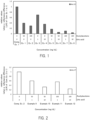
- FIG. 1 is a graph that shows relative values in the case where the reflectance difference ( ⁇ R) in Comparative Example 1 (hemoglobin-containing solution that does not contain monosodium urate or acetylacetone) is assumed to be 1.
- FIG. 2 is a graph that shows relative values in the case where a reflectance difference ( ⁇ R) in Comparative Example 2 (hemoglobin-containing solution that does not contain monosodium urate nor acetylacetone) is assumed to be 1.
- the relative values (change rates of reflectances) in Examples 1 to 8 were less than 0.7, which means that hemoglobin could be stably preserved in any of Examples.
- the relative values in Examples 5 to 8 in which both acetylacetone and monosodium urate were present were 0.17 or less, and particularly the relative values (change rates of reflectances) in Examples 6 and 8 in which acetylacetone and 10 mg/dL monosodium urate were present were 0.06 or less, which means that hemoglobin could be much more stably preserved.
Landscapes
- Health & Medical Sciences (AREA)
- Life Sciences & Earth Sciences (AREA)
- Chemical & Material Sciences (AREA)
- Hematology (AREA)
- Engineering & Computer Science (AREA)
- Molecular Biology (AREA)
- Immunology (AREA)
- Biomedical Technology (AREA)
- Urology & Nephrology (AREA)
- General Health & Medical Sciences (AREA)
- Biochemistry (AREA)
- General Physics & Mathematics (AREA)
- Pathology (AREA)
- Medicinal Chemistry (AREA)
- Physics & Mathematics (AREA)
- Analytical Chemistry (AREA)
- Cell Biology (AREA)
- Food Science & Technology (AREA)
- Microbiology (AREA)
- Biotechnology (AREA)
- Organic Chemistry (AREA)
- Gastroenterology & Hepatology (AREA)
- Biophysics (AREA)
- Genetics & Genomics (AREA)
- Proteomics, Peptides & Aminoacids (AREA)
- Investigating Or Analysing Biological Materials (AREA)
Applications Claiming Priority (1)
| Application Number | Priority Date | Filing Date | Title |
|---|---|---|---|
| JP2022105015A JP2024005038A (ja) | 2022-06-29 | 2022-06-29 | ヘモグロビンの安定化方法、及びヘモグロビン保存溶液 |
Publications (1)
| Publication Number | Publication Date |
|---|---|
| EP4300105A1 true EP4300105A1 (de) | 2024-01-03 |
Family
ID=87036682
Family Applications (1)
| Application Number | Title | Priority Date | Filing Date |
|---|---|---|---|
| EP23182210.7A Pending EP4300105A1 (de) | 2022-06-29 | 2023-06-28 | Verfahren zur stabilisierung von hämoglobin |
Country Status (4)
| Country | Link |
|---|---|
| US (1) | US20240003919A1 (de) |
| EP (1) | EP4300105A1 (de) |
| JP (1) | JP2024005038A (de) |
| CN (1) | CN117327172A (de) |
Citations (6)
| Publication number | Priority date | Publication date | Assignee | Title |
|---|---|---|---|---|
| JPH01309687A (ja) * | 1988-06-03 | 1989-12-14 | Internatl Reagents Corp | 安定化されたN−アセチル−β−D−グルコサミニダーゼ及びそれを含有するコントロール製剤 |
| JPH0214190B2 (de) | 1984-12-05 | 1990-04-06 | Kawasaki Steel Co | |
| JP2000319238A (ja) * | 1999-04-30 | 2000-11-21 | Shino Test:Kk | 被酸化性発色試薬用色原体、及びこれを用いる測定方法並びに測定試薬 |
| JP2003014768A (ja) | 2001-06-29 | 2003-01-15 | Eiken Chem Co Ltd | ヘムタンパク質の安定化方法および保存溶液 |
| US20090137612A1 (en) * | 2007-11-27 | 2009-05-28 | William Howard Waugh | Treatment with combined use of oxypurines and ascorbate to prevent and mitigate iron-catalized oxidative damage in Alzheimer's disease and other neurodegenerative disorders |
| JP2014174057A (ja) * | 2013-03-11 | 2014-09-22 | Akira Miike | ヘモグロビンの高感度測定法と試薬 |
-
2022
- 2022-06-29 JP JP2022105015A patent/JP2024005038A/ja active Pending
-
2023
- 2023-06-28 US US18/343,428 patent/US20240003919A1/en active Pending
- 2023-06-28 CN CN202310772755.2A patent/CN117327172A/zh active Pending
- 2023-06-28 EP EP23182210.7A patent/EP4300105A1/de active Pending
Patent Citations (6)
| Publication number | Priority date | Publication date | Assignee | Title |
|---|---|---|---|---|
| JPH0214190B2 (de) | 1984-12-05 | 1990-04-06 | Kawasaki Steel Co | |
| JPH01309687A (ja) * | 1988-06-03 | 1989-12-14 | Internatl Reagents Corp | 安定化されたN−アセチル−β−D−グルコサミニダーゼ及びそれを含有するコントロール製剤 |
| JP2000319238A (ja) * | 1999-04-30 | 2000-11-21 | Shino Test:Kk | 被酸化性発色試薬用色原体、及びこれを用いる測定方法並びに測定試薬 |
| JP2003014768A (ja) | 2001-06-29 | 2003-01-15 | Eiken Chem Co Ltd | ヘムタンパク質の安定化方法および保存溶液 |
| US20090137612A1 (en) * | 2007-11-27 | 2009-05-28 | William Howard Waugh | Treatment with combined use of oxypurines and ascorbate to prevent and mitigate iron-catalized oxidative damage in Alzheimer's disease and other neurodegenerative disorders |
| JP2014174057A (ja) * | 2013-03-11 | 2014-09-22 | Akira Miike | ヘモグロビンの高感度測定法と試薬 |
Non-Patent Citations (4)
| Title |
|---|
| COOPER C E ET AL: "Peroxidase activity of hemoglobin towards ascorbate and urate: A synergistic protective strategy against toxicity of Hemoglobin-Based Oxygen Carriers (HBOC)", BIOCHIMICA ET BIOPHYSICA ACTA (BBA) - PROTEINS & PROTEOMICS, ELSEVIER, NETHERLANDS, vol. 1784, no. 10, 16 April 2008 (2008-04-16), pages 1415 - 1420, XP025435227, ISSN: 1570-9639, [retrieved on 20080416], DOI: 10.1016/J.BBAPAP.2008.03.019 * |
| MAKARSKA-BIALOKOZ MAGDALENA ED - LUISA CARVALHO MARIA ET AL: "Analysis of the binding interaction in uric acid - Human hemoglobin system by spectroscopic techniques", SPECTROCHIMICA ACTA PART A: MOLECULAR AND BIOMOLECULAR SPECTROSCOPY, vol. 178, 31 January 2017 (2017-01-31), pages 47 - 54, XP029940701, ISSN: 1386-1425, DOI: 10.1016/J.SAA.2017.01.063 * |
| PICHERT ANNELIE ET AL: "Interaction of the chlorite-based drug WF10 and chlorite with hemoglobin, methemoglobin and ferryl hemoglobin", ARCHIVES OF BIOCHEMISTRY AND BIOPHYSICS, ACADEMIC PRESS, US, vol. 585, 21 September 2015 (2015-09-21), pages 82 - 89, XP029298851, ISSN: 0003-9861, DOI: 10.1016/J.ABB.2015.09.009 * |
| YANG T ET AL: "The effect of crosslinking by bis(3,5-dibromosalicyl) fumarate on the autoxidation of hemoglobin", BIOCHEMICAL AND BIOPHYSICAL RESEARCH COMMUNICATIONS, ELSEVIER, AMSTERDAM NL, vol. 163, no. 2, 15 September 1989 (1989-09-15), pages 733 - 738, XP024769790, ISSN: 0006-291X, [retrieved on 19890915], DOI: 10.1016/0006-291X(89)92284-5 * |
Also Published As
| Publication number | Publication date |
|---|---|
| JP2024005038A (ja) | 2024-01-17 |
| US20240003919A1 (en) | 2024-01-04 |
| CN117327172A (zh) | 2024-01-02 |
Similar Documents
| Publication | Publication Date | Title |
|---|---|---|
| US11808776B2 (en) | Method of analyzing diluted biological sample component | |
| US5045529A (en) | Tonometric fluid for blood gas and co-oximetry instruments | |
| Noe et al. | Direct spectrophotometry of serum hemoglobin: an Allen correction compared with a three-wavelength polychromatic analysis. | |
| US3979262A (en) | Compositions and methods for the determination of oxidizing agents | |
| JPS63271160A (ja) | 糞便試料のイムノアツセイの組成物および方法 | |
| Morin et al. | Single Glucose Oxidase—Peroxidase reagent for two-minute determination of serum glucose | |
| JPS6324900A (ja) | グルコ−ス定量用安定化液体酵素組成物、それを用いる試薬キット及び定量方法 | |
| US5804405A (en) | Bilirubin detection | |
| US4803158A (en) | Composition used for the determination of beta-hydroxybutyric acid and a method for preparing the said composition | |
| HU188211B (en) | Process and reagent for determining glycolyzed hemoglobine | |
| CN102128919B (zh) | 一种组合物及其应用 | |
| JPH11316228A (ja) | 組換え組織因子に基づく、即時使用可能なプロトロンビン時間試薬 | |
| EP4300105A1 (de) | Verfahren zur stabilisierung von hämoglobin | |
| JPH06294799A (ja) | 臨床診断に用いる安定した液体対照および/または 較正用血清 | |
| JP4392486B2 (ja) | ハプトグロビンの分析方法 | |
| US20090123956A1 (en) | Measurement of the oxidants-antioxidants balance in liquids | |
| CN109837270B (zh) | 一种使肌醇脱氢酶、酮胺氧化酶和鞘磷脂酶在液体中长期稳定的方法 | |
| JP3165654B2 (ja) | 対照血清及びカリブレーター中のビリルビンの安定化 | |
| US3778384A (en) | Diagnostic composition for the quantitative determination of glucose | |
| JP3713901B2 (ja) | 破骨細胞由来酸性ホスファターゼの測定方法 | |
| Mazzachi et al. | A manual spectrophotometric method for the measurement of serum sodium and potassium by enzyme activation | |
| JP5425062B2 (ja) | D−マンニトールを含有する管理試料を用いるグリコアルブミン等の測定方法 | |
| JP2002527076A (ja) | ヘモグロビン妨害を排除しつつアルカリホスファターゼを測定する方法 | |
| JPH02122267A (ja) | ヘモグロビン定量試薬キット及びそれを用いるヘモグロビン定量方法 | |
| Kickler et al. | Kinetic determination of serum haptoblobin with a centrifugal analyzer. |
Legal Events
| Date | Code | Title | Description |
|---|---|---|---|
| PUAI | Public reference made under article 153(3) epc to a published international application that has entered the european phase |
Free format text: ORIGINAL CODE: 0009012 |
|
| STAA | Information on the status of an ep patent application or granted ep patent |
Free format text: STATUS: THE APPLICATION HAS BEEN PUBLISHED |
|
| AK | Designated contracting states |
Kind code of ref document: A1 Designated state(s): AL AT BE BG CH CY CZ DE DK EE ES FI FR GB GR HR HU IE IS IT LI LT LU LV MC ME MK MT NL NO PL PT RO RS SE SI SK SM TR |
|
| STAA | Information on the status of an ep patent application or granted ep patent |
Free format text: STATUS: REQUEST FOR EXAMINATION WAS MADE |
|
| 17P | Request for examination filed |
Effective date: 20240628 |
|
| RBV | Designated contracting states (corrected) |
Designated state(s): AL AT BE BG CH CY CZ DE DK EE ES FI FR GB GR HR HU IE IS IT LI LT LU LV MC ME MK MT NL NO PL PT RO RS SE SI SK SM TR |
|
| STAA | Information on the status of an ep patent application or granted ep patent |
Free format text: STATUS: EXAMINATION IS IN PROGRESS |
|
| 17Q | First examination report despatched |
Effective date: 20250903 |