EP4325861A2 - Interaction entre une table de conversion et un amvp - Google Patents
Interaction entre une table de conversion et un amvp Download PDFInfo
- Publication number
- EP4325861A2 EP4325861A2 EP23220549.2A EP23220549A EP4325861A2 EP 4325861 A2 EP4325861 A2 EP 4325861A2 EP 23220549 A EP23220549 A EP 23220549A EP 4325861 A2 EP4325861 A2 EP 4325861A2
- Authority
- EP
- European Patent Office
- Prior art keywords
- motion
- candidates
- block
- candidate
- merge
- Prior art date
- Legal status (The legal status is an assumption and is not a legal conclusion. Google has not performed a legal analysis and makes no representation as to the accuracy of the status listed.)
- Pending
Links
- 230000003993 interaction Effects 0.000 title 1
- 238000000034 method Methods 0.000 claims abstract description 192
- 239000013598 vector Substances 0.000 claims description 147
- 230000002123 temporal effect Effects 0.000 claims description 58
- PXFBZOLANLWPMH-UHFFFAOYSA-N 16-Epiaffinine Natural products C1C(C2=CC=CC=C2N2)=C2C(=O)CC2C(=CC)CN(C)C1C2CO PXFBZOLANLWPMH-UHFFFAOYSA-N 0.000 claims description 35
- 230000015654 memory Effects 0.000 claims description 11
- 238000001914 filtration Methods 0.000 claims description 3
- 238000003672 processing method Methods 0.000 claims description 3
- 230000008569 process Effects 0.000 abstract description 53
- 238000006243 chemical reaction Methods 0.000 abstract description 32
- 241000023320 Luma <angiosperm> Species 0.000 description 54
- OSWPMRLSEDHDFF-UHFFFAOYSA-N methyl salicylate Chemical compound COC(=O)C1=CC=CC=C1O OSWPMRLSEDHDFF-UHFFFAOYSA-N 0.000 description 54
- 238000009795 derivation Methods 0.000 description 47
- 238000000638 solvent extraction Methods 0.000 description 35
- 230000002146 bilateral effect Effects 0.000 description 21
- 238000013138 pruning Methods 0.000 description 21
- 238000004590 computer program Methods 0.000 description 15
- 238000005192 partition Methods 0.000 description 15
- 238000012545 processing Methods 0.000 description 14
- 238000010276 construction Methods 0.000 description 11
- 230000011664 signaling Effects 0.000 description 9
- 230000008901 benefit Effects 0.000 description 5
- 230000005540 biological transmission Effects 0.000 description 5
- 238000005516 engineering process Methods 0.000 description 5
- 230000006870 function Effects 0.000 description 5
- 101150114515 CTBS gene Proteins 0.000 description 4
- 230000006835 compression Effects 0.000 description 4
- 238000007906 compression Methods 0.000 description 4
- 238000013461 design Methods 0.000 description 4
- 238000005286 illumination Methods 0.000 description 4
- 238000003780 insertion Methods 0.000 description 4
- 230000037431 insertion Effects 0.000 description 4
- 230000003287 optical effect Effects 0.000 description 4
- 230000003044 adaptive effect Effects 0.000 description 3
- 238000004422 calculation algorithm Methods 0.000 description 3
- 238000010586 diagram Methods 0.000 description 3
- 238000000926 separation method Methods 0.000 description 3
- 230000000007 visual effect Effects 0.000 description 3
- 238000004891 communication Methods 0.000 description 2
- 230000001419 dependent effect Effects 0.000 description 2
- 230000000644 propagated effect Effects 0.000 description 2
- 238000013515 script Methods 0.000 description 2
- IUVCFHHAEHNCFT-INIZCTEOSA-N 2-[(1s)-1-[4-amino-3-(3-fluoro-4-propan-2-yloxyphenyl)pyrazolo[3,4-d]pyrimidin-1-yl]ethyl]-6-fluoro-3-(3-fluorophenyl)chromen-4-one Chemical compound C1=C(F)C(OC(C)C)=CC=C1C(C1=C(N)N=CN=C11)=NN1[C@@H](C)C1=C(C=2C=C(F)C=CC=2)C(=O)C2=CC(F)=CC=C2O1 IUVCFHHAEHNCFT-INIZCTEOSA-N 0.000 description 1
- 208000037170 Delayed Emergence from Anesthesia Diseases 0.000 description 1
- 230000001174 ascending effect Effects 0.000 description 1
- 230000006399 behavior Effects 0.000 description 1
- 238000004364 calculation method Methods 0.000 description 1
- 238000011161 development Methods 0.000 description 1
- 230000018109 developmental process Effects 0.000 description 1
- 229910003460 diamond Inorganic materials 0.000 description 1
- 239000010432 diamond Substances 0.000 description 1
- 238000006073 displacement reaction Methods 0.000 description 1
- 238000012986 modification Methods 0.000 description 1
- 230000004048 modification Effects 0.000 description 1
- 238000013139 quantization Methods 0.000 description 1
- 230000003252 repetitive effect Effects 0.000 description 1
- 230000004044 response Effects 0.000 description 1
- 238000005070 sampling Methods 0.000 description 1
- 230000011218 segmentation Effects 0.000 description 1
- 239000004065 semiconductor Substances 0.000 description 1
- 239000000758 substrate Substances 0.000 description 1
- 238000012546 transfer Methods 0.000 description 1
Images













Classifications
-
- H—ELECTRICITY
- H04—ELECTRIC COMMUNICATION TECHNIQUE
- H04N—PICTORIAL COMMUNICATION, e.g. TELEVISION
- H04N19/00—Methods or arrangements for coding, decoding, compressing or decompressing digital video signals
- H04N19/50—Methods or arrangements for coding, decoding, compressing or decompressing digital video signals using predictive coding
- H04N19/503—Methods or arrangements for coding, decoding, compressing or decompressing digital video signals using predictive coding involving temporal prediction
- H04N19/51—Motion estimation or motion compensation
- H04N19/513—Processing of motion vectors
-
- H—ELECTRICITY
- H04—ELECTRIC COMMUNICATION TECHNIQUE
- H04N—PICTORIAL COMMUNICATION, e.g. TELEVISION
- H04N19/00—Methods or arrangements for coding, decoding, compressing or decompressing digital video signals
- H04N19/50—Methods or arrangements for coding, decoding, compressing or decompressing digital video signals using predictive coding
- H04N19/503—Methods or arrangements for coding, decoding, compressing or decompressing digital video signals using predictive coding involving temporal prediction
- H04N19/51—Motion estimation or motion compensation
- H04N19/513—Processing of motion vectors
- H04N19/517—Processing of motion vectors by encoding
- H04N19/52—Processing of motion vectors by encoding by predictive encoding
-
- H—ELECTRICITY
- H04—ELECTRIC COMMUNICATION TECHNIQUE
- H04N—PICTORIAL COMMUNICATION, e.g. TELEVISION
- H04N19/00—Methods or arrangements for coding, decoding, compressing or decompressing digital video signals
- H04N19/10—Methods or arrangements for coding, decoding, compressing or decompressing digital video signals using adaptive coding
- H04N19/134—Methods or arrangements for coding, decoding, compressing or decompressing digital video signals using adaptive coding characterised by the element, parameter or criterion affecting or controlling the adaptive coding
- H04N19/136—Incoming video signal characteristics or properties
- H04N19/137—Motion inside a coding unit, e.g. average field, frame or block difference
-
- H—ELECTRICITY
- H04—ELECTRIC COMMUNICATION TECHNIQUE
- H04N—PICTORIAL COMMUNICATION, e.g. TELEVISION
- H04N19/00—Methods or arrangements for coding, decoding, compressing or decompressing digital video signals
- H04N19/10—Methods or arrangements for coding, decoding, compressing or decompressing digital video signals using adaptive coding
- H04N19/102—Methods or arrangements for coding, decoding, compressing or decompressing digital video signals using adaptive coding characterised by the element, parameter or selection affected or controlled by the adaptive coding
- H04N19/103—Selection of coding mode or of prediction mode
- H04N19/105—Selection of the reference unit for prediction within a chosen coding or prediction mode, e.g. adaptive choice of position and number of pixels used for prediction
-
- H—ELECTRICITY
- H04—ELECTRIC COMMUNICATION TECHNIQUE
- H04N—PICTORIAL COMMUNICATION, e.g. TELEVISION
- H04N19/00—Methods or arrangements for coding, decoding, compressing or decompressing digital video signals
- H04N19/10—Methods or arrangements for coding, decoding, compressing or decompressing digital video signals using adaptive coding
- H04N19/102—Methods or arrangements for coding, decoding, compressing or decompressing digital video signals using adaptive coding characterised by the element, parameter or selection affected or controlled by the adaptive coding
- H04N19/12—Selection from among a plurality of transforms or standards, e.g. selection between discrete cosine transform [DCT] and sub-band transform or selection between H.263 and H.264
- H04N19/122—Selection of transform size, e.g. 8x8 or 2x4x8 DCT; Selection of sub-band transforms of varying structure or type
-
- H—ELECTRICITY
- H04—ELECTRIC COMMUNICATION TECHNIQUE
- H04N—PICTORIAL COMMUNICATION, e.g. TELEVISION
- H04N19/00—Methods or arrangements for coding, decoding, compressing or decompressing digital video signals
- H04N19/10—Methods or arrangements for coding, decoding, compressing or decompressing digital video signals using adaptive coding
- H04N19/134—Methods or arrangements for coding, decoding, compressing or decompressing digital video signals using adaptive coding characterised by the element, parameter or criterion affecting or controlling the adaptive coding
- H04N19/157—Assigned coding mode, i.e. the coding mode being predefined or preselected to be further used for selection of another element or parameter
-
- H—ELECTRICITY
- H04—ELECTRIC COMMUNICATION TECHNIQUE
- H04N—PICTORIAL COMMUNICATION, e.g. TELEVISION
- H04N19/00—Methods or arrangements for coding, decoding, compressing or decompressing digital video signals
- H04N19/10—Methods or arrangements for coding, decoding, compressing or decompressing digital video signals using adaptive coding
- H04N19/134—Methods or arrangements for coding, decoding, compressing or decompressing digital video signals using adaptive coding characterised by the element, parameter or criterion affecting or controlling the adaptive coding
- H04N19/157—Assigned coding mode, i.e. the coding mode being predefined or preselected to be further used for selection of another element or parameter
- H04N19/159—Prediction type, e.g. intra-frame, inter-frame or bidirectional frame prediction
-
- H—ELECTRICITY
- H04—ELECTRIC COMMUNICATION TECHNIQUE
- H04N—PICTORIAL COMMUNICATION, e.g. TELEVISION
- H04N19/00—Methods or arrangements for coding, decoding, compressing or decompressing digital video signals
- H04N19/10—Methods or arrangements for coding, decoding, compressing or decompressing digital video signals using adaptive coding
- H04N19/169—Methods or arrangements for coding, decoding, compressing or decompressing digital video signals using adaptive coding characterised by the coding unit, i.e. the structural portion or semantic portion of the video signal being the object or the subject of the adaptive coding
- H04N19/17—Methods or arrangements for coding, decoding, compressing or decompressing digital video signals using adaptive coding characterised by the coding unit, i.e. the structural portion or semantic portion of the video signal being the object or the subject of the adaptive coding the unit being an image region, e.g. an object
- H04N19/176—Methods or arrangements for coding, decoding, compressing or decompressing digital video signals using adaptive coding characterised by the coding unit, i.e. the structural portion or semantic portion of the video signal being the object or the subject of the adaptive coding the unit being an image region, e.g. an object the region being a block, e.g. a macroblock
-
- H—ELECTRICITY
- H04—ELECTRIC COMMUNICATION TECHNIQUE
- H04N—PICTORIAL COMMUNICATION, e.g. TELEVISION
- H04N19/00—Methods or arrangements for coding, decoding, compressing or decompressing digital video signals
- H04N19/10—Methods or arrangements for coding, decoding, compressing or decompressing digital video signals using adaptive coding
- H04N19/169—Methods or arrangements for coding, decoding, compressing or decompressing digital video signals using adaptive coding characterised by the coding unit, i.e. the structural portion or semantic portion of the video signal being the object or the subject of the adaptive coding
- H04N19/184—Methods or arrangements for coding, decoding, compressing or decompressing digital video signals using adaptive coding characterised by the coding unit, i.e. the structural portion or semantic portion of the video signal being the object or the subject of the adaptive coding the unit being bits, e.g. of the compressed video stream
-
- H—ELECTRICITY
- H04—ELECTRIC COMMUNICATION TECHNIQUE
- H04N—PICTORIAL COMMUNICATION, e.g. TELEVISION
- H04N19/00—Methods or arrangements for coding, decoding, compressing or decompressing digital video signals
- H04N19/70—Methods or arrangements for coding, decoding, compressing or decompressing digital video signals characterised by syntax aspects related to video coding, e.g. related to compression standards
-
- H—ELECTRICITY
- H04—ELECTRIC COMMUNICATION TECHNIQUE
- H04N—PICTORIAL COMMUNICATION, e.g. TELEVISION
- H04N19/00—Methods or arrangements for coding, decoding, compressing or decompressing digital video signals
- H04N19/90—Methods or arrangements for coding, decoding, compressing or decompressing digital video signals using coding techniques not provided for in groups H04N19/10-H04N19/85, e.g. fractals
- H04N19/96—Tree coding, e.g. quad-tree coding
Definitions
- This patent document relates to video coding and decoding techniques, devices and systems.
- This document discloses methods, systems, and devices for encoding and decoding digital video.
- a method of video decoding includes maintaining tables, wherein each table includes a set of motion candidates and each motion candidate is associated with corresponding motion information; and performing a conversion between a first video block and a bitstream representation of a video including the first video block, the performing of the conversion including using at least some of the set of motion candidates as a predictor to process motion information of the first video block.
- the various techniques described herein may be embodied as a computer program product stored on a non-transitory computer readable media.
- the computer program product includes program code for carrying out the methods described herein.
- the present document is related to video coding technologies. Specifically, it is related to motion information coding (such as merge mode, AMVP mode) in video coding. It may be applied to the existing video coding standard like HEVC, or the standard (Versatile Video Coding) to be finalized. It may be also applicable to future video coding standards or video codec.
- motion information coding such as merge mode, AMVP mode
- Video coding standards have evolved primarily through the development of the well-known ITU-T and ISO/IEC standards.
- the ITU-T produced H.261 and H.263, ISO/IEC produced MPEG-1 and MPEG-4 Visual, and the two organizations jointly produced the H.262/MPEG-2 Video and H.264/MPEG-4 Advanced Video Coding (AVC) and H.265/HEVC standards.
- AVC H.264/MPEG-4 Advanced Video Coding
- H.265/HEVC High Efficiency Video Coding
- the video coding standards are based on the hybrid video coding structure wherein temporal prediction plus transform coding are utilized.
- An example of a typical HEVC encoder framework is depicted in FIG. 1 .
- the core of the coding layer in previous standards was the macroblock, containing a 16 ⁇ 16 block of luma samples and, in the usual case of 4:2:0 color sampling, two corresponding 8 ⁇ 8 blocks of chroma samples.
- An intra-coded block uses spatial prediction to exploit spatial correlation among pixels.
- Two partitions are defined: 16x16 and 4x4.
- An inter-coded block uses temporal prediction, instead of spatial prediction, by estimating motion among pictures.
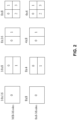
- Motion can be estimated independently for either 16x16 macroblock or any of its sub-macroblock partitions: 16x8, 8x16, 8x8, 8x4, 4x8, 4x4 (see FIG. 2 ). Only one motion vector (MV) per sub-macroblock partition is allowed.
- a CTU is split into CUs by using a quadtree structure denoted as coding tree to adapt to various local characteristics.
- the decision whether to code a picture area using inter-picture (temporal) or intra-picture (spatial) prediction is made at the CU level.
- Each CU can be further split into one, two or four PUs according to the PU splitting type. Inside one PU, the same prediction process is applied and the relevant information is transmitted to the decoder on a PU basis.
- a CU can be partitioned into transform units (TUs) according to another quadtree structure similar to the coding tree for the CU.
- TUs transform units
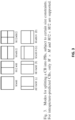
- FIG. 4 shows an example of a subdivision of a CTB into CBs [and transform block (TBs)]. Solid lines indicate CB borders and dotted lines indicate TB borders. (a) CTB with its partitioning. (b) corresponding quadtree.
- a CB can be recursively partitioned into transform blocks (TBs).
- the partitioning is signaled by a residual quadtree. Only square CB and TB partitioning is specified, where a block can be recursively split into quadrants, as illustrated in FIG. 4 .
- a flag signals whether it is split into four blocks of size M/2 ⁇ M/2. If further splitting is possible, as signaled by a maximum depth of the residual quadtree indicated in the SPS, each quadrant is assigned a flag that indicates whether it is split into four quadrants.
- the leaf node blocks resulting from the residual quadtree are the transform blocks that are further processed by transform coding.
- the encoder indicates the maximum and minimum luma TB sizes that it will use. Splitting is implicit when the CB size is larger than the maximum TB size. Not splitting is implicit when splitting would result in a luma TB size smaller than the indicated minimum.
- the chroma TB size is half the luma TB size in each dimension, except when the luma TB size is 4 ⁇ 4, in which case a single 4 ⁇ 4 chroma TB is used for the region covered by four 4 ⁇ 4 luma TBs.
- intra-picture-predicted CUs the decoded samples of the nearest-neighboring TBs (within or outside the CB) are used as reference data for intra picture prediction.
- the HEVC design allows a TB to span across multiple PBs for inter-picture predicted CUs to maximize the potential coding efficiency benefits of the quadtree-structured TB partitioning.
- a CTB is divided according to a quad-tree structure, the nodes of which are coding units.
- the plurality of nodes in a quad-tree structure includes leaf nodes and non-leaf nodes.
- the leaf nodes have no child nodes in the tree structure (i.e., the leaf nodes are not further split).
- The, non-leaf nodes include a root node of the tree structure.
- the root node corresponds to an initial video block of the video data (e.g., a CTB).
- the respective non-root node corresponds to a video block that is a sub-block of a video block corresponding to a parent node in the tree structure of the respective non-root node.
- Each respective non-leaf node of the plurality of non-leaf nodes has one or more child nodes in the tree structure.
- JVET Joint Video Exploration Team
- the QTBT structure removes the concepts of multiple partition types, i.e. it removes the separation of the CU, PU and TU concepts, and supports more flexibility for CU partition shapes.
- a CU can have either a square or rectangular shape.
- a coding tree unit (CTU) is first partitioned by a quadtree structure.
- the quadtree leaf nodes are further partitioned by a binary tree structure.
- the binary tree leaf nodes are called coding units (CUs), and that segmentation is used for prediction and transform processing without any further partitioning.
- a CU sometimes consists of coding blocks (CBs) of different colour components, e.g. one CU contains one luma CB and two chroma CBs in the case of P and B slices of the 4:2:0 chroma format and sometimes consists of a CB of a single component, e.g., one CU contains only one luma CB or just two chroma CBs in the case of I slices.
- CBs coding blocks
- the CTU size is set as 128 ⁇ 128 luma samples with two corresponding 64 ⁇ 64 blocks of chroma samples
- the MinQTSize is set as 16 ⁇ 16
- the MaxBTSize is set as 64 ⁇ 64
- the MinBTSize (for both width and height) is set as 4 ⁇ 4
- the MaxBTDepth is set as 4.
- the quadtree partitioning is applied to the CTU first to generate quadtree leaf nodes.
- the quadtree leaf nodes may have a size from 16 ⁇ 16 (i.e., the MinQTSize) to 128 ⁇ 128 (i.e., the CTU size).
- the quadtree leaf node is also the root node for the binary tree and it has the binary tree depth as 0.
- MaxBTDepth i.e., 4
- no further splitting is considered.
- MinBTSize i.e. 4
- no further horizontal splitting is considered.
- the binary tree node has height equal to MinBTSize
- no further vertical splitting is considered.
- the leaf nodes of the binary tree are further processed by prediction and transform processing without any further partitioning. In the JEM, the maximum CTU size is 256 ⁇ 256 luma samples.
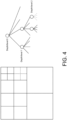
- FIG. 5 illustrates an example of block partitioning by using QTBT
- FIG. 5 illustrates the corresponding tree representation.
- the solid lines indicate quadtree splitting and dotted lines indicate binary tree splitting.
- each splitting (i.e., non-leaf) node of the binary tree one flag is signalled to indicate which splitting type (i.e., horizontal or vertical) is used, where 0 indicates horizontal splitting and 1 indicates vertical splitting.
- the quadtree splitting there is no need to indicate the splitting type since quadtree splitting always splits a block both horizontally and vertically to produce 4 sub-blocks with an equal size.
- the QTBT scheme supports the ability for the luma and chroma to have a separate QTBT structure.
- the luma and chroma CTBs in one CTU share the same QTBT structure.
- the luma CTB is partitioned into CUs by a QTBT structure
- the chroma CTBs are partitioned into chroma CUs by another QTBT structure. This means that a CU in an I slice consists of a coding block of the luma component or coding blocks of two chroma components, and a CU in a P or B slice consists of coding blocks of all three colour components.
- inter prediction for small blocks is restricted to reduce the memory access of motion compensation, such that bi-prediction is not supported for 4 ⁇ 8 and 8 ⁇ 4 blocks, and inter prediction is not supported for 4 ⁇ 4 blocks.
- these restrictions are removed.
- TT ternary tree partitions, i.e., horizontal and vertical center-side ternary-trees are introduced, as shown in FIG. 6 (d) and (e) .
- FIG. 6 shows: (a) quad-tree partitioning (b) vertical binary-tree partitioning (c) horizontal binary-tree partitioning (d) vertical center-side ternary-tree partitioning (e) horizontal center-side ternary-tree partitioning.
- region tree region tree
- prediction tree binary-tree or ternary-tree
- a CTU is firstly partitioned by region tree (RT).
- a RT leaf may be further split with prediction tree (PT).
- PT leaf may also be further split with PT until max PT depth is reached.
- a PT leaf is the basic coding unit. It is still called CU for convenience.
- a CU cannot be further split.
- Prediction and transform are both applied on CU in the same way as JEM.
- the whole partition structure is named 'multiple-type-tree'.
- Multi-Tree Type is a generalization of the QTBT.
- a Coding Tree Unit (CTU) is firstly partitioned by a quad-tree structure.
- the quad-tree leaf nodes are further partitioned by a binary-tree structure.
- the fundamental structure of MTT constitutes of two types of tree nodes: Region Tree (RT) and Prediction Tree (PT), supporting nine types of partitions, as shown in FIG. 7 .
- RT Region Tree
- PT Prediction Tree
- FIG. 7 shows: (a) quad-tree partitioning (b) vertical binary-tree partitioning (c) horizontal binary-tree partitioning (d) vertical ternary-tree partitioning (e) horizontal ternary-tree partitioning (f) horizontal-up asymmetric binary-tree partitioning (g) horizontal-down asymmetric binary-tree partitioning (h) vertical-left asymmetric binary-tree partitioning (i) vertical-right asymmetric binary-tree partitioning.
- a region tree can recursively split a CTU into square blocks down to a 4x4 size region tree leaf node.
- a prediction tree can be formed from one of three tree types: Binary Tree (BT), Ternary Tree (TT), and Asymmetric Binary Tree (ABT).
- BT Binary Tree
- TT Ternary Tree
- ABT Asymmetric Binary Tree
- JEM JEM
- the luma tree and the chroma tree are separated in I slices.
- the signaling methods for RT and PT are illustrated in FIG. 8 .
- Each inter-predicted PU has motion parameters for one or two reference picture lists.
- Motion parameters include a motion vector and a reference picture index. Usage of one of the two reference picture lists may also be signalled using inter_pred_idc.
- Motion vectors may be explicitly coded as deltas relative to predictors, such a coding mode is called AMVP mode.
- a merge mode is specified whereby the motion parameters for the current PU are obtained from neighbouring PUs, including spatial and temporal candidates.
- the merge mode can be applied to any inter-predicted PU, not only for skip mode.
- the alternative to merge mode is the explicit transmission of motion parameters, where motion vector, corresponding reference picture index for each reference picture list and reference picture list usage are signalled explicitly per each PU.
- the PU When signalling indicates that one of the two reference picture lists is to be used, the PU is produced from one block of samples. This is referred to as 'uni-prediction'. Uni-prediction is available both for P-slices and B-slices.
- the PU When signalling indicates that both of the reference picture lists are to be used, the PU is produced from two blocks of samples. This is referred to as 'bi-prediction'. Bi-prediction is available for B-slices only.
- a maximum of four merge candidates are selected among candidates that are located in five different positions.
- a maximum of one merge candidate is selected among two candidates. Since constant number of candidates for each PU is assumed at decoder, additional candidates are generated when the number of candidates does not reach to maximum number of merge candidate (MaxNumMergeCand) which is signalled in slice header. Since the number of candidates is constant, index of best merge candidate is encoded using truncated unary binarization (TU). If the size of CU is equal to 8, all the PUs of the current CU share a single merge candidate list, which is identical to the merge candidate list of the 2N ⁇ 2N prediction unit.
- TU truncated unary binarization
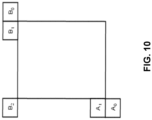
- a maximum of four merge candidates are selected among candidates located in the positions depicted in FIG. 10 .
- the order of derivation is A 1 , B 1 , B 0 , A 0 and B 2 .
- Position B 2 is considered only when any PU of position A 1 , B 1 , B 0 , A 0 is not available (e.g. because it belongs to another slice or tile) or is intra coded.
- candidate at position A 1 is added, the addition of the remaining candidates is subject to a redundancy check which ensures that candidates with same motion information are excluded from the list so that coding efficiency is improved.
- a redundancy check which ensures that candidates with same motion information are excluded from the list so that coding efficiency is improved.
- not all possible candidate pairs are considered in the mentioned redundancy check. Instead only the pairs linked with an arrow in FIG.
- FIG. 12 depicts the second PU for the case of N ⁇ 2N and 2N ⁇ N, respectively.
- candidate at position A 1 is not considered for list construction. In fact, by adding this candidate will lead to two prediction units having the same motion information, which is redundant to just have one PU in a coding unit.
- position B 1 is not considered when the current PU is partitioned as 2N ⁇ N.
- a scaled motion vector is derived based on co-located PU belonging to the picture which has the smallest POC difference with current picture within the given reference picture list.
- the reference picture list to be used for derivation of the co-located PU is explicitly signaled in the slice header.
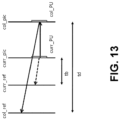
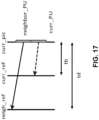
- the scaled motion vector for temporal merge candidate is obtained as illustrated by the dashed line in FIG.
- tb is defined to be the POC difference between the reference picture of the current picture and the current picture
- td is defined to be the POC difference between the reference picture of the co-located picture and the co-located picture.
- the reference picture index of temporal merge candidate is set equal to zero.
- a practical realization of the scaling process is described in the HEVC specification. For a B-slice, two motion vectors, one is for reference picture list 0 and the other is for reference picture list 1, are obtained and combined to make the bi-predictive merge candidate. Illustration of motion vector scaling for temporal merge candidate.
- the position for the temporal candidate is selected between candidates C 0 and Ci, as depicted in FIG. 14 . If PU at position C 0 is not available, is intra coded, or is outside of the current CTU, position C 1 is used. Otherwise, position C 0 is used in the derivation of the temporal merge candidate.
- merge candidates there are two additional types of merge candidates: combined bi-predictive merge candidate and zero merge candidate.
- Combined bi-predictive merge candidates are generated by utilizing spatio-temporal merge candidates.
- Combined bi-predictive merge candidate is used for B-Slice only.
- the combined bi-predictive candidates are generated by combining the first reference picture list motion parameters of an initial candidate with the second reference picture list motion parameters of another. If these two tuples provide different motion hypotheses, they will form a new bi-predictive candidate. As an example, FIG.
- Zero motion candidates are inserted to fill the remaining entries in the merge candidates list and therefore hit the MaxNumMergeCand capacity. These candidates have zero spatial displacement and a reference picture index which starts from zero and increases every time a new zero motion candidate is added to the list. The number of reference frames used by these candidates is one and two for uni and bi-directional prediction, respectively. Finally, no redundancy check is performed on these candidates.
- HEVC defines the motion estimation region (MER) whose size is signalled in the picture parameter set using the "log2_parallel merge level minus2" syntax element. When a MER is defined, merge candidates falling in the same region are marked as unavailable and therefore not considered in the list construction.
- pic_parameter_set_rbsp( ) Descript or pps_pic_parameter_set_id ue(v) pps_seq_parameter_set_id ue(v) dependent_slice_segments_enabled_flag u(l) ...
- log2_parallel _ merge_level _ minus2 plus 2 specifies the value of the variable Log2ParMrgLevel, which is used in the derivation process for luma motion vectors for merge mode as specified in clause 8.5.3.2.2 and the derivation process for spatial merging candidates as specified in clause 8.5.3.2.3.
- the value of log2_parallel_merge_level_minus2 shall be in the range of 0 to CtbLog2SizeY - 2, inclusive.
- Log2ParMrgLevel log 2 _ parallel _ merge _ level _ minus 2 + 2
- Log2ParMrgLevel indicates the built-in capability of parallel derivation of the merging candidate lists. For example, when Log2ParMrgLevel is equal to 6, the merging candidate lists for all the prediction units (PUs) and coding units (CUs) contained in a 64x64 block can be derived in parallel.
- PUs prediction units
- CUs coding units
- Motion vector prediction exploits spatial-temporal correlation of motion vector with neighboring PUs, which is used for explicit transmission of motion parameters. It constructs a motion vector candidate list by firstly checking availability of left, above temporally neighboring PU positions, removing redundant candidates and adding zero vector to make the candidate list to be constant length. Then, the encoder can select the best predictor from the candidate list and transmit the corresponding index indicating the chosen candidate. Similarly to merge index signaling, the index of the best motion vector candidate is encoded using truncated unary. The maximum value to be encoded in this case is 2 (e.g., FIGs. 2 to 8 ). In the following sections, details about derivation process of motion vector prediction candidate are provided.
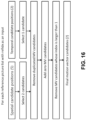
- FIG. 16 summarizes derivation process for motion vector prediction candidate.
- motion vector candidate In motion vector prediction, two types of motion vector candidates are considered: spatial motion vector candidate and temporal motion vector candidate.
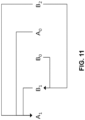
- spatial motion vector candidate derivation two motion vector candidates are eventually derived based on motion vectors of each PU located in five different positions as depicted in FIG. 11 .
- one motion vector candidate is selected from two candidates, which are derived based on two different co-located positions. After the first list of spatio-temporal candidates is made, duplicated motion vector candidates in the list are removed. If the number of potential candidates is larger than two, motion vector candidates whose reference picture index within the associated reference picture list is larger than 1 are removed from the list. If the number of spatio-temporal motion vector candidates is smaller than two, additional zero motion vector candidates is added to the list.
- a maximum of two candidates are considered among five potential candidates, which are derived from PUs located in positions as depicted in FIG. 11 , those positions being the same as those of motion merge.
- the order of derivation for the left side of the current PU is defined as A 0 , A 1 , and scaled A 0 , scaled A 1 .
- the order of derivation for the above side of the current PU is defined as B 0 , B 1 , B 2 , scaled B 0 , scaled B 1 , scaled B 2 .
- the no-spatial-scaling cases are checked first followed by the spatial scaling. Spatial scaling is considered when the POC is different between the reference picture of the neighbouring PU and that of the current PU regardless of reference picture list. If all PUs of left candidates are not available or are intra coded, scaling for the above motion vector is allowed to help parallel derivation of left and above MV candidates. Otherwise, spatial scaling is not allowed for the above motion vector.
- the motion vector of the neighbouring PU is scaled in a similar manner as for temporal scaling, as depicted as FIG. 17 .
- the main difference is that the reference picture list and index of current PU is given as input; the actual scaling process is the same as that of temporal scaling.
- bitstream For the AMVP mode, four parts may be signalled in the bitstream, i.e., prediction direction, reference index, MVD and mv predictor candidate index.
- each CU can have at most one set of motion parameters for each prediction direction.
- Two sub-CU level motion vector prediction methods are considered in the encoder by splitting a large CU into sub-CUs and deriving motion information for all the sub-CUs of the large CU.
- Alternative temporal motion vector prediction (ATMVP) method allows each CU to fetch multiple sets of motion information from multiple blocks smaller than the current CU in the collocated reference picture.
- STMVP spatial-temporal motion vector prediction
- the motion compression for the reference frames is currently disabled.
- the motion vectors temporal motion vector prediction is modified by fetching multiple sets of motion information (including motion vectors and reference indices) from blocks smaller than the current CU.
- the sub-CUs are square N ⁇ N blocks (N is set to 4 by default).
- ATMVP predicts the motion vectors of the sub-CUs within a CU in two steps.
- the first step is to identify the corresponding block in a reference picture with a so-called temporal vector.
- the reference picture is called the motion source picture.
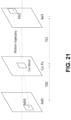
- the second step is to split the current CU into sub-CUs and obtain the motion vectors as well as the reference indices of each sub-CU from the block corresponding to each sub-CU, as shown in FIG. 18 .
- a reference picture and the corresponding block is determined by the motion information of the spatial neighbouring blocks of the current CU.
- the first merge candidate in the merge candidate list of the current CU is used.
- the first available motion vector as well as its associated reference index are set to be the temporal vector and the index to the motion source picture.
- the corresponding block may be more accurately identified, compared with TMVP, wherein the corresponding block (sometimes called collocated block) is always in a bottom-right or center position relative to the current CU.
- the associated MV and reference picture are utilized to identify the source block and source picture.
- FIG. 19 shows an example of the identification of source block and source picture
- a corresponding block of the sub-CU is identified by the temporal vector in the motion source picture, by adding to the coordinate of the current CU the temporal vector.
- the motion information of its corresponding block (the smallest motion grid that covers the center sample) is used to derive the motion information for the sub-CU.
- the motion information of a corresponding N ⁇ N block is identified, it is converted to the motion vectors and reference indices of the current sub-CU, in the same way as TMVP of HEVC, wherein motion scaling and other procedures apply.
- the decoder checks whether the low-delay condition (i.e.
- motion vector MV x the motion vector corresponding to reference picture list X
- motion vector MV y the motion vector corresponding to 0 or 1 and Y being equal to 1-X
- FIG. 20 illustrates this concept. Let us consider an 8 ⁇ 8 CU which contains four 4 ⁇ 4 sub-CUs A, B, C, and D. The neighbouring 4 ⁇ 4 blocks in the current frame are labelled as a, b, c, and d.
- the motion derivation for sub-CU A starts by identifying its two spatial neighbours.
- the first neighbour is the N ⁇ N block above sub-CU A (block c). If this block c is not available or is intra coded the other N ⁇ N blocks above sub-CU A are checked (from left to right, starting at block c).
- the second neighbour is a block to the left of the sub-CU A (block b). If block b is not available or is intra coded other blocks to the left of sub-CU A are checked (from top to bottom, staring at block b).
- the motion information obtained from the neighbouring blocks for each list is scaled to the first reference frame for a given list.
- temporal motion vector predictor (TMVP) of sub-block A is derived by following the same procedure of TMVP derivation as specified in HEVC.
- the motion information of the collocated block at location D is fetched and scaled accordingly.
- all available motion vectors (up to 3) are averaged separately for each reference list. The averaged motion vector is assigned as the motion vector of the current sub-CU.
- FIG. 20 shows an example of one CU with four sub-blocks (A-D) and its neighbouring blocks (a-d).
- the sub-CU modes are enabled as additional merge candidates and there is no additional syntax element required to signal the modes.
- Two additional merge candidates are added to merge candidates list of each CU to represent the ATMVP mode and STMVP mode. Up to seven merge candidates are used, if the sequence parameter set indicates that ATMVP and STMVP are enabled.
- the encoding logic of the additional merge candidates is the same as for the merge candidates in the HM, which means, for each CU in P or B slice, two more RD checks is needed for the two additional merge candidates.
- MVDs motion vector differences
- LAMVR locally adaptive motion vector resolution
- MVD can be coded in units of quarter luma samples, integer luma samples or four luma samples.
- the MVD resolution is controlled at the coding unit (CU) level, and MVD resolution flags are conditionally signalled for each CU that has at least one non-zero MVD components.
- a first flag is signalled to indicate whether quarter luma sample MV precision is used in the CU.
- the first flag (equal to 1) indicates that quarter luma sample MV precision is not used, another flag is signalled to indicate whether integer luma sample MV precision or four luma sample MV precision is used.
- the quarter luma sample MV resolution is used for the CU.
- the MVPs in the AMVP candidate list for the CU are rounded to the corresponding precision.
- CU-level RD checks are used to determine which MVD resolution is to be used for a CU. That is, the CU-level RD check is performed three times for each MVD resolution.
- the following encoding schemes are applied in the JEM.
- the motion information of the current CU (integer luma sample accuracy) is stored.
- the stored motion information (after rounding) is used as the starting point for further small range motion vector refinement during the RD check for the same CU with integer luma sample and 4 luma sample MVD resolution so that the time-consuming motion estimation process is not duplicated three times.
- RD check of a CU with 4 luma sample MVD resolution is conditionally invoked.
- RD cost integer luma sample MVD resolution is much larger than that of quarter luma sample MVD resolution
- the RD check of 4 luma sample MVD resolution for the CU is skipped.
- Pattern matched motion vector derivation (PMMVD) mode is a special merge mode based on Frame-Rate Up Conversion (FRUC) techniques. With this mode, motion information of a block is not signalled but derived at decoder side.
- PMMVD Pattern matched motion vector derivation
- FRUC Frame-Rate Up Conversion
- a FRUC flag is signalled for a CU when its merge flag is true.
- the FRUC flag is false, a merge index is signaled and the regular merge mode is used.
- an additional FRUC mode flag is signalled to indicate which method (bilateral matching or template matching) is to be used to derive motion information for the block.
- the decision on whether using FRUC merge mode for a CU is based on RD cost selection as done for normal merge candidate. That is the two matching modes (bilateral matching and template matching) are both checked for a CU by using RD cost selection. The one leading to the minimal cost is further compared to other CU modes. If a FRUC matching mode is the most efficient one, FRUC flag is set to true for the CU and the related matching mode is used.
- Motion derivation process in FRUC merge mode has two steps.
- a CU-level motion search is first performed, then followed by a Sub-CU level motion refinement.
- an initial motion vector is derived for the whole CU based on bilateral matching or template matching.
- a list of MV candidates is generated and the candidate which leads to the minimum matching cost is selected as the starting point for further CU level refinement.
- a local search based on bilateral matching or template matching around the starting point is performed and the MV results in the minimum matching cost is taken as the MV for the whole CU.
- the motion information is further refined at sub-CU level with the derived CU motion vectors as the starting points.
- the following derivation process is performed for a W ⁇ H CU motion information derivation.
- MV for the whole W ⁇ H CU is derived.
- the CU is further split into M ⁇ M sub-CUs.
- the value of M is calculated as in (16), D is a predefined splitting depth which is set to 3 by default in the JEM.
- the MV for each sub-CU is derived.
- M max 4 , min N 2 D N 2 D
- the bilateral matching is used to derive motion information of the current CU by finding the closest match between two blocks along the motion trajectory of the current CU in two different reference pictures.
- the motion vectors MV0 and MV1 pointing to the two reference blocks shall be proportional to the temporal distances, i.e., TD0 and TD1, between the current picture and the two reference pictures.
- the bilateral matching becomes mirror based bi-directional MV.
- template matching is used to derive motion information of the current CU by finding the closest match between a template (top and/or left neighbouring blocks of the current CU) in the current picture and a block (same size to the template) in a reference picture. Except the aforementioned FRUC merge mode, the template matching is also applied to AMVP mode.
- AMVP has two candidates.
- template matching method a new candidate is derived. If the newly derived candidate by template matching is different to the first existing AMVP candidate, it is inserted at the very beginning of the AMVP candidate list and then the list size is set to two (meaning remove the second existing AMVP candidate).
- AMVP mode only CU level search is applied.
- the MV candidate set at CU level consists of:
- each valid MV of a merge candidate is used as an input to generate a MV pair with the assumption of bilateral matching.
- one valid MV of a merge candidate is (MVa, refa) at reference list A.
- the reference picture refb of its paired bilateral MV is found in the other reference list B so that refa and refb are temporally at different sides of the current picture. If such a refb is not available in reference list B, refb is determined as a reference which is different from refa and its temporal distance to the current picture is the minimal one in list B.
- MVb is derived by scaling MVa based on the temporal distance between the current picture and refa, refb.
- MVs from the interpolated MV field are also added to the CU level candidate list. More specifically, the interpolated MVs at the position (0, 0), (W/2, 0), (0, H/2) and (W/2, H/2) of the current CU are added.
- the original AMVP candidates are also added to CU level MV candidate set.
- the MV candidate set at sub-CU level consists of:
- the scaled MVs from reference pictures are derived as follows. All the reference pictures in both lists are traversed. The MVs at a collocated position of the sub-CU in a reference picture are scaled to the reference of the starting CU-level MV.
- ATMVP and STMVP candidates are limited to the four first ones.
- interpolated motion field is generated for the whole picture based on unilateral ME. Then the motion field may be used later as CU level or sub-CU level MV candidates.
- the motion field of each reference pictures in both reference lists is traversed at 4 ⁇ 4 block level.
- the motion of the reference block is scaled to the current picture according to the temporal distance TD0 and TD1 (the same way as that of MV scaling of TMVP in HEVC) and the scaled motion is assigned to the block in the current frame. If no scaled MV is assigned to a 4 ⁇ 4 block, the block's motion is marked as unavailable in the interpolated motion field.
- the matching cost is the absolute sum difference (SAD) of bilateral matching or template matching.
- SAD absolute sum difference
- SAD is still used as the matching cost of template matching at sub-CU level search.
- MV is derived by using luma samples only. The derived motion will be used for both luma and chroma for MC inter prediction. After MV is decided, final MC is performed using 8-taps interpolation filter for luma and 4-taps interpolation filter for chroma.
- MV refinement is a pattern based MV search with the criterion of bilateral matching cost or template matching cost.
- two search patterns are supported - an unrestricted center-biased diamond search (UCBDS) and an adaptive cross search for MV refinement at the CU level and sub-CU level, respectively.
- UMBDS center-biased diamond search
- the MV is directly searched at quarter luma sample MV accuracy, and this is followed by one-eighth luma sample MV refinement.
- the search range of MV refinement for the CU and sub-CU step are set equal to 8 luma samples.
- the encoder can choose among uni-prediction from list0, uni-prediction from list1 or bi-prediction for a CU. The selection is based on a template matching cost as follows:
- bi-prediction operation for the prediction of one block region, two prediction blocks, formed using a motion vector (MV) of list0 and a MV of list1, respectively, are combined to form a single prediction signal.
- MV motion vector
- DMVR decoder-side motion vector refinement
- the two motion vectors of the bi-prediction are further refined by a bilateral template matching process.
- the bilateral template matching applied in the decoder to perform a distortion-based search between a bilateral template and the reconstruction samples in the reference pictures in order to obtain a refined MV without transmission of additional motion information.
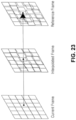
- a bilateral template is generated as the weighted combination (i.e. average) of the two prediction blocks, from the initial MV0 of list0 and MV1 of list1, respectively, as shown in FIG. 23 .
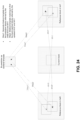
- the template matching operation consists of calculating cost measures between the generated template and the sample region (around the initial prediction block) in the reference picture. For each of the two reference pictures, the MV that yields the minimum template cost is considered as the updated MV of that list to replace the original one.
- nine MV candidates are searched for each list. The nine MV candidates include the original MV and 8 surrounding MVs with one luma sample offset to the original MV in either the horizontal or vertical direction, or both.
- the two new MVs i.e., MV0' and MV1' as shown in FIG. 24 , are used for generating the final bi-prediction results.
- a sum of absolute differences (SAD) is used as the cost measure.
- DMVR is applied for the merge mode of bi-prediction with one MV from a reference picture in the past and another from a reference picture in the future, without the transmission of additional syntax elements.
- JEM when LIC, affine motion, FRUC, or sub-CU merge candidate is enabled for a CU, DMVR is not applied.
- a merge candidate list is first constructed by inserting the motion vectors and reference indices of the spatial neighboring and temporal neighboring blocks into the candidate list with redundancy checking until the number of the available candidates reaches the maximum candidate size of 19.
- the merge candidate list for the merge/skip mode is constructed by inserting spatial candidates ( FIG. 11 ), temporal candidates, affine candidates, advanced temporal MVP (ATMVP) candidate, spatial temporal MVP (STMVP) candidate and the additional candidates as used in HEVC (Combined candidates and Zero candidates) according to a pre-defined insertion order:
- IC flags are also inherited from merge candidates except for STMVP and affine. Moreover, for the first four spatial candidates, the bi-prediction ones are inserted before the ones with uni-prediction.
- blocks which are not connected with the current block may be accessed. If a non-adjacent block is coded with non-intra mode, the associated motion information may be added as an additional merge candidate.
- the ancestor node is named merge sharing node.
- the shared merging candidate list is generated at the merge sharing node pretending the merge sharing node is a leaf CU.
- the merge sharing node will be decided for each CU inside a CTU during parsing stage of decoding; moreover, the merge sharing node is an ancestor node of leaf CU which must satisfy the following 2 criteria:
- the merge sharing node size is equal to or larger than the size threshold
- one of the child CU size is smaller than the size threshold
- Figure 35 shows an example for the difference of Type-1 and Type-2 definition.
- the parent node is ternary-split into 3 child CUs.
- the size of parent node is 128.
- the 3 child-CUs will be merge sharing nodes separately.
- the parent node is the merge sharing node.
- the proposed shared merging candidate list algorithm supports translational merge (including merge mode and triangle merge mode, history-based candidate is also supported) and subblock-based merge mode.
- merge mode For all kinds of merge mode, the behavior of shared merging candidate list algorithm looks basically the same, and it just generates candidates at the merge sharing node pretending the merge sharing node is a leaf CU. It has 2 major benefits. The first benefit is to enable parallel processing for merge mode, and the second benefit is to share all computations of all leaf CUs into the merge sharing node. Therefore, it significantly reduces the hardware cost of all merge modes for hardware codec.
- the encoder and decoder can easily support parallel encoding for merge mode and it relieves the cycle budget problem of merge mode.
- JVET-L0686 was adopted in which slices are removed in favor of tile groups and the HEVC syntax element slice_address is substituted with tile_group_address in the tile_group_header (if there is more than one tile in the picture) as address of the first tile in the tile group.
- the current HEVC design could take the correlation of current block its neighbouring blocks (next to the current block) to better code the motion information. However, it is possible that that the neighbouring blocks correspond to different objects with different motion trajectories. In this case, prediction from its neighbouring blocks is not efficient.
- Prediction from motion information of non-adjacent blocks could bring additional coding gain with the cost of storing all the motion information (typically on 4x4 level) into cache which significantly increase the complexity for hardware implementation.
- LUT-based motion vector prediction techniques using one or more tables with at least one motion candidate stored to predict motion information of a block can be implemented in various embodiments to provide video coding with higher coding efficiencies.
- a look up table is an example of a table which can be used to include motion candidates to predict motion information of a block and other implementations are also possible.
- Each LUT can include one or more motion candidates, each associated with corresponding motion information.
- Motion information of a motion candidate can include partial or all of the prediction direction, reference indices/pictures, motion vectors, LIC flags, affine flags, Motion Vector Derivation (MVD) precisions, and/or MVD values.
- Motion information may further include the block position information to indicate from which the motion information is coming.
- the LUT-based motion vector prediction based on the disclosed technology which may enhance both existing and future video coding standards, is elucidated in the following examples described for various implementations. Because the LUTs allow the encoding/decoding process to be performed based on historical data (e.g., the blocks that have been processed), the LUT-based motion vector prediction can also be referred to as History-based Motion Vector Prediction (HMVP) method. In the LUT-based motion vector prediction method, one or multiple tables with motion information from previously coded blocks are maintained during the encoding/decoding process. These motion candidates stored in the LUTs are named HMVP candidates.
- HMVP candidates are named referred to as History-based Motion Vector Prediction
- the associated motion information in LUTs may be added to the motion candidate lists (e.g., merge/AMVP candidate lists), and after encoding/decoding one block, LUTs may be updated. The updated LUTs are then used to code the subsequent blocks.
- the updating of motion candidates in the LUTs are based on the encoding/decoding order of blocks.
- Some embodiments may use one or more look up tables with at least one motion candidate stored to predict motion information of a block.
- Embodiments may use motion candidate to indicate a set of motion information stored in a look up table.
- embodiments may use AMVP or merge candidates for storing the motion information.
- Each look up table may contain one or more motion candidates wherein each candidate is associated with its motion information.
- Example B1 For coding a block, partial or all of motion candidates from one look up table may be checked in order. When one motion candidate is checked during coding a block, it may be added to the motion candidate list (e.g., AMVP, merge candidate lists).
- Example B2 The selection of look up tables may depend on the position of a block.
- Example C1 The total number of motion candidates in a look up table to be checked may be pre-defined.
- Example C2 The motion candidate(s) included in a look up table may be directly inherited by a block.
- Example C3 The motion candidate(s) included in a look up table may be used as a predictor for coding motion information of a block.
- the motion candidates in a look up table may be utilized to derive other candidates and the derived candidates may be utilized for coding a block.
- enabling/disabling the usage of look up tables for motion information coding of a block may be signaled in SPS, PPS, Slice header, tile header, CTU, CTB, CU or PU, region covering multiple CTU/CTB/CU/PUs.
- whether to apply prediction from look up tables may further depend on the coded information. When it is inferred not to apply for a block, additional signaling of indications of the prediction is skipped. Alternatively, when it is inferred not to apply for a block, there is no need to access motion candidates of look up tables, and the checking of related motion candidates is omitted.
- the motion candidates of a look up table in previously coded frames/slices/tiles may be used to predict motion information of a block in a different frame/slice/tile.
- one or multiple look up tables may be updated.
- the look up tables indicate the coded information or information derived from coded information from previously coded blocks in a decoding order.
- HMVP history-based MVP
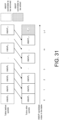
- a First-In-First-Out (FIFO) rule is applied so that the table always contains the latest previously coded L motion candidates.
- FIG. 31 depicts an example wherein the FIFO rule is applied to remove a HMVP candidate and add a new one to the table used in the proposed method.
- a redundancy checking process is applied firstly to identify whether there are identical or similar motion candidates in LUTs.
- HMVP candidates could be used in the merge candidate list construction process. All HMVP candidates from the last entry to the first entry ( or the last K 0 HMVP, e.g., K 0 equal to 16 or 6) in the table are inserted after the TMVP candidate. Pruning is applied on the HMVP candidates. Once the total number of available merge candidates reaches the signaled maximally allowed merge candidates, the merge candidate list construction process is terminated. Alternatively, once the total number of added motion candidates reaches a given value, the fetching of motion candidates from LUTs is terminated.
- HMVP candidates could also be used in the AMVP candidate list construction process.
- the motion vectors of the last K1 HMVP candidates in the table are inserted after the TMVP candidate. Only HMVP candidates with the same reference picture as the AMVP target reference picture are used to construct the AMVP candidate list. Pruning is applied on the HMVP candidates. In one example, K1 is set to 4.
- FIG. 28 is a block diagram of a video processing apparatus 2800.
- the apparatus 2800 may be used to implement one or more of the methods described herein.
- the apparatus 2800 may be embodied in a smartphone, tablet, computer, Internet of Things (IoT) receiver, and so on.
- the apparatus 2800 may include one or more processors 2802, one or more memories 2804 and video processing hardware 2806.
- the processor(s) 2802 may be configured to implement one or more methods described in the present document.
- the memory (memories) 2804 may be used for storing data and code used for implementing the methods and techniques described herein.
- the video processing hardware 2806 may be used to implement, in hardware circuitry, some techniques described in the present document.
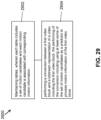
- FIG. 29 is a flowchart for an example of a video decoding method 2900.
- the method 2900 includes maintaining tables (2902) wherein each table includes a set of motion candidates and each motion candidate is associated with corresponding motion information.
- the method 2900 further includes performing a conversion (2904) between a first video block and a bitstream representation of a video including the first video block, the performing of the conversion including using at least some of the set of motion candidates as a predictor to process motion information of the first video block.
- the motion information includes at least one of: a prediction direction, a reference picture index, motion vector values, intensity compensation flag, affine flag, motion vector difference precision, and motion vector difference value. Further, the motion information may further include block position information indicating source of the motion information.
- the video block may be a CU or a PU and the portion of video may correspond to one or more video slices or one or more video pictures.
- each LUT includes an associated counter, wherein the counter is initialized to a zero value at beginning of the portion of video and increased for each encoded video region in the portion of the video.
- the video region comprises one of a coding tree unit, a coding tree block, a coding unit, a coding block or a prediction unit.
- the counter indicates, for a corresponding LUT, a number of motion candidates that were removed from the corresponding LUT.
- the set of motion candidates may have a same size for all LUTs.
- the portion of video corresponds to a slice of video
- the number of LUTs is equal to N*P
- N is an integer representing LUTs per decoding thread
- P is an integer representing a number of Largest Coding Unit rows or a number of tiles in the slice of video. Additional details of the method 2900 is described in the examples provided in Section 4 and the examples listed below.
- the disclosed and other embodiments, modules and the functional operations described in this document can be implemented in digital electronic circuitry, or in computer software, firmware, or hardware, including the structures disclosed in this document and their structural equivalents, or in combinations of one or more of them.
- the disclosed and other embodiments can be implemented as one or more computer program products, i.e., one or more modules of computer program instructions encoded on a computer readable medium for execution by, or to control the operation of, data processing apparatus.
- the computer readable medium can be a machine-readable storage device, a machine-readable storage substrate, a memory device, a composition of matter effecting a machine-readable propagated signal, or a combination of one or more them.
- data processing apparatus encompasses all apparatus, devices, and machines for processing data, including by way of example a programmable processor, a computer, or multiple processors or computers.
- the apparatus can include, in addition to hardware, code that creates an execution environment for the computer program in question, e.g., code that constitutes processor firmware, a protocol stack, a database management system, an operating system, or a combination of one or more of them.
- a propagated signal is an artificially generated signal, e.g., a machine-generated electrical, optical, or electromagnetic signal, that is generated to encode information for transmission to suitable receiver apparatus.
- a computer program (also known as a program, software, software application, script, or code) can be written in any form of programming language, including compiled or interpreted languages, and it can be deployed in any form, including as a stand-alone program or as a module, component, subroutine, or other unit suitable for use in a computing environment.
- a computer program does not necessarily correspond to a file in a file system.
- a program can be stored in a portion of a file that holds other programs or data (e.g., one or more scripts stored in a markup language document), in a single file dedicated to the program in question, or in multiple coordinated files (e.g., files that store one or more modules, sub programs, or portions of code).
- a computer program can be deployed to be executed on one computer or on multiple computers that are located at one site or distributed across multiple sites and interconnected by a communication network.
- the processes and logic flows described in this document can be performed by one or more programmable processors executing one or more computer programs to perform functions by operating on input data and generating output.
- the processes and logic flows can also be performed by, and apparatus can also be implemented as, special purpose logic circuitry, e.g., an FPGA (field programmable gate array) or an ASIC (application specific integrated circuit).
- processors suitable for the execution of a computer program include, by way of example, both general and special purpose microprocessors, and any one or more processors of any kind of digital computer.
- a processor will receive instructions and data from a read only memory or a random-access memory or both.
- the essential elements of a computer are a processor for performing instructions and one or more memory devices for storing instructions and data.
- a computer will also include, or be operatively coupled to receive data from or transfer data to, or both, one or more mass storage devices for storing data, e.g., magnetic, magneto optical disks, or optical disks.
- mass storage devices for storing data, e.g., magnetic, magneto optical disks, or optical disks.
- a computer need not have such devices.
- Computer readable media suitable for storing computer program instructions and data include all forms of non-volatile memory, media and memory devices, including by way of example semiconductor memory devices, e.g., EPROM, EEPROM, and flash memory devices; magnetic disks, e.g., internal hard disks or removable disks; magneto optical disks; and CD ROM and DVD-ROM disks.
- semiconductor memory devices e.g., EPROM, EEPROM, and flash memory devices
- magnetic disks e.g., internal hard disks or removable disks
- magneto optical disks e.g., CD ROM and DVD-ROM disks.
- the processor and the memory can be supplemented by, or incorporated in, special purpose logic circuitry.
Landscapes
- Engineering & Computer Science (AREA)
- Multimedia (AREA)
- Signal Processing (AREA)
- Physics & Mathematics (AREA)
- Discrete Mathematics (AREA)
- General Physics & Mathematics (AREA)
- Compression Or Coding Systems Of Tv Signals (AREA)
- Tires In General (AREA)
- Transition And Organic Metals Composition Catalysts For Addition Polymerization (AREA)
- Liquid Crystal Substances (AREA)
Applications Claiming Priority (5)
| Application Number | Priority Date | Filing Date | Title |
|---|---|---|---|
| CN2018093663 | 2018-06-29 | ||
| CN2018105193 | 2018-09-12 | ||
| CN2019072058 | 2019-01-16 | ||
| PCT/IB2019/055595 WO2020003284A1 (fr) | 2018-06-29 | 2019-07-01 | Interaction entre table de conversion et amvp |
| EP19739718.5A EP3797516A1 (fr) | 2018-06-29 | 2019-07-01 | Interaction entre table de conversion et amvp |
Related Parent Applications (1)
| Application Number | Title | Priority Date | Filing Date |
|---|---|---|---|
| EP19739718.5A Division EP3797516A1 (fr) | 2018-06-29 | 2019-07-01 | Interaction entre table de conversion et amvp |
Publications (2)
| Publication Number | Publication Date |
|---|---|
| EP4325861A2 true EP4325861A2 (fr) | 2024-02-21 |
| EP4325861A3 EP4325861A3 (fr) | 2024-03-06 |
Family
ID=67262803
Family Applications (2)
| Application Number | Title | Priority Date | Filing Date |
|---|---|---|---|
| EP23220549.2A Pending EP4325861A3 (fr) | 2018-06-29 | 2019-07-01 | Interaction entre une table de conversion et un amvp |
| EP19739718.5A Pending EP3797516A1 (fr) | 2018-06-29 | 2019-07-01 | Interaction entre table de conversion et amvp |
Family Applications After (1)
| Application Number | Title | Priority Date | Filing Date |
|---|---|---|---|
| EP19739718.5A Pending EP3797516A1 (fr) | 2018-06-29 | 2019-07-01 | Interaction entre table de conversion et amvp |
Country Status (10)
| Country | Link |
|---|---|
| US (3) | US10873756B2 (fr) |
| EP (2) | EP4325861A3 (fr) |
| JP (2) | JP7295231B2 (fr) |
| KR (2) | KR20240005239A (fr) |
| CN (2) | CN110662043B (fr) |
| CA (1) | CA3105330C (fr) |
| MX (1) | MX2020013828A (fr) |
| SG (1) | SG11202013028PA (fr) |
| TW (1) | TWI719525B (fr) |
| WO (1) | WO2020003284A1 (fr) |
Families Citing this family (25)
| Publication number | Priority date | Publication date | Assignee | Title |
|---|---|---|---|---|
| CN110662059B (zh) | 2018-06-29 | 2021-04-20 | 北京字节跳动网络技术有限公司 | 使用查找表存储先前编码的运动信息并用其编码后续块的方法和装置 |
| WO2020003265A1 (fr) | 2018-06-29 | 2020-01-02 | Beijing Bytedance Network Technology Co., Ltd. | Conditions d'utilisation de tables de conversion |
| KR20240005239A (ko) | 2018-06-29 | 2024-01-11 | 베이징 바이트댄스 네트워크 테크놀로지 컴퍼니, 리미티드 | Lut와 amvp 사이의 상호작용 |
| EP4322533A3 (fr) | 2018-06-29 | 2024-03-06 | Beijing Bytedance Network Technology Co., Ltd. | Vérification d'un ordre de candidats de mouvement dans une table de consultation |
| WO2020003270A1 (fr) | 2018-06-29 | 2020-01-02 | Beijing Bytedance Network Technology Co., Ltd. | Nombre de candidats de mouvement dans une table de consultation à vérifier selon un mode |
| MX392418B (es) | 2018-06-29 | 2025-03-24 | Beijing Bytedance Network Tech Co Ltd | Poda parcial/total cuando se añade un candidato a hmvp para fusión/amvp. |
| KR102660666B1 (ko) | 2018-06-29 | 2024-04-26 | 베이징 바이트댄스 네트워크 테크놀로지 컴퍼니, 리미티드 | Lut들을 업데이트하기 위한 조건들 |
| AU2019293670B2 (en) | 2018-06-29 | 2023-06-08 | Beijing Bytedance Network Technology Co., Ltd. | Update of look up table: FIFO, constrained FIFO |
| WO2020008346A1 (fr) | 2018-07-02 | 2020-01-09 | Beijing Bytedance Network Technology Co., Ltd. | Règles sur la mise à jour de tables de recherche |
| TWI820211B (zh) | 2018-09-12 | 2023-11-01 | 大陸商北京字節跳動網絡技術有限公司 | 取決於總數減去k的開始檢查hmvp候選的條件 |
| EP3836545B1 (fr) * | 2018-09-22 | 2023-11-15 | Lg Electronics Inc. | Procédé de traitement de signaux vidéo par inter-prédiction |
| CN113170150B (zh) | 2018-12-03 | 2024-02-27 | 北京字节跳动网络技术有限公司 | 基于历史的运动矢量预测(hmvp)模式的部分修剪方法 |
| BR112021011807A2 (pt) * | 2018-12-21 | 2021-09-28 | Samsung Electronics Co., Ltd. | Método de decodificação de imagem realizado por um aparelho de decodificação de imagem, meio legível por computador, aparelho de decodificação de imagem, e método de codificação de imagem realizado por um aparelho de codificação de imagem |
| TWI782887B (zh) * | 2018-12-28 | 2022-11-01 | 日商Jvc建伍股份有限公司 | 影像編碼裝置、影像編碼方法、影像編碼程式、影像解碼裝置、影像解碼方法及影像解碼程式 |
| JP7407412B2 (ja) * | 2018-12-28 | 2024-01-04 | 合同会社IP Bridge1号 | 動画像符号化装置、動画像符号化方法、動画像符号化プログラム、動画像復号装置、動画像復号方法、動画像復号プログラム、格納方法、及び伝送方法 |
| CN118018759A (zh) * | 2018-12-28 | 2024-05-10 | 知识产权之桥一号有限责任公司 | 动图像编码装置和方法、以及动图像解码装置和方法 |
| WO2020143741A1 (fr) | 2019-01-10 | 2020-07-16 | Beijing Bytedance Network Technology Co., Ltd. | Invocation de mise à jour de table de consultation |
| WO2020143824A1 (fr) | 2019-01-13 | 2020-07-16 | Beijing Bytedance Network Technology Co., Ltd. | Interaction entre une table de consultation et une liste de fusion partagée |
| WO2020147773A1 (fr) | 2019-01-16 | 2020-07-23 | Beijing Bytedance Network Technology Co., Ltd. | Insertion d'un ordre de candidats de mouvement dans une table de consultation |
| US11632542B2 (en) * | 2019-02-26 | 2023-04-18 | Apple Inc. | Method for encoding/decoding video signal, and apparatus therefor |
| KR102521261B1 (ko) * | 2019-03-08 | 2023-04-12 | 가부시키가이샤 제이브이씨 켄우드 | 동화상 부호화 장치, 동화상 부호화 방법 및, 동화상 부호화 프로그램, 동화상 복호 장치, 동화상 복호 방법 및 동화상 복호 프로그램 |
| CN113615193B (zh) | 2019-03-22 | 2024-06-25 | 北京字节跳动网络技术有限公司 | Merge列表构建和其他工具之间的交互 |
| JP7342153B2 (ja) * | 2019-06-24 | 2023-09-11 | エルジー エレクトロニクス インコーポレイティド | 動きベクトルを用いた画像コーディング方法および装置 |
| US11895321B2 (en) * | 2021-03-29 | 2024-02-06 | Qualcomm Incorporated | Template matching based advanced motion vector predictor (AMVP) candidate list construction with non-adjacent candidates and AMVP index signaling |
| WO2022212254A2 (fr) * | 2021-03-29 | 2022-10-06 | Qualcomm Incorporated | Construction de liste de candidats prédicteurs de vecteur de mouvement avancé (amvp) basée sur la mise en correspondance de modèles avec des candidats non adjacents et une signalisation d'indice amvp |
Family Cites Families (354)
| Publication number | Priority date | Publication date | Assignee | Title |
|---|---|---|---|---|
| US7023922B1 (en) | 2000-06-21 | 2006-04-04 | Microsoft Corporation | Video coding system and method using 3-D discrete wavelet transform and entropy coding with motion information |
| US7623719B2 (en) | 2003-09-26 | 2009-11-24 | The Regents Of The University Of California | Video encoding methods and devices |
| CN100545892C (zh) | 2003-12-18 | 2009-09-30 | 汤姆森特许公司 | 生成视频图像场中的查找表的方法和装置 |
| US7801220B2 (en) | 2005-01-07 | 2010-09-21 | Microsoft Corporation | In-band wavelet video coding with spatial scalability |
| KR100931912B1 (ko) | 2005-04-13 | 2009-12-15 | 노키아 코포레이션 | 스케일러블 비디오 코딩에서 fgs 식별 |
| US20070025444A1 (en) | 2005-07-28 | 2007-02-01 | Shigeyuki Okada | Coding Method |
| CN100539693C (zh) | 2005-08-30 | 2009-09-09 | 深圳清华大学研究院 | 快速运动估计方法 |
| KR101088772B1 (ko) | 2006-10-20 | 2011-12-01 | 노키아 코포레이션 | 스케일러블 멀티미디어의 적응 경로들에 대한 포괄적 표시 |
| KR100856411B1 (ko) | 2006-12-01 | 2008-09-04 | 삼성전자주식회사 | 조도 보상 방법 및 그 장치와 그 방법을 기록한 컴퓨터로 읽을 수 있는 기록매체 |
| US8228990B2 (en) | 2008-01-16 | 2012-07-24 | Sony Corporation | Template matching scheme using multiple predictors as candidates for intra-prediction |
| WO2009094349A1 (fr) | 2008-01-22 | 2009-07-30 | Dolby Laboratories Licensing Corporation | Estimation adaptative de coût d'informations de mouvement à mise à jour dynamique de table de consultation |
| US8724697B2 (en) | 2008-09-26 | 2014-05-13 | Qualcomm Incorporated | Locating motion vectors for video data units |
| HRP20231396T1 (hr) | 2009-06-18 | 2024-05-10 | Kabushiki Kaisha Toshiba | Video kodiranje |
| WO2011003326A1 (fr) | 2009-07-06 | 2011-01-13 | Mediatek Singapore Pte. Ltd. | Filtre adaptatif d'interpolation à passage unique |
| KR20110008653A (ko) | 2009-07-20 | 2011-01-27 | 삼성전자주식회사 | 움직임 벡터 예측 방법과 이를 이용한 영상 부호화/복호화 장치 및 방법 |
| PL3595311T3 (pl) | 2009-10-01 | 2021-01-25 | Sk Telecom Co., Ltd | Sposób i urządzenie do kodowania/dekodowania obrazu z zastosowaniem makrobloków o zmiennym rozmiarze |
| KR101600818B1 (ko) | 2009-11-06 | 2016-03-09 | 삼성디스플레이 주식회사 | 3차원 광학 모듈 및 이를 포함하는 디스플레이 장치 |
| JP5338684B2 (ja) | 2010-01-08 | 2013-11-13 | ソニー株式会社 | 画像処理装置、画像処理方法、およびプログラム |
| WO2011095260A1 (fr) | 2010-02-05 | 2011-08-11 | Telefonaktiebolaget L M Ericsson (Publ) | Gestion de vecteurs de mouvement prédits candidats |
| KR101630688B1 (ko) | 2010-02-17 | 2016-06-16 | 삼성전자주식회사 | 움직임 예측 장치 및 방법과 영상 처리 장치 |
| US9510009B2 (en) | 2010-05-20 | 2016-11-29 | Thomson Licensing | Methods and apparatus for adaptive motion vector candidate ordering for video encoding and decoding |
| KR20120016991A (ko) | 2010-08-17 | 2012-02-27 | 오수미 | 인터 프리딕션 방법 |
| US10104391B2 (en) | 2010-10-01 | 2018-10-16 | Dolby International Ab | System for nested entropy encoding |
| US8711940B2 (en) | 2010-11-29 | 2014-04-29 | Mediatek Inc. | Method and apparatus of motion vector prediction with extended motion vector predictor |
| WO2012074344A2 (fr) | 2010-12-03 | 2012-06-07 | 엘지전자 주식회사 | Procédé d'indexation de listes d'informations de mouvement et appareil l'utilisant |
| CN107105282B (zh) | 2010-12-14 | 2019-11-12 | M&K控股株式会社 | 用于解码运动画面的设备 |
| KR20120068743A (ko) | 2010-12-17 | 2012-06-27 | 한국전자통신연구원 | 인터 예측 방법 및 그 장치 |
| KR20120070479A (ko) | 2010-12-21 | 2012-06-29 | 한국전자통신연구원 | 화면 내 예측 방향 정보 부호화/복호화 방법 및 그 장치 |
| US9049455B2 (en) | 2010-12-28 | 2015-06-02 | Panasonic Intellectual Property Corporation Of America | Image coding method of coding a current picture with prediction using one or both of a first reference picture list including a first current reference picture for a current block and a second reference picture list including a second current reference picture for the current block |
| GB2492778A (en) * | 2011-07-11 | 2013-01-16 | Canon Kk | Motion compensated image coding by combining motion information predictors |
| WO2012095467A1 (fr) * | 2011-01-12 | 2012-07-19 | Canon Kabushiki Kaisha | Codage et décodage vidéo à faible complexité |
| US9319716B2 (en) | 2011-01-27 | 2016-04-19 | Qualcomm Incorporated | Performing motion vector prediction for video coding |
| US20120195366A1 (en) | 2011-02-01 | 2012-08-02 | Mediatek Singapore Pte. Ltd. | Method and Apparatus of Adaptive Inter Mode Coding Using Variable Length Codes |
| CN107181954B (zh) | 2011-02-09 | 2020-11-06 | Lg 电子株式会社 | 一种通过编解码装置进行的帧间预测方法和数字信息存储介质 |
| EP2490448A1 (fr) | 2011-02-18 | 2012-08-22 | Siemens Aktiengesellschaft | Procédé d'encodage et dispositif d'encodage d'image pour la compression d'une séquence d'images |
| US10171813B2 (en) | 2011-02-24 | 2019-01-01 | Qualcomm Incorporated | Hierarchy of motion prediction video blocks |
| US9066110B2 (en) | 2011-03-08 | 2015-06-23 | Texas Instruments Incorporated | Parsing friendly and error resilient merge flag coding in video coding |
| GB2501836B (en) | 2011-03-09 | 2014-08-06 | Canon Kk | Video encoding |
| GB2488816A (en) | 2011-03-09 | 2012-09-12 | Canon Kk | Mapping motion vectors from a plurality of reference frames to a single reference frame |
| US9866859B2 (en) | 2011-06-14 | 2018-01-09 | Texas Instruments Incorporated | Inter-prediction candidate index coding independent of inter-prediction candidate list construction in video coding |
| KR102117085B1 (ko) * | 2011-03-21 | 2020-05-29 | 엘지전자 주식회사 | 움직임 벡터 예측자 선택 방법 및 이를 이용하는 장치 |
| US9143795B2 (en) * | 2011-04-11 | 2015-09-22 | Texas Instruments Incorporated | Parallel motion estimation in video coding |
| US9247266B2 (en) * | 2011-04-18 | 2016-01-26 | Texas Instruments Incorporated | Temporal motion data candidate derivation in video coding |
| US20120287999A1 (en) | 2011-05-11 | 2012-11-15 | Microsoft Corporation | Syntax element prediction in error correction |
| ES2673180T3 (es) | 2011-05-24 | 2018-06-20 | Velos Media International Limited | Procedimiento de codificación de imágenes, aparato de codificación de imágenes, procedimiento de decodificación de imágenes, aparato de decodificación de imágenes y aparato de codificación/decodificación de imágenes |
| KR101889582B1 (ko) | 2011-05-31 | 2018-08-20 | 선 페이턴트 트러스트 | 동화상 부호화 방법, 동화상 부호화 장치, 동화상 복호화 방법, 동화상 복호화 장치, 및, 동화상 부호화 복호화 장치 |
| HUE067847T2 (hu) | 2011-05-31 | 2024-11-28 | Jvckenwood Corp | Mozgókép kódoló eszköz, mozgókép kódolási eljárás és mozgókép kódoló program, valamint mozgókép dekódoló eszköz, mozgókép dekódoló eljárás és mozgókép dekódoló program |
| WO2012172668A1 (fr) | 2011-06-15 | 2012-12-20 | 株式会社 東芝 | Procédé et dispositif de codage vidéo, et procédé et dispositif de décodage vidéo |
| JP5786478B2 (ja) | 2011-06-15 | 2015-09-30 | 富士通株式会社 | 動画像復号装置、動画像復号方法、及び動画像復号プログラム |
| US9762900B2 (en) | 2011-06-17 | 2017-09-12 | Lg Electronics Inc. | Method and apparatus for encoding/decoding video in intra prediction mode |
| US9131239B2 (en) | 2011-06-20 | 2015-09-08 | Qualcomm Incorporated | Unified merge mode and adaptive motion vector prediction mode candidates selection |
| PT3136729T (pt) | 2011-06-28 | 2018-01-25 | Samsung Electronics Co Ltd | Aparelho para descodificar vídeo com intra previsão |
| CN103609120B (zh) | 2011-06-30 | 2016-09-28 | Jvc建伍株式会社 | 图像解码装置、图像解码方法 |
| CN105245875B (zh) | 2011-06-30 | 2018-01-05 | Jvc建伍株式会社 | 图像解码装置和图像解码方法 |
| MY181718A (en) | 2011-06-30 | 2021-01-05 | Sun Patent Trust | Image decoding method, image encoding method, image decoding device, image encoding device, and image encoding/decoding device |
| US20130188013A1 (en) | 2011-07-22 | 2013-07-25 | Qualcomm Incorporated | Mvc based 3dvc codec supporting inside view motion prediction (ivmp) mode |
| US9456214B2 (en) | 2011-08-03 | 2016-09-27 | Sun Patent Trust | Moving picture coding method, moving picture coding apparatus, moving picture decoding method, moving picture decoding apparatus, and moving picture coding and decoding apparatus |
| GB201113527D0 (en) | 2011-08-04 | 2011-09-21 | Imagination Tech Ltd | External vectors in a motion estimation system |
| GB2493755B (en) | 2011-08-17 | 2016-10-19 | Canon Kk | Method and device for encoding a sequence of images and method and device for decoding a sequence of images |
| MX365013B (es) | 2011-08-29 | 2019-05-20 | Ibex Pt Holdings Co Ltd | Metodo para generar un bloque de prediccion en modo de prediccion de vector de movimiento avanzada (amvp). |
| US8804816B2 (en) | 2011-08-30 | 2014-08-12 | Microsoft Corporation | Video encoding enhancements |
| HRP20260268T1 (hr) | 2011-09-09 | 2026-04-10 | Lg Electronics Inc. | Uređaj za dekodiranje slike, uređaj za kodiranje slike i uređaj za prijenos podataka za sliku |
| RU2600547C2 (ru) | 2011-09-09 | 2016-10-20 | Кт Корпорейшн | Способ получения вектора движения с временным предсказанием и устройство, использующее этот способ |
| US9736489B2 (en) | 2011-09-17 | 2017-08-15 | Qualcomm Incorporated | Motion vector determination for video coding |
| US20130070855A1 (en) | 2011-09-17 | 2013-03-21 | Qualcomm Incorporated | Hybrid motion vector coding modes for video coding |
| JP5884697B2 (ja) | 2011-09-28 | 2016-03-15 | 株式会社Jvcケンウッド | 動画像符号化装置、動画像符号化方法、動画像符号化プログラム、送信装置、送信方法及び送信プログラム |
| PL3754982T3 (pl) | 2011-09-29 | 2024-09-02 | Sharp Kabushiki Kaisha | Urządzenie do dekodowania obrazu, sposób dekodowania obrazu, sposób kodowania obrazu i urządzenie kodowania obrazu do realizowania konwersji bipredykcyjnej na unipredykcyjną |
| US20140241434A1 (en) | 2011-10-11 | 2014-08-28 | Mediatek Inc | Method and apparatus of motion and disparity vector derivation for 3d video coding and hevc |
| US9838692B2 (en) | 2011-10-18 | 2017-12-05 | Qualcomm Incorporated | Detecting availabilities of neighboring video units for video coding |
| MX369192B (es) | 2011-10-18 | 2019-10-31 | Kt Corp | Método para codificar imagen, método para decodificar imagen, codificador de imagen y decodificador de imagen. |
| CN103858428B (zh) | 2011-10-19 | 2018-07-03 | 太阳专利托管公司 | 图像编码方法、图像编码装置、图像解码方法及图像解码装置 |
| AU2012325419B2 (en) * | 2011-10-19 | 2015-11-05 | Hfi Innovation Inc. | Method and apparatus for derivation of motion vector predictor candidate set |
| US9462298B2 (en) | 2011-10-21 | 2016-10-04 | Qualcomm Incorporated | Loop filtering around slice boundaries or tile boundaries in video coding |
| EP2769549A1 (fr) | 2011-10-21 | 2014-08-27 | Dolby Laboratories Licensing Corporation | Estimation du mouvement hiérarchique pour une compression vidéo et une analyse de mouvement |
| CN104041042B (zh) | 2011-10-28 | 2018-10-23 | 太阳专利托管公司 | 图像编码方法、图像解码方法、图像编码装置及图像解码装置 |
| US9571833B2 (en) | 2011-11-04 | 2017-02-14 | Nokia Technologies Oy | Method for coding and an apparatus |
| KR20130050406A (ko) | 2011-11-07 | 2013-05-16 | 오수미 | 머지 모드에서의 움직임 정보 생성 방법 |
| US20130114717A1 (en) | 2011-11-07 | 2013-05-09 | Qualcomm Incorporated | Generating additional merge candidates |
| KR20130050407A (ko) | 2011-11-07 | 2013-05-16 | 오수미 | 인터 모드에서의 움직임 정보 생성 방법 |
| SG10201502731VA (en) | 2011-11-08 | 2015-05-28 | Samsung Electronics Co Ltd | Method and apparatus for motion vector determination in video encoding or decoding |
| CN110198449B (zh) | 2011-11-08 | 2022-01-04 | 韩国电子通信研究院 | 用于共享候选者列表的方法和装置 |
| CN107493474B (zh) | 2011-11-08 | 2021-01-12 | 株式会社Kt | 利用解码装置对视频信号进行解码的方法 |
| KR102641723B1 (ko) | 2011-11-11 | 2024-02-29 | 지이 비디오 컴프레션, 엘엘씨 | 깊이-맵 추정 및 업데이트를 사용한 효율적인 멀티-뷰 코딩 |
| US9485503B2 (en) | 2011-11-18 | 2016-11-01 | Qualcomm Incorporated | Inside view motion prediction among texture and depth view components |
| WO2013081365A1 (fr) | 2011-11-28 | 2013-06-06 | 에스케이텔레콤 주식회사 | Procédé et appareil de codage/décodage vidéo à l'aide d'une fusion améliorée |
| US9762904B2 (en) | 2011-12-22 | 2017-09-12 | Qualcomm Incorporated | Performing motion vector prediction for video coding |
| BR112014013969B1 (pt) | 2011-12-28 | 2022-05-10 | JVC Kenwood Corporation | Dispositivo de codificação de vídeo, método de codificação de vídeo, programa de codificação de vídeo, dispositivo de decodificação de vídeo, método de decodificação de vídeo, programa de decodificação de vídeo |
| US9900615B2 (en) | 2011-12-28 | 2018-02-20 | Microsoft Technology Licensing, Llc | Representative motion information for temporal motion prediction in video encoding and decoding |
| US20130188715A1 (en) | 2012-01-09 | 2013-07-25 | Qualcomm Incorporated | Device and methods for merge list reordering in video coding |
| TWI558176B (zh) | 2012-01-18 | 2016-11-11 | Jvc Kenwood Corp | A dynamic image coding apparatus, a motion picture coding method and a motion picture coding program, and a motion picture decoding apparatus, a motion picture decoding method, and a motion picture decoding program |
| BR122020017172B1 (pt) | 2012-01-19 | 2022-11-29 | Electronics And Telecommunications Research Institute | Aparelho de decodificação de imagem |
| HUE050473T2 (hu) | 2012-01-20 | 2020-12-28 | Dolby Laboratories Licensing Corp | Eljárás belsõ predikciós mód leképezésére |
| TWI835639B (zh) | 2012-01-20 | 2024-03-11 | 美商Ge影像壓縮有限公司 | 允許平行處理之編碼器、解碼器、傳送解多工器、系統、儲存媒體、方法及電腦程式 |
| WO2013113997A1 (fr) * | 2012-02-01 | 2013-08-08 | Nokia Corporation | Procédé et appareil de codage vidéo |
| US9544592B2 (en) | 2012-02-10 | 2017-01-10 | Texas Instruments Incorporated | Methods and systems for encoding pictures associated with video data |
| US9445076B2 (en) * | 2012-03-14 | 2016-09-13 | Qualcomm Incorporated | Disparity vector construction method for 3D-HEVC |
| US10200709B2 (en) * | 2012-03-16 | 2019-02-05 | Qualcomm Incorporated | High-level syntax extensions for high efficiency video coding |
| US9503720B2 (en) * | 2012-03-16 | 2016-11-22 | Qualcomm Incorporated | Motion vector coding and bi-prediction in HEVC and its extensions |
| WO2013140807A1 (fr) | 2012-03-23 | 2013-09-26 | 株式会社Jvcケンウッド | Dispositif de codage vidéo, procédé de codage vidéo, programme de codage vidéo, dispositif de transmission, procédé de transmission et programme de transmission, ainsi que dispositif de décodage vidéo, procédé de décodage vidéo, programme de décodage vidéo, dispositif de réception, procédé de réception et programme de réception |
| US9264706B2 (en) | 2012-04-11 | 2016-02-16 | Qualcomm Incorporated | Bypass bins for reference index coding in video coding |
| US9325991B2 (en) | 2012-04-11 | 2016-04-26 | Qualcomm Incorporated | Motion vector rounding |
| US20130272412A1 (en) | 2012-04-12 | 2013-10-17 | Qualcomm Incorporated | Common motion information candidate list construction process |
| US9338451B2 (en) | 2012-04-12 | 2016-05-10 | Qualcomm Incorporated | Common spatial candidate blocks for parallel motion estimation |
| DK3833023T3 (da) | 2012-04-12 | 2022-04-19 | Jvckenwood Corp | Fusionskandidatlistekonstruktion |
| US9503702B2 (en) | 2012-04-13 | 2016-11-22 | Qualcomm Incorporated | View synthesis mode for three-dimensional video coding |
| WO2013157251A1 (fr) | 2012-04-16 | 2013-10-24 | 株式会社Jvcケンウッド | Dispositif de codage vidéo, procédé de codage vidéo, programme de codage vidéo, dispositif de transmission, procédé de transmission, programme de transmission, dispositif de décodage vidéo, procédé de décodage vidéo, programme de décodage vidéo, dispositif de réception, procédé de réception et programme de réception |
| US20150085932A1 (en) | 2012-04-24 | 2015-03-26 | Mediatek Inc. | Method and apparatus of motion vector derivation for 3d video coding |
| US20130294513A1 (en) | 2012-05-07 | 2013-11-07 | Qualcomm Incorporated | Inter layer merge list construction for video coding |
| EP3796651A1 (fr) | 2012-05-09 | 2021-03-24 | Sun Patent Trust | Procédé pour effectuer une prédiction de vecteur de mouvement, procédés de codage et de décodage, et appareils associés |
| US10341677B2 (en) | 2012-05-10 | 2019-07-02 | Lg Electronics Inc. | Method and apparatus for processing video signals using inter-view inter-prediction |
| US11317101B2 (en) | 2012-06-12 | 2022-04-26 | Google Inc. | Inter frame candidate selection for a video encoder |
| US9258562B2 (en) | 2012-06-13 | 2016-02-09 | Qualcomm Incorporated | Derivation of depth map estimate |
| US20130336406A1 (en) | 2012-06-14 | 2013-12-19 | Qualcomm Incorporated | Redundancy removal for merge/skip mode motion information candidate list construction |
| US20130343459A1 (en) | 2012-06-22 | 2013-12-26 | Nokia Corporation | Method and apparatus for video coding |
| CN108055551A (zh) | 2012-07-02 | 2018-05-18 | 三星电子株式会社 | 用于预测对视频进行编码或解码的运动矢量的方法和设备 |
| CN109257601A (zh) | 2012-07-03 | 2019-01-22 | 夏普株式会社 | 图像解码装置以及图像编码装置 |
| US9357195B2 (en) | 2012-08-16 | 2016-05-31 | Qualcomm Incorporated | Inter-view predicted motion vector for 3D video |
| US20140071235A1 (en) | 2012-09-13 | 2014-03-13 | Qualcomm Incorporated | Inter-view motion prediction for 3d video |
| KR102238567B1 (ko) * | 2012-09-19 | 2021-04-08 | 퀄컴 인코포레이티드 | 디스패리티 벡터 유도를 위한 화상들의 선택 |
| US9998727B2 (en) | 2012-09-19 | 2018-06-12 | Qualcomm Incorporated | Advanced inter-view residual prediction in multiview or 3-dimensional video coding |
| WO2014049196A1 (fr) | 2012-09-27 | 2014-04-03 | Nokia Corporation | Procédé et équipement technique de codage vidéo échelonnable |
| JPWO2014054267A1 (ja) | 2012-10-01 | 2016-08-25 | パナソニックIpマネジメント株式会社 | 画像符号化装置及び画像符号化方法 |
| US10178410B2 (en) | 2012-10-03 | 2019-01-08 | Mediatek Inc. | Method and apparatus of motion information management in video coding |
| US9699450B2 (en) | 2012-10-04 | 2017-07-04 | Qualcomm Incorporated | Inter-view predicted motion vector for 3D video |
| CN102883163B (zh) | 2012-10-08 | 2014-05-28 | 华为技术有限公司 | 用于运动矢量预测的运动矢量列表建立的方法、装置 |
| CN102946536B (zh) | 2012-10-09 | 2015-09-30 | 华为技术有限公司 | 候选矢量列表构建的方法及装置 |
| CN110545419B (zh) | 2012-10-12 | 2022-11-22 | 韩国电子通信研究院 | 图像编码/解码方法和使用其的装置 |
| US9854234B2 (en) | 2012-10-25 | 2017-12-26 | Qualcomm Incorporated | Reference picture status for video coding |
| US9357214B2 (en) | 2012-12-07 | 2016-05-31 | Qualcomm Incorporated | Advanced merge/skip mode and advanced motion vector prediction (AMVP) mode for 3D video |
| JP6215344B2 (ja) | 2012-12-14 | 2017-10-18 | クゥアルコム・インコーポレイテッドQualcomm Incorporated | 非対称空間解像度を有するテクスチャビューコンポーネントおよび深度ビューコンポーネントの中での内部ビュー動き予測 |
| US9544566B2 (en) * | 2012-12-14 | 2017-01-10 | Qualcomm Incorporated | Disparity vector derivation |
| US9584792B2 (en) | 2013-01-04 | 2017-02-28 | Qualcomm Incorporated | Indication of current view dependency on reference view in multiview coding file format |
| US10021414B2 (en) | 2013-01-04 | 2018-07-10 | Qualcomm Incorporated | Bitstream constraints and motion vector restriction for inter-view or inter-layer reference pictures |
| KR101840915B1 (ko) | 2013-01-07 | 2018-03-21 | 브이아이디 스케일, 인크. | 스케일러블 비디오 코딩을 위한 모션 정보 시그널링 |
| EP2944080B1 (fr) | 2013-01-11 | 2018-09-12 | HFI Innovation Inc. | Procédé et appareil de codage efficace de tableau de consultation de profondeur |
| JP5692262B2 (ja) | 2013-03-06 | 2015-04-01 | 株式会社Jvcケンウッド | 動画像復号装置、動画像復号方法、動画像復号プログラム、受信装置、受信方法、及び受信プログラム |
| JP6149151B2 (ja) | 2013-04-02 | 2017-06-14 | ヴィド スケール インコーポレイテッド | スケーラブルビデオコーディングのための拡張時間的動きベクトル予測 |
| WO2014166329A1 (fr) | 2013-04-10 | 2014-10-16 | Mediatek Inc. | Procédé et appareil de calcul de candidat entre vues pour un codage vidéo tridimensionnel |
| US10158876B2 (en) | 2013-04-10 | 2018-12-18 | Qualcomm Incorporated | Backward view synthesis prediction |
| CN104125463A (zh) | 2013-04-26 | 2014-10-29 | 华为技术有限公司 | 一种图像预测编码方法及图像编码器 |
| EP2997732A1 (fr) | 2013-05-15 | 2016-03-23 | VID SCALE, Inc. | Prédiction inter-couche fondée sur un décodage à boucle unique |
| US9667990B2 (en) | 2013-05-31 | 2017-05-30 | Qualcomm Incorporated | Parallel derived disparity vector for 3D video coding with neighbor-based disparity vector derivation |
| WO2015000108A1 (fr) | 2013-07-01 | 2015-01-08 | Mediatek Singapore Pte. Ltd. | Candidat de fusion de texture améliorée de 3dvc |
| KR101854003B1 (ko) | 2013-07-02 | 2018-06-14 | 경희대학교 산학협력단 | 복수의 레이어를 포함하는 영상의 부호화 및 복호화 방법 |
| WO2015006920A1 (fr) | 2013-07-16 | 2015-01-22 | Mediatek Singapore Pte. Ltd. | Procédé d'obtention d'un vecteur de disparité adaptatif |
| SG10201800237QA (en) * | 2013-07-24 | 2018-02-27 | Qualcomm Inc | Simplified advanced motion prediction for 3d-hevc |
| RU2016115055A (ru) | 2013-09-20 | 2017-10-25 | Вид Скейл, Инк. | Системы и способы обеспечения кодирования 3d справочной таблицы для масштабируемости цветовой гаммы |
| US9667996B2 (en) | 2013-09-26 | 2017-05-30 | Qualcomm Incorporated | Sub-prediction unit (PU) based temporal motion vector prediction in HEVC and sub-PU design in 3D-HEVC |
| GB2519514A (en) | 2013-10-11 | 2015-04-29 | Canon Kk | Method and apparatus for displacement vector component prediction in video coding and decoding |
| ES2781561T3 (es) | 2013-10-18 | 2020-09-03 | Lg Electronics Inc | Método que predice síntesis de vistas en la codificación de vídeo multi-vista y método para constituir una lista de candidatos a la fusión mediante el uso del mismo |
| EP3062518A4 (fr) | 2013-10-24 | 2017-05-31 | Electronics and Telecommunications Research Institute | Procédé et appareil de codage/décodage vidéo |
| CN104717510B (zh) | 2013-12-13 | 2018-08-17 | 华为技术有限公司 | 用于图像处理的方法和装置 |
| AU2014376061B8 (en) * | 2014-01-03 | 2019-05-30 | Microsoft Technology Licensing, Llc | Block vector prediction in video and image coding/decoding |
| US9967592B2 (en) | 2014-01-11 | 2018-05-08 | Qualcomm Incorporated | Block-based advanced residual prediction for 3D video coding |
| KR101847899B1 (ko) | 2014-02-12 | 2018-04-12 | 주식회사 칩스앤미디어 | 동영상 처리 방법 및 장치 |
| US9591313B2 (en) | 2014-03-04 | 2017-03-07 | Vixs Systems, Inc. | Video encoder with transform size preprocessing and methods for use therewith |
| WO2015131326A1 (fr) | 2014-03-04 | 2015-09-11 | Microsoft Technology Licensing, Llc | Décisions de basculement de bloc et de mode de saut du côté encodeur, lors d'une intraprédiction de copie de blocs |
| CN106105212A (zh) | 2014-03-07 | 2016-11-09 | 高通股份有限公司 | 简化的子预测单元(sub‑pu)运动参数继承(mpi) |
| KR102329126B1 (ko) | 2014-03-14 | 2021-11-19 | 삼성전자주식회사 | 인터 레이어 비디오의 복호화 및 부호화를 위한 머지 후보 리스트 구성 방법 및 장치 |
| US9756354B2 (en) | 2014-03-17 | 2017-09-05 | Qualcomm Incorporated | Block vector predictor for intra block copying |
| WO2015139187A1 (fr) | 2014-03-17 | 2015-09-24 | Mediatek Inc. | Prise de decision de codeur a faible temps d'attente pour la compensation d'eclairage et transmission de table de consultation de profondeur en codage video |
| WO2015139203A1 (fr) | 2014-03-18 | 2015-09-24 | Mediatek Singapore Pte. Ltd. | Signalisation de table dlt en codage vidéo 3d |
| CN108632629B9 (zh) | 2014-03-19 | 2021-06-15 | 株式会社Kt | 针对多视图视频信号生成合并候选列表的方法及解码装置 |
| US10554967B2 (en) | 2014-03-21 | 2020-02-04 | Futurewei Technologies, Inc. | Illumination compensation (IC) refinement based on positional pairings among pixels |
| EP3130147B1 (fr) | 2014-05-06 | 2022-05-04 | HFI Innovation Inc. | Procédés de prédiction et de décodage de vecteur de bloc pour codage à mode de copie de bloc intra |
| US10382749B2 (en) | 2014-05-23 | 2019-08-13 | Qualcomm Incorporated | Coding run values based on palette index in palette-based video coding |
| WO2015180014A1 (fr) | 2014-05-26 | 2015-12-03 | Mediatek Singapore Pte. Ltd. | Procédé amélioré de construction d'une liste de candidats à la fusion pour copie intra-bloc |
| US10567789B2 (en) | 2014-06-16 | 2020-02-18 | Qualcomm Incorporated | Simplified shifting merge candidate and merge list derivation in 3D-HEVC |
| CA2950964C (fr) * | 2014-06-19 | 2018-10-30 | Hfi Innovation Inc. | Procede et appareil de generation de candidat pour un mode d'echantillon unique dans un codage video |
| KR101884408B1 (ko) | 2014-06-19 | 2018-08-02 | 브이아이디 스케일, 인크. | 3차원 기반 컬러 매핑에서의 모델 파라미터 최적화를 위한 시스템 및 방법 |
| CN105706450B (zh) | 2014-06-23 | 2019-07-16 | 微软技术许可有限责任公司 | 根据基于散列的块匹配的结果的编码器决定 |
| CN104079944B (zh) | 2014-06-30 | 2017-12-01 | 华为技术有限公司 | 视频编码的运动矢量列表构建方法和系统 |
| WO2016008161A1 (fr) | 2014-07-18 | 2016-01-21 | Mediatek Singapore Pte. Ltd. | Prédicteur de vecteur de mouvement bi-directionnel temporel dérivé |
| WO2016008157A1 (fr) | 2014-07-18 | 2016-01-21 | Mediatek Singapore Pte. Ltd. | Procédés de compensation de mouvement faisant appel au modèle de mouvement d'ordre élevé |
| KR102276854B1 (ko) | 2014-07-31 | 2021-07-13 | 삼성전자주식회사 | 인루프 필터 파라미터 예측을 사용하는 비디오 부호화 방법 및 그 장치, 비디오 복호화 방법 및 그 장치 |
| US10027981B2 (en) | 2014-09-01 | 2018-07-17 | Hfi Innovation Inc. | Method of intra picture block copy for screen content and video coding |
| EP3178228B1 (fr) | 2014-09-15 | 2023-10-04 | HFI Innovation Inc. | Procédé de déblocage pour copie intra-bloc dans un codage vidéo |
| JP6472877B2 (ja) | 2014-10-09 | 2019-02-20 | 寰發股▲ふん▼有限公司HFI Innovation Inc. | 視点合成予測を含む3dまたは多視点映像符号化の方法 |
| US9854237B2 (en) | 2014-10-14 | 2017-12-26 | Qualcomm Incorporated | AMVP and merge candidate list derivation for intra BC and inter prediction unification |
| KR102647887B1 (ko) | 2014-10-31 | 2024-03-14 | 삼성전자주식회사 | 움직임 벡터 부복호화 방법 및 장치 |
| US10602179B2 (en) | 2014-10-31 | 2020-03-24 | Samsung Electronics Co., Ltd. | Video encoding device and video decoding device using high-precision skip encoding and method thereof |
| SG11201703454XA (en) | 2014-11-18 | 2017-06-29 | Mediatek Inc | Method of bi-prediction video coding based on motion vectors from uni-prediction and merge candidate |
| WO2016091162A1 (fr) | 2014-12-09 | 2016-06-16 | Mediatek Inc. | Procédé de calcul de prédicteur de vecteur de mouvement ou de candidat à la fusion lors d'un codage vidéo |
| WO2016090568A1 (fr) | 2014-12-10 | 2016-06-16 | Mediatek Singapore Pte. Ltd. | Structure de partitionnement de bloc d'arbre binaire |
| US10230980B2 (en) | 2015-01-26 | 2019-03-12 | Qualcomm Incorporated | Overlapped motion compensation for video coding |
| US11477477B2 (en) * | 2015-01-26 | 2022-10-18 | Qualcomm Incorporated | Sub-prediction unit based advanced temporal motion vector prediction |
| US10070130B2 (en) | 2015-01-30 | 2018-09-04 | Qualcomm Incorporated | Flexible partitioning of prediction units |
| WO2016123792A1 (fr) | 2015-02-06 | 2016-08-11 | Microsoft Technology Licensing, Llc | Omission d'étapes d'évaluation durant l'encodage de supports |
| US10057574B2 (en) | 2015-02-11 | 2018-08-21 | Qualcomm Incorporated | Coding tree unit (CTU) level adaptive loop filter (ALF) |
| US11330284B2 (en) | 2015-03-27 | 2022-05-10 | Qualcomm Incorporated | Deriving motion information for sub-blocks in video coding |
| WO2016161974A1 (fr) | 2015-04-08 | 2016-10-13 | Mediatek Inc. | Procédés pour le codage par contexte en mode palette et binarisation dans le codage vidéo |
| US10638129B2 (en) | 2015-04-27 | 2020-04-28 | Lg Electronics Inc. | Method for processing video signal and device for same |
| CN104915966B (zh) | 2015-05-08 | 2018-02-09 | 上海交通大学 | 基于卡尔曼滤波的帧率上变换运动估计方法及系统 |
| US10200713B2 (en) | 2015-05-11 | 2019-02-05 | Qualcomm Incorporated | Search region determination for inter coding within a particular picture of video data |
| US10148961B2 (en) | 2015-05-29 | 2018-12-04 | Qualcomm Incorporated | Arithmetic coder with multiple window sizes |
| US10887597B2 (en) | 2015-06-09 | 2021-01-05 | Qualcomm Incorporated | Systems and methods of determining illumination compensation parameters for video coding |
| US10356416B2 (en) * | 2015-06-09 | 2019-07-16 | Qualcomm Incorporated | Systems and methods of determining illumination compensation status for video coding |
| US10271064B2 (en) | 2015-06-11 | 2019-04-23 | Qualcomm Incorporated | Sub-prediction unit motion vector prediction using spatial and/or temporal motion information |
| US9918102B1 (en) * | 2015-06-22 | 2018-03-13 | Ambarella, Inc. | Inter-prediction candidate selection in a mode decision |
| WO2017043734A1 (fr) | 2015-09-07 | 2017-03-16 | 엘지전자(주) | Procédé de traitement d'image basé sur un mode de prédiction inter et dispositif associé |
| WO2017045101A1 (fr) | 2015-09-14 | 2017-03-23 | Mediatek Singapore Pte. Ltd. | Filtre de dégroupage perfectionné pour le codage vidéo |
| EP3355578B1 (fr) | 2015-09-24 | 2020-12-09 | LG Electronics Inc. | Dérivation de prédicteur de vecteur de mouvement et construction de liste de candidats |
| US20170094288A1 (en) | 2015-09-25 | 2017-03-30 | Nokia Technologies Oy | Apparatus, a method and a computer program for video coding and decoding |
| WO2017059415A1 (fr) | 2015-10-02 | 2017-04-06 | Vid Scale, Inc. | Correction de couleur avec une table de consultation |
| US10812822B2 (en) | 2015-10-02 | 2020-10-20 | Qualcomm Incorporated | Intra block copy merge mode and padding of unavailable IBC reference region |
| CN108353184B (zh) | 2015-11-05 | 2022-02-01 | 联发科技股份有限公司 | 一种视频编解码的方法及装置 |
| CN118890465A (zh) | 2015-11-19 | 2024-11-01 | Lx半导体科技有限公司 | 图像编码/解码方法和图像数据的传输方法 |
| US10999595B2 (en) * | 2015-11-20 | 2021-05-04 | Mediatek Inc. | Method and apparatus of motion vector prediction or merge candidate derivation for video coding |
| JP6495835B2 (ja) | 2016-01-06 | 2019-04-03 | 日本電信電話株式会社 | 映像符号化装置、映像復号装置、映像符号化方法、映像復号方法、映像符号化プログラム及び映像復号プログラム |
| CN105681807B (zh) | 2016-01-06 | 2018-11-02 | 福州瑞芯微电子股份有限公司 | 一种基于h264协议的分像素运动矢量计算方法和装置 |
| US10368083B2 (en) | 2016-02-15 | 2019-07-30 | Qualcomm Incorporated | Picture order count based motion vector pruning |
| WO2017142448A1 (fr) | 2016-02-17 | 2017-08-24 | Telefonaktiebolaget Lm Ericsson (Publ) | Procédés et dispositifs de codage et de décodage d'images vidéo |
| WO2017147765A1 (fr) | 2016-03-01 | 2017-09-08 | Mediatek Inc. | Procédés de compensation de mouvement affine |
| ES2688624R1 (es) | 2016-04-06 | 2018-12-04 | Kt Corporation | Método y aparato para procesar señales de vídeo |
| CN116546207A (zh) | 2016-04-08 | 2023-08-04 | 韩国电子通信研究院 | 用于导出运动预测信息的方法和装置 |
| CN114189678A (zh) | 2016-04-26 | 2022-03-15 | 英迪股份有限公司 | 图像解码方法、图像编码方法以及传输比特流的方法 |
| US10142652B2 (en) | 2016-05-05 | 2018-11-27 | Google Llc | Entropy coding motion vector residuals obtained using reference motion vectors |
| US10694204B2 (en) | 2016-05-06 | 2020-06-23 | Vid Scale, Inc. | Systems and methods for motion compensated residual prediction |
| US10560718B2 (en) * | 2016-05-13 | 2020-02-11 | Qualcomm Incorporated | Merge candidates for motion vector prediction for video coding |
| US10547854B2 (en) | 2016-05-13 | 2020-01-28 | Qualcomm Incorporated | Neighbor based signaling of intra prediction modes |
| US10419755B2 (en) | 2016-05-16 | 2019-09-17 | Qualcomm Incorporated | Confusion of multiple filters in adaptive loop filtering in video coding |
| US10560712B2 (en) | 2016-05-16 | 2020-02-11 | Qualcomm Incorporated | Affine motion prediction for video coding |
| CN116567260A (zh) | 2016-05-24 | 2023-08-08 | 韩国电子通信研究院 | 图像编码/解码方法和用于所述方法的记录介质 |
| CN117221597A (zh) | 2016-06-22 | 2023-12-12 | Lx 半导体科技有限公司 | 图像编码/解码方法以及图像数据的传输方法 |
| CN109479141B (zh) | 2016-07-12 | 2023-07-14 | 韩国电子通信研究院 | 图像编码/解码方法和用于所述方法的记录介质 |
| CN116708784A (zh) | 2016-07-12 | 2023-09-05 | 韩国电子通信研究院 | 图像编码/解码方法以及用于该方法的记录介质 |
| CN117201808A (zh) | 2016-08-01 | 2023-12-08 | 韩国电子通信研究院 | 图像编码/解码方法和装置以及存储比特流的记录介质 |
| US11638027B2 (en) | 2016-08-08 | 2023-04-25 | Hfi Innovation, Inc. | Pattern-based motion vector derivation for video coding |
| US20210281873A1 (en) | 2016-09-06 | 2021-09-09 | Mediatek Inc. | Methods and apparatuses of candidate set determination for binary-tree splitting blocks |
| US10721489B2 (en) | 2016-09-06 | 2020-07-21 | Qualcomm Incorporated | Geometry-based priority for the construction of candidate lists |
| WO2018049594A1 (fr) | 2016-09-14 | 2018-03-22 | Mediatek Inc. | Procédés de décision de codeur pour une structure d'arbre binaire et d'arbre quaternaire |
| US10812791B2 (en) | 2016-09-16 | 2020-10-20 | Qualcomm Incorporated | Offset vector identification of temporal motion vector predictor |
| WO2018061522A1 (fr) | 2016-09-27 | 2018-04-05 | シャープ株式会社 | Dispositif de génération de vecteur de mouvement, dispositif de génération d'image de prédiction, dispositif de décodage d'image animée, et dispositif de codage d'image animée |
| EP3509304B1 (fr) | 2016-09-30 | 2023-11-01 | Huawei Technologies Co., Ltd. | Procédé de décodage d'image et dispositif de codage et de décodage d'image pour prédiction intertrame |
| KR102343668B1 (ko) | 2016-09-30 | 2021-12-24 | 후아웨이 테크놀러지 컴퍼니 리미티드 | 비디오 인코딩 방법, 비디오 디코딩 방법, 및 단말 |
| US10631002B2 (en) | 2016-09-30 | 2020-04-21 | Qualcomm Incorporated | Frame rate up-conversion coding mode |
| EP3301919A1 (fr) | 2016-10-03 | 2018-04-04 | Thomson Licensing | Procédé et appareil de codage et décodage d'informations de mouvement |
| US10448010B2 (en) * | 2016-10-05 | 2019-10-15 | Qualcomm Incorporated | Motion vector prediction for affine motion models in video coding |
| JP2019216294A (ja) | 2016-10-14 | 2019-12-19 | シャープ株式会社 | エントロピー復号装置、エントロピー符号化装置、画像復号装置および画像符号化装置 |
| US11343530B2 (en) | 2016-11-28 | 2022-05-24 | Electronics And Telecommunications Research Institute | Image encoding/decoding method and device, and recording medium having bitstream stored thereon |
| PL3541073T3 (pl) | 2016-12-05 | 2021-12-13 | Lg Electronics Inc. | Sposób i nośnik pamięci do dekodowania obrazu w systemie kodowania obrazu |
| US20200128238A1 (en) | 2016-12-22 | 2020-04-23 | Kt Corporation | Video signal processing method and device |
| KR20180074000A (ko) | 2016-12-23 | 2018-07-03 | 삼성전자주식회사 | 비디오 디코딩 방법, 이를 수행하는 비디오 디코더, 비디오 인코딩 방법, 및 이를 수행하는 비디오 인코더 |
| CN106851046A (zh) | 2016-12-28 | 2017-06-13 | 中国科学院自动化研究所 | 视频动态超分辨率处理方法及系统 |
| US10681370B2 (en) | 2016-12-29 | 2020-06-09 | Qualcomm Incorporated | Motion vector generation for affine motion model for video coding |
| EP3343925A1 (fr) | 2017-01-03 | 2018-07-04 | Thomson Licensing | Procédé et appareil de codage et de décodage d'informations de mouvement |
| US12063387B2 (en) | 2017-01-05 | 2024-08-13 | Hfi Innovation Inc. | Decoder-side motion vector restoration for video coding |
| US10715827B2 (en) | 2017-01-06 | 2020-07-14 | Mediatek Inc. | Multi-hypotheses merge mode |
| US20180242024A1 (en) | 2017-02-21 | 2018-08-23 | Mediatek Inc. | Methods and Apparatuses of Candidate Set Determination for Quad-tree Plus Binary-tree Splitting Blocks |
| US10701366B2 (en) | 2017-02-21 | 2020-06-30 | Qualcomm Incorporated | Deriving motion vector information at a video decoder |
| US10701390B2 (en) | 2017-03-14 | 2020-06-30 | Qualcomm Incorporated | Affine motion information derivation |
| US10491917B2 (en) | 2017-03-22 | 2019-11-26 | Qualcomm Incorporated | Decoder-side motion vector derivation |
| US10595035B2 (en) * | 2017-03-22 | 2020-03-17 | Qualcomm Incorporated | Constraining motion vector information derived by decoder-side motion vector derivation |
| US10805650B2 (en) | 2017-03-27 | 2020-10-13 | Qualcomm Incorporated | Signaling important video information in network video streaming using mime type parameters |
| US11102509B2 (en) | 2017-04-28 | 2021-08-24 | Electronics And Telecommunications Research Institute | Image encoding/decoding method and device, and recording medium storing bit stream |
| US10742975B2 (en) | 2017-05-09 | 2020-08-11 | Futurewei Technologies, Inc. | Intra-prediction with multiple reference lines |
| US20180332312A1 (en) | 2017-05-09 | 2018-11-15 | Futurewei Technologies, Inc. | Devices And Methods For Video Processing |
| US10523934B2 (en) | 2017-05-31 | 2019-12-31 | Mediatek Inc. | Split based motion vector operation reduction |
| EP3410717A1 (fr) | 2017-05-31 | 2018-12-05 | Thomson Licensing | Procédés et appareil d'élagage de liste de candidats |
| WO2018226015A1 (fr) | 2017-06-09 | 2018-12-13 | 한국전자통신연구원 | Procédé et dispositif de codage/de décodage vidéo, et support d'enregistrement stockant un flux binaire |
| CN109089119B (zh) | 2017-06-13 | 2021-08-13 | 浙江大学 | 一种运动矢量预测的方法及设备 |
| US10602180B2 (en) * | 2017-06-13 | 2020-03-24 | Qualcomm Incorporated | Motion vector prediction |
| US10911769B2 (en) | 2017-06-23 | 2021-02-02 | Qualcomm Incorporated | Motion-based priority for the construction of candidate lists in video coding |
| US10757420B2 (en) | 2017-06-23 | 2020-08-25 | Qualcomm Incorporated | Combination of inter-prediction and intra-prediction in video coding |
| EP3422716A1 (fr) | 2017-06-26 | 2019-01-02 | Thomson Licensing | Procédé et appareil de mode de tri et de signalisation le plus probable (mpm) dans un codage et un décodage vidéo |
| US10687077B2 (en) | 2017-06-26 | 2020-06-16 | Qualcomm Incorporated | Motion information propagation in video coding |
| WO2019009546A1 (fr) | 2017-07-04 | 2019-01-10 | 엘지전자 주식회사 | Procédé de traitement d'image en fonction d'une interprédiction et dispositif pour cela |
| CN107295348A (zh) | 2017-07-31 | 2017-10-24 | 南通海鑫信息科技有限公司 | 一种图像编码方法 |
| US10284869B2 (en) | 2017-09-28 | 2019-05-07 | Google Llc | Constrained motion field estimation for hardware efficiency |
| CN118075491A (zh) | 2017-09-28 | 2024-05-24 | Vid拓展公司 | 视频编码器、视频解码器及视频处理设备 |
| CN120378630A (zh) | 2017-10-10 | 2025-07-25 | 韩国电子通信研究院 | 使用帧间预测信息的方法和装置 |
| US20190116374A1 (en) | 2017-10-17 | 2019-04-18 | Qualcomm Incorporated | Coding motion information of video data using coding structure-based candidate list construction |
| CN118214854A (zh) | 2017-10-26 | 2024-06-18 | 英迪股份有限公司 | 用于基于非对称子块的图像编码/解码的方法及装置 |
| US11057640B2 (en) | 2017-11-30 | 2021-07-06 | Lg Electronics Inc. | Image decoding method and apparatus based on inter-prediction in image coding system |
| CN109963155B (zh) | 2017-12-23 | 2023-06-06 | 华为技术有限公司 | 图像块的运动信息的预测方法、装置及编解码器 |
| US11172229B2 (en) | 2018-01-12 | 2021-11-09 | Qualcomm Incorporated | Affine motion compensation with low bandwidth |
| US11265551B2 (en) | 2018-01-18 | 2022-03-01 | Qualcomm Incorporated | Decoder-side motion vector derivation |
| US10652571B2 (en) | 2018-01-25 | 2020-05-12 | Qualcomm Incorporated | Advanced motion vector prediction speedups for video coding |
| CN112106359B (zh) | 2018-03-19 | 2024-04-05 | 株式会社Kt | 用于处理视频信号的方法和设备 |
| WO2019194440A1 (fr) | 2018-04-02 | 2019-10-10 | 엘지전자 주식회사 | Procédé de codage d'image à l'aide d'une table de consultation de mode d'intraprédiction et appareil associé |
| CN117294837A (zh) | 2018-04-02 | 2023-12-26 | 深圳市大疆创新科技有限公司 | 用于图像处理的方法和图像处理装置 |
| US10986343B2 (en) | 2018-04-15 | 2021-04-20 | Arris Enterprises Llc | Reducing overhead for multiple-hypothesis temporal prediction |
| CN120128726A (zh) | 2018-05-23 | 2025-06-10 | 株式会社Kt | 对视频进行解码、编码的方法以及用于传送压缩视频数据的装置 |
| BR112020023571A8 (pt) | 2018-05-23 | 2023-02-07 | Mediatek Inc | Método e aparelho de codificação de vídeo usando ponderação de cu bidirecional |
| EP4351140A1 (fr) | 2018-06-07 | 2024-04-10 | Beijing Bytedance Network Technology Co., Ltd. | Calcul de coût partiel |
| WO2020003255A1 (fr) | 2018-06-29 | 2020-01-02 | Beijing Bytedance Network Technology Co., Ltd. | Améliorations de mer |
| WO2020003270A1 (fr) | 2018-06-29 | 2020-01-02 | Beijing Bytedance Network Technology Co., Ltd. | Nombre de candidats de mouvement dans une table de consultation à vérifier selon un mode |
| KR102648120B1 (ko) | 2018-06-29 | 2024-03-18 | 베이징 바이트댄스 네트워크 테크놀로지 컴퍼니, 리미티드 | 슬라이스/타일/lcu 행마다의 룩업 테이블 리셋 |
| KR20240005239A (ko) | 2018-06-29 | 2024-01-11 | 베이징 바이트댄스 네트워크 테크놀로지 컴퍼니, 리미티드 | Lut와 amvp 사이의 상호작용 |
| CN110662059B (zh) | 2018-06-29 | 2021-04-20 | 北京字节跳动网络技术有限公司 | 使用查找表存储先前编码的运动信息并用其编码后续块的方法和装置 |
| AU2019293670B2 (en) | 2018-06-29 | 2023-06-08 | Beijing Bytedance Network Technology Co., Ltd. | Update of look up table: FIFO, constrained FIFO |
| KR102660666B1 (ko) | 2018-06-29 | 2024-04-26 | 베이징 바이트댄스 네트워크 테크놀로지 컴퍼니, 리미티드 | Lut들을 업데이트하기 위한 조건들 |
| MX392418B (es) | 2018-06-29 | 2025-03-24 | Beijing Bytedance Network Tech Co Ltd | Poda parcial/total cuando se añade un candidato a hmvp para fusión/amvp. |
| EP4322533A3 (fr) | 2018-06-29 | 2024-03-06 | Beijing Bytedance Network Technology Co., Ltd. | Vérification d'un ordre de candidats de mouvement dans une table de consultation |
| WO2020003265A1 (fr) | 2018-06-29 | 2020-01-02 | Beijing Bytedance Network Technology Co., Ltd. | Conditions d'utilisation de tables de conversion |
| WO2020008346A1 (fr) | 2018-07-02 | 2020-01-09 | Beijing Bytedance Network Technology Co., Ltd. | Règles sur la mise à jour de tables de recherche |
| TWI703861B (zh) | 2018-07-06 | 2020-09-01 | 聯發科技股份有限公司 | 解碼器的視訊解碼方法及裝置 |
| US11606575B2 (en) | 2018-07-10 | 2023-03-14 | Qualcomm Incorporated | Multiple history based non-adjacent MVPs for wavefront processing of video coding |
| US11051036B2 (en) | 2018-07-14 | 2021-06-29 | Mediatek Inc. | Method and apparatus of constrained overlapped block motion compensation in video coding |
| US10491902B1 (en) | 2018-07-16 | 2019-11-26 | Tencent America LLC | Method and apparatus for history-based motion vector prediction |
| US10440378B1 (en) | 2018-07-17 | 2019-10-08 | Tencent America LLC | Method and apparatus for history-based motion vector prediction with parallel processing |
| US11381833B2 (en) | 2018-07-19 | 2022-07-05 | Tencent America LLC | Method and apparatus for video coding |
| US10958934B2 (en) | 2018-07-27 | 2021-03-23 | Tencent America LLC | History-based affine merge and motion vector prediction |
| US10362330B1 (en) | 2018-07-30 | 2019-07-23 | Tencent America LLC | Combining history-based motion vector prediction and non-adjacent merge prediction |
| GB2590228B (en) | 2018-08-04 | 2023-04-05 | Beijing Bytedance Network Tech Co Ltd | Clipping of updated MV or derived MV |
| WO2020030002A1 (fr) | 2018-08-09 | 2020-02-13 | Huawei Technologies Co., Ltd. | Procédé et appareil de codage de mode intra fondé sur un historique |
| BR112021002604A2 (pt) | 2018-08-13 | 2021-05-04 | Lg Electronics Inc. | método de predição inter baseado no vetor de movimento baseado em histórico e dispositivo do mesmo |
| CN116781925B (zh) | 2018-08-28 | 2025-07-08 | 夏普株式会社 | 编码视频数据的方法 |
| WO2020050678A1 (fr) | 2018-09-06 | 2020-03-12 | 엘지전자 주식회사 | Procédé de codage d'image basé sur une prédiction intra à l'aide d'une liste mpm et appareil associé |
| TWI820211B (zh) | 2018-09-12 | 2023-11-01 | 大陸商北京字節跳動網絡技術有限公司 | 取決於總數減去k的開始檢查hmvp候選的條件 |
| BR122022004567B1 (pt) | 2018-09-17 | 2024-02-06 | Samsung Electronics Co., Ltd | Método de decodificação de vídeo, aparelho de decodificação de vídeo, método de codificação de vídeo, e aparelho de codificação de vídeo |
| US11212550B2 (en) | 2018-09-21 | 2021-12-28 | Qualcomm Incorporated | History-based motion vector prediction for affine mode |
| WO2020067835A1 (fr) | 2018-09-28 | 2020-04-02 | 엘지전자 주식회사 | Procédé et dispositif de traitement d'un signal vidéo à l'aide d'une prédiction affine |
| US20200112715A1 (en) | 2018-10-05 | 2020-04-09 | Qualcomm Incorporated | History-based motion vector prediction for inter prediction coding |
| CN112840653B (zh) | 2018-10-06 | 2023-12-26 | 寰发股份有限公司 | 视频编解码中共享合并候选列表区域的方法和装置 |
| US11051034B2 (en) | 2018-10-08 | 2021-06-29 | Qualcomm Incorporated | History-based motion vector predictor |
| CN116634170A (zh) | 2018-10-10 | 2023-08-22 | 华为技术有限公司 | 帧间预测方法及装置 |
| EP3866470A4 (fr) | 2018-10-10 | 2022-07-20 | Samsung Electronics Co., Ltd. | Procédé de codage et de décodage vidéo à l'aide d'une valeur différentielle de vecteur de mouvement, et appareil de codage et de décodage d'informations de mouvement |
| US11284066B2 (en) | 2018-10-10 | 2022-03-22 | Tencent America LLC | Method and apparatus for intra block copy in intra-inter blending mode and triangle prediction unit mode |
| CN117880513A (zh) | 2018-10-22 | 2024-04-12 | 北京字节跳动网络技术有限公司 | 基于编解码信息的解码器侧运动矢量推导的限制 |
| CN112913240B (zh) | 2018-10-22 | 2024-08-06 | 北京字节跳动网络技术有限公司 | 解码器侧运动矢量推导和其他编解码工具之间的并置 |
| CN113196751B (zh) | 2018-10-23 | 2023-10-13 | 韦勒斯标准与技术协会公司 | 通过使用基于子块的运动补偿处理视频信号的方法和设备 |
| CN112889269B (zh) | 2018-10-23 | 2023-10-27 | 腾讯美国有限责任公司 | 视频解码方法及装置 |
| CN111093073B (zh) | 2018-10-24 | 2024-04-19 | 北京字节跳动网络技术有限公司 | 用于子块运动矢量预测的基于搜索的运动候选推导 |
| BR112021007863A2 (pt) | 2018-11-02 | 2021-07-27 | Beijing Bytedance Network Technology Co., Ltd. | método e aparelho para processar dados de vídeo, e, meios de armazenamento e de gravação legíveis por computador não transitórios |
| WO2020094051A1 (fr) | 2018-11-06 | 2020-05-14 | Beijing Bytedance Network Technology Co., Ltd. | Signalisation d'informations annexes pour une inter-prédiction avec partitionnement géométrique |
| WO2020094079A1 (fr) | 2018-11-06 | 2020-05-14 | Beijing Bytedance Network Technology Co., Ltd. | Stockage dépendant de la taille de bloc, d'informations de mouvement |
| WO2020103932A1 (fr) | 2018-11-22 | 2020-05-28 | Beijing Bytedance Network Technology Co., Ltd. | Utilisation de lignes de référence pour traitement vidéo de mode intra |
| WO2020103935A1 (fr) | 2018-11-22 | 2020-05-28 | Beijing Bytedance Network Technology Co., Ltd. | Procédé de mélange pour une inter-prédiction avec partition géométrique |
| US11184633B2 (en) | 2018-11-27 | 2021-11-23 | Qualcomm Incorporated | Simplification of history-based motion vector prediction |
| US11146810B2 (en) | 2018-11-27 | 2021-10-12 | Qualcomm Incorporated | Decoder-side motion vector refinement |
| EP3716626A4 (fr) | 2018-12-12 | 2021-05-19 | LG Electronics Inc. | Procédé et dispositif de traitement de signal vidéo sur la base d'une transformée de vecteurs de mouvements basés sur l'historique |
| ES2971293T3 (es) | 2018-12-28 | 2024-06-04 | Godo Kaisha Ip Bridge 1 | Dispositivo de codificación de imágenes, procedimiento de codificación de imágenes, programa de codificación de imágenes, dispositivo de descodificación de imágenes, procedimiento de descodificación de imágenes y programa de descodificación de imágenes |
| US11627335B2 (en) | 2018-12-28 | 2023-04-11 | Samsung Electronics Co., Ltd. | Methods and apparatuses for encoding and decoding motion vector difference using sequence MMVD information |
| KR102443965B1 (ko) | 2019-01-01 | 2022-09-19 | 엘지전자 주식회사 | 히스토리 기반 모션 벡터 예측을 기반으로 비디오 신호를 처리하기 위한 방법 및 장치 |
| US11234007B2 (en) | 2019-01-05 | 2022-01-25 | Tencent America LLC | Method and apparatus for video coding |
| WO2020143741A1 (fr) | 2019-01-10 | 2020-07-16 | Beijing Bytedance Network Technology Co., Ltd. | Invocation de mise à jour de table de consultation |
| US11153590B2 (en) | 2019-01-11 | 2021-10-19 | Tencent America LLC | Method and apparatus for video coding |
| WO2020143824A1 (fr) | 2019-01-13 | 2020-07-16 | Beijing Bytedance Network Technology Co., Ltd. | Interaction entre une table de consultation et une liste de fusion partagée |
| WO2020147773A1 (fr) | 2019-01-16 | 2020-07-23 | Beijing Bytedance Network Technology Co., Ltd. | Insertion d'un ordre de candidats de mouvement dans une table de consultation |
| US11025936B2 (en) | 2019-01-25 | 2021-06-01 | Tencent America LLC | Method and apparatus for video coding |
| CN118612453A (zh) | 2019-02-14 | 2024-09-06 | Lg 电子株式会社 | 基于dmvr的帧间预测方法和设备 |
| WO2020172342A1 (fr) | 2019-02-20 | 2020-08-27 | Beijing Dajia Internet Information Technology Co., Ltd. | Procédés et appareil d'arrondissement, d'écrêtage et de stockage de vecteurs de mouvement pour l'interprédiction |
| US11134262B2 (en) | 2019-02-28 | 2021-09-28 | Tencent America LLC | Method and apparatus for video coding |
| US11190797B2 (en) | 2019-03-01 | 2021-11-30 | Qualcomm Incorporated | Constraints on decoder-side motion vector refinement based on weights for bi-predicted prediction |
| US11323731B2 (en) | 2019-03-08 | 2022-05-03 | Tencent America LLC | Method and apparatus for video coding |
| US11394993B2 (en) | 2019-03-13 | 2022-07-19 | Tencent America LLC | Method and apparatus for affine inter prediction with small subblocks |
| CN113545083B (zh) | 2019-03-18 | 2023-08-22 | 腾讯美国有限责任公司 | 视频编解码的方法和装置 |
| CN113615193B (zh) | 2019-03-22 | 2024-06-25 | 北京字节跳动网络技术有限公司 | Merge列表构建和其他工具之间的交互 |
| US11272200B2 (en) | 2019-06-24 | 2022-03-08 | Tencent America LLC | Method and apparatus for video coding |
| US11516489B2 (en) | 2019-06-24 | 2022-11-29 | Tencent America LLC | Method and apparatus for video coding |
| US20200402546A1 (en) | 2019-06-24 | 2020-12-24 | Seagate Technology Llc | Reducing base deck porosity |
| KR20220063248A (ko) | 2019-09-19 | 2022-05-17 | 알리바바 그룹 홀딩 리미티드 | 병합 후보 목록 구성 방법 |
| US11438595B2 (en) | 2019-11-29 | 2022-09-06 | Tencent America LLC | Video coding method and system using a scan region based coefficient coding |
-
2019
- 2019-07-01 KR KR1020237045251A patent/KR20240005239A/ko active Pending
- 2019-07-01 EP EP23220549.2A patent/EP4325861A3/fr active Pending
- 2019-07-01 JP JP2021523115A patent/JP7295231B2/ja active Active
- 2019-07-01 TW TW108123186A patent/TWI719525B/zh active
- 2019-07-01 CN CN201910591979.7A patent/CN110662043B/zh active Active
- 2019-07-01 EP EP19739718.5A patent/EP3797516A1/fr active Pending
- 2019-07-01 CN CN202111404972.3A patent/CN114125450B/zh active Active
- 2019-07-01 MX MX2020013828A patent/MX2020013828A/es unknown
- 2019-07-01 CA CA3105330A patent/CA3105330C/fr active Active
- 2019-07-01 WO PCT/IB2019/055595 patent/WO2020003284A1/fr not_active Ceased
- 2019-07-01 SG SG11202013028PA patent/SG11202013028PA/en unknown
- 2019-07-01 KR KR1020207038026A patent/KR102641872B1/ko active Active
-
2020
- 2020-08-07 US US16/987,711 patent/US10873756B2/en active Active
- 2020-09-14 US US17/019,675 patent/US11528501B2/en active Active
-
2022
- 2022-10-27 US US17/975,323 patent/US12167018B2/en active Active
-
2023
- 2023-02-06 JP JP2023016139A patent/JP7544883B2/ja active Active
Also Published As
| Publication number | Publication date |
|---|---|
| CN110662043B (zh) | 2021-12-21 |
| CN114125450B (zh) | 2023-11-17 |
| WO2020003284A1 (fr) | 2020-01-02 |
| US10873756B2 (en) | 2020-12-22 |
| US11528501B2 (en) | 2022-12-13 |
| JP2021530940A (ja) | 2021-11-11 |
| TW202015422A (zh) | 2020-04-16 |
| JP2023052926A (ja) | 2023-04-12 |
| CA3105330C (fr) | 2023-12-05 |
| CN110662043A (zh) | 2020-01-07 |
| SG11202013028PA (en) | 2021-01-28 |
| KR102641872B1 (ko) | 2024-02-29 |
| US12167018B2 (en) | 2024-12-10 |
| EP4325861A3 (fr) | 2024-03-06 |
| JP7295231B2 (ja) | 2023-06-20 |
| BR112020024162A2 (pt) | 2021-03-02 |
| JP7544883B2 (ja) | 2024-09-03 |
| CN114125450A (zh) | 2022-03-01 |
| CA3105330A1 (fr) | 2020-01-02 |
| EP3797516A1 (fr) | 2021-03-31 |
| US20210014525A1 (en) | 2021-01-14 |
| KR20240005239A (ko) | 2024-01-11 |
| US20230064498A1 (en) | 2023-03-02 |
| US20200366923A1 (en) | 2020-11-19 |
| TWI719525B (zh) | 2021-02-21 |
| KR20210024504A (ko) | 2021-03-05 |
| MX2020013828A (es) | 2021-03-25 |
Similar Documents
| Publication | Publication Date | Title |
|---|---|---|
| US12167018B2 (en) | Interaction between LUT and AMVP | |
| US12556738B2 (en) | Update of look up table: FIFO, constrained FIFO | |
| US12549756B2 (en) | Partial/full pruning when adding a HMVP candidate to merge/AMVP | |
| US12034914B2 (en) | Checking order of motion candidates in lut | |
| US11695921B2 (en) | Selection of coded motion information for LUT updating | |
| US10778997B2 (en) | Resetting of look up table per slice/tile/LCU row | |
| WO2020003271A1 (fr) | Interaction entre une table de conversion et une hmvp de fusion : insertion en tant que candidat de fusion, position de hmvp |
Legal Events
| Date | Code | Title | Description |
|---|---|---|---|
| PUAI | Public reference made under article 153(3) epc to a published international application that has entered the european phase |
Free format text: ORIGINAL CODE: 0009012 |
|
| STAA | Information on the status of an ep patent application or granted ep patent |
Free format text: STATUS: THE APPLICATION HAS BEEN PUBLISHED |
|
| REG | Reference to a national code |
Ref country code: DE Ref legal event code: R079 Free format text: PREVIOUS MAIN CLASS: H04N0019700000 Ipc: H04N0019520000 |
|
| PUAL | Search report despatched |
Free format text: ORIGINAL CODE: 0009013 |
|
| AC | Divisional application: reference to earlier application |
Ref document number: 3797516 Country of ref document: EP Kind code of ref document: P |
|
| AK | Designated contracting states |
Kind code of ref document: A2 Designated state(s): AL AT BE BG CH CY CZ DE DK EE ES FI FR GB GR HR HU IE IS IT LI LT LU LV MC MK MT NL NO PL PT RO RS SE SI SK SM TR |
|
| AK | Designated contracting states |
Kind code of ref document: A3 Designated state(s): AL AT BE BG CH CY CZ DE DK EE ES FI FR GB GR HR HU IE IS IT LI LT LU LV MC MK MT NL NO PL PT RO RS SE SI SK SM TR |
|
| RIC1 | Information provided on ipc code assigned before grant |
Ipc: H04N 19/70 20140101ALI20240129BHEP Ipc: H04N 19/52 20140101AFI20240129BHEP |
|
| STAA | Information on the status of an ep patent application or granted ep patent |
Free format text: STATUS: REQUEST FOR EXAMINATION WAS MADE |
|
| 17P | Request for examination filed |
Effective date: 20240906 |
|
| RBV | Designated contracting states (corrected) |
Designated state(s): AL AT BE BG CH CY CZ DE DK EE ES FI FR GB GR HR HU IE IS IT LI LT LU LV MC MK MT NL NO PL PT RO RS SE SI SK SM TR |