EP4380039A1 - Dispositif d'entraînement de moteur électrique et procédé d'entraînement de moteur électrique - Google Patents
Dispositif d'entraînement de moteur électrique et procédé d'entraînement de moteur électrique Download PDFInfo
- Publication number
- EP4380039A1 EP4380039A1 EP22847404.5A EP22847404A EP4380039A1 EP 4380039 A1 EP4380039 A1 EP 4380039A1 EP 22847404 A EP22847404 A EP 22847404A EP 4380039 A1 EP4380039 A1 EP 4380039A1
- Authority
- EP
- European Patent Office
- Prior art keywords
- electric motor
- torque command
- torque
- value
- command value
- Prior art date
- Legal status (The legal status is an assumption and is not a legal conclusion. Google has not performed a legal analysis and makes no representation as to the accuracy of the status listed.)
- Pending
Links
Images



Classifications
-
- H—ELECTRICITY
- H02—GENERATION; CONVERSION OR DISTRIBUTION OF ELECTRIC POWER
- H02P—CONTROL OR REGULATION OF ELECTRIC MOTORS, ELECTRIC GENERATORS OR DYNAMO-ELECTRIC CONVERTERS; CONTROLLING TRANSFORMERS, REACTORS OR CHOKE COILS
- H02P27/00—Arrangements or methods for the control of AC motors characterised by the kind of supply voltage
- H02P27/04—Arrangements or methods for the control of AC motors characterised by the kind of supply voltage using variable-frequency supply voltage, e.g. inverter or converter supply voltage
- H02P27/06—Arrangements or methods for the control of AC motors characterised by the kind of supply voltage using variable-frequency supply voltage, e.g. inverter or converter supply voltage using DC to AC converters or inverters
- H02P27/08—Arrangements or methods for the control of AC motors characterised by the kind of supply voltage using variable-frequency supply voltage, e.g. inverter or converter supply voltage using DC to AC converters or inverters with pulse width modulation
-
- B—PERFORMING OPERATIONS; TRANSPORTING
- B60—VEHICLES IN GENERAL
- B60L—PROPULSION OF ELECTRICALLY-PROPELLED VEHICLES; SUPPLYING ELECTRIC POWER FOR AUXILIARY EQUIPMENT OF ELECTRICALLY-PROPELLED VEHICLES; ELECTRODYNAMIC BRAKE SYSTEMS FOR VEHICLES IN GENERAL; MAGNETIC SUSPENSION OR LEVITATION FOR VEHICLES; MONITORING OPERATING VARIABLES OF ELECTRICALLY-PROPELLED VEHICLES; ELECTRIC SAFETY DEVICES FOR ELECTRICALLY-PROPELLED VEHICLES
- B60L15/00—Methods, circuits, or devices for controlling the traction-motor speed of electrically-propelled vehicles
- B60L15/007—Physical arrangements or structures of drive train converters specially adapted for the propulsion motors of electric vehicles
-
- B—PERFORMING OPERATIONS; TRANSPORTING
- B60—VEHICLES IN GENERAL
- B60L—PROPULSION OF ELECTRICALLY-PROPELLED VEHICLES; SUPPLYING ELECTRIC POWER FOR AUXILIARY EQUIPMENT OF ELECTRICALLY-PROPELLED VEHICLES; ELECTRODYNAMIC BRAKE SYSTEMS FOR VEHICLES IN GENERAL; MAGNETIC SUSPENSION OR LEVITATION FOR VEHICLES; MONITORING OPERATING VARIABLES OF ELECTRICALLY-PROPELLED VEHICLES; ELECTRIC SAFETY DEVICES FOR ELECTRICALLY-PROPELLED VEHICLES
- B60L15/00—Methods, circuits, or devices for controlling the traction-motor speed of electrically-propelled vehicles
- B60L15/02—Methods, circuits, or devices for controlling the traction-motor speed of electrically-propelled vehicles characterised by the form of the current used in the control circuit
-
- B—PERFORMING OPERATIONS; TRANSPORTING
- B60—VEHICLES IN GENERAL
- B60L—PROPULSION OF ELECTRICALLY-PROPELLED VEHICLES; SUPPLYING ELECTRIC POWER FOR AUXILIARY EQUIPMENT OF ELECTRICALLY-PROPELLED VEHICLES; ELECTRODYNAMIC BRAKE SYSTEMS FOR VEHICLES IN GENERAL; MAGNETIC SUSPENSION OR LEVITATION FOR VEHICLES; MONITORING OPERATING VARIABLES OF ELECTRICALLY-PROPELLED VEHICLES; ELECTRIC SAFETY DEVICES FOR ELECTRICALLY-PROPELLED VEHICLES
- B60L15/00—Methods, circuits, or devices for controlling the traction-motor speed of electrically-propelled vehicles
- B60L15/02—Methods, circuits, or devices for controlling the traction-motor speed of electrically-propelled vehicles characterised by the form of the current used in the control circuit
- B60L15/025—Methods, circuits, or devices for controlling the traction-motor speed of electrically-propelled vehicles characterised by the form of the current used in the control circuit using field orientation; Vector control; Direct Torque Control [DTC]
-
- B—PERFORMING OPERATIONS; TRANSPORTING
- B60—VEHICLES IN GENERAL
- B60L—PROPULSION OF ELECTRICALLY-PROPELLED VEHICLES; SUPPLYING ELECTRIC POWER FOR AUXILIARY EQUIPMENT OF ELECTRICALLY-PROPELLED VEHICLES; ELECTRODYNAMIC BRAKE SYSTEMS FOR VEHICLES IN GENERAL; MAGNETIC SUSPENSION OR LEVITATION FOR VEHICLES; MONITORING OPERATING VARIABLES OF ELECTRICALLY-PROPELLED VEHICLES; ELECTRIC SAFETY DEVICES FOR ELECTRICALLY-PROPELLED VEHICLES
- B60L15/00—Methods, circuits, or devices for controlling the traction-motor speed of electrically-propelled vehicles
- B60L15/20—Methods, circuits, or devices for controlling the traction-motor speed of electrically-propelled vehicles for control of the vehicle or its driving motor to achieve a desired performance, e.g. speed, torque, programmed variation of speed
- B60L15/2009—Methods, circuits, or devices for controlling the traction-motor speed of electrically-propelled vehicles for control of the vehicle or its driving motor to achieve a desired performance, e.g. speed, torque, programmed variation of speed for braking
-
- B—PERFORMING OPERATIONS; TRANSPORTING
- B60—VEHICLES IN GENERAL
- B60L—PROPULSION OF ELECTRICALLY-PROPELLED VEHICLES; SUPPLYING ELECTRIC POWER FOR AUXILIARY EQUIPMENT OF ELECTRICALLY-PROPELLED VEHICLES; ELECTRODYNAMIC BRAKE SYSTEMS FOR VEHICLES IN GENERAL; MAGNETIC SUSPENSION OR LEVITATION FOR VEHICLES; MONITORING OPERATING VARIABLES OF ELECTRICALLY-PROPELLED VEHICLES; ELECTRIC SAFETY DEVICES FOR ELECTRICALLY-PROPELLED VEHICLES
- B60L3/00—Electric devices on electrically-propelled vehicles for safety purposes; Monitoring operating variables, e.g. speed, deceleration or energy consumption
- B60L3/10—Indicating wheel slip ; Correction of wheel slip
- B60L3/102—Indicating wheel slip ; Correction of wheel slip of individual wheels
-
- B—PERFORMING OPERATIONS; TRANSPORTING
- B60—VEHICLES IN GENERAL
- B60L—PROPULSION OF ELECTRICALLY-PROPELLED VEHICLES; SUPPLYING ELECTRIC POWER FOR AUXILIARY EQUIPMENT OF ELECTRICALLY-PROPELLED VEHICLES; ELECTRODYNAMIC BRAKE SYSTEMS FOR VEHICLES IN GENERAL; MAGNETIC SUSPENSION OR LEVITATION FOR VEHICLES; MONITORING OPERATING VARIABLES OF ELECTRICALLY-PROPELLED VEHICLES; ELECTRIC SAFETY DEVICES FOR ELECTRICALLY-PROPELLED VEHICLES
- B60L3/00—Electric devices on electrically-propelled vehicles for safety purposes; Monitoring operating variables, e.g. speed, deceleration or energy consumption
- B60L3/10—Indicating wheel slip ; Correction of wheel slip
- B60L3/106—Indicating wheel slip ; Correction of wheel slip for maintaining or recovering the adhesion of the drive wheels
-
- B—PERFORMING OPERATIONS; TRANSPORTING
- B60—VEHICLES IN GENERAL
- B60L—PROPULSION OF ELECTRICALLY-PROPELLED VEHICLES; SUPPLYING ELECTRIC POWER FOR AUXILIARY EQUIPMENT OF ELECTRICALLY-PROPELLED VEHICLES; ELECTRODYNAMIC BRAKE SYSTEMS FOR VEHICLES IN GENERAL; MAGNETIC SUSPENSION OR LEVITATION FOR VEHICLES; MONITORING OPERATING VARIABLES OF ELECTRICALLY-PROPELLED VEHICLES; ELECTRIC SAFETY DEVICES FOR ELECTRICALLY-PROPELLED VEHICLES
- B60L9/00—Electric propulsion with power supply external to the vehicle
- B60L9/16—Electric propulsion with power supply external to the vehicle using AC induction motors
- B60L9/18—Electric propulsion with power supply external to the vehicle using AC induction motors fed from DC supply lines
-
- B—PERFORMING OPERATIONS; TRANSPORTING
- B60—VEHICLES IN GENERAL
- B60L—PROPULSION OF ELECTRICALLY-PROPELLED VEHICLES; SUPPLYING ELECTRIC POWER FOR AUXILIARY EQUIPMENT OF ELECTRICALLY-PROPELLED VEHICLES; ELECTRODYNAMIC BRAKE SYSTEMS FOR VEHICLES IN GENERAL; MAGNETIC SUSPENSION OR LEVITATION FOR VEHICLES; MONITORING OPERATING VARIABLES OF ELECTRICALLY-PROPELLED VEHICLES; ELECTRIC SAFETY DEVICES FOR ELECTRICALLY-PROPELLED VEHICLES
- B60L2200/00—Type of vehicles
- B60L2200/26—Rail vehicles
-
- B—PERFORMING OPERATIONS; TRANSPORTING
- B60—VEHICLES IN GENERAL
- B60L—PROPULSION OF ELECTRICALLY-PROPELLED VEHICLES; SUPPLYING ELECTRIC POWER FOR AUXILIARY EQUIPMENT OF ELECTRICALLY-PROPELLED VEHICLES; ELECTRODYNAMIC BRAKE SYSTEMS FOR VEHICLES IN GENERAL; MAGNETIC SUSPENSION OR LEVITATION FOR VEHICLES; MONITORING OPERATING VARIABLES OF ELECTRICALLY-PROPELLED VEHICLES; ELECTRIC SAFETY DEVICES FOR ELECTRICALLY-PROPELLED VEHICLES
- B60L2220/00—Electrical machine types; Structures or applications thereof
- B60L2220/40—Electrical machine applications
- B60L2220/42—Electrical machine applications with use of more than one motor
-
- B—PERFORMING OPERATIONS; TRANSPORTING
- B60—VEHICLES IN GENERAL
- B60L—PROPULSION OF ELECTRICALLY-PROPELLED VEHICLES; SUPPLYING ELECTRIC POWER FOR AUXILIARY EQUIPMENT OF ELECTRICALLY-PROPELLED VEHICLES; ELECTRODYNAMIC BRAKE SYSTEMS FOR VEHICLES IN GENERAL; MAGNETIC SUSPENSION OR LEVITATION FOR VEHICLES; MONITORING OPERATING VARIABLES OF ELECTRICALLY-PROPELLED VEHICLES; ELECTRIC SAFETY DEVICES FOR ELECTRICALLY-PROPELLED VEHICLES
- B60L2240/00—Control parameters of input or output; Target parameters
- B60L2240/10—Vehicle control parameters
- B60L2240/12—Speed
-
- B—PERFORMING OPERATIONS; TRANSPORTING
- B60—VEHICLES IN GENERAL
- B60L—PROPULSION OF ELECTRICALLY-PROPELLED VEHICLES; SUPPLYING ELECTRIC POWER FOR AUXILIARY EQUIPMENT OF ELECTRICALLY-PROPELLED VEHICLES; ELECTRODYNAMIC BRAKE SYSTEMS FOR VEHICLES IN GENERAL; MAGNETIC SUSPENSION OR LEVITATION FOR VEHICLES; MONITORING OPERATING VARIABLES OF ELECTRICALLY-PROPELLED VEHICLES; ELECTRIC SAFETY DEVICES FOR ELECTRICALLY-PROPELLED VEHICLES
- B60L2240/00—Control parameters of input or output; Target parameters
- B60L2240/40—Drive Train control parameters
- B60L2240/42—Drive Train control parameters related to electric machines
- B60L2240/421—Speed
-
- B—PERFORMING OPERATIONS; TRANSPORTING
- B60—VEHICLES IN GENERAL
- B60L—PROPULSION OF ELECTRICALLY-PROPELLED VEHICLES; SUPPLYING ELECTRIC POWER FOR AUXILIARY EQUIPMENT OF ELECTRICALLY-PROPELLED VEHICLES; ELECTRODYNAMIC BRAKE SYSTEMS FOR VEHICLES IN GENERAL; MAGNETIC SUSPENSION OR LEVITATION FOR VEHICLES; MONITORING OPERATING VARIABLES OF ELECTRICALLY-PROPELLED VEHICLES; ELECTRIC SAFETY DEVICES FOR ELECTRICALLY-PROPELLED VEHICLES
- B60L2240/00—Control parameters of input or output; Target parameters
- B60L2240/40—Drive Train control parameters
- B60L2240/42—Drive Train control parameters related to electric machines
- B60L2240/423—Torque
-
- B—PERFORMING OPERATIONS; TRANSPORTING
- B60—VEHICLES IN GENERAL
- B60L—PROPULSION OF ELECTRICALLY-PROPELLED VEHICLES; SUPPLYING ELECTRIC POWER FOR AUXILIARY EQUIPMENT OF ELECTRICALLY-PROPELLED VEHICLES; ELECTRODYNAMIC BRAKE SYSTEMS FOR VEHICLES IN GENERAL; MAGNETIC SUSPENSION OR LEVITATION FOR VEHICLES; MONITORING OPERATING VARIABLES OF ELECTRICALLY-PROPELLED VEHICLES; ELECTRIC SAFETY DEVICES FOR ELECTRICALLY-PROPELLED VEHICLES
- B60L2240/00—Control parameters of input or output; Target parameters
- B60L2240/40—Drive Train control parameters
- B60L2240/42—Drive Train control parameters related to electric machines
- B60L2240/429—Current
-
- B—PERFORMING OPERATIONS; TRANSPORTING
- B60—VEHICLES IN GENERAL
- B60L—PROPULSION OF ELECTRICALLY-PROPELLED VEHICLES; SUPPLYING ELECTRIC POWER FOR AUXILIARY EQUIPMENT OF ELECTRICALLY-PROPELLED VEHICLES; ELECTRODYNAMIC BRAKE SYSTEMS FOR VEHICLES IN GENERAL; MAGNETIC SUSPENSION OR LEVITATION FOR VEHICLES; MONITORING OPERATING VARIABLES OF ELECTRICALLY-PROPELLED VEHICLES; ELECTRIC SAFETY DEVICES FOR ELECTRICALLY-PROPELLED VEHICLES
- B60L2240/00—Control parameters of input or output; Target parameters
- B60L2240/40—Drive Train control parameters
- B60L2240/46—Drive Train control parameters related to wheels
- B60L2240/465—Slip
-
- B—PERFORMING OPERATIONS; TRANSPORTING
- B60—VEHICLES IN GENERAL
- B60L—PROPULSION OF ELECTRICALLY-PROPELLED VEHICLES; SUPPLYING ELECTRIC POWER FOR AUXILIARY EQUIPMENT OF ELECTRICALLY-PROPELLED VEHICLES; ELECTRODYNAMIC BRAKE SYSTEMS FOR VEHICLES IN GENERAL; MAGNETIC SUSPENSION OR LEVITATION FOR VEHICLES; MONITORING OPERATING VARIABLES OF ELECTRICALLY-PROPELLED VEHICLES; ELECTRIC SAFETY DEVICES FOR ELECTRICALLY-PROPELLED VEHICLES
- B60L2240/00—Control parameters of input or output; Target parameters
- B60L2240/40—Drive Train control parameters
- B60L2240/52—Drive Train control parameters related to converters
- B60L2240/526—Operating parameters
-
- B—PERFORMING OPERATIONS; TRANSPORTING
- B60—VEHICLES IN GENERAL
- B60L—PROPULSION OF ELECTRICALLY-PROPELLED VEHICLES; SUPPLYING ELECTRIC POWER FOR AUXILIARY EQUIPMENT OF ELECTRICALLY-PROPELLED VEHICLES; ELECTRODYNAMIC BRAKE SYSTEMS FOR VEHICLES IN GENERAL; MAGNETIC SUSPENSION OR LEVITATION FOR VEHICLES; MONITORING OPERATING VARIABLES OF ELECTRICALLY-PROPELLED VEHICLES; ELECTRIC SAFETY DEVICES FOR ELECTRICALLY-PROPELLED VEHICLES
- B60L2240/00—Control parameters of input or output; Target parameters
- B60L2240/40—Drive Train control parameters
- B60L2240/52—Drive Train control parameters related to converters
- B60L2240/529—Current
-
- B—PERFORMING OPERATIONS; TRANSPORTING
- B60—VEHICLES IN GENERAL
- B60L—PROPULSION OF ELECTRICALLY-PROPELLED VEHICLES; SUPPLYING ELECTRIC POWER FOR AUXILIARY EQUIPMENT OF ELECTRICALLY-PROPELLED VEHICLES; ELECTRODYNAMIC BRAKE SYSTEMS FOR VEHICLES IN GENERAL; MAGNETIC SUSPENSION OR LEVITATION FOR VEHICLES; MONITORING OPERATING VARIABLES OF ELECTRICALLY-PROPELLED VEHICLES; ELECTRIC SAFETY DEVICES FOR ELECTRICALLY-PROPELLED VEHICLES
- B60L2260/00—Operating Modes
- B60L2260/40—Control modes
- B60L2260/42—Control modes by adaptive correction
-
- B—PERFORMING OPERATIONS; TRANSPORTING
- B60—VEHICLES IN GENERAL
- B60L—PROPULSION OF ELECTRICALLY-PROPELLED VEHICLES; SUPPLYING ELECTRIC POWER FOR AUXILIARY EQUIPMENT OF ELECTRICALLY-PROPELLED VEHICLES; ELECTRODYNAMIC BRAKE SYSTEMS FOR VEHICLES IN GENERAL; MAGNETIC SUSPENSION OR LEVITATION FOR VEHICLES; MONITORING OPERATING VARIABLES OF ELECTRICALLY-PROPELLED VEHICLES; ELECTRIC SAFETY DEVICES FOR ELECTRICALLY-PROPELLED VEHICLES
- B60L2270/00—Problem solutions or means not otherwise provided for
- B60L2270/10—Emission reduction
- B60L2270/14—Emission reduction of noise
- B60L2270/145—Structure borne vibrations
-
- H—ELECTRICITY
- H02—GENERATION; CONVERSION OR DISTRIBUTION OF ELECTRIC POWER
- H02P—CONTROL OR REGULATION OF ELECTRIC MOTORS, ELECTRIC GENERATORS OR DYNAMO-ELECTRIC CONVERTERS; CONTROLLING TRANSFORMERS, REACTORS OR CHOKE COILS
- H02P29/00—Arrangements for regulating or controlling electric motors, appropriate for both AC and DC motors
- H02P29/02—Providing protection against overload without automatic interruption of supply
- H02P29/024—Detecting a fault condition, e.g. short circuit, locked rotor, open circuit or loss of load
- H02P29/028—Detecting a fault condition, e.g. short circuit, locked rotor, open circuit or loss of load the motor continuing operation despite the fault condition, e.g. eliminating, compensating for or remedying the fault
-
- Y—GENERAL TAGGING OF NEW TECHNOLOGICAL DEVELOPMENTS; GENERAL TAGGING OF CROSS-SECTIONAL TECHNOLOGIES SPANNING OVER SEVERAL SECTIONS OF THE IPC; TECHNICAL SUBJECTS COVERED BY FORMER USPC CROSS-REFERENCE ART COLLECTIONS [XRACs] AND DIGESTS
- Y02—TECHNOLOGIES OR APPLICATIONS FOR MITIGATION OR ADAPTATION AGAINST CLIMATE CHANGE
- Y02T—CLIMATE CHANGE MITIGATION TECHNOLOGIES RELATED TO TRANSPORTATION
- Y02T10/00—Road transport of goods or passengers
- Y02T10/60—Other road transportation technologies with climate change mitigation effect
- Y02T10/72—Electric energy management in electromobility
Definitions
- the present invention relates to a drive device and a drive method for driving an electric motor, and is particularly suitable as a drive device and a drive method for driving an electric motor mounted on a railway vehicle.
- a railway vehicle rotates wheels, which are drive wheels, by torque of a rotary electric machine, and accelerates the vehicle by a tangential force generated on the wheels as a reaction force that a wheel tread surface receives from a rail.
- This tangential force varies depending on the tangential force coefficient ⁇ representing the adhesion state between the wheels and the rails, and when the torque of the wheels becomes excessively larger than the tangential force, only the force for rotating the wheels increases while the force for accelerating the vehicle remains small. As a result, wheel slip or skidding of the wheels (hereinafter, also abbreviated as “wheel slip/skidding”) occurs. In particular, when it rains or it snows, the coefficient of adhesion greatly decreases, so that wheel slip/skidding is likely to occur.
- re-adhesion control is performed in which the torque generated by the electric motor is reduced to control to a re-adhesion state smaller than the tangential force (for example, PTLs 1, 2, and 3).
- PTLs 1, 2, and 3 describe techniques related to re-adhesion control, but the techniques described in PTLs 1 and 2 mainly aim at re-adhesion configuration such as improvement of adhesion utilization and setting of throttle torque, and do not mention the speed of torque reduction after wheel slip/skidding detection.
- An object of the present invention is to provide an electric motor drive device and an electric motor drive method capable of appropriately changing a torque reduced speed after wheel slip/skidding detection with a simple configuration.
- one of the representative electric motor drive devices of the present invention includes: an inverter that drives an electric motor; a current detecting circuit that detects a current of the electric motor; and a control device that controls the inverter based on a torque command value for the electric motor and a current detected value from the current detecting circuit, in which the control device changes a torque command reduced speed for the electric motor based on a wheel slip/skidding detection signal that has detected occurrence of wheel slip or skidding of the electric motor and the torque command value, and throttles torque of the electric motor.
- the torque command reduced speed is changed with reference to the torque command value, the torque command reduced speed is less susceptible to noise, and re-adhesion control can be performed with a simple configuration without using a first order lag filter or the like.
- re-adhesion control can be performed with a simple configuration without using a first order lag filter or the like.
- by appropriately reducing the torque it is possible to suppress rotational speed fluctuation at the time of wheel slip/skidding.
- the embodiment of the present invention will be described with reference to FIGs. 1 to 8 .
- the present embodiment is an example in which an electric motor mounted on a railway vehicle is driven by a drive device according to the present invention.
- FIG. 1 is a block diagram illustrating an overall configuration of an electric motor drive device according to the present embodiment.
- the drive device according to the present embodiment includes a control device 2, an inverter 3, and a current detecting circuit 4, and drives an electric motor 1.
- the control device 2 includes a vector control unit 21, a PWM pulse generating unit 22, a speed estimating unit 23, a torque command calculating unit 24, and a wheel slip/skidding detection determining unit 25, and performs drive control of the inverter 3.
- the vector control unit 21 calculates a voltage command value based on a torque command from the torque command calculating unit 24 and a current detected value from the current detecting circuit 4 that detects a current flowing through the electric motor 1.
- the PWM pulse generating unit 22 generates a PWM pulse signal on the basis of the voltage command value and supplies the PWM pulse signal to the inverter 3 as a drive signal.
- the inverter 3 generates an output voltage corresponding to the voltage command value and applies the output voltage to the electric motor 1.
- the vector control unit 21 can be realized by using general vector control, and the control method is not particularly specified.
- the wheel slip/skidding detection determining unit 25 receives rotation speed information of the electric motor 1 from the speed estimating unit 23, detects a wheel slip or skidding state, and outputs a wheel slip/skidding detection signal to the torque command calculating unit 24.
- the speed estimating unit 23 and the wheel slip/skidding detection determining unit 25 can be realized by a general speed estimation method and detection method, and the estimation method and detection method are not particularly specified.
- the torque command calculating unit 24 performs re-adhesion control including torque reduction when the wheel slip or skidding state is detected on the basis of the wheel slip/skidding detection signal.
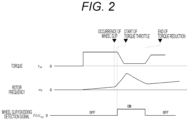
- FIG. 2 is a diagram illustrating an outline of operation waveforms at the time of general wheel slip detection and re-adhesion control when wheel slip occurs.
- the wheel slip/skidding detection determining unit 25 when deviation between the frequency conversion value of the vehicle speed and the rotor frequency exceeds a certain threshold, the wheel slip/skidding detection determining unit 25 outputs the wheel slip/skidding detection signal to the torque command calculating unit 24. Therefore, the wheel slip/skidding detection determining unit 25 may take in the vehicle speed from the outside as indicated by a dotted line in FIG. 1 .
- the torque command calculating unit 24 illustrated in FIG. 1 Upon receiving the wheel slip/skidding detection signal, the torque command calculating unit 24 illustrated in FIG. 1 performs the re-adhesion control including torque reduction (in a period from start of torque throttle to end of torque reduction illustrated in FIG. 2 ).
- the enlargement of the wheel slip state is suppressed, and the rotational speed fluctuation and the vibration to the vehicle are reduced.
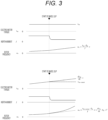
- FIG. 3 is a diagram illustrating a relationship between the electric motor torque and the rotor frequency when wheel slip occurs.
- FIG. 3 illustrates characteristics of a rotor frequency ⁇ r , electric motor torque ⁇ m , and inertia moment J of the electric motor 1.
- P m is the number of pole pairs of the electric motor 1
- the inertia moment J is treated as equivalent inertia moment obtained by synthesizing a mass of the vehicle and the adhesion due to a tangential force coefficient ⁇ in order to simplify the description.
- the inertia moment J is large in a state where the wheel and the rail adhere to each other, and in a case where wheel slip/skidding occurs between the wheel and the rail, it is regarded that the inertia moment J appears to be small.
- the characteristic illustrated on the upper side of FIG. 3 is a case where the electric motor torque ⁇ m is a fixed value. For example, a case of constant speed traveling without notching is applicable.
- the rotor frequency includes a primary component as expressed by the following formula (Formula 2), and increases at a constant inclination as illustrated in the upper side of FIG. 3 . In other words, the rotor frequency increases at a constant acceleration.
- ⁇ r ⁇ m ⁇ P m J ⁇ t
- the characteristic illustrated on the lower side of FIG. 3 is a case where the electric motor torque ⁇ m increases at a constant inclination.
- cases of acceleration due to notching, initial startup, and restart are applicable.
- the rotor frequency includes a primary component of fixed torque value ⁇ m-const at the start of wheel slip and a secondary component of torque gradient d ⁇ m /dt as expressed in the following formula (Formula 3), and increases secondarily as illustrated in the lower part of FIG. 3 .
- ⁇ r ⁇ m ⁇ const ⁇ P m J ⁇ t + d ⁇ m dt ⁇ P m ⁇ t 2
- the present invention proposes a configuration in which, when the electric motor torque command at the time of wheel slip/skidding detection is large or when the change in the electric motor torque command is large, it is determined that the rotor frequency quickly changes, and the torque command reduced speed is increased.
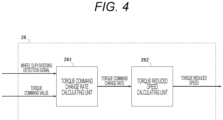
- FIG. 4 is a block diagram illustrating a configuration of a torque reduction calculating unit 26.
- the torque reduction calculating unit 26 is included in the torque command calculating unit 24 illustrated in FIG. 1 and includes a torque command change rate calculating unit 261 and a torque command reduced speed calculating unit 262.
- the torque command change rate calculating unit 261 determines a magnitude and inclination of the torque command value when the wheel slip or skidding is detected by the wheel slip/skidding detection signal, and calculates and outputs a torque command change rate.
- the torque command reduced speed calculating unit 262 calculates and outputs a torque command reduced speed based on the torque command change rate.
- the magnitude and the inclination of the torque command value can be easily obtained by referring to the value at the time of torque command generation.
- the torque command reduced speed calculating unit 262 can set the torque command reduced speed by using a table or a function that outputs the torque command reduced speed with at least one of the magnitude and the inclination of the torque command value as a reference value.
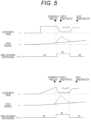
- FIG. 5 is a diagram illustrating an outline of operation waveforms at the time of the wheel slip detection and the re-adhesion control when the torque reduction calculating unit 26 is applied in a case in which the electric motor torque is a fixed value (upper side in FIG. 5 ) and a case in which the electric motor torque increases (lower side in FIG. 5 ). If the torque is not throttled the rotor frequency fluctuates as indicated by a dotted line in FIG. 5 .
- a predetermined upper limit value may be provided for the torque command reduced speed.
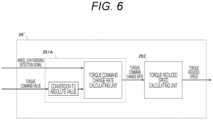
- FIG. 6 is a block diagram illustrating a configuration of a torque reduction calculating unit 26' in consideration of the skidding state.
- the torque reduction calculating unit 26' is also included in the torque command calculating unit 24 illustrated in FIG. 1 , and includes a torque command change rate calculating unit 261A and the torque command reduced speed calculating unit 262.
- the torque command change rate calculating unit 261A illustrated in FIG. 6 has a different configuration from that of the torque command change rate calculating unit 261 illustrated in FIG. 4 in that a torque command value that is input is converted into an absolute value in order to use the same logical configuration in both of the wheel slip and the skidding.
- a torque command value that is input is converted into an absolute value in order to use the same logical configuration in both of the wheel slip and the skidding.
- FIG. 7 is a diagram illustrating an outline of operation waveforms at the time of the skidding detection and the re-adhesion control when the torque reduction calculating unit 26' is applied in a case in which the electric motor torque increases in the negative direction.
- the torque command value obtained by converting the electric motor torque into an absolute value and indicated by a one-dot broken line is used to calculate the inclination of the torque command at the time of skidding detection (torque command change rate), and the torque command reduced speed calculating unit 262 outputs a torque command reduced speed d ⁇ m3 /dt.
- the calculation of the torque command reduced speed in the wheel slip or the skidding can be constructed with a simple configuration.
- FIG. 8 is a diagram illustrating a schematic configuration in a case where the electric motor drive device according to the present embodiment is applied to an electric motor for a railway vehicle.
- a railway vehicle 100 having an electric motor drive device receives supply of DC power from an overhead line 101, and travels along a rail 102 by wheels driven by the electric motor (for example, induction motors 1a to 1d).
- the electric motor drive device By applying the electric motor drive device according to the present embodiment, it is possible to suppress the rotational speed fluctuation of the electric motor for the railway vehicle at the time of occurrence of the wheel slip or the skidding, and to perform smooth re-adhesion control.
Landscapes
- Engineering & Computer Science (AREA)
- Power Engineering (AREA)
- Transportation (AREA)
- Mechanical Engineering (AREA)
- Life Sciences & Earth Sciences (AREA)
- Sustainable Development (AREA)
- Sustainable Energy (AREA)
- Electric Propulsion And Braking For Vehicles (AREA)
- Control Of Electric Motors In General (AREA)
Applications Claiming Priority (2)
| Application Number | Priority Date | Filing Date | Title |
|---|---|---|---|
| JP2021126026 | 2021-07-30 | ||
| PCT/JP2022/025067 WO2023008010A1 (fr) | 2021-07-30 | 2022-06-23 | Dispositif d'entraînement de moteur électrique et procédé d'entraînement de moteur électrique |
Publications (2)
| Publication Number | Publication Date |
|---|---|
| EP4380039A1 true EP4380039A1 (fr) | 2024-06-05 |
| EP4380039A4 EP4380039A4 (fr) | 2025-07-23 |
Family
ID=85087873
Family Applications (1)
| Application Number | Title | Priority Date | Filing Date |
|---|---|---|---|
| EP22847404.5A Pending EP4380039A4 (fr) | 2021-07-30 | 2022-06-23 | Dispositif d'entraînement de moteur électrique et procédé d'entraînement de moteur électrique |
Country Status (3)
| Country | Link |
|---|---|
| EP (1) | EP4380039A4 (fr) |
| JP (1) | JP7542157B2 (fr) |
| WO (1) | WO2023008010A1 (fr) |
Family Cites Families (7)
| Publication number | Priority date | Publication date | Assignee | Title |
|---|---|---|---|---|
| US7064507B2 (en) * | 2004-02-17 | 2006-06-20 | Railpower Technologies Corp. | Managing wheel skid in a locomotive |
| JP4527736B2 (ja) * | 2007-01-05 | 2010-08-18 | トヨタ自動車株式会社 | 車両およびその制御方法並びに駆動装置 |
| US8988016B2 (en) * | 2011-10-03 | 2015-03-24 | General Electric Company | System and method for traction motor control |
| EP2913919A4 (fr) * | 2012-10-26 | 2016-08-10 | Renesas Electronics Corp | Dispositif de commande de moteur et dispositif d'entraînement de moteur |
| JP6169924B2 (ja) * | 2013-08-29 | 2017-07-26 | 株式会社日立製作所 | 誘導電動機式電気車及びその制御方法 |
| JP6730057B2 (ja) * | 2016-03-30 | 2020-07-29 | 株式会社東芝 | 電気車制御装置 |
| JP7105608B2 (ja) * | 2018-05-15 | 2022-07-25 | 公益財団法人鉄道総合技術研究所 | 電動機制御方法及び電動機制御装置 |
-
2022
- 2022-06-23 WO PCT/JP2022/025067 patent/WO2023008010A1/fr not_active Ceased
- 2022-06-23 EP EP22847404.5A patent/EP4380039A4/fr active Pending
- 2022-06-23 JP JP2023538341A patent/JP7542157B2/ja active Active
Also Published As
| Publication number | Publication date |
|---|---|
| JP7542157B2 (ja) | 2024-08-29 |
| EP4380039A4 (fr) | 2025-07-23 |
| WO2023008010A1 (fr) | 2023-02-02 |
| JPWO2023008010A1 (fr) | 2023-02-02 |
Similar Documents
| Publication | Publication Date | Title |
|---|---|---|
| JP3323899B2 (ja) | 電気車の制御装置 | |
| EP0699553A1 (fr) | Dispositif de commande pour véhicule électrique | |
| JP5391456B2 (ja) | 電動機制御方法及び電動機制御装置 | |
| JPWO2005110802A1 (ja) | 電気車制御装置 | |
| EP4380039A1 (fr) | Dispositif d'entraînement de moteur électrique et procédé d'entraînement de moteur électrique | |
| JP4903740B2 (ja) | 電動機制御方法及び電動機制御装置 | |
| JP5063274B2 (ja) | 電気車制御装置 | |
| JP7105608B2 (ja) | 電動機制御方法及び電動機制御装置 | |
| JP3935039B2 (ja) | 速度指令制御部及び電動車輌の速度制御装置 | |
| JP6017842B2 (ja) | 再粘着制御方法及び電動機制御装置 | |
| JP2004274845A (ja) | 電気車制御装置 | |
| JP2020043715A (ja) | 電気車の制御装置及び制御方法 | |
| JP3679599B2 (ja) | インバータ制御電気車の空転・滑走制御装置 | |
| JP2002345108A (ja) | 電気車の制御装置 | |
| JP2009100603A (ja) | 電気車制御装置 | |
| JP3879924B2 (ja) | 駆動車両の制御装置 | |
| JP4969411B2 (ja) | 電気車制御装置 | |
| JP6738751B2 (ja) | 電動機制御方法および制御装置 | |
| JPH0884405A (ja) | 電気車の制御装置 | |
| JP6990112B2 (ja) | 再粘着制御方法および電動機制御装置 | |
| CN121175213A (zh) | 铁道车辆用驱动装置及其控制方法 | |
| JP4120503B2 (ja) | 誘導電動機の制御方法 | |
| JPH10210605A (ja) | 電気車制御装置 | |
| JP3089920B2 (ja) | 電気車の制御装置 | |
| JP3446849B2 (ja) | 電気車の制御装置 |
Legal Events
| Date | Code | Title | Description |
|---|---|---|---|
| STAA | Information on the status of an ep patent application or granted ep patent |
Free format text: STATUS: THE INTERNATIONAL PUBLICATION HAS BEEN MADE |
|
| PUAI | Public reference made under article 153(3) epc to a published international application that has entered the european phase |
Free format text: ORIGINAL CODE: 0009012 |
|
| STAA | Information on the status of an ep patent application or granted ep patent |
Free format text: STATUS: REQUEST FOR EXAMINATION WAS MADE |
|
| 17P | Request for examination filed |
Effective date: 20240229 |
|
| AK | Designated contracting states |
Kind code of ref document: A1 Designated state(s): AL AT BE BG CH CY CZ DE DK EE ES FI FR GB GR HR HU IE IS IT LI LT LU LV MC MK MT NL NO PL PT RO RS SE SI SK SM TR |
|
| DAV | Request for validation of the european patent (deleted) | ||
| DAX | Request for extension of the european patent (deleted) | ||
| A4 | Supplementary search report drawn up and despatched |
Effective date: 20250620 |
|
| RIC1 | Information provided on ipc code assigned before grant |
Ipc: H02P 29/028 20160101AFI20250613BHEP Ipc: B60L 9/18 20060101ALI20250613BHEP Ipc: B60L 15/00 20060101ALI20250613BHEP Ipc: B60L 15/02 20060101ALI20250613BHEP Ipc: B60L 15/20 20060101ALI20250613BHEP Ipc: B60L 3/10 20060101ALI20250613BHEP Ipc: H02P 27/08 20060101ALI20250613BHEP |
|
| STAA | Information on the status of an ep patent application or granted ep patent |
Free format text: STATUS: EXAMINATION IS IN PROGRESS |
|
| 17Q | First examination report despatched |
Effective date: 20251006 |
|
| GRAP | Despatch of communication of intention to grant a patent |
Free format text: ORIGINAL CODE: EPIDOSNIGR1 |
|
| STAA | Information on the status of an ep patent application or granted ep patent |
Free format text: STATUS: GRANT OF PATENT IS INTENDED |
|
| INTG | Intention to grant announced |
Effective date: 20260206 |
|
| GRAS | Grant fee paid |
Free format text: ORIGINAL CODE: EPIDOSNIGR3 |
|
| GRAA | (expected) grant |
Free format text: ORIGINAL CODE: 0009210 |
|
| STAA | Information on the status of an ep patent application or granted ep patent |
Free format text: STATUS: THE PATENT HAS BEEN GRANTED |