FR2644455A1 - Derives d'acides pyridone carboxyliques azetidinyl substitues, leur preparation et leur application en tant que medicaments - Google Patents
Derives d'acides pyridone carboxyliques azetidinyl substitues, leur preparation et leur application en tant que medicaments Download PDFInfo
- Publication number
- FR2644455A1 FR2644455A1 FR8903459A FR8903459A FR2644455A1 FR 2644455 A1 FR2644455 A1 FR 2644455A1 FR 8903459 A FR8903459 A FR 8903459A FR 8903459 A FR8903459 A FR 8903459A FR 2644455 A1 FR2644455 A1 FR 2644455A1
- Authority
- FR
- France
- Prior art keywords
- sep
- dihydro
- azetidinyl
- oxo
- methyl
- Prior art date
- Legal status (The legal status is an assumption and is not a legal conclusion. Google has not performed a legal analysis and makes no representation as to the accuracy of the status listed.)
- Granted
Links
- 0 CC1(*)C(*)(*)NC1(C)* Chemical compound CC1(*)C(*)(*)NC1(C)* 0.000 description 1
Classifications
-
- C—CHEMISTRY; METALLURGY
- C07—ORGANIC CHEMISTRY
- C07D—HETEROCYCLIC COMPOUNDS
- C07D401/00—Heterocyclic compounds containing two or more hetero rings, having nitrogen atoms as the only ring hetero atoms, at least one ring being a six-membered ring with only one nitrogen atom
- C07D401/02—Heterocyclic compounds containing two or more hetero rings, having nitrogen atoms as the only ring hetero atoms, at least one ring being a six-membered ring with only one nitrogen atom containing two hetero rings
- C07D401/04—Heterocyclic compounds containing two or more hetero rings, having nitrogen atoms as the only ring hetero atoms, at least one ring being a six-membered ring with only one nitrogen atom containing two hetero rings directly linked by a ring-member-to-ring-member bond
-
- C—CHEMISTRY; METALLURGY
- C07—ORGANIC CHEMISTRY
- C07D—HETEROCYCLIC COMPOUNDS
- C07D471/00—Heterocyclic compounds containing nitrogen atoms as the only ring hetero atoms in the condensed system, at least one ring being a six-membered ring with one nitrogen atom, not provided for by groups C07D451/00 - C07D463/00
- C07D471/02—Heterocyclic compounds containing nitrogen atoms as the only ring hetero atoms in the condensed system, at least one ring being a six-membered ring with one nitrogen atom, not provided for by groups C07D451/00 - C07D463/00 in which the condensed system contains two hetero rings
- C07D471/04—Ortho-condensed systems
Landscapes
- Chemical & Material Sciences (AREA)
- Organic Chemistry (AREA)
- Nitrogen Condensed Heterocyclic Rings (AREA)
- Plural Heterocyclic Compounds (AREA)
- Pharmaceuticals Containing Other Organic And Inorganic Compounds (AREA)
Abstract
La présente invention se rapporte à de nouveaux dérivés azétidiniques des acides pyridonecarboxyliques azétidinyl substitués, du 1,4-dihydro-4-oxoquinoléine-3-carboxylique, du 1,8-naphtyridine-4-oxo-3-carboxylique et du 2,3-dihydro-7-oxo-7H-pyrido [1,2,3-de]-1,4-benzoxazine-6-carboxylique représentés par la formule générale I : (CF DESSIN DANS BOPI) La présente invention concerne également les sels thérapeutiquement acceptables de ces composés, leur procédé de préparation et leur application en tant que médicament.
Description
La présente invention se rapporte a des nouveaux dérivés azétidiniques des acides pyridonecarboxyliques 7,rl-dihydro-rl -oxoquinolAine-3 - carboxylique, 1,8-naphtyridine-4-oxo-3-carboxylique et 2,3-dihydro-7-oxo-7Hpyrido[1,2,3-de]-1,4-benzoxazine-6-carboxylique. les sels thérapeutiquement acceptables de ces composés, leur procédé de préparation, ainsi que leur application en tant que médicaments.
Les composés objet de la présente invention peuvent être utilisés dans l'industrie pharmaceutique comme intermédiaires et pour la préparation de médicaments.
Dans les brevets Eur. Pat. Appl. EP 106489 Eur. Pat. Appl. EP 153163; Japan
Kokkai JP 58/72589 (83/72589); Japan Kokkai JP 60/89840 (85/89840) et Japan Kokkai
JP 60/126284 (85/12684) sont décrites quelques azétidines 3-monosubstituées attachues a la position 7 de quelques quinolones et naphtyridines.
Kokkai JP 58/72589 (83/72589); Japan Kokkai JP 60/89840 (85/89840) et Japan Kokkai
JP 60/126284 (85/12684) sont décrites quelques azétidines 3-monosubstituées attachues a la position 7 de quelques quinolones et naphtyridines.
Dans la demande de brevet Français FR 87.18289 et son addition 88. 09816 sont décrites quelques azétidines mono ou disubstituées dans leur position 3 er qui sont attachées a la position 7 de quelques quinolones et pyrido-benzoxacines.
Nous avons maintenant découvert que les nouveaux dérivés azétidiniques des acides 1,4-dihydro-4-oxoquinoléine-3-carboxylique, 1,8-naphtyridine-4-oxo-3-carboxylique et 2,3-dihydro-7-oxo-7H-pyrido[1,2,3-de]-1,4-benzoxazine-6-carboxylique.
qui font l'objet de la présente invention, présentent une trts bonne activité antimicrobienne.
Les composés objet de la présente invention répondent à la formule générale I

dans laquelle A représente un atome d'azote ou bien un atome de carbone avec un atome d'hydrogène attaché (C-H), ou bien un atome de carbone avec un halogène attaché (C-X), dans ce cas X représente un atome de chlore, de fluor ou de brome ou bien un atome de carbone avec un radical hydroxy (C-OH).
dans laquelle A représente un atome d'azote ou bien un atome de carbone avec un atome d'hydrogène attaché (C-H), ou bien un atome de carbone avec un halogène attaché (C-X), dans ce cas X représente un atome de chlore, de fluor ou de brome ou bien un atome de carbone avec un radical hydroxy (C-OH).
R1 représente un radical allyle ou cycloalkyle inférieur. un radical halogénoalkyle inférieur, un radical aryle ou un radical aryle substitué, notammment par un ou plusieurs atome(s) de fluor.
R2 et R7, égaux ou différents, représentent un atome d'hydrogène ou un radi
cal alkyle inférieur.
cal alkyle inférieur.
R5, R5 et R6 égaux ou différents représentent un atome d'hydrogène, un
radical aminoalkyle, un radical alkylamino, un radical alkylaminoalkyle.
radical aminoalkyle, un radical alkylamino, un radical alkylaminoalkyle.
R4 représente un atome d'hydrogène, un radical alkyle inférieur, un radical
hydroxyle, un radical amino, un radical aminoalkyle, un radical alkylamino, un radical dialkylamino, un radical hétérocyclique azoté de préférence aromatique pouvant être un cycle de trois à six maillons, un radical alkylaminoalkyle, un radical alkylcarboxamido, et dans ce dernier cas, le radical alkyle pouvant être substitué par un ou Plusieurs halogènes, un radical arvi- sulfonyloxy, un radical alkylsulfonyloxy, un radical carboxamico, pouvant être substitué ou non sur l'azote, ou un radical cyano.
hydroxyle, un radical amino, un radical aminoalkyle, un radical alkylamino, un radical dialkylamino, un radical hétérocyclique azoté de préférence aromatique pouvant être un cycle de trois à six maillons, un radical alkylaminoalkyle, un radical alkylcarboxamido, et dans ce dernier cas, le radical alkyle pouvant être substitué par un ou Plusieurs halogènes, un radical arvi- sulfonyloxy, un radical alkylsulfonyloxy, un radical carboxamico, pouvant être substitué ou non sur l'azote, ou un radical cyano.
Rs, représente un atome d'hydrogène, un radical nitro, un radical amino ou
amino substitué.
amino substitué.
A et R1 peuvent former ensemble une liaison représentée par un qroupe ou -O-CH2-CHR9 dans lesquels R9 représente un atome d'hydrogène ou un radical alkyle inférieur et dans ce dernier cas on a un centre chiral avec une configuration "R" ou "S".
Ria represente un atome d'hydrogène ou un radical alkyle inférieur de Cl à C4
Les substituants azétidiniques peuvent avoir, selon le nombre, la nature et la position relative des substituants, jusqu'à trois centres ch iraux, chacun d'eux avec une configuration "R" ou "S".
Les substituants azétidiniques peuvent avoir, selon le nombre, la nature et la position relative des substituants, jusqu'à trois centres ch iraux, chacun d'eux avec une configuration "R" ou "S".
La stéréochimie des produits objet de la présente invention est déterminée par celle des produits de départ. Par sélection de la stéréoisomérie de chacun des produits de départ on peut obtenir tous les stéréoisomères possibles et dans le cas ou le produit de réaction est un mélange stéréoisomérique, les composants peuvent être séparés et leur configuration établie par des procédées bien connus.
Les nouveaux dérivés de formule générale I peuvent être préparés, conformement a l'invention, selon la méthode suivante:
Par réaction d'un composé de formule générale II

dans laquelle A, R1, R8 et Rlo ont les significations mentionnées précédemment et
Z représente un atome d'halogène, de preférence un chlore ou un fluor, avec une azètidine, de formule générale III

dans laquelle R2 , R3, R4, R5, R6 et R7 ont les significations mentionnées précé- demment.
Par réaction d'un composé de formule générale II
dans laquelle A, R1, R8 et Rlo ont les significations mentionnées précédemment et
Z représente un atome d'halogène, de preférence un chlore ou un fluor, avec une azètidine, de formule générale III
dans laquelle R2 , R3, R4, R5, R6 et R7 ont les significations mentionnées précé- demment.
Les composés hetérocycliques de formule générale II que l'on peut utiliser comme matières de départ pour préparer les composés de l'invention, sont des composés décrits, comme dans H.Koga, A. Itoh, S. Murayama, S. Suzue et T. Irikura L Med. Chem., 1980. 23,1358. ou bien dans H. Egawa, T.Miyamoto, A. Minamida, Y Nishimura, H Okada. H. Uno J. Matsumoto, J.Med.Chem 1984, aZ, 1543.
D'autre part, les composés de formule générale III, qui constituent les autres matières de départ pour la préparation des composés de l'invention selon la formule générale I, sont connus ou bien sont synthétisés comme par exemple dans A.G.
Anderson et R. Lok, J.Ore.Chem, 1972, U, 3953 ou bien dans R.H. Higgins et N.H.
Cromwell, J.Heterocvcl. Chem.,1971, 1,1059 et aussi dans N.H. Cromwell et B. Phillips
Chem.Rews. 1979, 22,331.
Chem.Rews. 1979, 22,331.
Les azétidines de formule générale III peuvent avoir, selon le nombre, la na
ture et la position relative des substituants, jusqu'à trois centres duraux, et on peut obtenir les différents stéréoisomères soit par synthèse assymétrique soit par différentes sortes de séparations, selon les procédés connus dans la chimie organique.
ture et la position relative des substituants, jusqu'à trois centres duraux, et on peut obtenir les différents stéréoisomères soit par synthèse assymétrique soit par différentes sortes de séparations, selon les procédés connus dans la chimie organique.
La rection s'effectue en présence d'un solvant adéquat, par exemple le diméthylsulfoxyde, la diméthylformamide, la pyridine, les trialkylamines comme la triéthylamine, le chlorure de méthylène, le chloroforme, ou bien des éthers comme le tétrahydrofuranne ou le dioxanne, ou des mélanges de ces solvants.
Les températures les plus adéquates oscillent entre la température ambiante et la température de reflux du solvant, et le temps réactionnel est compris entre í heure et 24 heures.
Dans les exemples suivants on indique la préparation de nouveaux dérivés selon l'invention. On décrira également quelques formes d'emploi.
Les exemples ci-après, donnés a simple titre d'illustration ne doivent cependant, en aucune façon, limiter l'étendue de l'invention.
Exemple 1.- Préparation de l'acide 1-cyclopropyl-6-fluoro-7-(1-azétidinyl)-1,4- dihydro-4-oxo-3-quinoléincarboxylique.
On chauffe a 110 C dans un récipient clos et pendant 2 heures un mélange de 0,6g (2,2 mmoles) de l'acide 1-cyclopropyl-6,7-difluoro-1,4-dihydro-4-oxo-3-quinolein- carboxylique, 0,25 g (4,4 mmoles) d'azétidine et 1 ml de triéthylamine dans 8 ml de pyridine. On laisse refroidir, on filtre et on lave à l'eau, l'éthanol et l'éther. On obtient ainsi 0,275 g de l'acide 1-cyclopropyl-6-fluoro-7-(1-aztidinyl)-1,4-dihydro-4- oxo-3 -quinoléincarboxylique, de point de fusion 291-4 C.
Données spectroscopiques: 1H RMN, s 5,J=Hz,[DMSO-TFAA];8,57(s, 1H); 7,78 (d, J=13, 1H); 6,86 (d, J=8, 1H); 4,22 (t, J=7, 4H); 3,73 (m, 1H); 1,15 (m, 6H).
IR(KBr).-1725, 1631, 1479, 1464, I348 cm-l.
Exemple 2.- Préparation de l'acide 1-cyclopropyl-6,8-difluoro-7-(3-méthyl-3-mé- thylamino-1-azétidinyl)-1,4-dihydro-4-oxo-3-quinoléincarboxylique.
On chauffe 9 reflux pendant 2 heures un mélange de 1,35 g (4,8 mmoles) de
l'acide 1-cyclopropyl-6,7,8-trifluoro-1,4-dihydro-4-oxo-3-quinoléincarboxylique, 1,45g (6,2 mmoles) de chlorhydrate de 3-méthyl-3-trifluoroacétamidoazétidine et I ml de
triéthylamine dans 15 ml de pyridine. On évapore sous vide, on dilue avec de l'eau
glacée, on filtre et on lave å l'eau.On obtient ainsi 2,2 g de l'acide l-cyclopropyl- 6-fluoro-7-(3-méthyl-3-trifluoroacétamido-N-méthyl-1-azétidinyl)-1,4-dihydro-4-oxo-3quinoléincarboxylique, de point de fusion 291-4QC, qui est ensuite hydrolysé en le
chauffant dans un mélange de 4ml de soude 10% et 20 ml d'eau avec 1 mi d'éthanol,
pendant 1 heure. On filtre 9 chaud, on acidifie avec de l'acide acétique, on filtre et
on lave a l'eau. On obtient ainsi 1,57g de l'acide 1-cyclopropyl-6,8-difluoro-7-(3-
méthyl-3-méthylamino-1-azétidinyl)-2,4-dihydro-4-oxo-3-quinoléincarboxylique, de
Point de fusion > 3002C.
l'acide 1-cyclopropyl-6,7,8-trifluoro-1,4-dihydro-4-oxo-3-quinoléincarboxylique, 1,45g (6,2 mmoles) de chlorhydrate de 3-méthyl-3-trifluoroacétamidoazétidine et I ml de
triéthylamine dans 15 ml de pyridine. On évapore sous vide, on dilue avec de l'eau
glacée, on filtre et on lave å l'eau.On obtient ainsi 2,2 g de l'acide l-cyclopropyl- 6-fluoro-7-(3-méthyl-3-trifluoroacétamido-N-méthyl-1-azétidinyl)-1,4-dihydro-4-oxo-3quinoléincarboxylique, de point de fusion 291-4QC, qui est ensuite hydrolysé en le
chauffant dans un mélange de 4ml de soude 10% et 20 ml d'eau avec 1 mi d'éthanol,
pendant 1 heure. On filtre 9 chaud, on acidifie avec de l'acide acétique, on filtre et
on lave a l'eau. On obtient ainsi 1,57g de l'acide 1-cyclopropyl-6,8-difluoro-7-(3-
méthyl-3-méthylamino-1-azétidinyl)-2,4-dihydro-4-oxo-3-quinoléincarboxylique, de
Point de fusion > 3002C.
Données spectroscopiques:
1H RMN. 6,JIHz,[DMSO-TFAA]; 1,I(m,4H); 1,65 (s, 3H); 2,7 (s, 3H); 4,0 (m, 1H); 4,5
(AB, J=7, 4H): 7,75 (d, J=. 1H); 8,6 (s.lH); 9.4 (élargie, 2H)
IR(KBr).-2918, 1731, 1622, 1470, cm-1
Exemple 3.- Préparation de l'acide 1-cyclopropyl-6-fluoro-7-(3-méthyl-3-mé-
thylamino-1-azétidinyl)-1,4-dihydro-4-oxo-3-quinoléincarboxylique.
1H RMN. 6,JIHz,[DMSO-TFAA]; 1,I(m,4H); 1,65 (s, 3H); 2,7 (s, 3H); 4,0 (m, 1H); 4,5
(AB, J=7, 4H): 7,75 (d, J=. 1H); 8,6 (s.lH); 9.4 (élargie, 2H)
IR(KBr).-2918, 1731, 1622, 1470, cm-1
Exemple 3.- Préparation de l'acide 1-cyclopropyl-6-fluoro-7-(3-méthyl-3-mé-
thylamino-1-azétidinyl)-1,4-dihydro-4-oxo-3-quinoléincarboxylique.
Par une procédure tout 9 fait semblable à celle de l'exemple 2, on obtient
l'acide 1-cyclopropyl-6-fluoro-7-(3-méthyl-3-(trifluorométhylamino-N-méthyl)-1-azé
tidinyl)-l ,4-dihydro-4-oxo-3-quinoléincarboxylique de point de fusion 210-5 C. qui est
ensuite hydrolysé pour obtenir l'acide 1-cyclopropyl-6-fluoro-7-(3-méthyl-3-méthyla
mino- I -azétidinyl)-1,4-dihydro-4-oxo-3-quinoléincarboxylique de point de fusion > 300C.
l'acide 1-cyclopropyl-6-fluoro-7-(3-méthyl-3-(trifluorométhylamino-N-méthyl)-1-azé
tidinyl)-l ,4-dihydro-4-oxo-3-quinoléincarboxylique de point de fusion 210-5 C. qui est
ensuite hydrolysé pour obtenir l'acide 1-cyclopropyl-6-fluoro-7-(3-méthyl-3-méthyla
mino- I -azétidinyl)-1,4-dihydro-4-oxo-3-quinoléincarboxylique de point de fusion > 300C.
Données spectroscopiques:
1H RMN,6,J=Hz.[DMSO-TFAA] : 1,15 (m, 4H) ; 1,7 (s, 3H); 2,75 (s, 3H); 3,75 (m, 1H);
4,2 (AB, J=7 , 4H); 7,0 (d, J"7,6 ,1H); 7,85 (d, J=12,9 ,1H);8,6 (s, 1H); 9.4 (élargie,
2H)
IR(KBr). -2915, 1731, 1629, 1516, cvm-1
Exemple 4.- Préparation de l'acide 1-cyclopropyl-6-fluoro-7-(3-diméthylamino-3
méthyl-1-azétidinyl)-1,4-dihydro-4-oxo-3-quinoléincarboxylique.
1H RMN,6,J=Hz.[DMSO-TFAA] : 1,15 (m, 4H) ; 1,7 (s, 3H); 2,75 (s, 3H); 3,75 (m, 1H);
4,2 (AB, J=7 , 4H); 7,0 (d, J"7,6 ,1H); 7,85 (d, J=12,9 ,1H);8,6 (s, 1H); 9.4 (élargie,
2H)
IR(KBr). -2915, 1731, 1629, 1516, cvm-1
Exemple 4.- Préparation de l'acide 1-cyclopropyl-6-fluoro-7-(3-diméthylamino-3
méthyl-1-azétidinyl)-1,4-dihydro-4-oxo-3-quinoléincarboxylique.
On chauffe à reflux pendant 2 heures un mélange de l,32g (5 mmoles) de l'acide 1-cyclopropyl-6,7-difluoro-1,4-dihydro-4-oxo-3-quinoléincarboxylique, 1.31g (7 mmoles) de l'hydrochlorure de 3-méthyl-3-diméthylaminoazétidine et 3 mi de trié- thylamine dans- 10 ml de pyridine. On evapore on Iaisse réfroidir, on additionne de l'eau glacée, on filtre et on lave à l'eau, l'éthanol et l'éther, et on obtient ainsi 1,8 g de l'acide 1-cyclopropyl-6-fluoro-7-(3-diméthylamino-3-méthyl-1-azétidinyl)-1,4- dihydro-4-oxo-3-quinoléincarboxylique, de point de fusion 298-301 C.
Données spectroscopiques: 1H RMN,#,J=Hz.[DMSO-TFA]; 1,16 (m,4H); 1,67 (s, 3H); 2,78 (s, 6H); 3,67 (m, 1H); 4,29 (AB, J=20, J=9,3, 4H); 7,0 (d, J=7,5 ,IH); 7,85 (d, J=12,9 ,1h) ; 8,6 (s, 1H); IR(KBr).-1712, 1629, 1521, 1476 cm-1
Exemple 5.- Préparation de l'acide l-cyclopropyl-6,8-difluoro-7- (trans-2-méthyl-3- hydroxy-1-azétidinyl)-1,4-dihydro-4-oxo-3-quinoléincarboxylique.
Exemple 5.- Préparation de l'acide l-cyclopropyl-6,8-difluoro-7- (trans-2-méthyl-3- hydroxy-1-azétidinyl)-1,4-dihydro-4-oxo-3-quinoléincarboxylique.
Par une procédure semblable à celle de l'exemple 4 on obtient l'acide 1cyclopropyl-6,8-difluoro-7-(E)-2-méthyl-3-hydroxy-1-azétidinyl)-1,4-dihydro-4-oxo-3 quinoléincarboxyliQue de point de fusion 215-82C.
Données spectroscopiques: 1H RMN, #,J=Hz.[DMSO-TFAA] ; 8,59(s,lH); 7,69 (d, J=13, 1H); 4,55 (m, 2H); 4,01 (m, 3H); 1,45 (d,J=6, 3H); 1,16 (d, J=6, 4H).
IR(KBr).- 1719, 1628, 1526, 1453, 1412 cm-1.
Exemple 6.- Préparation de l'acide 1-cyclopropyl-6-fluoro-7-(trans-2-méthyl-3-hy- droxy-1-azétidinyl)-1,4-dihydro-4-oxo-3-quinoléincarboxylique.
Par une procédure tout à fait semblable à celle décrite dans rexemple 4 on obtient l'acide 1-cyclopropyl-6-fluoro-7-(E)-2-méthyl-3-hydroxy- 1 -azétidinyl)- 1,4dihydro-4-oxo-3-quinoléincarboxylique. de point de fusion 239-422C.
Données spectroscopiques: 1H RMN.#,J=Hz.[DMSO-TFAA] ; 8,58 (s,1H) ; 7,79 (d, J=13.1H) ; 7.01 (d. J=8.1 H) ; 4.45 (m, 1H); 4,15 (m, 2H);3,75 (m, 2H); 1,46 (d,J-6, 3H); 1,24 (m, 4H).
IR(KBr).-1708, 1630, 1503, 1474, 1460, 1337cm-1.
Exemple 7.- Préparation de l'acide 1-cyclopropyl-6,8-difluoro-7-(3-methyl-3-(1- pirrolyl)-1-azétidinyl)-1,4-dihydro-4-oxo-3-quinoléincarboxylique.
Par une procédure tout a fait semblable a celle décrite dans l'exemple 4 on obtient l'acide 1-cyclopropyl-6,8-difluoro-7-(3-méthyl-3-(1-pirrolyl)-1-azétidinyl)-1,4dihydro-4-oxo-3-quinoléincarboxylique de point de fusion 249-52 C.
Données spectroscopiques: 1H RMN,#,J=Hz.[Cl3CD] ; 1,20 (m, 4H); 1,96 (s, 3H); 3,9 (m,lH);4,4-5,0 (complexe, 4H);6,25 (t, J- 2, 1H); 6,88 (t, J= 2 1H); 7.77 (dd,J-13, J=2 ,1H); 8.66 (s,1H).
IR(KBr).- 1727, 1628, 1527, 1446, 1412 cm-1.
Exemple 8. - Préparation de l'acide 1-cyclopropyl-6-fluoro-7-(3-éthylaminométhyl-1-azétidinyl)-1,4-dihydro-4-oxo-3-quinoléincarboxylique.
Par une procédure tout a fait semblable a celle décrite dans l'exemple 4 on obtient l'acide 1-cyclopropyl-6-fluoro-7-(3-éthylaminométhyl-1-azétidinyl)-1,4-dihydro-4-oxo-3-quinoléincarboxylique de point de fusion 200-3 C.
Données spectroscopiques: 1H RMN,#,J=Hz.[DMSO-TFAA] ; 8,52 (s,lH); 7,69 (d, J-13, 1H);6,81 (d, J=8, 1H); 4,26 (m, 2H); 3,95 (m, 2H); 3,68 (m, 1H); 2,84 (s, 2H); 2,56 (q, J- 7, 2H); 1,26 (m, 4H); 1,04 (t, J-7, 3H).
IR(KBr).-1710, 1625, 1477, 1323 cm-1
Exemple 9. - Préparation de l'acide 1-cyclopropyl-6,8-difluoro-7-(trans-2-méthyl-3amino-1-azétidinyl)-1,4-dihydro-4-oxo-3-quinoléincarboxylique.
Exemple 9. - Préparation de l'acide 1-cyclopropyl-6,8-difluoro-7-(trans-2-méthyl-3amino-1-azétidinyl)-1,4-dihydro-4-oxo-3-quinoléincarboxylique.
Par une procédure tout a fait semblable a celle décrite dans l'exemple 4 on obtient l'acide 1-cyclopropyl-6,8-difluoro-7-((E)-2-méthyl-3-amino-1-azétidinyl)-1,4dihydro-4-oxo-3-quinoléincarboxylique, de point de fusion 234-7 C.
Données spectroscopiques: 1H RMN,6,J=Hz,[DMSO-TFAA1;8,61(s,1H);8.32 (élargie, 2H); 7,70 (dd, J=13,J=1,5, 1H); 4,76 (m, 2H); 4,09 (m, 2H);3,72 (m, 1H) ; 1,53 (d,J=6, 3H); 1,16 (d,J=6, 4H).
IR(KBr).-1719, 1630, 1578, 1466, 1402, 1319 cm-1.
Exemple 10.- Préparation de l'acide l-cyclopropyl-6-fluoro-7 (trans-2-méthyl-3- amino-1-azétidinyl)-1,4-dihydro-4-oxo-3-quinoléincarboxylique.
Par une procédure tout a fait semblable à celle décrite dans l'exemple 4 on obtient l'acide 1 -cyclopropyl-6-fluoro-7-((E)-3-méthyl-3-amino 1 -azétidinyl)- 1 ,4-dihy- dro-4-oxo-3-quinoléincarboxylique, de point de fusion 241-4 C.
Données spectroscopiques: 1H RMN,#,J=Hz,[DMSO-TFAA] ; 8,61(s,1H) ; 8,37 (élargie, 2H) ; 7,86 (d, J=13, 1H) ; 7,04 (d,
J=8, 1H); 4,53 (m, 2H); 3,92 (m, 3H);1,54 (d,J=6, 3H); 1,19 (d,J=8, 4H).
J=8, 1H); 4,53 (m, 2H); 3,92 (m, 3H);1,54 (d,J=6, 3H); 1,19 (d,J=8, 4H).
IR(KBr).-1719, 1629, 1479, 1325 cm-1.
Exemple 11.- Préparation de l'acide 1-cyclopropyl-6-fluoro-7-(3-aminométhyl-1- azétidinyl)-1,l4-dihydro-4-oxo-3-quinoléincarboxylique.
Par une procédure tout a fait semblable à celle décrite dans l'exemple 2 on obtient 'acide 1-cyclopropyl-6-fluoro-7(3-trifluorométhylacétamidométhyl-1-azétidinyl)-1,4dihydro-4-oxo-3-quinoléincarboxylique de point de fusion 205- 1 I2C et qui est ensuite hydroé pour obtenir l'acide 1 -cyclopropyl-6-fluoro -7-(3-aminométhyî- I -azétidinyl)-
1,4-dihydro-4-oxo-3-quinoléincarboxylique. de point de fusion 234-92C.
1,4-dihydro-4-oxo-3-quinoléincarboxylique. de point de fusion 234-92C.
Données spectroscopiques: 1H RMN,#,J=Hz.[DMSO-TFAA] ; 8,55(s,1H); 8.4 (élargie, 2H); 7,75 (d, J=13, 1H); 6,85 (d, 5=7,6 1H); 4,25 (m, 2H); 4,0 (m, 2H); 3,45 (m, 1H) ; 3,15 (élargie, 3H) ; 1,11 (m, 4H).
IR(KBr). - 3368, 1725, 1630, 1479, 1471, cm-1
Exemple 12.- Préparation de l'acide 1 -cyclopropyl-6-fluoro-7-(3-méthyl-3-hydro- xy- I -azétidinyl)- I ,4-dibydro-4-oxo-3-quinoléincarboxylique.
Exemple 12.- Préparation de l'acide 1 -cyclopropyl-6-fluoro-7-(3-méthyl-3-hydro- xy- I -azétidinyl)- I ,4-dibydro-4-oxo-3-quinoléincarboxylique.
Par une procédure tout à fait semblable à celle décrite dans l'exemple 4 on obtient l'acide I -cyclopropyl-6-fluoro-7-(3-méthyl-3-hydroxy- I -azétidinyl)- 1 ,4-dihy- dro-4-oxo-3-quinoléincarboxylique de point de fusion 303-8 C.
Données spectroscopiques: 1H RMN,#,J=Hz,[DMSO-TFAA] ; 8,52(s,1H) ; 7,68 (d, J=13, 1H) ; 6,80 (d, J=7,6 1H) ; 4,02 (m, 4H); 3,60 (m, 1H); 1,45 (s, 3H); 1,15 (m, 4H).
IR(KBr).- 1725, 1630, 1514, 1473, 1460, cm-1.
Exemple 13.- Préparation de l'acide 1 -cyclopropyl-6-fluoro-7-(3-éthyl-3-hydro xy-1-azétidinyl)-1,4-dihydro-4-oxo-3-quinoléincarboxylique.
Par une procédure tout à fait semblable à celle décrite dans l'exemple 4 on obtient l'acide 1 -cyclopropyl-6-fluoro-7-(3-éthyl-3-hydroxy- I -azétidinyl)- 1 4-dihydro- 4-oxo-3-quinoléincarboxylique, de point de fusion 284-7 C.
Données spectroscopiques: 1H RMN,#,J=Hz,[DMSO-TFAA] ; 8,55 (s,1H) ; 7,73 (d, J=13,1H) ; 6,84 (d, J=7,6 1H) ; 4,01 (m, 4H); 3,64 (m, 1H); 1,74 (q, J-7 ,2H); 1,17 (m, 4H); 0.9 (t, J=7, 3H).
IR(KBr).- 1725, 1628, 1513, 1465, cm-1.
Exemple 14.- Préparation de l'acide 1-cyclopropyl-6,8-difluoro-7-(3-éthyl-3- hydroxy-1-azétidinyl)-1,4-dihydro-4-oxo-3-quinoléincarboxylique.
Par une procédure tout à fait semblable à celle décrite dans l'exemple 4 on obtient l'acide 1-cyclopropyl-6,8-difluoro-7-(3-éthyl-3-hydroxy-1-azétidinyl)-1,4-dihydro-4-oxo-3-quinoléincarboxylique de point de fusion 257-9 C.
Données spectroscopiques: 1H RMN,#,J=Hz,[DMSO-TFAA] ; 8,52(s,1H) ; 7,58 (d, J=13, 1H) ; 4,20 (élargie, 4H) ; 3,90 (m, 1H) ; 1,71 (q, J=7. 2H); 1,07 (m, 4H); 0,88 (t, J=7, 3H).
IR(KBr).- 1715, 1626, 1460, 1453, 1412 cm-1.
Exemple 15.- Préparation de l'acide 1-cyclopropyl-6-fluoro-7-(3-amino-3-méthyl 1-azétidinyl)-1,4-dihydro-4-oxo-1,-naphtyridine-3-carboxylique.
On chauffe à reflux pendant 3 heures un mélange de 0,5g (1.8 mmoles) de l'acide 1-cyclopropyl-6,fluoro-7-chloro-1,4-dihydro-4-oxo-1,8-naphtyridine-3-carboxyligue, 0,34g (2,1 mmoles) d'hydrochlorure de 3-méthyl-3-aminoazétidine et 0.5 ml de triéthylamine dans 10 mi de pyridine On laisse réfroidir, on filtre et on lave à l'eau. On obtient ainsi 0,52 g de l'acide 1-cyclopropyl-6-fluoro-7-(3-amino-3-méthyl- 1-azétidinyl)-1,4-dihydro-4-oxo-1,8-naphtyridine-3-carboxylique de point de fusion 285-72C.
Données spectroscopiques: 1H RMN, #,J=Hz,[DMSO-TFAA] 8,59(s,1H) ; 8,4 (élargie, 2H); 8,0 (d, J=13, 1H); 4,4 (AB, J= 7, 4H); 3,65 (m, IH); 1,65 (s, 3H); 1,1 (m, 4H).
IR(KBr).-=943, 1629, 1447 cm-1
Exemple 16. - Préparation de l'acide 1-cyclopropyl-6-fluoro-7-(trans-3-amino-2méthyl-1-azétidinyl)-1,4-dihydro-4-oxo-1,8-naphtyridine-3-carboxylique.
Exemple 16. - Préparation de l'acide 1-cyclopropyl-6-fluoro-7-(trans-3-amino-2méthyl-1-azétidinyl)-1,4-dihydro-4-oxo-1,8-naphtyridine-3-carboxylique.
Par une procédure tout à fait semblable à celle décrite dans l'exemple 15 on obtient l'acide 1 -cyclopropyl-6-fluoro-7-((E)-3-amino-2-méthyl- 1 -azétidinyl)- 1 ,4-dihy- dro-4-oxo-1,8-naphtyridine-3-carboxylique, de point de fusion 211-82C.
Données spectroscopiques: 1H RMN, #,J=Hz.[DMSO-TFAA] ; 8,6 (s,lH); 8,4 (élargie, 2H); 7,95 (d, J=13, 1H); 4,7 (m, 2H); 4,25 (m, 1H);3,6 (m, 2H); 1,55 (d, J=6 ,3H) ; 1,1 (m, 4H).
IR(KBr).-2943, 1629, 1447 cm-1.
Exemple 17.- Préparation de l'acide (3S)-(-)-9-fluoro-3 -méthyl-7-oxo-2,3 -dihy- dro-7H-pyrido[1,2,3-]de[1,4]benzoxazine-10-(3-amino-1-azétidinyl)-6-carboxylique.
Par une procédure tout à fait semblable à celle décrite dans l'exemple 4 on obtient l'acide (3S)-(-)-9-fluoro-3-méthyl-7-oxo-2,3-dihydro-7H-pyrido[1,2,3de][1,4]benzoxazine-10-(3-amino-1-azétidinyl)-6-carboxylique de point de fusion 23610 C.
Données spectroscopiques: 1H RMN,#,J=Hz.[DMSO-TFAA]; 1,41(d, J=7.3H) ; 3.9-5.1 (complexe, 8H) ; 7,52 (d, J= 13, 1H); 8,35 (élargie, 2H); 8.88 (s,lH).
IR(KBr).-3350. 1712, 1622, 1536, 1474 cm-l.
=-78,8(c=4.1, NaOH 0,5N)
Exemple 18.- Préparation de l'acide (3S)-(-)-9-fluoro-3-méthyl-7-oxo-2,3-dihyp dro-7H-pyrido[1,2,3-de][1,4]benzoxazine-10-(3-diméthylamino-1-azétidinyl)-6-carboxylique.
Exemple 18.- Préparation de l'acide (3S)-(-)-9-fluoro-3-méthyl-7-oxo-2,3-dihyp dro-7H-pyrido[1,2,3-de][1,4]benzoxazine-10-(3-diméthylamino-1-azétidinyl)-6-carboxylique.
Par une procédure tout à fait semblable à celle décrite dans l'exemple 4 on obtient l'acide (3S)-(-)-9-fluoro-3-mthyl-7-oxo-2,3-dihydro-7H-pyridor1,2,3- de[1,4]benzoxazine-10-(3-diméthylamino-1-azétidinyl)-6-carboxylique de point de fusion > 300 C.
Données spectroscopiques: 1H RMN,#,J=Hz,[DMSO-TFAA] ; 1,41 (d, J-7, 3H); 2,8 (s, 6H); 4,0-5.0 (complexe,8H); 7,52 (d, J- 13, 1H); 8,87 (s, 1H).
IR(KBr).-2400, 1712, 1619, 1525, 1442, 1340 cm-1.
[a]D20 --79,6 (c- 4,06 , NaOH 0,5N
Exemple 19.- Préparation de l'acide (3S)-(-)-9-fluoro-3-méthyl-7-oxo-2,3-dihydro-7H-pyrido[1,2,3-de][1,4]benzoxazine-10-(3-diméthylamino -3-méthyl-1-azétidinyl)-6-carboxylique.
Exemple 19.- Préparation de l'acide (3S)-(-)-9-fluoro-3-méthyl-7-oxo-2,3-dihydro-7H-pyrido[1,2,3-de][1,4]benzoxazine-10-(3-diméthylamino -3-méthyl-1-azétidinyl)-6-carboxylique.
Par une procédure tout à fait semblable à celle décrite dans l'exemple 4 on obtient l'acide (3S)-(-)-9-fluoro-3-mthyl-7-oxo-2,3-dihydro-7H-pyridotl,2,3- de][1,4]benzoxazine-10-(3-diméthylamino-3-méthyl-1-azétidinyl)-6-carboxylique de point de fusion 298-9 C.
Données spectroscopiques: 1H RMN,#,J=Hz.[DMSO-TFAA] ; 1,43 (d, J=6.3, 3H) ; 1,62 (s, 3H); 2,73 (s, 6H); 4,05,0 (complexe, 7H); 7,50 (d, J= 13, 1H); 8.76 (s,lH).
IR(KBr).-2400, 1712, 1617, 1440, 1420, 1325 cm-1.
[a]D20 = -74,6 (c= 4,02 , NaOH 0,5N)
Exemple 20.- Préparation de l'acide (3R)-(+)-9-fluoro-3-méthyl-7-oxo-2,3-dihy- dro-7H-pyrido[1,2,3-de][1,4]benzoxazine-10-(3-amino-1-azétidinyl)-6-carboxylique.
Exemple 20.- Préparation de l'acide (3R)-(+)-9-fluoro-3-méthyl-7-oxo-2,3-dihy- dro-7H-pyrido[1,2,3-de][1,4]benzoxazine-10-(3-amino-1-azétidinyl)-6-carboxylique.
Par une procédure tout a fait semblable à celle décrite dans l'exemple 4 on obtient l'acide (3R(-(+)-9-fluoro-3-méthyl-7-oxo-2,3-dihydro-7H-pyrido[1,2,3de][1,4]benzoxazine-10-(3-amino-1-azétidinyl)-6-carboxylique de point de fusion 236402C.
Données spectroscopiques: 1H RMN,#,J=Hz,[DMSO-TFAA] ; 1,40 (d, J=7, 3H); 3,9-5,1 (complexe,8H); 7,51 (d, J=
13, 1H) ; 8,35 (élargie, 2H) ; 8.87 (s,1H).
13, 1H) ; 8,35 (élargie, 2H) ; 8.87 (s,1H).
IR(KBr).-3350, 1712, 1622, 1536, 1474 cm-1.
[a]D20 = +80,1 (c= 4,12, NaOH 0,5N)
Exemple 21.- Préparation de l'acide (3R)-(+)-9-fluoro-3-méthyl-7-oxo-2,3-dihy- dro-7H-pyrido[1,2,3-de][1,4]benzoxazine-10-(3-diméthylamino-1-azétidinyl)-6-carboxylique.
Exemple 21.- Préparation de l'acide (3R)-(+)-9-fluoro-3-méthyl-7-oxo-2,3-dihy- dro-7H-pyrido[1,2,3-de][1,4]benzoxazine-10-(3-diméthylamino-1-azétidinyl)-6-carboxylique.
Par une procédure tout à fait semblable à celle décrite dans l'exemple 4 on obtient l'acide (3R)-(+)-9-fluoro-3-méthyl-7-oxo-2,3-dihydro-7H-pyrido[1,2,3de][1,4]benzoxazine-10-(3-diméthylamino-1-azétidinyl)-6-carboxylique de point de fusion > 300QC.
Données spectroscopiques: 1H RMN,#,J=Hz.[DMSO-TFAA] ; 1,40 (d, J=7, 3H); 2,8 (s, 6H); 4,0-5,0 (complexe,8H); 7,51 (d, J= 13, 1H); 8,88 (s, 1H).
IR(KBr).-2400, 1712, 1619, 1525, 1442, 1340 cm-l.
[a]D20 = +82,3 (c 4,16 , NaOH 0,5N
Exemple 22.- Préparation de l'acide (3R)-(+)-9-fluoro-3-méthyl-7-oxo-2,3-dihy- dro-7H-pyrido[1,2,3-de][1,4]benzoxazine-10-(3-diméthylamino-3-méthyl-1-azétidinyl)-6carboxylique.
Exemple 22.- Préparation de l'acide (3R)-(+)-9-fluoro-3-méthyl-7-oxo-2,3-dihy- dro-7H-pyrido[1,2,3-de][1,4]benzoxazine-10-(3-diméthylamino-3-méthyl-1-azétidinyl)-6carboxylique.
Par une procédure tout a fait semblable à celle décrite dans l'exemple 4 on obtient l'acide (3R)-(I)-9-fluoro-3-mthyl-7-oxo-2,3-dihydro-7H-pyridoll,2,3- deXI ,4]benzoxazine-10-(3-diméthylamino-3-méthyl-] -azètidinyl)-6-carboxylique de point de fusion 298-9êC.
Données spectroscopiques: 1H RMN,6 J=Hz[DMSO-TFAA]; 1,43 (d, J-6,3, 3H); 1,62 (s, 3H); 2,72 (s, 6H); 4,05,0 (complexe, 7HX 7,51 (d, J- 13, 1H); 8.76 (s,lH).
IR(KBr).-2400. 1712, 1617. 1440, 1420, 1325 cm-1.
[a]D30=+72.8 (c=4.02. NaOH 0,5N)
Exemple 23.- Préparation de l'acide 1-cyclopropyl-6-fluoro-7-(3-diméthylamino- 1-azétidinyl)-1,4-dihydro-4-oxo-1,8-naphtyridine-3-carboxylique.
Exemple 23.- Préparation de l'acide 1-cyclopropyl-6-fluoro-7-(3-diméthylamino- 1-azétidinyl)-1,4-dihydro-4-oxo-1,8-naphtyridine-3-carboxylique.
Par une procédure tout a fait semblable å celle décrite dans l'exemple 15 on obtient l'acide 1-cyclopropyl-6-fluoro-7-(3-diméthylamino-1-azétidinyl)-1,4-dihydro-4-oxo-1,8naphtyridine-3-carboxylique de point de fusion 249-51 C.
Données spectroscopiques: 1H RMN,#,J=Hz.[DMSO-TFAA] ; 1,13 (m, 4H); 2,86 (s, 6H); 3,66 (m,lH); 4,35 (m, 1H); 4,45 (m, 4H); 8.04 (d, J- 11,4 , 1H); 8,59 (s, 1H).
IR(KBr).-1716, 1634, 151 I, 1452 cm-1
Exemple 24.- Préparation de l'acide 1-cyclopropyl-6-fluoro-7-(3-méthylamino-1- azétidinyl)-1,4-dihydro-4-oxo-1,8-naphtyridine-3-carboxylique.
Exemple 24.- Préparation de l'acide 1-cyclopropyl-6-fluoro-7-(3-méthylamino-1- azétidinyl)-1,4-dihydro-4-oxo-1,8-naphtyridine-3-carboxylique.
Par une procédure tout à fait semblable à celle décrite dans l'exemple 2 on obtient l'acide 1-cyclopropyl-6-fluoro-7-(3-trifluorométhylacétamido-N'-méthyl-1azétidinyl)-1,4-dihydro-4-oxo-1,8-naphtyridine-3-carboxylique de point de fusion 206 12*C qui est ensuite hydro@@é pour obtenir l'acide l-cyclopropyl-6-fluoro-7-(3 méthylamino- I -azétidinyl)-1,4-dihydro-4-oxo-1,8-naphtyridine-3-carboxylique de point de fusion 250-3 C.
Données spectroscopiques: 1H RMN, #,J=Hz.[DMSO-TFAA] ; 1,11 (m, 4H); 2,64 (s, 3H); 3,65 (m,lH); 4,15 (m, 1H); 4,44 (m, 4H); 7,97 (d, J= 11,4 , 1H); 8,56 (s, 1H); 9,24 (élargie, 1H).
IR(KBr).- 2932, 1631, 1614, 1457, 1276 cm-1.
Exemple 25.- Préparation de l'acide 1-cyclopropyl-6,8-difluoro-7-trans-2 2,3 dimé- thyl-3-hydroxy- 1 -azétidinyl)- 1 ,4-dihydro-4-oxo-3-quinoléincarboxylique.
Par une procédure tout à fait semblable à celle décrite dans l'exemple 4 on obtient l'acide 1-cyclopropyl-6,8-difluoro-7-((E)-2,3-diméthyl-3-hydroxy-1-azétidinyl) 1,4-dihydro-4-oxo-3-quinoléincarboxylique, de point de fusion 246-512C.
Données spectroscopiques: 1H RMN,#,J=Hz.[DMSO-TFAA] ; 8,59 (s,lH); 7,68 (dd, J=13,J=1,5, 1H); 4,54 (m, 1H); 4,27 (m, 1H); 4,02 (m, 2H); 1,35 (m,6H); 1,16 (d, J=6 , 4H).
IR(KBr).- 3470, 1705, 1626, 1529, 1475, I458, 1414 cm-1
Exemple 26.- Préparation de l'acide 1-cyclopropyl-6-fluoro-7-(trans-2,3-diméthyl- 3-hydroxy-1-amétidinyl)-1,4-dihydro-4-oxo-3-quinoléincarboxylique.
Exemple 26.- Préparation de l'acide 1-cyclopropyl-6-fluoro-7-(trans-2,3-diméthyl- 3-hydroxy-1-amétidinyl)-1,4-dihydro-4-oxo-3-quinoléincarboxylique.
Par une procédure tout à fait semblable à celle décrite dans l'exemple 4 on obtient l'acide 1-cyclopropyl-6-fluoro-7-((E)-2,3-diméthyl-3-hydroxy- I -azétidinyl)- 1,4- dihydro-4-oxo-3-quinoléincarboxylique, de point de fusion 284-902C.
Données spectroscopiques: 1H RMN, #,J=Hz.[DMSO-TFAA] ; 8,57 (s,1H);7,77 (d, J=13,1H) ; 7,05 (d, J=7, 1H) ; 4,16 (m, 2H); 3,81 (m, 2H); 1,32 (m, 10H).
IR(KBr).- 3450, 1706, 1630, 1503, 1475 cm-1.
Exemple 27.- Préparation de l'acide 5-amino-1-cyclopropyl-6,8-difluoro-7-(3-hy- droxy-1-azétidinyl)-1,4-dihydro-4-oxo-3-quinoléincarboxylique.
Par une procédure semblable å celle de l'exemple 4 on obtient l'acide 5-amino-1-cyclopropyl-6,8-difluoro-7-(3-hydroxy-1-azétidinyl)-1,4-dihydro-4-oxo-3-quinoléincarboxylique de point de fusion 271-5QC.
Données spectroscopiques: 1H RMN, #,J=Hz,[DMSO-TFAA] ; 8,43 (s,lH); 6,98 (s,2H); 4,58 (m, 3H); 4,05 (m, 3H); 1,07 (m, 4H).
IR(KBr).- 3340, 1690, 1540, 1423, cm~l.
ACTIVITE BIOLOGIQUE
L'activité pharmacologique antimicrobienne de ces composés a été étudiée selon les références exposées ci-dessous.
L'activité pharmacologique antimicrobienne de ces composés a été étudiée selon les références exposées ci-dessous.
Activité pharmacologique antimicrobienne (G. L. Daquet et Y. A. Chabbect, Tecnloues en bacterioloeie, Vol 3, Flammarion Médecine-Sciences, Paris 1972, et W.
B. Hugo et A. D. Rusell, Pharmaceutical Microbioloev, Blackwell Scientific Publications, London, 1977.
Milieu de culture et solvant:
Agar d'antibiotiques ng I (Oxoid CM 327)
Bouillon de triptone-soja (Oxoid CM 129)
Solution Physiologique Ringer 1/4 (Oxoid BR 52)
Agar Dextrose (BBL 11165)
Microorganismes "Bacillus subtilis" ATCC 6633
"Citrobacter freundii" ATCC 112606
"Enterobacteraerogenes"ATCC 15038 "Enterobacter cloacae" ATCC 23355 "Bacillus cereus" ATCC 1178
"Escherichia coli" ATCC 10799
"Escherichia coli" ATCC 23559
"Klebsiella pneumoniae" ATCC 10031 "Proteus vulgaris" ATCC 8427
"Morg. morganii" ATCC 8019 "Pseudomonas aeruginosa" ATCC 9721
"Pseudomonas aeruginosa" ATCC 10145 "Salmonella tiphymurium" ATCC 14028 "Salmonella tiphymurium" ATCC 6539 "Serratia marcescens" ATCC 13880 "Shigella flexnerii" ATCC 12022 "Staphylococcus epidermis ATCC 155-1 "Staphylococcus aureus ATCC 25178 "Streptococcus faecalis" ATCC 10541
Préparation des inoculations
Chacun des microorganismes est ensemencé par strie dans des tubes d'Agar d'antibiotiques n21, et mis en incubation pendant 20 heures à 37 C. Ensuite on prend une anse de culture, on ensemence dans un bouillon de Triptone-soja et on incube pendant 20 heures a 37 C.On dilue à 1/4 la culture obtenue avec une solution physiologique Ringer, de façon a obtenir une suspension normalisée de 107
109 Pfc/ml pour chaque organisme.
Agar d'antibiotiques ng I (Oxoid CM 327)
Bouillon de triptone-soja (Oxoid CM 129)
Solution Physiologique Ringer 1/4 (Oxoid BR 52)
Agar Dextrose (BBL 11165)
Microorganismes "Bacillus subtilis" ATCC 6633
"Citrobacter freundii" ATCC 112606
"Enterobacteraerogenes"ATCC 15038 "Enterobacter cloacae" ATCC 23355 "Bacillus cereus" ATCC 1178
"Escherichia coli" ATCC 10799
"Escherichia coli" ATCC 23559
"Klebsiella pneumoniae" ATCC 10031 "Proteus vulgaris" ATCC 8427
"Morg. morganii" ATCC 8019 "Pseudomonas aeruginosa" ATCC 9721
"Pseudomonas aeruginosa" ATCC 10145 "Salmonella tiphymurium" ATCC 14028 "Salmonella tiphymurium" ATCC 6539 "Serratia marcescens" ATCC 13880 "Shigella flexnerii" ATCC 12022 "Staphylococcus epidermis ATCC 155-1 "Staphylococcus aureus ATCC 25178 "Streptococcus faecalis" ATCC 10541
Préparation des inoculations
Chacun des microorganismes est ensemencé par strie dans des tubes d'Agar d'antibiotiques n21, et mis en incubation pendant 20 heures à 37 C. Ensuite on prend une anse de culture, on ensemence dans un bouillon de Triptone-soja et on incube pendant 20 heures a 37 C.On dilue à 1/4 la culture obtenue avec une solution physiologique Ringer, de façon a obtenir une suspension normalisée de 107
109 Pfc/ml pour chaque organisme.
Préparation du milieu contenant les dérivés de formule générale I
A partir d'une solution de 100 ug/ml dans de la soude 0,1 N, chaque produit est dilué dans l'Agar Dextrose (préalablement fondu et maintenu à 502C) par dilutions successives de façon à obtenir les concentrations suivantes: 64-32-16-8-4-2 1-0,5-0,25-0,125 ug de dérivé/ml du milieu.
A partir d'une solution de 100 ug/ml dans de la soude 0,1 N, chaque produit est dilué dans l'Agar Dextrose (préalablement fondu et maintenu à 502C) par dilutions successives de façon à obtenir les concentrations suivantes: 64-32-16-8-4-2 1-0,5-0,25-0,125 ug de dérivé/ml du milieu.
Postérieurement, chaque concentration de chaque produit est répartie dans des boines de Petri de 10 cm de diamètre, à raison de 10 ml de milieu par boite et autant de boites que de microorganismes a tester.
Une fois le milieu refroidi, les boites sont ensemencées avec les inoculations à raison de 0,4 ml d'inoculation par boîte. On les étend avec une anse de Driglasky et on recueille le surnageant. Les boltes ensemencées sont incubées a 37 C pendant 20 heures.
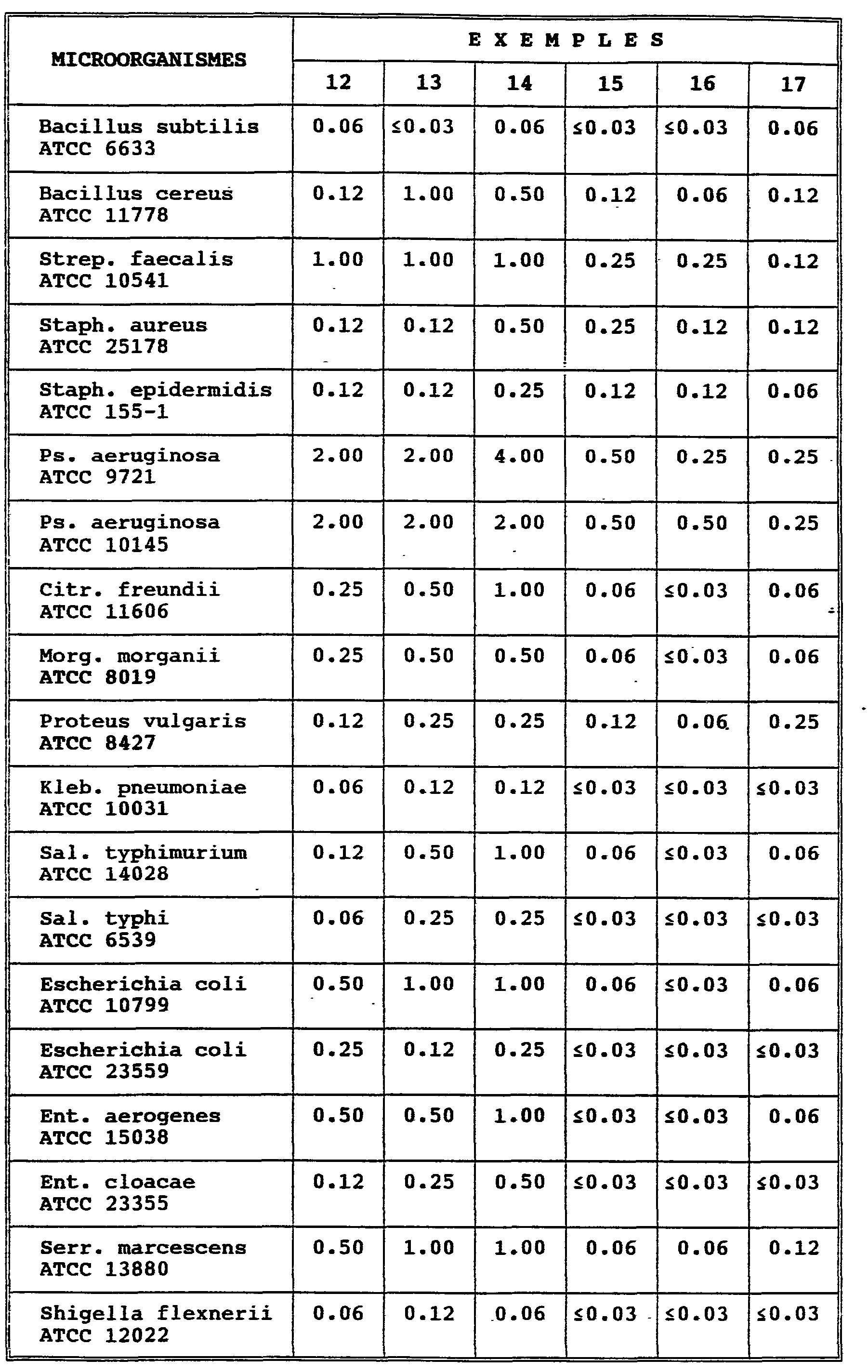
Les résultants obtenus sont décrits dans les tableaux suivants. L'activité des composés "in vitro" y est comparée à celle de la norfioxacine. Les concentrations sont données en g/ml.

<tb> <SEP> EXEMPLES
<tb> <SEP> MICROORGANISMES <SEP> Norfioxacin <SEP>
<tb> <SEP> 1 <SEP> 2 <SEP> 3 <SEP> 4 <SEP> 5
<tb> <SEP> Bacillus <SEP> subtilis <SEP> 0.25 <SEP> #0.03 <SEP> <SEP> 0.12 <SEP> 0.06 <SEP> 0.06 <SEP> #0.03
<tb> <SEP> ATCC <SEP> 6633
<tb> <SEP> Bacillus <SEP> cereus <SEP> 1.0 <SEP> 0.06 <SEP> 0.50 <SEP> 0.25 <SEP> 1 <SEP> 0.25 <SEP> 0.06
<tb> <SEP> ATCC <SEP> 11778
<tb> <SEP> Strep.<SEP> faecalis <SEP> 1.0 <SEP> 2.00 <SEP> 1.00 <SEP> 1.00 <SEP> 2.00 <SEP> 1.00
<tb> <SEP> ATCC <SEP> 10541
<tb> <SEP> Staph. <SEP> aureus <SEP> 2.0 <SEP> 0.06 <SEP> 0.50 <SEP> 0.25 <SEP> 0.25 <SEP> 0.12
<tb> <SEP> ATCC <SEP> 25178
<tb> <SEP> Staph. <SEP> epidermidis <SEP> 1.0 <SEP> 0.06 <SEP> 0.50 <SEP> 0.25 <SEP> 0.25 <SEP> 0.06
<tb> <SEP> ATCC <SEP> 155-1
<tb> <SEP> Ps. <SEP> aeruginosa <SEP> 0.5 <SEP> 2.00 <SEP> 1.00 <SEP> 1.00 <SEP> 4.00 <SEP> 2.00
<tb> <SEP> ATCC <SEP> 9721
<tb> <SEP> Ps. <SEP> aeruginosa <SEP> 1.0 <SEP> 2.00 <SEP> 2.00 <SEP> 2.00 <SEP> 4.00 <SEP> 2.00
<tb> ATCC <SEP> 10145
<tb> <SEP> Citr. <SEP> freundii <SEP> 0.25 <SEP> 0.25 <SEP> 0.12 <SEP> 0.12 <SEP> 0.25 <SEP> 0.25
<tb> <SEP> ATCC <SEP> 11606
<tb> <SEP> Morg.<SEP> morganii <SEP> 0.12 <SEP> 0.25 <SEP> 0.12 <SEP> 0.06 <SEP> 0.25 <SEP> 0.25
<tb> <SEP> ATCC <SEP> 8019
<tb> <SEP> Proteus <SEP> vulgaris <SEP> 0.06 <SEP> 0.06 <SEP> 1.00 <SEP> 0.25 <SEP> 0.50 <SEP> 0.12
<tb> <SEP> ATCC <SEP> 8427
<tb> <SEP> Kleb. <SEP> pneumoniae <SEP> 0.03 <SEP> s0.03 <SEP> 0.12 <SEP> 0.06 <SEP> 0.25 <SEP> s0.03 <SEP>
<tb> <SEP> ATCC <SEP> 10031
<tb> <SEP> Sal. <SEP> typhimurium <SEP> 0.25 <SEP> 0.50 <SEP> 0.25 <SEP> 0.12 <SEP> 0.50 <SEP> 0.25
<tb> <SEP> ATCC <SEP> 14028
<tb> <SEP> Sal. <SEP> typhi <SEP> 0.06 <SEP> 0.25 <SEP> 0.12 <SEP> 0.12 <SEP> 0.50 <SEP> 0.25
<tb> <SEP> ATCC <SEP> 6539
<tb> <SEP> Escherichia <SEP> coli <SEP> 0.25 <SEP> 0.50 <SEP> 0.25 <SEP> 0.12 <SEP> 0.50 <SEP> 0.25
<tb> <SEP> ATCC <SEP> 10799
<tb> <SEP> Escherichia <SEP> coli <SEP> 0.06 <SEP> 0.12 <SEP> 0.12 <SEP> 0.06 <SEP> 0.25 <SEP> 0.06
<tb> <SEP> ATCC <SEP> 23559
<tb> <SEP> Ent. <SEP> aerogenes <SEP> 0.25 <SEP> 0.25 <SEP> 0.25 <SEP> 0.12 <SEP> 0.25 <SEP> 0.25
<tb> <SEP> ATCC <SEP> 15038
<tb> <SEP> Ent. <SEP> cloacae <SEP> 0.06 <SEP> 0.12 <SEP> 0.12 <SEP> 0.12 <SEP> 0.25 <SEP> 0.12
<tb> <SEP> ATCC <SEP> 23355
<tb> <SEP> Serr.<SEP> marcescens <SEP> 0.50 <SEP> 0.25 <SEP> 0.25 <SEP> 0.25 <SEP> 1.00 <SEP> 1.00
<tb> <SEP> ATCC <SEP> 13880
<tb> <SEP> Shigella <SEP> flexnerii <SEP> 0.12 <SEP> 0.12 <SEP> 0.06 <SEP> 0.06 <SEP> 0.25 <SEP> 0.06
<tb> <SEP> ATCC <SEP> 12022
<tb>

<tb> <SEP> MICROORGANISMES <SEP> Norfioxacin <SEP>
<tb> <SEP> 1 <SEP> 2 <SEP> 3 <SEP> 4 <SEP> 5
<tb> <SEP> Bacillus <SEP> subtilis <SEP> 0.25 <SEP> #0.03 <SEP> <SEP> 0.12 <SEP> 0.06 <SEP> 0.06 <SEP> #0.03
<tb> <SEP> ATCC <SEP> 6633
<tb> <SEP> Bacillus <SEP> cereus <SEP> 1.0 <SEP> 0.06 <SEP> 0.50 <SEP> 0.25 <SEP> 1 <SEP> 0.25 <SEP> 0.06
<tb> <SEP> ATCC <SEP> 11778
<tb> <SEP> Strep.<SEP> faecalis <SEP> 1.0 <SEP> 2.00 <SEP> 1.00 <SEP> 1.00 <SEP> 2.00 <SEP> 1.00
<tb> <SEP> ATCC <SEP> 10541
<tb> <SEP> Staph. <SEP> aureus <SEP> 2.0 <SEP> 0.06 <SEP> 0.50 <SEP> 0.25 <SEP> 0.25 <SEP> 0.12
<tb> <SEP> ATCC <SEP> 25178
<tb> <SEP> Staph. <SEP> epidermidis <SEP> 1.0 <SEP> 0.06 <SEP> 0.50 <SEP> 0.25 <SEP> 0.25 <SEP> 0.06
<tb> <SEP> ATCC <SEP> 155-1
<tb> <SEP> Ps. <SEP> aeruginosa <SEP> 0.5 <SEP> 2.00 <SEP> 1.00 <SEP> 1.00 <SEP> 4.00 <SEP> 2.00
<tb> <SEP> ATCC <SEP> 9721
<tb> <SEP> Ps. <SEP> aeruginosa <SEP> 1.0 <SEP> 2.00 <SEP> 2.00 <SEP> 2.00 <SEP> 4.00 <SEP> 2.00
<tb> ATCC <SEP> 10145
<tb> <SEP> Citr. <SEP> freundii <SEP> 0.25 <SEP> 0.25 <SEP> 0.12 <SEP> 0.12 <SEP> 0.25 <SEP> 0.25
<tb> <SEP> ATCC <SEP> 11606
<tb> <SEP> Morg.<SEP> morganii <SEP> 0.12 <SEP> 0.25 <SEP> 0.12 <SEP> 0.06 <SEP> 0.25 <SEP> 0.25
<tb> <SEP> ATCC <SEP> 8019
<tb> <SEP> Proteus <SEP> vulgaris <SEP> 0.06 <SEP> 0.06 <SEP> 1.00 <SEP> 0.25 <SEP> 0.50 <SEP> 0.12
<tb> <SEP> ATCC <SEP> 8427
<tb> <SEP> Kleb. <SEP> pneumoniae <SEP> 0.03 <SEP> s0.03 <SEP> 0.12 <SEP> 0.06 <SEP> 0.25 <SEP> s0.03 <SEP>
<tb> <SEP> ATCC <SEP> 10031
<tb> <SEP> Sal. <SEP> typhimurium <SEP> 0.25 <SEP> 0.50 <SEP> 0.25 <SEP> 0.12 <SEP> 0.50 <SEP> 0.25
<tb> <SEP> ATCC <SEP> 14028
<tb> <SEP> Sal. <SEP> typhi <SEP> 0.06 <SEP> 0.25 <SEP> 0.12 <SEP> 0.12 <SEP> 0.50 <SEP> 0.25
<tb> <SEP> ATCC <SEP> 6539
<tb> <SEP> Escherichia <SEP> coli <SEP> 0.25 <SEP> 0.50 <SEP> 0.25 <SEP> 0.12 <SEP> 0.50 <SEP> 0.25
<tb> <SEP> ATCC <SEP> 10799
<tb> <SEP> Escherichia <SEP> coli <SEP> 0.06 <SEP> 0.12 <SEP> 0.12 <SEP> 0.06 <SEP> 0.25 <SEP> 0.06
<tb> <SEP> ATCC <SEP> 23559
<tb> <SEP> Ent. <SEP> aerogenes <SEP> 0.25 <SEP> 0.25 <SEP> 0.25 <SEP> 0.12 <SEP> 0.25 <SEP> 0.25
<tb> <SEP> ATCC <SEP> 15038
<tb> <SEP> Ent. <SEP> cloacae <SEP> 0.06 <SEP> 0.12 <SEP> 0.12 <SEP> 0.12 <SEP> 0.25 <SEP> 0.12
<tb> <SEP> ATCC <SEP> 23355
<tb> <SEP> Serr.<SEP> marcescens <SEP> 0.50 <SEP> 0.25 <SEP> 0.25 <SEP> 0.25 <SEP> 1.00 <SEP> 1.00
<tb> <SEP> ATCC <SEP> 13880
<tb> <SEP> Shigella <SEP> flexnerii <SEP> 0.12 <SEP> 0.12 <SEP> 0.06 <SEP> 0.06 <SEP> 0.25 <SEP> 0.06
<tb> <SEP> ATCC <SEP> 12022
<tb>
<tb> <SEP> EXEMPLES
<tb> <SEP> MICROORGANISMES
<tb> <SEP> 6 <SEP> 7 <SEP> 8 <SEP> 9 <SEP> 10 <SEP> 11
<tb> Bacillus <SEP> subtilis <SEP> #0.03 <SEP> <SEP> S0.03 <SEP> 0.06 <SEP> s0.03 <SEP> s0.03 <SEP> 0.12
<tb> ATCC <SEP> 6633
<tb> Bacillus <SEP> cereus <SEP> 0.06 <SEP> 0.25 <SEP> 0.50 <SEP> 0.06 <SEP> 0.06 <SEP> 0.25
<tb> ATCC <SEP> 11778
<tb> Strep. <SEP> faecalis <SEP> 2.00 <SEP> 2.00 <SEP> 4.00 <SEP> 0.25 <SEP> 0.25 <SEP> 0.50
<tb> ATCC <SEP> 10541
<tb> Staph.<SEP> aureus <SEP> 0.12 <SEP> 0.25 <SEP> 0.50 <SEP> 0.06 <SEP> 0.12 <SEP> 0.50
<tb> ATCC <SEP> 25178
<tb> Staph. <SEP> epidermidis <SEP> 0.06 <SEP> 0.25 <SEP> 1.00 <SEP> 0.06 <SEP> 0.12 <SEP> 0.25
<tb> ATCC <SEP> 155-1
<tb> Ps. <SEP> aeruginosa <SEP> 2.00 <SEP> 3.00 <SEP> 2.00 <SEP> 0.25 <SEP> 0.25 <SEP> 0.50
<tb> ATCC <SEP> 9721
<tb> Ps. <SEP> aeruginosa <SEP> 2.00 <SEP> 3.00 <SEP> 4.00 <SEP> 0.25 <SEP> 0.25 <SEP> 1.00
<tb> ATCC <SEP> 10145
<tb> Citr. <SEP> freundii <SEP> 0.12 <SEP> 2.00 <SEP> 0.25 <SEP> sO.03 <SEP> s0.03 <SEP> 0.25
<tb> ATCC <SEP> 11606
<tb> Morg. <SEP> morganii <SEP> 0.25 <SEP> 1.00 <SEP> 0.50 <SEP> #0.03 <SEP> <SEP> #0.03 <SEP> <SEP> 0.12
<tb> ATCC <SEP> 8019
<tb> Proteus <SEP> vulgaris <SEP> 0.06 <SEP> 1.00 <SEP> 1.00 <SEP> 0.06 <SEP> 0.06 <SEP> 1.00
<tb> ATCC <SEP> 8427
<tb> Kleb.<SEP> pneumoniae <SEP> s0.03 <SEP> 0.25 <SEP> 0.06 <SEP> s0.03 <SEP> s0.03 <SEP> 0.12
<tb> ATCC <SEP> 10031
<tb> Sal. <SEP> typhimurium <SEP> 0.25 <SEP> 2.00 <SEP> 0.50 <SEP> s0.03 <SEP> 50.03 <SEP> 0.25
<tb> ATCC <SEP> 14028
<tb> Sal. <SEP> typhi <SEP> 0.12 <SEP> 1.00 <SEP> 0.50 <SEP> s0.03 <SEP> S0.03 <SEP> 0.25
<tb> ATCC <SEP> 6539
<tb> Escherichia <SEP> coli <SEP> 0.25 <SEP> 2.00 <SEP> 0.50 <SEP> s0.03 <SEP> s0.03 <SEP> 0.25
<tb> ATCC <SEP> 10799
<tb> Escherichia <SEP> coli <SEP> 0.12 <SEP> 1.00 <SEP> 0.25 <SEP> s0.03 <SEP> s0.03 <SEP> 0.12
<tb> ATCC <SEP> 23559
<tb> Ent. <SEP> aerogenes <SEP> 0.25 <SEP> 2.00 <SEP> 0.50 <SEP> s0.03 <SEP> #0.03 <SEP> <SEP> 0.25
<tb> ATCC <SEP> 15038
<tb> Ent.<SEP> cloacae <SEP> 0.12 <SEP> 2.00 <SEP> 0.12 <SEP> s0.03 <SEP> s0.03 <SEP> 0.25
<tb> ATCC <SEP> 23355
<tb> Serr. <SEP> sarcescens <SEP> 0.50 <SEP> 4.00 <SEP> 1.00 <SEP> 0.06 <SEP> 0.12 <SEP> 0.50
<tb> ATCC <SEP> 13880
<tb> Shigella <SEP> flexnerii <SEP> 0.06 <SEP> 0.25 <SEP> 0.12 <SEP> s0.03 <SEP> #0.03 <SEP> <SEP> 0.12
<tb> ATCC <SEP> 12022
<tb>
<tb> <SEP> MICROORGANISMES
<tb> <SEP> 6 <SEP> 7 <SEP> 8 <SEP> 9 <SEP> 10 <SEP> 11
<tb> Bacillus <SEP> subtilis <SEP> #0.03 <SEP> <SEP> S0.03 <SEP> 0.06 <SEP> s0.03 <SEP> s0.03 <SEP> 0.12
<tb> ATCC <SEP> 6633
<tb> Bacillus <SEP> cereus <SEP> 0.06 <SEP> 0.25 <SEP> 0.50 <SEP> 0.06 <SEP> 0.06 <SEP> 0.25
<tb> ATCC <SEP> 11778
<tb> Strep. <SEP> faecalis <SEP> 2.00 <SEP> 2.00 <SEP> 4.00 <SEP> 0.25 <SEP> 0.25 <SEP> 0.50
<tb> ATCC <SEP> 10541
<tb> Staph.<SEP> aureus <SEP> 0.12 <SEP> 0.25 <SEP> 0.50 <SEP> 0.06 <SEP> 0.12 <SEP> 0.50
<tb> ATCC <SEP> 25178
<tb> Staph. <SEP> epidermidis <SEP> 0.06 <SEP> 0.25 <SEP> 1.00 <SEP> 0.06 <SEP> 0.12 <SEP> 0.25
<tb> ATCC <SEP> 155-1
<tb> Ps. <SEP> aeruginosa <SEP> 2.00 <SEP> 3.00 <SEP> 2.00 <SEP> 0.25 <SEP> 0.25 <SEP> 0.50
<tb> ATCC <SEP> 9721
<tb> Ps. <SEP> aeruginosa <SEP> 2.00 <SEP> 3.00 <SEP> 4.00 <SEP> 0.25 <SEP> 0.25 <SEP> 1.00
<tb> ATCC <SEP> 10145
<tb> Citr. <SEP> freundii <SEP> 0.12 <SEP> 2.00 <SEP> 0.25 <SEP> sO.03 <SEP> s0.03 <SEP> 0.25
<tb> ATCC <SEP> 11606
<tb> Morg. <SEP> morganii <SEP> 0.25 <SEP> 1.00 <SEP> 0.50 <SEP> #0.03 <SEP> <SEP> #0.03 <SEP> <SEP> 0.12
<tb> ATCC <SEP> 8019
<tb> Proteus <SEP> vulgaris <SEP> 0.06 <SEP> 1.00 <SEP> 1.00 <SEP> 0.06 <SEP> 0.06 <SEP> 1.00
<tb> ATCC <SEP> 8427
<tb> Kleb.<SEP> pneumoniae <SEP> s0.03 <SEP> 0.25 <SEP> 0.06 <SEP> s0.03 <SEP> s0.03 <SEP> 0.12
<tb> ATCC <SEP> 10031
<tb> Sal. <SEP> typhimurium <SEP> 0.25 <SEP> 2.00 <SEP> 0.50 <SEP> s0.03 <SEP> 50.03 <SEP> 0.25
<tb> ATCC <SEP> 14028
<tb> Sal. <SEP> typhi <SEP> 0.12 <SEP> 1.00 <SEP> 0.50 <SEP> s0.03 <SEP> S0.03 <SEP> 0.25
<tb> ATCC <SEP> 6539
<tb> Escherichia <SEP> coli <SEP> 0.25 <SEP> 2.00 <SEP> 0.50 <SEP> s0.03 <SEP> s0.03 <SEP> 0.25
<tb> ATCC <SEP> 10799
<tb> Escherichia <SEP> coli <SEP> 0.12 <SEP> 1.00 <SEP> 0.25 <SEP> s0.03 <SEP> s0.03 <SEP> 0.12
<tb> ATCC <SEP> 23559
<tb> Ent. <SEP> aerogenes <SEP> 0.25 <SEP> 2.00 <SEP> 0.50 <SEP> s0.03 <SEP> #0.03 <SEP> <SEP> 0.25
<tb> ATCC <SEP> 15038
<tb> Ent.<SEP> cloacae <SEP> 0.12 <SEP> 2.00 <SEP> 0.12 <SEP> s0.03 <SEP> s0.03 <SEP> 0.25
<tb> ATCC <SEP> 23355
<tb> Serr. <SEP> sarcescens <SEP> 0.50 <SEP> 4.00 <SEP> 1.00 <SEP> 0.06 <SEP> 0.12 <SEP> 0.50
<tb> ATCC <SEP> 13880
<tb> Shigella <SEP> flexnerii <SEP> 0.06 <SEP> 0.25 <SEP> 0.12 <SEP> s0.03 <SEP> #0.03 <SEP> <SEP> 0.12
<tb> ATCC <SEP> 12022
<tb>
<tb> <SEP> EXEMPLES
<tb> <SEP> MICROORGANISMES
<tb> <SEP> 12 <SEP> | <SEP> 13 <SEP> 14 <SEP> 15 <SEP> | <SEP> 16 <SEP> 17
<tb> <SEP> Bacillus <SEP> subtilis <SEP> 0.06 <SEP> #0.03 <SEP> <SEP> 0.06 <SEP> #0.03 <SEP> <SEP> #0.03 <SEP> <SEP> 0.06
<tb> ATCC <SEP> 6633
<tb> <SEP> Bacillus <SEP> cereux <SEP> 0.12 <SEP> 1.00 <SEP> 0.50 <SEP> 0.12 <SEP> 0.06 <SEP> 0.12
<tb> <SEP> ATCC <SEP> 11778
<tb> <SEP> Strep. <SEP> faecalis <SEP> 1.00 <SEP> 1.00 <SEP> 1.00 <SEP> 0.25 <SEP> 0.25 <SEP> 0.12
<tb> <SEP> ATCC <SEP> 10541
<tb> <SEP> Staph. <SEP> aureus <SEP> 0.12 <SEP> 0.12 <SEP> 0.50 <SEP> 0.25 <SEP> | <SEP> 0.12 <SEP> 0.12
<tb> <SEP> ATCC <SEP> 25178
<tb> <SEP> Staph. <SEP> epidermidis <SEP> 0.12 <SEP> 0.12 <SEP> 0.25 <SEP> 0.12 <SEP> 0.12 <SEP> 0.06
<tb> <SEP> ATCC <SEP> 155-1
<tb> <SEP> Ps. <SEP> aeruginosa <SEP> 2.00 <SEP> 2.00 <SEP> 4.00 <SEP> 0.50 <SEP> 0.25 <SEP> 0.25
<tb> ATCC <SEP> 9721
<tb> <SEP> Ps. <SEP> aeruginosa <SEP> 2.00 <SEP> 2.00 <SEP> 2.00 <SEP> 0.50 <SEP> 0.50 <SEP> 0.25
<tb> <SEP> ATCC <SEP> 10145
<tb> <SEP> Citr. <SEP> freundii <SEP> 0.25 <SEP> 0.50 <SEP> 1.00 <SEP> 0.06 <SEP> s0.03 <SEP> 0.06
<tb> <SEP> ATCC <SEP> 11606
<tb> <SEP> Morg.<SEP> morganii <SEP> 0.25 <SEP> 0.50 <SEP> 0.50 <SEP> 0.06 <SEP> #0.03 <SEP> <SEP> 0.06
<tb> ATCC <SEP> 8019
<tb> <SEP> Proteus <SEP> vulgaris <SEP> 0.12 <SEP> 0.25 <SEP> 0.25 <SEP> 0.12 <SEP> 0.06 <SEP> 0.25
<tb> <SEP> ATCC <SEP> 8427
<tb> <SEP> Kleb. <SEP> pneumoniae <SEP> 0.06 <SEP> 0.12 <SEP> 0.12 <SEP> #0.03 <SEP> <SEP> #0.03 <SEP> <SEP> #0.03
<tb> <SEP> ATCC <SEP> 10031
<tb> <SEP> Sal. <SEP> typhimurium <SEP> 0.12 <SEP> 0.50 <SEP> 1.00 <SEP> 0.06 <SEP> #0.03 <SEP> <SEP> 0.06
<tb> <SEP> ATCC <SEP> 14028
<tb> <SEP> Sal.<SEP> typhi <SEP> 0.06 <SEP> 0.25 <SEP> 0.25 <SEP> #0.03 <SEP> <SEP> #0.03 <SEP> <SEP> #0.03
<tb> <SEP> ATCC <SEP> 6539
<tb> <SEP> Escherichia <SEP> coli <SEP> 0.50 <SEP> 1.00 <SEP> 1.00 <SEP> 0.06 <SEP> #0.03 <SEP> <SEP> 0.06
<tb> <SEP> ATCC <SEP> 10799
<tb> <SEP> Escherichia <SEP> coli <SEP> 0.25 <SEP> 0.12 <SEP> 0.25 <SEP> #0.03 <SEP> <SEP> #0.03 <SEP> <SEP> #0.03
<tb> <SEP> ATCC <SEP> 23559
<tb> <SEP> Ent. <SEP> aerogenes <SEP> 0.50 <SEP> 0.50 <SEP> 1.00 <SEP> #0.03 <SEP> <SEP> #0.03 <SEP> <SEP> 0.06
<tb> <SEP> ATCC <SEP> 15038
<tb> <SEP> Ent. <SEP> cloace <SEP> 0.12 <SEP> 0.25 <SEP> 0.50 <SEP> #0.03 <SEP> <SEP> #0.03 <SEP> #0.03
<tb> <SEP> ATCC <SEP> 23355
<tb> <SEP> Serr. <SEP> marcescens <SEP> 0.50 <SEP> 1.00 <SEP> 1.00 <SEP> 0.06 <SEP> 0.06 <SEP> 0.12
<tb> <SEP> ATCC <SEP> 13880
<tb> <SEP> Shigella <SEP> flexnerii <SEP> 0.06 <SEP> 0.12 <SEP> 0.06 <SEP> #0.03 <SEP> <SEP> #0.03 <SEP> #0.03
<tb> <SEP> ATCC <SEP> 12022
<tb>

<tb> <SEP> MICROORGANISMES
<tb> <SEP> 12 <SEP> | <SEP> 13 <SEP> 14 <SEP> 15 <SEP> | <SEP> 16 <SEP> 17
<tb> <SEP> Bacillus <SEP> subtilis <SEP> 0.06 <SEP> #0.03 <SEP> <SEP> 0.06 <SEP> #0.03 <SEP> <SEP> #0.03 <SEP> <SEP> 0.06
<tb> ATCC <SEP> 6633
<tb> <SEP> Bacillus <SEP> cereux <SEP> 0.12 <SEP> 1.00 <SEP> 0.50 <SEP> 0.12 <SEP> 0.06 <SEP> 0.12
<tb> <SEP> ATCC <SEP> 11778
<tb> <SEP> Strep. <SEP> faecalis <SEP> 1.00 <SEP> 1.00 <SEP> 1.00 <SEP> 0.25 <SEP> 0.25 <SEP> 0.12
<tb> <SEP> ATCC <SEP> 10541
<tb> <SEP> Staph. <SEP> aureus <SEP> 0.12 <SEP> 0.12 <SEP> 0.50 <SEP> 0.25 <SEP> | <SEP> 0.12 <SEP> 0.12
<tb> <SEP> ATCC <SEP> 25178
<tb> <SEP> Staph. <SEP> epidermidis <SEP> 0.12 <SEP> 0.12 <SEP> 0.25 <SEP> 0.12 <SEP> 0.12 <SEP> 0.06
<tb> <SEP> ATCC <SEP> 155-1
<tb> <SEP> Ps. <SEP> aeruginosa <SEP> 2.00 <SEP> 2.00 <SEP> 4.00 <SEP> 0.50 <SEP> 0.25 <SEP> 0.25
<tb> ATCC <SEP> 9721
<tb> <SEP> Ps. <SEP> aeruginosa <SEP> 2.00 <SEP> 2.00 <SEP> 2.00 <SEP> 0.50 <SEP> 0.50 <SEP> 0.25
<tb> <SEP> ATCC <SEP> 10145
<tb> <SEP> Citr. <SEP> freundii <SEP> 0.25 <SEP> 0.50 <SEP> 1.00 <SEP> 0.06 <SEP> s0.03 <SEP> 0.06
<tb> <SEP> ATCC <SEP> 11606
<tb> <SEP> Morg.<SEP> morganii <SEP> 0.25 <SEP> 0.50 <SEP> 0.50 <SEP> 0.06 <SEP> #0.03 <SEP> <SEP> 0.06
<tb> ATCC <SEP> 8019
<tb> <SEP> Proteus <SEP> vulgaris <SEP> 0.12 <SEP> 0.25 <SEP> 0.25 <SEP> 0.12 <SEP> 0.06 <SEP> 0.25
<tb> <SEP> ATCC <SEP> 8427
<tb> <SEP> Kleb. <SEP> pneumoniae <SEP> 0.06 <SEP> 0.12 <SEP> 0.12 <SEP> #0.03 <SEP> <SEP> #0.03 <SEP> <SEP> #0.03
<tb> <SEP> ATCC <SEP> 10031
<tb> <SEP> Sal. <SEP> typhimurium <SEP> 0.12 <SEP> 0.50 <SEP> 1.00 <SEP> 0.06 <SEP> #0.03 <SEP> <SEP> 0.06
<tb> <SEP> ATCC <SEP> 14028
<tb> <SEP> Sal.<SEP> typhi <SEP> 0.06 <SEP> 0.25 <SEP> 0.25 <SEP> #0.03 <SEP> <SEP> #0.03 <SEP> <SEP> #0.03
<tb> <SEP> ATCC <SEP> 6539
<tb> <SEP> Escherichia <SEP> coli <SEP> 0.50 <SEP> 1.00 <SEP> 1.00 <SEP> 0.06 <SEP> #0.03 <SEP> <SEP> 0.06
<tb> <SEP> ATCC <SEP> 10799
<tb> <SEP> Escherichia <SEP> coli <SEP> 0.25 <SEP> 0.12 <SEP> 0.25 <SEP> #0.03 <SEP> <SEP> #0.03 <SEP> <SEP> #0.03
<tb> <SEP> ATCC <SEP> 23559
<tb> <SEP> Ent. <SEP> aerogenes <SEP> 0.50 <SEP> 0.50 <SEP> 1.00 <SEP> #0.03 <SEP> <SEP> #0.03 <SEP> <SEP> 0.06
<tb> <SEP> ATCC <SEP> 15038
<tb> <SEP> Ent. <SEP> cloace <SEP> 0.12 <SEP> 0.25 <SEP> 0.50 <SEP> #0.03 <SEP> <SEP> #0.03 <SEP> #0.03
<tb> <SEP> ATCC <SEP> 23355
<tb> <SEP> Serr. <SEP> marcescens <SEP> 0.50 <SEP> 1.00 <SEP> 1.00 <SEP> 0.06 <SEP> 0.06 <SEP> 0.12
<tb> <SEP> ATCC <SEP> 13880
<tb> <SEP> Shigella <SEP> flexnerii <SEP> 0.06 <SEP> 0.12 <SEP> 0.06 <SEP> #0.03 <SEP> <SEP> #0.03 <SEP> #0.03
<tb> <SEP> ATCC <SEP> 12022
<tb>
<tb> <SEP> EXEMPLES
<tb> <SEP> MICROORGANISMES
<tb> <SEP> 18 <SEP> 19 <SEP> 27
<tb> Bacillus <SEP> subtilis <SEP> S0.03 <SEP> 0.06 <SEP> su.03 <SEP>
<tb> ATCC <SEP> 6633
<tb> Bacillus <SEP> cereus <SEP> 0.06 <SEP> 0.50 <SEP> 50.03 <SEP>
<tb> ATCC <SEP> 11778
<tb> Strep. <SEP> faecalis <SEP> 2.00 <SEP> 2.00 <SEP> 2.0
<tb> ATCC <SEP> 10541
<tb> Staph. <SEP> aureus <SEP> 0.12 <SEP> 0.25 <SEP> 0.06
<tb> ATCC <SEP> 25178
<tb> Staph. <SEP> epidermidis <SEP> 0.12 <SEP> 0.12 <SEP> 0.06
<tb> ATCC <SEP> 155-1
<tb> Ps. <SEP> aeruginosa <SEP> 2.00 <SEP> 2.00 <SEP> 1.00
<tb> ATCC <SEP> 9721
<tb> Ps. <SEP> aeruginosa <SEP> 4.00 <SEP> 4.00 <SEP> 2.00
<tb> ATCC <SEP> 10145
<tb> Citr. <SEP> freundii <SEP> 0.12 <SEP> 0.50 <SEP> 0.12
<tb> ATCC <SEP> 11606
<tb> Morg. <SEP> morganii <SEP> 0.12 <SEP> 0.25 <SEP> 0.12
<tb> ATCC <SEP> 8019
<tb> Proteus <SEP> vulgaris <SEP> 0.25 <SEP> 0.50 <SEP> 0.12
<tb> ATCC <SEP> 8427
<tb> Kleb. <SEP> pneumoniae <SEP> 50.03 <SEP> 0.12 <SEP> 0.03
<tb> ATCC <SEP> 10031
<tb> Sal. <SEP> typhimurium <SEP> 0.25 <SEP> 0.25 <SEP> 0.25
<tb> ATCC <SEP> 14028
<tb> Sal.<SEP> typhi <SEP> 0.06 <SEP> 0.12 <SEP> 0.03
<tb> ATCC <SEP> 6539
<tb> Escherichia <SEP> coli <SEP> 0.25 <SEP> 0.50 <SEP> 0.12
<tb> ATCC <SEP> 10799
<tb> Escherichia <SEP> coli <SEP> 0.06 <SEP> 0.12 <SEP> 0.06
<tb> ATCC <SEP> 23559
<tb> Ent. <SEP> aerogenes <SEP> 0.25 <SEP> 0.25 <SEP> 0.12
<tb> ATCC <SEP> 15038
<tb> Ent. <SEP> cloacae <SEP> 0.06 <SEP> 0.50 <SEP> 0.12
<tb> ATCC <SEP> 23355
<tb> Serr. <SEP> marcescens <SEP> 0.25 <SEP> 0.50 <SEP> 0.25
<tb> ATCC <SEP> 13880
<tb> Shigella <SEP> flexnerii <SEP> 0.06 <SEP> 0.25 <SEP> 0.06
<tb> ATCC <SEP> 12022
<tb>
<tb> <SEP> MICROORGANISMES
<tb> <SEP> 18 <SEP> 19 <SEP> 27
<tb> Bacillus <SEP> subtilis <SEP> S0.03 <SEP> 0.06 <SEP> su.03 <SEP>
<tb> ATCC <SEP> 6633
<tb> Bacillus <SEP> cereus <SEP> 0.06 <SEP> 0.50 <SEP> 50.03 <SEP>
<tb> ATCC <SEP> 11778
<tb> Strep. <SEP> faecalis <SEP> 2.00 <SEP> 2.00 <SEP> 2.0
<tb> ATCC <SEP> 10541
<tb> Staph. <SEP> aureus <SEP> 0.12 <SEP> 0.25 <SEP> 0.06
<tb> ATCC <SEP> 25178
<tb> Staph. <SEP> epidermidis <SEP> 0.12 <SEP> 0.12 <SEP> 0.06
<tb> ATCC <SEP> 155-1
<tb> Ps. <SEP> aeruginosa <SEP> 2.00 <SEP> 2.00 <SEP> 1.00
<tb> ATCC <SEP> 9721
<tb> Ps. <SEP> aeruginosa <SEP> 4.00 <SEP> 4.00 <SEP> 2.00
<tb> ATCC <SEP> 10145
<tb> Citr. <SEP> freundii <SEP> 0.12 <SEP> 0.50 <SEP> 0.12
<tb> ATCC <SEP> 11606
<tb> Morg. <SEP> morganii <SEP> 0.12 <SEP> 0.25 <SEP> 0.12
<tb> ATCC <SEP> 8019
<tb> Proteus <SEP> vulgaris <SEP> 0.25 <SEP> 0.50 <SEP> 0.12
<tb> ATCC <SEP> 8427
<tb> Kleb. <SEP> pneumoniae <SEP> 50.03 <SEP> 0.12 <SEP> 0.03
<tb> ATCC <SEP> 10031
<tb> Sal. <SEP> typhimurium <SEP> 0.25 <SEP> 0.25 <SEP> 0.25
<tb> ATCC <SEP> 14028
<tb> Sal.<SEP> typhi <SEP> 0.06 <SEP> 0.12 <SEP> 0.03
<tb> ATCC <SEP> 6539
<tb> Escherichia <SEP> coli <SEP> 0.25 <SEP> 0.50 <SEP> 0.12
<tb> ATCC <SEP> 10799
<tb> Escherichia <SEP> coli <SEP> 0.06 <SEP> 0.12 <SEP> 0.06
<tb> ATCC <SEP> 23559
<tb> Ent. <SEP> aerogenes <SEP> 0.25 <SEP> 0.25 <SEP> 0.12
<tb> ATCC <SEP> 15038
<tb> Ent. <SEP> cloacae <SEP> 0.06 <SEP> 0.50 <SEP> 0.12
<tb> ATCC <SEP> 23355
<tb> Serr. <SEP> marcescens <SEP> 0.25 <SEP> 0.50 <SEP> 0.25
<tb> ATCC <SEP> 13880
<tb> Shigella <SEP> flexnerii <SEP> 0.06 <SEP> 0.25 <SEP> 0.06
<tb> ATCC <SEP> 12022
<tb>
En thérapeutique humaine, la dose d'administration est bien sûr fonction de la susceptibilité de la souche infective, de la nature du composé administré et de la wie d'administration. Elle sera généralement comprise entre environ 0,2Q0 et environ 300 mg pour chaque kilogramme de poids et par jour. Les dérivés de l'invention seront, par exemple, administrés sous forme de comprimés, de solutions ou de suspensions, ou bien de gélules.
On indiquera ci-après, à titre d'exemples, deux formes galéniques particulières des dérivés objet de la présente invention.
Exemple de formule par comprimé
Composé de l'exemple 9 250 mg
Cellulose microcristalline 69 mg
Povidone 15 mg
Amidon de blé 36 mg
Dioxyde de silice colloldale 2 mg
Stearate de magnesium 3 mg
Poids comprimé 375 mg
Exemple de formule par gélule
Composé de l'exemple 9 250 mg
Glycéride polyoxyéthylenée 85 mg
Behenate de -glycerine 15 mg
Excipient gélatine molle q.s. 450 mg
Composé de l'exemple 9 250 mg
Cellulose microcristalline 69 mg
Povidone 15 mg
Amidon de blé 36 mg
Dioxyde de silice colloldale 2 mg
Stearate de magnesium 3 mg
Poids comprimé 375 mg
Exemple de formule par gélule
Composé de l'exemple 9 250 mg
Glycéride polyoxyéthylenée 85 mg
Behenate de -glycerine 15 mg
Excipient gélatine molle q.s. 450 mg
Claims (7)
- dans laquelle A représente un atome d'azote ou bien un atome de carbone avec un atome d'hydrogène attache (C-H), ou bien un atome de carbone avec un halogène attaché (C-X), dans ce cas X représente un atome de chlore, de fluor ou de brome ou bien un atome de carbone avec un radical hydroxy (C-OH).
 REVENDICAnONS 1.- Les composés objet de la présente invention répondant à la formule générale IRl représente un radical alkyle ou cycloalkyîe inférieur,un radical halogénoalkyle inférieur, un radical aryle ou un radical aryle substitué, notammment par un ou plusieurs atome(s) de fluor.R2 et R , égaux ou différents, représentent un atome d'hydrogène ou un radical alkyle inférieur.Rs, R5 et R6 égaux ou differents représentent un atome d'hydrogène, un radical aminoalkyle, un radical alkylamino,, un radical alkylaminoalkyle.x4 représente un atome d'hydrogène, un radical alkyle inférieur, un radical hydroxyle, un radical amino, un radical aminoalkyle, un radical sîkylamino, un radical dialkylamino, un radical hétérocyclique azoté pouvant être un cycle de trois à six maillons, un radical alkylaminoalkyle, un radical alkylcarboxamido, et dans ce dernier cas, le radical alkyl pouvant être substitué par un ou plusieurs halogènes, un radical arylsulfonyloxy,un radical alkylsulfonyloxy, un radical carboxamido, pouvant être substitué ou non sur l'azote ou un radical cyano.Rs, représente un atome d'hydrogène, un radical nitro, un radical amino ou amino substitué.A et R1 peuvent être unis par un groupe -CH2-CH2-CHRg- ou -O-CH2-CHRg dans lesquels Rg représente un atome d'hydrogène ou un radical alkyle inférieur, et dans ce dernier cas on a un autre centre chiral avec une configuration "R" ou "S".Les substituants azétidiniques peuvent avoir, selon le nombre, la nature et la position relative des substituants, jusqu'à trois centres choraux, chacun d'eux avec une configuration "R" ou "S", ainsi crue leurs sels d'acidesminéraux tels les chlorhydratest ou d'acides organiqiies tels les toluènes sulfonates ou nethylsulfonates physiologiquement acceptables.R10 représente un atome d'hydrogène ou un radical alkyle inférieur de Cl à C4
 - 2.- Les composés répondant à la formule générale I selon la revendication 1,séléctionnés parmi le groupe suivant:acide 1-cyclopropyl-6-fluoro-7-(1-azétidinyl)-1 ,4-dihydro-4-oxo-3-quinàléincar-boxylique.azétidinyl)-1,4-dihydro-4-oxo-3-quinoléincarboxylique.# acide 1-cyclopropyl-6,8-difluoro-7-(3-méthyl-3-trifluoroacétamido-N-méthyl-1dihydro-4-oxo -3-quinoléincarboxylique.# acide 1-cyclopropyl-6,8-difluoro-7-(3-méthyl-3-méthylamino-1-azétidinyl)-1,4azétidinyl)-1,4-dihydro-4-oxo-3-quinoléincarboxylique.- acide 1-cyclopropyl-6-fluoro-7-(3-méthyl-3-trifluoroacétamido-N-méthyl-1-dihydro-4-oxo-3-quinoléincarboxylique.acide 1 -cyclopropyl-6-fluoro-7-(3 -méthyl-3-méthylamino- 1 -azétidinyl)- 1,4-dihydro-4-oxo-3-quinoléincarboxylique.acide 1 -cyclopropyl-6-fluoro-7-(3-diméthylamino-3-méthyl- i -azétidinyl)- 1,4-dihydro-4-oxo-3-quinoléincarboxylique.acide 1 -cyclopropyl-6,8-difluoro-7-((E)-2-méthyl-3-hydroxy- i -azétidinyl)- 1,4-dihydro-4-oxo-3-quinoléincarboxylique.acide I -cyclopropyl-6-fluoro-7-((E)-2-méthyl-3-hydroxy- i -azétidinyl)- 1,4-dihydro-4-oxo-3-quinoléincarboxylique.acide 1 -cyclopropyl-6,8-difluoro-7-(3-méthyl-3-(1 -pirrolyl)- I -azétidinyl)- 1,4-oxo- 3-quinoléincarboxylique.# acide 1-cyclopropyl-6-fluoro-7-(3-éthylaminométhyl-1-azétidinyl)-1,4-dihydro-4dihydro-4-oxo-3-quinoléincarboxylique.# acide 1-cyclopropyl-6,8-difluoro-7-((E)-2-méthyl-3-amino-1-azétidinyl)-1,44-oxo-3-quinoléincarboxylique.acide I -cyclopropyl-6-fluoro-7-((E)-2-méthyl-3-amino I -azétidinyl)- i 4-dihydroacide 1 -cyclopropyl-6-fluoro-7-(-3-trifluoroacétamidométhyl- i -azétidinyl)- 1,4- dihydro-4-oxo-3-quinoliincarboxylique.quinoléincarboxylique.acide I -cyclopropyl-6-fluoro-7-(3-aminomithyl- 1 -azétidinyl)- i ,4-dihydro-4-oxo-3# acide 1-cyclopropyl-6-fluoro-7-(3-méthyl-3-hydroxy-1-azétidinyl)-,4-dihydro-4 oxo- 3 -quinoléincarboxylique.acide 1 -cyclopropyl-6-fluoro-7-(3-éthyl-3-hydroxy 1-azétidinyl)-1,4-dihydro-4- oxo-3-quinoléincarboxylique.# acide 1-cyclopropyl-6,8-difluoro-7-(3-éthyl-3-hydroxy-1-azétidinyl)-1,4-dihydro 4-oxo-3-quinoléincarboxylique.oxo- I ,8-naphtyridine-3-carboxylique.# acide 1-cyclopropyl-6-fluoro-7-(3-amino-3-méthyl-1-azétidinyl)-1,4-dihydro-4oxo-1,8-naphtyridine-3-carboxylique.acide I -cyclopropyl-6-fluoro-7-(3-amino-2-méthyl- 1 -azétidinyl)-1,4-dihydro-4-de][1,4]benzoxazine-10-(3-amino-1-azétidinyl)-6-carboxylique.# acide (3S)-(-)-9-fluoro-3-méthyl-7-oxo-2,3-dihydro-7H-pyrido(1,2,3de][1,4]benzoxazine-10-(3-diméthylamino-1-azétidinyl)-6-carboxylique.# acide (3S)-(-)-9-fluoro-3-méthyl-7-oxo-2,3-dihydro-7H-pyrido(1,2,3de][1,4]benzoxazine-10-(3-diméthylamino-3-méthyl-1-azétidinyl)-6-carboxylique.# acide (3S)-(-)-9-fluoro-3-méthyl-7-oxo-2,3-dihydro-7H-pyrido(1,2,3de][1,4]benzoxazine-10-(3-amino-1-azétidinyl)-6-carboxylique.acide (3R)-(+)-9-fluoro- 3-méthyl-7-oxo-2,3-dihydro-7H-pyrido[1,2,3-de][1,4]benzoxazine-10-(3-diméthylamino-1-azétidinyl)-6-carboxylique.# acide (3R)-(+)-9-fluoro-3-méthyl-7-oxo-2,3-dihydro-7H-pyrido[1,2,3de][l ,4]benzoxazine- 10-(3-diméthylamino-3-méthyl- I -azétidinyl)-6-carboxylique.# acide (3R)-(+)-9-fluoro-3-méthyl-7-oxo-2,3-dihydro-7H-pyrido[1,2,31,8-naphtyridine-3-carboxytique.acide I -cyclopropyl-6-fluoro-7-(3-trifluorométhylacétamido-N-méthyl- I azétidinyl)- I ,4-dihydro-4-oxo-1,8-naphtyridine-3-carboxylique # acide 1-cyclogropyl-6-fluoro-7-(3-méthylamino-1-azétidinyl)-1,4-dihydro-4-oxodihydro-4-oxo-3-quinoléincarboxylique.acide I -cyclopropyl-6,8-difluoro-7-((E)-2,3-diméthyl-3-hydroxy- t-azétidinyl)-1,4-dihydro-4-oxo-3-quinoléincarboxylique.acide l-cyclopropyi- 6-fluoro-7-((E)-2,3 -dimithyl-3 -hydoxy-l -azétidinyl)- 1,44-oxo-3 -quinoléincarboxylique.# acide 5-amino-1-cyclopropyl-6,8-difluoro-7-(3-hydroxy-1-azétidinyl)-1,4-dihydro

- 3.- Procédé de préparation de ces composés, selon l'une quelconque des revendications 1 et 2 et qui se caractérise par la réaction d'un composé de formule générale II.
 dans laquelle A , R1 Re et Rlo ont les significations mentionnées précédemment et Z représente un atome d'halogène, de préférence un chlore ou un fluor, avec une azétidine. de formule générale III.ment.dans laquelle R2, R3, R4, R5, R6 et R7 ont les significations mentionnées précédem
 - 4- A titre de médicaments, les dérivés de formule générale I et leurs sels thérapeutiquement acceptables, selon les revendications 1 a2', en particulier à titre de médicaments destinés au traitement de certaines maladies infectieuses.
- 5.- Compositions pharmaceutiques, caracterisées par le fait Qu'elles contiennent, outre un support pharmaceutiquement acceptable, au moins un dérivé de formule générale I ou l'un de ses sels physiologiquement acceptables, selon l'une des revendications 1 à 2.
- 6.- Utilisation des dérivés de formule générale I et leurs sels physiologiquement acceptables, selon l'une des revendications 1 à 2 pour la fabrication de médicaments destinés au traitement des infections microbiennes
- 7. A titre de produits intermédiaires les composés représentés par la formlle III
 dans laquelle R2, Pz, R4, Pg, R6 et R7 ont les significations mentionnées précédemment.
Priority Applications (21)
| Application Number | Priority Date | Filing Date | Title |
|---|---|---|---|
| FR8903459A FR2644455B1 (fr) | 1989-03-16 | 1989-03-16 | Derives d'acides pyridone carboxyliques azetidinyl substitues, leur preparation et leur application en tant que medicaments |
| FR8915178A FR2654728B2 (fr) | 1989-03-16 | 1989-11-20 | Derives d'acides pyridone carboxyliques azetidinyl substitues, leur preparation et leur application en tant que medicament. |
| NO901171A NO177302C (no) | 1989-03-16 | 1990-03-13 | Analogifremgangsmåte til fremstilling av terapeutisk aktive substituerte azetidinylkinolon(naftyridon)karboksylsyrederivater |
| HU901570A HU206702B (en) | 1989-03-16 | 1990-03-14 | Process for producing substituted azetidinyl-carboxylic acid derivatives and pharmaceutical compositions containing them |
| YU50590A YU47430B (sh) | 1989-03-16 | 1990-03-14 | Supstituisani derivati azetidinil piridon karboksilnih kiselina i postupak njihove izrade |
| EP90400684A EP0388298B1 (fr) | 1989-03-16 | 1990-03-14 | Dérivés d'acides pyridone carboxyliques azétidinyl substitues, leur préparation et leur application en tant que médicaments |
| AT90400684T ATE124039T1 (de) | 1989-03-16 | 1990-03-14 | Durch azetidine substituierte derivate von pyridon-carboxylsäure, ihre herstellung und verwendung als arzneimittel. |
| DE69020199T DE69020199T2 (de) | 1989-03-16 | 1990-03-14 | Durch Azetidine substituierte Derivate von Pyridon-Carboxylsäure, ihre Herstellung und Verwendung als Arzneimittel. |
| DK90400684.8T DK0388298T3 (da) | 1989-03-16 | 1990-03-14 | Azetidinylsubstituerede derivater af pyridoncarboxylsyrer, deres fremstilling og anvendelse som lægemidler |
| ZA901978A ZA901978B (en) | 1989-03-16 | 1990-03-15 | Substituted azetidinylpyridonecarboxylic acid derivatives,their preparation and their application as medicinal products |
| PT93450A PT93450B (pt) | 1989-03-16 | 1990-03-15 | Processo para a preparacao de novos derivados azetidinicos de acidos piridinocarboxilicos e de composicoes farmaceuticas que os contem |
| DD90338764A DD298927A5 (de) | 1989-03-16 | 1990-03-15 | Derivate substituierter pyridoncarbonazetidinylsaeuren, ihre herstellung und verwendung als medikamente oder zwischenprodukte fuer diese |
| AU51375/90A AU638437B2 (en) | 1989-03-16 | 1990-03-15 | Substituted azetidinylpyridonecarboxylic acid derivatives, their preparation and their application as medicinal products |
| CA002012223A CA2012223A1 (fr) | 1989-03-16 | 1990-03-15 | Derives de l'acide azetidinylpyridonecarboxylique substitues, procede de preparation et leurs applications en medecine |
| ES9000945A ES2022006A6 (es) | 1989-03-16 | 1990-03-16 | Procedimiento para la preparacion de compuestos de acidos piridona carboxilicos azetidinil substituidos. |
| JP2068014A JPH075586B2 (ja) | 1989-03-16 | 1990-03-16 | 置換アゼチジニルピリドンカルボン酸誘導体、その製法及びその医薬用途 |
| KR1019900003679A KR940006595B1 (ko) | 1989-03-16 | 1990-03-16 | 피리돈카르복실산의 아제티딘 유도체, 그의 제조방법 및 이를 함유하는 의약품조성물 |
| SU915001502A RU2044735C1 (ru) | 1989-03-16 | 1991-09-18 | Производные азетидина или их фармацевтически приемлемые соли, обладающие антимикробной активностью |
| AU47469/93A AU648212B2 (en) | 1989-03-16 | 1993-09-21 | Azetidine compounds |
| US08/191,153 US5393758A (en) | 1989-01-29 | 1994-02-03 | Substituted azetidinylpyridone naphthyridine carboxylic acid derivatives and their application as medical products |
| GR950402431T GR3017304T3 (en) | 1989-03-16 | 1995-09-06 | Derivatives of pyridone carboxylic acids substituted by an azetidine, their preparation and their use as medicines. |
Applications Claiming Priority (1)
| Application Number | Priority Date | Filing Date | Title |
|---|---|---|---|
| FR8903459A FR2644455B1 (fr) | 1989-03-16 | 1989-03-16 | Derives d'acides pyridone carboxyliques azetidinyl substitues, leur preparation et leur application en tant que medicaments |
Publications (2)
| Publication Number | Publication Date |
|---|---|
| FR2644455A1 true FR2644455A1 (fr) | 1990-09-21 |
| FR2644455B1 FR2644455B1 (fr) | 1994-09-23 |
Family
ID=9379760
Family Applications (1)
| Application Number | Title | Priority Date | Filing Date |
|---|---|---|---|
| FR8903459A Expired - Fee Related FR2644455B1 (fr) | 1989-01-29 | 1989-03-16 | Derives d'acides pyridone carboxyliques azetidinyl substitues, leur preparation et leur application en tant que medicaments |
Country Status (3)
| Country | Link |
|---|---|
| DD (1) | DD298927A5 (fr) |
| FR (1) | FR2644455B1 (fr) |
| ZA (1) | ZA901978B (fr) |
Cited By (1)
| Publication number | Priority date | Publication date | Assignee | Title |
|---|---|---|---|---|
| CN119431325A (zh) * | 2024-10-31 | 2025-02-14 | 诚达药业股份有限公司 | 一种3-(1h-吡唑-1-基)氮杂环丁烷类化合物及其合成方法 |
Citations (10)
| Publication number | Priority date | Publication date | Assignee | Title |
|---|---|---|---|---|
| US3998808A (en) * | 1968-05-22 | 1976-12-21 | Velsicol Chemical Corporation | Compositions of matter D-hetero-1,1-(α-thiocyanoacetyl) compounds |
| US4183923A (en) * | 1977-11-07 | 1980-01-15 | Schering Corporation | Antipsoriatic compositions |
| EP0106489A2 (fr) * | 1982-09-09 | 1984-04-25 | Warner-Lambert Company | Agents bactéricides |
| EP0047005B1 (fr) * | 1980-09-02 | 1984-11-14 | Daiichi Seiyaku Co., Ltd. | Dérivés de benzoxazine |
| JPS60126284A (ja) * | 1983-12-09 | 1985-07-05 | Dainippon Pharmaceut Co Ltd | ピリドンカルボン酸誘導体およびその塩 |
| EP0155870A1 (fr) * | 1984-02-27 | 1985-09-25 | Sanofi | 3-aminoazétidine, ses sels, procédé pour leur préparation et intermédiaires de synthèse |
| JPS61126082A (ja) * | 1984-11-22 | 1986-06-13 | Dainippon Pharmaceut Co Ltd | アミノピロリジン誘導体、そのエステルおよびその塩 |
| EP0241206A2 (fr) * | 1986-03-31 | 1987-10-14 | Sankyo Company Limited | Dérivés d'acide quinoléine-3-carboxylique, leur préparation et utilisation |
| EP0314362A2 (fr) * | 1987-10-26 | 1989-05-03 | Pfizer Inc. | Acides azétidinylquinoloncarboxyliques et esters |
| EP0324298A1 (fr) * | 1987-12-29 | 1989-07-19 | Laboratorios Del Dr. Esteve, S.A. | Dérivés des acides 7-(1-azétidinyl)-1,4-dihydro-4-oxoquinoléine-3-carboxyliques, leur préparation et leur application en tant que médicaments |
-
1989
- 1989-03-16 FR FR8903459A patent/FR2644455B1/fr not_active Expired - Fee Related
-
1990
- 1990-03-15 DD DD90338764A patent/DD298927A5/de not_active IP Right Cessation
- 1990-03-15 ZA ZA901978A patent/ZA901978B/xx unknown
Patent Citations (10)
| Publication number | Priority date | Publication date | Assignee | Title |
|---|---|---|---|---|
| US3998808A (en) * | 1968-05-22 | 1976-12-21 | Velsicol Chemical Corporation | Compositions of matter D-hetero-1,1-(α-thiocyanoacetyl) compounds |
| US4183923A (en) * | 1977-11-07 | 1980-01-15 | Schering Corporation | Antipsoriatic compositions |
| EP0047005B1 (fr) * | 1980-09-02 | 1984-11-14 | Daiichi Seiyaku Co., Ltd. | Dérivés de benzoxazine |
| EP0106489A2 (fr) * | 1982-09-09 | 1984-04-25 | Warner-Lambert Company | Agents bactéricides |
| JPS60126284A (ja) * | 1983-12-09 | 1985-07-05 | Dainippon Pharmaceut Co Ltd | ピリドンカルボン酸誘導体およびその塩 |
| EP0155870A1 (fr) * | 1984-02-27 | 1985-09-25 | Sanofi | 3-aminoazétidine, ses sels, procédé pour leur préparation et intermédiaires de synthèse |
| JPS61126082A (ja) * | 1984-11-22 | 1986-06-13 | Dainippon Pharmaceut Co Ltd | アミノピロリジン誘導体、そのエステルおよびその塩 |
| EP0241206A2 (fr) * | 1986-03-31 | 1987-10-14 | Sankyo Company Limited | Dérivés d'acide quinoléine-3-carboxylique, leur préparation et utilisation |
| EP0314362A2 (fr) * | 1987-10-26 | 1989-05-03 | Pfizer Inc. | Acides azétidinylquinoloncarboxyliques et esters |
| EP0324298A1 (fr) * | 1987-12-29 | 1989-07-19 | Laboratorios Del Dr. Esteve, S.A. | Dérivés des acides 7-(1-azétidinyl)-1,4-dihydro-4-oxoquinoléine-3-carboxyliques, leur préparation et leur application en tant que médicaments |
Non-Patent Citations (6)
Cited By (1)
| Publication number | Priority date | Publication date | Assignee | Title |
|---|---|---|---|---|
| CN119431325A (zh) * | 2024-10-31 | 2025-02-14 | 诚达药业股份有限公司 | 一种3-(1h-吡唑-1-基)氮杂环丁烷类化合物及其合成方法 |
Also Published As
| Publication number | Publication date |
|---|---|
| FR2644455B1 (fr) | 1994-09-23 |
| ZA901978B (en) | 1990-12-28 |
| DD298927A5 (de) | 1992-03-19 |
Similar Documents
| Publication | Publication Date | Title |
|---|---|---|
| EP0324298B1 (fr) | Dérivés des acides 7-(1-azétidinyl)-1,4-dihydro-4-oxoquinoléine-3-carboxyliques, leur préparation et leur application en tant que médicaments | |
| US4649144A (en) | Antibacterial 7-(3-amino-1-pyrrolidinyl)-1-cyclopropyl-6-fluoro-1,4-dihydro-4-oxo-1,8-naphthyridine-3-carboxylic acid derivatives | |
| HU219488B (hu) | Kinolon-karbonsavszármazék, ezt tartalmazó gyógyszerkészítmény és eljárás előállításukra | |
| FR2563521A1 (fr) | Derives de la 1,4-dihydro-4-oxonaphtyridine et leurs sels, procede pour leur production et agents antibacteriens les contenant | |
| US4840956A (en) | Novel disubstituted-7-pyrrolidinoquinoline antibacterial agents | |
| JPS61243077A (ja) | 抗菌剤 | |
| EP0388298B1 (fr) | Dérivés d'acides pyridone carboxyliques azétidinyl substitues, leur préparation et leur application en tant que médicaments | |
| EP0134165B1 (fr) | Dérivés 7-(pyrrol-1-yl) des acides 1-éthyl-1,4-dihydro-4-oxoquinoléine-3-carboxyliques et 1-éthyl-1,4-dihydro-4-oxo-(1,8-naphtyridine)-3-carboxyliques substitués, leur préparation et leur application en tant que médicaments | |
| EP0394120A1 (fr) | Dérivés d'isothiazolo-pyrydone azétidinyl substitués, leur préparation et leur application en tant que médicaments | |
| US5990106A (en) | Bicyclic amino group-substituted pyridonecarboxylic acid derivatives, esters thereof and salts thereof, and bicyclic amines useful as intermediates thereof | |
| EP0514268A1 (fr) | Dérivés de pyridone amino acide azétidinyl substitués, leur préparation et leur application en tant que médicaments | |
| FR2644455A1 (fr) | Derives d'acides pyridone carboxyliques azetidinyl substitues, leur preparation et leur application en tant que medicaments | |
| JPWO1995021163A1 (ja) | 2環性アミノ基で置換されたピリドンカルボン酸誘導体、そのエステルおよびその塩ならびにこれらの中間体たる2環性アミン | |
| FR2690161A1 (fr) | Dérivés de pyridone azétidinyl substitués avec activité antimicrobienne. | |
| FR2548664A1 (fr) | Derives 7-(pyrrol-l-yl) des acides l-ethyl-1,4-dihydro-4-oxoquinoleine-3-carboxyliques et l-ethyl-1,4-dihydro-4-oxo-(1,8-naphtyridine)-3-carboxyliques substitues, leur preparation et leur application en tant que medicaments | |
| JPS6270370A (ja) | キノロンカルボン酸誘導体およびその製造方法 | |
| FR2625200A1 (en) | 7-(1-Azetidinyl)-1,4-dihydro-4-oxoquinoline-3-carboxylic acid derivatives, their preparation and their application as medicaments | |
| JPH07300472A (ja) | 新規キノロンカルボン酸誘導体およびその製造方法 | |
| KR970001159B1 (ko) | 신규 1,8-나프티리딘 유도체 및 그의 제조방법 | |
| JP2666320B2 (ja) | 抗菌化合物 | |
| KR100261939B1 (ko) | 퀴놀론 카르복실산 유도체와 그 제조방법 | |
| KR930008224B1 (ko) | 새로운 피롤리딘 유도체와 그 제조방법 | |
| JP2621204B2 (ja) | 抗菌化合物 | |
| JPH11147883A (ja) | ピリドンカルボン酸誘導体、そのエステルまたはこれらの塩 | |
| JP2001181281A (ja) | 抗菌剤として有用なキノロン誘導体 |
Legal Events
| Date | Code | Title | Description |
|---|---|---|---|
| ST | Notification of lapse |