US6761852B2 - Forming complex-shaped aluminum components - Google Patents
Forming complex-shaped aluminum components Download PDFInfo
- Publication number
- US6761852B2 US6761852B2 US10/095,272 US9527202A US6761852B2 US 6761852 B2 US6761852 B2 US 6761852B2 US 9527202 A US9527202 A US 9527202A US 6761852 B2 US6761852 B2 US 6761852B2
- Authority
- US
- United States
- Prior art keywords
- aluminum
- powder
- forming
- particles
- binder
- Prior art date
- Legal status (The legal status is an assumption and is not a legal conclusion. Google has not performed a legal analysis and makes no representation as to the accuracy of the status listed.)
- Expired - Fee Related
Links
Images


Classifications
-
- B—PERFORMING OPERATIONS; TRANSPORTING
- B22—CASTING; POWDER METALLURGY
- B22F—WORKING METALLIC POWDER; MANUFACTURE OF ARTICLES FROM METALLIC POWDER; MAKING METALLIC POWDER; APPARATUS OR DEVICES SPECIALLY ADAPTED FOR METALLIC POWDER
- B22F3/00—Manufacture of workpieces or articles from metallic powder characterised by the manner of compacting or sintering; Apparatus specially adapted therefor ; Presses and furnaces
- B22F3/10—Sintering only
- B22F3/1003—Use of special medium during sintering, e.g. sintering aid
-
- B—PERFORMING OPERATIONS; TRANSPORTING
- B22—CASTING; POWDER METALLURGY
- B22F—WORKING METALLIC POWDER; MANUFACTURE OF ARTICLES FROM METALLIC POWDER; MAKING METALLIC POWDER; APPARATUS OR DEVICES SPECIALLY ADAPTED FOR METALLIC POWDER
- B22F3/00—Manufacture of workpieces or articles from metallic powder characterised by the manner of compacting or sintering; Apparatus specially adapted therefor ; Presses and furnaces
- B22F3/10—Sintering only
- B22F3/1035—Liquid phase sintering
-
- C—CHEMISTRY; METALLURGY
- C22—METALLURGY; FERROUS OR NON-FERROUS ALLOYS; TREATMENT OF ALLOYS OR NON-FERROUS METALS
- C22C—ALLOYS
- C22C1/00—Making non-ferrous alloys
- C22C1/04—Making non-ferrous alloys by powder metallurgy
- C22C1/05—Mixtures of metal powder with non-metallic powder
- C22C1/051—Making hard metals based on borides, carbides, nitrides, oxides or silicides; Preparation of the powder mixture used as the starting material therefor
-
- B—PERFORMING OPERATIONS; TRANSPORTING
- B22—CASTING; POWDER METALLURGY
- B22F—WORKING METALLIC POWDER; MANUFACTURE OF ARTICLES FROM METALLIC POWDER; MAKING METALLIC POWDER; APPARATUS OR DEVICES SPECIALLY ADAPTED FOR METALLIC POWDER
- B22F2998/00—Supplementary information concerning processes or compositions relating to powder metallurgy
-
- B—PERFORMING OPERATIONS; TRANSPORTING
- B22—CASTING; POWDER METALLURGY
- B22F—WORKING METALLIC POWDER; MANUFACTURE OF ARTICLES FROM METALLIC POWDER; MAKING METALLIC POWDER; APPARATUS OR DEVICES SPECIALLY ADAPTED FOR METALLIC POWDER
- B22F2998/00—Supplementary information concerning processes or compositions relating to powder metallurgy
- B22F2998/10—Processes characterised by the sequence of their steps
-
- B—PERFORMING OPERATIONS; TRANSPORTING
- B22—CASTING; POWDER METALLURGY
- B22F—WORKING METALLIC POWDER; MANUFACTURE OF ARTICLES FROM METALLIC POWDER; MAKING METALLIC POWDER; APPARATUS OR DEVICES SPECIALLY ADAPTED FOR METALLIC POWDER
- B22F2999/00—Aspects linked to processes or compositions used in powder metallurgy
Definitions
- the invention relates to formation of objects, having net-shaped and other complex geometries, from aluminum and its alloys with particular reference to powder metallurgy and metal injection molding.
- Aluminum and its alloys are commonly used in many applications such as cooking utensils, industrial components, photographic reflectors and storage equipment. These materials have several very important desirable attributes such as light weight, high thermal conductivity, non-magnetic, high strength-to-weight ratio, which are not commonly found in other metal alloys.
- a shape and investment casting process can offer design flexibility with low capital investment but the method is not suitable for large volume production because a new mold is required for each cast piece.
- Die casting offers high volume capability and design flexibility but the finished part is prone to internal porosity, blow holes and undesirable flashing.
- Extrusion processes are simple but the geometry is very limited. In forging, the process offers good mechanical properties but limited shape complexity and additional secondary operations needed. Thus, all these processes are limited when applied to the production of miniaturized components in large volumes.
- Powder metallurgy Another metal forming process is powder metallurgy where a metal powder is used and shaped into finished parts that meet the dimensional specifications of the finished article along with excellent shape complexity, minimal level of porosity and little or no material wastage. Powder metallurgy is well known in this field but shape complexity is restricted by the die compaction geometry and the powder flowability.
- Metal Injection Molding is another known field with many patents filed and issued over the last 20 years. However, these tend to be limited to common, less reactive, materials such as iron, stainless steels, low-alloy steels and tungsten alloys.
- metal injection molding process aluminum in powder form is found to be reactive, rapidly forming surface oxide films. As a result good mechanical properties and low-impurity bodies are difficult to obtain, regardless of what sintering process is employed. These oxide films are not easily removed or reduced. For this reason, processes for producing net-shaped and complex parts via aluminum powder are limited. While powder metallurgy pressing operation may provide high green strength through sufficient pressure, metal injection molding is not known to produce metal parts from aluminum powder.
- U.S. Pat. No. 4,623,388 describes a process for producing a composite material.
- concentration of silicon carbide was much greater than concentrations used to promote sinterability (as in our invention).
- Other examples of aluminum-alloy composite can be found in U.S. Pat. No. 4,973,522 and in U.S. Pat. No. 6,077,327.
- the purpose of adding silicon carbide into aluminum is for high pressure compaction (mold temperature has to be higher than melting point of aluminum, 660° C.). This is not applicable to the present invention where mold temp is not more than 150° C.
- These processes seek to enhance thermal conductivities in the sintered composite. They represent a powder metallurgy process where the green part already has very high density (about 90-95%) but shape geometry is very limited. They require the addition of silicon carbide has to be substantial to see the effect.
- U.S. Pat. No. 5,057,903 the use of aluminum and silicon carbide particles is to promote thermal conductivities in thermoplastic based material
- U.S. Pat. No. 6,346,133 describes metal based powder compositions containing silicon carbide as an alloying powder.
- silicon carbide is added into iron-based or nickel based powder, under high pressure and high temperature compaction, to enhance strength, ductility, and machine-ability.
- U.S. Pat. No. 3,971,657 Daver teaches production of sintered bodies of particulate metal, especially porous sintered bodies, from particles of metal having a refractory oxide coating.
- a minor proportion of a flux is mixed with the particulate metal before sintering to aid in removing oxide from surfaces of the metal particles.
- the particulate metal may be aluminum, with which there may be mixed a minor proportion of particles of an alloying element.
- the flux may be a mixture of potassium fluoaluminate complexes; the residue of this flux, after sintering, provides a coating that aids in protecting the sintered article against corrosion.
- An important feature of the Daver process is that the product after sintering has high porosity (and low density). In fact, one application of the process is for the production of filters.
- Another object of at least one embodiment of the present invention has been that said process be based on metal injection molding.
- Still another object of at least one embodiment of the present invention has been that said process be compatible with metal injection molding as practiced for other materials.
- compositions of elemental powders into a feedstock that includes aluminum in the amount of at least 95% by weight, the rest being silicon carbide or a metallic fluoride in an amount sufficient for the required density and strength.
- the process includes molding the feedstock into the form of compacted items such as heat sink and then sintering the compact items at sintering temperature of between 600° C. and 650° C.
- the sintering temperature of the alloy is between 600° C. to 650° C. in either vacuum or nitrogen or argon atmosphere. In the desired alloy, it comprises approximately 97% by weight of Al, and the rest 3% by weight of silicon carbide or metallic fluorides with a sintering temperature of between 600° C. and 650° C. and a sintering time of approximately 60 minutes in a vacuum atmosphere of ⁇ 0.01 torr.
- the technical advantage of the aluminum alloy of the present invention is that it is relatively easy to source for the alloys.
- Aluminum, Silicon Carbide and metallic fluorides are easy to buy from powder manufacturers worldwide.
- the aluminum alloys of the present invention can be easily manufactured in large volume economically in many intricate shapes and sizes.
- Another technical advantage of the present invention is that it can be net-shaped with excellent dimensional control and mechanical properties. Little or no secondary operation is necessary to the finished parts. Further, the present invention allows the manufacture of miniaturized complex geometry of less than 1 g, wall thickness of less than 0.3 mm and surface finish of less than 0.5 microns.
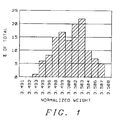
- FIG. 1 is a histogram plotting number of samples against thickness.
- FIG. 2 is a flow diagram of the process of the present invention.
- the concentration of the aluminum or aluminum alloy (defined as aluminum and up to 10 total percent by weight of one or more metals selected from the group consisting of Fe, Si, Mn, Mg, Cu, Zn, Ni, Pb, Sn, and Ti) relative to the added sintering aiding material should be 95-99% by weight.
- the selection and control of the metal particle sizes in the powder is an important aspect of the present invention.
- the metal powder size and powder size distribution used to produce the sintered articles do have an effect on the properties of the ultimate products obtained. Therefore, the metal powder size and powder size distribution used in the present invention are selected so as to impart maximum density and other desired properties to the alloys produced.
- the ratio (aluminum particle size):(additive particle size) should not exceed 3:13, with 3:5 being preferred.
- concentration by weight of both aluminum and the additive are in inverse proportion to their average particle sizes. Thus, for example, if the average aluminum particle size is doubled, then the weight concentration of aluminum particles must be cut in half.
- the aluminum powder should have a mean particle size of about 1 to 15 microns and additives like silicon carbide or metallic fluorides have a mean particle size of 1 to 50 microns. Only a small percentage of the mix needs to be the sintering aiding element since the eutectic liquid will be gradually squeezed out from between aluminum particles as they bond to one another, ending, eventually at the surface. If the additive particles are too large, there will be too few of them distributed throughout the mix. If the weight fraction of additive material is too large, the excess additives will not go through the reaction, remaining in their original state with its associated high melting temperature. They will not sinter, resulting in unsintered local structures.
- the aluminum, silicon carbide and metallic fluoride powders are available commercially in the required particle size ranges.
- the metal powder having the above composition is then mixed with a plasticizer (also known as a binder) to form a feedstock which can be compacted using heavy tonnage presses and injection molded using conventional injection molding machines.
- a plasticizer also known as a binder
- organic polymeric binders are typically included in the molded articles for the purpose of holding them together until they are debinded prior to the sintering process.
- An organic polymeric binder is preferred over the water-based binders or water soluble polymers since water may react with the reactive aluminum powder and accelerate the formation of the surface oxide film.
- any organic material will function if it will decompose under elevated temperatures without leaving an undesired residue that will be detrimental to the properties of the metal articles can be used in the present invention.
- Preferred materials are various organic polymers such as stearic acids, micropulvar wax, paraffin wax and polyethylene.
- the feedstocks are then either compacted or injection molded.
- the metal powder can be injection molded using conventional injection molding machines to form green articles.
- the dimensions of the green articles are determined by the size of the tooling used, which in turn is determined by the dimensions of the desired finished articles, taking into account the shrinkage of the articles during the sintering process.
- the metal powder can be pressed with either high tonnage hydraulic or mechanical press in a die to form a green part.
- the binder is removed by any one of a number of well known debinding techniques available to the metal injection molding industry such as, but not limited to, solvent extraction, thermal, catalytic or wicking.
- the molded or formed articles from which the binder has been removed are densified in a sintering step in any one of a number of furnace types such as, but not limited to, batch vacuum, continuous atmosphere or batch atmosphere.
- a sintering step is carried out in batch vacuum furnace as it is efficient and economical.
- supporting plates used for the sintering process is important. It is desirable that a material which does not decompose or react under sintering conditions, such as alumina, be used as a supporting plate for the articles in the furnace. Contamination of the metal alloys can occur if suitable plates are not used. For example, a graphite plate is not usable as it may react with the aluminum alloys used in the present invention.
- Sintering is carried out with sufficient time and temperature to cause the green article to be transformed into a sintered product, i.e. a product having density of at least 95% of theoretical, preferably at least 99% of theoretical.
- Sintering processes suitable for producing aluminum alloys require special attentions to prevent common defects such as warpage, cracking, and non-uniform shrinkage by the articles.
- Sintering can be carried out in either vacuum or nitrogen or argon atmosphere, preferably a vacuum of less than 0.01 torr or gases with relative humidity and oxygen content less than 0.6%.
- the temperature is ramped up gradually from room temperature to the sintering temperature at a ramp rate of 25° C./hr to 45° C./hr. Typically the temperature is between 600° C. to 650° C. for 30 to 90 minutes.
- a good vacuum of less than 1 torr at sintering temperature will provide excellent temperature uniformity in the furnace which in turn brings about even and uniform shrinkage of the articles in batch size.
- An example of a sintering profile which has been found to be particularly effective for manufacture of aluminum steel efficiently and economically in accordance with the present invention involves heating the green articles in vacuum of less than 0.01 torr from room temperature to 300° C. in 30° C./hr and maintain at that temperature for about 0.5-1.0 hr. The ramp rate is then increased to 50° C./hr until the temperature reaches the sintering temperature of 600° C.-650° C., maintaining for 30-120 minutes. The temperature is then either cooled gradually or rapidly cooled using inert gases such as argon or nitrogen by the cooling fan of the furnace.
- inert gases such as argon or nitrogen
- the physical dimensions and weight of the sintered aluminum alloys are consistent from batch to batch.
- the variability of dimensions and weights within the same batch is minimal. Close tolerances of dimensions and weight can be achieved and thus eliminates the need for secondary machining processes which can be costly and difficult.
- aluminum alloy parts manufactured according to the teachings of the present invention can be removed from the sintering furnace and used as is or it can be subjected to well-known conventional secondary operations such as a glass beading process to clean the sintered surface and tumbling to smooth off sharp edges.
- the aluminum alloys produced in the present invention can be used in a variety of different industrial applications in the same way as prior art aluminum alloys, their most valuable applications being in areas where high complexity or miniaturization are required.
- the sintered aluminum of the present invention can be easily and rapidly produced over a large range of intricate shapes and profiles. Variability in weight and physical dimension between successful parts is very small, which means that post sintering machining and other mechanical working can be totally eliminated.
- the mixing machine is a double-planetary mixer where the bowl was heated to 150° C. using circulating oil in the double-walled bowl.
- the well blended powder mixture was placed inside the bowl with the organic binders of 3,230 g of micropulvar wax, 3,230 g of semi-refined paraffin wax and 2,310 g of polyethylene alathon.
- the mixture of powder and organic binders took 4.5 hours to form a homogeneous powder/binder mixture with the final hour being in vacuo.
- the powder/binder mixture was then removed from the mixing bowl and cooled in open air. Once it was cooled and solidified at room temperature, it was granulated to form a granulated feedstock.
- the density of the granulated feedstock was measured by a helium gas pycnometer and found to be identical to the theoretical density.
- An injection-molding machine was fitted with a mold for a rectangular block.
- the sintered block has a total length of 25.0 ⁇ 15.0 ⁇ 3.5 mm. Based on the expected linear sintering shrinkage of 10%, the mold is 10% larger in all dimensions than the rectangular block.
- the injection-molding composition was melted at a composition temperature of 190° C. and injected into the mold which was at 100° C. After a cooling time of about 20 seconds, the green parts were taken from the mold.
- the green rectangular block was laid on an alumina oxide supporting plate and was heated to 300° C. at a rate of 30° C./hr, held for an hour before heating to 640° C. at a rate of 50° C./hr., held for an hour, under a vacuum of less than 0.01 torr in a sintering furnace.
- the sintering time was 60 minutes at 640° C. and the sintering furnace was then cooled. This gave a rectangular block having exactly the correct dimensions.
- FIG. 2 A diagram illustrating the process flow of the present invention is shown in FIG. 2 .
Landscapes
- Engineering & Computer Science (AREA)
- Mechanical Engineering (AREA)
- Manufacturing & Machinery (AREA)
- Chemical & Material Sciences (AREA)
- Materials Engineering (AREA)
- Metallurgy (AREA)
- Organic Chemistry (AREA)
- Powder Metallurgy (AREA)
Priority Applications (4)
| Application Number | Priority Date | Filing Date | Title |
|---|---|---|---|
| US10/095,272 US6761852B2 (en) | 2002-03-11 | 2002-03-11 | Forming complex-shaped aluminum components |
| SG200205230A SG124245A1 (en) | 2002-03-11 | 2002-08-28 | Forming complex-shaped aluminum components |
| JP2002290864A JP4748915B2 (ja) | 2002-03-11 | 2002-10-03 | アルミニウム物体及びアルミニウム合金物体の製造方法 |
| EP03368018A EP1344593A3 (de) | 2002-03-11 | 2003-03-10 | Herstellung von komplex geformten Aluminiumkörpern |
Applications Claiming Priority (1)
| Application Number | Priority Date | Filing Date | Title |
|---|---|---|---|
| US10/095,272 US6761852B2 (en) | 2002-03-11 | 2002-03-11 | Forming complex-shaped aluminum components |
Publications (2)
| Publication Number | Publication Date |
|---|---|
| US20030170137A1 US20030170137A1 (en) | 2003-09-11 |
| US6761852B2 true US6761852B2 (en) | 2004-07-13 |
Family
ID=27765392
Family Applications (1)
| Application Number | Title | Priority Date | Filing Date |
|---|---|---|---|
| US10/095,272 Expired - Fee Related US6761852B2 (en) | 2002-03-11 | 2002-03-11 | Forming complex-shaped aluminum components |
Country Status (4)
| Country | Link |
|---|---|
| US (1) | US6761852B2 (de) |
| EP (1) | EP1344593A3 (de) |
| JP (1) | JP4748915B2 (de) |
| SG (1) | SG124245A1 (de) |
Cited By (2)
| Publication number | Priority date | Publication date | Assignee | Title |
|---|---|---|---|---|
| US7297310B1 (en) * | 2003-12-16 | 2007-11-20 | Dwa Technologies, Inc. | Manufacturing method for aluminum matrix nanocomposite |
| US20100183471A1 (en) * | 2006-08-07 | 2010-07-22 | The University Of Queensland | Metal injection moulding method |
Families Citing this family (17)
| Publication number | Priority date | Publication date | Assignee | Title |
|---|---|---|---|---|
| KR100394242B1 (ko) * | 2001-05-16 | 2003-08-09 | 주식회사 엘지이아이 | 왕복동식 모터의 마그네트 고정장치 |
| US7517492B2 (en) * | 2003-12-01 | 2009-04-14 | The Ex One Company | Processes for sintering aluminum and aluminum alloy components |
| EP2081713B2 (de) | 2006-10-27 | 2025-11-05 | Tecnium, LLC | Hochtemperatur-nanokompositaluminiumlegierung und verfahren dafür |
| WO2009029993A1 (en) * | 2007-09-07 | 2009-03-12 | The University Of Queensland | Metal injection moulding method |
| CN101891479A (zh) * | 2010-07-15 | 2010-11-24 | 南京信息工程大学 | 多功能陶瓷复合材料及其制备方法 |
| EP2651582B1 (de) * | 2010-12-13 | 2019-05-01 | GKN Sinter Metals, LLC | Aluminiumlegierungspulvermetall mit hoher wärmeleitfähigkeit |
| US9908261B2 (en) | 2013-05-07 | 2018-03-06 | Comadur S.A. | Mixer, method of mixing raw material for powder metallurgy binder for injection moulding composition |
| EP2765123B1 (de) * | 2013-07-26 | 2016-01-20 | Comadur S.A. | Zwangsmischer von Rohstoff für die Pulvermetallurgie |
| CN103757497A (zh) * | 2013-12-26 | 2014-04-30 | 安徽欣意电缆有限公司 | 一种汽车线用Al-Fe-Cu-Ca铝合金及其线束 |
| EP3156155A1 (de) * | 2015-10-15 | 2017-04-19 | Höganäs AB (publ) | Pulver auf eisenbasis für pulverspritzgiessen |
| CN105463224B (zh) * | 2015-11-25 | 2017-03-29 | 陕西理工学院 | 一种TiCx‑Al2O3‑TiAl3/Al基复合材料及其制备方法 |
| CN105562678A (zh) * | 2015-12-30 | 2016-05-11 | 安徽悦众车身装备有限公司 | 一种刮雨器注塑模具的粉末冶金制备方法 |
| CN106955999B (zh) * | 2017-03-29 | 2019-02-15 | 株洲钻石切削刀具股份有限公司 | 一种用于硬质合金脱蜡工艺的舟皿及舟皿组 |
| CN107952954B (zh) * | 2017-11-14 | 2020-10-09 | 北京宝航新材料有限公司 | 一种超高强铝合金粉体材料及其制备方法 |
| CN110711862B (zh) * | 2019-11-04 | 2021-10-26 | 中南大学 | 一种6系铝合金的3d打印专用合金的制备方法 |
| CN111673080B (zh) * | 2020-07-10 | 2022-03-01 | 宿迁学院 | 一种铜合金喂料及其制备方法、铜合金坯体的制备方法 |
| CN117340239B (zh) * | 2023-11-10 | 2026-03-27 | 洛阳理工学院 | 一种金属粉末注射与3d打印结合的成型方法及界面催化剂 |
Citations (10)
| Publication number | Priority date | Publication date | Assignee | Title |
|---|---|---|---|---|
| US3971657A (en) * | 1974-02-13 | 1976-07-27 | Alcan Aluminum Corporation | Sintering of particulate metal |
| US4623388A (en) | 1983-06-24 | 1986-11-18 | Inco Alloys International, Inc. | Process for producing composite material |
| US4973522A (en) | 1987-06-09 | 1990-11-27 | Alcan International Limited | Aluminum alloy composites |
| US5057903A (en) | 1989-07-17 | 1991-10-15 | Microelectronics And Computer Technology Corporation | Thermal heat sink encapsulated integrated circuit |
| US6077327A (en) | 1996-03-29 | 2000-06-20 | Hitachi Metals, Ltd. | Aluminum composite material of low-thermal expansion and high-thermal conductivity and method of producing same |
| US6183874B1 (en) * | 1996-06-14 | 2001-02-06 | Sumitomo Electric Industries, Ltd. | Substrate material for mounting a semiconductor device, substrate for mounting a semiconductor device, semiconductor device, and method of producing the same |
| US6209446B1 (en) * | 1996-05-20 | 2001-04-03 | Yamaha Hatsudoki Kabushiki Kaisha | Piston for internal combustion engine and process of making same |
| US6262150B1 (en) | 2000-06-20 | 2001-07-17 | Honeywell International Inc. | Aqueous injection molding binder composition and molding process |
| US6346133B1 (en) | 1999-09-03 | 2002-02-12 | Hoeganaes Corporation | Metal-based powder compositions containing silicon carbide as an alloying powder |
| US6531089B1 (en) * | 1997-08-30 | 2003-03-11 | Honsel Gmbh & Co. Kg | Alloy and method for producing objects therefrom |
Family Cites Families (4)
| Publication number | Priority date | Publication date | Assignee | Title |
|---|---|---|---|---|
| JPS5989738A (ja) * | 1982-11-11 | 1984-05-24 | Kanto Yakin Kogyo Kk | アルミニウム系焼結部品の製造方法 |
| US4715892A (en) * | 1986-03-12 | 1987-12-29 | Olin Corporation | Cermet substrate with glass adhesion component |
| US4888054A (en) * | 1987-02-24 | 1989-12-19 | Pond Sr Robert B | Metal composites with fly ash incorporated therein and a process for producing the same |
| JPH04293703A (ja) * | 1991-03-19 | 1992-10-19 | Fujitsu Ltd | 複合材料およびその製造方法 |
-
2002
- 2002-03-11 US US10/095,272 patent/US6761852B2/en not_active Expired - Fee Related
- 2002-08-28 SG SG200205230A patent/SG124245A1/en unknown
- 2002-10-03 JP JP2002290864A patent/JP4748915B2/ja not_active Expired - Fee Related
-
2003
- 2003-03-10 EP EP03368018A patent/EP1344593A3/de not_active Ceased
Patent Citations (10)
| Publication number | Priority date | Publication date | Assignee | Title |
|---|---|---|---|---|
| US3971657A (en) * | 1974-02-13 | 1976-07-27 | Alcan Aluminum Corporation | Sintering of particulate metal |
| US4623388A (en) | 1983-06-24 | 1986-11-18 | Inco Alloys International, Inc. | Process for producing composite material |
| US4973522A (en) | 1987-06-09 | 1990-11-27 | Alcan International Limited | Aluminum alloy composites |
| US5057903A (en) | 1989-07-17 | 1991-10-15 | Microelectronics And Computer Technology Corporation | Thermal heat sink encapsulated integrated circuit |
| US6077327A (en) | 1996-03-29 | 2000-06-20 | Hitachi Metals, Ltd. | Aluminum composite material of low-thermal expansion and high-thermal conductivity and method of producing same |
| US6209446B1 (en) * | 1996-05-20 | 2001-04-03 | Yamaha Hatsudoki Kabushiki Kaisha | Piston for internal combustion engine and process of making same |
| US6183874B1 (en) * | 1996-06-14 | 2001-02-06 | Sumitomo Electric Industries, Ltd. | Substrate material for mounting a semiconductor device, substrate for mounting a semiconductor device, semiconductor device, and method of producing the same |
| US6531089B1 (en) * | 1997-08-30 | 2003-03-11 | Honsel Gmbh & Co. Kg | Alloy and method for producing objects therefrom |
| US6346133B1 (en) | 1999-09-03 | 2002-02-12 | Hoeganaes Corporation | Metal-based powder compositions containing silicon carbide as an alloying powder |
| US6262150B1 (en) | 2000-06-20 | 2001-07-17 | Honeywell International Inc. | Aqueous injection molding binder composition and molding process |
Cited By (2)
| Publication number | Priority date | Publication date | Assignee | Title |
|---|---|---|---|---|
| US7297310B1 (en) * | 2003-12-16 | 2007-11-20 | Dwa Technologies, Inc. | Manufacturing method for aluminum matrix nanocomposite |
| US20100183471A1 (en) * | 2006-08-07 | 2010-07-22 | The University Of Queensland | Metal injection moulding method |
Also Published As
| Publication number | Publication date |
|---|---|
| JP4748915B2 (ja) | 2011-08-17 |
| EP1344593A3 (de) | 2005-11-23 |
| JP2003268407A (ja) | 2003-09-25 |
| US20030170137A1 (en) | 2003-09-11 |
| EP1344593A2 (de) | 2003-09-17 |
| SG124245A1 (en) | 2006-08-30 |
Similar Documents
| Publication | Publication Date | Title |
|---|---|---|
| US6761852B2 (en) | Forming complex-shaped aluminum components | |
| AU2003245820B2 (en) | Method for producing highly porous metallic moulded bodies close to the desired final contours | |
| US6045601A (en) | Non-magnetic, high density alloy | |
| US8017070B2 (en) | Direct to metal sintering of 17-4PH steel | |
| Dobrzański et al. | Overview of conventional technologies using the powders of metals, their alloys and ceramics in Industry 4.0 stage | |
| DK2552630T3 (en) | Process for the production of moldings based on aluminum alloys | |
| US8206645B2 (en) | Preparation of filler-metal weld rod by injection molding of powder | |
| JPH01129902A (ja) | 粒状材料からの部品の加工方法およびその供給原料 | |
| AU2004201143A1 (en) | Infiltrated aluminium preforms | |
| CN102057074A (zh) | A1基合金溅射靶材的制造方法 | |
| JP2004517215A (ja) | 高密度の成形部品を製造するための粉末冶金法 | |
| WO2006130153A2 (en) | Method and composition for making a wire | |
| US20080075619A1 (en) | Method for making molybdenum parts using metal injection molding | |
| CN114367663B (zh) | 一种全致密复杂形状钛合金薄壁零部件的制备方法 | |
| CA2556825A1 (en) | Processes for sintering aluminum and aluminum alloy components | |
| JP4206476B2 (ja) | アルミニウム焼結材の製造方法 | |
| US20050163646A1 (en) | Method of forming articles from alloys of tin and/or titanium | |
| JPH11315304A (ja) | 焼結体の製造方法 | |
| WO1994020242A1 (fr) | Procede de realisation de pieces moulees par injection par transfert de poudre | |
| JPH11315305A (ja) | 焼結体の製造方法 | |
| JP2000038605A (ja) | 魚釣用リールの部品の製造方法 | |
| JPH02290901A (ja) | 成形用金属微粉およびその焼結体の製造方法 | |
| JP2932763B2 (ja) | 射出成形粉末冶金製品の製造方法 | |
| JP2857751B2 (ja) | 鋳鉄系高密度粉末焼結体の製造法 | |
| JPH06316744A (ja) | 封着用Fe−Ni−Co系合金部品の製造方法 |
Legal Events
| Date | Code | Title | Description |
|---|---|---|---|
| AS | Assignment |
Owner name: ADVANCED MATERIALS TECHNOLOGIES PTE LTD., SINGAPOR Free format text: ASSIGNMENT OF ASSIGNORS INTEREST;ASSIGNORS:YEO, CHEE-TIAN;TAN, LYE-KING;REEL/FRAME:012692/0394 Effective date: 20020311 |
|
| FPAY | Fee payment |
Year of fee payment: 4 |
|
| FPAY | Fee payment |
Year of fee payment: 8 |
|
| REMI | Maintenance fee reminder mailed | ||
| LAPS | Lapse for failure to pay maintenance fees | ||
| STCH | Information on status: patent discontinuation |
Free format text: PATENT EXPIRED DUE TO NONPAYMENT OF MAINTENANCE FEES UNDER 37 CFR 1.362 |
|
| STCH | Information on status: patent discontinuation |
Free format text: PATENT EXPIRED DUE TO NONPAYMENT OF MAINTENANCE FEES UNDER 37 CFR 1.362 |
|
| FP | Lapsed due to failure to pay maintenance fee |
Effective date: 20160713 |