US8884047B2 - N-substituted carbamic acid ester production method and isocyanate production method using the N-substituted carbamic acid ester - Google Patents
N-substituted carbamic acid ester production method and isocyanate production method using the N-substituted carbamic acid ester Download PDFInfo
- Publication number
- US8884047B2 US8884047B2 US13/001,238 US200913001238A US8884047B2 US 8884047 B2 US8884047 B2 US 8884047B2 US 200913001238 A US200913001238 A US 200913001238A US 8884047 B2 US8884047 B2 US 8884047B2
- Authority
- US
- United States
- Prior art keywords
- group
- including isomers
- phenol
- groups
- aromatic
- Prior art date
- Legal status (The legal status is an assumption and is not a legal conclusion. Google has not performed a legal analysis and makes no representation as to the accuracy of the status listed.)
- Active, expires
Links
- 0 C.C.CC(=O)C*CC(C)=O.N*N.NC(N)=O Chemical compound C.C.CC(=O)C*CC(C)=O.N*N.NC(N)=O 0.000 description 56
- ZSBDGXGICLIJGD-UHFFFAOYSA-N OC1=CC=C(OC2=CC=CC=C2)C=C1 Chemical compound OC1=CC=C(OC2=CC=CC=C2)C=C1 ZSBDGXGICLIJGD-UHFFFAOYSA-N 0.000 description 46
- QBDSZLJBMIMQRS-UHFFFAOYSA-N CC(C)(C1=CC=CC=C1)C1=CC=C(O)C=C1 Chemical compound CC(C)(C1=CC=CC=C1)C1=CC=C(O)C=C1 QBDSZLJBMIMQRS-UHFFFAOYSA-N 0.000 description 21
- ISWSIDIOOBJBQZ-UHFFFAOYSA-N OC1=CC=CC=C1 Chemical compound OC1=CC=CC=C1 ISWSIDIOOBJBQZ-UHFFFAOYSA-N 0.000 description 16
- NXXYKOUNUYWIHA-UHFFFAOYSA-N CC1=CC=CC(C)=C1O Chemical compound CC1=CC=CC(C)=C1O NXXYKOUNUYWIHA-UHFFFAOYSA-N 0.000 description 12
- CRBJBYGJVIBWIY-UHFFFAOYSA-N CC(C)C1=CC=CC=C1O Chemical compound CC(C)C1=CC=CC=C1O CRBJBYGJVIBWIY-UHFFFAOYSA-N 0.000 description 6
- JWAZRIHNYRIHIV-UHFFFAOYSA-N OC1=CC2=CC=CC=C2C=C1 Chemical compound OC1=CC2=CC=CC=C2C=C1 JWAZRIHNYRIHIV-UHFFFAOYSA-N 0.000 description 6
- WMVJWKURWRGJCI-UHFFFAOYSA-N CCC(C)(C)C1=CC(C(C)(C)CC)=C(O)C=C1 Chemical compound CCC(C)(C)C1=CC(C(C)(C)CC)=C(O)C=C1 WMVJWKURWRGJCI-UHFFFAOYSA-N 0.000 description 5
- ISAVYTVYFVQUDY-UHFFFAOYSA-N CC(C)(C)CC(C)(C)C1=CC=C(O)C=C1 Chemical compound CC(C)(C)CC(C)(C)C1=CC=C(O)C=C1 ISAVYTVYFVQUDY-UHFFFAOYSA-N 0.000 description 4
- FMUYQRFTLHAARI-UHFFFAOYSA-N CC(C)(C1=CC=CC=C1)C1=CC=C(O)C(C(C)(C)C2=CC=CC=C2)=C1 Chemical compound CC(C)(C1=CC=CC=C1)C1=CC=C(O)C(C(C)(C)C2=CC=CC=C2)=C1 FMUYQRFTLHAARI-UHFFFAOYSA-N 0.000 description 4
- RESPRRZCTRXFAQ-UHFFFAOYSA-N CC1=CC=C(C)C(O)=C1.OC1=CC=CC=C1OC1=CC=CC=C1 Chemical compound CC1=CC=C(C)C(O)=C1.OC1=CC=CC=C1OC1=CC=CC=C1 RESPRRZCTRXFAQ-UHFFFAOYSA-N 0.000 description 4
- UCAUGTKYMNLXAP-UHFFFAOYSA-N CC1=CC=CC(C)=C1O.OC1=CC=C(OC2=CC=CC=C2)C=C1 Chemical compound CC1=CC=CC(C)=C1O.OC1=CC=C(OC2=CC=CC=C2)C=C1 UCAUGTKYMNLXAP-UHFFFAOYSA-N 0.000 description 4
- CYYZDBDROVLTJU-UHFFFAOYSA-N CCCCC1=CC=C(O)C=C1 Chemical compound CCCCC1=CC=C(O)C=C1 CYYZDBDROVLTJU-UHFFFAOYSA-N 0.000 description 4
- NTDQQZYCCIDJRK-UHFFFAOYSA-N CCCCCCCCC1=CC=C(O)C=C1 Chemical compound CCCCCCCCC1=CC=C(O)C=C1 NTDQQZYCCIDJRK-UHFFFAOYSA-N 0.000 description 4
- YZKPJAZHLHPYBZ-UHFFFAOYSA-N OC1=CC=C(CC2=CC=CC=C2)C=C1CC1=CC=CC=C1 Chemical compound OC1=CC=C(CC2=CC=CC=C2)C=C1CC1=CC=CC=C1 YZKPJAZHLHPYBZ-UHFFFAOYSA-N 0.000 description 4
- OTMSDBZUPAUEDD-UHFFFAOYSA-N *.CC Chemical compound *.CC OTMSDBZUPAUEDD-UHFFFAOYSA-N 0.000 description 3
- QZRJDBUOEFAHEN-UHFFFAOYSA-N CC(C)(C1=CC=C(O)C=C1)C1=CC=C(O)C=C1.CC1=CC=CC(C)=C1O Chemical compound CC(C)(C1=CC=C(O)C=C1)C1=CC=C(O)C=C1.CC1=CC=CC(C)=C1O QZRJDBUOEFAHEN-UHFFFAOYSA-N 0.000 description 3
- OFLHUUVQZCQMMG-UHFFFAOYSA-N CC(C)(C1=CC=CC=C1)C1=CC=C(O)C=C1.CC(C)C1=CC(O)=CC=C1 Chemical compound CC(C)(C1=CC=CC=C1)C1=CC=C(O)C=C1.CC(C)C1=CC(O)=CC=C1 OFLHUUVQZCQMMG-UHFFFAOYSA-N 0.000 description 3
- IFWCADPSKWEDFQ-UHFFFAOYSA-N CC(C)(C1=CC=CC=C1)C1=CC=C(O)C=C1.CC(C)C1=CC=C(O)C=C1 Chemical compound CC(C)(C1=CC=CC=C1)C1=CC=C(O)C=C1.CC(C)C1=CC=C(O)C=C1 IFWCADPSKWEDFQ-UHFFFAOYSA-N 0.000 description 3
- VJIVSJHAPQWHIB-UHFFFAOYSA-N CC(C)(C1=CC=CC=C1)C1=CC=C(O)C=C1.CC1=CC(C)=CC(O)=C1 Chemical compound CC(C)(C1=CC=CC=C1)C1=CC=C(O)C=C1.CC1=CC(C)=CC(O)=C1 VJIVSJHAPQWHIB-UHFFFAOYSA-N 0.000 description 3
- VXEMIPXVWJUHLM-UHFFFAOYSA-N CC(C)(C1=CC=CC=C1)C1=CC=C(O)C=C1.CC1=CC=C(O)C=C1 Chemical compound CC(C)(C1=CC=CC=C1)C1=CC=C(O)C=C1.CC1=CC=C(O)C=C1 VXEMIPXVWJUHLM-UHFFFAOYSA-N 0.000 description 3
- VILVLYCJSGKSND-UHFFFAOYSA-N CC(C)(C1=CC=CC=C1)C1=CC=C(O)C=C1.CC1=CC=CC=C1O Chemical compound CC(C)(C1=CC=CC=C1)C1=CC=C(O)C=C1.CC1=CC=CC=C1O VILVLYCJSGKSND-UHFFFAOYSA-N 0.000 description 3
- JAPCWVRMKIMFAJ-UHFFFAOYSA-N CC(C)(C1=CC=CC=C1)C1=CC=C(O)C=C1.CCCC1=CC=C(O)C=C1 Chemical compound CC(C)(C1=CC=CC=C1)C1=CC=C(O)C=C1.CCCC1=CC=C(O)C=C1 JAPCWVRMKIMFAJ-UHFFFAOYSA-N 0.000 description 3
- RLEVWIFPZJXKNC-UHFFFAOYSA-N CC(C)(C1=CC=CC=C1)C1=CC=C(O)C=C1.CCCC1=CC=CC=C1O Chemical compound CC(C)(C1=CC=CC=C1)C1=CC=C(O)C=C1.CCCC1=CC=CC=C1O RLEVWIFPZJXKNC-UHFFFAOYSA-N 0.000 description 3
- ZCVKUGQKEHYZJW-UHFFFAOYSA-N CC(C)(C1=CC=CC=C1)C1=CC=C(O)C=C1.OC1=CC=CC=C1 Chemical compound CC(C)(C1=CC=CC=C1)C1=CC=C(O)C=C1.OC1=CC=CC=C1 ZCVKUGQKEHYZJW-UHFFFAOYSA-N 0.000 description 3
- DENUMXDIIRYWNZ-UHFFFAOYSA-N CC(C)C1=CC=CC=C1O.COC1=CC=CC(OC)=C1O Chemical compound CC(C)C1=CC=CC=C1O.COC1=CC=CC(OC)=C1O DENUMXDIIRYWNZ-UHFFFAOYSA-N 0.000 description 3
- HVAJOUZPDAJUHF-UHFFFAOYSA-N CC(C)C1=CC=CC=C1O.OC1=CC=C(OC2=CC=CC=C2)C=C1 Chemical compound CC(C)C1=CC=CC=C1O.OC1=CC=C(OC2=CC=CC=C2)C=C1 HVAJOUZPDAJUHF-UHFFFAOYSA-N 0.000 description 3
- CIZUJKFCFQKOAC-UHFFFAOYSA-N CC1=CC(C)=C(O)C(C)=C1.OC1=CC=C(CC2=CC=CC=C2)C=C1CC1=CC=CC=C1 Chemical compound CC1=CC(C)=C(O)C(C)=C1.OC1=CC=C(CC2=CC=CC=C2)C=C1CC1=CC=CC=C1 CIZUJKFCFQKOAC-UHFFFAOYSA-N 0.000 description 3
- TWOQMRURWBIPSC-UHFFFAOYSA-N CC1=CC(O)=CC=C1.OC1=CC=C(OC2=CC=CC=C2)C=C1 Chemical compound CC1=CC(O)=CC=C1.OC1=CC=C(OC2=CC=CC=C2)C=C1 TWOQMRURWBIPSC-UHFFFAOYSA-N 0.000 description 3
- RZYXITKXIVZYLR-UHFFFAOYSA-N CC1=CC=C(O)C(C)=C1.OC1=CC=C(CC2=CC=CC=C2)C=C1CC1=CC=CC=C1 Chemical compound CC1=CC=C(O)C(C)=C1.OC1=CC=C(CC2=CC=CC=C2)C=C1CC1=CC=CC=C1 RZYXITKXIVZYLR-UHFFFAOYSA-N 0.000 description 3
- ZQDLCDHEYBWUHN-UHFFFAOYSA-N CC1=CC=CC(C)=C1O.OC1=CC=C(CC2=CC=C(O)C=C2)C=C1 Chemical compound CC1=CC=CC(C)=C1O.OC1=CC=C(CC2=CC=C(O)C=C2)C=C1 ZQDLCDHEYBWUHN-UHFFFAOYSA-N 0.000 description 3
- HYEOAACOTHGNDI-UHFFFAOYSA-N CC1=CC=CC(C)=C1O.OC1=CC=CC=C1CC1=CC=CC=C1 Chemical compound CC1=CC=CC(C)=C1O.OC1=CC=CC=C1CC1=CC=CC=C1 HYEOAACOTHGNDI-UHFFFAOYSA-N 0.000 description 3
- QWVGKYWNOKOFNN-UHFFFAOYSA-N CC1=CC=CC=C1O Chemical compound CC1=CC=CC=C1O QWVGKYWNOKOFNN-UHFFFAOYSA-N 0.000 description 3
- SBMPIZWDWDNTJU-UHFFFAOYSA-N CCCCCCCCCCCCC1=CC(CCCCCCCCCCCC)=C(O)C=C1 Chemical compound CCCCCCCCCCCCC1=CC(CCCCCCCCCCCC)=C(O)C=C1 SBMPIZWDWDNTJU-UHFFFAOYSA-N 0.000 description 3
- MOEFFSWKSMRFRQ-UHFFFAOYSA-N CCOc(cccc1)c1O Chemical compound CCOc(cccc1)c1O MOEFFSWKSMRFRQ-UHFFFAOYSA-N 0.000 description 3
- PXKLMJQFEQBVLD-UHFFFAOYSA-N OC1=CC=C(CC2=CC=C(O)C=C2)C=C1 Chemical compound OC1=CC=C(CC2=CC=C(O)C=C2)C=C1 PXKLMJQFEQBVLD-UHFFFAOYSA-N 0.000 description 3
- KOWXKIHEBFTVRU-UHFFFAOYSA-N *.CC.CC Chemical compound *.CC.CC KOWXKIHEBFTVRU-UHFFFAOYSA-N 0.000 description 2
- HULWFSHIHLWHLY-UHFFFAOYSA-N CC(C)(C)C.CC(C)C.CC(C)C.CCC.CN(C)C.COC.CS(C)(=O)=O.CS(C)=O.CSC Chemical compound CC(C)(C)C.CC(C)C.CC(C)C.CCC.CN(C)C.COC.CS(C)(=O)=O.CS(C)=O.CSC HULWFSHIHLWHLY-UHFFFAOYSA-N 0.000 description 2
- IISBACLAFKSPIT-UHFFFAOYSA-N CC(C)(C1=CC=C(O)C=C1)C1=CC=C(O)C=C1 Chemical compound CC(C)(C1=CC=C(O)C=C1)C1=CC=C(O)C=C1 IISBACLAFKSPIT-UHFFFAOYSA-N 0.000 description 2
- CVCREFQINJSAMY-UHFFFAOYSA-N CC(C)(C1=CC=CC=C1)C1=CC=C(O)C=C1.CC1=C(C)C=C(O)C=C1 Chemical compound CC(C)(C1=CC=CC=C1)C1=CC=C(O)C=C1.CC1=C(C)C=C(O)C=C1 CVCREFQINJSAMY-UHFFFAOYSA-N 0.000 description 2
- YCOXTKKNXUZSKD-UHFFFAOYSA-N CC1=C(C)C=C(O)C=C1 Chemical compound CC1=C(C)C=C(O)C=C1 YCOXTKKNXUZSKD-UHFFFAOYSA-N 0.000 description 2
- BPRYUXCVCCNUFE-UHFFFAOYSA-N CC1=CC(C)=C(O)C(C)=C1 Chemical compound CC1=CC(C)=C(O)C(C)=C1 BPRYUXCVCCNUFE-UHFFFAOYSA-N 0.000 description 2
- TUAMRELNJMMDMT-UHFFFAOYSA-N CC1=CC(C)=CC(O)=C1 Chemical compound CC1=CC(C)=CC(O)=C1 TUAMRELNJMMDMT-UHFFFAOYSA-N 0.000 description 2
- RLSSMJSEOOYNOY-UHFFFAOYSA-N CC1=CC(O)=CC=C1 Chemical compound CC1=CC(O)=CC=C1 RLSSMJSEOOYNOY-UHFFFAOYSA-N 0.000 description 2
- KUFFULVDNCHOFZ-UHFFFAOYSA-N CC1=CC=C(O)C(C)=C1 Chemical compound CC1=CC=C(O)C(C)=C1 KUFFULVDNCHOFZ-UHFFFAOYSA-N 0.000 description 2
- IWDCLRJOBJJRNH-UHFFFAOYSA-N CC1=CC=C(O)C=C1 Chemical compound CC1=CC=C(O)C=C1 IWDCLRJOBJJRNH-UHFFFAOYSA-N 0.000 description 2
- LZVMXZMBLATKAM-UHFFFAOYSA-N CC1=CC=CC2=CC=CC(O)=C12.CC1CC=CC2=CC=CC(O)=C21 Chemical compound CC1=CC=CC2=CC=CC(O)=C12.CC1CC=CC2=CC=CC(O)=C21 LZVMXZMBLATKAM-UHFFFAOYSA-N 0.000 description 2
- RINXYRRFSJCVTE-UHFFFAOYSA-N CC1=CC=CC=C1O.OC1=CC=C(OC2=CC=CC=C2)C=C1 Chemical compound CC1=CC=CC=C1O.OC1=CC=C(OC2=CC=CC=C2)C=C1 RINXYRRFSJCVTE-UHFFFAOYSA-N 0.000 description 2
- METWAQRCMRWDAW-UHFFFAOYSA-N CCC1=CC=CC(CC)=C1O Chemical compound CCC1=CC=CC(CC)=C1O METWAQRCMRWDAW-UHFFFAOYSA-N 0.000 description 2
- LHOIBQYFYSMBKH-UHFFFAOYSA-N CCC1=CC=CC(CC)=C1O.OC1=CC=C(OC2=CC=CC=C2)C=C1 Chemical compound CCC1=CC=CC(CC)=C1O.OC1=CC=C(OC2=CC=CC=C2)C=C1 LHOIBQYFYSMBKH-UHFFFAOYSA-N 0.000 description 2
- KLSLBUSXWBJMEC-UHFFFAOYSA-N CCCC1=CC=C(O)C=C1 Chemical compound CCCC1=CC=C(O)C=C1 KLSLBUSXWBJMEC-UHFFFAOYSA-N 0.000 description 2
- LCHYEKKJCUJAKN-UHFFFAOYSA-N CCCC1=CC=CC=C1O Chemical compound CCCC1=CC=CC=C1O LCHYEKKJCUJAKN-UHFFFAOYSA-N 0.000 description 2
- XZEGEVIHUZKBPA-UHFFFAOYSA-N CCCCC1=CC=C(O)C=C1.OC1=CC=C(CC2=CC=CC=C2)C=C1CC1=CC=CC=C1 Chemical compound CCCCC1=CC=C(O)C=C1.OC1=CC=C(CC2=CC=CC=C2)C=C1CC1=CC=CC=C1 XZEGEVIHUZKBPA-UHFFFAOYSA-N 0.000 description 2
- PQULWPXTEXWATQ-UHFFFAOYSA-N CCOC1=C(O)C=CC=C1.OC1=CC=C(OC2=CC=CC=C2)C=C1 Chemical compound CCOC1=C(O)C=CC=C1.OC1=CC=C(OC2=CC=CC=C2)C=C1 PQULWPXTEXWATQ-UHFFFAOYSA-N 0.000 description 2
- KLIDCXVFHGNTTM-UHFFFAOYSA-N COC1=CC=CC(OC)=C1O Chemical compound COC1=CC=CC(OC)=C1O KLIDCXVFHGNTTM-UHFFFAOYSA-N 0.000 description 2
- YCIMNLLNPGFGHC-UHFFFAOYSA-N OC1=C(O)C=CC=C1 Chemical compound OC1=C(O)C=CC=C1 YCIMNLLNPGFGHC-UHFFFAOYSA-N 0.000 description 2
- ILWLPAFEOOESRO-UHFFFAOYSA-N OC1=C(O)C=CC=C1.OC1=CC=C(OC2=CC=CC=C2)C=C1 Chemical compound OC1=C(O)C=CC=C1.OC1=CC=C(OC2=CC=CC=C2)C=C1 ILWLPAFEOOESRO-UHFFFAOYSA-N 0.000 description 2
- YYINNSMIQZQBAO-UHFFFAOYSA-N OC1=CC=C(OC2=CC=CC=C2)C=C1.OC1=CC=CC=C1 Chemical compound OC1=CC=C(OC2=CC=CC=C2)C=C1.OC1=CC=CC=C1 YYINNSMIQZQBAO-UHFFFAOYSA-N 0.000 description 2
- CDMGNVWZXRKJNS-UHFFFAOYSA-N OC1=CC=CC=C1CC1=CC=CC=C1 Chemical compound OC1=CC=CC=C1CC1=CC=CC=C1 CDMGNVWZXRKJNS-UHFFFAOYSA-N 0.000 description 2
- VHZNDENPFMBPEN-UHFFFAOYSA-N *.*.*.*.CC.CC.CC.CC.COC(N)=O.COC(N)=O.N.N=C=O.NC(N)=O Chemical compound *.*.*.*.CC.CC.CC.CC.COC(N)=O.COC(N)=O.N.N=C=O.NC(N)=O VHZNDENPFMBPEN-UHFFFAOYSA-N 0.000 description 1
- MCTJQZPXFBASJU-UHFFFAOYSA-N *.*.*.OC1=CC=CC(O)=C1O.OC1=CC=CC2=CC=CC(O)=C12.OC1=CC=CC2=CC=CC(O)=C12 Chemical compound *.*.*.OC1=CC=CC(O)=C1O.OC1=CC=CC2=CC=CC(O)=C12.OC1=CC=CC2=CC=CC(O)=C12 MCTJQZPXFBASJU-UHFFFAOYSA-N 0.000 description 1
- SCFMWUIFGNCOTM-UHFFFAOYSA-N C.C.C.C.C.C.C.C.C=C(CCOC#N)N(CCC(C)=O)C(=O)OC.COC(=O)CCCC(C)=O.N#COCN=C=O Chemical compound C.C.C.C.C.C.C.C.C=C(CCOC#N)N(CCC(C)=O)C(=O)OC.COC(=O)CCCC(C)=O.N#COCN=C=O SCFMWUIFGNCOTM-UHFFFAOYSA-N 0.000 description 1
- BMOOPDDDBTXHCU-UHFFFAOYSA-N C.C.C.C.C.C.CCCC=O.N#COCN=C=O.NCN.O=C(Cl)CCCC(=O)Cl.O=C(Cl)Cl Chemical compound C.C.C.C.C.C.CCCC=O.N#COCN=C=O.NCN.O=C(Cl)CCCC(=O)Cl.O=C(Cl)Cl BMOOPDDDBTXHCU-UHFFFAOYSA-N 0.000 description 1
- XYHOZGOMLVRTKI-UHFFFAOYSA-N C.C.C.C.COC(=O)CCCC(C)=O.N#COCN=C=O Chemical compound C.C.C.C.COC(=O)CCCC(C)=O.N#COCN=C=O XYHOZGOMLVRTKI-UHFFFAOYSA-N 0.000 description 1
- JIBKLRVGCKBEHK-UHFFFAOYSA-N C1=CC=C(CC2=CC=CC=C2)C=C1.CCC.CN.CN.NC1=CC=CC=C1 Chemical compound C1=CC=C(CC2=CC=CC=C2)C=C1.CCC.CN.CN.NC1=CC=CC=C1 JIBKLRVGCKBEHK-UHFFFAOYSA-N 0.000 description 1
- XSOQURPWWXYUFV-UHFFFAOYSA-N C1=CC=C(CC2=CC=CC=C2)C=C1.CCC.CNC(N)=O.CNC(N)=O.NC(=O)NC1=CC=CC=C1 Chemical compound C1=CC=C(CC2=CC=CC=C2)C=C1.CCC.CNC(N)=O.CNC(N)=O.NC(=O)NC1=CC=CC=C1 XSOQURPWWXYUFV-UHFFFAOYSA-N 0.000 description 1
- KZIXCASCFWOMCL-UHFFFAOYSA-N CC(=O)[Y] Chemical compound CC(=O)[Y] KZIXCASCFWOMCL-UHFFFAOYSA-N 0.000 description 1
- PJICNQXCPAGREV-UHFFFAOYSA-N CC(C)(C)C.CC(C)C.CCC.CCC.CN(C)C.COC.CS(C)(=O)=O.CS(C)=O.CSC Chemical compound CC(C)(C)C.CC(C)C.CCC.CCC.CN(C)C.COC.CS(C)(=O)=O.CS(C)=O.CSC PJICNQXCPAGREV-UHFFFAOYSA-N 0.000 description 1
- WFQQKRIIWCNSLM-UHFFFAOYSA-N CC(C)(C)C.CC(C)C.CCC.CN(C)C.COC.CS(C)(=O)=O.CS(C)=O.CSC Chemical compound CC(C)(C)C.CC(C)C.CCC.CN(C)C.COC.CS(C)(=O)=O.CS(C)=O.CSC WFQQKRIIWCNSLM-UHFFFAOYSA-N 0.000 description 1
- DLBMHJXVYLVMJV-UHFFFAOYSA-N CC(C)(C)CC(C)(C)C1=CC=C(O)C=C1.CC(C)C1=CC(O)=CC=C1 Chemical compound CC(C)(C)CC(C)(C)C1=CC=C(O)C=C1.CC(C)C1=CC(O)=CC=C1 DLBMHJXVYLVMJV-UHFFFAOYSA-N 0.000 description 1
- KRVMWKCQLDFNDT-UHFFFAOYSA-N CC(C)(C)CC(C)(C)C1=CC=C(O)C=C1.OC1=C(O)C=CC=C1 Chemical compound CC(C)(C)CC(C)(C)C1=CC=C(O)C=C1.OC1=C(O)C=CC=C1 KRVMWKCQLDFNDT-UHFFFAOYSA-N 0.000 description 1
- ZBCRVXWTPNDRSD-UHFFFAOYSA-N CC(C)(C)CC(C)(C)c(cc1-c(cccc2O)c2O)ccc1O Chemical compound CC(C)(C)CC(C)(C)c(cc1-c(cccc2O)c2O)ccc1O ZBCRVXWTPNDRSD-UHFFFAOYSA-N 0.000 description 1
- XMYMFSUQIYGYOL-UHFFFAOYSA-N CC(C)(C1=CC=CC=C1)C1=CC=C(O)C=C1.CC(C)C1=CC=CC=C1O Chemical compound CC(C)(C1=CC=CC=C1)C1=CC=C(O)C=C1.CC(C)C1=CC=CC=C1O XMYMFSUQIYGYOL-UHFFFAOYSA-N 0.000 description 1
- NXQNVGRKTZBLRN-UHFFFAOYSA-N CC(C)(c1ccccc1)c(ccc(O)c1)c1-c1ccc(C)c(O)c1 Chemical compound CC(C)(c1ccccc1)c(ccc(O)c1)c1-c1ccc(C)c(O)c1 NXQNVGRKTZBLRN-UHFFFAOYSA-N 0.000 description 1
- VLJSLTNSFSOYQR-UHFFFAOYSA-N CC(C)C1=CC(O)=CC=C1 Chemical compound CC(C)C1=CC(O)=CC=C1 VLJSLTNSFSOYQR-UHFFFAOYSA-N 0.000 description 1
- YQUQWHNMBPIWGK-UHFFFAOYSA-N CC(C)C1=CC=C(O)C=C1 Chemical compound CC(C)C1=CC=C(O)C=C1 YQUQWHNMBPIWGK-UHFFFAOYSA-N 0.000 description 1
- ILFQSJNDTQRAAX-UHFFFAOYSA-N CC(C)C1=CC=C(O)C=C1.CCCCCCCCC1=CC=C(O)C=C1 Chemical compound CC(C)C1=CC=C(O)C=C1.CCCCCCCCC1=CC=C(O)C=C1 ILFQSJNDTQRAAX-UHFFFAOYSA-N 0.000 description 1
- ZQGRHORJURIDKL-UHFFFAOYSA-N CC(C)C1=CC=CC=C1O.CCCCCCCC1=CC=C(O)C=C1 Chemical compound CC(C)C1=CC=CC=C1O.CCCCCCCC1=CC=C(O)C=C1 ZQGRHORJURIDKL-UHFFFAOYSA-N 0.000 description 1
- NBAFNVAOFPDBEO-UHFFFAOYSA-N CC(C)C1=CC=CC=C1O.OC1=CC2=CC=CC=C2C=C1 Chemical compound CC(C)C1=CC=CC=C1O.OC1=CC2=CC=CC=C2C=C1 NBAFNVAOFPDBEO-UHFFFAOYSA-N 0.000 description 1
- LOGWSCAQXLBAIX-UHFFFAOYSA-N CC1(C)CC(NC(N)=O)CC(C)(CNC(N)=O)C1 Chemical compound CC1(C)CC(NC(N)=O)CC(C)(CNC(N)=O)C1 LOGWSCAQXLBAIX-UHFFFAOYSA-N 0.000 description 1
- RKDFYHINFXZXIV-UHFFFAOYSA-N CC1=C(C)C=C(O)C=C1.CC1=CC(O)=CC=C1C(C)(C)C1=CC=CC=C1 Chemical compound CC1=C(C)C=C(O)C=C1.CC1=CC(O)=CC=C1C(C)(C)C1=CC=CC=C1 RKDFYHINFXZXIV-UHFFFAOYSA-N 0.000 description 1
- YSNQGYVBQOFOHL-UHFFFAOYSA-N CC1=C(CC(N)=O)C=C(NC(N)=O)C=C1 Chemical compound CC1=C(CC(N)=O)C=C(NC(N)=O)C=C1 YSNQGYVBQOFOHL-UHFFFAOYSA-N 0.000 description 1
- KPGAFGSDCRBDLI-UHFFFAOYSA-N CC1=CC(C2=CC=CC(O)=C2)=CC=C1.CC1=CC=CC(C)=C1O Chemical compound CC1=CC(C2=CC=CC(O)=C2)=CC=C1.CC1=CC=CC(C)=C1O KPGAFGSDCRBDLI-UHFFFAOYSA-N 0.000 description 1
- DENSUUXXYHRACC-UHFFFAOYSA-N CC1=CC(O)=C(C)C=C1.OC1=CC=C(OC2=CC=CC=C2)C=C1 Chemical compound CC1=CC(O)=C(C)C=C1.OC1=CC=C(OC2=CC=CC=C2)C=C1 DENSUUXXYHRACC-UHFFFAOYSA-N 0.000 description 1
- NKTOLZVEWDHZMU-UHFFFAOYSA-N CC1=CC=C(C)C(O)=C1 Chemical compound CC1=CC=C(C)C(O)=C1 NKTOLZVEWDHZMU-UHFFFAOYSA-N 0.000 description 1
- CSLXDCVCGPQASN-UHFFFAOYSA-N CC1=CC=C(O)C=C1.CC1=CC=CC=C1O.OC1=CC=C(CC2CCCCC2)C=C1 Chemical compound CC1=CC=C(O)C=C1.CC1=CC=CC=C1O.OC1=CC=C(CC2CCCCC2)C=C1 CSLXDCVCGPQASN-UHFFFAOYSA-N 0.000 description 1
- UTDROXMELLPKPC-UHFFFAOYSA-N CC1=CC=CC(C)=C1O.CN(C)C1=CC=C(O)C=C1 Chemical compound CC1=CC=CC(C)=C1O.CN(C)C1=CC=C(O)C=C1 UTDROXMELLPKPC-UHFFFAOYSA-N 0.000 description 1
- LIJTWRWNLKPNQK-UHFFFAOYSA-N CC1=CC=CC(C)=C1O.OC1=C(CC2CCCCC2)C=CC=C1 Chemical compound CC1=CC=CC(C)=C1O.OC1=C(CC2CCCCC2)C=CC=C1 LIJTWRWNLKPNQK-UHFFFAOYSA-N 0.000 description 1
- ZVZJSQHQUHMDDL-UHFFFAOYSA-N CC1=CC=CC(C)=C1O.OC1=CC=CC2=CC=CC=C12 Chemical compound CC1=CC=CC(C)=C1O.OC1=CC=CC2=CC=CC=C12 ZVZJSQHQUHMDDL-UHFFFAOYSA-N 0.000 description 1
- IAPGOBZOXMHVGK-UHFFFAOYSA-N CC1=CC=CC=C1O.OC1=CC=C(C2CCCCC2)C=C1 Chemical compound CC1=CC=CC=C1O.OC1=CC=C(C2CCCCC2)C=C1 IAPGOBZOXMHVGK-UHFFFAOYSA-N 0.000 description 1
- YJUPRERCLXDCQS-UHFFFAOYSA-N CCC(C)(C)C1=CC(C(C)(C)CC)=C(O)C=C1.CCC1=CC=CC(CC)=C1O Chemical compound CCC(C)(C)C1=CC(C(C)(C)CC)=C(O)C=C1.CCC1=CC=CC(CC)=C1O YJUPRERCLXDCQS-UHFFFAOYSA-N 0.000 description 1
- SHPCLBLFTDSANE-UHFFFAOYSA-N CCC(C)(C)C1=CC(C(C)(C)CC)=C(O)C=C1.CCCCC1=CC=C(O)C=C1 Chemical compound CCC(C)(C)C1=CC(C(C)(C)CC)=C(O)C=C1.CCCCC1=CC=C(O)C=C1 SHPCLBLFTDSANE-UHFFFAOYSA-N 0.000 description 1
- QOUFXLZIJUJHBJ-UHFFFAOYSA-N CCC(C)(C)C1=CC(C(C)(C)CC)=C(O)C=C1.CCOC1=C(O)C=CC=C1 Chemical compound CCC(C)(C)C1=CC(C(C)(C)CC)=C(O)C=C1.CCOC1=C(O)C=CC=C1 QOUFXLZIJUJHBJ-UHFFFAOYSA-N 0.000 description 1
- JCUJQQNUGQJTLQ-UHFFFAOYSA-N CCC.CCC1=CC=C(NC(N)=O)C=C1.CCC1=CC=C(NC(N)=O)C=C1.NC(=O)NC1=CC=CC=C1.NC(=O)NC1=CC=CC=C1 Chemical compound CCC.CCC1=CC=C(NC(N)=O)C=C1.CCC1=CC=C(NC(N)=O)C=C1.NC(=O)NC1=CC=CC=C1.NC(=O)NC1=CC=CC=C1 JCUJQQNUGQJTLQ-UHFFFAOYSA-N 0.000 description 1
- RIUZVNGKGDGQFB-UHFFFAOYSA-N CCC1=CC=C(NC(N)=O)C=C1.CCC1=CC=C(NC(N)=O)C=C1.NC(=O)NC1=CC=CC=C1 Chemical compound CCC1=CC=C(NC(N)=O)C=C1.CCC1=CC=C(NC(N)=O)C=C1.NC(=O)NC1=CC=CC=C1 RIUZVNGKGDGQFB-UHFFFAOYSA-N 0.000 description 1
- IGZLMWXMALPDAS-UHFFFAOYSA-N CCCCOC1=CC=C(O)C=C1.OC1=CC=CC=C1 Chemical compound CCCCOC1=CC=C(O)C=C1.OC1=CC=CC=C1 IGZLMWXMALPDAS-UHFFFAOYSA-N 0.000 description 1
- IJRQJQJKRVKGOT-UHFFFAOYSA-N Cc1ccc(Cc(cc(cc2)Oc3ccccc3)c2O)c(O)c1 Chemical compound Cc1ccc(Cc(cc(cc2)Oc3ccccc3)c2O)c(O)c1 IJRQJQJKRVKGOT-UHFFFAOYSA-N 0.000 description 1
- RSVYMRHKJIYIBX-UHFFFAOYSA-N NC(=O)CC1CCC(CC2CCC(CC(N)=O)CC2)CC1 Chemical compound NC(=O)CC1CCC(CC2CCC(CC(N)=O)CC2)CC1 RSVYMRHKJIYIBX-UHFFFAOYSA-N 0.000 description 1
- LMFOYEUWVQZEAW-UHFFFAOYSA-N NC(=O)NC1=CC=C(CC2=CC=C(NC(N)=O)C=C2)C=C1 Chemical compound NC(=O)NC1=CC=C(CC2=CC=C(NC(N)=O)C=C2)C=C1 LMFOYEUWVQZEAW-UHFFFAOYSA-N 0.000 description 1
- PYWFAJNMYCSXSE-UHFFFAOYSA-N NC(=O)O[Ar] Chemical compound NC(=O)O[Ar] PYWFAJNMYCSXSE-UHFFFAOYSA-N 0.000 description 1
- PAYRUJLWNCNPSJ-UHFFFAOYSA-N Nc1ccccc1 Chemical compound Nc1ccccc1 PAYRUJLWNCNPSJ-UHFFFAOYSA-N 0.000 description 1
- STHQSIUWLIQVRZ-UHFFFAOYSA-N O=C(Nc1ccccc1)OC1CCCCCCCC1 Chemical compound O=C(Nc1ccccc1)OC1CCCCCCCC1 STHQSIUWLIQVRZ-UHFFFAOYSA-N 0.000 description 1
- SSNOSIHVYVYULV-UHFFFAOYSA-N OC1=CC2=CC=CC=C2C=C1.OC1=CC=C(Cl)C=C1 Chemical compound OC1=CC2=CC=CC=C2C=C1.OC1=CC=C(Cl)C=C1 SSNOSIHVYVYULV-UHFFFAOYSA-N 0.000 description 1
- FMAYKKMKSLQWSJ-UHFFFAOYSA-N OC1=CC=C(CC2=CC=C(C3=CC=CC=C3)C=C2)C=C1 Chemical compound OC1=CC=C(CC2=CC=C(C3=CC=CC=C3)C=C2)C=C1 FMAYKKMKSLQWSJ-UHFFFAOYSA-N 0.000 description 1
- KDTZBYPBMTXCSO-UHFFFAOYSA-N OC1=CC=CC=C1OC1=CC=CC=C1 Chemical compound OC1=CC=CC=C1OC1=CC=CC=C1 KDTZBYPBMTXCSO-UHFFFAOYSA-N 0.000 description 1
- PQMGDAFSFACTPJ-UHFFFAOYSA-N Oc(cc1)cc(-c(c2ccccc2cc2)c2O)c1Cl Chemical compound Oc(cc1)cc(-c(c2ccccc2cc2)c2O)c1Cl PQMGDAFSFACTPJ-UHFFFAOYSA-N 0.000 description 1
- UXZKAQWFDPIJAL-UHFFFAOYSA-N Oc1c(Cc(cc(cc2)Oc3ccccc3)c2O)cccc1 Chemical compound Oc1c(Cc(cc(cc2)Oc3ccccc3)c2O)cccc1 UXZKAQWFDPIJAL-UHFFFAOYSA-N 0.000 description 1
Images




Classifications
-
- C—CHEMISTRY; METALLURGY
- C07—ORGANIC CHEMISTRY
- C07C—ACYCLIC OR CARBOCYCLIC COMPOUNDS
- C07C275/00—Derivatives of urea, i.e. compounds containing any of the groups, the nitrogen atoms not being part of nitro or nitroso groups
- C07C275/28—Derivatives of urea, i.e. compounds containing any of the groups, the nitrogen atoms not being part of nitro or nitroso groups having nitrogen atoms of urea groups bound to carbon atoms of six-membered aromatic rings of a carbon skeleton
- C07C275/40—Derivatives of urea, i.e. compounds containing any of the groups, the nitrogen atoms not being part of nitro or nitroso groups having nitrogen atoms of urea groups bound to carbon atoms of six-membered aromatic rings of a carbon skeleton being further substituted by nitrogen atoms not being part of nitro or nitroso groups
-
- C—CHEMISTRY; METALLURGY
- C07—ORGANIC CHEMISTRY
- C07C—ACYCLIC OR CARBOCYCLIC COMPOUNDS
- C07C263/00—Preparation of derivatives of isocyanic acid
- C07C263/04—Preparation of derivatives of isocyanic acid from or via carbamates or carbamoyl halides
-
- C—CHEMISTRY; METALLURGY
- C07—ORGANIC CHEMISTRY
- C07C—ACYCLIC OR CARBOCYCLIC COMPOUNDS
- C07C265/00—Derivatives of isocyanic acid
- C07C265/14—Derivatives of isocyanic acid containing at least two isocyanate groups bound to the same carbon skeleton
-
- C—CHEMISTRY; METALLURGY
- C07—ORGANIC CHEMISTRY
- C07C—ACYCLIC OR CARBOCYCLIC COMPOUNDS
- C07C269/00—Preparation of derivatives of carbamic acid, i.e. compounds containing any of the groups, the nitrogen atom not being part of nitro or nitroso groups
-
- C—CHEMISTRY; METALLURGY
- C07—ORGANIC CHEMISTRY
- C07C—ACYCLIC OR CARBOCYCLIC COMPOUNDS
- C07C269/00—Preparation of derivatives of carbamic acid, i.e. compounds containing any of the groups, the nitrogen atom not being part of nitro or nitroso groups
- C07C269/04—Preparation of derivatives of carbamic acid, i.e. compounds containing any of the groups, the nitrogen atom not being part of nitro or nitroso groups from amines with formation of carbamate groups
-
- C—CHEMISTRY; METALLURGY
- C07—ORGANIC CHEMISTRY
- C07C—ACYCLIC OR CARBOCYCLIC COMPOUNDS
- C07C269/00—Preparation of derivatives of carbamic acid, i.e. compounds containing any of the groups, the nitrogen atom not being part of nitro or nitroso groups
- C07C269/08—Separation; Purification; Stabilisation; Use of additives
-
- C—CHEMISTRY; METALLURGY
- C07—ORGANIC CHEMISTRY
- C07C—ACYCLIC OR CARBOCYCLIC COMPOUNDS
- C07C271/00—Derivatives of carbamic acids, i.e. compounds containing any of the groups, the nitrogen atom not being part of nitro or nitroso groups
- C07C271/06—Esters of carbamic acids
- C07C271/40—Esters of carbamic acids having oxygen atoms of carbamate groups bound to carbon atoms of six-membered aromatic rings
-
- C—CHEMISTRY; METALLURGY
- C07—ORGANIC CHEMISTRY
- C07C—ACYCLIC OR CARBOCYCLIC COMPOUNDS
- C07C271/00—Derivatives of carbamic acids, i.e. compounds containing any of the groups, the nitrogen atom not being part of nitro or nitroso groups
- C07C271/06—Esters of carbamic acids
- C07C271/40—Esters of carbamic acids having oxygen atoms of carbamate groups bound to carbon atoms of six-membered aromatic rings
- C07C271/42—Esters of carbamic acids having oxygen atoms of carbamate groups bound to carbon atoms of six-membered aromatic rings with the nitrogen atoms of the carbamate groups bound to hydrogen atoms or to acyclic carbon atoms
- C07C271/52—Esters of carbamic acids having oxygen atoms of carbamate groups bound to carbon atoms of six-membered aromatic rings with the nitrogen atoms of the carbamate groups bound to hydrogen atoms or to acyclic carbon atoms to carbon atoms of hydrocarbon radicals substituted by nitrogen atoms not being part of nitro or nitroso groups
-
- C—CHEMISTRY; METALLURGY
- C07—ORGANIC CHEMISTRY
- C07C—ACYCLIC OR CARBOCYCLIC COMPOUNDS
- C07C271/00—Derivatives of carbamic acids, i.e. compounds containing any of the groups, the nitrogen atom not being part of nitro or nitroso groups
- C07C271/06—Esters of carbamic acids
- C07C271/40—Esters of carbamic acids having oxygen atoms of carbamate groups bound to carbon atoms of six-membered aromatic rings
- C07C271/42—Esters of carbamic acids having oxygen atoms of carbamate groups bound to carbon atoms of six-membered aromatic rings with the nitrogen atoms of the carbamate groups bound to hydrogen atoms or to acyclic carbon atoms
- C07C271/54—Esters of carbamic acids having oxygen atoms of carbamate groups bound to carbon atoms of six-membered aromatic rings with the nitrogen atoms of the carbamate groups bound to hydrogen atoms or to acyclic carbon atoms to carbon atoms of hydrocarbon radicals substituted by carboxyl groups
-
- C—CHEMISTRY; METALLURGY
- C07—ORGANIC CHEMISTRY
- C07C—ACYCLIC OR CARBOCYCLIC COMPOUNDS
- C07C271/00—Derivatives of carbamic acids, i.e. compounds containing any of the groups, the nitrogen atom not being part of nitro or nitroso groups
- C07C271/06—Esters of carbamic acids
- C07C271/40—Esters of carbamic acids having oxygen atoms of carbamate groups bound to carbon atoms of six-membered aromatic rings
- C07C271/56—Esters of carbamic acids having oxygen atoms of carbamate groups bound to carbon atoms of six-membered aromatic rings with the nitrogen atom of at least one of the carbamate groups bound to a carbon atom of a ring other than a six-membered aromatic ring
-
- C—CHEMISTRY; METALLURGY
- C07—ORGANIC CHEMISTRY
- C07C—ACYCLIC OR CARBOCYCLIC COMPOUNDS
- C07C271/00—Derivatives of carbamic acids, i.e. compounds containing any of the groups, the nitrogen atom not being part of nitro or nitroso groups
- C07C271/06—Esters of carbamic acids
- C07C271/40—Esters of carbamic acids having oxygen atoms of carbamate groups bound to carbon atoms of six-membered aromatic rings
- C07C271/58—Esters of carbamic acids having oxygen atoms of carbamate groups bound to carbon atoms of six-membered aromatic rings with the nitrogen atom of at least one of the carbamate groups bound to a carbon atom of a six-membered aromatic ring
-
- C07C2101/14—
-
- C—CHEMISTRY; METALLURGY
- C07—ORGANIC CHEMISTRY
- C07C—ACYCLIC OR CARBOCYCLIC COMPOUNDS
- C07C2601/00—Systems containing only non-condensed rings
- C07C2601/12—Systems containing only non-condensed rings with a six-membered ring
- C07C2601/14—The ring being saturated
Definitions
- the present invention relates to a method for producing N-substituted carbamic acid ester and a method for producing isocyanate that uses the N-substituted carbamic acid ester.
- Isocyanates are widely used as production raw materials of such products as polyurethane foam, paints and adhesives. Although a plurality of reaction mechanisms can be considered for industrial production of isocyanates, the main industrial production method involves reaction of an amine with phosgene (phosgene method) as indicated in the following formula (i), and nearly the entire amount of isocyanates produced throughout the world are produced according to the phosgene method. However, the phosgene method has numerous problems.
- this method requires the use of a large amount of phosgene as raw material.
- Phosgene is extremely toxic and requires special handling precautions to prevent exposure of handlers thereof, and also requires special apparatuses to detoxify waste.
- examples of such methods may include a method for synthesizing aliphatic isocyanate from an aliphatic nitro compound and carbon monoxide, and a method for converting an aliphatic amide compound to isocyanate by Hoffmann decomposition, both of these methods have poor yield and are inadequate for industrial application.
- Thermal decomposition represented by the above general formula is reversible, and although the equilibrium thereof is biased towards the N-substituted carbamic acid-O-alkyl ester on the left side at low temperatures, the right side with the isocyanate and a alcohol side are advantageous at high temperatures.
- methods for obtaining isocyanate by thermal decomposition of N-substituted carbamic acid-O-alkyl ester are carried out at high temperatures (see, for example, Examples 12 and 13 of Patent Document 1).
- the boiling point of N-substituted carbamic acid-O-methyl ester for example, is 110° C.
- Non-Patent Document 3 the boiling point of hexamethylene diisocyanate, which is formed in the corresponding thermal decomposition reaction, is 130 to 140° C. (during reduced pressure of about 2 kPa) (Non-Patent Document 3). Namely, this indicates that the N-substituted carbamic acid-O-methyl ester has a lower boiling point than the product in the form of hexamethylene diisocyanate. Although the details of the thermal decomposition temperature of the N-substituted carbamic acid-O-methyl ester are not described, thermal decomposition proceeds at 200° C. or higher.
- Non-Patent Document 5 examples of such side reactions result in the formation of substituted ureas, biurets, urethodiones, carbodiimides and isocyanurates.
- N-substituted carbamic acid-O-alkyl esters since the concentrations of both the isocyanate and N-substituted carbamic acid-O-alkyl ester are high in the gaseous phase, allophanate compounds form easily as indicated by the following formula (iii). The boiling points of these allophanate compounds are high since they are formed by a crosslinking reaction, and these allophanate compounds liquefy within the reactor simultaneous to their formation.
- Patent Document 2 contains the production of aliphatic carbamic acid-O-alkyl ester without using phosgene.
- an aliphatic carbamic acid-O-alkyl ester is produced from an aliphatic primary amine and urea by reacting N,N′-dialkyl urea and a hydroxy compound, after which the primary amine formed as a by-product is isolated, recovered and returned to the first stage. Since this method not only has a low yield of carbamic acid ester formed, but also requires equipment for recycling the primary amine, the process is extremely complex and is not satisfactory for industrial application.
- Patent Document 3 contains reacting a primary diamine and alcohol with urea or carbonic acid derivative in the presence of a catalyst followed by conversion to N-substituted carbamic acid-O-alkyl ester.
- N-substituted carbamic acid-O-alkyl ester is produced after first producing bis-urea from aliphatic primary amine, urea and alcohol, while the method described in Patent Document 5 involves the partial reaction of urea and alcohol in a first step, followed by supplying diamine to produce N-substituted carbamic acid-O-alkyl ester in a second step.
- Patent Document 6 describes a method for obtaining N-substituted carbamic acid-O-alkyl ester by reacting a primary amine and non-N-substituted carbamic acid-O-alkyl ester in the presence of alcohol at a ratio of NH 2 groups to carbamate to alcohol of 1:0.8 to 10.0:0.25 to 50, at a temperature of from 160 to 300° C. and in the presence or absence of a catalyst, and then removing the ammonia formed as necessary.
- aromatic diisocyanate and/or polyisocyanate are produced by going through the following two steps.
- an aromatic primary amine and non-N-substituted carbamic acid-O-alkyl ester are reacted in the presence or absence of a catalyst and in the presence or absence of urea and alcohol to obtain N-aryl carbamic acid-O-alkyl ester while removing the ammonia formed as a by-product as necessary, while in the second step, the N-aryl carbamic acid-O-alkyl ester is subjected to thermal decomposition to obtain aromatic isocyanate.
- the method described in Patent Document 8 contains producing N-alkyl carbamic acid-O-alkyl ester after first producing bis-urea from an aliphatic primary polyamine, urea and alcohol.
- Patent Document 9 describes a method for producing aliphatic O-alkyl monourethane by reacting an aliphatic primary amine and urea with an aliphatic alcohol.
- isocyanates formed in thermal decomposition reactions tend to increase the longer the duration of contact with the unreacted N-substituted carbamic acid-O-alkyl ester and other reaction components (including those in which a portion of the carbamic acid esters have become isocyanate groups in the case the thermal decomposition reaction raw material is a poly(N-substituted carbamic acid-O-alkyl ester)).
- Various methods have been proposed for obtaining a favorable isocyanate yield by inhibiting the formation of products of undesirable side reactions during thermal decomposition of N-substituted carbamic acid-O-alkyl esters.
- N-substituted carbamic acid-O-esters refer to carbamic acid esters containing a carbamic acid group and an organic group
- N-substituted carbamic acid-O-aryl esters in which the organic group is derived from an aromatic hydroxy group and/or N-substituted carbamic acid-O-alkyl esters in which the organic group is derived from an alcohol
- N-substituted carbamic acid-O-aryl esters, in which the ester group that composes the N-substituted carbamic acid-O-ester is an aromatic group namely, carbamic acid ester group derived from an aromatic hydroxy group
- Patent Document 11 describes a method for producing aliphatic N-substituted carbamic acid-O-aryl ester without using phosgene.
- N-substituted carbamic acid-O-aryl ester is produced oxidatively using a precious metal catalyst from a primary amine, carbon monoxide and an aliphatic alcohol or aromatic hydroxy compound.
- this method has the problems of a complex procedure and considerable costs. These problems refer to the use of highly toxic carbon monoxide, and the need to recover the catalyst from the product in the form of N-substituted carbamic acid-O-aryl ester due to the use of an expensive precious metal catalyst.
- Patent Document 12 describes a method for producing N-substituted carbamic acid-O-aryl ester by reacting an N-alkyl-N,N′-dialkyl urea, an aromatic hydroxy compound and hydrogen chloride gas.
- this method also has a complicated procedure and requires considerable costs. Namely, this method uses corrosive hydrogen chloride gas, consumes an expensive and uncommon urea compound, and results in difficulty in recovering the N-substituted carbamic acid-O-aryl ester from a hydrochloride of N,N′-dialkylamine formed as a by-product.
- N-substituted carbamic acid-O-aryl ester is produced by a one-stage reaction between urea, aromatic hydroxy compound and aliphatic primary amine.
- urea and an aromatic hydroxy compound are reacted in a first step, and N-substituted carbamic acid-O-aryl ester is produced by reacting with primary amine in a subsequent second step.
- Patent Document 15 and Patent Document 16 disclose methods for producing aliphatic O-aryl urethane from a single-stage reaction of urea and/or O-aryl carbamate (non-N-substituted carbamic acid-O-aryl ester), aromatic hydroxy compound and aliphatic primary amine. In these methods, considerable improvement is made with respect to the removal of ammonia, such as by using reactive distillation or a method for introducing a large amount of inert gas.
- Patent Document 17 discloses a method for continuously producing urethane while continuously supplying a primary polyamine, urea and/or non-N-substituted carbamic acid ester and organic hydroxy compound to a reaction column to form the corresponding urethane and continuously extracting ammonia formed within the reaction column from the reaction column.
- Patent Document 18 describes a method that does not use a lowly nucleophilic aromatic hydroxy compound as described above.
- This method allows a corresponding N-alkyl carbamic acid-O-aryl ester to be obtained at a yield of 90 to 95% by reacting a primary alkyl amine with a diaryl carbonate in the presence of a solvent such as benzene, dioxane or carbon tetrachloride.
- This method has the advantage of allowing the obtaining of N-substituted carbamic acid-O-aryl ester at a low temperature as well as high selectivity.
- Patent Document 19 contains recovering non-N-substituted carbamic acid-O-aryl ester from a resulting reaction liquid and recycling for use as a raw material of the reaction when producing N-substituted carbamic acid-O-aryl ester by reacting an aliphatic primary polyamine, aromatic hydroxy compound, urea and/or non-N-substituted carbamic acid-O-aryl ester. Namely, this method serves to reduce the amount used of the urea and/or non-N-substituted carbamic acid-O-aryl ester.
- Patent Document 20 the use of chemical methods such as the use of a special catalyst (see Patent Document 20 or Patent Document 21), or a catalyst in combination with an inert solvent (see Patent Document 22) have been proposed for improving yield during thermal decomposition of N-substituted carbamic acid-O-alkyl esters
- problems encountered during the production of N-substituted carbamic acid-O-aryl esters have yet to be solved.
- the method described in Patent Document 23 is a method for producing hexamethylene diisocyanate.
- This method contains thermal decomposition of hexamethylene dicarbamic acid-O-ethyl ester in the presence of a catalyst mixture containing methyl toluene sulfonate and diphenyl tin dichloride while using dibenzyl toluene as a solvent.
- a catalyst mixture containing methyl toluene sulfonate and diphenyl tin dichloride
- dibenzyl toluene as a solvent.
- N-substituted carbamic acid-O-alkyl ester is easily decomposed to isocyanate and alcohol in a carbon-containing fluidized bed without using a catalyst.
- the yield of isocyanate obtained in the thermal decomposition reaction is from about 83.8 to 98.7%, and although reaction by-products and the like are not described, since N-substituted carbamic acid-O-alkyl ester is still subjected to thermal decomposition and the resulting compounds contain isocyanate and alcohol that are susceptible to the occurrence of reverse reactions in the same manner as in the prior art, the above-mentioned side reactions cannot be said to be inhibited.
- a circulating method to produce an alicyclic diisocyanate by reacting an alicyclic primary diamine, urea and alcohol to obtain an alicyclic dicarbamic acid-O-alkyl ester, followed by subjecting the alicyclic dicarbamic acid-O-alkyl ester to thermal decomposition.
- This method succeeds at reducing the amounts of materials used by recovering unreacted alcohol, non-N-substituted carbamic acid-O-ester and dialkyl carbonates, and recirculating a portion of the reaction mixture of the thermal decomposition step along with by-products to the initial step.
- this method requires the alicyclic dicarbamic acid-O-alkyl ester to be distilled at a high temperature of about 230° C. to remove residue unable to be used in the production method. Since this high distillation temperature is within the temperature range at which carbamic acid-O-alkyl esters undergo thermal decomposition, isocyanate groups formed during distillation ends up reacting with the alicyclic dicarbamic acid-O-alkyl ester resulting in the possibility of the formation of solid polymers. Although it is described in the examples that yield is maintained over a long operating time, there is no description regarding the presence of accumulation of polymers or clogging of the apparatus due to the occurrence of side reactions.
- Patent Document 26 involves partially removing worthless by-products prior to thermal decomposition of N-substituted carbamic acid-O-alkyl ester.
- N-substituted carbamic acid-O-alkyl ester is also removed together with the partially removed by-products, the yield of isocyanate based on primary amine and carbonic acid derivative is ultimately decreased.
- polymeric compounds are formed as a result of by-products remaining in the reactor without being discharged from the reactor being heated, and since these compounds adhered to the reactor, continuous operation over a long period of time is difficult.
- a reaction formula of N-substituted carbamic acid-O-alkyl ester in the case of using a primary amine and urea as raw materials is shown in the following formula (iv). Although an adequate amount of urea is present based on the primary amine in the initial phase of the reaction, as the reaction enters the latter phase, the concentrations of both (primary amine and urea) decrease resulting in the N-substituted carbamic acid-O-alkyl ester being present at a high concentration.
- the cationicity of urea and carbonyl carbons of carbonic acid derivatives is low (due to accepting electron donation by NH 2 groups and alkoxy groups) and the difference in reactivity between carbonyl carbons of the product in the form of N-substituted carbamic acid-O-alkyl ester and the primary amine is small.
- the reaction proceeds as indicated by formula (v) during the latter phase of the reaction.
- the primary amine reacts with the product in the form of N-substituted carbamic acid-O-(alkyl or aryl) ester causing it to be denatured to a compound having undesirable N,N-di-substituted urea bonds.
- polyamine since each amino group reacts successively, various denatured forms are formed in addition to that shown in the following formula (v).
- Patent Document 27 a method for purifying such polymeric substances by crystallization has also been developed.
- this method it is difficult to selectively crystallize compounds having similar structures at high yield, while on the other hand, energy is expended for separating solids and liquids as well as recovery of the crystallization solvent.
- Patent Document 1 U.S. Pat. No. 7,122,697
- Patent Document 2 U.S. Pat. No. 2,677,698
- Patent Document 3 U.S. Pat. No. 4,713,476
- Patent Document 4 EP Application No. 0568782
- Patent Document 5 EP Application No. 0657420
- Patent Document 6 U.S. Pat. No. 4,497,963
- Patent Document 7 U.S. Pat. No. 4,290,970
- Patent Document 8 Japanese Patent Application Laid-open No. H6-41045
- Patent Document 9 U.S. Pat. No. 2,409,701
- Patent Document 10 U.S. Pat. No. 3,992,430
- Patent Document 11 U.S. Pat. No. 4,297,501
- Patent Document 12 U.S. Pat. No. 3,873,553
- Patent Document 13 U.S. Pat. No. 4,925,971
- Patent Document 14 Japanese Patent Application Laid-open No. H4-164060
- Patent Document 15 Japanese Patent Application Laid-open No. H2-759
- Patent Document 16 Japanese Patent Application Laid-open No. H3-20254
- Patent Document 17 Japanese Patent Application Laid-open No. H8-277255
- Patent Document 18 Japanese Patent Application Laid-open No. S52-71443
- Patent Document 19 Japanese Patent Application Laid-open No. H7-157463
- Patent Document 20 U.S. Pat. No. 2,692,275
- Patent Document 21 U.S. Pat. No. 3,734,941
- Patent Document 22 U.S. Pat. No. 4,081,472
- Patent Document 23 U.S. Pat. No. 4,388,426
- Patent Document 24 U.S. Pat. No. 4,482,499
- Patent Document 25 EP Application No. 0355443
- Patent Document 26 Japanese Patent No. 3382289
- Patent Document 27 Japanese Patent No. 2804132
- N-substituted carbamic acid-O-(alkyl or aryl) esters at high yield using urea and non-N-substituted carbamic acid-O-esters as raw materials, and generally the reaction products thereof include compounds having urea bonds (—NHCONH—), compounds having urea terminals (—NHCONH 2 ), compounds having amino group terminals (—NH 2 ) or compounds having allophanate bonds and the like in nearly all cases.
- N-substituted carbamic acid-O-(alkyl or aryl) ester using urea or carbonic acid derivatives.
- Corresponding isocyanates are known to be able to be obtained by thermal decomposition of N-substituted carbamic acid-O-(alkyl or aryl) esters.
- the formed isocyanate and the raw material in the form of the N-substituted carbamic acid-O-aryl ester react due to the high thermal decomposition temperature resulting in increased susceptibility to the occurrence of denaturation.
- both alcohol and isocyanate are present in the gaseous phase.
- the disclosed methods require the use of an excess of urea or carbonic acid derivative based on the amino groups of the primary amine in order to improve the yield based on the comparative expensive primary amine.
- a method for efficiently recovering and reusing the excess urea or carbonic acid derivative has yet to be described, and increases in basic units of urea or carbonic acid derivative are unable to be avoided.
- the inventors of the present invention have previously disclosed a method for inhibiting thermal denaturation reactions of N-substituted carbamic acid-O-alkyl esters by using a specific aromatic hydroxy compound as a reaction solvent (International Patent Publication WO 2008/120645), and have also disclosed a method for improving thermal stability of aromatic hydroxy compounds by having a trace amount of a carbonic acid derivative present during thermal decomposition of N-substituted carbamic acid-O-alkyl ester, which is obtained by reacting carbonic acid ester and primary amine, in the presence of an aromatic hydroxy compound (International Patent Publication WO 2008/084824).
- An object of the present invention is to provide a method for producing N-substituted carbamic acid-O-aryl ester that is free of the various problems described above, and to provide a method for producing isocyanate by thermal decomposition of the N-substituted carbamic acid-O-aryl ester.
- the inventors of the present invention found that the problems are solved by obtaining N-substituted carbamic acid-O-aryl ester derived from a compound having ureido groups and an aromatic hydroxy compound from the compound having ureido groups and a specific aromatic hydroxy composition, and producing isocyanate by subjecting the N-substituted carbamic acid-O-aryl ester to thermal decomposition, thereby leading to completion of the present invention.
- the present invention provides:
- R 1 represents an organic group containing an integral number of carbon atoms within a range of from 1 to 85, that is substituted by number a of ureido group(s), and the a represents an integer of from 1 to 10, and
- ring A represents an organic group, which contains an aromatic group substituted by number b of hydroxy group(s) at arbitrary location(s) that maintain aromatic properties, and which contains an integral number of carbon atoms within a range of from 6 to 50, may be a single or multiple heterocyclic ring, and may be substituted by other substituents, and the b represents an integer of from 1 to 6).
- R 1 represents an organic group containing an integral number of carbon atoms within a range of from 1 to 85, that is substituted by number c of NH 2 group(s), and the c represents an integer of from 1 to 10).
- ring A represents an organic group, which contains an aromatic group substituted by number b of hydroxy group(s) at an arbitrary location(s) that maintain aromatic properties, which contains an integral number of carbon atoms within a range of from 6 to 50, may be a single or multiple heterocyclic ring, and may be substituted by other substituents, and the b represents an integer of from 1 to 6).
- R 2 represents an aliphatic group, or an aliphatic group in which an aromatic group is bonded, which contains an integral number of carbon atoms within a range of from 1 to 14, and the OH group of the alcohol represented by formula (4) is an OH group that is not bonded to an aromatic ring).
- the present invention provides:
- R 1 represents an organic group containing an integral number of carbon atoms within a range of from 1 to 85, that is substituted by number a of ureido group(s), and the a represents an integer of from 1 to 10), and
- ring A represents an organic group, which contains an aromatic group substituted by number b of hydroxy group(s) at arbitrary location(s) that maintain aromatic properties, and which contains an integral number of carbon atoms within a range of from 6 to 50, may be a single or multiple heterocyclic ring, and may be substituted by other substituents, and the b represents an integer of from 1 to 6).
- R 1 represents an organic group containing an integral number of carbon atoms within a range of from 1 to 85, that is substituted by number c of NH 2 group(s), and the c represents an integer of 1 to 10, and
- ring A represents an organic group, which contains an aromatic group substituted by number b of hydroxy group(s) at arbitrary location(s) that maintain aromatic properties, and which contains an integral number of carbon atoms within a range of from 6 to 50, may be a single or multiple heterocyclic ring, and may be substituted by other substituents, and the b represents an integer of 1 to 6).
- R 1 represents an organic group containing an integral number of carbon atoms within a range of from 1 to 85, that is substituted by number c of NH 2 group(s), and the c represents an integer of from 1 to 10,
- ring A represents an organic group, which contains an aromatic group substituted by number b of hydroxy group(s) at arbitrary location(s) that maintain aromatic properties, and which contains an integral number of carbon atoms within a range of from 6 to 50, may be a single or multiple heterocyclic ring, and may be substituted by other substituents, and the b represents an integer of from 1 to 6, and
- R 2 represents an aliphatic group, or an aliphatic group in which an aromatic group is bonded, which contains an integral number of carbon atoms within a range of from 1 to 14, and the OH group of the alcohol represented by formula (4) is an OH group that is not bonded to an aromatic ring).
- groups R 3 to R 6 respectively represent a group substituted at an arbitrary location that maintains aromatic properties of the ring, groups R 3 to R 6 may respectively and independently substitute an aromatic ring or groups R 3 to R 6 may together bond to form a ring with an aromatic ring, groups R 3 to R 6 are hydrogen atoms or groups selected from the group consisting of groups in which a group selected from the group consisting of an alkyl group, an cycloalkyl group, an aryl group and an aryl group having a hydroxy group is bonded by saturated aliphatic bonds and/or ether bonds, the number of carbon atoms of groups R 3 to R 6 is an integral number within a range of 0 to 7, and a total number of carbon atoms that compose the aromatic organic primary monoamine represented by formula (5) is an integer of from 6 to 13).
- step (E) a step of recycling urea recovered in step (D) to step (A).
- R 1 represents an organic group containing an integral number of carbon atoms within a range of from 1 to 85, that is substituted by number s of NCO group(s), and the s represents an integer of from 1 to 10).
- ring A represents an aromatic ring selected from a benzene ring, a naphthalene ring and an anthracene ring
- the OH groups and groups R 7 to R 14 respectively represent groups substituted at arbitrary location(s) that maintain aromatic properties of ring A
- groups R 7 to R 14 may respectively and independently substitute ring A
- groups R 7 to R 14 may bond together to form a ring with an aromatic ring by bonding to ring A
- groups R 7 to R 14 respectively and independently represent a hydrogen atom, a halogen atom or a group selected from the group consisting of an alkyl group, an cycloalkyl group, an aryl group, an aryl group having a hydroxy group, an aralkyl group and an ether group (substituted and/or unsubstituted alkyl ether and/or substituted and/or unsubstituted aryl ether and/or substituted and/or unsubstituted aralky
- b represents an integer of from 1 to 6
- d, e, f, g, h, i, j and k represent integers of from 0 to 5
- the value of d+e+f+g+h+i+j+k represents an integer equal to 6-b in the case ring A is the benzene ring
- a group selected from groups R 7 to R 14 as described above may be cyclically bonded to ring A by carbon-carbon bonds and/or ether bonds).
- ring A represents an aromatic ring selected from a benzene ring, a naphthalene ring and an anthracene ring
- the OH groups and groups R 7 to R 14 respectively represent groups substituted at arbitrary location(s) that maintain aromatic properties of ring A
- groups R 7 to R 14 may respectively and independently substitute ring A
- groups R 7 to R 14 may bond together to form a ring with an aromatic ring by bonding to ring A
- groups R 7 to R 14 respectively and independently represent a hydrogen atom, halogen atom or group selected from the group consisting of an alkyl group, a cycloalkyl group, an aryl group, an aryl group having a hydroxy group, an aralkyl group and an ether group (substituted and/or unsubstituted alkyl ether and/or substituted and/or unsubstituted aryl ether and/or substituted and/or unsubstituted aralkyl ether
- b represents an integer of from 1 to 6
- d, e, f, g, h, i, j and k represent integers of from 0 to 5
- the value of d+e+f+g+h+i+j+k represents an integer equal to 6-b in the case ring A is the benzene ring
- a group selected from groups R 7 to R 14 as described above may be cyclically bonded to ring A by carbon-carbon bonds and/or ether bonds).
- step (G) a step of recovering ammonia formed as a by-product, regenerating urea by reacting the ammonia with carbon dioxide, and recycling the urea to step (A)
- N-substituted carbamic acid-O-aryl ester by producing the N-substituted carbamic acid-O-aryl ester from a compound having an ureido group and an aromatic hydroxy composition, inhibiting side reactions and efficiently recovering and reusing urea and the like used in excess in the reaction, N-substituted carbamic acid-O-aryl ester can be produced without any losses in the amounts of urea and organic primary amine used.
- various side reaction products can be inhibited and the various side reaction products can be dissolved by an aromatic hydroxy compound and removed outside the system, operation is possible over a long period of time.
- the composition for transfer and storage of a compound having an ureido group can be preferably used as a raw material for production of the N-substituted carbamic acid-O-aryl ester.
- FIG. 1 shows a conceptual drawing depicting a production method of a compound having the ureido group(s) according to a step (A) in the present embodiment
- FIG. 2 shows a conceptual drawing depicting a step (B) in the present embodiment
- FIG. 3 shows a conceptual drawing depicting a step (R) in the present embodiment
- FIG. 4 shows a conceptual drawing depicting a step (P) in the present embodiment
- FIG. 5 shows a conceptual drawing depicting a step (P) in the present embodiment
- FIG. 6 shows a conceptual drawing depicting a step (P) in the present embodiment
- FIG. 7 shows a conceptual drawing depicting an N-substituted carbamic acid ester production method that uses an aromatic hydroxy composition containing an active aromatic hydroxy compound and an inactive aromatic hydroxy compound in the present embodiment
- FIG. 8 shows a conceptual drawing depicting one aspect of the present embodiment that combines a route 1) with steps (D), (E), (F) and (G);
- FIG. 9 shows a conceptual drawing depicting one aspect of the present embodiment that combines a route 2) with steps (D), (E), (F) and (G);
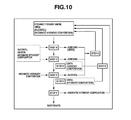
- FIG. 10 shows a conceptual drawing depicting one aspect of the present embodiment that combines a route 3) with steps (D), (E), (F) and (G);
- FIG. 11 shows a conceptual drawing depicting one aspect of the present embodiment that combines a route 4) with steps (D), (E), (F) and (G);
- FIG. 12 shows a conceptual drawing depicting one aspect of the present embodiment that combines a route 5) with steps (D), (E), (F) and (G);
- FIG. 13 shows a conceptual drawing depicting an N-substituted carbamic acid ester production apparatus in an example of the present embodiment
- FIG. 14 shows a conceptual drawing depicting an N-substituted carbamic acid ester production apparatus in an example of the present embodiment
- FIG. 15 shows a conceptual drawing depicting an N-substituted carbamic acid ester production apparatus in an example of the present embodiment
- FIG. 16 shows a conceptual drawing depicting a transesterification reaction apparatus in an example of the present embodiment
- FIG. 17 shows a conceptual drawing depicting an isocyanate production apparatus in an example of the present embodiment
- FIG. 18 shows a conceptual drawing depicting an isocyanate production apparatus in an example of the present embodiment
- FIG. 19 shows a conceptual drawing depicting an apparatus for producing a compound having ureido groups in an example of the present embodiment
- FIG. 20 shows a conceptual drawing depicting an N-substituted carbamic acid ester production apparatus in a comparative example of the present embodiment
- FIG. 21 shows a conceptual drawing depicting an N-substituted carbamic acid ester production apparatus in an example of the present embodiment
- FIG. 22 shows a conceptual drawing depicting a urea production apparatus in an example of the present embodiment
- FIG. 23 shows the 1 H-NMR spectrum of a composition for transfer and storage of a compound having the ureido groups of Example 97 of the present embodiment
- FIG. 24 shows the 1 H-NMR spectrum of a composition for transfer and storage of a compound having the ureido groups of Example 106 of the present embodiment
- FIG. 25 shows the 1 H-NMR spectrum of a composition for transfer and storage of a compound having the ureido groups of Example 122 of the present embodiment.
- FIG. 26 shows the 1 H-NMR spectrum of a composition for transfer and storage of a compound having the ureido groups of Example 142 of the present embodiment.
- present embodiment provides a detailed explanation of the best mode for carrying out the present invention (to be referred to as “present embodiment”). Furthermore, the present invention is not limited to the following present embodiment, but rather can be modified in various ways within the scope of the gist thereof.
- composition for transfer and storage of a compound having ureido groups in the present embodiment refers to a composition for transferring and storing compounds having ureido groups, in which the number of molecules of an aromatic hydroxy compound in an aromatic hydroxy composition (composition containing at least one type of aromatic hydroxy compound represented by the following formula (2)) based on the number of ureido groups contained in a compound having ureido groups represented by the following formula (1) in the composition is an integer of from 1 to 100:
- R 1 represents an organic group which contains an integral number of carbon atoms within a range of from 1 to 85, and which is substituted by a number of ureido groups, and a represents an integer of from 1 to 10, and
- ring A represents an organic group, which contains an aromatic group substituted by number b of hydroxy groups at arbitrary locations that maintain aromatic properties, and which contains an integral number of carbon atoms within a range of from 6 to 50, may be a single or multiple heterocyclic ring, and may be substituted by other substituents, and b represents an integer of from 1 to 6).
- the compound having ureido groups used in the present embodiment easily forms hydrogen bonds between molecules thereof due to the ureido groups that compose the compound having ureido groups, there are many cases in which it has a high melting point.
- transfer is carried out by, for example, crushing a solid compound having ureido groups or shaping such as by forming into pellets.
- methods are also employed in which the compound having ureido groups is heated to a temperature higher than the melting point thereof to transfer the compound having the ureido groups in the form of a liquid.
- the composition of the present embodiment demonstrates the effect of being able to maintain the stability of the compound having the ureido groups by inhibiting thermal denaturation of the compound having the ureido groups in the composition during transfer or storage of the composition.
- the mechanism by which the effect of inhibiting thermal denaturation of the compound having the ureido groups is demonstrated is not clear, the inventors of the present invention presumed that, as a result of the aromatic hydroxy compound that composes the composition forming a state in which urethane bonds have difficulty in approaching each other due to the formation of hydrogen bonds between ureido bonds (—NHCONH 2 ) of the compound having the ureido groups and the weakly acidic aromatic hydroxy compound, it is difficult for a reaction to occur that forms compounds having ureylene (—NHCONH—) groups.
- ureylene groups (—NHCONH—) may be referred to as ureine groups in the explanation of the present embodiment.
- the composition for transfer and storage can be preferably used in the production of N-substituted carbamic acid-O-aryl ester in particular (although the term N-substituted carbamic acid-O-aryl ester is used frequently in the following explanations, the term N-substituted carbamic acid-O-aryl ester refers to an N-substituted carbamic acid ester in which oxygen atoms of the carbamic acid group (—NHCOO—) are bonded to an aromatic ring, the aromatic ring referring to an aromatic ring in which a group is bonded to an aromatic group, said group being selected from the group consisting of aromatic groups and/or aliphatic groups, and the aromatic ring being formed by bonding said group of integer numbers of at least 0 with the aromatic group, the details of which will be subsequently described).
- the method contains transferring the composition for transfer and storage to an N-substituted carbamic acid-O-aryl ester synthesis step, applying a compound having ureido groups contained in the composition to an esterification reaction, and recovering the N-substituted carbamic acid-O-aryl ester formed.
- the N-substituted carbamic acid-O-aryl ester synthesis step is carried out at a high temperature, and if compounds having the ureido groups are supplied in a state of having hydrogen bonds between molecules thereof, denaturation to compounds having thermally stable ureylene groups is thermodynamically advantageous.
- a compound having ureylene groups is a condensed form of the compound having ureido groups and is a high molecular weight compound.
- problems occur due to the formation of polymers that adhere or solidify in the reactor.
- the compound having the ureido groups contains compounds such as ammonia or urea. These compounds, and particularly urea, frequently undergo thermal decomposition to isocyanic acid and ammonia at the synthesis temperature range of the N-substituted carbamic acid-O-aryl ester synthesis step, and when the isocyanic acid reacts with the compound having ureido groups, they are denatured to compounds having biuret bonds.
- the compounds having biuret bonds have a high thermal decomposition temperature, and present difficulties in forming N-substituted carbamic acid-O-aryl ester due to reacting with aromatic hydroxy compounds.
- the inventors of the present invention found that denaturation of compounds having ureido groups during transfer and storage of the composition for transfer and storage is inhibited even if the composition for transfer and storage contains specific amounts of this ammonia and urea. This effect is particularly remarkable during long-term storage, and there are many cases in which denaturation is unable to be confirmed even during accelerated evaluation and testing. This finding was heretofore unknown and is surprising.
- the inventors of the present invention have surmised that, during transfer and storage of the composition, the aromatic hydroxy compound inhibits denaturation of compounds of ammonia and urea or the like and the compounds having the ureido groups by trapping water and oxygen present in trace amounts, and when producing N-substituted carbamic acid-O-aryl ester using this composition, the aromatic hydroxy compound also functions as an esterification catalyst of the N-substituted carbamic acid-O-aryl ester.
- the ratio of the number of molecules (y) of the aromatic hydroxy compound that composes the aromatic hydroxy composition to the number of ureido groups (x) that compose (or are contained in) the compound having ureido groups is within a range of from 1 to 100.
- y is preferably in excess based on x in the case of assuming the mechanism described above, on the other hand, in consideration of the transfer efficiency of the compound having the ureido groups and the size of the storage tank during storage, the ratio of y to x is preferably within a range of greater than 2 but less than 50, and more preferably within a range of greater than 3 but less than 20.
- the compound having the ureido groups contained in the composition is preferably a compound having ureido groups that is obtained by reacting an organic primary amine, urea and/or carbonic acid derivative (to be subsequently explained in detail) and/or isocyanic acid and/or non-N-substituted carbamic acid.
- the compound having the ureido groups is more preferably a compound having ureido groups that is obtained by reacting an organic primary amine and urea.
- the composition for transfer and storage may also contain components other than the compound having the ureido groups and the aromatic hydroxy compound.
- components may include the above-mentioned ammonia, urea, carbonic acid derivative (the carbonic acid derivative indicated in the present embodiment will be subsequently explained in detail), non-N-substituted carbamic acid, compound having a biuret bond, compound having a ureylene group, water, alcohol, inert gas (such as nitrogen gas, carbon dioxide gas, argon gas or ammonia gas) and N-substituted carbamic acid-O-ester such as N-substituted carbamic acid-O-(alkyl or aryl) ester obtained by reacting the composition for transfer and storage with an aromatic hydroxy composition (to be subsequently explained in detail).
- inert gas such as nitrogen gas, carbon dioxide gas, argon gas or ammonia gas
- N-substituted carbamic acid-O-ester such as N-substituted carb
- the amounts at which these components are contained are preferably adjusted as the occasion demands.
- Particularly noteworthy components are oxygen, ammonia, water, oxidizing substances and reducing substances.
- the composition for transfer and storage contains compounds containing nitrogen atoms, or the aromatic hydroxy composition may be denatured as a result of being oxidized by oxygen resulting in the occurrence of phenomena such as coloring.
- oxygen gas is to be managed using known methods in the same manner as ordinary storage of organic chemical substances carried out in this technical field.
- the concentration of gaseous phase oxygen in a storage tank is controlled by purging with nitrogen so that the oxygen concentration is 10% or less, preferably 1% or less and more preferably 100 ppm or less.
- the oxygen concentration of the insert gas is controlled to 10 ppm or less.
- the dissolved ammonia concentration in the composition is controlled to 1% by weight or less and preferably to 0.1% by weight or less.
- the control method may be a known method such as purging the liquid phase with an inert gas such as nitrogen gas.
- the water concentration in the composition is 10% by weight or less and preferably 1% by weight or less, although dependent upon the components of the composition, and in the case of using the composition as a raw material of an N-substituted carbamic acid-O-aryl ester, the water concentration is more preferably 100 ppm or less since a large amount of water present may cause side reactions attributable to the water.
- the concentration of water may be controlled by a known method such as the use of a dehydrating agent or desiccant, distilling under a reduced pressure, an increased pressure or a normal pressure, or purging a liquid phase with an inert gas to remove the water together with the inert gas.
- Oxidizing substances refer to Bronsted acids such as organic acids or inorganic acids and Lewis acids
- reducing substances refer to Bronsted bases such as organic bases or inorganic bases, Lewis bases and hydrogen gas.
- Reducing substances do not include compounds derived from the composition, such as the above-mentioned ammonia, urea, carbonic acid derivative or compounds that compose the composition (for example, N-substituted carbamic acid-O-esters such as N-substituted carbamic acid-O-aryl ester, N-substituted carbamic acid-O-alkyl ester or N-substituted carbamic acid-O—R 2 ester (the N-substituted carbamic acid-O—R 2 ester will be subsequently described in detail)).
- N-substituted carbamic acid-O-esters such as N-substituted carbamic acid-O-aryl ester, N-substituted carbamic acid-O-alkyl ester or N-substituted carbamic acid-O—R 2 ester (the N-substituted carbamic acid-O—R 2 ester will be subsequently described in detail)
- N-substituted carbamic acid-O—(R 2 or aryl) ester (the N-substituted carbamic acid-O—R 2 ester will be subsequently described in detail) obtained in a process for producing N-substituted carbamic acid-O-aryl ester from the composition for transfer and storage and an aromatic hydroxy composition (to be subsequently described in detail)
- the compound having the ureido groups and the N-substituted carbamic acid-O—(R 2 or aryl) ester reacts during storage resulting in the formation of a dealcoholized or de-aromatic hydroxylated compound that condenses by forming ureylene bonds
- the amount thereof based on the compound having the ureido groups contained in the composition for transfer and storage is controlled to 10 molar equivalents or less and preferably 1 molar equivalent or less.
- the composition for transfer and storage may be in the form of a slurry or solid. It is preferably in the form of a slurry and more preferably in the form of a liquid. Since urea tends to solidify easily, in consideration of fluidity, it is controlled to 20 molar equivalents or less and preferably 10 molar equivalents or less based on the compound having the ureido groups contained in the composition for transfer and storage. Although there are also no limitations on alcohol, it may be controlled corresponding to the need to distill off alcohol following transfer. For example, the amount of alcohol is controlled to 100 molar equivalents or less and preferably 10 molar equivalents or less based on the compound having the ureido groups contained in the composition for transfer and storage.
- N-substituted carbamic acid-O—(R 2 or aryl) ester is frequently used in the present specification, this refers to an N-substituted carbamic acid-O—R 2 ester or N-substituted carbamic acid-O-aryl ester.
- the conditions for storage and transfer of the composition there are no particular limitations on the conditions for storage and transfer of the composition, there are conditions at which a thermal decomposition reaction of the compound having the ureido groups occurs extremely easily at high temperatures.
- storage is carried out within a range of from ⁇ 40 to 280° C., and in cases in which fluidity and stability are impaired, preferably at 0 to 260° C. and more preferably at 40 to 260° C.
- the storage temperature may be controlled corresponding to the application of the composition, the storage period and the handling ease of the composition.
- transfer is also carried out at a temperature within the temperature range during storage, when using the composition as a raw material of N-substituted carbamic acid-O-aryl ester, and when transferring to the N-substituted carbamic acid-O-aryl ester synthesis step, transfer may be carried out after confirming that transfer can be carried out safely according to the conditions of the reaction step and the equipment used in the reaction step since transfer to the reactor of the synthesis step is typically carried out after preheating to the reaction temperature. Generally, transfer is carried out within a range of from ⁇ 40 to 280° C., and in cases in which fluidity and stability are impaired, is preferably carried out at 0 to 260° C. and more preferably at 40 to 260° C.
- Transfer may be controlled depending on the application of the composition, transfer time and handling ease of the composition as previously described.
- pressure during transfer storage may be carried out under conditions of a reduced pressure to conditions of an increased pressure.
- the ratio of the compound having the ureido groups and the aromatic hydroxy composition in the composition is controlled to be within the previously described range.
- storage vessels, lines and the like during storage and transfer A vessel is selected in accordance with applicable handling regulations in consideration of the handling of a flammable organic substance while paying attention to the flash point of the composition being handled.
- the material and a known material can be used.
- Examples of materials may include glass, stainless steel, carbon steel, Hastelloy, glass-lined base materials and Teflon (registered trademark) coated materials.
- Known equipment may be incidentally provided as necessary as equipment for storage and transfer of the composition, such as pumps, temperature control equipment or instrumentation.
- composition for transfer and storage of the compound having the ureido groups indicated above may be prepared by mixing the compound having the ureido groups, aromatic hydroxy composition, ammonia, N-substituted carbamic acid-O—(R 2 or aryl) ester, urea, alcohol, carbonic acid derivative and other components as previously described so as to be formulated as previously described, or may be prepared by adding and/or removing an aromatic hydroxy composition, urea, alcohol, ammonia or carbonic acid derivative and the like so as to be formulated as previously described based on a composition containing a compound having ureido groups obtained in the production of the compound having the ureido groups.
- the method for producing the compound having the ureido groups can be preferably carried out in the manner subsequently described.
- the present embodiment refers to a method for producing at least one N-substituted carbamic acid-O-aryl ester (wherein an N-substituted carbamic acid-O-aryl ester refers to an N-substituted carbamic acid ester in which oxygen atoms of the carbamic acid group (—NHCOO—) are bonded to an aromatic ring) derived from a compound having ureido groups and an aromatic hydroxy composition from a compound having ureido groups represented by formula (1) and an aromatic hydroxy composition containing at least one type of aromatic hydroxy compound represented by formula (2), which comprises the step of carrying out an esterification reaction or an esterification reaction and transesterification reaction. (The above-mentioned formulas (1) and (2) will subsequently be explained in detail.)
- the production method of the present embodiment is a method for producing an N-substituted carbamic acid-O-aryl ester derived from a compound having ureido groups and an aromatic hydroxy composition from the compound having ureido groups and the aromatic hydroxy composition (indicating a group of aromatic hydroxy compounds containing at least one type of aromatic hydroxy compound) (and although subsequently described in detail, a method for obtaining N-substituted carbamic acid-O-aryl ester and by-product ammonia by reacting the compound having ureido groups and the aromatic hydroxy composition, as well as a method for obtaining N-substituted carbamic acid-O—R 2 ester and by-product alcohol (R 2 OH) by obtaining an N-substituted carbamic acid-O—R 2 ester and by-product ammonia by esterifying the compound having ureido groups and an alcohol (although subsequently explained, the alcohol refers to an alcohol represented by R 2 OH in the
- the production method of the present embodiment is a method for producing N-substituted carbamic acid-O-aryl ester in a step comprising an esterification reaction from a compound having ureido groups and an aromatic hydroxy composition. More specifically, the production method of the present embodiment is a method for producing N-substituted carbamic acid-O-aryl ester in a step comprising an esterification reaction or an esterification reaction and a transesterification reaction.
- An esterification reaction refers to a reaction in which ureido groups (—NHCONH 2 ) in a compound having ureido groups are converted to carbamic acid groups and ammonia is formed as a by-product thereof.
- this esterification reaction contains a reaction in which the ureido groups (—NHCONH 2 ) are converted to carbamic acid-O-aryl ester groups (—NHCOOAr) obtained from ureido groups in a compound having ureido groups and an aromatic hydroxy compound, with ammonia being formed as a by-product accompanying the reaction, or a reaction in which the ureido groups (—NHCONH 2 ) are converted to carbamic acid-O—R 2 ester groups (—NHCOOR 2 ) obtained from ureido groups in a compound having ureido groups and an alcohol (R 2 OH), with ammonia being formed as a by-product accompanying the reaction.
- the Ar indicated for the above-mentioned carbamic acid-O-aryl ester groups refers to a residue in which a single hydrogen atom of a hydroxyl group directly bonded to an aromatic hydrocarbon ring has been removed from an aromatic hydroxy compound.
- the esterification reaction refers to a reaction in which an N-substituted carbamic acid-O-aryl ester represented by formula (43) is obtained from a compound having ureido groups represented by formula (1) to be subsequently indicated and an aromatic hydroxy compound represented by formula (2), with ammonia being formed as a by-product accompanying the reaction, and a reaction in which an N-substituted carbamic acid-O—R 2 ester represented by formula (49) is obtained from a compound having ureido groups represented by formula (1) and an alcohol represented by formula (4), with ammonia being formed as a by-product accompanying the reaction.
- the above-mentioned transesterification reaction specifically refers to a reaction in which an N-substituted carbamic acid-O—R 2 ester represented by formula (49) and an aromatic hydroxy compound are reacted to convert the carbamic acid-O-ester groups (—NHCOOR 2 ) in the N-substituted carbamic acid-O—R 2 ester to carbamic acid-O-aryl ester groups (—NHCOOAr), with alcohol (R 2 OH) being formed as a by-product of the reaction.
- Ar is the same as previously defined. (These will also be subsequently described in detail.)
- the present embodiment includes the case of obtaining an N-substituted carbamic acid-O-aryl ester by directly carrying out an esterification reaction on a compound having ureido groups and an aromatic hydroxy composition (composition containing at least one type of aromatic hydroxy compound), and the case of obtaining an N-substituted carbamic acid-O-aryl ester by carrying out an esterification reaction on a compound having ureido groups and an alcohol, and then carrying out a transesterification reaction on an aromatic hydroxy composition (composition containing at least one type of aromatic hydroxy compound).
- the method for producing the compound having ureido groups may be a known method, and can be obtained by, for example, reacting an organic primary amine, urea and/or carbonic acid derivative (to be subsequently described in detail) and/or isocyanic acid and/or non-N-substituted carbamic acid
- at least one type of compound having ureido groups derived from an organic primary amine and urea is preferably obtained by a production method that reacts the organic primary amine and urea in a ureidation reaction.
- An organic primary amine used in the present embodiment (wherein an organic primary amine refers to a “primary amine” (mono primary amines and poly primary amines) as defined in rule C-8 of the nomenclature (IUPAC Nomenclature of Organic Chemistry) stipulated by the International Union of Pure and Applied Chemistry (IUPAC) is an organic primary amine represented by the following formula (3). This rule is based on Recommendations on Organic & Biochemical Nomenclature.
- organic refers generically to a group of compounds considered to be subject to the nomenclature disclosed in the above publications.
- the subjects may be subjects described in recommendations published in 1993.
- the subjects may be subjects described in recommendations published in 1993 (in the case it is difficult to acquire the above-mentioned publications published in Japan, 1979 recommendations and 1993 recommendations may be referred to).
- “organic” compounds covered by the nomenclature described above include organometallic compounds and metal complexes.
- organometallic compounds and metal complexes include organometallic compounds and metal complexes.
- the following provides explanations of “organic”, and/or “organic groups”, and/or “substituents” and the like, as well as compounds used in the present embodiment, when not specifically explained, these are composed of atoms that do not include metal atoms and/or semimetals.
- organic compounds composed of atoms selected from H (hydrogen atoms), C (carbon atoms), N (nitrogen atoms), O (oxygen atoms), S (sulfur atoms), Cl (chlorine atoms), Br (bromine atoms) and I (iodine atoms) are used in the present embodiment.
- Aliphatic and “aromatic” are frequently used in the following explanations. According to the above-mentioned IUPAC rules, organic compounds are described as being classified into aliphatic and aromatic. Aliphatic compounds refer to the definitions of groups in accordance with aliphatic compounds based on the 1995 IUPAC recommendations. Aliphatic compounds are defined in these recommendations as “acyclic or cyclic saturated or unsaturated carbon compounds, excluding aromatic compounds”. Aliphatic groups, which are frequently used in the present specification, refer to groups composed of the aliphatic compounds. These groups are such that an R moiety, in which a hydrogen atom has been removed from an aliphatic compound in the form of RH, for example, is defined as a monovalent aliphatic group.
- aliphatic and aliphatic groups used in the explanation of the present invention include saturated and unsaturated as well as linear and cyclic aliphatic compounds, and refer to “organic compounds”, “organic groups” and “substituents” composed of atoms selected from the above-mentioned H (hydrogen atoms); C (carbon atoms); N (nitrogen atoms); O (oxygen atoms); S (sulfur atoms); Si (silicon atoms); and halogen atoms selected from Cl (chlorine atoms), Br (bromine atoms) and I (iodine atoms).
- non-aromatic reactive groups including groups such as aralkyl groups and alkyl groups are frequently denoted as “aliphatic groups optionally substituted with an aromatic group”, “aliphatic group substituted with an aromatic group” or “aliphatic group bonded to an aromatic group” and the like.
- aliphatic groups optionally substituted with an aromatic group aliphatic group optionally substituted with an aromatic group
- aliphatic group substituted with an aromatic group or “aliphatic group bonded to an aromatic group” and the like.
- a primary amine refers to a compound having an amino group (—NH 2 ) in which an aliphatic compound and/or aromatic compound and/or aliphatic group and aromatic group are bonded.
- an organic primary amine as referred to in the present application indicates a “primary amine” that is classified as being “organic” as previously described.
- An organic primary amine preferably used in the present embodiment is an organic primary amine represented by the following formula (3): R 1 (NH 2 ) c (3) (wherein
- R 1 represents an organic group which contains carbon atoms within a range of from 1 to 85, and which is substituted by number c of NH 2 groups, and c represents an integer of from 1 to 10).
- R 1 is an organic group classified as “organic” as previously described, and an organic primary amine in the present embodiment refers to an organic primary amine in which number c of NH 2 groups are bonded to an organic group containing carbon atoms within a range of from 1 to 85.
- R 1 represents an aliphatic group, aromatic group or group bonded to an aliphatic group and an aromatic group, and represents a group composed of an acyclic hydrocarbon group or cyclic hydrocarbon group (such as a monocyclic hydrocarbon group, condensed polycyclic hydrocarbon group, crosslinked cyclic hydrocarbon group, spirohydrocarbon group, ring-assembling hydrocarbon group, cyclic hydrocarbon group having a side chain, heterocyclic group, heterocyclic spiro group, hetero-crosslinked ring group or compound ring group), a group bonded from one or more types of groups selected from the above-mentioned acyclic hydrocarbon groups and cyclic hydrocarbon groups, and groups in which the above-mentioned groups are bonded through a covalent bond with a specific non-metal atom (carbon, oxygen, nitrogen, sulfur or silicon).
- a specific non-metal atom carbon, oxygen, nitrogen, sulfur or silicon
- a covalent bond with a specific non-metal atom as described above is in a state in which the above-mentioned groups are bonded by a covalent bond with, for example, groups represented by the following formulas (8) to (16).
- R 1 groups that can be preferably used in the present embodiment in consideration of less susceptibility to the occurrence of side reactions contains groups selected from the group consisting of acyclic hydrocarbon groups and cyclic hydrocarbon groups selected from aliphatic groups, aromatic groups and groups bonded to aliphatic groups and aromatic groups (such as a monocyclic hydrocarbon group, condensed polycyclic hydrocarbon group, crosslinked cyclic hydrocarbon group, spirohydrocarbon group, ring-assembling hydrocarbon group or cyclic hydrocarbon group having a side chain), and groups bonded to at least one type of group selected from this group (mutually substituted groups), having carbon atoms within the range of 1 to 85.
- the number of carbon atoms of the groups is preferably within a range of from 1 to 70 and more preferably within a range of from 1 to 13.
- organic amines composed by the R 1 group may include:
- R 1 group has 6 to 85 carbon atoms and contains one or more types of an aromatic ring optionally substituted with an aliphatic group and/or aromatic group, an aromatic group in the R 1 group is substituted with an NH 2 group, and c is 1,
- aromatic organic poly primary amines in which the R 1 group has 6 to 85 carbon atoms and contains one or more types of an aromatic ring optionally substituted with an aliphatic group and/or aromatic group, an aromatic group in the R 1 group is substituted with an NH 2 group, and c is 2 or more, and
- aliphatic organic poly primary amines in which the R 1 group is an aliphatic group having 1 to 85 carbon atoms optionally substituted with an aromatic group, and c is 2 or 3.
- the R 1 group is an aliphatic group having 1 to 85 carbon atoms optionally substituted with an aromatic group
- c is 2 or 3.
- atoms bonded to an NH 2 group (and preferably carbon atoms) that are contained in an aromatic ring are denoted as aromatic organic amines
- cases of bonding to atoms not in an aromatic ring are denoted as aliphatic organic amines.
- More preferable aliphatic groups are linear hydrocarbon groups, cyclic hydrocarbon groups and at least one type of group selected from the linear hydrocarbon groups and cyclic hydrocarbon groups (referring to, for example, cyclic hydrocarbon groups substituted with a linear hydrocarbon group or linear hydrocarbon groups substituted with a cyclic hydrocarbon group) having 6 to 70 carbon atoms.
- aromatic organic mono primary amines in which the R 1 group is a group having 6 to 85 carbon atoms and contains one or more types of an aromatic ring optionally substituted with an aliphatic group and/or aromatic group, an aromatic group in the R 1 group is substituted with an NH 2 group and c is 1, preferably aromatic organic mono primary amines in which the R 1 group is a group having 6 to 70 carbon atoms and c is 1, and more preferably in consideration of fluidity and the like, aromatic organic mono primary amines in which the R 1 group has 6 to 13 carbon atoms and c is 1, which are aromatic organic mono primary amines represented by the following formula (5).
- groups R 3 to R 6 respectively represent a group substituted at an arbitrary location that maintains aromatic properties of the ring
- groups R 3 to R 6 may respectively and independently substitute an aromatic ring or groups R 3 to R 6 may together bond to form a ring with an aromatic ring
- groups R 3 to R 6 are hydrogen atoms or groups composed of groups in which a group selected from the group consisting of an alkyl group, a cycloalkyl group, an aryl group and an aryl group having a hydroxy group is bonded by saturated aliphatic bonds and/or ether bonds, the number of carbon atoms of groups R 3 to R 6 is an integral number within a range of from 0 to 7, and the total number of carbon atoms that compose the aromatic organic primary monoamine represented by formula (5) is an integer of from 6 to 13).
- aromatic organic mono primary amines represented by formula (5) may include those in which the R 3 to R 6 groups are hydrogen atoms or groups selected from alkyl groups such as a methyl group or an ethyl group, and examples of such aromatic organic mono primary amines may include aniline, aminotoluene (including isomers), dimethylaniline (including isomers), diethylaniline (including isomers), dipropylaniline (including isomers), aminonaphthalene (including isomers), aminomethylnaphthalene (including isomers), dimethylnaphthylamine (including isomers) and trimethylnaphthylamine (including isomers), with aniline being used more preferably.
- aromatic organic polyamines may include diaminobenzene (including isomers), diaminotoluene (including isomers), methylenedianiline (including isomers), diaminomesitylene (including isomers), diaminobiphenyl (including isomers), diaminodibenzyl (including isomers), bis(aminophenyl)methane (including isomers), bis(aminophenyl)propane (including isomers), bis(aminophenyl)ether (including isomers), bis(aminophenoxyethane) (including isomers), ⁇ ⁇ ′-diaminoxylene (including isomers), diaminoanisole (including isomers), diaminophenetol (including isomers), diaminonaphthalene (including isomers), diamino-methylbenzene (including isomers), diamino-methylpyridine (including isomers), diamino-methylnaphthal
- n is an integer of from 0 to 6).
- More preferable organic amines are aliphatic organic primary amines in which the aliphatic group is a linear hydrocarbon group, cyclic hydrocarbon group or group to which is bonded at least one type of group selected from the linear hydrocarbon groups and the cyclic hydrocarbon groups (such as cyclic hydrocarbon group substituted with a linear hydrocarbon group or linear hydrocarbon group substituted with a cyclic hydrocarbon group).
- the organic amine is an aliphatic organic poly primary amine in which the R 1 group is an aliphatic group that is an acyclic hydrocarbon group, a cyclic hydrocarbon group or a group to which is bonded at least one type of group selected from the acyclic hydrocarbon groups and the cyclic hydrocarbon groups (such as a cyclic hydrocarbon group substituted with an acyclic hydrocarbon group or acyclic hydrocarbon group substituted with a cyclic hydrocarbon group) having 1 to 70 carbon atoms, and c is 2 or 3.
- the R 1 group is an aliphatic group that is an acyclic hydrocarbon group, a cyclic hydrocarbon group or a group to which is bonded at least one type of group selected from the acyclic hydrocarbon groups and the cyclic hydrocarbon groups (such as a cyclic hydrocarbon group substituted with an acyclic hydrocarbon group or acyclic hydrocarbon group substituted with a cyclic hydrocarbon group) having 1 to 70 carbon atoms,
- the organic amine is more preferably an aliphatic organic poly primary amine in which the R 1 group is an acyclic hydrocarbon group, a cyclic hydrocarbon group or a group to which is bonded at least one type of group selected from the acyclic hydrocarbon groups and the cyclic hydrocarbon groups (such as a cyclic hydrocarbon group substituted with an acyclic hydrocarbon group or an acyclic hydrocarbon group substituted with a cyclic hydrocarbon group) having 6 to 13 carbon atoms and composed of carbon atoms and hydrogen atoms.
- the R 1 group is an acyclic hydrocarbon group, a cyclic hydrocarbon group or a group to which is bonded at least one type of group selected from the acyclic hydrocarbon groups and the cyclic hydrocarbon groups (such as a cyclic hydrocarbon group substituted with an acyclic hydrocarbon group or an acyclic hydrocarbon group substituted with a cyclic hydrocarbon group) having 6 to 13 carbon atoms and composed of carbon atoms
- R 1 group is a linear and/or branched alkyl group, a cycloalkyl group or a group composed of the alkyl groups and cycloalkyl groups.
- organic amines may include aliphatic di-primary amines such as ethylenediamine, diaminopropane (including isomers), diaminobutane (including isomers), diaminopentane (including isomers), diaminohexane (including isomers) or diaminodecane (including isomers); aliphatic triamines such as triaminohexane (including isomers), triaminononane (including isomers) or triaminodecane (including isomers); and, substituted cyclic aliphatic polyamines such as diaminocyclobutane (including isomers), diaminocyclohexane (including isomers), 3-amino
- Examples thereof may include alkyl di-primary amines such as ethylenediamine, diaminopropane (including isomers), diaminobutane (including isomers), diaminopentane (including isomers), diaminohexane (including isomers), diaminoheptane (including isomers), diaminooctane (including isomers), diaminononane (including isomers) or diaminodecane (including isomers); alkyl tri-primary amines such as triaminohexane (including isomers), triaminoheptane (including isomers), triaminooctane (including isomers), triaminononane (including isomers) or triaminodecane (including isomers); cycloalkyl primary amines such as diaminocyclobutane (including isomers), diaminocyclopentane (including isomers
- organic primary amines explained in 1), 2) and 3) above are used preferably, and in particular the organic primary amine is more preferably an organic primary monoamine, organic primary diamine or organic primary triamine (in which c in formula (3) above is an integer of 1, 2 or 3).
- a compound having ureido groups used when producing an N-substituted carbamic acid-O-aryl ester from the composition for transfer and storage of the compound having ureido groups of the present embodiment and/or an aromatic hydroxy composition is a compound represented by the following formula (1):
- R 1 represents an organic group which contains an integral number of carbon atoms within a range of from 1 to 85, and which is substituted by a number of ureido groups, and a represents an integer of from 1 to 10).
- the compound having the ureido groups represented by formula (1) above is a compound having “ureido groups” as defined in nomenclature rule C-971 stipulated by IUPAC.
- R 1 is an organic group classified as “organic” as described above, and the compound having the ureido groups according to the present embodiment is a compound having ureido groups bonded to a number of ureido groups (—NH—CONH 2 ) including carbon atoms within a range of from 1 to 85.
- R 1 represents an aliphatic group, an aromatic group or a group bonded to an aliphatic group and an aromatic group, and represents a group composed of an acyclic hydrocarbon group or a cyclic hydrocarbon group (such as a monocyclic hydrocarbon group, a condensed polycyclic hydrocarbon group, a crosslinked cyclic hydrocarbon group, a spirohydrocarbon group, a ring-assembling hydrocarbon group, a cyclic hydrocarbon group having a side chain, a heterocyclic group, a heterocyclic spiro group, a hetero-crosslinked ring group or a heterocyclic group), a group bonded from one or more types of groups selected from the above-mentioned acyclic hydrocarbon groups and cyclic hydrocarbon groups, and groups in which the above-mentioned groups are bonded through a covalent bond with a specific non-metal atom (carbon, oxygen, nitrogen, sulfur or silicon).
- a specific non-metal atom carbon, oxygen, nitrogen
- a covalent bond with a specific non-metal atom as described above is in a state in which the above-mentioned groups are bonded by a covalent bond with, for example, groups represented by the following formulas (8) to (16).
- R 1 groups that can be preferably used in the present embodiment in consideration of less susceptibility to the occurrence of side reactions contains groups selected from the group consisting of acyclic hydrocarbon groups and cyclic hydrocarbon groups selected from aliphatic groups and aromatic groups (such as a monocyclic hydrocarbon group, a condensed polycyclic hydrocarbon group, a crosslinked cyclic hydrocarbon group, a spirohydrocarbon group, a ring-assembling hydrocarbon group or a cyclic hydrocarbon group having a side chain), and groups bonded to at least one type of group selected from this group (mutually substituted groups), containing 1 to 85 carbon atoms.
- the number of carbon atoms is preferably 1 to 70 and more preferably 1 to 13.
- Preferable examples of compounds having a ureido group composed by the R 1 group may include: 1) N-substituted aromatic organic monoureas in which the R 1 group has 6 to 85 carbon atoms and contains one or more types of an aromatic ring optionally substituted with an aliphatic group and/or an aromatic group, an aromatic group in the R 1 group is substituted with a ureido group, and c is 1, 2) N-substituted aromatic organic polyureas in which the R 1 group has 6 to 85 carbon atoms and contains one or more types of an aromatic ring optionally substituted with an aliphatic group and/or an aromatic group, an aromatic group in the R 1 group is substituted with a ureido group, and c is 2 or more, and 3) N-substituted aliphatic organic polyureas in which the R 1 group is an aliphatic group having 1 to 85 carbon atoms optionally substituted with an aromatic group, and c is 2 or 3.
- N-substituted aromatic organic ureas compounds in which atoms bonded to a ureido group (mainly carbon atoms) that are contained in an aromatic ring are denoted as N-substituted aromatic organic ureas, while cases of bonding to atoms not in an aromatic ring (mainly carbon atoms) are denoted as N-substituted aliphatic organic ureas.
- an aliphatic group is a linear hydrocarbon group, a cyclic hydrocarbon group and at least one type of group bonded to a group selected from the linear hydrocarbon groups and cyclic hydrocarbon groups (referring to, for example, cyclic hydrocarbon groups substituted with a linear hydrocarbon group or linear hydrocarbon groups substituted with a cyclic hydrocarbon group) having 6 to 70 carbon atoms.
- the method for producing the compound having the ureido groups may be a known method, and can be obtained by, for example, reacting an organic primary amine, urea and/or carbonic acid derivative (to be subsequently described in detail) and/or isocyanic acid and/or non-N-substituted carbamic acid
- at least one type of compound having the ureido groups derived from an organic primary amine and urea is preferably obtained by a production method that reacts the organic primary amine and urea in a ureidation reaction
- a compound having ureido groups preferably uses a compound having ureido groups obtained in a process that includes the following step A:
- R 1 represents an organic group which contains an integral number of carbon atoms within a range of 1 to 85, and which is substituted by number c of NH 2 groups, and c represents an integer of from 1 to 10).
- a compound having ureido groups obtained in step (A) above is a compound having ureido groups that has an organic group derived from the above-mentioned organic primary amine.
- this step contains reacting organic primary amino groups (—NH 2 ) of the organic primary amine with urea to form the ureido groups (this reaction is frequently referred to as an ureidation reaction in the present embodiment).
- (—CONH 2 ) groups within the ureido groups (—NHCONH 2 ) are formed from the urea reacted in the reaction.
- the term “derived” is frequently used in the present specification, the term “derived” is used in the sense of inheriting a group possessed by a raw material when a functional group of the raw material compound changes in a reaction.
- the compound having the ureido groups has a structure that has inherited the organic primary amino groups (—NH 2 ) of the organic primary amine, while the (—CONH 2 ) groups within the ureido groups refer to (—CONH 2 ) groups contained in the reacted urea (NH 2 CONH 2 ).
- a is an integer equal to or less than c, and a and c are preferably the same integers.
- a ureido group is the same of a substituent, and in the present specification, is described as the name of a compound in the form of an “N-substituted (substituent name) urea”.
- N nitrogen atom
- N-substituted is clearly indicated
- the substituent is clearly indicated as being an aromatic group or aliphatic group
- organic is also intentionally clearly indicated in the sense that the compound is an organic compound.
- a compound is clearly indicated as being “monourea” in the case of a single ureido group within a molecule thereof, or is clearly indicated as being a “polyurea” in the case of multiple ureido groups within a molecule thereof. Since the compound is an N-substituted urea, even in cases of multiple ureido groups, the ureido groups contained in a compound having ureido groups explained below are indicated by attaching the prefix “poly”, “di” or “tri” and the like immediately before the term “urea” as indicated above to facilitate distinction thereof.
- N-substituted aromatic organic monourea refers to that in which the R 1 group has 6 to 85 carbon atoms and contains one or more types of an aromatic ring optionally substituted with an aliphatic group and/or aromatic group, an aromatic group in the R 1 group is substituted with a ureido group, and c is 1, preferably refers to an aromatic organic monourea in which the R 1 group is a group having 6 to 70 carbon atoms and c is 1, and in consideration of fluidity and the like, more preferably refers to an N-substituted aromatic organic monourea in which the R 1 group is a group having 6 to 13 carbon atoms and c is 1, and is an N-substituted aromatic organic monourea represented by the following formula (41):
- groups R 10 to R 13 respectively represent a group substituted at an arbitrary location that maintains aromatic properties of the ring, groups R 10 to R 13 may respectively and independently substitute an aromatic ring or groups R 10 to R 13 may together bond to form a ring with an aromatic ring, groups R 10 to R 13 are hydrogen atoms or groups selected from groups composed of groups in which a group selected from the group consisting of an alkyl group, a cycloalkyl group, an aryl group and an aryl group having a hydroxy group is bonded by saturated aliphatic bonds and/or ether bonds, the number of carbon atoms is an integral number within a range of from 0 to 7, and the total number of carbon atoms that compose the N-substituted aromatic organic monourea represented by formula (41), excluding ureido groups (—NH—
- N-substituted aromatic organic monoureas represented by formula (41) may include those in which groups R 10 to R 13 are hydrogen atoms or groups selected from alkyl groups such as a methyl group or an ethyl group, and examples of such N-substituted aromatic organic monoureas may include N-phenylurea, N-tolylurea (including isomers), N-dimethylphenylurea (including isomers), N-diethylphenylurea (including isomers), N-dipropylphenylurea (including isomers), N-naphthalen-ylurea (including isomers), N-methylnaphthalen-ylurea (including isomers), N-dimethylnaphthalen-ylurea (including isomers) and N-trimethylnaphthalen-ylurea (including isomers).
- N-phenylurea is used more preferably.
- N-substituted aromatic organic polyurea refers to that in which the R 1 group is a group having 6 to 85 carbon atoms that contains one or more aromatic rings optionally substituted with an aliphatic group and/or an aromatic group, an aromatic group in the R 1 group is substituted with a ureido group and c is 2 or more, preferably an N-substituted aromatic organic polyurea in which the R 1 group is a group having 6 to 70 carbon atoms and c is 2 or more, and more preferably in consideration of fluidity and the like, an N-substituted aromatic organic polyurea in which the R 1 group contains one or more types of aromatic rings, the aromatic ring has 6 to 13 carbon atoms and may be further substituted with an alkyl group, an aryl group or an aralkyl group, a ureido group is bonded to the aromatic group contained in the R 1 group, and c is 2 or more.
- N-substituted aromatic organic polyureas may include N,N′-phenylene diurea (including isomers), N,N′-methylphenylene diurea (including isomers), N,N′-mesitylene diphenylene diurea (including isomers), N,N′-mesitylene diurea (including isomers), N,N′-biphenylene diurea (including isomers), N,N′-dibenzyldiurea (including isomers), N,N′-propan-diylphenylene diurea (including isomers), N,N′-oxydiphenylene diurea (including isomers), N,N′-diphenyl-diyl-dipropan-diyldiurea (including isomers), N,N′-phenylene dimethylene diurea (including isomers), N,N′-methoxyphenylene diurea (including isomers), N,N′-ethoxyphen
- n is an integer of from 0 to 6).
- N-substituted aliphatic organic polyurea is that in which the R 1 group is an aliphatic group having 1 to 85 carbon atoms that is optionally substituted with an aromatic group, and c is 2 or 3.
- Preferable N-substituted aliphatic organic polyureas are N-substituted aliphatic organic polyureas in which the aliphatic group is a linear hydrocarbon group, a cyclic hydrocarbon group (including aromatic groups) or a group to which is bonded at least one type of group selected from the linear hydrocarbon groups and the cyclic hydrocarbon groups (such as cyclic hydrocarbon group substituted with a linear hydrocarbon group or linear hydrocarbon group substituted with a cyclic hydrocarbon group).
- the N-substituted aliphatic organic polyurea is an N-substituted aliphatic organic polyurea in which the R 1 group is an aliphatic group that is an acyclic hydrocarbon group, a cyclic hydrocarbon group or a group to which is bonded at least one type of group selected from the acyclic hydrocarbon groups and the cyclic hydrocarbon groups (such as a cyclic hydrocarbon group substituted with an acyclic hydrocarbon group or acyclic hydrocarbon group substituted with a cyclic hydrocarbon group) having 1 to 70 carbon atoms, and c is 2 or 3.
- the R 1 group is an aliphatic group that is an acyclic hydrocarbon group, a cyclic hydrocarbon group or a group to which is bonded at least one type of group selected from the acyclic hydrocarbon groups and the cyclic hydrocarbon groups (such as a cyclic hydrocarbon group substituted with an acyclic hydrocarbon group or acyclic hydrocarbon group substituted with
- the N-substituted aliphatic organic polyurea is more preferably an N-substituted aliphatic organic polyurea in which the R 1 group is an acyclic hydrocarbon group, a cyclic hydrocarbon group or a group to which is bonded at least one type of group selected from the acyclic hydrocarbon groups and the cyclic hydrocarbon groups (such as a cyclic hydrocarbon group substituted with an acyclic hydrocarbon group or an acyclic hydrocarbon group substituted with a cyclic hydrocarbon group) having 6 to 13 carbon atoms that is composed of carbon atoms and hydrogen atoms.
- the R 1 group is an acyclic hydrocarbon group, a cyclic hydrocarbon group or a group to which is bonded at least one type of group selected from the acyclic hydrocarbon groups and the cyclic hydrocarbon groups (such as a cyclic hydrocarbon group substituted with an acyclic hydrocarbon group or an acyclic hydrocarbon group substituted with a cyclic
- R 1 group is a linear or branched alkyl group, a cycloalkyl group or a group composed of the alkyl groups and cycloalkyl groups.
- examples thereof may include N-substituted aliphatic organic polyureas such as methylenediurea, 1,2-dimethylenediurea, 1,3-trimethylenediurea, 1,4-tetramethylenediurea, 1,5-pentamethylenediurea, 1,6-hexamethylenediurea, 1,8-octamethylenediurea, cyclopentane-diurea (including isomers), cyclohexane-diurea (including isomers), cycloheptane-diurea (including isomers), cyclooctane-diurea (including isomers), methylcyclopentane-diurea (including isomers), ethylcyclopentane-
- step (A) may be carried out in the presence of water and/or alcohol and/or an aromatic hydroxy composition (composition containing at least one type of aromatic hydroxy compound) in addition to the organic primary amine and urea.
- an aromatic hydroxy composition composition containing at least one type of aromatic hydroxy compound
- step (A) is preferably carried out in the presence of the above-mentioned aromatic hydroxy composition (composition containing at least one type of aromatic hydroxy compound represented by the following formula (2)).
- one aspect of the present embodiment is a process for producing N-substituted carbamic acid-O-aryl ester which comprises the step (A), the following step (R) and the following step (P) by carrying out the step (R) (esterification reaction step) to obtain N-substituted carbamic acid-O—R 2 ester (the details of which will be subsequently described) and then carrying out the step (P) (transesterification reaction step) to obtain N-substituted carbamic acid-O-aryl ester after having carried out the step (A).
- An alcohol represented by the following formula (4) is also used for the alcohol used at that time.
- the aromatic hydroxy composition used in the following step (P) (composition containing at least one type of aromatic hydroxy compound represented by formula (2)) will be subsequently described in detail:
- R 2 represents a group composed of an aliphatic group or an aliphatic group in which an aromatic group is bonded, which contains an integral number of carbon atoms within a range of from 1 to 14, and the OH group of the alcohol represented by formula (4) is an OH group that is not bonded to an aromatic ring).
- a preferable alcohol represented by formula (4) is an alcohol in which the R 2 group is a group composed of an aliphatic group or an aliphatic group in which an aromatic group is bonded, and in which the OH group of an alcohol represented by formula (4) is an OH group that is not bonded to an aromatic group.
- the R 2 group represents a group composed of an acyclic hydrocarbon group or a cyclic hydrocarbon group (such as a monocyclic hydrocarbon group, a condensed polycyclic hydrocarbon group, a crosslinked cyclic hydrocarbon group, a spirohydrocarbon group, a ring-assembling hydrocarbon group, a cyclic hydrocarbon group having a side chain, a heterocyclic group, heterocyclic spiro group, a hetero-crosslinked ring group or a heterocyclic group), a group bonded from one or more types of groups selected from the above-mentioned acyclic hydrocarbon groups and cyclic hydrocarbon groups, and a group in which the above-mentioned groups are bonded through a covalent bond with a specific non-metal atom (carbon, oxygen, nitrogen, sulfur or silicon).
- a specific non-metal atom carbon, oxygen, nitrogen, sulfur or silicon
- a covalent bond with a specific non-metal atom as described above is in a state in which the above-mentioned groups are bonded by a covalent bond with, for example, groups represented by the following formulas (8) to (16).
- R 2 groups that can be preferably used in the present embodiment in consideration of less susceptibility to the occurrence of side reactions contain groups selected from the group consisting of acyclic hydrocarbon groups and cyclic hydrocarbon groups selected from aliphatic groups and/or aliphatic groups in which aromatic groups are bonded (such as a monocyclic hydrocarbon group, a condensed polycyclic hydrocarbon group, a crosslinked cyclic hydrocarbon group, a spirohydrocarbon group, a ring-assembling hydrocarbon group or a cyclic hydrocarbon group having a side chain), groups bonded to at least one type of group selected from this group (mutually substituted groups), and groups in which the above-mentioned groups are substituted with an aromatic group, and which contain a number of carbon atoms within a range of from 1 to 14.
- an N-substituted carbamic acid-O—R 2 ester is preferably transesterified with an aromatic hydroxy composition and the by-product alcohol is removed outside the system.
- the alcohol used in the step (A) and/or the step (R) preferably has a boiling point that is lower than the aromatic hydroxy compound contained in the aromatic hydroxy composition, and more preferably the R 2 group is a group containing a number of carbon atoms within a range of from 1 to 10. The R 2 group more preferably contains a number of carbon atoms within a range of from 1 to 8.
- R 2 is an alkyl group, group in which a cycloalkyl group and an alkyl group are bonded, or an aralkyl group.
- alcohols may include methanol, ethanol, propanol (including isomers), butanol (including isomers), pentanol (including isomers), hexanol (including isomers), heptanol (including isomers), octanol (including isomers), benzyl alcohol, tolyl methanol (including isomers), xylyl methanol (including isomers) and phenylethyl alcohol (including isomers).
- alcohols may include the alcohols listed above in which R 2 is an alkyl group, and among the carbon atoms that compose the alkyl group, the carbon atom at the ⁇ position of the hydroxy group (carbon atom that composes the alkyl group to which an OH group is bonded) is a secondary carbon atom (—CH 2 —).
- composition containing at least one type of aromatic hydroxy compound represented by formula (2) used in the present embodiment.
- An aromatic hydroxy composition is used as a compound that composes the composition for transfer and storage of the compound having the ureido groups as previously described.
- the step (A) is preferably carried out in the presence of an aromatic hydroxy composition (composition containing at least one type of aromatic hydroxy compound represented by formula (2)).
- an aromatic hydroxy composition composition containing at least one type of aromatic hydroxy compound represented by formula (2) is used also in the step (P) described in the above explanation of the alcohol.
- an example of another aspect of the present embodiment is a method for obtaining N-substituted carbamic acid-O-aryl ester by a process that includes the step (A) (ureidation reaction step) and the following step (B) (esterification reaction step), and an aromatic hydroxy composition (composition containing at least one type of aromatic hydroxy compound represented by formula (2)) is also used in the step (B):
- an aromatic hydroxy composition composition containing at least one type of aromatic hydroxy compound represented by formula (2)
- the aromatic hydroxy composition used in the present embodiment is an aromatic hydroxy composition that contains at least one type of aromatic hydroxy compound represented by formula (2) as previously described.
- An aromatic hydroxy composition in the present embodiment refers to a composition that contains one type of aromatic hydroxy compound or a plurality of types of aromatic hydroxy compounds.
- the following provides an explanation of aromatic hydroxy compounds preferably used as aromatic hydroxy compounds that compose the aromatic hydroxy composition.
- Aromatic hydroxy compounds that compose (or are contained in) the aromatic hydroxy composition are at least one type of aromatic hydroxy compound represented by the following formula (2):
- ring A represents an organic group which contains 6 to 50 carbon atoms and which contains an aromatic group substituted with number b of hydroxy groups at an arbitrary location that maintains aromatic properties, may be a single ring or multiple rings, may be a heterocyclic ring or may be substituted by other substituents, and b is an integer of from 1 to 6).
- substituents that substitute an aromatic group of an aromatic hydroxy compound represented by formula (2) above may include groups selected from a hydrogen atom, a halogen atom, aliphatic groups and aromatic groups and groups in which the above-mentioned groups are bonded that are composed of acyclic hydrocarbon groups or cyclic hydrocarbon groups (such as a monocyclic hydrocarbon group, a condensed polycyclic hydrocarbon group, a crosslinked cyclic hydrocarbon group, a spirohydrocarbon group, a ring-assembling hydrocarbon group, a cyclic hydrocarbon group having a side chain, a heterocyclic group, a heterocyclic spiro group, a hetero-crosslinked ring group or a heterocyclic group), groups bonded to one or more types of groups selected from the acyclic hydrocarbon groups and the cyclic hydrocarbon groups, and groups in which the above-mentioned groups are bonded through a covalent bond with a specific non-metal atom (carbon, oxygen, nitrogen, sulfur or
- covalent bonding with a specific non-metal atom as described above refers to a state in which, for example, a group represented by the following formulas (8) to (11) and formulas (13) to (16) and the above-mentioned groups are bonded with a covalent bond.
- Ring A has a structure that contains at least one structure selected from the group consisting of a benzene ring, a naphthalene ring and an anthracene ring
- ring A preferably has a structure that contains at least one structure selected from the group consisting of a benzene ring, a naphthalene ring and an anthracene ring
- more preferably ring A has a structure that contains a single benzene ring.
- substituents that can be preferably used in the present embodiment in consideration of less susceptibility to the occurrence of side reactions contain groups selected from the group consisting of acyclic hydrocarbon groups and cyclic hydrocarbon groups (such as a monocyclic hydrocarbon group, a condensed polycyclic hydrocarbon group, a crosslinked cyclic hydrocarbon group, a spirohydrocarbon group, a ring-assembling hydrocarbon group or a cyclic hydrocarbon group having a side chain), and groups bonded to at least one type of group selected from this group (mutually substituted groups).
- acyclic hydrocarbon groups and cyclic hydrocarbon groups such as a monocyclic hydrocarbon group, a condensed polycyclic hydrocarbon group, a crosslinked cyclic hydrocarbon group, a spirohydrocarbon group, a ring-assembling hydrocarbon group or a cyclic hydrocarbon group having a side chain
- ring A of the aromatic hydroxy compound is preferably an aromatic hydroxy compound composed of a group having at least one inactive substituent (including hydrogen atoms) in addition to the aromatic group and hydroxy groups bonded to the aromatic group (here, an inactive substituent refers to, for example, a substituent that does not have an active hydrogen in which the pKa of a compound in which the inactive substituent is bonded to a phenyl group is 30 or less, although it may have an aromatic hydroxyl group).
- the aromatic hydroxy compound represented by formula (2) is an aromatic hydroxy compound having at least one substituent selected from the groups of substituents indicated below in addition to the aromatic group and hydroxy group bonded to the aromatic group:
- a group composed of carbon atoms, hydrogen atoms and oxygen atoms (representing, for example, an ether group composed of aliphatic groups, ether group composed of aromatic groups or ether group composed of aliphatic groups and aromatic groups, but excluding groups containing active hydrogen such as a carbonyl group, an ester group, a terminal methine group and an alcoholic OH group, a carboxyl group, a NH 2 group, a NH group, a NOH group, a SH group, a SO 3 H group or a SOH group),
- a group composed of atoms selected from carbon atoms, hydrogen atoms, oxygen atoms, nitrogen atoms, sulfur atoms and halogen atoms but excluding groups containing active hydrogen such as a carbonyl group, an ester group, a terminal methine group and an alcoholic OH group, a carboxyl group, a NH 2 group, a NH group, a NOH group, a SH group, a SO 3 H group or a SOH group).
- Active hydrogen refers to a hydrogen atom bonded to oxygen, sulfur or nitrogen (but excluding aromatic hydroxyl groups).
- aromatic hydroxyl groups OH groups directly bonded to an aromatic group
- aromatic hydroxyl groups are included in the above-mentioned definition of active hydrogen, since the aromatic hydroxyl groups are also contained in the composition of the present embodiment and reaction raw materials and do not have a detrimental effect in particular, aromatic hydroxyl groups are not included in groups containing active hydrogen unless specifically indicated otherwise.
- the “groups containing active hydrogen” are frequently described in other locations of the invention of the present application, the above-mentioned definition applies to such groups.
- ring A is a structure that contains at least one structure selected from the group consisting of a benzene ring, a naphthalene ring and an anthracene ring, and preferably is an aromatic hydroxy compound represented by the following formula (7):
- ring A represents an aromatic ring selected from a benzene ring, a naphthalene ring and an anthracene ring
- the OH groups and groups R 7 to R 14 respectively represent groups substituted at arbitrary locations that maintain aromatic properties of ring A
- groups R 7 to R 14 may respectively and independently substitute ring A
- groups R 7 to R 14 may bond together to form a ring with ring A
- groups R 7 to R 14 respectively and independently represent a hydrogen atom, a halogen atom or a group selected from the group consisting of an alkyl group, a cycloalkyl group, an aryl group, an aryl group having a hydroxy group, an aralkyl group and an ether group (substituted and/or unsubstituted alkyl ether and/or aryl ether and/or aralkyl ether group), and/or a group to which one or more types of groups selected from the group are bonded, and/or a
- b represents an integer of from 1 to 6
- d, e, f, g, h, i, j and k represent integers of from 0 to 5
- the value of d+e+f+g+h+i+j+k represents an integer equal to 6-b in the case ring A is a benzene ring
- a group selected from groups R 7 to R 14 as described above may be cyclically bonded to ring A by carbon-carbon bonds and/or ether bonds).
- the aromatic hydroxy compound is a compound that has ureido groups by carrying out the step (B) and undergoing esterification, it forms an N-substituted carbamic acid-O-aryl ester derived from the ureido groups and the aromatic hydroxy compound (namely, an N-substituted carbamic acid-O-aryl ester in which the O-aryl group that forms the carbamic acid-O-aryl ester is formed by the aromatic hydroxy compound, while the N-substituted carbamic acid group moiety is formed from the compound having ureido groups), while in the case of carrying out the step (P), an N-substituted carbamic acid-O—R 2 ester derived from the N-substituted carbamic acid-O—R 2 ester and the aromatic hydroxy compound is formed from the N-substituted carbamic acid-O—R 2 ester by carrying out a transesterification reaction (namely, the N-substit)
- N-substituted carbamic acid-O-aryl ester is used as an isocyanate precursor.
- an N-substituted carbamic acid-O-aryl ester obtained by the process of the present embodiment is preferably thermally decomposed in the following step (F) to obtain an isocyanate represented by the following formula (6), which is derived from the N-substituted carbamic acid-O-aryl ester, and an aromatic hydroxy composition:
- R 1 represents an organic group which contains an integral number of carbon atoms within a range of from 1 to 85, and which is substituted by number s of NCO groups, and s represents an integer of from 1 to 10).
- the production method contains thermally decomposing the N-substituted carbamic acid-O-aryl ester to obtain an aromatic hydroxy compound and isocyanate derived from the N-substituted carbamic acid-O-aryl ester.
- isocyanate derived from the N-substituted carbamic acid-O-aryl ester refers to an isocyanate compound in which the carbamic acid O-aryl group (—NHCOOAr, where Ar represents an aryl group derived from the aromatic hydroxy compound) of the N-substituted carbamic acid-O-aryl ester is converted to an isocyanate group (—NCO).
- the aromatic hydroxy compound formed at that time is an aromatic hydroxy compound contained in the aromatic hydroxy composition reacted with the compound having ureido groups when obtaining the N-substituted carbamic acid-O-aryl ester.
- an aromatic hydroxy compound represented by the formula (2), and preferably by the formula (7) is formed as a by-product together with isocyanate during thermal decomposition of the N-substituted carbamic acid-O-aryl ester.
- this aspect of the present embodiment is a preferable aspect in which the aromatic hydroxy composition obtained in the step (F) is separated from isocyanate, and then used by recycling to the step (A) and/or the step (B), or to the step (A) and/or the step (R) and/or the step (P).
- the following Table (1) indicates the standard boiling points of aromatic hydroxy compounds or boiling points at a reduced pressure in the case measurement thereof is difficult at the normal pressure.
- the reactivity of the aromatic hydroxy compound that composes the aromatic hydroxy composition used in the present embodiment with a compound containing a ureido group and/or an N-substituted carbamic acid-O—R 2 ester (details regarding this N-substituted carbamic acid-O—R 2 ester will be described hereinafter) and/or urea is important
- the standard boiling point is also an important selection index with respect to separation of each component.
- Boiling point is a physical property that is also dependent on intermolecular forces, and is commonly known among persons with ordinary skill in the art to be unable to be defined by the structure of a single molecule.
- selection of an aromatic hydroxy compound according to an important aspect of the present invention in the form of standard boiling point is carried out by measuring or investigating the structure and properties (standard boiling point) of the desired N-substituted carbamic acid-O—Ar ester (the details of which will be described hereinafter) and/or isocyanate.
- Measurement of standard boiling point can be carried out with known methods, and can be routinely carried out by a researcher with ordinary skill in the relevant technical field. As has been described above, it is difficult to define separation of aromatic hydroxy compounds used in the present invention with a structure such as a general formula, and the intended method of the present embodiment is not to predict the standard boiling point of an aromatic hydroxy compound. Thus, a person with ordinary skill in the art is able to carry out the present embodiment by referring to or measuring standard boiling point corresponding to the compound used as previously described.
- the compound having ureido groups and an aromatic hydroxy composition are subjected to an esterification reaction by carrying out the step (B) to obtain a compound having an N-substituted carbamic acid-O-aryl ester group
- the step (F) is carried out using the N-substituted carbamic acid-O-aryl ester to produce an aromatic hydroxy compound and isocyanate derived from the N-substituted carbamic acid-O-aryl ester.
- an aromatic hydroxy compound and isocyanate derived from the N-substituted carbamic acid-O-aryl ester are produced by a method that comprises the steps (A), (R), (P) and (F).
- the organic primary amine is an aromatic organic primary monoamine represented by the following formula (5)
- the following step (C) is carried out after the step (B) or the step (P) (the details of step (C) will be subsequently described)
- groups R 3 to R 6 respectively represent a group substituted at an arbitrary location that maintains aromatic properties of the ring, groups R 3 to R 6 may respectively and independently substitute an aromatic ring or groups R 3 to R 6 may together bond to form a ring with an aromatic ring, groups R 3 to R 6 are hydrogen atoms or groups selected from groups composed of groups in which a group selected from the group consisting of an alkyl group, a cycloalkyl group, an aryl group and an aryl group having a hydroxy group is bonded by saturated aliphatic bonds and/or ether bonds, the number of carbon atoms of groups R 3 to R 6 is an integral number within a range of from 0 to 7, and the total number of carbon atoms that compose the aromatic organic primary monoamine represented by formula (5) is an integer of from 6 to 13).
- N-substituted carbamic acid-O—(R 2 or aryl) ester is frequently used in the present specification, this refers to “N-substituted carbamic acid-O—R 2 ester or N-substituted carbamic acid-O-aryl ester”.
- the structures of the aromatic hydroxy compound and isocyanate to be separated following the thermal decomposition reaction are such that the aromatic hydroxy compound is an aromatic hydroxy compound that composes (or is contained in) an aromatic hydroxy composition used when converting a compound having ureido groups to an N-substituted carbamic acid-O-aryl ester, while the other product in the form of the isocyanate is derived from a compound having ureido groups represented by formula (1) or an organic primary amine represented by formula (3) (namely, an isocyanate is obtained having a structure in which a ureido group (—NHCONH 2 ) of the compound having ureido groups is converted to an isocyanate group (—NCO), or a primary amino group (—NH 2 ) of the organic primary amine is converted to an isocyanate group (—NCO)).
- the standard boiling point of an aromatic hydroxy compound represented by formula (2), or preferably by formula (7), and an isocyanate represented by formula (6) differ by 10° C. or more, the aromatic hydroxy compound and the isocyanate can be separated by currently known techniques.
- isocyanate represented by formula (6) obtained by the method of the present embodiment is produced by using as starting materials a compound having ureido groups or an organic primary amine
- the standard boiling point of the isocyanate to be produced may be the standard boiling point of an isocyanate in which all ureido groups or all primary amino groups of the compound having ureido groups or the organic primary amine are converted to isocyanate groups.
- the compound having ureido groups is a compound having ureido groups that is obtained by carrying out the step (A).
- an aromatic hydroxy compound is preferable in which the standard boiling point of the aromatic hydroxy compound that composes the aromatic hydroxy composition differs by 10° C. or more from the standard boiling point of an isocyanate having a structure in which all of the amino groups (primary amino groups) of the organic primary amine are converted to isocyanate groups.
- aromatic monohydroxy compound having an easily acquirable benzene ring for the skeleton thereof is preferable.
- aromatic monohydroxy compound may include aromatic monohydroxy compounds represented by the following formula (31):
- R 19 , R 20 , R 21 , R 22 and R 23 are groups independently selected from the above-mentioned groups R 7 to R 14 (excluding aryl groups having a hydroxy group), and the aromatic hydroxy compound represented by formula (31) is an aromatic monohydroxy compound in which the number of carbon atoms is an integer of from 6 to 50, namely the total number of carbon atoms of groups R 19 , R 20 , R 21 , R 22 and R 23 is an integer of from 0 to 44).
- groups R 19 , R 20 , R 21 , R 22 and R 23 are preferably hydrogen atoms and/or groups respectively and independently selected from the groups indicated in the following (i) to (iii):
- an “atom at the ⁇ position” refers to an atom that composes the groups R 19 , R 20 , R 21 , R 22 and R 23 are that is adjacent to a carbon atom on the aromatic hydrocarbon ring to which groups R 19 , R 20 , R 21 , R 22 and R 23 are bonded.
- R 19 , R 20 , R 21 , R 22 and R 23 may include hydrogen atoms, alkyl groups and/or cycloalkyl groups and/or cycloalkyl groups substituted with an alkyl group and/or alkyl groups substituted with a cycloalkyl group such as a methyl group, an ethyl group, a propyl group (including isomers), a butyl group (including isomers), a pentyl group (including isomers), a hexyl group (including isomers), a heptyl group (including isomers), an octyl group (including isomers), a nonyl group (including isomers), a decyl group (including isomers), a dodecyl group (including isomers), an octadecyl group (including isomers), cyclopentyl group, cyclohexyl group, cycloheptyl group,
- aromatic monohydroxy compounds represented by the above-mentioned formula (30) may include the following compounds: phenol, methylphenol (including isomers), ethylphenol (including isomers), propylphenol (including isomers), butylphenol (including isomers), pentylphenol (including isomers), hexylphenol (including isomers), heptylphenol (including isomers), octylphenol (including isomers), nonylphenol (including isomers), decylphenol (including isomers), dodecylphenol (including isomers), octadecylphenol (including isomers), dimethylphenol (including isomers), diethylphenol (including isomers), dipropylphenol (including isomers), dibutylphenol (including isomers), dipentylphenol (including isomers), dihexylphenol (including isomers), diheptylphenol (including isomers), dioctylphenol (including is)
- aromatic monohydroxy compounds may include those in which at least two of the groups, R 19 , R 20 , R 21 , R 22 and R 23 are hydrogen atoms due to ease of transfer, and more preferably the number of carbon atoms that compose the groups R 19 , R 20 , R 21 , R 22 and R 23 is from 0 to 13.
- the aromatic monohydroxy compound is an aromatic monohydroxy compound in which the groups R 20 , R 21 , R 22 and R 23 are groups having 0 to 9 carbon atoms that are selected hydrogen atoms, linear or branched alkyl groups, cycloalkyl groups, substituted or unsubstituted aryl groups, linear or branched alkoxy groups, substituted or unsubstituted aryloxy groups and substituted or unsubstituted aralkyl groups.
- An aromatic hydroxy compound represented by the above-mentioned formula (2) and/or formula (7) and/or formula (31) can be preferably used as an aromatic hydroxy compound that composes an aromatic composition used in a composition for transfer and storage of a compound having ureido groups.
- it can also be preferably used as the aromatic hydroxy compound that composes an aromatic hydroxy composition used during production of an N-substituted carbamic acid-O-aryl ester by reacting with a compound having ureido groups and/or an N-substituted carbamic acid-O—R 2 ester.
- the latter aromatic hydroxy compound that composes an aromatic hydroxy composition used during production of an N-substituted carbamic acid-O-aryl ester is a compound that composes an —O-aryl ester group in an N-substituted carbamic acid-O-aryl ester by reacting with a compound having ureido groups and/or an N-substituted carbamic acid-O—R 2 ester.
- an aromatic hydroxy compound represented by the following formula (32) is used particularly preferably (an aromatic hydroxy compound represented by formula (32) is frequently referred to as an “active aromatic hydroxy compound” in the present specification in order to express the ease by which the reaction occurs).
- the active aromatic hydroxy compound represented by the following formula (32) may be used alone as an aromatic hydroxy composition used in a composition for transfer and storage of a compound having ureido groups, or may be used as one type of aromatic hydroxy compound that composes an aromatic hydroxy composition.
- the aromatic hydroxy compound represented by the following formula (32) may be used alone as an aromatic hydroxy composition for obtaining an N-substituted carbamic acid-O-aryl ester by reacting with a compound having ureido groups and/or an N-substituted carbamic acid-O—R 2 ester, or may be used as one type of aromatic hydroxy compound that composes an aromatic hydroxy composition.
- a plurality of active aromatic hydroxy compounds represented by the following formula (32) may also be used in each of the cases described above.
- the active aromatic monohydroxy compound is represented by the following formula (32):
- ring A represents an organic group, which contains an aromatic group substituted by number b of hydroxy groups at arbitrary locations that maintain aromatic properties, may be a single or multiple heterocyclic ring, and may be substituted by other substituents, and an integral number of from 1 to 6 OH groups represented by formula (32) are substituted on an aromatic ring contained in the ring A (namely, the formula (32) constitutes a portion of the ring A, and an integral number of from 1 to 6 structures to which the above-mentioned R 24 group, OH group and R 25 group are adjacent are respectively present on the ring A).
- R 24 and R 25 are groups bonded to the aromatic ring to which the hydroxy group is bonded, and which are bonded to a carbon atom adjacent to the carbon atom to which the hydroxy group is bonded.
- An integral number of from 1 to 6 hydroxy groups are bonded to ring A, and thus, an integral number of from 1 to 6 of R 24 and R 25 are respectively bonded to ring A.
- An aromatic hydroxy compound represented by formula (32) is an aromatic hydroxy compound that contains an integral number of carbon atoms within a range of from 6 to 50.
- a substituent that substitutes an aromatic group of an aromatic hydroxy compound represented by formula (32) above is selected from the group consisting of a hydrogen atom, a halogen atom, an aliphatic group, an aromatic group and an aliphatic group in which an aromatic group is bonded, is a group composed of an acyclic hydrocarbon group or a cyclic hydrocarbon group (such as a monocyclic hydrocarbon group, a condensed polycyclic hydrocarbon group, a crosslinked cyclic hydrocarbon group, a spirohydrocarbon group, a ring-assembling hydrocarbon group, a cyclic hydrocarbon group having a side chain, a heterocyclic group, a heterocyclic spiro group, a hetero-crosslinked ring group or a heterocyclic group), a group bonded from one or more types of groups selected from the above-mentioned acyclic hydrocarbon groups and cyclic hydrocarbon groups, and groups in which the
- a covalent bond with a specific non-metal atom as described above is in a state in which the above-mentioned groups are bonded by a covalent bond with, for example, groups represented by the above-mentioned formulas (8) to (11) and (13) to (16).
- acyclic hydrocarbon groups and cyclic hydrocarbon groups such as a monocyclic hydrocarbon group, a condensed polycyclic hydrocarbon group, a crosslinked cyclic hydrocarbon group, a spirohydrocarbon group, a ring-assembling hydrocarbon group or a cyclic hydrocarbon group having a side chain
- the ring A of the aromatic hydroxy compound is preferably composed of a group having at least one inactive substituent (including hydrogen atoms) in addition to the aromatic group and the hydroxy group bonded to the aromatic group (here, an inactive substituent refers to a group in which the inactive substituent does not contain an active hydrogen as previously described, although it may have an aromatic hydroxyl group).
- an aromatic hydroxy compound represented by formula (32) is an aromatic hydroxy compound having at least one substituent selected from the group of substituents explained in the following (i) to (v) in addition to the aromatic group and the hydroxy group bonded to the aromatic group (while groups R 24 and R 25 will be subsequently explained in detail).
- a group composed of carbon atoms, hydrogen atoms and oxygen atoms (representing, for example, an ether group composed of aliphatic groups, an ether group composed of aromatic groups or an ether group composed of aliphatic groups and aromatic groups, but excluding groups containing active hydrogen such as a carbonyl group, an ester group, a terminal methine group and an alcoholic OH group, a carboxyl group, a NH 2 group, a NH group, a NOH group, a SH group, a SO 3 H group or a SOH group),
- a group composed of atoms selected from carbon atoms, hydrogen atoms, oxygen atoms, nitrogen atoms, sulfur atoms and halogen atoms but excluding groups containing active hydrogen such as a carbonyl group, an ester group, a terminal methine group and an alcoholic OH group, a carboxyl group, a NH 2 group, a NH group, a NOH group, a SH group, a SO 3 H group or a SOH group).
- R 24 and R 25 respectively and independently represent any of the groups defined in the following (i) to (v), and R 24 and R 25 may further form a condensed ring structure by bonding with ring A.
- the number of R 24 and R 25 bonded to a carbon adjacent to the OH group bonded to the aromatic group that composes ring A may frequently not coincide with the number of the OH groups
- ring A may be a ring moiety shown on the right side of the following formula (35)
- R 25 may form a ring structure by bonding with ring A.
- the aromatic hydroxyl group bonded to ring A is the center OH group, while the adjacent OH groups may be groups R 24 and R 25 , respectively:
- a group composed of carbon atoms, hydrogen atoms and oxygen atoms (representing, for example, an ether group composed of aliphatic groups, an ether group composed of aromatic groups or an ether group composed of aliphatic groups and aromatic groups, but not having an alcoholic OH group, a carbonyl group, an ester group, a carboxyl group or a methine group on a terminal thereof), in which the atom at the ⁇ position (atom that forms the R 24 and R 25 that is bonded to the aromatic ring of ring A) is a carbon atom or oxygen atom, and in the case of a carbon atom, the carbon atom is a primary or secondary carbon atom (namely, a carbon atom of a methyl group or a carbon atom that forms a —CH 2 — bond), provided that in the case the R 24 and/or R 25 form a saturated and/or unsaturated condensed ring structure with ring A and the condensed ring has six members or less,
- a group composed of atoms selected from carbon atoms, hydrogen atoms, oxygen atoms, nitrogen atoms, sulfur atoms and halogen atoms but excluding groups containing active hydrogen such as an alcoholic OH group, a carbonyl group, an ester group, a carboxyl group, a terminal methine group, a NH 2 group, a NH group, a NOH group, a SH group, a SO 3 H group or a SOH group
- the atom at the ⁇ position is a carbon atom, oxygen atom or sulfur atom
- the carbon atom is a primary or secondary carbon atom (namely, a carbon atom of a methyl group or a carbon atom that forms a —CH 2 — bond)
- the sulfur atom is a divalent sulfur atom (namely
- active hydrogen refers to a hydrogen atom bonded to oxygen, sulfur or nitrogen.
- aromatic hydroxyl groups are excluded.
- aromatic hydroxyl groups OH groups directly bonded to an aromatic group
- aromatic hydroxyl groups are also contained in the composition of the present embodiment and reaction raw materials and do not have a detrimental effect, aromatic hydroxyl groups are not included in groups containing active hydrogen unless specifically indicated otherwise.
- groups containing active hydrogen are frequently described in other locations of the present embodiment, the above-mentioned definition applies to such groups.
- Such active hydrogen is highly reactive, and reacts with the organic primary amine, urea compound and the like used in the present embodiment as well as with compounds having ureido groups, N-substituted carbamic acid-O—(R 2 or aryl) esters and the like formed in the present embodiment resulting in the formation of reaction by-products, thereby making them undesirable.
- ring A is preferably a structure that contains at least one structure selected from the group consisting of a benzene ring, a naphthalene ring and an anthracene ring.
- an aromatic hydroxy compound represented by formula (2), (7), (31) or (32) is formed as a by-product together with isocyanate during thermal decomposition of the N-substituted carbamic acid-O-aryl ester when carrying out the step (F) (frequently referred to as the thermal decomposition step, thermal decomposition or during thermal decomposition).
- the aromatic hydroxy compound and isocyanate are separated by distillation following the thermal decomposition step, and the separated aromatic hydroxy compound may be recycled in the form of the aromatic hydroxy composition of the present embodiment. Separation is carried out using standard boiling point as an indicator, and the method is selected in accordance with the previously described definition.
- the active aromatic hydroxy compound is preferably an easily acquirable aromatic monohydroxy compound.
- a preferable example of such an aromatic monohydroxy compound is an aromatic monohydroxy compound represented by the following formula (38):
- R 28 , R 29 and R 30 are groups respectively and independently selected from the above-mentioned groups R 7 to R 14 (excluding aryl groups having a hydroxy group), groups R 26 and R 27 are groups respectively and independently selected from the above-mentioned groups R 24 and R 25 , and the aromatic hydroxy compound represented by formula (38) is an aromatic monohydroxy compound having an integral number of from 6 to 50 carbon atoms, provided that the total number of carbon atoms of groups R 26 , R 27 , R 28 , R 29 and R 30 is an integer of from 0 to 44, and R 26 and R 27 are respectively and independently any group defined in the following (i) to (iii).
- R 26 and R 27 are groups respectively and independently selected from the above-mentioned groups R 24 and R 25 , and are respectively and independently any group defined in the following (i) to (iii):
- a group composed of carbon atoms, hydrogen atoms and oxygen atoms (representing, for example, an ether group composed of aliphatic groups, an ether group composed of aromatic groups or an ether group composed of aliphatic groups and aromatic groups, but not having an alcoholic OH group, a carbonyl group, an ester group, a carboxyl group or a methine group on a terminal thereof), in which the atom at the ⁇ position (atom that forms the R 26 and R 27 that is bonded to the aromatic ring of ring A) is a carbon atom or an oxygen atom, and in the case of a carbon atom, the carbon atom is a primary or secondary carbon atom (namely, a carbon atom of a methyl group or a carbon atom that forms a —CH 2 — bond), provided that in the case the R 26 and/or R 27 form a saturated and/or unsaturated condensed ring structure and the condensed ring has six members or less, the carbon at
- Active aromatic monohydroxy compounds in which the R 26 and the R 27 are hydrogen atoms are preferable, and examples of such aromatic monohydroxy compounds may include phenol, methylphenol (including isomers), ethylphenol (including isomers), 2-n-propylphenol (including isomers), 2-n-butylphenol (including isomers), 2-n-pentylphenol (including isomers), 2-n-hexylphenol (including isomers), 2-n-heptylphenol (including isomers), 2-n-octylphenol (including isomers), 2-n-nonylphenol (including isomers), 2-n-decylphenol (including isomers), 2-n-dodecylphenol (including isomers), 2-n-octadecylphenol (including isomers), 3-propylphenol (including isomers), 3-butylphenol (including isomers), 3-pentylphenol (including isomers), 3-hexylphenol (including isomers), 3-heptylphenol
- Particularly preferable examples include aromatic monohydroxy compounds in which the R 26 and the R 27 are hydrogen atoms, while other substituents are linear and/or cyclic saturated alkyl groups, naphthol (including isomers), phenoxyphenol (including isomers) and diphenoxyphenol (including isomers).
- an aromatic hydroxy compound having a specific structure is used preferably from the viewpoint of reactivity in the reaction between a compound having ureido groups and/or an N-substituted carbamic acid-O—R 2 ester and an aromatic hydroxy composition (namely, an esterification reaction or transesterification reaction).
- the inventors of the present invention found that, in the case a group bonded to the atom at the ⁇ position of a substituent of at least one ortho position of the aromatic hydroxy compound is a bulky substituent, the formation rate of N-substituted carbamic acid-O-aryl ester decreases considerably. More specifically, this refers to an aromatic hydroxy compound in which a substituent in which the atom at the ⁇ position is a tertiary or quaternary carbon atom or tertiary nitrogen atom is bonded to at least one ortho position relative to a hydroxy group of the aromatic hydroxy compound. The demonstration of such an effect by this aromatic hydroxy compound is also not found in the prior art.
- an aromatic hydroxy compound for which the formation rate of N-substituted carbamic acid-O—Ar ester is low is frequently referred to as a low activity aromatic hydroxy compound.
- N-substituted carbamic acid-O-aryl ester differs depending on the type of aromatic hydroxy compound as described above
- the inventors of the present invention conceived of and completed an N-substituted carbamic acid-O-aryl ester production method that uses an aromatic hydroxy composition containing a plurality of types of aromatic hydroxy compounds.
- the aromatic hydroxy compound explained below is a low activity aromatic hydroxy compound that is used in a N-substituted carbamic acid-O-aryl ester production method which uses an aromatic hydroxy composition containing a plurality of types of aromatic hydroxy compounds, and which uses an aromatic hydroxy composition that contains an active aromatic hydroxy compound and a low activity hydroxy compound.
- the production method is an N-substituted carbamic acid-O-ester production method that uses an aromatic hydroxy composition containing an aromatic hydroxy compound having a high formation rate of N-substituted carbamic acid-O-aryl ester as indicated above (the above-mentioned active aromatic hydroxy compound) and an aromatic hydroxy compound having a low formation rate of N-substituted carbamic acid-O-ester (frequently referred to as a low activity aromatic hydroxy compound).
- ring A represents an organic group, which contains an aromatic group substituted by b number of hydroxy groups at arbitrary locations that maintain aromatic properties, may be a single or multiple heterocyclic ring, and may be substituted by other substituents, and an integral number of from 1 to 6 OH groups represented by formula (39) are substituted on an aromatic ring contained in the ring A (namely, the formula (39) constitutes a portion of the ring A, and an integral number of 1 to 6 structures to which the above-mentioned R 31 group, OH group and R 32 group are adjacent are respectively present on the ring A).
- R 31 and R 32 are groups that substitute the aromatic ring to which the hydroxy group is bonded, and which are bonded to a carbon atom adjacent to the carbon atom to which the hydroxy group is bonded.
- An integral number of from 1 to 6 hydroxy groups are bonded to ring A, and thus, a maximum integral number of from 1 to 6 of R 31 and R 32 are respectively bonded to ring A.
- An aromatic hydroxy compound represented by formula (39) is an aromatic hydroxy compound that contains an integral number of carbon atoms within a range of from 6 to 50.
- substituents that substitute an aromatic group of the aromatic hydroxy compound represented by formula (39) above may include groups selected from a hydrogen atom, a halogen atom, an aliphatic group and an aromatic group that are composed of an acyclic hydrocarbon group or a cyclic hydrocarbon group (such as a monocyclic hydrocarbon group, a condensed polycyclic hydrocarbon group, a crosslinked cyclic hydrocarbon group, a spirohydrocarbon group, a ring-assembling hydrocarbon group, a cyclic hydrocarbon group having a side chain, a heterocyclic group, a heterocyclic spiro group, a hetero-crosslinked ring group or a heterocyclic group), a group bonded from one or more types of groups selected from the above-mentioned acyclic hydrocarbon groups and cyclic hydrocarbon groups, and groups in which the above-mentioned groups are bonded through a covalent bond with a specific non
- a covalent bond with a specific non-metal atom as described above is in a state in which the above-mentioned groups are bonded by a covalent bond with, for example, groups represented by the above-mentioned formulas (8) to (11) and (13) to (16).
- acyclic hydrocarbon groups and cyclic hydrocarbon groups such as a monocyclic hydrocarbon group, a condensed polycyclic hydrocarbon group, a crosslinked cyclic hydrocarbon group, a spirohydrocarbon group, a ring-assembling hydrocarbon group or a cyclic hydrocarbon group having a side chain
- ring A of the aromatic hydroxy compound is preferably an aromatic hydroxy compound composed of a group having at least one inactive substituent (including hydrogen atoms) in addition to the aromatic group and hydroxy groups bonded to the aromatic group (herein an inactive substituent refers to a group in which the inactive substituent does not contain active hydrogen as previously described, although it may have an aromatic hydroxyl group).
- the aromatic hydroxy compound represented by formula (39) is an aromatic hydroxy compound having at least one substituent selected from the groups of substituents explained in the following (i) to (v) in addition to the aromatic group and hydroxy group bonded to the aromatic group (groups R 31 and R 32 will be subsequently explained in detail):
- a group composed of carbon atoms, hydrogen atoms and oxygen atoms (representing, for example, an ether group composed of aliphatic groups, ether group composed of aromatic groups or ether group composed of aliphatic groups and aromatic groups, but excluding groups containing active hydrogen such as a carbonyl group, an ester group, a terminal methine group and an alcoholic OH group, a carboxyl group, a NH 2 group, a NH group, a NOH group, a SH group, a SO 3 H group or a SOH group),
- a group composed of atoms selected from carbon atoms, hydrogen atoms, oxygen atoms, nitrogen atoms, sulfur atoms and halogen atoms but excluding groups containing active hydrogen such as a carbonyl group, an ester group, a terminal methine group and an alcoholic OH group, a carboxyl group, a NH 2 group, a NH group, a NOH group, a SH group, a SO 3 H group or a SOH group).
- R 31 and R 32 respectively and independently represent any of the groups defined in the following (i) to (viii), at least either one is a group defined in the following (vi) to (viii), and R 31 and R 32 may further form a condensed ring structure by bonding with ring A.
- R 31 and R 32 may further form a condensed ring structure by bonding with ring A.
- R 31 or R 32 is a group defined in the following (vi) to (viii):
- a group composed of carbon atoms, hydrogen atoms and oxygen atoms (representing, for example, an ether group composed of aliphatic groups, an ether group composed of aromatic groups or an ether group composed of aliphatic groups and aromatic groups, but not having an alcoholic OH group, a carbonyl group, an ester group, a carboxyl group or a methine group on a terminal thereof), in which the atom at the ⁇ position (atom that forms the R 31 and R 32 that is bonded to the aromatic ring of ring A) is a carbon atom or oxygen atom, and in the case of a carbon atom, the carbon atom is a primary or secondary carbon atom (namely, a carbon atom of a methyl group or a carbon atom that forms a —CH 2 — bond), provided that in the case the R 31 or R 32 form a saturated and/or unsaturated condensed ring structure with ring A and the condensed ring has six members or less, the carbon
- a group composed of atoms selected from carbon atoms, hydrogen atoms, oxygen atoms, nitrogen atoms, sulfur atoms and halogen atoms but excluding groups containing active hydrogen such as an alcoholic OH group, a carbonyl group, an ester group, a carboxyl group, a terminal methine group, a NH 2 group, a NH group, a NOH group, a SH group, a SO 3 H group or a SOH group
- the atom at the ⁇ position is a carbon atom, oxygen atom or sulfur atom
- the carbon atom is a primary or secondary carbon atom (namely, a carbon atom of a methyl group or a carbon atom that forms a —CH 2 — bond)
- the sulfur atom is a divalent sulfur atom (namely
- the condensed ring may have seven members or more, and in the case the carbon atom at the ⁇ position forms a double bond with an atom at the ⁇ position (adjacent to an atom that forms the R 31 and R 32 that is bonded to the aromatic ring of ring A), the carbon at the ⁇ position may be a quaternary carbon atom, but excluding the carbon at the
- a group composed of carbon atoms, hydrogen atoms and oxygen atoms (representing, for example, an ether group composed of aliphatic groups, an ether group composed of aromatic groups or an ether group composed of aliphatic groups and aromatic groups, but not having an alcoholic OH group, a carbonyl group, an ester group, a carboxyl group or a methine group on a terminal thereof), in which the atom at the ⁇ position (atom that forms the R 31 and R 32 that is bonded to the aromatic ring of ring A) is a carbon atom, and the carbon atom is a tertiary or quaternary carbon atom (namely, a carbon atom that forms a —CH— bond or carbon atom not bonded by hydrogen), provided that in the case the R 31 and/or R 32 form a saturated and/or unsaturated condensed ring structure with ring A, the condensed ring may have seven members or more, and in the case the carbon atom at the ⁇ position
- a group composed of atoms selected from carbon atoms, hydrogen atoms, oxygen atoms, nitrogen atoms, sulfur atoms and halogen atoms but excluding groups containing active hydrogen such as an alcoholic OH group, a carbonyl group, an ester group, a carboxyl group, a terminal methine group, a NH 2 group, a NH group, a NOH group, a SH group, a SO 3 H group or a SOH group
- the atom at the ⁇ position is a carbon atom or nitrogen atom
- the carbon atom is a tertiary or quaternary carbon atom (namely, a carbon atom that forms a —CH— bond or carbon atom not bonded by hydrogen), provided that in the case the R 31 and/or R 32 form a saturated and/or unsaturated condensed
- ring A is preferably a structure that contains at least one structure selected from the group consisting of a benzene ring, a naphthalene ring and an anthracene ring.
- the aromatic hydroxy compound and isocyanate are separated by distillation, and the separated aromatic hydroxy compound may be recycled in the form of an aromatic hydroxy composition that is reacted with the compound having ureido groups. Separation is carried out using standard boiling point as an indicator, and the method is selected in accordance with the previously described definition.
- the aromatic hydroxy compound and inactive aromatic hydroxyl compound are used as an aromatic hydroxy composition although it is easy to separate and purify the two components if the aromatic hydroxy compound is selected so that a relationship exists in which the standard boiling point of the active aromatic hydroxy compound is 10° C. or more higher than the standard boiling point of the inactive aromatic hydroxy compound, this is not required.
- the aromatic hydroxy compounds are selected such that a relationship exists in which the standard boiling point of the active aromatic hydroxy compound having the lowest standard boiling point is 10° C. or more higher than the standard boiling point of the inactive aromatic hydroxy compound having the highest standard boiling point.
- the number of types of active and low-active aromatic hydroxy compounds use is as low as possible, and for example, only one type each is used preferably.
- the inactive aromatic hydroxy compound is preferably an easily acquirable aromatic monohydroxy compound.
- a preferable example of such an aromatic monohydroxy compound is an aromatic monohydroxy compound represented by the following formula (40):
- R 35 , R 36 and R 37 are groups respectively and independently selected from the above-mentioned groups R 7 to R 14 (excluding aryl groups having a hydroxy group), groups R 33 and R 34 are groups respectively and independently selected from the above-mentioned groups R 31 and R 32 , and the aromatic hydroxy compound represented by formula (40) is an aromatic monohydroxy compound having an integral number of from 6 to 50 carbon atoms, provided that the total number of carbon atoms of groups R 33 , R 34 , R 35 , R 36 and R 37 is an integer of from 0 to 44, and R 33 and R 34 are respectively and independently any group defined in the following (i) to (ii):
- the condensed ring may have seven members or more, and in the case the carbon atom at the ⁇ position forms a double bond with an atom at the ⁇ position (adjacent to an atom that forms the R 33 and R 34 that is bonded to the aromatic ring of ring A), the carbon at the ⁇ position may be a quaternary carbon atom, but excluding the carbon at the
- a group composed of carbon atoms, hydrogen atoms and oxygen atoms (representing, for example, an ether group composed of aliphatic groups, an ether group composed of aromatic groups or an ether group composed of aliphatic groups and aromatic groups, but not having an alcoholic OH group, a carbonyl group, an ester group, a carboxyl group or a methine group on a terminal thereof), in which the atom at the ⁇ position (atom that forms the R 33 and R 34 that is bonded to the aromatic ring of ring A) is a carbon atom, and the carbon atom is a tertiary or quaternary carbon atom (namely, a carbon atom that forms a —CH— bond or carbon atom not bonded by hydrogen), provided that in the case the R 33 and/or R 34 form a saturated and/or unsaturated condensed ring structure with ring A, the condensed ring may have seven members or more, and in the case the carbon atom at the ⁇
- aromatic monohydroxy compounds represented by formula (40) may include 2-tert-propylphenol (including isomers), 2-tert-butylphenol (including isomers), 2-tert-pentylphenol (including isomers), 2-tert-hexylphenol (including isomers), 2-tert-heptylphenol (including isomers), 2-tert-octylphenol (including isomers), 2-tert-nonylphenol (including isomers), 2-tert-decylphenol (including isomers), 2-tert-dodecylphenol (including isomers), 2-tert-octadecylphenol (including isomers), 2-sec-propylphenol (including isomers), 2-sec-butylphenol (including isomers), 2-sec-pentylphenol (including isomers), 2-sec-hexylphenol (including isomers), 2-sec-heptylphenol (including isomers), 2-sec-octylphenol (including isomers).
- More preferable examples thereof may include aromatic monohydroxy compounds in which groups R 33 , R 34 , R 35 , R 36 and R 37 are linear and/or cyclic saturated alkyl groups, and in which at least one of R 33 and R 34 has a tertiary or quaternary carbon atom for the carbon atom at the ⁇ position.
- the carbonic acid derivative in the present embodiment refers to a compound represented by the following formula (19).
- the carbonic acid derivative is a component that may be contained in the composition for transfer and storage of the compound having the ureido groups.
- the carbonic acid derivative is a component that also serves as a raw material of a compound having ureido groups.
- X and Y represent organic groups or amino groups (—NH 2 ) having 1 to 50 carbon atoms, provided that X and Y are not simultaneously amino groups, and the value of the number of carbon atoms is an integral value).
- Examples of compounds represented by the above-mentioned formula (19) that are used in the present embodiment may include non-N-substituted carbamic acid-O-aryl esters, non-N-substituted carbamic acid-O—R 2 esters and carbonic acid esters.
- non-N-substituted carbamic acids “non-N-substituted carbamic acid-O-aryl esters” and “non-N-substituted carbamic acid-O—R 2 esters” are used in the explanation of the present embodiment and as general formula names of compounds, here the term “non-N-substituted carbamic acid” is used in the sense of the NH 2 group of the carbamoyl group (NH 2 —CO—) not being substituted by a substituent. Namely, the NH 2 group of the carbamoyl group (NH 2 —CO—) of a non-N-substituted carbamic acid is an NH 2 group.
- a non-N-substituted carbamic acid-O—R 2 ester represented by the following formula (21) is preferably used for the non-N-substituted carbamic acid-O—R 2 ester:
- the R 2 group is the same as the R 2 group of an alcohol represented by formula (4) and represents a group composed of an aliphatic group to which is bonded an aliphatic group or aromatic group containing an integral number of carbon atoms within a range of from 1 to 14, and the —O—R 2 group of the non-N-substituted carbamic acid-O—R 2 ester represented by formula (21) is an R 20 group of R 2 OH of an alcohol represented by formula (4)).
- the non-N-substituted carbamic acid-O—R 2 ester may be formed as a by-product during production of N-substituted carbamic acid-O-aryl ester in a process comprising the step (A) and/or the step (R) that use an alcohol (namely, a process in which alcohol is used), or may be a non-N-substituted carbamic acid-O—R 2 ester produced by the known method.
- the known method is preferably a method for obtaining non-N-substituted carbamic acid-O—R 2 ester from urea and alcohol as shown in the following reaction formula (23) by reacting isocyanic acid (HNCO) and alcohol as shown in the following reaction formula (22), and a non-N-substituted carbamic acid-O—R 2 ester represented by formula (21) above can be obtained by using an alcohol represented by formula (4) for the alcohol used at that time.
- R 2 groups listed as examples in the explanation of an alcohol represented by formula (4) can be preferably used for the R 2 group.
- Examples of such non-N-substituted carbamic acid-O—R 2 esters represented by formula (21) may include methyl carbamate, ethyl carbamate, propyl carbamate (including isomers), butyl carbamate (including isomers), pentyl carbamate (including isomers), hexyl carbamate (including isomers), heptyl carbamate (including isomers), octyl carbamate (including isomers), nonyl carbamate (including isomers), decyl carbamate (including isomers), undecyl carbamate (including isomers), dodecyl carbamate (including isomers), tridecyl carbamate (including isomers), tetradecyl carbamate (including isomers), pentadecyl carbamate (including isomers), hexadecyl carbamate (including isomers), heptadecyl carbamate (including is
- reaction formula (24) may also be carried out simultaneously thereto.
- this method is preferable since it enables reaction side-products to be used effectively.
- a non-N-substituted carbamic acid-O-aryl ester represented by the following formula (25) is preferably used for the non-N-substituted carbamic acid-O-aryl ester:
- Ar represents a group derived from an aromatic hydroxy compound that composes an aromatic hydroxy composition
- the Ar—O— group represents a residue in which a hydrogen atom of a hydroxyl group bonded directly to an aromatic hydrocarbon ring has been removed from the aromatic hydroxy compound
- the compound represented by formula (25) may be a non-N-substituted carbamic acid-O-aryl ester either formed as a by-product during production of N-substituted carbamic acid-O-aryl ester by a process comprising any of the step (A), step (P) or step (B) using an aromatic hydroxy composition, or produced using the known method.
- the known method is preferably a method in non-N-substituted carbamic acid-O-aryl ester is obtained from urea and aromatic hydroxy compound as shown in the following reaction formula (27) in a reaction between isocyanic acid (HNCO) and aromatic hydroxy compound as shown in the following reaction formula (26), and by using an aromatic hydroxy compound represented by formula (2) for the aromatic hydroxy compound used at that time, a non-N-substituted carbamic acid-O-aryl ester represented by formula (25) above can be obtained:
- ring A and b are the same as defined for the aromatic hydroxy compound represented by formula (2), and the oxygen-ring A bond bonded to the carbamoyl group (NH 2 —CO—) contained in the structure of the non-N-substituted carbamic acid-O-aryl ester represented in formulas (26) and (27) represents a residue in which a hydrogen atom has been removed from a hydroxy group bonded to the aromatic ring of the aromatic hydroxy compound).
- a polyvalent non-N-substituted carbamic acid-O-aryl ester may be formed having a structure other than that indicated above.
- the structure is such that the ratio between carbamic acid groups in the non-N-substituted carbamic acid-O-aryl ester and groups derived from an aromatic hydroxy residue derived from formula (2) is generally 1:1.
- a compound having ureido groups can be obtained from the above-mentioned non-N-substituted carbamic acid-O-aryl ester by reacting with organic primary amine using the known method.
- the reaction formula is shown in the following formula (28):
- Ar is the same as that defined for the Ar explained in the above-mentioned formula (25)).
- the compound having the ureido groups is preferably obtained by carrying out the step (A) containing reacting organic primary amine and urea
- the reaction shown in formula (28) above may also be carried out simultaneous thereto.
- both the non-N-substituted carbamic acid-O-aryl ester and the organic primary amine are represented as being monovalent (having one reaction site), these may also be a polyvalent non-N-substituted carbamic acid-O-aryl ester and organic primary polyamine, respectively.
- this method is preferable since it enables reaction side-products to be used effectively.
- the reaction of formula (24) derived from the above-mentioned non-N-substituted carbamic acid-O—R 2 ester and the reaction of formula (28) derived from a non-N-substituted carbamic acid-O-aryl ester may also be carried out simultaneously.
- a structure in which one or more hydroxy groups bonded to an aromatic contained in an aromatic hydroxy compound listed as an example in the explanation of an aromatic hydroxy compound represented by formula (2) has been removed can be preferably used for the Ar group.
- a residue in which a hydrogen atom of a hydroxyl group directly bonded to an aromatic hydrocarbon ring has been removed from an aromatic hydroxy compound represented by formula (2) can be preferably used for the —O—Ar group of the non-N-substituted carbamic acid-O-aryl ester of the above-mentioned formula (25).
- an aromatic monohydroxy compound represented by formula (31) or formula (32) is preferable, while an active aromatic monohydroxy compound represented by formula (38) is more preferable.
- one type or two or more types may be used.
- Examples of such non-N-substituted carbamic acid-O-aryl ester represented by formula (21) may include phenyl carbamate, (methylphenyl) carbamate (including isomers), (ethylphenyl) carbamate (including isomers), (propylphenyl) carbamate (including isomers), (butylphenyl) carbamate (including isomers), (pentylphenyl) carbamate (including isomers), (hexylphenyl) carbamate (including isomers), (heptylphenyl) carbamate (including isomers), (octylphenyl) carbamate (including isomers), (nonylphenyl) carbamate (including isomers), (decylphenyl) carbamate (including isomers), (biphenyl)carbamate (including isomers), (dimethylphenyl) carbamate (including isomers), (diethylpheny
- Preferable examples thereof may include non-N-substituted carbamic acid-O-aryl esters in which the aryl group of the —O-aryl ester is a phenyl group substituted with an alkyl group or a phenyl group.
- a non-N-substituted carbamic acid-O—(R 2 or aryl) ester represented by formula (21) or formula (25) can be effectively used as a synthesis raw material of a compound having ureido groups.
- a complexly substituted monomer or polymer of a urea compound, biuret or nurate and the like may also be contained at that time as a carbonic acid derivative in addition to the previously described urea, alcohol, ammonia, N-substituted carbamic acid ester and subsequently explained carbonic acid ester and the like, there are no problems with such compound being contained.
- non-N-substituted carbamic acid-O—(R 2 or aryl) ester refers to “an N-substituted carbamic acid-O—R 2 ester or N-substituted carbamic acid-O-aryl ester”.
- the N-substituted carbamic acid-O-aryl ester produced with the method of the present embodiment is a compound represented by the following formula (43).
- the present embodiment refers to a method for esterifying a compound having ureido groups and an aromatic hydroxy composition, or a method for obtaining an N-substituted carbamic acid-O—R 2 ester by esterifying a compound having ureido groups and an alcohol followed by transesterifying the N-substituted carbamic acid-O—R 2 ester and an aromatic hydroxy composition to obtain N-substituted carbamic acid-O-aryl ester (and the N-substituted carbamic acid-O-aryl ester refers to an N-substituted carbamic acid ester in which an oxygen atom of the carbamic acid group (—NHCOO—) is bonded to an aromatic ring).
- the O-aryl group in the carbamic acid-O-aryl ester group of the N-substituted carbamic acid-O-aryl ester is a residue in which a hydrogen atom has been removed from a single hydroxy group (OH group) bonded to an aromatic ring carbon atom of an aromatic hydroxy compound.
- the former method described above is a method for esterifying a ureido group (—NHCONH 2 ) and an aromatic hydroxy compound to obtain a carbamic acid-O-aryl group (—NHCOOAr), while the latter method described above is a method for esterifying a ureido group (—NHCONH 2 ) and an alcohol to obtain a carbamic acid-O—R 2 group (—NHCOOR 2 ) followed by transesterifying with an aromatic hydroxy compound to obtain a carbamic acid-O-aryl group (—NHCOOAr):
- R 1 represents a group derived from an organic primary amine or compound having ureido groups as previously defined
- Ar represents a group derived from an aromatic hydroxy compound represented by formula (2) that composes an aromatic hydroxy composition
- the Ar—O— group represents a residue in which a single hydrogen atom of a hydroxyl group bonded directly to an aromatic hydrocarbon ring has been removed from the aromatic hydroxy compound
- q represents an integer of from 1 to a or an integer of from 1 to c, and a and c are as previously defined).
- the specific structure of the N-substituted carbamic acid-O-aryl ester represented by formula (43) above is determined by the organic primary amine and/or compound having ureido groups and aromatic hydroxy composition used.
- N-substituted carbamic acid-O-aryl esters can be obtained with the production method of the present embodiment, and can be typically represented by the above-mentioned formula (43).
- aryl according to nomenclature rules defined by IUPAC, refers to a monovalent aromatic ring, and the term “aryl” is used in the present embodiment since a suitable term that generically refers to compounds in the present embodiment was unable to be found
- the group referred to by the N-substituted carbamic acid-O-aryl ester of the present embodiment contains the N-substituted carbamic acid-O-aryl esters indicated above.
- an N-substituted carbamic acid-O-aryl ester in the present embodiment may also be referred to as an N-substituted carbamic acid-O—Ar ester, or in other words, Ar has the same meaning as previously described.):
- R 1 represents a group derived from an organic primary amine as previously defined
- ring A represents a group derived from an aromatic hydroxy compound that composes an aromatic hydroxy composition as previously defined, which is a residue in which a single hydrogen atom of a hydroxyl group directly bonded to an aromatic hydrocarbon ring has been removed from the aromatic hydroxy compound,
- R 3 to R 14 represent groups as previously defined
- b, d, e, f, g, h, i, j, k, m and q are integers as previously defined, and
- q represents an integer of from 1 to a or an integer of from 1 to c, and a and c are as previously defined).
- examples of such specific compounds may include N,N′-hexanediyl-di(carbamic acid phenyl ester), N,N′-hexanediyl-di(carbamic acid (methylphenyl)ester) (including isomers), N,N′-hexanediyl-di(carbamic acid (ethylphenyl)ester) (including isomers), N,N′-hexanediyl-di(carbamic acid (propylphenyl)ester) (including isomers), N,N′-hexanediyl-di(carbamic acid (butylphenyl)ester) (including isomers), N,N′-hexanediyl-di(carbamic acid (butylphenyl)ester) (including isomers), N,N′-hexanediyl-di(carbamic acid (butylphenyl)est
- N-substituted carbamic acid-O-aryl esters contain N-substituted carbamic acid-O-aryl esters obtained by using preferable compounds previously explained for the above-mentioned organic primary amines, aromatic hydroxy compounds and compounds having ureido groups, examples of which may include N-substituted carbamic acid-O-aryl esters obtained by reacting an active aromatic monohydroxy compound with an N-substituted aromatic organic monourea, N-substituted aromatic organic polyurea or N-substituted aliphatic organic polyurea, and N-substituted carbamic acid-O-aryl esters obtained by condensing an N-substituted carbamic acid-O-aryl ester obtained from an active aromatic monohydroxy compound and an N-substituted aromatic organic monourea with a condensing agent.
- N-substituted carbamic acid O—R 2 ester produced with the production method of the present embodiment is a compound represented by the following formula (49).
- the present invention as referred to here indicates a compound obtained when producing an N-substituted carbamic acid-O-aryl ester by a process that includes the above-mentioned step (R).
- This is a compound in which a compound having ureido groups is esterified with an alcohol represented by formula (4) to convert the ureido groups (—NHCONH 2 ) to carbamic acid-O—R 2 ester groups (—NHCOOR 2 ).
- this is an N-substituted carbamic acid-O—R 2 ester, which is obtained by reacting at least one type of compound having ureido groups with an alcohol represented by formula (4) in a liquid phase followed by extracting the ammonia formed as a by-product to a gaseous phase
- the N-substituted carbamic acid-O—R 2 ester refers to an N-substituted carbamic acid ester in which oxygen atoms of the carbamic acid group (—NHCOO—) are bonded to the R 2 group derived from the alcohol.
- the OR 2 group in the carbamic acid-O—R 2 ester group (—NHCOOR 2 ) of the N-substituted carbamic acid-O—R 2 ester is a residue in which a hydrogen atom has been removed from a single hydroxy group (OH group) bonded to a carbon atom of the alcohol:
- R 1 represents a group derived from an organic primary amine as previously defined
- R 2 represents a group derived from an alcohol as previously defined
- r is an integer of from 1 to a or from 1 to c, and a and c are as previously defined).
- examples of such specific compounds may include N,N′-hexanediyl-di(carbamic acid methyl ester), N,N′-hexanediyl-di(carbamic acid ethyl ester), N,N′-hexanediyl-di(carbamic acid propyl ester) (including isomers), N,N′-hexanediyl-di(carbamic acid butyl ester) (including isomers), N,N′-hexanediyl-di(carbamic acid pentyl ester) (including isomers), N,N′-hexanediyl-di(carbamic acid hexyl ester) (including isomers), methylene-di(cyclohexanediyl-di(carbamic acid methyl ester), N,N′-hexanediyl-di(carbamic acid ethyl este
- N-substituted carbamic acid-O—R 2 esters contain N-substituted carbamic acid-O—R 2 esters obtained by using preferable compounds previously explained for the above-mentioned organic primary amines, alcohols and compounds having ureido groups, examples of which may include N-substituted carbamic acid-O—R 2 esters obtained by reacting an alcohol with an N-substituted aromatic organic monourea, N-substituted aromatic organic polyurea or N-substituted aliphatic organic polyurea, and N-substituted carbamic acid-O—R 2 esters obtained by condensing an N-substituted carbamic acid-O—R 2 ester obtained from an alcohol and an N-substituted aromatic organic monourea with a condensing agent.
- the carbonic acid ester is a component that is preferably contained at a specific amount in the composition for transfer and storage of the present embodiment.
- a carbonic acid ester refers to a compound in which one or both of the two hydrogen atoms of carbonic acid (CO(OH) 2 ) are substituted with an aliphatic group or aromatic group.
- a compound represented by the following formula (20) is preferably used in the present embodiment:
- R 38 and R 39 are groups that are respectively and independently selected from the above-mentioned R 2 and Ar groups).
- the above-mentioned carbonic acid ester is formed by a reaction between urea and an alcohol and/or aromatic hydroxy compound, a reaction between an N-substituted carbamic acid-O—(R 2 or aryl) ester and an alcohol and/or aromatic hydroxy compound, or a disproportionation reaction of the formed carbonic acid ester.
- R 2 and Ar groups may include the R 2 and Ar groups explained for the N-substituted carbamic acid-O—(R 2 or aryl) ester.
- Examples of carbonic acid ester represented by the formula (20) may include dimethyl carbonate, diethyl carbonate, dipropyl carbonate (including isomers), dibutyl carbonate (including isomers), dipentyl carbonate (including isomers), dihexyl carbonate (including isomers), diheptyl carbonate (including isomers), dioctyl carbonate (including isomers), dinonyl carbonate (including isomers), didecyl carbonate (including isomers), diundecyl carbonate (including isomers), didodecyl carbonate (including isomers), ditridecyl carbonate (including isomers), ditetradecyl carbonate (including isomers), dipentadecyl carbonate (including isomers), dihexadecyl carbonate (including isomers), diheptadecyl carbonate (including isomers), dioctadecyl carbonate (including isomers), dinonadecy
- a trace amount of carbonic acid ester is formed as a by-product during production of N-substituted carbamic acid-O-aryl ester from the composition for transfer and storage of a compound having ureido groups of the present embodiment and an aromatic hydroxy compound and/or during production of N-substituted carbamic acid-O—R 2 ester from a compound having ureido groups and an alcohol as previously described.
- a preferable aspect involves producing the N-substituted carbamic acid-O-aryl ester followed by recycling the compounds used in each step when producing isocyanate by thermally decomposing the N-substituted carbamic acid-O-aryl ester.
- the carbonic acid ester may be contained at that time when the composition for transfer and storage of a compound having ureido groups is produced by recovering the carbonic acid ester along with the aromatic hydroxy compound.
- the carbonic acid ester formed as a by-product is a carbonic acid ester derived from the aromatic hydroxy compound and/or alcohol used when producing the N-substituted carbamic acid-O-aryl ester, namely a carbonic acid ester in which R 38 OH and R 39 OH, in which hydroxyl groups have been added to R 38 and R 39 of the above-mentioned formula (20), correspond to the above-mentioned aromatic hydroxy compound and/or alcohol.
- N-substituted carbamic acid-O-aryl ester When producing N-substituted carbamic acid-O-aryl ester using the compound for transfer and storage of a compound having ureido groups that contains the carbonic acid ester, there is also a mechanism by which N-substituted carbamic acid-O—(R 2 or aryl) ester is regenerated by addition to an undesirable compound having ureylene groups that is formed due to condensation of the N-substituted carbamic acid-O—(R 2 or aryl) ester, thereby making this aspect preferable.
- the production method of N-substituted carbamic acid-O-aryl ester of the present embodiment is a method for producing at least one N-substituted carbamic acid-O-aryl ester derived from a compound having ureido groups and an aromatic hydroxy composition comprising a step of carrying out an esterification reaction or steps for carrying out an esterification reaction and a transesterification reaction from the compound having ureido groups represented by formula (1) and the aromatic hydroxy composition containing at least one type of aromatic hydroxy compound represented by formula (2)
- the N-substituted carbamic acid-O-aryl ester refers to an N-substituted carbamic acid ester in which an oxygen atom of the carbamic acid group (—NHCOO—) is bonded to an aromatic ring, or in other words, an N-substituted carbamic acid-O-ester derived from the compound having ureido groups and the aromatic hydroxy compound).
- the production method is a method for producing N-substituted carbamic acid-O-aryl ester comprising a step of esterifying a compound having ureido groups and at least one type of aromatic hydroxy composition represented by formula (2), or a method for producing the N-substituted carbamic acid-O-aryl ester comprising a step of esterifying a compound having ureido groups and an alcohol represented by formula (4) to obtain N-substituted carbamic acid-O—R 2 ester, and a step of transesterifying the N-substituted carbamic acid-O—R 2 ester and the aromatic hydroxy composition.
- the production method is a method for producing N-substituted carbamic acid-O-aryl ester from the compound having ureido groups and the aromatic hydroxy composition that comprises a step (B), or a method for producing the N-substituted carbamic acid-O-aryl ester from the compound having ureido groups, the aromatic hydroxy composition and an alcohol represented by formula (4) that comprises a step (R) and a step (P).
- the compound having ureido groups is a compound having ureido groups obtained in step (A), and the above-mentioned production methods respectively contains a production method that comprises the step (A) and the step (B) and a production method that comprises the step (A), the step (R) and the step (P).
- the above-mentioned N-substituted carbamic acid-O—R 2 ester refers to an N-substituted carbamic acid-O-ester derived from a compound having ureido groups and an R 2 group of an alcohol represented by formula (4).
- step (D) is carried out to recover urea before step (B), step (R) or step (P), or simultaneous to step (B), step (R) or step (P):
- step (G) is carried out to recover ammonia formed as a by-product in step (A) and/or step (B) and/or step (R), react with carbon dioxide to regenerate urea, and recycle the urea to step (A):
- step (G) a step of recovering ammonia formed as a by-product, reacting with carbon dioxide to regenerate urea, and recycling the urea to step (A).
- the production method of N-substituted carbamic acid-O-aryl ester of the present embodiment enables the production of diverse N-substituted carbamic acid-O-aryl esters by selecting the compounds used, such as organic primary amine, aromatic hydroxy composition and additionally alcohol and the like, together with selecting and combining the above-mentioned steps (A) to (G), and further enables the obtaining of isocyanate from the N-substituted carbamic acid-O-aryl ester.
- the compound having the ureido groups used in the present embodiment may be a compound having ureido groups that is obtained by the known method.
- it is a compound having ureido groups that is obtained using the following step (A):
- step (A) a step of obtaining at least one type of compound having ureido groups derived from an organic primary amine represented by the following formula (3) and urea by ureidating the organic primary amine and the urea in a liquid phase and eliminating or extracting to a gaseous phase ammonia formed as a by-product in the ureidation reaction.
- FIG. 1 shows a conceptual drawing of the step (A) in the present embodiment.
- the above-mentioned ureidation reaction indicates a reaction between an amino group of an organic primary amine and an ureido group, namely a reaction in which the organic primary amine is converted to a compound having ureido groups.
- the inventors of the present invention surmised the reaction mechanism by which a compound having ureido groups is formed from an organic primary amine and urea to be as indicated below, although the entirety of which is not yet clear. Furthermore, in order to simplify the following explanation, an organic primary amine having two amino groups is shown for the organic primary amine. Naturally, cases of using an organic primary amine other than that shown here can be considered in the same manner.
- R represents an organic group substituted with two substituents).
- a reaction for example, in which a compound having ureylene groups is formed from a compound having ureido groups and organic primary amine as represented by the following formula (113), or for example, a reaction in which a compound having biuret groups is formed by condensing a compound having ureido groups as represented by the following formula (114), may occur concomitantly as side reactions (the reaction formulas used to explain the present embodiment are for indicating the concepts of the reactions (whether compounds are reactants or products), and frequently do not indicate numbers indicating stoichiometric ratios):
- R represents a divalent organic group
- step (A) provides an explanation of the amounts of organic primary amine and urea used as raw materials in step (A).
- the amount of urea is within a range of a stoichiometric ratio of from 1 to 100 times based on amino groups of the organic primary amine.
- a compound having ureido groups can be obtained by reacting with organic primary amine in the same manner as urea also in the case of non-N-substituted carbamic acid-O—R 2 ester and/or N-substituted carbamic acid-O-aryl ester.
- the amounts of urea indicated previously and indicated to follow are stoichiometric values of the total of urea, non-N-substituted carbamic acid-O—R 2 ester and non-N-substituted carbamic acid O-aryl ester.
- the amount used of urea (and non-N-substituted carbamic acid ester) is low, since complexly substituted carbonyl compounds and the like attributable to formula (113) above are formed easily, it is preferable to use an excess of urea and non-N-substituted carbamic acid ester.
- urea and non-N-substituted carbamic acid ester present in excess in the reaction system of step (A) are presumed to have the effect of stabilizing the compound having ureido groups formed (non-N-substituted carbamic acid-O—R 2 ester and/or non-N-substituted carbamic acid-O-aryl ester are frequently collectively referred to as non-N-substituted carbamic acid ester).
- the compound having ureido groups forms a compound having an isocyanate terminal (—NCO group) and ammonia due to thermal decomposition of the ureido groups depending on the reaction conditions (according to the following formula (124), for example):
- R represents a divalent organic group
- R represents a divalent organic group
- the urea (and non-N-substituted carbamic acid ester) is presumed to stabilize the ureido groups by coordinating with the ureido groups by hydrogen bonding in the reaction liquid, and has the effect of inhibiting the first reaction in particular (namely the reaction represented by formula (124) above) among this series of reactions.
- the use of an excess amount of urea (and non-N-substituted carbamic acid ester) is important for selectively forming the compound having ureido groups.
- the use of an overly excessive amount of urea (and non-N-substituted carbamic acid ester) increases the size of the reactor making industrial application difficult, or as will be described later, may hinder separation and recovery of the urea (and non-N-substituted carbamic acid ester).
- the amount of urea used in terms of the stoichiometric ratio based on amino groups of the organic primary amine is preferably within a range of from 1 to 100 times, more preferably within a range of from 1.1 to 10 times and most preferably within a range of from 1.5 to 5 times.
- a method is preferably carried out in which, for example, the entire amount of urea (and non-N-substituted carbamic acid ester) used is dissolved in advance in a reaction solvent (the details of which will be subsequently described) followed by addition of the organic primary amine to this mixed solution so as to continuously maintain the number of molecules of urea (and non-N-substituted carbamic acid ester) in the reaction system in a state of excess (and in a state of large excess if possible) based on the number of amino groups of the organic primary amine.
- a reaction solvent the details of which will be subsequently described
- the preferable range of the ammonia concentration described here refers to the ammonia concentration in the reaction liquid after the compound having ureido groups has formed to a certain degree (such as at a yield of not less than 5% based on the organic amine), and does not refer to that at the start of the reaction.
- reaction in which N-substituted carbamic acid-O—(R 2 and/or aryl) ester is formed is an equilibrium reaction, and the equilibrium is considerably biased towards the reactants side.
- reaction in which the compound having ureido groups is formed was determined to be a reaction in which the equilibrium thereof is considerably biased towards the products side or be an irreversible reaction, and be virtually independent of the ammonia concentration in the system. Such a finding was heretofore unknown and is surprising.
- the compound having ureido groups can be formed selectively by maintaining the ammonia concentration in the reaction liquid of step (A) at a certain level or higher and inhibiting the formation of N-substituted carbamic acid ester by a reaction between the compound having ureido groups formed and an aromatic hydroxy compound (reaction of the above-mentioned formula (118)), and it was further found that the compound having ureido groups can be obtained with good selectivity by inhibiting side reactions by maintaining the ammonia concentration at a certain level or higher.
- N-substituted carbamic acid-O—(R 2 and/or aryl) ester is used in the explanation of the present specification, this refers to “N-substituted carbamic acid-O—R 2 ester and/or N-substituted carbamic acid-O-aryl ester”:
- R represents an organic group substituted with two substituents
- R′OH represents a monovalent hydroxy compound (alcohol or aromatic hydroxy compound)).
- Step (A) can be carried out at a reaction temperature within a range of from 30 to 250° C.
- a reaction temperature is preferable to increase the reaction rate, on the other hand, since undesirable reactions occur at high temperatures (such as decomposition of the carbonic acid derivative) resulting in the formation of complexly substituted urea compounds and carbonyl compounds
- the reaction temperature is preferably within a range of from 50 to 200° C. and more preferably within a range of from 70 to 180° C.
- the known cooling apparatus or heating apparatus may be installed in the reactor for carrying out step (A) to maintain a constant reaction temperature.
- reaction is preferably carried out at a reaction pressure within a range of from 0.01 kPa to 10 MPa (absolute pressure), and in consideration of ease of the industrial application, is preferably carried out at reaction pressure within a range of from 0.1 kPa to 5 MPa (absolute pressure).
- reaction time (residence time in the case of a continuous method) in the step (A)
- the reaction time is generally from 0.001 to 100 hours, preferably from 0.01 to 80 hours and more preferably from 0.1 to 50 hours.
- the reaction may be terminated after confirming that a desired amount of the compound having ureido groups has been formed by sampling the reaction liquid and determining the amount of the compound having ureido groups by liquid chromatography, for example.
- step (A) is a step of producing a compound having ureido groups
- step (A) if a large amount of amino groups derived from unreacted organic amine are present, compounds having ureylene groups and the like are formed during storage when using in the form of a composition for transfer and storage of a compound having ureido groups, or in step (B) or step (R) using the reaction liquid after step (A), which frequently not only causes a decrease in the amount of N-substituted carbamic acid-O-ester formed, but also causes adhesion and solidification in the reactor.
- step (A) it is preferable to reduce the amount of amino groups derived from the organic primary amine by forming the compound having ureido groups at as high a yield as possible. More specifically, the reaction is preferably continued until the ratio of the number of amino groups derived from the organic primary amine to the number of ureido groups composing the compound having ureido groups becomes preferably 0.25 or less, more preferably 0.1 or less, and even more preferably 0.05 or less.
- a catalyst can be used as necessary, and examples of catalysts that can be used may include organic metal compounds and inorganic metal compounds of tin, lead, copper or titanium, and basic catalysts such as alcoholate of alkaline metals or alkaline earth metals in the form of methylates, ethylates and butyrates (including isomers) of lithium, sodium, potassium, calcium or barium.
- basic catalysts such as alcoholate of alkaline metals or alkaline earth metals in the form of methylates, ethylates and butyrates (including isomers) of lithium, sodium, potassium, calcium or barium.
- the catalyst is preferably separated or removed during the course of obtaining isocyanate by thermally decomposing N-substituted carbamic acid-O-aryl ester and purifying the isocyanate. If isocyanate is stored with the catalyst present, discoloration and other undesirable phenomena may occur.
- the known method can be used to remove the catalyst, and methods such as membrane separation, distillative separation or crystallization can be used.
- the catalyst is preferably removed for the reasons described above without being limited to step (A). More preferably, the catalyst is removed at completion of each step in which it is used. Known methods as previously described can be preferably used to remove the catalyst.
- the reaction of step (A) is preferably carried out in a liquid phase in the presence of a solvent from the viewpoint of lowering the viscosity of the reaction liquid and/or making the reaction system homogeneous.
- solvents that can be preferably used as reaction solvents may include alkanes such as pentane (including isomers), hexane (including isomers), heptane (including isomers), octane (including isomers), nonane (including isomers) or decane (including isomers); aromatic hydrocarbons and alkyl-substituted aromatic hydrocarbons such as benzene, toluene, xylene (including isomers), ethyl benzene, diisopropyl benzene (including isomers), dibutyl benzene (including isomers) or naphthalene; nitrile compounds such as acetonitrile or benzonitrile; aromatic compounds substituted with a hal
- the reaction solvent is preferably water or a hydroxy composition (composition containing alcohol and/or aromatic hydroxy compound), and more preferably a hydroxy composition (the hydroxy composition being a hydroxy composition composed of one type or a plurality of types of hydroxy compounds (alcohol represented by formula (4) and/or aromatic hydroxy compound represented by formula (2)), and a hydroxy composition preferably used as a reaction solvent in step (A) is hereinafter referred to as “hydroxy composition a”).
- these solvents can be used alone or as a mixture of two or more types thereof.
- hydroxy compounds that compose the hydroxy composition a may be completely identical, partially identical or different from the hydroxy composition used in step (B), step (R) or step (P) (composition composed of the aromatic hydroxy compound and/or alcohol that composes the aromatic hydroxy composition), in order to facilitate the procedure, the hydroxy composition a is preferably either the same as the hydroxy composition used in step (B) or step (P) or is a composition composed of that hydroxy composition.
- step (A) is more preferably either carried out in the presence of an aromatic hydroxy composition (composition containing at least one type of aromatic hydroxy compound represented by the following formula (2)), or the reaction of step (A) is carried out in the presence of an alcohol or aromatic hydroxy composition followed by the addition of an aromatic hydroxy composition (composition containing at least one type of aromatic hydroxy compound represented by the following formula (2)).
- the step (A) is more preferably carried out in the presence of an aromatic hydroxy composition (composition containing at least one type of aromatic hydroxy compound represented by the following formula (2)).
- an aromatic hydroxy composition composition containing at least one type of aromatic hydroxy compound represented by the following formula (2)
- an aromatic hydroxy composition composition containing at least one type of aromatic hydroxy compound represented by the following formula (2)
- reaction solvents indicated here can be used in an arbitrary amount, in the case of using an alcohol for the reaction solvent, it can be used at a stoichiometric ratio within a range of greater than 1 time to less than 100 times based on the amino groups of the organic primary amine.
- the alcohol can be used at a stoichiometric ratio more preferably within a range of greater than 5 times to less than 50 times and even more preferably within a range of greater than 8 times to less than 20 times the amino groups of the organic primary amine.
- an aromatic hydroxy composition for the reaction solvent of step (A), it can be used at a stoichiometric ratio within a range of greater than 1 time to less than 100 times the amino groups of the organic primary amine.
- an excess of alcohol based on the amino groups of the organic primary amine in order to improve the fluidity of the reaction liquid and allow the reaction to proceed efficiently, since problems may result such as an increase in the size of the reactor if an overly excessive amount of alcohol is used, alcohol can be used at a stoichiometric ratio more preferably within a range of greater than 2 times to less than 50 times and even more preferably within a range of greater than 3 times to less than 20 times the amino groups of the organic primary amine.
- an aromatic hydroxy compound is used preferably in consideration of solubility of the compound having ureido groups formed.
- Japanese Examined Patent Publication No. H2-48539 describes to the effect that a compound having ureido groups is poorly soluble in n-butanol, with respect to this point, aromatic hydroxy compounds frequently have superior solubility for compounds having ureido groups.
- aromatic hydroxy compounds also demonstrate the effect of promoting reactions between organic primary amine and urea (and non-N-substituted carbamic acid ester).
- an aromatic hydroxy composition for the reaction solvent
- an aromatic hydroxy compound may be used alone or mixed with other solvents
- the amount of the aromatic hydroxy compound used is within the range of the previously described values.
- the aromatic hydroxy composition is used within the previously described ranges.
- the amount of alcohol used during the reaction of step (A) is also used at the stoichiometric ratio indicated for the aromatic hydroxy compound based on the organic primary amine as previously described.
- water in step (A) the water is preferably used together with an aromatic hydroxy composition and/or alcohol.
- step (A) Although water alone may be used as a solvent, it may be necessary to remove the water following completion of step (A).
- an aromatic hydroxy compound in the amount described above is added to obtain a composition for transfer and storage of a compound having ureido groups by using a compound having ureido groups obtained in step (A)
- the reaction liquid separates into an aqueous phase and organic phase or the aromatic hydroxy compound and compound having ureido groups solidify.
- step (R) or step (B) is carried out after adding the aromatic hydroxy compound in the amount described above following completion of step (A)
- a homogeneous liquid may be unable to be transferred or transfer pumps and lines may become clogged for the reasons described above.
- the water is removed before or after adding the aromatic hydroxy compound.
- water is removed until the amount of water is within a range of from 10 ppm to 10% by weight, preferably from 10 ppm to 5% by weight and more preferably from 10 ppm to 2% by weight in the reaction liquid (or mixed liquid) following removal thereof.
- the known method for removing water can be used for the water removal method, and examples of methods that can be used may preferably include removal by distillation at a reduced pressure or a normal pressure, the use of an adsorbent such as zeolite, the addition of a hydrolyzable compound such as an acetal followed by removal of water by a hydrolysis reaction, and removal of water with a compound that reacts with water in the manner of N,N-dicyclohexylcarbodiimide. Water is more preferably removed by distillation.
- the amount of water in the reaction is within a range of from 10 ppm to 10% by weight, preferably from 10 ppm to 5% by weight, and more preferably from 10 ppm to 2% by weight.
- the inventors of the present invention surprisingly found that the reaction of step (A) demonstrates an improvement in reaction rate due to the presence of water.
- having water present during the reaction is a preferable method.
- the details of this effect have not been determined, it is presumed that the water demonstrates the effect of enhancing nucleophilicity of the organic primary amine.
- reaction apparatus used when carrying out the reaction
- the known reactor can be used.
- conventionally known reactors can be suitably combined, such as a stirring tank, a pressurized stirring tank, a depressurized stirring tank, a column type reactor, a distillation column, a packed column or a thin film distiller.
- a tank-type reactor provided with a stirrer is used preferably.
- material of the reactors and known materials can be used. Examples thereof may include glass, stainless steel, carbon steel, Hastelloy, glass-lined base materials and Teflon (registered trademark) coated materials. Materials such as SUS304, SUS316 or SUS316L are inexpensive and can be used preferably.
- Known process apparatuses such as a flow meter, a thermometer and other measuring instruments or a reboiler, a pump or a condenser and the like may be added as necessary, a known method such as steam or a heater may be used for heating, and a known method such as air cooling, cooling water or brine can be used for cooling. Steps may also be added as necessary.
- steps and apparatuses able to be conceived by a person or engineer with ordinary skill in the art may be added, such as a step of removing the ammonia formed, a step of purifying the organic primary amine, a step of dissolving the urea in the aromatic hydroxy compound, a step of dissolving the aromatic hydroxy compound, a step of separating the alcohol, a step of separating and/or purifying the aromatic hydroxy compound, a step of purifying the compound having ureido groups from the formed reaction liquid or a step of incinerating or discarding by-products and the like.
- the reaction solvent may be removed from the reaction liquid of step (A) hen preparing the composition for transfer and storage of a compound having ureido groups to a desired composition or prior to carrying out step (B) or step (R), or the composition may be prepared or the step may be carried out without removing the reaction solvent.
- the hydroxy compound used as a reaction solvent is step (A) is preferably used as is as a portion of the hydroxy composition of step (B) or step (R).
- Ammonia formed as a by-product in the step (A) may be recovered in the form of ammonia gas by introducing into a condenser provided in the reactor at a reduced pressure or a normal pressure, and condensing all or a portion of the hydroxy composition used in step (A) with a compound having carbonyl groups derived from urea.
- Examples of aspects of the present embodiment may include the following five routes that are carried out after obtaining a compound having ureido groups or after obtaining at least one type of compound having ureido groups (or reaction liquid containing a compound having ureido groups) by carrying out step (A):
- route 4 method for carrying out step (R), step (P) and then step (C);
- route 5 method for carrying out step (R), step (C) and then step (P).
- a method that includes step (B) is a method for obtaining N-substituted carbamic acid-O-aryl ester from a compound having ureido groups (or reaction liquid containing a compound having ureido groups) and an aromatic hydroxy composition by an esterification reaction
- a method that includes step (R) is a method for obtaining N-substituted carbamic acid-O-aryl ester by esterifying a compound having ureido groups and an alcohol to obtain an N-substituted carbamic acid-O—R 2 ester, and then transesterifying the N-substituted carbamic acid-O—R 2 ester and aromatic hydroxy composition in a step that includes step (P).
- N-substituted carbamic acid-O-aryl ester is obtained from the compound having the ureido groups (or after obtaining the same) and the aromatic hydroxy composition.
- Route 1) comprises a method for carrying out step (B).
- Route 1 is a method for producing an N-substituted carbamic acid-O-aryl ester by reacting a compound having ureido groups and an aromatic hydroxy composition or from a composition for transfer and storage of a compound having ureido groups.
- an aromatic hydroxy composition composition containing at least one type or aromatic hydroxy compound represented by formula (2)
- At least one type of compound having the ureido groups may be a compound having ureido groups produced using the known method provided it is the compound having ureido groups represented by formula (1). It is preferably at least one type of compound having ureido groups produced in step (A) or a reaction liquid containing at least one type of compound having ureido groups produced in step (A).
- the reaction liquid refers to the liquid resulting from completion of the reaction of step (A) and/or a reaction liquid to which has been added an aromatic hydroxy composition (composition containing at least one type of aromatic hydroxy compound represented by formula (2)) after having carried out the reaction of step (A) in the presence of an alcohol or aromatic hydroxy composition, and represents a reaction liquid containing at least one type of compound having ureido groups and a hydroxy composition.
- an aromatic hydroxy composition composition containing at least one type of aromatic hydroxy compound represented by formula (2)
- a composition for transfer and storage of a compound having ureido groups as previously explained may be used in place of the reaction liquid containing at least one type of compound having ureido groups produced in the above-mentioned step (A), and this method is also one aspect of the present embodiment.
- Step (B) may be a step of producing N-substituted carbamic acid-O-aryl ester by esterifying a compound having ureido groups and an aromatic hydroxy composition, and is a preferable aspect.
- FIG. 2 shows a conceptual drawing depicting the step (B).
- the organic primary amine used in this route is an organic primary amine represented by formula (3)
- the compound having the ureido groups obtained in step (A) of this route is a compound having ureido groups represented by formula (1) derived from the organic primary amine
- the N-substituted carbamic acid-O-aryl ester obtained in step (B) of this route is an N-substituted carbamic acid-O-aryl ester represented by formula (43) derived from the compound having ureido groups.
- Indications of specific examples of each of these compounds are respectively contained in previous explanations thereof.
- step (B) can be carried out as is by using the reaction liquid obtained in step (A).
- step (B) may be carried out after newly adding a hydroxy compound to the reaction liquid obtained in step (A), one or a plurality of types of hydroxy compounds may be newly added to the reaction liquid obtained in step (A) followed by carrying out step (B) after separating all or a portion of the hydroxy composition used as a reaction solvent of step (A), or step (B) may be carried out after removing all or a portion of the hydroxy composition used as a reaction solvent in step (A) followed by newly adding one or a plurality of types of hydroxy compounds.
- the newly added hydroxy compound is an aromatic hydroxy composition containing at least one type of aromatic hydroxy compound represented by the above-mentioned formula (2).
- the aromatic hydroxy composition used in step (B) is preferably an aromatic hydroxy composition containing an aromatic hydroxy compound represented by formula (7) or formula (31), and more preferably an aromatic hydroxy composition containing an active aromatic hydroxy compound, and even more preferably an aromatic hydroxy composition represented by formula (32) and even more preferably by formula (38) in order to conduct step (B).
- a method for producing N-substituted carbamic acid-O-alkyl ester by using a compound having ureido groups and reacting with alcohol is disclosed in Japanese Patent Application Laid-open No. H6-41045.
- this N-substituted carbamic acid-O-alkyl ester is susceptible to thermal denaturation and easily forms a compound having ureylene groups.
- the N-substituted carbamic acid-O-alkyl ester is subjected to thermal decomposition in an attempt to produce isocyanate, the thermal decomposition temperature becomes high and a reverse reaction of the thermal decomposition reaction occurs easily.
- N-substituted carbamic acid-O-aryl ester by reacting a compound having ureido groups and an aromatic hydroxy compound, it was found that N-substituted carbamic acid-O-aryl ester can be obtained at high yield without undergoing thermal denaturation.
- step (A) There are no particular limitations on the method for separating the reaction solvent used in step (A), and although a known method such as distillative separation, membrane separation or extraction separation can be used, distillative separation is preferable.
- step (B) In the case of carrying out step (B) after having carried out step (A), there are cases in which step (A) is preferably carried out in the presence of an aromatic hydroxy composition, and there are also cases in which step (A) is preferably carried out in the absence of alcohol and in the presence of an aromatic hydroxy composition.
- step (A) is preferably carried out in the absence of alcohol and in the presence of an aromatic hydroxy composition.
- N-substituted carbamic acid-O-alkyl ester is susceptible to thermal denaturation.
- step (A) As a result of studies conducted by the inventors of the present invention, even if an alcohol is used in step (A) and a trace amount of N-substituted carbamic acid-O—R 2 ester is formed in step (B), denaturation was found to be significantly inhibited even in the presence of an aromatic hydroxy composition.
- step (B) in the presence of alcohol, since there are cases in which a trace amount of N-substituted carbamic acid-O—R 2 ester is formed together with N-substituted carbamic acid-O-aryl ester, the alcohol is preferably removed before carrying out step (B) or simultaneous to carrying out step (B).
- N-substituted carbamic acid-O—R 2 ester is a compound that has a higher thermal decomposition temperature when carrying out step (F) as compared with N-substituted carbamic acid-O-aryl ester, in the case of route 1) or route 2) that includes step (B), alcohol is preferably not used in step (A) whenever possible (namely, alcohol is not used throughout the entire step) to inhibit the amount of N-substituted carbamic acid-O—R 2 ester formed.
- reaction conditions for producing N-substituted carbamic acid-O-aryl ester by reacting a compound having ureido groups and an aromatic hydroxy composition of step (B) are such that the amount of aromatic hydroxy compound in the aromatic hydroxy composition used has a stoichiometric ratio within a range of from 1 to 500 times based on the ureido groups of the compound having ureido groups used.
- the stoichiometric ratio is preferably within a range of from 1 to 100 times, more preferably within a range of from 2 to 50 times and even more preferably within a range of from 3 to 20 times.
- the reaction temperature is preferably within a range of from 100 to 350° C. If the temperature is lower than 100° C., the reaction slows or the reaction hardly proceeds at all, or complexly substituted carbonyl compounds increase, thereby making this undesirable.
- the N-substituted carbamic acid-O-aryl ester either remains in step (A), the urea (and non-N-substituted carbamic acid ester) formed in the system of step (B) decompose, the hydroxy composition is subjected to dehydrogenative denaturation, or decomposition and denaturation reactions of the product in the form of N-substituted carbamic acid-O-aryl ester occur easily, thereby making this undesirable.
- the reaction temperature is more preferably within a range of from 120 to 320° C. and even more preferably within a range of from 140 to 300° C.
- the reaction by which N-substituted carbamic acid-O-aryl ester is formed is an equilibrium reaction, and since the reaction is biased towards the reactants side, the reaction is preferably carried out while removing ammonia formed as a by-product outside the system as much as possible.
- Ammonia is preferably removed so that the ammonia concentration in the reaction liquid is preferably 1000 ppm or less, more preferably 300 ppm or less, even more preferably 100 ppm or less and most preferably 30 ppm or less (being contained in the reaction liquid refers to being contained in a liquid phase when carrying out the step (B)).
- Ammonia can be removed using methods such as reactive distillation, use of an inert gas, membrane separation and adsorptive separation.
- the reactive distillation refers to a method for separating continuously formed ammonia during the reaction by distillation in the form of a gas. This can be carried out while boiling an aromatic hydroxy compound, solvent or hydroxy composition in order to increase the distillation efficiency of the ammonia.
- a method using an inert gas refers to a method for separating continuously formed ammonia during the reaction from the reaction system in the form of a gas along with the inert gas. Examples of inert gases used may include nitrogen, helium, argon, carbon dioxide, methane, ethane and propane, these may be used alone or as a mixture, and a method in which the inert gas is introduced into the reaction system is preferable.
- Examples of adsorbents used in methods using adsorptive separation may include adsorbents able to be used under the temperature conditions at which the reaction is carried out, such as silica, alumina, various types of zeolite or diatomaceous earth. These methods for removing ammonia outside the system may be carried out alone or a plurality of types may be carried out in combination.
- a catalyst can be used in the reaction for the purpose of increasing the reaction rate, for example.
- catalysts that are used preferably may include basic catalysts such as methylates, ethylates or butyrates (including isomers) of lithium, sodium, potassium, calcium or barium, rare earth elements, antimony or bismuth alone or oxides, sulfides and salts thereof, boron alone or boron compounds, metals of the copper family, zinc family, aluminum family, carbon family and titanium family in the periodic table as well as metal oxides and sulfides thereof, and carbides and nitrides of elements of the carbon family excluding carbon, titanium family, vanadium family and chromium family in the periodic table.
- basic catalysts such as methylates, ethylates or butyrates (including isomers) of lithium, sodium, potassium, calcium or barium, rare earth elements, antimony or bismuth alone or oxides, sulfides and salts thereof, boron alone or boron compounds, metals
- a catalyst can be used within a range of a stoichiometric ratio of from 0.0001 to 100 times the ureido groups of the compound having ureido groups. Since there are many cases in which it is necessary to remove the catalyst if a catalyst is added, the reaction is preferably carried out without adding a catalyst.
- the reaction pressure is generally within a range of from 0.01 Pa to 10 MPa (absolute pressure), and in consideration of ease of industrial application, the reaction pressure is more preferably within a range of from 0.1 Pa to 5 MPa (absolute pressure), and in consideration of removing gaseous ammonia outside the system, even more preferably from 0.1 Pa to 1.5 MPa (absolute pressure).
- the reaction time (residence time in the case of a continuous reaction) is generally from 0.01 to 100 hours.
- the reaction time can also be determined according to the formed amount of the target compound in the form of N-substituted carbamic acid-O-aryl ester (and depending on the case, the total amount resulting from adding the amount of N-substituted carbamic acid-O—R 2 ester).
- the reaction may be stopped after having sampled the reaction liquid, determined the content of N-substituted carbamic acid-O-aryl ester (and depending on the case, the total amount resulting from adding the amount of N-substituted carbamic acid-O—R 2 ester) in the reaction liquid and confirming that the N-substituted carbamic acid-O-aryl ester has been formed at a yield of 10% or more based on the compound having ureido groups, or the reaction may be stopped after having confirmed that the yield is 90% or more.
- Isocyanate is obtained by applying the reaction liquid containing the N-substituted carbamic acid-O-aryl ester in step (B) to the thermal decomposition reaction in step (F).
- the yield is preferably 50% or more, more preferably 80% or more and even more preferably 90% or more.
- a suitable solvent is preferably used as a reaction solvent for the purpose of facilitating the reaction procedure, examples of which include alkanes such as pentane (including isomers), hexane (including isomers), heptane (including isomers), octane (including isomers), nonane (including isomers) or decane (including isomers); aromatic hydrocarbons and alkyl-substituted aromatic hydrocarbons such as benzene, toluene, xylene (including isomers), ethyl benzene, diisopropyl benzene (including isomers), dibutyl benzene (including isomers) or naphthalene; nitrile compounds such as acetonitrile or benzonitrile; aromatic compounds substituted with a halogen or nitro group such as chlorobenzene, dichlorobenzene (including isomers),
- alkanes such as pentane (including is
- the reaction is carried out in a system having a gaseous phase containing a hydroxy composition, a compound having carbonyl groups derived from urea (a compound that inherits a carbonyl group possessed by urea, such as a non-N-substituted carbamic acid ester or biuret, which refers to a compound excluding N-substituted carbamic acid-O-esters) and ammonia produced as a by-product in the reaction, and a liquid phase in which the reaction is carried out.
- urea a compound that inherits a carbonyl group possessed by urea, such as a non-N-substituted carbamic acid ester or biuret, which refers to a compound excluding N-substituted carbamic acid-O-esters
- ammonia produced as a by-product in the reaction
- the volumetric content of the liquid phase in the reaction in which the reaction is carried out is preferably 50% or less.
- polymeric by-products may form due to fluctuations in operating conditions (such as temperature or pressure) and the like, if the volumetric content of the liquid phase in the reactor is high, adhesion and accumulation of such polymeric by-products in the reactor can be avoided.
- the volumetric content of the liquid phase based on the gaseous phase is preferably 50% or less, more preferably 30% or less and even more preferably 20% or less (the volumetric content of the liquid phase refers to volumetric ratio of the liquid phase based on the volume of the reaction tank in the case of a tank-type reactor, the volume of the stage lower than the feed stage (not including the tank bottom and reboiler) in the case of a column-type reactor, or the volume of the thin film distiller in the case of a thin film distiller).
- a tank-type and/or column-type reactor is used preferably.
- the reactor used is preferably equipped with a condenser.
- the reaction is preferably carried out in a system containing a gaseous phase containing a hydroxy composition, a compound having carbonyl groups derived from urea and ammonia produced as a by-product in the reaction, and a liquid phase in which the reaction is carried out under conditions such that the volumetric content of the liquid phase in the reactor in which the reaction is carried out is 50% or less, and a reactor that satisfies these conditions is selected for the reactor in which the reaction is carried out.
- reactors can be suitably combined and used, examples of which may include a stirring tank, a pressurized stirring tank, a depressurized stirring tank, a column-type reactor, a distillation column, a packed column or a thin film distiller.
- condenser there are no particular limitations on the type of condenser provided in the reactor and the known condenser can be used.
- conventionally known condensers such as a multitubular cylindrical condenser, a double tube condenser, a single tube condenser or an air-cooled condenser can be suitably combined and used.
- the condenser may be provided inside the reactor or outside the reactor, or may be connected with the reactor by a line, and various types can be employed in consideration of the forms of the reactor and condenser, the manner in which condensed liquid is handled and the like.
- the materials of the reactor and condenser there are no particular limitations on the materials of the reactor and condenser and known materials can be used. Examples of materials that can be used may include glass, stainless steel, carbon steel, Hastelloy, glass-lined base materials and Teflon (registered trademark) coated materials. Materials such as SUS304, SUS316 or SUS316L are inexpensive and can be used preferably.
- Known process apparatuses such as a flow meter, a thermometer and other measuring instruments or a reboiler, a pump or a condenser and the like may be added as necessary, a known method such as steam or a heater may be used for heating, and a known method such as air cooling, cooling water or brine can be used for cooling. Steps may also be added as necessary.
- steps and apparatuses able to be conceived by a person or engineer with ordinary skill in the art may be added, such as a step of dissolving the compound having ureido groups in the aromatic hydroxy composition, a step of dissolving the aromatic hydroxy compound, a step of separating alcohol, a step of separating and/or purifying the aromatic hydroxy compound, a step of purifying N-substituted carbamic acid-O-aryl ester from the formed reaction liquid, or a step of incinerating or discarding by-products and the like.
- Step (B) is a step of producing N-substituted carbamic acid-O-aryl ester by reacting a compound having ureido groups and an aromatic hydroxy composition in a liquid phase using a reactor (equipped with a condenser).
- the gaseous component formed in the step (B) containing a compound having carbonyl groups derived from urea and ammonia formed as a by-product in the reaction is introduced into the condenser provided in the reactor and all or a portion of the aromatic hydroxy composition and compound having carbonyl groups derived from urea are condensed followed by recovery of ammonia in the form of a gas.
- the compound having carbonyl groups derived from urea that is contained in ammonia recovered as a gas from the condenser is present at a specific amount or less.
- the ratio of the number of carbonyl groups (—C( ⁇ O)—) contained in the compound having carbonyl groups derived from urea contained in the ammonia to the number of ammonia molecules is 1 or less, preferably 0.5 or less, more preferably 0.1 or less and even more preferably 0.01 or less.
- the reason for making the amount of the compound having carbonyl groups derived from urea contained in the ammonia to be within a specific range is to avoid adhesion and accumulation of solid components in the line for transferring ammonia from the condenser.
- adhesion and accumulation in the line is caused by the compound having carbonyl groups derived from the carbonic acid derivative itself as well as decomposition and/or polymerization products of the compound having carbonyl groups derived from the carbonic acid derivative, and that by making the amount of carbonyl groups contained in the compound having carbonyl groups derived from the carbonic acid derivative equal to or less than a specific concentration, adhesion of the compound having carbonyl groups derived from the carbonic acid derivative itself as well as the reaction rates of decomposition and/or polymerization of that compound are lowered considerably.
- the condensed aromatic hydroxy composition and compound having carbonyl groups derived from urea are made to be such that the stoichiometric ratio of the condensed aromatic hydroxy composition to the condensed compound having carbonyl groups derived from urea is 1 or more, preferably 2 or more and more preferably 3 or more.
- the reason for defining such ranges is to enable a mixture of the aromatic hydroxy composition and compound having carbonyl groups derived from urea condensed in the condenser to be in the form of a homogeneous liquid mixture. As a result, not only is handling of the mixture easier, but occurrence of problems such as adhesion and accumulation of solid components in the condenser can be avoided.
- step (B) the mixture of the aromatic hydroxy composition and the compound having carbonyl groups derived from urea condensed by the condenser may be circulated within the reactor and reused in the reaction of step (A).
- the concentration of ammonia contained in the mixture is preferably 5000 ppm or less, more preferably 3000 ppm or less and even more preferably 2000 ppm or less.
- Route 2) is a method for carrying out step (B) followed by carrying out step (C).
- Route 2) is one aspect of the method indicated in route 1).
- the method of route 2) is a method for obtaining N-substituted carbamic acid-O-aryl ester from the N-substituted carbamic acid-O-aryl ester of step (B) in which the organic primary amine is an aromatic organic primary monoamine represented by the following formula (5), the following step (C) is carried out after step (B), and at least two molecules of the N-substituted carbamic acid-O-aryl ester are crosslinked with methylene groups (—CH 2 —).
- the aromatic hydroxy compound constituting the aromatic hydroxy composition used in step (A) and/or step (B) is an aromatic monohydroxy compound.
- the N-substituted carbamic acid-O—R 2 ester in the route 2) represents an N-substituted carbamic acid-O—R 2 ester formed as a by-product in the case of using an alcohol in step (A) and/or step (B).
- step (A) is carried out using an organic primary amine represented by the following formula is used for the organic primary amine to obtain a compound having ureido groups derived from the organic primary amine, after which step (B) is carried out to obtain N-substituted carbamic acid-O-aryl ester derived from the compound having ureido groups, followed by carrying out step (C).
- organic primary amine represented by the following formula is used for the organic primary amine to obtain a compound having ureido groups derived from the organic primary amine
- step (B) is carried out to obtain N-substituted carbamic acid-O-aryl ester derived from the compound having ureido groups, followed by carrying out step (C).
- the organic primary amine used in this route is an organic primary amine represented by formula (5)
- the compound having ureido groups obtained in step (A) of this route is a compound having ureido groups represented by formula (41) derived from the organic primary amine, and more specifically a compound having ureido groups represented by formula (148)
- the N-substituted carbamic acid-O-aryl ester obtained in step (B) of this route is an N-substituted carbamic acid-O-aryl ester represented by formula (43) derived from the compound having ureido groups, and more specifically an N-substituted carbamic acid-O-aryl ester represented by the following formula (149). Indications of specific examples of each of these compounds are respectively contained in previous explanations thereof.
- groups R 3 to R 6 respectively represent a group substituted at an arbitrary location that maintains aromatic properties of the ring, groups R 3 to R 6 may respectively and independently substitute an aromatic ring or groups R 3 to R 6 may together bond to form a ring with an aromatic ring, groups R 3 to R 6 are hydrogen atoms or groups selected from groups composed of groups in which a group selected from the group consisting of an alkyl group, a cycloalkyl group, an aryl group and an aryl group having a hydroxy group is bonded by saturated aliphatic bonds and/or ether bonds, the number of carbon atoms of groups R 3 to R 6 is an integral number within a range of from 0 to 7, and the total number of carbon atoms that compose the aromatic organic primary monoamine represented by formula (5) is an integer of from 6 to 13).
- the compound having ureido groups obtained in step (A) is at least one type of compound having ureido groups represented by the following formula (148).
- the groups R 3 , R 4 , R 5 and R 6 in the following formula (148) are selected from the groups R 3 , R 4 , R 5 and R 6 of an organic primary amine represented by the above-mentioned formula (5), and the compound having ureido groups is a compound in which amino groups (—NH 2 groups) of the organic primary amine represented by formula (5) are in the form of ureido groups (—NH—CO—NH 2 ):
- groups R 3 to R 6 respectively represent a group substituted at an arbitrary location that maintains aromatic properties of the ring, groups R 3 to R 6 may respectively and independently substitute an aromatic ring or groups R 3 to R 6 may together bond to form a ring with an aromatic ring, groups R 3 to R 6 are hydrogen atoms or groups selected from groups composed of groups in which a group selected from the group consisting of an alkyl group, a cycloalkyl group, an aryl group and an aryl group having a hydroxy group is bonded by saturated aliphatic bonds and/or ether bonds, the number of carbon atoms of groups R 3 to R 6 is an integral number within a range of from 0 to 7, and the total number of carbon atoms that compose the N-substituted aromatic organic monourea represented by formula (148), excluding urei
- the N-substituted carbamic acid-O-aryl ester obtained in step (B) is at least one type of N-substituted carbamic acid-O-aryl ester represented by the following formula (149).
- the groups R 3 , R 4 , R 5 and R 6 in the following formula (149) are selected from the groups R 3 , R 4 , R 5 and R 6 of an organic primary amine represented by the above-mentioned formula (5), and the compound is a compound in which ureido groups (—NH—CO—NH 2 ) of a compound having ureido groups represented by formula (148) are in the form of carbamic acid-O-aryl ester groups:
- the organic primary amine used is an organic primary amine represented by formula (5), and steps (A) and (B) of this route are carried out under the conditions of steps (A) and (B) of route 1).
- Step (C) is a step of obtaining N-substituted carbamic acid-O—(R 2 or aryl) ester, in which at least two molecules of the N-substituted carbamic acid-O—(R 2 or aryl) ester are crosslinked with methylene groups (—CH 2 —), by crosslinking at least one type of N-substituted carbamic acid-O-aryl ester (or reaction liquid containing the same) obtained in step (B) with methylene groups (—CH 2 —).
- N-substituted carbamic acid-O-aryl ester is obtained in which at least two molecules of at least one type of N-substituted carbamic acid-O-aryl ester represented by the following formula (150) are crosslinked with the methylene groups (—CH 2 —).
- a polyvalent aromatic hydroxy compound may be used, crosslinking may occur at locations other than the desired locations at that time.
- ring A of the following formula does not have other aromatic hydroxy groups or alcoholic hydroxy groups.
- An aromatic hydroxy compound represented by the above-mentioned formula (31) is preferable for the aromatic monohydroxy compound, the case of using an active aromatic hydroxy compound, of the active aromatic hydroxy compounds, represented by formula (38) is more preferable, and the case of using an aromatic hydroxy compound represented by formula (38), in which groups R 26 and R 27 are hydrogen atoms while other substituents are linear and/or cyclic saturated alkyl groups, or the case of being naphthol (including isomers), phenoxyphenol (including isomers) or diphenoxyphenol (including isomers), in which the ortho position or para position of the hydroxy group is not substituted, is even more preferable.
- R 1 represents a group derived from an organic primary amine as previously defined
- ring A represents a group derived from an aromatic hydroxy compound that composes an aromatic hydroxy composition as previously defined, and which represents a residue in which one hydrogen atom of hydroxyl groups directly bonded to an aromatic hydrocarbon ring has been removed from the aromatic hydroxy compound,
- groups R 3 to R 6 represent groups as previously defined
- n an integer of from 0 to 6).
- a monoisocyanate can be produced by applying the N-substituted carbamic acid-O-mono(aryl ester) represented by the above-mentioned formula (149) to a thermal decomposition reaction as is, when considering that isocyanates are typically used in applications such as paint and polyurethane, the isocyanate is preferably a polyfunctional isocyanate.
- a method can be carried out in which, after having preliminarily polymerized the N-substituted carbamic acid mono (aryl ester) by the above-mentioned step (C), the polymer is applied to a thermal decomposition reaction to obtain a polyfunctional isocyanate.
- N-substituted carbamic acid-O-mono(aryl ester) refers to an N-substituted carbamic acid-O-aryl ester having one carbamic acid-O-aryl ester group in a molecule thereof.
- step (C) the N-substituted carbamic acid-O-aryl ester obtained in step (B) of route 2) is frequently indicated as N-substituted carbamic acid-O-mono(aryl ester) or N-substituted carbamic acid monoaryl ester.
- step (C) Prior to carrying out step (C), the aromatic hydroxy composition obtained in step (B) is separated from the reaction liquid containing the resulting N-substituted carbamic acid-O-aryl ester.
- step (C) may be carried out in the presence of an aromatic hydroxy compound, since the aromatic hydroxy compound may be crosslinked by the methylenating crosslinking agent resulting in the formation of by-products such as polyaromatic hydroxy compounds, or the amount of methylenating crosslinking agent used may increase, aromatic hydroxy compounds are preferably separated.
- the known method can be used for the separation method, and although varying according to the compounds used, examples of separation methods that can be used may include a distillation method, an extraction separation method that uses the difference in solubility between the N-substituted carbamic acid-O-aryl ester and aromatic hydroxy compound, and a filtration method carried out by solidifying either the N-substituted carbamic acid-O-aryl ester or aromatic hydroxy compound. Although these methods cannot be indicated specifically since they depend on the respective physical properties of the compounds used, the method and conditions thereof can be adequately selected within the scope of knowledge of a person with ordinary skill in the art.
- step (C) When carrying out step (C), the aromatic hydroxy compound is removed until the amount of aromatic hydroxy compound present following the above-mentioned separation procedure is a stoichiometric ratio of 1 time or less, preferably 0.5 times and more preferably 0.1 times based on the N-substituted carbamic acid-O-aryl ester. At this time, the aromatic hydroxy compound may be removed in the presence of solvent used in step (C) to be subsequently explained.
- methylenating crosslinking agents preferably used in the step (C) may include formaldehyde, paraformaldehyde, trioxane, dialkoxymethanes having a lower alkyl group having 1 to 6 carbon atoms (such as dimethoxymethane, diethoxymethane, dipropoxymethane, dipentanoxymethane or dihexyloxymethane), and diacyloxymethanes having a lower carboxyl group such as diacetoxymethane or dipropioxymethane. These may be used alone or two or more types may be used as a mixture.
- aqueous solutions of formaldehyde are particularly preferable in consideration of cases of industrial application, ease of handling of the methylenating crosslinking agent and the like.
- the N-substituted carbamic acid-O-mono(aryl ester) is preferably used at a stoichiometric ratio of from 2 to 20 times the methylenating crosslinking agent.
- polynuclear forms referring to N-substituted carbamic acid-O-aryl esters in which three or more aromatic rings (aromatic rings derived from organic primary amine) are bonded by a methylene crosslinked structure, or in other words, compounds in which m is an integer of from 1 or more in the above-mentioned formula (150)) is inhibited the greater the amount of N-substituted carbamic acid-monoaryl ester used, if an overly excessive amount of N-substituted carbamic acid-O-monoaryl ester is used, there are many cases in which the remaining amount of raw material N-substituted carbamic acid-O-mono(aryl ester) increases.
- the amount of N-substituted carbamic acid-O-monoaryl ester used in terms of the stoichiometric ratio with the methylenating crosslinking agent is more preferably within a range of from 3 to 15 times and even more preferably within a range of from 5 to 10 times.
- An acid catalyst is preferably used as a catalyst in the condensation reaction.
- acid catalysts may include inorganic acids such as hydrochloric acid, sulfuric acid, phosphoric acid or boric acid, and organic acids such as formic acid, acetic acid, oxalic acid or toluenesulfonic acid.
- acids referred to as super strong acids such as hydrobromic acid, perchloric acid, chlorosulfonic acid or trifluoromethanesulfonic acid are also effective.
- ion exchange resins having acidic groups such as carboxyl groups or sulfonate groups as well as acids referred to as Lewis acids, such as trifluoroboric acid, iron chloride, aluminum chloride, zinc chloride or titanium chloride, are also effective.
- the amount of these acids used is within a range of a stoichiometric ratio of from 0.001 to 10, and preferably within a range of from 0.01 to 5, based on the raw material N-substituted carbamic acid ester.
- these acids can be used in the form of aqueous solutions, they can be used at a concentration within a range of from 10 to 95% by weight and preferably within a range of from 20 to 80% by weight based on the amount of water in the reaction system. If the concentration is less than 10% by weight, the reaction rate of the condensation reaction becomes extremely slow, while if the concentration exceeds 95% by weight, hydrolysis of the raw material and other undesirable side reactions may occur.
- the condensation reaction can be carried out in the presence or absence of solvent.
- solvents that are used preferably may include linear, branched or cyclic hydrocarbons such as pentane, hexane, heptane, octane, nonane, decane, hexadecane, cyclopentane or cyclohexane; aromatic hydrocarbons such as benzene, toluene or xylene and their alkyl-, halogen- and nitro-substituted forms; halogenated hydrocarbons such as chloroform, methylene chloride, carbon tetrachloride, dichloroethane, trichloroethane or tetrachloroethane; aliphatic alkyl esters such as methyl acetate or ethyl acetate; and ethers such as diethyl ether, diisopropyl ether, dioxane or tetrahydrofur
- thioacetals, acetals or acylals are used preferably since they do not form free formaldehyde under the reaction conditions and do not substantially form water by reacting with water formed as a by-product in the reaction.
- Acetals and acylals are used particularly preferably.
- the above-mentioned acids themselves are also preferably used as solvents. These solvents may be used alone or two or more types may be used as a mixture.
- solvents can be used at a weight ratio within a range of from 0.1 to 100 times and preferably within a range of from 0.2 to 50 times based on the raw material N-substituted carbamic acid-O-monoaryl ester.
- the reaction temperature is preferably from 10 to 160° C., more preferably from 20 to 140° C. and even more preferably from 50 to 120° C.
- an excessively high temperature may cause undesirable side reactions such as hydrolysis.
- the reaction time can be within a range of from 1 minute to 20 hours.
- the reaction may be terminated when the reduction in the amount of raw material N-substituted carbamic acid-O-monoaryl ester has reached a certain level by sampling the reaction liquid and using the known analytical method such as liquid chromatography, or the reaction may be terminated when the average molecular weight of the product in the form of N-substituted carbamic acid-O-aryl ester has reached a certain level by using the known analytical method such as gel permeation chromatography.
- N-substituted carbamic acid-O-aryl ester obtained by the method described above is an N-substituted carbamic acid-O-aryl ester represented by the above-mentioned formula (150).
- those N-substituted carbamic acid-O-aryl esters in which m is 0 are preferable in consideration ease of handling and particularly solution viscosity and the like, there are no problems with containing trinuclear or larger polynuclear forms (namely, compounds represented by formula (150) in which m is 1 or more) provided they do not contradict the purport of the present embodiment.
- step (C) The N-substituted carbamic acid-O-aryl ester obtained in step (C) is preferably used in step (F).
- reaction liquid of step (C) may be removed from the reaction liquid (such as the methylenating agent, reaction solvent or catalyst used in step (C)).
- the known method can be used for the removal method, and although examples of such methods may include membrane separation, distillative separation and crystallization, distillative separation is preferable.
- distillative separation In the case of removing a compound remaining in the reaction liquid of step (C) by distillative separation, by adding the aromatic hydroxy composition used in the subsequent step (F) to the reaction liquid of step (C) to obtain a mixed liquid, followed by removing the compounds remaining in the reaction liquid of step (C) (such as the methylenating agent, reaction solvent or catalyst used in step (C)) from the mixed liquid, distillative separation can be carried out without causing precipitation of the N-substituted carbamic acid ester, thereby making this method preferable.
- the compounds remaining in the reaction liquid of step (C) such as the methylenating agent, reaction solvent or catalyst used in step (C)
- step (C) Although caution is required with respect to the materials of the reactor and the condenser since an acid is used in step (C), there are no particular limitations on the materials provided they do not cause problems such as corrosion attributable to the compounds used in step (C), and known materials can be used. Examples of materials that can be used may include glass, stainless steel, carbon steel, Hastelloy, glass-lined base materials and Teflon (registered trademark) coated materials.
- Known process apparatuses such as a flow meter, a thermometer and other measuring instruments or a reboiler, a pump or a condenser and the like may be added as necessary, the known method such as steam or a heater may be used for heating, and the known method such as air cooling, cooling water or brine can be used for cooling. Steps may also be added as necessary, and for example, steps and apparatuses able to be conceived by a person or engineer with ordinary skill in the art may be added.
- Route 3 is a route that includes a method for carrying out step (R) followed by carrying out step (P).
- N-substituted carbamic acid-O—R 2 ester is obtained in step (R) using a compound having ureido groups, after which the N-substituted carbamic acid-O—R 2 ester and an aromatic hydroxy composition are reacted in step (P) to obtain N-substituted carbamic acid-O-aryl ester.
- a compound having ureido groups or reaction liquid containing the same
- step (R) is carried out using the compound having ureido groups (or reaction liquid containing the same) followed by carrying out step (P) to obtain N-substituted carbamic acid-O-aryl ester.
- Step (R) is a step of producing N-substituted carbamic acid-O—R 2 ester by reacting a compound having ureido groups with alcohol.
- N-substituted carbamic acid-O—R 2 ester is produced by reacting (esterifying) a compound having ureido groups (or reaction liquid containing the same) obtained in step (A) with an alcohol.
- FIG. 3 is a conceptual drawing depicting the step (R).
- the compound having ureido groups obtained in step (A) of this route is a compound having ureido groups represented by formula (1) that is derived from the organic primary amine
- the N-substituted carbamic acid-O—R 2 ester obtained in step (R) of this route is an N-substituted carbamic acid-O—R 2 ester represented by formula (49) that is derived from the compound having ureido groups and an alcohol
- the N-substituted carbamic acid-O-aryl ester obtained in step (P) of this route is an N-substituted carbamic acid-O-aryl ester represented by formula (43) that is derived from the N-substituted carbamic acid-O—R 2 ester and an aromatic hydroxy composition.
- step (R) can be carried out directly by using the reaction liquid obtained in step (A).
- step (R) may be carried out after newly adding a hydroxy compound (alcohol represented by formula (4) and/or aromatic hydroxy compound represented by formula (2)) to the reaction liquid obtained in step (A), one or a plurality of types of hydroxy compounds may be newly added to the reaction liquid obtained in step (A) followed by carrying out step (R) after separating all or a portion of the hydroxy composition used as a reaction solvent of step (A), or step (R) may be carried out after removing all or a portion of the hydroxy composition used as a reaction solvent in step (A) followed by newly adding one or a plurality of types of hydroxy compounds.
- a hydroxy compound alcohol represented by formula (4) and/or aromatic hydroxy compound represented by formula (2)
- the newly added hydroxy compound is an alcohol represented by formula (4) and/or an aromatic hydroxy composition.
- the method for separating the reaction solvent used in step (A) there are no particular limitations on the method for separating the reaction solvent used in step (A), and although the known method such as distillative separation, membrane separation or extraction separation can be used, distillative separation is preferable.
- step (R) After having carried out step (A), there are cases in which step (A) is preferably carried out in the presence of an alcohol, and there are also cases in which step (A) is preferably carried out in the absence of an aromatic hydroxy composition and in the presence of alcohol.
- step (R) in the presence of an aromatic hydroxy compound, although there are cases in which a trace amount of N-substituted carbamic acid-O-aryl ester is formed together with N-substituted carbamic acid-O—R 2 ester, in the method for producing N-substituted carbamic acid-O-aryl ester of the present embodiment, after carrying out step (R) this does not present any problem whatsoever since the N-substituted carbamic acid-O—R 2 ester is converted to N-substituted carbamic acid-O-aryl ester by carrying out a step (P) to be subsequently explained.
- this method is susceptible to the formation of by-products when obtaining a compound having ureido groups, contains a range over which in which a large amount of N-substituted carbamic acid-O-alkyl ester is simultaneously formed, and the N-substituted carbamic acid-O-alkyl ester is susceptible to thermal denaturation causing compounds having ureylene groups to be easily formed.
- step (R) is preferably carried out in the presence of an aromatic hydroxy composition or aromatic hydroxy compound when carrying out step (R) as well.
- the aromatic hydroxy composition or aromatic hydroxy compound is selected from aromatic hydroxy compounds represented by formula (2), and is preferably an aromatic hydroxy compound represented by formula (7), and more preferably an aromatic hydroxy compound represented by formula (31).
- the aromatic hydroxy compound or aromatic hydroxy composition is preferably selected in accordance with the criteria explained therein.
- reaction conditions for producing N-substituted carbamic acid-O—R 2 ester by reacting a compound having ureido groups and an alcohol of step (R) are such that the amount of alcohol used has a stoichiometric ratio within a range of from 1 to 500 times based on the ureido groups of the compound having ureido groups used.
- the stoichiometric ratio is preferably within a range of from 1 to 100 times, more preferably within a range of from 5 to 50 times and even more preferably within a range of from 8 to 20 times.
- the reaction temperature is preferably within a range of from 100 to 350° C. If the temperature is lower than 100° C., the reaction slows or the reaction hardly proceeds at all, or complexly substituted carbonyl compounds increase, thereby making this undesirable.
- the N-substituted carbamic acid-O—R 2 ester either remains in step (A), the urea (and non-N-substituted carbamic acid ester) formed in the system of step (R) decompose, the hydroxy composition is subjected to dehydrogenative denaturation, or decomposition and denaturation reactions of the product in the form of N-substituted carbamic acid-O—R 2 ester occur easily, thereby making this undesirable.
- the reaction temperature is more preferably within a range of from 120 to 320° C. and even more preferably within a range of from 140 to 300° C.
- the reaction by which N-substituted carbamic acid-O—R 2 ester is formed is an equilibrium reaction, and since the reaction is biased towards the reactants side, the reaction is preferably carried out while removing ammonia formed as a by-product outside the system as much as possible.
- Ammonia is preferably removed so that the ammonia concentration in the reaction liquid is preferably 1000 ppm or less, more preferably 300 ppm or less, even more preferably 100 ppm or less and most preferably 30 ppm or less (being contained in the reaction liquid refers to being contained in a liquid phase when carrying out the step (R)).
- Ammonia can be removed using methods such as reactive distillation, use of an inert gas, membrane separation and adsorptive separation.
- the reactive distillation refers to a method for separating continuously formed ammonia during the reaction by distillation in the form of a gas. This can be carried out while boiling alcohol, a solvent or hydroxy composition in order to increase the distillation efficiency of the ammonia.
- a method using an inert gas refers to a method for separating continuously formed ammonia during the reaction from the reaction system in the form of a gas along with the inert gas. Examples of inert gases used may include nitrogen, helium, argon, carbon dioxide, methane, ethane and propane, these may be used alone or as a mixture, and a method in which the inert gas is introduced into the reaction system is preferable.
- Examples of adsorbents used in methods using adsorptive separation may include adsorbents able to be used under the temperature conditions at which the reaction is carried out, such as silica, alumina, various types of zeolite or diatomaceous earth. These methods for removing ammonia outside the system may be carried out alone or a plurality of types may be carried out in combination.
- a catalyst can be used in the reaction for the purpose of increasing the reaction rate, for example.
- catalysts that are used preferably may include basic catalysts such as methylates, ethylates or butyrates (including isomers) of lithium, sodium, potassium, calcium or barium, rare earth elements, antimony or bismuth alone or oxides, sulfides and salts thereof, boron alone or boron compounds, metals of the copper family, zinc family, aluminum family, carbon family and titanium family in the periodic table as well as metal oxides and sulfides thereof, and carbides and nitrides of elements of the carbon family excluding carbon, titanium family, vanadium family and chromium family in the periodic table.
- basic catalysts such as methylates, ethylates or butyrates (including isomers) of lithium, sodium, potassium, calcium or barium, rare earth elements, antimony or bismuth alone or oxides, sulfides and salts thereof, boron alone or boron compounds, metals
- a catalyst can be used within the range of a stoichiometric ratio of from 0.0001 to 100 times the ureide groups of the compound having ureide groups. Since there are many cases in which it is necessary to remove the catalyst if a catalyst is added, the reaction is preferably carried out without adding a catalyst.
- the reaction pressure is normally within a range of from 0.01 Pa to 10 MPa (absolute pressure), and in consideration of ease of industrial application, the reaction pressure is more preferably within a range of from 0.1 Pa to 5 MPa (absolute pressure), and in consideration of removing gaseous ammonia outside the system, even more preferably from a to 1.5 MPa (absolute pressure).
- the reaction time (residence time in the case of a continuous reaction) is generally from 0.01 to 100 hours.
- the reaction time can also be determined according to the formation amount of the target compound in the form of N-substituted carbamic acid-O—R 2 ester (and depending on the case, the total amount resulting from adding the amount of N-substituted carbamic acid-O-aryl ester).
- the reaction may be stopped after having sampled the reaction liquid, determined the content of N-substituted carbamic acid ester in the reaction liquid (and depending on the case, the total amount resulting from adding the amount of N-substituted carbamic acid-O-aryl ester) and confirming that the N-substituted carbamic acid-O—R 2 ester has been formed at a yield of 10% or more based on the compound having ureido groups, or the reaction may be stopped after having confirmed that the yield is 90% or more.
- the reaction liquid containing the N-substituted carbamic acid-O—R 2 ester obtained in step (R) is converted to N-substituted carbamic acid-O-aryl ester in a process that contains step (P) to be subsequently described, followed by obtaining an isocyanate in step (F).
- step (R) if the content of N-substituted carbamic acid-O—R 2 ester in step (R) is low (the yield thereof is low), there are cases in which this can cause a decrease in the yield of isocyanate.
- the yield of the N-substituted carbamic acid-O—R 2 ester is preferably 50% or more, more preferably 80% or more and even more preferably 90% or more.
- a suitable solvent is preferably used as a reaction solvent for the purpose of facilitating the reaction procedure, examples of which include alkanes such as pentane (including isomers), hexane (including isomers), heptane (including isomers), octane (including isomers), nonane (including isomers) or decane (including isomers); aromatic hydrocarbons and alkyl-substituted aromatic hydrocarbons such as benzene, toluene, xylene (including isomers), ethyl benzene, diisopropyl benzene (including isomers), dibutyl benzene (including isomers) or naphthalene; nitrile compounds such as acetonitrile or benzonitrile; aromatic compounds substituted with a halogen or nitro group such as chlorobenzene, dichlorobenzene (including isomers),
- alkanes such as pentane (including is
- the reaction is carried out in a system having a gaseous phase containing a hydroxy composition, a compound having carbonyl groups derived from urea (a compound that inherits a carbonyl group possessed by urea, such as a non-N-substituted carbamic acid ester or biuret, which refers to a compound excluding N-substituted carbamic acid-O-esters) and ammonia produced as a by-product in the reaction, and a liquid phase in which the reaction is carried out.
- urea a compound that inherits a carbonyl group possessed by urea, such as a non-N-substituted carbamic acid ester or biuret, which refers to a compound excluding N-substituted carbamic acid-O-esters
- ammonia produced as a by-product in the reaction
- the volumetric content of the liquid phase in the reaction in which the reaction is carried out is preferably 50% or less.
- polymeric by-products may form due to fluctuations in operating conditions (such as temperature or pressure) and the like, if the volumetric content of the liquid phase in the reactor is high, adhesion and accumulation of such polymeric by-products in the reactor can be avoided.
- the volumetric content of the liquid phase based on the gaseous phase is preferably 50% or less, more preferably 30% or less and even more preferably 20% or less (the volumetric content of the liquid phase refers to volumetric ratio of the liquid phase based on the volume of the reaction tank in the case of a tank-type reactor, the volume of the stage lower than the feed stage (not including the tank bottom and reboiler) in the case of a column-type reactor, or the volume of the thin film distiller in the case of a thin film distiller).
- a tank-type and/or a column-type reactor is used preferably.
- the reactor used is preferably equipped with a condenser.
- the reaction is preferably carried out in a system having a gaseous phase containing a hydroxy composition, a compound having carbonyl groups derived from urea and ammonia produced as a by-product in the reaction, and a liquid phase in which the reaction is carried out under conditions such that the volumetric content of the liquid phase in the reactor is 50% or less, and a reactor that satisfies these conditions is selected for the reactor in which the reaction is carried out.
- reactors can be suitably combined and used, examples of which may include a stirring tank, a pressurized stirring tank, a reduced pressure stirring tank, a column-type reactor, a distillation column, a packed column or a thin film distiller.
- condenser there are no particular limitations on the type of condenser provided in the reactor and the known condenser can be used.
- conventionally known condensers such as a multitubular cylindrical condenser, a double tube condenser, a single tube condenser or an air-cooled condenser can be suitably combined and used.
- the condenser may be provided inside the reactor or provided outside the reactor or may be connected with the reactor by a line, and various types can be employed in consideration of the forms of the reactor and condenser, the manner in which condensed liquid is handled and the like.
- materials of the reactor and condenser and known materials can be used.
- Examples of materials that can be used may include glass, stainless steel, carbon steel, Hastelloy, glass-lined base materials and Teflon (registered trademark) coated materials.
- Materials such as SUS304, SUS316 or SUS316L are inexpensive and can be used preferably.
- Known process apparatuses such as a flow meter, a thermometer and other measuring instruments or a reboiler, a pump or a condenser and the like may be added as necessary, the known method such as steam or a heater may be used for heating, and the known method such as air cooling, cooling water or brine can be used for cooling. Steps may also be added as necessary.
- steps and apparatuses able to be conceived by a person or engineer with ordinary skill in the art may be added, such as a step of dissolving the urea in the aromatic hydroxy compound, a step of dissolving the aromatic hydroxy compound, a step of separating the alcohol, a step of separating and/or purifying the aromatic hydroxy compound, a step of purifying the N-substituted carbamic acid-O—R 2 ester from the formed reaction liquid or a step of incinerating or discarding by-products and the like.
- Step (R) is a step of producing N-substituted carbamic acid-O—R 2 ester by reacting a compound having ureido groups and an alcohol in a liquid phase using a reactor (equipped with a condenser).
- the gaseous component formed in the step (R) containing a compound having carbonyl groups derived from urea and ammonia formed as a by-product in the reaction is introduced into the condenser provided in the reactor and all or a portion of the alcohol and compound having carbonyl groups derived from urea are condensed followed by recovery of ammonia in the form of a gas.
- the compound having carbonyl groups derived from urea that is contained in ammonia recovered as a gas from the condenser is present at a specific amount or less.
- the ratio of the number of carbonyl groups (—C( ⁇ O)—) contained in the compound having carbonyl groups derived from urea contained in the ammonia to the number of ammonia molecules is 1 or less, preferably 0.5 or less, more preferably 0.1 or less and even more preferably 0.01 or less.
- the reason for making the amount of the compound having carbonyl groups derived from urea contained in the ammonia to be within a specific range is to avoid adhesion and accumulation of solid components in the line for transferring ammonia from the condenser.
- adhesion and accumulation in the line is caused by the compound having carbonyl groups derived from the carbonic acid derivative itself as well as decomposition and/or polymerization products of the compound having carbonyl groups derived from the carbonic acid derivative, and that by making the amount of carbonyl groups contained in the compound having carbonyl groups derived from the carbonic acid derivative equal to or less than a specific concentration, adhesion of the compound having carbonyl groups derived from the carbonic acid derivative itself as well as the reaction rates of decomposition and/or polymerization of that compound are lowered considerably.
- the condensed hydroxy composition and compound having carbonyl groups derived from urea are made to be such that the stoichiometric ratio of the condensed hydroxy composition to the condensed compound having carbonyl groups derived from urea is 1 or more, preferably 2 or more and more preferably 3 or more.
- the reason for defining such ranges is to enable a mixture of the hydroxy composition and compound having carbonyl groups derived from urea condensed in the condenser to be in the form of a homogeneous liquid mixture. As a result, not only is handling of the mixture easier, but occurrence of problems such as adhesion and accumulation of solid components in the condenser can be avoided.
- the mixture of the hydroxy composition and the compound having carbonyl groups derived from urea condensed by the condenser in step (R) may be circulated within the reactor and reused in the reaction of step (A).
- the amount of ammonia contained in the mixture is preferably 5000 ppm or less, more preferably 3000 ppm or less and even more preferably 2000 ppm or less.
- N-substituted carbamic acid-O—R 2 ester produced according to step (R) also allows the obtaining of isocyanate by thermal decomposition of the N-substituted carbamic acid-O—R 2 ester
- a more preferably used N-substituted carbamic acid ester is an N-substituted carbamic acid-O-aryl ester.
- N-substituted carbamic acid-O-aryl esters are more susceptible to thermal decomposition than N-substituted carbamic acid-O—R 2 esters, and are known to easily decompose to the corresponding isocyanate and aromatic hydroxy compound.
- step (P) After converting an easily thermally decomposable N-substituted carbamic acid-O-aryl ester by a transesterification reaction according to step (P), the resulting N-substituted carbamic acid-O-aryl ester can be used in an isocyanate reaction. Furthermore, since this step is a step of converting the ester group of the N-substituted carbamic acid-O—R 2 ester, it is also generally referred to as a “transesterification step” in the present embodiment.
- an aromatic hydroxy composition composition containing at least one type of aromatic hydroxy compound represented by the following formula (2)
- FIG. 4 shows a conceptual drawing depicting the step (P).
- step (P) an alcohol derived from N-substituted carbamic acid-O—R 2 ester is formed in the step (P).
- step (P) an alcohol derived from N-substituted carbamic acid-O—R 2 ester is formed in the step (P).
- the target N-substituted carbamic acid-O—R 2 ester refers to an N-substituted carbamic acid-O—R 2 ester represented by the above-mentioned formula (49).
- the aromatic hydroxy compound in the reacted aromatic hydroxy composition may be any of an aromatic hydroxy compound represented by the above-mentioned formula (2), formula (7), formula (31), formula (32), formula (38), formula (39) or formula (40).
- the case in which an aromatic hydroxy compound represented by formula (7) or formula (31) is contained is preferable, the case in which an aromatic hydroxy composition is used that contains an active aromatic hydroxy compound represented by formula (32) is more preferable, and the case in which an aromatic hydroxy composition is used that contains an active aromatic hydroxy compound represented by formula (38) is even more preferable.
- step (P) Various methods can be carried out for the step (P) according to the compounds used and the like with reference to known methods (see, for example, WO 2008/059953).
- the reaction conditions of step (P) are such that the amount of aromatic hydroxy compound in the aromatic hydroxy composition used has a stoichiometric ratio within a range of from 2 to 1000 times based on the ester groups that compose the raw material N-substituted carbamic acid-O—R 2 ester.
- the stoichiometric ratio is preferably within a range of from 2 to 100 times and more preferably within a range of from 5 to 50 times.
- the reaction temperature is generally within a range of from 100 to 300° C., and a high temperature is preferable for increasing the reaction rate, but since side reactions may occur easily at high temperatures, the reaction temperature is preferably within a range of from 150 to 250° C.
- a known cooling apparatus or heating apparatus may be installed in the reactor for maintaining a constant reaction temperature.
- the reaction may be carried out at reduced pressure, normal pressure or increased pressure and generally at a reaction pressure within a range of from 20 to 1 ⁇ 10 6 Pa.
- the reaction time (residence time in the case of a continuous method), and is generally from 0.001 to 100 hours, preferably from 0.01 to 50 hours and more preferably from 0.1 to 30 hours.
- the reaction can be terminated after confirming that a desired amount of the target N-substituted carbamic acid-O-aryl ester has been formed by sampling the reaction liquid and determining the amount formed by liquid chromatography, for example.
- a catalyst is not necessarily required in step (P), a catalyst may be used without problem to lower the reaction temperature or complete the reaction more quickly.
- the catalyst is used at 0.01 to 30% by weight and preferably at 0.5 to 20% by weight based on the weight of the N-substituted carbamic acid-O—R 2 ester.
- catalysts may include Lewis acids as well as transition metal compounds that form a Lewis acid, organic tin compounds, copper group metals, zinc or iron group metal compounds, and more specifically, Lewis acids and transition metal compounds that form a Lewis acid represented by AlX 3 , TiX 3 , TiX 4 , VOX 3 , VX 5 , ZnX 2 , FeX 3 or SnX 4 (wherein X represents a halogen, an acetoxy group, an alkoxy group or an aryloxy group); organic tin compounds represented by (CH 3 ) 3 SnOCHCH 3 , (C 2 H 5 )SnOCOC 6 H 5 , Bu 3 SnOCOCH 3 , Ph 3 SnOCOCH 3 , Bu 2 Sn(OCOCH 3 ) 2 , Bu 2 Sn(OCOC 11 H 23 ) 2 , Ph 3 SnOCH 3 , (C 2 H 5 ) 3 SnOPh, Bu 2 Sn(OCH 3 ) 2 , Bu 2 Sn(OC
- Bu refers to a butyl group
- Ph refers to a phenyl group
- acac refers to an acetyl acetone chelate ligand.
- Amines such as 1,4-diazabicyclo[2,2,2]octane, triethylenediamine or triethylamine are suitable for use as catalysts, while organic metal catalysts such as dibutyl tin dilaurate, lead octoate or stannous octoate are particularly preferable. These compounds may be used alone or two or more types may be used as a mixture.
- a suitable inert solvent can be preferably used as a reaction solvent for the purpose of facilitating the reaction procedure and the like, examples of which may include alkanes such as hexane (including isomers), heptane (including isomers), octane (including isomers), nonane (including isomers) or decane (including isomers); aromatic hydrocarbons and alkyl-substituted aromatic hydrocarbons such as benzene, toluene, xylene (including isomers), ethyl benzene, diisopropyl benzene (including isomers), dibutyl benzene (including isomers) or naphthalene; aromatic compounds substituted with a halogen or nitro group such as chlorobenzene, dichlorobenzene (including isomers), bromobenzene, dibromobenzene (including isomers), chlor
- the transesterification reaction in the present embodiment is an equilibrium reaction.
- the aromatic hydroxy compound is selected such that the standard boiling point of the aromatic hydroxy compound used in transesterification is higher than the standard boiling point of the alcohol derived from the raw material N-substituted carbamic acid-O—R 2 ester, the compound having the lowest standard boiling point in the reaction system becomes the alcohol derived from the raw material N-substituted carbamic acid-O—R 2 ester, thereby facilitating removal of products from the reaction system.
- an aromatic hydroxy compound is preferably used such that the standard boiling point of the compound having the lowest standard boiling point in the aromatic hydroxy composition (based on a comparison of standard boiling points) is 10° C. or more higher than the standard boiling point of the alcohol.
- transesterification is preferably carried out by the continuous method to allow transesterification to proceed efficiently.
- the raw material N-substituted carbamic acid-O—R 2 ester and the aromatic hydroxy composition are continuously supplied to a reactor, transesterification is carried out, alcohol derived from the raw material N-substituted carbamic acid-O—R 2 ester that is formed is extracted from the reactor in the form of a gaseous component, and a reaction liquid containing the N-substituted carbamic acid-O-aryl ester formed and the aromatic hydroxy composition is continuously extracted from the bottom of the reactor.
- the material of the reactor and lines used to carry out transesterification may be known materials provided they do not have a detrimental effect on the starting substances and reactants, materials such as SUS304, SUS316 or SUS316L are inexpensive and can be used preferably.
- Known process apparatuses such as a flow meter, a thermometer and other measuring instruments or a reboiler, a pump or a condenser and the like may be added as necessary, the known method such as steam or a heater may be used for heating, and the known method such as air cooling, cooling water or brine can be used for cooling. Steps may also be added as necessary.
- steps and apparatuses able to be conceived by a person or engineer with ordinary skill in the art may be added, such as a step of dissolving the aromatic hydroxy compound, a step of separating the alcohol, a step of separating and/or purifying the aromatic hydroxy compound, a step of purifying the N-substituted carbamic acid-O-aryl ester from the formed reaction liquid or a step of incinerating or discarding by-products and the like.
- reactors There are no particular limitations on the type of reactor, and a known tank-type or a column-type reactor can be used.
- Various known methods are used for such a reactor, examples of which may include types using reactors containing a stirring tank, a multistage stirring tank, a distillation column, a multistage distillation column, a multitubular reactor, a continuous multistage distillation column, a packed column, a thin film evaporator, a reactor provided with a support inside, a forced circulation reactor, a falling film evaporator, a falling drop evaporator, a trickle flow reactor or a bubble column, and types using combinations thereof.
- Methods using a thin film evaporator or a column-type reactor are preferable from the viewpoint of efficiently shifting the equilibrium to the products side, while a structure having a large gas-liquid contact area is preferable for being able to rapidly transfer the alcohol derived from the raw material N-substituted carbamic acid-O—R 2 ester formed to the gaseous phase.
- a multistage distillation column refers to a distillation column having multiple stages in which the number of theoretical plates of distillation is 2 or more, and any multistage distillation column may be used provided it allows continuous distillation.
- Any multistage distillation column can be used for the multistage distillation column provided it is ordinarily used as a multistage distillation column, examples of which may include tray column types using a tray such as a bubble tray, a porous plate tray, a valve tray or a counter-current tray, and packed column types packed with various types of packing materials such as a raschig ring, a lessing ring, a pole ring, Berl saddle, Interlock saddle, Dixon packing, McMahon packing, Helipack, Sulzer packing or Mellapak. Any packed column can be used provided the column is packed with a known packing material as described above.
- a combination tray-packed column type is also used preferably that combines a tray portion with a portion packed with a packing material.
- a line for supplying inert gas and/or liquid inert solvent from the lower portion of the reactor may be separately attached, and in the case the mixture of the target N-substituted carbamic acid-O-aryl ester and aromatic hydroxy compound contains raw material N-substituted carbamic acid-O—R 2 ester, a line may be attached for re-circulating all or a portion of the mixture to the reactor.
- the inert solvent may be in the form of a gas and/or a liquid.
- the gaseous component extracted from the reactor containing alcohol derived from the raw material N-substituted carbamic acid-O—R 2 ester is preferably purified using a known method such as that which uses a distillation column, and can be reused as an alcohol of step (A) and/or step (R).
- Route 4) is a method for carrying out step (R) followed by carrying out step (P) and step (C).
- Route 4) is one aspect of the method indicated in route 2).
- the method of route 4) is a method for obtaining N-substituted carbamic acid-O-aryl ester, in which at least two molecules of the N-substituted carbamic acid-O-aryl ester are crosslinked with methylene (—CH 2 —) groups, from the N-substituted carbamic acid-O-aryl ester obtained in step (P) by carrying out the following step (C) after step (P), in which the organic primary amine used in step (A) is an aromatic organic primary monoamine represented by the following formula (5).
- An aromatic monohydroxy compound is preferably used for the aromatic hydroxy compound that composes the aromatic hydroxy composition used in step (A) and/or step (R) and/or step (P).
- N-substituted carbamic acid-O—R 2 ester of this route refers to unreacted N-substituted carbamic acid-O—R 2 ester in step (P).
- step (A) is carried out using an organic primary amine represented by the following formula for the organic primary amine to obtain a compound having ureido groups represented by formula (1) derived from the organic primary amine, followed by carrying out step (R) to obtain an N-substituted carbamic acid-O—R 2 ester derived from the compound having ureido groups, carrying out step (P) to obtain an N-substituted carbamic acid-O-aryl ester derived from the compound having ureido groups, and finally carrying out step (C).
- the organic primary amine used in this route is an organic primary amine represented by formula (5)
- the compound having ureido groups obtained in step (A) of this route is a compound having ureido groups represented by formula (41) derived from the organic primary amine
- groups R 3 to R 6 respectively represent a group substituted at an arbitrary location that maintains aromatic properties of the ring, groups R 3 to R 6 may respectively and independently substitute an aromatic ring or groups R 3 to R 6 may together bond to form a ring with an aromatic ring, groups R 3 to R 6 are hydrogen atoms or groups selected from groups composed of groups in which a group selected from the group consisting of an alkyl group, a cycloalkyl group, an aryl group and an aryl group having a hydroxy group is bonded by saturated aliphatic bonds and/or ether bonds, the number of carbon atoms of groups R 3 to R 6 is an integral number within a range of from 0 to 7, and the total number of carbon atoms that compose the aromatic organic primary monoamine represented by formula (5) is an integer of from 6 to 13).
- the compound having ureido groups obtained in step (A) is at least one type of compound having ureido groups represented by the following formula (148).
- the groups R 3 , R 4 , R 5 and R 6 in the following formula (148) are selected from the groups R 3 , R 4 , R 5 and R 6 of an organic primary amine represented by the above-mentioned formula (5), and is a compound in which amino groups (—NH 2 groups) of the organic primary amine represented by formula (5) are in the form of ureido groups (—NH—CO—NH 2 ):
- groups R 3 to R 6 respectively represent a group substituted at an arbitrary location that maintains aromatic properties of the ring, groups R 3 to R 6 may respectively and independently substitute an aromatic ring or groups R 3 to R 6 may together bond to form a ring with an aromatic ring, groups R 3 to R 6 are hydrogen atoms or groups selected from groups composed of groups in which a group selected from the group consisting of an alkyl group, a cycloalkyl group, an aryl group and an aryl group having a hydroxy group is bonded by saturated aliphatic bonds and/or ether bonds, the number of carbon atoms of groups R 3 to R 6 is an integral number within a range of from 0 to 7, and the total number of carbon atoms that compose the N-substituted aromatic organic monourea represented by formula (148), excluding urei
- the N-substituted carbamic acid-O-aryl ester obtained in step (P) by carrying out step (R) is at least one type of N-substituted carbamic acid-O-aryl ester represented by the following formula (149).
- the groups R 3 , R 4 , R 5 and R 6 in the following formula (149) are selected from the groups R 3 , R 4 , R 5 and R 6 of an organic primary amine represented by the above-mentioned formula (5), and is a compound in which ureido groups (—NH—CO—NH 2 ) of a compound having ureido groups represented by formula (148) are in the form of carbamic acid-O-aryl ester groups:
- steps (A), (R) and (P) of this route the organic primary amine used is an organic primary amine represented by formula (5), and steps (A), (R) and (P) of this route are carried out under the conditions of steps (A), (R) and (P) of route 3).
- reaction conditions for producing N-substituted carbamic acid-O—R 2 ester by reacting a compound having ureido groups and an alcohol of step (R) are such that the amount of alcohol used has a stoichiometric ratio within a range of from 1 to 500 times based on the ureido groups of the compound having ureido groups used.
- the stoichiometric ratio is preferably within a range of from 1 to 200 times, more preferably within a range of from 1.5 to 100 times and even more preferably within a range of from 2 to 50 times.
- the reaction temperature is preferably within a range of from 100 to 350° C. If the temperature is lower than 100° C., the reaction slows or the reaction hardly proceeds at all, or complexly substituted carbonyl compounds increase, thereby making this undesirable.
- the N-substituted carbamic acid-O—R 2 ester either remains in step (A), the urea (and non-N-substituted carbamic acid ester) formed in the system of step (R) decompose, the hydroxy composition is subjected to dehydrogenative denaturation, or decomposition and denaturation reactions of the product in the form of N-substituted carbamic acid-O—R 2 ester occur easily, thereby making this undesirable.
- the reaction temperature is more preferably within a range of from 120 to 320° C. and even more preferably within a range of from 140 to 300° C.
- the reaction by which N-substituted carbamic acid-O—R 2 ester is formed is an equilibrium reaction, and since the reaction is biased towards the reactants side, the reaction is preferably carried out while removing ammonia formed as a by-product outside the system as much as possible.
- Ammonia is preferably removed so that the ammonia concentration in the reaction liquid is preferably 1000 ppm or less, more preferably 300 ppm or less, even more preferably 100 ppm or less and most preferably 30 ppm or less (being contained in the reaction liquid refers to being contained in a liquid phase when carrying out the step (R)).
- Ammonia can be removed using methods such as reactive distillation, use of an inert gas, membrane separation and adsorptive separation.
- the reactive distillation refers to a method for separating continuously formed ammonia during the reaction by distillation in the form of a gas. This can be carried out while boiling alcohole, an aromatic hydroxy compound, solvent or hydroxy composition in order to increase the distillation efficiency of the ammonia.
- a method using an inert gas refers to a method for separating continuously formed ammonia during the reaction from the reaction system in the form of a gas along with the inert gas. Examples of inert gases used may include nitrogen, helium, argon, carbon dioxide, methane, ethane and propane, these may be used alone or as a mixture, and a method in which the inert gas is introduced into the reaction system is preferable.
- Examples of adsorbents used in methods using adsorptive separation may include adsorbents able to be used under the temperature conditions at which the reaction is carried out, such as silica, alumina, various types of zeolite or diatomaceous earth. These methods for removing ammonia outside the system may be carried out alone or a plurality of types may be carried out in combination.
- a catalyst can be used in the reaction for the purpose of increasing the reaction rate, for example.
- catalysts that are used preferably may include basic catalysts such as methylates, ethylates or butyrates (including isomers) of lithium, sodium, potassium, calcium or barium, rare earth elements, antimony or bismuth alone or oxides, sulfides and salts thereof, boron alone or boron compounds, metals of the copper family, zinc family, aluminum family, carbon family and titanium family in the periodic table as well as metal oxides and sulfides thereof, and carbides and nitrides of elements of the carbon family excluding carbon, titanium family, vanadium family and chromium family in the periodic table.
- basic catalysts such as methylates, ethylates or butyrates (including isomers) of lithium, sodium, potassium, calcium or barium, rare earth elements, antimony or bismuth alone or oxides, sulfides and salts thereof, boron alone or boron compounds, metals
- a catalyst can be used within the range of a stoichiometric ratio of from 0.0001 to 100 times the ureido groups of the compound having ureido groups.
- the reaction pressure is generally within a range of preferably from 0.01 Pa to 10 MPa (absolute pressure), and in consideration of ease of industrial application, the reaction pressure is more preferably within a range of from 0.1 Pa to 5 MPa (absolute pressure), and in consideration of removing gaseous ammonia outside the system, even more preferably from 0.1 Pa to 1.5 MPa (absolute pressure).
- the reaction time (residence time in the case of a continuous reaction) is generally from 0.01 to 100 hours.
- the reaction time can also be determined according to the formation amount of the target compound in the form of N-substituted carbamic acid-O—R 2 ester (and depending on the case, the total amount resulting from adding the amount of N-substituted carbamic acid-O-aryl ester).
- the reaction may be stopped after having sampled the reaction liquid, determined the content of N-substituted carbamic acid ester in the reaction liquid (and depending on the case, the total amount resulting from adding the amount of N-substituted carbamic acid-O-aryl ester) and confirming that the N-substituted carbamic acid-O—R 2 ester has been formed at a yield of 10% or more based on the compound having ureido groups, or the reaction may be stopped after having confirmed that the yield is 90% or more.
- the reaction liquid containing the N-substituted carbamic acid-O—R 2 ester obtained in step (R) is converted to N-substituted carbamic acid-O-aryl ester in a process that contains step (P) to be subsequently described, followed by obtaining an isocyanate in step (F).
- step (R) if the content of N-substituted carbamic acid-O—R 2 ester in step (R) is low (the yield thereof is low), there are cases in which this can cause a decrease in the yield of isocyanate.
- the yield of the N-substituted carbamic acid-O—R 2 ester is preferably 50% or more, more preferably 80% or more and even more preferably 90% or more.
- a suitable solvent is preferably used as a reaction solvent for the purpose of facilitating the reaction procedure, examples of which may include alkanes such as pentane (including isomers), hexane (including isomers), heptane (including isomers), octane (including isomers), nonane (including isomers) or decane (including isomers); aromatic hydrocarbons and alkyl-substituted aromatic hydrocarbons such as benzene, toluene, xylene (including isomers), ethyl benzene, diisopropyl benzene (including isomers), dibutyl benzene (including isomers) or naphthalene; nitrile compounds such as acetonitrile or benzonitrile; aromatic compounds substituted with a halogen or nitro group such as chlorobenzene, dichlorobenzene (including isomers
- the reaction is carried out in a system having a gaseous phase containing a hydroxy composition, a compound having carbonyl groups derived from urea (a compound that inherits a carbonyl group possessed by urea, such as a non-N-substituted carbamic acid ester or biuret, which refers to a compound excluding N-substituted carbamic acid-O-esters) and ammonia produced as a by-product in the reaction, and a liquid phase in which the reaction is carried out.
- urea a compound that inherits a carbonyl group possessed by urea, such as a non-N-substituted carbamic acid ester or biuret, which refers to a compound excluding N-substituted carbamic acid-O-esters
- ammonia produced as a by-product in the reaction
- the volumetric content of the liquid phase in the reaction in which the reaction is carried out is preferably 50% or less.
- polymeric by-products may form due to fluctuations in operating conditions (such as temperature or pressure) and the like, if the volumetric content of the liquid phase in the reactor is high, adhesion and accumulation of such polymeric by-products in the reactor can be avoided.
- the volumetric content of the liquid phase based on the gaseous phase is preferably 50% or less, more preferably 30% or less and even more preferably 20% or less (the volumetric content of the liquid phase refers to volumetric ratio of the liquid phase based on the volume of the reaction tank in the case of a tank-type reactor, the volume of the stage lower than the feed stage (not including the tank bottom and reboiler) in the case of a column-type reactor, or the volume of the thin film distiller in the case of a thin film distiller).
- a tank-type and/or a column-type reactor is used preferably.
- the reactor used is preferably equipped with a condenser.
- the reaction is preferably carried out in a system containing a gaseous phase containing a hydroxy composition, a compound having carbonyl groups derived from urea and ammonia produced as a by-product in the reaction, and a liquid phase in which the reaction is carried out, and under conditions such that the volumetric content of the liquid phase in the reactor in which the reaction is carried out is 50% or less, and a reactor that satisfies these conditions is selected for the reactor in which the reaction is carried out.
- reactors can be suitably combined and used, examples of which may include a stirring tank, a pressurized stirring tank, a depressurized stirring tank, a column-type reactor, a distillation column, a packed column or a thin film distiller.
- condenser there are no particular limitations on the type of condenser provided in the reactor and the known condenser can be used.
- conventionally known condensers such as a multitubular cylindrical condenser, a double tube condenser, a single tube condenser or an air-cooled condenser can be suitably combined and used.
- the condenser may be provided inside the reactor or outside the reactor, or may be connected with the reactor by a line, and various types can be employed in consideration of the forms of the reactor and condenser, the manner in which condensed liquid is handled and the like.
- the materials of the reactor and condenser there are no particular limitations on the materials of the reactor and condenser and known materials can be used. Examples of materials that can be used may include glass, stainless steel, carbon steel, Hastelloy, glass-lined base materials and Teflon (registered trademark) coated materials. Materials such as SUS304, SUS316 or SUS316L are inexpensive and can be used preferably.
- Known process apparatuses such as a flow meter, a thermometer and other measuring instruments or a reboiler, a pump or a condenser and the like may be added as necessary, the known method such as steam or a heater may be used for heating, and the known method such as air cooling, cooling water or brine can be used for cooling. Steps may also be added as necessary.
- steps and apparatuses able to be conceived by a person or engineer with ordinary skill in the art may be added, such as a step of dissolving the compound having ureido groups in the aromatic hydroxy composition, a step of dissolving the aromatic hydroxy compound, a step of separating alcohol, a step of separating and/or purifying the aromatic hydroxy compound, a step of purifying N-substituted carbamic acid-O—R 2 ester from the formed reaction liquid, or a step of incinerating or discarding by-products and the like.
- Step (R) is a step of producing N-substituted carbamic acid-O—R 2 ester by reacting (esterifying) a compound having ureido groups and an alcohol in a liquid phase using a reactor (equipped with a condenser).
- the gaseous component formed in the step (R) containing a compound having carbonyl groups derived from urea and ammonia formed as a by-product in the reaction is introduced into the condenser provided in the reactor and all or a portion of the alcohol and compound having carbonyl groups derived from urea are condensed followed by recovery of ammonia in the form of a gas.
- the compound having carbonyl groups derived from urea that is contained in ammonia recovered as a gas from the condenser is present at a specific amount or less.
- the ratio of the number of carbonyl groups (—C( ⁇ O)—) contained in the compound having carbonyl groups derived from urea contained in the ammonia to the number of ammonia molecules is 1 or less, preferably 0.5 or less, more preferably 0.1 or less and even more preferably 0.01 or less.
- the reason for making the amount of the compound having carbonyl groups derived from urea contained in the ammonia to be within a specific range is to avoid adhesion and accumulation of solid components in the line for transferring ammonia from the condenser.
- adhesion and accumulation in the line is caused by the compound having carbonyl groups derived from the carbonic acid derivative itself as well as decomposition and/or polymerization products of the compound having carbonyl groups derived from the carbonic acid derivative, and that by making the amount of carbonyl groups contained in the compound having carbonyl groups derived from the carbonic acid derivative equal to or less than a specific concentration, adhesion of the compound having carbonyl groups derived from the carbonic acid derivative itself as well as the reaction rates of decomposition and/or polymerization of that compound are lowered considerably.
- the condensed hydroxy composition and compound having carbonyl groups derived from urea are made to be such that the stoichiometric ratio of the condensed hydroxy composition to the condensed compound having carbonyl groups derived from urea is 1 or more, preferably 2 or more and more preferably 3 or more.
- the reason for defining such ranges is to enable a mixture of the hydroxy composition and compound having carbonyl groups derived from urea condensed in the condenser to be in the form of a homogeneous liquid mixture. As a result, not only is handling of the mixture easier, but occurrence of problems such as adhesion and accumulation of solid components in the condenser can be avoided.
- the mixture of the hydroxy composition and the compound having carbonyl groups derived from urea condensed by the condenser in step (R) may be circulated within the reactor and reused in the reaction of step (A).
- the amount of ammonia contained in the mixture is preferably 5000 ppm or less, more preferably 3000 ppm or less and even more preferably 2000 ppm or less.
- this step is a step of converting the ester group of an N-substituted carbamic acid-O—R 2 ester, it is also generally referred to as an “esterification step” in the present embodiment.
- FIG. 5 shows a conceptual drawing depicting the step (P).
- step (P) an alcohol derived from N-substituted carbamic acid-O—R 2 ester is formed in this step (P).
- the following provides an explanation of the step (P).
- the aromatic hydroxy compound in the reacted aromatic hydroxy composition may be any of an aromatic hydroxy compound represented by the above-mentioned formula (2), formula (7), formula (31), formula (32), formula (38), formula (39) or formula (40).
- the case in which an aromatic hydroxy compound represented by formula (7) or formula (31) is contained is preferable, the case in which an aromatic hydroxy composition is used that contains an active aromatic hydroxy compound represented by formula (32) is more preferable, and the case in which an aromatic hydroxy composition is used that contains an active aromatic hydroxy compound represented by formula (38) is even more preferable.
- step (P) Various methods can be carried out for the step (P) according to the compounds used and the like with reference to known methods (see, for example, WO 2008/059953).
- the reaction conditions of step (P) are such that the amount of aromatic hydroxy compound in the aromatic hydroxy composition used has a stoichiometric ratio within a range of from 2 to 1000 times based on the ester groups that compose the raw material N-substituted carbamic acid-O—R 2 ester.
- the stoichiometric ratio is preferably within a range of from 2 to 100 times and more preferably within a range of from 5 to 50 times.
- the reaction temperature is generally within a range of from 100 to 300° C., and a high temperature is preferable for increasing the reaction rate, but since side reactions may occur easily at high temperatures, the reaction temperature is preferably within a range of from 150 to 250° C.
- a known cooling apparatus or heating apparatus may be installed in the reactor for maintaining a constant reaction temperature.
- the reaction may be carried out at reduced pressure, normal pressure or increased pressure and normally at a reaction pressure within a range of from 20 to 1 ⁇ 10 6 Pa.
- the reaction time (residence time in the case of a continuous method), and is generally from 0.001 to 100 hours, preferably from 0.01 to 50 hours and more preferably from 0.1 to 30 hours.
- the reaction can be terminated after confirming that a desired amount of the target N-substituted carbamic acid-O-aryl ester has been formed by sampling the reaction liquid and determining the amount formed by liquid chromatography, for example.
- a catalyst is not necessarily required in step (P), a catalyst may be used without problem to lower the reaction temperature or complete the reaction more quickly.
- the catalyst is used at 0.01 to 30% by weight and preferably at 0.5 to 20% by weight based on the weight of the N-substituted carbamic acid-O—R 2 ester.
- catalysts may include Lewis acids as well as transition metal compounds that form a Lewis acid, organic tin compounds, copper group metals, zinc or iron group metal compounds, and more specifically, Lewis acids and transition metal compounds that form a Lewis acid represented by AlX 3 , TiX 3 , TiX 4 , VOX 3 , VX 5 , ZnX 2 , FeX 3 or SnX 4 (wherein X represents a halogen, an acetoxy group, an alkoxy group or an aryloxy group); organic tin compounds represented by (CH 3 ) 3 SnOCHCH 3 , (C 2 H 5 )SnOCOC 6 H 6 , Bu 3 SnOCOCH 3 , Ph 3 SnOCOCH 3 , Bu 2 Sn(OCOCH 3 ) 2 , Bu 2 Sn(OCOC 11 H 23 ) 2 , Ph 3 SnOCH 3 , (C 2 H 5 ) 3 SnOPh, Bu 2 Sn(OCH 3 ) 2 , Bu 2 Sn(OC
- Bu refers to a butyl group
- Ph refers to a phenyl group
- acac refers to an acetyl acetone chelate ligand.
- Amines such as 4-diazabicyclo[2,2,2]octane, triethylenediamine or triethylamine are suitable for use as catalysts, while organic metal catalysts such as dibutyl tin dilaurate, lead octoate or stannous octoate are particularly preferable. These compounds may be used alone or two or more types may be used as a mixture.
- a suitable inert solvent can be preferably used as a reaction solvent for the purpose of facilitating the reaction procedure and the like, examples of which may include alkanes such as hexane (including isomers), heptane (including isomers), octane (including isomers), nonane (including isomers) or decane (including isomers); aromatic hydrocarbons and alkyl-substituted aromatic hydrocarbons such as benzene, toluene, xylene (including isomers), ethyl benzene, diisopropyl benzene (including isomers), dibutyl benzene (including isomers) or naphthalene; aromatic compounds substituted with a halogen or nitro group such as chlorobenzene, dichlorobenzene (including isomers), bromobenzene, dibromobenzene (including isomers), chlor
- the transesterification reaction in the present embodiment is an equilibrium reaction.
- the aromatic hydroxy compound is selected such that the standard boiling point of the aromatic hydroxy compound used in transesterification is higher than the standard boiling point of the alcohol derived from the raw material N-substituted carbamic acid-O—R 2 ester, the compound having the lowest standard boiling point in the reaction system becomes the alcohol derived from the raw material N-substituted carbamic acid-O—R 2 ester, thereby facilitating removal of products from the reaction system.
- an aromatic hydroxy compound is preferably used such that the standard boiling point of the compound having the lowest standard boiling point in the aromatic hydroxy composition (based on a comparison of standard boiling points) is 10° C. or more higher than the standard boiling point of the alcohol.
- transesterification is preferably carried out by a continuous method to allow transesterification to proceed efficiently.
- the raw material N-substituted carbamic acid-O—R 2 ester and the aromatic hydroxy composition are continuously supplied to a reactor, transesterification is carried out, alcohol derived from the raw material N-substituted carbamic acid-O—R 2 ester that is formed is extracted from the reactor in the form of a gaseous component, and a reaction liquid containing the N-substituted carbamic acid-O-aryl ester formed and the aromatic hydroxy composition is continuously extracted from the bottom of the reactor.
- the material of the reactor and lines used to carry out transesterification may be known materials provided they do not have a detrimental effect on the starting substances and reactants, materials such as SUS304, SUS316 or SUS316L are inexpensive and can be used preferably.
- Known process apparatuses such as a flow meter, a thermometer and other measuring instruments or a reboiler, a pump or a condenser and the like may be added as necessary, the known method such as steam or a heater may be used for heating, and the known method such as air cooling, cooling water or brine can be used for cooling. Steps may also be added as necessary.
- steps and apparatuses able to be conceived by a person or engineer with ordinary skill in the art may be added, such as a step of dissolving the aromatic hydroxy compound, a step of separating the alcohol, a step of separating and/or purifying the aromatic hydroxy compound, a step of purifying the N-substituted carbamic acid-O-aryl ester from the formed reaction liquid or a step of incinerating or discarding by-products and the like.
- a step of dissolving the aromatic hydroxy compound such as a step of dissolving the aromatic hydroxy compound, a step of separating the alcohol, a step of separating and/or purifying the aromatic hydroxy compound, a step of purifying the N-substituted carbamic acid-O-aryl ester from the formed reaction liquid or a step of incinerating or discarding by-products and the like.
- a step of dissolving the aromatic hydroxy compound such as a step of separating the alcohol, a step of separating
- Methods using a thin film evaporator or a column-type reactor are preferable from the viewpoint of efficiently shifting the equilibrium to the products side, while a structure having a large gas-liquid contact area is preferable for being able to rapidly transfer the alcohol derived from the raw material N-substituted carbamic acid-O—R 2 ester formed to the gaseous phase.
- a multistage distillation column refers to a distillation column having multiple stages in which the number of theoretical plates of distillation is 2 or more, and any multistage distillation column may be used provided it allows continuous distillation.
- Any multistage distillation column can be used for the multistage distillation column provided it is ordinarily used as a multistage distillation column, examples of which may include tray column types using a tray such as a bubble tray, a porous plate tray, a valve tray or a counter-current tray, and packed column types packed with various types of packing materials such as a raschig ring, a lessing ring, a pole ring, Berl saddle, Interlock saddle, a Dixon packing, a McMahon packing, Helipack, a Sulzer packing or Mellapak. Any packed column can be used provided the column is packed with the known packing material as described above.
- a combination tray-packed column type is also used preferably that combines a tray portion with a portion packed with a packing material.
- a line for supplying inert gas and/or liquid inert solvent from the lower portion of the reactor may be separately attached, and in the case the mixture of the target N-substituted carbamic acid-O-aryl ester and aromatic hydroxy compound contains raw material N-substituted carbamic acid-O—R 2 ester, a line may be attached for re-circulating all or a portion of the mixture to the reactor.
- the inert solvent may be in the form of a gas and/or a liquid.
- the gaseous component extracted from the reactor containing alcohol derived from the raw material N-substituted carbamic acid-O—R 2 ester is preferably purified using the known method such as that which uses a distillation column, and can be reused as an alcohol of step (A) and/or step (R).
- Step (C) is a step of obtaining N-substituted carbamic acid-O—(R 2 or aryl) ester, in which at least two molecules of the N-substituted carbamic acid-O—(R 2 or aryl) ester are crosslinked with methylene groups (—CH 2 —), by crosslinking at least one type of N-substituted carbamic acid-O-aryl ester (or reaction liquid containing the same) obtained in step (P) with methylene groups (—CH 2 —).
- N-substituted carbamic acid-O-aryl ester is obtained in which at least two molecules of at least one type of N-substituted carbamic acid-O-aryl ester represented by the following formula (150) are crosslinked with the methylene groups (—CH 2 —).
- a polyvalent aromatic hydroxy compound may be used, crosslinking may occur at locations other than the desired locations at that time.
- ring A of the following formula does not have other aromatic hydroxy groups or alcoholic hydroxy groups.
- An aromatic hydroxy compound represented by the above-mentioned formula (31) is preferable for the aromatic hydroxy compound, the case of using an active aromatic hydroxy compound represented by formula (38) is more preferable, and the case of using an aromatic hydroxy compound represented by formula (38), in which groups R 26 and R 27 are hydrogen atoms while other substituents are linear and/or cyclic saturated alkyl groups, or the case of being naphthol (including isomers), phenoxyphenol (including isomers) or diphenoxyphenol (including isomers), in which the ortho position or para position of the hydroxy group is not substituted, is even more preferable.
- R 1 represents a group derived from an organic primary amine as previously defined
- ring A represents a group derived from an aromatic hydroxy compound that composes an aromatic hydroxy composition as previously defined, and which represents a residue in which at least one hydrogen atom of hydroxyl groups directly bonded to an aromatic hydrocarbon ring has been removed from the aromatic hydroxy compound,
- groups R 3 to R 6 represent previously defined groups
- n an integer of from 0 to 6).
- a monoisocyanate can be produced by applying the N-substituted carbamic acid-O-mono(aryl ester) represented by the above-mentioned formula (149) to a thermal decomposition reaction as is, when considering that isocyanates are typically used in applications such as paint and polyurethane, the isocyanate is preferably a polyfunctional isocyanate.
- a method can be carried out in which, after having preliminarily polymerized the N-substituted carbamic acid-O-mono(aryl ester) by the above-mentioned step (C), the polymer is applied to a thermal decomposition reaction to obtain a polyfunctional isocyanate.
- step (C) the N-substituted carbamic acid-O-aryl ester obtained in step (P) of route 4) is frequently indicated as N-substituted carbamic acid-O-mono(aryl ester) or N-substituted carbamic acid monoaryl ester.
- step (C) Prior to carrying out step (C), the aromatic hydroxy composition obtained in step (P) is separated from the reaction liquid containing the resulting N-substituted carbamic acid-O-aryl ester.
- step (C) may be carried out in the presence of an aromatic hydroxy compound, since the aromatic hydroxy compound may be crosslinked by the methylenating crosslinking agent resulting in the formation of by-products such as polyaromatic hydroxy compounds, or the amount of methylenating crosslinking agent used may increase, aromatic hydroxy compounds are preferably separated.
- the known method can be used for the separation method, and although varying according to the compounds used, examples of separation methods that can be used may include a distillation method, an extraction separation method that uses the difference in solubility between the N-substituted carbamic acid-O-aryl ester and aromatic hydroxy compound, and a filtration method carried out by solidifying either the N-substituted carbamic acid-O-aryl ester or aromatic hydroxy compound. Although these methods cannot be indicated specifically since they depend on the respective physical properties of the compounds used, the method and conditions thereof can be adequately selected within the scope of knowledge of a person with ordinary skill in the art.
- step (C) When carrying out step (C), the aromatic hydroxy compound is removed until the amount of aromatic hydroxy compound present following the above-mentioned separation procedure is a stoichiometric ratio of 1 time or less, preferably 0.5 times and more preferably 0.1 times based on the N-substituted carbamic acid-O-aryl ester. At this time, the aromatic hydroxy compound may be removed in the presence of solvent used in step (C) to be subsequently explained.
- methylenating crosslinking agents preferably used in the step (C) may include formaldehyde, paraformaldehyde, trioxane, dialkoxymethanes having a lower alkyl group having 1 to 6 carbon atoms (such as dimethoxymethane, diethoxymethane, dipropoxymethane, dipentanoxymethane or dihexyloxymethane), and diacyloxymethanes having a lower carboxyl group such as diacetoxymethane or dipropioxymethane. These may be used alone or two or more types may be used as a mixture. Among these methylenating agents, aqueous solutions of formaldehyde are particularly preferable in consideration of cases of industrial application, ease of handling of the methylenating crosslinking agent and the like.
- the N-substituted carbamic acid-O-mono(aryl ester) is preferably used at a stoichiometric ratio of from 2 to 20 times the methylenating crosslinking agent.
- polynuclear forms referring to N-substituted carbamic acid-O-aryl esters in which three or more aromatic rings (aromatic rings derived from organic primary amine) are bonded by a methylene crosslinked structure, or in other words, compounds in which m is an integer of 1 or more in the above-mentioned formula (150)) is inhibited the greater the amount of N-substituted carbamic acid-monoaryl ester used, if an overly excessive amount of N-substituted carbamic acid-O-monoaryl ester is used, there are many cases in which the remaining amount of raw material N-substituted carbamic acid-O-mono(aryl ester) increases.
- the amount of N-substituted carbamic acid-O-monoaryl ester used in terms of the stoichiometric ratio with the methylenating crosslinking agent is more preferably within a range of from 3 to 15 times and even more preferably within a range of from 5 to 10 times.
- An acid catalyst is preferably used as a catalyst in the condensation reaction.
- acid catalysts may include inorganic acids such as hydrochloric acid, sulfuric acid, phosphoric acid or boric acid, and organic acids such as formic acid, acetic acid, oxalic acid or toluenesulfonic acid.
- acids referred to as super strong acids such as hydrobromic acid, perchloric acid, chlorosulfonic acid or trifluoromethanesulfonic acid are also effective.
- ion exchange resins having acidic groups such as carboxyl groups or sulfonate groups as well as acids referred to as Lewis acids, such as trifluoroboric acid, iron chloride, aluminum chloride, zinc chloride or titanium chloride, are also effective.
- the amount of these acids used is within a range of a stoichiometric ratio of from 0.001 to 10, and preferably within a range of from 0.01 to 5, based on the raw material N-substituted carbamic acid ester.
- these acids can be used in the form of aqueous solutions, they can be used at a concentration within a range of from 10 to 95% by weight and preferably within a range of from 20 to 80% by weight based on the amount of water in the reaction system. If the concentration is less than 10% by weight, the reaction rate of the condensation reaction becomes extremely slow, while if the concentration exceeds 95% by weight, hydrolysis of the raw material and other undesirable side reactions may occur.
- the condensation reaction can be carried out in the presence or absence of solvent.
- solvents that are used preferably may include linear, branched or cyclic hydrocarbons such as pentane, hexane, heptane, octane, nonane, decane, hexadecane, cyclopentane or cyclohexane; aromatic hydrocarbons such as benzene, toluene or xylene and their alkyl-, halogen- and nitro-substituted forms; halogenated hydrocarbons such as chloroform, methylene chloride, carbon tetrachloride, dichloroethane, trichloroethane or tetrachloroethane; aliphatic alkyl esters such as methyl acetate or ethyl acetate; and ethers such as diethyl ether, diisopropyl ether, dioxane or tetrahydrofur
- thioacetals, acetals or acylals are used preferably since they do not form free formaldehyde under the reaction conditions and do not substantially form water by reacting with water formed as a by-product in the reaction.
- Acetals and acylals are used particularly preferably.
- the above-mentioned acids themselves are also preferably used as solvents. These solvents may be used alone or two or more types may be used as a mixture.
- solvents can be used at a weight ratio within a range of from 0.1 to 100 times and preferably within a range of from 0.2 to 50 times based on the raw material N-substituted carbamic acid-O-monoaryl ester.
- the reaction temperature is preferably from 10 to 160° C., more preferably from 20 to 140° C. and even more preferably from 50 to 120° C.
- an excessively high temperature may cause undesirable side reactions such as hydrolysis.
- the reaction time can be within a range of from 1 minute to 20 hours.
- the reaction may be terminated when the reduction in the amount of raw material N-substituted carbamic acid-O-monoaryl ester has reached a certain level by sampling the reaction liquid and using the known analytical method such as liquid chromatography, or the reaction may be terminated when the average molecular weight of the product in the form of N-substituted carbamic acid-O-aryl ester has reached a certain level by using the known analytical method such as gel permeation chromatography.
- N-substituted carbamic acid-O-aryl ester obtained by the method described above is an N-substituted carbamic acid-O-aryl ester represented by the above-mentioned formula (150).
- those N-substituted carbamic acid-O-aryl esters in which m is 0 are preferable in consideration ease of handling and particularly solution viscosity and the like, there are no problems with containing trinuclear or larger polynuclear forms (namely, compounds represented by formula (150) in which m is 1 or more) provided they do not contradict the purport of the present embodiment.
- step (C) The N-substituted carbamic acid-O-aryl ester obtained in step (C) is preferably used in step (F).
- reaction liquid of step (C) may be removed from the reaction liquid (such as the methylenating agent, reaction solvent or catalyst used in step (C)).
- the known method can be used for the removal method, and although examples of such methods may include membrane separation, distillative separation and crystallization, distillative separation is preferable.
- step (C) In the case of removing a compound remaining in the reaction liquid of step (C) by distillative separation, by adding the aromatic hydroxy composition used in the subsequent step (F) to the reaction liquid of step (C) to obtain a mixed liquid, followed by separating by distillation the compounds remaining in the reaction liquid of step (C) (such as the methylenating agent, reaction solvent or catalyst used in step (C)) from the mixed liquid, distillative separation can be carried out without causing precipitation of the N-substituted carbamic acid ester, thereby making this method preferable.
- the compounds remaining in the reaction liquid of step (C) such as the methylenating agent, reaction solvent or catalyst used in step (C)
- step (C) Although caution is required with respect to the materials of the reactor and the condenser since an acid is used in step (C), there are no particular limitations on the materials provided they do not cause problems such as corrosion attributable to the compounds used in step (C), and the known materials can be used. Examples of materials that can be used may include glass, stainless steel, carbon steel, Hastelloy, glass-lined base materials and Teflon (registered trademark) coated materials.
- Known process apparatuses such as a flow meter, a thermometer and other measuring instruments or a reboiler, a pump or a condenser and the like may be added as necessary, the known method such as steam or a heater may be used for heating, and the known method such as air cooling, cooling water or brine can be used for cooling. Steps may also be added as necessary, and for example, steps and apparatuses able to be conceived by a person or engineer with ordinary skill in the art may be added.
- Route 5) is a method for carrying out step (R), carrying out step (C) and carrying out step (P).
- Route 5) is one aspect of the method indicated in route 3).
- the method of route 5) is a method for obtaining N-substituted carbamic acid-O—R 2 ester, in which at least two molecules of the N-substituted carbamic acid-O—R 2 ester are crosslinked with methylene (—CH 2 —) groups, from the N-substituted carbamic acid-O—R 2 ester obtained in step (R) by carrying out the following step (C) after step (R), in which the organic primary amine used in step (A) is an aromatic organic primary monoamine represented by the following formula (5), and then carrying out step (P) to obtain N-substituted carbamic acid-O-aryl ester derived from the N-substituted carbamic acid-O—R 2 ester and aromatic hydroxy composition, in which at least two molecules of the N-substituted carbamic acid-O—R 2 ester are crosslinked with the methylene groups (—CH 2 —), by reacting the N-substituted carbamic
- the N-substituted carbamic acid-O-aryl ester of this route 5) refers to N-substituted carbamic acid-O-aryl ester formed in trace amounts when using an aromatic hydroxy composition in step (A) and/or step (R).
- step (A) is carried out using an organic primary amine represented by the following formula (5) for the organic primary amine to obtain a compound having ureido groups represented by formula (1) derived from the organic primary amine, followed by carrying out step (R) to obtain an N-substituted carbamic acid-O—R 2 ester derived from the compound having ureido groups, carrying out step (C) to obtain N-substituted carbamic acid-O—R 2 ester, in which at least two molecules of the N-substituted carbamic acid-O—R 2 ester are crosslinked with methylene groups (—CH 2 —), and finally carrying out step (P) to obtain an N-substituted carbamic acid-O-aryl ester derived from the N-substituted carbamic acid-O—R 2 ester and aromatic hydroxy composition, in which the N-substituted carbamic acid-O—R 2 ester are crosslinked with methylene groups (—CH 2
- the organic primary amine used in this route is an organic primary amine represented by formula (5)
- the compound having ureido groups obtained in step (A) of this route is a compound having ureido groups represented by formula (41) derived from the organic primary amine, and more specifically a compound having ureido groups represented by formula (148)
- the N-substituted carbamic acid-O—R 2 ester obtained in step (C) of this route is an N-substituted carbamic acid-O—R 2 ester represented by the following formula (151) derived from the N
- groups R 3 to R 6 respectively represent a group substituted at an arbitrary location that maintains aromatic properties of the ring, groups R 3 to R 6 may respectively and independently substitute an aromatic ring or groups R 3 to R 6 may together bond to form a ring with an aromatic ring, groups R 3 to R 6 are hydrogen atoms or groups selected from groups composed of groups in which a group selected from the group consisting of an alkyl group, a cycloalkyl group, an aryl group and an aryl group having a hydroxy group is bonded by saturated aliphatic bonds and/or ether bonds, the number of carbon atoms of groups R 3 to R 6 is an integral number within a range of from 0 to 7, and the total number of carbon atoms that compose the aromatic organic primary monoamine represented by formula (5) is an integer of from 6 to 13).
- the compound having ureido groups obtained in step (A) is at least one type of compound having ureido groups represented by the following formula (148).
- the groups R 3 , R 4 , R 5 and R 6 in the following formula (148) are selected from the groups R 3 , R 4 , R 5 and R 6 of an organic primary amine represented by the above-mentioned formula (5), and is a compound in which amino groups (—NH 2 groups) of the organic primary amine represented by formula (5) are in the form of ureido groups (—NH—CO—NH 2 ):
- groups R 3 to R 6 respectively represent a group substituted at an arbitrary location that maintains aromatic properties of the ring, groups R 3 to R 6 may respectively and independently substitute an aromatic ring or groups R 3 to R 6 may together bond to form a ring with an aromatic ring, groups R 3 to R 6 are hydrogen atoms or groups selected from groups composed of groups in which a group selected from the group consisting of an alkyl group, a cycloalkyl group, an aryl group and an aryl group having a hydroxy group is bonded by saturated aliphatic bonds and/or ether bonds, the number of carbon atoms of groups R 3 to R 6 is an integral number within a range of from 0 to 7, and the total number of carbon atoms that compose the N-substituted aromatic aromatic organic monourea represented by formula (148), excluding ure
- the N-substituted carbamic acid-O—R 2 ester obtained in step (R) by carrying out step (A) is at least one type of N-substituted carbamic acid-O—R 2 ester represented by the following formula (146).
- the groups R 3 , R 4 , R 5 and R 6 in the following formula (146) are selected from the groups R 3 , R 4 , R 5 and R 6 of a compound having ureido groups represented by the above-mentioned formula (148), and is a compound in which ureido groups (—NH—CO—NH 2 ) of a compound having ureido groups represented by formula (148) are in the form of carbamic acid-O—R 2 ester groups of the group R 2 deriving from alcohole:
- the N-substituted carbamic acid-O—R 2 ester obtained in step (C) by carrying out step (R) is at least one type of N-substituted carbamic acid-O—R 2 ester represented by the following formula (151).
- the groups R 3 , R 4 , R 5 and R 6 in the following formula (151) are selected from the groups R 3 , R 4 , R 5 and R 6 of an organic primary amine represented by the above-mentioned formula (5):
- groups R 2 to R 6 are the groups indicated above, and m is an integer from 0 to 6).
- step (A) and (R) of this route the organic primary amine used is an organic primary amine represented by formula (5), and steps (A), (R) and (P) of this route are carried out under the conditions of steps (A) and (R) of route 4).
- step (C) of this route is carried out under the conditions of step (C) of route 4) with the exception that the reacted raw material is N-substituted carbamic acid-O—R 2 ester.
- step (P) of this route is carried out under the conditions of step (P) described in route 4) with the exception of the raw material used being an N-substituted carbamic acid-O—R 2 ester in which the N-substituted carbamic acid-O—R 2 ester is crosslinked with methylene groups (—CH2—).
- reaction conditions for producing N-substituted carbamic acid-O—R 2 ester by reacting a compound having ureido groups and an alcohol of step (R) are such that the amount of alcohol used has a stoichiometric ratio within a range of from 1 to 500 times based on the ureido groups of the compound having ureido groups used.
- the stoichiometric ratio is preferably within a range of from 1 to 200 times, more preferably within a range of from 1.5 to 100 times and even more preferably within a range of from 2 to 50 times.
- the reaction temperature is preferably within a range of from 100 to 350° C. If the temperature is lower than 100° C., the reaction slows or the reaction hardly proceeds at all, or complexly substituted carbonyl compounds increase, thereby making this undesirable.
- the N-substituted carbamic acid-O—R 2 ester either remains in step (A), the urea (and non-N-substituted carbamic acid ester) formed in the system of step (R) decompose, the hydroxy composition is subjected to dehydrogenative denaturation, or decomposition and denaturation reactions of the product in the form of N-substituted carbamic acid-O—R 2 ester occur easily, thereby making this undesirable.
- the reaction temperature is more preferably within a range of from 120 to 320° C. and even more preferably within a range of from 140 to 300° C.
- the reaction by which N-substituted carbamic acid-O—R 2 ester is formed is an equilibrium reaction, and since the reaction is biased towards the reactants side, the reaction is preferably carried out while removing ammonia formed as a by-product outside the system as much as possible.
- Ammonia is preferably removed so that the ammonia concentration in the reaction liquid is preferably 1000 ppm or less, more preferably 300 ppm or less, even more preferably 100 ppm or less and most preferably 30 ppm or less (being contained in the reaction liquid refers to being contained in a liquid phase when carrying out the step (R)).
- Ammonia can be removed using methods such as reactive distillation, use of an inert gas, membrane separation and adsorptive separation.
- the reactive distillation refers to a method for separating continuously formed ammonia during the reaction by distillation in the form of a gas. This can be carried out while boiling alcohole, a solvent or hydroxy composition in order to increase the distillation efficiency of the ammonia.
- a method using an inert gas refers to a method for separating continuously formed ammonia during the reaction from the reaction system in the form of a gas along with the inert gas. Examples of inert gases used may include nitrogen, helium, argon, carbon dioxide, methane, ethane and propane, these may be used alone or as a mixture, and a method in which the inert gas is introduced into the reaction system is preferable.
- Examples of adsorbents used in methods using adsorptive separation may include adsorbents able to be used under the temperature conditions at which the reaction is carried out, such as silica, alumina, various types of zeolite or diatomaceous earth. These methods for removing ammonia outside the system may be carried out alone or a plurality of types may be carried out in combination.
- a catalyst can be used in the reaction for the purpose of increasing the reaction rate, for example.
- catalysts that are used preferably may include basic catalysts such as methylates, ethylates or butyrates (including isomers) of lithium, sodium, potassium, calcium or barium, rare earth elements, antimony or bismuth alone or oxides, sulfides and salts thereof, boron alone or boron compounds, metals of the copper family, zinc family, aluminum family, carbon family and titanium family in the periodic table as well as metal oxides and sulfides thereof, and carbides and nitrides of elements of the carbon family excluding carbon, titanium family, vanadium family and chromium family in the periodic table.
- basic catalysts such as methylates, ethylates or butyrates (including isomers) of lithium, sodium, potassium, calcium or barium, rare earth elements, antimony or bismuth alone or oxides, sulfides and salts thereof, boron alone or boron compounds, metals
- a catalyst can be used within the range of a stoichiometric ratio of from 0.0001 to 100 times the ureido groups of the compound having ureido groups.
- the reaction pressure is generally within a range of preferably from 0.01 Pa to 10 MPa (absolute pressure), and in consideration of ease of the industrial application, the reaction pressure is more preferably within a range of from 0.1 Pa to 5 MPa (absolute pressure), and in consideration of removing gaseous ammonia outside the system, even more preferably from 0.1 Pa to 1.5 MPa (absolute pressure).
- the reaction time (residence time in the case of a continuous reaction) is generally from 0.01 to 100 hours.
- the reaction time can also be determined according to the formation amount of the target compound in the form of N-substituted carbamic acid-O—R 2 ester (and depending on the case, the total amount resulting from adding the amount of N-substituted carbamic acid-O-aryl ester).
- the reaction may be stopped after having sampled the reaction liquid, determined the content of N-substituted carbamic acid ester in the reaction liquid (and depending on the case, the total amount resulting from adding the amount of N-substituted carbamic acid-O-aryl ester) and confirming that the N-substituted carbamic acid-O—R 2 ester has been formed at a yield of 10% or more based on the compound having ureido groups, or the reaction may be stopped after having confirmed that the yield is 90% or more.
- the reaction liquid containing the N-substituted carbamic acid-O—R 2 ester obtained in step (R) is converted to N-substituted carbamic acid-O-aryl ester in a process that contains step (P) to be subsequently described, followed by obtaining an isocyanate in step (F).
- step (R) if the content of N-substituted carbamic acid-O—R 2 ester in step (R) is low (the yield thereof is low), there are cases in which this can cause a decrease in the yield of isocyanate.
- the yield of the N-substituted carbamic acid-O—R 2 ester is preferably 50% or more, more preferably 80% or more and even more preferably 90% or more.
- a suitable solvent is preferably used as a reaction solvent for the purpose of facilitating the reaction procedure, examples of which may include alkanes such as pentane (including isomers), hexane (including isomers), heptane (including isomers), octane (including isomers), nonane (including isomers) or decane (including isomers); aromatic hydrocarbons and alkyl-substituted aromatic hydrocarbons such as benzene, toluene, xylene (including isomers), ethyl benzene, diisopropyl benzene (including isomers), dibutyl benzene (including isomers) or naphthalene; nitrile compounds such as acetonitrile or benzonitrile; aromatic compounds substituted with a halogen or nitro group such as chlorobenzene, dichlorobenzene (including isomers
- the reaction is carried out in a system having a gaseous phase containing a hydroxy composition, a compound having carbonyl groups derived from urea (a compound that inherits a carbonyl group possessed by urea, such as a non-N-substituted carbamic acid ester or biuret, which refers to a compound excluding N-substituted carbamic acid-O-esters) and ammonia produced as a by-product in the reaction, and a liquid phase in which the reaction is carried out.
- urea a compound that inherits a carbonyl group possessed by urea, such as a non-N-substituted carbamic acid ester or biuret, which refers to a compound excluding N-substituted carbamic acid-O-esters
- ammonia produced as a by-product in the reaction
- the volumetric content of the liquid phase in the reaction in which the reaction is carried out is preferably 50% or less.
- polymeric by-products may form due to fluctuations in operating conditions (such as temperature or pressure) and the like, if the volumetric content of the liquid phase in the reactor is high, adhesion and accumulation of such polymeric by-products in the reactor can be avoided.
- the volumetric content of the liquid phase based on the gaseous phase is preferably 50% or less, more preferably 30% or less and even more preferably 20% or less (the volumetric content of the liquid phase refers to volumetric ratio of the liquid phase based on the volume of the reaction tank in the case of a tank-type reactor, the volume of the stage lower than the feed stage (not including the tank bottom and reboiler) in the case of a column-type reactor, or the volume of the thin film distiller in the case of a thin film distiller).
- a tank-type and/or a column-type reactor is used preferably.
- the reactor used is preferably equipped with a condenser.
- the reaction is preferably carried out in a system containing a gaseous phase containing a hydroxy composition, a compound having carbonyl groups derived from urea and ammonia produced as a by-product in the reaction, and a liquid phase in which the reaction is carried out, and under conditions such that the volumetric content of the liquid phase in the reactor in which the reaction is carried out is 50% or less, and a reactor that satisfies these conditions is selected for the reactor in which the reaction is carried out.
- reactors can be suitably combined and used, examples of which may include a stirring tank, a pressurized stirring tank, a depressurized stirring tank, a column-type reactor, a distillation column, a packed column or a thin film distiller.
- condenser there are no particular limitations on the type of condenser provided in the reactor and the known condenser can be used.
- conventionally known condensers such as a multitubular cylindrical condenser, a double tube condenser, a single tube condenser or an air-cooled condenser can be suitably combined and used.
- the condenser may be provided inside the reactor or outside the reactor, or may be connected with the reactor by a line, and various types can be employed in consideration of the forms of the reactor and condenser, the manner in which condensed liquid is handled and the like.
- the materials of the reactor and condenser there are no particular limitations on the materials of the reactor and condenser and known materials can be used. Examples of materials that can be used may include glass, stainless steel, carbon steel, Hastelloy, glass-lined base materials and Teflon (registered trademark) coated materials. Materials such as SUS304, SUS316 or SUS316L are inexpensive and can be used preferably.
- Known process apparatuses such as a flow meter, a thermometer and other measuring instruments or a reboiler, a pump or a condenser and the like may be added as necessary, the known method such as steam or a heater may be used for heating, and the known method such as air cooling, cooling water or brine can be used for cooling. Steps may also be added as necessary.
- steps and apparatuses able to be conceived by a person or engineer with ordinary skill in the art may be added, such as a step of dissolving the compound having ureido groups in the aromatic hydroxy composition, a step of dissolving the aromatic hydroxy compound, a step of separating alcohol, a step of separating and/or purifying the aromatic hydroxy compound, a step of purifying N-substituted carbamic acid-O—R 2 ester from the formed reaction liquid, or a step of incinerating or discarding by-products and the like.
- Step (R) is a step of producing N-substituted carbamic acid-O—R 2 ester by reacting a compound having ureido groups and an alcohol in a liquid phase using a reactor (equipped with a condenser).
- the gaseous component formed in the step (R) containing a compound having carbonyl groups derived from urea and ammonia formed as a by-product in the reaction is introduced into the condenser provided in the reactor and all or a portion of the alcohol and compound having carbonyl groups derived from urea are condensed followed by recovery of ammonia in the form of a gas.
- the compound having carbonyl groups derived from urea that is contained in ammonia recovered as a gas from the condenser is present at a specific amount or less.
- the ratio of the number of carbonyl groups (—C( ⁇ O)—) contained in the compound having carbonyl groups derived from urea contained in the ammonia to the number of ammonia molecules is 1 or less, preferably 0.5 or less, more preferably 0.1 or less and even more preferably 0.01 or less.
- the reason for making the amount of the compound having carbonyl groups derived from urea contained in the ammonia to be within a specific range is to avoid adhesion and accumulation of solid components in the line for transferring ammonia from the condenser.
- adhesion and accumulation in the line is caused by the compound having carbonyl groups derived from the carbonic acid derivative itself as well as decomposition and/or polymerization products of the compound having carbonyl groups derived from the carbonic acid derivative, and that by making the amount of carbonyl groups contained in the compound having carbonyl groups derived from the carbonic acid derivative equal to or less than a specific concentration, adhesion of the compound having carbonyl groups derived from the carbonic acid derivative itself as well as the reaction rates of decomposition and/or polymerization of that compound are lowered considerably.
- the condensed hydroxy composition and compound having carbonyl groups derived from urea are made to be such that the stoichiometric ratio of the condensed hydroxy composition to the condensed compound having carbonyl groups derived from urea is 1 or more, preferably 2 or more and more preferably 3 or more.
- the reason for defining such ranges is to enable a mixture of the hydroxy composition and compound having carbonyl groups derived from urea condensed in the condenser to be in the form of a homogeneous liquid mixture. As a result, not only is handling of the mixture easier, but occurrence of problems such as adhesion and accumulation of solid components in the condenser can be avoided.
- the mixture of the hydroxy composition and the compound having carbonyl groups derived from urea condensed by the condenser in step (R) may be circulated within the reactor and reused in the reaction of step (A).
- the amount of ammonia contained in the mixture is preferably 5000 ppm or less, more preferably 3000 ppm or less and even more preferably 2000 ppm or less.
- Step (C) of this route is a step of obtaining N-substituted carbamic acid-O—R 2 ester, in which at least two molecules of the N-substituted carbamic acid-O—R 2 ester are crosslinked with methylene groups (—CH 2 —), by crosslinking at least one type of N-substituted carbamic acid-O—R 2 ester (or reaction liquid containing the same) obtained in step (R) with methylene groups (—CH 2 —).
- N-substituted carbamic acid-O-aryl ester is obtained in which at least two molecules of at least one type of N-substituted carbamic acid-O-aryl ester represented by the above-mentioned formula (151) are crosslinked with the methylene groups (—CH 2 —).
- an aromatic hydroxy compound represented by formula (2) preferably an aromatic hydroxy compound represented by formula (2), and more preferably an aromatic hydroxy compound represented by formula (7), is used for the aromatic hydroxy compound that composes the aromatic hydroxy composition used in step (A) and/or step (R) as previously described.
- the aromatic hydroxy compound is that represented by formula (31), naphthol (including isomers), phenoxyphenol (including isomers) or diphenoxyphenol (including isomers), in which the ortho position or para position of the hydroxy group is not substituted, or an aromatic monohydroxy compound in which groups R 19 and R 23 of an aromatic hydroxy compound represented by formula (31) are linear and/or cyclic saturated alkyl groups.
- the aromatic hydroxy compound that composes the aromatic hydroxy composition used in step (P) of route 5) is preferably an active aromatic hydroxy compound, an aromatic hydroxy compound selected from aromatic hydroxy compounds represented by formula (32), and more preferably an aromatic hydroxy compound represented by formula (38).
- R 1 represents a group derived from an organic primary amine as previously defined
- ring A represents a group derived from an aromatic hydroxy compound that composes an aromatic hydroxy composition as previously defined, and which represents a residue in which a single hydrogen atom of hydroxyl groups directly bonded to an aromatic hydrocarbon ring has been removed from the aromatic hydroxy compound, and
- R 3 to R 6 represent previously defined groups
- n an integer of from 0 to 6).
- step (C) the N-substituted carbamic acid-O—R 2 ester obtained in step (R) of route 5) is frequently indicated as N-substituted carbamic acid-O-mono(R 2 ester) or N-substituted carbamic acid mono-R 2 ester.
- step (C) Prior to carrying out step (C), in the case of having used an aromatic hydroxy composition in step (R), the aromatic hydroxy composition obtained in step (R) is separated from the reaction liquid containing the resulting N-substituted carbamic acid-O—R 2 ester.
- step (C) may be carried out in the presence of an aromatic hydroxy compound, since the aromatic hydroxy compound may be crosslinked by the methylenating crosslinking agent resulting in the formation of by-products such as polyaromatic hydroxy compounds, or the amount of methylenating crosslinking agent used may increase, aromatic hydroxy compounds are preferably separated.
- the known method can be used for the separation method, and although varying according to the compounds used, examples of separation methods that can be used may include a distillation method, an extraction separation method that uses the difference in solubility between the N-substituted carbamic acid-O—R 2 ester and aromatic hydroxy compound, and a filtration method carried out by solidifying either the N-substituted carbamic acid-O—R 2 ester or aromatic hydroxy compound. Although these methods cannot be indicated specifically since they depend on the respective physical properties of the compounds used, the method and conditions thereof can be adequately selected within the scope of knowledge of a person with ordinary skill in the art.
- step (C) When carrying out step (C), the aromatic hydroxy compound is removed until the amount of aromatic hydroxy compound present following the above-mentioned separation procedure is a stoichiometric ratio of 1 time or less, preferably 0.5 times and more preferably 0.1 times based on the N-substituted carbamic acid-O—R 2 ester. At this time, the aromatic hydroxy compound may be removed in the presence of solvent used in step (C) to be subsequently explained.
- methylenating crosslinking agents preferably used in the step (C) may include formaldehyde, paraformaldehyde, trioxane, dialkoxymethanes having a lower alkyl group having 1 to 6 carbon atoms (such as dimethoxymethane, diethoxymethane, dipropoxymethane, dipentanoxymethane or dihexyloxymethane), and diacyloxymethanes having a lower carboxyl group such as diacetoxymethane or dipropioxymethane. These may be used alone or two or more types may be used as a mixture.
- aqueous solutions of formaldehyde are particularly preferable in consideration of cases of the industrial application, ease of handling of the methylenating crosslinking agent and the like.
- the N-substituted carbamic acid-O-mono(R 2 ester) is preferably used at a stoichiometric ratio of from 2 to 20 times the methylenating crosslinking agent.
- N-substituted carbamic acid-O—R 2 esters in which three or more aromatic rings (aromatic rings derived from organic primary amine) are bonded by a methylene crosslinked structure, or in other words, compounds in which m is an integer of 1 or more in the above-mentioned formula (151)) is inhibited the greater the amount of N-substituted carbamic acid-mono (R 2 ester) used, if an overly excessive amount of N-substituted carbamic acid-O-mono(R 2 ester) is used, there are many cases in which the remaining amount of raw material N-substituted carbamic acid-O-mono(R 2 ester) increases.
- the amount of N-substituted carbamic acid-O-mono(R 2 ester) used in terms of the stoichiometric ratio with the methylenating crosslinking agent is more preferably within a range of from 3 to 15 times and even more preferably within a range of from 5 to 10 times.
- An acid catalyst is preferably used as a catalyst in the condensation reaction.
- acid catalysts may include inorganic acids such as hydrochloric acid, sulfuric acid, phosphoric acid or boric acid, and organic acids such as formic acid, acetic acid, oxalic acid or toluenesulfonic acid.
- acids referred to as super strong acids such as hydrobromic acid, perchloric acid, chlorosulfonic acid or trifluoromethanesulfonic acid are also effective.
- ion exchange resins having acidic groups such as carboxyl groups or sulfonate groups as well as acids referred to as Lewis acids, such as trifluoroboric acid, iron chloride, aluminum chloride, zinc chloride or titanium chloride, are also effective.
- the amount of these acids used is within a range of a stoichiometric ratio of from 0.001 to 10, and preferably within a range of from 0.01 to 5, based on the raw material N-substituted carbamic acid ester.
- these acids can be used in the form of aqueous solutions, they can be used at a concentration within a range of from 10 to 95% by weight and preferably within a range of 20 to 80% by weight based on the amount of water in the reaction system. If the concentration is less than 10% by weight, the reaction rate of the condensation reaction becomes extremely slow, while if the concentration exceeds 95% by weight, hydrolysis of the raw material and other undesirable side reactions may occur.
- the condensation reaction can be carried out in the presence or absence of solvent.
- solvents that are used preferably may include linear, branched or cyclic hydrocarbons such as pentane, hexane, heptane, octane, nonane, decane, hexadecane, cyclopentane or cyclohexane; aromatic hydrocarbons such as benzene, toluene or xylene and their alkyl-, halogen- and nitro-substituted forms; halogenated hydrocarbons such as chloroform, methylene chloride, carbon tetrachloride, dichloroethane, trichloroethane or tetrachloroethane; aliphatic alkyl esters such as methyl acetate or ethyl acetate; and ethers such as diethyl ether, diisopropyl ether, dioxane or tetrahydrofur
- thioacetals, acetals or acylals are used preferably since they do not form free formaldehyde under the reaction conditions and do not substantially form water by reacting with water formed as a by-product in the reaction.
- Acetals and acylals are used particularly preferably.
- the above-mentioned acids themselves are also preferably used as solvents. These solvents may be used alone or two or more types may be used as a mixture.
- solvents can be used at a weight ratio within a range of from 0.1 to 100 times and preferably within a range of from 0.2 to 50 times based on the raw material N-substituted carbamic acid-O-mono(R 2 ester).
- the reaction temperature is preferably from 10 to 160° C., more preferably from 20 to 140° C. and even more preferably from 50 to 120° C.
- an excessively high temperature may cause undesirable side reactions such as hydrolysis.
- the reaction time can be within a range of from 1 minute to 20 hours.
- the reaction may be terminated when the reduction in the amount of raw material N-substituted carbamic acid-O-mono(R 2 ester) has reached a certain level by sampling the reaction liquid and using the known analytical method such as liquid chromatography, or the reaction may be terminated when the average molecular weight of the product in the form of N-substituted carbamic acid-O-aryl ester has reached a certain level by using the known analytical method such as gel permeation chromatography.
- N-substituted carbamic acid-O—R 2 ester obtained by the method described above is an N-substituted carbamic acid-O—R 2 ester represented by the above-mentioned formula (151).
- those N-substituted carbamic acid-O—R 2 esters in which m is 0 are preferable in consideration ease of handling and particularly solution viscosity and the like, there are no problems with containing trinuclear or larger polynuclear forms (namely, compounds represented by formula (151) in which m is 1 or more) provided they do not contradict the purport of the present embodiment.
- step (C) The N-substituted carbamic acid-O—R 2 ester obtained in step (C) is preferably used in step (P).
- reaction liquid of step (C) may be removed from the reaction liquid (such as the methylenating agent, reaction solvent or catalyst used in step (C)).
- the known method can be used for the removal method, and although examples of such methods may include membrane separation, distillative separation and crystallization, distillative separation is preferable.
- distillative separation In the case of removing a compound remaining in the reaction liquid of step (C) by distillative separation, by adding the aromatic hydroxy composition used in the subsequent step (P) to the reaction liquid of step (C) to obtain a mixed liquid, followed by distilling and separating the compounds remaining in the reaction liquid of step (C) (such as the methylenating agent, reaction solvent or catalyst used in step (C)) from the mixed liquid, distillative separation can be carried out without causing precipitation of the N-substituted carbamic acid ester, thereby making this method preferable.
- step (C) Although caution is required with respect to the materials of the reactor and the condenser since an acid is used in step (C), there are no particular limitations on the materials provided they do not cause problems such as corrosion attributable to the compounds used in step (C), and known materials can be used. Examples of materials that can be used may include glass, stainless steel, carbon steel, Hastelloy, glass-lined base materials and Teflon (registered trademark) coated materials.
- Known process apparatuses such as a flow meter, a thermometer and other measuring instruments or a reboiler, a pump or a condenser and the like may be added as necessary, the known method such as steam or a heater may be used for heating, and the known method such as air cooling, cooling water or brine can be used for cooling. Steps can also be added as necessary, and for example, steps and apparatuses able to be conceived by a person or engineer with ordinary skill in the art may be added.
- this step is a step of converting the ester group of the N-substituted carbamic acid-O—R 2 ester, it is also generally referred to as a “transesterification step” in the present embodiment.
- an aromatic hydroxy composition composition containing at least one type of aromatic hydroxy compound represented by the following formula (2)
- FIG. 6 shows a conceptual drawing depicting the step (P).
- step (P) an alcohol derived from N-substituted carbamic acid-O—R 2 ester is formed in the step (P).
- step (P) an alcohol derived from N-substituted carbamic acid-O—R 2 ester is formed in the step (P).
- the aromatic hydroxy compound in the reacted aromatic hydroxy composition may be any of an aromatic hydroxy compound represented by the above-mentioned formula (2), formula (7), formula (31), formula (32), formula (38), formula (39) or formula (40).
- the case in which an aromatic hydroxy compound represented by formula (7) or formula (31) is contained is preferable, the case in which an aromatic hydroxy composition is used that contains an active aromatic hydroxy compound represented by formula (32) is more preferable, and the case in which an aromatic hydroxy composition is used that contains an active aromatic hydroxy compound represented by formula (38) is even more preferable.
- step (P) Various methods can be carried out for the step (P) according to the compounds used and the like with reference to the known methods (see, for example, WO 2008/059953).
- the reaction conditions of step (P) are such that the amount of aromatic hydroxy compound in the aromatic hydroxy composition used has a stoichiometric ratio within a range of from 2 to 1000 times based on the ester groups that compose the raw material N-substituted carbamic acid-O—R 2 ester.
- the stoichiometric ratio is preferably within a range of from 2 to 100 times and more preferably within a range of from 5 to 50 times.
- the reaction temperature is generally within a range of from 100 to 300° C., and a high temperature is preferable for increasing the reaction rate, but since side reactions may occur easily at high temperatures, the reaction temperature is preferably within a range of from 150 to 250° C.
- the known cooling apparatus or heating apparatus may be installed in the reactor for maintaining a constant reaction temperature.
- the reaction may be carried out at reduced pressure, normal pressure or increased pressure and generally at a reaction pressure within a range of from 20 to 1 ⁇ 10 6 Pa.
- the reaction time (residence time in the case of a continuous method), and is generally from 0.001 to 100 hours, preferably from 0.01 to 50 hours and more preferably from 0.1 to 30 hours.
- the reaction can be terminated after confirming that a desired amount of the target N-substituted carbamic acid-O-aryl ester has been formed by sampling the reaction liquid and determining the amount formed by liquid chromatography, for example.
- a catalyst is not necessarily required in step (P), a catalyst may be used without problem to lower the reaction temperature or complete the reaction more quickly.
- the catalyst is used at 0.01 to 30% by weight and preferably at 0.5 to 20% by weight based on the weight of the N-substituted carbamic acid-O—R 2 ester.
- catalysts may include Lewis acids as well as transition metal compounds that form a Lewis acid, organic tin compounds, copper group metals, zinc or iron group metal compounds, and more specifically, Lewis acids and transition metal compounds that form a Lewis acid represented by AlX 3 , TiX 3 , TiX 4 , VOX 3 , VX 5 , ZnX 2 , FeX 3 or SnX 4 (wherein, X represents a halogen, an acetoxy group, an alkoxy group or an aryloxy group); organic tin compounds represented by (CH 3 ) 3 SnOCHCH 3 , (C 2 H 5 )SnOCOC 6 H 6 , Bu 3 SnOCOCH 3 , Ph 3 SnOCOCH 3 , Bu 2 Sn(OCOCH 3 ) 2 , Bu 2 Sn(OCOC 11 H 23 ) 2 , Ph 3 SnOCH 3 , (C 2 H 5 ) 3 SnOPh, Bu 2 Sn(OCH 3 ) 2 , Bu 2 Sn(
- Bu refers to a butyl group
- Ph refers to a phenyl group
- acac refers to an acetyl acetone chelate ligand.
- Amines such as 1,4-diazabicyclo[2,2,2]octane, triethylenediamine or triethylamine are suitable for use as catalysts, while organic metal catalysts such as dibutyl tin dilaurate, lead octoate or stannous octoate are particularly preferable. These compounds may be used alone or two or more types may be used as a mixture.
- a suitable inert solvent can be preferably used as a reaction solvent for the purpose of facilitating the reaction procedure and the like, examples of which may include alkanes such as hexane (including isomers), heptane (including isomers), octane (including isomers), nonane (including isomers) or decane (including isomers); aromatic hydrocarbons and alkyl-substituted aromatic hydrocarbons such as benzene, toluene, xylene (including isomers), ethyl benzene, diisopropyl benzene (including isomers), dibutyl benzene (including isomers) or naphthalene; aromatic compounds substituted with a halogen or nitro group such as chlorobenzene, dichlorobenzene (including isomers), bromobenzene, dibromobenzene (including isomers), chlor
- the transesterification reaction in the present embodiment is an equilibrium reaction.
- the aromatic hydroxy compound is selected such that the standard boiling point of the aromatic hydroxy compound used in transesterification is higher than the standard boiling point of the alcohol derived from the raw material N-substituted carbamic acid-O—R 2 ester, the compound having the lowest standard boiling point in the reaction system becomes the alcohol derived from the raw material N-substituted carbamic acid-O—R 2 ester, thereby facilitating removal of products from the reaction system.
- an aromatic hydroxy compound is preferably used such that the standard boiling point of the compound having the lowest standard boiling point in the aromatic hydroxy composition (based on a comparison of standard boiling points) is 10° C. or more higher than the standard boiling point of the alcohol.
- transesterification is preferably carried out by a continuous method to allow transesterification to proceed efficiently.
- the raw material N-substituted carbamic acid-O—R 2 ester and the aromatic hydroxy composition are continuously supplied to a reactor, transesterification is carried out, alcohol derived from the raw material N-substituted carbamic acid-O—R 2 ester that is formed is extracted from the reactor in the form of a gaseous component, and a reaction liquid containing the N-substituted carbamic acid-O-aryl ester formed and the aromatic hydroxy composition is continuously extracted from the bottom of the reactor.
- the material of the reactor and lines used to carry out transesterification may be known materials provided they do not have a detrimental effect on the starting substances and reactants, materials such as SUS304, SUS316 or SUS316L are inexpensive and can be used preferably.
- Known process apparatuses such as a flow meter, a thermometer and other measuring instruments or a reboiler, a pump or a condenser and the like may be added as necessary, the known method such as steam or a heater may be used for heating, and the known method such as air cooling, cooling water or brine can be used for cooling. Steps may also be added as necessary.
- steps and apparatuses able to be conceived by a person or engineer with ordinary skill in the art may be added, such as a step of dissolving the aromatic hydroxy compound, a step of separating the alcohol, a step of separating and/or purifying the aromatic hydroxy compound, a step of purifying the N-substituted carbamic acid-O-aryl ester from the formed reaction liquid or a step of incinerating or discarding by-products and the like.
- a step of dissolving the aromatic hydroxy compound such as a step of dissolving the aromatic hydroxy compound, a step of separating the alcohol, a step of separating and/or purifying the aromatic hydroxy compound, a step of purifying the N-substituted carbamic acid-O-aryl ester from the formed reaction liquid or a step of incinerating or discarding by-products and the like.
- a step of dissolving the aromatic hydroxy compound such as a step of separating the alcohol, a step of separating
- Methods using a thin film evaporator or a column-type reactor are preferable from the viewpoint of efficiently shifting the equilibrium to the products side, while a structure having a large gas-liquid contact area is preferable for being able to rapidly transfer the alcohol derived from the raw material N-substituted carbamic acid-O—R 2 ester formed to the gaseous phase.
- the multistage distillation column refers to a distillation column having multiple stages in which the number of theoretical plates of distillation is 2 or more, and any multistage distillation column may be used provided it allows continuous distillation.
- Any multistage distillation column can be used for the multistage distillation column provided it is ordinarily used as a multistage distillation column, examples of which may include tray column types using a tray such as a bubble tray, a porous plate tray, a valve tray or a counter-current tray, and packed column types packed with various types of packing materials such as a raschig ring, a lessing ring, a pole ring, a Berl saddle, a Interlock saddle, a Dixon packing, a McMahon packing, a Helipack, Sulzer packing or Mellapak. Any packed column can be used provided the column is packed with the known packing material as described above.
- a combination tray-packed column type is also used preferably that combines a tray portion with a portion packed with a packing material.
- a line for supplying inert gas and/or liquid inert solvent from the lower portion of the reactor may be separately attached, and in the case the mixture of the target N-substituted carbamic acid-O-aryl ester and aromatic hydroxy compound contains raw material N-substituted carbamic acid-O—R 2 ester, a line may be attached for re-circulating all or a portion of the mixture to the reactor.
- the inert solvent may be in the form of a gas and/or a liquid.
- the gaseous component extracted from the reactor containing alcohol derived from the raw material N-substituted carbamic acid-O—R 2 ester is preferably purified using the known method such as that which uses a distillation column, and can be reused as an alcohol of step (A) and/or step (R).
- Step (F) is a method for obtaining isocyanate represented by the following formula (6), derived from an N-substituted carbamic acid-O-aryl ester, and an aromatic hydroxy composition by thermally decomposing the N-substituted carbamic acid-O-aryl ester in the following step (F).
- R 1 represents an organic group which has an integral number of carbon atoms within a range of from 1 to 85, and which is substituted with number s of NCO groups, and s represents an integer of from 1 to 10).
- the N-substituted carbamic acid-O-aryl ester produced according to the method described above is preferably used to produce isocyanate.
- the following provides an explanation of a step of producing isocyanate by applying the N-substituted carbamic acid-O-aryl ester to a thermal decomposition reaction (to be referred to as step (F)).
- a solvent may or may not be used in the step (F), it is preferably carried out in the presence of an aromatic hydroxy composition. Since an aromatic hydroxy composition is used in routes 1), 3) and 5) when carrying out step (B) or step (P), step (F) may be carried out using the reaction liquid obtained in those steps, or step (F) may be carried out by adjusting the amount of aromatic hydroxy composition if necessary. Alternatively, since an aromatic hydroxy composition is used in step (C) of routes 2) and 4), step (F) may be carried out by reusing the separated aromatic hydroxy composition, the amount of aromatic hydroxy composition used may be adjusted, or an aromatic hydroxy composition may be newly prepared and used.
- the solvent used in step (C) may be separated from the N-substituted carbamic acid-O-aryl ester or may be used with the aromatic hydroxy composition.
- the amount thereof is such that the ratio of the number of aromatic hydroxy compounds in the aromatic hydroxy composition to the total number of ester groups of the —O-aryl ester contained in the N-substituted carbamic acid-O-aryl ester is from 0.2 to 50, preferably from 0.3 to 30 and more preferably from 1 to 20 in consideration of transfer efficiency of the N-substituted carbamic acid-O-aryl ester and size of the storage tank during storage.
- solvents may include suitable inert solvents for the purpose of facilitating the reaction procedure and the like, including alkanes such as hexane (including isomers), heptane (including isomers), octane (including isomers), nonane (including isomers) or decane (including isomers); aromatic hydrocarbons and alkyl-substituted aromatic hydrocarbons such as benzene, toluene, xylene (including isomers), ethyl benzene, diisopropyl benzene (including isomers), dibutyl benzene (including isomers) or naphthalene; aromatic compounds substituted with a halogen or nitro group such as chlorobenzene, dichlorobenzene (including isomers), bromobenzene, dibromobenzene (including isomers), chloronaphthalene, bromonaphthalene, nitrobenzene or nitro
- alkanes
- the reaction temperature of the thermal decomposition reaction carried out in step (F) is generally within a range of from 100 to 300° C., and although a high temperature is preferable for increasing the reaction rate, since side reactions as previously described may be induced by the N-substituted carbamic acid-O-aryl ester and/or product in the form of isocyanate at high temperatures, the reaction temperature is preferably within a range of from 150 to 250° C.
- the known cooling apparatus or heating apparatus may be installed in the reactor to maintain a constant reaction temperature.
- the reaction may be carried out at reduced pressure, normal pressure or increased pressure and normally at a reaction pressure within a range of from 20 to 1 ⁇ 10 6 Pa.
- the reaction time (residence time in the case of a continuous method), and is generally from 0.001 to 100 hours, preferably from 0.005 to 50 hours and more preferably from 0.01 to 10 hours.
- the catalyst residue may be supplied to the thermal decomposition step, although the presence of such catalyst residue does not present a problem.
- the thermal decomposition reaction is preferably carried out in the form of the continuous method.
- the continuous method refers to a method in which a mixture containing the N-substituted carbamic acid-O-aryl ester is continuously supplied to a reactor where it is subjected to a thermal decomposition reaction, and the isocyanate and aromatic hydroxy compound formed are continuously extracted from the thermal decomposition reactor.
- low boiling point components formed by thermal decomposition of urethane are preferably recovered from the upper portion of the thermal decomposition reactor in the form of gaseous phase components, while the remainder is recovered from the bottom of the thermal decomposition reactor in the form of liquid phase components.
- the presence of liquid phase components in the thermal decomposition reactor has the effect of dissolving polymeric substances formed by side reactions caused by the N-substituted carbamic acid-O-aryl ester and/or isocyanate, thereby preventing adhesion and solidification of the polymeric substances in the thermal decomposition reactor.
- isocyanate and aromatic hydroxy compound are formed by thermal decomposition of N-substituted carbamic acid-O-aryl ester, at least one of these compounds is recovered in the form of a gaseous phase component. Which compound is recovered as a gaseous phase component is dependent upon such factors as the conditions of the thermal decomposition reaction.
- low boiling point component formed by thermal decomposition of N-substituted carbamic acid-O-aryl ester used in the present embodiment is equivalent to the aromatic hydroxy compound and/or isocyanate formed by thermal decomposition of the N-substituted carbamic acid-O-aryl ester, it particularly refers to a compound that is able to be present as a gas under the conditions in which the thermal decomposition reaction is carried out.
- a method can be employed in which the isocyanate and aromatic hydroxy compound formed by the thermal decomposition reaction can be recovered in the form of gaseous phase components, while a liquid phase component is recovered that contains N-substituted carbamic acid-O-aryl ester.
- the isocyanate and aromatic hydroxy compound may be recovered separately in the thermal decomposition reactor.
- the recovered gaseous phase component that contains isocyanate is preferably supplied to a distillation apparatus for separating and purifying the isocyanate in the gaseous phase.
- the recovered gaseous phase component that contains isocyanate can be supplied to a distillation apparatus after converting to a liquid phase with a condenser and the like, there are many cases in which the apparatus becomes complex and the amount of energy used becomes large, thereby making this undesirable.
- the liquid phase component contains N-substituted carbamic acid-O-aryl ester
- all or a portion of the liquid phase component is preferably supplied to the upper portion of the thermal decomposition reactor where the N-substituted carbamic acid-O-aryl ester is again subjected to a thermal decomposition reaction.
- the upper portion of the thermal decomposition reactor as referred to here indicates the portion two or more stages above the bottom of the column in terms of the number of theoretical plates in the case of the thermal decomposition reactor being a distillation column, while in the case the thermal decomposition reactor is a thin film distiller, indicates the portion above the heated transfer surface portion.
- the liquid phase component is transferred while holding at a temperature of preferably from 50 to 180° C., more preferably from 70 to 170° C. and even more preferably from 100 to 150° C.
- a method can also be employed in which, for example, the isocyanate and aromatic hydroxy compound formed by the thermal decomposition reaction are recovered in the form of gaseous phase components, while a liquid phase component containing N-substituted carbamic acid-O-aryl ester is recovered from the bottom of the thermal decomposition reactor.
- the recovered gaseous component that contains isocyanate is preferably supplied to a distillation apparatus for separating and purifying the isocyanate in the gaseous phase.
- the liquid phase component that contains N-substituted carbamic acid-O-aryl ester is supplied to the upper portion of the thermal decomposition reactor where the N-substituted carbamic acid-O-aryl ester is again subjected to a thermal decomposition reaction.
- the liquid phase component is transferred while holding at a temperature of preferably from 50 to 180° C., more preferably from 70 to 170° C. and even more preferably from 100 to 150° C.
- a method can also be employed in which, for example, the aromatic hydroxy compound among the isocyanate and aromatic hydroxy compound formed by the thermal decomposition reaction is recovered in the form of a gaseous phase component, while a mixture containing the isocyanate is recovered in the form of a liquid phase component from the bottom of the thermal decomposition reactor.
- the liquid phase component is supplied to a distillation apparatus to recover the isocyanate.
- N-substituted carbamic acid-O-aryl ester is contained in the liquid phase component
- all or a portion of the mixture containing N-substituted carbamic acid-O-aryl ester is preferably supplied to the upper portion of the thermal decomposition reactor and the N-substituted carbamic acid-O-aryl ester is again subjected to a thermal decomposition reaction.
- the liquid phase component is transferred while holding at a temperature of preferably from 50 to 180° C., more preferably from 70 to 170° C. and even more preferably from 100 to 150° C.
- the liquid phase component is preferably recovered from the bottom of the thermal decomposition reactor. This is because the presence of a liquid phase component in the thermal decomposition reactor has the effect of dissolving polymeric substances formed by side reactions caused by the N-substituted carbamic acid-O-aryl ester and/or isocyanate as previously described, thereby enabling the polymeric substances to be discharged from the thermal decomposition reactor and preventing adhesion and solidification of the polymeric substances in the thermal decomposition reactor.
- liquid phase component contains N-substituted carbamic acid-O-aryl ester
- all or a portion of the liquid phase component is supplied to the upper portion of the thermal decomposition reactor where the N-substituted carbamic acid-O-aryl ester is again subjected to a thermal decomposition reaction
- polymeric by-products may accumulate in the liquid phase component if this step is repeated.
- all or a portion of the liquid phase component can be removed from the reaction system or held to a fixed concentration to reduce accumulation of polymeric by-products.
- the known distillation apparatus is used preferably in order to efficiently recover gaseous phase components.
- Various known methods are used for such a reaction vessel, examples of which may include types using reaction vessels containing a distillation column, a multistage distillation column, a multitubular reactor, a continuous multistage distillation column, a packed column, a thin film evaporator, a reactor provided with a support inside, a forced circulation reactor, a falling film evaporator or a falling drop evaporator, and types using combinations thereof.
- a method using a tubular reactor is preferable, while a method using a reactor such as a tubular thin film evaporator or a tubular falling film evaporator is more preferable, and a structure having a large gas-liquid contact area is preferable for being able to rapidly transfer the low boiling point components formed to the gaseous phase.
- SUS304, SUS316 or SUS316L are inexpensive and can be used preferably.
- aromatic hydroxy compounds contained in the gaseous phase components and/or liquid phase component obtained in the thermal decomposition reaction as described above can each be separated, recovered and reused. More specifically, aromatic hydroxy compounds can be reused as aromatic hydroxy compounds used in step (A) and/or step (A) and/or step (B) and/or step (R) and/or step (P).
- aromatic hydroxy composition obtained in the step (F) is separated from isocyanate, and then used by recycling to the step (A) and/or the step (B) described in route 1), or to the step (A) and/or the step (R) and/or the step (P) described in route 3).
Landscapes
- Chemical & Material Sciences (AREA)
- Organic Chemistry (AREA)
- Organic Low-Molecular-Weight Compounds And Preparation Thereof (AREA)
- Low-Molecular Organic Synthesis Reactions Using Catalysts (AREA)
Applications Claiming Priority (5)
| Application Number | Priority Date | Filing Date | Title |
|---|---|---|---|
| JP2009192268 | 2009-08-21 | ||
| JP2009-192250 | 2009-08-21 | ||
| JP2009-192268 | 2009-08-21 | ||
| JP2009192250 | 2009-08-21 | ||
| PCT/JP2009/005013 WO2011021258A1 (ja) | 2009-08-21 | 2009-09-29 | N-置換カルバミン酸エステルの製造方法および該n-置換カルバミン酸エステルを使用するイソシアネートの製造方法 |
Related Parent Applications (1)
| Application Number | Title | Priority Date | Filing Date |
|---|---|---|---|
| PCT/JP2009/005013 A-371-Of-International WO2011021258A1 (ja) | 2009-08-21 | 2009-09-29 | N-置換カルバミン酸エステルの製造方法および該n-置換カルバミン酸エステルを使用するイソシアネートの製造方法 |
Related Child Applications (1)
| Application Number | Title | Priority Date | Filing Date |
|---|---|---|---|
| US14/490,027 Division US9249090B2 (en) | 2009-08-21 | 2014-09-18 | N-substituted carbamic acid ester production method and isocyanate production method using the N-substituted carbamic acid ester |
Publications (2)
| Publication Number | Publication Date |
|---|---|
| US20110160476A1 US20110160476A1 (en) | 2011-06-30 |
| US8884047B2 true US8884047B2 (en) | 2014-11-11 |
Family
ID=43606725
Family Applications (5)
| Application Number | Title | Priority Date | Filing Date |
|---|---|---|---|
| US13/001,238 Active 2031-02-20 US8884047B2 (en) | 2009-08-21 | 2009-09-29 | N-substituted carbamic acid ester production method and isocyanate production method using the N-substituted carbamic acid ester |
| US12/810,668 Expired - Fee Related US8658819B2 (en) | 2009-08-21 | 2009-09-29 | N-substituted carbamic acid ester production method, isocyanate production method using such N-substituted carbamic acid ester, and composition for transfer and storage of N-substituted carbamic acid ester comprising N-substituted carbamic acid ester and aromatic hydroxy compound |
| US14/151,178 Active US9145357B2 (en) | 2009-08-21 | 2014-01-09 | N-substituted carbamic acid ester production method, isocyanate production method using such N-substituted carbamic acid ester, and composition for transfer and storage of N-substituted carbamic acid ester comprising N-substituted carbamic acid ester and aromatic hydroxy compound |
| US14/151,213 Active US9145358B2 (en) | 2009-08-21 | 2014-01-09 | N-substituted carbamic acid ester production method, isocyanate production method using such N-substituted carbamic acid ester, and composition for transfer and storage of N-substituted carbamic acid ester comprising N-substituted carbamic acid ester and aromatic hydroxy compound |
| US14/490,027 Active US9249090B2 (en) | 2009-08-21 | 2014-09-18 | N-substituted carbamic acid ester production method and isocyanate production method using the N-substituted carbamic acid ester |
Family Applications After (4)
| Application Number | Title | Priority Date | Filing Date |
|---|---|---|---|
| US12/810,668 Expired - Fee Related US8658819B2 (en) | 2009-08-21 | 2009-09-29 | N-substituted carbamic acid ester production method, isocyanate production method using such N-substituted carbamic acid ester, and composition for transfer and storage of N-substituted carbamic acid ester comprising N-substituted carbamic acid ester and aromatic hydroxy compound |
| US14/151,178 Active US9145357B2 (en) | 2009-08-21 | 2014-01-09 | N-substituted carbamic acid ester production method, isocyanate production method using such N-substituted carbamic acid ester, and composition for transfer and storage of N-substituted carbamic acid ester comprising N-substituted carbamic acid ester and aromatic hydroxy compound |
| US14/151,213 Active US9145358B2 (en) | 2009-08-21 | 2014-01-09 | N-substituted carbamic acid ester production method, isocyanate production method using such N-substituted carbamic acid ester, and composition for transfer and storage of N-substituted carbamic acid ester comprising N-substituted carbamic acid ester and aromatic hydroxy compound |
| US14/490,027 Active US9249090B2 (en) | 2009-08-21 | 2014-09-18 | N-substituted carbamic acid ester production method and isocyanate production method using the N-substituted carbamic acid ester |
Country Status (12)
| Country | Link |
|---|---|
| US (5) | US8884047B2 (de) |
| EP (4) | EP3153499B1 (de) |
| JP (4) | JP5043191B2 (de) |
| KR (2) | KR101347403B1 (de) |
| CN (4) | CN103588680B (de) |
| BR (2) | BRPI0920794B1 (de) |
| CA (2) | CA2724634C (de) |
| EA (2) | EA030865B1 (de) |
| ES (4) | ES2609025T3 (de) |
| RU (1) | RU2528423C2 (de) |
| TW (2) | TWI415828B (de) |
| WO (2) | WO2011021257A1 (de) |
Cited By (1)
| Publication number | Priority date | Publication date | Assignee | Title |
|---|---|---|---|---|
| US9714215B2 (en) | 2013-03-29 | 2017-07-25 | Asahi Kasei Chemicals Corporation | Method for producing isocyanate |
Families Citing this family (30)
| Publication number | Priority date | Publication date | Assignee | Title |
|---|---|---|---|---|
| US11731991B2 (en) | 2008-11-03 | 2023-08-22 | Lehigh University | Augmenting moieties for anti-inflammatory compounds |
| CN103588680B (zh) | 2009-08-21 | 2016-08-10 | 旭化成株式会社 | N-取代氨基甲酸酯的输送用和储藏用组合物及制造异氰酸酯的方法 |
| US8940926B2 (en) | 2010-06-16 | 2015-01-27 | Mitsui Chemicals, Inc. | Method for producing carbamate, method for producing isocyanate, carbamate production system, and isocyanate production system |
| JP5753380B2 (ja) * | 2010-12-27 | 2015-07-22 | 旭化成ケミカルズ株式会社 | ウレイド基を有する化合物の製造方法 |
| EP2679575B1 (de) | 2011-02-21 | 2019-04-10 | Asahi Kasei Kabushiki Kaisha | Verfahren zur herstellung von carbonylverbindungen |
| JP5883661B2 (ja) * | 2012-01-25 | 2016-03-15 | 旭化成ケミカルズ株式会社 | N−置換カルバミン酸エステルの製造方法 |
| KR101489098B1 (ko) * | 2012-01-25 | 2015-02-02 | 아사히 가세이 케미칼즈 가부시키가이샤 | 분리 방법 |
| JP6140405B2 (ja) * | 2012-08-20 | 2017-05-31 | 旭化成株式会社 | N−置換カルバミン酸エステルの製造方法 |
| TWI530510B (zh) * | 2012-11-01 | 2016-04-21 | 旭化成化學股份有限公司 | 聚異氰酸酯組成物及異氰酸酯聚合物組成物 |
| EP3214071B1 (de) | 2013-03-05 | 2019-07-03 | Asahi Kasei Kabushiki Kaisha | Isothiocyanatzusammensetzung |
| US9512068B2 (en) * | 2013-03-15 | 2016-12-06 | Rutgers, The State University Of New Jersey | Augmenting moieties for anti-inflammatory compounds |
| WO2016190024A1 (ja) * | 2015-05-27 | 2016-12-01 | 三菱瓦斯化学株式会社 | ヒドロキシ置換芳香族化合物の製造方法及び梱包方法 |
| US10968168B2 (en) | 2017-05-15 | 2021-04-06 | Asahi Kasei Kabushiki Kaisha | Isocyanate production method |
| WO2018211467A1 (en) * | 2017-05-19 | 2018-11-22 | Reliance Industries Limited | A process for reducing total acid number of heat transfer fluid |
| EP3459931A1 (de) * | 2017-09-26 | 2019-03-27 | Covestro Deutschland AG | Mehrschrittverfahren zur herstellung von diisocyanaten |
| EP3459930A1 (de) * | 2017-09-26 | 2019-03-27 | Covestro Deutschland AG | Mehrstufiges verfahren zur herstellung von hexamethylendiisocyanat, pentamethylendiisocyanat oder toluoldiisocyanat |
| CN108414056B (zh) * | 2018-05-10 | 2024-01-12 | 合肥邦立电子股份有限公司 | 一种应用于甲醇的液位浮子及非接触式甲醇液位传感器 |
| CN112020493B (zh) * | 2018-05-15 | 2023-04-21 | 旭化成株式会社 | 氨基甲酸酯的制造方法和异氰酸酯的制造方法 |
| US20230021574A1 (en) * | 2019-11-20 | 2023-01-26 | Asahi Kasei Kabushiki Kaisha | Method for producing isocyanate |
| CN111608002A (zh) * | 2020-04-17 | 2020-09-01 | 仙鹤股份有限公司 | 一种免碳化固态电容器纸的制备方法 |
| EP4431490A4 (de) * | 2021-11-08 | 2025-03-05 | Asahi Kasei Kabushiki Kaisha | Verfahren zur herstellung von isocyanatverbindungen, verfahren zur herstellung von carbamatverbindungen, verfahren zur rückgewinnung von aminverbindungen und isocyanatzusammensetzung |
| CN118215651A (zh) * | 2021-11-08 | 2024-06-18 | 旭化成株式会社 | 异氰酸酯化合物的制造方法、氨基甲酸酯化合物的制造方法、胺化合物的回收方法、异氰酸酯组合物 |
| EP4446310A4 (de) | 2021-12-08 | 2025-04-09 | Asahi Kasei Kabushiki Kaisha | Verfahren zur herstellung einer blockierten isocyanatverbindung und verfahren zur herstellung einer isocyanatverbindung |
| JP2023092840A (ja) * | 2021-12-22 | 2023-07-04 | 旭化成株式会社 | イソシアネートの製造方法 |
| CN114644576A (zh) * | 2022-04-21 | 2022-06-21 | 中国科学院过程工程研究所 | 一种1,3-环己烷二亚甲基二氨基甲酸酯及其制备方法与应用 |
| CN115449651B (zh) * | 2022-08-27 | 2024-05-17 | 萍乡泽昊新材料有限责任公司 | 一种稀土原矿溶解方法 |
| CN117185962A (zh) * | 2022-08-30 | 2023-12-08 | 海南华盛水泥投资有限公司 | 高效制备二苯甲烷二氨基甲酸甲酯的方法及其制备的产物和应用 |
| CN117447425B (zh) * | 2023-10-26 | 2025-08-05 | 长春工业大学 | 一种生物基聚氨酯基环氧树脂及其制备方法和固化物 |
| CN117430533B (zh) * | 2023-11-13 | 2025-12-30 | 万华化学集团股份有限公司 | 一种双重活性环氧树脂固化剂、环氧树脂组合物及其应用 |
| CN118641674B (zh) * | 2024-08-13 | 2024-11-12 | 杭州研趣信息技术有限公司 | 一种提高裂解-气相色谱-质谱联用测试结果准确度的方法 |
Citations (58)
| Publication number | Priority date | Publication date | Assignee | Title |
|---|---|---|---|---|
| US2145242A (en) | 1937-07-02 | 1939-01-31 | Du Pont | Process of making aliphatic polyureas |
| US2409712A (en) * | 1944-02-03 | 1946-10-22 | Du Pont | Chemical process and products |
| US2409701A (en) | 1944-07-19 | 1946-10-22 | Hinde & Dauch Paper Co | Chick box |
| US2677698A (en) | 1950-08-01 | 1954-05-04 | Spencer Chem Co | Preparation of nu-monosubstituted carbamic acid esters |
| US2692275A (en) | 1953-01-23 | 1954-10-19 | Rohm & Haas | Preparation of 1, 8-diisocyanato-p-menthane |
| DE1042891B (de) | 1956-08-16 | 1958-11-06 | Bayer Ag | Verfahren zur Herstellung von stickstoffhaltigen Kondensationsprodukten |
| US3466346A (en) | 1967-05-29 | 1969-09-09 | Universal Oil Prod Co | Method for aromatic hydrocarbon recovery |
| US3734941A (en) | 1968-09-06 | 1973-05-22 | American Cyanamid Co | Process for converting urethanes to isocyanates |
| US3873553A (en) | 1971-12-06 | 1975-03-25 | Quimco Gmbh | Process for preparing N-monosubstituted carbamates |
| US3992430A (en) | 1975-09-11 | 1976-11-16 | Chevron Research Company | Process for preparing aromatic isocyanates |
| JPS5271443A (en) | 1975-12-03 | 1977-06-14 | Anic Spa | Production of aromatic urethane |
| JPS5271433A (en) | 1975-12-09 | 1977-06-14 | Teijin Ltd | Preparation of aromatic polycarboxylic acid arylester |
| US4081472A (en) | 1975-08-07 | 1978-03-28 | Mitsui Toatsu Chemicals Inc. | Process for preparation of aromatic isocyanates |
| JPS56103153A (en) | 1979-10-27 | 1981-08-18 | Bayer Ag | Urethane manufacture |
| JPS56103152A (en) | 1979-10-27 | 1981-08-18 | Bayer Ag | Manufacture of n*oodisubstituted urethane useful for manufacture of isocyanate |
| US4290970A (en) | 1979-10-20 | 1981-09-22 | Basf Aktiengesellschaft | Process for the manufacture of aromatic di- and/or polyisocyanates |
| US4297501A (en) | 1979-03-02 | 1981-10-27 | Bayer Aktiengesellschaft | Process for the preparation of urethanes |
| JPS5791967A (en) | 1980-10-01 | 1982-06-08 | Bayer Ag | Manufacture of n,o-disubstituted urethane |
| JPS57112363A (en) | 1979-10-27 | 1982-07-13 | Bayer Ag | Manufacture of n,o-disubstituted urethane suitable for manufacturing isocyanate as starting substance |
| US4388426A (en) | 1981-06-26 | 1983-06-14 | Eschem Inc. | Stabilization of epoxy systems in non-flammable solvents |
| US4388246A (en) | 1981-03-10 | 1983-06-14 | Bayer Aktiengesellschaft | Process for the preparation of polyisocyanates |
| JPS59108754A (ja) | 1982-12-13 | 1984-06-23 | Mitsubishi Chem Ind Ltd | 芳香族ウレタンの熱分解法 |
| US4482499A (en) | 1981-10-28 | 1984-11-13 | Basf Aktiengesellschaft | Process for the preparation of isocyanates by thermal cleaving of urethanes |
| US4497963A (en) | 1979-04-30 | 1985-02-05 | Basf Aktiengesellschaft | Process for the preparation of an aliphatic, cycloaliphatic, and/or aliphatic-cycloaliphatic di- and/or polyurethane |
| US4514339A (en) | 1983-05-13 | 1985-04-30 | Enichimica S.P.A. | Process for preparing alkyl isocyanates |
| US4611079A (en) | 1979-04-30 | 1986-09-09 | Basf Aktiengesellschaft | Process for the preparation of N-aryl di- or polyurethanes |
| US4692550A (en) | 1982-04-27 | 1987-09-08 | Bayer Aktiengesellschaft | Continuous process for thermal splitting of carbamic acid esters |
| US4713476A (en) | 1979-04-30 | 1987-12-15 | Basf Aktiengesellschaft | Process for the preparation of aliphatic di- and polyurethanes |
| JPH01203356A (ja) | 1988-02-10 | 1989-08-16 | Sumitomo Metal Ind Ltd | ポリイソシアネートの製造方法 |
| JPH02262A (ja) | 1987-10-09 | 1990-01-05 | Nkk Corp | 芳香族ウレタンの製造方法 |
| JPH02759A (ja) | 1987-12-08 | 1990-01-05 | Asahi Chem Ind Co Ltd | 脂肪族o―アリールウレタンの製造方法 |
| EP0355443A2 (de) | 1988-08-18 | 1990-02-28 | Hüls Aktiengesellschaft | Kreislaufverfahren zur Herstellung von (cyclo)aliphatischen Diisocyanaten |
| US4925971A (en) * | 1987-12-08 | 1990-05-15 | Asahi Kasei Kogyo Kabushiki Kaisha | Method for producing aliphatic o-arylurethanes |
| JPH0320254A (ja) | 1989-06-16 | 1991-01-29 | Asahi Chem Ind Co Ltd | 脂肪族o―アリールウレタンの製造法 |
| DE3928595A1 (de) | 1989-08-29 | 1991-03-07 | Chemie Linz Deutschland | Verfahren zur herstellung unsymmetrisch substituierter harnstoffe |
| CA2033634A1 (en) | 1990-01-12 | 1991-07-13 | Takao Ikariya | Method of manufacturing aromatic urethane |
| JPH04164060A (ja) | 1990-10-29 | 1992-06-09 | Asahi Chem Ind Co Ltd | O―アリールウレタンの製造方法 |
| JPH04221359A (ja) | 1990-12-21 | 1992-08-11 | Asahi Chem Ind Co Ltd | ウレタンの製造法 |
| CA2094484A1 (en) | 1992-04-21 | 1993-10-22 | Andreas Otterbach | Multistep, Continuous Preparation of Organic Polyisocyanates |
| EP0568782A2 (de) | 1992-05-05 | 1993-11-10 | Hüls Aktiengesellschaft | Kontinuierliches mehrstufiges Verfahren zur Herstellung von (cyclo)-aliphatischen Diisocyanaten |
| JPH05310677A (ja) | 1992-05-01 | 1993-11-22 | Asahi Chem Ind Co Ltd | カルバミン酸エステルの製造方法 |
| JPH06192204A (ja) | 1992-12-28 | 1994-07-12 | Asahi Chem Ind Co Ltd | ポリカルバミン酸エステル化合物の熱分解方法 |
| JPH06239826A (ja) | 1993-02-19 | 1994-08-30 | Denki Kagaku Kogyo Kk | 脂肪族イソシアネートの製造方法 |
| EP0657420A1 (de) | 1993-12-13 | 1995-06-14 | Bayer Ag | Verfahren zur Herstellung von Diurethanen und ihrer Verwendung zur Herstellung von Diisocyanaten |
| JPH07157463A (ja) | 1993-12-03 | 1995-06-20 | Asahi Chem Ind Co Ltd | 脂肪族ポリo−アリールウレタンの製造法 |
| JPH08277257A (ja) | 1995-04-06 | 1996-10-22 | Asahi Chem Ind Co Ltd | O−アリールウレタンの製造法 |
| JPH08277255A (ja) | 1995-04-06 | 1996-10-22 | Asahi Chem Ind Co Ltd | ウレタンの連続的製造方法 |
| JPH09255630A (ja) | 1996-01-17 | 1997-09-30 | Idemitsu Kosan Co Ltd | 脂肪族炭酸ジエステル類の製造方法 |
| JP2804132B2 (ja) | 1989-12-15 | 1998-09-24 | 旭化成工業株式会社 | カルバミン酸エステルの精製方法 |
| JP2804232B2 (ja) | 1994-10-11 | 1998-09-24 | 株式会社ロッテ | 抗う蝕、歯周病剤およびこれを含有する口腔用組成物 |
| US7122697B2 (en) | 2001-12-28 | 2006-10-17 | Mitsui Takeda Chemicals, Inc. | Method for producing carbamates and method for producing isocyanates |
| WO2008059953A1 (en) | 2006-11-17 | 2008-05-22 | Asahi Kasei Chemicals Corporation | Method for producing isocyanate |
| WO2008084824A1 (ja) | 2007-01-11 | 2008-07-17 | Asahi Kasei Chemicals Corporation | イソシアネートの製造方法 |
| CN101234998A (zh) | 2006-12-23 | 2008-08-06 | 赢创德固赛有限责任公司 | 脂(环)族二异氰酸酯的连续生产方法 |
| US20080227999A1 (en) | 2005-07-20 | 2008-09-18 | Molzahn David C | Heterogeneous Supported Catalytic Carbamate Process |
| WO2008120645A1 (ja) | 2007-03-30 | 2008-10-09 | Asahi Kasei Chemicals Corporation | カルバミン酸エステルおよび芳香族ヒドロキシ化合物を含む組成物を用いるイソシアネートの製造方法、ならびにカルバミン酸エステル移送用および貯蔵用組成物 |
| CN101374802A (zh) | 2006-01-13 | 2009-02-25 | 巴斯夫欧洲公司 | 制备异氰酸酯的方法 |
| TW200930693A (en) | 2007-11-19 | 2009-07-16 | Asahi Kasei Chemicals Corp | Manufacture methods for isocyanate and aromatic hydroxy compound |
Family Cites Families (8)
| Publication number | Priority date | Publication date | Assignee | Title |
|---|---|---|---|---|
| US3434941A (en) * | 1965-05-03 | 1969-03-25 | Us Army | Anodized aluminum cap and branch of service insignia |
| US3993430A (en) * | 1975-11-17 | 1976-11-23 | The Raymond Lee Organization, Inc. | Liquid fuel fireplace log |
| NL1005118C2 (nl) | 1997-01-29 | 1998-07-30 | Dsm Nv | Werkwijze voor de bereiding van ureum. |
| DE102004036499A1 (de) * | 2004-07-28 | 2006-03-23 | Degussa Ag | Mehrstufiges Verfahren zur kontinuierlichen Herstellung von cycloaliphatischen Diisocyanaten |
| JP4164060B2 (ja) | 2004-10-22 | 2008-10-08 | 株式会社高尾 | 弾球遊技機の基板取付構造 |
| CN1966490A (zh) * | 2005-11-17 | 2007-05-23 | 中国科学院兰州化学物理研究所 | 胺基甲酸酯的制备方法 |
| RU2359958C2 (ru) * | 2007-07-03 | 2009-06-27 | Государственное образовательное учреждение высшего профессионального образования "Российский химико-технологический университет им. Д.И.Менделеева" (РХТУ им. Д.И. Менделеева) | Способ получения n-алкил-о-алкилкарбаматов |
| CN103588680B (zh) | 2009-08-21 | 2016-08-10 | 旭化成株式会社 | N-取代氨基甲酸酯的输送用和储藏用组合物及制造异氰酸酯的方法 |
-
2009
- 2009-09-29 CN CN201310485324.4A patent/CN103588680B/zh not_active Expired - Fee Related
- 2009-09-29 EP EP16198429.9A patent/EP3153499B1/de not_active Not-in-force
- 2009-09-29 RU RU2010152832/04A patent/RU2528423C2/ru not_active IP Right Cessation
- 2009-09-29 EA EA201400698A patent/EA030865B1/ru not_active IP Right Cessation
- 2009-09-29 US US13/001,238 patent/US8884047B2/en active Active
- 2009-09-29 BR BRPI0920794-5A patent/BRPI0920794B1/pt not_active IP Right Cessation
- 2009-09-29 BR BRPI0919143-7A patent/BRPI0919143B1/pt not_active IP Right Cessation
- 2009-09-29 ES ES09845052.1T patent/ES2609025T3/es active Active
- 2009-09-29 EP EP09845052.1A patent/EP2322504B9/de not_active Not-in-force
- 2009-09-29 CN CN201310484829.9A patent/CN103553972B/zh not_active Expired - Fee Related
- 2009-09-29 ES ES09833912.0T patent/ES2623463T3/es active Active
- 2009-09-29 WO PCT/JP2009/005007 patent/WO2011021257A1/ja not_active Ceased
- 2009-09-29 JP JP2010524277A patent/JP5043191B2/ja active Active
- 2009-09-29 KR KR1020117028504A patent/KR101347403B1/ko not_active Expired - Fee Related
- 2009-09-29 KR KR1020107028732A patent/KR101332485B1/ko not_active Expired - Fee Related
- 2009-09-29 ES ES16198438T patent/ES2721158T3/es active Active
- 2009-09-29 CA CA2724634A patent/CA2724634C/en not_active Expired - Fee Related
- 2009-09-29 CN CN200980160125.8A patent/CN102471244B/zh not_active Expired - Fee Related
- 2009-09-29 ES ES16198429.9T patent/ES2693201T3/es active Active
- 2009-09-29 EA EA201070852A patent/EA022171B1/ru not_active IP Right Cessation
- 2009-09-29 EP EP16198438.0A patent/EP3153500B1/de not_active Not-in-force
- 2009-09-29 JP JP2010539966A patent/JP5067906B2/ja active Active
- 2009-09-29 EP EP09833912.0A patent/EP2439191B1/de not_active Not-in-force
- 2009-09-29 WO PCT/JP2009/005013 patent/WO2011021258A1/ja not_active Ceased
- 2009-09-29 CA CA2707336A patent/CA2707336C/en not_active Expired - Fee Related
- 2009-09-29 CN CN200980124092.1A patent/CN102105439B/zh not_active Expired - Fee Related
- 2009-09-29 US US12/810,668 patent/US8658819B2/en not_active Expired - Fee Related
- 2009-10-12 TW TW098134457A patent/TWI415828B/zh not_active IP Right Cessation
- 2009-10-12 TW TW098134456A patent/TWI439442B/zh not_active IP Right Cessation
-
2012
- 2012-04-09 JP JP2012088122A patent/JP5084068B2/ja active Active
- 2012-04-09 JP JP2012088124A patent/JP5187922B2/ja not_active Expired - Fee Related
-
2014
- 2014-01-09 US US14/151,178 patent/US9145357B2/en active Active
- 2014-01-09 US US14/151,213 patent/US9145358B2/en active Active
- 2014-09-18 US US14/490,027 patent/US9249090B2/en active Active
Patent Citations (76)
| Publication number | Priority date | Publication date | Assignee | Title |
|---|---|---|---|---|
| US2145242A (en) | 1937-07-02 | 1939-01-31 | Du Pont | Process of making aliphatic polyureas |
| US2409712A (en) * | 1944-02-03 | 1946-10-22 | Du Pont | Chemical process and products |
| US2409701A (en) | 1944-07-19 | 1946-10-22 | Hinde & Dauch Paper Co | Chick box |
| US2677698A (en) | 1950-08-01 | 1954-05-04 | Spencer Chem Co | Preparation of nu-monosubstituted carbamic acid esters |
| US2692275A (en) | 1953-01-23 | 1954-10-19 | Rohm & Haas | Preparation of 1, 8-diisocyanato-p-menthane |
| DE1042891B (de) | 1956-08-16 | 1958-11-06 | Bayer Ag | Verfahren zur Herstellung von stickstoffhaltigen Kondensationsprodukten |
| US3466346A (en) | 1967-05-29 | 1969-09-09 | Universal Oil Prod Co | Method for aromatic hydrocarbon recovery |
| US3734941A (en) | 1968-09-06 | 1973-05-22 | American Cyanamid Co | Process for converting urethanes to isocyanates |
| US3873553A (en) | 1971-12-06 | 1975-03-25 | Quimco Gmbh | Process for preparing N-monosubstituted carbamates |
| US4081472A (en) | 1975-08-07 | 1978-03-28 | Mitsui Toatsu Chemicals Inc. | Process for preparation of aromatic isocyanates |
| US3992430A (en) | 1975-09-11 | 1976-11-16 | Chevron Research Company | Process for preparing aromatic isocyanates |
| JPS5271443A (en) | 1975-12-03 | 1977-06-14 | Anic Spa | Production of aromatic urethane |
| US4097676A (en) | 1975-12-03 | 1978-06-27 | Anic S.P.A. | Method for the preparation of aromatic urethans |
| JPS5271433A (en) | 1975-12-09 | 1977-06-14 | Teijin Ltd | Preparation of aromatic polycarboxylic acid arylester |
| US4297501A (en) | 1979-03-02 | 1981-10-27 | Bayer Aktiengesellschaft | Process for the preparation of urethanes |
| US4713476A (en) | 1979-04-30 | 1987-12-15 | Basf Aktiengesellschaft | Process for the preparation of aliphatic di- and polyurethanes |
| US4497963A (en) | 1979-04-30 | 1985-02-05 | Basf Aktiengesellschaft | Process for the preparation of an aliphatic, cycloaliphatic, and/or aliphatic-cycloaliphatic di- and/or polyurethane |
| US4611079A (en) | 1979-04-30 | 1986-09-09 | Basf Aktiengesellschaft | Process for the preparation of N-aryl di- or polyurethanes |
| US4290970A (en) | 1979-10-20 | 1981-09-22 | Basf Aktiengesellschaft | Process for the manufacture of aromatic di- and/or polyisocyanates |
| JPS56103152A (en) | 1979-10-27 | 1981-08-18 | Bayer Ag | Manufacture of n*oodisubstituted urethane useful for manufacture of isocyanate |
| JPS57112363A (en) | 1979-10-27 | 1982-07-13 | Bayer Ag | Manufacture of n,o-disubstituted urethane suitable for manufacturing isocyanate as starting substance |
| US4388238A (en) | 1979-10-27 | 1983-06-14 | Bayer Aktiengesellschaft | Process for the preparation of N,O-disubstituted urethanes suitable as a starting material for the preparation of isocyanates |
| US4480110A (en) | 1979-10-27 | 1984-10-30 | Bayer Aktiengesellschaft | Process for the preparation of urethanes |
| JPS56103153A (en) | 1979-10-27 | 1981-08-18 | Bayer Ag | Urethane manufacture |
| US4430505A (en) | 1979-10-27 | 1984-02-07 | Bayer Aktiengesellschaft | Process for the preparation of N,O-disubstituted urethanes useful for the preparation of isocyanates |
| JPS5791967A (en) | 1980-10-01 | 1982-06-08 | Bayer Ag | Manufacture of n,o-disubstituted urethane |
| US4381404A (en) | 1980-10-01 | 1983-04-26 | Bayer Aktiengesellschaft | Process for the production of N,O-disubstituted urethanes and use thereof as starting materials for the production of organic isocyanates |
| US4388246A (en) | 1981-03-10 | 1983-06-14 | Bayer Aktiengesellschaft | Process for the preparation of polyisocyanates |
| US4388426A (en) | 1981-06-26 | 1983-06-14 | Eschem Inc. | Stabilization of epoxy systems in non-flammable solvents |
| US4482499A (en) | 1981-10-28 | 1984-11-13 | Basf Aktiengesellschaft | Process for the preparation of isocyanates by thermal cleaving of urethanes |
| US4692550A (en) | 1982-04-27 | 1987-09-08 | Bayer Aktiengesellschaft | Continuous process for thermal splitting of carbamic acid esters |
| JPS59108754A (ja) | 1982-12-13 | 1984-06-23 | Mitsubishi Chem Ind Ltd | 芳香族ウレタンの熱分解法 |
| US4514339A (en) | 1983-05-13 | 1985-04-30 | Enichimica S.P.A. | Process for preparing alkyl isocyanates |
| JPH02262A (ja) | 1987-10-09 | 1990-01-05 | Nkk Corp | 芳香族ウレタンの製造方法 |
| JPH02759A (ja) | 1987-12-08 | 1990-01-05 | Asahi Chem Ind Co Ltd | 脂肪族o―アリールウレタンの製造方法 |
| US4925971A (en) * | 1987-12-08 | 1990-05-15 | Asahi Kasei Kogyo Kabushiki Kaisha | Method for producing aliphatic o-arylurethanes |
| JPH01203356A (ja) | 1988-02-10 | 1989-08-16 | Sumitomo Metal Ind Ltd | ポリイソシアネートの製造方法 |
| EP0355443A2 (de) | 1988-08-18 | 1990-02-28 | Hüls Aktiengesellschaft | Kreislaufverfahren zur Herstellung von (cyclo)aliphatischen Diisocyanaten |
| US5087739A (en) | 1988-08-18 | 1992-02-11 | Huels Aktiengesellschaft | Circulation process for the production of aliphatic and cycloaliphatic diisocyanates |
| JPH0320254A (ja) | 1989-06-16 | 1991-01-29 | Asahi Chem Ind Co Ltd | 脂肪族o―アリールウレタンの製造法 |
| DE3928595A1 (de) | 1989-08-29 | 1991-03-07 | Chemie Linz Deutschland | Verfahren zur herstellung unsymmetrisch substituierter harnstoffe |
| JP2804132B2 (ja) | 1989-12-15 | 1998-09-24 | 旭化成工業株式会社 | カルバミン酸エステルの精製方法 |
| CA2033634A1 (en) | 1990-01-12 | 1991-07-13 | Takao Ikariya | Method of manufacturing aromatic urethane |
| JPH04164060A (ja) | 1990-10-29 | 1992-06-09 | Asahi Chem Ind Co Ltd | O―アリールウレタンの製造方法 |
| JPH04221359A (ja) | 1990-12-21 | 1992-08-11 | Asahi Chem Ind Co Ltd | ウレタンの製造法 |
| US5386053A (en) | 1992-04-21 | 1995-01-31 | Basf Aktiengesellschaft | Multistep, continuous preparation of organic polyisocyanates |
| CA2094484A1 (en) | 1992-04-21 | 1993-10-22 | Andreas Otterbach | Multistep, Continuous Preparation of Organic Polyisocyanates |
| EP0566925A2 (de) | 1992-04-21 | 1993-10-27 | BASF Aktiengesellschaft | Mehrstufiges Verfahren zur kontinuierlichen Herstellung von organischen Polyisocyanaten |
| JPH05310677A (ja) | 1992-05-01 | 1993-11-22 | Asahi Chem Ind Co Ltd | カルバミン酸エステルの製造方法 |
| EP0568782A2 (de) | 1992-05-05 | 1993-11-10 | Hüls Aktiengesellschaft | Kontinuierliches mehrstufiges Verfahren zur Herstellung von (cyclo)-aliphatischen Diisocyanaten |
| US5360931A (en) | 1992-05-05 | 1994-11-01 | Huels Aktiengesellschaft | Continuous multi-stage process for the preparation of (cyclo) aliphatic diisocyanates |
| JPH0641045A (ja) | 1992-05-05 | 1994-02-15 | Huels Ag | (環状)脂肪族ジイソシアネートの連続的多段階製造方法 |
| JPH06192204A (ja) | 1992-12-28 | 1994-07-12 | Asahi Chem Ind Co Ltd | ポリカルバミン酸エステル化合物の熱分解方法 |
| JPH06239826A (ja) | 1993-02-19 | 1994-08-30 | Denki Kagaku Kogyo Kk | 脂肪族イソシアネートの製造方法 |
| JPH07157463A (ja) | 1993-12-03 | 1995-06-20 | Asahi Chem Ind Co Ltd | 脂肪族ポリo−アリールウレタンの製造法 |
| US5744633A (en) | 1993-12-13 | 1998-04-28 | Bayer Aktiengesellschaft | Process for the production of diurethanes and their use for the production of diisocyanates |
| EP0657420A1 (de) | 1993-12-13 | 1995-06-14 | Bayer Ag | Verfahren zur Herstellung von Diurethanen und ihrer Verwendung zur Herstellung von Diisocyanaten |
| JP2804232B2 (ja) | 1994-10-11 | 1998-09-24 | 株式会社ロッテ | 抗う蝕、歯周病剤およびこれを含有する口腔用組成物 |
| JPH08277257A (ja) | 1995-04-06 | 1996-10-22 | Asahi Chem Ind Co Ltd | O−アリールウレタンの製造法 |
| JPH08277255A (ja) | 1995-04-06 | 1996-10-22 | Asahi Chem Ind Co Ltd | ウレタンの連続的製造方法 |
| JPH09255630A (ja) | 1996-01-17 | 1997-09-30 | Idemitsu Kosan Co Ltd | 脂肪族炭酸ジエステル類の製造方法 |
| US7122697B2 (en) | 2001-12-28 | 2006-10-17 | Mitsui Takeda Chemicals, Inc. | Method for producing carbamates and method for producing isocyanates |
| US20080227999A1 (en) | 2005-07-20 | 2008-09-18 | Molzahn David C | Heterogeneous Supported Catalytic Carbamate Process |
| JP2009502792A (ja) | 2005-07-20 | 2009-01-29 | ダウ グローバル テクノロジーズ インコーポレイティド | 不均質担持触媒カルバメート方法 |
| CN101374802A (zh) | 2006-01-13 | 2009-02-25 | 巴斯夫欧洲公司 | 制备异氰酸酯的方法 |
| US20100274046A1 (en) | 2006-01-13 | 2010-10-28 | Basf Se | Method for producing isocyanates |
| WO2008059953A1 (en) | 2006-11-17 | 2008-05-22 | Asahi Kasei Chemicals Corporation | Method for producing isocyanate |
| US20100029981A1 (en) | 2006-11-17 | 2010-02-04 | Masaaki Shinohata | Process for producing isocyanates |
| US20100036154A1 (en) | 2006-12-23 | 2010-02-11 | Evonik Degussa Gmbh | Process for the continuous preparation of (cyclo)aliphatic diisocyanates |
| CN101234998A (zh) | 2006-12-23 | 2008-08-06 | 赢创德固赛有限责任公司 | 脂(环)族二异氰酸酯的连续生产方法 |
| US20100069665A1 (en) | 2007-01-11 | 2010-03-18 | Ahahi Kasei Chemicals Corporation | Process for producing isocyanates |
| WO2008084824A1 (ja) | 2007-01-11 | 2008-07-17 | Asahi Kasei Chemicals Corporation | イソシアネートの製造方法 |
| WO2008120645A1 (ja) | 2007-03-30 | 2008-10-09 | Asahi Kasei Chemicals Corporation | カルバミン酸エステルおよび芳香族ヒドロキシ化合物を含む組成物を用いるイソシアネートの製造方法、ならびにカルバミン酸エステル移送用および貯蔵用組成物 |
| US20100113823A1 (en) | 2007-03-30 | 2010-05-06 | Masaaki Shinohata | Isocyanate production process using composition containing carbamic acid ester and aromatic hydroxy compound, and composition for transfer and storage of carbamic acid ester |
| TW200930693A (en) | 2007-11-19 | 2009-07-16 | Asahi Kasei Chemicals Corp | Manufacture methods for isocyanate and aromatic hydroxy compound |
| US20130178643A1 (en) | 2007-11-19 | 2013-07-11 | Asahi Kasei Chemical Corporation | Isocyanates and Aromatic Hydroxy Compounds |
Non-Patent Citations (24)
| Title |
|---|
| Bayer, Das Diisocyanat-Polyadditionsverfahren, 1963. |
| Canadian Office Action from corresponding Canadian Patent Application No. 2707336 dated Feb. 27, 2012. |
| Dyer, Thermal Degradation of Alkyl N-Phenylcarbamates, Journal of the American Chemical Society, 81, 2138-2143, 1959. |
| Gittos, A New Synthesis of Isocyanates, Journal of the Chemical Society, 141-143, 1976. |
| Harris, Thermal Oligomerization of N,N'-(1,6-hexanediyl)bisurea, Polymer, 35, 3766-3768, 1994. |
| Hofmann, Berchte der Deutechen Chemischen Gesellschaft, 3, 653-658, 1870. |
| Japanese Office Action in corresponding Patent Application No. 2010-53996 dated Feb. 23. 2010. |
| Katshalski, The Chemical Structure of Some Diamine Carbamates, Journal of the American Chemical Society, 73, 1829-1831, 1951. |
| Miyake, Reactions of Amines with Urea and its Derivatives, III Reactions of Urea with Diamines, Journal of Synthetic Organic Chemistry, 20, 1003-1008, 1962. |
| Office Action issued in corresponding Chinese Patent Application No. 200980160125.8 dated May 22, 2013. Office action on Chinese Patent Appl. 200980160125.8 was considered to the extent of the pictures. |
| Office Action issued in corresponding Japanese Patent Application No. 2012-088122 dated Jun. 1, 2012. |
| Office Action issued in corresponding Taiwanese Patent Application No. 101105787 dated Oct. 17, 2013. Office action on Taiwanese Patent Appl. 101105787 was considered to the extent of the US patents 4480110A and 4381404. |
| Office Action issued in related Chinese Patent Application No. 200980124092.1 dated Dec. 28, 2012. |
| Office Action issued in related U.S. Appl. No. 13/821,818 dated Dec. 19, 2013. |
| Recommendations 1979. |
| Recommendations 1993. |
| Schiff, Berchte der Deutechen Chemischen Gesellschaft, 3, 649-652, 1870. |
| Search Report issued in International Application No. PCT/JP2012/054148 dated May 15, 2012. |
| Stedman, The Methylurethanes of the Isomeric alpha-Hydroxyphenylethyldimethylamines and their Miotic Activity, Journal of the Chemical Society, 609-617, 1929. |
| Taiwanese Office Action issued in corresponding Taiwanese Patent Application No. 098134456 dated Apr. 13. 2012. |
| Yadav et al. (Three-Component Coupling Strategy for Expeditious Synthesis of 4-Aminobenzoxazinones on Mineral Support, SYNLETT, No. 20, pp. 3055-3058, 2005 as sited in IDS filed Jan. 13, 2011). * |
| Yadav et al., Synlett 2005, No. 20, pp. 3055-3058. * |
| Yadav, Three-Component Coupling Strategy for Expeditious Synthesis of 4-Aminobenzoxazinones on Mineral Support, Syn. Lett, 20, 3055-3058, 2005. |
| Yukikagaku Seikagaku Meimeihou, Organic Chemistry and Biochemistry Nomenclature, 1992. |
Cited By (1)
| Publication number | Priority date | Publication date | Assignee | Title |
|---|---|---|---|---|
| US9714215B2 (en) | 2013-03-29 | 2017-07-25 | Asahi Kasei Chemicals Corporation | Method for producing isocyanate |
Also Published As
Similar Documents
| Publication | Publication Date | Title |
|---|---|---|
| US8884047B2 (en) | N-substituted carbamic acid ester production method and isocyanate production method using the N-substituted carbamic acid ester |
Legal Events
| Date | Code | Title | Description |
|---|---|---|---|
| AS | Assignment |
Owner name: ASAHI KASEI CHEMICALS CORPORATION, JAPAN Free format text: ASSIGNMENT OF ASSIGNORS INTEREST;ASSIGNORS:MIYAKE, NOBUHISA;SHINOHATA, MASAAKI;OKUBO, ATSUSHI;REEL/FRAME:025562/0601 Effective date: 20100907 |
|
| STCF | Information on status: patent grant |
Free format text: PATENTED CASE |
|
| MAFP | Maintenance fee payment |
Free format text: PAYMENT OF MAINTENANCE FEE, 4TH YEAR, LARGE ENTITY (ORIGINAL EVENT CODE: M1551) Year of fee payment: 4 |
|
| MAFP | Maintenance fee payment |
Free format text: PAYMENT OF MAINTENANCE FEE, 8TH YEAR, LARGE ENTITY (ORIGINAL EVENT CODE: M1552); ENTITY STATUS OF PATENT OWNER: LARGE ENTITY Year of fee payment: 8 |