US9242879B2 - Use of peracetic acid/hydrogen peroxide and peroxide-reducing agents for treatment of drilling fluids, frac fluids, flowback water and disposal water - Google Patents
Use of peracetic acid/hydrogen peroxide and peroxide-reducing agents for treatment of drilling fluids, frac fluids, flowback water and disposal water Download PDFInfo
- Publication number
- US9242879B2 US9242879B2 US13/798,307 US201313798307A US9242879B2 US 9242879 B2 US9242879 B2 US 9242879B2 US 201313798307 A US201313798307 A US 201313798307A US 9242879 B2 US9242879 B2 US 9242879B2
- Authority
- US
- United States
- Prior art keywords
- ppm
- water
- water source
- peracid
- peroxide
- Prior art date
- Legal status (The legal status is an assumption and is not a legal conclusion. Google has not performed a legal analysis and makes no representation as to the accuracy of the status listed.)
- Active, expires
Links
- 0 [1*]C([2*]C(=O)OO)S(=O)(=O)[O-]C Chemical compound [1*]C([2*]C(=O)OO)S(=O)(=O)[O-]C 0.000 description 1
Images






Classifications
-
- C—CHEMISTRY; METALLURGY
- C02—TREATMENT OF WATER, WASTE WATER, SEWAGE, OR SLUDGE
- C02F—TREATMENT OF WATER, WASTE WATER, SEWAGE, OR SLUDGE
- C02F1/00—Treatment of water, waste water, or sewage
- C02F1/70—Treatment of water, waste water, or sewage by reduction
-
- A—HUMAN NECESSITIES
- A01—AGRICULTURE; FORESTRY; ANIMAL HUSBANDRY; HUNTING; TRAPPING; FISHING
- A01N—PRESERVATION OF BODIES OF HUMANS OR ANIMALS OR PLANTS OR PARTS THEREOF; BIOCIDES, e.g. AS DISINFECTANTS, AS PESTICIDES OR AS HERBICIDES; PEST REPELLANTS OR ATTRACTANTS; PLANT GROWTH REGULATORS
- A01N25/00—Biocides, pest repellants or attractants, or plant growth regulators, characterised by their forms, or by their non-active ingredients or by their methods of application, e.g. seed treatment or sequential application; Substances for reducing the noxious effect of the active ingredients to organisms other than pests
- A01N25/22—Biocides, pest repellants or attractants, or plant growth regulators, characterised by their forms, or by their non-active ingredients or by their methods of application, e.g. seed treatment or sequential application; Substances for reducing the noxious effect of the active ingredients to organisms other than pests containing ingredients stabilising the active ingredients
-
- A—HUMAN NECESSITIES
- A01—AGRICULTURE; FORESTRY; ANIMAL HUSBANDRY; HUNTING; TRAPPING; FISHING
- A01N—PRESERVATION OF BODIES OF HUMANS OR ANIMALS OR PLANTS OR PARTS THEREOF; BIOCIDES, e.g. AS DISINFECTANTS, AS PESTICIDES OR AS HERBICIDES; PEST REPELLANTS OR ATTRACTANTS; PLANT GROWTH REGULATORS
- A01N25/00—Biocides, pest repellants or attractants, or plant growth regulators, characterised by their forms, or by their non-active ingredients or by their methods of application, e.g. seed treatment or sequential application; Substances for reducing the noxious effect of the active ingredients to organisms other than pests
- A01N25/32—Ingredients for reducing the noxious effect of the active substances to organisms other than pests, e.g. toxicity reducing compositions, self-destructing compositions
-
- A—HUMAN NECESSITIES
- A01—AGRICULTURE; FORESTRY; ANIMAL HUSBANDRY; HUNTING; TRAPPING; FISHING
- A01N—PRESERVATION OF BODIES OF HUMANS OR ANIMALS OR PLANTS OR PARTS THEREOF; BIOCIDES, e.g. AS DISINFECTANTS, AS PESTICIDES OR AS HERBICIDES; PEST REPELLANTS OR ATTRACTANTS; PLANT GROWTH REGULATORS
- A01N37/00—Biocides, pest repellants or attractants, or plant growth regulators containing organic compounds containing a carbon atom having three bonds to hetero atoms with at the most two bonds to halogen, e.g. carboxylic acids
- A01N37/16—Biocides, pest repellants or attractants, or plant growth regulators containing organic compounds containing a carbon atom having three bonds to hetero atoms with at the most two bonds to halogen, e.g. carboxylic acids containing the group; Thio analogues thereof
-
- A—HUMAN NECESSITIES
- A01—AGRICULTURE; FORESTRY; ANIMAL HUSBANDRY; HUNTING; TRAPPING; FISHING
- A01N—PRESERVATION OF BODIES OF HUMANS OR ANIMALS OR PLANTS OR PARTS THEREOF; BIOCIDES, e.g. AS DISINFECTANTS, AS PESTICIDES OR AS HERBICIDES; PEST REPELLANTS OR ATTRACTANTS; PLANT GROWTH REGULATORS
- A01N59/00—Biocides, pest repellants or attractants, or plant growth regulators containing elements or inorganic compounds
-
- A—HUMAN NECESSITIES
- A01—AGRICULTURE; FORESTRY; ANIMAL HUSBANDRY; HUNTING; TRAPPING; FISHING
- A01N—PRESERVATION OF BODIES OF HUMANS OR ANIMALS OR PLANTS OR PARTS THEREOF; BIOCIDES, e.g. AS DISINFECTANTS, AS PESTICIDES OR AS HERBICIDES; PEST REPELLANTS OR ATTRACTANTS; PLANT GROWTH REGULATORS
- A01N63/00—Biocides, pest repellants or attractants, or plant growth regulators containing microorganisms, viruses, microbial fungi, animals or substances produced by, or obtained from, microorganisms, viruses, microbial fungi or animals, e.g. enzymes or fermentates
-
- C—CHEMISTRY; METALLURGY
- C02—TREATMENT OF WATER, WASTE WATER, SEWAGE, OR SLUDGE
- C02F—TREATMENT OF WATER, WASTE WATER, SEWAGE, OR SLUDGE
- C02F1/00—Treatment of water, waste water, or sewage
- C02F1/50—Treatment of water, waste water, or sewage by addition or application of a germicide or by oligodynamic treatment
-
- C—CHEMISTRY; METALLURGY
- C02—TREATMENT OF WATER, WASTE WATER, SEWAGE, OR SLUDGE
- C02F—TREATMENT OF WATER, WASTE WATER, SEWAGE, OR SLUDGE
- C02F1/00—Treatment of water, waste water, or sewage
- C02F1/72—Treatment of water, waste water, or sewage by oxidation
- C02F1/722—Oxidation by peroxides
-
- C—CHEMISTRY; METALLURGY
- C02—TREATMENT OF WATER, WASTE WATER, SEWAGE, OR SLUDGE
- C02F—TREATMENT OF WATER, WASTE WATER, SEWAGE, OR SLUDGE
- C02F1/00—Treatment of water, waste water, or sewage
- C02F1/72—Treatment of water, waste water, or sewage by oxidation
- C02F1/76—Treatment of water, waste water, or sewage by oxidation with halogens or compounds of halogens
-
- C—CHEMISTRY; METALLURGY
- C02—TREATMENT OF WATER, WASTE WATER, SEWAGE, OR SLUDGE
- C02F—TREATMENT OF WATER, WASTE WATER, SEWAGE, OR SLUDGE
- C02F3/00—Biological treatment of water, waste water, or sewage
- C02F3/34—Biological treatment of water, waste water, or sewage characterised by the microorganisms used
- C02F3/342—Biological treatment of water, waste water, or sewage characterised by the microorganisms used characterised by the enzymes used
-
- E—FIXED CONSTRUCTIONS
- E21—EARTH OR ROCK DRILLING; MINING
- E21B—EARTH OR ROCK DRILLING; OBTAINING OIL, GAS, WATER, SOLUBLE OR MELTABLE MATERIALS OR A SLURRY OF MINERALS FROM WELLS
- E21B21/00—Methods or apparatus for flushing boreholes, e.g. by use of exhaust air from motor
- E21B21/06—Arrangements for treating drilling fluids outside the borehole
- E21B21/068—Arrangements for treating drilling fluids outside the borehole using chemical treatment
-
- E—FIXED CONSTRUCTIONS
- E21—EARTH OR ROCK DRILLING; MINING
- E21B—EARTH OR ROCK DRILLING; OBTAINING OIL, GAS, WATER, SOLUBLE OR MELTABLE MATERIALS OR A SLURRY OF MINERALS FROM WELLS
- E21B43/00—Methods or apparatus for obtaining oil, gas, water, soluble or meltable materials or a slurry of minerals from wells
-
- C—CHEMISTRY; METALLURGY
- C02—TREATMENT OF WATER, WASTE WATER, SEWAGE, OR SLUDGE
- C02F—TREATMENT OF WATER, WASTE WATER, SEWAGE, OR SLUDGE
- C02F2103/00—Nature of the water, waste water, sewage or sludge to be treated
- C02F2103/08—Seawater, e.g. for desalination
-
- C—CHEMISTRY; METALLURGY
- C02—TREATMENT OF WATER, WASTE WATER, SEWAGE, OR SLUDGE
- C02F—TREATMENT OF WATER, WASTE WATER, SEWAGE, OR SLUDGE
- C02F2103/00—Nature of the water, waste water, sewage or sludge to be treated
- C02F2103/10—Nature of the water, waste water, sewage or sludge to be treated from quarries or from mining activities
-
- C—CHEMISTRY; METALLURGY
- C02—TREATMENT OF WATER, WASTE WATER, SEWAGE, OR SLUDGE
- C02F—TREATMENT OF WATER, WASTE WATER, SEWAGE, OR SLUDGE
- C02F2103/00—Nature of the water, waste water, sewage or sludge to be treated
- C02F2103/34—Nature of the water, waste water, sewage or sludge to be treated from industrial activities not provided for in groups C02F2103/12 - C02F2103/32
- C02F2103/36—Nature of the water, waste water, sewage or sludge to be treated from industrial activities not provided for in groups C02F2103/12 - C02F2103/32 from the manufacture of organic compounds
- C02F2103/365—Nature of the water, waste water, sewage or sludge to be treated from industrial activities not provided for in groups C02F2103/12 - C02F2103/32 from the manufacture of organic compounds from petrochemical industry (e.g. refineries)
-
- C—CHEMISTRY; METALLURGY
- C02—TREATMENT OF WATER, WASTE WATER, SEWAGE, OR SLUDGE
- C02F—TREATMENT OF WATER, WASTE WATER, SEWAGE, OR SLUDGE
- C02F2303/00—Specific treatment goals
- C02F2303/04—Disinfection
-
- C—CHEMISTRY; METALLURGY
- C02—TREATMENT OF WATER, WASTE WATER, SEWAGE, OR SLUDGE
- C02F—TREATMENT OF WATER, WASTE WATER, SEWAGE, OR SLUDGE
- C02F2303/00—Specific treatment goals
- C02F2303/08—Corrosion inhibition
-
- C—CHEMISTRY; METALLURGY
- C02—TREATMENT OF WATER, WASTE WATER, SEWAGE, OR SLUDGE
- C02F—TREATMENT OF WATER, WASTE WATER, SEWAGE, OR SLUDGE
- C02F2303/00—Specific treatment goals
- C02F2303/18—Removal of treatment agents after treatment
-
- C—CHEMISTRY; METALLURGY
- C02—TREATMENT OF WATER, WASTE WATER, SEWAGE, OR SLUDGE
- C02F—TREATMENT OF WATER, WASTE WATER, SEWAGE, OR SLUDGE
- C02F2303/00—Specific treatment goals
- C02F2303/20—Prevention of biofouling
-
- C—CHEMISTRY; METALLURGY
- C02—TREATMENT OF WATER, WASTE WATER, SEWAGE, OR SLUDGE
- C02F—TREATMENT OF WATER, WASTE WATER, SEWAGE, OR SLUDGE
- C02F2305/00—Use of specific compounds during water treatment
- C02F2305/02—Specific form of oxidant
-
- C—CHEMISTRY; METALLURGY
- C09—DYES; PAINTS; POLISHES; NATURAL RESINS; ADHESIVES; COMPOSITIONS NOT OTHERWISE PROVIDED FOR; APPLICATIONS OF MATERIALS NOT OTHERWISE PROVIDED FOR
- C09K—MATERIALS FOR MISCELLANEOUS APPLICATIONS, NOT PROVIDED FOR ELSEWHERE
- C09K2208/00—Aspects relating to compositions of drilling or well treatment fluids
- C09K2208/28—Friction or drag reducing additives
-
- C—CHEMISTRY; METALLURGY
- C09—DYES; PAINTS; POLISHES; NATURAL RESINS; ADHESIVES; COMPOSITIONS NOT OTHERWISE PROVIDED FOR; APPLICATIONS OF MATERIALS NOT OTHERWISE PROVIDED FOR
- C09K—MATERIALS FOR MISCELLANEOUS APPLICATIONS, NOT PROVIDED FOR ELSEWHERE
- C09K2208/00—Aspects relating to compositions of drilling or well treatment fluids
- C09K2208/32—Anticorrosion additives
-
- C—CHEMISTRY; METALLURGY
- C09—DYES; PAINTS; POLISHES; NATURAL RESINS; ADHESIVES; COMPOSITIONS NOT OTHERWISE PROVIDED FOR; APPLICATIONS OF MATERIALS NOT OTHERWISE PROVIDED FOR
- C09K—MATERIALS FOR MISCELLANEOUS APPLICATIONS, NOT PROVIDED FOR ELSEWHERE
- C09K8/00—Compositions for drilling of boreholes or wells; Compositions for treating boreholes or wells, e.g. for completion or for remedial operations
- C09K8/60—Compositions for stimulating production by acting on the underground formation
- C09K8/605—Compositions for stimulating production by acting on the underground formation containing biocides
-
- C—CHEMISTRY; METALLURGY
- C09—DYES; PAINTS; POLISHES; NATURAL RESINS; ADHESIVES; COMPOSITIONS NOT OTHERWISE PROVIDED FOR; APPLICATIONS OF MATERIALS NOT OTHERWISE PROVIDED FOR
- C09K—MATERIALS FOR MISCELLANEOUS APPLICATIONS, NOT PROVIDED FOR ELSEWHERE
- C09K8/00—Compositions for drilling of boreholes or wells; Compositions for treating boreholes or wells, e.g. for completion or for remedial operations
- C09K8/60—Compositions for stimulating production by acting on the underground formation
- C09K8/62—Compositions for forming crevices or fractures
- C09K8/66—Compositions based on water or polar solvents
-
- Y—GENERAL TAGGING OF NEW TECHNOLOGICAL DEVELOPMENTS; GENERAL TAGGING OF CROSS-SECTIONAL TECHNOLOGIES SPANNING OVER SEVERAL SECTIONS OF THE IPC; TECHNICAL SUBJECTS COVERED BY FORMER USPC CROSS-REFERENCE ART COLLECTIONS [XRACs] AND DIGESTS
- Y02—TECHNOLOGIES OR APPLICATIONS FOR MITIGATION OR ADAPTATION AGAINST CLIMATE CHANGE
- Y02W—CLIMATE CHANGE MITIGATION TECHNOLOGIES RELATED TO WASTEWATER TREATMENT OR WASTE MANAGEMENT
- Y02W10/00—Technologies for wastewater treatment
- Y02W10/30—Wastewater or sewage treatment systems using renewable energies
- Y02W10/37—Wastewater or sewage treatment systems using renewable energies using solar energy
Definitions
- the present disclosure relates to percarboxylic acid compositions and methods for the use of peracid compositions with decreased hydrogen peroxide concentrations for various water treatments and UV-blocking agents, including oil- and gas-field operations, and/or other aseptic treatments.
- the present invention also relates to slick water compositions and gel based compositions that comprise stable percarboxylic acid compositions and the use thereof in oil- and gas-field operations.
- peracetic acid is the preferred peracid and is treated with a peroxide-reducing agent, such as a metal or strong oxidizer, to substantially reduce the hydrogen peroxide content.
- the methods of treatment are particularly suitable for treatment of drilling fluids, frac fluids, flow back waters and/or disposal waters for improving water condition, reducing oxidizing damage associated with hydrogen peroxide and/or reducing bacteria infestation.
- Peroxycarboxylic acids also referred to as peracids
- peracids are known for use as antimicrobials and bleaching agents in a variety of industries.
- Peracetic acid or peroxyacetic acid (PAA or POAA) (dynamic equilibrium mixture of POAA/PAA, H 2 O 2 , H 2 O and AA) have been used in the food and beverage industries as a fast acting, “green” antimicrobial.
- Such products demonstrate beneficial properties towards oxidizing solids and improving water quality.
- the use of peracetic acid results in a low environmental footprint due in part to its decomposition into innocuous components (e.g. acetic acid (AA), oxygen, CO 2 and H 2 O). See for example, U.S. Pat. No. 8,226,939, entitled “Antimicrobial Peracid Compositions with Selected Catalase Enzymes and Methods of Use in Aseptic Packaging,” which is incorporated by reference in its entirety.
- Peracids have also been used for certain water treatment applications. However, these have been very limited in the area of commercial well drilling operations. See for example U.S. Patent Publication No. 2010/0160449, entitled “Peracetic Acid Oil-Field Biocide and Method,” and U.S. Pat. No. 7,156,178 which are incorporated by reference in their entirety.
- particular water treatment applications present difficulties for the use of peracids during several steps of the oil and gas production methods, including for example microbial efficacy and compatibility concerns.
- the use of peracids, including peracetic acid has a number of limitations for use in water treatment methods.
- High dosages of the peracid can increase the corrosion rates in pipelines and equipment due in part to the presence of hydrogen peroxide (H 2 O 2 ).
- the peracids/H 2 O 2 can interfere with the activity of functional agents necessary for the methods of water treatment in oil and gas recovery, including friction reducers and thickeners which are often critical for the fracking process.
- peracids and hydrogen peroxide are prone to quenching from common, naturally occurring chemicals which can severely limit their utility.
- a further objective of the invention is to develop compositions and methods for use of atypical peracids via distillation, perhydrolysis of acetyl donors, and preferably use of peroxide-reducing agents, such as a metal or strong oxidizer, to improve the stability of peracids and peracid compositions and in most cases the antimicrobial efficacy of the peracid compared to the use of conventional equilibrium peracids alone.
- peroxide-reducing agents such as a metal or strong oxidizer
- compositions and methods for using peracids namely peracetic acid, with a peroxide-reducing agent, such as a metal or strong oxidizer, to reduce H 2 O 2 in order to minimize the negative effects of H 2 O 2 .
- a peroxide-reducing agent such as a metal or strong oxidizer
- compositions and methods of the invention are used for minimizing and/or eliminating the negative effects of UV (e.g. sunlight) in the treatment of water used in drilling and/or fracking that employ peroxide-reducing enzymes.
- UV e.g. sunlight
- the present invention provides a method of treating waters comprising: (a) treating a percarboxylic acid composition with a peroxide-reducing agent to generate an antimicrobial composition; (b) providing the antimicrobial composition to a water source in need of treatment to form a treated water source, wherein the antimicrobial composition and/or the treated water source further comprises a UV-blocking agent, and wherein the treated water source comprises (i) from up to about 1000 ppm peroxide-reducing enzyme, (ii) from about 0 wt-% to about 1 wt-% hydrogen peroxide; (iii) from about 0.0001 wt-% to about 10.0 wt-% of a C1-C22 carboxylic acid; and (iv) from about 0.0001 wt-% to about 10.0 wt-% of a C1-C22 percarboxylic acid, wherein the hydrogen peroxide to peracid ratio is from about 0:100 to about 1:10 by wt; and (
- the present invention provides a method of treating a water source comprising: adding a percarboxylic acid and peroxide-reducing enzyme to the water source to form a treated water source having a hydrogen peroxide to peracid ratio from about 0:100 to about 1:10 by weight, wherein said antimicrobial composition in a use solution with said treated water source comprises (i) less than about 1000 ppm of a catalase enzyme, (ii) from about 0 wt-% to about 1 wt-% hydrogen peroxide; (iii) from about 0.0001 wt-% to about 10.0 wt-% of a C 1 -C 22 carboxylic acid; (iv) from about 0.0001 wt-% to about 10.0 wt-% of a C 1 -C 22 percarboxylic acid; and (v) from about 0.00001 wt-% to about 5 wt-% of said UV-blocking agent.
- the treated water source reduces corrosion caused by hydrogen peroxide and reduces microbial-induced corrosion, and wherein the antimicrobial composition does not interfere with friction reducers, viscosity enhancers, other functional ingredients found in the water source or combinations thereof.
- UV-blocking agent further enhances the efficacy of the peroxide-reducing enzymes, such as catalase enzymes, are particularly effective at decomposing hydrogen peroxide in peracid compositions and in particular in peracid compositions that are used in water treatments for oil and gas recovery in the presence of the UV-blocking agent.
- Methods and compositions for using decreased amounts/ratio of hydrogen peroxide (to peracid) provide unexpected benefits in the stability (and as an apparent result, further unexpected benefits in the efficacy) of the oxidizing biocides.
- the reduced available oxygen within the peracid composition does not negatively interact with functional agents, including for example friction reducers, and provides a number of additional benefits for use in industrial applications and/or various aseptic treatment applications.
- FIGS. 1-2 show an embodiment of the invention where use of peracid with catalase decreases the corrosion rates of carbon steel.
- FIG. 4 shows the biocide efficiency of PAA/H 2 O 2 and PAA/H 2 O 2 /Catalase compositions after a 10 minute contact period according to an embodiment of the invention.
- FIG. 5 shows the biocide efficiency of PAA/H 2 O 2 and PAA/H 2 O 2 /Catalase compositions after a 60 minute contact period according to an embodiment of the invention.
- FIG. 6 shows the average log reduction generated after a 2.5 minute exposure time to varying concentrations of POAA to achieve 20 ppm residual POAA within fracking water mixtures.
- FIG. 7 shows the average log reduction generated after a 2.5 minute exposure time to 30 ppm or 40 ppm POAA EnviroSan with or without catalase in different fracking water mixtures according to embodiments of the invention.
- FIG. 8 shows titration data of POAA in catalase treated (and untreated) solutions of the EnviroSan test substance according to embodiments of the invention.
- FIG. 9 shows the average log reduction generated after a 2.5 minute exposure time to 30 ppm POAA EnviroSan with or without catalase pretreatment in different fracking water mixtures according to the invention.
- FIG. 10 shows the average log reduction generated after a 5 minute exposure time to 30 ppm POAA EnviroSan with or without catalase pretreatment in different fracking water mixtures according to the invention.
- FIG. 11 shows the average log reduction generated after a 5 minute exposure time to 30 ppm POAA EnviroSan with or without catalase in different fracking water mixtures that were pretreated with 500 ppm EnviroSan product more than 1 hour before micro testing.
- FIG. 12 shows the log survivors present 2.5, 5 and 60 minutes after the addition of a P. aeruginosa culture into different mixtures of fracking water according to embodiments of the invention.
- FIG. 13 shows the average log reduction generated after a 2.5 and 5 minute exposure times to 30 ppm PAA with catalase against increasing levels of PAA alone in various fracking water mixtures.
- FIG. 14 shows the impact of POAA to H 2 O 2 ratio on the stability of POAA according to embodiments of the invention.
- FIGS. 15-16 show the impact of catalase addition on the peracid stability within treatment waters according to the invention.
- FIG. 17 shows the synergy of mixed peracid antimicrobial efficacy with blends of water sources according to embodiments of the invention.
- FIG. 18 shows the compatibility of peracid and catalase compositions for use in gel formation for gel frac fluids according to embodiments of the invention.
- FIG. 19 shows the compatibility of peracid and catalase compositions as a result of processes of combining the same to produce reduced peroxide peracid compositions according to embodiments of the invention.
- FIG. 20 shows the impact on peracid composition stability in various pretreated contaminated water sources according to embodiments of the invention.
- FIG. 21 shows differences in POAA composition stability according to embodiments of the invention.
- FIG. 22 shows the difference in POAA decomposition within a peracid composition treated with an inorganic metal peroxide-reducing agent, wherein the peracid compositions have varying concentrations of hydrogen peroxide.
- FIG. 23 shows the loss rate of POAA concentration in the presence of a platinum peroxide-reducing agent.
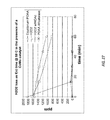
- FIG. 24 shows the decomposition of POAA compositions treated with a platinum peroxide-reducing agent (with/without a catalase peroxide-reducing enzyme agent) according to embodiments of the invention.
- FIG. 25 shows the decomposition of POAA and hydrogen peroxide in peracid compositions treated with various metallic catalysts (e.g. peroxide-reducing agents) according to embodiments of the invention.
- various metallic catalysts e.g. peroxide-reducing agents
- FIGS. 28-29 show POAA loss ( FIG. 28 ) and hydrogen peroxide loss ( FIG. 29 ) as a function of time in the presence of a NiW peroxide-reducing agent according to embodiments of the invention.
- FIGS. 30-33 show POAA loss ( FIGS. 30 , 32 , 33 ) and hydrogen peroxide loss ( FIGS. 31-33 ) as a function of time in the presence of a NiMo peroxide-reducing agent according to embodiments of the invention.
- FIGS. 34-37 show POAA loss ( FIGS. 34 , 36 , 37 ) and hydrogen peroxide loss ( FIGS. 35-37 ) as a function of time in the presence of a Mo peroxide-reducing agent according to embodiments of the invention.
- the present disclosure relates to peracid compositions with low to substantially no hydrogen peroxide for use in water treatments.
- peroxycarboxylic acids treated with a peroxide-reducing agent, such as a catalase enzyme, to reduce and/or eliminate hydrogen peroxide from the peroxycarboxylic acid are provided, as well as methods for treating various water sources with the same for the use in oil and gas recovery.
- the methods and compositions disclosed herein have many advantages over conventional, peracid compositions used for water treatment and/or other antimicrobial treatments.
- the peracid compositions treated with a peroxide-reducing agent such as a peroxide-reducing enzyme (or other means to substantially reduce hydrogen peroxide content) according to methods disclosed herein have significantly lower levels of the oxidant hydrogen peroxide.
- the reduction and/or elimination of hydrogen peroxide compared to un-treated peracid compositions provides improved antimicrobial efficacy, eliminates deleterious interaction with friction reducers and other functional ingredients used in water treatments, and/or reduces the environmental impact of treated waters when eliminated.
- the treated peracid compositions have greatly reduced off gassing potential and continue to prevent well and reservoir souring as well as prevent microbiologically-influenced corrosion.
- the embodiments of this invention are not limited to particular peroxycarboxylic acid compositions (preferably treated with a peroxide-reducing agent, such as a catalase to reduce hydrogen peroxide) and methods for using the same, which can vary and are understood by skilled artisans. It is further to be understood that all terminology used herein is for the purpose of describing particular embodiments only, and is not intended to be limiting in any manner or scope. For example, all units, prefixes, and symbols may be denoted in its SI accepted form. Numeric ranges recited within the specification are inclusive of the numbers defining the range and include each integer within the defined range.
- range format is merely for convenience and brevity and should not be construed as an inflexible limitation on the scope of the invention. Accordingly, the description of a range should be considered to have specifically disclosed all the possible sub-ranges as well as individual numerical values within that range. For example, description of a range such as from 1 to 6 should be considered to have specifically disclosed sub-ranges such as from 1 to 3, from 1 to 4, from 1 to 5, from 2 to 4, from 2 to 6, from 3 to 6 etc., as well as individual numbers within that range, for example, 1, 2, 3, 4, 5, and 6. This applies regardless of the breadth of the range.
- the term “about” refers to variation in the numerical quantity that can occur, for example, through typical measuring and liquid handling procedures used for making concentrates or use solutions in the real world; through inadvertent error in these procedures; through differences in the manufacture, source, or purity of the ingredients used to make the compositions or carry out the methods; and the like.
- the term “about” also encompasses amounts that differ due to different equilibrium conditions for a composition resulting from a particular initial mixture. Whether or not modified by the term “about”, the claims include equivalents to the quantities.
- cleaning means to perform or aid in soil removal, bleaching, microbial population reduction, or combination thereof.
- successful microbial reduction is achieved when the microbial populations are reduced by at least about 50%, or by significantly more than is achieved by a wash with water. Larger reductions in microbial population provide greater levels of protection.
- the term “disinfectant” refers to an agent that kills all vegetative cells including most recognized pathogenic microorganisms, using the procedure described in A.O.A.C. Use Dilution Methods , Official Methods of Analysis of the Association of Official Analytical Chemists, paragraph 955.14 and applicable sections, 15th Edition, 1990 (EPA Guideline 91-2).
- the term “high level disinfection” or “high level disinfectant” refers to a compound or composition that kills substantially all organisms, except high levels of bacterial spores, and is effected with a chemical germicide cleared for marketing as a sterilant by the Food and Drug Administration.
- intermediate-level disinfection or “intermediate level disinfectant” refers to a compound or composition that kills mycobacteria, most viruses, and bacteria with a chemical germicide registered as a tuberculocide by the Environmental Protection Agency (EPA).
- low-level disinfection or “low level disinfectant” refers to a compound or composition that kills some viruses and bacteria with a chemical germicide registered as a hospital disinfectant by the EPA.
- the term “free,” “no,” “substantially no” or “substantially free” refers to a composition, mixture, or ingredient that does not contain a particular compound or to which a particular compound or a particular compound-containing compound has not been added. According to the invention, the reduction and/or elimination of hydrogen peroxide according to embodiments provide hydrogen peroxide-free or substantially-free compositions. Should the particular compound be present through contamination and/or use in a minimal amount of a composition, mixture, or ingredients, the amount of the compound shall be less than about 3 wt-%. More preferably, the amount of the compound is less than 2 wt-%, less than 1 wt-%, and most preferably the amount of the compound is less than 0.5 wt-%.
- microorganism refers to any noncellular or unicellular (including colonial) organism. Microorganisms include all prokaryotes. Microorganisms include bacteria (including cyanobacteria), spores, lichens, fungi, protozoa, virinos, viroids, viruses, phages, and some algae. As used herein, the term “microbe” is synonymous with microorganism.
- the terms “mixed” or “mixture” when used relating to “percarboxylic acid composition,” “percarboxylic acids,” “peroxycarboxylic acid composition” or “peroxycarboxylic acids” refer to a composition or mixture including more than one percarboxylic acid or peroxycarboxylic acid.
- sanitizer refers to an agent that reduces the number of bacterial contaminants to safe levels as judged by public health requirements.
- sanitizers for use in this invention will provide at least a 99.999% reduction (5-log order reduction). These reductions can be evaluated using a procedure set out in Germicidal and Detergent Sanitizing Action of Disinfectants , Official Methods of Analysis of the Association of Official Analytical Chemists, paragraph 960.09 and applicable sections, 15th Edition, 1990 (EPA Guideline 91-2). According to this reference a sanitizer should provide a 99.999% reduction (5-log order reduction) within 30 seconds at room temperature, 25 ⁇ 2° C., against several test organisms.
- Antimicrobial compositions can affect two kinds of microbial cell damage. The first is a lethal, irreversible action resulting in complete microbial cell destruction or incapacitation. The second type of cell damage is reversible, such that if the organism is rendered free of the agent, it can again multiply.
- the former is termed microbiocidal and the later, microbistatic.
- a sanitizer and a disinfectant are, by definition, agents which provide antimicrobial or microbiocidal activity.
- a preservative is generally described as an inhibitor or microbistatic composition
- water for treatment according to the invention includes a variety of sources, such as freshwater, pond water, sea waters, salt water or brine source, brackish water, recycled water, or the like. Waters are also understood to optionally include both fresh and recycled water sources (e.g. “produced waters”), as well as any combination of waters for treatment according to the invention.
- sources such as freshwater, pond water, sea waters, salt water or brine source, brackish water, recycled water, or the like.
- Waters are also understood to optionally include both fresh and recycled water sources (e.g. “produced waters”), as well as any combination of waters for treatment according to the invention.
- weight percent As used herein, “weight percent,” “wt-%,” “percent by weight,” “% by weight,” and variations thereof refer to the concentration of a substance as the weight of that substance divided by the total weight of the composition and multiplied by 100. It is understood that, as used here, “percent,” “%,” and the like are intended to be synonymous with “weight percent,” “wt-%,” etc.
- the invention generally relates to the use of peroxide-reducing agents, such as a metal or strong oxidizer, for use with peracid compositions.
- the invention uses the peroxide-reducing agents with peracid compositions for use in water treatments in the field of oil and gas recovery.
- the invention further relates to the use of additional methods to reduce and/or eliminate hydrogen peroxide from peracids to provide similar benefits to a peracid composition. Additional methods which produce a very low hydrogen peroxide to peracid ratio are similarly advantageous and suitable for use according to the invention, including those disclosed in U.S. Provisional Patent Application Ser. No. 61/710,631, filed Oct.
- compositions of the invention may comprise, consist of and/or consist essentially of a peracid composition having a low hydrogen peroxide to peracid ratio.
- the peracid composition has a hydrogen peroxide to peracid ratio in a concentrated composition from about 0:100 to about 1:10, preferably from about 0.5:100 to about 1:100, and more preferably from about 1:100 to 1:10.
- the compositions of the invention may comprise, consist of and/or consist essentially of a peracid composition and a peroxide-reducing agent used to obtain a resultant peracid composition having a low hydrogen peroxide to peracid ratio.
- a peracetic acid composition further includes acetic acid, hydrogen peroxide and water in the aqueous commercial formulation.
- the compositions of the invention may further comprise, consist of and/or consist essentially of a peracid composition, carboxylic acid, hydrogen peroxide, and a peroxide-reducing enzyme.
- additional functional ingredients such as a friction reducer, corrosion inhibitor, viscosity enhancer and/or additional antimicrobial agent are employed in the compositions.
- no additional functional ingredients are employed in the compositions.
- a peroxide-reducing agent is used to reduce and/or eliminate the concentration of hydrogen peroxide in an antimicrobial peracid composition.
- the peroxide-reducing agent is a peroxide-reducing inorganic agent.
- the agent is a metal and/or a strong oxidizing agent. The metal catalyzes the decomposition of hydrogen peroxide to water and oxygen. Further, the metal catalyzes the decomposition of the peracid in equilibrium.
- the decomposition of the hydrogen peroxide and peracid of an equilibrium peracid composition catalyzed by the peroxide-reducing agent beneficially results in an accelerated oxidation reaction causing increased or enhanced antimicrobial efficacy.
- the reduction and/or elimination of hydrogen peroxide further results in other additives for a water treatment source (e.g. water source) not being degraded or rendered incompatible.
- a water treatment source e.g. water source
- various additives used to enhance and/or modify the characteristics of aqueous fluids used in well drilling, recovery and/or production applications are at risk of degradation by the oxidizing effects of hydrogen peroxide.
- these may include for example, friction reducers, scale inhibitors and viscosity enhancers used in commercial well drilling, well completion and stimulation, or production applications.
- the significant reduction in hydrogen peroxide from a peracid composition reduces or eliminates these compatibility and/or degradation concerns.
- the peroxide-reducing agent is a metal, combination of metals and/or a metal compound.
- suitable metals for use as the peroxide-reducing agents include heavy metals.
- metal oxides may be employed according to the invention.
- suitable metals include platinum, palladium, bismuth, tin, copper, manganese, iron, tungsten, zirconium, ruthenium, cobalt, molybdenum, nickel, iron, copper and/or manganese.
- the metals include platinum, tungsten, zirconium, ruthenium, cobalt, molybdenum, nickel, iron, copper and/or manganese.
- the metals include iron, copper and/or manganese.
- a combination of metals can be employed as the peroxide-reducing agent.
- the peroxide-reducing agent is a strong oxidizer.
- the oxidizer has greater oxidizing potential that hydrogen peroxide, beneficially allowing the decomposition of the oxidant hydrogen peroxide.
- suitable strong oxidizers for use as peroxide-reducing agents include halide anions, halide salts and/or halide sources, including for example bromide and/or bromine, iodide and/or iodine, chloride and/or chlorine, fluoride and/or fluorine, etc.
- the peroxide-reducing agent is a chlorine sources, including, for example, hypochlorite or sodium hypochlorite, chlorine dioxide, or the like.
- the agent is not UV-sensitive.
- the metals and/or strong oxidizing agents have a high ability to decompose hydrogen peroxide.
- the peroxide-reducing agents are able to degrade at least about 500 ppm of hydrogen peroxide in a peracid composition in 15 minutes.
- the metals and/or strong oxidizing agents also have a high ability to decompose hydrogen peroxide at low concentrations.
- the concentration of metals and/or strong oxidizing agents needed to degrade 500 ppm of hydrogen peroxide in a peracid composition in 15 minutes is less than 200 ppm, less than 100 ppm, and less than 50 ppm.
- the reduction or elimination of hydrogen peroxide from oxidizing compositions obviate the various detriments caused by oxidizing agents in the various field operations for well drilling, recovery and/or production applications (and others set forth according to the methods of the invention).
- the use of the peroxide-reducing agents) with the peracid compositions provides enhanced antimicrobial benefits without causing the damage associated with conventional oxidizing agents (e.g. peracetic acid, hypochlorite or hypochlorous acid, and/or chlorine dioxide), such as corrosion.
- the reduction of hydrogen peroxide also benefits the stability of gel formation in gel frac fluids.
- the reduction of hydrogen peroxide in a peracid composition beneficially allows a gel frac fluid to maintain the gel for a sufficient period of time (before it breaks apart within the subterranean environment).
- the reduction of the hydrogen peroxide within a peracid composition according to the invention provides a suitable level of peroxide from about 1 ppm to about 50 ppm, from about 1 ppm to about 25 ppm, or preferably from about 5 ppm to about 15 ppm to maintain a stable gel frac fluid for an extended period of time.
- the peroxide-reducing agents preferentially decompose hydrogen peroxide from a peracid composition (e.g. a greater percentage of peracid concentration remains in a treated peracid composition in comparison to hydrogen peroxide).
- the agent preferentially reduces hydrogen peroxide over the peracid.
- the agent reduces at least about 2:1 hydrogen peroxide to peracid, or greater.
- the agent reduces at least about 1.5:1 hydrogen peroxide to peracid, or greater.
- the peroxide-reducing agent is able to degrade at least about 50% of the initial concentration of hydrogen peroxide in a peracid composition.
- the agent is provided in sufficient amount to reduce the hydrogen peroxide concentration of a peracid composition by at least more than about 50%, more preferably at least about 60%, at least about 70%, at least about 80%, or at least about 90%.
- the peroxide-reducing agent reduces the hydrogen peroxide concentration of a peracid composition by more than about 90%.
- the numeric ranges are inclusive of the numbers defining the range and include each integer within the defined range.
- the peroxide-reducing agents are suitable for use and have a tolerance to a wide range of temperatures, including the temperatures ranges in water treatment applications which may range from about 0-180° C. Although temperature and other ambient conditions may affect the stability of the agents, a suitable peroxide-reducing agent will maintain at least 50% of its activity under such storage and/or application temperatures for at least about 10 minutes, preferably for at least about 1 hour, and more preferably for at least about 24 hours.
- the numeric ranges are inclusive of the numbers defining the range and include each integer within the defined range.
- the peroxide-reducing agents described herein have a tolerance to pH ranges found in water treatment applications.
- Acetic acid levels (or other carboxylic acid) in a water treatment application can widely range in parts per million (ppm) of acetic or other carboxylic acid.
- the solutions will have a corresponding range of pH range from greater than 0 to about 10.
- a suitable peroxide-reducing agent will maintain at least about 50% of its activity in such solutions of acetic or other carboxylic acid over a period of about 10 minutes, preferably for at least about 1 hour, and more preferably for at least about 24 hours.
- the numeric ranges are inclusive of the numbers defining the range and include each integer within the defined range.
- a peroxide-reducing agent is present in a use solution of the water treatment and peracid composition in sufficient amounts to reduce the concentration of hydrogen peroxide from the peracid composition within at least a few hours, preferably within less than 10 hours, preferably within less than 5 hours, preferably within less than 4 hours, and still more preferably within less than 1 hour.
- a peroxide-reducing agent is present in a use solution of the water treatment and peracid composition in sufficient amounts to reduce the concentration of hydrogen peroxide from the peracid composition by at least 50% within about 10 minutes, preferably within about 5 minutes, preferably within about 2 to 5 minutes, more preferably within about 1 minute.
- concentration of the agents will vary depending upon the amount of time within which 50% of the hydrogen peroxide from the peracid composition is removed.
- a peroxide-reducing agent is present in a use solution composition including the water source to be treated in amounts of at least about 0.5 ppm, preferably between about 0.5 ppm and about 1000 ppm, preferably between about 0.5 ppm and about 500 ppm, preferably between about 0.5 ppm and 100 ppm, and more preferably between about 1 ppm and about 100 ppm.
- the numeric ranges are inclusive of the numbers defining the range and include each integer within the defined range.
- the peroxide-reducing agents employed may be free floating in the use solution composition, meaning that the agent is part of the composition, without being bound to a surface.
- the peroxide-reducing agents may be immobilized on a surface that is in fluid communication with the use solution composition in way that allows the agent to interact with and decompose hydrogen peroxide from the peracid compositions.
- immobilized agents may be more stable than unbound, soluble agents.
- immobilized agents may also have increased thermal and pH stability which might be due to the protection of the substrate provides against sudden thermal and pH changes.
- An immobilized agent also has the advantage of being able to be removed from the rest of the composition easily.
- An immobilized agent may include an agent attached to a substrate.
- substrates may include for example zeolites, polyurethane foams, polyacrylamide gels, polyethylene maleic anhydride gels, polystyrene maleic anhydride gels, cellulose, nitrocellulose, silastic resins, porous glass, macroporous glass membranes, glass beads, activated clay, zeolites, alumina, silica, silicate and other inorganic and organic substrates.
- the peroxide-reducing agent may be attached to the substrate in various ways including carrier covalent binding, crosslinking, physical adsorption, ionic binding, and entrapping.
- the peroxide-reducing agent is added into a peracid use solution instead of a concentrated peracid composition.
- the use of a peroxide-reducing agent is preferably added to a non-concentrated peracid composition in order to maintain the viability and peroxide-reducing capability of the agent.
- a concentrated peracid composition e.g. about 10 wt-% or greater peracid, or about 15 wt-% or greater peracid
- the dilute water source may be the water source in need of treatment according to the invention.
- the dilute water source may be a use solution of the peracid composition (or less concentrated peracid composition) for subsequent dosing into the water source in need of treatment according to the invention.
- the peroxide-reducing agent is a peroxide-reducing enzyme.
- a catalase or peroxidase enzyme is used to reduce and/or eliminate the concentration of hydrogen peroxide in an antimicrobial peracid composition.
- the enzymes catalyze the decomposition of hydrogen peroxide to water and oxygen.
- the reduction and/or elimination of hydrogen peroxide results in other additives for a water treatment source (e.g. water source) not being degraded or rendered incompatible.
- Various additives used to enhance or modify the characteristics of the aqueous fluids used in well drilling, recovery and production applications are at risk of degradation by the oxidizing effects of hydrogen peroxide. These may include for example, friction reducers, scale inhibitors and viscosity enhancers used in commercial well drilling, well completion and stimulation, or production applications.
- catalase enzymes or other peroxide-reducing enzyme agents
- animal sources such as bovine catalase isolated from beef livers
- fungal catalases isolated from fungi including Penicillium chrysogenum, Penicillium notatum , and Aspergillus niger
- plant sources such as Staphylcoccus aureus , and genetic variations and modifications thereof.
- fungal catalases are utilized to reduce the hydrogen peroxide content of a peracid composition.
- Catalases are commercially available in various forms, including liquid and spray dried forms.
- Commercially available catalase includes both the active enzyme as well as additional ingredients to enhance the stability of the enzyme.
- Some exemplary commercially available catalase enzymes include Genencor CA-100 and CA-400, as well as Mitsubishi Gas and Chemical (MGC) ASC super G and ASC super 200. Additional description of suitable catalase enzymes are disclosed and herein incorporated by reference in its entirety from U.S. Patent Publication No. 2012/0321510 and U.S. Pat. Nos. 8,241,624, 8,231,917 and 8,226,939, which are herein incorporated by reference in their entirety.
- catalase enzymes have a high ability to decompose hydrogen peroxide.
- catalase enzymes (or other peroxide-reducing enzyme agents) used in this invention include enzymes with a high ability to decompose hydrogen peroxide.
- the enzyme is able to degrade at least about 500 ppm of hydrogen peroxide in a peracid composition in 15 minutes.
- enzymes used in this invention include catalase enzymes (or other peroxide-reducing enzyme agents) with a high ability to decompose hydrogen peroxide at low concentrations.
- the concentration of enzyme needed to degrade 500 ppm of hydrogen peroxide in a peracid composition in 15 minutes is less than 200 ppm, less than 100 ppm, and less than 50 ppm.
- the reduction or elimination of hydrogen peroxide from oxidizing compositions obviates the various detriments caused by oxidizing agents.
- the use of catalase (or other peroxide-reducing enzyme agents) with the peracids compositions provides enhanced antimicrobial benefits without causing the damage associated with conventional oxidizing agents (e.g. peracetic acid, hypochlorite or hypochlorous acid, and/or chlorine dioxide), such as corrosion.
- Peroxidase enzymes may also be employed to decompose hydrogen peroxide from a peracid composition. Although peroxidase enzymes primarily function to enable oxidation of substrates by hydrogen peroxide, they are also suitable for effectively lowering hydrogen peroxide to peracid ratios in compositions. Various sources of peroxidase enzymes (or other peroxide-reducing enzyme agents) may be employed according to the invention, including for example animal sources, fungal peroxidases, and genetic variations and modifications thereof. Peroxidases are commercially available in various forms, including liquid and spray dried forms. Commercially available peroxidases include both the active enzyme as well as additional ingredients to enhance the stability of the enzyme.
- the peroxide-reducing enzyme is able to degrade at least about 50% of the initial concentration of hydrogen peroxide in a peracid composition.
- the enzyme is provided in sufficient amount to reduce the hydrogen peroxide concentration of a peracid composition by at least more than about 50%, more preferably at least about 60%, at least about 70%, at least about 80%, at least about 90%.
- the enzyme reduces the hydrogen peroxide concentration of a peracid composition by more than 90%.
- the numeric ranges are inclusive of the numbers defining the range and include each integer within the defined range.
- the peroxide-reducing enzymes are suitable for use and have a tolerance to a wide range of temperatures, including the temperatures ranges in water treatment applications which may range from about 0-180° C. Although temperature and other ambient conditions may affect the stability of the enzymes, a suitable peroxide-reducing enzyme will maintain at least 50% of its activity under such storage and/or application temperatures for at least about 10 minutes, preferably for at least about 1 hour, and more preferably for at least about 24 hours.
- the numeric ranges are inclusive of the numbers defining the range and include each integer within the defined range.
- the peroxide-reducing enzymes described herein have a tolerance to pH ranges found in water treatment applications.
- Acetic acid levels (or other carboxylic acid) in a water treatment application can widely range in parts per million (ppm) of acetic or other carboxylic acid.
- the solutions will have a corresponding range of pH range from greater than 0 to about 10.
- a suitable peroxide-reducing enzyme will maintain at least about 50% of its activity in such solutions of acetic or other carboxylic acid over a period of about 10 minutes, preferably for at least about 1 hour, and more preferably for at least about 24 hours.
- the numeric ranges are inclusive of the numbers defining the range and include each integer within the defined range.
- a peroxide-reducing enzyme is present in a use solution of the water treatment and peracid composition in sufficient amounts to reduce the concentration of hydrogen peroxide from the peracid composition to sufficiently reduced or eliminated concentration within at least a few hours, preferably within less than 10 hours, preferably within less than 5 hours, preferably within less than 4 hours, and still more preferably within less than 1 hour.
- a peroxide-reducing enzyme is present in a use solution of the water treatment and peracid composition in sufficient amounts to reduce the concentration of hydrogen peroxide from the peracid composition by at least 50% within about 10 minutes, preferably within about 5 minutes, preferably within about 2 to 5 minutes, more preferably within about 1 minute.
- concentration of the enzymes will vary depending upon the amount of time within which 50% of the hydrogen peroxide from the peracid composition is removed.
- a peroxide-reducing enzyme is present in a use solution composition including the water source to be treated in amounts of at least about 0.5 ppm, preferably between about 0.5 ppm and about 1000 ppm, preferably between about 0.5 ppm and about 500 ppm, preferably between about 0.5 ppm and 100 ppm, and more preferably between about 1 ppm and about 100 ppm.
- the numeric ranges are inclusive of the numbers defining the range and include each integer within the defined range.
- the enzymes employed may be free floating in the use solution composition, meaning that the enzyme is part of the composition, without being bound to a surface.
- the enzymes may be immobilized on a surface that is in fluid communication with the use solution composition in way that allows the enzyme to interact with and decompose hydrogen peroxide from the peracid compositions.
- Immobilized enzyme may be more stable than unbound, soluble enzyme.
- Immobilized enzyme also shows increased thermal and pH stability which might be due to the protection of the substrate provides against sudden thermal and pH changes.
- An immobilized enzyme also has the advantage of being able to be removed from the rest of the composition easily.
- An immobilized enzyme may include a soluble enzyme that is attached to a substrate.
- substrates may include polyurethane foams, polyacrylamide gels, polyethylene maleic anhydride gels, polystyrene maleic anhydride gels, cellulose, nitrocellulose, silastic resins, porous glass, macroporous glass membranes, glass beads, activated clay, zeolites, alumina, silica, silicate and other inorganic and organic substrates.
- the enzyme may be attached to the substrate in various ways including carrier covalent binding, crosslinking, physical adsorption, ionic binding, and entrapping.
- the peroxide-reducing enzyme is added into a peracid use solution instead of a concentrated peracid composition.
- the use of a peroxide-reducing enzyme agent is preferably added to a non-concentrated peracid composition in order to maintain the viability and peroxide-reducing capability of the agent.
- a concentrated peracid composition e.g. about 10 wt-% or greater peracid, or about 15 wt-% or greater peracid
- the dilute water source may be the water source in need of treatment according to the invention.
- the dilute water source may be a use solution of the peracid composition (or less concentrated peracid composition) for subsequent dosing into the water source in need of treatment according to the invention.
- a peracid is included for antimicrobial efficacy in the compositions for water treatment.
- the term “peracid” may also be referred to as a “percarboxylic acid” or “peroxyacid.”
- Sulfoperoxycarboxylic acids, sulfonated peracids and sulfonated peroxycarboxylic acids are also included within the term “peracid” as used herein.
- the terms “sulfoperoxycarboxylic acid,” “sulfonated peracid,” or “sulfonated peroxycarboxylic acid” refers to the peroxycarboxylic acid form of a sulfonated carboxylic acid as disclosed in U.S. Pat. No.
- a peracid refers to an acid having the hydrogen of the hydroxyl group in carboxylic acid replaced by a hydroxy group. Oxidizing peracids may also be referred to herein as peroxycarboxylic acids.
- a peracid includes any compound of the formula R—(COOOH) n in which R can be hydrogen, alkyl, alkenyl, alkyne, acylic, alicyclic group, aryl, heteroaryl, or heterocyclic group, and n is 1, 2, or 3, and named by prefixing the parent acid with peroxy.
- R includes hydrogen, alkyl, or alkenyl.
- alkyl includes a straight or branched saturated aliphatic hydrocarbon chain having from 1 to 22 carbon atoms, such as, for example, methyl, ethyl, propyl, isopropyl (1-methylethyl), butyl, tert-butyl (1,1-dimethylethyl), and the like.
- alkyl or “alkyl groups” also refers to saturated hydrocarbons having one or more carbon atoms, including straight-chain alkyl groups (e.g., methyl, ethyl, propyl, butyl, pentyl, hexyl, heptyl, octyl, nonyl, decyl, etc.), cyclic alkyl groups (or “cycloalkyl” or “alicyclic” or “carbocyclic” groups) (e.g., cyclopropyl, cyclopentyl, cyclohexyl, cycloheptyl, cyclooctyl, etc.), branched-chain alkyl groups (e.g., isopropyl, tert-butyl, sec-butyl, isobutyl, etc.), and alkyl-substituted alkyl groups (e.g., alkyl-substituted cycloal
- alkyl includes both “unsubstituted alkyls” and “substituted alkyls.”
- substituted alkyls refers to alkyl groups having substituents replacing one or more hydrogens on one or more carbons of the hydrocarbon backbone.
- substituents may include, for example, alkenyl, alkynyl, halogeno, hydroxyl, alkylcarbonyloxy, arylcarbonyloxy, alkoxycarbonyloxy, aryloxy, aryloxycarbonyloxy, carboxylate, alkylcarbonyl, arylcarbonyl, alkoxycarbonyl, aminocarbonyl, alkylaminocarbonyl, dialkylaminocarbonyl, alkylthiocarbonyl, alkoxyl, phosphate, phosphonato, phosphinato, cyano, amino (including alkyl amino, dialkylamino, arylamino, diarylamino, and alkylarylamino), acylamino (including alkylcarbonylamino, arylcarbonylamino, carbamoyl and ureido), imino, sulfhydryl, alkylthio, arylthio, thiocarboxylate,
- alkenyl includes an unsaturated aliphatic hydrocarbon chain having from 2 to 12 carbon atoms, such as, for example, ethenyl, 1-propenyl, 2-propenyl, 1-butenyl, 2-methyl-1-propenyl, and the like.
- the alkyl or alkenyl can be terminally substituted with a heteroatom, such as, for example, a nitrogen, sulfur, or oxygen atom, forming an aminoalkyl, oxyalkyl, or thioalkyl, for example, aminomethyl, thioethyl, oxypropyl, and the like.
- alkyl or alkenyl can be interrupted in the chain by a heteroatom forming an alkylaminoalkyl, alkylthioalkyl, or alkoxyalkyl, for example, methylaminoethyl, ethylthiopropyl, methoxymethyl, and the like.
- alicyclic includes any cyclic hydrocarbyl containing from 3 to 8 carbon atoms.
- suitable alicyclic groups include cyclopropanyl, cyclobutanyl, cyclopentanyl, etc.
- heterocyclic includes any closed ring structures analogous to carbocyclic groups in which one or more of the carbon atoms in the ring is an element other than carbon (heteroatom), for example, a nitrogen, sulfur, or oxygen atom. Heterocyclic groups may be saturated or unsaturated.
- heterocyclic groups include for example, aziridine, ethylene oxide (epoxides, oxiranes), thiirane (episulfides), dioxirane, azetidine, oxetane, thietane, dioxetane, dithietane, dithiete, azolidine, pyrrolidine, pyrroline, oxolane, dihydrofuran, and furan.
- suitable heterocyclic groups include groups derived from tetrahydrofurans, furans, thiophenes, pyrrolidines, piperidines, pyridines, pyrrols, picoline, coumaline, etc.
- alkyl, alkenyl, alicyclic groups, and heterocyclic groups can be unsubstituted or substituted by, for example, aryl, heteroaryl, C 1-4 alkyl, C 1-4 alkenyl, C 1-4 alkoxy, amino, carboxy, halo, nitro, cyano, —SO 3 H, phosphono, or hydroxy.
- alkyl, alkenyl, alicyclic group, or heterocyclic group is substituted, preferably the substitution is C 1-4 alkyl, halo, nitro, amido, hydroxy, carboxy, sulpho, or phosphono.
- R includes alkyl substituted with hydroxy.
- aryl includes aromatic hydrocarbyl, including fused aromatic rings, such as, for example, phenyl and naphthyl.
- heteroaryl includes heterocyclic aromatic derivatives having at least one heteroatom such as, for example, nitrogen, oxygen, phosphorus, or sulfur, and includes, for example, furyl, pyrrolyl, thienyl, oxazolyl, pyridyl, imidazolyl, thiazolyl, isoxazolyl, pyrazolyl, isothiazolyl, etc.
- heteroaryl also includes fused rings in which at least one ring is aromatic, such as, for example, indolyl, purinyl, benzofuryl, etc.
- aryl and heteroaryl groups can be unsubstituted or substituted on the ring by, for example, aryl, heteroaryl, alkyl, alkenyl, alkoxy, amino, carboxy, halo, nitro, cyano, —SO 3 H, phosphono, or hydroxy.
- aryl, aralkyl, or heteroaryl is substituted, preferably the substitution is C 1-4 alkyl, halo, nitro, amido, hydroxy, carboxy, sulpho, or phosphono.
- R includes aryl substituted with C 1-4 alkyl.
- Peracids suitable for use include any peroxycarboxylic acids, including varying lengths of peroxycarboxylic and percarboxylic acids (e.g. C1-22) that can be prepared from the acid-catalyzed equilibrium reaction between a carboxylic acid described above and hydrogen peroxide.
- a peroxycarboxylic acid can also be prepared by the auto-oxidation of aldehydes or by the reaction of hydrogen peroxide with an acid chloride, acid hydride, carboxylic acid anhydride, or sodium alcoholate.
- peracids can be prepared through non-equilibrium reactions, which may be generated for use in situ, such as the methods disclosed in U.S. Patent Publication Nos.
- a composition of the invention includes peroxyacetic acid, peroxyoctanoic acid, peroxypropionic acid, peroxylactic acid, peroxyheptanoic acid, peroxyoctanoic acid and/or peroxynonanoic acid.
- a peroxycarboxylic acid includes at least one water-soluble peroxycarboxylic acid in which R includes alkyl of 1-22 carbon atoms.
- a peroxycarboxylic acid includes peroxyacetic acid.
- a peroxycarboxylic acid has R that is an alkyl of 1-22 carbon atoms substituted with hydroxy.
- a sulfoperoxycarboxylic acid has the following formula:
- R 1 is hydrogen, or a substituted or unsubstituted alkyl group
- R 2 is a substituted or unsubstituted alkylene group
- X is hydrogen, a cationic group, or an ester forming moiety; or salts or esters thereof.
- R 1 is a substituted or unsubstituted C m alkyl group
- X is hydrogen a cationic group, or an ester forming moiety
- R 2 is a substituted or unsubstituted C n alkyl group
- m 1 to 10
- n 1 to 10
- m+n is less than 18, or salts, esters or mixtures thereof.
- R 1 is hydrogen. In other embodiments, R 1 is a substituted or unsubstituted alkyl group. In some embodiments, R 1 is a substituted or unsubstituted alkyl group that does not include a cyclic alkyl group. In some embodiments, R 1 is a substituted alkyl group. In some embodiments, R 1 is an unsubstituted C 1 -C 9 alkyl group. In some embodiments, R 1 is an unsubstituted C 7 or C 8 alkyl. In other embodiments, R 1 is a substituted C 8 -C 10 alkylene group.
- R 1 is a substituted C 8 -C 10 alkyl group is substituted with at least 1, or at least 2 hydroxyl groups. In still yet other embodiments, R 1 is a substituted C 1 -C 9 alkyl group. In some embodiments, R 1 is a substituted C 1 -C 9 substituted alkyl group is substituted with at least 1 SO 3 H group. In other embodiments, R 1 is a C 9 -C 10 substituted alkyl group. In some embodiments, R 1 is a substituted C 9 -C 10 alkyl group wherein at least two of the carbons on the carbon backbone form a heterocyclic group. In some embodiments, the heterocyclic group is an epoxide group.
- R 2 is a substituted C 1 -C 10 alkylene group. In some embodiments, R 2 is a substituted C 8 -C 10 alkylene. In some embodiments, R 2 is an unsubstituted C 6 -C 9 alkylene. In other embodiments, R 2 is a C 8 -C 10 alkylene group substituted with at least one hydroxyl group. In some embodiments, R 2 is a C 10 alkylene group substituted with at least two hydroxyl groups. In other embodiments, R 2 is a C 8 alkylene group substituted with at least one SO 3 H group.
- R 2 is a substituted C 9 group, wherein at least two of the carbons on the carbon backbone form a heterocyclic group.
- the heterocyclic group is an epoxide group.
- R 1 is a C 8 -C 9 substituted or unsubstituted alkyl
- R 2 is a C 7 -C 8 substituted or unsubstituted alkylene.
- a sulfoperoxycarboxylic acid is combined with a single or mixed peroxycarboxylic acid composition, such as a sulfoperoxycarboxylic acid with peroxyacetic acid, peroxyoctanoic acid and sulfuric acid (PSOA/POOA/POAA/H 2 SO 4 ).
- a mixed peracid is employed, such as a peroxycarboxylic acid including at least one peroxycarboxylic acid of limited water solubility in which R includes alkyl of 5-22 carbon atoms and at least one water-soluble peroxycarboxylic acid in which R includes alkyl of 1-4 carbon atoms.
- a peroxycarboxylic acid includes peroxyacetic acid and at least one other peroxycarboxylic acid such as those named above.
- a composition of the invention includes peroxyacetic acid and peroxyoctanoic acid.
- Other combinations of mixed peracids are well suited for use in the current invention.
- a mixture of peracetic acid and peroctanoic acid is used to treat a water source, such as disclosed in U.S. Pat. No. 5,314,687 which is herein incorporated by reference in its entirety.
- the peracid mixture is a hydrophilic peracetic acid and a hydrophobic peroctanoic acid, providing antimicrobial synergy.
- the synergy of a mixed peracid system allows the use of lower dosages of the peracids.
- a tertiary peracid mixture composition such as peroxysulfonated oleic acid, peracetic acid and peroctanoic acid are used to treat a water source, such as disclosed in U.S. Pat. No. 8,344,026 which is incorporated herein by reference in its entirety.
- a combination of the three peracids provides significant antimicrobial synergy providing an efficient antimicrobial composition for the water treatment methods according to the invention.
- the high acidity built in the composition assists in removing chemical contaminants from the water (e.g. sulfite and sulfide species), and the defoaming agent (e.g. aluminum sulfate) provides defoaming (e.g. combating foam caused by any anionic surface active agents used in the water treatment).
- compositions of the invention can include a peroxycarboxylic acid, or mixtures thereof.
- peracids Various commercial formulations of peracids are available, including for example peracetic acid (15%) and hydrogen peroxide (10%) available as EnviroSan (Ecolab, Inc., St. Paul Minn.). Most commercial peracid solutions state a specific percarboxylic acid concentration without reference to the other chemical components in a use solution. However, it should be understood that commercial products, such as peracetic acid, will also contain the corresponding carboxylic acid (e.g. acetic acid), hydrogen peroxide and water.
- peracetic acid e.g. acetic acid
- carboxylic acid e.g. acetic acid
- any suitable C 1 -C 22 percarboxylic acid can be used in the present compositions.
- the C 1 -C 22 percarboxylic acid is a C 2 -C 20 percarboxylic acid.
- the C 1 -C 22 percarboxylic is a C 1 , C 2 , C 3 , C 4 , C 5 , C 6 , C 7 , C 8 , C 9 , C 10 , C 11 , C 12 , C 13 , C 14 , C 15 , C 16 , C 17 , C 18 , C 19 , C 20 , C 21 , or C 22 carboxylic acid.
- the C 1 -C 22 percarboxylic acid comprises peroxyacetic acid, peroxyoctanoic acid and/or peroxysulfonated oleic acid.
- a peracid is present in a use solution with the water source in need of treatment in an amount of between about 1 ppm and about 5000 ppm, preferably between about 1 ppm and about 2000 ppm, preferably between about 1 ppm and about 1000 ppm, and more preferably between about 1 ppm and about 100 ppm.
- the numeric ranges are inclusive of the numbers defining the range and include each integer within the defined range.
- the amount of peracid above the preferred range of 100 ppm may be employed for highly contaminated waters in need of treatment, such as source waters including increased amounts of produced water (e.g. recycled waters).
- a peracid may be selected from a concentrated composition having a ratio of hydrogen peroxide to peracid from about 0:100 to about 0.5:100, preferably from about 0.5:100 to about 1:10.
- Various concentrated peracid compositions having the hydrogen peroxide to peracid ratios of about 0:100 to about 0.5:100, preferably from about 0.5:100 to about 1:10 may be employed to produce a use solution for treatment according to the methods of the invention.
- a peracid may have a ratio of hydrogen peroxide to peracid as low as from about 0.001 part or 0.01 part hydrogen peroxide to about 1 part peracid.
- any ratio wherein the amount of hydrogen peroxide is less than peracid is suitable for use according to the invention in formulating a use solution for water treatments.
- the numeric ranges are inclusive of the numbers defining the range and include each integer within the defined range.
- Obtaining the preferred hydrogen peroxide to peroxycarboxylic acid ratios in a peracid composition may be obtained by a variety of methods suitable for producing a very low hydrogen peroxide to peracid ratio.
- equilibrium peracid compositions may be distilled to recover a very low hydrogen peroxide peracid mixture.
- catalysts for hydrogen peroxide decomposition may be combined with a peracid composition, including for example, peroxide-reducing agents and/or other biomimetic complexes.
- perhydrolysis of peracid precursors such as esters (e.g. triacetin) and amides may be employed to obtain peracids with very low hydrogen peroxide.
- the ester and amide peracid precursors have alkyl leaving groups ranging in carbon chain lengths of C1-C8.
- the peroxycarboxylic acid concentration ranges from 0.0001 wt-% to 20 wt-%, preferably from about 0.0001 wt-% to 10 wt-%, or from about 0.0001 wt-% to 5 wt-%, or from about 1 wt-% to about 3 wt-%.
- the numeric ranges are inclusive of the numbers defining the range and include each integer within the defined range.
- a peroxide-reducing agent is combined with a peracid composition.
- a peracid composition having a concentration of less than or equal to about 10% may be combined with the peroxide-reducing agent, without having a detrimental effect on the peroxide-reducing agent.
- a peracid composition having a concentration of less than or equal to about 5% is suitable for use with the peroxide-reducing agent, without having a detrimental effect on the peroxide-reducing agent.
- a peracid concentration of less than or equal to 3% is preferred, or less than or equal to 2%.
- the present invention includes reduced amounts of hydrogen peroxide, and preferably no hydrogen peroxide.
- Hydrogen peroxide, H 2 O 2 provides the advantages of having a high ratio of active oxygen because of its low molecular weight (34.014 g/mole) and being compatible with numerous substances that can be treated by methods of the invention because it is a weakly acidic, clear, and colorless liquid.
- Another advantage of hydrogen peroxide is that it decomposes into water and oxygen. It is advantageous to have these decomposition products because they are generally compatible with substances being treated. For example, the decomposition products are generally compatible with metallic substance (e.g., substantially noncorrosive) and are generally innocuous to incidental contact and are environmentally friendly.
- hydrogen peroxide is initially in an antimicrobial peracid composition in an amount effective for maintaining equilibrium between a carboxylic acid, hydrogen peroxide, water and a peracid.
- the amount of hydrogen peroxide should not exceed an amount that would adversely affect the antimicrobial activity of a composition of the invention.
- hydrogen peroxide concentration is significantly reduced within an antimicrobial peracid composition, preferably containing hydrogen peroxide at a concentration as close to zero as possible. That is, the concentration of hydrogen peroxide is minimized, through the use of the selected peroxide-reducing agents according to the invention.
- the concentration of hydrogen peroxide is reduced and/or eliminated as a result of distilled equilibrium peracid compositions, other catalysts for hydrogen peroxide decomposition (e.g. biomimetic complexes) and/or the use of perhydrolysis of esters (e.g. triacetin) to obtain peracids with very low hydrogen peroxide.
- other catalysts for hydrogen peroxide decomposition e.g. biomimetic complexes
- esters e.g. triacetin
- an advantage of minimizing the concentration of hydrogen peroxide is that antimicrobial activity of a composition of the invention is improved as compared to conventional equilibrium peracid compositions.
- significant improvements in antimicrobial efficacy result from enhanced peracid, namely POAA stability from the reduced hydrogen peroxide concentration.
- hydrogen peroxide can typically be present in a use solution in an amount less than 2500 ppm, preferably less than 2000 ppm, more preferably less than 1000 ppm.
- the use of a catalase reduces the hydrogen peroxide concentration as close to zero as possible, preferably a concentration of zero.
- the numeric ranges are inclusive of the numbers defining the range and include each integer within the defined range.
- hydrogen peroxide in a peracid composition is reduced by at least 50%, at least 60%, at least 70%, at least 80%, or at least 90%.
- the hydrogen peroxide is substantially zero after the treatment of a peracid composition according to the invention.
- the ratio of hydrogen peroxide to peracid in a concentrated composition for use according to the invention is from about 0:100 to about 1:10, preferably from about 0.5:100 to about 0.5:10.
- Various concentrated peracid compositions with a hydrogen peroxide to peracid ratio from about 0:100 to about 1:10, preferably from about 0.5:100 to about 0.5:10, may be employed to produce a use solution for treatment according to the invention.
- the numeric ranges are inclusive of the numbers defining the range and include each integer within the defined range.
- a use solution may have a ratio of hydrogen peroxide to peracid as low as from about 0.001 part hydrogen peroxide to about 1 part peracid.
- a ratio of hydrogen peroxide to peracid as low as from about 0.001 part hydrogen peroxide to about 1 part peracid.
- any ratio wherein the amount of hydrogen peroxide is less than peracid is suitable for use according to the invention in formulating a use solution for water treatments.
- the numeric ranges are inclusive of the numbers defining the range and include each integer within the defined range.
- the present invention includes a carboxylic acid with the peracid composition and hydrogen peroxide.
- a carboxylic acid includes any compound of the formula R—(COOH) n in which R can be hydrogen, alkyl, alkenyl, alkyne, acylic, alicyclic group, aryl, heteroaryl, or heterocylic group, and n is 1, 2, or 3.
- R includes hydrogen, alkyl, or alkenyl.
- alkyl,” “alkenyl,” “alkyne,” “acylic,” “alicyclic group,” “aryl,” “heteroaryl,” and “heterocyclic group” are as defined above with respect to peracids.
- suitable carboxylic acids include a variety monocarboxylic acids, dicarboxylic acids, and tricarboxylic acids.
- Monocarboxylic acids include, for example, formic acid, acetic acid, propanoic acid, butanoic acid, pentanoic acid, hexanoic acid, heptanoic acid, octanoic acid, nonanoic acid, decanoic acid, undecanoic acid, dodecanoic acid, glycolic acid, lactic acid, salicylic acid, acetylsalicylic acid, mandelic acid, etc.
- Dicarboxylic acids include, for example, adipic acid, fumaric acid, glutaric acid, maleic acid, succinic acid, malic acid, tartaric acid, etc.
- Tricarboxylic acids include, for example, citric acid, trimellitic acid, isocitric acid, agaicic acid, etc.
- a particularly well suited carboxylic acid is water soluble such as formic acid, acetic acid, propionic acid, butanoic acid, lactic acid, glycolic acid, citric acid, mandelic acid, glutaric acid, maleic acid, malic acid, adipic acid, succinic acid, tartaric acid, etc.
- a composition of the invention includes acetic acid, octanoic acid, or propionic acid, lactic acid, heptanoic acid, octanoic acid, or nonanoic acid.
- suitable carboxylic acids are employed in sulfoperoxycarboxylic acid or sulfonated peracid systems, which are disclosed in U.S. Pat. No. 8,344,026, and U.S. Patent Publication Nos. 2010/0048730 and 2012/0052134, each of which are herein incorporated by reference in their entirety.
- any suitable C 1 -C 22 carboxylic acid can be used in the present compositions.
- the C 1 -C 22 carboxylic acid is a C 2 -C 20 carboxylic acid.
- the C 1 -C 22 carboxylic acid is a C 1 , C 2 , C 3 , C 4 , C 5 , C 6 , C 7 , C 8 , C 9 , C 10 , C 11 , C 12 , C 13 , C 14 , C 15 , C 16 , C 17 , C 18 , C 19 , C 20 , C 21 , or C 22 carboxylic acid.
- the C 1 -C 22 carboxylic acid comprises acetic acid, octanoic acid and/or sulfonated oleic acid.
- a carboxylic acid is present in a use solution with the water source in need of treatment in an amount of between about 1 ppm and about 5000 ppm, preferably between about 1 ppm and about 2000 ppm, preferably between about 1 ppm and about 1000 ppm, and more preferably between about 1 ppm and about 100 ppm.
- the numeric ranges are inclusive of the numbers defining the range and include each integer within the defined range.
- the amount of carboxylic acid above the preferred range of 100 ppm may be employed for highly contaminated waters in need of treatment, such as source waters including increased amounts of produced water (e.g. recycled waters).
- compositions according to the invention may further include a UV-blocking and/or absorbing agent.
- a UV-blocking agent is any agent that prevents and/or reduces the amount of ultraviolet (UV) exposure of a water source in need of treatment according to the invention.
- UV-blocking agent in the alternative of a UV-blocking agent, methods of use may be employed minimize and/or eliminate the exposure to sunlight by dosing the peroxide-reducing agent at a time with no and/or weak UV exposure is present, such as at night and/or cloudy periods of time.
- reference to reducing and/or blocking UV according to the invention will include either or both of these scenarios.
- the UV-blocking agent may include natural (from a variety of sources) and/or synthetic dyes that are compatible with the peracid compositions employed according to the compositions and methods of the present invention.
- synthetic dyes include organic dyes, including for example acid dyes and/or basic dyes.
- the dyes are water-soluble.
- the UV-blocking agents may include a dye, a means of covering a water source, or the like, which are suitable for decreasing and/or preventing the penetration of sunlight into a water system in need of treatment.
- dyes suitable for use as UV-blocking agents are those capable of preventing and/or reducing the penetration of sunlight into a water system.
- the dye is a blue dye having considerable absorption in the ultraviolet regions.
- the dye is for example, methylene blue (e.g. methylthioninium chloride).
- the dye is a cationic dye.
- the dye is a heterocyclic aromatic compound.
- the dye used as a UV-blocking agent further has antimicrobial properties, such as the blue dye methylene blue.
- the dye used as a UV-blocking agent further has anti-algae properties.
- the UV-blocking agent in addition to preventing and/or reducing the penetration of sunlight into a water system, further provides the antimicrobial properties and/or anti-algae properties which provide additional benefit(s) to the condition of the water source, in addition to the benefit of allowing the peroxide-reducing agent (e.g. catalase) to function to reduce the hydrogen peroxide content in a use solution.
- the peroxide-reducing agent e.g. catalase
- Such additional benefits provided to the water source through use of the antimicrobial and/or anti-algae UV-blocking agent may prolong the dosing frequency of the treated peracid composition.
- the UV-blocking agent may be provided with and/or formulated into a composition with the peroxide-reducing agent according to the invention.
- the UV-blocking agent may be provided separately from both the peracid composition and/or the peroxide-reducing agent.
- the UV-blocking agent may be formulated into a two or three part component system for treating a water source according to the methods of the invention.
- UV-blocking agent is provided in a use solution in an amount of from about 0.1 ppm to about 5000 ppm, preferably from about 1 ppm to about 2000 ppm, more preferably from about 1 ppm to about 500 ppm.
- the numeric ranges are inclusive of the numbers defining the range and include each integer within the defined range.
- the composition can optionally include additional ingredients to enhance the composition for water treatment according to the invention, including for example, friction reducers, viscosity enhancers, UV-blocking agents and the like.
- Additional optional functional ingredients may include for example, peracid stabilizers, emulsifiers, corrosion inhibitors and/or descaling agents (i.e. scale inhibitors), surfactants and/or additional antimicrobial agents for enhanced efficacy (e.g. mixed peracids, biocides), antifoaming agents, acidulants (e.g. strong mineral acids) or other pH modifiers, additional carboxylic acids, and the like.
- no additional functional ingredients are employed.
- Friction reducers are used in water or other water-based fluids used in hydraulic fracturing treatments for subterranean well formations in order to improve permeability of the desired gas and/or oil being recovered from the fluid-conductive cracks or pathways created through the fracking process.
- the friction reducers allow the water to be pumped into the formations more quickly.
- Various polymer additives have been widely used as friction reducers to enhance or modify the characteristics of the aqueous fluids used in well drilling, recovery and production applications.
- friction reducers examples include polyacrylamide polymers and copolymers.
- additional suitable friction reducers may include acrylamide-derived polymers and copolymers, such as polyacrylamide (sometime abbreviated as PAM), acrylamide-acrylate (acrylic acid) copolymers, acrylic acid-methacrylamide copolymers, partially hydrolyzed polyacrylamide copolymers (PHPA), partially hydrolyzed polymethacrylamide, acrylamide-methyl-propane sulfonate copolymers (AMPS) and the like.
- PAM polyacrylamide
- PHPA partially hydrolyzed polyacrylamide copolymers
- AMPS acrylamide-methyl-propane sulfonate copolymers
- Various derivatives of such polymers and copolymers e.g., quaternary amine salts, hydrolyzed versions, and the like, should be understood to be included with the polymers and copolymers described herein.
- Friction reducers are combined with water and/or other aqueous fluids, which in combination are often referred to as “slick water” fluids.
- Slick water fluids have reduced frictional drag and beneficial flow characteristics which enable the pumping of the aqueous fluids into various gas- and/or oil-producing areas, including for example for fracturing.
- a friction reducer is present in a use solution in an amount between about 100 ppm to 1000 ppm.
- a friction reducer is present in a use solution in an amount of at least about 0.01 wt-% to about 10 wt-%, preferably at least about 0.01 wt-% to about 5 wt-%, preferably at least about 0.01 wt-% to about 1 wt-%, more preferably at least about 0.01 wt-% to about 0.5 wt-%, and still more preferably at least about 0.01 wt-% to about 0.1 wt-%.
- the numeric ranges are inclusive of the numbers defining the range and include each integer within the defined range.
- compositions and methods of the invention do not negatively interfere with friction reducers included in an aqueous solution. Without being limited to a particular theory of the invention, it is thought that the reduction and/or elimination of the oxidant hydrogen peroxide from the peracid composition promotes the stability and efficacy of any variation in the amount of friction reducer present in a use solution.
- Viscosity enhancers are additional polymers used in water or other water-based fluids used in hydraulic fracturing treatments to provide viscosity enhancement. Natural and/or synthetic viscosity-increasing polymers may be employed in compositions and methods according to the invention. Viscosity enhancers may also be referred to as gelling agents and examples include guar, xanthan, cellulose derivatives and polyacrylamide and polyacrylate polymers and copolymers, and the like.
- a viscosity enhancer is present in a use solution in an amount between about 100 ppm to 1000 ppm. In a further aspect, a viscosity enhancer is present in a use solution in an amount of at least about 0.01 wt-% to about 10 wt-%, preferably at least about 0.01 wt-% to about 5 wt-%, preferably at least about 0.01 wt-% to about 1 wt-%, at least about 0.01 wt-% to about 2 wt-%, preferably at least about 0.01 wt-% to about 1 wt-%, preferably at least about 0.01 wt-% to about 0.5 wt-%.
- the numeric ranges are inclusive of the numbers defining the range and include each integer within the defined range.
- compositions and methods of the invention do not negatively interfere with viscosity enhancer included in an aqueous solution. Without being limited to a particular theory of the invention, it is believed the reduction and/or elimination of the oxidant hydrogen peroxide from the peracid composition promotes the stability and efficacy of any variation in the amount of viscosity enhancer present in a use solution.
- Corrosion inhibitors are additional molecules used in oil and gas recovery operations. Corrosion inhibitors that may be employed in the present disclosure are disclosed in U.S. Pat. No. 5,965,785, U.S. Patent Publication No. 2010/0108566, GB Patent No. 1,198,734, WO/03/006581, WO04/044266, and WO08/005,058, each of which are incorporated herein by reference in their entirety.
- a corrosion inhibitor is present in a use solution in an amount between about 100 ppm to 1000 ppm. In a further aspect, a corrosion inhibitor is present in a use solution in an amount of at least about 0.0001 wt-% to about 10 wt-%, preferably at least about 0.0001 wt-% to about 5 wt-%, preferably at least about 0.0001 wt-% to about 1 wt-%, preferably at least about 0.0001 wt-% to about 0.1 wt-%, and still more preferably at least about 0.0001 wt-% to about 0.05 wt-%.
- the numeric ranges are inclusive of the numbers defining the range and include each integer within the defined range.
- compositions and methods of the invention do not negatively interfere with corrosion inhibitor included in an aqueous solution. Without being limited to a particular theory of the invention, it is believed the reduction and/or elimination of the oxidant hydrogen peroxide from the peracid composition promotes the stability and efficacy of any variation in the amount of corrosion inhibitor present in a use solution.
- Scale inhibitors are additional molecules used in oil and gas recovery operations. Common scale inhibitors that may be employed in these types of applications include polymers and co-polymers, phosphates, phosphate esters and the like.
- a scale inhibitor is present in a use solution in an amount between about 100 ppm to 1000 ppm.
- a scale inhibitor is present in a use solution in an amount of at least about 0.0001 wt-% to about 10 wt-%, at least about 0.0001 wt-% to about 1 wt-%, preferably at least about 0.0001 wt-% to about 0.1 wt-%, preferably at least about 0.0001 wt-% to about 0.05 wt-%.
- the numeric ranges are inclusive of the numbers defining the range and include each integer within the defined range.
- compositions and methods of the invention do not negatively interfere with scale inhibitor included in an aqueous solution. Without being limited to a particular theory of the invention, it is thought that the reduction and/or elimination of the oxidant hydrogen peroxide from the peracid composition promote the stability and efficacy of any variation in the amount of scale inhibitor present in a use solution.
- Additional antimicrobial agents may be included in the compositions and/or methods of the invention for enhanced antimicrobial efficacy.
- additional antimicrobial agents e.g. surfactants
- biocides may include, for example, a quaternary ammonium compound as disclosed in U.S. Pat. No. 6,627,657, which is incorporated herein by reference in its entirety.
- quaternary ammonium compound as disclosed in U.S. Pat. No. 6,627,657, which is incorporated herein by reference in its entirety.
- the presence of the quaternary ammonium compound provides both synergistic antimicrobial efficacies with peracids, as well as maintains long term biocidal efficacy of the compositions.
- the additional biocide may include an oxidizer compatible phosphonium biocide, such as tributyl tetradecyl phosphonium chloride.
- the phosphonium biocide provides similar antimicrobial advantages as the quaternary ammonium compound in combination with the peracids.
- the phosphonium biocide is compatible with the anionic polymeric chemicals commonly used in the oil field applications, such as the methods of the fracking disclosed according to the invention.
- Additional antimicrobial and biocide agents may be employed in amounts sufficient to provide antimicrobial efficacy, as may vary depending upon the water source in need of treatment and the contaminants therein.
- Such agents may be present in a use solution in an amount of at least about 0.1 wt-% to about 50 wt-%, preferably at least about 0.1 wt-% to about 20 wt-%, more preferably from about 0.1 wt-% to about 10 wt-%.
- the numeric ranges are inclusive of the numbers defining the range and include each integer within the defined range.
- Acidulants may be included as additional functional ingredients in a composition according to the invention.
- a strong, oxidative mineral acid such as nitric acid or sulfuric acid can be used to treat water sources, as disclosed in U.S. Pat. No. 4,587,264, which is incorporated herein by reference in its entirety.
- the combined use of a strong mineral acid with the peracid composition provides enhanced antimicrobial efficacy as a result of the acidity assisting in removing chemical contaminants within the water source (e.g. sulfite and sulfide species).
- an acidulant such as a mineral acid, is suitable for decreasing the pH of the water source and/or the treated peracid composition to obtain additional and/or synergistic impact on cleaning efficacy.
- an acidulant may be used to decrease the pH of the water source in need of treatment to a pH below about 6, preferably below about 5, and more preferably between about 4.5 and about 5.5 to get a synergistic impact on water clean-up from the acid.
- an acidulant is used to decrease the pH of the treated water source from about 2 to about 6 to provide a synergistic impact on water clean-up.
- any acidulant may be employed to decrease the pH of the water source.
- suitable acidulants include hydrochloric acid and other acids, and chlorine, chlorine dioxide (ClO 2 ) and other oxidants.
- nitric acid some strong mineral acids, such as nitric acid, provide a further benefit of reducing the risk of corrosion toward metals contacted by the peracid compositions according to the invention.
- exemplary peracid products containing nitric acid are commercially available from Enviro Tech Chemical Services, Inc. (Reflex brand) and from Solvay Chemicals (Proxitane® NT brand).
- an acidulant may be employed to decrease the pH of the peracid composition according to the invention to increase the peracid stability by decreasing the pH of the peracid composition.
- decreasing the pH of the treated peracid composition from about 8 or greater to less than about 8, or less than about 7.5, or less than about 7 has a beneficial impact on the peracid stability for use according to the methods of the invention.
- Acidulants may be employed in amounts sufficient to provide the intended antimicrobial efficacy, peracid stability and/or anticorrosion benefits, as may vary depending upon the peracid composition and/or water source in need of treatment and the contaminants therein.
- Such agents may be present in a use solution in an amount of at least about 0.1 wt-% to about 50 wt-%, preferably at least about 0.1 wt-% to about 20 wt-%, more preferably from about 0.1 wt-% to about 10 wt-%.
- the numeric ranges are inclusive of the numbers defining the range and include each integer within the defined range.
- compositions of the present invention include one or more stabilizing agents.
- the stabilizing agents can be used, for example, to stabilize the peracid and hydrogen peroxide and prevent the premature oxidation of this constituent within the composition of the invention.
- an acidic stabilizing agent can be used.
- the compositions of the present invention can be substantially free of an additional acidulant.
- Suitable stabilizing agents include, for example, chelating agents or sequestrants.
- Suitable sequestrants include, but are not limited to, organic chelating compounds that sequester metal ions in solution, particularly transition metal ions.
- Such sequestrants include organic amino- or hydroxy-polyphosphonic acid complexing agents (either in acid or soluble salt forms), carboxylic acids (e.g., polymeric polycarboxylate), hydroxycarboxylic acids, aminocarboxylic acids, or heterocyclic carboxylic acids, e.g., pyridine-2,6-dicarboxylic acid (dipicolinic acid).
- compositions of the present invention include dipicolinic acid as a stabilizing agent.
- compositions including dipicolinic acid can be formulated to be free or substantially free of phosphorous.
- the sequestrant can be or include phosphonic acid or phosphonate salt.
- Suitable phosphonic acids and phosphonate salts include HEDP; ethylenediamine tetrakis methylenephosphonic acid (EDTMP); diethylenetriamine pentakis methylenephosphonic acid (DTPMP); cyclohexane-1,2-tetramethylene phosphonic acid; amino[tri(methylene phosphonic acid)]; (ethylene diamine[tetra methylene-phosphonic acid)]; 2-phosphene butane-1,2,4-tricarboxylic acid; or salts thereof, such as the alkali metal salts, ammonium salts, or alkyloyl amine salts, such as mono, di, or tetra-ethanolamine salts; picolinic, dipicolinic acid or mixtures thereof.
- organic phosphonates e.g., HEDP are included in the compositions of the present invention.
- phosphonates sold under the trade name DEQUEST® including, for example, 1-hydroxyethylidene-1,1-diphosphonic acid, available from Monsanto Industrial Chemicals Co., St. Louis, Mo., as DEQUEST® 2010; amino(tri(methylenephosphonic acid)), (N[CH 2 PO 3 H 2 ] 3 ), available from Monsanto as DEQUEST® 2000; ethylenediamine[tetra(methylenephosphonic acid)] available from Monsanto as DEQUEST® 2041; and 2-phosphonobutane-1,2,4-tricarboxylic acid available from Mobay Chemical Corporation, Inorganic Chemicals Division, Pittsburgh, Pa., as Bayhibit AM.
- the sequestrant can be or include aminocarboxylic acid type sequestrant.
- Suitable aminocarboxylic acid type sequestrants include the acids or alkali metal salts thereof, e.g., amino acetates and salts thereof.
- Suitable aminocarboxylates include N-hydroxyethylaminodiacetic acid; hydroxyethylenediaminetetraacetic acid, nitrilotriacetic acid (NTA); ethylenediaminetetraacetic acid (EDTA); N-hydroxyethyl-ethylenediaminetriacetic acid (HEDTA); diethylenetriaminepentaacetic acid (DTPA); and alanine-N,N-diacetic acid; and the like; and mixtures thereof.
- the sequestrant can be or include a polycarboxylate.
- Suitable polycarboxylates include, for example, polyacrylic acid, maleic/olefin copolymer, acrylic/maleic copolymer, polymethacrylic acid, acrylic acid-methacrylic acid copolymers, hydrolyzed polyacrylamide, hydrolyzed polymethacrylamide, hydrolyzed polyamide-methacrylamide copolymers, hydrolyzed polyacrylonitrile, hydrolyzed polymethacrylonitrile, hydrolyzed acrylonitrile-methacrylonitrile copolymers, polymaleic acid, polyfumaric acid, copolymers of acrylic and itaconic acid, phosphino polycarboxylate, acid or salt forms thereof, mixtures thereof, and the like.
- the present composition includes about 0.01 to about 10 wt-% stabilizing agent, about 0.4 to about 4 wt-% stabilizing agent, about 0.6 to about 3 wt-% stabilizing agent, about 1 to about 2 wt-% stabilizing agent. It is to be understood that all values and ranges within these values and ranges are encompassed by the present invention.
- the methods disclosed for water treatment in oil and gas recovery provide effective antimicrobial efficacy without any deleterious interaction with functional agents, including for example friction reducers.
- the methods for water treatment according to the invention using the peroxide-reducing agent provide increased antimicrobial efficacy compared to the use of the antimicrobial peracids alone.
- the methods of use result in the disposal of cleaner water with low numbers of microorganisms.
- the reduction and/or elimination of H 2 O 2 from the peracid compositions minimizes the negative effects of the oxidant H 2 O 2 .
- the treated peracid compositions can be used for a variety of industrial applications, e.g., to reduce microbial or viral populations on a surface or object or in a body or stream of water.
- the invention includes methods of using the treated peracid compositions to prevent biological fouling in various industrial processes and industries, including oil and gas operations, to control microorganism growth, eliminate microbial contamination, limit or prevent biological fouling in liquid systems, process waters or on the surfaces of equipment that come in contact with such liquid systems.
- microbial contamination can occur in various industrial liquid systems including, but not limited to, air-borne contamination, water make-up, process leaks and improperly cleaned equipment.
- the peracid and peroxide-reducing enzyme agent e.g. catalase
- compositions or other treated peracid compositions having low to substantially no hydrogen peroxide
- the compositions are suitable for incorporating into fracturing fluids to control or eliminate microorganisms.
- treated peracid compositions can employ a variety of peracid compositions having a low to substantially no hydrogen peroxide concentration.
- These treated peracid compositions include peracid compositions with a peroxide-reducing agent to reduce the hydrogen peroxide to peracid ratio and/or other reduced hydrogen peroxide peracid compositions disclosed herein.
- peracid and peroxide-reducing agent use solutions having reduced or substantially no hydrogen peroxide are introduced to a water source in need of treatment.
- the methods by which the treated peracid use solutions are introduced into the aqueous fluids according to the invention are not critical. Introduction of the treated peracid compositions (and/or introduction of the two or more part system, such as a peracid composition and a peroxide-reducing agent composition, may be carried out in a continuous or intermittent manner and will depend on the type of water being treated.
- treated peracid use solutions are employed according to the methods of the invention.
- treated peracid compositions or treated peracid use solutions are understood to refer to peracid compositions having reduced or substantially no hydrogen peroxide.
- Such reduced or substantially no hydrogen peroxide peracid compositions may be generated by use of peroxide-reducing agent(s) at a point of use (e.g. combining more than one component part of the composition—e.g. the peroxide-reducing agent and a peracid composition in a two part system) and/or generated prior to a point of use.
- the treated peracid compositions are generated at a point of use, and may be generated within a water source on site.
- the peracid composition and a peroxide-reducing enzyme agent such as a catalase enzyme, are combined with a water source at a point of use and the hydrogen peroxide concentration of the use solution is reduced within a period of time from at least a minute to a few hours, preferably from at least 5 minutes to a few hours.
- the treatment time for a use solution of a peracid composition within a water source to be treated will vary depending upon the concentration of the peroxide-reducing agent and/or the volume of the peracid composition and/or water source in need of treatment.
- the concentrations of the peracid composition and peroxide-reducing agent will further vary depending upon the amount of bacteria within the water source in need of treatment.
- the treated peracid use solutions may further comprise a UV-blocking agent and/or other means of minimizing and/or preventing UV exposure of the treated peracid use solutions and/or the water in need of treatment with the peracid compositions.
- a UV-blocking agent and/or other means of minimizing and/or preventing UV exposure of the treated peracid use solutions and/or the water in need of treatment with the peracid compositions.
- a suitable UV-blocking agent is provided in a peracid composition.
- the use of the disclosed UV-blocking agents is stable for formulation within the peracid compositions.
- the UV-blocking agent may be added directly to a water source in need of treatment either simultaneously with a peracid composition or in sequence with the peracid compositions.
- the UV-blocking agent may alternatively be replaced with methods of application of the peracid compositions that effectively minimize the exposure to sunlight (e.g. dosing the peroxide-reducing agent at a time with no and/or weak sunlight, such as at night and/or cloudy periods of time).
- the UV-blocking agent may refer to a cover that physically blocks sunlight from the water source.
- the treated peracid use solutions are added to waters in need of treatment prior to the drilling and fracking steps in order to restrict the introduction of microbes into the reservoir and to prevent the microbes from having a negative effect on the integrity of the fluids.
- the treatment of source waters (e.g. pond, holding tank, lake, municipal, etc.) and/or produced waters is particularly well suited for use according to the invention.
- the treated waters according to the invention can be used for both slick water fracturing (i.e. using frictions reducers) and/or gel fracturing (i.e. using viscosity enhancers), depending on the type of formation being fractured and the type of hydrocarbon expected to be produced.
- a treated peracid use solution namely a peroxide-reducing agent treated peracid composition use solution having low to substantially no hydrogen peroxide, is suitable for both slick water fracturing and gel fracturing.
- pretreating the peracid composition such as peracetic acid (including a mixture of acetic acid, hydrogen peroxide and water) with a peroxide-reducing agent substantially removes the hydrogen peroxide with minimal to no impact on the fracturing fluids and the well itself.
- the peracetic acid pretreated with a peroxide-reducing agent allows the formation of gel suitable for gel fracturing, as opposed to untreated peracetic acid/hydrogen peroxide solutions that do not allow a gel to form.
- the treated peracid use solutions are added to waters in need of treatment in the subterranean well formations (e.g. introduced through a bore hole in a subterranean formation).
- the treated peracid use solutions are added to waters in need of treatment before disposal.
- flow back waters e.g. post fracking
- flow back waters are treated to minimize microbial contaminations in the waters and to remove solids prior to disposal of the water into a subterranean well, reuse in a subsequent fracturing application or return of the water into local environmental water sources.
- the treated peracid use solution may be formed within the water source to be treated.
- a peracid composition is provided to a water source and a peroxide-reducing agent is thereafter provided to the water source, such that the reduction and/or elimination of peroxide concentration occur within the water source.
- the methods of treating a water source may include the cyclical dosing of treated (e.g. low or no hydrogen peroxide) peracid compositions to a water source.
- the methods of treating a water source may include the cyclical dosing of a water source with a two (or more) part composition used to generate the treated (e.g. low or no hydrogen peroxide) peracid composition within the water source in need of treatment.
- Such cyclical dosing may include daily dosing, every two or more day dosing, every three or more day dosing, every four or more day dosing, every five or more day dosing, every six or more day dosing, weekly dosing, or longer frequency dosing.
- the water source is treated in an every five day cycle for optimal reduction or elimination of hydrogen peroxide within a peracid composition used to treat the water source.
- all ranges of the dosing cycles are included within the scope of the invention.
- the present invention is directed to a method for treating water, which method comprises providing the above compositions to a water source in need of treatment to form a treated water source, wherein said treated water source comprises from about 1 ppm to about 1,000 ppm of said C 1 -C 22 percarboxylic acid. Any suitable C 1 -C 22 percarboxylic acid can be used in the present methods.
- peroxyacetic acid peroxyoctanoic acid and/or peroxysulfonated oleic acid
- peroxyacetic acid, peroxyoctanoic acid and/or peroxysulfonated oleic acid can be used.
- a combination of peroxyacetic acid, peroxyoctanoic acid and peroxysulfonated oleic acid is used.
- the treated peracid composition provides a water source with any suitable concentration of the hydrogen peroxide.
- the treated water source comprises from about 1 ppm to about 15 ppm of the hydrogen peroxide.
- the treated water source comprises about 1 ppm, 2 ppm, 3 ppm, 4 ppm, 5 ppm, 6 ppm, 7 ppm, 8 ppm, 9 ppm, 10 ppm, 11 ppm, 12 ppm, 13 ppm, 14 ppm, or 15 ppm of the hydrogen peroxide.
- the treated peracid use solutions may be added to an incoming stream of water, such as water added to a holding tank or other storage reservoir.
- the treated peracid use solutions are added to provide a peracid concentration (e.g. peracetic acid) applied at a rate of about 1 ppm to about 5000 ppm peracid, from about 1 ppm to about 2000 ppm, from about 1 ppm to about 1000 ppm, from about 1 ppm to about 500 ppm, and preferably from about 1 ppm to about 100 ppm peracid.
- a peracid concentration e.g. peracetic acid
- the treated peracid use solutions may be added at an elevated peracid concentration (e.g. about 200 to about 5000 ppm) to an intermittent water source (e.g. a smaller holding tank, such as up to about 1000 gallons of water) prior to dilution within a larger holding tank or other storage reservoir for a water source (e.g. 1 million gallons of water or more).
- an intermittent water source e.g. a smaller holding tank, such as up to about 1000 gallons of water
- a water source e.g. 1 million gallons of water or more.
- such a method beneficially provides a rapid kill of microorganisms within a controlled/smaller volume of a water source in need of treatment, while still providing a static or slower antimicrobial activity within a bulk water system.
- the treated peracid use solutions may be added to a larger bulk fluid, such as the holding tank or other storage reservoir for a water source.
- a bulk fluid source may be a holding tank or other storage reservoir having a volume from about 1000 gallons to about 20 million gallons or more, preferably from about 1000 gallons to about 12 million gallons.
- the treated peracid use solutions provide a peracid concentration (e.g. peracetic acid) in the bulk water source from 0.1 ppm to about 100 ppm peracid or greater, preferably from about 1 ppm to about 100 ppm peracid or greater. Without being limited according to the mechanism and/or the scope of the invention, all ranges are included within the scope of the invention.
- monitoring devices and/or means may be included to measure the application rate and/or bulk solution of peracid in order to ensure either the application rate of peracid (or the bulk solution having a maintained peracid) at a concentration of from 0.1 ppm to about 100 ppm peracid or greater, preferably from about 1 ppm to about 100 ppm peracid or greater.
- the treated peracid use solutions may be added to dormant water sources.
- dormant water sources will often require less frequent dosing that other water sources.
- use of the treated water sources during non-pumping (e.g. non-use) periods, such as for example winter, will require less frequent dosing due to the more static nature of the water source at that particular time.
- the treated peracid use solutions are added to waters in need of treatment before disposal.
- flow back waters e.g. post fracking
- Such flow back waters may be held, for example, in tanks, ponds or the like, in some aspects of the invention.
- the water source in need of treatment may vary significantly.
- the water source may be a freshwater source (e.g. pond water), salt water or brine source, brackish water source, recycled water source, or the like.
- seawater sources are often employed (e.g. saltwater or non-saltwater).
- the peracid and peroxide-reducing agent compositions of the invention are suitable for use with any types of water and provide effective antimicrobial efficiency with any of such water sources.
- recycled water sources e.g. produced waters
- Recycled or produced water are understood to include non-potable water sources.
- the use of such produced waters (in combination with freshwater, pond water or seawater) reduces certain economic and/or environmental constraints.
- thousands to millions of gallons of water may be employed and the combination of produced water with fresh water sources provides significant economic and environmental advantages.
- the treated water source can comprise any suitable concentration of the C 1 -C 22 percarboxylic acid.
- the treated water source comprises from about 10 ppm to about 200 ppm of the C 1 -C 22 percarboxylic acid.
- the treated water source comprises about 1 ppm, 10 ppm, 100 ppm, 200 ppm, 300 ppm, 400 ppm, 500 ppm, 600 ppm, 700 ppm, 800 ppm, 900 ppm or 1,000 ppm of the C 1 -C 22 percarboxylic acid.
- the present methods can be used to treat any suitable or desirable water sources.
- the present methods can be used to treat fresh water, pond water, sea water, produced water and a combination thereof.
- the water source comprises at least about 1 wt-% produced water. In other embodiments, the water source comprises at least about 1 wt-%, 2 wt-%, 3 wt-%, 4 wt-%, 5 wt-%, 6 wt-%, 7 wt-%, 8 wt-%, 9 wt-%, or 10 wt-%, 15 wt-%, 20 wt-%, 25 wt-%, 30 wt-% or more produced water.
- the method includes a pretreatment step, wherein the peracid composition is treated with a peroxide-reducing agent to reduce the hydrogen peroxide concentration in a use solution.
- the pretreatment step occurs prior to combining the peracid antimicrobial composition and/or peroxide-reducing agent to a water source in need of treatment.
- the pretreatment may occur within a few minutes to hours before addition to a water source.
- a commercial peracid formulation is employed (e.g. peracetic acid).
- the peracid and peroxide-reducing agent composition use solution may be diluted to obtain the desired peracetic acid concentrations, with low and/or no hydrogen peroxide concentration.
- a sufficient amount of the pretreated peracid and peroxide-reducing agent use solution composition is added to the aqueous water source in need of treatment to provide the desired peracid concentration for antimicrobial efficacy.
- a water source is dosed amounts of the peracid and peroxide-reducing agent use solution composition until a peracid concentration within the water source is detected within the preferred concentration range (e.g. about 1 ppm to about 100 ppm peracid).
- the preferred concentration range e.g. about 1 ppm to about 100 ppm peracid.
- the level of a microorganism, if present in the water source is stabilized or reduced by the present methods. For example, at least 10%, 20%, 30%, 40%, 50%, 60%, 70%, 80%, or 90% or more of the microorganism, if present in the water source, is killed, destroyed, removed and/or inactivated by the present methods.
- the method includes a pretreatment step of the water source.
- the water source in need of treatment may be first dosed an acidulant to decrease the pH of the water source.
- the pretreatment of a water source with an acidulant provides increased peracid stability within the water source.
- the methods of use as described herein can vary in the temperature and pH conditions associated with use of the aqueous treatment fluids.
- the aqueous treatment fluids may be subjected to varying ambient temperatures according to the applications of use disclosed herein, including ranging from about 0° C. to about 180° C. in the course of the treatment operations.
- the temperature range is between about 5° C. to about 100° C., more preferably between about 10° C. to about 80° C.
- all ranges are included within the scope of the invention.
- the exposure of the compositions to relatively high temperatures is not a substantial concern.
- the peracid composition aqueous treatment fluids may be subjected to varying pH ranges, such as from 1 to about 10.5.
- the pH range is less than about 9, less than about 8.2 (pKa value of the representative peracid peracetic acid) to ensure the effective antimicrobial efficacy of the peracid.
- a pH modifier such as an acidulant
- the antimicrobial compositions of the invention are fast-acting. However, the present methods require a certain minimal contact time of the compositions with the water in need of treatment for occurrence of sufficient antimicrobial effect.
- the contact time can vary with concentration of the use compositions, method of applying the use compositions, temperature of the use compositions, pH of the use compositions, amount of water to be treated, amount of soil or substrates in the water to be treated, or the like.
- the contact or exposure time can be at least about 15 seconds. In some embodiments, the exposure time is about 1 to 5 minutes. In other embodiments, the exposure time is at least about 10 minutes, 30 minutes, or 60 minutes. In other embodiments, the exposure time is a few minutes to hours. In other embodiments, the exposure time is a few days or more.
- the compositions for use according to the invention are suitable for short contact times due in part to the non-oxidizing nature of the compositions having reduced or eliminated hydrogen peroxide content.
- the contact time will further vary based upon the concentration of peracid in a
- the methods include the direction of the treated water compositions into a subterranean environment and/or a well-bore.
- the treated water compositions are directed into a subterranean environment and/or a well-bore at a speed faster than about 30 barrel (bbl.)/minute, faster than about 60 barrel (bbl.)/minute, and/or at a speed of about 65 barrel (bbl.)/minute and about 100 barrel (bbl.)/minute.
- a subterranean environment may include, for example, a shale gas reservoir, a well, and/or an oil reservoir.
- the methods disclosed for water treatment in oil and gas recovery provide effective antimicrobial efficacy without deleterious interaction with functional agents, including for example friction reducers.
- the methods for water treatment provide increased antimicrobial efficacy compared to the use of the antimicrobial peracids alone.
- the methods of use result in the disposal of cleaner water with low numbers of microorganisms.
- the reduction and/or elimination of H 2 O 2 from the peracid compositions minimizes the negative effects of the oxidant H 2 O 2 .
- the methods of use provide an antimicrobial for use that does not negatively impact the environment.
- the degradation of the compositions of the invention provides a “green” alternative.
- utilizing peroxyacetic acid is beneficial as the by-products are non-toxic, non-persistent in the environment, certified as organic and permitted for discharge in surface waters.
- the methods of use provide an antimicrobial for use that does not negatively interfere with friction reducers, viscosity enhancers and/or other functional ingredients.
- the methods of use do not negatively interfere with any additional functional agents utilized in the water treatment methods, including for example, corrosion inhibitors, descaling agents, UV blocking agents, and the like.
- the compositions administered according to the invention provide extremely effective control of microorganisms without adversely affecting the functional properties of any additive polymers of an aqueous system.
- the treated peracid composition use solutions provide additional benefits to a system, including for example, reducing corrosion within the system due to the decreased or substantially eliminated hydrogen peroxide from a treated peracid composition. Beneficially, the non-deleterious effects of the treated peracid compositions (namely using a peroxide-reducing agent) on the various functional ingredients used in water treatment methods are achieved regardless of the make-up of the water source in need of treatment.
- the methods of use prevent the contamination of systems, such as well or reservoir souring. In further aspects, the methods of use prevent microbiologically-influenced corrosion of the systems upon which it is employed.
- the reduction and/or elimination of hydrogen peroxide from the systems reduces volume expansion within sealed systems (e.g. wells). As a result there is a significantly decreased or eliminated risk of well blow outs due to the removal of gases within the antimicrobial compositions used for treating the various water sources.
- the methods of use employ the antimicrobial and/or bleaching activity of the peracid compositions.
- the invention includes a method for reducing a microbial population and/or a method for bleaching. These methods can operate on an article, surface, in a body or stream of water or a gas, or the like, by contacting the article, surface, body, or stream with the compositions. Contacting can include any of numerous methods for applying the compositions, including, but not limited to, providing the antimicrobial peracid compositions in an aqueous use solution and immersing any articles, and/or providing to a water source in need of treatment.
- compositions are suitable for antimicrobial efficacy against a broad spectrum of microorganisms, providing broad spectrum bactericidal and fungistatic activity.
- the peracid biocides of this invention provide broad spectrum activity against wide range of different types of microorganisms (including both aerobic and anaerobic microorganisms), including bacteria, yeasts, molds, fungi, algae, and other problematic microorganisms associated with oil- and gas-field operations.
- Exemplary microorganisms susceptible to the peracid compositions of the invention include, gram positive bacteria (e.g., Staphylococcus aureus, Bacillus species (sp.) like Bacillus subtilis, Clostridia sp.), gram negative bacteria (e.g., Escherichia coli, Pseudomonas sp., Klebsiella pneumoniae, Legionella pneumophila, Enterobacter sp., Serratia sp., Desulfovibrio sp., and Desulfotomaculum sp.), yeasts (e.g., Saccharomyces cerevisiae and Candida albicans ), molds (e.g., Aspergillus niger, Cephalosporium acremonium, Penicillium notatum , and Aureobasidium pullulans ), filamentous fungi (e.g., Aspergillus niger and Cladosporium resinae
- liquid system refers to flood waters or an environment within at least one artificial artifact, containing a substantial amount of liquid that is capable of undergoing biological fouling.
- Liquid systems include but are not limited to industrial liquid systems, industrial water systems, liquid process streams, industrial liquid process streams, industrial process water systems, process water applications, process waters, utility waters, water used in manufacturing, water used in industrial services, aqueous liquid streams, liquid streams containing two or more liquid phases, and any combination thereof.
- compositions and methods can also be used to treat other liquid systems where both the compositions' antimicrobial function and oxidant properties can be utilized.
- waste water is often rich in malodorous compounds of reduced sulfur, nitrogen or phosphorous.
- a strong oxidant such as the compositions disclosed herein converts these compounds efficiently to their odor free derivatives e.g. the sulfates, phosphates and amine oxides. These same properties are very useful in the pulp and paper industry where the property of bleaching is also of great utility.
- compositions and methods can also be used for various aseptic treatment uses.
- Description of various applications of use of treated peracid compositions having low or reduced hydrogen peroxide are disclosed for example in U.S. Pat. No. 8,226,939, entitled “Antimicrobial Peracid Compositions with Selected Catalase Enzymes and Methods of Use in Aseptic Packaging,” which is incorporated by reference in its entirety.
- aseptic packaging fillers including both categories: a single use filler and a re-use or recirculating filler, are suitable for using the compositions and methods of the invention.
- the single use system makes a dilute stock solution of peracid. It sprays a small amount of this solution in the inside of a package to sterilize it.
- the solution can be heated at the point of injection or it can be pre-heated prior to injection into the bottle. In either case the running conditions (temperature, contact time, and peracid concentration) are chosen so that the bottle is rendered commercially sterile.
- this spent solution drains from the bottle and is exported by the filler either to a drain or to other parts of the machine for environmental antimicrobial treatments or treatment of the exterior of the bottles.
- the bottle After the bottle has been treated it will be rinsed with microbial pure water, filled with a liquid food and sealed. All of these steps occur inside of a positive pressure zone inside the filler called the sterile zone.
- the filler contains a sump of diluted peracid solution. This sump is held at the desired temperature (40-65° C.). The filler draws from this sump and uses the solution to sterilize both the inside and outside of the bottles.
- the solution drains away from the bottles and it is collected and exported back to the same sump from which it originated. After the bottle has been treated it will be rinsed with microbiologically pure water, filled with a liquid food and sealed. All of these steps occur inside of a positive pressure zone inside the filler called a sterile zone.
- compositions and methods can be used in aseptic packaging, including contacting the container with a composition according to the present invention. Such contacting can be accomplished using a spray device or soaking tank or vessel to intimately contact the inside of the container with the composition for sufficient period of time to clean or reduce the microbial population in the container. The container is then emptied of the amount of the present composition used. After emptying, the container can then be rinsed with potable water or sterilized water (which can include a rinse additive) and again emptied. After rinsing, the container can be filled with the food. The container is then sealed, capped or closed and then packed for shipment for ultimate sale.
- containers that can be filled include polyethylene terephthalate (PET), high density polyethylene (HDPE), polypropylene (PP), low density polyethylene, polycarbonate (PC), poly vinyl alcohol (PVA), aluminum, single or multilayer films or pouches, paperboard, steel, glass, multilayer bottles, other polymeric packaging material, combinations of these materials in films, pouches, bottle, or other food packaging materials.
- PET polyethylene terephthalate
- HDPE high density polyethylene
- PP polypropylene
- PC polycarbonate
- PVA poly vinyl alcohol
- aluminum single or multilayer films or pouches, paperboard, steel, glass, multilayer bottles, other polymeric packaging material, combinations of these materials in films, pouches, bottle, or other food packaging materials.
- Embodiments of the present invention are further defined in the following non-limiting Examples. It should be understood that these Examples, while indicating certain embodiments of the invention, are given by way of illustration only. From the above discussion and these Examples, one skilled in the art can ascertain the essential characteristics of this invention, and without departing from the spirit and scope thereof, can make various changes and modifications of the embodiments of the invention to adapt it to various usages and conditions. Thus, various modifications of the embodiments of the invention, in addition to those shown and described herein, will be apparent to those skilled in the art from the foregoing description. Such modifications are also intended to fall within the scope of the appended claims.
- Corrosion test were conducted. Corrosion rates were determined by a wheel box test, using bottles on a wheel in an oven. Each bottle contained a 1018 carbon steel coupon used for weight loss analysis upon completion of the test. The test was conducted using produced water (e.g. recycled water) from an oil/gas well and deionized water. The test was run at room temperature and in triplicates. The average corrosion rates were compared to blank samples (no chemical added). PAA/H 2 O 2 was dosed at 50, 300 and 900 ppm. Catalase was added at 1000 ppm. The test duration was 24 hours.
- produced water e.g. recycled water
- Catalase was added at 1000 ppm.
- results The results from the corrosion tests for produced and deionized water are shown in FIG. 1 .
- addition of 1000 ppm catalase to the PAA/H 2 O 2 treatment decreased the corrosion rates of the 1018 carbon steel by approximately 30-50% ( FIG. 1 ).
- the reduction in corrosion rates reached almost 60% ( FIG. 2 ).
- Viscosity measurements were obtained using a FANN Model 35 Viscometer. A total of 600 ml of tap water containing a friction reducer was treated with 200 ppm and 1000 ppm of peracetic acid with and without catalase. The mixture was blended for 15 seconds with a Hamilton Beach hand mixer and viscosity was measured at 300 rpm, room temperature. Viscosity values are reported in centipoise (cP).
- Table 1 shows the impact of PAA/H 2 O 2 on friction reducers within a water source for oil/gas recovery, with and without the addition of catalase. A negative effect of the PAA/H 2 O 2 was observed on both friction reducers. However, the effect was reduced in all cases following treatment with catalase indicating the addition of catalase to remove H 2 O 2 reduces any negative impact of PAA/H 2 O 2 on the friction reducers.
- the impact of water pretreatment with 500 ppm of the EnviroSan product (75 ppm POAA) on micro efficacy in various fracking water mixtures were evaluated.
- the example represents a baseline data set of various water treatment options according to the invention.
- Table 2 and FIG. 3 show the average log reduction in various slick water treatments with varying ppm PAA (without any catalase treatment or pretreatment), representing a baseline data set.
- FIG. 3 shows the increasing amount of POAA required in tested water samples having increased amounts of produced water (e.g. reused water).
- Planktonic kill studies were performed as an evaluation of biocide efficiency for PAA/H 2 O 2 and PAA/H 2 O 2 /Catalase applications. Briefly, produced water samples were used to test the kill efficiency of PAA/H 2 O 2 at the following dosages: 25, 50, 75, 150 and 300 ppm PAA. Concentration of catalase was fixed at 1000 ppm. The contact time was set to 10 and 60 minutes. After contact time, bacterial enumeration was performed using ATP quantification assay. Bacterial enumeration was calculated at the end of the appropriate time and biocide efficacy determined by comparison to an untreated sample.
- EnviroSan stock solutions with catalase were prepared as follows: 1 gram of EnviroSan (POAA) was added to 99 gram of deionized water in a beaker. With stirring, 100 ⁇ l of Optimase CA 400 L (catalase) was added through a syringe, and the stirring was continued for another 6.5 minutes. The subsequent assay (QATM 317) indicates that the resulting solution contains ⁇ 1400 ppm peracetic acid, and no detectable H 2 O 2 . The stock solution of EnviroSan with catalase is stable for at least 30 minutes without detectable changes on the level of POAA and/or H 2 O 2 .
- P. aeruginosa were inoculated at ambient (18-22° C.) temperature using tryptone glucose extract (TGE) agar plating media and incubated at 35° C. for 48 hours.
- TGE tryptone glucose extract
- test water mixtures C, E and G Prior (24 hours) to micro testing, water mixtures C, E and G were mixed and pretreated with 300 ppm EnviroSan. Water samples were dispensed into sterile 250 mL Erlenmeyer flasks according to Table 4A, ensuring each flask contained 100 mL total of test water and mixed water types were completely homogeneous. Test water mixture was dispensed (24.75 mL) into a centrifuge tube and 0.25 mL of a 10 8 CFU/mL culture of P. aeruginosa was added and mixed thoroughly. 1 mL of inoculated water mixture was serial diluted in PBDW.
- Example 5 10 mL of the inoculated water mixture was dispensed into 2 individual test tubes, where the appropriate volume of the EnviroSan solution with or without catalase (Table 4B) was added to achieve 20 ppm POAA residual to each test tube in timed intervals and mixed. The methods of Example 5 were employed to make the EnviroSan with catalase stock solutions. Then neutralized 1 mL samples in 9 mL of 0.5% sodium thiosulfate were obtained after 2.5 minutes, as well as 5 minutes.
- Aerobic bacterial populations present in water sample mixtures (both not pretreated and pretreated with 300 ppm EnviroSan) after inoculation with a P. aeruginosa culture, as well as survivors present 2.5 minutes and 5 minutes after the addition of EnviroSan POAA ⁇ catalase were evaluated as shown in Table 5.
- test systems P. aeruginosa and natural water
- Water mixtures as outlined in Table 6 were provided (showing the percentage of 100 mL of each water sample type).
- Test water samples were dispensed into sterile 250 mL Erlenmeyer flasks according to Table 6, ensuring each flask contained 100 mL total of test water and mixed water types were completely homogeneous. 50 mL was saved for titration and 50 mL was used for micro evaluation. Test water mixture was dispensed (24.75 mL) into a centrifuge tube and 0.25 mL of a 10 8 CFU/mL culture of P. aeruginosa was added and mixed thoroughly. 1 mL of inoculated water mixture was serial diluted in PBDW.
- Example 5 10 mL of the inoculated water mixture was dispensed into 2 individual test tubes, where the appropriate volume of the EnviroSan 1 stock solution with catalase was added to achieve 30 ppm or 40 ppm POAA to each test tube in timed intervals and mixed.
- the methods of Example 5 were employed to make the EnviroSan with catalase stock solutions.
- neutralized 1 mL samples in 9 mL of 0.5% sodium thiosulfate were obtained after 2.5 minutes, as well as 5 minutes.
- Table 7 shows the summary of aerobic bacterial population (CFU/mL) present in water sample mixtures before and after inoculation with a P.
- aeruginosa culture as well as survivors present 2.5 minutes and 5 minutes after the addition of 30 ppm or 40 ppm POAA+catalase.
- the bottom portion of the table summarizes data for the treatment of inoculated fresh water with 30 ppm and 40 ppm POAA alone as a comparison to those pre-reduced with catalase.
- Titration data showing POAA consumption was also analyzed and shown in Table 8.
- the titration data indicates the addition of catalase to the EnviroSan test substance significantly lowers the degradation rate of POAA within the water mixture over 5 minutes as compared to equivalent dosing of chemistry not pre-reduced with catalase.
- the average log reduction generated after a 2.5 minute exposure time to 30 ppm or 40 ppm POAA EnviroSan with or without catalase in different fracking water mixtures is shown in Table 8 and FIG. 7 .
- the addition of catalase to the EnviroSan test substance appears to have no impact on efficacy generated against organisms present in the inoculated fresh water samples.
- the data also suggests that with increasing amounts of produced water within the tested water mixture, there is increased efficacy generated within the 2.5 and 5 minute exposure times when treated with EnviroSan pre-reduced with catalase.
- Example 6 Additional micro efficacy performance was evaluated to confirm the improved micro efficacy observed in Example 6 when using increasing amounts of produced water with the dosing static initial concentrations of POAA (30 ppm or 40 ppm) with catalase. Improved micro efficacy with increased amounts of produced water present in a mixture is a highly counterintuitive result and was unexpected. Under normal conditions, it would be expected to have decreased micro efficacy as the amount of produced water (e.g. recycled) increases and the amount of POAA remains static as a result of the increased contamination found in produced water as opposed to fresh water sources. As a result, subsequent evaluation observed the activity of the water itself against a spiked culture of P. aeruginosa over a 1 hour exposure period to determine whether the produced water itself has an antimicrobial present.
- Example 5 The testing methods of Example 5 were utilized for the chemically treated water samples, differing only in the combination of the 10 mL inoculated water mixtures with appropriate volumes of the EnviroSan with or without catalase to achieve 30 ppm POAA residual to each test tube in timed intervals and mixed. The methods of Example 5 were employed to make the EnviroSan with catalase stock solutions. In comparison, for the water samples that were not chemically treated, 9.9 mL of test water mixture was dispensed into 2 individual test tubes. 0.10 mL of an approximate 10 8 CFU/mL culture of P. aeruginosa was added in timed intervals and mixed thoroughly. Then 1 mL samples were neutralized in 9 mL of 0.5% sodium thiosulfate, followed by serial dilution and enumeration after 2.5 minutes, 5 minutes and 60 minute exposure times.
- Table 10 shows a summary of aerobic bacterial population (CFU/mL) present in the water sample mixtures (both not pretreated and pretreated with 500 ppm EnviroSan) before and after inoculation with a P. aeruginosa culture, as well as survivors present 2.5 minutes and 5 minutes after the addition of 30 ppm POAA with or without catalase.
- CFU/mL aerobic bacterial population
- Tables 11A-B The water sample mixtures according to this study are summarized in Tables 11A-B, showing the water sample mixtures and chemical treatments (Table 10A) and the titrated concentrations of POAA (Table 11B).
- the titration data confirms that the addition of catalase to the EnviroSan test substance significantly lowers the degradation rate of POAA within the water mixture over minutes as compared to equivalent dosing of chemistry not pre-reduced with catalase.
- water pretreated with H 2 O 2 1 hour prior to testing slightly reduces POAA degradation, as well, however not nearly as significantly as using pre-reduced EnviroSan by catalase as the test substance.
- Table 11C show the use of 30 ppm POAA with/without catalase treatment compared for micro performance at both 2.5 and 5.0 minutes exposure times. Upon addition of 10-30% reuse water a defined drop in antimicrobial performance was observed over both 2.5 and 5 minutes as peracid was rapidly consumed if not pretreated with catalase. A residual of 30 ppm POAA at 5 minutes was needed to achieve the desired antimicrobial performance.
- FIGS. 9 and 10 confirm the findings of no difference in micro efficacy between fresh water samples treated with 30 ppm POAA alone vs. 30 ppm POAA+catalase at 2.5 minutes ( FIG. 9 ) and 5 minutes ( FIG. 10 ). It is thought that the use of fresh water does not interfere with the stability of the POAA and therefore the micro efficacy of the POAA in solution of fresh waters.
- FIG. 14 shows the increased ratio of peracid to hydrogen peroxide improves peracid stability.
- the decreased catalase used in the pretreated peracid composition again outperformed the simultaneous addition of catalase to a peracid system and/or no catalase system.
- the micro efficacy of a 30 ppm POAA (EnviroSan) composition, a 30 ppm POAA (EnviroSan) with catalase composition and a 30 ppm mixed peracetic acid and peroctanoic acid peracid composition (POAA/POOA) were compared ( FIG. 17 ).
- the micro efficacy was evaluated using 80% fresh water/20% produced water system from and oil- and gas-field operation.
- the mixed POAA/POOA composition demonstrated improvements over use of the 30 ppm POAA composition alone.
- the same ppm peracid provided significantly improved results and therefore would enable use at significantly lower dosages, demonstrating synergy in a mixed peracid composition.
- the pass/fail criteria of the test were established as the fluids maintaining a minimum viscosity of 200 cP for 120 minutes at 275° F.
- the results shown in FIG. 18 demonstrate that varying concentrations of peracetic acid between 1 ppm and 1000 ppm along with varying concentrations of catalase between 1 ppm and 200 ppm were tested.
- FIG. 18 shows that hydrogen peroxide removal is critical for the viscosity of the gel to remain above 200 cP for the required time. Excess peracetic acid and hydrogen peroxide (e.g. insufficient catalase) in a system failed to sustain the viscosity above 200 cP for the required time. Testing could not be performed with peracetic acid and hydrogen peroxide alone (i.e. without catalase or other peroxide-reducing agent) as the product prevented a gel from being formed. This is considered a fail and would not be compatible for field use.
- the concentration of peracid compositions was evaluated to determine the peroxide-reducing capability of enzymes.
- a catalase enzyme was evaluated for efficacy in reducing hydrogen peroxide at varying concentrations under increasingly concentrated peracid compositions.
- the commercially-available peracid (POAA) composition EnviroSan (Ecolab, Inc., St. Paul, Minn.) was evaluated using catalase enzymes added to 2%, 3%, and 5% peracid compositions. The catalase enzymes were added to the POAA solution and gently stirred under ambient conditions. After the addition of catalase, the stirring was discontinued, and the samples were taken for iodometric assay.
- the peroxide-reducing enzymes demonstrated efficacy in removing hydrogen peroxide from the peracid composition at peracid levels as high as 3% POAA; however no impact was observed at the level of 5% POAA.
- a first process (A) combined a peracid composition to a solution containing catalase enzyme. To 392 grams of DI water was added 1.5 mL of ES 2000 catalase, then 107.37 grams of EnviroSan (POAA) peracid composition was slowly added to the solution during a period of 5 minutes without stirring.
- POAA EnviroSan
- a second process (B) added a catalase composition to a diluted peracid composition.
- a catalase composition to a diluted peracid composition.
- POAA EnviroSan
- the process of adding the peroxide-reducing enzymes impacted the efficacy of the hydroxide removal from the POAA peracid compositions.
- the mixture of POAA and H2O2 is preferably added to the catalase solution to achieve the maximum efficiency of hydrogen peroxide removal/reduction.
- the pond water with POAA and H 2 O 2 could be treated with as low as 0.5 ppm catalase within 4 hours.
- the results further demonstrate that higher levels (concentrations) of catalase work more efficiently in decomposing H 2 O 2 from the peracid composition. Regardless, approximate 1 ppm catalase is sufficient for treating the water source.
- the results show that under the tested ambient conditions, catalase selectively decomposes the H 2 O 2 without having any negative impact on POAA stability.
- the stability of treated peracid compositions according to the invention was evaluated to determine the impact of acidulants on compositional stability. pH adjustments to POAA compositions were made using various acidulants to decrease the pH of the peracid compositions as a means of pretreating the compositions prior to use according to the various methods of the invention.
- the EnviroSan (POAA) peracid composition was pretreated with the following materials to assess the impact on the stability of POAA: chlorine dioxide (ClO 2 ), catalase, or nitric acid (HNO 3 ). The following methods were employed to test the stability (as measured by remaining ppm POAA) of the peracid compositions in 20/80 water (produced/5 grain water), as set forth in Table 19.
- the chlorine dioxide (100 ppm) was added as a pretreatment to 100 ml of 100% produced water. Two hours elapsed before the 1% EnviroSan was added and POAA stability was tested in the acidified water source to be treated according to the invention.
- the catalase pretreatment consisted of adding 1% EnviroSan to 100 ppm catalase. The solution was stirred for 6.5 minutes before POAA stability was tested.
- the pretreatment of 100 ml of 100% produced water with the acid included stirring the solution magnetically for ⁇ 1 hour. Then 20 g of the acidified water to be treated according to the invention was mixed with 80 g of 5 grain water, and the pH of the solution was adjusted from 5.5 to 6.6 before adding the 1% EnviroSan for POAA stability testing.
- EnviroSan 60 microliter/100 g (POAA, 13.97%, H 2 O 2 , 10.41%); Low Peroxide POAA: 65 microliter/100 g (POAA 12.72, H 2 O 2 , 1.55%); and EnviroSan/HAC (i.e. Acidified EnviroSan): 60 microliter EnviroSan plus 25 microliter/Hac/100 g.
- An inorganic metal peroxide-reducing agent was evaluated for its specificity of reducing hydrogen peroxide in peracid compositions in comparison to peracid reduction. As shown in Table 21, various POAA compositions with varying starting concentrations of hydrogen peroxide were contacted with a platinum (Pt) catalyst.
- composition A (2000 ppm POAA plus 250 ppm H 2 O 2 ; 0.2166% w/w peracid, 0.0034 wt-% measured H 2 O 2 );
- Composition B (2000 ppm POAA plus 500 ppm H 2 O 2 ; 0.2166% w/w peracid, 0.0094 wt-% measured H 2 O 2 );
- Composition C (2000 ppm POAA plus 1000 ppm H 2 O 2 ; 0.2138% w/w peracid, 0.0340 wt-% measured H 2 O 2 );
- Composition D (2000 ppm POAA plus 2000 ppm H 2 O 2 ; 0.2119% w/w peracid, 0.0540 wt-% measured H 2 O 2 ).
- a zeolite i.e. a porous structure that can accommodate a wide variety of cations and are used in formulating catalysts
- the zeolite was saturated with various metal peroxide-reducing agents (as set forth in the various different examples) in a solution of peracetic acid.
- the zeolites that were employed are commonly used in the industry of hydrocarbon cracking for catalysis.
- the concentrations of POAA and H 2 O 2 were then measured with an iodometric titration over time to show the impact of the particular metal peroxide-reducing agent on selective or non-selective degradation of POAA and/or H 2 O 2 .
- Table 21 shows the comparison of the initial POAA concentration and the final POAA concentration after 15 minutes contact with the peroxide-reducing agent according to the invention is shown in FIG. 22 .
- the decomposition rates of the POAA concentration in the various peracid compositions are further shown. As shown in both Table 22 and FIG. 23 , as the concentration of hydrogen peroxide increases the POAA loss rate similarly increases. As a result, the peroxide-reducing agent provides a partially selective peroxide decomposition from peracid compositions.
- the inorganic peroxide-reducing agent was then evaluated in combination with the peroxide-reducing enzyme agent catalase.
- the 2000 ppm POAA compositions were measured at 0 minutes, 30 minutes, 60 minutes, 120 minutes and 240 minutes, as shown in Table 23 under the various combinations with a catalase peroxide-reducing enzyme.
- FIG. 24 graphically shows the results of the decrease in POAA (e.g. peracid decomposition), showing that inorganic peroxide-reducing agent results in less selective hydrogen peroxide reduction or decomposition in comparison to the peroxide-reducing enzyme catalase.
- POAA e.g. peracid decomposition
- the inorganic peroxide-reducing agent provides a partially selective peroxide decomposition from peracid compositions.
- Additional inorganic metals were evaluated for use as solid catalysts for evaluation as peroxide decomposition catalysts according to the methods of the invention.
- the metals tungsten (W), zirconium (Zr), and ruthenium (Ru) were evaluated to determine whether the metals preferentially reduce hydrogen peroxide concentration over peracid concentration within a peracid composition.
- Table 24 shows the various formulations evaluated over 4 hours.
- Various additional inorganic metals and metal compounds were further evaluated for use as peroxide decomposition catalysts (e.g. peroxide-reducing agents) according to the methods of the invention.
- the metals were provided as solid catalysts to POAA solutions.
- Table 25 shows the various solutions that were tested against 10 g CoMo, cobalt molybdenum peroxide-reducing agent sample, including a POAA plus catalase peracid composition, hydrogen peroxide plus acetic acid composition, hydrogen peroxide composition.
- the POAA loss ( FIG. 26 ) and hydrogen peroxide loss ( FIG. 27 ) are a function of time of exposure to the peroxide-reducing agent CoMo.
- Table 26 shows the various solutions that were tested against 10 g NiW, a nickel wolfram inorganic peroxide-reducing agent sample, including a POAA plus catalase peracid composition, hydrogen peroxide plus acetic acid composition, hydrogen peroxide composition.
- POAA loss ( FIG. 28 ) and hydrogen peroxide loss ( FIG. 29 ) are a function of time in the presence of a NiW peroxide-reducing agent.
- Table 27 shows the various solutions that were tested against 10 g NiMo, a nickel molybdenum inorganic peroxide-reducing agent sample, including a POAA plus catalase peracid composition, hydrogen peroxide plus acetic acid composition, hydrogen peroxide composition.
- POAA loss ( FIG. 30 ) and hydrogen peroxide loss ( FIG. 31 ) are a function of time in the presence of a NiMo peroxide-reducing agent.
- NiMo nickel molybdenum inorganic peroxide-reducing agent
- 2 separate 10 ml samples were collected at each time point during the test.
- One of the samples was treated with a small amount ( ⁇ 1 mml) of added catalase to eliminate the hydrogen peroxide in the solution.
- the second solution was titrated for total oxygen content with addition of oxygen catalyst, sulfuric acid and KI.
- the titration volume from the catalase treated sample represents a direct measurement of the POAA content in the solution, and the total oxygen titration minus the catalase treated titration equals the amount of peroxide in the solution.
- the results are outlined in Table 28 and shown in FIGS. 32-33 .
- POAA loss ( FIG. 34 ) and hydrogen peroxide loss ( FIG. 35 ) are a function of time in the presence of a Mo peroxide-reducing agent.
- Micro efficacy of peracid compositions utilizing various peroxide-reducing agents according to embodiments of the invention was analyzed, as shown in Table 31.
- the control sample was a contaminated water source from a field water composition used in the field of hydraulic fracturing (i.e. 73,412,793.2 micro equivalents per gram contaminants).
- Peracid samples with and without hypochlorite were added to the Control contaminated water source and were tested to determine effect on micro efficacy of the use of and sequencing of the potential peroxide-reducing agent.
- the POAA employed is a 15% peracetic acid and 10% hydrogen peroxide composition (such as commercially-available as EnviroSan).
- X2 refers to a second sequence of dosing the POAA and/or Hypochlorite to the Control contaminated water source. For example, a first dose of 250 ppm POAA was added to treat the Control contaminated water source and thereafter a second dose was administered.
- the amount of active (ppm) POAA and/or hypochlorite in the Control treated water sources is as follows, for example: 250 ppm POAA is equivalent to 37.5 ppm POAA in solution of the Control water source; 250 ppm hydrogen peroxide is equivalent to 25 ppm hydrogen peroxide in solution of the Control water source.
- the peracetic acid and sodium hypochlorite are indistinguishable in titration, and are therefore presumed to consist of 1 ⁇ 2 of the titrateable material; however the focus of the evaluation was solely on the hydrogen peroxide decomposition.
- Catalase (ES 2000) was used in a pond water source (370000 barrel (bbl.)) to reduce/eliminate H 2 O 2 in a POAA peracid composition.
- the pond water when sampled contained both POAA and H 2 O 2 .
- the treatments analyzed were based on established laboratory data, which at 1 ppm use level selectively eliminated H 2 O 2 to zero within 4 hours.
- An initial catalase treatment in the pond water applied in the late morning under clear weather conditions and ambient outdoor temperatures in the 90° F. (+) range did not result in any significant elimination of the hydrogen peroxide as expected. Therefore, 100 gram samples of the pond water were used to add various levels of either 1 ppm catalase (Table 33) or 2 ppm catalase (Table 34).
- the results of the field trials demonstrate utility for the inclusion of a UV-blocking agent for certain applications of use of the peroxide-reducing agent, namely a peroxide-reducing enzyme, such as catalase.
- a UV-blocking agent may alternatively be replaced with methods of application that minimize the exposure to sunlight (e.g. dosing the peroxide-reducing agent at a time with no and/or weak sunlight, such as at night and/or cloudy periods of time).
- the field trials demonstrate applications of use suitable for use of a dye as a UV-blocking agent to prevent the penetration of sunlight into a water system in need of treatment with the UV-blocking agent for the effective reduction of hydrogen peroxide according to the invention.
Landscapes
- Life Sciences & Earth Sciences (AREA)
- Engineering & Computer Science (AREA)
- General Health & Medical Sciences (AREA)
- Health & Medical Sciences (AREA)
- Environmental & Geological Engineering (AREA)
- Chemical & Material Sciences (AREA)
- Organic Chemistry (AREA)
- Water Supply & Treatment (AREA)
- Hydrology & Water Resources (AREA)
- Zoology (AREA)
- Dentistry (AREA)
- Environmental Sciences (AREA)
- Wood Science & Technology (AREA)
- Plant Pathology (AREA)
- Pest Control & Pesticides (AREA)
- Agronomy & Crop Science (AREA)
- Microbiology (AREA)
- Geology (AREA)
- Mining & Mineral Resources (AREA)
- Toxicology (AREA)
- General Life Sciences & Earth Sciences (AREA)
- Physics & Mathematics (AREA)
- Fluid Mechanics (AREA)
- Geochemistry & Mineralogy (AREA)
- Biodiversity & Conservation Biology (AREA)
- Mechanical Engineering (AREA)
- General Chemical & Material Sciences (AREA)
- Chemical Kinetics & Catalysis (AREA)
- Inorganic Chemistry (AREA)
- Biotechnology (AREA)
- Virology (AREA)
- Agricultural Chemicals And Associated Chemicals (AREA)
- Treatment Of Water By Oxidation Or Reduction (AREA)
Priority Applications (2)
| Application Number | Priority Date | Filing Date | Title |
|---|---|---|---|
| US13/798,307 US9242879B2 (en) | 2012-03-30 | 2013-03-13 | Use of peracetic acid/hydrogen peroxide and peroxide-reducing agents for treatment of drilling fluids, frac fluids, flowback water and disposal water |
| US15/005,567 US10023484B2 (en) | 2012-03-30 | 2016-01-25 | Use of peracetic acid/hydrogen peroxide and peroxide-reducing agents for treatment of drilling fluids, frac fluids, flowback water and disposal water |
Applications Claiming Priority (3)
| Application Number | Priority Date | Filing Date | Title |
|---|---|---|---|
| US201261617814P | 2012-03-30 | 2012-03-30 | |
| US201261710631P | 2012-10-05 | 2012-10-05 | |
| US13/798,307 US9242879B2 (en) | 2012-03-30 | 2013-03-13 | Use of peracetic acid/hydrogen peroxide and peroxide-reducing agents for treatment of drilling fluids, frac fluids, flowback water and disposal water |
Related Parent Applications (1)
| Application Number | Title | Priority Date | Filing Date |
|---|---|---|---|
| US201261617814P Continuation-In-Part | 2011-12-20 | 2012-03-30 |
Related Child Applications (1)
| Application Number | Title | Priority Date | Filing Date |
|---|---|---|---|
| US15/005,567 Continuation US10023484B2 (en) | 2012-03-30 | 2016-01-25 | Use of peracetic acid/hydrogen peroxide and peroxide-reducing agents for treatment of drilling fluids, frac fluids, flowback water and disposal water |
Publications (2)
| Publication Number | Publication Date |
|---|---|
| US20130264059A1 US20130264059A1 (en) | 2013-10-10 |
| US9242879B2 true US9242879B2 (en) | 2016-01-26 |
Family
ID=49235305
Family Applications (4)
| Application Number | Title | Priority Date | Filing Date |
|---|---|---|---|
| US13/798,307 Active 2033-09-10 US9242879B2 (en) | 2012-03-30 | 2013-03-13 | Use of peracetic acid/hydrogen peroxide and peroxide-reducing agents for treatment of drilling fluids, frac fluids, flowback water and disposal water |
| US13/798,311 Active 2034-07-24 US10017403B2 (en) | 2012-03-30 | 2013-03-13 | Use of peracetic acid/hydrogen peroxide and peroxide-reducing enzymes for treatment of drilling fluids, frac fluids, flowback water and disposal water |
| US13/798,281 Active 2033-07-16 US9926214B2 (en) | 2012-03-30 | 2013-03-13 | Use of peracetic acid/hydrogen peroxide and peroxide-reducing agents for treatment of drilling fluids, frac fluids, flowback water and disposal water |
| US15/005,567 Active 2033-06-07 US10023484B2 (en) | 2012-03-30 | 2016-01-25 | Use of peracetic acid/hydrogen peroxide and peroxide-reducing agents for treatment of drilling fluids, frac fluids, flowback water and disposal water |
Family Applications After (3)
| Application Number | Title | Priority Date | Filing Date |
|---|---|---|---|
| US13/798,311 Active 2034-07-24 US10017403B2 (en) | 2012-03-30 | 2013-03-13 | Use of peracetic acid/hydrogen peroxide and peroxide-reducing enzymes for treatment of drilling fluids, frac fluids, flowback water and disposal water |
| US13/798,281 Active 2033-07-16 US9926214B2 (en) | 2012-03-30 | 2013-03-13 | Use of peracetic acid/hydrogen peroxide and peroxide-reducing agents for treatment of drilling fluids, frac fluids, flowback water and disposal water |
| US15/005,567 Active 2033-06-07 US10023484B2 (en) | 2012-03-30 | 2016-01-25 | Use of peracetic acid/hydrogen peroxide and peroxide-reducing agents for treatment of drilling fluids, frac fluids, flowback water and disposal water |
Country Status (9)
| Country | Link |
|---|---|
| US (4) | US9242879B2 (fr) |
| EP (1) | EP2831000A4 (fr) |
| CN (2) | CN106396037B (fr) |
| AU (1) | AU2013240312C1 (fr) |
| BR (1) | BR112014020748B1 (fr) |
| CA (1) | CA2867565C (fr) |
| EC (1) | ECSP14023313A (fr) |
| MX (1) | MX360142B (fr) |
| WO (1) | WO2013148200A1 (fr) |
Cited By (3)
| Publication number | Priority date | Publication date | Assignee | Title |
|---|---|---|---|---|
| WO2020117724A1 (fr) | 2018-12-03 | 2020-06-11 | Ecolab Usa Inc. | Utilisation de peroxyacides/peroxyde d'hydrogène afin d'éliminer des constituants métalliques de charges de pétrole et d'hydrocarbures en vue d'applications aval |
| US11570988B2 (en) | 2018-05-31 | 2023-02-07 | Evonik Operations Gmbh | Sporicidal methods and compositions |
| US11793208B2 (en) | 2017-06-15 | 2023-10-24 | Evonik Operations Gmbh | Antimicrobial treatment of animal carcasses and food products |
Families Citing this family (49)
| Publication number | Priority date | Publication date | Assignee | Title |
|---|---|---|---|---|
| WO2012166997A2 (fr) | 2011-05-31 | 2012-12-06 | Clean Chemistry, Llc | Réacteur électrochimique et procédé associé |
| US10837949B1 (en) * | 2012-03-22 | 2020-11-17 | Piers Richard Warburton | Peracetic acid sensor with filter to remove hydrogen peroxide |
| US10844322B2 (en) | 2012-08-07 | 2020-11-24 | Ecolab Usa Inc. | High flashpoint alcohol-based cleaning, sanitizing and disinfecting composition and method of use on food contact surfaces |
| US9517955B2 (en) | 2012-09-07 | 2016-12-13 | Clean Chemistry, Llc | System and method for generation of point of use reactive oxygen species |
| US20140128297A1 (en) * | 2012-11-07 | 2014-05-08 | Greg A. Conrad | System and Method for Injecting Peracetic Acid |
| US10442711B2 (en) | 2013-03-15 | 2019-10-15 | Sabre Intellectual Property Holdings Llc | Method and system for the treatment of produced water and fluids with chlorine dioxide for reuse |
| US9238587B2 (en) | 2013-03-15 | 2016-01-19 | Sabre Intellectual Property Holdings Llc | Method and system for the treatment of water and fluids with chlorine dioxide |
| US8789592B2 (en) | 2013-04-24 | 2014-07-29 | Sabre Intellectual Property Holdings Llc | Flooding operations employing chlorine dioxide |
| WO2015161187A2 (fr) * | 2014-04-18 | 2015-10-22 | Siemens Energy, Inc. | Systèmes et procédés catalytiques pour le traitement de flux de processus |
| WO2016037149A1 (fr) | 2014-09-04 | 2016-03-10 | Clean Chemistry, Inc. | Procédé de traitement de l'eau au moyen d'une solution oxydante de péracétate |
| CA2971416C (fr) | 2014-12-18 | 2024-01-23 | Ecolab Usa Inc. | Procedes de formation d'acide peroxyformique et ses utilisations |
| US11040902B2 (en) | 2014-12-18 | 2021-06-22 | Ecolab Usa Inc. | Use of percarboxylic acids for scale prevention in treatment systems |
| CA2981034C (fr) | 2015-03-26 | 2024-06-25 | Clean Chemistry, Inc. | Systemes et procedes de reduction d'une population bacterienne dans de l'eau a teneur elevee en sulfure d'hydrogene |
| US10112853B2 (en) | 2015-09-15 | 2018-10-30 | William Moseley Archer, Iii | Method for treating sulfides in waste streams |
| US10906823B2 (en) | 2015-09-15 | 2021-02-02 | Bill Archer, Llc | Method for treating sulfides in waste streams |
| US10730770B2 (en) | 2015-09-15 | 2020-08-04 | Bill Archer, Llc | Method for treating sulfides in waste streams |
| US10787379B2 (en) | 2015-09-15 | 2020-09-29 | Bill Archer, Llc | Methods for treating sulfides in gaseous streams |
| AU2015416309A1 (en) * | 2015-12-01 | 2018-04-19 | Halliburton Energy Services, Inc. | Conveyance of ambient-reactive subterranean formation additives to downhole locations |
| US10883224B2 (en) | 2015-12-07 | 2021-01-05 | Clean Chemistry, Inc. | Methods of pulp fiber treatment |
| FI3386948T3 (fi) | 2015-12-07 | 2025-05-15 | Clean Chemistry Inc | Selluloosakuitujen käsittelymenetelmät |
| WO2017120433A1 (fr) | 2016-01-06 | 2017-07-13 | Justeq, Llc | Composition biocide et son utilisation |
| US10107756B2 (en) * | 2016-01-12 | 2018-10-23 | Ecolab Usa Inc. | Fluorescence assay for quantification of picolinate and other compounds in oxidizers and oxidizing compositions |
| WO2017196567A1 (fr) | 2016-05-12 | 2017-11-16 | Lubrizol Oilfield Solutions, Inc. | Procédé de formation d'un fluide de traitement de puits aqueux ayant une activité biocide |
| US11136714B2 (en) | 2016-07-25 | 2021-10-05 | Clean Chemistry, Inc. | Methods of optical brightening agent removal |
| US11311012B1 (en) | 2017-09-07 | 2022-04-26 | Clean Chemistry, Inc. | Bacterial control in fermentation systems |
| US11001864B1 (en) | 2017-09-07 | 2021-05-11 | Clean Chemistry, Inc. | Bacterial control in fermentation systems |
| CA3017667C (fr) | 2017-09-18 | 2026-01-20 | Ecolab Usa Inc. | Systemes et methodes de titrage de plage adaptatif |
| CN109694701B (zh) * | 2017-10-20 | 2021-04-23 | 湖北汉科新技术股份有限公司 | 一种暂堵修井液及其暂堵剂、制备和使用方法 |
| BR112020020717B1 (pt) | 2018-04-09 | 2023-10-24 | Ecolab Usa Inc | Sistema de titulação automatizado, e, método para quantificar uma concentração de analito alvo em uma corrente de amostra |
| US11397170B2 (en) * | 2018-04-16 | 2022-07-26 | Ecolab Usa Inc. | Repetition time interval adjustment in adaptive range titration systems and methods |
| US11779013B2 (en) * | 2018-08-02 | 2023-10-10 | Evonik Corporation | Stabilized peroxyacid solutions |
| CN110563194B (zh) * | 2019-08-20 | 2022-07-01 | 中国石油天然气集团有限公司 | 一种用于配制钻井液的压裂返排液预处理剂及预处理方法 |
| CN110498516A (zh) * | 2019-08-30 | 2019-11-26 | 山东多芬农业有限公司 | 具有净水并能够预防蓝藻水华的药物及其制备方法 |
| TWM592987U (zh) * | 2019-11-08 | 2020-04-01 | 金豐機器工業股份有限公司 | 具有控制系統的加工產線 |
| CN111014282B (zh) * | 2019-12-31 | 2021-09-03 | 西安石油大学 | 一种深层石油污染土壤模拟修复装置及应用 |
| CA3175766A1 (fr) | 2020-05-29 | 2021-12-02 | Ecolab Usa Inc. | Compositions biocides comprenant des sources d'ions hydronium pour la lutte contre les biofilms |
| CN113943566B (zh) * | 2020-07-17 | 2023-06-02 | 中石化石油工程技术服务有限公司 | 一种耐温增强剂及压裂液 |
| CN112010456A (zh) * | 2020-07-22 | 2020-12-01 | 山东尚科环境工程有限公司 | 一种用于处理油田采出水的双微处理工艺 |
| CN111944509B (zh) * | 2020-08-26 | 2022-05-03 | 肯特催化材料股份有限公司 | 一种页岩气压裂用防膨剂 |
| US20230348375A1 (en) | 2020-09-10 | 2023-11-02 | Symbient Environmental Technologies | Method and apparatus for the production of performic acid |
| CA3226578A1 (fr) * | 2021-07-12 | 2023-01-19 | 1579689 Alberta Ltd. (Dba Saurus Solutions) | Utilisation d'acide percitrique dans des operations en champ petrolifere et gazier |
| IT202100030128A1 (it) * | 2021-11-29 | 2023-05-29 | Promox S R L | Soluzione di acido perossiacetico e perossido di idrogeno per la disinfezione di acque in uscita da depuratori biologici |
| CN114467987B (zh) * | 2022-01-21 | 2024-05-10 | 重庆采阳科技有限公司 | 一种用于厌氧微生物的抗微生物剂及其制备方法 |
| US20260078294A1 (en) | 2022-09-01 | 2026-03-19 | Lanxess Corporation | Enzymes for controlling microbiologically influenced corrosion |
| CN115894733B (zh) * | 2022-11-23 | 2024-04-02 | 昆山京昆油田化学科技有限公司 | 一种含硫改性瓜尔胶及其制备方法和应用 |
| US12172910B2 (en) * | 2023-03-29 | 2024-12-24 | Ebb Carbon, Inc. | In-situ acid neutralization and carbon mineralization |
| EP4712775A1 (fr) | 2023-05-17 | 2026-03-25 | Clean Chemistry, Inc. | Procédés et formulations de traitement d'oxydation de transformation alimentaire |
| US20240399004A1 (en) * | 2023-05-31 | 2024-12-05 | Kevin Rezzadeh | Compositions and methods for cleaning and sterilizing surgical instruments while mitigating corrosion |
| WO2025245307A1 (fr) * | 2024-05-23 | 2025-11-27 | Baker Hughes Oilfield Operations Llc | Procédé de stimulation acide ou de remédiation de tartre |
Citations (239)
| Publication number | Priority date | Publication date | Assignee | Title |
|---|---|---|---|---|
| DE1024514B (de) | 1953-12-04 | 1958-02-20 | Du Pont | Verfahren zum Oxydieren von organischen Verbindungen mit Wasserstoffperoxyd in fluessigem Zustand |
| GB1041417A (en) | 1964-08-20 | 1966-09-07 | Procter & Gamble Ltd | Alpha-sulpho peroxy fatty acids and salts |
| GB1198734A (en) | 1968-05-01 | 1970-07-15 | Nalco Chemical Co | Prevention of Control of Corrosion in Oil Refining Equipment |
| US4051059A (en) | 1975-08-16 | 1977-09-27 | Henkel & Cie Gmbh | Peroxy-containing microbicides stable in storage |
| GB1584170A (en) | 1976-06-29 | 1981-02-11 | Peroxid Chemie Gmbh | Germicide |
| US4259201A (en) | 1979-11-09 | 1981-03-31 | The Procter & Gamble Company | Detergent composition containing organic peracids buffered for optimum performance |
| US4311598A (en) | 1979-09-04 | 1982-01-19 | Interox Chemicals Limited | Disinfection of aqueous media |
| EP0061393A1 (fr) | 1981-03-24 | 1982-09-29 | Elf Atochem S.A. | Procédé continu de préparation de l'oxyde de propylène |
| EP0068547A1 (fr) | 1981-06-22 | 1983-01-05 | THE PROCTER & GAMBLE COMPANY | Compositions de blanchiment mixtes à base de peroxyacides avec la puissance de blanchiment améliorée |
| EP0075419A2 (fr) | 1981-09-15 | 1983-03-30 | THE PROCTER & GAMBLE COMPANY | Produit de blanchiment pour le linge |
| US4430236A (en) | 1981-06-22 | 1984-02-07 | Texize, Division Of Mortonthiokol | Liquid detergent composition containing bleach |
| US4470919A (en) | 1982-02-03 | 1984-09-11 | The Procter & Gamble Company | Oxygen-bleach-containing liquid detergent compositions |
| JPS59206495A (ja) | 1983-05-10 | 1984-11-22 | ライオン株式会社 | 混合界面活性剤組成物 |
| US4540721A (en) | 1983-03-10 | 1985-09-10 | The Procter & Gamble Company | Method of providing odor to product container |
| JPS60230000A (ja) | 1984-04-09 | 1985-11-15 | コルゲート・パーモリブ・カンパニー | 液状の漂白洗濯洗剤組成物 |
| US4587264A (en) | 1982-02-24 | 1986-05-06 | L'air Liquide, Societe Anonyme Pour L'etude Et L'exploitation Des Procedes Georges Claude | Disinfection and sterilizing solution of peracetic acid and nitric acid |
| GB2172897A (en) | 1985-03-01 | 1986-10-01 | Colgate Palmolive Co | Built liquid laundry detergent composition containing aluminium soap as stabiliser |
| GB2177716A (en) | 1985-07-18 | 1987-01-28 | Colgate Palmolive Co | Non-gelling liquid detergent composition containing dicarboxylic acid |
| GB2178754A (en) | 1985-08-05 | 1987-02-18 | Colgate Palmolive Co | Phosphate free or low phosphate laundry detergent |
| GB2179364A (en) | 1985-08-20 | 1987-03-04 | Colgate Palmolive Co | Built liquid detergent compositions containing stabilizing agents |
| GB2179365A (en) | 1985-08-20 | 1987-03-04 | Colgate Palmolive Co | Phosphate free or low phosphate laundry detergent |
| EP0231632A2 (fr) | 1985-12-20 | 1987-08-12 | Unilever Plc | Procédé de désinfection |
| EP0233730A2 (fr) | 1986-02-18 | 1987-08-26 | Interox Chemicals Limited | Compositions liquides concentrées contenant un composé peroxygéné |
| GB2187199A (en) | 1986-02-21 | 1987-09-03 | Colgate Palmolive Co | Built non-aqueous liquid laundry detergent compositions |
| GB2195124A (en) | 1986-09-09 | 1988-03-30 | Colgate Palmolive Co | Laundry detergent compositions containing a persalt bleach and calcium cyanamide bleach activator |
| GB2195125A (en) | 1986-09-09 | 1988-03-30 | Colgate Palmolive Co | Nonaqueous liquid nonionic laundry detergent compositions containing a persalt bleach and a liquid organic bleach activator |
| GB2195649A (en) | 1986-08-28 | 1988-04-13 | Colgate Palmolive Co | Liquid nonionic laundry detergent composition containing higher alkyl sulphonate or alkyl ether sulphate stabilizer |
| EP0267047A2 (fr) | 1986-11-06 | 1988-05-11 | The Clorox Company | Compositions de blanchiment, glycolate ester peracides et précurseurs |
| EP0273775A2 (fr) | 1986-12-31 | 1988-07-06 | Albright & Wilson Limited | Azurants optiques protégés |
| US4786431A (en) | 1984-12-31 | 1988-11-22 | Colgate-Palmolive Company | Liquid laundry detergent-bleach composition and method of use |
| US4797225A (en) | 1986-09-08 | 1989-01-10 | Colgate-Palmolive Company | Nonaqueous liquid nonionic laundry detergent composition containing an alkali metal dithionite or sulfite reduction bleaching agent and method of use |
| GB2208233A (en) | 1987-07-15 | 1989-03-15 | Colgate Palmolive Co | Stable non-aqueous cleaning composition containing low density filler and method of use |
| US4846992A (en) | 1987-06-17 | 1989-07-11 | Colgate-Palmolive Company | Built thickened stable non-aqueous cleaning composition and method of use, and package therefor |
| EP0349220A2 (fr) | 1988-06-30 | 1990-01-03 | The Procter & Gamble Company | Lavage d'acide peroxyamidique avec un tampon de phosphate pour modifier la stabilité de stockage |
| WO1990007501A1 (fr) | 1988-12-24 | 1990-07-12 | Interox Chemicals Limited | Acides peroxycarboxyliques |
| EP0384911A2 (fr) | 1989-02-21 | 1990-08-29 | Monsanto Company | Compositions stabilisées contenant des composés peroxygénés |
| EP0387049A2 (fr) | 1989-03-09 | 1990-09-12 | AUSIMONT S.r.l. | Détergent liquide et/ou compositions de blanchiment |
| EP0395902A2 (fr) | 1989-05-05 | 1990-11-07 | SchàLke & Mayr Gmbh | Concentré désinfectant liquide |
| EP0396341A2 (fr) | 1989-05-01 | 1990-11-07 | The Procter & Gamble Company | Granulé de blanchiment aggloméré à base de peroxyacide et procédé de préparation |
| US5004558A (en) | 1986-11-03 | 1991-04-02 | Monsanto Company | Sulfone peroxycarboxylic acids |
| WO1991007375A1 (fr) | 1989-11-10 | 1991-05-30 | Eka Nobel Ab | Composition d'acide peracetique |
| EP0442549A2 (fr) | 1990-02-13 | 1991-08-21 | Unilever N.V. | Composition de blanchiment aqueuse |
| WO1991014674A2 (fr) | 1990-03-27 | 1991-10-03 | Smithkline Beecham Corporation | Inhibiteurs de 5-lipoxygenase |
| WO1991015474A1 (fr) | 1990-03-31 | 1991-10-17 | The Procter & Gamble Company | Precurseurs de blanchissage a l'acide peroxy et compositions detergentes contenant ces precurseurs |
| WO1991015122A1 (fr) | 1990-04-05 | 1991-10-17 | Minntech Corporation | Microbicide anticorrosif |
| US5117049A (en) | 1988-05-04 | 1992-05-26 | Ausimont S.R.L. | Nitrogen-containing peroxycarboxylic monopersulfates |
| US5139788A (en) | 1989-10-17 | 1992-08-18 | Ecolab Inc. | Noncontaminating antimicrobial composition |
| EP0280697B1 (fr) | 1986-07-25 | 1992-09-23 | GARCIN, Francoise | Composition antiseptique incorporant des huiles essentielles |
| US5160656A (en) | 1988-04-22 | 1992-11-03 | L'air Liquide, Societe Anonyme Pour L'etude Et L'exploitation Des Procedes Georges Claude | Aqueous liquid bleaching detergents which are stable during storage and washing process |
| CN1020197C (zh) | 1986-11-03 | 1993-03-31 | 孟山都公司 | 含磺酰基过氧羧酸的漂白剂组合物 |
| US5200189A (en) | 1991-07-23 | 1993-04-06 | Ecolab Inc. | Peroxyacid antimicrobial composition |
| CA2084172A1 (fr) | 1991-12-06 | 1993-06-07 | Jose Antonio Lopez | Procede de preparation de compositions pour detergent en poudre |
| JPH05503507A (ja) | 1989-11-02 | 1993-06-10 | ノボ ノルディスク アクティーゼルスカブ | 過カルボン酸の製造方法 |
| JPH05507951A (ja) | 1990-06-21 | 1993-11-11 | ヘンケル・コマンディットゲゼルシャフト・アウフ・アクチェン | 注入出およびポンプ使用可能な液体状界面活性剤濃厚物 |
| US5264229A (en) | 1992-04-20 | 1993-11-23 | Degussa Corporation | Shelf life extension for commercially processed poultry/fowl and seafood products using a specialized hydrogen peroxide |
| US5268003A (en) | 1992-03-31 | 1993-12-07 | Lever Brothers Company, Division Of Conopco, Inc. | Stable amido peroxycarboxylic acids for bleaching |
| US5274369A (en) | 1990-03-16 | 1993-12-28 | Nec Corporation | Radio paging receiver consuming less electric power |
| WO1994003580A1 (fr) | 1992-08-03 | 1994-02-17 | Imperial Chemical Industries Plc | Compositions detergentes |
| WO1994003395A1 (fr) | 1992-08-01 | 1994-02-17 | The Procter & Gamble Company | Compositions de precurseurs de blanchiment a base de peroxyacide |
| US5288746A (en) | 1992-12-21 | 1994-02-22 | The Procter & Gamble Company | Liquid laundry detergents containing stabilized glucose/glucose oxidase as H2 O2 generation system |
| JPH06503372A (ja) | 1990-11-27 | 1994-04-14 | マイクロナイザーズ・プロプライエタリー・リミテッド | 重合物質 |
| WO1994010284A1 (fr) | 1992-10-23 | 1994-05-11 | The Procter & Gamble Company | Detergents granulaires contenant une enzyme protease et un agent de blanchiment |
| WO1994013776A1 (fr) | 1992-12-07 | 1994-06-23 | Unilever Plc | Compositions de blanchiment aqueuses contenant des acides peroxycarboxyliques |
| WO1994018299A1 (fr) | 1993-02-08 | 1994-08-18 | Warwick International Group Limited | Agents d'oxydation |
| WO1994019446A1 (fr) | 1993-02-26 | 1994-09-01 | Lion Corporation | Composition de blanchiment |
| US5349083A (en) | 1990-02-23 | 1994-09-20 | Solvay Interox Limited | Solutions of peracids |
| CN1092385A (zh) | 1993-03-17 | 1994-09-21 | 埃克雷伯公司 | 抑制水流中微生物生长的方法 |
| US5362899A (en) | 1993-09-09 | 1994-11-08 | Affymax Technologies, N.V. | Chiral synthesis of alpha-aminophosponic acids |
| WO1994024869A1 (fr) | 1993-04-28 | 1994-11-10 | Kao Corporation | Composition germicide |
| EP0626371A1 (fr) | 1993-05-26 | 1994-11-30 | Degussa Aktiengesellschaft | Solutions d'acide percarboxylique stabilisées et procédé pour leur préparation |
| US5374369A (en) | 1993-10-14 | 1994-12-20 | Lever Brothers Company, Division Of Conopco, Inc. | Silver anti-tarnishing detergent composition |
| WO1994029509A1 (fr) | 1993-06-09 | 1994-12-22 | The Procter & Gamble Company | Procede de blanchiment de tissus |
| GB2279660A (en) | 1993-06-30 | 1995-01-11 | Procter & Gamble | Liquid laundry detergents containing alkyl ethoxylate |
| WO1995002030A1 (fr) | 1993-07-08 | 1995-01-19 | The Procter & Gamble Company | Compositions de detergents comprenant des detachants |
| US5383977A (en) | 1990-03-11 | 1995-01-24 | Black & Decker Inc. | Workbench and worktable |
| GB2281744A (en) | 1993-06-30 | 1995-03-15 | Procter & Gamble | Stable pourable aqueous liquid detergent |
| US5398506A (en) | 1994-04-22 | 1995-03-21 | Diesel Equipment Limited | Control system for hydraulic pump system |
| US5409629A (en) | 1991-07-19 | 1995-04-25 | Rohm And Haas Company | Use of acrylic acid/ethyl acrylate copolymers for enhanced clay soil removal in liquid laundry detergents |
| US5433881A (en) | 1986-03-19 | 1995-07-18 | Warwick International Group Limited | Granulation process for making granular bleach activator compositions and resulting product |
| WO1995021122A1 (fr) | 1994-02-03 | 1995-08-10 | The Procter & Gamble Company | Compositions de blanchissage liquides sous emballage |
| WO1995021290A1 (fr) | 1994-02-07 | 1995-08-10 | Warwick International Group Limited | Blanchiment de pate a papier |
| WO1995028472A1 (fr) | 1994-04-19 | 1995-10-26 | Ecolab Inc. | Procede de rinçage desinfectant |
| WO1995028471A1 (fr) | 1994-04-19 | 1995-10-26 | Ecolab Inc. | Procede de rinçage a base d'acides peroxy carboxyliques |
| WO1995031527A1 (fr) | 1994-05-18 | 1995-11-23 | Colgate-Palmolive Company | Composition de blanchiment au peroxygene |
| US5472619A (en) | 1993-09-03 | 1995-12-05 | Birko Corporation | Waste water treatment with peracetic acid compositions |
| WO1995033816A1 (fr) | 1994-06-08 | 1995-12-14 | Unilever Plc | Compositions aqueuses de blanchiment comprenant des acides peroxycarboxyliques |
| WO1995034269A1 (fr) | 1994-06-16 | 1995-12-21 | Warner-Lambert Company | Procede et appareil de production de gellules fermees scellees |
| US5496728A (en) | 1991-12-13 | 1996-03-05 | The Procter & Gamble Company | Encapsulation of liquids in micro-organisms |
| WO1996010072A1 (fr) | 1994-09-26 | 1996-04-04 | The Procter & Gamble Company | Procede de preparation de compositions detergentes liquides, non aqueuses et contenant un agent de blanchiment |
| WO1996014384A1 (fr) | 1994-11-05 | 1996-05-17 | The Procter & Gamble Company | Procede de lavage du linge utilisant un moyen de distribution de detergent de decoloration |
| WO1996016148A1 (fr) | 1994-11-19 | 1996-05-30 | The Procter & Gamble Company | Compositions de precurseurs de blanchiment a base de peroxyacide hydrophobe stabilisees par un acide carboxylique hydrosoluble |
| WO1996033254A1 (fr) | 1995-04-19 | 1996-10-24 | The Procter & Gamble Company | Compositions non aqueuses de detergent liquide particulaire |
| US5589507A (en) | 1995-11-17 | 1996-12-31 | Minntech Corporation | Method for sterilizing medical devices utilizing a room temperature sterilant |
| EP0751210A1 (fr) | 1995-06-27 | 1997-01-02 | The Procter & Gamble Company | Compositions de blanchiment |
| WO1997000938A1 (fr) | 1995-06-20 | 1997-01-09 | The Procter & Gamble Company | Compositions detergentes liquides non aqueuses contenant des particules et un agent tensioactif a base de sulfonate de benzene d'alkyle |
| US5624634A (en) | 1991-10-17 | 1997-04-29 | Solvay Interox Limited | Peracid compositions for medical disinfection |
| US5635195A (en) | 1995-11-17 | 1997-06-03 | Minntech Corporation | Premix for room temperature sterilant |
| US5637755A (en) | 1993-06-16 | 1997-06-10 | Kao Corporation | Sulfonate compound process for producing the same, and bleach composition comprising the same |
| WO1997032871A1 (fr) | 1996-03-08 | 1997-09-12 | Takeda Chemical Industries, Ltd. | Composes tricycliques, leur production et leur utilisation |
| US5672739A (en) | 1996-07-12 | 1997-09-30 | Exxon Research & Engineering Company | Class of three tail surfactants law388 |
| CN1162132A (zh) | 1995-10-26 | 1997-10-15 | 佳能株式会社 | 调色剂装填机构以及调色剂供料容器 |
| US5683977A (en) | 1995-03-06 | 1997-11-04 | Lever Brothers Company, Division Of Conopco, Inc. | Dry cleaning system using densified carbon dioxide and a surfactant adjunct |
| WO1997042286A1 (fr) | 1996-05-03 | 1997-11-13 | The Procter & Gamble Company | Compositions detergentes liquides pour la lessive contenant des polymeres facilitant le lavage des cotons |
| US5698506A (en) | 1995-05-19 | 1997-12-16 | Lever Brothers Company, Division Of Conopco, Inc. | Automatic dishwashing compositions containing aluminum salts |
| WO1998000528A1 (fr) | 1996-06-28 | 1998-01-08 | Novo Nordisk A/S | Enzyme recombinante a activite mutanase |
| WO1998003513A1 (fr) | 1996-07-24 | 1998-01-29 | The Procter & Gamble Company | Peracides, compositions aqueuses stables contenant ces peracides et procede de formation de ceux-ci |
| WO1998005749A1 (fr) | 1996-08-07 | 1998-02-12 | The Procter & Gamble Company | Compositions detergentes contenant des esters dianioniques |
| WO1998011189A1 (fr) | 1996-09-13 | 1998-03-19 | The Procter & Gamble Company | Procede de pretraitement du linge a blanchir et compositions de blanchiment |
| WO1998011777A1 (fr) | 1996-09-18 | 1998-03-26 | Cottrell, Ltd. | Compositions desinfectantes et sterilisantes a base de peroxyde d'hydrogene |
| WO1998018893A1 (fr) | 1996-10-31 | 1998-05-07 | The Procter & Gamble Company | Compositions liquides aqueuses de blanchiment et procede de pretraitement |
| WO1998020116A1 (fr) | 1996-11-04 | 1998-05-14 | Novo Nordisk A/S | Variants de subtilase et compositions |
| EP0741776B1 (fr) | 1994-01-25 | 1998-05-27 | Unilever N.V. | Co-granules et pastilles detergentes produites a l'aide desdits co-granules |
| EP0845526A2 (fr) | 1996-11-29 | 1998-06-03 | Eka Chemicals AB | Composition de nettoyage, désinfection et blanchiment |
| US5814592A (en) | 1996-06-28 | 1998-09-29 | The Procter & Gamble Company | Non-aqueous, particulate-containing liquid detergent compositions with elasticized, surfactant-structured liquid phase |
| US5840343A (en) | 1995-12-01 | 1998-11-24 | Minntech Corporation | Room temperature sterilant for medical devices |
| US5872092A (en) | 1994-09-26 | 1999-02-16 | The Procter & Gamble Company | Nonaqueous bleach-containing liquid detergent compositions |
| EP0906950A1 (fr) | 1997-10-03 | 1999-04-07 | The Procter & Gamble Company | Compositions contenant des agents de blanchiment péroxydés comprenant un système d'agent chélatant particulier |
| WO1999019451A1 (fr) | 1997-10-14 | 1999-04-22 | The Procter & Gamble Company | Compositions detergentes liquides non aqueuses renfermant des tensioactifs ramifies a chaine moyenne |
| EP0751933B1 (fr) | 1994-03-09 | 1999-06-02 | Kemira Chemicals B.V. | Procede de preparation de solutions aqueuses renfermant de l'acide performique et leur utilisation |
| DE19754290A1 (de) | 1997-12-08 | 1999-06-10 | Henkel Kgaa | Enolester als Bleichaktivatoren für Wasch- und Reinigungsmittel |
| WO1999031215A1 (fr) | 1997-12-17 | 1999-06-24 | The Procter & Gamble Company | Comprime detergent |
| WO1999032598A1 (fr) | 1997-12-22 | 1999-07-01 | The Procter & Gamble Company | Systeme perfectionne de blanchiment par l'oxygene |
| US5965785A (en) | 1993-09-28 | 1999-10-12 | Nalco/Exxon Energy Chemicals, L.P. | Amine blend neutralizers for refinery process corrosion |
| CN1231599A (zh) | 1996-07-31 | 1999-10-13 | 普罗格特-甘布尔公司 | 制备过酸的方法和含有所述过酸的组合物 |
| US5968885A (en) | 1996-04-22 | 1999-10-19 | Procter & Gamble Co. | Bleaching compositions |
| WO1999064556A1 (fr) | 1998-06-05 | 1999-12-16 | The Procter & Gamble Company | Matiere particulaire gazeifiee contenant des compositions detergentes liquides non aqueuses |
| US6010729A (en) | 1998-08-20 | 2000-01-04 | Ecolab Inc. | Treatment of animal carcasses |
| EP1001012A1 (fr) | 1998-11-10 | 2000-05-17 | The Procter & Gamble Company | Compositions désinfectantes de nettoyage |
| EP1010749A2 (fr) | 1995-03-27 | 2000-06-21 | The Procter & Gamble Company | Compositions liquides de blanchiment activées |
| WO2000042158A1 (fr) | 1999-01-12 | 2000-07-20 | The Procter & Gamble Company | Constituant de blanchiment |
| WO2000042145A1 (fr) | 1999-01-14 | 2000-07-20 | The Procter & Gamble Company | Compositions detergentes comprenant un systeme d'enzymes degradant la pectine |
| US6136769A (en) | 1996-05-17 | 2000-10-24 | The Procter & Gamble Company | Alkoxylated cationic detergency ingredients |
| WO2000070951A1 (fr) | 1999-05-24 | 2000-11-30 | Ecolab Inc. | Procede de protection de plantes en cours de croissance contre les effets d'agents pathogenes des plantes |
| US6156156A (en) | 1996-11-06 | 2000-12-05 | Chempolis Oy | Method of producing pulp using single-stage cooking with formic acid and washing with performic acid |
| WO2000076963A1 (fr) | 1999-06-14 | 2000-12-21 | Solvay (Société Anonyme) | Nouvel acide peroxy-carboxylique et compositions aqueuses de cet acide |
| US6165483A (en) | 1998-04-06 | 2000-12-26 | Ecolab Inc. | Peroxy acid treatment to control pathogenic organisms on growing plants |
| JP2000357633A (ja) | 1999-04-14 | 2000-12-26 | Matsushita Electric Ind Co Ltd | コンデンサの製造方法 |
| WO2000078911A1 (fr) | 1999-06-22 | 2000-12-28 | Deoflor S.P.A. | Composition detergente et desinfectante pour appareils sanitaires |
| WO2001000765A1 (fr) | 1999-06-28 | 2001-01-04 | The Procter & Gamble Company | Compositions liquides de detergent aqueux comprenant un systeme effervescent |
| US6183807B1 (en) | 1998-08-20 | 2001-02-06 | Ecolab Inc. | Antimicrobial composition for cleaning and sanitizing meat products |
| WO2001019414A1 (fr) | 1999-09-16 | 2001-03-22 | Metrex Research Corporation | Nettoyage et decontamination de dialyseurs a l'aide de solutions de per-composes |
| US6211237B1 (en) | 1998-03-23 | 2001-04-03 | Degussa-Huls Ag | Aqueous disinfecting agent containing performic acid and peracetic acid process for production and process for use thereof |
| EP1099750A2 (fr) | 1999-11-10 | 2001-05-16 | Henkel Kommanditgesellschaft auf Aktien | Procédé d'obtention d'une préparation enzymatique à faible teneur en eau |
| US6262013B1 (en) | 1999-01-14 | 2001-07-17 | Ecolab Inc. | Sanitizing laundry sour |
| US6277804B1 (en) | 1996-06-28 | 2001-08-21 | The Procter & Gamble Company | Preparation of non-aqueous, particulate-containing liquid detergent compositions with surfactant-structured liquid phase |
| US6284793B1 (en) | 1998-12-04 | 2001-09-04 | Degussa-Huls Ag | Process for preventing contamination of the aquatic environment with organisms from ballast water |
| DE10011273A1 (de) | 2000-03-08 | 2001-09-20 | Henkel Kgaa | Flüssigwaschmittel mit flüssigen Bleichaktivatoren |
| US6310025B1 (en) | 1996-03-04 | 2001-10-30 | The Procter & Gamble Company | Laundry pretreatment process and bleaching compositions |
| GB2361687A (en) | 2000-04-28 | 2001-10-31 | Procter & Gamble | Layered water soluble pouch for detergents |
| US20010054201A1 (en) | 2000-02-15 | 2001-12-27 | Jiping Wang | Method for the application of durable press finishes to textile components via the use of hydrophobic bleaching preparation |
| US20020007516A1 (en) | 2000-02-15 | 2002-01-24 | Jiping Wang | Method for the one step preparation of textiles |
| WO2002008076A1 (fr) | 2000-07-11 | 2002-01-31 | B.A.G. Corp. | Sac de consommation courante dechargeable par deversement |
| US6346279B1 (en) | 1998-12-14 | 2002-02-12 | Virox Technologies, Inc. | Hydrogen peroxide disinfectant with increased activity |
| JP2002105352A (ja) | 2000-09-29 | 2002-04-10 | Ricoh Co Ltd | 自己分散型有機顔料、記録液、記録液カートリッジ、記録装置及び記録方法 |
| US6384008B1 (en) | 1997-12-11 | 2002-05-07 | The Procter & Gamble Company | Non-aqueous liquid detergent compositions containing ethoxylated quaternized amine clay compounds |
| US6432661B1 (en) | 1988-07-25 | 2002-08-13 | The Clorox Company | Method for quantitating organic peracid using catalase |
| US6444634B1 (en) | 1997-09-11 | 2002-09-03 | The Procter & Gamble Company | Bleaching compositions |
| EP1247802A1 (fr) | 2001-04-04 | 2002-10-09 | Kemira Chemicals Oy | Procédé pour la préparation de l' acide peracétique |
| US20020157189A1 (en) | 2001-02-27 | 2002-10-31 | Jiping Wang | Method for the use of hydrophobic bleaching systems in cold batch textile preparation |
| WO2002088076A2 (fr) | 2001-03-09 | 2002-11-07 | Ecolab Inc. | Compositions stabilisees d'acide peroxycarboxylique ester |
| US6503876B1 (en) | 1999-02-10 | 2003-01-07 | The Procter & Gamble Company | Stable non-aqueous liquid laundry detergents comprising low density particles |
| US6528471B1 (en) | 1999-01-22 | 2003-03-04 | The Procter & Gamble Company | Process of treating fabrics with a laundry additive |
| US20030045443A1 (en) | 1999-12-23 | 2003-03-06 | Heinz-Otto Korber | Washing of delicate textiles using peracids to disinfect the same |
| US20030100468A1 (en) | 1997-12-19 | 2003-05-29 | The Procter & Gamble Company | Nonaqueous, particulate-containing liquid detergent compositions with alkyl benzene sulfonate surfactant |
| US6576602B1 (en) | 1996-06-28 | 2003-06-10 | The Procter & Gamble Company | Nonaqueous, particulate-containing liquid detergent compositions with surfactant-structured liquid phase |
| US20030148909A1 (en) | 2001-09-19 | 2003-08-07 | Valerio Del Duca | Bleaching compositions for dark colored fabric and articles comprising same |
| US6607710B1 (en) | 1999-10-12 | 2003-08-19 | Nihon Medi-Physics Co., Ltd. | Bisphosphonic acid derivative and compound thereof labeled with radioactive nuclide |
| US20030154556A1 (en) | 2001-09-07 | 2003-08-21 | Valerio Del Duca | Bleaching composition comprising a dye maintenance agent |
| WO2003067989A1 (fr) | 2002-02-12 | 2003-08-21 | Virox Technologies Inc. | Desinfectant au peroxyde d'hydrogene a activite amelioree |
| US6627657B1 (en) | 2000-03-22 | 2003-09-30 | Ecolab Inc. | Peroxycarboxylic acid compositions and methods of use against microbial spores |
| US20030235623A1 (en) | 2002-06-21 | 2003-12-25 | Van Oosterom Piet J.A. | Aqueous disinfecting compositions with rapid bactericidal effect |
| US20040010858A1 (en) | 2000-11-13 | 2004-01-22 | Jurgen Detering | Hydrophilically modified polyisocyanates and polyurethanes for crease-proofing textiles containing cellulose |
| WO2003006581A3 (fr) | 2001-07-13 | 2004-01-22 | Exxon Mobile And Engineering C | Procede d'inhibition de la corrosion a l'aide de certains composes depourvus de phosphore et de soufre |
| US20040016060A1 (en) | 2000-11-13 | 2004-01-29 | Jurgen Detering | Highly branched polymers for wrinkleproofing cellulosic textiles |
| US6686324B2 (en) | 1999-11-26 | 2004-02-03 | Virox Technologies, Inc. | Low-foaming hydrogen peroxide cleaning solution for organic soils |
| US20040025262A1 (en) | 2000-12-05 | 2004-02-12 | Christoph Hamers | Reagent-modified particulate polymers for treatment of the surface of textile and non-textile materials |
| US20040033269A1 (en) | 2002-08-06 | 2004-02-19 | Ecolab Inc. | Critical fluid antimicrobial compositions and their use and generation |
| US6696093B2 (en) | 2000-06-08 | 2004-02-24 | Lonza Inc. | Aldehyde donors for stabilizing peroxides |
| US20040035537A1 (en) | 2000-09-18 | 2004-02-26 | Michel Delmas | Method for bleaching paper pulp |
| US20040072718A1 (en) | 1999-07-16 | 2004-04-15 | The Procter & Gamble Company | Laundry detergent compositions comprising zwitterionic polyamines and mid-chain branched surfactants |
| US20040077514A1 (en) | 1999-07-16 | 2004-04-22 | Price Kenneth Nathan | Laundry detergent compositions comprising polyamines and mid-chain branched surfactants |
| WO2004044266A1 (fr) | 2002-11-12 | 2004-05-27 | Kurita Water Industries Ltd. | Inhibiteur de corrosion metallique et inhibiteur de formation de chlorure d'hydrogene dans une unite de distillation atmospherique de petrole brut |
| US20040107506A1 (en) | 2001-04-12 | 2004-06-10 | Juergen Detering | Polysiloxane-containing polymers for wrinkleproofing cellulosic textiles |
| US20040139559A1 (en) | 2001-05-18 | 2004-07-22 | Juergen Detering | Hydrophobically modified polyethylenimines and polyvinylamines for wrinkle-resistant finishing of textiles containing cellulose |
| US6830591B1 (en) | 2000-02-15 | 2004-12-14 | The Procter & Gamble Company | Method for the use of hydrophobic bleaching systems in textile preparation |
| US20040266653A1 (en) | 2003-06-16 | 2004-12-30 | The Procter & Gamble Company | Liquid laundry detergent composition containing boron-compatible cationic deposition aids |
| US20050000908A1 (en) | 2003-04-23 | 2005-01-06 | Goran Karlsson | Method of treating digested sludge |
| US20050222003A1 (en) | 2004-04-05 | 2005-10-06 | The Procter & Gamble Company | Liquid bleaching compositions |
| US20050281773A1 (en) | 2002-12-20 | 2005-12-22 | Henkel Kommanditgesellschaft Auf Aktien | Subtilisin variants with improved perhydrolase activity |
| JP2006045147A (ja) | 2004-08-06 | 2006-02-16 | Kao Corp | 硬質表面用殺菌洗浄剤組成物 |
| JP2006045146A (ja) | 2004-08-06 | 2006-02-16 | Kao Corp | 自動洗浄機用殺菌剤組成物 |
| US7012053B1 (en) | 1999-10-22 | 2006-03-14 | The Procter & Gamble Company | Fabric care composition and method comprising a fabric care polysaccharide and wrinkle control agent |
| CA2152908C (fr) | 1993-01-06 | 2006-03-14 | Joseph William Gerard Malone | Desinfection de solutions aqueuses |
| CN1751768A (zh) | 2004-09-21 | 2006-03-29 | 日本诺普科助剂有限公司 | 消泡剂 |
| US20060172909A1 (en) | 2003-06-13 | 2006-08-03 | Peter Schmiedel | Peroxycarboxylic acid-based polyelectrolyte capsule system having a long shelf life |
| US20060257964A1 (en) | 2005-05-16 | 2006-11-16 | Biosafe Systems L.L.C. | Method of measuring the concentration of hydrogen peroxide, peroxyacetic acid, chlorinated compounds and other aqueous oxidizer compounds |
| US20070010420A1 (en) | 2005-07-06 | 2007-01-11 | Ecolab | Surfactant peroxycarboxylic acid compositions |
| JP2007084589A (ja) | 2005-09-20 | 2007-04-05 | Nippon Peroxide Co Ltd | 酸性殺菌洗浄剤 |
| US20070102359A1 (en) | 2005-04-27 | 2007-05-10 | Lombardi John A | Treating produced waters |
| JP2007520479A (ja) | 2004-01-09 | 2007-07-26 | イーコラブ インコーポレイティド | 中鎖ペルオキシカルボン酸組成物 |
| JP2007523892A (ja) | 2004-01-09 | 2007-08-23 | イーコラブ インコーポレイティド | 処理中の家禽類を中鎖ペルオキシカルボン酸組成物で洗浄する方法 |
| WO2008005058A1 (fr) | 2006-06-30 | 2008-01-10 | Baker Hughes Incorporated | Procédé et compositions pour inhibition de corrosion induite par l'acide naphténique |
| US20080064619A1 (en) | 2006-09-07 | 2008-03-13 | Thorsten Bastigkeit | Detergent compositions with unique builder system for enhanced stain removal |
| US20080146482A1 (en) | 2006-12-06 | 2008-06-19 | The Procter & Gamble Company | Liquid laundry detergent having improved brightener stability |
| US20080194449A1 (en) | 2005-01-26 | 2008-08-14 | Basf Aktiengesellschaft | Use of Polymers Based on Modified Polyamines as Additives for Detergents |
| US20090005286A1 (en) | 2005-03-22 | 2009-01-01 | Basf Aktiengesellschaft | Use of Cationic Polycondensation Products as Additives for Fixing Colours and/or Inhibiting the Running of Colours, for Washing Products and Washing Aftertreatment Products |
| US20090047176A1 (en) | 2007-08-16 | 2009-02-19 | Cregger Tricia A | Indicator for monitoring a sterilization process |
| US20090075856A1 (en) | 2006-05-19 | 2009-03-19 | Henkel Ag & Co. Kgaa | Encapsulated Bleaching Agent Particles |
| WO2009053686A1 (fr) | 2007-10-25 | 2009-04-30 | Croda International Plc | Formulations de lessive et procédé de nettoyage |
| WO2009071664A1 (fr) | 2007-12-07 | 2009-06-11 | Emanuela Manna | Compositions désodorisantes et désinfectantes |
| US20090188055A1 (en) | 2008-01-22 | 2009-07-30 | Stepan Company | Sulfonated estolides and other derivatives of fatty acids, methods of making them, and compositions and processes employing them |
| US20090221704A1 (en) | 2005-09-13 | 2009-09-03 | Kemira Oyj | Process for the preparation of peroxy acids |
| WO2009118714A2 (fr) | 2008-03-28 | 2009-10-01 | Ecolab Inc. | Acides peroxycarboxyliques sulfurés, leur préparation et leurs procédés d’utilisation en tant qu’agents de blanchiment et antimicrobiens |
| US20090269324A1 (en) | 2008-04-18 | 2009-10-29 | Ecolab Inc. | Antimicrobial peracid compositions with selected catalase enzymes and methods of use in aseptic packaging |
| US7618545B2 (en) | 2004-07-30 | 2009-11-17 | Katayama Chemical, Inc. | Method for treating ship ballast water |
| US20090294382A1 (en) | 2005-02-18 | 2009-12-03 | Katayama Chemical, Inc. | Method for Treating Ship Ballast Water |
| US20100021558A1 (en) | 2008-07-24 | 2010-01-28 | Fmc Corporation | Dilute Aqueous Peracid Solutions and Stabilization Method |
| US20100041579A1 (en) | 2008-08-13 | 2010-02-18 | Giulia Ottavia Bianchetti | Particulate bleaching composition comprising enzymes |
| US20100048730A1 (en) | 2008-03-28 | 2010-02-25 | Ecolab Inc. | Sulfoperoxycarboxylic acids, their preparation and methods of use as bleaching and antimicrobial agents |
| US20100108566A1 (en) | 2008-11-03 | 2010-05-06 | Scattergood Glenn L | Method of reducing corrosion and corrosion byproduct deposition in a crude unit |
| US20100140186A1 (en) | 2008-12-09 | 2010-06-10 | Fmc Corporation | Acrylamide Removal from Aqueous Fluid Bodies |
| US20100160449A1 (en) | 2008-12-18 | 2010-06-24 | Fmc Corporation | Peracetic Acid Oil-Field Biocide and Method |
| US20100222242A1 (en) | 2009-02-27 | 2010-09-02 | Fmc Corporation | Peracid oil-field viscosity breaker and method |
| EP2329893A1 (fr) | 2009-12-02 | 2011-06-08 | Metatecta, naamloze vennootschap | Procédé pour le nettoyage microbiologique d'un espace intérieur |
| WO2011089313A2 (fr) | 2010-01-21 | 2011-07-28 | Kemira Oyj | Ensemble appareil doseur pour produits chimiques réactifs |
| US20110217761A1 (en) | 2010-03-02 | 2011-09-08 | Ecolab Usa Inc. | Method for processing peroxygen solutions |
| US8017409B2 (en) | 2009-05-29 | 2011-09-13 | Ecolab Usa Inc. | Microflow analytical system |
| EP2271410B1 (fr) | 2008-04-30 | 2011-10-12 | Arkema France | Composition et procede pour la destruction de polluants organophosphores et/ou organosoufres |
| US8080404B1 (en) | 2005-04-05 | 2011-12-20 | The United States Of America As Represented By The Secretary Of The Army | Enzymatic decontamination |
| US20120012307A1 (en) | 2010-07-14 | 2012-01-19 | Donald Nevin | Method for removing contaminants from wastewater in hydraulic fracturing process |
| US20120024525A1 (en) | 2010-07-28 | 2012-02-02 | Chevron U.S.A. Inc. | Fracturing fluid water reuse system and method |
| US20120070339A1 (en) | 2010-03-26 | 2012-03-22 | Aquionics, Inc. | Ultraviolet disinfection of oil field process water |
| US20120085236A1 (en) | 2010-10-07 | 2012-04-12 | Encana Corporation | Treatment of water for use in hydraulic fracture stimulation |
| US20120097614A1 (en) | 2010-10-22 | 2012-04-26 | General Electric Company | Norm removal from frac water |
| WO2012090124A2 (fr) | 2010-12-29 | 2012-07-05 | Ecolab Usa Inc. | Génération in situ d'acides peroxycarboxyliques à un ph alcalin et procédés d'utilisation associés |
| US8241624B2 (en) | 2008-04-18 | 2012-08-14 | Ecolab Usa Inc. | Method of disinfecting packages with composition containing peracid and catalase |
| EP2522715A1 (fr) | 2011-05-13 | 2012-11-14 | Unilever Plc, A Company Registered In England And Wales under company no. 41424 of Unilever House | Compositions de détergent concentré aqueux pour le linge |
| EP2522714A1 (fr) | 2011-05-13 | 2012-11-14 | Unilever Plc, A Company Registered In England And Wales under company no. 41424 of Unilever House | Compositions de détergent concentré aqueux pour le linge |
| US20130018097A1 (en) | 2011-07-14 | 2013-01-17 | Ecolab Usa Inc. | Enhanced microbial peracid compositions and methods of use at reduced temperatures in aseptic cleaning |
Family Cites Families (216)
| Publication number | Priority date | Publication date | Assignee | Title |
|---|---|---|---|---|
| US2609391A (en) | 1950-09-13 | 1952-09-02 | Buffalo Electro Chem Co | Stabilization of peracids with dipicolinic acid |
| NL209345A (fr) | 1955-07-27 | |||
| US3053633A (en) | 1959-12-14 | 1962-09-11 | Shell Oil Co | Peroxide stabilization |
| US3156654A (en) | 1961-06-19 | 1964-11-10 | Shell Oil Co | Bleaching |
| US3130169A (en) | 1961-06-26 | 1964-04-21 | Fmc Corp | Stabilization of peroxy carboxylic acids |
| NL292430A (fr) | 1962-05-07 | |||
| US3256198A (en) | 1963-04-22 | 1966-06-14 | Monsanto Co | Compositions containing an oxygen releasing compound and an organic carbonate |
| US3432546A (en) | 1964-11-03 | 1969-03-11 | Fmc Corp | Manufacture of peracetic acid |
| GB1370626A (en) | 1971-01-27 | 1974-10-16 | Laporte Industries Ltd | Coated peroxygen compounds |
| AT339246B (de) | 1974-08-14 | 1977-10-10 | Henkel & Cie Gmbh | Als bestandteil von pulverformigen wasch- und bleichmitteln geeignetes bleichhilfsmittel |
| AT326611B (de) | 1972-07-31 | 1975-12-29 | Henkel & Cie Gmbh | Als bestandteil von pulverförmigen wasch- und bleichmitteln geeignetes bleichhilfsmittel |
| US3969258A (en) | 1974-10-10 | 1976-07-13 | Pennwalt Corporation | Low foaming acid-anionic surfactant sanitizer compositions |
| US3956159A (en) | 1974-11-25 | 1976-05-11 | The Procter & Gamble Company | Stable concentrated liquid peroxygen bleach composition |
| US4144179A (en) | 1975-07-21 | 1979-03-13 | Halliburton Company | Composition for treating low temperature subterranean well formations |
| NL7608266A (nl) | 1975-08-16 | 1977-02-18 | Henkel & Cie Gmbh | Concentraten van microbicide middelen. |
| US4013575A (en) | 1975-11-28 | 1977-03-22 | Fmc Corporation | Dry cleaning with peracids |
| US4126573A (en) | 1976-08-27 | 1978-11-21 | The Procter & Gamble Company | Peroxyacid bleach compositions having increased solubility |
| US4100095A (en) | 1976-08-27 | 1978-07-11 | The Procter & Gamble Company | Peroxyacid bleach composition having improved exotherm control |
| DE2654164C2 (de) | 1976-11-30 | 1978-08-10 | Schuelke & Mayr Gmbh, 2000 Norderstedt | Wäßrige Perglutarsäurelösung und deren Verwendung |
| US4170453A (en) | 1977-06-03 | 1979-10-09 | The Procter & Gamble Company | Peroxyacid bleach composition |
| US4233235A (en) | 1979-02-26 | 1980-11-11 | The Procter & Gamble Company | Method for making diperoxyacids |
| FR2462425A1 (fr) | 1979-08-01 | 1981-02-13 | Air Liquide | Procede de fabrication de solutions diluees stables de peracides carboxyliques aliphatiques |
| US4367156A (en) | 1980-07-02 | 1983-01-04 | The Procter & Gamble Company | Bleaching process and compositions |
| US4370251A (en) | 1980-07-25 | 1983-01-25 | Fmc Corporation | Continuous process for the production of peroxycarboxylic acid compositions |
| US4374035A (en) | 1981-07-13 | 1983-02-15 | The Procter & Gamble Company | Accelerated release laundry bleach product |
| US4391723A (en) | 1981-07-13 | 1983-07-05 | The Procter & Gamble Company | Controlled release laundry bleach product |
| US4391724A (en) | 1981-10-21 | 1983-07-05 | The Procter & Gamble Company | Controlled release laundry bleach product |
| US4473507A (en) | 1981-10-21 | 1984-09-25 | The Procter & Gamble Company | Controlled release laundry bleach product |
| US4412934A (en) | 1982-06-30 | 1983-11-01 | The Procter & Gamble Company | Bleaching compositions |
| US4529534A (en) | 1982-08-19 | 1985-07-16 | The Procter & Gamble Company | Peroxyacid bleach compositions |
| US4486327A (en) | 1983-12-22 | 1984-12-04 | The Procter & Gamble Company | Bodies containing stabilized bleach activators |
| US4483778A (en) | 1983-12-22 | 1984-11-20 | The Procter & Gamble Company | Peroxygen bleach activators and bleaching compositions |
| GB8415909D0 (en) | 1984-06-21 | 1984-07-25 | Procter & Gamble Ltd | Peracid compounds |
| US4655781A (en) | 1984-07-02 | 1987-04-07 | The Clorox Company | Stable bleaching compositions |
| US4588506A (en) | 1984-11-08 | 1986-05-13 | Fmc Corporation | Stimulation of biooxidation processes in subterranean formations |
| US4964870A (en) | 1984-12-14 | 1990-10-23 | The Clorox Company | Bleaching with phenylene diester peracid precursors |
| US4617090A (en) | 1984-12-20 | 1986-10-14 | The United States Of America As Represented By The United States Department Of Energy | Process for producing peracids from aliphatic hydroxy carboxylic acids |
| FR2578332B1 (fr) | 1985-01-30 | 1989-03-31 | Air Liquide | Composition aseptisante pour lentilles de contact |
| JPH0617289B2 (ja) | 1985-12-27 | 1994-03-09 | エーザイ株式会社 | 蓄舎用殺菌剤組成物 |
| US5030240A (en) | 1986-06-09 | 1991-07-09 | The Clorox Company | Enzymatic peracid bleaching system |
| US4957647A (en) | 1986-11-06 | 1990-09-18 | The Clorox Company | Acyloxynitrogen peracid precursors |
| ES2045106T3 (es) | 1987-03-17 | 1994-01-16 | Procter & Gamble | Composiciones de blanqueo. |
| DE3709348A1 (de) | 1987-03-21 | 1988-10-06 | Degussa | Peroxycarbonsaeure enthaltende waessrige bleichmittelsuspensionen, verfahren zu ihrer herstellung und ihre verwendung |
| US5250212A (en) | 1987-05-27 | 1993-10-05 | The Procter & Gamble Company | Liquid detergent containing solid peroxygen bleach and solvent system comprising water and lower aliphatic monoalcohol |
| US5019292A (en) | 1987-06-30 | 1991-05-28 | The Procter & Gamble Company | Detergent compositions |
| DE68901737T2 (de) | 1988-03-21 | 1993-02-04 | Akzo Nv | Alkylsulphonylpercarbonsaeuren und die sie enthaltenden bleichmittel- und reinigungszusammensetzungen. |
| US4917815A (en) | 1988-06-10 | 1990-04-17 | Sterling Drug Inc. | Stable aqueous aromatic percarboxylic acid solution |
| JPH0223304A (ja) | 1988-07-12 | 1990-01-25 | Toray Ind Inc | 可視偏光フイルム |
| GB8830235D0 (en) | 1988-12-24 | 1989-02-22 | Interox Chemicals Ltd | Percarboxylic acids |
| DK27789D0 (da) | 1989-01-23 | 1989-01-23 | Novo Industri As | Detergent - sammensaetning |
| EP0396287A3 (fr) | 1989-05-04 | 1991-10-02 | The Clorox Company | Méthode et produit pour accroítre le blanchiment avec formation in situ de peracide |
| GB8911525D0 (en) | 1989-05-19 | 1989-07-05 | Allied Colloids Ltd | Polymeric composition |
| US5073285A (en) | 1989-06-12 | 1991-12-17 | Lever Brothers Company, Division Of Conopco, Inc. | Stably suspended organic peroxy bleach in a structured aqueous liquid |
| TR24867A (tr) | 1989-08-23 | 1992-07-01 | Unilever Nv | CAMASIR MUAMELE MAMULü |
| BE1003515A3 (fr) | 1989-10-05 | 1992-04-14 | Interox Sa | Compositions d'acide peracetique et procede pour obtenir ces compositions. |
| FR2653284B1 (fr) | 1989-10-12 | 1994-05-06 | Alcatel Cit | Dispositif de regularisation de debit de circuit virtuels empruntant une voie de transmission a multiplexage temporel asynchrone. |
| US5196133A (en) | 1989-10-31 | 1993-03-23 | The Procter & Gamble Company | Granular detergent compositions containing peroxyacid bleach and sulfobenzoyl end-capped ester oligomers useful as soil-release agents |
| CA2047223A1 (fr) | 1989-12-23 | 1991-06-24 | John P. Sankey | Acides peroxycarboxyliques |
| JPH0798816B2 (ja) | 1990-04-25 | 1995-10-25 | 宇部興産株式会社 | ε―カプロラクトンの製造法 |
| GB9012876D0 (en) | 1990-06-08 | 1990-08-01 | Interox Chemicals Ltd | Peroxycompounds |
| DK0539378T3 (da) | 1990-07-13 | 1994-09-12 | Ecolab Inc | Fast skyllemiddel af fødevarekvalitet |
| FR2665158B1 (fr) | 1990-07-30 | 1993-12-24 | Air Liquide | Clathrates de peroxyacides. |
| US5143641A (en) | 1990-09-14 | 1992-09-01 | Lever Brothers Company, Division Of Conopco, Inc. | Ester perhydrolysis by preconcentration of ingredients |
| EP0556327A1 (fr) | 1990-11-09 | 1993-08-25 | Verigen, Inc. | Procede destine a determiner la sensibilite et/ou la specificite d'un systeme de dosage en vue de detecter des anticorps |
| GB9027975D0 (en) | 1990-12-22 | 1991-02-13 | Interox Chemicals Ltd | Peroxycarboxylic acid |
| US5827447A (en) | 1991-05-15 | 1998-10-27 | Kao Corporation | Liquid bleaching agent composition |
| US5431843A (en) | 1991-09-04 | 1995-07-11 | The Clorox Company | Cleaning through perhydrolysis conducted in dense fluid medium |
| BR9206591A (pt) | 1991-10-04 | 1995-11-28 | Akzo Nv | Processo para a alomeração em suspensão de amidoperoxiácidos aglomerado de peroxiácido composição de alvejamento de peroxiácido líquida e composição detergente |
| JPH05186989A (ja) | 1992-01-07 | 1993-07-27 | Sanyo Chem Ind Ltd | セルロースパルプの漂白方法 |
| GB9227020D0 (en) | 1992-12-24 | 1993-02-17 | Solvay Interox Ltd | Microbicidual compositions |
| US5683724A (en) * | 1993-03-17 | 1997-11-04 | Ecolab Inc. | Automated process for inhibition of microbial growth in aqueous food transport or process streams |
| US5998350A (en) | 1993-05-20 | 1999-12-07 | The Procter & Gamble Company | Bleaching compounds comprising N-acyl caprolactam and/or peroxy acid activators |
| US5785867A (en) | 1993-08-05 | 1998-07-28 | Nalco Chemical Company | Method and composition for inhibiting growth of microorganisms including peracetic acid and a non-oxidizing biocide |
| US5464563A (en) | 1993-08-25 | 1995-11-07 | Burlington Chemical Co., Inc. | Bleaching composition |
| US5503765A (en) | 1993-08-27 | 1996-04-02 | Lever Brothers Company, Division Of Conopco, Inc. | Stable non-aqueous compositions containing peracids which are substantially insoluble |
| US5647997A (en) | 1993-09-03 | 1997-07-15 | Birko Corporation | Waste water treatment with peracid compositions |
| US5435808A (en) | 1993-09-03 | 1995-07-25 | Birko Corporation | Hide raceway treatment and improved method of curing hides |
| US5632676A (en) | 1993-10-12 | 1997-05-27 | Fmc Corporation | Use of peracetic acid to sanitize processed fowl |
| US5716923A (en) | 1993-11-03 | 1998-02-10 | The Proctor & Gamble Company | Laundry detergent containing a coated percarbonate and an acidification agent to provide delayed lowered pH |
| GB9325558D0 (en) | 1993-12-14 | 1994-02-16 | Solvay Interox Ltd | Percaboxylic acids |
| DE4436151A1 (de) | 1994-08-16 | 1996-05-02 | Henkel Kgaa | Verfahren zur Herstellung eines Flüssigwaschmittels mit Bleiche |
| JPH0892595A (ja) | 1994-09-22 | 1996-04-09 | Kao Corp | 漂白洗浄剤組成物 |
| JP3297217B2 (ja) | 1994-09-22 | 2002-07-02 | 花王株式会社 | 漂白洗浄剤組成物 |
| JP3297226B2 (ja) | 1994-11-24 | 2002-07-02 | 花王株式会社 | 漂白洗浄剤組成物 |
| US5599781A (en) | 1995-07-27 | 1997-02-04 | Haeggberg; Donna J. | Automatic dishwashing detergent having bleach system comprising monopersulfate, cationic bleach activator and perborate or percarbonate |
| US5534179A (en) | 1995-02-03 | 1996-07-09 | Procter & Gamble | Detergent compositions comprising multiperacid-forming bleach activators |
| US5929012A (en) | 1995-02-28 | 1999-07-27 | Procter & Gamble Company | Laundry pretreatment with peroxide bleaches containing chelators for iron, copper or manganese for reduced fabric damage |
| JPH08245549A (ja) | 1995-03-13 | 1996-09-24 | Kao Corp | スルホナートの製造法 |
| DE19517465C1 (de) | 1995-05-12 | 1997-01-23 | Degussa | Percarbonsäurelösungen mit verbesserter Stabilität im Kontakt mit Edelstahl |
| US5681805A (en) | 1995-05-25 | 1997-10-28 | The Clorox Company | Liquid peracid precursor colloidal dispersions: microemulsions |
| DE19531241A1 (de) | 1995-08-25 | 1997-02-27 | Degussa | Verfahren zur Desinfektion wäßriger Lösungen |
| US5576282A (en) | 1995-09-11 | 1996-11-19 | The Procter & Gamble Company | Color-safe bleach boosters, compositions and laundry methods employing same |
| US6022381A (en) | 1995-12-29 | 2000-02-08 | Procter & Gamble Company | Oxidative hair coloring compositions which contain a preformed organic peroxyacid oxidizing agent |
| US6207632B1 (en) | 1996-05-31 | 2001-03-27 | The Procter & Gamble Company | Detergent composition comprising a cationic surfactant and a hydrophobic peroxyacid bleaching system |
| US5755977A (en) * | 1996-07-03 | 1998-05-26 | Drexel University | Continuous catalytic oxidation process |
| JP3119174B2 (ja) | 1996-09-05 | 2000-12-18 | トヨタ自動車株式会社 | 駆動力制御装置 |
| US6110883A (en) | 1996-11-13 | 2000-08-29 | The Procter & Gamble Company | Aqueous alkaline peroxygen bleach-containing compositions |
| US6177393B1 (en) | 1996-12-12 | 2001-01-23 | The Procter & Gamble Company | Process for making tabletted detergent compositions |
| US5827808A (en) | 1997-01-31 | 1998-10-27 | The Procter & Gamble Company | Dishwashing method |
| DE19704634A1 (de) | 1997-02-07 | 1998-08-27 | Henkel Kgaa | pH-gesteuerte Freisetzung von Waschmittelkomponenten |
| AU731577B2 (en) | 1997-03-07 | 2001-04-05 | Procter & Gamble Company, The | Bleach compositions containing metal bleach catalyst, and bleach activators and/or organic percarboxylic acids |
| DE19713852A1 (de) | 1997-04-04 | 1998-10-08 | Henkel Kgaa | Aktivatoren für Persauerstoffverbindungen in Wasch- und Reinigungsmitteln |
| US6183763B1 (en) | 1997-06-04 | 2001-02-06 | Procter & Gamble Company | Antimicrobial wipes which provide improved immediate germ reduction |
| KR20010013377A (fr) | 1997-06-04 | 2001-02-26 | 데이비드 엠 모이어 | Compositions antimicrobiennes comprenant un analogue de l'acide benzoique et un sel metallique |
| US6599871B2 (en) | 1997-08-02 | 2003-07-29 | The Procter & Gamble Company | Detergent tablet |
| US5977403A (en) | 1997-08-04 | 1999-11-02 | Fmc Corporation | Method for the production of lower organic peracids |
| GB2329187A (en) | 1997-09-11 | 1999-03-17 | Procter & Gamble | Detergent composition containing an anionic surfactant system and a hydrophobic peroxy bleach |
| US5780064A (en) | 1997-09-12 | 1998-07-14 | Babson Bros. Co. | Germicidal compositions for the treatment of animal infectious diseases of the hoof |
| WO1999020722A2 (fr) | 1997-10-23 | 1999-04-29 | The Procter & Gamble Company | Acides gras, savons, systemes tensioactifs et produits de consommation a base de ces composes |
| US6221341B1 (en) | 1997-11-19 | 2001-04-24 | Oraceutical Llc | Tooth whitening compositions |
| US6399564B1 (en) | 1997-11-26 | 2002-06-04 | The Procter & Gamble Company | Detergent tablet |
| BR9909685A (pt) | 1998-04-15 | 2002-12-31 | Akzo Nobel Nv | Processos para a preparação de monoperóxi éster ou de monoperóxi carbonato, para a preparação do peróxido misto, para a preparação de um diperóxi éster misto e um peróxi éster peróxi carbonato, e para a preparação de um diperóxi carbonato misto, monoperóxi éster ou monoperóxi carbonato, peróxido misto, diperóxi éster misto e peróxi éster peróxi carbonato, diperóxi carbonato misto, uso de peróxi ésteres, peróxi carbonatos, diperóxidos mistos, peróxi carbonatos mistos e peróxi éster peróxi carbonatos mistos, e, formulação |
| US6569286B1 (en) | 1998-09-30 | 2003-05-27 | Warwick International Group Limited | Method for the alkaline bleaching of pulp with a peroxyacid based oxygen bleaching species using an agglomerated bleach activator |
| US6326032B1 (en) | 1998-11-18 | 2001-12-04 | Ecolab Inc. | Beverage manufacture and cold aseptic bottling using peroxyacid antimicrobial composition |
| WO2000030690A1 (fr) | 1998-11-23 | 2000-06-02 | Ecolab Inc. | Composition de sterilisation non-corrosive |
| DE19853845A1 (de) | 1998-11-23 | 2000-05-25 | Henkel Kgaa | Wäßriges Bleichmittelkonzentrat |
| JP2003508587A (ja) | 1999-08-27 | 2003-03-04 | ザ、プロクター、エンド、ギャンブル、カンパニー | 安定性増強配合成分、これを用いた組成物および洗濯方法 |
| US6592907B2 (en) | 1999-10-04 | 2003-07-15 | Hampar L. Karagoezian | Synergistic antimicrobial ophthalmic and dermatologic preparations containing chlorite and hydrogen peroxide |
| DE19960994A1 (de) | 1999-12-17 | 2001-06-21 | Degussa | Verfahren zur Herstellung von Peroxycarbonsäurelösungen insbesondere Gleichgewichts-Peressigsäure und -Perpropionsäure |
| EG23339A (en) | 1999-12-20 | 2004-12-29 | Procter & Gamble | Bleach activators with improved solubility. |
| US20020172656A1 (en) | 2000-01-20 | 2002-11-21 | Biedermann Kimberly Ann | Cleansing compositions |
| US6645428B1 (en) | 2000-04-27 | 2003-11-11 | Ondeo Nalco Company | Fluorescent monomers and tagged treatment polymers containing same for use in industrial water systems |
| WO2001087358A1 (fr) | 2000-05-17 | 2001-11-22 | Kralovic Raymond C | Procede d'elimination de contamination microbienne |
| IT1318549B1 (it) | 2000-06-01 | 2003-08-27 | Eni Spa | Processo per la produzioni in continuo di acqua ossigenata. |
| DE60128869T2 (de) | 2000-09-12 | 2008-02-14 | Sanyo Electric Co., Ltd., Moriguchi | Nickelelektrode für alkalische Speicherbatterien, Herstellungsverfahren dafür und alkalische Speicherbatterie |
| US6855680B2 (en) | 2000-10-27 | 2005-02-15 | The Procter & Gamble Company | Stabilized liquid compositions |
| US20020086903A1 (en) * | 2000-10-30 | 2002-07-04 | Giambrone Charles J. | Synergistic biocidal oxidant |
| US20020107288A1 (en) | 2000-12-08 | 2002-08-08 | Singh Waheguru Pal | Methods of sterilizing with dipercarboxylic acids |
| US6635286B2 (en) | 2001-06-29 | 2003-10-21 | Ecolab Inc. | Peroxy acid treatment to control pathogenic organisms on growing plants |
| FI116466B (fi) | 2001-10-30 | 2005-11-30 | Kemira Oyj | Menetelmä perkarboksyylihapon valmistamiseksi |
| WO2003050343A2 (fr) | 2001-12-06 | 2003-06-19 | The Procter & Gamble Company | Blanchiment associe a un regime de nettoyage au moyen d'un fluide lipophile |
| US7192601B2 (en) | 2002-01-18 | 2007-03-20 | Walker Edward B | Antimicrobial and sporicidal composition |
| US7217295B2 (en) | 2002-01-31 | 2007-05-15 | L'oreal S.A. | Use of soluble conductive polymers for treating human keratin fibers |
| US7169236B2 (en) | 2002-03-28 | 2007-01-30 | Nalco Company | Method of monitoring membrane cleaning processes |
| US7060136B1 (en) | 2002-03-28 | 2006-06-13 | Nalco Company | Method of monitoring membrane cleaning processes |
| DE10215822B4 (de) | 2002-04-10 | 2013-03-07 | Sew-Eurodrive Gmbh & Co. Kg | Umrichtersystem und Verfahren |
| WO2003093405A2 (fr) | 2002-05-02 | 2003-11-13 | The Procter & Gamble Company | Compositions detergentes et composants de ces compositions |
| ITVR20020062A1 (it) | 2002-06-03 | 2003-12-03 | Andrea Pretto | Preparazione estemporanea di periossiacidi organici stabili nel tempo |
| EP1374679A3 (fr) | 2002-06-21 | 2004-01-21 | Nippon Peroxide Co., Ltd. | Composition stérilisante et procédé de stérilisation utilisant celle-ci |
| GB2392917A (en) | 2002-09-10 | 2004-03-17 | Reckitt Benckiser Inc | Two-part composition containing hydrogen peroxide |
| CA2442240A1 (fr) | 2002-09-24 | 2004-03-24 | Bj Services Company Canada | Composes de traitement de puits, contenant un tampon et un peroxyde ou un peracide |
| ITTO20020871A1 (it) | 2002-10-09 | 2004-04-10 | Skf Ind Spa | Gruppo di retroazione per una unita' di attuazione elettromeccanica su comando elettronico per un veicolo. |
| PL204555B1 (pl) | 2002-11-04 | 2010-01-29 | Unilever Nv | Detergentowa kompozycja do prania oraz sposób prania tkanin tekstylnych |
| WO2004089089A1 (fr) | 2003-04-02 | 2004-10-21 | Kao Corporation | Composition de produit bactericide et processus de production de peracide organique |
| GB0310974D0 (en) | 2003-05-13 | 2003-06-18 | Unilever Plc | Fabric conditioning compositions |
| DE60320778D1 (de) | 2003-07-08 | 2008-06-19 | Procter & Gamble | Flüssige Bleichaktivatorzusamensetzung |
| DE10339164A1 (de) | 2003-08-26 | 2005-03-31 | Henkel Kgaa | Stabilisierung von Wasserstoffperoxid während der Auflösung alkalisierend wirkender Feststoffe in wasserstoffperoxidhaltigen Systemen |
| US7601789B2 (en) | 2003-09-09 | 2009-10-13 | Nalco Company | Fluorescent monomers and tagged treatment polymers containing same for use in industrial water systems |
| US7504123B2 (en) | 2004-01-09 | 2009-03-17 | Ecolab Inc. | Methods for washing poultry during processing with medium chain peroxycarboxylic acid compositions |
| US7887641B2 (en) | 2004-01-09 | 2011-02-15 | Ecolab Usa Inc. | Neutral or alkaline medium chain peroxycarboxylic acid compositions and methods employing them |
| US7771737B2 (en) | 2004-01-09 | 2010-08-10 | Ecolab Inc. | Medium chain peroxycarboxylic acid compositions |
| GB2410032A (en) | 2004-01-17 | 2005-07-20 | Reckitt Benckiser Inc | Foaming two-component hard surface cleaning compositions |
| GB2412389A (en) | 2004-03-27 | 2005-09-28 | Cleansorb Ltd | Process for treating underground formations |
| US7169237B2 (en) | 2004-04-08 | 2007-01-30 | Arkema Inc. | Stabilization of alkaline hydrogen peroxide |
| US7431775B2 (en) | 2004-04-08 | 2008-10-07 | Arkema Inc. | Liquid detergent formulation with hydrogen peroxide |
| US7442679B2 (en) | 2004-04-15 | 2008-10-28 | Ecolab Inc. | Binding agent for solidification matrix comprising MGDA |
| US7228894B2 (en) | 2004-04-30 | 2007-06-12 | Hewlett-Packard Development Company, L.P. | Heat spreader with controlled Z-axis conductivity |
| US7012154B2 (en) | 2004-07-28 | 2006-03-14 | Peragen Systems, Llc | Continuous process for on-site and on-demand production of aqueous peracteic acid |
| CA2580440A1 (fr) | 2004-08-12 | 2006-02-16 | Antec International Limited | Formulation de desinfectant |
| DE102004043360A1 (de) | 2004-09-08 | 2006-03-09 | Clariant Gmbh | Bleichaktivator-Mischungen |
| US20060088498A1 (en) | 2004-10-27 | 2006-04-27 | Truox, Inc. | Anti-microbial composition using in-situ generation of an oxidizing agent |
| US7686892B2 (en) | 2004-11-19 | 2010-03-30 | The Procter & Gamble Company | Whiteness perception compositions |
| EP1661977A1 (fr) | 2004-11-29 | 2006-05-31 | The Procter & Gamble Company | Compositions de lavage |
| US7910371B2 (en) | 2005-01-20 | 2011-03-22 | Nalco Company | Method of monitoring treating agent residuals in water treatment processes |
| US8217193B2 (en) | 2005-02-28 | 2012-07-10 | Board Of Trustees Of Michigan State University | Modified fatty acid esters and method of preparation thereof |
| US20060199742A1 (en) | 2005-03-02 | 2006-09-07 | Arisz Petrus Wilhelmus F | Water-soluble, low substitution hydroxyethylcellulose, derivatives thereof, process of making, and uses thereof |
| EP1698689A1 (fr) | 2005-03-03 | 2006-09-06 | The Procter & Gamble Company | Compositions de lavage |
| EP1853690A1 (fr) | 2005-03-04 | 2007-11-14 | The Procter and Gamble Company | Composition pour lave-vaisselle automatique contenant des inhibiteurs de corrosion |
| EP1717302B1 (fr) | 2005-04-27 | 2008-04-16 | Mifa Ag Frenkendorf | Compositions détergentes liquides avec additif de blanchiment |
| US20060247151A1 (en) | 2005-04-29 | 2006-11-02 | Kaaret Thomas W | Oxidizing compositions and methods thereof |
| US7550420B2 (en) | 2005-04-29 | 2009-06-23 | E. I. Dupont De Nemours And Company | Enzymatic production of peracids using perhydrolytic enzymes |
| WO2006131503A2 (fr) | 2005-06-10 | 2006-12-14 | Novozymes A/S | Detergents comprenant des systemes d'adjuvant et de blanchiment enzymatiques |
| US8110603B2 (en) | 2005-07-27 | 2012-02-07 | Mitsubishi Gas Chemical Company, Inc. | Organic peracid polymer composition and process for producing the same |
| BRPI0619506A2 (pt) | 2005-12-07 | 2011-10-04 | Procter & Gamble | composição lìquida para lavagem de roupas compreendendo um branqueador óptico, tendo melhor estabilidade do branqueador e método para melhorar a deposição de um branqueador insolúvel em água sobre tecidos |
| US7723083B2 (en) | 2005-12-13 | 2010-05-25 | E.I. Du Pont De Nemours And Company | Production of peracids using an enzyme having perhydrolysis activity |
| TWI400330B (zh) | 2005-12-28 | 2013-07-01 | Kao Corp | Liquid detergent |
| JP2009523900A (ja) | 2006-01-23 | 2009-06-25 | ザ プロクター アンド ギャンブル カンパニー | リパーゼと漂白剤触媒を含む組成物 |
| US7601266B2 (en) * | 2006-04-20 | 2009-10-13 | Ch2O Incorporated | Method of promoting unrestricted flow of irrigation water through irrigation networks |
| US20070281002A1 (en) | 2006-05-31 | 2007-12-06 | Sara Morales | Low irritation antimicrobial cleaning substrate |
| US7550746B2 (en) | 2006-06-01 | 2009-06-23 | Ecolab Inc. | UV fluorometric sensor and method for using the same |
| AU2007262442B2 (en) | 2006-06-19 | 2012-11-01 | Dupont Nutrition Biosciences Aps | Polypeptide |
| US7448255B2 (en) | 2006-06-29 | 2008-11-11 | Nalco Company | Very high-temperature fluorescent tracer and automation for boiler water applications |
| WO2008024818A2 (fr) | 2006-08-22 | 2008-02-28 | Brilliant Telecommunications, Inc. | Appareil et procédé de transmission de paquets avec retard contrôlé |
| US7981679B2 (en) | 2007-02-16 | 2011-07-19 | Nalco Company | Method of monitoring bulk (total) microbiological activity in process streams |
| US7949432B2 (en) | 2007-02-16 | 2011-05-24 | Nalco Company | Method of monitoring surface associated microbiological activity in process streams |
| US7828905B2 (en) | 2007-05-04 | 2010-11-09 | Ecolab Inc. | Cleaning compositions containing water soluble magnesium compounds and methods of using them |
| US7985318B2 (en) | 2007-05-10 | 2011-07-26 | Nalco Company | Method of monitoring and inhibiting scale deposition in pulp mill evaporators and concentrators |
| US7939958B2 (en) | 2007-06-01 | 2011-05-10 | Bill Todorof | Direct drive wind turbine and blade assembly |
| US8143070B2 (en) | 2007-06-05 | 2012-03-27 | Ecolab Usa Inc. | Optical cell |
| US8119412B2 (en) | 2007-06-05 | 2012-02-21 | Ecolab Usa Inc. | Kinetic determination of peracid and/or peroxide concentrations |
| EP2011856B1 (fr) | 2007-07-02 | 2011-11-23 | The Procter & Gamble Company | Procédé de traitement du linge |
| US20090043123A1 (en) | 2007-08-10 | 2009-02-12 | Fmc Corporation | Dilute Stabilized Peracetic Acid Production and Treatment Process |
| US9271494B2 (en) | 2007-08-30 | 2016-03-01 | Ecolab USA, Inc. | Shelf stable, reduced corrosion, ready to use peroxycarboxylic acid antimicrobial compositions |
| US8361936B2 (en) | 2007-09-28 | 2013-01-29 | Schlumberger Technology Corporation | Treatment fluid with non-symmetrical peroxide breaker and method |
| GB0719181D0 (en) | 2007-10-02 | 2007-11-14 | Reckitt Benckiser Nv | Stain treating composition |
| US8198503B2 (en) | 2007-11-19 | 2012-06-12 | The Procter & Gamble Company | Disposable absorbent articles comprising odor controlling materials |
| US20090175956A1 (en) | 2008-01-08 | 2009-07-09 | Buschmann Wayne E | Method of preparation and composition of antimicrobial ice |
| JP5412040B2 (ja) | 2008-02-08 | 2014-02-12 | 花王株式会社 | 液体漂白剤組成物 |
| US8871807B2 (en) | 2008-03-28 | 2014-10-28 | Ecolab Usa Inc. | Detergents capable of cleaning, bleaching, sanitizing and/or disinfecting textiles including sulfoperoxycarboxylic acids |
| WO2010050634A1 (fr) | 2008-10-30 | 2010-05-06 | Lee, Jin Tae | Procédé de fabrication d'une solution d'acide peracétique à l'aide d'un réacteur de type colonne et d'un réacteur de vieillissement de type à serpentin |
| US8153573B2 (en) | 2009-01-30 | 2012-04-10 | Ecolab Usa Inc. | Development of an aluminum hydroxycarboxylate builder |
| JP5540643B2 (ja) | 2009-02-03 | 2014-07-02 | ソニー株式会社 | 薄膜固体リチウムイオン二次電池及びその製造方法 |
| US8287916B2 (en) | 2009-03-05 | 2012-10-16 | E I Du Pont De Nemours And Company | Multi-part kit system for the preparation of a disinfectant of the peracetic acid type |
| US20110177145A1 (en) | 2009-07-27 | 2011-07-21 | E.I. Du Pont De Nemours And Company | In situ preparation of peracid-based removable antimicrobial coating compositions and methods of use |
| GB201000122D0 (en) | 2010-01-06 | 2010-02-17 | Reckitt & Colman Overseas | Antimicrobial hand soap composition |
| US20110168567A1 (en) | 2010-01-11 | 2011-07-14 | Ecolab Usa Inc. | Control of hard water scaling in electrochemical cells |
| US9284487B2 (en) | 2010-01-13 | 2016-03-15 | The Penn State Research Foundation | Up-conversion luminescent coatings/materials for antimicrobial applications |
| US9238916B2 (en) | 2010-01-20 | 2016-01-19 | Stacey Schneider | Apparatus and method for protecting a downspout of a gutter |
| JP5758412B2 (ja) | 2010-03-12 | 2015-08-05 | ザ プロクター アンド ギャンブルカンパニー | 消費者製品組成物で使用するジアミドゲル化剤 |
| US20110240510A1 (en) | 2010-04-06 | 2011-10-06 | Johan Maurice Theo De Poortere | Optimized release of bleaching systems in laundry detergents |
| US20110257060A1 (en) | 2010-04-19 | 2011-10-20 | Robert Richard Dykstra | Laundry detergent composition comprising bleach particles that are suspended within a continuous liquid phase |
| RU2012155311A (ru) | 2010-05-20 | 2014-06-27 | Аркема Инк. | Чистящие составы с активированным пероксидом |
| US20110311645A1 (en) * | 2010-06-16 | 2011-12-22 | Diaz Raul O | Microbiological control in oil and gas operations |
| EP2625245B1 (fr) | 2010-10-08 | 2016-02-10 | Ecolab Usa Inc. | Formulations de gel fluorescent et applications de ces dernières |
| US9321664B2 (en) | 2011-12-20 | 2016-04-26 | Ecolab Usa Inc. | Stable percarboxylic acid compositions and uses thereof |
| US20140096971A1 (en) | 2012-10-05 | 2014-04-10 | Timothy S. Keizer | New method and arrangement for feeding chemicals into a hydrofracturing process and oil and gas applications |
-
2013
- 2013-03-13 CA CA2867565A patent/CA2867565C/fr active Active
- 2013-03-13 BR BR112014020748-8A patent/BR112014020748B1/pt active IP Right Grant
- 2013-03-13 WO PCT/US2013/030904 patent/WO2013148200A1/fr not_active Ceased
- 2013-03-13 CN CN201610862259.6A patent/CN106396037B/zh active Active
- 2013-03-13 MX MX2014011189A patent/MX360142B/es active IP Right Grant
- 2013-03-13 US US13/798,307 patent/US9242879B2/en active Active
- 2013-03-13 CN CN201380014182.1A patent/CN104254496B/zh active Active
- 2013-03-13 US US13/798,311 patent/US10017403B2/en active Active
- 2013-03-13 US US13/798,281 patent/US9926214B2/en active Active
- 2013-03-13 AU AU2013240312A patent/AU2013240312C1/en active Active
- 2013-03-13 EP EP13769778.5A patent/EP2831000A4/fr not_active Ceased
-
2014
- 2014-10-17 EC ECIEPI201423313A patent/ECSP14023313A/es unknown
-
2016
- 2016-01-25 US US15/005,567 patent/US10023484B2/en active Active
Patent Citations (272)
| Publication number | Priority date | Publication date | Assignee | Title |
|---|---|---|---|---|
| DE1024514B (de) | 1953-12-04 | 1958-02-20 | Du Pont | Verfahren zum Oxydieren von organischen Verbindungen mit Wasserstoffperoxyd in fluessigem Zustand |
| GB1041417A (en) | 1964-08-20 | 1966-09-07 | Procter & Gamble Ltd | Alpha-sulpho peroxy fatty acids and salts |
| US3414593A (en) | 1964-08-20 | 1968-12-03 | Procter & Gamble | Alpha-sulfo peroxy fatty acid detergent compounds |
| GB1198734A (en) | 1968-05-01 | 1970-07-15 | Nalco Chemical Co | Prevention of Control of Corrosion in Oil Refining Equipment |
| US4051059A (en) | 1975-08-16 | 1977-09-27 | Henkel & Cie Gmbh | Peroxy-containing microbicides stable in storage |
| GB1584170A (en) | 1976-06-29 | 1981-02-11 | Peroxid Chemie Gmbh | Germicide |
| US4311598A (en) | 1979-09-04 | 1982-01-19 | Interox Chemicals Limited | Disinfection of aqueous media |
| US4259201A (en) | 1979-11-09 | 1981-03-31 | The Procter & Gamble Company | Detergent composition containing organic peracids buffered for optimum performance |
| EP0061393A1 (fr) | 1981-03-24 | 1982-09-29 | Elf Atochem S.A. | Procédé continu de préparation de l'oxyde de propylène |
| EP0068547A1 (fr) | 1981-06-22 | 1983-01-05 | THE PROCTER & GAMBLE COMPANY | Compositions de blanchiment mixtes à base de peroxyacides avec la puissance de blanchiment améliorée |
| US4430236A (en) | 1981-06-22 | 1984-02-07 | Texize, Division Of Mortonthiokol | Liquid detergent composition containing bleach |
| EP0075419A2 (fr) | 1981-09-15 | 1983-03-30 | THE PROCTER & GAMBLE COMPANY | Produit de blanchiment pour le linge |
| US4470919A (en) | 1982-02-03 | 1984-09-11 | The Procter & Gamble Company | Oxygen-bleach-containing liquid detergent compositions |
| US4587264A (en) | 1982-02-24 | 1986-05-06 | L'air Liquide, Societe Anonyme Pour L'etude Et L'exploitation Des Procedes Georges Claude | Disinfection and sterilizing solution of peracetic acid and nitric acid |
| US4540721A (en) | 1983-03-10 | 1985-09-10 | The Procter & Gamble Company | Method of providing odor to product container |
| JPS59206495A (ja) | 1983-05-10 | 1984-11-22 | ライオン株式会社 | 混合界面活性剤組成物 |
| JPS60230000A (ja) | 1984-04-09 | 1985-11-15 | コルゲート・パーモリブ・カンパニー | 液状の漂白洗濯洗剤組成物 |
| US4786431A (en) | 1984-12-31 | 1988-11-22 | Colgate-Palmolive Company | Liquid laundry detergent-bleach composition and method of use |
| GB2172897A (en) | 1985-03-01 | 1986-10-01 | Colgate Palmolive Co | Built liquid laundry detergent composition containing aluminium soap as stabiliser |
| GB2177716A (en) | 1985-07-18 | 1987-01-28 | Colgate Palmolive Co | Non-gelling liquid detergent composition containing dicarboxylic acid |
| GB2178754A (en) | 1985-08-05 | 1987-02-18 | Colgate Palmolive Co | Phosphate free or low phosphate laundry detergent |
| GB2179364A (en) | 1985-08-20 | 1987-03-04 | Colgate Palmolive Co | Built liquid detergent compositions containing stabilizing agents |
| GB2179365A (en) | 1985-08-20 | 1987-03-04 | Colgate Palmolive Co | Phosphate free or low phosphate laundry detergent |
| EP0231632A2 (fr) | 1985-12-20 | 1987-08-12 | Unilever Plc | Procédé de désinfection |
| EP0233730A2 (fr) | 1986-02-18 | 1987-08-26 | Interox Chemicals Limited | Compositions liquides concentrées contenant un composé peroxygéné |
| GB2187199A (en) | 1986-02-21 | 1987-09-03 | Colgate Palmolive Co | Built non-aqueous liquid laundry detergent compositions |
| US5433881A (en) | 1986-03-19 | 1995-07-18 | Warwick International Group Limited | Granulation process for making granular bleach activator compositions and resulting product |
| EP0280697B1 (fr) | 1986-07-25 | 1992-09-23 | GARCIN, Francoise | Composition antiseptique incorporant des huiles essentielles |
| GB2195649A (en) | 1986-08-28 | 1988-04-13 | Colgate Palmolive Co | Liquid nonionic laundry detergent composition containing higher alkyl sulphonate or alkyl ether sulphate stabilizer |
| US4797225A (en) | 1986-09-08 | 1989-01-10 | Colgate-Palmolive Company | Nonaqueous liquid nonionic laundry detergent composition containing an alkali metal dithionite or sulfite reduction bleaching agent and method of use |
| GB2195125A (en) | 1986-09-09 | 1988-03-30 | Colgate Palmolive Co | Nonaqueous liquid nonionic laundry detergent compositions containing a persalt bleach and a liquid organic bleach activator |
| GB2195124A (en) | 1986-09-09 | 1988-03-30 | Colgate Palmolive Co | Laundry detergent compositions containing a persalt bleach and calcium cyanamide bleach activator |
| CN1020197C (zh) | 1986-11-03 | 1993-03-31 | 孟山都公司 | 含磺酰基过氧羧酸的漂白剂组合物 |
| US5004558A (en) | 1986-11-03 | 1991-04-02 | Monsanto Company | Sulfone peroxycarboxylic acids |
| EP0267047A2 (fr) | 1986-11-06 | 1988-05-11 | The Clorox Company | Compositions de blanchiment, glycolate ester peracides et précurseurs |
| EP0273775A2 (fr) | 1986-12-31 | 1988-07-06 | Albright & Wilson Limited | Azurants optiques protégés |
| US4846992A (en) | 1987-06-17 | 1989-07-11 | Colgate-Palmolive Company | Built thickened stable non-aqueous cleaning composition and method of use, and package therefor |
| GB2208233A (en) | 1987-07-15 | 1989-03-15 | Colgate Palmolive Co | Stable non-aqueous cleaning composition containing low density filler and method of use |
| US5160656A (en) | 1988-04-22 | 1992-11-03 | L'air Liquide, Societe Anonyme Pour L'etude Et L'exploitation Des Procedes Georges Claude | Aqueous liquid bleaching detergents which are stable during storage and washing process |
| US5117049A (en) | 1988-05-04 | 1992-05-26 | Ausimont S.R.L. | Nitrogen-containing peroxycarboxylic monopersulfates |
| EP0349220A2 (fr) | 1988-06-30 | 1990-01-03 | The Procter & Gamble Company | Lavage d'acide peroxyamidique avec un tampon de phosphate pour modifier la stabilité de stockage |
| US6432661B1 (en) | 1988-07-25 | 2002-08-13 | The Clorox Company | Method for quantitating organic peracid using catalase |
| WO1990007501A1 (fr) | 1988-12-24 | 1990-07-12 | Interox Chemicals Limited | Acides peroxycarboxyliques |
| EP0384911A2 (fr) | 1989-02-21 | 1990-08-29 | Monsanto Company | Compositions stabilisées contenant des composés peroxygénés |
| EP0387049A2 (fr) | 1989-03-09 | 1990-09-12 | AUSIMONT S.r.l. | Détergent liquide et/ou compositions de blanchiment |
| EP0396341A2 (fr) | 1989-05-01 | 1990-11-07 | The Procter & Gamble Company | Granulé de blanchiment aggloméré à base de peroxyacide et procédé de préparation |
| EP0395902A2 (fr) | 1989-05-05 | 1990-11-07 | SchàLke & Mayr Gmbh | Concentré désinfectant liquide |
| US5139788A (en) | 1989-10-17 | 1992-08-18 | Ecolab Inc. | Noncontaminating antimicrobial composition |
| JPH05503507A (ja) | 1989-11-02 | 1993-06-10 | ノボ ノルディスク アクティーゼルスカブ | 過カルボン酸の製造方法 |
| WO1991007375A1 (fr) | 1989-11-10 | 1991-05-30 | Eka Nobel Ab | Composition d'acide peracetique |
| EP0442549A2 (fr) | 1990-02-13 | 1991-08-21 | Unilever N.V. | Composition de blanchiment aqueuse |
| US5349083A (en) | 1990-02-23 | 1994-09-20 | Solvay Interox Limited | Solutions of peracids |
| US5383977A (en) | 1990-03-11 | 1995-01-24 | Black & Decker Inc. | Workbench and worktable |
| US5274369A (en) | 1990-03-16 | 1993-12-28 | Nec Corporation | Radio paging receiver consuming less electric power |
| WO1991014674A2 (fr) | 1990-03-27 | 1991-10-03 | Smithkline Beecham Corporation | Inhibiteurs de 5-lipoxygenase |
| WO1991015474A1 (fr) | 1990-03-31 | 1991-10-17 | The Procter & Gamble Company | Precurseurs de blanchissage a l'acide peroxy et compositions detergentes contenant ces precurseurs |
| WO1991015122A1 (fr) | 1990-04-05 | 1991-10-17 | Minntech Corporation | Microbicide anticorrosif |
| JPH05507951A (ja) | 1990-06-21 | 1993-11-11 | ヘンケル・コマンディットゲゼルシャフト・アウフ・アクチェン | 注入出およびポンプ使用可能な液体状界面活性剤濃厚物 |
| JPH06503372A (ja) | 1990-11-27 | 1994-04-14 | マイクロナイザーズ・プロプライエタリー・リミテッド | 重合物質 |
| US5409629A (en) | 1991-07-19 | 1995-04-25 | Rohm And Haas Company | Use of acrylic acid/ethyl acrylate copolymers for enhanced clay soil removal in liquid laundry detergents |
| US5718910A (en) | 1991-07-23 | 1998-02-17 | Ecolab Inc. | Peroxyacid antimicrobial composition |
| US5314687A (en) | 1991-07-23 | 1994-05-24 | Ecolab Inc. | Peroxyacid antimicrobial composition |
| JPH06510526A (ja) | 1991-07-23 | 1994-11-24 | エコラボ インコーポレイテッド | ペルオキシン酸抗菌性組成物 |
| US5200189A (en) | 1991-07-23 | 1993-04-06 | Ecolab Inc. | Peroxyacid antimicrobial composition |
| US5624634A (en) | 1991-10-17 | 1997-04-29 | Solvay Interox Limited | Peracid compositions for medical disinfection |
| CA2084172A1 (fr) | 1991-12-06 | 1993-06-07 | Jose Antonio Lopez | Procede de preparation de compositions pour detergent en poudre |
| US5496728A (en) | 1991-12-13 | 1996-03-05 | The Procter & Gamble Company | Encapsulation of liquids in micro-organisms |
| JPH06100531A (ja) | 1992-03-31 | 1994-04-12 | Unilever Nv | アミドペルオキシ酸化合物、基質漂白方法、及び汚れ落とし組成物 |
| US5268003A (en) | 1992-03-31 | 1993-12-07 | Lever Brothers Company, Division Of Conopco, Inc. | Stable amido peroxycarboxylic acids for bleaching |
| US5264229A (en) | 1992-04-20 | 1993-11-23 | Degussa Corporation | Shelf life extension for commercially processed poultry/fowl and seafood products using a specialized hydrogen peroxide |
| WO1994003395A1 (fr) | 1992-08-01 | 1994-02-17 | The Procter & Gamble Company | Compositions de precurseurs de blanchiment a base de peroxyacide |
| WO1994003580A1 (fr) | 1992-08-03 | 1994-02-17 | Imperial Chemical Industries Plc | Compositions detergentes |
| WO1994010284A1 (fr) | 1992-10-23 | 1994-05-11 | The Procter & Gamble Company | Detergents granulaires contenant une enzyme protease et un agent de blanchiment |
| WO1994013776A1 (fr) | 1992-12-07 | 1994-06-23 | Unilever Plc | Compositions de blanchiment aqueuses contenant des acides peroxycarboxyliques |
| US5288746A (en) | 1992-12-21 | 1994-02-22 | The Procter & Gamble Company | Liquid laundry detergents containing stabilized glucose/glucose oxidase as H2 O2 generation system |
| CA2152908C (fr) | 1993-01-06 | 2006-03-14 | Joseph William Gerard Malone | Desinfection de solutions aqueuses |
| WO1994018299A1 (fr) | 1993-02-08 | 1994-08-18 | Warwick International Group Limited | Agents d'oxydation |
| WO1994019446A1 (fr) | 1993-02-26 | 1994-09-01 | Lion Corporation | Composition de blanchiment |
| CN1092385A (zh) | 1993-03-17 | 1994-09-21 | 埃克雷伯公司 | 抑制水流中微生物生长的方法 |
| WO1994024869A1 (fr) | 1993-04-28 | 1994-11-10 | Kao Corporation | Composition germicide |
| EP0626371A1 (fr) | 1993-05-26 | 1994-11-30 | Degussa Aktiengesellschaft | Solutions d'acide percarboxylique stabilisées et procédé pour leur préparation |
| WO1994029509A1 (fr) | 1993-06-09 | 1994-12-22 | The Procter & Gamble Company | Procede de blanchiment de tissus |
| US5637755A (en) | 1993-06-16 | 1997-06-10 | Kao Corporation | Sulfonate compound process for producing the same, and bleach composition comprising the same |
| GB2279660A (en) | 1993-06-30 | 1995-01-11 | Procter & Gamble | Liquid laundry detergents containing alkyl ethoxylate |
| GB2281744A (en) | 1993-06-30 | 1995-03-15 | Procter & Gamble | Stable pourable aqueous liquid detergent |
| WO1995002030A1 (fr) | 1993-07-08 | 1995-01-19 | The Procter & Gamble Company | Compositions de detergents comprenant des detachants |
| US5472619A (en) | 1993-09-03 | 1995-12-05 | Birko Corporation | Waste water treatment with peracetic acid compositions |
| US5362899A (en) | 1993-09-09 | 1994-11-08 | Affymax Technologies, N.V. | Chiral synthesis of alpha-aminophosponic acids |
| US5965785A (en) | 1993-09-28 | 1999-10-12 | Nalco/Exxon Energy Chemicals, L.P. | Amine blend neutralizers for refinery process corrosion |
| US5374369A (en) | 1993-10-14 | 1994-12-20 | Lever Brothers Company, Division Of Conopco, Inc. | Silver anti-tarnishing detergent composition |
| EP0741776B1 (fr) | 1994-01-25 | 1998-05-27 | Unilever N.V. | Co-granules et pastilles detergentes produites a l'aide desdits co-granules |
| WO1995021122A1 (fr) | 1994-02-03 | 1995-08-10 | The Procter & Gamble Company | Compositions de blanchissage liquides sous emballage |
| WO1995021290A1 (fr) | 1994-02-07 | 1995-08-10 | Warwick International Group Limited | Blanchiment de pate a papier |
| EP0751933B1 (fr) | 1994-03-09 | 1999-06-02 | Kemira Chemicals B.V. | Procede de preparation de solutions aqueuses renfermant de l'acide performique et leur utilisation |
| US6049002A (en) | 1994-03-09 | 2000-04-11 | Kemira Chemicals B.V. | Method for the preparation of aqueous solutions containing performic acid as well as their use |
| WO1995028471A1 (fr) | 1994-04-19 | 1995-10-26 | Ecolab Inc. | Procede de rinçage a base d'acides peroxy carboxyliques |
| WO1995028472A1 (fr) | 1994-04-19 | 1995-10-26 | Ecolab Inc. | Procede de rinçage desinfectant |
| JPH09512042A (ja) | 1994-04-19 | 1997-12-02 | エコラボ インコーポレイテッド | 衛生処理を伴ったすすぎ方法 |
| US5398506A (en) | 1994-04-22 | 1995-03-21 | Diesel Equipment Limited | Control system for hydraulic pump system |
| WO1995031527A1 (fr) | 1994-05-18 | 1995-11-23 | Colgate-Palmolive Company | Composition de blanchiment au peroxygene |
| US5525121A (en) | 1994-05-18 | 1996-06-11 | Colgate-Palmolive Company | Dioxirane compounds useful for bleaching fabrics |
| WO1995033816A1 (fr) | 1994-06-08 | 1995-12-14 | Unilever Plc | Compositions aqueuses de blanchiment comprenant des acides peroxycarboxyliques |
| WO1995034269A1 (fr) | 1994-06-16 | 1995-12-21 | Warner-Lambert Company | Procede et appareil de production de gellules fermees scellees |
| WO1996010072A1 (fr) | 1994-09-26 | 1996-04-04 | The Procter & Gamble Company | Procede de preparation de compositions detergentes liquides, non aqueuses et contenant un agent de blanchiment |
| US5872092A (en) | 1994-09-26 | 1999-02-16 | The Procter & Gamble Company | Nonaqueous bleach-containing liquid detergent compositions |
| WO1996014384A1 (fr) | 1994-11-05 | 1996-05-17 | The Procter & Gamble Company | Procede de lavage du linge utilisant un moyen de distribution de detergent de decoloration |
| WO1996016148A1 (fr) | 1994-11-19 | 1996-05-30 | The Procter & Gamble Company | Compositions de precurseurs de blanchiment a base de peroxyacide hydrophobe stabilisees par un acide carboxylique hydrosoluble |
| US5683977A (en) | 1995-03-06 | 1997-11-04 | Lever Brothers Company, Division Of Conopco, Inc. | Dry cleaning system using densified carbon dioxide and a surfactant adjunct |
| EP1010749A2 (fr) | 1995-03-27 | 2000-06-21 | The Procter & Gamble Company | Compositions liquides de blanchiment activées |
| WO1996033254A1 (fr) | 1995-04-19 | 1996-10-24 | The Procter & Gamble Company | Compositions non aqueuses de detergent liquide particulaire |
| US5698506A (en) | 1995-05-19 | 1997-12-16 | Lever Brothers Company, Division Of Conopco, Inc. | Automatic dishwashing compositions containing aluminum salts |
| WO1997000938A1 (fr) | 1995-06-20 | 1997-01-09 | The Procter & Gamble Company | Compositions detergentes liquides non aqueuses contenant des particules et un agent tensioactif a base de sulfonate de benzene d'alkyle |
| EP0751210A1 (fr) | 1995-06-27 | 1997-01-02 | The Procter & Gamble Company | Compositions de blanchiment |
| CN1162132A (zh) | 1995-10-26 | 1997-10-15 | 佳能株式会社 | 调色剂装填机构以及调色剂供料容器 |
| CN1117298C (zh) | 1995-10-26 | 2003-08-06 | 佳能株式会社 | 调色剂供料机构和调色剂供料容器 |
| US5589507A (en) | 1995-11-17 | 1996-12-31 | Minntech Corporation | Method for sterilizing medical devices utilizing a room temperature sterilant |
| US5635195A (en) | 1995-11-17 | 1997-06-03 | Minntech Corporation | Premix for room temperature sterilant |
| US5840343A (en) | 1995-12-01 | 1998-11-24 | Minntech Corporation | Room temperature sterilant for medical devices |
| US6310025B1 (en) | 1996-03-04 | 2001-10-30 | The Procter & Gamble Company | Laundry pretreatment process and bleaching compositions |
| WO1997032871A1 (fr) | 1996-03-08 | 1997-09-12 | Takeda Chemical Industries, Ltd. | Composes tricycliques, leur production et leur utilisation |
| US5968885A (en) | 1996-04-22 | 1999-10-19 | Procter & Gamble Co. | Bleaching compositions |
| WO1997042286A1 (fr) | 1996-05-03 | 1997-11-13 | The Procter & Gamble Company | Compositions detergentes liquides pour la lessive contenant des polymeres facilitant le lavage des cotons |
| US6136769A (en) | 1996-05-17 | 2000-10-24 | The Procter & Gamble Company | Alkoxylated cationic detergency ingredients |
| US5814592A (en) | 1996-06-28 | 1998-09-29 | The Procter & Gamble Company | Non-aqueous, particulate-containing liquid detergent compositions with elasticized, surfactant-structured liquid phase |
| US6277804B1 (en) | 1996-06-28 | 2001-08-21 | The Procter & Gamble Company | Preparation of non-aqueous, particulate-containing liquid detergent compositions with surfactant-structured liquid phase |
| US6576602B1 (en) | 1996-06-28 | 2003-06-10 | The Procter & Gamble Company | Nonaqueous, particulate-containing liquid detergent compositions with surfactant-structured liquid phase |
| WO1998000528A1 (fr) | 1996-06-28 | 1998-01-08 | Novo Nordisk A/S | Enzyme recombinante a activite mutanase |
| US5672739A (en) | 1996-07-12 | 1997-09-30 | Exxon Research & Engineering Company | Class of three tail surfactants law388 |
| JP2000505136A (ja) | 1996-07-24 | 2000-04-25 | ザ、プロクター、エンド、ギャンブル、カンパニー | 過酸、過酸を含む安定な水性組成物、及び過酸の形成方法 |
| WO1998003513A1 (fr) | 1996-07-24 | 1998-01-29 | The Procter & Gamble Company | Peracides, compositions aqueuses stables contenant ces peracides et procede de formation de ceux-ci |
| CN1231599A (zh) | 1996-07-31 | 1999-10-13 | 普罗格特-甘布尔公司 | 制备过酸的方法和含有所述过酸的组合物 |
| WO1998005749A1 (fr) | 1996-08-07 | 1998-02-12 | The Procter & Gamble Company | Compositions detergentes contenant des esters dianioniques |
| WO1998011189A1 (fr) | 1996-09-13 | 1998-03-19 | The Procter & Gamble Company | Procede de pretraitement du linge a blanchir et compositions de blanchiment |
| WO1998011777A1 (fr) | 1996-09-18 | 1998-03-26 | Cottrell, Ltd. | Compositions desinfectantes et sterilisantes a base de peroxyde d'hydrogene |
| WO1998018893A1 (fr) | 1996-10-31 | 1998-05-07 | The Procter & Gamble Company | Compositions liquides aqueuses de blanchiment et procede de pretraitement |
| WO1998020116A1 (fr) | 1996-11-04 | 1998-05-14 | Novo Nordisk A/S | Variants de subtilase et compositions |
| US6156156A (en) | 1996-11-06 | 2000-12-05 | Chempolis Oy | Method of producing pulp using single-stage cooking with formic acid and washing with performic acid |
| EP0845526A2 (fr) | 1996-11-29 | 1998-06-03 | Eka Chemicals AB | Composition de nettoyage, désinfection et blanchiment |
| US6444634B1 (en) | 1997-09-11 | 2002-09-03 | The Procter & Gamble Company | Bleaching compositions |
| EP0906950A1 (fr) | 1997-10-03 | 1999-04-07 | The Procter & Gamble Company | Compositions contenant des agents de blanchiment péroxydés comprenant un système d'agent chélatant particulier |
| WO1999019451A1 (fr) | 1997-10-14 | 1999-04-22 | The Procter & Gamble Company | Compositions detergentes liquides non aqueuses renfermant des tensioactifs ramifies a chaine moyenne |
| DE19754290A1 (de) | 1997-12-08 | 1999-06-10 | Henkel Kgaa | Enolester als Bleichaktivatoren für Wasch- und Reinigungsmittel |
| US6384008B1 (en) | 1997-12-11 | 2002-05-07 | The Procter & Gamble Company | Non-aqueous liquid detergent compositions containing ethoxylated quaternized amine clay compounds |
| WO1999031215A1 (fr) | 1997-12-17 | 1999-06-24 | The Procter & Gamble Company | Comprime detergent |
| US20030100468A1 (en) | 1997-12-19 | 2003-05-29 | The Procter & Gamble Company | Nonaqueous, particulate-containing liquid detergent compositions with alkyl benzene sulfonate surfactant |
| WO1999032598A1 (fr) | 1997-12-22 | 1999-07-01 | The Procter & Gamble Company | Systeme perfectionne de blanchiment par l'oxygene |
| US6211237B1 (en) | 1998-03-23 | 2001-04-03 | Degussa-Huls Ag | Aqueous disinfecting agent containing performic acid and peracetic acid process for production and process for use thereof |
| US6165483A (en) | 1998-04-06 | 2000-12-26 | Ecolab Inc. | Peroxy acid treatment to control pathogenic organisms on growing plants |
| US6238685B1 (en) | 1998-04-06 | 2001-05-29 | Ecolab Inc. | Peroxy acid treatment to control pathogenic organisms on growing plants |
| WO1999064556A1 (fr) | 1998-06-05 | 1999-12-16 | The Procter & Gamble Company | Matiere particulaire gazeifiee contenant des compositions detergentes liquides non aqueuses |
| US6545047B2 (en) | 1998-08-20 | 2003-04-08 | Ecolab Inc. | Treatment of animal carcasses |
| US8030351B2 (en) | 1998-08-20 | 2011-10-04 | Ecolab, Inc. | Treatment of animal carcasses |
| US6010729A (en) | 1998-08-20 | 2000-01-04 | Ecolab Inc. | Treatment of animal carcasses |
| US6183807B1 (en) | 1998-08-20 | 2001-02-06 | Ecolab Inc. | Antimicrobial composition for cleaning and sanitizing meat products |
| US6103286A (en) | 1998-08-20 | 2000-08-15 | Ecolab Inc. | Treatment of animal carcasses |
| EP1001012A1 (fr) | 1998-11-10 | 2000-05-17 | The Procter & Gamble Company | Compositions désinfectantes de nettoyage |
| US6284793B1 (en) | 1998-12-04 | 2001-09-04 | Degussa-Huls Ag | Process for preventing contamination of the aquatic environment with organisms from ballast water |
| US6803057B2 (en) | 1998-12-14 | 2004-10-12 | Virox Technologies Inc. | Hydrogen peroxide disinfectant with increased activity |
| US6346279B1 (en) | 1998-12-14 | 2002-02-12 | Virox Technologies, Inc. | Hydrogen peroxide disinfectant with increased activity |
| WO2000042158A1 (fr) | 1999-01-12 | 2000-07-20 | The Procter & Gamble Company | Constituant de blanchiment |
| US6262013B1 (en) | 1999-01-14 | 2001-07-17 | Ecolab Inc. | Sanitizing laundry sour |
| WO2000042145A1 (fr) | 1999-01-14 | 2000-07-20 | The Procter & Gamble Company | Compositions detergentes comprenant un systeme d'enzymes degradant la pectine |
| US6528471B1 (en) | 1999-01-22 | 2003-03-04 | The Procter & Gamble Company | Process of treating fabrics with a laundry additive |
| US6503876B1 (en) | 1999-02-10 | 2003-01-07 | The Procter & Gamble Company | Stable non-aqueous liquid laundry detergents comprising low density particles |
| JP2000357633A (ja) | 1999-04-14 | 2000-12-26 | Matsushita Electric Ind Co Ltd | コンデンサの製造方法 |
| WO2000070951A1 (fr) | 1999-05-24 | 2000-11-30 | Ecolab Inc. | Procede de protection de plantes en cours de croissance contre les effets d'agents pathogenes des plantes |
| WO2000076963A1 (fr) | 1999-06-14 | 2000-12-21 | Solvay (Société Anonyme) | Nouvel acide peroxy-carboxylique et compositions aqueuses de cet acide |
| WO2000078911A1 (fr) | 1999-06-22 | 2000-12-28 | Deoflor S.P.A. | Composition detergente et desinfectante pour appareils sanitaires |
| WO2001000765A1 (fr) | 1999-06-28 | 2001-01-04 | The Procter & Gamble Company | Compositions liquides de detergent aqueux comprenant un systeme effervescent |
| US20040072718A1 (en) | 1999-07-16 | 2004-04-15 | The Procter & Gamble Company | Laundry detergent compositions comprising zwitterionic polyamines and mid-chain branched surfactants |
| US20040077514A1 (en) | 1999-07-16 | 2004-04-22 | Price Kenneth Nathan | Laundry detergent compositions comprising polyamines and mid-chain branched surfactants |
| WO2001019414A1 (fr) | 1999-09-16 | 2001-03-22 | Metrex Research Corporation | Nettoyage et decontamination de dialyseurs a l'aide de solutions de per-composes |
| US6607710B1 (en) | 1999-10-12 | 2003-08-19 | Nihon Medi-Physics Co., Ltd. | Bisphosphonic acid derivative and compound thereof labeled with radioactive nuclide |
| US7012053B1 (en) | 1999-10-22 | 2006-03-14 | The Procter & Gamble Company | Fabric care composition and method comprising a fabric care polysaccharide and wrinkle control agent |
| EP1099750A2 (fr) | 1999-11-10 | 2001-05-16 | Henkel Kommanditgesellschaft auf Aktien | Procédé d'obtention d'une préparation enzymatique à faible teneur en eau |
| US6686324B2 (en) | 1999-11-26 | 2004-02-03 | Virox Technologies, Inc. | Low-foaming hydrogen peroxide cleaning solution for organic soils |
| US20030045443A1 (en) | 1999-12-23 | 2003-03-06 | Heinz-Otto Korber | Washing of delicate textiles using peracids to disinfect the same |
| US6830591B1 (en) | 2000-02-15 | 2004-12-14 | The Procter & Gamble Company | Method for the use of hydrophobic bleaching systems in textile preparation |
| US20020007516A1 (en) | 2000-02-15 | 2002-01-24 | Jiping Wang | Method for the one step preparation of textiles |
| US20010054201A1 (en) | 2000-02-15 | 2001-12-27 | Jiping Wang | Method for the application of durable press finishes to textile components via the use of hydrophobic bleaching preparation |
| DE10011273A1 (de) | 2000-03-08 | 2001-09-20 | Henkel Kgaa | Flüssigwaschmittel mit flüssigen Bleichaktivatoren |
| US6627657B1 (en) | 2000-03-22 | 2003-09-30 | Ecolab Inc. | Peroxycarboxylic acid compositions and methods of use against microbial spores |
| GB2361687A (en) | 2000-04-28 | 2001-10-31 | Procter & Gamble | Layered water soluble pouch for detergents |
| US6696093B2 (en) | 2000-06-08 | 2004-02-24 | Lonza Inc. | Aldehyde donors for stabilizing peroxides |
| WO2002008076A1 (fr) | 2000-07-11 | 2002-01-31 | B.A.G. Corp. | Sac de consommation courante dechargeable par deversement |
| US6866749B2 (en) | 2000-09-18 | 2005-03-15 | Compagnie Industrielle De La Matiere Vegetale | Method for bleaching paper pulp with organic peracids followed by peroxide and sodium hydroxide |
| US20040035537A1 (en) | 2000-09-18 | 2004-02-26 | Michel Delmas | Method for bleaching paper pulp |
| JP2002105352A (ja) | 2000-09-29 | 2002-04-10 | Ricoh Co Ltd | 自己分散型有機顔料、記録液、記録液カートリッジ、記録装置及び記録方法 |
| US20040016060A1 (en) | 2000-11-13 | 2004-01-29 | Jurgen Detering | Highly branched polymers for wrinkleproofing cellulosic textiles |
| US20040010858A1 (en) | 2000-11-13 | 2004-01-22 | Jurgen Detering | Hydrophilically modified polyisocyanates and polyurethanes for crease-proofing textiles containing cellulose |
| US20040025262A1 (en) | 2000-12-05 | 2004-02-12 | Christoph Hamers | Reagent-modified particulate polymers for treatment of the surface of textile and non-textile materials |
| US20020157189A1 (en) | 2001-02-27 | 2002-10-31 | Jiping Wang | Method for the use of hydrophobic bleaching systems in cold batch textile preparation |
| WO2002088076A2 (fr) | 2001-03-09 | 2002-11-07 | Ecolab Inc. | Compositions stabilisees d'acide peroxycarboxylique ester |
| EP1247802A1 (fr) | 2001-04-04 | 2002-10-09 | Kemira Chemicals Oy | Procédé pour la préparation de l' acide peracétique |
| US20040107506A1 (en) | 2001-04-12 | 2004-06-10 | Juergen Detering | Polysiloxane-containing polymers for wrinkleproofing cellulosic textiles |
| US20040139559A1 (en) | 2001-05-18 | 2004-07-22 | Juergen Detering | Hydrophobically modified polyethylenimines and polyvinylamines for wrinkle-resistant finishing of textiles containing cellulose |
| WO2003006581A3 (fr) | 2001-07-13 | 2004-01-22 | Exxon Mobile And Engineering C | Procede d'inhibition de la corrosion a l'aide de certains composes depourvus de phosphore et de soufre |
| US20030154556A1 (en) | 2001-09-07 | 2003-08-21 | Valerio Del Duca | Bleaching composition comprising a dye maintenance agent |
| US20030148909A1 (en) | 2001-09-19 | 2003-08-07 | Valerio Del Duca | Bleaching compositions for dark colored fabric and articles comprising same |
| WO2003067989A1 (fr) | 2002-02-12 | 2003-08-21 | Virox Technologies Inc. | Desinfectant au peroxyde d'hydrogene a activite amelioree |
| US20030235623A1 (en) | 2002-06-21 | 2003-12-25 | Van Oosterom Piet J.A. | Aqueous disinfecting compositions with rapid bactericidal effect |
| US20040033269A1 (en) | 2002-08-06 | 2004-02-19 | Ecolab Inc. | Critical fluid antimicrobial compositions and their use and generation |
| WO2004044266A1 (fr) | 2002-11-12 | 2004-05-27 | Kurita Water Industries Ltd. | Inhibiteur de corrosion metallique et inhibiteur de formation de chlorure d'hydrogene dans une unite de distillation atmospherique de petrole brut |
| US20050281773A1 (en) | 2002-12-20 | 2005-12-22 | Henkel Kommanditgesellschaft Auf Aktien | Subtilisin variants with improved perhydrolase activity |
| US20050000908A1 (en) | 2003-04-23 | 2005-01-06 | Goran Karlsson | Method of treating digested sludge |
| US20060172909A1 (en) | 2003-06-13 | 2006-08-03 | Peter Schmiedel | Peroxycarboxylic acid-based polyelectrolyte capsule system having a long shelf life |
| US20040266653A1 (en) | 2003-06-16 | 2004-12-30 | The Procter & Gamble Company | Liquid laundry detergent composition containing boron-compatible cationic deposition aids |
| JP2007520479A (ja) | 2004-01-09 | 2007-07-26 | イーコラブ インコーポレイティド | 中鎖ペルオキシカルボン酸組成物 |
| JP2007523892A (ja) | 2004-01-09 | 2007-08-23 | イーコラブ インコーポレイティド | 処理中の家禽類を中鎖ペルオキシカルボン酸組成物で洗浄する方法 |
| US20050222003A1 (en) | 2004-04-05 | 2005-10-06 | The Procter & Gamble Company | Liquid bleaching compositions |
| US7618545B2 (en) | 2004-07-30 | 2009-11-17 | Katayama Chemical, Inc. | Method for treating ship ballast water |
| JP2006045147A (ja) | 2004-08-06 | 2006-02-16 | Kao Corp | 硬質表面用殺菌洗浄剤組成物 |
| JP2006045146A (ja) | 2004-08-06 | 2006-02-16 | Kao Corp | 自動洗浄機用殺菌剤組成物 |
| CN1751768A (zh) | 2004-09-21 | 2006-03-29 | 日本诺普科助剂有限公司 | 消泡剂 |
| US20080194449A1 (en) | 2005-01-26 | 2008-08-14 | Basf Aktiengesellschaft | Use of Polymers Based on Modified Polyamines as Additives for Detergents |
| US20090294382A1 (en) | 2005-02-18 | 2009-12-03 | Katayama Chemical, Inc. | Method for Treating Ship Ballast Water |
| US20090005286A1 (en) | 2005-03-22 | 2009-01-01 | Basf Aktiengesellschaft | Use of Cationic Polycondensation Products as Additives for Fixing Colours and/or Inhibiting the Running of Colours, for Washing Products and Washing Aftertreatment Products |
| US8080404B1 (en) | 2005-04-05 | 2011-12-20 | The United States Of America As Represented By The Secretary Of The Army | Enzymatic decontamination |
| US20070102359A1 (en) | 2005-04-27 | 2007-05-10 | Lombardi John A | Treating produced waters |
| US20060257964A1 (en) | 2005-05-16 | 2006-11-16 | Biosafe Systems L.L.C. | Method of measuring the concentration of hydrogen peroxide, peroxyacetic acid, chlorinated compounds and other aqueous oxidizer compounds |
| WO2007008478A1 (fr) | 2005-07-06 | 2007-01-18 | Ecolab Inc. | Compositions d'acide peroxycarboxylique tensioactif |
| JP2009500415A (ja) | 2005-07-06 | 2009-01-08 | イーコラブ インコーポレイティド | 界面活性ペルオキシカルボン酸組成物 |
| US20070010420A1 (en) | 2005-07-06 | 2007-01-11 | Ecolab | Surfactant peroxycarboxylic acid compositions |
| EP1931628B1 (fr) | 2005-09-13 | 2010-11-24 | Kemira Oyj | Procede de preparation de peroxyacides |
| US20090221704A1 (en) | 2005-09-13 | 2009-09-03 | Kemira Oyj | Process for the preparation of peroxy acids |
| JP2007084589A (ja) | 2005-09-20 | 2007-04-05 | Nippon Peroxide Co Ltd | 酸性殺菌洗浄剤 |
| US20090075856A1 (en) | 2006-05-19 | 2009-03-19 | Henkel Ag & Co. Kgaa | Encapsulated Bleaching Agent Particles |
| WO2008005058A1 (fr) | 2006-06-30 | 2008-01-10 | Baker Hughes Incorporated | Procédé et compositions pour inhibition de corrosion induite par l'acide naphténique |
| US20080064619A1 (en) | 2006-09-07 | 2008-03-13 | Thorsten Bastigkeit | Detergent compositions with unique builder system for enhanced stain removal |
| US20080146482A1 (en) | 2006-12-06 | 2008-06-19 | The Procter & Gamble Company | Liquid laundry detergent having improved brightener stability |
| US20090047176A1 (en) | 2007-08-16 | 2009-02-19 | Cregger Tricia A | Indicator for monitoring a sterilization process |
| WO2009053686A1 (fr) | 2007-10-25 | 2009-04-30 | Croda International Plc | Formulations de lessive et procédé de nettoyage |
| WO2009071664A1 (fr) | 2007-12-07 | 2009-06-11 | Emanuela Manna | Compositions désodorisantes et désinfectantes |
| US20090188055A1 (en) | 2008-01-22 | 2009-07-30 | Stepan Company | Sulfonated estolides and other derivatives of fatty acids, methods of making them, and compositions and processes employing them |
| US20100021557A1 (en) | 2008-03-28 | 2010-01-28 | Ecolab Inc. | Sulfoperoxycarboxylic acids, their preparation and methods of use as bleaching and antimicrobial agents |
| JP2012126740A (ja) | 2008-03-28 | 2012-07-05 | Ecolab Inc | スルホペルオキシカルボン酸、それらの製造方法並びに漂白剤および殺菌剤としての使用方法 |
| US20100048730A1 (en) | 2008-03-28 | 2010-02-25 | Ecolab Inc. | Sulfoperoxycarboxylic acids, their preparation and methods of use as bleaching and antimicrobial agents |
| JP2012126741A (ja) | 2008-03-28 | 2012-07-05 | Ecolab Inc | スルホペルオキシカルボン酸、それらの製造方法並びに漂白剤および殺菌剤としての使用方法 |
| US8344026B2 (en) | 2008-03-28 | 2013-01-01 | Ecolab Usa Inc. | Sulfoperoxycarboxylic acids, their preparation and methods of use as bleaching and antimicrobial agents |
| NZ587218A (en) | 2008-03-28 | 2012-04-27 | Ecolab Inc | Sulfoperoxycarboxylic acids, their preparation and methods of use as bleaching and antimicrobial agents |
| JP2012126918A (ja) | 2008-03-28 | 2012-07-05 | Ecolab Inc | スルホペルオキシカルボン酸、それらの製造方法並びに漂白剤および殺菌剤としての使用方法 |
| US20120052134A1 (en) | 2008-03-28 | 2012-03-01 | Ecolab Usa Inc. | Sulfoperoxycarboxylic acids, their preparation and methods of use as bleaching and antimicrobial agents |
| JP2012149080A (ja) | 2008-03-28 | 2012-08-09 | Ecolab Inc | スルホペルオキシカルボン酸、それらの製造方法並びに漂白剤および殺菌剤としての使用方法 |
| CN102105443A (zh) | 2008-03-28 | 2011-06-22 | 埃科莱布有限公司 | 磺基过氧羧酸、它们的制备和用作漂白剂和抗微生物剂的方法 |
| JP2011518775A (ja) | 2008-03-28 | 2011-06-30 | イーコラブ インコーポレイティド | スルホペルオキシカルボン酸、それらの製造方法並びに漂白剤および殺菌剤としての使用方法。 |
| WO2009118714A2 (fr) | 2008-03-28 | 2009-10-01 | Ecolab Inc. | Acides peroxycarboxyliques sulfurés, leur préparation et leurs procédés d’utilisation en tant qu’agents de blanchiment et antimicrobiens |
| US8241624B2 (en) | 2008-04-18 | 2012-08-14 | Ecolab Usa Inc. | Method of disinfecting packages with composition containing peracid and catalase |
| US8226939B2 (en) | 2008-04-18 | 2012-07-24 | Ecolab Usa Inc. | Antimicrobial peracid compositions with selected catalase enzymes and methods of use in aseptic packaging |
| US8231917B2 (en) | 2008-04-18 | 2012-07-31 | Ecolab Usa Inc. | Antimicrobial peracid compositions with selected catalase enzymes and methods of use in aseptic packaging |
| US20120321510A1 (en) | 2008-04-18 | 2012-12-20 | Ecolab Usa Inc. | Antimicrobial peracid compositions with selected catalase enzymes and methods of use in aseptic packaging |
| US20090269324A1 (en) | 2008-04-18 | 2009-10-29 | Ecolab Inc. | Antimicrobial peracid compositions with selected catalase enzymes and methods of use in aseptic packaging |
| EP2271410B1 (fr) | 2008-04-30 | 2011-10-12 | Arkema France | Composition et procede pour la destruction de polluants organophosphores et/ou organosoufres |
| US20100021558A1 (en) | 2008-07-24 | 2010-01-28 | Fmc Corporation | Dilute Aqueous Peracid Solutions and Stabilization Method |
| US20100041579A1 (en) | 2008-08-13 | 2010-02-18 | Giulia Ottavia Bianchetti | Particulate bleaching composition comprising enzymes |
| US20100108566A1 (en) | 2008-11-03 | 2010-05-06 | Scattergood Glenn L | Method of reducing corrosion and corrosion byproduct deposition in a crude unit |
| US20100140186A1 (en) | 2008-12-09 | 2010-06-10 | Fmc Corporation | Acrylamide Removal from Aqueous Fluid Bodies |
| US20100160449A1 (en) | 2008-12-18 | 2010-06-24 | Fmc Corporation | Peracetic Acid Oil-Field Biocide and Method |
| US20100222242A1 (en) | 2009-02-27 | 2010-09-02 | Fmc Corporation | Peracid oil-field viscosity breaker and method |
| US8236573B2 (en) | 2009-05-29 | 2012-08-07 | Ecolab Usa Inc. | Microflow analytical system |
| US8017409B2 (en) | 2009-05-29 | 2011-09-13 | Ecolab Usa Inc. | Microflow analytical system |
| EP2329893A1 (fr) | 2009-12-02 | 2011-06-08 | Metatecta, naamloze vennootschap | Procédé pour le nettoyage microbiologique d'un espace intérieur |
| WO2011089313A2 (fr) | 2010-01-21 | 2011-07-28 | Kemira Oyj | Ensemble appareil doseur pour produits chimiques réactifs |
| US20110217761A1 (en) | 2010-03-02 | 2011-09-08 | Ecolab Usa Inc. | Method for processing peroxygen solutions |
| US20120070339A1 (en) | 2010-03-26 | 2012-03-22 | Aquionics, Inc. | Ultraviolet disinfection of oil field process water |
| US20120012307A1 (en) | 2010-07-14 | 2012-01-19 | Donald Nevin | Method for removing contaminants from wastewater in hydraulic fracturing process |
| US20120024525A1 (en) | 2010-07-28 | 2012-02-02 | Chevron U.S.A. Inc. | Fracturing fluid water reuse system and method |
| US20120085236A1 (en) | 2010-10-07 | 2012-04-12 | Encana Corporation | Treatment of water for use in hydraulic fracture stimulation |
| US20120097614A1 (en) | 2010-10-22 | 2012-04-26 | General Electric Company | Norm removal from frac water |
| WO2012090124A2 (fr) | 2010-12-29 | 2012-07-05 | Ecolab Usa Inc. | Génération in situ d'acides peroxycarboxyliques à un ph alcalin et procédés d'utilisation associés |
| EP2522715A1 (fr) | 2011-05-13 | 2012-11-14 | Unilever Plc, A Company Registered In England And Wales under company no. 41424 of Unilever House | Compositions de détergent concentré aqueux pour le linge |
| EP2522714A1 (fr) | 2011-05-13 | 2012-11-14 | Unilever Plc, A Company Registered In England And Wales under company no. 41424 of Unilever House | Compositions de détergent concentré aqueux pour le linge |
| US20130018097A1 (en) | 2011-07-14 | 2013-01-17 | Ecolab Usa Inc. | Enhanced microbial peracid compositions and methods of use at reduced temperatures in aseptic cleaning |
Non-Patent Citations (56)
| Title |
|---|
| "Recommendations on the Transport of Dangerous Goods, Manual of Tests and Criteria", 5th revised edition (2009), UN , sect. 28.4.4, p. 314. |
| "Recommendations on the Transport of Dangerous Goods, Model Regulations" (Rev.17) ST/SG/AC.10/1/Rev.17 (2011). |
| A.O.A.C. Germicidal and Detergent Sanitizing Action of Disinfectants, Official Methods of Analysis of the Association of Official Analytical Chemists, paragraph 960.09 and applicable sections, 15th Edition, 1990 (EPA Guideline 91-2. |
| A.O.A.C. Use Dilution Methods, Official Methods of Analysis of the Association of Official Analytical Chemists, paragraph 955.14 and applicable sections, 15th Edition, 1990 (EPA Guideline 91-2. |
| Brooks, Robert E., et al., "Alkaline hydrogen peroxide bleaching of cellulose", Kluwer Academic Publishers, Cellulose 7: 263-286, 2000 (24 pages). |
| Carboni-Oerlemans, Chiara, et al., "Hydrolase-catalysed synthesis of peroxycarboxylic acids: Biocatalytic promiscuity for practical applications", Elsevier, Journal of Biotechnology, 126 (2006) 140-151 (12 pages). |
| Chen, J., "Enhanced Alkaline Peroxide Bleaching of Softwood Kraft Pulps Using a New Activator," Journal of Pulp and Paper Science: vol. 27, No. 12, Dec. 2001 (4 pages). |
| Chung, L, et al., "Coordinative Binding of Divalent Cations with Ligands Related to Bacterial Spores", Biophysical Journal (1971) vol. 11, pp. 470-482. |
| CN 1751768-San Nopco-English Translation. |
| Dannacher, Josef J., "Catalytic bleach: Most valuable applications for smart oxidation chemistry", Journal of Molecular Catalysis A: Chemical 251 (2006) 159-176. |
| DE 197 54 290 A1-Henkel KGaA-English Translation. |
| E.I. du Pont de Nemours & Co., DE 1024514-English Abstract Feb. 20, 1958. |
| ECOLA8 USA, Inc. et al., PCT/IB2011/055830 filed Dec. 20, 2011, "Notification of Transmittal of the International Search Report and the Written Opinion of the International Searching Authority, or the Declaration" mailed Aug. 24, 2012, 8 pages. |
| ECOLA8 USA, Inc. et al., PCT/IB2011/055832 filed Dec. 20, 2011, "Notification of Transmittal of the International Search Report and the Written Opinion of the International Searching Authority, or the Declaration" mailed Aug. 14, 2012, 14 pages. |
| Ecolab USA Inc., PCT/US2013/030904, filed on Mar. 13, 2013, "The International Search Report and the Written Opinion of the International Searching Authority, or the Declaration", mail date Jul. 5, 2013. |
| Ecolab USA Inc., PCT/US2013/063512 filed Oct. 4, 2013, "The International Search Report and Written Opinion", mailed Dec. 26, 2013, 10 pages. |
| Effkemann, Stefan, et al., "Peroxide analysis in laundry detergents using liquid chromotography", Elsevier, Analytica Chimica Acta, 363 (1998) 97-103 (7 pages). |
| EP 0 061 393-Elf Atochem-English Abstract. |
| EP 0 280 697-Garcin Francoise-English Translation. |
| EP 0 395 902-Schulke & Mayr GmbH-English Translation. |
| EP 0 626 371-Degussa-English Translation. |
| EP 2 271 410-Arkema-English Translation. |
| IP Australia, "Patent Examination Report No. 1," issued in connection with Australian Patent Application No. 2009230713, mailed Feb. 22, 2013, 3 pages. |
| IP Australia, "Patent Examination Report No. 1," issued in connection with Australian Patent Application No. 2012201800, mailed Feb. 27, 2013, 3 pages. |
| IP Australia, "Patent Examination Report No. 1," issued in connection with Australian Patent Application No. 2012201802, mailed Mar. 5, 2013, 3 pages. |
| IP Australia, "Patent Examination Report No. 1," issued in connection with Australian Patent Application No. 2012201804, mailed Feb. 27, 2013, 3 pages. |
| IP Australia, "Patent Examination Report No. 2," issued in connection with Australian Patent Application No. 2009230713, mailed Jul. 1, 2013, 3 pages. |
| IP Australia, "Patent Examination Report No. 2," issued in connection with Australian Patent Application No. 2012201800, mailed Jul. 3, 2013, 3 pages. |
| IP Australia, "Patent Examination Report No. 2," issued in connection with Australian Patent Application No. 2012201804, mailed Jul. 1, 2013, 3 pages. |
| JP 2006-45146-KAO Corp-English Translation, 2006. |
| JP 2006-45147-KAO Corp-English Translation, 2006. |
| Junzhong Li et al., "Stable Percarboxylic Acid Compositions and Uses Thereof", U.S. Appl. No. 13/844,515, filed Mar. 15, 2013, Applicant Ecolab USA Inc. |
| Katz, Jonathan, "Report: Fracking to Grow U.S. Water-Treatment Market Nine-Fold by 2020", http://www.industryweek.com/global-economy/report-fracking-grow-us-frack-water-treatment-market-nine-fold-2020, [retrieved from the internet on Jun. 6, 2012], pp. 1-2. |
| Lee, Jung Jin, et al., "Hydrolytic stability of a series of lactam-based cationic bleach activators and their impact on cellulose peroxide bleaching", Springer Science+Business Medica B.V., Cellulose (2010) 17:671-678 (8 pages). |
| Leistner (1995) In Gould GW (Ed.) New Methods of Food Preservation, Springer, pp. 1-21. |
| Leistner, "Basic aspects of food preservation by hurdle technology", International Journal of Food Microbiology, (2000) 55:181-186. |
| Leveneur, Sebastien, "Synthesis of peroxypropionic acid from propionic acid and hydrogen peroxide over heterogeneous catalysts", Elsevier, Chemical Engineering Journal, 147 (2009) 323-329 (7 pages). |
| Li, Junzhong, "Stable Percarboxylic Acid Compositions and Uses Thereof", filed Mar. 15, 2013, U.S. Appl. No. 13/844,515. |
| Maeda, Hatsuo, et al., "Assessment of Acyl Groups and Reaction Conditions in the Competition between 6 Perhydrolysis and Hydrolysis of Acyl Resorufins for Developing an Indicator Reaction for Fluorometric Analysis of Hydrogen Peroxide", Pharmaceutical Society of Japan, Cehm. Pharm. Bull. 50(2) 169-174,2002 (6 pages). |
| Malow and Wehrstedt, "Prediction of the self-accelerating decomposition temperature (SADT) for liquid organic peroxides from differential scanning calorimetry (DSC) measurements", J. Hazard Mater. (2005) 120(1-3):21-4. |
| Muurinene, Esa, "Organosolv Pulping-A review and distillation study related to peroxyacid pulping", Department of Process Engineering, University of Oulu, May 16, 2000, Oulu, Finland (314 pages). |
| Nowack, Bernd, "Environmental Chemistry of Phosphonates", Water Research (2003) vol. 37, No. 11, pp. 2533-2546. |
| Ogata et al., "Radical scavenging activities of niacin-related compounds", Biosci. Biotechnol. Biochem., 2002, 66(3), 641-645. |
| Ogata, Y., et al., "The Formation of Peracids by the Perhydrolysis With Alkaline Hydrogen Peroxide", Tetrochem, vol. 23, pp. 3327-3332, Pergamom Press, 1967 (7 pages). |
| Popov, Konstantin, et al., "Critical Evaluation of Stability Constants of Phosphonic Acids", Pure Appl. Chem. (2001), vol. 73, No. 10, pp. 1641-1677. |
| Rizkalla, E.N., et al., "Metal Chelates of Phosphonate-Containing Ligands-V Stability of some 1-Hydroxyethane-1, 1-Diphosphonic Acid Metal Chelates", Talanta (1980), vol. 27, No. 9, pp. 715-719. |
| Rusch gen. Klaas, Mark, et al., "Lipase-catalyzed preparation of peroxy acids and their use for expoxidation", Elsevier, Journal of Molecular Catalysis A: Chemical117 (1997) 311-319 (9 pages). |
| Rusch gen. Klaas, Market al., "Biocataly1ic peroxy acid formation for disinfection", Journal of Molecular Catalysis B: Enzymatic 19-20 (2002) 499-505. |
| Rusch gen. Klaas, Market al., "Lipase-catalyzed conversions of trimethylsilyl ethers: deprotection, acetylation, epoxidation and one-pot-multi-step reactions", Journal of Molecular Catalysis B: Enzymatic 7 (1999) 283-289. |
| State Intellectual Property Office of China, "First Office Action," issued in connection with Chinese Application No. 201380014182.1, mailed Jun. 18, 2015, 26 pages. |
| Suchy, Miro, et al., "Improving Alkaline Peroxide Delignification Using a Vandium Activator", Paprican and Department of Chemistry, McGill University, Montreal, Quebec, Oct. 25-29, 1998 (15 pages). |
| Swern, Daniel (ed.), "Organic Peroxides", Wiley-Interscience, New York (1970), vol. 1, pp. 360-369. |
| Tsunokawa, Youko et al., "A Versatile Method for Preparation of 0-Aikylperoxycarbonic Acids: Epoxidation with Alkyloxycarbonylimidazoles and Hydrogen Peroxide", Tetrahedron Letters, vol. 23, No. 20, (1982), pp. 2113-2116. |
| U.S. Appl. No. 13/645,671 (2012). |
| United States Patent and Trademark Office, "Office Action", issued in connection with U.S. Appl. No. 13/844,515, 11 pages, mailed on Dec. 5, 2014. |
| Yin, De Lu (Tyler), et al., "Switching Catalysis from Hydrolysis to Perhydrolysis in Pseudomonas fluorescens Esterase", Biochemistry, (2010) 49:1931-1942. |
Cited By (3)
| Publication number | Priority date | Publication date | Assignee | Title |
|---|---|---|---|---|
| US11793208B2 (en) | 2017-06-15 | 2023-10-24 | Evonik Operations Gmbh | Antimicrobial treatment of animal carcasses and food products |
| US11570988B2 (en) | 2018-05-31 | 2023-02-07 | Evonik Operations Gmbh | Sporicidal methods and compositions |
| WO2020117724A1 (fr) | 2018-12-03 | 2020-06-11 | Ecolab Usa Inc. | Utilisation de peroxyacides/peroxyde d'hydrogène afin d'éliminer des constituants métalliques de charges de pétrole et d'hydrocarbures en vue d'applications aval |
Also Published As
| Publication number | Publication date |
|---|---|
| ECSP14023313A (es) | 2015-09-30 |
| CN106396037B (zh) | 2019-10-15 |
| US20160137535A1 (en) | 2016-05-19 |
| US20130264059A1 (en) | 2013-10-10 |
| CA2867565C (fr) | 2021-01-19 |
| AU2013240312C1 (en) | 2018-02-01 |
| CA2867565A1 (fr) | 2013-10-03 |
| EP2831000A4 (fr) | 2016-03-30 |
| US20130264293A1 (en) | 2013-10-10 |
| MX360142B (es) | 2018-10-24 |
| MX2014011189A (es) | 2014-10-06 |
| US20130259743A1 (en) | 2013-10-03 |
| CN106396037A (zh) | 2017-02-15 |
| CN104254496B (zh) | 2016-10-26 |
| AU2013240312A1 (en) | 2014-08-21 |
| WO2013148200A1 (fr) | 2013-10-03 |
| US10023484B2 (en) | 2018-07-17 |
| EP2831000A1 (fr) | 2015-02-04 |
| US9926214B2 (en) | 2018-03-27 |
| US10017403B2 (en) | 2018-07-10 |
| BR112014020748B1 (pt) | 2021-02-23 |
| AU2013240312B2 (en) | 2017-08-03 |
| CN104254496A (zh) | 2014-12-31 |
Similar Documents
| Publication | Publication Date | Title |
|---|---|---|
| US10023484B2 (en) | Use of peracetic acid/hydrogen peroxide and peroxide-reducing agents for treatment of drilling fluids, frac fluids, flowback water and disposal water | |
| US12152164B2 (en) | Identification and characterization of novel corrosion inhibitor molecules | |
| ES3060958T3 (en) | Use of percarboxylic acid compositions | |
| US11772998B2 (en) | Use of percarboxylic acids for scale prevention in treatment systems | |
| EP4008689B1 (fr) | Utilisation de peracides à chaine moyenne pour l'inhibition de biofilm dans les systèmes d'eau de recirculation industriels | |
| EP4136973B1 (fr) | Utilisation de compositions d'acides percarboxyliques stables | |
| WO2021243120A2 (fr) | Compositions biocides comprenant des sources d'ions hydronium pour la lutte contre les biofilms |
Legal Events
| Date | Code | Title | Description |
|---|---|---|---|
| AS | Assignment |
Owner name: ECOLAB USA INC., MINNESOTA Free format text: ASSIGNMENT OF ASSIGNORS INTEREST;ASSIGNORS:KEASLER, VICTOR;DE PAULA, RENATO;LI, JUNZHONG;AND OTHERS;SIGNING DATES FROM 20130307 TO 20130312;REEL/FRAME:029981/0567 |
|
| STCF | Information on status: patent grant |
Free format text: PATENTED CASE |
|
| AS | Assignment |
Owner name: ECOLAB USA, INC., MINNESOTA Free format text: ASSIGNMENT OF ASSIGNORS INTEREST;ASSIGNORS:KEASLER, VICTOR;DE PAULA, RENATO;LI, JUNZHONG;AND OTHERS;SIGNING DATES FROM 20130307 TO 20130312;REEL/FRAME:037654/0846 |
|
| MAFP | Maintenance fee payment |
Free format text: PAYMENT OF MAINTENANCE FEE, 4TH YEAR, LARGE ENTITY (ORIGINAL EVENT CODE: M1551); ENTITY STATUS OF PATENT OWNER: LARGE ENTITY Year of fee payment: 4 |
|
| MAFP | Maintenance fee payment |
Free format text: PAYMENT OF MAINTENANCE FEE, 8TH YEAR, LARGE ENTITY (ORIGINAL EVENT CODE: M1552); ENTITY STATUS OF PATENT OWNER: LARGE ENTITY Year of fee payment: 8 |