WO1991004265A1 - Verfahren zur herstellung von progesteron-derivaten - Google Patents

Verfahren zur herstellung von progesteron-derivaten Download PDF

Info

Publication number
WO1991004265A1
WO1991004265A1 PCT/DE1990/000688 DE9000688W WO9104265A1 WO 1991004265 A1 WO1991004265 A1 WO 1991004265A1 DE 9000688 W DE9000688 W DE 9000688W WO 9104265 A1 WO9104265 A1 WO 9104265A1
Authority
WO
WIPO (PCT)
Prior art keywords
group
general formula
reaction
progesterone derivatives
symbolizes
Prior art date
Legal status (The legal status is an assumption and is not a legal conclusion. Google has not performed a legal analysis and makes no representation as to the accuracy of the status listed.)
Ceased
Application number
PCT/DE1990/000688
Other languages
English (en)
French (fr)
Inventor
Helmut HÄUSER
Hans Detlef Berndt
Current Assignee (The listed assignees may be inaccurate. Google has not performed a legal analysis and makes no representation or warranty as to the accuracy of the list.)
Bayer Pharma AG
Original Assignee
Schering AG
Priority date (The priority date is an assumption and is not a legal conclusion. Google has not performed a legal analysis and makes no representation as to the accuracy of the date listed.)
Filing date
Publication date
Application filed by Schering AG filed Critical Schering AG
Priority to EP90913165A priority Critical patent/EP0443000B1/de
Priority to DE59008362T priority patent/DE59008362D1/de
Publication of WO1991004265A1 publication Critical patent/WO1991004265A1/de
Anticipated expiration legal-status Critical
Ceased legal-status Critical Current

Links

Classifications

    • CCHEMISTRY; METALLURGY
    • C07ORGANIC CHEMISTRY
    • C07JSTEROIDS
    • C07J63/00Steroids in which the cyclopenta(a)hydrophenanthrene skeleton has been modified by expansion of only one ring by one or two atoms
    • C07J63/008Expansion of ring D by one atom, e.g. D homo steroids
    • CCHEMISTRY; METALLURGY
    • C07ORGANIC CHEMISTRY
    • C07JSTEROIDS
    • C07J41/00Normal steroids containing one or more nitrogen atoms not belonging to a hetero ring
    • C07J41/0033Normal steroids containing one or more nitrogen atoms not belonging to a hetero ring not covered by C07J41/0005
    • C07J41/005Normal steroids containing one or more nitrogen atoms not belonging to a hetero ring not covered by C07J41/0005 the 17-beta position being substituted by an uninterrupted chain of only two carbon atoms, e.g. pregnane derivatives
    • CCHEMISTRY; METALLURGY
    • C07ORGANIC CHEMISTRY
    • C07JSTEROIDS
    • C07J41/00Normal steroids containing one or more nitrogen atoms not belonging to a hetero ring
    • C07J41/0033Normal steroids containing one or more nitrogen atoms not belonging to a hetero ring not covered by C07J41/0005
    • C07J41/0094Normal steroids containing one or more nitrogen atoms not belonging to a hetero ring not covered by C07J41/0005 containing nitrile radicals, including thiocyanide radicals
    • CCHEMISTRY; METALLURGY
    • C07ORGANIC CHEMISTRY
    • C07JSTEROIDS
    • C07J7/00Normal steroids containing carbon, hydrogen, halogen or oxygen substituted in position 17 beta by a chain of two carbon atoms
    • C07J7/0005Normal steroids containing carbon, hydrogen, halogen or oxygen substituted in position 17 beta by a chain of two carbon atoms not substituted in position 21
    • C07J7/001Normal steroids containing carbon, hydrogen, halogen or oxygen substituted in position 17 beta by a chain of two carbon atoms not substituted in position 21 substituted in position 20 by a keto group
    • C07J7/004Normal steroids containing carbon, hydrogen, halogen or oxygen substituted in position 17 beta by a chain of two carbon atoms not substituted in position 21 substituted in position 20 by a keto group substituted in position 17 alfa
    • C07J7/0045Normal steroids containing carbon, hydrogen, halogen or oxygen substituted in position 17 beta by a chain of two carbon atoms not substituted in position 21 substituted in position 20 by a keto group substituted in position 17 alfa not substituted in position 16

Definitions

  • the invention relates to a process for the preparation of progesterone derivatives of the general formula I.
  • symbolizes a single bond or a double bond
  • X represents a hydrogen atom, a fluorine atom or a methyl group
  • V represents a methylene group, an ethylene group, an ethylidene group or a vinylidene group
  • Y is an alkyloxy group with up to 4 carbon atoms
  • Formula II should, for example, a 1,2-ethylenedoxoxy group
  • 1,3-propylenedioxy group 1,3-propylenedioxy group, a 2,2-dimethyl-1,3-propylenedioxoxy group or a 2,3-butylenedioxy group.
  • Suitable alkoxy groups Z are, for example, the methoxy group, the ethoxy group, the isopropyloxy group or the tert-butyloxy group.
  • Suitable acyloxy groups include the acetoxy group, the
  • Propionyloxy group the dimethylacetoxy group, the trimethylacetoxy group and the benzoyloxy group.
  • Grignard reagent can be prepared in a conventional manner, for example by reacting methyl chloride or methyl bromide in an ether such as diethyl ether, diisopropyl ether, dibutyl ether, 1,2-dimethoxyethane or tetrahydrofuran with magnesium shavings. Because of its relatively low boiling point and not too low flash point, tetrahydrofuran is particularly suitable.
  • ether such as diethyl ether, diisopropyl ether, dibutyl ether, 1,2-dimethoxyethane or tetrahydrofuran with magnesium shavings. Because of its relatively low boiling point and not too low flash point, tetrahydrofuran is particularly suitable.
  • These Grignard reagents can be used directly for the reaction with the nitriles of the general formula II.
  • the ether is largely removed by distillation before the reaction and replaced by toluene.
  • toluene has the advantage of substantially lower toxicity compared to benzene and the advantage of low boiling point compared to xylenes). This has the advantage not only that a large part of the ether can be recovered without problems, but also that the reaction can be carried out under mild conditions and the work-up of the reaction mixture is made very easy. At least 4 moles of Grignard reagent are required to carry out the reaction in order to achieve high yields of process product.
  • the reaction is carried out at a temperature of from -20 ° C to + 10 ° C - preferably at -5 ° C to + 5 ° C. Under these conditions, the reaction time is about 30 to 180 minutes.
  • the reaction mixture is decomposed as is customary in Grignard reactions.
  • This decomposition can take place, for example, with an aqueous solution of the tetrasodium salt of ethylenediaminetetraacetic acid, but this reagent is somewhat expensive.
  • the decomposition of the reaction mixture with aqueous ammonium chloride solution has proven to be quite expedient and problem-free.
  • the toluene can be removed by steam distillation and an intermediate product is obtained which consists of a mixture of the progesterone derivative of the general formula I and the imino compounds of the formulas IV and V
  • This product can easily be hydrolyzed by means of acids to the progesterone derivatives of the general formula I.
  • This hydrolysis can be carried out, for example, by dissolving the intermediate in a lower alcohol - such as methanol, ethanol or isopropanol, adding an acid such as hydrochloric acid, sulfuric acid or p-toluenesulfonic acid and heating. After the reaction has taken place, the reaction product can be precipitated, for example, with water, it being expedient to ensure that the acid is neutralized.
  • a lower alcohol - such as methanol, ethanol or isopropanol
  • an acid such as hydrochloric acid, sulfuric acid or p-toluenesulfonic acid
  • Process product approx. 90% of theory. It can possibly be increased further by optimizing the process parameters.
  • progesterone derivatives of the general formula I can be prepared by direct Grignardation of nitriles of the general formula II.
  • 17-Oxosteroids 17 ⁇ -hydroxy-pregnan-20-one derivatives produced.
  • they etherified the 17-hydroxy group of the cyanohydrins by reaction with 2,3-dihydropyran and then reacted the 17-tetrahydropyranyl ether with a Grignard reagent of the formula III.
  • the direct one etherified the 17-hydroxy group of the cyanohydrins by reaction with 2,3-dihydropyran and then reacted the 17-tetrahydropyranyl ether with a Grignard reagent of the formula III.
  • a solution of 25 kg of ammonium chloride in 200 l of water is then added to the reaction mixture in such a way that the reaction temperature does not exceed 80 ° C., it is acidified with hydrochloric acid to pH 6.5 and heated to 80 ° C. for 20 minutes with stirring , the organic phase is separated off, the aqueous phase is washed with 200 l of toluene, the organic phases are combined, 200 l of water are added and the toluene is distilled off by means of steam distillation.
  • the separated intermediate is filtered off, washed with water, introduced into 500 l of methanol, mixed with 6.5 l of concentrated hydrochloric acid and heated under reflux for 15 minutes. Then the mixture is allowed to cool, it is introduced into a solution of 12.5 kg of sodium acetate in 25 l of water, 400 l of methanol are distilled off and the residue is slowly mixed with 500 l of water.
  • the separated product is filtered off, washed with water and dried at 50 ° C. in a forced-air drying cabinet.

Landscapes

  • Chemical & Material Sciences (AREA)
  • Organic Chemistry (AREA)
  • Health & Medical Sciences (AREA)
  • General Health & Medical Sciences (AREA)
  • Toxicology (AREA)
  • Steroid Compounds (AREA)
  • Organic Low-Molecular-Weight Compounds And Preparation Thereof (AREA)

Abstract

Ein Verfahren zur Herstellung von Progesteron-Derivaten der allgemeinen Formel (I), worin .... eine Einfachbindung oder eine Doppelbindung symbolisiert, X ein Wasserstoffatom, ein Fluoratom oder eine Methylgruppe darstellt und V eine Methylengruppe, eine Ethylengruppe, eine Ethylidengruppe oder eine Vinylidengruppe bedeutet, wird beschrieben.

Description

Verfahren zur Herstellung von
Progesteron-Derivaten
Die Erfindung betrifft ein Verfahren zur Herstellung von ProgesteronDerivaten der allgemeinen Formel I
Figure imgf000003_0001
worin
┉ eine Einfachbindung oder eine Doppelbindung symbolisiert,
X ein Wasserstoffatom, ein Fluoratom oder eine Methylgruppe darstellt und
V eine Methylengruppe, eine Ethylengruppe, eine Ethylidengruppe oder eine Vinylidengruppe bedeutet,
welches dadurch gekennzeichnet ist, daß man ein Nitril der allgemeinen
Formel II
Figure imgf000004_0001
worin
┉ X und V die oben genannte Bedeutung besitzen und worin
bedeuten und W ein Wasserstoffatom darstellt oder worin
Y eine Alkyloxygruppe mit bis zu 4 Kohlenstoffatomen,
eine Bezylgruppe oder eine Acyloxygruppe mit 2 bis 8 Kohlenstoffatomen sybolisiert und Z und W zwei Wasserstoffatome darstellen oder gemeinsam eine Kohlenstoff-Kohlenstoff-Bindung bedeuten,
mit einem Grignard-Reagenz der allgemeinen Formel III
CH3-Mg-Z (III). worin Z ein Chloratom oder ein Bromatom symbolisiert, umsetzt und die gebildeten Zwischenprodukte mittels Säuren hydrolysiert.
Llnter einer Alkylendioxygruppe Y und Z der Nitrile der allgemeinen
Formel II soll beispielsweise eine 1,2-Ethylendιoxygruppe, eine
1,3-Propylendioxygruppe, eine 2,2-Dimethyl-1,3-propylendιoxygruppe oder eine 2,3-Butylendioxygruppe verstanden werden.
Geeignete Alkoxygruppen Z sind beispielsweise die Methoxygruppe, die Ethoxygruppe, die Isopropyloxygruppe oder die tert.-Butyloxygruppe.
Geeignete Acyloxygruppen sind unter anderem die Acetoxygruppe, die
Propionyloxygruppe, die Dimethylacetoxygruppe, die Trimethylacetoxygruppe und die Benzoyloxygruppe.
Das für die Durchführung des erfindungsgemaßen Verfahrens benotigte
Grignard-Reagenz kann in üblicher Weise hergestellt werden, beispielsweise indem man Methylchlorid oder Methylbromid in einem Ether wie Diethylether, Dusopropylether, Dibutylether, 1,2-Dimethoxyethan oder Tetrahydrofuran mit Magnesiumspänen umsetzt. Wegen seines relativ niedrigen Siedepunktes und nicht zu niedrigen Flammenpunktes ist Tetrahydrofuran besonders geeignet. Diese Grignard-Reagenzien können direkt zur Umsetzung mit den Nitrilen der allgemeinen Formel II verwendet werden. Zweckmäßigerweise wird aber vor der Umsetzung der Ether durch Destillation weitgehend entfernt und durch Toluol ersetzt. (Fs sei angemerkt, daß Toluol gegenüber Benzol den Vorteil der wesentlich geringeren Toxizitat und gegenüber den Xylolen den Vorteil des niedrigen Siedepunktes hat). Dies hat nicht nur den Vorteil daß ein Großteil des Ethers problemlos wiedergewonnen werden kann, sondern darüberhinaus, daß die Reaktion unter milden Bedingungen durchgeführt werden kann und die Aufarbeitung der Reaktionsmischung sehr erleichtert wird. Zur Durchfuhrung der Reaktion werden zur Erzielung hoher Ausbeuten an Verfahrensprodukt mindestens 4 Mol Grignard-Reagenz benötigt. Die Reaktion wird bei einer Temperatur von -20° C bis +10° C - vorzugsweise bei -5° C bis +5° C - durchgeführt. Unter diesen Bedingungen betragt die Reaktionszeit etwa 30 bis 180 Minuten.
Nach erfolgter Umsetzung wird die Reaktionsmischung wie bei Grignard-Reaktionen üblich zersetzt. Diese Zersetzung kann beispielsweise mit einer wässrigen Lösung des Tetranatriumsalzes der Ethylendiamintetraessigsäure erfolgen, jedoch ist dieses Reagenz etwas aufwendig. Als recht zweckmäßig und problemlos hat sich die Zersetzung der Reaktionsmischung mit wassriger Ammoniumchlorid-Lösung erwiesen.
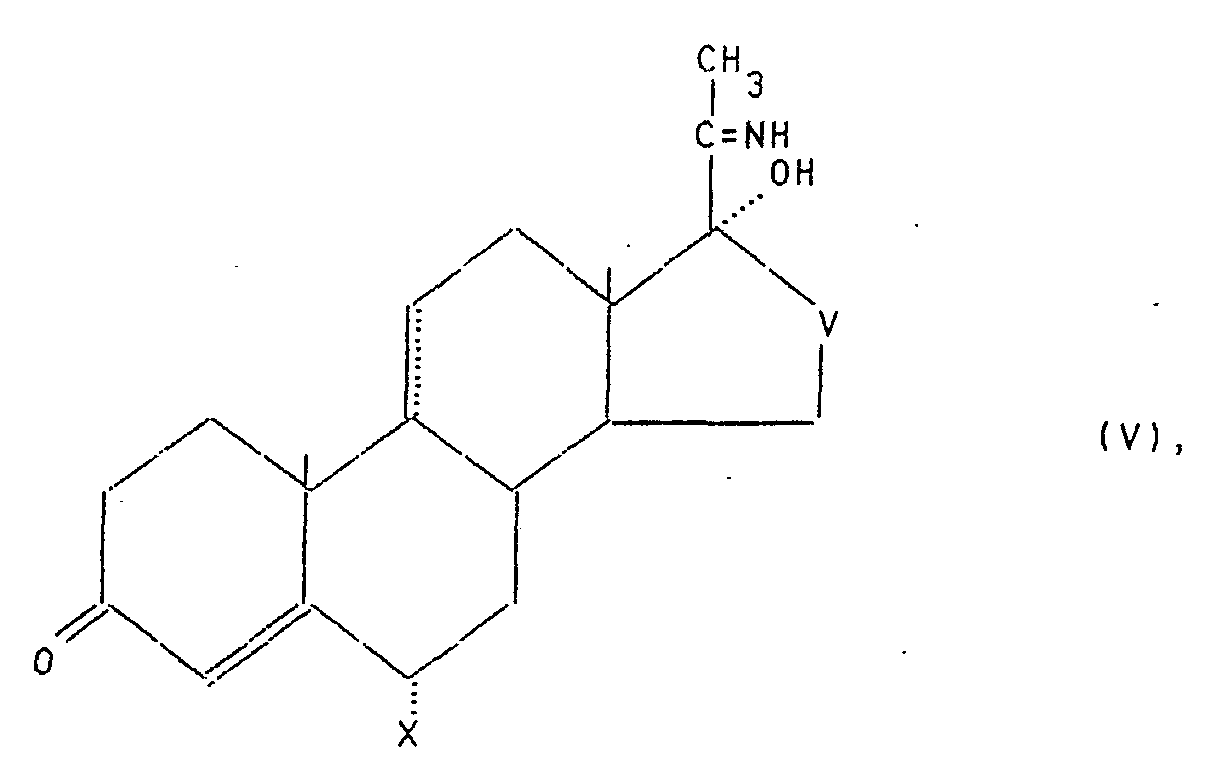
Nach erfolgter Zersetzung kann das Toluol mittels Wasserdampfdestillation entfernt werden und man erhält ein Zwischenprodukt, welches aus einem Gemisch des Progesteron-Derivates der allgemeinen Formel I und den Iminoverbindungen der Formeln IV und V
Figure imgf000006_0001
Figure imgf000007_0001
(in diesen Formeln haben ....., X, Y,Z,W und V die oben genannte Bedeutung) besteht.
Dieses Produkt kann problemlos mittels Säuren zu den Progesteron-Derivaten der allgemeinen Formel I hydrolysiert werden.
Diese Hydrolyse läßt sich beispielsweise so durchführen, daß man das Zwischenprodukt in einem niederen Alkohol - wie Methanol, Ethanol oder Isopropanol löst, mit einer Säure, wie Salzsäure, Schwefelsäure oder p-Toluolsulfonsäure versetzt und erhitzt. Nach erfolgter Umsetzung kann das Reaktionsprodukt beispielsweise mit Wasser ausgefällt werden, wobei man zweckmäßigerweise dafür Sorge trägt, daß die Säure neutralisiert wird.
Nach den bislang vorliegenden Versuchen betagt die Ausbeute an
Verfahrensprodukt ca. 90 % der Theorie. Sie kann möglicherweise durch Optimierung der Verfahrensparameter weiter gesteigert werden.
Es ist für den Fachmann sehr überraschend, daß die Progesteron-Derivate der allgemeinen Formel I durch direkte Grignardierung von Nitrilen der allgemeinen Formel II hergestellt werden können.
Bereits 1959 hatten P. de Ruggieri et. al. aus Cyanhydrinen von
17-Oxosteroiden 17α-Hydroxy-pregnan-20-on-Derivate hergestellt. Sie hatten zu diesem Zweck die 17-Hydroxygruppe der Cyanhydrine durch Umsetzen mit 2,3-Dιhydropyran verethert und dann den 17-Tetrahydropyranylether mit einem Grignard-Reagenz der Formel III umgesetzt. Die direkte
Grignardierung von ungeschützten Cyanhydrinen ist nach Meinung der Autoren nicht möglich, da das Grignard-Reagenz zur Dissoziation des Cyanhydrins führt, wobei das Ausgangsketon entsteht, welches mit dem Grignard-Reagenz das entsprechende Methylcarbinol bildet. (J. Amer. Chem. Soc, 81, 1959, p 5725).
Auch L.F. Fieser et. al. (L.F. Fieser und M. Fieser "Steroide" Verlag Chemie, Weinheim DE. 1961, p 742) und E. Oliveto 13 . Fried and J.E.
Edwards ( Ed ) "Organic Reactions in Steroid Chemistry" Vol. II; van
Nostrand Reinhold Comp. New York et. al. 1972, p 132) vertraten die Ansicht, die direkte Grignardierung von ungeschützten Cyanhydrinen sein nicht möglich.
Wenn Synthesen dieser Art durchgeführt wurden, wurden selbst in neuerer
Zeit als Ausgangssubstanzen stets Cyanhydrine verwendet, deren 17-Hydroxygruppe geschützt war. Siehe beispielsweise
K. Annen et. al. DE-A 34 27 486
I. Nitta et al. Bull Chem. Soc, Jpn. 58, 1985, 978
V. H. van Rhennen US-A 4,500,461
J.V.M. Batist et. al. EP-A 0263569 und
A.E.V. Popova et. al. ref. CA. 102, 1985, 167.005e Die Vorteile des erfindungsgemäßen Verfahrens liegen nicht nur darin, daß ein Reaktionsschritt eingespart wird, sie liegen auch in der sehr einfachen Durchführbarkeit des erfindungsgemäßen Verfahrens und der hohen Ausbeute an Verfahrensprodukt.
Das nachfolgende Ausführungsbeispiel dient zur näheren Erläuterung des erfindungsgemäßen Verfahrens:
Ausfuhrungsbeispiel
Aus 219 1 einer 3 molren Lösung von Methylmagnesiumchlorid in Tetrahydrofuran werden unter Stickstoff 100 1 Tetrahydrofuran bei Normaldruck abdestilliert. Dann setzt man der Mischung 725 1 Toluol so zu, daß die Temperatur 80° C nicht untersteigt und destilliert 300 1 TetrahydrofuranToluol Mischung ab.
Man läßt die Lösung auf 0° C erkalten, versetzt sie unter Rühren innerhalb von 30 Minuten mit einer Suspension von 50 kg 3,3-Ethylendioxy-17ß-5-androsten-17α-ol in 150 1 Toluol, wobei die Temperatur 5° C nicht übersteigen soll und rührt noch eine Stunde lang bei 5° C.
Dann setzt man der Reaktionsmischung eine Lösung von 25 kg Ammoniumchlorid in 200 1 Wasser so zu, daß die Reaktionstemperatur 80° C nicht übersteigt, säuert sie mit Salzsäure an bis zum pH-6,5 erwärmt sie 20 Minuten lang unter Rühren auf 80° C, trennt die organische Phase ab, wäscht die wässrige Phase mit 200 1 Toluol, vereinigt die organischen Phasen, versetzt sie mit 200 1 Wasser und destilliert das Toluol mittels Wasserdampfdestillation ab.
Nach Erkalten des Reaktionsgemisches wird das abgeschiedene Zwischenprodukt abfiltriert, mit Wasser gewaschen, in 500 1 Methanol eingetragen, mit 6,5 1 konzentrierter Salzsäure versetzt und 15 Minuten unter Rückfluß erhitzt. Dann läßt man die Mischung erkalten, trägt sie in eine Lösung von 12,5 kg Natriumacetat in 25 1 Wasser ein, destilliert 400 1 Methanol ab und versetzt den Rückstand langsam mit 500 1 Wasser.
Das abgeschiedene Produkt wird abfiltriert, mit Wasser gewaschen und bei 50° C im Umlufttrockenschrank getrocknet.
Man erhält so 48 kg 17α-Hydroxy-4-pregnen-3,20-dion vom Schmelzpunkt 210-213° C. (Reinheit laut HPCL 93 %).

Claims

Patentansprüche
1. Verfahren zur Herstellung von Progesteron-Derivaten der allgemeinen Formel I
Figure imgf000011_0001
worin
┉ eine Einfachbindung oder eine Doppelbindung symbolisiert,
X ein Wasserstoffatom, ein Fluoratom oder eine Methylgruppe darstellt und
V eine Methylengruppe, eine Ethylengruppe, eine Ethylidengruppe oder eine Vinylidengruppe bedeutet,
dadurch gekennzeichnet, daß man ein Nitril der allgemeinen Formel II
Figure imgf000012_0001
worin
..... , X und V die oben genannte Bedeutung besitzen und worin
bedeuten und W ein Wasserstoffatom darstellt oder worin
Y eine Alkyloxygruppe mit bis zu 4 Kohlenstoffatomen,
eine Bezylgruppe oder eine Acyloxygruppe mit 2 bis 8 Kohlenstoffatomen symbolisiert und Z und W zwei Wasserstoffatome darstellen oder gemeinsam eine Kohlenstoff-Kohlenstoff-Bindung bedeuten,
mit einem Grignard-Reagenz der allgemeinen Formel III
CH3-Mg-Z (III),
worin Z ein Chloratom oder ein Bromatom symbolisiert, umsetzt und die gebildeten Zwischenprodukte mittels Säuren hydrolysiert.
2. Verfahren zur Herstellung von Progesteron-Derivaten der allgemeinen Formel I gemäß Patentanspurch 1, dadurch gekennzeichnet, daß man die Reaktion mit einer Lösung eines Komplexes des Grignard-Reagenzes mit einem Ether in Toluol durchführt.
3. Verfahren zur Herstellung von Progesteron-Derivaten der allgemeinen Formel I gemäß Patentanspruch 1 und 2, dadurch gekennzeichnet, daß man der Reaktion bei einer Temperatur von -20° C bis +10° C durchführt.
Y und Z gemeinsam eine Alkylendioxygruppe mit 2 bis 6
Kohlenstoffatomen
PCT/DE1990/000688 1989-09-14 1990-09-06 Verfahren zur herstellung von progesteron-derivaten Ceased WO1991004265A1 (de)

Priority Applications (2)

Application Number Priority Date Filing Date Title
EP90913165A EP0443000B1 (de) 1989-09-14 1990-09-06 Verfahren zur herstellung von progesteron-derivaten
DE59008362T DE59008362D1 (de) 1989-09-14 1990-09-06 Verfahren zur herstellung von progesteron-derivaten.

Applications Claiming Priority (2)

Application Number Priority Date Filing Date Title
DE3931064A DE3931064A1 (de) 1989-09-14 1989-09-14 Verfahren zur herstellung von progesteron-derivaten
DEP3931064.7 1989-09-14

Publications (1)

Publication Number Publication Date
WO1991004265A1 true WO1991004265A1 (de) 1991-04-04

Family

ID=6389636

Family Applications (1)

Application Number Title Priority Date Filing Date
PCT/DE1990/000688 Ceased WO1991004265A1 (de) 1989-09-14 1990-09-06 Verfahren zur herstellung von progesteron-derivaten

Country Status (10)

Country Link
US (1) US5132440A (de)
EP (1) EP0443000B1 (de)
JP (1) JP2837271B2 (de)
AT (1) ATE117695T1 (de)
CA (1) CA2041644A1 (de)
DD (1) DD297651A5 (de)
DE (2) DE3931064A1 (de)
ES (1) ES2070334T3 (de)
MX (1) MX172229B (de)
WO (1) WO1991004265A1 (de)

Families Citing this family (5)

* Cited by examiner, † Cited by third party
Publication number Priority date Publication date Assignee Title
CN103467555A (zh) * 2013-03-29 2013-12-25 山东新华制药股份有限公司 17α-羟基黄体酮的合成方法
CN104072565B (zh) * 2014-07-11 2017-03-01 山东众诚药业股份有限公司 一种高收率的17α‑羟基黄体酮的简捷制备方法
CN104119415B (zh) * 2014-08-06 2017-01-25 湖南科瑞生物制药股份有限公司 一种17a‑羟基黄体酮的制备方法
CN107286215A (zh) * 2016-03-31 2017-10-24 天津金耀集团有限公司 一种多个烯烃基团的甾体化合物制备方法
CN105801651B (zh) * 2016-04-19 2018-03-06 浙江仙居君业药业有限公司 一种17α‑羟基黄体酮的合成方法

Citations (3)

* Cited by examiner, † Cited by third party
Publication number Priority date Publication date Assignee Title
FR2082129A5 (de) * 1970-03-04 1971-12-10 Roussel Uclaf
EP0153001A2 (de) * 1984-02-03 1985-08-28 The Upjohn Company Steroide mit einer Enamid- oder Enimidgruppe sowie ihre Herstellung
DE3427486A1 (de) * 1984-07-23 1986-01-30 Schering AG, Berlin und Bergkamen, 1000 Berlin Verfahren zur herstellung von 6(alpha)-methylsteroiden

Family Cites Families (2)

* Cited by examiner, † Cited by third party
Publication number Priority date Publication date Assignee Title
US4585590A (en) * 1984-02-03 1986-04-29 The Upjohn Company Cyanohydrin process
US4831131A (en) * 1984-02-03 1989-05-16 The Upjohn Company 11β,17α-Dihydroxy-17β-cyano-androstanes

Patent Citations (3)

* Cited by examiner, † Cited by third party
Publication number Priority date Publication date Assignee Title
FR2082129A5 (de) * 1970-03-04 1971-12-10 Roussel Uclaf
EP0153001A2 (de) * 1984-02-03 1985-08-28 The Upjohn Company Steroide mit einer Enamid- oder Enimidgruppe sowie ihre Herstellung
DE3427486A1 (de) * 1984-07-23 1986-01-30 Schering AG, Berlin und Bergkamen, 1000 Berlin Verfahren zur herstellung von 6(alpha)-methylsteroiden

Non-Patent Citations (1)

* Cited by examiner, † Cited by third party
Title
J. Amer. Chem. Soc., Band. 81, November 1959 Pietro de Ruggieri et al.: "17-Hydroxypregnanes from Androstane Compounds ", *

Also Published As

Publication number Publication date
ATE117695T1 (de) 1995-02-15
ES2070334T3 (es) 1995-06-01
US5132440A (en) 1992-07-21
DE59008362D1 (de) 1995-03-09
EP0443000A1 (de) 1991-08-28
EP0443000B1 (de) 1995-01-25
MX172229B (es) 1993-12-08
JPH04501861A (ja) 1992-04-02
JP2837271B2 (ja) 1998-12-14
DD297651A5 (de) 1992-01-16
DE3931064A1 (de) 1991-03-28
CA2041644A1 (en) 1991-03-15

Similar Documents

Publication Publication Date Title
CH629222A5 (de) Verfahren zur herstellung von androstan-derivaten.
EP0153615B1 (de) Verfahren zur Herstellung von Tetronsäure
EP0443000B1 (de) Verfahren zur herstellung von progesteron-derivaten
DE3427486A1 (de) Verfahren zur herstellung von 6(alpha)-methylsteroiden
DE1468410A1 (de) Verfahren zur Herstellung von 16-Methylensteroiden
CH624684A5 (de)
DE69527997T2 (de) Verfahren zur Herstellung von Isoxazole-3-Carbonsäure
DE2533335C2 (de) 3-Methyl-3-aryl-brenztraubensäureester und Verfahren zur Herstellung substituierter Brenztraubensäureester
DE2237202A1 (de) Verfahren zur herstellung von 17(2-haloaethyliden)-steroiden
DE2814347A1 (de) Verfahren zur herstellung von steroidsaeuren
WO2001096277A1 (de) Verfahren zur herstellung von 2,3,4,6-tetramethylmandelsäure und 2,3,4,6-tetramethylmandelsäureacetat
DE1618871B2 (de) Verfahren zur herstellung eines steroidketonderivates
AT273387B (de) Verfahren zur Herstellung von neuen Cholesterinderivaten sowie von deren Säureadditionssalzen
DE2246867A1 (de) Tetrahydroxy-bicyclo- eckige klammer auf 3.3.0 eckige klammer zu -octane
DE4018828C2 (de) Verfahren zur Herstellung C7-alpha-substituierter 8alpha- und 8ß-Estra-1,3,5(10)-triene und C8-alpha-substituierter Estra-1,3,5(10)-triene sowie neue Zwischenprodukte für dieses Verfahren
DE1238021B (de) Verfahren zur Herstellung von Verbindungen der Pregnanreihe
DE960819C (de) Verfahren zur Herstellung von 11ª‰ -Oxyprogesteron
DE2256866C3 (de) Verfahren zur Herstellung von 17 alpha- oder 17beta-Hydroxy-Verbindungen der 20-Ketopregnan- oder -17alpha-pregnanreihe
DE948974C (de) Verfahren zur Herstellung von cyclischen 4-Halogenpregnan-3, 20-dion-3, 20-diketalen
DE1593407C3 (de) 17beta-Hydroxy-2-oxaöstra-4,9(10)dien-3-on sowie Verfahren zur Herstellung dieser Verbindung
DE2204366A1 (de) Steroid-abkoemmlinge
DE3230333A1 (de) Verfahren zur herstellung von threo-1-phenyl-2-amino-propanol-(1)-derivaten
CH504474A (de) Verfahren zur Herstellung von Oxa-Steroidverbindungen
DE2508110A1 (de) Verfahren zur gewinnung von 19-nor-delta hoch 4 -androsten-3,17- dion
CH322807A (de) Verfahren zur Herstellung von a-Halogen-ketalen von Steroiden

Legal Events

Date Code Title Description
AK Designated states

Kind code of ref document: A1

Designated state(s): CA JP US

AL Designated countries for regional patents

Kind code of ref document: A1

Designated state(s): AT BE CH DE DK ES FR GB IT LU NL SE

WWE Wipo information: entry into national phase

Ref document number: 1990913165

Country of ref document: EP

WWE Wipo information: entry into national phase

Ref document number: 2041644

Country of ref document: CA

WWP Wipo information: published in national office

Ref document number: 1990913165

Country of ref document: EP

WWG Wipo information: grant in national office

Ref document number: 1990913165

Country of ref document: EP