WO1998003590A1 - Polyphenylene sulfide resin composition - Google Patents
Polyphenylene sulfide resin composition Download PDFInfo
- Publication number
- WO1998003590A1 WO1998003590A1 PCT/JP1997/002487 JP9702487W WO9803590A1 WO 1998003590 A1 WO1998003590 A1 WO 1998003590A1 JP 9702487 W JP9702487 W JP 9702487W WO 9803590 A1 WO9803590 A1 WO 9803590A1
- Authority
- WO
- WIPO (PCT)
- Prior art keywords
- group
- resin composition
- sulfide resin
- acid
- aromatic group
- Prior art date
- Legal status (The legal status is an assumption and is not a legal conclusion. Google has not performed a legal analysis and makes no representation as to the accuracy of the status listed.)
- Ceased
Links
Classifications
-
- C—CHEMISTRY; METALLURGY
- C08—ORGANIC MACROMOLECULAR COMPOUNDS; THEIR PREPARATION OR CHEMICAL WORKING-UP; COMPOSITIONS BASED THEREON
- C08L—COMPOSITIONS OF MACROMOLECULAR COMPOUNDS
- C08L81/00—Compositions of macromolecular compounds obtained by reactions forming in the main chain of the macromolecule a linkage containing sulfur with or without nitrogen, oxygen or carbon only; Compositions of polysulfones; Compositions of derivatives of such polymers
- C08L81/02—Polythioethers; Polythioether-ethers
-
- C—CHEMISTRY; METALLURGY
- C08—ORGANIC MACROMOLECULAR COMPOUNDS; THEIR PREPARATION OR CHEMICAL WORKING-UP; COMPOSITIONS BASED THEREON
- C08G—MACROMOLECULAR COMPOUNDS OBTAINED OTHERWISE THAN BY REACTIONS ONLY INVOLVING UNSATURATED CARBON-TO-CARBON BONDS
- C08G75/00—Macromolecular compounds obtained by reactions forming a linkage containing sulfur with or without nitrogen, oxygen, or carbon in the main chain of the macromolecule
- C08G75/02—Polythioethers
- C08G75/0204—Polyarylenethioethers
- C08G75/0209—Polyarylenethioethers derived from monomers containing one aromatic ring
-
- C—CHEMISTRY; METALLURGY
- C08—ORGANIC MACROMOLECULAR COMPOUNDS; THEIR PREPARATION OR CHEMICAL WORKING-UP; COMPOSITIONS BASED THEREON
- C08K—Use of inorganic or non-macromolecular organic substances as compounding ingredients
- C08K5/00—Use of organic ingredients
-
- C—CHEMISTRY; METALLURGY
- C08—ORGANIC MACROMOLECULAR COMPOUNDS; THEIR PREPARATION OR CHEMICAL WORKING-UP; COMPOSITIONS BASED THEREON
- C08K—Use of inorganic or non-macromolecular organic substances as compounding ingredients
- C08K7/00—Use of ingredients characterised by shape
- C08K7/02—Fibres or whiskers
- C08K7/04—Fibres or whiskers inorganic
- C08K7/14—Glass
-
- C—CHEMISTRY; METALLURGY
- C08—ORGANIC MACROMOLECULAR COMPOUNDS; THEIR PREPARATION OR CHEMICAL WORKING-UP; COMPOSITIONS BASED THEREON
- C08K—Use of inorganic or non-macromolecular organic substances as compounding ingredients
- C08K2201/00—Specific properties of additives
- C08K2201/002—Physical properties
- C08K2201/003—Additives being defined by their diameter
-
- C—CHEMISTRY; METALLURGY
- C08—ORGANIC MACROMOLECULAR COMPOUNDS; THEIR PREPARATION OR CHEMICAL WORKING-UP; COMPOSITIONS BASED THEREON
- C08K—Use of inorganic or non-macromolecular organic substances as compounding ingredients
- C08K2201/00—Specific properties of additives
- C08K2201/002—Physical properties
- C08K2201/004—Additives being defined by their length
Definitions
- the present invention relates to a polyphenylene sulfide resin composition having excellent burr characteristics, fluidity and crystallization characteristics.
- Polyphenylene sulfide resin (hereinafter abbreviated as PPS resin) has excellent heat resistance, flame retardancy, rigidity and electrical insulating properties, and is suitable for engineering plastics. It is used for various electrical parts, mechanical parts and automotive parts.
- PPS resin generates burrs relatively frequently during molding, and its use is particularly limited in applications such as small precision parts that require low burrs.
- the resin temperature gradually decreases near the center, so that the crystallization of the resin proceeds in a relatively high temperature region.
- the resin temperature decreases rapidly near the surface of the molded product, and crystallization of the resin proceeds in a relatively low temperature range. Therefore, in order to exhibit excellent injection moldability irrespective of the thickness of the molded product, it is necessary to improve the crystallization rate in any temperature range.
- PPS resin is made of poly (phenylene sulfide ketone). It has been disclosed that the crystallization of PPS resin is promoted in a relatively high temperature range by the addition of polyether ether ketone or polyester ether ketone, and this is due to the crystal nucleation effect of such an additive. The present inventors have tried this method again, but this method is effective, but not sufficient, for promoting the crystallization of PPS resin in a high temperature range, and it is not enough to form the PPS resin in a low temperature range. There is almost no effect on product promotion.
- Japanese Patent Application Laid-Open No. 62-23048 discloses that by adding a monomeric carboxylic acid ester to a PPS resin, crystallization of the PPS resin is promoted in a relatively low temperature range. It is disclosed.
- such additives have little effect on accelerating the crystallization of PPS resins in a relatively high temperature range, and such additives are liable to decompose or volatilize at high process temperatures of PPS resins, and the composition has an adverse effect on the composition.
- a PPS resin composition comprising a specific amount of an aromatic group-containing oligomer added to a PPS resin, wherein the PPS resin composition is characterized in that the temperature-rise crystallization peak temperature of the composition is 125 or less.
- Japanese Unexamined Patent Publication (Kokai) No. 2-123159 describes that the addition of a specific amount of a specific aromatic group-containing amide oligomer significantly reduces burrs, and in particular, the PPS resin in a relatively low temperature range. It does not disclose that crystallization is promoted.
- Japanese Patent Application Laid-Open No. 6-57138 discloses that a PPS resin composition having excellent moldability can be obtained by adding a specific polyimide to the PPS resin. It does not disclose anything about the specific reduction of burrs by the addition of an aromatic oligomer containing an aromatic group, nor does it disclose that the crystallization rate is improved in both high and low temperature ranges. . Further, Japanese Patent Application Laid-Open No.
- Japanese Patent Application Laid-Open No. 7-228787 discloses that by adding an amide oligomer to a PPS resin, the adhesion to an epoxy resin is improved.
- Japanese Patent Application Laid-Open No. 7-228787 discloses that addition of a specific amount of a specific amide oligomer having an aromatic group significantly reduces burr and promotes crystallization of a PPS resin.
- JP-A-59-196364 describes that the addition of aromatic oligoamides having a total number of amide bonds and hydrazide bonds of 1 to 6 promotes crystallization of PPS resin. Although it discloses that it is effective in improving heat resistance and heat resistance, it does not disclose any burrs and fluidity.
- 8-157640 discloses that the addition of an oligoamide compound increases the crystallization rate of a PPS resin, and the PPS resin composition in which the mechanical and thermal properties of a molded article are improved. Although the technology for obtaining a product is disclosed, it is not disclosed at all that the addition of a specific aromatic group-containing oligomer reduces remarkably burrs, and that fluidity is not impaired during injection molding. Is not disclosed. Disclosure of the invention
- the present invention provides the following composition, a method for producing the same, and a molded article.
- the aromatic group-containing oligomer is selected from an amide group, a hydrazide group, an imido group, an ester group, an ether group, a ketone group, a urethane group, and a sulfone group.
- the aromatic group-containing oligomer has one or more residues selected from divalent residues represented by the following structural formulas (I), (II) and (III) and It contains one or more kinds of residues selected from the divalent residues represented by the structural formulas (IV), (V) and (VI), and each residue is formed through an amide bond.
- Item 4 which is an aromatic group-containing amide oligomer which is a linked polycondensate and whose relative viscosity (1% sulfuric acid solution, 25 ° C) is 1.01 to 2.00. Polyphenylene sulfide resin composition.
- R l, R 3 represent a divalent non-aromatic organic group having 2 to 20 carbon atoms, which may be the same or different.
- r 2 a r 3 represents an organic group containing a divalent aromatic group having 0 2 6 carbon atoms, which may be the same or different.
- At least a part of the terminal of the aromatic group-containing amide oligomer is a monocarboxylic acid having 1 to 20 carbon atoms and Z or a monoamino acid having 1 to 20 carbon atoms. 7.
- the aromatic group-containing oligomer is a divalent residue represented by the following structural formula (VII), (VIII) or (IX) and a structural unit represented by the following structural formula (X) or (XI) It is an aromatic group-containing amide oligomer which is a polycondensate in which one or more organic residues selected from monovalent residues are connected via an amide bond. 4.
- the polyphenylene sulfide resin composition according to the above item 4.
- a r and A r 5 A ′ represent organic groups containing a divalent aromatic group having 6 to 20 carbon atoms, which may be the same or different.
- a r 7 represents an organic group containing a monovalent aromatic group having 6 to 2 0 carbon atoms, these may be the same or may be different.
- An aromatic group-containing oligomer is a divalent residue represented by the following structural formulas (XII), (XI11), and (XIV) and a divalent residue represented by the following structural formulas (XV) and (XVI).
- One or more organic residues selected from the monovalent residues shown Is the aromatic group-containing ester oligomer which is a polycondensate linked via an ester bond, wherein the polyolefin resin composition according to the above item 4 is characterized in that:
- Ar ′ 2 and Ar 1 represent an organic group containing a monovalent aromatic group having 6 to 20 carbon atoms, and they may be the same or different. Good.
- the (18) (A) polyphenylene sulfide resin has a number average molecular weight determined by gel permeation chromatography using (A1) 1-chloronaphthalene as a solvent.
- Polyphenylene sulfide resin composition is a polyolefin sulfide resin mixture comprising 95 to 10% by weight of a polyolefin resin having substantially no cross-linked structure.
- (D) at least one selected from an epoxy group, an amino group, an isocyanate group, a hydroxyl group, a mercapto group, and a ureido group.
- the alkoxylan compound having one kind of functional group was added to 100 parts by weight of a total of (A) a polyphenylene sulfide resin and (B) an aromatic group-containing oligomer. 2.
- Polypropylene sulfide resin is selected from (D) epoxy group, amino group, isocyanate group, hydroxyl group, mercapto group and ureide group.
- An alkoxysilane compound having at least one type of functional group is blended and melt-kneaded, and then (B) an aromatic group-containing oligomer is blended with the mixture and melt-kneaded.
- (E-1) an ester compound composed of an aliphatic carboxylic acid having 12 to 40 carbon atoms and a polyhydric alcohol
- (E-2) an aliphatic monocarboxylic acid having 12 to 40 carbon atoms.
- (E-3) an amide compound consisting of an aliphatic monocarboxylic acid having 12 to 40 carbon atoms, an aliphatic polybasic acid having 2 to 20 carbon atoms, and an aliphatic diamine;
- the one additive (E) was added to 0.05 parts by weight based on 100 parts by weight of the total amount of (A) the polyolefin sulfide resin and (B) the aromatic group-containing oligomer. 2.
- (F) lithium, sodium, calcium, magnesium At least one metal selected from the group consisting of aluminum, canoleum, zinc, iron, cobalt, nickel, copper, silver, zinc, aluminum, and tin; and carbonates and halides of at least one metal selected from the group consisting of: At least one metal salt selected from the group consisting of (A) polyphenylene, sulfate, nitrate, phosphate, phosphite, hypophosphite and double salts thereof. 2. The polyolefin resin according to the above item 1, wherein 0.01 to 5 parts by weight is added to 100 parts by weight of the total amount of the lens sulfide resin and the (B) aromatic group-containing oligomer. Lead resin composition.
- the (30) polyphenylene sulfide resin composition has a cooling crystallization peak temperature measured by a differential scanning calorimeter (a scanning speed of 20 D CZ) of 230 or more. 2.
- polyolefin sulfide resin composition according to the above item 1, wherein the polyolefin sulfide resin composition is for a molded article having a thin portion having a thickness of 2 mm or less.
- Polyvinylene sulfide resin is selected from (D) Epoxy group, Amino group, Isocyanate group, Hydroxyl group, Mercapto group, Ureido group After blending with at least one type of alkoxysilane compound having at least one functional group and melt-kneading, (B) an oligomer containing an aromatic group is blended with this, followed by melt-kneading. 28.
- FIG. 1 is a view of a molded product of a connector formed in an embodiment
- FIG. 1a is a plan view
- FIG. 1b is a side view thereof.
- the polyphenylene sulfide resin used in the present invention is a polymer containing a repeating unit (i) represented by the following structural formula, and contains 70 mol% or more, particularly 90 mol% or more from the viewpoint of heat resistance. Is preferred.
- the PPS resin can constitute less than 30 mol% of the repeating unit with a repeating unit (ii) having the following structural formula.
- the melt viscosity of the PP s resin used in the present invention is not particularly limited as long as melt kneading is possible, but is usually 5 to 2,000 Pa-s (320 ° C, shear rate 1,000 sec- 1) is used, and the range of 10 to 200 Pa ⁇ s is more preferable.
- the PPS resin used in the present invention is specified in ASTM D1238-86 (315.5 ° C, 5000 g load) in order to obtain better fluidity and a better low burr effect.
- the melt flow rate at the time of residence for 5 minutes is preferably 100 gZ 10 min or more, more preferably 250 gZl Omin or more.
- Such a PPS resin is generally prepared by a known method, that is, a method of obtaining a polymer having a relatively small molecular weight described in JP-B-45-3368, JP-B-52-12240, and JP-A-61-7332. Can be produced by a method for obtaining a polymer having a relatively large molecular weight as described in (1).
- the PPS resin obtained as described above is crosslinked / high molecular weight by heating in air, heat treatment in an atmosphere of inert gas such as nitrogen or under reduced pressure, washing with an organic solvent, hot water, an acid aqueous solution, etc.
- inert gas such as nitrogen or under reduced pressure
- washing with an organic solvent hot water, an acid aqueous solution, etc.
- it is also possible to use after being subjected to extreme treatment such as activation with a functional group-containing compound such as an acid anhydride, an amine, an isocyanate, or a functional S-containing disulfide compound.
- Cross-linking by heating the PPS resin Z Specific methods for increasing the molecular weight include, for example, an atmosphere of an oxidizing gas such as air or oxygen or a mixed gas atmosphere of the oxidizing gas and an inert gas such as nitrogen or argon.
- an atmosphere of an oxidizing gas such as air or oxygen or a mixed gas atmosphere of the oxidizing gas and an inert gas such as nitrogen or argon.
- the heat treatment temperature is usually selected from 170 to 280, preferably from 200 to 270 ° C
- the time is usually selected from 0.5 to 100 hours, preferably from 2 to 50 hours. By controlling both, the target viscosity level can be obtained.
- the heating device may be an ordinary hot air drier or a rotary or a heating device with a stirrer, but for efficient and more uniform processing, a heating device with a rotary or stirrer blade may be used. More preferably, it is used.
- a heat treatment temperature of 150 to 280 ° C, preferably under an inert gas atmosphere such as nitrogen or under reduced pressure is preferable.
- Heat treatment This device may be a hot air dryer or vacuum dryer that has a high sealing property and can be replaced with an inert gas, or may be a rotary or a heating device with a stirring blade, but the treatment is performed efficiently and more uniformly. In this case, it is more preferable to use a heating device having a rotary type or a stirring blade.
- the following method can be exemplified as a specific method for washing the PPS resin with an organic solvent. That is, the organic solvent used for washing is not particularly limited as long as it does not have a function of decomposing the PPS resin, for example, N'methylpyrrolidone, dimethylformamide, dimethylacetamide, etc.
- Nitrogen-containing polar solvents such as dimethyl sulfoxide and dimethylsulfone, ketone solvents such as acetone, methylethylketone, getylketone, and acetofphenone; ether solvents such as dimethylether, dipropylether and tetrahydrofuran; Halogen solvents such as form, methylene chloride, trichloroethylene, ethylene dichloride, dichloroethane, tetrachloroethane, and chlorobenzene, methanol, ethanol, propanol, butanol, pentanol, ethylene glycol Call, propylene glycol, phenol, cresol, alcohol 'phenol-based solvent such as polyethylene glycol, benzene, toluene, and xylene of any aromatic hydrocarbon solvent.
- sulfoxidesulfone solvents such as dimethyl sulfoxide and dimethylsulfone
- ketone solvents such as acetone
- organic solvents use of N-methylpyrrolidone, acetone, dimethylformamide, and chloroform is preferred.
- These organic solvents are used alone or as a mixture of two or more.
- As a method for washing with an organic solvent there is a method of immersing the PPS resin in an organic solvent, and the like, and if necessary, stirring or heating can also be performed.
- the washing temperature when washing the PPS resin with an organic solvent there is no particular limitation on the washing temperature when washing the PPS resin with an organic solvent, and any temperature from room temperature to about 300 ° C. can be selected. Although the cleaning efficiency tends to increase as the cleaning temperature increases, a sufficient effect can usually be obtained at a cleaning temperature of room temperature to 150 ° C.
- the PPS resin that has been washed with an organic solvent is preferably washed several times with water or warm water in order to remove residual organic solvent.
- the following method can be exemplified as a specific method for treating the PPS resin with hot water. That is, it is preferable that the water used is distilled water or deionized water in order to exhibit a preferable effect of chemically modifying the PPS resin by washing with hot water.
- Hot water treatment The operation is usually performed by charging a predetermined amount of PPS resin into a predetermined amount of water, and heating and stirring the mixture at normal pressure or in a pressure vessel.
- the ratio of PPS resin to water it is preferable that the amount of water is large. ? 3 A bath ratio of 200 or less is selected.
- the following method can be exemplified as a specific method when the PPS resin is subjected to acid treatment. That is, there is a method of immersing the PPS resin in an acid or an aqueous solution of an acid, or the like, and if necessary, stirring or heating can be performed as appropriate.
- the acid to be used is not particularly limited as long as it does not have a function of decomposing PPS.
- Aliphatic unsaturated monocarboxylic acids such as aliphatic saturated carboxylic acid, acrylic acid and crotonic acid; aromatic carboxylic acids such as benzoic acid and salicylic acid; dicarboxylic acids such as oxalic acid, malonic acid, succinic acid, phthalic acid and fumaric acid And inorganic acid compounds such as sulfuric acid, phosphoric acid, hydrochloric acid, carbonic acid, and silicic acid.
- acetic acid and hydrochloric acid are more preferably used.
- the acid-treated PPS resin is preferably washed several times with water or hot water in order to remove the remaining acid or salt.
- the water used for washing is preferably distilled water or deionized water in the sense that the effect of the preferred chemical modification of the PPS resin by the acid treatment is not impaired.
- the (A) PPS resin of the present invention has a number average molecular weight of 7,000 to 1,500,000 and a total ash content determined by gel permeation chromatography using (Al) 1-chloro-naphthylene as a solvent. 0.3% by weight or less of PPS resin of 5 to 90% by weight and (A 2) a number average molecular weight of 3000 to 6000 and a substantially non-crosslinked PPS resin of 95 to 10% % Of the PPS resin mixture is preferable from the viewpoint of obtaining better low burr and thin-wall fluidity.
- PPS resin (A 1) (A 1-1) PPS resin having a number-average molecular weight of 7,000 to 15,000 and a total ash content of 0.3% by weight or less and having substantially no cross-linked structure, which is determined by gel permeation chromatography using len as a solvent, or (A1 -2) Number average molecular weight determined by gel permeation chromatography using 1-chloronaphthalene as solvent 7000-15000, total ash content is less than 0.3% by weight, and ASTM
- melt flow rate value at the time is 50 to 95% of the melt flow rate value at the time of residence for 5 minutes.
- the total ash content was determined as follows: 5 g of resin dried at 150 for 1 hour was placed in a crucible, and the residue was burned for 6 hours at 540 ° C. The ratio of the residue weight to the resin (5 g) after drying was measured. Is calculated.
- the temperature rise crystallization peak temperature measured by a differential scanning calorimeter at a scanning speed of 20 / min is 1 It is preferable to use PPS having a temperature of 35 ° C. or less and a temperature-reducing crystallization peak temperature obtained in the same manner, which is 210 or more.
- the appropriate molecular weight of the (B) aromatic group-containing oligomer varies depending on its chemical structure and cannot be unconditionally specified, but it is preferable that at least the number average molecular weight is about 100 or less.
- the cooling crystallization peak temperature measured by a differential scanning calorimeter at a scanning speed of 20 ° C / min is 240 ° C or more. It is more preferable that the temperature is from 250 to 330C.
- the melting temperature of (B) the aromatic group-containing oligomer is significantly higher than the melting temperature of the PPS resin.
- the melting peak temperature measured by a differential scanning calorimeter (scanning speed: 20 min) is preferably 37 (TC or lower, more preferably 350 or lower).
- the aromatic group-containing oligomer (B) used in the present invention is formed through at least one kind of bond selected from amide group, hydrazide group, imido group, ester group, ketone group, urethane group and sulfone group. It is preferred that the polycondensate is linked by at least one selected from amide groups, ester groups, ketone groups, and imido groups. Polycondensates linked via a bond are more preferred.
- Preferred compounds of the (B) aromatic group-containing oligomer used in the present invention include a divalent residue containing an aromatic group and a divalent residue not containing an aromatic group. And oligomers (meaning amide oligomers containing an aromatic group in part).
- Such (B1) semi-aromatic amide oligomer is defined as one or more residues selected from divalent residues represented by the following structural formulas (I), (II) and (III). It contains one or more residues selected from divalent residues represented by structural formulas (IV), (V), and (VI), and each residue is linked via an amide bond to form a polycondensation.
- Aromatic group-containing amide oligomer having a relative viscosity (1% sulfuric acid solution, 25 ° C.) of 1.01 to 2.00.
- R ′, R 2 and R 3 represent a divalent non-aromatic organic group having 2 to 20 carbon atoms, which may be the same or different. Also, A r ′ and A r 2 and ⁇ 3 represent organic groups containing a divalent aromatic group having 6 to 20 carbon atoms, which may be the same or different.)
- (B 1) Semi-aromatic amide Oligomers are usually derived from aminocarboxylic acids, lactams, or diamines and dicarboxylic acids.
- the structural formula (I) is derived from a non-aromatic dicarboxylic acid having 4 to 22 carbon atoms.
- specific examples of the non-aromatic dicarboxylic acid having 4 to 22 carbon atoms include succinic acid, glutaric acid, and adipine. Acid, pimelic acid, azelaic acid, suberic acid, sebacic acid, dodecandioic acid, maleic acid, fumaric acid, cyclohexanedicarboxylic acid, etc., and these may be used alone or in combination of two or more. Is also good. Horse mackerel P-Pin acid, sebacic acid and dodecane diacid are particularly preferably used.
- the above structural formula (II) is derived from a non-aromatic diamine having 2 to 20 carbon atoms.
- specific examples of the non-aromatic diamine having 2 to 20 carbon atoms include ethylenediamine, propylenediamine, and the like.
- Tetramethylene diamine pentamethylene diamine, hexamethylene diamine, heptane methylene diamine, octamethylene diamine, nonamethylene diamine, decamethylene diamine, pendecamethylene diamine, dodecamethylene diamine , Tridecamethylenediamine, Tetradecamethylenediamine, 2,2,4-Trimethylhexamethylenediamine, 2,4,4 Trimethylhexamethylenediamine, 5-Methylnonamethylene Rangeamine, 1,3-bis (aminomethyl) cyclohexane, 1,4-bis (aminomethyl) cyclohexane, Amino-3 —aminomethyl-3,5,5—trimethylcyclohexane, 2,2-bis (4-aminocyclohexyl) propane, bis (aminopropyl) piperazine, bis (aminoethyl) piperazine, bis (4— Aliphatic and alicyclic diamines selected from aminocyclohexyl) methane
- the above structural formula (III) is derived from a non-aromatic aminocarboxylic acid or lactam having 3 to 21 carbon atoms.
- specific examples of the non-aromatic aminocarboxylic acid or lactam having 3 to 21 carbon atoms include: Aminocarboxylic acids such as 6-aminohexanoic acid, 7-aminoheptanoic acid, 8-aminoaminooctanoic acid, 91-aminononanoic acid, 10-aminodecanoic acid, and 11-aminoundecanoic acid; Lactams such as lactams may be used, and these may be used alone or in combination of two or more. Among them, 6-aminohexanoic acid and hydraprolactam are particularly preferably used.
- the structural formula (IV) is derived from an aromatic dicarboxylic acid having 8 to 22 carbon atoms.
- aromatic dicarboxylic acid having 8 to 22 carbon atoms include isophthalic acid and terephthalic acid. Acid, orthophthalic acid, 2-chloroterephthalic acid, 2-methylterephthalic acid, 5-methylisophthalic acid, 5-sodium sulfoisophthalic acid, 4, 4'-biphenyldicarboxylic acid, 3,4'-biphenyldicarboxylic acid, 2,2'-biphenyldicarboxylic acid, 1,3-naphthalenedicarboxylic acid, 1,4-naphthalenedicarboxylic acid, 1,5— Naphthalenedicarboxylic acid, 1,6-naphthalenedicarboxylic acid rubonic acid, 1.7-naphthalenedicarboxylic acid, 2,6-naphthalenedicarboxylic acid, 2.5-pyridinedicarboxylic acid, 2,4-
- the above structural formula (V) is derived from a diamine containing an aromatic group having 6 to 20 carbon atoms.
- a diamine containing an aromatic group having 2 to 20 carbon atoms include paraphenylenediamine, Metaphenylene diamine, orthophenylene diamine, methaxylylene diamine, haxylylene diamine, 2,3-diaminotoluene, 2,4 diaminotoluene, 2,6-diaminotoluene, 3,4-diaminotoluene , 1,5-diaminonaphthalene, 1,8-diaminonaphthalene, 2,3-diaminonaphthalene, and the like. These may be used alone or in combination of two or more. Among them, paraphenylenediamine, methylphenylenediamine, metaxylylenediamine and paraxylylenediamine are particularly preferably used.
- the above structural formula (VI) is derived from an aromatic aminocarboxylic acid having 7 to 21 carbon atoms, and specific examples of such an aromatic aminocarboxylic acid having 7 to 21 carbon atoms are: Examples thereof include laminobenzoic acid, metaaminobenzoic acid, and orthoaminobenzoic acid. These may be used alone or in combination of two or more.
- the (B 1) semi-aromatic polyamide resin used in the present invention has the structural formula (I):
- One or more residues selected from divalent residues represented by (II) and (III) and divalent residues represented by the following structural formulas (IV), (V) and (VI) One or two or more residues are included, but a multi-component copolymer containing three or more residues is particularly preferable.
- the constituent ratio of the above ( ⁇ ) to (VI) in the (B1) semi-aromatic amide oligomer used in the present invention is not particularly limited, but usually, the melting peak temperature increases as the aromatic component increases.
- the (B 1) semi-aromatic amide oligomer used in the present invention preferably has a melting peak temperature of 270 ° C. or higher, and a melting peak temperature of 270 to 36. 0. C, more preferably 270-330 ° C.
- a divalent residue represented by the above structural formula (I), ( ⁇ ) or (IV) is an amide bond.
- a more specific example is a hexamethylenediamine residue, a terephthalic acid residue, a di-dipic acid residue, or a dodecamethylene diamine residue, a non-terephthalic acid residue.
- An aromatic group-containing copolymer amide oligomer comprising a xamethylenediamine residue Z adipic acid residue is exemplified.
- the molar ratio of (II) is not particularly limited, but is usually in the range of 0.5 to 1.5 times the total molar amount of (I) and (IV). 0 times is preferred.
- the divalent residue represented by the above structural formulas (II), (III) and (IV) has an amide bond.
- examples include polycondensates linked via an amino acid. More specific examples include a hexamethylene diamine residue / terephthalic acid residue Z-force prolactam residue, or a hexamethylene diamine residue or a neisophthalic acid residue.
- Aromatic group-containing copolymerized amide oligomers composed of hydraprolactam residues are exemplified.
- the molar ratio of (II) is not particularly limited, but is preferably substantially equimolar to (IV).
- a divalent residue represented by the above structural formula (II) and at least two or more kinds of (IV) have an amide bond.
- a more specific example is an aromatic group-containing copolymer polyamide consisting of a hexamethylenediamine residue, a terephthalic acid residue, and a neisophthalic acid residue.
- the ( ⁇ 1) semi-aromatic amide oligomer used in the present invention has at least a part or substantially all of the terminal thereof a monocarboxylic acid having 1 to 20 carbon atoms and a monoamine having 1 to 20 carbon atoms or a monoamine having 1 to 20 carbon atoms. End-blocked amide oligomer containing aromatic group You can use it.
- Such a monocarboxylic acid having 1 to 20 carbon atoms include acetic acid, propionic acid, butyric acid, valeric acid, caproic acid, caprylic acid, lauric acid, myristic acid, hanoremitic acid, stearic acid, Examples thereof include oleic acid, cyclohexanecarboxylic acid, benzoic acid, toluic acid, and humyl acetic acid. These may be used alone or in combination of two or more.
- specific examples of the monoamine having 1 to 20 carbon atoms include propylamine, butylamine, hexylamine, octylamine, nonylamine, decylamine, pendecylamine, dodecylamine, octadecylamine, cyclohexylamine, benzylamine, and the like. / 3-phenethylamine, etc., which may be used alone or in combination of two or more.
- the method for synthesizing the (B 1) semi-aromatic amide oligomer is not particularly limited.
- a desired monomer such as the aminocarboxylic acid, lactam, diamine, dicarboxylic acid or a salt of diamine and dicarboxylic acid may be used.
- Such a (B 1) semi-aromatic amide oligomer needs to be an oligomer having a relative viscosity (1% sulfuric acid solution, 25) of 1.01 to 2.00, and more preferably a relative viscosity.
- the viscosity range is from 1.01 to 1.70, more preferably from 1.01 to 1.50, and even more preferably from 1.10 to 1.5.
- the so-called aromatic group-containing polyamide used as engineering plastics and the like is a polymer having a relative viscosity of usually not less than 2.0, but an aromatic group-containing amide polymer having a relative viscosity exceeding 2.0 is used.
- a r 5 A is an organic group containing a divalent Kaoru aromatic group having 6 to 2 0 carbon atoms, these may also me same Jidea, even if different from one Good.
- a r represents an organic group containing a monovalent aromatic group having 6 to 2 0 carbon atoms, these are even the same, may be different.
- the A r 4 to a r 6 is one in which an organic group containing a divalent aromatic group having 6 to 20 carbon atoms, specifically p-, m-, 0- Fuweniren, 4, 4 '1,3,4'1,2,2'-biphenelene, 1,3—, 1,4-1,1,5—, 1,6—, 1,1,1,2,6-naphthalene, 2, 4-, 2, 5-c pyridine and the like which are aliphatic groups of from 1 to 1 0 carbon atoms, alicyclic group, aromatic group 6-2 0 carbon atoms with carbon number 4-20, a halogen, It may be substituted by a nitro group, a cyano group, or the like.
- Ar 7 to A 8 represent an organic group containing a monovalent aromatic group having 6 to 20 carbon atoms, and specific examples thereof include phenyl, biphenyl, naphthalene, and pyridin. Can be These may be substituted with an aliphatic group having 1 to 10 carbon atoms, an alicyclic group having 4 to 20 carbon atoms, an aromatic group having 6 to 20 carbon atoms, a halogen, a nitro group, a cyano group, or the like.
- Such ( ⁇ 2) wholly aromatic amide oligomers are usually derived from aminocarboxylic acids or diamines and dicarboxylic acids or derivatives thereof.
- the above structural formula (VII) is derived from a diamine containing an aromatic group having 6 to 20 carbon atoms.
- aromatic diamine having 6 to 20 carbon atoms include: Paraphenylenediamine, metaphenylenediamine, orthophenylenediamine, methaxylylenediamine, noraxylylenediamine, 2,3—diaminotoluene, 2,4—diaminotoluene, 2,6—diaminotoluene , 3, 4-diamino toluene, 1, 5-diamino naphthene, 1, 8-diamino naphthene, 2,3-diamino naphthalene, etc. These can be used alone or in combination of two or more. May be used together. Among them, paraphenylenediamine, metaphenylenediamine, metaxylylenediamine, and paraxylylenediamine are particularly preferably used.
- the above structural formula (VI II) is derived from an aminocarboxylic acid having an aromatic group having 7 to 21 carbon atoms, and specific examples of the aminocarboxylic acid having an aromatic group having 7 to 21 carbon atoms Examples thereof include paraaminobenzoic acid, metaaminobenzoic acid, and orthoaminobenzoic acid. These may be used alone or in combination of two or more.
- the structural formula (IX) is derived from a dicarboxylic acid having an aromatic group having 8 to 22 carbon atoms.
- aromatic dicarboxylic acid having 8 to 22 carbon atoms include isophthalic acid and Terephthalic acid, orthophthalic acid, 2-chloroterephthalic acid, 2-methylterephthalic acid, 5-methylisophthalic acid, 5-sodium sulfoisophthalic acid, 4,4'-biphenyldicarboxylic acid, 3,4'- Biphenyldicarboxylic acid, 2,2'-biphenyldicarboxylic acid, 1,3-naphthalenedicarboxylic acid, 1,4-naphthylenedicarboxylic acid, 1,5-naphthalenedicarboxylic acid, 1,6-naphthalenedicarboxylic acid, 1,7-naphthalenedicarboxylic acid, 2,6-naphthalenedicarboxylic acid, rubonic acid, 2,5-pyridinedicarbox
- the (2) wholly aromatic amide oligomer used in the present invention has a terminal part or substantially all of a monoamine having 6 to 20 carbon atoms and a monoamine having 6 to 20 carbon atoms or a monocarboxylic acid having 7 to 21 carbon atoms. It is a wholly aromatic amide oligomer end-capped with an acid.
- Specific examples of the above structural formula (X) include aniline, benzylamine, and monophenylene. Tilamine and the like may be used, and these may be used alone or in combination of two or more.
- structural formula (XI) examples include benzoic acid, toluic acid, and phenylacetic acid. These may be used alone or in combination of two or more.
- the method for synthesizing the (B 2) wholly aromatic amide oligomer in the present invention is not particularly limited.
- a desired monomer such as the above-mentioned aminocarboxylic acid, diamine, dicarboxylic acid or a salt of diamine and dicarboxylic acid can be used.
- Examples thereof include a method in which a halide of the above dicarboxylic acid or monocarboxylic acid or an ester compound with a lower alcohol is used as a carboxylic acid raw material, and the temperature is raised while stirring in an organic solvent or without a solvent.
- the molecular weight of the (B 2) wholly aromatic amide oligomer is preferably 2000 or less, more preferably 1000 or less.
- the oligomeric polycondensate linked via an ester bond is one of the preferred embodiments of (B) the aromatic group-containing oligomer.
- aromatic group-containing ester oligomers include divalent residues represented by the following structural formulas (XII), (XIII) and (XIV) and structural formulas (XV) and (XVI) shown below.
- (B3) a wholly aromatic ester oligomer, which is a polycondensate in which one or more organic residues selected from monovalent residues are linked via an ester bond.
- a and Ar ′ ° Ar ′ represent organic groups containing a divalent aromatic group having 620 carbon atoms, which may be the same or different.
- a r 12, A r 13 in here represents an organic group containing a monovalent aromatic group 0 2 6 carbon atoms, which may be the same or different.
- the A r 9 to A r u represent an organic group containing a divalent aromatic group having 6 to 20 carbon atoms, a force, ′, specifically, P—, m—, 0-phenylene, 4, 4 '-, 3, 4' one, 2, 2 '-biphenylene, 1, 3-, 1, 4 one, 1, 5-, 1, 6 one, 1, 7-, 2, 6- Examples include naphthalene, 2,4- and 2,5-pyridine.
- These may be substituted with an aliphatic group having 1 to 10 carbon atoms, an alicyclic group having 4 to 20 carbon atoms, an aromatic group having 6 to 20 carbon atoms, a halogen, a nitro group, a cyano group, or the like.
- a r 12 ⁇ A r 13 is one in which an organic group containing an aromatic group of monovalent carbon number 6-20, specifically mentioned Fuweniru, Bifuweniru, naphthalene, etc. pyridine emissions are Can be These may be substituted with an aliphatic group having 1 to 10 carbon atoms, an alicyclic group having 4 to 20 carbon atoms, an aromatic group having 6 to 20 carbon atoms, a halogen, a nitrile group, a cyano group, or the like. Good.
- Such (B3) wholly aromatic ester oligomers are usually derived from hydroxycarboxylic acids, or diols and dicarboxylic acids or derivatives thereof.
- the above structural formula (XII) is derived from a diol having an aromatic group having 6 to 20 carbon atoms.
- aromatic diol having 6 to 20 carbon atoms include para-dihydroxybenzene, Metadihydroxybenzene, orthodihydroxybenzene, chlorohydroquinone, 4-chlororesorcinol, 1,5-dihydroquinnaphthalene, 2,6-dihydroxynaphthalene, 2,2'-dihydroxydiphenyl, 4,4'dihydroxydiphne These may be used alone or in combination of two or more. Among them, paradihydroquinbenzene, 2,6-dihydroxynaphthalene and 2,2′-dihydroxydiphenyl are particularly preferably used.
- the above structural formula ( ⁇ ⁇ ) is derived from a hydroxycarboxylic acid containing an aromatic group having 7 to 21 carbon atoms, and specific examples of such an aromatic hydroxycarboxylic acid having 6 to 20 carbon atoms. Examples thereof include parahydroxybenzoic acid, metahydroxybenzoic acid, and orthohydroxybenzoic acid. These may be used alone or in combination of two or more.
- the above structural formula (XIV) is derived from a dicarboxylic acid containing an aromatic group having 8 to 22 carbon atoms, and specific examples of the aromatic dicarboxylic acid having 8 to 22 carbon atoms include isophthalic acid. , Terephthalic acid, orthophthalic acid, 2-chloroterephthalic acid, 2-methylterephthalic acid, 5-methylisophthalic acid, 5-sodium sulfoisophthalic acid, 4,4'-biphenyldicarboxylic acid, 3,4'- Biphenyldicarboxylic acid, 2,2'-biphenyldicarboxylic acid, 1,3-naphthalenedicarboxylic acid, 1,4-naphthalenedicarboxylic acid, 1,5-naphthalenedicarboxylic acid, 1,6-naphthalenedicarboxylic acid , 1,7-naphthalenedicarboxylic acid, 2,6-naphthalenedicarboxylic acid, 2.5-pyridinedicarboxy
- the (B 3) wholly aromatic ester oligomer used in the present invention has at least a part or substantially all of its terminal monohydroxy having 6 to 20 carbon atoms and / or monocarboxylic acid having 6 to 20 carbon atoms. It is a wholly aromatic ester oligomer capped with an acid.
- Specific examples of the above structural formula (XV) include funinol, 11-naphthol, 2-naphthol, and the like. These may be used alone or in combination of two or more.
- Specific examples of the above structural formula (XVI) include benzoic acid, toluic acid, and phenylacetic acid. These may be used alone or in combination of two or more.
- the method for synthesizing the (B 3) wholly aromatic ester oligomer there is no particular limitation on the method for synthesizing the (B 3) wholly aromatic ester oligomer.
- the above-mentioned hydroxy group is esterified with acetic anhydride, and then another monomer is added to the esterified monomer and the mixture is subjected to high vacuum.
- a method of performing heat treatment and performing polycondensation, or a method of performing low-temperature interfacial polycondensation using a halide of the above-mentioned dicarboxylic acid or monocarboxylic acid as a carboxylic acid raw material, and the like are exemplified.
- the molecular weight of the (B 3) wholly aromatic ester oligomer is preferably 2,000 or less, more preferably 1,000 or less.
- an oligomeric compound having one or more aromatic groups and one or more ketone groups in the molecule is also mentioned as one of the preferred embodiments of (B) the aromatic group-containing oligomer.
- aromatic ketone oligomer examples include, for example, one or more polycondensation linked via a ketone group represented by the following structural formulas (XVII), (XVIII) and (XIX). Aromatic ketone oligomers.
- a r represents a divalent aromatic organic group having 6 to 20 carbon atoms.
- XI and X 2 represent a monovalent aromatic organic group having 6 to 20 carbon atoms.
- A is an integer from 1 to 18)
- Ar 17 , Ar 18 and Ar 19 represent a divalent aromatic organic group having 6 to 20 carbon atoms, which may be the same or different.
- X 5 and X 6 Represents a monovalent aromatic organic group having 6 to 20 carbon atoms, which may be the same or different, and c represents an integer of 1 to 6.
- the above Ar M to Ar 19 are And a divalent aromatic organic group having 6 to 20 carbon atoms, specifically, p—, m—, 0—phenylene, 4, 4 * —, 3, 4 ′ 2, 2'—Bifenylene, 1,3—, 1,4-1,1,5—, 1,6—, 1,7—, 2,6-naphthylene, 2,4—, 2,5-pyridine And the like.
- These may be substituted with an aliphatic group having 1 to 10 carbon atoms, an alicyclic group having 4 to 20 carbon atoms, an aromatic group having 6 to 20 carbon atoms, or the like.
- X ′ to X 6 each represent a monovalent aromatic organic group having 6 to 20 carbon atoms, specifically, phenyl, biphenyl, naphthalene, pyridine, and alkyls thereof. Substitutes, halogen substitutes and the like. These may be substituted with an aliphatic group having 1 to 10 carbon atoms, an alicyclic group having 4 to 20 carbon atoms, an aromatic group having 6 to 20 carbon atoms, or the like.
- the molecular weight of the aromatic ketone oligomer (B4) is preferably 2000 or less, more preferably 1000 or less.
- an oligomeric compound having one or more aromatic groups and one or more imido groups in the molecule is also mentioned as one of the preferred modes of the aromatic group-containing oligomer (B).
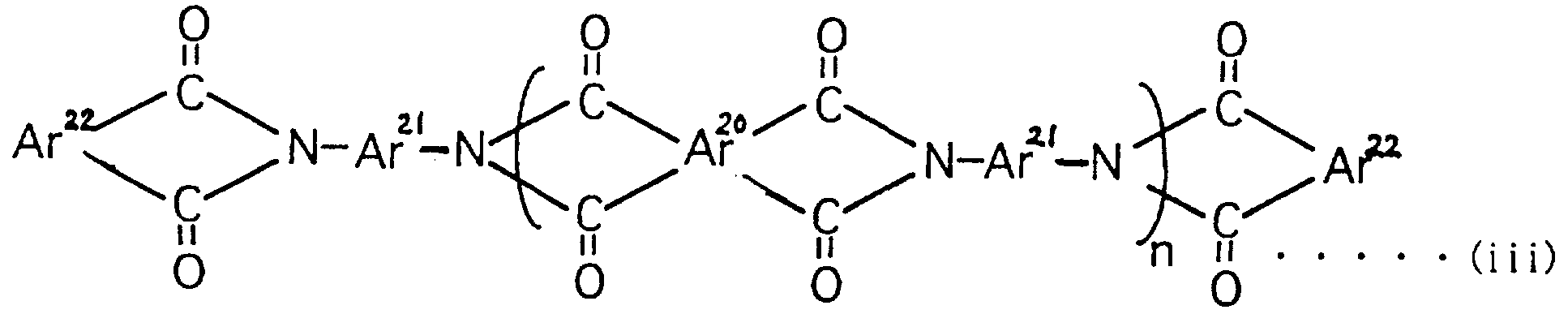
- (B 5) aromatic imido oligomer examples include, for example, a polycondensate (B 5) aromatic imido oligomer linked via an imide group represented by the following structural formula (iii).
- Such an aromatic imido oligomer can be obtained by reacting an aromatic tetracarboxylic acid with an aromatic diamine.
- Aromatic tetracarboxylic acids include 3,3 ', 4,4'-benzophenenotetracarboxylic acid, pyromellitic acid, 2,3,6,7-naphthalenetetracarboxylic acid,
- aromatic tricarboxylic acid having 8 to 22 carbon atoms and the aromatic dicarboxylic acid include trimellitic acid, isophthalic acid, terephthalic acid, orthophthalic acid, and 2-chloroterephthalic acid. Acid, 2-methylterephthalic acid, 5-methylisophthalic acid, 5-sodium sulfoisophthalic acid,
- 2'-biphenyldicarboxylic acid 1,3-naphthalenedicarboxylic acid, 1,4-naphthalenedicarboxylic acid, 1,5-naphthalenedicarboxylic acid, 1,6-naphthalenedicarboxylic acid, 1,7-naphthalenedicarboxylic acid, Examples thereof include 2,6-naphthalenedicarboxylic acid, 2,5-pyridinedicarboxylic acid, 2,4-pyridinedicarboxylic acid, and halides thereof.
- Aromatic diamines include 2,2'-bis (4-aminophenoxydiphenyl) propane, 1,3-bis (3-aminophenoxy) benzene, 1,4-bis (4-aminophenoxy) benzene, 4 , 4'-bis (4-aminodiphenoxy) diphenyl, p-phenylenediamine, m-phenylenediamine, 3,3'-diaminodiphenylmethane, 3,3'-dioxydianiline, 4,4 'diaminodifin Phenylmethane, 3, 3 'diaminodiphenyl sulfide, 4, 4'- diamino diphenyl sulfone, 3, 3' diamino diphenyl sulfone, 4, 4 '-diamino diphenyl sulfone, 3, 3'-diaminodiphenyl ether, 4,4'diaminodiphenyl ether, 1,5
- the molecular weight of the aromatic imido oligomer (B5) is preferably 2000 or less, more preferably 10000 or less.
- a fibrous, fibrous, or non-fibrous (C) filler is used as necessary.
- the filler (C) include glass fiber, glass milled fiber, carbon fiber, titanic acid whisker, zinc oxide whisker, aluminum borate whisker, aramide fiber, alumina fiber, silicon carbide fiber, and ceramic.
- Fibrous fillers such as wax fibers, asbestos fibers, stone fibers, metal fibers, etc., wallastite, zeolite, sericite, kaolin, my strength, clay, pyrophyllite, bentonite, asbestos, talc, alumina silicate Metal compounds such as silicates such as sodium chloride, alumina, silicon oxide, magnesium oxide, zirconium oxide, titanium oxide, and iron oxide; carbonates such as calcium carbonate, magnesium carbonate, and dolomite; calcium sulfate; and potassium sulfate.
- the filler (C) may be an isocyanate compound, an organic silane compound, an organic titanate compound, or an organic compound. Pretreatment with a coupling agent such as a borane-based compound or an epoxy compound before use is preferable from the viewpoint of obtaining more excellent mechanical strength.
- the (C) filler is preferably (C-11) glass fiber.
- the diameter of the (C-1) glass fiber is preferably not less than 8 // m and not more than 15 m from the viewpoint of obtaining a resin composition having an excellent balance between melt fluidity and reduction of burrs, and further contains an aromatic group.
- the (C-11) glass fiber preferably has a glass fiber length of 400 m or less in weight in the polyphenylene sulfide resin composition. .
- the compounding amount is selected in the range of 100 to 400 parts by weight based on 100 parts by weight of the total amount of (A) the PPS resin and (B) the aromatic group-containing oligomer.
- An alkoxysilane compound having the following is used as needed. Specific examples of such alkoxysilane compounds include ⁇ -glycidoxypropyltrimethoxysilane, aglycidoxypropyltriethoxysilane, and ⁇ - (3,4-epoxycyclohexyl) ethyltrimethoxysilane.
- the (D) alkoxysilane compound is used to obtain more excellent mechanical strength and lower burr, and the amount of the (A) PPS resin and ( ⁇ ) aromatic group-containing oligomer is 10 With respect to 0 parts by weight, a range of 0.1 to 5 parts by weight is selected, and a range of 0.2 to 3 parts by weight is more preferably selected.
- ( ⁇ -1) an ester comprising an aliphatic carboxylic acid having 12 to 40 carbon atoms and a polyhydric alcohol for the purpose of obtaining a superior deburring effect together with a superior mold release property.
- Compound, ( ⁇ —2) Amide compound consisting of aliphatic monocarboxylic acid having 12 to 40 carbon atoms and diamine, ( ⁇ —3) Aliphatic monoforce having 12 to 40 carbon atoms It is effective to add at least one additive (E) selected from amide compounds consisting of rubonic acid, aliphatic polybasic acids having 2 to 20 carbon atoms, and aliphatic diamines.
- An amide compound consisting of an aliphatic monocarboxylic acid having 12 to 40 carbon atoms, an aliphatic polybasic acid having 2 to 20 carbon atoms, and an aliphatic diamine provides a more excellent burr reduction effect. Is particularly effective.
- Specific examples of the aliphatic carboxylic acid having 12 to 40 carbon atoms in the ester compound comprising an aliphatic carboxylic acid having 12 to 40 carbon atoms and a polyhydric alcohol include stearic acid and oleic acid. , No ,. Examples include noremic acid, lauryl acid, and montanic acid.
- Polyhydric alcohols include ethylene glycol, 1,2-propanediol, 1.3-propanediol, 1,4-butanediol, and 1,6-hexane. Examples include diol, 2-ethyl-1,3-hexanediol, glycerin, trimethylolpropane, pentaerythritol, and polypentaerythritol.
- (E-2) Specific examples of the aliphatic monocarboxylic acid having 12 to 40 carbon atoms in the amide compound comprising an aliphatic monocarboxylic acid having 12 to 40 carbon atoms and diamine include (E-1). Specific examples of diamine include ethylenediamine, 1,3-diaminopronon, 1,4 diaminopropane, hexamethylenediamine, metaxylylenediamine, tolylenediamine, paraxylenediamine, Phenylenediamine, isophoronediamine and the like.
- aliphatic monocarboxylic acid include those similar to (E-1).
- Specific examples of the aliphatic diamine include ethylenediamine, 1,3-diaminobromonogone, 1,4-diaminopropane, Hexamethylene diamine and the like can be exemplified.
- Polybasic acids are carboxylic acids of two or more basic acids.
- Such an amide compound is prepared by adding aliphatic monocarboxylic acid and aliphatic polybasic acid as raw materials together with aliphatic diamine to 180 to 300 ° C., preferably It can be synthesized by a method of performing a heat reaction at 200 to 270 ° C.
- (E-1) an ester compound comprising an aliphatic carboxylic acid having 12 to 40 carbon atoms and a polyhydric alcohol; and (E-2) an aliphatic monocarboxylic acid having 12 to 40 carbon atoms and a diamine.
- An amide compound, (E-3) an amide compound composed of an aliphatic monocarboxylic acid having 12 to 40 carbon atoms, an aliphatic polybasic acid having 2 to 20 carbon atoms, and an aliphatic diamine, a compound selected from the group consisting of:
- the amount of the at least one additive to be added is 0.05 to 1.5 parts by weight, in particular, based on 100 parts by weight of the total amount of (A) the PPS resin and (B) the aromatic group-containing oligomer.
- 0.1 to 1.0 parts by weight is preferably selected from the viewpoint of the burr reduction effect and the mechanical strength.
- the total amount is preferably within the above range.
- carbonates such as sodium carbonate, lithium carbonate, potassium carbonate, zinc carbonate, magnesium carbonate, calcium carbonate, barium carbonate, etc.
- Phosphoric acid such as magnesium phosphite, diphosphoric acid, and salts of hypophosphorous acid are preferably used.
- the metal salt is added in an amount of 0.01 to 5 parts by weight based on 100 parts by weight of (A) the polyphenylene sulfide resin and (B) 100 parts by weight of the aromatic group-containing polyol, and reduces the variability. It is preferable in terms of effect, strength, and fluidity.
- plasticizers such as polyalkylene oxide oligomer-based compounds, thioether-based compounds, ester-based compounds, and organic phosphorus compounds, talc, kaolin, and organic compounds, as long as the effects of the present invention are not impaired.
- Normal compounds such as phosphorus compounds, crystal nucleating agents such as polyetheretherketone, coloring inhibitors such as hypophosphite, antioxidants, heat stabilizers, lubricants, UV inhibitors, coloring agents, flame retardants, and foaming agents Additives can be added. Further, the PPS resin composition of the present invention has the effect of the present invention.
- Polyester Polysulfone, Polytetrafluoroethylene, Polyetherimide, Polyamide, Polyamide, Polyimide, Polycarbonate, Polyethersulfone, Polyetherketone, Polythioetherketone, Polyetherether Ketones, epoxy resins, phenolic resins, polyethylene, polystyrene, polypropylene, ABS resins, polyamide elastomers, polyester elastomers, polyalkylene oxides, or olefins containing acid anhydride groups, carboxyl groups, epoxy groups, etc. It may contain a resin such as a polymer.
- the method for preparing the PPS resin composition of the present invention is not particularly limited, and the mixture of the raw materials is supplied to a commonly known melt mixer such as a single-screw or twin-screw extruder, a Banbury mixer, a neader and a mixing mixer. Then, a method of kneading at a temperature of 280 to 380 ° C. can be mentioned as a typical example. There is no particular limitation on the mixing order of the raw materials, either, a method in which all the raw materials are blended and then melt-kneaded by the above-mentioned method.
- Any method may be used, such as a method or a method in which after mixing some raw materials, the remaining raw materials are mixed using a side feeder during melt-kneading by a single-screw or twin-screw extruder.
- a side feeder during melt-kneading by a single-screw or twin-screw extruder.
- additive components it is of course possible to knead other components by the above-mentioned method and the like to pelletize, to add them before molding, and to provide them for molding.
- the mixture may be melt-kneaded, or may be blended with (B) the aromatic group-containing oligomer and melt-kneaded.
- melt kneading may be performed twice using a single-screw or twin-screw extruder.
- the (A) PPS resin and (A) D) A mixture of an alkoxysilane compound having at least one functional group selected from an epoxy group, an amino group, an isocyanate group, a hydroxyl group, a mercapto group and a ureide group is charged and melt-kneaded.
- the aromatic group-containing oligomer may be supplied from the middle of the melt-kneading by a side feeder or the like and melt-kneaded.
- a PPS resin In order to simultaneously achieve the object of the present invention, that is, excellent flash reduction effect, fluidity, and crystallization characteristics, it is necessary to use (A) a PPS resin and (B) a PPS resin composition containing an aromatic group-containing oligomer.
- the temperature-rise crystallization peak temperature measured by a differential scanning calorimeter (scanning speed: 207 minutes) must be 125 or less, and more preferably 120 ° C or less. Further, it is preferable that the crystallization peak temperature for cooling is 230 or more.
- the rising crystallization peak temperature and the falling crystallization peak temperature of the PPS resin composition were measured by the following methods. That is, using a PPS resin composition pellet or a molded product thereof, the mixture was pressurized with a hot press machine at 340 ° C. for 4 minutes, and then rapidly cooled in water to obtain an amorphous sheet having a thickness of about 2 ° m. . Approximately 1 Omg was cut out from this sheet and used as a measurement sample. The measurement was performed using Perkin-Elmer DSC-7, two-point calibration (indium, lead), and baseline correction. The temperature was raised from 40 ° C at a speed of 20 min. After maintaining the temperature for 20 minutes, the temperature was lowered at a rate of 20 ° CZ, and the crystallization peak temperature observed when the temperature was raised and lowered was measured.
- the PPS resin composition of the present invention is a ppS resin having excellent low burr properties, crystallization properties, and fluidity without significantly impairing the inherent thermal stability and electrical properties of the PPS resin composition. It is a resin composition.
- the PPS resin composition thus obtained can be used not only for injection molding, but also for extrusion molding and compression. Although it can be applied to various known molding methods such as molding, blow molding and injection compression molding, it is a resin composition particularly suitable for injection molding.
- the polyphenylene sulfide resin composition of the present invention makes use of its excellent fluidity, low burr, and crystallization characteristics to form a molded product having a thin portion, particularly a molded product having a thin portion having a thickness of 2 mm or less. It is especially useful in some cases.
- the molded article of the PPS resin composition of the present invention is particularly suitable for electrical and electronic parts such as connectors and coils, as well as sensors, LED lamps, sockets, resistors, relay cases, small switches, and coil bobbins.
- FIG. 1a is a plan view of such a molded connector
- FIG. 1b is a side view.
- the connector has 50 pin holes per row.
- Arrow 2 indicates the gate position. ⁇
- Molding is performed at a mold temperature of 135 and a resin temperature of 320 ° C.
- the minimum injection pressure minimum molding pressure
- the injection pressure + 3 kgf Zcm2 gauge pressure
- Molding was performed.
- the pin hole portion of the obtained molded piece (the pin hole of the row located on the upper side when the opening side of the box shape is the upper side and the gate side is on the left, and 3, 9, 1 from the gate side
- the length of the burr generated on the 8th, 28th, 38th, 48th was measured from the upper side of Fig. 1b using a universal projector, and the average value was calculated.
- the temperature was raised to T + 20, and held at that temperature for 1 minute, then cooled at a temperature lowering rate of 20 hours, and the temperature was lowered to the crystallization temperature with the crystallization exothermic peak temperature.
- NMP N-methyl-2-pyrrolide
- reaction product is washed 5 times with warm water, then poured into 10 kg of NMP heated to 100, stirred for about 1 hour, filtered, and further heated several times with hot water. Washed. This is poured into 25 liters of an aqueous acetic acid solution of pH 4 heated to 90, stirred for about 1 hour, filtered, and washed with about 90 ion-exchanged water until the pH of the filtrate becomes 7. And dried under reduced pressure at 80 for 24 hours to obtain 2.43 kg of PPS.
- This PPS is linear and has a number average molecular weight of 9200, total ash content of 0.07% by weight, melt flow rate value of 580 g / 10 minutes, elevated crystallization temperature of 127.3 ° C, cooling The crystallization temperature was 232.
- the reaction solution was then flushed with stirring at a temperature of 250 ° C with a cooling condenser and heated and maintained to obtain a mixed powder of PPS and salts.
- the mixture was slurried with 15 liters of ion-exchanged water and filtered with a centrifuge.
- the resulting cake, 15 liters of ion-exchanged water and 13 m of glacial acetic acid were placed in an autoclave equipped with a stirrer. Charged, sealed under nitrogen gas, heated to 190 ° C, heated to 190 ° C, and cooled to 70 ° C.
- the resulting slurry was filtered with a centrifugal separator, and then filtered. Washed with deionized water and dried under vacuum to obtain 2.56 kg of PPS, which is linear and has a number average molecular weight of 5,100. It was.
- NMP N-methyl-2-pyrrolidone
- This PPS is a PPS having a crosslinked structure heat-treated in an oxygen atmosphere, having a number average molecular weight of 9300, a total ash content of 0.19% by weight, and a melt flow rate at the time of residence for 15 minutes. The value was 81% of the melt flow rate value at the time of 5 minutes residence.
- NMP N-methyl-2-pyrrolidone
- the PPS thus obtained was subjected to a heat treatment in air at 220 until the melt flow rate became 640 g / 10 minutes.
- This PPS is a PPS having a crosslinked structure that has been heat-treated in an oxygen atmosphere.
- the elevated crystallization temperature of this PPS was 128.6 ° C, and the decreased crystallization temperature was 223.7.
- PPS obtained by polymerization in the same manner as PPS-2 was subjected to a heat treatment at 220 ° C. in air until the melt flow rate became 11.8 gZ10 minutes.
- This PPS is a PPS having a crosslinked structure that has been heat-treated in an oxygen atmosphere.
- the heating crystallization temperature of this PPS was 132.3, and the cooling crystallization temperature was 21.8.
- the PPS obtained by polymerization in the same manner as PPS-2 was subjected to a heat treatment at 220 ° C. in air until the melt flow rate became 75 g / 10 minutes.
- This PPS is a PPS having a crosslinked structure that has been heat-treated in an oxygen atmosphere.
- the rising crystallization temperature of this PPS was 136.6
- the cooling crystallization temperature was 209.2 ° C.
- Hexamethylene ammonium acetate (equimolar salt of hexamethylene diamine and adipic acid) 7.6 kg (29.0 mol), terephthalic acid 3.66 kg (22.0 mol), 3.97 kg of a 64.5% by weight aqueous solution of hexamethylenediamine, 31 g of acetic acid, 6.38 kg of ion-exchanged water were charged into a 0.10 m3 batch-type pressurized polymerization vessel, and nitrogen was sufficiently replaced. After that, the temperature was raised to 140, and the mixture was pre-concentrated to a concentration of 80% by weight at a pressure of 4.0 kg / cm2 under stirring. Subsequently, the temperature was raised to 230 ° C.
- Hexamethylene ammonium acetate 7.61 kg (29.0 mol), terephthalic acid 3.66 kg (22.0 mol), 64.5% by weight of hexamethylene diamine Charge 397 kg of aqueous solution, 31 g of acetic acid and 6.38 kg of ion-exchanged water into a 0.10 m3 batch-type pressure polymerization tank, sufficiently purge with nitrogen, raise the temperature to 140, and stir It was pre-concentrated at a pressure of 4.0 kg / cm2 to a concentration of 80% by weight. Subsequently, the temperature was raised to 230 ° C. over 3.5 hours with stirring, and the polymerization pressure was adjusted to 15 kg / cm 2 -G.
- the reaction was maintained at 245 ° C to 250 ° C for an additional 30 minutes to complete the reaction.
- Discharge was performed over a period of 1 hour while supplying ion-exchanged water at a rate of 3 liters / 'hour by a constant volume pump and maintaining the water vapor pressure at 25 kg / cm2-G.
- the relative viscosity of this condensate was 1.25, the melting peak temperature was 278 ° C, and the cooling crystallization temperature was 253.5 ° C.
- Hexamethylene ammonium acetate 8.58 k (32.7 mol), terephthalic acid 3.09 kg (18.6 mol), 64.5% by weight aqueous solution of hexamethylene diamine 3.36 kg, 31 g of acetic acid, 6.38 kg of ion-exchanged water are charged into a 0.10 m3 batch-type pressure polymerization tank, and after sufficient nitrogen replacement, the temperature is raised to 140 ° C and stirred. It was pre-concentrated at a pressure of 4.0 kg / cm2 to a concentration of 80% by weight. Subsequently, the temperature was increased to 230 ° C over 3.5 hours under stirring, and the polymerization pressure was set to 15 kgZcm2-G.
- the reaction was maintained at 245 ° C to 250 ° C for an additional 30 minutes to complete the reaction.
- Discharge was performed over 1 hour while supplying ion-exchanged water by a constant volume pump at a rate of 3 liters and maintaining the steam pressure at 21 kgZcm2-G.
- the relative viscosity of this condensate was 1.28, the melting peak temperature was 274 ° C, and the cooling crystallization temperature was 238.5 ° C.
- Hexamethylene ammonium acetate 40 g (0.152 mol), equimolar salt of hexamethylene diamine and terephthalic acid 60 g (0.213 mol), benzoic acid 6.7 g, hexamethylene diamine 3.2 g of amine and 100 g of ion-exchanged water were charged into an autoclave, and after sufficient nitrogen replacement, it took 3 hours to reach 200 to 210 ° C. And the temperature gradually increased. Thereafter, the temperature in the system was increased to 270 ° C while maintaining the pressure in the system at 17.5 kg / cm2 at 1 G. Subsequently, the pressure was gradually released over 2 hours while maintaining the temperature to complete the reaction.
- the obtained condensate had a relative viscosity of 1.31, a melting peak temperature of 315 ° C and a cooling crystallization temperature of 273.6.
- Hexamethylenediamine and terephthalic acid equimolar salt 65 g (0.230 mol), hexamethylenediamine and isophthalic acid equimolar salt 35 g (0.124 mol), benzoic acid 5.2 g 2.5 g of hexamethylene diamine was charged into a autoclave, and a condensation reaction was carried out in the same manner as in B-104.
- the relative viscosity of the obtained condensate was 1.40, the melting peak temperature was 300, and the cooling crystallization temperature was 262.5.
- Hexamethylene diammonium 80 g (0.305 mol), equimolar salt of hexmethylenediamine and terephthalic acid 20 g (0.07 1 mol), benzoic acid 6.7 g, hexamethylene diamine 3.2 g of amine and 100 g of ion-exchanged water were charged into an autoclave, and a condensation reaction was carried out in the same manner as in B-104.
- the relative viscosity of the obtained condensate is 1.45
- the melting peak temperature is 265 ° C
- the cooling crystallization temperature is 232. It was five.
- the residence time is 95 seconds in a 30 mm (vent type twin screw extruder), the degree of vacuum is 70 OmmHg, and the degree of melt polymerization is increased at the maximum resin temperature of 300.
- C—1 E glass fiber with an average fiber diameter of 13 ⁇ m.
- C-3 E glass fiber with an average fiber diameter of 9 m.
- C-4 E glass fiber with an average fiber diameter of 6 ⁇ m.
- D-1 ⁇ - (3,4-epoxycyclohexyl) ethyltrimethoxysilane
- D-2 araminopropyltrimethoxysilane
- ⁇ — 3 Charge 2 mol of stearic acid and 1 mol of sebacic acid into a reaction tube equipped with a condenser with a condenser and a stirrer. After heating and melting, 2 mol of ethylenediamine is added dropwise and dehydrated at 160 ° C in a nitrogen stream. An amide compound obtained by starting the reaction and reacting at 250 to 260 ° C for about 7 hours until the amine value becomes 5 or less.
- F-1 calcium hypophosphite
- A PPS resin
- B Aromatic group-containing oligomer and other additives are dry blended in the proportions shown in Table 1 and pre-mixed in a tumbler for 2 minutes, then the cylinder temperature is 300-320 ° C Melt kneading with a twin screw extruder set to It was pelletized by a cutter and dried at 120 for 1 mm. The crystallization characteristics and burr length were measured using such pellets. Table 1 shows the results.
- (C)-(F) show the blending ratio of (A) PPS + (B) 100 parts by weight of the total amount of oligomers and the like.
- (B) The loading amount of oligomers and the like indicates the respective weight ratio (100 total loading%).
- (C) to (F) show the mixing ratio of (A) PPS + (B) oligomer and the like to the total g of 100 parts by weight. *): After (A) and (C) to (F) were melt-kneaded, (B) was added thereto and the mixture was kneaded again.
- A PPS resin
- B Aromatic group-containing oligomer and other additives are dry-blended in the proportions shown in Table 4 and premixed in a tumbler for 2 minutes. The mixture was melt-kneaded in a twin-screw extruder set at 50 ° C, pelletized by a strand vibrator, and dried at 120 ° C for 1 mm. Using such pellets, crystallization characteristics and burr length were measured. Table 4 shows the results.
- Formulation S of (A) PPS, (B) oligomer, etc. indicates the proportion of each B amount (total 100 weight.
- (C)-(F) show the blending table with respect to 100 parts by weight of the total amount of (A) PPS + (B) oligomer and the like.
- the amounts of (A) PPS, (B) oligomers, etc. indicate the respective weight ratios (100 weight in total.
- (C) to (F) indicate the total amount of (A) PPS + (B) oligomers, etc. 1 Shows the mixing ratio to 00 parts by weight.
- A PPS resin
- B Aromatic group-containing oligomer and other additives are dry blended in the proportions shown in Table 6 and premixed in a tumbler for 2 minutes, and then the cylinder temperature is 300 to 340 ° C.
- the mixture was melt-kneaded with a twin-screw extruder set in the above, pelletized with a strand cutter, and dried at 120 for 1 mm. Using such pellets, crystallization characteristics and burr length were measured. Table 6 shows the results.
- the blending amounts of (A) PPS, (B) oligomer, etc. indicate the respective weight ratios (100 wt% in total).
- (C) and (F) show the mixing ratio of (A) PPS + (B) oligomers and the like to the total fi 100 parts by weight.
- Example 3 Dry blending was performed in the same manner as in Example 28 except that the aromatic group-containing oligomer was not added, and the mixture was premixed in a tumbler for 2 minutes at a ratio shown in Table 6, and then the cylinder was heated to a temperature of 300 to 3 ° C. The mixture was melt-kneaded with a twin-screw extruder set at 40 ° C, pelletized with a strand cutter, and dried with 120 at 1 ⁇ . Using such pellets, crystallization characteristics and burr length were measured. Table 6 shows the results.
- Example 3 3 Example 3 3
- the PPS resin composition of the present invention is a PPS resin composition that suppresses the generation of burrs and has excellent fluidity and crystallization characteristics, and is particularly useful for molding molded articles such as small precision parts. Useful as
Landscapes
- Chemical & Material Sciences (AREA)
- Health & Medical Sciences (AREA)
- Chemical Kinetics & Catalysis (AREA)
- Medicinal Chemistry (AREA)
- Polymers & Plastics (AREA)
- Organic Chemistry (AREA)
- Compositions Of Macromolecular Compounds (AREA)
Description




Claims
Priority Applications (3)
| Application Number | Priority Date | Filing Date | Title |
|---|---|---|---|
| CA002232837A CA2232837A1 (en) | 1996-07-22 | 1997-07-17 | Polyphenylene sulfide resin composition |
| EP97930827A EP0852249A4 (en) | 1996-07-22 | 1997-07-17 | POLYPHENYLENE SULFIDE RESIN COMPOSITION |
| KR1019980702129A KR20000064264A (ko) | 1996-07-22 | 1997-07-17 | 폴리페닐렌 술피드 수지조성물 |
Applications Claiming Priority (4)
| Application Number | Priority Date | Filing Date | Title |
|---|---|---|---|
| JP8/192192 | 1996-07-22 | ||
| JP19219296 | 1996-07-22 | ||
| JP3748297 | 1997-02-21 | ||
| JP9/37482 | 1997-02-21 |
Publications (1)
| Publication Number | Publication Date |
|---|---|
| WO1998003590A1 true WO1998003590A1 (en) | 1998-01-29 |
Family
ID=26376605
Family Applications (1)
| Application Number | Title | Priority Date | Filing Date |
|---|---|---|---|
| PCT/JP1997/002487 Ceased WO1998003590A1 (en) | 1996-07-22 | 1997-07-17 | Polyphenylene sulfide resin composition |
Country Status (4)
| Country | Link |
|---|---|
| EP (1) | EP0852249A4 (ja) |
| KR (1) | KR20000064264A (ja) |
| CA (1) | CA2232837A1 (ja) |
| WO (1) | WO1998003590A1 (ja) |
Cited By (1)
| Publication number | Priority date | Publication date | Assignee | Title |
|---|---|---|---|---|
| WO2007077831A1 (ja) * | 2005-12-28 | 2007-07-12 | Dic Corporation | 耐熱性樹脂組成物、その製造方法、耐熱性樹脂成形物、及び表面実装用電子部品 |
Families Citing this family (20)
| Publication number | Priority date | Publication date | Assignee | Title |
|---|---|---|---|---|
| JP3624077B2 (ja) * | 1997-09-29 | 2005-02-23 | ポリプラスチックス株式会社 | ポリアリーレンサルファイド樹脂組成物 |
| JP4295848B2 (ja) * | 1998-12-24 | 2009-07-15 | 出光興産株式会社 | 電子部品封止用ポリアリーレンスルフィド樹脂組成物 |
| EP2738222B1 (en) | 2011-07-25 | 2018-09-26 | Toray Industries, Inc. | Thermoplastic resin composition for impact absorbing member and method for producing same |
| WO2013032975A1 (en) | 2011-08-29 | 2013-03-07 | Ticona Llc | Thermotropic liquid crystalline polymer with improved low shear viscosity |
| KR20140057360A (ko) | 2011-08-29 | 2014-05-12 | 티코나 엘엘씨 | 고유동성 액정 중합체 조성물 |
| US8852730B2 (en) | 2011-08-29 | 2014-10-07 | Ticona Llc | Melt-extruded substrate for use in thermoformed articles |
| TW201319223A (zh) | 2011-08-29 | 2013-05-16 | Ticona Llc | 高流量液晶聚合物組合物 |
| TW201319022A (zh) | 2011-08-29 | 2013-05-16 | Ticona Llc | 芳族醯胺化合物 |
| TW201313884A (zh) | 2011-08-29 | 2013-04-01 | Ticona Llc | 液晶聚合物之固態聚合 |
| WO2013032967A1 (en) | 2011-08-29 | 2013-03-07 | Ticona Llc | Cast molded parts formed form a liquid crystalline polymer |
| WO2013032979A1 (en) | 2011-08-29 | 2013-03-07 | Ticona Llc | Melt polymerization of low melt viscosity liquid crystalline polymers |
| US8906258B2 (en) | 2011-08-29 | 2014-12-09 | Ticona Llc | Heat-resistant liquid crystalline polymer composition having a low melting temperature |
| CN103998506B (zh) | 2011-12-16 | 2016-08-24 | 提克纳有限责任公司 | 用于聚苯硫醚的含硼成核剂 |
| US8852487B2 (en) | 2011-12-16 | 2014-10-07 | Ticona Llc | Injection molding of polyarylene sulfide compositions |
| US8796392B2 (en) | 2011-12-16 | 2014-08-05 | Ticona Llc | Low temperature injection molding of polyarylene sulfide compositions |
| WO2013090173A2 (en) * | 2011-12-16 | 2013-06-20 | Ticona Llc | Molded part for a portable electronic device |
| CN104011124A (zh) * | 2011-12-16 | 2014-08-27 | 提克纳有限责任公司 | 用于聚芳硫醚组合物的成核体系 |
| KR101487310B1 (ko) * | 2012-11-09 | 2015-01-29 | 세양폴리머주식회사 | 기계적 강도 및 압출 가공성이 우수한 수지 조성물 및 이로부터 제조된 성형품 |
| WO2014130275A2 (en) | 2013-02-22 | 2014-08-28 | Ticona Llc | High performance polymer composition with improved flow properties |
| US20150166731A1 (en) * | 2013-12-16 | 2015-06-18 | Chevron Phillips Chemical Company Lp | Reinforced Poly(Arylene Sulfide) Polymer Compositions |
Citations (8)
| Publication number | Priority date | Publication date | Assignee | Title |
|---|---|---|---|---|
| JPS6245654A (ja) * | 1985-08-21 | 1987-02-27 | バイエル・アクチエンゲゼルシヤフト | 迅速に結晶化するポリフエニレンスルフイド組成物 |
| JPH04130159A (ja) * | 1990-09-21 | 1992-05-01 | Tosoh Corp | ポリアリーレンサルファイド樹脂組成物 |
| JPH04202363A (ja) * | 1990-11-30 | 1992-07-23 | Tosoh Corp | ポリアリ―レンサルファイド樹脂組成物 |
| JPH055061A (ja) * | 1990-08-28 | 1993-01-14 | Kureha Chem Ind Co Ltd | ポリアリーレンチオエーテル組成物 |
| JPH0641428A (ja) * | 1992-07-22 | 1994-02-15 | Toray Ind Inc | ポリフェニレンスルフィド樹脂組成物 |
| JPH07316426A (ja) * | 1994-05-26 | 1995-12-05 | Mitsui Toatsu Chem Inc | ポリイミド系樹脂組成物 |
| JPH0881630A (ja) * | 1994-09-13 | 1996-03-26 | Idemitsu Petrochem Co Ltd | ポリアリーレンスルフィド樹脂組成物 |
| JPH08134352A (ja) * | 1994-11-14 | 1996-05-28 | Tosoh Corp | ポリフェニレンスルフィド樹脂組成物 |
Family Cites Families (4)
| Publication number | Priority date | Publication date | Assignee | Title |
|---|---|---|---|---|
| DE3607712A1 (de) * | 1986-03-08 | 1987-09-10 | Bayer Ag | Schnellkristallisierende polyphenylensulfidmassen |
| US4690972A (en) * | 1986-04-04 | 1987-09-01 | Phillips Petroleum Company | Method of producing poly(arylene sulfide) compositions and articles made therefrom |
| EP0286298B1 (en) * | 1987-03-30 | 1994-06-29 | Kureha Kagaku Kogyo Kabushiki Kaisha | Polyarylene thioether composition for molding |
| JP2949742B2 (ja) * | 1989-12-26 | 1999-09-20 | 東レ株式会社 | ポリフェニレンスルフィド樹脂組成物 |
-
1997
- 1997-07-17 EP EP97930827A patent/EP0852249A4/en not_active Withdrawn
- 1997-07-17 CA CA002232837A patent/CA2232837A1/en not_active Abandoned
- 1997-07-17 KR KR1019980702129A patent/KR20000064264A/ko not_active Withdrawn
- 1997-07-17 WO PCT/JP1997/002487 patent/WO1998003590A1/ja not_active Ceased
Patent Citations (8)
| Publication number | Priority date | Publication date | Assignee | Title |
|---|---|---|---|---|
| JPS6245654A (ja) * | 1985-08-21 | 1987-02-27 | バイエル・アクチエンゲゼルシヤフト | 迅速に結晶化するポリフエニレンスルフイド組成物 |
| JPH055061A (ja) * | 1990-08-28 | 1993-01-14 | Kureha Chem Ind Co Ltd | ポリアリーレンチオエーテル組成物 |
| JPH04130159A (ja) * | 1990-09-21 | 1992-05-01 | Tosoh Corp | ポリアリーレンサルファイド樹脂組成物 |
| JPH04202363A (ja) * | 1990-11-30 | 1992-07-23 | Tosoh Corp | ポリアリ―レンサルファイド樹脂組成物 |
| JPH0641428A (ja) * | 1992-07-22 | 1994-02-15 | Toray Ind Inc | ポリフェニレンスルフィド樹脂組成物 |
| JPH07316426A (ja) * | 1994-05-26 | 1995-12-05 | Mitsui Toatsu Chem Inc | ポリイミド系樹脂組成物 |
| JPH0881630A (ja) * | 1994-09-13 | 1996-03-26 | Idemitsu Petrochem Co Ltd | ポリアリーレンスルフィド樹脂組成物 |
| JPH08134352A (ja) * | 1994-11-14 | 1996-05-28 | Tosoh Corp | ポリフェニレンスルフィド樹脂組成物 |
Non-Patent Citations (1)
| Title |
|---|
| See also references of EP0852249A4 * |
Cited By (2)
| Publication number | Priority date | Publication date | Assignee | Title |
|---|---|---|---|---|
| WO2007077831A1 (ja) * | 2005-12-28 | 2007-07-12 | Dic Corporation | 耐熱性樹脂組成物、その製造方法、耐熱性樹脂成形物、及び表面実装用電子部品 |
| US8142899B2 (en) | 2005-12-28 | 2012-03-27 | Dic Corporation | Heat-resistant resin composition, method of producing the same, heat-resistant resin-molded article, and surface mount electronic component |
Also Published As
| Publication number | Publication date |
|---|---|
| EP0852249A1 (en) | 1998-07-08 |
| KR20000064264A (ko) | 2000-11-06 |
| CA2232837A1 (en) | 1998-01-29 |
| EP0852249A4 (en) | 1999-10-13 |
Similar Documents
| Publication | Publication Date | Title |
|---|---|---|
| WO1998003590A1 (en) | Polyphenylene sulfide resin composition | |
| EP3480257B1 (en) | Polyphenylene sulfide resin composition and hollow molding therefrom | |
| JP2010195874A (ja) | ポリフェニレンサルファイド樹脂組成物および成形体 | |
| JP5742377B2 (ja) | ポリフェニレンスルフィド樹脂組成物および成形品 | |
| KR20230161420A (ko) | 폴리페닐렌 설파이드 수지 조성물 및 그것으로 이루어지는성형품 | |
| JPH10292114A (ja) | ポリフェニレンスルフィド樹脂組成物 | |
| JP7151086B2 (ja) | ポリフェニレンスルフィド樹脂組成物 | |
| JP2003268236A (ja) | ポリアリーレンサルファイド樹脂組成物 | |
| JP6701877B2 (ja) | ポリフェニレンスルフィド樹脂組成物 | |
| CN115989202B (zh) | 聚芳硫醚树脂组合物、成型品及它们的制造方法 | |
| JP2020143274A (ja) | ポリフェニレンスルフィド樹脂組成物およびそれからなる成形品 | |
| JP3605933B2 (ja) | ポリフェニレンスルフィド樹脂組成物 | |
| JP2003301107A (ja) | 樹脂組成物 | |
| JP4747424B2 (ja) | 高熱伝導性樹脂組成物 | |
| CN1205020A (zh) | 聚苯硫醚树脂组合物 | |
| JP4834940B2 (ja) | 高誘電性樹脂組成物 | |
| JP2003119383A (ja) | ポリアリーレンサルファイド樹脂組成物 | |
| JP7552199B2 (ja) | ポリフェニレンスルフィド樹脂組成物およびそれを用いた中空成形品 | |
| JPH10120902A (ja) | ポリフェニレンスルフィド樹脂組成物 | |
| JP2003147200A (ja) | ポリアリーレンサルファイド樹脂組成物 | |
| CN115989201A (zh) | 聚芳硫醚树脂组合物、成型品及它们的制造方法 | |
| JP2022010455A (ja) | ポリフェニレンスルフィド樹脂組成物、および成形品 | |
| JPH11269385A (ja) | ポリフェニレンスルフィド樹脂組成物 | |
| JP6866609B2 (ja) | ポリアリーレンスルフィド樹脂組成物、成形品およびそれらの製造方法 | |
| JP2000265059A (ja) | ポリフェニレンスルフィド樹脂組成物およびその成形体 |
Legal Events
| Date | Code | Title | Description |
|---|---|---|---|
| WWE | Wipo information: entry into national phase |
Ref document number: 97191278.5 Country of ref document: CN |
|
| AK | Designated states |
Kind code of ref document: A1 Designated state(s): CA CN KR SG US VN |
|
| AL | Designated countries for regional patents |
Kind code of ref document: A1 Designated state(s): AT BE CH DE DK ES FI FR GB GR IE IT LU MC NL PT SE |
|
| ENP | Entry into the national phase |
Ref document number: 2232837 Country of ref document: CA Ref document number: 2232837 Country of ref document: CA Kind code of ref document: A |
|
| WWE | Wipo information: entry into national phase |
Ref document number: 1019980702129 Country of ref document: KR |
|
| WWE | Wipo information: entry into national phase |
Ref document number: 09043568 Country of ref document: US Ref document number: 1199800322 Country of ref document: VN |
|
| WWE | Wipo information: entry into national phase |
Ref document number: 1997930827 Country of ref document: EP |
|
| 121 | Ep: the epo has been informed by wipo that ep was designated in this application | ||
| WWP | Wipo information: published in national office |
Ref document number: 1997930827 Country of ref document: EP |
|
| WWW | Wipo information: withdrawn in national office |
Ref document number: 1997930827 Country of ref document: EP |
|
| WWP | Wipo information: published in national office |
Ref document number: 1019980702129 Country of ref document: KR |
|
| WWW | Wipo information: withdrawn in national office |
Ref document number: 1019980702129 Country of ref document: KR |