WO1998043134A1 - Composition (e.g. encre ou vernis) polymerisable et/ou reticulable sous irradiation par voie cationique et/ou radicalaire, a base d'une matrice organique, d'un diluant silicone et d'un photo-amorceur - Google Patents
Composition (e.g. encre ou vernis) polymerisable et/ou reticulable sous irradiation par voie cationique et/ou radicalaire, a base d'une matrice organique, d'un diluant silicone et d'un photo-amorceur Download PDFInfo
- Publication number
- WO1998043134A1 WO1998043134A1 PCT/FR1998/000566 FR9800566W WO9843134A1 WO 1998043134 A1 WO1998043134 A1 WO 1998043134A1 FR 9800566 W FR9800566 W FR 9800566W WO 9843134 A1 WO9843134 A1 WO 9843134A1
- Authority
- WO
- WIPO (PCT)
- Prior art keywords
- diluent
- radical
- cationic
- composition
- formula
- Prior art date
- Legal status (The legal status is an assumption and is not a legal conclusion. Google has not performed a legal analysis and makes no representation as to the accuracy of the status listed.)
- Ceased
Links
- 0 CCCC1=CC(C)(*C(*)=C)CCC(C(O2)=O)=C1C2=O Chemical compound CCCC1=CC(C)(*C(*)=C)CCC(C(O2)=O)=C1C2=O 0.000 description 4
- JIEXSUHKRRHZAS-UHFFFAOYSA-N CO[Si+](C)(C)N=C Chemical compound CO[Si+](C)(C)N=C JIEXSUHKRRHZAS-UHFFFAOYSA-N 0.000 description 1
Classifications
-
- C—CHEMISTRY; METALLURGY
- C09—DYES; PAINTS; POLISHES; NATURAL RESINS; ADHESIVES; COMPOSITIONS NOT OTHERWISE PROVIDED FOR; APPLICATIONS OF MATERIALS NOT OTHERWISE PROVIDED FOR
- C09D—COATING COMPOSITIONS, e.g. PAINTS, VARNISHES OR LACQUERS; FILLING PASTES; CHEMICAL PAINT OR INK REMOVERS; INKS; CORRECTING FLUIDS; WOODSTAINS; PASTES OR SOLIDS FOR COLOURING OR PRINTING; USE OF MATERIALS THEREFOR
- C09D11/00—Inks
- C09D11/02—Printing inks
- C09D11/10—Printing inks based on artificial resins
- C09D11/101—Inks specially adapted for printing processes involving curing by wave energy or particle radiation, e.g. with UV-curing following the printing
-
- C—CHEMISTRY; METALLURGY
- C08—ORGANIC MACROMOLECULAR COMPOUNDS; THEIR PREPARATION OR CHEMICAL WORKING-UP; COMPOSITIONS BASED THEREON
- C08G—MACROMOLECULAR COMPOUNDS OBTAINED OTHERWISE THAN BY REACTIONS ONLY INVOLVING UNSATURATED CARBON-TO-CARBON BONDS
- C08G59/00—Polycondensates containing more than one epoxy group per molecule; Macromolecules obtained by polymerising compounds containing more than one epoxy group per molecule using curing agents or catalysts which react with the epoxy groups
- C08G59/18—Macromolecules obtained by polymerising compounds containing more than one epoxy group per molecule using curing agents or catalysts which react with the epoxy groups ; e.g. general methods of curing
- C08G59/20—Macromolecules obtained by polymerising compounds containing more than one epoxy group per molecule using curing agents or catalysts which react with the epoxy groups ; e.g. general methods of curing characterised by the epoxy compounds used
- C08G59/22—Di-epoxy compounds
- C08G59/24—Di-epoxy compounds carbocyclic
- C08G59/245—Di-epoxy compounds carbocyclic aromatic
-
- C—CHEMISTRY; METALLURGY
- C08—ORGANIC MACROMOLECULAR COMPOUNDS; THEIR PREPARATION OR CHEMICAL WORKING-UP; COMPOSITIONS BASED THEREON
- C08G—MACROMOLECULAR COMPOUNDS OBTAINED OTHERWISE THAN BY REACTIONS ONLY INVOLVING UNSATURATED CARBON-TO-CARBON BONDS
- C08G59/00—Polycondensates containing more than one epoxy group per molecule; Macromolecules obtained by polymerising compounds containing more than one epoxy group per molecule using curing agents or catalysts which react with the epoxy groups
- C08G59/18—Macromolecules obtained by polymerising compounds containing more than one epoxy group per molecule using curing agents or catalysts which react with the epoxy groups ; e.g. general methods of curing
- C08G59/68—Macromolecules obtained by polymerising compounds containing more than one epoxy group per molecule using curing agents or catalysts which react with the epoxy groups ; e.g. general methods of curing characterised by the catalysts used
-
- C—CHEMISTRY; METALLURGY
- C09—DYES; PAINTS; POLISHES; NATURAL RESINS; ADHESIVES; COMPOSITIONS NOT OTHERWISE PROVIDED FOR; APPLICATIONS OF MATERIALS NOT OTHERWISE PROVIDED FOR
- C09D—COATING COMPOSITIONS, e.g. PAINTS, VARNISHES OR LACQUERS; FILLING PASTES; CHEMICAL PAINT OR INK REMOVERS; INKS; CORRECTING FLUIDS; WOODSTAINS; PASTES OR SOLIDS FOR COLOURING OR PRINTING; USE OF MATERIALS THEREFOR
- C09D163/00—Coating compositions based on epoxy resins; Coating compositions based on derivatives of epoxy resins
-
- G—PHYSICS
- G03—PHOTOGRAPHY; CINEMATOGRAPHY; ANALOGOUS TECHNIQUES USING WAVES OTHER THAN OPTICAL WAVES; ELECTROGRAPHY; HOLOGRAPHY
- G03F—PHOTOMECHANICAL PRODUCTION OF TEXTURED OR PATTERNED SURFACES, e.g. FOR PRINTING, FOR PROCESSING OF SEMICONDUCTOR DEVICES; MATERIALS THEREFOR; ORIGINALS THEREFOR; APPARATUS SPECIALLY ADAPTED THEREFOR
- G03F7/00—Photomechanical, e.g. photolithographic, production of textured or patterned surfaces, e.g. printing surfaces; Materials therefor, e.g. comprising photoresists; Apparatus specially adapted therefor
- G03F7/004—Photosensitive materials
- G03F7/075—Silicon-containing compounds
- G03F7/0755—Non-macromolecular compounds containing Si-O, Si-C or Si-N bonds
-
- G—PHYSICS
- G03—PHOTOGRAPHY; CINEMATOGRAPHY; ANALOGOUS TECHNIQUES USING WAVES OTHER THAN OPTICAL WAVES; ELECTROGRAPHY; HOLOGRAPHY
- G03F—PHOTOMECHANICAL PRODUCTION OF TEXTURED OR PATTERNED SURFACES, e.g. FOR PRINTING, FOR PROCESSING OF SEMICONDUCTOR DEVICES; MATERIALS THEREFOR; ORIGINALS THEREFOR; APPARATUS SPECIALLY ADAPTED THEREFOR
- G03F7/00—Photomechanical, e.g. photolithographic, production of textured or patterned surfaces, e.g. printing surfaces; Materials therefor, e.g. comprising photoresists; Apparatus specially adapted therefor
- G03F7/004—Photosensitive materials
- G03F7/0045—Photosensitive materials with organic non-macromolecular light-sensitive compounds not otherwise provided for, e.g. dissolution inhibitors
Definitions
- the field of the invention is that of the invention.
- the field of the invention is that of the field of the invention.
- additives such as pigments, which are capable of appreciably increasing the viscosity of the compositions, so much so that they can no longer be spread and handled. . It goes without saying that these are crippling drawbacks for the applications considered. To remedy this, diluents have been incorporated into these compositions, in order to reduce their viscosity.
- photopolymerizable coating compositions comprising organic cycloaliphatic polyepoxides, associated with an ⁇ - ⁇ -epoxycycloaliphatic functionalized siloxane, present in an amount allowing acceleration of crosslinking.
- the photo-initiators used are onium salts.
- a photoinitiator consisting of (4-octyloxyphenyl) phenyliodonium-hexafluoro-antimonate in solution in 2-ethyl-1,3-hexanediol.
- the cc-co-epoxidized dimethyldisiloxanes are, moreover, known as monomers which can be polymerized cationically under UV, in the presence of photo-initiators of the omnium salt type.
- CRIVELLO's article published in J. Polym. Sci. : Part A: Polym. Chem., 1994, Vol. 32, 683-697 deals with this subject and shows that the cycloaliphatic epoxy functions are more reactive in cationic polymerization under UV than conventional epoxy functions.
- the state of the art is even poorer in the case where the reactive polymerization functions are not epoxy but, for example, either alkenyl ether (e. G. Vinyl ether) - cationic route -, or acrylate or hydroxy - radical route -.
- alkenyl ether e. G. Vinyl ether
- one of the essential objectives of the present invention is to overcome the existing deficiencies, by providing photopolymerizable compositions by cationic and / or radical route, which meet the expectations of their fields of application, in particular as regards concerns inks and varnishes.
- the Applicant had the merit, on the one hand, of isolating and selecting a silicone compound of the functionalized di or oligosiloxane type and, on the other hand, of implementing, in an original manner, this compound as a diluent in photopolymerizable compositions, for example in inks or varnishes.
- the invention which is the subject of the present application relates to a polymerizable and / or crosslinkable composition under irradiation, preferably actinic and / or by electron beam (s), by cationic and / or radical route, characterized in that it includes:
- R ° is identical or different to its similars of the same exponent and represents an alkyl, cycloalkyl, aryl, vinyl, hydrogen, alkoxy radical, preferably a lower C 6 alkyl,
- Z is an organic substituent comprising at least one reactive function frB, epoxy and or acrylate and / or alkenyl ether and / or hydroxy, with the condition that at least part of the functions frB is of the same nature as at least one part of the functions frA of the matrix A,
- F possibly at least one other additive.
- the choice of silicone B as diluent of the composition is likely to solve the viscosity problems in dark inks and varnishes and , flexibility, spreading or sliding in clear photopolymerizable varnishes, under UV, by cationic and / or radical route.
- frA OH
- the condition that the compound or compounds of said matrix comprise at least 20 OH per molecule must be respected. These will then be polyols.
- a diluent B having a metal concentration less than or equal to 100 ppm, preferably at 50 ppm and, more preferably still, at 20 ppm.
- the silicone diluent B is obtained by hydrosilylation of a synthon carrying an ethylenically unsaturated function and a frA function using a hydrogenated silicone oil, in the presence of a heterogeneous catalytic composition, comprising at least one metal chosen from the group consisting of Co, Rh, Ru, Pt, Ni, deposited on an inert support.
- a heterogeneous catalytic composition comprising at least one metal chosen from the group consisting of Co, Rh, Ru, Pt, Ni, deposited on an inert support.
- the metal is deposited on various inert supports such as carbon black, carbon, alumina, treated or untreated silica, barium sulphate or even crosslinked silicones.
- the particle size of the catalytic supports is greater than 10 ⁇ m in order to have good filterability which does not require filtration aids. Thus, this particle size is such that the filtration time can be considerably reduced.
- the synthons contain at least one hydrocarbon ring in which an oxygen atom is included and have the formula: - (1)
- the symbols W are identical or different and correspond to a divalent hydrocarbon radical chosen from linear or branched alkylene radicals having from 1 to 12 carbon atoms, one of the symbols W can be a free valence;
- the symbol Y corresponds to a free valence or a divalent radical chosen from linear or branched alkylene radicals having from 1 to 12 carbon atoms and which may contain a heteroatom, preferably an oxygen atom;
- the symbol Rj corresponds to a hydrogen atom or monovalent hydrocarbon radical chosen from linear or branched alkyl radicals having from 1 to 12 carbon atoms and, preferably, a hydrogen atom or a methyl radical;
- Y corresponds to a free valence or a divalent radical chosen from linear or branched alkylene radicals having from 1 to 12 carbon atoms and which may contain a heteroatom, preferably an oxygen atom;
- Ri corresponds to a hydrogen atom or monovalent hydrocarbon radical chosen from linear or branched alkyl radicals having from 1 to
- the symbols W are identical or different and correspond to a divalent hydrocarbon radical chosen from linear or branched alkylene radicals having from 1 to 12 carbon atoms and which may contain at least one hydroxyl function; one of the symbols W can be a free valence for (V) and the two symbols W can be simultaneously a free valence for (VI);
- the symbols W are identical or different and correspond to a divalent hydrocarbon radical chosen from linear or branched alkylene radicals having from 1 to 12 carbon atoms; at least one of the symbols W can be a free valence;
- Y corresponds to a free valence or a divalent radical chosen from linear or branched alkylene radicals having from 1 to 12 carbon atoms and which may contain a heteroatom, preferably an oxygen atom;
- Rj corresponds to a hydrogen atom or monovalent hydrocarbon radical chosen from linear or branched alkyl radicals having from 1 to 12 carbon atoms, and preferably a hydrogen atom or a methyl radical;
- Z corresponds to a divalent radical chosen from a carbon atom or a heteroatom.
- the hydrocarbon ring in which the hydrogen atom is included has at most 8 atoms in said cycle.
- the best results are obtained in accordance with the hydrosilylation process of the invention with synthons containing only one hydrocarbon ring in which an oxygen atom is included.
- the synthons used and giving good results have the formula:
- the synthons reacting with the silicone oil are identical synthons.
- the molar ratio of the silicone oil / synthons is between 0.01 and 100, preferably between 0.1 and 10.
- heterogeneous catalytic compositions can be used.
- platinum on carbon black or carbon such as the catalytic composition containing 2.5% of platinum by weight deposited on the CECA 2S support developed by the company CECA, the catalytic composition SCAT 20 (1% Pt) from the company Engelhard or the catalytic composition 88 231 (1% Pt) from the company Heraeus.
- platinum can be deposited on this type of support by depositing chloroplatinic acid followed by neutralization and reduction.
- platinum on alumina preferably of the ⁇ type such as the catalytic composition CAL 101 (0.3% of Pt, SCS9 support consisting of ⁇ -alumina) sold by the company Procatalyse or the catalytic composition 88 823 of HERAEUS (0.5% Pt on ⁇ -alumina) gives good results.
- This process for obtaining diluent B used in the composition according to the invention can be implemented according to various variants. It is thus in particular possible to use a first embodiment in which all of the reactants and of the catalytic composition are mixed in the reaction medium ("batch" type).
- a second embodiment of this process can be a continuous mode with a fixed bed of heterogeneous catalytic composition over which the silicone oil to be functionalized and the synthon pass.
- This type of implementation is advantageous in the case where the grain size of the inert support of the catalytic composition is greater than 100 ⁇ m.
- An example of the first embodiment is given below: (a) an amount of 5 to 5000 ppm, preferably from 10 to 100 ppm, of heterogeneous catalytic composition relative to the total mass of the reactants is introduced under gas inert in the reaction medium; (b) the synthon is introduced into the reaction medium;
- said medium is heated to a temperature between 25 ° C and 200 ° C, and preferably between 50 ° C and 160 ° C;
- the silicone oil is then introduced over a period of between 0 and 24 hours, preferably between 2.5 and 5 hours; the synthon / silicone molar ratio being between 1 and 1.10.
- reaction mass is then filtered in order to separate the heterogeneous catalytic composition and the functionalized silicone oil, and;
- This process can be carried out in bulk, which means that the reaction between the silicone oil and the synthon takes place in the absence of solvent.
- solvents such as toluene, xylene, octamethyltetrasiloxane, cyclohexane or hexane can be used.
- the molar quantity of synthon poured during step (b) is less than that which is used for a conventional process of the prior art.
- the synthon / silicone oil molar ratio is between 1 and 1.05 and this without harming the quality of the functionalized oils obtained and the yield of the reaction.
- Step (e) of filtration makes it possible, if necessary, to remove any trace of turbidity from the functionalized silicone oil obtained.
- the heterogeneous catalytic composition can be recovered then reused again, without requiring regeneration, with or without washing, and without there being any noticeable drop in activity of its performance.
- diluent B corresponds to at least one of the following general formulas: in which :
- R 2 , R 3 are identical or different and correspond to the same definition as that given above for R ° of formula (I), the lower alkyls and / or alkoxyls in and R 3 , respectively,
- R 4 , R 5 are, respectively and jointly, identical or different between them and correspond to the same definition as R 2 given above.
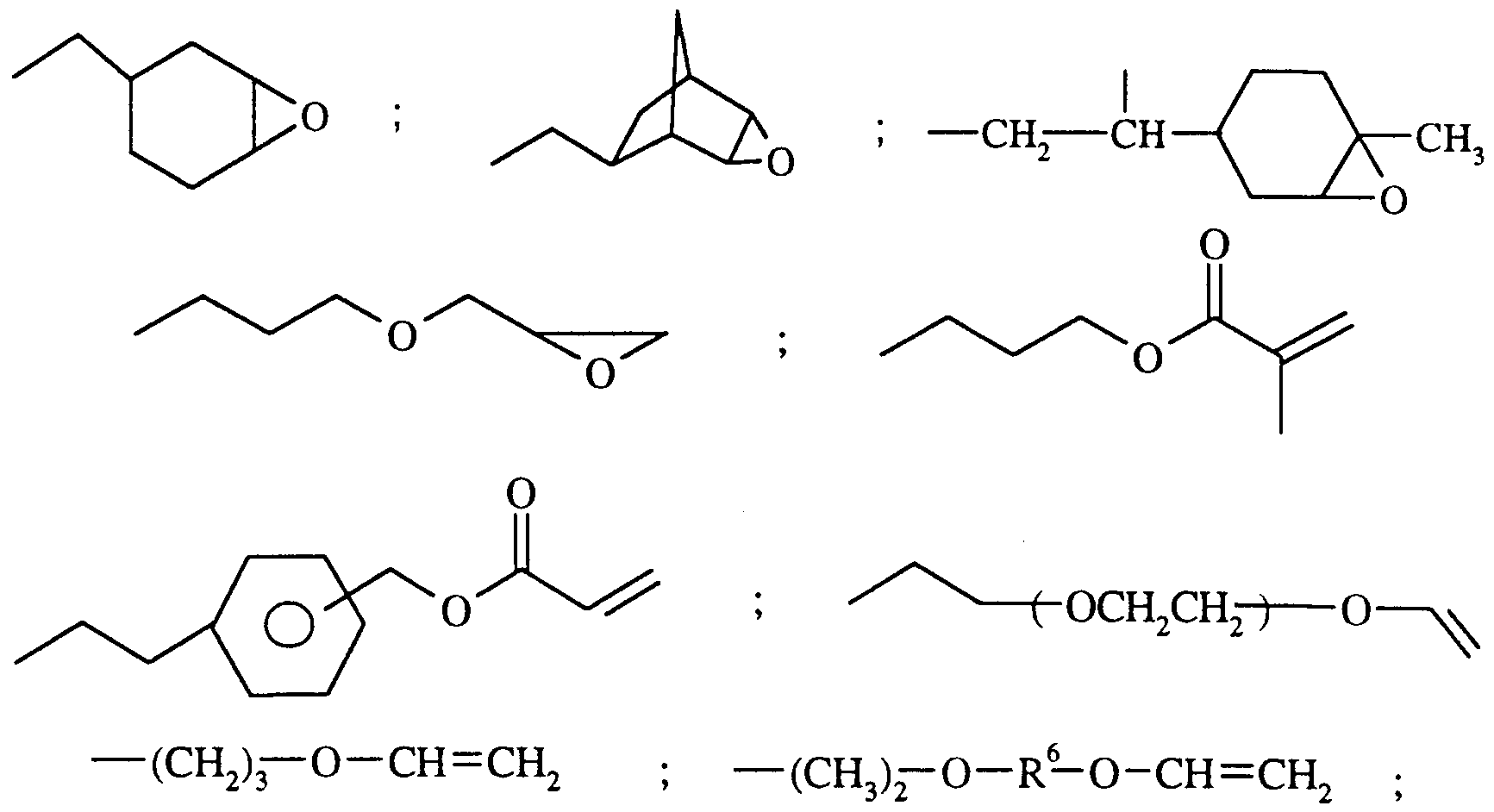
- frB of diluent B are of epoxy, vinyl ether or acrylate nature. More precisely, these frB are, for example, chosen from the following radicals:
- R 7 linear or branched C j -Cg alkyl.
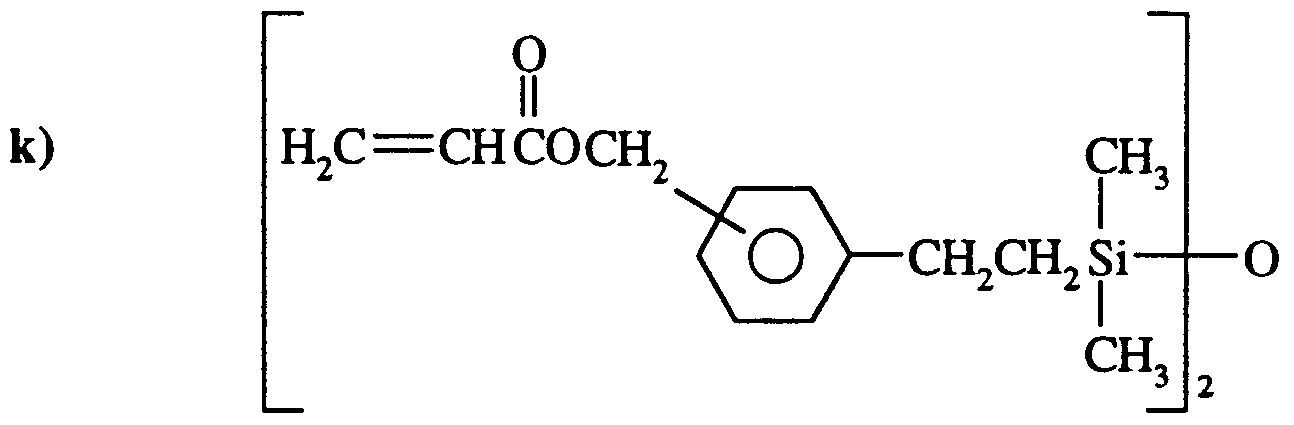
- diluent B consisting of at least one di, oligo or polysiloxane functionalized frB, mention may be made of those of the following formulas:
- the silicone diluent B according to the invention is of less importance quantitatively, compared to the matrix A, which constitutes the predominant element of the composition. As regards the latter, these constituents belong to at least one of the following species:
- epoxy acrylates preferably the oligomer of Bisphenol-A- epoxydiacrylate (EBECRYL 600),
- acryloglycero-polyester preferably a mixture of trifunctional acrylate oligomer obtained from glycerol and polyester (EBECRYL 810), • multifunctional acrylates, preferably pentaerythrityl triacrylate (PETA), trimethylolpropane triacrylate (TMPTA), 1,6-hexanediol diacrylate (HDODA), trimethylolpropane ethoxylate triacrylate, thiodiethylene glycol diacrylate, tetraethylene glycol diacrylate (TTEGDA), tripropylene glycol diacrylate (TRPGDA ), triethylene glycol diacrylate (TREGDA), trimethylpropane trimethacrylate (TMPTMA),
- PETA pentaerythrityl triacrylate
- TMPTA trimethylolpropane triacrylate
- HDODA 1,6-hexanediol diacrylate
- TTEGDA tetraethylene glycol diacrylate
- acrylo-acrylics being particularly preferred, eg, ) alkenyl ethers, linear or cyclic, taken alone or as a mixture between them:
- the cationic photoinitiators can be chosen from onium borates (taken alone or as a mixture between them) of an element from groups 15 to 17 of the periodic table [Chem. & Eng. News, vol.63, N ° 5, 26 of February 4, 1985] or of an organometallic complex of an element from groups 4 to 10 of the periodic table [same reference], ⁇ whose cationic entity is selected from: 1) the onium salts of formula (I): [(R 1 ) n - A - (R 2 ) m ] + (I) formula in which:
- A represents an element from groups 15 to 17 such as for example: I, S, Se, P or N,
- Ri represents a carbocyclic or heterocyclic Cg-C20 aryl radical .
- said heterocyclic radical possibly containing as heteroelements nitrogen or sulfur,
- n is an integer ranging from 1 to v + 1, v being the valence of the element A,
- Ar * which may be identical or different from each other, each represent a monovalent phenyl or naphthyl radical, optionally substituted with one or more radicals chosen from: a linear or branched C ⁇ - ⁇ 2 alkyl radical, preferably in CJ-C ⁇ , a linear or branched C1-C6 alkoxy radical, preferably C -C ⁇ , a halogen atom, a group -OH, a group -COOH, an ester group - COO-alkyl where the alkyl part is a linear or branched residue in Ci - Ci 2, preferably in Ci-Cé, and a group of formula - ⁇ 4-Ar where the symbols Y * and Ar2 have the meanings given just below,
- Y is then a divalent radical having the following meanings ⁇ to Y ⁇ :
- M represents a metal from group 4 to 10, in particular iron, manganese, chromium, cobalt ...
- L ⁇ represents 1 ligand linked to the metal M by ⁇ electrons, a ligand chosen from the ligands ⁇ ⁇ -alkyl, ⁇ ⁇ - cyclopendadienyl and ⁇ ⁇ - cycloheptratrienyl and the ⁇ ⁇ - aromatic compounds chosen from the ligands ⁇ ⁇ -benzene substituted and the compounds having from 2 to 4 condensed cycles, each cycle being able to contribute to the valence layer of the metal M by 3 to 8 ⁇ electrons;
- L represents a ligand linked to metal M by ⁇ electrons, a ligand chosen from the ligands chosen from the ligands ⁇ 6-benzene optionally substituted and the compounds having from 2 to 4 condensed cycles, each cycle being capable of contributing to the valence layer of the metal M by 6 or 7 ⁇ electrons;
- L 3 represents from 0 to 3 identical or different ligands linked to the metal M by ⁇ electrons, ligand (s) chosen from CO and NO2 "1" ; the total electronic charge q of the complex to which L ⁇ , L and 1 contribute? and the ionic charge of the metal M being positive and equal to 1 or 2;
- ⁇ the anionic borate entity having the formula:
- a phenyl radical substituted by at least one electron-withdrawing group such as for example OCF3, CF3, NO2, CN, and / or by at least 2 halogen atoms (especially fluorine), and this when the cationic entity is an onium an element from groups 15 to 17,
- a phenyl radical substituted by at least one element or an electron-withdrawing group in particular a halogen atom (especially fluorine), CF3, OCF3, NO2, CN, and this when the cationic entity is an organometallic complex of an element of the groups 4 to 10
- an aryl radical containing at least two aromatic rings such as, for example, biphenyl or naphthyl, optionally substituted with at least one element or an electron-withdrawing group, in particular a halogen atom (especially fluorine),
- the species which are particularly suitable are the following: r [B (C 6 F 5 ) - 5 '[B (C 6 H 3 (CF 3 ) 2 ) - v [ (C 6 F 5 ) 2 BF 2 ] - 6 '[B (C 6 H 3 F 2 ) 4 ] - y [B (C 6 H 4 CF 3 ) 4 ] - T [C 6 F 5 BF 3 ] -
- the first 1) are described in numerous documents, notably in patents US-A-4,026,705, US-A-4,032,673, US-A-4,069,056, US-A- 4,136,102, US-A- 4,173,476. Among these, the following cations will be particularly favored:
- radical R 6 has the meaning given in this WO application in connection with the symbol R 1 ; a cationic entity of this type which is more preferred is that where R 6 represents an alkyl radical, linear or branched, C j -C ⁇ .
- R 6 represents an alkyl radical, linear or branched, C j -C ⁇ .
- oxoisothiochromanium salts which are particularly suitable, mention will be made in particular the sulfonium salt of 2-ethyl-4-oxoisothiochromanium or 2-dodecyl-4-oxoisothiochromanium.
- the cationic polysulfonium entity preferably comprises a species or a mixture of species of formula (III.1) in which:
- radicals Ar ⁇ identical or different from each other, each represent a phenyl radical, optionally substituted by a linear or branched C1-C4 alkyl radical or by the group of formula:
- radicals Ar 3 each represent an unsubstituted para-phenylene radical
- radical Ar has the preferred meaning given just above in this paragraph
- the mono-sulfonium species when there are any, which fall within the framework of this preferential modality are the species of formula (IV) in which the symbols Ar ⁇ and Ar2 have the preferred meanings indicated above in the preceding paragraph , including, when these radicals are directly linked together by a remainder Y 1 , the installation of a valential link or the rest - O -.
- the borate anionic entity is preferably chosen from anions of formula [BX ⁇ ] - in which: - the symbols X represent a fluorine atom,
- R which are identical or different, represent a phenyl radical substituted by at least one electron-withdrawing group chosen from OCF3, CF3, NO2 and CN, and / or by at least two fluorine atoms.
- borate anionic entity of formula [BX..R - is preferably chosen from the following anions: l ', 2', 3 ', 4', 5 ', 6', 7 ', borates of polysulfonium, which will be used very preferably, are the salts formed by the association of the following cations and anions: Cation Anion
- polysulfonium borates can be prepared by exchange reaction between a salt of the cationic entity (halide such as for example chloride, iodide) with an alkali metal salt (sodium, lithium, potassium) of the anionic entity.
- a salt of the cationic entity halide such as for example chloride, iodide
- an alkali metal salt sodium, lithium, potassium
- polysulfonium borates According to an alternative concerning the preparation of polysulfonium borates, the latter can be prepared directly by reaction between a diarylsulfoxide and a diarylsulfide according to the teaching described in: "J. Org. Chem.”, Vol. 55, pages 4222 - 4225 (1990).
- These new polysulfonium borates can be used, as they are obtained at the end of their preparation process, for example in solid or liquid form or in solution in an appropriate solvent, in monomer / oligomer / polymer compositions which are intended to be polymerized and / or crosslinked cationically and under activation, for example UV.
- the mono-sulfonium species (III.2) mentioned above may be in particular the co-products which are formed at the time of the preparation of the polysulfonium cations and whose presence can be more or less avoided. Up to 99%, more generally up to 90% and even more generally up to 50 mol% (of cation) of the polysulfonium species of formula (III. 1) can be replaced by monosulfonium species (H ⁇ .2) .
- organometallic salts most readily used in practice are in particular: ( ⁇ 5 - cyclopentadienyl) ( ⁇ ⁇ - toluene) Fe + 'le ( ⁇ 5 - cyclopentadienyl) ( ⁇ ⁇ - methyl-1- naphthalene) Fe + >. ( ⁇ - cyclopentadienyl) ( ⁇ ⁇ - cumene) Fe + > bis ( ⁇ - mesitylene) Fe + 'bis ( ⁇ "- benzene) Cr + -
- the radical photoinitiators can contain one or more phosphorus atoms, such as those marketed by CIBA-GEIGY (IRGACURE 1700) or BASF (LUCIRIN TPO).
- CIBA-GEIGY IRGACURE 1700
- BASF LOCIRIN TPO
- the proportions of compounds A, B, C are as follows:
- B 39-1%, preferably 29-1%
- the matrix A and the diluent B of the composition according to the invention comprises:
- A a matrix (A) based on a mixture of at least one of the following species: epoxides ( ⁇ ,), acrylates ( ⁇ 2 ), vinyl ethers (0C 3 ), polyols ( ⁇ 4 ), preferably ( ⁇ ,) and ( ⁇ 2 ), - and a silicone diluent (B) whose frB are epoxy and / or acrylate and / or vinyl ether and / or hydroxy, preferably epoxy and / or acrylate.
- the photoinitiator (C) is of the cationic type, while, for the species (o ⁇ ) and ( ⁇ 4 ) the photoinitiator (C) is radical.
- the epoxy and acrylate frA functions can be carried by different comonomers from the matrix A.
- the photoinitiator C is used in solution in an organic solvent (accelerator), preferably chosen from proton donors and, more preferably still, from the following groups: isopropyl alcohols, benzylic alcohols, diacetone alcohol, butyl lactate and their mixtures.
- organic solvent preferably chosen from proton donors and, more preferably still, from the following groups: isopropyl alcohols, benzylic alcohols, diacetone alcohol, butyl lactate and their mixtures.
- the composition according to the invention can optionally comprise at least one photo-sensitizer D selected from (poly) aromatic products - optionally metallic - and heterocyclic products and, preferably, chosen from the following product list: phenothiazine, tetracene, perylene, anthracene, diphenyl-9-10-anthracene, thioxanthone, 2-chlorothioxanthen-9-one, 1-chloro 4 propoxy 9H-thioxanthen-9-one, isopropyl-OH-thioxanten -9-one, mixture of isomers 2 and 4, 2-isopropyl-9H - thioxanthen-9-one, benzophenone, [4- (4-methylphenylthio) phenyl] phenylmethanone, 4-benzyl-4'-methyldiphenylsulphide, acetophenone, xanthone, fluorenone,
- effective amount of initiator system is meant, within the meaning of the invention, the amount sufficient to initiate crosslinking.
- the effective amount corresponds to 1.10- 4-1, preferably from 1.10 ° to 1.10 -1 and even more preferably from 1.10 ° to 1.10 * 2 moles of photoinitiator per 1 mole of
- the optional ingredients which are the pigments E in the composition according to the invention
- the pigmented compositions according to the invention are, e. g., inks. Titanium dioxide produces a white ink.
- additives F mention may be made, by way of examples, of dyes, fillers (silicones or not), surfactants, mineral reinforcing fillers (siliceous or not), bactericides, inhibitors of corrosion, binding bases, organosilicon compounds or epoxy compounds, such as alkoxysilanes, epoxycycloaliphatics or epoxyetheraliphatics.
- the varnishes comprise at least one surfactant and, advantageously, a particular combination of monomer, oligomer and polymer products in the matrix A, namely at least one cyclo aliphatic epoxide and, optionally, at least one epoxide obtained from condensation.
- bisphenol A and an epichlorohydrin are examples of monomer, oligomer and polymer products in the matrix A, namely at least one cyclo aliphatic epoxide and, optionally, at least one epoxide obtained from condensation.
- varnishes can include in their compositions: flexibilization agents and / or leveling agents (products marketed by BYK CHEMIE or EFKA CHEM., For example BYK 306, 307, 361, EFKA 31, EFKA 35 ) and / or adhesion promoting agents: eg silanes of the GLYMO type:
- the flexibilization agent (s) and / or the leveling agent (s) and / or the adhesion promoter (s) can comprise, in whole or in part l the reactive diluent B, eg formula 1.1, as described above.
- Diluent B can therefore assume the functions fulfilled by these various functional additives. This multifunctionality is all the more interesting since it does not require an overload in diluting B. Low doses are sufficient.
- MI is marketed by the company UNION-CARBIDE (UVR 6105 and 6110).
- UVR 6105 and 6110 UVR 6105 and 6110.
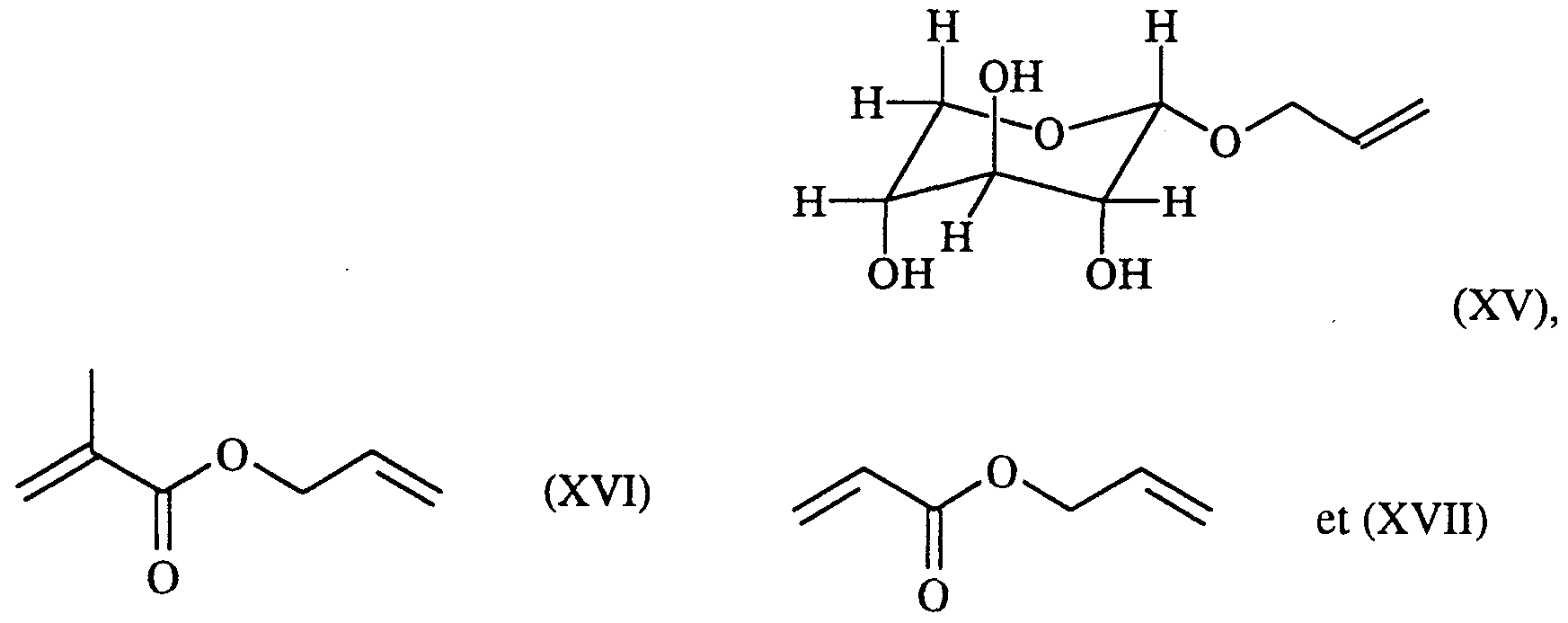
- - ⁇ 2 - frA oligomer / epoxyacrylate of the type:
- This siloxane a) can be obtained by hydrosilylation of vinylcyclohexene-monoxide with tetramethyldihydrogeno-1,3-disiloxane, at a flash point of 200 ° C. 2)
- Photoinitiator (PI) bis + 90% w / w and mono. 10% w / w
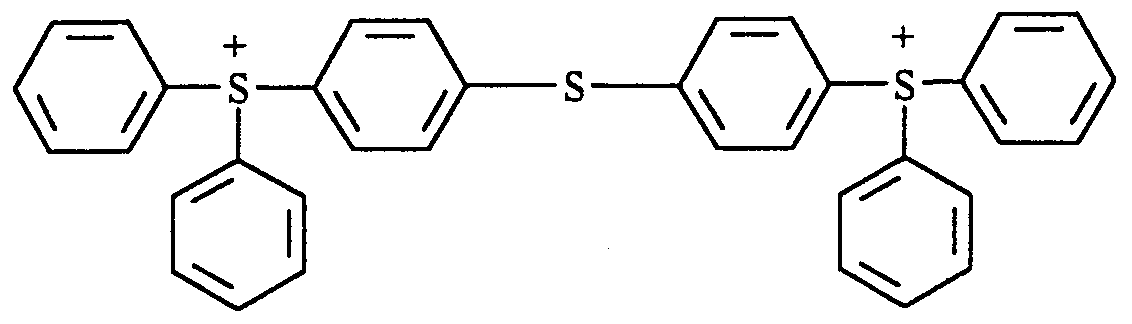
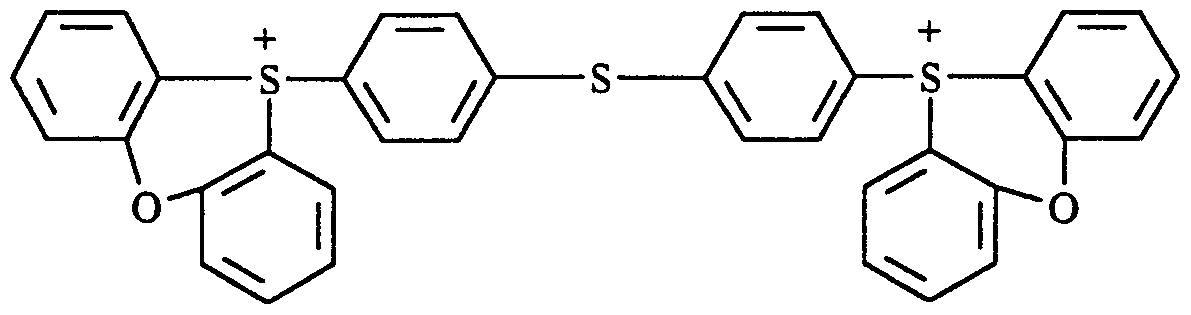
- the cationic photoinitiator used has the following formula:
- the radical photoinitiator (P3) used is that marketed by CIBA-
- P2 is soluble in P3.
- PI, P2, P3 are used in the form of a solution in butyl lactate or isopropanol.
- CPTX chloro-l-propoxy-4-thioxanthone.
- BYK BYK 306, BYK 307 or BYK 361
- EFKA EFKA 35
- This MEK methyl ethyl ketone test consists of measuring the number of round trips that can be made on the surface of the varnish with a paper (cellulose wadding) soaked in methyl ethyl ketone (MEK) before the varnish is completely degraded.
- the diluent a) is perfectly miscible in the epoxy (Ml) or polyol (Tl) matrix.
- Ml epoxy
- Tl polyol
- PI sulfonium borate
- Vibratory needle crosslinking tests are carried out in a tank with a size of 10 x 10 x 40 mm using 1 cm 3 of composition poured into the tank.
- the bottom of the tank is connected to a mercury vapor lamp (high pressure) via an optical fiber.
- the needle plunges up to 2 mm from the bottom of the tank which receives the light beam.
- the minimum duration of exposure is recorded at a given scrolling speed to go from the liquid state to the non-sticky solid state.
- the degree of crosslinking of the films obtained by the methyl ethyl ketone (MEK) test is also defined.
- the mercury arc lamp in the case of cross-linking in a thick layer of 2 mm with RAPRA (vibrating needle), the minimum duration of exposure is recorded to reach 95% of cross-linking (T 95 defined above). ).
- the new control formulation (F'T) becomes:
- the photoinitiator is an iodonium borate of formula (P2) added in solution at 33% w / w in isopropanol:
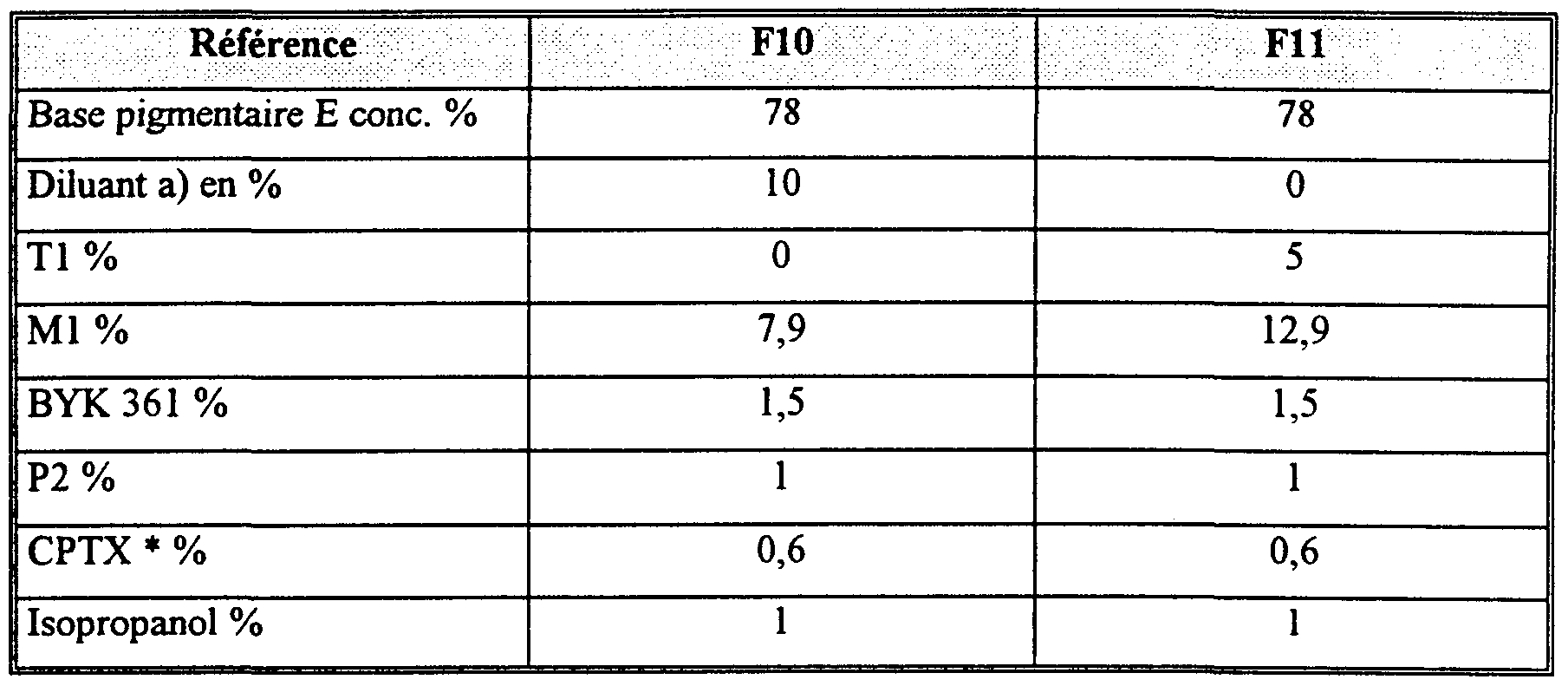
- This concentrated pigment base is formulated with or without diluent siloxane (a).
- CPTX chlorine 1 propoxy4thioxanthone used as photo-sensitizer.
- the photoinitiator is added in the form of an isopropanolic solution.
- the various constituents are added and mixed until complete dissolution of the thioxanthone CPTX, before addition of the concentrated pigment base.
- the drying of the inks is evaluated on a UV bench from the company FUSION fitted with a mercury lamp doped with gallium. This lamp, which has a power of 120W / cm, was calibrated using a Powerpuck cell from the company EIT, so as to determine the intensity and the dose received as a function of the running speed of the bench. At the running speed of 23 m / min the sample receives:
- UW (390-440 nm) 0.490 J / cm 2 .
- UVA 320-390 nm
- UVB 280-320 nm
- UVC 250-260 nm
- UW 0.416 J / cm 2
- the resistance to solvents of the inks obtained after drying of films of 12 ⁇ m ⁇ 3 is measured, by measuring the number of necessary round trips made using a cloth soaked in solvent to disintegrate the ink layer, 1 hour. after exposure and 24 hours after exposure.
- the solvent used is methyl ethyl ketone (MEK).
- UVC 250-260 nm
- UW 390-440 nm
- 0.343 J / cm 2 At the speed of 100 m / min, the calibration is not significant, taking into account the response time of the cell.
- the solvent used is methyl ethyl ketone (MEK).
- MEK methyl ethyl ketone
- siloxane diluent (a) allows, thanks to its low viscosity, to facilitate spreading on the support and the mixture of the constituents.
- the drying of the inks is evaluated on a UV bench from the IST Company equipped with two 200 W / cm lamps. A gallium-doped mercury lamp and an undoped mercury lamp.
- the calibration of the lamps is the same as before.
Landscapes
- Chemical & Material Sciences (AREA)
- Organic Chemistry (AREA)
- Wood Science & Technology (AREA)
- Life Sciences & Earth Sciences (AREA)
- Polymers & Plastics (AREA)
- Chemical Kinetics & Catalysis (AREA)
- Physics & Mathematics (AREA)
- Health & Medical Sciences (AREA)
- Materials Engineering (AREA)
- Medicinal Chemistry (AREA)
- Engineering & Computer Science (AREA)
- General Physics & Mathematics (AREA)
- Spectroscopy & Molecular Physics (AREA)
- Epoxy Resins (AREA)
- Inks, Pencil-Leads, Or Crayons (AREA)
- Paints Or Removers (AREA)
Abstract
Description










Claims






Priority Applications (2)
| Application Number | Priority Date | Filing Date | Title |
|---|---|---|---|
| EP98917196A EP0970405A1 (fr) | 1997-03-25 | 1998-03-20 | Composition (e.g. encre ou vernis) polymerisable et/ou reticulable sous irradiation par voie cationique et/ou radicalaire, a base d'une matrice organique, d'un diluant silicone et d'un photo-amorceur |
| AU70496/98A AU7049698A (en) | 1997-03-25 | 1998-03-20 | (e.g. ink or varnish) composition polymerisable and/or crosslinkable under radiation exposure by cationic and/or radical process, with an organic matrix base, of a diluent and a photoinitiator |
Applications Claiming Priority (2)
| Application Number | Priority Date | Filing Date | Title |
|---|---|---|---|
| FR97/03916 | 1997-03-25 | ||
| FR9703916A FR2761368B1 (fr) | 1997-03-25 | 1997-03-25 | Composition (e. g. encre ou vernis) polymerisable et/ou reticulable sous irradiation par voie cationique et/ou radicalaire, a base d'une matrice organique, d'un diluant silicone et d'un photo-amorceur |
Related Child Applications (2)
| Application Number | Title | Priority Date | Filing Date |
|---|---|---|---|
| US09381888 A-371-Of-International | 1998-03-20 | ||
| US09/922,614 Continuation US20020035199A1 (en) | 1997-03-25 | 2001-08-06 | Composition (e.g. ink or varnish) which can undergo cationic and/or radical polymerization and/or crosslinking by irradiation, based on an organic matrix, a silicone diluent and a photoinitiator |
Publications (1)
| Publication Number | Publication Date |
|---|---|
| WO1998043134A1 true WO1998043134A1 (fr) | 1998-10-01 |
Family
ID=9505365
Family Applications (1)
| Application Number | Title | Priority Date | Filing Date |
|---|---|---|---|
| PCT/FR1998/000566 Ceased WO1998043134A1 (fr) | 1997-03-25 | 1998-03-20 | Composition (e.g. encre ou vernis) polymerisable et/ou reticulable sous irradiation par voie cationique et/ou radicalaire, a base d'une matrice organique, d'un diluant silicone et d'un photo-amorceur |
Country Status (4)
| Country | Link |
|---|---|
| EP (1) | EP0970405A1 (fr) |
| AU (1) | AU7049698A (fr) |
| FR (1) | FR2761368B1 (fr) |
| WO (1) | WO1998043134A1 (fr) |
Cited By (6)
| Publication number | Priority date | Publication date | Assignee | Title |
|---|---|---|---|---|
| JP2001253869A (ja) * | 2000-03-09 | 2001-09-18 | Hitachi Chem Co Ltd | ビススルホニウムボレート化合物及びその製造法 |
| US6918984B2 (en) | 2002-06-24 | 2005-07-19 | Loctite (R&D) Limited | Photocurable adhesive compositions, reaction products of which have low halide ion content |
| US8309633B2 (en) | 2008-07-17 | 2012-11-13 | Henkel Ireland Ltd. | Low temperature, cationically curable compositions with improved cure speed and toughness |
| CN101503587B (zh) * | 2008-02-07 | 2014-10-08 | 富士胶片株式会社 | 油墨组合物、喷墨记录方法、印刷物以及成型印刷物 |
| WO2021037778A1 (fr) | 2019-08-27 | 2021-03-04 | Ferro Gmbh | Substance d'impression permettant de revêtir des surfaces de verre |
| CN113980245A (zh) * | 2021-12-01 | 2022-01-28 | 福建蓝海黑石新材料科技有限公司 | 一种柠檬烯基含硅脂环族环氧树脂及其制备和应用方法 |
Families Citing this family (2)
| Publication number | Priority date | Publication date | Assignee | Title |
|---|---|---|---|---|
| FR2849446B1 (fr) | 2002-12-26 | 2006-07-28 | Rhodia Chimie Sa | Vernis anti-salissures, procede d'application de ce vernis sur un support silicone et support ainsi traite |
| FR2904321B1 (fr) | 2006-07-25 | 2008-09-05 | Rhodia Recherches Et Technologies Sas | Composition polymerisable et/ou reticulable sous irradiation par voie cationique et/ou radicalaire |
Citations (6)
| Publication number | Priority date | Publication date | Assignee | Title |
|---|---|---|---|---|
| US4547431A (en) * | 1983-06-20 | 1985-10-15 | General Electric Company | Ultraviolet radiation-curable silicone controlled release compositions |
| EP0389927A2 (fr) * | 1989-03-30 | 1990-10-03 | General Electric Company | Epoxysiloxanes comme promoteurs et accélérateurs de durcissement pour des systèmes de durcissement par UV |
| WO1993008238A1 (fr) * | 1991-10-15 | 1993-04-29 | Minnesota Mining And Manufacturing Company | Compositions pour couches de liberation au silicone, durcissables aux u.v. |
| US5229251A (en) * | 1991-04-29 | 1993-07-20 | International Business Machines Corp. | Dry developable photoresist containing an epoxide, organosilicon and onium salt |
| EP0624827A1 (fr) * | 1993-05-12 | 1994-11-17 | Ciba-Geigy Ag | Procédé de fabrication de microstructures |
| EP0739945A2 (fr) * | 1995-04-28 | 1996-10-30 | Dow Corning Toray Silicone Company, Limited | Compositions de revêtement antiadhésif à base de silicone durcissable par irradiation |
-
1997
- 1997-03-25 FR FR9703916A patent/FR2761368B1/fr not_active Expired - Fee Related
-
1998
- 1998-03-20 EP EP98917196A patent/EP0970405A1/fr not_active Withdrawn
- 1998-03-20 AU AU70496/98A patent/AU7049698A/en not_active Abandoned
- 1998-03-20 WO PCT/FR1998/000566 patent/WO1998043134A1/fr not_active Ceased
Patent Citations (6)
| Publication number | Priority date | Publication date | Assignee | Title |
|---|---|---|---|---|
| US4547431A (en) * | 1983-06-20 | 1985-10-15 | General Electric Company | Ultraviolet radiation-curable silicone controlled release compositions |
| EP0389927A2 (fr) * | 1989-03-30 | 1990-10-03 | General Electric Company | Epoxysiloxanes comme promoteurs et accélérateurs de durcissement pour des systèmes de durcissement par UV |
| US5229251A (en) * | 1991-04-29 | 1993-07-20 | International Business Machines Corp. | Dry developable photoresist containing an epoxide, organosilicon and onium salt |
| WO1993008238A1 (fr) * | 1991-10-15 | 1993-04-29 | Minnesota Mining And Manufacturing Company | Compositions pour couches de liberation au silicone, durcissables aux u.v. |
| EP0624827A1 (fr) * | 1993-05-12 | 1994-11-17 | Ciba-Geigy Ag | Procédé de fabrication de microstructures |
| EP0739945A2 (fr) * | 1995-04-28 | 1996-10-30 | Dow Corning Toray Silicone Company, Limited | Compositions de revêtement antiadhésif à base de silicone durcissable par irradiation |
Cited By (8)
| Publication number | Priority date | Publication date | Assignee | Title |
|---|---|---|---|---|
| JP2001253869A (ja) * | 2000-03-09 | 2001-09-18 | Hitachi Chem Co Ltd | ビススルホニウムボレート化合物及びその製造法 |
| US6918984B2 (en) | 2002-06-24 | 2005-07-19 | Loctite (R&D) Limited | Photocurable adhesive compositions, reaction products of which have low halide ion content |
| CN101503587B (zh) * | 2008-02-07 | 2014-10-08 | 富士胶片株式会社 | 油墨组合物、喷墨记录方法、印刷物以及成型印刷物 |
| US8309633B2 (en) | 2008-07-17 | 2012-11-13 | Henkel Ireland Ltd. | Low temperature, cationically curable compositions with improved cure speed and toughness |
| WO2021037778A1 (fr) | 2019-08-27 | 2021-03-04 | Ferro Gmbh | Substance d'impression permettant de revêtir des surfaces de verre |
| US12018164B2 (en) | 2019-08-27 | 2024-06-25 | Vibrantz Gmbh | Printing substance for coating glass surfaces |
| CN113980245A (zh) * | 2021-12-01 | 2022-01-28 | 福建蓝海黑石新材料科技有限公司 | 一种柠檬烯基含硅脂环族环氧树脂及其制备和应用方法 |
| CN113980245B (zh) * | 2021-12-01 | 2023-12-29 | 福建蓝海黑石新材料科技有限公司 | 一种柠檬烯基含硅脂环族环氧树脂及其制备和应用方法 |
Also Published As
| Publication number | Publication date |
|---|---|
| EP0970405A1 (fr) | 2000-01-12 |
| FR2761368A1 (fr) | 1998-10-02 |
| AU7049698A (en) | 1998-10-20 |
| FR2761368B1 (fr) | 2005-10-21 |
Similar Documents
| Publication | Publication Date | Title |
|---|---|---|
| EP0973808B1 (fr) | Amorceurs non toxiques, resines a groupements organofonctionnels reticulables comprenant les amorceurs, et leur utilisation pour la preparation de polymeres stables et non toxiques | |
| EP0834502B1 (fr) | Composés polymères polyioniques, leur procédé de préparation et leur utilisation comme photoamorceurs | |
| EP2225285A1 (fr) | Procede de realisation d'un film ou revetement dur a partir d'une composition reticulable/polymerisable par voie cationique comprenant un borate de iodonium et degageant une odeur acceptable | |
| US6864311B2 (en) | Composition (e. g. ink or varnish) which can undergo cationic and/or radical polymerization and/or crosslinking by irradiation, based on an organic matrix, a silicone diluent and a photoinitiator | |
| EP1117368B1 (fr) | Composition dentaire a base d'une silicone reticulable par voie cationique | |
| EP0562897B1 (fr) | Borates d'onium ou de complexe organométallique amorceurs cationiques de polymérisation | |
| BE1001615A4 (fr) | Procede de formation d'images et compositions pour ce procede. | |
| FR2805273A1 (fr) | Traitement de surface de materiau plastique avec une composition a fonctions reactives polymerisable et/ou reticulable | |
| WO1998028663A1 (fr) | Utilisation pour la stereophotolithographie d'une composition liquide photoreticulable par voie cationique comprenant un photoamorceur du type sels d'onium ou de complexes organometalliques | |
| CN1615115A (zh) | 用于可阳离子聚合树脂的三元光敏引发剂体系 | |
| CA2452566C (fr) | Sels de sulfonium, procedes de preparation associes et utilisation de ces sels en tant que photoinitiateurs dans des systemes durcissables par rayonnement | |
| TW202140574A (zh) | 作為光學材料之pd(acac)催化多環烯烴組成物的uv活性衍生物 | |
| EP0970405A1 (fr) | Composition (e.g. encre ou vernis) polymerisable et/ou reticulable sous irradiation par voie cationique et/ou radicalaire, a base d'une matrice organique, d'un diluant silicone et d'un photo-amorceur | |
| EP0998499B1 (fr) | Nouveaux systemes amorceurs de polymerisation et/ou de reticulation comprenant un borate d'onium et une benzophenone | |
| BE1010656A4 (fr) | Monomeres, oligomeres et polymeres a groupes oxirannes terminaux, leur procede de preparation et leur polymerisation cationique sous irradiation. | |
| WO2024185639A1 (fr) | Particules de conversion ascendante de photons et leur procédé de production, composition de résine photodurcissable et procédé de durcissement associé, et résine durcie | |
| FR2472592A1 (fr) | Compositions de polyorganosiloxanes durcissables sous l'action d'un rayonnement | |
| FR2996227A1 (fr) | Composition de resine organique reticulable/polymerisable par voie cationique comprenant un borate de iodonium et degageant une odeur acceptable | |
| EP1406956A1 (fr) | Traitement de surface de materiau plastique avec une composition organique a fonctions reactives polymerisable et/ou reticulable | |
| CN101588783B (zh) | 通过阳离子途径可交联/可聚合的牙科组合物 | |
| WO2022130796A1 (fr) | Photogénérateur d'acide et composition photosensible l'utilisant | |
| JP7089409B2 (ja) | 活性エネルギー線硬化性組成物及びその硬化物 | |
| EP1660019A1 (fr) | Composition dentaire polymerisable et a haute teneur en charge | |
| WO2006088040A1 (fr) | Composition durcissable de façon cationique et produit durci de celle-ci | |
| CA2218434C (fr) | Sulfonylimidures et sulfonylmethylures ioniques fluores, leur procede de preparation et leur utilisation comme photoamorceurs |
Legal Events
| Date | Code | Title | Description |
|---|---|---|---|
| AK | Designated states |
Kind code of ref document: A1 Designated state(s): AL AU BA BB BG BR CA CN CU CZ EE GE HU IL IS JP KP KR LC LK LR LT LV MG MK MN MX NO NZ PL RO SG SI SK TR TT UA US UZ VN YU |
|
| AL | Designated countries for regional patents |
Kind code of ref document: A1 Designated state(s): GH GM KE LS MW SD SZ UG ZW AM AZ BY KG KZ MD RU TJ TM AT BE CH DE DK ES FI FR GB GR IE IT LU MC NL PT SE BF BJ CF CG CI CM GA GN ML MR NE SN TD TG |
|
| DFPE | Request for preliminary examination filed prior to expiration of 19th month from priority date (pct application filed before 20040101) | ||
| 121 | Ep: the epo has been informed by wipo that ep was designated in this application | ||
| WWE | Wipo information: entry into national phase |
Ref document number: 1998917196 Country of ref document: EP |
|
| WWP | Wipo information: published in national office |
Ref document number: 1998917196 Country of ref document: EP |
|
| WWE | Wipo information: entry into national phase |
Ref document number: 09381888 Country of ref document: US |
|
| NENP | Non-entry into the national phase |
Ref country code: JP Ref document number: 1998545124 Format of ref document f/p: F |
|
| NENP | Non-entry into the national phase |
Ref country code: CA |