WO2002102756A2 - Polyimide mit cf2o-strukturelementen - Google Patents

Polyimide mit cf2o-strukturelementen Download PDF

Info

Publication number
WO2002102756A2
WO2002102756A2 PCT/EP2002/006443 EP0206443W WO02102756A2 WO 2002102756 A2 WO2002102756 A2 WO 2002102756A2 EP 0206443 W EP0206443 W EP 0206443W WO 02102756 A2 WO02102756 A2 WO 02102756A2
Authority
WO
WIPO (PCT)
Prior art keywords
chain
ocf
diamines
bisanhydrides
naphthylene
Prior art date
Legal status (The legal status is an assumption and is not a legal conclusion. Google has not performed a legal analysis and makes no representation as to the accuracy of the status listed.)
Ceased
Application number
PCT/EP2002/006443
Other languages
English (en)
French (fr)
Other versions
WO2002102756A3 (de
Inventor
Peer Kirsch
Andreas Taugerbeck
Georg LÜSSEM
Andreas Beyer
Sieglinde Mair
Current Assignee (The listed assignees may be inaccurate. Google has not performed a legal analysis and makes no representation or warranty as to the accuracy of the list.)
Merck Patent GmbH
Original Assignee
Merck Patent GmbH
Priority date (The priority date is an assumption and is not a legal conclusion. Google has not performed a legal analysis and makes no representation as to the accuracy of the date listed.)
Filing date
Publication date
Application filed by Merck Patent GmbH filed Critical Merck Patent GmbH
Priority to JP2003505301A priority Critical patent/JP2004530714A/ja
Priority to KR1020037016584A priority patent/KR100873547B1/ko
Publication of WO2002102756A2 publication Critical patent/WO2002102756A2/de
Publication of WO2002102756A3 publication Critical patent/WO2002102756A3/de
Anticipated expiration legal-status Critical
Ceased legal-status Critical Current

Links

Classifications

    • CCHEMISTRY; METALLURGY
    • C07ORGANIC CHEMISTRY
    • C07DHETEROCYCLIC COMPOUNDS
    • C07D407/00Heterocyclic compounds containing two or more hetero rings, at least one ring having oxygen atoms as the only ring hetero atoms, not provided for by group C07D405/00
    • C07D407/02Heterocyclic compounds containing two or more hetero rings, at least one ring having oxygen atoms as the only ring hetero atoms, not provided for by group C07D405/00 containing two hetero rings
    • C07D407/12Heterocyclic compounds containing two or more hetero rings, at least one ring having oxygen atoms as the only ring hetero atoms, not provided for by group C07D405/00 containing two hetero rings linked by a chain containing hetero atoms as chain links
    • CCHEMISTRY; METALLURGY
    • C07ORGANIC CHEMISTRY
    • C07CACYCLIC OR CARBOCYCLIC COMPOUNDS
    • C07C65/00Compounds having carboxyl groups bound to carbon atoms of six—membered aromatic rings and containing any of the groups OH, O—metal, —CHO, keto, ether, groups, groups, or groups
    • C07C65/21Compounds having carboxyl groups bound to carbon atoms of six—membered aromatic rings and containing any of the groups OH, O—metal, —CHO, keto, ether, groups, groups, or groups containing ether groups, groups, groups, or groups
    • C07C65/24Compounds having carboxyl groups bound to carbon atoms of six—membered aromatic rings and containing any of the groups OH, O—metal, —CHO, keto, ether, groups, groups, or groups containing ether groups, groups, groups, or groups polycyclic
    • C07C65/26Compounds having carboxyl groups bound to carbon atoms of six—membered aromatic rings and containing any of the groups OH, O—metal, —CHO, keto, ether, groups, groups, or groups containing ether groups, groups, groups, or groups polycyclic containing rings other than six-membered aromatic rings
    • CCHEMISTRY; METALLURGY
    • C07ORGANIC CHEMISTRY
    • C07CACYCLIC OR CARBOCYCLIC COMPOUNDS
    • C07C65/00Compounds having carboxyl groups bound to carbon atoms of six—membered aromatic rings and containing any of the groups OH, O—metal, —CHO, keto, ether, groups, groups, or groups
    • C07C65/21Compounds having carboxyl groups bound to carbon atoms of six—membered aromatic rings and containing any of the groups OH, O—metal, —CHO, keto, ether, groups, groups, or groups containing ether groups, groups, groups, or groups
    • C07C65/24Compounds having carboxyl groups bound to carbon atoms of six—membered aromatic rings and containing any of the groups OH, O—metal, —CHO, keto, ether, groups, groups, or groups containing ether groups, groups, groups, or groups polycyclic
    • CCHEMISTRY; METALLURGY
    • C07ORGANIC CHEMISTRY
    • C07DHETEROCYCLIC COMPOUNDS
    • C07D307/00Heterocyclic compounds containing five-membered rings having one oxygen atom as the only ring hetero atom
    • C07D307/77Heterocyclic compounds containing five-membered rings having one oxygen atom as the only ring hetero atom ortho- or peri-condensed with carbocyclic rings or ring systems
    • C07D307/87Benzo [c] furans; Hydrogenated benzo [c] furans
    • C07D307/89Benzo [c] furans; Hydrogenated benzo [c] furans with two oxygen atoms directly attached in positions 1 and 3
    • CCHEMISTRY; METALLURGY
    • C08ORGANIC MACROMOLECULAR COMPOUNDS; THEIR PREPARATION OR CHEMICAL WORKING-UP; COMPOSITIONS BASED THEREON
    • C08GMACROMOLECULAR COMPOUNDS OBTAINED OTHERWISE THAN BY REACTIONS ONLY INVOLVING UNSATURATED CARBON-TO-CARBON BONDS
    • C08G73/00Macromolecular compounds obtained by reactions forming a linkage containing nitrogen with or without oxygen or carbon in the main chain of the macromolecule, not provided for in groups C08G12/00 - C08G71/00
    • C08G73/06Polycondensates having nitrogen-containing heterocyclic rings in the main chain of the macromolecule
    • C08G73/10Polyimides; Polyester-imides; Polyamide-imides; Polyamide acids or similar polyimide precursors
    • C08G73/1039Polyimides; Polyester-imides; Polyamide-imides; Polyamide acids or similar polyimide precursors comprising halogen-containing substituents
    • GPHYSICS
    • G02OPTICS
    • G02FOPTICAL DEVICES OR ARRANGEMENTS FOR THE CONTROL OF LIGHT BY MODIFICATION OF THE OPTICAL PROPERTIES OF THE MEDIA OF THE ELEMENTS INVOLVED THEREIN; NON-LINEAR OPTICS; FREQUENCY-CHANGING OF LIGHT; OPTICAL LOGIC ELEMENTS; OPTICAL ANALOGUE/DIGITAL CONVERTERS
    • G02F1/00Devices or arrangements for the control of the intensity, colour, phase, polarisation or direction of light arriving from an independent light source, e.g. switching, gating or modulating; Non-linear optics
    • G02F1/01Devices or arrangements for the control of the intensity, colour, phase, polarisation or direction of light arriving from an independent light source, e.g. switching, gating or modulating; Non-linear optics for the control of the intensity, phase, polarisation or colour 
    • G02F1/13Devices or arrangements for the control of the intensity, colour, phase, polarisation or direction of light arriving from an independent light source, e.g. switching, gating or modulating; Non-linear optics for the control of the intensity, phase, polarisation or colour  based on liquid crystals, e.g. single liquid crystal display cells
    • G02F1/133Constructional arrangements; Operation of liquid crystal cells; Circuit arrangements
    • G02F1/1333Constructional arrangements; Manufacturing methods
    • G02F1/1337Surface-induced orientation of the liquid crystal molecules, e.g. by alignment layers
    • G02F1/133711Surface-induced orientation of the liquid crystal molecules, e.g. by alignment layers by organic films, e.g. polymeric films
    • G02F1/133723Polyimide, polyamide-imide

Definitions

  • the invention relates to chain-shaped polycyclic bisanhydrides and polyimides which can be obtained by polycondensation of the chain-shaped polycyclic bisanhydrides with diamines.
  • LCDs Liquid crystal displays
  • Examples include wristwatches, notebook computers, TV sets and display displays in the instrument panel of motor vehicles or in the aircraft cockpit.
  • a liquid crystal display consists of a liquid crystalline layer with opposite sides, a set of electrodes on each side of the liquid crystalline layer and a polymeric orientation layer between each set of electrodes and the liquid crystalline layer.
  • the liquid-crystalline molecules are oriented at a certain angle, which is referred to as the angle of inclination, with respect to the plane of the inside of the two substrates, for example
  • the inside of the substrates have a coating of sets of transparent electrodes (electrical conductors), usually of indium tin oxide.
  • the orientation process is carried out by applying the organic polymer from solution to the two substrates coated with indium tin oxide. After removal of the solvents and / or curing of the polymer layers, the substrate surfaces are usually rubbed or polished in a certain direction with fabric. The rubbing or polishing serves to produce a uniform optical direction. After polishing the two substrates, they are rotated by 70 to 360 ° to one another, connected to one another with suitable spacers and using organic adhesives, and filled with a wide variety of mixtures of liquid-crystalline materials. At this stage of the manufacturing process, polarizing films are often applied to the outer substrate surfaces by lamination. Finally, the electrical connections to both substrates are made.
  • Polyimide films are the most commonly used orientation films today. Polyimide films are used to control the orientation and the
  • Tilt angle of the liquid crystal molecules in liquid crystal displays are very thin, their thickness is generally between 100 and 2000 A. Orientation in a single direction is induced by polishing with special textile materials. The actual angle of inclination is determined as a function of the order of the polymers on the surface of the resulting surface energy, the type of fabric used to polish the surface, and the size of the work involved in polishing.
  • the object of the invention is to provide new polyimide materials which are suitable for producing polymeric orientation films in liquid crystal displays.
  • chain-shaped polycyclic bisanhydrides containing 2 to 12 chain cycles, selected from 1,3-phenylene, 1,4-phenylene, 2,6-naphthylene, 2,7-naphthylene, 1,4-cyclohexylene, bicyclopentylene, Bicyclooctylene, cubylene, which can be mono- or polysubstituted by halogen, cyano, alkyl, fluoroalkyl, alkoxy and / or fluoroalkoxy, the cycles being bridged by groups selected from a single bond, -CF 2 O-, -OCF 2 - , -O-, -S-, -SO 2 -, -CO-, -NH-, - (CH 2 ) ⁇ - ⁇ o-, - (CF 2 ) ⁇ - ⁇ o-.
  • Preferred chain-shaped polycyclic bisanhydrides are those of the general formula (I):
  • A, B, C and D can be the same or different and 1, 3-phenylene, 1, 4-phenylene, 2,6-naphthylene, 2,7-naphthylene and 1, 4-cyclohexylene with halogen, cyano, alkyl , Fluoroalkyl, alkoxy and / or fluoroalkoxy can be substituted one or more times,
  • E and F can be the same or different and
  • w, x, y and z are independently 0 or 1.
  • Preferred groups Z are a single bond - CF 2 O-, -OCF ⁇ -, -CO-, -CH 2 -, -CH 2 CH 2 - ( -O-, -S-, -SO 2 -, -CF 2 CF. 2 -, -C (CH 3 ) 2 -, -C (CF 3 ) 2 -,
  • Particularly preferred chain-shaped polycyclic bisanhydrides are those with a symmetrical structure of the general formula (II) - (V):
  • A, B are as defined above, z 1 , z- 1 , z 2 , z- 2 , z 3 have the meaning of Z 1 - Z 5 as defined above with the proviso that
  • Z2, Z - 3 are as defined above.
  • an aromatic halide is first converted into a Grignard compound or into a lithiated compound and then converted into the dithiocarboxylic acid with carbon disulfide.
  • the dithiocarboxylic acid is converted into a thioester with a phenol in the presence of an alkali metal hydride and iodine.
  • the desired -O-CF 2 bridge is then formed from the thioester using a fluorinating agent.
  • a cyclohexanone is first reacted with hexamethylphosphoric triamide and dibromodifluoromethane, a difluorohexylidene derivative being obtained.
  • Bromine is first added to this and then etherified by reaction with a phenolate with simultaneous elimination of hydrogen bromide to form a —CF 2 —O bridge.
  • a bis (alkylthio) carbenium salt is first reacted in the presence of a base with a compound having at least one hydroxyl group and then, preferably in situ, with a fluorinating agent and an oxidizing agent for connection to at least one -CF 2 - O-bridge in the molecule is oxidatively fluorinated.
  • the bis (alkylthio) carbenium salts can be prepared very easily from the corresponding carboxylic acids or activated carboxylic acid derivatives.
  • Suitable carboxylic acid derivatives are, for example, halides, carboxylic acid pseudohalides, carboxylic acid sulfonylates, which are suitably substituted, for example a trifluoromethanesulfonylate.
  • Carboxylic anhydrides and alkyl or phenyl carboxylic acid esters can also be used. The salts precipitate out of the reaction solution in a clean form and can be used in the next stage without further purification.
  • the bis (alkylthio) carbenium salt is first converted to the dithioorthoester by reaction with the compound containing at least one hydroxyl group.
  • This dithioorthoester is generally not isolated, but is immediately implemented further.
  • the oxidative fluorination to give a compound containing a -CF 2 -O group takes place under very mild, slightly basic conditions and, in contrast to conventional methods, is therefore compatible with a large number of unprotected functional groups, for example a nitrile group.
  • a further advantage is that the stereochemistry of the radicals, for example an ice or trans-cyclohexylene radical, is retained in the reaction.
  • the basic steps are summarized in Figure 1 below.
  • the carboxylic acid derivative A in which X represents, for example, -OH, halogen, pseudohalogen, substituted sulfonate, an anhydride, alkoxy or phenoxy, is reacted with an alkylthiol to form the bis (alkylthio) carbenium salt B.
  • Dithiols which lead to the formation of a cyclic cation are preferably used.
  • Ethanedithiol, propanedithiol or 1,2-benzenedithiol, which lead to the formation of dithianylium or dithiolanylium salts, are therefore particularly suitable.
  • This salt B is then converted to the orthoester C using a hydroxy compound R b -OH.
  • the orthoester C is generally not isolated, but directly oxidatively to Compound D implemented.
  • the method can be used universally, so that R a and R b are not subject to any restrictions.
  • R a and R b can thus be, for example, independently of one another an alkyl, an aryl, a cycloalkyl or an alkenyl radical, where these radicals can in turn be substituted as desired, for example by halogen, pseudohalogen, hydroxyl or carbonyl groups.
  • the present invention further relates to polyimides having -CF 2 O groups, which are obtainable by polycondensation of chain-shaped polycyelic bisanhydrides according to the invention and optionally further polycyelic bisanhydrides with diamines.
  • Suitable diamines are the diamines of the following formulas (VII) (XXXVI):
  • Preferred diamines are chain polycyelic diamines which are terminated at the chain ends by -NH 2 .
  • Particularly preferred diamines contain 2 to 12 chain cycles selected from 1, 3-phenylene, 1, 4-phenylene, 2,6-naphthylene, 2,7-naphthylene, 1, 4-cyclohexylene, bicyclopentylene, bicyclooctylene and cubylene, which with Halogen, cyano, alkyl, fluoroalkyl, alkoxy and / or fluoroalkoxy can be substituted one or more times, the cycles being selected by bridging groups from a single bond, -CF 2 O-, -OCF 2 -, -O-, -S-, -SO 2 -, -CO-, -NH-, - (CH 2 ) ⁇ - ⁇ o-, - (CF 2 ) 1-10 -, -CH (CH 3 ) -, -CH (CCI 3 ) -, - CH (CF 3 ) -, -C (CH 3 ) 2 -, -C (CF 3
  • A, B, C and D may be the same or different and 1,3-phenylene, 1,4-phenylene, 2,6-naphthylene, 2,7-naphthylene, 1,4-cyclohexylene, bicyclopentylene, bicyclooctylene and cubylene, the can be mono- or polysubstituted by halogen, cyano, alkyl, fluoroalkyl, alkoxy and / or fluoroalkoxy,
  • -NH 2 is independently bound in the 3- or 4-position
  • w, x, y and z are independently 0 or 1.
  • Examples are diamines of the general formulas (XXXVI) to (XL)
  • A, B are as defined above,
  • T ⁇ z 3 have the meaning of Z 1 - Z 5 as defined above with the proviso that
  • the present invention furthermore relates to polyimides which are obtained by polycondensation of chain-shaped polycyelic bisanhydrides and / or further polycyelic bisanhydrides with chain-shaped polycyclic diamines which are terminated by -NH 2 at the chain ends are terminated and at least one bridging group selected from - CF 2 O- or -OCF 2 - are available.
  • the diamines can be constructed analogously to the diamines of the general formulas (XXXVI) to (XL) with the additional proviso that at least one bridging group in the diamines is -CF2O- or -OCF 2 -.
  • Suitable further bisanhydrides are the compounds of the formulas (XLI) to (LVIII):
  • the monomers mentioned are notable for very good solubility in the customary organic solvents.
  • the size of the repetitive units lowers the relative number of link positions (imide bonds). These linking positions can contribute to the binding of ionic impurities to the polymer and thus impair the usability of the polymer as a component of electronic components, for example by reducing the electrical resistance.
  • the reduction in the number of linking positions based on the molecular weight is therefore a decisive advantage.
  • polyimides according to the invention are furthermore their high thermal, photochemical and chemical stability, their high lipophilicity, their high electrical resistance and their low affinity for ionic impurities. These properties offer particular advantages when the polyimides are used in electronic components, for example as an orientation material in LCDs or organic light-emitting diodes (OLEDs) or as an insulation material for electronic circuits.
  • the polyimide orientation film can be produced by solution polymerization of essentially equimolar amounts of the bisanhydride and the diamine, preferably at room temperature to 50 ° C., for example in N-methylpyrrolidone or N, N-dimethylacetamide as solvent.
  • the imide can then be formed in the polyamic acid solution obtained by chemical imidation with acetic anhydride and pyridine at 50 ° C. or by thermal imidation by heating to 70 to 250 ° C.
  • the polyimide obtained can then be precipitated, filtered and dried in vacuo.
  • the polyimide can then be dissolved in ⁇ -butyrolactone as a solvent and applied by spin coating to a glass plate coated with indium tin oxide and at a temperature of, for example, 150 ° C. to 220 ° C. for a period of generally one minute to two Hours imidized and dried.
  • the polyimide coating obtained in this way can then be polished in a manner known per se in order to obtain the orientation-controlling film.
  • Trifluoromethanesulfonic acid is heated to 120 ° C for 1 h. The mixture is allowed to cool to 80 ° C., diluted with 300 ml of acetonitrile and then diluted with 2 l of dibutyl ether. After cooling to 0 ° C., the precipitated product 2 is filtered off with suction, washed with diethyl ether and dried.
  • the anhydride 5 and the diamine 4 are dissolved in NMP and stirred under nitrogen for 22 h at room temperature. The mixture is then heated to 100 ° C. for 6 h and the polymer is precipitated by adding 50% aqueous ethanol. The crude product is reprecipitated once from 20 ml and once from 30 ml of NMP by adding 50% aqueous ethanol.

Landscapes

  • Chemical & Material Sciences (AREA)
  • Organic Chemistry (AREA)
  • Physics & Mathematics (AREA)
  • Nonlinear Science (AREA)
  • Mathematical Physics (AREA)
  • Polymers & Plastics (AREA)
  • Medicinal Chemistry (AREA)
  • Spectroscopy & Molecular Physics (AREA)
  • Chemical Kinetics & Catalysis (AREA)
  • Crystallography & Structural Chemistry (AREA)
  • Health & Medical Sciences (AREA)
  • General Physics & Mathematics (AREA)
  • Optics & Photonics (AREA)
  • Macromolecular Compounds Obtained By Forming Nitrogen-Containing Linkages In General (AREA)
  • Furan Compounds (AREA)
  • Polymers With Sulfur, Phosphorus Or Metals In The Main Chain (AREA)

Abstract

Gegenstand der Erfindung sind kettenförmige polycyclische Bisanhydride, enthaltend 2 bis 12 kettenständige Cyclen, ausgewählt aus 1,3-Phenylen, 1,4-Phenylen, 2,6-Naphthylen, 2,7-Naphthylen, 1,4-Cyclohexylen, Bicyclopentylen, Bicyclooctylen, Cubylen, die mit Halogen, Cyano, Alkyl, Fluoralkyl, Alkoxy und/oder Fluoralkoxy ein- oder mehrfach substituiert sein können, wobei die Cyclen durch Brücken-Gruppen, ausgewählt aus einer Einfachbindung, -CF2O, -OCF2-, -O-, -S-, -SO2-, -CO-, -NH-, -(CH2)1-10-, -(CF2)1-10-, -CH(CH3)-, -CH(CCI3)-, -CH(CF3)-, -C(CH3)2-, -C(CF3)2-, -C C-, -CH=CH-, -CF=CH-, -CH=CF-, -CF=CF-, (I) verknüpft sind mit der Maßgabe, daß mindestens eine Brücken-Gruppe -CF20- oder -OCF2- ist, wobei die Polycyclen an beiden Kettenenden durch verschiedene Gruppen ausgewählt aus (II) terminiert sind.

Description

Polyimide mit CF2O-Strukturelementen
Die Erfindung betrifft kettenförmige polycyclische Bisanhydride sowie Po- lyimide, die durch Polykondensation der kettenförmigen polycyclischen Bisanhydride mit Diaminen erhältlich sind.
Flüssigkristallanzeigen (LCDs) gewinnen zunehmend an Bedeutung und werden heute schon für eine Vielzahl von Anwendungen eingesetzt. Bei- spiele sind Armbanduhren, Notebook-Computer, TV-Geräte sowie Anzeigendisplays in der Instrumentenkonsole von Kraftfahrzeugen oder im Flugzeug-Cockpit.
In ihrer einfachsten Form besteht eine Flüssigkristallanzeige aus einer flüssigkristallinen Schicht mit gegenüberliegenden Seiten, einem Satz E- lektroden auf jeder Seite der flüssigkristallinen Schicht und einer polyme- ren Orientierungsschicht zwischen jedem Satz Elektroden und der flüssig- kristallinen Schicht. Die Orientierung der flüssigkristallinen Moleküle erfolgt in einem bestimmten Winkel, der als Neigungswinkel bezeichnet wird, be- züglich der Ebene der Innenseite der beiden Substrate, beispielsweise
Glasplatten, Kunststoffolien oder Quarzplatten, welche die Elektroden tragen. Die Innenseiten der Substrate weisen eine Beschichtung aus Sätzen transparenter Elektroden (elektrische Leiter) auf, üblicherweise aus Indium-Zinn-Oxid. Der Orientierungsvorgang wird durch Aufbringen des orga- nischen Polymers aus Lösung auf die beiden mit Indium-Zinn-Oxid beschichteten Substrate durchgeführt. Nach Entfernen der Lösungsmittel und/oder Aushärten der Polymerschichten werden die Substratoberflächen üblicherweise mit Stoff in eine bestimmte Richtung gerieben oder poliert. Das Reiben bzw. Polieren dient der Herstellung einer einheitlichen opti- sehen Richtung. Nach dem Polieren beider Substrate werden diese um 70 bis 360° zueinander verdreht, mit geeigneten Abstandshaltern und unter Verwendung von organischen Haftmitteln miteinander verbunden und mit den unterschiedlichsten Mischungen flüssigkristalliner Materialien gefüllt. In diesem Stadium des Herstellprozesses werden häufig Polarisationsfilme auf die äußeren Substratoberflächen durch Laminieren aufgebracht. Schließlich werden die elektrischen Verbindungen zu beiden Substraten hergestellt.
Filme aus Polyimiden sind die heute am häufigsten verwendeten Orientie- rungsfilme. Polyimidfilme dienen zur Kontrolle der Orientierung und des
Neigungswinkels der Flüssigkristall-Moleküle in Flüssigkristallanzeigen. Diese sind sehr dünn, im allgemeinen beträgt ihre Dicke zwischen 100 und 2000 A. Die Orientierung in eine einzige Richtung wird durch Polieren mit speziellen Textilmaterialien induziert. Der tatsächliche Neigungswinkel wird als Funktion der Ordnung der Polymere auf der Oberfläche der resultierenden Oberflächenenergie, der Art des Textilmaterials, das zum Polieren der Oberfläche verwendet wird, und der Größe der beim Polieren aufgewendeten Arbeit bestimmt.
Aufgabe der Erfindung ist es, neue Polyimid-Materialien, die zur Herstellung von polymeren Orientierungsfilmen in Flüssigkristallanzeigen geeignet sind, bereitzustellen.
Gelöst wird die Aufgabe durch kettenförmige polycyclische Bisanhydride, enthaltend 2 bis 12 kettenständige Cyclen, ausgewählt aus 1 ,3-Phenylen, 1 ,4-Phenylen, 2,6-Naphthylen, 2,7-Naphthylen, 1 ,4-Cyclohexylen, Bicyclopentylen, Bicyclooctylen, Cubylen, die mit Halogen, Cyano, Alkyl, Fluoralkyl, Alkoxy und/oder Fluoralkoxy ein- oder mehrfach substituiert sein können, wobei die Cyclen durch Brücken-Gruppen, ausgewählt aus einer Einfachbindung, -CF2O-, -OCF2-, -O-, -S-, -SO2-, -CO-, -NH-, -(CH2)ι-ιo-, - (CF2)ι-ιo-. -CH(CH3)-, -CH(CCI3)-, -CH(CF3)-, -C(CH3)2-, -C(CF3)2-, -CC-, - CH=CH-, -CF=CH-, -CH=CF-, -CF=CF-,
Figure imgf000004_0001
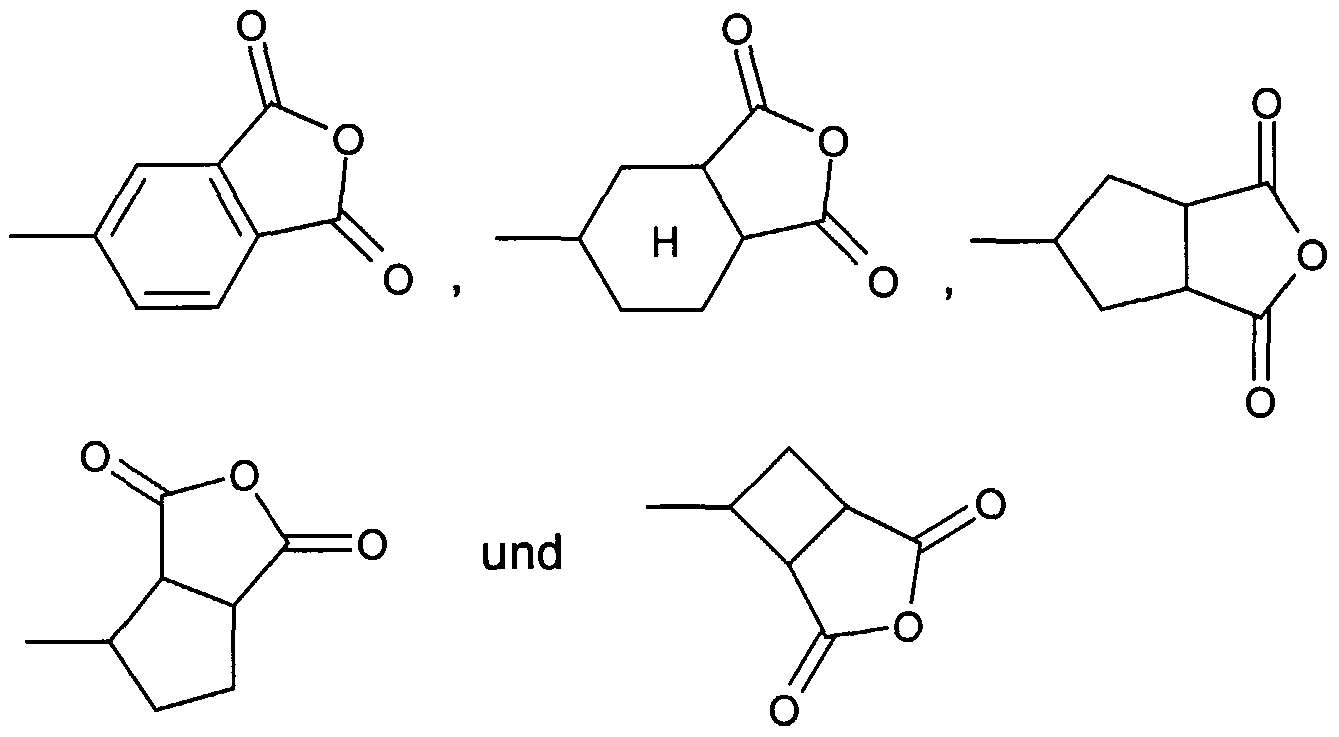
verknüpft sind mit der Maßgabe, daß mindestens eine Brücken-Gruppe - CF2O- oder -OCF2- ist, wobei die Polycyclen an beiden Kettenenden durch verschiedene Gruppen ausgewählt aus
Figure imgf000005_0001
Figure imgf000005_0002
terminiert sind.
Bevorzugte kettenförmige polycyclische Bisanhydride sind solche der allgemeinen Formel (I):
E" Z1-A ÜZ2-B Ü - Z3— C^-D^-F
(D
worin
A, B, C und D gleich oder verschieden sein können und 1 ,3-Phenylen, 1 ,4-Phenylen, 2,6-Naphthylen, 2,7-Naphthylen und 1 ,4- Cyclohexylen, die mit Halogen, Cyano, Alkyl, Fluoralkyl, Alkoxy und/oder Fluoralkoxy ein- oder mehrfach substituiert sein können, bedeuten,
E und F gleich oder verschieden sein können und
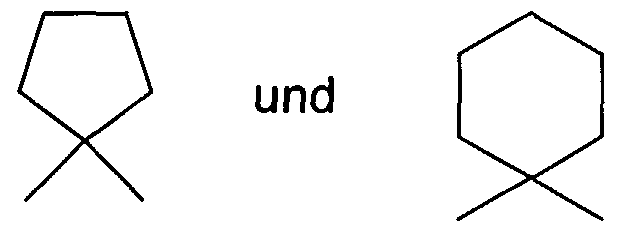
Figure imgf000006_0001
Figure imgf000006_0002
bedeuten,
Z1, Z2, Z3, Z4 und Z5 gleich oder verschieden sein können und eine Einfachbindung, -CF2O-, -OCF2-, -O-, -S-, -SO2-, -CO-, -NH-, -(CH2)ι.ιo-, -(CF2)ι-ιo-, -CH(CH3)-, -CH(CCI3)-, -CH(CF3)-, -C(CH3)2-, -C(CF3)2-, -C≡C-, CH=CH-, -CF=CH-, -CH=CF-, -CF=CF-,
Figure imgf000006_0003
bedeuten mit der Maßgabe, daß mindestens eine der Gruppen Z1 bis Z5 -CF2O- oder -OCF2- ist, und
w, x, y und z unabhängig voneinander 0 oder 1 sind.
Bevorzugte Gruppen Z sind eine Einfachbindung - CF2O-, -OCF-, -CO-, -CH2-, -CH2CH2-( -O-, -S-, -SO2-, -CF2CF2-, -C(CH3)2-, -C(CF3)2-,
Figure imgf000006_0004
Besonders bevorzugte kettenförmige polycyclische Bisanhydride sind solche mit symmetrischem Aufbau der allgemeinen Formel (II) - (V):
Figure imgf000007_0001
worin
A, B wie obenstehend definiert sind, z1, z-1, z2, z-2, z3 die Bedeutung von Z1 - Z5 wie obenstehend definiert haben mit der Maßgabe, daß
Z"1 = -OCF2- wenn Z1 = -CF2O- und umgekehrt,
Z"2 = -OCF2- wenn Z2 = -CF2O- und umgekehrt,
Z"1 = -CH=CF- wenn Z1 = -CF=CH- und umgekehrt,
Z"2 = -CH=CF- wenn Z2 = -CF=CH- und umgekehrt,
Z"1 = Z1 und Z"2 = Z2 in allen anderen Fällen ist.
Beispiele sind kettenförmige polycyclische Bisanhydride der Formeln (Ha) (VI):
Figure imgf000008_0001
Figure imgf000009_0001
worin Z2 , Z - 3 wie obenstehend definiert sind.
Ganz besonders bevorzugt sind die Verbindungen (Ha) mit Z3 = eine Einfachbindung, -O- oder -C(CF3)2-, Verbindungen (llb) mit Z3 = eine Einfachbindung, -O- oder -C(CF3)2- und Verbindungen (IVa) mit Z2 = eine Einfachbindung, -CH2CH2- oder -CF2CF2-. Zur Herstellung der -O-CF2-Brücken eignen sich verschiedene Verfahren, wie sie nachstehend aufgeführt sind. Ansonsten werden die erfindungsgemäßen kettenförmigen polycyclischen Bisanhydride nach den an sich bekannten Methoden der präparativen organischen Chemie, wie in Hou- ben-Weyl, Methoden der Organischen Chemie, Stuttgart, DE, beschrieben, erhalten.
Nach einem Verfahren wird zunächst ein aromatisches Halogenid in eine Grignard-Verbindung oder in eine lithiierte Verbindung überführt und dann mit Schwefelkohlenstoff in die Dithiocarbonsäure überführt. Die Dithiocar- bonsäure wird mit einem Phenol in Gegenwart eines Alkalimetallhydrids und Jod in einen Thioester überführt. Mit einem Fluorierungsmittel wird aus dem Thioester dann die gewünschte -O-CF2-Brücke gebildet.
Nach einem anderen Verfahren wird zunächst ein Cyclohexanon mit He- xamethylphosphortriamid und Dibromdifluormethan umgesetzt, wobei ein Difluorhexylidenderivat erhalten wird. An dieses wird zunächst Brom addiert und dann durch Reaktion mit einem Phenolat unter gleichzeitiger Ab- Spaltung von Bromwasserstoff unter Ausbildung einer -CF2-O-Brücke ve- rethert.
Nachteile dieser Verfahren sind, daß die Reaktionsgeschwindigkeiten niedrig, die Ausbeuten unzufriedenstellend und die Aufarbeitung und Rei- nigung des Produkts aufwendig sind.
Gemäß einem bevorzugten Verfahren wird zunächst ein Bis(alkylthio)carbenium-Salz in Gegenwart einer Base mit einer mindestens eine Hydroxylgruppe aufweisenden Verbindung umgesetzt und an- schließend, vorzugsweise in situ, mit einem Fluorierungsmittel und einem Oxidationsmittel zur Verbindung mit mindestens einer -CF2-O-Brücke im Molekül oxidativ fluoriert.
Die Bis(alkylthio)carbenium-Salze lassen sich sehr einfach aus den ent- sprechenden Carbonsäuren oder aktivierten Carbonsäurederivaten herstellen. Geeignete Carbonsäurederivate sind beispielsweise Carbonsäure- halogenide, Carbonsäurepseudohalogenide, Carbonsäuresulfonylate, welche geeignet substituiert sind, beispielsweise ein Trifluormethansulfonylat. Weiter können verwendet werden Carbonsäureanhydride und Alkyl- bzw. Phenylcarbonsäureester. Die Salze fallen in sauberer Form aus der Reak- tionslösung aus und können ohne weitere Reinigung in der nächsten Stufe eingesetzt werden.
Das Bis(alkylthio)carbenium-Salz wird durch Reaktion mit der mindestens eine Hydroxylgruppe enthaltenden Verbindung zunächst zum Dithi- oorthoester umgesetzt. Dieser Dithioorthoester wird im allgemeinen nicht isoliert, sondern sofort weiter umgesetzt. Dabei erfolgt die oxidative Fluorierung zur eine -CF2-O-Gruppe enthaltenden Verbindung unter sehr milden, leicht basischen Bedingungen und ist daher im Gegensatz zu den konventionellen Methoden mit einer Vielzahl von ungeschützten funktio- nellen Gruppen, z.B. einer Nitrilgruppe, kompatibel. Als weiterer Vorteil ergibt sich, daß die Stereochemie der Reste, beispielsweise ein eis- oder trans-Cyclohexylenrest, bei der Reaktion erhalten bleibt. Die prinzipiellen Schritte sind in der folgenden Abbildung 1 zusammengefaßt.
Figure imgf000011_0001
A B C D Abb. 1 Reaktionsschema zur Herstellung von Verbindungen mit einer CF2O-Brücke.
Das Carbonsäurederivat A, in dem X beispielsweise steht für -OH, Halogen, Pseudohalogen, substituiertes Sulfonat, ein Anhydrid, Alkoxy oder Phenoxy, wird mit einem Alkylthiol zum Bis(alkylthio)carbenium-Salz B umgesetzt. Bevorzugt werden Dithiole verwendet, die zur Ausbildung eines zyklischen Kations führen. Insbesondere geeignet sind daher Ethandithiol, Propandithiol oder 1 ,2-Benzoldithiol, die zur Ausbildung von Dithianylium- bzw. Dithiolanyliumsalzen führen. Dieses Salz B wird anschließend mit ei- ner Hydroxyverbindung Rb-OH zum Orthoester C umgesetzt. Der Or- thoester C wird im allgemeinen nicht isoliert, sondern direkt oxidativ zur Verbindung D umgesetzt. Das Verfahren ist universell einsetzbar, so daß Ra und Rb an sich keinen Beschränkungen unterliegen. Ra und Rb können also unabhängig voneinander beispielsweise ein Alkyl-, ein Aryl-, ein Cyc- loalkyl oder ein Alkenylrest sein, wobei diese Reste wiederum beliebig substituiert sein können, beispielsweise durch Halogen, Pseudohalogen, Hydroxy- oder Carbonylgruppen.
Vorteile des zuletzt beschriebenen Verfahrens sind, daß es mit zufriedenstellenden Reaktionsgeschwindigkeiten zu guten Ausbeuten führt. Zwischen- und Endprodukte sind auf einfache Weise zu reinigen.
Gegenstand der vorliegenden Erfindung sind ferner Polyimide mit -CF2O- Gruppen, die durch Polykondensation von erfindungsgemäßen kettenförmigen polycyelischen Bisanhydriden und gegebenenfalls weiteren polycyelischen Bisanhydriden mit Diaminen erhältlich sind.
Geeignete Diamine sind die Diamine der nachfolgenden Formeln (VII) (XXXVI):
Figure imgf000012_0001
Figure imgf000013_0001
Figure imgf000013_0002
Figure imgf000013_0003
Figure imgf000013_0004
Figure imgf000013_0005
(XVIII)
Figure imgf000014_0001
Figure imgf000014_0002
CF,
Figure imgf000014_0003
(XXIII)
Figure imgf000015_0001
Figure imgf000015_0002
Figure imgf000015_0003
(XXVII)
Figure imgf000015_0004
(XXVIII)
Figure imgf000016_0001
(XXXII)
(XXXIII)
Figure imgf000016_0003
(XXXIV)
Figure imgf000017_0001
Figure imgf000017_0002
(XXXVI)
Figure imgf000017_0003
Bevorzugte Diamine sind kettenförmige polycyelischen Diamine, die an den Kettenenden durch -NH2 terminiert sind.
Besonders bevorzugte Diamine enthalten 2 bis 12 kettenständige Cyclen, ausgewählt aus 1 ,3-Phenylen, 1 ,4-Phenylen, 2,6-Naphthylen, 2,7- Naphthylen, 1 ,4-Cyclohexylen, Bicyclopentylen, Bicyclooctylen und Cubylen, die mit Halogen, Cyano, Alkyl, Fluoralkyl, Alkoxy und/oder Fluoralkoxy ein- oder mehrfach substituiert sein können, wobei die Cyclen durch Brückengruppen ausgewählt aus einer Einfachbindung, -CF2O-, -OCF2-, -O-, -S-, -SO2-, -CO-, -NH-, -(CH2)ι-ιo-, -(CF2)1-10-, -CH(CH3)-, -CH(CCI3)-, -CH(CF3)-, -C(CH3)2-, -C(CF3)2-, -C≡C-, -CH=CH-, CF=CH-, -CH=CF-, -CF=CF-,
Figure imgf000017_0004
verknüpft sind.
Spezielle Diamine weisen die allgemeine Formel (XXXV) auf:
Figure imgf000018_0001
(XXXV) worin
A, B, C und D gleich oder verschieden sein können und 1 ,3-Phenylen, 1 ,4-Phenylen, 2,6-Naphthylen, 2,7-Naphthylen, 1 ,4- Cyclohexylen, Bicyclopentylen, Bicyclooctylen und Cubylen, die mit Halogen, Cyano, Alkyl, Fluoralkyl, Alkoxy und/oder Fluoralkoxy ein- oder mehrfach substituiert sein können, bedeuten,
Z1 Z2 Z3
Z4 und Z5 gleich oder verschieden sein können und eine Einfachbindung, -CF2O-, -OCF2-, -O-, -S-, -SO2-, -CO-, -NH-, -(CH2)ι-ιo-, -(CF2)ι-ιo-, -CH(CH3)-, -CH(CCI3)-, -CH(CF3)-, -C(CH3)2-, C(CF3)2-, -C≡C-, -CH=CH-, -CF=CH-, CH=CF-, -CF=CF-,
Figure imgf000018_0002
bedeuten,
-NH2 unabhängig voneinander in 3- oder 4-Position gebunden ist, und
w, x, y und z unabhängig voneinander 0 oder 1 sind.
Beispiele sind Diamine der allgemeinen Formeln (XXXVI) bis (XL)
Figure imgf000019_0001
(XXXVII)
(XXXVIII)
(XXXXIX)
Figure imgf000019_0002
Figure imgf000019_0003
worin
A, B wie obenstehend definiert sind,
z z z2,
T\ z3 die Bedeutung von Z1 - Z5 wie obenstehend definiert haben mit der Maßgabe, daß
Z"1 = -OCF2- wenn Z1 = -CF2O- und umgekehrt, Z"2 = -OCF2- wenn Z2 = -CF2O- und umgekehrt,
Z"1 = -CH=CF- wenn Z1 = -CF=CH- und umgekehrt, Z"2 = -CH=CF- wenn Z2 = -CF=CH- und umgekehrt, Z"1 = Z1 und Z'2 = Z2 in allen anderen Fällen ist,
-NH2 an beiden Kettenenden übereinstimmend in 3- oder in
4-Position gebunden ist.
Gegenstand der vorliegenden Erfindung sind ferner Polyimide, die durch Polykondensation von erfindungsgemäßen kettenförmigen polycyelischen Bisanhydriden und/oder weiteren polycyelischen Bisanhydriden mit kettenförmigen polycylischen Diaminen, die an den Kettenenden durch -NH2 terminiert sind und mindestens eine Brückengruppe, ausgewählt aus - CF2O- oder -OCF2-, aufweisen, erhältlich sind.
Die Diamine können analog den Diaminen der allgemeinen Formeln (XXXVI) bis (XL) aufgebaut sein mit der zusätzlichen Maßgabe, daß mindestens eine Brückengruppe in den Diaminen -CF2O- oder -OCF2- ist.
Geeignete weitere Bisanhydride sind die Verbindungen der Formeln (XLI) bis (LVIII):
Figure imgf000020_0001
Figure imgf000021_0001
(XLVII)
(XLVIII)
Figure imgf000021_0002
Figure imgf000021_0003
Figure imgf000022_0001
Figure imgf000023_0001
Die genannten Monomere zeichnen sich trotz ihres vergleichsweise hohen Molekulargewichts durch eine sehr gute Löslichkeit in den üblichen organischen Lösungsmitteln aus. Durch die Größe der repititiven Einheiten wird die relative Anzahl der Verknüpfungspositionen (Imidbindungen) erniedrigt. Diese Verknüpfungspositionen können zur Bindung ionischer Verunreinigungen an das Polymer beitragen und so die Verwendbarkeit des Polymers als Bestandteil elektronischer Bauteile beeinträchtigen, beispielsweise durch Verringerung des elektrischen Widerstands. Die Reduktion der Anzahl der Verknüpfungspositionen bezogen auf das Molekulargewicht stellt also einen entscheidenden Vorteil dar.
Vorteile der erfindungsgemäßen Polyimide sind ferner ihre hohe thermische, photochemische und chemische Stabilität, ihre hohe Lipohilie, ihr hoher elektrischer Widerstand sowie ihre geringe Affinität zu ionischen Verunreinigungen. Diese Eigenschaften bieten insbesondere Vorteile beim Einsatz der Polyimide in elektronischen Bauteilen, beispielsweise als Orientierungsmaterial in LCDs oder organischen Leuchtdioden (OLEDs) oder als Isolationsmaterial für elektronische Schaltkreise. Der Polyimid-Orientierungsfilm kann durch Lösungspolymerisation von im wesentlichen äquimolaren Mengen des Bisanhydrid und des Diamins, vorzugsweise bei Raumtemperatur bis 50°C beispielsweise in N- Methylpyrrolidon oder N,N-Dimethylacetamid als Lösungsmittel hergestellt werden. In der erhaltene Polyamidsäure-Lösung kann anschließend durch chemische Imidierung mit Essigsäureanhydrid und Pyridin bei 50°C oder durch thermische Imidierung durch Erhitzen auf 70 bis 250°C das Imid gebildet werden. Das erhaltene Polyimid kann anschließend gefällt, filtriert und im Vakuum getrocknet werden. Das Polyimid kann anschließend in γ- Butyrolacton als Lösungsmittel gelöst und durch Spin-Coating auf eine mit Indium-Zinn-Oxid beschichtete Glasplatte aufgebracht und bei einer Temperatur von beispielsweise 150°C bis 220°C während eines Zeitraums von im allgemeinen einer Minute bis zwei Stunden imidisiert und getrocknet werden. Die so erhaltene Polyimid-Beschichtung kann anschließend in an sich bekannter Weise poliert werden, um den die Orientierung kontrollierenden Film zu erhalten. Eine Übersicht über herkömmliche Techniken zur Einstellung der Orientierung findet sich beispielsweise bei I. Sage in Ther- motropic Liquid Chrystals, herausgegeben von G. W. Gray, John Wiley & Sons, 1987, Seiten 75 bis 77 und bei J. M. Geary et al., Journal of Applied Physics, Vol. 62 (10), 1987, Seiten 4100 - 4108.
Die Erfindung wird durch die nachstehenden Beispiele näher erläutert.
Beispiele
Herstellung der Monomere
Beispiel 1
Figure imgf000025_0001
2: Eine Mischung von 0,2 mol 1 0,48 mol 1 ,3-Propandithiol und 0,6 mol
Trifluormethansulfonsäure wird 1 h auf 120°C erwärmt. Man läßt die Mischung auf 80°C abkühlen, verdünnt mit 300 ml Acetonitril und verdünnt anschließend mit 2 I Dibutylether. Nach dem Abkühlen auf 0°C wird das ausgefallene Produkt 2 abgesaugt, mit Diethylether gewaschen und ge- trocknet.
Ausbeute: 92 %
Figure imgf000025_0002
Figure imgf000025_0003
Figure imgf000026_0001
Kupplung mit p-Nitrophenol zu 3 und weitere Umsetzung zu 4: 0,1 mol 2 wird in 500 ml CH2CI gelöst und auf -78°C gekühlt. Man tropft bei derselben Temperatur eine Mischung aus 0,4 mol p-Nitrophenol und 0,4 mol NEt3, verdünnt mit 300 ml CH2CI2 zu, gefolgt von 1 mol NEt33HF. Danach wird 1 mol Br2 langsam unter Konstanthaltung der Temperatur zugetropft. Man läßt auf RT kommen und arbeitet wässrig auf. Das Reaktionsprodukt wird mit einem geeigneten Laufmittel chromatographiert und anschließend aus MTB-Ether umkristallisiert (Fp. = 158 - 159°C). Die Nitroverbindung wird in Gegenwart von Lindlar-Katalysator in THF zum Diamin hydriert. Zur Aufreinigung wird das Produkt 4 aus Pentan kristallisiert (Fp. = 120°C). Ausbeute: 47 %
Beispiel 2
Figure imgf000026_0002
Figure imgf000026_0003
5: Die Synthese erfolgt analog zu 3, wobei an Stelle von p-Nitrophenol 4-Hydroxyphthalsäureanhydrid eingesetzt wird. Ausbeute: 62 %
Beispiel 3
Figure imgf000027_0001
7: 0,3 mol 6 werden in 1 I Ethanol gelöst und in Gegenwart von 10 g 5 Gew.-% Rh auf C bei 50°C und 50 bar Druck hydriert. Nach Abtrennen bei Katalysators wird das Rohprodukt wiederholt aus Aceton umkristallisiert, um die reine trans/trans-Dicarbonsäure 7 in 22 %iger Ausbeute zu erhalten.
: Eine Mischung von 0,2 mol 7, 0,48 mol 1 ,3-Propandithiol und 0,6 mol Trifluormethansulfonsäure wird 1 h auf 120°C erwärmt. Man läßt die Mischung auf 80°C abkühlen, verdünnt mit 300 ml Acetronitril und verdünnt anschließend mit 2 I Dibutylether. Nach dem Abkühlen auf 0°C wird das ausgefallene Produkt 8 abgesaugt, mit Diethylether gewaschen und getrocknet. Ausbeute: 87 %
Figure imgf000028_0001
Figure imgf000028_0002
10
Kupplung mit p-Nitrophenol zu 9 und weitere Umsetzung zu 10: 0,1 mol 8 wird in 500 ml CH2CI2 gelöst und auf -78°C gekühlt. Man tropft bei derselben Temperatur eine Mischung aus 0,4 mol Phenol und 0,4 mol NEt3, verdünnt mit 300 ml CH2CI2 zu, gefolgt von 1 mol NEt33HF. Danach wird 1 mol Br2 langsam unter Konstanthaltung der Temperatur zugetropft. Man läßt auf RT kommen und arbeitet wässrig auf. Das Reaktionsprodukt wird mit einem geeigneten Laufmittel chromatographiert und anschließend umkristallisiert. Die Nitroverbindung wird in Gegenwart von Lindlar-Katalysator in THF zum Diamin hydriert. Zur Aufreinigung wird das Produkt kristallisiert. Ausbeuten: 42 %
Beispiel 4
Figure imgf000028_0003
Figure imgf000029_0001
11 : Die Synthese erfolgt analog zu der Synthese von 9, wobei an Stelle von p-Nitrophenol p-Benzaldehyd eingesetzt wird. Ausbeute: 58 %
Beispiel 5
Figure imgf000029_0002
12
Figure imgf000029_0003
13
Figure imgf000029_0004
14
Figure imgf000029_0005
15 : 51 ,97 mmol 2-Trimethylsilyl-1 ,3-dithian werden in 250 ml THF gelöst. Zu dieser Lösung werden bei -70°C 31 ,707 ml einer 15 gew.-%igen Lösung von Butyllithium (51 ,97 mmol) zugetropft. Man läßt innerhalb von 4 h allmählich auf 0°C erwärmen, kühlt erneut auf -70°C ab und läßt 23,708 mmol des Diketons 12 in 50 ml THF zutropfen, wobei ein farbloser Niederschlag ausfällt. Nach beendeter Zugabe wird die Kühlung entfernt und man läßt über Nacht rühren. Anschließend gibt man den Ansatz auf 400 ml Eiswasser und extrahiert 5 mal mit Dichlor- methan. Die vereinigten organischen Phasen werden zweimal mit gesättigter NaCI-Lösung gewaschen und über Natriumsulfat getrocknet. Das Lösungsmittel wird im Vakuum entfernt und das leicht gelbe Rohprodukt aus Dichlormethan umkristallisiert. Man erhält farblose Blättchen des Produktes 13. Die Mutterlauge der Kristallisation wird einge- engt und der Rückstand erneut aus Dichlormethan umkristallisiert.
Ausbeute: 77,3 %
: 17,383 mmol 13 werden in 100 ml Dichlormethan suspendiert und zu dieser Suspension werden unter Eiskühlung 34,774 mmol Trifluor- methansulfonsäure zugetropft. Anschließend läßt man die klare gelbe
Lösung 1 h bei Raumtemperatur rühren. Dann wird der Ansatz auf -70°C abgekühlt und eine Lösung von 52,153 mmol 4-Nitrophenol und 62,576 mmol Triethylamin in 20 ml Dichlormethan tropfenweise hinzugegeben. Nach 1 h werden langsam 151 ,976 mmol Triethylamin- trishydrofluorid und anschließend portionsweise innerhalb von 30 min eine Suspension von 173,833 mmol DBH in 70 ml Dichlormethan hinzugegeben. Man läßt 60 min rühren, läßt anschließend den Ansatz auf -20CC erwärmen und gibt die orangefarbene Suspension vorsichtig auf eine eiskalte Mischung aus 500 ml 1 M Natronlauge und 50 ml Natri- umhydrogensulfitlösung. Der pH-Wert wird mit 32 gew.-%iger Natronlauge auf 7 eingestellt, die wässrige Phase abgetrennt und dreimal mit Pentan extrahiert. Die vereinigten organischen Phasen werden über Natriumsulfat getrocknet. Das Lösungsmittel wird im Vakuum entfernt und der Rückstand mit Dichlormethan/n-Heptan 1 : 1 über Kieselgel filtriert. Das Rohprodukt wird aus Dichlormethan/n-Hexan umkristalli- siert. Man erhält schwach gelbe Kristalle des trans, trans-Produktes 14 mit einem Schmelzpunkt von 164°C. Ausbeute: 57,2 %
5: Die Nitroverbindung 14 wird in Gegenwart von Lindlar-Katalysator in THF zum Diamin 15 hydriert. Die nach der Hydrierung erhaltene Lösung wird über Kieselgel filtriert. Es wird mit MTB-Ether nachgewaschen und das Lösungsmittel im Vakuum entfernt. Der Rückstand wird aus Essigsäure umkristallisiert. Ausbeute: 36,3 %
Figure imgf000031_0001
13
Figure imgf000031_0002
6: 17,383 mmol 13 werden in 100 ml Dichlormethan suspendiert und es werden unter Eiskühlung 34,774 mmol Trifluormethansulfonsäure zu- tropfen gelassen. Anschließend läßt man die klare gelbe Lösung 1 h bei Raumtemperatur rühren. Dann wird der Ansatz auf -70°C abgekühlt und eine Lösung von 52,149 mmol 5-Hydroxyphthalsäurean- hydrid und 62,576 mmol Triethylamin in 40 ml Dichlormethan tropfenweise hinzugegeben. Nach 1 h werden langsam 151 ,976 mmol Triethylamin-trishydrofluorid und anschließend portionsweise innerhalb von 30 min eine Suspension von 173,833 mmol DBH in 70 ml Dichlormethan hinzugegeben. Nach 60 min Rühren läßt man den Ansatz auf -20°C erwärmen und gibt die orangefarbene Suspension vorsichtig auf eine eiskalte Mischung aus 500 ml 1 M Natronlauge und 50 ml Natriumhydrogensulfitlösung. Der pH-Wert wird mit 32 gew.-%iger Natronlauge auf 7 eingestellt, die wässrige Phase abgetrennt und dreimal mit Pentan extrahiert. Die vereinigten organischen Phasen werden ü- ber Natriumsulfat getrocknet. Das Lösungsmittel wird im Vakuum entfernt und der Rückstand mit Dichlormethan/n-Heptan 1 : 1 zunächst ü- ber Kieselgel filtriert und anschließend chromatographiert (Rf = 0,11). Man erhält ein schwach gelbes Öl. Aus Toluol/n-Pentan kristallisieren farblose, watteartige Nadeln. Ausbeute: 60,5 %.
Herstellung der Polyimide
Beispiel 7
Das Anhydrid 5 und das Diamin 4 werden in NMP gelöst und unter Stickstoff 22 h bei Raumtemperatur gerührt. Anschließend wird 6 h auf 100°C erhitzt und das Polymer durch Zugabe von 50 %igem wässrigem Ethanol ausgefällt. Das Rohprodukt wird einmal aus 20 ml und einmal aus 30 ml NMP durch Zugabe von 50%igem wässrigem Ethanol umgefällt.

Claims

Patentansprüche
Kettenförmige polycyclische Bisanhydride, enthaltend 2 bis 12 kettenständige Cyclen, ausgewählt aus 1 ,3-Phenylen, 1 ,4-Phenylen, 2,6-Naphthylen, 2,7-Naphthylen, 1 ,4-Cyclohexylen, Bicyclopentylen, Bicyclooctylen, Cubylen, die mit Halogen, Cyano, Alkyl, Fluoralkyl, Alkoxy und/oder Fluoralkoxy ein- oder mehrfach substituiert sein können, wobei die Cyclen durch Brücken-Gruppen, ausgewählt aus einer Einfachbindung, -CF2O-, -OCF2-, -O-, -S-, -SO2-, -CO-, -NH-, - (CH2)ι-ιo-, -(CF2)ι-ιo-, -CH(CH3)-, -CH(CCI3)-, -CH(CF3)-, -C(CH3)2-, - C(CF3)2-, -C≡C-, -CH=CH-, -CF=CH-, -CH=CF-, -CF=CF-,
Figure imgf000033_0001
verknüpft sind mit der Maßgabe, daß mindestens eine Brücken- Gruppe -CF2O- oder -OCF2- ist, wobei die Polycyclen an beiden Kettenenden durch verschiedene Gruppen ausgewählt aus
Figure imgf000033_0002
terminiert sind.
Kettenförmige polycyclische Bisanhydride nach Anspruch 1 mit der allgemeinen Formel (I) E z1-AÜz2~B " z3— C^4-D]^Z5-F
(i)
worin
A, B, C und D gleich oder verschieden sein können und 1 ,3- Phenylen, 1 ,4-Phenylen, 2,6-Naphthylen, 2,7- Naphthylen und 1 ,4-Cyclohexylen, die mit Halogen, Cyano, Alkyl, Fluoralkyl, Alkoxy und/oder Fluoralkoxy ein- oder mehrfach substituiert sein können, bedeuten,
E und F gleich oder verschieden sein können und
Figure imgf000034_0001
bedeuten,
Z\ Z2, Z3, Z4 und Z5 gleich oder verschieden sein können und eine Einfachbindung, -CF2O-, -OCF2-, -O-, -S-, -SO2-, -CO-, -NH-, -(CH2)ι.ιo-, -(CF2)ι.10-, -CH(CH3)-, -CH(CCI3)-, -CH(CF3)-, -C(CH3)2-, -C(CF3)2-, -C≡C-, CH=CH-, -CF=CH-, -CH=CF-, -CF=CF-,
Figure imgf000035_0001
bedeuten mit der Maßgabe, daß mindestens eine der Gruppen Z1 bis Z5 -CF2O- oder -OCF2- ist, und
w, x, y und z unabhängig voneinander 0 oder 1 sind.
3. Kettenförmige polycyclische Bisanhydride nach Anspruch 2, ausgewählt aus der Gruppe bestehend aus Verbindungen der allgemeinen Formeln (II) - (V)
Figure imgf000035_0002
Figure imgf000036_0001
worin
A, B wie in Anspruch 2 definiert sind,
Z1 Z"1 z2
Z'2, Z3 die Bedeutung von Z1 - Z5 wie in Anspruch 2 definiert haben mit der Maßgabe, daß Z"1 = -OCF2- wenn Z1 = -CF2O- und umgekehrt, Z"2 = -OCF2- wenn Z2 = -CF2O- und umgekehrt, Z"1 = -CH=CF- wenn Z1 = -CF=CH- und umgekehrt, Z"2 = -CH=CF- wenn Z2 = -CF=CH- und umgekehrt, r1 = Z1 und Z-2 = Z2 in allen anderen Fällen ist.
Kettenförmige polycyclische Bisanhydride nach Anspurch 2 oder 3 der Formeln bzw. allgemeinen Formeln (Ha) - (VI)
Figure imgf000036_0002
Figure imgf000037_0001
Figure imgf000038_0001
worin Z2, Z wie in Anspruch 3 definiert sind.
5. Polyimide mit -CF2O-Gruppen, erhältlich durch Polykondensation von kettenförmigen polycyelischen Bisanhydriden, wie sie in einem der Ansprüche 1 - 4 definiert sind, und gegebenenfalls weiteren polycyelischen Bisanhydriden, mit Diaminen.
6. Polyimide nach Anspruch 5, wobei die Diamine kettenförmige polycyclische Diamine sind, die an den Kettenenden durch -NH2 terminiert sind.
7. Polyimide nach Anspruch 6, wobei die Diamine 2 bis 12 kettenständige Cyclen, ausgewählt aus 1 ,3-Phenylen, 1 ,4-Phenylen, 2,6- Naphthylen, 2,7-Naphthylen, 1 ,4-Cyclohexylen, Bicyclopentylen, Bicyclooctylen und Cubylen, die mit Halogen, Cyano, Alkyl, Fluoralkyl, Alkoxy und/oder Fluoralkoxy ein- oder mehrfach substituiert sein können , enthalten und wobei die Cyclen durch Brücken-Gruppen, ausgewählt aus einer Einfachbindung, -CF2O-, -OCF2-, -O-, -S-, - SO2-, -CO-, -NH-, -(CH2-10-, -(CF2)ι.ιo-, -CH(CH3)-, -CH(CCI3)-, - CH(CF3)-, -C(CH3)2-,
-C(CF3)2-, -C≡C-, -CH=CH-, CF=CH-, -CH=CF-, -CF=CF-,
Figure imgf000038_0002
verknüpft sind.
8. Polyimide nach Anspruch 7, wobei die Diamine die allgemeine Formel (XXXV) aufweisen
Figure imgf000039_0001
(XXXV)
worin
A, B, C und D gleich oder verschieden sein können und 1 ,3- Phenylen, 1 ,4-Phenylen, 2,6-Naphthylen, 2,7- Naphthylen, 1 ,4-Cyclohexylen, Bicyclopentylen, Bicyclooctylen und Cubylen, die mit Halogen, Cyano, Alkyl, Fluoralkyl, Alkoxy und/oder Fluoralkoxy ein- oder mehrfach substituiert sein können, bedeuten,
Z1 Z2 Z3 Z4 und Z5 gleich oder verschieden sein können und eine Einfachbindung, -CF2O-, -OCF2-, -O-, -S-, -SO2-, -CO-, -NH-, -(CH2)ι.ιo-, -(CF2)1-10-, -CH(CH3)-, -CH(CCI3)-, -CH(CF3)-, -C(CH3)2-, C(CF3)2-, -C≡C-, -CH=CH-, -CF=CH-, CH=CF-, -CF=CF-,
Figure imgf000039_0002
bedeuten,
-NH; unabhängig voneinander in 3- oder 4-Position gebunden ist, und
w, x, y und z unabhängig voneinander 0 oder 1 sind.
Polyimide nach Anspruch 8, wobei die Diamine ausgewählt sind aus Verbindungen der allgemeinen Formeln (XXXVI) - (XL)
Figure imgf000040_0001
(XXXVI I)
(XXXVIII)
Figure imgf000040_0002
χιχ)
Figure imgf000040_0003
worin
A, B wie in Anspruch 8 definiert sind,
z1, r1, z2,
Z"2, Z3 die Bedeutung von Z1 - Z5 wie in Anspruch 8 definiert haben mit der Maßgabe, daß
Z"1 = -OCF2- wenn Z1 = -CF2O- und umgekehrt, Z"2 = -OCF2- wenn Z2 = -CF2O- und umgekehrt, Z"1 = -CH=CF- wenn Z1 = -CF=CH- und umgekehrt, Z"2 = -CH=CF- wenn Z2 = -CF=CH- und umgekehrt, Z"1 = Z1 und Z'2 = Z2 in allen anderen Fällen ist,
-NH2 an beiden Kettenenden übereinstimmend in 3- oder in
4-Position gebunden ist.
10. Polyimide, erhältlich durch Polykondensation von kettenförmigen polycylischen Bisanhydriden, wie sie in einem der Ansprüche 1 - 4 definiert sind, und/oder weiteren polycyelischen Bisanhydriden, mit Dia- minen, wie sie in einem der Ansprüche 7 - 9 definiert sind mit der zusätzlichen Maßgabe, daß mindestens eine Brücken-Gruppe in den Diaminen -CF2O- oder -OCF2- ist, und gegebenenfalls weiteren Diaminen.
11. Verwendung von Polyimiden, wie in einem der Ansprüche 5 bis 10 definiert, als Orientierungsmaterial in Flüssigkristallanzeigen oder organischen Leuchtdioden (OLEDs).
PCT/EP2002/006443 2001-06-19 2002-06-12 Polyimide mit cf2o-strukturelementen Ceased WO2002102756A2 (de)

Priority Applications (2)

Application Number Priority Date Filing Date Title
JP2003505301A JP2004530714A (ja) 2001-06-19 2002-06-12 Cf2o構造要素を含むポリイミド
KR1020037016584A KR100873547B1 (ko) 2001-06-19 2002-06-12 Cf2o 구조 성분을 포함하는 폴리이미드

Applications Claiming Priority (2)

Application Number Priority Date Filing Date Title
DE10129335.6 2001-06-19
DE10129335A DE10129335A1 (de) 2001-06-19 2001-06-19 Polyimide mit CF¶2¶O-Strukturelementen

Publications (2)

Publication Number Publication Date
WO2002102756A2 true WO2002102756A2 (de) 2002-12-27
WO2002102756A3 WO2002102756A3 (de) 2003-04-24

Family

ID=7688562

Family Applications (1)

Application Number Title Priority Date Filing Date
PCT/EP2002/006443 Ceased WO2002102756A2 (de) 2001-06-19 2002-06-12 Polyimide mit cf2o-strukturelementen

Country Status (4)

Country Link
JP (1) JP2004530714A (de)
KR (1) KR100873547B1 (de)
DE (1) DE10129335A1 (de)
WO (1) WO2002102756A2 (de)

Cited By (2)

* Cited by examiner, † Cited by third party
Publication number Priority date Publication date Assignee Title
EP1489079A1 (de) * 2003-06-18 2004-12-22 Mitsubishi Gas Chemical Company, Inc. Anhydride und ihre Polyimid Derivate
CN115286517A (zh) * 2022-06-01 2022-11-04 慧迈材料科技(广东)有限公司 一种二胺单体及其合成的热塑性聚酰亚胺

Families Citing this family (3)

* Cited by examiner, † Cited by third party
Publication number Priority date Publication date Assignee Title
JP5359029B2 (ja) * 2007-06-06 2013-12-04 Jnc株式会社 酸二無水物、液晶配向膜および液晶表示素子
CN105683200A (zh) 2013-10-02 2016-06-15 大金工业株式会社 含氟络合化合物及使用其的含氟有机化合物的制造方法
JP6342088B2 (ja) * 2016-06-28 2018-06-13 大日本印刷株式会社 化合物、及びその中間体

Family Cites Families (10)

* Cited by examiner, † Cited by third party
Publication number Priority date Publication date Assignee Title
EP0285160B1 (de) * 1987-04-03 1993-12-08 Daikin Industries, Limited Fluor enthaltende aromatische Verbindung, Verfahren für ihre Herstellung und ihre Verwendung
JP2503578B2 (ja) * 1987-04-03 1996-06-05 ダイキン工業株式会社 新規含フッ素芳香族化合物並びにその製法及び用途
DE3927498C2 (de) * 1989-08-21 2002-01-17 Merck Patent Gmbh Polyamidester, Verfahren zu ihrer Herstellung und ihre Verwendung zur Herstellung von Polyimiden
JPH04304234A (ja) * 1991-04-02 1992-10-27 Hitachi Ltd 熱可塑型ポリエーテルイミドおよびそれを用いた電子装置
JPH04328524A (ja) * 1991-04-26 1992-11-17 Nippon Telegr & Teleph Corp <Ntt> 液晶曲面表示素子
JPH0586047A (ja) * 1991-09-30 1993-04-06 Hitachi Ltd 新規なテトラカルボン酸二無水物化合物およびテトラカ ルボン酸化合物
JPH05214101A (ja) * 1992-02-06 1993-08-24 Hitachi Ltd 熱可塑型ポリエステルイミドとそれを用いた電子部品および電子装置
TW587185B (en) * 1997-06-26 2004-05-11 Du Pont Multi-domain STN LCD comprising fluorinated polyimide alignment layers
KR100509512B1 (ko) * 1997-12-31 2005-11-08 삼성전자주식회사 비스(트리알킬트리멜리트산 무수물) 유도체 및 이로부터 형성된 광통신용 폴리에스테르이미드
DE10018882A1 (de) * 2000-04-14 2001-10-25 Merck Patent Gmbh Elektrooptische Flüssigkristallanzeige

Cited By (4)

* Cited by examiner, † Cited by third party
Publication number Priority date Publication date Assignee Title
EP1489079A1 (de) * 2003-06-18 2004-12-22 Mitsubishi Gas Chemical Company, Inc. Anhydride und ihre Polyimid Derivate
US7193030B2 (en) 2003-06-18 2007-03-20 Mitsubishi Gas Chemical Company, Inc. Acid anhydride and polyimide using the same
CN1318480C (zh) * 2003-06-18 2007-05-30 三菱瓦斯化学株式会社 新型酸酐和使用该酸酐的聚酰亚胺
CN115286517A (zh) * 2022-06-01 2022-11-04 慧迈材料科技(广东)有限公司 一种二胺单体及其合成的热塑性聚酰亚胺

Also Published As

Publication number Publication date
KR20040015744A (ko) 2004-02-19
DE10129335A1 (de) 2003-01-02
KR100873547B1 (ko) 2008-12-11
WO2002102756A3 (de) 2003-04-24
JP2004530714A (ja) 2004-10-07

Similar Documents

Publication Publication Date Title
EP0755918B1 (de) Photovernetzbare flüssigkristalline 1,2-Phenylen-Derivate
EP0700981B1 (de) Photopolymerisierbare Flüssigkristalle
EP1259503B1 (de) Herstellung von flüssigkristallen mit cf20-brücke
DE3752264T2 (de) Flüssigkristallines Polymer
EP0023728B1 (de) Anisotrope Verbindungen mit negativer oder positiver D.K. Anisotropie und geringer optischer Anisotropie und Flüssigkristallmischungen, die diese anisotropen Verbindungen enthalten
DE69912532T2 (de) Alkenylverbindung mit negativem Delta Epsilon Wert, Flüssigkristallzusammensetzung und Flüssigkristallanzeigevorrichtung
DE60215739T2 (de) 4-gliedrige Ringverbindung und diese enthaltende optische Phasenverzögerungsplatte
WO2003010120A1 (de) Indanverbindungen mit negativem dielektrischer anisotropie
EP1532090B1 (de) Cyclopenta ¬b naphthalinderivate
DE3743965A1 (de) Fluessigkristall-verbindung
WO2005021682A1 (de) Cyclopenta[a]naphthalinderivate
DE69814203T2 (de) Flüssigkristallverbindungen und Verfahren zur Herstellung
WO2002102756A2 (de) Polyimide mit cf2o-strukturelementen
DE10222509A1 (de) Organosiliziumverbindungen
CH654825A5 (de) Nematische fluessigkristallverbindungen.
DE4211694A1 (de) Fluessigkristalline verbindungen
DE3016758C2 (de) Substituierte Phenylbenzoate, Verfahren zu deren Herstellung, sowie diese enthaltende Flüssigkristallzusammensetzungen
DE4108627A1 (de) Fluessigkristalline verbindungen
EP1016703B1 (de) Flüssigkristalline Silicone mit erhöhter UV-Beständigkeit
DE69001601T2 (de) Ferroelektrische Flüssigkristallvorrichtung.
WO2002102875A2 (de) Polymere mit cf2o-strukturelementen
WO1991016321A1 (de) 1,3-dioxanderivate und flüssigkristallines medium
KR20100069160A (ko) 액정 화합물 및 그 제조방법
DE10335606B4 (de) Flüssigkristalline Verbindungen mit CF2CF2O- oder CF2OCF2-Brücke
EP0857728B1 (de) Photovernetzbare Silanderivate

Legal Events

Date Code Title Description
AK Designated states

Kind code of ref document: A2

Designated state(s): AE AG AL AM AT AU AZ BA BB BG BR BY BZ CA CH CN CO CR CU CZ DE DK DM DZ EC EE ES FI GB GD GE GH GM HR HU ID IL IN IS JP KE KG KP KR KZ LC LK LR LS LT LU LV MA MD MG MK MN MW MX MZ NO NZ OM PH PL PT RO RU SD SE SG SI SK SL TJ TM TN TR TT TZ UA UG US UZ VN YU ZA ZM ZW

AL Designated countries for regional patents

Kind code of ref document: A2

Designated state(s): GH GM KE LS MW MZ SD SL SZ TZ UG ZM ZW AM AZ BY KG KZ MD RU TJ TM AT BE CH CY DE DK ES FI FR GB GR IE IT LU MC NL PT SE TR BF BJ CF CG CI CM GA GN GQ GW ML MR NE SN TD TG

121 Ep: the epo has been informed by wipo that ep was designated in this application
WWE Wipo information: entry into national phase

Ref document number: 1020037016584

Country of ref document: KR

WWE Wipo information: entry into national phase

Ref document number: 2003505301

Country of ref document: JP

REG Reference to national code

Ref country code: DE

Ref legal event code: 8642

122 Ep: pct application non-entry in european phase