WO2004111166A1 - α-スルホ脂肪酸アルキルエステル塩を高濃度含有するパウダー、フレーク又はペレット及びその製造方法、並びに粒状洗剤及びその製造方法 - Google Patents
α-スルホ脂肪酸アルキルエステル塩を高濃度含有するパウダー、フレーク又はペレット及びその製造方法、並びに粒状洗剤及びその製造方法 Download PDFInfo
- Publication number
- WO2004111166A1 WO2004111166A1 PCT/JP2004/008563 JP2004008563W WO2004111166A1 WO 2004111166 A1 WO2004111166 A1 WO 2004111166A1 JP 2004008563 W JP2004008563 W JP 2004008563W WO 2004111166 A1 WO2004111166 A1 WO 2004111166A1
- Authority
- WO
- WIPO (PCT)
- Prior art keywords
- powder
- acid alkyl
- alkyl ester
- flakes
- pellets
- Prior art date
- Legal status (The legal status is an assumption and is not a legal conclusion. Google has not performed a legal analysis and makes no representation as to the accuracy of the status listed.)
- Ceased
Links
Classifications
-
- C—CHEMISTRY; METALLURGY
- C11—ANIMAL OR VEGETABLE OILS, FATS, FATTY SUBSTANCES OR WAXES; FATTY ACIDS THEREFROM; DETERGENTS; CANDLES
- C11D—DETERGENT COMPOSITIONS; USE OF SINGLE SUBSTANCES AS DETERGENTS; SOAP OR SOAP-MAKING; RESIN SOAPS; RECOVERY OF GLYCEROL
- C11D1/00—Detergent compositions based essentially on surface-active compounds; Use of these compounds as a detergent
- C11D1/02—Anionic compounds
- C11D1/12—Sulfonic acids or sulfuric acid esters; Salts thereof
- C11D1/28—Sulfonation products derived from fatty acids or their derivatives, e.g. esters, amides
-
- C—CHEMISTRY; METALLURGY
- C11—ANIMAL OR VEGETABLE OILS, FATS, FATTY SUBSTANCES OR WAXES; FATTY ACIDS THEREFROM; DETERGENTS; CANDLES
- C11D—DETERGENT COMPOSITIONS; USE OF SINGLE SUBSTANCES AS DETERGENTS; SOAP OR SOAP-MAKING; RESIN SOAPS; RECOVERY OF GLYCEROL
- C11D1/00—Detergent compositions based essentially on surface-active compounds; Use of these compounds as a detergent
- C11D1/66—Non-ionic compounds
-
- C—CHEMISTRY; METALLURGY
- C11—ANIMAL OR VEGETABLE OILS, FATS, FATTY SUBSTANCES OR WAXES; FATTY ACIDS THEREFROM; DETERGENTS; CANDLES
- C11D—DETERGENT COMPOSITIONS; USE OF SINGLE SUBSTANCES AS DETERGENTS; SOAP OR SOAP-MAKING; RESIN SOAPS; RECOVERY OF GLYCEROL
- C11D11/00—Special methods for preparing compositions containing mixtures of detergents
- C11D11/0082—Special methods for preparing compositions containing mixtures of detergents one or more of the detergent ingredients being in a liquefied state, e.g. slurry, paste or melt, and the process resulting in solid detergent particles such as granules, powders or beads
-
- C—CHEMISTRY; METALLURGY
- C11—ANIMAL OR VEGETABLE OILS, FATS, FATTY SUBSTANCES OR WAXES; FATTY ACIDS THEREFROM; DETERGENTS; CANDLES
- C11D—DETERGENT COMPOSITIONS; USE OF SINGLE SUBSTANCES AS DETERGENTS; SOAP OR SOAP-MAKING; RESIN SOAPS; RECOVERY OF GLYCEROL
- C11D11/00—Special methods for preparing compositions containing mixtures of detergents
- C11D11/04—Special methods for preparing compositions containing mixtures of detergents by chemical means, e.g. by sulfonating in the presence of other compounding ingredients followed by neutralising
-
- C—CHEMISTRY; METALLURGY
- C11—ANIMAL OR VEGETABLE OILS, FATS, FATTY SUBSTANCES OR WAXES; FATTY ACIDS THEREFROM; DETERGENTS; CANDLES
- C11D—DETERGENT COMPOSITIONS; USE OF SINGLE SUBSTANCES AS DETERGENTS; SOAP OR SOAP-MAKING; RESIN SOAPS; RECOVERY OF GLYCEROL
- C11D17/00—Detergent materials or soaps characterised by their shape or physical properties
- C11D17/0039—Coated compositions or coated components in the compositions, (micro)capsules
-
- C—CHEMISTRY; METALLURGY
- C11—ANIMAL OR VEGETABLE OILS, FATS, FATTY SUBSTANCES OR WAXES; FATTY ACIDS THEREFROM; DETERGENTS; CANDLES
- C11D—DETERGENT COMPOSITIONS; USE OF SINGLE SUBSTANCES AS DETERGENTS; SOAP OR SOAP-MAKING; RESIN SOAPS; RECOVERY OF GLYCEROL
- C11D17/00—Detergent materials or soaps characterised by their shape or physical properties
- C11D17/06—Powder; Flakes; Free-flowing mixtures; Sheets
-
- C—CHEMISTRY; METALLURGY
- C11—ANIMAL OR VEGETABLE OILS, FATS, FATTY SUBSTANCES OR WAXES; FATTY ACIDS THEREFROM; DETERGENTS; CANDLES
- C11D—DETERGENT COMPOSITIONS; USE OF SINGLE SUBSTANCES AS DETERGENTS; SOAP OR SOAP-MAKING; RESIN SOAPS; RECOVERY OF GLYCEROL
- C11D7/00—Compositions of detergents based essentially on non-surface-active compounds
- C11D7/22—Organic compounds
- C11D7/34—Organic compounds containing sulfur
Definitions
- the present invention relates to a powder, flake or pellet containing a high concentration of alkyl sulfo fatty acid ester and a method for producing the same, and a granular detergent and a method for producing the same.
- the present invention relates to a powder, flake or pellet containing a high concentration of an ⁇ -sulfofatty acid alkyl ester salt which is excellent in powder whiteness when concentrated, and has improved odor and powder physical properties during storage, and a powder thereof.
- the present invention relates to a production method, and a granular detergent, a solid detergent containing the powder, flakes or pellets, and a production method thereof.
- the monosulfofatty acid alkyl ester salt is generally obtained as an aqueous base by neutralization, it is necessary to remove water by some method in order to concentrate or handle as a powder.
- Some methods There are two typical methods. One is to dissolve the ⁇ -sulfofatty acid alkyl ester salt and the inorganic powder in water to prepare a slurry having a water content of about 20 to 70% by mass. This is a method of obtaining a dry powder by spray drying. The other is a method of directly mixing a salt of a monosulfo fatty acid alkyl ester having a water content of 20 to 30% by mass with an inorganic powder to obtain particles.
- the anionic surfactant-containing slurry was concentrated to obtain a lump having a water content of 10% or less, cooled to 20 to 70 ° C, and then pulverized, and the efficiency of adhesion to the pulverizer was reduced.
- a production method has been proposed to obtain a granular detergent (see JP-A-8-157894)
- JP-A-8-157894 a production method has been proposed to obtain a granular detergent
- the surfactant-containing slurry is concentrated to form a water-insoluble powder having a water content of 10% by mass or less and a water-insoluble fine powder of 1 to 15% by mass in a powder having an average particle diameter of 200 to 1,000 m.
- a method of obtaining particles having improved fluidity and solubility by coating has been proposed (see Japanese Patent Application Laid-Open No. 9-87070). However, there is concern about the solidification under pressure immediately after forming the particles. In addition, a method has been proposed in which the anionic surfactant slurry is concentrated using two types of evaporators to reduce power consumption and prevent color deterioration due to thermal deterioration.
- the present invention relates to a powder, flake or pellet containing a high concentration of a sulfosulfo fatty acid alkyl ester salt which is excellent in physical properties (non-solidification under pressure and fluidity) during storage, wherein the sulfonation method is limited.
- Powder, flake or pellet containing a high concentration of an ⁇ -sulfofatty acid alkyl ester salt which has improved powder color tone and odor by using the same, a method for producing the same, and a powder, flake or pellet obtained by the production method.
- the present inventors aimed to provide a granular detergent, a solid detergent, and a method for producing the same, comprising the steps of sulfonating a raw material fatty acid alkyl ester, neutralizing and bleaching, and then using an aged paste to obtain powder. It has been found that a padder, flake or pellet having good color and odor can be obtained. 0; -sulfo fat When producing powders, flakes or pellets containing a high concentration of acid alkyl ester salt, the paste containing the sodium sulfo fatty acid alkyl ester salt is concentrated to a water content of 10% by mass or less to obtain powder, flakes or pellets, which are then aged. It was found that powder, flakes or pellets having excellent physical properties during storage (non-solidification under pressure and fluidity) can be obtained.
- a method for producing a powder, flake or pellet containing a high concentration of a monosulfo fatty acid alkyl ester salt characterized by comprising:
- the method further comprises the step of mixing 1 to 40% by mass of the inorganic powder having an average particle size of 0.1 to 100 m in the powder, flake or pellet in the powder, flake or pellet. [1] The production method according to [1].
- the powder, flakes or pellets produced by the production method according to any one of [1] to [3] are converted into a method selected from powder mixing, kneading / crushing, and stirring granulation.
- a method for producing a granular detergent comprising mixing a slurry or pellet with a detergent component and water to prepare a slurry having a water content of 20 to 50% by mass, and spray-drying the slurry.
- the granular detergent produced by the production method according to [5] or [6] is further mixed or formed with a detergent component by a method selected from powder mixing, kneading / crushing, and stirring granulation.
- a solid detergent is obtained by mixing powder and flakes or pellets produced by the production method according to any one of [1] to [3] with a detergent component and kneading them to obtain a solid detergent.
- a method for producing a solid detergent BRIEF DESCRIPTION OF THE FIGURES
- FIG. 1 is a flowchart showing an example of a process for producing a monosulfo fatty acid alkyl ester salt-containing paste according to the present invention.
- FIG. 2 is a schematic configuration diagram showing an example of an apparatus used for the manufacturing method of the present invention.
- FIG. 3 is a schematic configuration diagram showing an example of a sulfonation reactor.
- FIG. 4 is a schematic configuration diagram showing an example of a reactor for performing a tubular gas-liquid multiphase flow reaction (pseudo-film reaction method).
- the powder is a powder having an average particle diameter of 100 to 1,500 m
- the flake is a flake having a length of 1 to 200 mm and a thickness of 0.2 to 5 mm
- Is formed by an extruder such as Yuichi Petsutsu to a diameter of about 5 to 15 mm and an average length of 5 to 50 mm.
- High concentration means that the powder, flake or pellet contains ⁇ -sulfofatty acid methyl ester in a pure content of 50% by mass or more, preferably 75% by mass or more.
- the average particle size refers to a sieve and a saucer, preferably a classification operation using a sieve described in JI SZ 8801-1: 2000 “Test sieve—Part 1: Metal mesh sieve”. It means the value obtained by the following formula.
- particles having an average particle diameter of 100 m or less are manufactured by Tohoku Computer One Applications Co., Ltd. It is measured with a single light scattering particle size distribution analyzer (LDSA-140 OA).
- Average particle size (weight 50%) 10 a: The first sieve opening where the calculated weight frequency is 50% or more [ ⁇ m] b: The sieve opening m larger than the opening a m]
- the first step of the method for producing a powder, flake or pellet containing a high concentration of an ⁇ -sulfofatty acid alkyl ester salt of the present invention comprises:
- the bleaching may be performed before the neutralization reaction.
- FIG. 1 is a flow chart showing an example of a process for producing a paste containing a sulfosulfo fatty acid alkyl ester salt of the present invention
- FIG. 2 is a schematic diagram showing an example of a production apparatus
- FIG. 3 is a sulfonation reaction.
- FIG. 2 is a schematic configuration diagram illustrating an example of a container.
- fatty acid methyl esters as the fatty acid alkyl ester feedstock, S_ ⁇ 3 gas diluted with dehumidified air or nitrogen gas as a sulfo emission gases, Na 2 as an coloring inhibitor S_ ⁇ 4 (Glauber's salt ), methanol as a lower alcohol, NaOH aqueous solution and alkaline aqueous solution, conditions examples of which are illustrated in the case of using H 2 0 2 (hydrogen peroxide) as a bleaching agent.
- S_ ⁇ 3 gas diluted with dehumidified air or nitrogen gas as a sulfo emission gases Na 2 as an coloring inhibitor S_ ⁇ 4 (Glauber's salt )
- methanol as a lower alcohol
- NaOH aqueous solution NaOH aqueous solution
- alkaline aqueous solution alkaline aqueous solution
- AI active ingredient: (Sulfofatty acid alkyl ester salt) means that it is used in a pure content of 1.0% by mass.
- a fatty acid alkyl ester and a coloring inhibitor which are raw materials, are charged into a batch-type stirring-mixing reaction tank 1 equipped with a stirring device.
- Raw material alkyl esters include animal fats and oils derived from beef tallow, fish oil, lanolin, etc .; vegetable fats and oils derived from coconut oil, palm oil, soybean oil, etc .; Any of fatty acid alkyl esters and the like may be used, and there is no particular limitation.
- the iodine value of the raw material fatty acid alkyl ester the more preferable in terms of color tone and odor.
- the value is preferably 1 or less, more preferably 0.5 or less.
- the effect of improving the color tone is greater than that when the iodine value exceeds 1.
- fatty acid alkyl esters represented by the following general formula (1) are particularly preferred.
- R 1 represents a linear or branched alkyl group or alkenyl group having 6 to 24 carbon atoms
- R 2 represents a linear or branched alkyl group having 1 to 6 carbon atoms.
- a coloring inhibitor include monovalent metal salts such as organic acid salts and inorganic sulfates, and preferably inorganic sulfates.
- the organic acid salt include sodium formate, potassium formate, and sodium acetate.
- Inorganic sulfates are powdered anhydrous salts that are monovalent metal salts Is not particularly limited, and examples thereof include sodium sulfate, potassium sulfate, and lithium sulfate. Inorganic sulfates are highly effective in suppressing coloration, are often inexpensive, and are components that are added to detergents. This is preferred because it does not need to be removed from the ester salt.
- the average particle size of the coloring inhibitor is preferably 250; m or less, particularly preferably 100 im or less.
- the reason for such a particle size is that, for example, the inorganic sulfate is hardly dissolved in the raw material liquid phase during the reaction to such an extent that its surface is slightly dissolved, but is dispersed in the raw material liquid phase. Therefore, by using the inorganic sulfate having a small particle size as described above, the contact area with the raw material liquid phase is increased, the dispersibility is improved, and the effect can be further enhanced.
- the addition amount of the coloring inhibitor is preferably 0 to 30% by mass, more preferably 0.5 to 20% by mass, and still more preferably 3 to 20% by mass, based on the raw material fatty acid alkyl ester. If the amount exceeds 30% by mass, the effect may be saturated.
- a tank reactor (reaction tank 1) is used.
- the reaction method is not particularly limited, and other methods such as a film reaction and a tubular gas-liquid multiphase flow reaction are applied.
- the sulfonation method is not particularly limited, and a thin film type sulfonation method, a batch type sulfonation method and the like are applied.
- a coloring inhibitor is used at the time of the sulfonation reaction, it is preferable to contact the sulfonation gas in a state of being dispersed as uniformly as possible in the raw material. Is preferred.
- the internal temperature of the reaction tank 1 is raised to a predetermined reaction temperature while stirring with the stirrer 3 to obtain a raw material liquid phase 2 in which coloring inhibitor particles are dispersed in a liquid raw material.
- the reaction temperature is a temperature at which the fatty acid alkyl ester has fluidity. Generally, it is higher than the melting point of the fatty acid alkyl ester, preferably from the melting point to a temperature 70 ° C. higher than the melting point.
- a sulfonated gas is introduced into the raw material liquid phase 2 from the sulfonated gas inlet 4.
- the sulfonated gas is introduced from the gas sparger 5 a of the gas introduction pipe 5 and dispersed in the raw material liquid phase 2 by the stirrer 3.
- the particles of the coloring inhibitor Are also uniformly dispersed in the raw material liquid phase 2.
- the rate of introduction of the sulfonated gas from the gas sparger 5a is preferably 1 Om / sec or more, more preferably 50 to 20 OmZsec. If the introduction speed is less than 1 Om / sec, bubbles may become large.
- the peripheral speed of the tip of the stirring blade 3b of the stirrer 3 is preferably 0.5 to 6. OmZsec, more preferably 2.0 to 5. Om / sec.
- the peripheral speed is less than 0.5 mZsec, the effect of dispersing bubbles is insufficient, and the reaction rate may decrease. Further, since the dispersion of the coloring inhibitor becomes insufficient, the coloring suppressing effect may be reduced.
- the peripheral speed exceeds 6. Om / sec, the coloring suppression effect is saturated, but the power consumption may increase.
- the introduction time of the sulfonated gas is usually about 10 to 180 minutes from the viewpoint of production efficiency. If the emphasis is placed on the suppression of coloring over the production efficiency, set the time to 180 minutes or more.
- the sulfonated gas examples include so 3 gas, fuming sulfuric acid, etc., but so 3 gas is preferred. More preferably, a sulfonated gas diluted with dehumidified air or an inert gas such as nitrogen so that the so 3 concentration becomes 1 to 40% by volume is used. If S0 3 concentration is less than 1% by volume, the volume of the sulfonating gas is increased, which may become reactor volume increases and the disadvantages of for gas hold-up. On the other hand, when the content exceeds 40% by volume, the reaction becomes excessive, by-products are easily generated, and the color tone of a sulfonated product such as a monosulfofatty acid alkyl ester may deteriorate. In particular, when the sulfonate is an ⁇ -sulfofatty acid alkyl ester, it is preferable to dilute the sulfonated gas to 1 to 30% by volume in order to suppress the color tone deterioration.
- S_ ⁇ 3 reaction molar ratio is preferably in the raw material 1.0 to 2.0 moles, preferably 1.0 to 1.7 moles, more preferably 1.05 to 1.5 times by mol. If the molar ratio is less than 1.0 times, the sulfonation reaction does not proceed sufficiently. If the molar ratio exceeds 2.0 times, the sulfonation reaction becomes more severe, which may cause by-products or coloring.
- the inside of the reaction tank 1 is It is preferable to perform ripening after introduction of the sulfonated gas while maintaining the temperature at a constant temperature.
- the aging temperature is preferably 70 to 100 ° C. If the temperature is lower than 70 ° C, the reaction does not proceed rapidly, and if the temperature is higher than 100 ° C, coloring may be remarkable.
- the aging time is preferably from 1 to 120 minutes. At this time, by rotating the stirring blade 3b while maintaining the preferable peripheral speed in the above-described numerical range, the reaction can be performed while sufficiently dispersing the coloring inhibitor even during aging.
- the sulfonation process is set at 80 ° C for 1 hour, and the aging process is set at 80 ° C for 30 minutes.
- esterification with a lower alcohol is performed by supplying a lower alcohol.
- Esterification is a process of suppressing by-products and improving the purity of the ⁇ -sulfofatty acid alkyl ester salt. If the ⁇ -sulfofatty acid alkyl ester salt of sufficient purity is obtained by sulfonation and, if necessary, ripening (reaction) if so 3 bimolecular adduct is sufficiently fewer in the liquid), but may not perform this esterification step, usually carried out esterification.
- the lower alcohol used for the esterification preferably has a carbon number equal to the carbon number of the alcohol residue of the raw material fatty acid alkyl ester and is 1 to 6, but is not particularly limited.
- Lower alcohol, 0.5 to 10 moles in good suitable relative S_ ⁇ 3 bimolecular adduct in the reaction mixture are preferably used 0.8 to 5.0 moles. If the molar ratio is less than 0.5 times, the esterification becomes insufficient. If the molar ratio exceeds 10 times, the effect is saturated and a step of recovering excess lower alcohol may be required.
- the reaction temperature is preferably 50 to 100 ° (: preferably 50 to 90 ° C, and the reaction time is 5 to 120 minutes. In the example of FIG. 2, the reaction temperature is set to 80 ° C for 30 minutes.
- the sulfonated product extracted from the esterification reaction tank 10 is supplied to a neutralization line 17 by the action of an esterified acid supply pump 12, and neutralized with an aqueous alkali solution.
- the AI concentration in the neutralized product (the effective concentration of the alkyl sulfosulfate) is preferably from 10 to 80% by mass, more preferably from 60 to 80% by mass, and still more preferably from 62 to 75% by mass.
- the AI concentration is 70% by mass .. 81
- the production efficiency is low in the low concentration range, but the neutralization product is low.
- the viscosity is low, and the viscosity of the neutralized product tends to increase in the high concentration range. 60-80 mass% range , The viscosity is appropriately low, which is preferable from the viewpoint of handling and production efficiency.
- the alkaline aqueous solution for example, an aqueous solution of an alkali metal, an alkaline earth metal, ammonia, or ethanolamine is used.
- the concentration of the alkaline aqueous solution is preferably 50% by mass or less, more preferably about 15 to 50% by mass. When the content is less than 15% by mass, it may be difficult to adjust the AI concentration of the neutralized product to a range of 60 to 80% by mass. In the example of FIG.
- the concentration of the alkaline aqueous solution is set to 34% by mass.
- the sulfonated product and the neutralized product may be mixed using the premixer 14.
- the neutralized product (pre-neutralized product) is preferably 5 to 25 times, more preferably 10 to 20 times, the mass of the total of the sulfonated product and the aqueous alkali solution added thereto. If the mass is less than 5 times, the effect of suppressing by-products is small, and if it exceeds 25 times, the production efficiency may be reduced. In this example, it is set to 20 times the mass.
- the viscosity of the neutralized product is further reduced by the remaining lower alcohol.
- the neutralization temperature is preferably 30 to 140 ° C, preferably 50 to 120 ° C, more preferably 50 to 100 ° C, and the neutralization time is 10 to 60 ° C. Minutes are preferred.
- the neutralization step is preferably performed when the pH of the mixture of the sulfonated product, the neutralized product, and the aqueous alkali solution is in the acidic or weakly alkaline range (pH 4 to 9). In the case of strong alkali, the ester bond may be easily broken.
- the neutralization step of the present invention can be carried out by reacting sulfonic acid with a solid metal carbonate or hydrogencarbonate in addition to using an aqueous alkali solution.
- neutralization with solid metal carbonate (rich soda ash) is preferable because it is less expensive than other bases.
- the water content in the reaction mixture decreases, and the reaction mixture does not become a strong alkali.
- the heat of neutralization during neutralization is lower than that of metal hydroxide.
- the metal carbonate or hydrogencarbonate include sodium carbonate, potassium carbonate, ammonium carbonate, sodium hydrogencarbonate, potassium hydrogencarbonate, ammonium hydrogencarbonate and the like, and anhydrous salts, hydrated salts or a mixture thereof. Compounds and the like can be used alone or in an appropriate combination of two or more.
- the neutralization process is set at 70 ° C. and 20 minutes in the example of FIG.
- a treatment for improving the color tone of the ⁇ sulfo fatty acid alkyl ester salt Before or after the neutralization step, it is preferable to perform a treatment for improving the color tone of the ⁇ sulfo fatty acid alkyl ester salt to a color closer to white.
- the treatment for improving the color tone include a bleaching treatment using a bleaching agent, and the treatment is preferably performed after the neutralization step.
- an aqueous solution of hydrogen peroxide, hypochlorite or the like is used as the bleaching agent. These are used in a pure content of preferably 0.1 to 10% by mass, preferably 0.1 to 5% by mass, based on AI (active ingredient: alkyl ester of ⁇ -sulfofatty acid).
- AI active ingredient: alkyl ester of ⁇ -sulfofatty acid.
- concentration of hydrogen peroxide or the concentration of hypochlorite in the aqueous solution is not particularly limited. In the example shown in Fig. 2, it is set to 1.0% by mass as a pure component with respect to AI. In the example of Fig. 2, the neutralized product is bleached.
- the neutralized product is more stable and does not interact with the esterification reaction, so that side reactions are less likely to occur than when the esterification of the sulfonated product is performed simultaneously with the conventional method.
- the amount of the bleach used can be smaller than before.
- the amount of hydrogen peroxide added is 1.0 mass% (vs. AI) in pure content. It is preferable that the neutralized product (preliminarily bleached product) mixed with the bleaching agent is mixed 5 to 30 times by mass with respect to the unbleached neutralized product. If the mass is less than 5 times, the effect of suppressing by-products is small, and if it exceeds 30 times, the production efficiency may be reduced.
- the bleaching temperature is preferably 50 to 140 ° C., preferably 60 to 120 ° C. when hydrogen peroxide is used, and 30 to 80 ° C. when hypochlorous acid is used.
- C The total reaction time in the bleach mixing line 21 and the bleach line 23 is about 30 to 360 minutes. In the example of FIG. 2, the temperature is set at 80 ° C. for 3 hours. Further, the pH in the bleaching step is preferably 4 to 9.
- the color tone of the powder or the like can be further improved.
- the neutralized product is suitably heated to 80 ° C. or more, preferably 80 to 170 ° C., and is suitably 0.5 hours to 7 days, preferably 1 hour to 5 days, Preferably, it is kept for 2 to 24 hours.
- the paste containing the sulfo fatty acid alkyl ester salt is transferred to the bleach tank 25, and further subjected to the first aging step, whereby a paste with good color tone can be obtained.
- Aging refers to holding at a predetermined temperature for a predetermined time.
- the aging temperature is preferably 60 to 90 ° C, preferably 70 to 80 ° C, and the aging time is suitably 1 to 48 hours, preferably 2 to 24 hours, more preferably 2 to 12 hours.
- the aging temperature is less than 60 ° C or the aging time is less than 1 hour, the color tone of the paste may not be improved. If the aging temperature is 90 ° C and the aging time exceeds 48 hours, ⁇ —Sulfo fatty acid alkyl ester salt may be hydrolyzed. Through the above operations, a paste containing ⁇ -sulfofatty acid alkyl ester salt, which is a raw material for powder, flakes or pellets, can be obtained.
- the paste containing the ⁇ -sulfofatty acid alkyl ester salt obtained by the above method is concentrated to a water content of 10% by mass or less and flaked or pelletized.
- the apparatus and method for the concentration are not particularly limited, but the following rice cakes are given as examples.
- a C-processor Kurimoto Iron & Steel Co., Ltd.
- custom dryer Okawara Seisakusho
- a thin film evaporator or a flash concentrator is preferable in view of production efficiency.
- a general evaporation method using a thin film evaporator is as follows. ⁇ -Sulfo fatty acid alk Luster salt-containing paste is introduced into a cylindrical casing with stirring blades (blade, paddle, etc.), and the paste is forcibly thinned along the heat transfer surface by the centrifugal force of the stirring blades. At this time, the low-boiling components and moisture evaporate due to the heat transfer from the heat medium in the wall jacket and the stirring heat. The amount of evaporated water is adjusted by the addition speed of the paste, the rotation speed and the peripheral speed of the tip of the stirring blade, the clearance between the wall and the tip of the blade, and the vacuum inside the concentrator
- the peripheral speed of the tip of the stirring blade is preferably 5 to 3 Om / s, more preferably 5 to 25 m / s. If the tip peripheral speed is less than 5 m / s, the thinning and liquid exchange of the paste existing on the wall surface will not be performed smoothly, while if it exceeds 3 Om / s, frictional heat with the paste will be generated, and the resulting concentrated The temperature of the product may rise. At the same time, the mechanical load on the concentrator may increase.
- the clearance between the wall surface and the tip of the blade is preferably 0.5 to 5 mm, more preferably 1 to 4 mm, and further preferably 1 to 3 mm. If it is less than 0.5 mm, stable operation is difficult mechanically with the actual size assuming mass production.On the other hand, if it exceeds 5 mm, thinning of the concentrated paste and liquid exchange are not performed smoothly.
- the degree of vacuum inside the concentrator is preferably 0.0040 to atmospheric pressure, more preferably 0.0040 to 0.067 MPa. If the viscosity of the concentrated product is lower than 0.0040 MPa, it may be difficult to discharge the concentrated product from the concentrator.
- the size of the concentrator is not particularly limited.
- the inner diameter of the cylindrical casing is 0.2 to 1.0 m
- the length of the heat transfer section is 0.5 to: L 0 m
- the area of the heat transfer section is A size of 0.2 to 126 m 2 is often used.
- the residence time on the transmission surface in the concentrator is preferably 0.15 seconds to 10 minutes. More preferably, it is 0.3 second to 10 minutes.
- the method of flash concentration is as follows. In flash concentration, a heated paste containing ⁇ -sulfofatty acid alkyl ester salt is injected into a flash evaporator.
- the concentrated and dried paste containing the high concentration ⁇ -sulfofatty acid alkyl ester salt is recovered.
- flash evaporation when liquid is introduced from a high temperature atmosphere into a low pressure depressurized flash evaporator, Evaporation occurs.
- the pressure in the flash evaporator is preferably 0.010 to atmospheric pressure, and the moisture in the concentrated product is controlled by adjusting the internal pressure of the flash evaporator, the jacket temperature of the heater, and the flow rate.
- the concentrate whose water content is reduced to 10% by mass or less by concentration is generally in the form of a highly viscous base, but the temperature immediately after concentration is generally a high temperature exceeding 70 ° C. Due to the physical properties of the paste containing the high-concentration ⁇ -sulfofatty acid alkyl ester salt, the adhesive property becomes strong at such a high temperature, so that it is impossible to immediately perform pulverization using a pulverizer or the like. Therefore, in the present invention, it is preferable to perform a cooling step prior to a post-treatment such as pulverization. In this case, it is preferable to perform a cooling step simultaneously with or after flake formation or pelletization. By performing the cooling step, it is possible to reduce the adhesion so that the treatment can be sufficiently performed.
- the temperature after cooling is suitably from 20 to 70 ° C, preferably from 20 to 60 ° C.
- the apparatus and method for cooling are not particularly limited, but include the following apparatuses.
- Air cooling or a belt-type vacuum cooler (Bellmax, manufactured by Okawara Seisakusho Co., Ltd., steel belt-type cooling device; manufactured by Sandvik Co., Ltd., etc.) can be used.
- a drum type cooler (Drum Flaker; manufactured by Kusunoki Kikai Seisakusho Co., Ltd., Double Drum Dryer; manufactured by Kanzone Co., Ltd.) is more efficient as a device for forming flakes simultaneously with cooling.
- the concentrated high-concentration ⁇ -sulfofatty acid alkyl ester-containing paste can be obtained in the form of flakes at the same time as the cooling, or it can be pelletized at a pellet after concentration and then cooled. . If necessary, the flakes or pellets obtained above can be crushed by a crushing granulator to prepare a powder having a desired average particle size.
- a crushing granulator As the crushing and granulating machine, a well-known crushing machine and a crushing machine can be used. Particularly preferred devices are described below.
- a crushing and granulating machine equipped with a rotating body and a screen inside, and preferably a cutting and shearing crushing machine such as a hammer mill, an atomizer, a pulverizer, etc., an impact crusher, a cutter mill, a feather mill, etc. Machine and the like.
- a cutting and shearing crushing machine such as a hammer mill, an atomizer, a pulverizer, etc., an impact crusher, a cutter mill, a feather mill, etc. Machine and the like.
- Fitzmill manufactured by Hosokawa Micron Corporation
- speed mill manufactured by Okada Seie Co., Ltd.
- crushing type granulator Power Mill manufactured by Dalton Co., Ltd.
- Atomizer manufactured by Dalton Co., Ltd.
- Atomizer Feji Padal Co., Ltd.
- Pulverizer-1 manufactured by Hosokawa Micron Corp.
- Kominyu Yuichi manufactured by Fuji Powder Co., Ltd.
- a crusher capable of discharging crushed flakes or burettes containing a high concentration Q! -Sulfofatty acid alkyl ester salt from a screen having a predetermined hole diameter is preferably used.
- the cold air temperature is suitably 5 to 30 ° C, preferably 5 to 25 ° C.
- the cold air used is preferably dehumidified.
- a solution diluted with nitrogen may be used.
- crushing aid when crushing, and by adding a small amount into the crusher, it can reduce the crushing power, improve the crushing particle size, and improve the properties of crushed products. Having. Specific examples include the inorganic powder described below.
- the screen is not particularly limited, such as a wire mesh type, a herringbone type, and a punched metal type, but punched metal is preferable in consideration of the strength of the screen and the shape of the crushed material.
- the above-mentioned hammer or cutter is used as a crusher, but a cutter type is preferable in order to avoid generation of fine powder due to impact crushing.
- treatment with Stellite-Tungsten Carbide is preferable to prevent the blade of the cut-off blade from being worn out during a long operation.
- the average particle size of the crushed product (powder) is 100 to 1,500 m, preferably 200 to 800. If the particle size is large, the solubility during washing becomes slow, which may cause problems such as cloth adhesion and detergency. On the other hand, if it is too small, it may lead to an increase in the amount of dust due to an increase in fine powder, a decrease in crushing yield, and a deterioration in fluidity.
- the bulk density is generally between 0.2 and 1.4 g Z cm 3 , preferably between 0.3 and 1.4 g Z cm 3 , more preferably between 0.4 and 0.4 g / cm 3 . .
- the next step in the method for producing a powder, flake or pellet containing a high concentration of the ⁇ -sulfofatty acid alkyl ester salt obtained by the above method is to ripen these. This is the process of forming.
- ripening refers to holding at a predetermined temperature for a predetermined time.
- the obtained powder, flakes, or pellets are allowed to stand still, and the process is performed until the powder does not solidify or deteriorate in fluidity during storage or when it is made into a product.
- the aging temperature is preferably from 5 to 60 ° C, particularly preferably from 10 to 45 ° C. If the aging temperature is lower than 5 ° C, crystallization of the ⁇ -sulfofatty acid alkyl ester salt may not proceed, and the aging temperature may be 60 ° C. If it exceeds C, it may be solidified due to deterioration of physical properties.
- the aging time is preferably at least 10 minutes, more preferably at least 30 minutes, even more preferably at least 60 minutes, and if it is less than 10 minutes, the crystallization of the ⁇ -sulfofatty acid alkyl ester salt proceeds. Is not sufficient, and subsequently causes solidification in large storage tanks such as silos and solidification when the product is manufactured. Further, the resulting powder, flakes or pellets preferably have an average particle size of 0.1 to 100 m, preferably 0.5 to 50 m, more preferably 0.5 to 30 m. Mixing the inorganic powder in an amount of preferably 1 to 40% by mass, more preferably:! To 30% by mass, and even more preferably 1 to 20% by mass is effective for improving the powder properties.
- the average particle size of the inorganic powder is less than 0.1 m, dusting properties may be deteriorated. If the average particle size exceeds 100 m, non-uniformity of the mixed powder due to classification during storage may occur. May occur. Also, if the mixing amount is less than 1% by mass, powder, flakes or pellets will coalesce due to adhesion, while if it exceeds 40% by mass, there will be a problem with the fluidity of the mixed powder. .
- the inorganic powder to be mixed here may be directly mixed with the obtained flakes or pellets, or may be mixed at the time of or after the flakes or pellets are pulverized.
- the apparatus for mixing the flakes or pellets or the powder after milling is not limited to these as long as the apparatus is used for dry mixing. Specific examples include a horizontal cylindrical mixer, a V-type mixer, and a stirring granulator.
- the inorganic powder may be water-soluble or water-insoluble, and may be used alone or in combination of two or more.
- the inorganic powder is not particularly limited as long as it is a substance having the above-mentioned average particle size.
- Stearate, aluminosilicate such as A-type zeolite, sodium carbonate, calcium carbonate, magnesium carbonate, alkaline earth metal carbonate , Amorphous silica, white carbon (silica), sodium silicate Clay minerals such as calcium, calcium silicate, magnesium silicate, etc., clay minerals such as talc and bentonite, silicon dioxide, titanium dioxide, finely ground sodium carbonate, sodium sulfate, potassium sulfate, sodium tripolyphosphate, citrate Sodium.
- the flakes or pellets containing the monosulfofatty acid alkyl ester salt obtained by the production method of the present invention can also be used after crystallization of the monosulfofatty acid alkyl ester salt has progressed.
- the above-mentioned average particle diameter of 0.1 to 100 ⁇ m, preferably 0.5 to 50 m, more preferably 0.5 to 50 m, as an agent for improving the adhesion of the pulverizer during the pulverization or the powder property after the pulverization. It is possible to mix or coat a single kind of inorganic powder of 0.5 to 30 m or a mixture of two or more kinds.
- the present invention is characterized in that the powder, flakes or pellets produced by the above production method are mixed or granulated with a detergent component by a method selected from powder mixing, kneading and crushing, and stirring granulation. This is a method for producing a granular detergent.
- the detergent component refers to a detergent component that is mixed or granulated with the powder, flakes or pellets produced by the above-described production method, and the detergent component is a component that improves the cleaning component, the bleaching component, the productivity, and the powder physical properties. There is no particular limitation as long as it is generally used for detergents.
- the detergent components that can be used in the granular detergent of the present invention include anionic surfactants, nonionic surfactants, cationic surfactants, amphoteric surfactants, chelating agents (zeolites, organic builder, etc.), neutral Inorganic builders, alkali-free builders, anti-redeposition agents, viscosity modifiers, softeners, reducing agents, bleaching agents, bleach activators, fluorescent brighteners, fragrances, enzymes, dyes, surface modifiers, inhibitors Foaming agents, antioxidants, water and the like.
- the form of the detergent component contained in the detergent is not particularly limited, and the raw material such as the detergent component may be used as it is, or may be used as detergent particles.
- the detergent particles are composed of the above detergent components.
- the particle is not particularly limited as long as the particle contains a component contributing to washing during the period, and particularly preferably contains both an alkali builder and a chelating agent.
- the mixing ratio of the powder, flake or pellet containing a high concentration of the sulfo fatty acid alkyl ester salt in the detergent to the detergent component is not particularly limited.
- the granular detergent is obtained by a method selected from powder, flakes or pellets containing a high concentration of alkyl sulfosulfate fatty acid salt, and powder mixing, kneading / crushing, and stirring granulation of the detergent component. .
- a powder containing a high concentration of bisulfo fatty acid alkyl ester salt, a detergent component, particularly a granular detergent component is charged into a device capable of mixing solids, and the mixing temperature is preferably 5 to 60 ° C.
- the mixing is preferably performed at 10 to 50 ° C, preferably for 0.5 seconds or more, more preferably 5 seconds or more, and even more preferably 30 seconds or more.
- the upper limit of the mixing time is not particularly limited.
- the apparatus used for powder mixing is not particularly limited, but a horizontal cylindrical mixer, a V-type mixer, and a stirring granulator are preferable.
- powder, flakes or pellets containing a high concentration of an ⁇ -sulfofatty acid alkyl ester salt and a detergent component are mixed with a continuous dai-der (KRC Kneader; manufactured by Kurimoto Iron Works) or After being put into a batch type kneader (vertical kneader; made by Dalton Co., Ltd.) and made into a lump, a Fitzmill (made by Hosokawa Micron Co., Ltd.) and a speed mill (made by Okada Seie Co., Ltd.) are used. Crushed by a crusher to form detergent particles.
- a continuous dai-der KRC Kneader; manufactured by Kurimoto Iron Works
- a batch type kneader vertical kneader; made by Dalton Co., Ltd.
- a Fitzmill made by Hosokawa Micron Co., Ltd.
- a speed mill made by Okada Seie Co., Ltd.
- agitation granulation powder containing a high concentration of ⁇ _sulfofatty acid alkyl ester salt, or flakes and a detergent component, are mixed with a Ledige mixer (manufactured by Matsupo Co., Ltd.) Granulation by agitation granulator such as Palek), High Speed Mixer (Fukae Industry Co., Ltd.), Professional Share Mixer (Oheiyo Machinery Co., Ltd.), etc., and crushing and sieving as necessary It is possible to obtain detergent particles by sieving with the use of a gel.
- the present invention also provides a slurry having a water content of 20 to 50% by mass by mixing together the powder, flakes or pellets produced by the above production method, a detergent component and water.
- This is a method for producing a granular detergent to be spray-dried. Detergent ingredients in advance It may be dispersed or dissolved in water.
- the mixing mass ratio of the powder, flake or pellet containing the sulfo fatty acid alkyl ester salt to the detergent component in the granular detergent is preferably 70:30 to 2:98, more preferably 30:70 to 5:95, Further, 20:80 to 5:95 is preferred.
- the same detergent components as described above can be used.
- the order of mixing is not particularly limited. However, when LAS-H, alkyl sulfonate monosulfo fatty acid, alkali builder or zeolite is contained, the slurry after neutralizing LAS-H is added to the alkali builder. Alternatively, it is preferable to add zeolite and then add a sulfo fatty acid alkyl ester salt.
- the water content of the slurry is preferably from 20 to 50% by mass, more preferably from 35 to 45% by mass.
- the detergent slurry thus obtained is suitably kept at 50-90 ° (: preferably 55-S 0 ° C).
- the atomization device may be any of a pressurized spray nozzle, a two-fluid spray nozzle, and a rotating disk type. Since the average particle size of the dried powder is suitably 100 to 700 mm, preferably 150 to 500 m, a pressurized spray nozzle is preferred as the atomizing device.
- a high-temperature gas preferably 150-350 ° C, preferably 200-280 ° C, is introduced into the drying tower, and spray-dried particles are obtained by drying the atomized slurry. If the temperature of the obtained spray-dried powder is high, problems such as deterioration of fluidity and adhesion may occur. Therefore, improvement can be achieved by introducing cold air or introducing inorganic fine particles.
- the present invention is characterized in that the granular detergent produced by the above production method is further mixed or granulated with a detergent component by a method selected from powder mixing, kneading / crushing, and stirring granulation.
- a method selected from powder mixing, kneading / crushing, and stirring granulation This is a method for producing a granular detergent.
- the detergent component used here can be the same as the detergent component used for mixing or granulating with the powder or the like produced by the above-mentioned production method. Is also good.
- the powder mixing, kneading / crushing, and stirring granulation are as described above.
- the mixing ratio of the spray-dried particles to the detergent component is such that the pure content of the monosulfo fatty acid alkyl ester salt is 4 It is preferable that the compounding is performed so as to be 90 to 90% by mass, preferably 5 to 54% by mass, and more preferably 9 to 27% by mass.
- the present invention is a method for producing a solid detergent in which the powder, flake or pellet produced by the above production method is mixed with a detergent component and kneaded to obtain a solid detergent.
- a detergent component particles obtained by granulating the detergent component may be used.
- the method for producing the particles may be any of spray drying, kneading / crushing, and stirring granulation, but is not limited thereto. Further, particles obtained by neutralizing the anionic activator acid precursor with an alkali powder may be used.
- the above-mentioned powder, flakes or pellets and detergent components or particles obtained by granulating detergent components are mixed by a mixer arranged in series in one or more stages.
- the mixing device is not particularly limited, but the device used for powder mixing, kneading / crushing, or stirring granulation described above can be used. If necessary, pellets or noodles may be formed using an extruder such as a pelletizer. Thereafter, the mixture kneaded with a prodder or the like is stamped to obtain a solid detergent.
- the mixing mass ratio of the powder, flake or pellet containing the sulfosulfo fatty acid alkyl ester salt to the detergent component in the solid detergent is preferably 40:60 to 1:99, more preferably 30: 7. 0 to 3:97, particularly preferably 20:80 to 3:97.
- the production method described above is an example, and is not limited thereto. According to the present invention, the powder properties during storage (non-solidification under pressure and fluidity) are excellent, and the color tone and odor of the powder are also improved.
- Powders, flakes, pellets, and granular detergents were prepared by the following methods, and the properties were evaluated based on the following evaluation methods.
- a sample was placed in a cylindrical cell having an inner diameter of 50 mm and a height of 50 mm, and was allowed to stand at a load of 3 kg for 3 minutes in a 45 ° C atmosphere to form a molded body.
- the molded body was taken out, a load was applied from above, and the load at which the molded body was broken was measured. Evaluation criteria to evaluate results using the following evaluation criteria>
- Tan 0 height / radius of base circle
- the b value of the sample particles of 500 to 710 m was measured using ⁇ 90ColorMeasurngsystem (manufactured by Nippon Denshoku Co., Ltd.). The larger the b value is, the yellower the color is. If the color difference is 1.0 or more, the difference can be confirmed with the naked eye. The results were evaluated according to the following evaluation criteria.
- the sample was filled into a 3 OmL glass container with a diameter of 30 mm at 80% by volume, then sealed and stored at 50 ° C. After 2 weeks, the lid of the glass container was opened, and the odor was organoleptically evaluated based on the following evaluation criteria. It was judged that the smell was bad when an unpleasant odor was felt.
- the apparatus used was made of SUS 316L equipped with a 200L capacity, jacket cooling, and a stirrer 3, and the reaction temperature was controlled by a circulation line 7. Is initially charged with the raw material fatty acid methyl ester 92 kg to the reaction vessel 1, sodium fines sulfate (Na 2 S_ ⁇ 4) was added 5% with respect to the fatty acid methyl ester as a coloring inhibitor with stirring rather good.
- reaction temperature 80 ° C While further continuing to stir, the reaction temperature 80 ° C, the circulation rate of the circulation line 7 at 80 ⁇ 10 OL / min, S0 3 gas (sulfonating gas) diluted to 8 capacity% with nitrogen gas 110 ⁇ 120M 3 ( The mixture was blown at a constant speed over 1 hour with a ring sparger over the raw material methyl ester over 1 hour, and aged for 30 minutes while maintaining the temperature at 80 ° C.
- esterification reaction tank 10 As the esterification reaction tank 10, a three-stage stirring tank type equipped with a jacket was used. In addition, methanol is supplied as 3.5 to 5. S kgZhr as a lower alcohol, Esterification was performed by controlling the amount to 3 to 4% by mass based on the amount of the honed product. The reaction temperature for esterification was 80 ° (:, aging time was 30 minutes.
- the sulfonated product extracted from the esterification reaction tank 10 was continuously supplied to the neutralization line 17 at 130 to 135 kgZhr.
- a neutralization method described in Japanese Patent Application Laid-Open No. 2001-64248 is employed.
- a 25 to 35% by mass aqueous sodium hydroxide solution is mixed with 50 to 60 kg / kg.
- Quantitative feed was performed at the rate of hr to continuously neutralize.
- the sulfonated product was completely mixed in advance with the pre-neutralized product using the premixer 14, and then mixed with an aqueous sodium hydroxide solution to obtain a neutralized product.
- the amount of the pre-neutralized substance circulating in the loop was set to 20 times the sum of the sulfonated substance and the aqueous alkali solution to be added.
- the neutralization temperature was controlled at 70 ° C. by adjusting the water temperature in the heat exchanger 16 of the loop circuit.
- the residence time of the neutralized product was 20 minutes.
- a pH control system was installed in the circulation loop, and the feedback control of the sodium hydroxide aqueous solution was performed by a feedback controller to adjust the supply rate of the sodium hydroxide aqueous solution.
- the speed (supply rate) was controlled.
- Pipe pressure circulation loop was 4 k gZ cm 2.
- the pH of the resulting neutralized product was 6.5.
- the bleach mixing line 21 was a circulation loop type having a circulation line 22 having a heat exchanger 20. Then, 35% hydrogen peroxide solution is supplied at 3.5 to 7.5 kg / hr (1 to 2% of pure content for AI (active ingredient: alkyl sulfonate fatty acid salt)). Blend thoroughly with the bleached mixed neutralizer from 22 (pre-bleached). The amount of loop circulation was 15 times that of the newly added neutralized product to the pre-bleached product, and the pressure in the circulation loop pipe was 4 kg / cm 2 .
- the temperature of the circulation loop was adjusted to 80 ° C by the heat exchanger 20, and the residence time of the circulation loop was 10 minutes.
- the bleaching line 23 was a double tube with a jacket, and the temperature and pressure could be adjusted.
- the bleach mixture flow was a piston flow, adjusted to a pressure of 4 kg / cm 2 , a temperature of 80 ° C, and a residence time of 180 minutes.
- the vacuum thin film evaporator exeva (heat transfer surface: 0.5 m 2) rotating the paste containing the sulfosulfo fatty acid alkyl ester salt obtained above at a rotation speed of 1,060 rpm and a blade tip speed of about 11 mZ sec. , Inner diameter: 205mm, clearance between heat transfer surface and blade tip: 2-4mm, introduced by Shinko Pantech Co., Ltd. at 5-90 kg / 'hr, inner wall heating temperature 120-160 ° C, vacuum The concentration was performed at a temperature of 0.007 to 0.014 MPa. The temperature of the obtained concentrate was 70 to 100 ° C, and the water content of the concentrate was as shown in Table 1.
- this concentrated product was cooled to 20 to 30 ° C. using a drum flaker (manufactured by Kusunoki Kikai Seisakusho) to obtain a flake containing high-concentration sulfo fatty acid alkyl ester salt.
- a Fitz mill manufactured by Hosokawa Micron Corporation in which the high-concentration sodium sulfo fatty acid alkyl ester salt-containing fleece obtained in the concentration step and the inorganic powder (the blending amount shown in Table 1) were arranged in two-stage series.
- the obtained pulverized product (powder) was further aged under the conditions shown in Table 1 to obtain a powder containing a high concentration of monosulfo fatty acid alkyl ester salt.
- Table 1 shows the properties of the obtained powder.
- Example 1 (1) to (3) A high-concentration sulfonic acid alkyl ester salt-containing flake obtained according to the method up to the concentration step was reduced to an oxygen concentration of 8% by introducing nitrogen without mixing inorganic powder.
- the diluted cold air was introduced into the Fitzmill (air volume: 6 Nm 3 / min). Pulverization was performed at a processing speed of 150 kgZhr to obtain a pulverized product (powder).
- the Fitzmill is a two-stage Fitzmill (manufactured by Hosokawa Miclon Co., Ltd., DKA-3 type), first stage screen diameter 8 mm (second stage screen diameter 3.5 mmd), blade rotation speed first stage: 4700 rpm, second stage 2820 rpm) was used.
- the obtained pulverized product (powder) was subjected to a second aging step under the conditions shown in Table 1 to obtain a powder containing a sulfosulfo fatty acid alkyl ester salt.
- Table 1 shows the properties of the obtained powder.
- the sulfonation reaction was carried out using a tubular gas-liquid multiphase flow reactor (pseudo-film reactor) shown in Fig. 4 instead of the tank reactor (reaction tank 1).
- the inlet 36 used a reaction mixer with a jacket and a capacity of 10 OmL.
- As the jacketed reaction tube 41 four 2m pipes made of stainless steel SUS 316L with an inner diameter of 13.8mm are used in parallel, and these are used as connecting pipes 43 with an inner diameter of 13.8mm and a length of lm. Connected to each other.
- the raw material fatty acid methyl ester and sodium sulfate (5% by mass relative to the raw material) are charged into the stirring tank 31 as a coloring inhibitor, and heated to 50 ° C to form sodium sulfate in the liquid phase.
- Thorium was uniformly dispersed, the pump 32 was operated, and the mixture was returned to the stirring tank 31 through the circulation pipe 34 to increase the mixing property, thereby preparing a solid-liquid mixed phase.
- discharge pipe 3 3 3 tube flow rate of the circulation pipe 34 and the supply pipe 35 is 0. 7 mZ sec, was pipe pressure 2 kg "cm 2.
- the solid-liquid mixed phase was supplied stably to the introduction section 36 at 128 gZmin from the raw material introduction pipe 39.
- a sulfonated gas diluted to 8% by volume with nitrogen gas was introduced quantitatively at 0.3 m 3 min from the sulfonated gas introduction pipe 38.
- the temperature of the inlet 36 was adjusted to 80 ° C
- the temperature of the solid-liquid mixed phase in the reaction tube 41 was adjusted to 80 ° C by controlling the cold water in the jacket.
- the gas velocity in the reaction tube 41 was 3 Om / sec
- the average thickness of the annular liquid film of the raw material was 0.3 mm
- the flow velocity was 5 cmZsec
- the residence time was 60 seconds.
- Example 1 (1) to (3) After obtaining flakes according to the method up to the concentration step, in Example 11, inorganic powder was mixed according to the blending amount shown in Table 2. The mixing was carried out for 2 minutes by putting 1 kg of flakes and inorganic powder (the amount of blending shown in Table 2) into a horizontal cylindrical rotating drum (400 mm in diameter, 700 mm in length, 0.14 in 1 "). In Example 10, the inorganic powder was not mixed.) The obtained products were each aged under the conditions shown in Table 2 to obtain flakes containing ⁇ -sulfofatty acid alkyl ester salt at a high concentration. Table 2 shows the properties of the flakes.
- the flake containing the sulfosulfo fatty acid alkyl ester salt obtained in Example 10 was dehumidified at 15 ° C. (dew point: 15), together with cold air, and inorganic powder (compounding amount shown in Table 2) as a grinding aid. , Introduced to Fitzmill (wind speed: 6Nm 3 / min). place Pulverization was performed at a processing speed of 100 kg / hr to obtain a powder containing a high concentration of a sulfofatty acid alkyl ester salt.
- FIMMILL is a FIMMILL (manufactured by Hosokawa Micron Co., Ltd., DKA-3 type, first stage screen diameter 8 ⁇ , second stage screen diameter: 3.5 ⁇ , blade rotation speed first stage: 4,700 rpm) Second stage: 2820 rpm) was used. Table 2 shows the properties of the obtained powder.
- Example 1 The paste containing the ⁇ -sulfofatty acid alkyl ester salt obtained by the method described in (1) or (2) was jacketed at 90 ° C using a vertical stirring mixer (manufactured by Dalton Co., Ltd.). The mixture was stirred for 8 hours to evaporate water. The pellets having a diameter of about 10 mm and an average length of 10 to 30 mm were obtained from the obtained concentrated product using pellets double (EXDFJ S-60 manufactured by Fuji Padal Co., Ltd.). Inorganic powder was mixed according to the compounding amount shown in Table 2.
- Example 15 For mixing, 10 kg of pellets and inorganic powder were put into a horizontal cylindrical rotating drum (400 mm in diameter, 700 mm in length, Fr number 0.14), mixed for 2 minutes, and discharged to obtain a mixed product ( In Example 13, no inorganic powder was mixed.) Thereafter, the pellets were aged under the conditions shown in Table 2 to obtain pellets containing ⁇ -sulfofatty acid alkyl ester salts at a high concentration. Table 2 shows the properties of the obtained pellets. [Example 15]
- Pellets obtained by the method described in Example 13 were introduced together with cold air at 15 ° C diluted to an oxygen concentration of 8% by introducing nitrogen, and inorganic powder (composition amount shown in Table 2) as a grinding aid. (Air volume: 6Nm 3 / min). The powder was ground at a processing speed of 190 kg / hr to obtain a powder containing a high concentration of the alkyl sulfofatty acid salt.
- the Fitzmill is a Fitzmill (manufactured by Hosokawa Micron Corporation, DK A-3 type, 8mm (i) of the first stage screen diameter, 3rd stage screen diameter: 3. ⁇ , 1 stage of blade rotation) Eye: 4700 rpm, 2nd stage: 2820 rpm). Table 2 shows the properties of the obtained powder. [Examples 16 to 21]
- Example 1 According to the method described in Example 1, the inorganic powders listed in Tables 2 and 3 were mixed to obtain a powder containing a high concentration of an ⁇ -sulfofatty acid alkyl ester salt.
- the method for mixing the inorganic powder was in accordance with the method described in Example 11. Tables 2 and 3 show the properties of the obtained powder.
- Example 1 A thin film evaporating a paste containing a sulfo fatty acid alkyl ester obtained by the method described in (1) to (2) at a rotation speed of 1,060 rpm and a blade tip speed of about 11 mZ sec. Introduced into machine exeva (heat transfer surface: 0.5m 2 , inner diameter: 205mm, clearance between heat transfer surface and blade tip: 2-4mm, manufactured by Shinko Pantech Co., Ltd.) at 5-40kg / hr, Concentration was performed at an inner wall heating temperature of 120 to 160 ° C and atmospheric pressure. The temperature of the obtained concentrate was 95 ° C, and the water content is shown in Table 3. Then, the concentrated product was cooled to 20 to 30 ° C.
- Example 23 the obtained flakes were powdered by aging under the conditions shown in Table 3 according to the pulverization method of Example 1.
- Example 2 According to the method described in Example 1, a powder containing the ⁇ -sulfofatty acid alkyl ester salt having the properties shown in Table 4 at a high concentration was obtained.
- Example 4 According to the method described in Example 1, except that aging is not performed after pulverization and flakes, -A flake containing a high concentration of sulfo fatty acid alkyl ester salt was obtained. Table 4 shows the properties of the obtained flakes.
- a pellet containing a high concentration of a monosulfofatty acid alkyl ester salt was obtained according to the method described in Example 14 except that ripening was not performed after forming the pellet.
- Table 4 shows the properties of the pellets obtained.
- Example 4 shows the properties of the obtained powder.
- ⁇ final product '' refers to powder, flakes or pellets after completion of all the steps in Examples 1 to 31, and the amounts of the inorganic powder and additives in Tables 1 to 5 are as follows. It shows the amount of the raw material used later.
- Example 1 The ⁇ -sulfofatty acid alkyl ester salt-containing paste obtained by the method described in (1) or (2) and the additive were uniformly mixed in a stirring tank according to the blending amounts shown in Table 5. According to the method described in Examples 1 (3) to (4), the mixture was used to obtain a powder containing a high concentration ⁇ -sulfo fatty acid alkyl ester salt. Table 5 shows the properties of the obtained powder.
- Example 1 The paste containing the sodium sulfo fatty acid alkyl ester obtained by the method described in (1) or (2) and the additive were uniformly mixed in a stirring tank in accordance with the blending amounts shown in Table 5, and thereafter, The concentration method described in Example 13, followed by the method described in Example 1 after pulverization, gave a powder containing a high-concentration monosulfo fatty acid alkyl ester salt. Table 5 shows the properties of the obtained powder. [Examples 29 to 31]
- Example 1 (1) to (3) A concentrated product containing monosulfofatty acid alkyl ester salt was obtained according to the method up to the concentration step.
- the temperature of the obtained concentrate is 60 to 100 ° C, and the water content is shown in Table 5.
- it was introduced into the KRC Kneader (S-4 type, manufactured by Kurimoto Tekkosho Co., Ltd.) in accordance with the obtained concentrate and the blending amount shown in Table 5 to obtain a kneaded mixture at a temperature of 70 to 90 ° C. Was.
- the capacity was 50 kg ghr as a kneaded mixture.
- the kneaded mixture was put into a pelletizer (EXDFJ S-60, manufactured by Fuji Padal Co., Ltd., die diameter 10 10 ⁇ ) to obtain a pellet-like solid having a diameter of 10 ⁇ and an average length of 10 to 30 mm.
- a pelletizer EXDFJ S-60, manufactured by Fuji Padal Co., Ltd., die diameter 10 10 ⁇
- the obtained solid pellets and the inorganic powder were introduced into a Fitzmill together with cold air at the mixing amount shown in Table 5 and dehumidified at 15 ° C (dew point: -5 ° C) (air volume: 5 Nm 3 mm n). Milling was performed at a processing speed of 50 kgZhr.
- the Fitzmill is a Fitzmill (manufactured by Hosokawa Micron Co., Ltd., DKA-3 type, first stage screen diameter 8 mm0, second stage screen diameter: 3.5 ⁇ blade rotation speed, two rows arranged in series). 4700 rpm, 2nd stage: 2820 rpm) was used.
- the resulting pulverized product (powder 1) was aged under the conditions shown in Table 5 to obtain a powder containing a high concentration of -sulfofatty acid alkyl ester salt. Table 5 shows the properties of the obtained powder.
- the powder containing the monosulfofatty acid alkyl ester salt obtained according to the above example and the particles 15 shown in Table 611 were mixed in the mixing ratio shown in Tables 12 and 13.
- particles were put into a horizontal cylindrical rotating drum (400 mm in diameter, 700 mm in length, Fr number 0.14), and mixed for 3 minutes while spraying fragrance to obtain a granular detergent.
- Table 1213 shows the properties of the obtained granular detergent.
- the particles 15 to be mixed are shown below. Composition and manufacturing method of particles to be mixed
- a water-soluble alkaline inorganic salt was introduced into a Reedige mixer (Matsubo Co., Ltd., Model M-20) equipped with a plow-blade shovel and having a clearance of 5 mm between the walls of the shovel. Then, stirring at a spindle speed of 20 rpm was started (the chopper was stopped). Ten seconds after the start of stirring, an aqueous solution of sodium acrylate / maleic acid copolymer was added in 30 seconds, and granulation and coating operations were performed. Next, lauric acid was added in 30 seconds while the stirring of the Loedige mixer was continued, and a coating operation was performed. Further, zeolite was added and stirring was continued for 30 seconds to obtain coated particles.
- the obtained coated particles were classified using a sieve having an opening of 2,000 O ⁇ m, and particles 1 having passed through the sieve were obtained. 6]
- composition of Particle 1 (The figures in the table below are the mass% of the pure content)
- the slurry was transported to the top of the drying tower (diameter 2 m, effective length 5 m) by a plunger pump, and then sprayed into the tower with a pressure nozzle at a pressure of 30 kgZcm 2 and dried.
- the temperature inside the drying tower is 260 at the hot air inlet, and the exhaust air temperature during operation is 90 1010 ° C.
- the powder obtained from the bottom and the zeolite for coating were mixed to obtain spray-dried particles.
- the spray-dried particles, nonionic surfactant and water are applied to a KRC Eder (Kurimoto Iron Works, S-4 type) at a ratio of 88.44: 3.33: 0.89 (mass ratio).
- the mixture was charged to obtain a kneaded mixture at a temperature of 60 to 70 ° C.
- the capacity was 180 kg / hr as a kneaded mixture.
- the kneaded mixture is put into a pellet pellet Yuichi (Fuji Baudal Co., Ltd., EXDFJ S-60, die diameter ⁇ ⁇ ), and pelletized solid having a diameter of 10 mm ⁇ and an average length of 10 to 3 Omm.
- a Fitzmill in which the obtained pelleted solid detergent and zeolite were arranged in three stages in series with cold air at 15 ° C (air volume 6 Nm 3 / min) at a ratio of 92.67: 4.00 (mass ratio).
- DKA-3 type first stage screen diameter: 12mm ⁇ i
- second stage screen diameter 6 ⁇
- third stage screen diameter 2.3 ⁇
- rotation speed all stages 4,700 r pm
- pulverized at a processing speed of 188 kg / hr.
- the obtained crushed particles are transferred to a horizontal cylindrical rotating drum (fr. 0.14, diameter 0.70 m, length 1.40 m, inclination angle 3 °, thickness ImmX height 5 OmmX length 35 Omm baffle plate 15 ) And zeolite were continuously charged, and a nonionic surfactant was sprayed inside to obtain particles 2 shown in Table 8.
- the mass ratio of the pulverized product, zeolite, and sprayed nonionic surfactant charged into the horizontal cylindrical rotating drum was 96.67: 3.00: 0.33.
- Spray-dried particle composition of Particle 2 (The numbers in the table below are the mass% of the pure content)
- composition of the particles 2 (by mass. / 0 of the numbers in the table below purity)
- the raw materials excluding the coating zeolite were mixed at a predetermined ratio to prepare a slurry having a water content of 40% and a temperature of 70 ° C.
- LAS-Na was charged with LAS-H and Na ⁇ H to form LAS-Na in the slurry.
- composition of Particle 3 (The numbers in the table are mass% of the pure content)
- the main composition of zeolite, white carbon, and sodium carbonate [1] are equipped with a plow-blade excavator and the clearance between the excavator and the wall is 5 mm. 20 volume) (powder temperature: approx. 30 ° C). Thereafter, the main shaft and the chopper were rotated at 200 rpm and 6,000 rpm, respectively, for 30 seconds to mix the powder.
- the nonionic surfactant and 12-hydroxystearic acid are previously melted and mixed at 85 ° C, and after mixing of the powder is completed, the non-ionic surfactant and 12-hydroxystearic acid are melted while the spindle ⁇ ⁇ is rotated.
- the mixture was added in about 60 seconds.
- the divided zeolite was added while the rotation of the spindle and the chopper was continued, and the mixture was stirred for 90 seconds. Thereafter, zeolite for coating was added, and the mixture was stirred for 30 seconds, and then taken out from the Redige mixer.
- composition of Particle 4 (The numbers in the table are mass% of the pure content)
- Raw materials excluding the coating zeolite from the compositions shown in Table 11 were mixed at a predetermined ratio to prepare a slurry having a water content of 50% and a temperature of 80 ° C. This slurry into particles
- the light was mixed to obtain particles 5.
- composition of Particle 5 (The numbers in the table are the mass% of the pure content)
- Example 1 Example 1 Particle size 1 10.0 20.0 10.0 67.1 47.0 Compound particle 2 74.8
- the other components excluding zeolite for coating were put into a professional mixer (WB-75, manufactured by Taiheiyo Kikai Co., Ltd.) at the ratios shown in Table 15, and the main shaft rotation speed was 162 rpm and the chopper rotation speed was 6 Granulated at 5,000 rpm for 5 minutes.
- zeolite for coating was added in such an amount that the ratio of the obtained granules to zeolite was 93.64: 5.25 (mass ratio) and mixed for 1 minute to obtain a stirred granule. Then, the obtained stirred granulated product is disturbed by a horizontal cylindrical rotating drum (Fr: 0.14, diameter: 0.7011, length: 1.4 Om, inclination angle: 3 °, thickness: lmmx, height: 5 OmmX, length: 350 mm) (With 15 plates), and sprayed with a nonionic surfactant for spraying inside to remove particles remaining on the 2 mm (i) sieve to obtain a granular detergent. The mass ratio of the stirred granulated product charged into the horizontal cylindrical rolling drum and the nonionic surfactant for spraying was 98.89: 1.11. Table 15 shows the properties of the obtained granular detergent.
- the sodium sulfo fatty acid alkyl ester sodium obtained in Example 1 is shown in the following table.
- the powder containing sulfo fatty acid alkyl ester salt to obtain the AI shown in Fig. 5 and the nonionic surfactant for spraying and other components excluding the auxiliary agent and the zeolite for coating were mixed in Table 15 below (Nonionic surfactant Of the agent and stones in the shape shown in Table 15 below) into a KRC kneader (S-4 type, manufactured by Kurimoto Tekkosho Co., Ltd.), and kneading and kneading at a temperature of 60 to 70 ° C. I got something.
- the capacity was 150 kg / hr as a kneaded mixture. Then, the kneaded mixture is put into a pellet ichiichi (Fuji Baudal Co., Ltd., EXDF JS-60, die hole diameter l Ommc), and a pellet-like solid having a diameter l Omm0 and an average length of 10 to 3 Omm is obtained. Obtained.
- the obtained solid pellets and the auxiliary zeolite were mixed in a three-stage series at a ratio of 91.76: 5.25 (mass ratio as-is) with 15 ° C cold air (air volume: 6 Nm 3 / min).
- Fitzmill manufactured by Hosokawa Micron Co., Ltd., DKA-3 type, 1st screen diameter: 6mm, 2nd screen diameter: 4 ⁇ , 3rd screen diameter: 2 ⁇ , number of blade rotations: 1880 r pm, 2nd stage: 2350 rpm, 3rd stage: 3760 rpm), and pulverized at a processing speed of 160 kg / hr to obtain pulverized particles.
- the obtained crushed particles are transferred to a horizontal cylindrical rotating drum (1 "number 0.14, diameter 0.70m, length 1.40m, inclination angle 3 °, thickness ImmX height 5 OmmX length 35 Omm baffle plate 15 ), And sprayed with nonionic surfactant and fragrance for spraying to obtain granular detergent.Pulverized particles to be fed into a horizontal cylindrical rotating drum, zeolite for coating, spray The appearance mass ratio of the nonionic surfactant for use was 97.01: 1.88: 1.11 The properties of the obtained granular detergent are shown in Table 15. [Table 15]
- Nonionic surfactant A I (active ingredient) 90% aqueous solution, Soap: A I (active ingredient) 93% powder
- Nonionic surfactant / soap 3 8 mixture concentrate, moisture 8.1%
- Nonionic surfactant / soap 8/8 mixture concentrate, moisture 18.8%
- Raw materials were blended at a predetermined ratio according to the composition shown in Table 16 to prepare a slurry having a water content of 40% and a temperature of 70 ° C.
- LAS-K was fed with LAS-H and KOH to produce LAS-K in the slurry, and the sodium sulfosulfate fatty acid methyl ester used was the powder obtained in Example 1.
- the slurry was spray-dried using a drying tower under the same conditions as for Particle 2, and the dried powder obtained from the bottom and zeolite for coating were mixed to obtain spray-dried particles.
- Spray-dried granules obtained Table 16 shows the properties of the particles (granular particles).
- Spray-dried particle composition and properties are the mass% of the pure content
- the spray-dried particles obtained in Example 53, the nonionic surfactant and water were mixed at a ratio of 85.09: 3.89: 3.09 (mass ratio by weight) to a KRC kneader (Kurimoto Iron Works, Ltd.). And S-4 type) to obtain a kneaded mixture at a temperature of 60 to 70 ° C.
- the capacity was 180 kg / hr as a kneaded mixture.
- the kneaded mixture was injected into a pellet pellet (Fuji Padal Co., Ltd., EXDF J S_60, die hole diameter 10 mm ⁇ ) to obtain a pellet-like solid having a diameter of 10 ⁇ and an average length of 10 to 30 mm. .
- the obtained solid pellets and zeolite are arranged in three stages in series with cold air at 15 ° C (air volume: 6 Nm 3 / min) at a ratio of 92.07: 5.50 (existing mass ratio).
- Fitzmill manufactured by Hosokawa Micron Co., Ltd., DKA-3 type, first stage screen diameter: 12 ⁇ , second stage screen diameter: 6 ⁇ , third stage screen diameter: 2.5 ⁇ , rotation speed all stages 4700 rpm
- the obtained pulverized particles are transferred to a horizontal cylindrical rotating drum (Fr number: 0.14, diameter: 0.70 m, With a baffle of 1.40m in length, 3 ° inclination, 3mm in thickness, 5mm in height, 5mm in height and 35mm in length) along with zeolite, spray nonionic surfactant inside and spray granular detergent Obtained.
- the mass ratio of ground particles, zeolite, and sprayed nonionic surfactant charged to the horizontal cylindrical rotating drum was 97.57: 1.88: 0.55.
- Table 17 shows the properties of the obtained granular detergent. [17]
- Granular detergent composition (mass% of pure content) and properties
- the spray-dried particles obtained in Example 53, the nonionic surfactant and water were mixed at a ratio of 88.66: 3.89: 1.39 (mass ratio by weight) with a professional shear mixer (Oheiyo Kikai).
- the mixture was granulated for 5 minutes at a spindle speed of 162 rpm and a single rotation of 6000 rpm.
- Zeolite was injected in an amount such that the ratio of the obtained granules to zeolite was 93.94: 5.50 (mass ratio in presence), and mixed for 1 minute to obtain a stirred granule.
- the obtained agglomerated granulated product was transferred to a horizontal cylindrical rotating drum (Fr: 0.14, diameter: 0.7 Om, length: 1.40 m, tilt angle: 3 °, thickness: lm mX, height: 5 Omm, length: 35 Omm (With 15 baffle plates), spray nonionic surfactant inside, remove particles remaining on 2mm * sieve, remove granular detergent Got.
- the mass ratio of the stirred granulated product and the nonionic surfactant sprayed into the horizontal cylindrical rotating drum was 99.44: 0.56.
- Table 18 shows the properties of the obtained granular detergent.
- Granular detergent composition (mass% of pure content) and properties
- the raw materials were blended according to the composition shown in Table 19 to prepare a slurry having a water content of 40% and a temperature of 70 ° C.
- LAS-Na was charged with LAS-H and NaOH to produce LAS-Na in the slurry.
- This slurry was spray-dried under the same conditions as for particle 2, to obtain particles 6 to L0 dried from the bottom of the tower. 19]
- the raw materials except for ME SL AS-H and AOS-Na were used as extruders equipped with a plow-blade excavator and a Ledige mixer with a clearance of 5 mm between walls (Matsupo Co., Ltd., M-20 type) ) (Filling ratio 30% by volume), and stirring of the main spindle 200 rpm and the chopper 3,000 rpm was started. 30 seconds after the start of stirring, the LAS-H solution was added over 2 minutes.
- the raw materials except MES, LAS-H and AOS-Na were used, and a shovel equipped with a plow-blade shovel-Laidige mixer with a clearance of 5 mm between walls (Matsupo Co., Ltd., M-20 type) ) (Filling rate 30% by volume), and stirring of the main spindle 200 rpm and the chopper 3,000 rpm was started. Thirty seconds after the start of stirring, a solution in which a LAS-H solution and an AOS-Na solution were mixed in advance was added over 3 minutes. Then, after charging the MES described in Table 21, stirring was carried out for 1 minute to obtain particles. The obtained particles were classified using a sieve with a mesh size of 2, OOOm. Got.
- the raw materials except MES, LASH and AOS-Na were used as excavators equipped with a plow-blade-shaped excavator and a Reedige mixer with a clearance of 5 mm between walls (M-20, manufactured by Matsupo Corporation). (Filling ratio: 30% by volume), and stirred and mixed for 30 seconds under the conditions of spindle 200 rpm and chopper 3,000 rpm. . After mixing, stirring was once stopped, and a solution in which a LAS-H solution and an AOS-Na solution were previously mixed was added over 15 seconds. After the addition, the mixture was mixed for 2 minutes under the above-mentioned conditions, and after adding the MES shown in Table 21, stirring was continued for 1 minute to obtain particles.
- the obtained particles were classified using a sieve having a mesh size of 2,000 / m, and particles 17 having passed through the sieve were obtained.
- Example 56 Example 57
- Example 58 Example 59 Particle 6 89.5 53.3
- Example 1 Example 10
- Example 1 Example 14
- Fatty acid methyl esters used as raw materials are fatty acid methyl esters obtained by esterifying palm oil (trade names: A, C: Ed enor ME PA MY (manufactured by Cognis), B: Pastel M-14 and Pastel M-16 (Liono) (A mixture of Reo Chemical Co., Ltd.) at a mass ratio of 2: 8) to reduce the iodine value. What was reduced and purified was used.
- the hydrogenation treatment is carried out in the usual manner by adding 0.15% of SO-850 (trade name, manufactured by Sakai Chemical Co., Ltd.) to the fatty acid methyl ester as a hydrogenation catalyst at 170 ° C for 8 hours.
- Table 25 shows the carbon distribution and properties of the raw material fatty acid methyl ester.
- AOS—Na manufactured by Lion Corporation, Ripolan LB—440
- Methanol First grade reagent methanol manufactured by Junsei Chemical Co., Ltd.
- Zeolite A type zeolite, manufactured by Mizusawa Chemical Co., Ltd., trade name: Shilton B, bulk density 0.30 g / cm 3
- Potassium sulphate Ueno Pharmaceutical Co., Ltd., made of potassium sulphate with a particle size of 20 to 3 O ⁇ m.
- White carbon manufactured by Tokuyama Corporation, trade name: Toksil N
- Sodium citrate First grade reagent manufactured by Junsei Chemical Co., Ltd.
- Enzyme Protease / lipase mixed enzyme manufactured by Novo Nordisk, Inc.
- Fragrance Perfume composition A shown in JP-A-2002-146399 [Table 11] to [Table 18]
Landscapes
- Chemical & Material Sciences (AREA)
- Life Sciences & Earth Sciences (AREA)
- Engineering & Computer Science (AREA)
- Chemical Kinetics & Catalysis (AREA)
- Oil, Petroleum & Natural Gas (AREA)
- Wood Science & Technology (AREA)
- Organic Chemistry (AREA)
- Detergent Compositions (AREA)
- Organic Low-Molecular-Weight Compounds And Preparation Thereof (AREA)
Abstract
Description


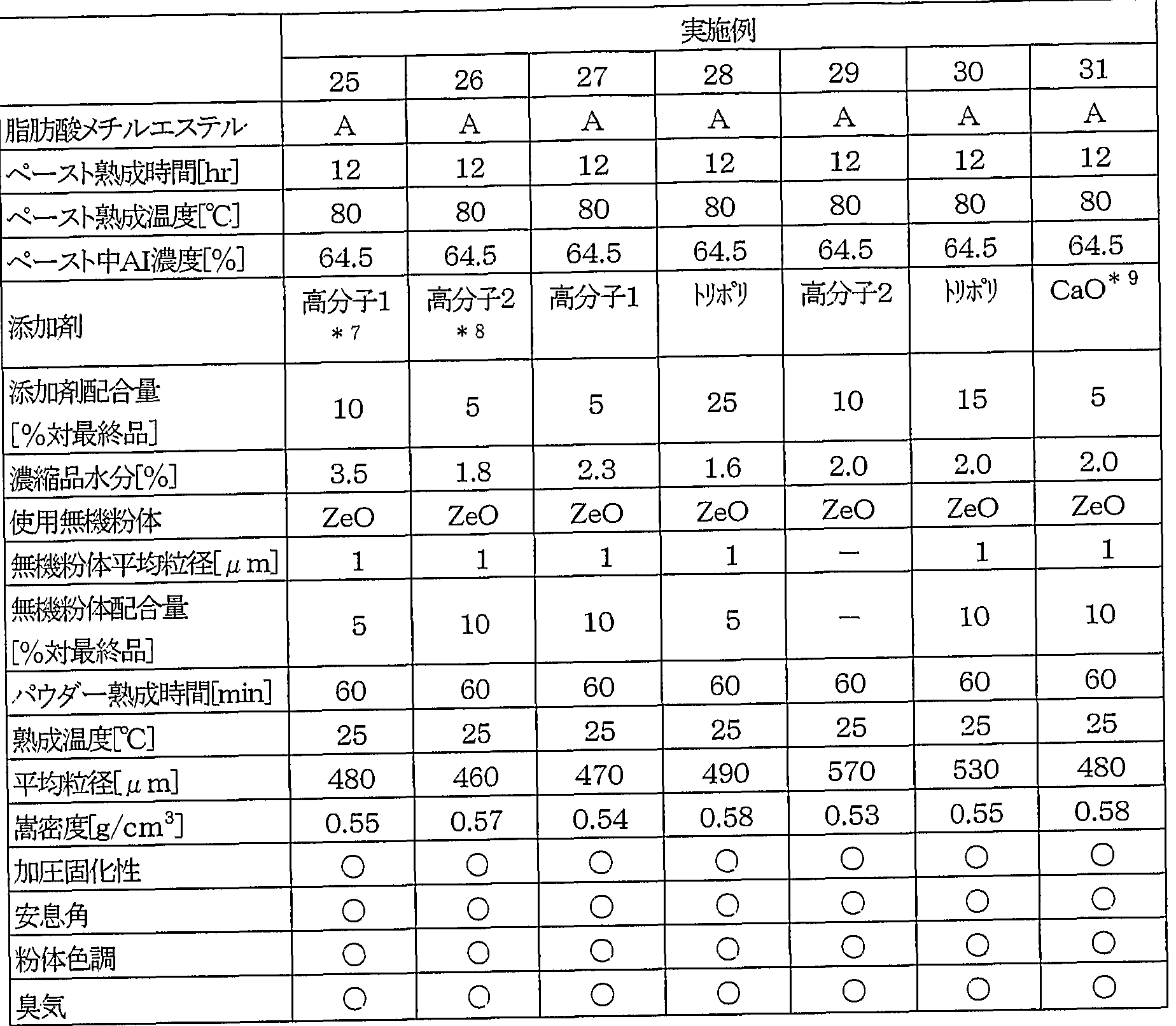


Claims
Priority Applications (4)
| Application Number | Priority Date | Filing Date | Title |
|---|---|---|---|
| EP04746076A EP1634941A4 (en) | 2003-06-12 | 2004-06-11 | POWDERS, FLAKES OR PELLETS HAVING A HIGH CONCENTRATION OF ALKYL ESTER SALTS OF G (A) -SULFO FATTY ACIDS, PROCESS FOR THE PRODUCTION THEREOF, AND PELLET DETERGENTS AND PROCESS FOR THE PRODUCTION THEREOF |
| US10/559,999 US7592302B2 (en) | 2003-06-12 | 2004-06-11 | Powders, flakes, or pellets containing salts of a sulfo fatty acid alkyl esters in high concentrations, process for production thereof, granulated detergents, and process for production thereof |
| JP2005507002A JP4761045B2 (ja) | 2003-06-12 | 2004-06-11 | α−スルホ脂肪酸アルキルエステル塩を高濃度含有するパウダー、フレーク又はペレットの製造方法、並びに粒状洗剤の製造方法 |
| KR1020057022398A KR101072911B1 (ko) | 2003-06-12 | 2005-11-23 | α-술포 지방산 알킬 에스테르염을 고농도 함유하는 파우더, 플레이크 또는 펠릿 및 그 제조방법 및 입상 세제 및 그 제조방법 |
Applications Claiming Priority (2)
| Application Number | Priority Date | Filing Date | Title |
|---|---|---|---|
| JP2003-168185 | 2003-06-12 | ||
| JP2003168185 | 2003-06-12 |
Publications (1)
| Publication Number | Publication Date |
|---|---|
| WO2004111166A1 true WO2004111166A1 (ja) | 2004-12-23 |
Family
ID=33549326
Family Applications (1)
| Application Number | Title | Priority Date | Filing Date |
|---|---|---|---|
| PCT/JP2004/008563 Ceased WO2004111166A1 (ja) | 2003-06-12 | 2004-06-11 | α-スルホ脂肪酸アルキルエステル塩を高濃度含有するパウダー、フレーク又はペレット及びその製造方法、並びに粒状洗剤及びその製造方法 |
Country Status (6)
| Country | Link |
|---|---|
| US (1) | US7592302B2 (ja) |
| EP (1) | EP1634941A4 (ja) |
| JP (1) | JP4761045B2 (ja) |
| KR (1) | KR101072911B1 (ja) |
| MY (1) | MY145387A (ja) |
| WO (1) | WO2004111166A1 (ja) |
Cited By (6)
| Publication number | Priority date | Publication date | Assignee | Title |
|---|---|---|---|---|
| JP2007302840A (ja) * | 2006-05-15 | 2007-11-22 | Takenet:Kk | 洗濯用洗剤組成物 |
| JP2008179800A (ja) * | 2006-12-25 | 2008-08-07 | Lion Corp | 粒状洗剤の製造方法 |
| WO2009054406A1 (ja) * | 2007-10-22 | 2009-04-30 | Lion Corporation | 脂肪酸アルキルエステルスルホナート金属塩固形物及び粒度分布のシャープな脂肪酸アルキルエステルスルホナート金属塩粉末の製造方法 |
| WO2009142322A1 (ja) * | 2008-05-23 | 2009-11-26 | ライオン株式会社 | 気泡を含ませたα-スルホ脂肪酸アルキルエステル塩固形物及びその製造方法 |
| WO2010123060A1 (ja) * | 2009-04-22 | 2010-10-28 | ライオン株式会社 | 脂肪酸アルキルエステルスルホナート金属塩粉末混合物及びその製造方法 |
| WO2014200050A1 (ja) | 2013-06-12 | 2014-12-18 | ライオン株式会社 | 洗浄剤組成物 |
Families Citing this family (17)
| Publication number | Priority date | Publication date | Assignee | Title |
|---|---|---|---|---|
| DE102004011087A1 (de) * | 2004-03-06 | 2005-09-22 | Henkel Kgaa | Partikel umfassend diskrete, feinpartikuläre Tensidpartikel |
| ES2614083T3 (es) | 2010-10-14 | 2017-05-29 | Unilever N.V. | Partícula de detergente para lavado de ropa |
| MX2013003973A (es) | 2010-10-14 | 2013-05-14 | Unilever Nv | Particulas de detergente para lavanderia. |
| PH12013500628A1 (en) | 2010-10-14 | 2017-08-04 | Unilever Ip Holdings B V | Laundry detergent particles |
| CA2813830A1 (en) * | 2010-10-14 | 2012-04-19 | Uniliver Plc | Packaged particulate detergent composition |
| WO2012048926A1 (en) | 2010-10-14 | 2012-04-19 | Unilever Plc | Manufacture of coated particulate detergents |
| BR112013008993B1 (pt) | 2010-10-14 | 2021-06-15 | Unilever Ip Holdings B.V. | Composição detergente particulada |
| PT2627755E (pt) * | 2010-10-14 | 2016-01-14 | Unilever Nv | Composição de detergente particulada empacotada |
| CA2813794C (en) | 2010-10-14 | 2018-08-28 | Unilever Plc | Laundry detergent particles |
| AU2011315790B2 (en) | 2010-10-14 | 2014-03-06 | Unilever Plc | Laundry detergent particles |
| DK3011004T3 (en) * | 2013-06-20 | 2017-10-30 | Chemsenti Ltd | WHITE AND OXIDATION CATALYST |
| CZ305172B6 (cs) * | 2014-03-28 | 2015-05-27 | Bochemie A.S. | Diskontinuální krystalizační jednotka pro výrobu kulovitých krystalů |
| JP6644000B2 (ja) * | 2014-10-01 | 2020-02-12 | ライオン株式会社 | 被覆α−スルホ脂肪酸アルキルエステル塩粒子群及びその製造方法並びに粉末洗剤 |
| WO2016160407A1 (en) | 2015-03-31 | 2016-10-06 | Stepan Company | Detergents based on alpha-sulfonated fatty ester surfactants |
| JP6606747B2 (ja) * | 2015-06-15 | 2019-11-20 | 株式会社菊水製作所 | 粉体混合供給装置及びこれを用いた粉体圧縮成形機 |
| CN111116432B (zh) * | 2019-12-27 | 2022-02-15 | 赞宇科技集团股份有限公司 | 一种高品质脂肪酸甲酯磺酸钠的生产工艺 |
| WO2024088878A1 (en) * | 2022-10-24 | 2024-05-02 | Unilever Ip Holdings B.V. | Spray-dried laundry particle |
Citations (11)
| Publication number | Priority date | Publication date | Assignee | Title |
|---|---|---|---|---|
| JPS5141675A (ja) * | 1974-10-05 | 1976-04-08 | Lion Fat Oil Co Ltd | Kaimenkatsuseizaisuiyoekino noshukuhoho |
| JPH04359098A (ja) * | 1991-06-04 | 1992-12-11 | Lion Corp | 高嵩密度洗剤組成物の製造方法 |
| JPH05331496A (ja) * | 1992-06-01 | 1993-12-14 | Kao Corp | アニオン活性剤粉粒体の製造方法 |
| JPH06184592A (ja) * | 1992-12-18 | 1994-07-05 | Lion Corp | 高濃度界面活性剤ペーストの製造方法 |
| JPH0816237B2 (ja) * | 1989-02-23 | 1996-02-21 | 花王株式会社 | 高密度洗剤用ペースト原料の連続乾燥方法 |
| JPH08157894A (ja) * | 1994-12-02 | 1996-06-18 | Lion Corp | 界面活性剤粉体の製造方法およびそれを用いた粒状洗剤組成物の製造方法 |
| JPH0987700A (ja) * | 1995-09-18 | 1997-03-31 | Lion Corp | 高濃度界面活性剤粒子およびそれを含有する粒状洗剤の製造方法 |
| JPH09143500A (ja) * | 1995-09-18 | 1997-06-03 | Lion Corp | 高嵩密度粒状洗剤の製造方法 |
| JPH1088197A (ja) * | 1996-09-18 | 1998-04-07 | Lion Corp | 高嵩密度粒状洗剤用粉体原料の製造方法 |
| JPH11172299A (ja) * | 1997-12-06 | 1999-06-29 | Lion Corp | 高濃度界面活性剤スラリーの濃縮・乾燥方法およびそれを用いた高嵩密度粒状洗剤の製造方法 |
| JP2001064248A (ja) * | 1999-06-25 | 2001-03-13 | Lion Corp | α−スルホ脂肪酸アルキルエステル塩の製造方法 |
Family Cites Families (9)
| Publication number | Priority date | Publication date | Assignee | Title |
|---|---|---|---|---|
| JPS57180699A (en) * | 1981-04-30 | 1982-11-06 | Lion Corp | Granular detergent composition |
| US4707289A (en) * | 1986-03-06 | 1987-11-17 | Colgate Palmolive Company | Alpha-sulfo-fatty acid ester and/or amide salt(s) detergent laundry bars and processes for manufacture thereof |
| CA2027518A1 (en) * | 1990-10-03 | 1992-04-04 | Richard L. Tadsen | Process for preparing high density detergent compositions containing particulate ph sensitive surfactant |
| JP2979727B2 (ja) * | 1991-05-27 | 1999-11-15 | ライオン株式会社 | 高嵩密度洗剤組成物の製造方法 |
| DE4127323A1 (de) * | 1991-08-20 | 1993-02-25 | Henkel Kgaa | Verfahren zur herstellung von tensidgranulaten |
| US5429773A (en) * | 1993-02-05 | 1995-07-04 | The Procter & Gamble Company | Process to improve alkyl ester sulfonate surfactant compositions |
| DE4310671A1 (de) * | 1993-04-01 | 1994-10-06 | Henkel Kgaa | alpha-Sulfofettsäurealkylester enthaltendes Granulat |
| US6657071B1 (en) | 1999-06-25 | 2003-12-02 | Lion Corporation | Process for producing α-sulfo-fatty acid alkyl ester salt |
| AU2003271151A1 (en) * | 2002-10-16 | 2004-05-04 | Lion Corporation | PARTICLE CONTAINING Alpha-SULFOFATTY ACID ALKYL ESTER SALT, PROCESS FOR PRODUCING THE SAME, AND DETERGENT |
-
2004
- 2004-06-10 MY MYPI20042240A patent/MY145387A/en unknown
- 2004-06-11 JP JP2005507002A patent/JP4761045B2/ja not_active Expired - Fee Related
- 2004-06-11 US US10/559,999 patent/US7592302B2/en not_active Expired - Lifetime
- 2004-06-11 EP EP04746076A patent/EP1634941A4/en not_active Withdrawn
- 2004-06-11 WO PCT/JP2004/008563 patent/WO2004111166A1/ja not_active Ceased
-
2005
- 2005-11-23 KR KR1020057022398A patent/KR101072911B1/ko not_active Expired - Lifetime
Patent Citations (11)
| Publication number | Priority date | Publication date | Assignee | Title |
|---|---|---|---|---|
| JPS5141675A (ja) * | 1974-10-05 | 1976-04-08 | Lion Fat Oil Co Ltd | Kaimenkatsuseizaisuiyoekino noshukuhoho |
| JPH0816237B2 (ja) * | 1989-02-23 | 1996-02-21 | 花王株式会社 | 高密度洗剤用ペースト原料の連続乾燥方法 |
| JPH04359098A (ja) * | 1991-06-04 | 1992-12-11 | Lion Corp | 高嵩密度洗剤組成物の製造方法 |
| JPH05331496A (ja) * | 1992-06-01 | 1993-12-14 | Kao Corp | アニオン活性剤粉粒体の製造方法 |
| JPH06184592A (ja) * | 1992-12-18 | 1994-07-05 | Lion Corp | 高濃度界面活性剤ペーストの製造方法 |
| JPH08157894A (ja) * | 1994-12-02 | 1996-06-18 | Lion Corp | 界面活性剤粉体の製造方法およびそれを用いた粒状洗剤組成物の製造方法 |
| JPH0987700A (ja) * | 1995-09-18 | 1997-03-31 | Lion Corp | 高濃度界面活性剤粒子およびそれを含有する粒状洗剤の製造方法 |
| JPH09143500A (ja) * | 1995-09-18 | 1997-06-03 | Lion Corp | 高嵩密度粒状洗剤の製造方法 |
| JPH1088197A (ja) * | 1996-09-18 | 1998-04-07 | Lion Corp | 高嵩密度粒状洗剤用粉体原料の製造方法 |
| JPH11172299A (ja) * | 1997-12-06 | 1999-06-29 | Lion Corp | 高濃度界面活性剤スラリーの濃縮・乾燥方法およびそれを用いた高嵩密度粒状洗剤の製造方法 |
| JP2001064248A (ja) * | 1999-06-25 | 2001-03-13 | Lion Corp | α−スルホ脂肪酸アルキルエステル塩の製造方法 |
Non-Patent Citations (1)
| Title |
|---|
| See also references of EP1634941A4 * |
Cited By (14)
| Publication number | Priority date | Publication date | Assignee | Title |
|---|---|---|---|---|
| JP2007302840A (ja) * | 2006-05-15 | 2007-11-22 | Takenet:Kk | 洗濯用洗剤組成物 |
| JP2008179800A (ja) * | 2006-12-25 | 2008-08-07 | Lion Corp | 粒状洗剤の製造方法 |
| JP5561822B2 (ja) * | 2007-10-22 | 2014-07-30 | ライオン株式会社 | 脂肪酸アルキルエステルスルホナート金属塩固形物及び粒度分布のシャープな脂肪酸アルキルエステルスルホナート金属塩粉末の製造方法 |
| US8501972B2 (en) | 2007-10-22 | 2013-08-06 | Lion Corporation | Solid fatty alkyl ester sulfonate metal salt and method for producing powder thereof with sharp particle size distribution |
| WO2009054406A1 (ja) * | 2007-10-22 | 2009-04-30 | Lion Corporation | 脂肪酸アルキルエステルスルホナート金属塩固形物及び粒度分布のシャープな脂肪酸アルキルエステルスルホナート金属塩粉末の製造方法 |
| WO2009142322A1 (ja) * | 2008-05-23 | 2009-11-26 | ライオン株式会社 | 気泡を含ませたα-スルホ脂肪酸アルキルエステル塩固形物及びその製造方法 |
| JP5452481B2 (ja) * | 2008-05-23 | 2014-03-26 | ライオン株式会社 | 気泡を含ませたα−スルホ脂肪酸アルキルエステル塩固形物及びその製造方法 |
| WO2010123060A1 (ja) * | 2009-04-22 | 2010-10-28 | ライオン株式会社 | 脂肪酸アルキルエステルスルホナート金属塩粉末混合物及びその製造方法 |
| CN102414304A (zh) * | 2009-04-22 | 2012-04-11 | 狮王株式会社 | 脂肪酸烷基酯磺酸盐金属盐粉末混合物及其制造方法 |
| CN102414304B (zh) * | 2009-04-22 | 2014-07-16 | 狮王株式会社 | 脂肪酸烷基酯磺酸盐金属盐粉末混合物及其制造方法 |
| JP5688772B2 (ja) * | 2009-04-22 | 2015-03-25 | ライオン株式会社 | 脂肪酸アルキルエステルスルホナート金属塩粉末混合物及びその製造方法 |
| US9708252B2 (en) | 2009-04-22 | 2017-07-18 | Lion Corporation | Fatty acid alkyl ester sulfonate metal salt powder mixture and method for producing the same |
| WO2014200050A1 (ja) | 2013-06-12 | 2014-12-18 | ライオン株式会社 | 洗浄剤組成物 |
| US9982222B2 (en) | 2013-06-12 | 2018-05-29 | Lion Corporation | Detergent composition |
Also Published As
| Publication number | Publication date |
|---|---|
| MY145387A (en) | 2012-01-31 |
| EP1634941A4 (en) | 2011-10-19 |
| JP4761045B2 (ja) | 2011-08-31 |
| US7592302B2 (en) | 2009-09-22 |
| KR101072911B1 (ko) | 2011-10-17 |
| EP1634941A1 (en) | 2006-03-15 |
| US20060160717A1 (en) | 2006-07-20 |
| JPWO2004111166A1 (ja) | 2006-07-20 |
| KR20060026023A (ko) | 2006-03-22 |
Similar Documents
| Publication | Publication Date | Title |
|---|---|---|
| WO2004111166A1 (ja) | α-スルホ脂肪酸アルキルエステル塩を高濃度含有するパウダー、フレーク又はペレット及びその製造方法、並びに粒状洗剤及びその製造方法 | |
| AU702856B2 (en) | Production of anionic surfactant granules by in situ neutralisation | |
| JP3514758B2 (ja) | 高活性洗剤ペースト | |
| JPH10195497A (ja) | 界面活性剤粉体の製造方法および粒状洗剤組成物 | |
| JP4614065B2 (ja) | 高濃度α−スルホ脂肪酸アルキルエステル塩含有粒子及びその製造方法、ならびに洗剤 | |
| JP5401036B2 (ja) | 粒状洗剤の製造方法 | |
| JP2979727B2 (ja) | 高嵩密度洗剤組成物の製造方法 | |
| JP4514435B2 (ja) | 粒状洗剤の製造方法 | |
| CA2420295A1 (en) | Production of anionic surfactant granules by in situ neutralisation | |
| CN1157471C (zh) | 高堆积密度的洗涤剂组合物的生产方法 | |
| JPH08157894A (ja) | 界面活性剤粉体の製造方法およびそれを用いた粒状洗剤組成物の製造方法 | |
| JP5537800B2 (ja) | 洗剤粒子群の製造方法 | |
| JP4488211B2 (ja) | α−スルホ脂肪酸アルキルエステル塩含有粒子の製造方法 | |
| JP4782001B2 (ja) | α―スルホ脂肪酸アルキルエステル塩を含むアニオン界面活性剤の製造方法、アニオン界面活性剤及びこれを含む洗浄剤組成物 | |
| JP2962595B2 (ja) | 高嵩密度洗剤組成物の製造方法 | |
| WO2011061045A1 (en) | Detergent granule and its manufacture | |
| JP4379586B2 (ja) | 高嵩密度粒状洗剤組成物の製造方法 | |
| JP4387787B2 (ja) | 固形洗浄剤組成物 | |
| JP2003105396A (ja) | 粒状洗剤組成物の製造方法 | |
| JP2761577B2 (ja) | 高嵩密度粒状洗剤組成物 | |
| JP2006291070A (ja) | 高嵩密度洗浄剤組成物の製造方法 | |
| JPH04146999A (ja) | 高嵩密度粒状洗剤組成物の製造方法 | |
| JPH04359100A (ja) | 高嵩密度洗剤組成物の製造方法 | |
| JPH0913098A (ja) | 洗剤スラリーの製造方法 | |
| JPH09241694A (ja) | アニオン界面活性剤、高嵩密度粒状アニオン界面活性剤、高嵩密度粒状洗剤組成物およびその製造法 |
Legal Events
| Date | Code | Title | Description |
|---|---|---|---|
| AK | Designated states |
Kind code of ref document: A1 Designated state(s): AE AG AL AM AT AU AZ BA BB BG BR BW BY BZ CA CH CN CO CR CU CZ DE DK DM DZ EC EE EG ES FI GB GD GE GH GM HR HU ID IL IN IS JP KE KG KP KR KZ LC LK LR LS LT LU LV MA MD MG MK MN MW MX MZ NA NI NO NZ OM PG PH PL PT RO RU SC SD SE SG SK SL SY TJ TM TN TR TT TZ UA UG US UZ VC VN YU ZA ZM ZW |
|
| AL | Designated countries for regional patents |
Kind code of ref document: A1 Designated state(s): GM KE LS MW MZ NA SD SL SZ TZ UG ZM ZW AM AZ BY KG KZ MD RU TJ TM AT BE BG CH CY CZ DE DK EE ES FI FR GB GR HU IE IT LU MC NL PL PT RO SE SI SK TR BF BJ CF CG CI CM GA GN GQ GW ML MR NE SN TD TG |
|
| 121 | Ep: the epo has been informed by wipo that ep was designated in this application | ||
| WWE | Wipo information: entry into national phase |
Ref document number: 1020057022398 Country of ref document: KR |
|
| WWE | Wipo information: entry into national phase |
Ref document number: 2005507002 Country of ref document: JP |
|
| ENP | Entry into the national phase |
Ref document number: 2006160717 Country of ref document: US Kind code of ref document: A1 |
|
| WWE | Wipo information: entry into national phase |
Ref document number: 10559999 Country of ref document: US |
|
| WWE | Wipo information: entry into national phase |
Ref document number: 2004746076 Country of ref document: EP |
|
| WWP | Wipo information: published in national office |
Ref document number: 2004746076 Country of ref document: EP |
|
| WWP | Wipo information: published in national office |
Ref document number: 1020057022398 Country of ref document: KR |
|
| WWP | Wipo information: published in national office |
Ref document number: 10559999 Country of ref document: US |