WO2006125884A2 - Procede de preparation de composes organosiliciques - Google Patents
Procede de preparation de composes organosiliciques Download PDFInfo
- Publication number
- WO2006125884A2 WO2006125884A2 PCT/FR2006/001098 FR2006001098W WO2006125884A2 WO 2006125884 A2 WO2006125884 A2 WO 2006125884A2 FR 2006001098 W FR2006001098 W FR 2006001098W WO 2006125884 A2 WO2006125884 A2 WO 2006125884A2
- Authority
- WO
- WIPO (PCT)
- Prior art keywords
- group
- sio
- formula
- sub
- symbols
- Prior art date
- Legal status (The legal status is an assumption and is not a legal conclusion. Google has not performed a legal analysis and makes no representation as to the accuracy of the status listed.)
- Ceased
Links
Classifications
-
- C—CHEMISTRY; METALLURGY
- C07—ORGANIC CHEMISTRY
- C07F—ACYCLIC, CARBOCYCLIC OR HETEROCYCLIC COMPOUNDS CONTAINING ELEMENTS OTHER THAN CARBON, HYDROGEN, HALOGEN, OXYGEN, NITROGEN, SULFUR, SELENIUM OR TELLURIUM
- C07F7/00—Compounds containing elements of Groups 4 or 14 of the Periodic Table
- C07F7/02—Silicon compounds
- C07F7/08—Compounds having one or more C—Si linkages
- C07F7/18—Compounds having one or more C—Si linkages as well as one or more C—O—Si linkages
-
- C—CHEMISTRY; METALLURGY
- C07—ORGANIC CHEMISTRY
- C07F—ACYCLIC, CARBOCYCLIC OR HETEROCYCLIC COMPOUNDS CONTAINING ELEMENTS OTHER THAN CARBON, HYDROGEN, HALOGEN, OXYGEN, NITROGEN, SULFUR, SELENIUM OR TELLURIUM
- C07F7/00—Compounds containing elements of Groups 4 or 14 of the Periodic Table
- C07F7/02—Silicon compounds
- C07F7/08—Compounds having one or more C—Si linkages
- C07F7/18—Compounds having one or more C—Si linkages as well as one or more C—O—Si linkages
- C07F7/1804—Compounds having Si-O-C linkages
- C07F7/1872—Preparation; Treatments not provided for in C07F7/20
- C07F7/1892—Preparation; Treatments not provided for in C07F7/20 by reactions not provided for in C07F7/1876 - C07F7/1888
-
- C—CHEMISTRY; METALLURGY
- C07—ORGANIC CHEMISTRY
- C07F—ACYCLIC, CARBOCYCLIC OR HETEROCYCLIC COMPOUNDS CONTAINING ELEMENTS OTHER THAN CARBON, HYDROGEN, HALOGEN, OXYGEN, NITROGEN, SULFUR, SELENIUM OR TELLURIUM
- C07F7/00—Compounds containing elements of Groups 4 or 14 of the Periodic Table
- C07F7/02—Silicon compounds
- C07F7/08—Compounds having one or more C—Si linkages
Definitions
- the field of the invention is that of the synthesis of functionalized organosilicon compounds.
- the organosilicon compounds more particularly concerned by the invention are those comprising at least one activated azo group. This activation may result, for example, from the presence of neighboring carbonyl groups of the nitrogens.
- the organosilicon portion of these compounds may comprise, for example, hydrolysable or condensable groups of the type ⁇ SiOR or ⁇ SiOH.
- Such activated azo group (s) organosilicon compounds are very useful, especially in the synthesis of active organic molecules (for example nitrogenous heterocycles) which can be used in the fields of agrochemistry and pharmacy, for example as dienophiles in reaction of hetero-Diels Help.
- X and X 1 are the same or different and each represents an imino group, an oxygen atom or a substituted or unsubstituted methylene group;
- Y is a substituted or unsubstituted alkyl, aryl or aralkyl group, or is identical to Z *;
- Z * is an alkyl, aryl or aralkyl group which has as substituent at least one silane group of formula Si (OR) 3 or OSi (OR) 3 in which R is a straight or branched chain alkyl group, preferably with 1 to 6 carbon atoms.
- R 1 * -O-CO-N N-CO-NH- (C 6 H 6 ) - (CH 2 ) m -Si (OR 2 * ) 3
- R 1 * -O-CO-N N-CO-NH- (CH 2 ) n -Si (OR 2 * ) 3 in which R and R are identical or different and each represents an alkyl group with straight or branched chain preferably containing 1 to 6 carbon atoms, m is 0, 1, 2 or 3 and n is 1, 2 or 3, are cited.
- Example 3 of FR-A-2340323 provides for the implementation of an organic precursor solution Ethyl-O-CO-HN-NH-CO-NH- (CH 2 ) 3 -
- NBS-pyridine oxidizing system is in excess (10 mol%) relative to the precursor.
- the final product is not pure. It contains undesirable and penalizing residues, in particular, in terms of industrial hygiene and ecotoxicity on the one hand, and, on the other hand, in terms of performance in applications.
- This known process suffers from at least four disadvantages.
- the quality of the final product (I *, II *, IIP) obtained is poor, particularly with regard to purity and more specifically with regard to the presence of undesirable pyridine residues in the final product. These residues are detrimental to the quality of the final product, in particular on the one hand, in terms of industrial hygiene and ecotoxicity, and, on the other hand, in terms of performance in the applications of these functionalized organosilicon compounds, preferably to activated azo group (s).
- one of the essential objectives of the present invention is to provide an improved process for the preparation of organosilicon compounds containing azo group (s), by oxidation of the hydrazino group of a precursor in an azo group.
- Another essential objective of the invention is to provide a process for the preparation of organosilicic compounds containing azo group (s), which makes it possible to dispense with solid reagents such as solid NBS, which complicate the process somewhere, in particular for the incorporation into the reaction medium.
- Another essential objective of the invention is to provide a process for the preparation of organosilicon compounds containing azo group (s), which is more efficient than those of the prior art, especially in terms of productivity and yield of azoalcoxysilane targeted.
- Another essential objective of the invention is to provide a process for the preparation of organosilicon compounds with azo group (s), which is economical.
- Another essential objective of the invention is to provide a process for the preparation of organosilicon compounds containing azo groups, which makes it possible to optimize the quality of the final product, in particular as regards the purity of organosilicic compounds and especially by reducing in the form of traces, or even by removing unwanted residues of the base used, and in particular the pyridine residues when the base comprises pyridine. In doing so, the process is improved in terms of final product quality, industrial hygiene and environmental impact.
- Another essential objective of the present invention is to provide new organosilicon compounds with azo group (s), with reduced content of pyridine residues.
- the symbols G 0 which are identical or different, each represent one of the groups corresponding to G or G;
- the symbols G 2 which may be identical or different, each represent: a hydroxyl group, a hydrolysable monovalent group or two G 2 together and with silicon to which they are bonded, a ring having 3 to 5 hydrocarbon linkages and which may comprise at least one heteroatom, at least one of these links possibly also being a link of at least one other hydrocarbon or aromatic ring;
- the symbols G 1 which may be identical or different, each represent: a saturated or unsaturated aliphatic hydrocarbon group; a carbocyclic group, saturated or unsaturated and / or aromatic, monocyclic or polycyclic; or a group representing a saturated or unsaturated aliphatic hydrocarbon portion and a carbocyclic moiety as defined above;
- the symbol Z represents a
- the symbols G ° which are identical or different, each represent: an aliphatic hydrocarbon group, saturated or unsaturated; a carbocyclic group, saturated or unsaturated and / or aromatic, monocyclic or polycyclic; or a group representing a saturated or unsaturated aliphatic hydrocarbon portion and a carbocyclic moiety as defined above; or a polysiloxane residue; the symbols G 2 'being identical or different and representing a hydrolyzable monovalent group corresponding to the same definition as that given above for the symbols G 2 described in relation to formula (I),
- Ox is chosen from oxidants capable of oxidizing a hydrazine function as azo function, with or without N-bromosuccinimide (NBS), preferably among halogens, halogenated derivatives and mixtures thereof, and more preferably still in the group comprising: bromine, tert-butyl hypochlorite, trichloroisocyanuric acid, chlorine and mixtures thereof;
- NBS N-bromosuccinimide
- these compounds (I) obtained by the process according to the invention are remarkably pure.
- these compounds have little or no (undetectable traces) undesirable residues from, for example, base B, such as pyridine residues when B comprises pyridine.
- Ox is chosen from halogens, halogenated derivatives and mixtures thereof, and even more preferably from the group comprising: bromine, tert-butyl hypochlorite, trichloroisocyanuric acid, chlorine and mixtures thereof.
- a base B comprising pyridine in a stoichiometric amount with respect to the precursor (II) is used.
- This use of pyridine in limited quantity represents a significant advance over the prior art, since, as already explained above, pyridine forms unwanted residues very difficult to eliminate final organosilicon compounds (I).
- a post-treatment in one or more steps to significantly improve the quality of the final organosilicon compounds (I). , contributing to the total or almost total elimination of undesirable residues from, for example, base B, in particular pyridine residues likely to be present when base B comprises pyridine.
- This post-treatment is all the more remarkable in that it does not affect the yield and / or the productivity of final organosilicon compounds (I).
- the process according to the invention for the preparation of organosilicic compounds containing an azo (I) group can be part of a synthetic process comprising at least the following steps: (i): a precursor silane of formula (IV) is reacted: [(G °) 3 Si0 1/2 ] m [(G °) 2 Si0 2/2 ] n [G ° SiO 3/2 ] 0 [SiO 4/2 ] p [(G ⁇ G 1 ) * L 1 SiO. ⁇ ]
- L 2 -NH-NH-CO-A (V) formulas in which the symbols G 0 , G 1 , G 2 , m, n, o, p, q, a, a 'and A are as defined above , and L 1 and L 2 represent groups whose structure and functionality are such that these groups are capable of reacting with one another to give rise to the central sequence -Z-CO- so as to lead to precursor of formula (II):
- step (ii) corresponds to the preparation process according to the present invention.
- organosilicon compounds with an azo (I) group in the structure of which the symbol Z then represents the divalent radical - (CH 2 ) 3 -NH-
- the synthetic scheme that is applied may be the following (i): a precursor silane of formula (IV) is reacted:
- step (i) of obtaining the precursor (II) and the oxidation step (ii) of (II) in (I) are in accordance with the following general methodology:
- the purification of the organosilicon compounds (I) is carried out by the implementation of a post-treatment which makes it possible to reduce or even eliminate the content of impurities.
- the latter may, for example, come from the base B.
- the residues may be pyridine, which are particularly undesirable from the point of view of industrial hygiene and the performance of the compounds (I) in the applications.
- the post-treatment essentially consists in bringing the organosilicon compounds (I) into contact with a trap with impurities, this trap being selected:
- the post-treatment consists essentially of: a) mixing an ion-affinity support, preferably carbon black, with an organic filler solution, in a proportion of 0.1 to 20% by weight, preferably from 1 to 10% by weight of ionic carrier with respect to the filler, b) to leave in contact preferably with stirring for a few minutes to several hours, c) to separate the carrier charged with impurities from the filler solution, preferably by filtration, d) removing the solvent preferably by evaporation, e) mixing a chemical-affinity support, preferably an acidic resin (preferably a resin slightly).
- steps e) to h) possibly being performed before steps a) to d) or simultaneously.
- the steps a) to d) constitute a first treatment and the steps e) to h) a second treatment, these two treatments can be implemented simultaneously or successively in any order.
- the post-processing implemented in the method according to the invention comprises only one of these two treatments a) to d), on the one hand, and e) to h), of somewhere else.
- these compounds (I) are free or virtually free (undetectable traces) of impurities, especially pyridine residues.
- the invention therefore aims, as new products, of organosilicon compounds (I) with activated azo functional group (s) (I), obtainable by the process according to the invention characterized in that they are free or virtually free (undetectable traces) of impurities, including pyridine residues.
- these novel organosilicon compounds (I) may be characterized by a content (% by weight) of pyridine residues less than or equal to 0.3, preferably to 0.2, and more preferably to 0.1.
- These organosilicon compounds (I) with azo activated functional group (s) (I), obtainable by the process according to the invention are also characterized in that they are heat stable. eg at temperatures between 80-180 °.
- the invention also concerns, as new products, the organosilicon compounds (I) with activated azo functional group (s) (I) characterized by a degree of hydrolysis / condensation (% molar) of the functions. G 2 less than or equal to 40, preferably 10, and even more preferably 1.
- aliphatic hydrocarbon group is meant, in the sense of the invention, a linear or branched group, preferably comprising from 1 to 25 carbon atoms, optionally substituted.
- said aliphatic hydrocarbon group comprises from 1 to 18 carbon atoms, better still from 1 to 8 carbon atoms and better still from 1 to 6 carbon atoms.
- alkyl groups such as the methyl, ethyl, propyl, isopropyl, n-butyl, isobutyl, t-butyl, pentyl, isopentyl, neopentyl, 2-methylbutyl and 1-ethylpropyl radicals.
- alkyl groups such as the methyl, ethyl, propyl, isopropyl, n-butyl, isobutyl, t-butyl, pentyl, isopentyl, neopentyl, 2-methylbutyl and 1-ethylpropyl radicals.
- the unsaturated aliphatic hydrocarbon groups comprise one or more unsaturations, preferably one, two or three unsaturations of the ethylenic (double bond) or / and acetylenic (triple bond) type.
- Examples are alkenyl or alkynyl groups derived from the alkyl groups defined above by removal of two or more hydrogen atoms.
- the unsaturated aliphatic hydrocarbon groups comprise a single unsaturation.
- the term "carbocyclic group” means a monocyclic or polycyclic radical, optionally substituted, preferably C 3 -C 5 O-advantageously, it is a C 3 -C 3 radical. 18 , preferably mono-, bi- or tricyclic.
- the carbocyclic group comprises more than one ring nucleus (case of polycyclic carbocycles)
- the cyclic rings are condensed in pairs. Two fused rings may be ortho-condensed or pericondensed.
- the carbocyclic group may comprise, unless otherwise indicated, a saturated portion and / or an aromatic moiety and / or an unsaturated moiety.
- saturated carbocyclic groups are cycloalkyl groups.
- the cycloalkyl groups are C 3 -C 18 , more preferably C 5 -C 10 .
- Mention may in particular be made of cyclopentyl, cyclohexyl, cycloheptyl, cyclooctyl, adamantyl or norbornyl radicals.
- the unsaturated carbocycle or any unsaturated carbocyclic moiety has one or more ethylenic unsaturations, preferably one, two or three. It advantageously has from 6 to 50 carbon atoms, more preferably from 6 to 20, for example from 6 to 18.
- unsaturated carbocycles are C 6 -C 10 cycloalkenyl groups.
- aromatic carbocyclic radicals are (C 6 -C 18 ) aryl groups, more preferably (C 6 -C 12 ) aryl and especially phenyl, naphthyl, anthryl and phenanthryl.
- a group having both a hydrocarbon aliphatic moiety as defined above and a carbocyclic moiety as defined above is, for example, an arylalkyl group such as benzyl, or an alkylaryl group such as tolyl.
- the substituents of the hydrocarbon aliphatic groups or moieties and carbocyclic groups or moieties are, for example, alkoxy groups in which the alkyl moiety is preferably as defined above.
- such a hydrolysable monovalent group is a radical: alkoxy, linear or branched, C 1 -C 8 optionally halogenated and / or optionally substituted by one or more (C 1 -C 4 ) alkoxy; C 2 -C 9 acyloxy optionally halogenated or optionally substituted by one or more (C 1 -C 4 ) alkoxy, C 5 -C 10 cycloalkyloxy or C 6 -C 18 aryloxy
- the hydrolyzable group is methoxy, ethoxy, n-propoxy, isopropoxy, n-butoxy, methoxymethoxy, ethoxyethoxy, methoxyethoxy, ⁇ -chloropropoxy or ⁇ -chloroethoxy or else acetoxy.
- monovalent carbocyclic groups which can form together, in the formula (I), two substituents G 2 and the silicon atom to which they are attached, there may be mentioned, for example, the
- G 1 which may be identical or different, each represent: a linear or branched C 1 -C 8 alkyl radical, a C 5 -C 10 cycloalkyl radical or a C 6 -C 18 aryl radical;
- G 2 which may be identical or different, each represent: a linear or branched C 1 -C 8 alkoxy radical optionally substituted by one or more (C 1 -
- Z ' represents: a C 1 -C 8 alkylene chain; a saturated C 5 -C 10 cycloalkylene group; a C 6 -C 18 arylene group; or a divalent group consisting of a combination of at least two of these radicals;
- - Z "represents: -O- or -NR 4 -, with R 4 being: a hydrogen atom; an alkyl radical, linear or branched Ci-C 8, a cycloalkyl C 5 -C O; a a C 6 -C 18 aryl radical or a (C 6 -C 18) aryl (C 1 -C 8 ) alkyl radical;
- A denotes a group -OG 3 or -NG G 3 where G 3 and G 4 , which are identical or different from each other, each represent a linear or branched C 1 -C 8 alkyl radical or a C 5 -C 5 cycloalkyl radical; CiO aryl or C 6 -C 8.
- F 2 of the formula (I) 1 the symbols G 0 , which are identical or different, correspond to the same definition as that 1 0 given below for the G or G radicals;
- the symbols G 1 which may be identical or different, are chosen from the group formed by the methyl, ethyl, propyl, isopropyl, cyclohexyl and phenyl radicals;
- the symbols G 2 which are identical or different, are chosen from the group formed by the methoxy, ethoxy, n-propoxy, isopropoxy, n-butoxy, methoxymethoxy, ethoxyethoxy and methoxyethoxy radicals;
- Z represents the divalent Z'-Z radical; - or :
- Z ' represents: a C 1 -C 8 alkylene chain
- Z represents -O- or -NR 4 -, with R 4 being selected from the group consisting of: hydrogen, methyl, ethyl, propyl, isopropyl, n-butyl, isobutyl, t-butyl, pentyl, hexyl, cyclohexyl, and benzyl;
- A denotes a group -OG 3 or -NG 4 G 3 where G 3 and G 4 , which are identical to or different from each other, are chosen from the group formed by the methyl, ethyl, propyl and isopropyl radicals; , cyclohexyl and phenyl.
- the symbols G 0 each represent one of the radicals chosen hereafter for G or G;
- the symbols G 1 which may be identical or different, are chosen from the group formed by the methyl, ethyl and propyl radicals; isopropyl, cyclohexyl and phenyl;
- the symbols G 2 which are identical or different, are chosen from the group formed by the methoxy, ethoxy, n-propoxy, isopropoxy and n-butoxy radicals;
- "Z represents the divalent radical Z'-Z" - where:
- Z ' is selected from the group consisting of divalent methylene, ethylene and propylene radicals; - - Z "represents: -O- or -NR 4 - with R 4 being a hydrogen atom;
- A denotes a group -OG 3 where G 3 is selected from the group consisting of methyl, ethyl, propyl, isopropyl, cyclohexyl and phenyl.
- the siloxane oligomers (2i) constitute a subgroup of compounds of formula (I).
- the quantity of additional reagent (III) used is not critical, but it is preferable, in accordance with the invention, for this quantity, relative to the precursor (II), to be at least 0 3 MI, preferably at least 1M to 100M or more, and more preferably 1 to 1OM.
- additional reagent (III) is trimethylethoxysilane.
- species (2i) are subdivided into subspecies:
- the functionalized organosilicon compounds of general formula (I) are chosen from the group of the following (sub) species:
- organosilicon compounds of general formula (I) that are particularly preferred are those formed by a mixture (3i) of at least one species (s) (i) and / or at least one subspecies (s) (2i.l) and / or at least one subspecies (2i.2).
- organosilicon compounds according to the invention comprise at least one mixture (3i) including compounds (i) and / or (2i.l) and / or (2i.2) of formula (I) in which :
- G ° identical or different, correspond to the definitions given below for G, G 2 ;
- G 1 which are identical or different, are chosen from the group formed by the methyl, ethyl, propyl, isopropyl, cyclohexyl and phenyl radicals;
- G 2 which are identical or different, are chosen from the group formed by the methoxy, ethoxy, n-propoxy, isopropoxy and n-butoxy radicals;
- A denotes a group -OG 3 where G 3 is selected from the group consisting of methyl, ethyl, propyl, isopropyl, cyclohexyl and phenyl.
- Z represents the divalent radical Z '-NR 4 - where:
- Z ' is selected from the group consisting of divalent methylene, ethylene and propylene radicals
- - R is a hydrogen atom
- the invention also relates to organosilicon compounds of general formula (I), obtainable by the method according to the invention, taken in themselves and selected from the group of the following species:
- a represents an integer selected from 1, 2 and 3;
- a ' represents an integer selected from 0, 1 and 2;
- B is used in a stoichiometric amount relative to the liberated HBr
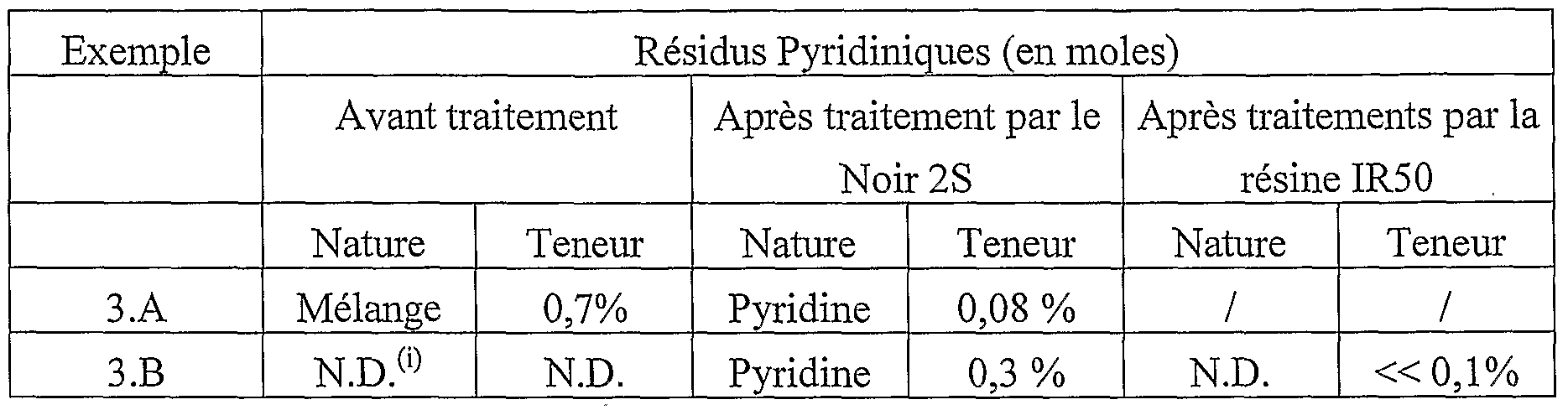
- Example 3 Postprocessing steps a) to d) then steps e) to h)
- NBS and pyridine can be used in stoichiometric amounts relative to the precursor. This result is particularly interesting because excess pyridine is very difficult to remove from the medium.
- Bromine can advantageously replace the NBS from a cost point of view even if its use requires doubling the amount of pyridine (there is in this case twice as much hydrobromic acid to trap).
- Post-treatment in one or more steps can improve the quality of the final product by contributing to the almost total elimination of pyridine residues without degradation of the Silcaf content of the sample.
- the precursor, pyridine and dichloromethane are charged into a calibrated reactor which is put under argon sky; the reaction medium is substantially colorless homogeneous. • N-Bromosuccinimide (NBS) is added in 30 minutes with a spatula. The temperature is kept below 25 ° C. From the first addition of NBS, the reaction medium becomes bright orange.
- NBS N-Bromosuccinimide
- the reaction medium is concentrated under reduced pressure on a rotary evaporator.
- the residue which is in the form of an orange paste, is taken up in 100 ml of a heptane / iP 2 O mixture (1/1: vol / vol) and then filtered on sintered glass (125 ml) of porosity. 4. The filter cake is washed with an additional 4 x 25 mL of the above solvent mixture.
- the reaction medium is concentrated under reduced pressure on a rotary evaporator.
- pyridine residues being constituted by a mixture of pyridinium hydrobromide and pyridine, a double treatment was envisaged:
- the resin treatment is carried out according to the following operating protocol:
- the MR is kept stirring for 2 hours at 60 ° C before returning to room temperature. • The MR is allowed to rest for a few hours at room temperature.
Landscapes
- Chemical & Material Sciences (AREA)
- Organic Chemistry (AREA)
- Chemical Kinetics & Catalysis (AREA)
- Silicon Polymers (AREA)
Abstract
Description






Claims
Priority Applications (6)
| Application Number | Priority Date | Filing Date | Title |
|---|---|---|---|
| CN200680018310XA CN101184765B (zh) | 2005-05-26 | 2006-05-16 | 有机硅化合物的制备方法 |
| BRPI0609893A BRPI0609893B1 (pt) | 2005-05-26 | 2006-05-16 | processo de preparação de compostos organossilícicos |
| US11/921,019 US8367812B2 (en) | 2005-05-26 | 2006-05-16 | Preparation of organosilicon compounds |
| CA2609310A CA2609310C (fr) | 2005-05-26 | 2006-05-16 | Procede de preparation de composes organosiliciques |
| JP2008512861A JP5139977B2 (ja) | 2005-05-26 | 2006-05-16 | 有機ケイ素化合物の製造方法 |
| EP06764635A EP1888603B1 (fr) | 2005-05-26 | 2006-05-16 | Procede de preparation de composes organosiliciques |
Applications Claiming Priority (2)
| Application Number | Priority Date | Filing Date | Title |
|---|---|---|---|
| FR0505283 | 2005-05-26 | ||
| FR0505283A FR2886294B1 (fr) | 2005-05-26 | 2005-05-26 | Procede de preparation de composes organosiliciques |
Publications (2)
| Publication Number | Publication Date |
|---|---|
| WO2006125884A2 true WO2006125884A2 (fr) | 2006-11-30 |
| WO2006125884A3 WO2006125884A3 (fr) | 2007-01-18 |
Family
ID=35530775
Family Applications (1)
| Application Number | Title | Priority Date | Filing Date |
|---|---|---|---|
| PCT/FR2006/001098 Ceased WO2006125884A2 (fr) | 2005-05-26 | 2006-05-16 | Procede de preparation de composes organosiliciques |
Country Status (9)
| Country | Link |
|---|---|
| US (1) | US8367812B2 (fr) |
| EP (1) | EP1888603B1 (fr) |
| JP (1) | JP5139977B2 (fr) |
| KR (1) | KR100978768B1 (fr) |
| CN (1) | CN101184765B (fr) |
| BR (1) | BRPI0609893B1 (fr) |
| CA (1) | CA2609310C (fr) |
| FR (1) | FR2886294B1 (fr) |
| WO (1) | WO2006125884A2 (fr) |
Families Citing this family (4)
| Publication number | Priority date | Publication date | Assignee | Title |
|---|---|---|---|---|
| FR2886295B1 (fr) * | 2005-05-26 | 2007-07-20 | Rhodia Chimie Sa | Composes organosiliciques et procede de preparation associe |
| DE102010003387A1 (de) * | 2010-03-29 | 2011-09-29 | Evonik Degussa Gmbh | Verfahren zur Herstellung von siliciumhaltigen Azodicarbamiden |
| PT2937351T (pt) | 2014-04-22 | 2018-01-08 | Evonik Degussa Gmbh | Silanos funcionalizados de azocarbonilo |
| CN110041223B (zh) * | 2019-06-03 | 2021-10-22 | 西北师范大学 | 以肼类化合物为原料氧化合成偶氮类化合物的方法 |
Family Cites Families (9)
| Publication number | Priority date | Publication date | Assignee | Title |
|---|---|---|---|---|
| US3931143A (en) | 1967-02-15 | 1976-01-06 | Pennwalt Corporation | Unsymmetrical aliphatic monoazo compounds |
| GB1538256A (en) * | 1976-02-06 | 1979-01-17 | Malaysian Rubber Producers | Azosilanes and their use in reinforced rubber |
| CN1045577A (zh) * | 1989-11-15 | 1990-09-26 | 石家庄市化工助剂厂 | 偶氮二甲酰胺生产新工艺 |
| JPH0693134A (ja) * | 1992-07-31 | 1994-04-05 | Sumitomo Chem Co Ltd | 優れたグリップ性能と転動抵抗を有するゴム組成物およびその製造方法 |
| JPH06298719A (ja) * | 1993-04-20 | 1994-10-25 | Otsuka Chem Co Ltd | カルバモイルアゾカルボン酸エステル誘導体及びその製造法 |
| US5380828A (en) * | 1993-10-05 | 1995-01-10 | Ciba-Geigy Corporation | Azodicarboxylic acid derivatives containing hindered amine moieties as polymer stabilizers |
| FR2772025B1 (fr) | 1997-12-10 | 2000-03-03 | Guerbet Sa | Chelates metalliques de macrocycles polyaminocarboxyliques et leur application a l'imagerie par resonance magnetique |
| FR2826652B1 (fr) * | 2001-06-28 | 2005-09-09 | Atofina | Procede de preparation de composes type azoique. |
| JP2004339208A (ja) * | 2003-04-24 | 2004-12-02 | Ishihara Sangyo Kaisha Ltd | フェニルヒドラジン誘導体又はその塩、それらの製造方法、並びにそれらを有効成分として含有する殺菌剤 |
-
2005
- 2005-05-26 FR FR0505283A patent/FR2886294B1/fr not_active Expired - Fee Related
-
2006
- 2006-05-16 EP EP06764635A patent/EP1888603B1/fr not_active Not-in-force
- 2006-05-16 BR BRPI0609893A patent/BRPI0609893B1/pt not_active IP Right Cessation
- 2006-05-16 CN CN200680018310XA patent/CN101184765B/zh not_active Expired - Fee Related
- 2006-05-16 CA CA2609310A patent/CA2609310C/fr not_active Expired - Fee Related
- 2006-05-16 US US11/921,019 patent/US8367812B2/en not_active Expired - Fee Related
- 2006-05-16 KR KR1020077027525A patent/KR100978768B1/ko not_active Expired - Fee Related
- 2006-05-16 WO PCT/FR2006/001098 patent/WO2006125884A2/fr not_active Ceased
- 2006-05-16 JP JP2008512861A patent/JP5139977B2/ja not_active Expired - Fee Related
Non-Patent Citations (1)
| Title |
|---|
| None |
Also Published As
| Publication number | Publication date |
|---|---|
| EP1888603A2 (fr) | 2008-02-20 |
| CN101184765A (zh) | 2008-05-21 |
| BRPI0609893B1 (pt) | 2016-04-19 |
| US20090216000A1 (en) | 2009-08-27 |
| FR2886294B1 (fr) | 2007-07-20 |
| US8367812B2 (en) | 2013-02-05 |
| CA2609310A1 (fr) | 2006-11-30 |
| EP1888603B1 (fr) | 2013-03-27 |
| FR2886294A1 (fr) | 2006-12-01 |
| WO2006125884A3 (fr) | 2007-01-18 |
| JP5139977B2 (ja) | 2013-02-06 |
| KR100978768B1 (ko) | 2010-08-30 |
| CA2609310C (fr) | 2012-05-08 |
| KR20080007387A (ko) | 2008-01-18 |
| CN101184765B (zh) | 2013-06-26 |
| BRPI0609893A2 (pt) | 2011-10-11 |
| JP2008542244A (ja) | 2008-11-27 |
Similar Documents
| Publication | Publication Date | Title |
|---|---|---|
| EP1888603B1 (fr) | Procede de preparation de composes organosiliciques | |
| FR2770218A1 (fr) | Procede de silylation d'hydrates de carbone | |
| WO2006125888A2 (fr) | Procede de preparation de composes organosiliciques en milieu biphasique | |
| CA2473789C (fr) | Derives ureido ou carbamates d'ethers-couronnes et de silicium, utilisables pour preparer des supports destines a la separation par chromatographie de cations metalliques et de molecules organiques comportant des fonctions amines | |
| EP1888602B1 (fr) | Procede de preparation des composes organosiliciques | |
| WO2009003955A1 (fr) | Procede de preparation de composes hydrazo-silanes mettant en oeuvre un precurseur hydrazocarbocylate alcoxyle | |
| WO2009003956A2 (fr) | Procede de preparation de composes hydrazo-silanes par reaction de substitution nucleophile | |
| WO1998043985A1 (fr) | Procede d'obtention d'organosilanes mettant en oeuvre une reaction de redistribution | |
| WO2009121963A1 (fr) | Procede perfectionne de preparation de composes organosiliciques en milieu biphasique | |
| EP2097425A2 (fr) | Procede de preparation d'organomonoalcoxy(ou monohydroxy)silanes fonctionnalises, en particulier alcenyles | |
| FR2582313A1 (fr) | Composition pour faire adherer une silicone elastomere a un support |
Legal Events
| Date | Code | Title | Description |
|---|---|---|---|
| 121 | Ep: the epo has been informed by wipo that ep was designated in this application | ||
| WWE | Wipo information: entry into national phase |
Ref document number: 2609310 Country of ref document: CA |
|
| WWE | Wipo information: entry into national phase |
Ref document number: 2008512861 Country of ref document: JP Ref document number: 200680018310.X Country of ref document: CN Ref document number: 1020077027525 Country of ref document: KR |
|
| NENP | Non-entry into the national phase |
Ref country code: DE |
|
| WWW | Wipo information: withdrawn in national office |
Ref document number: DE |
|
| WWE | Wipo information: entry into national phase |
Ref document number: 2006764635 Country of ref document: EP |
|
| NENP | Non-entry into the national phase |
Ref country code: RU |
|
| WWW | Wipo information: withdrawn in national office |
Ref document number: RU |
|
| WWP | Wipo information: published in national office |
Ref document number: 2006764635 Country of ref document: EP |
|
| WWE | Wipo information: entry into national phase |
Ref document number: 11921019 Country of ref document: US |
|
| ENP | Entry into the national phase |
Ref document number: PI0609893 Country of ref document: BR Kind code of ref document: A2 Effective date: 20071126 |