WO2009021590A1 - Tyrosinaseinhibitoren - Google Patents
Tyrosinaseinhibitoren Download PDFInfo
- Publication number
- WO2009021590A1 WO2009021590A1 PCT/EP2008/005832 EP2008005832W WO2009021590A1 WO 2009021590 A1 WO2009021590 A1 WO 2009021590A1 EP 2008005832 W EP2008005832 W EP 2008005832W WO 2009021590 A1 WO2009021590 A1 WO 2009021590A1
- Authority
- WO
- WIPO (PCT)
- Prior art keywords
- acid
- formula
- compounds
- compound
- polyethylene glycol
- Prior art date
- Legal status (The legal status is an assumption and is not a legal conclusion. Google has not performed a legal analysis and makes no representation as to the accuracy of the status listed.)
- Ceased
Links
- HGTKAJAUGBZWOA-UHFFFAOYSA-N CCCCCCc(c(O)c1)ccc1OC(CCC(O)=O)=O Chemical compound CCCCCCc(c(O)c1)ccc1OC(CCC(O)=O)=O HGTKAJAUGBZWOA-UHFFFAOYSA-N 0.000 description 1
- BZTGCBHMYCZCFV-UHFFFAOYSA-N CCCCCCc(ccc(O)c1)c1OC(CCC(O)=O)=O Chemical compound CCCCCCc(ccc(O)c1)c1OC(CCC(O)=O)=O BZTGCBHMYCZCFV-UHFFFAOYSA-N 0.000 description 1
Classifications
-
- C—CHEMISTRY; METALLURGY
- C07—ORGANIC CHEMISTRY
- C07C—ACYCLIC OR CARBOCYCLIC COMPOUNDS
- C07C69/00—Esters of carboxylic acids; Esters of carbonic or haloformic acids
- C07C69/34—Esters of acyclic saturated polycarboxylic acids having an esterified carboxyl group bound to an acyclic carbon atom
- C07C69/40—Succinic acid esters
-
- A—HUMAN NECESSITIES
- A61—MEDICAL OR VETERINARY SCIENCE; HYGIENE
- A61K—PREPARATIONS FOR MEDICAL, DENTAL OR TOILETRY PURPOSES
- A61K8/00—Cosmetics or similar toiletry preparations
- A61K8/18—Cosmetics or similar toiletry preparations characterised by the composition
- A61K8/30—Cosmetics or similar toiletry preparations characterised by the composition containing organic compounds
- A61K8/33—Cosmetics or similar toiletry preparations characterised by the composition containing organic compounds containing oxygen
- A61K8/34—Alcohols
- A61K8/347—Phenols
-
- A—HUMAN NECESSITIES
- A61—MEDICAL OR VETERINARY SCIENCE; HYGIENE
- A61K—PREPARATIONS FOR MEDICAL, DENTAL OR TOILETRY PURPOSES
- A61K8/00—Cosmetics or similar toiletry preparations
- A61K8/18—Cosmetics or similar toiletry preparations characterised by the composition
- A61K8/30—Cosmetics or similar toiletry preparations characterised by the composition containing organic compounds
- A61K8/33—Cosmetics or similar toiletry preparations characterised by the composition containing organic compounds containing oxygen
- A61K8/36—Carboxylic acids; Salts or anhydrides thereof
- A61K8/368—Carboxylic acids; Salts or anhydrides thereof with carboxyl groups directly bound to carbon atoms of aromatic rings
-
- A—HUMAN NECESSITIES
- A61—MEDICAL OR VETERINARY SCIENCE; HYGIENE
- A61K—PREPARATIONS FOR MEDICAL, DENTAL OR TOILETRY PURPOSES
- A61K8/00—Cosmetics or similar toiletry preparations
- A61K8/18—Cosmetics or similar toiletry preparations characterised by the composition
- A61K8/30—Cosmetics or similar toiletry preparations characterised by the composition containing organic compounds
- A61K8/33—Cosmetics or similar toiletry preparations characterised by the composition containing organic compounds containing oxygen
- A61K8/37—Esters of carboxylic acids
-
- A—HUMAN NECESSITIES
- A61—MEDICAL OR VETERINARY SCIENCE; HYGIENE
- A61P—SPECIFIC THERAPEUTIC ACTIVITY OF CHEMICAL COMPOUNDS OR MEDICINAL PREPARATIONS
- A61P17/00—Drugs for dermatological disorders
-
- A—HUMAN NECESSITIES
- A61—MEDICAL OR VETERINARY SCIENCE; HYGIENE
- A61Q—SPECIFIC USE OF COSMETICS OR SIMILAR TOILETRY PREPARATIONS
- A61Q19/00—Preparations for care of the skin
- A61Q19/02—Preparations for care of the skin for chemically bleaching or whitening the skin
-
- A—HUMAN NECESSITIES
- A61—MEDICAL OR VETERINARY SCIENCE; HYGIENE
- A61Q—SPECIFIC USE OF COSMETICS OR SIMILAR TOILETRY PREPARATIONS
- A61Q19/00—Preparations for care of the skin
- A61Q19/08—Anti-ageing preparations
-
- C—CHEMISTRY; METALLURGY
- C07—ORGANIC CHEMISTRY
- C07C—ACYCLIC OR CARBOCYCLIC COMPOUNDS
- C07C69/00—Esters of carboxylic acids; Esters of carbonic or haloformic acids
- C07C69/02—Esters of acyclic saturated monocarboxylic acids having the carboxyl group bound to an acyclic carbon atom or to hydrogen
- C07C69/22—Esters of acyclic saturated monocarboxylic acids having the carboxyl group bound to an acyclic carbon atom or to hydrogen having three or more carbon atoms in the acid moiety
- C07C69/28—Esters of acyclic saturated monocarboxylic acids having the carboxyl group bound to an acyclic carbon atom or to hydrogen having three or more carbon atoms in the acid moiety esterified with dihydroxylic compounds
-
- C—CHEMISTRY; METALLURGY
- C07—ORGANIC CHEMISTRY
- C07C—ACYCLIC OR CARBOCYCLIC COMPOUNDS
- C07C69/00—Esters of carboxylic acids; Esters of carbonic or haloformic acids
- C07C69/52—Esters of acyclic unsaturated carboxylic acids having the esterified carboxyl group bound to an acyclic carbon atom
- C07C69/533—Monocarboxylic acid esters having only one carbon-to-carbon double bond
- C07C69/58—Esters of straight chain acids with eighteen carbon atoms in the acid moiety
Definitions
- the invention relates to compounds of the formula I.
- substituents AAi, AA 2 and R have the meaning given in claim 1, and their salts and solvates and mixtures, a process for their preparation, preparations and their use, in particular as tyrosinase inhibitors, suitable for whitening human skin or for the prophylaxis and / or treatment of pigmentary disorders such as hyperpigmentation, freckles, age spots, sun spots, and environmental aging.
- Skin and hair color are dependent on the content, size and type of
- Melanin (a nitrogenous dark dye) which is produced from melanocytes, the cells capable of melanin formation. Based on tyrosine and the help of various melanocyte-specific enzymes such as tyrosinase or tyrosinase-related proteins, melanin is produced within the melanosomes, with subsequent transformation of the melanosomes into keratinocytes.
- the melanin in the skin is a suitable protection against UV radiation, darker or over-pigmented skin, as already mentioned, the
- Hyperpigmented skin conditions or lesions contain melasma (also called chloasma), i. irregularly shaped yellowish-brown spots.
- a large number of skin-whitening compounds for the treatment of pigmentation marks are available on the market. These include compounds such as kojic acid, arbutin, aloesin or rucinol, which inhibit melamine production in the skin. They delay the conversion of tyrosine into melanin by blocking the enzyme tyrosinase.
- Unsubstituted 4-alkylresorcinols are compounds known to have the ability to reduce skin pigmentation. This is described in many publications, for example in EP 0341664, EP 904774, WO 2004/103940, EP 1317425, US 2006/0210498, US 2004/0109832.
- a first subject of the present invention are therefore compounds of the formula I 1
- AAi and AA 2 each independently represent OH or a residue of a monocarboxylic acid (fatty acid) or a dicarboxylic acid,
- R each independently, optionally substituted, a linear or branched alkyl group having 1 to 12 carbon atoms, cycloalkyl having 3 to 9
- Solvates of the compounds of the formula I mean additions of inert solvent molecules to the compounds of the formula I, which are formed on the basis of their mutual attraction. Solvates are e.g. Mono or dihydrate or addition compounds with alcohols, e.g. with methanol or ethanol.
- the compounds of the formula I have at least one chiral center, they can occur in several stereoisomeric forms. All of these forms (e.g., D and L forms) and mixtures thereof (e.g., the DL forms) are included in the formula.
- a fatty acid or dicarboxylic acid is preferably derived from acids which may be saturated or unsaturated and contain 4 to 30 C atoms, preferably 8 to 22 C atoms, particularly preferably 12 to 20 C atoms.
- fatty acids examples include lauric acid (C 11 H 23 COOH), myristic acid (C 3 H 27 COOH), palmitic acid (C 15 H 3 iCOOH), stearic acid (C 7 H 35 COOH), oleic acid (C 7 H 33 COOH), linoleic acid (Ci 7 H 3I COOH), ricinoleic acid (Ci 7 H 32 (OH) COOH), linolenic acid
- Atoms more preferably with 12, 14, 16, 18 or 20 C atoms.
- synthetic fatty acids with an odd number of carbon atoms.
- a fatty acid or dicarboxylic acid furthermore corresponds in a preferred embodiment to the radical OCOR 1 , where
- R 1 is a linear or branched alkyl group having 8 to 30 carbon atoms, a linear or branched by OH, OR, SH, SR, NH 2 , NHR, NR 2 , substituted or unsubstituted guanidinium, (NR 3 ) + , COOH, COOR , CONH 2 , CONHR, CONR 2 , COR, Ar or Het, substituted alkyl group having 1 to 30 C atoms or a linear or branched alkenyl group having 8 to 30 C atoms, Ar unsubstituted or by R, OH or OR mono- denotes di- or trisubstituted phenyl,
- a preferred group of compounds of the formula I are compounds of the formula Ia
- R is a linear or branched alkyl group having 1 to 12 C atoms, preferably methyl, furthermore ethyl, n-propyl, isopropyl, n-butyl, sec-butyl or tert-butyl, and also pentyl, 1-, 2- or 3-methylbutyl, 1, 1-, 1, 2- or 2,2-dimethylpropyl, 1-ethylpropyl, hexyl, 1-, 2-, 3- or 4-methylpentyl, 1, 1, 1, 2, 1, 3, 2,2, 2,3 or 3,3-dimethylbutyl, 1 - or 2-ethylbutyl, 1-ethyl-1-methylpropyl, 1-ethyl-2-methylpropyl, 1, 1, 2- or 1, 2,2-trimethylpropyl or cycloalkyl having 3 to 9
- R may optionally also be substituted, i. at least one H can for example be substituted by a substituent selected from the group consisting of linear, branched or cyclic alkyl having 1 to 12 C atoms, linear, branched or cyclic alkenyl having 1 to 12 C atoms or Ar.
- R is a linear or branched alkyl group having 1-12 C atoms.
- R is particularly preferably hexyl.
- R in the definition of R 1 , Ar and Het is preferably methyl, ethyl or propyl, more preferably methyl.
- Ar is unsubstituted or mono-, di- or trisubstituted by R, OH or OR phenyl, for example phenyl, o-, m- or p-methylphenyl, o-, m- or p-ethylphenyl, o-, m- or p- Propylphenyl, o-, m- or p-isopropylphenyl, o-, m- or p-tert-butylphenyl, o-, m- or p-hydroxyphenyl, o-, m- or p-methoxyphenyl, o-, m- or p-ethoxyphenyl or o-, m- or p-propoxyphenyl.
- phenyl for example phenyl, o-, m- or p-methylphenyl, o-, m- or p-ethylphenyl, o-
- the heterocyclic radical having 5 to 13 ring members, where 1, 2 or 3 N and / or 1 or 2 S or O atoms may be present, means preferably substituted or unsubstituted 2- or 3-furyl, 2- or 3-thienyl, 1-, 2- or 3-pyrrolyl, 1-, 2-, A- or 5-imidazolyl, 3-, A- or 5-pyrazolyl , 2-, A- or 5-oxazolyl, 3-, 4- or 5-isoxazolyl, 2-, 4- or 5-thiazolyl, 3-, A- or 5-isothiazolyl, 2-, 3- or 4-pyridyl , 2-, 4-, 5- or 6-pyrimidinyl, furthermore preferably 1, 2,3-triazoM-, -A- or -5-yl, 1, 2,4-
- a preferred group of compounds are compounds of the formula Ia, where AAi corresponds to the partial formula OCOR 1 and AA 2 OH or AA 2 of the partial forms! OCOR 1 and AAi Q is H, where R 1 is a linear or branched alkyl group having 15 to 30 carbon atoms.
- a preferred group of compounds are compounds of the formula Ia, where AAi of the partial formula corresponds to OCOR 1 and AA 2 OH or AA 2 corresponds to the partial formula OCOR 1 and AAi OH, where R 1 is a linear or branched alkenyl group having 15 to 30 C Atoms means.
- a preferred group of compounds are compounds of the formula Ia in which AA 1 corresponds to the sub-formula OCOR 1 and AA 2 denotes OH or AA 2 corresponds to the sub-formula OCOR 1 and AA 1 denotes OH, where R 1 denotes COOH, COOR, CONH 2 , CONHR, CONR 2 or COR substituted, linear or branched alkyl group having 1 to 30 carbon atoms.
- Particularly preferred compounds of the formula I or Ia are hexadecanoic acid (4-hexyl-3-hydroxyphenyl) esters, hexadecanoic acid (2-hexyl-5-hydroxyphenyl) esters, (Z) octadec-9-enoic acid ( 4-hexyl-3-hydroxyphenyl ester, (Z) octadec-9-enoic acid (2-hexyl-5-hydroxyphenyl) ester, succinic acid (4-hexyl-3-hydroxyphenyl) ester, Succinic acid (2-hexyl-5-hydroxyphenyl) esters, and their salts and solvates.
- Another object of the invention is also a process for the preparation of compounds of formulas I or Ia and their salts and solvates, characterized in that (a) a compound of formula V or Va in which R and o have the meaning given in claim 1, with an acid of the formula VI,
- R 1 COCI VII is reacted, wherein the substituent R 1 has one of the meaning indicated above, and
- the compounds of the formulas V or Va are known compounds which are prepared by various methods or are in part also commercially available.
- resorcinol or, in general, a hydroxyphenol can be reacted with a carboxylic acid RCOOH in the presence of zinc chloride and the resulting condensate can be reduced with zinc / amalgam / hydrochloric acid, analogously to Lille. J. Bitter et al, Inst. Slantsev 1969, 18, 127.
- resorcinol, a hydroxy phenol with an MQ Qi-UR jn Ge n enwarte an aluminum Katah'sators be produced at high temperatures of 200 to 400 0 C or generally , analogous to GB 1581428.
- carboxylic acid chlorides of the formula VII can be prepared by reaction of the carboxylic acids with thionyl chloride (SOCfe), phosgene (COCl 2 ), phosphorus (III) chloride or phosphorus (V) chloride.
- the compounds of formulas I or Ia can be readily prepared in a one step synthesis from the compounds of formulas V or Va by esterification with the acids of formula VI.
- Various methods are known in the literature in this regard.
- the coupling reaction is preferably carried out in the presence of an activating reagent, for example a carbodiimide such as dicyclohexylcarbodiimide (DCC), N- (3-dimethylaminopropyl) -N'-ethyl-carbodiimide hydrochloride (EDC), diisopropylcarbodiimide (DIC), or with 4-dimethylaminopyridine (DMAP ) as an acylation catalyst (Aldrichchimia Acta, 36, 1, 2003) in an inert solvent, for example a halogenated hydrocarbon such as dichloromethane, an ether such as tetrahydrofuran or dioxane, an amide such as DMF or dimethylacetamide, a nitrile such as acetonitrile, in dimethyl sulfoxide or in the presence thereof Solvent, at temperatures between about -10 and 40 °, preferably between 0 and 30 °.
- the reaction time is between a few minutes and several days, depending on the conditions used.
- Particularly advantageous is the addition of the coupling reagent TBTU (O ⁇ benzotriazole-i-yO-NNN'.N'-bis ⁇ tetramethylene ⁇ uronium tetrafluoroborate) or O- (benzotriazol-1-yl) -N, N, N ⁇ N'-bis (tetramethylene) - Uronium hexafluorophosphate proved because in the presence of one of these compounds only a slight racemization occurs and no cytotoxic by-products arise.
- the coupling reagent TBTU O ⁇ benzotriazole-i-yO-NNN'.N'-bis ⁇ tetramethylene ⁇ uronium tetrafluoroborate
- the compounds of formula I or Ia may also be formed by combining an alcohol of formula V or Va and a carboxylic acid of formula VI with an acid catalyst (e.g., concentrated sulfuric acid).
- the compounds of formula I or la may also be formed by reacting an alcohol of formula V or Va and a carboxylic acid chloride of formula VII in the presence of a base (such as triethylamine).
- a base such as triethylamine
- a compound of the formula I can be converted with an acid into the associated acid addition salt, for example by reaction of equivalent amounts of the base and the acid in an inert solvent such as ethanol and subsequent evaporation.
- Particularly suitable acids for this reaction are those which yield physiologically acceptable salts.
- inorganic acids can be used, for example sulfuric acid, sulfurous acid, dithionic acid, nitric acid.
- Hydrohalic acids such as hydrochloric acid or hydrobromic acid, phosphoric acids such as orthophosphoric acid, sulfamic acid, and also organic acids, in particular aliphatic, alicyclic, araliphatic, aromatic or heterocyclic mono- or polybasic carboxylic, sulfonic or sulfuric acids, for example formic acid, acetic acid, propionic acid, hexanoic acid, octanoic acid, Decanoic, hexadecanoic, octadecanoic, pivalic, diethylacetic, malonic, succinic, pimelic, fumaric, maleic, lactic, tartaric, malic, citric, gluconic, Ascorbic acid, nicotinic acid, isonicotinic acid, methane- or ethanesulfonic acid, benzenesulfonic acid, trimethoxybenzoic acid, adamantanecarboxylic acid,
- Cyclohexanecarboxylic acid glucose-1-phosphate, naphthalene mono- and disulfonic acids or lauryl sulfuric acid. Salts with physiologically unacceptable acids, e.g. Picrates, can be used for isolation and / or purification of the compounds of formula I.
- compounds of formula I can be converted with bases (e.g., sodium or potassium hydroxide or carbonate) into the corresponding metal, especially alkali metal or alkaline earth metal, or into the corresponding ammonium salts.
- a further subject of the invention is therefore also a mixture containing at least one compound of the formula Ia-1
- Another object of the invention is also a mixture containing at least one compound of formula Ia-1 and / or at least one
- Claim 1 or 2 specified or have the preferred meanings.
- Tyrosinase inhibitors as evidenced in the example part, and show due to this property the desired activity as a skin brightener.
- enzymes in the skin for example lipases or esterases, cleave the present ester bond.
- the compounds of the formula V or Va thus produced in vivo are known skin whiteners and display at least additive, or even synergistic, action.
- the unsubstituted or substituted mono- or dicarboxylic acids, in particular acids of the formula VI, which are formed in this reaction have further properties which are advantageous for the skin. According to the invention, different stages of melangenesis can be attacked, eg:
- mRNA messenger RNA
- tyrosinase thus reducing the production of tyrosinase
- Another object of the present invention is a preparation or composition containing at least one compound of the formulas I or Ia, as described above, or a mixture of at least the compounds of formula Ia-1 or Ia-2, with the embodiments as described above, as well as at least one carrier suitable for topical applications.
- Suitable for topical purposes means suitable for a local, in particular superficially applicable form.
- the preparations are usually either topically applicable preparations, for example cosmetic, pharmaceutical or dermatological formulations, or foods or food supplements.
- the preparations in this case contain a cosmetically, pharmaceutically or dermatologically suitable carrier and, depending on the desired property profile, optionally further suitable ingredients.
- the topical preparations are preferably used as a cosmetic or dermatological preparation, particularly preferably as a cosmetic preparation.
- a food of suitable carrier is used.
- agent for the purposes of the present invention, in addition to the term preparation, the term agent, composition or formulation is used synonymously.
- the compounds of the formulas I or Ia or a mixture as described above are or will typically be used according to the invention in amounts of from 0.01 to 20% by weight, preferably in amounts of from 0.05% by weight to 10% by weight. used.
- the expert does not have any difficulties in selecting the quantities according to the intended effect of the preparation.
- the preparations according to the invention in particular for use as a skin lightening preparation or as a cosmetic and / or pharmaceutical preparation for the prophylaxis and / or treatment of pigmentary disorders such as hyperpigmentation, freckles, age spots, sunspots and environmental Skin aging, one or more antioxidants and / or one or more vitamins.
- antioxidants Through the use of antioxidants, a protective effect against oxidative stress or against the action of radicals can generally be achieved, whereby the expert has no difficulty in selecting suitable fast or delayed-acting antioxidants.
- Compounds having reducing / oxidizing properties may also have depigmenting activities, for example by interaction with quinones and, as a result, the avoidance of oxidative
- antioxidants eg amino acids (eg glycine, histidine, tyrosine, tryptophan) and their derivatives, imidazoles, (eg urocaninic acid) and their derivatives, peptides such as D, L- Camosine, D-camosine, L-camosine and their derivatives (eg anserine), carotenoids, carotenes (eg ⁇ -carotene, ⁇ -carotene, lycopene) and their derivatives, chlorogenic acid and its derivatives, lipoic acid and derivatives thereof (eg dihydrolipoic acid), Aurothioglucose, propylthiouracil and other thiols (eg thioredoxin, glutathione, cysteine, cystine, cystamine and their glycosyl, N-acetyl, methyl, ethyl, propyl, amyl, buty
- cholesteryl and glyceryl esters and their salts, dilauryl thiodipropionate, distearyl thiodipropionate, thiodipropionic acid and derivatives thereof (esters, ethers, peptides, lipids, nucleotides, nucleosides and salts) and sulfoximine compounds (eg buthionine sulfoximines, Homocysteinsu lfoximine, buthionine sulphones, penta, hexa, heptathionine sulfoximine) in very low tolerated dosages (eg pmol to ⁇ mol / kg), furthermore (metal) chelators (eg ⁇ -hydroxyfatty acids, palmitic acid, phytic acid, lactoferrin), ⁇ -hydroxy acids (eg citric acid, Lactic acid, malic acid), humic acid, bile acids, bil
- Zinc and its derivatives eg ZnO, ZnSO 4
- selenium and its derivatives eg selenium methionine
- stilbenes and their derivatives eg stilbene oxide, trans-stilbene oxide.
- Suitable antioxidants are also described in WO 2006/111233 and WO 2006/111234.
- Suitable antioxidants are also compounds of the general formulas A or B.
- R 1 can be selected from the group consisting of -C (O) CH 3 , -CO 2 R 3 , -C (O) NH 2 and -C (O) N (R 4 ) 2 , XO or NH,
- R 2 is linear or branched alkyl having 1 to 30 C atoms
- R 3 is linear or branched alkyl having 1 to 20 C atoms
- R 4 are each independently of one another H or linear or branched alkyl having 1 to 8 C atoms,
- R 5 is linear or branched alkyl having 1 to 8 C atoms or linear or branched alkoxy having 1 to 8 C atoms and R 6 denotes linear or branched alkyl having 1 to 8 C atoms, preferably derivatives of 2- (4-hydroxy-3,5-dimethoxybenzylidene) malonic acid and / or 2- (4-hydroxy-3,5-dimethoxybenzyl) - malonic acid, particularly preferably 2- (4-hydroxy-3,5-dimethoxybenzylidene) malonic acid bis- (2-ethylhexyl) ester (for example Oxynex ® ST Liquid) and / or 2- (4-hydroxy-3,5 dimethoxybenzy ) malonic acid-bis (2-ethylhexyl) ester (example RonaCare ® AP).
- antioxidants are also suitable for use in the formulations of the invention.
- Known and commercial mixtures mixtures are, for example comprising, as active ingredients, lecithin, L - (+) - ascorbyl palmitate and citric acid (for example (for example Oxynex ® AP), natural tocopherols, L - (+) - ascorbyl palmitate, L - (+) - ascorbic acid and citric acid (for example Oxynex ® K LIQUID), tocopherol extracts from natural sources, L - (+) - ascorbyl palmitate, L - (+) - ascorbic acid and citric acid (for example Oxynex ® L LIQUID), DL- ⁇ -tocopherol, L - (+) - ascorbyl palmitate, citric acid and lecithin (for example Oxynex ® LM) or butylhydroxytoluene (BHT), L - (+) -. ascorbyl palmitate and citric acid (for
- compositions according to the invention can be used as further ingredients
- vitamins and vitamin derivatives selected from vitamin A, vitamin A propionate, vitamin A palmitate, vitamin A
- Vitamins are in this case with vitamin B, thiamin chloride hydrochloride (vitamin Bi), riboflavin (vitamin B 2 ), nicotinamide, vitamin C (ascorbic acid), vitamin D, ergocalciferol (vitamin D 2 ), vitamin E, DL- ⁇ -tocopherol, tocopherol-E Acetate, tocopherol hydrogen succinate, vitamin Ki, esculin (vitamin P active ingredient), thiamine (vitamin B 1 ), nicotinic acid (niacin), pyridoxine, pyridoxal, pyridoxamine, (vitamin B 6 ), pantothenic acid, biotin, folic acid acid and cobalamin (vitamin Bi 2 ) in the cosmetic preparations according to the invention, particularly preferably vitamin C and its derivatives, DL- ⁇ -tocopherol, tocopherol-E-acetate, nicotinic acid, pantothenic acid and biotin. Vitamins are in this case with vitamin
- the polyphenols which are sometimes present as natural substances, are of particular interest for applications in the pharmaceutical, cosmetic or food sector.
- the flavonoids or bioflavonoids which are mainly known as plant dyes, frequently have an antioxidant potential.
- dihydroxyflavones having an OH group adjacent to the keto function or OH groups in the 3'4 'or 6,7 or 7,8 position have antioxidant properties, while other mono- and dihydroxyflavones are partially non-antioxidant
- Quercetin (cyanidanol, cyanidolone 1522, meletin, sophoretine, ericin, S.S., S.T. pentahyuroxyfiavo ⁇ o) is often referred to as a particularly effective antioxidant (e.g., CA. Rice-Evans, N.J. Miller, et al.
- K. Lemanska, H. Szymusiak, B. Tyrakowska, R. Zielinski, AEMF Soffers, IMCM Rietjens; Free Radical Biology & Medicine 2001, 31 (7), 869-881 investigate the pH dependence of the antioxidant action of hydroxyflavones. Quercetin shows the highest activity of the investigated structures over the entire pH range. So that the compounds of the formula I or Ia can develop their positive action on the skin particularly well, it may be preferable to allow the compounds of the formula I or Ia to penetrate into deeper skin layers. There are several options available.
- the compounds of the formula I or Ia can have sufficient lipophilicity in order to be able to penetrate through the outer skin layer into epidermal layers.
- suitable transport agents for example liposomes, can be provided in the preparation, which enable transport of the compounds of the formula I or Ia through the outer skin layers.
- a systemic transport of the compounds of formula I or Ia is conceivable.
- the preparation is then, for example, designed to be suitable for oral administration.
- compositions which are preferred according to the invention comprise, in addition to the at least one compound of the formulas I or Ia or a mixture of at least one compound of the formula Ia-1 and a compound of the formula Ia-2, if appropriate also containing at least one compound of the formula Va, also UV filters.
- UV filters are suitable for combination with the compounds of the formula I or Ia according to the invention. Particularly preferred are those UV filters whose physiological harmlessness has already been demonstrated.
- Benzylidenecamphor derivatives such as 3- (4'-methylbenzylidene) -dl-camphor (for example Eusolex 6300), 3-benzylidenecamphor (for example Mexoryl® SD), polymers of N - ⁇ (2 and 4) - [(2-oxoborn-3- ylidene) methyl] benzyl ⁇ -acrylamide (eg Mexoryl® SW), N, N, N-trimethyl-4- (2-oxoborn-3-ylidenemethyl) anilinium methylsulfate (eg Mexoryl® SK) or (2-oxobrom-3-yl) yliden) toluene-4-sulfonic acid (eg
- Benzoyl or dibenzoylmethanes such as 1- (4-tert-butylphenyl) -3- (4-methoxyphenyl) propane-1,3-dione (e.g., Eusolex® 9020) or 4-isopropyldibenzoylmethane (e.g., Eusolex® 8020),
- Benzophenones such as 2-hydroxy-4-methoxybenzophenone (e.g., Eusolex® 4360) or 2-hydroxy-4-methoxybenzophenone-5-sulfonic acid and its sodium salt (e.g., Uvinul® MS-40),
- Methoxycinnamic acid esters such as octyl methoxycinnamate (e.g., Eusolex® 2292), isopentyl 4-methoxycinnamate, e.g. as a mixture of isomers (e.g., Neo Heliopan® E 1000),
- Salicylate derivatives such as 2-ethylhexyl salicylate (e.g., Eusolex® OS), 4-isopropylbenzyl salicylate (e.g., Megasol® or 3,3,5-trimethylcyclohexyl salicylate (e.g., Eusolex® HMS),
- 4-aminobenzoic acid and derivatives such as 4-aminobenzoic acid, 2-ethylhexyl 4- (dimethylamino) benzoate (e.g., Eusolex® 6007), ethoxylated 4-aminobenzoic acid ethyl ester (e.g., Uvinul® P25),
- Phenylbenzimidazole sulfonic acids such as 2-phenylbenzimidazole-5-sulfonic acid and its potassium, sodium and triethanolamine salts (eg Eusolex® 232), 2,2- (1,4-phenylene) bisbenzimidazole-4,6-disulfonic acid or salts thereof ( eg Neoheliopan® AP) or 2,2- (1,4-phenylene) bisbenzimidazole-6-sulfonic acid; and other substances like
- 2-ethylhexyl 2-cyano-3,3-diphenylacrylate for example Eusolex® OCR
- - SS ' 1 -I-phenylenedimethylene ⁇ to -ZC.Z-dimethyl ⁇ -oxobicyclo-p-1-yl-1-ylmethanesulfonic acid and their salts (for example Mexoryl SX ®) and
- organic UV filters are usually incorporated in an amount of 0.5 to 10 weight percent, preferably 1-8 wt .-%, in cosmetic formulations.
- Benzotriazolyl Tetramethylbutylphenol such as Tinosorb ® M
- Organic UV filters are usually incorporated in an amount of 0.5 to 20 percent by weight, preferably 1 to 15 wt .-%, in cosmetic formulations.
- inorganic UV filters are those from the group of titanium dioxides such as coated titanium dioxide (eg Eusolex®T-2000, Eusolex ® T-AQUA, Eusolex ® T-AVO), zinc oxides (eg Sachtotec®), iron oxides or cerium oxides conceivable.
- coated titanium dioxide eg Eusolex®T-2000, Eusolex ® T-AQUA, Eusolex ® T-AVO
- zinc oxides eg Sachtotec®
- iron oxides or cerium oxides conceivable.
- These inorganic UV filters are usually incorporated in an amount of 0.5 to 20 percent by weight, preferably 2 to 10 wt .-%, in cosmetic preparations.
- UV filters By combining one or more compounds of formula I or Ia with other UV filters, the protective effect against harmful effects of UV radiation can be optimized. This results in broadband protection systems that can be supplemented by the addition of inorganic UV filters.
- UV filters can also be used in encapsulated form.
- organic UV filters in encapsulated form.
- the hydrophilicity of the capsule wall can be adjusted independently of the solubility of the UV filter.
- hydrophobic UV filters can also be incorporated into purely aqueous preparations.
- the often perceived as unpleasant oily impression when applying the hydrophobic UV filter containing preparation is suppressed.
- Certain UV filters in particular dibenzoylmethane derivatives, show only reduced photostability in cosmetic preparations.
- these filters or compounds that affect the photostability of these filters such as cinnamic acid derivatives, the photostability of the entire formulation can be increased.
- UV filters it is preferred if one or more of the above-mentioned UV filters are present in encapsulated form. It is advantageous if the capsules are so small that they can not be observed with the naked eye. To achieve the o.g. Effects it is still necessary that the capsules are sufficiently stable and donate the encapsulated active ingredient (UV filter) not or only to a small extent to the environment.
- Suitable capsules may have walls of inorganic or organic polymers.
- Capsules particularly preferred for use have walls which can be obtained by a SolGel process as described in applications WO 00/09652, WO 00/72806 and WO 00/71084. Again, capsules whose walls are made up of silica gel (silica, undefined silicon oxide hydroxide) are preferred.
- silica gel silicon, undefined silicon oxide hydroxide
- the capsules in preparations according to the invention are preferably present in amounts which ensure that the encapsulated UV filters are present in the preparation in the amounts indicated above.
- the preparations according to the invention may also contain one or more further skin-lightening active ingredients.
- skin-lightening active ingredients can be all active ingredients known to the person skilled in the art. Examples of compounds with skin-lightening activity are hydroquinone, kojic acid, arbutin, aloesin or rucinol.
- the preparations according to the invention can moreover be further
- Skin-sparing or skin-care active ingredients can, in principle, be all active ingredients known to the person skilled in the art.
- anti-aging agents are pyrimidinecarboxylic acids, aryloximes, bioflavonoids, bioflavonoid-containing extracts, chromones or retinoids.
- Pyrimidinecarboxylic acids occur in halophilic microorganisms and play a role in the osmoregulation of these organisms (EA Galinski et al., Eur. J. Biochem., 149 (1985) page 135-139).
- pyrimidinecarboxylic acids in particular ectoine ((S) -1, 4,5,6-tetrahydro-2-methyl-4-pyrimidinecarboxylic acid) and hydroxyectoine ((S, S) -1,5,6,6-tetrahydro-5- hydroxy-2-methyl-4-pyrimidinecarboxylic acid and derivatives thereof
- ectoine ((S) -1, 4,5,6-tetrahydro-2-methyl-4-pyrimidinecarboxylic acid)
- hydroxyectoine (S, S) -1,5,6,6-tetrahydro-5- hydroxy-2-methyl-4-pyrimidinecarboxylic acid and derivatives thereof
- enzymes against denaturing conditions such as salts, extreme pH, surfactants, urea, guanidinium chloride and other compounds.
- Ectoine and ectoine derivatives such as hydroxyectoine can be used to advantage in medicines.
- hydroxyectoine can be used for the manufacture of a medicament for the treatment of skin diseases.
- Other uses of hydroxyectoine and other ectoine derivatives are typically in areas where e.g. Trehalose is used as an additive. So may ectoin derivatives, such as
- Hydroxyectoin as a protective substance in dried yeast and bacterial cells use.
- pharmaceutical products such as non-glycosylated, pharmaceutically active peptides and proteins e.g. t-PA can be protected with Ectoin or its derivatives.
- EP-A-0 671 161 describes that ectoine and hydroxyectoine are used in cosmetic preparations, such as powders, soaps, surfactant-containing
- a pyrimidinecarboxylic acid according to the formula below is preferably used, wherein R 1 is a radical H or Ci -8 alkyl, R 2 is a radical H or Ci -4 alkyl and R 3 , R 4 , R 5 and R 6 are each independently a radical from the group H 1 OH, NH 2 and Ci -4 alkyl.
- R 1 is a radical H or Ci -8 alkyl
- R 2 is a radical H or Ci -4 alkyl
- R 3 , R 4 , R 5 and R 6 are each independently a radical from the group H 1 OH, NH 2 and Ci -4 alkyl.
- pyrimidinecarboxylic acids ectoine ((S) -1, 4,5,6-tetrahydro-2-methyl-4-pyrimidinecarboxylic acid) and hydroxyectoine ((S 1 S) -1, 4,5,6- Tetrahydro-5-hydroxy-2-methyl-4-pyrimidine-carboxylic acid) used.
- the preparations according to the invention contain such pyrimidinecarboxylic acids, preferably in amounts of up to 15% by weight.
- the pyrimidinecarboxylic acids are preferably used in weight percent ratios of from 100: 1 to 1: 100 to give the compounds of the formula I, weight percent ratios in the range from 1:10 to 10: 1 being particularly preferred.
- 2-hydroxy-5-methyllaurophenone oxime which is also referred to as HMLO, LPO or F5
- HMLO 2-hydroxy-5-methyllaurophenone oxime
- LPO 2-hydroxy-5-methyllaurophenone oxime
- Preparations containing 2-hydroxy-5-methyllaurophenone oxime are accordingly suitable for the treatment of skin diseases which accompany inflammation.
- the preparations preferably contain from 0.01 to 10% by weight of the aryloxime, and it is particularly preferred if the preparation contains from 0.05 to 5% by weight of aryloxime.
- bioflavonoids are, for example, troxerutin, tiliroside, ⁇ -
- Bioflavonoid Vietnamese extracts are for example Gingko Biloba or Emblica.
- retinoids for example retinol (vitamin A), retinoic acid, retinaldehyde or also synthetically modified compounds of vitamin A.
- the described chromones and retinoids are also effective anti-cellulite agents.
- Another well known anti-cellulite drug is caffeine.
- compositions may comprise or contain, consist essentially of or consist of the necessary or optional ingredients or ingredients mentioned. Any compounds or components which may be used in the compositions are either known and commercially available or may be synthesized by known methods.
- the one or more compounds of the formula I or Ia or the mixture as described above can be incorporated in the usual way into cosmetic or dermatological preparations. Suitable preparations for external use, for example as a cream, lotion, gel, or as a solution that can be sprayed on the skin.
- administration formulas such as capsules, dragees, powders, tablet solutions or solutions are suitable.
- preparations for example: solutions, suspensions, emulsions, PIT emulsions, pastes, ointments, gels, creams, lotions, powders, soaps, surfactant-containing cleaning compositions. preparations, oils, aerosols and sprays. Other forms of application include sticks, shampoos and shower baths. Any customary carrier substances, adjuvants and optionally further active ingredients can be added to the preparation.
- Preferable excipients come from the group of preservatives, stabilizers, solubilizers, colorants, i. Pigments or dyes or odor improvers.
- Ointments, pastes, creams and gels may contain the usual excipients, e.g. animal and vegetable fats, waxes, paraffins, starch, tragacanth, cellulose derivatives, polyethylene glycols, silicones, bentonites, silicic acid, talc and zinc oxide or mixtures of these substances.
- excipients e.g. animal and vegetable fats, waxes, paraffins, starch, tragacanth, cellulose derivatives, polyethylene glycols, silicones, bentonites, silicic acid, talc and zinc oxide or mixtures of these substances.
- Powders and sprays may contain the usual carriers, e.g.
- Sprays may additionally contain the usual propellants, e.g. Chlorofluorocarbons, propane / butane or dimethyl ether.
- Solutions and emulsions may contain the usual excipients such as solvents, solubilizers and emulsifiers, e.g. Water, ethanol, isopropanol, ethyl carbonate, ethyl acetate, benzyl alcohol, benzyl benzoate, propylene glycol, 1,3-butyric glycol, oils, in particular cottonwort oil, peanut oil, maize germ oil, olive oil, castor oil and sesame oil, glycerin fatty acid esters, polyethylene glycols and fatty acid esters of sorbitan or mixtures of these substances.
- solvents e.g. Water, ethanol, isopropanol, ethyl carbonate, ethyl acetate, benzyl alcohol, benzyl benzoate, propylene glycol, 1,3-butyric glycol, oils, in particular cottonwort oil, peanut oil, maize germ oil, olive oil, castor oil and sesame oil,
- Suspensions may be the customary carriers such as liquid diluents, for example water, ethanol or propylene glycol, suspending agents, for example ethoxylated isostearyl alcohols, polyoxyethylene sorbitol esters and polyoxyethylene sorbitol esters.
- suspending agents for example ethoxylated isostearyl alcohols, polyoxyethylene sorbitol esters and polyoxyethylene sorbitol esters.
- ethylene sorbitan ester microcrystalline cellulose, aluminum metahydroxide, bentonite, agar-agar and tragacanth or mixtures of these substances.
- Soaps may contain the usual excipients such as alkali salts of fatty acids, salts of fatty acid monoesters, fatty acid protein hydrolysates, isothionates,
- Lanolin fatty alcohol, vegetable oils, plant extracts, glycerol, sugar or mixtures of these substances.
- Surfactant-containing cleaning products may include the usual excipients such as salts of fatty alcohol sulfates, fatty alcohol ether sulfates, sulfosuccinic monoesters, fatty acid protein hydrolysates, isothionates, imidazolinium derivatives, methyl taurates, sarcosinates, fatty acid amide ether sulfates, alkyl amidobetaines, fatty alcohols, fatty acid glycerides, fatty acid diethanolamides, vegetable and synthetic oils, lanolin derivatives, ethoxylated glycerol - Contain fatty acid esters or mixtures of these substances.
- excipients such as salts of fatty alcohol sulfates, fatty alcohol ether sulfates, sulfosuccinic monoesters, fatty acid protein hydrolysates, isothionates, imidazolinium derivatives, methyl taurates, sarcosinate
- Facial and body oils may contain the usual excipients such as synthetic oils such as fatty acid esters, fatty alcohols, silicone oils, natural oils such as vegetable oils and oily vegetable extracts, paraffin oils, lanolin oils or mixtures of these substances.
- synthetic oils such as fatty acid esters, fatty alcohols, silicone oils, natural oils such as vegetable oils and oily vegetable extracts, paraffin oils, lanolin oils or mixtures of these substances.
- the preferred preparation forms according to the invention include in particular emulsions.
- Emulsions of the invention are advantageous and contain z.
- the lipid phase can advantageously be selected from the following substance group:
- Oils such as triglycerides of capric or caprylic, further natural oils such. Castor oil;
- Fats, waxes and other natural and synthetic fats preferably esters of fatty acids with lower C-number alcohols, e.g. with isopropanol, propylene glycol or glycerol, or esters of fatty acids
- Alcohols with low C-alkanoic acids or with fatty acids Alcohols with low C-alkanoic acids or with fatty acids
- Silicone oils such as dimethylpolysiloxanes, diethylpolysiloxanes, diphenylpolysiloxanes and mixed forms thereof.
- the oil phase of the emulsions, oleogels or hydrodispersions or lipodispersions in the context of the present invention is advantageously selected from the group of esters of saturated and / or unsaturated, branched and / or unbranched alkanecarboxylic acids having a chain length of 3 to 30 carbon atoms and saturated and / or or unsaturated, branched and / or unbranched alcohols having a chain length of 3 to 30 carbon atoms, from the group of esters of aromatic carboxylic acid and saturated and / or unsaturated, branched and / or unbranched alcohols having a chain length of 3 to 30 carbon atoms.
- ester oils can then advantageously be selected from the group isopropyl myristate, isopropyl palmitate, isopropyl stearate, isopropyl oleate, n-butyl stearate, n-hexyl laurate, n-decyl oleate, isooctyl stearate, isononyl stearate, isononyl isononanoate, 2-ethylhexyl palmitate, 2-ethylhexyl laurate, 2-hexadecyl stearate, 2 Octyl dodecyl palmitate, oleyl oleate, oleyl erucate, erucyl oleate, erucyl erucate and synthetic, semisynthetic and natural mixtures of such esters, eg.
- the oil phase can advantageously be selected from the group of branched and unbranched hydrocarbons and waxes, silicone oils, dialkyl ethers, the group of saturated or unsaturated, branched or unbranched alcohols, and fatty acid triglycerides, in particular the triglycerol esters of saturated and / or unsaturated, branched and / or unbranched alkanecarboxylic acids of a chain length of 8 to 24, in particular 12-18 C-atoms.
- the fatty acid triglycerides can be selected, for example, advantageously from the group of synthetic, semi-synthetic and natural oils, for. Olive oil, sunflower oil, soybean oil, peanut oil, rapeseed oil, almond oil, palm oil, coconut oil, palm kernel oil and the like.
- any mixtures of such oil and wax components are also advantageous to use in the context of the present invention. It may also be advantageous, if appropriate, to use waxes, for example cetyl palmitate, as the sole lipid component of the oil phase.
- the oil phase is advantageously selected from the group 2-ethylhexyl isostearate, octyldodecanol, isotridecyl isononanoate, isoeicosane, 2-ethylhexyl cocoate, CI2 C15 alkyl benzoate, caprylic capric triglyceride, dicapryl ether.
- Ci2-is-alkyl benzoate and 2-ethylhexyl isostearate mixtures of C 2 -i 5 alkyl benzoate and isotridecyl isononanoate and mixtures of 2-ethyl! Hexy! Isostearate and isotridecyl isononanoate.
- hydrocarbons paraffin oil, squalane and squalene are to be used advantageously in the context of the present invention.
- the oil phase may also have a content of cyclic or linear silicone oils or consist entirely of such oils, although it is preferred, except for the silicone oil or silicone oils to use an additional content of other oil phase components.
- cyclomethicone octamethylcyclotetrasiloxane
- Silicone oils are to be used advantageously in the context of the present invention, for example hexamethylcyclotrisiloxane, polydimethylsiloxane, poly (methylphenylsiloxane).
- mixtures of cyclomethicone and Iso tridecylisononanoat from cyclomethicone and 2-Ethylhexylisostearat.
- the aqueous phase of the preparations according to the invention advantageously contains alcohols, diols or polyols of low C number, and their ethers, preferably ethanol, isopropanol, propylene glycol, glycerol, ethylene glycol, ethylene glycol monoethyl or monobutyl ether, propylene glycol monomethyl, monoethyl or monobutyl ether, diethylene - Glykolmonomethyl- or -monoethylether and analogous products, also low C-number alcohols, z.
- alcohols, diols or polyols of low C number, and their ethers preferably ethanol, isopropanol, propylene glycol, glycerol, ethylene glycol, ethylene glycol monoethyl or monobutyl ether, propylene glycol monomethyl, monoethyl or monobutyl ether, diethylene - Glykolmonomethyl- or -monoeth
- isopropanol, 1, 2-propanediol, glycerol and in particular one or more thickening agents which or which can be advantageously selected from the group of silica, aluminum silicates, polysaccharides or their derivatives, e.g. Hyaluronic acid, xanthan gum, hydroxypropylmethylcellulose, particularly advantageous from the group of polyacrylates, preferably a polyacrylate from the group of so-called Carbopols, for example Carbopols types 980, 981, 1382, 2984, 5984, each individually or in combination.
- Carbopols for example Carbopols types 980, 981, 1382, 2984, 5984, each individually or in combination.
- Emulsions of the invention are advantageous and contain z.
- the preparations according to the invention contain hydrophilic surfactants.
- hydrophilic surfactants are preferably selected from the group of alkylglucosides, acyl lactylates, betaines and cocoamphoacetates.
- alkylglucosides in turn are advantageously selected from the group of alkylglucosides, which are represented by the structural formula
- R is a branched or unbranched alkyl radical
- the value DP represents the degree of glucosidation of the alkylglucosides used in the invention and is defined as
- pi, p 2 , P 3 ••• or Pi represent the proportion of the products which are mono-, di-trisubstituted ... times glucosylated in weight percentages.
- the value DP takes into account the fact that alkylglucosides, as a rule, are mixtures of mono- and oligoglucosides.
- Advantageously in accordance with the invention is a relatively high content of 10 monoglucosides, typically of the order of 40-70% by weight.
- Alkylglylcosides used particularly advantageously according to the invention are selected from the group of octylglucopyranoside, nonylglucopyranoside, decylglucopyranoside, undecylglucopyranoside, dodecylglucopyranoside, tetra-15-decylglucopyranoside and hexadecylglucopyranoside.
- acyl lactylates are advantageously selected from the group of substances which are defined by the structural formula
- R 1 is a branched or unbranched alkyl radical having 1 to 30 carbon atoms and M + from the group of alkali metal ions and the group having one or more alkyl and / or with one or more hydroxyalkyl radicals substituted ammonium ions is selected or corresponds to half the equivalent of an alkaline earth metal ion.
- sodium is advantageous, for example the product Pathionic ® ISL from the American Ingredients
- R 2 is a branched or unbranched alkyl radical having 1 to 30 carbon atoms.
- R 2 is a branched or unbranched alkyl radical having 6 to 12 carbon atoms.
- capramidopropylbetaine for example the product Tego ® betaine 810 from Th. Goldschmidt AG.
- Sodium for example, selected as inventively advantageous cocoamphoacetate as under the name Miranol ® Ultra C32 from Miranol Chemical Corp. is available.
- compositions according to the invention are advantageously characterized in that the hydrophilic or surfactant (s) in concentrations of
- the cosmetic and dermatological preparations according to the invention are applied in sufficient quantity to the skin in the manner customary for cosmetics.
- Cosmetic and dermatological preparations according to the invention can be present in various forms. So they can z.
- Oil-in-water (W / O / W) a gel, a solid stick, an ointment or even an aerosol.
- Ectoine in encapsulated form, e.g. In collagen matrices and other common encapsulating materials, e.g.
- wax matrices As encapsulated cellulose, in gelatin, wax matrices or liposomally encapsulated. In particular, wax matrices as described in DE-OS 43 08282, have been found to be favorable. Preference is given to emulsions. O / W emulsins are especially preferred. Emulsions, W / O emulsions and O / W emulsions are commonly available.
- emulsifiers for example, the known W / O and O / W emulsifiers can be used. It is advantageous to use further customary co-emulsifiers in the preferred O / W emulsions according to the invention.
- suitable co-emulsifiers are, for example, O / W emulsifiers, primarily from the group of substances with HLB values of 11-16, very particularly advantageously with HLB values of 14.5-15.5, provided that the O / W emulsifiers have W emulsifiers have saturated radicals R and R '. If the O / W emulsifiers unsaturated radicals R and / or R 1 or, if isoalkyl derivatives are present, the preferred HLB value of such emulsifiers may also be lower or higher.
- fatty alcohol ethoxylates from the group of ethoxylated stearyl alcohols, cetyl alcohols, cetylstearyl alcohols (cetearyl alcohols).
- Particularly preferred are: polyethylene glycol (13) stearyl ether (steareth-13), polyethylene glycol (14) stearyl ether (steareth-14), polyethylene glycol (15) stearyl ether (steareth-15), polyethylene glycol (16) stearyl ether (steareth-16), Polyethylene glycol (17) stearyl ether (steareth-17), polyethylene glycol (18) stearyl ether (steareth-18), polyethylene glycol (19) stearyl ether (steareth-19), polyethylene glycol (20) stearyl ether (steareth-20), polyethylene glycol (12) isostearyl ether (isosteareth-12), polyethylene glycol (13) isostearyl ether (isosteareth-13), polyethylene glycol (14) - iso
- the ethoxylated alkyl ether carboxylic acid or its salt may advantageously be the sodium laureth-11-carboxylate.
- alkyl ether sulfate sodium laureth-4 sulfate can be advantageously used.
- polyethylene glycol (30) may advantageously be cholesteryl ether be used.
- polyethylene glycol (25) soybean oil has been proven.
- polyethylene glycol glycerol fatty acid esters from the group consisting of polyethylene glycol (20) glyceryl laurate, polyethylene glycol (21) glyceryl laurate, polyethylene glycol (22) glyceryl laurate, polyethylene glycol (23) glyceryl laurate, polyethylene glycol (6) glyceryl caprate / citrate, polyethylene glycol (20 ) glyceryl oleate, polyethylene glycol (20) glyceryl isostearate, polyethylene glycol (18) glyceryl oleate (cocoate).
- polyethylene glycol (20) glyceryl laurate polyethylene glycol (21) glyceryl laurate
- polyethylene glycol (22) glyceryl laurate polyethylene glycol (23) glyceryl laurate
- polyethylene glycol (6) glyceryl caprate / citrate polyethylene glycol (20 ) glyceryl oleate
- sorbitan esters from the group of polyethylene glycol (20) sorbitan monolaurate, polyethylene glycol (20) sorbitan monostearate, polyethylene glycol (20) sorbitan monoisostearate, polyethylene glycol (20) sorbitan monopalmitate, polyethylene glycol (20) sorbitan monooleate.
- W / O emulsifiers can be used:
- W / O emulsifiers are glyceryl monostearate,
- Glyceryl monoisostearate glyceryl monomyristate, glyceryl monooleate, diglyceryl monostearate, Diglycerylmonoisostearat, propylene glycol monostearate, propylene glycol monoisostearate, propylene glycol monocaprylate, propylene glycol monolaurate, sorbitan monoisostearate, sorbitan monolaurate, sorbitan monocaprylate, Sorbitanmonoisooleat, sucrose distearate, cetyl alcohol, stearyl alcohol, arachidyl alcohol, behenyl alcohol, Isobehenyl- alcohol, selachyl alcohol, chimyl alcohol, polyethylene glycol ( 2) stearyl ether (steareth-2), glyceryl monolaurate, glyceryl monocaprinate, glyceryl mono- caprylate or PEG-30 dipolyhydroxystearate.
- compositions or preparations described are particularly useful for protecting human skin against UV radiation, aging processes and oxidative stress, i. against damage by radicals. They are present in various dosage forms commonly used for this application.
- the preparation in particular as a lotion or emulsion, such as cream or milk (O / W, W / O, O / W / O, W / O / W), in the form of oily-alcoholic, oily-aqueous or aqueous-alcoholic Gels or solutions, be present as solid pens or formulated as an aerosol
- the preparation may contain cosmetic adjuvants commonly used in this type of preparation, such as thickeners, emollients, humectants, surfactants, emulsifiers, preservatives, antifoaming agents, perfumes, waxes, lanolin, propellants, dyes and / or pigments which stain the agent itself or the skin, and other ingredients commonly used in cosmetics.
- cosmetic adjuvants commonly used in this type of preparation, such as thickeners, emollients, humectants, surfactants, emulsifiers, preservatives, antifoaming agents, perfumes, waxes, lanolin, propellants, dyes and / or pigments which stain the agent itself or the skin, and other ingredients commonly used in cosmetics.
- AIs dyes are preferably used approved dyes listed in the Cosmetics Regulation, Appendix 3 as a positive list.
- preservatives are preferably approved
- Preservatives used which are listed in the Cosmetics Regulation, Appendix 6 as a positive list or antimicrobial pigments, as described for example in WO 2004/0092283 or WO 2004/091567.
- Suitable preservatives are therefore also alkyl esters of p-hydroxybenzoic acid, hydantoin derivatives, propionate salts or a variety of ammonium compounds.
- Preservatives are methylparaben, propylparaben, imidazolidinyl urea, sodium dehydroxyacetate or
- Benzyl alcohol Preservatives are used in amounts between 0.5 to 2 wt .-%.
- Emollients or plasticizers are often incorporated into cosmetic preparations. They are preferably used in 0.5 to 50 wt .-%, preferably between 5 and 30 wt .-% based on the total composition.
- plasticizers can be classified into classes, such as the category of esters, fatty acids or fatty alcohols, polyols, hydrocarbons and oils containing at least one amide structure unit.
- oils containing at least one amide structure unit together with their synthesis are described in particular in EP 1044676 and EP 0928608.
- a particularly preferred compound is isopropyl N-lauroyl sarcosinate, which is commercially available under the product name Eldew SL-205 from Ajinomoto.
- esters mono or diesters may be selected. Examples in this regard are dibutyl adipate, diethyl sebacate, diisopropyl dimerate or dioctyl succinate.
- Branched fatty acid esters are, for example, 2-ethylhexyl myristate, isopropyl stearate or isostearyl palmitate.
- Tribasic esters are, for example, trisopropyl trilinoleate or trilauryl citrate. straight-
- Fatty acid esters are, for example, lauryl palmitate, myristyl lactate, oleyl eurcat or stearyl oleate.
- Suitable fatty alcohols and acids are compounds having 10 to 20 carbon atoms. Particularly preferred compounds are cetyl, myristyl, palmitic or stearic alcohol or acid.
- Suitable polyols are linear or branched-chain alkyl polyhydroxy compounds, for example propylene glycol, sorbitol or glycerol. However, it is also possible to use polymeric polyols, for example polypropylene glycol or polyethylene glycol. Butylene and propylene glycol are also particularly suitable compounds for enhancing the penetration.
- hydrocarbons as plasticizers are compounds that generally have 12 to 30 carbon atoms. Specific examples are arylalkyl benzoates, alkyl benzoates, mineral oils, petrolatum, squalene or isoparaffins.
- Additional emollients or hydrophobizing agents are preferably C 2 to C 5 - alkyl benzoates, dioctyladipate, octyl stearate, octyldodecanol, hexyl laurate, octyldodecyl neopentanoate, cyclomethicone, Dicapryl ether, dimethicone, phenyl trimethicone, isopropyl myristate, Capriylic / capric glycerides, propylene glycol dicaprylate / dicaprate or decyl oleate.
- Another category of functional ingredients of cosmetic preparations are thickening agents. Thickeners are used in dr rule in amounts between 0.1 to 20 wt .-%, preferably between 0.5 to 10 wt .-% based on the total amount. Exemplary for this
- Compounds are cross-linked polyacrylate materials, available commercially under the trademark Carbopol from B.F. Goodrich Company. It is also possible to use thickeners, such as xanthan gum, carrageenan gum, gelatin gum, karaya gum, pectin gum or locust bean gum.
- thickeners such as xanthan gum, carrageenan gum, gelatin gum, karaya gum, pectin gum or locust bean gum.
- a compound may be both a thickener and a plasticizer.
- these are silicone gums (kinematic viscosity> 10 centistokes), esters such as glycerol stearate or cellulose derivatives, for example hydroxypropyl cellulose.
- dispersion or solubilizing agent an oil, wax or other fatty substance, a low monoalcohol or a low polyol or mixtures thereof.
- Particularly preferred monoalcohols or polyols include ethanol, i-propanol, propylene glycol, glycerine and sorbitol.
- a preferred embodiment of the invention is an emulsion which is present as a protective cream or milk and contains, for example, fatty alcohols, fatty acids, fatty acid esters, in particular triglycerides of fatty acids, lanolin, natural and synthetic oils or waxes and emulsifiers in the presence of water.
- oily lotions based on natural or synthetic oils and waxes, lanolin, fatty acid esters, in particular triglycerides of fatty acids, or oily alcoholic lotions based on a lower alcohol, such as ethanol, or a glycerol, such as propylene glycol, and / or a polyol, such as glycerol, and oils, waxes and fatty acid esters, such as triglycerides of fatty acids.
- the preparation according to the invention may also be in the form of an alcoholic gel which comprises one or more lower alcohols or polyols, such as ethanol, propylene glycol or glycerol, and a thickening agent, such as silica.
- the oily-alcoholic gels also contain natural or synthetic oil or wax.
- the solid sticks consist of natural or synthetic waxes and oils, fatty alcohols, fatty acids, fatty acid esters, lanolin and other fatty substances.
- the customary propellants such as alkanes, fluoroalkanes and chlorofluoroalkanes, are generally used.
- Further objects of the present invention are a process for the preparation of a preparation which is characterized in that one or more compounds of the formula I or Ia with residues as described above or at least one mixture as described above with a carrier suitable for topical applications, for example a cosmetically, pharmaceutically or dermatologically suitable carrier.
- a dietary supplement which comprises mixing one or more compounds of the formula I or Ia with radicals as described above or at least one mixture as described above with a carrier suitable for foods.
- the preparations according to the invention can be prepared using techniques which are well known to the person skilled in the art.
- the mixing may involve dissolving, emulsifying or dispersing the at least one compound according to formula I or Ia or of
- the foods include all materials that are suitable for consumption by animals or for human consumption, for example, vitamins and provitamins thereof, fats, minerals or amino acids. "The foods may be solid or liquid, so as a beverage
- the present invention accordingly provides the use of at least one compound of the formula I or Ia or of the mixture comprising at least one compound of the formula Ia-1 and at least one compound of the formula Ia-2 as a food additive for human or animal nutrition and preparations, the food or Dietary supplements are included and appropriate carriers.
- foods are, for example, foodstuffs derived from a single natural source, e.g. Sugar, unsweetened juice, nectar or puree from a single natural source, e.g. Sugar, unsweetened juice, nectar or puree from a single natural source, e.g. Sugar, unsweetened juice, nectar or puree from a single natural source, e.g. Sugar, unsweetened juice, nectar or puree from a single natural source, e.g. Sugar, unsweetened juice, nectar or puree from a single
- Plant species such as unsweetened apple juice (eg a mixture of different types of apple juice), grapefruit juice, orange juice, apple compote, Apricot nectar, tomato juice, tomato sauce, tomato puree, etc.
- foods that can be enriched with one or more compounds of formula I according to the present invention are the grains or cereals of a single plant species and materials made from such plant species, such as
- Corn syrup, rye flour, wheat flour or oat bran are also suitable, for example multi-vitamin preparations, mineral mixtures or sweetened juice.
- Other examples of foods include food preparations such as prepared cereals, biscuits, mixed drinks, foods specially formulated for children, such as yoghurt, diet foods, low calorie foods or animal foods.
- the foods thus include all edible combinations of carbohydrates, lipids, proteins, inorganic elements,
- the foods are preferably administered orally, e.g. in the form of food, pills, tablets, capsules, powders, syrups, solutions or suspensions.
- the foods of the invention can be prepared by techniques well known to those skilled in the art.
- Example 1 Synthesis of hexadecanoic acid (4-hexyl-3-hydroxyphenyl) ester (1) and hexadecanoic acid (2-hexyl-5-hydroxyphenyl) ester (2)
- Example 2 Synthesis of (Z) octadec-9-enoic acid (4-hexyl-3-hydroxyphenyl) ester (3) and (Z) octadec-9-enoic acid (2-hexyl-5-hydroxy) phenyl) ester (4)
- Oleic acid chloride reacted.
- Tyrosinase was prepared using fungal and tyrosinase tyrosinase.
- DOPA rated as a substrate DOPA rated as a substrate.
- the compounds (1) and (2), as obtained in Example 1, the compounds (3) and (4) as obtained in Example 2 and L-Dopa are for 10 minutes at 25 ° C in phosphate buffer (pH 6.8) pre- incubated and then fungal tyrosinase (16U) (Fluka) is added.
- the optical density of the samples is measured at 470 nm against a negative control (without active substance) measured.
- Kojic acid and 4-hexyl-resorcinol are tested as a tyrosinase reference, ie positive control.
- the tanned epidermal tissues (11 days old, size 0.5 cm 2 ) are treated daily for 4 days with 5 ⁇ l of a phosphate buffer solution of the compound of formula I or Ia to be tested or a mixture.
- a negative control epidermal tissue dosed with pure phosphate buffer only
- a positive control epidermal tissue dosed with pure phosphate buffer only
- UV-Pearl, OMC stands for the preparation with the INCI name: Water (for EU: Aqua), Ethylhexyl Methoxycinnamate, Silica, PVP, Chlorphenesin, BHT; this composition is commercially available under the name Eusolex ® UV Pearl TM OMC from Merck KGaA, Darmstadt.
Landscapes
- Health & Medical Sciences (AREA)
- Organic Chemistry (AREA)
- Chemical & Material Sciences (AREA)
- Life Sciences & Earth Sciences (AREA)
- Veterinary Medicine (AREA)
- Public Health (AREA)
- General Health & Medical Sciences (AREA)
- Animal Behavior & Ethology (AREA)
- Dermatology (AREA)
- Emergency Medicine (AREA)
- Epidemiology (AREA)
- Birds (AREA)
- General Chemical & Material Sciences (AREA)
- Chemical Kinetics & Catalysis (AREA)
- Bioinformatics & Cheminformatics (AREA)
- Engineering & Computer Science (AREA)
- Nuclear Medicine, Radiotherapy & Molecular Imaging (AREA)
- Medicinal Chemistry (AREA)
- Pharmacology & Pharmacy (AREA)
- Gerontology & Geriatric Medicine (AREA)
- Acyclic And Carbocyclic Compounds In Medicinal Compositions (AREA)
- Pharmaceuticals Containing Other Organic And Inorganic Compounds (AREA)
- Cosmetics (AREA)
Abstract
Die Erfindung betrifft Verbindungen der Formel (I), wobei die Substituenten AA1, AA2 o und R eine in Anspruch 1 angegebene Bedeutung haben, sowie deren Salze und Solvate und Gemische, ein Verfahren zu deren Herstellung, Zubereitungen und deren Verwendung.
Description
Tyrosinaseinhibitoren
Die Erfindung betrifft Verbindungen der Formel I

Haut- und Haarfarbe sind abhängig vom Gehalt, Größe und Typ des
Melanins (einem stickstoffhaltigen dunklen Farbstoff) welches aus Melanozyten, den zur Melaninbildung befähigten Zellen, produziert wird. Ausgehend von Tyrosin und der Hilfe von verschiedenen Melanozyten spezifischen Enzymen wie Tyrosinase oder Tyrosinase-verwandten Proteinen, wird Melanin innerhalb der Melanosomen produziert, mit anschließender Umwandlung der Melanosomen in Keratinozyten.
Obwohl das Melanin in der Haut ein geeigneter Schutz gegen UV-Strahlung ist, kann dunklere oder überpigmentierte Haut, wie schon erwähnt, die
Schönheit beeinflussen und zu ernsthaften ästhetischen Problemen führen. Hyperpigmentierte Hautbedingungen oder Läsionen enthalten Melasma (auch Chloasma genannt), d.h. unregelmäßig gestaltete gelblich-braune Flecken.
Generell unterscheidet man bei Pigmentflecken zwischen Sommersprossen
(Epheliden), Altersflecken (Lentigines), sogenannten Alterswarzen
(Verrucae seborrhoicea) und einer Hyperpigmentierung (z.B. Chloasma oder Melasma) und sehr häufig spielt die Sonne hier eine wichtige Rolle. Zu Sommersprossen neigen vor allem Menschen mit sehr heller Haut und rötlichen Haaren. Hyperpigmentierung (Chloasma) findet man hingegen häufig bei jenen Frauen, die regelmäßig ihrem Körper Östrogene zuführen.
Vorbeugen kann man vor allem durch regelmäßigen Sonnenschutz mit einem hohen Lichtschutzfaktor. Ist es aber einmal passiert, so bieten sich verschiedene Möglichkeiten wie Laser, Dermabrasio oder andere elektrochirurgische Verfahren sowie sogenannte Bleichcremes an, um die unschönen Altersflecken zu entfernen. Letztere Alternative (Bleichcremes) hat den Vorteil, dass sie für den Patienten wesentlich kostengünstiger als die elektrochirurgischen Verfahren ist.
Eine große Zahl von Verbindungen mit hautaufhellender Wirkung zur Behandlung von Pigmentflecken ist auf dem Markt verfügbar. Unter anderem sind dies Verbindungen wie Kojisäure, Arbutin, Aloesin oder Rucinol, die die Melaminproduktion in der Haut unterbinden. Sie verzögern die Umwandlung von Tyrosin in Melanin durch Blockade des Enzyms Tyrosinase.
Diese Verbindungen haben jedoch eine Reihe von Nachteilen, wie z.B. geringe Depigmentierungs-Effizienz, Nebenwirkungen wie Hautirritationen oder Hautexfoliation (Hautabschälung), Zellschädigungen: geringe Hautdurchdringung oder geringe Haltbarkeit der Formulierungen. Daher ist ein Bedürfnis nach neuen Hautaufhellern mit höherer Effektivität und/oder einer besseren Handhabung zur Einarbeitung in Zubereitungen vorhanden.
Daher war es Aufgabe der vorliegenden Erfindung neue Verbindungen herzustellen, die die Fähigkeit zur Hautaufhellung besitzen und sich hervorragend in Zubereitungen einarbeiten lassen.
Unsubstituierte 4-Alkylresorcinole sind Verbindungen, die bekanntermaßen die Fähigkeit besitzen, Hautpigmentierungen zu reduzieren. Dies ist in vielen Publikationen beschrieben, beispielsweise in EP 0341664, EP 904774, WO 2004/103940, EP 1317425, US 2006/0210498, US 2004/0109832.
Ein Verfahren zur Herstellung von 4-Alkylresorcinol-estern ist in WO 2004/052827 beschrieben. Die US-Patente US 6,863,897 oder US 6,869,598 offenbaren kosmetische Zubereitungen enthaltend 4- Alkylresorcinol oder 4-Alkylresorcinoldiacetat.
Überraschenderweise ist nun gefunden worden, dass Verbindungen der Formel I1 wie nachfolgend beschrieben, exzellente Hautaufheller- Eigenschaften besitzen. Sie unterbinden die Synthese von Melanin, verhindern die Melanin-Überproduktion und sind somit zur Behandlung von Pigmentflecken aller Art geeignet.
Ein erster Gegenstand der vorliegenden Erfindung sind daher Verbindungen der Formel I1

AAi und AA2 jeweils unabhängig voneinander OH oder einen Rest einer Monocarbonsäure (Fettsäure) oder einer Dicarbonsäure bedeutet,
R jeweils unabhänig voneinander, gegebenenfalls substituiert, eine lineare oder verzweigte Alkylgruppe mit 1 bis 12 C-Atomen, Cycloalkyl mit 3 bis 9
C-Atomen oder Cycloalkenyl mit 5 bis 9 C-Atomen bedeutet, o 0, 1 oder 2 ist, mit der Bedingung, dass AAi und AA2 nicht gleichzeitig OH sind, sowie ihre Salze und Solvate.
- A -
Unter Solvaten der Verbindungen der Formel I werden Anlagerungen von inerten Lösungsmittelmolekülen an die Verbindungen der Formel I verstanden, die sich aufgrund ihrer gegenseitigen Anziehungskraft ausbilden. Solvate sind z.B. Mono- oder Dihydrate oder Additionsverbindungen mit Alkoholen, wie z.B. mit Methanol oder Ethanol.
Falls die Verbindungen der Formel I mindestens ein chirales Zentrum besitzen, so können sie in mehreren stereoisomeren Formen auftreten. Alle diese Formen (z.B. D- und L-Formen) und deren Gemische (z.B. die DL- Formen) sind in der Formel eingeschlossen.
Der Rest einer Fettsäure oder Dicarbonsäure leitet sich bevorzugt von Säuren ab, die gesättigt oder ungesättigt sein können und 4 bis 30 C- Atome, vorzugsweise 8 bis 22 C-Atome, besonders bevorzugt 12 bis 20 C- Atome enthalten.
Beispiele für Fettsäuren sind Laurinsäure (C11H23COOH), Myristinsäure (Ci3H27COOH), Palmitinsäure (C15H3iCOOH), Stearinsäure (Ci7H35COOH), Ölsäure (Ci7H33COOH), Linolsäure (Ci7H3ICOOH), Ricinolsäure (Ci7H32(OH)COOH), Linolensäure
(CH3CH2CH=CHCH2CH=CH2CH=CH(CH2)7COOH), Arachinsäure (Ci9H39COOH) oder Erucasäure (C2i H43COOH).
In PrfinHi innov/αriαnto oinrl Poftcäi iron mit ΠDΓQHOΓ kOhlonctnffrahl bevorzugt, d.h. vorzugsweise mit 8, 10, 12, 14, 16, 18, 20 oder 22 C-
Atomen, besonders bevorzugt mit 12, 14, 16, 18 oder 20 C-Atomen. Es können jedoch auch synthetische Fettsäuren mit ungerader Kohlenstoffzahl eingesetzt werden.
Beispiele für Dicarbonsäuren sind Succinylsäure (HOOCC2H4COOH), Glutarsäure (HOOC-C3H6-COOH), Adipinsäure (HOOCC4H8COOH), Korksäure (HOOC-C6HI2-COOH), Azelainsäure (HOOCC7HI4COOH),
Sebacinsäure (HOOC-C8H16-COOH), Weinsäure (HOOCCH(OH)CH(OH)COOH), Äpfelsäure (HOOCCH2CH(OH)COOH), Maleinsäure ((Z>HOOCCH=CHCOOH), Fumarsäure ((E)- HOOCCH=CHCOOH) oder Octandecenyldicarbonsäure (HOOC(CH2)7CH=CH(CH2)7COOH).
Der Rest einer Fettsäure oder Dicarbonsäure entspricht weiterhin in einer bevorzugten Ausführungsform dem Rest OCOR1, wobei
R1 eine lineare oder verzweigte Alkylgruppe mit 8 bis 30 C-Atomen, eine lineare oder verzweigte durch OH, OR, SH, SR, NH2, NHR, NR2, substituiertes oder unsubstituiertes Guanidinium, (NR3)+, COOH, COOR, CONH2, CONHR, CONR2, COR, Ar oder Het, substituierte Alkylgruppe mit 1 bis 30 C-Atomen oder eine lineare oder verzweigte Alkenylgruppe mit 8 bis 30 C-Atomen bedeutet, Ar unsubstsituiertes oder durch R, OH oder OR mono-, di- oder trisubstituiertes Phenyl bedeutet,
Het gesättigter oder ungesättigter mono- oder bicyclischer heterocyclischer Rest mit 5 bis 13 Ringgliedern, wobei 1 , 2 oder 3 N- und/oder 1 oder 2 S- oder O-Atome vorliegen können und der heterocyclische Rest ein- oder mehrfach durch R1 OH oder OR substituiert sein kann bedeutet.
Eine bevorzugte Gruppe von Verbindungen der Formel I sind Verbindungen der Formel Ia

In den Formeln I oder Ia bedeutet R eine lineare oder verzweigte Alkylgruppe mit 1 bis 12 C-Atomen, vorzugsweise Methyl, weiterhin Ethyl,
n-Propyl, Isopropyl, n-Butyl, sek.-Butyl oder tert.-Butyl, ferner auch Pentyl, 1-, 2- oder 3-Methylbutyl, 1 ,1-, 1 ,2- oder 2,2-Dimethylpropyl, 1-Ethylpropyl, Hexyl, 1-, 2-, 3- oder 4-Methylpentyl, 1 ,1-, 1 ,2-, 1 ,3-, 2,2-, 2,3- oder 3,3- Dimethylbutyl, 1 - oder 2-Ethylbutyl, 1-Ethyl-1-methylpropyl, 1 -Ethyl-2- methylpropyl, 1 ,1 ,2- oder 1 ,2,2-Trimethylpropyl oder Cycloalkyl mit 3 bis 9
C-Atomen, vorzugsweise Cyclopentyl, Cyclohexyl oder Cycloheptyl oder Cycloalkenyl mit 5 bis 9 C-Atomen, vorzugsweise Cyclopentenyl, Cyclohexenyl oder Cycloheptenyl. R kann gegebenenfalls auch substituiert sein, d.h. mindestens ein H kann beispielsweise gegen einen Substituent ausgewählt aus der Gruppe lineares, verzweigtes oder cyclisches Alkyl mit 1 bis 12 C-Atomen, lineares, verzweigtes oder cyclisches Alkenyl mit 1 bis 12 C-Atomen oder Ar substituiert werden.
Bevorzugt ist R eine lineare oder verzweigte Alkylgruppe mit 1-12 C- Atomen. Besonders bevorzugt steht R für Hexyl.
Bevorzugte Verbindungen der Formel I sind Verbindungen, bei denen o = 0 oder 1 ist, besonders bevorzugt, bei denen o = 0 ist.
R in der Definition bei R1, Ar und Het bedeutet bevorzugt Methyl, Ethyl oder Propyl, besonders bevorzugt Methyl.
Ar bedeutet unsubstituiertes oder durch R, OH oder OR mono-, die- oder trisubstituiertes Phenyl, beispielsweise Phenyl, o-, m- oder p-Methylphenyl, o-, m- oder p-Ethylphenyl, o-, m- oder p-Propylphenyl, o-, m- oder p- Isopropylphenyl, o-, m- oder p-tert.-Butylphenyl, o-, m- oder p- Hydroxyphenyl, o-, m- oder p-Methoxyphenyl, o-, m- oder p-Ethoxyphenyl oder o-, m- oder p-Propoxyphenyl.
Der heterocyclische Rest mit 5 bis 13 Ringgliedern, wobei 1 ,2 oder 3 N- und/oder 1 oder 2 S- oder O-Atome vorliegen können, bedeutet
vorzugsweise substituiertes oder unsubstituiertes 2- oder 3-Furyl, 2- oder 3- Thienyl, 1-, 2- oder 3-Pyrrolyl, 1-, 2-, A- oder 5-lmidazolyl, 3-, A- oder 5- Pyrazolyl, 2-, A- oder 5-Oxazolyl, 3-, 4- oder 5-lsoxazolyl, 2-, 4- oder 5- Thiazolyl, 3-, A- oder 5-lsothiazolyl, 2-, 3- oder 4-Pyridyl, 2-, 4-, 5- oder 6- Pyrimidinyl, weiterhin bevorzugt 1 ,2,3-TriazoM-, -A- oder -5-yl, 1 ,2,4-
Triazol-1-, -4- oder -5-yl, 1- oder 5-Tetrazolyl, 1 ,2,3-Oxadiazol-4- oder -5-yl 1 ,2,4-Oxadiazol-3- oder -5-yl, 1 ,3,4-Thiadiazol-2- oder -5-yl, 1 ,2,4- Thiadiazol-3- oder -5-yl, 1,2,3-Thiadiazol-4- oder -5-yl, 2-, 3-, A-, 5- oder 6- 2H-Thiopyranyl, 2-, 3- oder 4-4H-Thiopyranyl, 3- oder 4-Pyridazinyl, Pyrazinyl, 2-, 3-, A-, 5-, 6- oder 7-Benzofuryl, 2-, 3-, A-, 5-, 6- oder 7- Benzothienyl, 1-, 2-, 3-, A-, 5-, 6- oder 7-1 H-lndolyl, 1-, 2-, 4- oder 5- Benzimidazolyl, 1-, 3-, A-, 5-, 6- oder 7-Benzopyrazolyl, 2-, 4-, 5-, 6- oder 7- Benzoxazolyl, 3-, A-, 5-, 6- oder 7-Benzisoxazolyl, 2-, 4-, 5-, 6- oder 7- Benzthiazolyl, 2-, 4-, 5-, 6- oder 7-Benzisothiazolyl, A-, 5-, 6- oder 7-Benz- 2,1 ,3-oxadiazolyl, 1-, 2-, 3-, A-, 5-, 6-, 7- oder 8-Chinolinyl, 1-, 3-, A-, 5-, 6-, 7- oder 8-lsochinolinyl, 1-, 2-, 3-, A- oder 9-Carbazolyl, 1-, 2-, 3-, 4-, 5-, 6-, 7-, 8- oder 9-Acridinyl, 3-, A-, 5-, 6-, 7- oder 8-Cinnolinyl, 2-, 4-, 5-, 6-, 7- oder 8-Chinazolinyl oder 1-, 2- oder 3-Pyrrolidinyl. Besonders bevorzugt ist Het 1-, 2-, 4- oder 5-lmidazolyl oder 1-, 2-, 3-, A-, 5-, 6- oder 7-1 H-lndolyl.
Eine bevorzugte Gruppe von Verbindungen sind Verbindungen der Formel Ia, wobei AAi der Teilformel OCOR1 entspricht und AA2 OH bedeutet oder AA2 der Teilforme! OCOR1 entspricht und AAi QH bedeutet, wobei R1 eine lineare oder verzweigte Alkylgruppe mit 15 bis 30 C-Atomen bedeutet.
Eine bevorzugte Gruppe von Verbindungen sind Verbindungen der Formel Ia, wobei AAi der Teilformel OCOR1 entspricht und AA2 OH bedeutet oder AA2 der Teilformel OCOR1 entspricht und AAi OH bedeutet, wobei R1 eine lineare oder verzweigte Alkenylgruppe mit 15 bis 30 C-Atomen bedeutet.
Eine bevorzugte Gruppe von Verbindungen sind Verbindungen der Formel Ia, wobei AAi der Teilformel OCOR1 entspricht und AA2 OH bedeutet oder AA2 der Teilformel OCOR1 entspricht und AAi OH bedeutet, wobei R1 eine durch COOH, COOR, CONH2, CONHR, CONR2 oder COR substituierte, lineare oder verzweigte Alkylgruppe mit 1 bis 30 C-Atomen bedeutet.
Weitere bevorzugte Kombinationen sind in den Ansprüchen offenbart.
Besonders bevorzugte Verbindungen der Formel I oder Ia sind Hexadecansäure-(4-hexyl-3-hydroxy-phenyl)ester, Hexadecansäure -(2-hexyl-5-hydroxy-phenyl)ester, (Z)-Octadec-9-ensäure-(4-hexyl-3-hydroxy-phenyl)ester, (Z)-Octadec-9-ensäure-(2-hexyl-5-hydroxy-phenyl)ester, Succinsäure-(4-hexyl-3-hydroxy-phenyl)ester, Succinsäure-(2-hexyl-5-hydroxy-phenyl)ester, sowie deren Salze und Solvate.
Die Verbindungen der Formel I nach Anspruch 1 und auch die Ausgangsstoffe zu ihrer Herstellung werden im übrigen nach an sich bekannten Methoden hergestellt, wie sie in der Literatur (z.B. in den
Standardwerken wie Houben-Weyl, Methoden der organischen Chemie, Georg-Thieme- Verlag, Stuttgart) beschrieben sind, und zwar unter Reaktionsbedingungen, die für die genannten Umsetzungen bekannt und geeignet sind. Dabei kann man auch von an sich bekannten, hier nicht näher erwähnten Varianten Gebrauch machen.
Ein weiterer Gegenstand der Erfindung ist auch ein Verfahren zur Herstellung von Verbindungen der Formeln I oder Ia sowie ihrer Salze und Solvate, dadurch gekennzeichnet, dass man (a) eine Verbindung der Formel V oder Va
 worin R und o eine in Anspruch 1 angegebene Bedeutung haben, mit einer Säure der Formel VI,
R1COOH VI oder einem Säurechlorid der Formel VII
R1COCI VII umsetzt, wobei der Substituent R1 eine der zuvor angegebenen Bedeutung hat und
(b) gegebenenfalls eine basische oder saure Verbindung der Formel I durch Behandeln mit einer Säure oder Base in eines ihrer Salze oder Solvate umwandelt.
Die Verbindungen der Formeln V oder Va sind bekannte Verbindungen, die über verschiedene Methoden hergestellt werden oder zum Teil auch käuflich zu erwerben sind. Beispielsweise kann Resorcinol oder generell ein Hydroxyphenol mit einer Carbonsäure RCOOH in Gegenwart von Zinkchlorid umgesetzt werden und das erhaltene Kondensat mit Zink/Amalgam/Salzsäure reduziert werden, analog zu Lille. J. Bitter et al, Inst. Slantsev 1969, 18, 127. Weiterhin kann Resorcinol oder generell ein Hydroxyphenol mit einem MQ-Qi-U-R jn Genenwarte eines Aluminium-Katah'sators bei hohen Temperaturen von 200 bis 4000C hergestellt werden, analog zu GB 1581428.
Weitere Methoden zur Herstellung der Verbindungen der Formel Va sind auch in EP 0341664, EP 904774, WO 2004/103940, EP 1317425, US 2006/0210498, US 2004/0109832 beschrieben.
Die vollständige Offenbarung aller vor- und nachstehend aufgeführten Anmeldungen, Patenten und Veröffentlichungen ist durch Bezugnahme in diese Anmeldung eingeführt.
Die Säuren der Formel VI bzw. die Säurechloride der Formel VII sind in der
Regel käuflich zu erwerben. Sie sind weiterhin auch synthetisch herstellbar, wie in der Literatur in zahlreichen Standardwerken der Chemie beschrieben. Beispielweise können die Carbonsäurechloride der Formel VII durch Reaktion der Carbonsäuren mit Thionylchlorid (SOCfe), Phosgen (COCI2), Phosphor(lll)-chlorid oder Phosphor(V)-chlorid hergestellt werden.
Die Verbindungen der Formeln I oder Ia können leicht in einer einstufigen Synthese aus den Verbindungen der Formeln V oder Va durch Veresterung mit den Säuren der Formeln VI hergestellt werden. Vielfältige Methoden sind in der Literatur diesbezüglich bekannt.
Die Kupplungsreaktion gelingt vorzugsweise in Gegenwart eines Aktivierungsreagenzes, z.B. eines Carbodiimids wie Dicyclohexylcarbodiimid (DCC), N-(3-Dimethylaminopropyl)-N'-ethyl- carbodiimid-hydrochlorid (EDC), Diisopropylcarbodiimid (DIC), oder mit 4- Dimethylaminopyridin (DMAP) als Acylierungskatalysator (Aldrichchimia Acta, 36, 1 , 2003) in einem inerten Lösungsmittel, z.B. einem halogenierten Kohlenwasserstoff wie Dichlorrnethan, einem Ether wie Tetrahydrofuran oder Dioxan, einem Amid wie DMF oder Dimethylacetamid, einem Nitril wie Acetonitril, in Dimethylsulfoxid oder in Gegenwart dieser Lösungsmittel, bei Temperaturen zwischen etwa -10 und 40°, vorzugsweise zwischen 0 und 30°. Die Reaktionszeit liegt je nach den angewendeten Bedingungen zwischen einigen Minuten und mehreren Tagen. Als besonders vorteilhaft hat sich die Zugabe des Kupplungsreagenzes TBTU (O^Benzotriazol-i-yO-N.N.N'.N'-bis^tetramethylen^uronium- tetrafluoroborat) oder O-(Benzotriazol-1-yl)-N,N,N\N'-bis-(tetramethylen)-
uronium-hexafluorophosphat erwiesen, da in Gegenwart einer dieser Verbindungen nur eine geringe Racemisierung auftritt und keine cytotoxischen Nebenprodukte entstehen.
Die Verbindungen der Formel I oder Ia können auch entstehen, wenn man einen Alkohol der Formeln V oder Va und eine Carbonsäure der Formeln VI mit einer Säure als Katalysator (wie z.B. konzentrierte Schwefelsäure) zusammengibt. Die Verbindungen der Formel I oder Ia können auch entstehen, wenn man einen Alkohol der Formeln V oder Va und ein Carbonsäurechlorid der Formel VII in Gegenwart einer Base (wie z.B. Triethylamin) umsetzt. Es gibt eine Reihe weiterer Möglichkeiten, Alkohole und Säuren bzw. Säurederivate zu Estern umzusetzen, so z. B. die Reaktion zwischen Alkohol und Säureanhydrid, die Steglich-Veresterung oder die Mitsunobu- Reaktion.
Eine Verbindung der Formel I kann mit einer Säure in das zugehörige Säureadditionssalz überführt werden, beispielsweise durch Umsetzung äquivalenter Mengen der Base und der Säure in einem inerten Lösungsmittel wie Ethanol und anschließendes Eindampfen. Für diese Umsetzung kommen insbesondere Säuren in Frage, die physiologisch unbedenkliche Salze liefern. So können anorganische Säuren verwendet werden, z.B. Schwefelsäure, schweflige Säure, Dithionsäure, Salpetersäure. Halogenwasserstoffsäuren wie Chlorwasserstoffsäure oder Bromwasserstoffsäure, Phosphorsäuren wie z.B. Orthophosphorsäure, Sulfaminsäure, ferner organische Säuren, insbesondere aliphatische, alicyclische, araliphatische, aromatische oder heterocyclische ein- oder mehrbasige Carbon-, Sulfon- oder Schwefelsäuren, z.B. Ameisensäure, Essigsäure, Propionsäure, Hexansäure, Octansäure, Decansäure, Hexadecansäure, Octadecansäure, Pivalinsäure, Diethylessigsäure, Malonsäure, Bernsteinsäure, Pimelinsäure, Fumarsäure, Maleinsäure, Milchsäure, Weinsäure, Äpfelsäure, Citronensäure, Gluconsäure,
Ascorbinsäure, Nicotinsäure, Isonicotinsäure, Methan- oder Ethansulfonsäure, Benzolsulfonsäure, Trimethoxybenzoesäure, Adamantancarbonsäure, p-Toluolsulfonsäure, Glycolsäure, Embonsäure, Chlorphenoxyessigsäure, Asparaginsäure, Glutaminsäure, Prolin, Glyoxylsäure, Palmitinsäure, Parachlorphenoxyisobuttersäure,
Cyclohexancarbonsäure, Glucose-1-phosphat, Naphthalin-mono- und disulfonsäuren oder Laurylschwefelsäure. Salze mit physiologisch nicht unbedenklichen Säuren, z.B. Pikrate, können zur Isolierung und/oder Aufreinigung der Verbindungen der Formel I verwendet werden. Andererseits können Verbindungen der Formel I mit Basen (z.B. Natriumoder Kaliumhydroxid oder -carbonat) in die entsprechenden Metall-, insbesondere Alkalimetall- oder Erdalkalimetall- oder in die entsprechenden Ammoniumsalze umgewandelt werden.
Generell ist bei der beschriebenen Eintopf-Synthese zu beachten, dass dabei in der Regel ein Gemisch von regioisomeren Verbindungen auftaucht, die dann jedoch gegebenenfalls in die Einzelverbindungen isoliert werden können. Gängige Methoden der Isolierung und Aufarbeitung sind Destillation, Umkristallisation oder Chromatographie, beispielweise Flüssigchromatographie und die dazu gehörigen Methoden wie Dünnschichtchromatographie und Säulenchromatographie (Niederdruckchromatographie, Flash-chromatographie und Hochleistungchromatographie auch HPLC gennant).
Ein weiterer Gegenstand der Erfindung ist daher auch ein Gemisch enthaltend mindestens eine Verbindung der Formel la-1


Anspruch 1 oder 2 angegebenen oder den bevorzugt genannten
Bedeutungen haben.
Ein weiterer Gegenstand der Erfindung ist auch ein Gemisch, enthaltend mindestens eine Verbindung der Formel la-1 und/oder mindestens eine
Verbindung der Formel la-2 und mindestens eine Verbindung der Formel
Va

Anspruch 1 oder 2 angegebenen oder den bevorzugt genannten Bedeutungen haben.
Vorteile der erfindungsgemäßen Verbindungen oder des erfindungsgemäßen Gemisches als haut-aufhellende Wirkstoffe oder von bevorzugt angegebenen Verbindungen oder deren Gemische können dabei insbesondere sein:
- sie sind leicht in Zubereitungen einarbeitbar,
- sie besitzen eine erhöhte Stabilität in Zubereitungen,
- sie zeigen keine Hautirritation,
- sie zeigen eine hohe und langanhaltende Aktivität bezüglich Ihrer Wirkung als haut-aufhellende Wirkstoffe.
Zum einen sind die erfindungsgemäßen Verbindungen und/oder Gemische
Tyrosinaseinhibitoren, wie im Beispielteil belegt, und zeigen aufgrund dieser Eigenschaft die gewünschte Aktivität als Hautaufheller. Zum anderen
besteht nach Aufbringung der erfindungsgemäßen Verbindungen und/oder Gemische, vorzugsweise in Zubereitungen, auf die Haut, die Möglichkeit, dass Enzyme in der Haut, beispielsweise Lipasen oder Esterasen, die vorliegende Esterbindung spalten. Die so in vivo entstehenden Verbindungen der Formel V oder Va sind bekannte Hautaufheller und entfalten ihre Wirkung mindestens additiv, oder sogar synergistisch. Die bei dieser Reaktion entstehenden unsubstituierten oder substituierten Mono- oder Dicarbonsäuren, insbesondere Säuren der Formel VI, besitzen weitere Eigenschaften, die vorteilhaft für die Haut sind. Erfindungsgemäß können unterschiedliche Stadien der Melangonese angegriffen werden, z.B.:
- Inhibierung der Tyrosinaseaktivität durch die Verbindungen der Formel I bzw. Ia und 4-Alkyl-resorcinol der Formel V bzw. Va;
- Inhibierung der TRP-1 Aktivität (Ryrosinase-Related-Protein 1 Aktivität) durch 4-Alkyl-resorcinol der Formel V bzw. Va und
- Regulierung des proteosomalen Zerfalls des Enzyms Tyrosinase durch ungesättigte Fettsäuren (Ando et al, J.Biol.Chem. 2004, 279(15), 15427- 15433) und Ando et al, Biochem.J., 2006, 394, 43-50.;
- Regulierung der Expression der mRNA (messenger RNA) von Tyrosinase (und damit resultiert eine Reduzierung der Tyrosinaseproduktion) durch
Interaktion der Peroxisom-Proliferator-aktivierten Rezeptoren, den sogenannten PPAR-Rezeptoren, mit Dicarbonsäuren (Wiechers et al, Int. J. Cosmetic Science, 2005, 27, 123-132).
Ein weiterer Gegenstand der vorliegenden Erfindung ist eine Zubereitung oder Zusammensetzung, enthaltend mindestens eine Verbindung der Formeln I oder Ia, wie zuvor beschrieben, oder ein Gemisch mindestens der Verbindungen der Formel la-1 oder la-2, mit den Ausführungsformen wie zuvor beschrieben, sowie mindestens einen für topische Anwendungen geeigneten Träger.
Für topische Zwecke geeignet, bedeutet für eine örtliche, insbesondere oberflächlich auftragbare Form, geeignet.
Bei den Zubereitungen handelt es sich dabei üblicherweise entweder um topisch anwendbare Zubereitungen, beispielsweise kosmetische, pharmazeutische oder dermatologische Formulierungen oder um Nahrungsmittel bzw. Nahrungsergänzungsmittel. Die Zubereitungen enthalten in diesem Fall einen kosmetisch, pharmazeutisch oder dermatologisch geeigneten Träger und je nach gewünschtem Eigenschaftsprofil optional weitere geeignete Inhaltsstoffe. Bevorzugt werden die topischen Zubereitungen als kosmetische oder dermatologische Zubereitung eingesetzt, insbesondere bevorzugt als kosmetische Zubereitung. Im Fall von Nahrungsergänzungsmitteln wird ein Nahrungsmittel geeigneter Träger verwendet.
Im Sinne der vorliegenden Erfindung wird neben dem Begriff Zubereitung gleichbedeutend auch der Begriff Mittel, Zusammensetzung oder Formulierung verwendet.
Die Verbindungen der Formeln I oder Ia oder ein Gemisch, wie zuvor beschrieben, werden oder wird erfindungsgemäß typisch in Mengen von 0,01 bis 20 Gew.-%, vorzugsweise in Mengen von 0,05 Gew.-% bis 10 Gew.-% eingesetzt. Dabei bereitet es dem Fachmann keinerlei Schwierigkeiten die Mengen abhängig von der beabsichtigten Wirkung der Zubereitung entsprechend auszuwählen.
Weiterhin empfiehlt es sich, dass die erfindungsgemäßen Zubereitungen, insbesondere zur Verwendung als hautaufhellende Zubereitung oder als kosmetische und/oder pharmazeutische Zubereitung zur Prophylaxe und/oder Behandlung von Pigmentstörungen wie Hyperpigmentierung, Sommersprossen, Altersflecken, Sonnenflecken sowie umweltbedingter
Hautalterung, ein oder mehrere Antioxidantien und/oder ein oder mehrere Vitamine enthalten.
Durch den Einsatz von Antioxidantien kann eine schützende Wirkung gegen oxidativen Stress bzw. gegen die Einwirkung von Radikalen generell erzielt werden, wobei es dem Fachmann keinerlei Schwierigkeiten bereitet geeignet schnell oder zeitverzögert wirkende Antioxidantien auszuwählen.
Verbindungen mit reduzierenden/oxidierenden Eigenschaften können auch depigmentierende Aktivitäten haben, beispielsweise durch Wechselwirkung mit Chinonen und daraus resultierend das Vermeiden einer oxidativen
Polymerisation von Melanin-Intermediaten oder durch Wechselwirkung mit
Kupfer-Ionen am aktiven Zentrum der Tyrosinase.
Es gibt viele aus der Fachliteratur bekannte und bewährte Substanzen, die als Antioxidantien verwendet werden können, z.B. Aminosäuren (z.B. Glycin, Histidin, Tyrosin, Tryptophan) und deren Derivate, Imidazole, (z.B. Urocaninsäure) und deren Derivate, Peptide wie D,L-Camosin, D-Camosin, L-Camosin und deren Derivate (z.B. Anserin), Carotinoide, Carotine (z.B. α-Carotin, ß-Carotin, Lycopin) und deren Derivate, Chlorogensäure und deren Derivate, Liponsäure und deren Derivate (z.B. Dihydroliponsäure), Aurothioglucose, Propylthiouracil und andere Thiole (z.B. Thioredoxin, Glutathion, Cystein, Cystin, Cystamin und deren Glycosyl-, N-Acetyl-, Methyl-, Ethyl-, Propyl-, Amyl-, Butyl- und Lauryl-, Palmitoyl-, Oleyl-, γ-Lino!ey!, Cholesteryl- und Glycerylester) sowie deren Saize, Dilaurylthiodipropionat, Distearylthiodipropionat, Thiodipropionsäure und deren Derivate (Ester, Ether, Peptide, Lipide, Nukleotide, Nukleoside und Salze) sowie Sulfoximinverbindungen (z.B. Buthioninsulfoximine, Homocysteinsulfoximin, Buthioninsulfone, Penta-, Hexa-, Heptathionin- sulfoximin) in sehr geringen verträglichen Dosierungen (z.B. pmol bis μmol/kg), ferner (Metall-) Chelatoren, (z.B. α-Hydroxyfettsäuren, Palmi- tinsäure, Phytinsäure, Lactoferrin), α-Hydroxysäuren (z.B. Citronensäure,
Milchsäure, Äpfelsäure), Huminsäure, Gallensäure, Gallenextrakte, Bilirubin, Biliverdin, EDTA, EGTA und deren Derivate, ungesättigte Fettsäuren und deren Derivate, Vitamin C und Derivate (z.B. Ascorbylpalmitat, Magnesium-Ascorbylphosphat, Ascorbylacetat), Tocopherole und Derivate (z.B. Vitamin-E-acetat) sowie Koniferylbenzoat des Benzoeharzes, Rutin- säure und deren Derivate, α-Glycosylrutin, Ferulasäure, Furfuryliden- glucitol, Carnosin, Butylhydroxytoluol, Butylhydroxyanisol, Nordohydro- guajaretsäure, Trihydroxybutyrophenon, Quercitin, Harnsäure und deren Derivate, Mannose und deren Derivate, Zink und dessen Derivate (z.B. ZnO, ZnSO4), Selen und dessen Derivate (z.B. Selenmethionin), Stilbene und deren Derivate (z.B. Stilbenoxid, trans-Stilbenoxid).
Geeignete Antioxidantien sind auch in der WO 2006/111233 und WO 2006/111234 beschrieben.
Geeignete Antioxidantien sind auch Verbindungen der allgemeinen Formeln A oder B

R1 aus der Gruppe -C(O)CH3, -CO2R3, -C(O)NH2 und -C(O)N(R4)2 ausgewählt werden kann, X O oder NH,
R2 lineares oder verzweigtes Alkyl mit 1 bis 30 C-Atomen,
R3 lineares oder verzweigtes Alkyl mit 1 bis 20 C-Atomen,
R4 jeweils ungabhängig voneinander H oder lineares oder verzweigtes Alkyl mit 1 bis 8 C-Atomen,
R5 lineares oder verzweigtes Alkyl mit 1 bis 8 C-Atomen oder lineares oder verzweigtes Alkoxy mit 1 bis 8 C-Atomen und
R6 lineares oder verzweigtes Alkyl mit 1 bis 8 C-Atomen bedeutet, vorzugsweise Derivate der 2-(4-Hydroxy-3,5-dimethoxybenzyliden)- malonsäure und/oder 2-(4-Hydroxy-3,5-dimethoxybenzyl)-malonsäure, besonders bevorzugt 2-(4-Hydroxy-3,5-dimethoxybenzyliden)-malonsäure- bis-(2-ethylhexyl)ester (z.B. Oxynex® ST Liquid) und/oder 2-(4-Hydroxy-3,5- dimethoxybenzy)-malonsäure-bis-(2-ethylhexyl)ester (z.B. RonaCare® AP).
Mischungen von Antioxidantien sind ebenfalls zur Verwendung in den erfindungsgemäßen Zubereitungen geeignet. Bekannte und käufliche Mischungen sind beispielsweise Mischungen enthaltend als aktive Inhaltsstoffe Lecithin, L-(+)-Ascorbylpalmitat und Zitronensäure (z.B. (z.B. Oxynex® AP), natürliche Tocopherole, L-(+)-Ascorbylpalmitat, L-(+)- Ascorbinsäure und Zitronensäure (z.B. Oxynex® K LIQUID), Tocopherol- extrakte aus natürlichen Quellen, L-(+)-Ascorbylpalmitat, L-(+)-Ascorbin- säure und Zitronensäure (z.B. Oxynex® L LIQUID), DL-α-Tocopherol, L-(+)- Ascorbylpalmitat, Zitronensäure und Lecithin (z.B. Oxynex® LM) oder Butylhydroxytoluol (BHT), L-(+)-Ascorbylpalmitat und Zitronensäure (z.B. Oxynex® 2004). Derartige Antioxidantien werden mit Verbindungen der
Formel I oder Ia in solchen Zusammensetzungen überlicherweise in
Gewichtsprozentverhältnissen im Bereich von 1000:1 bis 1 :1000, bevorzugt in Gewichtsprozentverhältnissen von 100:1 bis 1 :100 eingesetzt.
Die erfindungsgemäßen Zubereitungen können als weitere Inhaltsstoffe
Vitamine enthalten. Bevorzugt sind Vitamine und Vitamin-Derivate aus- gewählt aus Vitamin A, Vitamin-A-Propionat, Vitamin-A-Palmitat, Vitamin-A-
Acetat, Retinol, Vitamin B, Thiaminchloridhydrochlorid (Vitamin Bi), Riboflavin (Vitamin B2), Nicotinsäureamid, Vitamin C (Ascorbinsäure), Vitamin D, Ergocalciferol (Vitamin D2), Vitamin E, DL-α-Tocopherol, Tocopherol-E-Acetat, Tocopherolhydrogensuccinat, Vitamin Ki, Esculin (Vitamin P-Wirkstoff), Thiamin (Vitamin B1), Nicotinsäure (Niacin), Pyri- doxin, Pyridoxal, Pyridoxamin, (Vitamin B6), Panthothensäure, Biotin, Fol-
säure und Cobalamin (Vitamin Bi2) in den erfindungsgemäßen kosmetischen Zubereitungen enthalten, insbesondere bevorzugt Vitamin C und dessen Derivaten, DL-α-Tocopherol, Tocopherol-E-Acetat, Nicotin- säure, Pantothensäure und Biotin. Vitamine werden dabei mit Verbindungen der Formel I oder Ia überlicherweise in
Gewichtsprozentverhältnissen im Bereich von 1000:1 bis 1 :1000, bevorzugt in Gewichtsprozentverhältnissen von 100:1 bis 1 :100 eingesetzt.
Unter den Phenolen mit antioxidativer Wirkung sind die teilweise als Naturstoffe vorkommenden Polyphenole für Anwendungen im pharmazeutischen, kosmetischen oder Ernährungsbereich besonders interessant. Beispielsweise weisen die hauptsächlich als Pflanzenfarbstoffe bekannten Flavonoide oder Bioflavonoide häufig ein antioxidantes Potential auf. Mit Effekten des Substitutionsmusters von Mono- und Dihydoxyflavonen beschäftigen sich K. Lemanska, H. Szymusiak,
B. Tyrakowska, R. Zielinski, I. M. C. M. Rietjens; Current Topics in Biophysics
2000, 24(2), 101-108. Es wird dort beobachtet, dass Dihydroxyflavone mit einer OH-Gruppe benachbart zur Ketofunktion oder OH-Gruppen in 3'4'- oder 6,7- oder 7,8-Position antioxidative Eigenschaften aufweisen, während andere Mono- und Dihydroxyflavone teilweise keine antioxidativen
Eigenschaften aufweisen.
Häufig wird Quercetin (Cyanidanol, Cyanidenolon 1522, Meletin, Sophoretin, Ericin, S.S'^'.S.T-Pentahyuroxyfiavoπ) ais besonders wirksames Antioxidans genannt (z.B. CA. Rice-Evans, N.J. Miller,
G. Paganga, Trends in Plant Science 1997, 2(4), 152-159). K. Lemanska, H. Szymusiak, B. Tyrakowska, R. Zielinski, A.E. M. F. Soffers, I.M.C.M. Rietjens; Free Radical Biology&Medicine 2001 , 31(7), 869-881 untersuchen die pH-Abhängigkeit der antioxidanten Wirkung von Hydoxyflavonen. Über den gesamten pH-Bereich zeigt Quercetin die höchste Aktivität der untersuchten Strukturen.
Damit die Verbindungen der Formel I oder Ia ihre positive Wirkung auf die Haut besonders gut entwickeln können, kann es bevorzugt sein die Verbindungen der Formel I oder Ia in tiefere Hautschichten eindringen zu lassen. Dazu stehen mehrere Möglichkeiten zur Verfügung. Zum einen können die Verbindungen der Formel I oder Ia eine ausreichende Lipophilie aufweisen, um durch die äußere Hautschicht in epidermale Schichten vordringen zu können. Als weitere Möglichkeit können in der Zubereitung auch entsprechende Transportmittel, beispielsweise Liposomen, vorgesehen sein, die einen Transport der Verbindungen der Formel I oder Ia durch die äußeren Hautschichten ermöglichen. Schließlich ist auch ein systemischer Transport der Verbindungen der Formel I oder Ia denkbar. Die Zubereitung wird dann beispielsweise so gestaltet, dass sie für eine orale Gabe geeignet ist.
Es ist auch vorteilhaft, die Verbindungen der Formel I oder Ia in verkapselter Form darzureichen, z. B. als Cellulose- oder Chitin-kapseln, in Gelatine bzw. Wachsmatrices oder mit Cyclodextrinen verkapselt.
Erfindungsgemäß bevorzugte Zubereitungen enthalten neben der mindestens einen Verbindung der Formeln I oder Ia oder eines Gemisches aus mindestens einer Verbindung der Formel la-1 und einer Verbindung der Formel la-2, gegebenenfalls auch enthaltend mindestens eine Verbindung der Formel Va, auch UV-Filter.
Prinzipiell kommen alle UV-Filter für eine Kombination mit den erfindungsgemäßen Verbindungen der Formel I oder Ia in Frage. Besonders bevorzugt sind solche UV-Filter, deren physiologische Unbedenklichkeit bereits nachgewiesen ist. Sowohl für UVA wie auch UVB- Filter gibt es viele aus der Fachliteratur bekannte und bewährte Substanzen, z.B.
Benzylidenkampferderivate wie 3-(4'-Methylbenzyliden)-dl-kampfer (z.B. Eusolex® 6300), 3-Benzylidenkampfer (z.B. Mexoryl® SD), Polymere von N-{(2 und 4)-[(2-oxoborn-3-yliden)methyl]benzyl}-acrylamid (z.B. Mexoryl® SW), N,N,N-Trimethyl-4-(2-oxoborn-3-ylidenmethyl)anilinium methylsulfat (z.B. Mexoryl® SK) oder (2-Oxobom-3-yliden)toluol-4-sulfonsäure (z.B.
Mexoryl® SL),
Benzoyl- oder Dibenzoylmethane wie 1 -(4-tert-Butylphenyl)-3-(4- methoxyphenyl)propan-1 ,3-dion (z.B. Eusolex® 9020) oder 4- Isopropyldibenzoylmethan (z.B. Eusolex® 8020),
Benzophenone wie 2-Hydroxy-4-methoxybenzophenon (z.B. Eusolex® 4360) oder 2-Hydroxy-4-methoxybenzophenon-5-sulfonsäure und ihr Natriumsalz (z.B. Uvinul® MS-40),
Methoxyzimtsäureester wie Methoxyzimtsäureoctylester (z.B. Eusolex® 2292), 4-Methoxyzimtsäureisopentylester, z.B. als Gemisch der Isomere (z.B. Neo Heliopan® E 1000),
Salicylatderivate wie 2-Ethylhexylsalicylat (z.B. Eusolex® OS), 4- Isopropylbenzylsalicylat (z.B. Megasol® oder 3,3,5- Trimethylcyclohexylsalicylat (z.B. Eusolex® HMS),
4-AminGbenzoesäure und Derivate wie 4-Arninobenzoe3äure, 4- (Dimethylamino)benzoesäure-2-ethylhexylester (z.B. Eusolex® 6007), ethoxylierter 4-Aminobenzoesäureethylester (z.B. Uvinul® P25),
Phenylbenzimidazolsulfonsäuren, wie 2-Phenylbenzimidazol-5-sulfonsäure sowie ihre Kalium-, Natrium- und Triethanolaminsalze (z.B. Eusolex® 232), 2,2-(1 ,4-Phenylen)-bisbenzimidazol-4,6-disulfonsäure bzw. deren Salze (z.B. Neoheliopan® AP) oder 2,2-(1 ,4-Phenylen)-bisbenzimidazol-6- sulfonsäure;
und weitere Substanzen wie
- 2-Cyano-3,3-diphenylacrylsäure-2-ethylhexylester (z.B. Eusolex® OCR), - S.S'^I Λ-Phenylendimethylen^bis-CZ.Z-dimethyl^-oxobicyclo-p^.iJhept- 1-ylmethansulfonsäure sowie ihre Salze (z.B. Mexoryl® SX) und
- 2I4,6-Trianilino-(p-carbo-2'-ethylhexyl-1 '-oxi)-1 ,3,5-triazin ( z.B. Uvinul® T 150)
- 2-(4-Diethylamino-2-hydroxy-benzoyl)-benzoesäure hexylester (z.B. Uvinul®UVA Plus, Fa. BASF).
Die in der Liste aufgeführten Verbindungen sind nur als Beispiele aufzufassen. Selbstverständlich können auch andere UV-Filter verwendet werden.
Diese organischen UV-Filter werden in der Regel in einer Menge von 0,5 bis 10 Gewichtsprozent, vorzugsweise 1 - 8 Gew.-%, in kosmetische Formulierungen eingearbeitet.
Weitere geeignete organische UV-Filter sind z.B.
- 2-(2H-Benzotriazol-2-yl)-4-methyl-6-(2-methyl-3-(1 ,3,3,3-tetramethyl-i -
(trimethylsilyloxy)disiloxanyl)propyl)phenol (INCI: Drometrizole Trisiloxane, z.B. Mexoryl® XL),
- α-(Trirr!ethy!s!!y!)-ω=[tr!msthy!3ily!)oxy]po!y[oxy(dirrιeιhyl [und ca. 6% methyl[2-[p-[2,2-bis(ethoxycarbonyl]vinyl]phenoxy]-1 -methylenethyl] und ca. 1 ,5 % methyl[3-[p-[2,2-bis(ethoxycarbonyl)vinyl)phenoxy)-propenyl) und 0,1 bis 0,4% (methylhydrogenjsilylen]] (n » 60) (CAS-Nr. 207 574- 74-1 ) (INCI: Polysilicone-15, z.B. Parsol® SLX),
- 2,2'-Methylen-bis-(6-(2H-benzotriazol-2-yl)-4-(1 ,1 ,3,3-tetramethyl- butyl)phenol) (CAS-Nr. 103 597-45-1 ) (INCI: Methylene Bis-
Benzotriazolyl Tetramethylbutylphenol, z.B. Tinosorb® M),
- 2,2'-(1 ,4-Phenylen)bis-(1 H-benzimidazol-4,6-disulfonsäure,
Mononatriumsalz) (CAS-Nr. 180 898-37-7),
- 2,4-bis-{[4-(2-Ethyl-hexyloxy)-2-hydroxyl]-phenyl}-6-(4-methoxyphenyl)-
1 ,3,5-triazin (CAS-Nr. 103 597-45-, 187 393-00-6) (INCI: Bis- Ethylhexyloxyphenol Methoxyphenyl Triazine, z. B. Tinosorb®S) oder
- 4,4'-[(6-[4-((1 ,1-Dimethylethyl)aminocarbonyl)phenylamino]-1 ,3,5-triazin- 2,4-diyl)diimino]bis(benzoesäure-2-ethylhexylester) (INCI: Diethylhexyl Butamido Triazone, z.B. Uvasorb® HEB).
Organische UV-Filter werden in der Regel in einer Menge von 0,5 bis 20 Gewichtsprozent, vorzugsweise 1 - 15 Gew.-%, in kosmetische Formulierungen eingearbeitet.
Als anorganische UV-Filter sind solche aus der Gruppe der Titandioxide wie z.B. gecoatetes Titandioxid (z.B. Eusolex®T-2000, Eusolex®T-AQUA, Eusolex®T-AVO), Zinkoxide (z.B. Sachtotec®), Eisenoxide oder auch Ceroxide denkbar. Diese anorganischen UV-Filter werden in der Regel in einer Menge von 0,5 bis 20 Gewichtsprozent, vorzugsweise 2 - 10 Gew.-%, in kosmetische Zubereitungen eingearbeitet.
Durch Kombination von einer oder mehrerer Verbindungen der Formel I oder Ia mit weiteren UV-Filtern kann die Schutzwirkung gegen schädliche Einwirkungen der UV-Strahlung optimiert werden. Dadurch entstehen Breitbandschutzsysteme, die sich durch Zusatz von anorganischen UV- Filtern noch ergänzen lassen.
Alle genannten UV-Filter können auch in verkapselter Form eingesetzt werden. Insbesondere ist es von Vorteil organische UV-Filter in verkapselter Form einzusetzen. Im Einzelnen ergeben sich die folgende Vorteile:
- Die Hydrophilie der Kapselwand kann unabhängig von der Löslichkeit des UV-Filters eingestellt werden. So können beispielsweise auch hydrophobe UV-Filter in rein wässrige Zubereitungen eingearbeitet werden. Zudem wird der häufig als unangenehm empfundene ölige Eindruck beim Auftragen der hydrophobe UV-Filter enthaltenden Zubereitung unterbunden.
- Bestimmte UV-Filter, insbesondere Dibenzoylmethanderivate, zeigen in kosmetischen Zubereitungen nur eine verminderte Photostabilität. Durch Verkapselung dieser Filter oder von Verbindungen, die die Photostabilität dieser Filter beeinträchtigen, wie beispielsweise Zimtsäurederivate, kann die Photostabilität der gesamten Zubereitung erhöht werden.
- In der Literatur wird immer wieder die Hautpenetration durch organische UV-Filter und das damit verbundene Reizpotential beim direkten Auftragen auf die menschliche Haut diskutiert. Durch die hier vorgeschlagene Verkapselung der entsprechenden Substanzen wird dieser Effekt unterbunden.
- Allgemein können durch Verkapselung einzelner UV-Filter oder anderer Inhaltstoffe Zubereitungsprobleme, die durch Wechselwirkung einzelner Zubereitungsbestandteile untereinander entstehen, wie Kristallisationsvorgänge, Ausfällungen und Agglomeratbildung vermieden werden, da die Wechselwirkung unterbunden wird.
Daher ist es bevorzugt, wenn ein oder mehrere der oben genannten UV- Filter in verkapselter Form vorliegen. Vorteilhaft ist es dabei, wenn die Kapseln so klein sind, dass sie mit dem bloßen Auge nicht beobachtet werden können. Zur Erzielung der o.g. Effekte ist es weiterhin erforderlich, dass die Kapseln hinreichend stabil sind und den verkapselten Wirkstoff (UV-Filter) nicht oder nur in geringem Umfang an die Umgebung abgeben.
Geeignete Kapseln können Wände aus anorganischen oder organischen Polymeren aufweisen. Beispielsweise wird in US 6,242,099 B1 die
Herstellung geeigneter Kapseln mit Wänden aus Chitin, Chitin-Derivaten oder polyhydroxylierten Polyaminen beschrieben. Erfindungsgemäß
besonders bevorzugt einzusetzende Kapseln weisen Wände auf, die durch einen SolGel-Prozeß, wie er in den Anmeldungen WO 00/09652, WO 00/72806 und WO 00/71084 beschrieben ist, erhalten werden können. Bevorzugt sind hier wiederum Kapseln, deren Wände aus Kieselgel (Silica; Undefiniertes Silicium-oxid-hydroxid) aufgebaut sind. Die Herstellung entsprechender Kapseln ist dem Fachmann beispielsweise aus den zitierten Patentanmeldungen bekannt, deren Inhalt ausdrücklich auch zum Gegenstand der vorliegenden Anmeldung gehört.
Dabei sind die Kapseln in erfindungsgemäßen Zubereitungen vorzugsweise in solchen Mengen enthalten, die gewährleisten, dass die verkapselten UV- Filter in den oben angegebenen Mengen in der Zubereitung vorliegen.
Die erfindungsgemäßen Zubereitungen können auch ein oder mehrere weitere hautaufhellende Wirkstoffe enthalten. Hautaufhellende Wirkstoffe können prinzipiell alle dem Fachmann bekannte Wirkstoffe sein. Beispiele von Verbindungen mit hautaufhellender Aktivität sind Hydrochinon, Kojisäure, Arbutin, Aloesin oder Rucinol.
Die erfindungsgemäßen Zubereitungen können darüber hinaus weitere
Anti-aging-Wirkstoffe, Anti-Cellulite-Wirkstoffe oder übliche hautschonende oder hautpflegende Wirkstoffe enthalten. Hautschonende oder hautpflegende Wirkstoffe können prinzipiell alle dem Fachmann bekannten Wirkstoffe sein.
Besonders bevorzugte Anti-aging-Wirkstoffe sind Pyrimidincarbonsäuren, Aryloxime, Bioflavonoide, bioflavonoidhaltige Extrakte, Chromone oder Retinoide.
Pyrimidincarbonsäuren kommen in halophilen Mikroorganismen vor und spielen bei der Osmoregulation dieser Organismen eine Rolle (E. A. Galinski et al., Eur. J. Biochem., 149 (1985) Seite 135-139). Dabei
sind unter den Pyrimidincarbonsäuren insbesondere Ectoin ((S)-1 ,4,5,6- Tetrahydro-2-methyl-4-pyrimidincarbonsäure) und Hydroxyectoin ((S, S)- 1 ,4,5,6-Tetrahydro-5-hydroxy-2-methyl-4-pyrimidincarbonsäure und deren Derivate zu nennen. Diese Verbindungen stabilisieren Enzyme und andere Biomoleküle in wässrigen Lösungen und organischen Lösungsmitteln.
Weiter stabilisieren sie insbesondere Enzyme gegen denaturierende Bedingungen, wie Salze, extreme pH-Werte, Tenside, Harnstoff, Guanidiniumchlorid und andere Verbindungen.
Ectoin und Ectoin-Derivate wie Hydroxyectoin können vorteilhaft in Arzneimitteln verwendet werden. Insbesondere kann Hydroxyectoin zur Herstellung eines Arzneimittels zur Behandlung von Hauterkrankungen eingesetzt werden. Andere Einsatzgebiete des Hydroxyectoins und anderer Ectoin-Derivate liegen typischerweise in Gebieten in denen z.B. Trehalose als Zusatzstoff verwendet wird. So können Ectoin-Derivate, wie
Hydroxyectoin, als Schutzstoff in getrockneten Hefe- und Bakterienzellen Verwendung finden. Auch pharmazeutische Produkte wie nicht glyko- sylierte, pharmazeutische wirksame Peptide und Proteine z.B. t-PA können mit Ectoin oder seinen Derivaten geschützt werden.
Unter den kosmetischen Anwendungen ist insbesondere die Verwendung von Ectoin und Ectoin-Derivaten zur Pflege von gealterter, trockener oder gereizter Haut zu nennen. So wird in der europäischen Patentanmeldung EP-A-O 671 161 insbesondere beschrieben, dass Ectoin und Hydroxyectoin in kosmetischen Zubereitungen wie Pudern, Seifen, tensidhaltigen
Reinigungsprodukten, Lippenstiften, Rouge, Make-Ups, Riegecremes und Sonnenschutzpräparaten eingesetzt werden.
Dabei wird vorzugsweise eine Pyrimidincarbonsäure gemäß der unten stehenden Formel eingesetzt,
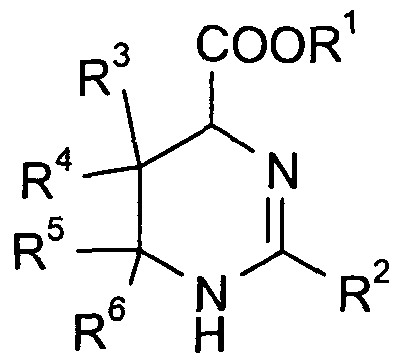 worin R1 ein Rest H oder Ci-8-Alkyl, R2 ein Rest H oder Ci-4-Alkyl und R3, R4, R5 sowie R6 jeweils unabhängig voneinander ein Rest aus der Gruppe H1 OH, NH2 und Ci-4-Alkyl sind. Bevorzugt werden Pyrimidincarbonsäuren eingesetzt, bei denen R2 eine Methyl- oder eine Ethylgruppe ist und R1 bzw. R5 und R6 H sind. Insbesondere bevorzugt werden die Pyrimidincarbonsäuren Ectoin ((S)-1 ,4,5,6-Tetrahydro-2-methyl-4-pyrimidin-carbon- säure) und Hydroxyectoin ((S1 S)-1 ,4,5,6-Tetrahydro-5-hydroxy-2-methyl-4- pyrimidin-carbonsäure) eingesetzt. Dabei enthalten die erfindungsgemäßen Zubereitungen derartige Pyrimidincarbonsäuren vorzugsweise in Mengen bis zu 15 Gew.-%. Vorzugsweise werden die Pyrimidincarbonsäuren dabei in Gewichtsprozentverhältnissen von 100:1 bis 1 :100 zu den Verbindungen der Formel I eingesetzt, wobei Gewichtsprozentverhältnisse im Bereich 1:10 bis 10:1 besonders bevorzugt sind.
Unter den Aryloximen wird vorzugsweise 2-Hydroxy-5- methyllaurophenonoxim, welches auch als HMLO, LPO oder F5 bezeichnet wird, eingesetzt. Seine Eignung zum Einsatz in kosmetischen Mitteln ist beispielsweise aus der Deutschen Offenlegungsschrift DE-A-41 16 123 bekannt Zubereitungen, die 2-Hydroxy-5-methyllaurophenonoxim enthalten, sind demnach zur Behandlung von Hauterkrankungen, die mit Entzündungen einhergehen, geeignet. Dabei enthalten die Zubereitungen vorzugsweise 0,01 bis 10 Gew.-% des Aryloxims, wobei es insbesondere bevorzugt ist, wenn die Zubereitung 0,05 bis 5 Gew-% Aryloxim enthält.
Bekannte Bioflavonoide sind beispielsweise Troxerutin, Tilirosid, α-
Glucosylrutin, Rutin oder Isoquercetin, wobei die genannte Auswahl nicht beschränkend wirken soll.
Bioflavonoidhaltige Extrakte sind beispielsweise Gingko Biloba oder Emblica.
Bekannte Anti-aging-Stoffe sind auch Chromone, wie beispielsweise in EP
1508327 beschrieben oder Retinoide, beispielsweise Retinol (Vitamin A), Retinsäure, Retinaldehyd oder auch synthetisch modifizierte Verbindungen von Vitamin A.
Die beschriebenen Chromone und Retinoide sind gleichzeitig auch wirksame Anti-Cellulite-Wirkstoffe. Ein ebenfalls bekannter Anti-Cellulite- Wirkstoff ist Koffein.
Die Zubereitungen können die genannten notwendigen oder optionalen Bestandteile oder Inhaltsstoffe umfassen oder enthalten, daraus im wesentlichen oder daraus bestehen. Alle Verbindungen oder Komponenten, die in den Zubereitungen verwendet werden können, sind entweder bekannt und käuflich erwerbbar oder können nach bekannten Verfahren synthetisiert werden.
Die eine oder die mehreren Verbindungen der Formel I oder Ia oder das Gemisch, wie zuvor beschrieben, können in der üblichen Weise in kosmetische oder dermatologische Zubereitungen eingearbeitet werden. Geeignet sind Zubereitungen für eine äußerliche Anwendung, beispiels- weise als Creme, Lotion, Gel, oder als Lösung, die auf die Haut aufgesprüht werden kann.
Für eine innerliche Anwendung sind Darreichungsformeln wie Kapseln, Dragees, Pulver, Tabletten-Lösungen oder Lösungen geeignet.
Als Anwendungsform der erfindungsgemäßen Zubereitungen seien z.B. genannt: Lösungen, Suspensionen, Emulsionen, PIT-Emulsionen, Pasten, Salben, Gele, Cremes, Lotionen, Puder, Seifen, tensidhaltige Reinigungs-
präparate, Öle, Aerosole und Sprays. Weitere Anwendungsformen sind z.B. Sticks, Shampoos und Duschbäder. Der Zubereitung können beliebige übliche Trägerstoffe, Hilfsstoffe und gegebenenfalls weitere Wirkstoffe zugesetzt werden.
Vorzuziehende Hilfsstoffe stammen aus der Gruppe der Konservierungsstoffe, Stabilisatoren, Lösungsvermittler, Färbemittel, d.h. Pigmente oder Farbstoffe oder Geruchsverbesserer.
Salben, Pasten, Cremes und Gele können die üblichen Trägerstoffe enthalten, z.B. tierische und pflanzliche Fette, Wachse, Paraffine, Stärke, Traganth, Cellulosederivate, Polyethylenglykole, Silicone, Bentonite, Kieselsäure, Talkum und Zinkoxid oder Gemische dieser Stoffe.
Puder und Sprays können die üblichen Trägerstoffe enthalten, z.B.
Milchzucker, Talkum, Kieselsäure, Aluminiumhydroxid, Calciumsilikat und Polyamid-Pulver oder Gemische dieser Stoffe. Sprays können zusätzlich die üblichen Treibmittel, z.B. Chlorfluorkohlenwasserstoffe, Propan/Butan oder Dimethylether, enthalten.
Lösungen und Emulsionen können die üblichen Trägerstoffe wie Lösungsmittel, Lösungsvermittler und Emulgatoren, z.B. Wasser, Ethanol, Iso- propanol, Ethylcarbonat, Ethlyacetat, Benzylalkohol, Benzylbenzoat, Propylenglykol, 1 ,3-Buty!g!ykol, Öle, insbesondere Baumwoüsaatöl, Erdnussöl, Maiskeimöl, Olivenöl, Rizinusöl und Sesamöl, Glycerinfettsäure- ester, Polyethylenglykole und Fettsäureester des Sorbitans oder Gemische dieser Stoffe enthalten.
Suspensionen können die üblichen Trägerstoffe wie flüssige Verdünnungs- mittel, z.B. Wasser, Ethanol oder Propylenglykol, Suspendiermittel, z.B. ethoxylierte Isostearylalkohole, Polyoxyethylensorbitester und Polyoxy-
ethylensorbitanester, mikrokristalline Cellulose, Aluminiummetahydroxid, Bentonit, Agar-Agar und Traganth oder Gemische dieser Stoffe enthalten.
Seifen können die üblichen Trägerstoffe wie Alkalisalze von Fettsäuren, Salze von Fettsäurehalbestern, Fettsäureeiweißhydrolysaten, Isothionate,
Lanolin, Fettalkohol, Pflanzenöle, Pflanzenextrakte, Glycerin, Zucker oder Gemische dieser Stoffe enthalten.
Tensidhaltige Reinigungsprodukte können die üblichen Trägerstoffe wie Salze von Fettalkoholsulfaten, Fettalkoholethersulfaten, Sulfobernstein- säurehalbestern, Fettsäureeiweißhydrolysaten, Isothionate, Imidazolinium- derivate, Methyltaurate, Sarkosinate, Fettsäureamidethersulfate, Alkyl- amidobetaine, Fettalkohole, Fettsäureglyceride, Fettsäurediethanolamide, pflanzliche und synthetische Öle, Lanolinderivate, ethoxylierte Glycerin- fettsäureester oder Gemische dieser Stoffe enthalten.
Gesichts- und Körperöle können die üblichen Trägerstoffe wie synthetische Öle wie Fettsäureester, Fettalkohole, Silikonöle, natürliche Öle wie Pflanzenöle und ölige Pflanzenauszüge, Paraffinöle, Lanolinöle oder Gemische dieser Stoffe enthalten.
Weitere typische kosmetische Anwendungsformen sind auch Puder-, Emulsions- und Wachs-Make up sowie Sonnenschutz-, Prä-Sun- und After- Sun-Präparatβ.
Zu den bevorzugten erfindungsgemäßen Zubereitungsformen gehören insbesondere Emulsionen.
Erfindungsgemäße Emulsionen sind vorteilhaft und enthalten z. B. die genannten Fette, Öle, Wachse und anderen Fettkörper, sowie Wasser und einen Emulgator, wie er üblicherweise für einen solchen Typ der Zubereitung verwendet wird.
Die Lipidphase kann vorteilhaft gewählt werden aus folgender Substanzgruppe:
- Mineralöle, Mineralwachse
- Öle, wie Triglyceride der Caprin- oder der Caprylsäure, ferner natürliche Öle wie z. B. Rizinusöl;
- Fette, Wachse und andere natürliche und synthetische Fettkörper, vorzugsweise Ester von Fettsäuren mit Alkoholen niedriger C-Zahl, z.B. mit Isopropanol, Propylenglykol oder Glycerin, oder Ester von Fett-
Ikoholen mit Alkansäuren niedriger C-Zahl oder mit Fettsäuren;
- Silikonöle wie Dimethylpolysiloxane, Diethylpolysiloxane, Diphenylpolysiloxane sowie Mischformen daraus.
Die Ölphase der Emulsionen, Oleogele bzw. Hydrodispersionen oder Lipodispersionen im Sinne der vorliegenden Erfindung wird vorteilhaft gewählt aus der Gruppe der Ester aus gesättigtem und/oder ungesättigten, verzweigten und/oder unverzweigten Alkancarbonsäuren einer Kettenlänge von 3 bis 30 C-Atomen und gesättigten und/oder ungesättigten, verzweigten und/oder unverzweigten Alkoholen einer Kettenlänge von 3 bis 30 C-Atomen, aus der Gruppe der Ester aus aromatischen Carbonsäure und gesättigten und/oder ungesättigten, verzweigten und/oder unverzweigten Alkoholen einer Kettenlänge von 3 bis 30 C-Atomen. Solche Esteröle können dann vorteilhaft gewählt werden aus der Gruppe Isopropylmyristat, Isopropylpalmitat, Isopropylstearat, Isopropyloleat, n-Butylstearat, n-Hexyllaurat, n-Decyloleat, Isooctylstearat, Isononylstearat, Isononylisononanoat, 2-Ethylhexylpalmitat, 2-Ethylhexyllaurat, 2-Hexaldecylstearat, 2-Octyldodecylpalmitat, Oleyloleat, Oleylerucat, Eru- cyloleat, Erucylerucat sowie synthetische, halbsynthetische und natürliche Gemische solcher Ester, z. B. Jojobaöl.
Ferner kann die Ölphase vorteilhaft gewählt werden aus der Gruppe der verzweigten und unverzweigten Kohlenwasserstoffe und -wachse, der Silikonöle, der Dialkylether, der Gruppe der gesättigten oder ungesättigten, verzweigten oder unverzweigten Alkohole, sowie der Fettsäuretriglyceride, namentlich der Triglycerinester gesättigter und/oder ungesättigter, verzweigter und/oder unverzweigter Alkancarbonsäuren einer Kettenlänge von 8 bis 24, insbesondere 12-18 C-Atomen. Die Fettsäuretriglyceride können beispielsweise vorteilhaft gewählt werden aus der Gruppe der synthetischen, halbsynthetischen und natürlichen Öle, z. B. Olivenöl, Sonnenblumenöl, Sojaöl, Erdnussöl, Rapsöl, Mandelöl, Palmöl, Kokosöl, Palmkemöl und dergleichen mehr.
Auch beliebige Abmischungen solcher Öl- und Wachskomponenten sind vorteilhaft im Sinne der vorliegenden Erfindung einzusetzen. Es kann auch gegebenenfalls vorteilhaft sein, Wachse, beispielsweise Cetylpalmitat, als alleinige Lipidkomponente der Ölphase einzusetzen.
Vorteilhaft wird die Ölphase gewählt aus der Gruppe 2-Ethylhexylisostearat, Octyldodecanol, Isotridecylisononanoat, Isoeicosan, 2-Ethylhexylcocoat, Ci2-15-Alkylbenzoat, Capryl-Caprinsäure-triglycerid, Dicaprylether.
Besonders vorteilhaft sind Mischungen aus Ci2-is-Alkylbenzoat und 2-Ethylhexylisostearat, Mischungen aus Ci2-i5-Alkylbenzoat und Isotridecylisononanoat sowie Mischungen aus
 2-Ethy!hexy!- isostearat und Isotridecylisononanoat.
Von den Kohlenwasserstoffen sind Paraffinöl, Squalan und Squalen vorteilhaft im Sinne der vorliegenden Erfindung zu verwenden.
Vorteilhaft kann auch die Ölphase ferner einen Gehalt an cyclischen oder linearan Silikonölen aufweisen oder vollständig aus solchen Ölen bestehen, wobei allerdings bevorzugt wird, außer dem Silikonöl oder den Silikonölen
einen zusätzlichen Gehalt an anderen Ölphasenkomponenten zu verwenden.
Vorteilhaft wird Cyclomethicon (Octamethylcyclotetrasiloxan) als erfindungsgemäß zu verwendendes Silikonöl eingesetzt. Aber auch andere
Silikonöle sind vorteilhaft im Sinne der vorliegenden Erfindung zu verwenden, beispielsweise Hexamethylcyclotrisiloxan, Polydimethylsiloxan, Poly(methylphenylsiloxan).
Besonders vorteilhaft sind ferner Mischungen aus Cyclomethicon und Iso- tridecylisononanoat, aus Cyclomethicon und 2-Ethylhexylisostearat.
Die wässrige Phase der erfindungsgemäßen Zubereitungen enthält gegebenenfalls vorteilhaft Alkohole, Diole oder Polyole niedriger C-Zahl, sowie deren Ether, vorzugsweise Ethanol, Isopropanol, Propylenglykol, Glycerin, Ethylenglykol, Ethylenglykolmonoethyl- oder -monobutylether, Propylenglykolmonomethyl, -monoethyl- oder -monobutylether, Diethylen- glykolmonomethyl- oder -monoethylether und analoge Produkte, ferner Alkohole niedriger C-Zahl, z. B. Ethanol, Isopropanol, 1 ,2-Propandiol, Glycerin sowie insbesondere ein oder mehrere Verdickungsmittel, welches oder welche vorteilhaft gewählt werden können aus der Gruppe Siliciumdioxid, Aluminiumsilikate, Polysaccharide bzw. deren Derivate, z.B. Hyaluronsäure, Xanthangummi, Hydroxypropylmethylcellulose, besonders vorteilhaft aus der Gruppe der Polyacrylate, bevorzugt ein Polyacrylat aus der Gruppe der sogenannten Carbopole, beispielsweise Carbopole der Typen 980, 981 , 1382, 2984, 5984, jeweils einzeln oder in Kombination.
Insbesondere werden Gemische der vorstehend genannten Lösemittel verwendet. Bei alkoholischen Lösemitteln kann Wasser ein weiterer Bestandteil sein.
Erfindungsgemäße Emulsionen sind vorteilhaft und enthalten z. B. die genannten Fette, Öle, Wachse und anderen Fettkörper, sowie Wasser und einen Emulgator, wie er üblicherweise für einen solchen Typ der Formu- ierung verwendet wird.
In einer bevorzugten Ausführungsform enthalten die erfindungsgemäßen Zubereitungen hydrophile Tenside.
Die hydrophilen Tenside werden bevorzugt gewählt aus der Gruppe der Alkylglucoside, der Acyllactylate, der Betaine sowie der Cocoampho- acetate.
Die Alkylglucoside werden ihrerseits vorteilhaft gewählt aus der Gruppe der Alkylglucoside, welche sich durch die Strukturformel

auszeichnen, wobei R einen verzweigten oder unverzweigten Alkylrest mit
4 bis 24 Kohlenstoffatomen darstellt und wobei DP einen mittleren Glucosylierungsgrad von bis zu 2 bedeutet.
Der Wert DP repräsentiert den Glucosidierungsgrad der erfindungsgemäß verwendeten Alkylglucoside und ist definiert als
Pi P2 P3 Pi
DP = 1 + • 2 + ■ 3 + ... = ∑-
100 100 100 100
Dabei stellen pi, p2, P3 ••• bzw. Pi den Anteil der einfach, zweifach dreifach ... i-fach glucosylierten Produkte in Gewichtsprozenten dar. Erfindungs- emäß vorteilhaft werden Produkte mit Glucosylierungsgraden von 1-2, insbesondere vorteilhaft von 1 , 1 bis 1 ,5, ganz besonders vorteilhaft von 1 ,2-1 ,4, insbesondere von 1 ,3 gewählt.
Der Wert DP trägt den Umstände Rechnung, dass Alkylglucoside herstellungsedingt in der Regel Gemische aus Mono- und Oligoglucosiden darstellen. Erfindungsgemäß vorteilhaft ist ein relativ hoher Gehalt an 10 Monoglucosiden, typischerweise in der Größenordnung von 40-70 Gew.-%.
Erfindungsgemäß besonders vorteilhaft verwendete Alkylglylcoside werden gewählt aus der Gruppe Octylglucopyranosid, Nonylglucopyranosid, Decyl- glucopyranosid, Undecylglucopyranosid, Dodecylglucopyranosid, Tetra- 15 decylglucopyranosid und Hexadecylglucopyranosid.
Es ist ebenfalls von Vorteil, natürliche oder synthetische Roh- und Hilfs- stoffe bzw. Gemische einzusetzen, welche sich durch einen wirksamen Gehalt an den erfindungsgemäß verwendeten Wirkstoffen auszeichnen, 20 beispielsweise Plantaren® 1200 (Henkel KGaA)1 Oramix® NS 10 (Seppic).
Die Acyllactylate werden ihrerseits vorteilhaft gewählt aus der Gruppe der Substanzen, welche sich durch die Strukturformel

MΘ
„0 auszeichnen, wobei R1 einen verzweigten oder unverzweigten Alkylrest mit 1 bis 30 Kohlenstoffatomen bedeutet und M+ aus der Gruppe der Alkaliionen sowie der Gruppe der mit einer oder mehreren Alkyl- und/oder mit
einer oder mehreren Hydroxyalkylresten substituierten Ammoniumionen gewählt wird bzw. dem halben Äquivalent eines Erdalkalions entspricht.
Vorteilhaft ist beispielsweise Natriumisostearyllactylat, beispielsweise das Produkt Pathionic® ISL von der Gesellschaft American Ingredients
Company.
Die Betaine werden vorteilhaft gewählt aus der Gruppe der Substanzen, welche sich durch die Strukturformel
CH3
R2-C-NH-4CH24-N-CH2-C /y
CH3
auszeichnen, wobei R2 einen verzweigten oder unverzeigten Alkylrest mit 1 bis 30 Kohlenstoffatomen bedeutet.
Insbesondere vorteilhaft bedeutet R2 einen verzweigten oder unver- zweigten Alkylrest mit 6 bis 12 Kohlenstoffatomen.
Vorteilhaft ist beispielsweise Capramidopropylbetain, beispielsweise das Produkt Tego® Betain 810 von der Gesellschaft Th. Goldschmidt AG.
Als erfindungsgemäß vorteilhaftes Cocoamphoacetat wird beispielsweise Natriumcocoamphoacetat gewählt, wie es unter der Bezeichnung Miranol® Ultra C32 von der Gesellschaft Miranol Chemical Corp. erhältlich ist.
Die erfindungsgemäßen Zubereitungen sind vorteilhaft dadurch gekenn- zeichnet, dass das oder die hydrophilen Tenside in Konzentrationen von
0,01-20 Gew.-% bevorzugt 0,05-10 Gew.-%, besonders bevorzugt 0,1-5
Gew.-%, jeweils bezogen auf das Gesamtgewicht der Zusammensetzung, vorliegt oder vorliegen.
Zu Anwendung werden die erfindungsgemäßen kosmetischen und dermatologischen Zubereitungen in der für Kosmetika üblichen Weise aufdie Haut in ausreichender Menge aufgebracht.
Erfindungsgemäße kosmetische und dermatologische Zubereitungen können in verschiedenen Formen vorliegen. So können sie z. B. eine Lösung, eine wasserfreie Zubereitung, eine Emulsion oder Mikroemulsion vom Typ Wasser-in-ÖI (W/O) oder vom Typ Öl-in-Wasser (O/W), eine multiple Emulsion, beispielsweise vom Typ Waser-in-ÖI-in-Wasser (W/O/W), ein Gel, einen festen Stift, eine Salbe oder auch ein Aerosol darstellen. Es ist auch vorteilhaft, Ectoine in verkapselter Form darzureichen, z. B. in Kollagenmatrices und anderen üblichen Verkapselungsmaterialien, z. B. als Celluloseverkapselungen, in Gelatine, Wachsmatrices oder liposomal verkapselt. Insbesondere Wachsmatrices wie sie in der DE-OS 43 08282 beschrieben werden, haben sich als günstig herausgestellt. Bevorzugt werden Emulsionen. O/W-Emulsinen werden besonders bevorzugt. Emulsionen, W/O-Emulsionen und O/W-Emulsionen sind in üblicherweise erhältlich.
Als Emulgatoren können beispielsweise die bekannten W/O- und O/W- Emulgatoren verwendet werden. Es ist vorteilhaft, weitere übliche Co- emulgatoren in den erfindungsgemäßen bevorzugten O/W-Emulsionen zu verwenden.
Erfindungsgemäß vorteilhaft werden als Co-Emulgatoren beispielsweise O/W-Emulgatoren gewählt, vornehmlich aus der Gruppe der Substanzen mit HLB-Werten von 11-16, ganz besonders vorteilhaft mit HLB-Werten von 14,5-15,5, sofern die O/W-Emulgatoren gesättigte Reste R und R' aufweisen. Weisen die O/W-Emulgatoren ungesättigte Reste R und/oder R1
auf, oder liegen Isoalkylderivate vor, so kann der bevorzugte HLB-Wert solcher Emulgatoren auch niedriger oder darüber liegen.
Es ist von Vorteil, die Fettalkoholethoxylate aus der Gruppe der ethoxyl- ierten Stearylalkhole, Cetylalkohole, Cetylstearylalkohole (Cetearylalkohole) zu wählen. Insbesondere bevorzugt sind: Polyethylenglycol(13)stearylether (Steareth-13), Polyethylenglycol(14)stearylether (Steareth-14), Polyethylen- glycol(15)stearylether (Steareth-15), Polyethylenglycol(16)stearylether (Steareth-16), Polyethylenglycol(17)stearylether (Steareth- 17),Polyethylenglycol(18)stearylether (Steareth-18), Polyethylenglycol(19)- stearylether (Steareth-19), Polyethylenglycol(20)stearylether (Steareth-20), Polyethylenglycol(12)isostearylether (lsosteareth-12), Polyethylen- glycol(13)isostearylether (lsosteareth-13), Polyethylenglycol(14)- isostearylether (lsosteareth-14), Polyethylenglycol(15)isostearylether (lsosteareth-15), Polyethylenglycol(16)isostearylether (lsosteareth-16), Polyethylenglycol(17)isostearylether (lsosteareth-17), Polyethylenglycol(18)isostearylether (lsosteareth-18), Polyethylen- glycol(19)isostearylether (lsosteareth-19), Polyethylenglycol(20)- isostearylether (lsosteareth-20), Polyethylenglycol(13)cetylether (Ceteth- 13), Polyethylenglycol(14)cetylether (Ceteth-14), Polyethylenglycol(15)- cetylether (Ceteth-15), Polyethylenglycol(16)cetylether (Ceteth-16), Polyethylenglycol(17)cetylether (Ceteth-17), Polyethylenglycol(18)- cetylether (Ceteth-18), Polyethylenglycol(19)cetylether (Ceteth-19), Polyethylen-glycol(20)cetylether (Ceteth-20): Polyethylen- glycol(13)isocetylether (lsoceteth-13), Polyethylenglycol(14)isocetylether (lsoceteth-14), Polyethylenglycol(15)isocetylether (lsoceteth-15), Polyethylenglycol(16)isocetylether (lsoceteth-16), Polyethylenglycol(17)- isocetylether (lsoceteth-17), Polyethylenglycol(18)isocetylether (Isoceteth- 18), Polyethylenglycol(19)isocetylether (lsoceteth-19), Polyethylen- glycol(20)isocetylether (lsoceteth-20), Polyethylenglycol(12)oleylether (Oleth-12), Polyethylenglycol(13)oleylether (Oleth-13), Polyethylen- glycol(14)oleylether (Oleth-14), Polyethylenglycol(15)oleylether (Oleth-15),
Polyethylenglycol(12)laurylether (Laureth-12), Polyethylenglycol(12)- isolaurylether (lsolaureth-12), Polyethylenglycol(13)cetylstearylether (Ceteareth-13), Polyethylenglycol(14)cetylstearylether (Ceteareth-14), Polyethylenglycol(15)cetylstearylether (Ceteareth-15), Polyethylen- glycol(16)cetylstearylether (Ceteareth-16), Polyethylenglycol(17)- cetylstearylether (Ceteareth-17), Polyethylenglycol(18)cetylstearylether (Ceteareth-18), Polyethylenglycol(19)cetylstearylether (Ceteareth-19), Polyethylenglycol(20)cetylstearylether (Ceteareth-20).
Es ist ferner von Vorteil, die Fettsäureethoxylate ausfolgender Gruppe zu wählen:
Polyethylenglycol(20)stearat, Polyethylenglycol(21 )stearat, Polyethylenglycol(22)stearat, Polyethylenglycol(23)stearat, Polyethylenglycol(24)stearat, Polyethylenglycol(25)stearat,
Polyethylenglycol(12)isostearat, Polyethylenglycol(13)isostearat, Polyethylenglycol(14)isostearat, Polyethylenglycol(15)isostearat, Polyethylenglycol(16)isostearat, Polyethylenglycol(17)isostearat, Polyethylenglycol(18)isostearat, Polyethylenglycol(19)isostearat, Polyethylenglycol(20)isostearat, Polyethylenglycol(21 )isostearat, Polyethylenglycol(22)isostearat, Polyethylenglycol(23)isostearat, Polyethylenglycol(24)isostearat, Polyethylenglycol(25)isostearat, Polyethylenglycol(12)oleat, Polyethylenglycol(13)oleat, Polyethylenglycol(14)oleat, Polyethylenglycol(15)oleat. Polyethylenglycol(16)oleat, Polyethylenglycol(17)oleat, Polyethylenglycol(18)oleat, Polyethylenglycol(19)oleat, Polyethylenglycol(20)oleat,
Als ethoxylierte Alkylethercarbonsäure bzw. deren Salz kann vorteilhaft das Natriumlaureth-11 -carboxylat verwendet werden. Als Alkylethersulfat kann Natrium Laureth1-4sulfat vorteilhaft verwendet werden. Als ethoxyliertes Cholesterinderivat kann vorteilhaft Polyethylenglycol(30)Cholesterylether
verwendet werden. Auch Polyethylenglycol(25)Sojasterol hat sich bewährt. Als ethoxylierte Triglyceride können vorteilhaft die Polyethylenglycol(βO) Evening Primrose Glycerides verwendet werden (Evening Primrose = Nachtkerze).
Weiterhin ist von Vorteil, die Polyethylenglycolglycerinfettsäureester aus der Gruppe Polyethylenglycol(20)glyceryllaurat, Polyethylenglycol(21 )gly- ceryllaurat, Polyethylenglycol(22)glyceryllaurat, Polyethylenglycol(23)gly- ceryllaurat, Polyethylenglycol(6)glycerylcaprat/cprinat, Polyethylenglycol- (20)glyceryloleat, Polyethylenglycol(20)glycerylisostearat, Polyethylengly- col(18)glyceryloleat(cocoat zu wählen.
Es ist ebenfalls günstig, die Sorbitanester aus der Gruppe Polyethylen- glycol(20)sorbitanmonolaurat, Polyethylenglycol(20)sorbitanmonostearat, Polyethylenglycol(20)sorbitanmonoisostearat, Polyethylenglycol(20)sorbi- tanmonopalmitat, Polyethylenglycol(20)sorbitanmonooleat zu wählen.
Als fakultative, dennoch erfindungsgemäß gegebenenfalls vorteilhafte W/O- Emulgatoren können eingesetzt werden:
Fettalkohole mit 8 bis 30 Kohlenstoffatomen, Monoglycerinester gesättigter und/oder ungesättigter, verzweigter und/oder unverzweigter Alkancarbon- säuren einer Kettenlänge von 8 bis 24, insbesondere 12-18 C-Atome, Diglycerinester gesättigter und/oder ungesättigter, verzweigter und/oder unverzweigter Alkancarbonsäuren einer Kettenlänge von 8 bis 24, insbesondere 12-18 C-Atomen, Monoglycerinether gesättigter und/oder ungesättigter, verzweigter und/oder unverzweigter Alkohole einer Kettenlänge von 8 bis 24, insbesondere 12-18 C-Atomen, Diglycerinether gesättigter und/oder ungesättigter, verzweigter und/oder unverzweigter Alkhole einer Kettenlänge von 8 bis 24, insbesondere 12-18 C-Atomen, Propylenglycolester gesättigter und/oder ungesättigter, verzweigter und/oder unverzweigter Alkancarbonsäuren einer Kettenlänge von 8 bis 24,
insbesondere 12-18 C-Atomen sowie Sorbitanester gesättigter und/oder ungesättigter, verzweigter und/oder unverzweigter Alkancarbonsäuren einer Kettenlänge von 8 bis 24, insbesondere 12-18 C-Atomen.
Insbesondere vorteilhafte W/O-Emulgatoren sind Glycerylmonostearat,
Glycerylmonoisostearat, Glycerylmonomyristat, Glycerylmonooleat, Diglycerylmonostearat, Diglycerylmonoisostearat, Propylenglycol- monostearat, Propylenglycolmonoisostearat, Propylenglycolmonocaprylat, Propylenglycolmonolaurat, Sorbitanmonoisostearat, Sorbitanmonolaurat, Sorbitanmonocaprylat, Sorbitanmonoisooleat, Saccharosedistearat, Cetyl- alkohol, Stearylalkohol, Arachidylalkohol, Behenylalkohol, Isobehenyl- alkohol, Selachylalkohol, Chimylalkohol, Polyethylenglycol(2)stearylether (Steareth-2), Glycerylmonolaurat, Glycerylmonocaprinat, Glycerylmono- caprylat oder PEG-30-dipolyhydroxystearat.
Die beschriebenen Mittel oder Zubereitungen eignen sich besonders zum Schutz menschlicher Haut gegen UV-Strahlung, Alterungsprozesse sowie vor oxidativem Stress, d.h. gegen Schädigungen durch Radikale. Dabei liegen sie in verschiedenen, für diese Anwendung üblicherweise verwendeten Darreichungsformen vor. So kann die Zubereitung insbesondere als Lotion oder Emulsion, wie als Creme oder Milch (O/W, W/O, O/W/O, W/O/W), in Form ölig-alkoholischer, ölig-wässriger oder wässrig-alkoholischer Gele bzw. Lösungen, als feste Stifte vorliegen oder als Aerosol konfektioniert sein
Die Zubereitung kann kosmetische Adjuvanten enthalten, welche in dieser Art von Zubereitungen üblicherweise verwendet werden, wie z.B. Verdickungsmittel, weichmachende Mittel, Befeuchtungsmittel, grenzflächenaktive Mittel, Emulgatoren, Konservierungsmittel, Mittel gegen Schaumbildung, Parfüms, Wachse, Lanolin, Treibmittel, Farbstoffe und/oder Pigmente, welche das Mittel selbst oder die Haut färben, und andere in der Kosmetik gewöhnlich verwendete Ingredienzien.
AIs Farbstoffe werden bevorzugt zugelassene Farbstoffe verwendet, die in der Kosmetikverordnung, Anlage 3 als Positivliste aufgeführt sind.
Als Konservierungsstoffe werden bevorzugt zugelassene
Konservierungsstoffe verwendet, die in der Kosmetikverordnung, Anlage 6 als Positivliste aufgeführt sind oder auch antimikrobiellen Pigmente, wie beispielsweise in WO 2004/0092283 oder WO 2004/091567 beschrieben.
Geeignete Konservierungsstoffe sind daher auch Alkylester der p- Hydroxybenzoesäure, Hydantoinderivate, Propionat-Salze oder eine Vielzahl von Ammoniumverbindungen.
Ganz besonders bevorzugte Konservierungsstoffe sind Methylparaben, Propylparaben, Imidazolidinyl-Harnstoff, Natrium-dehydroxyacetat oder
Benzylalkohol. Konservierungsmittel werden in Mengen zwischen 0.5 bis 2 Gew.-% eingesetzt.
Emollients oder Weichmacher werden oft in kosmetische Zubereitungen eingearbeitet. Sie werden bevorzugt in 0.5 bis 50 Gew.-%, bevorzugt zwischen 5 und 30 Gew.-% bezogen auf die Gesamtzusammensetzung eingesetzt. Generell können Weichmacher in Klassen eingeordnet werden, wie beispielsweise die Kategorie der Ester, Fettsäuren oder Fettalkohole, Polyole, Kohlenwasserstoffe und Öle enthaltend mindestens eine Amidstruktur-Einheit.
Repräsentative Öle enthaltend mindestens eine Amidstruktur-Einheit zusammen mit ihrer Synthese sind insbesondere in EP 1044676 und EP 0928608 beschrieben. Eine besonders bevorzugt angegebene Verbindung ist Isopropyl-N-Iauroylsarcosinat, welches unter der Produktbezeichnung Eldew SL-205 von Ajinomoto kommerziell erhältlich ist.
Unter den Estern können Mono- oder Diester ausgewählt warden. Beispiele sind diesbezüglich Dibutyl-adipat, Diethyl-sebacat, Disopropyl-dimerat oder Dioctyl-succinat. Verzweigte Fettsäureester sind beispielsweise 2-Ethyl- hexyl-myristat, Isopropyl-stearat oder Isostearyl-palmitat. Tribasische Ester sind beispielsweise Trisopropyl-trilinoleat oder Trilauryl-citrat. Geradkettige
Fettsäureester sind beispielsweise Lauryl-palmitat, Myristyl-Iactat, Oleyl- eurcat oder Stearyl-oleat. Bevorzugte Ester sind Coco-Caprylate/Caprate (= INCI-Bezeichnung, es sind Ester aus Kokosfettalkoholen mit gesättigten mitelkettigen Fettsäuren), Propylenglycol-myristyl-ether-acetat, Diisopropyl- adipat oder Cetyl-octanoat.
Geeignete Fettalkohole und -säuren sind Verbindungen, die 10 bis 20 C- Atome haben. Besonders bevorzugte Verbindungen sind Cetyl-, Myristyl-, Palmitin- oder Stearinalkohol oder -säure.
Als Polyole eignen sich lineare oder verzweigtkettige Alkyl- polyhydroxyverbindungen, beispielsweise Propylenglycol, Sorbitol oder Glycerin. Einsetzbar sind jedoch auch polymere Polyole, beispielsweise Polypropylenglycol oder Polyethylenglycol. Butylen- und Propylenglycol sind auch besonders geeignete Verbindungen zur Verstärkung des Eindringungsvermögens.
Beispielhafte Kohlenwasserstoffe als Weichmacher sind Verbindungen, die generell 12 bis 30 C-Atome haben. Spezielle Beispiele sind Arylalkylbenzoate, Alkylbenzoate, Mineralöle, Vaseline, Squalene oder Isoparaffine.
Weitere Emollients oder Hydrophobiermittel sind bevorzugt Ci2 bis Ci5- Alkylbenzoate, Dioctyladipat, Octylstearat, Octyldodecanol, Hexyllaurat, Octyldodecyl-neopentanoat, Cyclomethicone, Dicapryl-ether, Dimethicone, Phenyl-trimethicone, Isopropyl-myristat, Capriylic/Capric-glyceride, Propylenglycol-dicaprylat/dicaprat oder Decyl-oleat.
Eine weitere Kategorie funktioneller Inhaltsstoffe von kosmetischen Zubereitungen sind Vedickungsmittel. Verdickungsmittel werden in dr Regel in Mengen zwischen 0.1 bis 20 Gew.-%, vorzugsweise zwischen 0.5 bis 10 Gew.-% bezogen auf die Gesamtmenge eingesetzt. Beispielhaft für diese
Verbindungen sind vernetzte Polyacrylat-Materialien, kommeziell erhältlich under der Marke Carbopol von B. F. Goodrich Company. Verwendet werden können auch Verdickungsmittel, wie Xanthan-Gum, Carrageenan- Gum, Gelatin-Gum, Karayagummi, Pectin-Gum oder Johannisbrotkernmehl.
Unter gewissen Umständen ist es möglich, dass eine Verbindung sowohl ein Verdickungsmittel als auch ein Weichmacher sein kann. Beispiele hierfür sind Silicon-Gums (kinematische Viskosität > 10 Centistokes), Ester wie beispielsweise Glycerolstearat oder Cellulosederivate, beispielsweise Hydroxypropylcellulose.
Man kann als Dispersions- bzw. Solubilisierungsmittel ein Öl, Wachs oder sonstigen Fettkörper, einen niedrigen Monoalkohol oder ein niedriges Polyol oder Mischungen davon verwenden. Zu den besonders bevorzugten Monoalkoholen oder Polyolen zählen Ethanol, i-Propanol, Propylenglykol, Glycerin und Sorbit.
Eine bevorzugte Ausführungsform der Erfindung ist eine Emulsion, welche als Schutzcreme oder -milch vorliegt und beispielsweise Fettalkohole, Fettsäuren, Fettsäureester, insbesondere Triglyceride von Fettsäuren, Lanolin, natürliche und synthetische Öle oder Wachse und Emulgatoren in Anwesenheit von Wasser enthält.
Weitere bevorzugte Ausführungsformen stellen ölige Lotionen auf Basis von natürlichen oder synthetischen Ölen und Wachsen, Lanolin, Fettsäureestern, insbesondere Triglyceriden von Fettsäuren, oder ölig-
alkoholische Lotionen auf Basis eines Niedrigalkohols, wie Ethanol, oder eines Glycerols, wie Propylenglykol, und/oder eines Polyols, wie Glycerin, und Ölen, Wachsen und Fettsäureestern, wie Triglyceriden von Fettsäuren, dar.
Die erfindungsgemäße Zubereitung kann auch als alkoholisches Gel vorliegen, welches einen oder mehrere Niedrigalkohole oder -polyole, wie Ethanol, Propylenglykol oder Glycerin, und ein Verdickungsmittel, wie Kieselerde umfaßt. Die ölig-alkoholischen Gele enthalten außerdem natürliches oder synthetisches Öl oder Wachs.
Die festen Stifte bestehen aus natürlichen oder synthetischen Wachsen und Ölen, Fettalkoholen, Fettsäuren, Fettsäureestern, Lanolin und anderen Fettkörpern.
Ist eine Zubereitung als Aerosol konfektioniert, verwendet man in der Regel die üblichen Treibmittel, wie Alkane, Fluoralkane und Chlorfluoralkane.
Weitere Gegenstände der vorliegenden Erfindung sind ein Verfahren zur Herstellung einer Zubereitung, welches dadurch gekennzeichnet ist, dass eine oder mehrere Verbindungen der Formel I oder Ia mit Resten wie oben beschrieben oder mindestens ein Gemisch, wie zuvor beschrieben mit einem für topische Anwendungen geeigneten Träger, beispielsweise einem kosmetisch, pharmazeutisch oder dermatologisch geeigneten Träger, vermischt wird.
Gleiches gilt für die Herstellung eines Nahrungsergänzungsmittels, dadurch gekennzeichnet, dass eine oder mehrere Verbindungen der Formel I oder Ia mit Resten wie oben beschrieben oder mindestens ein Gemisch, wie zuvor beschrieben, mit einem für Nahrungsmittel geeigneten Träger vermischt wird.
Die erfindungsgemäßen Zubereitungen können dabei mit Hilfe von Techniken hergestellt werden, die dem Fachmann wohl bekannt sind.
Das Vermischen kann ein Lösen, Emulgieren oder Dispergieren der mindestens einen Verbindung gemäß Formel I oder Ia oder des
Gemisches, wie zuvor beschrieben, in dem Träger zur Folge haben.
Ebenso positiv sind die Eigenschaften von Verbindungen mit der Formel I oder Ia oder des Gemisches, wie zuvor beschrieben, zu werten für eine Verwendung in Nahrungsmitteln oder als Nahrungsergänzungsmittel oder als „functional food". Die weiteren zu Nahrungsmitteln ausgeführten Erläuterungen gelten sinngemäß auch für Nahrungsergänzungsmittel und für „functional food".
Die Nahrungsmittel umfassen alle Materialien, die für den Verzehr durch Tiere oder für den Verzehr durch Menschen geeignet sind, beispielsweise Vitamine und Provitamine davon, Fette, Mineralien oder Aminosäuren ". Die Nahrungsmittel können fest sein aber auch flüssig, also als Getränk vorliegen. Weitere Gegenstände der vorliegenden Erfindung sind dementsprechend die Verwendung mindestens einer Verbindung der Formel I oder Ia oder des Gemisches enthaltend mindestens eine Verbindung der Formel la-1 und mindestens eine Verbindung der Formel la-2 als Nahrungsmittelzusatz für die human- oder Tierernährung sowie Zubereitungen, die Nahrungsmittel oder Nahrungsergänzungsmittel sind und entsprechende Träger enthalten.
Nahrungsmittel im Sinne der Erfindung sind beispielsweise auch Nahrungsmittel, die aus einer einzigen natürlichen Quelle stammen, wie z.B. Zucker, ungesüßter Saft, Nektar oder Püree von einer einzigen
Pflanzenspezies, wie z.B. ungesüßter Apfelsaft (z.B. auch eine Mischung verschiedener Sorten Apfelsaft), Grapefruitsaft, Orangensaft, Apfelkompott,
Aprikosennektar, Tomatensaft, Tomatensoße, Tomatenpüree usw. Weitere Beispiele für Nahrungsmittel, die nach der vorliegenden Erfindung mit einer oder mehreren Verbindungen der Formel I angereichert werden können, sind Korn oder Getreide einer einzigen Pflanzenspezies und Materialien, die aus derartigen Pflanzenspezies hergestellt werden, wie z.B.
Getreidesirup, Roggenmehl, Weizenmehl oder Haferkleie. Auch Mischungen von derartigen Nahrungsmitteln sind geeignet, beispielsweise MultiVitaminpräparate, Mineralstoff mischungen oder gezuckerter Saft. Als weitere Beispiele für Nahrungsmittel seien Nahrungsmittelzubereitungen, beispielsweise zubereitete Cerealien, Gebäck, Mischgetränke, speziell für Kinder zubereitete Nahrungsmittel, wie Joghurt, Diätnahrungsmittel, kalorienarme Nahrungsmittel oder Tierfutter, genannt.
Die Nahrungsmittel umfassen somit alle genießbaren Kombinationen von Kohlenhydraten, Lipiden, Proteinen, anorganischen Elementen,
Spurenelementen, Vitaminen, Wasser oder aktiven Metaboliten von Pflanzen und Tieren.
Die Nahrungsmittel werden vorzugsweise oral angewendet, z.B. in Form von Speisen, Pillen, Tabletten, Kapseln, Pulver, Sirup, Lösungen oder Suspensionen.
Die erfindungsgemäßen Nahrungsmittel können mit Hilfe von Techniken hergestellt werden, die dem Fachmann wohl bekannt sind.
Durch ihre Wirkung eignen sich Verbindungen der Formel I auch als Arzneimittelinhaltsstoff.
Im folgenden wird die Erfindung anhand von Beispielen näher erläutert, die Erfindung ist im gesamten beanspruchten Bereich ausführbar und nicht auf die hier genannten Beispiele beschränkt.
Beispiele:
Die Verbindung der Formel I oder Ia werden gemäß Schema 1 hergestellt:

Schema 1
Beispiel 1 : Synthese von Hexadecansäure-(4-hexyl-3-hydroxy- phenyl)ester (1) und Hexadecansäure-(2-hexyl-5-hydroxy-phenyl)ester (2)
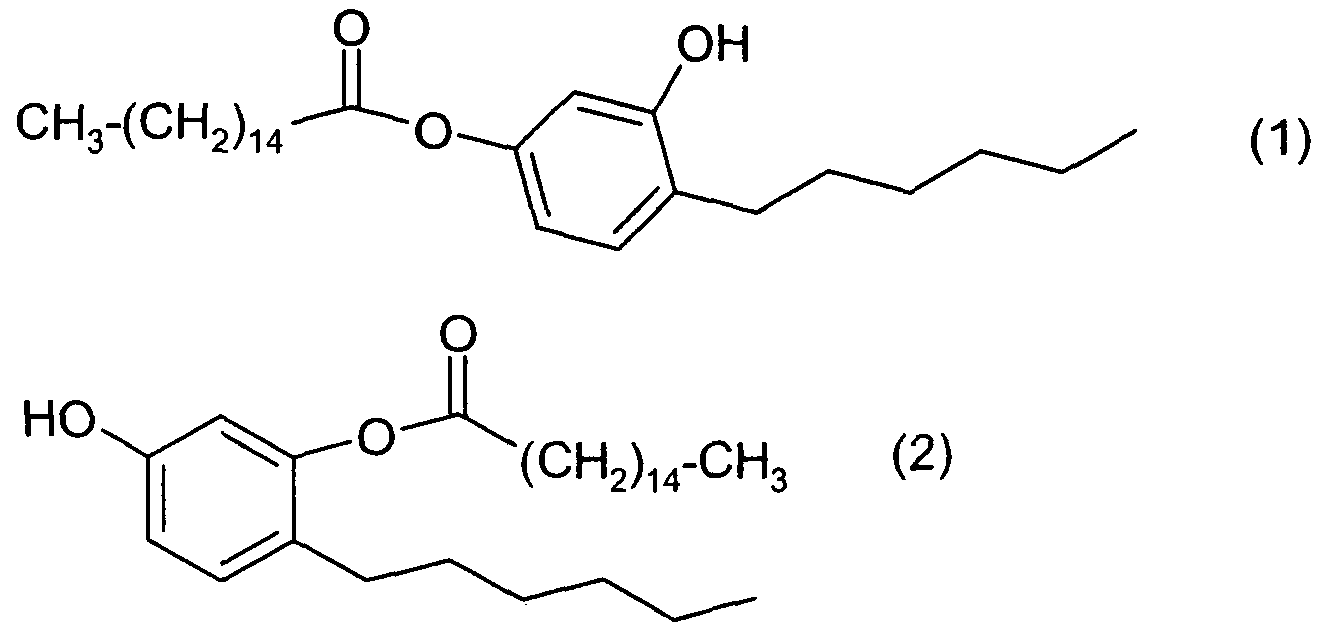
Zu einer Lösung von 4-Hexyl-resorcinol (5.2 mmol) in 50 ml Methylenchlorid werden 12.3 mmol Triethylamine zugegeben. Danach werden 5.3 mmol Palmitinsäurechlorid zugegeben und die Lösung wird für 18 h bei Raumtemperatur gerührt. Die Reaktionslösung wird auf Wasser gegeben und die wässrige Phase mehrmals mit Methylenchlorid extrahiert und schließlich vom Lösungsmittel befreit. Man erhält eine Mischung der beiden Verbindungen in einem Verhältnis von -1 :1 [(1 ):(2)]. Durch
Säulenchromatographie und oder Umkristallisation kann man auch das Gemisch in die Einzelkomponenten auftrennen.
Hexadecansäure-(4-hexyl-3-hydroxy-phenyl)ester (1 )
1 H NMR (DMS0-d6) δ 9.40 (s, 1 H), 7.03 (d, J= 8.4 Hz, 1 H), 6.49 (d, J= 2.3
Hz, 1 H), 6.45 (dd, J= 8.2, 2.3 Hz, 1 H), 2.51 (m, 2H), 1.61 (m, 2H), 1.50 (m,
2H), 1.37-1.20 (m, 32H), 0.84 (m, 6H).
MS (El): 432.4 (M+)
Hexadecansäure-(2-hexyl-5-hydroxy-phenyl)ester (2)
1 H NMR (DMSO-d6) δ 9.39 (s, 1 H), 7.03 (d, J= 8.4 Hz, 1 H), 6.59 (dd, J=
8.4, 2.4 Hz, 1 H ), 6.40 (d, J= 2.4 Hz, 1H), 2.54 (t, J= 7.3 Hz1 2H), 2.31 (t, J=
7.2 Hz, 2H), 1.64 (m, 2H), 1.48-1.22 (m, 32H), 0.84 (m, 6H).
MS (El): 432.4 (M+).
Beispiel 2: Synthese von (Z)-Octadec-9-ensäure-(4-hexyl-3-hydroxy- phenyl)ester (3) und (Z)-Octadec-9-ensäure-(2-hexyl-5-hydroxy- phenyl)ester (4)

Analog zu Beispiel 1 und Reaktionsschema 1 wird 4-Hexyl-resorcinol mit
Ölsäurechlorid umgesetzt.
(Z)-Octadec-9-ensäure-(4-hexyl-3-hydroxy-phenyl)ester (3)
1 H NMR (DMSO-d6) δ 9.44 (s, 1 H), 7.00 (d, J= 8.2 Hz, 1 H), 6.49 (d, J= 2.3
Hz, 1 H), 6.41 (dd, J= 8.2, 2.3 Hz, 1 H ), 5.30 (m, 2H), 2.52 (m, 2H), 2.02 (m,
4H), 1.49 (m, 2H), 1.46 (m, 2H), 1.37-1.21 (m, 28H), 0.84 (m, 6H).
MS (El): 458.3 (M+).
Beispiel 3: Synthese von Succinsäure-(4-hexyl-3-hydroxy-phenyl)ester (5) und Succinsäure-(2-hexyl-5-hydroxy-phenyl)ester (6)

Analog zu Beispiel 1 und Reaktionsschema 1 wird 4-Hexyl-resorcinol mit Succinylanhydrid umgesetzt. MS (El): 294.1 (M+).
Beispiel A:
Tyrosinase Assay
Die Wirkung der Verbindungen I oder Ia als Hautaufheller wird geprüft durch Ihre Fähigkeit das Enzym Tyrosinase zu hemmen und damit die
Melanin-Synthese zu unterbinden.
Die hemmende Wirkung der Verbindungen der Formel I oder Ia gegenüber
Tyrosinase wurde unter Verwendung von Tyrosinase aus Pilzen und L-
DOPA als Substrat bewertet.
Die Verbindungen (1 ) und (2), wie erhalten in Beispiel 1 , die Verbindungen (3) und (4) wie erhalten in Beispiel 2 und L-Dopa werden für 10 Minuten bei 25°C in Phosphatpuffer (pH 6.8) pre-inkubiert und anschließend wird Tyrosinase aus Pilzen (16U) (Fluka) zugegeben. Die optische Dichte der Proben wird bei 470 nm gegen eine Negativkontrolle (ohne Wirkstoff)
gemessen. Kojisäure und 4-Hexyl-resorcinol werden als Tyrosinase- Referenz, d.h. positive Kontrolle, mit getestet.
Die Ergebnisse sind in der folgenden Tabelle aufgeführt, ausgedrückt in dem IC50-WeIi (der Konzentration der Testverbindung, bei der 50% der
Tyrosinaseaktivität inhibiert ist).
Tabelle: Testergebnisse des Tyrosinase Assays

Beispiel B:
Depigmentierungsaktivität auf der Haut
Die Depigmentierungsaktivität von Verbindungen des Typs I oder Ia werden in vitro durch Anwendung eines „Reconstituted Human Tanned Epidermis Modell" (SkinEthic Laboratories) überprüft.
Die gebräunten Epidermalgewebe (11 Tage alte, Größe 0.5 cm2) werden während 4 Tagen täglich mit 5 μl_ einer Phosphatpuffer-Lösung der zu untersuchenden Verbindung der Formel I oder Ia oder einer Mischung behandelt.
Parallel dazu wird eine Negativ-Kontrolle (Epidermalgewebe dosiert nur mit reinem Phosphatpuffer) und eine Positiv-Kontrolle zum Vergleich erstellt.
Alle Hautkulturen werden bei 37°C für 6 Tage inkubiert.
Nach den Behandlungen werden alle Epidemnalgewebe durch visuelle Begutachtung bezüglich der Zellmorphologie und Zellentwicklungsfähigkeit untersucht. Zusätzlich wurde der Melaningehalt quantitativ bestimmt.
Beispiel C:
Öl-Löslichkeit in kosmetischen Trägern bzw. kosmetischen Ölen:
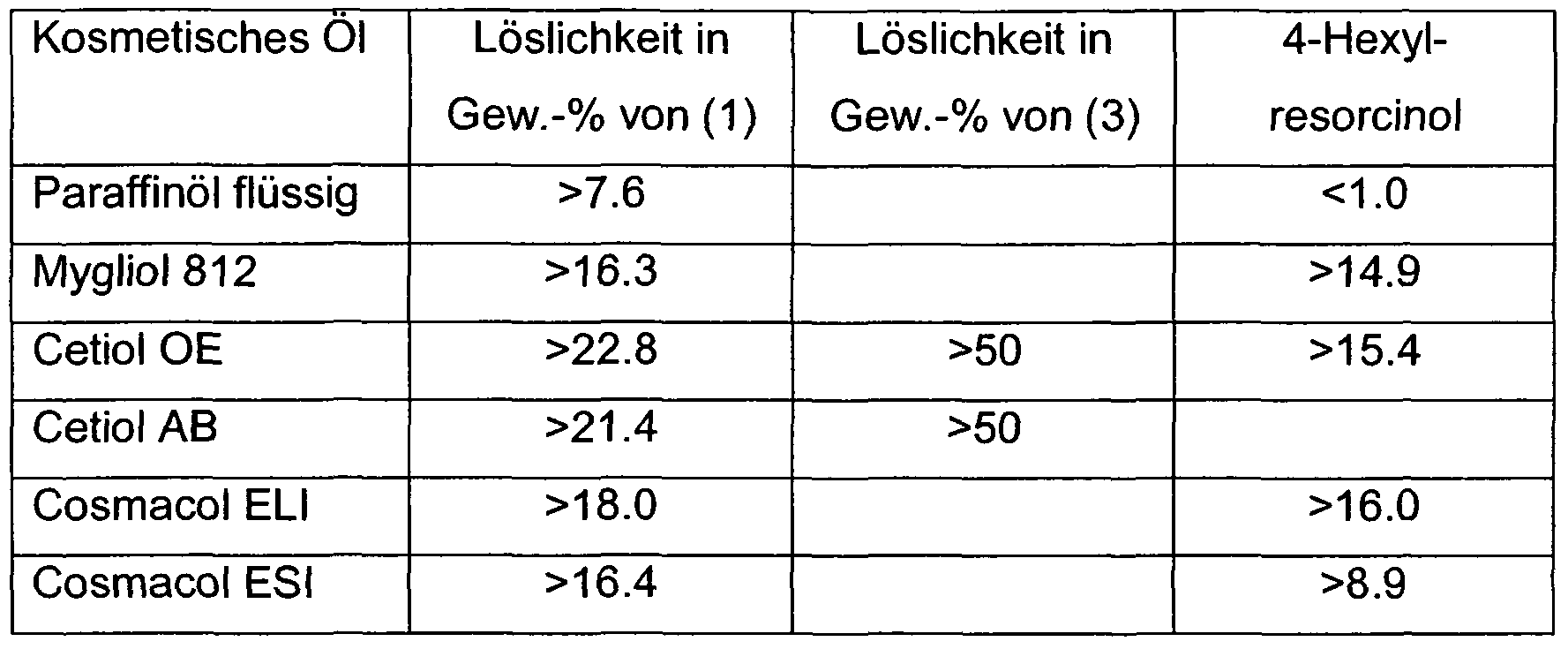
Beispiel D: Zubereitungen
Im folgenden werden beispielhaft Rezepturen für kosmetische Zubereitungen angegeben, die Verbindungen nach Beispielen 1 bis 3 enthalten. Im übrigen sind die INCI-Bezeichnungen der handelsüblichen Verbindungen angegeben.
UV-Pearl , OMC steht für die Zubereitung mit der INCI-Bezeichnung: Water (for EU: Aqua), Ethylhexyl Methoxycinnamate, Silica, PVP, Chlorphenesin, BHT; diese Zubereitung ist im Handel unter der Bezeichnung Eusolex®UV Pearl™OMC von der Merck KGaA, Darmstadt erhältlich.
Die anderen in den Tabellen angegebenen UV-Pearl sind jeweils analog zusammengesetzt, wobei OMC gegen die angegebenen UV-Filter ausgetauscht wurde.
Tabelle 1 W/O-Emulsionen (Zahlen in Gew.-%)

Tabelle 1 (Fortsetzung)


Fortsetzung Tabelle 2:


Claims
1. Verbindungen der Formel I

AAi und AA2 jeweils unabhängig voneinander OH oder einen Rest einer Monocarbonsäure (Fettsäure) oder einer Dicarbonsäure bedeutet,
R jeweils unabhänig voneinander, gegebenenfalls substituiert, eine lineare oder verzweigte Alkylgruppe mit 1 bis 12 C-Atomen, Cycloalkyl mit 3 bis 9 C-Atomen oder Cycloalkenyl mit 5 bis 9 C-Atomen bedeutet,
0 0, 1 oder 2 ist, mit der Bedingung, dass AAi und AA2 nicht gleichzeitig OH sind, sowie ihre Salze und Solvate.
2. Verbindungen nach Anspruch 1 , dadurch gekennzeichnet, dass der Rest einer Fettsäure oder einer Dicarbonsäure der Teilformel OCOR1 entspricht, wobei
R1 eine lineare oder verzweigte Alkylgruppe mit 8 bis 30 C-Atomen, eine lineare oder verzweigte durch OH, OR1 SH, SR, NH2, NHR, NR2, substituiertes oder unsubstituiertes Guanidinium, (NR3)+, COOH, COOR, CONH2, CONHR, CONR2, COR, Ar oder Het, substituierte Alkylgruppe mit 1 bis 30 C-Atomen oder eine lineare oder verzweigte Alkenylgruppe mit 8 bis 30 C-Atomen bedeutet,
Ar unsubstsituiertes oder durch R, OH oder OR mono-, di- oder trisubstituiertes Phenyl bedeutet, Het gesättigter oder ungesättigter mono- oder bicyclischer heterocyclischer Rest mit 5 bis 13 Ringgliedern, wobei 1 , 2 oder 3 N- und/oder 1 oder 2 S- oder O-Atome vorliegen können und der heterocyclische Rest ein- oder mehrfach durch R, OH oder OR substituiert sein kann bedeutet.
3. Verbindungen nach Anspruch 1 oder 2, dadurch gekennzeichnet, dass die Verbindungen der Formel Ia
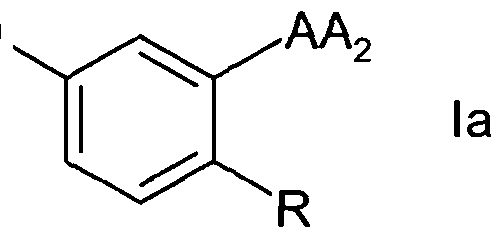
Bedeutung haben.
4. Verbindungen nach einem oder mehreren der Ansprüche 1 bis 3, dadurch gekennzeichnet, dass AAi der Teilformel OCOR1 entspricht und AA2 OH bedeutet oder AA2 der Teilformel OCOR1 entspricht und AAi OH bedeutet, wobei R1 eine lineare oder verzweigte Alkylgruppe mit 15 bis 30 C-Atomen bedeutet.
5. Verbindungen nach einem oder mehreren der Ansprüche 1 bis 3, dadurch gekennzeichnet, dass AAi der Teilformel OCOR1 entspricht und AA2 OH bedeutet oder AA2 der Teilformel OCOR1 entspricht und AAi OH bedeutet, wobei R1 eine lineare oder verzweigte Alkenylgruppe mit 15 bis 30 C-Atomen bedeutet.
6. Verbindungen nach einem oder mehreren der Ansprüche 1 bis 3, dadurch gekennzeichnet, dass AAi der Teilformel OCOR1 entspricht und AA2 OH bedeutet oder AA2 der Teilformel OCOR1 entspricht und AAi OH bedeutet, wobei R1 eine durch COOH, COOR, CONH2, CONHR, CONR2 oder COR substituierte, lineare oder verzweigte Alkylgruppe mit 1 bis 30
C-Atomen bedeutet.
7. Verbindungen nach einem oder mehreren der Ansprüche 1 bis 6, Hexadecansäure-(4-hexyl-3-hydroxy-phenyl)ester, Hexadecansäure-(2-hexyl-5-hydroxy-phenyl)ester, (Z)-Octadec-9-ensäure-(4-hexyl-3-hydroxy-phenyl)ester, (Z)-Octadec-9-ensäure-(2-hexyl-5-hydroxy-phenyl)ester, Succinsäure-(4-hexyl-3-hydroxy-phenyl)ester,
Succinsäure-(2-hexyl-5-hydroxy-phenyl)ester, sowie deren Salze und Solvate.
8. Gemisch enthaltend mindestens eine Verbindung der Formel la-1
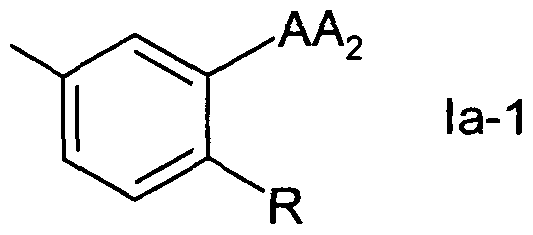

9. Gemisch nach Anspruch 8, dadurch gekennzeichnet, dass mindestens eine Verbindung der Formel Va

10. Gemisch nach Anspruch 9, dadurch gekennzeichnet, dass entweder mindestens eine Verbindung der Formel la-1 oder mindestens eine Verbindung der Formel la-2 enthalten ist.
11. Verfahren zur Herstellung von Verbindungen der Formeln I oder Ia sowie ihrer Salze und Solvate, dadurch gekennzeichnet, dass man (a) eine Verbindung der Formel V oder Va

R1COOH VI oder einem Säurechlorid der Formel VII
R1COCI VII
umsetzt, wobei der Substituent R1 eine in Anspruch 1 angegebene Bedeutung hat und
(b) gegebenenfalls eine basische oder saure Verbindung der Formel I durch Behandeln mit einer Säure oder Base in eines ihrer Salze oder Solvate umwandelt.
12. Zubereitung enthaltend mindestens eine Verbindung nach einem oder mehreren der Ansprüche 1 bis 7 oder ein Gemisch nach einem oder mehreren der Ansprüche 8 bis 10, sowie mindestens einen für topische Anwendungen geeigneten Träger.
13. Zubereitung nach Anspruch 12, dadurch gekennzeichnet, dass sie eine oder mehrere Verbindungen der Formel I oder mindestens ein Gemisch nach einem oder mehreren der Ansprüche 8 bis 10 in einer
Menge von 0.01 bis 20 Gew.-%, bezogen auf das Gesamtgewicht der Zubereitung, enthält.
14. Zubereitung nach Anspruch 12 oder 13, dadurch gekennzeichnet, dass ein oder mehrere Antioxidantien und/oder ein oder mehrere Vitamine enthalten sind.
15. Zubereitung nach einem oder mehreren der Ansprüche 12 bis 14, dadurch gekennzeichnet, dass ein oder mehrere UV-Filter enthalten sind. 0
16. Zubereitung nach einem oder mehreren der Ansprüche 12 bis 15, dadurch gekennzeichnet, dass mindestens eine weitere Verbindung mit hautaufhellender Aktivität enthalten ist.
17. Zubereitung nach Anspruch 16, dadurch gekennzeichnet, dass die 5 weitere Verbindung mit hautaufhellender Aktivität ausgewählt wird aus
Hydrochinon, Kojisäure, Arbutin, Aloesin oder Rucinol.
18. Verfahren zur Herstellung einer Zubereitung nach einem oder mehreren der Ansprüche 12 bis 17, dadurch gekennzeichnet, dass eine0 oder mehrere Verbindungen der Formel I nach einem oder mehreren der
Ansprüche 1 bis 7 oder mindestens ein Gemisch nach einem der Ansprüche 8 bis 10 mit einem für topische Anwendungen geeigneten Träger vermischt wird. 5 19. Verwendung von mindestens einer Verbindung der Formel I nach einem oder mehreren der Ansprüche 1 bis 7 oder mindestens eines Gemisches nach einem oder mehreren der Ansprüche 8 bis 10 zur Aufhellung menschlicher Haut. Q 20. Verwendung von mindestens einer Verbindung der Formel I nach einem oder mehreren der Ansprüche 1 bis 7 oder mindestens eines
Gemisches nach einem oder mehreren der Ansprüche 8 bis 10 als Tyrosinase-Inhibitor.
21. Verwendung von mindestens einer Verbindung der Formel I nach einem oder mehreren der Ansprüche 1 bis 7 oder mindestens eines
Gemisches nach einem oder mehreren der Ansprüche 8 bis 10 oder einer Zubereitung nach einem oder mehreren der Ansprüche 12 bis 17 zur Prophylaxe und/oder Behandlung von Pigmentstörungen wie Hyperpigmentierung, Sommersprossen, Altersflecken, Sonnenflecken sowie umweltbedingter Hautalterung.
Applications Claiming Priority (2)
| Application Number | Priority Date | Filing Date | Title |
|---|---|---|---|
| DE102007038098.6 | 2007-08-13 | ||
| DE102007038098A DE102007038098A1 (de) | 2007-08-13 | 2007-08-13 | Tyrosinaseinhibitoren |
Publications (1)
| Publication Number | Publication Date |
|---|---|
| WO2009021590A1 true WO2009021590A1 (de) | 2009-02-19 |
Family
ID=40044016
Family Applications (1)
| Application Number | Title | Priority Date | Filing Date |
|---|---|---|---|
| PCT/EP2008/005832 Ceased WO2009021590A1 (de) | 2007-08-13 | 2008-07-17 | Tyrosinaseinhibitoren |
Country Status (2)
| Country | Link |
|---|---|
| DE (1) | DE102007038098A1 (de) |
| WO (1) | WO2009021590A1 (de) |
Citations (8)
| Publication number | Priority date | Publication date | Assignee | Title |
|---|---|---|---|---|
| DE925471C (de) * | 1951-06-07 | 1955-03-21 | Strong Cobb And Company | Verfahren zur Herstellung von Estern des 4-Hexylresorcins |
| GB729826A (en) * | 1951-06-07 | 1955-05-11 | Strong Cobb And Company Inc | Hexylresorcinol esters and anthelmintic compositions containing them |
| US2752388A (en) * | 1952-08-28 | 1956-06-26 | Strong Cobb And Company Inc | Catalytic mono-acylation of hexylresorcinol and its keto-analog |
| US20030185773A1 (en) * | 2002-03-22 | 2003-10-02 | Unilever Home & Personal Care Usa, Division Of Conopco, Inc. | Stabilization of sunscreens in cosmetic compositions |
| US20040109832A1 (en) * | 2002-12-09 | 2004-06-10 | Unilever Home & Personal Care Usa, Division Of Conopco, Inc. | Di-substituted resorcinols as skin lightening agents |
| WO2004052827A1 (en) * | 2002-12-09 | 2004-06-24 | Unilever Plc | Process for the preparation of 4-alkyl resorcinol esters |
| WO2006097224A1 (en) * | 2005-03-18 | 2006-09-21 | Unilever Plc | Novel resorcinol derivatives for skin |
| EP1886561A1 (de) * | 2006-07-15 | 2008-02-13 | Syngenta Limited | Verfahren zum Schutz von Kulturpflanzen gegen die Beschädigungen verursacht von Herbiziden der Gruppe HPPD-Inhibitoren |
Family Cites Families (18)
| Publication number | Priority date | Publication date | Assignee | Title |
|---|---|---|---|---|
| GB1581428A (en) | 1978-03-13 | 1980-12-10 | Conoco Inc | Alkylation of aromatic hydroxy compounds |
| JPH0651619B2 (ja) | 1988-05-09 | 1994-07-06 | 株式会社クラレ | 美白剤 |
| DE4116123B4 (de) | 1991-05-17 | 2006-03-09 | Merck Patent Gmbh | Mittel zur Behandlung von Hauterkrankungen |
| DE4308282C2 (de) | 1993-03-16 | 1994-12-22 | Beiersdorf Ag | Vorzugsweise in Form von Mikrosphärulen vorliegende galenische Matrices |
| DE4342560A1 (de) | 1993-12-14 | 1995-06-22 | Marbert Gmbh | Ectoin und Ectoinderivate als Feuchtigkeitsspender in Kosmetikprodukten |
| FR2755856B1 (fr) | 1996-11-21 | 1999-01-29 | Merck Clevenot Laboratoires | Microcapsules de chitine ou de derives de chitine contenant une substance hydrophobe, notamment un filtre solaire et procede de preparation de telles microcapsules |
| BR9803596A (pt) | 1997-09-23 | 2000-04-25 | Pfizer Prod Inc | Derivados do resorcinol. |
| TWI225793B (en) | 1997-12-25 | 2005-01-01 | Ajinomoto Kk | Cosmetic composition |
| WO2000009652A2 (en) | 1998-08-13 | 2000-02-24 | Sol-Gel Technologies Ltd. | Method for the preparation of oxide microcapsules loaded with functional molecules and the products obtained thereof |
| US6238650B1 (en) | 1999-05-26 | 2001-05-29 | Sol-Gel Technologies Ltd. | Sunscreen composition containing sol-gel microcapsules |
| JP3802288B2 (ja) | 1999-04-16 | 2006-07-26 | 味の素株式会社 | 油性原料組成物 |
| EP1181000B1 (de) | 1999-05-25 | 2007-02-07 | Sol-Gel Technologies Ltd. | Ein verfahren zur herstellung von einem lichtstabilen sonnenschutzmittel |
| BR0113798A (pt) | 2000-09-11 | 2003-07-08 | Pfizer Prod Inc | Derivados de resorcinol |
| US6863897B2 (en) | 2002-03-22 | 2005-03-08 | Unilever Home & Personal Care Usa, Division Of Conopco, Inc. | Stabilization of resorcinol derivatives in cosmetic compositions |
| WO2004091567A2 (en) | 2003-04-18 | 2004-10-28 | Merck Patent Gmbh | Cosmetic formulations comprising antimicrobial pigments |
| JP2007504278A (ja) | 2003-05-20 | 2007-03-01 | ワーナー−ランバート カンパニー リミティド ライアビリティー カンパニー | 脱色剤 |
| DE10337863A1 (de) | 2003-08-18 | 2005-03-17 | Merck Patent Gmbh | Verwendung von Chromen-4-on-Derivaten |
| CN101163659B (zh) | 2005-04-19 | 2012-09-05 | 默克专利股份有限公司 | 抗氧化剂 |
-
2007
- 2007-08-13 DE DE102007038098A patent/DE102007038098A1/de not_active Withdrawn
-
2008
- 2008-07-17 WO PCT/EP2008/005832 patent/WO2009021590A1/de not_active Ceased
Patent Citations (8)
| Publication number | Priority date | Publication date | Assignee | Title |
|---|---|---|---|---|
| DE925471C (de) * | 1951-06-07 | 1955-03-21 | Strong Cobb And Company | Verfahren zur Herstellung von Estern des 4-Hexylresorcins |
| GB729826A (en) * | 1951-06-07 | 1955-05-11 | Strong Cobb And Company Inc | Hexylresorcinol esters and anthelmintic compositions containing them |
| US2752388A (en) * | 1952-08-28 | 1956-06-26 | Strong Cobb And Company Inc | Catalytic mono-acylation of hexylresorcinol and its keto-analog |
| US20030185773A1 (en) * | 2002-03-22 | 2003-10-02 | Unilever Home & Personal Care Usa, Division Of Conopco, Inc. | Stabilization of sunscreens in cosmetic compositions |
| US20040109832A1 (en) * | 2002-12-09 | 2004-06-10 | Unilever Home & Personal Care Usa, Division Of Conopco, Inc. | Di-substituted resorcinols as skin lightening agents |
| WO2004052827A1 (en) * | 2002-12-09 | 2004-06-24 | Unilever Plc | Process for the preparation of 4-alkyl resorcinol esters |
| WO2006097224A1 (en) * | 2005-03-18 | 2006-09-21 | Unilever Plc | Novel resorcinol derivatives for skin |
| EP1886561A1 (de) * | 2006-07-15 | 2008-02-13 | Syngenta Limited | Verfahren zum Schutz von Kulturpflanzen gegen die Beschädigungen verursacht von Herbiziden der Gruppe HPPD-Inhibitoren |
Non-Patent Citations (6)
| Title |
|---|
| DATABASE CAPLUS [online] CHEMICAL ABSTRACTS SERVICE, COLUMBUS, OHIO, US; TROFIMOV, V. A. ET AL: "Synthesis of bis(3-hydroxy-4-acylphenyl) 5,5'-thiodivalerates", XP002507057, retrieved from STN Database accession no. 1975:124957 * |
| HOSHINO NAOMI ET AL: "Smectogenic Copper(II) Complexes of N-Salicylideneaniline Derivatives. A Comparative Study of Homologous Series Carrying Alkoxy and/or Alkanoyloxy Substituents", INORG. CHEM., vol. 37, no. 5, 1998, pages 882 - 889, XP002507056, ISSN: 0020-1669 * |
| TSUTOMU INOUE ET AL: "Lewis Acis Catalyzed Reactions of o-[1-(Alkylthio)alkyl]phenols:The Generation and Reaction of o-Quinonemethides and Applications to Cannabinoid Synthesis", BULL. CHEM. SOC.JPN., vol. 63, 1990, pages 1647 - 1652, XP002506994 * |
| VARMAN S JORAPUR ET AL: "Hashish: synthesis and central nervous system activity of some novel analogs of cannabidiol and oxepin derivatives of delta.9-tetrahydrocannabinol", J. MED. CHEM., vol. 28, no. 6, 1985, pages 783 - 787, XP002506993 * |
| VIRINDER S PARMAR ET AL: "Hydrolytic Reactions on Polyphenolic Perpropanoates by Porcine Pancreatic Lipase Immobilized in Microemulsion-based Gels", BIOORGANIC & MEDICINAL CHEMISTRY LETTERS, vol. 6, no. 19, 1996, pages 2269 - 2274, XP002506992 * |
| ZHURNAL PRIKLADNOI KHIMII (SANKT-PETERBURG, RUSSIAN FEDERATION) , 48(1), 149-52 CODEN: ZPKHAB; ISSN: 0044-4618, 1975 * |
Also Published As
| Publication number | Publication date |
|---|---|
| DE102007038098A1 (de) | 2009-02-19 |
Similar Documents
| Publication | Publication Date | Title |
|---|---|---|
| EP1508327B1 (de) | Verwendung von 5,7-Dihydroxy-2-methylchromen-4-on zur Hautpflege | |
| EP2010294B1 (de) | Antioxidantien | |
| EP1400579A2 (de) | Zubereitung mit antioxidanten Eigenschaften | |
| EP1250331B1 (de) | Benzofuranonderivate enthaltende formulierung zum schutz vor oxidativem stress | |
| EP1979337B1 (de) | Chromen-4-on-derivate als selbstbräunungssubstanz | |
| EP1382329A1 (de) | Lichtschutzmittel enthaltend ein Flavonoid | |
| EP2175936A1 (de) | Tyrosinaseinhibitoren | |
| EP2134732B1 (de) | [(4-oxo-4h-chromen-3-yl)-hydroxymethyl]- oder [(4-oxo-4h-chromen-3-yl)-methyl]-phosphonsäurederivate | |
| EP2229169A1 (de) | Zubereitung enthaltend chroman-2-on-derivate | |
| EP1656364A1 (de) | Chromen-4-on-derivate | |
| EP1893207A1 (de) | Verwendung von substituierten piperazin- und morpholinderivaten | |
| DE102007013366A1 (de) | Verwendung von Chroman-4-on-Derivaten | |
| DE102006019043A1 (de) | Antioxidantien | |
| WO2009021590A1 (de) | Tyrosinaseinhibitoren | |
| DE102005011534A1 (de) | Chromen-4-on-Derivate | |
| EP1811989B1 (de) | Zubereitung enthaltend oxidierte flavonoid-derivate | |
| EP1948632A1 (de) | Flavonsulfate und ihre verwendung als antioxidantien | |
| DE102005058542A1 (de) | Erythruloseester als UV Filter | |
| EP2640348A2 (de) | Dihydroxyfumarsäure-derivate und deren verwendung zur hautaufhellung |
Legal Events
| Date | Code | Title | Description |
|---|---|---|---|
| 121 | Ep: the epo has been informed by wipo that ep was designated in this application |
Ref document number: 08774011 Country of ref document: EP Kind code of ref document: A1 |
|
| NENP | Non-entry into the national phase |
Ref country code: DE |
|
| 122 | Ep: pct application non-entry in european phase |
Ref document number: 08774011 Country of ref document: EP Kind code of ref document: A1 |