WO2010038643A1 - プライマー及び該プライマーからなる樹脂塗膜を有する積層体 - Google Patents
プライマー及び該プライマーからなる樹脂塗膜を有する積層体 Download PDFInfo
- Publication number
- WO2010038643A1 WO2010038643A1 PCT/JP2009/066481 JP2009066481W WO2010038643A1 WO 2010038643 A1 WO2010038643 A1 WO 2010038643A1 JP 2009066481 W JP2009066481 W JP 2009066481W WO 2010038643 A1 WO2010038643 A1 WO 2010038643A1
- Authority
- WO
- WIPO (PCT)
- Prior art keywords
- primer
- unsaturated
- compound
- main agent
- carboxylic acid
- Prior art date
- Legal status (The legal status is an assumption and is not a legal conclusion. Google has not performed a legal analysis and makes no representation as to the accuracy of the status listed.)
- Ceased
Links
Images


Classifications
-
- C—CHEMISTRY; METALLURGY
- C09—DYES; PAINTS; POLISHES; NATURAL RESINS; ADHESIVES; COMPOSITIONS NOT OTHERWISE PROVIDED FOR; APPLICATIONS OF MATERIALS NOT OTHERWISE PROVIDED FOR
- C09D—COATING COMPOSITIONS, e.g. PAINTS, VARNISHES OR LACQUERS; FILLING PASTES; CHEMICAL PAINT OR INK REMOVERS; INKS; CORRECTING FLUIDS; WOODSTAINS; PASTES OR SOLIDS FOR COLOURING OR PRINTING; USE OF MATERIALS THEREFOR
- C09D5/00—Coating compositions, e.g. paints, varnishes or lacquers, characterised by their physical nature or the effects produced; Filling pastes
- C09D5/002—Priming paints
-
- C—CHEMISTRY; METALLURGY
- C08—ORGANIC MACROMOLECULAR COMPOUNDS; THEIR PREPARATION OR CHEMICAL WORKING-UP; COMPOSITIONS BASED THEREON
- C08G—MACROMOLECULAR COMPOUNDS OBTAINED OTHERWISE THAN BY REACTIONS ONLY INVOLVING UNSATURATED CARBON-TO-CARBON BONDS
- C08G18/00—Polymeric products of isocyanates or isothiocyanates
- C08G18/06—Polymeric products of isocyanates or isothiocyanates with compounds having active hydrogen
- C08G18/08—Processes
- C08G18/0804—Manufacture of polymers containing ionic or ionogenic groups
- C08G18/0819—Manufacture of polymers containing ionic or ionogenic groups containing anionic or anionogenic groups
- C08G18/0823—Manufacture of polymers containing ionic or ionogenic groups containing anionic or anionogenic groups containing carboxylate salt groups or groups forming them
-
- C—CHEMISTRY; METALLURGY
- C08—ORGANIC MACROMOLECULAR COMPOUNDS; THEIR PREPARATION OR CHEMICAL WORKING-UP; COMPOSITIONS BASED THEREON
- C08G—MACROMOLECULAR COMPOUNDS OBTAINED OTHERWISE THAN BY REACTIONS ONLY INVOLVING UNSATURATED CARBON-TO-CARBON BONDS
- C08G18/00—Polymeric products of isocyanates or isothiocyanates
- C08G18/06—Polymeric products of isocyanates or isothiocyanates with compounds having active hydrogen
- C08G18/28—Polymeric products of isocyanates or isothiocyanates with compounds having active hydrogen characterised by the compounds used containing active hydrogen
- C08G18/40—High-molecular-weight compounds
- C08G18/62—Polymers of compounds having carbon-to-carbon double bonds
- C08G18/6216—Polymers of alpha-beta ethylenically unsaturated carboxylic acids or of derivatives thereof
- C08G18/625—Polymers of alpha-beta ethylenically unsaturated carboxylic acids; hydrolyzed polymers of esters of these acids
- C08G18/6254—Polymers of alpha-beta ethylenically unsaturated carboxylic acids and of esters of these acids containing hydroxy groups
-
- C—CHEMISTRY; METALLURGY
- C08—ORGANIC MACROMOLECULAR COMPOUNDS; THEIR PREPARATION OR CHEMICAL WORKING-UP; COMPOSITIONS BASED THEREON
- C08G—MACROMOLECULAR COMPOUNDS OBTAINED OTHERWISE THAN BY REACTIONS ONLY INVOLVING UNSATURATED CARBON-TO-CARBON BONDS
- C08G18/00—Polymeric products of isocyanates or isothiocyanates
- C08G18/06—Polymeric products of isocyanates or isothiocyanates with compounds having active hydrogen
- C08G18/28—Polymeric products of isocyanates or isothiocyanates with compounds having active hydrogen characterised by the compounds used containing active hydrogen
- C08G18/40—High-molecular-weight compounds
- C08G18/62—Polymers of compounds having carbon-to-carbon double bonds
- C08G18/6216—Polymers of alpha-beta ethylenically unsaturated carboxylic acids or of derivatives thereof
- C08G18/6262—Polymers of nitriles derived from alpha-beta ethylenically unsaturated carboxylic acids
-
- C—CHEMISTRY; METALLURGY
- C08—ORGANIC MACROMOLECULAR COMPOUNDS; THEIR PREPARATION OR CHEMICAL WORKING-UP; COMPOSITIONS BASED THEREON
- C08G—MACROMOLECULAR COMPOUNDS OBTAINED OTHERWISE THAN BY REACTIONS ONLY INVOLVING UNSATURATED CARBON-TO-CARBON BONDS
- C08G18/00—Polymeric products of isocyanates or isothiocyanates
- C08G18/06—Polymeric products of isocyanates or isothiocyanates with compounds having active hydrogen
- C08G18/70—Polymeric products of isocyanates or isothiocyanates with compounds having active hydrogen characterised by the isocyanates or isothiocyanates used
- C08G18/72—Polyisocyanates or polyisothiocyanates
- C08G18/74—Polyisocyanates or polyisothiocyanates cyclic
- C08G18/75—Polyisocyanates or polyisothiocyanates cyclic cycloaliphatic
- C08G18/751—Polyisocyanates or polyisothiocyanates cyclic cycloaliphatic containing only one cycloaliphatic ring
- C08G18/752—Polyisocyanates or polyisothiocyanates cyclic cycloaliphatic containing only one cycloaliphatic ring containing at least one isocyanate or isothiocyanate group linked to the cycloaliphatic ring by means of an aliphatic group
- C08G18/753—Polyisocyanates or polyisothiocyanates cyclic cycloaliphatic containing only one cycloaliphatic ring containing at least one isocyanate or isothiocyanate group linked to the cycloaliphatic ring by means of an aliphatic group containing one isocyanate or isothiocyanate group linked to the cycloaliphatic ring by means of an aliphatic group having a primary carbon atom next to the isocyanate or isothiocyanate group
- C08G18/755—Polyisocyanates or polyisothiocyanates cyclic cycloaliphatic containing only one cycloaliphatic ring containing at least one isocyanate or isothiocyanate group linked to the cycloaliphatic ring by means of an aliphatic group containing one isocyanate or isothiocyanate group linked to the cycloaliphatic ring by means of an aliphatic group having a primary carbon atom next to the isocyanate or isothiocyanate group and at least one isocyanate or isothiocyanate group linked to a secondary carbon atom of the cycloaliphatic ring, e.g. isophorone diisocyanate
-
- C—CHEMISTRY; METALLURGY
- C08—ORGANIC MACROMOLECULAR COMPOUNDS; THEIR PREPARATION OR CHEMICAL WORKING-UP; COMPOSITIONS BASED THEREON
- C08G—MACROMOLECULAR COMPOUNDS OBTAINED OTHERWISE THAN BY REACTIONS ONLY INVOLVING UNSATURATED CARBON-TO-CARBON BONDS
- C08G18/00—Polymeric products of isocyanates or isothiocyanates
- C08G18/06—Polymeric products of isocyanates or isothiocyanates with compounds having active hydrogen
- C08G18/70—Polymeric products of isocyanates or isothiocyanates with compounds having active hydrogen characterised by the isocyanates or isothiocyanates used
- C08G18/72—Polyisocyanates or polyisothiocyanates
- C08G18/74—Polyisocyanates or polyisothiocyanates cyclic
- C08G18/76—Polyisocyanates or polyisothiocyanates cyclic aromatic
- C08G18/7614—Polyisocyanates or polyisothiocyanates cyclic aromatic containing only one aromatic ring
- C08G18/7628—Polyisocyanates or polyisothiocyanates cyclic aromatic containing only one aromatic ring containing at least one isocyanate or isothiocyanate group linked to the aromatic ring by means of an aliphatic group
- C08G18/7642—Polyisocyanates or polyisothiocyanates cyclic aromatic containing only one aromatic ring containing at least one isocyanate or isothiocyanate group linked to the aromatic ring by means of an aliphatic group containing at least two isocyanate or isothiocyanate groups linked to the aromatic ring by means of an aliphatic group having a primary carbon atom next to the isocyanate or isothiocyanate groups, e.g. xylylene diisocyanate or homologues substituted on the aromatic ring
-
- C—CHEMISTRY; METALLURGY
- C08—ORGANIC MACROMOLECULAR COMPOUNDS; THEIR PREPARATION OR CHEMICAL WORKING-UP; COMPOSITIONS BASED THEREON
- C08G—MACROMOLECULAR COMPOUNDS OBTAINED OTHERWISE THAN BY REACTIONS ONLY INVOLVING UNSATURATED CARBON-TO-CARBON BONDS
- C08G18/00—Polymeric products of isocyanates or isothiocyanates
- C08G18/06—Polymeric products of isocyanates or isothiocyanates with compounds having active hydrogen
- C08G18/70—Polymeric products of isocyanates or isothiocyanates with compounds having active hydrogen characterised by the isocyanates or isothiocyanates used
- C08G18/72—Polyisocyanates or polyisothiocyanates
- C08G18/80—Masked polyisocyanates
- C08G18/8003—Masked polyisocyanates masked with compounds having at least two groups containing active hydrogen
- C08G18/8006—Masked polyisocyanates masked with compounds having at least two groups containing active hydrogen with compounds of C08G18/32
- C08G18/8009—Masked polyisocyanates masked with compounds having at least two groups containing active hydrogen with compounds of C08G18/32 with compounds of C08G18/3203
- C08G18/8022—Masked polyisocyanates masked with compounds having at least two groups containing active hydrogen with compounds of C08G18/32 with compounds of C08G18/3203 with polyols having at least three hydroxy groups
- C08G18/8025—Masked aliphatic or cycloaliphatic polyisocyanates
-
- C—CHEMISTRY; METALLURGY
- C08—ORGANIC MACROMOLECULAR COMPOUNDS; THEIR PREPARATION OR CHEMICAL WORKING-UP; COMPOSITIONS BASED THEREON
- C08L—COMPOSITIONS OF MACROMOLECULAR COMPOUNDS
- C08L33/00—Compositions of homopolymers or copolymers of compounds having one or more unsaturated aliphatic radicals, each having only one carbon-to-carbon double bond, and only one being terminated by only one carboxyl radical, or of salts, anhydrides, esters, amides, imides or nitriles thereof; Compositions of derivatives of such polymers
- C08L33/04—Homopolymers or copolymers of esters
- C08L33/06—Homopolymers or copolymers of esters of esters containing only carbon, hydrogen and oxygen, which oxygen atoms are present only as part of the carboxyl radical
- C08L33/10—Homopolymers or copolymers of methacrylic acid esters
- C08L33/12—Homopolymers or copolymers of methyl methacrylate
-
- C—CHEMISTRY; METALLURGY
- C08—ORGANIC MACROMOLECULAR COMPOUNDS; THEIR PREPARATION OR CHEMICAL WORKING-UP; COMPOSITIONS BASED THEREON
- C08L—COMPOSITIONS OF MACROMOLECULAR COMPOUNDS
- C08L33/00—Compositions of homopolymers or copolymers of compounds having one or more unsaturated aliphatic radicals, each having only one carbon-to-carbon double bond, and only one being terminated by only one carboxyl radical, or of salts, anhydrides, esters, amides, imides or nitriles thereof; Compositions of derivatives of such polymers
- C08L33/18—Homopolymers or copolymers of nitriles
- C08L33/20—Homopolymers or copolymers of acrylonitrile
-
- C—CHEMISTRY; METALLURGY
- C09—DYES; PAINTS; POLISHES; NATURAL RESINS; ADHESIVES; COMPOSITIONS NOT OTHERWISE PROVIDED FOR; APPLICATIONS OF MATERIALS NOT OTHERWISE PROVIDED FOR
- C09D—COATING COMPOSITIONS, e.g. PAINTS, VARNISHES OR LACQUERS; FILLING PASTES; CHEMICAL PAINT OR INK REMOVERS; INKS; CORRECTING FLUIDS; WOODSTAINS; PASTES OR SOLIDS FOR COLOURING OR PRINTING; USE OF MATERIALS THEREFOR
- C09D133/00—Coating compositions based on homopolymers or copolymers of compounds having one or more unsaturated aliphatic radicals, each having only one carbon-to-carbon double bond, and at least one being terminated by only one carboxyl radical, or of salts, anhydrides, esters, amides, imides, or nitriles thereof; Coating compositions based on derivatives of such polymers
- C09D133/04—Homopolymers or copolymers of esters
- C09D133/06—Homopolymers or copolymers of esters of esters containing only carbon, hydrogen and oxygen, the oxygen atom being present only as part of the carboxyl radical
- C09D133/062—Copolymers with monomers not covered by C09D133/06
- C09D133/066—Copolymers with monomers not covered by C09D133/06 containing -OH groups
-
- C—CHEMISTRY; METALLURGY
- C09—DYES; PAINTS; POLISHES; NATURAL RESINS; ADHESIVES; COMPOSITIONS NOT OTHERWISE PROVIDED FOR; APPLICATIONS OF MATERIALS NOT OTHERWISE PROVIDED FOR
- C09D—COATING COMPOSITIONS, e.g. PAINTS, VARNISHES OR LACQUERS; FILLING PASTES; CHEMICAL PAINT OR INK REMOVERS; INKS; CORRECTING FLUIDS; WOODSTAINS; PASTES OR SOLIDS FOR COLOURING OR PRINTING; USE OF MATERIALS THEREFOR
- C09D133/00—Coating compositions based on homopolymers or copolymers of compounds having one or more unsaturated aliphatic radicals, each having only one carbon-to-carbon double bond, and at least one being terminated by only one carboxyl radical, or of salts, anhydrides, esters, amides, imides, or nitriles thereof; Coating compositions based on derivatives of such polymers
- C09D133/04—Homopolymers or copolymers of esters
- C09D133/14—Homopolymers or copolymers of esters of esters containing halogen, nitrogen, sulfur or oxygen atoms in addition to the carboxy oxygen
-
- C—CHEMISTRY; METALLURGY
- C09—DYES; PAINTS; POLISHES; NATURAL RESINS; ADHESIVES; COMPOSITIONS NOT OTHERWISE PROVIDED FOR; APPLICATIONS OF MATERIALS NOT OTHERWISE PROVIDED FOR
- C09D—COATING COMPOSITIONS, e.g. PAINTS, VARNISHES OR LACQUERS; FILLING PASTES; CHEMICAL PAINT OR INK REMOVERS; INKS; CORRECTING FLUIDS; WOODSTAINS; PASTES OR SOLIDS FOR COLOURING OR PRINTING; USE OF MATERIALS THEREFOR
- C09D175/00—Coating compositions based on polyureas or polyurethanes; Coating compositions based on derivatives of such polymers
- C09D175/04—Polyurethanes
-
- C—CHEMISTRY; METALLURGY
- C09—DYES; PAINTS; POLISHES; NATURAL RESINS; ADHESIVES; COMPOSITIONS NOT OTHERWISE PROVIDED FOR; APPLICATIONS OF MATERIALS NOT OTHERWISE PROVIDED FOR
- C09D—COATING COMPOSITIONS, e.g. PAINTS, VARNISHES OR LACQUERS; FILLING PASTES; CHEMICAL PAINT OR INK REMOVERS; INKS; CORRECTING FLUIDS; WOODSTAINS; PASTES OR SOLIDS FOR COLOURING OR PRINTING; USE OF MATERIALS THEREFOR
- C09D201/00—Coating compositions based on unspecified macromolecular compounds
- C09D201/02—Coating compositions based on unspecified macromolecular compounds characterised by the presence of specified groups, e.g. terminal or pendant functional groups
-
- C—CHEMISTRY; METALLURGY
- C09—DYES; PAINTS; POLISHES; NATURAL RESINS; ADHESIVES; COMPOSITIONS NOT OTHERWISE PROVIDED FOR; APPLICATIONS OF MATERIALS NOT OTHERWISE PROVIDED FOR
- C09J—ADHESIVES; NON-MECHANICAL ASPECTS OF ADHESIVE PROCESSES IN GENERAL; ADHESIVE PROCESSES NOT PROVIDED FOR ELSEWHERE; USE OF MATERIALS AS ADHESIVES
- C09J133/00—Adhesives based on homopolymers or copolymers of compounds having one or more unsaturated aliphatic radicals, each having only one carbon-to-carbon double bond, and at least one being terminated by only one carboxyl radical, or of salts, anhydrides, esters, amides, imides, or nitriles thereof; Adhesives based on derivatives of such polymers
- C09J133/04—Homopolymers or copolymers of esters
- C09J133/06—Homopolymers or copolymers of esters of esters containing only carbon, hydrogen and oxygen, the oxygen atom being present only as part of the carboxyl radical
- C09J133/062—Copolymers with monomers not covered by C09J133/06
- C09J133/066—Copolymers with monomers not covered by C09J133/06 containing -OH groups
-
- C—CHEMISTRY; METALLURGY
- C08—ORGANIC MACROMOLECULAR COMPOUNDS; THEIR PREPARATION OR CHEMICAL WORKING-UP; COMPOSITIONS BASED THEREON
- C08K—Use of inorganic or non-macromolecular organic substances as compounding ingredients
- C08K5/00—Use of organic ingredients
- C08K5/16—Nitrogen-containing compounds
- C08K5/205—Compounds containing groups, e.g. carbamates
-
- Y—GENERAL TAGGING OF NEW TECHNOLOGICAL DEVELOPMENTS; GENERAL TAGGING OF CROSS-SECTIONAL TECHNOLOGIES SPANNING OVER SEVERAL SECTIONS OF THE IPC; TECHNICAL SUBJECTS COVERED BY FORMER USPC CROSS-REFERENCE ART COLLECTIONS [XRACs] AND DIGESTS
- Y10—TECHNICAL SUBJECTS COVERED BY FORMER USPC
- Y10T—TECHNICAL SUBJECTS COVERED BY FORMER US CLASSIFICATION
- Y10T428/00—Stock material or miscellaneous articles
- Y10T428/31504—Composite [nonstructural laminate]
- Y10T428/31551—Of polyamidoester [polyurethane, polyisocyanate, polycarbamate, etc.]
- Y10T428/31591—Next to cellulosic
-
- Y—GENERAL TAGGING OF NEW TECHNOLOGICAL DEVELOPMENTS; GENERAL TAGGING OF CROSS-SECTIONAL TECHNOLOGIES SPANNING OVER SEVERAL SECTIONS OF THE IPC; TECHNICAL SUBJECTS COVERED BY FORMER USPC CROSS-REFERENCE ART COLLECTIONS [XRACs] AND DIGESTS
- Y10—TECHNICAL SUBJECTS COVERED BY FORMER USPC
- Y10T—TECHNICAL SUBJECTS COVERED BY FORMER US CLASSIFICATION
- Y10T428/00—Stock material or miscellaneous articles
- Y10T428/31504—Composite [nonstructural laminate]
- Y10T428/31551—Of polyamidoester [polyurethane, polyisocyanate, polycarbamate, etc.]
- Y10T428/31605—Next to free metal
Definitions
- the present invention relates to a printing primer for obtaining a laminate having excellent adhesiveness, hot water resistance and high-definition printability in the field of soft packaging materials such as foods and pharmaceuticals, and a laminate having a coating layer of the primer. .
- a method for improving the adhesion and transferability of printing ink by modifying the surface of the substrate by corona discharge treatment, flame treatment, or plasma treatment usually (1) a method for improving the adhesion and transferability of printing ink by modifying the surface of the substrate by corona discharge treatment, flame treatment, or plasma treatment; (2) substrate There is a method of improving printability and adhesion by providing a resin layer that imparts easy adhesion to the surface.
- surface modification by corona discharge treatment, flame treatment, and plasma treatment occupies the majority due to the ease of means and the spread of processing equipment.
- urethane-based resins for example, see Patent Documents 1 and 2
- polyester-based resins for example, see Patent Documents 3 and 4
- acrylic polyol-based resins for example, , See Patent Document 5
- epoxy and isocyanate curing agents are often used in combination.
- the corona discharge treatment and the flame treatment have problems that the surface modification effect deteriorates with time and the adhesiveness under high humidity is insufficient.
- its surface wettability is about 50 mN / m immediately after treatment, whereas it is about 40 mN / m after 6 months.
- the adhesiveness and dot reproducibility of printing inks decrease.
- the adhesiveness under high humidity is insufficient, and in the method of forming a polyester-based resin layer, a high crystalline polyester and a low crystalline polyester are mixed, Alternatively, a method of mixing high-melting polyester and low-melting polyester is common, but the former has problems such as instability of adhesiveness and lack of hot water resistance.
- urethane resin When urethane resin is configured as an easy-adhesion layer on PET film, the adhesion of urethane-based gravure ink for packaging is greatly improved, but the adhesion of other resins such as acrylic and dot reproducibility of ink are inferior. .
- the method of combining an acrylic polyol and an isocyanate curing agent as an easily adhesive resin layer uses an acrylic resin to improve the adhesion to the vapor deposition layer.
- the printed image may be deteriorated by being dissolved by the printing ink using.
- an easy-adhesion resin layer using an acrylic polyol and an isocyanate curing agent is constructed on a highly polar substrate or a highly polar resin layer is constructed on an easy-adhesion resin layer, it can be stored for a long time under high humidity or in water When immersed, the adhesion between the substrate and the easy-adhesion resin layer may deteriorate. Further, if the adhesive interface is kept wet with water even for a short time, the adhesion may deteriorate. In particular, the deterioration of adhesion is significant under acidic conditions with a pH of 5 or less.
- the object of the present invention is to solve the above-mentioned problems.
- a primer composition for obtaining a laminate (for packaging) having both printability and easy adhesion excellent in printing ink transferability and dot reproducibility, long-term storage under high humidity, and acid resistance is provided.
- a laminate (for packaging) having the primer layer is provided.
- a primer layer comprising a main agent (A) comprising a copolymer having a specific unsaturated compound and a curing agent (B) comprising a compound having an isocyanate group is further added.
- a curing agent (B) comprising a compound having an isocyanate group.
- the present invention first comprises (a) an unsaturated compound having a hydroxyl group, and (b) an unsaturated carboxylic acid ester, styrene, an unsaturated carboxylic acid, an unsaturated hydrocarbon, a vinyl ester, and a vinyl halide.
- a main agent (A) composed of a copolymer having one or more unsaturated compounds as monomers in the group, a curing agent (B) composed of a compound having an isocyanate group, and a carboxylic acid group in one molecule.
- the second aspect of the present invention is that the main component (A) and curing agent (B) of the primer described above and a compound having two or more carboxylic acid groups or one or more carboxylic anhydride groups in one molecule ( A laminate having a resin coating obtained from C) is provided.
- the adhesion between the base material layer of the packaging material, the printing ink layer, the coating agent layer or the adhesive layer is improved, so that the printing ink has excellent transferability and dot reproducibility.
- a laminate (for packaging) having both aptitude and easy adhesion can be provided.
- Sectional view of the laminate (Structure 1) of the present invention Sectional view of the laminate (structure 2) of the present invention
- the present invention aims to improve the adhesion between the packaging substrate layer, the printing ink layer, the coating agent layer or the adhesive layer, thereby improving the transferability and dot reproducibility of the printing ink. It was made as a primer for a packaging material for obtaining a laminate for packaging having both excellent printability and easy adhesion.
- the primer of the present invention comprises (a) an unsaturated compound having a hydroxyl group, and (b) one of the group consisting of unsaturated carboxylic acid ester, styrene, unsaturated carboxylic acid, unsaturated hydrocarbon, vinyl ester and vinyl halide.
- Unsaturated nitrile can also be contained as a monomer in the main agent (A) comprising a copolymer having the above-mentioned specific unsaturated compound as a monomer.
- composition consisting of the main agent (A) comprising a copolymer having a monomer as a monomer and the curing agent (B) comprising a compound having an isocyanate group is improved in adhesion to inks, adhesives and various coating agents, printing It becomes a primer with an effect of improving suitability and ink adhesion.
- This primer contains (a) an unsaturated compound having a hydroxyl group as an essential component. However, as the number of hydroxyl groups increases, water or an acidic substance tends to enter between the substrate and the primer, and adhesion tends to decrease.
- an unsaturated compound having a hydroxyl group (a) an unsaturated compound having a hydroxyl group, and (b) one or more members selected from the group consisting of unsaturated carboxylic acid ester, styrene, unsaturated carboxylic acid, unsaturated hydrocarbon, vinyl ester and vinyl halide
- a composition comprising a main agent (A) comprising a copolymer containing an unsaturated compound as a monomer and a curing agent (B) comprising a compound having an isocyanate group, and further containing 2 carboxylic acid groups in one molecule.
- the primer for obtaining the laminated body which has acid resistance (for packaging) is obtained. This is because the compound (C) having two or more carboxylic acid groups or one or more carboxylic anhydride groups in one molecule is localized and coordinated on the substrate surface, It is an effect by making water or an acidic substance difficult to enter. Furthermore, (c) high-definition printability with better ink dot reproducibility can be realized by disposing a primer layer containing a copolymer containing unsaturated nitrile as one kind of monomer.
- the primer of the present invention comprises a primer (A), a curing agent (B), and a compound (C) having two or more carboxylic acid groups or one or more carboxylic acid anhydride groups in one molecule on a substrate. It is formed as a laminate having a resin coating obtained from The compound (C) may be mixed with the main agent (A) in advance, or may be mixed with the curing agent (B). Further, as the third component, three components of the main agent (A), the curing agent (B), and the compound (C) may be mixed before coating.
- the laminate can be applied to high-definition printing and is widely used, for example, for various packaging materials having excellent design properties.
- Examples of unsaturated compounds having a hydroxyl group include ⁇ -hydroxyethyl (meth) acrylate, ⁇ -hydroxypropyl (meth) acrylate, ⁇ -hydroxypropyl (meth) acrylate, and hydroxybutyl (meth) acrylate ( (Meth) acrylate having a hydroxyl group such as a C2-C8 hydroxyalkyl (meth) acrylate of meth) acrylic acid, allyl alcohol, and an ⁇ -caprolactone modified product of the above C2 to C8 hydroxyalkyl (meth) acrylate, the molecular terminal is a hydroxyl group (Meth) acrylate having a polyoxyethylene chain, ⁇ -hydroxy vinyl ether, polyethylene glycol (meth) acrylate, polypropylene glycol mono (meth) acrylate, etc. can be used. In consideration, ⁇ -hydroxyethyl (meth) acrylate is preferable. In addition, (meth) acrylate
- ⁇ -hydroxyethyl (meth) acrylate is preferable, and ⁇ -hydroxyethyl methacrylate is particularly preferable because particularly good polymerization stability is obtained and reactivity with an isocyanate group is particularly good.
- the content of the unsaturated compound having a hydroxyl group in the copolymer is preferably 10 to 70% by mass in terms of nonvolatile content.
- the primer of the present invention forms a film of the primer, in order to obtain polymerization stability, film-forming property of the coating film and water resistance, (b) unsaturated carboxylic acid ester, styrene, unsaturated carboxylic acid, One or more unsaturated compounds of the group consisting of unsaturated hydrocarbons, vinyl esters and vinyl halides are contained as essential components of the monomer.
- unsaturated carboxylic acid esters include methyl (meth) acrylate, ethyl (meth) acrylate, n-propyl (meth) acrylate, isopropyl (meth) acrylate, n-butyl (meth) acrylate, isobutyl (meth) acrylate, sec- Butyl (meth) acrylate, tert-butyl (meth) acrylate, n-amyl (meth) acrylate, n-octyl (meth) acrylate, 2-ethylhexyl (meth) acrylate, lauryl (meth) acrylate, stearyl (meth) acrylate 2-methoxyethyl (meth) acrylate, 2-ethoxyethyl (meth) acrylate, 2- (n-propoxy) ethyl (meth) acrylate and the like.
- methyl (meth) acrylate is prefer
- unsaturated carboxylic acid examples include (meth) acrylic acid, crotonic acid, cinnamic acid, itaconic acid, itaconic anhydride, maleic acid, maleic anhydride, fumaric acid, citraconic acid, and mesaconic acid.
- unsaturated hydrocarbons examples include ethylene, propylene, isobutylene, 1-butene, 1-pentene and the like.
- vinyl esters examples include vinyl esters such as vinyl formate, vinyl acetate, vinyl propionate, vinyl butyrate, vinyl pivalate, vinyl versatate, and vinyl stearate.
- vinyl halide examples include vinyl chloride, vinylidene chloride, and vinyl fluoride.
- methyl (meth) acrylate is preferred, and methyl methacrylate is most preferred.
- the content of one or more unsaturated compounds in the copolymer consisting of unsaturated carboxylic acid ester, styrene, unsaturated carboxylic acid, unsaturated hydrocarbon, vinyl ester and vinyl halide in the copolymer is non-volatile It is preferably 20 to 55% by mass in terms of conversion.
- the content in the copolymer is less than 20% by mass, the relative amount of (c) the unsaturated nitrile and (a) the unsaturated compound having a hydroxyl group increases, and the solubility in the solvent tends to be poor.
- the unsaturated compound (b) contains acrylic acid or methacrylic acid as the unsaturated carboxylic acid
- the acrylic acid or methacrylic acid content is 0.05 to 3% by mass of the copolymer in terms of nonvolatile content. It is preferable that
- the content of styrene is preferably 0.01 to 30% by mass of the copolymer, more preferably 0.05 to 10% in terms of nonvolatile content. % By mass.
- the unsaturated compound (b) contains butyl (meth) acrylate as an unsaturated carboxylic acid ester
- the content of butyl (meth) acrylate is 0.01 to 30 mass of the copolymer in terms of nonvolatile content. % Is preferred.
- the main component (A) constituting the primer of the present invention comprises (a) an unsaturated compound having a hydroxyl group, (b) an unsaturated carboxylic acid ester, styrene, an unsaturated carboxylic acid, an unsaturated hydrocarbon, a vinyl ester, and a halogenated compound. It consists of a copolymer having one or more unsaturated compounds in the group consisting of vinyl as monomers. (C) Unsaturated nitrile can also be contained as a monomer in the main agent (A) comprising a copolymer having the above-mentioned specific unsaturated compound as a monomer.
- (C) When an unsaturated nitrile is used, (meth) acrylonitrile, ⁇ -chloroacrylonitrile, ⁇ -chloromethylacrylonitrile, ⁇ -methoxyacrylonitrile, ⁇ -ethoxyacrylonitrile, etc. may be used as the (c) unsaturated nitrile. However, (meth) acrylonitrile is preferable in consideration of reactivity.
- the content of the unsaturated nitrile component in the copolymer is preferably 0 to 50% by mass. More preferably, it is 10 to 50% by mass.
- A When the unsaturated nitrile component exceeds 50% by mass, the solubility of the copolymer in an organic solvent is lowered, and there is a tendency to hinder an increase in molecular weight during polymerization, making it difficult to form a coating material. As a result, the transparency of the primer is poor, the smoothness is poor, and the ink dot reproducibility tends to be poor.
- C By containing 10% by mass or more of the unsaturated nitrile component in the copolymer, the ink dot reproducibility is significantly improved.
- Solvents that can be used as the main component of the primer of the present invention include, for example, toluene, methyl ethyl ketone (MEK), cyclohexanone, sorbeso, isophorone, xylene, methyl isobutyl ketone (MIBK), ethyl acetate, butyl acetate, n-propyl alcohol, isopropyl alcohol. , Ethyl alcohol, methanol, propylene glycol, ethylene glycol, propylene glycol monomethyl ether, and propylene glycol methyl ether acetate, but are not limited thereto.
- the primer of the present invention forms a crosslinked film by the reaction of the main agent and the curing agent, and contains a compound (C) having two or more carboxylic acid groups or one or more carboxylic anhydride groups in one molecule in the film.
- a compound (C) having two or more carboxylic acid groups or one or more carboxylic anhydride groups in one molecule in the film By containing, it is a primer for obtaining a laminate (for packaging) having both long-term storage stability and acid resistance under high humidity as well as adhesion and printability.
- the curing agent a compound having an isocyanate group that reacts with a hydroxyl group that the copolymer as the main agent has as a side chain is used.
- Examples of the compound having an isocyanate group include 2,4-tolylene diisocyanate, 2,6-tolylene diisocyanate, 4,4'-diphenylmethane diisocyanate, 2,4'-diphenylmethane diisocyanate, 2,2'-diphenylmethane diisocyanate, 1, 5-naphthylene diisocyanate, 1,4-naphthylene diisocyanate, p-phenylene diisocyanate, m-phenylene diisocyanate, o-xylylene diisocyanate, m-xylylene diisocyanate, p-xylylene diisocyanate, tetramethylxylylene diisocyanate, 4, 4'-diphenyl ether diisocyanate, 2-nitrodiphenyl-4,4'-diisocyanate, 2,2'-diphenylpropane-4,4'-diisocyanate 3,3
- Aliphatic diisocyanates such as tetramethylene diisocyanate, hexamethylene diisocyanate, 2-methyl-1,5-pentane diisocyanate, 3-methyl-1,5-pentane diisocyanate, lysine diisocyanate, 2,2,4-trimethylhexamethylene diisocyanate,
- Alicyclic diisocyanates such as isophorone diisocyanate, hydrogenated tolylene diisocyanate, hydrogenated diphenylmethane diisocyanate, hydrogenated xylylene diisocyanate, hydrogenated tetramethylxylylene diisocyanate, cyclohexyl diisocyanate,
- urethane-modified products include urethane-modified products, allophanate-modified products, urea-modified products, biuret-modified products, uretdione-modified products, uretoimine-modified products, isocyanurate-modified products, and carbodiimide-modified products. These may be a single product or a mixture.
- an isocyanate group is preferably not directly bonded to an aromatic ring such as o-xylylene diisocyanate, m-xylylene diisocyanate, p-xylylene diisocyanate, and tetramethylxylylene diisocyanate in order to obtain hot water resistance.
- Solvents that can be used for the curing agent include, for example, toluene, methyl ethyl ketone (MEK), cyclohexanone, solvesso, isophorone, xylene, methyl isobutyl ketone (MIBK), ethyl acetate, butyl acetate, propylene glycol monomethyl ether, propylene glycol methyl ether acetate. Although it is mentioned, it is not limited to these.
- the main agent (A), curing agent (B) and compound (C) are mixed and used when applied to the substrate.
- the mixing ratio of the main agent and the curing agent is preferably about 50% to 200% as the NCO excess ratio in the curing agent with respect to the hydroxyl groups in the main agent.
- the compound (C) may be mixed with the main agent (A) in advance, or may be mixed with the curing agent (B). Further, as the third component, three components of the main agent (A), the curing agent (B), and the compound (C) may be mixed before coating.
- a compound (C) having two or more carboxylic acid groups or one or more carboxylic acid anhydride groups in one molecule is used as an essential component.
- Examples of the compound (C) having two or more carboxylic acid groups or one or more carboxylic anhydride groups in one molecule include phthalic acid, terephthalic acid, isophthalic acid, sebacic acid, azelaic acid, adipic acid, trimellitic acid, Examples include 2,6-naphthalenedicarboxylic acid, maleic acid, succinic acid, malic acid, citric acid, isocitric acid, and tartaric acid.
- Compounds with anhydrides include maleic anhydride, succinic anhydride, trimellitic anhydride, tetrabasic anhydride, etc., especially when coating on highly polar substrates such as metals.
- a compound having two or more acid anhydrides is good.
- Non-tetrabasic acids include benzophenone tetracarboxylic anhydride, 2,3,6,7-naphthalene tetracarboxylic dianhydride, 5- (2,5-dioxotetrahydro-3-furanyl) -3-methyl- And 3-cyclohexene-1,2-dicarboxylic acid anhydride.
- numerator can also be used.
- the number average molecular weight of the compound (C) having two or more carboxylic acid groups or one or more carboxylic anhydride groups in one molecule is preferably 1000 or less.
- the content in the primer of the compound (C) having two or more carboxylic acid groups or one or more carboxylic anhydride groups in one molecule is 0.5 to 50% by mass in terms of nonvolatile content. preferable.
- Various known coupling agents and epoxy resins can be used as the adhesion promoter.
- a silane coupling agent, a titanium coupling agent, an aluminum coupling agent, a zirconium coupling agent, or the like can be used to improve adhesion to the substrate surface.
- the silane coupling agent, titanium coupling agent, aluminum coupling agent, and zirconium coupling agent are not particularly limited.
- Silane coupling agents include vinyltrichlorosilane, vinyltrimethoxysilane, vinyltriethoxysilane, 2- (3,4-epoxycyclohexyl) ethyltrimethoxysilane, 3-glycidoxypropyltrimethoxysilane, 3-glycol.
- Titanium coupling agents include titanium acetylacetonate, titanium octylene glycolate, titanium tetraacetylacetonate, titanium ethyl acetoacetate, titanium acylate (acyloxy titanate), polyhydroxy titanium stearate, titanium lactate, titanium tri Examples include ethanolaminate, tetraisopropyl titanate, tetranormal butyl titanate, butyl titanate dimer, and tetraoctyl titanate.
- Aluminum coupling agents include aluminum alcoholates such as aluminum isopropylate, mono sec-butoxyaluminum diisopropylate, aluminum sec-butyrate, aluminum ethylate,
- Alkyl acetate aluminum diisopropylate such as ethyl acetoacetate aluminum diisopropyl
- Aluminum tris (ethyl acetoacetate), aluminum monoacetylacetonate bis (ethyl acetoacetate), aluminum tris (acetylacetonate), aluminum-monoisopropoxy monooroxyethyl acetoacetate, diisopropoxy aluminum lauryl acetoacetate It is done.
- Zirconium-based coupling agents include zirconium tetraacetylacetonate, zirconium tributoxyacetylacetonate, zirconium tributoxy systemate, tetranormal propoxyzirconium, tetranormalbutoxyzirconium and the like, and one or more of these coupling agents can be used. They can be mixed and used depending on the type of substrate.
- An oligomer type can be used as the epoxy resin.
- examples thereof include epoxy compounds produced by a condensation reaction of various phenolic compounds such as bisphenol A, bisphenol S, novolak, o-cresol novolak, p-alkylphenol novolak and epichlorohydrin.
- the primer of the present invention is basically evaluated as a laminate coated on various substrates. Adhesion of primer to substrate, adhesion of printing ink on primer dry cured film, printability such as dot reproducibility, ink transfer property, etc., and further bonding with second substrate film via adhesive As the laminate, the heat resistance such as the laminate strength and the laminate strength after retort is evaluated, and the following laminate structure is assumed.
- (Laminated structure (1)) A laminate in which a primer is applied by various coating methods on a base film (1) such as a polyethylene terephthalate film (hereinafter referred to as PET film) to form a dry cured film (2) of the primer. As shown in FIG.
- a primer is applied by various coating methods on a base film (1) such as a PET film having an aluminum vapor deposition layer (6) to form a dry cured film (2) of the primer, and on the primer film (2)
- a laminated film (5) such as an unstretched PP film is provided on the printed layer (3) of the laminate provided with the printed layer (3) with a printing ink such as gravure ink, via an adhesive layer (4).
- a printing ink such as gravure ink
- a primer was further applied by various coating methods on the vapor deposition surface of the laminate corresponding to the laminate structure (5) provided with a 50 nm aluminum oxide vapor deposition layer (6) by oxidation reaction vapor deposition.
- the laminated body which provided the printing layer (3) further with printing inks, such as gravure ink, on the coating surface of the laminated body corresponding to the laminated body structure (6) in which the dry cured film (2) was formed. As shown in FIG.
- a corona-treated PET film As the base film to be used, a corona-treated PET film, an aluminum oxide vapor deposited PET film, a silica vapor deposited PET film, a polylactic acid biodegradable film, or the like can be used.
- an unstretched PP film is mainly used as a bonding film used particularly for a sealant film.
- gravure coater As a coating method for coating the primer of the present invention on various substrates, gravure coater, gravure reverse coater, micro gravure coater, flexo coater, blanket coater, lip coater, spin coater, slot die coater, roll coater, knife coater An air knife coater, a kiss touch coater, a comma coater, or the like can be used.
- a uniform continuous thin film can be formed by using a gravure coater, a gravure reverse coater, or a micro gravure coater.
- the thickness of the coating film is about 0.1 to 10 g / m 2 (dry), more preferably 0.3 to 3 g / m 2 (dry).
- Example Primers 1-7 and Comparative Primers 1-7) The main agent solution (A) was prepared with the monomer composition shown in Table 1 below.
- the solvent composition was 70: 14: 6 for MEK, ethyl acetate, and propylene glycol monomethyl ether, and the nonvolatile content was adjusted to 10%.
- a curing agent (B) having two or more carboxylic acid groups or one or more carboxylic acid anhydride groups in one molecule was compared with Example Primers 1 to 7, Example Primers 1-7 were prepared.
- MMA methyl methacrylate AN: acrylonitrile
- ⁇ -HEMA ⁇ -hydroxyethyl methacrylate ( ⁇ omitted in the table)
- ST Styrene BA: Butyl acrylate
- BMA Butyl methacrylate
- MAA Methacrylic acid
- XDI Xylylene diisocyanate
- IPDI Isophorone diisocyanate
- TMP Trimethylolpropane
- XDI-TMP XDI-TMP adduct (adduct)
- IPDI-TMP IPDI-TMP adduct body (additional body)
- DFMCDA 5- (2,5-dioxotetrahydro-3-furanyl) -3-methyl-3-cyclohexene-1,2-dicarboxylic anhydride
- VMCH Maleic acid-modified vinyl acetate resin manufactured by Dow Chemical Co., USA VMCH "
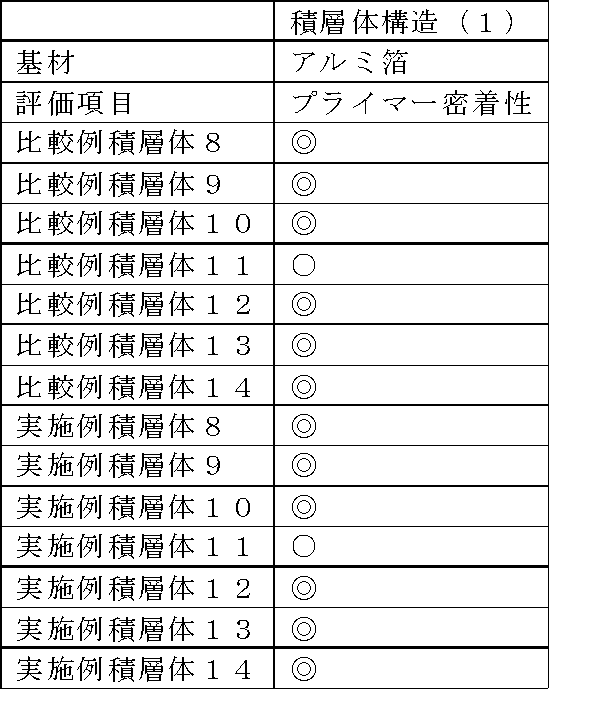
- Example Barriers 1 to 7 corresponding to the layered structure (1) were obtained by applying a dry coating amount of 1.0 g / m 2 on a “barrier rocks VM-PET1011 (HG)” by a direct gravure method. Similarly, a dry coating amount of 1.0 g / m 2 was applied on a 30 ⁇ m-thick aluminum foil (soft aluminum made by Toyo Aluminum Co., Ltd.) as a base material by a direct gravure method.
- Example laminates 8 to 14 were obtained.
- Comparative Example Laminates 1 to 14 Preparation of Comparative Example Laminates 1 to 14
- Comparative Example Primers 1 to 7 consisting of the components (A) and (B) listed in Table 1, a 12 ⁇ m thick aluminum oxide-deposited PET film (“Barrier Rocks VM-PET1011” manufactured by Toray Film Processing Co., Ltd.) HG) ") and a dry coating amount of 1.0 g / m 2 were applied by direct gravure method and cured at 40 ° C. for 48 hours to obtain comparative laminates 1 to 7 corresponding to the laminate structure (1).
- Example laminates 8 to 14 were obtained.
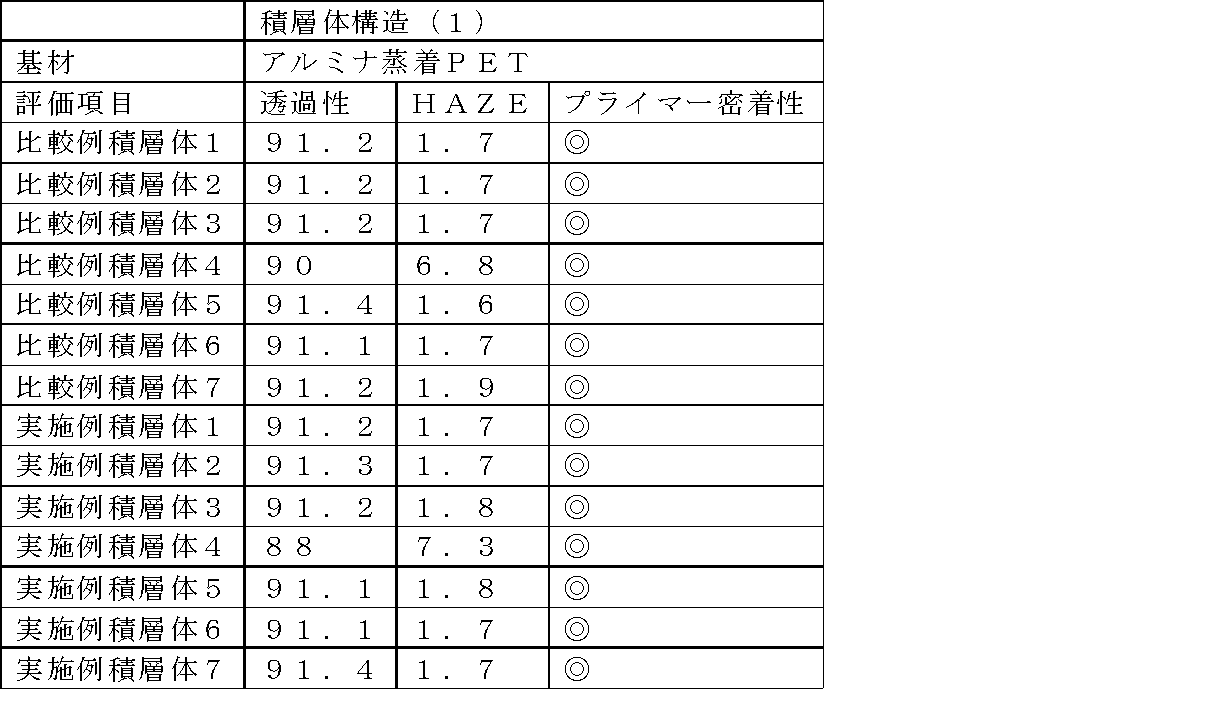
- Example laminates 1 to 7 The following evaluation items were evaluated for Example laminates 1 to 7 and Comparative example laminates 1 to 7. The results are shown in Table 2.
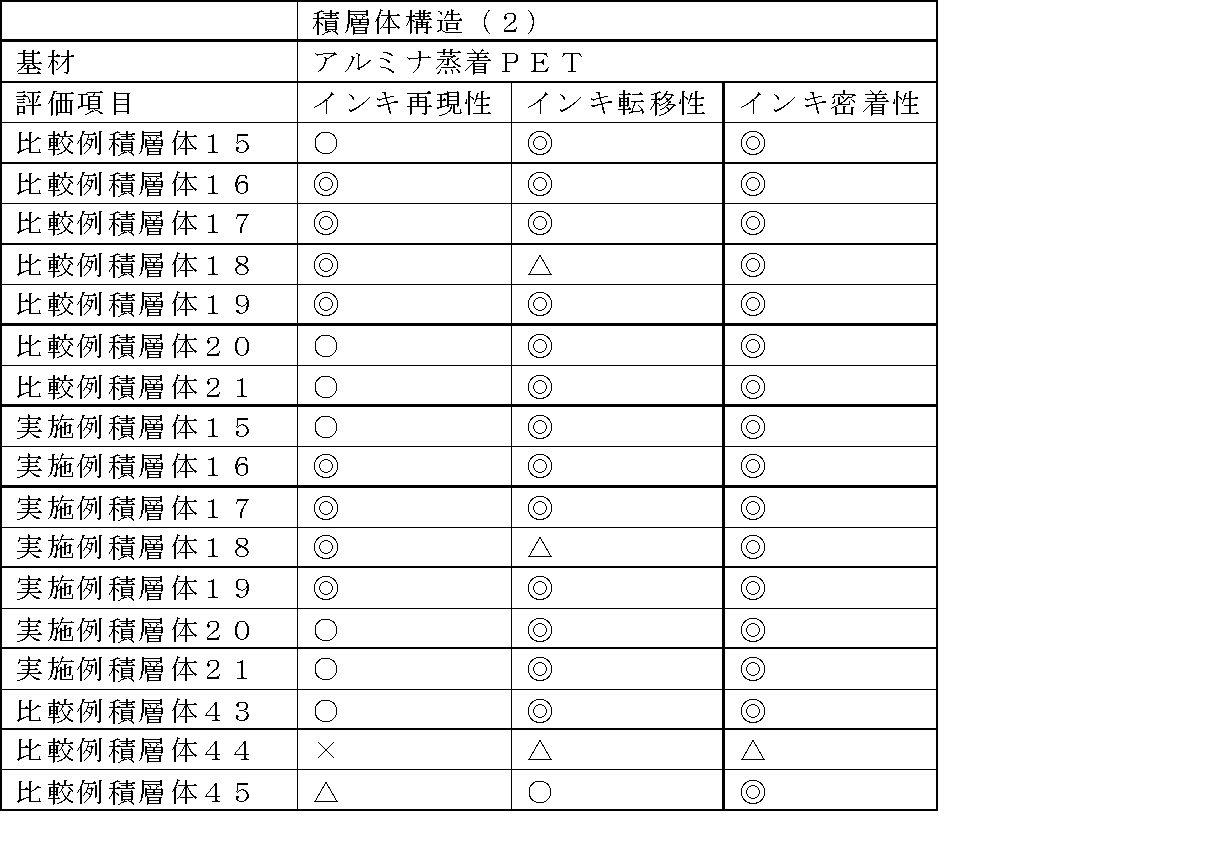
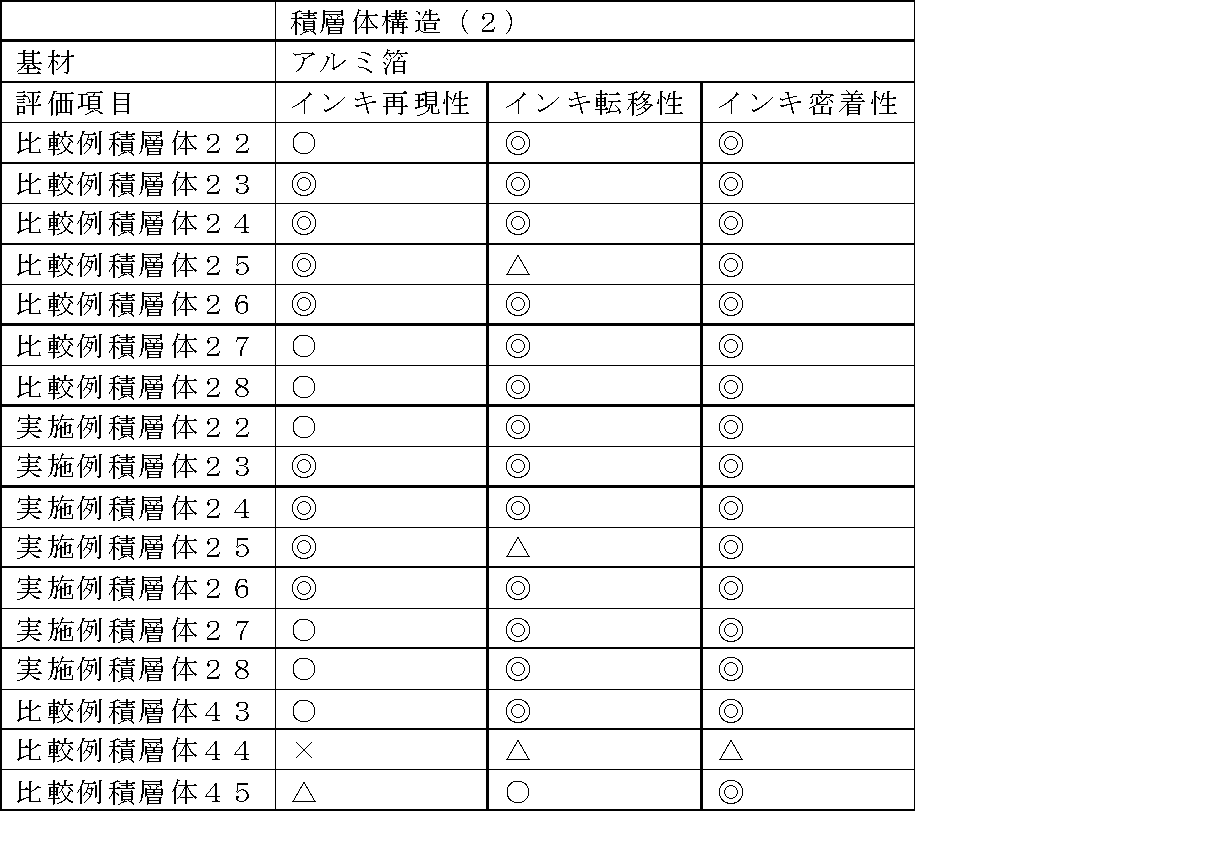
- Example laminates 15 to 28 (Preparation of Example laminates 15 to 28) Furthermore, gravure ink ("Univia A 407 medium yellow, 105 red, 507 primary color indigo, 805 black, 793 white” manufactured by DIC Corporation) is printed on the surface of the primer dry cured coating film, which corresponds to the laminate structure (2).
- Example laminates 15 to 28 and comparative example laminates 15 to 28 were obtained.
- univia A which is a DIC gravure ink, is printed by adding 3 parts of DIC “CVL Hardener # 10” to 100 parts of the ink stock during printing, and is cured at 40 ° C. for 48 hours.
- a solvent-based gravure ink is printed on the laminate of the present invention at a printing speed of 40 m / min.
- the plate used a solid plate and evaluated ink dot reproducibility. The evaluation was performed by visual observation using a microscope (VH-8000 manufactured by KEYENCE) with a magnification of 400 times.
- ⁇ Evaluation criteria> ⁇ : No repelling or ink loss on printed matter ⁇ : No repelling on printed matter, slight ink loss observed in 20% cell ⁇ : No repelling on printed matter, many ink loss observed in 20% cell X: The printed matter has many repelling and ink loss
- Ink transfer property gradation transfer property
- a solvent-based gravure ink is printed on the laminate of the present invention at a printing speed of 40 m / min.
- the gradation version and the solid version were used, and the presence / absence of tone jump, highlighting, and transition of the solid part were evaluated. In addition, evaluation evaluated visually.
- ⁇ Evaluation criteria> ⁇ : Print printed material without tone jump ⁇ : Print printed material with tone jump seen from 40% cell ⁇ : Print printed material with tone jump seen from 60% cell ⁇ : Printed material seen with tone jump from 80% cell thing
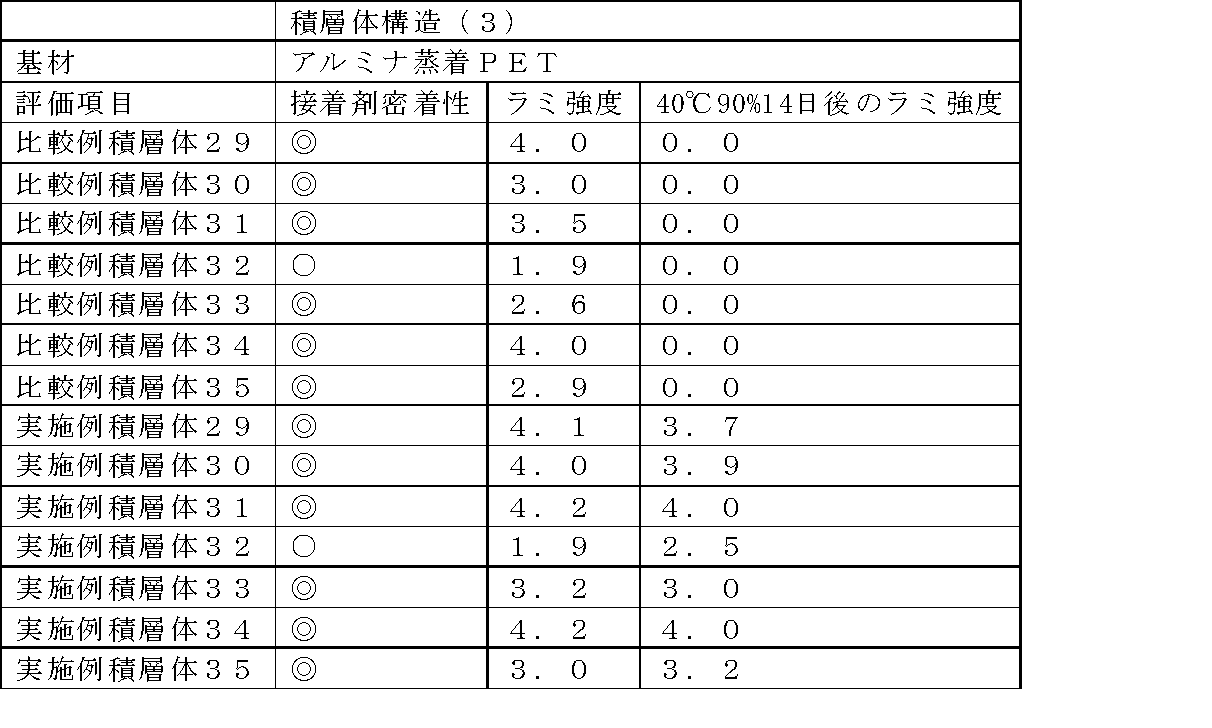
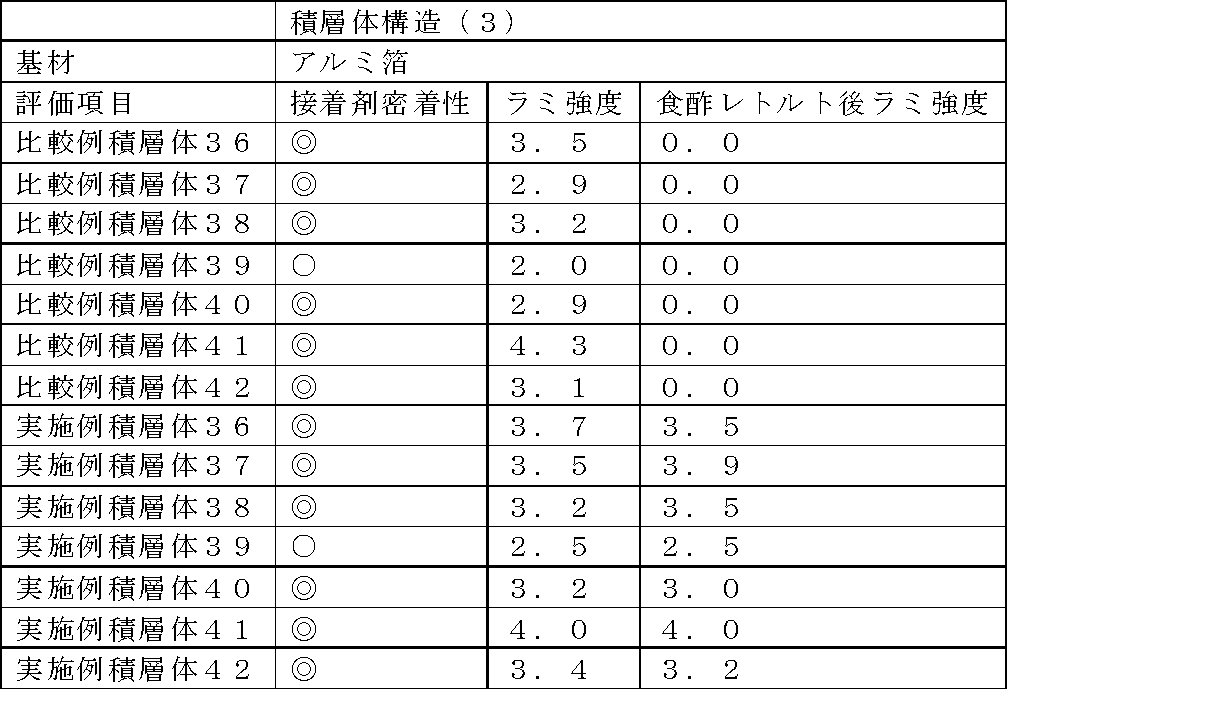
- Example laminates 29 to 42 and comparative example laminates 29 to 42 corresponding to the laminate structure (3) were obtained by dry lamination using “ ⁇ 963”).
- the laminates 29 to 35 of the example and the laminates 29 to 35 of the comparative example were measured by comparing the laminate strength immediately after being stored in an atmosphere of 40 ° C. and 90% for 14 days.
- vinegar Mitsubishi grain vinegar
- a retort test was performed, and the laminate strength after storage for one day was measured and compared. The results are shown in Tables 6 and 7.
- Laminate strength After producing the laminate in the example, the laminate strength was measured at a peeling rate of 200 mm / min in a 180 ° peeling test using a method according to JIS K6854 after curing at 40 ° C. for 72 hours.
- the laminate structure (3) was prepared, it was cured at 40 ° C. for 72 hours, stored in an atmosphere of 40 ° C. and 90% for 14 days, and then 200 mm / min in a 180 ° peel test using a method according to JIS K6854. The laminate strength was measured at a peeling rate of.
- Example Primers 8 to 14 The main agent solution (A) was prepared with the monomer composition shown in Table 8 below.
- the solvent composition was 70: 14: 6 for MEK, ethyl acetate, and propylene glycol monomethyl ether, and the nonvolatile content was adjusted to 10%.
- Example Primers 8 to 14 were prepared by blending the curing agent (B) and the compound (C) having two or more carboxylic acid groups or one or more carboxylic anhydride groups in one molecule with the formulation shown in Table 1. did.
- Example Laminates 46 to 52 (Preparation of Example Laminates 46 to 52) Using primers 8 to 14 comprising the components (A), (B), and (C) listed in Table 8, 12 ⁇ m aluminum oxide-deposited PET film (“Barrier Rocks VM-PET1011 (HG) manufactured by Toray Film Processing Co., Ltd.” ) ”) A dry coating amount of 1.0 g / m 2 was applied by a direct gravure method to obtain Example laminates 46 to 52 corresponding to the laminate structure 1.
- Example Primers 46 to 52 were compared in terms of primer adhesion. The results are shown in Table 9.
- gravure ink (Univia A 407 medium yellow, 105 red, 507 primary color indigo, 805 black, 793 white” manufactured by DIC Corporation) is printed on the surface of the primer dry cured coating film, which corresponds to the laminate structure (2).
- Example laminates 53 to 59 were obtained.
- univia A which is a DIC gravure ink, is printed by adding 3 parts of DIC “CVL Hardener # 10” to 100 parts of the ink stock during printing, and is cured at 40 ° C. for 48 hours.
- ink adhesion, ink transfer property, and ink reproducibility were compared. The results are shown in Table 10.
- Example laminates 60 to 66 were used using an adhesive (“Dick Dry LX-963” manufactured by DIC Corporation). Dry lamination was performed to obtain Example laminates 60 to 66 corresponding to the laminate structure (3).
- adhesive strength, the laminate strength, and the laminate strength immediately after storage for 14 days in an atmosphere of 40 ° C. and 90% were measured and compared. The results are shown in Table 11.
- Example primer 5 consisting of (A) component, (B) component, and (C) component shown in Table 1 was used as a 12 ⁇ m PET film (“E5100” manufactured by Toyobo Co., Ltd.), 12 ⁇ m silica-deposited PET film (manufactured by Toppan Printing Co., Ltd.
- pure white printing paper (“Hamayu” manufactured by Kishu Paper Co., Ltd.) is considered to penetrate into the paper, and a dry coating amount of 3.0 g / m 2 is applied by a direct gravure method to form a laminate structure (1).
- a corresponding example laminate 72 was obtained.
- the primer laminates 67 to 72 were compared in terms of primer adhesion. The results are shown in Table 12.
- Example primer 5 shown in Table 1 was applied on a 12 ⁇ m PET film (“E5100” manufactured by Toyobo Co., Ltd.) by a reverse gravure method to apply a dry coating amount of 1.0 g / m 2 to obtain a laminate 73.
- a 50 nm aluminum oxide vapor deposition was performed on this coated surface by an oxidation reaction vapor deposition method to obtain a laminate 74.
- the Example primer 5 was applied on the vapor deposition surface again by a reverse gravure method to apply a dry coating amount of 0.5 g / m 2 to obtain a laminate 75.
- gravure ink (“Univia A 407 medium yellow, 105 red, 507 primary color indigo, 805 black, 793 white” manufactured by DIC Corporation) was printed on the coated surface, and a laminate 76 was obtained. Further, this printed surface and an unstretched PP film (“ZK-93KM” manufactured by Toray Film Processing Co., Ltd.) are dry-laminated using an adhesive (“Dick Dry LX-963” manufactured by DIC Corporation) to obtain a laminate. 77 was obtained. About each laminated body, the item shown in Table 13 was evaluated. The results are shown in Table 13. The laminate strength (*) after storage is an evaluation after storage at 40 ° C. and 90% for 14 days.
- the primer of the present invention is excellent in adhesion between the inorganic vapor-deposited coating and the urethane gravure ink, and is also excellent in hot water resistance (121 ° C., 30 minutes) and storability under high humidity conditions.
- the primer of the present invention improves the adhesion between the base material layer of the packaging material and the printing ink layer, coating agent layer or adhesive layer, and the transferability and dot reproducibility of the printing ink. Has excellent printability and easy adhesion, long-term storage under high humidity, and acid resistance. Thereby, it becomes possible to perform high-definition printing excellent in design on the surfaces of various packaging materials that have conventionally been difficult to perform high-definition printing, and can be widely applied to packaging materials.
Landscapes
- Chemical & Material Sciences (AREA)
- Organic Chemistry (AREA)
- Health & Medical Sciences (AREA)
- Polymers & Plastics (AREA)
- Medicinal Chemistry (AREA)
- Chemical Kinetics & Catalysis (AREA)
- Engineering & Computer Science (AREA)
- Materials Engineering (AREA)
- Wood Science & Technology (AREA)
- Life Sciences & Earth Sciences (AREA)
- Manufacturing & Machinery (AREA)
- Laminated Bodies (AREA)
- Paints Or Removers (AREA)
- Wrappers (AREA)
Abstract
Description
ポリエチレンテレフタレートフィルム(以降、PETフィルム)等の基材フィルム(1)上にプライマーを各種塗工方式で塗工し、プライマーの乾燥硬化皮膜(2)を形成した積層体。図1に示す。
積層体構造1のプライマー皮膜(2)上に、グラビアインキ等の印刷インキで印刷層(3)を設けた積層体。図2に示す。
積層体構造(1)のプライマー皮膜(2)上に、グラビアインキ等の印刷インキで印刷層(3)を設けた積層体構造2の印刷層上に、接着剤層(4)を介して、未延伸ポリプロピレンフィルム(以降:PPフィルム)等の貼合フィルム(5)をラミネートした積層体。図3に示す。
アルミ蒸着層(6)を有するPETフィルム等の基材フィルム(1)上にプライマーを各種塗工方式で塗工してプライマーの乾燥硬化皮膜(2)を形成し、該プライマー皮膜(2)上に、グラビアインキ等の印刷インキで印刷層(3)を設けた積層体の印刷層(3)上に接着剤層(4)を介して、未延伸PPフィルム等の貼合フィルム(5)をラミネートした積層体。図4に示す。
前記したPETフィルム等の基材フィルム(1)上にプライマーを各種塗工方式で塗工し、プライマーの乾燥硬化皮膜(2)を形成した積層体構造(1)に相当する積層体の皮膜面に酸化反応蒸着方式にて50nmの酸化アルミ蒸着層(6)を設けた積層体。図5に示す。
前記したPETフィルム等の基材フィルム(1)上にプライマーを各種塗工方式で塗工し、プライマーの乾燥硬化皮膜(2)を形成した積層体構造(1)に相当する積層体の皮膜面に酸化反応蒸着方式にて50nmの酸化アルミ蒸着層(6)を設けた前記積層体構造(5)に相当する積層体の蒸着面に、更にプライマーを各種塗工方式で塗工し、プライマーの乾燥硬化皮膜(2)を形成した積層体。図6に示す。
前記したPETフィルム等の基材フィルム(1)上にプライマーを各種塗工方式で塗工し、プライマーの乾燥硬化皮膜(2)を形成した積層体構造(1)に相当する積層体の皮膜面に酸化反応蒸着方式にて50nmの酸化アルミ蒸着層(6)を設けた前記積層体構造(5)に相当する積層体の蒸着面に、更にプライマーを各種塗工方式で塗工し、プライマーの乾燥硬化皮膜(2)を形成した積層体構造(6)に相当する積層体の塗工面に、更に、グラビアインキ等の印刷インキで印刷層(3)を設けた積層体。図7に示す。
前記したPETフィルム等の基材フィルム(1)上にプライマーを各種塗工方式で塗工し、プライマーの乾燥硬化皮膜(2)を形成した積層体構造(1)に相当する積層体の皮膜面に酸化反応蒸着方式にて50nmの酸化アルミ蒸着層(6)を設けた前記積層体構造(5)に相当する積層体の蒸着面に、更にプライマーを各種塗工方式で塗工し、プライマーの乾燥硬化皮膜(2)を形成した積層体構造(6)に相当する積層体の塗工面に、更に、グラビアインキ等の印刷インキで印刷層(3)を設けた積層体構造(7)に相当する積層体の印刷層(3)上に接着剤層(4)を介して、未延伸PPフィルム等の貼合フィルム(5)をラミネートした積層体。図8に示す。
以下の表1に示す、モノマー配合組成で主剤溶液(A)を調製した。溶剤組成は、MEK、酢酸エチル、プロピレングリコールモノメチルエーテルが、70:14:6であり、不揮発分は10%に調整した。更に、硬化剤(B)、1分子中にカルボン酸基を2個以上または無水カルボン酸基を1個以上有する化合物(C)を同表1に示す配合で、実施例プライマー1~7、比較例プライマー1~7を調製した。

MMA :メチルメタクリレート
AN :アクリロニトリル
β-HEMA:β-ヒドロキシエチルメタクリレート(表中標記ではβ省略)
ST :スチレン
BA :ブチルアクリレート
BMA :ブチルメタクリレート
MAA :メタクリル酸
XDI :キシリレンジイソシアネート
IPDI :イソホロンジイソシアネート
TMP :トリメチロールプロパン
XDI-TMP :XDI-TMPのアダクト体(付加体)
IPDI-TMP :IPDI-TMPのアダクト体(付加体)
DFMCDA :5-(2,5-ジオキソテトラヒドロ-3-フラニル)-3-メチル-3-シクロヘキセン-1,2-ジカルボン酸無水物
VMCH :米国ダウ・ケミカル社製マレイン酸変性塩酢ビ樹脂「VMCH」
353S :日本製紙ケミカル株式会社製マレイン酸変性α―オレフィン樹脂「アウローレン353S」
表1に記載の(A)成分、(B)成分、(C)成分からなる、実施例プライマー1~7を用い、基材として、12μm厚の酸化アルミ蒸着PETフィルム(東レフィルム加工株式会社製「バリアロックスVM-PET1011(HG)」)上にダイレクトグラビア方式にてドライ塗布量1.0g/m2塗工し積層体構造(1)に相当する実施例積層体1~7を得た。同様に、基材として、30μm厚のアルミニウム箔(東洋アルミニウム株式会社製軟質アルミ)上にダイレクトグラビア方式にてドライ塗布量1.0g/m2塗工し積層体構造(1)に相当する実施例積層体8~14を得た。
同時に、表1に記載の(A)成分、(B)成分からなる、比較例プライマー1~7を用い、12μm厚の酸化アルミ蒸着PETフィルム(東レフィルム加工株式会社製「バリアロックスVM-PET1011(HG)」)上にダイレクトグラビア方式にてドライ塗布量1.0g/m2塗工し40℃48時間硬化エージングし積層体構造(1)に相当する比較例積層体1~7を得た。同様に、基材として、30μm厚のアルミニウム箔(東洋アルミニウム株式会社製軟質アルミ)上にダイレクトグラビア方式にてドライ塗布量1.0g/m2塗工し積層体構造(1)に相当する比較例積層体8~14を得た。
(1.透過性)
実施例積層体をHAZE・透過率測定装置ヘイズ-ガードII(東洋精機製作所製)を用いASTM D 1003に記載の方法で測定する。
(2.HAZE)
実施例積層体をHAZE・透過率測定装置ヘイズ-ガードII(東洋精機製作所製)を用いASTM D 1003に記載の方法で測定する。
(3.プライマー接着性)
本発明プライマーを基材に塗工後、印刷面にニチバン製15mm巾セロハン粘着テープを貼り付け剥離する。
<評価基準>
◎ :全くインキが剥離しない
○ :インキの剥離が僅かにある
△ :インキの剥離が20%未満
× :インキの剥離が20%以上
更に、このプライマー乾燥硬化塗膜面にグラビアインキ(DIC株式会社製「ユニビアA 407中黄、105紅、507原色藍、805墨、793白」)を印刷し、積層体構造(2)に相当する実施例積層体15~28、比較例積層体15~28を得た。尚、DIC製グラビアインキであるユニビアAは、印刷時にインキ原液100部に対してDIC製「CVLハードナー#10」を3部添加して印刷を行い、40℃にて48時間硬化エージングを行う。
溶剤系グラビアインキを40m/minの印刷速度で、本発明積層体に印刷。版はベタ版を使用しインキドット再現性を評価した。尚、評価はマイクロスコープ(KEYENCE製VH-8000)を用い、400倍に拡大して目視評価を行った。
<評価基準>
◎:印刷物にはじき、インキ抜けが無い
○:印刷物にはじきが無く、20%セルにおいて僅かにインキ抜けが見られるもの
△:印刷物にはじきが無く、20%セルにおいて多くのインキ抜けが見られるもの
×:印刷物にはじき及びインキ抜けが多数見られるもの
溶剤系グラビアインキを40m/minの印刷速度で、本発明積層体に印刷。版は、グラデーション版、ベタ版を使用し、トーンジャンプの有無、ハイライトの入り、ベタ部の転移性を評価した。尚、評価は目視評価を行った。
<評価基準>
◎:印刷物にトーンジャンプが無いもの
○:印刷物にトーンジャンプが40%セルから見られるもの
△:印刷物にトーンジャンプが60%セルから見られるもの
×:印刷物にトーンジャンプが80%セルから見られるもの
印刷インキを塗工後、印刷面にニチバン製15mm巾セロハン粘着テープを貼り付け剥離する。
<評価基準>
◎:全くインキが剥離しない。
○:インキの剥離が僅かにある
△:インキの剥離が20%未満
×:インキの剥離が20%以上
ディックドライLX-963:ディックドライLX-963/KO-40=8/1
実施例積層体29~42、比較例積層体29~42について接着剤密着性、ラミネート強度を比較した。実施例積層体29~35、比較例積層体29~35については40℃90%雰囲気において14日間保管した直後のラミネート強度を測定し比較した。実施例積層体36~42、比較例積層体36~42については内容物に食酢(ミツカン製穀物酢)を選択しレトルト試験を行い、1日間保管した後のラミネート強度を測定し比較した。結果を表6,7に示す。
ラミネート強度を測定した際、剥離界面をIR分光分析にて測定確認した。
<評価基準>
◎:本発明コーティング剤と接着剤が剥離しない
○:本発明コーティング剤と接着剤が僅かに剥離
△:本発明コーティング剤と接着剤が20%未満の面積剥離
×:本発明コーティング剤と接着剤が20%以上剥離
実施例にある積層体を作成後、40℃にて72時間硬化させた後にJIS K6854に準じる方法を用い、180°剥離試験にて200mm/minの剥離速度でラミネート強度を測定した。
積層体構造(3)を作成後、40℃にて72時間硬化させ、このフィルム構成を使用して縦290mm、横210mmのパウチを作成し、純水、若しくは、食酢(株式会社ミツカン製穀物酢)を充填して121℃にて30分レトルト処理を行った。十分冷却した後にJIS K6854に準じる方法を用い、180°剥離試験にて200mm/minの剥離速度でラミネート強度を測定した。
積層体構造(3)を作成後、40℃にて72時間硬化させ、40℃、90%の雰囲気に14日間保管した後、JIS K6854に準じる方法を用い、180°剥離試験にて200mm/minの剥離速度でラミネート強度を測定した。
以下の表8に示す、モノマー配合組成で主剤溶液(A)を調製した。溶剤組成は、MEK、酢酸エチル、プロピレングリコールモノメチルエーテルが、70:14:6であり、不揮発分は10%に調整した。更に、硬化剤(B)、1分子中にカルボン酸基を2個以上または無水カルボン酸基を1個以上有する化合物(C)を同表1に示す配合で、実施例プライマー8~14を調製した。

表8に記載の(A)成分、(B)成分、(C)成分からなるプライマー8~14を用いて、12μm酸化アルミ蒸着PETフィルム(東レフィルム加工株式会社製「バリアロックスVM-PET1011(HG)」)上にダイレクトグラビア方式にてドライ塗布量1.0g/m2塗工し、積層体構造1に相当する実施例積層体46~52を得た。
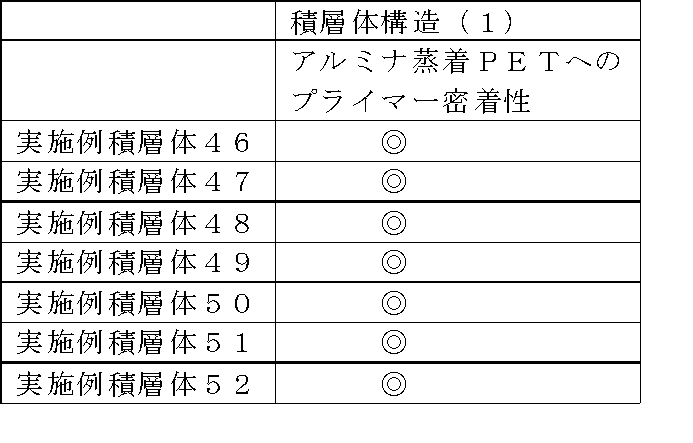

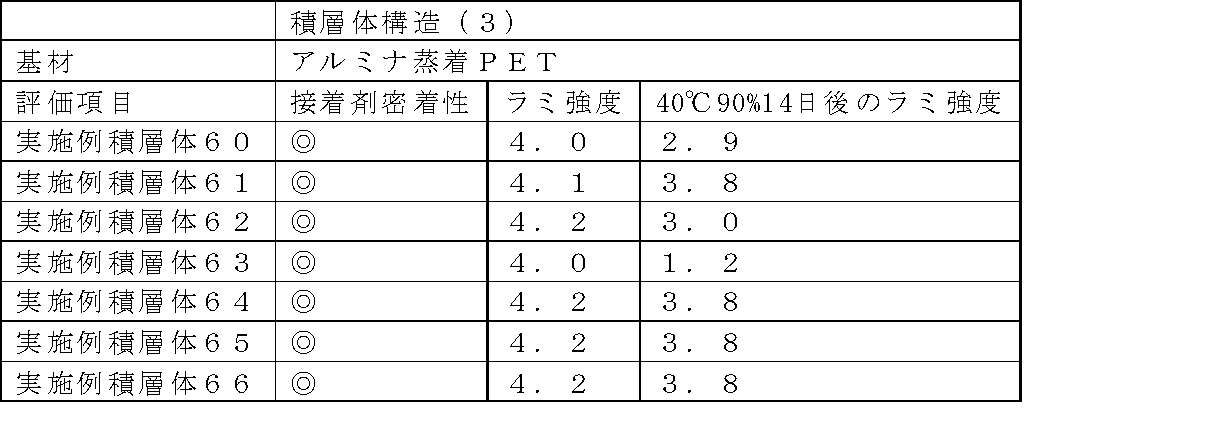
表1に記載の(A)成分、(B)成分、(C)成分からなる実施例プライマー5を12μmPETフィルム(東洋紡株式会社製「E5100」)、12μmシリカ蒸着PETフィルム(凸版印刷株式会社製「GL-E)、12μm酸化アルミ蒸着PETフィルム(大日本印刷株式会社製「IB-PET-PC)、ポリ乳酸系生分解フィルム(ユニチカ株式会社製「テラマックTF)、30μm延伸PPフィルム(二村化学工業製「FOR」)にダイレクトグラビア方式にて、ドライ塗布量1.0g/m2塗工し積層体構造(1)に相当する実施例積層体67~71を得た。更に、基材として、純白印刷紙(紀州製紙製「はまゆう」)には紙に対する浸透を考慮し、ダイレクトグラビア方式にてドライ塗布量3.0g/m2塗工し積層体構造(1)に相当する実施例積層体72を得た。実施例積層体67~72について、プライマーの密着性を比較した。結果を表12に示す。
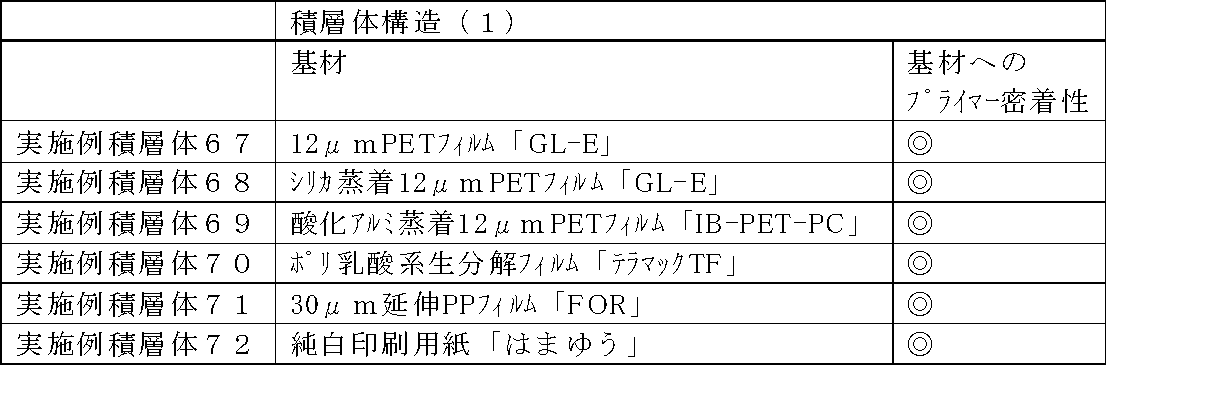
表1の実施例プライマー5を、12μmPETフィルム(東洋紡株式会社製「E5100」)上にリバースグラビア方式にてドライ塗布量1.0g/m2塗工し、積層体73を得た。この塗工面に酸化反応蒸着方式にて50nmの酸化アルミ蒸着を行い、積層体74を得た。更にこの蒸着面に再度リバースグラビア方式にて実施例プライマー5をドライ塗布量0.5g/m2塗工し積層体75を得た。更に、この塗工面にグラビアインキ(DIC株式会社製「ユニビアA 407中黄、105紅、507原色藍、805墨、793白」)を印刷し、積層体76を得た。更に、この印刷面と未延伸PPフィルム(東レフィルム加工株式会社製「ZK-93KM」)を接着剤(DIC株式会社製「ディックドライLX-963」)を使用してドライラミネートして、積層体77を得た。各積層体について、表13に示す項目について評価した。結果を表13に示す。尚、保管後のラミネート強度(*)は40℃90%で14日間保管後の評価である。表13の結果から、本発明のプライマーは無機蒸着コーティングとウレタン系グラビアインキとの密着性に優れ、さらに耐熱水性(121℃、30分)、高湿度条件における保管性にも優れる。

2 本発明のプライマー乾燥硬化皮膜層
3 印刷インキ皮膜層
4 接着剤層
5 貼合フィルム(シーラント材層)
6 蒸着層
Claims (18)
- (a)水酸基を有する不飽和化合物と、(b)不飽和カルボン酸エステル、スチレン、不飽和カルボン酸、不飽和炭化水素、ビニルエステル及びハロゲン化ビニルからなる群のうち1つ以上の不飽和化合物とを単量体とする共重合体からなる主剤(A)と、イソシアネート基を有する化合物からなる硬化剤(B)と、1分子中にカルボン酸基を2個以上または無水カルボン酸基を1個以上有する化合物(C)を含有することを特徴とするプライマー。
- 前記した主剤(A)が、(a)水酸基を有する不飽和化合物と、(b)不飽和カルボン酸エステル、スチレン、不飽和カルボン酸、不飽和炭化水素、ビニルエステル及びハロゲン化ビニルからなる群のうち1つ以上の不飽和化合物と、(c)不飽和ニトリルとを単量体とする共重合体からなる主剤(A)である請求項1に記載のプライマー。
- 前記した1分子中にカルボン酸基を2個以上または無水カルボン酸基を1個以上有する化合物(C)の数平均分子量が1000以下である請求項1または2に記載のプライマー。
- 前記した1分子中にカルボン酸基を2個以上または無水カルボン酸基を1個以上有する化合物(C)のプライマー中の含有量が、不揮発分換算で0.5~50質量%である請求項1~3の何れかに記載のプライマー。
- 前記した1分子中にカルボン酸基を2個以上または無水カルボン酸基を1個以上有する化合物(C)が四塩基酸無水物である請求項1~4の何れかに記載のプライマー。
- 前記主剤(A)中の(c)不飽和ニトリルが、アクリロニトリルを含有し、主剤(A)中の該アクリロニトリルの含有量が、不揮発分換算で10~50質量%である請求項2~5の何れかに記載のプライマー。
- 前記主剤(A)中の(a)水酸基を有する不飽和化合物の含有量が、不揮発分換算で10~70質量%である請求項1~6の何れかに記載のプライマー。
- 前記主剤(A)中の(a)水酸基を有する不飽和化合物が、β-ヒドロキシエチルメタクリレートを含有し、主剤(A)中の該β-ヒドロキシエチルメタクリレートの含有量が、不揮発分換算で10~70質量%である請求項1~7の何れかに記載のプライマー。
- 前記主剤(A)中の(b)不飽和化合物が、不飽和カルボン酸エステルとしてメチルメタクリレートを含有し、主剤(A)中の該メチルメタクリレートの含有量が、不揮発分換算で20~55質量%である請求項1~8の何れかに記載のプライマー。
- 前記主剤(A)中の(b)不飽和化合物が、不飽和カルボン酸として、アクリル酸またはメタクリル酸を含有し、主剤(A)中の該アクリル酸またはメタクリル酸の含有量が、不揮発分換算で0.05~3質量%である請求項1~9の何れかに記載のプライマー。
- 前記主剤(A)中の(b)不飽和化合物が、スチレンを含有し、主剤(A)中の該スチレンの含有量が、不揮発分換算で0.01~30質量%である請求項1~10の何れかに記載のプライマー。
- 前記主剤(A)中の(b)不飽和化合物が、不飽和カルボン酸エステルとして、ブチルアクリレートまたはブチルメタクリレートを含有し、主剤(A)中の該ブチルアクリレートまたはブチルメタクリレートの含有量が、不揮発分換算で0.01~30質量%である請求項1~11の何れかに記載のプライマー。
- 基材上に、請求項1~12の何れかに記載のプライマーから得られる樹脂塗膜を有することを特徴とする積層体。
- 前記基材が、紙、金属、ガラスまたはプラスチックからなる請求項13に記載の積層体。
- 前記樹脂塗膜の上に、インキ層、接着剤層およびシーラント層からなる群のうちいずれか1つ以上を有する請求項13又は14に記載の積層体。
- 前記樹脂塗膜の上に、インキ層、接着剤層、及びシーラント層をこの順に有する請求項13~15の何れかに記載の積層体。
- 前記樹脂塗膜の上に、第二の樹脂塗膜を有する請求項13~16の何れかに記載の積層体。
- 前記樹脂塗膜の上に、無機薄膜層を有する請求項13~16の何れかに記載の積層体。
Priority Applications (5)
| Application Number | Priority Date | Filing Date | Title |
|---|---|---|---|
| EP20090817677 EP2354200B1 (en) | 2008-10-01 | 2009-09-24 | Primer and laminate including resin film formed from the primer |
| US13/122,066 US8440749B2 (en) | 2008-10-01 | 2009-09-24 | Primer and laminate including resin coating film containing the same |
| CN200980133911.9A CN102137903B (zh) | 2008-10-01 | 2009-09-24 | 底漆以及具有由该底漆形成的树脂涂膜的层叠体 |
| JP2010518452A JP4645777B2 (ja) | 2008-10-01 | 2009-09-24 | プライマー及び該プライマーからなる樹脂塗膜を有する積層体 |
| KR1020117004429A KR101679436B1 (ko) | 2008-10-01 | 2009-09-24 | 프라이머 및 상기 프라이머로 이루어지는 수지 도막을 가지는 적층체 |
Applications Claiming Priority (2)
| Application Number | Priority Date | Filing Date | Title |
|---|---|---|---|
| JP2008-256221 | 2008-10-01 | ||
| JP2008256221 | 2008-10-01 |
Publications (1)
| Publication Number | Publication Date |
|---|---|
| WO2010038643A1 true WO2010038643A1 (ja) | 2010-04-08 |
Family
ID=42073408
Family Applications (1)
| Application Number | Title | Priority Date | Filing Date |
|---|---|---|---|
| PCT/JP2009/066481 Ceased WO2010038643A1 (ja) | 2008-10-01 | 2009-09-24 | プライマー及び該プライマーからなる樹脂塗膜を有する積層体 |
Country Status (6)
| Country | Link |
|---|---|
| US (1) | US8440749B2 (ja) |
| EP (1) | EP2354200B1 (ja) |
| JP (1) | JP4645777B2 (ja) |
| KR (1) | KR101679436B1 (ja) |
| CN (1) | CN102137903B (ja) |
| WO (1) | WO2010038643A1 (ja) |
Cited By (7)
| Publication number | Priority date | Publication date | Assignee | Title |
|---|---|---|---|---|
| JP2010131756A (ja) * | 2008-12-02 | 2010-06-17 | Toray Advanced Film Co Ltd | ガスバリア性フィルム |
| WO2013146801A1 (ja) * | 2012-03-27 | 2013-10-03 | 日本ペイント株式会社 | 接着層形成用硬化性樹脂組成物、および基材と被接着基材との一体化方法 |
| JP2013245313A (ja) * | 2012-05-28 | 2013-12-09 | Henkel Japan Ltd | 積層シート用接着剤 |
| JP2013249327A (ja) * | 2012-05-30 | 2013-12-12 | Henkel Japan Ltd | 積層シート用接着剤 |
| KR20170042777A (ko) | 2014-09-16 | 2017-04-19 | 고오 가가쿠고교 가부시키가이샤 | 프라이머 조성물 및 적층 부재 |
| JP2019534917A (ja) * | 2016-09-29 | 2019-12-05 | ビーエーエスエフ ソシエタス・ヨーロピアBasf Se | 水性ポリマー分散液およびインキ定着プライマーとしてのその使用 |
| WO2022009829A1 (ja) | 2020-07-06 | 2022-01-13 | 三井化学株式会社 | コーティング組成物および積層体 |
Families Citing this family (12)
| Publication number | Priority date | Publication date | Assignee | Title |
|---|---|---|---|---|
| JP5889611B2 (ja) * | 2011-11-25 | 2016-03-22 | ヘンケルジャパン株式会社 | 太陽電池バックシート用接着剤 |
| JP5841893B2 (ja) | 2012-04-23 | 2016-01-13 | ヘンケルジャパン株式会社 | 積層シート用接着剤 |
| JP6095297B2 (ja) * | 2012-08-24 | 2017-03-15 | ヘンケルジャパン株式会社 | 積層シート用接着剤 |
| WO2014148330A1 (ja) * | 2013-03-22 | 2014-09-25 | Dic株式会社 | 樹脂組成物、プライマー塗料及び該塗料で塗装されたプラスチック成形品 |
| JP6194190B2 (ja) * | 2013-05-16 | 2017-09-06 | ヘンケルジャパン株式会社 | 太陽電池保護シート用接着剤 |
| BR112018003499A2 (pt) | 2015-10-23 | 2018-09-18 | Hp Indigo Bv | material impresso flexível |
| WO2017162305A1 (en) | 2016-03-24 | 2017-09-28 | Hp Indigo B.V. | Printing substrates |
| CN109074012B (zh) | 2016-07-21 | 2022-04-08 | 惠普印迪戈股份公司 | 标签 |
| KR102545653B1 (ko) * | 2016-09-29 | 2023-06-20 | 주식회사 케이씨씨 | 우레탄 도료 조성물 |
| JPWO2022054727A1 (ja) * | 2020-09-14 | 2022-03-17 | ||
| CN116710277A (zh) * | 2021-01-13 | 2023-09-05 | 凸版印刷株式会社 | 容器以及加热用包装袋 |
| CN117845654B (zh) * | 2024-01-09 | 2025-07-25 | 广东玉兰集团股份有限公司 | 一种柔性壁纸基材、生产方法及应用 |
Citations (9)
| Publication number | Priority date | Publication date | Assignee | Title |
|---|---|---|---|---|
| JPS63137969A (ja) * | 1986-11-28 | 1988-06-09 | Nippon Oil & Fats Co Ltd | 塗料組成物 |
| JPS6410118B2 (ja) | 1982-12-03 | 1989-02-21 | Fujitsu Ltd | |
| JPH0433853A (ja) | 1990-05-30 | 1992-02-05 | Toray Ind Inc | 積層ポリエステルフイルム |
| JPH1120103A (ja) | 1997-06-30 | 1999-01-26 | Unitika Ltd | 易印字性二軸延伸ポリアミドフィルム |
| JP2002080705A (ja) | 2000-09-11 | 2002-03-19 | Unitika Ltd | 接着性に優れた易引裂性ポリエステルフィルム、及びそれを用いた包装材料、包装袋 |
| JP2002138246A (ja) * | 2000-11-01 | 2002-05-14 | Kansai Paint Co Ltd | アルミホイール用粉体プライマー |
| WO2006019171A1 (ja) * | 2004-08-19 | 2006-02-23 | Kansai Paint Co., Ltd. | 水性プライマー組成物 |
| JP2006116704A (ja) | 2004-10-19 | 2006-05-11 | Dainippon Printing Co Ltd | バリア性フィルムおよびそれを使用した積層材 |
| JP2008239911A (ja) * | 2007-03-29 | 2008-10-09 | Dic Corp | プライマー及び該プライマーからなる樹脂塗膜を有する積層体 |
Family Cites Families (7)
| Publication number | Priority date | Publication date | Assignee | Title |
|---|---|---|---|---|
| US4952475A (en) * | 1988-02-09 | 1990-08-28 | Fuji Photo Film Co., Ltd. | Electrophotographic photoreceptor comprising binder resin containing terminal acidic groups |
| JP2822386B2 (ja) | 1988-05-09 | 1998-11-11 | 大日本インキ化学工業株式会社 | 粉体塗料用樹脂組成物 |
| JP3283075B2 (ja) | 1992-11-12 | 2002-05-20 | 大日本インキ化学工業株式会社 | 高固形分樹脂組成物と、それを用いた高固形分型塗料と、これらを用いた塗料の塗装および焼き付け方法 |
| JPH10147744A (ja) | 1996-11-20 | 1998-06-02 | Kansai Paint Co Ltd | 硬化性塗料組成物及び上塗り塗膜形成方法 |
| JP2008013647A (ja) | 2006-07-05 | 2008-01-24 | Kansai Paint Co Ltd | 塗料組成物及び塗膜形成方法 |
| JP5540704B2 (ja) * | 2008-10-01 | 2014-07-02 | 東レ株式会社 | ガスバリア性フィルム |
| US8803920B2 (en) | 2011-12-12 | 2014-08-12 | Google Inc. | Pre-fetching map tile data along a route |
-
2009
- 2009-09-24 US US13/122,066 patent/US8440749B2/en active Active
- 2009-09-24 WO PCT/JP2009/066481 patent/WO2010038643A1/ja not_active Ceased
- 2009-09-24 KR KR1020117004429A patent/KR101679436B1/ko not_active Expired - Fee Related
- 2009-09-24 JP JP2010518452A patent/JP4645777B2/ja active Active
- 2009-09-24 CN CN200980133911.9A patent/CN102137903B/zh active Active
- 2009-09-24 EP EP20090817677 patent/EP2354200B1/en active Active
Patent Citations (9)
| Publication number | Priority date | Publication date | Assignee | Title |
|---|---|---|---|---|
| JPS6410118B2 (ja) | 1982-12-03 | 1989-02-21 | Fujitsu Ltd | |
| JPS63137969A (ja) * | 1986-11-28 | 1988-06-09 | Nippon Oil & Fats Co Ltd | 塗料組成物 |
| JPH0433853A (ja) | 1990-05-30 | 1992-02-05 | Toray Ind Inc | 積層ポリエステルフイルム |
| JPH1120103A (ja) | 1997-06-30 | 1999-01-26 | Unitika Ltd | 易印字性二軸延伸ポリアミドフィルム |
| JP2002080705A (ja) | 2000-09-11 | 2002-03-19 | Unitika Ltd | 接着性に優れた易引裂性ポリエステルフィルム、及びそれを用いた包装材料、包装袋 |
| JP2002138246A (ja) * | 2000-11-01 | 2002-05-14 | Kansai Paint Co Ltd | アルミホイール用粉体プライマー |
| WO2006019171A1 (ja) * | 2004-08-19 | 2006-02-23 | Kansai Paint Co., Ltd. | 水性プライマー組成物 |
| JP2006116704A (ja) | 2004-10-19 | 2006-05-11 | Dainippon Printing Co Ltd | バリア性フィルムおよびそれを使用した積層材 |
| JP2008239911A (ja) * | 2007-03-29 | 2008-10-09 | Dic Corp | プライマー及び該プライマーからなる樹脂塗膜を有する積層体 |
Non-Patent Citations (1)
| Title |
|---|
| See also references of EP2354200A4 |
Cited By (10)
| Publication number | Priority date | Publication date | Assignee | Title |
|---|---|---|---|---|
| JP2010131756A (ja) * | 2008-12-02 | 2010-06-17 | Toray Advanced Film Co Ltd | ガスバリア性フィルム |
| WO2013146801A1 (ja) * | 2012-03-27 | 2013-10-03 | 日本ペイント株式会社 | 接着層形成用硬化性樹脂組成物、および基材と被接着基材との一体化方法 |
| JP2013245313A (ja) * | 2012-05-28 | 2013-12-09 | Henkel Japan Ltd | 積層シート用接着剤 |
| JP2013249327A (ja) * | 2012-05-30 | 2013-12-12 | Henkel Japan Ltd | 積層シート用接着剤 |
| KR20170042777A (ko) | 2014-09-16 | 2017-04-19 | 고오 가가쿠고교 가부시키가이샤 | 프라이머 조성물 및 적층 부재 |
| JP2019534917A (ja) * | 2016-09-29 | 2019-12-05 | ビーエーエスエフ ソシエタス・ヨーロピアBasf Se | 水性ポリマー分散液およびインキ定着プライマーとしてのその使用 |
| JP7204642B2 (ja) | 2016-09-29 | 2023-01-16 | ビーエーエスエフ ソシエタス・ヨーロピア | 水性ポリマー分散液およびインキ定着プライマーとしてのその使用 |
| WO2022009829A1 (ja) | 2020-07-06 | 2022-01-13 | 三井化学株式会社 | コーティング組成物および積層体 |
| JPWO2022009829A1 (ja) * | 2020-07-06 | 2022-01-13 | ||
| JP7604492B2 (ja) | 2020-07-06 | 2024-12-23 | 三井化学株式会社 | コーティング組成物および積層体 |
Also Published As
| Publication number | Publication date |
|---|---|
| CN102137903A (zh) | 2011-07-27 |
| US8440749B2 (en) | 2013-05-14 |
| EP2354200A4 (en) | 2013-07-10 |
| JP4645777B2 (ja) | 2011-03-09 |
| KR20110060890A (ko) | 2011-06-08 |
| EP2354200B1 (en) | 2015-03-04 |
| EP2354200A1 (en) | 2011-08-10 |
| US20110177345A1 (en) | 2011-07-21 |
| CN102137903B (zh) | 2014-04-23 |
| KR101679436B1 (ko) | 2016-11-24 |
| JPWO2010038643A1 (ja) | 2012-03-01 |
Similar Documents
| Publication | Publication Date | Title |
|---|---|---|
| JP4645777B2 (ja) | プライマー及び該プライマーからなる樹脂塗膜を有する積層体 | |
| JP5151209B2 (ja) | プライマー及び該プライマーからなる樹脂塗膜を有する積層体 | |
| JP7639342B2 (ja) | ガスバリア性フィルム | |
| JP5115010B2 (ja) | プライマー組成物及びこれを用いたガスバリアフィルム | |
| JP6560346B2 (ja) | ガスバリア性積層体 | |
| US12128656B2 (en) | Laminated film | |
| WO2010038755A1 (ja) | ガスバリア性フィルム | |
| JP2014030984A (ja) | 積層フィルム | |
| JP6030843B2 (ja) | フレキソ印刷用シートおよびその製造方法 | |
| JP6558463B2 (ja) | 積層フィルム | |
| JP2017193708A (ja) | プライマー層形成用組成物、バリアフィルム、波長変換シート、及びそれらの製造方法 | |
| JP2022026963A (ja) | 積層フィルム及びその製造方法並びに包装袋 | |
| JP7072117B1 (ja) | ガスバリア性グラビア積層体、ガスバリア用グラビアインキセット、およびガスバリア性グラビア積層体の製造方法 | |
| JP5516032B2 (ja) | ガスバリア性積層体 | |
| JP2018158530A (ja) | ガスバリア性積層フィルム | |
| JP4611683B2 (ja) | 塗工液および保護層を有する蒸着フィルム | |
| JP2016064650A (ja) | ガスバリア性フィルム | |
| JP7816472B2 (ja) | 積層フィルム | |
| JP2008056835A (ja) | 蒸着フィルム用コート剤組成物 | |
| JP2017114079A (ja) | バリア性フィルムおよびバリア性包装体 | |
| JP6807668B2 (ja) | バリア性積層フィルムおよびレトルト食品用包装体 | |
| JP2018047682A (ja) | 樹脂積層金属板及びその製造方法 | |
| JP5703847B2 (ja) | 超低粘度塗剤を用いたグラビアコーティング方法およびこの方法により製造されたガスバリア性フィルム | |
| JP2002256247A (ja) | 熱硬化型接着剤 |
Legal Events
| Date | Code | Title | Description |
|---|---|---|---|
| WWE | Wipo information: entry into national phase |
Ref document number: 200980133911.9 Country of ref document: CN |
|
| WWE | Wipo information: entry into national phase |
Ref document number: 2010518452 Country of ref document: JP |
|
| 121 | Ep: the epo has been informed by wipo that ep was designated in this application |
Ref document number: 09817677 Country of ref document: EP Kind code of ref document: A1 |
|
| ENP | Entry into the national phase |
Ref document number: 20117004429 Country of ref document: KR Kind code of ref document: A |
|
| WWE | Wipo information: entry into national phase |
Ref document number: 13122066 Country of ref document: US |
|
| NENP | Non-entry into the national phase |
Ref country code: DE |
|
| WWE | Wipo information: entry into national phase |
Ref document number: 1456/KOLNP/2011 Country of ref document: IN |
|
| WWE | Wipo information: entry into national phase |
Ref document number: 2009817677 Country of ref document: EP |