WO2011111989A2 - Substrat céramique à métal lié - Google Patents
Substrat céramique à métal lié Download PDFInfo
- Publication number
- WO2011111989A2 WO2011111989A2 PCT/KR2011/001609 KR2011001609W WO2011111989A2 WO 2011111989 A2 WO2011111989 A2 WO 2011111989A2 KR 2011001609 W KR2011001609 W KR 2011001609W WO 2011111989 A2 WO2011111989 A2 WO 2011111989A2
- Authority
- WO
- WIPO (PCT)
- Prior art keywords
- ceramic substrate
- metal layer
- metal
- cutting line
- bonded
- Prior art date
- Legal status (The legal status is an assumption and is not a legal conclusion. Google has not performed a legal analysis and makes no representation as to the accuracy of the status listed.)
- Ceased
Links
Images




Classifications
-
- H—ELECTRICITY
- H10—SEMICONDUCTOR DEVICES; ELECTRIC SOLID-STATE DEVICES NOT OTHERWISE PROVIDED FOR
- H10W—GENERIC PACKAGES, INTERCONNECTIONS, CONNECTORS OR OTHER CONSTRUCTIONAL DETAILS OF DEVICES COVERED BY CLASS H10
- H10W40/00—Arrangements for thermal protection or thermal control
- H10W40/20—Arrangements for cooling
- H10W40/25—Arrangements for cooling characterised by their materials
- H10W40/255—Arrangements for cooling characterised by their materials having a laminate or multilayered structure, e.g. direct bond copper [DBC] ceramic substrates
-
- C—CHEMISTRY; METALLURGY
- C04—CEMENTS; CONCRETE; ARTIFICIAL STONE; CERAMICS; REFRACTORIES
- C04B—LIME, MAGNESIA; SLAG; CEMENTS; COMPOSITIONS THEREOF, e.g. MORTARS, CONCRETE OR LIKE BUILDING MATERIALS; ARTIFICIAL STONE; CERAMICS; REFRACTORIES; TREATMENT OF NATURAL STONE
- C04B37/00—Joining burned ceramic articles with other burned ceramic articles or other articles by heating
- C04B37/02—Joining burned ceramic articles with other burned ceramic articles or other articles by heating with metallic articles
- C04B37/023—Joining burned ceramic articles with other burned ceramic articles or other articles by heating with metallic articles characterised by the interlayer used
- C04B37/026—Joining burned ceramic articles with other burned ceramic articles or other articles by heating with metallic articles characterised by the interlayer used consisting of metals or metal salts
-
- H—ELECTRICITY
- H10—SEMICONDUCTOR DEVICES; ELECTRIC SOLID-STATE DEVICES NOT OTHERWISE PROVIDED FOR
- H10W—GENERIC PACKAGES, INTERCONNECTIONS, CONNECTORS OR OTHER CONSTRUCTIONAL DETAILS OF DEVICES COVERED BY CLASS H10
- H10W70/00—Package substrates; Interposers; Redistribution layers [RDL]
- H10W70/60—Insulating or insulated package substrates; Interposers; Redistribution layers
- H10W70/67—Insulating or insulated package substrates; Interposers; Redistribution layers characterised by their insulating layers or insulating parts
- H10W70/69—Insulating materials thereof
- H10W70/692—Ceramics or glasses
-
- C—CHEMISTRY; METALLURGY
- C04—CEMENTS; CONCRETE; ARTIFICIAL STONE; CERAMICS; REFRACTORIES
- C04B—LIME, MAGNESIA; SLAG; CEMENTS; COMPOSITIONS THEREOF, e.g. MORTARS, CONCRETE OR LIKE BUILDING MATERIALS; ARTIFICIAL STONE; CERAMICS; REFRACTORIES; TREATMENT OF NATURAL STONE
- C04B2237/00—Aspects relating to ceramic laminates or to joining of ceramic articles with other articles by heating
- C04B2237/30—Composition of layers of ceramic laminates or of ceramic or metallic articles to be joined by heating, e.g. Si substrates
- C04B2237/32—Ceramic
- C04B2237/34—Oxidic
- C04B2237/343—Alumina or aluminates
-
- C—CHEMISTRY; METALLURGY
- C04—CEMENTS; CONCRETE; ARTIFICIAL STONE; CERAMICS; REFRACTORIES
- C04B—LIME, MAGNESIA; SLAG; CEMENTS; COMPOSITIONS THEREOF, e.g. MORTARS, CONCRETE OR LIKE BUILDING MATERIALS; ARTIFICIAL STONE; CERAMICS; REFRACTORIES; TREATMENT OF NATURAL STONE
- C04B2237/00—Aspects relating to ceramic laminates or to joining of ceramic articles with other articles by heating
- C04B2237/30—Composition of layers of ceramic laminates or of ceramic or metallic articles to be joined by heating, e.g. Si substrates
- C04B2237/32—Ceramic
- C04B2237/36—Non-oxidic
- C04B2237/365—Silicon carbide
-
- C—CHEMISTRY; METALLURGY
- C04—CEMENTS; CONCRETE; ARTIFICIAL STONE; CERAMICS; REFRACTORIES
- C04B—LIME, MAGNESIA; SLAG; CEMENTS; COMPOSITIONS THEREOF, e.g. MORTARS, CONCRETE OR LIKE BUILDING MATERIALS; ARTIFICIAL STONE; CERAMICS; REFRACTORIES; TREATMENT OF NATURAL STONE
- C04B2237/00—Aspects relating to ceramic laminates or to joining of ceramic articles with other articles by heating
- C04B2237/30—Composition of layers of ceramic laminates or of ceramic or metallic articles to be joined by heating, e.g. Si substrates
- C04B2237/32—Ceramic
- C04B2237/36—Non-oxidic
- C04B2237/366—Aluminium nitride
-
- C—CHEMISTRY; METALLURGY
- C04—CEMENTS; CONCRETE; ARTIFICIAL STONE; CERAMICS; REFRACTORIES
- C04B—LIME, MAGNESIA; SLAG; CEMENTS; COMPOSITIONS THEREOF, e.g. MORTARS, CONCRETE OR LIKE BUILDING MATERIALS; ARTIFICIAL STONE; CERAMICS; REFRACTORIES; TREATMENT OF NATURAL STONE
- C04B2237/00—Aspects relating to ceramic laminates or to joining of ceramic articles with other articles by heating
- C04B2237/30—Composition of layers of ceramic laminates or of ceramic or metallic articles to be joined by heating, e.g. Si substrates
- C04B2237/32—Ceramic
- C04B2237/36—Non-oxidic
- C04B2237/368—Silicon nitride
-
- C—CHEMISTRY; METALLURGY
- C04—CEMENTS; CONCRETE; ARTIFICIAL STONE; CERAMICS; REFRACTORIES
- C04B—LIME, MAGNESIA; SLAG; CEMENTS; COMPOSITIONS THEREOF, e.g. MORTARS, CONCRETE OR LIKE BUILDING MATERIALS; ARTIFICIAL STONE; CERAMICS; REFRACTORIES; TREATMENT OF NATURAL STONE
- C04B2237/00—Aspects relating to ceramic laminates or to joining of ceramic articles with other articles by heating
- C04B2237/30—Composition of layers of ceramic laminates or of ceramic or metallic articles to be joined by heating, e.g. Si substrates
- C04B2237/40—Metallic
- C04B2237/402—Aluminium
-
- C—CHEMISTRY; METALLURGY
- C04—CEMENTS; CONCRETE; ARTIFICIAL STONE; CERAMICS; REFRACTORIES
- C04B—LIME, MAGNESIA; SLAG; CEMENTS; COMPOSITIONS THEREOF, e.g. MORTARS, CONCRETE OR LIKE BUILDING MATERIALS; ARTIFICIAL STONE; CERAMICS; REFRACTORIES; TREATMENT OF NATURAL STONE
- C04B2237/00—Aspects relating to ceramic laminates or to joining of ceramic articles with other articles by heating
- C04B2237/30—Composition of layers of ceramic laminates or of ceramic or metallic articles to be joined by heating, e.g. Si substrates
- C04B2237/40—Metallic
- C04B2237/407—Copper
-
- C—CHEMISTRY; METALLURGY
- C04—CEMENTS; CONCRETE; ARTIFICIAL STONE; CERAMICS; REFRACTORIES
- C04B—LIME, MAGNESIA; SLAG; CEMENTS; COMPOSITIONS THEREOF, e.g. MORTARS, CONCRETE OR LIKE BUILDING MATERIALS; ARTIFICIAL STONE; CERAMICS; REFRACTORIES; TREATMENT OF NATURAL STONE
- C04B2237/00—Aspects relating to ceramic laminates or to joining of ceramic articles with other articles by heating
- C04B2237/50—Processing aspects relating to ceramic laminates or to the joining of ceramic articles with other articles by heating
- C04B2237/86—Joining of two substrates at their largest surfaces, one surface being complete joined and covered, the other surface not, e.g. a small plate joined at it's largest surface on top of a larger plate
Definitions
- the present invention relates to a ceramic substrate, and more particularly to a metal bonded ceramic substrate having a structure that can improve the accuracy of the circuit pattern during manufacturing, improve the productivity and process efficiency of the semiconductor mounting process.
- metals such as copper (Cu) and aluminum (Al) are bonded to substrates of ceramic materials such as alumina (Al 2 O 3 ), aluminum nitride (AlN), silicon carbide (SiC) and silicon nitride (Si 3 N 4 ). So-called metal bonded ceramic substrates are widely used and used as component parts of semiconductor devices.
- a method of integrally joining a ceramic substrate and a metal circuit board wherein a metal such as copper is placed in contact with the ceramic substrate and heated to a temperature lower than the melting point of copper (1083 ° C) and higher than the eutectic point of copper and oxygen (1065 ° C).
- Direct bonding copper (DBC) method for directly bonding a copper plate to a substrate has been developed and commercialized. Recently, in order to maintain more heat dissipation and strong mechanical bonding properties, a metal circuit board is bonded through a solder material layer. Ceramic circuit boards manufactured by the active metal method have also been developed and applied to power semiconductors that require high reliability.
- the metal bonded ceramic substrate is manufactured by bonding a metal plate to a large ceramic substrate and manufacturing a desired circuit pattern by chemically etching a metal, which is a general pattern implementation method of a printed circuit board.
- This method can manufacture several arrays of circuit boards at the same time and finally cut them into individual products through laser processing such as carbon dioxide.
- the individual circuit board located at the outermost part of the cut individual circuit boards differs from the individual circuit board located at the center of the pattern, and is heat-treated after the braze layer is printed on the individual products to mount the semiconductor device. In this case, it is more difficult to meet the proper temperature condition than the individual circuit board.
- the metal-bonded ceramic substrate is warped to generate a large problem in applying an automated process.
- an object of the present invention is to solve the problems of the prior art as described above, and to improve the dimensional accuracy during the etching process for forming a circuit pattern, advantageous bending occurrence and strength in printing a brazing filler metal layer for mounting a semiconductor device.
- a metal bonded ceramic substrate having a complex array structure effective to maintain a stable process and through the improvement of the temperature uniformity during heat treatment of the brazing material layer.
- a metal layer is bonded to the surface to form a circuit pattern, the metal layer is a metal bonded ceramic substrate is arranged in a plurality of columns and rows, At least one surface of the ceramic substrate is characterized in that the additional metal layer is formed along the edge so as to be located outside the metal layer.
- the spacing between the metal layers is the same as the spacing between the outermost metal layer and the additional metal layer.
- At least one cutting line is formed between the metal layer and between the metal layer and the additional metal layer.
- the cutting line is characterized in that the metal layer is composed of an outer cutting line formed between the edge and the inner cutting line formed between the metal layer.
- the additional metal layer is characterized in that the cutting channel is formed in a portion corresponding to the extension of the boundary of the metal layer arranged in a plurality of columns and rows.
- the inner cutting line extends only to the edge of the metal layer, and the outer cutting line extends to the edge of the ceramic substrate through the cutting channel.
- the outer cutting line and the inner cutting line are characterized in that extend through the cutting channel to the edge of the ceramic substrate.
- the ceramic substrate is made of a ceramic material of alumina (Al 2 O 3), aluminum nitride (AlN), silicon carbide (SiC) or silicon nitride (Si 3 N 4), and the metal layer 20 is made of copper or aluminum.
- the additional metal layer is formed to have a different area and shape on the upper and lower surfaces of the ceramic substrate, respectively.
- the present invention it is possible to improve the dimensional accuracy by reducing the variation of the circuit pattern during the etching process for forming the circuit, and to reduce the temperature deviation during heat treatment of the brazing filler metal layer for mounting the semiconductor chip, thereby improving the bonding characteristics of the semiconductor chip.
- the warpage caused by the difference in thermal expansion coefficient between the metal and the ceramic can be alleviated or artificially controlled.
- FIGS. 1A to 1F are schematic views showing a manufacturing process of a metal bonded ceramic substrate.
- Figure 2 is a plan view showing a conventional metal bonded ceramic substrate.
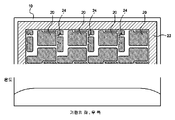
- Figure 3 is a plan view showing a metal bonded ceramic substrate according to an embodiment of the present invention.
- FIGS. 2 and 3 are views of a portion indicated by a dotted line in FIGS. 2 and 3.
- FIG. 5 is a graph schematically showing a temperature distribution during heat treatment of a conventional metal bonded ceramic substrate.
- FIG. 6 is a graph schematically showing a temperature distribution during heat treatment of a metal bonded ceramic substrate according to an embodiment of the present invention.
- FIG. 8 is a graph schematically showing the stress distribution on the upper and lower surfaces of a conventional metal bonded ceramic substrate.
- Figure 9 is a schematic diagram showing that warping occurs in a conventional metal bonded ceramic substrate.
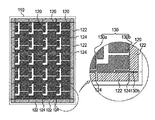
- FIG. 10 is a plan view showing a metal bonded ceramic substrate according to another embodiment of the present invention.
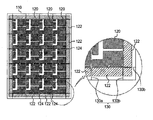
- FIG. 11 is a plan view showing a metal bonded ceramic substrate according to another embodiment of the present invention.
- the configuration indicated by the reference numeral 10 will be expressed in two terms, ceramic substrate, metal bonded ceramic substrate, and the configuration indicated by the reference numeral 20 will be expressed in two terms, metal or metal layer.
- FIGS. 1A to 1F a manufacturing process of a metal bonded ceramic substrate will be described.
- the metal 20 is first placed in contact with the ceramic substrate 10 and then directly bonded (DBC).
- DBC directly bonded
- 1A is bonded by a method or an active metal method, and the bonded metal bonded ceramic substrate 10 is coated with a photosensitive film 30 called a dry film to cure only necessary portions through ultraviolet exposure (see FIG. 1B). ).
- the uncured portion of the metal layer 20 bonded and bonded to the ceramic substrate 10 is developed as shown in FIG. 1C, and the ceramic is removed through an etching process (see FIG. 1D) to remove unnecessary portions by acidic chemicals.
- a circuit pattern is formed on the substrate 10.
- the photosensitive film 30 is removed by a peeling process (see FIG. 1E), and finally a circuit pattern is formed by the metal layer 20 bonded to the ceramic substrate 10 through an etching process.
- the ceramic is melted and cut using a carbon dioxide laser or the like that generates strong light energy (see FIG. 1F).
- the metal bonded ceramic substrate 10 made by the manufacturing process described above may be designed in various arrangements according to the design method of the manufacturer or the needs of the consumer.
- the metal layer 20 may be bonded to both surfaces of the ceramic substrate 10 such that the circuit patterns are formed to be symmetrical with each other.
- the circuit pattern is formed on one surface and the metal layer 20 is not a circuit pattern on the other surface. It may be formed to occupy.
- FIG. 2 is a plan view showing a conventional metal bonded ceramic substrate
- FIG. 3 is a plan view showing a metal bonded ceramic substrate according to an embodiment of the present invention.
- FIG. 2 and 3 show a comparison between a metal bonded ceramic substrate according to the prior art and the present invention.
- a plurality of metal layers 20 are arranged in one column and one row on one surface of the ceramic substrate 10.
- all of the metal layers 20 that do not form the circuit pattern are removed.
- all unnecessary portions corresponding to the outside of the metal layer 20 are removed.
- an additional metal layer 22 is bonded to the outer side of the metal layer 20.
- the ceramic substrate 10 and the metal layer 20 may be made of various materials.
- the ceramic substrate 10 is made of ceramic materials such as alumina (Al 2 O 3 ), aluminum nitride (AlN), silicon carbide (SiC), and silicon nitride (Si 3 N 4 ), and the metal layer 20 ) Is made of copper (Cu) or aluminum (Al).
- the additional metal layer 22 is formed along the edge of the ceramic substrate 10, and may be bonded to at least one surface of the ceramic substrate 10.
- the additional metal layer 22 surrounds the outer portion of the metal layer 20 in a strap shape.
- the formed additional metal layer 22 has the advantage of improving the dimensional accuracy of the ceramic substrate 10 and reducing the temperature deviation during heat treatment to improve the bonding characteristics of the semiconductor chip. Detailed description thereof will be given below.
- cutting lines 24 are formed between the metal layers 20.
- the cutting line 24 is also formed between the metal layer 20 and the additional metal layer 22.
- the cutting lines 24 are portions formed to facilitate cutting of the metal layers 20, respectively.
- the spacing between the metal layer 20 is preferably formed equal to the spacing between the outermost metal layer 20 and the additional metal layer 22.
- the cutting line 24 is formed along a central portion between the metal layer 20 and a central portion between the outermost metal layer 20 and the additional metal layer 22.
- FIGS. 2 and 3 are views of a portion indicated by the dotted lines of FIGS. 2 and 3.
- dimension 1 the distance between the outermost metal layer 20 and the cutting line 24 is referred to as dimension 1 (L1), and the distance between the metal layer 20 and the cutting line 24 located inside is determined. Assume dimension 2 (L2).
- the metal bonded ceramic substrate 10 may be etched under the same conditions as the center portion (the portion where the metal layer is formed).
- the size of the dimension 1 and the dimension 2 may be the same, resulting in an improvement in the dimensional accuracy of the circuit pattern.
- Table 1 shows the circuit dimensions of the metal bonded ceramic substrate, and the conventional dimension 1 is about 0.1 mm larger than the dimension 2 and the dimension 1 of the present invention is almost the same as the dimension 2. This is due to the difference between the conventional metal bonded ceramic substrate which failed to equally match the environment of adjacent parts when etching the metal layer 20 and the metal bonded ceramic substrate of the present invention in which the metal layer 20 is positioned at the same distance from the adjacent parts. appear.
- FIG. 5 is a graph schematically showing a temperature distribution during heat treatment of a conventional metal bonded ceramic substrate
- FIG. 6 schematically shows a temperature distribution during heat treatment of a metal bonded ceramic substrate according to an embodiment of the present invention. The graph shown is shown.
- a solder material layer is formed on the surface of the ceramic substrate through a printing method, and the semiconductor chip is placed on the solder material layer and subjected to a bonding process.
- the temperature is maintained at 150 to 350 ° C. for about 10 to 30 minutes in a continuous heat treatment facility, the solder material layer may melt to strongly bond the semiconductor chip and the ceramic substrate 10.
- the difference in the melting degree of the brazing material layer occurs according to the deviation of the temperature received by the ceramic substrate 10 during the heat treatment.
- the temperature deviation is large, the brazing material layer does not melt, and thus the bonding is not performed normally.
- heat is concentrated, a spreading phenomenon of the brazing filler metal layer occurs and an air layer is formed therein, thereby deteriorating a bonding property.
- Table 2 shows the wettability of the brazing filler metal layer at positions (1) and (2) of FIG. 7.
- the difference between position (1) (outer part) and position (2) (middle part) is about 10%, which not only lowers the bonding characteristics with the semiconductor chip but also the process conditions. It also works against you.
- the difference in positions (1) and (2) is less than about 1%, and the average wettability is less than 5%, so that wettability can be remarkably improved compared with the prior art.
- Position 1 Position 2 Position 1 Position 2 One 21.4% 11.2% 4.2% 3.8% 2 18.5% 8.0% 3.6% 3.4% 3 19.5% 8.8% 5.4% 3.9% 4 21.2% 5.5% 4.8% 3.8% 5 18.8% 9.8% 4.2% 3.2% 6 17.5% 8.5% 4.8% 3.6% 7 19.2% 7.6% 5.5% 3.7% 8 20.1% 9.8% 4.5% 3.5% 9 20.5% 10.2% 3.8% 3.7% 10 22.6% 8.4% 4.1% 3.8% Average 19.93% 8.78% 4.49% 3.64%
- FIG. 8 a graph schematically showing stress distributions on the upper and lower surfaces of the conventional metal bonded ceramic substrate is shown in FIG. 8, and FIG. 9 is a schematic view showing that warpage occurs in the conventional metal bonded ceramic substrate.
- a semiconductor device is mounted on an upper surface of a metal bonded ceramic substrate, and various types of circuit patterns for connecting circuits and circuits, circuits, and semiconductor devices are realized through wire bonding.
- a simple pattern of a rectangular shape is formed on the lower surface without forming a complicated pattern in order to effectively radiate heat to a portion bonded to the heat sink.
- an additional metal layer 22 is further formed as described above to minimize the occurrence of such warpage.
- the area and shape of the additional metal layer 22 formed as described above the occurrence of warpage can be alleviated more, and the direction of the warpage desired can be further adjusted.
- Figure 10 is a plan view showing a metal bonded ceramic substrate according to another embodiment of the present invention
- Figure 11 is a plan view showing a metal bonded ceramic substrate according to another embodiment of the present invention.
- the same components as in the above-described embodiment are denoted by the reference numerals of 100, and detailed description thereof will be omitted.
- the additional metal layer 122 is not connected by one strap, and the cutting channel 124 is formed between the additional metal layers 122.
- the cutting channel 124 represents a portion corresponding to an extension line of the boundary of the metal layer 120.
- the cutting line 130 is composed of an inner cutting line 130a and an outer cutting line 130b.
- the outer cutting line 130b represents a cutting line located at an edge (outermost) of the metal layer 120 arranged in a plurality of columns and rows, and the inner cutting line 130a is a cutting line located inside.
- the cutting line formed between 122) is shown.
- the inner cutting line 130a does not extend to the cutting channel 124, and only the outer cutting line 130b extends to the cutting channel 124.
- the outer cutting line 130b preferably extends to the cutting channel 124 only in portions (upper and lower or left and right portions in FIG. 10) corresponding to both sides, rather than extending to the cutting channel 124. That is, at least a portion of the outer cutting line 130b extends into the cutting channel 124. This is to cut portions corresponding to both sides when cutting the additional metal layer 122, respectively, and to prevent the additional metal layer 122 positioned vertically after the cutting from being arbitrarily cut with the portion of the metal layer 120.
Landscapes
- Chemical & Material Sciences (AREA)
- Engineering & Computer Science (AREA)
- Ceramic Engineering (AREA)
- Materials Engineering (AREA)
- Structural Engineering (AREA)
- Organic Chemistry (AREA)
- Structure Of Printed Boards (AREA)
- Ceramic Products (AREA)
- Cooling Or The Like Of Semiconductors Or Solid State Devices (AREA)
Abstract
La présente invention concerne un substrat céramique à métal lié. La présente invention concerne un substrat céramique, sur la surface duquel des couches métalliques sont liées pour former un motif de circuit. Les couches métalliques qui forment le motif de circuit sont disposées en colonnes et rangées. Une couche métallique supplémentaire est formée le long de la bordure d'au moins une surface du substrat céramique de telle sorte que la couche métallique supplémentaire soit située le long des périphéries des couches métalliques. Il est souhaitable que l'espace entre les couches métalliques soit le même que l'espace entre les couches métalliques et la couche métallique supplémentaire. Conformément à la présente invention, la déviation du motif de circuit peut être réduite au cours d'un procédé de gravure pour former un circuit, permettant ainsi d'améliorer la précision des dimensions, la déviation de température peut être réduite pendant un traitement thermique d'une couche de matériau de brasage pour monter une puce de semi-conducteur, permettant ainsi d'améliorer les caractéristiques de liaison de la puce de semi-conducteur et un gauchissement dû à la différence dans les coefficients de dilatation thermique d'un métal et d'une céramique peut être atténuée ou artificiellement contrôlée.
Priority Applications (2)
| Application Number | Priority Date | Filing Date | Title |
|---|---|---|---|
| EP11753594.8A EP2546870A4 (fr) | 2010-03-09 | 2011-03-09 | Substrat céramique à métal lié |
| JP2012556974A JP5642808B2 (ja) | 2010-03-09 | 2011-03-09 | 金属接合セラミック基板 |
Applications Claiming Priority (2)
| Application Number | Priority Date | Filing Date | Title |
|---|---|---|---|
| KR10-2010-0020879 | 2010-03-09 | ||
| KR1020100020879A KR101675727B1 (ko) | 2010-03-09 | 2010-03-09 | 금속접합 세라믹기판 |
Publications (2)
| Publication Number | Publication Date |
|---|---|
| WO2011111989A2 true WO2011111989A2 (fr) | 2011-09-15 |
| WO2011111989A3 WO2011111989A3 (fr) | 2012-01-05 |
Family
ID=44563992
Family Applications (1)
| Application Number | Title | Priority Date | Filing Date |
|---|---|---|---|
| PCT/KR2011/001609 Ceased WO2011111989A2 (fr) | 2010-03-09 | 2011-03-09 | Substrat céramique à métal lié |
Country Status (4)
| Country | Link |
|---|---|
| EP (1) | EP2546870A4 (fr) |
| JP (1) | JP5642808B2 (fr) |
| KR (1) | KR101675727B1 (fr) |
| WO (1) | WO2011111989A2 (fr) |
Cited By (5)
| Publication number | Priority date | Publication date | Assignee | Title |
|---|---|---|---|---|
| US20160192476A1 (en) * | 2014-12-29 | 2016-06-30 | Kcc Corporation | Warpage-preventing structure of substrate |
| CN108059485A (zh) * | 2017-12-05 | 2018-05-22 | 天津荣事顺发电子有限公司 | 一种微型超薄氮化铝陶瓷电路板及制备方法 |
| WO2020222501A1 (fr) * | 2019-05-02 | 2020-11-05 | 주식회사 아모센스 | Substrat en céramique et son procédé de fabrication |
| CN113614261A (zh) * | 2019-03-25 | 2021-11-05 | 京瓷株式会社 | 电路衬底及具备它的散热衬底或电子设备 |
| CN113764292A (zh) * | 2021-11-08 | 2021-12-07 | 上海曦智科技有限公司 | 半导体装置及其制造方法 |
Families Citing this family (4)
| Publication number | Priority date | Publication date | Assignee | Title |
|---|---|---|---|---|
| JP2719412B2 (ja) | 1989-08-02 | 1998-02-25 | 三洋電機株式会社 | 赤外線制御装置 |
| CN112189382A (zh) * | 2018-05-23 | 2021-01-05 | 住友电木株式会社 | 电路基板的制造方法 |
| KR102244833B1 (ko) | 2019-12-10 | 2021-04-27 | 주식회사 유텔 | 적층형 lcp 전자소자 |
| CN117116775B (zh) * | 2023-09-25 | 2024-03-26 | 江苏富乐华半导体科技股份有限公司 | 一种厚金属层陶瓷基板的图形设计方法 |
Family Cites Families (8)
| Publication number | Priority date | Publication date | Assignee | Title |
|---|---|---|---|---|
| DE69021438T2 (de) * | 1989-05-16 | 1996-01-25 | Marconi Gec Ltd | Verfahren zur Herstellung einer Flip-Chip-Lötstruktur für Anordnungen mit Gold-Metallisierung. |
| JP2876989B2 (ja) * | 1994-05-31 | 1999-03-31 | 松下電工株式会社 | プリント配線板の製造方法 |
| JP4077888B2 (ja) * | 1995-07-21 | 2008-04-23 | 株式会社東芝 | セラミックス回路基板 |
| EP0935286A4 (fr) * | 1997-05-26 | 2008-04-09 | Sumitomo Electric Industries | Substrat jonction de circuit en cuivre et procede de production de ce substrat |
| JP4168114B2 (ja) * | 2001-09-28 | 2008-10-22 | Dowaホールディングス株式会社 | 金属−セラミックス接合体 |
| JP2007019123A (ja) * | 2005-07-06 | 2007-01-25 | Sumitomo Metal Electronics Devices Inc | セラミック回路基板集合体 |
| JP3993619B2 (ja) * | 2005-07-06 | 2007-10-17 | 株式会社住友金属エレクトロデバイス | セラミック回路基板集合体 |
| JP2007324277A (ja) * | 2006-05-31 | 2007-12-13 | Sumitomo Metal Electronics Devices Inc | セラミック回路基板集合体 |
-
2010
- 2010-03-09 KR KR1020100020879A patent/KR101675727B1/ko active Active
-
2011
- 2011-03-09 JP JP2012556974A patent/JP5642808B2/ja active Active
- 2011-03-09 WO PCT/KR2011/001609 patent/WO2011111989A2/fr not_active Ceased
- 2011-03-09 EP EP11753594.8A patent/EP2546870A4/fr not_active Withdrawn
Non-Patent Citations (2)
| Title |
|---|
| None |
| See also references of EP2546870A4 |
Cited By (10)
| Publication number | Priority date | Publication date | Assignee | Title |
|---|---|---|---|---|
| US20160192476A1 (en) * | 2014-12-29 | 2016-06-30 | Kcc Corporation | Warpage-preventing structure of substrate |
| US9839120B2 (en) * | 2014-12-29 | 2017-12-05 | Kcc Corporation | Warpage-preventing structure of substrate |
| CN108059485A (zh) * | 2017-12-05 | 2018-05-22 | 天津荣事顺发电子有限公司 | 一种微型超薄氮化铝陶瓷电路板及制备方法 |
| CN108059485B (zh) * | 2017-12-05 | 2023-06-13 | 上海铠琪科技有限公司 | 一种微型超薄氮化铝陶瓷电路板及制备方法 |
| CN113614261A (zh) * | 2019-03-25 | 2021-11-05 | 京瓷株式会社 | 电路衬底及具备它的散热衬底或电子设备 |
| WO2020222501A1 (fr) * | 2019-05-02 | 2020-11-05 | 주식회사 아모센스 | Substrat en céramique et son procédé de fabrication |
| US20220208697A1 (en) * | 2019-05-02 | 2022-06-30 | Amosense Co., Ltd. | Ceramic substrate and manufacturing method therefor |
| US12183689B2 (en) * | 2019-05-02 | 2024-12-31 | Amosense Co., Ltd. | Ceramic substrate and manufacturing method therefor |
| CN113764292A (zh) * | 2021-11-08 | 2021-12-07 | 上海曦智科技有限公司 | 半导体装置及其制造方法 |
| CN113764292B (zh) * | 2021-11-08 | 2022-03-01 | 上海曦智科技有限公司 | 半导体装置及其制造方法 |
Also Published As
| Publication number | Publication date |
|---|---|
| KR20110101692A (ko) | 2011-09-16 |
| WO2011111989A3 (fr) | 2012-01-05 |
| JP5642808B2 (ja) | 2014-12-17 |
| KR101675727B1 (ko) | 2016-11-14 |
| JP2013522872A (ja) | 2013-06-13 |
| EP2546870A2 (fr) | 2013-01-16 |
| EP2546870A4 (fr) | 2017-11-29 |
Similar Documents
| Publication | Publication Date | Title |
|---|---|---|
| WO2011111989A2 (fr) | Substrat céramique à métal lié | |
| US5616958A (en) | Electronic package | |
| JP2976917B2 (ja) | 半導体装置 | |
| CN102132403B (zh) | 模制超薄半导体管芯封装和使用该封装的系统及其制造方法 | |
| CN1205548A (zh) | 用于引线连接式芯片的有机芯片载体 | |
| CN103828079B (zh) | 承载设备、具有承载设备的电气设备和其制造方法 | |
| US11676882B2 (en) | Method of manufacturing power module substrate board and ceramic-copper bonded body | |
| WO2023163439A1 (fr) | Unité de substrat en céramique et son procédé de fabrication | |
| WO2014051233A2 (fr) | Carte de circuit imprimé | |
| WO2023163438A1 (fr) | Unité de substrat en céramique et son procédé de fabrication | |
| WO2022203288A1 (fr) | Module de puissance et son procédé de production | |
| KR101733442B1 (ko) | 기판의 휨 방지 구조체 | |
| WO2024063410A1 (fr) | Substrat céramique intégré à un dissipateur thermique et son procédé de production | |
| WO2017155249A1 (fr) | Système de lamination pour fabriquer un substrat à base de céramique, et procédé de fabrication d'un substrat à base de céramique l'utilisant | |
| WO2016028098A1 (fr) | Carte de circuit imprimé à noyau métallique et son procédé de fabrication | |
| WO2020149587A1 (fr) | Carte de rayonnement | |
| KR102923480B1 (ko) | 세라믹 기판 유닛 및 그 제조방법 | |
| KR102855285B1 (ko) | 세라믹 기판 유닛 및 그 제조방법 | |
| TWI851015B (zh) | 內埋陶瓷基板之電路板結構及其製程 | |
| JP4641635B2 (ja) | ヒートシンク集合体 | |
| JP2000082762A (ja) | 半導体装置 | |
| WO2024136625A1 (fr) | Boîtier électronique et procédé de fabrication de boîtier électronique | |
| WO2024210582A2 (fr) | Substrat céramique à jonction métallique multicouche et son procédé de fabrication | |
| JPS5931091A (ja) | 混成集積回路装置 | |
| JP2022149755A (ja) | 多数個取り基板及び配線基板並びに電子部品 |
Legal Events
| Date | Code | Title | Description |
|---|---|---|---|
| 121 | Ep: the epo has been informed by wipo that ep was designated in this application |
Ref document number: 11753594 Country of ref document: EP Kind code of ref document: A2 |
|
| WWE | Wipo information: entry into national phase |
Ref document number: 2012556974 Country of ref document: JP |
|
| NENP | Non-entry into the national phase |
Ref country code: DE |
|
| WWE | Wipo information: entry into national phase |
Ref document number: 2011753594 Country of ref document: EP |