WO2011114643A1 - Dispositif de commande de vibration à bain liquide, et son procédé de production - Google Patents
Dispositif de commande de vibration à bain liquide, et son procédé de production Download PDFInfo
- Publication number
- WO2011114643A1 WO2011114643A1 PCT/JP2011/001270 JP2011001270W WO2011114643A1 WO 2011114643 A1 WO2011114643 A1 WO 2011114643A1 JP 2011001270 W JP2011001270 W JP 2011001270W WO 2011114643 A1 WO2011114643 A1 WO 2011114643A1
- Authority
- WO
- WIPO (PCT)
- Prior art keywords
- liquid
- outer cylinder
- rubber
- main body
- cylinder member
- Prior art date
- Legal status (The legal status is an assumption and is not a legal conclusion. Google has not performed a legal analysis and makes no representation as to the accuracy of the status listed.)
- Ceased
Links
Images





Classifications
-
- F—MECHANICAL ENGINEERING; LIGHTING; HEATING; WEAPONS; BLASTING
- F16—ENGINEERING ELEMENTS AND UNITS; GENERAL MEASURES FOR PRODUCING AND MAINTAINING EFFECTIVE FUNCTIONING OF MACHINES OR INSTALLATIONS; THERMAL INSULATION IN GENERAL
- F16F—SPRINGS; SHOCK-ABSORBERS; MEANS FOR DAMPING VIBRATION
- F16F13/00—Units comprising springs of the non-fluid type as well as vibration-dampers, shock-absorbers, or fluid springs
- F16F13/04—Units comprising springs of the non-fluid type as well as vibration-dampers, shock-absorbers, or fluid springs comprising both a plastics spring and a damper, e.g. a friction damper
- F16F13/06—Units comprising springs of the non-fluid type as well as vibration-dampers, shock-absorbers, or fluid springs comprising both a plastics spring and a damper, e.g. a friction damper the damper being a fluid damper, e.g. the plastics spring not forming a part of the wall of the fluid chamber of the damper
- F16F13/08—Units comprising springs of the non-fluid type as well as vibration-dampers, shock-absorbers, or fluid springs comprising both a plastics spring and a damper, e.g. a friction damper the damper being a fluid damper, e.g. the plastics spring not forming a part of the wall of the fluid chamber of the damper the plastics spring forming at least a part of the wall of the fluid chamber of the damper
- F16F13/14—Units of the bushing type, i.e. loaded predominantly radially
- F16F13/16—Units of the bushing type, i.e. loaded predominantly radially specially adapted for receiving axial loads
-
- F—MECHANICAL ENGINEERING; LIGHTING; HEATING; WEAPONS; BLASTING
- F16—ENGINEERING ELEMENTS AND UNITS; GENERAL MEASURES FOR PRODUCING AND MAINTAINING EFFECTIVE FUNCTIONING OF MACHINES OR INSTALLATIONS; THERMAL INSULATION IN GENERAL
- F16F—SPRINGS; SHOCK-ABSORBERS; MEANS FOR DAMPING VIBRATION
- F16F13/00—Units comprising springs of the non-fluid type as well as vibration-dampers, shock-absorbers, or fluid springs
- F16F13/04—Units comprising springs of the non-fluid type as well as vibration-dampers, shock-absorbers, or fluid springs comprising both a plastics spring and a damper, e.g. a friction damper
- F16F13/06—Units comprising springs of the non-fluid type as well as vibration-dampers, shock-absorbers, or fluid springs comprising both a plastics spring and a damper, e.g. a friction damper the damper being a fluid damper, e.g. the plastics spring not forming a part of the wall of the fluid chamber of the damper
- F16F13/08—Units comprising springs of the non-fluid type as well as vibration-dampers, shock-absorbers, or fluid springs comprising both a plastics spring and a damper, e.g. a friction damper the damper being a fluid damper, e.g. the plastics spring not forming a part of the wall of the fluid chamber of the damper the plastics spring forming at least a part of the wall of the fluid chamber of the damper
- F16F13/14—Units of the bushing type, i.e. loaded predominantly radially
- F16F13/1481—Units of the bushing type, i.e. loaded predominantly radially characterised by features of plastic springs, e.g. presence of cavities or stiffeners; characterised by features of flexible walls of equilibration chambers, i.e. membranes
-
- Y—GENERAL TAGGING OF NEW TECHNOLOGICAL DEVELOPMENTS; GENERAL TAGGING OF CROSS-SECTIONAL TECHNOLOGIES SPANNING OVER SEVERAL SECTIONS OF THE IPC; TECHNICAL SUBJECTS COVERED BY FORMER USPC CROSS-REFERENCE ART COLLECTIONS [XRACs] AND DIGESTS
- Y10—TECHNICAL SUBJECTS COVERED BY FORMER USPC
- Y10T—TECHNICAL SUBJECTS COVERED BY FORMER US CLASSIFICATION
- Y10T29/00—Metal working
- Y10T29/49—Method of mechanical manufacture
- Y10T29/49826—Assembling or joining
Definitions
- the present invention relates to a liquid-filled vibration isolator suitable for use as an automobile cabin mount, engine mount, and the like, and a method for manufacturing the same, and in particular, excellent damping performance against vibration input and durability of rubber.
- an anti-vibration device for preventing vibration generated on the unsprung side of an automobile from being transmitted to a cabin, for example, as described in Patent Document 1, there is a device in which a liquid is sealed inside the device.
- the liquid-filled vibration isolator described in Patent Document 1 is provided with an inner cylinder member 102 and a coaxial input with the inner cylinder member 102 to input vibration.
- the outer cylinder member 103 that is displaced relative to the inner cylinder member 102 in the axial direction when the inner cylinder member 102 is received, and two main body rubbers 104a that connect both ends of the outer cylinder member 103 to the outer peripheral surface of the inner cylinder member 102 in a liquid-tight manner.
- a rubber-lined inner cylinder-side rigid protrusion 106 that protrudes toward the outer cylinder member 103 is provided over the entire circumference, and the outer peripheral surface of the inner cylinder-side rigid protrusion 106 and the inner peripheral surface of the outer cylinder member 103 are liquidated.
- Closely connected partition rubber 10 By providing the partition the fluid chamber 105 two liquid chambers 107a, in 107b, are those provided they both liquid chambers 107a, the restricted passage 109 providing communication 107b to the inner cylinder side rigid protrusion 106.
- the vibration input to the vibration generating side can be attenuated and insulated from the vibration transmission side member.
- the ring-shaped outer cylinder side rigid protrusions 111a and 111b that protrude from the inner peripheral surface of the outer cylinder member 103 toward the inner cylinder member 102 are further provided.
- the main body rubbers 104a and 104b are fixed to the inner peripheral surfaces of the outer cylinder side rigid protrusions 111a and 111b.
- the inner cylinder-side rigid ridge 106 that moves up and down together with the member 102 approaches or separates from the outer cylinder-side rigid ridges 111a, 111b, so that the liquid chambers 107a, 107b are moved vertically from both the inner and outer sides in the radial direction.
- the volume change of the liquid chambers 107a and 107b at the time of vibration input is increased to improve the damping performance of the apparatus.
- the thickness in the radial direction of the main body rubbers 104a and 104b is reduced by the amount of protrusion in the direction, so that, for example, a large shocking force is input from the vibration generating side, and the inner cylinder member 102 and the outer cylinder member 103
- the amount of axial relative displacement becomes particularly large, excessive shear deformation occurs in each of the main body rubbers 104a and 104b, and there is a problem that the fatigue of the rubber proceeds at an early stage.
- the main body rubbers 104a and 104b have a small cross-sectional area in the cross section including the central axis, and there is no room for absorbing deformation during shear deformation. Therefore, the outer cylinder side rigid protrusions 111a and 111b and the main body rubbers 104a and 104b There is also a problem that stress is concentrated on the fixed surface and the fixed surface is easily peeled off.
- Patent Document 2 discloses a technique in which a damping plate is provided on the radially outer side of the inner cylinder seal member, and attenuation is obtained by shear resistance of a highly viscous liquid that flows due to vertical displacement of the damping plate. Is described. However, in order to improve the damping performance in a specific frequency range, it may be preferable to use a fluid having a low viscosity. In such a case, it is possible to obtain sufficient damping performance with the above-described damping plate. Since this is not possible, it must be said that the technique described in Patent Document 2 has low applicability to vibrations outside the special frequency range.
- a projecting portion having a restriction passage is formed on the member side constituting the outer cylinder, and the damping performance is provided by the flow resistance of the fluid passing through the restriction passage.
- the main object of the present invention is to improve the damping performance of the device by increasing the volume change of the liquid chamber at the time of vibration input, and to prevent fatigue breakdown of the main rubber.
- Another object is to provide a liquid-sealed anti-vibration device capable of exhibiting durability.
- Another object is to provide a simple structure that enables filling of each liquid chamber with the required liquid at atmospheric pressure.
- it is easy to process, and furthermore, it is easy and easy to insert and press-fit the vibration isolator, directly the outer cylinder, into the required object.
- An object of the present invention is to provide a liquid-filled vibration isolator that can be effectively reduced and a method of manufacturing the same.
- the liquid-filled vibration isolator of the present invention includes an inner cylinder member connected to either the vibration generation side or the vibration transmission side, and an outer cylinder member disposed on the outer side of the inner cylinder member.
- An outer cylinder member connected to the other side, a first main body rubber liquid-tightly connecting one end of the outer cylinder member to the outer peripheral surface of the inner cylinder member, and the other end of the outer cylinder member connected to the inner cylinder member
- a second main body rubber that is liquid-tightly connected to the outer peripheral surface of the first main body rubber, a first main body rubber, a second main body rubber, an inner cylinder member, and an outer cylinder member.
- a liquid-filled vibration isolator comprising a fluid chamber filled with liquid
- the inner cylinder member is provided with an inner cylinder side rigid protrusion that protrudes from the outer peripheral surface toward the outer cylinder member at an intermediate portion in the axial direction over the entire circumference, and the outer cylinder surface and the outer cylinder of the inner cylinder side rigid protrusion are provided.
- a restriction that provides liquid-tight connection between the inner peripheral surface of the member and partitions the fluid chamber into two liquid chambers together with the inner cylinder-side rigid protrusion, and provides communication between the two liquid chambers.
- a passage is provided in the inner cylinder side rigid protrusion
- the outer cylinder member has an inward flange-shaped first outer cylinder side rigid ridge projecting from the inner peripheral surface of the outer cylinder member into the first main body rubber toward the inner cylinder member, and the inner circumference
- An inward flange-shaped second outer cylinder side rigid protrusion that protrudes in the same direction from the surface into the second main body rubber, and the first outer cylinder side rigid protrusion and the second outer cylinder side
- At least one of the rigid ridges is biased to the liquid chamber side
- Both the first main body rubber and the second main body rubber enter the main body rubber along the outer peripheral surface of the inner cylinder member, and include the central axis of the inner cylinder member and cut along it.
- a ring-shaped cavity having a depth exceeding the first outer cylinder-side rigid protrusion or the second outer cylinder-side rigid protrusion is provided, and at least one of the voids faces the liquid chamber. It is provided.
- the inner cylinder side rigid ridge may be integrally formed with the inner cylinder member or may be configured separately in structure, and the outer cylinder side rigid ridge is formed by the outer cylinder member. Or may be configured separately in structure.
- inward flange shape means the distance from the inner peripheral surface of the outer cylinder member body to the radially inward protruding end in the cross section, that is, the outer cylinder side rigid protrusion.
- the thickness of the outer cylinder side rigid protrusion shall be a sufficiently thin shape with respect to the protruding height.
- the outer cylinder side rigid ridge may be linearly projected inward in the radial direction and terminated, or the inner peripheral end portion is curved toward, for example, the inner cylinder side rigid ridge. It can also be extended and terminated in such a shape.
- first or second outer cylinder side rigid ridge “displaced toward the liquid chamber side” covers the surface of the outer cylinder side rigid ridge on the inner cylinder side rigid ridge side.
- the outer cylinder side rigid protrusion is provided so that the thickness of the main rubber is 5 mm or less. The thickness may be 0 mm. In this case, the outer cylinder side rigid protrusion is exposed to the liquid chamber.
- the depth exceeding the first outer cylinder side rigid protrusion or the second outer cylinder side rigid protrusion means that in the cross section, the void is the void. It is the depth which intersects with the extension line of the thickness direction center line of the 1st outer cylinder side rigid protrusion or the 2nd outer cylinder side rigid protrusion which is the closest to.
- the inner peripheral end portion of the outer cylinder side rigid ridge is curved in the direction of the inner cylinder side rigid ridge, it is an extension of the center line in the thickness direction of the portion excluding the curved portion It is said that it is the depth that intersects.
- At least one inner peripheral end portion of the first outer cylinder side rigid ridge and the second outer cylinder side rigid ridge is formed in the inner cylinder in the cross section. Curved toward the direction of the side rigid protrusion, and the top surface or bottom surface of the void provided in the first main body rubber or the second main body rubber embedded with the outer cylinder side rigid protrusion is gently bent into a mountain shape. The shape is
- “slowly curved in a mountain shape” means that the outline of the void is not refracted in the cross section, and the radius of curvature of the outline at each point on the outline is 1.5 mm or more. As such, it means to provide the void.
- the protruding height of the inner cylinder side rigid protrusion from the maximum outer diameter part of the inner cylinder member is set to be different from the maximum outer diameter part of the outer cylinder member main body.
- the projection height of the first outer cylinder side rigid protrusion and the second outer cylinder side rigid protrusion is set to a range of 50 to 80% of the radial distance to the inner peripheral surface. The range is 80%.
- the “inner peripheral surface of the outer cylinder member main body” means an inner peripheral surface of the outer cylinder member in a portion excluding the outer cylinder-side rigid protrusion, and the outer cylinder member is an intermediate cylinder on the inner peripheral side, When it has a support cylinder etc., it shall mean the inner peripheral surface of the member located in the innermost radial direction.
- the axial thickness of the partition rubber is set to be greater than the bisection point position between the inner peripheral surface and the outer peripheral surface of the partition rubber. Minimum in the area on the outer peripheral surface side.
- the liquid-filled vibration isolator after assembling the respective device constituent members, injecting liquid from the liquid inlet provided in the outer cylinder member, The liquid inlet is sealed in the atmosphere by a male member.
- the inner cylinder side rigid protrusion on the outer peripheral surface of the inner cylinder member, and the first outer cylinder side rigid protrusion and the second outer cylinder side rigidity on the inner peripheral surface of the outer cylinder member are provided and when the vibration is input, the inner cylinder side rigid protrusion and each outer cylinder side rigid protrusion approach or separate from each other to increase the volume change of the liquid chamber.
- excellent damping performance can be exhibited.
- the ring-shaped first outer cylinder side rigid protrusion and the second outer cylinder side rigid protrusion are formed on the inner peripheral surface of the outer cylinder member.
- the main body rubber is fixed to the inner peripheral surface of these outer cylinder side rigid ridges, and since the substantial volume of the main body rubber is not sufficient, shock vibration is input as described above.
- the liquid-filled vibration isolator of the present invention there is a problem that excessive shear deformation occurs in each main body rubber and the fatigue of the rubber progresses.
- the volume of each body rubber can be secured sufficiently large, so when inputting vibration It is possible to effectively disperse the shear deformation of the rubber and suppress the progress of rubber fatigue.
- the present invention has excellent damping performance, and effectively suppresses peeling due to the progress of fatigue of the main rubber and stress concentration on the adhesive surface between the main rubber and the outer cylinder side rigid protrusion, and is durable. Therefore, it is possible to provide a liquid-filled vibration isolator having greatly improved performance.
- At least one of the first outer cylinder side rigid protrusion and the second outer cylinder side rigid protrusion is arranged so as to be biased toward the liquid chamber. Since a large amount of rubber can be secured on the outer cylinder side rigid ridge on the side other than the liquid chamber side, the shear deformation of rubber at the time of vibration input can be more effectively dispersed.
- the inner peripheral end portion of at least one of the first outer cylinder-side rigid protrusion and the second outer cylinder-side rigid protrusion in the cross section is defined as the inner cylinder.
- the inner cylinder When curved toward the direction of the side rigid protrusion, it is possible to make it easier for the adhesive surface to peel off near the inner peripheral end portion due to rubber deformation at the time of vibration input.
- the top surface or bottom surface of the void provided in the first main rubber or the second main rubber embedding the side rigid protrusion into a shape that is gently curved in a mountain shape, the rubber around the void is more evenly distributed. Therefore, stress concentration can be more effectively suppressed.
- the protrusion height of the inner cylinder side rigid protrusion from the maximum outer diameter portion of the inner cylinder member is set from the outer peripheral surface of the inner cylinder member to the inner diameter of the outer cylinder member.
- the protrusion height of each protrusion is less than 50% of the distance, the volume change amount of the liquid chamber cannot be increased so much that a sufficient attenuation performance improvement effect may not be obtained.
- the protruding height of the inner cylinder side rigid protrusion is set to an amount exceeding 80% of the distance, there is a tendency for the partition rubber to be easily fatigued, and the outer cylinder side rigid protrusion is protruded. If the height exceeds 80% of the distance, the space width cannot be sufficiently secured, and stress concentration may occur in the rubber near the inner peripheral end portion of the outer cylinder side rigid protrusion.
- the thickness of the partition rubber is minimized in the region on the outer peripheral surface side from the bisection point position between the inner peripheral surface and the outer peripheral surface of the partition rubber.
- the partition rubber is bent at a portion close to the radially outermost side, so that a larger amount of the rubber portion is protruded from the inner cylinder side. Since it can be deformed together with the strip, the volume change amount of the liquid chamber can be increased. Therefore, the attenuation performance of the apparatus can be further improved.
- the liquid injection port sealed by the male member is provided at the small-diameter end portion of the outer cylinder member, it is provided at the small-diameter end portion of one end portion of the outer cylinder member after the assembly of the respective device constituent members.
- the liquid inlet is blind rivet, screw
- this device is provided with a small-diameter end portion at one end portion of the outer cylinder member, and the small-diameter end portion is formed in advance in a small diameter so that the small-diameter end portion after the outer cylinder member is assembled. Since the diameter reduction processing for forming the film is not necessary, the number of processing steps for the outer cylinder member can be sufficiently reduced, the apparatus cost can be effectively reduced, and the liquid injection caused by the diameter reduction processing can be performed. The possibility of deformation of the inlet can be sufficiently removed.
- the outer cylinder member has a small-diameter end at one end portion, when the outer cylinder member is inserted into a predetermined mounting member or used for press-fitting, the outer cylinder member By inserting the small diameter end portion into the mounting member as a guide portion for insertion or press-fitting, the required insertion or press-fitting can be performed without accurately positioning and specifying the initial posture of the outer cylinder member. Therefore, the insertion and press-fitting can be performed easily and quickly.
- the input and vibration are insulated from the transmission side member and attenuated based on the shear deformation of each main rubber.
- the input and vibration can also be determined based on the flow of the liquid between the two liquid chambers due to the variation in the pressure of the liquid in the liquid chamber due to the deformation of the main rubber. Can be effectively insulated and attenuated.
- the manufacturing method of the liquid filled type vibration damping device of the present invention in particular, after the assembly of the respective constituent members of the device, an appropriate method is used from the liquid inlet provided at the small diameter end portion of the outer cylinder member.
- the liquid chamber is filled with a liquid, and then the liquid inlet is sealed in the atmosphere with a male member, so that each liquid chamber can be filled with a liquid at atmospheric pressure without any gaps.
- the liquid inlet itself is the outer cylinder member. Since it is formed at the small-diameter end, the possibility of interference of the protruding portion of the male member with the predetermined mounting member when the outer cylinder member is inserted into the predetermined mounting member, press-fitted, or the like is sufficiently removed. be able to.
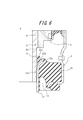
- FIG. 6 is an enlarged cross-sectional view of a main part shown in a posture before the sleeve shown in FIG. 5 is completely frictionally engaged with the inner cylinder member.
- FIG. 6 is a perspective view illustrating a sleeve shown in FIG. 5.
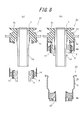
- FIG. 6 is an exploded sectional view showing an assembling process of each member of the vibration isolator shown in FIG. 5. It is a cross-sectional perspective view which expands and shows a part of apparatus shown in FIG. It is a longitudinal cross-sectional perspective view which shows a conventional apparatus typically.
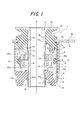
- the liquid-filled vibration isolator 1 includes an inner cylinder member 2 attached to a member on either the vibration generation side or the vibration transmission side, and coaxially on the outer side of the inner cylinder member 2.
- An outer cylinder member 3 that is arranged and connected to a member on the vibration generation side or vibration transmission side, and a first end that liquid-tightly connects one end of the outer cylinder member 3 to the outer peripheral surface of the inner cylinder member 2.
- the inner cylinder member 2 has an annular flange 2a that is fixed or fixed to the top in the drawing and is used for connection to a member on either the vibration generation side or the vibration transmission side.
- the main body portion 2 has a maximum outer diameter portion 2b located on the upper side in the drawing and a small outer diameter portion 2c located on the lower side in the drawing.
- the outer cylinder member 3 is fixed to or fixed to the upper end flange 3a and the rigid flange provided on the upper end flange 3a for connection to the other member on the vibration generation side or vibration transmission side together with the upper end flange 3a. 3b, and a rubber coating layer 3c and a support cylinder 3d that are sequentially arranged inwardly on the inner peripheral side of the main body, and the inner side of the rubber coating layer 3c at a position above the support cylinder 3d. And an intermediate cylinder 3e disposed from the position of the rigid reinforcing ring 3b toward the lower side of the figure.
- an end portion of the outer cylinder member 3 on the first body rubber 4 a side and a partition member 6 to be described later are disposed on the end portion on the second body rubber 4 b side.
- a small-diameter end portion 3f having an outer diameter smaller than any of the portions corresponding to the positions is provided, and a liquid injection port 8 sealed by the male member 7 is provided in the small-diameter portion 3f.
- An inner cylinder side rigid protrusion 9 that protrudes from the outer peripheral surface of the inner cylinder member 2 to the outer cylinder member 3 side is provided at an intermediate portion of the inner cylinder member 2 in the axial direction of the central axis A.
- a partition member 6 comprising an inner cylinder-side rigid protrusion 9, and a partition rubber 10 that liquid-tightly connects an outer peripheral surface of the inner cylinder-side rigid protrusion 9 and an inner peripheral surface of the outer cylinder member 3; 5 is divided into two liquid chambers 11a and 11b, and a restriction passage 12 is provided in the inner cylinder-side rigid ridge 9 for providing mutual communication between the two liquid chambers 11a and 11b.
- the outer cylinder member 3 has an inward flange-like first outer cylinder side rigid protrusion that protrudes from the inner peripheral surface of the outer cylinder member 3 into the first main body rubber 4a toward the inner cylinder member 2 side.
- the first outer cylinder, and the second outer cylinder side rigid protrusion 13b having an inward flange shape projecting in the same direction from the inner peripheral surface into the second main body rubber 4b.
- the side rigid ridge 13a is arranged so as to be biased toward the first liquid chamber 11a.
- the thickness b of the main body rubber 4a covering the surface on the inner cylinder side rigid protrusion 9a side of the outer cylinder side rigid protrusion 13a is 1 mm.
- both the first main body rubber 4a and the second main body rubber 4b enter the main body rubber 4a and 4b along the outer peripheral surface of the inner cylinder member 2, and the inner cylinder A depth d 1 exceeding each of the first outer cylinder side rigid protrusion 13a and the second outer cylinder side rigid protrusion 13b in a cross section including the central axis A of the member 2 and cut along the center axis A; a ring-shaped cavity 14, 15 of d 2 is provided, space 14 provided in the first rubber body 4a causes the position to face the liquid chamber 11a.
- the first outer cylinder side rigid protrusion 13a is not integrally formed with the main body of the outer cylinder member 3, but is formed on the intermediate cylinder 3e welded to the rigid reinforcing ring 3b.
- the second outer cylinder side rigid protrusion 13b is integrally formed at the lower end of the small diameter of the main body of the outer cylinder member 3.
- the intermediate cylinder 3e can be integrally formed with the rigid reinforcing ring 3b.
- the inner cylinder side rigid ridge 9 is fitted to the small outer diameter part 2c of the inner cylinder member 2, and one end in the axial direction is generated by a difference in diameter between the maximum outer diameter part 2b and the small outer diameter part 2c. 16, and the other end in the axial direction is fixed to the second main body rubber 4 b and the inner peripheral surface of the second main body rubber 4 b, and the second main body rubber 4 b is fixed to the lower end of the figure. Restrained by a rigid sleeve 17 that pushes up from the side.
- the second liquid chamber 11b is provided with a liquid inlet 8 for filling the fluid chamber 5 with a liquid when the apparatus is manufactured.
- the liquid inlet 8 is liquid-tight by a male member 7, for example, a blind rivet. Is blocked.
- the first main body rubber 4a has a ring-shaped constricted portion 18 that enters from the radially outer side toward the central axis A, and the first main body rubber is adjusted by adjusting the size of the constricted portion 18.
- the spring constant in the axial direction of 4a can be adjusted.
- the inner peripheral end portion 13c of the first outer cylinder side rigid ridge 13a is curved with a radius of curvature R toward the partition member 6, and here, the second outer cylinder side rigid ridge 13b is also here.
- the inner peripheral end portion 13 d is curved in a direction away from the partition member 6.
- the top surface of the void 14 provided in the first main body rubber 4a embedding the outer cylinder side rigid protrusion 13a is gently curved in a mountain shape, which means that the void provided in the second main rubber 4b. The same applies to 15.
- the maximum depth points Pd 1 and Pd 2 of the cavities 14 and 15 are positioned in the vicinity of the outer peripheral surface of the inner cylindrical member 2 as shown in the drawing.
- the voids 14 and 15 are preferably provided, and according to this, the main body rubbers 4a and 4b are easily bent in the vicinity of the outer peripheral surface of the inner cylindrical member 2, and the liquid chambers 11a and 11b at the time of vibration input are provided.
- the volume change amount of can be increased.
- the radial distance H is in the range of 50 to 80%.
- the thickness w of the partition rubber 10 is a shape that gradually decreases from the inner cylinder member 2 side to the outer cylinder member 3 side, and the point Pw of the minimum thickness of the partition rubber 10 is set to the inside of the outer cylinder member 3. It is located within 5 mm inward from the peripheral surface, and is positioned closer to the outer peripheral surface than the bisection point position between the inner peripheral surface and the outer peripheral surface of the partition rubber 10.
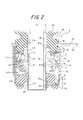
- the restriction passage 12 can be in any form, for example, a two-storey structure with an internal two-turn winding such as that shown in FIG.
- a peripheral arrangement structure such as a thing can be adopted.
- the liquid-filled vibration isolator 1 shown in FIG. 2 is the same as the liquid-filled vibration isolator 1 shown in FIG. 1 except that the extending form of the restriction passage 12 is different.
- annular flange 2a is integrally formed on the top of the inner cylinder member 2 made of metal, for example.
- the inner cylinder side rigid protrusion 9 of the partition member 6 is liquid-tightly attached around the inner cylinder member 2, and the rigid protrusion 9 is vulcanized and bonded to the partition.
- the rubber 10 is liquid-tightly attached to the outer cylinder member 3 side
- the rigid portion of the partition member 6 can be liquid-tightly attached to the outer cylinder member side
- the partition rubber can be attached to the inner cylinder member side.
- one end of the outer cylinder member 3 on the side of the main body rubber, in the drawing, on the end portion of the second main body rubber 4b on the lower end side, the other main body rubber 4a side of the outer cylinder member 3 is provided.
- a small-diameter end portion 3f having an outer diameter smaller than any of the end portion and the portion corresponding to the arrangement position of the partition member 6 and the partition rubber 10 is provided.
- the small-diameter end portion 3f is provided with a rivet, screw, bolt, or the like.
- a liquid inlet 8 that is hermetically sealed by the male member 7 is provided.
- the male member 7 is provided at the small diameter end portion 2a of the outer cylinder member 3, a part of the male member 7 protrudes from the outer surface of the small diameter end portion 2a when the liquid outlet 8 is sealed. Even so, as long as the protruding portion of the male member 7 can be accommodated within the step between the large diameter portion and the small diameter portion of the outer cylinder member 3, the large diameter portion of the outer cylinder member 3 is attached to a predetermined attachment. It is possible to sufficiently prevent interference between the male member protruding portion and the predetermined attachment target member during insertion or press-fitting into the target member.
- Such an anti-vibration device performs shear deformation of the respective main rubbers 4a and 4b and expansion / contraction deformation of the respective liquid chambers 11a and 11b with respect to input in the axial direction of the inner and outer cylindrical members 2 and 3 and relative vibration. At the same time, a flow of the liquid in both the liquid chambers through the restriction passage 12 is generated, and thereby, an excellent vibration isolation and vibration damping function can be exhibited.
- the first main body rubber 4a on the upper end side in the figure is fixed to the inner cylinder member 2 including the upper end flange 2a by vulcanization adhesion or the like.
- the rigid cylinder 3e provided with a rigid reinforcing ring 3b aligned with the upper flange 3a is also fixed to the inner peripheral surface of the rigid cylinder 3e, where the intermediate cylinder 3e enters the main rubber 4a provided at the lower end thereof. Is integrated with the main rubber 4a.
- the partition member 6 of this apparatus includes a rigid ridge 9 attached by press-fitting or the like around the inner cylinder member 2, a circumscribed rigid cylinder member attached to the outer peripheral surface of the rigid ridge 9, and a support cylinder 3d.
- Each of the inner peripheral surfaces is provided with a partition rubber 10 fixed by vulcanization adhesion or the like, and the illustrated rigid protrusion 9 has a required cross-sectional area formed in an arc shape, a spiral shape, or the like.
- a restricted passage 12 having a length.
- the second main body rubber 4b on the lower end side in the figure is below the partition member 6 and has an outer peripheral surface of a rigid sleeve 17 attached by press fitting or the like around the inner cylindrical member 2, and an inner peripheral surface of the outer cylindrical member 3.
- the body portion of the outer cylindrical member 3 is, for example, in a posture in which the upper end flange 3a is aligned with the rigid reinforcing ring 3b by reducing the diameter thereof. It is liquid-tightly attached to the outer peripheral surface of the cylinder 3e and the outer peripheral surface of the support cylinder 3d of the partition member 6 via a rubber lining layer on the inner peripheral surface of the main body portion of the outer cylinder member 3.
- the outer cylinder member 3 has an end portion on the side of the main rubber 4b, a position corresponding to the liquid chamber 11b on the lower side of the figure, and a fixing area of the main rubber 4b on the lower side of the liquid chamber 11b.
- the outer cylinder member 3 has a small-diameter end portion 3f having a smaller outer diameter than the end portion on the main rubber 4a side and the portion corresponding to the position where the partition member 6 is disposed, as described above.
- the small-diameter end 3f has a liquid inlet 8 that is sealed with a male member 7 at a position corresponding to the liquid chamber 11b.
- the small-diameter end portion 3f is formed in advance in the outer cylinder member 3, so that processing such as diameter reduction processing for forming the small-diameter end portion 3f after assembly of the outer cylinder member 3 is performed. It becomes completely unnecessary.
- the small diameter end portion 2a is used as an insertion guide or the like.
- the required insertion, press-fitting, and the like can be performed easily and quickly without requiring the initial highly accurate positioning and positioning of the outer cylinder member 3. it can.
- the required press-fitting length of the outer cylinder member 3 with respect to the predetermined mounting member is shortened by a length corresponding to the axial distance of the small-diameter end portion 3fa. The frictional force with the inner peripheral surface of the mounting member can be effectively reduced, and the required pushing force of the outer cylinder member 3 can be effectively reduced.
- the second outer cylinder-side rigid ridge 13b that is provided on the edge of the outer cylinder member 3 on the small diameter end portion 3f side and enters the second main body rubber 4b is, for example,
- the amount of increase or decrease in the pressure in the liquid chamber is suppressed by suppressing the amount of shear deformation of the main rubber.
- the first main rubber 4a is provided with a space 14 extending annularly around the inner cylinder member 2 and opening into the liquid chamber 11a, and the main rubber 4b is provided with a sleeve.
- a space 15 extending annularly around 17 and opening to the atmosphere is provided, and each of the body rubbers 4a according to the relative displacement in the axial direction of the inner and outer cylinder members 2, 3 is provided by these spaces 14, 15. , 4b It is intended to prevent the rubber 4a, 4b from being peeled off due to stress concentration on the end of the rubber 4a, 4b fixed to the inner cylinder member 2 or the sleeve 17 during shear deformation.
- the partition member 6 is attached to the inner cylinder member 2 at a small outer diameter portion 2 c having a uniform outer diameter through a step portion, and is press-fitted around the inner cylinder member 2.
- the inner diameter of the rigid ridge 9 is a taper surface that gradually decreases in diameter toward the lower side of the figure, and only the lower half portion of the rigid ridge 9 is used as the small outer diameter portion of the inner cylindrical member 2.
- the input and vibration are transmitted to the transmission-side member based on the shear deformation of the main rubbers 4a and 4b with respect to the axial input or relative vibration of the inner and outer cylindrical members 2 and 3.
- the liquid chambers 11a, 11b can be insulated and damped, and the volume of the liquid chambers 11a, 11b accompanying the deformation of the body rubbers 4a, 4b, and the liquid pressure in the liquid chambers due to the variation of the liquid pressure in the liquid chambers.
- the input and vibration can be insulated and damped also by the liquid column resonance in the restricting passage 12 and the flow resistance exerted on the liquid by the restricting passage 12 based on the flow of the liquid between 11b.
- each liquid chamber 11a, 11b is filled with a required liquid from the liquid injection port 8, and then the injection port is sealed with the male member 7. Since the pressure of the liquid sealed in the liquid chambers 11a and 11b is large and BR> C pressure, it is possible to sufficiently prevent the initial deformation of the main body rubbers 4a and 4b. It is possible to effectively eliminate the possibility of a decrease in sex. Further, this apparatus is provided with a small diameter end portion 3f at one end portion of the outer cylinder member 3, and since this small diameter end portion 3f can be formed in the outer cylinder member 3 in advance, The number of steps required for the diameter reduction processing can be reduced, and the apparatus cost can be effectively reduced.
- the outer cylinder member 3 has the small diameter end portion 3f at one end portion, the small diameter end portion 3f is inserted when the outer cylinder member 3 is inserted into or pressed into a predetermined mounting member.
- the required insertion, press-fitting, etc. can be performed simply and quickly and always applied without the need to accurately position and hold the outer cylinder member 3 with respect to the mounting member.
- it is sufficient to push only the large-diameter portion of the outer cylinder member 3 excluding the small-diameter end portion 3f with respect to the mounting member compared with the case where the entire outer cylinder member 3 is the large-diameter portion. Thus, the required pushing force and the like can be effectively reduced.
- FIG. 4 showing another embodiment, what is shown in FIG. 4 (a) is, in particular, a region where the small diameter end portion 3f with respect to the outer cylinder member 3 is further below the portion where the liquid chamber 11b on the lower side is disposed. Only the portion corresponding to the second main body rubber 4b on the side is provided, and a liquid injection port 8 sealed by the male member 7 is provided at the small diameter end portion 3f, and this liquid injection port 8 is used as the main body rubber 4b.
- 3 is different from the embodiment shown in FIG. 3 in that it communicates with the liquid chamber 11b on the lower side through a recess 19 provided in the first embodiment.
- the rigid protrusion 9 of the partition member 6 is attached to the outer cylinder member 3, and the partition rubber 10 is attached to the inner cylinder member 2 via the rigid cylinder body 20, respectively. Therefore, the configuration is different from that shown in FIGS. 3 and 4A.
- any of these anti-vibration devices shown in FIG. 4 can provide the same operations and effects as those shown in FIG. 4
- the second main body rubber 4b located on the lower side of the figure has an outer cylinder member 3 and a rigid body arranged on the inner peripheral side of the outer cylinder member 3.
- vulcanization adhesion or the like is fixed to each of the members between the sleeve 17 and the main body rubber 4b is formed by frictionally engaging the sleeve 17 with the outer peripheral surface of the inner cylindrical member 2. It is connected to the inner cylinder member 2 via the sleeve 17.
- the end portion (upper end portion in the drawing) of the sleeve 17 on the liquid chamber 11b side is enlarged in diameter as compared with other portions, and the enlarged diameter portion 17a having a trumpet shape in the drawing is formed.
- An annular elastic member 21 formed integrally with the main rubber 4b is interposed between the portion 17a and the outer peripheral surface of the inner cylinder member 2.
- the annular elastic member 21 is shown in FIG. 6 as an enlarged cross-sectional view illustrating the posture before the sleeve 17 is completely frictionally engaged with the outer peripheral surface of the inner cylinder member 2.
- a protruding portion 21a that is annularly projected toward the central axis A direction of the inner cylinder member is provided, and a recess 21b is formed over the entire circumference on the outer peripheral side of the protruding portion 21a.
- the annular elastic member 21 is formed with a protruding portion 21a that is crushed by the step 2d of the inner cylinder member 2, the gap between the sleeve 17 and the inner cylinder member 2 can be sufficiently sealed. Therefore, providing the annular elastic member 21 with a recess 21b as a clearance for the protruding portion 21a as shown in FIG. 6 is not essential to the present invention.
- the protruding portion 21a of the annular elastic member 21 is crushed, the annular elastic member 21 is sufficiently brought into close contact with the outer peripheral surface of the inner cylindrical member 2 to improve the sealing performance.
- the protruding portion 21a is provided on the inner peripheral side of the recess 21b. However, the inner and outer forming positions of the protruding portion 21a and the recess 21b can be interchanged.
- annular elastic member 21 integrally with the main body rubber 4b fixed to the outer peripheral surface of the sleeve 17, an increase in manufacturing cost due to an increase in the number of members can be advantageously suppressed.
- annular elastic member 21 integrally with the main body rubber 4b for example, as illustrated in a perspective view in which only the rigid sleeve 17 is taken out in FIG. 7, the end of the sleeve 17 on the enlarged diameter portion 17a side is illustrated.
- a plurality of cutout portions 17b are provided at predetermined intervals in the circumferential direction in the drawing, and the annular elastic member 21 and the main rubber 4b are connected to each other through the cutout portions 17b.
- the sleeve 17 is engaged with the inner cylinder member 2 as shown in FIG.
- the rigid portion 17c other than the notch portion 17b at the tip of the sleeve 17 can be brought into contact with the rigid ridge 9 of the partition member 6 in the figure, so that the rigid ridge 9 with respect to the rigid ridge 9 when the sleeve 17 is assembled is shown.
- displacement of the sleeve 17 with respect to the inner cylindrical member 2 during use of the apparatus 1 or the like is prevented under rigid body contact.
- 17 d is preferably formed in a tapered shape whose diameter increases toward the partition member 6 side. Even when the sleeve 17 has such a tapered shape, in the vibration isolator of the present invention, the lower end region of the sleeve 17 in the figure is sufficiently frictionally engaged with the outer peripheral surface of the inner cylinder member 2.
- the annular elastic member 21 whose squeezed protruding portion 21 a is closely attached to the outer peripheral surface of the inner cylinder, and the leakage of the sealed liquid from between the sleeve 17 and the inner cylinder member 2 is ensured. Can be prevented.
- the inner diameter of the annular elastic member 21 is preferably somewhat larger than the outer diameter of the inner cylinder member 2 in the posture before complete engagement with the inner cylinder member 2 shown in FIG. According to this, when the annular elastic member 21 and the sleeve 17 are fitted to the outer peripheral surface of the inner cylindrical member 2, the annular elastic member 21 is not rubbed with the outer peripheral surface of the inner cylindrical member 2. The occurrence of damage to 21 can be effectively prevented. Even in this case, the protruding portion 21a of the annular elastic member 21 is crushed by the step 2d or the like of the inner cylindrical member 2, and as shown in FIG. However, since the gap between the annular elastic member 21 and the inner cylinder member 2 is surely filled, the sealing performance by the annular elastic member 21 is ensured.
- the outer cylinder side portion 23 formed by connecting the outer peripheral surface of the sleeve 17 and the inner peripheral surface of the outer cylinder member 3 with the main rubber 4 b is used to connect the inner cylinder with the sleeve 17. It fits on the outer peripheral surface of the member 2 and is frictionally engaged with the inner cylinder member 2. Finally, the enlarged cylindrical portion 3g of the outer cylindrical member 3 is squeezed inward and deformed to reduce the diameter, and the inner cylindrical portion 3e on the inner peripheral side is firmly fixed under the plastic deformation of the expanded cylindrical portion 3g. .
- the upper end flange 3a of the outer cylindrical member 3 is connected to the rigid reinforcing ring 3b.
- a cylindrical rising portion 3h that covers the side surface and the top surface is formed in advance, and prior to narrowing the enlarged diameter cylindrical portion 3g, as shown in cross-sectional perspective views in FIGS. 9 (a) and 9 (b), the upper end flange 3a It is preferable that the upper cylindrical rising portion 3h provided at least in part is folded inward and plastically deformed, and the rigid reinforcing ring 3b is sandwiched and fixed by the outer cylinder member 3 upper end flange 3a.
- the outer cylinder member 3 is As a result, the quality of the vibration isolator 1 can be improved.
Landscapes
- Engineering & Computer Science (AREA)
- General Engineering & Computer Science (AREA)
- Mechanical Engineering (AREA)
- Combined Devices Of Dampers And Springs (AREA)
Abstract
Priority Applications (2)
| Application Number | Priority Date | Filing Date | Title |
|---|---|---|---|
| US13/636,021 US9222543B2 (en) | 2010-03-19 | 2011-03-03 | Liquid-sealed-type anti-vibration device and method for manufacturing the same |
| CN201180022809.9A CN102884339B (zh) | 2010-03-19 | 2011-03-03 | 液体封入式防振装置及其制造方法 |
Applications Claiming Priority (6)
| Application Number | Priority Date | Filing Date | Title |
|---|---|---|---|
| JP2010-064951 | 2010-03-19 | ||
| JP2010064951A JP5364019B2 (ja) | 2010-03-19 | 2010-03-19 | 防振装置 |
| JP2010-100024 | 2010-04-23 | ||
| JP2010100024A JP5457261B2 (ja) | 2010-04-23 | 2010-04-23 | 液体封入式防振装置 |
| JP2010-107596 | 2010-05-07 | ||
| JP2010107596A JP5457265B2 (ja) | 2010-05-07 | 2010-05-07 | 液体封入式防振装置およびそれの製造方法 |
Publications (1)
| Publication Number | Publication Date |
|---|---|
| WO2011114643A1 true WO2011114643A1 (fr) | 2011-09-22 |
Family
ID=44648759
Family Applications (1)
| Application Number | Title | Priority Date | Filing Date |
|---|---|---|---|
| PCT/JP2011/001270 Ceased WO2011114643A1 (fr) | 2010-03-19 | 2011-03-03 | Dispositif de commande de vibration à bain liquide, et son procédé de production |
Country Status (3)
| Country | Link |
|---|---|
| US (1) | US9222543B2 (fr) |
| CN (1) | CN102884339B (fr) |
| WO (1) | WO2011114643A1 (fr) |
Cited By (1)
| Publication number | Priority date | Publication date | Assignee | Title |
|---|---|---|---|---|
| EP2706257A3 (fr) * | 2012-09-05 | 2015-07-29 | Cooper-Standard Automotive, Inc. | Ensemble de montage hydraulique amorti de manière axiale |
Families Citing this family (15)
| Publication number | Priority date | Publication date | Assignee | Title |
|---|---|---|---|---|
| US9765845B2 (en) | 2008-02-05 | 2017-09-19 | Cooper-Standard Automotive Inc. | Axially damped hydraulic mount assembly |
| US9038997B2 (en) | 2008-02-05 | 2015-05-26 | Cooper-Standard Automotive Inc. | Axially damped hydraulic mount assembly |
| US9163695B2 (en) * | 2010-03-08 | 2015-10-20 | Bridgestone Corporation | Liquid-sealed anti-vibration device and method for manufacturing the same |
| US9097310B2 (en) * | 2012-09-19 | 2015-08-04 | The Pullman Company | Bolt through hydraulic mount with and without a decoupler |
| CN104912995B (zh) * | 2014-03-14 | 2017-04-19 | 广州汽车集团股份有限公司 | 一种用于汽车悬架系统导向装置中的液压衬套及汽车 |
| JP6422179B2 (ja) * | 2014-10-03 | 2018-11-14 | 株式会社ブリヂストン | 液体封入ブッシュ |
| US10145443B2 (en) | 2015-01-26 | 2018-12-04 | Itt Manufacturing Enterprises Llc | Compliant elastomeric shock absorbing apparatus |
| JP6751656B2 (ja) * | 2016-11-15 | 2020-09-09 | Toyo Tire株式会社 | 液封入式防振装置 |
| JP6967429B2 (ja) * | 2017-11-08 | 2021-11-17 | 株式会社ブリヂストン | 防振装置 |
| US11287011B2 (en) * | 2018-09-19 | 2022-03-29 | Vibracoustic Usa, Inc. | Hydraulic mount |
| US11009097B2 (en) * | 2019-01-31 | 2021-05-18 | The Pullman Company | Hydraulic mount having fluid-track |
| KR102750657B1 (ko) * | 2019-06-12 | 2025-01-06 | 현대자동차주식회사 | 유체 봉입형 엔진 마운트 |
| US11685443B2 (en) | 2020-07-22 | 2023-06-27 | The Pullman Company | Hydroelastic body mount |
| US11754142B2 (en) * | 2021-05-26 | 2023-09-12 | Bae Systems Information And Electronic Systems Integration Inc. | Low displacement, fail safe, all attitude, universal isolator |
| CN116044952B (zh) * | 2023-02-22 | 2025-09-09 | 十堰东森汽车密封件有限公司 | 一种轴向型副车架液压衬套总成 |
Citations (5)
| Publication number | Priority date | Publication date | Assignee | Title |
|---|---|---|---|---|
| JPH10132016A (ja) * | 1996-10-30 | 1998-05-22 | Kinugawa Rubber Ind Co Ltd | 液体封入式防振マウント |
| JPH10141425A (ja) * | 1996-11-11 | 1998-05-29 | Bridgestone Corp | 防振装置 |
| JP2003533654A (ja) * | 2000-05-18 | 2003-11-11 | トレルボルク オートモチブ テクニカル センター ゲゼルシャフト ミット ベシュレンクテル ハフツング | 液圧減衰ブッシュ |
| JP2006046555A (ja) * | 2004-08-06 | 2006-02-16 | Toyo Tire & Rubber Co Ltd | 液封入式防振装置 |
| JP2007527488A (ja) * | 2003-12-16 | 2007-09-27 | ツェットエフ フリードリヒスハーフェン アクチエンゲゼルシャフト | ハイドロリック減衰作用を有するブッシュベアリング |
Family Cites Families (16)
| Publication number | Priority date | Publication date | Assignee | Title |
|---|---|---|---|---|
| JPH0225947Y2 (fr) * | 1985-09-26 | 1990-07-16 | ||
| JP2776463B2 (ja) * | 1986-07-08 | 1998-07-16 | 株式会社ブリヂストン | 防振装置 |
| US5005810A (en) * | 1987-07-09 | 1991-04-09 | Tokai Rubber Ind., Ltd. | Fluid-filled cushioning device having sealing arrangement for easy assembling |
| GB9007300D0 (en) * | 1990-03-31 | 1990-05-30 | Btr Plc | Improvements in and relating to an elastomeric mounting |
| JP3477920B2 (ja) * | 1995-06-23 | 2003-12-10 | 東海ゴム工業株式会社 | 流体封入式防振支持体 |
| JP3896553B2 (ja) | 1996-06-06 | 2007-03-22 | 株式会社フコク | ビスカスダンパー |
| JP4237426B2 (ja) | 2001-06-08 | 2009-03-11 | 東洋ゴム工業株式会社 | 液体封入式防振装置とその製造方法 |
| KR20030085715A (ko) * | 2002-05-01 | 2003-11-07 | 가부시키가이샤 후코쿠 | 액체봉입식 마운트장치 |
| JP3915591B2 (ja) * | 2002-05-07 | 2007-05-16 | 東海ゴム工業株式会社 | 流体封入式防振装置の製造方法 |
| JP4110567B2 (ja) * | 2002-07-04 | 2008-07-02 | 東海ゴム工業株式会社 | 流体封入式筒形防振装置 |
| DE10232393B4 (de) * | 2002-07-17 | 2008-06-19 | Trelleborg Automotive Technical Centre Gmbh | Hydraulisch dämpfende Buchse |
| JP4061493B2 (ja) | 2003-03-17 | 2008-03-19 | 東海ゴム工業株式会社 | 流体封入式筒形防振装置 |
| EP2240704B1 (fr) | 2008-02-05 | 2018-08-15 | Cooper-Standard Automotive, Inc. | Ensemble de monture hydraulique amorti axialement |
| JP2010006339A (ja) * | 2008-06-30 | 2010-01-14 | Tokai Rubber Ind Ltd | パワーユニットの支持構造 |
| US9163695B2 (en) * | 2010-03-08 | 2015-10-20 | Bridgestone Corporation | Liquid-sealed anti-vibration device and method for manufacturing the same |
| JP5406760B2 (ja) * | 2010-03-08 | 2014-02-05 | 株式会社ブリヂストン | 液体封入式防振装置の製造方法および液体封入式防振装置 |
-
2011
- 2011-03-03 US US13/636,021 patent/US9222543B2/en active Active
- 2011-03-03 WO PCT/JP2011/001270 patent/WO2011114643A1/fr not_active Ceased
- 2011-03-03 CN CN201180022809.9A patent/CN102884339B/zh active Active
Patent Citations (5)
| Publication number | Priority date | Publication date | Assignee | Title |
|---|---|---|---|---|
| JPH10132016A (ja) * | 1996-10-30 | 1998-05-22 | Kinugawa Rubber Ind Co Ltd | 液体封入式防振マウント |
| JPH10141425A (ja) * | 1996-11-11 | 1998-05-29 | Bridgestone Corp | 防振装置 |
| JP2003533654A (ja) * | 2000-05-18 | 2003-11-11 | トレルボルク オートモチブ テクニカル センター ゲゼルシャフト ミット ベシュレンクテル ハフツング | 液圧減衰ブッシュ |
| JP2007527488A (ja) * | 2003-12-16 | 2007-09-27 | ツェットエフ フリードリヒスハーフェン アクチエンゲゼルシャフト | ハイドロリック減衰作用を有するブッシュベアリング |
| JP2006046555A (ja) * | 2004-08-06 | 2006-02-16 | Toyo Tire & Rubber Co Ltd | 液封入式防振装置 |
Cited By (1)
| Publication number | Priority date | Publication date | Assignee | Title |
|---|---|---|---|---|
| EP2706257A3 (fr) * | 2012-09-05 | 2015-07-29 | Cooper-Standard Automotive, Inc. | Ensemble de montage hydraulique amorti de manière axiale |
Also Published As
| Publication number | Publication date |
|---|---|
| US20130069288A1 (en) | 2013-03-21 |
| US9222543B2 (en) | 2015-12-29 |
| CN102884339A (zh) | 2013-01-16 |
| CN102884339B (zh) | 2014-10-08 |
Similar Documents
| Publication | Publication Date | Title |
|---|---|---|
| WO2011114643A1 (fr) | Dispositif de commande de vibration à bain liquide, et son procédé de production | |
| CN102884338B (zh) | 液体封入式防振装置及其制造方法 | |
| CN104769311B (zh) | 流体封入式隔振装置 | |
| JP5170809B2 (ja) | 液封防振装置 | |
| JP4919783B2 (ja) | 液封防振装置 | |
| JP5907783B2 (ja) | 流体封入式防振装置 | |
| US8740197B2 (en) | Vibration-damping device | |
| JP5462040B2 (ja) | 液封防振装置およびそれの製造方法 | |
| JP6460782B2 (ja) | 液体封入式防振装置 | |
| JP2019082197A (ja) | 流体封入式筒形防振装置 | |
| JP5406760B2 (ja) | 液体封入式防振装置の製造方法および液体封入式防振装置 | |
| JP5711088B2 (ja) | 流体封入式防振装置及びその製造方法 | |
| JP5457261B2 (ja) | 液体封入式防振装置 | |
| WO2016174800A1 (fr) | Dispositif antivibrations | |
| JP5364019B2 (ja) | 防振装置 | |
| JP5457265B2 (ja) | 液体封入式防振装置およびそれの製造方法 | |
| JP2012197872A (ja) | 液封入式防振装置 | |
| JP2009127780A (ja) | 液体封入式防振装置 | |
| JP2024136201A (ja) | 流体封入式防振装置 | |
| JP6483444B2 (ja) | 防振装置 | |
| JP5210956B2 (ja) | 防振装置 | |
| WO2024185692A1 (fr) | Dispositif de régulation de vibration rempli de fluide | |
| JP6091952B2 (ja) | 防振装置 | |
| JP4266981B2 (ja) | 液封入式防振装置 | |
| JP2001241489A (ja) | 防振装置及び防振装置への液体充填方法 |
Legal Events
| Date | Code | Title | Description |
|---|---|---|---|
| WWE | Wipo information: entry into national phase |
Ref document number: 201180022809.9 Country of ref document: CN |
|
| 121 | Ep: the epo has been informed by wipo that ep was designated in this application |
Ref document number: 11755836 Country of ref document: EP Kind code of ref document: A1 |
|
| NENP | Non-entry into the national phase |
Ref country code: DE |
|
| WWE | Wipo information: entry into national phase |
Ref document number: 1201004839 Country of ref document: TH |
|
| WWE | Wipo information: entry into national phase |
Ref document number: 13636021 Country of ref document: US |
|
| 122 | Ep: pct application non-entry in european phase |
Ref document number: 11755836 Country of ref document: EP Kind code of ref document: A1 |