WO2012111199A1 - Pâte à frire pour produits alimentaires frits - Google Patents
Pâte à frire pour produits alimentaires frits Download PDFInfo
- Publication number
- WO2012111199A1 WO2012111199A1 PCT/JP2011/075597 JP2011075597W WO2012111199A1 WO 2012111199 A1 WO2012111199 A1 WO 2012111199A1 JP 2011075597 W JP2011075597 W JP 2011075597W WO 2012111199 A1 WO2012111199 A1 WO 2012111199A1
- Authority
- WO
- WIPO (PCT)
- Prior art keywords
- tapioca starch
- starch
- processed
- mass
- fat
- Prior art date
- Legal status (The legal status is an assumption and is not a legal conclusion. Google has not performed a legal analysis and makes no representation as to the accuracy of the status listed.)
- Ceased
Links
Images
Classifications
-
- A—HUMAN NECESSITIES
- A23—FOODS OR FOODSTUFFS; TREATMENT THEREOF, NOT COVERED BY OTHER CLASSES
- A23L—FOODS, FOODSTUFFS OR NON-ALCOHOLIC BEVERAGES, NOT OTHERWISE PROVIDED FOR; PREPARATION OR TREATMENT THEREOF
- A23L29/00—Foods or foodstuffs containing additives; Preparation or treatment thereof
- A23L29/20—Foods or foodstuffs containing additives; Preparation or treatment thereof containing gelling or thickening agents
- A23L29/206—Foods or foodstuffs containing additives; Preparation or treatment thereof containing gelling or thickening agents of vegetable origin
- A23L29/212—Starch; Modified starch; Starch derivatives, e.g. esters or ethers
- A23L29/219—Chemically modified starch; Reaction or complexation products of starch with other chemicals
-
- A—HUMAN NECESSITIES
- A23—FOODS OR FOODSTUFFS; TREATMENT THEREOF, NOT COVERED BY OTHER CLASSES
- A23P—SHAPING OR WORKING OF FOODSTUFFS, NOT FULLY COVERED BY A SINGLE OTHER SUBCLASS
- A23P20/00—Coating of foodstuffs; Coatings therefor; Making laminated, multi-layered, stuffed or hollow foodstuffs
- A23P20/10—Coating with edible coatings, e.g. with oils or fats
- A23P20/12—Apparatus or processes for applying powders or particles to foodstuffs, e.g. for breading; Such apparatus combined with means for pre-moistening or battering
Definitions
- the present invention relates to a fried food material that can form a deep-fried food that is excellent in clothing texture and maintains the juiciness of the ingredients.
- Deep-fried foods such as deep-fried chicken, tempura, and fries have a crisp taste (crispy feeling), and those that maintain the juicy feel of the ingredients are preferred.
- Patent Document 1 discloses a clothing composition for tempura, fried chicken or fritters, characterized by containing oxidized starch and waxy starch.
- Patent Document 2 discloses a fried food material characterized by containing 20% by weight or more of a crosslinked starch having a swelling degree of 4 to 15 and a solubility of 10% by weight or less. .
- an object of the present invention is to provide a fried food material that can form a fried food that is excellent in the texture of clothing and that has a good juicy feeling.
- the present invention provides a fried food material characterized by containing an oil- and fat-processed acetylated tapioca starch obtained by subjecting an acetylated tapioca starch obtained by acetylating tapioca starch with vinyl acetate to an oil-and-fat process. It is to provide.
- the oil- and fat-processed acetylated tapioca starch has an acetyl group content of 0.2 to 1% by mass, and stirs an aqueous suspension in which the starch concentration is 6% by mass in terms of dry matter.
- the peak viscosity of the starch suspension was maintained at 95 ° C. for 30 minutes. It is preferable that the breakdown value after subtracting the bottom viscosity is 200 BU or less.
- the acetylated tapioca starch processed with fats and oils has a heat swelling degree of 20 to 40 times.
- the acetylated tapioca starch processed with fat contains 0.02 to 0.5% by mass of fat or oil or a mixture of fat and emulsifier.
- acetylated tapioca starch processed with fats and oils in terms of dry matter.
- the acetylated tapioca starch processed with fats and oils is subjected to a treatment for adjusting the pH to less than 5 after addition or reaction when acetylating the tapioca starch with vinyl acetate.
- the fried food material of the present invention it is possible to provide a fried food material that can form a fried food that is excellent in the texture of the clothes and has a good juicy feeling. Moreover, when it is prepared into a batter or a dust for fried foods, it has excellent binding properties.
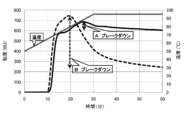
- FIG. 6 is a chart showing an example of a temperature-starch viscosity curve (amylogram) for determining a breakdown value of starch.
- the dressing material for deep-fried food according to the present invention is characterized by containing acetylated tapioca starch that has been processed with oil and fat, and is obtained by subjecting acetylated tapioca starch obtained by acetylating tapioca starch with vinyl acetate.
- the acetylated tapioca starch used in the present invention can be obtained, for example, by the following method.
- an alkaline agent such as sodium hydroxide, calcium hydroxide, sodium carbonate, etc. Is added to the starch slurry to adjust the pH to 8-11, preferably 9.5-10.5.
- the temperature of the starch slurry is 10 to 45 ° C, preferably 20 to 40 ° C, and still more preferably 25 to 35 ° C. The reaction is carried out for 10 to 120 minutes, preferably 20 to 60 minutes.
- an acid such as hydrochloric acid is added to adjust the starch slurry to a pH of less than 5, preferably 2 to 4.5, more preferably 2.5 to 4.
- the starch slurry subjected to the above treatment is washed with water, dehydrated, dried and packaged. Furthermore, you may readjust starch to desired pH by adding a pH adjuster in the process from the said pH adjustment to packaging.
- the dressing material for deep-fried food of this invention contains the fat-and-oil processed starch formed by giving fat and oil processing to the said acetylated tapioca starch.
- the above-mentioned oil- and fat-processed starch used in the present invention is added to and mixed with acetylated tapioca starch so that the content of the oil or fat and a mixture of oil and emulsifier is 0.02 to 0.5% by mass.
- the starch may be before drying after being washed with water or after drying in the production process of the acetylated tapioca starch.
- alkaline agents such as sodium hydroxide, calcium hydroxide, and sodium carbonate.
- the oil- and fat-processed acetylated tapioca starch of the present invention can be obtained.
- physical treatment such as acid treatment, alkali treatment, pregelatinization, bleaching treatment, enzyme treatment, heat treatment, wet heat treatment, and fine pulverization treatment can be performed.
- a combination of processing can be applied. When combined with these processes, it may be incorporated into any part of the manufacturing process of the above-mentioned acetylated tapioca starch processed with fats and oils.
- tapioca starch used as a raw material in the present invention are not particularly limited.
- the above-mentioned acetylated tapioca starch processed with fat is substantially acetic acid without using any of acetic anhydride, adipic acid, phosphorus oxychloride, and sodium trimetaphosphate as an esterifying agent. It is preferable that the resin is acetylated using only vinyl and subjected to oil and fat processing. Further, when acetylating tapioca starch with vinyl acetate, an acid such as hydrochloric acid is added after the addition or after the reaction, and the pH is less than 5, preferably pH 2 to 4.5, more preferably pH 2.5 to 4. It is preferable to adjust to. Although details of the mechanism are unknown by this treatment, swelling of starch granules can be suppressed. The effect of this treatment is more efficient as the amount of vinyl acetate added increases.
- the oil- and fat-processed acetylated tapioca starch has an acetyl group content of 0.2 to 1.0% by mass, more preferably 0.3 to 0.8% by mass, and a breakdown value of 200 BU or less. It is preferable that it is 100 BU or less.
- the breakdown value refers to a continuous heating state from 50 ° C. to 95 ° C. over 30 minutes while stirring an aqueous suspension in which the starch concentration is 6% by mass in terms of dry matter. Further, in the temperature-starch viscosity curve (amylogram) obtained when held at 95 ° C. for 30 minutes, it means a value obtained by subtracting the bottom viscosity after holding at 95 ° C. for 30 minutes from the peak viscosity of the starch suspension. .
- FIG. 1 specifically illustrates a temperature-starch viscosity curve (amylogram) for determining a breakdown value. When a solid line amylogram is obtained in the figure, the breakdown value is the value of the viscosity difference indicated by A in the figure. When a dotted amylogram in the figure is obtained, the breakdown value is the value of the viscosity difference indicated by B in the figure.
- the acetyl group content can be determined by the following method.
- a starch sample (5.0 g) is accurately weighed and suspended in 50 ml of water, a few drops of phenolphthalein test solution are added, and 0.1 mol / l sodium hydroxide solution is added dropwise until the solution turns slightly red, then 0.45 mol / l.
- Add exactly 25 ml of sodium hydroxide solution cap and shake vigorously for 30 minutes, taking care that the temperature does not exceed 30 ° C.
- a free acetyl group content is calculated
- Acetyl group content (%) (ef) ⁇ n ⁇ 0.043 ⁇ 100 / w (1)
- e blank test titration (ml)
- f sample titration (ml)
- n titer of 0.2 mol / l hydrochloric acid
- w dry sample weight (g) .
- the above-mentioned acetylated tapioca starch processed with fats and oils preferably has a heat swelling degree of 20 to 40 times.
- the degree of heat swelling is more preferably 25 to 35 times, and still more preferably 30 to 35 times.
- the heat swelling degree of starch means a value quantified by the following method.
- a starch sample having a dry matter weight of 1.0 g is dispersed in 100 ml of water, heated for 30 minutes with occasional stirring in boiling water, and then cooled to 30 ° C. Next, this glue solution is centrifuged (3000 rpm, 10 minutes) to be divided into a glue layer and a supernatant layer, and the weight of the glue layer is measured and this is designated as A. Next, after the weight-measured glue layer was dried at 105 ° C., the weight was measured and designated as B, and the value of A / B was defined as the degree of heating swelling (times).
- the acetylated tapioca starch processed with fats and oils contains 0.02 to 0.5% by mass of the fats and oils or a mixture of fats and emulsifiers for the fats and oils processing.
- the oil or fat or a mixture of oil and emulsifier is more preferably contained in an amount of 0.2 to 0.4% by mass.
- the fats and oils used in the present invention and the fats and oils used in the mixture of fats and oils and emulsifiers means fats and oils that are recognized as edible, adjusted oils, and mixtures thereof.
- examples thereof include chicken oil, sheep oil, whale oil, fish oil, processed oils such as fractionated oils and transesterified oils.
- emulsifier used in the mixture of fats and oils examples include glycerin fatty acid ester, polyglycerin fatty acid ester, organic acid monoglyceride, sorbitan fatty acid ester, propylene glycol fatty acid ester, sucrose fatty acid ester, and lecithin.
- the fried food dressing of the present invention preferably contains 5 to 60% by mass of the above-mentioned oil- and fat-processed acetylated tapioca starch in terms of dry matter.
- the content is more preferably 20 to 50% by mass, still more preferably 30 to 40% by mass.
- the mass ratio of the above-mentioned oil-and-fat processed acetylated tapioca starch and wheat flour is from 2: 7 to 5 : 4 is preferable, and 1: 2 to 4: 5 is more preferable.
- materials used in ordinary fried food materials can be used for the fried food material of the present invention.
- the content of the above-mentioned acetylated tapioca starch and wheat flour processed with fat in the fried food material is preferably 80 to 90% by mass, and more preferably 85 to 88% by mass in terms of dry matter.
- the fried food material of the present invention can be used as, for example, fried powder, tempura powder, fritter powder, and batter mix powder for frying. Among these, it is particularly suitable as a deep-fried powder or tempura powder.
- a deep-fried fried powder When used as a deep-fried fried powder, it can be used as a type of fried powder that is sprinkled on ingredients, but it can also be used as a deep-fried fried type where the powder is melted in water and a sticky batter is attached. It is more suitable as a mixed powder for tempura.
- the amount of water added when fried with a batter solution is preferably 90 to 150 parts by mass of water with respect to 100 parts by mass of the fried food material.
- the appropriate amount of water and eggs as necessary to the dressing for deep-fried food of the present invention and prepare a batter liquid adjusted to an appropriate viscosity.
- the batter liquid may be attached and oiled.
- the amount of water added when preparing the batter solution for tempura is preferably 100 to 150 parts by mass of water with respect to 100 parts by mass of the fried food material.
- the appropriate amount of water and eggs as necessary to the dressing for fried food of the present invention When using it as fritter powder, add the appropriate amount of water and eggs as necessary to the dressing for fried food of the present invention, and create a batter liquid adjusted to an appropriate viscosity.
- the batter liquid may be attached and oiled.
- the amount of water added when preparing the batter liquid for fritter powder is preferably 100 to 150 parts by mass of water with respect to 100 parts by mass of the fried food material.
- the dressing material for fried foods of the present invention When using as a batter mix powder for frying, to the dressing material for fried foods of the present invention, an appropriate amount of water and, if necessary, eggs and the like are added and mixed to create a batter liquid adjusted to an appropriate viscosity,
- the batter liquid may be attached to the ingredients, and bread crumbs may be further attached, and oiled.
- the amount of water added when preparing the batter liquid for frying is preferably 100 to 500 parts by mass of water with respect to 100 parts by mass of the fried food material.
- the fried food material of the present invention is applied to refrigerated or frozen fried foods that are refrigerated or frozen after being oiled as described above and reheated in an oven or microwave oven. In that case, it is possible to bring about the effect that the texture of the clothes and the succulent feeling of the implement after reheating can be kept good.
- the fried food materials are often sold after being cooked, arranged in stores, etc., or stored in a convenience store hot vendor. According to the fried food materials of the present invention, Since there is little change over time in the texture and the juiciness of the ingredients, even when the consumer eats after the oil has passed, it can give a good texture of the clothes and the juiciness of the ingredients .
- Example 1 Water was added to 300 g of raw tapioca (weight of dried product) to prepare a starch slurry having a concentration of 40%, and adjusted to 30 ° C. After adding sodium carbonate to this starch slurry to adjust to pH 10, stirring was maintained for 30 minutes after adding 1.6% by mass of vinyl acetate with respect to the dry product weight of starch. Furthermore, the reaction of acetylation was completed by adjusting the pH to 3 using 9% hydrochloric acid, dehydrated through a 250 mesh sieve, and further dehydrated by adding 2 L of water.
- Example 2 After preparing a wet cake with 30% moisture by adding and mixing water to 300g (dry weight) of eclipse MT-01HL (produced by Nippon Food Chemical Co., Ltd., acetylated tapioca starch acetylated with acetic anhydride) After adding and mixing 0.3% by mass of fat and oil (mixture of egoma oil and glycerin fatty acid ester) with respect to the dry substance weight of starch, the mixture was dried with a shelf dryer, and the fat was processed. Acetylated tapioca starch was obtained.
- eclipse MT-01HL produced by Nippon Food Chemical Co., Ltd., acetylated tapioca starch acetylated with acetic anhydride
- sample 3 By using TAS-202 (manufactured by Asia Modified Star Co., Ltd., acetylated adipic acid-crosslinked tapioca starch), the same treatment as in sample 2 was carried out to obtain an acetylated adipic acid-crosslinked tapioca starch that had been processed with fats and oils. It was.
- TAS-202 manufactured by Asia Modified Star Co., Ltd., acetylated adipic acid-crosslinked tapioca starch
- Example 4 Water was added to 300 g of raw tapioca (weight of dried product) to prepare a starch slurry having a concentration of 40%, and adjusted to 30 ° C. To this starch slurry, 0.5% by mass of calcium chloride is added to the dry weight of the starch, then 3% sodium hydroxide is added to adjust the pH to 11, and then the starch slurry is adjusted to a pH of 0.1. Stirring was maintained for 60 minutes after adding 06% by weight of sodium trimetaphosphate.
- the reaction of phosphoric acid crosslinking was completed by adjusting the pH to 7 using 9% hydrochloric acid, and then adjusted to pH 10 by adding sodium carbonate, and then 1.6% by mass of acetic acid with respect to the dry weight of starch. Stirring was maintained for 30 minutes after the vinyl was added. Furthermore, the acetylation reaction was completed by adjusting the pH to 5 using 9% hydrochloric acid. Thereafter, the same treatment as that of Sample 1 was performed to obtain an acetylated phosphate-crosslinked tapioca starch that had been processed with fats and oils.
- Example 5 Water was added to 300 g of raw tapioca (weight of dried product) to prepare a starch slurry having a concentration of 40%, and adjusted to 30 ° C. After adding 1.0 mass% sodium sulfate to this starch slurry with respect to the dry substance weight of starch, and then adjusting to pH 11 by adding 3% sodium hydroxide, the starch slurry was adjusted to a pH of 0.1. Stirring was maintained for 60 minutes after the addition of 02 mass% phosphorus oxychloride. Thereafter, the same treatment as in Sample 4 was performed to obtain an acetylated phosphate-crosslinked tapioca starch that had been processed with oil and fat.
- Example 6 Except for the addition rate of phosphorus oxychloride being 0.025% by mass, the same treatment as in Sample 5 was performed to obtain an acetylated phosphoric acid crosslinked tapioca starch processed into an oil and fat.
- Example 7 Except that the reaction of acetylation was completed by adjusting the pH to 4 using 9% hydrochloric acid, the same treatment as in Sample 1 was performed to obtain an acetylated tapioca starch that had been processed with fats and oils.
- Example 8 Except that the reaction of acetylation was completed by adjusting the pH to 5 using 9% hydrochloric acid, the same treatment as in Sample 1 was performed to obtain an acetylated tapioca starch that had been processed with fats and oils.
- Example 9 Except for the addition rate of vinyl acetate being 0.3% by mass, the same treatment as in Sample 1 was performed to obtain an acetylated tapioca starch that had been processed with oil and fat.
- Example 10 Except that the addition rate of vinyl acetate was changed to 0.5% by mass, the same treatment as in Sample 1 was performed to obtain an acetylated tapioca starch that had been processed with oil and fat.
- Example 11 Except for the addition rate of vinyl acetate being 2.5% by mass, the same treatment as in Sample 1 was performed to obtain an acetylated tapioca starch that had been processed with oil and fat.
- Example 12 Except for the addition rate of vinyl acetate being 3% by mass, the same treatment as in Sample 1 was performed to obtain an acetylated tapioca starch that had been processed with oil and fat.
- Example 13 Except that the reaction of acetylation was completed by adjusting the pH to 2.5 using 9% hydrochloric acid, the same treatment as in Sample 1 was performed to obtain acetylated tapioca starch that had been processed with fats and oils.
- Example 14 Except that the reaction of acetylation was completed by adjusting the pH to 3.5 using 9% hydrochloric acid, the same treatment as in Sample 1 was performed to obtain acetylated tapioca starch that had been processed with fats and oils.
- Example 15 Except that the addition ratio of fats and oils (a mixture of egoma oil and glycerin fatty acid ester) was 0.01% by mass, the same treatment as in Sample 1 was performed to obtain acetylated tapioca starch that had been processed with fats and oils.
- Example 16 Except that the addition rate of fats and oils (a mixture of egoma oil and glycerin fatty acid ester) was set to 0.02% by mass, the same treatment as in Sample 1 was performed to obtain acetylated tapioca starch that had been processed with fats and oils.
- the addition rate of fats and oils a mixture of egoma oil and glycerin fatty acid ester
- Example 17 Except that the addition rate of fats and oils (a mixture of egoma oil and glycerin fatty acid ester) was 0.5% by mass, the same treatment as in Sample 1 was performed to obtain acetylated tapioca starch that had been processed with fats and oils.
- fats and oils a mixture of egoma oil and glycerin fatty acid ester
- Example 18 Except that the addition rate of fats and oils (a mixture of egoma oil and glycerin fatty acid ester) was 0.6% by mass, the same treatment as in Sample 1 was performed to obtain acetylated tapioca starch that had been processed with fats and oils.
- Test Example 1 (Preparation of fried chicken) A fried chicken batter having the composition shown in Table 2 below was prepared, and the fried chicken evaluated below was prepared using the batter. That is, using any of the processed starches of Samples 1 to 18 shown in Table 1 above, a batter for fried chicken was prepared with the other ingredients together with the ingredients shown in Table 2 below, and the pickle liquid was added as an ingredient to the batter. The soaked chicken breast was soaked, a batter solution was adhered, and oiled in 175 ° C. corn oil for 4 minutes to obtain fried chicken.
- Sample 2 obtained by acetylating tapioca starch with acetic anhydride had a very crisp and wet texture and was inferior to Sample 1.
- Sample 3 in which tapioca starch was subjected to acetylated adipic acid cross-linking with acetic anhydride and adipic acid, and sample 4 in which tapioca starch was subjected to phosphoric acid cross-linking with sodium trimetaphosphate and further acetylated with vinyl acetate were used in juicy ingredients. The feeling was inferior to that of Sample 1.
- Sample 5 and sample 6 in which tapioca starch was subjected to phosphoric acid crosslinking with phosphorus oxychloride and further acetylated with vinyl acetate were inferior to sample 1 in the succulent feeling of the ingredients and the texture of the clothes.
- vinyl acetate is used as an esterifying agent for acetylating tapioca starch, and adipic acid, sodium trimetaphosphate and oxy It was confirmed that it is preferable to use a material that has not been crosslinked by a crosslinking agent selected from phosphorus chloride.
- Sample 9 having an acetyl group content of 0.1% by mass did not have a succulent feeling and had a papasa texture. Moreover, in the sample 12 with an acetyl group content of 1.1% by mass, the garment has a texture of papasa. Further, sample 8 having an acetyl group content of 0.6% by mass as in sample 1 but having a breakdown value of 410 BU also had a poor texture and a wet texture. On the other hand, the other samples having an acetyl group content of 0.2, 0.6, or 0.9% by mass and having breakdown values of 0, 20, 60, and 190 BU are generally evaluated well. Met.
- Test Example 2 (Preparation of fried chicken) As the processed starch to be contained in the fried food material, the sample 14 is selected, and the blending ratio in the batter is changed to 3, 5, 25, 50, 60, 70 mass% in terms of dry matter, and the blending ratio is changed to these blending ratios. The mixing ratio of the corresponding flour was changed to 87, 85, 65, 40, 30, and 20% by mass, respectively, and the other raw materials were prepared in the above-mentioned Table 2 to prepare a fried batter. Using the batter, the chicken was fried in the same manner as in Test Example 1 above.
Landscapes
- Chemical & Material Sciences (AREA)
- Life Sciences & Earth Sciences (AREA)
- Engineering & Computer Science (AREA)
- Food Science & Technology (AREA)
- Polymers & Plastics (AREA)
- Chemical Kinetics & Catalysis (AREA)
- Dispersion Chemistry (AREA)
- Health & Medical Sciences (AREA)
- Nutrition Science (AREA)
- Grain Derivatives (AREA)
- Oil, Petroleum & Natural Gas (AREA)
- Jellies, Jams, And Syrups (AREA)
Abstract
La présente invention concerne une pâte à frire pour produits alimentaires frits, dotée d'une texture remarquable et permettant l'obtention d'un produit alimentaire frit juteux et agréable au goût. Ladite pâte à frire pour produits alimentaires frits contient un amidon de manioc acétylé et dont les graisses ont été transformées, obtenu en soumettant à une transformation des graisses l'amidon de manioc acétylé résultant de l'acétylation de l'amidon de manioc au moyen d'acétate de vinyle. Il est souhaitable que l'amidon de manioc acétylé et dont les graisses ont été transformées présente une teneur en groupes acétyle égale à 0,2 à 1 % en poids et une viscosité pouvant aller jusqu'à 200 unités Brabender.
Priority Applications (2)
| Application Number | Priority Date | Filing Date | Title |
|---|---|---|---|
| CN201180067791.4A CN103501633B (zh) | 2011-02-17 | 2011-11-07 | 油炸食品用面衣材料 |
| HK14105362.3A HK1191816B (en) | 2011-02-17 | 2011-11-07 | Batter for deep-fried food products |
Applications Claiming Priority (2)
| Application Number | Priority Date | Filing Date | Title |
|---|---|---|---|
| JP2011031489A JP4838390B1 (ja) | 2011-02-17 | 2011-02-17 | 揚げ物用衣材 |
| JP2011-031489 | 2011-02-17 |
Publications (1)
| Publication Number | Publication Date |
|---|---|
| WO2012111199A1 true WO2012111199A1 (fr) | 2012-08-23 |
Family
ID=45418235
Family Applications (1)
| Application Number | Title | Priority Date | Filing Date |
|---|---|---|---|
| PCT/JP2011/075597 Ceased WO2012111199A1 (fr) | 2011-02-17 | 2011-11-07 | Pâte à frire pour produits alimentaires frits |
Country Status (3)
| Country | Link |
|---|---|
| JP (1) | JP4838390B1 (fr) |
| CN (1) | CN103501633B (fr) |
| WO (1) | WO2012111199A1 (fr) |
Cited By (10)
| Publication number | Priority date | Publication date | Assignee | Title |
|---|---|---|---|---|
| WO2015015870A1 (fr) * | 2013-08-02 | 2015-02-05 | 株式会社J-オイルミルズ | Matière pour pâte, produit alimentaire l'utilisant et procédé de fabrication correspondant |
| CN104754958A (zh) * | 2013-01-28 | 2015-07-01 | 日本食品化工株式会社 | 油脂加工淀粉及其制备方法 |
| JP2016158596A (ja) * | 2015-03-04 | 2016-09-05 | 昭和産業株式会社 | 天ぷら用バッターミックス、天ぷら用バッター、天ぷらの製造方法、及び天ぷら |
| WO2017170810A1 (fr) * | 2016-03-31 | 2017-10-05 | 日本食品化工株式会社 | Agent améliorant la texture pour pâtisserie, et procédé de fabrication de pâtisserie |
| WO2018123257A1 (fr) * | 2016-12-27 | 2018-07-05 | 株式会社J-オイルミルズ | Fluide de traitement de viande et procédé de fabrication de produit aliemntaire carné traité |
| CN110290712A (zh) * | 2017-02-17 | 2019-09-27 | 日清富滋株式会社 | 水溶型的龙田油炸用混合料 |
| JP2019195305A (ja) * | 2018-05-11 | 2019-11-14 | 昭和産業株式会社 | 揚げ物バッター用組成物、揚げ物用バッター、揚げ物及び揚げ物の製造方法 |
| JPWO2019151034A1 (ja) * | 2018-01-31 | 2021-01-14 | 株式会社J−オイルミルズ | 食品の製造方法 |
| JP2021003031A (ja) * | 2019-06-26 | 2021-01-14 | 修三 小西 | グルテンフリー天ぷら粉 |
| WO2022075069A1 (fr) * | 2020-10-06 | 2022-04-14 | 日本食品化工株式会社 | Amidon transformé avec de l'huile/matière grasse ayant une excellente dispersibilité, son procédé de production et son utilisation |
Families Citing this family (10)
| Publication number | Priority date | Publication date | Assignee | Title |
|---|---|---|---|---|
| JP5154714B2 (ja) | 2011-06-01 | 2013-02-27 | 株式会社J−オイルミルズ | 油脂加工澱粉およびその製造方法 |
| JP4942855B1 (ja) * | 2011-11-15 | 2012-05-30 | 日本食品化工株式会社 | 水産練り製品用改良剤及び水産練り製品 |
| JP4942856B1 (ja) * | 2011-11-25 | 2012-05-30 | 日本食品化工株式会社 | 畜肉製品用改良剤及び畜肉製品 |
| JP7161408B2 (ja) * | 2016-12-05 | 2022-10-26 | 株式会社日清製粉ウェルナ | 揚げ物用衣材ミックス |
| JP6320605B1 (ja) * | 2017-06-30 | 2018-05-09 | 日本食品化工株式会社 | 油脂加工澱粉及びその製造方法 |
| WO2020036221A1 (fr) * | 2018-08-17 | 2020-02-20 | 日清フーズ株式会社 | Procédé de préparation d'aliments frits |
| WO2021086273A2 (fr) * | 2019-10-29 | 2021-05-06 | Sms Corporation Co., Ltd. | Adipate de diamidon acétylé modifié et produits le contenant |
| US20240365819A1 (en) * | 2021-04-28 | 2024-11-07 | Nisshin Seifun Welna Inc. | Coating composition for fried food |
| CN119156140A (zh) * | 2022-07-07 | 2024-12-17 | 株式会社日清富滋 | 油炸食品用面衣材料及其制造方法 |
| CN121263073A (zh) * | 2023-12-05 | 2026-01-02 | 株式会社日清制粉集团本社 | 油脂被覆难消化性淀粉的制造方法 |
Citations (2)
| Publication number | Priority date | Publication date | Assignee | Title |
|---|---|---|---|---|
| JP2008022753A (ja) * | 2006-07-20 | 2008-02-07 | Nippon Reishoku:Kk | 春巻きの皮用組成物、及びこれを焼成してなる春巻きの皮、並びにこれを用いてなる春巻き |
| JP2011103837A (ja) * | 2009-11-19 | 2011-06-02 | Nisshin Foods Kk | 具材の旨みを逃さない衣材用ミックス |
Family Cites Families (6)
| Publication number | Priority date | Publication date | Assignee | Title |
|---|---|---|---|---|
| JP2790968B2 (ja) * | 1993-08-30 | 1998-08-27 | 日清製油株式会社 | 揚げ物用衣材、及びこれを用いた揚げ物の製造方法 |
| US6080434A (en) * | 1998-07-01 | 2000-06-27 | Penford Corporation | French fry potato products with improved functionality and process for preparing |
| EP1228700A1 (fr) * | 2001-01-29 | 2002-08-07 | Coöperatieve Verkoop- en Productievereniging, van Aardappelmeel en Derivaten AVEBE B.A. | Enrobage alimentaire |
| JP4663928B2 (ja) * | 2001-09-05 | 2011-04-06 | 日東富士製粉株式会社 | 衣用組成物 |
| JP2009264404A (ja) * | 2008-04-22 | 2009-11-12 | Nsk Ltd | 密封型転がり軸受ユニット及びシール環 |
| EP2130442B1 (fr) * | 2008-06-06 | 2018-01-17 | Estrella Maarud Holding AS | Frites à faible teneur en matières grasses et procédé de production |
-
2011
- 2011-02-17 JP JP2011031489A patent/JP4838390B1/ja active Active
- 2011-11-07 CN CN201180067791.4A patent/CN103501633B/zh active Active
- 2011-11-07 WO PCT/JP2011/075597 patent/WO2012111199A1/fr not_active Ceased
Patent Citations (2)
| Publication number | Priority date | Publication date | Assignee | Title |
|---|---|---|---|---|
| JP2008022753A (ja) * | 2006-07-20 | 2008-02-07 | Nippon Reishoku:Kk | 春巻きの皮用組成物、及びこれを焼成してなる春巻きの皮、並びにこれを用いてなる春巻き |
| JP2011103837A (ja) * | 2009-11-19 | 2011-06-02 | Nisshin Foods Kk | 具材の旨みを逃さない衣材用ミックス |
Cited By (16)
| Publication number | Priority date | Publication date | Assignee | Title |
|---|---|---|---|---|
| CN104754958A (zh) * | 2013-01-28 | 2015-07-01 | 日本食品化工株式会社 | 油脂加工淀粉及其制备方法 |
| CN104754958B (zh) * | 2013-01-28 | 2016-10-19 | 日本食品化工株式会社 | 油脂加工淀粉及其制备方法 |
| WO2015015870A1 (fr) * | 2013-08-02 | 2015-02-05 | 株式会社J-オイルミルズ | Matière pour pâte, produit alimentaire l'utilisant et procédé de fabrication correspondant |
| JP2016158596A (ja) * | 2015-03-04 | 2016-09-05 | 昭和産業株式会社 | 天ぷら用バッターミックス、天ぷら用バッター、天ぷらの製造方法、及び天ぷら |
| WO2017170810A1 (fr) * | 2016-03-31 | 2017-10-05 | 日本食品化工株式会社 | Agent améliorant la texture pour pâtisserie, et procédé de fabrication de pâtisserie |
| JP7065787B2 (ja) | 2016-12-27 | 2022-05-12 | 株式会社J-オイルミルズ | 食肉加工用液および食肉加工食品の製造方法 |
| WO2018123257A1 (fr) * | 2016-12-27 | 2018-07-05 | 株式会社J-オイルミルズ | Fluide de traitement de viande et procédé de fabrication de produit aliemntaire carné traité |
| JPWO2018123257A1 (ja) * | 2016-12-27 | 2019-10-31 | 株式会社J−オイルミルズ | 食肉加工用液および食肉加工食品の製造方法 |
| CN110290712A (zh) * | 2017-02-17 | 2019-09-27 | 日清富滋株式会社 | 水溶型的龙田油炸用混合料 |
| JPWO2019151034A1 (ja) * | 2018-01-31 | 2021-01-14 | 株式会社J−オイルミルズ | 食品の製造方法 |
| JP7364473B2 (ja) | 2018-01-31 | 2023-10-18 | 株式会社J-オイルミルズ | 食品の製造方法 |
| JP2019195305A (ja) * | 2018-05-11 | 2019-11-14 | 昭和産業株式会社 | 揚げ物バッター用組成物、揚げ物用バッター、揚げ物及び揚げ物の製造方法 |
| JP7218096B2 (ja) | 2018-05-11 | 2023-02-06 | 昭和産業株式会社 | 揚げ物バッター用組成物、揚げ物用バッター、揚げ物及び揚げ物の製造方法 |
| JP2021003031A (ja) * | 2019-06-26 | 2021-01-14 | 修三 小西 | グルテンフリー天ぷら粉 |
| JP2022061335A (ja) * | 2020-10-06 | 2022-04-18 | 日本食品化工株式会社 | 分散性に優れた油脂加工澱粉、その製造方法およびその用途 |
| WO2022075069A1 (fr) * | 2020-10-06 | 2022-04-14 | 日本食品化工株式会社 | Amidon transformé avec de l'huile/matière grasse ayant une excellente dispersibilité, son procédé de production et son utilisation |
Also Published As
| Publication number | Publication date |
|---|---|
| JP2012165724A (ja) | 2012-09-06 |
| JP4838390B1 (ja) | 2011-12-14 |
| CN103501633A (zh) | 2014-01-08 |
| CN103501633B (zh) | 2016-06-15 |
| HK1191816A1 (zh) | 2014-08-08 |
Similar Documents
| Publication | Publication Date | Title |
|---|---|---|
| JP4838390B1 (ja) | 揚げ物用衣材 | |
| JP4566288B1 (ja) | 揚げ物用衣材 | |
| KR101874145B1 (ko) | 튀김 식품용 코팅 물질 | |
| JP4942855B1 (ja) | 水産練り製品用改良剤及び水産練り製品 | |
| JP5265821B1 (ja) | 油脂加工澱粉およびその製造方法 | |
| JP5449463B2 (ja) | 膨潤抑制澱粉及びその用途 | |
| JP6637887B2 (ja) | 天ぷら衣用ミックス | |
| WO2015162972A1 (fr) | Matériau d'enrobage pour produit alimentaire frit, produit alimentaire l'utilisant, et procédé pour le fabriquer | |
| CN110290712A (zh) | 水溶型的龙田油炸用混合料 | |
| JPWO2019021606A1 (ja) | 衣材用酸化澱粉の製造方法 | |
| JP2005185122A (ja) | 油脂加工澱粉およびそれを用いる揚げ物用衣材 | |
| JP3208341B2 (ja) | 揚げ物用衣材 | |
| JP7282479B2 (ja) | 焼き餃子羽用組成物 | |
| JPH08173073A (ja) | 揚げ物用衣材 | |
| JP6591979B2 (ja) | 天ぷら衣用ミックス | |
| JP4249974B2 (ja) | 竜田揚げの製造方法 | |
| JP2005204502A (ja) | 揚げ物用衣材及び揚げ物食品 | |
| JP2005000081A (ja) | 揚げ物用バッター | |
| JP4734046B2 (ja) | パン粉付けフライ食品及びその製造法 | |
| JP2000333633A (ja) | 揚げ物用バッター液およびそれを用いた揚げ物 | |
| JP5890701B2 (ja) | 冷凍フライ食品用バッターミックス | |
| JPH1198969A (ja) | 油脂コーティング穀粉 | |
| JP6295647B2 (ja) | 竜田揚げ用衣液およびその製造方法、並びに当該衣液を用いて製造される竜田揚げ | |
| CN112533491A (zh) | 面包粉混合料 | |
| HK1191816B (en) | Batter for deep-fried food products |
Legal Events
| Date | Code | Title | Description |
|---|---|---|---|
| 121 | Ep: the epo has been informed by wipo that ep was designated in this application |
Ref document number: 11858553 Country of ref document: EP Kind code of ref document: A1 |
|
| NENP | Non-entry into the national phase |
Ref country code: DE |
|
| 122 | Ep: pct application non-entry in european phase |
Ref document number: 11858553 Country of ref document: EP Kind code of ref document: A1 |