WO2012111207A1 - Dispositif d'acheminement pour papiers mélangés, procédé d'acheminement pour papiers mélangés et machine postale - Google Patents
Dispositif d'acheminement pour papiers mélangés, procédé d'acheminement pour papiers mélangés et machine postale Download PDFInfo
- Publication number
- WO2012111207A1 WO2012111207A1 PCT/JP2011/076749 JP2011076749W WO2012111207A1 WO 2012111207 A1 WO2012111207 A1 WO 2012111207A1 JP 2011076749 W JP2011076749 W JP 2011076749W WO 2012111207 A1 WO2012111207 A1 WO 2012111207A1
- Authority
- WO
- WIPO (PCT)
- Prior art keywords
- envelope
- unit
- suction
- postal
- Prior art date
- Legal status (The legal status is an assumption and is not a legal conclusion. Google has not performed a legal analysis and makes no representation as to the accuracy of the status listed.)
- Ceased
Links
Images



Classifications
-
- B—PERFORMING OPERATIONS; TRANSPORTING
- B65—CONVEYING; PACKING; STORING; HANDLING THIN OR FILAMENTARY MATERIAL
- B65H—HANDLING THIN OR FILAMENTARY MATERIAL, e.g. SHEETS, WEBS, CABLES
- B65H3/00—Separating articles from piles
- B65H3/08—Separating articles from piles using pneumatic force
- B65H3/12—Suction bands, belts, or tables moving relatively to the pile
- B65H3/124—Suction bands or belts
-
- B—PERFORMING OPERATIONS; TRANSPORTING
- B65—CONVEYING; PACKING; STORING; HANDLING THIN OR FILAMENTARY MATERIAL
- B65H—HANDLING THIN OR FILAMENTARY MATERIAL, e.g. SHEETS, WEBS, CABLES
- B65H2511/00—Dimensions; Position; Numbers; Identification; Occurrences
- B65H2511/40—Identification
- B65H2511/416—Identification of material
-
- B—PERFORMING OPERATIONS; TRANSPORTING
- B65—CONVEYING; PACKING; STORING; HANDLING THIN OR FILAMENTARY MATERIAL
- B65H—HANDLING THIN OR FILAMENTARY MATERIAL, e.g. SHEETS, WEBS, CABLES
- B65H2513/00—Dynamic entities; Timing aspects
- B65H2513/10—Speed
-
- B—PERFORMING OPERATIONS; TRANSPORTING
- B65—CONVEYING; PACKING; STORING; HANDLING THIN OR FILAMENTARY MATERIAL
- B65H—HANDLING THIN OR FILAMENTARY MATERIAL, e.g. SHEETS, WEBS, CABLES
- B65H2701/00—Handled material; Storage means
- B65H2701/10—Handled articles or webs
- B65H2701/19—Specific article or web
- B65H2701/1916—Envelopes and articles of mail
Definitions
- the present invention relates to a composite paper sheet supply apparatus, a composite paper sheet supply method, and a postal machine that continuously separate and send a plurality of postal items of different envelope types.
- the exterior of the mail is referred to as an envelope body
- the paper envelope body is referred to as a standard envelope body
- the envelope body such as vinyl that is weaker than paper
- a soft envelope body If the separation processing conditions set for standard envelopes are applied as they are to postal mails of soft envelopes, the soft envelopes are weaker than standard envelopes, so damage such as wrinkles and tears can easily occur . Therefore, in order to continuously separate and sort a bundle of mail pieces (hereinafter referred to as a mail bundle) in which standard envelope bodies and soft envelope bodies are mixed, the mail pieces to be separated are soft envelope bodies. Therefore, it is necessary to perform a separate sending process different from the standard envelope. That is, separation processing according to the type of envelope is required.
- Japanese Patent Application Laid-Open No. 10-134225 discloses a technique for continuously distinguishing banknotes in different states. That is, when a banknote that may be damaged is conveyed at a high speed, troubles such as paper jams and poor stacking tend to occur. Therefore, when a banknote that is being transported is provided and a banknote being transported is a specific denomination banknote that is easily damaged, the controller decelerates the transport motor and the separation and accumulation motor, and follows. The bill feeding speed is slowed down. This prevents troubles such as paper jams and poor stacking when the banknotes are conveyed at high speed.
- the banknotes targeted by the above-mentioned Japanese Patent Application Laid-Open No. 10-134225 are known in size and thickness, but in the case of postal items, the size, thickness, and weight are different from each other. In some cases, mail bundles containing different types of envelopes cannot be separated continuously. Therefore, the main object of the present invention is to provide a composite paper sheet supply device and composite paper that can perform separation and sending processing without damaging the postal matter even if it is a postal bundle containing different types of envelopes. It is to provide a leaf supply method and a postal machine.
- a bundle of postal items including a standard envelope postal item having a standard waist strength and a soft envelope postal item having a lower waist strength has been conveyed. It includes a type detector that detects the envelope type of the first mail piece of the mail bundle, and a suction belt that rotates at a predetermined speed. Includes a suction section that separates from the mail piece, a pair of pickup rollers that rotate at a predetermined speed, a pick-up section that grips and sends out the first mail piece separated by the suction section, and the envelope type of the first mail piece based on the type signal A control unit that determines and controls the rotation speed of the suction unit and the pickup unit.
- the envelope type of the first mail piece of the mail bundle in which the mail bundle including the mail piece of the standard envelope with the waist strength and the mail of the soft envelope softer than the standard envelope has been conveyed Detection procedure, a suction procedure that separates the first mail piece from other mail pieces by the frictional force when the first mail piece contacts the suction belt rotating at a predetermined speed, and the first mail separated by the suction procedure.
- a pick-up procedure for gripping and sending out an article by a pair of pick-up rollers rotating at a predetermined speed, and a control procedure for controlling the rotational speed of the suction procedure and the pick-up procedure by judging the envelope type of the first mail piece based on the type signal It is characterized by including these.
- the type of envelope body is detected and control is performed according to the type of envelope body, even a mail bundle containing different types of envelopes is damaged.
- the separation and transmission process can be performed without giving
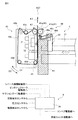
- FIG. 1 is a partial side view of a composite paper sheet supply apparatus in a mail machine according to an embodiment of the present invention.
- FIG. 2 is a perspective view of the pickup roller according to the embodiment.
- FIG. 3 is a partial side view of the composite paper sheet supply apparatus when the separation unit is retracted from the mail according to the embodiment.
- FIG. 4 is a flowchart of the composite paper sheet supply apparatus of the mail machine according to the embodiment.
- FIG. 1 is a partial side view of a composite paper sheet feeder 4 of a mail machine 2 according to the present invention.
- the composite paper sheet supply apparatus 4 includes a transport unit 6, a control unit 8, a supply unit 10, and a separation unit 46.
- a bundle of postal items conveyed by the conveyor 21 is a postal piece bundle K1, a top postal matter that separates the postal matter bundle K1 from the postal piece bundle K1, and a postal matter that is separated and sent out. It is described as K3.
- the mail bundle K1 contains a mixture of soft envelopes and standard envelopes.
- an envelope of a vinyl product will be described as an example of the flexible envelope, but the present invention is not limited to the vinyl product.
- the control unit 8 includes a state detector 31, a type detector 32, a pressure detector 33, and a control unit 34.
- the control unit 34 controls the transport unit 6 and the supply unit 10 based on the detection signal from the state detector 31, the type signal from the type detector 32, and the pressure signal from the pressure detector 33.
- the state detector 31 detects the presence or absence of the head mail K2, and outputs the detection result to the control unit 34 as a detection signal.
- the type detector 32 detects the reflected light from the head mail K2, and outputs the detection result to the control unit 34 as a type signal.
- the pressure detector 33 is disposed on the back side (the back side in FIG. 1) of the supply unit 10 and detects the force with which the backup plate 22 presses the mail bundle K1 against the supply unit 10 side.
- the transport unit 6 includes a conveyor 21 and a backup plate 22.
- One end of the conveyor 21 extends to the supply unit 10, and conveys the mail bundle K ⁇ b> 1 to the supply unit 10.
- the backup plate 22 operates corresponding to the driving state of the conveyor 21.
- the control unit 34 stops the conveyor 21 and operates the backup plate 22.
- the mail bundle K1 conveyed by the conveyor 21 is pressed against the supply unit 10 side.
- the supply unit 10 includes a pickup unit 41 and a suction unit 43.
- the pickup unit 41 includes a pair of pickup rollers 41a and 41b and a pickup roller driving unit (not shown) that rotationally drives the pickup rollers 41a and 41b.
- the suction unit 43 includes a tension roller 43a, a suction roller 43b, a suction belt 43c, a driven roller 43d, a suction roller driving unit (not shown) that rotationally drives the suction roller 43b, and a supply unit swing that swings the supply unit 10. Part (not shown).
- the pickup roller driving unit and the suction roller driving unit include a driving source such as a servo motor, and the rotation speed and the like are controlled by the control unit 34.
- the pickup roller 41a is a two-stage roller as shown in FIG.
- the second roller portion 47c that is freely inserted and rotated.
- the first roller portion 47b faces the pickup roller 41b at a predetermined interval (including the case where it contacts). At least one of the pickup roller 41a or the pickup roller 41b rotates by receiving rotational power from a pickup roller driving unit (not shown). As a result, the pickup unit 41 grips and sends the postal matter conveyed by the conveyor 21.
- the suction belt 43c is stretched around a pickup roller 41a, a suction roller 43b, a tension roller 43a, and a driven roller 43d, and is formed of a material having a high friction coefficient such as rubber.
- the tension roller 43a adjusts the tension of the suction belt 43c so that the frictional force applied to the leading postal matter K2 does not fluctuate.
- the suction belt 43c rotates, the leading postal matter K2 moves in the direction of rotation of the suction belt 43c by the frictional force with the suction belt 43c, and is separated from the other postal bundles K1. Thereafter, the head mail K2 is sandwiched and picked up by the pickup rollers 41a and 41b.
- the supply unit swinging section swings the supply unit 10 in the direction of arrow D1 (clockwise direction) or arrow D2 (counterclockwise direction) in FIG. Move.
- the pressure received by the first mail piece K2 is the origin of the frictional force that the first mail piece K2 receives from the suction belt 43c and the other mail bundle K1.
- the direction of the frictional force received from the suction belt 43c and the frictional force received from the other mail bundle K1 are opposite. For this reason, if a large pressure is applied when the top postal matter K2 is a flexible envelope, the top postal matter K2 may be damaged by a frictional force such as wrinkles and breakage.
- the pressure detector 33 detects the force applied to the leading postal matter K2, and the control unit 34 drives the supply unit swinging unit so that the pressure signal becomes equal to or lower than the pressure reference value, and causes the supply unit 10 to move.
- Rock That is, when the control unit 34 determines that a pressure larger than the pressure reference value is acting on the first mail piece K2, the control unit 34 rotates the supply unit 10 in the direction of the arrow D1 in FIG. Make it smaller. On the other hand, when the control unit 34 determines that a force smaller than the pressure reference value is acting on the first mail piece K2, the control unit 34 rotates the supply unit 10 in the direction of the arrow D2 to increase the pressure applied to the first mail piece K2. .
- the separation unit 46 includes a separation roller 46a, a plurality of rollers 46b, a separation belt 46c stretched over the rollers 46a and 46b, a separation unit position adjusting unit (not shown), and a separation unit driving unit (not shown).
- the separation unit driving unit rotationally drives at least one of the plurality of rollers 46a and 46b.
- the separation belt 46c rotates in the direction opposite to the rotation direction of the suction belt 43c.
- the force in the opposite direction is the separation force.
- the separation unit position adjustment unit adjusts the position of the separation roller 46a with respect to the suction belt 43c.
- the separation belt 46c is in contact with the other mail bundle K1 that has moved together with the leading mail K2. Push back the mail bundle K1. Therefore, only the head mail K2 can be separated. At this time, if the separation belt 46c is strongly pressed against the suction belt 43c, a large separation force acts on the leading postal matter K2. This large separation force may cause wrinkles or damage to the front mail piece K2. In particular, when the first postal matter K2 is a flexible envelope, wrinkles or breakage easily occurs.
- FIG. 3 is a partial side view of the composite sheet supply device 4 of the supply unit 10 when the separation unit 46 is retracted from the head mail K2.
- the separation belt 46c is the first mail.
- the separation unit 46 is moved backward so as not to hit the object K2 strongly.
- the separation force acting on the first mail piece K2 is reduced, so that the occurrence of wrinkles and breakage can be suppressed.
- the thickness of the first mail piece K2 is not constant. Therefore, a plurality of the initial setting values may be set according to the thickness of the mail piece, and the position of the separation unit 46 may be changed according to the thickness of the mail piece by detecting the thickness of the mail piece. And even if it is the same thickness, the position of the separation unit 46 is changed between the standard envelope body and the soft envelope body.
- Step S1 First, the control unit 34 operates the conveyor 21 to convey the plurality of mail bundles K1 to the supply unit 10.
- the plurality of mail bundles K1 include standard envelopes and soft envelopes. Then, the control unit 34 waits to receive a detection signal from the state detector 31, a type signal from the type detector 32, and a pressure signal from the pressure detector 33.
- Step S ⁇ b> 2 When receiving the detection signal indicating that the mail bundle K ⁇ b> 1 has been detected from the state detector 31, the controller 34 stops the conveyor 21 and operates the backup plate 22. As a result, the first head mail K2 is pressed against the suction belt 43c.
- Step S3 Based on the pressure signal from the pressure detector 33, the control unit 34 determines whether or not the pressure at which the backup plate 22 pushes the front mail piece K2 is greater than the pressure reference value.
- the pressure reference value is referred to as pressure reference value F1
- measured pressure F2 is smaller than the pressure reference value F1 (F2 ⁇ F1), the process proceeds to step S4.
- Step S4 When the measured pressure F2 is smaller than the pressure reference value F1 (F2 ⁇ F1), the control unit 34 controls the supply unit swinging unit so that the supply unit 10 rotates in the direction of the arrow D2 in FIG. . As a result, the supply unit 10 rotates toward the leading postal matter K2, so that the measurement pressure F2 increases and the pressure reference value F1 is applied to the leading postal matter K2. Thereafter, the process proceeds to step S7.
- Step S7 the control unit 34 determines the type of the first postal matter K2 based on the type signal from the type detector 32.
- This type signal corresponds to the luminance value of the light reflected by the surface of the head mail K2. Therefore, if the value of the type signal is equal to or greater than a predetermined value (hereinafter referred to as a type determination criterion), the control unit 34 determines that the first postal matter K2 is a flexible envelope, and the processing is performed. Proceed to step S4. On the other hand, if the value of the type signal is equal to or less than the type determination criterion, it is determined that the envelope is a standard envelope, and the process proceeds to step S6. As a result, the type of the first mail piece K2 can change the control of the separation process according to the flexible envelope body, the standard envelope body, or the like.
- a type determination criterion a predetermined value
- the surface of the flexible envelope is subjected to a surface treatment such as white, and the name of the address can be seen through. In some cases, it remains transparent. Therefore, the brightness of the reflected light from the flexible envelope depends on the surface state of the flexible envelope.
- the base processing is rarely performed on the entire sealed letter. That is, in many cases, background processing is performed only on an area such as an address, and advertisements are printed on other areas. The surface of the print area shows high gloss, but the surface of the base treatment area does not show high gloss.
- Step S8 When it is determined that the first mail piece K2 is a soft sealed cylinder, the control unit 34 controls each drive unit so as to reduce the rotational speed of the suction roller 43b. If it is determined in step S7 that the first postal matter K2 is not a flexible envelope, the rotational speed of the suction roller 43b is not reduced. That is, since the rotation speed of the suction roller 43b is initially set on the assumption that the head mail K2 is a standard envelope, the set value is not changed when it is determined that the head mail K2 is a standard envelope.
- Step S9 The control unit 34 controls each drive unit so as to decelerate the rotation speed of the pickup unit 41. If it is determined in step S7 that the first postal matter K2 is not a soft sealed cylinder, the rotational speeds of the pickup rollers 41a and 41b are not changed as with the suction roller 43b. When the rotational speed of the pickup unit 41 becomes slow, the sending output of the first mail piece K2 becomes small, and it is possible to suppress the occurrence of wrinkles or damage due to excessive force acting on the first mail piece K2.
- Step S10 The controller 34 adjusts the position of the separation unit 46 so as to retreat from the supply unit 10 while reducing the rotational speed of the suction roller 43b.
- the retreat position of the separation unit 46 includes not only a position where the separation belt 46c and the front mail piece K2 are not completely in contact but also a position where the separation unit 46 is in light contact. Which position is set is set by the user in consideration of the influence on the head mail K2. When the degree of contact between the separation belt 46c and the front mail piece K2 is reduced, the separation force by the separation belt 46c is reduced, so that the front mail piece K2 can be prevented from being wrinkled or damaged.
- Step S11 Through the processing so far, the leading postal matter K2 is pulled up to the pickup section 41 side by the frictional force of the suction belt 43c, and is separated only by the leading postal matter K2 by the separation unit 46.
- the separated first mail piece K2 is sandwiched between the pair of pickup rollers 41a and 41b and sent out according to the rotation of the pickup rollers 41a and 41b.
Landscapes
- Engineering & Computer Science (AREA)
- Mechanical Engineering (AREA)
- Sorting Of Articles (AREA)
- Sheets, Magazines, And Separation Thereof (AREA)
Abstract
L'invention est pourvue : d'un capteur de type (32) qui détecte le type d'enveloppe d'un courrier de tête (K2) d'un paquet de courriers (K1) qui a été transporté. Le paquet de courriers comprend des courriers ayant une enveloppe standard de rigidité standard et des courriers ayant une enveloppe souple qui est moins rigide que ladite enveloppe standard ; d'un élément d'aspiration (43) qui comprend une courroie d'aspiration (43c) qui tourne à une vitesse prescrite et sépare ledit courrier de tête (K2) des autres courriers par la force de frottement qui est obtenue lorsque le courrier de tête (K2) entre en contact avec la courroie d'aspiration (43c) ; d'un élément de capture (41) qui comprend deux rouleaux de capture (41a, 41b), qui tournent à une vitesse prescrite, et saisit et distribue e courrier de tête (K2) qui a été séparé par l'élément d'aspiration (43) et d'un élément de commande (34) qui évalue le type d'enveloppe du courrier de tête sur la base du signal de type et commande les vitesses de rotation de l'élément d'aspiration (43) et de l'élément de capture (41).
Applications Claiming Priority (2)
| Application Number | Priority Date | Filing Date | Title |
|---|---|---|---|
| JP2011031493A JP5772043B2 (ja) | 2011-02-17 | 2011-02-17 | 複合紙葉類供給装置、複合紙葉類供給方法及び、郵便機械 |
| JP2011-031493 | 2011-02-17 |
Publications (1)
| Publication Number | Publication Date |
|---|---|
| WO2012111207A1 true WO2012111207A1 (fr) | 2012-08-23 |
Family
ID=46672157
Family Applications (1)
| Application Number | Title | Priority Date | Filing Date |
|---|---|---|---|
| PCT/JP2011/076749 Ceased WO2012111207A1 (fr) | 2011-02-17 | 2011-11-15 | Dispositif d'acheminement pour papiers mélangés, procédé d'acheminement pour papiers mélangés et machine postale |
Country Status (2)
| Country | Link |
|---|---|
| JP (1) | JP5772043B2 (fr) |
| WO (1) | WO2012111207A1 (fr) |
Citations (9)
| Publication number | Priority date | Publication date | Assignee | Title |
|---|---|---|---|---|
| JPS60128138A (ja) * | 1983-12-13 | 1985-07-09 | Fuji Xerox Co Ltd | 給紙装置 |
| JPS63110438U (fr) * | 1987-01-08 | 1988-07-15 | ||
| JPS63247229A (ja) * | 1987-04-02 | 1988-10-13 | Nec Corp | 郵便用コ−デイング装置の供給部 |
| JPH01111639U (fr) * | 1988-01-25 | 1989-07-27 | ||
| JPH0881073A (ja) * | 1994-09-13 | 1996-03-26 | Sharp Corp | シート給紙装置及び該装置を備えた画像形成装置 |
| JP2001253577A (ja) * | 2000-03-09 | 2001-09-18 | Toshiba Corp | 紙葉類の取出装置及び取出方法と紙葉類の区分装置及び区分方法 |
| JP2001278534A (ja) * | 2000-04-03 | 2001-10-10 | Matsushita Electric Ind Co Ltd | 紙葉類搬送装置 |
| JP2001335165A (ja) * | 2000-05-25 | 2001-12-04 | Toshiba Corp | 紙葉類処理装置 |
| JP2007137645A (ja) * | 2005-11-22 | 2007-06-07 | Fuji Xerox Co Ltd | 給紙装置 |
Family Cites Families (1)
| Publication number | Priority date | Publication date | Assignee | Title |
|---|---|---|---|---|
| JP4077245B2 (ja) * | 2002-05-28 | 2008-04-16 | 株式会社東芝 | 紙葉類取出装置 |
-
2011
- 2011-02-17 JP JP2011031493A patent/JP5772043B2/ja not_active Expired - Fee Related
- 2011-11-15 WO PCT/JP2011/076749 patent/WO2012111207A1/fr not_active Ceased
Patent Citations (9)
| Publication number | Priority date | Publication date | Assignee | Title |
|---|---|---|---|---|
| JPS60128138A (ja) * | 1983-12-13 | 1985-07-09 | Fuji Xerox Co Ltd | 給紙装置 |
| JPS63110438U (fr) * | 1987-01-08 | 1988-07-15 | ||
| JPS63247229A (ja) * | 1987-04-02 | 1988-10-13 | Nec Corp | 郵便用コ−デイング装置の供給部 |
| JPH01111639U (fr) * | 1988-01-25 | 1989-07-27 | ||
| JPH0881073A (ja) * | 1994-09-13 | 1996-03-26 | Sharp Corp | シート給紙装置及び該装置を備えた画像形成装置 |
| JP2001253577A (ja) * | 2000-03-09 | 2001-09-18 | Toshiba Corp | 紙葉類の取出装置及び取出方法と紙葉類の区分装置及び区分方法 |
| JP2001278534A (ja) * | 2000-04-03 | 2001-10-10 | Matsushita Electric Ind Co Ltd | 紙葉類搬送装置 |
| JP2001335165A (ja) * | 2000-05-25 | 2001-12-04 | Toshiba Corp | 紙葉類処理装置 |
| JP2007137645A (ja) * | 2005-11-22 | 2007-06-07 | Fuji Xerox Co Ltd | 給紙装置 |
Also Published As
| Publication number | Publication date |
|---|---|
| JP2012166180A (ja) | 2012-09-06 |
| JP5772043B2 (ja) | 2015-09-02 |
Similar Documents
| Publication | Publication Date | Title |
|---|---|---|
| EP2301869B1 (fr) | Dispositif de ramassage de feuilles de papier | |
| JP3959328B2 (ja) | 紙葉類取出装置および紙葉類取出方法 | |
| US8528900B2 (en) | Sheet loading unit and sheet handling apparatus including the same | |
| CN1803562A (zh) | 送纸器和卡纸检测方法 | |
| US4819927A (en) | Flat article feeding apparatus comprising a plurality of reversedly driven and individually urged pulleys | |
| US20080054547A1 (en) | Sheet separation method, sheet separation mechanism and sheet feeder | |
| CA2546088C (fr) | Systeme d'amelioration du rendement d'alimentation de feuilles multiples | |
| JP5772043B2 (ja) | 複合紙葉類供給装置、複合紙葉類供給方法及び、郵便機械 | |
| EP2781478B1 (fr) | Dispositif de saisie de feuille de papier et appareil de traitement de feuille de papier | |
| US8939447B2 (en) | Item collating system and method | |
| JP2004075210A (ja) | 紙葉類取出装置 | |
| KR101681541B1 (ko) | 마스크 팩용 포장봉투 픽업장치 | |
| US7401777B2 (en) | Apparatus for supplying a shingled or overlapping sheet stream | |
| US8002266B2 (en) | Pickoff mechanism for mail feeder | |
| JP2006298643A5 (fr) | ||
| JP3531525B2 (ja) | 紙葉類分離装置 | |
| JP4660445B2 (ja) | 紙葉類処理装置、および紙葉類処理方法 | |
| JP3090134B2 (ja) | 給紙装置および方法 | |
| JPH043748A (ja) | 画像形成装置の給紙装置 | |
| JPH09221249A (ja) | 紙葉類の搬送装置 | |
| US20050067767A1 (en) | Method and apparatus for controlling feeding of sheets | |
| JPH11199073A (ja) | 紙葉類分離装置 | |
| JP2002255429A (ja) | 不良刷本排出装置 | |
| JPH1119595A (ja) | 郵便物間隔調整装置、郵便物間隔調整方法及び郵便物区分集積装置 | |
| JPH02178162A (ja) | 紙葉類の搬送装置 |
Legal Events
| Date | Code | Title | Description |
|---|---|---|---|
| 121 | Ep: the epo has been informed by wipo that ep was designated in this application |
Ref document number: 11858644 Country of ref document: EP Kind code of ref document: A1 |
|
| NENP | Non-entry into the national phase |
Ref country code: DE |
|
| 122 | Ep: pct application non-entry in european phase |
Ref document number: 11858644 Country of ref document: EP Kind code of ref document: A1 |