WO2013015110A1 - Plaque d'alliage d'aluminium et son procédé de fabrication - Google Patents
Plaque d'alliage d'aluminium et son procédé de fabrication Download PDFInfo
- Publication number
- WO2013015110A1 WO2013015110A1 PCT/JP2012/067587 JP2012067587W WO2013015110A1 WO 2013015110 A1 WO2013015110 A1 WO 2013015110A1 JP 2012067587 W JP2012067587 W JP 2012067587W WO 2013015110 A1 WO2013015110 A1 WO 2013015110A1
- Authority
- WO
- WIPO (PCT)
- Prior art keywords
- aluminum alloy
- less
- alloy plate
- mass
- slab
- Prior art date
- Legal status (The legal status is an assumption and is not a legal conclusion. Google has not performed a legal analysis and makes no representation as to the accuracy of the status listed.)
- Ceased
Links
Images


Classifications
-
- C—CHEMISTRY; METALLURGY
- C22—METALLURGY; FERROUS OR NON-FERROUS ALLOYS; TREATMENT OF ALLOYS OR NON-FERROUS METALS
- C22C—ALLOYS
- C22C21/00—Alloys based on aluminium
- C22C21/06—Alloys based on aluminium with magnesium as the next major constituent
- C22C21/08—Alloys based on aluminium with magnesium as the next major constituent with silicon
-
- B—PERFORMING OPERATIONS; TRANSPORTING
- B22—CASTING; POWDER METALLURGY
- B22D—CASTING OF METALS; CASTING OF OTHER SUBSTANCES BY THE SAME PROCESSES OR DEVICES
- B22D11/00—Continuous casting of metals, i.e. casting in indefinite lengths
- B22D11/001—Continuous casting of metals, i.e. casting in indefinite lengths of specific alloys
- B22D11/003—Aluminium alloys
-
- C—CHEMISTRY; METALLURGY
- C22—METALLURGY; FERROUS OR NON-FERROUS ALLOYS; TREATMENT OF ALLOYS OR NON-FERROUS METALS
- C22C—ALLOYS
- C22C21/00—Alloys based on aluminium
- C22C21/06—Alloys based on aluminium with magnesium as the next major constituent
-
- C—CHEMISTRY; METALLURGY
- C22—METALLURGY; FERROUS OR NON-FERROUS ALLOYS; TREATMENT OF ALLOYS OR NON-FERROUS METALS
- C22F—CHANGING THE PHYSICAL STRUCTURE OF NON-FERROUS METALS AND NON-FERROUS ALLOYS
- C22F1/00—Changing the physical structure of non-ferrous metals or alloys by heat treatment or by hot or cold working
-
- C—CHEMISTRY; METALLURGY
- C22—METALLURGY; FERROUS OR NON-FERROUS ALLOYS; TREATMENT OF ALLOYS OR NON-FERROUS METALS
- C22F—CHANGING THE PHYSICAL STRUCTURE OF NON-FERROUS METALS AND NON-FERROUS ALLOYS
- C22F1/00—Changing the physical structure of non-ferrous metals or alloys by heat treatment or by hot or cold working
- C22F1/04—Changing the physical structure of non-ferrous metals or alloys by heat treatment or by hot or cold working of aluminium or alloys based thereon
- C22F1/047—Changing the physical structure of non-ferrous metals or alloys by heat treatment or by hot or cold working of aluminium or alloys based thereon of alloys with magnesium as the next major constituent
-
- B—PERFORMING OPERATIONS; TRANSPORTING
- B21—MECHANICAL METAL-WORKING WITHOUT ESSENTIALLY REMOVING MATERIAL; PUNCHING METAL
- B21B—ROLLING OF METAL
- B21B3/00—Rolling materials of special alloys so far as the composition of the alloy requires or permits special rolling methods or sequences ; Rolling of aluminium, copper, zinc or other non-ferrous metals
- B21B2003/001—Aluminium or its alloys
Definitions
- the present invention relates to an aluminum alloy plate and a method for producing the aluminum alloy plate, and more particularly to an aluminum alloy plate excellent in chemical conversion property and formability and a method for producing the aluminum alloy plate.
- steel plates and aluminum alloy plates for automobile bodies are processed into a predetermined shape by press molding or the like, and then subjected to a chemical conversion treatment through an assembly process.
- the chemical conversion treatment is a treatment for precipitating zinc phosphate on the surface of a steel plate or aluminum alloy plate before coating.
- the chemical conversion treatment is also a pretreatment for coating. Therefore, in order to improve the corrosion resistance of the coated material and the sharpness of the coating film, it is necessary to deposit a sufficient amount of zinc phosphate uniformly on the surface of the aluminum alloy plate.
- the chemical conversion treatment a series of surface treatments such as degreasing, water washing, surface adjustment, zinc phosphate treatment, water washing and the like are performed, and this series of treatment steps is called a chemical conversion treatment step.
- the zinc phosphate treatment the following anode reaction and cathode reaction occur simultaneously in the zinc phosphate solution on the surface of the aluminum alloy plate.
- Patent Document 1 describes that an Al—Mg-based alloy having a copper content of 0.10% or less tends to have a shortage of zinc phosphate coating.
- a method for uniformly depositing zinc phosphate there is a method of strengthening pretreatment (degreasing, washing with water, surface adjustment) for zinc phosphate treatment.
- pretreatment degreasing, washing with water, surface adjustment
- the phosphate processability is improved by treating an aluminum material made of an Al—Mg—Si alloy with an acid containing fluorine ions (for example, Patent Document 2). reference).
- This aluminum material is suitable as a body material for automobiles and is rich in corrosion resistance.
- a method for uniformly depositing zinc phosphate a method for improving the surface state in advance for chemical conversion treatment by reviewing the manufacturing process of the aluminum alloy plate can be mentioned.
- an Al—Mg alloy, an Al—Mg—Si alloy, or an Al—Cu—Mg alloy sheet is continuously heat-treated through a heating zone and a cooling zone. To do.
- a treatment for removing the surface oxide film with an alkali solution or an acid solution is carried out, and then heated continuously to a temperature of 40 to 120 ° C. and immediately wound on a coil.
- an aluminum alloy plate excellent in formability and zinc phosphate treatment property and having excellent paint bake hardenability has been obtained for an alloy system having paint bake hardenability. And it is described that this aluminum alloy plate can be suitably used especially as transportation equipment members, such as an automobile outer plate.
- Patent Document 5 discloses an Al—Mg—Si based alloy plate that contains 0.05% or more and less than 0.3% zinc by mass% and that limits copper to less than 0.05%. .
- a zincate film of 0.1 to 1.5 g / m 2 is formed on the surface of the Al—Mg—Si based alloy plate.
- This zincate-treated Al—Mg—Si based alloy plate is formed by a single treatment and has a zincate film having excellent adhesion. It is described that this alloy plate is provided with excellent zinc phosphate processability and corrosion resistance, and can be suitably used particularly as an automobile outer plate.
- Patent Document 6 discloses an Al—Mg alloy plate excellent in continuous resistance spot weldability.
- This Al—Mg alloy sheet contains, by weight, 2 to 6% magnesium, 0.15 to 1.0% iron, and 0.03 to 2.0% manganese.
- the surface layer of the alloy plate on the side pressed by the resistance spot welding electrode contains 4000 / mm 2 or more intermetallic compound particles having a particle diameter of 0.5 ⁇ m or more.
- Al—Mg alloy plate excellent in seizure softening resistance in Patent Document 7.
- This Al—Mg alloy sheet contains, by mass, 2 to 5% magnesium, more than 0.05% and not more than 1.5% iron, 0.05 to 1.5% manganese, Fe and Mn Total exceeds 0.3%.
- the amount of solid solution of iron is 50 ppm or more
- the number of intermetallic compounds having an equivalent circle diameter of 1 to 6 ⁇ m is 5000 pieces / mm 2 or more
- the average recrystallized grain size is 20 ⁇ m or less. It is characterized by being.
- Patent Document 8 provides an Al—Mg alloy plate excellent in deep drawability and seizure softening resistance.
- This Al—Mg alloy sheet is 1% to 5% magnesium, 0.1 to 1.0% iron, 0.005 to 0.1% titanium, 0.0005 to 0.01% by mass. Silicon containing boron and inevitable impurities is less than 0.20%.
- the amount of solid solution of iron in a matrix is 50 ppm or more, the recrystallized grain size is 12 ⁇ m or less, and the limit drawing ratio is 2.13 or more.
- Patent Documents 6 to 8 mentions chemical conversion processability.
- JP-A-8-99256 JP-A-7-145488 Japanese Patent Laid-Open No. 9-195019 JP-A-8-277434 JP 2001-348670 A Japanese Patent Laid-Open No. 11-80873 JP 2004-76155 A JP 2008-223054 A
- the present invention has been made in view of such problems of the conventional technology. And the objective is to provide the manufacturing method of the aluminum alloy plate excellent in a moldability and chemical conversion treatment property, and an aluminum alloy plate.
- the aluminum alloy plate according to the first aspect of the present invention is, by mass, 3.0 to 4.0% magnesium, 0.2 to 0.4% manganese, and 0.1 to 0.5%.
- magnesium 0.03% or more and less than 0.10% copper, and less than 0.20% silicon, with the balance being composed of aluminum and inevitable impurities.
- the peak concentration of the copper concentration distribution in the thickness direction in the region of depth 15 nm to 200 nm from the surface of the aluminum alloy substrate is 0.15% or more.
- the aluminum alloy substrate has a recrystallized structure having an average crystal grain size of 15 ⁇ m or less.
- the method for producing the aluminum alloy plate according to the second aspect of the present invention comprises, in mass%, 3.0 to 4.0% magnesium, 0.2 to 0.4% manganese, 0.1 to A molten aluminum alloy containing 0.5% iron, 0.03% or more and less than 0.10% copper, and less than 0.20% silicon, with the balance being aluminum and inevitable impurities, Using a thin slab continuous casting machine, a continuous casting process to a slab having a thickness of 2 to 15 mm, a winding process directly on a roll without subjecting the slab to hot rolling, and a final slab after winding A step of performing cold rolling with a cold rolling ratio of 70 to 95%, and a step of subjecting the slab to cold rolling and then final annealing.
- the 5000 series aluminum alloy plate of the present invention is manufactured from a slab continuously cast by a thin slab continuous casting machine. And in the said aluminum alloy plate, since the alloy composition of material, especially content of copper (Cu) is prescribed
- SS marks stretcher strain marks
- the peak concentration of the copper concentration distribution in the thickness direction in the region 15 to 200 nm deep from the surface of the aluminum alloy plate is 0.15% by mass or more. Therefore, during the zinc phosphate treatment, the cathode reaction (2) is promoted on the surface of the aluminum alloy plate, and the zinc phosphate is uniformly deposited. Further, the aluminum alloy plate of the present invention has a recrystallized structure in which the alloy composition such as magnesium is limited and the average grain size is 15 ⁇ m or less. Therefore, it is possible to provide an aluminum alloy plate that hardly causes a stretcher strain mark by forming and has excellent formability.
- a slab having a thickness of 2 to 15 mm is continuously cast using a thin slab continuous casting machine. And after winding directly on a roll, without performing the hot rolling to the said slab, the cold rolling is given. At that time, the final cold rolling rate is set to 70 to 95%. And after cold rolling, the said thin slab is finally annealed. Therefore, even if the copper concentration in the molten metal is 0.03 to 0.12% by mass, finally the peak of the copper concentration distribution in the thickness direction in the region of 15 nm to 200 nm in depth from the surface of the aluminum alloy plate A density
- concentration will be 0.15 mass% or more. Such a peak concentration of the copper concentration distribution is considered to be possible by a casting method peculiar to thin slab casting as will be described later.
- the chamfered semi-continuous cast slab is subjected to heat treatment or the like in a homogenization treatment process, a hot rolling process, and a final annealing process after cold rolling. Therefore, elements such as copper diffuse to the boundary between the oxide film and the surface of the alloy plate and are concentrated. Therefore, in the concentrated layer, the cathode reaction (2) is promoted on the surface of the alloy plate at the initial stage of the reaction during the zinc phosphate treatment, and this effect is produced. However, when the reaction proceeds, aluminum on the surface is dissolved as Al 3+ ions in the solution, and the surface of the alloy plate is eroded. Therefore, the effect of promoting the cathode reaction (2) by the copper concentrated layer will eventually disappear.
- FIG. 1 is a schematic view showing a vehicle as an example using an aluminum alloy plate according to an embodiment of the present invention.
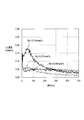
- FIG. 1, No. 1 4 and no. 5 is a graph showing the copper concentration in a region from the surface to a depth of about 500 nm of No. 5 specimen.
- FIG. 1 and No. 4 is a photograph showing a crystal appearance after chemical conversion treatment in a specimen of No. 4.
- a molten aluminum alloy is prepared.
- the composition of the molten aluminum alloy is, by mass%, 3.0-4.0% magnesium (Mg), 0.2-0.4% manganese (Mn), 0.1-0.5%. It contains iron, 0.03% or more and less than 0.10% copper, and less than 0.2% silicon (Si) as an unavoidable impurity, with the balance being aluminum (Al) and unavoidable impurities.
- this aluminum alloy molten metal is continuously cast into a thin slab having a thickness of 2 mm to 15 mm by using a thin slab continuous casting machine. And after winding on a roll directly, without performing hot rolling to a thin slab, it cold-rolls.
- the final cold rolling ratio of the thin slab is set to 70 to 95%.
- the thin slab is subjected to final annealing.
- the aluminum alloy plate (aluminum alloy substrate) thus obtained had a peak concentration of 0.15% by mass or more of the concentration distribution of copper (Cu) in the thickness direction in the region having a depth of 15 nm to 200 nm from the surface. is there.
- the aluminum alloy plate (aluminum alloy substrate) has a recrystallized structure having an average crystal grain size of 15 ⁇ m or less.
- the thin slab continuous casting machine includes both twin belt casting machines and twin roll casting machines.
- the twin belt casting machine includes a pair of rotating belt portions provided with endless belts that face each other, a cavity formed between the pair of rotating belt portions, and a cooling device provided inside the rotating belt portion. Prepare. Then, molten metal is supplied into the cavity through a nozzle made of a refractory, and a thin slab is continuously cast.
- the twin roll casting machine includes a pair of rotating roll portions that are endlessly provided with endless rolls, a cavity formed between the pair of rotating roll portions, and a cooling device provided inside the rotating roll portion. Prepare. Then, molten metal is supplied into the cavity through a nozzle made of a refractory, and a thin slab is continuously cast.
- the molten metal surface forms a meniscus for a short time until the molten metal moves from the nozzle tip to the belt.
- the meniscus melt surface is in contact with the atmosphere (air) in the cavity.
- the melt surface of the meniscus is oxidized and gradually cooled to form a very thin oxide film on the melt surface, and a very thin ⁇ -Al phase (solid phase) is crystallized on the inner side.
- the molten aluminum in which a very thin oxide film and a very thin ⁇ -Al shell are formed on the surface in a meniscus state is brought into contact with the belt and rapidly cooled (chilled).
- the ultra-thin ⁇ -Al shell and the segregation layer (liquid phase) formed inside it are also rapidly cooled, and the oxide film, ⁇ -Al shell, segregation layer (solid phase), and rapidly solidified structure are sequentially formed from the slab surface. Is formed. These are what are commonly called shells.
- a copper concentration peak exists at a position about 200 nm deep from the material surface of the thin slab.
- the thickness of the ⁇ -Al shell may be dependent on the belt speed or the like, but becomes relatively uniform in the slab surface layer. The above phenomenon is considered to occur naturally even in continuous thin slab casting by a twin roll casting machine.
- the concentration peak of the segregation layer formed in this way is estimated to exist at a depth of about 200 nm from the material surface of the thin slab.
- the thin slab is continuously cast, and the thin slab is directly wound on a roll without being hot-rolled, and then cold-rolled.
- the final cold rolling rate of the thin slab is set to 70 to 95%.
- the thin slab is finally annealed.
- the chamfering process, the homogenization process, and the hot rolling process required for the conventional semi-continuous cast slab (DC cast slab) can be omitted, and the processing cost can be kept low.
- dislocations are accumulated by processing while securing a predetermined solid solution amount of the transition metal element, and fine recrystallized grains of aluminum alloy of 15 ⁇ m or less can be obtained in the final annealing process. It becomes.
- a preferable final cold rolling rate is in the range of 70 to 95%.
- a more preferable final cold rolling rate is in the range of 70 to 90%.
- a more preferable final cold rolling rate is in the range of 70 to 85%.
- a final cold rolling rate shows the degree of rolling at the time of cold rolling. For example, when an aluminum plate having a thickness of 1.0 mm is cold rolled and rolled to 0.6 mm, the final cold rolling rate is expressed as 40%.
- elements such as copper are diffused and concentrated from the segregation layer having a copper concentration peak at a depth of, for example, about 50 nm from the surface of the aluminum alloy plate to the boundary between the oxide film and the alloy plate surface.
- the copper concentration peak in the segregation layer does not disappear.
- the influence by copper amount is especially large, and there exists a tendency for zinc phosphate processability to improve, so that there is much copper content. Therefore, since the aluminum alloy plate according to the present embodiment contains a predetermined amount of copper, the cathode reaction (2) on the surface is promoted even in the initial stage of the reaction in the zinc phosphate treatment.
- the copper segregation layer which has a copper concentration peak of 0.15 mass% or more exists in the predetermined depth from the surface of the aluminum alloy plate of this embodiment. Therefore, even if Al on the surface is dissolved as Al 3+ ions in the solution and the alloy plate surface is eroded, the effect of promoting the cathode reaction (2) is maintained by this copper segregation layer.
- the copper composition range of the entire aluminum alloy plate (aluminum alloy substrate) according to this embodiment needs to be 0.03 or more and less than 0.10% by mass.
- the peak concentration of the copper concentration distribution in the thickness direction in the region having a depth of 15 nm to 200 nm from the surface of the aluminum alloy plate is 0.15% by mass or more.
- the lower limit of the peak concentration of the copper concentration distribution in the thickness direction in the region having a depth of 15 nm to 200 nm from the surface of the aluminum alloy plate is 0.15% by mass, but the upper limit is not particularly limited. However, the upper limit of the peak concentration can be set to 1.0% by mass, for example.
- the upper limit of the average crystal grain size of the recrystallized structure in the aluminum alloy plate is 15 ⁇ m, but the lower limit is not particularly limited. However, the lower limit of the average crystal grain size can be set to 5 ⁇ m, for example.
- the thickness of the thin slab to be cast is preferably 2 mm to 15 mm.
- the thickness of the thin slab is less than 2 mm, it becomes difficult to cast a good thin slab by uniformly pouring molten aluminum into the cavity.
- the thickness of the thin slab exceeds 15 mm, it is difficult to wind the thin slab around the coil. If the thickness is within this range, a solidification rate of about 20 to 500 ° C./sec can be easily secured in a range of 1/4 of the slab thickness, so that a uniform cast structure can be obtained.
- transition metal elements such as Fe and Mn in the matrix.
- the thickness of the thin slab is within this range, the size of the intermetallic compound produced during casting solidification can be suppressed to less than 5 ⁇ m, and the number of intermetallic compounds per unit volume of the alloy plate can be increased.
- An intermetallic compound having an average particle size of about 1 to 5 ⁇ m becomes a nucleus of recrystallized grains during final annealing, and exhibits a pinning effect that hinders movement of crystal grain boundaries.
- a more preferable thickness of the thin slab is in the range of 3 mm to 12 mm.
- a more preferable thin slab thickness is in the range of 5 mm to 12 mm.
- the coil of the thin slab cold-rolled to a predetermined thickness is preferably subjected to final annealing at a holding temperature of 300 to 400 ° C. for 1 to 8 hours using a batch annealing furnace.
- Batch annealing refers to annealing performed with a thin slab coil standing still.
- the holding temperature in the batch annealing furnace is 300 ° C. or higher, recrystallization proceeds and a uniform recrystallized structure of the aluminum alloy can be easily obtained.
- the holding temperature is 400 ° C. or lower, the recrystallized grains are hardly coarsened by coalescence of the recrystallized grains, and a recrystallized structure of an aluminum alloy having an average particle diameter of 15 ⁇ m or less can be easily obtained. Furthermore, it becomes easy to prevent excessive softening of the thin slab and obtain a predetermined strength.
- the preferable final annealing temperature in the batch annealing is in the range of 300 to 400 ° C. Further, when the holding time of the annealing temperature is 1 hour or longer, the entire coil can be processed at a more uniform temperature. Furthermore, when the holding time is 8 hours or less, a recrystallized structure having an average particle size of 15 ⁇ m or less is obtained, and the productivity is further improved. Accordingly, a preferable holding time is in the range of 1 to 8 hours.
- the thin slab coil that has been cold-rolled to a predetermined thickness is preferably subjected to final annealing at a holding temperature of 400 to 500 ° C. for 10 to 60 seconds using a continuous annealing furnace (CAL annealing furnace).
- Continuous annealing refers to annealing performed by moving a thin slab coil continuously in a furnace.
- the holding temperature in continuous annealing is 400 ° C. or higher
- recrystallization proceeds and a uniform recrystallized structure can be easily obtained.
- the holding temperature is 500 ° C. or lower
- the recrystallized grains are hardly coarsened by coalescence of the recrystallized grains, and a recrystallized structure having an average particle diameter of 15 ⁇ m or less can be easily obtained. Furthermore, it becomes easy to prevent excessive softening of the thin slab and obtain a predetermined strength.
- the preferable final annealing temperature in the continuous annealing is in the range of 400 to 500 ° C. Further, when the holding time at the annealing temperature is 10 seconds or more, the entire coil can be processed at a more uniform temperature. Furthermore, when the holding time is 60 seconds or less, a recrystallized structure having an average particle size of 15 ⁇ m or less is obtained, and the productivity is further improved. Therefore, a preferable holding time is in the range of 10 to 60 seconds.
- the tensile strength of the aluminum alloy plate (aluminum alloy substrate) obtained as described above is not necessarily an essential requirement. However, high strength characteristics may be required depending on the application used for the structural member for automobiles. Therefore, the preferable tensile strength of the aluminum alloy plate (aluminum alloy substrate) is 240 MPa or more, and the more preferable tensile strength is 250 MPa or more.
- magnesium (Mg) is an essential element. Magnesium acts as an element that strengthens the solid solution by solid solution in the aluminum matrix, so it is added to give strength and formability.
- a preferable magnesium concentration is in the range of 3.0 to 4.0% by mass.
- a more preferable magnesium concentration is in the range of 3.2 to 4.0% by mass.
- a more preferable magnesium concentration is in the range of 3.4 to 3.8% by mass.
- manganese (Mn) is an essential element, and by coexisting with iron (Fe) and silicon (Si), an Al—Fe compound, Al— (Fe ⁇ Mn) is contained in the thin slab. ) —Si-based compounds are crystallized uniformly and finely. As a result, as described above, the average recrystallized grain size of the aluminum alloy becomes as fine as 15 ⁇ m or less. Further, since manganese is an element that easily dissolves in a supersaturated state in the matrix at the time of casting as compared with iron, it can impart seizure softening resistance to the final aluminum alloy plate.
- the manganese concentration is less than 0.2% by mass, the seizure softening resistance is small, and the predetermined tensile strength and average recrystallized grain size cannot be obtained. If the manganese concentration exceeds 0.4% by mass, the strength becomes too high, which may reduce the formability, which is not desirable. Therefore, a preferable manganese concentration is in the range of 0.2 to 0.4% by mass. A more preferable manganese concentration is in the range of 0.25 to 0.4% by mass. A more preferable manganese concentration is in the range of 0.3 to 0.4% by mass.
- iron (Fe) is an essential element, and by coexisting with manganese (Mn) and silicon (Si), an Al—Fe compound, Al— (Fe ⁇ Mn) is contained in the thin slab. ) —Si-based compounds are crystallized uniformly and finely. As a result, as described above, the average recrystallized grain size of the aluminum alloy becomes as fine as 15 ⁇ m or less. Further, since iron is an element that is easily crystallized at the time of casting as compared with manganese, the proportion of the final aluminum alloy plate that contributes to anti-seizure softening properties is smaller than that of manganese.
- a preferable iron concentration is in the range of 0.1 to 0.5% by mass.
- a more preferable iron concentration is in the range of 0.1 to 0.4 mass%.
- a more preferable iron concentration is in the range of 0.1 to 0.3% by mass.
- copper (Cu) is an essential element.
- substrate) is prescribed
- the peak concentration of the copper concentration distribution in the thickness direction in the region having a depth from the surface of 15 nm to 200 nm is defined as 0.15 mass% or more. Therefore, during the zinc phosphate treatment, the effect of promoting the cathode reaction (2) is maintained on the surface of the aluminum alloy plate, and the zinc phosphate is uniformly deposited.
- the copper concentration is less than 0.03% by mass, the copper peak concentration in the region of 15 nm to 200 nm in depth from the alloy plate surface will be less than 0.15% by mass, and the precipitation of zinc phosphate may be uneven. There is. If the copper concentration is 0.10% by mass or more, corrosion resistance such as yarn rust after coating and swelling of the coating film may be lowered. Therefore, a preferable copper concentration is in the range of 0.03% or more and less than 0.10% by mass. A more preferable copper concentration is in the range of 0.03% or more and less than 0.07% by mass. A more preferable copper concentration is in the range of 0.03% or more and less than 0.05% by mass.
- the concentration of silicon (Si) as an inevitable impurity is preferably limited to less than 0.20% by mass, that is, from 0% by mass to less than 0.20% by mass.
- silicon concentration is 0.20% by mass or more, coarse Al— (Fe ⁇ Mn) —Si based intermetallic compounds are crystallized at the time of thin slab casting, which is not preferable.
- a more preferable silicon concentration is less than 0.18% by mass.
- a more preferable silicon concentration is less than 0.15% by mass. In this embodiment, if the silicon concentration is less than 0.15% by mass, the moldability is not lowered.
- inevitable impurities Inevitable impurities are inevitably mixed from raw metal, return material and the like. Acceptable concentrations of inevitable impurities include, for example, zinc (Zn) less than 0.4 mass%, nickel (Ni) less than 0.2 mass%, gallium (Ga) and vanadium (V) 0.05 mass%. Is less than. Lead (Pb), bismuth (Bi), tin (Sn), sodium (Na), calcium (Ca), and strontium (Sr) are each less than 0.02% by mass. The other elements are each less than 0.05% by mass, and the inclusion of other elements within this range does not hinder the effects of the present invention.
- the mass ratio of manganese to iron (Mn / Fe ratio) is not an essential component in the aluminum alloy plate of the present embodiment.
- manganese is contained in the Al—Fe—Si intermetallic compound, and as the manganese concentration increases, an Al—Fe ⁇ Mn—Si intermetallic compound is easily formed.
- the Al—Fe—Si intermetallic compound is needle-shaped, whereas the Al—Fe ⁇ Mn—Si intermetallic compound is spherical. Therefore, mechanical properties such as fatigue strength and elongation of the aluminum alloy plate can be improved.
- Mn / Fe ratio When the Mn / Fe ratio is 1.0 or more, the effect of the mechanical properties can be obtained, and when it is 5.0 or less, high moldability can be obtained while ensuring sufficient strength. Therefore, a preferable Mn / Fe ratio is in the range of 1.0 to 5.0. A more preferable Mn / Fe ratio is in the range of 1.0 to 4.0. A more preferable Mn / Fe ratio is in the range of 1.0 to 3.0.
- the aluminum alloy plate of the present embodiment may include titanium (Ti) in addition to the above elements. Titanium may be mixed from the return material and is an unavoidable impurity. Titanium is added to the molten metal as a refiner for crystal grains in the ingot, and usually as an Al—Ti based or Al—Ti—B based hardener.
- a preferable titanium concentration is in the range of 0.005 to 0.1% by mass.
- a more preferable titanium concentration is in the range of 0.005 to 0.08 mass%.
- a more preferable titanium concentration is in the range of 0.005 to 0.05 mass%.
- the aluminum alloy plate of this embodiment may contain boron (B) in addition to the above elements.
- Boron (B) may be mixed from the return material and is an unavoidable impurity. Boron is added to the molten metal as a finer for crystal grains in the ingot, and usually as an Al—Ti based or Al—Ti—B based hardener.
- the boron concentration is 0.0005% by mass or more, the effect of the finer and hardener is easily obtained.
- the boron concentration is 0.01% by mass or less, it is possible to prevent an intermetallic compound such as TiB 2 from precipitating and aggregating on the furnace bottom.
- a preferable boron concentration is in the range of 0.0005 to 0.01% by mass.
- a more preferable boron concentration is in the range of 0.0005 to 0.005 mass%.
- a more preferable boron concentration is in the range of 0.001 to 0.005 mass%.
- the aluminum alloy plate excellent in chemical conversion treatment of the present embodiment is suitable as a vehicle body panel and a structural member.
- outer panels, inner panels, and reinforcements such as the hood 10, the door 11, the fender 12, the roof 13, and the trunk 14 shown in FIG.
- molten alloys having the compositions shown in Table 1 were melted.
- the molten alloy was continuously cast into a thin slab having a thickness of 10 mm by a twin belt casting machine, and this was directly wound around a coil.
- the thin slab wound around this coil was cold-rolled to a thickness of 2.3 mm and subjected to final annealing that was held at 330 ° C. for 4 hours in a batch furnace. In this case, the final cold rolling rate was 77%.
- the final board which gave the final annealing was wash
- these test materials are prepared by continuous casting, in the manufacturing method of Table 1, it is shown as "CC.”
- molten alloys having the compositions (No. 5, No. 6) shown in Table 1 were melted separately.
- the molten alloy was cast into a slab having a width of 600 mm, a thickness of 400 mm, and a length of 4000 mm by a DC casting machine.
- both sides of the slab were chamfered by using a milling cutter about 20 to 30 mm on one side.
- the chamfered slab was subjected to a homogenization treatment at 440 ° C. for 8 hours, and then hot-rolled to wind a 7 mm hot-rolled sheet around a coil.
- the thin slab wound around the coil was cold-rolled to a thickness of 2.3 mm and subjected to final annealing that was held at 330 ° C. for 4 hours in a batch furnace. And the final board which gave the final annealing was wash
- DC is indicated in the manufacturing method of Table 1.
- the SS mark is a surface pattern generated on the plate surface when an Al—Mg alloy is subjected to a tensile test or stretch forming, and is divided into a random mark and a parallel band.
- a random mark refers to an irregular belt-like pattern, also called a flame shape, which occurs at a portion having a relatively low strain amount.
- a parallel band means the strip
- GD-OES low discharge emission spectroscopic analysis
- an inert gas such as argon is introduced into the sample chamber evacuated to about 500 to 950 Pa.
- a high output of about 30 to 70 W is applied to generate glow discharge.
- the cathode material sputtered by positive ion collision is ionized by inelastic collision with argon ions and secondary electrons.
- the composition distribution in the depth direction from the surface of the sample is measured by spectroscopically measuring the light generated by the excitation due to the inelastic collision.
- Cu copper in a standard sample was measured using a high-frequency glow discharge luminescent surface analyzer (Horiba, Ltd., model GD-Profiler 2) under the measurement conditions of argon gas pressure of 600 Pa, RF power of 35 W, and wavelength of 325 nm. GD-OES analysis was performed. Thus, a calibration curve of emission intensity-copper content was prepared for copper. Next, the intensity of light having a wavelength of 325 nm with respect to the depth direction (time passage) from the material surface of each test material was measured and converted into a copper concentration distribution in a region from the material surface to a depth of 500 nm.
- Fig. 2 shows specimen No. 1, no. 4, no. 5 shows the copper concentration in the region from the material surface 5 to a depth of about 500 nm. From this figure, no. It can be seen that there is a clear peak in the copper concentration distribution in a region 15 to 200 nm deep from the surface of one material. In addition, specimen No. 4, no. In the measured copper concentration distribution chart for No. 5, there was no clear peak in the copper concentration distribution in the region 15 to 200 nm deep from the surface of the material. did. In this way, no. 1-No. From the copper concentration distribution chart measured for No. 6, the Cu peak concentration in a region 15 to 200 nm deep from the material surface was read. Table 2 shows the Cu peak concentration of each test material.
- test materials 1 to 3 satisfied predetermined conditions in all evaluation items of average crystal grain size, copper peak concentration, SS mark, and chemical conversion treatment, and had a tensile strength of 240 MPa or more.
- the specimens 4 to 6 do not satisfy the predetermined conditions in any of the evaluation items.
- No. Regarding the test material No. 4 although it was a CC material, the copper concentration was as low as 0.01% by mass, and the chemical conversion treatment property was inferior.
- the copper concentration was 0.05% by mass, but the magnesium concentration was as high as 4.60% by mass, and even the DC material had a high tensile strength.
- the average crystal grain size was 23 ⁇ m, which was larger than the predetermined value, SS marks were observed in the appearance after molding.
- the slab surface layer portion was removed, and the copper concentration distribution in the thickness direction in the region 15 nm to 200 nm deep from the material surface of the aluminum alloy plate was obtained. There was no clear peak (see No. 5 in FIG. 2).
- the copper concentration was 0.05% by mass, but since it was a DC material, the average crystal grain size was 21 ⁇ m, which was larger than a predetermined value, and the tensile strength was reduced to 235 MPa.
- FIG. 1 and no. 4 shows a crystal appearance after chemical conversion treatment in the test material of No. 4.
- FIG. 1 it can be seen that the appearance unevenness is improved by addition of copper, and the zinc phosphate coating is uniformly formed.
- FIG. 1 since the amount of copper added is insufficient, it can be seen that the zinc phosphate coating is segregated and the aluminum alloy plate is exposed.
Landscapes
- Chemical & Material Sciences (AREA)
- Mechanical Engineering (AREA)
- Engineering & Computer Science (AREA)
- Organic Chemistry (AREA)
- Metallurgy (AREA)
- Materials Engineering (AREA)
- Crystallography & Structural Chemistry (AREA)
- Physics & Mathematics (AREA)
- Thermal Sciences (AREA)
- Metal Rolling (AREA)
- Continuous Casting (AREA)
- Physical Vapour Deposition (AREA)
- Insulated Metal Substrates For Printed Circuits (AREA)
- Powder Metallurgy (AREA)
Abstract
Priority Applications (7)
| Application Number | Priority Date | Filing Date | Title |
|---|---|---|---|
| BR112014001471-0A BR112014001471B1 (pt) | 2011-07-25 | 2012-07-10 | Folha de liga de alumínio e método para fabricação da mesma |
| RU2014106736/02A RU2556171C1 (ru) | 2011-07-25 | 2012-07-10 | Лист алюминиевого сплава и способ его изготовления |
| EP12817572.6A EP2738273B1 (fr) | 2011-07-25 | 2012-07-10 | Plaque d'alliage d'aluminium et son procédé de fabrication |
| MX2014000362A MX353904B (es) | 2011-07-25 | 2012-07-10 | Lamina de alineacion de aluminio y metodo de fabricacion de la misma. |
| CN201280036235.5A CN103703155B (zh) | 2011-07-25 | 2012-07-10 | 铝合金片材及其制造方法 |
| JP2013525651A JP5728580B2 (ja) | 2011-07-25 | 2012-07-10 | アルミニウム合金板及びアルミニウム合金板の製造方法 |
| US14/234,770 US10041154B2 (en) | 2011-07-25 | 2012-07-10 | Aluminum alloy sheet and method for manufacturing same |
Applications Claiming Priority (2)
| Application Number | Priority Date | Filing Date | Title |
|---|---|---|---|
| JP2011162284 | 2011-07-25 | ||
| JP2011-162284 | 2011-07-25 |
Publications (1)
| Publication Number | Publication Date |
|---|---|
| WO2013015110A1 true WO2013015110A1 (fr) | 2013-01-31 |
Family
ID=47600963
Family Applications (1)
| Application Number | Title | Priority Date | Filing Date |
|---|---|---|---|
| PCT/JP2012/067587 Ceased WO2013015110A1 (fr) | 2011-07-25 | 2012-07-10 | Plaque d'alliage d'aluminium et son procédé de fabrication |
Country Status (9)
| Country | Link |
|---|---|
| US (1) | US10041154B2 (fr) |
| EP (1) | EP2738273B1 (fr) |
| JP (1) | JP5728580B2 (fr) |
| CN (1) | CN103703155B (fr) |
| BR (1) | BR112014001471B1 (fr) |
| MX (1) | MX353904B (fr) |
| MY (1) | MY167437A (fr) |
| RU (1) | RU2556171C1 (fr) |
| WO (1) | WO2013015110A1 (fr) |
Cited By (3)
| Publication number | Priority date | Publication date | Assignee | Title |
|---|---|---|---|---|
| JP2022525519A (ja) * | 2019-03-19 | 2022-05-17 | コンステリウム ヌフ-ブリザック | 電気自動車用のバッテリボックス底部部分 |
| JP2022130360A (ja) * | 2017-12-21 | 2022-09-06 | ノベリス・インコーポレイテッド | 改善された接合耐久性を有するアルミニウム合金物品および不活性な表面のアルミニウム合金物品、ならびにそれらを作製および使用する方法 |
| JP2023032692A (ja) * | 2021-08-27 | 2023-03-09 | 株式会社Uacj | アルミニウム合金圧延板及びその製造方法 |
Families Citing this family (14)
| Publication number | Priority date | Publication date | Assignee | Title |
|---|---|---|---|---|
| JP6243607B2 (ja) * | 2013-01-21 | 2017-12-06 | 矢崎総業株式会社 | アルミニウム合金線、電線、ケーブル、ワイヤハーネス、及び、アルミニウム合金線の製造方法 |
| DE102013012478A1 (de) * | 2013-07-26 | 2015-01-29 | GM Global Technology Operations LLC (n. d. Gesetzen des Staates Delaware) | Karosseriebauteil sowie Verfahren zur Herstellung eines Karosseriebauteils |
| CN104775062B (zh) * | 2015-04-21 | 2017-02-22 | 宝山钢铁股份有限公司 | 一种高强度铝合金材料、铝合金板及其制造方法 |
| RU2605976C1 (ru) * | 2015-07-24 | 2017-01-10 | Общество с ограниченной ответственностью "Алюком" | Наборный карниз фасада здания |
| EA033989B9 (ru) * | 2015-11-02 | 2020-01-30 | Автономная некоммерческая образовательная организация высшего образования "Сколковский институт науки и технологий" | Сверхпластичный алюминиевый сплав (варианты), его применение и изготовленное из него изделие |
| EP3235917B1 (fr) | 2016-04-19 | 2018-08-15 | Rheinfelden Alloys GmbH & Co. KG | Alliage d'aluminium pour moulage sous pression |
| EP3235916B1 (fr) | 2016-04-19 | 2018-08-15 | Rheinfelden Alloys GmbH & Co. KG | Alliage de moulage |
| JP6208389B1 (ja) * | 2016-07-14 | 2017-10-04 | 株式会社Uacj | 曲げ加工性及び耐リジング性に優れたアルミニウム合金からなる成形加工用アルミニウム合金圧延材の製造方法 |
| JP6437583B2 (ja) * | 2017-02-27 | 2018-12-12 | 株式会社Uacj | 磁気ディスク基板用アルミニウム合金板及びその製造方法、ならびに、この磁気ディスク基板用アルミニウム合金板を用いた磁気ディスク |
| AU2018249841B2 (en) | 2017-04-05 | 2020-12-24 | Novelis Inc. | Anodized quality 5xxx aluminum alloys with high strength and high formability and methods of making the same |
| US11649529B2 (en) | 2017-12-21 | 2023-05-16 | Novelis Inc. | Aluminum alloy products exhibiting improved bond durability and methods of making the same |
| CN112458345B (zh) * | 2020-11-26 | 2021-10-01 | 东莞市灿煜金属制品有限公司 | 一种笔电平板高强度氧化铝6s50的制造方法 |
| CN114574737B (zh) * | 2020-12-01 | 2022-11-22 | 中国科学院金属研究所 | 一种高强高塑性抗应力腐蚀纳米结构铝合金及其制备方法 |
| CN113637926B (zh) * | 2021-08-13 | 2022-10-25 | 联想(北京)有限公司 | 一种5系铝合金的轧制退火工艺 |
Citations (15)
| Publication number | Priority date | Publication date | Assignee | Title |
|---|---|---|---|---|
| JPH06256881A (ja) * | 1993-03-05 | 1994-09-13 | Nippon Steel Corp | 接着性に優れるアルミニウム合金板及びその製造方法 |
| JPH0726342A (ja) * | 1993-07-12 | 1995-01-27 | Sky Alum Co Ltd | 冷間予成形可能な超塑性成形用アルミニウム合金板およびその製造方法 |
| JPH07145488A (ja) | 1993-11-22 | 1995-06-06 | Mitsubishi Alum Co Ltd | リン酸塩処理性に優れたAl材及びその製造方法 |
| JPH07197177A (ja) * | 1994-01-10 | 1995-08-01 | Sky Alum Co Ltd | キャビテーションの少ない超塑性成形用アルミニウム合金圧延板 |
| JPH0899256A (ja) | 1994-09-29 | 1996-04-16 | Sumitomo Light Metal Ind Ltd | 優れたリン酸亜鉛処理性を与えるAl−Mg系合金材の研削方法 |
| JPH08277434A (ja) | 1995-04-05 | 1996-10-22 | Sumitomo Light Metal Ind Ltd | リン酸亜鉛処理性に優れた成形用アルミニウム合金 |
| JPH09195019A (ja) | 1996-01-12 | 1997-07-29 | Sumitomo Light Metal Ind Ltd | アルミニウム合金板の連続処理方法および装置 |
| JPH09263868A (ja) * | 1996-03-28 | 1997-10-07 | Nippon Steel Corp | 塗膜密着性に優れるアルミニウム合金板及びその製造方法 |
| JPH108177A (ja) * | 1996-06-20 | 1998-01-13 | Furukawa Electric Co Ltd:The | 磁気ディスク基板用アルミニウム合金板およびその製造方法 |
| JPH1180873A (ja) | 1997-09-11 | 1999-03-26 | Nippon Light Metal Co Ltd | 連続抵抗スポット溶接性に優れた自動車用アルミニウム合金板 |
| JP2001032031A (ja) * | 1999-07-22 | 2001-02-06 | Kobe Steel Ltd | 耐応力腐食割れ性に優れた構造材用アルミニウム合金板 |
| JP2001335875A (ja) * | 2000-05-31 | 2001-12-04 | Showa Denko Kk | 抗菌性を有するアルミニウム製品 |
| JP2001348670A (ja) | 2000-06-09 | 2001-12-18 | Sumitomo Light Metal Ind Ltd | リン酸亜鉛処理性に優れたジンケート処理アルミニウム合金板 |
| JP2004076155A (ja) | 2002-06-21 | 2004-03-11 | Nippon Light Metal Co Ltd | 耐焼付軟化性に優れたアルミニウム合金板 |
| JP2008223054A (ja) | 2007-03-09 | 2008-09-25 | Nippon Light Metal Co Ltd | 深絞り性および耐焼付け軟化性に優れた成形加工用アルミニウム合金板及びその製造方法 |
Family Cites Families (22)
| Publication number | Priority date | Publication date | Assignee | Title |
|---|---|---|---|---|
| JPH055149A (ja) | 1991-01-28 | 1993-01-14 | Sky Alum Co Ltd | 成形用アルミニウム合金硬質板およびその製造方法 |
| JPH04276047A (ja) * | 1991-02-28 | 1992-10-01 | Sky Alum Co Ltd | 成形用アルミニウム合金硬質板の製造方法 |
| RU2058204C1 (ru) * | 1993-03-25 | 1996-04-20 | Акционерное общество "Всероссийский институт легких сплавов" | Способ получения листов из алюминия с изотропной структурой поверхности |
| JP2862223B2 (ja) * | 1993-12-28 | 1999-03-03 | 本田技研工業株式会社 | 高周波焼入装置のコイル体 |
| JPH07278716A (ja) | 1994-02-21 | 1995-10-24 | Nippon Steel Corp | 機械的性質に優れた成形加工用アルミニウム合金板およびその製造方法 |
| JPH07310136A (ja) | 1994-05-12 | 1995-11-28 | Furukawa Electric Co Ltd:The | 成形用アルミニウム合金板およびその製造方法 |
| EP0690142A1 (fr) | 1994-06-09 | 1996-01-03 | The Furukawa Electric Co., Ltd. | TÔle en alliage d'aluminium pour carrosseries d'automobiles, son procédé de fabrication et son procédé de formage |
| JPH08165538A (ja) | 1994-12-12 | 1996-06-25 | Sky Alum Co Ltd | リサイクル性の高い自動車ボディシート用アルミニウム合金圧延板及びその製造方法 |
| DE69716949T2 (de) | 1996-12-04 | 2003-07-17 | Alcan International Ltd., Montreal | Al-legierung und verfahren |
| JPH10219412A (ja) * | 1997-02-04 | 1998-08-18 | Shinko Alcoa Yuso Kizai Kk | 成形加工後の外観性が優れたアルミニウム合金圧延板の製造方法 |
| JPH1112676A (ja) | 1997-06-23 | 1999-01-19 | Furukawa Electric Co Ltd:The | 成形用アルミニウム合金硬質板、前記硬質板を用いた缶蓋、および前記硬質板の製造方法 |
| JP2000080431A (ja) | 1998-09-02 | 2000-03-21 | Kobe Steel Ltd | プレス成形性に優れるAl―Mg系合金板 |
| RU2232828C2 (ru) * | 1998-12-18 | 2004-07-20 | Корус Алюминиум Вальцпродукте Гмбх | Способ получения изделий из сплава алюминий-магний-литий |
| US20040256079A1 (en) * | 2001-09-25 | 2004-12-23 | Akkurt Soner A | Process of producing 5xxx series aluminum alloys with high mechanical, properties through twin-roll casting |
| WO2005061744A1 (fr) * | 2003-12-19 | 2005-07-07 | Nippon Light Metal Company, Ltd. | Feuille en alliage d'aluminium presentant une excellente resistance a l'adoucissement par cuisson |
| JP4534573B2 (ja) | 2004-04-23 | 2010-09-01 | 日本軽金属株式会社 | 高温高速成形性に優れたAl‐Mg合金板およびその製造方法 |
| JP4740941B2 (ja) | 2004-07-30 | 2011-08-03 | 日本軽金属株式会社 | アルミニウム合金板の製造方法 |
| JP5135684B2 (ja) | 2006-01-12 | 2013-02-06 | 日本軽金属株式会社 | 高温高速成形性に優れたアルミニウム合金板およびその製造方法 |
| JP2008024964A (ja) | 2006-07-18 | 2008-02-07 | Nippon Light Metal Co Ltd | 高強度アルミニウム合金板およびその製造方法 |
| JP5220310B2 (ja) | 2006-12-26 | 2013-06-26 | 日本軽金属株式会社 | 自動車用アルミニウム合金板及びその製造方法 |
| EP2239347A4 (fr) * | 2008-02-06 | 2011-08-24 | Nippon Light Metal Co | Feuille d'alliage d'aluminium pour véhicules à moteur et procédé de production associé |
| JP2009167533A (ja) * | 2009-03-25 | 2009-07-30 | Nippon Light Metal Co Ltd | スピニング加工用アルミニウム合金厚板 |
-
2012
- 2012-07-10 JP JP2013525651A patent/JP5728580B2/ja active Active
- 2012-07-10 MX MX2014000362A patent/MX353904B/es active IP Right Grant
- 2012-07-10 BR BR112014001471-0A patent/BR112014001471B1/pt active IP Right Grant
- 2012-07-10 RU RU2014106736/02A patent/RU2556171C1/ru active
- 2012-07-10 MY MYPI2014000051A patent/MY167437A/en unknown
- 2012-07-10 WO PCT/JP2012/067587 patent/WO2013015110A1/fr not_active Ceased
- 2012-07-10 EP EP12817572.6A patent/EP2738273B1/fr active Active
- 2012-07-10 US US14/234,770 patent/US10041154B2/en active Active
- 2012-07-10 CN CN201280036235.5A patent/CN103703155B/zh active Active
Patent Citations (15)
| Publication number | Priority date | Publication date | Assignee | Title |
|---|---|---|---|---|
| JPH06256881A (ja) * | 1993-03-05 | 1994-09-13 | Nippon Steel Corp | 接着性に優れるアルミニウム合金板及びその製造方法 |
| JPH0726342A (ja) * | 1993-07-12 | 1995-01-27 | Sky Alum Co Ltd | 冷間予成形可能な超塑性成形用アルミニウム合金板およびその製造方法 |
| JPH07145488A (ja) | 1993-11-22 | 1995-06-06 | Mitsubishi Alum Co Ltd | リン酸塩処理性に優れたAl材及びその製造方法 |
| JPH07197177A (ja) * | 1994-01-10 | 1995-08-01 | Sky Alum Co Ltd | キャビテーションの少ない超塑性成形用アルミニウム合金圧延板 |
| JPH0899256A (ja) | 1994-09-29 | 1996-04-16 | Sumitomo Light Metal Ind Ltd | 優れたリン酸亜鉛処理性を与えるAl−Mg系合金材の研削方法 |
| JPH08277434A (ja) | 1995-04-05 | 1996-10-22 | Sumitomo Light Metal Ind Ltd | リン酸亜鉛処理性に優れた成形用アルミニウム合金 |
| JPH09195019A (ja) | 1996-01-12 | 1997-07-29 | Sumitomo Light Metal Ind Ltd | アルミニウム合金板の連続処理方法および装置 |
| JPH09263868A (ja) * | 1996-03-28 | 1997-10-07 | Nippon Steel Corp | 塗膜密着性に優れるアルミニウム合金板及びその製造方法 |
| JPH108177A (ja) * | 1996-06-20 | 1998-01-13 | Furukawa Electric Co Ltd:The | 磁気ディスク基板用アルミニウム合金板およびその製造方法 |
| JPH1180873A (ja) | 1997-09-11 | 1999-03-26 | Nippon Light Metal Co Ltd | 連続抵抗スポット溶接性に優れた自動車用アルミニウム合金板 |
| JP2001032031A (ja) * | 1999-07-22 | 2001-02-06 | Kobe Steel Ltd | 耐応力腐食割れ性に優れた構造材用アルミニウム合金板 |
| JP2001335875A (ja) * | 2000-05-31 | 2001-12-04 | Showa Denko Kk | 抗菌性を有するアルミニウム製品 |
| JP2001348670A (ja) | 2000-06-09 | 2001-12-18 | Sumitomo Light Metal Ind Ltd | リン酸亜鉛処理性に優れたジンケート処理アルミニウム合金板 |
| JP2004076155A (ja) | 2002-06-21 | 2004-03-11 | Nippon Light Metal Co Ltd | 耐焼付軟化性に優れたアルミニウム合金板 |
| JP2008223054A (ja) | 2007-03-09 | 2008-09-25 | Nippon Light Metal Co Ltd | 深絞り性および耐焼付け軟化性に優れた成形加工用アルミニウム合金板及びその製造方法 |
Non-Patent Citations (1)
| Title |
|---|
| See also references of EP2738273A4 |
Cited By (6)
| Publication number | Priority date | Publication date | Assignee | Title |
|---|---|---|---|---|
| JP2022130360A (ja) * | 2017-12-21 | 2022-09-06 | ノベリス・インコーポレイテッド | 改善された接合耐久性を有するアルミニウム合金物品および不活性な表面のアルミニウム合金物品、ならびにそれらを作製および使用する方法 |
| JP7384958B2 (ja) | 2017-12-21 | 2023-11-21 | ノベリス・インコーポレイテッド | 改善された接合耐久性を有するアルミニウム合金物品および不活性な表面のアルミニウム合金物品、ならびにそれらを作製および使用する方法 |
| JP2022525519A (ja) * | 2019-03-19 | 2022-05-17 | コンステリウム ヌフ-ブリザック | 電気自動車用のバッテリボックス底部部分 |
| JP7546590B2 (ja) | 2019-03-19 | 2024-09-06 | コンステリウム ヌフ-ブリザック | 電気自動車用のバッテリボックス底部部分 |
| JP2023032692A (ja) * | 2021-08-27 | 2023-03-09 | 株式会社Uacj | アルミニウム合金圧延板及びその製造方法 |
| JP7770812B2 (ja) | 2021-08-27 | 2025-11-17 | 株式会社Uacj | アルミニウム合金圧延板及びその製造方法 |
Also Published As
| Publication number | Publication date |
|---|---|
| EP2738273B1 (fr) | 2016-06-29 |
| EP2738273A1 (fr) | 2014-06-04 |
| MX2014000362A (es) | 2014-03-31 |
| JPWO2013015110A1 (ja) | 2015-02-23 |
| MX353904B (es) | 2018-02-02 |
| BR112014001471B1 (pt) | 2022-05-24 |
| US20140166162A1 (en) | 2014-06-19 |
| US10041154B2 (en) | 2018-08-07 |
| JP5728580B2 (ja) | 2015-06-03 |
| CN103703155A (zh) | 2014-04-02 |
| RU2556171C1 (ru) | 2015-07-10 |
| CN103703155B (zh) | 2015-08-26 |
| MY167437A (en) | 2018-08-28 |
| EP2738273A4 (fr) | 2015-04-29 |
| BR112014001471A2 (pt) | 2017-02-21 |
Similar Documents
| Publication | Publication Date | Title |
|---|---|---|
| JP5728580B2 (ja) | アルミニウム合金板及びアルミニウム合金板の製造方法 | |
| EP3733918B1 (fr) | Matériau d'acier plaqué d'alliage de zinc ayant une excellente résistance à la corosion après traitement et son procédé de fabrication | |
| CN101541993B (zh) | 具有高的{222}面聚集度的钢板及其制造方法 | |
| US9222161B2 (en) | Magnesium alloy sheet and method for producing same | |
| KR20020036838A (ko) | 변형시효 경화특성이 우수한 냉연강판 및 그 제조방법 | |
| JP2014532114A (ja) | AlMgSi系アルミニウムストリップの製造方法 | |
| JPH0747807B2 (ja) | 成形加工用アルミニウム合金圧延板の製造方法 | |
| JP7495009B2 (ja) | 熱間プレス用鋼板、熱間プレス用鋼板の製造方法、および熱間プレス部材の製造方法 | |
| CN106574328B (zh) | 铝合金板 | |
| WO2015155911A1 (fr) | Plaque en un alliage d'aluminium présentant une haute résistance et d'exceptionnelles aptitude au pliage et capacité de fixation de forme et son procédé de fabrication | |
| JP6857535B2 (ja) | 成形性、曲げ加工性および耐デント性に優れた高強度アルミニウム合金板及びその製造方法 | |
| TWI588293B (zh) | 熱壓印成形體 | |
| JP4175818B2 (ja) | 成形性および塗装焼付硬化性に優れたアルミニウム合金板およびその製造方法 | |
| JP2000345364A (ja) | 耐糸さび性に優れたアルミニウム合金材 | |
| JP3749627B2 (ja) | プレス成形性に優れたAl合金板 | |
| US20170349978A1 (en) | Aluminum alloy sheet | |
| JP6585436B2 (ja) | 耐糸錆性、塗装焼付け硬化性及び加工性に優れた自動車ボディパネル用アルミニウム合金板及びその製造方法、ならびに、これを用いた自動車ボディパネル及びその製造方法 | |
| JP2007131889A (ja) | Al−Mg−Si系アルミニウム合金板 | |
| JP2024509070A (ja) | 高強度5xxxアルミニウム合金の変種及びその調製方法 | |
| JPH08302440A (ja) | 高強度を有するAl合金板材 | |
| WO2025079390A1 (fr) | Corps moulé par estampage à chaud | |
| WO2023132240A1 (fr) | Tôle d'acier plaquée | |
| WO2025079391A1 (fr) | Tôle d'acier plaquée | |
| WO2022176850A1 (fr) | Tôle d'acier plaquée pour estampage à chaud, et corps moulé par estampage à chaud ainsi que procédé de fabrication de celui-ci | |
| JP2006249550A (ja) | 自動車ボディ用アルミニウム合金板 |
Legal Events
| Date | Code | Title | Description |
|---|---|---|---|
| 121 | Ep: the epo has been informed by wipo that ep was designated in this application |
Ref document number: 12817572 Country of ref document: EP Kind code of ref document: A1 |
|
| ENP | Entry into the national phase |
Ref document number: 2013525651 Country of ref document: JP Kind code of ref document: A |
|
| WWE | Wipo information: entry into national phase |
Ref document number: MX/A/2014/000362 Country of ref document: MX |
|
| WWE | Wipo information: entry into national phase |
Ref document number: 2012817572 Country of ref document: EP |
|
| WWE | Wipo information: entry into national phase |
Ref document number: 14234770 Country of ref document: US |
|
| NENP | Non-entry into the national phase |
Ref country code: DE |
|
| ENP | Entry into the national phase |
Ref document number: 2014106736 Country of ref document: RU Kind code of ref document: A |
|
| REG | Reference to national code |
Ref country code: BR Ref legal event code: B01A Ref document number: 112014001471 Country of ref document: BR |
|
| ENP | Entry into the national phase |
Ref document number: 112014001471 Country of ref document: BR Kind code of ref document: A2 Effective date: 20140122 |