WO2013069449A1 - シラノール基含有ポリシロキサン溶液の安定化方法、安定化シラノール基含有ポリシロキサン溶液の製造方法及び安定化シラノール基含有ポリシロキサン溶液 - Google Patents
シラノール基含有ポリシロキサン溶液の安定化方法、安定化シラノール基含有ポリシロキサン溶液の製造方法及び安定化シラノール基含有ポリシロキサン溶液 Download PDFInfo
- Publication number
- WO2013069449A1 WO2013069449A1 PCT/JP2012/077329 JP2012077329W WO2013069449A1 WO 2013069449 A1 WO2013069449 A1 WO 2013069449A1 JP 2012077329 W JP2012077329 W JP 2012077329W WO 2013069449 A1 WO2013069449 A1 WO 2013069449A1
- Authority
- WO
- WIPO (PCT)
- Prior art keywords
- containing polysiloxane
- silanol group
- polysiloxane solution
- solution
- exchange resin
- Prior art date
- Legal status (The legal status is an assumption and is not a legal conclusion. Google has not performed a legal analysis and makes no representation as to the accuracy of the status listed.)
- Ceased
Links
Classifications
-
- C—CHEMISTRY; METALLURGY
- C08—ORGANIC MACROMOLECULAR COMPOUNDS; THEIR PREPARATION OR CHEMICAL WORKING-UP; COMPOSITIONS BASED THEREON
- C08L—COMPOSITIONS OF MACROMOLECULAR COMPOUNDS
- C08L83/00—Compositions of macromolecular compounds obtained by reactions forming in the main chain of the macromolecule a linkage containing silicon with or without sulfur, nitrogen, oxygen or carbon only; Compositions of derivatives of such polymers
- C08L83/04—Polysiloxanes
- C08L83/06—Polysiloxanes containing silicon bound to oxygen-containing groups
-
- C—CHEMISTRY; METALLURGY
- C08—ORGANIC MACROMOLECULAR COMPOUNDS; THEIR PREPARATION OR CHEMICAL WORKING-UP; COMPOSITIONS BASED THEREON
- C08G—MACROMOLECULAR COMPOUNDS OBTAINED OTHERWISE THAN BY REACTIONS ONLY INVOLVING UNSATURATED CARBON-TO-CARBON BONDS
- C08G77/00—Macromolecular compounds obtained by reactions forming a linkage containing silicon with or without sulfur, nitrogen, oxygen or carbon in the main chain of the macromolecule
- C08G77/04—Polysiloxanes
- C08G77/32—Post-polymerisation treatment
-
- C—CHEMISTRY; METALLURGY
- C08—ORGANIC MACROMOLECULAR COMPOUNDS; THEIR PREPARATION OR CHEMICAL WORKING-UP; COMPOSITIONS BASED THEREON
- C08G—MACROMOLECULAR COMPOUNDS OBTAINED OTHERWISE THAN BY REACTIONS ONLY INVOLVING UNSATURATED CARBON-TO-CARBON BONDS
- C08G77/00—Macromolecular compounds obtained by reactions forming a linkage containing silicon with or without sulfur, nitrogen, oxygen or carbon in the main chain of the macromolecule
- C08G77/04—Polysiloxanes
- C08G77/14—Polysiloxanes containing silicon bound to oxygen-containing groups
- C08G77/16—Polysiloxanes containing silicon bound to oxygen-containing groups to hydroxy groups
-
- C—CHEMISTRY; METALLURGY
- C08—ORGANIC MACROMOLECULAR COMPOUNDS; THEIR PREPARATION OR CHEMICAL WORKING-UP; COMPOSITIONS BASED THEREON
- C08K—Use of inorganic or non-macromolecular organic substances as compounding ingredients
- C08K5/00—Use of organic ingredients
- C08K5/04—Oxygen-containing compounds
- C08K5/05—Alcohols; Metal alcoholates
-
- C—CHEMISTRY; METALLURGY
- C08—ORGANIC MACROMOLECULAR COMPOUNDS; THEIR PREPARATION OR CHEMICAL WORKING-UP; COMPOSITIONS BASED THEREON
- C08L—COMPOSITIONS OF MACROMOLECULAR COMPOUNDS
- C08L25/00—Compositions of, homopolymers or copolymers of compounds having one or more unsaturated aliphatic radicals, each having only one carbon-to-carbon double bond, and at least one being terminated by an aromatic carbocyclic ring; Compositions of derivatives of such polymers
- C08L25/18—Homopolymers or copolymers of aromatic monomers containing elements other than carbon and hydrogen
-
- C—CHEMISTRY; METALLURGY
- C08—ORGANIC MACROMOLECULAR COMPOUNDS; THEIR PREPARATION OR CHEMICAL WORKING-UP; COMPOSITIONS BASED THEREON
- C08L—COMPOSITIONS OF MACROMOLECULAR COMPOUNDS
- C08L83/00—Compositions of macromolecular compounds obtained by reactions forming in the main chain of the macromolecule a linkage containing silicon with or without sulfur, nitrogen, oxygen or carbon only; Compositions of derivatives of such polymers
- C08L83/04—Polysiloxanes
-
- C—CHEMISTRY; METALLURGY
- C08—ORGANIC MACROMOLECULAR COMPOUNDS; THEIR PREPARATION OR CHEMICAL WORKING-UP; COMPOSITIONS BASED THEREON
- C08K—Use of inorganic or non-macromolecular organic substances as compounding ingredients
- C08K5/00—Use of organic ingredients
- C08K5/04—Oxygen-containing compounds
- C08K5/06—Ethers; Acetals; Ketals; Ortho-esters
-
- C—CHEMISTRY; METALLURGY
- C08—ORGANIC MACROMOLECULAR COMPOUNDS; THEIR PREPARATION OR CHEMICAL WORKING-UP; COMPOSITIONS BASED THEREON
- C08L—COMPOSITIONS OF MACROMOLECULAR COMPOUNDS
- C08L101/00—Compositions of unspecified macromolecular compounds
- C08L101/02—Compositions of unspecified macromolecular compounds characterised by the presence of specified groups, e.g. terminal or pendant functional groups
Definitions
- the present invention relates to a method for stabilizing a silanol group-containing polysiloxane solution, a method for producing a stabilized silanol group-containing polysiloxane solution, and a stabilized silanol group-containing polysiloxane solution, and in particular, the molecular weight of the silanol group-containing polysiloxane. It relates to a stabilization method.
- a polycondensation reaction of a siloxane or silane having an alkoxy group bonded to silicon in the presence of a polycondensation catalyst as a method for producing a silanol group-containing polysiloxane used as a coating agent such as an antireflection film
- a coating agent such as an antireflection film
- the silanol group-containing polysiloxane solution produced by this method has poor storage stability even when the polycondensation catalyst is inactivated or removed, and for example, the molecular weight of the silanol group-containing polysiloxane increases. May continue. Thus, when storage stability is bad, it may become a big problem when storing or transferring the silanol group-containing polysiloxane solution.
- a method for stabilizing a silanol group-containing polysiloxane solution a method of adding an additive or a method of changing a solvent are known. Specifically, a method of stabilizing the viscosity of the siloxane polymer by adding an alcohol before or during the polymerization of the siloxane polymer (see Patent Document 1) or a comparison with a solvent having a relative dielectric constant within a certain range.
- a method for providing a composition of a silanol group-containing organopolysiloxane resin that does not condense even at room temperature, has excellent storage stability, and does not easily deteriorate with time by using a polar solvent with low static polarization (see Patent Document 2) Is disclosed.
- the storage stability of the silanol group-containing polysiloxane solution is insufficient, and another stabilization method is required. ing.
- Patent Document 3 For the purpose of obtaining a silicon-containing solution in which gelation of the solution is suppressed or prevented, a technique using a hydrous H-type cation exchange resin as a catalyst when hydrolyzing or condensing alkoxysilane is disclosed.
- the method of Patent Document 3 uses a hydrous H-type cation exchange resin as a catalyst for polycondensation of alkoxysilane, and contains a silanol group after the polycondensation reaction is completed.
- the polysiloxane solution is not treated with a cation exchange resin.
- An object of the present invention is to solve the above-mentioned problems of the prior art, and a method for stabilizing a silanol group-containing polysiloxane solution, which can remarkably improve the storage stability of the silanol group-containing polysiloxane solution.
- An object of the present invention is to provide a method for producing a stabilized silanol group-containing polysiloxane solution and a stabilized silanol group-containing polysiloxane solution.
- the present inventor treated the silanol group-containing polysiloxane solution with a cation exchange resin in the presence of an alcohol solvent, thereby increasing the molecular weight of the silanol group-containing polysiloxane.
- the inventors have found that the storage stability can be greatly improved, and have completed the present invention.
- a method for stabilizing a silanol group-containing polysiloxane solution wherein a silanol group-containing polysiloxane solution containing a silanol group-containing polysiloxane is treated with a cation exchange resin in the presence of an alcohol solvent; 2.
- the alcohol solvent is a polyhydric alcohol monoether solvent.
- the alcohol solvent is propylene glycol monoalkyl ether
- the alcohol solvent is at least one selected from propylene glycol monomethyl ether and propylene glycol monoethyl ether.
- a method for producing a stabilized silanol group-containing polysiloxane solution comprising a step of treating a silanol group-containing polysiloxane solution containing a silanol group-containing polysiloxane with a cation exchange resin in the presence of an alcohol solvent; 6).
- the molecular weight of the silanol group-containing polysiloxane is stabilized, and the storage stability of the silanol group-containing polysiloxane solution is stabilized. Can greatly improve the performance.
- a silanol group-containing polysiloxane solution containing a silanol group-containing polysiloxane is treated with a cation exchange resin in the presence of an alcohol solvent.
- the silanol group-containing polysiloxane solution to be stabilized in the present invention is not particularly limited as long as it is a polysiloxane solution containing silanol groups ( ⁇ Si—OH).
- Examples of the polysiloxane containing a silanol group include a polysiloxane obtained by polycondensation of one or more alkoxysilanes, which are siloxanes or silanes having an alkoxy group.
- polysiloxane having a silanol group examples include tetraalkoxysilanes such as tetramethoxysilane, tetraethoxysilane, tetrapropoxysilane, and tetrabutoxysilane, methyltrimethoxysilane, methyltriethoxysilane, and ethyltrimethoxysilane.
- the reaction solvent for polycondensation of alkoxysilane is not particularly limited.
- ketones such as acetone, methyl ethyl ketone and methyl isobutyl ketone, ethers such as diethyl ether and tetrahydrofuran, alcohols such as methanol, ethanol and isopropanol
- Polar solvents that are compatible with water in any proportion, such as glycols such as ethylene glycol and propylene glycol, amides such as N, N-dimethylformamide and N-methyl-2-pyrrolidone, dimethyl sulfoxide, and the like It is done.
- These solvents may be used alone or in combination of two or more.
- polycondensation catalyst examples include acid catalysts such as hydrochloric acid.
- the polycondensation catalyst is removed before the treatment with the cation exchange resin.
- the solvent for the silanol group-containing polysiloxane solution examples include the same solvent as the reaction solvent for polycondensation of the alkoxysilane, propylene glycol monomethyl ether acetate, and the like.
- the polycondensation reaction solvent or the solvent produced by the polycondensation reaction is the solvent of the target silanol group-containing polysiloxane solution
- the solution itself obtained by the polycondensation reaction is used as the silanol group-containing polysiloxane solution. Also good.
- the polycondensation reaction solvent and the produced solvent are used as polycondensation reaction solvents such as propylene glycol monomethyl ether acetate and the like. You may substitute with the solvent different from the solvent to produce
- Examples of the alcohol solvent to be present when such a silanol group-containing polysiloxane solution is treated with a cation exchange resin include methanol, ethanol, n-propanol, i-propanol, n-butanol, i-butanol, sec- Butanol, t-butanol, n-pentanol, i-pentanol, 2-methylbutanol, sec-pentanol, t-pentanol, 3-methoxybutanol, n-hexanol, 2-methylpentanol, sec-hexanol, 2-ethylbutanol, methyl isobutyl carbinol, sec-heptanol, 3-heptanol, n-octanol, 2-ethylhexanol, sec-octanol, n-nonyl alcohol, 2,6-dimethyl-4-heptan
- n-pentane, i-pentane, n-hexane, i-hexane, n-heptane, i-heptane, 2,2,4-trimethylpentane Aliphatic hydrocarbon solvents such as n-octane, i-octane, cyclohexane, methylcyclohexane, benzene, toluene, xylene, ethylbenzene, trimethylbenzene, methylethylbenzene, n-propyl benzene, i-propyl benzene, diethylbenzene, i-butyl Aromatic hydrocarbon solvents such as benzene, triethylbenzene, di-i-propylbenzene, n-amylnaphthalene, trimethylbenzene, acetone, methyl ethyl ketone, methyl
- Such an alcohol solvent may be added to the silanol group-containing polysiloxane solution before or simultaneously with the treatment with the cation exchange resin.
- the solvent of the silanol group-containing polysiloxane solution may be replaced with such an alcohol solvent.
- the solvent of the silanol group-containing polysiloxane solution is an alcohol solvent
- an alcohol solvent may be further added to the silanol group-containing polysiloxane solution.
- the ratio of the solvent of the silanol group-containing polysiloxane solution and the alcohol solvent that is present when the silanol group-containing polysiloxane solution is treated with a cation exchange resin is not particularly limited.
- Solvent of solution Alcohol solvent to be present when the silanol group-containing polysiloxane solution is treated with a cation exchange resin may be about 1: 1 to 99.
- the solution thus prepared is treated with a cation exchange resin.
- the silanol group-containing polysiloxane solution is compared with the case of not treating with a cation exchange resin in the presence of an alcohol solvent.
- the change in the molecular weight of siloxane can be suppressed, and the silanol group-containing polysiloxane solution can be remarkably stabilized.
- the silanol group-containing polysiloxane solution can be remarkably stabilized by the stabilization method of the present invention.
- the cation exchange resin is an active site of the silanol group-containing polysiloxane. This is presumed to be a catalyst for capping with an alcohol solvent. Even if the silanol group-containing polysiloxane solution is treated with an anion exchange resin in the presence of alcohol, the silanol group-containing polysiloxane cannot be stabilized as in the present invention.
- the cation exchange resin is not particularly limited, and may be a strong acid cation exchange resin or a weak acid cation exchange resin. Commonly used ones such as commercially available hydrogen cation exchange resins, specifically, Amberlist (organo Corporation registered trademark), Diaion (Mitsubishi Chemical Corporation registered trademark), Monosphere (Dow Chemical Co., Ltd.) Registered trademark) or the like. However, the water content of the cation exchange resin is preferably low, for example, 9% by mass or less, and more preferably 7% by mass or less.
- a cation exchange resin having a low water content can be obtained, for example, by washing the water-containing cation exchange resin with an alcohol such as an alcohol solvent that is present during the treatment with the cation exchange resin.
- a method of treating a silanol group-containing polysiloxane solution with a cation exchange resin a method in which the silanol group-containing polysiloxane solution is circulated in a column filled with a cation exchange resin or a cation exchange resin containing a silanol group
- examples thereof include a method of adding to the polysiloxane solution and stirring. In that case, the cation exchange resin is removed by filtration or the like after the treatment.
- the amount of the cation exchange resin is preferably 5 to 80 parts by mass, more preferably 10 to 50 parts by mass with respect to 100 parts by mass of the silanol-containing polysiloxane.
- the abundance of the alcohol solvent is preferably 1 to 99 parts by mass with respect to 1 part by mass of the silanol-containing polysiloxane.
- the temperature at the time of treatment with the cation exchange resin is preferably 0 ° C. to 50 ° C., more preferably 5 ° C. to 25 ° C.
- the time for treatment with the cation exchange resin is preferably 5 minutes to 24 hours, more preferably 1 to 10 hours.
- a water-containing H-type cation exchange resin is used as a catalyst for polycondensation of alkoxysilane, and the water-containing H-type cation exchange resin is added to a solution of alkoxysilane, and then 2 to Left for 7 days.
- a water-containing H-type cation exchange resin exists at the time of the polycondensation reaction of alkoxysilane (monomer), and this water-containing H-type cation exchange resin is basically a polycondensation reaction of alkoxysilane.
- the molecular weight of the alkoxysilane polymer (polysiloxane) produced seems to continue to change.
- the target to be treated with the cation exchange resin is a silanol group-containing polysiloxane, that is, a product after the polycondensation is completed to form a polymer. Therefore, Patent Document 3 does not treat a polysiloxane solution having a silanol group with a cation exchange resin as in the present invention, and it is not allowed to stand for 2 to 7 days as described in the Examples of Patent Document 3. Therefore, the same phenomenon as in the present invention is not caused. In addition, although patent document 3 has shown that it has stabilized by the presence or absence of gelatinization, just because there is no gelation, the molecular weight of polysiloxane is not necessarily stabilized.
- Patent Document 3 an ion exchange resin having a high water content is essential as shown in the Examples of Patent Document 3. This is because Patent Document 3 needs to hydrolyze and polycondense the raw material alkoxysilane monomer.
- Patent Document 3 since the silanol group-containing polysiloxane that is a polymer after the condensation reaction is treated with a cation exchange resin, it is not necessary to add water, and almost contains water. There is no cation exchange resin that can be used.
- the silanol group-containing polysiloxane solution by treating the silanol group-containing polysiloxane solution with a cation exchange resin in the presence of an alcohol solvent, the change in the molecular weight of the silanol group-containing polysiloxane is suppressed and the storage stability is improved.
- a containing polysiloxane solution, ie, a stabilized silanol group-containing polysiloxane solution is produced.
- Such a stabilized silanol group-containing polysiloxane solution can be suitably used even after storage or transportation because the molecular weight hardly changes even after a long period of time.
- Examples 1 to 4 and Comparative Example 1 In a 3000 mL four-necked flask, 601.5 g (2887 mmol) of tetraethoxysilane (TEOS), 273.6 g (1333 mmol) of methyltriethoxysilane (MTEOS), 44.1 g (222 mmol) of phenyltrimethoxysilane (PhTMOS) and acetone 1324 g was charged, cooled to 10 ° C. while stirring with a blade, and 292.2 g of 0.01N hydrochloric acid was added dropwise at 10 to 20 ° C. over 20 minutes. The temperature was raised to 62 ° C. and stirred for 4 hours.
- TEOS tetraethoxysilane
- MTEOS methyltriethoxysilane
- PhTMOS phenyltrimethoxysilane
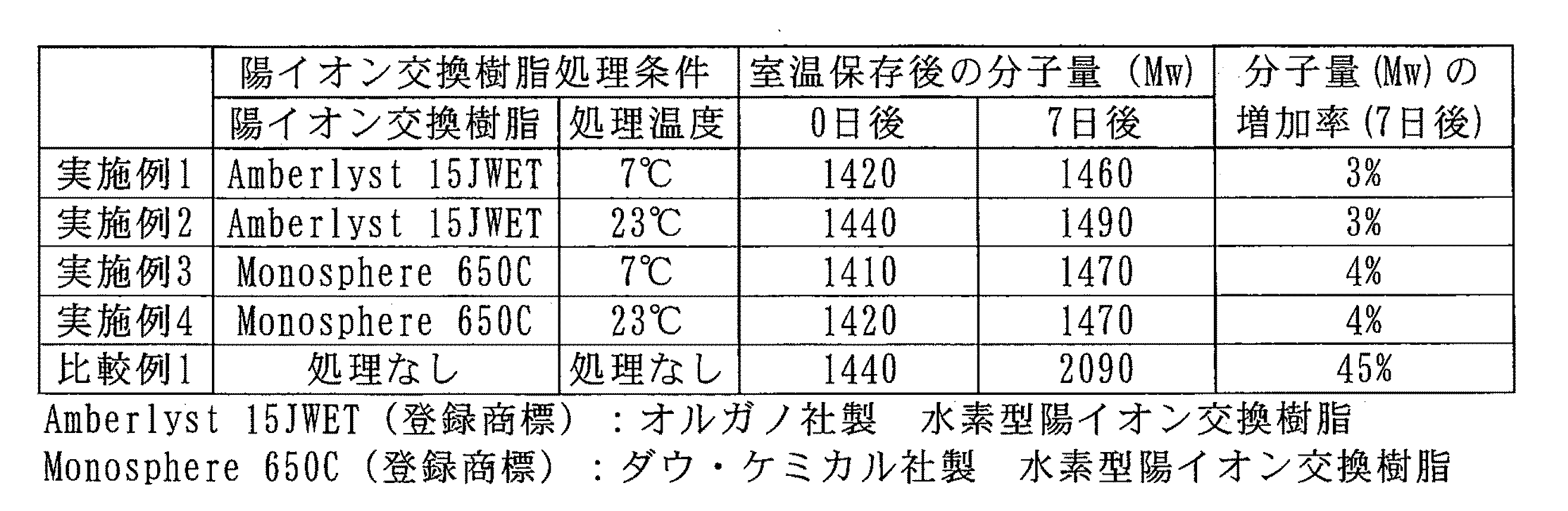
- a PGME / PGMEA solution of silanol group-containing polysiloxane was treated with a cation exchange resin under the conditions shown in Table 1 below.
- the cation exchange resin washed with PGME and having a water content of 7% by mass was used in an amount of 20% by mass with respect to the PGME / PGMEA solution of silanol group-containing polysiloxane.
- the treatment with the cation exchange resin was a treatment in which the cation exchange resin was put into a PGME / PGMEA solution of silanol group-containing polysiloxane and stirred for 4 hours. Thereafter, the cation exchange resin was removed by filtration to obtain each polymer solution of Examples 1 to 4 (stabilized silanol group-containing polysiloxane solution).
- Example 1 The obtained polymer solutions of Examples 1 to 4 and Comparative Example 1 were stored at room temperature (23 ° C.) for 7 days, immediately after the production of the polymer solution (described as “after 0 days” in the table) and after 7 days (in the table) The molecular weight of the silanol group-containing polysiloxane in “7 days later” was measured. The results are shown in Table 1. Table 1 also shows the increase rate of the molecular weight after 7 days with respect to 0 days later.
- Example 5 (Example 5 and Comparative Example 2) A 1000 mL four-necked flask was charged with 185.1 g (888.4 mmol) of tetraethoxysilane (TEOS) and 264.9 g of acetone, and cooled to 10 ° C. while stirring with a blade. The mixture was added dropwise at 20 ° C. over 20 minutes, heated to 62 ° C. and stirred for 4 hours. By adding 353.3 g of PGMEA to this solution and concentrating under reduced pressure at 40-60 ° C., the substitution of acetone, hydrogen chloride, water, ethanol to PGMEA was carried out, and 159.4 g of silanol group-containing polysiloxane PGMEA A solution was obtained.
- TEOS tetraethoxysilane
- This substitution also removes hydrochloric acid, which is a polycondensation catalyst.
- This silanol group-containing polysiloxane PGMEA solution was diluted with 197.3 g of PGME to obtain a silanol group-containing polysiloxane PGME / PGMEA solution.
- a PGME / PGMEA solution of this silanol group-containing polysiloxane was used as the polymer solution of Comparative Example 2.
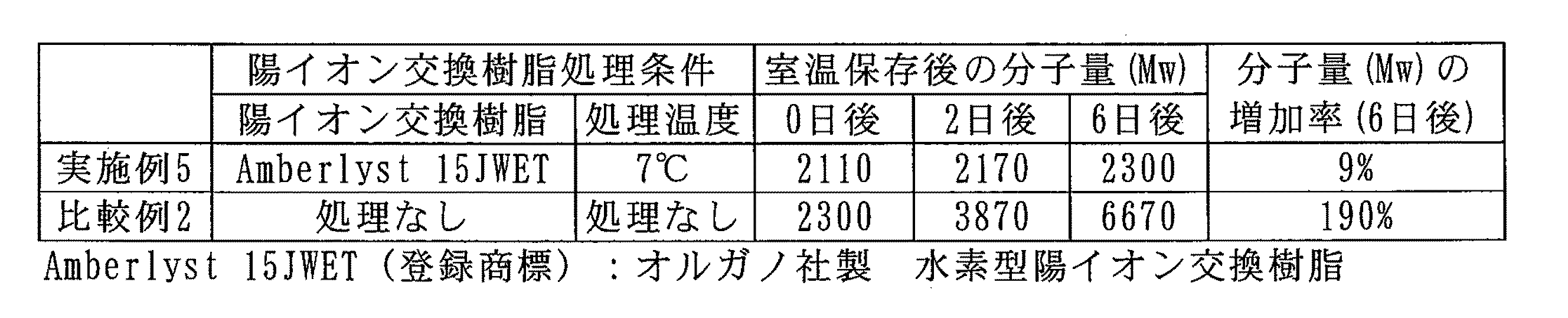
- the PGME / PGMEA solution of the silanol group-containing polysiloxane was treated with a cation exchange resin under the conditions shown in Table 2 below.
- the cation exchange resin washed with PGME and having a water content of 7% by mass was used in an amount of 20% by mass with respect to the PGME / PGMEA solution of silanol group-containing polysiloxane.
- the treatment with the cation exchange resin was a treatment in which the cation exchange resin was put into a PGME / PGMEA solution of silanol group-containing polysiloxane and stirred for 4 hours. Thereafter, the cation exchange resin was removed by filtration to obtain a polymer solution of Example 5 (stabilized silanol group-containing polysiloxane solution).
- Example 5 and Comparative Example 2 were stored at room temperature (23 ° C.) for 6 days, immediately after the production of the polymer solution (described as “after 0 days” in the table), and after 2 days (“2 in the table”).
- the molecular weight of the silanol group-containing polysiloxane after 6 days was measured. The results are shown in Table 2.
- Table 2 also shows the increase rate of the molecular weight after 6 days with respect to 0 days later.
- TEOS tetraethoxysilane
- MTEOS methyltriethoxysilane
- PhTMOS phenyltrimethoxysilane
- 0.32 g (0.89 mmol) of N- (3- (triethoxysilyl) propyl) benzenesulfonamide and 267.2 g of acetone were charged, cooled to 10 ° C. with stirring with a blade, and 0.01 N hydrochloric acid.
- This silanol group-containing polysiloxane PGMEA solution was diluted with 367.3 g of PGEE (propylene glycol monoethyl ether) to obtain a silanol group-containing polysiloxane PGEEA / PGMEA solution.
- PGEE propylene glycol monoethyl ether
- a PGEE / PGMEA solution of this silanol group-containing polysiloxane was used as the polymer solution of Comparative Example 3.
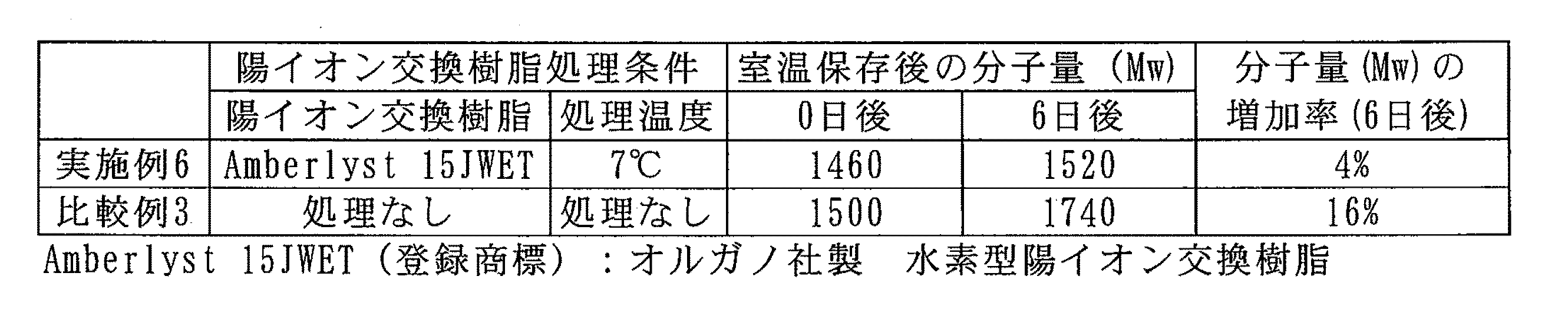
- a PGEE / PGMEA solution of silanol group-containing polysiloxane was treated with a cation exchange resin under the conditions shown in Table 3 below.
- the cation exchange resin which was washed with PGME to a water content of 7% by mass, was used in an amount of 20% by mass with respect to the PGEE / PGMEA solution of silanol group-containing polysiloxane.
- the treatment with the cation exchange resin was a treatment in which the cation exchange resin was added to the PGEE / PGMEA solution of silanol group-containing polysiloxane and stirred for 4 hours. Thereafter, the cation exchange resin was removed by filtration to obtain a polymer solution of Example 6 (a stabilized silanol group-containing polysiloxane solution).
- Example 6 and Comparative Example 3 were stored at room temperature (23 ° C.) for 6 days, immediately after the production of the polymer solution (described as “0 days later”) and after 6 days (“6” in the table).
- the molecular weight of the silanol group-containing polysiloxane was measured. The results are shown in Table 3. Also shown in Table 3 is the rate of increase in molecular weight after 6 days relative to 0 days later.
- Examples 1 to 6 in which the silanol group-containing polysiloxane was treated with a cation exchange resin in the presence of an alcohol solvent were allowed to stand for 7 days or 6 days, respectively.
- the molecular weight of the polysiloxane hardly changed.
- Comparative Examples 1 to 3 that were not treated with the cation exchange resin had a significantly increased molecular weight compared to Examples 1 to 6, and it was confirmed that a stable polymer solution could not be obtained. .
- the storage stability of a silanol group-containing polysiloxane solution useful as an antireflection film or the like can be remarkably improved, which is industrially useful.
Landscapes
- Chemical & Material Sciences (AREA)
- Health & Medical Sciences (AREA)
- Chemical Kinetics & Catalysis (AREA)
- Medicinal Chemistry (AREA)
- Polymers & Plastics (AREA)
- Organic Chemistry (AREA)
- Silicon Polymers (AREA)
- Compositions Of Macromolecular Compounds (AREA)
- Polyethers (AREA)
- Paints Or Removers (AREA)
Abstract
Description
1.シラノール基含有ポリシロキサンを含むシラノール基含有ポリシロキサン溶液を、アルコール溶媒の存在下、陽イオン交換樹脂で処理するシラノール基含有ポリシロキサン溶液の安定化方法、
2.アルコール溶媒が多価アルコールモノエーテル系溶媒である1.に記載のシラノール基含有ポリシロキサン溶液の安定化方法、
3.アルコール溶媒がプロピレングリコールモノアルキルエーテルである1.に記載のシラノール基含有ポリシロキサン溶液の安定化方法、
4.アルコール溶媒がプロピレングリコールモノメチルエーテル及びプロピレングリコールモノエチルエーテルから選択される少なくとも一種である1.記載のシラノール基含有ポリシロキサン溶液の安定化方法、
5.シラノール基含有ポリシロキサンを含むシラノール基含有ポリシロキサン溶液を、アルコール溶媒の存在下、陽イオン交換樹脂で処理する工程を有する安定化シラノール基含有ポリシロキサン溶液の製造方法、
6.シラノール基含有ポリシロキサンを含むシラノール基含有ポリシロキサン溶液を、アルコール溶媒の存在下、陽イオン交換樹脂で処理することにより得られる安定化シラノール基含有ポリシロキサン溶液
である。
3000mLの四つ口フラスコに、テトラエトキシシラン(TEOS)601.5g(2887mmol)、メチルトリエトキシシラン(MTEOS)273.6g(1333mmol)、フェニルトリメトキシシラン(PhTMOS)44.1g(222mmol)及びアセトン1324gを仕込み、羽根攪拌下に10℃に冷却し、0.01N塩酸292.2gを10~20℃で20分かけて滴下し、62℃まで昇温、4時間攪拌した。この溶液に、PGMEA(プロピレングリコールモノメチルエーテルアセテート)1766gを添加しながら40~60℃にて減圧濃縮することで、アセトン、塩化水素、水、エタノール、メタノールからPGMEAへの置換を行い、806.3gのシラノール基含有ポリシロキサンのPGMEA溶液を得た。また、この置換により、重縮合触媒である塩酸も除去される。このシラノール基含有ポリシロキサンのPGMEA溶液をPGME(プロピレングリコールモノメチルエーテル)1021.3gで希釈することによって、シラノール基含有ポリシロキサンのPGME/PGMEA溶液を得た。なお、このシラノール基含有ポリシロキサンのPGME/PGMEA溶液を比較例1のポリマー溶液とした。
1000mLの四つ口フラスコに、テトラエトキシシラン(TEOS)185.1g(888.4mmol)及びアセトン264.9gを仕込み、羽根攪拌下に10℃に冷却し、0.01N塩酸58.43gを10~20℃で20分かけて滴下し、62℃まで昇温、4時間攪拌した。この溶液に、PGMEA353.3gを添加しながら40~60℃にて減圧濃縮することで、アセトン、塩化水素、水、エタノールからPGMEAへの置換を行い、159.4gのシラノール基含有ポリシロキサンのPGMEA溶液を得た。また、この置換により、重縮合触媒である塩酸も除去される。このシラノール基含有ポリシロキサンのPGMEA溶液をPGME197.3gで希釈することによって、シラノール基含有ポリシロキサンのPGME/PGMEA溶液を得た。なお、このシラノール基含有ポリシロキサンのPGME/PGMEA溶液を比較例2のポリマー溶液とした。
1000mLの四つ口フラスコに、テトラエトキシシラン(TEOS)129.6g(621.9mmol)、メチルトリエトキシシラン(MTEOS)39.6g(222.1mmol)、フェニルトリメトキシシラン(PhTMOS)8.64g(43.5mmol)、N-(3-(トリエトキシシリル)プロピル)ベンゼンスルホンアミド0.32g(0.89mmol)及びアセトン267.2gを仕込み、羽根攪拌下に10℃に冷却し、0.01N塩酸59.23gを10~20℃で20分かけて滴下し、62℃まで昇温、4時間攪拌した。この溶液に、PGMEA356.2gを添加しながら40~60℃にて減圧濃縮することで、アセトン、塩化水素、水、エタノールからPGMEAへの置換を行い、160.4gのシラノール基含有ポリシロキサンのPGMEA溶液を得た。また、この置換により、重縮合触媒である塩酸も除去される。このシラノール基含有ポリシロキサンのPGMEA溶液をPGEE(プロピレングリコールモノエチルエーテル)367.3gで希釈することによって、シラノール基含有ポリシロキサンのPGEE/PGMEA溶液を得た。なお、このシラノール基含有ポリシロキサンのPGEE/PGMEA溶液を比較例3のポリマー溶液とした。
Claims (6)
- シラノール基含有ポリシロキサンを含むシラノール基含有ポリシロキサン溶液を、アルコール溶媒の存在下、陽イオン交換樹脂で処理することを特徴とするシラノール基含有ポリシロキサン溶液の安定化方法。
- 前記アルコール溶媒が、多価アルコールモノエーテル系溶媒であることを特徴とする請求項1記載のシラノール基含有ポリシロキサン溶液の安定化方法。
- 前記アルコール溶媒が、プロピレングリコールモノアルキルエーテルであることを特徴とする請求項1記載のシラノール基含有ポリシロキサン溶液の安定化方法。
- 前記アルコール溶媒が、プロピレングリコールモノメチルエーテル及びプロピレングリコールモノエチルエーテルから選択される少なくとも一種である請求項1記載のシラノール基含有ポリシロキサン溶液の安定化方法。
- シラノール基含有ポリシロキサンを含むシラノール基含有ポリシロキサン溶液を、アルコール溶媒の存在下、陽イオン交換樹脂で処理する工程を有することを特徴とする安定化シラノール基含有ポリシロキサン溶液の製造方法。
- シラノール基含有ポリシロキサンを含むシラノール基含有ポリシロキサン溶液を、アルコール溶媒の存在下、陽イオン交換樹脂で処理することにより得られることを特徴とする安定化シラノール基含有ポリシロキサン溶液。
Priority Applications (5)
| Application Number | Priority Date | Filing Date | Title |
|---|---|---|---|
| JP2013542914A JP6004201B2 (ja) | 2011-11-08 | 2012-10-23 | シラノール基含有ポリシロキサン溶液の安定化方法及び安定化シラノール基含有ポリシロキサン溶液の製造方法 |
| CN201280054628.9A CN103917580B (zh) | 2011-11-08 | 2012-10-23 | 含硅烷醇基的聚硅氧烷溶液的稳定化方法、稳定化的含硅烷醇基的聚硅氧烷溶液的制造方法和稳定化的含硅烷醇基的聚硅氧烷溶液 |
| KR1020147014499A KR101965923B1 (ko) | 2011-11-08 | 2012-10-23 | 실란올기 함유 폴리실록산 용액의 안정화 방법, 안정화 실란올기 함유 폴리실록산 용액의 제조 방법 및 안정화 실란올기 함유 폴리실록산 용액 |
| US14/356,623 US9127161B2 (en) | 2011-11-08 | 2012-10-23 | Method for stabilizing silanol-group-containing polysiloxane solution, method for producing stable silanol-group-containing polysiloxane solution, and stable silanol-group-containing polysiloxane solution |
| EP12847849.2A EP2778191A4 (en) | 2011-11-08 | 2012-10-23 | METHOD FOR STABILIZING SOLUTION OF POLYSILOXANE WITH SILANOL CONTENT, METHOD FOR MANUFACTURING STABLE POLYILOXANE SOLUTION WITH SILANOL CONTENT, AND STABLE SOLUTION OF SILANOL-CONTAINING POLYSILOXANE |
Applications Claiming Priority (2)
| Application Number | Priority Date | Filing Date | Title |
|---|---|---|---|
| JP2011-244554 | 2011-11-08 | ||
| JP2011244554 | 2011-11-08 |
Publications (1)
| Publication Number | Publication Date |
|---|---|
| WO2013069449A1 true WO2013069449A1 (ja) | 2013-05-16 |
Family
ID=48289832
Family Applications (1)
| Application Number | Title | Priority Date | Filing Date |
|---|---|---|---|
| PCT/JP2012/077329 Ceased WO2013069449A1 (ja) | 2011-11-08 | 2012-10-23 | シラノール基含有ポリシロキサン溶液の安定化方法、安定化シラノール基含有ポリシロキサン溶液の製造方法及び安定化シラノール基含有ポリシロキサン溶液 |
Country Status (7)
| Country | Link |
|---|---|
| US (1) | US9127161B2 (ja) |
| EP (1) | EP2778191A4 (ja) |
| JP (1) | JP6004201B2 (ja) |
| KR (1) | KR101965923B1 (ja) |
| CN (1) | CN103917580B (ja) |
| TW (1) | TWI572642B (ja) |
| WO (1) | WO2013069449A1 (ja) |
Cited By (2)
| Publication number | Priority date | Publication date | Assignee | Title |
|---|---|---|---|---|
| WO2017047805A1 (ja) * | 2015-09-16 | 2017-03-23 | 積水フーラー株式会社 | 硬化性樹脂組成物 |
| JPWO2021182329A1 (ja) * | 2020-03-13 | 2021-09-16 |
Families Citing this family (6)
| Publication number | Priority date | Publication date | Assignee | Title |
|---|---|---|---|---|
| WO2011068919A1 (en) | 2009-12-02 | 2011-06-09 | Astro Gaming, Inc. | Wireless game/audio system and method |
| JP2016212193A (ja) * | 2015-05-01 | 2016-12-15 | アーゼッド・エレクトロニック・マテリアルズ(ルクセンブルグ)ソシエテ・ア・レスポンサビリテ・リミテ | 光機能性膜およびその製造方法 |
| KR102720413B1 (ko) * | 2016-01-12 | 2024-10-22 | 도오레 화인케미칼 가부시키가이샤 | 실리콘 중합체의 제조방법 |
| US10761423B2 (en) | 2017-08-30 | 2020-09-01 | Taiwan Semiconductor Manufacturing Company, Ltd. | Chemical composition for tri-layer removal |
| US11312926B2 (en) * | 2017-09-25 | 2022-04-26 | Evonik Operations Gmbh | Polysiloxane-containing concentrates with improved storage stability and use thereof in textile care compositions |
| CN115397890B (zh) * | 2020-04-16 | 2024-04-19 | 信越化学工业株式会社 | 含有烯基的有机聚硅氧烷的制造方法 |
Citations (7)
| Publication number | Priority date | Publication date | Assignee | Title |
|---|---|---|---|---|
| JPS6116925A (ja) * | 1984-07-02 | 1986-01-24 | Toray Ind Inc | 有機ケイ素化合物のイオン交換方法 |
| JPS63120738A (ja) * | 1986-10-27 | 1988-05-25 | ダウ コーニング コーポレーション | シリコーンポリマーの活性度低減方法 |
| JPH03126612A (ja) | 1989-10-06 | 1991-05-29 | Toray Ind Inc | ケイ素含有溶液および被膜形成用塗布液 |
| JPH04180926A (ja) * | 1990-11-15 | 1992-06-29 | Shin Etsu Chem Co Ltd | ポリオルガノシロキサン樹脂の製造方法 |
| JPH09137061A (ja) | 1995-07-29 | 1997-05-27 | Dow Corning Ltd | シロキサンポリマーの粘度の安定化方法 |
| JPH10218995A (ja) | 1997-02-05 | 1998-08-18 | Shin Etsu Chem Co Ltd | オルガノポリシロキサン樹脂組成物 |
| JP2005023256A (ja) * | 2003-07-04 | 2005-01-27 | Toagosei Co Ltd | カチオン硬化性組成物 |
Family Cites Families (8)
| Publication number | Priority date | Publication date | Assignee | Title |
|---|---|---|---|---|
| US4298655A (en) * | 1980-07-28 | 1981-11-03 | General Electric Company | Aqueous silicone resin coating composition and solid substrate coated therewith |
| US4900520A (en) | 1988-10-31 | 1990-02-13 | Gaf Chemicals Corporation | Process for removal of soluble platinum group metal catalysts from liquid product mixtures |
| US5771013A (en) * | 1989-05-01 | 1998-06-23 | Dow Corning Corporation | Method for stabilizing compositions containing carbonyl iron powder |
| JP3221718B2 (ja) * | 1992-04-14 | 2001-10-22 | ジーイー東芝シリコーン株式会社 | エポキシ変性シリコーン樹脂組成物 |
| JP3079939B2 (ja) * | 1994-08-25 | 2000-08-21 | 信越化学工業株式会社 | シラノール基を有する低分子量のオルガノシロキサンの製造方法 |
| JP2776259B2 (ja) * | 1994-08-31 | 1998-07-16 | 松下電工株式会社 | 抗菌性無機塗料 |
| FR2747683B1 (fr) * | 1996-04-19 | 1998-06-19 | Centre Nat Etd Spatiales | Procede de stabilisation de resines silicones a groupes silanols terminaux prealablement purifiees |
| US7442822B2 (en) * | 2006-09-01 | 2008-10-28 | Air Products And Chemicals, Inc. | Stabilization of nitrogen-containing and oxygen-containing organosilanes using weakly basic ion-exchange resins |
-
2012
- 2012-10-23 JP JP2013542914A patent/JP6004201B2/ja active Active
- 2012-10-23 EP EP12847849.2A patent/EP2778191A4/en not_active Withdrawn
- 2012-10-23 WO PCT/JP2012/077329 patent/WO2013069449A1/ja not_active Ceased
- 2012-10-23 US US14/356,623 patent/US9127161B2/en active Active
- 2012-10-23 KR KR1020147014499A patent/KR101965923B1/ko active Active
- 2012-10-23 CN CN201280054628.9A patent/CN103917580B/zh active Active
- 2012-10-30 TW TW101140140A patent/TWI572642B/zh active
Patent Citations (7)
| Publication number | Priority date | Publication date | Assignee | Title |
|---|---|---|---|---|
| JPS6116925A (ja) * | 1984-07-02 | 1986-01-24 | Toray Ind Inc | 有機ケイ素化合物のイオン交換方法 |
| JPS63120738A (ja) * | 1986-10-27 | 1988-05-25 | ダウ コーニング コーポレーション | シリコーンポリマーの活性度低減方法 |
| JPH03126612A (ja) | 1989-10-06 | 1991-05-29 | Toray Ind Inc | ケイ素含有溶液および被膜形成用塗布液 |
| JPH04180926A (ja) * | 1990-11-15 | 1992-06-29 | Shin Etsu Chem Co Ltd | ポリオルガノシロキサン樹脂の製造方法 |
| JPH09137061A (ja) | 1995-07-29 | 1997-05-27 | Dow Corning Ltd | シロキサンポリマーの粘度の安定化方法 |
| JPH10218995A (ja) | 1997-02-05 | 1998-08-18 | Shin Etsu Chem Co Ltd | オルガノポリシロキサン樹脂組成物 |
| JP2005023256A (ja) * | 2003-07-04 | 2005-01-27 | Toagosei Co Ltd | カチオン硬化性組成物 |
Non-Patent Citations (1)
| Title |
|---|
| See also references of EP2778191A4 |
Cited By (7)
| Publication number | Priority date | Publication date | Assignee | Title |
|---|---|---|---|---|
| WO2017047805A1 (ja) * | 2015-09-16 | 2017-03-23 | 積水フーラー株式会社 | 硬化性樹脂組成物 |
| JP6152236B1 (ja) * | 2015-09-16 | 2017-06-21 | 積水フーラー株式会社 | 硬化性樹脂組成物 |
| JPWO2021182329A1 (ja) * | 2020-03-13 | 2021-09-16 | ||
| WO2021182329A1 (ja) * | 2020-03-13 | 2021-09-16 | 東レ・ファインケミカル株式会社 | シリコーン重合体の製造方法 |
| CN115244109A (zh) * | 2020-03-13 | 2022-10-25 | 东丽精细化工株式会社 | 硅氧烷聚合物的制造方法 |
| CN115244109B (zh) * | 2020-03-13 | 2023-07-07 | 东丽精细化工株式会社 | 硅氧烷聚合物的制造方法 |
| JP7623937B2 (ja) | 2020-03-13 | 2025-01-29 | 東レ・ファインケミカル株式会社 | シリコーン重合体の製造方法 |
Also Published As
| Publication number | Publication date |
|---|---|
| TWI572642B (zh) | 2017-03-01 |
| TW201336896A (zh) | 2013-09-16 |
| JP6004201B2 (ja) | 2016-10-05 |
| EP2778191A4 (en) | 2015-03-18 |
| JPWO2013069449A1 (ja) | 2015-04-02 |
| CN103917580B (zh) | 2016-06-08 |
| US20140309317A1 (en) | 2014-10-16 |
| CN103917580A (zh) | 2014-07-09 |
| EP2778191A1 (en) | 2014-09-17 |
| KR20140095522A (ko) | 2014-08-01 |
| US9127161B2 (en) | 2015-09-08 |
| KR101965923B1 (ko) | 2019-04-04 |
Similar Documents
| Publication | Publication Date | Title |
|---|---|---|
| JP6004201B2 (ja) | シラノール基含有ポリシロキサン溶液の安定化方法及び安定化シラノール基含有ポリシロキサン溶液の製造方法 | |
| CN102421862B (zh) | 紫外线吸收膜形成用涂布液及紫外线吸收用玻璃物品 | |
| US20080290472A1 (en) | Semiconductor interlayer-insulating film forming composition, preparation method thereof, film forming method, and semiconductor device | |
| US20090294922A1 (en) | Organic silicon oxide fine particle and preparation method thereof, porous film-forming composition, porous film and formation method thereof, and semiconductor device | |
| JP6430940B2 (ja) | シロキサン化合物を含む反射防止コーティング組成物、これを用いた反射防止フィルム | |
| JP2008201833A (ja) | 膜形成用組成物、低誘電率絶縁膜、低誘電率絶縁膜の形成方法及び半導体装置 | |
| TWI709595B (zh) | 聚矽氧聚合物之製造方法 | |
| JP5034283B2 (ja) | 高屈折材料形成用組成物およびその硬化体、ならびに高屈折材料形成用組成物の製造方法 | |
| US7084505B2 (en) | Porous film, composition and manufacturing method, interlayer dielectric film, and semiconductor device | |
| JP2009235238A (ja) | 水性塗料組成物、有機無機複合塗膜及び金属アルコキシド縮合物分散体及びその製造方法 | |
| CN102399372A (zh) | 硅氧烷树脂组合物的固化覆膜形成方法 | |
| CN104968834B (zh) | 涂料组合物、其制备方法及其用途 | |
| JP7504087B2 (ja) | 樹脂組成物、その製造方法、及び、多液型硬化性樹脂組成物 | |
| JP2019203067A (ja) | シリコーン重合体の製造方法 | |
| JP7637070B2 (ja) | 樹脂組成物、その製造方法、及び、多液型硬化性樹脂組成物 | |
| WO2020196751A1 (ja) | シラノール基の脱水縮合反応抑制剤及び抑制方法、並びに、シラノール基含有ポリオルガノシロキサンの製造方法及びその組成物 | |
| KR20170040470A (ko) | 실록산 폴리머 경화용 조성물 및 이를 포함하는 투명 피막 형성용 조성물 | |
| JP5435009B2 (ja) | 塗料組成物 | |
| JP2013155231A (ja) | 梯子型ポリシルセスキオキサンおよびその製造方法、ならびに硬化樹脂形成用組成物 | |
| JP2006199854A (ja) | 低屈折率膜 | |
| JP2006274082A (ja) | ラジカル重合性基を有する有機ケイ素化合物の製造方法 | |
| JP2019112519A (ja) | シロキサン系硬化性樹脂組成物及びハードコーティング液 | |
| JP2004292639A (ja) | 多孔質膜形成用組成物、多孔質膜の製造方法、多孔質膜、層間絶縁膜、及び半導体装置 | |
| JP2009263576A (ja) | シロキサンオリゴマーの製造方法及び保護被膜形成方法 | |
| KR20230160168A (ko) | 폴리실록산계 화합물, 피막 형성용 조성물, 적층체, 터치 패널, 및 경화 피막의 형성 방법 |
Legal Events
| Date | Code | Title | Description |
|---|---|---|---|
| 121 | Ep: the epo has been informed by wipo that ep was designated in this application |
Ref document number: 12847849 Country of ref document: EP Kind code of ref document: A1 |
|
| ENP | Entry into the national phase |
Ref document number: 2013542914 Country of ref document: JP Kind code of ref document: A |
|
| WWE | Wipo information: entry into national phase |
Ref document number: 14356623 Country of ref document: US |
|
| NENP | Non-entry into the national phase |
Ref country code: DE |
|
| WWE | Wipo information: entry into national phase |
Ref document number: 2012847849 Country of ref document: EP |
|
| ENP | Entry into the national phase |
Ref document number: 20147014499 Country of ref document: KR Kind code of ref document: A |