WO2013164912A1 - 変性天然ゴム及びその製造方法、並びにゴム組成物及びタイヤ - Google Patents
変性天然ゴム及びその製造方法、並びにゴム組成物及びタイヤ Download PDFInfo
- Publication number
- WO2013164912A1 WO2013164912A1 PCT/JP2013/002907 JP2013002907W WO2013164912A1 WO 2013164912 A1 WO2013164912 A1 WO 2013164912A1 JP 2013002907 W JP2013002907 W JP 2013002907W WO 2013164912 A1 WO2013164912 A1 WO 2013164912A1
- Authority
- WO
- WIPO (PCT)
- Prior art keywords
- natural rubber
- group
- modified natural
- raw material
- meth
- Prior art date
- Legal status (The legal status is an assumption and is not a legal conclusion. Google has not performed a legal analysis and makes no representation as to the accuracy of the status listed.)
- Ceased
Links
Images

Classifications
-
- C—CHEMISTRY; METALLURGY
- C08—ORGANIC MACROMOLECULAR COMPOUNDS; THEIR PREPARATION OR CHEMICAL WORKING-UP; COMPOSITIONS BASED THEREON
- C08F—MACROMOLECULAR COMPOUNDS OBTAINED BY REACTIONS ONLY INVOLVING CARBON-TO-CARBON UNSATURATED BONDS
- C08F253/00—Macromolecular compounds obtained by polymerising monomers on to natural rubbers or derivatives thereof
-
- B—PERFORMING OPERATIONS; TRANSPORTING
- B60—VEHICLES IN GENERAL
- B60C—VEHICLE TYRES; TYRE INFLATION; TYRE CHANGING; CONNECTING VALVES TO INFLATABLE ELASTIC BODIES IN GENERAL; DEVICES OR ARRANGEMENTS RELATED TO TYRES
- B60C1/00—Tyres characterised by the chemical composition or the physical arrangement or mixture of the composition
- B60C1/0016—Compositions of the tread
-
- C—CHEMISTRY; METALLURGY
- C08—ORGANIC MACROMOLECULAR COMPOUNDS; THEIR PREPARATION OR CHEMICAL WORKING-UP; COMPOSITIONS BASED THEREON
- C08C—TREATMENT OR CHEMICAL MODIFICATION OF RUBBERS
- C08C19/00—Chemical modification of rubber
- C08C19/20—Incorporating sulfur atoms into the molecule
-
- C—CHEMISTRY; METALLURGY
- C08—ORGANIC MACROMOLECULAR COMPOUNDS; THEIR PREPARATION OR CHEMICAL WORKING-UP; COMPOSITIONS BASED THEREON
- C08C—TREATMENT OR CHEMICAL MODIFICATION OF RUBBERS
- C08C19/00—Chemical modification of rubber
- C08C19/22—Incorporating nitrogen atoms into the molecule
-
- C—CHEMISTRY; METALLURGY
- C08—ORGANIC MACROMOLECULAR COMPOUNDS; THEIR PREPARATION OR CHEMICAL WORKING-UP; COMPOSITIONS BASED THEREON
- C08C—TREATMENT OR CHEMICAL MODIFICATION OF RUBBERS
- C08C19/00—Chemical modification of rubber
- C08C19/25—Incorporating silicon atoms into the molecule
-
- C—CHEMISTRY; METALLURGY
- C08—ORGANIC MACROMOLECULAR COMPOUNDS; THEIR PREPARATION OR CHEMICAL WORKING-UP; COMPOSITIONS BASED THEREON
- C08C—TREATMENT OR CHEMICAL MODIFICATION OF RUBBERS
- C08C19/00—Chemical modification of rubber
- C08C19/28—Reaction with compounds containing carbon-to-carbon unsaturated bonds
-
- C—CHEMISTRY; METALLURGY
- C08—ORGANIC MACROMOLECULAR COMPOUNDS; THEIR PREPARATION OR CHEMICAL WORKING-UP; COMPOSITIONS BASED THEREON
- C08F—MACROMOLECULAR COMPOUNDS OBTAINED BY REACTIONS ONLY INVOLVING CARBON-TO-CARBON UNSATURATED BONDS
- C08F279/00—Macromolecular compounds obtained by polymerising monomers on to polymers of monomers having two or more carbon-to-carbon double bonds as defined in group C08F36/00
- C08F279/02—Macromolecular compounds obtained by polymerising monomers on to polymers of monomers having two or more carbon-to-carbon double bonds as defined in group C08F36/00 on to polymers of conjugated dienes
-
- C—CHEMISTRY; METALLURGY
- C08—ORGANIC MACROMOLECULAR COMPOUNDS; THEIR PREPARATION OR CHEMICAL WORKING-UP; COMPOSITIONS BASED THEREON
- C08F—MACROMOLECULAR COMPOUNDS OBTAINED BY REACTIONS ONLY INVOLVING CARBON-TO-CARBON UNSATURATED BONDS
- C08F291/00—Macromolecular compounds obtained by polymerising monomers on to macromolecular compounds according to more than one of the groups C08F251/00 - C08F289/00
- C08F291/02—Macromolecular compounds obtained by polymerising monomers on to macromolecular compounds according to more than one of the groups C08F251/00 - C08F289/00 on to elastomers
-
- C—CHEMISTRY; METALLURGY
- C08—ORGANIC MACROMOLECULAR COMPOUNDS; THEIR PREPARATION OR CHEMICAL WORKING-UP; COMPOSITIONS BASED THEREON
- C08L—COMPOSITIONS OF MACROMOLECULAR COMPOUNDS
- C08L15/00—Compositions of rubber derivatives
Definitions
- the present invention relates to a modified natural rubber, a method for producing the same, and a rubber composition and a tire using the modified natural rubber, and in particular, the graft polymerization and addition efficiency of a polar group-containing compound is high and used as a rubber composition.
- the present invention relates to a modified natural rubber excellent in low loss, wear resistance and fracture resistance, and a method for producing the same.
- a rubber composition having a low tan ⁇ (hereinafter referred to as “low loss property”) and an excellent low heat generation property is required as a rubber composition used for a tire tread or the like.
- a rubber composition for a tread is required to have excellent wear resistance and fracture characteristics in addition to low loss.
- wear resistance and fracture characteristics of the rubber composition it is necessary to improve the affinity between the rubber component and the filler such as carbon black and silica in the rubber composition. It is valid.
- Patent Document 4 includes graft polymerization of a polar group-containing monomer on natural rubber latex, coagulation, A rubber composition obtained by blending a modified natural rubber obtained by drying and carbon black or silica is disclosed. Further, as a technique for further reducing the production cost, Patent Document 5 discloses that at least one natural rubber raw material selected from the group consisting of natural rubber, natural rubber latex coagulum, and natural rubber cup lamp has a polar group. A modified natural rubber obtained by graft polymerization or addition of a compound containing mechanical shearing force is disclosed.
- Patent Documents 4 and 5 it is possible to produce a modified natural rubber that can improve the low loss, wear resistance, and fracture characteristics of the rubber composition at low cost.
- the techniques of Patent Documents 4 and 5 have been desired to be further improved in terms of improving the efficiency of graft polymerization and addition reaction between a natural rubber raw material and a polar group-containing compound.
- JP-A-5-287121 JP-A-6-329702 Japanese Patent Laid-Open No. 9-25468 JP 2004-262773 A JP 2006-152171 A
- the object of the present invention is to improve the above-mentioned prior art and optimize the natural rubber raw material, so that it is excellent in the graft polymerization and addition efficiency of the polar group-containing compound and used as a rubber composition.
- Another object of the present invention is to provide a modified natural rubber excellent in low loss, wear resistance and fracture resistance and a method for producing the same.
- Another object of the present invention is to provide a rubber composition using the modified natural rubber and a tire using the rubber composition.
- the present inventor has obtained a rubber composition by grafting or adding a polar group-containing compound to a solid natural rubber raw material that can be obtained at low cost by applying a mechanical shearing force.
- a modified natural rubber capable of improving the low loss, wear resistance and fracture characteristics of the product is obtained, and the natural rubber raw material contains a polar group by using a lower protein than conventional products. It has been found that the reaction between the compound and the protein in the raw material can be reduced, and the efficiency of graft polymerization and addition can be improved, and the present invention has been completed.
- the modified natural rubber of the present invention provides a polar group-containing compound by applying mechanical shearing force to at least one natural rubber raw material selected from the group consisting of natural rubber, natural rubber latex coagulum and natural rubber cup lamp.
- the graft amount or addition amount of the polar group-containing compound is 0.01 to 5.0 parts by mass with respect to 100 parts by mass of the solid rubber component in the natural rubber raw material.
- the polar group of the polar group-containing compound is an amino group, imino group, nitrile group, ammonium group, imide group, amide group, hydrazo group, azo group, diazo group, It is at least one selected from the group consisting of a hydroxyl group, a carboxyl group, a carbonyl group, an epoxy group, an oxycarbonyl group, a nitrogen-containing heterocyclic group, an oxygen-containing heterocyclic group, a tin-containing group and an alkoxysilyl group.
- the polar group-containing compound is graft-polymerized, and the natural rubber raw material is not a conjugated system but an atom that undergoes radical cleavage at one point to become at least one radical.
- At least one selected from t-hexylperoxy-2-ethylhexanoate, t-butyl hydroperoxide and / or t-hexylperoxy-2-ethylhexanoate It is particularly preferred to be an ate.
- the method for producing a modified natural rubber according to the present invention provides a polar group by applying mechanical shearing force to at least one natural rubber raw material selected from the group consisting of natural rubber, natural rubber latex coagulum and natural rubber cup lamp.
- the modified natural rubber is obtained by graft polymerization of the polar group-containing compound, and the natural rubber raw material is radically cleaved at one point instead of a conjugated system. Then, a polymerization initiator having a structure in which the number of carbon atoms in the alkyl chain extending from the atom that becomes at least one radical is 5 to 10 is added.
- the rubber composition of the present invention is characterized by using the modified natural rubber
- the tire of the present invention is characterized by using the rubber composition for any of tire members.
- a modified natural rubber excellent in graft polymerization and addition efficiency of a polar group-containing compound and excellent in low loss, wear resistance and fracture resistance when used as a rubber composition, and its production A method can be provided.
- rupture characteristic using this modified natural rubber can be provided.
- FIG. 1 is a graph showing the relationship between the nitrogen content in the natural rubber raw material and the DEMA amount in Examples and Comparative Examples.
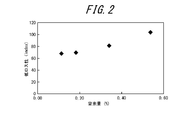
- FIG. 2 is a graph showing the relationship between the nitrogen content in the natural rubber raw material and the low loss property in Examples and Comparative Examples.
- the modified natural rubber of the present invention is a graft polymerization of a polar group-containing compound by applying mechanical shearing force to at least one natural rubber raw material selected from the group consisting of natural rubber, natural rubber latex coagulum and natural rubber cup lamp. Or add it. Since the polar group of the polar group-containing compound is excellent in affinity to various fillers such as carbon black and silica, the modified natural rubber has higher affinity for various fillers than unmodified natural rubber. .
- the rubber composition of the present invention using the modified natural rubber as a rubber component has a high dispersibility of the filler with respect to the rubber component, and the reinforcing effect of the filler is sufficiently exhibited, resulting in fracture characteristics and wear resistance. In addition to being excellent, the low heat build-up (low loss) is also greatly improved.
- the natural rubber raw material used for the modified natural rubber of the present invention is characterized in that the nitrogen content is 0.4 mass% or less. Nitrogen content: 0.4% by mass or less, and by using a low protein compared to the conventional natural rubber raw material, it becomes possible to suppress the reaction between the polar group-containing compound and the protein contained in the raw material. The efficiency of graft polymerization and addition of the polar group-containing compound to the rubber main chain can be improved.
- the natural rubber raw material various solid natural rubbers after drying, various natural rubber latex coagulates (including unsmoked sheets) or natural rubber cup lamps can be used, and these natural rubber raw materials are used alone. You may use, and may use it in combination of 2 or more type. Since the production of the modified natural rubber of the present invention does not require the use of a natural rubber latex having a high purity, the modified natural rubber can be produced at a relatively low cost. Among the natural rubber raw materials, cup lamps and the like can be obtained at a low cost, so that they have a great merit in terms of cost. When a cup lamp or the like is used as a raw material, the modification efficiency of natural rubber may be slightly reduced, but there is an advantage from a comprehensive view of cost and modification efficiency.
- the modified natural rubber of the present invention is obtained by graft polymerizing or adding a polar group-containing compound to a natural rubber raw material.
- the polar group-containing compound is a compound having an arbitrary polar group as the name suggests, and the type can be appropriately selected depending on the type and application of the modified rubber.
- the polar group-containing compound When the polar group-containing compound is graft-polymerized to a natural rubber molecule in a natural rubber raw material, the polar group-containing compound preferably has a carbon-carbon double bond in the molecule, and the polar group-containing vinyl monomer It is preferable that On the other hand, when a polar group-containing compound is subjected to an addition reaction with a natural rubber molecule in a natural rubber raw material, the polar group-containing compound preferably has a mercapto group in the molecule, and is preferably a polar group-containing mercapto compound.
- the polar group-containing compound is graft-polymerized to the natural rubber molecule in the natural rubber raw material
- the natural rubber raw material and the polar group-containing compound preferably, polar group-containing vinyl are contained in the apparatus to which the mechanical shearing force is applied.
- the natural rubber raw material and the polar group-containing compound preferably, a polar group-containing mercapto compound are contained in the device to which the mechanical shearing force is applied.
- organic peroxides and the like are further added to give mechanical shearing force, so that a polar group-containing compound is added to the double bond of the main chain of the natural rubber molecule in the natural rubber raw material.
- An addition reaction can be performed.
- polar groups of polar group-containing vinyl monomers suitable for graft polymerization to natural rubber molecules in the natural rubber raw material include amino groups, imino groups, nitrile groups, ammonium groups, imide groups, amides.
- These polar group-containing vinyl monomers may be used alone or in combination of two or more.
- Examples of the vinyl monomer containing an amino group include polymerizable monomers containing at least one amino group selected from primary, secondary and tertiary amino groups in one molecule. .
- polymerizable monomers having an amino group tertiary amino group-containing vinyl monomers such as dialkylaminoalkyl (meth) acrylate are particularly preferable.
- These amino group-containing vinyl monomers may be used alone or in a combination of two or more.
- the primary amino group-containing vinyl monomers include acrylamide, methacrylamide, 4-vinylaniline, aminomethyl (meth) acrylate, aminoethyl (meth) acrylate, aminopropyl (meth) acrylate, aminobutyl. Examples include (meth) acrylate.
- Secondary vinyl group-containing vinyl monomers include (1) anilinostyrene, ⁇ -phenyl-p-anilinostyrene, ⁇ -cyano-p-anilinostyrene, ⁇ -cyano- ⁇ -methyl. -p-anilinostyrene, ⁇ -chloro-p-anilinostyrene, ⁇ -carboxy-p-anilinostyrene, ⁇ -methoxycarbonyl-p-anilinostyrene, ⁇ - (2-hydroxyethoxy) carbonyl-p- Anilinostyrene such as anilinostyrene, ⁇ -formyl-p-anilinostyrene, ⁇ -formyl- ⁇ -methyl-p-anilinostyrene, ⁇ -carboxy- ⁇ -carboxy- ⁇ -phenyl-p-anilinostyrene (2) 1-anilinophenyl-1,3-butadiene, 1-anilinophenyl-3-
- examples of the tertiary amino group-containing vinyl monomer include N, N-disubstituted aminoalkyl (meth) acrylate and N, N-disubstituted aminoalkyl (meth) acrylamide.
- N, N-disubstituted aminoalkyl (meth) acrylate examples include N, N-dimethylaminomethyl (meth) acrylate, N, N-dimethylaminoethyl (meth) acrylate, N, N-dimethylaminopropyl (meth) Acrylate, N, N-dimethylaminobutyl (meth) acrylate, N, N-diethylaminoethyl (meth) acrylate, N, N-diethylaminopropyl (meth) acrylate, N, N-diethylaminobutyl (meth) acrylate, N-methyl -N-ethylaminoethyl (meth) acrylate, N, N-dipropylaminoethyl (meth) acrylate, N, N-dibutylaminoethyl (meth) acrylate, N, N-dibutylaminoe
- N, N-disubstituted aminoalkyl (meth) acrylamide examples include N, N-dimethylaminomethyl (meth) acrylamide, N, N-dimethylaminoethyl (meth) acrylamide, N, N-dimethylaminopropyl ( (Meth) acrylamide, N, N-dimethylaminobutyl (meth) acrylamide, N, N-diethylaminoethyl (meth) acrylamide, N, N-diethylaminopropyl (meth) acrylamide, N, N-diethylaminobutyl (meth) acrylamide, N -Methyl-N-ethylaminoethyl (meth) acrylamide, N, N-dipropylaminoethyl (meth) acrylamide, N, N-dibutylaminoethyl (meth) acrylamide, N, N-dibuty
- N, N-dimethylaminopropyl (meth) acrylamide, N, N-diethylaminopropyl (meth) acrylamide, N, N-dioctylaminopropyl (meth) acrylamide and the like are particularly preferable.
- Examples of the vinyl monomer containing a nitrile group include (meth) acrylonitrile, vinylidene cyanide and the like. These nitrile group-containing vinyl monomers may be used alone or in a combination of two or more.
- Examples of the vinyl monomer containing a hydroxyl group include polymerizable monomers having at least one primary, secondary and tertiary hydroxyl group in one molecule.
- Examples of such monomers include hydroxyl group-containing unsaturated carboxylic acid monomers, hydroxyl group-containing vinyl ether monomers, hydroxyl group-containing vinyl ketone monomers, and the like.
- hydroxyl group-containing vinyl monomer examples include 2-hydroxyethyl (meth) acrylate, 2-hydroxypropyl (meth) acrylate, 3-hydroxypropyl (meth) acrylate, 2-hydroxybutyl (meta ) Acrylate, 3-hydroxybutyl (meth) acrylate, hydroxyalkyl (meth) acrylates such as 4-hydroxybutyl (meth) acrylate; polyalkylene glycols such as polyethylene glycol and polypropylene glycol (the number of alkylene glycol units is, for example, 2 To 23) mono (meth) acrylates; N-hydroxymethyl (meth) acrylamide, N- (2-hydroxyethyl) (meth) acrylamide, N, N-bis (2-hydroxymethyl) (meth) acrylamide Hydroxyl group-containing unsaturated amides such as o- Contains hydroxyl groups such as loxystyrene, m-hydroxystyrene, p-hydroxyst
- hydroxyl group-containing unsaturated carboxylic acid monomers hydroxyalkyl (meth) acrylates, and hydroxyl group-containing vinyl aromatic compounds are preferable, and hydroxyl group-containing unsaturated carboxylic acid monomers are particularly preferable.
- examples of the hydroxyl group-containing unsaturated carboxylic acid-based monomer include esters such as acrylic acid, methacrylic acid, itaconic acid, fumaric acid, maleic acid, amides, and anhydrides. Among these, Particularly preferred are esters such as acrylic acid and methacrylic acid.
- These hydroxyl group-containing vinyl monomers may be used alone or in a combination of two or more.
- Examples of the vinyl monomer containing a carboxyl group include unsaturated carboxylic acids such as (meth) acrylic acid, maleic acid, fumaric acid, itaconic acid, tetraconic acid, cinnamic acid; phthalic acid, succinic acid, adipic acid, etc.
- unsaturated carboxylic acids such as (meth) acrylic acid, maleic acid, fumaric acid, itaconic acid, tetraconic acid, cinnamic acid; phthalic acid, succinic acid, adipic acid, etc.
- Non-polymerizable polyvalent carboxylic acids and free carboxyl group-containing esters such as monoesters of hydroxyl-containing unsaturated compounds such as (meth) allyl alcohol and 2-hydroxyethyl (meth) acrylate, and salts thereof It is done.
- unsaturated carboxylic acids are particularly preferred.
- These carboxyl group-containing vinyl monomers may be used alone or in a combination of two
- vinyl monomer containing an epoxy group examples include (meth) allyl glycidyl ether, glycidyl (meth) acrylate, and 3,4-oxycyclohexyl (meth) acrylate. These epoxy group-containing vinyl monomers may be used alone or in combination of two or more.
- the nitrogen-containing heterocyclic ring includes pyrrole, histidine, imidazole, triazolidine, triazole, triazine, pyridine, pyrimidine, pyrazine, indole, quinoline, purine, phenazine, Examples include pteridine and melamine.
- the nitrogen-containing heterocycle may contain other heteroatoms in the ring.
- a vinyl monomer containing a pyridyl group as a nitrogen-containing heterocyclic group 2-vinylpyridine, 3-vinylpyridine, 4-vinylpyridine, 5-methyl-2-vinylpyridine, 5-ethyl- 2-vinylpyridine and the like can be mentioned, among which 2-vinylpyridine, 4-vinylpyridine and the like are particularly preferable.
- These nitrogen-containing heterocyclic group-containing vinyl monomers may be used alone or in a combination of two or more.
- Examples of the vinyl monomer having a tin-containing group include allyltri-n-butyltin, allyltrimethyltin, allyltriphenyltin, allyltri-n-octyltin, (meth) acryloxy-n-butyltin, (meth) acryloxy Tin-containing monomers such as trimethyltin, (meth) acryloxytriphenyltin, (meth) acryloxy-n-octyltin, vinyltri-n-butyltin, vinyltrimethyltin, vinyltriphenyltin, vinyltri-n-octyltin Can be mentioned. These tin-containing vinyl monomers may be used alone or in a combination of two or more.
- Examples of the vinyl monomer containing the alkoxysilyl group include (meth) acryloxymethyltrimethoxysilane, (meth) acryloxymethylmethyldimethoxysilane, (meth) acryloxymethyldimethylmethoxysilane, (meth) acryloxy.
- the polymerization initiator used for graft polymerization of the polar group-containing compound to the natural rubber molecules in the natural rubber raw material is not particularly limited, and various polymerization initiators for emulsion polymerization can be used. There is also no particular restriction on.
- polymerization initiators examples include benzoyl peroxide, hydrogen peroxide, cumene hydroperoxide, tert-butyl hydroperoxide, di-tert-butyl peroxide, 2,2-azobisisobutyronitrile, 2,2-azobis (2-diaminopropane) hydrochloride, 2,2-azobis (2-diaminopropane) dihydrochloride, 2,2-azobis (2,4-dimethylvaleronitrile), potassium persulfate, sodium persulfate And ammonium persulfate.
- a redox polymerization initiator In order to lower the polymerization temperature, it is preferable to use a redox polymerization initiator.
- Examples of the reducing agent to be combined with the peroxide in the redox polymerization initiator include tetraethylenepentamine, mercaptans, acidic sodium sulfite, reducing metal ions, ascorbic acid and the like.
- a preferred combination of a peroxide and a reducing agent in the redox polymerization initiator includes a combination of tert-butyl hydroperoxide and tetraethylenepentamine.
- the polymerization initiator is not a conjugated system, but an alkyl chain extending from an atom that is radically cleaved at one point to become at least one radical. It is preferable to use those having a structure having 5 to 10 carbon atoms. In the case of a conjugated system, a sufficient gelation-inhibiting effect cannot be obtained, and when the structure has a structure that is cleaved at two points, the natural rubber is cross-linked, and thus gelation may be promoted.
- the atom which becomes the radical is an atom in which the covalent bond of the cleaved portion is broken
- the alkyl chain extending from the atom means an alkyl chain extending from the atom before radical cleavage.
- Examples of the polymerization initiator described above include those having the following structure.
- the reason for suppressing the gelation by optimizing the polymerization initiator is that when the gelation exceeds a certain amount, the processability deteriorates.
- the polar group is added to each natural rubber molecule. Since it is important that the contained compound is introduced in a small amount and uniformly, the addition amount of the polymerization initiator is preferably in the range of 1 to 100 mol%, more preferably in the range of 10 to 100 mol% with respect to the polar group-containing compound. preferable.
- the modified natural rubber in which the polar group-containing compound is graft-copolymerized to the natural rubber molecule is obtained by charging the above-described components into an apparatus that is capable of applying a mechanical shearing force and applying the mechanical shearing force.
- the modification reaction of the natural rubber molecule may be carried out by heating, and preferably at 30 to 160 ° C., more preferably 50 to 130 ° C., the modified natural rubber with sufficient reaction efficiency. Can be obtained.
- polar groups of the polar group-containing mercapto compound suitable for addition reaction with natural rubber molecules in the natural rubber raw material include amino groups, imino groups, nitrile groups, ammonium groups, imide groups, amide groups.
- Preferred examples include hydrazo group, azo group, diazo group, hydroxyl group, carboxyl group, carbonyl group, epoxy group, oxycarbonyl group, nitrogen-containing heterocyclic group, oxygen-containing heterocyclic group, tin-containing group and alkoxysilyl group. be able to.
- These polar group-containing mercapto compounds may be used alone or in combination of two or more.
- Examples of the mercapto compound containing an amino group include mercapto compounds having at least one amino group selected from primary, secondary, and tertiary amino groups in one molecule.
- a tertiary amino group-containing mercapto compound is particularly preferable.
- the primary amino group-containing mercapto compound 4-mercaptoaniline, 2-mercaptoethylamine, 2-mercaptopropylamine, 3-mercaptopropylamine, 2-mercaptobutylamine, 3-mercaptobutylamine, 4-mercaptobutylamine Etc.
- the secondary amino group-containing mercapto compounds include N-methylaminoethanethiol, N-ethylaminoethanethiol, N-methylaminopropanethiol, N-ethylaminopropanethiol, N-methylaminobutanethiol, N- And ethylaminobutanethiol.
- the tertiary amino group-containing mercapto compounds include N, N-dimethylaminoethanethiol, N, N-diethylaminoethanethiol, N, N-dimethylaminopropanethiol, N, N-diethylaminopropanethiol, N, N N, N-disubstituted aminoalkyl mercaptans such as -dimethylaminobutanethiol and N, N-diethylaminobutanethiol.
- 2-mercaptoethylamine, N, N-dimethylaminoethanethiol and the like are preferable.
- These amino group-containing mercapto compounds may be used alone or in combination of two or more.
- Examples of the mercapto compound having a nitrile group include 2-mercaptopropane nitrile, 3-mercaptopropane nitrile, 2-mercaptobutane nitrile, 3-mercaptobutane nitrile, 4-mercaptobutane nitrile, etc., and these nitrile group-containing mercapto compounds May be used individually by 1 type, and may be used in combination of 2 or more type.
- Examples of the mercapto compound containing a hydroxyl group include mercapto compounds having at least one primary, secondary or tertiary hydroxyl group in one molecule.
- Specific examples of the hydroxyl group-containing mercapto compound include 2-mercaptoethanol, 3-mercapto-1-propanol, 3-mercapto-2-propanol, 4-mercapto-1-butanol, 4-mercapto-2-butanol, 3 -Mercapto-1-butanol, 3-mercapto-2-butanol, 3-mercapto-1-hexanol, 3-mercapto-1,2-propanediol, 2-mercaptobenzyl alcohol, 2-mercaptophenol, 4-mercaptophenol, etc.
- 2-mercaptoethanol and the like are preferable.
- These hydroxyl group-containing mercapto compounds may be used alone or in a combination of two or more.
- Examples of the mercapto compound containing a carboxyl group include mercaptoacetic acid, mercaptopropionic acid, thiosalicylic acid, mercaptomalonic acid, mercaptosuccinic acid, mercaptobenzoic acid and the like. Among these, mercaptoacetic acid is preferred. These carboxyl group-containing mercapto compounds may be used individually by 1 type, and may be used in combination of 2 or more type.
- the nitrogen-containing heterocyclic ring includes pyrrole, histidine, imidazole, triazolidine, triazole, triazine, pyridine, pyrimidine, pyrazine, indole, quinoline, purine, phenazine, pteridine, melamine. Etc.
- the nitrogen-containing heterocycle may contain other heteroatoms in the ring.
- a mercapto compound containing a pyridyl group as a nitrogen-containing heterocyclic group 2-mercaptopyridine, 3-mercaptopyridine, 4-mercaptopyridine, 5-methyl-2-mercaptopyridine, 5-ethyl-2-mercapto
- Examples of mercapto compounds containing other nitrogen-containing heterocyclic groups include 2-mercaptopyrimidine, 2-mercapto-5-methylbenzimidazole, 2-mercapto-1-methylimidazole, and 2-mercapto. Examples include benzimidazole and 2-mercaptoimidazole. Among these, 2-mercaptopyridine and 4-mercaptopyridine are preferable.
- These nitrogen-containing heterocyclic group-containing mercapto compounds may be used alone or in combination of two or more.
- Examples of the mercapto compound having a tin-containing group include 2-mercaptoethyltri-n-butyltin, 2-mercaptoethyltrimethyltin, 2-mercaptoethyltriphenyltin, 3-mercaptopropyltri-n-butyltin, and 3-mercaptopropyl. Mention may be made of tin-containing mercapto compounds such as trimethyltin and 3-mercaptopropyltriphenyltin. These tin-containing mercapto compounds may be used individually by 1 type, and may be used in combination of 2 or more type.
- Examples of the mercapto compound containing an alkoxysilyl group include 3-mercaptopropyltrimethoxysilane, 3-mercaptopropyltriethoxysilane, 3-mercaptopropylmethyldimethoxysilane, 3-mercaptopropyldimethylmethoxysilane, and 2-mercaptoethyltrimethoxy. Examples include silane, 2-mercaptoethyltriethoxysilane, mercaptomethylmethyldiethoxysilane, mercaptomethyltrimethoxysilane, and the like. Among these, 3-mercaptopropyltrimethoxysilane is preferable. These alkoxysilyl group-containing mercapto compounds may be used alone or in a combination of two or more.
- a modified natural rubber in which the polar group-containing compound is subjected to an addition reaction with a natural rubber molecule is obtained by charging each of the above-described components in a device to which a mechanical shear force can be applied and applying the mechanical shear force in the device.
- the modification reaction of the natural rubber molecule may be carried out by heating, preferably at a temperature of 30 to 160 ° C., more preferably 50 to 130 ° C., so that the modified natural rubber has sufficient addition efficiency. Can be obtained.
- the graft amount or addition amount of the polar group-containing compound is preferably in the range of 0.01 to 5.0 parts by weight, and 0.05 to 2.0 parts by weight with respect to 100 parts by weight of the solid rubber component in the natural rubber raw material.
- the range of parts is more preferable, and the range of 0.10 to 1.0 parts by weight is even more preferable.
- the grafting amount or addition amount of the polar group-containing compound is less than 0.01 parts by mass, the low loss and wear resistance of the rubber composition may not be sufficiently improved.
- the grafting amount or addition amount of the polar group-containing compound exceeds 5.0 parts by mass, the physical properties inherent to natural rubber such as viscoelasticity and SS characteristics (stress-strain curve in a tensile tester) are greatly changed. In addition, the physical properties inherent to natural rubber are impaired, and the processability of the rubber composition may be greatly deteriorated.
- the rubber composition of the present invention is characterized by using the modified natural rubber, and preferably further contains a filler.
- the blending amount of the filler is not particularly limited, but is preferably in the range of 5 to 100 parts by mass, more preferably in the range of 10 to 70 parts by mass with respect to 100 parts by mass of the modified natural rubber. If the blending amount of the filler is less than 5 parts by mass, sufficient reinforcement may not be obtained, and if it exceeds 100 parts by mass, the workability may be deteriorated.
- Examples of the filler used in the rubber composition of the present invention include carbon black and inorganic filler.
- the inorganic filler silica and the following formula (I): nM ⁇ xSiO y ⁇ zH 2 O (I) [Wherein, M is a metal selected from the group consisting of aluminum, magnesium, titanium, calcium and zirconium, an oxide or hydroxide of these metals, and a hydrate thereof, or a carbonate of these metals. And n, x, y and z are each an integer of 1 to 5, an integer of 0 to 10, an integer of 2 to 5, and an integer of 0 to 10] Is mentioned. These fillers may be used alone or in a combination of two or more.
- the carbon black examples include GPF, FEF, SRF, HAF, ISAF, and SAF grades
- examples of the silica include wet silica, dry silica, and colloidal silica.
- the inorganic compound of the formula (I) includes alumina (Al 2 O 3 ) such as ⁇ -alumina and ⁇ -alumina; alumina monohydrate such as boehmite and diaspore (Al 2 O 3 .H 2 O).
- Aluminum hydroxide [Al (OH) 3 ] such as gibbsite and bayerite; aluminum carbonate [Al 2 (CO 3 ) 3 ], magnesium hydroxide [Mg (OH) 2 ], magnesium oxide (MgO), magnesium carbonate ( MgCO 3 ), talc (3MgO ⁇ 4SiO 2 ⁇ H 2 O), attapulgite (5MgO ⁇ 8SiO 2 ⁇ 9H 2 O), titanium white (TiO 2 ), titanium black (TiO 2n-1 ), calcium oxide (CaO), calcium hydroxide [Ca (OH) 2], magnesium aluminum oxide (MgO ⁇ Al 2 O 3) , clay (Al 2 O 3 ⁇ 2SiO 2 ), kaolin (Al 2 O 3 ⁇ 2SiO 2 ⁇ 2 2 O), pyrophyllite (Al 2 O 3 ⁇ 4SiO 2 ⁇ H 2 O), bentonite (Al 2 O 3 ⁇ 4SiO 2 ⁇ 2H 2 O), aluminum
- the rubber composition of the present invention includes compounding agents commonly used in the rubber industry, such as anti-aging agents, softeners, silane coupling agents, stearic acid, zinc white. Further, a vulcanization accelerator, a vulcanizing agent, and the like can be appropriately selected and blended within a range not impairing the object of the present invention. As these compounding agents, commercially available products can be suitably used.
- the rubber composition of the present invention can be produced by blending various modified additives appropriately selected as necessary with the modified natural rubber, kneading, heating, extruding and the like.
- the tire of the present invention is characterized by using the rubber composition, and the rubber composition is preferably used for a tread.
- a tire using the rubber composition as a tread is excellent in fuel efficiency, fracture characteristics, and wear resistance.
- the tire of the present invention is not particularly limited except that the rubber composition described above is used for any of the tire members, and can be produced according to a conventional method.
- inert gas such as nitrogen, argon, helium other than normal or the air which adjusted oxygen partial pressure, can be used.
- RSS Rabbed Smoked Sheets
- t-BHPO tert-butyl hydroperoxide
- the amount of N, N-diethylaminoethyl methacrylate grafted on the modified natural rubber Aa was analyzed using a pyrolysis gas chromatograph-mass spectrometer after extraction of unreacted monomers, and solid rubber in the natural rubber raw material was analyzed. It was 0.01 mass part with respect to 100 mass parts of components.
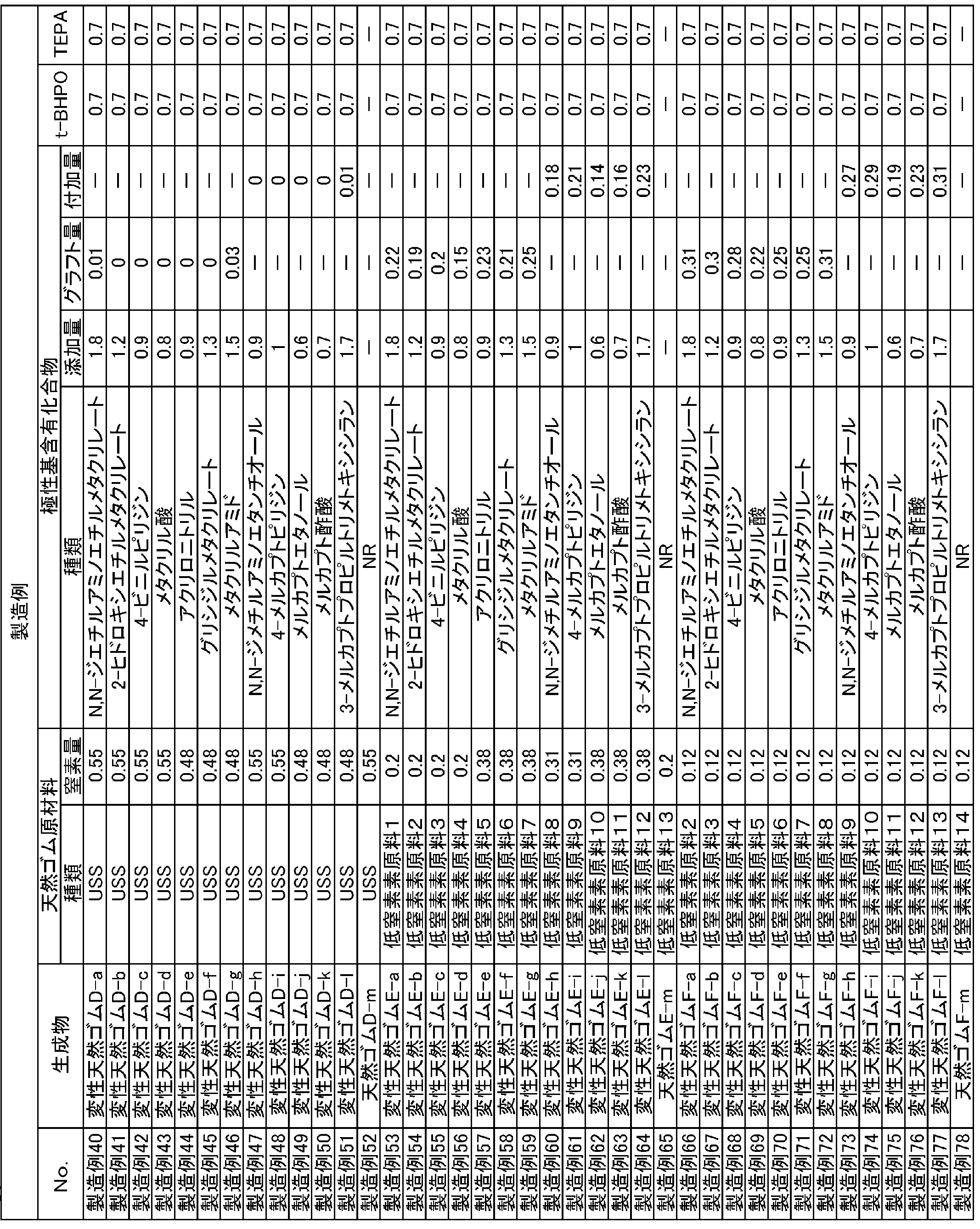
- the modified natural rubber Aa or the modified natural rubber Ah the graft amount or addition amount of the polar group-containing compound in the modified natural rubber Ba to Bl was analyzed, and the results shown in Table 1-1 were obtained.
- Examples 1 to 96, Comparative Examples 1 to 60 a rubber composition having the formulation shown in Table 2 was prepared by kneading with a plast mill, and the Mooney viscosity, tensile strength (Tb), tan ⁇ , and abrasion resistance were measured for the rubber composition by the following methods. Measured and evaluated.
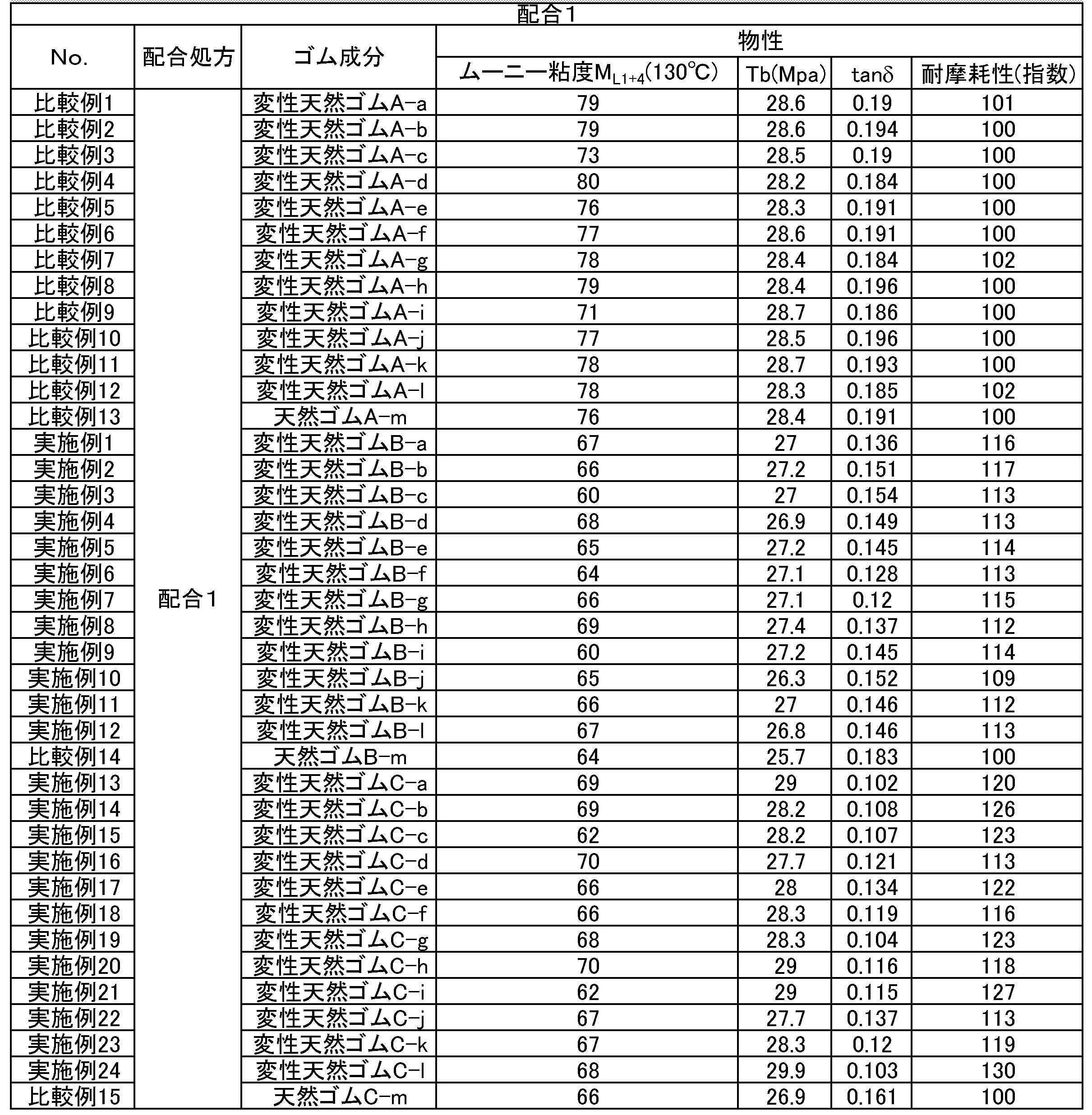
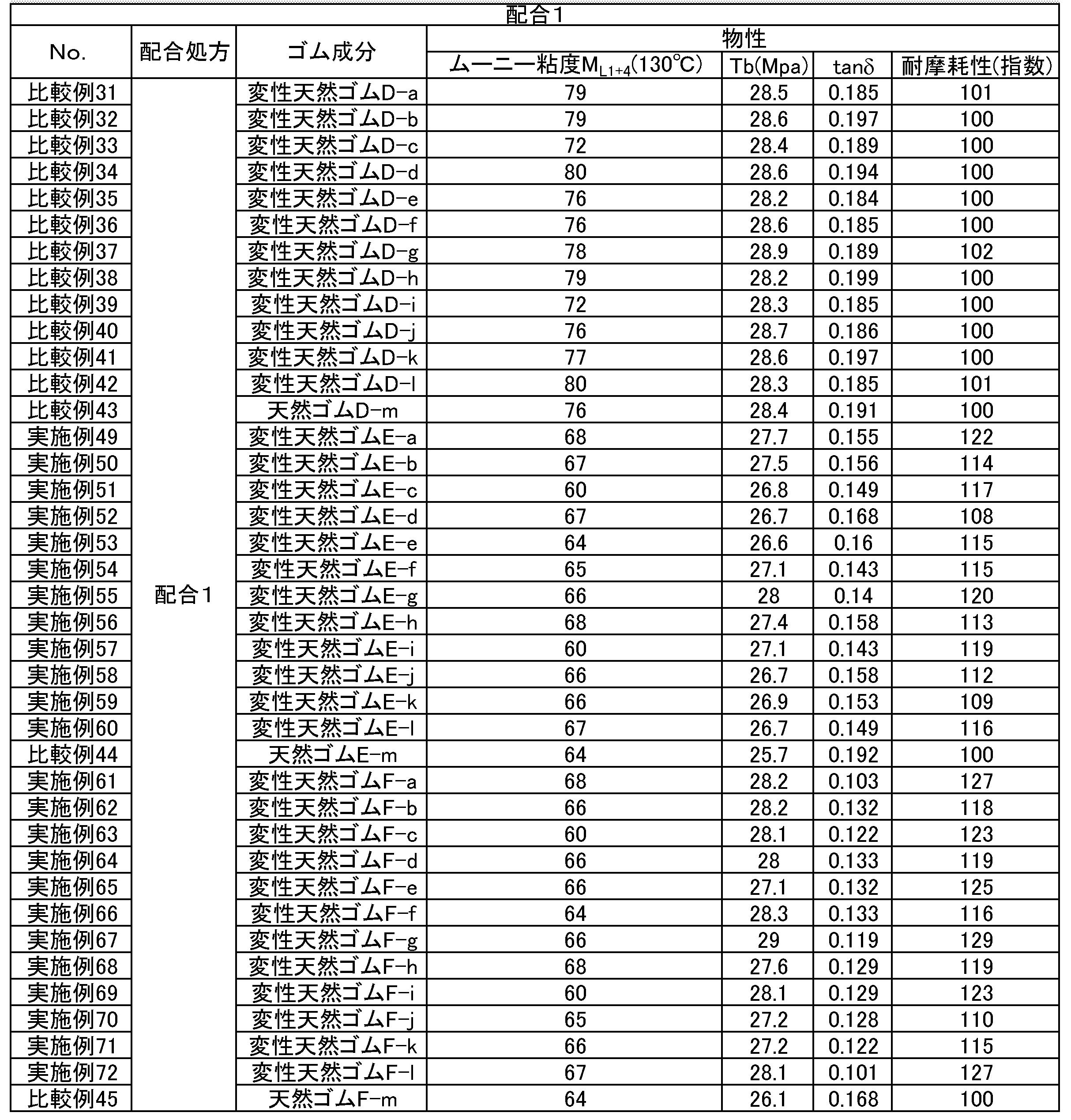
- the results of the rubber composition according to Formulation 1 are shown in Tables 3-1 and 3-2, and the results of the rubber composition according to Formulation 2 are shown in Tables 4-1 and 4-2.
- Mooney viscosity The Mooney viscosity ML 1 + 4 (130 ° C.) of the rubber composition was measured at 130 ° C. according to JIS K6300-1994. The evaluation results are shown in Tables 3 and 4.
- the reciprocal of the amount was set to 100
- the reciprocal of the wear amount of Comparative Example 30 was set to 100 for Examples 37 to 48 and Comparative Example 30
- the reciprocal of the wear amount of Comparative Example 43 was set to 100 for Comparative Examples 31 to 43.
- Comparative Example 4 The reciprocal of the wear amount of the comparative example 45 is set to 100 for the examples 61 to 72 and the comparative example 45
- the reciprocal of the wear amount of the comparative example 58 is set to 100 for the comparative examples 46 to 58.
- FIG. 1 shows that the lower the amount of nitrogen in the natural rubber raw material, the higher the amount of DEMA, and the more efficient the graft reaction.
- FIG. 2 shows that the lower the amount of nitrogen in the natural rubber raw material, the better the low loss property of the obtained rubber composition.
- Comparative examples 61 to 63 A modified natural rubber according to Comparative Example 61 was obtained under the same conditions as in Production Example 1 except that the polymerization initiator shown in Table 5 was used as the polymerization initiator instead of the polymerization initiator in Production Example 1. It was. Further, in place of the polymerization initiator of Production Example 1, the polymerization initiator shown in Table 5 was used as a polymerization initiator, and the mixture was extruded without adding tetraethylenepentamine (TEPA). Except for this, modified natural rubber according to Comparative Examples 62 and 63 was obtained under the same conditions as in Production Example 1.
- TEPA tetraethylenepentamine
- Example 97 a modified natural rubber according to Example 97 was prepared under the same conditions as in Production Example 1 except that the polymerization initiator shown in Table 5 was used as a polymerization initiator instead of the polymerization initiator in Production Example 14. Got. Furthermore, in place of the polymerization initiator of Production Example 14, the polymerization initiator shown in Table 5 was used as a polymerization initiator, and the mixture was extruded without adding tetraethylenepentamine (TEPA). Except that, modified natural rubber according to Examples 98 and 99 was obtained under the same conditions as in Production Example 14.
- TEPA tetraethylenepentamine
- Examples 100 to 103 Further, a modified natural rubber according to Example 100 was used under the same conditions as in Production Example 1 except that the polymerization initiator shown in Table 5 was used as the polymerization initiator instead of the polymerization initiator in Production Example 27. Got. Furthermore, instead of the polymerization initiator of Production Example 27, the polymerization initiator shown in Table 5 was used as the polymerization initiator, and the mixture was extruded without adding tetraethylenepentamine (TEPA). Except that, modified natural rubbers according to Examples 101 to 103 were obtained under the same conditions as in Production Example 27.
- TEPA tetraethylenepentamine
- Amount of gel in the modified natural rubber 200 mg of each sample of the obtained modified natural rubber was dissolved in toluene and left overnight (10 hours), then centrifuged (rotation speed: 3500 rpm, time: 1.5H) Went. Thereafter, the supernatant liquid generated by the treatment was removed, and the remaining gel was dried, and the mass was measured. The amount of the gel in the modified natural rubber was taken as the gel amount.
- the value of the gel amount (DEMA addition amount / gel increase amount ⁇ 100) with respect to the graft amount (DEMA addition amount) is shown in Table 5.
- a modified natural rubber excellent in graft polymerization and addition efficiency of a polar group-containing compound and excellent in low loss, wear resistance and fracture resistance when used as a rubber composition, and its production A method can be provided.
- a tire using a rubber composition containing the modified natural rubber is industrially useful in that it is excellent in low loss, wear resistance and fracture characteristics.
Landscapes
- Chemical & Material Sciences (AREA)
- Organic Chemistry (AREA)
- Health & Medical Sciences (AREA)
- Chemical Kinetics & Catalysis (AREA)
- Medicinal Chemistry (AREA)
- Polymers & Plastics (AREA)
- General Chemical & Material Sciences (AREA)
- Engineering & Computer Science (AREA)
- Mechanical Engineering (AREA)
- Graft Or Block Polymers (AREA)
- Compositions Of Macromolecular Compounds (AREA)
- Tires In General (AREA)
- Addition Polymer Or Copolymer, Post-Treatments, Or Chemical Modifications (AREA)
Description
また、さらに製造コストの低減が図られた技術として、特許文献5には、天然ゴム、天然ゴムラテックス凝固物及び天然ゴムカップランプからなる群から選択される少なくとも一種の天然ゴム原材料に、極性基含有化合物を機械的せん断力を与えてグラフト重合又は付加させてなる変性天然ゴム が開示されている。
さらに、前記重合開始剤が、t-ブチルハイドロパーオキサイド、1,1,3,3-テトラメチルブチルハイドロパーオキサイド、1,1,3,3-テトラメチルブチルパーオキシ-2-エチルヘキサノエート及びt-ヘキシルパーオキシ-2-エチルヘキサノエートのうちから選択される少なくとも一種であることがより好適であり、t-ブチルハイドロパーオキサイド及び/又はt-ヘキシルパーオキシ-2-エチルヘキサノエートであることが特に好適である。
以下に、本発明の実施形態を具体的に説明する。
本発明の変性天然ゴムは、天然ゴム、天然ゴムラテックス凝固物及び天然ゴムカップランプからなる群から選択される少なくとも一種の天然ゴム原材料に、機械的せん断力を与えて極性基含有化合物をグラフト重合又は付加させてなる。
前記極性基含有化合物の極性基は、カーボンブラックやシリカ等の種々の充填剤に対する親和性に優れるため、前記変性天然ゴムは、未変性の天然ゴムに比べて種々の充填剤に対する親和性が高い。そのため、前記変性天然ゴムをゴム成分として用いた本発明のゴム組成物は、ゴム成分に対する充填剤の分散性が高く、充填剤の補強効果が十分に発揮されて、破壊特性及び耐摩耗性に優れる上、低発熱性(低ロス性)も大幅に向上している。
窒素含有量:0.4質量%以下と、従来の天然ゴム原材料に比べてたんぱく質の低いものを用いることによって、極性基含有化合物と該原材料中に含有するたんぱく質との反応を抑えることが可能となり、天然ゴム主鎖に対する極性基含有化合物のグラフト重合及び付加の効率を向上できる。
本発明の変性天然ゴムの製造には、純度の高い天然ゴムラテックスを用いる必要がないため、比較的安価に変性天然ゴムを製造することができる。また、前記天然ゴム原材料の中でも、カップランプ等は、安価に入手できるため、コストの点でのメリットが大きい。なお、カップランプ等を原材料とした場合、天然ゴムの変性効率が多少落ちることがあるが、コストと変性効率とを総合的に見てメリットがある。
ここで、前記極性基含有化合物とは、その名の通り、任意の極性基を有する化合物のことであり、その種類については、変性ゴムの種類や用途によって適宜選択できる。

nM・xSiOy・zH2O ・・・(I)
[式中、Mは、アルミニウム、マグネシウム、チタン、カルシウム及びジルコニウムからなる群から選ばれる金属、これらの金属の酸化物又は水酸化物、及びそれらの水和物、またはこれらの金属の炭酸塩から選ばれる少なくとも一種であり;n、x、y及びzは、それぞれ1~5の整数、0~10の整数、2~5の整数、及び0~10の整数である]で表される無機化合物が挙げられる。これら充填剤は、一種単独で用いてもよし、二種以上を混合して用いてもよい。
本発明のタイヤは、前記ゴム組成物を用いたことを特徴とし、前記ゴム組成物をトレッドに用いることが好ましい。前記ゴム組成物をトレッドに用いたタイヤは、低燃費性、破壊特性及び耐摩耗性に優れる。なお、本発明のタイヤは、上述のゴム組成物をタイヤ部材のいずれかに用いる以外特に制限は無く、常法に従って製造することができる。また、該タイヤに充填する気体としては、通常の或いは酸素分圧を調整した空気の他、窒素、アルゴン、ヘリウム等の不活性ガスを用いることができる。
乾燥ゴム量換算で600gのRSS(Ribbed Smoked Sheets:燻煙乾燥ゴム)と、N,N-ジエチルアミノエチルメタクリレート 1.8gと、tert-ブチルハイドロパーオキサイド(t-BHPO)0.7gとを混練機内で室温にて30rpmで2分間練り込み、均一に分散させた。次に、得られた混合物にテトラエチレンペンタミン(TEPA)0.7gを均一に加えながら、神戸製鋼製二軸混練押出機[同方向回転スクリュー径=30mm, L/D=35, ベントホール3ヶ所]を用い、バレル温度120℃、回転数100rpmで機械的せん断力を加えながら押し出すことにより、変性天然ゴムA-aを得た(表1-1)。
また、得られた変性天然ゴムA-aにおけるN,N-ジエチルアミノエチルメタクリレートのグラフト量を、未反応モノマーの抽出後熱分解ガスクロマトグラフ-質量分析装置を用いて分析したところ、天然ゴム原材料中の固形ゴム成分100質量部に対して0.01質量部であった。
N,N-ジエチルアミノエチルメタクリレート 1.8gの代わりに、製造例2では2-ヒドロキシエチルメタクリレート 1.2.gを加え、製造例3では4-ビニルピリジン 0.9gを加え、製造例4ではメタクリル酸 0.8gを加え、製造例5ではアクリロニトリル 0.9gを加え、製造例6ではグリシジルメタクリレート 1.3gを加え、製造例7ではメタクリルアミド 1.5gを加え、それ以外は、前記製造例1と同様にして変性天然ゴムA-b~A-gを得た。また、変性天然ゴムA-aと同様にして、変性天然ゴムA-b~A-gにおける単量体として加えた極性基含有化合物のグラフト量を分析して、表1に示す結果を得た(表1-1)。
tert-ブチルハイドロパーオキサイド(t-BHPO)及びテトラエチレンペンタミン(TEPA)を添加せずに、N,N-ジエチルアミノエチルメタクリレート 1.8gに代えてN,N-ジメチルアミノエタンチオール 0.9gを用いる以外は、前記製造例1と同様にして変性天然ゴムA-hを得た(表1-1)。また、得られた変性天然ゴムA-hにおけるジメチルアミノメタンチオールの付加量を熱分解ガスクロマトグラフ-質量分析装置を用いて分析したところ、天然ゴム原材料中の固形ゴム成分100質量部に対して0質量部であった。
N,N-ジメチルアミノエタンチオール 0.9gの代わりに、製造例9では4-メルカプトピリジン 1.0gを加え、製造例10ではメルカプトエタノール 0.6gを加え、製造例11ではメルカプト酢酸 0.7gを加え、製造例12では3-メルカプトプロピルトリメトキシシラン 1.7gを加え、それ以外は、前記製造例8と同様にして変性天然ゴムA-i~A-lを得た(表1-1)。また、変性天然ゴムA-hと同様にして、変性天然ゴムA-i~A-lにおけるメルカプト化合物の付加量を分析して、表1-1に示す結果を得た。
上述したRSSを、混練機内で室温にて30rpmで2分間練り込み、均一に分散させた。次に、神戸製鋼製二軸混練押出機[同方向回転スクリュー径=30mm, L/D=35, ベントホール3ヶ所]を用い、バレル温度120℃、回転数100rpmで機械的せん断力を加えながら押し出すことにより、天然ゴムA-mを得た(表1-1)。
製造例1~13のRSSに代えて、次に示す天然ゴムを天然ゴム原材料として用いたこと以外は、製造例1~13と同様にして、変性天然ゴムB-a~B-l及び天然ゴムB-mを得た(表1-1)。
天然ゴム原材料としての天然ゴムは、アンモニア0.4質量%を添加した天然ゴムラテックス(CT-1)を、ラテックスセパレーターSLP-3000(斉藤遠心機工業製)を用いて回転数7500rpmで15分間の遠心分離することにより濃縮した。濃縮したラテックスをさらに回転数7500rpmで15分間の遠心分離した。得られた濃縮ラテックスを固形分として約20%に希釈した後、蟻酸を添加し一晩放置後、凝固して得られたゴム分を、110℃で210分の条件で乾燥した天然ゴム。また、変性天然ゴムA-a又は変性天然ゴムA-hと同様にして、変性天然ゴムB-a~B-lにおける極性基含有化合物のグラフト量又は付加量を分析して、表1-1に示す結果を得た。
製造例1~13のRSSに代えて、次に示す天然ゴムを天然ゴム原材料として用いたこと以外は、製造例1~13と同様にして、変性天然ゴムC-a~C-l及び天然ゴムC-mを得た(表1-1)。
天然ゴム原材料としての天然ゴムは、水136gにアニオン系界面活性剤[花王(株)製「デモール」、界面活性剤濃度は2.5重量%]24.7ml、プロテアーゼ(ノボザイムズ製「アルカラーゼ2.5L、タイプDX」)の0.06gを加えて混合し、溶液を調製した。次に、固形分20重量%の天然ゴムラテックス1000gをウォーターバス中にて40℃の恒温とし、攪拌しながら、該溶液を滴下し、5時間同温度で攪拌を続け、得られた天然ゴムラテックスを得た。上記天然ゴムラテックスを酸凝固して得られたゴム分を、130℃に設定されたドラムドライヤーを5回通過させ、その後真空乾燥機にて40℃で8時間乾燥して得られる天然ゴム。また、変性天然ゴムA-a又は変性天然ゴムA-hと同様にして、変性天然ゴムC-a~C-lにおける極性基含有化合物のグラフト量又は付加量を分析して、表1-1に示す結果を得た。
製造例1~13のRSSに代えて、USS(Un Smoked Sheet)を天然ゴム原材料として用い、変性後に乾燥させたこと以外は、製造例1~13と同様にして変性天然ゴムD-a~D-l及び天然ゴムD-mを得た(表1-2)。また、変性天然ゴムA-a又は変性天然ゴムA-hと同様にして、変性天然ゴムD-a~D-lにおける極性基含有化合物のグラフト量又は付加量を分析して、表1-2に示す結果を得た。
製造例1~13のRSSに代えて、次に示す天然ゴムを天然ゴム原材料として用い、変性後に乾燥させたこと以外は、製造例1~13と同様にして、変性天然ゴムE-a~E-l及び天然ゴムE-mを得た(表1-2)。
天然ゴム原材料としての天然ゴムは、アンモニア0.4質量%を添加した天然ゴムラテックス(CT-1)を、ラテックスセパレーターSLP-3000(斉藤遠心機工業製)を用いて回転数7500rpmで15分間の遠心分離することにより濃縮した。濃縮したラテックスをさらに回転数7500rpmで15分間の遠心分離した。得られた濃縮ラテックスを固形分として約20%に希釈した後、蟻酸を添加し一晩放置後、凝固して得られたゴム分である。また、変性天然ゴムA-a又は変性天然ゴムA-hと同様にして、変性天然ゴムE-a~E-lにおける極性基含有化合物のグラフト量又は付加量を分析して、表1-2に示す結果を得た。
製造例1~13のRSSに代えて、次に示す天然ゴムを天然ゴム原材料として用い、変性後に乾燥させたこと以外は、製造例1~13と同様にして、変性天然ゴムF-a~F-l及び天然ゴムF-mを得た(表1-2)。
天然ゴム原材料としての天然ゴムは、水136gにアニオン系界面活性剤[花王(株)製「デモール」、界面活性剤濃度は2.5重量%]24.7ml、プロテアーゼ(ノボザイムズ製「アルカラーゼ2.5L、タイプDX」)の0.06gを加えて混合し、溶液を調製した。次に、固形分20重量%の天然ゴムラテックス1000gをウォーターバス中にて40℃の恒温とし、攪拌しながら、該溶液を滴下し、5時間同温度で攪拌を続け、得られた天然ゴムラテックスを得た。上記天然ゴムラテックスを酸凝固して得られたゴム分である。また、変性天然ゴムA-a又は変性天然ゴムA-hと同様にして、変性天然ゴムF-a~F-lにおける極性基含有化合物のグラフト量又は付加量を分析して、表1-2に示す結果を得た。

次に、プラストミルで混練して表2に示す配合処方のゴム組成物を調製し、該ゴム組成物に対して、下記の方法でムーニー粘度、引張強さ(Tb)、tanδ及び耐摩耗性を測定・評価した。配合1に従うゴム組成物の結果を表3-1及び3-2に、配合2に従うゴム組成物の結果を表4-1及び4-2に示す。
JIS K6300-1994に準拠して、130℃にてゴム組成物のムーニー粘度ML1+4(130℃)を測定した。
評価結果を、表3及び表4に示す。
前記ゴム組成物を145℃で33分間加硫して得た加硫ゴムに対し、JIS K6301-1995に準拠して引張試験を行い、引張強さ(Tb)を測定した。引張強さが大きい程、耐破壊性が良好であることを示す。
評価結果を、表3及び表4に示す。
前記ゴム組成物を145℃で33分間加硫して得た加硫ゴムに対し、粘弾性測定装置[レオメトリックス社製]を用い、温度50℃、歪み5%、周波数15Hzで損失正接(tanδ)を測定した。tanδが小さい程、低ロス性に優れることを示す。
また、(別添)に、製造例1~39のサンプルについて、天然ゴム原材料中の窒素含有量とグラフト量若しくは付加量との関係をプロットした。
また、(別添)に、実施例1及び13、比較例1のサンプルについて、天然ゴム原材料中の窒素含有量と低ロス性との関係をプロットした。
評価結果を、表3及び表4に示す。
前記ゴム組成物を145℃で33分間加硫して得た加硫ゴムに対し、ランボーン型摩耗試験機を用い、室温におけるスリップ率60%での摩耗量を測定し、比較例1~13については比較例13の摩耗量の逆数を100とし、実施例1~12及び比較例14については比較例14の摩耗量の逆数を100とし、実施例13~24及び比較例15については比較例15の摩耗量の逆数を100とし、比較例16~28については比較例28の摩耗量の逆数を100とし、実施例25~36及び比較例29については比較例29の摩耗量の逆数を100とし、実施例37~48及び比較例30については比較例30の摩耗量の逆数を100とし、比較例31~43については比較例43の摩耗量の逆数を100とし、実施例49~60及び比較例44については比較例44の摩耗量の逆数を100とし、実施例61~72及び比較例45については比較例45の摩耗量の逆数を100とし、比較例46~58については比較例58の摩耗量の逆数を100とし、実施例73~84及び比較例59については比較例59の摩耗量の逆数を100とし、実施例85~96及び比較例60については比較例60の摩耗量の逆数を100としてそれぞれ指数表示した。指数値が大きい程、摩耗量が少なく、耐摩耗性に優れることを示す。評価結果を、表3及び表4に示す。

*2 日本シリカ工業製, 「ニプシルAQ」.
*3 デグッサ製, 「Si69」, ビス(3-トリエトキシシリルプロピル)テトラスルフィド.
*4 N-(1,3-ジメチルブチル)-N'-フェニル-p-フェニレンジアミン.
*5 N,N'-ジシクロヘキシル-2-ベンゾチアゾリルスルフェンアミド.
*6 ジフェニルグアニジン.
*7 ジベンゾチアジルジスルフィド.
*8 N-t-ブチル-2-ベンゾチアジルスルフェンアミド.


また、図1から、天然ゴム原材料中の窒素量が低いほど、DEMA量が高くなっており、グラフト反応の効率が向上していることがわかった。さらに、図2から、天然ゴム原材料中の窒素量が低いほど、得られたゴム組成物の低ロス性が良好となることがわかった。
・比較例61~63
製造例1の重合開始剤に代えて、重合開始剤として、表5に示した重合開始剤を用いたこと以外は、製造例1と同様の条件によって、比較例61に係る変性天然ゴムを得た。
さらに、製造例1の重合開始剤に代えて、重合開始剤として、表5に示した重合開始剤を用いたこと、及び、テトラエチレンペンタミン(TEPA)を加えることなく混合物の押し出しを行ったこと以外は、製造例1と同様の条件によって、比較例62及び63に係る変性天然ゴムを得た。
・実施例97~99
また、製造例14の重合開始剤に代えて、重合開始剤として、表5に示した重合開始剤を用いたこと以外は、製造例1と同様の条件によって、実施例97に係る変性天然ゴムを得た。
さらにまた、製造例14の重合開始剤に代えて、重合開始剤として、表5に示した重合開始剤を用いたこと、及び、テトラエチレンペンタミン(TEPA)を加えることなく混合物の押し出しを行ったこと以外は、製造例14と同様の条件によって、実施例98及び99に係る変性天然ゴムを得た。
・実施例100~103
また、製造例27の重合開始剤に代えて、重合開始剤として、表5に示した重合開始剤を用いたこと以外は、製造例1と同様の条件によって、実施例100に係る変性天然ゴムを得た。
さらにまた、製造例27の重合開始剤に代えて、重合開始剤として、表5に示した重合開始剤を用いたこと、及び、テトラエチレンペンタミン(TEPA)を加えることなく混合物の押し出しを行ったこと以外は、製造例27と同様の条件によって、実施例101~103に係る変性天然ゴムを得た。
得られた変性天然ゴムの各サンプル200mgを、トルエンに溶かして一晩(10時間)放置した後、遠心分離処理(回転数:3500rpm、時間:1.5H)を行った。その後、処理によって生じた上澄液を除去し、残ったゲルを乾燥させた後に質量を測定したものを、変性天然ゴム中のゲル量とした。グラフト量(DEMA付加量)に対するゲル量の値(DEMA付加量/ゲル増加量×100)を表5に示す。
得られた各変性天然ゴムをプラストミルで混練して、表2の配合1に示す配合処方のゴム組成物を調製し、該ゴム組成物に対して、損失正接(tanδ)を粘弾性測定装置[レオメトリックス社製]を用い、温度50℃、歪み5%、周波数15Hzの条件で測定した。得られた結果を表5に示す。
得られた各変性天然ゴムについて、JIS-K6300-1:2001に準拠して、ムーニー粘度計(モンサント社製RPA)によって、L型ローターを用い、130℃の条件下で、未加硫ゴム組成物のムーニー粘度[ML1+4(130℃)]を測定した。
得られた未加硫ゴム組成物のムーニー粘度の値は、比較例1の値を100として指数表示し、表5に示す。なお、指数値が大きいほど、未加硫ゴム組成物の流れ性が良く、加工性に優れる。

Claims (10)
- 天然ゴム、天然ゴムラテックス凝固物及び天然ゴムカップランプからなる群から選択される少なくとも一種の天然ゴム原材料に、機械的せん断力を与えて極性基含有化合物をグラフト重合又は付加させてなる変性天然ゴムであって、
前記天然ゴム原材料は、窒素含有量が0.4質量%以下であることを特徴とする変性天然ゴム。 - 前記極性基含有化合物のグラフト量又は付加量が、前記天然ゴム原材料中の固形ゴム成分100質量部に対して、0.01~5.0質量部の範囲であることを特徴とする請求項1に記載の変性天然ゴム。
- 前記極性基含有化合物の極性基がアミノ基、イミノ基、ニトリル基、アンモニウム基、イミド基、アミド基、ヒドラゾ基、アゾ基、ジアゾ基、ヒドロキシル基、カルボキシル基、カルボニル基、エポキシ基、オキシカルボニル基、含窒素複素環基、含酸素複素環基、スズ含有基及びアルコキシシリル基からなる群から選ばれる少なくとも一つであることを特徴とする請求項1に記載の変性天然ゴム。
- 前記変性天然ゴムは、前記極性基含有化合物をグラフト重合させてなり、前記天然ゴム原材料は、共役系ではなく、1点でラジカル開裂して少なくとも一方のラジカルになる原子から延びたアルキル鎖中の炭素数が5~10である構造を有する重合開始剤を含むことを特徴とする請求項1に記載の変性天然ゴム。
- 前記重合開始剤が、t-ブチルハイドロパーオキサイド、1,1,3,3-テトラメチルブチルハイドロパーオキサイド、1,1,3,3-テトラメチルブチルパーオキシ-2-エチルヘキサノエート及びt-ヘキシルパーオキシ-2-エチルヘキサノエートのうちから選択される少なくとも一種であることを特徴とする請求項4に記載の変性天然ゴム。
- 前記重合開始剤が、t-ブチルハイドロパーオキサイド及び/又はt-ヘキシルパーオキシ-2-エチルヘキサノエートであることを特徴とする請求項5に記載の変性天然ゴム。
- 天然ゴム、天然ゴムラテックス凝固物からなる群から選択される少なくとも一種の天然ゴム原材料に、機械的せん断力を与えて極性基含有化合物をグラフト重合又は付加させる変性天然ゴムの製造方法であって、
前記天然ゴム原材料の、窒素含有量を0.4質量%以下とすることを特徴とする変性天然ゴムの製造方法。 - 前記変性天然ゴムは前記極性基含有化合物をグラフト重合させてなり、前記天然ゴム原材料に、共役系ではなく、1点でラジカル開裂して少なくとも一方のラジカルになる原子から延びたアルキル鎖中の炭素数が5~10である構造を有する重合開始剤を添加することを特徴とする請求項7に記載の変性天然ゴムの製造方法。
- 請求項1~6のいずれかに記載の変性天然ゴムを用いたゴム組成物。
- 請求項9に記載のゴム組成物をタイヤ部材のいずれかに用いたことを特徴とするタイヤ。
Priority Applications (3)
| Application Number | Priority Date | Filing Date | Title |
|---|---|---|---|
| CN201380023020.4A CN104271624B (zh) | 2012-05-01 | 2013-05-01 | 改性天然橡胶、其制造方法、橡胶组合物和轮胎 |
| JP2014513338A JP6122844B2 (ja) | 2012-05-01 | 2013-05-01 | 変性天然ゴム及びその製造方法、並びにゴム組成物及びタイヤ |
| EP13785186.1A EP2845869B1 (en) | 2012-05-01 | 2013-05-01 | Modified natural rubber, method for producing same, rubber composition, and tire |
Applications Claiming Priority (2)
| Application Number | Priority Date | Filing Date | Title |
|---|---|---|---|
| JP2012-104877 | 2012-05-01 | ||
| JP2012104877 | 2012-05-01 |
Publications (1)
| Publication Number | Publication Date |
|---|---|
| WO2013164912A1 true WO2013164912A1 (ja) | 2013-11-07 |
Family
ID=49513033
Family Applications (1)
| Application Number | Title | Priority Date | Filing Date |
|---|---|---|---|
| PCT/JP2013/002907 Ceased WO2013164912A1 (ja) | 2012-05-01 | 2013-05-01 | 変性天然ゴム及びその製造方法、並びにゴム組成物及びタイヤ |
Country Status (5)
| Country | Link |
|---|---|
| US (1) | US9181378B2 (ja) |
| EP (1) | EP2845869B1 (ja) |
| JP (1) | JP6122844B2 (ja) |
| CN (1) | CN104271624B (ja) |
| WO (1) | WO2013164912A1 (ja) |
Cited By (3)
| Publication number | Priority date | Publication date | Assignee | Title |
|---|---|---|---|---|
| WO2017038001A1 (ja) * | 2015-08-31 | 2017-03-09 | 株式会社ブリヂストン | 変性ジエン系ゴムの製造方法、ゴム組成物及びタイヤ |
| WO2020175344A1 (ja) * | 2019-02-27 | 2020-09-03 | 住友化学株式会社 | 加硫ゴム組成物 |
| JP2021187976A (ja) * | 2020-06-01 | 2021-12-13 | 一誠 中北 | 新規変性ポリイソプレン、それを含むタイヤトレッド用ゴム組成物および空気入りタイヤ |
Families Citing this family (9)
| Publication number | Priority date | Publication date | Assignee | Title |
|---|---|---|---|---|
| JP5814277B2 (ja) * | 2013-01-31 | 2015-11-17 | 住友ゴム工業株式会社 | 破壊エネルギー予測方法及びゴム組成物 |
| FR3041346B1 (fr) * | 2015-09-17 | 2017-09-15 | Michelin & Cie | Procede de preparation d’un caoutchouc naturel |
| FR3046603B1 (fr) * | 2016-01-11 | 2017-12-29 | Michelin & Cie | Procede de modification d'un caoutchouc naturel et caoutchouc naturel modifie |
| CN110938174B (zh) * | 2019-11-12 | 2020-11-13 | 江苏麒祥高新材料有限公司 | 一种接枝改性天然橡胶、其制备方法、包含接枝改性天然橡胶的橡胶组合物及其应用 |
| CN113462034B (zh) * | 2020-03-31 | 2023-05-09 | 中国石油化工股份有限公司 | 一种含有巯基有机酸的橡胶组合物、一种硫化橡胶及其制备方法和应用 |
| CN111512810B (zh) * | 2020-06-04 | 2022-04-29 | 湖南省蔬菜研究所 | 一种甜瓜嫁接育苗方法 |
| JPWO2022130879A1 (ja) | 2020-12-15 | 2022-06-23 | ||
| CN115521406A (zh) * | 2021-11-04 | 2022-12-27 | 中国热带农业科学院 | 一种包含接枝改性天然橡胶的橡胶组合物及制备方法 |
| CN117511108B (zh) * | 2023-11-08 | 2024-08-09 | 中国热带农业科学院南亚热带作物研究所 | 一种接枝改性低蛋白天然胶乳海绵制品及其制备方法 |
Citations (8)
| Publication number | Priority date | Publication date | Assignee | Title |
|---|---|---|---|---|
| JPH05287121A (ja) | 1992-04-08 | 1993-11-02 | Sumitomo Rubber Ind Ltd | 改質された天然ゴムラテックス |
| JPH06329702A (ja) | 1993-05-24 | 1994-11-29 | Kao Corp | 改質天然ゴムおよびその製造方法 |
| JPH0925468A (ja) | 1995-07-07 | 1997-01-28 | Kao Corp | グラフト天然ゴム系粘着剤及びその粘着テープ |
| JP2002060714A (ja) * | 2000-08-24 | 2002-02-26 | Regitex:Kk | 可剥離性感圧接着剤及びそれを塗工したシート |
| JP2004262973A (ja) | 2003-02-13 | 2004-09-24 | Bridgestone Corp | 天然ゴム及びこれを用いたゴム組成物 |
| JP2006152171A (ja) | 2004-11-30 | 2006-06-15 | Bridgestone Corp | 変性天然ゴム及びその製造方法、並びにゴム組成物及びタイヤ |
| JP2010138360A (ja) * | 2008-12-15 | 2010-06-24 | Sumitomo Rubber Ind Ltd | 改質天然ゴムおよびその製造方法 |
| JP2011225792A (ja) * | 2010-04-23 | 2011-11-10 | Techno Polymer Co Ltd | ゴム変性芳香族ビニル系樹脂組成物 |
Family Cites Families (9)
| Publication number | Priority date | Publication date | Assignee | Title |
|---|---|---|---|---|
| JPS58152010A (ja) * | 1982-03-04 | 1983-09-09 | Hayakawa Rubber Co Ltd | 接着性並びに引張強さに優れた接着用変性ゴムの製造法 |
| JPH0925648A (ja) * | 1995-07-12 | 1997-01-28 | Komatsu Ltd | 作業車両のキャブ構造 |
| JP2004123897A (ja) * | 2002-10-02 | 2004-04-22 | Japan U-Pica Co Ltd | 耐衝撃性成形材料組成物 |
| JP4787502B2 (ja) * | 2005-01-07 | 2011-10-05 | 株式会社ブリヂストン | パンクシーリング剤 |
| US20100132863A1 (en) | 2007-05-17 | 2010-06-03 | Takashi Miki | Ply, clinch and tread formed by using a specific rubber composition and pneumatic tire using the same |
| JP2010116472A (ja) * | 2008-11-12 | 2010-05-27 | Bridgestone Corp | 接着剤組成物 |
| EP2666815B1 (en) * | 2008-12-15 | 2016-03-09 | Sumitomo Rubber Industries, Ltd. | Natural rubber and method for producing the same, rubber composition and pneumatic tire using the same, modified natural rubber and method for producing the same, and rubber composition for tread or for covering carcass cord and pneumatic tire using the same |
| KR20120023724A (ko) * | 2009-04-30 | 2012-03-13 | 다우 코닝 코포레이션 | 실란에 의해 개질된 엘라스토머 조성물 |
| JP5457378B2 (ja) | 2011-01-17 | 2014-04-02 | 住友ゴム工業株式会社 | 改質天然ゴム、その製造方法、タイヤ用ゴム組成物及び空気入りタイヤ |
-
2013
- 2013-05-01 JP JP2014513338A patent/JP6122844B2/ja active Active
- 2013-05-01 US US13/875,047 patent/US9181378B2/en not_active Expired - Fee Related
- 2013-05-01 EP EP13785186.1A patent/EP2845869B1/en not_active Not-in-force
- 2013-05-01 WO PCT/JP2013/002907 patent/WO2013164912A1/ja not_active Ceased
- 2013-05-01 CN CN201380023020.4A patent/CN104271624B/zh not_active Expired - Fee Related
Patent Citations (8)
| Publication number | Priority date | Publication date | Assignee | Title |
|---|---|---|---|---|
| JPH05287121A (ja) | 1992-04-08 | 1993-11-02 | Sumitomo Rubber Ind Ltd | 改質された天然ゴムラテックス |
| JPH06329702A (ja) | 1993-05-24 | 1994-11-29 | Kao Corp | 改質天然ゴムおよびその製造方法 |
| JPH0925468A (ja) | 1995-07-07 | 1997-01-28 | Kao Corp | グラフト天然ゴム系粘着剤及びその粘着テープ |
| JP2002060714A (ja) * | 2000-08-24 | 2002-02-26 | Regitex:Kk | 可剥離性感圧接着剤及びそれを塗工したシート |
| JP2004262973A (ja) | 2003-02-13 | 2004-09-24 | Bridgestone Corp | 天然ゴム及びこれを用いたゴム組成物 |
| JP2006152171A (ja) | 2004-11-30 | 2006-06-15 | Bridgestone Corp | 変性天然ゴム及びその製造方法、並びにゴム組成物及びタイヤ |
| JP2010138360A (ja) * | 2008-12-15 | 2010-06-24 | Sumitomo Rubber Ind Ltd | 改質天然ゴムおよびその製造方法 |
| JP2011225792A (ja) * | 2010-04-23 | 2011-11-10 | Techno Polymer Co Ltd | ゴム変性芳香族ビニル系樹脂組成物 |
Cited By (5)
| Publication number | Priority date | Publication date | Assignee | Title |
|---|---|---|---|---|
| WO2017038001A1 (ja) * | 2015-08-31 | 2017-03-09 | 株式会社ブリヂストン | 変性ジエン系ゴムの製造方法、ゴム組成物及びタイヤ |
| WO2020175344A1 (ja) * | 2019-02-27 | 2020-09-03 | 住友化学株式会社 | 加硫ゴム組成物 |
| JPWO2020175344A1 (ja) * | 2019-02-27 | 2020-09-03 | ||
| JP7377850B2 (ja) | 2019-02-27 | 2023-11-10 | 住友化学株式会社 | 加硫ゴム組成物 |
| JP2021187976A (ja) * | 2020-06-01 | 2021-12-13 | 一誠 中北 | 新規変性ポリイソプレン、それを含むタイヤトレッド用ゴム組成物および空気入りタイヤ |
Also Published As
| Publication number | Publication date |
|---|---|
| EP2845869A1 (en) | 2015-03-11 |
| JPWO2013164912A1 (ja) | 2015-12-24 |
| US9181378B2 (en) | 2015-11-10 |
| JP6122844B2 (ja) | 2017-04-26 |
| EP2845869A4 (en) | 2015-07-08 |
| EP2845869B1 (en) | 2018-01-17 |
| CN104271624B (zh) | 2016-10-26 |
| US20130296493A1 (en) | 2013-11-07 |
| CN104271624A (zh) | 2015-01-07 |
Similar Documents
| Publication | Publication Date | Title |
|---|---|---|
| JP6122844B2 (ja) | 変性天然ゴム及びその製造方法、並びにゴム組成物及びタイヤ | |
| JP4889940B2 (ja) | 変性天然ゴムの製造方法 | |
| JP4963786B2 (ja) | 変性天然ゴムラテックス及びその製造方法、変性天然ゴム及びその製造方法、並びにゴム組成物及びタイヤ | |
| CN101326240B (zh) | 橡胶组合物以及使用其的轮胎 | |
| JP2011017013A (ja) | 変性天然ゴム及びその製造方法、並びにゴム組成物及びタイヤ | |
| JP5244365B2 (ja) | 変性天然ゴム及びその製造方法、並びにそれを用いたゴム組成物及びタイヤ | |
| JP5823803B2 (ja) | 変性天然ゴムラテックス及びその製造方法、並びに、変性天然ゴム、ゴム組成物、及びタイヤ | |
| JP4733993B2 (ja) | 変性天然ゴムマスターバッチ及びその製造方法、並びにゴム組成物及びタイヤ | |
| JP4895629B2 (ja) | 変性天然ゴム及びその製造方法、並びにそれを用いたゴム組成物及びタイヤ | |
| JP6155086B2 (ja) | 変性天然ゴム及びその製造方法、並びにゴム組成物及びタイヤ | |
| JP2008184572A (ja) | 変性水添天然ゴムの製造方法、変性水添天然ゴム、ゴム組成物及びそれを用いた空気入りタイヤ | |
| JP4982074B2 (ja) | 変性天然ゴムラテックス及びその製造方法、変性天然ゴム及びその製造方法、並びにゴム組成物及びタイヤ | |
| JP5400108B2 (ja) | 変性天然ゴムの製造方法 | |
| JP5002161B2 (ja) | 変性天然ゴム及びその製造方法、並びにそれを用いたゴム組成物及びタイヤ | |
| JP2008044992A (ja) | ゴム組成物及びそれを用いたタイヤ | |
| JP5019750B2 (ja) | 変性天然ゴム及びその製造方法、並びにそれを用いたゴム組成物及びタイヤ | |
| JP5002162B2 (ja) | 変性天然ゴム、並びにそれを用いたゴム組成物及びタイヤ | |
| JP5986368B2 (ja) | 変性天然ゴム及びその製造方法、並びに、ゴム組成物及びタイヤ | |
| JP5019752B2 (ja) | 変性天然ゴム及びその製造方法、並びにゴム組成物及びタイヤ | |
| JP4863613B2 (ja) | ゴム組成物及びそれを用いたタイヤ | |
| JP2007308613A (ja) | ゴム組成物及びそれを用いたタイヤ | |
| JP2009102485A (ja) | 変性天然ゴム及びその製造方法、並びにそれを用いたゴム組成物及びタイヤ |
Legal Events
| Date | Code | Title | Description |
|---|---|---|---|
| 121 | Ep: the epo has been informed by wipo that ep was designated in this application |
Ref document number: 13785186 Country of ref document: EP Kind code of ref document: A1 |
|
| ENP | Entry into the national phase |
Ref document number: 2014513338 Country of ref document: JP Kind code of ref document: A |
|
| WWE | Wipo information: entry into national phase |
Ref document number: 2013785186 Country of ref document: EP |
|
| WWE | Wipo information: entry into national phase |
Ref document number: IDP00201406765 Country of ref document: ID |
|
| NENP | Non-entry into the national phase |
Ref country code: DE |