WO2013176207A1 - Produit à tartiner et son procédé de fabrication - Google Patents
Produit à tartiner et son procédé de fabrication Download PDFInfo
- Publication number
- WO2013176207A1 WO2013176207A1 PCT/JP2013/064310 JP2013064310W WO2013176207A1 WO 2013176207 A1 WO2013176207 A1 WO 2013176207A1 JP 2013064310 W JP2013064310 W JP 2013064310W WO 2013176207 A1 WO2013176207 A1 WO 2013176207A1
- Authority
- WO
- WIPO (PCT)
- Prior art keywords
- starch
- spread
- mass
- oil
- aqueous phase
- Prior art date
- Legal status (The legal status is an assumption and is not a legal conclusion. Google has not performed a legal analysis and makes no representation as to the accuracy of the status listed.)
- Ceased
Links
Images



Classifications
-
- A—HUMAN NECESSITIES
- A23—FOODS OR FOODSTUFFS; TREATMENT THEREOF, NOT COVERED BY OTHER CLASSES
- A23D—EDIBLE OILS OR FATS, e.g. MARGARINES, SHORTENINGS OR COOKING OILS
- A23D7/00—Edible oil or fat compositions containing an aqueous phase, e.g. margarines
- A23D7/015—Reducing calorie content; Reducing fat content, e.g. "halvarines"
-
- A—HUMAN NECESSITIES
- A23—FOODS OR FOODSTUFFS; TREATMENT THEREOF, NOT COVERED BY OTHER CLASSES
- A23D—EDIBLE OILS OR FATS, e.g. MARGARINES, SHORTENINGS OR COOKING OILS
- A23D7/00—Edible oil or fat compositions containing an aqueous phase, e.g. margarines
- A23D7/005—Edible oil or fat compositions containing an aqueous phase, e.g. margarines characterised by ingredients other than fatty acid triglycerides
- A23D7/0056—Spread compositions
Definitions
- the present invention relates to a spread and a manufacturing method thereof.
- a water-in-oil type fat / oil composition such as spread
- the raw material is dispersed or dissolved in the oil phase and the water phase, and the oil phase and the water phase are separately mixed and then mixed, and (preliminary) emulsification step It is manufactured through a heating (sterilization) step, a cooling step, a kneading step and the like.
- Patent Document 1 discloses a low fat spread prepared using an emulsifier composed of monoglycerin fatty acid ester, polyglycerin condensed ricinoleic acid ester, sucrose fatty acid ester and lecithin. Is described.
- Patent Document 2 describes a low-fat spread prepared using an emulsifier and a stabilizer composed of polyglycerin condensed ricinoleic acid ester, glycerin fatty acid ester and gelatin. .
- Patent Document 3 describes a low-fat spread prepared using a milk protein concentrate without using a modified starch.
- Patent Document 4 describes a low fat spread using milk protein derived from milk and starch.
- Patent Document 5 describes a weakly acidic low fat spread using a mixture of tapioca-derived hydroxypropyl starch and wheat fiber as a substitute for gelatin.
- the oil phase part is reduced, so that the water phase part is relatively increased.
- the spread is a water-in-oil type emulsion, and an increase in the water phase part causes the emulsion to become unstable.
- a stabilizer such as gelatin is added to the aqueous phase to improve the emulsion stability.
- adjusting the pH to acidic causes acidity and greatly affects the flavor.
- the present invention has been made as an object to provide a low fat spread having good emulsification stability and microbiological storage stability and a good flavor and a method for producing the same. is there.
- the present inventors have prepared an oil phase having a good emulsification stability, microbiological storage stability, a good flavor and an unprecedented low fat spread.
- the invention described in claim 1 of the present invention includes fats and oils in a proportion of 22% by mass or more and 42% by mass or less, starch in a proportion of 1.8% by mass or more and 12% by mass or less, and pH of the aqueous phase. Is a spread in the range of 6.0 to 8.5.
- the invention according to claim 2 is the spread according to claim 1, wherein the starch is selected from one or more of hydroxypropyl starch, hydroxypropylated phosphoric acid cross-linked starch, and phosphoric acid cross-linked starch.
- the invention according to claim 3 is the spread according to claim 2, wherein the hydroxypropyl starch, hydroxypropylated phosphate-crosslinked starch, and phosphate-crosslinked starch are derived from tapioca or waxy corn.
- the invention according to claim 4 is the spread according to any one of claims 1 to 3, wherein the raw material does not contain citric acid and a salt thereof.
- the invention according to claim 5 is prepared by emulsifying a composition containing starch in a proportion of 1.8% by mass or more and 12% by mass or less, and a composition containing oils and emulsifiers in a proportion of 22% by mass or more and 42% by mass or less. This is a method for producing a spread having a pH in the range of 6.0 or more and 8.5 or less by sterilizing, cooling and kneading the emulsion.
- the invention according to claim 6 is the method according to claim 5, wherein the starch is selected from one or more of hydroxypropyl starch, hydroxypropylated phosphoric acid cross-linked starch, and phosphoric acid cross-linked starch.
- the invention according to claim 7 is the method according to claim 6, wherein the hydroxypropyl starch, hydroxypropylated phosphate-crosslinked starch, and phosphate-crosslinked starch are derived from tapioca or waxy corn.
- the invention according to claim 8 is the method according to any one of claims 5 to 7, wherein the raw material does not contain citric acid and a salt thereof.
- the present invention it is possible to provide a low fat spread having good emulsification stability and microbiological storage stability and having a good flavor and a method for producing the same. That is, it is possible to provide a low fat spread and a method for producing the same that are free from any problems in emulsion stability, microbiological storage stability, and flavor.
- a low-fat spread having a relatively large amount of water phase part is excellent in emulsification stability and does not cause production failure factors such as phase inversion during production, and has a good production suitability. Can be provided.
- starch significantly improves the microbiological storage stability, so that it is possible to provide a low-fat spread with good storage stability that can be used for a long time even after opening.
- the microbiological storage stability is sufficiently secured, so that the acidity produced by adjusting the pH to acid as in the conventional case is not felt at all. For this reason, it becomes possible to perform a seasoning with a high degree of freedom, and it is possible to provide low-fat spreads with various flavors that have not been conventionally available.
- an oil phase and an aqueous phase are first emulsified and / or dispersed (preliminarily emulsified) to prepare a water-in-oil mixture or an oil-in-water mixture.
- starch is blended at a predetermined concentration in the aqueous phase at this time.
- a spread of the present invention is produced by sterilizing, cooling, and kneading an emulsified liquid prepared by emulsifying a composition containing a predetermined amount of starch, fats and oils and an emulsifier.
- a flavor material, a physical property improving agent, etc. may be mixed as an auxiliary material simultaneously with the oil phase or the aqueous phase, You may mix
- the mixture is heated (sterilized) and then cooled. If necessary, the mixture is filtered, heated (sterilized) and then cooled. If necessary, it can be filtered.
- This heating process and cooling process are not particularly limited as long as they are processed by equipment and equipment used in the food industry, but plate type heat exchangers, tube type heat exchangers, energizing (joule) type heaters, tanks, etc. are applied. it can.
- the heating conditions and cooling conditions are not particularly limited. For example, heating conditions for holding the mixture at 95 ° C. for 20 seconds or more can be mentioned, and the mixture is lowered to 30 to 60 ° C. and held. Cooling conditions to be mentioned.
- the filtration process is not particularly limited, but a ceramic filter or the like can be applied.
- a general margarine production machine such as a blender, perfector, combinator, botter, onlator, etc., rapidly cool and knead.
- the rapid cooling and kneading conditions at this time are not particularly limited, and can be freely set according to the desired physical properties.
- starch is added to the aqueous phase.
- Starch is not particularly limited as long as the desired effect can be obtained.
- the starch is modified or improved by enzymatic, physical, or chemical modification treatment to impart or enhance functionality.
- Starch is preferred.
- acetylated adipic acid cross-linked starch As modified starch, acetylated adipic acid cross-linked starch, acetylated phosphoric acid cross-linked starch, acetylated oxidized starch, octenyl succinate sodium starch, acetic acid starch, oxidized starch, hydroxypropyl starch, hydroxypropylated phosphate cross-linked starch, phosphate monoester
- Illustrative examples include phosphorylated cross-linked starch, phosphorylated starch, and phosphoric acid cross-linked starch. In this invention, it is preferable to select from 1 type, or 2 or more types of hydroxypropyl starch.
- Starch is not particularly limited as long as the desired effect is obtained, and is derived from rice, beans, potato, sweet potato, wheat, corn, tapioca and the like. Starch can be used. In the present invention, it is preferable to use starch derived from tapioca or waxy corn.
- hydroxypropyl starch derived from tapioca or waxy corn
- hydroxypropylated phosphate-crosslinked starch hydroxypropylated phosphate-crosslinked starch
- phosphate-crosslinked starch hydroxypropyl starch derived from tapioca or waxy corn
- the spread of the present invention manufactured by the above-described manufacturing method of the present invention contains fats and oils in a proportion of 22% by mass or more and 42% by mass or less, and starch in a proportion of 1.8% by mass or more and 12% by mass or less.
- the blending ratio of fats and oils is less than 22% by mass, the aqueous phase part becomes excessive, the stability of emulsification cannot be obtained, the commercial production is difficult, and the stability of the product over time cannot be obtained.
- the spread of the present invention preferably contains fats and oils in a proportion of 22% by mass or more and 42% by mass or less. Moreover, it is more preferable to contain fats and oils in the ratio of 25 mass% or more and 42 mass% or less from this viewpoint, It is more preferable to contain fats and oils in the ratio of 27 mass% or more and 41 mass% or less, and fats and oils are 30 mass% or more. It is particularly preferable to include it in a proportion of 40% by mass or less.
- the spread of the present invention preferably contains starch in a proportion of 1.8% by mass to 12% by mass. From this viewpoint, it is more preferable that starch is contained in a proportion of 2% by mass or more and 10% by mass or less, starch is more preferably contained in a proportion of 3% by mass or more and 9% by mass or less, and starch is contained by 3% by mass or more. It is particularly preferable to include it at a ratio of 7% by mass or less. Moreover, it is more preferable that starch is included in the ratio of 3 mass% or more and 5 mass% or less among the ratio of 3 mass% or more and 7 mass% or less.
- the pH of the aqueous phase is in the range of 6.0 or more and 8.5 or less when the spread is prepared at the above blending ratio.
- a composition containing starch in a proportion of 1.8% by mass or more and 12% by mass or less, and a fat and oil and an emulsifier in a proportion of 22% by mass or more and 42% by mass or less is prepared.
- the emulsified emulsified liquid is sterilized, cooled, and kneaded to produce the spread of the present invention having a pH in the range of 6.0 to 8.5.
- the pH of the aqueous phase was adjusted to be acidic or weakly acidic in order to ensure microbiological preservation. This is effective for preventing the growth of microorganisms, but it has been unavoidable that sourness is produced as a flavor by the blending of various pH adjusting agents.
- the pH of the aqueous phase is in the range of 6.0 to 8.5, and the pH of the aqueous phase is acidic. It is not necessary to adjust to the side.
- the pH of the aqueous phase is more preferably 6.2 or more and 8.4 or less, and the pH of the aqueous phase is 6.4 or more and 8.3 or less. More preferably, the pH of the aqueous phase is particularly preferably from 6.6 to 8.2. Even in the pH range of 6.6 to 8.2, the pH of the aqueous phase is more preferably 7.0 to 8.0.
- citric acid and its salts are not contained or added (blended) in the raw material.
- adding citric acid and its salt to the raw material or adding (compounding) it to the extent that it does not affect the flavor and physical properties of the spread substantially adds citric acid and its salt to the raw material. It shall correspond to not including or not adding (compounding).
- the effect of improving the emulsion stability can be obtained by adding starch.
- the emulsified state is stabilized by the effect of adding starch at a predetermined ratio, water separation hardly occurs during and after the production, and a stable emulsified state is obtained.
- the effect of improving microbiological preservation is obtained by blending starch at a predetermined ratio.
- the low fat spread has a problem that the pH of the aqueous phase is adjusted and the microbiological preservation is ensured, resulting in an obstacle to flavoring.
- the present invention by adding starch at a predetermined ratio, the growth of mold, bacteria, yeast, etc. is sufficiently suppressed while the pH of the aqueous phase is in the range of 6.0 to 8.5, It has been confirmed that the microbiological preservation is improved.
- Example 1 In a tank for preparation, 5540 g of vegetable oil (Ota Oil Co., Ltd.) and 2320 g of edible refined processed oil (Ueda Oil Co., Ltd.) 2320 g were mixed (stirred) and heated to 60 ° C. to give an emulsifier (Taiyo Chemical Co., Ltd.). 80 g was added and mixed (stirred).
- the water phase prepared as described above was added to and mixed with the oil phase prepared as described above, and then 52 g of fragrance was added and mixed.
- this mixture was sent to a plate heat exchanger (sterilizer), heated (sterilized) at 95 ° C. for 20 seconds, and then cooled to about 40 ° C.
- this mixture was sent to a scraper type heat exchanger (cooler), rapidly cooled to about 7 to 18 ° C., and then sent to a kneader to knead.
- this mixture was sent to a filling machine and filled into a container to produce a low fat spread.
- Example 1 In the production method of Example 1 described above, it was confirmed that water separation was not observed during and after the production, and the emulsified state was stable.
- Example 2 A low-fat spread of the present invention was produced in the same manner as in Example 1 except that the amount of hydroxypropyl starch added was changed from 400 g to 680 g and the water used for preparing the aqueous phase was changed from 11319 g to 11039 g.
- Example 2 In the production method of Example 2, generation of water separation was not observed during and after production, and it was confirmed that the emulsified state was stable.
- Example 1 The blending amounts and blending ratios of Example 1 and Example 2 are shown in Table 1.
- Example 1 A low-fat spread serving as a comparative example was produced in the same manner as in Example 1 except that the hydroxypropyl starch was not blended and the water used for preparing the aqueous phase was changed from 11319 g to 11719 g.
- Comparative Example 2 A low-fat spread of a comparative example was produced in the same manner as in Example 1 except that the amount of hydroxypropyl starch added was reduced from 400 g to 200 g and the water used to prepare the aqueous phase was changed from 11519 g to 11039 g.
- Example 3 In a tank for blending, 6648 g of vegetable oil (made by Ota Oil Co., Ltd.) and 2784 g of edible refined processed oil (made by Ueda Oil Co., Ltd.) were mixed (stirred) and heated to 60 ° C., and an emulsifier (made by Taiyo Chemical Co., Ltd.) 96 g was added and mixed (stirred).
- the water phase prepared as described above was added to and mixed with the oil phase prepared as described above, and further 67.2 g of fragrance was added and mixed.
- this mixture was sent to a plate heat exchanger (sterilizer), heated (sterilized) at 95 ° C. for 20 seconds, and then cooled to about 40 ° C.
- this mixture was sent to a scraper type heat exchanger (cooler), rapidly cooled to about 7 to 18 ° C., and then sent to a kneader to knead.
- Example 3 In the production method of Example 3 described above, the generation of water separation was not observed during and after the production, and it was confirmed that the emulsified state was stable.
- Example 3 yielded a water-in-oil type oil and fat composition spread in which the emulsified state was stable.
- Example 4 The same procedure as in Example 3 was conducted except that hydroxypropyl starch (Nlite CL, manufactured by NSC Japan) used in Example 3 was changed to hydroxypropyl starch (Textura, manufactured by NSC Japan, tapioca). The low fat spread of the present invention was manufactured.
- Example 4 provided a spread of a water-in-oil type oil / fat composition having a stable emulsified state.
- Table 3 shows the blending amounts and blending ratios of Example 3 and Example 4.
- Example 5 The same procedure as in Example 3 was conducted except that hydroxypropyl starch (Nlite CL, manufactured by NSC Japan) used in Example 3 was changed to hydroxypropyl starch (Unipure GA, manufactured by NSC Japan, corn). The low fat spread of the present invention was manufactured.
- Example 5 yielded a water-in-oil type oil / fat spread with a stable emulsified state.
- Example 5 The blending amounts and blending ratios of Example 5 and Comparative Example 3 are shown in Table 4.
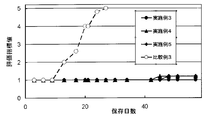
- Example 1 The spread obtained in Example 3, Example 4, Example 5, and Comparative Example 3 was subjected to a mold growth test. That is, a mold was kneaded into each and a preservation test was conducted.
- Aspergillus niger was used as a mold for the test.
- a sample was prepared by inoculating 1 g of each spread so that the number of mold spores was 50. This sample was put into a sterile petri dish, sealed with a vinyl tape, and stored at 20 ° C. and 25 ° C., respectively.
- FIG. 1 shows changes in evaluation index values when stored at 20 ° C.
- FIG. 2 shows changes in evaluation index values when stored at 25 ° C.
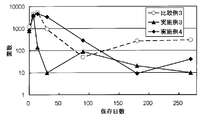
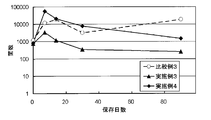
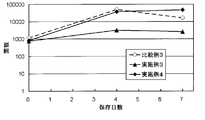
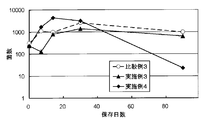
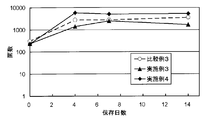
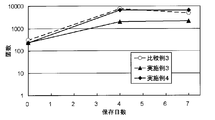
- Example 2 The spread obtained in Example 3, Example 4, and Comparative Example 3 was subjected to a bacterial growth test. That is, a preservation test was conducted by kneading bacteria in each of them.
- test bacteria As test bacteria, a mixture of heat-resistant gram-positive bacterium Bacillus cereus, psychrophilic gram-negative bacterium Pseudomonas sp., Escherichia coli gram-negative bacterium Enterobacter acacloacae, and Gram-positive cocci Staphylococcus epidermidis (4 types) .
- a sample was prepared by inoculating 1 g of each spread so that the total number of mixed bacteria was 500.
- the sample was placed in a sterile petri dish, sealed with vinyl tape, and stored at 10 ° C, 15 ° C, 20 ° C, and 25 ° C, respectively.
- the number of bacteria was measured after 7, 14, 30, 90, 180, and 270 days.
- the number of bacteria was measured after 4 days, 7 days, and 14 days.
- Fig. 3 shows the increase or decrease in the number of bacteria when stored at 10 ° C. Similarly, the increase and decrease in the number of bacteria when stored at 15 ° C., 20 ° C., and 25 ° C. are shown in FIGS. 4, 5, and 6, respectively.
- Example 3 The spread obtained in Example 3, Example 4, and Comparative Example 3 was subjected to a yeast growth test. That is, a storage test was conducted by kneading yeast into each.
- Candida krusei was used as a test yeast.
- a sample was prepared by inoculating 1 g of each spread so that the number of yeast cells was 500.
- the sample was placed in a sterile petri dish, sealed with vinyl tape, and stored at 10 ° C, 15 ° C, 20 ° C, and 25 ° C, respectively.
- the number of bacteria was measured after 7, 14, 30, 90, 180, and 270 days.
- the number of bacteria was measured after 4 days, 7 days, and 14 days.
- Fig. 7 shows changes in the number of yeasts when stored at 10 ° C. Similarly, the increase and decrease in the number of yeasts when stored at 15 ° C., 20 ° C., and 25 ° C. are shown in FIG. 8, FIG. 9, and FIG. 10, respectively.
- an aqueous phase was prepared by blending A to F in Table 6.
- Salt is manufactured by Salt Kansai
- gelatin is manufactured by Nitta Gelatin (MU-200)
- citric acid and trisodium citrate are manufactured by Saneigen FFI
- hydroxypropyl starch is manufactured by NSC Japan (Nlite) CL) and starch were manufactured by NSC Japan (derived from tapioca)
- sugar was manufactured by Nippon Sugar Sugar Co., Ltd.
- dextrin was manufactured by Matsutani Chemical Industry Co., Ltd. (paindex).
- Aspergillus niger was used as a mold for the test.
- each aqueous phase part was measured, and a sample was prepared by inoculating 1 g of the aqueous phase part so that the number of mold spores was 50.
- Test Example 5 As a mold growth test in the aqueous phase, a plurality of hydroxypropyl starches shown in Table 9 were used, and samples of 5.7% aqueous solutions were prepared and examined.
- hydroxypropyl starch, hydroxypropylated phosphate-crosslinked starch, and phosphate-crosslinked starch can be used as the starch blended in the aqueous phase from the viewpoint of ensuring sufficient microbiological storage stability.
- starch-derived plant is preferably tapioca or waxy corn from the viewpoint of ensuring sufficient microbiological preservation.
- Example 6 A low-fat spread of the present invention was produced in the same manner as in Example 1 except that the blending of Example 1 and the blending amount / blending ratio were changed to the blending shown in Table 9 and the blending amount / blending ratio.
- Example 6 yielded a water-in-oil type oil / fat spread with a stable emulsified state.
- Example 6 The blending amounts and blending ratios of Example 6 are shown in Table 10.
- Example 7 A low-fat spread of the present invention was produced in the same manner as in Example 1 except that the blending of Example 1 and the blending amount / blending ratio were changed to the blending shown in Table 11 and the blending amount / blending ratio.
- Table 11 shows the blending amount and blending ratio of Example 7.
- a low fat spread having a relatively large amount of aqueous phase has excellent emulsification stability, does not cause production defects such as phase inversion during the production, and has good production suitability. Can provide a wide spread.
Landscapes
- Chemical & Material Sciences (AREA)
- Oil, Petroleum & Natural Gas (AREA)
- Life Sciences & Earth Sciences (AREA)
- Engineering & Computer Science (AREA)
- Food Science & Technology (AREA)
- Polymers & Plastics (AREA)
- Edible Oils And Fats (AREA)
- Seasonings (AREA)
- Grain Derivatives (AREA)
Priority Applications (3)
| Application Number | Priority Date | Filing Date | Title |
|---|---|---|---|
| CN201380026534.5A CN104320975B (zh) | 2012-05-23 | 2013-05-23 | 涂抹酱及其制造方法 |
| JP2014516844A JPWO2013176207A1 (ja) | 2012-05-23 | 2013-05-23 | スプレッド及びその製造方法 |
| HK15106395.1A HK1205644B (en) | 2012-05-23 | 2013-05-23 | Spread and method for manufacturing same |
Applications Claiming Priority (2)
| Application Number | Priority Date | Filing Date | Title |
|---|---|---|---|
| JP2012-117366 | 2012-05-23 | ||
| JP2012117366 | 2012-05-23 |
Publications (1)
| Publication Number | Publication Date |
|---|---|
| WO2013176207A1 true WO2013176207A1 (fr) | 2013-11-28 |
Family
ID=49623888
Family Applications (1)
| Application Number | Title | Priority Date | Filing Date |
|---|---|---|---|
| PCT/JP2013/064310 Ceased WO2013176207A1 (fr) | 2012-05-23 | 2013-05-23 | Produit à tartiner et son procédé de fabrication |
Country Status (3)
| Country | Link |
|---|---|
| JP (2) | JPWO2013176207A1 (fr) |
| CN (1) | CN104320975B (fr) |
| WO (1) | WO2013176207A1 (fr) |
Cited By (1)
| Publication number | Priority date | Publication date | Assignee | Title |
|---|---|---|---|---|
| WO2017017945A1 (fr) * | 2015-07-24 | 2017-02-02 | 株式会社明治 | Procédé de production de pâte à tartiner à faible teneur en matière grasse |
Families Citing this family (1)
| Publication number | Priority date | Publication date | Assignee | Title |
|---|---|---|---|---|
| CN107467579A (zh) * | 2017-08-04 | 2017-12-15 | 武汉轻工大学 | 裱花奶油的替代物及制作方法 |
Citations (6)
| Publication number | Priority date | Publication date | Assignee | Title |
|---|---|---|---|---|
| JPS62220147A (ja) * | 1986-02-19 | 1987-09-28 | ユニリ−バ− ナ−ムロ−ゼ ベンノ−トシヤ−プ | 食用スプレツド |
| JPS62232335A (ja) * | 1986-03-06 | 1987-10-12 | ユニリ−バ− ナ−ムロ−ゼ ベンノ−トシヤ−プ | 低脂肪スプレツド |
| JPH01128744A (ja) * | 1987-10-13 | 1989-05-22 | L & L Internatl Sweden Ab | 低脂肪含有のマーガリン及びその製造方法 |
| JPH025823A (ja) * | 1988-02-02 | 1990-01-10 | St Ivel Ltd | 低脂肪スプレッドおよびその製造方法 |
| JPH04258242A (ja) * | 1991-02-07 | 1992-09-14 | Kanegafuchi Chem Ind Co Ltd | 低脂肪油中水型乳化油脂組成物 |
| JPH11318359A (ja) * | 1998-04-07 | 1999-11-24 | Cerestar Holding Bv | 小麦ファイバ―ゲル及びでんぷんによるゼラチン代用物 |
Family Cites Families (6)
| Publication number | Priority date | Publication date | Assignee | Title |
|---|---|---|---|---|
| US1990355A (en) * | 1933-06-26 | 1935-02-05 | William J Tierney | Concealed drinking fountain |
| IL24762A (en) * | 1965-01-09 | 1969-06-25 | Bratland A | Process for the production of reconstituted milk or cream |
| SE508785C2 (sv) * | 1991-10-07 | 1998-11-02 | L & L Int Sweden Ab | Förfarande för framställning av margarin med extra låg fetthalt |
| KR101169506B1 (ko) * | 2009-08-17 | 2012-07-27 | 씨제이제일제당 (주) | 유화력이 강화된 식이섬유전분의 제조방법 및 이를 이용한 저지방 마요네즈 및 마가린 조성물 |
| CN101642236B (zh) * | 2009-08-26 | 2012-02-08 | 天津实发冠华生物科技有限公司 | 含有大豆蛋白的涂抹酱及其制备方法 |
| JP6182743B2 (ja) * | 2013-03-29 | 2017-08-23 | 雪印メグミルク株式会社 | 油中水型乳化組成物 |
-
2013
- 2013-05-23 CN CN201380026534.5A patent/CN104320975B/zh active Active
- 2013-05-23 JP JP2014516844A patent/JPWO2013176207A1/ja active Pending
- 2013-05-23 WO PCT/JP2013/064310 patent/WO2013176207A1/fr not_active Ceased
-
2017
- 2017-12-18 JP JP2017241281A patent/JP6691905B2/ja active Active
Patent Citations (6)
| Publication number | Priority date | Publication date | Assignee | Title |
|---|---|---|---|---|
| JPS62220147A (ja) * | 1986-02-19 | 1987-09-28 | ユニリ−バ− ナ−ムロ−ゼ ベンノ−トシヤ−プ | 食用スプレツド |
| JPS62232335A (ja) * | 1986-03-06 | 1987-10-12 | ユニリ−バ− ナ−ムロ−ゼ ベンノ−トシヤ−プ | 低脂肪スプレツド |
| JPH01128744A (ja) * | 1987-10-13 | 1989-05-22 | L & L Internatl Sweden Ab | 低脂肪含有のマーガリン及びその製造方法 |
| JPH025823A (ja) * | 1988-02-02 | 1990-01-10 | St Ivel Ltd | 低脂肪スプレッドおよびその製造方法 |
| JPH04258242A (ja) * | 1991-02-07 | 1992-09-14 | Kanegafuchi Chem Ind Co Ltd | 低脂肪油中水型乳化油脂組成物 |
| JPH11318359A (ja) * | 1998-04-07 | 1999-11-24 | Cerestar Holding Bv | 小麦ファイバ―ゲル及びでんぷんによるゼラチン代用物 |
Cited By (2)
| Publication number | Priority date | Publication date | Assignee | Title |
|---|---|---|---|---|
| WO2017017945A1 (fr) * | 2015-07-24 | 2017-02-02 | 株式会社明治 | Procédé de production de pâte à tartiner à faible teneur en matière grasse |
| JPWO2017017945A1 (ja) * | 2015-07-24 | 2018-05-10 | 株式会社明治 | 低脂肪スプレッドの製造方法 |
Also Published As
| Publication number | Publication date |
|---|---|
| HK1205644A1 (en) | 2015-12-24 |
| JP2018038435A (ja) | 2018-03-15 |
| CN104320975A (zh) | 2015-01-28 |
| JPWO2013176207A1 (ja) | 2016-01-14 |
| CN104320975B (zh) | 2018-06-08 |
| JP6691905B2 (ja) | 2020-05-13 |
Similar Documents
| Publication | Publication Date | Title |
|---|---|---|
| US5922391A (en) | Composition like mayonnaise but having less or no edible oil | |
| KR102035274B1 (ko) | 온도변화에 안정한 마요네즈풍 소스 및 이의 제조방법 | |
| DE69616513T2 (de) | Verfahren zur herstellung von lagerstabilen milchprodukten | |
| JP6514110B2 (ja) | 酸性水中油型乳化調味料 | |
| JP6691905B2 (ja) | スプレッド及びその製造方法 | |
| JP2005530498A (ja) | 生微生物を含む食用エマルション | |
| JP4242359B2 (ja) | レアチーズケーキ及びその製造方法 | |
| JP6053420B2 (ja) | 容器入り液状又はペースト状食品組成物 | |
| EP3250041B1 (fr) | Émulsion comestible sensiblement exempte d'acides gras trans | |
| JPWO2014129230A1 (ja) | チーズ様食品 | |
| JP2005529593A (ja) | 生微生物を含む食用エマルション | |
| JP7649799B2 (ja) | 水中油型乳化組成物、および該水中油型乳化組成物が用いられた食品 | |
| JP5822564B2 (ja) | 乳化状油脂ベース食品及びその製造方法 | |
| JP4527005B2 (ja) | 発酵乳食品とその製造方法 | |
| JPH11276069A (ja) | 油中水型乳化油脂組成物 | |
| CN104661540B (zh) | 容器装液态或糊状或者速冻食品组合物及其制造方法 | |
| HK1205644B (en) | Spread and method for manufacturing same | |
| JPH0970256A (ja) | チーズ含有流動性組成物 | |
| JP6302834B2 (ja) | 油中水型油脂組成物の製造方法 | |
| JP6533079B2 (ja) | スプレッド用油中水中油型乳化油脂組成物 | |
| JP4920075B2 (ja) | カカオプリンの製造方法およびカカオプリン | |
| JP4562704B2 (ja) | チーズ入り液状又はペースト状酸性食品の製造方法 | |
| JP4920076B2 (ja) | カカオプリンの製造方法およびカカオプリン | |
| JP4961463B2 (ja) | チョコレートプリンの製造方法およびチョコレートプリン | |
| JP4562705B2 (ja) | チーズ入り液状又はペースト状酸性食品の製造方法 |
Legal Events
| Date | Code | Title | Description |
|---|---|---|---|
| 121 | Ep: the epo has been informed by wipo that ep was designated in this application |
Ref document number: 13793112 Country of ref document: EP Kind code of ref document: A1 |
|
| ENP | Entry into the national phase |
Ref document number: 2014516844 Country of ref document: JP Kind code of ref document: A |
|
| NENP | Non-entry into the national phase |
Ref country code: DE |
|
| 122 | Ep: pct application non-entry in european phase |
Ref document number: 13793112 Country of ref document: EP Kind code of ref document: A1 |