WO2013180176A1 - Adsorbant d'endotoxine - Google Patents
Adsorbant d'endotoxine Download PDFInfo
- Publication number
- WO2013180176A1 WO2013180176A1 PCT/JP2013/064905 JP2013064905W WO2013180176A1 WO 2013180176 A1 WO2013180176 A1 WO 2013180176A1 JP 2013064905 W JP2013064905 W JP 2013064905W WO 2013180176 A1 WO2013180176 A1 WO 2013180176A1
- Authority
- WO
- WIPO (PCT)
- Prior art keywords
- polymer
- adsorbent
- present
- solution
- endotoxin
- Prior art date
- Legal status (The legal status is an assumption and is not a legal conclusion. Google has not performed a legal analysis and makes no representation as to the accuracy of the status listed.)
- Ceased
Links
Images

Classifications
-
- B—PERFORMING OPERATIONS; TRANSPORTING
- B01—PHYSICAL OR CHEMICAL PROCESSES OR APPARATUS IN GENERAL
- B01J—CHEMICAL OR PHYSICAL PROCESSES, e.g. CATALYSIS OR COLLOID CHEMISTRY; THEIR RELEVANT APPARATUS
- B01J20/00—Solid sorbent compositions or filter aid compositions; Sorbents for chromatography; Processes for preparing, regenerating or reactivating thereof
- B01J20/22—Solid sorbent compositions or filter aid compositions; Sorbents for chromatography; Processes for preparing, regenerating or reactivating thereof comprising organic material
- B01J20/26—Synthetic macromolecular compounds
- B01J20/265—Synthetic macromolecular compounds modified or post-treated polymers
- B01J20/267—Cross-linked polymers
-
- B—PERFORMING OPERATIONS; TRANSPORTING
- B01—PHYSICAL OR CHEMICAL PROCESSES OR APPARATUS IN GENERAL
- B01J—CHEMICAL OR PHYSICAL PROCESSES, e.g. CATALYSIS OR COLLOID CHEMISTRY; THEIR RELEVANT APPARATUS
- B01J20/00—Solid sorbent compositions or filter aid compositions; Sorbents for chromatography; Processes for preparing, regenerating or reactivating thereof
- B01J20/281—Sorbents specially adapted for preparative, analytical or investigative chromatography
- B01J20/286—Phases chemically bonded to a substrate, e.g. to silica or to polymers
-
- B—PERFORMING OPERATIONS; TRANSPORTING
- B01—PHYSICAL OR CHEMICAL PROCESSES OR APPARATUS IN GENERAL
- B01J—CHEMICAL OR PHYSICAL PROCESSES, e.g. CATALYSIS OR COLLOID CHEMISTRY; THEIR RELEVANT APPARATUS
- B01J20/00—Solid sorbent compositions or filter aid compositions; Sorbents for chromatography; Processes for preparing, regenerating or reactivating thereof
- B01J20/30—Processes for preparing, regenerating, or reactivating
-
- B—PERFORMING OPERATIONS; TRANSPORTING
- B01—PHYSICAL OR CHEMICAL PROCESSES OR APPARATUS IN GENERAL
- B01J—CHEMICAL OR PHYSICAL PROCESSES, e.g. CATALYSIS OR COLLOID CHEMISTRY; THEIR RELEVANT APPARATUS
- B01J20/00—Solid sorbent compositions or filter aid compositions; Sorbents for chromatography; Processes for preparing, regenerating or reactivating thereof
- B01J20/30—Processes for preparing, regenerating, or reactivating
- B01J20/3042—Use of binding agents; addition of materials ameliorating the mechanical properties of the produced sorbent
-
- B—PERFORMING OPERATIONS; TRANSPORTING
- B01—PHYSICAL OR CHEMICAL PROCESSES OR APPARATUS IN GENERAL
- B01J—CHEMICAL OR PHYSICAL PROCESSES, e.g. CATALYSIS OR COLLOID CHEMISTRY; THEIR RELEVANT APPARATUS
- B01J20/00—Solid sorbent compositions or filter aid compositions; Sorbents for chromatography; Processes for preparing, regenerating or reactivating thereof
- B01J20/30—Processes for preparing, regenerating, or reactivating
- B01J20/3085—Chemical treatments not covered by groups B01J20/3007 - B01J20/3078
-
- B—PERFORMING OPERATIONS; TRANSPORTING
- B01—PHYSICAL OR CHEMICAL PROCESSES OR APPARATUS IN GENERAL
- B01J—CHEMICAL OR PHYSICAL PROCESSES, e.g. CATALYSIS OR COLLOID CHEMISTRY; THEIR RELEVANT APPARATUS
- B01J20/00—Solid sorbent compositions or filter aid compositions; Sorbents for chromatography; Processes for preparing, regenerating or reactivating thereof
- B01J20/30—Processes for preparing, regenerating, or reactivating
- B01J20/32—Impregnating or coating ; Solid sorbent compositions obtained from processes involving impregnating or coating
- B01J20/3202—Impregnating or coating ; Solid sorbent compositions obtained from processes involving impregnating or coating characterised by the carrier, support or substrate used for impregnation or coating
- B01J20/3204—Inorganic carriers, supports or substrates
-
- B—PERFORMING OPERATIONS; TRANSPORTING
- B01—PHYSICAL OR CHEMICAL PROCESSES OR APPARATUS IN GENERAL
- B01J—CHEMICAL OR PHYSICAL PROCESSES, e.g. CATALYSIS OR COLLOID CHEMISTRY; THEIR RELEVANT APPARATUS
- B01J20/00—Solid sorbent compositions or filter aid compositions; Sorbents for chromatography; Processes for preparing, regenerating or reactivating thereof
- B01J20/30—Processes for preparing, regenerating, or reactivating
- B01J20/32—Impregnating or coating ; Solid sorbent compositions obtained from processes involving impregnating or coating
- B01J20/3202—Impregnating or coating ; Solid sorbent compositions obtained from processes involving impregnating or coating characterised by the carrier, support or substrate used for impregnation or coating
- B01J20/3206—Organic carriers, supports or substrates
- B01J20/3208—Polymeric carriers, supports or substrates
- B01J20/321—Polymeric carriers, supports or substrates consisting of a polymer obtained by reactions involving only carbon to carbon unsaturated bonds
-
- B—PERFORMING OPERATIONS; TRANSPORTING
- B01—PHYSICAL OR CHEMICAL PROCESSES OR APPARATUS IN GENERAL
- B01J—CHEMICAL OR PHYSICAL PROCESSES, e.g. CATALYSIS OR COLLOID CHEMISTRY; THEIR RELEVANT APPARATUS
- B01J20/00—Solid sorbent compositions or filter aid compositions; Sorbents for chromatography; Processes for preparing, regenerating or reactivating thereof
- B01J20/30—Processes for preparing, regenerating, or reactivating
- B01J20/32—Impregnating or coating ; Solid sorbent compositions obtained from processes involving impregnating or coating
- B01J20/3202—Impregnating or coating ; Solid sorbent compositions obtained from processes involving impregnating or coating characterised by the carrier, support or substrate used for impregnation or coating
- B01J20/3206—Organic carriers, supports or substrates
- B01J20/3208—Polymeric carriers, supports or substrates
- B01J20/3212—Polymeric carriers, supports or substrates consisting of a polymer obtained by reactions otherwise than involving only carbon to carbon unsaturated bonds
-
- B—PERFORMING OPERATIONS; TRANSPORTING
- B01—PHYSICAL OR CHEMICAL PROCESSES OR APPARATUS IN GENERAL
- B01J—CHEMICAL OR PHYSICAL PROCESSES, e.g. CATALYSIS OR COLLOID CHEMISTRY; THEIR RELEVANT APPARATUS
- B01J20/00—Solid sorbent compositions or filter aid compositions; Sorbents for chromatography; Processes for preparing, regenerating or reactivating thereof
- B01J20/30—Processes for preparing, regenerating, or reactivating
- B01J20/32—Impregnating or coating ; Solid sorbent compositions obtained from processes involving impregnating or coating
- B01J20/3231—Impregnating or coating ; Solid sorbent compositions obtained from processes involving impregnating or coating characterised by the coating or impregnating layer
- B01J20/3242—Layers with a functional group, e.g. an affinity material, a ligand, a reactant or a complexing group
- B01J20/3268—Macromolecular compounds
- B01J20/3272—Polymers obtained by reactions otherwise than involving only carbon to carbon unsaturated bonds
- B01J20/3274—Proteins, nucleic acids, polysaccharides, antibodies or antigens
-
- B—PERFORMING OPERATIONS; TRANSPORTING
- B01—PHYSICAL OR CHEMICAL PROCESSES OR APPARATUS IN GENERAL
- B01J—CHEMICAL OR PHYSICAL PROCESSES, e.g. CATALYSIS OR COLLOID CHEMISTRY; THEIR RELEVANT APPARATUS
- B01J20/00—Solid sorbent compositions or filter aid compositions; Sorbents for chromatography; Processes for preparing, regenerating or reactivating thereof
- B01J20/30—Processes for preparing, regenerating, or reactivating
- B01J20/32—Impregnating or coating ; Solid sorbent compositions obtained from processes involving impregnating or coating
- B01J20/3231—Impregnating or coating ; Solid sorbent compositions obtained from processes involving impregnating or coating characterised by the coating or impregnating layer
- B01J20/3242—Layers with a functional group, e.g. an affinity material, a ligand, a reactant or a complexing group
- B01J20/3268—Macromolecular compounds
- B01J20/328—Polymers on the carrier being further modified
- B01J20/3282—Crosslinked polymers
-
- C—CHEMISTRY; METALLURGY
- C07—ORGANIC CHEMISTRY
- C07H—SUGARS; DERIVATIVES THEREOF; NUCLEOSIDES; NUCLEOTIDES; NUCLEIC ACIDS
- C07H1/00—Processes for the preparation of sugar derivatives
- C07H1/06—Separation; Purification
-
- C—CHEMISTRY; METALLURGY
- C07—ORGANIC CHEMISTRY
- C07H—SUGARS; DERIVATIVES THEREOF; NUCLEOSIDES; NUCLEOTIDES; NUCLEIC ACIDS
- C07H21/00—Compounds containing two or more mononucleotide units having separate phosphate or polyphosphate groups linked by saccharide radicals of nucleoside groups, e.g. nucleic acids
- C07H21/02—Compounds containing two or more mononucleotide units having separate phosphate or polyphosphate groups linked by saccharide radicals of nucleoside groups, e.g. nucleic acids with ribosyl as saccharide radical
-
- C—CHEMISTRY; METALLURGY
- C07—ORGANIC CHEMISTRY
- C07H—SUGARS; DERIVATIVES THEREOF; NUCLEOSIDES; NUCLEOTIDES; NUCLEIC ACIDS
- C07H21/00—Compounds containing two or more mononucleotide units having separate phosphate or polyphosphate groups linked by saccharide radicals of nucleoside groups, e.g. nucleic acids
- C07H21/04—Compounds containing two or more mononucleotide units having separate phosphate or polyphosphate groups linked by saccharide radicals of nucleoside groups, e.g. nucleic acids with deoxyribosyl as saccharide radical
-
- C—CHEMISTRY; METALLURGY
- C08—ORGANIC MACROMOLECULAR COMPOUNDS; THEIR PREPARATION OR CHEMICAL WORKING-UP; COMPOSITIONS BASED THEREON
- C08B—POLYSACCHARIDES; DERIVATIVES THEREOF
- C08B37/00—Preparation of polysaccharides not provided for in groups C08B1/00 - C08B35/00; Derivatives thereof
- C08B37/0006—Homoglycans, i.e. polysaccharides having a main chain consisting of one single sugar, e.g. colominic acid
- C08B37/0009—Homoglycans, i.e. polysaccharides having a main chain consisting of one single sugar, e.g. colominic acid alpha-D-Glucans, e.g. polydextrose, alternan, glycogen; (alpha-1,4)(alpha-1,6)-D-Glucans; (alpha-1,3)(alpha-1,4)-D-Glucans, e.g. isolichenan or nigeran; (alpha-1,4)-D-Glucans; (alpha-1,3)-D-Glucans, e.g. pseudonigeran; Derivatives thereof
- C08B37/0012—Cyclodextrin [CD], e.g. cycle with 6 units (alpha), with 7 units (beta) and with 8 units (gamma), large-ring cyclodextrin or cycloamylose with 9 units or more; Derivatives thereof
-
- C—CHEMISTRY; METALLURGY
- C08—ORGANIC MACROMOLECULAR COMPOUNDS; THEIR PREPARATION OR CHEMICAL WORKING-UP; COMPOSITIONS BASED THEREON
- C08B—POLYSACCHARIDES; DERIVATIVES THEREOF
- C08B37/00—Preparation of polysaccharides not provided for in groups C08B1/00 - C08B35/00; Derivatives thereof
- C08B37/0006—Homoglycans, i.e. polysaccharides having a main chain consisting of one single sugar, e.g. colominic acid
- C08B37/0009—Homoglycans, i.e. polysaccharides having a main chain consisting of one single sugar, e.g. colominic acid alpha-D-Glucans, e.g. polydextrose, alternan, glycogen; (alpha-1,4)(alpha-1,6)-D-Glucans; (alpha-1,3)(alpha-1,4)-D-Glucans, e.g. isolichenan or nigeran; (alpha-1,4)-D-Glucans; (alpha-1,3)-D-Glucans, e.g. pseudonigeran; Derivatives thereof
- C08B37/0012—Cyclodextrin [CD], e.g. cycle with 6 units (alpha), with 7 units (beta) and with 8 units (gamma), large-ring cyclodextrin or cycloamylose with 9 units or more; Derivatives thereof
- C08B37/0015—Inclusion compounds, i.e. host-guest compounds, e.g. polyrotaxanes
-
- C—CHEMISTRY; METALLURGY
- C08—ORGANIC MACROMOLECULAR COMPOUNDS; THEIR PREPARATION OR CHEMICAL WORKING-UP; COMPOSITIONS BASED THEREON
- C08G—MACROMOLECULAR COMPOUNDS OBTAINED OTHERWISE THAN BY REACTIONS ONLY INVOLVING UNSATURATED CARBON-TO-CARBON BONDS
- C08G18/00—Polymeric products of isocyanates or isothiocyanates
- C08G18/06—Polymeric products of isocyanates or isothiocyanates with compounds having active hydrogen
- C08G18/28—Polymeric products of isocyanates or isothiocyanates with compounds having active hydrogen characterised by the compounds used containing active hydrogen
- C08G18/40—High-molecular-weight compounds
- C08G18/64—Macromolecular compounds not provided for by groups C08G18/42 - C08G18/63
- C08G18/6484—Polysaccharides and derivatives thereof
-
- C—CHEMISTRY; METALLURGY
- C08—ORGANIC MACROMOLECULAR COMPOUNDS; THEIR PREPARATION OR CHEMICAL WORKING-UP; COMPOSITIONS BASED THEREON
- C08L—COMPOSITIONS OF MACROMOLECULAR COMPOUNDS
- C08L5/00—Compositions of polysaccharides or of their derivatives not provided for in groups C08L1/00 or C08L3/00
- C08L5/16—Cyclodextrin; Derivatives thereof
-
- B—PERFORMING OPERATIONS; TRANSPORTING
- B01—PHYSICAL OR CHEMICAL PROCESSES OR APPARATUS IN GENERAL
- B01J—CHEMICAL OR PHYSICAL PROCESSES, e.g. CATALYSIS OR COLLOID CHEMISTRY; THEIR RELEVANT APPARATUS
- B01J2220/00—Aspects relating to sorbent materials
- B01J2220/50—Aspects relating to the use of sorbent or filter aid materials
- B01J2220/52—Sorbents specially adapted for preparative chromatography
Definitions
- the present invention relates to an endotoxin adsorbent and a method for removing endotoxin (hereinafter also referred to as “ET”) using the same.
- the present invention particularly relates to a method for selectively removing ET in the presence of an acidic substance such as DNA.
- ET is a toxic substance mainly composed of lipopolysaccharide present in the outer cell wall membrane of Gram-negative bacteria, and is released when the bacteria die. ET causes harmful effects such as fever and ET shock when taken into a living body by mixing into an injectable medicine. Moreover, since ET can also act on the cell itself, it may affect experiments using various cells. In order to prevent these harmful effects of ET, methods for removing ET from injection solutions, substances that come into contact with body fluids, and experimental reagents have been studied.
- Conventionally known methods of removing ET include an adsorption method using activated carbon or an ion exchanger, a filtration method using a membrane or a membrane filter, a decomposition method using a high-temperature / high-pressure treatment, an acid treatment, or an alkali treatment.
- an adsorbent using polymyxin which is a basic antibiotic, as a ligand (see, for example, Non-Patent Document 1, Patent Document 1, and Patent Document 2), or a similar basic antibiotic is used.
- An adsorbent having a certain amikacin or the like as a ligand is known.
- Adsorbents using these antibiotics as ligands adsorb ET, but are known to adsorb nucleic acids such as DNA at the same time, and are not suitable for purification of nucleic acids.
- the recovery rate of DNA is at most 60%, that is, at least 40% of DNA is removed together with ET (see, for example, Non-Patent Document 2).
- a cationic (basic) adsorbent produced by introducing an amino group has also been studied.
- a cationic adsorbent produced by reacting diamine with polyglutamic acid methyl ester to introduce an amino group is known (see, for example, Patent Document 4).
- This adsorbent has a feature that the pore diameter is 1000 or less in terms of the molecular weight of dextran and is substantially non-porous, and ET can be selectively removed in the presence of albumin.
- adsorbents that use high molecular weight cationic substances as ligands.
- the polymer polyethyleneimine, polyallylamine, polylysine and the like are used (see, for example, Non-Patent Document 3 and Non-Patent Document 4).
- an adsorbent using epsilon polylysine as a ligand can remove ET from a protein solution, particularly when the base material has an exclusion limit molecular weight of 6000 or less. (For example, refer to Patent Document 5).
- Adsorbents with these basic (cationic) substances as ligands can selectively remove ET from protein solutions, like adsorbents with immobilized epsilon polylysine, but from nucleic acid solutions such as DNA. Cannot be removed selectively.
- an adsorbent that selectively removes ET from a solution in which a highly acidic substance such as heparin coexists an adsorbent using epsilon polylysine whose ligand is modified with glycidyl ether partially as an amino group has been reported. (See, for example, Patent Document 6).
- this ligand is basically cationic and the modification reduces heparin adsorption, but does not completely prevent heparin adsorption.
- Cyclodextrin (hereinafter also referred to as “CD”) is a molecule in which glucose is linked in a cyclic manner, and is widely known to include compounds that can enter the inside of the ring.
- a method for producing a bead-shaped CD polymer by crosslinking CD with epichlorohydrin has been reported (see, for example, Patent Document 7, Patent Document 8, and Patent Document 9). It is known to use such a CD polymer or a polymer of CD and polystyrene resin as an adsorbent for environmental hormones such as bisphenol A (see, for example, Patent Document 10 and Patent Document 11). Further, it is known that such a CD polymer is used for removing chlorogenic acid from a coffee extract (see, for example, Patent Document 12).
- CD polymers are all produced using epichlorohydrin as a crosslinking agent.
- Patent Document 8 exemplifies diepoxy compounds, diisocyanates, acrylamide derivatives, etc. in addition to epichlorohydrin as the crosslinking agent, but the properties of CD polymers produced using crosslinking agents other than epichlorohydrin are clarified. Not.
- a polymer is prepared by crosslinking CD with a diisocyanate compound, and the polymer is mixed with an alginic acid aqueous solution and then dropped into a calcium chloride aqueous solution to prepare a spherical CD polymer.
- adsorbing see, for example, Patent Document 13
- it does not indicate the phenol compound adsorption ability of the CD polymer alone before mixing with alginic acid or the like.
- Patent Document 14 exemplifies isocyanates, polyamines, acrylates, and carbonates in addition to epichlorohydrin as the crosslinking agent, but the properties of the CD polymer resin produced using a crosslinking agent other than epichlorohydrin are clearly shown. It has not been.
- ET removal is performed by ET removal buffer containing a surfactant or nucleic acid solution previously treated with a buffer containing alkali or SDS, or nickel chelate chromatography or chromatography using polymyxin or DNA ETOX.
- a method of purifying DNA by treating a treated nucleic acid solution with an inorganic chromatography support or an ion exchanger that retains DNA at a high salt concentration is shown.
- this method is very complicated and requires a lot of reagents such as solvents and salts and time.
- Patent No.4683632 Japanese Patent Laid-Open No. 2006-83379
- an adsorbent having a basic antibiotic such as polymyxin as a ligand an adsorbent having a polycation such as polylysine, ⁇ polylysine, polyethyleneimine, polyallylamine, etc. as a ligand
- adsorbents in which a positive charge such as an amino group is introduced into an insoluble carrier have been developed and used, but these adsorbents cannot selectively remove ET in the presence of nucleic acids such as DNA.
- An object of the present invention is to provide a means for selectively removing ET in the presence of a substance showing a negative charge such as a nucleic acid, and an endotoxin adsorbent (ET adsorbent) that can be used for the means.
- a substance showing a negative charge such as a nucleic acid
- ET adsorbent an endotoxin adsorbent
- the present inventors have used a polymer obtained by crosslinking cyclodextrin with an isocyanate-based crosslinking agent, so that in the coexistence of a substance showing a negative charge such as nucleic acid.
- the present invention has been completed by discovering that ET can be selectively removed.
- the present invention includes the following configuration.
- a method for producing the polymer comprising reacting a cyclodextrin with a cross-linking agent, A method wherein the cross-linking agent is a compound having one or more isocyanate groups and one or more functional groups capable of reacting with a hydroxyl group per molecule.
- the functional group capable of reacting with the hydroxyl group is an isocyanate group.
- An endotoxin adsorbent comprising a substrate and the polymer immobilized on the substrate.
- the manufacturing method of the said endotoxin adsorption material including fix
- a method for producing the endotoxin adsorbent comprising reacting a base material, a cyclodextrin, and a cross-linking agent, A method wherein the crosslinking agent is a compound having one or more isocyanate groups and one or more functional groups capable of reacting with hydroxyl groups. [7] The method, wherein the functional group capable of reacting with the hydroxyl group is an isocyanate group. [8] A method for removing endotoxin, comprising contacting the polymer or the adsorbent with a solution containing a target substance exhibiting negative charge and endotoxin.
- a method for producing a solution containing a target substance exhibiting a negative charge from which endotoxin has been removed comprising bringing the polymer or the adsorbent into contact with a target substance exhibiting a negative charge and a solution containing endotoxin.
- the target substance exhibiting negative charge is a nucleic acid.
- the nucleic acid is DNA.
- the nucleic acid is RNA.
- the first invention of the present application is a polymer of cyclodextrin (CD) (hereinafter also referred to as “CD polymer of the present invention”) having the following characteristics (1) to (4). (1) containing 6% to 15% of nitrogen atoms in molar ratio to carbon atoms; (2) a part of the hydroxyl group of cyclodextrin forms a urethane bond; (3) insoluble in water; (4) substantially no anion exchange ability.
- CD polymer of the present invention having the following characteristics (1) to (4). (1) containing 6% to 15% of nitrogen atoms in molar ratio to carbon atoms; (2) a part of the hydroxyl group of cyclodextrin forms a urethane bond; (3) insoluble in water; (4) substantially no anion exchange ability.
- CD is a compound having a cyclic structure in which a plurality of molecules of D-glucose are bonded by ⁇ -1,4 glycosidic bonds.
- CD is known to include various organic molecules in its cavity. Specific examples of CD include ⁇ -cyclodextrin, ⁇ -cyclodextrin, and ⁇ -cyclodextrin. Each characteristic is shown in Table 1.
- “glucose unit” refers to the number of glucose molecules forming a CD1 molecule, that is, the number of glucose molecules forming a cyclic structure of CD.
- the CD polymer is a polymer having a structure in which CD is crosslinked.
- the CD polymer of the present invention can be obtained, for example, by crosslinking CD with a crosslinking agent described later.
- one type of CD may be cross-linked, or two or more types of CD may be cross-linked.
- the ratio of each CD is not particularly limited and may be appropriately selected by those skilled in the art.
- the CD polymer of the present invention contains 6% to 15% nitrogen atoms in a molar ratio with respect to carbon atoms. That is, in the CD polymer of the present invention, N / C (mol%) represented by the following formula 1 is 6 to 15.
- the CD polymer of the present invention is insoluble in water.
- “insoluble in water” means that the solubility of the CD polymer of the present invention in water at 25 ° C. is less than 1 mg / L, preferably less than 1 ⁇ g / L, more preferably 0 ⁇ g / L.
- the CD polymer of the present invention exhibits substantially no anion exchange ability.
- “substantially does not exhibit anion exchange capacity” means that the anion exchange capacity (AEC) of the CD polymer of the present invention is less than 0.1 meq / g.
- the CD polymer of the present invention may or may not have an anion exchange group.
- the CD polymer of the present invention may or may not have a cation exchange group.
- the amount of the cation exchange group possessed by the CD polymer of the present invention is not particularly limited.
- a substance having a positive charge is present in an ET solution (a target substance showing a negative charge and a solution containing ET) described later.
- ET solution a target substance showing a negative charge and a solution containing ET
- a small amount may be preferable from the viewpoint of reducing non-specific adsorption of the substance having the positive charge.
- the CD polymer of the present invention may not exhibit substantial cation exchange capacity.
- “substantially no cation exchange capacity” means that the cation exchange capacity (CEC) of the CD polymer of the present invention is less than 0.1 meq / g.
- the ion exchange capacity is quantified by pH titration method.
- the description of the examples can be specifically referred to.
- the ion exchange group may be introduced by, for example, a crosslinking reaction, or may be introduced separately from the crosslinking reaction.
- the ion exchange group may be in a free form or may form a salt.
- a part of the hydroxyl group of CD forms a urethane bond.
- the urethane bond here is a structure represented by “(CD) —O—CO—NH—R”.
- (CD) represents a CD molecule constituting the CD polymer of the present invention
- R represents an arbitrary structure.
- all CD molecules constituting the CD polymer of the present invention may have a urethane bond, and some CD molecules may not have a urethane bond.
- the urethane bond can be formed by reacting CD with an isocyanate-based crosslinking agent described later.
- the urethane bond can be specifically formed by bonding a hydroxyl group in the CD molecule and an isocyanate group in the isocyanate-based crosslinking agent described later.
- the ratio of hydroxyl groups forming urethane bonds to all hydroxyl groups in all CD molecules constituting the CD polymer of the present invention is, for example, various conditions such as the type of crosslinking agent and N / C (mol%) in the CD polymer of the present invention. It is set appropriately according to
- the degree of swelling of the CD polymer of the present invention is not particularly limited, but may be, for example, 2 to 6, or 3 to 5.
- the degree of swelling refers to the ratio of the volume (measured volume) before drying to the dry weight when the CD polymer of the present invention is dried. That is, the degree of swelling can be calculated by the following formula 3.
- Swelling degree (wet-mL / dry-g) measured volume (mL) / dry weight (g) (Formula 3)
- the shape of the CD polymer particles of the present invention is not particularly limited, but may be, for example, granular or spherical.
- the average particle diameter of the particles of the CD polymer of the present invention is not particularly limited, but may be, for example, 0.1 ⁇ m to 500 ⁇ m, preferably 10 ⁇ m to 300 ⁇ m, more preferably 40 ⁇ m to 150 ⁇ m.
- the “average particle size” means a particle size at an integrated value of 50% in the particle size distribution obtained by the laser diffraction / scattering method. Specifically, the average particle diameter can be measured using, for example, a laser diffraction particle size distribution measuring apparatus.
- the CD polymer of the present invention can be produced, for example, by reacting CD with a crosslinking agent. That is, this invention provides the manufacturing method of CD polymer of this invention including making CD react with a crosslinking agent.
- crosslinking agent refers to a compound having one or more isocyanate groups and one or more functional groups capable of forming a covalent bond with a hydroxyl group per molecule.
- the crosslinking agent is also referred to as “isocyanate-based crosslinking agent”.
- the functional group capable of forming a covalent bond with a hydroxyl group include a carboxyl group and an isocyanate group.
- an isocyanate group is preferable. That is, the crosslinking agent preferably has 2 or more isocyanate groups per molecule. Specific examples of the compound having two or more isocyanate groups include compounds shown in Table 2 below.
- the crosslinking agent may have another functional group.
- the crosslinking agent may have an ion exchange group as long as the effects of the present invention are not impaired.
- 1 type of crosslinking agents may be used and 2 or more types of crosslinking agents may be used in combination.
- the reaction between CD and an isocyanate-based crosslinking agent can be performed in an appropriate solvent.
- the solvent is preferably a solvent that does not have reactivity with an isocyanate group, for example.
- Specific examples of the solvent having no reactivity with an isocyanate group include amides such as dimethylacetamide (DMAC) and dimethylformamide (DMF), ethers such as dioxane, diethyl ether, and tetrahydrofuran, and dimethylsulfone.
- DMAC dimethylacetamide
- DMF dimethylformamide
- ethers such as dioxane, diethyl ether, and tetrahydrofuran
- dimethylsulfone dimethylsulfone
- a solvent such as water, alcohol, thiol, or amine may be used in a range that does not impair the effects of the present invention from the viewpoint of reactivity with an isocyanate group, but is preferably not used.
- the solvent one type of solvent may be used, or two or more types of solvents may be used in combination.
- the crosslinking reaction may be performed, for example, by mixing CD and a crosslinking agent dissolved in a solvent, respectively, or by adding the other to a solvent in which one of CD and the crosslinking agent is dissolved. Alternatively, both the crosslinking agent and the crosslinking agent may be dissolved in a solvent at the same time.
- the crosslinking reaction is preferably performed, for example, by adding a crosslinking agent to a solvent in which CD is dissolved.
- the reaction temperature for carrying out the crosslinking reaction can be appropriately set according to various conditions such as the type of crosslinking agent, the type of solvent, and the reaction time.
- the reaction temperature is not particularly limited, but may be, for example, 10 ° C to 100 ° C, or 50 ° C to 90 ° C.
- the reaction time for carrying out the crosslinking reaction can be appropriately set according to various conditions such as the type of crosslinking agent, the type of solvent, and the reaction temperature.
- the reaction time is not particularly limited, and may be, for example, 30 minutes to 24 hours, or 1 hour to 10 hours.
- the molar ratio (CL / CD) of the crosslinking agent (CL) to CD when producing the CD polymer of the present invention may be, for example, 1 to 20.
- the molar ratio of the crosslinking agent to CD (CL / CD) is preferably 2 to 10 from the viewpoint of polymer strength, and more preferably 3 to 7 from the viewpoint of ET adsorption ability.
- the CD polymer of the present invention can be used as it is as an endotoxin adsorbent (ET adsorbent). That is, the present invention provides an ET adsorbent comprising the CD polymer of the present invention.
- the CD polymer of the present invention may be used as an ET adsorbent after processing such as grinding.
- the CD polymer of the present invention theoretically has no ion exchange group when produced using only a crosslinking agent having no CD and ion exchange group as a raw material.
- Such a CD polymer can be preferably used for the adsorption of ET in that the ion exchange group has no possibility of unexpectedly affecting the selective adsorption of ET.
- the CD polymer of the present invention can be used as an ET adsorbent after being immobilized on a substrate. That is, the second invention of the present application is an ET adsorbent comprising a base material and the CD polymer of the present invention immobilized on the base material.
- the CD polymer may be fixed to the base material by a covalent bond, or may be fixed to the base material by a non-covalent bond.
- the CD polymer is preferably immobilized on the substrate by a covalent bond.
- the ET adsorbent according to the second invention of the present application can be produced, for example, by immobilizing a CD polymer of the present invention produced in advance on a substrate. That is, this invention provides the manufacturing method of ET adsorption material including fix
- the immobilization technique can be appropriately selected according to various conditions such as the type of functional group possessed by the CD polymer of the present invention and the type of functional group possessed by the substrate.
- the hydroxyl group remaining in the CD polymer of the present invention and the hydroxyl group in the substrate are crosslinked with the above-described isocyanate-based crosslinking agent, whereby the CD polymer of the present invention is crosslinked with the substrate.
- the immobilization may be carried out, for example, by mixing a substrate dissolved or dispersed in a solvent, the CD polymer of the present invention, and a crosslinking agent. In this order, it may be carried out by dissolving or dispersing in a solvent, or by simultaneously dissolving or dispersing the substrate, the CD polymer of the present invention and the crosslinking agent in a solvent.
- the CD polymer of the present invention may be subjected to immobilization after processing such as grinding.
- the ET adsorbent according to the second invention of the present application can also be produced, for example, by reacting the base material and CD with an isocyanate-based crosslinking agent. That is, this invention provides the manufacturing method of ET adsorption material including making a base material and CD react with an isocyanate type crosslinking agent. The reaction can be carried out in a suitable solvent as described above. Moreover, about reaction temperature and reaction time, you may apply mutatis mutandis about the reaction temperature and reaction time of the crosslinking reaction at the time of manufacturing CD polymer of this invention mentioned above.
- the reaction may be performed, for example, by mixing a base material, CD, and a crosslinking agent dissolved or dispersed in a solvent, respectively, and dissolving or dispersing the base material, CD, and the crosslinking agent in a solvent in any order.
- the substrate, CD, and cross-linking agent may be dissolved or dispersed in a solvent at the same time.
- the reaction may be performed, for example, by adding a crosslinking agent to a solvent in which CD is dissolved to advance the crosslinking reaction, and then adding a substrate.
- “reacting the substrate and CD with the isocyanate crosslinking agent” means that the substrate itself is condensed with the isocyanate crosslinking agent or the CD as long as the substrate, CD, and isocyanate crosslinking agent are used as raw materials.
- the base material itself does not form a covalent bond with the isocyanate-based cross-linking agent or CD condensed therewith, but an ET adsorbent in which the CD polymer is immobilized on the base material by non-covalent bonding. Including the case where it is formed.
- the substrate is not particularly limited as long as it can be used as an ET adsorbent by immobilizing the CD polymer of the present invention.
- the substrate include already known adsorbents, chromatographic carriers, filter paper, membranes, filters, hollow fibers, fibers, polymers that can be processed into nanofibers, and inorganic materials.
- the base material include polysaccharides such as cellulose, agarose, starch, amylose, dextran, pullulan and glucomannan; polyacrylic acid or derivatives thereof, polyvinyl alcohol, nylon, polysulfone, polyacryl nitrile, polyethylene And synthetic polymers such as polypropylene and polystyrene; and inorganic materials such as glass, porous glass, silica gel, and hydroxyapatite.
- the substrate preferably has a functional group for immobilizing the CD polymer of the present invention through a covalent bond (hereinafter also referred to as “functional group for immobilization”).
- the functional group for immobilization examples include a functional group capable of forming a covalent bond with a hydroxyl group in the CD polymer when the CD polymer is directly bonded to the substrate.
- the functional group for immobilization for example, when the CD polymer is bonded to the substrate via another compound such as a crosslinking agent, a functional group capable of forming a covalent bond with the functional group in the compound is Can be mentioned.
- the substrate preferably has a hydroxyl group.
- the substrate having a hydroxyl group include polysaccharides.
- the “functional group for immobilization” may be a functional group that the base material originally has, or may be a functional group introduced into the base material.
- silica gel into which a diol has been introduced can be used as the base material.
- the introduction of the diol into the silica gel can be performed, for example, by epoxidizing the silica gel and adding a water molecule to open the ring.
- the description of the examples can be specifically referred to.
- a base material 1 type of base materials may be used and 2 or more types of base materials may be used in combination.
- ET is obtained from the solution.
- the CD polymer (including the ET adsorbent comprising the same polymer) according to the first invention of the present application and the ET adsorbent according to the second invention of the present application are also collectively referred to as “ET adsorbent of the present invention”.
- ET also called lipopolysaccharide
- ET is a substance in which lipid A is bound to a phosphorylated sugar and a polysaccharide and is a substance that exhibits a negative charge.
- the ET adsorbent of the present invention is useful for selectively removing ET, particularly when ET and a substance exhibiting negative charge other than ET coexist.
- such a substance exhibiting negative charge other than ET is also referred to as “target substance exhibiting negative charge”.
- the third invention of the present application is a method for removing ET, comprising contacting the ET adsorbent of the present invention with a solution containing a target substance exhibiting negative charge and ET (hereinafter referred to as “ET of the present invention”). It is also referred to as a “removal method”.
- a solution containing a target substance exhibiting negative charge and ET is also referred to as an “ET solution”.
- the ET solution may originally be a solution containing a target substance exhibiting negative charge and ET, or may be a solution prepared by dissolving a target substance exhibiting negative charge contaminated by ET in a solvent. .
- the ET removal method of the present invention provides a solution containing the target substance exhibiting negative charge from which ET has been removed. That is, one aspect of the ET removal method of the present invention shows negative charge from which ET has been removed, which comprises contacting the ET adsorbent of the present invention with a target substance that exhibits negative charge and a solution containing ET. A method for producing a solution containing a target substance. Further, by recovering the target substance exhibiting negative charge from the solution from which ET has been removed obtained by the same method, the target substance exhibiting negative charge from which ET has been removed can be obtained.
- “substance exhibiting negative charge” refers to a substance having a functional group that tends to be an anion in the molecule.
- the “functional group that easily becomes an anion” refers to a functional group that can become an anion in an arbitrary solution containing a substance having the functional group.
- a functional group that can become an anion in an ET solution is a “functional group that easily becomes an anion”. That is, the “substance exhibiting a negative charge” may indicate a negative charge in an arbitrary solution containing the substance, for example, an ET solution.
- Specific examples of the “functional group that easily becomes an anion” include a carboxyl group, a sulfate group, and a phosphate group.
- the “target substance showing a negative charge” is not particularly limited as long as it is a substance showing a negative charge other than ET.
- examples of the “target substance exhibiting negative charge” include proteins, peptides, hormones, polysaccharides, nucleic acids, lipids, vitamins, and various artificial polymers.
- proteins and peptides exhibiting a negative charge include proteins and peptides containing acidic amino acid residues.
- acidic amino acid residues include glutamic acid residues and aspartic acid residues.
- polysaccharides that exhibit a negative charge examples include polyanion derivatives of polysaccharides such as carboxymethylcellulose and sulfated cellulose, and glucosaminoglycans such as heparin, hyaluronic acid, and chondroitin sulfate.
- Nucleic acid is an acidic substance containing a large amount of phosphate ester in the molecule, and examples of the nucleic acid include DNA and RNA. In the ET removal method of the present invention, it is preferable that ET can be selectively removed in the presence of a nucleic acid.
- the artificial polymer exhibiting a negative charge examples include polyacrylic acid. These “target substances exhibiting a negative charge” may be natural products such as biological substances, or may be artificially modified or synthesized substances.
- the ET solution may be appropriately subjected to a pretreatment or the like before contacting with the ET adsorbent of the present invention.
- the ET solution may be diluted or concentrated.
- pH of ET solution may be adjusted and does not need to be adjusted.
- the pH is not particularly limited, but may be, for example, 3 to 10, preferably 4 to 9, and more preferably 4 to 6.
- the pH may be adjusted in consideration of, for example, the stability of each target substance exhibiting a negative charge in the ET solution at each pH.
- the pH can be adjusted using, for example, a buffer solution.
- the type of the buffer solution is not particularly limited, and can be appropriately selected according to, for example, a desired pH.
- the ionic strength of the ET solution is not particularly limited and may be adjusted or may not be adjusted.
- the ET adsorbent of the present invention may be used as it is, or may be used after being appropriately processed.
- the ET adsorbent of the present invention has a shape suitable for a chromatographic support such as a granular or membrane form
- the ET adsorbent of the present invention can be packed in a column and used.
- the contact between the ET adsorbent of the present invention and the ET solution can be performed, for example, by introducing the ET adsorbent of the present invention into the ET solution. Such a method is also called a batch method.
- the ET is removed by removing the adsorbent from the solution after adsorbing the ET to the adsorbent that has been added.
- the ET adsorbent of the present invention when the ET adsorbent of the present invention is packed in a column and used, the ET adsorbent of the present invention and the ET solution can be obtained by feeding the ET solution into the column packed with the ET adsorbent of the present invention. Can be contacted.
- the ET adsorbent of the present invention when the ET adsorbent of the present invention is in a filter form, the ET adsorbent of the present invention and the ET solution can be brought into contact by feeding the ET solution into the filter adsorbent.
- Such fluid separation methods include, for example, chromatography such as liquid chromatography, membrane chromatography and monolith chromatography; filtration using hollow fiber, flat membrane, membrane filter, filter paper, etc .; solid phase extraction; body fluid purification
- chromatography such as liquid chromatography, membrane chromatography and monolith chromatography
- solid phase extraction body fluid purification
- body fluid purification For example, an adsorption column can be used.
- the contact time between the ET adsorbent of the present invention and the ET solution in the batch method and the flow rate of the ET solution in the fluid separation method are not particularly limited.
- ET content in the ET solution The amount can be appropriately set according to various conditions such as the content and type of the target substance exhibiting a negative charge.
- the temperature in the ET removal method of the present invention is not particularly limited, but can be appropriately set according to various conditions such as the type of the target substance exhibiting negative charge.
- ET in the solution is removed by the ET removal method of the present invention.
- “ET is removed” is not particularly limited as long as the content of ET in the solution is lower than that before treatment (before contact with the ET adsorbent of the present invention).
- the content of ET is reduced to 30% or less, 20% or less, 10% or less, 5% or less, or 1% or less as compared to before treatment (before contact with the ET adsorbent of the present invention). It may be.
- the ET removal method of the present invention is not particularly limited as long as the target substance showing a negative charge remains in a desired amount in the solution after treatment (after contact with the ET adsorbent of the present invention). It is preferable that the target substance showing a negative charge is not substantially removed.
- the target substance exhibiting a negative charge is not substantially removed means that, for example, the target substance exhibiting a negative charge in the solution is 90% before treatment (before contact with the ET adsorbent of the present invention). More than 95%, 97% or more, or 99% or more may remain.
- CD polymer 10 g was gradually added and dissolved in 70 mL of N, N-dimethylformamide (DMF) solution.
- the obtained CD solution was placed in a 500 mL three-necked flask and stirred at 70 ° C. for 10 minutes. After adding an isocyanate crosslinking agent to the flask, the mixture was stirred for 4 hours at 70 ° C. and 200 rpm.
- the obtained product was transferred onto a glass filter (G3), and washing and suction filtration were repeated using pure water until the DMF odor was completely eliminated. From the obtained product, particles having a particle size of 20 to 105 ⁇ m were recovered using a sieve to obtain CD polymers of Examples 1 to 18.
- CD polymer was stored in 95% methanol.
- Table 3 shows the type and addition amount of the CD used and the type and addition amount of the crosslinking agent. Abbreviations for the crosslinking agents are as shown in Table 2.
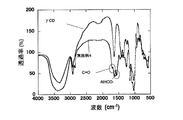
- the introduction of isocyanate groups into the CD polymer can also be confirmed by measuring the infrared absorption spectrum.
- An IR chart of ⁇ CD and the CD polymer of Example 4 is shown in FIG. It was revealed that the CD polymer was characterized by having a peak derived from “C ⁇ O” and a peak derived from “—NH—CO—” as compared with ⁇ CD before crosslinking.
- the anion exchange capacity of the CD polymer obtained above was quantified by a pH titration method. First, 5 ml of the CD polymer was transferred onto a glass filter, washed in turn with methanol, acetone, and ether, and then dried under reduced pressure for 24 hours. 0.5 g of the obtained dry CD polymer was weighed and placed in a 100 ml Erlenmeyer flask, and exactly 25 ml of 0.1N hydrochloric acid aqueous solution was added. After stirring for 2 hours, the reaction solution was filtered into a 100 ml volumetric flask and made up to 100 ml with distilled water.
- AEC anion exchange capacity
- AEC (meq / g) (0.1 ⁇ fHCl ⁇ VHCl ⁇ 0.05 ⁇ fNaOH ⁇ VNaOH ⁇ 100/25) ⁇ W (Formula 2) fHCl: Factor of 0.1N-hydrochloric acid aqueous solution fNaOH: Factor of 0.05N-aqueous sodium hydroxide solution VHCl: Amount of 0.1N-hydrochloric acid added (ml) VNaOH: Titration volume of 0.05N-sodium hydroxide aqueous solution (ml) W: Weight of dry CD polymer (g)
- ET-free of a CD polymer and a commercially available ET adsorbent used for the measurement of ET adsorption amount was performed according to the following procedure. Weighed 5-10 g each of the CD polymer obtained above, and commercially available ET adsorbents Detoxigel (Thermo Fisher / Pierce) and Cellufine ET Clean L (JNC Co., Ltd.), and sterilized glass filter The washing was repeated 5 times with 50 ml of the washing solution (95% ethanol solution containing 0.2 M NaOH).
- the washed sample was placed in a 100 mL flask, 50 mL of the cleaning solution was added, and the mixture was stirred at 25 ° C. for 1 hour at 200 rpm.
- the sample after stirring is washed again on the glass filter with 25 ml of the washing solution 5 times, and further, washing is repeated using distilled water for injection until the filtrate becomes neutral, and then the phosphorus having an ionic strength of 0.05 is obtained. It was equilibrated with an acid buffer (pH 6) and used as an adsorbent that had been ET-free in subsequent experiments.
- ET adsorption removal by batch method ET adsorption removal using a phosphate buffer (pH 6) having an ionic strength of 0.05 containing a predetermined amount of LPS derived from E. coli O55-B5 strain as a sample solution according to the following procedure
- a test was conducted.
- the ET-free adsorbent 0.1 g obtained above was placed in a 20 mL Erlenmeyer flask, 2 mL of the sample solution was added, and the mixture was stirred at 4 ° C. and 200 rpm for 1 hour.
- the obtained suspension solution was sucked up with a syringe and filtered through a 0.8 ⁇ m membrane filter.
- the residual endoxin concentration in the obtained filtrate was quantified.
- the ET concentration was measured using a commercially available kit (Limulus ES-II Test Wako, manufactured by Wako Pure Chemical Industries).
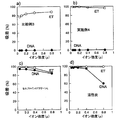
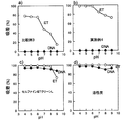
- the results are shown in FIG. It was revealed that the CD polymer of Example 4 adsorbs 70% or more of ET and does not adsorb DNA at any pH.
- the CD polymer of Example 4 was found to be able to adsorb almost 100% ET, particularly at pH 4 to 6. That is, the CD polymer of Example 4 can selectively remove ET from the DNA solution in a wide pH range.
- the CD polymer of Comparative Example 3 does not adsorb DNA at any pH, and can adsorb 70% or more of ET at pH 4 to 6. That is, the CD polymer of Comparative Example 3 can selectively remove ET from the DNA solution, particularly at pH 4 to 6, but does not reach Example 4 in terms of ET adsorption ability.
- Cellfine ET Clean L and activated carbon which are commercially available ET adsorbents, adsorbed both DNA and ET at any pH, and could not selectively adsorb ET in the presence of DNA.
- Example 20 The adsorbent was stored in 95% methanol.
- Example 21 The adsorbent was stored in 95% methanol.
- Example 22 An adsorbent of Example 22 was obtained.
- the adsorbent was stored in 95% methanol.
- ET can be selectively removed in the presence of a substance that exhibits a negative charge such as nucleic acid.
Landscapes
- Chemical & Material Sciences (AREA)
- Organic Chemistry (AREA)
- Chemical Kinetics & Catalysis (AREA)
- Health & Medical Sciences (AREA)
- Analytical Chemistry (AREA)
- Life Sciences & Earth Sciences (AREA)
- Biochemistry (AREA)
- Molecular Biology (AREA)
- General Health & Medical Sciences (AREA)
- Engineering & Computer Science (AREA)
- Medicinal Chemistry (AREA)
- Polymers & Plastics (AREA)
- Biotechnology (AREA)
- Genetics & Genomics (AREA)
- Materials Engineering (AREA)
- Inorganic Chemistry (AREA)
- Solid-Sorbent Or Filter-Aiding Compositions (AREA)
- Polysaccharides And Polysaccharide Derivatives (AREA)
Abstract
Priority Applications (3)
| Application Number | Priority Date | Filing Date | Title |
|---|---|---|---|
| US14/404,479 US9505850B2 (en) | 2012-05-30 | 2013-05-29 | Endotoxin adsorbent |
| JP2014518702A JP6253059B2 (ja) | 2012-05-30 | 2013-05-29 | エンドトキシン吸着材 |
| US15/285,465 US10155217B2 (en) | 2012-05-30 | 2016-10-04 | Endotoxin adsorbent |
Applications Claiming Priority (2)
| Application Number | Priority Date | Filing Date | Title |
|---|---|---|---|
| JP2012123281 | 2012-05-30 | ||
| JP2012-123281 | 2012-05-30 |
Related Child Applications (2)
| Application Number | Title | Priority Date | Filing Date |
|---|---|---|---|
| US14/404,479 A-371-Of-International US9505850B2 (en) | 2012-05-30 | 2013-05-29 | Endotoxin adsorbent |
| US15/285,465 Division US10155217B2 (en) | 2012-05-30 | 2016-10-04 | Endotoxin adsorbent |
Publications (1)
| Publication Number | Publication Date |
|---|---|
| WO2013180176A1 true WO2013180176A1 (fr) | 2013-12-05 |
Family
ID=49673364
Family Applications (1)
| Application Number | Title | Priority Date | Filing Date |
|---|---|---|---|
| PCT/JP2013/064905 Ceased WO2013180176A1 (fr) | 2012-05-30 | 2013-05-29 | Adsorbant d'endotoxine |
Country Status (3)
| Country | Link |
|---|---|
| US (2) | US9505850B2 (fr) |
| JP (1) | JP6253059B2 (fr) |
| WO (1) | WO2013180176A1 (fr) |
Cited By (3)
| Publication number | Priority date | Publication date | Assignee | Title |
|---|---|---|---|---|
| JP2016049527A (ja) * | 2014-09-02 | 2016-04-11 | 国立大学法人 熊本大学 | エンドトキシン吸着剤 |
| EP3425402A1 (fr) | 2017-07-06 | 2019-01-09 | Shinshu University | Procédé et dispositif de détection d'endotoxine |
| JP2024164213A (ja) * | 2019-02-14 | 2024-11-26 | サイクロピュア, インコーポレイテッド | 電荷を有するシクロデキストリンポリマー材料ならびにその製造法及び使用法 |
Families Citing this family (2)
| Publication number | Priority date | Publication date | Assignee | Title |
|---|---|---|---|---|
| MX373387B (es) | 2015-04-20 | 2020-06-03 | Univ Cornell | Materiales polimericos de ciclodextrina porosa y metodos de fabricacion y uso de los mismos. |
| CN107413317B (zh) * | 2017-08-16 | 2020-02-14 | 江苏理工学院 | 壳聚糖改性gma/maa聚合物吸附剂及其方法和应用 |
Citations (5)
| Publication number | Priority date | Publication date | Assignee | Title |
|---|---|---|---|---|
| JPH03296516A (ja) * | 1990-04-16 | 1991-12-27 | Uop Inc | シクロデキストリン被覆の固体基体 |
| JPH10195108A (ja) * | 1997-01-09 | 1998-07-28 | Makoto Komiyama | 架橋シクロデキストリン高分子の合成方法と、該高分子によるコレステロールの除去 |
| JP2001504879A (ja) * | 1996-11-22 | 2001-04-10 | ザ リージェンツ オブ ザ ユニバーシティ オブ カリフォルニア | シクロデキストリンポリマー分離材 |
| JP2006083379A (ja) * | 2004-08-20 | 2006-03-30 | Meiwa Kasei Kk | 球状シクロデキストリンポリマー、その製造方法及びそれが含まれた吸着剤 |
| JP2009502905A (ja) * | 2005-07-28 | 2009-01-29 | ヒューマニタス・ミラソーレ・エス.ピー.エー. | 血液を解毒するための血液濾過材 |
Family Cites Families (17)
| Publication number | Priority date | Publication date | Assignee | Title |
|---|---|---|---|---|
| JPS6011961B2 (ja) | 1982-03-31 | 1985-03-29 | 工業技術院長 | ポリシクロデキストリンビ−ズの製法 |
| JPS59193135A (ja) | 1983-04-18 | 1984-11-01 | Kanegafuchi Chem Ind Co Ltd | 吸着体 |
| CA1221307A (fr) | 1982-12-02 | 1987-05-05 | Nobutaka Tani | Adsorbent en methode de preparation |
| JPS6011961A (ja) | 1983-06-30 | 1985-01-22 | Fujitsu Ltd | プロセツサの制御方式 |
| JPS6020924A (ja) | 1983-07-14 | 1985-02-02 | Agency Of Ind Science & Technol | ビ−ズ状不溶性シクロデキストリンポリマ−の製法 |
| US4917956A (en) * | 1988-07-11 | 1990-04-17 | Uop | Method of preparing cyclodextrin-coated surfaces |
| JPH04256438A (ja) | 1991-02-06 | 1992-09-11 | Chuichi Hirayama | 発熱物質吸着剤 |
| JP2995274B2 (ja) | 1991-06-06 | 1999-12-27 | 工業技術院長 | コーヒー抽出液の呈味改良方法 |
| DK0775150T3 (da) | 1994-02-07 | 1999-11-08 | Qiagen Gmbh | Fremgangsmåde til reduktion eller fjernelse af endotoksiner |
| JP3817808B2 (ja) | 1997-02-17 | 2006-09-06 | 東レ株式会社 | 液体処理用カラムおよび液体処理方法 |
| JP2000189792A (ja) | 1998-12-29 | 2000-07-11 | Masashi Funayama | リポ多糖吸着体およびリポ多糖の吸着除去方法。 |
| JP4996791B2 (ja) | 2001-03-14 | 2012-08-08 | Jnc株式会社 | エンドトキシン吸着体、及びそれを用いたエンドトキシンの除去方法 |
| JP2003226755A (ja) | 2002-02-04 | 2003-08-12 | Maeda Seikan Kk | 不溶性シクロデキストリン誘導体及びこれを用いた環境ホルモン除去材 |
| JP4225731B2 (ja) | 2002-02-04 | 2009-02-18 | 前田製管株式会社 | シクロデキストリン架橋体及びこれを用いた環境ホルモン除去材 |
| JP4888879B2 (ja) | 2004-11-24 | 2012-02-29 | 地方独立行政法人青森県産業技術センター | ビーズ状シクロデキストリンポリマー製造方法 |
| WO2007030661A1 (fr) * | 2005-09-09 | 2007-03-15 | Avery Dennison Corporation | Hydrogel comprenant une cyclodextrine modifiée réticulée avec un prépolymère de polyuréthane |
| JP5017848B2 (ja) | 2005-11-25 | 2012-09-05 | Jnc株式会社 | エンドトキシン吸着体、およびそれを用いたエンドトキシンの除去方法 |
-
2013
- 2013-05-29 JP JP2014518702A patent/JP6253059B2/ja not_active Expired - Fee Related
- 2013-05-29 US US14/404,479 patent/US9505850B2/en not_active Expired - Fee Related
- 2013-05-29 WO PCT/JP2013/064905 patent/WO2013180176A1/fr not_active Ceased
-
2016
- 2016-10-04 US US15/285,465 patent/US10155217B2/en not_active Expired - Fee Related
Patent Citations (5)
| Publication number | Priority date | Publication date | Assignee | Title |
|---|---|---|---|---|
| JPH03296516A (ja) * | 1990-04-16 | 1991-12-27 | Uop Inc | シクロデキストリン被覆の固体基体 |
| JP2001504879A (ja) * | 1996-11-22 | 2001-04-10 | ザ リージェンツ オブ ザ ユニバーシティ オブ カリフォルニア | シクロデキストリンポリマー分離材 |
| JPH10195108A (ja) * | 1997-01-09 | 1998-07-28 | Makoto Komiyama | 架橋シクロデキストリン高分子の合成方法と、該高分子によるコレステロールの除去 |
| JP2006083379A (ja) * | 2004-08-20 | 2006-03-30 | Meiwa Kasei Kk | 球状シクロデキストリンポリマー、その製造方法及びそれが含まれた吸着剤 |
| JP2009502905A (ja) * | 2005-07-28 | 2009-01-29 | ヒューマニタス・ミラソーレ・エス.ピー.エー. | 血液を解毒するための血液濾過材 |
Non-Patent Citations (1)
| Title |
|---|
| M.SAKATA ET AL.: "Selective Removal of Endotoxin from a DNA Solution by Cross-linked Cyclodextrin Beads", ANALYTICAL SCIENCES, vol. 27, no. 2, 10 February 2011 (2011-02-10), pages 213 - 216 * |
Cited By (4)
| Publication number | Priority date | Publication date | Assignee | Title |
|---|---|---|---|---|
| JP2016049527A (ja) * | 2014-09-02 | 2016-04-11 | 国立大学法人 熊本大学 | エンドトキシン吸着剤 |
| EP3425402A1 (fr) | 2017-07-06 | 2019-01-09 | Shinshu University | Procédé et dispositif de détection d'endotoxine |
| US10746725B2 (en) | 2017-07-06 | 2020-08-18 | Shinshu University | Method and device for detecting endotoxin |
| JP2024164213A (ja) * | 2019-02-14 | 2024-11-26 | サイクロピュア, インコーポレイテッド | 電荷を有するシクロデキストリンポリマー材料ならびにその製造法及び使用法 |
Also Published As
| Publication number | Publication date |
|---|---|
| JPWO2013180176A1 (ja) | 2016-01-21 |
| US9505850B2 (en) | 2016-11-29 |
| US20150112050A1 (en) | 2015-04-23 |
| JP6253059B2 (ja) | 2017-12-27 |
| US10155217B2 (en) | 2018-12-18 |
| US20170021332A1 (en) | 2017-01-26 |
Similar Documents
| Publication | Publication Date | Title |
|---|---|---|
| US9522365B2 (en) | Cross-linked cellulose membranes | |
| Ahmad et al. | Adsorption of heavy metal ions: role of chitosan and cellulose for water treatment | |
| JP6467652B2 (ja) | エンドトキシン吸着剤 | |
| US8496123B2 (en) | Process for cross-linking cellulose ester membranes | |
| JP6764464B2 (ja) | 多孔性架橋セルロースゲル及びその製造方法 | |
| Cao et al. | Polymyxin B immobilized on cross-linked cellulose microspheres for endotoxin adsorption | |
| JP6253059B2 (ja) | エンドトキシン吸着材 | |
| EP4206274A1 (fr) | Membrane hybride comprenant de la cellulose réticulée | |
| EP3173437B1 (fr) | Procédé de fabrication de particules de cellulose poreuses et sphériques | |
| EP3050902A1 (fr) | Procédé de production de perles de cellulose poreuses par utilisation d'une solution aqueuse alcaline, support pour immobilisation de ligands, et adsorbant | |
| US8445427B2 (en) | Endotoxin adsorbent, and method for removing endotoxin using the same | |
| Huang et al. | Heparin-like chitosan hydrogels with tunable swelling behavior, prolonged clotting times, and prevented contact activation and complement activation | |
| JP6424343B2 (ja) | エンドトキシン吸着剤 | |
| EP3284778A1 (fr) | Procédé de production de billes poreuses en cellulose, et adsorbant contenant ces billes | |
| CN102653596A (zh) | 硝酸纤维素膜表面交联壳聚糖改性材料的制备方法 | |
| CN102019213B (zh) | 一种壳聚糖强酸性离子交换介质的制备方法 | |
| WO2015056681A1 (fr) | Procédé de production de billes de cellulose poreuses et agent absorbant les utilisant | |
| CN103933947B (zh) | 用于清除类风湿因子的血液净化材料及其制备方法 | |
| Dai et al. | Preparation and protein adsorption of porous dextran microspheres | |
| CN106334540B (zh) | 一种用于血液或血浆灌流去除内毒素的吸附剂及其制备方法 | |
| Yu et al. | Adsorption of bilirubin by amine-containing crosslinked chitosan resins | |
| JP4076970B2 (ja) | 不溶性シクロデキストリン担持高分子成形物の製造法 | |
| WO2015056680A1 (fr) | Procédé de fabrication de billes poreuses en cellulose | |
| JP3291123B2 (ja) | 分離剤の製造方法 | |
| JPH03290188A (ja) | 酵素もしくは微生物固定化用担体の製造方法 |
Legal Events
| Date | Code | Title | Description |
|---|---|---|---|
| 121 | Ep: the epo has been informed by wipo that ep was designated in this application |
Ref document number: 13796778 Country of ref document: EP Kind code of ref document: A1 |
|
| ENP | Entry into the national phase |
Ref document number: 2014518702 Country of ref document: JP Kind code of ref document: A |
|
| WWE | Wipo information: entry into national phase |
Ref document number: 14404479 Country of ref document: US |
|
| NENP | Non-entry into the national phase |
Ref country code: DE |
|
| 122 | Ep: pct application non-entry in european phase |
Ref document number: 13796778 Country of ref document: EP Kind code of ref document: A1 |