WO2016158794A1 - Film stratifié et sac pour conditionnement - Google Patents
Film stratifié et sac pour conditionnement Download PDFInfo
- Publication number
- WO2016158794A1 WO2016158794A1 PCT/JP2016/059737 JP2016059737W WO2016158794A1 WO 2016158794 A1 WO2016158794 A1 WO 2016158794A1 JP 2016059737 W JP2016059737 W JP 2016059737W WO 2016158794 A1 WO2016158794 A1 WO 2016158794A1
- Authority
- WO
- WIPO (PCT)
- Prior art keywords
- laminated film
- layer
- coating layer
- film according
- laminated
- Prior art date
- Legal status (The legal status is an assumption and is not a legal conclusion. Google has not performed a legal analysis and makes no representation as to the accuracy of the status listed.)
- Ceased
Links
Images






Classifications
-
- B—PERFORMING OPERATIONS; TRANSPORTING
- B32—LAYERED PRODUCTS
- B32B—LAYERED PRODUCTS, i.e. PRODUCTS BUILT-UP OF STRATA OF FLAT OR NON-FLAT, e.g. CELLULAR OR HONEYCOMB, FORM
- B32B27/00—Layered products comprising a layer of synthetic resin
- B32B27/18—Layered products comprising a layer of synthetic resin characterised by the use of special additives
-
- B—PERFORMING OPERATIONS; TRANSPORTING
- B32—LAYERED PRODUCTS
- B32B—LAYERED PRODUCTS, i.e. PRODUCTS BUILT-UP OF STRATA OF FLAT OR NON-FLAT, e.g. CELLULAR OR HONEYCOMB, FORM
- B32B1/00—Layered products having a non-planar shape
-
- B—PERFORMING OPERATIONS; TRANSPORTING
- B32—LAYERED PRODUCTS
- B32B—LAYERED PRODUCTS, i.e. PRODUCTS BUILT-UP OF STRATA OF FLAT OR NON-FLAT, e.g. CELLULAR OR HONEYCOMB, FORM
- B32B27/00—Layered products comprising a layer of synthetic resin
- B32B27/06—Layered products comprising a layer of synthetic resin as the main or only constituent of a layer, which is next to another layer of the same or of a different material
-
- B—PERFORMING OPERATIONS; TRANSPORTING
- B32—LAYERED PRODUCTS
- B32B—LAYERED PRODUCTS, i.e. PRODUCTS BUILT-UP OF STRATA OF FLAT OR NON-FLAT, e.g. CELLULAR OR HONEYCOMB, FORM
- B32B27/00—Layered products comprising a layer of synthetic resin
- B32B27/06—Layered products comprising a layer of synthetic resin as the main or only constituent of a layer, which is next to another layer of the same or of a different material
- B32B27/08—Layered products comprising a layer of synthetic resin as the main or only constituent of a layer, which is next to another layer of the same or of a different material of synthetic resin
-
- B—PERFORMING OPERATIONS; TRANSPORTING
- B32—LAYERED PRODUCTS
- B32B—LAYERED PRODUCTS, i.e. PRODUCTS BUILT-UP OF STRATA OF FLAT OR NON-FLAT, e.g. CELLULAR OR HONEYCOMB, FORM
- B32B27/00—Layered products comprising a layer of synthetic resin
- B32B27/18—Layered products comprising a layer of synthetic resin characterised by the use of special additives
- B32B27/20—Layered products comprising a layer of synthetic resin characterised by the use of special additives using fillers, pigments, thixotroping agents
-
- B—PERFORMING OPERATIONS; TRANSPORTING
- B32—LAYERED PRODUCTS
- B32B—LAYERED PRODUCTS, i.e. PRODUCTS BUILT-UP OF STRATA OF FLAT OR NON-FLAT, e.g. CELLULAR OR HONEYCOMB, FORM
- B32B27/00—Layered products comprising a layer of synthetic resin
- B32B27/32—Layered products comprising a layer of synthetic resin comprising polyolefins
-
- B—PERFORMING OPERATIONS; TRANSPORTING
- B32—LAYERED PRODUCTS
- B32B—LAYERED PRODUCTS, i.e. PRODUCTS BUILT-UP OF STRATA OF FLAT OR NON-FLAT, e.g. CELLULAR OR HONEYCOMB, FORM
- B32B27/00—Layered products comprising a layer of synthetic resin
- B32B27/32—Layered products comprising a layer of synthetic resin comprising polyolefins
- B32B27/327—Layered products comprising a layer of synthetic resin comprising polyolefins comprising polyolefins obtained by a metallocene or single-site catalyst
-
- B—PERFORMING OPERATIONS; TRANSPORTING
- B32—LAYERED PRODUCTS
- B32B—LAYERED PRODUCTS, i.e. PRODUCTS BUILT-UP OF STRATA OF FLAT OR NON-FLAT, e.g. CELLULAR OR HONEYCOMB, FORM
- B32B27/00—Layered products comprising a layer of synthetic resin
- B32B27/36—Layered products comprising a layer of synthetic resin comprising polyesters
-
- B—PERFORMING OPERATIONS; TRANSPORTING
- B32—LAYERED PRODUCTS
- B32B—LAYERED PRODUCTS, i.e. PRODUCTS BUILT-UP OF STRATA OF FLAT OR NON-FLAT, e.g. CELLULAR OR HONEYCOMB, FORM
- B32B27/00—Layered products comprising a layer of synthetic resin
- B32B27/38—Layered products comprising a layer of synthetic resin comprising epoxy resins
-
- B—PERFORMING OPERATIONS; TRANSPORTING
- B32—LAYERED PRODUCTS
- B32B—LAYERED PRODUCTS, i.e. PRODUCTS BUILT-UP OF STRATA OF FLAT OR NON-FLAT, e.g. CELLULAR OR HONEYCOMB, FORM
- B32B27/00—Layered products comprising a layer of synthetic resin
- B32B27/40—Layered products comprising a layer of synthetic resin comprising polyurethanes
-
- B—PERFORMING OPERATIONS; TRANSPORTING
- B32—LAYERED PRODUCTS
- B32B—LAYERED PRODUCTS, i.e. PRODUCTS BUILT-UP OF STRATA OF FLAT OR NON-FLAT, e.g. CELLULAR OR HONEYCOMB, FORM
- B32B9/00—Layered products comprising a layer of a particular substance not covered by groups B32B11/00 - B32B29/00
-
- B—PERFORMING OPERATIONS; TRANSPORTING
- B65—CONVEYING; PACKING; STORING; HANDLING THIN OR FILAMENTARY MATERIAL
- B65D—CONTAINERS FOR STORAGE OR TRANSPORT OF ARTICLES OR MATERIALS, e.g. BAGS, BARRELS, BOTTLES, BOXES, CANS, CARTONS, CRATES, DRUMS, JARS, TANKS, HOPPERS, FORWARDING CONTAINERS; ACCESSORIES, CLOSURES, OR FITTINGS THEREFOR; PACKAGING ELEMENTS; PACKAGES
- B65D65/00—Wrappers or flexible covers; Packaging materials of special type or form
- B65D65/38—Packaging materials of special type or form
- B65D65/40—Applications of laminates for particular packaging purposes
-
- B—PERFORMING OPERATIONS; TRANSPORTING
- B65—CONVEYING; PACKING; STORING; HANDLING THIN OR FILAMENTARY MATERIAL
- B65D—CONTAINERS FOR STORAGE OR TRANSPORT OF ARTICLES OR MATERIALS, e.g. BAGS, BARRELS, BOTTLES, BOXES, CANS, CARTONS, CRATES, DRUMS, JARS, TANKS, HOPPERS, FORWARDING CONTAINERS; ACCESSORIES, CLOSURES, OR FITTINGS THEREFOR; PACKAGING ELEMENTS; PACKAGES
- B65D81/00—Containers, packaging elements, or packages, for contents presenting particular transport or storage problems, or adapted to be used for non-packaging purposes after removal of contents
- B65D81/24—Adaptations for preventing deterioration or decay of contents; Applications to the container or packaging material of food preservatives, fungicides, pesticides or animal repellants
-
- C—CHEMISTRY; METALLURGY
- C08—ORGANIC MACROMOLECULAR COMPOUNDS; THEIR PREPARATION OR CHEMICAL WORKING-UP; COMPOSITIONS BASED THEREON
- C08J—WORKING-UP; GENERAL PROCESSES OF COMPOUNDING; AFTER-TREATMENT NOT COVERED BY SUBCLASSES C08B, C08C, C08F, C08G or C08H
- C08J7/00—Chemical treatment or coating of shaped articles made of macromolecular substances
- C08J7/04—Coating
- C08J7/042—Coating with two or more layers, where at least one layer of a composition contains a polymer binder
-
- C—CHEMISTRY; METALLURGY
- C08—ORGANIC MACROMOLECULAR COMPOUNDS; THEIR PREPARATION OR CHEMICAL WORKING-UP; COMPOSITIONS BASED THEREON
- C08J—WORKING-UP; GENERAL PROCESSES OF COMPOUNDING; AFTER-TREATMENT NOT COVERED BY SUBCLASSES C08B, C08C, C08F, C08G or C08H
- C08J7/00—Chemical treatment or coating of shaped articles made of macromolecular substances
- C08J7/04—Coating
- C08J7/042—Coating with two or more layers, where at least one layer of a composition contains a polymer binder
- C08J7/0423—Coating with two or more layers, where at least one layer of a composition contains a polymer binder with at least one layer of inorganic material and at least one layer of a composition containing a polymer binder
-
- C—CHEMISTRY; METALLURGY
- C08—ORGANIC MACROMOLECULAR COMPOUNDS; THEIR PREPARATION OR CHEMICAL WORKING-UP; COMPOSITIONS BASED THEREON
- C08J—WORKING-UP; GENERAL PROCESSES OF COMPOUNDING; AFTER-TREATMENT NOT COVERED BY SUBCLASSES C08B, C08C, C08F, C08G or C08H
- C08J7/00—Chemical treatment or coating of shaped articles made of macromolecular substances
- C08J7/04—Coating
- C08J7/043—Improving the adhesiveness of the coatings per se, e.g. forming primers
-
- C—CHEMISTRY; METALLURGY
- C08—ORGANIC MACROMOLECULAR COMPOUNDS; THEIR PREPARATION OR CHEMICAL WORKING-UP; COMPOSITIONS BASED THEREON
- C08J—WORKING-UP; GENERAL PROCESSES OF COMPOUNDING; AFTER-TREATMENT NOT COVERED BY SUBCLASSES C08B, C08C, C08F, C08G or C08H
- C08J7/00—Chemical treatment or coating of shaped articles made of macromolecular substances
- C08J7/04—Coating
- C08J7/048—Forming gas barrier coatings
-
- B—PERFORMING OPERATIONS; TRANSPORTING
- B32—LAYERED PRODUCTS
- B32B—LAYERED PRODUCTS, i.e. PRODUCTS BUILT-UP OF STRATA OF FLAT OR NON-FLAT, e.g. CELLULAR OR HONEYCOMB, FORM
- B32B2307/00—Properties of the layers or laminate
- B32B2307/50—Properties of the layers or laminate having particular mechanical properties
- B32B2307/514—Oriented
- B32B2307/518—Oriented bi-axially
-
- B—PERFORMING OPERATIONS; TRANSPORTING
- B32—LAYERED PRODUCTS
- B32B—LAYERED PRODUCTS, i.e. PRODUCTS BUILT-UP OF STRATA OF FLAT OR NON-FLAT, e.g. CELLULAR OR HONEYCOMB, FORM
- B32B2307/00—Properties of the layers or laminate
- B32B2307/70—Other properties
- B32B2307/724—Permeability to gases, adsorption
-
- B—PERFORMING OPERATIONS; TRANSPORTING
- B32—LAYERED PRODUCTS
- B32B—LAYERED PRODUCTS, i.e. PRODUCTS BUILT-UP OF STRATA OF FLAT OR NON-FLAT, e.g. CELLULAR OR HONEYCOMB, FORM
- B32B2309/00—Parameters for the laminating or treatment process; Apparatus details
- B32B2309/08—Dimensions, e.g. volume
- B32B2309/10—Dimensions, e.g. volume linear, e.g. length, distance, width
- B32B2309/105—Thickness
-
- B—PERFORMING OPERATIONS; TRANSPORTING
- B32—LAYERED PRODUCTS
- B32B—LAYERED PRODUCTS, i.e. PRODUCTS BUILT-UP OF STRATA OF FLAT OR NON-FLAT, e.g. CELLULAR OR HONEYCOMB, FORM
- B32B2553/00—Packaging equipment or accessories not otherwise provided for
-
- C—CHEMISTRY; METALLURGY
- C08—ORGANIC MACROMOLECULAR COMPOUNDS; THEIR PREPARATION OR CHEMICAL WORKING-UP; COMPOSITIONS BASED THEREON
- C08J—WORKING-UP; GENERAL PROCESSES OF COMPOUNDING; AFTER-TREATMENT NOT COVERED BY SUBCLASSES C08B, C08C, C08F, C08G or C08H
- C08J2323/00—Characterised by the use of homopolymers or copolymers of unsaturated aliphatic hydrocarbons having only one carbon-to-carbon double bond; Derivatives of such polymers
- C08J2323/02—Characterised by the use of homopolymers or copolymers of unsaturated aliphatic hydrocarbons having only one carbon-to-carbon double bond; Derivatives of such polymers not modified by chemical after treatment
- C08J2323/10—Homopolymers or copolymers of propene
- C08J2323/12—Polypropene
-
- C—CHEMISTRY; METALLURGY
- C08—ORGANIC MACROMOLECULAR COMPOUNDS; THEIR PREPARATION OR CHEMICAL WORKING-UP; COMPOSITIONS BASED THEREON
- C08J—WORKING-UP; GENERAL PROCESSES OF COMPOUNDING; AFTER-TREATMENT NOT COVERED BY SUBCLASSES C08B, C08C, C08F, C08G or C08H
- C08J2429/00—Characterised by the use of homopolymers or copolymers of compounds having one or more unsaturated aliphatic radicals, each having only one carbon-to-carbon double bond, and at least one being terminated by an alcohol, ether, aldehydo, ketonic, acetal, or ketal radical; Hydrolysed polymers of esters of unsaturated alcohols with saturated carboxylic acids; Derivatives of such polymer
- C08J2429/02—Homopolymers or copolymers of unsaturated alcohols
- C08J2429/04—Polyvinyl alcohol; Partially hydrolysed homopolymers or copolymers of esters of unsaturated alcohols with saturated carboxylic acids
Definitions
- This disclosure relates to a laminated film and a packaging bag.
- the packaging material used for packaging the contents is required to have a function of suppressing the quality deterioration of the contents. Deterioration of the quality of the contents may be promoted by atmospheric gases that permeate the packaging material. Therefore, in order to suppress the permeation of gas from the atmosphere, various laminated films have been studied as packaging bag materials.
- Patent Document 1 proposes a technique for improving gas barrier properties by providing a gas barrier vapor-deposited thin film layer and a gas barrier coating layer on a resin base material.
- Patent Document 2 proposes a technique for improving the gas barrier property of a packaging material by sequentially laminating a transparent primer layer, a vapor deposition thin film layer, and a gas barrier composite film on one surface of a polypropylene base material.
- the present invention provides, in one aspect, a laminated film having excellent oxygen barrier properties and a packaging bag.
- the present invention provides a laminated film capable of reducing the variation in the laminate strength due to the change in the composition of the underlayer. Moreover, the packaging bag excellent in sealing performance is provided by providing such a laminated film.
- the present invention in yet another aspect, provides a laminated film and a packaging bag that are sufficiently excellent in water vapor barrier properties.
- the present invention includes a resin base material and a coating layer on the resin base material, and the coating layer is a metal, at least one of a water-soluble polymer, a silane coupling agent, and a hydrolyzate thereof.
- the coating layer is a metal, at least one of a water-soluble polymer, a silane coupling agent, and a hydrolyzate thereof.
- a laminated film containing at least one of an alkoxide and a hydrolyzate thereof and an inorganic layered compound.
- the laminated film has a coating layer containing at least one of a water-soluble polymer, a silane coupling agent and a hydrolyzate thereof, at least one of a metal alkoxide and a hydrolyzate thereof, and an inorganic layered compound. Excellent. Such a laminated film is particularly useful, for example, in applications that are required to be superior in oxygen barrier properties to water vapor barrier properties.
- the content of the inorganic stratiform compound in the coating layer is preferably 2 to 5% by mass. It is preferable that the resin base material has a biaxially stretched polypropylene film.
- the laminated film may include a base layer between the resin base material and the coating layer in some embodiments.
- the base layer By providing the base layer, the adhesion between the resin base material and the coating layer can be improved. Such an effect is particularly useful when the base material has a low polarity, such as a resin base made of polypropylene or the like.
- the underlayer preferably contains an organic polymer as a main component.
- the coating layer has excellent oxygen barrier properties and good adhesiveness with a base layer containing an organic polymer as a main component. The coating layer can maintain good adhesion even if the composition of the underlayer changes. Therefore, the laminated film can reduce variations in laminate strength due to changes in the composition of the underlayer.
- the organic polymer preferably contains at least one of a polyol, an organic silane compound, an aqueous polyurethane resin, and a reaction product of the polyol and the organic silane compound.
- At least one of the silane coupling agent and the hydrolyzate thereof may have an epoxy group in the molecular structure.
- the coating layer contains a silane coupling agent having an epoxy group or a hydrolyzate thereof, the oxygen barrier property of the coating layer can be further improved. Further, the gelation reaction is suppressed when the coating layer is formed. Thereby, a coating layer having high uniformity can be formed.
- the laminated film may have a total content of the silane coupling agent and its hydrolyzate in the coating layer of 1 to 15% by mass.
- the laminated film may include a vapor-deposited thin film layer containing silicon oxide between the resin base material and the coating layer.
- the laminated film may have a thickness of the deposited thin film layer of 5 to 100 nm. In some embodiments, the laminated film may have a laminate strength of 2 N / 15 mm or more. In some embodiments, the laminated film may have a water vapor permeability of 2 g / m 2 / day or less. In some embodiments, the laminated film may have an oxygen permeability of 2 ml / m 2 / day or less.
- the present invention provides a packaging bag formed by laminating films, wherein the film includes the above-described laminated film. Since this packaging bag is provided with the above-mentioned laminated film, it is excellent in oxygen barrier properties. Such a packaging bag is particularly useful in applications where oxygen barrier properties are required to be superior to water vapor barrier properties.
- the present invention provides a coating comprising a resin base material, at least one of a water-soluble polymer, a silane coupling agent and a hydrolyzate thereof, a metal alkoxide and a hydrolyzate thereof, and an inorganic layered compound.
- a laminated film comprising a layer and a base layer containing an organic polymer as a main component between a resin substrate and a coating layer.
- the laminated film has a coating layer containing at least one of a water-soluble polymer, a silane coupling agent and a hydrolyzate thereof, at least one of a metal alkoxide and a hydrolyzate thereof, and an inorganic layered compound.
- a coating layer has excellent oxygen barrier properties and good adhesion to an underlayer containing an organic polymer as a main component.
- the coating layer can maintain good adhesion even if the composition of the underlayer changes. Therefore, the laminated film can reduce variations in laminate strength due to changes in the composition of the underlayer.
- At least one of the silane coupling agent and the hydrolyzate thereof may have an epoxy group in the molecular structure.
- the coating layer contains a silane coupling agent having an epoxy group or a hydrolyzate thereof, the laminate strength of the laminated film can be increased. In addition to this, the oxygen barrier property of the coating layer can be improved.
- the laminated film may have a total content of the silane coupling agent and its hydrolyzate in the coating layer of 1 to 15% by mass. As a result, it is possible to obtain a laminated film that is sufficiently excellent in oxygen barrier properties while reducing variations in laminate strength.
- the organic polymer in the underlayer includes at least one of a polyol, an organic silane compound, an aqueous polyurethane resin, and a reaction product of the polyol and the organic silane compound. It may be a thing. By providing such an underlayer, it is possible to further reduce the variation in laminate strength. In some embodiments, the laminate strength may be 2 N / 15 mm or more.
- the present invention provides a packaging bag formed by laminating films, wherein the film includes the above-described laminated film. Since this packaging bag is provided with a laminated film that can reduce variations in laminate strength due to changes in the composition of the underlayer, it has excellent sealing properties.
- the present invention provides an organic polymer as a main component between a resin substrate having a biaxially stretched polypropylene film, a deposited thin film layer containing silicon oxide, and the resin substrate and the deposited thin film layer.
- a laminated film comprising: an underlayer including:
- the laminated film includes a deposited thin film layer containing silicon oxide.
- a vapor-deposited thin film layer containing silicon oxide is superior in water vapor barrier properties to a vapor-deposited thin film layer of a metal oxide different from silicon oxide.
- the laminated film includes a biaxially stretched polypropylene film having excellent gas barrier properties.
- the biaxially stretched polypropylene film tends to have larger irregularities on the surface than other films such as PET. For this reason, when a vapor-deposited thin film layer is directly provided on a resin substrate having a biaxially stretched polypropylene film, cracks and the like occur, which causes a decrease in water vapor barrier properties.
- the laminated film which concerns on one side of this invention is equipped with the base layer which contains an organic polymer as a main component between a resin base material and a vapor deposition thin film layer.
- the adhesiveness between a resin base material and a vapor deposition thin film layer can be improved.
- the biaxially stretched polypropylene film having excellent water vapor barrier properties and the vapor-deposited thin film layer containing silicon oxide the water vapor barrier properties can be sufficiently improved.
- Such a laminated film is particularly useful, for example, in applications that are required to have a water vapor barrier property rather than an oxygen barrier property. However, this does not exclude applications that are required to have excellent oxygen barrier properties.
- the laminated film may include a coating layer on the side opposite to the base layer side of the deposited thin film layer.
- the coating layer may contain at least one of a water-soluble polymer, a silane coupling agent and a hydrolyzate thereof, at least one of a metal alkoxide and a hydrolyzate thereof, and an inorganic layered compound.
- the organic polymer in the base layer may contain at least one of polyols, organic silane compounds, water-based polyurethane resins, and reaction products of polyols and organic silane compounds.
- Such a base layer containing an organic polymer as a main component has excellent adhesion and transparency.
- the thickness of the deposited thin film layer may be 5 to 100 nm.
- the laminated film having the deposited thin film layer having such a thickness has more excellent water vapor barrier properties, and high flexibility and transparency.
- the laminated film may have a water vapor permeability of 2 g / m 2 / day or less. Such a laminated film having a sufficiently low water vapor permeability is particularly useful in applications requiring high water vapor barrier properties.
- the laminated film may have a laminate strength of 2 N / 15 mm or more.
- the laminated film may have an oxygen permeability of 2 ml / m 2 / day or less.
- the present invention provides a packaging bag formed by laminating films, wherein the film includes the above-described laminated film. Since this packaging bag is provided with the above-mentioned laminated film, it is excellent in water vapor barrier properties, or water vapor barrier properties and oxygen barrier properties. Such a packaging bag is particularly useful in applications that require water vapor barrier properties, or water vapor barrier properties and string yarn barrier properties.
- the present invention can provide a laminated film having excellent oxygen barrier properties and a packaging bag.
- the present invention can provide a laminated film capable of reducing variations in laminate strength due to changes in the composition of the underlayer.
- the packaging bag excellent in sealing performance can be provided by providing the above-mentioned laminated film.
- the present invention can provide a laminated film and a packaging bag that are sufficiently excellent in water vapor barrier properties.
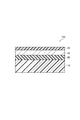
- FIG. 1 is a schematic cross-sectional view showing a first embodiment of a laminated film.
- FIG. 2 is a schematic cross-sectional view showing a modification of the first embodiment of the laminated film.
- FIG. 3 is a schematic cross-sectional view showing another modification of the laminated film of the first embodiment.
- FIG. 4 is a schematic cross-sectional view showing a second embodiment of the laminated film.
- FIG. 5 is a schematic cross-sectional view showing a modification of the second embodiment of the laminated film.
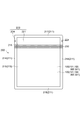
- FIG. 6 is a schematic cross-sectional view showing an embodiment of a packaging bag.
- FIG. 7 is a graph showing unevenness in the x direction on the surface of the coating layer in the laminated film of Example 1-3.
- FIG. 8 is a graph showing unevenness in the x direction on the surface of the coating layer in the laminated film of Example 1-8.
- FIG. 1 is a schematic cross-sectional view of the laminated film of the first embodiment.
- the laminated film 100 includes a film-like resin base material 10 and a base layer 20 and a coating layer 30 in this order from the resin base material 10 side on one surface of the resin base material 10.
- Resin substrate 10 is made of a resin film.
- the resin film include polyester films such as polyethylene terephthalate (PET) and polyethylene naphthalate (PEN); polyolefin films such as polyethylene and polypropylene; polystyrene films; polyamide films such as 66-nylon; polycarbonate films and polyacrylonitrile films. And engineering plastic films such as polyimide films.
- the resin base material 10 may be configured by stacking a plurality of the same types.
- the resin film may be either stretched or unstretched. At least one stretched film and at least one unstretched film may be laminated.
- the resin base material 10 can improve mechanical strength and dimensional stability by having a film arbitrarily stretched in the biaxial direction.
- the above-mentioned resin base material 10 preferably contains a biaxially stretched polypropylene film from the viewpoint of further improving the oxygen barrier property.
- Biaxially stretched polypropylene film is a homopolymer consisting only of propylene, a random copolymer in which a main monomer, propylene, and a small amount of a comonomer different from propylene are randomly copolymerized to form a homogeneous phase, or a main monomer
- At least one of a block copolymer or the like that forms a heterogeneous phase by block copolymerization of propylene and the above-mentioned comonomer or rubber may be processed into a film.
- the plane orientation coefficient ⁇ P by the retardation measurement method is in the range of 0.005 to 0.020. Surface peeling can be prevented by the cohesive strength of the substrate.
- the plane orientation coefficient can be adjusted by, for example, biaxial stretching and subsequent heat setting conditions.
- the resin substrate 10 may include one kind selected from a layer (film) composed of a homopolymer, a layer (film) composed of a random copolymer, and a layer (film) composed of a block copolymer. You may provide what laminated
- the thickness of the resin base material 10 is not particularly limited, and may be, for example, 3 to 200 ⁇ m or 6 to 30 ⁇ m. The thickness may be adjusted according to the application or required characteristics.
- the resin substrate 10 may contain at least one additive selected from fillers, antistatic agents, plasticizers, lubricants, antioxidants, and the like.
- the surface of the resin base material 10 may be subjected to at least one treatment selected from chemical treatment, solvent treatment, corona treatment, plasma treatment, and ozone treatment.
- the foundation layer 20 is provided between the resin base material 10 and the coating layer 30.
- the resin base material 10 contains a filler and has irregularities on the surface, or when it has undulations, the adhesion between the resin base material 10 and the coating layer 30 is improved by providing the base layer 20. be able to.
- the underlayer 20 is a layer containing an organic polymer as a main component, and is sometimes called a primer layer. By providing the base layer 20, the laminate strength of the laminated film 100 can be increased.
- the content of the organic polymer in the underlayer 20 may be, for example, 70% by mass or more, or 80% by mass or more.
- Organic polymers include polyols having two or more hydroxyl groups at the polymer terminals, organic silane compounds such as silane coupling agents or hydrolysates thereof, and two-component reactions of the above polyols with isocyanate compounds.
- the reaction product (water-based polyurethane resin) obtained, the reaction product of the said polyols and a silane coupling agent, etc. are mentioned. One of these may be used alone, or two or more may be combined.
- the polyols include at least one selected from acrylic polyol, polyvinyl acetal, polystill polyol, polyurethane polyol, and the like.
- the acrylic polyol may be obtained by polymerizing an acrylic acid derivative monomer, or may be obtained by copolymerizing an acrylic acid derivative monomer and another monomer.
- the acrylic acid derivative monomer include ethyl methacrylate, hydroxyethyl methacrylate, hydroxypropyl methacrylate, and hydroxybutyl methacrylate. Styrene etc. are mentioned as a monomer copolymerized with an acrylic acid derivative monomer.
- silane coupling agent examples include vinyltrimethoxysilane, ⁇ -chloropropylmethyldimethoxysilane, ⁇ -chloropropyltrimethoxysilane, glycidoxypropyltrimethoxysilane, ⁇ -methacryloxypropyltrimethoxysilane, and ⁇ - And methacryloxypropylmethyldimethoxysilane.
- the organosilane compound may be a hydrolyzate of these silane coupling agents.
- the organosilane compound may contain one kind of the above-mentioned silane coupling agent and its hydrolyzate alone or in combination of two or more kinds. When the underlayer 20 contains a silane coupling agent or a hydrolyzate thereof, these may be the same as or different from those included in the coating layer 30.
- the isocyanate compound has an action of enhancing the adhesion between the resin base material 10 and the coating layer 30 by a urethane bond generated by reacting with the polyol. That is, the isocyanate compound functions as a crosslinking agent or a curing agent.
- the isocyanate compound include monomers such as aromatic tolylene diisocyanate (TDI), diphenylmethane diisocyanate (MDI), aliphatic xylene diisocyanate (XDI), hexamethylene diisocyanate (HMDI), and isophorone diisocyanate (IPDI). , Their polymers, and their derivatives.
- the above isocyanate compounds may be used alone or in combination of two or more.
- the underlayer 20 may contain at least one selected from polyethyleneimine and derivatives thereof, polyolefin emulsion, polyimide, melamine, phenol, and inorganic silica such as organically modified colloidal silica.
- the thickness of the underlayer 20 is not particularly limited, and may be, for example, 0.005 to 5 ⁇ m. The thickness may be adjusted according to the application or required characteristics.
- the underlayer 20 can be formed using a mixed solution prepared on one surface of the resin substrate 10 by preparing a mixed solution by blending the above-described components in an organic solvent in an arbitrary ratio.
- the mixed solution is, for example, a curing accelerator such as a tertiary amine, an imidazole derivative, a carboxylic acid metal salt compound, a quaternary ammonium salt, or a quaternary phosphonium salt; an antioxidant such as a phenol, sulfur, or phosphite; It may contain a leveling agent; a flow regulator; a catalyst; a crosslinking reaction accelerator; a filler.
- a curing accelerator such as a tertiary amine, an imidazole derivative, a carboxylic acid metal salt compound, a quaternary ammonium salt, or a quaternary phosphonium salt
- an antioxidant such as a phenol, sulfur, or phosphite
- It may contain a leveling agent
- the liquid mixture is applied to the resin substrate 10 using a known printing method such as an offset printing method, a gravure printing method, or a silk screen printing method, or a known coating method such as roll coating, knife edge coating, or gravure coating. Can be coated on top.
- a known printing method such as an offset printing method, a gravure printing method, or a silk screen printing method, or a known coating method such as roll coating, knife edge coating, or gravure coating.
- a known coating method such as roll coating, knife edge coating, or gravure coating.
- the underlayer 20 can be formed, for example, by heating to 50 to 200 ° C. and drying and / or curing.
- the coating layer 30 includes at least one of a water-soluble polymer, a silane coupling agent and a hydrolyzate thereof, at least one of a metal alkoxide and a hydrolyzate thereof, and an inorganic layered compound. Since the coating layer 30 contains an inorganic layered compound, it is excellent in oxygen barrier properties. The content of the inorganic stratiform compound in the coating layer 30 is, for example, 2 to 10% by mass. By providing the laminated film 100 with the coating layer 30, the oxygen permeability can be reduced. Thereby, deterioration of the contents of the packaging bag formed using the laminated film 100 can be sufficiently suppressed.
- the water-soluble polymer is not particularly limited, and examples thereof include polyvinyl alcohol-based, alcohol-based polymers such as starch / methylcellulose / carboxymethylcellulose, and acrylic polyol-based polymers. From the viewpoint of further improving the oxygen gas barrier property, the water-soluble polymer preferably contains a polyvinyl alcohol-based polymer.
- the number average molecular weight of the water-soluble polymer is, for example, 40,000 to 180,000.
- the polyvinyl alcohol-based water-soluble polymer can be obtained, for example, by saponifying (including partial saponification) polyvinyl acetate.
- This water-soluble polymer may be one in which several tens percent of acetate groups remain, or one in which only several percent of acetate groups remain.
- the content of the water-soluble polymer in the coating layer 30 is, for example, 15 to 50% by mass.
- the lower limit of the content of the water-soluble polymer in the coating layer 30 may be 20% by mass from the viewpoint of further reducing the oxygen permeability.
- the upper limit of the content of the water-soluble polymer in the coating layer 30 may be 45% by mass from the viewpoint of further reducing the oxygen permeability.
- Examples of the metal alkoxide and its hydrolyzate contained in the coating layer 30 include general formulas such as tetraethoxysilane [Si (OC 2 H 5 ) 4 ] and triisopropoxyaluminum [Al (OC 3 H 7 ) 3 ].
- the thing represented by M (OR) n and its hydrolyzate are mentioned. One of these may be included alone or in combination of two or more.
- the total content of the metal alkoxide and its hydrolyzate in the coating layer 30 is, for example, 40 to 70% by mass. From the viewpoint of further reducing the oxygen permeability, the lower limit of the total content of the metal alkoxide and the hydrolyzate thereof in the coating layer 30 may be 50% by mass. From the same viewpoint, the upper limit of the total content of the metal alkoxide and the hydrolyzate thereof in the coating layer 30 may be 65% by mass.
- silane coupling agent included in the coating layer 30 and the hydrolyzate thereof examples include silane coupling agents having an organic functional group.
- silane coupling agents and hydrolysates thereof include ethyltrimethoxysilane, vinyltrimethoxysilane, ⁇ -chloropropylmethyldimethoxysilane, ⁇ -chloropropyltrimethoxysilane, glycidoxypropyltrimethoxysilane, ⁇ -Methacryloxypropyltrimethoxysilane, ⁇ -methacryloxypropylmethyldimethoxysilane, and hydrolysates thereof.
- One of these may be included alone or in combination of two or more.
- the silane coupling agent and the hydrolyzate thereof has an epoxy group as an organic functional group.
- the silane coupling agent having an epoxy group include ⁇ -glycidoxypropyltrimethoxysilane and ⁇ - (3,4-epoxycyclohexyl) ethyltrimethoxysilane.
- the silane coupling agent having an epoxy group and a hydrolyzate thereof may have an organic functional group different from the epoxy group, such as a vinyl group, an amino group, a methacryl group, or a ureyl group.
- the silane coupling agent having an organic functional group and a hydrolyzate thereof have an oxygen barrier property of the coating layer 30 and an adhesive property with the base layer 20 due to the interaction between the organic functional group and the hydroxyl group of the water-soluble polymer. This can be further improved.
- the epoxy layer of the silane coupling agent and the hydrolyzate thereof and the hydroxyl group of polyvinyl alcohol can form a coating layer 30 that is particularly excellent in oxygen barrier properties and adhesion to the underlayer 20 by interaction.
- the total content of the silane coupling agent and the hydrolyzate thereof in the coating layer 30 is, for example, 1 to 15% by mass. From the viewpoint of further reducing the oxygen permeability, the lower limit of the total content of the silane coupling agent and the hydrolyzate thereof in the coating layer 30 may be 2% by mass. From the same viewpoint, the upper limit of the total content of the silane coupling agent and the hydrolyzate thereof in the coating layer 30 may be 12% by mass.
- the lower limit of the total content of the silane coupling agent and the hydrolyzate thereof in the coating layer 30 may be 3% by mass.
- the upper limit of the total content of the silane coupling agent and the hydrolyzate thereof in the coating layer 30 may be 10% by mass.
- the inorganic layered compound contained in the coating layer 30 is a crystalline inorganic compound having a layered structure.
- examples of the inorganic layered compound include clay minerals represented by kaolinite group, smectite group, mica group and the like.
- the coating layer 30 may contain one of these alone or in combination of two or more.
- the particle size of the inorganic layered compound is, for example, 0.1 to 10 ⁇ m.
- the aspect ratio of the inorganic layered compound is, for example, 50 to 5000.
- smectite clay minerals are preferable from the viewpoint of forming a composite film in which the water-soluble polymer or metal alkoxide enters between layers of the layered structure to expand the layers.
- Specific examples of the smectite group clay mineral include montmorillonite, hectorite, and saponite. Among these, montmorillonite is more preferable from the viewpoint of the stability of the mixed solution and the coating property.
- the content of the inorganic stratiform compound in the coating layer 30 is, for example, 2 to 10% by mass from the viewpoint of achieving both excellent oxygen barrier properties and high laminate strength. From the viewpoint of further reducing the oxygen permeability, the lower limit of the content of the inorganic stratiform compound in the coating layer 30 may be 2.5 mass% or 3 mass%. From the viewpoint of increasing the laminate strength and / or the water vapor barrier property, the upper limit of the content of the inorganic layered compound in the coating layer 30 may be 8% by mass or 5% by mass.
- the thickness of the coating layer 30 is not particularly limited, and may be, for example, 0.01 to 50 ⁇ m. The thickness may be adjusted according to the application or required characteristics.
- the coating layer 30 containing the above-described components can reduce variations in the laminate strength of the laminated film 100 even if the composition of the underlayer 20 changes. For this reason, the freedom degree of selection of the material of the base layer 20 becomes high, and the specification selection of a laminated
- the laminate strength of the laminated film 100 can be stably increased, the laminated film 100 can be suitably used for a packaging bag that requires excellent hermeticity without a vapor-deposited thin film layer made of a metal oxide. . From these viewpoints, the underlayer 20 and the coating layer 30 are preferably in direct contact.
- the coating layer 30 is formed by mixing the above-described components in water or an organic solvent in an arbitrary ratio to prepare a mixed solution, applying the prepared mixed solution on the surface of the underlayer 20, drying, and curing. can do.
- the mixed solution may contain other components as long as the physical properties of the coating layer 30 are not significantly impaired.
- Such components include dispersants, stabilizers, viscosity modifiers, colorants, and the like.
- the liquid mixture is formed on the underlayer 20 using a known printing method such as an offset printing method, a gravure printing method, or a silk screen printing method, or a known coating method such as roll coating, knife edge coating, or gravure coating. Can be coated. After coating, for example, the coating layer 30 can be formed by heating to about 100 ° C. and drying and / or curing.
- a known printing method such as an offset printing method, a gravure printing method, or a silk screen printing method
- a known coating method such as roll coating, knife edge coating, or gravure coating.
- the coating layer 30 can be formed by heating to about 100 ° C. and drying and / or curing.
- the laminated film 100 is excellent in oxygen barrier properties. That is, an excellent oxygen barrier property can be ensured without having a deposited thin film layer made of an inorganic oxide or the like. For this reason, the laminated
- FIG. 2 is a schematic cross-sectional view of a laminated film according to a modification of the first embodiment.
- the laminated film 101 has a resin base material 10 and a coating layer 30 on one surface of the resin base material 10. That is, the laminated film 101 is different from the laminated film 100 in that the base layer 20 is not provided and the resin base material 10 and the coating layer 30 are in direct contact. Other configurations of the laminated film 101 are the same as those of the laminated film 100.
- the laminated film 101 is excellent in oxygen barrier properties. That is, even if it does not have the vapor deposition thin film layer and base layer which consist of inorganic oxides etc., the outstanding oxygen barrier property is securable. For this reason, the laminated
- Such a laminated film 101 is particularly useful for applications that do not require such a high water vapor barrier property. For example, it can be particularly suitably used as a laminated film constituting a packaging bag for storing contents containing moisture.
- FIG. 3 is a schematic cross-sectional view of a laminated film according to another modification of the first embodiment.
- the laminated film 102 includes a resin base material 10, and a vapor deposition thin film layer 45 made of an inorganic oxide or the like and a coating layer 30 in this order from the resin base material 10 side on one surface of the resin base material 10. . That is, the laminated film 102 is different from the laminated film 100 in that a vapor-deposited thin film layer 45 is provided between the base layer 20 and the coating layer 30. Other configurations of the laminated film 102 are the same as those of the laminated film 100.
- the laminated film 102 includes the vapor-deposited thin film layer 45, it has excellent oxygen barrier properties and excellent water vapor barrier properties. For this reason, it is particularly useful for applications that require not only oxygen barrier properties but also water vapor barrier properties. For example, it can be particularly suitably used as a laminated film constituting a packaging bag for storing contents that hardly contain moisture.
- the deposited thin film layer 45 includes, for example, aluminum oxide, silicon oxide, and magnesium oxide. These 1 type may be included individually or in combination of 2 or more types.
- the thickness of the deposited thin film layer 45 is, for example, 5 to 100 nm. When the thickness is less than 5 nm, excellent water vapor barrier properties tend to be impaired. On the other hand, when the thickness exceeds 100 nm, the vapor deposition thin film layer 45 tends to be easily cracked by an external force such as bending or pulling.
- the deposited thin film layer 45 can be formed by, for example, a vacuum deposition method, a sputtering method, an ion plating method, a plasma vapor deposition method (CVD), or the like.
- the oxygen permeability measured by the mocon method may be, for example, 3 ml / m 2 / day or less, or 2.5 ml / m 2 / day or less. It may be. Further, for example, may be less 2 ml / m 2 / day, it may be not more than 1.5 ml / m 2 / day.
- the oxygen permeability in this specification is a value measured on condition of 30 degreeC and 70% RH under atmospheric pressure.
- the laminated films 100, 101, and 102 described above may have excellent water vapor barrier properties.
- the water vapor permeability measured by the mocon method may be, for example, 2 g / m 2 / day or less, and 1.5 g / m 2 / day or less. There may be.
- the water vapor permeability in this specification is a value measured under conditions of 40 ° C. and 90% RH under atmospheric pressure.
- the laminate strength of the laminated films 100, 101, 102 can be measured by a T-type peeling method (crosshead speed: 300 mm / min) using a Tensilon type universal material testing machine in accordance with JIS Z 0238: 1998. .
- the laminate strength of the laminated film 100 is, for example, 2N / 15 mm or more.
- the coating layer 30 in the laminated films 100, 101, 102 can be formed using a mixed solution containing an inorganic layered compound.
- irregularities are formed on the surface of the covering layer 30 so as not to impair the functions of the laminated films 100, 101, and 102.
- the surface area of the coating layer 30 is increased, and when the coating layer 30 is formed, the mixed liquid can be dried sufficiently quickly.
- productivity of laminated film 100, 101, 102 can be made high because covering layer 30 contains an inorganic layered compound.
- R sm (average length of the roughness curve element) on the surface of the coating layer 30 may be less than 200 ⁇ m or less than 150 ⁇ m.
- R sm is a value measured using a non-contact surface / layer cross-sectional shape measuring instrument (Ryoka System Co., Ltd., VertScan [registered trademark]) in a range of an arbitrarily selected measurement length of 1.885 mm.
- the number of peaks having a height of 0.01 ⁇ m or more may be 200 or more, or 300 or more. By having such a high peak number, drying of the mixed liquid can be promoted when the coating layer 30 is formed. Therefore, the productivity of the laminated films 100, 101, 102 can be further increased.
- the number of the peaks is the number of protrusions having a height of 0.01 ⁇ m or more in an area range of 2.5 mm 2 arbitrarily selected in the cross section observed using the non-contact surface / layer cross-sectional shape measuring instrument. Can be obtained by counting.
- the laminated films 100, 101, 102 may be transparent or translucent. “Translucent” in the present specification means that a part of visible light is not transmitted when irradiated with visible light.
- the laminated films 100, 101, and 102 may not transmit a part of visible light, and may scatter visible light to some extent.
- the laminated films 100, 101, 102 may include a heat seal layer on the coating layer 30.
- a heat seal layer functions as an adhesion part at the time of forming a packaging bag.
- Constituent components of the heat seal layer include polyethylene, polypropylene, ethylene-vinyl acetate copolymer, ethylene-methacrylic acid copolymer, ethylene-methacrylic acid nitrile copolymer, ethylene-acrylic acid copolymer, ethylene-acrylic acid. Resins such as ester copolymers and metal cross-linked products thereof may be mentioned.
- the thickness of the heat seal layer is, for example, 15 to 200 ⁇ m. In addition, according to a use, you may provide a heat seal layer on the other surface (on the surface on the opposite side to the coating layer 30 side) of the resin base material 10.
- a dry laminate method in which a film made of the above-described resin is bonded using a two-component curable urethane adhesive
- a non-solvent dry laminate method in which a film is bonded using a solventless adhesive
- Examples include an extrusion lamination method in which the above-described resin is heated and melted, extruded into a curtain shape, and bonded.
- a relaxation layer containing at least one of stretched nylon, stretched polyester, stretched polypropylene and the like may be provided between the heat seal layer and the coating layer 30. Moreover, you may laminate
- FIG. 4 is a schematic cross-sectional view of the laminated film of the second embodiment.
- the laminated film 300 includes a film-like resin base material 10A and a base layer 20 and a vapor-deposited thin film layer 50 in this order from the resin base material 10A side on one surface of the resin base material 10A. That is, the foundation layer 20 is provided between the resin base material 10 and the vapor deposition thin film layer 50.
- Resin substrate 10A has a biaxially stretched polypropyne film.
- gas barrier properties such as oxygen barrier properties and water vapor barrier properties can be improved.
- Biaxially stretched polypropylene film is a homopolymer consisting only of propylene, a random copolymer in which a main monomer, propylene, and a small amount of a comonomer different from propylene are randomly copolymerized to form a homogeneous phase, or a main monomer At least one of a block copolymer or the like that forms a heterogeneous phase by block copolymerization of propylene and the above-described comonomer or rubber may be processed into a film.
- the plane orientation coefficient ⁇ P by the retardation measurement method is in the range of 0.005 to 0.020. Surface peeling can be prevented by the cohesive strength of the substrate.
- the plane orientation coefficient can be adjusted by, for example, biaxial stretching and subsequent heat setting conditions.
- the resin base material 10A may include one kind selected from a layer (film) composed of a homopolymer, a layer (film) composed of a random copolymer, and a layer (film) composed of a block copolymer. You may provide what laminated
- Resin substrate 10A may be a biaxially stretched polypropyne film laminated with another resin film.
- the resin film include polyester films such as polyethylene terephthalate (PET) and polyethylene naphthalate (PEN); polyolefin films such as polyethylene; polystyrene films; polyamide films such as 66-nylon; polycarbonate films, and polyacrylonitrile films; Examples include engineering plastic films such as polyimide films.
- the thickness of the resin base material 10A is not particularly limited, and may be, for example, 3 to 200 ⁇ m or 6 to 30 ⁇ m. The thickness may be adjusted according to the application or required characteristics.
- the resin substrate 10A may contain at least one additive selected from fillers, antistatic agents, plasticizers, lubricants, antioxidants, and the like.
- the surface of the resin substrate 10A may be subjected to at least one treatment selected from chemical treatment, solvent treatment, corona treatment, plasma treatment, and ozone treatment.
- the underlayer 20 is provided between the resin base material 10 ⁇ / b> A and the deposited thin film layer 50. Even if the resin base material 10A contains a filler and has irregularities or undulations on the surface, adhesion between the resin base material 10A and the deposited thin film layer 50 is achieved by providing the base layer 20. Can be improved.
- the underlayer 20 is a layer containing an organic polymer as a main component, and is sometimes called a primer layer.
- the content of the organic polymer in the underlayer 20 may be, for example, 70% by mass or more, or 80% by mass or more.
- Organic polymers include polyols having two or more hydroxyl groups at the polymer terminals, organic silane compounds such as silane coupling agents or hydrolysates thereof, and two-component reactions of the above polyols with isocyanate compounds. Reaction products (water-based polyurethane resins), reaction products of the above polyols and silane coupling agents, and the like. One of these may be used alone, or two or more may be combined.
- the polyols include at least one selected from acrylic polyol, polyvinyl acetal, polystill polyol, polyurethane polyol, and the like.
- the acrylic polyol may be obtained by polymerizing an acrylic acid derivative monomer, or may be obtained by copolymerizing an acrylic acid derivative monomer and another monomer.
- the acrylic acid derivative monomer include ethyl methacrylate, hydroxyethyl methacrylate, hydroxypropyl methacrylate, and hydroxybutyl methacrylate. Styrene etc. are mentioned as a monomer copolymerized with an acrylic acid derivative monomer.
- silane coupling agent examples include vinyltrimethoxysilane, ⁇ -chloropropylmethyldimethoxysilane, ⁇ -chloropropyltrimethoxysilane, glycidoxypropyltrimethoxysilane, ⁇ -methacryloxypropyltrimethoxysilane, and ⁇ - And methacryloxypropylmethyldimethoxysilane.
- the organosilane compound may be a hydrolyzate of these silane coupling agents.
- the organosilane compound may contain one kind of the above-mentioned silane coupling agent and its hydrolyzate alone or in combination of two or more kinds.
- the isocyanate compound has an effect of enhancing the adhesion between the resin base material 10A and the deposited thin film layer 50 by a urethane bond generated by reacting with the polyol. That is, the isocyanate compound functions as a crosslinking agent or a curing agent.
- the isocyanate compound include monomers such as aromatic tolylene diisocyanate (TDI), diphenylmethane diisocyanate (MDI), aliphatic xylene diisocyanate (XDI), hexamethylene diisocyanate (HMDI), and isophorone diisocyanate (IPDI). , Their polymers, and their derivatives.
- the above isocyanate compounds may be used alone or in combination of two or more.
- the underlayer 20 may contain at least one selected from polyethyleneimine and derivatives thereof, polyolefin emulsion, polyimide, melamine, phenol, and inorganic silica such as organically modified colloidal silica.
- the thickness of the underlayer 20 is not particularly limited, and may be, for example, 0.005 to 5 ⁇ m. The thickness may be adjusted according to the application or required characteristics.
- the underlayer 20 can be formed using a mixed liquid prepared on one surface of the resin base material 10A by preparing a mixed liquid by blending the above-described components in an organic solvent in an arbitrary ratio.
- the mixed solution is a curing accelerator such as a tertiary amine, an imidazole derivative, a metal salt compound of a carboxylic acid, a quaternary ammonium salt, a quaternary phosphonium salt;
- Antioxidants such as phosphites, leveling agents, flow control agents, catalysts, crosslinking reaction accelerators, fillers, and the like may be included.
- the liquid mixture is applied to the resin substrate 10A using a known printing method such as an offset printing method, a gravure printing method, or a silk screen printing method, or a known coating method such as a roll coating, a knife edge coating, or a gravure coating. Can be coated on top.
- a known printing method such as an offset printing method, a gravure printing method, or a silk screen printing method
- a known coating method such as a roll coating, a knife edge coating, or a gravure coating.
- the underlayer 20 can be formed, for example, by heating to 50 to 200 ° C. and drying and / or curing.
- the deposited thin film layer 50 includes silicon oxide [SiO x, (x is approximately 2)].
- the thickness of the deposited thin film layer 50 is, for example, 5 to 100 nm.
- the laminated film 100 having the deposited thin film layer 50 having such a thickness has a further excellent water vapor barrier property, high flexibility and transparency.
- the deposited thin film layer 50 can be formed on the underlayer 20 by, for example, a vacuum deposition method, a sputtering method, an ion plating method, a plasma vapor deposition method (CVD), or the like.
- the laminated film 300 includes a vapor-deposited thin film layer 50 containing silicon oxide on a resin base material 10A having excellent gas barrier properties.
- the vapor-deposited thin film layer 50 containing silicon oxide is excellent in water vapor barrier properties as compared with a vapor-deposited thin film layer containing an oxide different from silicon oxide, such as aluminum oxide and magnesium oxide. Since the underlayer 20 is provided between the deposited thin film layer 50 and the resin base material 10A, the deposited thin film layer 50 and the resin base material 10A are excellent in adhesion.
- the laminated film 300 has a sufficiently excellent water vapor barrier property due to the synergistic effect of having the vapor deposition thin film layer 50 and the resin base material 10 ⁇ / b> A having excellent water vapor barrier properties and their good adhesion. . For this reason, the laminated film 300 is particularly useful in applications that require high water vapor barrier properties. For example, by using the laminated film 300 for a packaging bag, deterioration of the contents of the packaging bag can be sufficiently suppressed.
- FIG. 5 is a schematic cross-sectional view of a laminated film according to a modification of the second embodiment.
- the laminated film 301 includes the resin base material 10A and the base layer 20, the deposited thin film layer 50, and the coating layer 40 in this order on one surface of the resin base material 10A. That is, the laminated film 301 is different from the laminated film 300 in that the coating layer 40 is provided on the opposite side of the deposited thin film layer 50 from the base layer 20 side.
- Other configurations of the laminated film 301 are the same as those of the laminated film 300.
- the coating layer 40 is, for example, a layer containing at least one of a water-soluble polymer, a silane coupling agent and a hydrolyzate thereof, at least one of a metal alkoxide and a hydrolyzate thereof, and an inorganic layered compound.
- the content of the inorganic stratiform compound in the coating layer 40 is, for example, 2 to 10% by mass.
- the coating layer 40 is excellent in water vapor barrier properties and oxygen barrier properties. Thereby, deterioration of the contents of the packaging bag formed using the laminated film 301 can be sufficiently suppressed.
- the water-soluble polymer is not particularly limited, and examples thereof include polyvinyl alcohol-based, alcohol-based polymers such as starch / methylcellulose / carboxymethylcellulose, and acrylic polyol-based polymers. From the viewpoint of further improving the oxygen gas barrier property, the water-soluble polymer preferably contains a polyvinyl alcohol-based polymer.
- the number average molecular weight of the water-soluble polymer is, for example, 40,000 to 180,000.
- the polyvinyl alcohol-based water-soluble polymer can be obtained, for example, by saponifying (including partial saponification) polyvinyl acetate.
- This water-soluble polymer may be one in which several tens percent of acetate groups remain, or one in which only several percent of acetate groups remain.
- the content of the water-soluble polymer in the coating layer 40 is, for example, 15 to 50% by mass.
- the lower limit of the content of the water-soluble polymer in the coating layer 40 may be 20% by mass from the viewpoint of further reducing the water vapor permeability and the oxygen permeability.
- the upper limit of the content of the water-soluble polymer in the coating layer 40 may be 45% by mass from the viewpoint of further reducing the water vapor permeability and the oxygen permeability.
- Examples of the metal alkoxide and its hydrolyzate contained in the coating layer 40 include general formulas such as tetraethoxysilane [Si (OC 2 H 5 ) 4 ] and triisopropoxyaluminum [Al (OC 3 H 7 ) 3 ].
- the thing represented by M (OR) n and its hydrolyzate are mentioned. One of these may be included alone or in combination of two or more.
- the total content of the metal alkoxide and the hydrolyzate thereof in the coating layer 40 is, for example, 40 to 70% by mass. From the viewpoint of further reducing the oxygen permeability, the lower limit of the total content of the metal alkoxide and the hydrolyzate thereof in the coating layer 40 may be 50% by mass. From the same viewpoint, the upper limit of the total content of the metal alkoxide and the hydrolyzate thereof in the coating layer 40 may be 65% by mass.
- silane coupling agent contained in the coating layer 40 and the hydrolyzate thereof examples include silane coupling agents having an organic functional group.
- silane coupling agents include ethyltrimethoxysilane, vinyltrimethoxysilane, ⁇ -chloropropylmethyldimethoxysilane, ⁇ -chloropropyltrimethoxysilane, glycidoxypropyltrimethoxysilane, ⁇ -methacryloxypropyltri Examples thereof include methoxysilane, ⁇ -methacryloxypropylmethyldimethoxysilane, and hydrolysates thereof. One of these may be included alone or in combination of two or more.
- the silane coupling agent contained in the coating layer 40 may be the same as or different from the silane coupling agent contained in the underlayer 20.
- the silane coupling agent and the hydrolyzate thereof has an epoxy group as an organic functional group.
- the silane coupling agent having an epoxy group include ⁇ -glycidoxypropyltrimethoxysilane and ⁇ - (3,4-epoxycyclohexyl) ethyltrimethoxysilane.
- the silane coupling agent having an epoxy group and a hydrolyzate thereof may have an organic functional group different from the epoxy group, such as a vinyl group, an amino group, a methacryl group, or a ureyl group.
- the silane coupling agent having an organic functional group and the hydrolyzate thereof can further improve the oxygen barrier property of the coating layer 40 due to the interaction between the organic functional group and the hydroxyl group of the water-soluble polymer.
- the epoxy layer of the silane coupling agent and its hydrolyzate and the hydroxyl group of polyvinyl alcohol can form a coating layer 40 that is particularly excellent in oxygen barrier properties by interaction.
- the total content of the silane coupling agent and the hydrolyzate thereof in the coating layer 40 is, for example, 1 to 15% by mass. From the viewpoint of further reducing the oxygen permeability, the lower limit of the total content of the silane coupling agent and the hydrolyzate thereof in the coating layer 40 may be 2% by mass. From the same viewpoint, the upper limit of the total content of the silane coupling agent and the hydrolyzate thereof in the coating layer 40 may be 12% by mass.
- the inorganic layered compound contained in the coating layer 40 is a crystalline inorganic compound having a layered structure.
- examples of the inorganic layered compound include clay minerals represented by kaolinite group, smectite group, mica group and the like.
- the coating layer 40 may contain one of these alone or in combination of two or more.
- the particle size of the inorganic layered compound is, for example, 0.1 to 10 ⁇ m.
- the aspect ratio of the inorganic layered compound is, for example, 50 to 5000.
- smectite clay minerals are preferable from the viewpoint of forming a composite film in which the water-soluble polymer or metal alkoxide enters between layers of the layered structure to expand the layers.
- Specific examples of the smectite group clay mineral include montmorillonite, hectorite, and saponite. Among these, montmorillonite is more preferable from the viewpoint of the stability of the mixed solution and the coating property.
- the content of the inorganic stratiform compound in the coating layer 40 is 2 to 10% by mass. From the viewpoint of further reducing the oxygen permeability, the lower limit of the content of the inorganic stratiform compound in the coating layer 40 may be 2.5% by mass or 3% by mass. From the viewpoint of increasing the water vapor barrier property, the upper limit of the content of the inorganic stratiform compound in the coating layer 40 may be 8% by mass or 5% by mass.
- the thickness of the coating layer 40 is not particularly limited, and may be, for example, 0.01 to 50 ⁇ m. The thickness may be adjusted according to the application or required characteristics.
- the coating layer 40 can be formed using a mixed liquid prepared on the surface of the vapor-deposited thin film layer 50 by mixing the above-described components in water or an organic solvent in an arbitrary ratio to prepare a mixed liquid.
- the mixed solution may contain other components as long as the physical properties of the coating layer 40 are not significantly impaired.
- Such components include dispersants, stabilizers, viscosity modifiers, colorants, and the like.
- the liquid mixture is applied to the deposited thin film layer 50 using a known printing method such as an offset printing method, a gravure printing method, or a silk screen printing method, or a known coating method such as roll coating, knife edge coating, or gravure coating. Can be coated on top.
- a known printing method such as an offset printing method, a gravure printing method, or a silk screen printing method, or a known coating method such as roll coating, knife edge coating, or gravure coating.
- the coating layer 40 can be formed by heating to about 100 ° C. and drying and / or curing.
- the laminated film 301 includes the coating layer 40, it has a further excellent water vapor barrier property and an oxygen barrier property. Therefore, the laminated film 101 is extremely useful in that the shelf life can be extended, for example, in food packaging applications. In addition, it is extremely useful in terms of being able to suppress distortion of door materials and the like due to moisture in building material applications.
- the water vapor permeability measured by the mocon method may be, for example, 2 g / m 2 / day or less, and 1.5 g / m 2 / day or less. There may be.
- the water vapor permeability in this specification is a value measured under conditions of 40 ° C. and 90% RH under atmospheric pressure.
- the laminated films 300 and 301 may have an excellent oxygen barrier property in addition to an excellent water vapor barrier property.
- the oxygen permeability measured by the mocon method may be, for example, 1 ml / m 2 / day or less, and 0.5 ml / m 2 / day or less. It may be.
- the oxygen permeability in this specification is a value measured on condition of 30 degreeC and 70% RH under atmospheric pressure.
- the laminate strength of the laminated films 300 and 301 can be measured by a T-type peeling method (crosshead speed: 300 mm / min) using a Tensilon type universal material testing machine in accordance with JIS Z 0238: 1998.
- the laminate strength of the laminated films 300 and 301 is, for example, 2N / 15 mm or more.
- the laminated films 300 and 301 may be transparent or translucent. “Translucent” in the present specification means that a part of visible light is not transmitted when irradiated with visible light.
- the laminated films 300 and 301 may not transmit a part of visible light, and may scatter visible light to some extent.
- the laminated film 300 may include a heat seal layer on the deposited thin film layer 50.
- the laminated film 301 may include a heat seal layer on the coating layer 40.
- a heat seal layer functions as an adhesion part at the time of forming a packaging bag.
- Constituent components of the heat seal layer include polyethylene, polypropylene, ethylene-vinyl acetate copolymer, ethylene-methacrylic acid copolymer, ethylene-methacrylic acid nitrile copolymer, ethylene-acrylic acid copolymer, ethylene-acrylic acid. Resins such as ester copolymers and metal cross-linked products thereof may be mentioned.
- the thickness of the heat seal layer is, for example, 15 to 200 ⁇ m. In addition, according to a use, you may provide a heat seal layer on the other surface (on the vapor deposition thin film layer 50 side or the surface on the opposite side to the coating layer 40 side) of 10 A of resin base materials.
- a dry laminate method in which a film made of the above-described resin is bonded using a two-component curable urethane adhesive
- a non-solvent dry laminate method in which a film is bonded using a solventless adhesive
- Examples include an extrusion lamination method in which the above-described resin is heated and melted, extruded into a curtain shape, and bonded.
- a relaxation layer including at least one of stretched nylon, stretched polyester, stretched polypropylene, and the like may be provided between the heat seal layer and the deposited thin film layer 50 or the coating layer 40.
- a printing layer may be laminated
- a printed layer or a heat seal layer may be provided on the other surface of the resin base material 10A, or a plurality of resin layers may be provided using an adhesive.
- FIG. 6 is a plan view showing an embodiment of a packaging bag formed using a laminated film.
- the packaging bag 200 includes a seal portion 211 formed by laminating the peripheral edges of a pair of substantially rectangular laminated films 100 (300), and an accommodating portion 218 formed between the pair of laminated films 100 and 100 by the seal portion 211. Prepare. That is, in the packaging bag 200, the side end portion 214, the lower end portion 216, and the upper end portion 217 are sealed by the seal portion 211.
- the packaging bag 200 includes an accommodating portion 218 that accommodates an article to be packaged such as food in a non-sealed portion (sheet portion) 215 surrounded by the seal portion 211.
- the container 218 encloses a packaged item such as a food product.
- the pair of laminated films 100 (300) are overlapped so that the covering layers 30 (deposited thin film layers 50) face each other.
- the pair of laminated films 100 (300) may be bonded to each other at the seal portion 211 with an adhesive.
- the pair of laminated films 100 (300) may constitute the seal portion 211 by bonding the heat seal layers provided on the coating layer 30 (deposited thin film layer 50).
- the packaging bag 200 may include a laminated film 101 or a laminated film 102 instead of the laminated film 100.
- the packaging bag 200 may include a laminated film 301 instead of the laminated film 300. Also in this case, it can fully suppress that the to-be-packaged object accommodated in the accommodating part 218 deteriorates with oxygen or water vapor.
- Arbitrary layers may be provided on the resin base material 10 and the coating layer 30 of the laminated film 100 (101, 102).
- Arbitrary layers may be provided on the resin base material 10A and the deposited thin film layer 50 (covering layer 40) of the laminated film 300 (301).
- a pair of laminated films 100 (300) is prepared.
- the covering layers 30 of the laminated film 100, or the heat seal layers provided on the covering layer 30 are opposed to each other, and the covering layer is sandwiched between, for example, the fastener tape 230.
- Adhere 30 or heat seal layers are opposed to each other, for example, with a fastener tape sandwiched between them, The vapor-deposited thin film layers 50 or the heat seal layers are bonded together.
- the seal portion 211 is formed at a position corresponding to the upper end portion 217 and the side end portions 214, 214, and the non-seal portion 215 surrounded by a U-shape by the seal portion 211 is formed.
- the opening means 220 may be formed.
- easy opening portions 224 and 224 made of a scar group are formed on the side end portions 214 and 214.
- the easy-open process part 224 is not limited to a scar group, and may be a V-shaped, U-shaped or I-shaped notch.
- a half-cut line 221 serving as a trajectory for cutting from the easy-open processing portion 224 may be formed on the surface portion of the laminated film 100 (300) between the upper end portion 217 and the resealing means 230.
- the half cut line 221 can be formed using a laser.
- an article to be packaged is filled from the lower end 216 in an unsealed state. Thereafter, the laminated films 100 (300) are bonded to each other at the lower end portion 216, and the seal portion 211 is also formed at the lower end portion 216. In this way, the packaging bag 200 can be manufactured.
- the half-cut line may be formed before slitting the pair of laminated films 100 (300) bonded together to a predetermined width.
- the packaging bag 200 can be manufactured in the same manner.
- the packaging bag 200 is provided on the upper end side of the non-sealing portion 215, on the side ends 214 and 214 of the packaging bag 200, and on the lower side of the opening means 220 for opening and opening so as to cross between them.
- a resealing means 230 for resealing the accommodating portion 218 after opening by the opening means 220.
- the resealing means 230 a known structure that can be repeatedly opened and sealed can be appropriately employed.
- it may be a synthetic resin fastener that can be repeatedly sealed by fitting a belt-like protrusion and a belt-like groove, or may be an adhesive seal.
- the laminated film 100 (101, 102) is formed between the resin base material 10 and the foundation layer 20, between the foundation layer 20 and the coating layer 30 or the vapor deposition thin film layer 45, or between the coating layer 30 and the vapor deposition thin film layer 45. Between these layers, an arbitrary layer or thin film may be provided as long as the function of the laminated film is not significantly impaired.
- the laminated film 300 (301) is a function of the laminated film between the resin base material 10 and the underlayer 20, between the underlayer 20 and the deposited thin film layer 50, or between the deposited thin film layer 50 and the coating layer 40. Any layer or thin film may be provided as long as the above is not significantly impaired.
- the shape of the packaging bag 200 is not limited to a four-sided bag. For example, it may be a two-sided bag, a three-sided bag, a palm-sacked bag, or a standing pouch shape with a bottom tape added thereto.
- Example 1-1 As a mixed solution for forming the underlayer, ⁇ -isocyanatopropyltrimethylsilane, acrylic polyol, and aliphatic xylene diisocyanate were blended in a dilution solvent (ethyl acetate) at a mass ratio of 11:53:37, and mixed solution A ( Solid content: 2% by mass) was prepared. On one side of the biaxially stretched polypropylene film prepared as a resin base material, the mixed solution A was applied by a gravure coating method. After application, the substrate was dried to form an underlayer on one surface of the biaxially stretched polypropylene film.
- a dilution solvent ethyl acetate
- mixed solution A Solid content: 2% by mass
- the biaxially stretched polypropylene film is a commercial product composed of a homopolymer type polypropylene film and a copolymer type polypropylene film (manufactured by AJ Plast, trade name: PJ201, thickness: 20 ⁇ m, plane orientation coefficient: 0.00). 011) was used.
- Table 1 shows four components of water, polyvinyl alcohol (PVA, number average molecular weight: 75000), ⁇ -glycidoxypropyltrimethoxysilane (GPTMS), tetraethoxysilane (TEOS), and montmorillonite (Mon.).
- the mixture B was prepared by blending at the indicated mass ratio.
- the mixed solution B was applied by a gravure coating method. After coating, the coating was heated and dried to form a coating layer on the base layer. In this way, a laminated film of Example 1-1 was produced.
- the thickness of the base layer of the laminated film was about 60 to 70 nm, and the thickness of the coating layer was about 0.4 to 0.6 ⁇ m.
- R sm of the surface of the coating layer of the laminated film (average length of roughness curve element), a non-contact surface-layer cross-sectional shape measuring instrument (Ryoka Systems Inc., VertScan [TM]) was used for the measurement.
- R sm is the measured value at any chosen range of measuring length 1.885mm along the x direction.
- R sm was as shown in Table 1. The number of peaks in Table 1 was determined by counting the number of protrusions having a height of 0.01 ⁇ m or more within an arbitrarily selected area range of 2.5 mm 2 .
- An unstretched polypropylene film was bonded to the laminated film coating layer via a two-component curable urethane adhesive by a dry laminating method to produce an evaluation film.
- the oxygen permeability of the obtained film for evaluation was measured using an oxygen permeability measuring device (manufactured by MOCON, device name: OXTRAN 2/21).
- the measurement atmosphere was 30 ° C. and 70% RH.
- the measurement results were as shown in Table 1.
- Example 1-8 Comparative Example 1-1 Except that the mass ratio of polyvinyl alcohol, ⁇ -glycidoxypropyltrimethoxysilane, tetraethoxysilane, and montmorillonite in the mixed solution B was changed as shown in Table 1, the same as in Example 1-1. A laminated film was formed. Then, the laminated film was evaluated in the same manner as in Example 1-1. These results are shown in Table 1.
- FIG. 7 is an example of a graph showing irregularities in the x direction on the surface of the coating layer of Example 1-3.
- FIG. 8 is an example of a graph showing irregularities in the x direction on the surface of the laminated film of Example 1-8.
- Example 1-8 having a small content of the inorganic layered compound had higher oxygen permeability than the other examples.
- the laminated film having a coating layer containing a silane coupling agent had lower oxygen permeability than the laminated film having a coating layer containing no silane coupling agent.
- the laminated film of Comparative Example 1-1 containing no silane coupling agent had higher oxygen permeability than the laminated film of the example.
- Example 1-9 A water-based polyurethane resin emulsion (manufactured by Mitsui Takeda Chemical Co., Ltd., trade name: WS5000) was prepared as a mixed liquid for forming the underlayer. A laminated film was formed in the same manner as in Example 1-2 except that this was used in place of the mixed solution A. Then, the laminated film was evaluated in the same manner as in Example 1-2. These results are shown in Table 2.
- Example 1-10 A biaxially stretched polypropylene film (manufactured by Mitsui Chemicals, Inc., trade name: U1, thickness: 20 ⁇ m, plane orientation coefficient: 0.012) was prepared as a resin substrate. A laminated film was formed in the same manner as in Example 1-9 except that this was used in place of the biaxially stretched polypropylene film. Then, the laminated film was evaluated in the same manner as in Example 1-9. These results are shown in Table 2.
- Comparative Example 1-2 A water-based polyurethane resin emulsion (manufactured by Mitsui Takeda Chemical Co., Ltd., trade name: WS5000) was prepared as a mixed liquid for forming the underlayer. A laminated film was formed in the same manner as in Comparative Example 2 except that this was used instead of the mixed solution A. Then, the laminated film was evaluated in the same manner as in Comparative Example 1-1. These results are shown in Table 2.
- the laminated films of Examples 1-9 and 1-10 obtained by changing the composition of the resin base material or the underlayer from Examples 1-1 to 1-8 also have excellent oxidation barrier properties.
- Comparative Example 1-2 containing no silane coupling agent had high oxygen permeability.
- Example 1-11 A biaxially stretched polypropylene film (manufactured by AJ Plast, trade name: VPH2011, thickness: 20 ⁇ m, plane orientation coefficient: 0.011) was prepared as a resin substrate. On this one surface, the mixed solution A was applied by a gravure coating method. After application, the substrate was dried to form an underlayer on one surface of the biaxially stretched polypropylene film. In a vacuum deposition apparatus using an electron beam heating method, metal aluminum was evaporated and oxygen gas was introduced to form a deposited thin film layer made of aluminum oxide having a thickness of 20 nm on the base layer.
- Example 1-11 On the deposited thin film layer, the mixed solution B was applied by the gravure coating method in the same manner as in Example 1-1. After coating, the coating layer was dried to form a coating layer on the deposited thin film layer. In this manner, a laminated film of Example 1-11 was produced. The thickness of the base layer of the laminated film was about 60 to 70 nm, and the thickness of the coating layer was about 0.4 to 0.6 ⁇ m. The laminated film was evaluated in the same manner as in Example 1-1. These results are shown in Table 3.
- Example 1-12 Except that instead of metallic aluminum, a mixed material containing two or more kinds of metallic silicon, silicon monoxide and silicon dioxide was evaporated to form a deposited thin film layer made of silicon oxide having a thickness of 20 ⁇ m on the underlayer. A laminated film was formed in the same manner as in Example 1-11. Then, the laminated film was evaluated in the same manner as in Example 1-11. These results are shown in Table 3.
- Example 1-13 As a liquid mixture for forming an underlayer, ⁇ -isocyanatopropyltrimethylsilane, acrylic polyol, and aliphatic xylene diisocyanate are blended in a dilution solvent (ethyl acetate) at a mass ratio of 11:53:37, and a liquid mixture D ( Solid content: 5% by mass) was prepared.
- a dilution solvent ethyl acetate
- a liquid mixture D Solid content: 5% by mass
- Example 2-1 As a mixed solution for forming the underlayer, ⁇ -isocyanatopropyltrimethylsilane, acrylic polyol, and aliphatic xylene diisocyanate were blended in a dilution solvent (ethyl acetate) at a mass ratio of 11:53:37, and mixed solution A ( Solid content: 2% by mass) was prepared. On one side of the biaxially stretched polypropylene film prepared as a resin base material, the mixed solution A was applied by a gravure coating method. After application, the substrate was dried to form an underlayer on one surface of the biaxially stretched polypropylene film.
- a dilution solvent ethyl acetate
- mixed solution A Solid content: 2% by mass
- the biaxially stretched polypropylene film is a commercial product composed of a homopolymer type polypropylene film and a copolymer type polypropylene film (manufactured by AJ Plast, trade name: PJ201, thickness: 20 ⁇ m, plane orientation coefficient: 0.00). 011) was used.
- Table 1 shows four components of water, polyvinyl alcohol (PVA, number average molecular weight: 75000), ⁇ -glycidoxypropyltrimethoxysilane (GPTMS), tetraethoxysilane (TEOS), and montmorillonite (Mon.).
- the mixture B was prepared by blending at the indicated mass ratio.
- the mixed solution B was applied by a gravure coating method. After coating, the coating was heated and dried to form a coating layer on the base layer.
- the laminated film of Example 1 was produced.
- the thickness of the base layer of the laminated film was about 60 to 70 nm, and the thickness of the coating layer was about 0.4 to 0.6 ⁇ m.
- An unstretched polypropylene film was bonded to the laminated film coating layer via a two-component curable urethane adhesive by a dry laminating method to produce an evaluation film.
- the oxygen permeability of the obtained film for evaluation was measured using an oxygen permeability measuring device (manufactured by MOCON, device name: OXTRAN 2/21).
- the measurement atmosphere was 30 ° C. and 70% RH.
- the measurement results were as shown in Table 1.
- the laminate strength of the above evaluation film was measured. Specifically, in accordance with JIS Z 0238: 1998, a T-type peeling method (crosshead speed: 300 mm) using a tensile testing machine (manufactured by A & D Co., Ltd., trade name: Tensilon Universal Material Testing Machine). / Min), the laminate strength was measured. The measurement results were as shown in Table 1.
- Example 2-1 (Examples 2-2 to 2-5, Comparative Example 2-1) Except that the mass ratio of polyvinyl alcohol, ⁇ -glycidoxypropyltrimethoxysilane, tetraethoxysilane, and montmorillonite in the mixed solution B was changed as shown in Table 1, it was the same as in Example 2-1. A laminated film was formed. Then, the laminated film was evaluated in the same manner as in Example 2-1. These results were as shown in Table 4.
- Example 2-6 A water-based polyurethane resin emulsion (manufactured by Mitsui Takeda Chemical Co., Ltd., trade name: WS5000) was prepared as a mixed liquid for forming the underlayer. A laminated film was formed in the same manner as in Example 3 except that this was used in place of the mixed solution A. Then, the laminated film was evaluated in the same manner as in Example 2-3. These results were as shown in Table 4.
- Example 2--7 A biaxially stretched polypropylene film (manufactured by Mitsui Chemicals, Inc., trade name: U1, thickness: 20 ⁇ m, plane orientation coefficient: 0.012) was prepared as a resin substrate. A laminated film was formed in the same manner as in Example 2-6 except that this was used as the resin substrate. Then, the laminated film was evaluated in the same manner as in Example 2-6. These results were as shown in Table 4.
- Comparative Example 2-2 A water-based polyurethane resin emulsion (manufactured by Mitsui Takeda Chemical Co., Ltd., trade name: WS5000) was prepared as a mixed liquid for forming the underlayer. A laminated film was formed in the same manner as in Comparative Example 2-1, except that this was used in place of the mixed solution A. Then, the laminated film was evaluated in the same manner as in Comparative Example 2-1. These results are shown in Table 1.
- Comparative Example 2-3 A biaxially stretched polypropylene film (manufactured by Mitsui Chemicals, Inc., trade name: U1, thickness: 20 ⁇ m, plane orientation coefficient: 0.012) was prepared as a resin substrate. A laminated film was formed in the same manner as in Comparative Example 2-2 except that this was used. Then, the laminated film was evaluated in the same manner as in Comparative Example 2-2. These results are shown in Table 1.
- the laminated films of Examples 2-1 to 2-7 stably had high laminate strength.
- Example 2-3 and Examples 2-6 and 2-7 having the same coating layer composition and different underlayer composition were compared, the difference in laminate strength was 0.5 N / 15 mm. From this, it was confirmed that the laminated films of the examples were able to reduce the variation in the laminate strength with the laminate strength almost independent of the composition of the underlayer. Therefore, the degree of freedom in selecting the material for the underlayer can be increased.
- Comparative Examples 2-1 to 2-3 in which the coating layer did not contain a silane coupling agent the composition of the coating layer was the same and the composition of the underlayer was different from that of Comparative Example 2-1.
- the difference in laminate strength was 1.4 to 1.7 N / 15 mm. From this, it was confirmed that the laminate strength of the laminated film of the comparative example varies greatly when the composition of the underlayer changes. That is, it was confirmed that the laminate strength of the laminated film greatly depends on the composition of the underlayer. It was confirmed that the laminated films of Examples 2-2 to 2-7 were sufficiently excellent in oxygen barrier properties.
- Example 3-1 As a mixed solution for forming the underlayer, ⁇ -isocyanatopropyltrimethylsilane, acrylic polyol, and aliphatic xylene diisocyanate were blended in a dilution solvent (ethyl acetate) at a mass ratio of 11:53:37, and mixed solution A ( Solid content: 2% by mass) was prepared. On one side of the biaxially stretched polypropylene film prepared as a resin base material, the mixed solution A was applied by a gravure coating method. After coating, the substrate was dried to form a base layer a on one surface of the biaxially stretched polypropylene film. The thickness of the underlayer a was about 60 to 70 nm.
- the biaxially stretched polypropylene film is a commercial product composed of a homopolymer type polypropylene film and a copolymer type polypropylene film (manufactured by AJ Plast, trade name: PJ201, thickness: 20 ⁇ m, plane orientation coefficient: 0.00). 011) was used.
- Example 3-1 Evaporation of a mixed material containing two or more of metal silicon, silicon monoxide, and silicon dioxide using a vacuum deposition apparatus using an electron beam heating method, and deposition of silicon oxide having a thickness of 20 nm on the base layer a A thin film layer was formed. Thus, a laminated film of Example 3-1 was produced.
- An unstretched polypropylene film was bonded to the vapor-deposited thin film layer of the produced laminated film by a dry laminating method via a two-component curable urethane adhesive to produce a film for evaluation.
- the water vapor permeability of the obtained film for evaluation was measured using a water vapor permeability measuring device (manufactured by MOCON, device name: PERMARTRAN 3/31).
- the measurement atmosphere was 40 ° C. and 90% RH.
- the measurement results were as shown in Table 1.
- the oxygen permeability of the film for evaluation was measured using an oxygen permeability measuring device (manufactured by MOCON, device name: OXTRAN 2/21).
- the measurement atmosphere was 30 ° C. and 70% RH.
- the evaluation results are as shown in Table 5.
- Example 3-2 As a liquid mixture for forming the underlayer, ⁇ -isocyanatopropyltrimethylsilane, acrylic polyol, and aliphatic xylene diisocyanate were blended in a dilution solvent (ethyl acetate) at a mass ratio of 11:53:37, and mixed liquid B ( Solid content: 5% by mass) was prepared. A laminated film was formed in the same manner as in Example 3-1, except that the mixed solution B was used instead of the mixed solution A. The thickness of the underlayer b was about 140 to 150 nm. Then, the laminated film was evaluated in the same manner as in Example 1. The evaluation results are as shown in Table 5.
- Example 3-3 Water: 4 components of polyvinyl alcohol (PVA, number average molecular weight: 75000), ⁇ -glycidoxypropyltrimethoxysilane (GPTMS), tetraethoxysilane (TEOS), and montmorillonite (Mon.) :
- PVA polyvinyl alcohol
- GTMS ⁇ -glycidoxypropyltrimethoxysilane
- TEOS tetraethoxysilane
- Mon. montmorillonite
- Example 3-4 A coating layer was formed on the vapor-deposited thin film layer in the same manner as in Example 3-3, except that the laminated film of Example 3-2 was used in place of the laminated film produced in Example 1. In this manner, a laminated film of Example 3-4 was produced. The thickness of the coating layer was about 0.4 to 0.6 ⁇ m. Then, the laminated film was evaluated in the same manner as in Example 3-1. The evaluation results are as shown in Table 1.
- Example 3-1 The same biaxially stretched polypropylene film (thickness: 20 ⁇ m) as in Example 3-1 was prepared as a resin substrate. On one surface of this resin substrate, using a vacuum vapor deposition apparatus by an electron beam heating method, metal aluminum is evaporated and oxygen gas is introduced, and vapor deposition made of aluminum oxide having a thickness of 20 nm on the resin substrate. A thin film layer was formed. This was designated as the laminated film of Comparative Example 3-1. Then, the laminated film was evaluated in the same manner as in Example 3-1. The evaluation results are as shown in Table 5.
- Example 3-2 A laminated film was produced in the same manner as in Example 3-1, except that a deposited thin film layer made of aluminum oxide having a thickness of 20 nm was formed on the base layer a instead of the deposited thin film layer made of silicon oxide. Then, the laminated film was evaluated in the same manner as in Example 3-1. The evaluation results are as shown in Table 5.
- Example 3-3 A laminated film was produced in the same manner as in Example 3-3 except that the laminated film of Comparative Example 3-2 was used instead of the laminated film produced in Example 3-1. In this way, a laminated film of Comparative Example 3-3 was produced. The thickness of the coating layer was about 0.4 to 0.6 ⁇ m. Then, the laminated film was evaluated in the same manner as in Example 3-1. The evaluation results are as shown in Table 5.
- Example 3-4 A laminated film was produced in the same manner as in Example 3-1, except that the base layer a was not formed. This was designated as the laminated film of Comparative Example 3-4. Then, the laminated film was evaluated in the same manner as in Example 3-1. The evaluation results are as shown in Table 5.
- the laminated films of Examples 3-1 to 3-4 in which the biaxially stretched polypropylene film and the vapor-deposited thin film layer containing silicon oxide are laminated through the underlayer have sufficient water vapor permeability. It was low. In addition, it was confirmed that the laminated films of Examples 3-3 and 3-4 having the coating layer covering the deposited thin film layer can sufficiently reduce both the water vapor permeability and the oxygen permeability. On the other hand, the laminated films of Comparative Examples 3-1 to 3-3 having no vapor-deposited thin film layer containing silicon oxide and Comparative Example 3-4 having no underlying layer had higher water vapor permeability than any of the Examples. .
- laminated films and packaging bags with excellent oxygen barrier properties Provided are laminated films and packaging bags with excellent oxygen barrier properties.
- the packaging bag excellent in sealing performance is provided by providing the above-mentioned laminated film.
- a laminated film having excellent water vapor barrier properties and a packaging bag are provided.
Landscapes
- Chemical & Material Sciences (AREA)
- Chemical Kinetics & Catalysis (AREA)
- Engineering & Computer Science (AREA)
- Health & Medical Sciences (AREA)
- Medicinal Chemistry (AREA)
- Polymers & Plastics (AREA)
- Organic Chemistry (AREA)
- Mechanical Engineering (AREA)
- Food Science & Technology (AREA)
- Inorganic Chemistry (AREA)
- Laminated Bodies (AREA)
- Wrappers (AREA)
Abstract
La présente invention concerne un film stratifié comprenant une base de résine et une couche enduite sur la base de résine, la couche enduite comprenant un polymère soluble dans l'eau, un agent de couplage au silane et/ou l'hydrolysat de celui-ci, un alkoxyde métallique et/ou l'hydrolysat de celui-ci et un composé inorganique stratifié.
Priority Applications (4)
| Application Number | Priority Date | Filing Date | Title |
|---|---|---|---|
| JP2017509931A JP6834943B2 (ja) | 2015-03-27 | 2016-03-25 | 積層フィルム、及び包装袋 |
| EP16772675.1A EP3275651B1 (fr) | 2015-03-27 | 2016-03-25 | Film stratifié et sac pour conditionnement |
| CN201680017171.2A CN107405896A (zh) | 2015-03-27 | 2016-03-25 | 层叠膜及包装袋 |
| US15/714,830 US10336044B2 (en) | 2015-03-27 | 2017-09-25 | Laminated film and packaging bag |
Applications Claiming Priority (6)
| Application Number | Priority Date | Filing Date | Title |
|---|---|---|---|
| JP2015-066811 | 2015-03-27 | ||
| JP2015066814 | 2015-03-27 | ||
| JP2015-066809 | 2015-03-27 | ||
| JP2015066809 | 2015-03-27 | ||
| JP2015-066814 | 2015-03-27 | ||
| JP2015066811 | 2015-03-27 |
Related Child Applications (1)
| Application Number | Title | Priority Date | Filing Date |
|---|---|---|---|
| US15/714,830 Continuation US10336044B2 (en) | 2015-03-27 | 2017-09-25 | Laminated film and packaging bag |
Publications (1)
| Publication Number | Publication Date |
|---|---|
| WO2016158794A1 true WO2016158794A1 (fr) | 2016-10-06 |
Family
ID=57005788
Family Applications (1)
| Application Number | Title | Priority Date | Filing Date |
|---|---|---|---|
| PCT/JP2016/059737 Ceased WO2016158794A1 (fr) | 2015-03-27 | 2016-03-25 | Film stratifié et sac pour conditionnement |
Country Status (5)
| Country | Link |
|---|---|
| US (1) | US10336044B2 (fr) |
| EP (1) | EP3275651B1 (fr) |
| JP (1) | JP6834943B2 (fr) |
| CN (1) | CN107405896A (fr) |
| WO (1) | WO2016158794A1 (fr) |
Cited By (34)
| Publication number | Priority date | Publication date | Assignee | Title |
|---|---|---|---|---|
| JPWO2018123734A1 (ja) * | 2016-12-26 | 2019-10-31 | Dic株式会社 | 樹脂組成物、成形体、積層体、ガスバリア材、コーティング材及び接着剤 |
| JP2020037186A (ja) * | 2018-08-31 | 2020-03-12 | 大日本印刷株式会社 | 包装材料用積層体および包装材料 |
| JP2020037189A (ja) * | 2018-08-31 | 2020-03-12 | 大日本印刷株式会社 | 包装材料用積層体および包装材料 |
| JP2020040259A (ja) * | 2018-09-07 | 2020-03-19 | 大日本印刷株式会社 | 包装材料用積層体および包装材料 |
| JP2020040257A (ja) * | 2018-09-07 | 2020-03-19 | 大日本印刷株式会社 | 積層基材、包装材料用積層体および包装材料 |
| JP2020040254A (ja) * | 2018-09-07 | 2020-03-19 | 大日本印刷株式会社 | 包装材料用積層体および包装材料 |
| WO2020116544A1 (fr) * | 2018-12-05 | 2020-06-11 | 凸版印刷株式会社 | Film barrière au gaz |
| JP2020097158A (ja) * | 2018-12-18 | 2020-06-25 | 凸版印刷株式会社 | ガスバリア性フィルム及びその製造方法 |
| JP2020116750A (ja) * | 2019-01-18 | 2020-08-06 | 凸版印刷株式会社 | ガスバリア性フィルム |
| JP2020157715A (ja) * | 2019-03-28 | 2020-10-01 | 大日本印刷株式会社 | 包装材料用積層体および包装材料 |
| WO2021020558A1 (fr) * | 2019-07-31 | 2021-02-04 | 大日本印刷株式会社 | Matériau de base multicouche, film multicouche pourvu dudit matériau de base multicouche, corps multicouche pourvu dudit film multicouche, et matériau d'emballage pourvu dudit corps multicouche |
| WO2021020400A1 (fr) | 2019-07-29 | 2021-02-04 | 凸版印刷株式会社 | Corps stratifié et sac d'emballage |
| JP2021024136A (ja) * | 2019-07-31 | 2021-02-22 | 大日本印刷株式会社 | 多層基材、該多層基材を備える多層フィルム、該多層フィルムを備える積層体および該積層体を備える包装材料 |
| JP2021024266A (ja) * | 2019-07-31 | 2021-02-22 | 大日本印刷株式会社 | 多層基材、該多層基材を備える多層フィルム、該多層フィルムを備える積層体および該積層体を備える包装材料 |
| JP2021045851A (ja) * | 2019-09-17 | 2021-03-25 | 株式会社フジシールインターナショナル | バリアフィルムおよびパウチ |
| WO2021065878A1 (fr) * | 2019-09-30 | 2021-04-08 | 大日本印刷株式会社 | Stratifié barrière, stratifié thermosoudable pourvu d'un stratifié barrière et contenant d'emballage pourvu d'un stratifié thermosoudable |
| JP2021054078A (ja) * | 2019-09-30 | 2021-04-08 | 大日本印刷株式会社 | バリア性積層体、該バリア性積層体を備える包装容器 |
| JPWO2021176824A1 (fr) * | 2020-03-05 | 2021-09-10 | ||
| WO2021199636A1 (fr) * | 2020-03-31 | 2021-10-07 | 大日本印刷株式会社 | Stratifié, sachet, et matériau de couvercle |
| JPWO2021220977A1 (fr) * | 2020-04-27 | 2021-11-04 | ||
| JP2021194822A (ja) * | 2020-06-11 | 2021-12-27 | 凸版印刷株式会社 | ガスバリア性フィルム |
| JP2022007961A (ja) * | 2020-06-04 | 2022-01-13 | 大日本印刷株式会社 | 積層体及びそれを用いた蓋材 |
| JP2022007963A (ja) * | 2020-03-31 | 2022-01-13 | 大日本印刷株式会社 | 積層体、該積層体を備える電子レンジパウチ |
| JP2022026963A (ja) * | 2020-07-31 | 2022-02-10 | 凸版印刷株式会社 | 積層フィルム及びその製造方法並びに包装袋 |
| US11292893B2 (en) | 2017-03-14 | 2022-04-05 | Dic Corporation | Resin composition, molded article, laminate, gas barrier material, coating material and adhesive |
| WO2022181549A1 (fr) | 2021-02-25 | 2022-09-01 | 凸版印刷株式会社 | Film barrière et stratifié |
| WO2022224647A1 (fr) * | 2021-04-23 | 2022-10-27 | 東洋紡株式会社 | Film stratifié et matériau d'emballage |
| JP7238938B1 (ja) | 2021-09-30 | 2023-03-14 | 東洋紡株式会社 | 積層フィルム及び包装材料 |
| JP2023040683A (ja) * | 2021-09-10 | 2023-03-23 | 東洋紡株式会社 | ラミネート積層体 |
| JP2023093556A (ja) * | 2019-07-29 | 2023-07-04 | 凸版印刷株式会社 | ガスバリア積層体及びこれを用いた包装材 |
| WO2024101161A1 (fr) * | 2022-11-08 | 2024-05-16 | Toppanホールディングス株式会社 | Film barrière aux gaz, film d'emballage, sac d'emballage et produit d'emballage |
| JP2025071278A (ja) * | 2019-07-29 | 2025-05-02 | Toppanホールディングス株式会社 | ガスバリア積層体、並びにこれを用いた包装材及びチューブ容器 |
| JP7743208B2 (ja) | 2019-09-30 | 2025-09-24 | 大日本印刷株式会社 | バリア性積層体、該バリア性積層体を備える包装容器 |
| EP4653191A1 (fr) | 2023-01-20 | 2025-11-26 | Toppan Holdings Inc. | Corps multicouche, procédé de production de corps multicouche, sachet d'emballage et emballage |
Families Citing this family (7)
| Publication number | Priority date | Publication date | Assignee | Title |
|---|---|---|---|---|
| WO2018181900A1 (fr) * | 2017-03-31 | 2018-10-04 | 大日本印刷株式会社 | Stratifié de barrière aux gaz, ainsi que matériau d'emballage de barrière aux gaz et sac d'emballage d'oreiller formés chacun dudit stratifié |
| WO2021065888A1 (fr) | 2019-09-30 | 2021-04-08 | 大日本印刷株式会社 | Stratifié barrière. et réceptacle d'emballage équipé de celui-ci |
| WO2021112243A1 (fr) * | 2019-12-06 | 2021-06-10 | 凸版印刷株式会社 | Film barrière contre les gaz |
| CN115867435A (zh) * | 2020-08-31 | 2023-03-28 | 凸版印刷株式会社 | 阻气层叠体、包装材料、包装袋以及管容器 |
| EP4234235A4 (fr) * | 2020-10-23 | 2024-04-17 | Toppan Inc. | Corps multicouche barrière aux gaz et matériau d'emballage |
| KR20240125552A (ko) * | 2021-12-22 | 2024-08-19 | 루나 랩스 유에스에이, 엘엘씨 | 갈바닉 부식을 완화하기 위한 졸-겔 코팅 제형 및 방법 |
| WO2023243637A1 (fr) * | 2022-06-15 | 2023-12-21 | Toppanホールディングス株式会社 | Film multicouche et film d'emballage |
Citations (10)
| Publication number | Priority date | Publication date | Assignee | Title |
|---|---|---|---|---|
| JPH10166516A (ja) * | 1996-10-09 | 1998-06-23 | Toray Ind Inc | ガスバリアフィルム及びその製造方法 |
| JP2000254994A (ja) * | 1999-03-04 | 2000-09-19 | Toppan Printing Co Ltd | 蒸着フィルム積層包装材料 |
| JP2001009982A (ja) * | 1999-06-29 | 2001-01-16 | Toray Ind Inc | ガスバリアフィルム |
| JP2002316381A (ja) * | 2001-04-19 | 2002-10-29 | Toppan Printing Co Ltd | ガスバリア性積層フィルム |
| JP3441594B2 (ja) * | 1995-03-14 | 2003-09-02 | ダイセル化学工業株式会社 | バリア性複合フィルムおよびその製造方法 |
| JP2005001242A (ja) * | 2003-06-12 | 2005-01-06 | Daicel Chem Ind Ltd | ガスバリアフィルム及びこれを用いた包装材 |
| JP2005144878A (ja) * | 2003-11-17 | 2005-06-09 | Toppan Printing Co Ltd | バルーン用積層フィルムおよびバルーン |
| JP2012158348A (ja) * | 2011-01-31 | 2012-08-23 | Dainippon Printing Co Ltd | ガスバリア性積層体からなる食品または医療用包装用容器 |
| JP2013237271A (ja) * | 2013-05-30 | 2013-11-28 | Dainippon Printing Co Ltd | ガスバリア性積層フィルム |
| JP2014076609A (ja) * | 2012-10-11 | 2014-05-01 | Toppan Printing Co Ltd | ガスバリア積層フィルム |
Family Cites Families (16)
| Publication number | Priority date | Publication date | Assignee | Title |
|---|---|---|---|---|
| MY132134A (en) | 1995-03-14 | 2007-09-28 | Daicel Chem | Barrier composite films and a method for producing the same |
| DE69724504T2 (de) | 1996-04-05 | 2004-07-01 | Toray Industries, Inc. | Gassperrfilm |
| JPH10264292A (ja) * | 1997-01-27 | 1998-10-06 | Toppan Printing Co Ltd | 透明積層体 |
| JP3941188B2 (ja) * | 1997-10-29 | 2007-07-04 | 凸版印刷株式会社 | ガスバリア性積層材料 |
| DE60022660T2 (de) * | 1999-06-04 | 2006-06-22 | Jsr Corp. | Gasdichte beschichtungszusammensetzung, verfahren zu deren herstellung und gasdichter beschichtungsfilm |
| JP2001163371A (ja) * | 1999-12-06 | 2001-06-19 | Haruhiko Watanabe | 無機化合物層を有する包装体 |
| JP2001260269A (ja) * | 2000-03-17 | 2001-09-25 | Oji Paper Co Ltd | ガスバリアー性積層体 |
| JP2001315250A (ja) * | 2000-05-11 | 2001-11-13 | Mitsui Chemicals Inc | ポリオレフィンの積層体 |
| EP1428657A4 (fr) * | 2001-09-18 | 2005-04-13 | Tokuyama Corp | Pellicule barriere aux gaz, agent de revetement barriere aux gaz et procede de fabrication |
| US7560168B2 (en) * | 2002-11-22 | 2009-07-14 | Toppan Printing Co., Ltd. | Gas barrier laminate film |
| ATE471809T1 (de) | 2002-11-22 | 2010-07-15 | Toppan Printing Co Ltd | Mehrlagiger gassperrfilm |
| JP2004217766A (ja) * | 2003-01-14 | 2004-08-05 | Rengo Co Ltd | ガスバリア性組成物及びこれを用いたガスバリア性フィルム |
| JP4512321B2 (ja) * | 2003-05-08 | 2010-07-28 | レンゴー株式会社 | 膨潤性合成フッ素雲母系鉱物及びこれを用いたガスバリア性積層体 |
| JP5103801B2 (ja) * | 2006-06-14 | 2012-12-19 | 凸版印刷株式会社 | 太陽電池用バックシート及び太陽電池モジュール |
| EP2460656B1 (fr) * | 2009-07-31 | 2018-09-05 | Toyobo Co., Ltd. | Film multicouche à barrière contre les gaz |
| JP5434341B2 (ja) * | 2009-07-31 | 2014-03-05 | 東洋紡株式会社 | ガスバリア性積層フィルム |
-
2016
- 2016-03-25 EP EP16772675.1A patent/EP3275651B1/fr active Active
- 2016-03-25 WO PCT/JP2016/059737 patent/WO2016158794A1/fr not_active Ceased
- 2016-03-25 CN CN201680017171.2A patent/CN107405896A/zh active Pending
- 2016-03-25 JP JP2017509931A patent/JP6834943B2/ja active Active
-
2017
- 2017-09-25 US US15/714,830 patent/US10336044B2/en active Active
Patent Citations (10)
| Publication number | Priority date | Publication date | Assignee | Title |
|---|---|---|---|---|
| JP3441594B2 (ja) * | 1995-03-14 | 2003-09-02 | ダイセル化学工業株式会社 | バリア性複合フィルムおよびその製造方法 |
| JPH10166516A (ja) * | 1996-10-09 | 1998-06-23 | Toray Ind Inc | ガスバリアフィルム及びその製造方法 |
| JP2000254994A (ja) * | 1999-03-04 | 2000-09-19 | Toppan Printing Co Ltd | 蒸着フィルム積層包装材料 |
| JP2001009982A (ja) * | 1999-06-29 | 2001-01-16 | Toray Ind Inc | ガスバリアフィルム |
| JP2002316381A (ja) * | 2001-04-19 | 2002-10-29 | Toppan Printing Co Ltd | ガスバリア性積層フィルム |
| JP2005001242A (ja) * | 2003-06-12 | 2005-01-06 | Daicel Chem Ind Ltd | ガスバリアフィルム及びこれを用いた包装材 |
| JP2005144878A (ja) * | 2003-11-17 | 2005-06-09 | Toppan Printing Co Ltd | バルーン用積層フィルムおよびバルーン |
| JP2012158348A (ja) * | 2011-01-31 | 2012-08-23 | Dainippon Printing Co Ltd | ガスバリア性積層体からなる食品または医療用包装用容器 |
| JP2014076609A (ja) * | 2012-10-11 | 2014-05-01 | Toppan Printing Co Ltd | ガスバリア積層フィルム |
| JP2013237271A (ja) * | 2013-05-30 | 2013-11-28 | Dainippon Printing Co Ltd | ガスバリア性積層フィルム |
Non-Patent Citations (1)
| Title |
|---|
| See also references of EP3275651A4 * |
Cited By (95)
| Publication number | Priority date | Publication date | Assignee | Title |
|---|---|---|---|---|
| JPWO2018123734A1 (ja) * | 2016-12-26 | 2019-10-31 | Dic株式会社 | 樹脂組成物、成形体、積層体、ガスバリア材、コーティング材及び接着剤 |
| US11292893B2 (en) | 2017-03-14 | 2022-04-05 | Dic Corporation | Resin composition, molded article, laminate, gas barrier material, coating material and adhesive |
| JP2023101544A (ja) * | 2018-08-31 | 2023-07-21 | 大日本印刷株式会社 | 包装材料用積層体および包装材料 |
| JP2023016859A (ja) * | 2018-08-31 | 2023-02-02 | 大日本印刷株式会社 | 包装材料用積層体および包装材料 |
| JP2025061505A (ja) * | 2018-08-31 | 2025-04-10 | 大日本印刷株式会社 | 包装材料用積層体および包装材料 |
| JP2020037189A (ja) * | 2018-08-31 | 2020-03-12 | 大日本印刷株式会社 | 包装材料用積層体および包装材料 |
| JP7624164B2 (ja) | 2018-08-31 | 2025-01-30 | 大日本印刷株式会社 | 包装材料用積層体および包装材料 |
| JP2024059746A (ja) * | 2018-08-31 | 2024-05-01 | 大日本印刷株式会社 | 包装材料用積層体および包装材料 |
| JP7182069B2 (ja) | 2018-08-31 | 2022-12-02 | 大日本印刷株式会社 | 包装材料用積層体および包装材料 |
| JP2020037186A (ja) * | 2018-08-31 | 2020-03-12 | 大日本印刷株式会社 | 包装材料用積層体および包装材料 |
| JP7282300B2 (ja) | 2018-08-31 | 2023-05-29 | 大日本印刷株式会社 | 包装材料用積層体および包装材料 |
| JP7751812B2 (ja) | 2018-08-31 | 2025-10-09 | 大日本印刷株式会社 | 包装材料用積層体および包装材料 |
| JP2023089053A (ja) * | 2018-09-07 | 2023-06-27 | 大日本印刷株式会社 | 包装材料用積層体および包装材料 |
| JP7725184B2 (ja) | 2018-09-07 | 2025-08-19 | 大日本印刷株式会社 | 包装材料用積層体および包装材料 |
| JP2020040254A (ja) * | 2018-09-07 | 2020-03-19 | 大日本印刷株式会社 | 包装材料用積層体および包装材料 |
| JP2020040259A (ja) * | 2018-09-07 | 2020-03-19 | 大日本印刷株式会社 | 包装材料用積層体および包装材料 |
| JP2020040257A (ja) * | 2018-09-07 | 2020-03-19 | 大日本印刷株式会社 | 積層基材、包装材料用積層体および包装材料 |
| JPWO2020116544A1 (ja) * | 2018-12-05 | 2021-10-21 | 凸版印刷株式会社 | ガスバリア性フィルム |
| JP7639342B2 (ja) | 2018-12-05 | 2025-03-05 | Toppanホールディングス株式会社 | ガスバリア性フィルム |
| WO2020116544A1 (fr) * | 2018-12-05 | 2020-06-11 | 凸版印刷株式会社 | Film barrière au gaz |
| JP7314506B2 (ja) | 2018-12-18 | 2023-07-26 | 凸版印刷株式会社 | ガスバリア性フィルム及びその製造方法 |
| JP2020097158A (ja) * | 2018-12-18 | 2020-06-25 | 凸版印刷株式会社 | ガスバリア性フィルム及びその製造方法 |
| JP2020116750A (ja) * | 2019-01-18 | 2020-08-06 | 凸版印刷株式会社 | ガスバリア性フィルム |
| JP7314512B2 (ja) | 2019-01-18 | 2023-07-26 | 凸版印刷株式会社 | ガスバリア性フィルム |
| JP7632408B2 (ja) | 2019-03-28 | 2025-02-19 | 大日本印刷株式会社 | 包装材料用積層体および包装材料 |
| JP2025069396A (ja) * | 2019-03-28 | 2025-04-30 | 大日本印刷株式会社 | 包装材料用積層体および包装材料 |
| JP2020157715A (ja) * | 2019-03-28 | 2020-10-01 | 大日本印刷株式会社 | 包装材料用積層体および包装材料 |
| JP2022132355A (ja) * | 2019-03-28 | 2022-09-08 | 大日本印刷株式会社 | 包装材料用積層体および包装材料 |
| JP2024133400A (ja) * | 2019-07-29 | 2024-10-01 | Toppanホールディングス株式会社 | 包装材 |
| JP7529082B2 (ja) | 2019-07-29 | 2024-08-06 | Toppanホールディングス株式会社 | 包装材 |
| US12214573B2 (en) | 2019-07-29 | 2025-02-04 | Toppan Inc. | Gas barrier laminate and packaging material using the same |
| JP2025071278A (ja) * | 2019-07-29 | 2025-05-02 | Toppanホールディングス株式会社 | ガスバリア積層体、並びにこれを用いた包装材及びチューブ容器 |
| JP2023093556A (ja) * | 2019-07-29 | 2023-07-04 | 凸版印刷株式会社 | ガスバリア積層体及びこれを用いた包装材 |
| WO2021020400A1 (fr) | 2019-07-29 | 2021-02-04 | 凸版印刷株式会社 | Corps stratifié et sac d'emballage |
| US12502877B2 (en) | 2019-07-29 | 2025-12-23 | Toppan Inc. | Laminate and packaging bag |
| JP2025019237A (ja) * | 2019-07-31 | 2025-02-06 | 大日本印刷株式会社 | 多層基材、該多層基材を備える多層フィルム、該多層フィルムを備える積層体および該積層体を備える包装材料 |
| JP2021024266A (ja) * | 2019-07-31 | 2021-02-22 | 大日本印刷株式会社 | 多層基材、該多層基材を備える多層フィルム、該多層フィルムを備える積層体および該積層体を備える包装材料 |
| JP7594744B2 (ja) | 2019-07-31 | 2024-12-05 | 大日本印刷株式会社 | 多層基材、該多層基材を備える多層フィルム、該多層フィルムを備える積層体および該積層体を備える包装材料 |
| JP7649487B2 (ja) | 2019-07-31 | 2025-03-21 | 大日本印刷株式会社 | 多層基材、該多層基材を備える多層フィルム、該多層フィルムを備える積層体および該積層体を備える包装材料 |
| WO2021020558A1 (fr) * | 2019-07-31 | 2021-02-04 | 大日本印刷株式会社 | Matériau de base multicouche, film multicouche pourvu dudit matériau de base multicouche, corps multicouche pourvu dudit film multicouche, et matériau d'emballage pourvu dudit corps multicouche |
| JP2023166511A (ja) * | 2019-07-31 | 2023-11-21 | 大日本印刷株式会社 | 多層基材、該多層基材を備える多層フィルム、該多層フィルムを備える積層体および該積層体を備える包装材料 |
| JP2021024136A (ja) * | 2019-07-31 | 2021-02-22 | 大日本印刷株式会社 | 多層基材、該多層基材を備える多層フィルム、該多層フィルムを備える積層体および該積層体を備える包装材料 |
| JP7382020B2 (ja) | 2019-07-31 | 2023-11-16 | 大日本印刷株式会社 | 多層基材、該多層基材を備える多層フィルム、該多層フィルムを備える積層体および該積層体を備える包装材料 |
| JP2023162244A (ja) * | 2019-07-31 | 2023-11-08 | 大日本印刷株式会社 | 多層基材、該多層基材を備える多層フィルム、該多層フィルムを備える積層体および該積層体を備える包装材料 |
| JP7331537B2 (ja) | 2019-07-31 | 2023-08-23 | 大日本印刷株式会社 | 多層基材、該多層基材を備える多層フィルム、該多層フィルムを備える積層体および該積層体を備える包装材料 |
| JP2021045851A (ja) * | 2019-09-17 | 2021-03-25 | 株式会社フジシールインターナショナル | バリアフィルムおよびパウチ |
| JP7463068B2 (ja) | 2019-09-17 | 2024-04-08 | 株式会社フジシールインターナショナル | バリアフィルムおよびパウチ |
| JP7743208B2 (ja) | 2019-09-30 | 2025-09-24 | 大日本印刷株式会社 | バリア性積層体、該バリア性積層体を備える包装容器 |
| JP2021054078A (ja) * | 2019-09-30 | 2021-04-08 | 大日本印刷株式会社 | バリア性積層体、該バリア性積層体を備える包装容器 |
| JP7709672B2 (ja) | 2019-09-30 | 2025-07-17 | 大日本印刷株式会社 | バリア性積層体、該バリア性積層体を備える包装容器 |
| JP7100830B2 (ja) | 2019-09-30 | 2022-07-14 | 大日本印刷株式会社 | バリア性積層体、該バリア性積層体を備えるヒートシール性積層体および該ヒートシール性積層体を備える包装容器 |
| JP2025094241A (ja) * | 2019-09-30 | 2025-06-24 | 大日本印刷株式会社 | バリア性積層体、該バリア性積層体を備える包装容器 |
| JP2022128500A (ja) * | 2019-09-30 | 2022-09-01 | 大日本印刷株式会社 | バリア性積層体、該バリア性積層体を備えるヒートシール性積層体および該ヒートシール性積層体を備える包装容器 |
| JP2021151791A (ja) * | 2019-09-30 | 2021-09-30 | 大日本印刷株式会社 | バリア性積層体、該バリア性積層体を備えるヒートシール性積層体および該ヒートシール性積層体を備える包装容器 |
| JP7833133B2 (ja) | 2019-09-30 | 2026-03-19 | 大日本印刷株式会社 | バリア性積層体、該バリア性積層体を備える包装容器 |
| US12497688B2 (en) | 2019-09-30 | 2025-12-16 | Dai Nippon Printing Co., Ltd. | Barrier laminate, heat sealing laminate including barrier laminate, and packaging container with heat sealing laminate |
| JP6902231B1 (ja) * | 2019-09-30 | 2021-07-14 | 大日本印刷株式会社 | バリア性積層体、該バリア性積層体を備えるヒートシール性積層体および該ヒートシール性積層体を備える包装容器 |
| WO2021065878A1 (fr) * | 2019-09-30 | 2021-04-08 | 大日本印刷株式会社 | Stratifié barrière, stratifié thermosoudable pourvu d'un stratifié barrière et contenant d'emballage pourvu d'un stratifié thermosoudable |
| JP7482401B2 (ja) | 2019-09-30 | 2024-05-14 | 大日本印刷株式会社 | バリア性積層体、該バリア性積層体を備えるヒートシール性積層体および該ヒートシール性積層体を備える包装容器 |
| JP2025019311A (ja) * | 2020-03-05 | 2025-02-06 | Toppanホールディングス株式会社 | ガスバリア性フィルム |
| JP2025067932A (ja) * | 2020-03-05 | 2025-04-24 | Toppanホールディングス株式会社 | ガスバリア性フィルム用樹脂基材の選定方法及びガスバリア性フィルム用樹脂基材 |
| JP7823780B2 (ja) | 2020-03-05 | 2026-03-04 | Toppanホールディングス株式会社 | ガスバリア性フィルム用樹脂基材の選定方法及びガスバリア性フィルム用樹脂基材 |
| US12534585B2 (en) | 2020-03-05 | 2026-01-27 | Toppan Inc. | Gas barrier film and method for producing the same |
| JPWO2021176824A1 (fr) * | 2020-03-05 | 2021-09-10 | ||
| JP7632451B2 (ja) | 2020-03-05 | 2025-02-19 | Toppanホールディングス株式会社 | ガスバリア性フィルム及びその製造方法 |
| JP7784054B2 (ja) | 2020-03-31 | 2025-12-11 | 大日本印刷株式会社 | 積層体、該積層体を備える電子レンジパウチ |
| JP2022007963A (ja) * | 2020-03-31 | 2022-01-13 | 大日本印刷株式会社 | 積層体、該積層体を備える電子レンジパウチ |
| WO2021199637A1 (fr) * | 2020-03-31 | 2021-10-07 | 大日本印刷株式会社 | Stratifié, sachet, et matériau de couvercle |
| WO2021199636A1 (fr) * | 2020-03-31 | 2021-10-07 | 大日本印刷株式会社 | Stratifié, sachet, et matériau de couvercle |
| EP4144521A4 (fr) * | 2020-04-27 | 2023-10-25 | Toppan Inc. | Stratifié de barrière contre les gaz et sac d'emballage |
| JPWO2021220977A1 (fr) * | 2020-04-27 | 2021-11-04 | ||
| WO2021220977A1 (fr) * | 2020-04-27 | 2021-11-04 | 凸版印刷株式会社 | Stratifié de barrière contre les gaz et sac d'emballage |
| US12030286B2 (en) | 2020-04-27 | 2024-07-09 | Toppan Inc. | Gas barrier laminate and packaging bag |
| JP7784052B2 (ja) | 2020-06-04 | 2025-12-11 | 大日本印刷株式会社 | 積層体及びそれを用いた蓋材 |
| JP2022007961A (ja) * | 2020-06-04 | 2022-01-13 | 大日本印刷株式会社 | 積層体及びそれを用いた蓋材 |
| JP2021194822A (ja) * | 2020-06-11 | 2021-12-27 | 凸版印刷株式会社 | ガスバリア性フィルム |
| JP2025031869A (ja) * | 2020-06-11 | 2025-03-07 | Toppanホールディングス株式会社 | ガスバリア性フィルム |
| JP7750368B2 (ja) | 2020-06-11 | 2025-10-07 | Toppanホールディングス株式会社 | ガスバリア性フィルム |
| JP7613007B2 (ja) | 2020-06-11 | 2025-01-15 | Toppanホールディングス株式会社 | ガスバリア性フィルム |
| JP2022026963A (ja) * | 2020-07-31 | 2022-02-10 | 凸版印刷株式会社 | 積層フィルム及びその製造方法並びに包装袋 |
| JP7480625B2 (ja) | 2020-07-31 | 2024-05-10 | Toppanホールディングス株式会社 | 積層フィルム及びその製造方法並びに包装袋 |
| JP2024096212A (ja) * | 2020-07-31 | 2024-07-12 | Toppanホールディングス株式会社 | 包装材 |
| WO2022181549A1 (fr) | 2021-02-25 | 2022-09-01 | 凸版印刷株式会社 | Film barrière et stratifié |
| JPWO2022181549A1 (fr) * | 2021-02-25 | 2022-09-01 | ||
| WO2022224647A1 (fr) * | 2021-04-23 | 2022-10-27 | 東洋紡株式会社 | Film stratifié et matériau d'emballage |
| JP7743711B2 (ja) | 2021-04-23 | 2025-09-25 | 東洋紡株式会社 | 積層フィルム及び包装材料 |
| JP2022167664A (ja) * | 2021-04-23 | 2022-11-04 | 東洋紡株式会社 | 積層フィルム及び包装材料 |
| JP2023040683A (ja) * | 2021-09-10 | 2023-03-23 | 東洋紡株式会社 | ラミネート積層体 |
| JP2023054108A (ja) * | 2021-09-30 | 2023-04-13 | 東洋紡株式会社 | 積層フィルム及び包装材料 |
| JP7537541B2 (ja) | 2021-09-30 | 2024-08-21 | 東洋紡株式会社 | 積層フィルム及び包装材料 |
| WO2023054103A1 (fr) * | 2021-09-30 | 2023-04-06 | 東洋紡株式会社 | Film stratifié et matériau d'emballage |
| JP2023050911A (ja) * | 2021-09-30 | 2023-04-11 | 東洋紡株式会社 | 積層フィルム及び包装材料 |
| JP7238938B1 (ja) | 2021-09-30 | 2023-03-14 | 東洋紡株式会社 | 積層フィルム及び包装材料 |
| WO2024101161A1 (fr) * | 2022-11-08 | 2024-05-16 | Toppanホールディングス株式会社 | Film barrière aux gaz, film d'emballage, sac d'emballage et produit d'emballage |
| EP4653191A1 (fr) | 2023-01-20 | 2025-11-26 | Toppan Holdings Inc. | Corps multicouche, procédé de production de corps multicouche, sachet d'emballage et emballage |
Also Published As
| Publication number | Publication date |
|---|---|
| CN107405896A (zh) | 2017-11-28 |
| US20180009206A1 (en) | 2018-01-11 |
| US10336044B2 (en) | 2019-07-02 |
| EP3275651A4 (fr) | 2018-08-15 |
| EP3275651B1 (fr) | 2021-08-11 |
| EP3275651A1 (fr) | 2018-01-31 |
| JP6834943B2 (ja) | 2021-02-24 |
| JPWO2016158794A1 (ja) | 2018-01-25 |
Similar Documents
| Publication | Publication Date | Title |
|---|---|---|
| WO2016158794A1 (fr) | Film stratifié et sac pour conditionnement | |
| CN107531381B (zh) | 层叠膜及包装袋 | |
| JP7639342B2 (ja) | ガスバリア性フィルム | |
| CN107969124B (zh) | 具有超高阻隔性能的柔性多层包装膜 | |
| TWI664089B (zh) | 積層膜、輸液袋用外裝袋及輸液袋包裝體 | |
| JP6962437B1 (ja) | ガスバリア層形成用組成物、これを用いたガスバリア性フィルム、包装フィルム及び包装袋並びにガスバリア性フィルムの製造方法、包装フィルムの製造方法及び包装袋の製造方法 | |
| CN114728512A (zh) | 阻气膜 | |
| JP2012076291A (ja) | ガスバリア性フィルム積層体、及び包装袋 | |
| CN117480052A (zh) | 气体阻隔膜、层叠体、以及包装材料 | |
| JP5569129B2 (ja) | 包装袋、及びそれを含む封入表示デバイス | |
| US11780978B2 (en) | Gas barrier film | |
| JP7786251B2 (ja) | 包装材料 | |
| JP2021169163A (ja) | 積層フィルムロール、それを用いたフィルム積層体ロール | |
| JP2023086487A (ja) | ガスバリア性フィルム、積層体、および包装材料 | |
| JP6404165B2 (ja) | 積層フィルムおよび積層フィルムの製造方法 | |
| JP5516030B2 (ja) | ガスバリア性積層体、及びそれを含む封入表示デバイス | |
| JP5151046B2 (ja) | ポリアミド系フィルム積層体 | |
| JP4548073B2 (ja) | ガスバリア性透明積層体 | |
| US20250346774A1 (en) | Laminate, production method of laminate, packaging bag, and packaging body | |
| CN121773023A (zh) | 阻气膜、层叠体、包装袋以及包装体 | |
| JP2022107930A (ja) | ガスバリア性フィルム、積層体、および包装材料 | |
| JP5516031B2 (ja) | 包装袋、及びそれを含む封入表示デバイス | |
| JP2023132669A (ja) | ガスバリアフィルム | |
| JP2023049126A (ja) | ガスバリア性フィルム、積層体、および包装材料 | |
| JP2021119030A (ja) | 多層構造体並びに前記多層構造体を備える包装材、真空包装袋及び真空断熱体 |
Legal Events
| Date | Code | Title | Description |
|---|---|---|---|
| 121 | Ep: the epo has been informed by wipo that ep was designated in this application |
Ref document number: 16772675 Country of ref document: EP Kind code of ref document: A1 |
|
| ENP | Entry into the national phase |
Ref document number: 2017509931 Country of ref document: JP Kind code of ref document: A |
|
| REEP | Request for entry into the european phase |
Ref document number: 2016772675 Country of ref document: EP |
|
| NENP | Non-entry into the national phase |
Ref country code: DE |