WO2017018468A1 - Stratifié de résine cholestérique, procédé de fabrication et utilisation - Google Patents
Stratifié de résine cholestérique, procédé de fabrication et utilisation Download PDFInfo
- Publication number
- WO2017018468A1 WO2017018468A1 PCT/JP2016/072082 JP2016072082W WO2017018468A1 WO 2017018468 A1 WO2017018468 A1 WO 2017018468A1 JP 2016072082 W JP2016072082 W JP 2016072082W WO 2017018468 A1 WO2017018468 A1 WO 2017018468A1
- Authority
- WO
- WIPO (PCT)
- Prior art keywords
- group
- cholesteric resin
- layer
- cholesteric
- resin layer
- Prior art date
- Legal status (The legal status is an assumption and is not a legal conclusion. Google has not performed a legal analysis and makes no representation as to the accuracy of the status listed.)
- Ceased
Links
Images


Classifications
-
- C—CHEMISTRY; METALLURGY
- C09—DYES; PAINTS; POLISHES; NATURAL RESINS; ADHESIVES; COMPOSITIONS NOT OTHERWISE PROVIDED FOR; APPLICATIONS OF MATERIALS NOT OTHERWISE PROVIDED FOR
- C09K—MATERIALS FOR MISCELLANEOUS APPLICATIONS, NOT PROVIDED FOR ELSEWHERE
- C09K19/00—Liquid crystal materials
- C09K19/04—Liquid crystal materials characterised by the chemical structure of the liquid crystal components, e.g. by a specific unit
- C09K19/06—Non-steroidal liquid crystal compounds
- C09K19/08—Non-steroidal liquid crystal compounds containing at least two non-condensed rings
- C09K19/10—Non-steroidal liquid crystal compounds containing at least two non-condensed rings containing at least two benzene rings
- C09K19/24—Non-steroidal liquid crystal compounds containing at least two non-condensed rings containing at least two benzene rings linked by a chain containing nitrogen-to-nitrogen bonds
-
- B—PERFORMING OPERATIONS; TRANSPORTING
- B32—LAYERED PRODUCTS
- B32B—LAYERED PRODUCTS, i.e. PRODUCTS BUILT-UP OF STRATA OF FLAT OR NON-FLAT, e.g. CELLULAR OR HONEYCOMB, FORM
- B32B23/00—Layered products comprising a layer of cellulosic plastic substances, i.e. substances obtained by chemical modification of cellulose, e.g. cellulose ethers, cellulose esters, viscose
- B32B23/20—Layered products comprising a layer of cellulosic plastic substances, i.e. substances obtained by chemical modification of cellulose, e.g. cellulose ethers, cellulose esters, viscose comprising esters
-
- B—PERFORMING OPERATIONS; TRANSPORTING
- B32—LAYERED PRODUCTS
- B32B—LAYERED PRODUCTS, i.e. PRODUCTS BUILT-UP OF STRATA OF FLAT OR NON-FLAT, e.g. CELLULAR OR HONEYCOMB, FORM
- B32B27/00—Layered products comprising a layer of synthetic resin
-
- B—PERFORMING OPERATIONS; TRANSPORTING
- B32—LAYERED PRODUCTS
- B32B—LAYERED PRODUCTS, i.e. PRODUCTS BUILT-UP OF STRATA OF FLAT OR NON-FLAT, e.g. CELLULAR OR HONEYCOMB, FORM
- B32B7/00—Layered products characterised by the relation between layers; Layered products characterised by the relative orientation of features between layers, or by the relative values of a measurable parameter between layers, i.e. products comprising layers having different physical, chemical or physicochemical properties; Layered products characterised by the interconnection of layers
- B32B7/04—Interconnection of layers
- B32B7/12—Interconnection of layers using interposed adhesives or interposed materials with bonding properties
-
- C—CHEMISTRY; METALLURGY
- C09—DYES; PAINTS; POLISHES; NATURAL RESINS; ADHESIVES; COMPOSITIONS NOT OTHERWISE PROVIDED FOR; APPLICATIONS OF MATERIALS NOT OTHERWISE PROVIDED FOR
- C09K—MATERIALS FOR MISCELLANEOUS APPLICATIONS, NOT PROVIDED FOR ELSEWHERE
- C09K19/00—Liquid crystal materials
- C09K19/04—Liquid crystal materials characterised by the chemical structure of the liquid crystal components, e.g. by a specific unit
- C09K19/06—Non-steroidal liquid crystal compounds
- C09K19/08—Non-steroidal liquid crystal compounds containing at least two non-condensed rings
- C09K19/10—Non-steroidal liquid crystal compounds containing at least two non-condensed rings containing at least two benzene rings
- C09K19/12—Non-steroidal liquid crystal compounds containing at least two non-condensed rings containing at least two benzene rings at least two benzene rings directly linked, e.g. biphenyls
-
- C—CHEMISTRY; METALLURGY
- C09—DYES; PAINTS; POLISHES; NATURAL RESINS; ADHESIVES; COMPOSITIONS NOT OTHERWISE PROVIDED FOR; APPLICATIONS OF MATERIALS NOT OTHERWISE PROVIDED FOR
- C09K—MATERIALS FOR MISCELLANEOUS APPLICATIONS, NOT PROVIDED FOR ELSEWHERE
- C09K19/00—Liquid crystal materials
- C09K19/04—Liquid crystal materials characterised by the chemical structure of the liquid crystal components, e.g. by a specific unit
- C09K19/06—Non-steroidal liquid crystal compounds
- C09K19/08—Non-steroidal liquid crystal compounds containing at least two non-condensed rings
- C09K19/10—Non-steroidal liquid crystal compounds containing at least two non-condensed rings containing at least two benzene rings
- C09K19/20—Non-steroidal liquid crystal compounds containing at least two non-condensed rings containing at least two benzene rings linked by a chain containing carbon and oxygen atoms as chain links, e.g. esters or ethers
-
- C—CHEMISTRY; METALLURGY
- C09—DYES; PAINTS; POLISHES; NATURAL RESINS; ADHESIVES; COMPOSITIONS NOT OTHERWISE PROVIDED FOR; APPLICATIONS OF MATERIALS NOT OTHERWISE PROVIDED FOR
- C09K—MATERIALS FOR MISCELLANEOUS APPLICATIONS, NOT PROVIDED FOR ELSEWHERE
- C09K19/00—Liquid crystal materials
- C09K19/04—Liquid crystal materials characterised by the chemical structure of the liquid crystal components, e.g. by a specific unit
- C09K19/06—Non-steroidal liquid crystal compounds
- C09K19/08—Non-steroidal liquid crystal compounds containing at least two non-condensed rings
- C09K19/10—Non-steroidal liquid crystal compounds containing at least two non-condensed rings containing at least two benzene rings
- C09K19/20—Non-steroidal liquid crystal compounds containing at least two non-condensed rings containing at least two benzene rings linked by a chain containing carbon and oxygen atoms as chain links, e.g. esters or ethers
- C09K19/2007—Non-steroidal liquid crystal compounds containing at least two non-condensed rings containing at least two benzene rings linked by a chain containing carbon and oxygen atoms as chain links, e.g. esters or ethers the chain containing -COO- or -OCO- groups
- C09K19/2021—Compounds containing at least one asymmetric carbon atom
-
- G—PHYSICS
- G02—OPTICS
- G02B—OPTICAL ELEMENTS, SYSTEMS OR APPARATUS
- G02B1/00—Optical elements characterised by the material of which they are made; Optical coatings for optical elements
- G02B1/08—Optical elements characterised by the material of which they are made; Optical coatings for optical elements made of polarising materials
-
- G—PHYSICS
- G02—OPTICS
- G02B—OPTICAL ELEMENTS, SYSTEMS OR APPARATUS
- G02B5/00—Optical elements other than lenses
- G02B5/08—Mirrors
- G02B5/0816—Multilayer mirrors, i.e. having two or more reflecting layers
- G02B5/0825—Multilayer mirrors, i.e. having two or more reflecting layers the reflecting layers comprising dielectric materials only
- G02B5/0841—Multilayer mirrors, i.e. having two or more reflecting layers the reflecting layers comprising dielectric materials only comprising organic materials, e.g. polymers
-
- G—PHYSICS
- G02—OPTICS
- G02B—OPTICAL ELEMENTS, SYSTEMS OR APPARATUS
- G02B5/00—Optical elements other than lenses
- G02B5/20—Filters
- G02B5/26—Reflecting filters
-
- G—PHYSICS
- G03—PHOTOGRAPHY; CINEMATOGRAPHY; ANALOGOUS TECHNIQUES USING WAVES OTHER THAN OPTICAL WAVES; ELECTROGRAPHY; HOLOGRAPHY
- G03H—HOLOGRAPHIC PROCESSES OR APPARATUS
- G03H1/00—Holographic processes or apparatus using light, infrared or ultraviolet waves for obtaining holograms or for obtaining an image from them; Details peculiar thereto
- G03H1/0005—Adaptation of holography to specific applications
- G03H1/0011—Adaptation of holography to specific applications for security or authentication
-
- B—PERFORMING OPERATIONS; TRANSPORTING
- B32—LAYERED PRODUCTS
- B32B—LAYERED PRODUCTS, i.e. PRODUCTS BUILT-UP OF STRATA OF FLAT OR NON-FLAT, e.g. CELLULAR OR HONEYCOMB, FORM
- B32B2255/00—Coating on the layer surface
- B32B2255/26—Polymeric coating
-
- B—PERFORMING OPERATIONS; TRANSPORTING
- B32—LAYERED PRODUCTS
- B32B—LAYERED PRODUCTS, i.e. PRODUCTS BUILT-UP OF STRATA OF FLAT OR NON-FLAT, e.g. CELLULAR OR HONEYCOMB, FORM
- B32B2451/00—Decorative or ornamental articles
-
- C—CHEMISTRY; METALLURGY
- C09—DYES; PAINTS; POLISHES; NATURAL RESINS; ADHESIVES; COMPOSITIONS NOT OTHERWISE PROVIDED FOR; APPLICATIONS OF MATERIALS NOT OTHERWISE PROVIDED FOR
- C09K—MATERIALS FOR MISCELLANEOUS APPLICATIONS, NOT PROVIDED FOR ELSEWHERE
- C09K19/00—Liquid crystal materials
- C09K19/04—Liquid crystal materials characterised by the chemical structure of the liquid crystal components, e.g. by a specific unit
- C09K2019/0425—Liquid crystal materials characterised by the chemical structure of the liquid crystal components, e.g. by a specific unit characterized by a specific unit that results in a functional effect
- C09K2019/0437—Liquid crystal materials characterised by the chemical structure of the liquid crystal components, e.g. by a specific unit characterized by a specific unit that results in a functional effect the specific unit being an optically active chain used as linking group between rings or as end group
-
- C—CHEMISTRY; METALLURGY
- C09—DYES; PAINTS; POLISHES; NATURAL RESINS; ADHESIVES; COMPOSITIONS NOT OTHERWISE PROVIDED FOR; APPLICATIONS OF MATERIALS NOT OTHERWISE PROVIDED FOR
- C09K—MATERIALS FOR MISCELLANEOUS APPLICATIONS, NOT PROVIDED FOR ELSEWHERE
- C09K19/00—Liquid crystal materials
- C09K19/04—Liquid crystal materials characterised by the chemical structure of the liquid crystal components, e.g. by a specific unit
- C09K2019/0444—Liquid crystal materials characterised by the chemical structure of the liquid crystal components, e.g. by a specific unit characterized by a linking chain between rings or ring systems, a bridging chain between extensive mesogenic moieties or an end chain group
- C09K2019/0448—Liquid crystal materials characterised by the chemical structure of the liquid crystal components, e.g. by a specific unit characterized by a linking chain between rings or ring systems, a bridging chain between extensive mesogenic moieties or an end chain group the end chain group being a polymerizable end group, e.g. -Sp-P or acrylate
-
- C—CHEMISTRY; METALLURGY
- C09—DYES; PAINTS; POLISHES; NATURAL RESINS; ADHESIVES; COMPOSITIONS NOT OTHERWISE PROVIDED FOR; APPLICATIONS OF MATERIALS NOT OTHERWISE PROVIDED FOR
- C09K—MATERIALS FOR MISCELLANEOUS APPLICATIONS, NOT PROVIDED FOR ELSEWHERE
- C09K19/00—Liquid crystal materials
- C09K19/04—Liquid crystal materials characterised by the chemical structure of the liquid crystal components, e.g. by a specific unit
- C09K19/06—Non-steroidal liquid crystal compounds
- C09K19/08—Non-steroidal liquid crystal compounds containing at least two non-condensed rings
- C09K19/10—Non-steroidal liquid crystal compounds containing at least two non-condensed rings containing at least two benzene rings
- C09K19/12—Non-steroidal liquid crystal compounds containing at least two non-condensed rings containing at least two benzene rings at least two benzene rings directly linked, e.g. biphenyls
- C09K2019/121—Compounds containing phenylene-1,4-diyl (-Ph-)
- C09K2019/122—Ph-Ph
-
- C—CHEMISTRY; METALLURGY
- C09—DYES; PAINTS; POLISHES; NATURAL RESINS; ADHESIVES; COMPOSITIONS NOT OTHERWISE PROVIDED FOR; APPLICATIONS OF MATERIALS NOT OTHERWISE PROVIDED FOR
- C09K—MATERIALS FOR MISCELLANEOUS APPLICATIONS, NOT PROVIDED FOR ELSEWHERE
- C09K2219/00—Aspects relating to the form of the liquid crystal [LC] material, or by the technical area in which LC material are used
- C09K2219/03—Aspects relating to the form of the liquid crystal [LC] material, or by the technical area in which LC material are used in the form of films, e.g. films after polymerisation of LC precursor
-
- G—PHYSICS
- G03—PHOTOGRAPHY; CINEMATOGRAPHY; ANALOGOUS TECHNIQUES USING WAVES OTHER THAN OPTICAL WAVES; ELECTROGRAPHY; HOLOGRAPHY
- G03H—HOLOGRAPHIC PROCESSES OR APPARATUS
- G03H2270/00—Substrate bearing the hologram
- G03H2270/10—Composition
- G03H2270/11—Crystal or glass
-
- G—PHYSICS
- G03—PHOTOGRAPHY; CINEMATOGRAPHY; ANALOGOUS TECHNIQUES USING WAVES OTHER THAN OPTICAL WAVES; ELECTROGRAPHY; HOLOGRAPHY
- G03H—HOLOGRAPHIC PROCESSES OR APPARATUS
- G03H2270/00—Substrate bearing the hologram
- G03H2270/55—Substrate bearing the hologram being an optical element, e.g. spectacles
Definitions
- the present invention relates to a cholesteric resin laminate, a production method thereof, and an application thereof.
- a technique for obtaining a solid resin layer having cholesteric regularity that is, a cholesteric resin layer using a composition capable of exhibiting a cholesteric liquid crystal phase has been conventionally known.
- a method for producing a cholesteric resin layer a liquid liquid crystal composition containing a liquid crystal compound capable of exhibiting a cholesteric liquid crystal phase is prepared, and the liquid crystal composition is applied onto a suitable support to form a liquid crystal composition.
- a method is known in which a layer is formed, a liquid crystal compound in the liquid crystal composition is aligned so as to exhibit a cholesteric liquid crystal phase, and the liquid crystal composition is cured while maintaining the alignment.
- the cholesteric resin layer can be given a property of reflecting light of a specific wavelength and polarization state, it is used in an optical device such as a display device utilizing its optical properties.
- the cholesteric resin layer is used for various uses such as a reflective material, a display medium for authenticity identification, and a decoration material by taking advantage of such optical properties and design features such as color and gloss (for example, Patent Document 1).
- the color change with time may be a problem.
- an object of the present invention is to provide a cholesteric resin laminate having little color change during use and a method for producing the same, and a reflective material including the cholesteric resin laminate and having little color change during use, a display medium, And providing a decorative material.
- the cholesteric resin laminate has a specific structure including an intermediate layer, and is configured so that the change in the reflection band center wavelength is a predetermined amount or less.
- the present invention was completed. That is, according to the present invention, the following [1] to [11] are provided.
- a cholesteric resin laminate comprising a base material, an intermediate layer, and a cholesteric resin layer in this order, A cholesteric resin laminate in which a difference in central wavelength of the reflection band of the cholesteric resin layer before and after the laminate is heated at 130 ° C. for 8 hours is 50 nm or less.
- R 3 and R 4 are each independently a (meth) acryl group, (thio) epoxy group, oxetane group, thietanyl group, aziridinyl group, pyrrole group, vinyl group, allyl group, fumarate group, cinnamoyl group, oxazoline group Represents a group selected from the group consisting of a mercapto group, an iso (thio) cyanate group, an amino group, a hydroxyl group, a carboxyl group, and an alkoxysilyl group; D 3 and D 4 are each independently a single bond, a linear or branched al
- C 3 to C 6 are each independently a single bond, —O—, —S—, —S—S—, —CO—, —CS—, —OCO—, —CH 2 —, —OCH 2 —.
- M is an azomethine, azoxy, phenyl, biphenyl, terphenyl, naphthalene, anthracene, benzoic acid ester, cyclohexanecarboxylic acid phenyl ester, which may be unsubstituted or substituted.
- the substituent that M may have is a halogen atom, an optionally substitute
- the intermediate layer is a layer containing polyvinyl alcohol, a modified polyvinyl alcohol compound or a mixture thereof, or a cured product of a material containing the polyvinyl alcohol, the modified polyvinyl alcohol compound or a mixture thereof, and a curing agent.
- the intermediate layer is an adhesive layer formed by curing an adhesive, and the base material and the cholesteric resin layer are bonded via the adhesive layer.
- the cholesteric resin laminate according to Item Any one of [1] to [7] The cholesteric resin laminate according to Item. [9] A method for producing a cholesteric resin laminate according to any one of [1] to [8], The substrate and the cholesteric resin layer are overlapped via the adhesive layer, A manufacturing method comprising curing the adhesive layer to form an intermediate layer. [10]
- the adhesive is a material containing polyvinyl alcohol, a modified polyvinyl alcohol compound or a mixture thereof, or a material containing the polyvinyl alcohol, the modified polyvinyl alcohol compound or a mixture thereof, and a curing agent. [9] The production method according to [9].
- the cholesteric resin laminate of the present invention may have little change with time in color during use. Therefore, the reflective material, the display medium, and the decorating material of the present invention including the material can have little change with time in color during use. Moreover, according to the manufacturing method of the cholesteric resin laminated body of this invention, such a cholesteric resin laminated body of this invention can be manufactured easily.
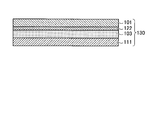
- FIG. 1 is a cross-sectional view schematically showing an example of the cholesteric resin laminate of the present invention.
- FIG. 2 is a cross-sectional view schematically showing a multilayer structure in the manufacturing process of the cholesteric resin laminate 100 shown in FIG.
- FIG. 3 is a cross-sectional view schematically showing a multilayer structure in the manufacturing process of the cholesteric resin laminate 100 shown in FIG.
- FIG. 4 is a cross-sectional view schematically showing a multilayer structure in the manufacturing process of the cholesteric resin laminate 100 shown in FIG.
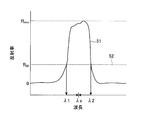
- FIG. 5 is a graph schematically showing an example of the measurement result of the spectral reflectance of the cholesteric resin layer and the calculation for obtaining the reflection band center wavelength based thereon.
- FIG. 1 is a cross-sectional view schematically showing an example of the cholesteric resin laminate of the present invention.
- FIG. 2 is a cross-sectional view schematically showing a multilayer structure in the manufacturing process of the cholesteric
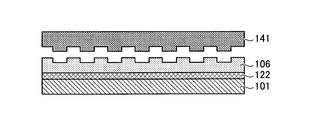
- FIG. 6 is a cross-sectional view schematically showing a process of manufacturing an example of the display medium of the present invention using the cholesteric resin laminate shown in FIG.
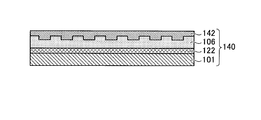
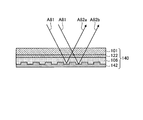
- FIG. 7 is a cross-sectional view schematically showing a process of manufacturing an example of the display medium of the present invention using the cholesteric resin laminate shown in FIG.
- FIG. 8 is a cross-sectional view schematically showing how the display medium 140 obtained in the manufacturing process shown in FIGS. 6 to 7 is used.
- (meth) acryl includes both acrylic and methacrylic.
- (Meth) acrylate includes both acrylate and methacrylate.
- (thio) epoxy includes both epoxy and thioepoxy.
- iso (thio) cyanate includes both isocyanate and isothiocyanate.
- the cholesteric resin laminate of the present invention includes a base material, an intermediate layer, and a cholesteric resin layer in this order.
- FIG. 1 is a cross-sectional view schematically showing an example of the cholesteric resin laminate of the present invention.
- a cholesteric resin laminate 100 includes a base material 101, a cholesteric resin layer 103, and an intermediate layer 122 interposed therebetween.
- the material which comprises a base material is not specifically limited, As an example, resin, a metal, glass, and paper are mentioned.
- a light transmissive material can be preferably used.
- the light transmissive material is preferably a material in which the total light transmittance of the substrate is 70% or more.
- the material constituting the base material is A material having a small degree of change in polarization of light transmitted through the substrate can be preferably used.
- Preferred examples of such materials include acetylcellulose resins and cycloolefin resins. From the viewpoint of easily obtaining the cost of acquisition and the affinity with the intermediate layer, acetylcellulose resin is more preferable.
- a more specific example of the acetyl cellulose resin includes a triacetyl cellulose resin.
- the base material 101 is a single layer made of a single material, but the base material in the present invention is not limited to this, and may be made up of a plurality of layers.
- the materials to be used may be the same as or different from each other. However, from the viewpoint of ease of production, a single layer is preferable.
- the thickness of the substrate is not particularly limited, and can be appropriately set according to the use of the cholesteric resin laminate.
- the thickness of the substrate is preferably 0.1 ⁇ m or more, more preferably 0.3 ⁇ m or more, while preferably 2000 ⁇ m or less, more preferably 1000 ⁇ m or less.
- Examples of the base material molding method include a melt molding method and a solution casting method.
- Examples of the melt molding method include a melt extrusion method in which molding is performed by melt extrusion, a press molding method, an inflation molding method, an injection molding method, a blow molding method, and a stretch molding method.
- the melt extrusion method, the inflation molding method, and the press molding method are preferable from the viewpoint of obtaining a base material before stretching excellent in mechanical strength and surface accuracy.
- the melt extrusion method is particularly preferable because the amount of the residual solvent can be reduced, and efficient and simple production is possible.
- a base material a commercial item can be obtained and used suitably.
- the surface of the base material may be subjected to surface treatment as necessary.
- the surface of the substrate on the side in contact with the intermediate layer can be subjected to a treatment such as a saponification treatment or a corona treatment prior to the formation of the intermediate layer.
- a treatment such as a saponification treatment or a corona treatment prior to the formation of the intermediate layer.
- the affinity with the intermediate layer can be increased.
- the cholesteric resin layer is a solid resin layer having cholesteric regularity.
- Cholesteric regularity means that the molecular axes are aligned in a certain direction on one plane, but the direction of the molecular axis is slightly offset in the next plane that overlaps it, and the angle is further shifted in the next plane. In this way, the structure is such that the molecular axes in the planes are displaced (twisted) as they sequentially pass through the overlapping planes. Thus, the structure in which the direction of the molecular axis is twisted becomes an optically chiral structure.
- the cholesteric resin layer usually has a circularly polarized light separation function. That is, it has a property of transmitting one circularly polarized light of right circularly polarized light and left circularly polarized light and reflecting a part or all of the other circularly polarized light. The reflection in the cholesteric resin layer reflects circularly polarized light while maintaining its chirality.
- the wavelength that exhibits the circularly polarized light separation function depends on the pitch of the helical structure in the cholesteric resin layer.
- the pitch of the helical structure is the distance in the plane normal direction until the angle of the molecular axis in the helical structure gradually shifts as it advances along the plane and then returns to the original molecular axis direction again.
- the wavelength at which the circularly polarized light separating function is exhibited can be changed.
- a circularly polarized light separating function over a wide band can be obtained by a single cholesteric resin layer.
- the cholesteric resin layer preferably has a circularly polarized light separating function for light in a part or all of the visible light wavelength region, and can selectively reflect circularly polarized light in the band.
- the cholesteric resin layer can be formed by applying a liquid crystal composition layer on a suitable support for forming a resin layer to form a liquid crystal composition layer and curing the layer.
- liquid crystal composition is a fluid material containing a liquid crystal compound.
- the material referred to as “liquid crystal composition” includes not only a mixture of two or more substances but also a material composed of a single substance.
- liquid crystalline compound a polymerizable liquid crystalline compound is preferable.
- a liquid crystal composition containing a polymerizable liquid crystal compound can be easily cured by polymerizing the liquid crystal compound.
- a cholesteric liquid crystal compound can be used as the liquid crystal compound.
- a cholesteric liquid crystalline compound is a compound that can exhibit cholesteric liquid crystallinity.
- a liquid crystal composition containing such a cholesteric liquid crystal compound when a layer of the liquid crystal composition is formed on the surface of the support, the liquid crystal compound exhibits a cholesteric liquid crystal phase in the layer, which is cured.
- a cholesteric resin layer can be produced.
- a non-liquid crystalline cholesteric resin layer cured with cholesteric regularity is obtained by polymerizing a liquid crystalline compound in a state exhibiting a cholesteric liquid crystal phase and curing the layer of the liquid crystal composition. Can do.
- liquid crystal composition capable of forming a cholesteric resin layer having a continuously changing helical pitch, as described above, include a compound represented by the following formula (1) and a specific rod-like liquid crystal And a liquid crystal composition containing a functional compound.
- this specific liquid crystal composition may be referred to as “liquid crystal composition (X)”.
- R 1 -A 1 -BA 2 -R 2 are each independently a linear or branched alkyl group having 1 to 20 carbon atoms, or a straight chain having 1 to 20 carbon atoms. Or a branched alkylene oxide group, a hydrogen atom, a halogen atom, a hydroxyl group, a carboxyl group, a (meth) acryl group, an epoxy group, a mercapto group, an isocyanate group, an amino group, which may be bonded with an arbitrary bonding group, And a group selected from the group consisting of a cyano group.
- the alkyl group and alkylene oxide group may be unsubstituted or substituted with one or more halogen atoms.
- the halogen atom, hydroxyl group, carboxyl group, (meth) acryl group, epoxy group, mercapto group, isocyanate group, amino group, and cyano group are an alkyl group having 1 to 2 carbon atoms, and an alkylene oxide. It may be bonded to a group.
- R 1 and R 2 include a halogen atom, a hydroxyl group, a carboxyl group, a (meth) acryl group, an epoxy group, a mercapto group, an isocyanate group, an amino group, and a cyano group.
- At least one of R 1 and R 2 is a reactive group.
- the compound represented by the formula (1) is fixed in the cholesteric resin layer at the time of curing, and a stronger layer can be formed.
- the reactive group include a carboxyl group, a (meth) acryl group, an epoxy group, a mercapto group, an isocyanate group, and an amino group.
- a 1 and A 2 are each independently 1,4-phenylene group, 1,4-cyclohexylene group, 1,4-cyclohexenyl group, 4,4′-biphenylene group, 4, A group selected from the group consisting of a 4′-bicyclohexylene group and a 2,6-naphthylene group.
- the 1,4-phenylene group, 1,4-cyclohexylene group, 1,4-cyclohexenyl group, 4,4′-biphenylene group, 4,4′-bicyclohexylene group, and 2,6-naphthylene group are Is not substituted, or is substituted by one or more substituents such as a halogen atom, a hydroxyl group, a carboxyl group, a cyano group, an amino group, an alkyl group having 1 to 10 carbon atoms, a halogenated alkyl group, etc. May be.
- substituents such as a halogen atom, a hydroxyl group, a carboxyl group, a cyano group, an amino group, an alkyl group having 1 to 10 carbon atoms, a halogenated alkyl group, etc. May be.
- substituents such as a halogen atom, a hydroxyl group, a carboxyl group, a cyan
- a 1 and A 2 include groups selected from the group consisting of 1,4-phenylene group, 4,4′-biphenylene group, and 2,6-naphthylene group. These aromatic ring skeletons are relatively rigid as compared with the alicyclic skeletons, have high affinity with the mesogen of the rod-like liquid crystal compound, and higher alignment uniformity.
- At least one of the compounds represented by the formula (1) preferably has liquid crystallinity, and preferably has chirality.
- the compound represented by the formula (1) is preferably used in combination of a plurality of optical isomers. For example, a mixture of a plurality of types of enantiomers, a mixture of a plurality of types of diastereomers, or a mixture of enantiomers and diastereomers may be used.
- At least one of the compounds represented by formula (1) preferably has a melting point in the range of 50 ° C to 150 ° C.
- the refractive index anisotropy ⁇ n is preferably high.
- the refractive index anisotropy ⁇ n of a liquid crystal composition containing the compound can be improved, and circularly polarized light is reflected.
- a cholesteric resin layer having a wide possible wavelength range can be produced.
- the refractive index anisotropy ⁇ n of the compound represented by the formula (1) is preferably 0.18 or more, more preferably 0.22 or more. Although the refractive index anisotropy ⁇ n is preferably as large as possible, it is practically 0.35 or less.
- the refractive index anisotropy ⁇ n can be measured by the Senarmon method.
- the cured resin layer is extinguished using an optical microscope (ECLIPSE E600POL (transmission / reflection type) equipped with a sensitive color plate, ⁇ / 4 wavelength plate, Senarmon compensator, GIF filter 546 nm, manufactured by Nikon Corporation).
- particularly preferred compounds represented by the formula (1) include the following compounds (A1) to (A9). One of these may be used alone, or two or more of these may be used in combination at any ratio.
- a rod-like liquid crystal compound having at least two reactive groups in one molecule can be used.
- the rod-like liquid crystalline compound include a compound represented by the formula (2). R 3 -C 3 -D 3 -C 5 -MC 6 -D 4 -C 4 -R 4 Formula (2)
- R 3 and R 4 are reactive groups, each independently (meth) acryl group, (thio) epoxy group, oxetane group, thietanyl group, aziridinyl group, pyrrole group, vinyl group. , An allyl group, a fumarate group, a cinnamoyl group, an oxazoline group, a mercapto group, an iso (thio) cyanate group, an amino group, a hydroxyl group, a carboxyl group, and an alkoxysilyl group.
- a high strength cholesteric resin layer can be obtained when the liquid crystal composition is cured.
- a cholesteric resin layer having a pencil hardness (JIS K5400) and usually HB or higher, preferably H or higher can be obtained.
- JIS K5400 pencil hardness
- HB or higher preferably H or higher
- D 3 and D 4 are each independently a single bond, a linear or branched alkyl group having 1 to 20 carbon atoms, and 1 to 20 carbon atoms. Represents a group selected from the group consisting of a linear or branched alkylene oxide group.
- C 3 to C 6 are each independently a single bond, —O—, —S—, —SS—, —CO—, —CS—, —OCO—, —CH 2.
- M represents a mesogenic group.
- M is an azomethine group, azoxy group, phenyl group, biphenyl group, terphenyl group, naphthalene group, anthracene group, benzoic acid ester group, cyclohexanecarboxyl group, which may be unsubstituted or substituted.
- Skeletons are —O—, —S—, —SS—, —CO—, —CS—, —OCO—, —CH 2 —, —OCH 2 —, —CH ⁇ N—N ⁇ CH—.
- Examples of the substituent that the mesogenic group M may have include a halogen atom, an optionally substituted alkyl group having 1 to 10 carbon atoms, a cyano group, a nitro group, —O—R 5 , — O—C ( ⁇ O) —R 5 , —C ( ⁇ O) —O—R 5 , —O—C ( ⁇ O) —O—R 5 , —NR 5 —C ( ⁇ O) —R 5 , —C ( ⁇ O) —NR 5 R 7 , or —O—C ( ⁇ O) —NR 5 R 7 may be mentioned.
- R 5 and R 7 represent a hydrogen atom or an alkyl group having 1 to 10 carbon atoms.
- the alkyl group includes —O—, —S—, —O—C ( ⁇ O) —, —C ( ⁇ O) —O—, —O—C. ( ⁇ O) —O—, —NR 6 —C ( ⁇ O) —, —C ( ⁇ O) —NR 6 —, —NR 6 —, or —C ( ⁇ O) — may be present. (However, the case where two or more of —O— and —S— are adjacent to each other is excluded).
- R 6 represents a hydrogen atom or an alkyl group having 1 to 6 carbon atoms.
- substituent in the “optionally substituted alkyl group having 1 to 10 carbon atoms” include, for example, a halogen atom, a hydroxyl group, a carboxyl group, a cyano group, an amino group, and a carbon atom number of 1 to 6 alkoxy groups, alkoxyalkoxy groups having 2 to 8 carbon atoms, alkoxyalkoxyalkoxy groups having 3 to 15 carbon atoms, alkoxycarbonyl groups having 2 to 7 carbon atoms, 2 carbon atoms A 7 to 7 alkylcarbonyloxy group, an alkoxycarbonyloxy group having 2 to 7 carbon atoms, and the like.
- the rod-like liquid crystalline compound preferably has an asymmetric structure.
- the asymmetric structure is a structure in which R 3 -C 3 -D 3 -C 5 -and -C 6 -D 4 -C 4 -R 4 are different in the formula (2) with the mesogenic group M as the center.
- R 3 -C 3 -D 3 -C 5 -and -C 6 -D 4 -C 4 -R 4 are different in the formula (2) with the mesogenic group M as the center.
- the refractive index anisotropy ⁇ n of the rod-like liquid crystal compound is preferably 0.18 or more, more preferably 0.22 or more. Although the refractive index anisotropy ⁇ n is preferably as large as possible, it is practically 0.35 or less. When a rod-like liquid crystalline compound having a refractive index anisotropy ⁇ n of 0.30 or more is used, the absorption edge on the long wavelength side of the ultraviolet absorption spectrum of the rod-like liquid crystalline compound may extend to the visible region. Can be used as long as they do not adversely affect the desired optical performance even in the visible range. By using such a rod-like liquid crystalline compound having a high refractive index anisotropy ⁇ n, a cholesteric resin layer having high optical performance (for example, selective reflection performance of circularly polarized light) can be obtained.
- rod-like liquid crystalline compound examples include the following compounds (B1) to (B9). Moreover, these may be used individually by 1 type and may be used combining two or more types by arbitrary ratios.
- the weight ratio represented by (total weight of compounds represented by formula (1)) / (total weight of rod-like liquid crystalline compounds) is preferably 0.05 or more, more preferably 0.1 or more, and particularly preferably 0. .15 or more, preferably 1 or less, more preferably 0.65 or less, and particularly preferably 0.45 or less.
- the refractive index anisotropy ⁇ n of the liquid crystal composition can be increased, for example, a cholesteric resin layer having desired optical performance such as selective reflection performance of circularly polarized light can be stably obtained.
- the total weight of the compound represented by the formula (1) indicates the weight when only one type of the compound represented by the formula (1) is used, and when two or more types are used. Indicates total weight.
- the total weight of the rod-like liquid crystalline compound indicates the weight when only one kind of rod-like liquid crystalline compound is used, and indicates the total weight when two or more kinds of rod-like liquid crystalline compounds are used.
- the molecular weight of the compound represented by Formula (1) is less than 600, and the molecular weight of a rod-shaped liquid crystalline compound is It is preferable that it is 600 or more.
- the liquid crystal composition such as the liquid crystal composition (X) may contain a chiral agent.
- the twist direction of the cholesteric resin layer can be appropriately selected depending on the type and structure of the chiral agent to be used.
- Specific examples of the chiral agent include JP-A-2005-289881, JP-A-2004-115414, JP-A-2003-66214, JP-A-2003-313187, JP-A-2003-342219, JP-A-2003-342219.
- 98/00428, Japanese Patent Laid-Open No. 2007-176870, etc. can be used as appropriate.
- it is available as LC756 of BASF Corporation Paliocolor.
- a chiral agent may be used individually by 1 type, and may be used combining two or more types by arbitrary ratios.
- the amount of the chiral agent can be arbitrarily set within a range not deteriorating the desired optical performance.
- the specific amount of the chiral agent is usually 1% by weight to 60% by weight in the liquid crystal composition.
- the cholesteric resin layer is preferably a compound layer having a crosslinked structure in order to improve its mechanical strength and durability.
- the liquid crystal composition such as the liquid crystal composition (X) may contain a crosslinking agent.
- the cross-linking agent increases the cross-linking density of the cholesteric resin layer by, for example, reacting when the liquid crystal composition layer is cured, promoting the reaction by heat treatment after curing, or allowing the reaction to proceed spontaneously due to moisture. be able to.
- a crosslinking agent what can react with an ultraviolet-ray, a heat
- a crosslinking agent what does not worsen the alignment uniformity of a liquid crystalline compound is preferable.
- crosslinking agent examples include trimethylolpropane tri (meth) acrylate, pentaerythritol tri (meth) acrylate, pentaerythritol tetra (meth) acrylate, dipentaerythritol hexa (meth) acrylate, and 2- (2-vinyloxyethoxy).
- Polyfunctional acrylate compounds such as ethyl acrylate; epoxy compounds such as glycidyl (meth) acrylate, ethylene glycol diglycidyl ether, glycerin triglycidyl ether, pentaerythritol tetraglycidyl ether; 2,2-bishydroxymethylbutanol-tris [3- ( 1-aziridinyl) propionate], 4,4-bis (ethyleneiminocarbonylamino) diphenylmethane, trimethylolpropane-tri- ⁇ -aziridinylpro Aziridine compounds such as pionate; isocyanate compounds such as isocyanurate type isocyanate, biuret type isocyanate and adduct type isocyanate derived from hexamethylene diisocyanate, hexamethylene diisocyanate; polyoxazoline compound having an oxazoline group in the side chain; vinyltrimethoxysilane; N-
- a crosslinking agent may be used individually by 1 type, and may be used combining two or more types by arbitrary ratios. Furthermore, you may use a well-known catalyst according to the reactivity of a crosslinking agent. By using a catalyst, productivity can be improved in addition to improvement in strength and durability of the cholesteric resin layer.
- the amount of the crosslinking agent is preferably such that the amount of the crosslinking agent in the cholesteric resin layer obtained by curing the layer of the liquid crystal composition is 0.1 wt% to 15 wt%.
- the liquid crystal composition such as the liquid crystal composition (X) may contain a photopolymerization initiator.
- a photoinitiator the compound which can generate
- photopolymerization initiator examples include benzoin, benzylmethyl ketal, benzophenone, biacetyl, acetophenone, Michler's ketone, benzyl, benzylisobutyl ether, tetramethylthiuram mono (di) sulfide, 2,2-azobisisobutyronitrile, 2,2-azobis-2,4-dimethylvaleronitrile, benzoyl peroxide, di-tert-butyl peroxide, 1-hydroxycyclohexyl phenyl ketone, 2-hydroxy-2-methyl-1-phenyl-propan-1-one 1- (4-Isopropylphenyl) -2-hydroxy-2-methylpropan-1-one, thioxanthone, 2-chlorothioxanthone, 2-methylthioxanthone, 2,4-diethylthioxanthone, methylbenzoylforme 2,2-diethoxyacetophenone, ⁇
- these may be used individually by 1 type and may be used combining two or more types by arbitrary ratios. Furthermore, you may control sclerosis
- the amount of the photopolymerization initiator is preferably 0.03% to 7% by weight in the liquid crystal composition. Since the degree of polymerization can be increased by setting the amount of the photopolymerization initiator to be equal to or higher than the lower limit of the above range, the mechanical strength of the cholesteric resin layer can be increased. Moreover, since the orientation of a liquid crystalline compound can be made favorable by setting it to the upper limit value or less, the liquid crystal phase of the liquid crystal composition can be stabilized.
- the liquid crystal composition such as the liquid crystal composition (X) may contain a surfactant.
- a surfactant for example, one that does not inhibit the orientation can be appropriately selected and used.
- a surfactant for example, a nonionic surfactant containing a siloxane or a fluorinated alkyl group in the hydrophobic group portion is preferably exemplified.
- oligomers having two or more hydrophobic group moieties in one molecule are particularly suitable.
- surfactants include PolyFox PF-151N, PF-636, PF-6320, PF-656, PF-6520, PF-3320, PF-651, PF-652 from OMNOVA; Neos FTX-209F, FTX-208G, FTX-204D of Surfactant, KH-40 of Surflon of Seimi Chemical Co., etc. can be used.
- surfactant may be used individually by 1 type and may be used combining two or more types by arbitrary ratios.
- the amount of the surfactant is preferably such that the amount of the surfactant in the cholesteric resin layer is 0.05% by weight to 3% by weight.
- the liquid crystal composition such as the liquid crystal composition (X) may further contain an optional component as necessary.
- optional components include a solvent; a polymerization inhibitor for improving pot life; an antioxidant, an ultraviolet absorber and a light stabilizer for improving durability; and the like.
- these arbitrary components may be used individually by 1 type, and may be used combining two or more types by arbitrary ratios. The amount of these optional components can be arbitrarily set within a range that does not deteriorate the desired optical performance.
- the method for producing the liquid crystal composition used in the present invention is not particularly limited, and the liquid crystal composition can be produced by mixing the above components.
- a liquid crystal composition such as the liquid crystal composition (X) described above is coated on a suitable support for forming a cholesteric resin layer to form a layer of the liquid crystal composition, and this layer is cured, whereby the cholesteric resin Layers can be formed.
- the support is not particularly limited, and any single-layer or multi-layer film suitable for carrying out the method can be used.
- support materials include cycloaliphatic olefin polymers, chain olefin polymers such as polyethylene and polypropylene, triacetyl cellulose, polyvinyl alcohol, polyimide, polyarylate, polyester, polycarbonate, polysulfone, polyethersulfone, and modified acrylic polymers.
- Synthetic resins such as epoxy resin, polystyrene, and acrylic resin.
- polyesters such as polyethylene terephthalate are preferable because they are easily available.
- the surface of the support Prior to the application of the liquid crystal composition, the surface of the support can be subjected to a treatment for imparting alignment regulating force.
- a treatment for imparting alignment regulating force examples include rubbing treatment of the support surface, stretching treatment of the support film, and the like.
- the support may have an alignment film on its surface, but preferably does not have an alignment film.
- the surface of the film formed of the above-described material is directly subjected to a treatment such as a rubbing treatment that imparts alignment regulating force, and the liquid crystal composition is applied.
- the material constituting the alignment film is usually a material that is more brittle than the material of the film described above. Therefore, when a support having an alignment film is used, the alignment is performed by applying an alignment regulating force such as rubbing. The film may be scraped to generate fine particles, which may cause defects.
- the liquid crystal composition can be applied by a known application method.
- the application method include an extrusion coating method, a direct gravure coating method, a reverse gravure coating method, a die coating method, and a bar coating method.
- an alignment treatment may be performed as necessary before performing the curing step.
- the alignment treatment can be performed, for example, by heating the liquid crystal composition layer at 50 to 150 ° C. for 0.5 to 10 minutes. By performing the alignment treatment, the liquid crystal compound in the liquid crystal composition can be aligned well.
- the curing treatment of the liquid crystal composition layer can be performed by a combination of one or more energy beam irradiations and a heating treatment.
- the heating conditions may be, for example, a temperature of 40 to 200 ° C., preferably 50 to 200 ° C., more preferably 50 to 140 ° C., and a time of 1 second to 3 minutes, preferably 5 to 120 seconds.
- energy rays include ultraviolet rays, visible light, and other electromagnetic waves.
- the energy beam irradiation can be performed, for example, by irradiating light having a wavelength of 200 to 500 nm for 0.01 second to 3 minutes.
- a cholesteric with a wide reflection band in which the pitch of the helical structure is continuously changed by repeatedly repeating weak UV irradiation of 0.01 to 50 mJ / cm 2 and heating a plurality of times alternately.
- a resin layer can be obtained.
- a relatively strong ultraviolet ray of 50 to 10,000 mJ / cm 2 is irradiated to completely polymerize the liquid crystalline compound to form a cholesteric resin layer. it can.
- the expansion of the reflection band and the irradiation with strong ultraviolet rays may be performed in the air, or a part or all of the process may be performed in an atmosphere in which the oxygen concentration is controlled (for example, in a nitrogen atmosphere). .
- the liquid crystalline compound when embossing is performed on the surface after forming the cholesteric resin layer, the liquid crystalline compound is not completely polymerized at this time, and after the embossing, additional ultraviolet irradiation is performed, Can be completely polymerized.
- the step of applying and curing the cholesteric liquid crystal composition on another layer such as an alignment film is not limited to one time, and the coating and curing are repeated a plurality of times to form two or more cholesteric resin layers. You can also.
- a liquid crystal composition such as the liquid crystal composition (X)
- a well-oriented rod-like liquid crystal compound having an ⁇ n of 0.18 or more is included.
- a cholesteric resin layer having a thickness of 5 ⁇ m or more can be easily formed.
- the thickness of the cholesteric resin layer is preferably 0.1 ⁇ m or more and more preferably 1 ⁇ m or more for obtaining sufficient reflectance. Moreover, in order to obtain the transparency of the film, the thickness is preferably 20 ⁇ m or less, and more preferably 10 ⁇ m or less.
- the thickness of the cholesteric resin layer is the sum of the thicknesses of each layer when the display medium of the present invention has two or more layers, and the thickness when the cholesteric resin layer is one layer. Sure.
- the intermediate layer is interposed between the base material and the cholesteric resin layer, so that the color change with time during use of the cholesteric resin laminate can be reduced.
- the reason the following can be considered, for example.
- the cholesteric resin layer there may be a monomer component that is not polymerized, and when the cholesteric resin layer is heated when using the cholesteric resin laminate, the monomer component moves in the layer, Furthermore, it may move to another layer and its concentration may vary. When such a change occurs, the pitch of the helical structure in the cholesteric resin layer changes, and a shift of the reflection band center wavelength can occur.
- the intermediate layer is interposed between the base material and the cholesteric resin layer, the migration of the monomer component is suppressed, and thereby the color change with time during use of the cholesteric resin laminate can be reduced.
- the intermediate layer As a material constituting the intermediate layer, a material that intervenes between the base material and the cholesteric resin layer and can be bonded thereto can be appropriately selected.
- the intermediate layer is (i) or (ii) below.
- a cured layer of a material containing a modified polyvinyl alcohol compound and a curing agent as the intermediate layer in order to obtain a heating change value of the reflection band center wavelength that is not more than a predetermined value.
- the polyvinyl alcohol When polyvinyl alcohol is used as the material for the intermediate layer, the polyvinyl alcohol can be obtained by general hydrolysis of polyvinyl acetate. Therefore, in the present application, the polyvinyl alcohol includes those containing an acetoxy group (—OCOCH 3 ) obtained by such a production method.
- examples of the modified polyvinyl alcohol compound include those obtained by replacing the —OH group of polyvinyl alcohol with a substituent.
- the substituent examples include an acetoacetoxy group (—OCOCH 2 COCH 3 ), a quaternary ammonium chloride group (—NR 3 Cl, R is an alkyl group, and in each R, the number of carbon atoms is preferably 1-5, more preferably 1-3, even more preferably 1-2), sodium sulfonate group (—SO 3 Z, Z is an alkali metal such as Na), ethylene oxide group (— (CH 2 CH 2 O ) X— H, X is preferably 1 or more, more preferably 1), and combinations thereof.
- the modified polyvinyl alcohol compound may be a compound in which a part of —OH groups contained in a large number of molecules of polyvinyl alcohol are substituted, or a compound in which all are substituted.
- modified polyvinyl alcohol compound include those in which a part of —OH group of polyvinyl alcohol is substituted with acetoacetoxy group.
- a commercially available product for example, trade name “Gozenex Z TM” manufactured by Nippon Synthetic Chemical Co., Ltd. is available.
- a material capable of more firmly curing polyvinyl alcohol and / or a modified polyvinyl alcohol compound can be appropriately selected and used.
- the curing agent include a crosslinking agent that can react with polyvinyl alcohol and / or a modified polyvinyl alcohol compound to form a crosslinked structure.
- polyvinyl alcohol crosslinking agents include boric acid and metal alkoxy compounds such as titanium and zirconium.
- the crosslinking agent of the acetoacetoxy group-modified polyvinyl alcohol compound include amine compounds, methylol compounds, and metal salts such as zirconium.
- crosslinking agent As a crosslinking agent, a commercial product (for example, a product name “Safe” manufactured by Nippon Synthetic Chemical Co., Ltd. as a curing agent for a modified polyvinyl alcohol compound in which a part of —OH group of polyvinyl alcohol is substituted with acetoacetoxy group is used. Link SPM-01 “and” Safe Link SPM-02 ”) are available.
- curing agent an intermediate
- the intermediate layer can contain any material in addition to the materials described above.
- optional materials include ultraviolet absorbers, colorants, and antistatic agents.
- the ratio of these optional components in the intermediate layer can be appropriately adjusted within a range that does not excessively impair the effects of the present invention.
- the thickness of the intermediate layer is preferably 0.01 ⁇ m or more, more preferably 0.1 ⁇ m or more, while it is preferably 100 ⁇ m or less, more preferably 10 ⁇ m or less, and even more preferably 5 ⁇ m or less.
- the thickness of the intermediate layer is not less than the lower limit, discoloration of the cholesteric resin layer under a high temperature environment can be satisfactorily suppressed.
- the thickness of the intermediate layer is not more than the above upper limit, it is possible to suppress cracking or breakage of the base material or the cholesteric resin layer due to the difference in expansion amount of each layer in a high temperature environment.
- the cholesteric resin laminate of the present invention can be preferably produced by forming a base material and a cholesteric resin layer, and further forming an intermediate layer therebetween.
- the intermediate layer is an adhesive layer obtained by curing an adhesive. Therefore, the cholesteric resin laminate of the present invention can be produced by bonding the base material and the cholesteric resin layer using an adhesive.
- the cholesteric resin laminate of the present invention can be produced by superposing a base material and a cholesteric resin layer via an adhesive layer, and curing the adhesive layer to form an intermediate layer.
- the intermediate layer can be formed using the following adhesive (i).
- the intermediate layer can be formed using the following adhesive (i).
- Adhesive (i) A material containing polyvinyl alcohol, a modified polyvinyl alcohol compound or a mixture thereof.
- Adhesive (ii) A material containing polyvinyl alcohol, a modified polyvinyl alcohol compound or a mixture thereof, and a curing agent.
- the adhesive may contain any component in addition to the components of the adhesive (i) or (ii) described above.
- Specific examples of the adhesive component include the same materials as those for the intermediate layer described above.
- the adhesive may further contain a solvent.
- a solvent is not particularly limited, and a solvent suitable for dissolution of other components and use in a production process can be appropriately selected.
- the adhesive contains polyvinyl alcohol, a modified polyvinyl alcohol compound, or a mixture thereof, it is preferable to use water as a solvent suitable for dissolving them.
- the ratio of the solid content (ratio of components other than the solvent) in the adhesive can be appropriately adjusted to a range suitable for dissolution of other components and use in the production process, and preferably 0.1% by weight or more. Preferably it is 1 wt% or more, while preferably 10 wt% or less, more preferably 7 wt% or less.
- the ratio of the curing agent is preferably 1 part by weight or more, more preferably 5 parts per 100 parts by weight of the polyvinyl alcohol and / or modified polyvinyl alcohol compound. Part by weight, preferably 20 parts by weight or less, more preferably 10 parts by weight or less. When the ratio of the curing agent is within the above range, a strong effect can be achieved efficiently.
- FIGS. 2 to 4 are cross-sectional views schematically showing a multilayer structure in the manufacturing process of the cholesteric resin laminate 100 shown in FIG.
- a multilayer body 110 including a support 111 and a cholesteric resin layer 103 formed on the support 111 is prepared.
- an adhesive is applied on the surface 110 ⁇ / b> U on the cholesteric resin layer 103 side of the multilayer 110 to form a liquid-state adhesive layer 121.
- the base material 101 is overlaid on the adhesive layer 121, and (support 111) / (cholesteric resin layer 103) / (adhesive layer 121) / (base material 101).
- the liquid-state adhesive layer 121 is cured, and as shown in FIG. 4, a composite having a layer structure of (support 111) / (cholesteric resin layer 103) / (intermediate layer 122) / (base material 101) is formed. A layered product 130 is obtained. Furthermore, the cholesteric resin laminate 100 shown in FIG. 1 can be obtained by peeling the support 111 from the multilayer 130.
- the conditions for curing the adhesive can be appropriately set as appropriate for the adhesive to be used.
- the adhesive (i) when used as an adhesive, the laminate including the adhesive layer may be dried to volatilize all or part of the solvent in the adhesive and cure the adhesive. it can.
- the adhesive When the adhesive (ii) is used as the adhesive, the adhesive can be cured by processing under conditions suitable for the reaction of the curing agent. When the reaction of the curing agent is accelerated by heating, the adhesive can be cured by advancing reactions such as solvent volatilization and crosslinking reaction by the same drying treatment as in the case of the adhesive (i). Moreover, when the thing which hardens
- the difference in the reflection band center wavelength of the cholesteric resin layer before and after being heated at 130 ° C. for 8 hours is 50 nm or less.
- the central wavelength of the reflection band of the cholesteric resin layer can be obtained based on the measurement result obtained by measuring the spectral reflectance of the cholesteric resin layer.
- the spectral reflectance can be measured using a spectrophotometer (for example, product name “V-550” manufactured by JASCO Corporation).
- a spectrophotometer for example, product name “V-550” manufactured by JASCO Corporation.
- V-550 product name “V-550” manufactured by JASCO Corporation
- the spectral reflectance is usually obtained as a graph in which the horizontal axis represents the wavelength and the vertical axis represents the reflectance at the wavelength.
- the reflection band of the cholesteric resin layer is usually shown as a broad peak in such a graph.
- FIG. 5 is a graph schematically showing an example of the measurement result of the spectral reflectance of the cholesteric resin layer and the calculation for obtaining the reflection band center wavelength based on the measurement result.
- the measurement result of the spectral reflectance is indicated by a curve 51.
- the reflectance R30 that is 30% of the maximum value Rmax of the spectral reflectance is the level indicated by the line 52.
- the values on the horizontal axis at the intersection of the curve 51 and the line 52 are ⁇ 1 and ⁇ 2, and the average of these values is the reflection band center wavelength ⁇ s.
- the cholesteric resin laminate is heated at 130 ° C. for 8 hours, and the reflection band center wavelength ⁇ t after heating is similarly determined.
- the value of the difference ⁇ st is preferably 30 nm or less, more preferably 10 nm or less.
- the lower limit of the value of the difference ⁇ st is not particularly limited, and is ideally 0 nm.
- Such a cholesteric resin laminate having a small difference in reflection band center wavelength before and after heating can be obtained by appropriately selecting the material of the intermediate layer. Specifically, by using the intermediate layer (i) or the intermediate layer (ii) listed above, a cholesteric resin laminate having a small difference in the reflection band center wavelength before and after heating can be obtained.
- the cholesteric resin laminate has a circularly polarized light separating function in a wavelength band as wide as possible for visible light when used for applications such as display media and decorative materials. Specifically, it is preferable that the width of the reflection band indicated by ⁇ 2- ⁇ 1 is 50 nm or more in a state before heating.
- cholesteric resin laminate [7. (Use of cholesteric resin laminate)
- the use of the cholesteric resin laminate of the present invention is arbitrary, taking advantage of optical properties and design features such as color and gloss, and products such as reflective materials, authenticity-identifying display media, and decorative materials It can be used as a component of Among these, a reflecting material, a display medium, and a decorating material will be described below as the reflecting material, the display medium, and the decorating material of the present invention, respectively.
- the reflective material of the present invention includes the cholesteric resin laminate of the present invention. Specifically, the cholesteric resin laminate is cut into an appropriate size and can be used as a reflector as it is, and the cholesteric resin laminate is bonded to another member via an appropriate adhesive, thereby reflecting the reflector. May be configured.
- the use of the reflecting material is not particularly limited, and for example, a cholesteric resin layer having a reflection band in the infrared region or the ultraviolet region can be formed and used as an infrared reflecting material or an ultraviolet reflecting agent. Since the reflective material of the present invention includes the cholesteric resin laminate of the present invention, it can be suitably used in a high temperature use environment.
- the display medium of the present invention includes the cholesteric resin laminate of the present invention.
- Examples of the display medium include a medium provided on the surface of the article in order to display information on the surface of the article. More specific examples include anti-counterfeit display media and security display media that utilize the property that a laminate including a cholesteric resin layer cannot be easily duplicated.
- Examples of the anti-counterfeit display medium include a label for authenticity identification and a seal.
- Examples of the security display medium include authentication media such as gold vouchers, gift certificates, tickets, certificates, and security cards.
- the display medium of the present invention includes the cholesteric resin laminate in a form in which an image visually recognized differs depending on how to observe. Specific examples thereof will be described with reference to FIGS.
- FIG. 6 to 7 are cross-sectional views schematically showing a process for manufacturing an example of the display medium of the present invention using the cholesteric resin laminate shown in FIG.
- a display medium having hologram embossing and a base image and different in how they are viewed depending on the observation method is manufactured.
- an embossing die 141 is pressed against the surface of the cholesteric resin laminate 100 shown in FIG. 1 on the side of the cholesteric resin layer 103, thereby giving an uneven shape to the surface of the cholesteric resin layer 103.
- the concavo-convex cholesteric resin layer 106 is used.
- a display medium capable of displaying a hologram image can be obtained by providing a fine concavo-convex structure in which the concavo-convex shape functions as a diffraction grating when illuminated with light.
- a base image layer 142 is formed on the surface of the concavo-convex cholesteric resin layer 106.
- the formation of the base image layer can be performed using a known means such as printing, whereby a base image layer in which an image can be visually recognized when observed from the substrate 101 side can be formed.
- the display medium 140 provided with the base material 101, the intermediate layer 122, the concavo-convex cholesteric resin layer 106, and the base image layer 142 in this order can be obtained.
- an arbitrary layer such as an adhesive layer and an additional base material layer may be further formed on the surface of the base image layer 142, and the layer may be provided on the surface of the article.
- FIG. 8 is a cross-sectional view schematically showing how the display medium 140 obtained in the manufacturing process shown in FIGS. 6 to 7 is used.
- FIG. 8 when non-polarized light is incident on the surface of the display medium 140 on the substrate 101 side in the direction indicated by the arrow A81, in the reflection band of the concavo-convex cholesteric resin layer 106, right circularly polarized light and left circularly polarized light One is reflected by the concavo-convex cholesteric resin layer 106 and is emitted in a mode indicated by an arrow A82a.
- the remaining light is reflected on the surface of the underlying image layer 142 and is emitted in the manner indicated by the arrow A82b.
- the concavo-convex cholesteric resin layer 106 is a layer that selectively reflects right circularly polarized light
- an image formed by hologram embossing is observed when the display medium 140 is observed through a filter that transmits only right circularly polarized light.
- the display medium 140 is observed through a filter that transmits only the left circularly polarized light
- an image of the base image is observed. Therefore, when such an image difference is observed, it can be determined that the display medium is genuine having the components of the present invention, and when such an image difference is not observed, the display medium is It can be determined that the display medium is not authentic and has no configuration of the display medium of the present invention, which is created by electronic printing or the like.
- the decorating material of the present invention comprises the cholesteric resin laminate of the present invention. Specifically, the cholesteric resin laminate is cut into an appropriate size and can be used as a decoration material as it is, and the cholesteric resin laminate is bonded to another member via an appropriate adhesive, thereby You may comprise the material for decorating. Examples of articles to be decorated with the decorating material of the present invention include ornaments, stationery, furniture, automobiles (interior and exterior), home appliances, personal computers, cosmetic packages, and the like.
- the design effect obtained by the decorating material of the present invention is not particularly limited, and may be any that takes advantage of the appearance of the cholesteric resin layer.
- a metallic luster can be imparted without using a metal
- a metallic design effect can be obtained even in applications where the use of a metal is not preferred.
- hologram embossing can be formed on the cholesteric resin layer to obtain a design effect of the hologram.
- a polyester film manufactured by Toyobo Co., Ltd., Cosmo Shine A4100, film thickness 100 ⁇ m, having an easy adhesion treatment surface on one side
- a cholesteric liquid crystal composition was applied to the surface using a # 5 wire bar to form a liquid crystal composition layer.
- the layer is subjected to orientation treatment at 100 ° C.
- a multilayer product 1 having a layer structure of cholesteric resin layer 1) was obtained.
- the value of ⁇ 2- ⁇ 1 of the obtained multilayer product 1 was 102 nm.
- Example 1 As an adhesive for forming the intermediate layer, an aqueous solution 1 composed of 5% by weight of polyvinyl alcohol and 95% by weight of water was prepared. A saponified 40 ⁇ m thick triacetyl cellulose film was prepared as a substrate. An adhesive was applied to the surface of the multilayer 1 obtained in Production Example 1 on the cholesteric resin layer 1 side, and a base material was placed thereon to superimpose to obtain a multilayer. The multilayer was pressed through a laminator and then dried at 60 ° C. for 2 minutes to cure the adhesive layer to form an intermediate layer. As a result, a multilayer product having a layer structure of (support) / (cholesteric resin layer 1) / (intermediate layer) / (base material) was obtained.
- the support was peeled from the multilayer.
- This obtained the cholesteric resin laminated body 1 which has a layer structure of (cholesteric resin layer 1) / (intermediate layer) / (base material).
- the thickness of the intermediate layer was 0.9 ⁇ m.
- the color of the cholesteric resin layer 1 of the obtained cholesteric resin laminate 1 was a slightly reddish gold color.
- the central wavelength of the reflection band of the cholesteric resin layer 1 was 619 nm.
- the cholesteric resin laminate 1 was heat-treated at 130 ° C. for 8 hours, and then the color of the cholesteric resin layer 1 and the reflection band center wavelength were observed again.
- the color of the cholesteric resin layer 1 was gold, and the color change due to the heat treatment was evaluated as “slight”.
- the central wavelength of the reflection band was 591 nm.
- Example 2 As an adhesive for forming the intermediate layer, a modified polyvinyl alcohol compound (manufactured by Nippon Synthetic Chemical Industry, trade name “GOHSEX Z-200”, a part of the —OH group of polyvinyl alcohol substituted with an acetoacetoxy group) 5 An aqueous solution 2 consisting of wt% and water 95 wt% was prepared. A cholesteric resin laminate having a layer structure of (cholesteric resin layer 1) / (intermediate layer) / (base material) in the same manner as in Example 1 except that this aqueous solution 2 was used instead of the aqueous solution 1 as an adhesive. Body 2 was obtained. The thickness of the intermediate layer was 1.0 ⁇ m.
- the color of the cholesteric resin layer 1 of the obtained cholesteric resin laminate 2 was a slightly reddish gold color.
- the central wavelength of the reflection band of the cholesteric resin layer 1 was 620 nm.
- the cholesteric resin laminate 2 was heat-treated at 130 ° C. for 8 hours, and then the color of the cholesteric resin layer 1 and the reflection band center wavelength were observed again.
- the color of the cholesteric resin layer 1 was gold, and the color change due to the heat treatment was evaluated as “slight”.
- the reflection band center wavelength was 602 nm.
- Example 3 As an adhesive for forming the intermediate layer, a modified polyvinyl alcohol compound (manufactured by Nippon Synthetic Chemical Industry, trade name “GOHSEX Z-200”, a part of the —OH group of polyvinyl alcohol substituted with an acetoacetoxy group) 5 An aqueous solution 3 consisting of 4% by weight, a curing agent (made by Nippon Synthetic Chemical Industry, trade name “Safelink SPM-01”, 7% aqueous solution) and 91% by weight of water was prepared.
- a modified polyvinyl alcohol compound manufactured by Nippon Synthetic Chemical Industry, trade name “GOHSEX Z-200”, a part of the —OH group of polyvinyl alcohol substituted with an acetoacetoxy group
- An aqueous solution 3 consisting of 4% by weight, a curing agent (made by Nippon Synthetic Chemical Industry, trade name “Safelink SPM-01”, 7% aqueous solution) and 91% by weight of water was prepared.
- the thickness of the intermediate layer was 0.9 ⁇ m.
- the color of the cholesteric resin layer 1 of the obtained cholesteric resin laminate 3 was a slightly reddish gold color.
- the central wavelength of the reflection band of the cholesteric resin layer 1 was 618 nm.
- this cholesteric resin laminate 3 was heat-treated at 130 ° C. for 8 hours, and then the color of the cholesteric resin layer 1 and the reflection band center wavelength were observed again.
- the color of the cholesteric resin layer 1 was gold, and the change in color due to the heat treatment was evaluated as “none”.
- the reflection band center wavelength was 613 nm.
- Example 4 (Cholesteric resin layer 2) / (intermediate layer) / (base material) layer in the same manner as in Example 3 except that the multilayer material 2 obtained in Production Example 2 was used instead of the multilayer material 1.
- a cholesteric resin laminate 4 having a configuration was obtained.
- the thickness of the intermediate layer was 1.1 ⁇ m.
- the color of the cholesteric resin layer 2 of the obtained cholesteric resin laminate 4 was red.
- the central wavelength of the reflection band of the cholesteric resin layer 1 was 626 nm.
- this cholesteric resin laminate 4 was heat-treated at 130 ° C. for 8 hours, and then the color of the cholesteric resin layer 2 and the central wavelength of the reflection band were observed again.
- the color of the cholesteric resin layer 2 was red, and the change in color due to the heat treatment was evaluated as “none”.
- the reflection band center wavelength was 619 nm.
- this multilayer 1 was heat-treated at 130 ° C. for 8 hours, and then the color of the cholesteric resin layer 1 and the central wavelength of the reflection band were observed again.
- the color of the cholesteric resin layer 1 was changed to green, and the color change due to the heat treatment was evaluated as “large”.
- the reflection band center wavelength was 536 nm.
- the multilayer 2 was heat-treated at 130 ° C. for 8 hours, and then the color of the cholesteric resin layer 2 and the central wavelength of the reflection band were observed again.
- the color of the cholesteric resin layer 1 was changed to green, and the color change due to the heat treatment was evaluated as “large”.
- the reflection band center wavelength was 543 nm.
- an acrylate ultraviolet curable adhesive (Toa Gosei Chemical, Aronix LCR0634) was prepared. Further, a saponified triacetyl cellulose film having a thickness of 40 ⁇ m, similar to that used in Example 1, was prepared as a substrate. An adhesive was applied to the surface of the multilayer 1 obtained in Production Example 1 on the cholesteric resin layer 1 side, and a base material was placed thereon to superimpose to obtain a multilayer. After pressing the multilayer through a laminator, the adhesive was cured by irradiating the substrate side with 3000 mJ / cm 2 ultraviolet rays. Thereafter, the support was peeled from the multilayer.
- This obtained the cholesteric resin laminated body 5 which has a layer structure of (cholesteric resin layer 1) / (intermediate layer) / (base material).
- the thickness of the intermediate layer was 3.6 ⁇ m.
- the color of the cholesteric resin layer 1 of the obtained cholesteric resin laminate 5 was a slightly reddish gold color.
- the central wavelength of the reflection band of the cholesteric resin layer 1 was 619 nm.
- this cholesteric resin laminate 5 was heat-treated at 130 ° C. for 8 hours, and then the color of the cholesteric resin layer 1 and the central wavelength of the reflection band were observed again.
- the color of the cholesteric resin layer 1 was changed to green, and the color change due to the heat treatment was evaluated as “large”.
- the reflection band center wavelength was 534 nm.
- Comparative Example 4 (Cholesteric resin layer 2) / (intermediate layer) / (base material) layer as in Comparative Example 3, except that the multilayer material 2 obtained in Production Example 2 was used instead of the multilayer material 1.
- a cholesteric resin laminate 6 having a configuration was obtained. The thickness of the intermediate layer was 3.8 ⁇ m. The color of the cholesteric resin layer 2 of the obtained cholesteric laminate 6 was red. The central wavelength of the reflection band of the cholesteric resin layer 1 was 629 nm.
- this cholesteric resin laminate 6 was heat-treated at 130 ° C. for 8 hours, and then the color of the cholesteric resin layer 2 and the central wavelength of the reflection band were observed again. The color of the cholesteric resin layer 2 was changed to green, and the color change due to the heat treatment was evaluated as “large”.
- the central wavelength of the reflection band was 539 nm.
- a two-component epoxy adhesive made by Cemedine, No. 1500, consisting of a main agent and a curing agent
- a saponified triacetyl cellulose film having a thickness of 40 ⁇ m, similar to that used in Example 1 was prepared as a substrate.
- an adhesive in which the same amount of the main agent and the curing agent are mixed is applied, and a base material is placed thereon and stacked to form a multilayered product.
- the multilayer was pressurized through a laminator and then heat treated at 40 ° C. for 10 hours to cure the adhesive.
- the support was peeled from the multilayer.
- This obtained the cholesteric resin laminated body 7 which has a layer structure of (cholesteric resin layer 1) / (intermediate layer) / (base material).
- the thickness of the intermediate layer was about 10 ⁇ m.
- the color of the cholesteric resin layer 1 of the obtained cholesteric laminate 7 was a slightly reddish gold color.
- the central wavelength of the reflection band of the cholesteric resin layer 1 was 618 nm.
- this cholesteric resin laminate 7 was heat-treated at 130 ° C. for 8 hours, and then the color of the cholesteric resin layer 1 and the reflection band center wavelength were observed again.
- the color of the cholesteric resin layer 1 was changed to green, and the color change due to the heat treatment was evaluated as “large”.
- the reflection band center wavelength was 552 nm.
Landscapes
- Chemical & Material Sciences (AREA)
- Physics & Mathematics (AREA)
- Engineering & Computer Science (AREA)
- Crystallography & Structural Chemistry (AREA)
- Materials Engineering (AREA)
- Organic Chemistry (AREA)
- General Physics & Mathematics (AREA)
- Optics & Photonics (AREA)
- Computer Security & Cryptography (AREA)
- Polarising Elements (AREA)
- Laminated Bodies (AREA)
- Liquid Crystal Substances (AREA)
- Optical Filters (AREA)
Abstract
Priority Applications (4)
| Application Number | Priority Date | Filing Date | Title |
|---|---|---|---|
| EP16830573.8A EP3330079B1 (fr) | 2015-07-28 | 2016-07-27 | Stratifié de résine cholestérique, procédé de fabrication et utilisation |
| US15/744,915 US10689574B2 (en) | 2015-07-28 | 2016-07-27 | Cholesteric resin laminate, production method, and use |
| JP2017530915A JP6819590B2 (ja) | 2015-07-28 | 2016-07-27 | コレステリック樹脂積層体の製造方法及び用途 |
| CN201680041822.1A CN107848274B (zh) | 2015-07-28 | 2016-07-27 | 胆甾型树脂层叠体、制造方法及用途 |
Applications Claiming Priority (2)
| Application Number | Priority Date | Filing Date | Title |
|---|---|---|---|
| JP2015148245 | 2015-07-28 | ||
| JP2015-148245 | 2015-07-28 |
Publications (1)
| Publication Number | Publication Date |
|---|---|
| WO2017018468A1 true WO2017018468A1 (fr) | 2017-02-02 |
Family
ID=57884463
Family Applications (1)
| Application Number | Title | Priority Date | Filing Date |
|---|---|---|---|
| PCT/JP2016/072082 Ceased WO2017018468A1 (fr) | 2015-07-28 | 2016-07-27 | Stratifié de résine cholestérique, procédé de fabrication et utilisation |
Country Status (5)
| Country | Link |
|---|---|
| US (1) | US10689574B2 (fr) |
| EP (1) | EP3330079B1 (fr) |
| JP (1) | JP6819590B2 (fr) |
| CN (1) | CN107848274B (fr) |
| WO (1) | WO2017018468A1 (fr) |
Cited By (8)
| Publication number | Priority date | Publication date | Assignee | Title |
|---|---|---|---|---|
| WO2018186184A1 (fr) * | 2017-04-06 | 2018-10-11 | 富士フイルム株式会社 | Corps stratifié, feuille décorative et corps moulé |
| WO2019230782A1 (fr) * | 2018-05-31 | 2019-12-05 | 日本ゼオン株式会社 | Support d'identification, et procédé de détermination de l'authenticité d'un support d'identification |
| JPWO2020203574A1 (fr) * | 2019-03-29 | 2020-10-08 | ||
| WO2021010445A1 (fr) * | 2019-07-18 | 2021-01-21 | 富士フイルム株式会社 | Corps moulé décoratif, procédé de fabrication d'un corps moulé décoratif, panneau décoratif et dispositif électronique |
| WO2021112133A1 (fr) * | 2019-12-02 | 2021-06-10 | 富士フイルム株式会社 | Film de cristaux liquides pour moulage tridimensionnel, corps moulé tridimensionnel et procédé de fabrication de corps moulé tridimensionnel |
| WO2022025052A1 (fr) * | 2020-07-30 | 2022-02-03 | 日本化薬株式会社 | Film multicouche réfléchissant la lumière et lunettes le comprenant |
| JPWO2022196327A1 (fr) * | 2021-03-18 | 2022-09-22 | ||
| JP2022154853A (ja) * | 2021-03-30 | 2022-10-13 | 富士フイルム株式会社 | 成型用加飾シート、成型物及び電子デバイス |
Families Citing this family (3)
| Publication number | Priority date | Publication date | Assignee | Title |
|---|---|---|---|---|
| CN108828865B (zh) * | 2018-06-07 | 2021-11-12 | 安徽屹珹新材料科技有限公司 | 一种光学膜 |
| KR102338107B1 (ko) * | 2018-09-14 | 2021-12-09 | 주식회사 엘지화학 | 홀로그램 매체 |
| WO2020122245A1 (fr) * | 2018-12-14 | 2020-06-18 | 富士フイルム株式会社 | Procédé de fabrication d'un film décoratif pour moulage, procédé de moulage, film décoratif pour moulage, produit moulé, plaque extérieure d'automobile, et dispositif électronique |
Citations (5)
| Publication number | Priority date | Publication date | Assignee | Title |
|---|---|---|---|---|
| JP2006227360A (ja) * | 2005-02-18 | 2006-08-31 | Fuji Photo Film Co Ltd | 光学補償シートおよびその製造方法、偏光板、液晶表示装置 |
| JP2009134277A (ja) * | 2007-11-08 | 2009-06-18 | Nitto Denko Corp | 積層光学フィルムおよびその製造方法 |
| WO2011058904A1 (fr) * | 2009-11-13 | 2011-05-19 | 日本ゼオン株式会社 | Élément optique, procédé de production, composite pour plaque polarisante et dispositif d'affichage à cristaux liquides |
| JP2015027743A (ja) * | 2013-07-30 | 2015-02-12 | 日本ゼオン株式会社 | 樹脂薄膜の剥離片の製造方法、樹脂薄膜顔料の製造方法、塗料、偽造防止物品、セキュリティ物品及び加飾性物品 |
| JP2016016538A (ja) * | 2014-07-04 | 2016-02-01 | 富士フイルム株式会社 | 光学積層体、光学積層体の製造方法、および光学積層体作製のための転写材料 |
Family Cites Families (24)
| Publication number | Priority date | Publication date | Assignee | Title |
|---|---|---|---|---|
| JP3291033B2 (ja) | 1992-08-28 | 2002-06-10 | 旭電化工業株式会社 | 光学活性フェニル化合物 |
| CN1103776C (zh) | 1996-07-01 | 2003-03-26 | 默克专利股份有限公司 | 手性掺杂剂和包含它的液晶材料和聚合物膜 |
| JPH11100575A (ja) | 1997-07-31 | 1999-04-13 | Asahi Glass Co Ltd | 液晶組成物およびこれを重合した高分子液晶 |
| DE69808883T2 (de) | 1997-07-31 | 2003-08-07 | Asahi Glass Co., Ltd. | Flüssigkristallzusammensetzung und polymerer flüssigkristall erhältlich durch deren polymerisation |
| DE19913604A1 (de) | 1999-03-25 | 2000-09-28 | Basf Ag | Chirale Verbindungen und deren Verwendung als chirale Dotierstoffe zur Herstellung von cholesterisch-flüssigkristallinen Zusammensetzungen |
| JP4169429B2 (ja) | 1999-04-08 | 2008-10-22 | 株式会社Adeka | 重合性光学活性化合物 |
| JP2003066213A (ja) | 2001-08-22 | 2003-03-05 | Fuji Photo Film Co Ltd | コレステリック液晶カラーフィルタ |
| JP2003313187A (ja) | 2002-04-18 | 2003-11-06 | Fuji Photo Film Co Ltd | 光学活性イソソルビド誘導体及びその製造方法、光反応型キラル剤、液晶組成物、液晶カラーフィルター、光学フィルム及び記録媒体、並びに液晶の螺旋構造を変化させる方法、液晶の螺旋構造を固定化する方法 |
| JP4179801B2 (ja) | 2002-05-27 | 2008-11-12 | 株式会社Adeka | 光学活性化合物及び該化合物を含有した液晶組成物 |
| JP2004115414A (ja) | 2002-09-25 | 2004-04-15 | Asahi Denka Kogyo Kk | 光学活性化合物及び該光学活性化合物を含有した液晶組成物 |
| JP4357337B2 (ja) | 2004-03-31 | 2009-11-04 | 株式会社Adeka | 光学活性化合物及び該化合物を含有した液晶組成物 |
| JP2007176870A (ja) | 2005-12-28 | 2007-07-12 | Nippon Zeon Co Ltd | キラル剤 |
| TWI439537B (zh) | 2007-09-28 | 2014-06-01 | Zeon Corp | Liquid crystal compositions and their use |
| JP2009104065A (ja) * | 2007-10-25 | 2009-05-14 | Nippon Zeon Co Ltd | 輝度向上フィルム及び液晶表示装置 |
| JP5195765B2 (ja) * | 2007-12-26 | 2013-05-15 | 日本ゼオン株式会社 | バックライト装置及び液晶表示装置 |
| JP5347442B2 (ja) * | 2008-11-10 | 2013-11-20 | 日本ゼオン株式会社 | 加飾シート及び成形体 |
| WO2011007796A1 (fr) * | 2009-07-16 | 2011-01-20 | 日本ゼオン株式会社 | Élément d'isolation thermique |
| WO2011048989A1 (fr) * | 2009-10-22 | 2011-04-28 | 日本ゼオン株式会社 | Pigment à particules thermiquement isolantes et solution de revêtement réfléchissant les infrarouges |
| WO2011111548A1 (fr) | 2010-03-09 | 2011-09-15 | 日本ゼオン株式会社 | Élément isolant thermique, verre feuilleté isolant thermique, et pièce en verre feuilleté isolant thermique |
| EP2784554A4 (fr) * | 2011-11-24 | 2015-07-08 | Konica Minolta Inc | Film de protection contre les infrarouges |
| JP2013158970A (ja) | 2012-02-02 | 2013-08-19 | Dainippon Printing Co Ltd | 赤外線反射フィルム |
| JP2014141057A (ja) * | 2012-12-27 | 2014-08-07 | Nippon Zeon Co Ltd | 識別用表示媒体 |
| JP6349699B2 (ja) * | 2013-11-28 | 2018-07-04 | 日本ゼオン株式会社 | 光学積層体および光学積層体の製造方法 |
| JP6307864B2 (ja) * | 2013-12-16 | 2018-04-11 | 日本ゼオン株式会社 | 真正性識別用の識別媒体の製造方法 |
-
2016
- 2016-07-27 WO PCT/JP2016/072082 patent/WO2017018468A1/fr not_active Ceased
- 2016-07-27 CN CN201680041822.1A patent/CN107848274B/zh active Active
- 2016-07-27 US US15/744,915 patent/US10689574B2/en active Active
- 2016-07-27 JP JP2017530915A patent/JP6819590B2/ja active Active
- 2016-07-27 EP EP16830573.8A patent/EP3330079B1/fr active Active
Patent Citations (5)
| Publication number | Priority date | Publication date | Assignee | Title |
|---|---|---|---|---|
| JP2006227360A (ja) * | 2005-02-18 | 2006-08-31 | Fuji Photo Film Co Ltd | 光学補償シートおよびその製造方法、偏光板、液晶表示装置 |
| JP2009134277A (ja) * | 2007-11-08 | 2009-06-18 | Nitto Denko Corp | 積層光学フィルムおよびその製造方法 |
| WO2011058904A1 (fr) * | 2009-11-13 | 2011-05-19 | 日本ゼオン株式会社 | Élément optique, procédé de production, composite pour plaque polarisante et dispositif d'affichage à cristaux liquides |
| JP2015027743A (ja) * | 2013-07-30 | 2015-02-12 | 日本ゼオン株式会社 | 樹脂薄膜の剥離片の製造方法、樹脂薄膜顔料の製造方法、塗料、偽造防止物品、セキュリティ物品及び加飾性物品 |
| JP2016016538A (ja) * | 2014-07-04 | 2016-02-01 | 富士フイルム株式会社 | 光学積層体、光学積層体の製造方法、および光学積層体作製のための転写材料 |
Cited By (18)
| Publication number | Priority date | Publication date | Assignee | Title |
|---|---|---|---|---|
| JPWO2018186184A1 (ja) * | 2017-04-06 | 2020-02-06 | 富士フイルム株式会社 | 積層体、加飾シートおよび成型体 |
| WO2018186184A1 (fr) * | 2017-04-06 | 2018-10-11 | 富士フイルム株式会社 | Corps stratifié, feuille décorative et corps moulé |
| WO2019230782A1 (fr) * | 2018-05-31 | 2019-12-05 | 日本ゼオン株式会社 | Support d'identification, et procédé de détermination de l'authenticité d'un support d'identification |
| JPWO2019230782A1 (ja) * | 2018-05-31 | 2021-09-24 | 日本ゼオン株式会社 | 識別媒体及び識別媒体の真正性を識別する方法 |
| JP7380554B2 (ja) | 2018-05-31 | 2023-11-15 | 日本ゼオン株式会社 | 識別媒体及び識別媒体の真正性を識別する方法 |
| JPWO2020203574A1 (fr) * | 2019-03-29 | 2020-10-08 | ||
| WO2020203574A1 (fr) * | 2019-03-29 | 2020-10-08 | 富士フイルム株式会社 | Feuille réfléchissante et film de transfert pour feuille réfléchissante |
| US11906865B2 (en) | 2019-03-29 | 2024-02-20 | Fujifilm Corporation | Reflective sheet and transfer film for reflective sheet |
| JP7177273B2 (ja) | 2019-07-18 | 2022-11-22 | 富士フイルム株式会社 | 加飾成型体、加飾成型体の製造方法、加飾パネル、及び、電子デバイス |
| WO2021010445A1 (fr) * | 2019-07-18 | 2021-01-21 | 富士フイルム株式会社 | Corps moulé décoratif, procédé de fabrication d'un corps moulé décoratif, panneau décoratif et dispositif électronique |
| JPWO2021010445A1 (fr) * | 2019-07-18 | 2021-01-21 | ||
| JPWO2021112133A1 (fr) * | 2019-12-02 | 2021-06-10 | ||
| JP7356516B2 (ja) | 2019-12-02 | 2023-10-04 | 富士フイルム株式会社 | 三次元成形用液晶フィルム、三次元成形体、および、三次元成形体の製造方法 |
| WO2021112133A1 (fr) * | 2019-12-02 | 2021-06-10 | 富士フイルム株式会社 | Film de cristaux liquides pour moulage tridimensionnel, corps moulé tridimensionnel et procédé de fabrication de corps moulé tridimensionnel |
| WO2022025052A1 (fr) * | 2020-07-30 | 2022-02-03 | 日本化薬株式会社 | Film multicouche réfléchissant la lumière et lunettes le comprenant |
| JPWO2022196327A1 (fr) * | 2021-03-18 | 2022-09-22 | ||
| JP2022154853A (ja) * | 2021-03-30 | 2022-10-13 | 富士フイルム株式会社 | 成型用加飾シート、成型物及び電子デバイス |
| JP7646417B2 (ja) | 2021-03-30 | 2025-03-17 | 富士フイルム株式会社 | 成型用加飾シート、成型物及び電子デバイス |
Also Published As
| Publication number | Publication date |
|---|---|
| JPWO2017018468A1 (ja) | 2018-05-24 |
| EP3330079B1 (fr) | 2020-03-04 |
| EP3330079A4 (fr) | 2019-03-27 |
| US20180237695A1 (en) | 2018-08-23 |
| JP6819590B2 (ja) | 2021-01-27 |
| CN107848274A (zh) | 2018-03-27 |
| US10689574B2 (en) | 2020-06-23 |
| CN107848274B (zh) | 2020-10-30 |
| EP3330079A1 (fr) | 2018-06-06 |
Similar Documents
| Publication | Publication Date | Title |
|---|---|---|
| JP6819590B2 (ja) | コレステリック樹脂積層体の製造方法及び用途 | |
| JP7396275B2 (ja) | 識別媒体、真正性判定方法、及び物品 | |
| JP7177273B2 (ja) | 加飾成型体、加飾成型体の製造方法、加飾パネル、及び、電子デバイス | |
| JP2019188740A (ja) | 積層体及び積層体の製造方法 | |
| WO2016002765A1 (fr) | Support d'identification, procédé de fabrication d'un support d'identification, et procédé d'utilisation d'un support d'identification | |
| JP6065667B2 (ja) | 識別媒体、物品の識別方法、及び積層構造体 | |
| JP2014174471A (ja) | 識別媒体、物品の識別方法、及び積層構造体 | |
| JP2014174321A (ja) | 表面形状を有する光学フィルムの製造方法、重合性液晶フィルム、および表面形状を有する重合性液晶フィルム | |
| JP7556351B2 (ja) | 表示媒体、真正性判定方法、及び表示媒体を含む物品 | |
| JP6349699B2 (ja) | 光学積層体および光学積層体の製造方法 | |
| JP6307864B2 (ja) | 真正性識別用の識別媒体の製造方法 | |
| JP6980988B2 (ja) | エンボス加工用フィルム及びその製造方法、エンボス加工品の製造方法、並びに、セキュリティ物品の製造方法 | |
| WO2019230782A1 (fr) | Support d'identification, et procédé de détermination de l'authenticité d'un support d'identification | |
| JP7099519B2 (ja) | 樹脂薄膜の剥離片の製造方法 | |
| WO2019230840A1 (fr) | Support d'identification et procédé d'authentification de support d'identification | |
| JP2014141057A (ja) | 識別用表示媒体 | |
| US20250204136A1 (en) | Display device | |
| JP7380301B2 (ja) | 液晶硬化物積層体の製造方法 | |
| EP4502677A1 (fr) | Support d'identification et article | |
| WO2023189967A1 (fr) | Support d'identification |
Legal Events
| Date | Code | Title | Description |
|---|---|---|---|
| 121 | Ep: the epo has been informed by wipo that ep was designated in this application |
Ref document number: 16830573 Country of ref document: EP Kind code of ref document: A1 |
|
| ENP | Entry into the national phase |
Ref document number: 2017530915 Country of ref document: JP Kind code of ref document: A |
|
| WWE | Wipo information: entry into national phase |
Ref document number: 15744915 Country of ref document: US |
|
| NENP | Non-entry into the national phase |
Ref country code: DE |
|
| WWE | Wipo information: entry into national phase |
Ref document number: 2016830573 Country of ref document: EP |