WO2017171091A1 - 固体色素の安定化方法 - Google Patents
固体色素の安定化方法 Download PDFInfo
- Publication number
- WO2017171091A1 WO2017171091A1 PCT/JP2017/013863 JP2017013863W WO2017171091A1 WO 2017171091 A1 WO2017171091 A1 WO 2017171091A1 JP 2017013863 W JP2017013863 W JP 2017013863W WO 2017171091 A1 WO2017171091 A1 WO 2017171091A1
- Authority
- WO
- WIPO (PCT)
- Prior art keywords
- solid
- pigment
- mass
- present
- pigments
- Prior art date
- Legal status (The legal status is an assumption and is not a legal conclusion. Google has not performed a legal analysis and makes no representation as to the accuracy of the status listed.)
- Ceased
Links
Classifications
-
- A—HUMAN NECESSITIES
- A23—FOODS OR FOODSTUFFS; TREATMENT THEREOF, NOT COVERED BY OTHER CLASSES
- A23L—FOODS, FOODSTUFFS OR NON-ALCOHOLIC BEVERAGES, NOT OTHERWISE PROVIDED FOR; PREPARATION OR TREATMENT THEREOF
- A23L5/00—Preparation or treatment of foods or foodstuffs, in general; Food or foodstuffs obtained thereby; Materials therefor
- A23L5/40—Colouring or decolouring of foods
- A23L5/41—Retaining or modifying natural colour by use of additives, e.g. optical brighteners
-
- C—CHEMISTRY; METALLURGY
- C09—DYES; PAINTS; POLISHES; NATURAL RESINS; ADHESIVES; COMPOSITIONS NOT OTHERWISE PROVIDED FOR; APPLICATIONS OF MATERIALS NOT OTHERWISE PROVIDED FOR
- C09B—ORGANIC DYES OR CLOSELY-RELATED COMPOUNDS FOR PRODUCING DYES, e.g. PIGMENTS; MORDANTS; LAKES
- C09B67/00—Influencing the physical, e.g. the dyeing or printing properties of dyestuffs without chemical reactions, e.g. by treating with solvents grinding or grinding assistants, coating of pigments or dyes; Process features in the making of dyestuff preparations; Dyestuff preparations of a special physical nature, e.g. tablets, films
- C09B67/0001—Post-treatment of organic pigments or dyes
- C09B67/0014—Influencing the physical properties by treatment with a liquid, e.g. solvents
-
- A—HUMAN NECESSITIES
- A23—FOODS OR FOODSTUFFS; TREATMENT THEREOF, NOT COVERED BY OTHER CLASSES
- A23L—FOODS, FOODSTUFFS OR NON-ALCOHOLIC BEVERAGES, NOT OTHERWISE PROVIDED FOR; PREPARATION OR TREATMENT THEREOF
- A23L2/00—Non-alcoholic beverages; Dry compositions or concentrates therefor; Preparation or treatment thereof
- A23L2/52—Adding ingredients
- A23L2/58—Colouring agents
-
- A—HUMAN NECESSITIES
- A23—FOODS OR FOODSTUFFS; TREATMENT THEREOF, NOT COVERED BY OTHER CLASSES
- A23L—FOODS, FOODSTUFFS OR NON-ALCOHOLIC BEVERAGES, NOT OTHERWISE PROVIDED FOR; PREPARATION OR TREATMENT THEREOF
- A23L5/00—Preparation or treatment of foods or foodstuffs, in general; Food or foodstuffs obtained thereby; Materials therefor
- A23L5/40—Colouring or decolouring of foods
- A23L5/42—Addition of dyes or pigments, e.g. in combination with optical brighteners
- A23L5/43—Addition of dyes or pigments, e.g. in combination with optical brighteners using naturally occurring organic dyes or pigments, their artificial duplicates or their derivatives
-
- A—HUMAN NECESSITIES
- A23—FOODS OR FOODSTUFFS; TREATMENT THEREOF, NOT COVERED BY OTHER CLASSES
- A23L—FOODS, FOODSTUFFS OR NON-ALCOHOLIC BEVERAGES, NOT OTHERWISE PROVIDED FOR; PREPARATION OR TREATMENT THEREOF
- A23L5/00—Preparation or treatment of foods or foodstuffs, in general; Food or foodstuffs obtained thereby; Materials therefor
- A23L5/40—Colouring or decolouring of foods
- A23L5/42—Addition of dyes or pigments, e.g. in combination with optical brighteners
- A23L5/43—Addition of dyes or pigments, e.g. in combination with optical brighteners using naturally occurring organic dyes or pigments, their artificial duplicates or their derivatives
- A23L5/44—Addition of dyes or pigments, e.g. in combination with optical brighteners using naturally occurring organic dyes or pigments, their artificial duplicates or their derivatives using carotenoids or xanthophylls
-
- A—HUMAN NECESSITIES
- A23—FOODS OR FOODSTUFFS; TREATMENT THEREOF, NOT COVERED BY OTHER CLASSES
- A23P—SHAPING OR WORKING OF FOODSTUFFS, NOT FULLY COVERED BY A SINGLE OTHER SUBCLASS
- A23P20/00—Coating of foodstuffs; Coatings therefor; Making laminated, multi-layered, stuffed or hollow foodstuffs
- A23P20/10—Coating with edible coatings, e.g. with oils or fats
- A23P20/105—Coating with compositions containing vegetable or microbial fermentation gums, e.g. cellulose or derivatives; Coating with edible polymers, e.g. polyvinyalcohol
-
- A—HUMAN NECESSITIES
- A23—FOODS OR FOODSTUFFS; TREATMENT THEREOF, NOT COVERED BY OTHER CLASSES
- A23P—SHAPING OR WORKING OF FOODSTUFFS, NOT FULLY COVERED BY A SINGLE OTHER SUBCLASS
- A23P20/00—Coating of foodstuffs; Coatings therefor; Making laminated, multi-layered, stuffed or hollow foodstuffs
- A23P20/10—Coating with edible coatings, e.g. with oils or fats
- A23P20/11—Coating with compositions containing a majority of oils, fats, mono/diglycerides, fatty acids, mineral oils, waxes or paraffins
-
- C—CHEMISTRY; METALLURGY
- C09—DYES; PAINTS; POLISHES; NATURAL RESINS; ADHESIVES; COMPOSITIONS NOT OTHERWISE PROVIDED FOR; APPLICATIONS OF MATERIALS NOT OTHERWISE PROVIDED FOR
- C09B—ORGANIC DYES OR CLOSELY-RELATED COMPOUNDS FOR PRODUCING DYES, e.g. PIGMENTS; MORDANTS; LAKES
- C09B61/00—Dyes of natural origin prepared from natural sources, e.g. vegetable sources
-
- C—CHEMISTRY; METALLURGY
- C09—DYES; PAINTS; POLISHES; NATURAL RESINS; ADHESIVES; COMPOSITIONS NOT OTHERWISE PROVIDED FOR; APPLICATIONS OF MATERIALS NOT OTHERWISE PROVIDED FOR
- C09B—ORGANIC DYES OR CLOSELY-RELATED COMPOUNDS FOR PRODUCING DYES, e.g. PIGMENTS; MORDANTS; LAKES
- C09B67/00—Influencing the physical, e.g. the dyeing or printing properties of dyestuffs without chemical reactions, e.g. by treating with solvents grinding or grinding assistants, coating of pigments or dyes; Process features in the making of dyestuff preparations; Dyestuff preparations of a special physical nature, e.g. tablets, films
- C09B67/0001—Post-treatment of organic pigments or dyes
- C09B67/0004—Coated particulate pigments or dyes
- C09B67/0008—Coated particulate pigments or dyes with organic coatings
- C09B67/0013—Coated particulate pigments or dyes with organic coatings with polymeric coatings
-
- A—HUMAN NECESSITIES
- A23—FOODS OR FOODSTUFFS; TREATMENT THEREOF, NOT COVERED BY OTHER CLASSES
- A23V—INDEXING SCHEME RELATING TO FOODS, FOODSTUFFS OR NON-ALCOHOLIC BEVERAGES AND LACTIC OR PROPIONIC ACID BACTERIA USED IN FOODSTUFFS OR FOOD PREPARATION
- A23V2002/00—Food compositions, function of food ingredients or processes for food or foodstuffs
-
- A—HUMAN NECESSITIES
- A23—FOODS OR FOODSTUFFS; TREATMENT THEREOF, NOT COVERED BY OTHER CLASSES
- A23V—INDEXING SCHEME RELATING TO FOODS, FOODSTUFFS OR NON-ALCOHOLIC BEVERAGES AND LACTIC OR PROPIONIC ACID BACTERIA USED IN FOODSTUFFS OR FOOD PREPARATION
- A23V2200/00—Function of food ingredients
- A23V2200/04—Colour
- A23V2200/044—Colouring
Definitions
- the present invention relates to a method for stabilizing a solid pigment.
- Carotenoid pigments (sometimes referred to simply as carotenoids in the present specification) are oil-soluble pigments that are widely present in plants, animals, and the microbial world. And tomato pigments are known.
- lycopene the main component of tomato pigment
- lycopene is used as an oil-in-water emulsion formulation using a suitable emulsifier or the like, or a formulation in which crystals are dispersed.
- crystalline carotenoid pigments such as lycopene are unstable in water, causing light deterioration due to fluorescent lamps, deterioration due to oxidation, and / or deterioration over time, which hinders food production. ing.
- various techniques have been studied and disclosed.
- Curcumin dye (sometimes referred to simply as curcumin in the present specification) is a dye contained in turmeric (Turmeric, Curcuma longa L.) and exhibits a yellow color. Curcumin pigments have also been studied for their physiological activity.
- Patent Document 1 discloses a discoloration of a crystalline carotenoid pigment characterized by blending cellulose in a food and drink containing a crystalline carotenoid pigment and a lipophilic component. Suppression methods have been proposed.
- An object of the present invention is to provide a method for stabilizing a solid pigment.
- the present inventors have By mixing one or more solid pigments selected from the group consisting of solid carotenoid pigments and solid curcumin pigments with a lipophilic liquid in an amount of 200 parts by mass or less with respect to 100 parts by mass of the solid carotenoid pigments, The present inventors have found that solid carotenoid pigments can be stabilized, and have completed the present invention based on such findings.
- the present invention includes the aspects described in the following items.
- Item 1 A method for stabilizing one or more solid pigments selected from the group consisting of a solid carotenoid pigment and a solid curcumin pigment, A method comprising a step of mixing the solid pigment with a lipophilic liquid in an amount of 200 parts by mass or less based on 100 parts by mass of the solid pigment.
- Item 2. The method according to Item 1, wherein the stabilization method is a method of suppressing a chemical change of the solid dye itself, or a method of suppressing physical instability given to an aqueous liquid as a surrounding environment containing the solid dye. Method.
- a pigment preparation containing one or more solid pigments selected from the group consisting of a solid carotenoid pigment and a solid curcumin pigment A preparation containing a lipophilic liquid in an amount of 200 parts by mass or less based on 100 parts by mass of the solid pigment.
- Item 4. Item 4. The preparation according to Item 3, further comprising water.
- Item 5. A method for producing a pigment preparation containing one or more solid pigments selected from the group consisting of a solid carotenoid pigment and a solid curcumin pigment, The manufacturing method including the process of mixing the said solid pigment
- Item 6 Said step of mixing a solid pigment with a lipophilic liquid, Item 6.
- Item 7. Item 5.
- Item 8. Item 5.
- Item 9. (1) hydrophobic solid particles, and (2) a coating layer that directly covers the hydrophobic solid particles, containing a lipophilic liquid and containing no gas. Coated hydrophobic solid particles.
- the hydrophobic solid is at least one solid pigment selected from the group consisting of a solid carotenoid pigment and a solid curcumin pigment; Item 10.
- the coating layer further contains one or more water-soluble polysaccharides selected from the group consisting of gum arabic and gati gum.
- Item 12. [1]
- the coating layer further contains one or more water-soluble polysaccharides selected from the group consisting of gum arabic and gati gum.
- one or more solid pigments selected from the group consisting of solid carotenoid pigments and solid curcumin pigments can be stabilized.
- the present invention A method for stabilizing at least one solid pigment selected from the group consisting of a solid carotenoid pigment and a solid curcumin pigment; One or more solid pigment-containing preparations selected from the group consisting of a solid carotenoid pigment and a solid curcumin pigment; A method for producing one or more solid pigment-containing preparations selected from the group consisting of solid carotenoid pigments and solid curcumin pigments; and a food containing one or more pigments selected from the group consisting of carotenoid pigments and curcumin pigments Etc.
- room temperature means a temperature within the range of 10 to 40 ° C.
- the term "stabilization of the dye” [1] Suppressing a chemical change of the solid dye itself, that is, for example, (1) Suppressing or preventing a chemical change (e.g., decomposition, oxidation, reduction) of a dye that is a compound or its composition; And (2) Suppression or prevention of dye fading; and [2] Suppressing physical instability given to the liquid that is the surrounding environment containing the solid dye, that is, for example, surroundings containing the dye It includes suppressing foaming of an aqueous liquid as an environment.
- the stabilization of [1] is preferably performed or utilized when the solid dye is present in any environment of solid or liquid, and the stabilization of [2] is performed in a liquid environment. It is preferably implemented when present.
- the term “food raw material” is sometimes used for the purpose of mixing the carotenoid pigment-containing preparation of the present invention with this and for distinguishing from the food of the present invention. That is, in this case, as readily understood by those skilled in the art, the “food ingredients” include those that are normally recognized as “food” in addition to those that are normally recognized as “food ingredients”. It is intended to be used.
- the dye stabilization method is A step of mixing the solid pigment with a lipophilic liquid in an amount of 200 parts by mass or less with respect to 100 parts by mass of the solid pigment.
- Solid Dye One or more solid dyes selected from the group consisting of the solid carotenoid dye used in the present invention and the solid curcumin dye (in this specification, the solid dye used in the present invention, or the solid dye and Is preferably a solid at room temperature.
- the solid dye used in the present invention is preferably a part or all of a crystal.
- the shape of the solid pigment used in the present invention is not particularly limited, and can preferably be powdery or granular.
- the lower limit of the size is not particularly limited.
- the median diameter can be 0.01 ⁇ m, preferably 0.02 ⁇ m, and more preferably 0.05 ⁇ m.
- the median diameter is usually 5 ⁇ m or less, preferably 2 ⁇ m or less, more preferably 1 ⁇ m or less, still more preferably 0.7 ⁇ m or less, and even more preferably 0.5 ⁇ m or less.
- One or more solid pigments selected from the group consisting of solid carotenoid pigments and solid curcumin pigments used in the present invention are not particularly limited, and can be generally used for foods and drinks, pharmaceuticals, quasi drugs, cosmetics, and the like. It can be a solid dye.
- carotenoid pigments include natural tomato pigments (lycopene), carrot pigments, Dunaliella carotene ( ⁇ -carotene, ⁇ -carotene), marigold pigment (lutein), and hematococcus alga pigment (astaxanthin). Examples are those that are generally available, such as those extracted or purified from pigments derived from products; and synthetic products such as canthaxanthin, ⁇ -carotene, and ⁇ -apocarotenal, or semi-synthetic products. These can be used alone or in combination in the present invention.
- the curcumin used in the present invention can be contained in a turmeric pigment or a turmeric extract.
- the curcumin used in the present invention can be obtained from the rhizome of Curcuma longa LINNE.
- curcumin prepared by extraction from a dried product of turmeric rhizome (turmeric powder) with hot ethanol, hot oil or propylene glycol, or room temperature to hot hexane or acetone is preferable. More preferred is curcumin in a crystalline state.
- curcumin can be prepared by extracting turmeric powder with hexane and acetone, filtering the extracted solution, and drying to volatilize the solvent.
- a synthetic product can be used.
- curcumin powder crystalline state
- curcumin powder can be purchased from San-Eigen FFI Co., Ltd.
- Lipophilic liquid The lipophilic liquid used in the present invention is preferably a liquid at room temperature.
- the lipophilic liquid used in the present invention can be one lipophilic substance or a combination of two or more lipophilic substances.
- the lipophilic liquid used in the present invention may be a liquid as the combination, and the lipophilic substance is not necessarily a liquid alone. You don't need to be.
- the lipophilic liquid (one kind of lipophilic substance or two or more kinds of lipophilic substance) used in the present invention has a solubility in water at 20 ° C. of preferably 0.1 w / w% or less, more preferably 0. .01w / w% or less.
- the lipophilic substance contained in the lipophilic liquid examples include an oily solvent, silicone oil, and an oil-soluble physiologically active substance.
- the lipophilic liquid, the oily solvent, and the oil-soluble physiologically active substance may be oils, which are only described for the sake of safety.
- the oily solvent is preferably a substance that can be eaten or consumed or a substance that can be applied to the human body.
- oils such as rapeseed oil, palm oil, soybean oil, olive oil, jojoba oil, coconut oil, beni flower oil, Elemi resin, and mastic resin
- Animal fats and oils such as beef tallow and pork fat
- other oily solvents such as sucrose acetate isobutyrate (SAIB), rosin, dammar resin, ester gum, glycerin fatty acid ester, and medium chain fatty acid triglyceride (MCT) To do.
- SAIB sucrose acetate isobutyrate
- rosin dammar resin
- ester gum glycerin fatty acid ester
- MCT medium chain fatty acid triglyceride
- oily solvent examples include medium-chain fatty acid triglycerides, sucrose acetate isobutyrate, and vegetable oils.
- the medium chain fatty acid triglyceride is a triacylglycerol composed of medium chain fatty acids having about 6 to 12 carbon atoms, preferably 6 to 10 carbon atoms, more preferably 8 to 10 carbon atoms, and is generally commercially available. Can be used without limitation. Specific examples include caprylic acid triglyceride, capric acid triglyceride, caprylic acid and capric acid mixed triglyceride, and mixtures thereof.
- the oily solvent may be a single type or a combination of two or more types.
- oils such as limonene, linalool, nerol, citronellol, geraniol, citral, l-menthol, eugenol, cinnamic aldehyde, anethole, perilaldehyde, vanillin, ⁇ -undecalactone; Resveratrol, oil-soluble polyphenol, glycosylceramide, sesamin, phosphatidylserine, coenzyme
- the solid dye is stabilized by mixing the solid dye with an lipophilic liquid in an amount of 200 parts by mass or less with respect to 100 parts by mass of the solid dye.
- the minimum of the quantity of the said lipophilic liquid is not specifically limited, For example, it is 0.1 mass part, 1 mass part, 2 mass parts, 5 mass parts, or 10 mass parts with respect to the said solid pigment
- the amount of the lipophilic liquid is 200 parts by mass or less, preferably less than 200 parts by mass, more preferably 150 parts by mass or less, still more preferably less than 100 parts by mass, based on 100 parts by mass of the solid pigment. More preferably, it is less than 100 parts by weight, particularly preferably 80 parts by weight or less, further particularly preferably 60 parts by weight or less, still more preferably 50 parts by weight or less, and most preferably 40 parts by weight or less.
- the method of mixing the solid pigment with the lipophilic liquid is not particularly limited as long as the solid pigment and the lipophilic liquid can be mixed so that they can come into contact with each other, and a known mixing method may be adopted. Examples include a method using a wet pulverizer.
- the mixing can be carried out in a medium (preferably an aqueous medium).
- the mixing method is not particularly limited, and a known mixing method may be employed.
- the mixing is performed, and then the mixture is dispersed in a medium (preferably an aqueous medium) if desired.
- the medium may contain other components described later.
- the medium eg, solvent or dispersion medium
- the medium include water, lower alcohol, polyhydric alcohol, and a mixture of two or more thereof.
- Preferred examples of the medium include water, a polyhydric alcohol, and a mixed liquid of water and a polyhydric alcohol. More preferable examples of the medium include a mixed liquid of water and a polyhydric alcohol.
- the content ratio of the polyhydric alcohol in the “mixed liquid of water and polyhydric alcohol” is not particularly limited, but is in the range of 1% by mass or more and less than 100% by mass, preferably 3% by mass or more and 80% by mass or less. More preferably, the range is 5% by mass or more and 60% by mass or less, more preferably 8% by mass or more and 50% by mass or less, and still more preferably 8% by mass or more and less than 30% by mass.
- the example of the lower alcohol content rate in the said liquid mixture in the case of using the liquid mixture of water and a lower alcohol includes the same example as this.
- lower alcohols examples include lower alcohols having 1 to 4 carbon atoms such as methanol, ethanol, propyl alcohol, isopropyl alcohol, butyl alcohol, sec-butyl alcohol, and isobutyl alcohol. These can be used singly or in combination of two or more. Suitable examples include ethanol.
- polyhydric alcohols examples include glycerin, diglycerin, triglycerin, polyglycerin, propylene glycol, dipropylene glycol, 1,3-butylene glycol, ethylene glycol, polyethylene glycol, sorbitol, xylitol, maltitol, erythritol, A mannitol etc. can be illustrated. These can be used singly or in combination of two or more. Preferred are glycerin, sorbitol, xylitol, maltitol, erythritol, and mannitol.
- the polyhydric alcohol to be used is solid at normal temperature, it is preferable to use it in combination with water or a lower alcohol.
- the amount of the medium that can be used in the present invention is, for example, in the range of 100 to 15000 parts by mass, preferably in the range of 200 to 13000 parts by mass, and more preferably 200 to 100 parts by mass of the solid dye. It is in the range of ⁇ 10000 parts by mass, and more preferably in the range of 200 to 8000 parts by mass.
- the solid pigment and the lipophilic liquid can be mixed in the presence of a surfactant.
- the surfactant that can be used in the present invention is not particularly limited as long as it is widely used as an emulsifier and / or a dispersant in the field of foods and drinks, pharmaceuticals, quasi drugs, and cosmetics.
- Esters such as glycerin fatty acid esters, sucrose fatty acid esters, and sorbitan fatty acid esters; Phospholipids such as lecithin, enzymatically degraded lecithin, and enzyme treated lecithin; Saponins such as Kiraya extract, Enju saponin, soybean saponin, enzyme-treated soybean saponin, tea seed saponin, and yucca foam extract; Polysorbate (polysorbate 20, 60, 65, 80); Examples include gum arabic and gati gum; and modified starch.
- Suitable examples include glycerin fatty acid esters, sucrose fatty acid esters, phospholipids, gum arabic, gati gum, and modified starch, and combinations of two or more thereof. More preferred examples include gum arabic, gati gum, and modified starch, and combinations of two or more thereof. Even more preferred examples include gum arabic and gati gum, and combinations of both.
- an aqueous gum arabic solution having a gum arabic content of 1% by mass or more, preferably 5% by mass or more, more preferably 8% by mass or more, and even more preferably 10% by mass or more with respect to water.
- the solid pigment and the lipophilic liquid can be mixed.
- the upper limit of the gum arabic content with respect to the said water is not restrict
- the solid pigment and the hydrophilic liquid can be mixed.
- the upper limit of the gati gum content with respect to the said water is not restrict
- the method for stabilizing a solid dye in the present invention includes the following embodiments.
- a method for stabilizing one or more solid pigments selected from the group consisting of a solid carotenoid pigment and a solid curcumin pigment A method comprising a step of mixing the solid pigment with a lipophilic liquid in an amount of 200 parts by mass or less based on 100 parts by mass of the solid pigment.
- the method for stabilizing a solid pigment of the present invention includes a method for stabilizing the solid pigment in an aqueous medium such as a beverage, that is, Method for suppressing or preventing fading of the solid pigment in an aqueous medium, and method for suppressing foaming of the solid pigment in an aqueous medium, Is included.
- the method for stabilizing a solid dye in the present invention includes the following preferred embodiments.
- a method for stabilizing one or more solid pigments selected from the group consisting of a solid carotenoid pigment and a solid curcumin pigment is one or more selected from the group consisting of lipophilic liquid in an amount of 200 parts by mass or less with respect to 100 parts by mass of the solid pigment, and gum arabic, gati gum and modified starch, A method comprising the step of mixing with.
- the dye preparation of the present invention (also referred to herein as the solid dye-containing preparation of the present invention)
- One or more solid pigments selected from the group consisting of a solid carotenoid pigment and a solid curcumin pigment, and a lipophilic liquid in an amount of 100 parts by mass or less with respect to 100 parts by mass of the solid pigment.
- Solid Dye One or more solid dyes selected from the group consisting of solid carotenoid dyes and solid curcumin dyes contained in the solid dye-containing preparation of the present invention are the same as those described for the stabilization method of the present invention. Can be.
- the solid pigment-containing preparation of the present invention may contain a pigment other than one or more solid pigments selected from the group consisting of a solid carotenoid pigment and a solid curcumin pigment.
- a solid dye when simply referred to as a solid dye, it means at least one solid dye selected from the group consisting of the solid carotenoid dye and the solid curcumin dye, unless otherwise specified. Does not mean solid dye.
- the amount of the solid pigment is usually 0.1% by mass or more, preferably 0.3% by mass or more, more preferably 0.5% by mass or more, based on the whole solid pigment-containing preparation of the present invention. And more preferably 1% by weight or more.
- the amount of the solid pigment is specifically set so that the solid pigment is added at 0.01% by mass or more with respect to the total mass of the final product to be colored, for example. can do.
- the amount of the solid pigment is usually 20% by mass or less, preferably 15% by mass or less, and more preferably 10% by mass or less with respect to the entire solid pigment-containing preparation of the present invention.
- the size of the solid pigment can be the same as that described for the stabilization method of the present invention.
- Lipophilic Liquid The lipophilic liquid contained in the solid pigment-containing preparation of the present invention can be the same as that described for the stabilization method of the present invention.
- the amount of the lipophilic liquid is usually 0.01% by mass or more, preferably 0.05% by mass or more, more preferably 0.1% by mass with respect to the whole solid pigment-containing preparation of the present invention. Or more, more preferably 0.2% by mass or more, and still more preferably 0.3% by mass or more.
- the amount thereof is usually 10% by mass or less, preferably 5% by mass or less, more preferably 3% by mass or less, and still more preferably 1.5% by mass or less with respect to the entire solid pigment-containing preparation of the present invention. Less than 1% by weight, and even more preferably less than 1% by weight.
- the amount of the lipophilic liquid relative to the solid pigment can be the same as that described for the stabilization method of the present invention.
- the solid pigment-containing preparation of the present invention can contain other components, that is, components other than the solid pigment and the lipophilic liquid, as long as the effects of the present invention are not significantly impaired.
- the amount of the other components may be set as appropriate based on common technical knowledge according to the type of the component and the purpose of use.
- Such other components include surfactants, media (eg, solvents or dispersion media), antioxidants, and excipients.
- the surfactant that can be used in the present invention is not particularly limited as long as it is widely used as an emulsifier and / or a dispersant in the field of foods and drinks, pharmaceuticals, quasi drugs, and cosmetics.
- Glycerin fatty acid ester sucrose fatty acid ester, sorbitan fatty acid ester; Phospholipids such as lecithin, enzyme-degraded lecithin, enzyme-treated lecithin; Saponins such as Kiraya extract, Enjusaponin, soybean saponin, enzyme-treated soybean saponin, tea seed saponin, yucca foam extract; Polysorbate (polysorbate 20, 60, 65, 80); Examples include gum arabic, gati gum; modified starch and the like.
- Suitable examples include glycerin fatty acid esters, sucrose fatty acid esters, phospholipids, gum arabic, gati gum, and modified starch, and combinations of two or more thereof. More preferred examples include glycerin fatty acid esters, sucrose fatty acid esters, gum arabic, and gati gum, and combinations of two or more thereof, and more preferred examples include gum arabic, gati gum and modified starch, and the like More preferable examples include gum arabic and gati gum, and combinations of two or more thereof.
- glycerin fatty acid ester and sucrose fatty acid ester those having a high HLB, specifically those having an HLB of 10 or more are desirable, and examples thereof include those having an HLB of 10 to 16.
- Preferred examples of the glycerin fatty acid ester include polyglycerin fatty acid esters having 12 to 22 carbon atoms and a polymerization degree of 5 or more.
- sucrose fatty acid esters include sucrose monolaurate, sucrose monomyristic ester, sucrose monopalmitate, sucrose monostearate, and sucrose monooleate. Sucrose monostearate and sucrose monopalmitate are preferred.
- Preferred examples of phospholipids include plant lecithin, enzyme-treated lecithin, enzyme-decomposed lecithin, fractionated lecithin, and egg yolk lecithin. More preferred are plant lecithin and enzyme-degraded lecithin.
- the enzyme-treated lecithin is obtained by allowing phospholipase D to act on a mixture of “plant lecithin” or “egg yolk lecithin” and glycerin, and includes phosphatidylglycerol as a main component.
- the enzymatically degraded lecithin was obtained by adjusting the pH of “plant lecithin” or “egg yolk lecithin” with water or an alkaline aqueous solution, followed by enzymatic degradation at room temperature to warm temperature, and then extracting with ethanol, isopropyl alcohol or acetone.
- Is. Contains lysolecithin and phosphatidic acid as main components.
- saponins such as Kiraya extract, Enju saponin, soybean saponin, enzyme-treated soybean saponin, tea seed saponin, yucca foam extract and the like can be preferably mentioned.
- polysorbate 20 polysorbate 60, polysorbate 65, and polysorbate 80 are known as polysorbates, and are generally commercially available. In the present invention, one or a combination of two or more of these polysorbates can be used.
- the amount can vary depending on the type of surfactant.
- the amount thereof is usually within the range of 5 to 40% by weight, preferably 10% to 35% by weight, based on the whole solid pigment-containing preparation of the present invention. Can be.
- the amount thereof can be usually in the range of 1 to 20% by mass, and preferably 1 to 15% by mass.
- Examples of the medium can be the same as the medium described for the stabilization method of the present invention.
- the amount can be, for example, usually 50% by mass or more, and preferably 85% by mass or more, based on the whole solid pigment-containing preparation of the present invention.
- the amount can be, for example, usually less than 100% by mass, and preferably 95% by mass or less, based on the whole solid pigment-containing preparation of the present invention.
- the amount of the medium with respect to the solid pigment can be the same as that described for the stabilization method of the present invention.
- antioxidants examples include ascorbic acids such as L-ascorbic acid and sodium L-ascorbate; Ascorbic acid esters such as L-ascorbic acid stearic acid ester and L-ascorbic acid palmitic acid ester; Erythorbic acids such as erythorbic acid and sodium erythorbate; Sulfites such as sodium sulfite, sodium hyposulfite, sodium pyrosulfite and potassium pyrosulfite; Tocopherols such as ⁇ -tocopherol and mixed tocopherol; Dibutylhydroxytoluene (BHT) and butylhydroxyanisole (BHA), etc .; Ethylenediaminetetraacetic acids such as disodium calcium ethylenediaminetetraacetate and disodium ethylenediaminetetraacetate; Gallic acids such as gallic acid and propyl gallate; Aoi flower extract, Aspergillus terre
- the amount of the antioxidant may be appropriately set so that the intended purpose can be achieved.
- the amount thereof can be 500 parts by mass or less with respect to 100 parts by mass of the solid pigment.
- the minimum of the quantity is not specifically limited, For example, it can be 1 mass part with respect to 100 mass parts of said solid pigment
- excipients examples include lactose, sucrose, glucose, corn starch, gelatin, starch, dextrin, calcium phosphate, calcium carbonate, synthetic and natural aluminum silicate, magnesium oxide, dry aluminum hydroxide, Includes magnesium stearate, sodium bicarbonate, dry yeast.
- excipients in the case of preparing a liquid preparation include water, glycerin, propylene glycol, simple syrup, ethanol, ethylene glycol, polyethylene glycol, sorbitol and the like.
- the amount may be set as appropriate so that the intended purpose can be achieved.
- the dosage form of the solid pigment-containing preparation of the present invention can be, for example, a powder, powder, tablet, emulsion, capsule, granule, chewable, liquid, or syrup.
- a suitable embodiment of the solid pigment-containing preparation of the present invention can be a preparation containing water, preferably an aqueous preparation.
- the solid pigment-containing preparation of the present invention includes the following preferred embodiments. water, A pigment preparation containing one or more solid pigments selected from the group consisting of a solid carotenoid pigment and a solid curcumin pigment, An lipophilic liquid in an amount of 200 parts by mass or less based on 100 parts by mass of the solid pigment, A preparation containing
- the solid pigment-containing preparation of the present invention also includes the following preferred embodiments. water, A pigment preparation containing one or more solid pigments selected from the group consisting of a solid carotenoid pigment and a solid curcumin pigment, A lipophilic liquid in an amount of 200 parts by mass or less with respect to 100 parts by mass of the solid pigment, and One or more selected from the group consisting of gum arabic, gati gum, and modified starch, A preparation containing
- the solid pigment-containing preparation of the present invention can also be a powder preparation obtained by pulverizing the water-containing preparation according to a conventional method.
- the solid pigment-containing preparation of the present invention can be suitably used, for example, for coloring foods and drinks, pharmaceuticals, quasi drugs, or cosmetics.
- the food and drink include milk drinks, lactic acid bacteria drinks, carbonated drinks, fruit drinks (eg, fruit juice drinks, soft drinks containing fruit juices, carbonated drinks containing fruit juices, fruit drinks), vegetable drinks, vegetables and fruit drinks, and liqueurs.
- Alcoholic beverages such as coffee, beverages such as coffee beverages, powdered beverages, sports beverages, supplement beverages; Tea beverages such as black tea, green tea, and blended tea (note that beverages and tea beverages are included in “beverages”); Puddings such as custard pudding, milk pudding, pudding with fruit juice, desserts such as jelly, bavaroa and yogurt; Frozen ice cream, ice cream with fruit juice, soft ice cream, ice candy, etc .; Gums such as chewing gum and bubble gum (eg, plate gum, sugar-coated granule gum); Chocolates such as coated chocolate (eg, marble chocolate), flavored chocolate (eg: strawberry chocolate, blueberry chocolate, melon chocolate, etc.); Hard candy (eg, bonbon, butterball, marble, etc.), soft candy (eg, caramel, nougat, gummy candy, marshmallow, etc.), sugar-coated candy, drop, candy such as toffee; Soups such as consomme soup and potage soup; Liquid seasonings such as separate dressing, non-o
- Examples of the pharmaceuticals and quasi drugs include syrups, drinks, tablets, capsules, tinctures, creams, and ointments. Of these, drinks and syrups are preferable.
- Examples of the cosmetics include toothpaste, shampoo, rinse, body soap, and cosmetics.
- the solid dye-containing preparation of the present invention can be produced by adopting a conventional method or a method according thereto according to the dosage form.
- the solid pigment-containing preparation of the present invention includes, for example,
- the solid dye can be produced by a production method including a step of mixing a lipophilic liquid in an amount of 100 parts by mass or less with respect to 100 parts by mass of the solid dye.
- the method for mixing the solid pigment with the lipophilic liquid can be the same as that described for the method for stabilizing the solid pigment of the present invention.
- the solid pigment-containing preparation of the present invention contains other components, that is, components other than the solid pigment and the lipophilic liquid, the other components depend on the type of the component, the purpose of use, etc. What is necessary is just to mix in the suitable step of manufacture of the solid pigment containing formulation of this invention.
- a homogenization treatment can be further performed after the mixing.
- the homogenization method is not particularly limited as long as it is a method for uniformly dispersing components such as solid pigments.
- an emulsifying and / or dispersing device such as a nanomizer, a microfluidizer, a homogenizer, or an ultrasonic disperser is used. Can be done using.
- Coated hydrophobic solid particles The present invention further comprises (1) hydrophobic solid particles, and (2) a coating layer that directly covers the hydrophobic solid particles, containing a lipophilic liquid and containing no gas. Coated hydrophobic solid particles are also provided.
- a coating layer that directly covers the hydrophobic solid particles means that the coating layer and the hydrophobic solid particles are in contact with each other.
- the phrase “contains no gas” includes containing substantially or completely no gas.
- the gas means a gas having a gas form, and does not mean a gas completely dissolved in the medium. That is, a gas may be dissolved in the coating layer.
- a coating includes a complete coating or an incomplete (partial) coating.
- the fact that the hydrophobic solid particles are coated is, for example, that the coated hydrophobic solid particles are smoothly different from the shape of the hydrophobic solid particles by microscopic observation. By having a simple shape, it can be easily recognized.
- coated hydrophobic solid particles examples include the solid pigment particles.
- the hydrophobic solid used in the present invention is not particularly limited, and is a solid pigment, a solid inorganic salt, a solid organic salt, or a sterol that can be normally used in foods and drinks, pharmaceuticals, quasi drugs, cosmetics, and the like, and mixtures thereof. Can be.
- the coated hydrophobic solid particles preferably have reduced physical instability given to the liquid which is the surrounding environment containing the particles, that is, for example, foaming of the aqueous liquid as the surrounding environment containing the solid particles is suppressed. ing.
- the hydrophobic solid may preferably be a solid dye, and more preferably may be one or more solid dyes selected from the group consisting of a solid carotenoid dye and a solid curcumin dye.
- the hydrophobic solid can be one or more salts preferably selected from the group consisting of sterols, solid inorganic salts and solid organic acid salts, and more preferably solid inorganic iron salts (e.g., Iron pyrophosphate, etc.) and solid inorganic calcium salts (eg, calcium carbonate, calcium phosphate, etc.).
- hydrophobic solid The form, nature, use and the like of the hydrophobic solid are the same as those of the solid dye, and can be understood from the description thereof.
- the size can be the same as the size of the solid dye described above. That is, the lower limit of the size is not particularly limited, but the median diameter can be 0.01 ⁇ m.
- the size is median diameter and is usually 5 ⁇ m or less, preferably 1 ⁇ m or less, and more preferably 0.5 ⁇ m or less.
- the coating layer may further preferably contain one or more water-soluble polysaccharides selected from the group consisting of gum arabic and gati gum. Thereby, the outstanding foaming suppression effect can be show
- Hydrophobic solid particle-containing aqueous preparation further comprises: [1] The coating layer further contains one or more water-soluble polysaccharides selected from the group consisting of gum arabic and gati gum.
- the coated hydrophobic solid particles of the present invention and [2] water.
- An aqueous formulation containing hydrophobic solid particles is provided.
- the lower limit of the content of the coated hydrophobic solid particles in the aqueous preparation is not particularly limited, for example, 0.05 mass%, 0.1 mass%, 0.5 mass%, 1 mass%, 5 mass% It can be 10%, 20%, 30%, 40%, 50%, or 60% by weight.
- the upper limit of the content of the coated hydrophobic solid particles in the aqueous preparation is not particularly limited, for example, 10% by mass, 20% by mass, 30% by mass, 40% by mass, 50% by mass, 60% by mass, or It can be 70% by weight.
- the method for producing the aqueous preparation can be the same as or similar to the method for producing the dye preparation of the present invention, and can be understood with reference to the method for producing the dye preparation of the present invention.
- the food of the present invention contains the hydrophobic solid particles of the present invention or the hydrophobic solid particle-containing preparation of the present invention.
- the hydrophobic solid particles and / or the preparation containing the hydrophobic solid completely or substantially retains the original properties (eg, shape, composition, and property, and combinations of two or more thereof).
- the degree of holding is high.
- substantially can be determined using as an index that stabilization of the hydrophobic solid is realized.
- a preferred embodiment of the food of the present invention is a pigment-containing food containing one or more pigments selected from the group consisting of carotenoid pigments and curcumin pigments.
- Another preferred embodiment of the food of the present invention is an iron-containing food containing a solid inorganic iron salt (for example, iron pyrophosphate) or calcium containing a solid inorganic calcium salt (for example, calcium carbonate, calcium phosphate, etc.).
- a solid inorganic iron salt for example, iron pyrophosphate
- calcium containing a solid inorganic calcium salt for example, calcium carbonate, calcium phosphate, etc.
- the food of the present invention is preferably a solid pigment-containing food.
- the food of the present invention may contain a carotenoid pigment and a pigment other than curcumin pigment.
- the food of the present invention may contain a solid carotenoid pigment and a solid pigment other than the solid curcumin pigment.
- Examples of the food include food examples described for the solid pigment-containing preparation of the present invention.
- Production method of food The food of the present invention can be produced, for example, by a production method including a step of mixing the pigment preparation of the present invention with a food material.
- the food raw material used in the present invention is not particularly limited. As described above, in addition to what is normally recognized as “food ingredients”, the “food ingredients” are intended to include those that are normally recognized as “food ingredients”.
- Rice germ oil (rice germ oil gamma 30N): gamma-oryzanol content 30% by mass
- Tsukino Food modified starch purity gum BE
- NSC silicone oil TSA750S
- MOMENTIVE tea extract Syncatechin
- Oily E Tea catechin amount 6% by mass or more
- Mitsui Norin Citrus mixed turbid juice (5 times concentrated): Citrus mixed turbid juice 53R, Ehime
- A represents excellent
- B represents good
- C represents poor
- test A [fading prevention test] With the compositions described in Tables 1 to 8 below, carotenoid pigment preparations of Comparative Examples and Examples were prepared by the following sample preparation method.
- Sample preparation method Crystals of lycopene or carotene were pulverized using a wet grinder Dynomill (manufactured by WAB, Dynomill KDL) to prepare a crystallized fine particle dispersion composition. The measurement of the median diameter was performed using a laser analysis type particle size distribution meter (manufactured by Nikkiso Co., Ltd., Microtrac MT-3000 II).
- each beverage shown in Table 1 was prepared by the beverage preparation method described below, and these were stored at room temperature (25 ° C.) for 2 months.
- the beverage after storage was evaluated by the method for evaluating the fading prevention effect described later.
- ⁇ Beverage preparation method Fructose-glucose liquid sugar, citric acid (anhydrous), vitamin C, trisodium citrate, and ion-exchanged water were mixed and dissolved. Next, 10% aqueous solution of each comparative example or example was added thereto and mixed with a magnetic stirrer at 1000 rpm for 10 minutes. The obtained solution was filled at a temperature of 93 ° C. into a 200 ml PET bottle at a rate of 100 g.
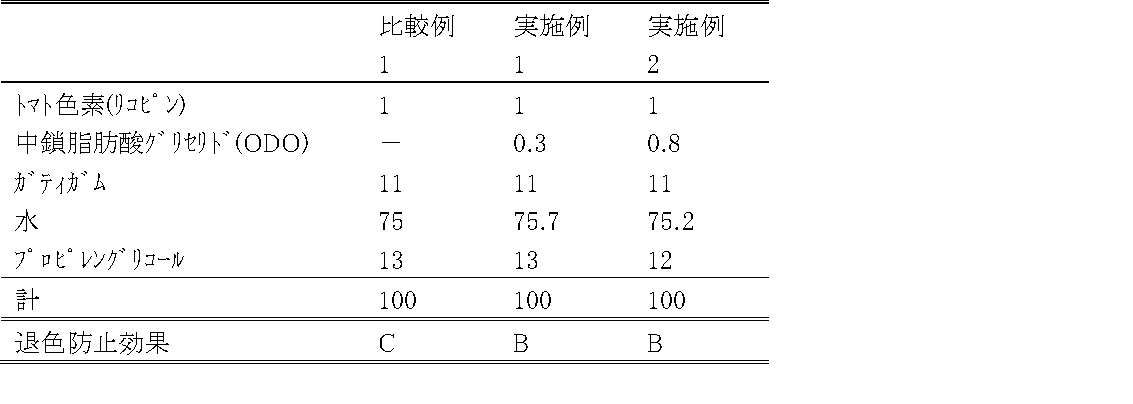
- Test example 1 Using the beverages containing the preparations of the comparative examples or examples whose compositions are shown in Table 2 below, the effect of adding fats and oils [medium chain fatty acid glycerides (ODO)] as a lipophilic liquid was tested. The results are shown in Table 2.
- the preparations of each comparative example and example were prepared by mixing medium chain fatty acid glycerides after mixing tomato pigment in gati gum aqueous solution containing water, gati gum and propylene glycol. The formulation was then treated with a high pressure homogenizer (pressure 500 kg / cm 2 ).
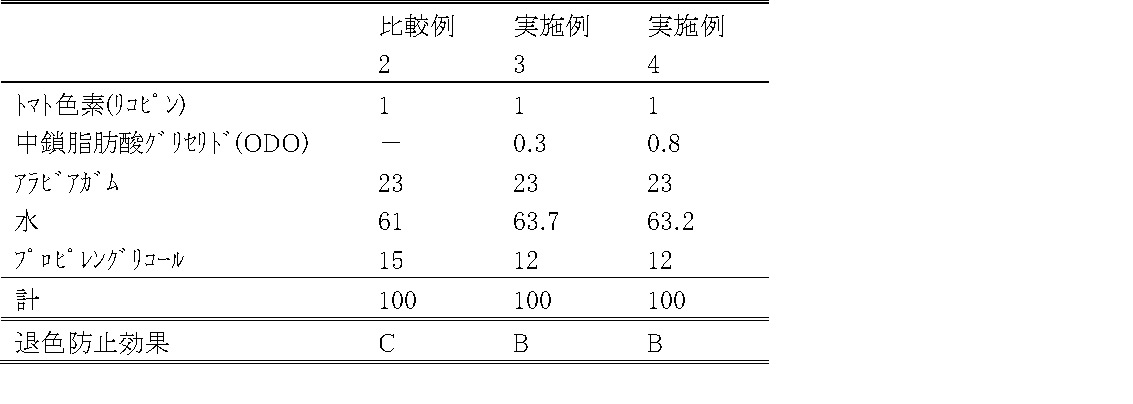
- Test example 2 The evaluation test at the time of changing the kind of dispersion
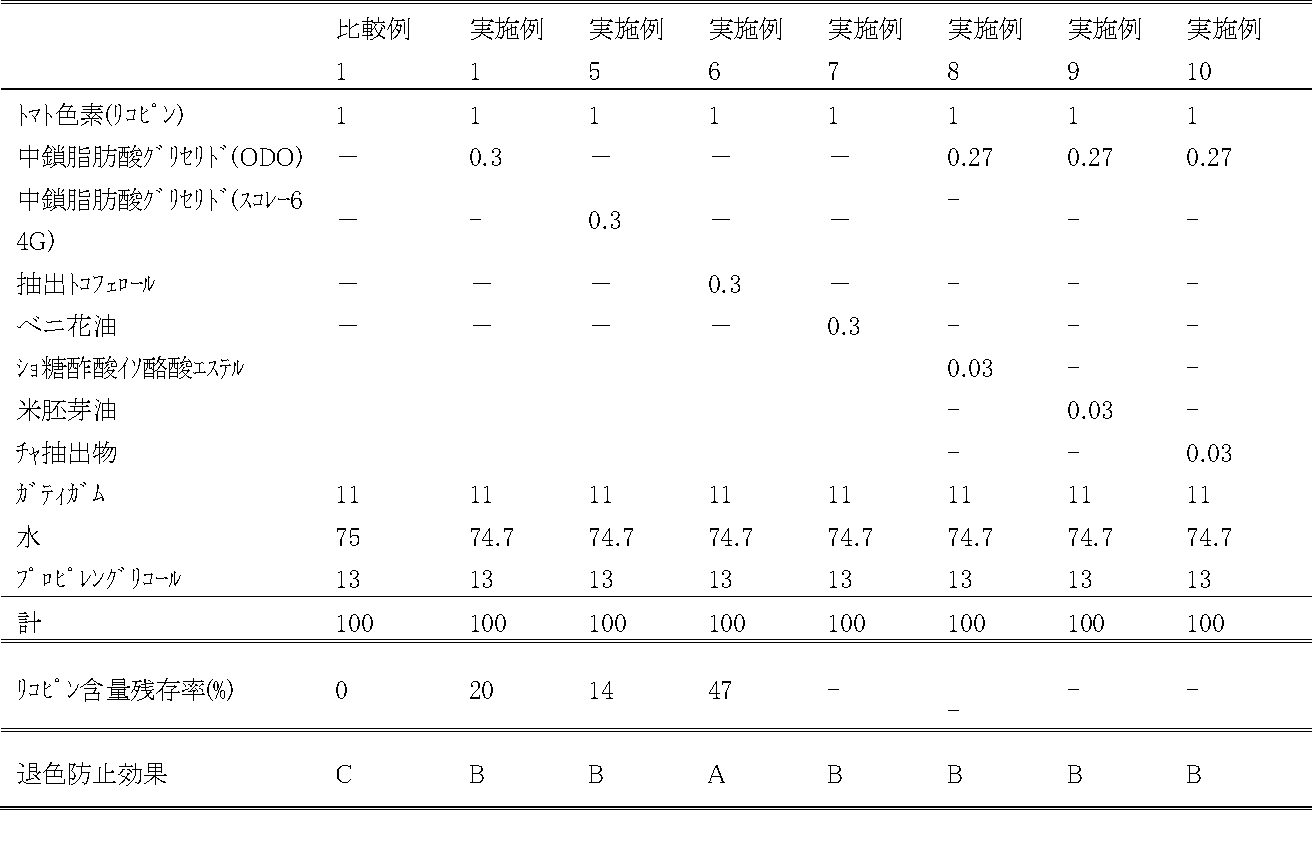
- Test example 3 The evaluation test of the difference by the kind of lipophilic liquid was implemented using the drink containing the formulation of each comparative example or Example which shows a composition in the following Table 4. The results are shown in Table 4.
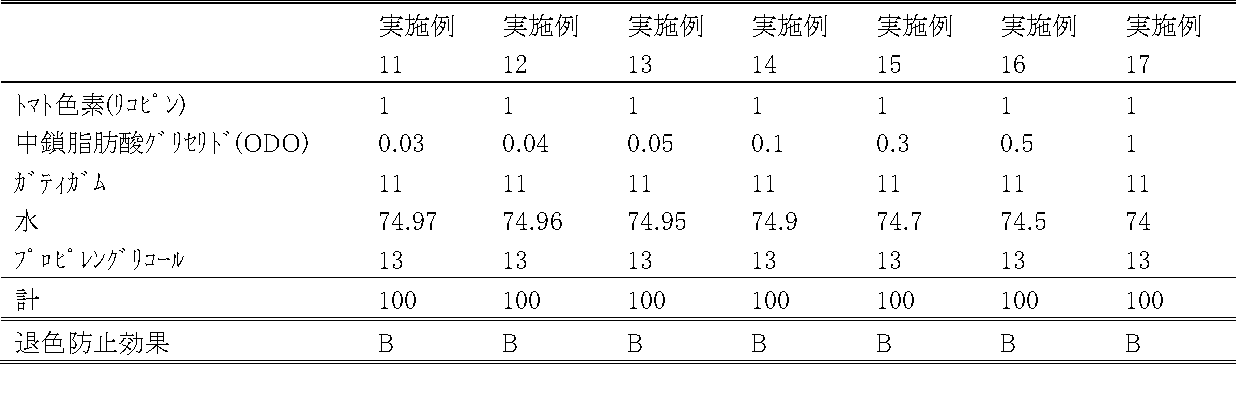
- Test example 4 The evaluation test of the difference in oil addition amount was carried out using beverages containing the preparations of the comparative examples or examples whose compositions are shown in Table 5 below. The results are shown in Table 5.
- Test Example 5 The evaluation test of the difference by the particle diameter of a pigment
- Test Example 6 The effects in the powder formulations of the comparative examples or examples whose compositions are shown in Table 7 below were tested. The formulation was prepared by mixing each component. The results are shown in Table 7.
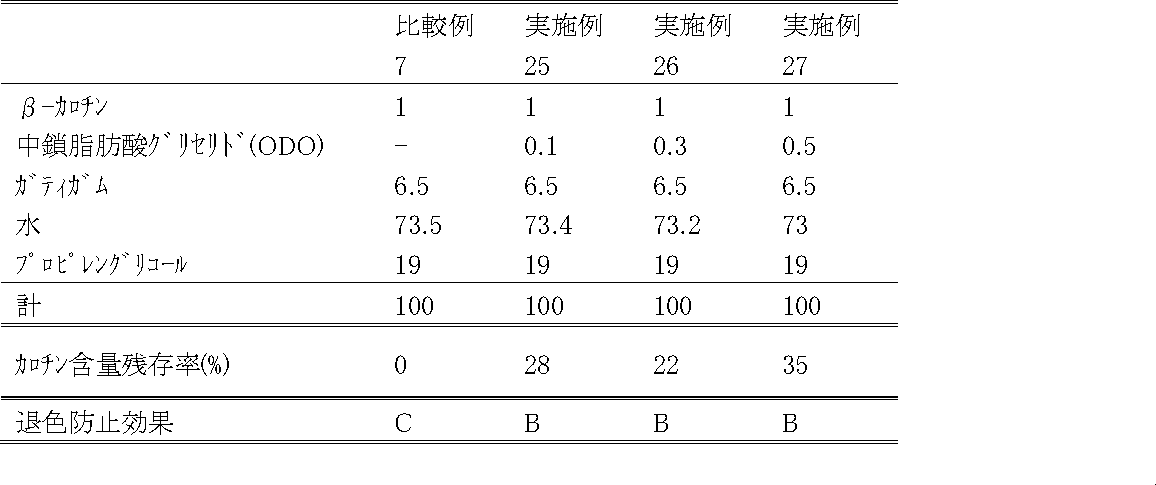
- Test Example 7 The effects of other carotenoids ( ⁇ -carotene) were tested using beverages containing the preparations of the comparative examples or examples whose compositions are shown in Table 8 below. The results are shown in Table 8.
- Test B [foam test ([Test Ba] foaming and [Test Bb] foam blowing] ⁇ Preparation of test solution> With the composition of Table 9, a test solution was prepared as follows. First, citric acid (anhydrous), 3Na citrate, and L-ascorbic acid were dissolved in water, and then fructose-glucose liquid sugar and fruit juice were mixed to prepare liquid 1. Next, 0.4 g of liquid 2 was added to 16.6 g of liquid 1 to prepare a syrup. A test solution was prepared by mixing 20 g of syrup and 80 mL of carbonated water.
- ⁇ Test method> pour 500 ml of the test solution into a 1000 ml graduated cylinder (inner diameter: 65 mm) using a funnel (caliber: ⁇ 100 mm, foot length: 105 mm), and the height of the top surface of the foam when the top surface of the foam is at the highest position. I read the value. When the sample overflowed from the graduated cylinder due to foaming, its mass was measured.
- Test Example B1 is “Comparative Example B1”, and the other test examples are the leftmost comparative examples in each table.
- test results of each sample are summarized in the following tables according to the test purpose of each test example. Examples with common numbers in each table are the same test results.
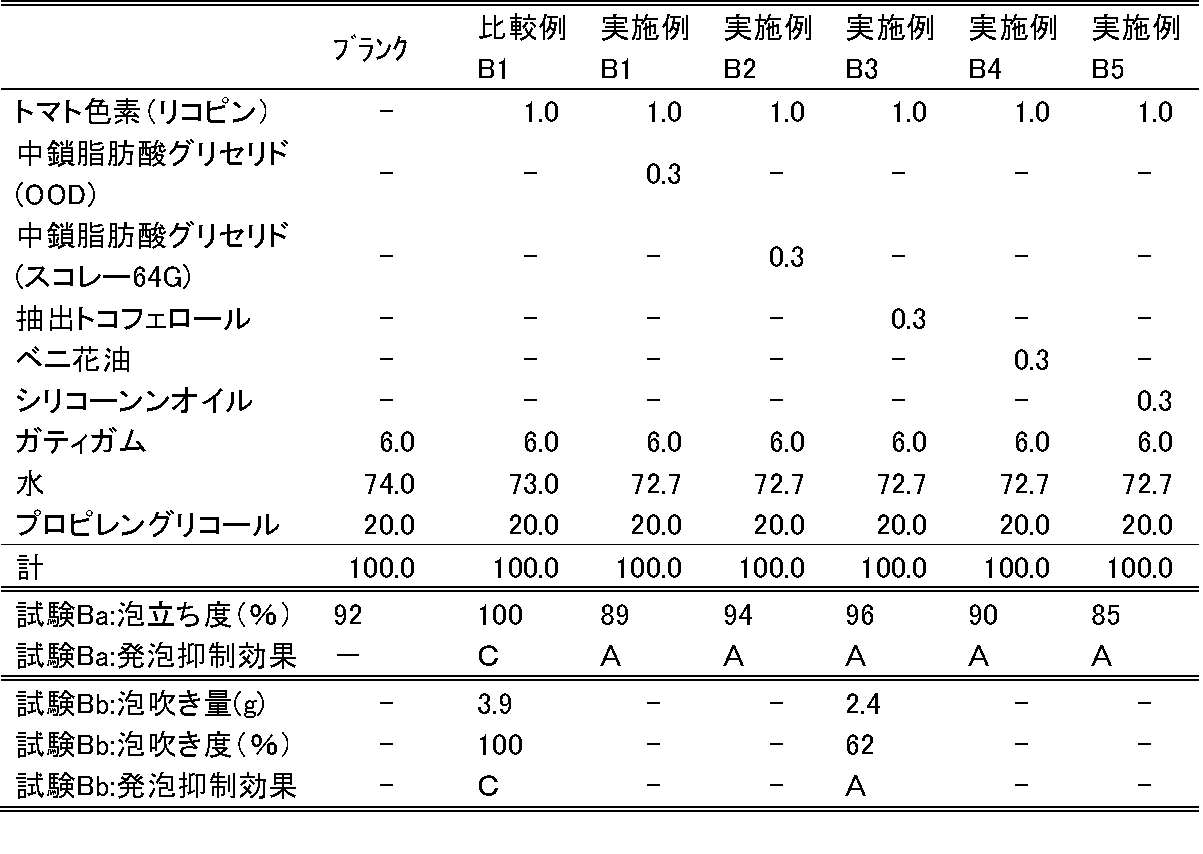
- Test example B1 The influence of the type of lipophilic liquid on the foaming suppression effect was tested. Table 12 shows the results. From this result, even when the kind of oil was different, the foaming suppression effect of the Example of this invention was confirmed.
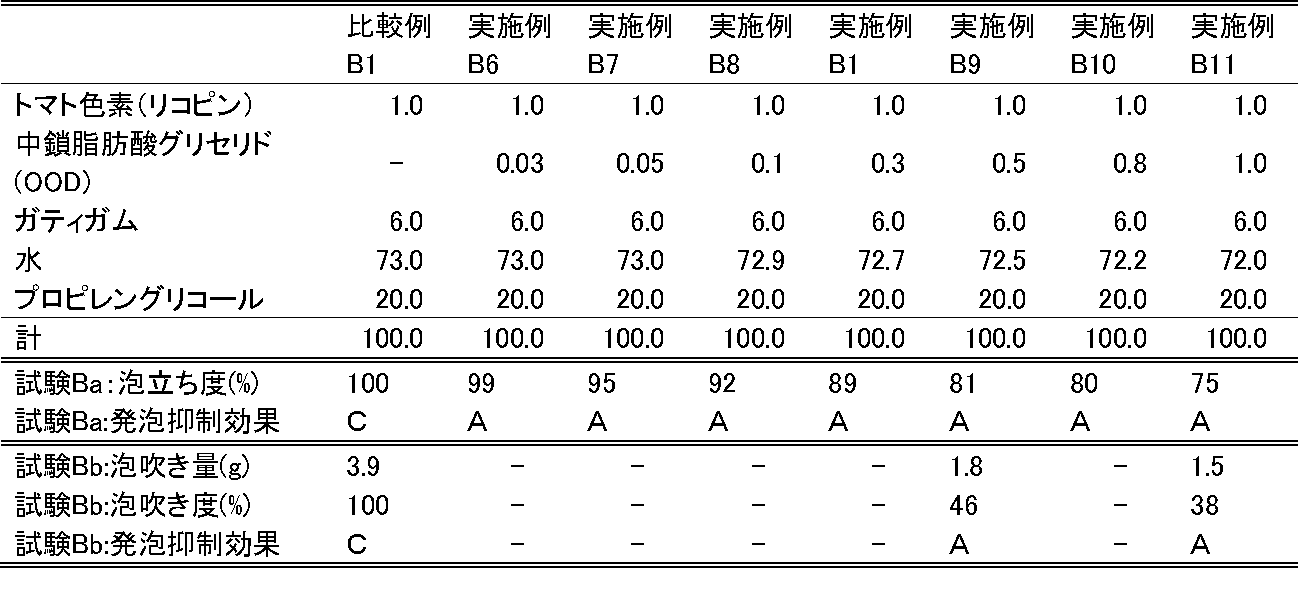
- Test example B2 The influence of the amount of oil added on the foaming suppression effect was tested. Table 13 shows the results. It was confirmed that the foaming suppression effect tended to increase as the amount of oil added increased.
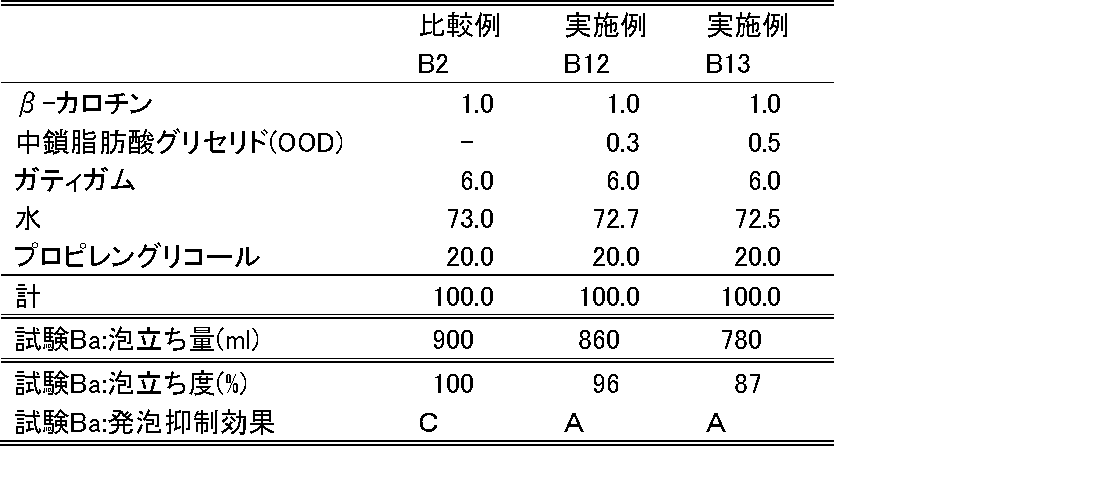
- Test Example B3 For other carotenoids, iron, and curcumin (turmeric pigment), the foaming inhibitory effect was tested. The results are shown in Tables 14-16. The foaming inhibitory effect was also confirmed for other carotenoids, iron, and curcumin (turmeric pigment).
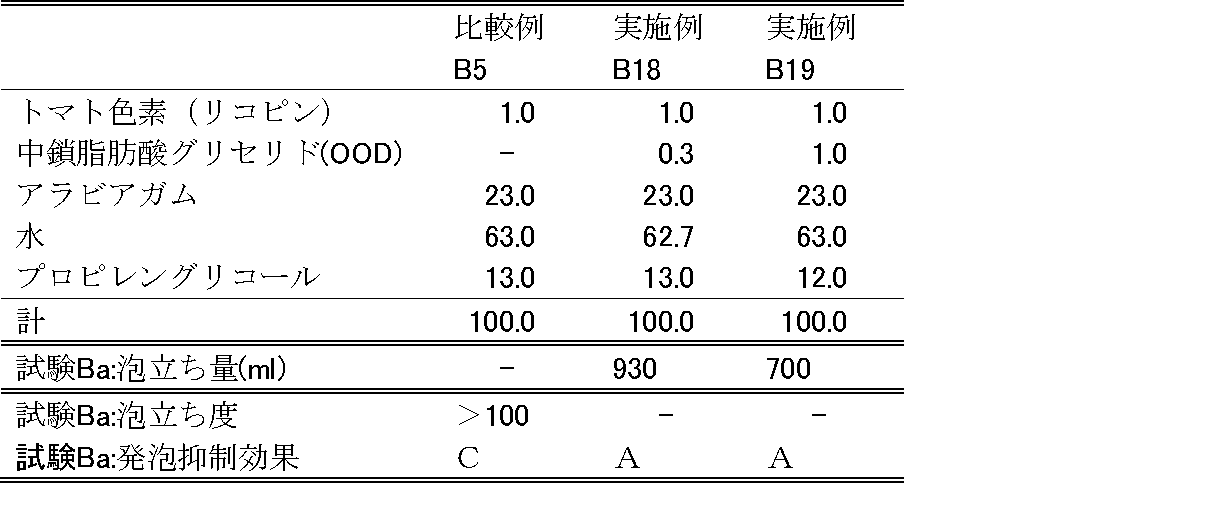
- Test Example B4 The foaming suppression effect when using gum arabic was tested. The results are shown in Table 17. In Comparative Example B5, a large amount of foam was generated when carbonated water was poured into the syrup, overflowing from the 1000 ml graduated cylinder, and the total amount of carbonated water could not be poured. On the other hand, the foaming amounts of Examples B18 and B19 are as shown in Table 17. From this result, even when gum arabic was used, the foaming suppression effect was confirmed.
Landscapes
- Chemical & Material Sciences (AREA)
- Life Sciences & Earth Sciences (AREA)
- Engineering & Computer Science (AREA)
- Food Science & Technology (AREA)
- Polymers & Plastics (AREA)
- Nutrition Science (AREA)
- Health & Medical Sciences (AREA)
- Organic Chemistry (AREA)
- Oil, Petroleum & Natural Gas (AREA)
- Chemical Kinetics & Catalysis (AREA)
- Biotechnology (AREA)
- Coloring Foods And Improving Nutritive Qualities (AREA)
- Non-Alcoholic Beverages (AREA)
- Medicinal Preparation (AREA)
- Cosmetics (AREA)
- Pharmaceuticals Containing Other Organic And Inorganic Compounds (AREA)
Abstract
Description
固体カロテノイド色素、及び固体クルクミン色素からなる群より選択される1種以上の固体色素を、当該固体カロテノイド色素100質量部に対して200質量部以下の量の親油性液体と混合することにより、当該固体カロテノイド色素を安定化できることを見出し、かかる知見に基づいて、本発明を完成するに至った。
固体カロテノイド色素、及び固体クルクミン色素からなる群より選択される1種以上の固体色素の安定化方法であって、
前記固体色素を、当該固体色素100質量部に対して200質量部以下の量の親油性液体と混合する工程を含む方法。
項2.
前記安定化方法が、固体色素自体の化学的変化を抑制する方法、又は固体色素がこれを含有する周囲環境としての水性液体に与える物理的不安定性を抑制する方法である、項1の記載の方法。
項3.
固体カロテノイド色素、及び固体クルクミン色素からなる群より選択される1種以上の固体色素を含有する色素製剤であって、
前記固体色素100質量部に対して200質量部以下の量の親油性液体を含有する製剤。
項4.
更に水を含有する、項3に記載の製剤。
項5.
固体カロテノイド色素、及び固体クルクミン色素からなる群より選択される1種以上の固体色素を含有する色素製剤の製造方法であって、
前記固体色素を、当該固体カロテノイド色素100質量部に対して200質量部以下の量の親油性液体と混合する工程を含む製造方法。
項6.
固体色素を親油性液体と混合する前記工程が、
水性媒体中で実施される、項5に記載の色素製剤の製造方法。
項7.
項3又は4に記載の製剤を含有する食品。
項8.
カロテノイド色素、及びクルクミン色素からなる群より選択される1種以上の色素を含有する食品の製造方法であって、項3又は4に記載の製剤を食品原料と混合する工程を含む製造方法。
項9.
(1)疎水性固体粒子、及び
(2)当該疎水性固体粒子を直接的に被覆している被覆層であって、親油性液体を含有し、及び気体を含有しない被覆層
を含有する、
被覆疎水性固体粒子。
項10.
前記疎水性固体が、固体カロテノイド色素、及び固体クルクミン色素からなる群より選択される1種以上の固体色素である、
項9に記載の被覆疎水性固体粒子。
項11.
前記被覆層が、更に、アラビアガム、及びガティガムからなる群より選択される1種以上の水溶性多糖類を含有する、
項9又は10に記載の被覆疎水性固体粒子。
項12.
[1]前記被覆層が、更に、アラビアガム、及びガティガムからなる群より選択される1種以上の水溶性多糖類を含有する、
項9~10に記載の被覆疎水性固体粒子、及び
[2]水
を含有する、疎水性固体粒子含有水性製剤。
固体カロテノイド色素、及び固体クルクミン色素からなる群より選択される1種以上の固体色素の安定化方法;
固体カロテノイド色素、及び固体クルクミン色素からなる群より選択される1種以上の固体色素含有製剤;
固体カロテノイド色素、及び固体クルクミン色素からなる群より選択される1種以上の固体色素含有製剤の製造方法;及び
カロテノイド色素、及びクルクミン色素からなる群より選択される1種以上の色素を含有する食品等を提供する。
本明細書中の記号及び略号は、特に限定のない限り、本明細書の文脈に沿い、本発明が属する技術分野において通常用いられる意味に理解できる。
本明細書中、語句「含有する」は、語句「から本質的になる」、及び語句「からなる」を包含することを意図して用いられる。
特に限定されない限り、本明細書中に記載されている工程、処理、又は操作は、室温で実施され得る。
本明細書中、室温は、10~40℃の範囲内の温度を意味する。
[1]固体色素自体の化学的変化を抑制すること、すなわち、例えば、(1)化合物、又はその組成物である色素の化学的変化(例:分解、酸化、還元)の抑制、又は防止;並びに(2)色素の退色の抑制、又は防止;並びに
[2]固体色素がこれを含有する周囲環境である液体に与える物理的不安定性を抑制すること、すなわち、例えば、当該色素を含有する周囲環境としての水性液体の発泡を抑制することを包含する。
この説明から理解されるように、
前記[1]の安定化は、固体色素が、固体又は液体の任意の環境中に存在するときに好適に実施又は利用され、及び
前記[2]の安定化は、固体色素が、液体環境中に存在するときに好適に実施される。
本発明の固体カロテノイド色素、及び固体クルクミン色素からなる群より選択される1種以上の固体色素の安定化方法は、
当該固体色素を、当該固体色素100質量部に対して200質量部以下の量の親油性液体と混合する工程を含む。
本発明で用いられる固体カロテノイド色素、及び固体クルクミン色素からなる群より選択される1種以上の固体色素(本明細書中、単に、本発明で用いられる固体色素、又は固体色素と称する場合がある。)は、好ましくは室温で固体である。
本発明で用いられる当該固体色素は、好ましくはその一部、又は全部が結晶である。
本発明で用いられる当該固体色素の形状は特に限定されず、好ましくは、粉状又は粒状であることができる。
そのサイズは、メジアン径で、通常5μm以下であり、好ましくは2μm以下、より好ましくは1μm以下、更に好ましくは0.7μm以下、及びより更に好ましくは0.5μm以下である。
前記固体色素がこのようなサイズを有することにより、本発明の色素製剤、及びこれを含有する食品等がより明るい色を呈し得る。
これらは、本発明において、単独で、又は複数を組み合わせて用いることができる。
なかでも好ましくは、ウコンの根茎の乾燥品(ウコン粉末)から温時エタノールで、熱時油脂若しくはプロピレングリコールで、又は室温時~熱時ヘキサン若しくはアセトンで抽出して調製されるクルクミンである。更に好ましくは結晶状態のクルクミンである。かかるクルクミンは、ウコン粉末をヘキサン及びアセトンによって抽出し、その抽出溶液を濾過後、乾燥させて溶媒を揮発させることによって調製することができる。或いは、合成品を用いることもできる。
本発明で用いられる親油性液体は、好ましくは室温で液体である。
本発明で用いられる親油性液体が2種以上の親油性物質の組合せである場合、本発明で用いられる親油性液体は、当該組合せとして液体であればよく、必ずしも親油性物質が単独で液体であることを必要としない。
菜種油、パーム油、大豆油、オリーブ油、ホホバ油、ヤシ油、ベニ花油、エレミ樹脂、及びマスティック樹脂等の植物性油脂類;
牛脂、豚脂等の動物性油脂類;並びに
ショ糖酢酸イソ酪酸エステル(SAIB)、ロジン、ダンマル樹脂、エステルガム、グリセリン脂肪酸エステル、及び中鎖脂肪酸トリグリセリド(MCT)等のその他の油性溶媒
を包含する。
具体的には、カプリル酸トリグリセリド、カプリン酸トリグリセリド、カプリル酸及びカプリン酸混合トリグリセリド等、並びにこれらの混合物が例示できる。
肝油、ビタミンA(例:レチノール等)、ビタミンA油、ビタミンD(例:エルゴカルシフェロール、コレカルシフェロール等)、ビタミンB2酪酸エステル、アスコルビン酸脂肪酸エステル、ビタミンE(例:トコフェロール、トコトリエノール等)、ビタミンK(例:フィロキノン、メナキノン等)等の脂溶性ビタミン類;
リモネン、リナロール、ネロール、シトロネロール、ゲラニオール、シトラール、l-メントール、オイゲノール、シンナミックアルデヒド、アネトール、ペリラアルデヒド、バニリン、γ-ウンデカラクトン等の植物精油類;
レスベラトロール、油溶性ポリフェノール、グリコシルセラミド、セサミン、ホスファチジルセリン、コエンザイムQ10、ユビキノール、α-リポ酸;
α-リノレン酸、エイコサペンタエン酸、及びドコサヘキサエン酸等のΩ-3系脂肪酸;リノール酸、及びγ-リノレン酸等のΩ-6系脂肪酸;並びに
植物ステロール
を包含する。
前記油溶性生理活性物質は、1種単独、又は2種以上の組み合わせであることができる。
前記親油性液体の量は、前記固体色素100質量部に対して200質量部以下であり、好ましくは200質量部未満であり、より好ましくは150質量部以下、更に好ましくは100質量部未満、より更に好ましくは100質量部未満、特に好ましくは80質量部以下、更に特に好ましくは60質量部以下、殊更に好ましくは50質量部以下、及び最も好ましくは40質量部以下である。
本発明の別の一態様においては、前記混合を実施し、その後、所望により、当該混合物を媒体(好ましくは水性媒体)中に分散させる。
当該媒体は、後記するその他の成分等を含有していてもよい。当該媒体(例、溶媒、又は分散媒)の例は、水、低級アルコール、多価アルコール、及びこれらの2種以上の混合液を包含する。当該媒体の好ましい例は、水、多価アルコール、及び水と多価アルコールとの混合液を包含する。当該媒体のより好ましい例は、水と多価アルコールとの混合液を包含する。当該「水と多価アルコールとの混合液」中の多価アルコール含有割合は、特に制限されないが、1質量%以上且つ100質量%未満の範囲内、好ましくは3質量%以上且つ80質量%以下、より好ましくは5質量%以上60質量%以下、更に好ましくは8質量%以上50質量%以下、及びより更に好ましくは8質量%以上30質量%以下未満の範囲を挙げることができる。
また、水と低級アルコールとの混合液を用いる場合における、当該混合液中の低級アルコール含有割合の例も、これと同様の例を包含する。
本発明の好適な一態様においては、前記固体色素と親油性液体との混合は、界面活性剤の存在下で実施することができる。
本発明で使用できる界面活性剤は、飲食品、医薬品、医薬部外品、又は化粧品の分野で乳化剤及び/又は分散剤として広く使われているものであればよく特に制限されない。
具体的には、
グリセリン脂肪酸エステル、ショ糖脂肪酸エステル、及びソルビタン脂肪酸エステル等のエステル;
レシチン、酵素分解レシチン、及び酵素処理レシチン等のリン脂質;
キラヤ抽出物、エンジュサポニン、大豆サポニン、酵素処理大豆サポニン、茶種子サポニン、及びユッカフォーム抽出物等のサポニン;
ポリソルベート(ポリソルベート20、60、65、80);
アラビアガム、及びガティガム;並びに
加工デンプン
等を例示することができる。
その好適な例は、グリセリン脂肪酸エステル、ショ糖脂肪酸エステル、リン脂質、アラビアガム、ガティガム、及び加工デンプン、並びにそれらの2種以上の組み合わせを包含する。
そのより好適な例は、アラビアガム、ガティガム、及び加工澱粉、並びにそれらの2種以上の組み合わせを包含する。
そのより更に好適な例は、アラビアガム、及びガティガム、並びに両者の組み合わせを包含する。
本発明の好適な一態様においては、水に対するアラビアガム含量が1質量%以上、好ましくは5質量%以上、より好ましくは8質量%以上、及び更に好ましくは10質量%以上であるアラビアガム水溶液の存在下で、前記固体色素と親油性液体との混合を実施することができる。当該水に対するアラビアガム含量の上限は特に制限されないが、例えば、50質量%、好ましくは45質量%、より好ましくは40質量%が挙げられる。
本発明の別の好適な一態様においては、水に対するガティガム含量が1質量%以上、好ましくは5質量%以上、より好ましくは8質量%以上、更に好ましくは10質量%以上であるガティガム水溶液の存在下で、前記固体色素と親水性液体との混合を実施することができる。当該水に対するガティガム含量の上限は特に制限されないが、例えば、50質量%、好ましくは35質量%、より好ましくは25質量%が挙げられる。
水性媒体中における、
固体カロテノイド色素、及び固体クルクミン色素からなる群より選択される1種以上の固体色素の安定化方法であって、
前記固体色素を、当該固体色素100質量部に対して200質量部以下の量の親油性液体
と混合する工程を含む方法。
前記のとおり、本発明の固体色素の安定化方法には、飲料等の水性媒体中における前記固体色素の安定化方法、すなわち、
水性媒体における前記固体色素の退色抑制又は退色防止方法、及び
水性媒体における前記固体色素の発泡抑制方法、
が包含される。
水性媒体中における、
固体カロテノイド色素、及び固体クルクミン色素からなる群より選択される1種以上の固体色素の安定化方法であって、
前記固体色素を、当該固体色素100質量部に対して200質量部以下の量の親油性液体、並びに
アラビアガム、ガティガム及び加工澱粉からなる群から選択される1種以上、
と混合する工程を含む方法。
本発明の色素製剤(本明細書中、本発明の固体色素含有製剤とも称する。)は、
固体カロテノイド色素、及び固体クルクミン色素からなる群より選択される1種以上の固体色素、及び当該固体色素100質量部に対して100質量部以下の量の親油性液体を含有する。
本発明の固体色素含有製剤が含有する固体カロテノイド色素、及び固体クルクミン色素からなる群より選択される1種以上の固体色素は、前記本発明の安定化方法について説明したものと同様であることができる。
本発明の固体色素含有製剤は、固体カロテノイド色素、及び固体クルクミン色素からなる群より選択される1種以上の固体色素以外の色素を含有していてもよい。
なお、本明細書中、単に固体色素と称する場合は、特に記載の無い限り、当該固体カロテノイド色素、及び固体クルクミン色素からなる群より選択される1種以上の固体色素を意味し、これ以外の固体色素を意味しない。
前記固体色素の量は、本発明の固体色素含有製剤の全体に対して、通常20質量%以下であり、好ましくは15質量%以下であり、及びより好ましくは10質量%以下である。
本発明の固体色素含有製剤が含有する親油性液体は、前記本発明の安定化方法について説明したものと同様であることができる。
本発明の固体色素含有製剤は、本発明の効果を著しく損なわない限りにおいて、その他の成分、すなわち、前記固体色素、及び前記親油性液体以外の成分を含有することができる。
具体的には、
グリセリン脂肪酸エステル、ショ糖脂肪酸エステル、ソルビタン脂肪酸エステル;
レシチン、酵素分解レシチン、酵素処理レシチン等のリン脂質;
キラヤ抽出物、エンジュサポニン、大豆サポニン、酵素処理大豆サポニン、茶種子サポニン、ユッカフォーム抽出物等のサポニン;
ポリソルベート(ポリソルベート20、60、65、80);
アラビアガム、ガティガム;加工デンプン
等を例示することができる。
その好適な例は、グリセリン脂肪酸エステル、ショ糖脂肪酸エステル、リン脂質、アラビアガム、ガティガム、及び加工デンプン、並びにそれらの2種以上の組み合わせを包含する。
そのより好適な例は、グリセリン脂肪酸エステル、ショ糖脂肪酸エステル、アラビアガム、及びガティガム、並びにそれらの2種以上の組み合わせを包含し、更に好適な例は、アラビアガム、ガティガム及び加工澱粉、並びにそれらの2種以上の組み合わせを包含し、より更に好適な例は、アラビアガム、及びガティガム、並びにそれらの2種以上の組み合わせを包含する。
例えば、界面活性剤としてアラビアガムを使用した場合、その量は、本発明の固体色素含有製剤の全体に対して、通常5~40質量%、好ましくは10質量%~35質量%の範囲内であることができる。
また、例えば、界面活性剤としてガティガムを使用した場合、その量は、通常1質量%~20質量%、及び好ましくは1~15質量%の範囲内であることができる。
L-アスコルビン酸ステアリン酸エステル、L-アスコルビン酸パルミチン酸エステル等のアスコルビン酸エステル類;
エリソルビン酸及びエリソルビン酸ナトリウム等のエリソルビン酸類;
亜硫酸ナトリウム、次亜硫酸ナトリウム、ピロ亜硫酸ナトリウム及びピロ亜硫酸カリウムなどの亜硫酸塩類等;
α-トコフェロール及びミックストコフェロール等のトコフェロール類;
ジブチルヒドロキシトルエン(BHT)及びブチルヒドロキシアニソール(BHA)等;
エチレンジアミン四酢酸カルシウム二ナトリウム及びエチレンジアミン四酢酸二ナトリウム等のエチレンジアミン四酢酸類;
没食子酸及び没食子酸プロピル等の没食子酸類;
アオイ花抽出物、アスペルギルステレウス抽出物、カンゾウ油性抽出物、食用カンナ抽出物、グローブ抽出物、精油除去ウイキョウ抽出物、セイヨウワサビ抽出物、セージ抽出物、セリ抽出物、チャ抽出物、テンペ抽出物、ドクダミ抽出物、生コーヒー豆抽出物、ヒマワリ種子抽出物、ピメンタ抽出物、ブドウ種子抽出物、ブルーベリー葉抽出物、プロポリス抽出物、へゴ・イチョウ抽出物、ペパー抽出物、ホウセンカ抽出物、ヤマモモ抽出物、ユーカリ葉抽出物、リンドウ根抽出物、ルチン抽出物(小豆全草,エンジュ,ソバ全草抽出物)、ローズマリー抽出物等の各種植物の抽出物;
その他、クエルセチン、ルチン酵素分解物(イソクエルシトリン)、酵素分解リンゴ抽出物、ゴマ油抽出物、菜種油抽出物、コメヌカ油抽出物、コメヌカ酵素分解物等を包含する。
また、液体状態の製剤を調製する場合の賦形剤の例は、水、グリセリン、プロピレングリコール、単シロップ、エタノール、エチレングリコール、ポリエチレングリコール、ソルビトール等を包含する。
本発明の固体色素含有製剤の好適な一態様は、水を含有する製剤、好ましくは水性製剤であることができる。
水、
固体カロテノイド色素、及び固体クルクミン色素からなる群より選択される1種以上の固体色素を含有する色素製剤であって、
前記固体色素100質量部に対して200質量部以下の量の親油性液体、
を含有する製剤。
水、
固体カロテノイド色素、及び固体クルクミン色素からなる群より選択される1種以上の固体色素を含有する色素製剤であって、
前記固体色素100質量部に対して200質量部以下の量の親油性液体、並びに、
アラビアガム、ガティガム、及び加工澱粉からなる群より選択される1種以上、
を含有する製剤。
紅茶飲料、緑茶、ブレンド茶等の茶飲料類(なお、飲料類と茶飲料類は、「飲料」に包含される。);
カスタードプリン、ミルクプリン、果汁入りプリン等のプリン類、ゼリー、ババロア及びヨーグルト等のデザート類;
ミルクアイスクリーム、果汁入りアイスクリーム及びソフトクリーム、アイスキャンディー等の冷菓類;
チューインガム及び風船ガム等のガム類(例:板ガム、糖衣状粒ガム);
コーティングチョコレート(例:マーブルチョコレート等)、風味を付加したチョコレート(例:イチゴチョコレート、ブルーベリーチョコレート及びメロンチョコレート等)等のチョコレート類;
ハードキャンディー(例:ボンボン、バターボール、マーブル等)、ソフトキャンディー(例:キャラメル、ヌガー、グミキャンディー、マシュマロ等)、糖衣キャンディー、ドロップ、及びタフィ等のキャンディー類;
コンソメスープ、ポタージュスープ等のスープ類;
セパレートドレッシング、ノンオイルドレッシング、ケチャップ、たれ、ソースなどの液体調味料類;
ストロベリージャム、ブルーベリージャム、マーマレード、リンゴジャム、杏ジャム、プレザーブ、シロップ等のジャム類;
赤ワイン等の果実酒;
シロップ漬のチェリー、アンズ、リンゴ、イチゴ、桃等の加工用果実;
漬物等の農産加工品;を挙げることができる。
なかでも好ましくは飲料、デザート類(特に好適にはゼリー)、キャンディー類、ジャム、漬物、液体調味料であり、より好ましくは飲料である。
なかでも好ましくは、ドリンク剤、及びシロップ剤が例示できる。
本発明の固体色素含有製剤は、その剤形に応じて、慣用の方法、又はそれに準じる方法を採用して製造できる。
固体色素を、当該固体色素100質量部に対して100質量部以下の量の親油性液体と混合する工程を含む製造方法により製造することができる。
本発明は更に、
(1)疎水性固体粒子、及び
(2)当該疎水性固体粒子を直接的に被覆している被覆層であって、親油性液体を含有し、及び気体を含有しない被覆層
を含有する、
被覆疎水性固体粒子
もまた提供する。
ここで、語句「気体を含有しない」とは、気体を実質的に、又は完全に含有しないことを包含する。
ここで、気体は、気体の形態を有するものを意味し、媒体中に完全に溶解している気体を意味しない。すなわち、前記被覆層には、気体が溶解していてもよい。
本明細書中、被覆は、完全な被覆、又は不完全な(部分的な)被覆を包含する。
本発明の被覆疎水性固体粒子において、前記疎水性固体粒子が被覆されていることは、例えば、顕微鏡観察により、当該被覆疎水性固体粒子が、前記疎水性固体粒子の形状とはとは異なる滑らかな形状を有することにより、容易に認識可能である。
また、前記疎水性固体は、好ましくはステロール、固体無機塩及び固体有機酸塩からなる群より選択される1種以上の塩であることができ、及びより好ましくは、固体無機鉄塩(例えば、ピロリン酸鉄等)、及び固体無機カルシウム塩(例えば、炭酸カルシウム、リン酸カルシウム等)であることができる。
すなわち、そのサイズの下限は、特に限定されないが、メジアン径で、0.01μmであることができる。
そのサイズは、メジアン径で、通常5μm以下であり、好ましくは1μm以下であり、より好ましくは0.5μm以下である。
これにより、優れた発泡抑制効果が奏され得る。
本発明は、更に、
[1]前記被覆層が、更に、アラビアガム、及びガティガムからなる群より選択される1種以上の水溶性多糖類を含有する、
前記本発明の被覆疎水性固体粒子、及び
[2]水
を含有する、
疎水性固体粒子含有水性製剤を
提供する。
当該水性製剤中の前記被覆疎水性固体粒子の含有量の上限は、特に限定されないが、例えば、10質量%、20質量%、30質量%、40質量%、50質量%、60質量%、又は70質量%であることができる。
本発明の食品は、本発明の疎水性固体粒子、又は本発明の疎水性固体粒子含有製剤を含有する。
本発明の食品において、前記疎水性固体粒子、及び/又は前記疎水性固体含有製剤は、元の性状(例:形状、組成、及び性質、並びにこれらの2種以上の組合せ)を完全に若しくは実質的に保持していてもよく、又は保持していなくてもよいが、保持されている程度が高いことが好ましい。
ここで、「実質的に」とは、疎水性固体の安定化が実現されていることを指標にして判断され得る。
本発明の食品の好適な一態様は、カロテノイド色素、及びクルクミン色素からなる群より選択される1種以上の色素を含有する色素含有食品である。
本発明の食品の別の好適な一態様は、固体無機鉄塩(例えば、ピロリン酸鉄等)を含有する鉄含有食品、又は固体無機カルシウム塩(例えば、炭酸カルシウム、リン酸カルシウム等)を含有するカルシウム含有食品である。
本発明の食品は、好ましくは固体色素含有食品である。
本発明の食品は、カロテノイド色素、及びクルクミン色素以外の色素を含有していてもよい。
本発明の食品は、固体カロテノイド色素、及び固体クルクミン色素以外の固体色素を含有していてもよい。
本発明の食品は、例えば、本発明の色素製剤を食品原料と混合する工程を含む製造方法によって製造できる。
本発明で用いられる食品原料は、特に限定されない。
前述した通り、当該「食品原料」は通常「食品原料」と認識されているものに加えて、通常「食品」と認識されているものも、包含することを意図して用いられる。
中鎖脂肪酸グリセリド(ODO): カプリル酸/カプリン酸=3/1、日清オイリオ社
中鎖脂肪酸グリセリド(スコレー64G): カプリル酸/カプリン酸=3/2、日清オイリオ社
ベニ花油: 脂肪酸組成として75%リノール酸
ショ糖酢酸イソ酪酸エステル(SAIB):EASTMAN CHEMICAL PRODUCTS INC.
米胚芽油(こめ胚芽油ガンマ30N):ガンマ-オリザノール含量 30質量%、築野食品
加工澱粉(ピュリティガムBE):オクテニルコハク酸デンプンナトリウム、NSC社
シリコーンオイル:TSA750S、MOMENTIVE社
チャ抽出物(サンカテキン油性E):茶カテキン量 6質量%以上、三井農林
柑橘混合混濁果汁(5倍濃縮):柑橘混合混濁果汁 53R、 えひめ飲料
後記表1~8に記載の組成で、次の試料調製方法により、各比較例、及び実施例のカロテノイド色素製剤を調製した。
<試料調製方法>
リコピン、又はカロチンの結晶を湿式摩砕機ダイノミル(WAB社製、ダイノミルKDL)を用いて粉砕し、結晶性微細化粒子分散組成物を調製した。
メジアン径の測定は、レーザー解析式粒度分布計(日機装社製、マイクロトラック MT-3000 II)を用いて行った。
保存後の飲料を、後記の退色防止効果の評価方法で評価した。

果糖ぶどう糖液糖、クエン酸(無水)、ビタミンC、クエン酸3ナトリウム、及びイオン交換水を混合して溶解させた。
次いで、そこへ各比較例又は実施例の製剤10%水溶液を添加し、マグネットスターラーにて1000rpmで10分間混合した。得られた溶液を93℃達温にて200mlのPETボトルに100gずつ充填した。
n-ヘキサンによって、各飲料からリコピンを抽出した。
これを分光光度計(日本分光社、分光光度計V-600)を用いて、n-ヘキサンを対象とした極大吸収波長(474nm付近)における吸光度を測定し、次式によりリコピン含量(ppm)を求めた。
リコピン含量(ppm)=[吸光度×希釈倍率×10000]/[3450×試料秤取量(g)]
シクロヘキサンによって、飲料からカロチンを抽出した。
これを、分光光度計(日本分光社、分光光度計V-600)を用いて、シクロヘキサンを対象とした極大吸収波長(454nm付近)における吸光度を測定し、次式によりカロチン含量(ppm)を求めた。
カロチン含量(ppm)=[吸光度×希釈倍率×10000]/[2450×試料秤取量(g)]
リコピン又はカロチンの含量残存率(%)
A(優): 40%以上
B(良): 5%以上40%未満
C(不良): 5%未満
カロテノイド含量残存率(未殺菌飲料に対する残存率)の算出又は目視による評価
残存率を測定したものは、この基準に従いA(優)、B(良)、又はC(不良)の評価をつけた。
残存率を測定していないものは、それぞれの残存率における色を基準にし、目視にてA(優)、B(良)、又はC(不良)の評価をつけた。
次の表2に組成を示す各比較例又は実施例の製剤を含有する飲料を用いて、親油性液体としての油脂[中鎖脂肪酸グリセリド(ODO)]の添加効果を試験した。結果を表2に示した。各比較例及び実施例の製剤は、水、ガティガム及びプロピレングリコールを含有するガティガム水溶液にトマト色素を混合後、中鎖脂肪酸グリセリドを混合することで調製した。次いで、当該製剤を高圧ホモジナイザーで処理した(圧力500kg/cm2)。
次の表3に組成を示す各比較例又は実施例の製剤を含有する飲料を用いて、分散基材の種類を変更した場合の評価試験を実施した。結果を表3に示した。
次の表4に組成を示す各比較例又は実施例の製剤を含有する飲料を用いて、親油性液体の種類による違いの評価試験を実施した。結果を表4に示した。
次の表5に組成を示す各比較例又は実施例の製剤を含有する飲料を用いて、油添加量の違いの評価試験を実施した。結果を表5に示した。
次の表6に組成を示す各比較例又は実施例の製剤を含有する飲料を用いて、色素の粒子径による差の評価試験を実施した。結果を表6に示した。

次の表7に組成を示す各比較例又は実施例の粉末製剤における効果を試験した。当該製剤は、各成分を混合することによって調製した。結果を表7に示した。
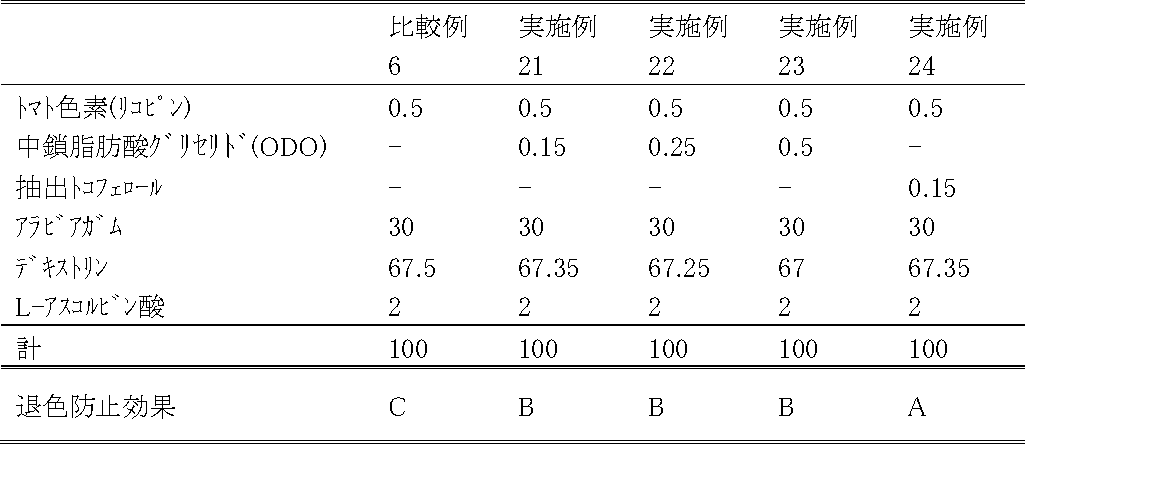
また、抽出トコフェロールの効果についても、液体製剤と同様の結果が得られた。
次の表8に組成を示す各比較例又は実施例の製剤を含有する飲料を用いて、他のカロテノイド(β-カロチン)における効果を試験した。結果を表8に示した。
<試験液の作成>
表9の組成で、次のようにして、試験液を作成した。
まず、水にクエン酸(無水)、クエン酸3Na、L-アスコルビン酸を溶解し、次いで、果糖ぶどう糖液糖、果汁を混合して、液1を作成した。
次に、16.6gの液1に、液2を0.4g添加し、シロップを作成した。
シロップ20g及び炭酸水80mLを混合し、試験液を作成した。

試験液500mlを、漏斗(口径:φ100mm、足長:105mm)を用いて、1000mlメスシリンダー(内径:65mm)に注ぎ、泡の上面が一番高い位置に来たときの、泡の上面の高さの値を読み取った。
泡立ちによりメスシリンダーから試料があふれ出た場合、その質量を測定した。
各試験において設定した対照の泡部の上面の高さを100%としたときの各試料の泡部の上面の高さ(泡立ちがない場合は液面の上面の高さ)の比を泡立ち度と定義し、その値に基づき、以下の評価基準にて試料を評価した。
各試験において設定した対照は、試験例B1は「比較例B1」であり、その他の試験例は各表中で最も左側の比較例である。

C(不良):泡立ちの抑制が不十分である。
前記シロップ22mlを、容量110ml(柏洋硝子製、「100卓上」、重量110g、ビン長131mm、胴径46mm、口部26.3ヒンジ)のジュース瓶に入れ、そこへ炭酸水を88ml添加し、試験液とした。
当該充填したジュース瓶を縦置きして140ストローク/minで横方向に2時間振とうした。
40℃にて1時間静置した。
当該静置後、開栓し、それにより噴出した泡の量を測定した。

C(不良):泡吹きの抑制が不十分である。
親油性液体の種類による泡立ち抑制効果への影響を試験した。
表12に結果を示した。
この結果から、油の種類が異なる場合でも本発明の実施例の泡立ち抑制効果が確認された。
油添加量の泡立ち抑制効果への影響を試験した。
表13に結果を示した。
油の添加量を増やすに従って、泡立ち抑制効果が増強される傾向が確認された。
他のカロテノイド、鉄、及びクルクミン(ウコン色素)に対して、それぞれ、泡立ち抑制効果を試験した。
表14~16に結果を示した。
他のカロテノイド、鉄、及びクルクミン(ウコン色素)に対しても、泡立ち抑制効果が確認された。


アラビアガムを用いた場合の、泡立ち抑制効果を試験した。
結果を表17に示した。
比較例B5はシロップに炭酸水を注ぐと大量の泡が発生し、1000mlメスシリンダーから溢れ、炭酸水全量を注ぐことができなかった。一方、実施例B18及びB19の泡立ち量は表17のとおりである。
本結果から、アラビアガムを用いた場合でも、泡立ち抑制効果が確認された。
Claims (12)
- 固体カロテノイド色素、及び固体クルクミン色素からなる群より選択される1種以上の固体色素の安定化方法であって、
前記固体色素を、当該固体色素100質量部に対して200質量部以下の量の親油性液体と混合する工程を含む方法。 - 前記安定化方法が、固体色素自体の化学的変化を抑制する方法、又は固体色素がこれを含有する周囲環境としての水性液体に与える物理的不安定性を抑制する方法である、請求項1の記載の方法。
- 固体カロテノイド色素、及び固体クルクミン色素からなる群より選択される1種以上の固体色素を含有する色素製剤であって、
前記固体色素100質量部に対して200質量部以下の量の親油性液体を含有する製剤。 - 更に水を含有する、請求項3に記載の製剤。
- 固体カロテノイド色素、及び固体クルクミン色素からなる群より選択される1種以上の固体色素を含有する色素製剤の製造方法であって、
前記固体色素を、当該固体カロテノイド色素100質量部に対して200質量部以下の量の親油性液体と混合する工程を含む製造方法。 - 固体色素を親油性液体と混合する前記工程が、
水性媒体中で実施される、請求項5に記載の色素製剤の製造方法。 - 請求項3又は4に記載の製剤を含有する食品。
- カロテノイド色素、及びクルクミン色素からなる群より選択される1種以上の色素を含有する食品の製造方法であって、請求項3又は4に記載の製剤を食品原料と混合する工程を含む製造方法。
- (1)疎水性固体粒子、及び
(2)当該疎水性固体粒子を直接的に被覆している被覆層であって、親油性液体を含有し、及び気体を含有しない被覆層
を含有する、
被覆疎水性固体粒子。 - 前記疎水性固体が、固体カロテノイド色素、及び固体クルクミン色素からなる群より選択される1種以上の固体色素である、
請求項9に記載の被覆疎水性固体粒子。 - 前記被覆層が、更に、アラビアガム、及びガティガムからなる群より選択される1種以上の水溶性多糖類を含有する、
請求項9又は10に記載の被覆疎水性固体粒子。 - [1]前記被覆層が、更に、アラビアガム、及びガティガムからなる群より選択される1種以上の水溶性多糖類を含有する、
請求項9~10に記載の被覆疎水性固体粒子、及び
[2]水
を含有する、疎水性固体粒子含有水性製剤。
Priority Applications (5)
| Application Number | Priority Date | Filing Date | Title |
|---|---|---|---|
| CN201780034549.4A CN109219639B (zh) | 2016-04-01 | 2017-03-31 | 稳定固体色素的方法 |
| US16/086,525 US20190100655A1 (en) | 2016-04-01 | 2017-03-31 | Method for stabilizing solid dye |
| EP17775622.8A EP3438209A4 (en) | 2016-04-01 | 2017-03-31 | PROCESS FOR STABILIZING SOLUBLE DYE |
| JP2018509710A JP7128739B2 (ja) | 2016-04-01 | 2017-03-31 | 固体色素の安定化方法 |
| KR1020187031381A KR20180124133A (ko) | 2016-04-01 | 2017-03-31 | 고체 색소의 안정화 방법 |
Applications Claiming Priority (2)
| Application Number | Priority Date | Filing Date | Title |
|---|---|---|---|
| JP2016074772 | 2016-04-01 | ||
| JP2016-074772 | 2016-04-01 |
Publications (1)
| Publication Number | Publication Date |
|---|---|
| WO2017171091A1 true WO2017171091A1 (ja) | 2017-10-05 |
Family
ID=59966002
Family Applications (1)
| Application Number | Title | Priority Date | Filing Date |
|---|---|---|---|
| PCT/JP2017/013863 Ceased WO2017171091A1 (ja) | 2016-04-01 | 2017-03-31 | 固体色素の安定化方法 |
Country Status (6)
| Country | Link |
|---|---|
| US (1) | US20190100655A1 (ja) |
| EP (1) | EP3438209A4 (ja) |
| JP (2) | JP7128739B2 (ja) |
| KR (1) | KR20180124133A (ja) |
| CN (1) | CN109219639B (ja) |
| WO (1) | WO2017171091A1 (ja) |
Cited By (2)
| Publication number | Priority date | Publication date | Assignee | Title |
|---|---|---|---|---|
| WO2020184556A1 (ja) * | 2019-03-11 | 2020-09-17 | 三栄源エフ・エフ・アイ株式会社 | 天然由来の水溶性色素の泡立ちを抑制する方法 |
| JP2021534105A (ja) * | 2018-08-06 | 2021-12-09 | ナチュレックス エスアーNaturex Sa | クルクミノイド組成物の使用 |
Families Citing this family (3)
| Publication number | Priority date | Publication date | Assignee | Title |
|---|---|---|---|---|
| CN114786485B (zh) * | 2019-10-21 | 2024-11-08 | 卡拉马祖控股股份有限公司 | 在腌制和发酵蔬菜应用中的光稳定的天然黄色着色剂体系 |
| EP4083177B1 (en) * | 2019-12-27 | 2026-05-06 | Suntory Holdings Limited | Beverage containing dispersed plant oil |
| IT202000022003A1 (it) * | 2020-09-18 | 2022-03-18 | Difass Int S R L | Composizioni comprendenti un sale minerale per uso orale |
Citations (10)
| Publication number | Priority date | Publication date | Assignee | Title |
|---|---|---|---|---|
| JPH0984566A (ja) * | 1995-09-28 | 1997-03-31 | Sanei Gen F F I Inc | 飲料の赤橙色着色方法 |
| JPH11285359A (ja) * | 1998-01-21 | 1999-10-19 | Basf Ag | カロチノイド―凝集体を含有する着色剤 |
| JP2002187837A (ja) * | 2000-12-20 | 2002-07-05 | Kuraray Co Ltd | 微粉化カロテノイドを含有する水溶性製剤の製造方法 |
| JP2005500157A (ja) * | 2001-08-23 | 2005-01-06 | バイオ−ダール・リミテツド | コーティングされた安定なマイクロカプセル |
| JP2008063476A (ja) * | 2006-09-08 | 2008-03-21 | T Hasegawa Co Ltd | 水分散性油溶性色素結晶製剤 |
| JP2010178655A (ja) * | 2009-02-04 | 2010-08-19 | Sanei Gen Ffi Inc | 結晶性カロテノイド色素の変色抑制方法 |
| JP2011157517A (ja) * | 2010-02-03 | 2011-08-18 | Toyo Ink Sc Holdings Co Ltd | 水系着色組成物 |
| JP2014036638A (ja) * | 2012-08-20 | 2014-02-27 | Taisho Technos Co Ltd | 食品用液体色素製剤およびそれを用いる加工食品の製造方法 |
| JP2016098364A (ja) * | 2014-11-26 | 2016-05-30 | 長谷川香料株式会社 | β−カロテン結晶の水分散性組成物 |
| JP2016098365A (ja) * | 2014-11-26 | 2016-05-30 | 長谷川香料株式会社 | リコペン結晶の水分散性組成物 |
Family Cites Families (27)
| Publication number | Priority date | Publication date | Assignee | Title |
|---|---|---|---|---|
| JPS5224535B2 (ja) * | 1974-01-24 | 1977-07-01 | ||
| JPS5865761A (ja) * | 1981-10-14 | 1983-04-19 | T Hasegawa Co Ltd | 色素用退色防止剤 |
| JPH0759181B2 (ja) * | 1985-11-29 | 1995-06-28 | 長谷川香料株式会社 | カロチノイド系色素用退色防止剤 |
| JPH06172170A (ja) * | 1992-02-13 | 1994-06-21 | T Hasegawa Co Ltd | カロチノイド含有粉末製剤 |
| JPH05247364A (ja) * | 1992-02-13 | 1993-09-24 | T Hasegawa Co Ltd | カロチノイド含有水溶性製剤 |
| JP3516737B2 (ja) * | 1994-09-30 | 2004-04-05 | 長谷川香料株式会社 | 異臭のない安定なカロチノイド製剤の製造法 |
| JPH08113723A (ja) * | 1994-10-18 | 1996-05-07 | Sanei Gen F F I Inc | 安定なリコピン色素液の製造方法 |
| JP3145584B2 (ja) * | 1994-10-21 | 2001-03-12 | 長谷川香料株式会社 | トランス体高含有β−カロチン製剤の製造方法 |
| ES2206679T5 (es) * | 1996-01-22 | 2011-10-27 | Chr. Hansen A/S | Composiciones dispersables en agua que contienen un pigmento natural hidrofóbico, su procedimiento de preparación y su utilización. |
| JPH10195325A (ja) * | 1997-01-09 | 1998-07-28 | Sanei Gen F F I Inc | カロチノイド含有錠剤の調製方法 |
| DE19841930A1 (de) * | 1998-09-14 | 2000-03-16 | Basf Ag | Stabile, pulverförmige Lycopin-Formulierungen, enthaltend Lycopin mit einem Kristallinitätsgrad von größer 20% |
| JP2002053857A (ja) * | 2000-08-09 | 2002-02-19 | Takasago Internatl Corp | カロチノイド系色素の褪色防止剤及び褪色防止方法 |
| JP2002112712A (ja) * | 2000-10-03 | 2002-04-16 | Fuji Chem Ind Co Ltd | 安定なカロチノイド類含有粉末およびその製造方法 |
| ES2606462T3 (es) * | 2001-06-14 | 2017-03-24 | San-Ei Gen F.F.I., Inc. | Preparación de emulsión de colorante carotenoide |
| KR20050050138A (ko) * | 2002-10-16 | 2005-05-27 | 마루오 칼슘 가부시키가이샤 | 식품첨가제 조성물 및 이것을 함유하는 식품조성물 |
| JP4472502B2 (ja) * | 2004-12-09 | 2010-06-02 | 理研ビタミン株式会社 | 粉末状カロテノイド製剤の製造方法 |
| EP1743530B1 (en) * | 2005-07-15 | 2011-08-31 | Unilever N.V. | Iron fortified food product and additive |
| EP1967081A1 (en) * | 2007-03-05 | 2008-09-10 | DSMIP Assets B.V. | Process for the manufacture of a powder containing carotenoids |
| JP4833176B2 (ja) * | 2007-10-05 | 2011-12-07 | 三栄源エフ・エフ・アイ株式会社 | 鉄強化飲食品用組成物 |
| JP5448511B2 (ja) * | 2008-03-31 | 2014-03-19 | 三栄源エフ・エフ・アイ株式会社 | ウコン色素組成物及びその調製方法 |
| CN101297691B (zh) * | 2008-06-06 | 2011-12-14 | 成都建福化学品有限公司 | 稳定的水溶性类胡萝卜素干粉的制备方法 |
| CN102933098B (zh) * | 2010-06-08 | 2017-03-29 | 三荣源有限公司 | 防止类胡萝卜色素附着于容器的方法 |
| EP2676553B1 (en) * | 2011-02-18 | 2017-04-12 | FUJIFILM Corporation | Carotenoid-containing composition |
| CN104220368B (zh) * | 2012-03-21 | 2016-10-12 | 株式会社益力多本社 | 焦磷酸铁组合物 |
| KR20150045445A (ko) * | 2012-08-26 | 2015-04-28 | 라이코드 리미티드 | 색상-조절된 β-카로텐 포뮬레이션 |
| JP6566270B2 (ja) * | 2013-08-28 | 2019-08-28 | ディーエスエム アイピー アセッツ ビー.ブイ.Dsm Ip Assets B.V. | ブイヨン濃縮物の鉄補給 |
| BR112017016445A2 (pt) * | 2015-02-06 | 2018-04-10 | Basf Se | microcápsula, processo para preparar uma microcápsula, produto, e, comprimido, suplemento dietético ou alimento. |
-
2017
- 2017-03-31 JP JP2018509710A patent/JP7128739B2/ja active Active
- 2017-03-31 CN CN201780034549.4A patent/CN109219639B/zh active Active
- 2017-03-31 EP EP17775622.8A patent/EP3438209A4/en active Pending
- 2017-03-31 US US16/086,525 patent/US20190100655A1/en not_active Abandoned
- 2017-03-31 KR KR1020187031381A patent/KR20180124133A/ko not_active Ceased
- 2017-03-31 WO PCT/JP2017/013863 patent/WO2017171091A1/ja not_active Ceased
-
2019
- 2019-11-08 JP JP2019203061A patent/JP6696037B2/ja active Active
Patent Citations (10)
| Publication number | Priority date | Publication date | Assignee | Title |
|---|---|---|---|---|
| JPH0984566A (ja) * | 1995-09-28 | 1997-03-31 | Sanei Gen F F I Inc | 飲料の赤橙色着色方法 |
| JPH11285359A (ja) * | 1998-01-21 | 1999-10-19 | Basf Ag | カロチノイド―凝集体を含有する着色剤 |
| JP2002187837A (ja) * | 2000-12-20 | 2002-07-05 | Kuraray Co Ltd | 微粉化カロテノイドを含有する水溶性製剤の製造方法 |
| JP2005500157A (ja) * | 2001-08-23 | 2005-01-06 | バイオ−ダール・リミテツド | コーティングされた安定なマイクロカプセル |
| JP2008063476A (ja) * | 2006-09-08 | 2008-03-21 | T Hasegawa Co Ltd | 水分散性油溶性色素結晶製剤 |
| JP2010178655A (ja) * | 2009-02-04 | 2010-08-19 | Sanei Gen Ffi Inc | 結晶性カロテノイド色素の変色抑制方法 |
| JP2011157517A (ja) * | 2010-02-03 | 2011-08-18 | Toyo Ink Sc Holdings Co Ltd | 水系着色組成物 |
| JP2014036638A (ja) * | 2012-08-20 | 2014-02-27 | Taisho Technos Co Ltd | 食品用液体色素製剤およびそれを用いる加工食品の製造方法 |
| JP2016098364A (ja) * | 2014-11-26 | 2016-05-30 | 長谷川香料株式会社 | β−カロテン結晶の水分散性組成物 |
| JP2016098365A (ja) * | 2014-11-26 | 2016-05-30 | 長谷川香料株式会社 | リコペン結晶の水分散性組成物 |
Non-Patent Citations (1)
| Title |
|---|
| See also references of EP3438209A4 * |
Cited By (2)
| Publication number | Priority date | Publication date | Assignee | Title |
|---|---|---|---|---|
| JP2021534105A (ja) * | 2018-08-06 | 2021-12-09 | ナチュレックス エスアーNaturex Sa | クルクミノイド組成物の使用 |
| WO2020184556A1 (ja) * | 2019-03-11 | 2020-09-17 | 三栄源エフ・エフ・アイ株式会社 | 天然由来の水溶性色素の泡立ちを抑制する方法 |
Also Published As
| Publication number | Publication date |
|---|---|
| CN109219639B (zh) | 2021-04-06 |
| CN109219639A (zh) | 2019-01-15 |
| US20190100655A1 (en) | 2019-04-04 |
| JP2020033378A (ja) | 2020-03-05 |
| EP3438209A4 (en) | 2019-12-04 |
| JP7128739B2 (ja) | 2022-08-31 |
| EP3438209A1 (en) | 2019-02-06 |
| JP6696037B2 (ja) | 2020-05-20 |
| KR20180124133A (ko) | 2018-11-20 |
| JPWO2017171091A1 (ja) | 2019-02-14 |
Similar Documents
| Publication | Publication Date | Title |
|---|---|---|
| JP6696037B2 (ja) | 固体色素の安定化方法 | |
| US8680161B2 (en) | Compositions of fat-soluble active ingredients containing gum ghatti | |
| CN104114038B (zh) | 乳剂组合物以及包含其的组合物 | |
| CA2950713C (en) | Emulsion composition comprising a lipophilic ingredient | |
| US20200253247A1 (en) | Defoaming and/or foam suppression method for naturally derived water-soluble pigment or substance containing the same | |
| TW200902072A (en) | Emulsion-containing composition, food and topical product, and method of preventing coagulation of polyphenol compound | |
| JPWO2018062554A1 (ja) | 低分子ガティガム | |
| US20180317523A1 (en) | Nanoparticles, nanoemulsions and their formation with mixing chamber micronization | |
| CN105578892A (zh) | 用于饮料、食品和药物组合物的红色着色剂 | |
| JP2008280256A (ja) | エマルジョン含有組成物、食品及び外用剤 | |
| CN105578894A (zh) | 用于对饮料和食品进行着色的稳定的红色制剂 | |
| JPWO2006030850A1 (ja) | 脂溶性成分の可溶化物の調製方法 | |
| CN110709160B (zh) | 乳液组合物 | |
| CN110573027A (zh) | 乳化组合物 | |
| TWI805745B (zh) | 乳化組成物及其製造方法 | |
| JP4163218B2 (ja) | ヘマトコッカス藻色素乳化組成物 | |
| JP2002053857A (ja) | カロチノイド系色素の褪色防止剤及び褪色防止方法 | |
| TW202102127A (zh) | 乳化組成物及含有其之飲料 | |
| JP6440356B2 (ja) | 色素退色防止剤 |
Legal Events
| Date | Code | Title | Description |
|---|---|---|---|
| WWE | Wipo information: entry into national phase |
Ref document number: 2018509710 Country of ref document: JP |
|
| NENP | Non-entry into the national phase |
Ref country code: DE |
|
| ENP | Entry into the national phase |
Ref document number: 20187031381 Country of ref document: KR Kind code of ref document: A |
|
| WWE | Wipo information: entry into national phase |
Ref document number: 2017775622 Country of ref document: EP |
|
| 121 | Ep: the epo has been informed by wipo that ep was designated in this application |
Ref document number: 17775622 Country of ref document: EP Kind code of ref document: A1 |