WO2019074121A1 - 抗ウィルス性基体、抗ウィルス性組成物、抗ウィルス性基体の製造方法、抗微生物基体、抗微生物組成物及び抗微生物基体の製造方法 - Google Patents
抗ウィルス性基体、抗ウィルス性組成物、抗ウィルス性基体の製造方法、抗微生物基体、抗微生物組成物及び抗微生物基体の製造方法 Download PDFInfo
- Publication number
- WO2019074121A1 WO2019074121A1 PCT/JP2018/038208 JP2018038208W WO2019074121A1 WO 2019074121 A1 WO2019074121 A1 WO 2019074121A1 JP 2018038208 W JP2018038208 W JP 2018038208W WO 2019074121 A1 WO2019074121 A1 WO 2019074121A1
- Authority
- WO
- WIPO (PCT)
- Prior art keywords
- binder
- copper
- substrate
- polymerization initiator
- antiviral
- Prior art date
- Legal status (The legal status is an assumption and is not a legal conclusion. Google has not performed a legal analysis and makes no representation as to the accuracy of the status listed.)
- Ceased
Links
Images



Classifications
-
- A—HUMAN NECESSITIES
- A01—AGRICULTURE; FORESTRY; ANIMAL HUSBANDRY; HUNTING; TRAPPING; FISHING
- A01N—PRESERVATION OF BODIES OF HUMANS OR ANIMALS OR PLANTS OR PARTS THEREOF; BIOCIDES, e.g. AS DISINFECTANTS, AS PESTICIDES OR AS HERBICIDES; PEST REPELLANTS OR ATTRACTANTS; PLANT GROWTH REGULATORS
- A01N59/00—Biocides, pest repellants or attractants, or plant growth regulators containing elements or inorganic compounds
- A01N59/16—Heavy metals; Compounds thereof
- A01N59/20—Copper
-
- A—HUMAN NECESSITIES
- A01—AGRICULTURE; FORESTRY; ANIMAL HUSBANDRY; HUNTING; TRAPPING; FISHING
- A01N—PRESERVATION OF BODIES OF HUMANS OR ANIMALS OR PLANTS OR PARTS THEREOF; BIOCIDES, e.g. AS DISINFECTANTS, AS PESTICIDES OR AS HERBICIDES; PEST REPELLANTS OR ATTRACTANTS; PLANT GROWTH REGULATORS
- A01N25/00—Biocides, pest repellants or attractants, or plant growth regulators, characterised by their forms, or by their non-active ingredients or by their methods of application, e.g. seed treatment or sequential application; Substances for reducing the noxious effect of the active ingredients to organisms other than pests
- A01N25/02—Biocides, pest repellants or attractants, or plant growth regulators, characterised by their forms, or by their non-active ingredients or by their methods of application, e.g. seed treatment or sequential application; Substances for reducing the noxious effect of the active ingredients to organisms other than pests containing liquids as carriers, diluents or solvents
- A01N25/04—Dispersions, emulsions, suspoemulsions, suspension concentrates or gels
-
- A—HUMAN NECESSITIES
- A01—AGRICULTURE; FORESTRY; ANIMAL HUSBANDRY; HUNTING; TRAPPING; FISHING
- A01N—PRESERVATION OF BODIES OF HUMANS OR ANIMALS OR PLANTS OR PARTS THEREOF; BIOCIDES, e.g. AS DISINFECTANTS, AS PESTICIDES OR AS HERBICIDES; PEST REPELLANTS OR ATTRACTANTS; PLANT GROWTH REGULATORS
- A01N25/00—Biocides, pest repellants or attractants, or plant growth regulators, characterised by their forms, or by their non-active ingredients or by their methods of application, e.g. seed treatment or sequential application; Substances for reducing the noxious effect of the active ingredients to organisms other than pests
- A01N25/08—Biocides, pest repellants or attractants, or plant growth regulators, characterised by their forms, or by their non-active ingredients or by their methods of application, e.g. seed treatment or sequential application; Substances for reducing the noxious effect of the active ingredients to organisms other than pests containing solids as carriers or diluents
- A01N25/10—Macromolecular compounds
-
- A—HUMAN NECESSITIES
- A01—AGRICULTURE; FORESTRY; ANIMAL HUSBANDRY; HUNTING; TRAPPING; FISHING
- A01N—PRESERVATION OF BODIES OF HUMANS OR ANIMALS OR PLANTS OR PARTS THEREOF; BIOCIDES, e.g. AS DISINFECTANTS, AS PESTICIDES OR AS HERBICIDES; PEST REPELLANTS OR ATTRACTANTS; PLANT GROWTH REGULATORS
- A01N25/00—Biocides, pest repellants or attractants, or plant growth regulators, characterised by their forms, or by their non-active ingredients or by their methods of application, e.g. seed treatment or sequential application; Substances for reducing the noxious effect of the active ingredients to organisms other than pests
- A01N25/34—Shaped forms, e.g. sheets, not provided for in any other sub-group of this main group
-
- B—PERFORMING OPERATIONS; TRANSPORTING
- B05—SPRAYING OR ATOMISING IN GENERAL; APPLYING FLUENT MATERIALS TO SURFACES, IN GENERAL
- B05D—PROCESSES FOR APPLYING FLUENT MATERIALS TO SURFACES, IN GENERAL
- B05D5/00—Processes for applying liquids or other fluent materials to surfaces to obtain special surface effects, finishes or structures
-
- B—PERFORMING OPERATIONS; TRANSPORTING
- B05—SPRAYING OR ATOMISING IN GENERAL; APPLYING FLUENT MATERIALS TO SURFACES, IN GENERAL
- B05D—PROCESSES FOR APPLYING FLUENT MATERIALS TO SURFACES, IN GENERAL
- B05D7/00—Processes, other than flocking, specially adapted for applying liquids or other fluent materials to particular surfaces or for applying particular liquids or other fluent materials
- B05D7/24—Processes, other than flocking, specially adapted for applying liquids or other fluent materials to particular surfaces or for applying particular liquids or other fluent materials for applying particular liquids or other fluent materials
-
- B—PERFORMING OPERATIONS; TRANSPORTING
- B32—LAYERED PRODUCTS
- B32B—LAYERED PRODUCTS, i.e. PRODUCTS BUILT-UP OF STRATA OF FLAT OR NON-FLAT, e.g. CELLULAR OR HONEYCOMB, FORM
- B32B27/00—Layered products comprising a layer of synthetic resin
- B32B27/18—Layered products comprising a layer of synthetic resin characterised by the use of special additives
-
- B—PERFORMING OPERATIONS; TRANSPORTING
- B32—LAYERED PRODUCTS
- B32B—LAYERED PRODUCTS, i.e. PRODUCTS BUILT-UP OF STRATA OF FLAT OR NON-FLAT, e.g. CELLULAR OR HONEYCOMB, FORM
- B32B3/00—Layered products comprising a layer with external or internal discontinuities or unevennesses, or a layer of non-planar shape; Layered products comprising a layer having particular features of form
- B32B3/10—Layered products comprising a layer with external or internal discontinuities or unevennesses, or a layer of non-planar shape; Layered products comprising a layer having particular features of form characterised by a discontinuous layer, i.e. formed of separate pieces of material
- B32B3/14—Layered products comprising a layer with external or internal discontinuities or unevennesses, or a layer of non-planar shape; Layered products comprising a layer having particular features of form characterised by a discontinuous layer, i.e. formed of separate pieces of material characterised by a face layer formed of separate pieces of material which are juxtaposed side-by-side
-
- C—CHEMISTRY; METALLURGY
- C08—ORGANIC MACROMOLECULAR COMPOUNDS; THEIR PREPARATION OR CHEMICAL WORKING-UP; COMPOSITIONS BASED THEREON
- C08K—Use of inorganic or non-macromolecular organic substances as compounding ingredients
- C08K3/00—Use of inorganic substances as compounding ingredients
- C08K3/18—Oxygen-containing compounds, e.g. metal carbonyls
- C08K3/20—Oxides; Hydroxides
- C08K3/22—Oxides; Hydroxides of metals
-
- C—CHEMISTRY; METALLURGY
- C08—ORGANIC MACROMOLECULAR COMPOUNDS; THEIR PREPARATION OR CHEMICAL WORKING-UP; COMPOSITIONS BASED THEREON
- C08K—Use of inorganic or non-macromolecular organic substances as compounding ingredients
- C08K3/00—Use of inorganic substances as compounding ingredients
- C08K3/28—Nitrogen-containing compounds
-
- C—CHEMISTRY; METALLURGY
- C08—ORGANIC MACROMOLECULAR COMPOUNDS; THEIR PREPARATION OR CHEMICAL WORKING-UP; COMPOSITIONS BASED THEREON
- C08K—Use of inorganic or non-macromolecular organic substances as compounding ingredients
- C08K5/00—Use of organic ingredients
- C08K5/04—Oxygen-containing compounds
- C08K5/09—Carboxylic acids; Metal salts thereof; Anhydrides thereof
- C08K5/098—Metal salts of carboxylic acids
-
- C—CHEMISTRY; METALLURGY
- C09—DYES; PAINTS; POLISHES; NATURAL RESINS; ADHESIVES; COMPOSITIONS NOT OTHERWISE PROVIDED FOR; APPLICATIONS OF MATERIALS NOT OTHERWISE PROVIDED FOR
- C09D—COATING COMPOSITIONS, e.g. PAINTS, VARNISHES OR LACQUERS; FILLING PASTES; CHEMICAL PAINT OR INK REMOVERS; INKS; CORRECTING FLUIDS; WOODSTAINS; PASTES OR SOLIDS FOR COLOURING OR PRINTING; USE OF MATERIALS THEREFOR
- C09D5/00—Coating compositions, e.g. paints, varnishes or lacquers, characterised by their physical nature or the effects produced; Filling pastes
- C09D5/14—Paints containing biocides, e.g. fungicides, insecticides or pesticides
-
- C—CHEMISTRY; METALLURGY
- C09—DYES; PAINTS; POLISHES; NATURAL RESINS; ADHESIVES; COMPOSITIONS NOT OTHERWISE PROVIDED FOR; APPLICATIONS OF MATERIALS NOT OTHERWISE PROVIDED FOR
- C09D—COATING COMPOSITIONS, e.g. PAINTS, VARNISHES OR LACQUERS; FILLING PASTES; CHEMICAL PAINT OR INK REMOVERS; INKS; CORRECTING FLUIDS; WOODSTAINS; PASTES OR SOLIDS FOR COLOURING OR PRINTING; USE OF MATERIALS THEREFOR
- C09D7/00—Features of coating compositions, not provided for in group C09D5/00; Processes for incorporating ingredients in coating compositions
- C09D7/40—Additives
- C09D7/60—Additives non-macromolecular
- C09D7/63—Additives non-macromolecular organic
-
- C—CHEMISTRY; METALLURGY
- C08—ORGANIC MACROMOLECULAR COMPOUNDS; THEIR PREPARATION OR CHEMICAL WORKING-UP; COMPOSITIONS BASED THEREON
- C08F—MACROMOLECULAR COMPOUNDS OBTAINED BY REACTIONS ONLY INVOLVING CARBON-TO-CARBON UNSATURATED BONDS
- C08F2/00—Processes of polymerisation
- C08F2/12—Polymerisation in non-solvents
- C08F2/16—Aqueous medium
- C08F2/18—Suspension polymerisation
- C08F2/20—Suspension polymerisation with the aid of macromolecular dispersing agents
-
- C—CHEMISTRY; METALLURGY
- C08—ORGANIC MACROMOLECULAR COMPOUNDS; THEIR PREPARATION OR CHEMICAL WORKING-UP; COMPOSITIONS BASED THEREON
- C08F—MACROMOLECULAR COMPOUNDS OBTAINED BY REACTIONS ONLY INVOLVING CARBON-TO-CARBON UNSATURATED BONDS
- C08F2/00—Processes of polymerisation
- C08F2/46—Polymerisation initiated by wave energy or particle radiation
- C08F2/48—Polymerisation initiated by wave energy or particle radiation by ultraviolet or visible light
-
- C—CHEMISTRY; METALLURGY
- C08—ORGANIC MACROMOLECULAR COMPOUNDS; THEIR PREPARATION OR CHEMICAL WORKING-UP; COMPOSITIONS BASED THEREON
- C08F—MACROMOLECULAR COMPOUNDS OBTAINED BY REACTIONS ONLY INVOLVING CARBON-TO-CARBON UNSATURATED BONDS
- C08F20/00—Homopolymers and copolymers of compounds having one or more unsaturated aliphatic radicals, each having only one carbon-to-carbon double bond, and only one being terminated by only one carboxyl radical or a salt, anhydride, ester, amide, imide or nitrile thereof
- C08F20/02—Monocarboxylic acids having less than ten carbon atoms, Derivatives thereof
- C08F20/10—Esters
- C08F20/12—Esters of monohydric alcohols or phenols
- C08F20/16—Esters of monohydric alcohols or phenols of phenols or of alcohols containing two or more carbon atoms
- C08F20/18—Esters of monohydric alcohols or phenols of phenols or of alcohols containing two or more carbon atoms with acrylic or methacrylic acids
-
- C—CHEMISTRY; METALLURGY
- C08—ORGANIC MACROMOLECULAR COMPOUNDS; THEIR PREPARATION OR CHEMICAL WORKING-UP; COMPOSITIONS BASED THEREON
- C08K—Use of inorganic or non-macromolecular organic substances as compounding ingredients
- C08K5/00—Use of organic ingredients
- C08K5/04—Oxygen-containing compounds
- C08K5/07—Aldehydes; Ketones
Definitions
- the present invention relates to an antiviral substrate, an antiviral composition and a method of producing the antiviral substrate, an antimicrobial substrate, an antimicrobial composition and a method of producing the antimicrobial substrate.
- Patent Document 1 is a molded article having on its surface a layer made of a curable resin containing an inorganic antibacterial agent and a metal oxide, and the inorganic antibacterial agent is a fatty acid modified metal ultrafine particle.
- a molded body is disclosed.
- Patent Document 2 discloses an antiviral coating agent comprising cuprous oxide and a reducing sugar. Further, Patent Document 3 discloses an antimicrobial building material coated with a coating agent containing an amino acid salt of copper, that is, an amino acid complex salt of copper. Further, Patent Document 4 discloses a coating agent comprising a binder resin containing copper suboxide and a phosphate ester type anionic surfactant. Further, Patent Document 5 discloses an antiviral paint using particles of monovalent copper acetate.
- Patent No. 5812488 gazette Japanese Patent Application Laid-Open No. 11-236734 International Publication No. 2014/132606 Patent No. 5723097 gazette
- the layer made of a curable resin is a continuous layer formed on the surface of the molded body, sufficient transparency such as a protective film or a film for display is required. It was difficult to use as a layer.
- metal particles such as silver and copper, although the antibacterial performance can be obtained, the metal particles do not have oxidizing power or reducing power, so that there is a problem that antiviral performance requiring oxidation or reduction reaction is not obtained. there were.
- Patent Document 2 discloses an antiviral coating agent composed of cuprous oxide and a reducing sugar, but does not disclose an electromagnetic wave curable resin and is inferior in coating property .
- sugars in the coating agent are easily eluted in water, causing deterioration of the cured resin, and copper suboxide is eliminated, so the water resistance is poor.
- the coating agent described in Patent Document 4 is also inferior in coatability, and although an acrylic resin or the like is disclosed as a coating agent composition, in the examples, a thermosetting acrylic resin is used, and Since it contains a water-soluble phosphate ester surfactant, it is likely to cause elimination of copper suboxide similarly to Patent Document 2 and has poor water resistance.
- the building material of Patent Document 3 uses an amino acid complex salt of copper, and in general, the valence of a copper ion capable of stably forming an amino acid complex salt of copper is bivalent; was not sufficient if it could be expressed, and it was also insufficient as antiviral performance.
- the antiviral coating material of Patent Document 5 uses monovalent copper chloride as a raw material, it is suspended without being dissolved in the dispersion medium, and particulate matter in the coating material from the uncured state to after curing As present. As a result, the dispersibility of copper ions is insufficient and the chance of contact with a virus or the like is lowered, which is not satisfactory as antiviral performance.
- the present invention has been made in view of such problems, and is excellent in antimicrobial properties and excellent in transparency etc., and maintaining the properties such as the transparency of the substrate and the color of the substrate surface as it is
- the present invention provides a possible antimicrobial substrate, an antimicrobial composition suitable for producing the antimicrobial substrate, and a method for producing the antimicrobial substrate excellent in coating performance which can easily produce the above-mentioned antimicrobial substrate. With the goal.
- the present invention is also an antiviral substrate which is excellent in antiviral properties, is excellent in transparency and the like, and can maintain properties such as the transparency of the substrate and the color of the substrate surface as it is, the antiviral property
- An object of the present invention is to provide an antiviral composition which is most suitable for producing a substrate and a method of producing the antiviral substrate which is capable of easily producing the above-mentioned antiviral substrate and which is excellent in coating performance.
- the present invention is preferably an antifungal substrate which is excellent in antifungal property, excellent in transparency and the like, and can maintain the characteristics such as the transparency of the substrate and the color of the substrate surface as it is,
- An object of the present invention is to provide an antifungal composition most suitable for producing an antifungal substrate and a method for producing the antifungal substrate excellent in coating performance which can easily produce the antifungal substrate. Do.
- a cured product of an electromagnetic wave curable resin containing a copper compound is scattered in the form of islands on the surface of a substrate, and at least a part of the copper compound is the electromagnetic wave curable resin. It is characterized in that it is exposed from the surface of the cured product.
- a cured product of an electromagnetic wave curable resin containing a copper compound (hereinafter sometimes referred to as a resin cured product) is scattered in the form of islands on the substrate surface. Since at least a part is exposed from the surface of the cured product of the above-mentioned electromagnetic wave curable resin, the copper compound is easily in contact with the virus, and the effect as a substrate having antiviral property based on the copper compound is sufficiently exhibited. Can.
- the copper compound is exposed from the surface of the cured product of the electromagnetic wave curable resin
- at least a portion of the copper compound is a cured product of the binder (hereinafter referred to as a cured binder)
- a cured binder a cured product of the binder
- the copper compound is not partially coated with the cured resin or the cured binder, and an atmosphere such as air exists around the cured resin or the cured binder. It means that it can be in contact with the medium, and a copper compound is present in the inside of open pores formed in the cured resin and the cured binder in a state where it can be contacted with an ambient medium such as ambient air. Also, it will be exposed.
- the antiviral substrate of the first aspect of the present invention it is desirable that at least a part of the copper compound is exposed from the surface of the cured product of the electromagnetic wave curable resin so as to be in contact with viruses. This is because the virus can be inactivated because it is exposed in a state accessible to the virus.
- the cured product of the electromagnetic wave curable resin since the cured product of the electromagnetic wave curable resin is scattered in the form of islands, the cured resin does not exist on the substrate surface, and the substrate surface is It is possible to prevent disadvantages such as the presence of exposed portions, the reduction in thickness of the cured resin, and the decrease in the transmittance of visible light to the surface of the substrate. Therefore, when the substrate is a transparent material, the transparency of the substrate does not decrease, and when a design or the like having a predetermined pattern is formed on the surface of the substrate, the appearance of the design or the like is impaired. I have nothing to do.
- the cured resin is scattered like islands, the contact area of the cured resin with the substrate surface can be reduced, and the cured resin can be obtained. It is possible to suppress the residual stress of the above and the stress generated at the time of the thermal cycle, and to form the above-mentioned resin cured product having high adhesion to the substrate.
- the cured resin is scattered in the form of islands, the surface area of the cured binder becomes large, and the virus is easily trapped between the cured resin, so that the cured resin and virus having antiviral properties The probability of contact is high, and high antiviral performance can be exhibited.
- island means that the resin cured product on the surface of the substrate is present in an isolated state in which the resin cured product does not come in contact with other resin cured products.
- shape of the resin cured material scattered in the form of islands and when the contour is viewed in plan, it may be a shape composed of a curve such as a circle or an ellipse. It may be in the shape of a circle, an ellipse, or the like connected via a thin portion.
- the cured product of the electromagnetic wave curable resin preferably comprises a porous body.
- the copper compound is easily brought into contact with the atmosphere medium such as air, and copper ion (I) reduces water and oxygen in the air to generate active oxygen, hydrogen peroxide water, superoxide anion, hydroxy radical, etc It is because it is easy to destroy the protein which comprises a virus and to inactivate a virus.
- the cured product of the electromagnetic wave curable resin may contain a polymerization initiator, and in particular may contain a photopolymerization initiator.
- the above-mentioned polymerization initiator can generate radicals and ions, and at the same time, can reduce the copper compound, so that the antiviral activity of copper can be increased.
- copper (I) has higher antiviral activity than copper (II), and reduction of copper improves antiviral activity.
- the inventors of the present invention have found for the first time that such a polymerization initiator has a reducing power to copper, and the polymerization initiator reduces the copper compound to increase the proportion of copper (I). It is possible.
- the cured product of the electromagnetic wave curable resin desirably contains a water-insoluble polymerization initiator. Since it does not elute even if it is touched with water, it does not cause deterioration of the cured resin and does not cause detachment of the copper compound. Even if the copper compound is water soluble, if it is retained by the cured resin, desorption can be suppressed, but if the cured resin contains a water soluble substance, the retention of the cured resin to the copper compound It is estimated that the elimination of the copper compound occurs.
- the water-insoluble polymerization initiator is preferably a photopolymerization initiator. It is because polymerization reaction can be easily advanced by light such as visible light and ultraviolet light.
- the antiviral substrate of the first invention it is desirable to use a photopolymerization initiator having a reducing power.
- the above-mentioned copper compound contained in the antiviral substrate of the first invention of the present invention is reduced to copper ion (I) having an antiviral effect, and at the same time copper ion (I) is oxidized to form a copper ion inferior in antiviral property ( It is because it can control changing to II).
- the polymerization initiator is preferably at least one selected from an alkylphenone polymerization initiator, benzophenone, or a derivative thereof.
- the polymerization initiator preferably contains benzophenone or a derivative thereof.
- the electromagnetic wave curable resin is at least one selected from the group consisting of acrylic resin, urethane acrylate resin, polyether resin, polyester resin, epoxy resin, and alkyd resin. Is desirable.
- the electromagnetic wave curable resin is at least one selected from the group consisting of an acrylic resin, a urethane acrylate resin, a polyether resin, a polyester resin, an epoxy resin, and an alkyd resin.
- the cured resin has transparency and is also excellent in adhesion to a substrate.
- the antiviral substrate of the first invention it is calculated by measuring the binding energy corresponding to Cu (I) and Cu (II) in the range of 925 to 955 eV for 5 minutes by X-ray photoelectron spectroscopy.
- the ratio of the number of Cu (I) to Cu (II) ions contained in the copper compound (Cu (I) / Cu (II)) is 0.4 to 50.
- the ratio of the number of Cu (I) to Cu (II) ions contained in the copper compound (Cu (I) / Cu (II)) is preferably 0.5 to 50.
- the antiviral substrate of the first invention of the present invention can be obtained by 925 X-ray photoelectron spectroscopy. Ions of Cu (I) and Cu (II) contained in the copper compound, calculated by measuring the binding energy corresponding to Cu (I) and Cu (II) in the range of 955 eV for 5 minutes.
- the ratio of the number of (Cu (I) / Cu (II)) is more preferably 1.0 to 4.0, particularly preferably 1.4 to 2.9, and most preferably 1.4 to 1.9. It becomes an antiviral substrate that is more excellent in antiviral properties.
- the cured product of the electromagnetic wave curable resin is dispersedly fixed in an island shape, or the region where the cured product of the electromagnetic wave curable resin is fixedly formed on the substrate surface and the cured product of the electromagnetic wave curable resin is fixed
- the Cu (I) / Cu (II) in the copper compound is adjusted to 0.4 / 1 to 4.0 / 1, it is antiviral. Because it can be high.
- the ratio of Cu (I) / Cu (II) in the copper compound in the antiviral substrate of the first invention of the present invention is an electromagnetic wave curable resin, a polymerization initiator, selection of a copper compound, adjustment of these concentrations, and ultraviolet light etc. It can adjust with the irradiation time and intensity of electromagnetic waves.
- Cu (I) means that the ion valence of copper is 1, and it may express as Cu ⁇ +> .
- Cu (II) means that the ion valence of copper is 2, and may be expressed as Cu 2+ .
- the bonding energy of Cu (I) is 932.5 eV ⁇ 0.3 (932.2 to 932.8 eV), and the bonding energy of Cu (II) is 933.8 eV ⁇ 0.3 (933 0.53 to 934.1 eV).
- the surface composition ratio determined by the energy dispersive X-ray analyzer of the electromagnetic wave curable resin containing the copper compound is carbon element and copper element which are main constituent elements of the resin component
- the weight ratio of Cu: C is preferably 1.0: 28.0 to 200.0.
- the maximum width in the direction parallel to the substrate surface of the cured product of the electromagnetic wave curable resin is 0.1 to 200 ⁇ m, and the average value of the thickness is 0 .1 to 20 ⁇ m is desirable.
- the average thickness of the cured resin is 0.1 to 20 ⁇ m, the thickness of the cured resin is small, so a continuous layer of the cured resin is formed. It is difficult for the cured resin to be scattered in the form of islands, the light transmittance tends to be high, and an antiviral effect is likely to occur.
- the maximum width of the cured resin in a direction parallel to the surface of the substrate is 1 to 100 ⁇ m, and the average value of the thickness is more preferably 1 to 20 ⁇ m.
- the compounds refer to covalent compounds, ionic compounds, and complexes are not included in the compounds. Therefore, the copper complex (copper complex salt) is not included in the copper compound in the present invention, and the complex salt of copper amino acid is not included in the copper compound of the present invention.
- the copper compound of the present invention refers to a covalent compound containing copper and an ionic compound containing copper.
- the copper compound in the antiviral substrate of the first invention, the antiviral composition, and the method of producing the antiviral substrate is a copper compound (excluding a copper complex).
- the above copper compound is, for example, copper sulfate, copper carboxylate, copper nitrate, copper chloride, copper phosphate, copper
- the above copper compound is, for example, copper sulfate, copper carboxylate, copper nitrate, copper chloride, copper phosphate, copper
- the copper compound is preferably a carboxylate of copper, a hydroxide of copper, an oxide of copper, or a water-soluble inorganic salt of copper.
- the carboxylate of copper is more desirable.
- a carboxylic acid has a COOH group, is excellent in affinity with a resin, is easily retained by a cured resin, and is less likely to be eluted with water than other inorganic salts of copper, and thus is excellent in water resistance.
- the hydroxide of copper also has an OH group and forms a hydrogen bond with a functional group in the resin, it is easily held by the cured resin, so it is difficult to be eluted by water and has excellent water resistance.
- the electromagnetic wave curable resin is insoluble in water after curing, and the cured resin has water resistance.
- the antiviral composition according to the first aspect of the present invention is characterized by containing a copper compound, an uncured electromagnetic wave curable resin, a dispersion medium, and a polymerization initiator.
- an uncured electromagnetic wave curable resin means a monomer or an oligomer which is a raw material of a resin cured product.
- the antiviral composition of the first invention contains a copper compound, an uncured electromagnetic wave curable resin, a dispersion medium, and a polymerization initiator
- the above-mentioned antiviral composition is sprayed onto the surface of a substrate
- the composition can be attached and formed to expose an arbitrary shape, for example, an island shape, or a part of the surface of the substrate, and the above-mentioned composition is irradiated with an electromagnetic wave such as ultraviolet rays, and the uncured electromagnetic wave
- an electromagnetic wave such as ultraviolet rays
- the term “dispersion” refers to adhesion of an antiviral composition containing a copper compound, an uncured electromagnetic wave curable resin, a dispersion medium, and a polymerization initiator to a substrate surface in a plurality of parts. It means to let it go. In this case, it is desirable to adhere to the substrate surface in a state of being divided into as many parts as possible.
- the polymerization initiator is preferably a photopolymerization initiator. This is because the uncured electromagnetic wave curable resin can be polymerized by a relatively simple method of irradiating light. Further, the photopolymerization initiator has a reducing power to copper ions, and can increase the amount of copper (I) having high antiviral activity.
- the compounds refer to covalent compounds, ionic compounds, and complexes are not included in the compounds. Therefore, the copper complex (copper complex salt) is not included in the copper compound in the present invention, and the copper amino acid salt is also not included in the copper compound of the present invention.
- the copper compound of the present invention refers to a covalent compound containing copper and an ionic compound containing copper. In other words, the copper compound in the first present invention is a copper compound (excluding a copper complex).
- the copper compound is, for example, a sulfate of copper, a carboxylate of copper, a nitrate of copper, a chloride of copper, a phosphate of copper, At least one selected from alkoxides of copper is desirable.
- the copper compound is preferably a divalent copper compound (copper compound (II)).
- a monovalent copper compound (copper compound (I)) is insoluble in water which is a dispersion medium, becomes particulate, and is inferior in dispersibility.
- a divalent copper compound to the antiviral composition and reducing the divalent copper compound, it has an advantage that it is possible to easily form a state in which monovalent and divalent copper compounds coexist. .
- Water soluble divalent copper compounds are optimal.
- the copper compound is preferably a carboxylate of copper, a hydroxide of copper, an oxide of copper, or a water-soluble inorganic salt of copper.
- the above copper compound is a carboxylic acid salt of copper or a water-soluble inorganic salt of copper
- the resin cured product when a resin cured product is formed on the substrate surface, the resin cured product
- the copper compound exposed in a state where it can be in contact with the virus from the surface of the above can exert excellent antiviral properties.
- a carboxylate of copper is more desirable.
- a carboxylic acid has a COOH group, is excellent in affinity with a resin, is easily retained by a cured resin, and is less likely to be eluted with water than other inorganic salts of copper, and thus is excellent in water resistance.
- the hydroxide of copper also has an OH group and forms a hydrogen bond with a functional group in the resin, it is easily held by the cured resin, so it is difficult to be eluted by water and has excellent water resistance.
- the electromagnetic wave curable resin is insoluble in water after curing, and the cured resin has water resistance.
- the electromagnetic wave curable resin is at least one selected from the group consisting of an acrylic resin, a urethane acrylate resin, a polyether resin, a polyester resin, an epoxy resin, and an alkyd resin. It is desirable to be a species.
- the above-mentioned electromagnetic wave curable resin in the antiviral composition of the present invention means a resin produced by the progress of the polymerization reaction or crosslinking reaction of the monomer or oligomer as the raw material by the irradiation of the electromagnetic wave. .
- the electromagnetic wave curable resin is at least one selected from the group consisting of an acrylic resin, a urethane acrylate resin, a polyether resin, a polyester resin, an epoxy resin, and an alkyd resin. While being the seed
- the dispersion medium is preferably alcohol or water.
- the copper compound when the dispersion medium is alcohol or water, the copper compound is well dispersed in the dispersion medium, and as a result, a resin cured product in which the copper compound is well dispersed Can be formed.
- the first antiviral composition of the present invention it is desirable to include a water-insoluble polymerization initiator. Since it does not elute even if it is touched with water, it does not cause deterioration of the cured resin and does not cause detachment of the copper compound. Even if the copper compound is water soluble, if it is retained by the cured resin, desorption can be suppressed, but if the cured resin contains a water soluble substance, the retention of the cured resin to the copper compound It is estimated that the elimination of the copper compound occurs.
- the water-insoluble polymerization initiator is preferably a photopolymerization initiator. It is because polymerization reaction can be easily advanced by light such as visible light and ultraviolet light.
- the antiviral composition of the first invention it is desirable to use a photopolymerization initiator having a reducing power.
- the above-mentioned copper compound contained in the antiviral composition of the first invention of the present invention is reduced to copper ion (I) having an antiviral effect, and at the same time, copper ion (I) is oxidized to form a copper ion inferior in antiviral property It is because it can control changing to II).
- the polymerization initiator is at least selected from the group consisting of alkylphenone type, benzophenone type, acyl phosphine oxide type, intramolecular hydrogen abstraction type, and oxime ester type One type is desirable.
- the polymerization initiator is selected from the group consisting of alkylphenone type, benzophenone type, acyl phosphine oxide type, intramolecular hydrogen abstraction type, and oxime ester type
- the composition is dried, and irradiation of electromagnetic waves such as ultraviolet rays facilitates the polymerization reaction, and the electromagnetic wave curable resin is easily cured. It is possible to form a cured resin.
- the polymerization initiator is particularly preferably at least one selected from an alkylphenone-based polymerization initiator, benzophenone, or a derivative thereof.
- the polymerization initiator is preferably at least one selected from an alkylphenone-based polymerization initiator, benzophenone, or a derivative thereof.
- the polymerization initiator is desirably benzophenone or a derivative thereof.
- the polymerization initiator includes an alkylphenone-based polymerization initiator and a benzophenone-based polymerization initiator
- the concentration of the alkylphenone-based polymerization initiator is an electromagnetic wave curing type. It is preferable that the concentration of the benzophenone series polymerization initiator is 0.5 to 2.0 wt% to the electromagnetic wave curable resin with respect to the resin. This is because a high crosslinking density can be realized even if the irradiation time of the electromagnetic wave is short.
- a high crosslink density can be realized, the hardness of the cured product can be increased to improve the abrasion resistance, and the reducing power to copper can be increased.
- the crosslink density is desirably 85% or more, particularly 95% or more.
- the method for producing an antiviral substrate according to the first aspect of the present invention comprises spraying the antiviral composition containing a copper compound, an uncured electromagnetic wave curable resin, a dispersion medium, and a polymerization initiator on the surface of a substrate. And a curing step of curing the electromagnetic wave curable resin by irradiating the electromagnetic wave to the uncured electromagnetic wave curable resin in the antiviral composition sprayed in the spraying step. .
- an antiviral composition containing a copper compound, an uncured electromagnetic wave curable resin, a dispersion medium, and a polymerization initiator is dispersed on the surface of a substrate.
- Spraying step, drying step of drying the antiviral composition sprayed in the spraying step to remove the dispersion medium, and the above-described antiviral composition in which the dispersion medium is removed in the drying step And curing the uncured electromagnetic wave curable resin by irradiating the electromagnetic wave with the electromagnetic wave.
- an antiviral composition containing a copper compound, an uncured electromagnetic wave curable resin, a dispersion medium, and a polymerization initiator is dispersed on the surface of a substrate.
- the antiviral composition can be attached to the surface of the substrate, and the composition is an uncured electromagnetic wave curable resin by irradiating the composition with an electromagnetic wave simultaneously with or after the drying step.
- the resin cures and shrinks, by exposing a part of the copper compound from the surface of the cured resin in a state where it can be in contact with the virus and making contact with the virus, the antiviral property by the copper compound is excellent.
- Anti It can be prepared-virus base member. Drying can be performed with an infrared lamp, a heater, or the like, or electromagnetic waves may be irradiated to simultaneously perform drying and curing.
- UV ultraviolet
- EB electron Wire
- the obtained resin cured product is scattered in the form of islands on the surface of the substrate, or a portion in which the resin cured product is present and a portion in which the resin cured product is not present are mixed. It is possible to prevent inconveniences such as the presence of a portion where the thickness of the cured resin is reduced and the transmittance of visible light is reduced.
- the area of the cured resin covering the substrate is obtained because the cured resin is scattered in islands, or the portion in which the cured resin is present and the portion in which the cured resin is not present are mixed. It is possible to reduce the residual stress and the stress generated at the time of the thermal cycle, and form the above-mentioned resin cured product having high adhesion with the substrate.
- the copper compound is preferably a carboxylate of copper, a hydroxide of copper, an oxide of copper, or a water-soluble inorganic salt of copper More preferably, it is a carboxylate of copper.
- the copper compound when the copper compound is a carboxylate of copper or a water-soluble inorganic salt of copper, when a resin cured product is formed on the surface of the substrate, The copper compound exposed in the state which can be contacted with a virus rather than a resin cured material can exhibit the outstanding antiviral property.
- the copper compound is preferably a divalent copper compound (copper compound (II)). Since a monovalent copper compound (copper compound (I)) is not dissolved in water as a dispersion medium, it is localized in the form of particles and is not uniformly dispersed in a resin cured product. In addition, by adding a divalent copper compound to the antiviral composition and reducing the divalent copper compound, the monovalent and divalent copper compounds coexisted in the oil-cured product of the UV-curable tree. It also has the advantage of being able to form the state easily. It is optimal to use a water-soluble divalent copper compound.
- the electromagnetic wave curable resin is selected from the group consisting of an acrylic resin, a urethane acrylate resin, a polyether resin, a polyester resin, an epoxy resin, and an alkyd resin. It is desirable to be at least one type.
- the above electromagnetic wave curable resin in the method for producing an antiviral substrate of the first invention is a resin produced by the progress of polymerization reaction or crosslinking reaction of a monomer or oligomer as a raw material by irradiation of electromagnetic waves. Means.
- the electromagnetic wave curable resin is selected from the group consisting of an acrylic resin, a urethane acrylate resin, a polyether resin, a polyester resin, an epoxy resin, and an alkyd resin.
- the said resin cured material is excellent in the adhesiveness with respect to a base material while it has transparency as it is at least 1 sort (s) of.
- the dispersion medium is preferably alcohol or water.
- a copper compound or an uncured electromagnetic wave curable resin is easily dispersed in the dispersion medium, and the copper compound Can form a well-cured resin cured product.
- the water-insoluble photopolymerization initiator is preferably a photopolymerization initiator. It is because polymerization reaction can be easily advanced by light such as visible light and ultraviolet light.
- the first method for producing an antiviral substrate of the present invention it is desirable to use a photopolymerization initiator having a reducing power. While reducing the said copper compound to copper ion (I) which has an antiviral effect, it is because it can suppress that copper ion (I) oxidizes and it changes into inferior copper ion (II) of antiviral property.
- the polymerization initiator is selected from the group consisting of alkylphenone type, benzophenone type, acyl phosphine oxide type, intramolecular hydrogen abstraction type, and oxime ester type It is desirable that it is at least one of
- the polymerization initiator is selected from the group consisting of alkylphenone type, benzophenone type, acyl phosphine oxide type, intramolecular hydrogen abstraction type, and oxime ester type.
- the polymerization initiator is at least one selected from an alkylphenone polymerization initiator, benzophenone, or a derivative thereof.
- the polymerization initiator is desirably benzophenone or a derivative thereof.
- the polymerization initiator includes an alkylphenone-based polymerization initiator and a benzophenone-based polymerization initiator, and the concentration of the alkylphenone-based polymerization initiator is an electromagnetic wave. It is preferable that the concentration of the benzophenone series polymerization initiator is 0.5 to 2.0 wt% to the electromagnetic curable resin with respect to the curable resin. This is because a high crosslinking density can be realized even if the irradiation time of the electromagnetic wave is short.
- a high crosslink density can be realized, the hardness of the cured product can be increased to improve the abrasion resistance, and the reducing power to copper can be increased.
- the crosslink density is desirably 85% or more, particularly 95% or more.
- the anti-microbial substrate, the anti-microbial composition, and the method for producing an anti-microbial substrate of the second present invention will be described.
- the anti-microbial according to the second aspect of the present invention is a concept including anti-virus, anti-bacteria, anti-mold and anti-mold.
- the antimicrobial substrate, the antimicrobial composition, and the method of producing an antimicrobial substrate according to the second invention are all an antiviral substrate, an antiviral composition, and a method of producing an antiviral substrate. Is desirable. This is because the effect of the second invention is the most remarkable.
- a cured product of a binder containing a copper compound and a polymerization initiator adheres to the surface of a substrate, and at least a portion of the copper compound is exposed from the surface of the cured product of the binder
- the compounds refer to covalent compounds and ionic compounds, and the complexes are not included in the compounds. Therefore, the copper complex (copper complex salt) is not included in the copper compound referred to in the method for producing the antimicrobial substrate, antimicrobial composition and antimicrobial substrate of the second invention of the present invention, and copper amino acid salts are also included in the copper compound of the invention Is not included.
- the copper compound in the second invention refers to a covalent compound containing copper and an ionic compound containing copper.
- the copper compound in the method for producing an antimicrobial substrate, antimicrobial composition and antimicrobial substrate according to the second aspect of the present invention is a copper compound (excluding a copper complex).
- the above-mentioned antimicrobial substrate may be a substrate showing any one of antiviral, antibacterial, antifungal and antifungal activity, and may be antiviral, antibacterial, antifungal and antifungal Among these, the substrate may exhibit any two types of activity, may exhibit any three types of activity, or may exhibit all four types of activity.
- the above-mentioned antimicrobial composition is a composition which exhibits any one of the antiviral active composition, the antibacterial active composition, the antifungal active composition and the antifungal active composition. The composition may exhibit any two of antiviral, antibacterial, antifungal and antifungal activity, and may have any three active compositions, all four types.
- the method for producing the above-mentioned antimicrobial substrate is a method for producing an antimicrobial substrate having the above-mentioned effect, using the antimicrobial composition having the above-mentioned effect.
- a cured product of a binder containing a copper compound and a polymerization initiator is fixedly formed on the substrate surface, and at least a part of the copper compound is from the surface of the cured product of the binder Being exposed, the copper compound is easily in contact with the virus, and the effect as a substrate having antimicrobial properties based on the copper compound can be sufficiently exhibited.
- the antimicrobial substrate of the second invention contains a polymerization initiator, and this polymerization initiator can generate radicals and ions, at which time the copper compound can be reduced, so that the antimicrobial activity of copper can be reduced. It can be raised.
- copper (I) has higher antimicrobial activity than copper (II), and the reduction of copper improves the antimicrobial activity.
- the polymerization initiator is hydrophobic and insoluble in water, it becomes an antimicrobial substrate having a binder cured product excellent in water resistance.
- the inventors of the present invention have found for the first time that such a polymerization initiator has a reducing power to copper, and the polymerization initiator reduces the copper compound to increase the proportion of copper (I). It is possible.
- the antimicrobial substrate of the second aspect of the present invention it is desirable that at least a part of the copper compound is exposed from the surface of the cured product of the binder so as to be in contact with microorganisms such as viruses.
- microorganisms such as viruses.
- the cured product of the binder is scattered in the form of islands and fixedly formed, or the region where the cured product of the binder is fixedly formed on the substrate surface and the curing of the binder
- Problems such as a decrease in transmittance can be prevented. Therefore, when the substrate is a transparent material, the transparency of the substrate does not decrease, and when a design or the like having a predetermined pattern is formed on the surface of the substrate, the appearance of the design or the like is impaired. I have nothing to do.
- the cured product of the binder is scattered in the form of islands and fixedly formed, or the region where the cured product of the binder is fixedly formed on the substrate surface and the binder Since the area where the cured product is not fixedly formed is mixed, the contact area of the cured product of the binder with the substrate surface can be reduced, and the residual stress of the cured product of the binder and the stress generated during cooling and heating cycles. Can be suppressed, and a cured product of the above-mentioned binder having high adhesion to the substrate can be formed.
- the cured product of the binder is scattered and fixed in the form of islands, or the area where the cured product of the binder is fixedly formed on the substrate surface and the area where the cured product of the binder is not fixed are mixed.
- the surface area of the cured binder is increased, and microorganisms such as viruses can be easily trapped between the cured binder, so that the probability of contact between the cured binder and the microorganism having the antimicrobial performance is increased, which is high. It can exhibit antimicrobial performance.
- the cured binder may be formed in a film shape.
- the antimicrobial binder cured product is formed in a film shape, it is dispersed and fixed in an island shape, or the region where the binder cured product is fixedly formed on the substrate surface and the binder cured product is not fixedly formed.
- the surface of the cured binder is slippery as compared with the mixed area, so that the resistance to wiping and cleaning is excellent.
- the cured binder when the cured binder is formed in a film-like manner on the substrate, the visibility of the design on the surface of the substrate, the antimicrobial performance, and the adhesion of the cured binder to the substrate after cold thermal cycle Is lower than in the case where the cured binder is dispersed and fixed in the form of islands, or the region where the cured binder is firmly formed on the surface of the base and the region where the cured binder is not fixed are mixed. Do.
- the thickness of the film made of the cured binder is preferably 0.5 to 100 ⁇ m.
- stress is generated to exfoliate the film to reduce the antimicrobial property, and when the film is too thin, the antimicrobial property can not be sufficiently exhibited.
- the film which consists of a binder hardened material may be formed on the base material .
- the cured product of the binder preferably comprises a porous body.
- the copper compound is easily brought into contact with the atmosphere medium such as air, and copper ion (I) reduces water and oxygen in the air to generate active oxygen, hydrogen peroxide water, superoxide anion, hydroxy radical and the like. It is because it is easy to destroy the protein which comprises a microbe and to inactivate a microbe.
- the polymerization initiator preferably contains a photopolymerization initiator.
- the copper compound is reduced to a copper ion (I) having an antimicrobial effect, and the copper ion (I) is oxidized to be changed to a copper ion (II) having poor antimicrobial properties. It is because it can control.
- the cured product of the binder preferably contains a water-insoluble polymerization initiator. Since it does not elute even if it touches water, it is because it becomes an antimicrobial substrate which has a binder hardened material excellent in water resistance.
- the polymerization initiator is preferably at least one selected from an alkylphenone-based polymerization initiator, benzophenone or a derivative thereof, and in particular, the polymerization initiator is It is desirable to include benzophenone or a derivative thereof.
- These polymerization initiators are particularly high in reducing power to copper and excellent in the effect of being able to maintain the state of copper ions (I) for a long time.
- the polymerization initiator contains an alkylphenone-based polymerization initiator and a benzophenone-based polymerization initiator, and the concentration of the alkylphenone-based polymerization initiator is relative to the binder, It is preferable that the concentration of 0.5 to 3.0 wt% of the benzophenone series polymerization initiator is 0.5 to 2.0 wt% with respect to the binder. This is because a high crosslinking density can be realized even if the irradiation time of the electromagnetic wave is short.
- a high crosslink density can be realized, the hardness of the cured product can be increased to improve the abrasion resistance, and the reducing power to copper can be increased.
- the crosslink density is desirably 85% or more, particularly 95% or more.
- the binder is preferably at least one selected from an organic binder, an inorganic binder, a mixture of an organic binder and an inorganic binder, and a binder of an organic / inorganic hybrid. This is because a binder cured product which is relatively easy to adhere can be fixedly formed on the substrate surface.
- the organic binder is preferably at least one selected from the group consisting of an electromagnetic wave curable resin and a thermosetting resin. It is because resin can be hardened and the copper compound can be fixed to the substrate surface by irradiation and heating of electromagnetic waves, and these organic binders. These resins are also advantageous because they do not reduce the reducing power of the polymerization initiator to copper.
- the electromagnetic wave curable resin at least one selected from an acrylic resin, a urethane acrylate resin, and an epoxy acrylate resin can be used.
- a thermosetting resin at least 1 or more types chosen from an epoxy resin, a melamine resin, and a phenol resin can be used.
- the binder is an acrylic resin, a urethane acrylate resin, a polyether resin, a polyester resin, an epoxy resin, an alkyd resin, a silica sol, an alumina sol, a zirconia sol, a titania sol, a metal alkoxide, and water It is desirable that it is at least one selected from the group consisting of glass.
- the copper compound measures binding energy corresponding to Cu (I) and Cu (II) in the range of 925 to 955 eV for 5 minutes by X-ray photoelectron spectroscopy. That the ratio of the number of Cu (I) to Cu (II) ions contained in the copper compound (Cu (I) / Cu (II)) is 0.4 to 50 desirable. It is because it becomes an antimicrobial base material which is more excellent in antimicrobial property. In particular, the ratio of the number of Cu (I) to Cu (II) ions contained in the copper compound (Cu (I) / Cu (II)) is preferably 0.5 to 50.
- the ratio of the number of Cu (I) to Cu (II) ions contained in the copper compound (Cu (I) / Cu (II)) is more preferably 1.0 to 4.0, particularly 1.4 More preferably, it is -2.9, more preferably 1.4-1.9, which makes it a more antiviral antiviral substrate.
- the binder cured product when the binder cured product is dispersed and fixed in an island shape, or in a state where the region in which the binder cured product is fixedly formed on the substrate surface and the region in which the binder cured material is not fixedly formed are mixed.
- Cu (I) / Cu (II) in the copper compound is adjusted to 0.4 / 1 to 4.0 / 1, it is desirable because the antiviral property can be increased.
- the ratio of Cu (I) / Cu (II) in the antimicrobial substrate of the second present invention is the selection of the binder, the polymerization initiator, the copper compound, the adjustment of these concentrations, and the irradiation time and intensity of electromagnetic waves such as ultraviolet rays. Can be adjusted.
- the maximum width in the direction parallel to the substrate surface of the cured product of the binder is 0.1 to 500 ⁇ m, and the average value of the thickness is 0.1 to 20 ⁇ m. Is desirable. If the maximum width of the cured binder in a direction parallel to the surface of the substrate is 0.1 to 500 ⁇ m, the percentage of the portion of the surface of the substrate not covered with the cured binder increases, and the light transmittance is increased. It is possible to suppress the decrease of Further, when the average value of the thickness of the cured binder is 0.1 to 20 ⁇ m, since the thickness of the cured binder is small, it is difficult to form a continuous layer of the cured binder, and the cured binder is scattered in islands.
- the maximum width in the direction parallel to the substrate surface of the cured product of the binder is 1 to 100 ⁇ m, and the average value of the thickness is more preferably 1 to 20 ⁇ m.
- the antimicrobial composition of the second invention is characterized by containing a copper compound, an uncured binder, a dispersion medium and a polymerization initiator.
- the antimicrobial composition of the second invention contains a copper compound, an uncured binder, a dispersion medium, and a polymerization initiator, so that the antimicrobial composition can be formed by adhering the above-mentioned antimicrobial composition to the substrate surface.
- the region where the binder cured product is fixedly formed on the substrate surface and the region where the binder cured product is not fixedly formed can be mixed or scattered in an island shape, and cured after the drying step.
- the binder cures in a state in which the region having the island shape or the binder cured product excellent in the transparency to the substrate and the adhesion with the substrate and the region in which the binder cured product is not firmly formed are mixed. Can form an object.
- the cured product of the binder is scattered and fixed in the form of islands, or the area where the cured product of the binder is fixedly formed on the substrate surface and the area where the cured product of the binder is not fixed are mixed.
- the surface area of the cured binder is increased, and microorganisms such as viruses can be easily trapped between the cured binder, so that the probability of contact between the cured binder and the microorganism having the antimicrobial performance is increased, which is high. It can exhibit antimicrobial performance.
- the antimicrobial composition of the second present invention contains a copper compound, an uncured binder, a dispersion medium and a polymerization initiator, the antimicrobial composition is adhered by adhering the above-mentioned antimicrobial composition to the substrate surface.
- the product can be formed into a film on the surface of the substrate, has excellent abrasion resistance, and its anti-microbial performance does not deteriorate even when it is wiped off during cleaning.
- the antimicrobial composition when the antimicrobial composition is formed into a film on the surface of the substrate, the visibility of the design on the surface of the substrate, the antimicrobial performance, and the adhesion of the cured binder to the substrate after the thermal cycle, When dispersed and fixed in an island shape, the area is lower than in a state in which the area in which the cured binder is firmly formed on the substrate surface and the area in which the cured binder is not fixed are mixed.
- the antimicrobial composition of the second present invention contains a polymerization initiator
- this polymerization initiator can generate radicals and ions, and at that time, can reduce a copper compound, and therefore, it is possible to use an anti-copper compound. It is possible to increase the microbial activity.
- copper (I) has higher antimicrobial activity than copper (II), and the reduction of copper improves the antimicrobial activity.
- the polymerization initiator is preferably a photopolymerization initiator.
- the copper compound is reduced to a copper ion (I) having an antimicrobial effect, and the copper ion (I) is oxidized to be changed to a copper ion (II) having poor antimicrobial properties. It is because it can control.
- the copper compound is preferably a carboxylate of copper, a hydroxide of copper, an oxide of copper, or a water-soluble inorganic salt of copper; It is more desirable to be a carboxylate.
- the copper compound exposed in a state capable of being in contact with microorganisms such as viruses can be exhibited from the surface of the binder cured product so as to exhibit excellent antimicrobial properties.
- the copper compound is preferably a divalent copper compound (copper compound (II)).
- a monovalent compound (copper compound (I)) is insoluble in water which is a dispersion medium, and is localized in the form of particles, because the dispersion in the binder is insufficient and the antimicrobial activity is inferior.
- a divalent copper compound to the antimicrobial composition and reducing the divalent copper compound, it is possible to easily form a state in which a monovalent and divalent copper compound coexist in the cured binder. It also has the advantage of It is optimal to use a water-soluble divalent copper compound.
- the binder is at least one selected from the group consisting of an organic binder, an inorganic binder, a mixture of an organic binder and an inorganic binder, and a binder of an organic / inorganic hybrid. Is desirable. This is because a binder cured product having relatively excellent adhesion can be fixedly formed on the surface of the substrate relatively easily.
- the organic binder is preferably at least one selected from the group consisting of an electromagnetic wave curable resin and a thermosetting resin. It is because resin can be hardened and the copper compound can be fixed to the substrate surface by irradiation and heating of electromagnetic waves, and these organic binders. These resins are also advantageous because they do not reduce the reducing power of the polymerization initiator to copper.
- the electromagnetic wave curable resin at least one selected from an acrylic resin, a urethane acrylate resin, and an epoxy acrylate resin can be used.
- a thermosetting resin at least 1 or more types chosen from an epoxy resin, a melamine resin, and a phenol resin can be used.
- the binder is an acrylic resin, a urethane acrylate resin, a polyether resin, a polyester resin, an epoxy resin, an alkyd resin, a silica sol, an alumina sol, a zirconia sol, a titania sol, a metal alkoxide, It is desirable that it is at least one selected from the group consisting of water glass.
- the dispersion medium is preferably alcohol or water. This is because the copper compound can be well dispersed in the dispersion medium, and as a result, a cured binder can be formed in which the copper compound is well dispersed.
- the polymerization initiator is desirably a water-insoluble polymerization initiator. It is because it does not elute even if it touches water, and it becomes a binder hardened material excellent in water resistance.
- the polymerization initiator is at least selected from the group consisting of alkylphenone type, benzophenone type, acylphosphine oxide type, intramolecular hydrogen abstraction type, and oxime ester type It is desirable to be one kind, and more preferable to be at least one kind selected from an alkylphenone type polymerization initiator, benzophenone or a derivative thereof.
- These polymerization initiators are particularly high in reducing power to copper and excellent in the effect of being able to maintain the state of copper ions (I) for a long time.
- the polymerization initiator includes an alkylphenone-based polymerization initiator and a benzophenone-based polymerization initiator, and the concentration of the alkylphenone-based polymerization initiator is relative to the binder. It is preferable that the concentration of the benzophenone series polymerization initiator be 0.5 to 2.0 wt% with respect to the binder. This is because a high crosslinking density can be realized even if the irradiation time of the electromagnetic wave is short.
- a high crosslink density can be realized, the hardness of the cured product can be increased to improve the abrasion resistance, and the reducing power to copper can be increased.
- the crosslink density is desirably 85% or more, particularly 95% or more.
- a second method of producing an antimicrobial substrate of the present invention is (1) an adhesion step of adhering an antimicrobial composition comprising a copper compound, an uncured binder, a dispersion medium, and a polymerization initiator on the surface of a substrate; And curing the uncured binder in the antimicrobial composition deposited in the depositing step to fix the cured binder on the surface of the substrate.
- an adhesion step of adhering an antimicrobial composition comprising a copper compound, an uncured binder, a dispersion medium, and a polymerization initiator on the surface of a substrate; Drying the antimicrobial composition deposited in the depositing step to remove the dispersion medium; And curing the uncured binder in the antimicrobial composition from which the dispersion medium has been removed in the drying step to fix the cured binder on the surface of the substrate.
- the antimicrobial composition is adhered to the surface of the substrate by adhering an antimicrobial composition containing a copper compound, an uncured binder, a dispersion medium and a polymerization initiator. Substances can be deposited, and the curing reaction of the antimicrobial composition can proceed relatively simultaneously with drying or after the drying step to form a binder cured substance containing a copper compound relatively easily.
- an antimicrobial substrate excellent in the antimicrobial effect by the copper compound can be produced.
- the shrinkage occurs when the binder is cured, the copper compound can be exposed from the surface of the binder during the cure shrinkage.
- drying and heating can be performed with an infrared lamp, a heater, or the like, and electromagnetic waves may be irradiated to simultaneously perform drying and curing.
- the method (1) and (2) for producing an antimicrobial substrate of the second present invention it is desirable to include a step of irradiating an electromagnetic wave of a predetermined wavelength to express the reducing power of the polymerization initiator.
- the electromagnetic waves ultraviolet rays having high energy are suitably used.
- the step of applying an electromagnetic wave includes a drying step, it is preferably performed before or after that or before or after the curing step.
- the antimicrobial composition may be adhered to the surface of the substrate in the form of islands, and after curing the binder
- the antimicrobial composition may be attached to the surface of the substrate such that the region in which the binder cured product is fixedly formed and the region in which the binder cured product is not fixed are mixed. Additionally, the antimicrobial composition may be deposited in a film form.
- the above-mentioned antimicrobial composition contains a polymerization initiator
- this polymerization initiator can generate radicals and ions, and at this time, can reduce the copper compound, so that the copper of the obtained antimicrobial substrate is obtained.
- Antimicrobial activity can be increased.
- copper (I) has higher antimicrobial activity than copper (II), and the reduction of copper improves the antimicrobial activity.
- the copper compound is preferably a carboxylate of copper, a hydroxide of copper, an oxide of copper, or a water-soluble inorganic salt of copper, More preferably, it is a carboxylate of copper.
- carboxylic acid has a COOH group, is excellent in affinity with a resin, is easily retained by a cured binder, and is eluted with water as compared to other copper inorganic salts, copper oxides, and copper hydroxides. Excellent water resistance because it is difficult to
- the binder is at least one selected from an organic binder, an inorganic binder, a mixture of an organic binder and an inorganic binder, and an organic / inorganic hybrid binder desirable. This is because a binder cured product which is relatively easy to adhere can be fixed to the substrate surface.
- the organic binder is preferably at least one selected from the group consisting of an electromagnetic wave curable resin and a thermosetting resin. It is because resin can be hardened and the copper compound can be fixed to the substrate surface by irradiation and heating of electromagnetic waves, and these organic binders. These resins are also advantageous because they do not reduce the reducing power of the polymerization initiator to copper.
- the electromagnetic wave curable resin at least one selected from an acrylic resin, a urethane acrylate resin, and an epoxy acrylate resin can be used.
- a thermosetting resin at least 1 or more types chosen from an epoxy resin, a melamine resin, and a phenol resin can be used.
- the binder is acrylic resin, urethane acrylate resin, polyether resin, polyester resin, epoxy resin, alkyd resin, silica sol, alumina sol, zirconia sol, titania sol, metal alkoxide, And, at least one selected from the group consisting of water glass is desirable.
- the dispersion medium is desirably alcohol or water. This is because the copper compound and the uncured binder can be easily dispersed in the dispersion medium, and a binder cured product in which the copper compound is favorably dispersed can be formed.
- the polymerization initiator is desirably a water-insoluble photopolymerization initiator. This is because an antimicrobial substrate having a cured binder which is excellent in water resistance can be formed because it does not dissolve even when it is touched with water.
- the polymerization initiator is selected from the group consisting of alkylphenone type, benzophenone type, acyl phosphine oxide type, intramolecular hydrogen abstraction type, and oxime ester type. Or at least one selected from the group consisting of alkylphenone-based polymerization initiators, benzophenones and derivatives thereof, and more preferably benzophenone and derivatives thereof.
- These polymerization initiators are particularly high in reducing power to copper and excellent in the effect of being able to maintain the state of copper ions (I) for a long time.
- the polymerization initiator includes an alkylphenone-based polymerization initiator and a benzophenone-based polymerization initiator, and the concentration of the alkylphenone-based polymerization initiator relative to the binder is 0.5 to 3.0 wt%, the benzophenone It is desirable that the concentration of the polymerization initiator of the system is 0.5 to 2.0 wt% with respect to the binder. This is because a high crosslinking density can be realized even if the irradiation time of the electromagnetic wave is short.
- a high crosslink density can be realized, the hardness of the cured product can be increased to improve the abrasion resistance, and the reducing power to copper can be increased.
- the crosslink density is desirably 85% or more, particularly 95% or more.
- the cured binder is formed like an island on the surface of the substrate, or the region where the cured binder is formed on the surface of the substrate and the cured binder It is possible to produce an antimicrobial substrate in which regions in which are not firmly formed are mixed. As a result, the contact area of the cured binder with the substrate surface can be reduced, and the residual stress of the cured binder and the stress generated during the thermal cycle can be suppressed, resulting in high adhesion to the substrate.
- the above-mentioned binder cured product can be formed.
- the cured product of the binder When the cured product of the binder is scattered and fixed in the form of islands, or the area where the cured product of the binder is fixedly formed on the substrate surface and the area where the cured product of the binder is not fixed are mixed. Since the surface area of the cured binder is increased and microorganisms such as viruses are easily trapped between the cured binder, the contact probability between the cured binder and the microorganism having antimicrobial performance is increased, and the high antimicrobial activity is high. Performance can be expressed.
- a cured binder is formed in a film-like manner on a substrate surface, and an antimicrobial substrate excellent in durability against wiping and cleaning can be produced.
- the above-mentioned antimicrobial substrate is more resistant than when it is dispersed and fixed in the form of an island, or a region in which the cured binder is firmly formed on the substrate surface and a region in which the cured binder is not fixed are mixed. Since the surface of the cured microbial binder is slippery, it is excellent in the resistance to wiping and cleaning.
- the cured binder when the cured binder is formed in a film-like manner on the substrate, the visibility of the design on the surface of the substrate, the antimicrobial performance, and the adhesion of the cured binder to the substrate after cold thermal cycle Is lower than in the case where the cured binder is dispersed and fixed in the form of islands, or the region where the cured binder is firmly formed on the surface of the base and the region where the cured binder is not fixed are mixed. Do.
- the antimicrobial substrate of the second invention is preferably an antiviral substrate
- the antimicrobial composition of the second invention is preferably an antiviral composition
- the antimicrobial composition of the second invention It is desirable that the method of producing an antimicrobial substrate is a method of producing an antiviral substrate.
- the polymerization initiator is a water-insoluble photopolymerization initiator
- the binder is an electromagnetic wave curable resin
- the copper compound (except for a copper complex) is Cu contained in the above copper compound which is calculated by measuring the binding energy corresponding to Cu (I) and Cu (II) in the range of 925 to 955 eV by X-ray photoelectron spectroscopy for 5 minutes.
- the ratio of the number of ions of I) to Cu (II) (Cu (I) / Cu (II)) is preferably 0.4 to 50.
- the water-insoluble photopolymerization initiator be a photopolymerization initiator having a reducing power. It is desirable that the binder cured product be dispersed and fixed in an island shape, or a region where the binder cured product is fixedly formed on the substrate surface and a region where the binder cured product is not fixedly formed are mixed. . In that case, it is desirable that Cu (I) / Cu (II) in the copper compound be adjusted to 0.4 / 1 to 4.0 / 1.
- the antimicrobial substrate is desirably an antiviral substrate and / or an antifungal substrate.
- the binder is an electromagnetic wave curable resin
- the dispersion medium is water
- the copper compound (except for a copper complex) is a water-soluble divalent copper
- the compound is preferably a compound
- the polymerization initiator is desirably a water-insoluble photopolymerization initiator.
- the water-insoluble photopolymerization initiator be a photopolymerization initiator having a reducing power. It is desirable that the above-mentioned antimicrobial composition is used in applications where it is spread and attached to a substrate.
- the antimicrobial composition is desirably used as an antiviral composition and / or an antifungal composition. That is, it is desirable to use the antiviral composition and / or the antifungal composition (USE) of the above-mentioned antimicrobial composition.
- the binder contained in the antimicrobial composition is an electromagnetic wave curable resin
- the dispersion medium is water
- a copper compound except for a copper complex
- the polymerization initiator is preferably a water-insoluble photopolymerization initiator.
- the water-insoluble photopolymerization initiator be a photopolymerization initiator having a reducing power. It is desirable that the method for producing the above-mentioned antimicrobial substrate includes the step of irradiating an electromagnetic wave.
- the method for producing the above-mentioned antimicrobial substrate is desirably a method for producing an antiviral substrate and / or a method for producing an antifungal substrate.
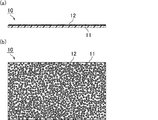
- FIG. 1 (a) is a cross-sectional view schematically showing an embodiment of the antiviral substrate of the first present invention
- FIG. 1 (b) is the antiviral substrate shown in FIG. 1 (a).
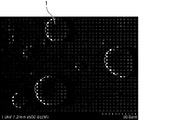
- FIG. FIG. 2 is a SEM photograph showing the antiviral substrate obtained in Example 1.
- FIG. 3 is a SEM photograph showing a cross section of the cured resin product produced in Example 1.
- FIG. 4 is a SEM photograph which shows the result of having analyzed the copper compound in the resin cured material manufactured in Example 1 with the energy dispersive X ray analyzer.
- FIG. 5 is a graph showing the relationship between the C / Cu ratio and the safety (eye irritation) score.
- FIG. 6 is an optical micrograph showing the antiviral substrate produced in Example 7.
- a cured product of an electromagnetic wave curable resin containing a copper compound is scattered in the form of islands on the surface of a substrate, and at least a part of the copper compound is the electromagnetic wave curable resin. It is characterized in that it is exposed from the surface of the cured product.
- FIG. 1 (a) is a cross-sectional view schematically showing an embodiment of the antiviral substrate of the first present invention
- FIG. 1 (b) is the antiviral substrate shown in FIG. 1 (a).
- a cured product 12 of an electromagnetic wave curable resin consisting of a porous material containing a copper compound is scattered in the form of islands on the surface of a substrate 11 ing.
- the material of the base material of the antiviral substrate of the first invention is not particularly limited, and examples thereof include metals, ceramics such as glass, resins, woven fibers, wood and the like.
- the member used as the base material of the antiviral base material of 1st this invention is not specifically limited, either, It may be a film for protection of a touch panel, or a film for displays, The interior material inside a building , Wall materials, window glass, glazes, etc. In addition, a doorknob, a sliding key for the toilet, etc. may be used. Furthermore, it may be office equipment, furniture, etc., and may be a decorative board etc. used for various uses besides the above-mentioned interior material.
- the copper compound contained in the cured resin is preferably a carboxylate of copper, a hydroxide of copper, an oxide of copper, or a water-soluble inorganic salt of copper.
- a carboxylate an ionic compound of copper can be used, and copper acetate, copper benzoate, copper phthalate and the like can be mentioned.
- the water-soluble inorganic salt of copper an ionic compound of copper can be used, and examples thereof include copper nitrate, copper sulfate and the like.
- Other copper compounds include, for example, copper (methoxide), copper ethoxide, copper propoxide, copper butoxide and the like, and examples of copper covalent bonding compounds include oxides of copper, hydroxides of copper and the like .
- Such a copper compound may be the same as or different from the copper compound added in preparing the antiviral composition used in producing the cured resin.
- the surface composition ratio of the cured resin obtained by the energy dispersive X-ray analyzer is calculated from peak intensities of characteristic X-rays of carbon element and copper element which are main constituent elements of the resin component.
- the antiviral substrate of the first invention it is calculated by measuring the binding energy corresponding to Cu (I) and Cu (II) in the range of 925 to 955 eV for 5 minutes by X-ray photoelectron spectroscopy.
- the ratio of the number of Cu (I) to Cu (II) ions contained in the copper compound (Cu (I) / Cu (II)) is 0.4 to 50.
- Coexistence with Cu (II) results in higher antiviral performance than Cu (I) alone. The reason for this is not clear, but it is not because Cu (I) can be prevented from being oxidized by coexistence with stable Cu (II) as compared with the case of unstable Cu (I) alone. It is estimated to be.
- the ratio of the number of Cu (I) to Cu (II) ions contained in the copper compound (Cu (I) / Cu (II)) is preferably 0.5 to 50.
- the antiviral substrate of the first invention of the present invention can be obtained by 925 Ions of Cu (I) and Cu (II) contained in the copper compound, calculated by measuring the binding energy corresponding to Cu (I) and Cu (II) in the range of 955 eV for 5 minutes
- the ratio of the number of (Cu (I) / Cu (II)) is 1.0 to 4.0
- an antiviral substrate having more excellent antiviral properties can be obtained.
- the most desirable range is the ratio of the number of Cu (I) to Cu (II) ions contained in the copper compound (Cu (I) / Cu (II)) of 1.4 to 2.9. Furthermore, 1.4 to 1.9 are optimal.
- the cured product of the electromagnetic wave curable resin is dispersedly fixed in an island shape, or the region where the cured product of the electromagnetic wave curable resin is fixedly formed on the substrate surface and the cured product of the electromagnetic wave curable resin is fixedly formed.
- the Cu (I) / Cu (II) in the copper compound is adjusted to 0.4 / 1 to 4.0 / 1, it is antiviral. It is desirable because it can be made higher.
- the ratio of Cu (I) / Cu (II) in the copper compound in the antiviral substrate of the first invention of the present invention is an electromagnetic wave curable resin, a polymerization initiator, selection of a copper compound, adjustment of these concentrations, and ultraviolet light etc. It can adjust with the irradiation time and intensity of electromagnetic waves.
- Cu (I) means that the ion valence of copper is 1, and it may express as Cu ⁇ +> .
- Cu (II) means that the ion valence of copper is 2, and may be expressed as Cu 2+ .
- the bonding energy of Cu (I) is 932.5 eV ⁇ 0.3 (932.2 to 932.8 eV), and the bonding energy of Cu (II) is 933.8 eV ⁇ 0.3 (933 0.53 to 934.1 eV).
- the photopolymerization initiator is a cleavage reaction, a hydrogen abstraction reaction, an electron transfer, etc.
- the resin of the first invention generated by such a reaction is referred to as an electromagnetic wave curable resin.
- the cured product of such an electromagnetic wave curable resin is scattered in the form of islands, but the method of manufacturing the cured resin in the form of islands will be described in detail later.
- the photopolymerization initiator contained in the cured product of the electromagnetic wave curable resin reduces copper ion (II) to form copper ion (I).
- copper ions (I) reduce water and oxygen in the air to generate active oxygen, hydrogen peroxide water, superoxide anions, hydroxy radicals, etc., thereby destroying the proteins that constitute the virus and virus It is because it can deactivate.
- copper ion (I) reduces water and oxygen in air, it changes to copper (II), but it is reduced again to copper ion (I) by the photopolymerization initiator contained in the electromagnetic wave curable resin. Force is always maintained.
- an electromagnetic wave curable resin for example, at least one selected from the group consisting of an acrylic resin, a urethane acrylate resin, a polyether resin, a polyester resin, an epoxy resin, and an alkyd resin is desirable.
- acrylic resin epoxy modified acrylate resin, urethane acrylate resin (urethane modified acrylate resin), silicon modified acrylate resin etc.
- polyester resin examples include polyethylene terephthalate (PET) and polybutylene terephthalate (PBT).
- epoxy resin what mixed the epoxy resin of an alicyclic epoxy resin, a glycidyl ether type, and oxetane resin etc. are mentioned.
- alkyd resin polyester alkyd resin etc. are mentioned. These resins have transparency and are also excellent in adhesion to a substrate.
- the maximum width in the direction parallel to the substrate surface of the cured product of the electromagnetic wave curable resin is 0.1 to 200 ⁇ m, and the average value of the thickness is 0 .1 to 20 ⁇ m is desirable.
- the average thickness of the resin cured product of the electromagnetic wave curable resin is 0.1 to 20 ⁇ m, the thickness of the resin cured product is small, so the resin cured product It is difficult to form a continuous layer, and the cured resin tends to be scattered like islands, and an antiviral effect tends to occur.
- the maximum width of the cured resin in a direction parallel to the surface of the substrate is 1 to 100 ⁇ m, and the average value of the thickness is more preferably 1 to 20 ⁇ m.
- the average value of the thickness of the resin cured product exceeds 20 ⁇ m, the thickness of the resin cured product becomes too thick, so the size of the resin cured product becomes too large, and the resin cured product is scattered in islands. It may be difficult and the transparency may be reduced.
- the average value of the thickness of the cured resin is less than 0.1 ⁇ m, problems such as insufficient antiviral performance can be exhibited or the copper compound is likely to fall off may occur.
- the maximum width of the cured resin in a direction parallel to the surface of the base exceeds 200 ⁇ m, it may be difficult to disperse the cured resin in an island shape, and the transparency may also be reduced.
- the maximum width in the direction parallel to the surface of the cured resin is less than 0.1 ⁇ m, the adhesion to the substrate may be reduced, and the cured product may be easily detached.
- the cured product of the electromagnetic wave curable resin desirably contains a water-insoluble polymerization initiator as a polymerization initiator. Since it does not elute even if it is touched with water, it does not cause deterioration of the cured resin and does not cause detachment of the copper compound. Even if the copper compound is water soluble, if it is retained by the cured resin, desorption can be suppressed, but if the cured resin contains a water soluble substance, the retention of the cured resin to the copper compound It is estimated that the elimination of the copper compound occurs.
- the water-insoluble polymerization initiator is preferably a photopolymerization initiator. It is because polymerization reaction can be easily advanced by light such as visible light and ultraviolet light.
- the antiviral substrate of the first invention it is desirable to use a photopolymerization initiator having a reducing power.
- the above-mentioned copper compound contained in the antiviral composition of the first invention of the present invention is reduced to copper ion (I) having an antiviral effect, and at the same time, copper ion (I) is oxidized to form a copper ion inferior in antiviral property It is because it can control changing to II).
- the polymerization initiator is at least selected from the group consisting of alkylphenone type, benzophenone type, acyl phosphine oxide type, intramolecular hydrogen abstraction type, and oxime ester type.
- alkylphenone type benzophenone type
- acyl phosphine oxide type intramolecular hydrogen abstraction type
- oxime ester type one kind is desirable.
- the polymerization initiator is preferably at least one selected from an alkylphenone polymerization initiator, benzophenone, or a derivative thereof.
- the polymerization initiator preferably contains benzophenone or a derivative thereof.
- the total light transmittance is desirably 90% or more, and more desirably 99% or more.
- the antiviral substrate of the first aspect of the present invention when the total light transmittance is 90% or more, light such as visible light is transmitted, so it can be used for applications utilizing light transmission.
- the protective film for a touch panel and the film for display can be provided with antiviral properties without reducing the transparency.
- the antiviral property can be imparted without changing the color tone or the like.
- the method for producing an antiviral substrate according to the first aspect of the present invention comprises spraying the antiviral composition containing a copper compound, an uncured electromagnetic wave curable resin, a dispersion medium, and a polymerization initiator on the surface of a substrate.
- the step of drying the antiviral composition sprayed in the spraying step to remove the dispersion medium, and the uncured material in the antiviral composition from which the dispersion medium is removed in the drying step And curing the electromagnetic wave curable resin by irradiating the electromagnetic wave with the electromagnetic wave.
- Spraying step In the first method for producing an antiviral substrate of the present invention, as a spraying step, a copper compound, an uncured electromagnetic wave curable resin, a dispersion medium, and a polymerization initiator are provided on the surface of the substrate. And dispersing the first antiviral composition of the present invention.
- the antiviral composition of the first invention containing a copper compound, an uncured electromagnetic wave curable resin, a dispersion medium and a polymerization initiator is used.
- the copper compound contained in the antiviral composition is preferably a carboxylate of copper, a hydroxide of copper, an oxide of copper, or a water-soluble inorganic salt of copper.
- divalent copper compounds copper compounds (II)) are easily dissolved in water as a dispersion medium, and copper ions are easily dispersed in the ultraviolet curable resin.
- the divalent copper compound is reduced to simplify coexistence of monovalent and divalent copper compounds in the cured resin. It also has the advantage of being able to It is optimal to use a water-soluble divalent copper compound.
- Examples of the copper carboxylate include copper (II) acetate, copper (II) benzoate, and copper (II) phthalate.
- copper (II) acetate copper (II) benzoate
- copper (II) phthalate copper (II) phthalate
- divalent carboxylic acid copper (carboxylic acid copper (II)) is desirable.
- water-soluble inorganic salt of copper an ionic compound of copper can be used, and examples thereof include copper (II) nitrate, copper (II) sulfate and the like.
- copper compounds include, for example, copper (II) (methoxide), copper (II) ethoxide, copper (II) propoxide, copper (II) butoxide and the like, and a covalent compound of copper is copper An oxide, a hydroxide of copper, etc. are mentioned.
- the electromagnetic wave curable resin is preferably at least one selected from the group consisting of an acrylic resin, a urethane acrylate resin, a polyether resin, a polyester resin, an epoxy resin, and an alkyd resin.
- the above-mentioned electromagnetic wave curable resin means a resin produced by the progress of the polymerization reaction or the crosslinking reaction of the monomer or oligomer which is the raw material by the electromagnetic wave irradiation. Therefore, the said antiviral composition contains the monomer and oligomer (uncured electromagnetic wave curable resin) used as the raw material of the said electromagnetic wave curable resin.
- the type of the dispersion medium is not particularly limited, but in consideration of stability, alcohols and water are preferably used.
- the alcohol include alcohols such as methyl alcohol, ethyl alcohol, n-propyl alcohol, isopropyl alcohol, n-butyl alcohol, isobutyl alcohol and sec-butyl alcohol in consideration of lowering the viscosity.
- these alcohols methyl alcohol and ethyl alcohol, which are less likely to increase in viscosity, are preferable, and a mixture of alcohol and water is desirable.
- the antiviral composition and the method for producing an antiviral substrate according to the first aspect of the present invention it is desirable to include a water-insoluble polymerization initiator as the polymerization initiator. Since it does not elute even if it is touched with water, it does not cause deterioration of the cured resin and does not cause detachment of the copper compound. Even if the copper compound is water soluble, if it is retained by the cured resin, desorption can be suppressed, but if the cured resin contains a water soluble substance, the retention of the cured resin to the copper compound It is estimated that the elimination of the copper compound occurs. Further, the water-insoluble polymerization initiator is preferably a photopolymerization initiator. It is because polymerization reaction can be easily advanced by light such as visible light and ultraviolet light.
- the first antiviral composition and the method for producing an antiviral substrate of the present invention it is desirable to use a photopolymerization initiator having reducing power.
- the above-mentioned copper compound contained in the antiviral composition of the first invention of the present invention is reduced to copper ion (I) having an antiviral effect, and at the same time, copper ion (I) is oxidized to form a copper ion inferior in antiviral property It is because it can control changing to II).
- the polymerization initiator is desirably at least one selected from the group consisting of alkylphenone type, benzophenone type, acyl phosphine oxide type, intramolecular hydrogen abstraction type, and oxime ester type.
- alkylphenone-based polymerization initiators examples include, for example, 2,2-dimethoxy-1,2-diphenylethan-1-one, 1-hydroxy-cyclohexyl-phenyl-ketone (polymerization initiators of Examples 1 to 4).
- acyl phosphine oxide type polymerization initiator examples include 2,4,6-trimethyl benzoyl-diphenyl-phosphine oxide, bis (2,4,6-trimethyl benzoyl) -phenyl phosphine oxide and the like.
- Examples of the polymerization initiator of the intramolecular hydrogen abstraction type include phenylglyoxylic acid methyl ester, oxyphenylsacsan, 2- [2-oxo-2-phenylacetoxyethoxy] ethyl ester tooxyphenylacetic acid and 2- (2) And mixtures thereof with -hydroxyethoxy) ethyl ester.
- oxime ester polymerization initiators examples include 1,2-octanedione, 1- [4- (phenylthio)-, 2- (O-benzoyloxime)], ethanone, 1- [9-ethyl-6- Examples include (2-methylbenzoyl) -9H-carbazol-3-yl]-, 1- (0-acetyloxime) and the like.
- the polymerization initiator comprises at least one selected from an alkylphenone-based polymerization initiator, benzophenone, or a derivative thereof. desirable. This is because a reducing power is exhibited by an electromagnetic wave such as ultraviolet light.
- benzophenone or a derivative thereof is particularly preferred.
- the polymerization initiator includes an alkylphenone-based polymerization initiator and a benzophenone-based polymerization initiator, and the alkylphenone-based one
- concentration of the polymerization initiator is 0.5 to 3.0 wt% with respect to the electromagnetic wave curable resin
- the concentration of the benzophenone series polymerization initiator is 0.5 to 2.0 wt% with respect to the electromagnetic wave curable resin Is desirable. This is because a high crosslinking density can be realized even if the irradiation time of the electromagnetic wave is short.
- a high crosslink density can be realized, the hardness of the cured product can be increased to improve the abrasion resistance, and the reducing power to copper can be increased.
- the crosslink density is desirably 85% or more, particularly 95% or more.
- the content of the copper compound in the antiviral composition is preferably 4.0 to 30.0% by weight, and the content of the uncured electromagnetic wave curable resin (monomer or oligomer) is preferably 65 to 95% by weight. Desirably, the content ratio of the dispersion medium is desirably 0.1 to 5.0% by weight.
- a UV absorber In the first antiviral composition of the present invention, if necessary, a UV absorber, an antioxidant, a light stabilizer, an adhesion promoter, a rheology modifier, a leveling agent, an antifoamer, etc. are blended. It may be
- the mixture is sufficiently stirred by a mixer or the like to obtain a copper compound, an uncured electromagnetic wave curable resin, etc.
- the composition is preferably dispersed after the polymerization initiator is dispersed at a uniform concentration.
- spraying means that the above-mentioned antiviral composition is attached to the substrate surface in a divided state.
- the spraying method include a spray method, a two-fluid spray method, an electrostatic spray method, an aerosol method and the like.
- the spray method is a gas such as high pressure air or a mechanical motion (such as a finger or a piezo element) to spray the antiviral composition in a mist state to the substrate surface as described above.
- the two-fluid spray method is a kind of spray method, in which a gas such as high-pressure air and the antiviral composition are mixed and then sprayed in the form of mist from a nozzle to obtain a substrate It refers to depositing droplets of the above-mentioned antiviral composition on the surface.
- the electrostatic spray method is a spraying method using a charged antiviral composition, and the antiviral composition is sprayed in the form of mist by the above-mentioned spray method.
- a system for atomizing a viral composition there are a cancer type in which the above-mentioned antiviral composition is sprayed with a sprayer and an electrostatic atomization system utilizing the repulsion of the charged antiviral composition, Furthermore, the cancer type includes a method of spraying a charged antiviral composition and a method of applying a charge to the sprayed antiviral composition from an external electrode by corona discharge.
- the aerosol method is a method in which an antiviral composition containing a metal compound is sprayed on an object physically and chemically generated in the form of a mist.
- a state in which an antiviral composition containing a copper compound, an uncured electromagnetic wave curable resin, a dispersion medium, and a polymerization initiator is scattered in an island shape on the surface of the substrate or a part of the surface of the substrate is obtained by the above spreading step.
- the antiviral composition adheres to the surface of the substrate so as to be exposed.
- Drying step The antiviral composition containing the copper compound, the cured resin, the dispersion medium, and the polymerization initiator dispersed in the above dispersion step is dried, the dispersion medium is evaporated and removed, and the copper compound is contained.
- the resin cured product is temporarily fixed to the substrate surface, and the copper compound can be exposed from the surface of the resin cured product by shrinkage of the resin cured product. Drying conditions are preferably 60 to 85 ° C. and 0.5 to 1.0 minutes.
- the drying step and the curing step may be performed simultaneously.
- UV ultraviolet
- UV ultraviolet
- EB Electro Beam: EB
- the above-mentioned polymerization initiator is added to the above-mentioned antiviral composition, by irradiating an electromagnetic wave, a polymerization reaction or a crosslinking reaction of a monomer or an oligomer which is an uncured electromagnetic wave curable resin progresses. And a cured resin containing a copper compound is formed.
- the antiviral composition sprayed by the above-mentioned spraying step adheres the antiviral composition so as to be scattered in islands or expose a part of the surface of the substrate, and thus the obtained cured resin product Also, it is scattered like an island or a resin cured product containing a copper compound so as to expose a part.
- the porosity of the cured resin can be adjusted by adjusting the concentration of the solvent, the concentration of the polymerization initiator, the illuminance of the electromagnetic wave, the temperature of the antiviral composition at the time of the electromagnetic wave irradiation, and the like.
- an antiviral composition containing a copper compound, an uncured electromagnetic wave curable resin, a dispersion medium, and a polymerization initiator is dispersed on the surface of a substrate.
- a resin cured product containing a copper compound can be formed so as to expose a part of the copper compound, and a part of the copper compound is exposed from the surface of the resin cured product in a state where it can be contacted with the virus By the copper compound It is possible to produce an excellent antiviral substrates Luz properties.
- the produced antiviral substrate contains a reducing photopolymerization initiator. While reducing the said copper compound contained in the said antiviral substrate to copper ion (I) with an antiviral effect, copper ion (I) is oxidized and it changes into inferior copper ion (II) of antiviral property. It is because it can suppress and can exhibit high antiviral property.
- the antimicrobial substrate of the second invention a cured product of a binder containing a copper compound and a polymerization initiator adheres to the surface of a substrate, and at least a portion of the copper compound is exposed from the surface of the cured product of the binder It is characterized by In the antimicrobial substrate of the second invention, the cured product of the binder containing the copper compound and the polymerization initiator adheres to the surface of the substrate, and at least a part of the copper compound is exposed from the surface of the cured product of the binder Therefore, the copper compound is easily in contact with microorganisms, and the effect as a substrate having antimicrobial activity based on the copper compound can be sufficiently exhibited.
- the antimicrobial substrate of the second invention is characterized in that a cured product of a binder containing a copper compound and a polymerization initiator is fixedly formed on the substrate surface.
- the cured product of the binder preferably comprises a porous body.
- the copper compound is easily brought into contact with the atmosphere medium such as air, and copper ion (I) reduces water and oxygen in the air to generate active oxygen, hydrogen peroxide water, superoxide anion, hydroxy radical and the like. It is because it is easy to destroy the protein which comprises a microbe and to inactivate a microbe.
- the microorganism is most effective against viruses and / or molds.
- the material of the base material of the antimicrobial substrate of the second invention is not particularly limited, and examples thereof include metals, ceramics such as glass, resins, woven fibers, wood and the like.
- a member to be a base material of the antimicrobial substrate of the second invention is not particularly limited, and may be a film for protecting a touch panel or a film for display, and an interior material in a building, It may be a wall material, a window glass, a handrail or the like.
- a doorknob, a sliding key for the toilet, etc. may be used.
- it may be office equipment, furniture, etc., and may be a decorative board etc. used for various uses besides the above-mentioned interior material.
- the binder for forming the cured binder is preferably at least one selected from an organic binder, an inorganic binder, a mixture of an organic binder and an inorganic binder, and an organic-inorganic hybrid binder.
- an inorganic binder at least 1 sort (s) selected from the group which consists of inorganic sol, a metal alkoxide, and water glass can be used. Furthermore, an organic metal compound can be used as a binder of the organic-inorganic hybrid.
- the content ratio of the inorganic oxide such as silica in the above-mentioned inorganic sol is preferably 1 to 80% by weight in terms of solid content.
- thermosetting resin or an electromagnetic wave curable resin can be used as the organic binder. It is because resin can be hardened and the copper compound can be fixed to the substrate surface by irradiation and heating of electromagnetic waves, and these organic binders. These resins are also advantageous because they do not reduce the reducing power of the polymerization initiator to copper.
- the electromagnetic wave curable resin at least one selected from an acrylic resin, a urethane acrylate resin, and an epoxy acrylate resin can be used.
- a thermosetting resin at least 1 or more types chosen from an epoxy resin, a melamine resin, and a phenol resin can be used.
- the binder is selected from the group consisting of acrylic resin, urethane acrylate resin, polyether resin, polyester resin, epoxy resin, alkyd resin, silica sol, alumina sol, zirconia sol, titania sol, metal alkoxide, and water glass. At least one of the following can be used.
- An alkoxysilane can be used as a metal alkoxide. This is because a siloxane bond is formed by hydrolysis to form a sol, and gelation is caused by drying to form a cured binder.
- the silica sol, alumina sol and water glass are also heated and dried to form a cured binder.
- the binder cured product of the second invention is a concept including the cured product of the electromagnetic wave curable resin according to the first invention.
- the copper compound contained in the cured binder is preferably a carboxylate of copper, a hydroxide of copper, an oxide of copper, or a water-soluble inorganic salt of copper.
- a carboxylate an ionic compound of copper can be used, and copper acetate, copper benzoate, copper phthalate and the like can be mentioned.
- the water-soluble inorganic salt of copper an ionic compound of copper can be used, and examples thereof include copper nitrate, copper sulfate and the like.
- copper compounds include, for example, copper (methoxide), copper ethoxide, copper propoxide, copper butoxide and the like, and examples of copper covalent bonding compounds include oxides of copper, hydroxides of copper and the like .
- the carboxylate of copper and the hydroxide of copper have high affinity with the organic binder and the inorganic binder and do not elute with water, so they are excellent in water resistance.
- Such a copper compound may be the same as or different from the copper compound added in preparing the antimicrobial composition used in producing the cured binder.
- the antimicrobial substrate of the second invention is calculated by measuring the binding energy corresponding to Cu (I) and Cu (II) in the range of 925 to 955 eV for 5 minutes by X-ray photoelectron spectroscopy.
- the ratio of the number of Cu (I) to Cu (II) ions contained in the copper compound (Cu (I) / Cu (II)) is 0.4 to 50.
- Coexistence with Cu (II) results in higher antiviral performance than Cu (I) alone. The reason for this is not clear, but it is not because Cu (I) can be prevented from being oxidized by coexistence with stable Cu (II) as compared with the case of unstable Cu (I) alone. It is estimated to be.
- the ratio of the number of Cu (I) to Cu (II) ions contained in the copper compound (Cu (I) / Cu (II)) is preferably 0.5 to 50.
- Cu (I) copper is superior to Cu (II) copper in terms of antimicrobial properties, so that the antimicrobial substrate of the second invention of the present invention can
- the ion of Cu (I) and Cu (II) contained in the above copper compound is calculated by measuring the binding energy corresponding to Cu (I) and Cu (II) in the range of 955 eV for 5 minutes When the ratio of the numbers (Cu (I) / Cu (II)) is 1.0 to 4.0, an antimicrobial substrate having more excellent antimicrobial properties is obtained.
- the most desirable range is the ratio of the number of Cu (I) to Cu (II) ions contained in the copper compound (Cu (I) / Cu (II)) of 1.4 to 2.9.
- the antimicrobial activity of copper ion (I) is most effective against viruses and / or molds. This is because monovalent copper ions most effectively destroy viruses and proteins that constitute mold.
- the binder cured product is dispersed and fixed in an island shape, or when the region where the binder cured product is fixedly formed on the substrate surface and the region where the binder cured material is not fixedly formed are mixed. It is desirable that Cu (I) / Cu (II) in the copper compound be adjusted to 0.4 / 1 to 4.0 / 1, because this can increase the antiviral property.
- the ratio of Cu (I) / Cu (II) in the copper compound in the antimicrobial substrate in the second invention is the selection of the binder, the polymerization initiator, the copper compound, the adjustment of these concentrations, and the electromagnetic waves such as ultraviolet rays. It can adjust by irradiation time and intensity.
- Cu (I) means that the ion valence of copper is 1, and it may express as Cu ⁇ +> .
- Cu (II) means that the ion valence of copper is 2, and may be expressed as Cu 2+ .
- the bonding energy of Cu (I) is 932.5 eV ⁇ 0.3 (932.2 to 932.8 eV), and the bonding energy of Cu (II) is 933.8 eV ⁇ 0.3 (933 0.53 to 934.1 eV).
- the photopolymerization initiator is a cleavage reaction, a hydrogen abstraction reaction, an electron transfer, etc.
- the resin of the second invention generated by such reaction is referred to as an electromagnetic wave curable resin.
- the photopolymerization initiator contained in the cured product of the electromagnetic wave curable resin reduces copper ion (II) to form copper ion (I), so the reducing power of copper (I)
- the copper ion (I) reduces water and oxygen in the air by this to generate active oxygen, hydrogen peroxide water, superoxide anion, And other microorganisms can be inactivated.
- copper ion (I) reduces water and oxygen in air, it changes to copper (II), but it is reduced again to copper ion (I) by the photopolymerization initiator contained in the electromagnetic wave curable resin. Force is always maintained.
- acrylic resin epoxy modified acrylate resin, urethane acrylate resin (urethane modified acrylate resin), silicon modified acrylate resin etc.
- polyester resin examples include polyethylene terephthalate (PET) and polybutylene terephthalate (PBT).
- epoxy resin what mixed the epoxy resin of an alicyclic epoxy resin, a glycidyl ether type, and oxetane resin etc. are mentioned.
- alkyd resin polyester alkyd resin etc. are mentioned. These resins have transparency and are also excellent in adhesion to a substrate.
- the polymerization initiator preferably contains a photopolymerization initiator.
- the copper compound is reduced to a copper ion (I) having an antimicrobial effect, and the copper ion (I) is oxidized to be changed to a copper ion (II) having poor antimicrobial properties. It is because it can control.
- the antimicrobial properties of copper ions (I) are most effective against viruses and / or molds.
- the cured product of the binder preferably contains a water-insoluble polymerization initiator. Since it does not elute even if it touches water, it is because it becomes an antimicrobial substrate which has a binder hardened material excellent in water resistance.
- the polymerization initiator is preferably at least one selected from an alkylphenone-based polymerization initiator, benzophenone or a derivative thereof, and in particular, the polymerization initiator is It is desirable to include benzophenone or a derivative thereof.
- These polymerization initiators are particularly high in reducing power to copper and excellent in the effect of being able to maintain the state of copper ions (I) for a long time.
- the polymerization initiator contains an alkylphenone-based polymerization initiator and a benzophenone-based polymerization initiator, and the concentration of the alkylphenone-based polymerization initiator is relative to the binder, It is preferable that the concentration of 0.5 to 3.0 wt% of the benzophenone series polymerization initiator is 0.5 to 2.0 wt% with respect to the binder. This is because a high crosslinking density can be realized even if the irradiation time of the electromagnetic wave is short.
- a high crosslink density can be realized, the hardness of the cured product can be increased to improve the abrasion resistance, and the reducing power to copper can be increased.
- the crosslink density is desirably 85% or more, particularly 95% or more.
- the maximum width of the cured binder in the antimicrobial substrate of the second invention in the direction parallel to the substrate surface is 0.1 to 500 ⁇ m, and the average value of the thickness is 0.1 to 20 ⁇ m.
- the total light transmittance is desirably 90% or more.
- the thickness of the cured binder when the average thickness of the cured binder is 0.1 to 20 ⁇ m, the thickness of the cured binder is small, so it is difficult to form a continuous layer of the cured binder.
- the cured binder tends to be scattered in the form of islands, and the antimicrobial effect tends to occur.
- the maximum width in the direction parallel to the surface of the substrate of the cured binder by setting the maximum width in the direction parallel to the surface of the substrate of the cured binder to 0.1 to 500 ⁇ m, the ratio of the portion where the surface of the substrate is not covered by the cured binder increases A decrease in light transmittance can be suppressed.
- the maximum width in the direction parallel to the substrate surface of the cured product of the binder is 1 to 100 ⁇ m, and the average value of the thickness is more preferably 1 to 20 ⁇ m.
- the average value of the thickness of the cured binder is more than 20 ⁇ m, the thickness of the cured binder becomes too thick, so the size of the cured binder becomes too large, and the cured binder is exposed to the substrate surface. It is difficult to adhere to the surface of the base material in the wet state, and the transparency may also be reduced.
- the average value of the thickness of the cured binder is less than 0.1 ⁇ m, problems such as the inability to exert sufficient antimicrobial performance or the tendency of the copper compound to fall off may occur.
- the maximum width of the cured binder in a direction parallel to the substrate surface exceeds 500 ⁇ m, it becomes difficult to fix the cured binder on the surface of the substrate with the substrate surface exposed, and transparency May also decrease.
- the maximum width in the direction parallel to the surface of the cured binder is less than 0.1 ⁇ m, the adhesion to the substrate may be reduced, and the cured material may be easily detached.
- the antimicrobial substrate of the second invention when the total light transmittance is 90% or more, light such as visible light is transmitted, so that it can be used for applications utilizing light transmission.
- the cured product of the binder is scattered and scattered in the form of islands, or the region where the cured binder is fixedly formed on the substrate surface and the cured binder form adhesion.
- the uncured region is mixed, and there is a portion where the substrate surface is exposed because there is no cured binder material on the surface of the substrate, so that the transmittance of the visible light to the substrate surface decreases. Can be prevented. Therefore, when the substrate is a transparent material, the transparency of the substrate does not decrease, and when a design or the like having a predetermined pattern is formed on the surface of the substrate, the appearance of the design or the like is impaired. I have nothing to do.
- the cured binder is dispersedly formed into islands and fixedly formed, or a region where the cured binder is fixedly formed on the substrate surface and the cured binder are provided. Since the areas not fixedly formed are mixed, the contact area of the cured binder with the substrate surface can be reduced, and the residual stress of the cured binder and the stress generated during the thermal cycle can be suppressed. It is possible to form the above-mentioned binder cured product having high adhesion to the substrate.
- the cured product of the binder When the cured product of the binder is scattered and fixed in the form of islands, or the area where the cured product of the binder is fixedly formed on the substrate surface and the area where the cured product of the binder is not fixed are mixed. Since the surface area of the cured binder is increased and microorganisms such as viruses can be easily trapped between the cured binder, the contact probability between the cured binder and the microorganisms having the antimicrobial performance is increased. , Can exhibit high antimicrobial performance.
- the cured binder may be formed in a film shape.
- the antimicrobial binder cured product is formed in a film shape, it is dispersed and fixed in an island shape, or the region where the binder cured product is fixedly formed on the substrate surface and the binder cured product is not fixedly formed.
- the resistance to wiping and cleaning is superior to the state in which the areas are mixed.
- the cured binder when the cured binder is formed in a film-like manner on the substrate, the visibility of the design on the surface of the substrate, the antimicrobial performance, and the adhesion of the cured binder to the substrate after cold thermal cycle Is lower than in the case where the cured binder is dispersed and fixed in the form of islands, or the region where the cured binder is firmly formed on the surface of the base and the region where the cured binder is not fixed are mixed. Do.
- the thickness of the film made of the cured binder is preferably 0.5 to 100 ⁇ m.
- stress is generated to exfoliate the film to reduce the antimicrobial property, and when the film is too thin, the antimicrobial property can not be sufficiently exhibited.
- a film made of the cured binder is formed on the substrate because the influence of appearance damage due to the cured binder is small. Is desirable.
- cured material may be formed on the base material.
- the method for producing an antimicrobial substrate according to the second aspect of the present invention comprises: adhering the antimicrobial composition comprising a copper compound, an uncured binder, a dispersion medium, and a polymerization initiator on the surface of a substrate, and the above adhesion And curing the uncured binder in the antimicrobial composition deposited by the process to fix the cured binder on the surface of the substrate.
- an adhesion step of attaching an antimicrobial composition comprising a copper compound, an uncured binder, a dispersion medium and a polymerization initiator to the surface of a substrate;
- the uncured binder in the antimicrobial composition from which the dispersion composition has been removed in the drying step and the drying step in which the dispersion composition is removed by drying the above-mentioned antimicrobial composition deposited in the above-mentioned adhesion step is cured. And curing the binder cured product on the surface of the substrate.
- the curing step may be performed immediately after the adhesion step, or the curing step may be performed after the drying step after the adhesion step.
- the antimicrobial composition of the second invention containing a copper compound, an uncured binder, a dispersion medium and a polymerization initiator in the adhesion step is applied to the surface of the substrate Attach it.
- the binder is preferably at least one selected from an organic binder, an inorganic binder, a mixture of an organic binder and an inorganic binder, and an organic / inorganic hybrid binder, and as the organic binder, a thermosetting resin, an electromagnetic wave curing type Resin can be used.
- a thermosetting resin, an electromagnetic wave curing type Resin can be used as the organic binder.
- an inorganic binder at least 1 sort (s) selected from the group which consists of inorganic sol, a metal alkoxide, and water glass can be used.
- an organic metal compound can be used as a binder of the organic-inorganic hybrid.
- the electromagnetic wave curable resin at least one selected from an acrylic resin, a urethane acrylate resin, and an epoxy acrylate resin can be used.
- a thermosetting resin at least 1 or more types chosen from an epoxy resin, a melamine resin, and a phenol resin can be used.
- specific examples of the above-mentioned binder are selected from the group consisting of acrylic resin, urethane acrylate resin, polyether resin, polyester resin, epoxy resin, alkyd resin, silica sol, alumina sol, zirconia sol, titania sol, metal alkoxide and water glass. It is desirable to use at least one of
- the inorganic binder as the dispersion medium, one using water and one using an organic solvent exist, so the inorganic binder can be selected in consideration of the type of copper compound to be added, etc. A uniformly dispersed antimicrobial composition can be obtained.
- Adhesion step In the method for producing an antimicrobial substrate according to the second aspect of the present invention, first, as the adhesion step, a copper compound, an uncured binder, a dispersion medium, and a polymerization initiator are provided on the surface of the substrate. Two of the antimicrobial compositions of the invention are applied.
- the method for producing an antimicrobial substrate according to the second aspect of the present invention uses an antimicrobial composition comprising a copper compound, an uncured binder, a dispersion medium and a polymerization initiator.
- the copper compound contained in the above antimicrobial composition is preferably a carboxylate of copper, a hydroxide of copper, an oxide of copper, or a water-soluble inorganic salt of copper.
- divalent copper compounds copper compounds (II)) are desirable. This is because the divalent copper compound is dissolved in water, which is a dispersion medium, and copper ions are easily dispersed uniformly in the binder.
- the monovalent copper compound (copper compound (I)) is not dissolved in water but suspended in the form of particles, resulting in poor uniformity.
- the state in which the monovalent and divalent copper compounds coexist in the binder cured product can be simplified. It also has the advantage of being able to be formed. It is optimal to use a water-soluble divalent copper compound.
- Examples of the copper carboxylate include copper (II) acetate, copper (II) benzoate, and copper (II) phthalate.
- the copper compound a divalent copper carboxylate is desirable.
- an ionic compound of copper can be used, and examples thereof include copper (II) nitrate, copper (II) sulfate and the like.
- Other copper compounds include, for example, copper (II) (methoxide), copper (II) ethoxide, copper (II) propoxide, copper (II) butoxide and the like, and a covalent compound of copper is copper An oxide, a hydroxide of copper, etc. are mentioned.
- the uncured binder is preferably at least one selected from an organic binder, an inorganic binder, a mixture of an organic binder and an inorganic binder, and an organic / inorganic hybrid binder, and a thermosetting resin as the organic binder,
- An electromagnetic wave curable resin can be used.
- an inorganic binder at least 1 sort (s) selected from the group which consists of inorganic sol, a metal alkoxide, and water glass can be used.
- an organic metal compound can be used as a binder of the organic-inorganic hybrid.
- the electromagnetic wave curable resin at least one selected from an acrylic resin, a urethane acrylate resin, and an epoxy acrylate resin can be used.
- a thermosetting resin at least 1 or more types chosen from an epoxy resin, a melamine resin, and a phenol resin can be used.
- specific examples of the above-mentioned binder are selected from the group consisting of acrylic resin, urethane acrylate resin, polyether resin, polyester resin, epoxy resin, alkyd resin, silica sol, alumina sol, zirconia sol, titania sol, metal alkoxide and water glass. It is desirable to use at least one of
- the above-mentioned electromagnetic wave curable resin means a resin produced by the progress of polymerization reaction, crosslinking reaction and the like of the monomer or oligomer which is a raw material by irradiation of electromagnetic wave. Therefore, the said antimicrobial composition contains the monomer and oligomer (uncured electromagnetic wave curable resin) used as the raw material of the said electromagnetic wave curable resin.
- the type of the dispersion medium is not particularly limited, but in consideration of stability, alcohols and water are preferably used.
- the alcohol include alcohols such as methyl alcohol, ethyl alcohol, n-propyl alcohol, isopropyl alcohol, n-butyl alcohol, isobutyl alcohol and sec-butyl alcohol in consideration of lowering the viscosity.
- these alcohols methyl alcohol and ethyl alcohol, which are less likely to increase in viscosity, are preferable, and a mixture of alcohol and water is desirable.
- the antimicrobial composition and the method for producing an antimicrobial substrate according to the second aspect of the present invention it is desirable to include a water-insoluble polymerization initiator as the polymerization initiator. Since it does not elute even when it is touched with water, it does not degrade the cured binder and does not cause the detachment of the copper compound. Even if the copper compound is soluble in water, desorption can be suppressed if it is retained by the cured binder, but if the cured binder contains a water-soluble substance, the retention of the cured binder to the copper compound It is estimated that the elimination of the copper compound occurs.
- the water-insoluble polymerization initiator is preferably a photopolymerization initiator. When an electromagnetic wave curable resin is used, the polymerization reaction can be easily advanced by light such as visible light and ultraviolet light.
- the antimicrobial composition and the method for producing an antimicrobial substrate according to the second aspect of the present invention it is desirable to use a photopolymerization initiator having a reducing power. While reducing the said copper compound contained in the antimicrobial composition of 2nd this invention to copper ion (I) with antimicrobial effects, such as an antiviral effect, copper ion (I) is oxidized and inferior to antimicrobial It is because it can suppress changing to copper ion (II).
- the second antimicrobial composition of the present invention acts most effectively on viruses and / or molds. Copper ions (I) reduce water and oxygen in the air by the reducing power of copper (I) to generate active oxygen, hydrogen peroxide water, superoxide anions, hydroxy radicals, etc. This is because the constituent proteins are effectively destroyed.
- the polymerization initiator is preferably at least one selected from the group consisting of alkylphenone type, benzophenone type, acyl phosphine oxide type, intramolecular hydrogen abstraction type, and oxime ester type.
- alkylphenone-based polymerization initiators examples include, for example, 2,2-dimethoxy-1,2-diphenylethan-1-one, 1-hydroxy-cyclohexyl-phenyl-ketone (polymerization initiators of Examples 1 to 4).
- acyl phosphine oxide type polymerization initiator examples include 2,4,6-trimethyl benzoyl-diphenyl-phosphine oxide, bis (2,4,6-trimethyl benzoyl) -phenyl phosphine oxide and the like.
- Examples of the polymerization initiator of the intramolecular hydrogen abstraction type include phenylglyoxylic acid methyl ester, oxyphenylsacsan, 2- [2-oxo-2-phenylacetoxyethoxy] ethyl ester tooxyphenylacetic acid and 2- (2) And mixtures thereof with -hydroxyethoxy) ethyl ester.
- oxime ester polymerization initiators examples include 1,2-octanedione, 1- [4- (phenylthio)-, 2- (O-benzoyloxime)], ethanone, 1- [9-ethyl-6- Examples include (2-methylbenzoyl) -9H-carbazol-3-yl]-, 1- (0-acetyloxime) and the like.
- the polymerization initiator preferably contains at least one selected from an alkylphenone-based polymerization initiator, benzophenone, or a derivative thereof. This is because a reducing power is exhibited by an electromagnetic wave such as ultraviolet light.
- benzophenone or a derivative thereof is particularly preferred.
- a high crosslink density can be realized, the hardness of the cured product can be increased to improve the abrasion resistance, and the reducing power to copper can be increased.
- the crosslink density is desirably 85% or more, particularly 95% or more.
- the content ratio of the copper compound in the antimicrobial composition is preferably 2.0 to 30.0% by weight, and the uncured electromagnetic wave is used.
- the content of the curable resin (monomer or oligomer) is desirably 15 to 40% by weight, and the content of the dispersion medium is desirably 30 to 80% by weight.
- the content ratio of the copper compound in the antimicrobial composition is preferably 2 to 30% by weight, and the content ratio of the dispersion medium is 30 to 80% by weight. desirable.
- the content of the inorganic oxide such as silica in the mixed composition is 5 to 20% by weight.
- a pH adjuster an ultraviolet absorber, an antioxidant, a light stabilizer, an adhesion promoter, a rheology modifier, a leveling agent, an antifoamer, etc. May be blended.
- the composition is sufficiently stirred by a mixer or the like to obtain a composition which is dispersed at a uniform concentration. It is desirable to adhere to the surface of the material.
- an antimicrobial composition is attached to the surface of a substrate.
- the above-mentioned antimicrobial composition is dispersed in the form of islands on the surface of the substrate in a divided state, or the area where the antimicrobial composition is attached to the substrate surface and the area where the antimicrobial composition is not attached are mixed.
- the antimicrobial composition may be attached such that the substrate surface is partially exposed, that is, the antimicrobial composition is formed into a film on the substrate surface. It is also good.
- a method of spraying the antimicrobial composition using a spray method, a two-fluid spray method, an electrostatic spray method, an aerosol method etc., a bar coater for coating, an applicator And the like, and a method of applying the antimicrobial composition using an application jig such as
- the spray method is a gas such as high pressure air or a mechanical motion (such as a finger or a piezo element) to spray the antimicrobial composition in the form of a mist, and the above-mentioned It refers to depositing droplets of the microbial composition.
- the two-fluid spray method is a kind of spray method, in which a gas such as high-pressure air and the antimicrobial composition are mixed, and then sprayed in the form of mist from a nozzle, To attach droplets of the above-mentioned antimicrobial composition.
- the electrostatic spray method is a spraying method using a charged antimicrobial composition, and the antimicrobial composition is sprayed in a mist state by the above-mentioned spray method, but the above-mentioned antimicrobial composition is used.
- a gun type that sprays the above-mentioned antimicrobial composition with a sprayer
- an electrostatic atomization type that utilizes the repulsion of a charged antimicrobial composition
- a gun type There are a method of spraying a charged antimicrobial composition and a method of applying a charge to the sprayed antimicrobial composition from an external electrode by corona discharge.
- the aerosol method is a method of spraying a physically and chemically generated mist form of an antimicrobial composition containing a metal compound onto an object.
- the antimicrobial composition containing the copper compound, the uncured binder, the dispersion medium, and the polymerization initiator is dispersed in an island shape on the surface of the substrate in a divided state, A region in which the microbial composition is attached and a region in which the antimicrobial composition is not attached are mixed.
- the above-mentioned antimicrobial composition may be formed in the form of a film on the surface of a substrate.
- Drying step The antimicrobial composition containing the copper compound sprayed in the above spraying step, the uncured binder, the dispersion medium, and the polymerization initiator is dried, the dispersion medium is evaporated and removed, and the copper compound and the like are contained. While temporarily fixing the binder cured product on the substrate surface, the copper compound can be exposed from the surface of the binder cured product by shrinkage of the binder cured product. Drying conditions are preferably 20 to 100 ° C. and 0.5 to 5.0 minutes. Drying can be performed with an infrared lamp or a heater. Alternatively, it may be dried under reduced pressure (vacuum). In the method for producing an antimicrobial substrate of the second invention, the drying step and the curing step may be performed simultaneously.
- the curing step in the antimicrobial composition from which the dispersion medium has been removed in the drying step, or in the antimicrobial composition containing the dispersion medium
- the uncured binder is cured to form a cured binder.
- Methods of curing the uncured binder include removal of the dispersion medium by drying, and acceleration of polymerization of monomers and oligomers by heating and electromagnetic wave irradiation. Drying includes reduced pressure drying, heat drying and the like.
- the binder is a thermosetting resin
- curing proceeds by heating. Heating can be performed with a heater, an infrared lamp, an ultraviolet lamp, or the like.
- the electromagnetic wave to be irradiated when the uncured binder is an electromagnetic wave curable resin is not particularly limited, and examples thereof include ultraviolet (UV), infrared, visible light, microwave, electron beam (EB) and the like. Of these, ultraviolet light (UV) is preferred.
- UV ultraviolet light
- the antimicrobial substrate of the second invention described above can be produced.
- the above-mentioned polymerization initiator is added to the above-mentioned antimicrobial composition, when a monomer or an oligomer is contained as a binder, their polymerization reaction proceeds.
- the polymerization initiator reduces copper, it can reduce copper (II) to copper (I), and the amount of copper (I) can be increased. It is obtained.
- the antimicrobial composition is scattered like islands, or the area where the antimicrobial composition is attached to the substrate surface and the area where the antimicrobial composition is not attached are mixed. Therefore, the obtained cured binder is also scattered in the form of islands, or a region in which the cured binder is attached to the surface of the substrate and a region in which the cured binder is not attached are mixed. Further, the cured binder may be formed in a film shape on the surface of the base material.
- the coverage of the cured binder on the substrate surface is determined by the concentration of the antimicrobial component such as the antiviral component in the antimicrobial composition, the concentration of the dispersion medium, the pressure of spraying, the spray velocity of the coating solution, the coating time It can adjust by operating etc.
- adjust the coverage of the cured binder by changing the air pressure and spray application width of the spray gun, the moving speed of the spray gun, the ejection speed of the coating liquid, and the application distance. Can.
- ultraviolet irradiation is performed to develop the reducing power of the polymerization initiator.
- an electromagnetic wave of a predetermined wavelength such as ultraviolet light.
- radicals can be generated by irradiation of electromagnetic waves, and the amount of copper (I) having high antimicrobial activity, particularly antiviral activity, can be increased by reducing copper ions. ,It is valid.
- the binder cured product is fixedly formed like an island on the substrate surface, or the region where the binder cured product is fixedly formed on the substrate surface and the binder It is possible to produce an antimicrobial substrate in which regions in which the cured product is not fixedly formed are mixed. As a result, the contact area of the cured binder with the substrate surface can be reduced, and the residual stress of the cured binder and the stress generated during the thermal cycle can be suppressed, resulting in high adhesion to the substrate.
- the above-mentioned binder cured product can be formed.
- the cured product of the binder When the cured product of the binder is scattered and fixed in the form of islands, or the area where the cured product of the binder is fixedly formed on the substrate surface and the area where the cured product of the binder is not fixed are mixed. Since the surface area of the cured binder is increased and microorganisms such as viruses are easily trapped between the cured binder, the contact probability between the cured binder and the microorganisms having the antimicrobial performance is increased. It can exhibit high antimicrobial performance.
- the cured binder is formed in a film shape on the surface of the substrate, and the antimicrobial substrate is excellent in durability for wiping and cleaning. It can be manufactured. Therefore, it is more resistant to wiping and cleaning than when it is dispersed and fixed in an island shape or a region where the binder cured product is fixedly formed on the substrate surface and a region where the binder cured product is not fixedly formed are mixed. Excellent.
- the cured binder when the cured binder is formed in a film shape on the substrate, the visibility of the design on the surface of the substrate, the antimicrobial performance, and the adhesion to the substrate of the cured binder after cooling and heating cycles As compared with the case where the binder cured product is dispersed and fixed in the form of islands, or the region where the binder cured product is fixedly formed on the substrate surface and the region where the binder cured product is not fixedly formed are mixed. descend.
- Example 1 After dissolving copper acetate (II) monohydrate powder (manufactured by Fujifilm Wako Pure Chemical Industries, Ltd.) in pure water so that the concentration of copper acetate is 6 wt%, use a magnetic stirrer to make 600 rpm The mixture was stirred for 15 minutes to prepare a copper acetate aqueous solution.
- the ultraviolet curable resin liquid was prepared by mixing a photo radical polymerization type acrylate resin (UCECOAT 7200 manufactured by Daicel Ornex) and a photopolymerization initiator (Omnirad 500 manufactured by IGM) at a weight ratio of 98: 2, and stirring with a stirring rod.
- the above 6 wt% copper acetate aqueous solution and the ultraviolet curable resin solution were mixed at a weight ratio of 4.8: 1.0, and stirred for 2 minutes at 600 rpm using a magnetic stirrer to prepare an antiviral composition.
- This photopolymerization initiator is insoluble in water and exhibits a reducing power by ultraviolet light.
- an antiviral composition equivalent to 23 g / m 2 with a dispersion medium was fogged with a spray gun (FINER SPOT G12 manufactured by Meiji Machine Mfg. Co., Ltd.) on a glass plate 300 mm ⁇ 300 mm in size.
- the mixture was sprayed in the form of droplets, and droplets of the antiviral composition were scattered in the form of islands on the surface of the glass plate.
- an antiviral substrate was obtained in which a cured product of an electromagnetic wave curable resin containing a copper compound is scattered in the form of islands on the surface of a glass plate as a substrate.
- the antiviral composition is irradiated with ultraviolet light using an ultraviolet irradiation apparatus so as to have an accumulated light quantity of 1250 mJ / cm 2 to polymerize an uncured photo radical polymerizable acrylate resin (monomer) It was cured to obtain an island-shaped coating film having a maximum width of 1 to 100 ⁇ m in the direction parallel to the substrate surface of the cured resin.
- an antiviral substrate was obtained in which a cured product of an electromagnetic wave curable resin containing a copper compound is scattered in the form of islands on the surface of a glass plate as a substrate. Copper acetate is presumed to be converted to copper hydroxide and partly to copper oxide.
- Example 2 After dissolving copper nitrate (II) trihydrate powder (manufactured by Kanto Chemical Co., Ltd.) in pure water so that the concentration of copper nitrate is 6 wt%, use a magnetic stirrer for 15 minutes at 600 rpm. The mixture was stirred to prepare a copper nitrate aqueous solution.
- the ultraviolet curable resin liquid was prepared by mixing a photo radical polymerization type acrylate resin (UCECOAT 7200 manufactured by Daicel Ornex) and a photopolymerization initiator (Omnirad 500 manufactured by IGM) at a weight ratio of 98: 2, and stirring with a stirring rod.
- This photopolymerization initiator is insoluble in water, and exhibits a reducing power by absorbing ultraviolet light.
- an antiviral composition equivalent to 23 g / m 2 with a dispersion medium was fogged with a spray gun (FINER SPOT G12 manufactured by Meiji Machine Mfg. Co., Ltd.) on a glass plate 300 mm ⁇ 300 mm in size.
- the mixture was sprayed in the form of droplets, and droplets of the antiviral composition were scattered in the form of islands on the surface of the glass plate.
- the antiviral composition is irradiated with ultraviolet light using an ultraviolet irradiation apparatus so as to have an accumulated light quantity of 1250 mJ / cm 2 to polymerize an uncured photo radical polymerizable acrylate resin (monomer) It was cured to obtain an island-shaped coating film having a maximum width of 1 to 100 ⁇ m in the direction parallel to the substrate surface of the cured resin.
- an antiviral substrate was obtained in which a cured product of an electromagnetic wave curable resin containing a copper compound is scattered in the form of islands on the surface of a glass plate as a substrate.
- Example 3 After dissolving copper acetate (II) monohydrate powder (Fujifilm Wako Pure Chemical Industries, Ltd.) in pure water so that the concentration of copper acetate is 3.3 wt%, a magnetic stirrer is used The mixture was stirred at 600 rpm for 15 minutes to prepare a copper acetate aqueous solution.
- the ultraviolet curable resin liquid was prepared by mixing a photo radical polymerization type acrylate resin (UCECOAT 7200 manufactured by Daicel Ornex) and a photopolymerization initiator (Omnirad 500 manufactured by IGM) at a weight ratio of 98: 2, and stirring with a stirring rod.
- Omnirad 500 manufactured by IGM Corp. is the same as IRGACURE 500 manufactured by BASF Corp., and is a mixture of 1-hydroxy-cyclohexyl-phenyl-ketone and benzophenone. This photopolymerization initiator is insoluble in water, and exhibits a reducing power by absorbing ultraviolet light.
- an anti-viral composition equivalent to 58.8 g / m 2 with a dispersion medium on a glass plate of 300 mm ⁇ 300 mm in size was sprayed with a spray gun (FINER SPOT G12 manufactured by Meiji Machine Mfg. Co., Ltd.) In the form of atomization, and droplets of the antiviral composition were scattered in the form of islands on the surface of the glass plate.
- a spray gun FINER SPOT G12 manufactured by Meiji Machine Mfg. Co., Ltd.
- the antiviral composition is irradiated with ultraviolet light to an integrated light quantity of 14400 mJ / cm 2 using an ultraviolet irradiation device to polymerize an uncured photo radical polymerizable acrylate resin (monomer) It was cured to obtain an island-shaped coating film having a maximum width of 1 to 100 ⁇ m in the direction parallel to the substrate surface of the cured resin.
- an antiviral substrate was obtained in which a cured product of an electromagnetic wave curable resin containing a copper compound is scattered in the form of islands on the surface of a glass plate as a substrate. Copper acetate is presumed to be converted to copper hydroxide and partly to copper oxide.
- Example 4 Basically the same as Example 3, but the powder of copper hydroxide (II) is dispersed in pure water so as to be 1.8 parts by weight with respect to 100 parts by weight of pure water, and the copper hydroxide is dispersed
- the solution and the ultraviolet curable resin solution were mixed at a weight ratio of 0.4: 1.0, and stirred using a magnetic stirrer at 600 rpm for 2 minutes to prepare an antiviral composition.
- Example 5 After dissolving copper acetate (II) monohydrate powder (manufactured by Fujifilm Wako Pure Chemical Industries, Ltd.) in ethanol (manufactured by Kansu Chemical Industry Co., Ltd.) so that the concentration of copper acetate is 0.4 wt%, The solution was stirred at 600 rpm for 30 minutes using a magnetic stirrer to prepare a copper acetate ethanol solution.
- copper acetate (II) monohydrate powder manufactured by Fujifilm Wako Pure Chemical Industries, Ltd.
- ethanol manufactured by Kansu Chemical Industry Co., Ltd.
- an inorganic sol N-103X manufactured by Corcoat
- a photopolymerization initiator Omnirad 500 manufactured by IGM
- the inorganic sol curing solution was prepared.
- the 0.4 wt% copper acetate ethanol solution and the inorganic sol curing solution were mixed at a weight ratio of 1.0: 9.6, and stirred using a magnetic stirrer at 600 rpm for 2 minutes to prepare an antiviral composition.
- IRGACURE 500 manufactured by BASF Corp., and is a mixture of 1-hydroxy-cyclohexyl-phenyl-ketone and benzophenone. This photopolymerization initiator is insoluble in water and exhibits a reducing power by ultraviolet light.
- an anti-viral composition equivalent to 1473.5 g / m 2 with a dispersion medium on a glass plate of 300 mm ⁇ 300 mm in size was sprayed with a spray gun (FINER SPOT G12 manufactured by Meiji Machine Mfg. Co., Ltd.) In the form of atomization, and droplets of the antiviral composition were scattered in the form of islands on the surface of the glass plate.
- a spray gun FINER SPOT G12 manufactured by Meiji Machine Mfg. Co., Ltd.
- the substrate is dried at 80 ° C. for 3 minutes, and then the antiviral composition is irradiated with ultraviolet light using an ultraviolet irradiation device so as to obtain an integrated light quantity of 2400 mJ / cm 2.
- An antiviral substrate was obtained in which an inorganic sol cured product made of an inorganic porous material containing a copper compound is scattered in the form of islands on the surface of a certain glass plate. Copper acetate is presumed to be converted to copper hydroxide and partly to copper oxide.
- Example 6 After dissolving copper acetate (II) monohydrate powder (manufactured by Fujifilm Wako Pure Chemical Industries, Ltd.) in pure water so that the concentration of copper acetate is 0.7 wt%, a magnetic stirrer is used. The mixture was stirred at 600 rpm for 15 minutes to prepare a copper acetate aqueous solution.
- a UV curable resin liquid is prepared by mixing a radical photopolymerization type acrylate resin (UCECOAT 7200 manufactured by Daicel Ornex) and a photopolymerization initiator (Omnirad 500 manufactured by IGM) at a weight ratio of 98: 2, and using a homogenizer, at 8000 rpm for 10 minutes It was prepared by stirring.
- UCECOAT 7200 radical photopolymerization type acrylate resin
- Omnirad 500 manufactured by IGM photopolymerization initiator
- Omnirad 500 manufactured by IGM Corp. is the same as IRGACURE 500 manufactured by BASF Corp., and is a mixture of 1-hydroxy-cyclohexyl-phenyl-ketone and benzophenone. This photopolymerization initiator is insoluble in water, and exhibits a reducing power by absorbing ultraviolet light.
- the antiviral composition was surface-coated using 13 bar coaters, and a coating of the antiviral composition was coated on the surface of a melamine decorative board and a glass plate in the surface embossed shape.
- the uncured photo radical polymerizable acrylate resin (monomer) is polymerized, It was cured to obtain a film-like coating film having a thickness of 10 ⁇ m on the surface of the melamine decorative board and the surface of the glass plate. Copper acetate is presumed to be converted to copper hydroxide and partly to copper oxide.
- Example 7 The same as Example 1, but including the dispersion medium, the antiviral composition corresponding to 92 g / m 2 is sprayed in the form of a mist using a spray gun (FINER SPOT G12 manufactured by Meiji Machine Mfg. Co., Ltd.), The amount of adhesion to the resin was increased to obtain a coated film in which the region to which the antiviral resin cured product was fixed and the region to which the cured resin was not mixed were mixed.
- FIG. 6 is an optical micrograph showing the antiviral substrate produced in Example 7.
- Example 8 (1) After dissolving copper acetate (II) monohydrate powder (Fujifilm Wako Pure Chemical Industries, Ltd.) in pure water so that the concentration of copper acetate is 1.75 wt%, a magnetic stirrer is used. The mixture was stirred at 600 rpm for 15 minutes to prepare a copper acetate aqueous solution.
- the ultraviolet curable resin liquid contains a photoradical polymerization type acrylate resin (UCECOAT 7200 manufactured by Daicel Ornex), a photopolymerization initiator (Omnirad 500 manufactured by IGM), and a photopolymerization initiator (Omnirad 184 manufactured by IGM) at a weight ratio of 97: 2: 1.
- Omnirad 500 manufactured by IGM Corp. is the same as IRGACURE 500 manufactured by BASF Corp., and is a 1: 1 mixture of 1-hydroxy-cyclohexyl-phenyl-ketone (alkylphenone) and benzophenone. This photopolymerization initiator is insoluble in water, and exhibits a reducing power by absorbing ultraviolet light.
- the photopolymerization initiator (Omnirad 184 manufactured by IGM Co., Ltd.) is 1-hydroxy-cyclohexyl-phenyl-ketone (alkylphenone), and eventually, as a photopolymerization initiator, alkylphenone and benzophenone are in a weight ratio of 2: 1 Exists in proportion.
- An antiviral substrate was obtained in which a cured product of a binder containing a copper compound was fixedly formed so that a part of the surface was exposed on the surface of the black glossy melamine board which is the material.
- copper acetate is estimated to be changing to copper hydroxide and a part to copper oxide.
- Example 8 is the same as Example 8, except that the photo radical polymerization type acrylate resin (UCECOAT 7200 manufactured by Daicel Ornex), the photopolymerization initiator (Omnirad 500 manufactured by IGM), and the photopolymerization initiator (Omnirad 184 manufactured by IGM) are used in a weight ratio of 97. Let 5: 1: 1.5 (alkylphenone and benzophenone are present in a ratio of 4: 1 by weight).
- the photo radical polymerization type acrylate resin UCECOAT 7200 manufactured by Daicel Ornex
- the photopolymerization initiator Omnirad 500 manufactured by IGM
- the photopolymerization initiator Omnirad 184 manufactured by IGM
- Example 8 is the same as Example 8, except that the weight ratio 97 of photo radical polymerization type acrylate resin (UCECOAT 7200 manufactured by Daicel Ornex), photopolymerization initiator (Omnirad 500 manufactured by IGM), and photopolymerization initiator (Omnirad 184 manufactured by IGM) Let 1: 2 (alkylphenone and benzophenone are present in a ratio of 5: 1 by weight).
- Example 11 Same as Example 8, but photo radical polymerization type acrylate resin (UCECOAT 7200 manufactured by Daicel Ornex Co., Ltd.), photo polymerization initiator (Omnirad 500 manufactured by IGM), benzophenone (Fuji Film Wako Pure Chemical Industries, Ltd.) as a photo polymerization initiator
- the weight ratio is 97: 2: 1 (alkylphenone and benzophenone are present in a weight ratio of 0.5: 1).
- the ultraviolet irradiation time is 240 seconds.
- Example 13 Similar to Example 8, but the irradiation time of the ultraviolet light is 30 minutes.
- Example 14 Similar to Example 8, but the irradiation time of the ultraviolet light is 120 minutes.
- Example 15 Similar to Example 8, but using 2.2 wt% copper sulfate instead of 1.75 wt% copper acetate.
- the ultraviolet curable resin liquid was prepared by mixing a photo radical polymerization type acrylate resin (UCECOAT 7200 manufactured by Daicel Ornex) and a photopolymerization initiator (Omnirad 500 manufactured by IGM) at a weight ratio of 98: 2, and stirring with a stirring rod.
- a photo radical polymerization type acrylate resin UECOAT 7200 manufactured by Daicel Ornex
- a photopolymerization initiator Omnirad 500 manufactured by IGM
- the above-described fatty acid-modified silver superparticle-containing methyl isobutyl ketone dispersion and ultraviolet curable resin solution are mixed at a weight ratio of 61.3: 1.0, and stirred for 2 minutes at 600 rpm using a magnetic stirrer to provide an antiviral composition was prepared.
- the antiviral composition is irradiated with ultraviolet light using an ultraviolet irradiation apparatus so as to have an accumulated light quantity of 2400 mJ / cm 2 to polymerize the uncured photo radical polymerizable acrylate resin (monomer) And cured to obtain a coated film of a cured resin containing fine particle silver.
- Quantitatively suction-filter with filter paper (6 types), wash with 100 mL of distilled water, recover the solid content, dry at 60 ° C for 3 hours, then grind in an agate mortar, 100 parts by mass of cuprous oxide particles
- microparticles containing copper suboxide in which 1.5 parts by mass of glucose coexisted were obtained.
- the above-mentioned fine particles containing cuprous oxide, colloidal silica (Nissan Chemical methanol silica sol) and pure water are mixed at a weight ratio of 1.0: 18.6: 47.6, and stirred for 2 minutes at 600 rpm using a magnetic stirrer. Then, an antiviral composition was prepared.
- an anti-viral composition equivalent to 31.4 g / m 2 with a dispersion medium on a glass plate of 300 mm ⁇ 300 mm in size was sprayed with a spray gun (FINER SPOT G12 manufactured by Meiji Machine Mfg. Co., Ltd.) In the form of atomization, and droplets of the antiviral composition were scattered in the form of islands on the surface of the glass plate.
- a spray gun FINER SPOT G12 manufactured by Meiji Machine Mfg. Co., Ltd.
- the antiviral composition is heated and dried in air at 50 ° C. for 16 hours using a drier (AS ONE DOV-450) to volatilize the solvent, thereby containing monovalent copper particles.
- a coated substrate was obtained.
- the antiviral composition is applied by a bar coater on a glass plate of 300 mm ⁇ 300 mm size, dried at 100 ° C. for 30 seconds and thermally cured, and a coated substrate containing monovalent copper particles.
- the glass plate is dried at room temperature for 24 hours, and a film of a binder cured product containing a copper compound is fixedly formed on the surface of the glass plate as a substrate so that a part of the surface is exposed. Obtain a sex substrate.
- a photoradical polymerization type acrylate resin (UCECOAT 7200 manufactured by Daicel Ornex Co., Ltd.), a photopolymerization initiator (Omnirad 500 manufactured by IGM), and a photopolymerization initiator (Omnirad 184 manufactured by IGM) are mixed in a weight ratio of 97: 2: 1
- the mixture is stirred at 8,000 rpm for 10 minutes using a homogenizer to obtain an ultraviolet curable resin solution.
- the aqueous solution of the copper aspartate complex and the ultraviolet curable resin solution are mixed at a weight ratio of 1.9: 1.0, and stirred for 2 minutes at 600 rpm using a magnetic stirrer to prepare an antiviral composition.
- the glass plate After applying the antiviral composition to the glass plate with a brush, the glass plate is dried at 80 ° C. for 3 minutes, and further using an ultraviolet irradiation apparatus (MP02 manufactured by COATTEC) with an irradiation intensity of 30 mW / cm 2 By irradiating ultraviolet rays for 80 seconds, an antiviral substrate is obtained in which a film of a cured binder material containing a copper compound is fixedly formed on the surface of a glass plate as a substrate.
- MP02 manufactured by COATTEC ultraviolet irradiation apparatus
- FIG. 2 is a SEM photograph showing the antiviral substrate obtained in Example 1. It can be seen that the cured resin 1 is scattered in the form of islands on the surface of the glass plate which is the substrate.
- FIG. 3 is a SEM photograph showing a cross section of the cured resin product manufactured in Example 1
- FIG. 4 is an analysis of a copper compound in the cured resin product manufactured in Example 1 using an energy dispersive X-ray analyzer. It is a SEM photograph which shows a result. As apparent from FIGS. 3 and 4, it can be seen that the copper compound is well dispersed in the obtained island-like cured resin and exposed on the surface.
- the antiviral composition prepared in Examples 1 and 3 was uniformly dropped on the surface of a glass plate, dried at 80 ° C. for 3 hours, and the solvent was evaporated. Thereafter, the antiviral composition was sandwiched from both sides by a glass plate, and irradiation was performed using an ultraviolet irradiation apparatus so that the integrated light amount was 3600 mJ / cm 2 on both sides. After removing the glass plate on one side, the surface of the antiviral composition was further irradiated so as to have an accumulated light quantity of 3600 mJ / cm 2 to obtain an antiviral resin cured product.
- the resin cured product on the surface of the glass plate was peeled and collected with a metal spatula, mixed and pulverized in a rattan mortar, and dried at 80 ° C. for 1 hour to obtain a powdery resin cured product.
- An eye irritation test using a rabbit according to OECD: Guideline for the Testing of Chemicals 405 (2017) was carried out on the powdered resin cured product.
- the binocular anterior segment of the test animal is examined on the day of the trial start to confirm that there is no abnormality, and 0.1 mL equivalent of the cured resin is instilled in the unilateral conjunctival sac of 3 rabbits, and the upper and lower eyelids for about 1 second Gently fit and hold.
- the other eye served as an untreated control.
- the cornea, iris, conjunctiva, etc. were observed using a slit lamp at 1, 24, 48, 72 hours, 7 days and 10 days after instillation, and the eye irritation was scored according to the criteria of the Draize method.
- the total score of each test animal was calculated using the obtained score value, and the average total score of 3 animals was determined for each observation time.
- the eye irritation of the cured resin was evaluated from the highest average total score during the observation period.
- Example 1 the eye irritation score was 58.3, and in Example 3, the eye irritation score was 9.7.
- the antiviral of the first invention of the present invention Substrates can be used.
- the water resistance performance of the antiviral substrate obtained in Example 3 and Comparative Example 2 was determined from the antiviral performance before and after the immersion test in pure water.
- the antiviral substrate was cut into one side 50 ⁇ 2 mm square and placed in a plastic petri dish having an outer diameter of 8.5 cm. 50 mL of pure water was added to a plastic petri dish on which an antiviral substrate was placed, the container was sealed, and immersed at room temperature for 8 hours.
- the antiviral substrate immersed in pure water was recovered, and the adhering water on the front and back surfaces was wiped off with a fiber cloth, and the antiviral performance was measured.
- the same test is performed in Comparative Example 3.
- the antiviral property test method of JIS R 1756 visible light responsive photocatalyst material is modified The virus inactivity was measured by the same method. That is, the obtained antiviral substrate was cut into 50 ⁇ 2 mm squares on one side, a bacteriophage solution was dropped onto a sample, coated with a film, and left for 4 hours to inactivate the virus. Thereafter, the bacteriophage was infected with E. coli and left overnight to measure the number of viruses retaining infectivity. The measurement results indicate the concentration of virus inactivated against E. coli as the degree of virus inactivity. Here, the concentration of virus inactivated against E. coli (virus inactivation) was used as an index of virus concentration, and the virus inactivity was calculated based on the virus inactivation.
- the virus inactivation is an antiviral test using bacteriophage, and the concentration of virus that can infect E. coli is measured using phage virus Q ⁇ concentration: 8.3 million cells / milliliter. It is the result of calculating the concentration of the inactivated virus. That is, the virus inactivation is a concentration that can not infect E. coli with respect to phage virus Q ⁇ concentration, (phage virus Q ⁇ concentration-concentration of virus that can infect E. coli) / (phage virus It can be calculated by Q ⁇ concentration) ⁇ 100.
- the virus inactivity is calculated from this virus inactivity.
- the degree of virus inactivity is a numerical value (negative) indicated by common logarithm log (1-X)
- log (1 ⁇ 0.999) ⁇ 3.00.
- the ratio of the amount of virus inactivated after the virus inactivation treatment to the total amount of virus before the virus inactivation treatment is represented by% (in the above case, 99.9%) is referred to as the virus inactivation.
- the virus inactivity was determined from the virus inactivity.
- the results of Examples 1 to 15 and Comparative Examples 1 to 2, 4, 5, and 6 are shown in Table 1.
- Antiviral evaluation using bacteriophage after wiping off (Anti-viral substrate surface wiping treatment)
- the antiviral substrates of Examples 1, 8 to 15 and Comparative Examples 4 to 6 were subjected to 5,475 wiping tests at a pressure of 150 Pa using a microfiber cloth impregnated with tap water. The virus inactivity was measured after the wiping test.
- test virus solution (> 10 7 PFU / mL).
- the test virus solution is a stock of 10 8 PFU / mL diluted 10-fold with purified water.
- Table 1 shows Cu (I) / Cu (II), virus inactivity, antiviral activity values of antiviral substrates obtained in Examples 1 to 15 and Comparative Examples 1 to 2, 4, 5 and 6. The evaluation results of the total light transmittance and the adhesion to the substrate are described. In Examples 1 to 8 and Comparative Examples 4 to 6, the virus inactivity after the wiping test is also shown. Moreover, in Table 2, the measurement result (evaluation result of water resistance) of the virus inactivity before and behind the immersion test of Example 3 and Comparative Example 2 is described. The part where-is described in Table 1 is a part which is not measuring data.
- the antiviral substrate of Example 4 is also excellent in water resistance. It is conceivable that. Further, the antiviral inertness of the antiviral substrate of Comparative Example 3 is -3.1 before the pure water immersion test and is -1.0 after the pure water immersion test. Further, in Comparative Example 3, the coated cured product is not observed to be peeled off in the adhesion evaluation immediately after curing on the glass substrate, but peeling is confirmed after the cold thermal cycle test. Since the hydrophilic group of the phosphate ester type anionic surfactant is bonded to water and is vaporized during the cooling and heating cycle to generate stress at the interface between the cured product and the glass substrate, it is presumed that peeling occurs.
- the weight ratio of alkylphenone / benzophenone is 1/1 to 4/1, the crosslink density of the UV curable epoxy resin is high, and the UV curable resin does not wear out even when the wiping force is applied. It is estimated that The crosslink density is desirably 85% or more, particularly 95% or more.
- the binder cured product is dispersed and fixed in the form of an island, or the region where the binder cured product is fixedly formed on the substrate surface and the region where the binder cured product is not fixedly formed are mixed. It is desirable that Cu (I) / Cu (II) in the copper compound be adjusted to 0.4 / 1 to 4.0 / 1, because this can increase the antiviral property.
- copper complex (II) such as amino acid copper as in Comparative Example 6 is not reduced by the photopolymerization initiator and remains as Cu (II), so the antiviral activity is low.
- the cured product or the binder cured product of the electromagnetic wave curable resin containing the copper compound on the surface of the glass plate or the like as the substrate is island A state in which the fixed region of the cured binder (resin) and the region not fixed are mixed, or in the form of a film, and a part of the copper compound is from the surface of the cured electromagnetic resin or the cured binder.
- Cu (I) / Cu (II) is 0.4 to 50, preferably 0.5 to 50, more preferably 1.0 to 4.0 or 1.4 to 2.9, particularly preferably 1.4. -1.9 is optimal.
- copper which comprises copper acetate is a bivalent ion normally, it is understood from Table 1 that it is reduce
- Example 2 describes the degree of virus inactivation before and after the water resistance test of Example 3 and Comparative Example 2.
- Example 3 there was no difference in virus inactivity before and after the water resistance test, but in Comparative Example 2 containing reducing sugar, the virus inactivity was significantly reduced, and the antiviral function was due to the elimination of copper suboxide. It is considered a decline.
- the resin cured product contains a substance that is easily eluted in water, such as a sugar or a phosphate ester surfactant, the retention of the copper compound is reduced due to the deterioration of the resin cured product, and copper It is considered that the elimination of the compound tends to proceed and the water resistance is lowered.
- a substance that is easily eluted in water such as a sugar or a phosphate ester surfactant
- the binder (resin) cured product is scattered and fixed in an island shape, or the binder (resin) cured product is It can be seen that the antiviral function is higher in Examples 1 to 5 and Example 7 in which the fixed region and the non-fixed region are mixed. If the binder (resin) cured product is scattered in an island shape and fixed, or if the region where the binder (resin) cured product is fixed and the region where it is not fixed is mixed, the antiviral binder (resin) cured product It is presumed that this is because the surface area is increased and the probability of contact with the virus is increased. In addition, the total light transmittance is measured by what apply
- Example 6 and Comparative Example 1 In the evaluation of the adhesion of the binder (resin) cured product to the substrate, no peeling was observed in any of Examples 1 to 15 and Comparative Examples 1, 2, 4, 5, and 6, but after the cooling and heating cycle test. Although peeling was not confirmed in Examples 1 to 5 and 7 to 15, peeling was confirmed in Example 6 and Comparative Examples 1, 2, 4 and 6.
- Example 6 and Comparative Example 1 the cured antiviral resin is fixed in the form of a film, and the interface between the substrate and the cured resin is obtained due to the difference in the coefficient of thermal expansion between the substrate and the cured resin during cooling and heating cycles. It is considered that stress is generated and adhesion to the glass plate or OPP film which is a base of the resin cured product is lowered, and peeling is easily generated.
- Comparative Example 2 sugar is used as a reducing agent, and since the sugar is absorbed by bonding with water in the air, the water bonded to the sugar molecule is vaporized during the cooling and heating cycle to harden the binder. It is presumed that the adhesion of the object to the substrate is reduced. Since Comparative Example 4 is a film containing particles of copper (I) chloride, it is estimated that stress concentrates around the particles during the thermal cycle, and peeling tends to occur. Furthermore, in Comparative Example 6, it is estimated that the copper complex absorbs ultraviolet rays and the curing of the resin is insufficient, so that peeling may easily occur.
- Antimicrobial evaluation using Staphylococcus aureus was performed as follows. (1) Place the test samples obtained by cutting the antiviral substrates obtained in Examples 1 and 8 to 15 and Comparative Examples 1 to 6 into squares of 50 mm square in a sterilized plastic petri dish, Inoculate 0.4 mL of 5 ⁇ 10 5 to 10 ⁇ 10 5 / mL). The test bacterial solution is precultured at a temperature of 35 ⁇ 1 ° C. in a culture vessel for 16 to 24 hours, further transferred to a slant medium, and precultured at a temperature of 35 ⁇ 1 ° C. for 16 to 20 hours in a culture vessel The solution is appropriately adjusted with 1/500 NB medium. (2) Prepare a 50 mm square polyethylene film as a control material, and inoculate the test solution similarly to the test sample.
- Antifungal evaluation using Aspergillus niger was carried out as follows. (1) Place the test samples obtained by cutting the antiviral substrates obtained in Examples 1 and 8 to 15 and Comparative Examples 1 to 6 into squares of 50 mm square in sterile plastic petri dishes, Inoculate 0.4 mL of concentration> 2 ⁇ 10 5 cells / ml). (2) Prepare a 50 mm square polyethylene film as a control material, and inoculate a spore suspension in the same manner as the test sample.
- a a (Log C t- Log C 0 )-(Log T t- Log T 0 ) A a : Antifungal activity
- LogC 0 Logarithmic log of the arithmetic mean of ATP amounts of three samples of the target sample immediately after inoculation
- LogC t Common log value of arithmetic mean of ATP amounts of the three samples of the target sample after culture
- LogT 0 Arithmetic log value
- LogT t of arithmetic mean of ATP amount of 3 test samples immediately after inoculation Standard logarithm value of arithmetic mean of ATP amount of 3 test samples after culture JIS Z 2801, JIS L 1921 As a test mold, Aspergillus niger NBRC 105649 was used. The evaluation results are described in Table 3.
- the antiviral substrates of Example 1 and Examples 8 to 15 all have antibacterial and / or antifungal properties.
- the weight ratio of 1-hydroxy-cyclohexyl-phenyl-ketone (alkylphenone) / benzophenone 1/1 to 4/1 as a photopolymerization disclosing agent, the antibacterial activity does not decrease at all after the wiping test. I understand.
- the weight ratio of alkylphenone / benzophenone is 1/1 to 4/1, the crosslink density of the UV curable epoxy resin is high, and the UV curable resin does not wear out even when the wiping force is applied. It is estimated that The crosslink density of the antiviral substrate of Example 8 is 97%.
- Example 10 and Example 11 were 91%.
- the crosslink density was measured by immersing the cured product in boiled toluene for 8 hours, drying, and the weight of the cured product after immersion / the weight of the cured product before immersion ⁇ 100%.
- copper complex (II) such as amino acid copper as in Comparative Example 6 is not reduced by the photopolymerization initiator and remains as Cu (II), so that the antibacterial and antifungal activity is low.
- the antiviral composition of this example is used as an antibacterial and / or antifungal composition
- the antiviral substrate of this example is used as an antibacterial and antifungal substrate.
- the method of producing the antiviral substrate of this example can be used as a method of producing an antibacterial and / or antifungal substrate.
- the method for producing the antimicrobial substrate, the antimicrobial composition, and the antimicrobial substrate according to the present invention can provide a substrate and a member exhibiting excellent antiviral, antibacterial and antifungal properties. In particular, it has a remarkable effect on antiviral and antifungal properties.
Landscapes
- Life Sciences & Earth Sciences (AREA)
- Chemical & Material Sciences (AREA)
- Health & Medical Sciences (AREA)
- Engineering & Computer Science (AREA)
- Wood Science & Technology (AREA)
- General Health & Medical Sciences (AREA)
- Plant Pathology (AREA)
- Environmental Sciences (AREA)
- Dentistry (AREA)
- Pest Control & Pesticides (AREA)
- Zoology (AREA)
- Agronomy & Crop Science (AREA)
- Organic Chemistry (AREA)
- Toxicology (AREA)
- Materials Engineering (AREA)
- Inorganic Chemistry (AREA)
- Chemical Kinetics & Catalysis (AREA)
- Medicinal Chemistry (AREA)
- Polymers & Plastics (AREA)
- Dispersion Chemistry (AREA)
- Agricultural Chemicals And Associated Chemicals (AREA)
- Polymerisation Methods In General (AREA)
- Laminated Bodies (AREA)
- Compositions Of Macromolecular Compounds (AREA)
- Paints Or Removers (AREA)
- Application Of Or Painting With Fluid Materials (AREA)
Priority Applications (12)
| Application Number | Priority Date | Filing Date | Title |
|---|---|---|---|
| CN202111360054.5A CN113973843B (zh) | 2017-10-12 | 2018-10-12 | 抗霉性基体 |
| CN202111360009.XA CN113994977B (zh) | 2017-10-12 | 2018-10-12 | 抗微生物基体 |
| CN202110653993.2A CN113383794B (zh) | 2017-10-12 | 2018-10-12 | 抗病毒性基体和抗微生物基体以及它们的制造方法、抗病毒性组合物以及抗微生物组合物 |
| CN202111360025.9A CN113925062B (zh) | 2017-10-12 | 2018-10-12 | 抗微生物基体 |
| CN202111359873.8A CN113973841B (zh) | 2017-10-12 | 2018-10-12 | 抗微生物基体 |
| CN202111360035.2A CN113994978B (zh) | 2017-10-12 | 2018-10-12 | 抗微生物基体 |
| EP18865548.4A EP3695724B1 (de) | 2017-10-12 | 2018-10-12 | Verwendung eines antiviralen substrats |
| CN201880065682.0A CN111194168B (zh) | 2017-10-12 | 2018-10-12 | 抗病毒性组合物、抗病毒性基体的制造方法 |
| JP2019519361A JP6657479B2 (ja) | 2017-10-12 | 2018-10-12 | 抗ウィルス性基体、抗ウィルス性組成物、抗ウィルス性基体の製造方法、抗微生物基体、抗微生物組成物及び抗微生物基体の製造方法 |
| US16/845,080 US11517020B2 (en) | 2017-10-12 | 2020-04-10 | Antiviral substrate, antiviral composition, method for manufacturing antiviral substrate, antimicrobial substrate, antimicrobial composition and method for manufacturing antimicrobial substrate |
| US17/978,213 US11925180B2 (en) | 2017-10-12 | 2022-11-01 | Antiviral substrate, antiviral composition, method for manufacturing antiviral substrate, antimicrobial substrate, antimicrobial composition and method for manufacturing antimicrobial substrate |
| US18/433,399 US12295371B2 (en) | 2017-10-12 | 2024-02-06 | Antiviral substrate, antiviral composition, method for manufacturing antiviral substrate, antimicrobial substrate, antimicrobial composition and method for manufacturing antimicrobial substrate |
Applications Claiming Priority (6)
| Application Number | Priority Date | Filing Date | Title |
|---|---|---|---|
| JP2017198616 | 2017-10-12 | ||
| JP2017-198616 | 2017-10-12 | ||
| JP2018-061612 | 2018-03-28 | ||
| JP2018061612 | 2018-03-28 | ||
| JP2018165952 | 2018-09-05 | ||
| JP2018-165952 | 2018-09-05 |
Related Child Applications (1)
| Application Number | Title | Priority Date | Filing Date |
|---|---|---|---|
| US16/845,080 Continuation US11517020B2 (en) | 2017-10-12 | 2020-04-10 | Antiviral substrate, antiviral composition, method for manufacturing antiviral substrate, antimicrobial substrate, antimicrobial composition and method for manufacturing antimicrobial substrate |
Publications (1)
| Publication Number | Publication Date |
|---|---|
| WO2019074121A1 true WO2019074121A1 (ja) | 2019-04-18 |
Family
ID=66100804
Family Applications (1)
| Application Number | Title | Priority Date | Filing Date |
|---|---|---|---|
| PCT/JP2018/038208 Ceased WO2019074121A1 (ja) | 2017-10-12 | 2018-10-12 | 抗ウィルス性基体、抗ウィルス性組成物、抗ウィルス性基体の製造方法、抗微生物基体、抗微生物組成物及び抗微生物基体の製造方法 |
Country Status (5)
| Country | Link |
|---|---|
| US (3) | US11517020B2 (de) |
| EP (1) | EP3695724B1 (de) |
| JP (13) | JP6657479B2 (de) |
| CN (9) | CN113994976A (de) |
| WO (1) | WO2019074121A1 (de) |
Cited By (5)
| Publication number | Priority date | Publication date | Assignee | Title |
|---|---|---|---|---|
| JP2020195973A (ja) * | 2019-06-04 | 2020-12-10 | イビデン株式会社 | 紫外線照射用冶具及び抗微生物組成物のコート方法 |
| WO2021198338A1 (de) * | 2020-04-02 | 2021-10-07 | Montanuniversität Leoben | Gegenstand mit einer bioziden beschichtung, verfahren zur beschichtung eines gegenstands und verwendung einer bioziden beschichtung |
| WO2021215028A1 (ja) * | 2020-04-22 | 2021-10-28 | アイカ工業株式会社 | 組成物、転写シート、メラミン化粧板及びメラミン化粧板の製造方法 |
| WO2022050391A1 (ja) * | 2020-09-04 | 2022-03-10 | 凸版印刷株式会社 | 抗ウィルス性積層体及び抗ウィルス性容器 |
| WO2023218878A1 (ja) * | 2022-05-12 | 2023-11-16 | 大日本印刷株式会社 | 抗ウイルス性光学フィルム、画像表示パネル及び画像表示装置 |
Families Citing this family (11)
| Publication number | Priority date | Publication date | Assignee | Title |
|---|---|---|---|---|
| CN113994976A (zh) * | 2017-10-12 | 2022-02-01 | 揖斐电株式会社 | 抗微生物基体 |
| JP7786045B2 (ja) * | 2020-04-28 | 2025-12-16 | 東洋製罐グループホールディングス株式会社 | 無機抗ウイルス剤 |
| JP6888727B1 (ja) * | 2020-08-31 | 2021-06-16 | 凸版印刷株式会社 | 化粧シート及び化粧材 |
| JP6830172B1 (ja) * | 2020-10-27 | 2021-02-17 | アイカ工業株式会社 | 光硬化性防曇樹脂組成物及びその硬化層を有する積層体 |
| WO2022107797A1 (ja) * | 2020-11-20 | 2022-05-27 | 凸版印刷株式会社 | 意匠性電磁波抑制体、並びに、これを備える建装材、電磁波抑制室及びシステム |
| GB202118910D0 (en) * | 2021-12-23 | 2022-02-09 | Codikoat Ltd | Antimicrobial and/or antiviral coatings |
| CN117586585B (zh) | 2021-04-28 | 2025-03-18 | 康宁股份有限公司 | 高效Cu基抗微生物膜和基材及其制造方法 |
| CN120916642A (zh) * | 2023-02-08 | 2025-11-07 | 科普隆性能添加剂公司 | 包含协同组分共混物的抗菌经模制的聚合物制品、经挤出的聚合物制品和薄膜聚合物制品 |
| US20240334938A1 (en) * | 2023-04-06 | 2024-10-10 | Vapor Technologies, Inc. | Antimicrobial cuprous oxide-containing coatings |
| CN121532071A (zh) * | 2023-07-20 | 2026-02-13 | 康宁股份有限公司 | 包含铜(i)和添加剂的铜基抗微生物透明无色反应性涂层 |
| US12063933B1 (en) * | 2023-07-20 | 2024-08-20 | Corning Incorporated | Antimicrobial compositions including copper(I) salts and additives |
Citations (13)
| Publication number | Priority date | Publication date | Assignee | Title |
|---|---|---|---|---|
| JPS5723097B2 (de) | 1973-09-07 | 1982-05-17 | ||
| JPS5812488B2 (ja) | 1977-12-02 | 1983-03-08 | 東京瓦斯株式会社 | 熱ガス機関の燃焼器 |
| JPH0236734A (ja) | 1988-07-26 | 1990-02-06 | Nippon Denso Co Ltd | 車両用発電機の電圧制御装置 |
| JPH08165210A (ja) * | 1994-12-14 | 1996-06-25 | Taki Chem Co Ltd | 抗菌剤の製造方法及び抗菌剤 |
| JPH08165212A (ja) * | 1994-12-14 | 1996-06-25 | Taki Chem Co Ltd | 抗菌剤の製造方法及び抗菌剤 |
| JPH08165211A (ja) * | 1994-12-14 | 1996-06-25 | Taki Chem Co Ltd | 抗菌剤の製造方法及び抗菌剤 |
| JP2011530400A (ja) * | 2008-08-07 | 2011-12-22 | マディコ インコーポレイテッド | 抗菌コーティングの製造方法 |
| WO2014080606A1 (ja) * | 2012-11-22 | 2014-05-30 | パナソニック株式会社 | 光半導体分散樹脂組成物及びその製造方法、並びに抗菌性部材 |
| WO2014132606A1 (ja) | 2013-02-27 | 2014-09-04 | パナソニック株式会社 | 亜酸化銅粒子分散液、コーティング剤組成物及び抗菌・抗ウイルス性部材 |
| WO2014141600A1 (ja) * | 2013-03-13 | 2014-09-18 | パナソニック株式会社 | 銅複合酸化チタン分散液、コーティング剤組成物及び抗菌・抗ウイルス性部材 |
| JP2015105252A (ja) | 2013-11-29 | 2015-06-08 | 東洋製罐グループホールディングス株式会社 | 抗菌性を有する成形体 |
| JP2017088586A (ja) * | 2015-11-17 | 2017-05-25 | イビデン株式会社 | 化粧板 |
| WO2017170593A1 (ja) * | 2016-03-28 | 2017-10-05 | 東洋製罐グループホールディングス株式会社 | 分散液及びその製造方法並びに銅化合物粒子 |
Family Cites Families (55)
| Publication number | Priority date | Publication date | Assignee | Title |
|---|---|---|---|---|
| JPS63104218A (ja) | 1986-10-22 | 1988-05-09 | Sony Corp | 磁気記録媒体 |
| JPS647480A (en) * | 1987-06-30 | 1989-01-11 | Matsushita Electric Industrial Co Ltd | Secondary photocell |
| JP3138884B2 (ja) * | 1991-10-24 | 2001-02-26 | 株式会社シード | 抗菌性塗料 |
| JPH08252302A (ja) * | 1995-03-15 | 1996-10-01 | Lab:Kk | 抗菌性シート素材およびその製造方法 |
| JPH08299418A (ja) | 1995-05-12 | 1996-11-19 | Sankyo Screen Insatsu Kk | 抗菌性被膜を有するパネルまたはシート材料並びにパネルまたはシート材料に抗菌性被膜を形成する方法 |
| JPH08324195A (ja) | 1995-05-29 | 1996-12-10 | Murata Kinpaku:Kk | 転写箔 |
| JPH10139838A (ja) * | 1996-11-13 | 1998-05-26 | Showa Denko Kk | 重合性組成物およびそれより得られる硬化物 |
| JPH11236734A (ja) | 1998-02-20 | 1999-08-31 | Kawai Musical Instr Mfg Co Ltd | 抗菌性建築資材 |
| JP3773087B2 (ja) | 1999-02-26 | 2006-05-10 | 昭 藤嶋 | 光触媒性機能部材 |
| EP1189504B1 (de) * | 1999-06-25 | 2012-12-19 | Arch Chemicals, Inc. | Durch zinkionen verstärkte pyrithionbiozide |
| JP4262362B2 (ja) * | 1999-07-02 | 2009-05-13 | 住化エンビロサイエンス株式会社 | 繊維用抗菌組成物 |
| IL135487A (en) | 2000-04-05 | 2005-07-25 | Cupron Corp | Antimicrobial and antiviral polymeric materials and a process for preparing the same |
| JP4210037B2 (ja) * | 2001-02-16 | 2009-01-14 | 村樫石灰工業株式会社 | 抗菌性組成物 |
| JP2002352410A (ja) | 2001-05-22 | 2002-12-06 | Fuji Photo Film Co Ltd | 磁気記録媒体 |
| JP4031759B2 (ja) * | 2001-10-17 | 2008-01-09 | 株式会社サンギ | 抗菌性複合粒子及び抗菌性樹脂組成物 |
| IL149206A (en) * | 2002-04-18 | 2007-07-24 | Cupron Corp | Method and device for inactivation of hiv |
| JP4177041B2 (ja) * | 2002-07-18 | 2008-11-05 | 三菱レイヨン株式会社 | 繊維強化複合材料の製造方法 |
| KR20070005658A (ko) * | 2004-03-02 | 2007-01-10 | 닛폰 에쿠스란 고교 가부시키가이샤 | 항바이러스성 섬유, 및 상기 섬유의 제조 방법, 및 상기섬유를 이용한 섬유 제품 |
| US20050202100A1 (en) * | 2004-03-11 | 2005-09-15 | Maria Dekkers Josephus H.C. | Biocidal compositions and methods of making thereof |
| JP4444753B2 (ja) * | 2004-08-11 | 2010-03-31 | 古河スカイ株式会社 | 光反射持続性に優れた樹脂被覆アルミニウム材 |
| CA2587029C (en) | 2004-11-07 | 2013-09-10 | The Cupron Corporation | Methods and materials for treating wounds, burns, and skin conditions |
| MX2007011572A (es) | 2005-03-21 | 2007-12-06 | Cupron Corp | Lote maestro polimerico antimicrobiano y antiviral, procedimientos para producir el material polimerico a partir de estos y productos producidos a partir de estos. |
| BRPI0520559A2 (pt) | 2005-09-23 | 2009-06-13 | Ecology Coatings Inc | composição, produto de papel, e, processo para fabricação de produtos de papel |
| JP2007161755A (ja) | 2005-12-09 | 2007-06-28 | Dainippon Ink & Chem Inc | 水性塗料組成物および耐水性塗膜 |
| JP4993966B2 (ja) * | 2006-08-22 | 2012-08-08 | 日本化学工業株式会社 | 抗菌剤 |
| JP4830997B2 (ja) * | 2007-07-13 | 2011-12-07 | パナソニック株式会社 | 除菌部材およびそれを用いた洗浄用具 |
| JP2009133034A (ja) | 2007-11-30 | 2009-06-18 | Toray Ind Inc | 繊維構造物 |
| WO2009101961A1 (ja) * | 2008-02-15 | 2009-08-20 | Kuraray Co., Ltd. | 硬化性樹脂組成物および樹脂硬化物 |
| JP2010077238A (ja) * | 2008-09-25 | 2010-04-08 | Nippon Paint Co Ltd | 水性防汚塗料組成物、防汚塗膜、船舶および水中構造物、ならびに防汚方法 |
| JP5723097B2 (ja) | 2008-12-25 | 2015-05-27 | 株式会社Nbcメッシュテック | 抗ウイルス性塗料および抗ウイルス性塗料が塗布乾燥された部材 |
| JP5570006B2 (ja) | 2009-12-24 | 2014-08-13 | 国立大学法人 東京大学 | ウイルス不活化剤 |
| JP5473721B2 (ja) | 2010-03-30 | 2014-04-16 | 富士フイルム株式会社 | インクジェット用インク組成物およびその製造方法、インクセット、ならびに画像形成方法 |
| JP5803498B2 (ja) * | 2010-09-28 | 2015-11-04 | セントラル硝子株式会社 | 抗菌剤およびそれを用いた基材の表面処理方法 |
| WO2012074931A2 (en) | 2010-11-29 | 2012-06-07 | The Regents Of The University Of Colorado, A Body Corporate | Photolinduced alkyne-azide click reactions |
| JP5904524B2 (ja) * | 2010-12-22 | 2016-04-13 | 国立大学法人 東京大学 | ウイルス不活化剤 |
| CN103338641B (zh) * | 2010-12-22 | 2015-11-25 | 国立大学法人东京大学 | 病毒灭活剂 |
| JP5812488B2 (ja) | 2011-10-12 | 2015-11-11 | 昭和電工株式会社 | 抗菌抗ウイルス性組成物及びその製造方法 |
| JP5982790B2 (ja) | 2011-11-15 | 2016-08-31 | 東洋インキScホールディングス株式会社 | 発光装置 |
| JP6166526B2 (ja) * | 2011-12-09 | 2017-07-19 | 株式会社日本触媒 | 硬化性樹脂組成物及びその用途 |
| JP5986780B2 (ja) | 2012-03-30 | 2016-09-06 | 株式会社Nbcメッシュテック | 抗ウイルス材 |
| JP2014009306A (ja) * | 2012-06-29 | 2014-01-20 | Neos Co Ltd | 抗菌性組成物 |
| WO2014025949A2 (en) * | 2012-08-09 | 2014-02-13 | Trinder Ii Kenneth Gauthier | Antimicrobial solid surfaces and treatments and processes for preparing the same |
| JP6065496B2 (ja) | 2012-09-25 | 2017-01-25 | Dic株式会社 | 光重合性組成物、その硬化物、及びプラスチックレンズシート |
| US10131797B2 (en) * | 2013-05-13 | 2018-11-20 | Panasonic Intellectual Property Management Co., Ltd. | Coating agent composition and antibacterial/antiviral member |
| JP6237410B2 (ja) | 2014-03-31 | 2017-11-29 | 東洋インキScホールディングス株式会社 | 活性エネルギー線硬化型インキおよび印刷物 |
| US10927192B2 (en) * | 2014-05-13 | 2021-02-23 | University Of Central Florida Research Foundation, Inc. | Composition and method of making water soluble chitosan polymer and composite particles |
| WO2016006213A1 (ja) * | 2014-07-10 | 2016-01-14 | イビデン株式会社 | 化粧板 |
| CN106660344B (zh) * | 2014-09-22 | 2019-12-06 | 富士胶片株式会社 | 抗菌片、抗菌涂层、层叠体及抗菌液 |
| JP2016088916A (ja) | 2014-11-10 | 2016-05-23 | 株式会社Nbcメッシュテック | 抗ウイルス・抗菌性貼付けテープ |
| JP5947445B1 (ja) * | 2015-08-11 | 2016-07-06 | 大木 彬 | 油性のフローリング用抗菌性塗料及び抗菌性床面の製造方法 |
| JP2016169335A (ja) | 2015-03-13 | 2016-09-23 | 旭硝子株式会社 | 硬化性組成物、硬化物、積層体および画像表示装置 |
| EP3978452A1 (de) * | 2015-06-26 | 2022-04-06 | Corning Incorporated | Farbloses kupferhaltiges material |
| GB201519811D0 (en) * | 2015-11-10 | 2015-12-23 | Univ Belfast | Ocular compositions |
| JP2017171726A (ja) | 2016-03-22 | 2017-09-28 | 昭和電工株式会社 | 硬化性組成物及びその硬化物並びに積層体 |
| CN113994976A (zh) | 2017-10-12 | 2022-02-01 | 揖斐电株式会社 | 抗微生物基体 |
-
2018
- 2018-10-12 CN CN202111359872.3A patent/CN113994976A/zh active Pending
- 2018-10-12 CN CN202110653993.2A patent/CN113383794B/zh active Active
- 2018-10-12 CN CN202111360054.5A patent/CN113973843B/zh active Active
- 2018-10-12 CN CN202111360025.9A patent/CN113925062B/zh active Active
- 2018-10-12 JP JP2019519361A patent/JP6657479B2/ja active Active
- 2018-10-12 CN CN201880065682.0A patent/CN111194168B/zh active Active
- 2018-10-12 CN CN202111360008.5A patent/CN113973842A/zh active Pending
- 2018-10-12 CN CN202111359873.8A patent/CN113973841B/zh active Active
- 2018-10-12 CN CN202111360009.XA patent/CN113994977B/zh active Active
- 2018-10-12 EP EP18865548.4A patent/EP3695724B1/de active Active
- 2018-10-12 WO PCT/JP2018/038208 patent/WO2019074121A1/ja not_active Ceased
- 2018-10-12 CN CN202111360035.2A patent/CN113994978B/zh active Active
-
2019
- 2019-07-23 JP JP2019135463A patent/JP6756881B2/ja active Active
- 2019-07-23 JP JP2019135464A patent/JP6734975B2/ja active Active
- 2019-07-23 JP JP2019135462A patent/JP7149235B2/ja active Active
-
2020
- 2020-04-10 US US16/845,080 patent/US11517020B2/en active Active
- 2020-04-24 JP JP2020077706A patent/JP6838184B2/ja active Active
- 2020-04-24 JP JP2020077707A patent/JP6838185B2/ja active Active
- 2020-04-24 JP JP2020077708A patent/JP6844051B2/ja active Active
- 2020-04-24 JP JP2020077709A patent/JP6838186B2/ja active Active
-
2021
- 2021-02-24 JP JP2021027363A patent/JP7329554B2/ja active Active
-
2022
- 2022-05-12 JP JP2022078713A patent/JP2022097686A/ja not_active Withdrawn
- 2022-05-19 JP JP2022082388A patent/JP2022103385A/ja not_active Withdrawn
- 2022-11-01 US US17/978,213 patent/US11925180B2/en active Active
-
2023
- 2023-09-27 JP JP2023165026A patent/JP7796087B2/ja active Active
- 2023-09-27 JP JP2023166115A patent/JP7796088B2/ja active Active
-
2024
- 2024-02-06 US US18/433,399 patent/US12295371B2/en active Active
Patent Citations (13)
| Publication number | Priority date | Publication date | Assignee | Title |
|---|---|---|---|---|
| JPS5723097B2 (de) | 1973-09-07 | 1982-05-17 | ||
| JPS5812488B2 (ja) | 1977-12-02 | 1983-03-08 | 東京瓦斯株式会社 | 熱ガス機関の燃焼器 |
| JPH0236734A (ja) | 1988-07-26 | 1990-02-06 | Nippon Denso Co Ltd | 車両用発電機の電圧制御装置 |
| JPH08165210A (ja) * | 1994-12-14 | 1996-06-25 | Taki Chem Co Ltd | 抗菌剤の製造方法及び抗菌剤 |
| JPH08165212A (ja) * | 1994-12-14 | 1996-06-25 | Taki Chem Co Ltd | 抗菌剤の製造方法及び抗菌剤 |
| JPH08165211A (ja) * | 1994-12-14 | 1996-06-25 | Taki Chem Co Ltd | 抗菌剤の製造方法及び抗菌剤 |
| JP2011530400A (ja) * | 2008-08-07 | 2011-12-22 | マディコ インコーポレイテッド | 抗菌コーティングの製造方法 |
| WO2014080606A1 (ja) * | 2012-11-22 | 2014-05-30 | パナソニック株式会社 | 光半導体分散樹脂組成物及びその製造方法、並びに抗菌性部材 |
| WO2014132606A1 (ja) | 2013-02-27 | 2014-09-04 | パナソニック株式会社 | 亜酸化銅粒子分散液、コーティング剤組成物及び抗菌・抗ウイルス性部材 |
| WO2014141600A1 (ja) * | 2013-03-13 | 2014-09-18 | パナソニック株式会社 | 銅複合酸化チタン分散液、コーティング剤組成物及び抗菌・抗ウイルス性部材 |
| JP2015105252A (ja) | 2013-11-29 | 2015-06-08 | 東洋製罐グループホールディングス株式会社 | 抗菌性を有する成形体 |
| JP2017088586A (ja) * | 2015-11-17 | 2017-05-25 | イビデン株式会社 | 化粧板 |
| WO2017170593A1 (ja) * | 2016-03-28 | 2017-10-05 | 東洋製罐グループホールディングス株式会社 | 分散液及びその製造方法並びに銅化合物粒子 |
Cited By (9)
| Publication number | Priority date | Publication date | Assignee | Title |
|---|---|---|---|---|
| JP2020195973A (ja) * | 2019-06-04 | 2020-12-10 | イビデン株式会社 | 紫外線照射用冶具及び抗微生物組成物のコート方法 |
| WO2021198338A1 (de) * | 2020-04-02 | 2021-10-07 | Montanuniversität Leoben | Gegenstand mit einer bioziden beschichtung, verfahren zur beschichtung eines gegenstands und verwendung einer bioziden beschichtung |
| WO2021215028A1 (ja) * | 2020-04-22 | 2021-10-28 | アイカ工業株式会社 | 組成物、転写シート、メラミン化粧板及びメラミン化粧板の製造方法 |
| JPWO2021215028A1 (de) * | 2020-04-22 | 2021-10-28 | ||
| JP2023007526A (ja) * | 2020-04-22 | 2023-01-19 | アイカ工業株式会社 | 組成物、転写シート、メラミン化粧板及びメラミン化粧板の製造方法 |
| JP7349464B2 (ja) | 2020-04-22 | 2023-09-22 | アイカ工業株式会社 | 組成物、転写シート、メラミン化粧板及びメラミン化粧板の製造方法 |
| JP7712202B2 (ja) | 2020-04-22 | 2025-07-23 | アイカ工業株式会社 | 組成物、転写シート、メラミン化粧板及びメラミン化粧板の製造方法 |
| WO2022050391A1 (ja) * | 2020-09-04 | 2022-03-10 | 凸版印刷株式会社 | 抗ウィルス性積層体及び抗ウィルス性容器 |
| WO2023218878A1 (ja) * | 2022-05-12 | 2023-11-16 | 大日本印刷株式会社 | 抗ウイルス性光学フィルム、画像表示パネル及び画像表示装置 |
Also Published As
Similar Documents
| Publication | Publication Date | Title |
|---|---|---|
| JP7329554B2 (ja) | 抗ウィルス性基体 | |
| JP6793704B2 (ja) | 抗カビ・抗菌性基体、抗カビ・抗菌性組成物及び抗カビ・抗菌性基体の製造方法 | |
| JP2021038237A (ja) | 抗カビ・抗菌性基体、抗カビ・抗菌性組成物及び抗カビ・抗菌性基体の製造方法 |
Legal Events
| Date | Code | Title | Description |
|---|---|---|---|
| ENP | Entry into the national phase |
Ref document number: 2019519361 Country of ref document: JP Kind code of ref document: A |
|
| 121 | Ep: the epo has been informed by wipo that ep was designated in this application |
Ref document number: 18865548 Country of ref document: EP Kind code of ref document: A1 |
|
| NENP | Non-entry into the national phase |
Ref country code: DE |
|
| ENP | Entry into the national phase |
Ref document number: 2018865548 Country of ref document: EP Effective date: 20200512 |
|
| WWG | Wipo information: grant in national office |
Ref document number: 2018865548 Country of ref document: EP |