WO2021200852A1 - 熱可塑性樹脂との相溶性に優れた重合体 - Google Patents
熱可塑性樹脂との相溶性に優れた重合体 Download PDFInfo
- Publication number
- WO2021200852A1 WO2021200852A1 PCT/JP2021/013370 JP2021013370W WO2021200852A1 WO 2021200852 A1 WO2021200852 A1 WO 2021200852A1 JP 2021013370 W JP2021013370 W JP 2021013370W WO 2021200852 A1 WO2021200852 A1 WO 2021200852A1
- Authority
- WO
- WIPO (PCT)
- Prior art keywords
- unit
- polymer
- mol
- moles
- component
- Prior art date
- Legal status (The legal status is an assumption and is not a legal conclusion. Google has not performed a legal analysis and makes no representation as to the accuracy of the status listed.)
- Ceased
Links
- 0 CC1C(C)=CC*C1 Chemical compound CC1C(C)=CC*C1 0.000 description 9
- RWGFKTVRMDUZSP-UHFFFAOYSA-N CC(C)c1ccccc1 Chemical compound CC(C)c1ccccc1 RWGFKTVRMDUZSP-UHFFFAOYSA-N 0.000 description 1
Classifications
-
- C—CHEMISTRY; METALLURGY
- C08—ORGANIC MACROMOLECULAR COMPOUNDS; THEIR PREPARATION OR CHEMICAL WORKING-UP; COMPOSITIONS BASED THEREON
- C08J—WORKING-UP; GENERAL PROCESSES OF COMPOUNDING; AFTER-TREATMENT NOT COVERED BY SUBCLASSES C08B, C08C, C08F, C08G or C08H
- C08J3/00—Processes of treating or compounding macromolecular substances
- C08J3/005—Processes for mixing polymers
-
- C—CHEMISTRY; METALLURGY
- C08—ORGANIC MACROMOLECULAR COMPOUNDS; THEIR PREPARATION OR CHEMICAL WORKING-UP; COMPOSITIONS BASED THEREON
- C08G—MACROMOLECULAR COMPOUNDS OBTAINED OTHERWISE THAN BY REACTIONS ONLY INVOLVING UNSATURATED CARBON-TO-CARBON BONDS
- C08G75/00—Macromolecular compounds obtained by reactions forming a linkage containing sulfur with or without nitrogen, oxygen, or carbon in the main chain of the macromolecule
- C08G75/02—Polythioethers
- C08G75/0204—Polyarylenethioethers
- C08G75/0286—Chemical after-treatment
- C08G75/029—Modification with organic compounds
-
- C—CHEMISTRY; METALLURGY
- C08—ORGANIC MACROMOLECULAR COMPOUNDS; THEIR PREPARATION OR CHEMICAL WORKING-UP; COMPOSITIONS BASED THEREON
- C08G—MACROMOLECULAR COMPOUNDS OBTAINED OTHERWISE THAN BY REACTIONS ONLY INVOLVING UNSATURATED CARBON-TO-CARBON BONDS
- C08G75/00—Macromolecular compounds obtained by reactions forming a linkage containing sulfur with or without nitrogen, oxygen, or carbon in the main chain of the macromolecule
- C08G75/02—Polythioethers
- C08G75/0204—Polyarylenethioethers
- C08G75/0209—Polyarylenethioethers derived from monomers containing one aromatic ring
- C08G75/0213—Polyarylenethioethers derived from monomers containing one aromatic ring containing elements other than carbon, hydrogen or sulfur
-
- C—CHEMISTRY; METALLURGY
- C08—ORGANIC MACROMOLECULAR COMPOUNDS; THEIR PREPARATION OR CHEMICAL WORKING-UP; COMPOSITIONS BASED THEREON
- C08G—MACROMOLECULAR COMPOUNDS OBTAINED OTHERWISE THAN BY REACTIONS ONLY INVOLVING UNSATURATED CARBON-TO-CARBON BONDS
- C08G75/00—Macromolecular compounds obtained by reactions forming a linkage containing sulfur with or without nitrogen, oxygen, or carbon in the main chain of the macromolecule
- C08G75/02—Polythioethers
- C08G75/0204—Polyarylenethioethers
- C08G75/025—Preparatory processes
- C08G75/0254—Preparatory processes using metal sulfides
-
- C—CHEMISTRY; METALLURGY
- C08—ORGANIC MACROMOLECULAR COMPOUNDS; THEIR PREPARATION OR CHEMICAL WORKING-UP; COMPOSITIONS BASED THEREON
- C08J—WORKING-UP; GENERAL PROCESSES OF COMPOUNDING; AFTER-TREATMENT NOT COVERED BY SUBCLASSES C08B, C08C, C08F, C08G or C08H
- C08J5/00—Manufacture of articles or shaped materials containing macromolecular substances
- C08J5/18—Manufacture of films or sheets
-
- C—CHEMISTRY; METALLURGY
- C08—ORGANIC MACROMOLECULAR COMPOUNDS; THEIR PREPARATION OR CHEMICAL WORKING-UP; COMPOSITIONS BASED THEREON
- C08L—COMPOSITIONS OF MACROMOLECULAR COMPOUNDS
- C08L77/00—Compositions of polyamides obtained by reactions forming a carboxylic amide link in the main chain; Compositions of derivatives of such polymers
- C08L77/06—Polyamides derived from polyamines and polycarboxylic acids
-
- C—CHEMISTRY; METALLURGY
- C08—ORGANIC MACROMOLECULAR COMPOUNDS; THEIR PREPARATION OR CHEMICAL WORKING-UP; COMPOSITIONS BASED THEREON
- C08L—COMPOSITIONS OF MACROMOLECULAR COMPOUNDS
- C08L81/00—Compositions of macromolecular compounds obtained by reactions forming in the main chain of the macromolecule a linkage containing sulfur with or without nitrogen, oxygen or carbon only; Compositions of polysulfones; Compositions of derivatives of such polymers
- C08L81/02—Polythioethers; Polythioether-ethers
-
- C—CHEMISTRY; METALLURGY
- C08—ORGANIC MACROMOLECULAR COMPOUNDS; THEIR PREPARATION OR CHEMICAL WORKING-UP; COMPOSITIONS BASED THEREON
- C08J—WORKING-UP; GENERAL PROCESSES OF COMPOUNDING; AFTER-TREATMENT NOT COVERED BY SUBCLASSES C08B, C08C, C08F, C08G or C08H
- C08J2371/00—Characterised by the use of polyethers obtained by reactions forming an ether link in the main chain; Derivatives of such polymers
- C08J2371/02—Polyalkylene oxides
-
- C—CHEMISTRY; METALLURGY
- C08—ORGANIC MACROMOLECULAR COMPOUNDS; THEIR PREPARATION OR CHEMICAL WORKING-UP; COMPOSITIONS BASED THEREON
- C08J—WORKING-UP; GENERAL PROCESSES OF COMPOUNDING; AFTER-TREATMENT NOT COVERED BY SUBCLASSES C08B, C08C, C08F, C08G or C08H
- C08J2377/00—Characterised by the use of polyamides obtained by reactions forming a carboxylic amide link in the main chain; Derivatives of such polymers
- C08J2377/02—Polyamides derived from omega-amino carboxylic acids or from lactams thereof
-
- C—CHEMISTRY; METALLURGY
- C08—ORGANIC MACROMOLECULAR COMPOUNDS; THEIR PREPARATION OR CHEMICAL WORKING-UP; COMPOSITIONS BASED THEREON
- C08J—WORKING-UP; GENERAL PROCESSES OF COMPOUNDING; AFTER-TREATMENT NOT COVERED BY SUBCLASSES C08B, C08C, C08F, C08G or C08H
- C08J2381/00—Characterised by the use of macromolecular compounds obtained by reactions forming in the main chain of the macromolecule a linkage containing sulfur with or without nitrogen, oxygen, or carbon only; Polysulfones; Derivatives of such polymers
- C08J2381/04—Polysulfides
-
- C—CHEMISTRY; METALLURGY
- C08—ORGANIC MACROMOLECULAR COMPOUNDS; THEIR PREPARATION OR CHEMICAL WORKING-UP; COMPOSITIONS BASED THEREON
- C08J—WORKING-UP; GENERAL PROCESSES OF COMPOUNDING; AFTER-TREATMENT NOT COVERED BY SUBCLASSES C08B, C08C, C08F, C08G or C08H
- C08J2467/00—Characterised by the use of polyesters obtained by reactions forming a carboxylic ester link in the main chain; Derivatives of such polymers
- C08J2467/02—Polyesters derived from dicarboxylic acids and dihydroxy compounds
- C08J2467/03—Polyesters derived from dicarboxylic acids and dihydroxy compounds the dicarboxylic acids and dihydroxy compounds having the hydroxy and the carboxyl groups directly linked to aromatic rings
-
- C—CHEMISTRY; METALLURGY
- C08—ORGANIC MACROMOLECULAR COMPOUNDS; THEIR PREPARATION OR CHEMICAL WORKING-UP; COMPOSITIONS BASED THEREON
- C08J—WORKING-UP; GENERAL PROCESSES OF COMPOUNDING; AFTER-TREATMENT NOT COVERED BY SUBCLASSES C08B, C08C, C08F, C08G or C08H
- C08J2481/00—Characterised by the use of macromolecular compounds obtained by reactions forming in the main chain of the macromolecule a linkage containing sulfur with or without nitrogen, oxygen, or carbon only; Polysulfones; Derivatives of such polymers
- C08J2481/04—Polysulfides
-
- C—CHEMISTRY; METALLURGY
- C08—ORGANIC MACROMOLECULAR COMPOUNDS; THEIR PREPARATION OR CHEMICAL WORKING-UP; COMPOSITIONS BASED THEREON
- C08L—COMPOSITIONS OF MACROMOLECULAR COMPOUNDS
- C08L2205/00—Polymer mixtures characterised by other features
- C08L2205/03—Polymer mixtures characterised by other features containing three or more polymers in a blend
-
- C—CHEMISTRY; METALLURGY
- C08—ORGANIC MACROMOLECULAR COMPOUNDS; THEIR PREPARATION OR CHEMICAL WORKING-UP; COMPOSITIONS BASED THEREON
- C08L—COMPOSITIONS OF MACROMOLECULAR COMPOUNDS
- C08L2205/00—Polymer mixtures characterised by other features
- C08L2205/12—Polymer mixtures characterised by other features containing additives being liquid crystalline or anisotropic in the melt
Definitions
- the present invention relates to a polymer having excellent compatibility with a thermoplastic resin and a resin composition containing the same.
- Thermoplastic resins are used in a wide range of fields such as mechanical mechanical parts, electrical / electronic parts, and automobile parts by taking advantage of their excellent injection moldability and mechanical characteristics.
- polymer alloy technology which mixes a plurality of thermoplastic resins, has been actively studied as a means for improving the physical characteristics of polymers.
- the purpose of the polymer alloy is to obtain a resin having the characteristics of each thermoplastic resin by mixing a plurality of thermoplastic resins. Since such a polymer alloy is composed of an existing polymer, the properties of the new polymer obtained by the polymer blend can be predicted, and the development risk is smaller than the development of the new polymer.
- the development of polymer alloys is drawing attention in applications such as electronic material parts.
- Patent Document 2 a resin composition obtained by blending a polylactic acid resin, a polyamide resin, a polystyrene resin, a polyphenylene sulfide resin, or the like with a compatibilizer has been proposed (Patent Document 2).
- an object of the present invention is to provide a polymer having excellent compatibility with thermoplastic resins such as polyester and polyamide. Another object of the present invention is to provide a highly dispersibility resin composition containing a thermoplastic resin and the polymer. Further, an object of the present invention is to provide a molded product (film) made of the resin composition and having excellent processability. Another object of the present invention is molding of a resin composition containing a liquid crystal polyester resin (LCP resin) and a polymer derived from polyphenylene sulfide (PPS) having a substituent derived from a carboxylic acid or an anhydride thereof in a benzene ring. It is an object of the present invention to provide a molded body which is a body, has excellent dispersibility, has a low relative permittivity and a dielectric loss tangent, and is suitable as a substrate material for a high frequency circuit.
- LCP resin liquid crystal polyester resin
- PPS polyphenylene sulfide
- the present inventor has found that a polymer having a substituent derived from a carboxylic acid or an anhydride thereof on a benzene ring has excellent compatibility with a thermoplastic resin such as polyester or polyamide, and has completed the present invention. Further, the present inventor has found that the resin composition containing the thermoplastic resin (component A) and the polymer (component B) has a small island phase particle size Dr and is excellent in dispersibility, and completed the present invention. .. Furthermore, the present inventor has found that the film made of the resin composition has good processability and is hard to break.
- the present inventor has made a resin composition containing a liquid crystal polyester resin (LCP resin) and a polymer (I) derived from polyphenylene sulfide (PPS) having a substituent derived from a carboxylic acid or an anhydride thereof on the benzene ring.
- LCP resin liquid crystal polyester resin
- PPS polyphenylene sulfide
- the present invention includes the following inventions.
- 1. Includes units mainly represented by the following formulas (1), (2) and (3).
- X is a repeating unit having a benzene ring
- -CH 3 is a methyl group substituted with a hydrogen atom of the benzene ring of X
- m is It represents the number of substitutions and is an integer of 1 to 6
- the unit (3) is a unit in which the hydrogen atom of ⁇ CH 3 in the unit (2) is substituted with a substituent “Z” derived from a carboxylic acid or its anhydride.
- X is The polymer (B) according to item 1 above.
- the number of moles of the unit (1) is 10 to 95 moles
- the number of moles of the unit (2) is 0 to 35 moles
- the number of moles of the unit (3) is 5 to 55 moles.
- the total number of moles of the unit (S1) + unit (S2) + (unit (S3) or unit (S4)) is 100 mol
- the number of moles of the unit (S1) is 20 to 90 mol
- the number of moles of the unit (S2) is 0.
- thermoplastic resin component A
- polymer (B) component B
- thermoplastic resin (component A) is at least one resin selected from the group consisting of a polyester resin, a liquid crystal polyester resin, and a polyamide resin.
- thermoplastic resin component A 8. The resin composition according to item 6 above, further containing 100 to 500 parts by mass of another thermoplastic resin (component C) with respect to 100 parts by mass of the thermoplastic resin (component A).
- thermoplastic resin (C component) is selected from the group consisting of polyphenylene sulfide (PPS), polyetheretherketone (PEEK), polyetherketoneketone (PEKK), polyetherketone (PEK) and polystyrene (PS).
- PPS polyphenylene sulfide
- PEEK polyetheretherketone
- PEKK polyetherketoneketone
- PEK polyetherketone
- PS polystyrene
- thermoplastic resin (component A) is a liquid crystal polyester resin
- polymer (component B) is a unit (1) to (3).
- the polymer (I) is a resin composition having component A as an island phase and component B as a sea phase, and the particle size of the island phase when the resin composition is melt-kneaded into pellets.
- X is It is a polymer (I) which is a molded product having an island phase as the A component and a sea phase as the B component.
- the relative permittivity is in the range of 2.0 to 4.0.
- the dielectric loss tangent is in the range of 1.0 ⁇ 10 -4 to 1.0 ⁇ 10 -2.
- the particle size Dr of the island phase is in the range of 0.5 ⁇ m to 80 ⁇ m.
- the liquid crystal polyester (component A) contains the units represented by the following formulas (a1) and (a2) in the main chain, and the molar ratio of (a1) / (a2) is (5 to 8) / (5).
- ( ⁇ ) mainly includes the units represented by the following formulas (1) and (2).
- X is a repeating unit having a benzene ring.
- -CH 3 is a methyl group substituted with a hydrogen atom of the benzene ring of X
- m represents the substituted number and is an integer of 1 to 6.
- step ( ⁇ ) for preparing (b) and the polymer (b) ( ⁇ ) are melt-kneaded with at least one compound selected from the group consisting of citric acid, maleic acid, itaconic acid and anhydrides thereof.
- Step ( ⁇ ) The method for producing a polymer (B) according to item 1 above.
- step ( ⁇ ) 0.05 to 20 parts by weight of at least one compound selected from the group consisting of citric acid, maleic acid, itaconic acid and anhydrides thereof was added to 100 parts by weight of the polymer (b).
- the polymer (B) of the present invention Since the polymer (B) of the present invention has a substituent derived from a carboxylic acid or an anhydride thereof on the benzene ring, it has excellent compatibility with thermoplastic resins such as polyester and polyamide.
- the resin composition of the present invention has excellent dispersibility and can be processed into a film or the like, and is useful as a molded product.
- the carboxylic acid in the side chain of the polymer (B) of the present invention or a substituent derived from its anhydride reacts with the terminal of the thermoplastic resin to form a block polymer with the thermoplastic resin, and a kind of compatibilizer is used. It is presumed that it has been formed.
- the ratio of the particle size Dr of the island component in the molded body to the particle size Dr of the island component in the resin composition is small, and the dispersion stability is excellent.
- the particle size Dr of the island component is within a predetermined range, and the dispersibility is excellent and the processability is excellent. According to the method for producing a molded product of the present invention, a molded product having excellent dispersibility can be produced.
- the polymer (B) of the present invention includes the following three aspects.
- Aspect 1 A mode in which the formula (1), the formula (2) and the formula (3) are present
- the number of moles of the unit represented by the formula (1) is 10 to 95 mol, and the unit represented by the formula (2).
- the number of moles of the unit is 1 to 35 moles, and the number of moles of the unit represented by the formula (3) is 5 to 55 moles.
- the number of moles of the unit represented by the formula (1) is 20 to 90 mol
- the number of moles of the unit represented by the formula (2) is 1 to 30 mol
- the number of moles is represented by the formula (3).
- the number of moles of the unit is 10 to 50 moles.
- Aspect 2 Aspect in which the formula (1) and the formula (3) are present
- the number of moles of the unit represented by the formula (1) is 10 to 95 mol, and the number of moles of the unit represented by the formula (3) is It is 5 to 90 mol.
- the number of moles of the unit represented by the formula (1) is 20 to 90 mol, and the number of moles of the unit represented by the formula (3) is 10 to 80 mol.
- Aspect 3 The number of moles of the unit represented by the embodiment (2) in which the formula (2) and the formula (3) are present is 10 to 98 mol, and the number of moles of the unit represented by the formula (3) is It is 2 to 90 mol.
- the number of moles of the unit represented by the formula (2) is 20 to 80 mol
- the number of moles of the unit represented by the formula (3) is 20 to 80 mol.
- the total number of moles of the unit represented by the formula (1), the number of moles of the unit represented by the formula (2), and the number of moles of the unit represented by the formula (3) in the polymer (B) are total. It becomes 100 mol.
- the polymer (B) of the present invention has a repeating unit X having a benzene ring.
- X is a polymer (I) derived from polyphenylene sulfide (PPS)
- X is a polymer (II) derived from polyetheretherketone (PEEK)
- X is a polyetherketoneketone (PEKK).
- X includes the polyetherketone (PEK) -derived polymer (IV)
- X includes the polystyrene (PS) -derived polymer (V).
- the degree of polymerization (k) in which the units of the formulas (1), (2) and (3) of the polymer (B) of the present invention are combined is preferably 50 to 2000, more preferably 100 to 1800, and further preferably 200. ⁇ 1500.
- the polymer (I) is a polymer whose main chain is derived from polyphenylene sulfide (PPS).
- the polymer (I) mainly contains units represented by the following formulas (I-1), (I-2) and (I-3).
- Formula (I-1) is a repeating unit of polyphenylene sulfide (PPS).
- PPS polyphenylene sulfide
- -CH 3 is a methyl group substituted with a hydrogen atom of the benzene ring
- m represents the substituted number and is an integer of 1 to 6.
- the unit represented by the formula (I-3) is a unit in which the hydrogen atom of ⁇ CH 3 of the unit represented by the formula (I-2) is substituted with the substituent “Z”.
- Z is a substituent derived from a carboxylic acid or an anhydride thereof. Examples of Z include groups derived from citric acid, maleic acid, itaconic acid and at least one compound selected from these anhydrides.
- Z preferably has a structure represented by the following formula.
- the unit represented by the formula (I-3) is a unit in which n is 1, 2, 3, 4, 5 or 6, or a unit composed of a combination thereof.
- the number of moles of the unit (I-1) is preferably 0 to 95 mol, and more. It is preferably 10 to 95 mol, more preferably 20 to 90 mol, particularly preferably 25 to 85 mol, and the number of moles of the unit (I-2) is preferably 0 to 50 mol, more preferably 0 to 35 mol. It is mol, more preferably 0 to 30 mol, particularly preferably 0 to 25 mol, and the number of moles of the unit (I-3) is 2 to 80 mol, preferably 5 to 55 mol, more preferably 10 to 10. It is 50 mol, particularly preferably 15-45 mol.
- the polymer (I) mainly contains units represented by the formulas (I-1), (I-2) and (I-3).
- "mainly" means 70 to 100 mol%, preferably 80 to 100 mol%, more preferably 90 to 100 mol%, when the number of moles of all units of the polymer (I) is 100 mol%. Is. Less than 30 mol% of the repeating unit of the polymer (I) may be composed of a repeating unit having the following structure or the like.
- the number average molecular weight of the polymer (I) is preferably 5,000 to 50,000, more preferably 8,000 to 40,000, and even more preferably 10,000 to 30,000.
- the polydispersity of the polymer (I), which is defined as the ratio of the weight average molecular weight to the number average molecular weight, is preferably 2.0 to 4.5, more preferably 2.0 to 4.0, and further. It is preferably 2.0 to 3.5.
- the melt viscosity of the polymer (I) measured at 300 ° C. by a rotating disk type viscometer is preferably 100 to 50,000 poise, more preferably 100 to 20,000 poise, and further preferably 300 to 10,000. Poise.
- Examples of the polymer (I) include polymers having repeating units represented by the following formulas (S1), (S2) and (S3).
- the number of moles of the unit (S1) is preferably 0 to 95 mol, more preferably 10 to 95 mol, and further. It is preferably 20 to 90 mol, particularly preferably 25 to 85 mol, and the number of moles of the unit (S2) is preferably 0 to 50 mol, more preferably 0 to 35 mol, still more preferably 0 to 30 mol. There are, particularly preferably 0 to 25 mol, and the number of moles of the unit (S3) is 2 to 80 mol, preferably 5 to 55 mol, more preferably 10 to 50 mol, and particularly preferably 15 to 45 mol. Is.
- Examples of the polymer (I) include polymers having repeating units represented by the following formulas (S1), (S2) and (S4).
- the number of moles of the unit (S1) is preferably 0 to 95 mol, more preferably 10 to 95 mol, and further. It is preferably 20 to 90 mol, particularly preferably 25 to 85 mol, and the number of moles of the unit (S2) is preferably 0 to 50 mol, more preferably 0 to 35 mol, still more preferably 0 to 30 mol. Yes, particularly preferably 0 to 25 mol, and the number of moles of the unit (S4) is preferably 2 to 80 mol, more preferably 5 to 55 mol, still more preferably 10 to 50 mol, particularly preferably 15 to 45 mol. It is a mole.
- the amount of atomic groups represented by ⁇ CO—O—CO— is preferably 0.1 to 2, more preferably 0, per mole of the repeating unit represented by the formula (S1) of the polymer (I). It is 2 to 1.5, and even more preferably 0.3 to 1.0.
- the polymer (I) is prepared by producing a polymer (i) having a methyl group containing a unit represented by the following formulas (I-1) and (I-2), and then the polymer (i) and citrate. It is obtained by melt-kneading an acid, maleic acid, itaconic acid and at least one compound selected from these anhydrides with a carboxylic acid or a substituent derived from the anhydride thereof.
- the number of moles of the unit (I-1) is preferably 0 to 95 mol, more preferably 0 to 80 mol. It is mol, more preferably 0 to 60 mol, and the number of moles of the unit (I-2) is preferably 1 to 100 mol, more preferably 5 to 100 mol.
- the polymer (i) is a side chain when a copolymer having a unit represented by the formula (I-1) (hereinafter, may be referred to as PPS) is produced by the following method 1 or method 2. It can be produced by using an aromatic compound having a methyl group as a copolymerization component and introducing a unit represented by the formula (I-2).
- PPS can be produced by reacting a material that provides hydrosulfide ions such as alkali metal sulfide in an organic amide solvent with a dihalogen aromatic compound.
- a material that provides hydrosulfide ions such as alkali metal sulfide in an organic amide solvent
- alkali metal sulfide examples include lithium sulfide, sodium sulfide, potassium sulfide, rubidium sulfide, cesium sulfide or a mixture thereof.
- dihalogen aromatic compounds o-dihalobenzene, m-dihalobenzene, p-dihalobenzene, dihalotoluene, dihalonaphthalene, methoxy-dihalobenzene, dihalobiphenyl, dihalobenzoic acid, dihalodiphenyl ether, dihalodiphenyl sulfone, dihalodiphenyl sulfoxide, Examples include halogiphenyl ketone.
- Dihalogen aromatic compounds can be used alone or in any combination thereof.
- Specific representative examples of dihalogen aromatic compounds include p-dichlorobenzene; m-dichlorobenzene; o-dichlorobenzene; 2,5-dichlorotoluene; 1,4-dibromobenzene; 1,4-dichloronaphthalene; 1- Methoxy-2,5-dichlorobenzene; 4,4'-dichlorobiphenyl; 3,5-dichlorobenzoic acid; 4,4'-dichlorodiphenyl ether; 4,4'-dichlorodiphenylsulfone;4,4'-dichlorodiphenylsulfoxide; And 4,4'-dichlorodiphenylketone and the like.
- Monohalo compounds eg, monohaloaromatic compounds
- PPS can be produced by a method of polymerizing a sulfur-containing reactant with a diiodot aromatic compound.
- the diiodine aromatic compound may be at least one selected from the group consisting of diiodobenzene (DIB), diiodonnaphthalene, diiodobiphenyl, diiodobisphenol, and diiodobenzophenone.
- the diiodot aromatic compound may contain a substituent such as an alkyl group or a sulfone group.
- a diiodot aromatic compound in which an oxygen or nitrogen atom is contained in an aromatic group may be used.
- the form of the sulfur element that reacts with the diiodot aromatic compound is not particularly limited.
- the sulfur element generally exists in the form of cyclooctasulfur (S8) in which eight atoms are bonded at room temperature. Although not in such a form, commercially available solid or liquid sulfur may be used without particular limitation.
- the reaction product may further contain a polymerization initiator, a stabilizer, or a mixture thereof.
- the polymerization initiator consists of 1,3-diiodo-4-nitrobenzene, mercaptobenzothiazole, 2,2'-dithiobenzothiazole, cyclohexyl-benzothiazolesulfenamide, and butyl-benzothiazolesulfonamide. It may be, but is not limited to, at least one selected from the group.
- the stabilizer may be used without particular limitation as long as it is a stabilizer generally used in the polymerization reaction of the resin.
- the polymerization reaction can be carried out under any conditions under which the polymerization reaction of the diiodot aromatic compound and the sulfur-containing reactant can be started.
- the polymerization reaction can be carried out under reaction conditions of temperature rise and pressure drop, specifically 270-350 ° C. and 0.001-20 tolls from the initial reaction conditions of 180-250 ° C. and 50-450 tolls. It can be carried out in 1 to 30 hours while raising the temperature and lowering the pressure up to the final reaction conditions of. More specifically, the polymerization reaction can be carried out under final reaction conditions of 280-300 ° C. and 0.1-0.5 toll.
- a polymerization inhibitor may be further added to the reaction product at the timing when the polymerization has progressed to a certain extent.
- the polymerization terminator is not particularly limited as long as the iodine group contained in the polymer polymerized to terminate the polymerization can be removed.
- the polymerization terminator is selected from the group consisting of diphenyl sulfide, diphenyl ether, diphenyl, benzophenone, dibenzothiazole disulfide, monoiodoaryl compounds, benzothiazole, benzothiazole sulfonamide, thiuram, dithiocarbamate, and diphenyldisulfide. There may be at least one.
- the PPS prepared as described above may contain iodine and free iodine bound to its main chain.
- the content of iodine and free iodine bound to the main chain may be 10 to 10,000 ppm.
- the content of iodine and free iodine bound to the backbone is measured as described in the following examples by heat treating the PPS sample at high temperature and then quantifying it using ion chromatography. be able to.
- Free iodine is an iodine molecule, iodine ion, which is produced in the polymerization step of the diiode aromatic compound and the sulfur-containing reactant as described above and remains in a state of being chemically separated from the finally formed PPS.
- the polymer (i) is melt-kneaded with citric acid, maleic acid, itaconic acid and at least one compound selected from these anhydrides to introduce a carboxylic acid anhydride into the side chain. It can be manufactured by forming a repeating unit represented by the formula (I-3).
- the polymer (II) is a polymer whose main chain is derived from polyetheretherketone (PEEK).
- the polymer (II) mainly contains units represented by the following formulas (II-1), (II-2) and (II-3).
- -CH 3 is a methyl group substituted with a hydrogen atom of the benzene ring
- the unit represented by the formula (II-3) is a unit in which the hydrogen atom of ⁇ CH 3 of the unit represented by the formula (II-2) is substituted with the substituent “Z”.
- Z is a substituent derived from a carboxylic acid or an anhydride thereof.
- Z include groups derived from citric acid, maleic acid, itaconic acid and at least one compound selected from these anhydrides.
- Z preferably has a structure represented by the following formula.
- the unit represented by the formula (3) is a unit in which na, nb, nc, la, lb, lc is 0, 1, 2, 3, 4, 5 or 6, or a unit composed of a combination thereof. be.
- the number of moles of the unit (II-1) is preferably 0 to 95 mol, and more. It is preferably 10 to 95 mol, more preferably 20 to 90 mol, particularly preferably 25 to 85 mol, and the number of moles of the unit (II-2) is preferably 0 to 50 mol, more preferably 0 to 0 to It is 35 mol, more preferably 0 to 30 mol, particularly preferably 0 to 25 mol, and the number of moles of the unit (II-3) is preferably 2 to 80 mol, more preferably 5 to 55 mol, and further. It is preferably 10 to 50 mol, particularly preferably 15 to 45 mol.
- the polymer (II) mainly contains units represented by the formulas (II-1), (II-2) and (II-3).
- "mainly” means 70 to 100 mol%, preferably 80 to 100 mol%, more preferably 90 to 100 mol%, when the number of moles of all units of the polymer (II) is 100 mol%.
- the polymer (II) may be composed of other repeating units in an amount of less than 30 mol% of the repeating units.
- the reducing viscosity ( ⁇ sp / C) of the polymer (II) is not particularly limited, but is preferably in the range of 0.1 to 2.5 dL / g, more preferably 0.2 to 2.0 dL / g, and even more preferably. Can exemplify 0.3 to 1.8 dL / g. By adjusting to such a suitable viscosity range, a molded product having excellent mechanical properties can be obtained.
- the melting point of the polymer (II) can be exemplified as a preferable range of 200 to 450 ° C., more preferably 230 to 400 ° C., and even more preferably 250 to 350 ° C. By adjusting to such a suitable temperature range, a molded product having excellent moldability and heat resistance can be obtained.
- the melting point of the polymer (II) can be measured by observing the endothermic peak temperature using a differential scanning calorimetry device.
- the polymer (II) is prepared by producing a polymer (ii) having a methyl group containing a unit represented by the following formulas (II-1) and (II-2), and then citrate with the polymer (ii). It is obtained by melt-kneading an acid, maleic acid, itaconic acid and at least one compound selected from these anhydrides with a carboxylic acid or a substituent derived from the anhydride thereof.
- -CH 3 is a methyl group substituted with a hydrogen atom of a benzene ring
- the number of moles of the unit (II-1) is preferably 0 to 90 mol, more preferably 0 to 80 mol. It is a mole, and the number of moles of the unit (II-2) is preferably 10 to 100 moles, more preferably 20 to 100 moles.
- methyl group-containing polymer (ii) when hydroquinone and 4,4-difluorobenzophenone are reacted in the presence of a potassium carbonate catalyst, hydroquinone substituted with a methyl group or methyl group substituted 4 , 4-Difluorobenzophenone can be produced by copolymerizing.
- the polymer (III) is a polymer whose main chain is derived from polyetherketoneketone (PEKK).
- the polymer (III) mainly contains units represented by the following formulas (III-1), (III-2) and (III-3).
- -CH 3 is a methyl group substituted with a hydrogen atom of the benzene ring
- the unit represented by the formula (III-3) is a unit in which the hydrogen atom of ⁇ CH 3 of the unit represented by the formula (III-2) is substituted with the substituent “Z”.
- Z is a substituent derived from a carboxylic acid or an anhydride thereof.
- Z include groups derived from citric acid, maleic acid, itaconic acid and at least one compound selected from these anhydrides.
- Z preferably has a structure represented by the following formula.
- the unit represented by the formula (III-3) is composed of a unit in which na, nb, nc, la, lb, lc is 0, 1, 2, 3, 4, 5 or 6, or a combination thereof. It is a unit.
- the number of moles of the unit (III-1) is preferably 0 to 95 mol, and more. It is preferably 10 to 95 mol, more preferably 20 to 90 mol, particularly preferably 25 to 85 mol, and the number of moles of the unit (III-2) is preferably 0 to 50 mol, more preferably 0 to 0 to It is 35 mol, more preferably 0 to 30 mol, particularly preferably 0 to 25 mol, and the number of moles of the unit (III-3) is preferably 2 to 80 mol, more preferably 5 to 55 mol, and further. It is preferably 10 to 50 mol, particularly preferably 15 to 45 mol.
- the polymer (III) mainly contains units represented by the formulas (III-1), (III-2) and (III-3).
- "mainly” means preferably 70 to 100 mol%, more preferably 80 to 100 mol%, still more preferably 90 to 90 to 100 mol%, when the number of moles of all units of the polymer (III) is 100 mol%. It is 100 mol%.
- the polymer (III) may be composed of other repeating units in an amount of less than 30 mol% of the repeating units.
- the reducing viscosity ( ⁇ sp / C) of the polymer (III) is not particularly limited, but is preferably in the range of 0.1 to 2.5 dL / g, more preferably 0.2 to 2.0 dL / g, and even more preferably. Can exemplify 0.3 to 1.8 dL / g. By adjusting to such a suitable viscosity range, a molded product having excellent mechanical properties can be obtained.
- the melting point of the polymer (III) can be exemplified as a preferable range of 200 to 450 ° C., more preferably 230 to 400 ° C., and even more preferably 250 to 350 ° C. By adjusting to such a suitable temperature range, a molded product having excellent moldability and heat resistance can be obtained.
- the melting point of the polymer (III) can be measured by observing the endothermic peak temperature using a differential scanning calorimetry device.
- the polymer (III) is prepared by producing a polymer (iii) having a methyl group containing a unit represented by the following formulas (III-1) and (III-2), and then citrate with the polymer (iii). It is obtained by melt-kneading an acid, maleic acid, itaconic acid and at least one compound selected from these anhydrides with a carboxylic acid or a substituent derived from the anhydride thereof.
- -CH 3 is a methyl group substituted with a hydrogen atom of the benzene ring
- the number of moles of the unit (III-1) is preferably 0 to 90 mol, more preferably 0 to 80 mol. It is a mole, and the number of moles of the unit (III-2) is preferably 10 to 100 moles, more preferably 20 to 100 moles.
- a polymer having a methyl group (iii) is a benzophenone substituted with a methyl group or methyl when a benzophenone and a benzene ring having a ketone group having chlorine bonded at both ends are reacted with aluminum chloride or the like as a catalyst. It can be produced by copolymerizing a benzene compound having a ketone group substituted with a group.
- the polymer (IV) is a polymer whose main chain is derived from polyetherketone (PEK).
- the polymer (IV) mainly contains units represented by the following formulas (IV-1), (IV-2) and (IV-3).
- -CH 3 is a methyl group substituted with a hydrogen atom of a benzene ring
- ma and mb represent the substituted number
- ma + mb an integer of 1 to 6.
- the unit represented by the formula (IV-3) is a unit in which the hydrogen atom of ⁇ CH 3 of the unit represented by the formula (IV-2) is substituted with the substituent “Z”.
- Z is a substituent derived from a carboxylic acid or an anhydride thereof.
- Z include groups derived from citric acid, maleic acid, itaconic acid and at least one compound selected from these anhydrides.
- Z preferably has a structure represented by the following formula.
- the unit represented by the formula (3) is a unit in which na, nb, la, and lb are 0, 1, 2, 3, 4, 5 or 6, or a unit composed of a combination thereof.
- the number of moles of the unit (IV-1) is preferably 0 to 95 mol, and more. It is preferably 10 to 95 mol, more preferably 20 to 90 mol, particularly preferably 25 to 85 mol, and the number of moles of the unit (IV-2) is preferably 0 to 50 mol, more preferably 0 to 35 mol. It is mol, more preferably 0 to 30 mol, particularly preferably 0 to 25 mol, and the number of moles of the unit (IV-3) is preferably 2 to 80 mol, more preferably 5 to 55 mol, still more preferably. Is 10 to 50 mol, particularly preferably 15 to 45 mol.
- the polymer (IV) mainly contains units represented by the formulas (IV-1), (IV-2) and (IV-3).
- "mainly” means preferably 70 to 100 mol%, more preferably 80 to 100 mol%, still more preferably 90 to 90 to 100 mol%, when the number of moles of all units of the polymer (IV) is 100 mol%. It is 100 mol%.
- the polymer (IV) may be composed of other repeating units in an amount of less than 30 mol% of the repeating units.
- the reducing viscosity ( ⁇ sp / C) of the polymer (IV) is not particularly limited, but is preferably in the range of 0.1 to 2.5 dL / g, more preferably 0.2 to 2.0 dL / g, and even more preferably. Can exemplify 0.3 to 1.8 dL / g. By adjusting to such a suitable viscosity range, a molded product having excellent mechanical properties can be obtained.
- the melting point of the polymer (IV) can be exemplified as a preferable range of 200 to 450 ° C., more preferably 230 to 400 ° C., and even more preferably 250 to 350 ° C. By adjusting to such a suitable temperature range, a molded product having excellent moldability and heat resistance can be obtained.
- the melting point of the polymer (IV) can be measured by observing the endothermic peak temperature using a differential scanning calorimetry device.
- the polymer (IV) is prepared by producing a polymer (iv) having a methyl group mainly containing a unit represented by the following formulas (IV-1) and (IV-2), and then citrate with the polymer (iv). It is obtained by melt-kneading an acid, maleic acid, itaconic acid and at least one compound selected from these anhydrides to introduce a substituent derived from a carboxylic acid or its anhydride.
- -CH 3 is a methyl group substituted with a hydrogen atom of a benzene ring
- ma and mb represent the substituted number
- ma + mb an integer of 1 to 6.
- the number of moles of the unit (IV-1) is preferably 0 to 90 mol, more preferably 0 to 80 mol. It is a mole, and the number of moles of the unit (IV-2) is preferably 10 to 100 mol, more preferably 20 to 100 mol.
- the polymer (iv) is produced by bonding a benzophenone in which fluorine and a hydroxyl group are bonded at both ends, and at that time, a benzophenone having a methyl group on the benzene ring is copolymerized.
- the polymer (V) is a polymer whose main chain is derived from polystyrene (PS).
- the polymer (V) mainly contains units represented by the following formulas (V-1), (V-2) and (V-3).
- Formula (V-1) is a repeating unit constituting polystyrene.
- -CH 3 is a methyl group substituted with a hydrogen atom of the benzene ring, and m represents the substituted number and is an integer of 1 to 6.
- the unit represented by the formula (V-3) is a unit in which the hydrogen atom of ⁇ CH 3 of the unit represented by the formula (V-2) is substituted with the substituent “Z”.
- Z is a substituent derived from a carboxylic acid or an anhydride thereof.
- Z include groups derived from citric acid, maleic acid, itaconic acid and at least one compound selected from these anhydrides.
- the unit represented by the formula (V-3) is a unit in which n is 1, 2, 3, 4, 5 or 6, or a unit composed of a combination thereof.
- the number of moles of the unit (V-1) is preferably 0 to 95 mol, and more. It is preferably 10 to 95 mol, more preferably 20 to 90 mol, particularly preferably 25 to 85 mol, and the number of moles of the unit (V-2) is preferably 0 to 50 mol, more preferably 0 to 0 to It is 35 mol, more preferably 0 to 30 mol, particularly preferably 0 to 25 mol, and the number of moles of the unit (V-3) is preferably 2 to 80 mol, more preferably 5 to 55 mol, and further. It is preferably 10 to 50 mol, particularly preferably 15 to 45 mol.
- the polymer (V) mainly contains units represented by the formulas (V-1), (V-2) and (V-3).
- "mainly” means preferably 70 to 100 mol%, more preferably 80 to 100 mol%, still more preferably 90 to 90 to 100 mol%, when the number of moles of all units of the polymer (V) is 100 mol%. It is 100 mol%. Less than 30 mol% of the repeating unit of the polymer (V) may be composed of a repeating unit having another structure or the like.
- the glass transition temperature of the polymer (V) can be exemplified as a preferable range of 20 to 150 ° C., more preferably 50 to 135 ° C., and further preferably 60 to 120 ° C.
- the glass transition temperature of the polymer (V) can be measured by using a differential scanning calorimeter.
- the molecular weight of the polymer (V) can be determined by GPC measurement using chloroform as an eluent using GPC.
- the molecular weight of the polymer (V) is preferably 10,000 to 400,000, more preferably 20,000 to 350,000, and even more preferably 30,000 to 300,000 as the weight average molecular weight.
- the formula (V-1) may be a unit derived from polystyrene, styrene / acrylonitrile polymer, rubber-modified styrene resin, or the like.
- the rubber-modified styrene resin include impact-resistant polystyrene (HIPS), ABS resin (acrylonitrile / butadiene / styrene polymer), AAS resin (acrylonitrile / acrylic / styrene polymer), and AES resin (acrylonitrile).
- HIPS impact-resistant polystyrene
- ABS resin acrylonitrile / butadiene / styrene polymer
- AAS resin acrylonitrile / acrylic / styrene polymer
- AES resin acrylonitrile
- Ethylenepropylene / styrene polymer and the like.
- the polymer (V) may have a syndiotactic structure formed by poly
- the polymer (V) is prepared by producing a polymer (v) having a methyl group containing a unit represented by the following formulas (V-1) and (V-2), and then the polymer (v) and citrate. It is obtained by melt-kneading an acid, maleic acid, itaconic acid and at least one compound selected from these anhydrides with a carboxylic acid or a substituent derived from the anhydride thereof.
- Formula (V-1) is a repeating unit constituting polystyrene.
- -CH 3 is a methyl group substituted with a hydrogen atom of the benzene ring
- m represents the substituted number and is an integer of 1 to 6.
- the number of moles of the unit (V-1) is preferably 0 to 90 mol, more preferably 0 to 80 mol.
- the number of moles of the unit (V-2) is preferably 10 to 100 mol, more preferably 20 to 100 mol.
- the polymer (v) can be produced by polymerizing styrene in which the benzene ring is substituted with a methyl group.
- the polymer (B) may be referred to as a B component.
- the resin composition of the present invention contains 3 to 900 parts by mass of the polymer (component B) with respect to 100 parts by mass of the thermoplastic resin (component A).
- the thermoplastic resin (component A) include polyester resin, liquid crystal polyester resin (LCP resin), and polyamide resin.
- LCP resin liquid crystal polyester resin
- the content of the polymer (component B) is 100 parts by mass of the polyester resin or the liquid crystal polyester resin (LCP resin).
- it is preferably 10 to 800 parts by mass, and more preferably 20 to 700 parts by mass.
- the content of the polymer (component B) is preferably 4 to 800 parts by mass, more preferably 5 to 400 parts by mass with respect to 100 parts by mass of the polyamide resin.
- the resin composition of the present invention may further contain 5 to 500 parts by mass of another thermoplastic resin (component C) with respect to 100 parts by mass of the thermoplastic resin (component A).
- the other thermoplastic resin (C component) is selected from the group consisting of polyphenylene sulfide (PPS), polyetheretherketone (PEEK), polyetherketoneketone (PEKK), polyetherketone (PEK) and polystyrene (PS). It is preferably at least one kind of resin.
- the polyester resin is at least selected from the group consisting of (1) a dicarboxylic acid or an ester-forming derivative thereof and a diol or an ester-forming derivative thereof, (2) a hydroxycarboxylic acid or an ester-forming derivative thereof, and (3) a lactone. It is a polymer or a polymer having one kind of residue as a main structural unit.
- "to be the main structural unit” means having at least 50 mol% or more of at least one residue selected from the group consisting of (1) to (3) in all the structural units. It is a preferred embodiment to have 80 mol% or more of residues.
- (1) a polymer or a polymer having a residue of (1) a dicarboxylic acid or an ester-forming derivative thereof and a diol or an ester-forming derivative thereof as a main structural unit is preferable in that it is excellent in mechanical properties and heat resistance.
- dicarboxylic acid or its ester-forming derivative examples include terephthalic acid, isophthalic acid, phthalic acid, 2,6-naphthalenedicarboxylic acid, 1,5-naphthalenedicarboxylic acid, bis (p-carboxyphenyl) methane, 1 , 4-anthracendicarboxylic acid, 1,5-anthracendicarboxylic acid, 1,8-anthracendicarboxylic acid, 2,6-anthracendicarboxylic acid, 9,10-anthracendicarboxylic acid, 4,4'-diphenyletherdicarboxylic acid, 5- Aromatic dicarboxylic acids such as tetrabutylphosphonium isophthalic acid and 5-sodium sulfoisophthalic acid, oxalic acids, succinic acid, adipic acid, sebacic acid, azelaic acid, dodecandioic acid, malonic acid, glutaphthalic acid, gluta
- Examples of the above-mentioned diol or ester-forming derivative thereof include ethylene glycol, propylene glycol, 1,4-butanediol, neopentyl glycol, 1,5-pentanediol, 1,6-hexanediol, and decamethylene glycol. , Cyclohexanedimethanol, cyclohexanediol, dimerdiol and other aliphatic or alicyclic glycols having 2 to 20 carbon atoms, polyethylene glycol, poly-1,3-propylene glycol, polytetramethylene glycol and the like having a molecular weight of 200 to 100,000.
- Examples of the polymer or polymer having a dicarboxylic acid or an ester-forming derivative thereof and a diol or an ester-forming derivative thereof as a structural unit include polyethylene terephthalate, polypropylene terephthalate, polybutylene terephthalate, polypropylene isophthalate, and polybutylene isophthalate.
- a polymer having a residue of an aromatic dicarboxylic acid or an ester-forming derivative thereof and a residue of an aliphatic diol or an ester-forming derivative thereof as a main structural unit from the viewpoint of further improving mechanical properties and heat resistance, a polymer having a residue of an aromatic dicarboxylic acid or an ester-forming derivative thereof and a residue of an aliphatic diol or an ester-forming derivative thereof as a main structural unit.
- a polymer is more preferable, and the main structure is a residue of terephthalic acid, naphthalenedicarboxylic acid or an ester-forming derivative thereof and a residue of an aliphatic diol selected from propylene glycol and 1,4-butanediol or an ester-forming derivative thereof.
- a polymer or a polymer as a unit is more preferable.
- at least one aromatic polyester selected from polybutylene terephthalate / naphthalate and the like is particularly preferred.
- At least one selected from polyethylene terephthalate, polybutylene terephthalate, polybutylene isophthalate / terephthalate, polybutylene decanecarboxylate / terephthalate, polybutylene terephthalate / naphthalate, and polybutylene / ethylene terephthalate is more preferable. Further, these two or more kinds can be used at an arbitrary content.
- the polyester used in the present invention preferably has a weight average molecular weight (Mw) of 8,000 or more in terms of further improving mechanical properties. Further, when the weight average molecular weight (Mw) is 500,000 or less, the fluidity can be improved, which is preferable. It is more preferably 300,000 or less, still more preferably 250,000 or less.
- the polyester used in the present invention can be produced by a known polycondensation method, ring-opening polymerization method or the like.
- the production method may be either batch polymerization or continuous polymerization, and either a transesterification reaction or a reaction by direct polymerization can be applied, but from the viewpoint of productivity, continuous polymerization is preferable, and direct polymerization is preferable. More preferably used.
- the polyester is a polymer or a polymer obtained by a condensation reaction containing a dicarboxylic acid or an ester-forming derivative thereof and a diol or an ester-forming derivative thereof as a main component
- the polyester is a dicarboxylic acid or an ester-forming derivative thereof. It can be produced by subjecting a diol or an ester-forming derivative thereof to an esterification reaction or an ester exchange reaction, and then a polycondensation reaction.
- the polymerization reaction catalyst include methyl ester of titanium acid, tetra-n-propyl ester, tetra-n-butyl ester, tetraisopropyl ester, tetraisobutyl ester, tetra-tert-butyl ester, cyclohexyl ester and phenyl ester.
- Organic titanium compounds such as benzyl esters, trill esters or mixed esters thereof, dibutyltin oxide, methylphenyltin oxide, tetraethyltin, hexaethyldistin oxide, cyclohexahexyl distin oxide, didodecyltin oxide, triethyltin hydrooxide, Triphenyltin Hydrooxide, Triisobutyltin Acetate, Dibutyltin Diacetate, Diphenyltin Dilaurate, Monobutyltin Trichloride, Dibutyltin Dichloride, Tributyltin Chloride, Dibutyltin Sulfide, Butylhydroxytin Oxide, Methylstannoic Acid, Ethylstannoic Acid, Butylstannon Examples thereof include tin compounds such as alkylstannonic acid such as acids, zirconia compounds such as zirconiumtetra-n-butoxide, and
- an organic titanium compound and a tin compound are preferable, and a tetra-n-butyl ester of titanium acid is more preferably used.
- the amount of the polymerization reaction catalyst added is preferably in the range of 0.01 to 0.2 parts by weight with respect to 100 parts by weight of the polyester resin.
- lactone examples include glycolide, ⁇ -caprolactone, ⁇ -propiolactone, ⁇ -butyrolactone, ⁇ - or ⁇ -butyrolactone, pivalolactone, ⁇ -valerolactone and the like.
- the liquid crystal polyester resin (LCP resin) used as the component A in the present invention was selected from, for example, an aromatic oxycarbonyl unit, an aromatic dioxy unit, an aromatic and / or an aliphatic dicarbonyl unit, an alkylenedioxy unit, and the like. Examples thereof include liquid crystal polyesters composed of structural units.
- aromatic oxycarbonyl unit examples include structural units produced from p-hydroxybenzoic acid, 6-hydroxy-2-naphthoic acid and the like.
- aromatic dioxy unit examples include 4,4'-dihydroxybiphenyl, hydroquinone, 3,3', 5,5'-tetramethyl-4,4'-dihydroxybiphenyl, t-butylhydroquinone, phenylhydroquinone, 2, Examples thereof include structural units produced from 6-dihydroxynaphthalene, 2,7-dihydroxynaphthalene, 2,2-bis (4-hydroxyphenyl) propane, 4,4'-dihydroxydiphenyl ether and the like.
- Examples of the aromatic and / or aliphatic dicarbonyl unit include terephthalic acid, isophthalic acid, 2,6-naphthalenedicarboxylic acid, 4,4'-diphenyldicarboxylic acid, 1,2-bis (phenoxy) ethane-4, Examples thereof include structural units produced from 4'-dicarboxylic acid, 1,2-bis (2-chlorophenoxy) ethane-4,4'-dicarboxylic acid and 4,4'diphenylether dicarboxylic acid, adipic acid, sebacic acid and the like.
- Examples of the alkylenedioxy unit include structural units produced from ethylene glycol, 1,3-propylene glycol, 1,4-butanediol and the like.
- aromatic iminooxy unit examples include structural units produced from 4-aminophenol and the like.
- a liquid crystal polyester composed of the structural units of the following formulas (1), (2), (3) and (4) is preferable.
- the structural unit (1) is a structural unit produced from p-hydroxybenzoic acid.
- X is at least one group selected from the following groups.
- the structural unit (2) is 4,4'-dihydroxybiphenyl, 3,3', 5,5'-tetramethyl-4,4'-dihydroxybiphenyl, hydroquinone, t-butylhydroquinone, phenylhydroquinone, methylhydroquinone, 2 , 6-Dihydroxynaphthalene, 2,7-dihydroxynaphthalene, 2,2-bis (4-hydroxyphenyl) propane and 4,4'-dihydroxydiphenyl ether, a structural unit produced from one or more aromatic dihydroxy compounds. be.
- the structural unit (3) is a structural unit produced from ethylene glycol.
- Y is at least one group selected from the following groups.
- R in the formula is at least one selected from a hydrogen atom, a halogen and an alkyl group.
- the alkyl group preferably has 1 to 6 carbon atoms.
- the structural unit (4) is terephthalic acid, isophthalic acid, 4,4'-diphenyldicarboxylic acid, 2,6-naphthalenedicarboxylic acid, 1,2-bis (phenoxy) ethane-4,4'-dicarboxylic acid, 1, A structural unit produced from one or more aromatic dicarboxylic acids selected from 2-bis (2-chlorophenoxy) ethane-4,4'-dicarboxylic acid and 4,4'-diphenylether dicarboxylic acid.
- the liquid crystal polyester (LCP) is composed of the polymer composed of the structural units (1), (3) and (4) and the structural units (1), (2), (3) and (4). It is one or more selected from the polymers, and the copolymerization amount of the structural units (1), (2), (3) and (4) is arbitrary. However, in order to bring out the characteristics of the present invention, the following copolymerization amount is preferable.
- the total of structural units (1) and (2) is the structural units (1), (2) and 30 to 95 mol% is preferable, and 40 to 85 mol% is more preferable with respect to the total of (3).
- the structural unit (3) is preferably 70 to 5 mol%, more preferably 60 to 15 mol%, based on the total of the structural units (1), (2) and (3).
- the molar ratio [(1) / (2)] of the structural unit (1) to (2) is preferably 75/25 to 95/5, and more preferably 78/22 to 93/7.
- the structural unit (4) is substantially equimolar to the sum of the structural units (2) and (3).
- the LCP resin (component A) contains repeating units represented by the following formulas (a1) and (a2), and the molar ratio of (a1) / (b1) is (5 to 8) / (2 to 5).
- the number average molecular weight is preferably 20,000 to 50,000.
- the number average molecular weight of the LCP resin (component A) is preferably 25,000 to 45,000, more preferably 30,000 to 40,000.
- the melting point of the LCP resin (component A) is preferably 280 to 360 ° C. from the viewpoints of dispersibility in the polymer (component B), suppression of deterioration of physical properties due to thermal decomposition during melt-kneading, and impartation of heat resistance, more preferably. It is 285 to 350 ° C., more preferably 290 to 335 ° C.
- LCP resin Manufacturing of liquid crystal polyester resin (LCP resin)
- the method for producing the LCP resin (component A) used in the present invention is not particularly limited, and can be produced according to a known polycondensation method for polyester. For example, the following production method is preferably mentioned.
- Diacylated products of p-acetoxybenzoic acid and aromatic dihydroxy compounds such as 4,4'-diacetoxybiphenyl and diacetoxybenzene, and aromatic dicarboxylic acids such as 2,6-naphthalenedicarboxylic acid, terephthalic acid and isophthalic acid.
- a method for producing a liquid crystal polyester resin by a deacetic acid condensation polymerization reaction (2) Acetic anhydride is reacted with p-hydroxybenzoic acid and aromatic dihydroxy compounds such as 4,4'-dihydroxybiphenyl and hydroquinone with aromatic dicarboxylic acids such as 2,6-naphthalenedicarboxylic acid, terephthalic acid and isophthalic acid.
- a method for producing a liquid crystal polyester resin by a deacetic acid polycondensation reaction after acylating a phenolic hydroxyl group (3) A phenyl ester of p-hydroxybenzoic acid, an aromatic dihydroxy compound such as 4,4'-dihydroxybiphenyl and hydroquinone, and a diphenyl ester of an aromatic dicarboxylic acid such as 2,6-naphthalenedicarboxylic acid, terephthalic acid and isophthalic acid.
- a method for producing a liquid crystal polyester resin by a dephenolization polycondensation reaction is a method for producing a liquid crystal polyester resin by a dephenolization polycondensation reaction.
- a predetermined amount of diphenyl carbonate is reacted with p-hydroxybenzoic acid and aromatic dicarboxylic acids such as 2,6-naphthalenedicarboxylic acid, terephthalic acid, and isophthalic acid to obtain diphenyl esters, respectively, and then 4,4'.
- aromatic dicarboxylic acids such as 2,6-naphthalenedicarboxylic acid, terephthalic acid, and isophthalic acid to obtain diphenyl esters, respectively, and then 4,4'.
- Liquid crystal by the method (1) or (2) in the presence of a polyester polymer such as polyethylene terephthalate, an oligomer or a bis ( ⁇ -hydroxyethyl) ester of an aromatic dicarboxylic acid such as bis ( ⁇ -hydroxyethyl) terephthalate.
- a polyester polymer such as polyethylene terephthalate, an oligomer or a bis ( ⁇ -hydroxyethyl) ester of an aromatic dicarboxylic acid such as bis ( ⁇ -hydroxyethyl) terephthalate.
- the polyamide resin used in the present invention is a polyamide resin containing amino acids, lactam or diamine and a dicarboxylic acid as main constituents.
- Typical examples of its main constituents are amino acids such as 6-aminocaproic acid, 11-aminoundecanoic acid, 12-aminododecanoic acid and paraaminomethylbenzoic acid, lactams such as ⁇ -caprolactam and ⁇ -laurolactam, and pentamethylenediamine.
- a particularly useful polyamide resin is a polyamide resin having a melting point of 150 ° C. or higher and excellent in heat resistance and strength.
- Specific examples thereof include polycaproamide (nylon 6) and polyhexamethylene adipamide.
- nylon 66 Polypentamethylene adipamide (Nylon 56), Polyhexamethylene sebacamide (Nylon 610), Polyhexamethylene dodecamide (Nylon 612), Polyundecane amide (Nylon 11), Polydodecane amide (Nylon) 12), Polycaproamide / Polyhexamethylene adipamide copolymer (nylon 6/66), Polycaproamide / Polyhexamethylene terephthalamide copolymer (Nylon 6 / 6T), Polyhexamethylene adipamide / Polyhexamethylene terephthalamide Copolymer (Nylon 66 / 6T), Polyhexamethylene adipamide / Polyhexamethylene isophthalamide copolymer (Nylon 66
- Particularly preferred polyamide resins include nylon 6, nylon 66, nylon 12, nylon 610, nylon 6/66 copolymer, nylon 6T / 66 copolymer, nylon 6T / 6I copolymer, nylon 6T / 12, and nylon 6T / 6 copolymer.
- Examples thereof include polymers having hexamethylene terephthalamide units, and it is also practically suitable to use these polyamide resins as a mixture according to necessary properties such as impact resistance and molding processability.
- the degree of polymerization of these polyamide resins is not particularly limited, but those having a relative viscosity measured at 25 ° C. in a 98% concentrated sulfuric acid solution having a sample concentration of 0.01 g / ml are in the range of 1.5 to 7.0.
- a polyamide resin in the range of 2.0 to 6.0 is particularly preferable.
- the content of the polyamide resin used in the present invention is 95 to 60% by weight, preferably 90 to 70% by weight.
- the resin composition of the present invention contains 100 parts by mass of a thermoplastic resin (component A) and 3 to 900 parts by mass of a polymer (component B).
- the upper limit of the content of the polymer (component B) is preferably 700 parts by mass, more preferably 500 parts by mass, based on 100 parts by mass of the thermoplastic resin (component A).
- the lower limit of the content of the polymer (component B) is preferably 90 parts by mass, more preferably 100 parts by mass with respect to 100 parts by mass of the thermoplastic resin (component A).
- the content of the other thermoplastic resin (C component) is 100 parts by mass of the thermoplastic resin (A component).
- the resin composition of the present invention when the B component is larger than the A component, the A component is usually an island phase and the B component is a sea phase. When the A component is larger than the B component, the B component is usually the island phase and the A component is the sea phase. Since the resin composition of the present invention contains a polymer (component B) having a substituent derived from a carboxylic acid or an anhydride thereof in the side chain, the particle size of the island phase when melt-kneaded into pellets is obtained. Dr is small and dispersibility is good. The particle size Dr of this island phase is in the range of 0.1 ⁇ m to 100 ⁇ m, preferably in the range of 5 ⁇ m to 50 ⁇ m, and more preferably 10 ⁇ m to 45 ⁇ m.
- the molded product of the present invention comprises the resin composition.
- the molded product of the present invention is preferably in the form of a film or a plate.
- the molded product of the present invention has a thermoplastic resin (component A) in a resin composition due to the interaction between the thermoplastic resin (component A) and a polymer (component B) having a carboxyl group or an anhydrous carboxyl group in the side chain. ) Has good dispersibility.
- component A is an island phase or a sea phase
- component B is a sea phase or an island phase.
- the relative permittivity is in the range of 2.0 to 4.0.
- the dielectric loss tangent is in the range of 1.0 ⁇ 10 -4 to 1.0 ⁇ 10 -2.
- the particle size Dr of the island phase is in the range of 0.5 ⁇ m to 80 ⁇ m. Is preferable.
- the B component is larger than the A component, the A component is usually the island phase and the B component is the sea phase.
- the B component is usually the island phase and the A component is the sea phase.
- the molded product of the present invention has a relative permittivity in the range of 2.0 to 4.0.
- the upper limit of the relative permittivity is preferably 3.8, more preferably 3.5.
- the lower limit of the relative permittivity is preferably 2.2, more preferably 2.5.
- the molded article of the present invention has a dielectric loss tangent in the range of 1.0 ⁇ 10 -4 to 1.0 ⁇ 10-2.
- the upper limit of the dielectric loss tangent is preferably 5.0 ⁇ 10 -3 , more preferably 3.0 ⁇ 10 -3 .
- the lower limit of the dielectric loss tangent is preferably 5.0 ⁇ 10 -4 , more preferably 1.0 ⁇ 10 -3 .
- the component A is an island phase or sea.
- the phase be, and let the B component be the sea phase or the island phase.
- the relative permittivity is in the range of 2.0 to 4.0.
- the dielectric loss tangent is in the range of 1.0 ⁇ 10 -4 to 1.0 ⁇ 10 -2.
- the particle size Dr of the island phase is in the range of 0.5 ⁇ m to 80 ⁇ m. Is preferable.
- the C component when the C component is larger than the A component, the A component usually forms an island phase and the C component forms a sea phase.
- the C component usually forms an island phase and the A component forms a sea phase.
- the resin composition may contain a filler.
- the filler can be selected from calcium carbonate, glass fiber, glass flakes, carbon fiber, siliceous stone, whiskers, ground glass, mica, barium sulfate, talc, silica, and any combination thereof.
- the filler can be selected from calcium carbonate and glass fiber. More specifically, the filler may contain calcium carbonate and glass fiber.
- the filler may be contained in an amount of 40 to 70% by mass, specifically 40 to 65% by mass, based on the total weight of the resin composition.
- the resin composition comprises 20 to 60% by mass of PPS resin, 0.5 to 10% by mass of phenoxy resin, 0.5 to 15% by mass of glass beads, 40 to 70% by mass of filler, and 0.
- hydrotalcite may contain 0.05 to 2.0% by weight of hydrotalcite.
- Typical additives such as heat-resistant stabilizers, lubricants, anti-static agents, nucleating agents, slip agents, pigments, or combinations thereof, are further added to the resin composition in appropriate amounts as needed. You may.
- LCP resins have a low dielectric constant, a high signal speed, a low dielectric loss tangent, and a small loss of electrical energy, and are therefore being used as substrate materials for high-frequency circuits.
- LCP resin is molecularly oriented in the uniaxial direction, fibrillation and surface roughness are likely to occur, and there is room for improvement in molding processability.
- PPS resin polyphenylene sulfide resin
- the LCP resin has a special molecular structure called a liquid crystal structure in which rigid mesogens are arranged without gaps, and because of its strong cohesive force and small free volume, it has a fine dispersion structure in the alloy with the PPS resin.
- the liquid crystal polyester phase reaggregates, making it impossible to use it as a stable material. Therefore, it is required to improve the dispersion structure of the alloy with the LCP resin and the PPS resin.
- an object of the present invention is a high-frequency circuit made of a resin composition containing an LCP resin and a polymer (I) derived from a PPS resin, which has excellent dispersibility and low relative permittivity and dielectric loss tangent. It is an object of the present invention to provide a molded product suitable for the substrate material of the above.
- the present inventor has prepared a molded product made of a resin composition obtained by adding a polyphenylene sulfide resin (the polymer (I), component B) having a substituent derived from a carboxylic acid or an anhydride thereof to an LCP resin (component A).
- the present invention has been completed by finding that it has excellent dispersibility, low relative permittivity and dielectric loss tangent, and is suitable as a substrate material for high-frequency circuits.
- the molded product preferably comprises a resin composition containing 100 parts by mass of an LCP resin (component A) and 10 to 900 parts by mass of a polymer (I).
- the structure of the polymer (I) is as described above.
- the upper limit of the content of the polymer (I) is preferably 800 parts by mass, more preferably 700 parts by mass, and further preferably 500 parts by mass with respect to 100 parts by mass of the LCP resin (component A).
- the lower limit of the content of the polymer (I) is preferably 20 parts by mass, more preferably 90 parts by mass, and further preferably 100 parts by mass with respect to 100 parts by mass of the LCP resin (component A).
- the A component is the island phase and the B component is the sea phase.
- the relative permittivity is in the range of 2.0 to 4.0.
- the dielectric loss tangent is in the range of 1.0 ⁇ 10 -4 to 1.0 ⁇ 10 -2.
- the particle size Dr of the island phase is in the range of 0.5 ⁇ m to 80 ⁇ m. Is preferable.
- the LCP resin (component A) contains the units represented by the following formulas (a1) and (a2) in the main chain, and the molar ratio of (a1) / (a2) is (5 to 8) / (5 to 5 to). 2) is preferable.
- the number average molecular weight of the LCP resin (component A) is preferably 20,000 to 50,000, more preferably 25,000 to 45,000, and even more preferably 30,000 to 40,000.
- the component A is the island phase and the component B is the sea phase.
- the particle size Dr of the island phase is in the range of 5 ⁇ m to 50 ⁇ m, more preferably in the range of 10 ⁇ m to 45 ⁇ m.
- the resin composition has a small particle size Dr of the island phase and is excellent in dispersibility.
- the molded product is excellent in dispersibility, dispersion stability, and film processability.
- the molded product preferably comprises a resin composition containing 100 parts by mass of a polyamide resin (component A) and 75 to 900 parts by mass of a polymer (I).
- the structure of the polymer (I) is as described above.
- the upper limit of the content of the polymer (I) is preferably 800 parts by mass, more preferably 400 parts by mass with respect to 100 parts by mass of the polyamide resin (component A).
- the lower limit of the content of the polymer (I) is preferably 4 parts by mass, more preferably 5 parts by mass with respect to 100 parts by mass of the polyamide resin (component A).
- polyamide resin (component A) examples include at least one resin selected from the group consisting of nylon 6, nylon 11, nylon 12, nylon 66, nylon 610, nylon 6T and nylon 9T.
- the molecular weight of the polyamide resin (component A) is preferably 10,000 to 500,000.
- either the A component or the B component may be in the sea phase or the island phase.
- the particle size Dr of the island phase is in the range of 0.1 ⁇ m to 100 ⁇ m, preferably in the range of 0.3 ⁇ m to 80 ⁇ m, and more preferably in the range of 0.5 ⁇ m to 50 ⁇ m.
- the resin composition has a small particle size Dr of the island phase and is excellent in dispersibility.
- the molded product is excellent in dispersibility, dispersion stability, and film processability.
- the A component is the sea phase and the B component is the island phase.
- molded product containing LCP resin (A component), PPS resin (C component) and polymer (I)>
- a molded product composed of an LCP resin (component A) and a polyphenylene sulfide resin (PPS resin) having a repeating unit represented by the following formula as a component C and a polymer (I) as a component B.
- the molecular weight of the PPS resin is preferably 10,000 or more, more preferably 15,000 or more, and more preferably 18,000 or more in terms of weight average molecular weight.
- the LCP resin (component A) contains the units represented by the following formulas (a1) and (a2) in the main chain, and the molar ratio of (a1) / (a2) is (5 to 8) / (5 to 5 to). 2) is preferable.
- the number average molecular weight of the LCP resin (component A) is preferably 20,000 to 50,000, more preferably 25,000 to 45,000, and even more preferably 30,000 to 40,000.
- the polymer (I) has a structure derived from polyphenylene sulfide as described above.
- the upper limit of the content of the polymer (I) is preferably 700 parts by mass, more preferably 500 parts by mass with respect to 100 parts by mass of the A component.
- the lower limit of the content of the polymer (I) is preferably 3 parts by mass, more preferably 10 parts by mass with respect to 100 parts by mass of the LCP resin (component A).
- either the A component or the C component may be the sea phase or the island phase.
- the B component exists as a compatibilizer at the interface between the sea phase and the island phase.
- the particle size Dr of the island phase is in the range of 0.1 ⁇ m to 100 ⁇ m, preferably in the range of 0.5 ⁇ m to 80 ⁇ m, and more preferably in the range of 1 ⁇ m to 50 ⁇ m.
- the resin composition has a small particle size Dr of the island phase and is excellent in dispersibility.
- the molded product is excellent in dispersibility, dispersion stability, and film processability.
- the C component is the sea phase and the A component is the island phase.
- the molded product include a molded product composed of a polyamide resin and a polyphenylene sulfide resin (PPS resin) having a repeating unit represented by the following formula as a C component and a polymer (I) as a B component.
- the molecular weight of the PPS resin is preferably 10,000 or more, more preferably 15,000 or more, and more preferably 18,000 or more in terms of weight average molecular weight.
- the polyamide resin (component A) include at least one resin selected from the group consisting of nylon 6, nylon 11, nylon 12, nylon 66, nylon 610, nylon 6T and nylon 9T.
- the molecular weight of the polyamide resin (component A) is preferably 10,000 to 100,000, more preferably 15,000 to 80,000 in terms of number average molecular weight.
- the structure of the polymer (I) is as described above.
- the upper limit of the content of the polymer (I) is preferably 800 parts by mass, more preferably 400 parts by mass with respect to 100 parts by mass of the A component.
- the lower limit of the content of the polymer (I) is preferably 4 parts by mass, more preferably 5 parts by mass with respect to 100 parts by mass of the polyamide resin (component A).
- the A component is the island phase and the C component is the sea phase.
- the particle size Dr of the island phase is in the range of 0.1 ⁇ m to 100 ⁇ m, preferably in the range of 0.3 ⁇ m to 80 ⁇ m, and more preferably in the range of 0.5 ⁇ m to 50 ⁇ m.
- the resin composition has a small particle size Dr of the island phase and is excellent in dispersibility.
- the molded product is excellent in dispersibility, dispersion stability, and film processability.
- molded product examples include a molded product made of a resin composition containing an LCP resin and a polymer (II) (PEEK).
- the LCP resin (component A) contains the units represented by the following formulas (a1) and (a2) in the main chain, and the molar ratio of (a1) / (a2) is (5 to 8) / (5 to 5 to). 2) is preferable.
- the number average molecular weight of the LCP resin (component A) is preferably 20,000 to 50,000, more preferably 25,000 to 45,000, and even more preferably 30,000 to 40,000.
- the polymer (II) is a polymer derived from PEEK.
- the polymer (II) contains units represented by the formulas (II-1), (II-2) and (II-3).
- the number of moles of the unit (II-1) is preferably 20 to 50 mol, and the unit (II-1).
- the number of moles of II-2) is preferably 20 to 40 moles, and the number of moles of the unit (II-3) is preferably 10 to 60 moles.
- the upper limit of the content of the polymer (II) is preferably 800 parts by mass, more preferably 700 parts by mass with respect to 100 parts by mass of the A component.
- the lower limit of the content of the polymer (I) is preferably 10 parts by mass, more preferably 20 parts by mass with respect to 100 parts by mass of the LCP resin (component A).
- the molded product has the A component as the island phase and the B component as the sea phase.
- the particle size Dr of the island phase is in the range of 0.1 ⁇ m to 100 ⁇ m, preferably in the range of 0.5 ⁇ m to 80 ⁇ m, and more preferably in the range of 1 ⁇ m to 50 ⁇ m.
- the resin composition has a small particle size Dr of the island phase and is excellent in dispersibility.
- the molded product is excellent in dispersibility, dispersion stability, and film processability.
- molded product containing LCP resin or polyamide resin (component A) and polymer (V)>
- the molded product include a molded product made of a resin composition containing an LCP resin or a polyamide resin and a polymer (V).
- the LCP resin (component A) contains the units represented by the following formulas (a1) and (a2) in the main chain, and the molar ratio of (a1) / (a2) is (5 to 8) / (5 to 5 to). 2) is preferable.
- the number average molecular weight of the LCP resin (component A) is preferably 20,000 to 50,000, more preferably 25,000 to 45,000, and even more preferably 30,000 to 40,000.
- polyamide resin (component A) examples include at least one resin selected from the group consisting of nylon 6, nylon 11, nylon 12, nylon 66, nylon 610, nylon 6T and nylon 9T.
- the molecular weight of the polyamide resin (component A) is preferably 10,000 to 100,000, more preferably 15,000 to 80,000 in terms of number average molecular weight.
- the polymer (V) is a polystyrene-derived polymer.
- the polymer (V) contains units represented by the formulas (V-1), (V-2) and (V-3).
- the number of moles of the unit (V-1) is preferably 20 to 50 mol, and the unit (V-1).
- the number of moles of V-2) is preferably 20 to 40 moles, and the number of moles of the unit (V-3) is preferably 10 to 60 moles.
- the upper limit of the content of the polymer (V) is preferably 700 parts by mass, more preferably 500 parts by mass with respect to 100 parts by mass of the A component.
- the lower limit of the content of the polymer (I) is preferably 10 parts by mass, more preferably 20 parts by mass with respect to 100 parts by mass of the LCP resin (component A).
- the molded product has the A component as the island phase and the B component as the sea phase.
- the particle size Dr of the island phase is in the range of 0.1 ⁇ m to 100 ⁇ m, preferably in the range of 0.5 ⁇ m to 80 ⁇ m, and more preferably in the range of 1 ⁇ m to 50 ⁇ m.
- the resin composition has a small particle size Dr of the island phase and is excellent in dispersibility.
- the molded product is excellent in dispersibility, dispersion stability, and film processability.
- Particle size Dr of the island phase As for the particle size, the shape of the island phase is assumed to be a circle, and the diameter converted from the area of the island phase is defined as the particle size Dr of the island phase. That is, assuming that the area S of the island phase, the particle size Dr is represented by (4S / ⁇ ) 1/2.
- the dispersion stability is the ratio of the weighted average particle diameter Dr f of the island phase in the resin molded body (film) to the weighted average particle diameter Dr p of the island phase in the resin composition (pellet) (Dr f / Dr. It is represented by p).
- LCP resin As the LCP resin (LCP-C), Vectra A950 (number average molecular weight 35000) manufactured by Tikona Co., Ltd. having a repeating unit represented by the following formulas (a1) and (a2) was used.
- PPS-C polyphenylene sulfide resin
- INITZ product name ECOTRAN B200, weight average molecular weight 30,000 to 60,000
- PA6 polycarbonate (nylon 6)
- PA12 polydodecaneamide (nylon 12) (manufactured by Ube Industries, Ltd., product name UBESTA 3020, number average molecular weight 20000 to 50000) was used.
- PPS-3 ⁇ Measurement of PPS resin characteristics> PPS-3 and PPS-4 having a carboxylic acid anhydride group in the side chain, PPS-1 having a phenyl group at the end of the main chain, and commercially available PPS-C may be referred to as PPS resins.
- the melting point (Tm), number average molecular weight (Mn), polydispersity index (PDI), and melt viscosity (MV) of the PPS resin were measured by the following methods.
- melt Viscosity The melt viscosity was measured at Tm + 20 ° C. with a rotary disc type viscometer. In the frequency sweep method, the angular frequency was measured at 0.6 to 500 rad / s, and the viscosity at 1.0 rad / s was defined as the melt viscosity.
- Melting point Using a differential scanning calorimeter (DSC), the temperature is raised from 30 to 320 ° C. at a speed of 20 ° C./min, cooled to 30 ° C., and then from 30 to 320 ° C. at 20 ° C./min. The melting point was measured while increasing at a speed.
- DSC differential scanning calorimeter
- PPS-3 A PPS resin (PPS-3) having a maleic anhydride-derived group in the side chain was prepared by the following method.
- the polystyrene-equivalent number average molecular weight (Mn) of the polymers (i) (pps-3) was 20000, the weight average molecular weight (Mw) was 45,000, and Mw / Mn was 2.25.
- the molar ratio (S1) / (S2) / (S3) of the obtained PPS-3 was 80/2/18.
- the polystyrene-equivalent number average molecular weight (Mn) of PPS-3 was 23000, the weight average molecular weight (Mw) was 50,000, and Mw / Mn was 2.17.
- the copolymerization ratio was calculated by performing 13C-NMR (DD / MAS) measurement using a Bruker NMR apparatus DSX300WB and calculating the area ratio of peaks derived from the monomer.
- the melt viscosity was measured at Tm + 20 ° C. with a rotating disc type viscometer.
- the angular frequency was measured at 0.6 to 500 rad / s, and the viscosity at 1.0 rad / s was defined as the melt viscosity.
- the melting point uses a differential scanning calorimetry (DSC) to raise the temperature from 30 to 320 ° C. at a speed of 20 ° C./min, cool to 30 ° C., and then from 30 to 320 ° C. at a speed of 20 ° C./min. The melting point was measured while raising.
- DSC differential scanning calorimetry
- PPS-4 having a group derived from citric acid anhydride in the side chain was prepared by the following method.
- the polymer (i) was prepared in the same manner as in Example 1, and the obtained polymer (i) (pps-4) and citric acid were dry-blended at a mass ratio of 20/1 and subjected to a resin feeder.
- the PPS-4 was supplied and melt-kneaded at a resin temperature of 300 ° C. using a TEM26-SS twin-screw extruder (manufactured by Toshiba Machine Co., Ltd.) to obtain pellets having a structure represented by the following formula.
- the molar ratio (S1) / (S2) / (S4) of the obtained PPS-4 was 80/2/18.
- the polystyrene-equivalent number average molecular weight (Mn) of PPS-4 was 23000, the weight average molecular weight (Mw) was 50,000, and Mw / Mn was 2.17.
- the copolymerization ratio was calculated by performing 13C-NMR (DD / MAS) measurement using a Bruker NMR apparatus DSX300WB and calculating the area ratio of peaks derived from the monomer.
- the melt viscosity was measured at Tm + 20 ° C. with a rotating disc type viscometer.
- the angular frequency was measured at 0.6 to 500 rad / s, and the viscosity at 1.0 rad / s was defined as the melt viscosity.
- the melting point uses a differential scanning calorimetry (DSC) to raise the temperature from 30 to 320 ° C. at a speed of 20 ° C./min, cool to 30 ° C., and then from 30 to 320 ° C. at a speed of 20 ° C./min. The melting point was measured while raising.
- DSC differential scanning calorimetry
- Table 1 shows the dispersion stability, film workability, relative permittivity, and dielectric loss tangent of the obtained substrate.
- PPS-1 PPS resin having a phenyl group at the end of the main chain was prepared by the following method. Reactants containing 5,130 parts by mass of p-diiodobenzene (p-DIB), 450 parts by mass of sulfur, and 4 parts by mass of 1,3-diiodo-4-nitrobenzene as a reaction initiator were added to the reactor. Completely melt and mix in a 5 L reactor with thermocouples capable of measuring internal temperature and vacuum lines for nitrogen purging and for vacuuming the reactor by heating to 180 ° C. Then, while adding sulfur 7 times (19 parts by mass each), the initial reaction conditions of 220 ° C. and 350 tolls were gradually increased to a final reaction temperature of 300 ° C. and a pressure of 0.6 to 0.9 tolls over 4 hours. The polymerization reaction was carried out by raising the temperature and lowering the pressure.
- p-DIB p-diiodobenzene
- sulfur 1,3-diiodo-4-
- the degree of progress of the polymerization reaction is specified by the relative viscosity ratio [(current viscosity / target viscosity)]
- the current viscosity is obtained by taking a sample from the reactor in which the polymerization reaction is proceeding. After collection, the viscosity was measured with a viscometer. The target viscosity was set to 600 pores.), 35 parts by mass of diphenyldisulfide was added thereto as a polymerization inhibitor, and the reaction was carried out for 1 hour to carry out the reaction according to the following formula (b1). And PPS-1 having the structure represented by (b2) was obtained.
- the polystyrene-equivalent number average molecular weight (Mn) of PPS-1 was 7520, the weight average molecular weight (Mw) was 41700, and Mw / Mn was 5.55.
- the content of the terminal phenyl group was 1 to 2 in one molecular chain of the polymer.
- Example 3 Comparing Example 3 with Comparative Examples 1 and 2, the molded product of Example 3 using PPS-3 is a resin with respect to the weighted average particle size Dr p of the island phase (LCP resin) in the resin composition (pellet). It can be seen that the ratio of the weighted average particle diameter Dr f (Dr f / Dr p ) of the island phase in the molded body (film) is low, and the dispersion stability is excellent.
- PPS resin + polyamide resin As the PPS resin, PPS-3 having a group derived from maleic anhydride in the side chain is used, and a polyamide resin (PA6 (polycaproamide (nylon 6)) is used. )), PA12 (polycarbonate decaneamide (nylon 12)) was produced in the same manner as in Example 3 except that the ratio was set to the ratio shown in Table 2. Polyamide resin became the sea phase, and PPS-3. And PPS-C were dispersed as an island phase. Table 2 shows the dispersion stability, particle size Dr, film processability, and particle size Dr in the film of the obtained film.
- PA6 polycaproamide (nylon 6)
- PA12 polycarbonate decaneamide
- the pellets were produced into a film having a thickness of 0.2 mm, a width of 40 mm, and a length of 40 mm under temperature conditions of a resin temperature of 300 ° C. and a mold temperature of 130 ° C. using a molding machine.
- Table 3 shows the dispersion stability, particle size Dr, film processability, and particle size Dr in the film of the obtained film.
- the pellets were produced into a film having a thickness of 0.2 mm, a width of 40 mm, and a length of 40 mm under the temperature conditions of a resin temperature of 310 ° C. and a mold temperature of 130 ° C. using a molding machine.
- Table 4 shows the dispersion stability, the particle size Dr, the film processability, and the particle size Dr in the film of the obtained film.
- peak-1 having units represented by the following formulas (ee1) and (ee2).
- the molar ratio of peak-1 (ee1) / (ee2) was 54/46.
- the reduced viscosity ⁇ sp / C of peak-1 was 0.2.
- the copolymerization ratio was calculated by performing 1H NMR measurement using a Bruker NMR apparatus DSX300WB using a mixed solution of trifluoroacetic acid and chloroform as a solvent.
- the reduced viscosity was calculated by measuring the solution viscosity using sulfuric acid as a solvent.
- the molar ratio (EE1) / (EE2) / (EE3) of the obtained PEEK-1 was 54/20/26.
- the molecular weight of PEEK-1 was 160000 by weight average molecular weight.
- Method for measuring molecular weight Using GPC manufactured by Showa Denko, GPC measurement was carried out using chlorophenol and dichlorobenzene as eluents. The molecular weight was determined using polystyrene as a standard substance.
- the copolymerization ratio was calculated by performing 1H NMR measurement using a Bruker NMR apparatus DSX300WB using a mixed solution of trifluoroacetic acid and chloroform as a solvent.
- Example 13 Resin composition and film Using a TEM26-SS twin-screw extruder (manufactured by Toshiba Machine Co., Ltd.), LCP resin (LCP-C) and PEEK-1 are dry-blended at the ratios shown in Table 5, and a resin feeder is used. It was further supplied, added using a heavy-duty side feeder at the ratio shown in Table 5, and melt-kneaded at a resin temperature of 300 ° C. to obtain pellets. PEEK-1 became the sea phase, and LCP-C was dispersed as the island phase.
- the pellets were produced into a film having a thickness of 0.2 mm, a width of 40 mm, and a length of 40 mm under temperature conditions of a resin temperature of 300 ° C. and a mold temperature of 130 ° C. using a molding machine.
- Table 5 shows the dispersion stability, particle size Dr, film processability, and particle size Dr in the film of the obtained film.
- PEEK-C Resin composition and film (manufacturing of PEEK-C)
- PEEK-C was prepared by the following method. That is, 8 parts by mass of 4,4-difluorobenzophenone, 4 parts by mass of hydroquinone, 60 parts by mass of sulfolane, 5.3 parts by mass of potassium carbonate were charged into an autoclave, and the mixture was stirred at 300 ° C. for 4 hours. After the heating was stopped and cooled, 220 parts by mass of ion-exchanged water was added and washed with hot water. Then, after cooling and filtering with a 100 mesh filter, the residue was washed twice with hot water at 130 ° C.
- the residue was filtered and dried under reduced pressure to obtain PEEK-C.
- the molecular weight of the obtained PEEK-C was 200,000 in terms of weight average molecular weight.
- Method for measuring molecular weight Using GPC manufactured by Showa Denko, GPC measurement was carried out using chlorophenol and dichlorobenzene as eluents. The molecular weight was determined using polystyrene as a standard substance.
- a resin composition and a film were obtained in the same manner as in Example 13 except that PEEK-C prepared by the above method was used instead of PEEK-1.
- PEEK-C became the sea phase, and LCP-C was dispersed as the island phase.
- Table 5 shows the dispersion stability, particle size Dr, film processability, and particle size Dr in the film of the obtained film.
- the molar ratio (st1) / (st2) of the obtained ps-1 was 56/44.
- the ps-1 molecular weight was 120,000 by weight average molecular weight.
- Method for measuring molecular weight Using GPC manufactured by Showa Denko, GPC measurement was carried out using chloroform as an eluent. The molecular weight was determined using polystyrene as a standard substance. The copolymerization ratio was calculated by performing 1H NMR measurement using chloroform as a solvent using a Bruker NMR apparatus DSX300WB.
- the obtained ps-1 and citric acid are dry-blended at a mass ratio of 20/1, supplied from a resin feeder, and used at a resin temperature of 300 ° C. using a TEM26-SS twin-screw extruder (manufactured by Toshiba Machine Co., Ltd.).
- the pellet was melt-kneaded to obtain PS-1 having a structure represented by the following formula.
- the molar ratio (ST1) / (ST2) / (ST3) of the obtained PS-1 was 56/12/32.
- the molecular weight of PS-1 was 130,000 by weight average.
- Method for measuring molecular weight Using GPC manufactured by Showa Denko, GPC measurement was carried out using chloroform as an eluent. The molecular weight was determined using polystyrene as a standard substance. The copolymerization ratio was calculated by performing 1H NMR measurement using chloroform as a solvent using a Bruker NMR apparatus DSX300WB.
- Example 15 Resin composition and film Using a TEM26-SS twin-screw extruder (manufactured by Toshiba Machine Co., Ltd.), LCP resin (commercially available, LCP-C) and PS-1 are dry-blended at the ratios shown in Table 6. , Was supplied from a resin feeder, added using a heavy-duty side feeder at the ratio shown in Table 1, and melt-kneaded at a resin temperature of 300 ° C. to obtain pellets. PS-1 became the sea phase, and LCP-C was dispersed as the island phase.
- LCP resin commercially available, LCP-C
- PS-1 was dry-blended at the ratios shown in Table 6.
- the pellets were produced into a film having a thickness of 0.2 mm, a width of 40 mm, and a length of 40 mm under temperature conditions of a resin temperature of 300 ° C. and a mold temperature of 130 ° C. using a molding machine.
- Table 6 shows the dispersion stability, particle size Dr, film processability, and particle size Dr in the film of the obtained film.
- Resin composition and film (manufacturing of polystyrene) PS-C having no methyl group in the side chain was prepared by the following method. That is, 0.15 parts by mass of polyvinyl alcohol having a saponification degree of 80% was anaerobically dissolved in 70 parts by mass of ion-exchanged water at room temperature. 33 parts by mass of styrene was added thereto, 0.05 parts by mass of azobisisobutyronitrile was added as a polymerization initiator, the temperature was raised to 60 ° C., and the mixture was stirred under anaerobic conditions for 6 hours for polymerization.
- the obtained dispersion was reprecipitated with 400 parts by mass of methanol to obtain polystyrene.
- the molecular weight of the obtained polystyrene was 180,000 in terms of weight average molecular weight.
- Method for measuring molecular weight Using GPC manufactured by Showa Denko, GPC measurement was carried out using chloroform as an eluent. The molecular weight was determined using polystyrene as a standard substance.
- a resin composition and a film were produced in the same manner as in Example 15 except that the polystyrene resin (PS-C) prepared by the method described above was used instead of PS-1.
- PS-C polystyrene resin
- Comparative Example 6 PS-C became the sea phase and LCP-C was dispersed as the island phase.
- Comparative Examples 7 and 8 the polyamide resin became the sea phase and PS-C was dispersed as the island phase.
- Table 7 shows the dispersion stability, particle size Dr, film processability, and particle size Dr in
- the polymer of the present invention can be used as a compatibilizer for thermoplastic resins.
- the resin composition and molded article of the present invention can be used for automobile parts, electric / electronic material parts, and the like. It can also be used as a high-frequency circuit board for mobile phones, a housing of an outdoor base station for 5G communication, and a flexible printed wiring board.
Landscapes
- Chemical & Material Sciences (AREA)
- Health & Medical Sciences (AREA)
- Chemical Kinetics & Catalysis (AREA)
- Medicinal Chemistry (AREA)
- Polymers & Plastics (AREA)
- Organic Chemistry (AREA)
- Engineering & Computer Science (AREA)
- Manufacturing & Machinery (AREA)
- General Chemical & Material Sciences (AREA)
- Materials Engineering (AREA)
- Compositions Of Macromolecular Compounds (AREA)
- Processes Of Treating Macromolecular Substances (AREA)
- Manufacture Of Macromolecular Shaped Articles (AREA)
Abstract
本発明の目的は、熱可塑性樹脂との相溶性に優れた重合体を提供することにある。 本発明は、主として下記式(1)、(2)および(3)で表される単位を含み、(単位(1)~(3)において、Xは、ベンゼン環を有する繰り返し単位であり、単位(2)において、-CH3は、Xのベンゼン環の水素原子に置換したメチル基で、mは置換した数を表し1~6の整数であり、単位(3)は、単位(2)の-CH3の水素原子がカルボン酸もしくはその無水物由来の置換基"Z"で置換した単位であり、nは置換した数を表し1~6の整数であり、l+n=mであり、単位(3)は、nが1、2、3、4、5または6である単位、若しくはこれらの組み合わせから構成される単位である。) 単位(1)、(2)および(3)の合計モル数を100モルとしたとき、単位(1)のモル数は0~95モルであり、単位(2)のモル数は0~50モルであり、単位(3)のモル数は、2~80モルである重合体(B)である。
Description
本発明は、熱可塑性樹脂との相溶性に優れた重合体よびそれを含有する樹脂組成物に関する。
熱可塑性樹脂は、その優れた射出成形性や機械物性などの諸特性を生かし、機械機構部品、電気・電子部品および自動車部品などの幅広い分野に利用されている。
近年、複数の熱可塑性樹脂を混合する、ポリマーアロイの技術がポリマーの物性改善の手段として盛んに研究されている。ポリマーアロイの目的は、複数の熱可塑性樹脂を混合することによって、各熱可塑性樹脂の特徴を合わせ持った樹脂を得ることである。このようなポリマーアロイは既存のポリマーによって構成されるため、ポリマーブレンドによって得られる新規ポリマーの性質が予想できること、新規ポリマーの開発に比べ、開発リスクが小さいことなどの利点から、自動車部品、電気・電子材料部品などの用途において、ポリマーアロイの開発が注目されている。
近年、複数の熱可塑性樹脂を混合する、ポリマーアロイの技術がポリマーの物性改善の手段として盛んに研究されている。ポリマーアロイの目的は、複数の熱可塑性樹脂を混合することによって、各熱可塑性樹脂の特徴を合わせ持った樹脂を得ることである。このようなポリマーアロイは既存のポリマーによって構成されるため、ポリマーブレンドによって得られる新規ポリマーの性質が予想できること、新規ポリマーの開発に比べ、開発リスクが小さいことなどの利点から、自動車部品、電気・電子材料部品などの用途において、ポリマーアロイの開発が注目されている。
しかしながら、混合の対象となるポリマー同士が溶け合わない非相溶の関係にある場合、単なる混合によっては分散に限界があり、改質の効果が得られない場合がある。そのような場合、相溶化剤を用いて両ポリマー相の分散を改善させることが知られている。相溶化剤として、層状チタン酸の層間に有機塩基性化合物を挿入することにより得られるナノシート化層状チタン酸が提案されている(特許文献1)。
また、ポリ乳酸樹脂と、ポリアミド樹脂、ポリスチレン樹脂、ポリフェニレンスルフィド樹脂等とを、相溶化剤を用いて配合してなる樹脂組成物が提案されている(特許文献2)。
そこで、本発明の目的は、ポリエステル、ポリアミド等の熱可塑性樹脂との相溶性に優れた重合体を提供することにある。また本発明の目的は、熱可塑性樹脂および前記重合体を含有する分散性に優れた樹脂組成物を提供することにある。さらに本発明の目的は、前記樹脂組成物からなり、加工性に優れた成形体(フィルム)を提供することにある。
また本発明の目的は、液晶ポリエステル樹脂(LCP樹脂)と、ベンゼン環にカルボン酸もしくはその無水物由来の置換基を有するポリフェニレンスルフィド(PPS)由来の重合体とを含有する樹脂組成物からなる成形体であって、分散性に優れ、比誘電率および誘電正接が低く、高周波回路の基板材料として適している成形体を提供することにある。
また本発明の目的は、液晶ポリエステル樹脂(LCP樹脂)と、ベンゼン環にカルボン酸もしくはその無水物由来の置換基を有するポリフェニレンスルフィド(PPS)由来の重合体とを含有する樹脂組成物からなる成形体であって、分散性に優れ、比誘電率および誘電正接が低く、高周波回路の基板材料として適している成形体を提供することにある。
本発明者は、ベンゼン環にカルボン酸もしくはその無水物由来の置換基を有する重合体は、ポリエステル、ポリアミド等の熱可塑性樹脂との相溶性に優れることを見出し、本発明を完成した。
また本発明者は、熱可塑性樹脂(A成分)および前記重合体(B成分)を含有する樹脂組成物は、島相の粒子径Drが小さく分散性に優れることを見出し、本発明を完成した。さらに本発明者は、前記樹脂組成物からなるフィルムは、加工性が良好であり、折れ難いことを見出した。
また本発明者は、液晶ポリエステル樹脂(LCP樹脂)と、ベンゼン環にカルボン酸もしくはその無水物由来の置換基を有するポリフェニレンスルフィド(PPS)由来の重合体(I)とを含有する樹脂組成物からなる成形体は、分散性に優れ、比誘電率および誘電正接が低く、高周波回路の基板材料として適していることを見出し、本発明を完成した。
また本発明者は、熱可塑性樹脂(A成分)および前記重合体(B成分)を含有する樹脂組成物は、島相の粒子径Drが小さく分散性に優れることを見出し、本発明を完成した。さらに本発明者は、前記樹脂組成物からなるフィルムは、加工性が良好であり、折れ難いことを見出した。
また本発明者は、液晶ポリエステル樹脂(LCP樹脂)と、ベンゼン環にカルボン酸もしくはその無水物由来の置換基を有するポリフェニレンスルフィド(PPS)由来の重合体(I)とを含有する樹脂組成物からなる成形体は、分散性に優れ、比誘電率および誘電正接が低く、高周波回路の基板材料として適していることを見出し、本発明を完成した。
本発明は、以下の発明を包含する。
1. 主として下記式(1)、(2)および(3)で表される単位を含み、

(単位(1)~(3)において、Xは、ベンゼン環を有する繰り返し単位であり、単位(2)において、-CH3は、Xのベンゼン環の水素原子に置換したメチル基で、mは置換した数を表し1~6の整数であり、単位(3)は、単位(2)の-CH3の水素原子がカルボン酸もしくはその無水物由来の置換基“Z”で置換した単位であり、nは置換した数を表し1~6の整数であり、l+n=mであり、単位(3)は、nが1、2、3、4、5または6である単位、若しくはこれらの組み合わせから構成される単位である。)
単位(1)、(2)および(3)の合計モル数を100モルとしたとき、単位(1)のモル数は0~95モルであり、単位(2)のモル数は0~50モルであり、単位(3)のモル数は、2~80モルである重合体(B)。
1. 主として下記式(1)、(2)および(3)で表される単位を含み、
単位(1)、(2)および(3)の合計モル数を100モルとしたとき、単位(1)のモル数は0~95モルであり、単位(2)のモル数は0~50モルであり、単位(3)のモル数は、2~80モルである重合体(B)。
2.単位(1)~(3)において、Xは、
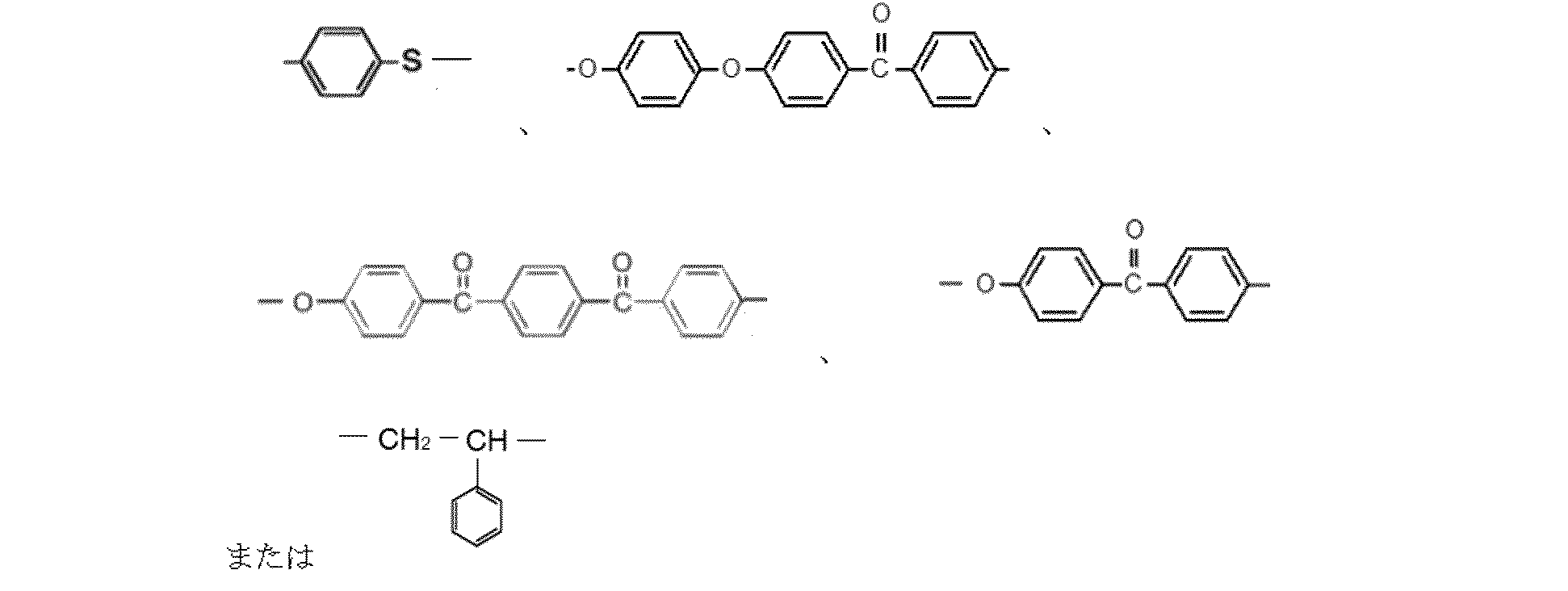
である前項1記載の重合体(B)。
3. 式(3)中のZは、クエン酸、マレイン酸、イタコン酸およびこれらの無水物から選ばれる少なくとも一種の化合物由来の置換基である前項1に記載の重合体(B)。
4.単位(1)のモル数は10~95モルであり、単位(2)のモル数は0~35モルであり、単位(3)のモル数は、5~55モルである前項1に記載の重合体(B)。

単位(S1)+単位(S2)+(単位(S3)または単位(S4))の合計100モルに対し、単位(S1)のモル数は20~90モル、単位(S2)のモル数は0~30モル、単位(S3)または単位(S4)のモル数は10~50モルである前項1に記載の重合体(B)。
6. 100質量部の熱可塑性樹脂(A成分)および3~900質量部の前項1記載の重合体(B)(B成分)を含有する樹脂組成物。
7. 熱可塑性樹脂(A成分)は、ポリエステル樹脂、液晶性ポリエステル樹脂およびポリアミド樹脂からなる群より選ばれる少なくとも一種の樹脂である請求項6記載の樹脂組成物。
8. さらに100質量部の該熱可塑性樹脂(A成分)に対して100~500質量部の他の熱可塑性樹脂(C成分)を含有する前項6記載の樹脂組成物。
9. 他の熱可塑性樹脂(C成分)は、ポリフェニレンスルフィド(PPS)、ポリエーテルエーテルケトン(PEEK)、ポリエーテルケトンケトン(PEKK)、ポリエーテルケトン(PEK)およびポリスチレン(PS)からなる群より選ばれる少なくとも一種の樹脂である前項8記載の樹脂組成物。
10. 熱可塑性樹脂(A成分)が液晶性ポリエステル樹脂であり、重合体(B成分)が単位(1)~(3)において、Xが、

である重合体(I)であり、A成分を島相とし、B成分を海相とする樹脂組成物であって、当該樹脂組成物を溶融混練してペレットとしたときの島相の粒子径Drが5μm~50μmの範囲にある、前項6記載の樹脂組成物。
11. 前項6~10の何れか一項に記載の樹脂組成物からなる成形体。
12. 液晶性ポリエステル樹脂(A成分)100質量部に対し、75~900質量部の重合体(B成分)を含有する樹脂組成物からなり、重合体(B成分)は、単位(1)~(3)において、Xが、

である重合体(I)であり、A成分を島相とし、B成分を海相とする成形体であって、
(i)比誘電率が、2.0~4.0の範囲にあり、
(ii)誘電正接が1.0×10⁻⁴~1.0×10⁻²の範囲にあり、
(iii)島相の粒子径Drが0.5μm~80μmの範囲にある、
前項11記載の成形体。
(i)比誘電率が、2.0~4.0の範囲にあり、
(ii)誘電正接が1.0×10⁻⁴~1.0×10⁻²の範囲にあり、
(iii)島相の粒子径Drが0.5μm~80μmの範囲にある、
前項11記載の成形体。
13. 液晶性ポリエステル(A成分)は、主鎖に下記式(a1)および(a2)で表される単位を含有し、(a1)/(a2)のモル比が、(5~8)/(5~2)である前項12記載の成形体。

14. (α)主として下記式(1)および(2)で表される単位を含み、

(単位(1)~(2)において、Xは、ベンゼン環を有する繰り返し単位であり、
単位(2)において、-CH3は、Xのベンゼン環の水素原子に置換したメチル基で、mは置換した数を表し1~6の整数である。)
単位(1)および(2)の合計モル数を100モルとしたとき、単位(1)のモル数は0~98モルであり、単位(2)のモル数は2~100モルである重合体(b)を調製する工程(α)、および
(β)重合体(b)と、クエン酸、マレイン酸、イタコン酸およびこれらの無水物からなる群より選ばれる少なくとも一種の化合物とを溶融混錬する工程(β)、
を含む前項1記載の重合体(B)の製造方法。
単位(2)において、-CH3は、Xのベンゼン環の水素原子に置換したメチル基で、mは置換した数を表し1~6の整数である。)
単位(1)および(2)の合計モル数を100モルとしたとき、単位(1)のモル数は0~98モルであり、単位(2)のモル数は2~100モルである重合体(b)を調製する工程(α)、および
(β)重合体(b)と、クエン酸、マレイン酸、イタコン酸およびこれらの無水物からなる群より選ばれる少なくとも一種の化合物とを溶融混錬する工程(β)、
を含む前項1記載の重合体(B)の製造方法。
15. 工程(β)において、100重量部の重合体(b)に対し、クエン酸、マレイン酸、イタコン酸およびこれらの無水物からなる群より選ばれる少なくとも一種の化合物を0.05~20重量部、溶融混錬する前項14記載の製造方法。
本発明の重合体(B)は、ベンゼン環にカルボン酸もしくはその無水物由来の置換基を有するので、ポリエステル、ポリアミド等の熱可塑性樹脂との相溶性に優れる。本発明の樹脂組成物は、分散性に優れ、またフィルム等に加工でき、成形体として有用である。
本発明の重合体(B)の側鎖のカルボン酸もしくはその無水物由来の置換基は、熱可塑性樹脂の末端と反応し、熱可塑性樹脂とのブロックポリマーを形成し、一種の相溶化剤が形成されているものと推定される。
本発明の重合体(B)の側鎖のカルボン酸もしくはその無水物由来の置換基は、熱可塑性樹脂の末端と反応し、熱可塑性樹脂とのブロックポリマーを形成し、一種の相溶化剤が形成されているものと推定される。
本発明の樹脂組成物は成形したとき、樹脂組成物中の島成分の粒子径Drに対する、成形体中の島成分の粒子径Drの比が小さく、分散安定性に優れる。本発明の成形体は、島成分の粒子径Drが所定の範囲にあり分散性に優れ加工性に優れる。本発明の成形体の製造方法によれば、分散性に優れた成形体を製造することができる。
〔重合体(B)〕
本発明の重合体(B)は、式(1)、(2)および(3)の単位の合計モル数を100モルとしたとき、式(1)で表される単位のモル数は0~95モルであり、式(2)で表される単位のモル数は0~50モルであり、式(3)で表される単位のモル数は、2~80モルである。式(1)、(2)および(3)の単位のモル数は、合計が100モルとなるように決められる。
本発明の重合体(B)は、式(1)、(2)および(3)の単位の合計モル数を100モルとしたとき、式(1)で表される単位のモル数は0~95モルであり、式(2)で表される単位のモル数は0~50モルであり、式(3)で表される単位のモル数は、2~80モルである。式(1)、(2)および(3)の単位のモル数は、合計が100モルとなるように決められる。
本発明の重合体(B)は、以下の3つの態様が含まれる。
態様1:式(1)、式(2)および式(3)が存在する態様
式(1)で表される単位のモル数は10~95モルであり、式(2)で表される単位のモル数は1~35モルであり、式(3)で表される単位のモル数は、5~55モルである。好ましくは式(1)で表される単位のモル数は20~90モルであり、式(2)で表される単位のモル数は1~30モルであり、式(3)で表される単位のモル数は、10~50モルである。
態様2:式(1)および式(3)が存在する態様
式(1)で表される単位のモル数は10~95モルであり、式(3)で表される単位のモル数は、5~90モルである。好ましくは式(1)で表される単位のモル数は20~90モルであり、式(3)で表される単位のモル数は、10~80モルである。
態様3:式(2)および式(3)が存在する態様
式(2)で表される単位のモル数は10~98モルであり、式(3)で表される単位のモル数は、2~90モルである。好ましくは式(2)で表される単位のモル数は20~80モルであり、式(3)で表される単位のモル数は、20~80モルである。
重合体(B)中の式(1)で表される単位のモル数、式(2)で表される単位のモル数および、式(3)で表される単位のモル数は、合計で100モルとなる。
態様1:式(1)、式(2)および式(3)が存在する態様
式(1)で表される単位のモル数は10~95モルであり、式(2)で表される単位のモル数は1~35モルであり、式(3)で表される単位のモル数は、5~55モルである。好ましくは式(1)で表される単位のモル数は20~90モルであり、式(2)で表される単位のモル数は1~30モルであり、式(3)で表される単位のモル数は、10~50モルである。
態様2:式(1)および式(3)が存在する態様
式(1)で表される単位のモル数は10~95モルであり、式(3)で表される単位のモル数は、5~90モルである。好ましくは式(1)で表される単位のモル数は20~90モルであり、式(3)で表される単位のモル数は、10~80モルである。
態様3:式(2)および式(3)が存在する態様
式(2)で表される単位のモル数は10~98モルであり、式(3)で表される単位のモル数は、2~90モルである。好ましくは式(2)で表される単位のモル数は20~80モルであり、式(3)で表される単位のモル数は、20~80モルである。
重合体(B)中の式(1)で表される単位のモル数、式(2)で表される単位のモル数および、式(3)で表される単位のモル数は、合計で100モルとなる。
本発明の重合体(B)は、ベンゼン環を有する繰り返し単位Xを有する。本発明の重合体(B)は、Xがポリフェニレンスルフィド(PPS)由来の重合体(I)、Xがポリエーテルエーテルケトン(PEEK)由来の重合体(II)、Xがポリエーテルケトンケトン(PEKK)由来の重合体(III)、Xがポリエーテルケトン(PEK)由来の重合体(IV)およびXがポリスチレン(PS)由来の重合体(V)を包含する。
本発明の重合体(B)の式(1)、(2)および(3)の単位を合わせた重合度(k)は、好ましくは50~2000、より好ましくは100~1800、さらに好ましくは200~1500である。
本発明の重合体(B)の式(1)、(2)および(3)の単位を合わせた重合度(k)は、好ましくは50~2000、より好ましくは100~1800、さらに好ましくは200~1500である。
<重合体(I)>
重合体(I)は、主鎖がポリフェニレンスルフィド(PPS)由来の重合体である。重合体(I)は、主として下記式(I-1)、(I-2)および(I-3)で表される単位を含む。
重合体(I)は、主鎖がポリフェニレンスルフィド(PPS)由来の重合体である。重合体(I)は、主として下記式(I-1)、(I-2)および(I-3)で表される単位を含む。



Zは、好ましくは下記式で表される構造を有する。

nは置換した数を表し1~6の整数であり、l+n=mである。式(I-3)で表される単位は、nが1、2、3、4、5または6である単位、若しくはこれらの組み合わせから構成される単位である。
単位(I-1)、単位(I-2)および単位(I-3)の合計モル数を100モルとしたとき、単位(I-1)のモル数は、好ましくは0~95モル、より好ましくは10~95モル、さらに好ましくは20~90モルであり、特に好ましくは25~85モルであり、単位(I-2)のモル数は好ましくは0~50モル、より好ましくは0~35モル、さらに好ましくは0~30モルであり、特に好ましくは0~25モルであり、単位(I-3)のモル数は、2~80モル、好ましくは5~55モル、より好ましくは10~50モルであり、特に好ましくは15~45モルである。
重合体(I)は、主として式(I-1)、(I-2)および(I-3)で表される単位を含む。ここで、「主として」とは、重合体(I)の全単位のモル数を100モル%としたとき、70~100モル%、好ましくは80~100モル%、より好ましくは90~100モル%である。
重合体(I)はその繰り返し単位の30モル%未満が、下記の構造を有する繰り返し単位等で構成されていてもよい。
重合体(I)はその繰り返し単位の30モル%未満が、下記の構造を有する繰り返し単位等で構成されていてもよい。

重合体(I)の数平均分子量は、好ましくは5,000~50,000、より好ましくは8,000~40,000、さらに好ましくは10,000~30,000である。また、重量平均分子量と数平均分子量との比として定義される、重合体(I)の多分散性は、好ましくは2.0~4.5、より好ましくは2.0~4.0、さらに好ましくは2.0~3.5である。
重合体(I)は、回転ディスク型粘度計により300℃で測定される溶融粘度が、好ましくは100~50,000ポアズ、より好ましくは100~20,000ポアズ、さらに好ましくは300~10,000ポアズである。
重合体(I)として、下記式(S1)、(S2)および(S3)で表される繰り返し単位を有する重合体が挙げられる。

単位(S1)、単位(S2)および単位(S3)の合計モル数を100モルとしたとき、単位(S1)のモル数は、好ましくは0~95モル、より好ましくは10~95モル、さらに好ましくは20~90モルであり、特に好ましくは25~85モルであり、単位(S2)のモル数は好ましくは0~50モル、より好ましくは0~35モル、さらに好ましくは0~30モルであり、特に好ましくは0~25モルであり、単位(S3)のモル数は、2~80モル、好ましくは5~55モル、より好ましくは10~50モルであり、特に好ましくは15~45モルである。
重合体(I)として、下記式(S1)、(S2)および(S4)で表される繰り返し単位を有する重合体が挙げられる。

単位(S1)、単位(S2)および単位(S4)の合計モル数を100モルとしたとき、単位(S1)のモル数は、好ましくは0~95モル、より好ましくは10~95モル、さらに好ましくは20~90モルであり、特に好ましくは25~85モルであり、単位(S2)のモル数は好ましくは0~50モル、より好ましくは0~35モル、さらに好ましくは0~30モルであり、特に好ましくは0~25モルであり、単位(S4)のモル数は、好ましくは2~80モル、より好ましくは5~55モル、さらに好ましくは10~50モル、特に好ましくは15~45モルである。
-CO-O-CO-で表される原子団の量は、重合体(I)の式(S1)で表される繰り返し単位1モルあたり、好ましくは0.1~2、より好ましくは0.2~1.5、さらにより好ましくは0.3~1.0である。
<重合体(I)の製造>
重合体(I)は、主として下記式(I-1)および(I-2)で表される単位を含むメチル基を有する重合体(i)を製造した後、該重合体(i)とクエン酸、マレイン酸、イタコン酸およびこれらの無水物から選ばれる少なくとも一種以上の化合物とを溶融混錬して、カルボン酸もしくはその無水物由来の置換基を導入することにより得られる。
重合体(I)は、主として下記式(I-1)および(I-2)で表される単位を含むメチル基を有する重合体(i)を製造した後、該重合体(i)とクエン酸、マレイン酸、イタコン酸およびこれらの無水物から選ばれる少なくとも一種以上の化合物とを溶融混錬して、カルボン酸もしくはその無水物由来の置換基を導入することにより得られる。
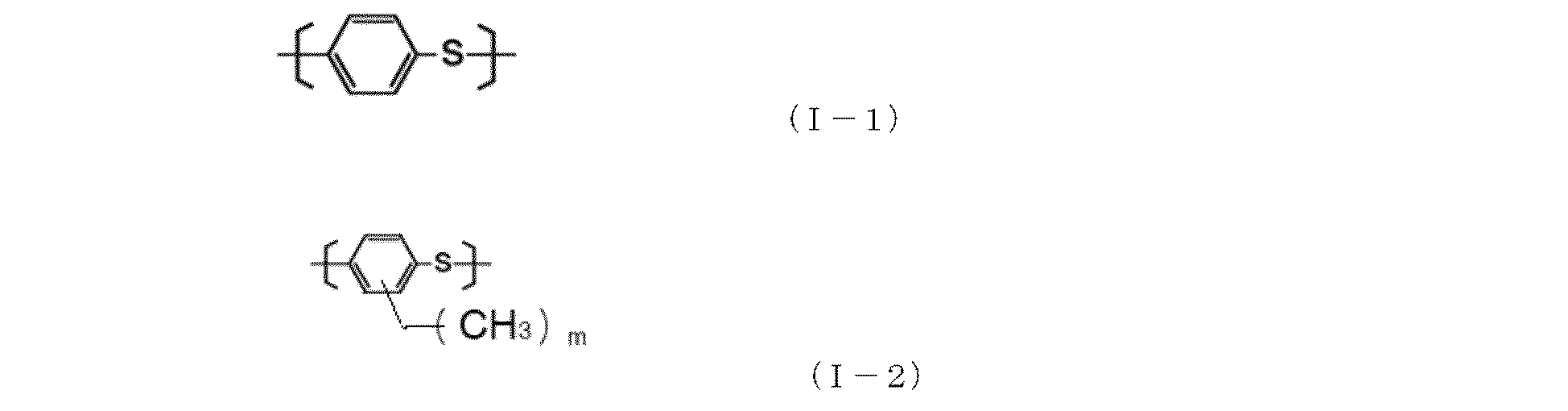
単位(I-1)および単位(I-2)の合計モル数を100モルとしたとき、単位(I-1)のモル数は、好ましくは0~95モルであり、より好ましくは0~80モルであり、さらにより好ましくは0~60モルであり、単位(I-2)のモル数は、好ましくは1~100モルであり、より好ましくは5~100モルである。
重合体(i)は、下記の方法1または方法2により、式(I-1)で表される単位を有する共重合体(以下、PPSと呼ぶことがある)を製造する際に、側鎖にメチル基を有する芳香族化合物を共重合成分として用い、式(I-2)で表される単位を導入することにより製造することができる。
(方法1:アルカリ金属の硫化物とのジハロゲン芳香族化合物とを反応)
PPSは、有機アミド溶媒中でアルカリ金属の硫化物などの水硫化物イオンを提供する材料と、ジハロゲン芳香族化合物とを反応させ製造することができる。
アルカリ金属の硫化物として、硫化リチウム、硫化ナトリウム、硫化カリウム、硫化ルビジウム、硫化セシウムまたはその混合物などが挙げられる。
ジハロゲン芳香族化合物として、o-ジハロベンゼン、m-ジハロベンゼン、p-ジハロベンゼン、ジハロトルエン、ジハロナフタレン、メトキシ-ジハロベンゼン、ジハロビフェニル、ジハロ安息香酸、ジハロジフェニルエーテル、ジハロジフェニルスルホン、ジハロジフェニルスルホキシド、ハロジフェニルケトンなどが挙げられる。
PPSは、有機アミド溶媒中でアルカリ金属の硫化物などの水硫化物イオンを提供する材料と、ジハロゲン芳香族化合物とを反応させ製造することができる。
アルカリ金属の硫化物として、硫化リチウム、硫化ナトリウム、硫化カリウム、硫化ルビジウム、硫化セシウムまたはその混合物などが挙げられる。
ジハロゲン芳香族化合物として、o-ジハロベンゼン、m-ジハロベンゼン、p-ジハロベンゼン、ジハロトルエン、ジハロナフタレン、メトキシ-ジハロベンゼン、ジハロビフェニル、ジハロ安息香酸、ジハロジフェニルエーテル、ジハロジフェニルスルホン、ジハロジフェニルスルホキシド、ハロジフェニルケトンなどが挙げられる。
ジハロゲン芳香族化合物は、単独でまたはそれらの任意の組み合わせで使用することができる。具体的な代表例のジハロゲン芳香族化合物として、p-ジクロロベンゼン;m-ジクロロベンゼン;o-ジクロロベンゼン;2,5-ジクロロトルエン;1,4-ジブロモベンゼン;1,4-ジクロロナフタレン;1-メトキシ-2,5-ジクロロベンゼン;4,4’-ジクロロビフェニル;3,5-ジクロロ安息香酸;4,4’-ジクロロジフェニルエーテル;4,4’-ジクロロジフェニルスルホン;4,4’-ジクロロジフェニルスルホキシド;および4,4’-ジクロロジフェニルケトンなど挙げることができる。
PPSの末端基を形成するか、重合反応、PPSの分子量を調整するために、ジハロ芳香族化合物と組み合わせてモノハロ化合物(例えばモノハロゲン芳香族化合物い)を使用することもできる。
PPSの末端基を形成するか、重合反応、PPSの分子量を調整するために、ジハロ芳香族化合物と組み合わせてモノハロ化合物(例えばモノハロゲン芳香族化合物い)を使用することもできる。
(方法2:硫黄含有反応物をジヨード芳香族化合物と重合させる方法)
PPSは、硫黄含有反応物をジヨード芳香族化合物と重合させる方法によって製造することができる。
PPSは、硫黄含有反応物をジヨード芳香族化合物と重合させる方法によって製造することができる。
ジヨード芳香族化合物は、ジヨードベンゼン(DIB)、ジヨードナフタレン、ジヨードビフェニル、ジヨードビスフェノール、およびジヨードベンゾフェノンから成る群から選択される少なくとも1つであってもよい。また、ジヨード芳香族化合物は、置換基、例えばアルキル基またはスルホン基などを含んでいてもよい。また、酸素または窒素原子が芳香族基に含有されるジヨード芳香族化合物を使用してもよい。
ジヨード芳香族化合物と反応する硫黄元素の形態は特に限定されない。硫黄元素は一般に8個の原子が室温で結合しているシクロオクタ硫黄(S8)の形態で存在する。そのような形態ではないが、固体状または液体状の市販の硫黄を特に限定されずに使用してもよい。
また、反応物は重合開始剤、安定化剤、またはそれらの混合物をさらに含んでいてもよい。具体的には、重合開始剤は、1,3-ジヨード-4-ニトロベンゼン、メルカプトベンゾチアゾール、2,2’-ジチオベンゾチアゾール、シクロヘキシル-ベンゾチアゾールスルフェンアミド、およびブチル-ベンゾチアゾールスルホンアミドから成る群から選択される少なくとも1つであってもよいが、それらに限定されない。また、安定化剤は、樹脂の重合反応で一般に使用される安定化剤である限り、特に限定されずに使用してもよい。
重合反応は、ジヨード芳香族化合物および硫黄含有反応物の重合反応を開始することができる任意の条件下で行うことができる。例えば、重合反応は、温度上昇および圧力降下の反応条件下で行うことができ、具体的には180~250℃および50~450トールの初期反応条件から270~350℃および0.001~20トールの最終反応条件までの温度上昇および圧力降下を行いながら1~30時間で行うことができる。より具体的には、重合反応は、280~300℃および0.1~0.5トールの最終反応条件下で行うことができる。
一方、重合反応の間に、重合がある程度まで進行したタイミングで、重合停止剤を反応物にさらに加えてもよい。重合停止剤は、重合を停止させるために重合したポリマー中に含まれるヨウ素基を除去できる限り、特に限定されない。具体的には、重合停止剤は、ジフェニルスルフィド、ジフェニルエーテル、ジフェニル、ベンゾフェノン、ジベンゾチアゾールジスルフィド、モノヨードアリール化合物、ベンゾチアゾール、ベンゾチアゾールスルホンアミド、チウラム、ジチオカルバメート、およびジフェニルジスルフィドから成る群から選択される少なくとも1つであってもよい。
上記のように調製されるPPSは、その主鎖に結合しているヨウ素および遊離ヨウ素を含んでいてもよい。具体的には、主鎖に結合しているヨウ素および遊離ヨウ素の含量は10~10,000ppmであってもよい。主鎖に結合しているヨウ素および遊離ヨウ素の含量は、PPS試料を高温で熱処理し、次いでイオンクロマトグラフィーを使用して定量化を行うことにより、以下の実施例で記載されるように測定することができる。遊離ヨウ素は、上記のようなジヨード芳香族化合物および硫黄含有反応物の重合工程で生成され、最終的に形成されるPPSから化学的に分離された状態で残留しているヨウ素分子、ヨウ素イオン、ヨウ素ラジカルなどを集合的に包含する。
その後、該重合体(i)と、クエン酸、マレイン酸、イタコン酸およびこれらの無水物から選ばれる少なくとも一種の化合物とを溶融混錬して、側鎖にカルボン酸無水物を導入して、式(I-3)で表される繰り返し単位を形成することにより製造することが出来る。
<重合体(II)>
重合体(II)は、主鎖がポリエーテルエーテルケトン(PEEK)由来の重合体である。重合体(II)は、主として下記式(II-1)、(II-2)および(II-3)で表される単位を含む。
重合体(II)は、主鎖がポリエーテルエーテルケトン(PEEK)由来の重合体である。重合体(II)は、主として下記式(II-1)、(II-2)および(II-3)で表される単位を含む。
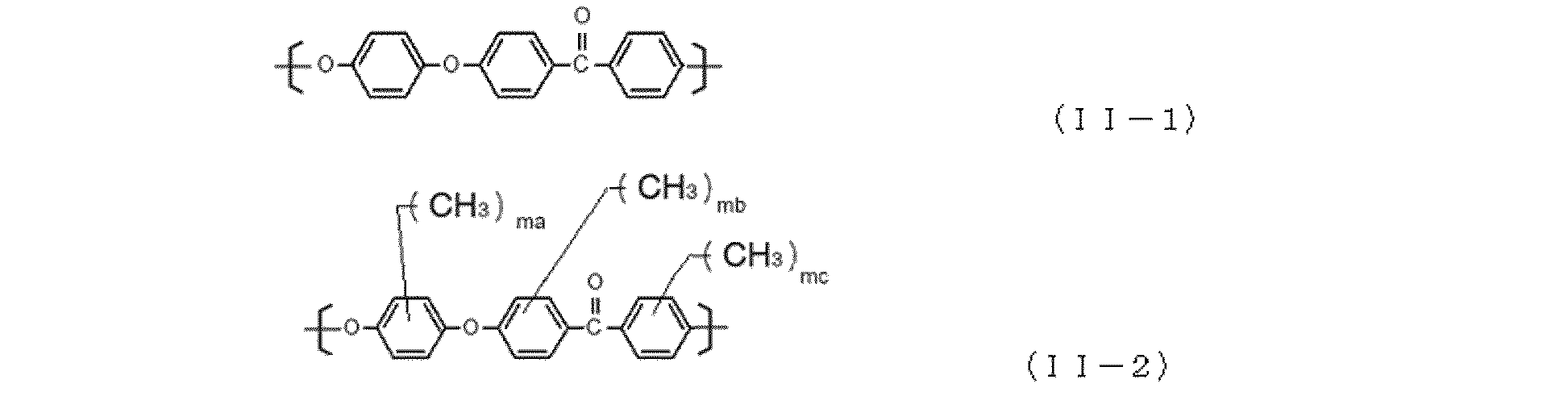

Zは、カルボン酸もしくはその無水物由来の置換基である。Zとして、クエン酸、マレイン酸、イタコン酸およびこれらの無水物から選ばれる少なくとも一種の化合物由来の基が挙げられる。Zは、好ましくは下記式で表される構造を有する。

na、nb、ncは置換した数を表し、na+nb+nc+la+lb+lc=1~6の整数である。式(3)で表される単位は、na、nb、nc、la、lb、lcが0、1、2、3、4、5または6である単位、若しくはこれらの組み合わせから構成される単位である。
単位(II-1)、単位(II-2)および単位(II-3)の合計モル数を100モルとしたとき、単位(II-1)のモル数は、好ましくは0~95モル、より好ましくは10~95モル、さらに好ましくは20~90モルであり、特に好ましくは25~85モルであり、単位(II-2)のモル数は、好ましくは0~50モル、より好ましくは0~35モル、さらに好ましくは0~30モルであり、特に好ましくは0~25モルであり、単位(II-3)のモル数は、好ましくは2~80モル、より好ましくは5~55モル、さらに好ましくは10~50モル、特に好ましくは15~45モルである。
重合体(II)は、主として式(II-1)、(II-2)および(II-3)で表される単位を含む。ここで、「主として」とは、重合体(II)の全単位のモル数を100モル%としたとき、70~100モル%、好ましくは80~100モル%、より好ましくは90~100モル%である。
重合体(II)は、その繰り返し単位の30モル%未満が、他の繰り返し単位で構成されていてもよい。
重合体(II)は、その繰り返し単位の30モル%未満が、他の繰り返し単位で構成されていてもよい。
重合体(II)の還元粘度(ηsp/C)は、特に制限はないが、好ましい範囲として0.1~2.5dL/g、より好ましくは0.2~2.0dL/g、さらに好ましくは0.3~1.8dL/gを例示できる。かかる好適な粘度範囲に調整することにより、力学特性に優れた成形品が得られる。
重合体(II)の融点は、好ましい範囲として、200~450℃、より好ましくは230~400℃、さらに好ましくは250~350℃を例示できる。かかる好適な温度範囲に調整することにより、成形性と耐熱性に優れた成形品が得られる。なおここで、重合体(II)の融点は、示差走査型熱量測定装置を用いて吸熱ピーク温度を観測することにより測定することが可能である。
<重合体(II)の製造>
重合体(II)は、主として下記式(II-1)および(II-2)で表される単位を含むメチル基を有する重合体(ii)を製造した後、該重合体(ii)とクエン酸、マレイン酸、イタコン酸およびこれらの無水物から選ばれる少なくとも一種以上の化合物とを溶融混錬して、カルボン酸もしくはその無水物由来の置換基を導入することにより得られる。
重合体(II)は、主として下記式(II-1)および(II-2)で表される単位を含むメチル基を有する重合体(ii)を製造した後、該重合体(ii)とクエン酸、マレイン酸、イタコン酸およびこれらの無水物から選ばれる少なくとも一種以上の化合物とを溶融混錬して、カルボン酸もしくはその無水物由来の置換基を導入することにより得られる。

単位(II-1)および単位(II-2)の合計モル数を100モルとしたとき、単位(II-1)のモル数は、好ましくは0~90モルであり、より好ましくは0~80モルであり、単位(II-2)のモル数は、好ましくは10~100モルであり、より好ましくは20~100モルである。
メチル基を有する重合体(ii)は、ヒドロキノンと、4,4-ジフルオロベンゾフェノンとを、炭酸カリウム触媒の存在下反応させる際に、メチル基で置換されたヒドロキノンや、メチル基で置換された4,4-ジフルオロベンゾフェノンを共重合させることにより製造することができる。
<重合体(III)>
重合体(III)は、主鎖がポリエーテルケトンケトン(PEKK)由来の重合体である。重合体(III)は、主として下記式(III-1)、(III-2)および(III-3)で表される単位を含む。
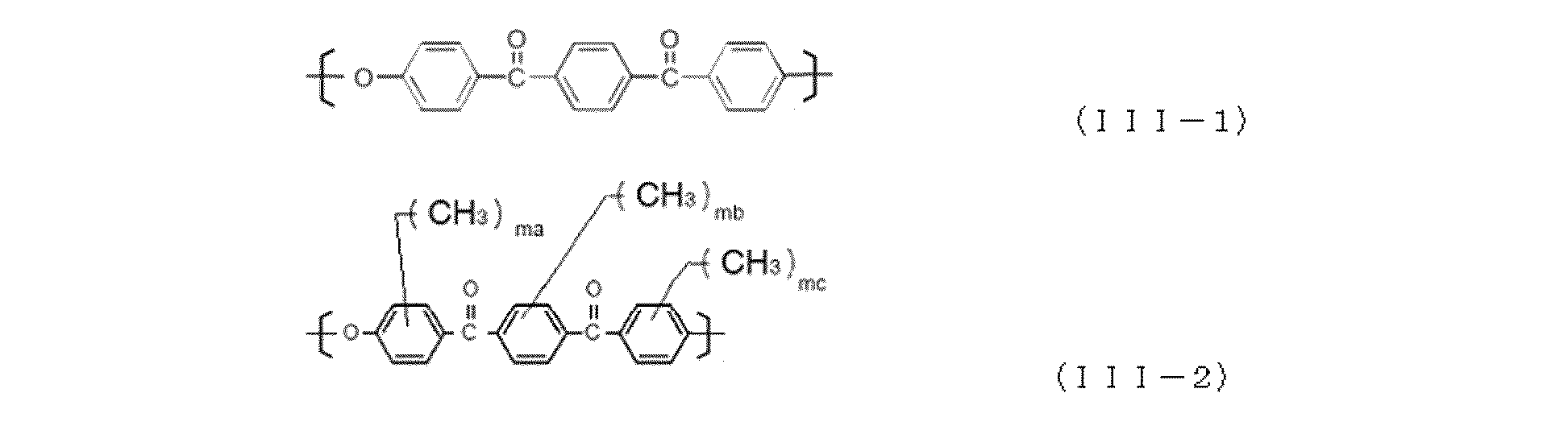
式(III-2)で表される単位において、-CH3は、ベンゼン環の水素原子に置換したメチル基で、ma、mb、mcは置換した数を表しma+mb+mc=1~6の整数である。
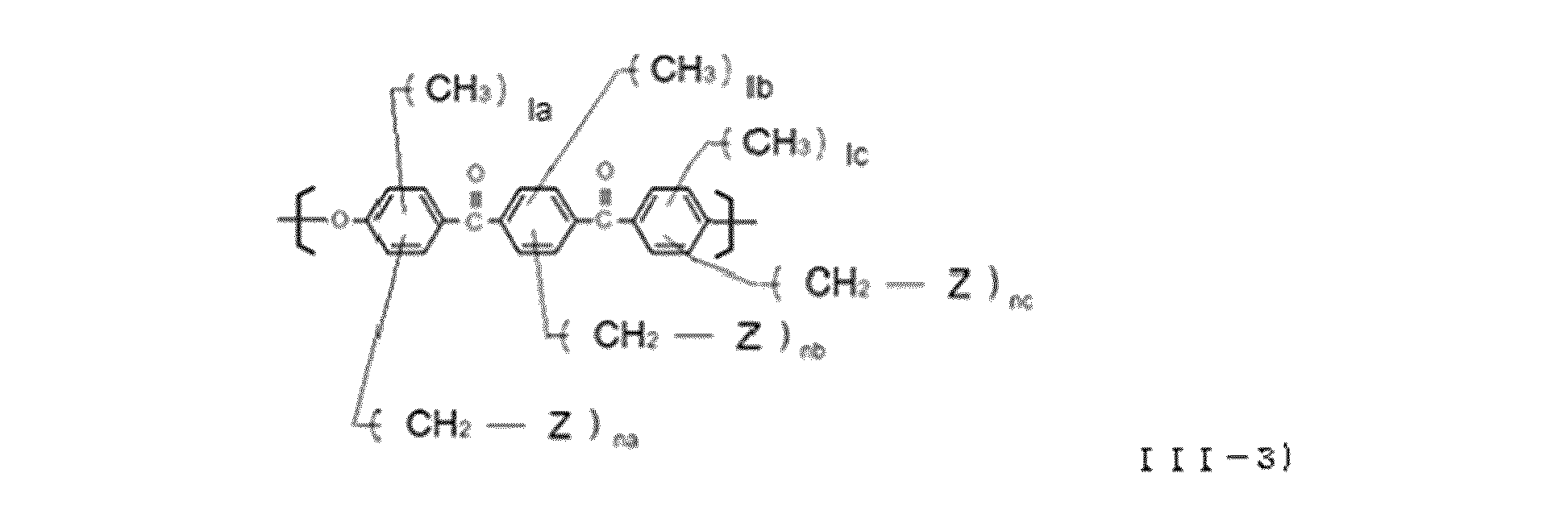 式(III-3)で表される単位は、式(III-2)で表される単位の-CH3の水素原子が置換基“Z”で置換した単位である。
重合体(III)は、主鎖がポリエーテルケトンケトン(PEKK)由来の重合体である。重合体(III)は、主として下記式(III-1)、(III-2)および(III-3)で表される単位を含む。
Zは、カルボン酸もしくはその無水物由来の置換基である。Zとして、クエン酸、マレイン酸、イタコン酸およびこれらの無水物から選ばれる少なくとも一種の化合物由来の基が挙げられる。Zは、好ましくは下記式で表される構造を有する。

na、nb、ncは置換した数を表し、na+nb+nc+la+lb+lc=1~6の整数である。
式(III-3)で表される単位は、na、nb、nc、la、lb、lcが0、1、2、3、4、5または6である単位、若しくはこれらの組み合わせから構成される単位である。
式(III-3)で表される単位は、na、nb、nc、la、lb、lcが0、1、2、3、4、5または6である単位、若しくはこれらの組み合わせから構成される単位である。
単位(III-1)、単位(III-2)および単位(III-3)の合計モル数を100モルとしたとき、単位(III-1)のモル数は、好ましくは0~95モル、より好ましくは10~95モル、さらに好ましくは20~90モルであり、特に好ましくは25~85モルであり、単位(III-2)のモル数は、好ましくは0~50モル、より好ましくは0~35モル、さらに好ましくは0~30モルであり、特に好ましくは0~25モルであり、単位(III-3)のモル数は、好ましくは2~80モル、より好ましくは5~55モル、さらに好ましくは10~50モル、特に好ましくは15~45モルである。
重合体(III)は、主として式(III-1)、(III-2)および(III-3)で表される単位を含む。ここで、「主として」とは、重合体(III)の全単位のモル数を100モル%としたとき、好ましくは70~100モル%、より好ましくは80~100モル%、さらに好ましくは90~100モル%である。重合体(III)は、その繰り返し単位の30モル%未満が、他の繰り返し単位で構成されていてもよい。
重合体(III)の還元粘度(ηsp/C)は、特に制限はないが、好ましい範囲として0.1~2.5dL/g、より好ましくは0.2~2.0dL/g、さらに好ましくは0.3~1.8dL/gを例示できる。かかる好適な粘度範囲に調整することにより、力学特性に優れた成形品が得られる。
重合体(III)の融点は、好ましい範囲として、200~450℃、より好ましくは230~400℃、さらに好ましくは250~350℃を例示できる。かかる好適な温度範囲に調整することにより、成形性と耐熱性に優れた成形品が得られる。なおここで、重合体(III)の融点は、示差走査型熱量測定装置を用いて吸熱ピーク温度を観測することにより測定することが可能である。
<重合体(III)の製造>
重合体(III)は、主として下記式(III-1)および(III-2)で表される単位を含むメチル基を有する重合体(iii)を製造した後、該重合体(iii)とクエン酸、マレイン酸、イタコン酸およびこれらの無水物から選ばれる少なくとも一種以上の化合物とを溶融混錬して、カルボン酸もしくはその無水物由来の置換基を導入することにより得られる。

重合体(III)は、主として下記式(III-1)および(III-2)で表される単位を含むメチル基を有する重合体(iii)を製造した後、該重合体(iii)とクエン酸、マレイン酸、イタコン酸およびこれらの無水物から選ばれる少なくとも一種以上の化合物とを溶融混錬して、カルボン酸もしくはその無水物由来の置換基を導入することにより得られる。
式(III-2)で表される単位において、-CH3は、ベンゼン環の水素原子に置換したメチル基で、ma、mb、mcは置換した数を表し、ma+mb+mc=1~6の整数である。
単位(III-1)および単位(III-2)の合計モル数を100モルとしたとき、単位(III-1)のモル数は、好ましくは0~90モルであり、より好ましくは0~80モルであり、単位(III-2)のモル数は、好ましくは10~100モルであり、より好ましくは20~100モルである。
メチル基を有する重合体(iii)は、ベンゾフェノンと、両端に塩素を結合させたケトン基を持つベンゼン環を、塩化アルミニウムなどを触媒として反応させる際に、メチル基で置換されたベンゾフェノンや、メチル基で置換されたケトン基を持つベンゼン化合物を共重合させることにより製造することができる。
<重合体(IV)>
重合体(IV)は、主鎖がポリエーテルケトン(PEK)由来の重合体である。重合体(IV)は、主として下記式(IV-1)、(IV-2)および(IV-3)で表される単位を含む。
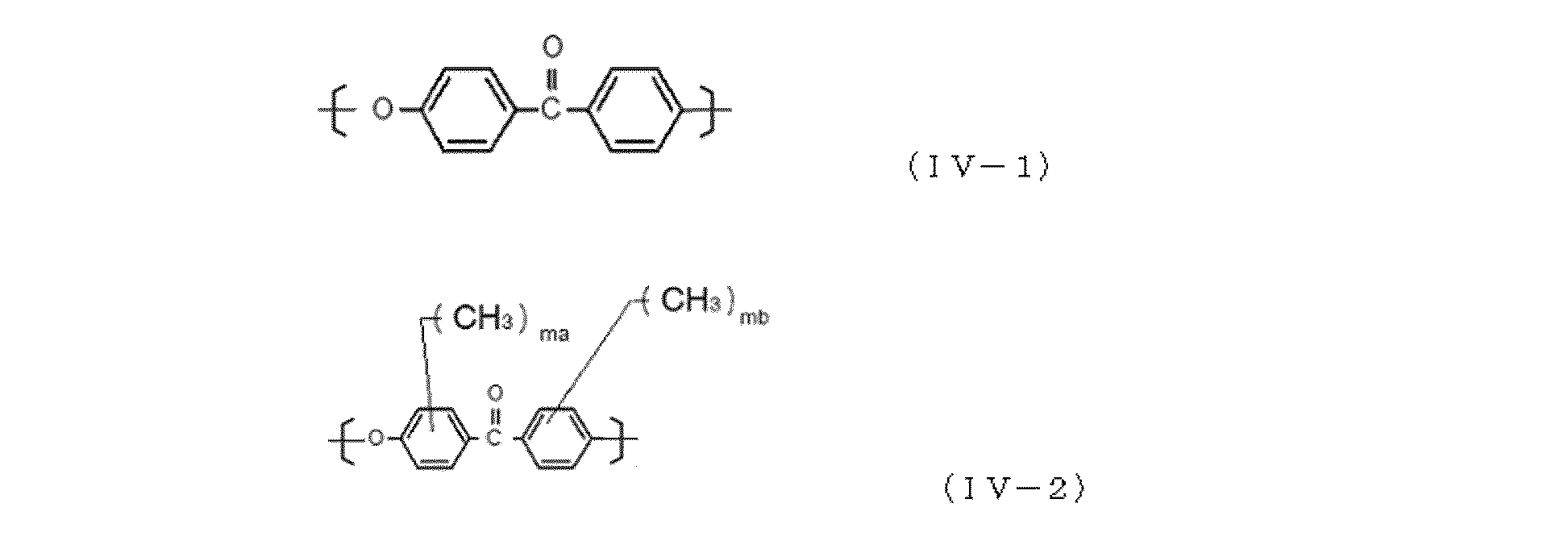
式(IV-2)で表される単位において、-CH3は、ベンゼン環の水素原子に置換したメチル基で、ma、mbは置換した数を表し、ma+mb=1~6の整数である。
 式(IV-3)で表される単位は、式(IV-2)で表される単位の-CH3の水素原子が置換基“Z”で置換した単位である。
重合体(IV)は、主鎖がポリエーテルケトン(PEK)由来の重合体である。重合体(IV)は、主として下記式(IV-1)、(IV-2)および(IV-3)で表される単位を含む。
Zは、カルボン酸もしくはその無水物由来の置換基である。Zとして、クエン酸、マレイン酸、イタコン酸およびこれらの無水物から選ばれる少なくとも一種の化合物由来の基が挙げられる。Zは、好ましくは下記式で表される構造を有する。

na、nbは置換した数を表し、na+nb+la+lb=1~6の整数である。
式(3)で表される単位は、na、nb、la、lbが、0、1、2、3、4、5または6である単位、若しくはこれらの組み合わせから構成される単位である。
式(3)で表される単位は、na、nb、la、lbが、0、1、2、3、4、5または6である単位、若しくはこれらの組み合わせから構成される単位である。
単位(IV-1)、単位(IV-2)および単位(IV-3)の合計モル数を100モルとしたとき、単位(IV-1)のモル数は、好ましくは0~95モル、より好ましくは10~95モル、さらに好ましくは20~90モルであり、特に好ましくは25~85モルであり、単位(IV-2)のモル数は好ましくは0~50モル、より好ましくは0~35モル、さらに好ましくは0~30モルであり、特に好ましくは0~25モルであり、単位(IV-3)のモル数は、好ましくは2~80モル、より好ましくは5~55モル、さらに好ましくは10~50モル、特に好ましくは15~45モルである。
重合体(IV)は、主として式(IV-1)、(IV-2)および(IV-3)で表される単位を含む。ここで、「主として」とは、重合体(IV)の全単位のモル数を100モル%としたとき、好ましくは70~100モル%、より好ましくは80~100モル%、さらに好ましくは90~100モル%である。
重合体(IV)は,その繰り返し単位の30モル%未満が、他の繰り返し単位で構成されていてもよい。
重合体(IV)は,その繰り返し単位の30モル%未満が、他の繰り返し単位で構成されていてもよい。
重合体(IV)の還元粘度(ηsp/C)は、特に制限はないが、好ましい範囲として0.1~2.5dL/g、より好ましくは0.2~2.0dL/g、さらに好ましくは0.3~1.8dL/gを例示できる。かかる好適な粘度範囲に調整することにより、力学特性に優れた成形品が得られる。
重合体(IV)の融点は、好ましい範囲として、200~450℃、より好ましくは230~400℃、さらに好ましくは250~350℃を例示できる。かかる好適な温度範囲に調整することにより、成形性と耐熱性に優れた成形品が得られる。なおここで、重合体(IV)の融点は、示差走査型熱量測定装置を用いて吸熱ピーク温度を観測することにより測定することが可能である。
重合体(IV)の融点は、好ましい範囲として、200~450℃、より好ましくは230~400℃、さらに好ましくは250~350℃を例示できる。かかる好適な温度範囲に調整することにより、成形性と耐熱性に優れた成形品が得られる。なおここで、重合体(IV)の融点は、示差走査型熱量測定装置を用いて吸熱ピーク温度を観測することにより測定することが可能である。
<重合体(IV)の製造>
重合体(IV)は、主として下記式(IV-1)および(IV-2)で表される単位を含むメチル基を有する重合体(iv)を製造した後、該重合体(iv)とクエン酸、マレイン酸、イタコン酸およびこれらの無水物から選ばれる少なくとも一種の化合物とを溶融混錬して、カルボン酸もしくはその無水物由来の置換基を導入することにより得られる。

式(IV-2)で表される単位において、-CH3は、ベンゼン環の水素原子に置換したメチル基で、ma、mbは置換した数を表し、ma+mb=1~6の整数である。
重合体(IV)は、主として下記式(IV-1)および(IV-2)で表される単位を含むメチル基を有する重合体(iv)を製造した後、該重合体(iv)とクエン酸、マレイン酸、イタコン酸およびこれらの無水物から選ばれる少なくとも一種の化合物とを溶融混錬して、カルボン酸もしくはその無水物由来の置換基を導入することにより得られる。
単位(IV-1)および単位(IV-2)の合計モル数を100モルとしたとき、単位(IV-1)のモル数は、好ましくは0~90モルであり、より好ましくは0~80モルであり、単位(IV-2)のモル数は、好ましくは10~100モルであり、より好ましくは20~100モルである。
重合体(iv)は、フッ素と水酸基とを両端に結合させたベンゾフェノンを結合させて製造し、その際に、ベンゼン環にメチル基を有するベンゾフェノンを共重合させ製造する。
重合体(iv)は、フッ素と水酸基とを両端に結合させたベンゾフェノンを結合させて製造し、その際に、ベンゼン環にメチル基を有するベンゾフェノンを共重合させ製造する。
<重合体(V)>
重合体(V)は、主鎖がポリスチレン(PS)由来の重合体である。重合体(V)は、主として下記式(V-1)、(V-2)および(V-3)で表される単位を含む。

式(V-1)は、ポリスチレンを構成する繰り返し単位である。
 式(V-2)で表される単位において、-CH3は、ベンゼン環の水素原子に置換したメチル基で、mは置換した数を表し1~6の整数である。
 式(V-3)で表される単位は、式(V-2)で表される単位の-CH3の水素原子が置換基“Z”で置換した単位である。
重合体(V)は、主鎖がポリスチレン(PS)由来の重合体である。重合体(V)は、主として下記式(V-1)、(V-2)および(V-3)で表される単位を含む。
Zは、カルボン酸もしくはその無水物由来の置換基である。Zとして、クエン酸、マレイン酸、イタコン酸およびこれらの無水物から選ばれる少なくとも一種の化合物由来の基が挙げられる。Zは、好ましくは下記式で表される構造を有する。

nは置換した数を表し1~6の整数であり、l+n=mである。式(V-3)で表される単位は、nが1、2、3、4、5または6である単位、若しくはこれらの組み合わせから構成される単位である。
単位(V-1)、単位(V-2)および単位(V-3)の合計モル数を100モルとしたとき、単位(V-1)のモル数は、好ましくは0~95モル、より好ましくは10~95モル、さらに好ましくは20~90モルであり、特に好ましくは25~85モルであり、単位(V-2)のモル数は、好ましくは0~50モル、より好ましくは0~35モル、さらに好ましくは0~30モルであり、特に好ましくは0~25モルであり、単位(V-3)のモル数は、好ましくは2~80モル、より好ましくは5~55モル、さらに好ましくは10~50モル、特に好ましくは15~45モルである。
重合体(V)は、主として式(V-1)、(V-2)および(V-3)で表される単位を含む。ここで、「主として」とは、重合体(V)の全単位のモル数を100モル%としたとき、好ましくは70~100モル%、より好ましくは80~100モル%、さらに好ましくは90~100モル%である。重合体(V)はその繰り返し単位の30モル%未満が、他の構造を有する繰り返し単位等で構成されていてもよい。
重合体(V)のガラス転移温度は、好ましい範囲として、20~150℃、より好ましくは50~135℃、さらに好ましくは60~120℃を例示できる。かかる好適な温度範囲に調整することにより、成形性と耐熱性に優れた成形品が得られる。なおここで、重合体(V)のガラス転移温度は、示差走査型熱量測定装置を用いることにより測定することが可能である。
重合体(V)の分子量はGPCを用いて、クロロホルムを溶離液としてGPC測定をすることにより求めることができる。重合体(V)の分子量は重量平均分子量として、好ましくは10000~400000、より好ましくは20000~350000、さらに好ましくは30000~300000を例示できる。
重合体(V)のガラス転移温度は、好ましい範囲として、20~150℃、より好ましくは50~135℃、さらに好ましくは60~120℃を例示できる。かかる好適な温度範囲に調整することにより、成形性と耐熱性に優れた成形品が得られる。なおここで、重合体(V)のガラス転移温度は、示差走査型熱量測定装置を用いることにより測定することが可能である。
重合体(V)の分子量はGPCを用いて、クロロホルムを溶離液としてGPC測定をすることにより求めることができる。重合体(V)の分子量は重量平均分子量として、好ましくは10000~400000、より好ましくは20000~350000、さらに好ましくは30000~300000を例示できる。
重合体(V)として、式(V-1)が、ポリスチレン、スチレン/アクリロニトリル重合体およびゴム変性スチレン系樹脂などに由来する単位であっても良い。ゴム変性スチレン系樹脂の具体例としては、例えば、耐衝撃性ポリスチレン(HIPS)、ABS樹脂(アクリロニトリル/ブタジエン/スチレン重合体)、AAS樹脂(アクリロニトリル/アクリル/スチレン重合体)、およびAES樹脂(アクリロニトリル/エチレンプロピレン/スチレン重合体)などが挙げられる。重合体(V)は、メタロセン触媒を用いて重合することにより形成されるシンジオタクチック構造を有していてもよい。
<重合体(V)の製造>
重合体(V)は、主として下記式(V-1)および(V-2)で表される単位を含むメチル基を有する重合体(v)を製造した後、該重合体(v)とクエン酸、マレイン酸、イタコン酸およびこれらの無水物から選ばれる少なくとも一種以上の化合物とを溶融混錬して、カルボン酸もしくはその無水物由来の置換基を導入することにより得られる。

式(V-1)は、ポリスチレンを構成する繰り返し単位である。
 式(V-2)で表される単位において、-CH3は、ベンゼン環の水素原子に置換したメチル基で、mは置換した数を表し1~6の整数である。
重合体(V)は、主として下記式(V-1)および(V-2)で表される単位を含むメチル基を有する重合体(v)を製造した後、該重合体(v)とクエン酸、マレイン酸、イタコン酸およびこれらの無水物から選ばれる少なくとも一種以上の化合物とを溶融混錬して、カルボン酸もしくはその無水物由来の置換基を導入することにより得られる。
単位(V-1)および(V-2)の合計モル数を100モルとしたとき、単位(V-1)のモル数は、好ましくは0~90モルであり、より好ましくは0~80モルであり、単位(V-2)のモル数は、好ましくは10~100モルであり、より好ましくは20~100モルである。
重合体(v)は、ベンゼン環をメチル基で置換したスチレンを重合することにより製造することができる。
重合体(v)は、ベンゼン環をメチル基で置換したスチレンを重合することにより製造することができる。
〔樹脂組成物〕
本発明において、重合体(B)をB成分と呼ぶことがある。本発明の樹脂組成物は、100質量部の熱可塑性樹脂(A成分)に対し、3~900質量部の前記重合体(B成分)を含有する。
熱可塑性樹脂(A成分)として、ポリエステル樹脂、液晶性ポリエステル樹脂(LCP樹脂)、ポリアミド樹脂等が挙げられる。
熱可塑性樹脂(A成分)としてポリエステル樹脂や液晶性ポリエステル樹脂(LCP樹脂)を用いる場合は、前記重合体(B成分)の含有量は100質量部のポリエステル樹脂や液晶性ポリエステル樹脂(LCP樹脂)に対し、好ましくは10~800質量部、より好ましくは20~700質量部である。
熱可塑性樹脂(A成分)としてポリアミド樹脂を用いる場合、前記重合体(B成分)の含有量は100質量部のポリアミド樹脂に対し、好ましくは4~800質量部、より好ましくは5~400質量部である。
本発明の樹脂組成物は、さらに100質量部の該熱可塑性樹脂(A成分)に対して5~500質量部の他の熱可塑性樹脂(C成分)を含有する態様がある。他の熱可塑性樹脂(C成分)は、ポリフェニレンスルフィド(PPS)、ポリエーテルエーテルケトン(PEEK)、ポリエーテルケトンケトン(PEKK)、ポリエーテルケトン(PEK)およびポリスチレン(PS)からなる群より選ばれる少なくとも一種の樹脂であることが好ましい。
本発明において、重合体(B)をB成分と呼ぶことがある。本発明の樹脂組成物は、100質量部の熱可塑性樹脂(A成分)に対し、3~900質量部の前記重合体(B成分)を含有する。
熱可塑性樹脂(A成分)として、ポリエステル樹脂、液晶性ポリエステル樹脂(LCP樹脂)、ポリアミド樹脂等が挙げられる。
熱可塑性樹脂(A成分)としてポリエステル樹脂や液晶性ポリエステル樹脂(LCP樹脂)を用いる場合は、前記重合体(B成分)の含有量は100質量部のポリエステル樹脂や液晶性ポリエステル樹脂(LCP樹脂)に対し、好ましくは10~800質量部、より好ましくは20~700質量部である。
熱可塑性樹脂(A成分)としてポリアミド樹脂を用いる場合、前記重合体(B成分)の含有量は100質量部のポリアミド樹脂に対し、好ましくは4~800質量部、より好ましくは5~400質量部である。
本発明の樹脂組成物は、さらに100質量部の該熱可塑性樹脂(A成分)に対して5~500質量部の他の熱可塑性樹脂(C成分)を含有する態様がある。他の熱可塑性樹脂(C成分)は、ポリフェニレンスルフィド(PPS)、ポリエーテルエーテルケトン(PEEK)、ポリエーテルケトンケトン(PEKK)、ポリエーテルケトン(PEK)およびポリスチレン(PS)からなる群より選ばれる少なくとも一種の樹脂であることが好ましい。
<ポリエステル樹脂>
ポリエステル樹脂は、(1)ジカルボン酸またはそのエステル形成性誘導体とジオールまたはそのエステル形成性誘導体、(2)ヒドロキシカルボン酸またはそのエステル形成性誘導体、および(3)ラクトンからなる群より選択される少なくとも1種の残基を主構造単位とする重合体または重合体である。ここで、「主構造単位とする」とは、全構造単位中、(1)~(3)からなる群より選択される少なくとも1種の残基を50モル%以上有することを指し、それらの残基を80モル%以上有することが好ましい態様である。これらの中でも、(1)ジカルボン酸またはそのエステル形成性誘導体とジオールまたはそのエステル形成性誘導体の残基を主構造単位とする重合体または重合体が、機械物性や耐熱性により優れる点で好ましい。
ポリエステル樹脂は、(1)ジカルボン酸またはそのエステル形成性誘導体とジオールまたはそのエステル形成性誘導体、(2)ヒドロキシカルボン酸またはそのエステル形成性誘導体、および(3)ラクトンからなる群より選択される少なくとも1種の残基を主構造単位とする重合体または重合体である。ここで、「主構造単位とする」とは、全構造単位中、(1)~(3)からなる群より選択される少なくとも1種の残基を50モル%以上有することを指し、それらの残基を80モル%以上有することが好ましい態様である。これらの中でも、(1)ジカルボン酸またはそのエステル形成性誘導体とジオールまたはそのエステル形成性誘導体の残基を主構造単位とする重合体または重合体が、機械物性や耐熱性により優れる点で好ましい。
上記のジカルボン酸またはそのエステル形成性誘導体としては、例えば、テレフタル酸、イソフタル酸、フタル酸、2,6-ナフタレンジカルボン酸、1,5-ナフタレンジカルボン酸、ビス(p-カルボキシフェニル)メタン、1,4-アントラセンジカルボン酸、1,5-アントラセンジカルボン酸、1,8-アントラセンジカルボン酸、2,6-アントラセンジカルボン酸、9,10-アントラセンジカルボン酸、4,4’-ジフェニルエーテルジカルボン酸、5-テトラブチルホスホニウムイソフタル酸、5-ナトリウムスルホイソフタル酸などの芳香族ジカルボン酸、シュウ酸、コハク酸、アジピン酸、セバシン酸、アゼライン酸、ドデカンジオン酸、マロン酸、グルタル酸、ダイマー酸などの脂肪族ジカルボン酸、1,3-シクロヘキサンジカルボン酸、1,4-シクロヘキサンジカルボン酸などの脂環式ジカルボン酸およびこれらのエステル形成性誘導体などが挙げられる。これらを2種以上用いてもよい。
また、上記のジオールまたはそのエステル形成性誘導体としては、例えば、エチレングリコール、プロピレングリコール、1,4-ブタンジオール、ネオペンチルグリコール、1,5-ペンタンジオール、1,6-ヘキサンジオール、デカメチレングリコール、シクロヘキサンジメタノール、シクロヘキサンジオール、ダイマージオールなどの炭素数2~20の脂肪族または脂環式グリコール、ポリエチレングリコール、ポリ-1,3-プロピ
レングリコール、ポリテトラメチレングリコールなどの分子量200~100,000の長鎖グリコール、4,4’-ジヒドロキシビフェニル、ハイドロキノン、t-ブチルハイドロキノン、ビスフェノールA、ビスフェノールS、ビスフェノールFなどの芳香族ジオキシ化合物およびこれらのエステル形成性誘導体などが挙げられる。これらを2種以上用いてもよい。
レングリコール、ポリテトラメチレングリコールなどの分子量200~100,000の長鎖グリコール、4,4’-ジヒドロキシビフェニル、ハイドロキノン、t-ブチルハイドロキノン、ビスフェノールA、ビスフェノールS、ビスフェノールFなどの芳香族ジオキシ化合物およびこれらのエステル形成性誘導体などが挙げられる。これらを2種以上用いてもよい。
ジカルボン酸またはそのエステル形成性誘導体とジオールまたはそのエステル形成性誘導体を構造単位とする重合体または重合体としては、例えば、ポリエチレンテレフタレート、ポリプロピレンテレフタレート、ポリブチレンテレフタレート、ポリプロピレンイソフタレート、ポリブチレンイソフタレート、ポリブチレンナフタレート、ポリプロピレンイソフタレート/テレフタレート、ポリブチレンイソフタレート/テレフタレート、ポリプロピレンテレフタレート/ナフタレート、ポリブチレンテレフタレート/ナフタレート、ポリブチレンテレフタレート/デカンジカルボキシレート、ポリプロピレンテレフタレート/5-ナトリウムスルホイソフタレート、ポリブチレンテレフタレート/5-ナトリウムスルホイソフタレート、ポリプロピレンテレフタレート/ポリエチレングリコール、ポリブチレンテレフタレート/ポリエチレングリコール、ポリプロピレンテレフタレート/ポリテトラメチレングリコール、ポリブチレンテレフタレート/ポリテトラメチレングリコール、ポリプロピレンテレフタレート/イソフタレート/ポリテトラメチレングリコール、ポリブチレンテレフタレート/イソフタレート/ポリテトラメチレングリコール、ポリブチレンテレフタレート/サクシネート、ポリプロピレンテレフタレート/アジペート、ポリブチレンテレフタレート/アジペート、ポリプロピレンテレフタレート/セバケート、ポリブチレンテレフタレート/セバケート、ポリプロピレンテレフタレート/イソフタレート/アジペート、ポリブチレンテレフタレート/イソフタレート/サクシネート、ポリブチレンテレフタレート/イソフタレート/アジペート、ポリブチレンテレフタレート/イソフタレート/セバケートなどの芳香族ポリエステル樹脂などが挙げられる。これらの重合体および重合体は、単独で用いても2種以上を併用してもよい。ここで、「/」は重合体を表す。
これらの中でも、機械物性および耐熱性をより向上させる観点から、芳香族ジカルボン酸またはそのエステル形成性誘導体の残基と脂肪族ジオールまたはそのエステル形成性誘導体の残基を主構造単位とする重合体または重合体がより好ましく、テレフタル酸、ナフタレンジカルボン酸またはそのエステル形成性誘導体の残基とプロピレングリコール、1,4-ブタンジオールから選ばれる脂肪族ジオールまたはそのエステル形成性誘導体の残基を主構造単位とする重合体または重合体がさらに好ましい。
中でも、ポリエチレンテレフタレート、ポリプロピレンテレフタレート、ポリブチレンテレフタレート、ポリプロピレンナフタレート、ポリブチレンナフタレート、ポリプロピレンイソフタレート/テレフタレート、ポリブチレンイソフタレート/テレフタレート、ポリプロピレンテレフタレート/ナフタレート、ポリブチレンアジペート/テレフタレート、ポリブチレンテレフタレート/セバケートおよびポリブチレンテレフタレート/ナフタレートなどから選ばれる少なくとも1種の芳香族ポリエステルが特に好ましい。
ポリエチレンテレフタレート、ポリブチレンテレフタレート、ポリブチレンイソフタレート/テレフタレート、ポリブチレンデカンジカルボキシレート/テレフタレート、ポリブチレンテレフタレート/ナフタレート、ポリブチレン/エチレンテレフタレートから選ばれる少なくとも1種がより好ましい。また、これら2種以上を任意の含有量で用いることもできる。
ポリエチレンテレフタレート、ポリブチレンテレフタレート、ポリブチレンイソフタレート/テレフタレート、ポリブチレンデカンジカルボキシレート/テレフタレート、ポリブチレンテレフタレート/ナフタレート、ポリブチレン/エチレンテレフタレートから選ばれる少なくとも1種がより好ましい。また、これら2種以上を任意の含有量で用いることもできる。
本発明で用いられるポリエステルは、機械特性をより向上させる点で、重量平均分子量(Mw)が8,000以上であることが好ましい。また、重量平均分子量(Mw)が500,000以下の場合、流動性が向上できるため、好ましい。より好ましくは300,000以下であり、さらに好ましくは250,000以下である。
本発明で用いられるポリエステルは、公知の重縮合法や開環重合法などにより製造することができる。製造方法は、バッチ重合および連続重合のいずれでもよく、また、エステル交換反応および直接重合による反応のいずれでも適用することができるが、生産性の観点から、連続重合が好ましく、また、直接重合がより好ましく用いられる。
ポリエステルが、ジカルボン酸またはそのエステル形成性誘導体とジオールまたはそのエステル形成性誘導体とを主成分とする縮合反応により得られる重合体または重合体である場合には、ジカルボン酸またはそのエステル形成性誘導体とジオールまたはそのエステル形成性誘導体とを、エステル化反応またはエステル交換反応し、次いで重縮合反応することにより製造することができる。
エステル化反応またはエステル交換反応および重縮合反応を効果的に進めるために、これらの反応時に重合反応触媒を添加することが好ましい。重合反応触媒の具体例としては、チタン酸のメチルエステル、テトラ-n-プロピルエステル、テトラ-n-ブチルエステル、テトライソプロピルエステル、テトライソブチルエステル、テトラ-tert-ブチルエステル、シクロヘキシルエステル、フェニルエステル、ベンジルエステル、トリルエステルあるいはこれらの混合エステルなどの有機チタン化合物、ジブチルスズオキシド、メチルフェニルスズオキシド、テトラエチルスズ、ヘキサエチルジスズオキシド、シクロヘキサヘキシルジスズオキシド、ジドデシルスズオキシド、トリエチルスズハイドロオキシド、トリフェニルスズハイドロオキシド、トリイソブチルスズアセテート、ジブチルスズジアセテート、ジフェニルスズジラウレート、モノブチルスズトリクロライド、ジブチルスズジクロライド、トリブチルスズクロライド、ジブチルスズサルファイド、ブチルヒドロキシスズオキシド、メチルスタンノン酸、エチルスタンノン酸、ブチルスタンノン酸などのアルキルスタンノン酸などのスズ化合物、ジルコニウムテトラ-n-ブトキシドなどのジルコニア化合物、三酸化アンチモンおよび酢酸アンチモンなどのアンチモン化合物などが挙げられる。これらを2種以上用いてもよい。
これらの重合反応触媒の中でも、有機チタン化合物およびスズ化合物が好ましく、チタン酸のテトラ-n-ブチルエステルがさらに好ましく用いられる。重合反応触媒の添加量は、ポリエステル樹脂100重量部に対して、0.01~0.2重量部の範囲が好ましい。
ラクトンとしては、例えば、グリコリド、ε―カプロラクトン、β―プロピオラクトン、δ―ブチロラクトン、β―またはγ―ブチロラクトン、ピバロラクトン、δ―バレロラクトン等が挙げられる。
<液晶性ポリエステル樹脂(LCP樹脂)>
本発明でA成分として用いられる液晶性ポリエステル樹脂(LCP樹脂)として、例えば芳香族オキシカルボニル単位、芳香族ジオキシ単位、芳香族および/または脂肪族ジカルボニル単位、アルキレンジオキシ単位などから選ばれた構造単位からなる液晶性ポリエステルが挙げられる。
本発明でA成分として用いられる液晶性ポリエステル樹脂(LCP樹脂)として、例えば芳香族オキシカルボニル単位、芳香族ジオキシ単位、芳香族および/または脂肪族ジカルボニル単位、アルキレンジオキシ単位などから選ばれた構造単位からなる液晶性ポリエステルが挙げられる。
芳香族オキシカルボニル単位としては、例えば、p-ヒドロキシ安息香酸、6-ヒドロキシ-2-ナフトエ酸などから生成した構造単位が挙げられる。
芳香族ジオキシ単位としては、例えば、4,4´-ジヒドロキシビフェニル、ハイドロキノン、3,3’,5,5’-テトラメチル-4,4’-ジヒドロキシビフェニル、t-ブチルハイドロキノン、フェニルハイドロキノン、2,6-ジヒドロキシナフタレン、2,7-ジヒドロキシナフタレン、2,2-ビス(4-ヒドロキシフェニル)プロパンおよび4,4’-ジヒドロキシジフェニルエーテルなどから生成した構造単位が挙げられる。
芳香族および/または脂肪族ジカルボニル単位としては、例えば、テレフタル酸、イソフタル酸、2,6-ナフタレンジカルボン酸、4,4’-ジフェニルジカルボン酸、1,2-ビス(フェノキシ)エタン-4,4’-ジカルボン酸、1,2-ビス(2-クロルフェノキシ)エタン-4,4’-ジカルボン酸および4,4’ジフェニルエーテルジカルボン酸、アジピン酸、セバシン酸などから生成した構造単位が挙げられる。
アルキレンジオキシ単位としてはエチレングリコール、1,3-プロピレングリコール、1,4-ブタンジオール等から生成した構造単位が挙げられる。
芳香族ジオキシ単位としては、例えば、4,4´-ジヒドロキシビフェニル、ハイドロキノン、3,3’,5,5’-テトラメチル-4,4’-ジヒドロキシビフェニル、t-ブチルハイドロキノン、フェニルハイドロキノン、2,6-ジヒドロキシナフタレン、2,7-ジヒドロキシナフタレン、2,2-ビス(4-ヒドロキシフェニル)プロパンおよび4,4’-ジヒドロキシジフェニルエーテルなどから生成した構造単位が挙げられる。
芳香族および/または脂肪族ジカルボニル単位としては、例えば、テレフタル酸、イソフタル酸、2,6-ナフタレンジカルボン酸、4,4’-ジフェニルジカルボン酸、1,2-ビス(フェノキシ)エタン-4,4’-ジカルボン酸、1,2-ビス(2-クロルフェノキシ)エタン-4,4’-ジカルボン酸および4,4’ジフェニルエーテルジカルボン酸、アジピン酸、セバシン酸などから生成した構造単位が挙げられる。
アルキレンジオキシ単位としてはエチレングリコール、1,3-プロピレングリコール、1,4-ブタンジオール等から生成した構造単位が挙げられる。
芳香族イミノオキシ単位としては、例えば、4-アミノフェノールなどから生成した構造単位が挙げられる。
下記式(1)、(2)、(3)および(4)の構造単位からなる液晶ポリエステルが好ましい。
(構造単位(1))

構造単位(1)はp-ヒドロキシ安息香酸から生成した構造単位である。
(構造単位(1))
(構造単位(2))

式(2)中、Xは、下記の基から選ばれる少なくとも一種の基である。

構造単位(2)は、4,4’-ジヒドロキシビフェニル、3,3’,5,5’-テトラメチル-4,4’-ジヒドロキシビフェニル、ハイドロキノン、t-ブチルハイドロキノン、フェニルハイドロキノン、メチルハイドロキノン、2,6-ジヒドロキシナフタレン、2,7-ジヒドロキシナフタレン、2,2-ビス(4-ヒドロキシフェニル)プロパンおよび4,4’-ジヒドロキシジフェニルエーテルから選ばれた一種以上の芳香族ジヒドロキシ化合物から生成した構造単位である。
(構造単位(3))

構造単位(3)は、エチレングリコールから生成した構造単位である。
(構造単位(4))

式(3)中、Yは、下記の基から選ばれる少なくとも一種の基である。
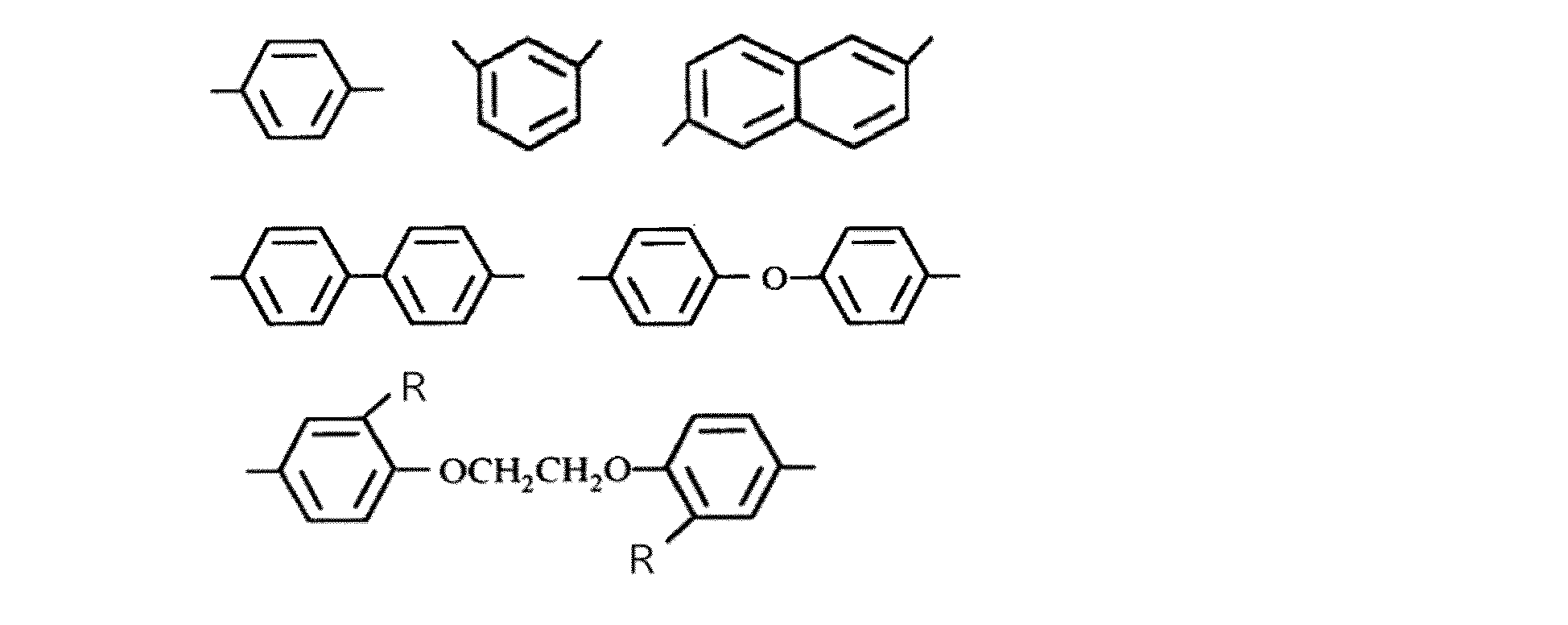
ただし、式中Rは、水素原子、ハロゲンおよびアルキル基から選ばれる少なくとも1種である。アルキル基は炭素数1~6のものが好ましい。
構造単位(4)は、テレフタル酸、イソフタル酸、4,4’-ジフェニルジカルボン酸、2,6-ナフタレンジカルボン酸、1,2-ビス(フェノキシ)エタン-4,4’-ジカルボン酸、1,2-ビス(2-クロルフェノキシ)エタン-4,4’-ジカルボン酸および4,4’-ジフェニルエーテルジカルボン酸から選ばれた一種以上の芳香族ジカルボン酸から生成した構造単位である。
構造単位(4)は、テレフタル酸、イソフタル酸、4,4’-ジフェニルジカルボン酸、2,6-ナフタレンジカルボン酸、1,2-ビス(フェノキシ)エタン-4,4’-ジカルボン酸、1,2-ビス(2-クロルフェノキシ)エタン-4,4’-ジカルボン酸および4,4’-ジフェニルエーテルジカルボン酸から選ばれた一種以上の芳香族ジカルボン酸から生成した構造単位である。
液晶性ポリエステル(LCP)は、上記したように、構造単位(1)、(3)、(4)からなる重合体および上記構造単位(1)、(2)、(3)、(4)からなる重合体から選択される1種以上であり、構造単位(1)、(2)、(3)および(4)の共重合量は任意である。しかし、本発明の特性を発揮させるためには次の共重合量であることが好ましい。
すなわち、構造単位(1)、(2)、(3)、(4)からなる重合体の場合は、構造単位(1)および(2)の合計は、構造単位(1)、(2)および(3)の合計に対して30~95モル%が好ましく、40~85モル%がより好ましい。また、構造単位(3)は構造単位(1)、(2)および(3)の合計に対して70~5モル%が好ましく、60~15モル%がより好ましい。また、構造単位(1)の(2)に対するモル比[(1)/(2)]は好ましくは75/25~95/5であり、より好ましくは78/22~93/7である。また、構造単位(4)は構造単位(2)および(3)の合計と実質的に等モルであることが好ましい。
LCP樹脂(A成分)は、下記式(a1)および(a2)で表される繰り返し単位を含有し、(a1)/(b1)のモル比が、(5~8)/(2~5)であり、数平均分子量が20000~50000であることが好ましい。

LCP樹脂(A成分)の数平均分子量は、好ましくは25000~45000、より好ましくは30000~40000である。
LCP樹脂(A成分)の融点は、前記重合体(B成分)への分散性、溶融混練時の熱分解による物性低下の抑制、耐熱性付与の点から280~360℃が好ましく、より好ましくは285~350℃、さらに好ましくは290~335℃である。
LCP樹脂(A成分)の融点は、前記重合体(B成分)への分散性、溶融混練時の熱分解による物性低下の抑制、耐熱性付与の点から280~360℃が好ましく、より好ましくは285~350℃、さらに好ましくは290~335℃である。
(液晶性ポリエステル樹脂(LCP樹脂)の製造)
本発明において使用するLCP樹脂(A成分)の製造方法は、特に制限がなく、公知のポリエステルの重縮合法に準じて製造できる。例えば、次の製造方法が好ましく挙げられる。
本発明において使用するLCP樹脂(A成分)の製造方法は、特に制限がなく、公知のポリエステルの重縮合法に準じて製造できる。例えば、次の製造方法が好ましく挙げられる。
(1)p-アセトキシ安息香酸および4,4’-ジアセトキシビフェニル、ジアセトキシベンゼンなどの芳香族ジヒドロキシ化合物のジアシル化物と2,6-ナフタレンジカルボン酸、テレフタル酸、イソフタル酸などの芳香族ジカルボン酸から脱酢酸縮重合反応によって液晶性ポリエステル樹脂を製造する方法。
(2)p-ヒドロキシ安息香酸および4,4’-ジヒドロキシビフェニル、ハイドロキノンなどの芳香族ジヒドロキシ化合物と2,6-ナフタレンジカルボン酸、テレフタル酸、イソフタル酸などの芳香族ジカルボン酸に無水酢酸を反応させて、フェノール性水酸基をアシル化した後、脱酢酸重縮合反応によって液晶性ポリエステル樹脂を製造する方法。
(3)p-ヒドロキシ安息香酸のフェニルエステルおよび4,4’-ジヒドロキシビフェニル、ハイドロキノンなどの芳香族ジヒドロキシ化合物と2,6-ナフタレンジカルボン酸、テレフタル酸、イソフタル酸などの芳香族ジカルボン酸のジフェニルエステルから脱フェノール重縮合反応により液晶性ポリエステル樹脂を製造する方法。
(2)p-ヒドロキシ安息香酸および4,4’-ジヒドロキシビフェニル、ハイドロキノンなどの芳香族ジヒドロキシ化合物と2,6-ナフタレンジカルボン酸、テレフタル酸、イソフタル酸などの芳香族ジカルボン酸に無水酢酸を反応させて、フェノール性水酸基をアシル化した後、脱酢酸重縮合反応によって液晶性ポリエステル樹脂を製造する方法。
(3)p-ヒドロキシ安息香酸のフェニルエステルおよび4,4’-ジヒドロキシビフェニル、ハイドロキノンなどの芳香族ジヒドロキシ化合物と2,6-ナフタレンジカルボン酸、テレフタル酸、イソフタル酸などの芳香族ジカルボン酸のジフェニルエステルから脱フェノール重縮合反応により液晶性ポリエステル樹脂を製造する方法。
(4)p-ヒドロキシ安息香酸および2,6-ナフタレンジカルボン酸、テレフタル酸、イソフタル酸などの芳香族ジカルボン酸に所定量のジフェニルカーボネートを反応させて、それぞれジフェニルエステルとした後、4,4’-ジヒドロキシビフェニル、ハイドロキノンなどの芳香族ジヒドロキシ化合物を加え、脱フェノール重縮合反応により液晶性ポリエステル樹脂を製造する方法。
(5)ポリエチレンテレフタレートなどのポリエステルのポリマー、オリゴマーまたはビス(β-ヒドロキシエチル)テレフタレートなど芳香族ジカルボン酸のビス(β-ヒドロキシエチル)エステルの存在下で(1)または(2)の方法により液晶性ポリエステル樹脂を製造する方法。
(5)ポリエチレンテレフタレートなどのポリエステルのポリマー、オリゴマーまたはビス(β-ヒドロキシエチル)テレフタレートなど芳香族ジカルボン酸のビス(β-ヒドロキシエチル)エステルの存在下で(1)または(2)の方法により液晶性ポリエステル樹脂を製造する方法。
<ポリアミド樹脂>
本発明で用いられるポリアミド樹脂とは、アミノ酸、ラクタムあるいはジアミンとジカルボン酸を主たる構成成分とするポリアミド樹脂である。その主要構成成分の代表例としては、6-アミノカプロン酸、11-アミノウンデカン酸、12-アミノドデカン酸、パラアミノメチル安息香酸などのアミノ酸、ε-カプロラクタム、ω-ラウロラクタムなどのラクタム、ペンタメチレンジアミン、ヘキサメチレンジアミン、2-メチルペンタメチレンジアミン、ノナメチレンジアミン、ウンデカメチレンジアミン、ドデカメチレンジアミン、2,2,4-/2,4,4-トリメチルヘキサメチレンジアミン、5-メチルノナメチレンジアミン、メタキシリレンジアミン、パラキシリレンジアミン、1,3-ビス(アミノメチル)シクロヘキサン、1,4-ビス(アミノメチル)シクロヘキサン、1-アミノ-3-アミノメチル-3,5,5-トリメチルシクロヘキサン、ビス(4-アミノシクロヘキシル)メタン、ビス(3-メチル-4-アミノシクロヘキシル)メタン、2,2-ビス(4-アミノシクロヘキシル)プロパン、ビス(アミノプロピル)ピペラジン、アミノエチルピペラジンなどの脂肪族、脂環族、芳香族のジアミン、およびアジピン酸、スペリン酸、アゼライン酸、セバシン酸、ドデカン二酸、テレフタル酸、イソフタル酸、2-クロロテレフタル酸、2-メチルテレフタル酸、5-メチルイソフタル酸、5-ナトリウムスルホイソフタル酸、2,6-ナフタレンジカルボン酸、ヘキサヒドロテレフタル酸、ヘキサヒドロイソフタル酸などの脂肪族、脂環族、芳香族のジカルボン酸が挙げられ、本発明においては、これらの原料から誘導されるナイロンホモポリマーまたはコポリマーを各々単独または混合物の形で用いることができる。
本発明で用いられるポリアミド樹脂とは、アミノ酸、ラクタムあるいはジアミンとジカルボン酸を主たる構成成分とするポリアミド樹脂である。その主要構成成分の代表例としては、6-アミノカプロン酸、11-アミノウンデカン酸、12-アミノドデカン酸、パラアミノメチル安息香酸などのアミノ酸、ε-カプロラクタム、ω-ラウロラクタムなどのラクタム、ペンタメチレンジアミン、ヘキサメチレンジアミン、2-メチルペンタメチレンジアミン、ノナメチレンジアミン、ウンデカメチレンジアミン、ドデカメチレンジアミン、2,2,4-/2,4,4-トリメチルヘキサメチレンジアミン、5-メチルノナメチレンジアミン、メタキシリレンジアミン、パラキシリレンジアミン、1,3-ビス(アミノメチル)シクロヘキサン、1,4-ビス(アミノメチル)シクロヘキサン、1-アミノ-3-アミノメチル-3,5,5-トリメチルシクロヘキサン、ビス(4-アミノシクロヘキシル)メタン、ビス(3-メチル-4-アミノシクロヘキシル)メタン、2,2-ビス(4-アミノシクロヘキシル)プロパン、ビス(アミノプロピル)ピペラジン、アミノエチルピペラジンなどの脂肪族、脂環族、芳香族のジアミン、およびアジピン酸、スペリン酸、アゼライン酸、セバシン酸、ドデカン二酸、テレフタル酸、イソフタル酸、2-クロロテレフタル酸、2-メチルテレフタル酸、5-メチルイソフタル酸、5-ナトリウムスルホイソフタル酸、2,6-ナフタレンジカルボン酸、ヘキサヒドロテレフタル酸、ヘキサヒドロイソフタル酸などの脂肪族、脂環族、芳香族のジカルボン酸が挙げられ、本発明においては、これらの原料から誘導されるナイロンホモポリマーまたはコポリマーを各々単独または混合物の形で用いることができる。
本発明において、特に有用なポリアミド樹脂は、150℃以上の融点を有する耐熱性や強度に優れたポリアミド樹脂であり、具体的な例としてはポリカプロアミド(ナイロン6)、ポリヘキサメチレンアジパミド(ナイロン66)、ポリペンタメチレンアジパミド(ナイロン56)、ポリヘキサメチレンセバカミド(ナイロン610)、ポリヘキサメチレンドデカミド(ナイロン612)、ポリウンデカンアミド(ナイロン11)、ポリドデカンアミド(ナイロン12)、ポリカプロアミド/ポリヘキサメチレンアジパミドコポリマー(ナイロン6/66)、ポリカプロアミド/ポリヘキサメチレンテレフタルアミドコポリマー(ナイロン6/6T)、ポリヘキサメチレンアジパミド/ポリヘキサメチレンテレフタルアミドコポリマー(ナイロン66/6T)、ポリヘキサメチレンアジパミド/ポリヘキサメチレンイソフタルアミドコポリマー(ナイロン66/6I)、ポリヘキサメチレンテレフタルアミド/ポリヘキサメチレンイソフタルアミドコポリマー(ナイロン6T/6I)、ポリヘキサメチレンテレフタルアミド/ポリドデカンアミドコポリマー(ナイロン6T/12)、ポリヘキサメチレンアジパミド/ポリヘキサメチレンテレフタルアミド/ポリヘキサメチレンイソフタルアミドコポリマー(ナイロン66/6T/6I)、ポリキシリレンアジパミド(ナイロンXD6)、ポリヘキサメチレンテレフタルアミド/ポリ-2-メチルペンタメチレンテレフタルアミドコポリマー(ナイロン6T/M5T)、ポリノナメチレンテレフタルアミド(ナイロン9T)およびこれらの混合物などが挙げられる。
とりわけ好ましいポリアミド樹脂としては、ナイロン6、ナイロン66、ナイロン12、ナイロン610、ナイロン6/66コポリマー、またナイロン6T/66コポリマー、ナイロン6T/6Iコポリマー、ナイロン6T/12、およびナイロン6T/6コポリマーなどのヘキサメチレテレフタルアミド単位を有する重合体を挙げることができ、更にこれらのポリアミド樹脂を耐衝撃性、成形加工性などの必要特性に応じて混合物として用いることも実用上好適である。
これらポリアミド樹脂の重合度には特に制限がないが、サンプル濃度0.01g/mlの98%濃硫酸溶液中、25℃で測定した相対粘度として、1.5~7.0の範囲のものが好ましく、特に2.0~6.0の範囲のポリアミド樹脂が好ましい。
本発明で使用されるポリアミド樹脂の含有量は95~60重量%であり、好ましくは90~70重量%である。
これらポリアミド樹脂の重合度には特に制限がないが、サンプル濃度0.01g/mlの98%濃硫酸溶液中、25℃で測定した相対粘度として、1.5~7.0の範囲のものが好ましく、特に2.0~6.0の範囲のポリアミド樹脂が好ましい。
本発明で使用されるポリアミド樹脂の含有量は95~60重量%であり、好ましくは90~70重量%である。
(組成比)
本発明の樹脂組成物は、100質量部の熱可塑性樹脂(A成分)および3~900質量部の重合体(B成分)を含有する。
重合体(B成分)の含有量の上限は、熱可塑性樹脂(A成分)100質量部に対し、好ましくは700質量部、より好ましくは500質量部である。重合体(B成分)の含有量の下限は、熱可塑性樹脂(A成分)100質量部に対し、好ましくは90質量部、より好ましくは100質量部である。
本発明の樹脂組成物において、さらに他の熱可塑性樹脂(C成分)を含有する態様では、他の熱可塑性樹脂(C成分)の含有量は、100質量部の該熱可塑性樹脂(A成分)に対して、好ましくは10~450質量部、より好ましくは20~400質量部である。
本発明の樹脂組成物は、B成分の方がA成分よりも多い場合は、通常、A成分を島相とし、B成分を海相とする。A成分の方がB成分よりも多い場合は、通常、B成分を島相とし、A成分を海相とする。本発明の樹脂組成物は、側鎖にカルボン酸もしくはその無水物由来の置換基を有する重合体(B成分)を含有しているので、溶融混練してペレットとしたときの島相の粒子径Drが小さく、分散性が良好である。この島相の粒子径Drは0.1μm~100μmの範囲にあり、好ましくは5μm~50μmの範囲にあり、より好ましくは、10μm~45μmである。
本発明の樹脂組成物は、100質量部の熱可塑性樹脂(A成分)および3~900質量部の重合体(B成分)を含有する。
重合体(B成分)の含有量の上限は、熱可塑性樹脂(A成分)100質量部に対し、好ましくは700質量部、より好ましくは500質量部である。重合体(B成分)の含有量の下限は、熱可塑性樹脂(A成分)100質量部に対し、好ましくは90質量部、より好ましくは100質量部である。
本発明の樹脂組成物において、さらに他の熱可塑性樹脂(C成分)を含有する態様では、他の熱可塑性樹脂(C成分)の含有量は、100質量部の該熱可塑性樹脂(A成分)に対して、好ましくは10~450質量部、より好ましくは20~400質量部である。
本発明の樹脂組成物は、B成分の方がA成分よりも多い場合は、通常、A成分を島相とし、B成分を海相とする。A成分の方がB成分よりも多い場合は、通常、B成分を島相とし、A成分を海相とする。本発明の樹脂組成物は、側鎖にカルボン酸もしくはその無水物由来の置換基を有する重合体(B成分)を含有しているので、溶融混練してペレットとしたときの島相の粒子径Drが小さく、分散性が良好である。この島相の粒子径Drは0.1μm~100μmの範囲にあり、好ましくは5μm~50μmの範囲にあり、より好ましくは、10μm~45μmである。
<成形体>
本発明の成形体は、前記樹脂組成物からなる。本発明の成形体は、フィルム、板状であることが好ましい。本発明の成形体は、熱可塑性樹脂(A成分)と、側鎖にカルボキシル基もしくは無水カルボキシル基を有する重合体(B成分)との相互作用により、樹脂組成物中の熱可塑性樹脂(A成分)の分散性が良好である。
成形体は、A成分を島相または海相とし、B成分を海相または島相とし、
(i)比誘電率が、2.0~4.0の範囲にあり、
(ii)誘電正接が1.0×10⁻⁴~1.0×10⁻²の範囲にあり、
(iii)島相の粒子径Drが0.5μm~80μmの範囲にある、
ことが好ましい。ここで、B成分の方がA成分よりも多い場合は、通常、A成分を島相とし、B成分を海相とする。A成分の方がB成分よりも多い場合は、通常、B成分を島相とし、A成分を海相とする。
(比誘電率)
本発明の成形体は、比誘電率が、2.0~4.0の範囲にある。比誘電率の上限は、好ましくは3.8、より好ましくは3.5である。比誘電率の下限は、好ましくは2.2、より好ましくは2.5である。
(誘電正接)
本発明の成形体は、誘電正接が1.0×10⁻⁴~1.0×10⁻²の範囲にある。誘電正接の上限は、好ましくは5.0×10⁻³、より好ましくは3.0×10⁻³である。誘電正接の下限は、好ましくは5.0×10⁻⁴、より好ましくは1.0×10⁻³である。
(3成分系)
なお、本発明の成形体が、熱可塑性樹脂(A成分)と重合体(B成分)と他の熱可塑性樹脂(C成分)を含む樹脂組成物からなる場合は、A成分を島相または海相とし、B成分を海相または島相とし、
(i)比誘電率が、2.0~4.0の範囲にあり、
(ii)誘電正接が1.0×10⁻⁴~1.0×10⁻²の範囲にあり、
(iii)島相の粒子径Drが0.5μm~80μmの範囲にある、
ことが好ましい。ここで、C成分の方がA成分よりも多い場合は、通常、A成分が島相を形成し、C成分が海相を形成する。A成分の方がC成分よりも多い場合は、通常、C成分が島相を形成し、A成分が海相を形成する。
本発明の成形体は、前記樹脂組成物からなる。本発明の成形体は、フィルム、板状であることが好ましい。本発明の成形体は、熱可塑性樹脂(A成分)と、側鎖にカルボキシル基もしくは無水カルボキシル基を有する重合体(B成分)との相互作用により、樹脂組成物中の熱可塑性樹脂(A成分)の分散性が良好である。
成形体は、A成分を島相または海相とし、B成分を海相または島相とし、
(i)比誘電率が、2.0~4.0の範囲にあり、
(ii)誘電正接が1.0×10⁻⁴~1.0×10⁻²の範囲にあり、
(iii)島相の粒子径Drが0.5μm~80μmの範囲にある、
ことが好ましい。ここで、B成分の方がA成分よりも多い場合は、通常、A成分を島相とし、B成分を海相とする。A成分の方がB成分よりも多い場合は、通常、B成分を島相とし、A成分を海相とする。
(比誘電率)
本発明の成形体は、比誘電率が、2.0~4.0の範囲にある。比誘電率の上限は、好ましくは3.8、より好ましくは3.5である。比誘電率の下限は、好ましくは2.2、より好ましくは2.5である。
(誘電正接)
本発明の成形体は、誘電正接が1.0×10⁻⁴~1.0×10⁻²の範囲にある。誘電正接の上限は、好ましくは5.0×10⁻³、より好ましくは3.0×10⁻³である。誘電正接の下限は、好ましくは5.0×10⁻⁴、より好ましくは1.0×10⁻³である。
(3成分系)
なお、本発明の成形体が、熱可塑性樹脂(A成分)と重合体(B成分)と他の熱可塑性樹脂(C成分)を含む樹脂組成物からなる場合は、A成分を島相または海相とし、B成分を海相または島相とし、
(i)比誘電率が、2.0~4.0の範囲にあり、
(ii)誘電正接が1.0×10⁻⁴~1.0×10⁻²の範囲にあり、
(iii)島相の粒子径Drが0.5μm~80μmの範囲にある、
ことが好ましい。ここで、C成分の方がA成分よりも多い場合は、通常、A成分が島相を形成し、C成分が海相を形成する。A成分の方がC成分よりも多い場合は、通常、C成分が島相を形成し、A成分が海相を形成する。
<充填剤など>
樹脂組成物には、充填剤を含有させることができる。充填剤は、炭酸カルシウム、ガラス繊維、ガラスフレーク、炭素繊維、珪灰石、ウィスカー、粉砕ガラス、マイカ、硫酸バリウム、タルク、シリカ、およびそれらの任意の組み合わせから選択できる。具体的には、充填剤は、炭酸カルシウムおよびガラス繊維から選択できる。より具体的には、充填剤は、炭酸カルシウムおよびガラス繊維を含有していてもよい。
充填剤は、樹脂組成物の総重量に対して40~70質量%、具体的には40~65質量%の量で含まれていてもよい。樹脂組成物は、20~60質量%のPPS樹脂と、0.5~10質量%のフェノキシ樹脂と、0.5~15質量%のガラスビーズと、40~70質量%の充填剤と、0.05~2.0質量%のヒドロタルサイトとを含んでいてもよい。
典型的な添加剤、例えば耐熱性安定化剤、潤滑剤、静電防止剤、核剤、スリップ剤、顔料、またはそれらの組み合わせなどを、必要に応じて適切な量で樹脂組成物にさらに加えてもよい。
樹脂組成物には、充填剤を含有させることができる。充填剤は、炭酸カルシウム、ガラス繊維、ガラスフレーク、炭素繊維、珪灰石、ウィスカー、粉砕ガラス、マイカ、硫酸バリウム、タルク、シリカ、およびそれらの任意の組み合わせから選択できる。具体的には、充填剤は、炭酸カルシウムおよびガラス繊維から選択できる。より具体的には、充填剤は、炭酸カルシウムおよびガラス繊維を含有していてもよい。
充填剤は、樹脂組成物の総重量に対して40~70質量%、具体的には40~65質量%の量で含まれていてもよい。樹脂組成物は、20~60質量%のPPS樹脂と、0.5~10質量%のフェノキシ樹脂と、0.5~15質量%のガラスビーズと、40~70質量%の充填剤と、0.05~2.0質量%のヒドロタルサイトとを含んでいてもよい。
典型的な添加剤、例えば耐熱性安定化剤、潤滑剤、静電防止剤、核剤、スリップ剤、顔料、またはそれらの組み合わせなどを、必要に応じて適切な量で樹脂組成物にさらに加えてもよい。
〔樹脂組成物および成形体の態様〕
<LCP樹脂および重合体(I)を含有する成形体>
LCP樹脂は、低い誘電率を有し信号速度が速く、また誘電正接が低く電気エネルギーの損失が小さいため、高周波回路の基板材料としての利用が進められている。しかし、LCP樹脂は、一軸方向に分子配向が起こるため、フィブリル化や表面あれ等が起こりやすく、成形加工性に改良の余地がある。
LCP樹脂の優れた特性と、ポリフェニレンスルフィド樹脂(PPS樹脂)の優れた特性を生かすため、LCP樹脂とPPS樹脂とのアロイが種々検討されている。
しかし、LCP樹脂は、液晶構造という剛直なメソゲンが隙間なく配列する特殊な分子構造を有しており、凝集力が強く自由体積が小さいために、PPS樹脂とのアロイにおいては一端微細な分散構造を形成することができたとしても、熱滞留や物理的せん断場の変化などによって、液晶性ポリエステル相が再凝集してしまい、安定的な材料とすることができなかった。そのため、LCP樹脂とのPPS樹脂とのアロイの分散構造を改良すること求められている。
<LCP樹脂および重合体(I)を含有する成形体>
LCP樹脂は、低い誘電率を有し信号速度が速く、また誘電正接が低く電気エネルギーの損失が小さいため、高周波回路の基板材料としての利用が進められている。しかし、LCP樹脂は、一軸方向に分子配向が起こるため、フィブリル化や表面あれ等が起こりやすく、成形加工性に改良の余地がある。
LCP樹脂の優れた特性と、ポリフェニレンスルフィド樹脂(PPS樹脂)の優れた特性を生かすため、LCP樹脂とPPS樹脂とのアロイが種々検討されている。
しかし、LCP樹脂は、液晶構造という剛直なメソゲンが隙間なく配列する特殊な分子構造を有しており、凝集力が強く自由体積が小さいために、PPS樹脂とのアロイにおいては一端微細な分散構造を形成することができたとしても、熱滞留や物理的せん断場の変化などによって、液晶性ポリエステル相が再凝集してしまい、安定的な材料とすることができなかった。そのため、LCP樹脂とのPPS樹脂とのアロイの分散構造を改良すること求められている。
そこで、本発明の目的は、LCP樹脂とPPS樹脂由来の重合体(I)とを含有する樹脂組成物からなる成形体であって、分散性に優れ、比誘電率および誘電正接が低い高周波回路の基板材料に適した成形体を提供することにある。
本発明者は、LCP樹脂(A成分)に、カルボン酸もしくはその無水物由来の置換基を有するポリフェニレンスルフィド樹脂(前記重合体(I)、B成分)を添加した樹脂組成物からなる成形体は、分散性に優れ、比誘電率および誘電正接が低く、高周波回路の基板材料として適していることを見出し、本発明を完成した。
本発明者は、LCP樹脂(A成分)に、カルボン酸もしくはその無水物由来の置換基を有するポリフェニレンスルフィド樹脂(前記重合体(I)、B成分)を添加した樹脂組成物からなる成形体は、分散性に優れ、比誘電率および誘電正接が低く、高周波回路の基板材料として適していることを見出し、本発明を完成した。
成形体は、100質量部のLCP樹脂(A成分)、および10~900質量部の重合体(I)を含有する樹脂組成物からなることが好ましい。
重合体(I)の構造は、前述の通りである。重合体(I)の含有量の上限は、LCP樹脂(A成分)100質量部に対し、好ましくは800質量部、より好ましくは700質量部、さらに好ましくは500質量部である。重合体(I)の含有量の下限は、LCP樹脂(A成分)100質量部に対し、好ましくは20質量部、より好ましくは90質量部、さらに好ましくは100質量部である。
重合体(I)の構造は、前述の通りである。重合体(I)の含有量の上限は、LCP樹脂(A成分)100質量部に対し、好ましくは800質量部、より好ましくは700質量部、さらに好ましくは500質量部である。重合体(I)の含有量の下限は、LCP樹脂(A成分)100質量部に対し、好ましくは20質量部、より好ましくは90質量部、さらに好ましくは100質量部である。
成形体は、A成分を島相とし、B成分を海相とし、
(i)比誘電率が、2.0~4.0の範囲にあり、
(ii)誘電正接が1.0×10⁻⁴~1.0×10⁻²の範囲にあり、
(iii)島相の粒子径Drが0.5μm~80μmの範囲にある、
ことが好ましい。
(i)比誘電率が、2.0~4.0の範囲にあり、
(ii)誘電正接が1.0×10⁻⁴~1.0×10⁻²の範囲にあり、
(iii)島相の粒子径Drが0.5μm~80μmの範囲にある、
ことが好ましい。
LCP樹脂(A成分)は、主鎖に下記式(a1)および(a2)で表される単位を含有し、(a1)/(a2)のモル比が、(5~8)/(5~2)であることが好ましい。LCP樹脂(A成分)の数平均分子量は、好ましくは20,000~50,000、より好ましくは25,000~45,000、さらに好ましくは30,000~40,000である。

成形体は、A成分を島相とし、B成分を海相とする。島相の粒子径Drは、5μm~50μmの範囲にあり、より好ましくは、10μm~45μmの範囲である。樹脂組成物は、島相の粒子径Drが小さく分散性に優れる。成形体は、分散性、分散安定性、フィルム加工性に優れる。
<ポリアミド樹脂(A成分)および重合体(I)を含有する成形体>
成形体は、100質量部のポリアミド樹脂(A成分)、および75~900質量部の重合体(I)を含有する樹脂組成物からなることが好ましい。
重合体(I)の構造は、前述の通りである。
重合体(I)の含有量の上限は、ポリアミド樹脂(A成分)100質量部に対し、好ましくは800質量部、より好ましくは400質量部である。重合体(I)の含有量の下限は、ポリアミド樹脂(A成分)100質量部に対し、好ましくは4質量部、より好ましくは5質量部である。
成形体は、100質量部のポリアミド樹脂(A成分)、および75~900質量部の重合体(I)を含有する樹脂組成物からなることが好ましい。
重合体(I)の構造は、前述の通りである。
重合体(I)の含有量の上限は、ポリアミド樹脂(A成分)100質量部に対し、好ましくは800質量部、より好ましくは400質量部である。重合体(I)の含有量の下限は、ポリアミド樹脂(A成分)100質量部に対し、好ましくは4質量部、より好ましくは5質量部である。
該ポリアミド樹脂(A成分)として、ナイロン6、ナイロン11、ナイロン12、ナイロン66、ナイロン610、ナイロン6Tおよびナイロン9Tからなる群より選ばれる少なくとも一種の樹脂が挙げられる。該ポリアミド樹脂(A成分)の分子量は、10000~500000であることが好ましい。
該成形体は、A成分、B成分のいずれが海相と島相になってもよい。島相の粒子径Drは、0.1μm~100μmの範囲にあり、好ましくは0.3μm~80μmの範囲にあり、より好ましくは、0.5μm~50μmの範囲である。該樹脂組成物は、島相の粒子径Drが小さく分散性に優れる。成形体は、分散性、分散安定性、フィルム加工性に優れる。実施例4、5は、A成分が海相となり、B成分が島相である。
<LCP樹脂(A成分)およびPPS樹脂(C成分)並びに重合体(I)を含有する成形体>
成形体として、LCP樹脂(A成分)および下記式で表される繰り返し単位を有するポリフェニレンスルフィド樹脂(PPS樹脂)をC成分とし、重合体(I)をB成分とする樹脂組成物からなる成形体が挙げられる。
PPS樹脂の分子量は、重量平均分子量で好ましくは10,000以上、さらに好ましくは15,000以上、より好ましくは18,000以上であることが好ましい。

成形体として、LCP樹脂(A成分)および下記式で表される繰り返し単位を有するポリフェニレンスルフィド樹脂(PPS樹脂)をC成分とし、重合体(I)をB成分とする樹脂組成物からなる成形体が挙げられる。
PPS樹脂の分子量は、重量平均分子量で好ましくは10,000以上、さらに好ましくは15,000以上、より好ましくは18,000以上であることが好ましい。
LCP樹脂(A成分)は、主鎖に下記式(a1)および(a2)で表される単位を含有し、(a1)/(a2)のモル比が、(5~8)/(5~2)であることが好ましい。LCP樹脂(A成分)の数平均分子量は、好ましくは20,000~50,000、より好ましくは25,000~45,000、さらに好ましくは30,000~40,000である。

重合体(I)は、前述の通りポリフェニレンスルフィド由来の構造を有する。
重合体(I)の含有量の上限は、A成分100質量部に対し、好ましくは700質量部、より好ましくは500質量部である。重合体(I)の含有量の下限は、LCP樹脂(A成分)100質量部に対し、好ましくは3質量部、より好ましくは10質量部である。
重合体(I)の含有量の上限は、A成分100質量部に対し、好ましくは700質量部、より好ましくは500質量部である。重合体(I)の含有量の下限は、LCP樹脂(A成分)100質量部に対し、好ましくは3質量部、より好ましくは10質量部である。
成形体は、A成分、C成分のいずれが海相と島相になってもよい。B成分は相容化剤として、海相と島相の界面に存在する。島相の粒子径Drは、0.1μm~100μmの範囲にあり、好ましくは0.5μm~80μmの範囲にあり、より好ましくは、1μm~50μmの範囲である。樹脂組成物は、島相の粒子径Drが小さく分散性に優れる。成形体は、分散性、分散安定性、フィルム加工性に優れる。実施例6、7、8、9はC成分が海相となり、A成分が島相である。
<ポリアミド樹脂(A成分)およびPPS樹脂(C成分)並びに重合体(I)を含有する成形体>
成形体として、ポリアミド樹脂および下記式で表される繰り返し単位を有するポリフェニレンスルフィド樹脂(PPS樹脂)をC成分とし、重合体(I)をB成分とする樹脂組成物からなる成形体が挙げられる。PPS樹脂の分子量は、重量平均分子量で好ましくは10,000以上、さらに好ましくは15,000以上、より好ましくは18,000以上であることが好ましい。

ポリアミド樹脂(A成分)として、ナイロン6、ナイロン11、ナイロン12、ナイロン66、ナイロン610、ナイロン6Tおよびナイロン9Tからなる群より選ばれる少なくとも一種の樹脂が挙げられる。該ポリアミド樹脂(A成分)の分子量は、数平均分子量で10000~100000、より好ましくは15000~80000であることが好ましい。
成形体として、ポリアミド樹脂および下記式で表される繰り返し単位を有するポリフェニレンスルフィド樹脂(PPS樹脂)をC成分とし、重合体(I)をB成分とする樹脂組成物からなる成形体が挙げられる。PPS樹脂の分子量は、重量平均分子量で好ましくは10,000以上、さらに好ましくは15,000以上、より好ましくは18,000以上であることが好ましい。
該重合体(I)の構造は、前述の通りである。 該重合体(I)の含有量の上限は、A成分100質量部に対し、好ましくは800質量部、より好ましくは400質量部である。重合体(I)の含有量の下限は、ポリアミド樹脂(A成分)100質量部に対し、好ましくは4質量部、より好ましくは5質量部である。
該成形体は、A成分を島相とし、C成分を海相とする。島相の粒子径Drは、0.1μm~100μmの範囲にあり、好ましくは0.3μm~80μmの範囲にあり、より好ましくは、0.5μm~50μmの範囲である。該樹脂組成物は、島相の粒子径Drが小さく分散性に優れる。成形体は、分散性、分散安定性、フィルム加工性に優れる。
<LCP樹脂および重合体(II)を含有する成形体>
成形体として、LCP樹脂および重合体(II)(PEEK)を含有する樹脂組成物からなる成形体が挙げられる。
成形体として、LCP樹脂および重合体(II)(PEEK)を含有する樹脂組成物からなる成形体が挙げられる。
LCP樹脂(A成分)は、主鎖に下記式(a1)および(a2)で表される単位を含有し、(a1)/(a2)のモル比が、(5~8)/(5~2)であることが好ましい。LCP樹脂(A成分)の数平均分子量は、好ましくは20,000~50,000、より好ましくは25,000~45,000、さらに好ましくは30,000~40,000である。

重合体(II)は前述のとおり、PEEK由来の重合体である。重合体(II)は、式(II-1)、(II-2)および(II-3)で表される単位を含む。単位(II-1)、単位(II-2)および単位(II-3)の合計モル数を100モルとしたとき、単位(II-1)のモル数は好ましくは20~50モル、単位(II-2)のモル数は好ましくは20~40モル、単位(II-3)のモル数は好ましくは10~60モルである。
重合体(II)の含有量の上限は、A成分100質量部に対し、好ましくは800質量部、より好ましくは700質量部である。重合体(I)の含有量の下限は、LCP樹脂(A成分)100質量部に対し、好ましくは10質量部、より好ましくは20質量部である。
重合体(II)の含有量の上限は、A成分100質量部に対し、好ましくは800質量部、より好ましくは700質量部である。重合体(I)の含有量の下限は、LCP樹脂(A成分)100質量部に対し、好ましくは10質量部、より好ましくは20質量部である。
該成形体は、A成分を島相とし、B成分を海相とする。島相の粒子径Drは、0.1μm~100μmの範囲にあり、好ましくは0.5μm~80μmの範囲にあり、より好ましくは、1μm~50μmの範囲である。該樹脂組成物は、島相の粒子径Drが小さく分散性に優れる。成形体は、分散性、分散安定性、フィルム加工性に優れる。
<LCP樹脂またはポリアミド樹脂(A成分)および重合体(V)を含有する成形体>
成形体として、LCP樹脂またはポリアミド樹脂および重合体(V)を含有する樹脂組成物からなる成形体が挙げられる。
成形体として、LCP樹脂またはポリアミド樹脂および重合体(V)を含有する樹脂組成物からなる成形体が挙げられる。
LCP樹脂(A成分)は、主鎖に下記式(a1)および(a2)で表される単位を含有し、(a1)/(a2)のモル比が、(5~8)/(5~2)であることが好ましい。LCP樹脂(A成分)の数平均分子量は、好ましくは20,000~50,000、より好ましくは25,000~45,000、さらに好ましくは30,000~40,000である。

ポリアミド樹脂(A成分)として、ナイロン6、ナイロン11、ナイロン12、ナイロン66、ナイロン610、ナイロン6Tおよびナイロン9Tからなる群より選ばれる少なくとも一種の樹脂が挙げられる。該ポリアミド樹脂(A成分)の分子量は、数平均分子量で10000~100000、より好ましくは15000~80000であることが好ましい。
重合体(V)は前述のとおり、ポリスチレン由来の重合体である。重合体(V)は、式(V-1)、(V-2)および(V-3)で表される単位を含む。単位(V-1)、単位(V-2)および単位(V-3)の合計モル数を100モルとしたとき、単位(V-1)のモル数は好ましくは20~50モル、単位(V-2)のモル数は好ましくは20~40モル、単位(V-3)のモル数は好ましくは10~60モルである。
重合体(V)の含有量の上限は、A成分100質量部に対し、好ましくは700質量部、より好ましくは500質量部である。重合体(I)の含有量の下限は、LCP樹脂(A成分)100質量部に対し、好ましくは10質量部、より好ましくは20質量部である。
重合体(V)の含有量の上限は、A成分100質量部に対し、好ましくは700質量部、より好ましくは500質量部である。重合体(I)の含有量の下限は、LCP樹脂(A成分)100質量部に対し、好ましくは10質量部、より好ましくは20質量部である。
該成形体は、A成分を島相とし、B成分を海相とする。島相の粒子径Drは、0.1μm~100μmの範囲にあり、好ましくは0.5μm~80μmの範囲にあり、より好ましくは、1μm~50μmの範囲である。該樹脂組成物は、島相の粒子径Drが小さく分散性に優れる。成形体は、分散性、分散安定性、フィルム加工性に優れる。
以下、実施例により本発明を詳述するが、本発明はこれら実施例により何ら限定されるものではない。
1.樹脂組成物(ペレット)および樹脂成形体(フィルム)の特性の測定
樹脂組成物(ペレット)および樹脂成形体(フィルム)の特性は、以下の方法で測定した。
樹脂組成物(ペレット)および樹脂成形体(フィルム)の特性は、以下の方法で測定した。
(1)島相の粒子径Dr
粒子径は、島相の形を円と仮定し、島相の面積から換算される直径を、島相の粒子径Drとする。すなわち、島相の面積Sとすると、粒子径Drは、(4S/π)1/2で表される。
なお、本発明における島相の粒子径Drは、加重平均で定義する。すなわち樹脂組成物(ペレット)または樹脂成形体(フィルム)中の任意の島相20個の個々の粒子径をDriとすると、島相の加重平均粒子径Drは、以下、の式により求められる。
島相の加重平均粒子径Dr=(ΣDri2)/(ΣDri)
粒子径は、島相の形を円と仮定し、島相の面積から換算される直径を、島相の粒子径Drとする。すなわち、島相の面積Sとすると、粒子径Drは、(4S/π)1/2で表される。
なお、本発明における島相の粒子径Drは、加重平均で定義する。すなわち樹脂組成物(ペレット)または樹脂成形体(フィルム)中の任意の島相20個の個々の粒子径をDriとすると、島相の加重平均粒子径Drは、以下、の式により求められる。
島相の加重平均粒子径Dr=(ΣDri2)/(ΣDri)
(2)分散安定性
分散安定性は、樹脂組成物(ペレット)中の島相の加重平均粒子径Drpに対する、樹脂成形体(フィルム)中の島相の加重平均粒子径Drfの比(Drf/Drp)で表す。
分散安定性は、樹脂組成物(ペレット)中の島相の加重平均粒子径Drpに対する、樹脂成形体(フィルム)中の島相の加重平均粒子径Drfの比(Drf/Drp)で表す。
(3)フィルム加工性
フィルムの加工性(折れ性)は以下のようにして評価した。
折り曲げても裂けない:2点
強く折り曲げると裂ける:1点
簡単に裂ける:0点
フィルムの加工性(折れ性)は以下のようにして評価した。
折り曲げても裂けない:2点
強く折り曲げると裂ける:1点
簡単に裂ける:0点
(4)比誘電率および誘電正接
キーサイト・テクノロジー社製ネットワークアナライザN5290A、関東電子応用開発社製スプリットシリンダ共振器28GHz CR-728を用いて、測定周波数28GHzで、スプリットシリンダ法にて、複素比誘電率測定を行った。得られた結果から、比誘電率および誘電正接を求めた。
キーサイト・テクノロジー社製ネットワークアナライザN5290A、関東電子応用開発社製スプリットシリンダ共振器28GHz CR-728を用いて、測定周波数28GHzで、スプリットシリンダ法にて、複素比誘電率測定を行った。得られた結果から、比誘電率および誘電正接を求めた。
2.使用した市販の樹脂
使用した市販の樹脂は以下の通りである。
(LCP樹脂)
LCP樹脂(LCP-C)として、下記式(a1)および(a2)で表される繰り返し単位を有するティコナ社製ベクトラA950(数平均分子量35000)を用いた。
使用した市販の樹脂は以下の通りである。
(LCP樹脂)
LCP樹脂(LCP-C)として、下記式(a1)および(a2)で表される繰り返し単位を有するティコナ社製ベクトラA950(数平均分子量35000)を用いた。

(PPS-C)
PPS-Cとして、ポリフェニレンスルフィド樹脂(INITZ社製、製品名ECOTRAN B200、重量平均分子量30000~60000)を用いた。
(PA6)
PA6として、ポリカプロアミド(ナイロン6)(BASF社製、製品名ウルトラミッド B3F、数平均分子量20000~50000)を用いた。
(PA12)
PA12としてポリドデカンアミド(ナイロン12)(宇部興産製、製品名UBESTA 3020、数平均分子量20000~50000)を用いた。
PPS-Cとして、ポリフェニレンスルフィド樹脂(INITZ社製、製品名ECOTRAN B200、重量平均分子量30000~60000)を用いた。
(PA6)
PA6として、ポリカプロアミド(ナイロン6)(BASF社製、製品名ウルトラミッド B3F、数平均分子量20000~50000)を用いた。
(PA12)
PA12としてポリドデカンアミド(ナイロン12)(宇部興産製、製品名UBESTA 3020、数平均分子量20000~50000)を用いた。
〔実施例1~2、比較例1~2〕重合体(I)PPS-3
<PPS樹脂の特性の測定>
カルボン酸無水物基を側鎖に有するPPS-3とPPS-4、主鎖の末端にフェニル基を有するPPS-1および市販のPPS―CをPPS樹脂と呼ぶことがある。
PPS樹脂の融点(Tm)、数平均分子量(Mn)、多分散指数(PDI)、および溶融粘度(MV)を以下の方法により測定した。
<PPS樹脂の特性の測定>
カルボン酸無水物基を側鎖に有するPPS-3とPPS-4、主鎖の末端にフェニル基を有するPPS-1および市販のPPS―CをPPS樹脂と呼ぶことがある。
PPS樹脂の融点(Tm)、数平均分子量(Mn)、多分散指数(PDI)、および溶融粘度(MV)を以下の方法により測定した。
(1)溶融粘度
回転ディスク型粘度計によりTm+20℃で溶融粘度を測定した。周波数掃引法において、角周波数を0.6~500rad/sで測定し、1.0rad/sでの粘度を溶融粘度として定義した。
(2)融点
示差走査熱量計(DSC)を使用して、温度を30から320℃まで20℃/分のスピードで上昇させ、30℃まで冷却し、次いで30から320℃まで20℃/分のスピードで上昇させながら、融点を測定した。
(3)数平均分子量(Mn)および多分散指数(PDI)
0.4質量%の溶液となるように、PPS樹脂を1-クロロナフタレン中に250℃で25分間かけて撹拌しながら溶解させることにより、試料を製造した。その後、高温ゲル浸透クロマトグラフィー(GPC)システム(210℃)のカラムにおいて、試料を1mL/分の流量で流すことにより、様々な分子量を有するPPS樹脂を順次分離し、RI検出器を使用することにより、分離されたPPS樹脂の分子量に対応する強度を測定した。分子量が既知である標準試料(ポリスチレン)により検量線を作成した後、試料の相対的な数平均分子量(Mn)および多分散指数(PDI)を計算した。
(4)共重合比の算出(S1/S2、S1/S2/S3、S1/S2/S4の算出)
Bruker 製 NMR 装置DSX300WBを用いて、13C-NMR (DD/MAS)測定を行い、モノマー由来のピークの面積比を算出することにより、共重合比を算出した。
回転ディスク型粘度計によりTm+20℃で溶融粘度を測定した。周波数掃引法において、角周波数を0.6~500rad/sで測定し、1.0rad/sでの粘度を溶融粘度として定義した。
(2)融点
示差走査熱量計(DSC)を使用して、温度を30から320℃まで20℃/分のスピードで上昇させ、30℃まで冷却し、次いで30から320℃まで20℃/分のスピードで上昇させながら、融点を測定した。
(3)数平均分子量(Mn)および多分散指数(PDI)
0.4質量%の溶液となるように、PPS樹脂を1-クロロナフタレン中に250℃で25分間かけて撹拌しながら溶解させることにより、試料を製造した。その後、高温ゲル浸透クロマトグラフィー(GPC)システム(210℃)のカラムにおいて、試料を1mL/分の流量で流すことにより、様々な分子量を有するPPS樹脂を順次分離し、RI検出器を使用することにより、分離されたPPS樹脂の分子量に対応する強度を測定した。分子量が既知である標準試料(ポリスチレン)により検量線を作成した後、試料の相対的な数平均分子量(Mn)および多分散指数(PDI)を計算した。
(4)共重合比の算出(S1/S2、S1/S2/S3、S1/S2/S4の算出)
Bruker 製 NMR 装置DSX300WBを用いて、13C-NMR (DD/MAS)測定を行い、モノマー由来のピークの面積比を算出することにより、共重合比を算出した。
<実施例1>重合体(I)(PPS-3)
側鎖に無水マレイン酸由来の基を有するPPS樹脂(PPS-3)を以下の方法で調製した。
(重合体(i)の調製)
オートクレーブに、32.6質量部の硫化ナトリウム、0.04質量部の水酸化ナトリウム、79質量部のNMPを仕込み、攪拌した、200℃まで昇温した。ついで、110.25質量部の1,4-ジクロロベンゼン(Mw=147.00)、44.64質量部(0.25モル)の2,5-ジクロロ-p-キシレン(Mw=175.05)、0.302質量部(0.277モル)の1,4-ベンゾキノン(Mw=108.10)および20質量部のNMPを添加した。反応系を260℃まで昇温し、1時間攪拌した。その後、冷却し100メッシュのフィルターでろ過した後、残渣を130℃の熱水で2回洗浄した。さらに残渣をろ過し、減圧乾燥して、下記式で表される構造を有する重合体(i)(pps-3)を得た。
側鎖に無水マレイン酸由来の基を有するPPS樹脂(PPS-3)を以下の方法で調製した。
(重合体(i)の調製)
オートクレーブに、32.6質量部の硫化ナトリウム、0.04質量部の水酸化ナトリウム、79質量部のNMPを仕込み、攪拌した、200℃まで昇温した。ついで、110.25質量部の1,4-ジクロロベンゼン(Mw=147.00)、44.64質量部(0.25モル)の2,5-ジクロロ-p-キシレン(Mw=175.05)、0.302質量部(0.277モル)の1,4-ベンゾキノン(Mw=108.10)および20質量部のNMPを添加した。反応系を260℃まで昇温し、1時間攪拌した。その後、冷却し100メッシュのフィルターでろ過した後、残渣を130℃の熱水で2回洗浄した。さらに残渣をろ過し、減圧乾燥して、下記式で表される構造を有する重合体(i)(pps-3)を得た。
仕込み比は、(s1)/(s2)=75/25であったが、得られた重合体(i)の(s1)/(s2)=5.5/1(モル比)であった。重合体(i)(pps-3)のポリスチレン換算の、数平均分子量(Mn)は、20000、重量平均分子量(Mw)は45000、Mw/Mnは2.25であった。
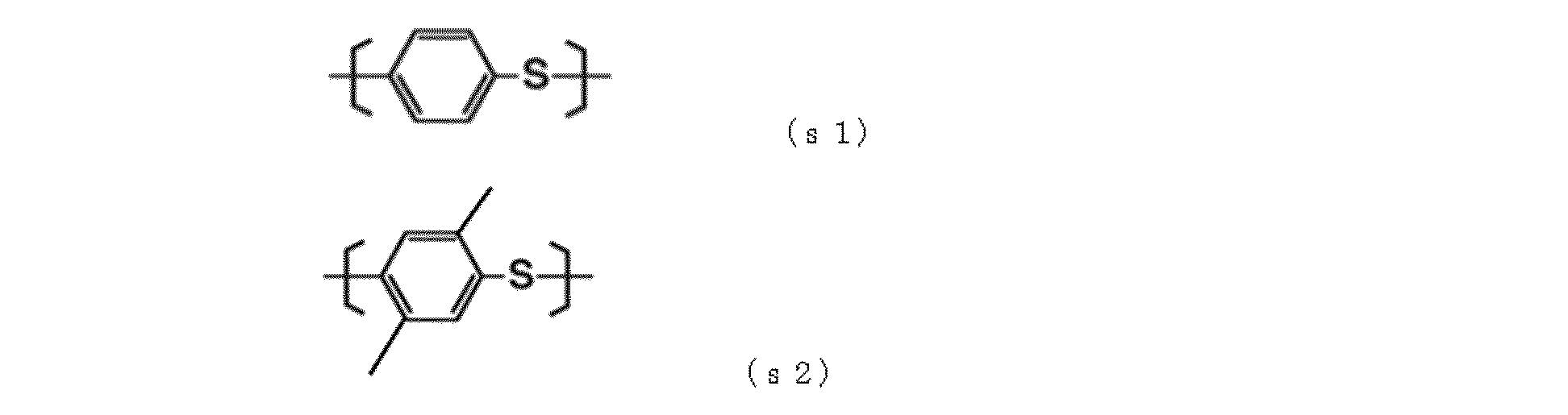
(溶融混練)
得られた重合体(i)(pps-3)および無水マレイン酸を質量比20/1の割合で、ドライブレンドし、樹脂フィーダーより供給し、TEM26-SS2軸押出機(東芝機械製)を用い樹脂温度300℃の温度で溶融混練しペレットとし下記式で表される構造を有する重合体(I)(PPS-3)を得た。
得られた重合体(i)(pps-3)および無水マレイン酸を質量比20/1の割合で、ドライブレンドし、樹脂フィーダーより供給し、TEM26-SS2軸押出機(東芝機械製)を用い樹脂温度300℃の温度で溶融混練しペレットとし下記式で表される構造を有する重合体(I)(PPS-3)を得た。
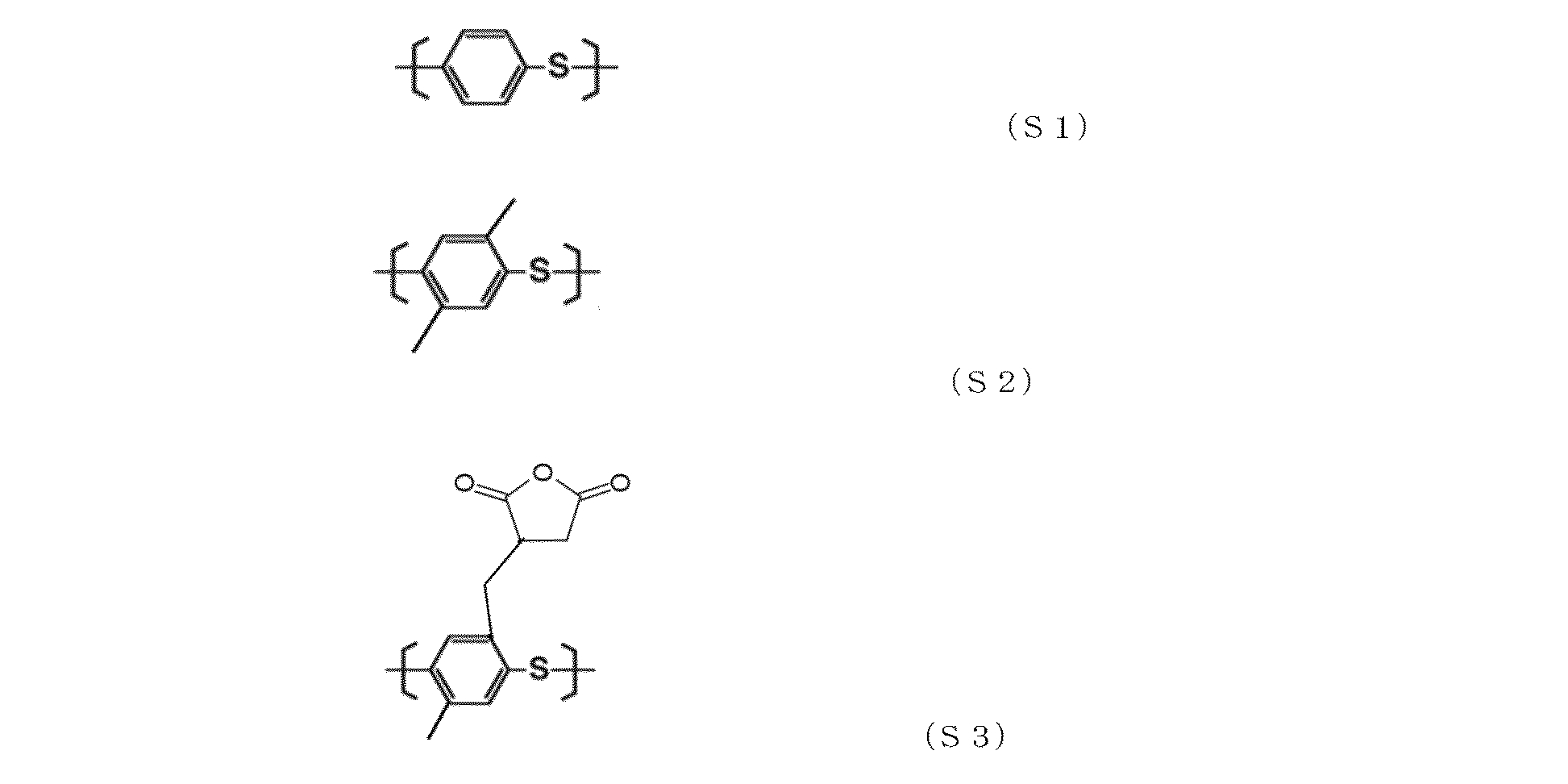
得られたPPS-3のモル比(S1)/(S2)/(S3)は、80/2/18であった。PPS-3のポリスチレン換算の数平均分子量(Mn)は23000、重量平均分子量(Mw)は50000、Mw/Mnは2.17であった。
共重合比は、Bruker 製 NMR 装置DSX300WBを用いて、13C-NMR (DD/MAS)測定を行い、モノマー由来のピークの面積比を算出することにより算出した。
溶融粘度は、回転ディスク型粘度計によりTm+20℃で溶融粘度を測定した。周波数掃引法において、角周波数を0.6~500rad/sで測定し、1.0rad/sでの粘度を溶融粘度として定義した。
融点は示差走査熱量計(DSC)を使用して、温度を30から320℃まで20℃/分のスピードで上昇させ、30℃まで冷却し、次いで30から320℃まで20℃/分のスピードで上昇させながら、融点を測定した。
共重合比は、Bruker 製 NMR 装置DSX300WBを用いて、13C-NMR (DD/MAS)測定を行い、モノマー由来のピークの面積比を算出することにより算出した。
溶融粘度は、回転ディスク型粘度計によりTm+20℃で溶融粘度を測定した。周波数掃引法において、角周波数を0.6~500rad/sで測定し、1.0rad/sでの粘度を溶融粘度として定義した。
融点は示差走査熱量計(DSC)を使用して、温度を30から320℃まで20℃/分のスピードで上昇させ、30℃まで冷却し、次いで30から320℃まで20℃/分のスピードで上昇させながら、融点を測定した。
<実施例2> PPS-4の調製
側鎖に無水クエン酸由来の基を有するPPS樹脂(PPS-4)を以下の方法で調製した。実施例1と同様にして、重合体(i)を調製し、得られた重合体(i)(pps-4)およびクエン酸を質量比20/1の割合で、ドライブレンドし、樹脂フィーダーより供給し、TEM26-SS2軸押出機(東芝機械製)を用い樹脂温度300℃の温度で溶融混練しペレットとし下記式で表される構造を有するPPS-4を得た。
側鎖に無水クエン酸由来の基を有するPPS樹脂(PPS-4)を以下の方法で調製した。実施例1と同様にして、重合体(i)を調製し、得られた重合体(i)(pps-4)およびクエン酸を質量比20/1の割合で、ドライブレンドし、樹脂フィーダーより供給し、TEM26-SS2軸押出機(東芝機械製)を用い樹脂温度300℃の温度で溶融混練しペレットとし下記式で表される構造を有するPPS-4を得た。
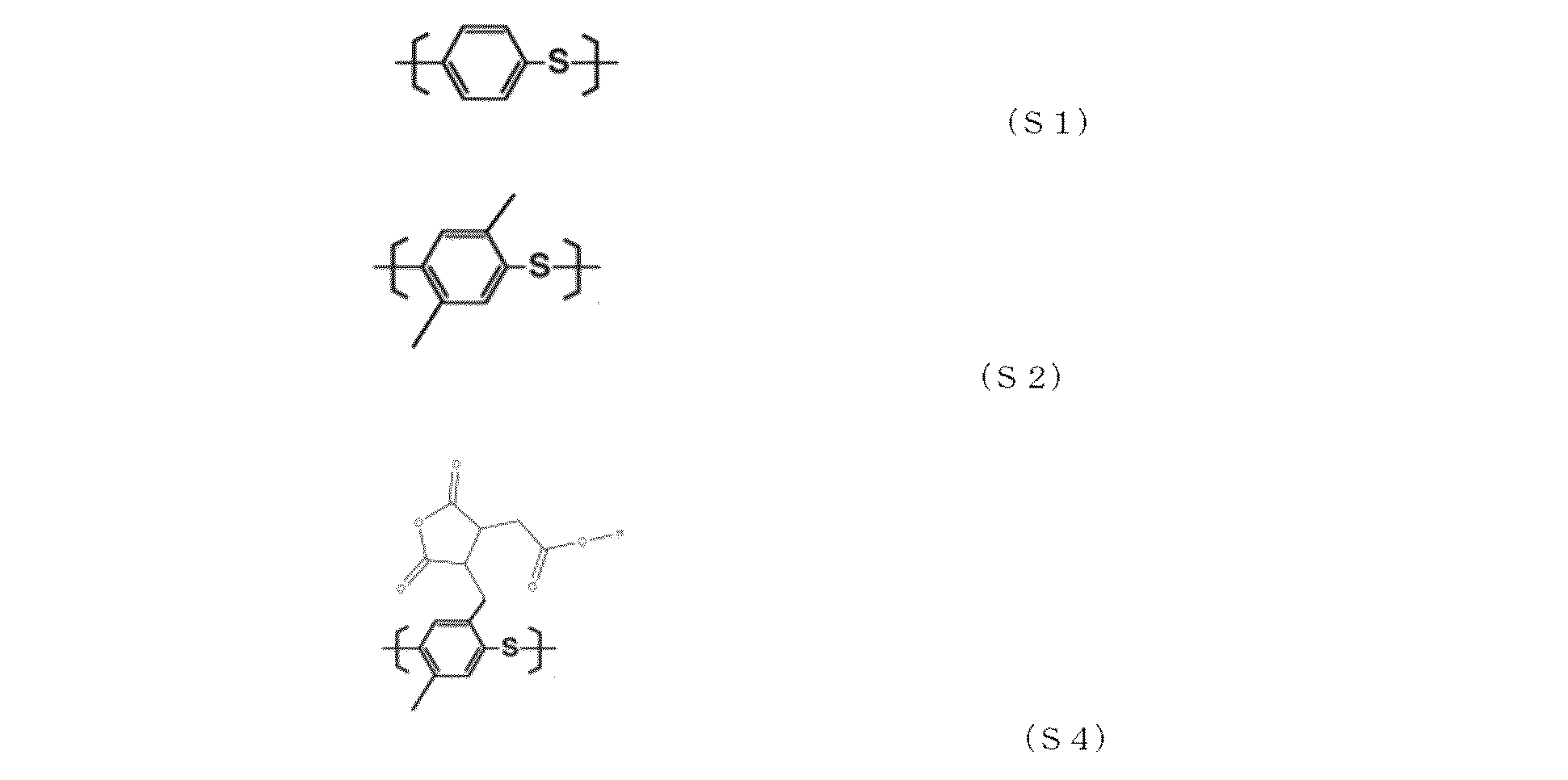
得られたPPS-4のモル比(S1)/(S2)/(S4)は、80/2/18であった。PPS-4のポリスチレン換算の数平均分子量(Mn)は23000、重量平均分子量(Mw)は50000、Mw/Mnは2.17であった。
共重合比は、Bruker 製 NMR 装置DSX300WBを用いて、13C-NMR (DD/MAS)測定を行い、モノマー由来のピークの面積比を算出することにより算出した。
溶融粘度は、回転ディスク型粘度計によりTm+20℃で溶融粘度を測定した。周波数掃引法において、角周波数を0.6~500rad/sで測定し、1.0rad/sでの粘度を溶融粘度として定義した。
融点は示差走査熱量計(DSC)を使用して、温度を30から320℃まで20℃/分のスピードで上昇させ、30℃まで冷却し、次いで30から320℃まで20℃/分のスピードで上昇させながら、融点を測定した。
共重合比は、Bruker 製 NMR 装置DSX300WBを用いて、13C-NMR (DD/MAS)測定を行い、モノマー由来のピークの面積比を算出することにより算出した。
溶融粘度は、回転ディスク型粘度計によりTm+20℃で溶融粘度を測定した。周波数掃引法において、角周波数を0.6~500rad/sで測定し、1.0rad/sでの粘度を溶融粘度として定義した。
融点は示差走査熱量計(DSC)を使用して、温度を30から320℃まで20℃/分のスピードで上昇させ、30℃まで冷却し、次いで30から320℃まで20℃/分のスピードで上昇させながら、融点を測定した。
<実施例3>樹脂組成物およびフィルム
TEM26-SS2軸押出機(東芝機械製)を用いて市販のLCP樹脂(LCP-C)、PPS樹脂(PPS-3)を表1に示した割合で、ドライブレンドし、樹脂フィーダーより供給し、表1の割合で重量式サイドフィーダーを用いて添加し、樹脂温度300℃の温度で溶融混練し、樹脂組成物のペレットとした。
次いでこのペレットを、成形機を用いて樹脂温度300℃、金型温度130℃の温度条件で、厚さ0.2mm、幅40mm、長さ40mmのフィルム状の高周波回路の基板を製造した。得られた基板の、分散安定性、フィルム加工性、比誘電率、誘電正接を表1に示す。
TEM26-SS2軸押出機(東芝機械製)を用いて市販のLCP樹脂(LCP-C)、PPS樹脂(PPS-3)を表1に示した割合で、ドライブレンドし、樹脂フィーダーより供給し、表1の割合で重量式サイドフィーダーを用いて添加し、樹脂温度300℃の温度で溶融混練し、樹脂組成物のペレットとした。
次いでこのペレットを、成形機を用いて樹脂温度300℃、金型温度130℃の温度条件で、厚さ0.2mm、幅40mm、長さ40mmのフィルム状の高周波回路の基板を製造した。得られた基板の、分散安定性、フィルム加工性、比誘電率、誘電正接を表1に示す。
<比較例1~2>
(PPS-1の調製)
主鎖の末端にフェニル基を有するPPS樹脂(PPS-1)を以下の方法で調製した。
5,130質量部のp-ジヨードベンゼン(p-DIB)、450質量部の硫黄、および反応開始剤として4質量部の1,3-ジヨード-4-ニトロベンゼンを含む反応物を、反応器の内部温度を測定することが可能な熱電対と窒素パージするためおよび反応器を180℃まで加熱することにより真空化するための真空ラインとを備えた5Lの反応器中で、完全に溶融および混合した後、硫黄を7回(各々19質量部)加えながら、220℃および350トールの初期反応条件から300℃の最終反応温度および0.6~0.9トールの圧力まで4時間かけて段階的に温度上昇および圧力降下を行うことにより、重合反応を行った。
(PPS-1の調製)
主鎖の末端にフェニル基を有するPPS樹脂(PPS-1)を以下の方法で調製した。
5,130質量部のp-ジヨードベンゼン(p-DIB)、450質量部の硫黄、および反応開始剤として4質量部の1,3-ジヨード-4-ニトロベンゼンを含む反応物を、反応器の内部温度を測定することが可能な熱電対と窒素パージするためおよび反応器を180℃まで加熱することにより真空化するための真空ラインとを備えた5Lの反応器中で、完全に溶融および混合した後、硫黄を7回(各々19質量部)加えながら、220℃および350トールの初期反応条件から300℃の最終反応温度および0.6~0.9トールの圧力まで4時間かけて段階的に温度上昇および圧力降下を行うことにより、重合反応を行った。
重合反応が80%進行したら(重合反応の進行度は相対的な粘度比[(現在の粘度/目標粘度)]によって特定され、現在の粘度は、重合反応が進行している反応器から試料を採取した後に粘度計で測定された。また、目標粘度は600ポアズに設定された。)、35質量部のジフェニルジスルフィドを重合阻害剤としてそこへ加え、反応を1時間行い、下記式(b1)および(b2)で表される構造を有するPPS-1を得た。

(樹脂組成物およびフィルム)
LCP樹脂、PPS樹脂の割合を表1に示した割合にした以外は、実施例3と同じ方法で、樹脂組成物のペレットを調製し、フィルムを製造した。得られた基板の、分散安定性、フィルム加工性、比誘電率、誘電正接を表1に示す。
LCP樹脂、PPS樹脂の割合を表1に示した割合にした以外は、実施例3と同じ方法で、樹脂組成物のペレットを調製し、フィルムを製造した。得られた基板の、分散安定性、フィルム加工性、比誘電率、誘電正接を表1に示す。

実施例3と比較例1~2とを対比すると、PPS-3を用いた実施例3の成形体は、樹脂組成物(ペレット)中の島相(LCP樹脂)の加重平均粒子径Drpに対する、樹脂成形体(フィルム)中の島相の加重平均粒子径Drfの比(Drf/Drp)が低く、分散安定性に優れていることがわかる。
<実施例4~5、比較例3~4> PPS樹脂+ポリアミド樹脂
PPS樹脂として、側鎖に無水マレイン酸由来の基を有するPPS-3を用い、ポリアミド樹脂(PA6(ポリカプロアミド(ナイロン6))、PA12(ポリドデカンアミド(ナイロン12))の割合を表2に示した割合にした以外は、実施例3と同じ方法で、フィルムを製造した。ポリアミド樹脂が海相となり、PPS-3やPPS-Cが島相として分散したものが得られた。得られたフィルムの、分散安定性、粒子径Dr、フィルム加工性、フィルム中の粒子径Drを表2に示す。
PPS樹脂として、側鎖に無水マレイン酸由来の基を有するPPS-3を用い、ポリアミド樹脂(PA6(ポリカプロアミド(ナイロン6))、PA12(ポリドデカンアミド(ナイロン12))の割合を表2に示した割合にした以外は、実施例3と同じ方法で、フィルムを製造した。ポリアミド樹脂が海相となり、PPS-3やPPS-Cが島相として分散したものが得られた。得られたフィルムの、分散安定性、粒子径Dr、フィルム加工性、フィルム中の粒子径Drを表2に示す。

<実施例6~9>PPS-C+PPS-3+LCP-C
TEM26-SS2軸押出機(東芝機械製)を用いてPPS-C(市販品)、LCP樹脂(市販品、LCP-C)、PPS樹脂(PPS-3)を表3に示した割合で、ドライブレンドし、樹脂フィーダーより供給し、表3の割合で重量式サイドフィーダーを用いて添加し、樹脂温度300℃の温度で溶融混練し、ペレットとした。PPS-Cが海相となり、LCP-Cが島相として分散したものが得られた。
次いでこのペレットを、成形機を用いて樹脂温度300℃、金型温度130℃の温度条件で、厚さ0.2mm、幅40mm、長さ40mmのフィルムを製造した。得られたフィルムの、分散安定性、粒子径Dr、フィルム加工性、フィルム中の粒子径Drを表3に示す。
TEM26-SS2軸押出機(東芝機械製)を用いてPPS-C(市販品)、LCP樹脂(市販品、LCP-C)、PPS樹脂(PPS-3)を表3に示した割合で、ドライブレンドし、樹脂フィーダーより供給し、表3の割合で重量式サイドフィーダーを用いて添加し、樹脂温度300℃の温度で溶融混練し、ペレットとした。PPS-Cが海相となり、LCP-Cが島相として分散したものが得られた。
次いでこのペレットを、成形機を用いて樹脂温度300℃、金型温度130℃の温度条件で、厚さ0.2mm、幅40mm、長さ40mmのフィルムを製造した。得られたフィルムの、分散安定性、粒子径Dr、フィルム加工性、フィルム中の粒子径Drを表3に示す。
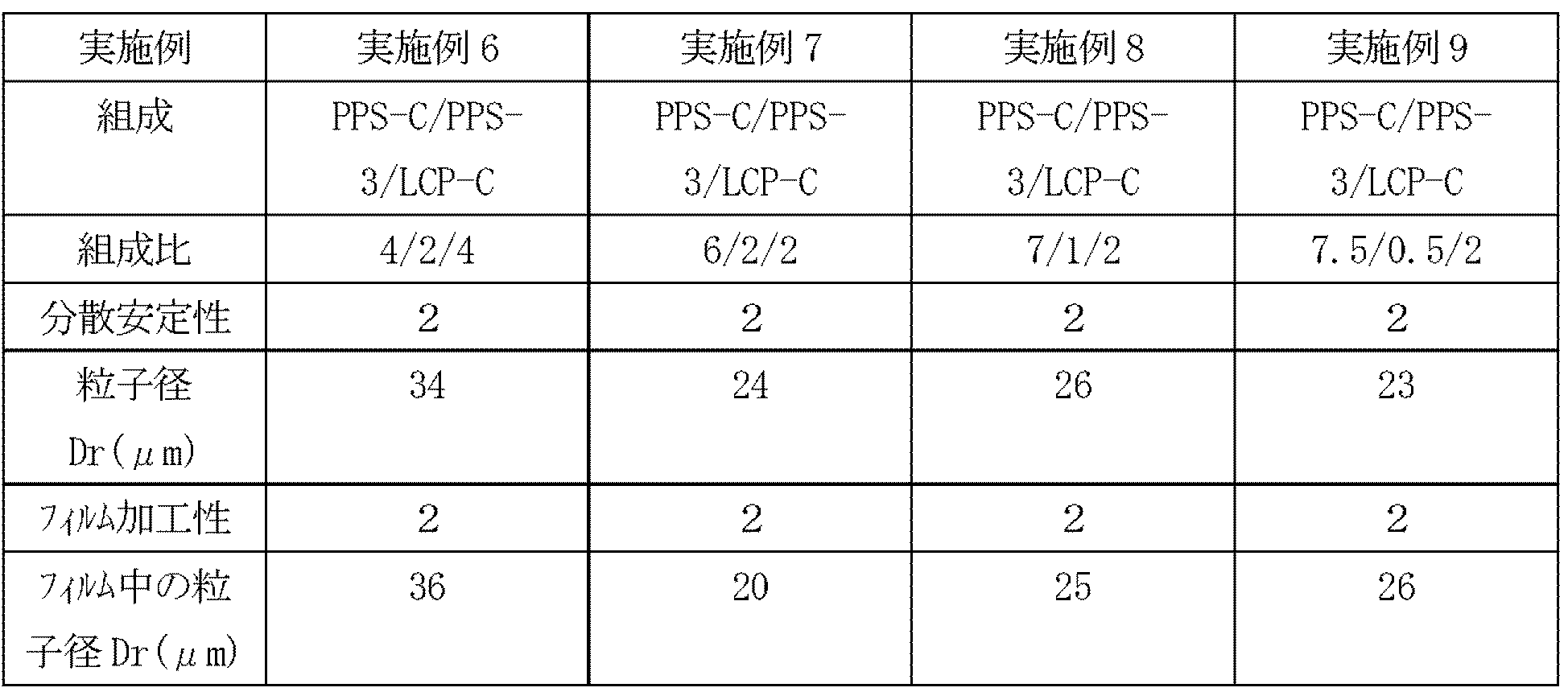
<実施例10~11>ポリアミド+PPS-3+PPS-C
TEM26-SS2軸押出機(東芝機械製)を用いてPPS樹脂(市販品、PPS-C)、PPS樹脂(PPS-3)、市販品のポリアミド樹脂(PA6、PA12)を表4に示した割合で、ドライブレンドし、樹脂フィーダーより供給し、表4の割合で重量式サイドフィーダーを用いて添加し、樹脂温度300℃の温度で溶融混練し、ペレットとした。ポリアミド樹脂が海相となり、PPS-Cが島相として分散したものが得られた。
次いでこのペレットを、成形機を用いて樹脂温度310℃、金型温度130℃の温度条件で、厚さ0.2mm、幅40mm、長さ40mmのフィルムを製造した。得られたフィルムの、分散安定性、粒子径Dr、フィルム加工性、フィルム中の粒子径Drを表4に示す。
TEM26-SS2軸押出機(東芝機械製)を用いてPPS樹脂(市販品、PPS-C)、PPS樹脂(PPS-3)、市販品のポリアミド樹脂(PA6、PA12)を表4に示した割合で、ドライブレンドし、樹脂フィーダーより供給し、表4の割合で重量式サイドフィーダーを用いて添加し、樹脂温度300℃の温度で溶融混練し、ペレットとした。ポリアミド樹脂が海相となり、PPS-Cが島相として分散したものが得られた。
次いでこのペレットを、成形機を用いて樹脂温度310℃、金型温度130℃の温度条件で、厚さ0.2mm、幅40mm、長さ40mmのフィルムを製造した。得られたフィルムの、分散安定性、粒子径Dr、フィルム加工性、フィルム中の粒子径Drを表4に示す。
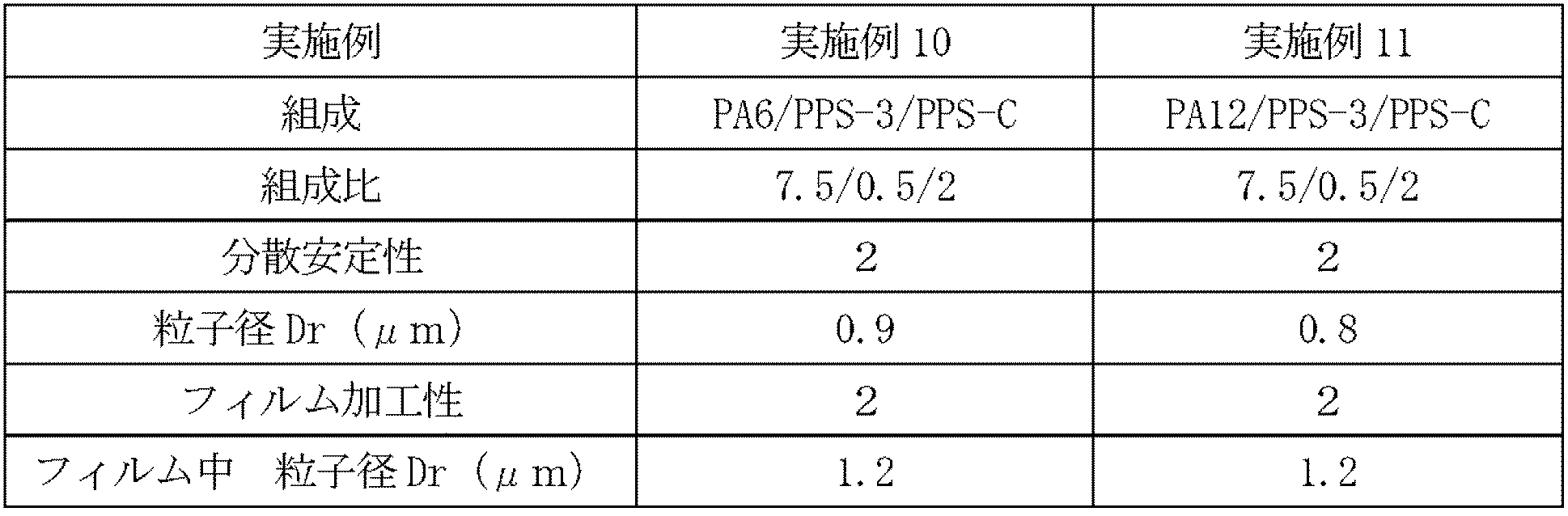
〔実施例12~13、比較例5〕重合体(II)
<実施例12>PEEK共重合体の製造
(重合体(ii)の調製)
側鎖にメチル基を有するpeek-1を以下の方法で調製した。すなわち、オートクレーブに、29.5質量部の4,4-ジフルオロベンゾフェノン、7.3質量部のヒドロキノン、8.3質量部のメチルヒドロキノン、223質量部のスルホラン、5.3質量部の炭酸カリウムを仕込み、300℃で4時間攪拌した。加熱を止め、冷却した後に、220質量部のイオン交換水を入れ、熱水洗浄した。その後、冷却し100メッシュのフィルターでろ過した後、残渣を130℃の熱水で2回洗浄した。さらに残渣をろ過し、減圧乾燥して、下記式(ee1)および(ee2)で表される単位を有するpeek-1を得た。

peek-1のモル比(ee1)/(ee2)は、54/46であった。peek-1の還元粘度ηsp/Cは0.2であった。
共重合比はBruker製NMR 装置DSX300WBを用いて、トリフルオロ酢酸とクロロホルム混合液を溶媒として、1H NMR測定を行うことにより算出した。還元粘度は溶媒に硫酸を使用して、溶液粘度を測定することにより、算出した。
<実施例12>PEEK共重合体の製造
(重合体(ii)の調製)
側鎖にメチル基を有するpeek-1を以下の方法で調製した。すなわち、オートクレーブに、29.5質量部の4,4-ジフルオロベンゾフェノン、7.3質量部のヒドロキノン、8.3質量部のメチルヒドロキノン、223質量部のスルホラン、5.3質量部の炭酸カリウムを仕込み、300℃で4時間攪拌した。加熱を止め、冷却した後に、220質量部のイオン交換水を入れ、熱水洗浄した。その後、冷却し100メッシュのフィルターでろ過した後、残渣を130℃の熱水で2回洗浄した。さらに残渣をろ過し、減圧乾燥して、下記式(ee1)および(ee2)で表される単位を有するpeek-1を得た。
共重合比はBruker製NMR 装置DSX300WBを用いて、トリフルオロ酢酸とクロロホルム混合液を溶媒として、1H NMR測定を行うことにより算出した。還元粘度は溶媒に硫酸を使用して、溶液粘度を測定することにより、算出した。
(溶融混錬)
得られたpeek-1およびクエン酸を質量比=20/1の割合で、ドライブレンドし、樹脂フィーダーより供給し、TEM26-SS2軸押出機(東芝機械製)を用い樹脂温度300℃の温度で溶融混練しペレットとし下記式で表される構造を有するPEEK-1を得た。
得られたpeek-1およびクエン酸を質量比=20/1の割合で、ドライブレンドし、樹脂フィーダーより供給し、TEM26-SS2軸押出機(東芝機械製)を用い樹脂温度300℃の温度で溶融混練しペレットとし下記式で表される構造を有するPEEK-1を得た。

分子量の測定方法:昭和電工製GPCを用いて、クロロフェノールおよびジクロロベンゼンを溶離液としてGPC測定を実施した。ポリスチレンを標準物質として、分子量を求めた。共重合比はBruker製NMR 装置DSX300WBを用いて、トリフルオロ酢酸とクロロホルム混合液を溶媒として、1H NMR測定を行うことにより算出した。
<実施例13>樹脂組成物およびフィルム
TEM26-SS2軸押出機(東芝機械製)を用いてLCP樹脂(LCP-C)、PEEK-1を表5に示した割合で、ドライブレンドし、樹脂フィーダーより供給し、表5の割合で重量式サイドフィーダーを用いて添加し、樹脂温度300℃の温度で溶融混練し、ペレットとした。PEEK-1が海相となり、LCP-Cが島相として分散したものが得られた。
次いでこのペレットを、成形機を用いて樹脂温度300℃、金型温度130℃の温度条件で、厚さ0.2mm、幅40mm、長さ40mmのフィルムを製造した。得られたフィルムの、分散安定性、粒子径Dr、フィルム加工性、フィルム中の粒子径Drを表5に示す。
TEM26-SS2軸押出機(東芝機械製)を用いてLCP樹脂(LCP-C)、PEEK-1を表5に示した割合で、ドライブレンドし、樹脂フィーダーより供給し、表5の割合で重量式サイドフィーダーを用いて添加し、樹脂温度300℃の温度で溶融混練し、ペレットとした。PEEK-1が海相となり、LCP-Cが島相として分散したものが得られた。
次いでこのペレットを、成形機を用いて樹脂温度300℃、金型温度130℃の温度条件で、厚さ0.2mm、幅40mm、長さ40mmのフィルムを製造した。得られたフィルムの、分散安定性、粒子径Dr、フィルム加工性、フィルム中の粒子径Drを表5に示す。
<比較例5>樹脂組成物およびフィルム
(PEEK-Cの製造)
PEEK-Cを以下の方法で調製した。すなわち、オートクレーブに、8質量部の4,4-ジフルオロベンゾフェノン、4質量部のヒドロキノン、60質量部のスルホラン、5.3質量部の炭酸カリウムを仕込み、300℃で4時間攪拌した。加熱を止め、冷却した後に、220質量部のイオン交換水を入れ、熱水洗浄した。その後、冷却し100メッシュのフィルターでろ過した後、残渣を130℃の熱水で2回洗浄した。さらに残渣をろ過し、減圧乾燥して、PEEK-Cを得た。得られたPEEK-Cの分子量は重量平均分子量で200000であった。分子量の測定方法:昭和電工製GPCを用いて、クロロフェノールおよびジクロロベンゼンを溶離液としてGPC測定を実施した。ポリスチレンを標準物質として、分子量を求めた。
PEEK-1の代わりに、上記の方法で準備したPEEK-Cを用いた以外は、実施例13と同じ方法で、樹脂組成物およびフィルムを得た。PEEK-Cが海相となり、LCP-Cが島相として分散したものが得られた。得られたフィルムの、分散安定性、粒子径Dr、フィルム加工性、フィルム中の粒子径Drを表5に示す。
(PEEK-Cの製造)
PEEK-Cを以下の方法で調製した。すなわち、オートクレーブに、8質量部の4,4-ジフルオロベンゾフェノン、4質量部のヒドロキノン、60質量部のスルホラン、5.3質量部の炭酸カリウムを仕込み、300℃で4時間攪拌した。加熱を止め、冷却した後に、220質量部のイオン交換水を入れ、熱水洗浄した。その後、冷却し100メッシュのフィルターでろ過した後、残渣を130℃の熱水で2回洗浄した。さらに残渣をろ過し、減圧乾燥して、PEEK-Cを得た。得られたPEEK-Cの分子量は重量平均分子量で200000であった。分子量の測定方法:昭和電工製GPCを用いて、クロロフェノールおよびジクロロベンゼンを溶離液としてGPC測定を実施した。ポリスチレンを標準物質として、分子量を求めた。
PEEK-1の代わりに、上記の方法で準備したPEEK-Cを用いた以外は、実施例13と同じ方法で、樹脂組成物およびフィルムを得た。PEEK-Cが海相となり、LCP-Cが島相として分散したものが得られた。得られたフィルムの、分散安定性、粒子径Dr、フィルム加工性、フィルム中の粒子径Drを表5に示す。
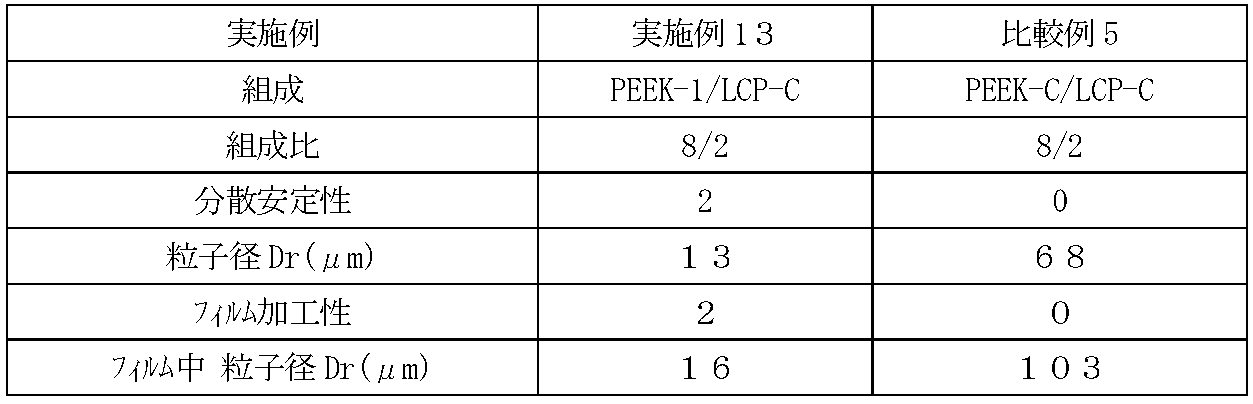
〔実施例14~17、比較例6~8〕重合体(V)
<実施例14>ポリスチレン共重合体の製造
(重合体(v)の調製)
側鎖にメチル基を有するps-1を以下の方法で調製した。すなわち、ケン化度80%のポリビニルアルコール0.15質量部を70質量部のイオン交換水に室温にて嫌気下で溶解した。そこに、15.62質量部のスチレン、17.73質量部のメチルスチレンを加え、重合開始剤として0.05質量部のアゾビスイソブチロニトリルを加え、60℃に昇温し、嫌気下で6時間攪拌し、重合した。得られた分散液を400質量部のメタノールで再沈殿し、下記式(st1)および(st2)で表される単位を有するポリスチレン共重合体(ps-1)を得た。
<実施例14>ポリスチレン共重合体の製造
(重合体(v)の調製)
側鎖にメチル基を有するps-1を以下の方法で調製した。すなわち、ケン化度80%のポリビニルアルコール0.15質量部を70質量部のイオン交換水に室温にて嫌気下で溶解した。そこに、15.62質量部のスチレン、17.73質量部のメチルスチレンを加え、重合開始剤として0.05質量部のアゾビスイソブチロニトリルを加え、60℃に昇温し、嫌気下で6時間攪拌し、重合した。得られた分散液を400質量部のメタノールで再沈殿し、下記式(st1)および(st2)で表される単位を有するポリスチレン共重合体(ps-1)を得た。

分子量の測定方法:昭和電工製GPCを用いて、クロロホルムを溶離液としてGPC測定を実施した。ポリスチレンを標準物質として、分子量を求めた。共重合比はBruker製NMR 装置DSX300WBを用いて、クロロホルムを溶媒として、1H NMR測定を行うことにより算出した。
(溶融混錬)
得られたps-1およびクエン酸を質量比=20/1の割合で、ドライブレンドし、樹脂フィーダーより供給し、TEM26-SS2軸押出機(東芝機械製)を用い樹脂温度300℃の温度で溶融混練しペレットとし下記式で表される構造を有するPS-1を得た。
得られたps-1およびクエン酸を質量比=20/1の割合で、ドライブレンドし、樹脂フィーダーより供給し、TEM26-SS2軸押出機(東芝機械製)を用い樹脂温度300℃の温度で溶融混練しペレットとし下記式で表される構造を有するPS-1を得た。

分子量の測定方法:昭和電工製GPCを用いて、クロロホルムを溶離液としてGPC測定を実施した。ポリスチレンを標準物質として、分子量を求めた。
共重合比はBruker製NMR 装置DSX300WBを用いて、クロロホルムを溶媒として、1H NMR測定を行うことにより算出した。
<実施例15>樹脂組成物およびフィルム
TEM26-SS2軸押出機(東芝機械製)を用いてLCP樹脂(市販品、LCP-C)、PS-1を表6に示した割合で、ドライブレンドし、樹脂フィーダーより供給し、表1の割合で重量式サイドフィーダーを用いて添加し、樹脂温度300℃の温度で溶融混練し、ペレットとした。PS-1が海相となり、LCP-Cが島相として分散したものが得られた。
次いでこのペレットを、成形機を用いて樹脂温度300℃、金型温度130℃の温度条件で、厚さ0.2mm、幅40mm、長さ40mmのフィルムを製造した。得られたフィルムの、分散安定性、粒子径Dr、フィルム加工性、フィルム中の粒子径Drを表6に示す。
TEM26-SS2軸押出機(東芝機械製)を用いてLCP樹脂(市販品、LCP-C)、PS-1を表6に示した割合で、ドライブレンドし、樹脂フィーダーより供給し、表1の割合で重量式サイドフィーダーを用いて添加し、樹脂温度300℃の温度で溶融混練し、ペレットとした。PS-1が海相となり、LCP-Cが島相として分散したものが得られた。
次いでこのペレットを、成形機を用いて樹脂温度300℃、金型温度130℃の温度条件で、厚さ0.2mm、幅40mm、長さ40mmのフィルムを製造した。得られたフィルムの、分散安定性、粒子径Dr、フィルム加工性、フィルム中の粒子径Drを表6に示す。
<実施例16~17>樹脂組成物およびフィルム
LCP樹脂(市販品、LCP-C)の代わりに、ポリアミド樹脂(市販品、PA6)またはポリアミド樹脂(市販品、PA12)を用いた以外は、実施例15と同様にして、樹脂組成物およびフィルムを製造した。ポリアミド樹脂が海相となり、PS-1が島相として分散したものが得られた。得られたフィルムの、分散安定性、粒子径Dr、フィルム加工性、フィルム中の粒子径Drを表6に示す。
LCP樹脂(市販品、LCP-C)の代わりに、ポリアミド樹脂(市販品、PA6)またはポリアミド樹脂(市販品、PA12)を用いた以外は、実施例15と同様にして、樹脂組成物およびフィルムを製造した。ポリアミド樹脂が海相となり、PS-1が島相として分散したものが得られた。得られたフィルムの、分散安定性、粒子径Dr、フィルム加工性、フィルム中の粒子径Drを表6に示す。

<比較例6~8>樹脂組成物およびフィルム
(ポリスチレンの製造)
側鎖にメチル基を有しないPS-Cを以下の方法で調製した。すなわち、ケン化度80%のポリビニルアルコール0.15質量部を70質量部のイオン交換水に室温にて嫌気下で溶解した。そこに、33質量部のスチレンを加え、重合開始剤として0.05質量部のアゾビスイソブチロニトリルを加え、60℃に昇温し、嫌気下で6時間攪拌し、重合した。得られた分散液を400質量部のメタノールで再沈殿し、ポリスチレンを得た。
得られたポリスチレンの分子量は重量平均分子量で180000であった。分子量の測定方法:昭和電工製GPCを用いて、クロロホルムを溶離液としてGPC測定を実施した。ポリスチレンを標準物質として、分子量を求めた。
PS-1の代わりに、上記記載の方法で準備したポリスチレン樹脂(PS-C)を用いた以外は、実施例15と同様にして、樹脂組成物およびフィルムを製造した。比較例6はPS-Cが海相となり、LCP-Cが島相として分散したものが得られた。比較例7と8はポリアミド樹脂が海相となり、PS-Cが島相として分散したものが得られた。得られたフィルムの、分散安定性、粒子径Dr、フィルム加工性、フィルム中の粒子径Drを表7に示す。

(ポリスチレンの製造)
側鎖にメチル基を有しないPS-Cを以下の方法で調製した。すなわち、ケン化度80%のポリビニルアルコール0.15質量部を70質量部のイオン交換水に室温にて嫌気下で溶解した。そこに、33質量部のスチレンを加え、重合開始剤として0.05質量部のアゾビスイソブチロニトリルを加え、60℃に昇温し、嫌気下で6時間攪拌し、重合した。得られた分散液を400質量部のメタノールで再沈殿し、ポリスチレンを得た。
得られたポリスチレンの分子量は重量平均分子量で180000であった。分子量の測定方法:昭和電工製GPCを用いて、クロロホルムを溶離液としてGPC測定を実施した。ポリスチレンを標準物質として、分子量を求めた。
PS-1の代わりに、上記記載の方法で準備したポリスチレン樹脂(PS-C)を用いた以外は、実施例15と同様にして、樹脂組成物およびフィルムを製造した。比較例6はPS-Cが海相となり、LCP-Cが島相として分散したものが得られた。比較例7と8はポリアミド樹脂が海相となり、PS-Cが島相として分散したものが得られた。得られたフィルムの、分散安定性、粒子径Dr、フィルム加工性、フィルム中の粒子径Drを表7に示す。
本発明の重合体は、熱可塑性樹脂の相溶化剤として用いることができる。本発明の樹脂組成物および成形体は、自動車部品、電気・電子材料部品などに用いることができる。また携帯電話用の高周波回路の基板や、5G通信の野外基地局の筐体、フレキシブルプリント配線板に用いることができる。
Claims (15)
- 主として下記式(1)、(2)および(3)で表される単位を含み、
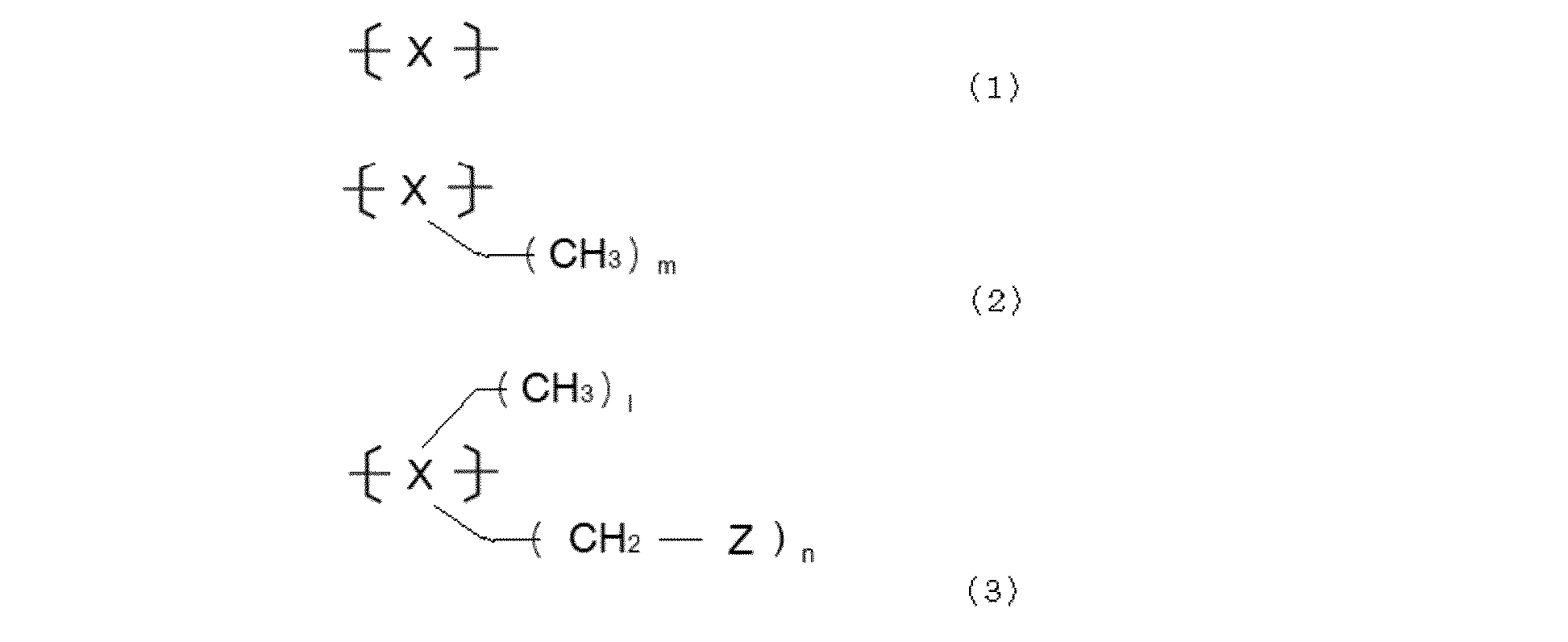
単位(1)、(2)および(3)の合計モル数を100モルとしたとき、単位(1)のモル数は0~95モルであり、単位(2)のモル数は0~50モルであり、単位(3)のモル数は、2~80モルである重合体(B)。 - 単位(1)~(3)において、Xは、

- 式(3)中のZは、クエン酸、マレイン酸、イタコン酸およびこれらの無水物から選ばれる少なくとも一種の化合物由来の置換基である請求項1に記載の重合体(B)。
- 単位(1)のモル数は10~95モルであり、単位(2)のモル数は0~35モルであり、単位(3)のモル数は、5~55モルである請求項1に記載の重合体(B)。
-

単位(S1)+単位(S2)+(単位(S3)または単位(S4))の合計100モルに対し、単位(S1)のモル数は20~90モル、単位(S2)のモル数は0~30モル、
単位(S3)または単位(S4)のモル数は10~50モルである請求項1に記載の重合体(B)。 - 100質量部の熱可塑性樹脂(A成分)および3~900質量部の請求項1記載の重合体(B)(B成分)を含有する樹脂組成物。
- 熱可塑性樹脂(A成分)は、ポリエステル樹脂、液晶性ポリエステル樹脂およびポリアミド樹脂からなる群より選ばれる少なくとも一種の樹脂である請求項6記載の樹脂組成物。
- さらに100質量部の該熱可塑性樹脂(A成分)に対して100~500質量部の他の熱可塑性樹脂(C成分)を含有する請求項6記載の樹脂組成物。
- 他の熱可塑性樹脂(C成分)は、ポリフェニレンスルフィド(PPS)、ポリエーテルエーテルケトン(PEEK)、ポリエーテルケトンケトン(PEKK)、ポリエーテルケトン(PEK)およびポリスチレン(PS)からなる群より選ばれる少なくとも一種の樹脂である請求項8記載の樹脂組成物。
- 熱可塑性樹脂(A成分)が液晶性ポリエステル樹脂であり、重合体(B成分)が単位(1)~(3)において、Xが、

- 請求項6~10の何れか一項に記載の樹脂組成物からなる成形体。
- 液晶性ポリエステル樹脂(A成分)100質量部に対し、75~900質量部の重合体(B成分)を含有する樹脂組成物からなり、重合体(B成分)は、単位(1)~(3)において、Xが、

(i)比誘電率が、2.0~4.0の範囲にあり、
(ii)誘電正接が1.0×10⁻⁴~1.0×10⁻²の範囲にあり、
(iii)島相の粒子径Drが0.5μm~80μmの範囲にある、
請求項11記載の成形体。 - 液晶性ポリエステル(A成分)は、主鎖に下記式(a1)および(a2)で表される単位を含有し、(a1)/(a2)のモル比が、(5~8)/(5~2)である請求項12記載の成形体。

- (α)主として下記式(1)および(2)で表される単位を含み、

単位(2)において、-CH3は、Xのベンゼン環の水素原子に置換したメチル基で、mは置換した数を表し1~6の整数である。)
単位(1)および(2)の合計モル数を100モルとしたとき、単位(1)のモル数は0~98モルであり、単位(2)のモル数は2~100モルである重合体(b)を調製する工程(α)、および
(β)重合体(b)と、クエン酸、マレイン酸、イタコン酸およびこれらの無水物からなる群より選ばれる少なくとも一種の化合物とを溶融混錬する工程(β)、
を含む請求項1記載の重合体(B)の製造方法。 - 工程(β)において、100重量部の重合体(b)に対し、クエン酸、マレイン酸、イタコン酸およびこれらの無水物からなる群より選ばれる少なくとも一種の化合物を0.05~20重量部、溶融混錬する請求項14記載の製造方法。
Priority Applications (4)
| Application Number | Priority Date | Filing Date | Title |
|---|---|---|---|
| JP2022512228A JP7464698B2 (ja) | 2020-03-30 | 2021-03-29 | 熱可塑性樹脂との相溶性に優れた重合体 |
| US17/915,684 US20230144380A1 (en) | 2020-03-30 | 2021-03-29 | Polymer having excellent compatibility with thermoplastic resins |
| EP21781196.7A EP4130103A4 (en) | 2020-03-30 | 2021-03-29 | POLYMER WITH EXCELLENT COMPATIBILITY WITH THERMOPLASTIC RESIN |
| CN202180026392.7A CN115427507B (zh) | 2020-03-30 | 2021-03-29 | 与热塑性树脂的相容性优异的聚合物 |
Applications Claiming Priority (2)
| Application Number | Priority Date | Filing Date | Title |
|---|---|---|---|
| JP2020-060489 | 2020-03-30 | ||
| JP2020060489 | 2020-03-30 |
Publications (1)
| Publication Number | Publication Date |
|---|---|
| WO2021200852A1 true WO2021200852A1 (ja) | 2021-10-07 |
Family
ID=77928614
Family Applications (1)
| Application Number | Title | Priority Date | Filing Date |
|---|---|---|---|
| PCT/JP2021/013370 Ceased WO2021200852A1 (ja) | 2020-03-30 | 2021-03-29 | 熱可塑性樹脂との相溶性に優れた重合体 |
Country Status (5)
| Country | Link |
|---|---|
| US (1) | US20230144380A1 (ja) |
| EP (1) | EP4130103A4 (ja) |
| JP (1) | JP7464698B2 (ja) |
| CN (1) | CN115427507B (ja) |
| WO (1) | WO2021200852A1 (ja) |
Citations (5)
| Publication number | Priority date | Publication date | Assignee | Title |
|---|---|---|---|---|
| JPH02169667A (ja) * | 1988-12-21 | 1990-06-29 | Toray Ind Inc | ポリアリーレンスルフィド樹脂組成物 |
| JPH02214774A (ja) * | 1989-02-15 | 1990-08-27 | Toray Ind Inc | ポリアリーレンスルフィド樹脂組成物 |
| JPH08170024A (ja) * | 1994-10-18 | 1996-07-02 | Polyplastics Co | 熱可塑性樹脂組成物、その射出成形方法および射出成形体 |
| JP2007246845A (ja) | 2006-03-17 | 2007-09-27 | Toray Ind Inc | 樹脂組成物ならびにそれからなる成形品 |
| JP2008045087A (ja) | 2006-08-21 | 2008-02-28 | Otsuka Chemical Co Ltd | ポリマーアロイ用相溶化剤、ポリマーアロイ及びポリマーアロイ調製用マスターバッチ |
Family Cites Families (14)
| Publication number | Priority date | Publication date | Assignee | Title |
|---|---|---|---|---|
| JP2707714B2 (ja) * | 1989-04-25 | 1998-02-04 | 東レ株式会社 | ポリフェニレンスルフィド樹脂組成物 |
| CN1185301C (zh) * | 1994-10-18 | 2005-01-19 | 聚塑株式会社 | 热塑性树脂组合物的注塑成型方法 |
| JPH101605A (ja) * | 1996-06-18 | 1998-01-06 | Kuraray Co Ltd | 熱可塑性樹脂組成物 |
| JP2002105333A (ja) * | 2000-06-28 | 2002-04-10 | Matsushita Electric Works Ltd | 熱可塑性樹脂組成物、その製造方法、並びに半導体素子収納用パッケージ |
| JP2003064255A (ja) * | 2001-08-23 | 2003-03-05 | Mitsubishi Engineering Plastics Corp | 熱可塑性樹脂組成物 |
| JP2007046044A (ja) * | 2005-07-15 | 2007-02-22 | Toray Ind Inc | 熱可塑性樹脂組成物、成形品およびフィルム |
| US8097685B2 (en) * | 2006-03-30 | 2012-01-17 | Toray Industries, Inc. | Dendritic polymer, method for producing the same, and thermoplastic resin composition |
| CN103403098B (zh) * | 2011-02-28 | 2014-11-12 | 东丽株式会社 | 热塑性树脂组合物及其成型品 |
| GB201108864D0 (en) * | 2011-05-26 | 2011-07-06 | Ct For Process Innovation The Ltd | Transistors and methods of making them |
| JP5862509B2 (ja) * | 2012-08-09 | 2016-02-16 | Jsr株式会社 | 樹脂組成物及びその製造方法 |
| JP6561507B2 (ja) * | 2014-03-27 | 2019-08-21 | 東レ株式会社 | 成形材料ならびにそれを用いた成形品の製造方法および成形品 |
| JP6402181B2 (ja) * | 2014-05-23 | 2018-10-10 | Sdpグローバル株式会社 | 吸水性樹脂粒子、これを含む吸収体および吸収性物品 |
| CN106589896A (zh) * | 2016-11-18 | 2017-04-26 | 江苏沃特新材料科技有限公司 | 一种高抗冲聚苯醚工程塑料及其制备方法和应用 |
| CN109265898A (zh) * | 2018-08-08 | 2019-01-25 | 南京欧纳壹有机光电有限公司 | 一种高性能工程塑料制备方法 |
-
2021
- 2021-03-29 WO PCT/JP2021/013370 patent/WO2021200852A1/ja not_active Ceased
- 2021-03-29 US US17/915,684 patent/US20230144380A1/en active Pending
- 2021-03-29 CN CN202180026392.7A patent/CN115427507B/zh active Active
- 2021-03-29 JP JP2022512228A patent/JP7464698B2/ja active Active
- 2021-03-29 EP EP21781196.7A patent/EP4130103A4/en active Pending
Patent Citations (5)
| Publication number | Priority date | Publication date | Assignee | Title |
|---|---|---|---|---|
| JPH02169667A (ja) * | 1988-12-21 | 1990-06-29 | Toray Ind Inc | ポリアリーレンスルフィド樹脂組成物 |
| JPH02214774A (ja) * | 1989-02-15 | 1990-08-27 | Toray Ind Inc | ポリアリーレンスルフィド樹脂組成物 |
| JPH08170024A (ja) * | 1994-10-18 | 1996-07-02 | Polyplastics Co | 熱可塑性樹脂組成物、その射出成形方法および射出成形体 |
| JP2007246845A (ja) | 2006-03-17 | 2007-09-27 | Toray Ind Inc | 樹脂組成物ならびにそれからなる成形品 |
| JP2008045087A (ja) | 2006-08-21 | 2008-02-28 | Otsuka Chemical Co Ltd | ポリマーアロイ用相溶化剤、ポリマーアロイ及びポリマーアロイ調製用マスターバッチ |
Non-Patent Citations (1)
| Title |
|---|
| See also references of EP4130103A4 |
Also Published As
| Publication number | Publication date |
|---|---|
| US20230144380A1 (en) | 2023-05-11 |
| EP4130103A1 (en) | 2023-02-08 |
| EP4130103A4 (en) | 2023-10-18 |
| JP7464698B2 (ja) | 2024-04-09 |
| JPWO2021200852A1 (ja) | 2021-10-07 |
| CN115427507A (zh) | 2022-12-02 |
| CN115427507B (zh) | 2024-07-23 |
Similar Documents
| Publication | Publication Date | Title |
|---|---|---|
| JP6258705B2 (ja) | 流動性が向上した全芳香族液晶ポリエステル樹脂コンパウンド | |
| JP5560770B2 (ja) | 液晶高分子組成物及びその成形体 | |
| JP4632395B2 (ja) | 液晶ポリエステル樹脂組成物 | |
| CN105255152A (zh) | 聚(芳醚酮二氮杂萘酮)的高温聚合物掺合物 | |
| JPWO2001081469A1 (ja) | 液晶ポリエステル樹脂組成物 | |
| CN104640929A (zh) | 聚亚芳基硫醚树脂组合物及成形的物品 | |
| JP4129674B2 (ja) | ポリアリーレンスルフィド系共重合体の製造方法 | |
| JPWO2021014800A1 (ja) | ポリアリーレンエーテルケトン樹脂及びその製造方法、並びに成形体 | |
| CN115304889A (zh) | 树脂组合物、成形体及低介电性树脂用的流动性提高剂 | |
| US5543474A (en) | Resin composition | |
| JPH05170907A (ja) | カルボキシル基含有ポリフェニレンスルフィドの製造方法 | |
| JP7464698B2 (ja) | 熱可塑性樹脂との相溶性に優れた重合体 | |
| EP0801113B1 (en) | Engineering plastics compositions containing a wholly aromatic polyester | |
| JP2004182754A (ja) | ポリアリーレンスルフィド樹脂組成物 | |
| KR101544211B1 (ko) | 점도 안정성이 향상된 전방향족 액정 폴리에스테르 수지, 및 이의 제조방법과 상기 수지를 포함하는 수지 컴파운드 | |
| JP6179361B2 (ja) | 末端変性ポリマーを含む熱可塑性樹脂 | |
| JP5322409B2 (ja) | 帯電防止性熱可塑性樹脂組成物の調製方法、帯電防止性熱可塑性樹脂組成物及び帯電防止性熱可塑性樹脂成形体 | |
| JP6301146B2 (ja) | 脂肪族ポリカーボネート樹脂組成物及びそれを用いた成形体 | |
| JPH0570700A (ja) | 液晶性樹脂組成物、その製造方法および成形品 | |
| JP2007323208A (ja) | Icタグ | |
| JP3937498B2 (ja) | 熱可塑性樹脂組成物 | |
| TW202342639A (zh) | 液晶聚酯組成物、液晶聚酯組成物之製造方法、薄膜及薄膜之製造方法 | |
| JP2680099B2 (ja) | 耐熱性樹脂組成物の製造方法 | |
| TW202132451A (zh) | 樹脂組合物及包含該樹脂組合物之樹脂成形品 | |
| JP2024111551A (ja) | 樹脂組成物、成形品及びフィルム |
Legal Events
| Date | Code | Title | Description |
|---|---|---|---|
| 121 | Ep: the epo has been informed by wipo that ep was designated in this application |
Ref document number: 21781196 Country of ref document: EP Kind code of ref document: A1 |
|
| ENP | Entry into the national phase |
Ref document number: 2022512228 Country of ref document: JP Kind code of ref document: A |
|
| NENP | Non-entry into the national phase |
Ref country code: DE |
|
| ENP | Entry into the national phase |
Ref document number: 2021781196 Country of ref document: EP Effective date: 20221031 |