WO2022210843A1 - エチレン-α-オレフィン共重合体、熱可塑性樹脂組成物、フィルムおよび積層体 - Google Patents
エチレン-α-オレフィン共重合体、熱可塑性樹脂組成物、フィルムおよび積層体 Download PDFInfo
- Publication number
- WO2022210843A1 WO2022210843A1 PCT/JP2022/015846 JP2022015846W WO2022210843A1 WO 2022210843 A1 WO2022210843 A1 WO 2022210843A1 JP 2022015846 W JP2022015846 W JP 2022015846W WO 2022210843 A1 WO2022210843 A1 WO 2022210843A1
- Authority
- WO
- WIPO (PCT)
- Prior art keywords
- group
- ethylene
- olefin copolymer
- film
- resin composition
- Prior art date
- Legal status (The legal status is an assumption and is not a legal conclusion. Google has not performed a legal analysis and makes no representation as to the accuracy of the status listed.)
- Ceased
Links
Classifications
-
- C—CHEMISTRY; METALLURGY
- C08—ORGANIC MACROMOLECULAR COMPOUNDS; THEIR PREPARATION OR CHEMICAL WORKING-UP; COMPOSITIONS BASED THEREON
- C08F—MACROMOLECULAR COMPOUNDS OBTAINED BY REACTIONS ONLY INVOLVING CARBON-TO-CARBON UNSATURATED BONDS
- C08F210/00—Copolymers of unsaturated aliphatic hydrocarbons having only one carbon-to-carbon double bond
- C08F210/16—Copolymers of ethene with alpha-alkenes, e.g. EP rubbers
-
- C—CHEMISTRY; METALLURGY
- C08—ORGANIC MACROMOLECULAR COMPOUNDS; THEIR PREPARATION OR CHEMICAL WORKING-UP; COMPOSITIONS BASED THEREON
- C08L—COMPOSITIONS OF MACROMOLECULAR COMPOUNDS
- C08L23/00—Compositions of homopolymers or copolymers of unsaturated aliphatic hydrocarbons having only one carbon-to-carbon double bond; Compositions of derivatives of such polymers
- C08L23/02—Compositions of homopolymers or copolymers of unsaturated aliphatic hydrocarbons having only one carbon-to-carbon double bond; Compositions of derivatives of such polymers not modified by chemical after-treatment
- C08L23/04—Homopolymers or copolymers of ethene
- C08L23/08—Copolymers of ethene
- C08L23/0807—Copolymers of ethene with unsaturated hydrocarbons only containing four or more carbon atoms
- C08L23/0815—Copolymers of ethene with unsaturated hydrocarbons only containing four or more carbon atoms with aliphatic 1-olefins containing one carbon-to-carbon double bond
-
- B—PERFORMING OPERATIONS; TRANSPORTING
- B29—WORKING OF PLASTICS; WORKING OF SUBSTANCES IN A PLASTIC STATE IN GENERAL
- B29C—SHAPING OR JOINING OF PLASTICS; SHAPING OF MATERIAL IN A PLASTIC STATE, NOT OTHERWISE PROVIDED FOR; AFTER-TREATMENT OF THE SHAPED PRODUCTS, e.g. REPAIRING
- B29C48/00—Extrusion moulding, i.e. expressing the moulding material through a die or nozzle which imparts the desired form; Apparatus therefor
- B29C48/25—Component parts, details or accessories; Auxiliary operations
- B29C48/36—Means for plasticising or homogenising the moulding material or forcing it through the nozzle or die
- B29C48/395—Means for plasticising or homogenising the moulding material or forcing it through the nozzle or die using screws surrounded by a cooperating barrel, e.g. single screw extruders
- B29C48/40—Means for plasticising or homogenising the moulding material or forcing it through the nozzle or die using screws surrounded by a cooperating barrel, e.g. single screw extruders using two or more parallel screws or at least two parallel non-intermeshing screws, e.g. twin screw extruders
-
- B—PERFORMING OPERATIONS; TRANSPORTING
- B32—LAYERED PRODUCTS
- B32B—LAYERED PRODUCTS, i.e. PRODUCTS BUILT-UP OF STRATA OF FLAT OR NON-FLAT, e.g. CELLULAR OR HONEYCOMB, FORM
- B32B27/00—Layered products comprising a layer of synthetic resin
- B32B27/32—Layered products comprising a layer of synthetic resin comprising polyolefins
-
- C—CHEMISTRY; METALLURGY
- C08—ORGANIC MACROMOLECULAR COMPOUNDS; THEIR PREPARATION OR CHEMICAL WORKING-UP; COMPOSITIONS BASED THEREON
- C08J—WORKING-UP; GENERAL PROCESSES OF COMPOUNDING; AFTER-TREATMENT NOT COVERED BY SUBCLASSES C08B, C08C, C08F, C08G or C08H
- C08J5/00—Manufacture of articles or shaped materials containing macromolecular substances
- C08J5/18—Manufacture of films or sheets
-
- B—PERFORMING OPERATIONS; TRANSPORTING
- B29—WORKING OF PLASTICS; WORKING OF SUBSTANCES IN A PLASTIC STATE IN GENERAL
- B29C—SHAPING OR JOINING OF PLASTICS; SHAPING OF MATERIAL IN A PLASTIC STATE, NOT OTHERWISE PROVIDED FOR; AFTER-TREATMENT OF THE SHAPED PRODUCTS, e.g. REPAIRING
- B29C2948/00—Indexing scheme relating to extrusion moulding
- B29C2948/92—Measuring, controlling or regulating
- B29C2948/92504—Controlled parameter
- B29C2948/92704—Temperature
-
- B—PERFORMING OPERATIONS; TRANSPORTING
- B29—WORKING OF PLASTICS; WORKING OF SUBSTANCES IN A PLASTIC STATE IN GENERAL
- B29K—INDEXING SCHEME ASSOCIATED WITH SUBCLASSES B29B, B29C OR B29D, RELATING TO MOULDING MATERIALS OR TO MATERIALS FOR MOULDS, REINFORCEMENTS, FILLERS OR PREFORMED PARTS, e.g. INSERTS
- B29K2023/00—Use of polyalkenes or derivatives thereof as moulding material
- B29K2023/04—Polymers of ethylene
- B29K2023/08—Copolymers of ethylene
-
- C—CHEMISTRY; METALLURGY
- C08—ORGANIC MACROMOLECULAR COMPOUNDS; THEIR PREPARATION OR CHEMICAL WORKING-UP; COMPOSITIONS BASED THEREON
- C08F—MACROMOLECULAR COMPOUNDS OBTAINED BY REACTIONS ONLY INVOLVING CARBON-TO-CARBON UNSATURATED BONDS
- C08F2410/00—Features related to the catalyst preparation, the catalyst use or to the deactivation of the catalyst
- C08F2410/01—Additive used together with the catalyst, excluding compounds containing Al or B
-
- C—CHEMISTRY; METALLURGY
- C08—ORGANIC MACROMOLECULAR COMPOUNDS; THEIR PREPARATION OR CHEMICAL WORKING-UP; COMPOSITIONS BASED THEREON
- C08F—MACROMOLECULAR COMPOUNDS OBTAINED BY REACTIONS ONLY INVOLVING CARBON-TO-CARBON UNSATURATED BONDS
- C08F2420/00—Metallocene catalysts
- C08F2420/07—Heteroatom-substituted Cp, i.e. Cp or analog where at least one of the substituent of the Cp or analog ring is or contains a heteroatom
-
- C—CHEMISTRY; METALLURGY
- C08—ORGANIC MACROMOLECULAR COMPOUNDS; THEIR PREPARATION OR CHEMICAL WORKING-UP; COMPOSITIONS BASED THEREON
- C08F—MACROMOLECULAR COMPOUNDS OBTAINED BY REACTIONS ONLY INVOLVING CARBON-TO-CARBON UNSATURATED BONDS
- C08F4/00—Polymerisation catalysts
- C08F4/42—Metals; Metal hydrides; Metallo-organic compounds; Use thereof as catalyst precursors
- C08F4/44—Metals; Metal hydrides; Metallo-organic compounds; Use thereof as catalyst precursors selected from light metals, zinc, cadmium, mercury, copper, silver, gold, boron, gallium, indium, thallium, rare earths or actinides
- C08F4/60—Metals; Metal hydrides; Metallo-organic compounds; Use thereof as catalyst precursors selected from light metals, zinc, cadmium, mercury, copper, silver, gold, boron, gallium, indium, thallium, rare earths or actinides together with refractory metals, iron group metals, platinum group metals, manganese, rhenium technetium or compounds thereof
- C08F4/62—Refractory metals or compounds thereof
- C08F4/64—Titanium, zirconium, hafnium or compounds thereof
- C08F4/659—Component covered by group C08F4/64 containing a transition metal-carbon bond
- C08F4/65912—Component covered by group C08F4/64 containing a transition metal-carbon bond in combination with an organoaluminium compound
-
- C—CHEMISTRY; METALLURGY
- C08—ORGANIC MACROMOLECULAR COMPOUNDS; THEIR PREPARATION OR CHEMICAL WORKING-UP; COMPOSITIONS BASED THEREON
- C08F—MACROMOLECULAR COMPOUNDS OBTAINED BY REACTIONS ONLY INVOLVING CARBON-TO-CARBON UNSATURATED BONDS
- C08F4/00—Polymerisation catalysts
- C08F4/42—Metals; Metal hydrides; Metallo-organic compounds; Use thereof as catalyst precursors
- C08F4/44—Metals; Metal hydrides; Metallo-organic compounds; Use thereof as catalyst precursors selected from light metals, zinc, cadmium, mercury, copper, silver, gold, boron, gallium, indium, thallium, rare earths or actinides
- C08F4/60—Metals; Metal hydrides; Metallo-organic compounds; Use thereof as catalyst precursors selected from light metals, zinc, cadmium, mercury, copper, silver, gold, boron, gallium, indium, thallium, rare earths or actinides together with refractory metals, iron group metals, platinum group metals, manganese, rhenium technetium or compounds thereof
- C08F4/62—Refractory metals or compounds thereof
- C08F4/64—Titanium, zirconium, hafnium or compounds thereof
- C08F4/659—Component covered by group C08F4/64 containing a transition metal-carbon bond
- C08F4/65916—Component covered by group C08F4/64 containing a transition metal-carbon bond supported on a carrier, e.g. silica, MgCl2, polymer
-
- C—CHEMISTRY; METALLURGY
- C08—ORGANIC MACROMOLECULAR COMPOUNDS; THEIR PREPARATION OR CHEMICAL WORKING-UP; COMPOSITIONS BASED THEREON
- C08J—WORKING-UP; GENERAL PROCESSES OF COMPOUNDING; AFTER-TREATMENT NOT COVERED BY SUBCLASSES C08B, C08C, C08F, C08G or C08H
- C08J2323/00—Characterised by the use of homopolymers or copolymers of unsaturated aliphatic hydrocarbons having only one carbon-to-carbon double bond; Derivatives of such polymers
- C08J2323/02—Characterised by the use of homopolymers or copolymers of unsaturated aliphatic hydrocarbons having only one carbon-to-carbon double bond; Derivatives of such polymers not modified by chemical after treatment
- C08J2323/04—Homopolymers or copolymers of ethene
- C08J2323/08—Copolymers of ethene
-
- C—CHEMISTRY; METALLURGY
- C08—ORGANIC MACROMOLECULAR COMPOUNDS; THEIR PREPARATION OR CHEMICAL WORKING-UP; COMPOSITIONS BASED THEREON
- C08J—WORKING-UP; GENERAL PROCESSES OF COMPOUNDING; AFTER-TREATMENT NOT COVERED BY SUBCLASSES C08B, C08C, C08F, C08G or C08H
- C08J2423/00—Characterised by the use of homopolymers or copolymers of unsaturated aliphatic hydrocarbons having only one carbon-to-carbon double bond; Derivatives of such polymers
- C08J2423/02—Characterised by the use of homopolymers or copolymers of unsaturated aliphatic hydrocarbons having only one carbon-to-carbon double bond; Derivatives of such polymers not modified by chemical after treatment
- C08J2423/04—Homopolymers or copolymers of ethene
- C08J2423/08—Copolymers of ethene
-
- C—CHEMISTRY; METALLURGY
- C08—ORGANIC MACROMOLECULAR COMPOUNDS; THEIR PREPARATION OR CHEMICAL WORKING-UP; COMPOSITIONS BASED THEREON
- C08L—COMPOSITIONS OF MACROMOLECULAR COMPOUNDS
- C08L2203/00—Applications
- C08L2203/30—Applications used for thermoforming
Definitions
- the present invention provides an ethylene- ⁇ -olefin copolymer, a thermoplastic resin composition containing the ethylene- ⁇ -olefin copolymer, and further the ethylene- ⁇ -olefin copolymer and the ethylene- ⁇ -olefin copolymer.
- the present invention relates to a film comprising a thermoplastic resin composition including coalescence, and a laminate comprising the film.
- Ethylene-based polymers are used in various molding methods and applications, and various properties are required for ethylene-based polymers depending on the molding method and application.
- neck-in occurs in which the edges of the film shrink toward the center.
- a phenomenon occurs in which the width of the film is reduced and the edges of the film become thicker than the central portion of the film. For this reason, if the neck-in is large, the yield of the product is deteriorated, and the product with the desired width cannot be produced.
- Problems such as sagging and breakage of the melt film may occur in blow molding, and swaying and breakage of the melt film may occur in inflation molding. In order to suppress these problems, it is necessary to select an ethylene polymer having a high melt tension relative to its molecular weight.
- Ethylene-based polymers without long chain branches obtained using metallocene catalysts have excellent mechanical strength, but there are problems with moldability. For example, neck-in becomes large in T-die molding, and take-off surging occurs.
- High-pressure low-density polyethylene has a large melt tension and excellent formability such as neck-in.
- high-pressure low-density polyethylene has a complex long-chain branched structure and is inferior in mechanical strength such as tensile strength, tear strength, and impact resistance.
- Patent Document 1 proposes a composition of an ethylene-based polymer obtained using a metallocene catalyst and high-pressure low-density polyethylene.
- the mechanical strength such as tensile strength, tear strength, and impact resistance will be inferior, and if the content of high-pressure low-density polyethylene is low, it will melt. Since the improvement in tension is not sufficient, deterioration in moldability such as large neck-in is expected.
- Patent Document 2 discloses an ethylene-based polymer obtained by solution polymerization in the presence of a catalyst composed of ethylenebis(indenyl)hafnium dichloride and methylalumoxane
- Patent Document 3 discloses an ethylene bis(
- Patent Document 4 discloses an ethylene polymer obtained by gas phase polymerization in the presence of a catalyst consisting of indenyl)zirconium dichloride and methylalumoxane
- Patent Document 4 discloses an ethylene polymer obtained by solution polymerization in the presence of a constrained geometry catalyst. Coalescing is described in US Pat. No.
- a film having a high external haze due to fine irregularities on the film surface is excellent in blocking resistance
- a film having excellent transparency is desired from the viewpoint of visibility of contents and inspection of defects in the film. Transparency is also desired in the case of using an ethylene polymer for a bottle or the like.
- the present invention provides an ethylene- ⁇ -olefin copolymer which is excellent in moldability and capable of forming a film having particularly excellent mechanical strength as compared with conventionally known ethylene-based polymers, and a heat treatment containing the polymer.
- An object of the present invention is to provide a plastic resin composition, and films and laminates obtained from the polymer or the thermoplastic resin composition.
- the present invention further provides an ethylene resin composition capable of producing a molded article having excellent transparency (for example, a film and a multilayer film having the film), and a molded article obtained from the ethylene resin composition (for example, a film , and a multilayer film comprising the film).
- the present inventors have found that by imparting specific melting properties and molecular structures to the polymer, ethylene-polyethylene which does not cause take-off surging in T-die molding, has small neck-in, and has particularly excellent mechanical strength.
- the inventors have found an ⁇ -olefin copolymer and completed the present invention.
- a composition containing two types of ethylene-based polymers with specific melting characteristics and molecular structures has excellent melt film stability in inflation molding, excellent mechanical strength, and excellent transparency.
- the present inventors have found that it is possible to produce a film, and a multilayer film having the film), and have completed the ethylene-based resin composition (Z) of the present invention.
- the present invention relates to, for example, the following [1] to [16].
- An ethylene- ⁇ -olefin copolymer (A) which is a copolymer of ethylene and an ⁇ -olefin having 4 to 10 carbon atoms and which satisfies the following requirements (1) to (7).
- Density is in the range of 890 kg/m 3 or more and 925 kg/m 3 or less.
- Melt flow rate (MFR) with a load of 2.16 kg at 190° C. is in the range of 3.0 g/10 minutes or more and 15.0 g/10 minutes or less.
- the ratio [MT/ ⁇ * (g/P)] of the melt tension [MT(g)] at 190°C and the shear viscosity [ ⁇ * (P)] at 200°C and an angular velocity of 1.0 rad/sec is It is in the range of 1.40 ⁇ 10 ⁇ 4 or more and 2.90 ⁇ 10 ⁇ 4 or less.
- the zero shear viscosity [ ⁇ 0 (P)] at 200°C and the weight average molecular weight (Mw) measured by the GPC-viscosity detector method (GPC-VISCO) satisfy the following relational expression (Eq-1) .
- Eq-1 Number average molecular weight (Mn), weight average molecular weight (Mw) and Z average molecular weight (Mz) measured by GPC-viscosity detector method (GPC-VISCO) satisfy the following relational expression (Eq-2) . -2.0 ⁇ Mz/Mw - Mw/Mn ⁇ 15 (Eq-2) (6) Total amount of vinyl, vinylidene, disubstituted internal olefin and trisubstituted internal olefin per 1000 carbon atoms measured by 1 H-NMR (number/1000C) is in the range of 0.1 to 1.0. . (7) There are multiple peaks in the melting curve obtained by differential scanning calorimetry (DSC).
- DSC differential scanning calorimetry
- the ethylene- ⁇ -olefin copolymer (A) of [1] further satisfies the following requirement (8).
- the ratio Mz/Mw of the Z-average molecular weight (Mz) to the weight-average molecular weight (Mw) measured by GPC-viscosity detector method (GPC-VISCO) is in the range of 4.0 to 25.0.
- the thermoplastic resin is an ethylene- ⁇ -olefin copolymer (B) that satisfies the following requirements (a) to (d),
- the mass fraction (W A ) of the ethylene- ⁇ -olefin copolymer (A) is 5% by mass or more and 90% by mass or less, and the mass fraction (W B ) is 10% by mass or more and 95% by mass or less (where the sum of W A and W B is 100% by mass), which is an ethylene-based resin composition (Z).
- the ratio [MT/ ⁇ * (g/P)] of the melt tension [MT(g)] at 190°C and the shear viscosity [ ⁇ * (P)] at 200°C and an angular velocity of 1.0 rad/sec is It is in the range of 1.0 ⁇ 10 ⁇ 6 or more and 1.0 ⁇ 10 ⁇ 4 or less.
- the amount (%) of components having a Log molecular weight of 5.8 or more in the molecular weight distribution curve obtained by GPC measurement is in the range of 0.01% or more and 5.0% or less.
- a film comprising the ethylene- ⁇ -olefin copolymer (A) according to any one of the above [1] to [3] or the thermoplastic resin composition (Y) according to the above [4] or [5].
- the ethylene- ⁇ -olefin copolymer (A) of any one of the above [1] to [3] or the thermoplastic resin composition (Y) of the above [4] or [5] is used as a substrate layer and a barrier layer.
- the ethylene- ⁇ -olefin copolymer (A) of the present invention and the thermoplastic resin composition (Y) containing the polymer are excellent in moldability (that is, there is no take-up surging in T-die molding, and there is no neck It is possible to suitably produce a film, a laminate, and a container made of the laminate having a particularly excellent mechanical strength.
- the ethylene- ⁇ -olefin copolymer (A) of the present invention and the thermoplastic resin composition (Y) containing the polymer have excellent adhesive strength when used in the adhesive layer of laminates, and Excellent heat-sealability when used in the heat-seal layer of the body.
- the ethylene-based resin composition (Z) of the present invention it is possible to suitably produce molded articles (especially films) with excellent moldability, excellent mechanical strength, and excellent transparency.
- the ethylene- ⁇ -olefin copolymer (A) according to the present invention will be specifically described below.
- the ethylene- ⁇ -olefin copolymer (A) according to the present invention is a copolymer of ethylene and an ⁇ -olefin having 4 to 10 carbon atoms, preferably ethylene and an ⁇ -olefin having 6 to 10 carbon atoms.
- Examples of ⁇ -olefins having 4 to 10 carbon atoms which are used for copolymerization with ethylene include 1-butene, 1-hexene, 4-methyl-1-pentene, 1-octene and 1-decene.
- the ethylene- ⁇ -olefin copolymer (A) of the present invention has the properties shown in (1) to (7) below.
- (1) Density is in the range of 890 kg/m 3 to 925 kg/m 3 , preferably 900 kg/m 3 to 920 kg/m 3 , more preferably 900 kg/m 3 to 915 kg/m 3 .
- the surface of the molded film is less sticky, and when the density is below the upper limit, the molded film has good low-temperature sealability.
- the density depends on the ⁇ -olefin content of the ethylene- ⁇ -olefin copolymer (A). The lower the ⁇ -olefin content, the higher the density, and the higher the ⁇ -olefin content, the lower the density.
- the ⁇ -olefin content of the ethylene- ⁇ -olefin copolymer (A) is determined by the composition ratio ( ⁇ -olefin/ethylene) of the ⁇ -olefin and ethylene in the polymerization system (for example, Walter Kaminsky, Makromol. Chem. 193, p.606 (1992)), by increasing or decreasing the ratio of ⁇ -olefin/ethylene, an ethylene- ⁇ -olefin copolymer (A) having a density within the above range can be produced.
- Density measurements are performed as follows. A strand obtained in the MFR measurement is heat-treated at 100° C. for 30 minutes, left at room temperature for 1 hour, and then measured by the density gradient tube method.
- MFR Melt flow rate
- melt flow rate (MFR) is at least the lower limit, the shear viscosity of the ethylene- ⁇ -olefin copolymer (A) is not too high and the extrusion load is good.
- melt flow rate (MFR) is below the upper limit, the ethylene- ⁇ -olefin copolymer (A) has good mechanical strength.
- the melt flow rate (MFR) strongly depends on the molecular weight. The smaller the melt flow rate (MFR), the larger the molecular weight, and the larger the melt flow rate (MFR), the smaller the molecular weight. Further, it is known that the molecular weight of an ethylene-based polymer is determined by the composition ratio (hydrogen/ethylene) of hydrogen and ethylene in the polymerization system (for example, Kazuo Soga et al., "Catalytic Olefin Polymerization", Kodansha Scientific, 1990, p.376). Therefore, by increasing or decreasing hydrogen/ethylene, it is possible to increase or decrease the melt flow rate (MFR) of the ethylene-based polymer. Melt flow rate (MFR) is measured under conditions of 190°C and a load of 2.16 kg according to JIS K 7210.
- the ratio [MT/ ⁇ * (g/P)] of melt tension [MT(g)] to shear viscosity [ ⁇ * (P)] at 200°C and an angular velocity of 1.0 rad/sec is 1.40. ⁇ 10 -4 to 2.90 ⁇ 10 -4 , preferably 1.50 ⁇ 10 -4 to 2.70 ⁇ 10 -4 , more preferably 1.80 ⁇ 10 -4 to 2.45 ⁇ 10 -4 in the range.
- the ethylene- ⁇ -olefin copolymer (A) When MT/ ⁇ * is equal to or higher than the lower limit, the ethylene- ⁇ -olefin copolymer (A) has high melt tension relative to its molecular weight and is excellent in moldability. When MT/ ⁇ * is equal to or lower than the upper limit, the ethylene- ⁇ -olefin copolymer (A) has excellent mechanical strength.
- MT/ ⁇ * depends on the long-chain branching content of the ethylene-based polymer .
- Long-chain branching is defined as a branched structure with a length longer than the molecular weight (Me) between entanglement points contained in the ethylene-based polymer. It is known to change remarkably (for example, edited by Kazuo Matsuura et al., "Polyethylene Technology Reader", Industrial Research Institute, 2001, p.32, 36).
- MT/ ⁇ * can be adjusted depending on the type of the component (A) or the solid carrier (S) of the olefin polymerization catalyst (X) described below.
- MT/ ⁇ * can be lowered by increasing the ethylene partial pressure.
- An MT/ ⁇ * near the lower limit can be obtained under the manufacturing conditions of Example 12 described later, and an MT/ ⁇ * near the upper limit can be obtained under the manufacturing conditions of Example 10 described later.
- the melt tension [MT (g)] is measured as follows.
- Melt tension (MT) (unit: g) is determined by measuring the stress when stretching at a constant speed.
- a capillary rheometer is used for the measurement (for example, a capillary rheometer: Capilograph 1D manufactured by Toyo Seiki Seisakusho Co., Ltd. was used in the examples described later).
- the conditions are resin temperature 190°C, melting time 6 minutes, barrel diameter 9.55 mm ⁇ , extrusion speed 15 mm/min, winding speed 24 m/min (if the molten filament breaks, reduce the winding speed by 5 m/min) ), a nozzle diameter of 2.095 mm, and a nozzle length of 8 mm.
- the shear viscosity [ ⁇ * (P)] at 200°C and an angular velocity of 1.0 rad/sec is measured as follows.
- the shear viscosity ( ⁇ * ) is measured by angular velocity [ ⁇ (rad/sec)] dispersion of the shear viscosity ( ⁇ * ) at a measurement temperature of 200°C within the range of 0.01 ⁇ 100.
- a viscoelasticity measuring device was used (for example, in the examples described later, a viscoelasticity measuring device Physica MCR301 manufactured by Anton Paar was used), a parallel plate of 25 mm ⁇ was used as a sample holder, and the sample thickness was about 2 mm. 0 mm.
- the measurement points are 5 points per one digit of ⁇ .
- the amount of strain is appropriately selected within the range of 3 to 10% so that the torque can be detected within the measurement range and the torque is not over.
- the samples used for shear viscosity measurement were obtained by using a molding machine (for example, a press molding machine manufactured by Shindo Kinzoku Kogyo Co., Ltd. was used in the examples described later), preheating temperature 190 ° C., preheating time 5 minutes, heating temperature 190 ° C., heating A measurement sample is press-molded to a thickness of 2 mm under conditions of 2 minutes, heating pressure of 100 kgf/cm 2 , cooling temperature of 20° C., cooling time of 5 minutes, and cooling pressure of 100 kgf/cm 2 .
- a molding machine for example, a press molding machine manufactured by Shindo Kinzoku Kogyo Co., Ltd. was used in the examples described later
- preheating temperature 190 ° C. preheating time 5 minutes
- heating temperature 190 ° C. heating A measurement sample is press-molded to a thickness of 2 mm under conditions of 2 minutes, heating pressure of 100 kgf/cm 2 , cooling temperature of 20° C., cooling time of 5 minutes
- elongational viscosity shows strain hardening like a linear ethylene polymer without long chain branching. While the resin without a high-pressure process follows the power law with a slope of 3.4, the elongational viscosity of a resin that exhibits strain rate hardening properties such as high-pressure low-density polyethylene has a zero-shear viscosity [ ⁇ 0 ( P)] (C Gabriel, H. Munstedt, J. Rheol., 47(3), 619 (2003)).
- zero shear viscosity [ ⁇ 0 (P)] and weight average molecular weight (Mw) is thought to depend on the content and length of long chain branches in the ethylene polymer.
- the zero shear viscosity [ ⁇ 0 (P)] decreases as the content of long chain branches increases and the length of long chain branches decreases. [ ⁇ 0 (P)] is considered to show a large value.
- the zero-shear viscosity [ ⁇ 0 (P)] at 200° C. is equal to or lower than the upper limit, the elongational viscosity of the ethylene-based polymer shows strain rate hardening properties, so that take-up surging does not occur.
- the film made of the ethylene-based resin composition (Z) has less unevenness on the surface and is excellent in transparency.
- the zero-shear viscosity [ ⁇ 0 (P)] can be adjusted depending on the type of the component (A) or the solid carrier (S) of the olefin polymerization catalyst (X) described below. In addition, even when the same olefin polymerization catalyst (X) is used, the polymerization conditions or polymerization process can be adjusted. For example, by increasing the ethylene partial pressure, the zero shear viscosity [ ⁇ 0 (P)] can be increased. be able to.
- Zero-shear viscosity [ ⁇ 0 (P)] at 200° C. is measured as follows. At a measurement temperature of 200° C., the angular velocity ⁇ (rad/sec) dispersion of shear viscosity ( ⁇ * ) is measured in the range of 0.01 ⁇ 100.
- a viscoelasticity measuring device was used for the measurement (for example, a viscoelasticity measuring device Physica MCR301 manufactured by Anton Paar was used in the examples described later), a 25 mm ⁇ parallel plate was used as a sample holder, and the sample thickness was set to about 2.5 mm. 0 mm.
- the measurement points are 5 points per one digit of ⁇ .
- the amount of strain is appropriately selected within the range of 3 to 10% so that the torque can be detected within the measurement range and the torque is not over.
- the samples used for shear viscosity measurement were obtained by using a molding machine (for example, a press molding machine manufactured by Shindo Kinzoku Kogyo Co., Ltd. was used in the examples described later), preheating temperature 190 ° C., preheating time 5 minutes, heating temperature 190 ° C., heating A measurement sample is press-molded to a thickness of 2 mm under conditions of 2 minutes, heating pressure of 100 kgf/cm 2 , cooling temperature of 20° C., cooling time of 5 minutes, and cooling pressure of 100 kgf/cm 2 .
- a molding machine for example, a press molding machine manufactured by Shindo Kinzoku Kogyo Co., Ltd. was used in the examples described later
- preheating temperature 190 ° C. preheating time 5 minutes
- heating temperature 190 ° C. heating A measurement sample is press-molded to a thickness of 2 mm under conditions of 2 minutes, heating pressure of 100 kgf/cm 2 , cooling temperature of 20° C., cooling time of 5 minutes
- the zero shear viscosity ( ⁇ 0 ) is calculated by fitting the Carreau model of the following formula to the actually measured rheology curve [angular velocity ( ⁇ ) dispersion of shear viscosity ( ⁇ * )] by the nonlinear least squares method.
- ⁇ * ⁇ 0 [1 + ( ⁇ ) a ] (n-1)/a [ ⁇ is a parameter with the dimension of time, a is a fitting parameter, and n is a power law index of the material. ]
- the weight average molecular weight (Mw) and the like are measured by gel permeation chromatography (GPC) as follows.
- a differential refractometer and a capillary viscometer were used as detectors, the column temperature was 145°C, o-dichlorobenzene was used as the mobile phase, the flow rate was 1.0 ml/min, and the sample concentration was 0.1% by weight. , using polystyrene as the standard polymer.
- an Agilent GPC-viscosity detector (GPC-VISCO) PL-GPC220 was used as the measurement device, two Agilent PLgel Olexis were used as the analytical columns, and standard polystyrene was manufactured by Tosoh Corporation.
- the measured viscosity is calculated from the viscometer and refractometer, and the number average molecular weight (Mn), weight average molecular weight (Mw), Z average molecular weight (Mz), molecular weight distribution (Mw/Mn, Mz /Mw).
- Mz/Mw-Mw/Mn When Mz/Mw-Mw/Mn is large, the molecular weight distribution spreads toward the high molecular weight side, and when Mz/Mw-Mw/Mn is above the lower limit, neck-in is excellent, and when Mz/Mw-Mw/Mn is below the upper limit, thin film formability is excellent.
- Mz/Mw-Mw/Mn can be adjusted depending on the type of component (A) or solid support (S) of the olefin polymerization catalyst (X) described later, and the same olefin polymerization catalyst (X) is used. Even if it does, it can be adjusted by the polymerization conditions or the polymerization process. Mz/Mw-Mw/Mn near the lower limit can be obtained by the production conditions of Example 2 described later, and Mz/Mw-Mw/Mn near the upper limit can be obtained by the polymerization conditions of Example 11 described later. The number average molecular weight (Mn), weight average molecular weight (Mw) and Z average molecular weight (Mz) are measured by the methods described above.
- Number of vinyl, vinylidene, disubstituted internal olefin (disubstituted vinylene), trisubstituted internal olefin (trisubstituted vinylene) in the polymer per 1000 carbon atoms contained in the polymer measured by 1 H-NMR method is the number of It is known that the production amount ratio and the number of vinyl, vinylidene, disubstituted internal olefin and trisubstituted internal olefin vary depending on the transition metal compound used (H.SAIKI, S.MAKOTO, T.MASAO, S.MORIHIKO, Y. AKIHIRO, J. Polym. Sci., A: Polym. Chem., 38, 4641 (2000)).
- olefin polymerization catalyst (X) can be adjusted depending on the type of the component (A) or the solid carrier (S) of the olefin polymerization catalyst (X) described below. Moreover, even when the same olefin polymerization catalyst (X) is used, it can be adjusted by the polymerization conditions or the polymerization process. For example, it can be increased or decreased by increasing or decreasing the ethylene partial pressure.
- the number of vinyl, vinylidene, disubstituted internal olefin, and trisubstituted internal olefin measured by 1 H-NMR (500 MHz) was measured using a nuclear magnetic resonance spectrometer (for example, in the examples described later, AVANCE III manufactured by Bruker ( A cryoprobe)-type nuclear magnetic resonance apparatus was used.) and measured as follows.
- the measurement mode shall be a single pulse with a pulse width of 45°.
- the number of points is 32k
- the observation range is 20ppm (-6 to 14ppm)
- the repetition time is 7 seconds
- the number of accumulations is 64 times. 20 mg of the sample is dissolved in 40.6 ml of ortho-dichlorobenzene-d and measured at 120°C.
- DSC differential scanning calorimetry
- the ethylene- ⁇ -olefin copolymer (A) of the present invention preferably has the properties shown in (8) below.
- the ratio (Mz/Mw) of the Z-average molecular weight (Mz) to the weight-average molecular weight (Mw) measured by the GPC-viscosity detector method (GPC-VISCO) is 4.0 to 25.0, preferably 7 .0 to 20.0, more preferably 10.0 to 18.0.
- Mz/Mw can be adjusted depending on the type of component (A) or solid carrier (S) of the olefin polymerization catalyst (X) described later, and when the same olefin polymerization catalyst (X) is used, can be adjusted by the polymerization conditions or the polymerization process.
- Mz/Mw near the lower limit can be obtained by the production conditions of Example 2 described later
- Mz/Mw near the upper limit can be obtained by the polymerization conditions of Example 11 described later.
- the ethylene- ⁇ -olefin copolymer (A) of the present invention preferably has the properties shown in (9) below.
- the intrinsic viscosity [[ ⁇ ] (dl/g)] becomes smaller relative to the molecular weight compared to a straight-chain ethylene-based polymer having no long-chain branching. is known (for example, Walther Burchard, ADVANCES IN POLYMER SCIENCE, 143, Branched Polymer II, p.137 (1999)). Therefore, when the intrinsic viscosity [[ ⁇ ] (dl/g)] is 1.65 ⁇ 10 -4 ⁇ Mw 0.776 or less, the ethylene polymer has a large number of long chain branches, and moldability and fluidity Excellent for
- the limiting viscosity [[ ⁇ ] (dl/g)] can be adjusted by the type of the component (A) or the solid carrier (S) of the olefin polymerization catalyst (X) described below. In addition, even when the same olefin polymerization catalyst (X) is used, it can be adjusted by the polymerization conditions or the polymerization process. For example, the intrinsic viscosity [[ ⁇ ] (dl/g)] can be raised. Intrinsic viscosity near the lower limit [[ ⁇ ] (dl/g)] under the manufacturing conditions of Example 8 described later, and intrinsic viscosity near the upper limit [[ ⁇ ] (dl/g) under the manufacturing conditions of Example 9 described later ] can be obtained.
- the ethylene- ⁇ -olefin copolymer (A) of the present invention can be efficiently produced by polymerizing ethylene and an ⁇ -olefin having 4 to 10 carbon atoms in the presence of an olefin polymerization catalyst (X) consisting of the following components. can be manufactured to
- the olefin polymerization catalyst (X) comprises the following component (A) and solid carrier (S).
- Component (A) is a transition metal compound represented by the following formula (1) (hereinafter also referred to as “transition metal compound (1)”).
- the olefin polymerization catalyst (X) contains at least one transition metal compound (1). That is, one type of transition metal compound (1) may be used as the component (A), or a plurality of types may be used.
- M is a zirconium atom or a hafnium atom, preferably a zirconium atom.
- n is an integer of 1 to 4, preferably 2, selected so that the transition metal compound (1) is electrically neutral.
- each X is independently a hydrogen atom, a halogen atom, a hydrocarbon group having 1 to 20 carbon atoms, a silicon-containing group, an oxygen-containing group, a nitrogen-containing group or a conjugated diene derivative group, preferably is a halogen atom or a hydrocarbon group having 1 to 20 carbon atoms.
- the halogen atom includes fluorine, chlorine, bromine and iodine, with chlorine being particularly preferred.
- hydrocarbon group having 1 to 20 carbon atoms examples include: methyl group, ethyl group, 1-propyl group, 1-butyl group, 1-pentyl group, 1-hexyl group, 1-heptyl group, 1-octyl group, iso-propyl group, sec-butyl group (butane-2- yl group), tert-butyl group (2-methylpropan-2-yl group), iso-butyl group (2-methylpropyl group), pentan-2-yl group, 2-methylbutyl group, iso-pentyl group (3 -methylbutyl group), neopentyl group (2,2-dimethylpropyl group), siamyl group (1,2-dimethylpropyl group), iso-hexyl group (4-methylpentyl group), 2,2-dimethylbutyl group, 2 ,3-dimethylbutyl group, 3,3-dimethylbutyl group, thexyl group (2,3-
- the hydrocarbon group having 1 to 20 carbon atoms may be a halogen-substituted hydrocarbon group in which some or all of the hydrogen atoms of the hydrocarbon group having 1 to 20 carbon atoms are substituted with halogen atoms, and Examples include fluoromethyl, trifluoromethyl, trichloromethyl, 2,2,2-trifluoroethyl, pentafluoroethyl, pentachloroethyl, pentafluorophenylmethyl, fluorophenyl, difluorophenyl group, trifluorophenyl group, tetrafluorophenyl group, pentafluorophenyl group, trifluoromethylphenyl group and bistrifluoromethylphenyl group, preferably pentafluorophenyl group.
- silicon-containing group examples include trimethylsilyl group, triethylsilyl group, tri-iso-propylsilyl group, diphenylmethylsilyl group, tert-butyldimethylsilyl group, tert-butyldiphenylsilyl group, triphenylsilyl group, tris ( trimethylsilyl)silyl group, trimethylsilylmethyl group and the like, preferably trimethylsilylmethyl group.
- oxygen-containing group examples include methoxy group, ethoxy group, n-propoxy group, iso-propoxy group, allyloxy group, n-butoxy group, sec-butoxy group, iso-butoxy group, tert-butoxy group and benzyloxy group.
- nitrogen-containing group examples include amino group, cyano group, methylamino group, dimethylamino group, ethylamino group, diethylamino group, allylamino group, diallylamino group, benzylamino group, dibenzylamino group, pyrrolidinyl group, piperidinyl groups, morpholyl groups, pyrrolyl groups, bistrifurylimide groups, and the like.
- Examples of the conjugated diene derivative group include a 1,3-butadienyl group, an isoprenyl group (2-methyl-1,3-butadienyl group), a piperylenyl group (1,3-pentadienyl group), and a 2,4-hexadienyl group. , 1,4-diphenyl-1,3-pentadienyl group and cyclopentadienyl group, preferably 1,3-butadienyl group and 1,3-pentadienyl group.
- Q is a carbon atom or a silicon atom, preferably a silicon atom.
- R 1 to R 14 each independently represent a hydrogen atom, a hydrocarbon group having 1 to 20 carbon atoms, a silicon-containing group having 1 to 20 carbon atoms, or an oxygen-containing group having 1 to 20 carbon atoms.
- it is a nitrogen-containing group having 1 to 20 carbon atoms, preferably a hydrogen atom, a hydrocarbon group having 1 to 20 carbon atoms, or an oxygen-containing group having 1 to 20 carbon atoms.
- Hydrocarbon groups having 1 to 20 carbon atoms as R 1 to R 14 include methyl group, ethyl group, 1-propyl group, 1-butyl group, 1-pentyl group, 1-hexyl group, 1-heptyl group, 1-octyl group, iso-propyl group, sec-butyl group (butan-2-yl group), tert-butyl group (2-methylpropan-2-yl group), iso-butyl group (2-methylpropyl group) , pentan-2-yl group, 2-methylbutyl group, iso-pentyl group (3-methylbutyl group), neopentyl group (2,2-dimethylpropyl group), siamyl group (1,2-dimethylpropyl group), iso- hexyl group (4-methylpentyl group), 2,2-dimethylbutyl group, 2,3-dimethylbutyl group, 3,3-dimethylbutyl group, thexyl group (2,3
- Cyclic saturated hydrocarbon groups such as a cyclopropyl group, a cyclobutyl group, a cyclopentyl group, a cyclohexyl group, a cycloheptyl group, a cycloheptatrienyl group, a norbornyl group, a norbornenyl group, a 1-adamantyl group, and a 2-adamantyl group; Phenyl group, tolyl group (methylphenyl group), xylyl group (dimethylphenyl group), mesityl group (2,4,6-trimethylphenyl group), cumenyl group (iso-propylphenyl group), juryl group (2,3, 5,6-tetramethylphenyl group), 2,6-di-iso-propylphenyl group, 2,4,6-tri-iso-propylphenyl group, 4-ter
- Silicon-containing groups having 1 to 20 carbon atoms as R 1 to R 14 include trimethylsilyl group, triethylsilyl group, tri-iso-propylsilyl group, tert-butyldimethylsilyl group, triphenylsilyl group and cyclopentadienyl.
- dimethylsilyl group dimethylsilyl group, cyclopentadienyldiphenylsilyl group, indenyldimethylsilyl group, fluorenyldimethylsilyl group, 4-trimethylsilylphenyl group, 4-triethylsilylphenyl group, 4-tri-iso-propylsilylphenyl group, 3 , 5-bis(trimethylsilyl)phenyl group and the like are preferred, trimethylsilyl group, triethylsilyl group, tert-butyldimethylsilyl group, 4-trimethylsilylphenyl group, 4-triethylsilylphenyl group, 4-tri-iso-propylsilylphenyl group , 3,5-bis(trimethylsilyl)phenyl groups.
- the oxygen-containing group having 1 to 20 carbon atoms as R 1 to R 14 includes methoxy, ethoxy, iso-propoxy, allyloxy, n-butoxy, tert-butoxy, prenyloxy, benzyloxy, phenoxy group, naphthoxy group, toluyloxy group, iso-propylphenoxy group, allylphenoxy group, tert-butylphenoxy group, methoxyphenoxy group, biphenyloxy group, binaphthyloxy group, allyloxymethyl group, benzyloxymethyl group, phenoxymethyl group, methoxyethyl group, methoxyallyl group, benzyloxyallyl group, phenoxyallyl group, dimethoxymethyl group, dioxolanyl group, tetramethyldioxolanyl group, dioxanyl group, dimethyldioxanyl group, methoxyphenyl group, iso-propoxyphenyl group
- the nitrogen-containing groups having 1 to 20 carbon atoms as R 1 to R 14 are amino group, dimethylamino group, diethylamino group, allylamino group, benzylamino group, dibenzylamino group, pyrrolidinyl group, piperidinyl group, morpholyl group, dimethyl aminomethyl group, benzylaminomethyl group, pyrrolidinylmethyl group, dimethylaminoethyl group, pyrrolidinylethyl group, dimethylaminopropyl group, pyrrolidinylpropyl group, dimethylaminoallyl group, pyrrolidinylallyl group, aminophenyl group, dimethylaminophenyl group, 3,5-dimethyl-4-dimethylaminophenyl group, 3,5-di-iso-propyl-4-dimethylaminophenyl group, julolidinyl group, tetramethyljulolidinyl group,
- amino group preferably amino group, dimethylamino group, diethylamino group, pyrrolidinyl group, dimethylaminophenyl group, 3,5-dimethyl-4-dimethylaminophenyl group, 3,5-di-iso-propyl-4-dimethylaminophenyl group , julolidinyl group, tetramethyljulolidinyl group, pyrrolidinylphenyl group, pyrrolyl group, pyridyl group, carbazolyl group and imidazolyl group.
- adjacent substituents among R 1 to R 6 may combine with each other to form a ring which may have a substituent.
- the ring formed in this case is composed of a saturated hydrocarbon (excluding the hydrocarbon of the indenyl ring portion) or an unsaturated hydrocarbon, optionally having a substituent, condensed to the indenyl ring portion.
- ⁇ 8 membered rings are preferred.
- these may mutually be the same or different.
- the ring is more preferably a 5- or 6-membered ring.
- a nyl ring, a tetrahydroindacene ring, and a cyclopentatetrahydronaphthalene ring can be mentioned, and a benzoindenyl ring and a tetrahydroindacene ring are preferred. These rings may have a substituent.
- adjacent substituents among R 7 to R 12 may combine with each other to form a ring which may have a substituent.
- the ring formed in this case consists of a saturated hydrocarbon (excluding the hydrocarbon of the indenyl ring portion) or an unsaturated hydrocarbon, optionally having a substituent, condensed to the indenyl ring portion.
- a 5- to 8-membered ring is preferred.
- these may mutually be the same or different.
- the ring is more preferably a 5- or 6-membered ring.
- a nil ring, a tetrahydroindacene ring, a cyclopentatetrahydronaphthalene ring, a tetrahydrofluorene ring, and a fluorene ring can be mentioned, and a benzoindenyl ring and a tetrahydroindacene ring are preferred. These rings may have a substituent.
- R 13 and R 14 may combine with each other to form a ring containing Q, and these rings may have a substituent.
- the ring formed in this case preferably forms an optionally substituted 3- to 8-membered saturated or unsaturated ring. Although it is not particularly limited as long as the effect of the present invention is exhibited, it is preferably a 4- to 6-membered ring.
- the structure together with Q may be, for example, a cyclobutane ring, a cyclopentane ring, a fluorene ring, or a silacyclobutane (siletane) ring.
- silacyclopentane silane
- silacyclohexane sinane
- silafluorene ring preferably cyclopentane ring, silacyclobutane ring, and silacyclopentane ring. These rings may have a substituent.
- the transition metal compound (1) is represented by 2-indenyl ring moiety, 1-indenyl ring moiety, indenyl ring moiety R 1 , R 6 and R 8 substituents, indenyl ring moieties R 2 , R 5 , R 9 and R 12 substituents; indenyl ring moieties R 3 , R 4 , R 10 and R 11 substituents; 1-indenyl ring moieties R 7 substituents; It is divided into seven parts of the structure.
- the abbreviation of the 2-indenyl ring moiety is ⁇
- the abbreviation of the 1-indenyl ring moiety is ⁇
- the abbreviation of the substituents of the indenyl ring moiety R 1 , R 6 and R 8 is ⁇
- the abbreviation for the R 12 substituent is ⁇
- the abbreviation for the R 3 , R 4 , R 10 and R 11 substituents in the indenyl ring portion is ⁇
- the abbreviation for the R 7 substituent in the 1-indenyl ring portion is ⁇
- the abbreviation for the structure of the bridging portion. is ⁇
- abbreviations of each substituent are shown in [Table 1] to [Table 7].
- R 1 , R 6 and R 8 substituents in [Table 3] may be the same or different in combination.
- R 2 , R 5 , R 9 and R 12 substituents in [Table 4] may be the same or different in combination.
- R 3 , R 4 , R 10 and R 11 substituents in [Table 5] may be the same or different in combination.
- the metal portion MXn include: ZrF2, ZrCl2 , ZrBr2 , ZrI2 , Zr(Me) 2 , Zr(Bn) 2 , Zr(Allyl) 2 , Zr( CH2 -tBu)2 , Zr(1,3-butadienyl), Zr( 1,3-pentadienyl), Zr(2,4-hexadienyl), Zr(1,4-diphenyl-1,3-pentadienyl), Zr(CH 2 —Si(Me) 3 ) 2 , Zr(OMe) 2 , Zr(OiPr) 2 , Zr(NMe2) 2 , Zr( OMs ) 2 , Zr(OTs) 2 , Zr(OTf) 2 , HfF 2 , HfCl 2 , HfBr 2 , HfI 2 , Hf(Me) 2 , Hf(B
- Me is a methyl group
- Bn is a benzyl group
- tBu is a tert-butyl group
- Si(Me) 3 is a trimethylsilyl group
- OMe is a methoxy group
- OiPr is an iso-propoxy group
- NMe2 is a dimethylamino group
- OMs is methanesulfonate.
- OTs is the p-toluenesulfonate group and OTf is the trifluoromethanesulfonate group.
- the 2-indenyl ring moiety is ⁇ -1 in [Table 1]
- the 1-indenyl ring moiety is ⁇ -5 in [Table 2]
- the indenyl ring moieties R 1 , R 6 and R 8 All substituents are ⁇ -1,2-indenyl ring moieties R 2 and R 5 in [Table 3]
- All substituents are ⁇ -1,2-indenyl ring moieties R 3 and R 4 in [Table 4]
- All of the substituents are the ⁇ -1,1-indenyl ring moiety R 7 substituent in [Table 5] and the ⁇ -30, 1-indenyl ring moiety R 9 substituent in [Table 6]
- the ⁇ -38, 1-indenyl ring portion R 12 substituent is ⁇ -3 in [Table 4]
- the bridging portion is ⁇ -20 in [Table 7]
- the metal portion MXn is ZrCl 2
- the compound represented by the following formula [6] is exempl
- the 2-indenyl ring moiety is ⁇ -1 in [Table 1]
- the 1-indenyl ring moiety is ⁇ -2 in [Table 2]
- the indenyl ring moiety R 1 , R 6 and R 8 substituents are all ⁇ -1,2-indenyl ring moieties
- R 2 and R 5 substituents in [Table 3] are both ⁇ -2,2-indenyl ring moieties R 3 and R 4 substituents in [Table 4]
- the ⁇ -1,1-indenyl ring moiety in [Table 5] consists of a combination of the R 7 substituent of ⁇ -1 in [Table 6] and the bridging moiety of ⁇ -4 in [Table 7], and the metal moiety is Zr(NMe 2 ) 2 , the compound represented by the following formula [7] is exemplified.
- the 2-indenyl ring moiety in [Table 1 ] is the ⁇ -3,1 - indenyl ring moiety in [Table 2] and the ⁇ -1,2-indenyl ring moiety in [Table 2] ⁇ -2, indenyl ring moieties R 2 , R 5 and R 12 substituents in [Table 3] are all the ⁇ -1,1-indenyl ring moieties R 7 substituents in [Table 4]
- the ⁇ -12,1-indenyl ring moiety R 8 substituent in [Table 3] is the ⁇ -1,1-indenyl ring moiety
- R 9 substituent in [Table 4] is the ⁇ -42,1-indenyl ring moiety in [Table 4]
- the R 10 substituent is ⁇ -3 in [Table 5]
- R 11 substituent is ⁇ -12 in [Table 5]
- the bridging moiety is ⁇ -31 in [Table 7].
- the 2-indenyl ring moiety in [Table 1] is the ⁇ -1,1-indenyl ring moiety in [Table 2] and the ⁇ - 1,2 - indenyl ring moiety in [Table 2] ⁇ -1,2-indenyl ring moieties R 2 substituents in [Table 3] and ⁇ -7,2-indenyl ring moieties R 3 , R 4 , R 10 and R 11 substituents in [Table 4]
- the ⁇ -1,2-indenyl ring portion R 5 substituent in [Table 5] is the ⁇ -2,1-indenyl ring portion R 7 substituent in [Table 4] ⁇ -1 in [Table 6],
- the 1-indenyl ring moiety R 8 substituent is ⁇ -9 in [Table 3]
- the 1-indenyl ring moiety R 9 and R 12 substituents are both ⁇ -1 in [Table 4]
- the bridging moiety is [Table 4] 7]
- the transition metal compound (1) can be produced using a conventionally known method, and the production method is not particularly limited.
- the starting substituted indene compound can be produced by a known method, and the production method is not particularly limited.
- Known production methods include, for example, "Organometallics 1994, 13, 954.”, “Organometallics 2006, 25, 1217.” WO2009/080216, “Organometallics 2011, 30, 5744.” JP 2012-012307, JP 2012-121882, JP 2014-196319, JP 2014-513735, JP 2015-063495, JP 2016-501952, JP 2019 -059933, etc., can be mentioned.
- transition metal compound (1) and the precursor compound (ligand) include, for example, “Macromolecules 2001, 34, 2072.”, “Macromolecules 2003, 36, 9325.” , 5332.”, “Eur. J. Inorg. Chem. 2005, 1003.", and “Eur. J. Inorg. Chem. 2009, 1759.”
- transition metal compound (1) there are two planes of the indenyl ring portion that binds to the central metal across the bridge portion (front side and back side). Therefore, when the 2-indenyl ring moiety does not have a plane of symmetry, there are two types of structural isomers represented by the following general formulas [10a] and [10b].
- one type of transition metal compound may be used alone, two or more types may be used in combination, a mixture of structural isomers may be used, and structural isomers may be used. may be used alone, or a mixture of two or more structural isomers may be used.
- the transition metal compound (1) alone is used as the transition metal compound constituting the catalyst for olefin polymerization to produce an ethylene-based polymer into which many long-chain branches are introduced with high catalytic activity.
- one or more transition metal compounds other than the transition metal compound (1) may be used in combination as the transition metal compound as long as this effect is not impaired. At this time, the transition metal compound (1) may be in any of the above modes.
- Solid carrier (S) contained in the olefin polymerization catalyst (X) is an inorganic compound or an organic compound, and is a granular or particulate solid.
- inorganic compounds used as the solid carrier (S) include porous oxides, solid aluminoxane compounds, inorganic chlorides, clays, clay minerals, and ion-exchange layered compounds.
- porous oxide examples include SiO 2 , Al 2 O 3 , MgO, ZrO, TiO 2 , B 2 O 3 , CaO, ZnO, BaO and ThO 2 , or compounds or mixtures containing these, specifically includes natural or synthetic zeolites such as SiO2-MgO, SiO2 - Al2O3 , SiO2 - TiO2 , SiO2 - V2O5 , SiO2 - Cr2O3 and SiO2 - TiO2 -MgO. is used. Among these, those containing SiO 2 as a main component are preferred.
- the above porous oxides may contain a small amount of Na2CO3 , K2CO3 , CaCO3 , MgCO3 , Na2SO4 , Al2 ( SO4 ) 3 , BaSO4 , KNO3 , Mg ( NO 3 ) Carbonates such as 2 , Al(NO 3 ) 3 , Na 2 O, K 2 O and Li 2 O, sulfates, nitrates and oxide components may be contained.
- Such porous oxides have different properties depending on the type and manufacturing method. It is usually in the range of 50 to 1200 m 2 /g, preferably 100 to 1000 m 2 /g, and the pore volume is usually in the range of 0.3 to 30 cm 3 /g.
- a carrier is calcined at, for example, 100 to 1000° C., preferably 150 to 700° C., if necessary.
- an aluminoxane having a structure represented by the following general formula (Sa), an aluminoxane having a structure represented by the following general formula (Sb), and the following general formula (Sc) and aluminoxanes having a structure of a repeating unit represented by the following general formula (Sd) and the like As the solid aluminoxane compound, an aluminoxane having a structure represented by the following general formula (Sa), an aluminoxane having a structure represented by the following general formula (Sb), and the following general formula (Sc) and aluminoxanes having a structure of a repeating unit represented by the following general formula (Sd) and the like.
- R e is each independently a hydrocarbon group having 1 to 10 carbon atoms, preferably 1 to 4 carbon atoms, specifically a methyl group, an ethyl group, propyl group, isopropyl group, isopropenyl group, n-butyl group, sec-butyl group, tert-butyl group, pentyl group, hexyl group, octyl group, decyl group, dodecyl group, tridecyl group, tetradecyl group, hexadecyl group , octadecyl group, eicosyl group, cyclohexyl group, cyclooctyl group, phenyl group, tolyl group, ethylphenyl group, and the like.
- methyl group ethyl group and isobutyl group, and particularly methyl group is preferable.
- part of R e may be substituted with halogen atoms such as chlorine and bromine, and the halogen content may be 40% by weight or less based on R e .
- halogen atoms such as chlorine and bromine
- r represents an integer of 2-500, preferably 6-300, and particularly preferably 10-100.
- s and t each represent an integer of 1 or more. r, s and t are selected such that the aluminoxane remains substantially solid under the reaction environment employed.
- the solid aluminoxane compound unlike conventionally known carriers for olefin polymerization catalysts, does not contain inorganic solid components such as silica and alumina, and organic polymer components such as polyethylene and polystyrene. It has become.
- solid state is meant that the aluminoxane component remains substantially solid under the reaction environment in which it is used.
- an olefin polymerization catalyst e.g., an ethylene polymerization catalyst
- an aluminoxane component as described later, and using the prepared olefin polymerization catalyst, It is that the aluminoxane component maintains a substantially solid state when the olefin (eg, ethylene) is polymerized (eg, suspension polymerization) in the presence of the aluminoxane component.
- Visual confirmation is the easiest way to determine whether the aluminoxane component is in a solid state, but it is often difficult to visually confirm, for example, during polymerization. In that case, it is possible to determine, for example, from the properties of the polymer powder obtained after polymerization, the state of adhesion to the reactor, and the like. Conversely, if the polymer powder has good properties and little adhesion to the reactor, even if some of the aluminoxane component is eluted under the polymerization environment, it does not depart from the gist of the present invention. Indices for judging the properties of the polymer powder include bulk density, particle shape, surface shape, and the degree of presence of amorphous polymer. Polymer bulk density is preferable from the viewpoint of quantification. The bulk density is generally 0.01 to 0.9, preferably 0.05 to 0.6, more preferably 0.1 to 0.5.
- the dissolution ratio of the solid aluminoxane compound in n-hexane kept at a temperature of 25° C. is usually 0 to 40 mol %, preferably 0 to 20 mol %, particularly preferably 0 to 10 mol %. .
- the dissolution ratio was obtained by adding 2 g of the solid aluminoxane compound carrier to 50 ml of n-hexane kept at 25° C. and stirring for 2 hours, then separating the solution portion using a G-4 glass filter, It is obtained by measuring the aluminum concentration in this filtrate.
- the dissolution rate is therefore determined as the proportion of aluminum atoms present in the filtrate to the amount of aluminum atoms corresponding to 2 g of the aluminoxane used.
- solid aluminoxane compound known solid aluminoxane can be used without limitation, and for example, the solid polyaluminoxane composition described in International Publication No. 2014/123212 can also be used.
- Known production methods include, for example, JP-B-7-42301, JP-A-6-220126, JP-A-6-220128, JP-A-11-140113, JP-A-11-310607, Examples include the production methods described in JP-A-2000-38410, JP-A-2000-95810, and International Publication No. 2010/55652.
- the average particle size of the solid aluminoxane compound is generally in the range of 0.01-50000 ⁇ m, preferably 0.1-1000 ⁇ m, particularly preferably 1-200 ⁇ m.
- the average particle size of the solid aluminoxane compound can be obtained by observing particles with a scanning electron microscope, measuring the particle size of 100 or more particles, and averaging the particles by weight.
- the solid aluminoxane compound preferably has a specific surface area of 50 to 1000 m 2 /g, preferably 100 to 800 m 2 /g, and a pore volume of 0.1 to 2.5 cm 3 /g.
- the inorganic halides include MgCl 2 , MgBr 2 , MnCl 2 and MnBr 2 .
- the inorganic halide may be used as it is, or may be used after pulverizing with a ball mill or vibration mill. Moreover, after dissolving an inorganic halide in a solvent such as alcohol, it is possible to use a product obtained by depositing fine particles using a precipitating agent.
- Clay is usually composed mainly of clay minerals.
- An ion-exchangeable layered compound is a compound having a crystal structure in which planes formed by ionic bonds or the like are stacked in parallel with weak bonding force, and the ions contained therein can be exchanged.
- Most clay minerals are ion exchange layered compounds.
- these clays, clay minerals, and ion-exchangeable layered compounds not only naturally occurring ones but also artificially synthesized ones can be used.
- Clays, clay minerals, and ionic crystalline compounds having a layered crystal structure such as hexagonal close-packing type, antimony type, CdCl2 type, CdI2 type, etc. are used as clays, clay minerals, or ion-exchangeable layered compounds. can be exemplified.
- Such clays and clay minerals include kaolin, bentonite, kibushi clay, gyrome clay, allophane, hisingerite, pyrophyllite, ummo group, montmorillonite group, vermiculite, ryokudite group, palygorskite, kaolinite, nacrite, and dickite. and halloysite .
- Such a clay, clay mineral or ion-exchange layered compound preferably has a pore volume of 0.1 cc/g or more with a radius of 20 ⁇ or more measured by mercury porosimetry, and preferably 0.3 to 5 cc/g. Especially preferred.
- the pore volume is measured in the range of pore radius from 20 to 3 ⁇ 10 4 ⁇ by mercury porosimetry using a mercury porosimeter.
- any chemical treatment can be used, such as surface treatment for removing impurities adhering to the surface, treatment for affecting the crystal structure of clay, and the like.
- Specific examples of chemical treatment include acid treatment, alkali treatment, salt treatment, organic substance treatment, and the like.
- the acid treatment removes surface impurities and also elutes cations such as Al, Fe and Mg in the crystal structure to increase the surface area.
- Alkaline treatment destroys the crystalline structure of the clay, resulting in changes in the clay structure.
- salt treatment and organic matter treatment ionic complexes, molecular complexes, organic derivatives, etc. are formed, and the surface area and interlayer distance can be changed.
- the ion-exchangeable layered compound may be a layered compound in which the interlayer spacing is expanded by exchanging the exchangeable ions between the layers with other large bulky ions by utilizing the ion-exchangeability.
- Such bulky ions play a pillar-like role supporting the layered structure and are usually called pillars.
- intercalation the introduction of another substance between the layers of a layered compound is called intercalation.
- Guest compounds for intercalation include cationic inorganic compounds such as TiCl 4 and ZrCl 4 , metal alkoxides such as Ti(OR) 4 , Zr(OR) 4 , PO(OR) 3 and B(OR) 3 ( R is a hydrocarbon group, etc.), metal hydroxide ions such as [Al 13 O 4 (OH) 24 ] 7+ , [Zr 4 (OH) 14 ] 2+ , [Fe 3 O(OCOCH 3 ) 6 ] + etc. These compounds are used alone or in combination of two or more.
- metal alkoxides such as Si(OR) 4 , Al(OR) 3 and Ge(OR) 4
- Colloidal inorganic compounds such as substances, SiO 2 and the like can coexist.
- pillars include oxides produced by intercalating the above metal hydroxide ions between layers and then dehydrating them by heating.
- the clay, clay mineral, and ion-exchangeable layered compound may be used as they are, or may be used after being subjected to treatments such as ball milling and sieving. Alternatively, water may be newly added and adsorbed, or may be used after heat dehydration treatment. Furthermore, one type may be used alone, or two or more types may be used in combination.
- Examples of the organic compound used as the solid carrier (S) include granular or particulate solids having a particle size in the range of 10 to 300 ⁇ m.
- Specific examples of the organic compound include polymers produced mainly from olefins having 2 to 14 carbon atoms such as ethylene, propylene, 1-butene, and 4-methyl-1-pentene, or vinylcyclohexane, Granular or particulate solids composed of polymers and reactants mainly composed of styrene and divinylbenzene, and modified products thereof can be mentioned.
- a porous oxide is preferable from the viewpoint of foreign matter prevention during molding.
- the olefin polymerization catalyst (X) may preferably further contain a component (C), wherein the component (C) is an organometallic compound (c-1) represented by the following general formulas (3) to (5), It is at least one compound selected from the group consisting of an organoaluminumoxy compound (c-2) and a compound (c-3) that forms an ion pair by reacting with the component (A).
- component (C) is an organometallic compound (c-1) represented by the following general formulas (3) to (5), It is at least one compound selected from the group consisting of an organoaluminumoxy compound (c-2) and a compound (c-3) that forms an ion pair by reacting with the component (A).
- R a and R b each independently represent a hydrocarbon group having 1 to 15 carbon atoms
- X represents a halogen atom
- m is 0 ⁇ m ⁇ 3
- n is 0 ⁇ n ⁇ 3
- p is 0 ⁇ p ⁇ 3
- M a AlR a 4 M a AlR a 4 (4)
- M a represents Li, Na or K
- R a represents a hydrocarbon group having 1 to 15 carbon atoms.
- R a and R b each independently represent a hydrocarbon group having 1 to 15 carbon atoms
- M b is selected from Mg, Zn and Cd
- X represents a halogen atom
- r is 0 ⁇ r ⁇ 2
- s is 0 ⁇ s ⁇ 1
- t is 0 ⁇ t ⁇ 1
- r+s+t 2.
- organometallic compounds (c-1) those represented by the formula (3) are preferable, and specifically, trimethylaluminum, triethylaluminum, triisopropylaluminum, triisobutylaluminum, trihexylaluminum, trioctyl aluminum, trialkylaluminum such as tri-2-ethylhexylaluminum; dialkylaluminum halides such as dimethylaluminum chloride, diethylaluminum chloride, diisopropylaluminum chloride, diisobutylaluminum chloride, dimethylaluminum bromide; alkylaluminum sesquihalides such as methylaluminum sesquichloride, ethylaluminum sesquichloride, isopropylaluminum sesquichloride, butylaluminum sesquichloride, ethylaluminum sesquibromide; alkylaluminum dihalides such as methyl
- Examples of the formula (4) include lithium aluminum hydride, and examples of the formula (5) include dialkylzinc compounds described in JP-A-2003-171412. It can also be used in combination with a compound or the like.
- the organoaluminumoxy compound (c-2) is preferably an organoaluminumoxy compound prepared from trialkylaluminum or tricycloalkylaluminum, and particularly preferably an aluminoxane prepared from trimethylaluminum or triisobutylaluminum, such as methylaluminoxane. .
- organoaluminumoxy compounds may be used singly or in combination of two or more.
- Examples of the compound (c-3) that reacts with the component (A) to form an ion pair include JP-A-1-501950, JP-A-1-502036, JP-A-3-179005, Lewis acids, ionic compounds, borane compounds and carborane compounds described in JP-A-3-179006, JP-A-3-207703, JP-A-3-207704 and US5321106, as well as heteropoly compounds and isopoly compounds etc. can be used.
- olefin polymerization catalyst (X) when an organoaluminumoxy compound such as methylaluminoxane is used as a cocatalyst component, not only does it exhibit extremely high polymerization activity for olefin compounds, but it also reacts with active hydrogen in the solid support.
- Component (C) preferably contains at least the organoaluminum oxy compound (c-2), since a solid carrier component containing a co-catalyst component can be easily prepared.
- the olefin polymerization catalyst (X) can be prepared by mixing and contacting components (A) and (S), and optionally component (C) in an inert hydrocarbon.
- component (G) coexistence suppresses fouling during the polymerization reaction and improves the particle properties of the resulting polymer.
- a compound having a polar functional group can be used, preferably a nonionic (nonionic) surfactant, polyalkylene oxide block, higher aliphatic amide, polyalkylene oxide, polyalkylene oxide alkyl ether , alkyldiethanolamines, polyoxyalkylenealkylamines, glycerin fatty acid esters, and N-acylamino acids are more preferable. These may be used alone or in combination of two or more.
- Examples of the solvent used for preparing the olefin polymerization catalyst (X) include inert hydrocarbon solvents.
- hydrocarbons alicyclic hydrocarbons such as cyclopentane, cyclohexane and methylcyclopentane; aromatic hydrocarbons such as benzene, toluene and xylene; halogenated hydrocarbons such as ethylene chloride, chlorobenzene and dichloromethane; can be mentioned.
- the reactive sites in the component (C) and the reactive sites in the component (S) are chemically bonded by reaction, and the component (C) and the component (S ) is formed.
- the contact time between component (C) and component (S) is usually 1 minute to 20 hours, preferably 30 minutes to 10 hours, and the contact temperature is usually -50 to 200°C, preferably -20 to 120°C. is done in When component (C) and component (S) are rapidly brought into initial contact with each other, component (S) collapses due to the reaction heat and reaction energy, and the morphology of the obtained solid catalyst component deteriorates. Continuous operation is often difficult due to poor polymer morphology.
- the contact is made at a lower temperature for the purpose of suppressing the reaction heat generation, or the reaction heat generation is controlled and the reaction is made at a rate that can maintain the initial contact temperature. is preferred.
- the contact weight ratio between component (C) and component (S) can be arbitrarily selected, but the higher the contact weight ratio, the more component (A ) can be contacted, and the catalytic activity per weight of the solid catalyst component can be improved.
- the contact time is usually 1 minute to 20 hours, preferably 1 minute to 10 hours, and the contact temperature is usually in the range of -50 to 200°C, preferably -50 to 100°C.
- component (C-1) the molar ratio [(C-1)/M] of component (C-1) to all transition metal atoms (M) in component (A) is usually 0.01 to 100, 000, preferably 0.05 to 50,000.
- component (C-2) the molar ratio [(C-2)/M] of component (C-2) (in terms of aluminum atoms) to all transition metal atoms (M) in component (A) is usually 10. -500,000, preferably from 20 to 100,000.
- component (C-3) the molar ratio [(C-3)/M] of component (C-3) to all transition metal atoms (M) in component (A) is usually 1 to 10, preferably It is used in an amount such that 1-5.
- the ratio of component (C) to all transition metal atoms (M) in component (A) can be determined by inductively coupled plasma atomic emission spectrometry (ICP analysis).
- ICP analysis inductively coupled plasma atomic emission spectrometry
- the olefin polymerization catalyst (X) can be used as it is, but the olefin polymerization catalyst can be prepolymerized with an olefin to form a prepolymerization catalyst (XP) before use.
- the prepolymerization catalyst (XP) can be prepared by prepolymerizing ethylene or the like in the presence of the olefin polymerization catalyst (X), usually in an inert hydrocarbon solvent. It can be carried out by any method of the formula, and can be carried out under reduced pressure, normal pressure or increased pressure. Further, it is desirable to produce the prepolymerized catalyst (XP) in an amount of 0.01 to 1000 g, preferably 0.1 to 800 g, more preferably 0.2 to 500 g per 1 g of the solid catalyst component by prepolymerization.
- prepolymerized catalyst (XP) produced in the inert hydrocarbon solvent from the suspension After separating the prepolymerized catalyst (XP) produced in the inert hydrocarbon solvent from the suspension, it may be suspended again in the inert hydrocarbon and ethylene may be introduced into the obtained suspension. Alternatively, ethylene may be introduced after drying.
- the prepolymerization temperature is -20 to 80°C, preferably 0 to 60°C, and the prepolymerization time is 0.5 to 100 hours, preferably 1 to 50 hours.
- An olefin based on ethylene is preferably used for the prepolymerization.
- component (C) is used as necessary, and the organometallic compound (c-1) represented by the formula (3) is preferably used.
- component (C) has a molar ratio (Al/M) between aluminum atoms (Al) in component (C) and transition metal atoms (M) in component (A). , 0.1 to 10,000, preferably 0.5 to 5,000.
- the concentration of the olefin polymerization catalyst (X) in the prepolymerization system is preferably from 1 to 1000 g/liter, preferably from 10 to 500 g/liter, in terms of the olefin polymerization catalyst/polymerization volume ratio.
- the aforementioned component (G) may coexist for the purpose of suppressing fouling or improving particle properties.
- the component (G) is brought into contact with the prepolymerization catalyst (XP) once generated by prepolymerization. You may let
- the temperature at which the component (G) is contacted is usually -50 to 50°C, preferably -20 to 50°C, and the contact time is usually 1 minute to 20 hours, preferably 5 minutes to 10 hours. .
- the component (G) is added in an amount of 0.1 to 20 parts by weight, preferably 0.1 to 20 parts by weight, per 100 parts by weight of the olefin polymerization catalyst (X). It is used in an amount of 3 to 10 parts by weight, more preferably 0.4 to 5 parts by weight.
- the mixed contact between the olefin polymerization catalyst (X) and the component (G) can be carried out in an inert hydrocarbon solvent, and examples of the inert hydrocarbon solvent include those mentioned above.
- a dried prepolymerization catalyst (XP) (hereinafter also referred to as “dried prepolymerization catalyst”) can be used as the olefin polymerization catalyst (X). . Drying of the prepolymerized catalyst (XP) is usually carried out after removing hydrocarbons as a dispersion medium from the obtained suspension of the prepolymerized catalyst by filtration or the like.
- the drying of the prepolymerized catalyst (XP) is carried out by keeping the prepolymerized catalyst (XP) at a temperature of 70°C or less, preferably in the range of 20 to 50°C under inert gas flow.
- the amount of volatile components in the obtained dry prepolymerized catalyst is desirably 2.0% by weight or less, preferably 1.0% by weight or less.
- the drying time is usually 1 to 48 hours depending on the drying temperature.
- the dry prepolymerized catalyst has excellent fluidity, so it can be stably supplied to the polymerization reactor. Further, when the dry prepolymerized catalyst is used, the solvent used for suspension does not have to be entrained in the gas phase polymerization system, so that the polymerization can be stably carried out.
- An ethylene polymer is obtained by polymerizing (homopolymerizing or copolymerizing) ethylene in the presence of the olefin polymerization catalyst (X) described above.
- the olefin polymerization catalyst (X) it is possible to efficiently produce a low-density ethylene copolymer having high polymerization activity, excellent moldability and mechanical strength, and having many long chain branches.
- the ethylene-based polymer of the present invention refers to a polymer containing 10 mol % or more of ethylene.
- polymerization can be carried out by either a liquid phase polymerization method such as solution polymerization or suspension polymerization, or a gas phase polymerization method. It is preferable to use
- inert hydrocarbon media used in liquid phase polymerization include aliphatic hydrocarbons such as propane, butane, pentane, hexane, heptane, octane, decane, dodecane, and kerosene; cyclopentane, cyclohexane, and methylcyclopentane.
- aromatic hydrocarbons such as benzene, toluene and xylene; halogenated hydrocarbons such as ethylene chloride, chlorobenzene and dichloromethane; and mixtures thereof.
- the olefin itself can be used as a solvent.
- the amount of component (A) is generally 1 ⁇ 10 ⁇ 12 to 1 ⁇ 10 ⁇ 1 mol, preferably 1 ⁇ 10 ⁇ 8 to 1 ⁇ 10 ⁇ 1 mol, per liter of reaction volume. It is used in an amount to give 1 ⁇ 10 ⁇ 2 mol.
- component (C) is used, and the organoaluminum compound represented by formula (3) in (c-1) is particularly preferably used.
- the temperature for ethylene polymerization using the prepolymerization catalyst (XP) is usually -50 to +200°C, preferably 0 to 170°C, and particularly preferably 60 to 170°C.
- the polymerization pressure is usually normal pressure to 100 kgf/cm 2 , preferably normal pressure to 50 kgf/cm 2 , and the polymerization reaction can be carried out in any of batch, semi-continuous and continuous processes. can be done. Furthermore, it is also possible to carry out the polymerization in two or more stages with different reaction conditions.
- the molecular weight of the resulting polymer can be adjusted by allowing hydrogen to exist in the polymerization system or by changing the polymerization temperature.
- the more the low-molecular-weight component the more it adheres to the walls of the polymerization reactor and the stirring blades, which may increase the load on the cleaning process and lead to a decrease in productivity.
- the component (G) can coexist for the purpose of suppressing fouling or improving particle properties.
- the monomer supplied together with ethylene to the copolymerization reaction is one or more monomers selected from ⁇ -olefins having 4 to 10 carbon atoms, preferably ⁇ -olefins having 6 to 10 carbon atoms.
- ⁇ -olefins having 4 to 10 carbon atoms include propylene, 1-butene, 1-pentene, 1-hexene, 4-methyl-1-pentene, 1-octene and 1-decene.
- a monomer other than ethylene and an ⁇ -olefin having 4 to 10 carbon atoms may or may not be supplied within a range that does not impair the effects of the present invention.
- the ethylene- ⁇ -olefin copolymer (A) according to the present invention is a thermoplastic resin other than the ethylene- ⁇ -olefin copolymer (A) according to the present invention (hereinafter referred to as “other thermoplastic resin (RY)”). described below), a thermoplastic resin composition (Y) having excellent moldability and excellent mechanical strength can be obtained.
- the blend ratio of the ethylene- ⁇ -olefin copolymer (A) of the present invention and another thermoplastic resin (RY) (mass of ethylene- ⁇ -olefin copolymer (A)/other thermoplastic resin (RY ) is usually 99.9/0.1 to 0.1/99.9.
- thermoplastic resins include crystalline thermoplastic resins such as polyolefins, polyamides, polyesters and polyacetals; A crystalline thermoplastic resin is used. Polyvinyl chloride is also preferably used.
- polystyrene-based polymers examples include ethylene-based polymers, propylene-based polymers, butene-based polymers, 4-methyl-1-pentene-based polymers, 3-methyl-1-butene-based polymers, hexene-based polymers, and the like. is mentioned. Among them, ethylene-based polymers, propylene-based polymers, and 4-methyl-1-pentene-based polymers are preferable. It may be a vinyl copolymer, but a conventional ethylene-based polymer is more preferred.
- the ethylene-based polymer and propylene-based polymer may be an ethylene-based polymer and a propylene polymer, respectively, containing biomass-derived monomers.
- the ethylene- ⁇ -olefin copolymer (A) of the present invention contains a weather stabilizer, a heat stabilizer, an antistatic agent, an antislip agent, an antiblocking agent, and an antifogging agent, as long as the objects of the present invention are not impaired.
- Additives such as agents, lubricants, pigments, dyes, nucleating agents, plasticizers, anti-aging agents, hydrochloric acid absorbers, and antioxidants may be blended as necessary.
- thermoplastic resin composition (Y) As one aspect of the thermoplastic resin composition (Y) according to the present invention, the other thermoplastic resin (RY) is an ethylene- ⁇ -olefin copolymer (B) described below, and the ethylene- ⁇ - An ethylene-based resin composition (Z) in which the ratio of the olefin copolymer (A) and the ethylene- ⁇ -olefin copolymer (B) is within a predetermined range.
- the ethylene- ⁇ -olefin copolymer (B) is a copolymer of ethylene and an ⁇ -olefin having 4 to 10 carbon atoms, preferably ethylene and an ⁇ -olefin having 6 to 10 carbon atoms.
- Examples of ⁇ -olefins having 4 to 10 carbon atoms used for copolymerization with ethylene include 1-butene, 1-hexene, 4-methyl-1-pentene, 1-octene and 1-decene.
- the ethylene- ⁇ -olefin copolymer (B) has the following properties (a) to (d).
- Density is in the range of 890 kg/m 3 to 930 kg/m 3 , preferably 900 kg/m 3 to 925 kg/m 3 , more preferably 905 kg/m 3 to 920 kg/m 3 .
- the density is above the lower limit, the surface of the film formed from the ethylene resin composition (Z) is less sticky, and when the density is below the upper limit, the impact strength of the film formed from the ethylene resin composition (Z) is high. Mechanical strength such as heat seal strength and bag breaking strength of the bag made of the film is good.
- melt flow rate (MFR) of 0.1 g/10 min or more and 20 g/10 min or less, preferably 0.5 g/10 min or more and 10 g/10 min or less, more preferably 0.8 g/10 min or more8. It is in the range of 0 g/10 minutes or less.
- MFR melt flow rate
- the melt flow rate (MFR) is at least the lower limit, the film molded from the ethylene-based resin composition (Z) has few fish eyes and good appearance.
- melt flow rate (MFR) is equal to or lower than the upper limit, the melt tension of the ethylene-based resin composition (Z) is high and moldability such as melt film stability is improved.
- Ratio of melt tension [MT (g)] at 190° C. to shear viscosity [ ⁇ * (P)] (P is Poise) at 200° C. and angular velocity of 1.0 rad/sec [MT/ ⁇ ] * (g/P)] is 1.0 ⁇ 10 -6 or more and 1.0 ⁇ 10 -4 or less, preferably 5.0 ⁇ 10 -6 or more and 8.0 ⁇ 10 -5 or less, more preferably 1.0 x10 -5 or more and 6.0 x 10 -5 or less.
- the obtained ethylene- ⁇ -olefin copolymer (B) has a high melt tension relative to its molecular weight, so that the ethylene-based resin composition (Z) has excellent moldability.
- the ethylene-based resin composition (Z) is excellent in mechanical strength.
- MT/ ⁇ * depends on the long-chain branching content of the ethylene-based polymer .
- the melt tension [MT(g)] at 190° C. and the shear viscosity [ ⁇ * (P)] at 200° C. and an angular velocity of 1.0 rad/sec are measured in the same manner as in (3) above.
- the amount of components with a Log molecular weight of 5.8 or more in the molecular weight distribution curve obtained by GPC measurement is 0.01% or more and 5.0% or less, preferably 0.01% or more and 4.0% or less, and more It is preferably in the range of 0.01% or more and 3.0% or less.
- the amount of components having a Log molecular weight of 5.8 or more in the molecular weight distribution curve obtained by GPC measurement is equal to or less than the upper limit, the ethylene- ⁇ -olefin copolymer (B) has intermolecular entanglement due to high-molecular-weight molecular chains. Since they are easily unraveled, the molecules in the ethylene-based resin composition (Z) are easily relaxed.
- the film made of the ethylene-based resin composition (Z) has less unevenness on the surface and is excellent in transparency. Moreover, when it is more than the lower limit, the ethylene-based resin composition (Z) is excellent in moldability.
- the amount of components having a Log molecular weight of 5.8 or more in the molecular weight distribution curve obtained by GPC measurement is calculated using gel permeation chromatography under the following conditions. In addition, the following devices and the like were used in the examples described later.
- Measuring device HLC-8321 GPC/HT type (manufactured by Tosoh Corporation)
- Data processing software Empower 3 (manufactured by Waters)
- Polystyrene monodisperse polystyrene (manufactured by Tosoh Corporation); #3 std set
- the ethylene- ⁇ -olefin copolymer (B) can be obtained by polymerizing ethylene and an ⁇ -olefin having 4 to 10 carbon atoms.
- a polymerization catalyst and polymerization conditions are not particularly limited.
- the ethylene- ⁇ -olefin copolymer (B) for example, commercially available products such as linear low-density polyethylene, ethylene- ⁇ -olefin copolymer and high-density polyethylene can be used.
- one that satisfies the requirements (a) to (d) can be selected from LLDPE Evolue (registered trademark) and Ultozex (registered trademark) manufactured by Prime Polymer Co., Ltd.
- the ethylene-based resin composition (Z) comprises the ethylene- ⁇ -olefin copolymer (A) and the ethylene- ⁇ -olefin copolymer (B), and the ethylene- ⁇ -olefin W A is 5 to 90% by weight, where the sum of the mass fraction (W A ) of the copolymer (A) and the mass fraction (W B ) of the ethylene- ⁇ -olefin copolymer (B) is 100% by mass. % and W B is 10 to 95% by weight.
- W A is preferably 10-80% by weight, more preferably 20-70% by weight.
- the ethylene-based resin composition (Z) is excellent in moldability and mechanical strength, and a film molded from the ethylene-based resin composition (Z) is excellent in transparency.
- the ethylene-based resin composition (Z) according to the present invention consists essentially of the ethylene- ⁇ -olefin copolymer (A) and the ethylene- ⁇ -olefin copolymer (B).
- thermoplastic resin other than the coalescence (A) and the ethylene- ⁇ -olefin copolymer (B) hereinafter referred to as "another thermoplastic resin (RZ)
- RZ another thermoplastic resin
- a thermoplastic resin composition (Y ) has excellent moldability and excellent mechanical strength.
- the total mass of polymer (A) and ethylene- ⁇ -olefin copolymer (B)/mass of other thermoplastic resin (RZ)) is usually 99.9/0.1 to 0.1/99. 9, preferably 90/10 to 10/90, more preferably 70/30 to 30/70.
- thermoplastic resin (RZ) As the other thermoplastic resin (RZ), those exemplified as the other thermoplastic resin (RY) are used.
- the ethylene-based resin composition (Z) of the present invention further contains the above-described additives, if necessary, in addition to the "other thermoplastic resin (RZ)" within a range that does not impair the object of the present invention. may be
- the total amount of the additive compounded is generally 10 parts by mass or less, preferably 1 part by mass or less, more preferably 1 part by mass or less, with respect to a total of 100 parts by mass of the components other than additives in the ethylene resin composition (Z). It is 0.5 parts by mass or less.
- the ethylene-based resin composition (Z) can be produced by melt-kneading the ethylene- ⁇ -olefin copolymer (A) and the ethylene- ⁇ -olefin copolymer (B), or It can also be produced by dry blending pellets obtained by granulating the ethylene- ⁇ -olefin copolymer (A) and pellets of the ethylene- ⁇ -olefin copolymer (B).
- melt-kneading a continuous extruder or a closed kneader can be used.
- apparatuses such as a single-screw extruder, a twin-screw extruder, a mixing roll, a Banbury mixer, and a kneader can be used.
- a single-screw extruder and/or a twin-screw extruder from the viewpoint of economy, processing efficiency, and the like.
- the "other thermoplastic resin" can be blended.
- the above additives may be further blended.
- the order of adding the “other thermoplastic resin (RZ)" and the additive is not particularly limited.
- one or both of the ethylene- ⁇ -olefin copolymer (A) and the ethylene- ⁇ -olefin copolymer (B) are combined with the “other thermoplastic resin (RZ)” and the additive. They may be blended at the same time, or may be added after kneading the ethylene- ⁇ -olefin copolymer (A) and the ethylene- ⁇ -olefin copolymer (B).
- the ethylene/ ⁇ -olefin copolymer (A) and the ethylene/ ⁇ -olefin copolymer (B) each contain at least one structural unit derived from biomass-derived ethylene or ⁇ -olefin. good too.
- the same kind of monomers constituting the polymer may be only biomass-derived monomers, may be only fossil fuel-derived monomers, or may contain both biomass-derived monomers and fossil fuel-derived monomers.
- Biomass-derived monomers are monomers derived from any renewable natural sources and their residues, such as plant-derived or animal-derived, including fungi, yeast, algae and bacteria, and having 1 ⁇ 10 C isotope as carbon.
- biomass carbon concentration (pMC) measured according to ASTM D6866 is about 100 (pMC).
- Biomass-derived ethylene and ⁇ -olefins can be obtained, for example, by conventionally known methods. It is preferable that the ethylene/ ⁇ -olefin copolymer (A) and/or the ethylene/ ⁇ -olefin copolymer (B) contain structural units derived from biomass-derived monomers from the viewpoint of reducing the environmental load.
- the ethylene- ⁇ -olefin copolymer (A) of the present invention or a thermoplastic resin composition (Y) containing the ethylene- ⁇ -olefin copolymer (A) (for example, an ethylene-based resin composition (Z)) is By processing, a molded article having excellent moldability and excellent mechanical strength, preferably a film, more preferably a laminate comprising the film can be obtained.
- the ethylene- ⁇ -olefin copolymer (A) of the present invention or the thermoplastic resin composition (Y) containing the ethylene- ⁇ -olefin copolymer (A) can be processed by general film molding, sheet molding, blow molding, It is processed by injection molding, extrusion molding, and the like.
- film molding include extrusion lamination molding, T-die film molding, and inflation molding (air cooling, water cooling, multistage cooling, high-speed processing).
- the resulting film can be used as a single layer, but by forming it into multiple layers, various functions can be imparted.
- a co-extrusion method is mentioned as a molding method used in that case.
- lamination with paper or barrier films which are difficult to co-extrude, can be performed by a pasting lamination molding method such as extrusion lamination molding or dry lamination.
- Blow molding, injection molding, and extrusion molding can be used to produce multi-layered high-performance products by co-extrusion in the same way as film molding.
- the molded article obtained by processing the ethylene- ⁇ -olefin copolymer (A) of the present invention or the thermoplastic resin composition (Y) containing the ethylene- ⁇ -olefin copolymer (A) includes a film , sheets, blow infusion bags, blow bottles, gasoline tanks, extrusion-molded tubes, pipes, wire coatings, tear-off caps, injection-molded products such as daily necessities, fibers, and large-sized rotational molding products.
- the film obtained by processing the ethylene- ⁇ -olefin copolymer (A) of the present invention or the thermoplastic resin composition (Y) containing the ethylene- ⁇ -olefin copolymer (A) is Food packaging bags, liquid soup packets, paper containers for liquids, laminated raw fabric, special-shaped liquid packaging bags (standing pouches, etc.), standard bags, heavy duty bags, wrap film, sugar bags, oil packaging bags, food packaging, etc. It is suitable for various packaging films, protective films, infusion bags, agricultural materials, etc. It is also suitable for clean films used for packaging such as bag-in-boxes, semiconductor materials, medicines and foods.
- the above film can also be used as a multilayer film by bonding it to a substrate such as a nylon, polyester, or polyolefin film.
- the laminate containing the ethylene- ⁇ -olefin copolymer (A) of the present invention or a thermoplastic resin containing the ethylene- ⁇ -olefin copolymer (A) in at least one layer will be described in more detail below.
- Examples of layers other than the layers constituting the laminate include a substrate layer and a barrier layer.
- Examples of the substrate used as the substrate layer include films of polyamide, polyester, polypropylene, polyethylene, ethylene-vinyl alcohol copolymer, and the like.
- the film is preferably a stretched film.
- Paper and paper substrates obtained by coating polyethylene on paper can also be used. These substrates may be printed or variously coated as necessary. If necessary, various pretreatments such as corona treatment, flame treatment, plasma treatment, ultraviolet treatment, anchor coat treatment, etc. may be performed.
- substrates include paper such as fine paper, kraft paper, thin paper, and Kent paper, cellophane, woven fabric, non-woven fabric, oriented nylon, non-oriented nylon, special nylon (MXD6, etc.), K-nylon (polyvinylidene fluoride coat).
- Nylon base materials such as oriented PET (polyethylene terephthalate), non-oriented PET (polyethylene terephthalate), K-PET (polyethylene terephthalate), oriented polypropylene (OPP), non-oriented polypropylene (CPP), K-PP, co-extruded film
- Polypropylene base materials such as PP, LDPE films, LLDPE films, EVA films, stretched LDPE films, stretched HDPE films, and the like can be mentioned.
- Barrier substrates used as barrier layers include metal foils, thermoplastic resin films deposited with metals or inorganic substances, and thermoplastic resin films coated with barrier properties.
- thermoplastic resin films include oriented nylon, oriented PET (polyethylene terephthalate), oriented polypropylene (OPP), non-oriented polypropylene (CPP), and the like.
- a part of raw materials of the laminate such as the base material and the barrier base material may contain an ethylene-based polymer and a propylene-based polymer containing a biomass-derived monomer.
- the metal foil is a metal foil such as aluminum, gold, silver, iron, copper, nickel, and alloys containing these as main components.
- a thermoplastic resin film deposited with a metal is a film obtained by depositing a metal such as aluminum or silicon on the surface of a film such as polyester or polyamide.
- a thermoplastic resin film deposited with an inorganic substance is a thermoplastic resin film deposited with silica or alumina.
- Barrier coating means coating a film surface with a barrier resin such as polyvinyl alcohol or polyvinylidene chloride.
- the substrate layer is used, for example, as a printing substrate.
- barrier substrates are generally not used as printing substrates. Specific configurations of the laminate in the present invention are illustrated below, but are not limited thereto.
- PE lamination in the following structure means that ethylene resin is laminated by extrusion lamination molding.
- the ethylene-based resin used for at least one PE laminate in each configuration is the ethylene- ⁇ -olefin copolymer (A) of the present invention or the composition (W) containing the same.
- PE laminate using the ethylene- ⁇ -olefin copolymer (A) of the present invention or the composition (W) containing the same is used as an adhesive layer adjacent to an aluminum vapor deposition layer of an aluminum vapor deposition film or an aluminum foil, PE The lamination has excellent adhesion strength to the aluminum deposition layer or aluminum foil.
- Co-extrusion lamination means lamination of two layers of acid copolymer and ethylene-based resin by co-extrusion lamination, and the acid copolymer is adjacent to the aluminum foil.
- acid copolymers include ethylene-acrylic copolymers (EAA), ethylene-methacrylic acid copolymers (EMAA), ethylene-acrylic acid ester copolymers (EEA, EMA, EMMA, etc.).
- EAA ethylene-acrylic copolymers
- EAA ethylene-methacrylic acid copolymers
- EOA ethylene-acrylic acid ester copolymers
- the film used for the innermost layer is a thermoplastic resin film, preferably a propylene-based resin film or an ethylene-based resin film.
- Extrusion laminate rating [Neck-in] 50 g of ethylene- ⁇ -olefin copolymer (hereinafter also referred to as "ethylene-based polymer"), which is a base material, is processed using a laminator manufactured by Sumitomo Heavy Industries, Ltd., which has a 65 mm ⁇ extruder and a T-die with a die width of 500 mm. /m 2 of kraft paper under the following conditions.
- ethylene-based polymer ethylene-based polymer
- An ethylene polymer is placed between a base material and an aluminum vapor-deposited film using a Sumitomo Heavy Industries laminator having a 65 mm ⁇ extruder and a T-die with a die width of 500 mm. Under these conditions, extrusion lamination was performed so that the film thickness was 15 ⁇ m.
- the base material is a 12 ⁇ m-thick stretched polyethylene terephthalate film (trade name: Emblet (registered trademark), manufactured by Unitika Ltd.). used.
- a 12 ⁇ m-thick product name ML PET manufactured by Mitsui Chemicals Tohcello, Inc. was used as the aluminum deposition film.
- the extrusion laminated ethylene-based polymer comes into contact with the aluminum surface.
- the obtained extruded laminate film was cut into strips of 15 mm width, and the adhesive strength between the obtained ethylene-based polymer layer and the aluminum-deposited film layer was determined by performing T-shaped peeling at a peeling speed of 300 mm/min. Peel strength determined in the same way using high-pressure LDPE (high-pressure low-density polyethylene manufactured by Asahi Kasei Corporation, Suntec (registered trademark)-LD "L1850A”) instead of the obtained peel strength and ethylene polymer ( LDPE) was taken as the AL adhesive strength ratio.
- AL adhesive strength ratio peel strength / peel strength (LDPE)
- Cast molding evaluation A cast film molding machine manufactured by Tanabe Plastics Machine Co., Ltd. having a 40 mm ⁇ extruder and a T-die with a die width of 500 mm was used to form a film having a thickness of 40 ⁇ m at a die temperature of 40° C. and a chill roll temperature of 40° C. from an ethylene polymer. made.
- an antiblocking agent masterbatch antioxidant concentration 20% by weight, EAZ-20 manufactured by Prime Polymer Co., Ltd.
- a slip agent masterbatch slip agent concentration 4% by weight, Prime Co., Ltd. 1% by weight of ESQ-4 manufactured by Polymer Co., Ltd. was blended with the ethylene polymer by dry blending.
- the obtained film was measured as follows.
- Inflation molding evaluation From an ethylene polymer, using an extruder with a diameter of 50 mm and an inflation molding machine manufactured by Sumitomo Heavy Industries Modern Co., Ltd. with a die diameter of 100 mm, the thickness is obtained under the conditions of a die temperature of 190 ° C., an extrusion rate of 29 kg / hr, and a tube width of 320 mm. A 40 ⁇ m film was obtained. The following items were measured for the obtained film.
- Transition metal compounds and component (G) used in Examples and the like are as follows.
- Transition metal compound (A-1) dimethylsilylene (2-indenyl) (4-(3,5-di-tert-butyl-4-methoxyphenyl)-7-methoxy-1-indenyl) zirconium dichloride [JP 2019 It was synthesized by the method described in JP-A-059933.
- Transition metal compound (B-1) dimethylsilylene(3-n-propylcyclopentadienyl)(cyclopentadienyl)zirconium dichloride [synthesized based on the method described in Japanese Patent No. 5455354.
- Transition metal compound (B-2) isopropylidene(cyclopentadienyl)(2,7-di-tert-butylfluorenyl)zirconium dichloride [synthesized based on the method described in JP-A-4-69394 . ]
- Component (G-1) Lauryl diethanolamine (manufactured by Kao Corporation)
- Component (G-2) Emulgen (registered trademark) 108 (manufactured by Kao Corporation)
- the temperature in the system was kept at 0 to 5°C. After reacting at 0 to 5°C for 30 minutes, the temperature was raised to 95 to 100°C over about 1.5 hours, followed by reaction at 95 to 100°C for 4 hours. After that, the temperature was lowered to normal temperature, the supernatant liquid was removed by decantation, and the mixture was washed with toluene twice to prepare a total amount of 58.0 L of toluene slurry. A portion of the obtained slurry components was sampled and examined for concentration.
- prepolymerized catalyst (XP-1) was sampled and examined for composition, and it was found that 0.56 mg of Zr atoms were contained per 1 g of the prepolymerized catalyst component.
- the temperature in the system was kept at 0 to 5°C. After reacting at 0 to 5°C for 30 minutes, the temperature was raised to 95 to 100°C over about 1.5 hours, followed by reaction at 95 to 100°C for 4 hours. After that, the temperature was lowered to normal temperature, the supernatant liquid was removed by decantation, and the mixture was washed with toluene twice to prepare a total amount of 58.0 L of toluene slurry. A portion of the obtained slurry components was sampled and examined for concentration.
- a total of 29.8 L of slurry was prepared after washing twice with While adjusting the obtained slurry to 35 to 40° C., 4.0 L of a 0.92 M hexane solution of diisobutylaluminum hydride was added, and the supply of ethylene gas was started at a flow rate of 795.4 L/hr. When the amount of ethylene supplied reached 3,980 L 5 hours after starting the ethylene supply, the ethylene supply was stopped. After that, the inside of the system was sufficiently replaced with nitrogen, the supernatant liquid was removed by decantation, and after washing four times with hexane, a total amount of slurry of 21.7 L was prepared.
- Example 1 Ethylene-based polymers were produced by a gas-phase polymerization process using a fluidized-bed gas-phase polymerization reactor. 24 kg of spherical ethylene polymer particles having an average particle diameter of 900 ⁇ m were previously introduced into the reactor, and nitrogen was supplied to form a fluidized bed. Hydrogen, 1-hexene, a prepolymerization catalyst, and Electrostripper (registered trademark) EA (manufactured by Kao Corporation) were continuously supplied. The polymerization reaction product was continuously withdrawn from the reactor and dried in a drying apparatus to obtain a powder of ethylene- ⁇ -olefin copolymer (A-1).
- the powder of the obtained ethylene polymer is melt-kneaded using a twin-screw co-directional 46 mm diameter extruder manufactured by Ikegai Co., Ltd. under conditions of a set temperature of 200° C. and a screw rotation speed of 300 rpm, then extruded into a strand shape and cut. to obtain pellets. Physical properties were measured using the obtained pellet as a sample for measurement. Table 9 shows the measurement results.
- Examples 3, 4, 8 to 12 Powders of ethylene- ⁇ -olefin copolymers (A-3, 4, 8 to 12) were obtained in the same manner as in Example 1 except that the polymerization conditions were changed as shown in Table 8, and various measurements and evaluations were carried out. did The results are shown in Tables 9, 11 and 12. In Table 8, Chemistat (registered trademark) 2500 (manufactured by Sanyo Chemical Industries, Ltd.) is listed as a component that was not used in Example 1.
- Example 2 In a two-stage polymerization process in which the fluidized-bed gas-phase polymerization reactor used in Example 1 was used as the front-stage reactor and the fluidized-bed gas-phase polymerization reactor with an internal volume of 0.6 m 3 was used as the rear-stage reactor, ethylene A series polymer was produced.
- Two-stage polymerization means that the polymerization reaction product obtained in the first-stage polymerization reactor is continuously withdrawn into the second-stage polymerization reactor, and the polymerization reaction is continued in the second-stage polymerization reactor as well.
- 24 kg of spherical ethylene polymer particles having an average particle diameter of 900 ⁇ m were previously introduced into the pre-stage polymerization reactor. Nitrogen was supplied to this to form a fluidized bed.
- ethylene, hydrogen, 1-hexene, a prepolymerization catalyst, and an electrostripper EA were continuously supplied to both the front-stage polymerization reactor and the rear-stage polymerization reactor so as to establish a steady state.
- the prepolymerization catalyst and the electrostripper EA were supplied only to the pre-polymerization reactor.
- the polymerization reaction product obtained by two-stage polymerization in the second-stage polymerization reactor is continuously withdrawn from the second-stage polymerization reactor and dried in a drying device to obtain ethylene- ⁇ -olefin copolymer (A-2) powder. Obtained.
- Examples 5-7 Powders of ethylene- ⁇ -olefin copolymers (A-5 to A-7) were obtained in the same manner as in Example 2, except that the polymerization conditions were changed as shown in Table 8, and various measurements and evaluations were performed. The results are shown in Tables 9, 11 and 12.
- Example 1 A powder of ethylene- ⁇ -olefin copolymer (a-1) was obtained and various measurements and evaluations were carried out in the same manner as in Example 1 except that the polymerization conditions were changed as shown in Table 8. The results are shown in Tables 9, 11 and 12. In Table 8, Chemistat (registered trademark) 2500 (manufactured by Sanyo Chemical Industries, Ltd.) is listed as a component that was not used in Example 1.
- Example 13 and 14 Powders of ethylene- ⁇ -olefin copolymers (A-13, 14) were obtained in the same manner as in Production Example 1, except that the polymerization conditions were changed as shown in Table 8, and various measurements were performed on the pellets. Table 9 shows the results.
- Example 15 5% by weight of the obtained ethylene- ⁇ -olefin copolymer (A-13) pellets and 95% by weight of the ethylene- ⁇ -olefin copolymer (B-1) pellets were dry-blended, and inflation molding was evaluated. gone. Table 13 shows the evaluation results.
- Example 16 10% by weight of the pellets of the obtained ethylene- ⁇ -olefin copolymer (A-13) and 90% by weight of the pellets of the ethylene- ⁇ -olefin copolymer (B-1) were dry-blended, and inflation molding was evaluated. gone. Table 13 shows the evaluation results.
- Example 17 15% by weight of the obtained ethylene- ⁇ -olefin copolymer (A-13) pellets and 85% by weight of the ethylene- ⁇ -olefin copolymer (B-1) pellets were dry-blended, and inflation molding evaluation was performed. gone. Table 13 shows the evaluation results.
- Example 18 60% by weight of the obtained ethylene- ⁇ -olefin copolymer (A-14) pellets and 40% by weight of the ethylene- ⁇ -olefin copolymer (B-3) pellets were dry-blended, and inflation molding evaluation was performed. gone. Table 13 shows the evaluation results.
- Example 19 80% by weight of the obtained ethylene- ⁇ -olefin copolymer (A-14) pellets and 20% by weight of the ethylene- ⁇ -olefin copolymer (B-3) pellets were dry-blended, and inflation molding was evaluated. gone. Table 13 shows the evaluation results.
- Example 20 20% by weight of the pellets of the obtained ethylene- ⁇ -olefin copolymer (A-6) and 80% by weight of the pellets of the ethylene- ⁇ -olefin copolymer (B-1) were dry-blended, and inflation molding was evaluated. gone. Table 13 shows the evaluation results.
- Example 21 30% by weight of the pellets of the obtained ethylene- ⁇ -olefin copolymer (A-6) and 70% by weight of the pellets of the ethylene- ⁇ -olefin copolymer (B-1) were dry-blended, and inflation molding was evaluated. gone. Table 13 shows the evaluation results.
Landscapes
- Chemical & Material Sciences (AREA)
- Engineering & Computer Science (AREA)
- Health & Medical Sciences (AREA)
- Chemical Kinetics & Catalysis (AREA)
- Medicinal Chemistry (AREA)
- Polymers & Plastics (AREA)
- Organic Chemistry (AREA)
- Manufacturing & Machinery (AREA)
- Mechanical Engineering (AREA)
- Materials Engineering (AREA)
- Addition Polymer Or Copolymer, Post-Treatments, Or Chemical Modifications (AREA)
Abstract
Description
本発明は、さらに、透明性に優れる成形体(たとえばフィルム、および該フィルムを有する多層フィルム)を製造することのできるエチレン樹脂組成物、ならびに該エチレン系樹脂組成物から得られる成形体(たとえばフィルム、および該フィルムを有する多層フィルム)を提供することを目的としている。
さらに、特定の溶融特性と分子構造をもつ2種のエチレン系重合体を含む組成物が、インフレーション成形における溶融膜安定性に優れ、かつ機械的強度に優れ、さらに透明性に優れる成形体(たとえばフィルム、および該フィルムを有する多層フィルム)を製造できることを見出し、本発明のエチレン系樹脂組成物(Z)を完成するに至った。
[1]
エチレンと炭素数4~10のα-オレフィンとの共重合体であって、下記要件(1)~(7)を満たすエチレン-α-オレフィン共重合体(A)。
(1)密度が890kg/m3以上925kg/m3以下の範囲にある。
(2)190℃における2.16kg荷重でのメルトフローレート(MFR)が3.0g/10分以上15.0g/10分以下の範囲にある。
(3)190℃における溶融張力〔MT(g)〕と、200℃、角速度1.0rad/秒におけるせん断粘度〔η*(P)〕との比〔MT/η*(g/P)〕が1.40×10-4以上2.90×10-4以下の範囲にある。
(4)200℃におけるゼロせん断粘度〔η0(P)〕とGPC-粘度検出器法(GPC-VISCO)により測定された重量平均分子量(Mw)が、下記関係式(Eq-1)を満たす。
0.01×10⁻¹³×Mw3.4 ≦ η0 ≦ 4.5×10⁻¹³×Mw3.4 ・・・(Eq-1)
(5)GPC-粘度検出器法(GPC-VISCO)により測定された数平均分子量(Mn)、重量平均分子量(Mw)及びZ平均分子量(Mz)が、下記関係式(Eq-2)を満たす。
-2.0 ≦ Mz/Mw - Mw/Mn ≦ 15 ・・・(Eq-2)
(6)1H-NMRにより測定された炭素原子1000個当たりのビニル、ビニリデン、2置換内部オレフィン、3置換内部オレフィンの合計(個/1000C)が0.1以上1.0以下の範囲にある。
(7)示差走査熱量測定(DSC)により得られた融解曲線に複数個のピークが存在する。
さらに下記の要件(8)を満たす前記[1]のエチレン-α-オレフィン共重合体(A)。
(8)GPC-粘度検出器法(GPC-VISCO)により測定されたZ平均分子量(Mz)と重量平均分子量(Mw)の比Mz/Mwが4.0以上25.0以下の範囲にある。
さらに下記の要件(9)を満たす前記[1]または[2]のエチレン-α-オレフィン共重合体(A)。
(9)135℃デカリン中で測定した極限粘度〔[η](dl/g)〕とGPC-粘度検出器法(GPC-VISCO)により測定された重量平均分子量(Mw)とが下記関係式(Eq-4)を満たす。
0.8×10⁻⁴×Mw0.776 ≦[η]≦ 1.65×10⁻⁴×Mw0.776 ・・・(Eq-4)
前記[1]~[3]のいずれかのエチレン-α-オレフィン共重合体(A)および熱可塑性樹脂(ただし、前記エチレン-α-オレフィン共重合体(A)を除く。)を含む熱可塑性樹脂組成物(Y)。
前記熱可塑性樹脂が、下記要件(a)~(d)を満たすエチレン-α-オレフィン共重合体(B)であり、
前記エチレン-α-オレフィン共重合体(A)の質量分率(WA)が5質量%以上90質量%以下であり、前記エチレン-α-オレフィン共重合体(B)の質量分率(WB)が10質量%以上95質量%以下である(ただし、WAとWBとの合計を100質量%とする。)エチレン系樹脂組成物(Z)である、前記[4]の熱可塑性樹脂組成物(Y)。
(a)密度が890kg/m3以上930kg/m3以下の範囲にある。
(b)190℃における2.16kg荷重でのメルトフローレート(MFR)が0.1g/10分以上20g/10分以下の範囲にある。
(c)190℃における溶融張力〔MT(g)〕と、200℃、角速度1.0rad/秒におけるせん断粘度〔η*(P)〕との比〔MT/η*(g/P)〕が1.0×10-6以上1.0×10-4以下の範囲にある。
(d)GPC測定により得られた分子量分布曲線におけるLog分子量が5.8以上の成分量(%)が、0.01%以上5.0%以下の範囲にある。
前記[1]~[3]のいずれかのエチレン-α-オレフィン共重合体(A)あるいは前記[4]または[5]の熱可塑性樹脂組成物(Y)を含むフィルム。
前記[1]~[3]のいずれかのエチレン-α-オレフィン共重合体(A)を含む、前記[6]のフィルム。
前記[4]の熱可塑性樹脂組成物(Y)を含む、前記[6]のフィルム。
前記[5]の熱可塑性樹脂組成物(Y)を含む、前記[6]のフィルム。
前記[1]~[3]のいずれかのエチレン-α-オレフィン共重合体(A)あるいは前記[4]または[5]の熱可塑性樹脂組成物(Y)を含む層を有する積層体。
さらに基材層を有する前記[10]の積層体。
さらにバリア層を有する前記[11]の積層体。
前記[1]~[3]のいずれかのエチレン-α-オレフィン共重合体(A)を含む層を有する、前記[10]~[12]のいずれかの積層体。
前記[4]の熱可塑性樹脂組成物(Y)を含む層を有する、前記[10]~[12]のいずれかの積層体。
前記[5]の熱可塑性樹脂組成物(Y)を含む層を有する、前記[10]~[12]のいずれかの積層体。
前記[1]~[3]のいずれかのエチレン-α-オレフィン共重合体(A)あるいは前記[4]または[5]の熱可塑性樹脂組成物(Y)を、基材層とバリア層との間に押出ラミネートする、積層体の製造方法。
さらに、本発明のエチレン系樹脂組成物(Z)によれば、優れた成形性で、機械的強度に優れ、かつ透明性に優れる成形体(とりわけ、フィルム)を好適に製造することができる。
〔エチレン-α-オレフィン共重合体(A)〕
本発明に係るエチレン-α-オレフィン共重合体(A)は、エチレンと炭素数4~10のα-オレフィン、好ましくはエチレンと炭素数6~10のα-オレフィンとの共重合体である。エチレンとの共重合に用いられる炭素数4~10のα-オレフィンとしては、1-ブテン、1-ヘキセン、4-メチル-1-ペンテン、1-オクテン、1-デセンなどが挙げられる。
(1)密度が890kg/m3以上925kg/m3以下、好ましくは900kg/m3以上920kg/m3以下、より好ましくは900kg/m3以上915kg/m3以下の範囲にある。
MFR測定時に得られるストランドを100℃で30分間熱処理し、更に室温で1時間放置した後に密度勾配管法で測定する。
MT/η*は、後述のオレフィン重合用触媒(X)の成分(A)または固体状担体(S)の種類によって調整可能である。また、同じオレフィン重合用触媒(X)を使用する場合であっても重合条件または重合プロセスによって調整可能であり、例えばエチレン分圧を上げることによって、MT/η*を下げることができる。後述する実施例12の製造条件によって下限付近のMT/η*を、後述する実施例10の製造条件によって上限付近のMT/η*を得ることができる。
0.01×10⁻¹³×Mw3.4 ≦ η0 ≦ 4.5×10⁻¹³×Mw3.4 ・・・(Eq-1)
好ましくは、以下(Eq-1')を満たす。
0.1×10⁻¹³×Mw3.4 ≦ η0 ≦ 3.0×10⁻¹³×Mw3.4 ・・・(Eq-1')
より好ましくは、以下(Eq-1")を満たす。
0.2×10⁻¹³×Mw3.4 ≦ η0 ≦ 2.0×10⁻¹³×Mw3.4 ・・・(Eq-1")
200℃におけるゼロせん断粘度〔η0(P)〕が上限以下の場合、エチレン系重合体の伸長粘度がひずみ速度硬化性を示すため、引取サージングが発生しない。また、長鎖分岐が短く、分子間の絡み合いがほぐれ易いことから、エチレン系樹脂組成物(Z)中の分子は緩和し易い。このため、エチレン系樹脂組成物(Z)からなるフィルムは、表面の凹凸が少なく透明性に優れる。
測定温度200℃にて、せん断粘度(η*)の角速度ω(rad/秒)分散を0.01≦ω≦100の範囲で測定する。測定には粘弾性測定装置を用い(たとえば、後述する実施例ではアントンパール社製粘弾性測定装置Physica MCR301を用いた。)、サンプルホルダーとして25mmφのパラレルプレートを用い、サンプル厚さを約2.0mmとする。測定点はω一桁当たり5点とする。歪み量は、測定範囲でのトルクが検出可能で、かつトルクオーバーにならないよう、3~10%の範囲で適宜選択する。
η*=η0〔1+(λω)a〕(n-1)/a
〔λは時間の次元を持つパラメーター、aはフィッティングパラメータ、nは材料の冪法則係数(power law index)を表す。〕

-2.0≦ Mz/Mw - Mw/Mn ≦15 ・・・(Eq-2)
好ましくは、下記関係式(Eq-2')を満たす。
-1.5≦ Mz/Mw - Mw/Mn ≦12 ・・・(Eq-2')
より好ましくは、下記関係式(Eq-2")を満たす。
-1.0≦ Mz/Mw - Mw/Mn ≦10 ・・・(Eq-2")
数平均分子量(Mn)と重量平均分子量(Mw)とZ平均分子量(Mz)は、上述の方法で測定する。
0.1≦ビニル+ビニリデン+2置換内部オレフィン+3置換内部オレフィン≦1.0 ・・・(Eq-3)
好ましくは、下記関係式(Eq-3')を満たす。
0.3≦ビニル+ビニリデン+2置換内部オレフィン+3置換内部オレフィン≦0.9 ・・・(Eq-3')
より好ましくは、下記関係式(Eq-3")を満たす。
0.5≦ビニル+ビニリデン+2置換内部オレフィン+3置換内部オレフィン≦0.8 ・・・(Eq-3")
複数ピークを持つ場合、低融点成分が多く低温でのヒートシール性に優れる。
示差走査熱量測定(DSC)は、示差走査熱量計を用い(たとえば、後述する実施例ではパーキンエルマー社製Diamond DSCを用いた。)、下記のように行う。
試料約5mgをアルミパンに詰め、10℃/分で200℃まで昇温し、200℃で10分間保持した後、10℃/分で-30℃まで降温し、次いで10℃/分で200℃まで昇温する際の吸熱曲線を得る。この吸熱曲線が2つ以上のピークを持つことが、示差走査熱量測定(DSC)により得られた融解曲線に複数個のピークが存在することを意味する。
本発明のエチレン-α-オレフィン共重合体(A)は、好ましくは下記(9)に示すような特性を有している。
0.8×10⁻⁴×Mw0.776 ≦[η]≦ 1.65×10⁻⁴×Mw0.776 ・・・(Eq-4)
好ましくは、以下(Eq-4')を満たす。
0.9×10⁻⁴×Mw0.776 ≦[η]≦ 1.45×10⁻⁴×Mw0.776 ・・・(Eq-4')
さらに好ましくは、以下(Eq-4")を満たす。
1.0×10⁻⁴×Mw0.776 ≦[η]≦ 1.30×10⁻⁴×Mw0.776 ・・・(Eq-4")
[η]=lim(ηsp/C) (C→0)
重量平均分子量(Mw)は、上述の方法で測定する。
次に、本発明のエチレン-α-オレフィン共重合体(A)の製造方法に関して説明する。
本発明のエチレン-α-オレフィン共重合体(A)は、下記成分からなるオレフィン重合用触媒(X)の存在下、エチレンと炭素数4~10のα-オレフィンとを重合することによって効率的に製造することができる。
オレフィン重合用触媒(X)は、以下の成分(A)および固体状担体(S)を含んでなる。
成分(A)は、下記式(1)で表される遷移金属化合物(以下「遷移金属化合物(1)」ともいう。)である。オレフィン重合用触媒(X)は、遷移金属化合物(1)を少なくとも1種含む。すなわち、成分(A)として、遷移金属化合物(1)を1種用いてもよく、複数種用いてもよい。

前記式(1)において、nは遷移金属化合物(1)が電気的に中性となるように選択される1~4の整数であり、好ましくは2である。
前記ハロゲン原子としては、フッ素、塩素、臭素、ヨウ素が挙げられ、特に好ましくは塩素である。
メチル基、エチル基、1-プロピル基、1-ブチル基、1-ペンチル基、1-ヘキシル基、1-ヘプチル基、1-オクチル基、iso-プロピル基、sec-ブチル基(ブタン-2-イル基)、tert-ブチル基(2-メチルプロパン-2-イル基)、iso-ブチル基(2-メチルプロピル基)、ペンタン-2-イル基、2-メチルブチル基、iso-ペンチル基(3-メチルブチル基)、ネオペンチル基(2,2-ジメチルプロピル基)、シアミル基(1,2-ジメチルプロピル基)、iso-ヘキシル基(4-メチルペンチル基)、2,2-ジメチルブチル基、2,3-ジメチルブチル基、3,3-ジメチルブチル基、テキシル基(2,3-ジメチルブタ-2-イル基)、4,4-ジメチルペンチル基などの直鎖状または分岐状のアルキル基;
ビニル基、アリル基、プロペニル基(プロパ-1-エン-1-イル基)、iso-プロペニル基(プロパ-1-エン-2-イル基)、アレニル基(プロパ-1,2-ジエン-1-イル基)、ブタ-3-エン-1-イル基、クロチル基(ブタ-2-エン-1-イル基)、ブタ-3-エン-2-イル基、メタリル基(2-メチルアリル基)、ブタ-1,3-ジエニル基、ペンタ-4-エン-1-イル基、ペンタ-3-エン-1-イル基、ペンタ-2-エン-1-イル基、iso-ペンテニル基(3-メチルブタ-3-エン-1-イル基)、2-メチルブタ-3-エン-1-イル基、ペンタ-4-エン-2-イル基、プレニル基(3-メチルブタ-2-エン-1-イル基)などの直鎖状または分岐状のアルケニル基もしくは不飽和二重結合含有基;
エチニル基、プロパ-2-イン-1-イル基、プロパルギル基(プロパ-1-イン-1-イル基)などの直鎖状または分岐状のアルキニル基もしくは不飽和三重結合含有基;
ベンジル基、2-メチルベンジル基、4-メチルベンジル基、2,4,6-トリメチルベンジル基、3,5-ジメチルベンジル基、クミニル基(4-iso-プロピルベンジル基)、2,4,6-トリ-iso-プロピルベンジル基、4-tert-ブチルベンジル基、3,5-ジ-tert-ブチルベンジル基、1-フェニルエチル基、ベンズヒドリル基(ジフェニルメチル基)などの芳香族を含有する直鎖状または分岐状のアルキル基および不飽和二重結合含有基;
シクロプロピル基、シクロブチル基、シクロペンチル基、シクロヘキシル基、シクロヘプチル基、シクロヘプタトリエニル基、ノルボルニル基、ノルボルネニル基、1-アダマンチル基、2-アダマンチル基などの環状飽和炭化水素基;
フェニル基、トリル基(メチルフェニル基)、キシリル基(ジメチルフェニル基)、メシチル基(2,4,6-トリメチルフェニル基)、クメニル基(iso-プロピルフェニル基)、ジュリル基(2,3,5,6-テトラメチルフェニル基)、2,6-ジ-iso-プロピルフェニル基、2,4,6-トリ-iso-プロピルフェニル基、4-tert-ブチルフェニル基、3,5-ジ-tert-ブチルフェニル基、ナフチル基、ビフェニル基、ter-フェニル基、ビナフチル基、アセナフタレニル基、フェナントリル基、アントラセニル基、ピレニル基、フェロセニル基などの芳香族置換基
が挙げられ、好ましくは、メチル基、iso-ブチル基、ネオペンチル基、シアミル基、ベンジル基、フェニル基、トリル基、キシリル基、メシチル基、クメニル基である。
前記式(1)において、R1~R14は、それぞれ独立に、水素原子、炭素数1~20の炭化水素基、炭素数1~20のケイ素含有基、炭素数1~20の酸素含有基または炭素数1~20の窒素含有基であり、好ましくは水素原子、炭素数1~20の炭化水素基、炭素数1~20の酸素含有基である。
ビニル基、アリル基、プロペニル基(プロパ-1-エン-1-イル基)、iso-プロペニル基(プロパ-1-エン-2-イル基)、アレニル基(プロパ-1,2-ジエン-1-イル基)、ブタ-3-エン-1-イル基、クロチル基(ブタ-2-エン-1-イル基)、ブタ-3-エン-2-イル基、メタリル基(2-メチルアリル基)、ブタ-1,3-ジエニル基、ペンタ-4-エン-1-イル基、ペンタ-3-エン-1-イル基、ペンタ-2-エン-1-イル基、iso-ペンテニル基(3-メチルブタ-3-エン-1-イル基)、2-メチルブタ-3-エン-1-イル基、ペンタ-4-エン-2-イル基、プレニル基(3-メチルブタ-2-エン-1-イル基)などの直鎖状または分岐状のアルケニル基もしくは不飽和二重結合含有基;
エチニル基、プロパ-2-イン-1-イル基、プロパルギル基(プロパ-1-イン-1-イル基)などの直鎖状または分岐状のアルキニル基もしくは不飽和三重結合含有基;
ベンジル基、2-メチルベンジル基、4-メチルベンジル基、2,4,6-トリメチルベンジル基、3,5-ジメチルベンジル基、クミニル基(4-iso-プロピルベンジル基)、2,4,6-トリ-iso-プロピルベンジル基、4-tert-ブチルベンジル基、3,5-ジ-tert-ブチルベンジル基、1-フェニルエチル基、ベンズヒドリル基(ジフェニルメチル基)、ペンタフルオロフェニルメチル基などの芳香族を含有する直鎖状または分岐状のアルキル基および不飽和二重結合含有基;
シクロプロピル基、シクロブチル基、シクロペンチル基、シクロヘキシル基、シクロヘプチル基、シクロヘプタトリエニル基、ノルボルニル基、ノルボルネニル基、1-アダマンチル基、2-アダマンチル基などの環状飽和炭化水素基;
フェニル基、トリル基(メチルフェニル基)、キシリル基(ジメチルフェニル基)、メシチル基(2,4,6-トリメチルフェニル基)、クメニル基(iso-プロピルフェニル基)、ジュリル基(2,3,5,6-テトラメチルフェニル基)、2,6-ジ-iso-プロピルフェニル基、2,4,6-トリ-iso-プロピルフェニル基、4-tert-ブチルフェニル基、3,5-ジ-tert-ブチルフェニル基、ナフチル基、ビフェニル基、ter-フェニル基、ビナフチル基、アセナフタレニル基、フェナントリル基、アントラセニル基、ピレニル基、フェロセニル基などの芳香族置換基;
フルオロメチル基、トリフルオロメチル基、トリクロロメチル基、2,2,2-トリフルオロエチル基、ペンタフルオロエチル基、ペンタクロロエチル基、ペンタフルオロフェニルメチル基、フルオロフェニル基、ジフルオロフェニル基、トリフルオロフェニル基、テトラフルオロフェニル基、ペンタフルオロフェニル基、トリフルオロメチルフェニル基、ビストリフルオロメチルフェニル基などの、前記炭素数1~20の炭化水素基の水素原子の一部または全部がハロゲン原子に置換された、ハロゲン置換炭化水素基;
が挙げられ、好ましくは、メチル基、エチル基、1-プロピル基、1-ブチル基、1-ペンチル基、1-ヘキシル基、1-ヘプチル基、1-オクチル基、iso-プロピル基、sec-ブチル基、tert-ブチル基、iso-ブチル基、iso-ペンチル基、ネオペンチル基、tert-ペンチル基、アリル基、シクロプロピル基、シクロブチル基、シクロペンチル基、シクロヘキシル基、シクロヘプチル基、シクロオクチル基、シクロオクテニル基、ノルボルニル基、ビシクロ[2.2.2]オクタン-1-イル基、1-アダマンチル基、2-アダマンチル基、ベンジル基、ベンズヒドリル基、クミル基、1,1-ジフェニルエチル基、トリチル基、2-フェニルエチル基、3-フェニルプロピル基、シンナミル基、フェニル基、トリル基、キシリル基、メシチル基、クメニル基、2,6-ジ-iso-プロピルフェニル基、2,4,6-トリ-iso-プロピルフェニル基、4-tert-ブチルフェニル基、3,5-ジ-tert-ブチルフェニル基、4-アダマンチルフェニル基、ナフチル基、ビフェニル基、tert-フェニル基、ビナフチル基、フェナントリル基、アントラセニル基、フェロセニル基、ペンタフルオロフェニル基である。
されるものではない。
便宜上、前記遷移金属化合物(1)のMXn(金属部分)で表される部分を除いたリガンド構造を、2-インデニル環部分、1-インデニル環部分、インデニル環部分R1、R6およびR8置換基、インデニル環部分R2、R5、R9およびR12置換基、インデニル環部分R3、R4、R10およびR11置換基、1-インデニル環部分R7置換基、架橋部分の構造の7つに分ける。2-インデニル環部分の略称をα、1-インデニル環部分の略称をβ、インデニル環部分R1、R6およびR8置換基の略称をγ、インデニル環部分R2、R5、R9およびR12置換基の略称をδ、インデニル環部分R3、R4、R10およびR11置換基の略称をε、1-インデニル環部分R7置換基の略称をζ、架橋部分の構造の略称をηとし、各置換基の略称を[表1]~[表7]に示す。


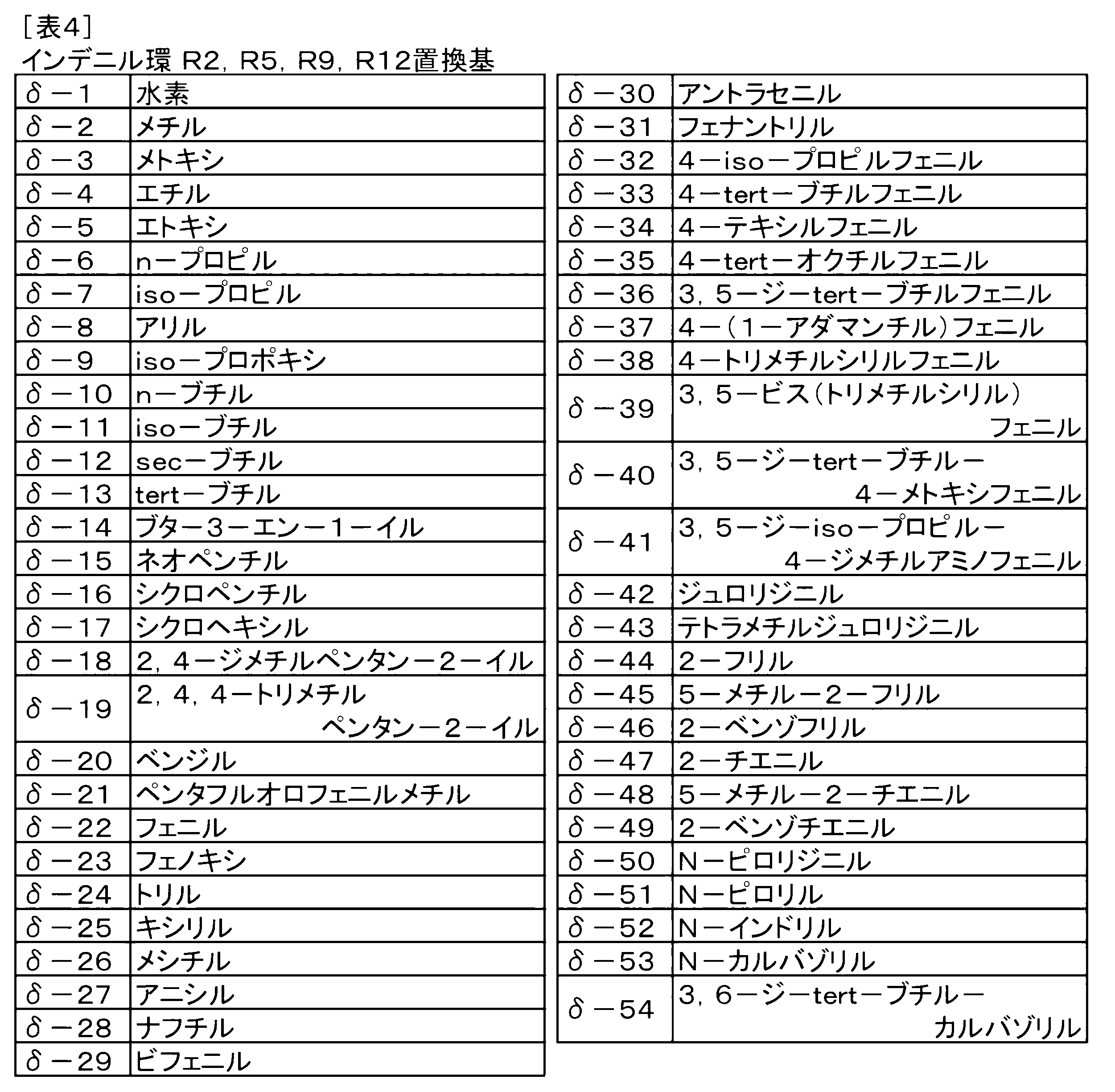
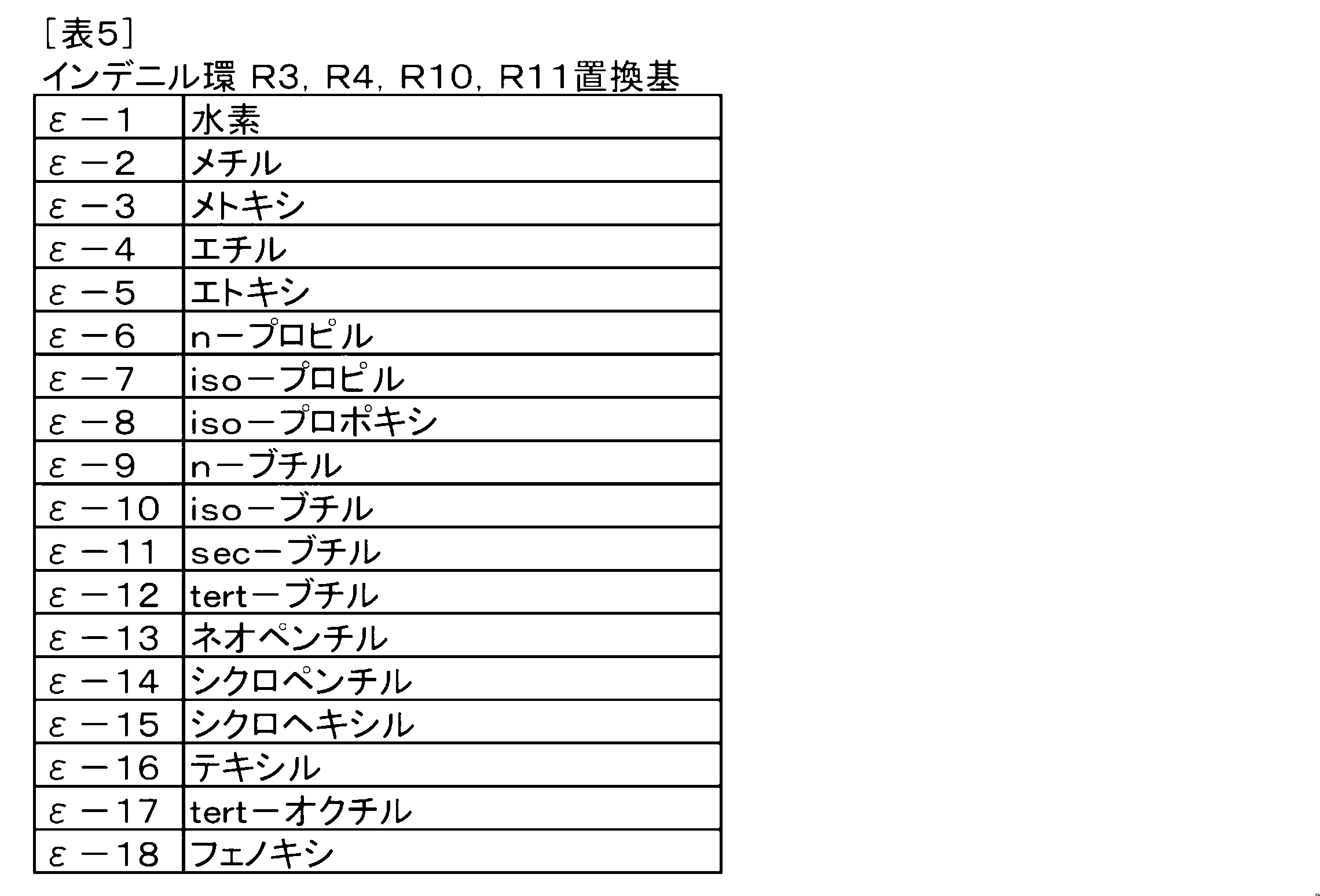
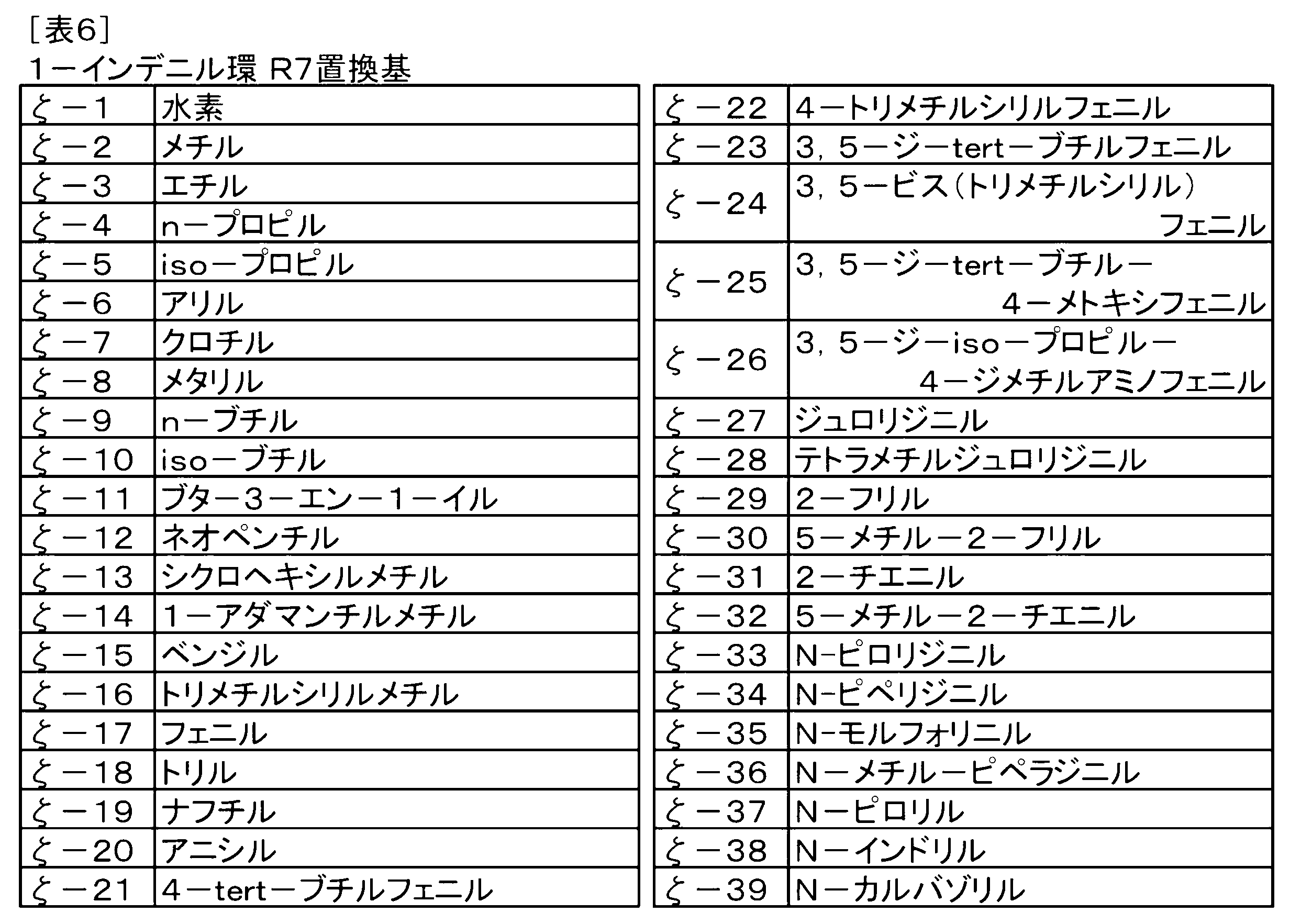
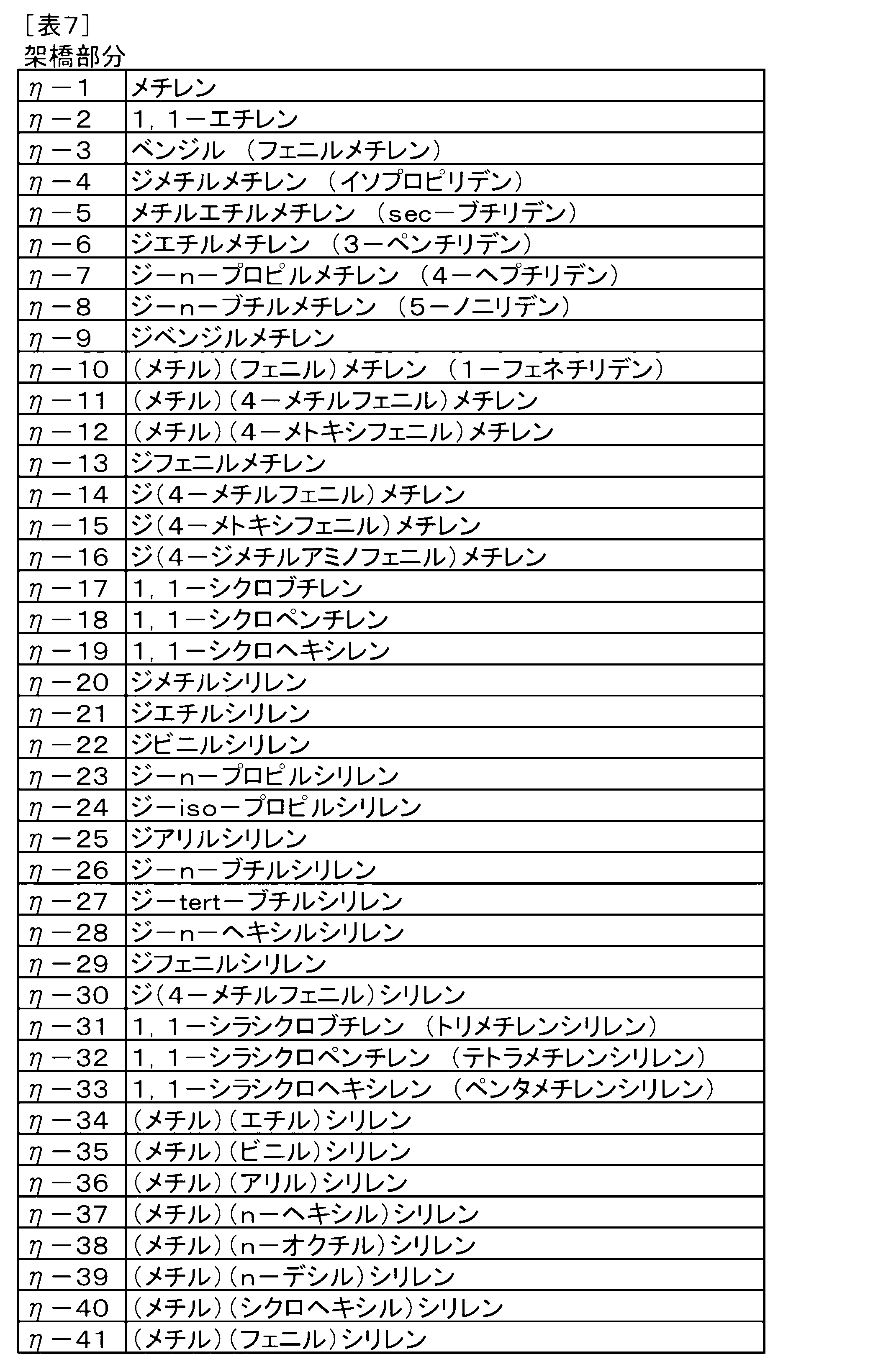
ZrF2、ZrCl2、ZrBr2、ZrI2、Zr(Me)2、Zr(Bn)2、Zr(Allyl)2、Zr(CH2-tBu)2、Zr(1,3-ブタジエニル)、Zr(1,3-ペンタジエニル)、Zr(2,4-ヘキサジエニル)、Zr(1,4-ジフェニル-1,3-ペンタジエニル)、Zr(CH2-Si(Me)3)2、Zr(ОMe)2、Zr(ОiPr)2、Zr(NMe2)2、Zr(ОMs)2、Zr(ОTs)2、Zr(ОTf)2、
HfF2、HfCl2、HfBr2、HfI2、Hf(Me)2、Hf(Bn)2、Hf(Allyl)2、Hf(CH2-tBu)2、Hf(1,3-ブタジエニル)、Hf(1,3-ペンタジエニル)、Hf(2,4-ヘキサジエニル)、Hf(1,4-ジフェニル-1,3-ペンタジエニル)、Hf(CH2-Si(Me)3)2、Hf(ОMe)2、Hf(ОiPr)2、Hf(NMe2)2、Hf(ОMs)2、Hf(ОTs)2、Hf(ОTf)2
などが挙げられる。Meはメチル基、Bnはベンジル基、tBuはtert-ブチル基、Si(Me)3はトリメチルシリル基、ОMeはメトキシ基、ОiPrはiso-プロポキシ基、NMe2はジメチルアミノ基、ОMsはメタンスルホナート基、ОTsはp-トルエンスルホナート基、ОTfはトリフルオロメタンスルホナート基である。

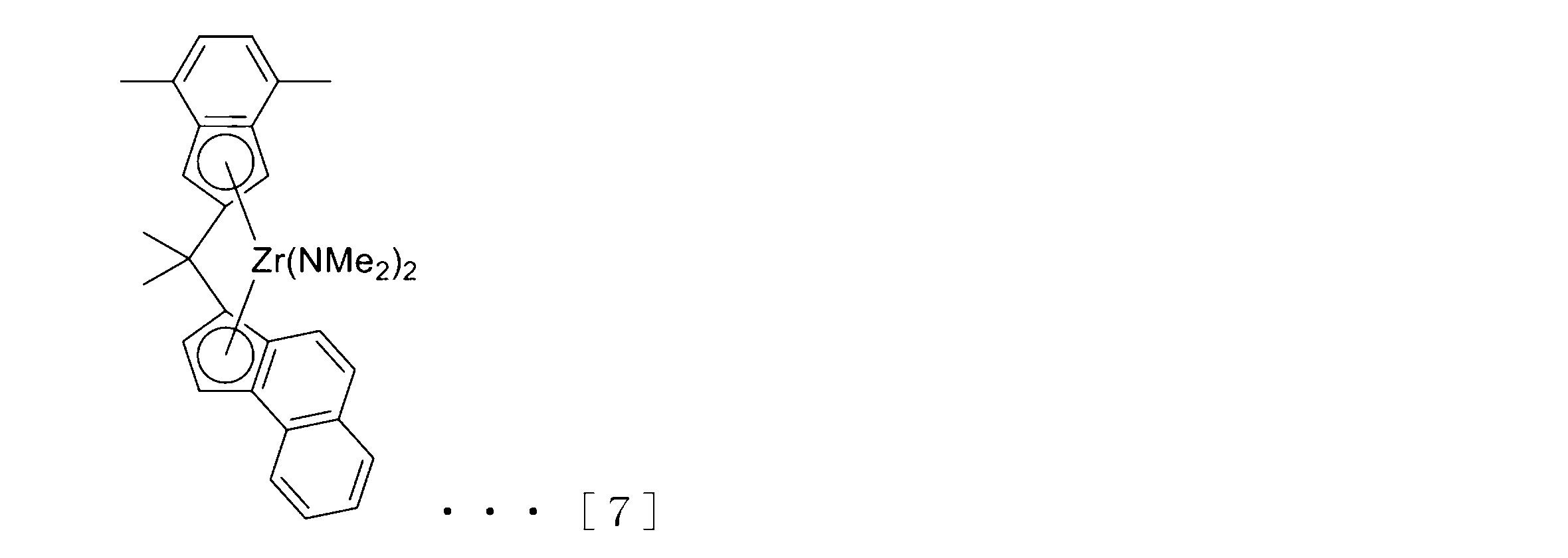

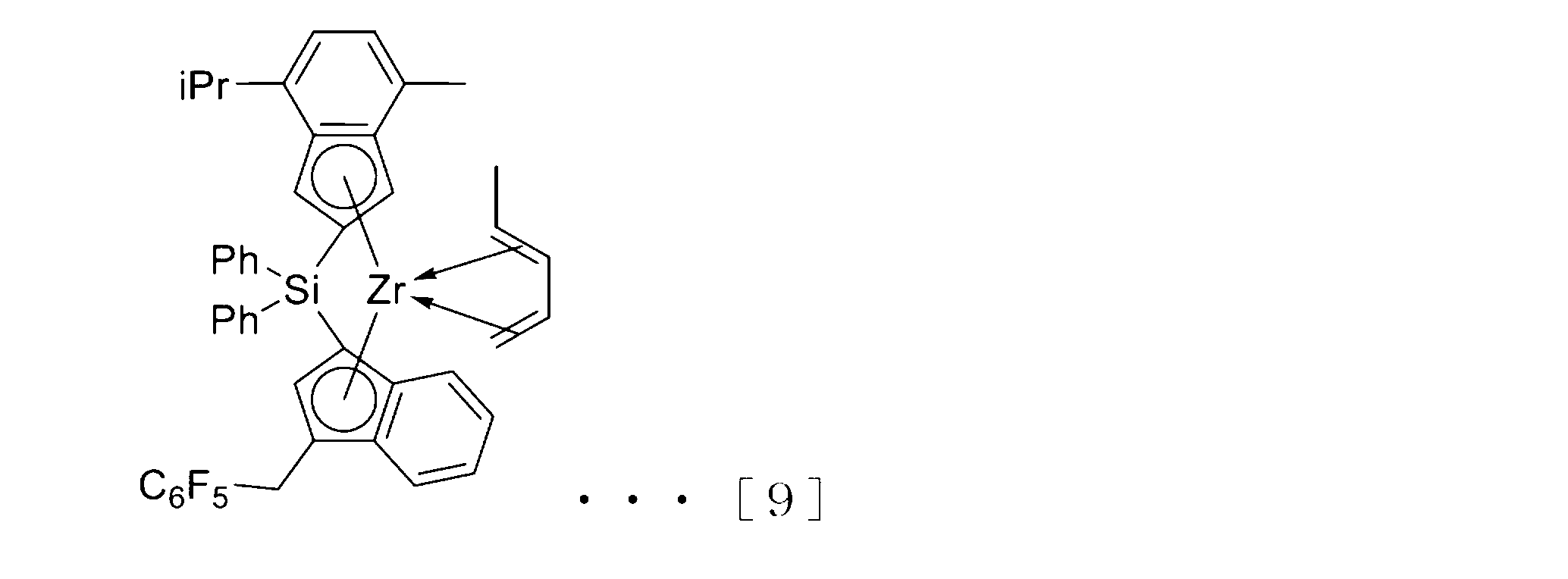
出発物質である置換インデン化合物は、公知の方法によって製造可能であり、特に製造法が限定されるわけではない。公知の製造方法として例えば、「Оrganometallics 1994,13,954.」、「Оrganometallics 2006,25,1217.」、特表2006-509059号公報、「Bioorg.Med.Chem. 2008,16,7399.」、WО2009/080216号公報、「Оrganometallics 2011,30,5744.」、特表2011-500800号公報、「Оrganometallics 2012,31,4962.」、「Chem.Eur.J. 2012,18,4174.」、特開2012-012307号公報、特開2012-121882号公報、特開2014-196319号公報、特表2014-513735号公報、特開2015-063495号公報、特表2016-501952号公報、特開2019-059933号公報などに開示された製造方法が挙げられる。
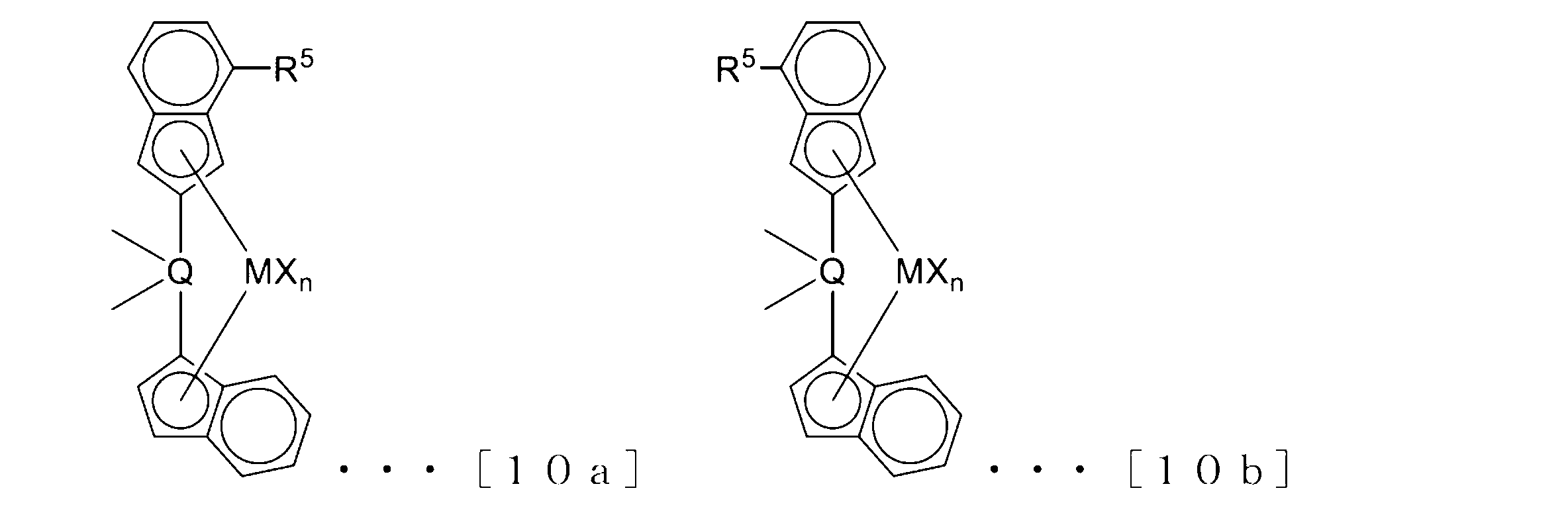
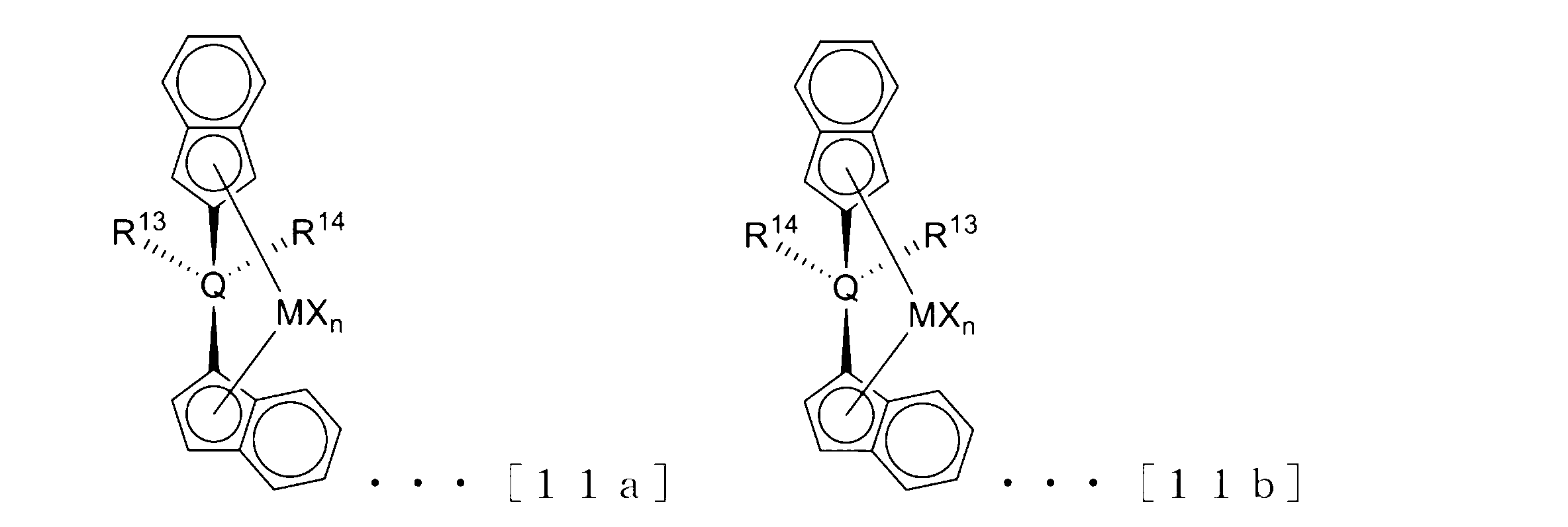
オレフィン重合用触媒(X)に含まれる固体状担体(S)は、無機化合物または有機化合物であって、顆粒状または微粒子状の固体である。
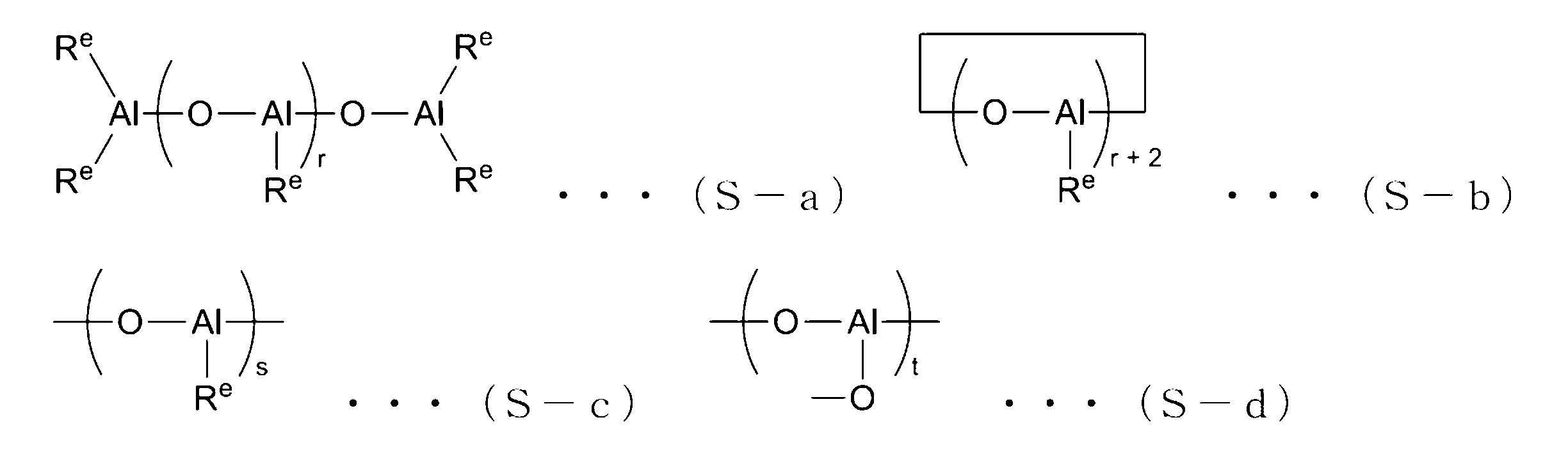
粒径d=((水平方向長さ)2+(垂直方向長さ)2)0.5
平均粒子径=Σnd4/Σnd3
前記固体状アルミノキサン化合物は、比表面積が50~1000m2/g、好ましくは100~800m2/gであり、細孔容積が0.1~2.5cm3/gであることが望ましい。
前記固体状担体(S)としては、成形時の異物防止の観点から、多孔質酸化物が好ましい。
オレフィン重合用触媒(X)は、好ましくは、さらに成分(C)を含んでよく、成分(C)は下記一般式(3)~(5)で表される有機金属化合物(c-1)、有機アルミニウムオキシ化合物(c-2)、ならびに、成分(A)と反応してイオン対を形成する化合物(c-3)からなる群より選ばれる少なくとも1種の化合物である。
式(3)中、RaおよびRbは、それぞれ独立に炭素原子数が1~15の炭化水素基を示し、Xはハロゲン原子を示し、mは0<m≦3、nは0≦n<3、pは0≦p<3、qは0≦q<3の数であり、かつm+n+p+q=3である。
式(4)中、MaはLi、NaまたはKを示し、Raは炭素原子数が1以上15以下の炭化水素基を示す。
式(5)中、RaおよびRbは、それぞれ独立に炭素原子数が1以上15以下の炭化水素基を示し、MbはMg、ZnおよびCdから選ばれ、Xはハロゲン原子を示し、rは0<r≦2、sは0≦s≦1、tは0≦t≦1であり、かつr+s+t=2である。
ジメチルアルミニウムクロリド、ジエチルアルミニウムクロリド、ジイソプロピルアルミニウムクロリド、ジイソブチルアルミニウムクロリド、ジメチルアルミニウムブロミドなどのジアルキルアルミニウムハライド;
メチルアルミニウムセスキクロリド、エチルアルミニウムセスキクロリド、イソプロピルアルミニウムセスキクロリド、ブチルアルミニウムセスキクロリド、エチルアルミニウムセスキブロミドなどのアルキルアルミニウムセスキハライド;
メチルアルミニウムジクロリド、エチルアルミニウムジクロリド、イソプロピルアルミニウムジクロリド、エチルアルミニウムジブロミドなどのアルキルアルミニウムジハライド;
ジメチルアルミニウムハイドライド、ジエチルアルミニウムハイドライド、ジヒドロフェニルアルミニウムハイドライド、ジイソプロピルアルミニウムハイドライド、ジ-n-ブチルアルミニウムハイドライド、ジイソブチルアルミニウムハイドライド、ジイソヘキシルアルミニウムハイドライド、ジフェニルアルミニウムハイドライド、ジシクロヘキシルアルミニウムハイドライド、ジ-sec-ヘプチルアルミニウムハイドライド、ジ-sec-ノニルアルミニウムハイドライドなどのアルキルアルミニウムハイドライド;
ジメチルアルミニウムエトキサイド、ジエチルアルミニウムエトキサイド、ジイソプロピルアルミニウムメトキサイド、ジイソブチルアルミニウムエトキサイドなどのジアルキルアルミニウムアルコキサイド
などが挙げられる。
オレフィン重合用触媒(X)は、成分(A)および成分(S)、ならびに任意に成分(C)を不活性炭化水素中で混合し接触させることにより、調製することができる。
(i) 成分(S)に成分(A)を接触させる方法
(ii) 成分(S)に成分(C)を接触させ、次いで成分(A)を接触させる方法
(iii) 成分(A)に成分(C)を接触させ、次いで成分(S)を接触させる方法
(iv) 成分(S)に成分(C)を接触させ、次いで成分(A)と成分(C)との混合物を接触させる方法、
(v) 成分(S)に成分(C)を接触させ、さらに成分(C)を接触させ、次いで成分(A)と成分(C)との混合物を接触させる方法
などが挙げられる。成分(C)が複数種用いられる場合は、その成分(C)同士が同一であっても異なっていてもよい。上記の方法のうち(i)、(ii)および(iii)が好ましい。
成分(C)と成分(S)との接触物と、成分(A)とを接触させる際には、接触時間は、通常1分~20時間、好ましくは1分~10時間であり、接触温度は、通常-50~200℃、好ましくは-50~100℃の範囲内である。
オレフィン重合用触媒(X)と成分(G)とを接触させるに際して、成分(G)は、オレフィン重合用触媒(X)100重量部に対して、0.1~20重量部、好ましくは0.3~10重量部、より好ましくは0.4~5重量部の量で用いられる。
本発明に係るエチレン系重合体の製造方法において、オレフィン重合用触媒(X)として、予備重合触媒(XP)を乾燥させたもの(以下「乾燥予備重合触媒」ともいう。)を用いることができる。予備重合触媒(XP)の乾燥は、通常、得られた予備重合触媒の懸濁液から濾過などにより分散媒である炭化水素を除去した後に行われる。
次に、本発明に係るエチレン系重合体の製造方法に関して記載する。上述したオレフィン重合用触媒(X)の存在下、エチレンを重合(単独重合または共重合)することによりエチレン系重合体を得る。オレフィン重合用触媒(X)を用いることで、高い重合活性を持って、成型加工性および機械的強度に優れ、数多くの長鎖分岐を有する低密度のエチレン系共重合体を効率的に製造できる。本発明のエチレン系重合体は、重合体中のエチレン含量が10モル%以上含まれるものをさす。
本発明に係るエチレン-α-オレフィン共重合体(A)を、本発明に係るエチレン-α-オレフィン共重合体(A)以外の熱可塑性樹脂(以下「他の熱可塑性樹脂(RY)」と記載する。)とブレンドすることにより、成形性に優れ、かつ機械的強度に優れた熱可塑性樹脂組成物(Y)が得られる。本発明のエチレン-α-オレフィン共重合体(A)と、他の熱可塑性樹脂(RY)とのブレンド比率(エチレン-α-オレフィン共重合体(A)の質量/他の熱可塑性樹脂(RY)の質量)は、通常、99.9/0.1~0.1/99.9である。
本発明に係る熱可塑性樹脂組成物(Y)の一態様として、前記他の熱可塑性樹脂(RY)が、以下に説明するエチレン-α-オレフィン共重合体(B)であり、前記エチレン-α-オレフィン共重合体(A)と前記エチレン-α-オレフィン共重合体(B)との割合が所定の範囲にあるエチレン系樹脂組成物(Z)が挙げられる。
前記エチレン-α-オレフィン共重合体(B)は、エチレンと炭素数4~10のα-オレフィン、好ましくはエチレンと炭素数6~10のα-オレフィンとの共重合体である。エチレンとの共重合に用いられる炭素数4~10のα-オレフィンとしては、1-ブテン、1-ヘキセン、4-メチル-1-ペンテン、1-オクテン、1-デセンなどが挙げられる。
エチレン-α-オレフィン共重合体(B)は下記(a)から(d)の特性を有している。
密度が下限以上の場合、エチレン系樹脂組成物(Z)から成形されたフィルム表面のべたつきが少なく、密度が上限以下の場合、エチレン系樹脂組成物(Z)から成形されたフィルムの衝撃強度が良好となり、ヒートシール強度、該フィルムからなる袋の破袋強度などの機械的強度が良好である。
メルトフローレート(MFR)が下限以上の場合、エチレン系樹脂組成物(Z)から成形されたフィルムのフィッシュアイが少なく外観が良好である。メルトフローレート(MFR)が上限以下の場合、エチレン系樹脂組成物(Z)の溶融張力が高く溶融膜安定性等の成形性が良好になる。
MT/η*が下限以上の場合、得られるエチレン-α-オレフィン共重合体(B)は分子量の割に溶融張力が高いため、エチレン系樹脂組成物(Z)は成形性に優れる。MT/η*が上限以下の場合、エチレン系樹脂組成物(Z)は機械的強度に優れる。MT/η*はエチレン系重合体の長鎖分岐含量に依存しており、長鎖分岐含量が多いほどMT/η*は大きく、長鎖分岐含量が少ないほどMT/η*は小さくなる。
190℃における溶融張力〔MT(g)〕と、200℃、角速度1.0rad/秒におけるせん断粘度〔η*(P)〕は上述の(3)と同様に測定する。
GPC測定により得られた分子量分布曲線におけるLog分子量が5.8以上の成分量が上限以下の場合、エチレン-α-オレフィン共重合体(B)の、高分子量の分子鎖による分子間の絡み合いがほぐれ易いことから、エチレン系樹脂組成物(Z)中の分子は緩和し易い。このため、エチレン系樹脂組成物(Z)からなるフィルムは、表面の凹凸が少なく透明性に優れる。また、下限以上の場合、エチレン系樹脂組成物(Z)は成形性に優れる。
GPC測定により得られた分子量分布曲線におけるLog分子量が5.8以上の成分量は、ゲル浸透クロマトグラフを用い、以下の条件で測定を行い、算出する。なお、後述する実施例では、以下の装置等を使用した。
測定装置:HLC-8321 GPC/HT型 (東ソー社製)
データ処理ソフト:Empower 3(Waters社製)
カラム:2x TSKgel GMH6-HT + 2x TSKgel GMH6-HTL
(いずれも7.5 mmI.D. x 30 cm, 東ソー社製)
ポリスチレン:単分散ポリスチレン(東ソー社製); #3 std set
カラム温度:140℃
移動相:o-ジクロロベンゼン (0.025 %BHT含有)
検出器:示差屈折計
流量:1.0ml/分
試料濃度:0.1%(w/v)
注入量:400μL
サンプリング時間間隔:0.5秒
カラム較正:ポリスチレン
分子量換算:PE換算/汎用較正法
得られた分子量分布曲線からLog分子量が5.8以上となる成分量(%)を算出する。
前記エチレン-α-オレフィン共重合体(B)は、エチレンと炭素数4以上10以下のα-オレフィンとを重合することによって得ることができるが、上記要件を満たすものが得られる限りにおいて、用いる重合触媒や重合条件は特に限定されない。エチレン-α-オレフィン共重合体(B)としては、例えば、直鎖低密度ポリエチレンやエチレン-α-オレフィンコポリマーや高密度ポリエチレン等の市販品を用いることができる。具体的な例としては、株式会社プライムポリマー製LLDPEエボリュー(登録商標)やウルトゼックス(登録商標)等から要件(a)~(d)を満たすものを選択することができる。
本発明に係るエチレン系樹脂組成物(Z)は、前記エチレン-α-オレフィン共重合体(A)と、前記エチレン-α-オレフィン共重合体(B)とを含み、前記エチレン-α-オレフィン共重合体(A)の質量分率(WA)と前記エチレン-α-オレフィン共重合体(B)の質量分率(WB)の合計を100質量%として、WAが5~90重量%、WBが10~95重量%である。ここで、WAは好ましくは10~80重量%、より好ましくは20~70重量%である。該範囲内において、エチレン系樹脂組成物(Z)は成形性および機械的強度に優れ、エチレン系樹脂組成物(Z)から成形されたフィルムは透明性に優れる。
また、本発明に係るエチレン系樹脂組成物(Z)は、実質的に前記エチレン-α-オレフィン共重合体(A)および前記エチレン-α-オレフィン共重合体(B)のみからなるものであっても良いが、これに限られるものではなく、前記エチレン-α-オレフィン共重合体(A)および前記エチレン-α-オレフィン共重合体(B)に加えて、前記エチレン-α-オレフィン共重合体(A)および前記エチレン-α-オレフィン共重合体(B)のいずれでもない熱可塑性樹脂(以下「他の熱可塑性樹脂(RZ)」と記載する。)を含んでいてもよい。前記エチレン-α-オレフィン共重合体(A)および前記エチレン-α-オレフィン共重合体(B)に対して「他の熱可塑性樹脂(RZ)」をブレンドすることにより熱可塑性樹脂組成物(Y)として得られるエチレン系樹脂組成物(Z)は、成形性に優れ、かつ機械的強度に優れる。
前記エチレン-α-オレフィン共重合体(A)および前記エチレン-α-オレフィン共重合体(B)の合計と、「他の熱可塑性樹脂(RZ)」のとブレンド比率(エチレン-α-オレフィン共重合体(A)およびエチレン-α-オレフィン共重合体(B)の合計の質量/他の熱可塑性樹脂(RZ)の質量)は、通常99.9/0.1~0.1/99.9、好ましくは90/10~10/90、さらに好ましくは70/30~30/70である。
前記他の熱可塑性樹脂(RZ)としては、前記他の熱可塑性樹脂(RY)として例示したものが用いられる。
本発明のエチレン系樹脂組成物(Z)は、前記「他の熱可塑性樹脂(RZ)」に加えてさらに、本発明の目的を損なわない範囲で、上述した添加剤が必要に応じて配合されていてもよい。
添加剤の総配合量は、エチレン系樹脂組成物(Z)の添加剤以外の成分の合計100質量部に対して、一般的には10質量部以下、好ましくは1質量部以下、より好ましくは0.5質量部以下である。
エチレン系樹脂組成物(Z)は、前記エチレン-α-オレフィン共重合体(A)と前記エチレン-α-オレフィン共重合体(B)とを溶融混練することによって製造することができるし、あるいはエチレン-α-オレフィン共重合体(A)を造粒したペレットとエチレン-α-オレフィン共重合体(B)のペレットとをドライブレンドすることによっても製造することができる。溶融混練により製造する場合は、連続式押出機や密閉式混練機を用いることができる。例えば、一軸押出機、二軸押出機、ミキシングロール、バンバリーミキサー、ニーダー等の装置を挙げることができる。これらのうち、経済性、処理効率等の観点から一軸押出機及びまたは二軸押出機を用いることが好ましい。
ここで、前記溶融混練及びドライブレンドを行う際、前記エチレン-α-オレフィン共重合体(A)および前記エチレン-α-オレフィン共重合体(B)に加えて、前記「他の熱可塑性樹脂」をブレンドすることができる。また、「他の熱可塑性樹脂」に加えて、あるいは、「他の熱可塑性樹脂」に代えて、前記添加剤をさらに配合してもよい。
前記「他の熱可塑性樹脂(RZ)」および前記添加剤を加える順序は、特に限定されない。例えば、前記「他の熱可塑性樹脂(RZ)」および前記添加剤を、前記エチレン-α-オレフィン共重合体(A)および前記エチレン-α-オレフィン共重合体(B)のうちの一方または両方と同時にブレンドしてもよいし、あるいは、前記エチレン-α-オレフィン共重合体(A)と前記エチレン-α-オレフィン共重合体(B)とを混練してから加えてもよい。
本発明のエチレン-α-オレフィン共重合体(A)または該エチレン-α-オレフィン共重合体(A)を含む熱可塑性樹脂組成物(Y)(たとえば、エチレン系樹脂組成物(Z))を加工することにより、優れた成形性で、機械的強度に優れた成形体、好ましくはフィルム、より好ましくは該フィルムを含んで成る積層体が得られる。
基材層として用いられる基材としては、ポリアミド、ポリエステル、ポリプロピレン、ポリエチレン、エチレン・ビニルアルコール共重合体等のフィルムが例示できる。前記フィルムは延伸フィルムであることが好ましい。また紙や紙の上にポリエチレンをコートした紙基材が挙げられる。これらの基材には必要に応じて印刷や各種コーティングが施されてもよい。また必要に応じて、コロナ処理、フレーム処理、プラズマ処理、紫外線処理、アンカーコート処理等の各種前処理がなされていてもよい。
基材、バリア基材などの積層体の一部の原料は、バイオマス由来モノマーを含むエチレン系重合体、プロピレン系重合体を含んでいてもよい。
本発明における具体的な積層体の構成は、以下に例示するが、これらに限られない。
紙/PEラミ、
延伸ポリプロピレン/接着剤/PEラミ(1)/アルミニウム箔/接着剤/フィルムまたはPEラミ(2)、
延伸ポリプロピレン/接着剤/PEラミ(1)/アルミニウム蒸着フィルム(アルミニウム蒸着層はPEラミ(1)層と隣接する)、
延伸ポリプロピレン/接着剤/PEラミ(1)/アルミニウム蒸着フィルム/接着剤/フィルムまたはPEラミ(2)(アルミニウム蒸着層はPEラミ(1)層と隣接する)、
延伸ポリプロピレン/接着剤/押出ラミ(1)/無機物蒸着フィルム、
延伸ポリプロピレン/接着剤/PEラミ(1)/無機物蒸着フィルム/接着剤/フィルムまたはPEラミ(2)、
延伸ポリエチレンテレフタレート/接着剤/押出ラミ(1)/アルミニウム箔/接着剤/フィルムまたはPEラミ(2)、
延伸ポリエチレンテレフタレート/接着剤/押出ラミ(1)/アルミニウム蒸着フィルム/接着剤/フィルムまたはPEラミ(2)(アルミニウム蒸着層はPEラミ(1)層と隣接する)、
延伸ポリエチレンテレフタレート/接着剤/PEラミ(1)/無機物蒸着フィルム、
延伸ポリエチレンテレフタレート/接着剤/PEラミ(1)/無機物蒸着フィルム/接着剤/フィルムまたはPEラミ(2)、
PEラミ(1)/紙/PEラミ(2)/アルミニウム箔/共押出ラミ(酸コポリマー/PEラミ(3))、
PEラミ(1)/紙/PEラミ(2)/アルミニウム箔/接着剤/ポリエチレンテレフタレート/接着剤/フィルムまたはPEラミ(3)、
PEラミ(1)/紙/PEラミ(2)/アルミニウム蒸着フィルム/接着剤/フィルムまたはPEラミ(3)、
PEラミ(1)/紙/PEラミ(2)/無機物蒸着フィルム/接着剤/フィルムまたはPEラミ(3)
以下の実施例等において、エチレン-α-オレフィン共重合体等の各種物性は、[発明を実施するための形態]に記載の方法で測定し、[発明を実施するための形態]に記載のない評価方法としては以下の方法を採用した。
[ネックイン]
エチレン-α-オレフィン共重合体(以下「エチレン系重合体」とも記載する。)を、65mmφの押出機とダイ幅500mmのTダイを有する住友重機社製ラミネーターを用いて、基材である50g/m2のクラフト紙上に下記条件にて押出ラミネートした。
・エアギャップ:130mm
・ダイ下樹脂温度:320℃
・引取速度:80m/分
・膜厚:20μm
Tダイの幅をL0、各引取速度にてクラフト紙上にラミネートされたフィルムの幅をLとしたとき、L0-Lによりネックインを算出した。
エチレン系重合体を、65mmφの押出機とダイ幅500mmのTダイを有する住友重機社製ラミネーターを用いて、基材である50g/m2のクラフト紙上に、エアギャップ130mm、ダイ下樹脂温度320℃の条件にて押出ラミネートした。押出量は引取速度80m/分の時の膜厚が20μmになるように設定した。引取速度を上昇させていき、溶融膜が切れたときの引取速度を膜切れ速度とした。また、引取速度を上昇させていき、引取速度200m/分におけるネックインを5回測定し、そのネックインの平均値に対して±1.5mm以上になる値が2回以上測定された場合を引取サージング発生とした。
エチレン系重合体を、65mmφの押出機とダイ幅500mmのTダイを有する住友重機社製ラミネーターを用いて、基材とアルミニウム蒸着フィルムの間にダイ下樹脂温度320℃、引取速度150m/分の条件下で、膜厚15μmになるように押出ラミネートした。基材は、厚さ12μmの延伸ポリエチレンテレフタレートフィルム(商品名:エンブレット(登録商標)、ユニチカ株式会社製)の片面(エチレン系重合体層側)に2液硬化ウレタン系アンカーコート剤を塗布して使用した。アルミニウム蒸着フィルムは、厚さ12μmの商品名ML PET(三井化学東セロ株式会社製)を使用した。押出ラミネートしたエチレン系重合体は、アルミニウム表面と接触している状態となる。得られた押出ラミネートフィルムを15mm幅の短冊に切り、得られたエチレン系重合体層とアルミニウム蒸着フィルム層との接着強度を、剥離速度300mm/分でT字剥離を行って求めた。求められた剥離強度とエチレン系重合体の代わりに高圧法LDPE(旭化成株式会社製の高圧法低密度ポリエチレン、サンテック(登録商標)-LD「L1850A」)を使用して同様に求めた剥離強度(LDPE)との比をAL接着強度比とした。
AL接着強度比=剥離強度/剥離強度(LDPE)
エチレン系重合体を、65mmφの押出機とダイ幅500mmのTダイを有する住友重機社製ラミネーターを用いて、基材である50g/m2のクラフト紙上に、エアギャップ130mm、ダイ下樹脂温度320℃、引取速度80m/分の条件下で膜厚20μmになるよう押出ラミネートした。JIS K7128-1に準拠し、得られた積層体を幅50mm長さ150mmに切り出し、幅中央に75mmの切り込みを入れ、速度200mm/分で引き裂き強度を測定した。
エチレン系重合体から、40mmφの押出機とダイ幅500mmのTダイを有する田辺プラスチックス機械社製のキャストフィルム成形機を用いて、ダイ温度40℃、チルロール温度40℃、厚さ40μmのフィルムを作製した。製膜する際に、アンチブロッキング剤マスターバッチ(アンチブロッキング剤濃度20重量%、株式会社プライムポリマー社製EAZ-20)を2重量%、スリップ剤マスターバッチ(スリップ剤濃度4重量%、株式会社プライムポリマー社製ESQ-4)を1重量%、ドライブレンドでエチレン系重合体に配合した。得られたフィルムを下記のように測定した。
エチレン系重合体から、50mmφの押出機とダイ径100mmの住友重機械モダン株式会社製のインフレーション成形機を用いて、ダイス温度190℃、押出量29kg/hr、チューブ幅320mmの条件下で厚さ40μmのフィルムを得た。得られたフィルムについて以下の項目を測定した。
JIS 7136に準拠して、得られたフィルムの全ヘイズを測定した。
シクロヘキサノールを充填したセルに得られたフィルムを入れ、JIS 7136に準拠して測定した。
JIS Z8741に準拠し、入射角度20°で得られたフィルムのグロスを測定した。
JIS K6781に準拠し、試験速度500mm/分で、得られたフィルムのMD方向及びTD方向について測定した。
JIS K6781に準拠し、試験速度200mm/分で、得られたフィルムのMD方向及びTD方向について測定した。
ASTM D1709 A法に準拠し、得られたフィルムをエアークランプ方式で締め付け、半球径のダートを一定の高さから落下させ、フィルムが50%破壊する荷重をグラフから読み取った。
インフレーション成形にて得られたフィルムを東洋精機製作所社製キャピラリーレオメーター:キャピログラフ1Dを用いて測定した。条件は樹脂温度190℃、溶融時間6分、バレル径9.55mmφ、押し出し速度15mm/分、巻取り速度24m/分(溶融フィラメントが切れてしまう場合には、巻取り速度を5m/分ずつ低下させる)、ノズル径2.095mmφ、ノズル長さ8mmとする。
インフレーション成形時の溶融膜(バブル)安定性を目視にて確認した。表13中の記号(評価結果)の意味は以下のとおりである。
〇:溶融膜(バブル)が安定している
×:溶融膜(バブル)の安定性が悪くゆれが激しい
実施例等で使用した遷移金属化合物、および成分(G)は以下の通りである。
遷移金属化合物(A-1):ジメチルシリレン(2-インデニル)(4-(3,5-ジ-tert-ブチル-4-メトキシフェニル)-7-メトキシ-1-インデニル)ジルコニウムジクロリド[特開2019-059933号公報記載の方法によって合成した。]
遷移金属化合物(B-1):ジメチルシリレン(3-n-プロピルシクロペンタジエニル)(シクロペンタジエニル)ジルコニウムジクロリド[特許第5455354号公報記載の方法に基づいて合成した。]
遷移金属化合物(B-2):イソプロピリデン(シクロペンタジエニル)(2,7-ジ-tert-ブチルフルオレニル)ジルコニウムジクロリド[特開平4-69394号公報に記載の方法に基づいて合成した。]
成分(G-1):ラウリルジエタノールアミン(花王株式会社製)
成分(G-2):エマルゲン(登録商標)108(花王株式会社製)
内容積270Lの攪拌機付き反応器に、窒素雰囲気下、固体状担体(S)として、富士シリシア株式会社製シリカ(平均粒径70μm、比表面積340m2/g、細孔容積1.3cm3/g、250℃焼成)10kgを77Lのトルエンに懸濁させた後0~5℃に冷却した。この懸濁液に成分(C)として、メチルアルミノキサンのトルエン溶液(Al原子換算で3.5mol/L)20.4Lを30分間かけて滴下した。この際、系内の温度を0~5℃に保った。引き続き0~5℃で30分間反応させた後、約1.5時間かけて95~100℃まで昇温して、引き続き95~100℃で4時間反応させた。その後常温まで降温して、上澄み液をデカンテーションにより除去し、さらにトルエンで2回洗浄した後、全量58.0Lのトルエンスラリーを調製した。得られたスラリー成分の一部を採取し濃度を調べたところ、スラリー濃度:248.0g/L、Al濃度:1.21mol/Lであった。
内容積270Lの攪拌機付き反応器に、窒素雰囲気下、固体状担体(S)として、富士シリシア株式会社製シリカ(平均粒径70μm、比表面積340m2/g、細孔容積1.3cm3/g、250℃焼成)10kgを77Lのトルエンに懸濁させた後0~5℃に冷却した。この懸濁液に成分(C)として、メチルアルミノキサンのトルエン溶液(Al原子換算で3.5mol/L)20.4Lを30分間かけて滴下した。この際、系内の温度を0~5℃に保った。引き続き0~5℃で30分間反応させた後、約1.5時間かけて95~100℃まで昇温して、引き続き95~100℃で4時間反応させた。その後常温まで降温して、上澄み液をデカンテーションにより除去し、さらにトルエンで2回洗浄した後、全量58.0Lのトルエンスラリーを調製した。得られたスラリー成分の一部を採取し濃度を調べたところ、スラリー濃度:248.0g/L、Al濃度:1.21mol/Lであった。
[実施例1]
流動層型気相重合反応器を用いた気相重合プロセスによりエチレン系重合体の製造を行った。反応器に予め平均粒径900μmの球状のエチレン重合体粒子24kgを導入し、窒素を供給して、流動床を形成させた後、表8に示す重合条件にて定常状態になるようにエチレン、水素、1-ヘキセン、予備重合触媒、エレクトロストリッパー(登録商標)EA(花王株式会社製)を連続的に供給した。重合反応物は反応器より連続的に抜き出し、乾燥装置にて乾燥し、エチレン-α-オレフィン共重合体(A-1)のパウダーを得た。
重合条件を表8に記載のとおり変更したこと以外は実施例1と同様にして、エチレン-α-オレフィン共重合体(A-3、4、8~12)のパウダーを得ると共に各種測定および評価を行った。結果を表9、11、12に示す。なお、表8には、実施例1では使用しなかった成分としてケミスタット(登録商標)2500(三洋化成工業株式会社製)が記載されている。
実施例1で使用した流動層型気相重合反応器を前段反応器とし、加えて内容積0.6m3の流動層型気相重合反応器を後段反応器とした2段重合プロセスにおいて、エチレン系重合体の製造を行った。2段重合とは前段重合反応器で得られた重合反応物を連続的に後段重合反応器に抜出、後段重合反応器においても前段に継続して重合反応を行うことを意味する。前段重合反応器に、予め平均粒径900μmの球状のエチレン重合体粒子24kgを導入した。これに窒素を供給して、流動床を形成した。前段重合反応器、後段重合反応器共に表8に示す重合条件にて定常状態になるようにエチレン、水素、1-ヘキセン、予備重合触媒、エレクトロストリッパーEAを連続的に供給した。但し、予備重合触媒、エレクトロストリッパーEAは前段重合反応器にのみ供給した。後段重合反応器にて得られた2段重合による重合反応物は後段重合反応器より連続的に抜き出し、乾燥装置にて乾燥し、エチレン-α-オレフィン共重合体(A-2)のパウダーを得た。
重合条件を表8に記載のとおり変更したこと以外は実施例2と同様にして、エチレン-α-オレフィン共重合体(A-5~7)のパウダーを得ると共に各種測定および評価を行った。結果を表9、11、12に示す。
重合条件を表8に記載のとおり変更したこと以外は実施例1と同様にして、エチレン-α-オレフィン共重合体(a-1)のパウダーを得るとともに各種測定および評価を行った。結果を表9、11、12に示す。なお、表8には、実施例1では使用しなかった成分としてケミスタット(登録商標)2500(三洋化成工業株式会社製)が記載されている。
旭化成株式会社製の高圧法低密度ポリエチレンであるサンテック-LD「L1850A」(密度:918kg/m3、MFR:6.5g/10分)に対して、実施例1と同様にして、押出ラミネート評価、キャスト成形評価を行った。結果を表11、12に示す。
特許第5943941号に記載の製造例1のエチレン系重合体(α-1)と同様にして、エチレン-α-オレフィン共重合体(a-3)のパウダーを得た。各種測定結果を表9に示す。
重合条件を表8に記載のとおり変更したこと以外は製造例1と同様にして、エチレン-α-オレフィン共重合体(A-13、14)のパウダーを得るとともにペレットの各種測定を行った。結果を表9に示す。
[エチレン-α-オレフィン共重合体(B-1)]
株式会社プライムポリマー製のエボリューGD1588について、物性測定を行った。
測定結果を表10に示す。
[エチレン-α-オレフィン共重合体(b-2)]
株式会社プライムポリマー製のネオゼックス2006Hについて、物性測定を行った。
測定結果を表10に示す。
[エチレン-α-オレフィン共重合体(B-3)]
株式会社プライムポリマー製のエボリューSP1510について、物性測定を行った。
測定結果を表10に示す。
[実施例15]
得られたエチレン-α-オレフィン共重合体(A-13)のペレットを5重量%とエチレン-α-オレフィン共重合体(B-1)のペレット95重量%をドライブレンドし、インフレーション成形評価を行った。評価結果を表13に示す。
得られたエチレン-α-オレフィン共重合体(A-13)のペレットを10重量%とエチレン-α-オレフィン共重合体(B-1)のペレット90重量%をドライブレンドし、インフレーション成形評価を行った。評価結果を表13に示す。
得られたエチレン-α-オレフィン共重合体(A-13)のペレットを15重量%とエチレン-α-オレフィン共重合体(B-1)のペレット85重量%をドライブレンドし、インフレーション成形評価を行った。評価結果を表13に示す。
得られたエチレン-α-オレフィン共重合体(A-14)のペレットを60重量%とエチレン-α-オレフィン共重合体(B-3)のペレット40重量%をドライブレンドし、インフレーション成形評価を行った。評価結果を表13に示す。
得られたエチレン-α-オレフィン共重合体(A-14)のペレットを80重量%とエチレン-α-オレフィン共重合体(B-3)のペレット20重量%をドライブレンドし、インフレーション成形評価を行った。評価結果を表13に示す。
得られたエチレン-α-オレフィン共重合体(A-6)のペレットを20重量%とエチレン-α-オレフィン共重合体(B-1)のペレット80重量%をドライブレンドし、インフレーション成形評価を行った。評価結果を表13に示す。
得られたエチレン-α-オレフィン共重合体(A-6)のペレットを30重量%とエチレン-α-オレフィン共重合体(B-1)のペレット70重量%をドライブレンドし、インフレーション成形評価を行った。評価結果を表13に示す。
得られたエチレン-α-オレフィン共重合体(a-3)のペレットを80重量%とエチレン-α-オレフィン共重合体(B-3)のペレット20重量%をドライブレンドし、インフレーション成形評価を行った。評価結果を表13に示す。
エチレン-α-オレフィン共重合体(B-1)を用い、インフレーション成形評価を行った。評価結果を表13に示す。
得られたエチレン-α-オレフィン共重合体(A-13)のペレットを15重量%とエチレン-α-オレフィン共重合体(b-2)のペレット85重量%をドライブレンドし、インフレーション成形評価を行った。評価結果を表13に示す。

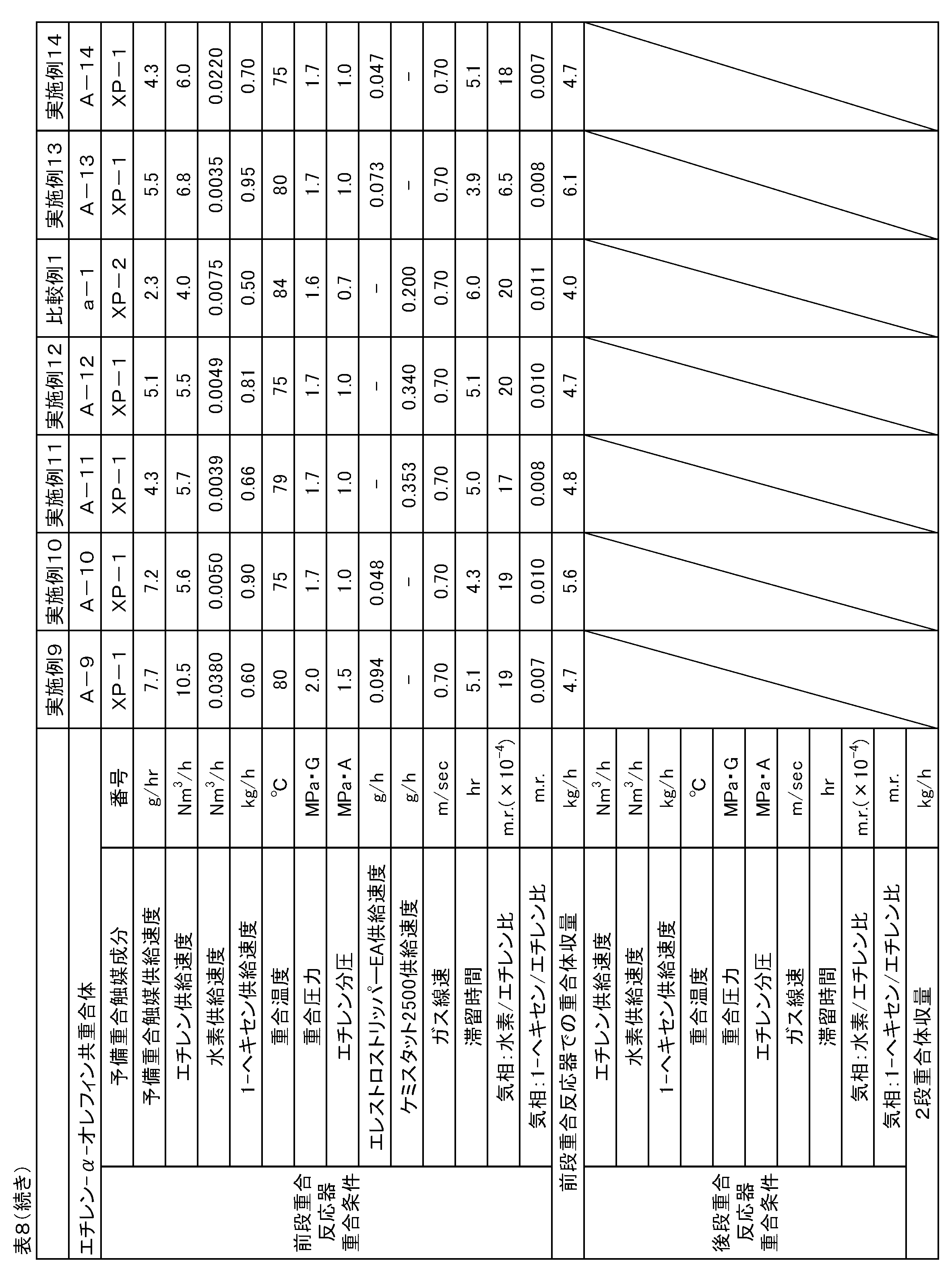

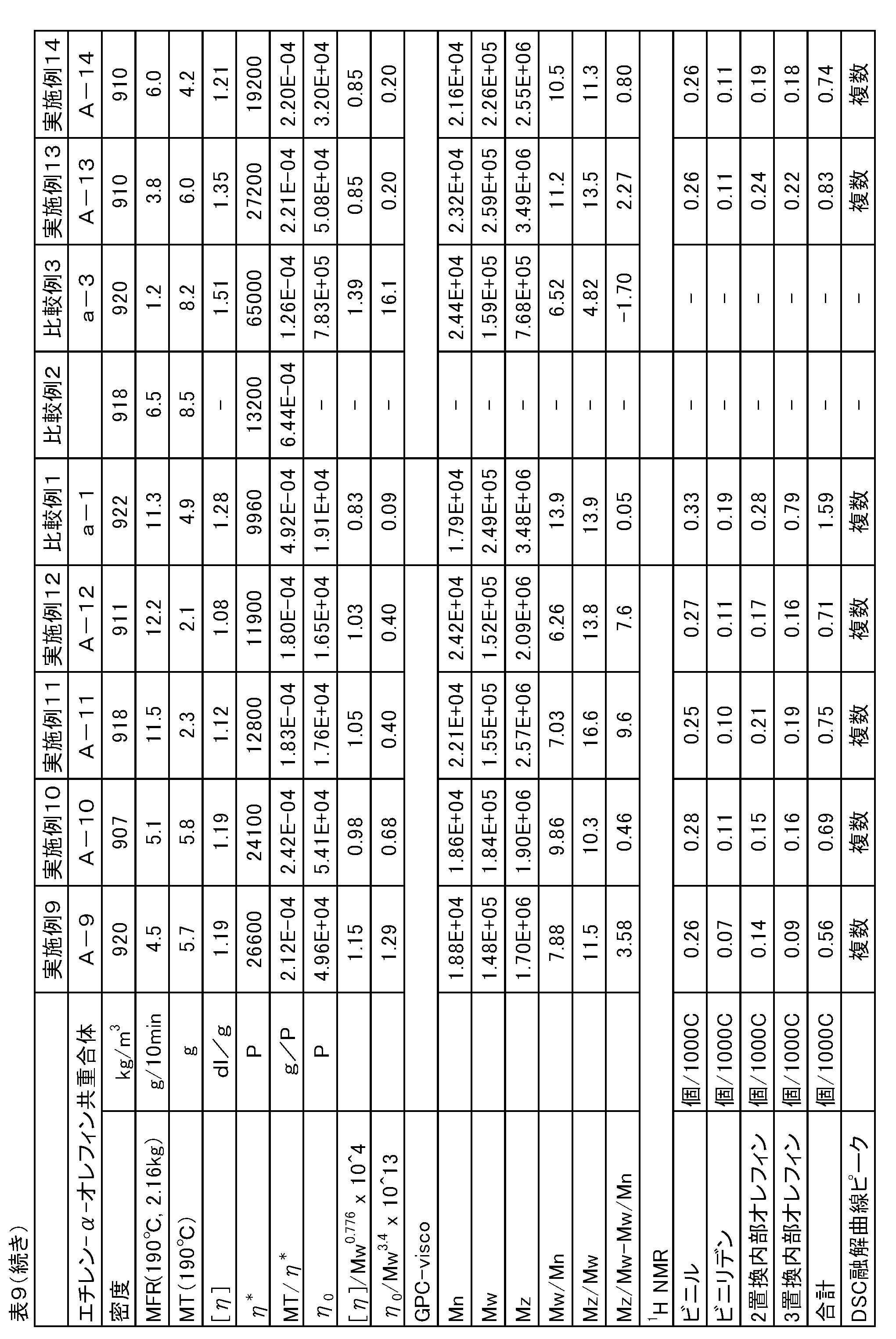
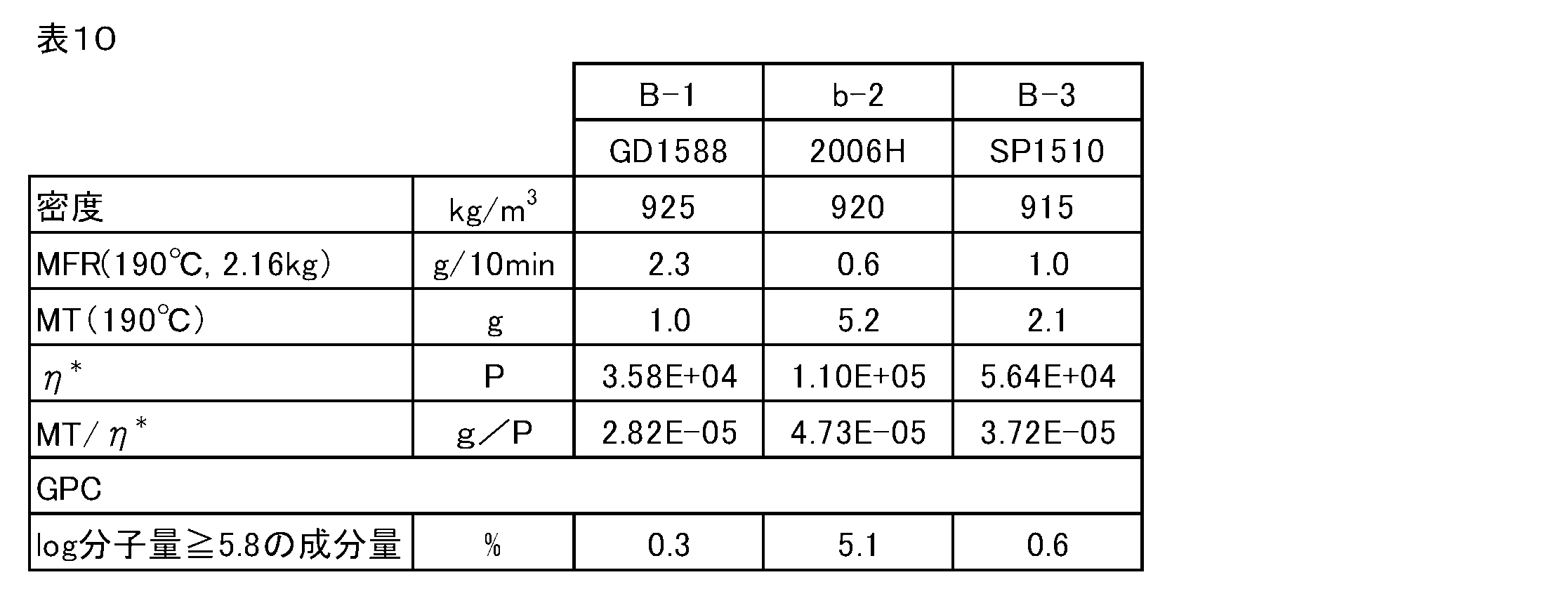


Claims (16)
- エチレンと炭素数4~10のα-オレフィンとの共重合体であって、下記要件(1)~(7)を満たすエチレン-α-オレフィン共重合体(A)。
(1)密度が890kg/m3以上925kg/m3以下の範囲にある。
(2)190℃における2.16kg荷重でのメルトフローレート(MFR)が3.0g/10分以上15.0g/10分以下の範囲にある。
(3)190℃における溶融張力〔MT(g)〕と、200℃、角速度1.0rad/秒におけるせん断粘度〔η*(P)〕との比〔MT/η*(g/P)〕が1.40×10-4以上2.90×10-4以下の範囲にある。
(4)200℃におけるゼロせん断粘度〔η0(P)〕とGPC-粘度検出器法(GPC-VISCO)により測定された重量平均分子量(Mw)が、下記関係式(Eq-1)を満たす。
0.01×10⁻¹³×Mw3.4 ≦ η0 ≦ 4.5×10⁻¹³×Mw3.4 ・・・(Eq-1)
(5)GPC-粘度検出器法(GPC-VISCO)により測定された数平均分子量(Mn)、重量平均分子量(Mw)及びZ平均分子量(Mz)が、下記関係式(Eq-2)を満たす。
-2.0 ≦ Mz/Mw - Mw/Mn ≦ 15 ・・・(Eq-2)
(6)1H-NMRにより測定された炭素原子1000個当たりのビニル、ビニリデン、2置換内部オレフィン、3置換内部オレフィンの合計(個/1000C)が0.1以上1.0以下の範囲にある。
(7)示差走査熱量測定(DSC)により得られた融解曲線に複数個のピークが存在する。 - さらに下記の要件(8)を満たす請求項1に記載のエチレン-α-オレフィン共重合体(A)。
(8)GPC-粘度検出器法(GPC-VISCO)により測定されたZ平均分子量(Mz)と重量平均分子量(Mw)の比Mz/Mwが4.0以上25.0以下の範囲にある。 - さらに下記の要件(9)を満たす請求項1または2に記載のエチレン-α-オレフィン共重合体(A)。
(9)135℃デカリン中で測定した極限粘度〔[η](dl/g)〕とGPC-粘度検出器法(GPC-VISCO)により測定された重量平均分子量(Mw)とが下記関係式(Eq-4)を満たす。
0.8×10⁻⁴×Mw0.776 ≦[η]≦ 1.65×10⁻⁴×Mw0.776 ・・・(Eq-4) - 請求項1~3のいずれか一項に記載のエチレン-α-オレフィン共重合体(A)および熱可塑性樹脂(ただし、前記エチレン-α-オレフィン共重合体(A)を除く。)を含む熱可塑性樹脂組成物(Y)。
- 前記熱可塑性樹脂が、下記要件(a)~(d)を満たすエチレン-α-オレフィン共重合体(B)であり、
前記エチレン-α-オレフィン共重合体(A)の質量分率(WA)が5質量%以上90質量%以下であり、前記エチレン-α-オレフィン共重合体(B)の質量分率(WB)が10質量%以上95質量%以下である(ただし、WAとWBとの合計を100質量%とする。)エチレン系樹脂組成物(Z)である、請求項4に記載の熱可塑性樹脂組成物(Y)。
(a)密度が890kg/m3以上930kg/m3以下の範囲にある。
(b)190℃における2.16kg荷重でのメルトフローレート(MFR)が0.1g/10分以上20g/10分以下の範囲にある。
(c)190℃における溶融張力〔MT(g)〕と、200℃、角速度1.0rad/秒におけるせん断粘度〔η*(P)〕との比〔MT/η*(g/P)〕が1.0×10-6以上1.0×10-4以下の範囲にある。
(d)GPC測定により得られた分子量分布曲線におけるLog分子量が5.8以上の成分量(%)が、0.01%以上5.0%以下の範囲にある。 - 請求項1~3のいずれか一項に記載のエチレン-α-オレフィン共重合体(A)あるいは請求項4または5に記載の熱可塑性樹脂組成物(Y)を含むフィルム。
- 請求項1~3のいずれか一項に記載のエチレン-α-オレフィン共重合体(A)を含む、請求項6に記載のフィルム。
- 請求項4に記載の熱可塑性樹脂組成物(Y)を含む、請求項6に記載のフィルム。
- 請求項5に記載の熱可塑性樹脂組成物(Y)を含む、請求項6に記載のフィルム。
- 請求項1~3のいずれか一項に記載のエチレン-α-オレフィン共重合体(A)あるいは請求項4または5に記載の熱可塑性樹脂組成物(Y)を含む層を有する積層体。
- さらに基材層を有する請求項10に記載の積層体。
- さらにバリア層を有する請求項11に記載の積層体。
- 請求項1~3のいずれか一項に記載のエチレン-α-オレフィン共重合体(A)を含む層を有する、請求項10~12のいずれか一項に記載の積層体。
- 請求項4に記載の熱可塑性樹脂組成物(Y)を含む層を有する、請求項10~12のいずれか一項に記載の積層体。
- 請求項5に記載の熱可塑性樹脂組成物(Y)を含む層を有する、請求項10~12のいずれか一項に記載の積層体。
- 請求項1~3のいずれか一項に記載のエチレン-α-オレフィン共重合体(A)あるいは請求項4または5に記載の熱可塑性樹脂組成物(Y)を、基材層とバリア層との間に押出ラミネートする、積層体の製造方法。
Priority Applications (4)
| Application Number | Priority Date | Filing Date | Title |
|---|---|---|---|
| EP22781054.6A EP4316833A4 (en) | 2021-03-31 | 2022-03-30 | ETHYLENE-α-OLEFIN COPOLYMER, THERMOPLASTIC RESIN COMPOSITION, FILM AND LAMINATE |
| US18/283,745 US20240191067A1 (en) | 2021-03-31 | 2022-03-30 | ETHYLENE-alpha-OLEFIN COPOLYMER, THERMOPLASTIC RESIN COMPOSITION, FILM, AND LAMINATE |
| JP2023511465A JP7681097B2 (ja) | 2021-03-31 | 2022-03-30 | エチレン-α-オレフィン共重合体、熱可塑性樹脂組成物、フィルムおよび積層体 |
| CN202280025166.1A CN117120489B (zh) | 2021-03-31 | 2022-03-30 | 乙烯-α-烯烃共聚物、热塑性树脂组合物、膜和叠层体 |
Applications Claiming Priority (4)
| Application Number | Priority Date | Filing Date | Title |
|---|---|---|---|
| JP2021-062157 | 2021-03-31 | ||
| JP2021062157 | 2021-03-31 | ||
| JP2022-033929 | 2022-03-04 | ||
| JP2022033929 | 2022-03-04 |
Publications (1)
| Publication Number | Publication Date |
|---|---|
| WO2022210843A1 true WO2022210843A1 (ja) | 2022-10-06 |
Family
ID=83456418
Family Applications (1)
| Application Number | Title | Priority Date | Filing Date |
|---|---|---|---|
| PCT/JP2022/015846 Ceased WO2022210843A1 (ja) | 2021-03-31 | 2022-03-30 | エチレン-α-オレフィン共重合体、熱可塑性樹脂組成物、フィルムおよび積層体 |
Country Status (5)
| Country | Link |
|---|---|
| US (1) | US20240191067A1 (ja) |
| EP (1) | EP4316833A4 (ja) |
| JP (1) | JP7681097B2 (ja) |
| CN (1) | CN117120489B (ja) |
| WO (1) | WO2022210843A1 (ja) |
Cited By (3)
| Publication number | Priority date | Publication date | Assignee | Title |
|---|---|---|---|---|
| JP2023129127A (ja) * | 2022-03-04 | 2023-09-14 | 三井化学株式会社 | エチレン系樹脂組成物および成形体 |
| WO2025005968A1 (en) * | 2023-06-27 | 2025-01-02 | Dow Global Technologies Llc | Multi stage process for producing ethylene-based polymer with (ultra) high molecular weight polyethylene component |
| EP4458887A4 (en) * | 2021-12-28 | 2025-12-17 | Prime Polymer Co Ltd | Ethylene olefin copolymer film |
Citations (46)
| Publication number | Priority date | Publication date | Assignee | Title |
|---|---|---|---|---|
| JPS6337149A (ja) * | 1985-08-02 | 1988-02-17 | エクソン・ケミカル・パテンツ・インク | 加工性の良いエチレンプロピレンエラストマ− |
| JPH01501950A (ja) | 1987-01-30 | 1989-07-06 | エクソン・ケミカル・パテンツ・インク | 触媒、これらの触媒の製法およびこれらの触媒を使用する重合プロセス |
| JPH02276807A (ja) | 1989-01-24 | 1990-11-13 | Mitsui Petrochem Ind Ltd | エチレン系共重合体およびその製造方法 |
| JPH03179005A (ja) | 1989-10-10 | 1991-08-05 | Fina Technol Inc | メタロセン触媒 |
| JPH03179006A (ja) | 1989-10-10 | 1991-08-05 | Fina Technol Inc | シンジオタクチツク重合体の製造方法および製造用触媒 |
| JPH03207703A (ja) | 1989-10-30 | 1991-09-11 | Fina Technol Inc | オレフイン重合触媒の製造法 |
| JPH03207704A (ja) | 1989-10-30 | 1991-09-11 | Fina Technol Inc | オレフイン重合触媒 |
| JPH0469394A (ja) | 1990-07-09 | 1992-03-04 | Mitsui Toatsu Chem Inc | 新規遷移金属化合物及びこれを用いたシンジオタクチックポリ―α―オレフィンの製造方法 |
| JPH04213309A (ja) | 1990-05-14 | 1992-08-04 | Mitsui Petrochem Ind Ltd | エチレン系共重合体 |
| WO1993008221A2 (en) | 1991-10-15 | 1993-04-29 | The Dow Chemical Company | Elastic substantially linear olefin polymers |
| US5321106A (en) | 1990-07-03 | 1994-06-14 | The Dow Chemical Company | Addition polymerization catalyst with oxidative activation |
| JPH06220128A (ja) | 1993-01-26 | 1994-08-09 | Mitsui Petrochem Ind Ltd | ポリオレフィンの製造方法 |
| JPH06220126A (ja) | 1993-01-26 | 1994-08-09 | Mitsui Petrochem Ind Ltd | ポリオレフィンの製造方法 |
| JPH0726079A (ja) | 1992-12-03 | 1995-01-27 | Mitsubishi Chem Corp | ラミネート用樹脂組成物 |
| JPH0742301B2 (ja) | 1987-02-14 | 1995-05-10 | 三井石油化学工業株式会社 | 微粒子状アルミノオキサン、その製法およびその用途 |
| JPH08311260A (ja) | 1995-05-16 | 1996-11-26 | Union Carbide Chem & Plast Technol Corp | 高められた加工性を有するエチレンポリマー |
| JPH10502036A (ja) | 1994-06-23 | 1998-02-24 | ウプム−キメネ オサケ ユキチュア | 単位積荷パッケージを充填する方法と、充填する方法に使用する単位積荷パッケージの充填部と、単位積荷パッケージ用の輸送用パッケージ |
| JPH10109996A (ja) | 1996-10-04 | 1998-04-28 | Kanto Chem Co Inc | メタロセン化合物の新規な合成方法 |
| JPH10506952A (ja) * | 1994-10-11 | 1998-07-07 | ボレアリス エイ/エス | 広い分子量分散を有する新規なポリプロピレン組成物 |
| JPH11140113A (ja) | 1997-09-03 | 1999-05-25 | Mitsui Chem Inc | 固体状オレフィン重合用触媒成分およびオレフィンの重合方法 |
| JPH11222505A (ja) * | 1998-02-05 | 1999-08-17 | Tosoh Akzo Kk | 共重合体の製造方法 |
| JPH11310607A (ja) | 1998-04-28 | 1999-11-09 | Mitsui Chem Inc | オレフィン重合用触媒成分およびオレフィンの重合方法 |
| JP2000038410A (ja) | 1998-07-24 | 2000-02-08 | Mitsui Chemicals Inc | オレフィン重合用予備重合触媒の製造方法 |
| JP2000095810A (ja) | 1997-09-03 | 2000-04-04 | Mitsui Chemicals Inc | 触媒担体用固体状アルミノキサンおよびその製造方法、ならびにその用途 |
| JP2003171412A (ja) | 2000-12-26 | 2003-06-20 | Sumitomo Chem Co Ltd | 改質された粒子およびその製造方法、担体、付加重合用触媒成分、付加重合用触媒ならびに付加重合体の製造方法 |
| JP2006509059A (ja) | 2002-12-04 | 2006-03-16 | バセル ポリオレフィン ジーエムビーエイチ | 1−ブテンポリマーの製造方法 |
| JP2006233207A (ja) | 2005-01-31 | 2006-09-07 | Mitsui Chemicals Inc | エチレン系重合体およびこれから得られる成形体 |
| JP2009144148A (ja) * | 2007-11-19 | 2009-07-02 | Mitsui Chemicals Inc | オレフィン重合用触媒およびそれを用いたエチレン系重合体の製造方法 |
| WO2009080216A1 (en) | 2007-12-19 | 2009-07-02 | Basell Polyolefine Gmbh | Mono-hydroindacenyl complexes |
| JP2009197225A (ja) | 2008-01-25 | 2009-09-03 | Mitsui Chemicals Inc | エチレン系重合体、該エチレン系重合体を含む熱可塑性樹脂組成物およびこれらから得られる成形体 |
| WO2010055652A1 (ja) | 2008-11-11 | 2010-05-20 | 東ソー・ファインケム株式会社 | 固体状ポリメチルアルミノキサン組成物およびその製造方法 |
| JP2011500800A (ja) | 2007-10-25 | 2011-01-06 | ルムス・ノボレン・テクノロジー・ゲゼルシャフト・ミット・ベシュレンクテル・ハフツング | メタロセン化合物、それを含む触媒、その触媒を使用するオレフィンポリマーの製造プロセス、ならびにオレフィンホモポリマーおよびコポリマー |
| JP2011502192A (ja) | 2007-10-25 | 2011-01-20 | ルムス・ノボレン・テクノロジー・ゲゼルシャフト・ミット・ベシュレンクテル・ハフツング | アンサ−メタロセン化合物のラセモ選択的合成、アンサ−メタロセン化合物、それを含む触媒、触媒の使用によってオレフィンポリマーを製造するプロセス、ならびにホモポリマーおよびコポリマー |
| JP2012012307A (ja) | 2010-06-29 | 2012-01-19 | Sumitomo Chemical Co Ltd | 架橋インデンの製造方法 |
| JP2012121882A (ja) | 2010-11-19 | 2012-06-28 | Japan Polypropylene Corp | メタロセン錯体およびオレフィンの重合方法 |
| WO2013099927A1 (ja) | 2011-12-28 | 2013-07-04 | 三井化学株式会社 | エチレン系重合体組成物、及びこれから得られる成形体 |
| JP5455354B2 (ja) | 2007-11-19 | 2014-03-26 | 三井化学株式会社 | 架橋メタロセン化合物およびそれを用いたオレフィン重合用触媒ならびにオレフィンの重合方法 |
| JP2014513735A (ja) | 2011-03-25 | 2014-06-05 | エクソンモービル ケミカル パテンツ インコーポレイテッド | ビニル末端型ポリマーを製造するための新規な触媒およびその使用方法 |
| WO2014123212A1 (ja) | 2013-02-08 | 2014-08-14 | 三井化学株式会社 | 固体状ポリアルミノキサン組成物、オレフィン重合用触媒、オレフィン重合体の製造方法、および固体状ポリアルミノキサン組成物の製造方法 |
| JP2014177506A (ja) | 2013-03-13 | 2014-09-25 | Mitsui Chemicals Inc | エチレン系重合体組成物、及びこれから得られるフィルム |
| JP2014196319A (ja) | 2014-06-06 | 2014-10-16 | ルムス・ノボレン・テクノロジー・ゲゼルシャフト・ミット・ベシュレンクテル・ハフツングLummus Novolen Technology Gmbh | 新たなメタロセン化合物、それを含む触媒、その触媒を使用するオレフィンポリマーの製造プロセス、ならびにオレフィンホモポリマーおよびコポリマー |
| JP2015063495A (ja) | 2013-09-26 | 2015-04-09 | 日本ポリプロ株式会社 | メタロセン化合物及びそれを使用する重合触媒によるオレフィン重合体の製造方法 |
| JP2015127431A (ja) * | 2010-06-29 | 2015-07-09 | 住友化学株式会社 | エチレン−α−オレフィン共重合体 |
| JP2016501952A (ja) | 2012-12-21 | 2016-01-21 | ボレアリス エージー | 触媒 |
| JP2019059933A (ja) | 2017-09-27 | 2019-04-18 | 三井化学株式会社 | エチレン重合用触媒およびエチレン系重合体の製造方法 |
| JP2019059723A (ja) * | 2017-09-27 | 2019-04-18 | 三井化学株式会社 | 遷移金属化合物、オレフィン重合用触媒およびオレフィン重合体の製造方法 |
Family Cites Families (3)
| Publication number | Priority date | Publication date | Assignee | Title |
|---|---|---|---|---|
| JP2009197226A (ja) * | 2008-01-25 | 2009-09-03 | Mitsui Chemicals Inc | エチレン共重合体、該エチレン共重合体を含む熱可塑性樹脂組成物およびこれらから得られる成形体 |
| US8889794B2 (en) * | 2011-12-27 | 2014-11-18 | Dow Global Technologies Llc | Resin compositions for extrusion coating |
| JP6004998B2 (ja) * | 2013-06-26 | 2016-10-12 | 三井化学株式会社 | エチレン系重合体組成物、押出ラミネートフィルムおよび包装袋 |
-
2022
- 2022-03-30 EP EP22781054.6A patent/EP4316833A4/en active Pending
- 2022-03-30 US US18/283,745 patent/US20240191067A1/en active Pending
- 2022-03-30 CN CN202280025166.1A patent/CN117120489B/zh active Active
- 2022-03-30 WO PCT/JP2022/015846 patent/WO2022210843A1/ja not_active Ceased
- 2022-03-30 JP JP2023511465A patent/JP7681097B2/ja active Active
Patent Citations (47)
| Publication number | Priority date | Publication date | Assignee | Title |
|---|---|---|---|---|
| JPS6337149A (ja) * | 1985-08-02 | 1988-02-17 | エクソン・ケミカル・パテンツ・インク | 加工性の良いエチレンプロピレンエラストマ− |
| JPH01501950A (ja) | 1987-01-30 | 1989-07-06 | エクソン・ケミカル・パテンツ・インク | 触媒、これらの触媒の製法およびこれらの触媒を使用する重合プロセス |
| JPH0742301B2 (ja) | 1987-02-14 | 1995-05-10 | 三井石油化学工業株式会社 | 微粒子状アルミノオキサン、その製法およびその用途 |
| JPH02276807A (ja) | 1989-01-24 | 1990-11-13 | Mitsui Petrochem Ind Ltd | エチレン系共重合体およびその製造方法 |
| JPH03179005A (ja) | 1989-10-10 | 1991-08-05 | Fina Technol Inc | メタロセン触媒 |
| JPH03179006A (ja) | 1989-10-10 | 1991-08-05 | Fina Technol Inc | シンジオタクチツク重合体の製造方法および製造用触媒 |
| JPH03207703A (ja) | 1989-10-30 | 1991-09-11 | Fina Technol Inc | オレフイン重合触媒の製造法 |
| JPH03207704A (ja) | 1989-10-30 | 1991-09-11 | Fina Technol Inc | オレフイン重合触媒 |
| JPH04213309A (ja) | 1990-05-14 | 1992-08-04 | Mitsui Petrochem Ind Ltd | エチレン系共重合体 |
| US5321106A (en) | 1990-07-03 | 1994-06-14 | The Dow Chemical Company | Addition polymerization catalyst with oxidative activation |
| JPH0469394A (ja) | 1990-07-09 | 1992-03-04 | Mitsui Toatsu Chem Inc | 新規遷移金属化合物及びこれを用いたシンジオタクチックポリ―α―オレフィンの製造方法 |
| WO1993008221A2 (en) | 1991-10-15 | 1993-04-29 | The Dow Chemical Company | Elastic substantially linear olefin polymers |
| JPH0726079A (ja) | 1992-12-03 | 1995-01-27 | Mitsubishi Chem Corp | ラミネート用樹脂組成物 |
| JPH06220128A (ja) | 1993-01-26 | 1994-08-09 | Mitsui Petrochem Ind Ltd | ポリオレフィンの製造方法 |
| JPH06220126A (ja) | 1993-01-26 | 1994-08-09 | Mitsui Petrochem Ind Ltd | ポリオレフィンの製造方法 |
| JPH10502036A (ja) | 1994-06-23 | 1998-02-24 | ウプム−キメネ オサケ ユキチュア | 単位積荷パッケージを充填する方法と、充填する方法に使用する単位積荷パッケージの充填部と、単位積荷パッケージ用の輸送用パッケージ |
| JPH10506952A (ja) * | 1994-10-11 | 1998-07-07 | ボレアリス エイ/エス | 広い分子量分散を有する新規なポリプロピレン組成物 |
| JPH08311260A (ja) | 1995-05-16 | 1996-11-26 | Union Carbide Chem & Plast Technol Corp | 高められた加工性を有するエチレンポリマー |
| JPH10109996A (ja) | 1996-10-04 | 1998-04-28 | Kanto Chem Co Inc | メタロセン化合物の新規な合成方法 |
| JP2000095810A (ja) | 1997-09-03 | 2000-04-04 | Mitsui Chemicals Inc | 触媒担体用固体状アルミノキサンおよびその製造方法、ならびにその用途 |
| JPH11140113A (ja) | 1997-09-03 | 1999-05-25 | Mitsui Chem Inc | 固体状オレフィン重合用触媒成分およびオレフィンの重合方法 |
| JPH11222505A (ja) * | 1998-02-05 | 1999-08-17 | Tosoh Akzo Kk | 共重合体の製造方法 |
| JPH11310607A (ja) | 1998-04-28 | 1999-11-09 | Mitsui Chem Inc | オレフィン重合用触媒成分およびオレフィンの重合方法 |
| JP2000038410A (ja) | 1998-07-24 | 2000-02-08 | Mitsui Chemicals Inc | オレフィン重合用予備重合触媒の製造方法 |
| JP2003171412A (ja) | 2000-12-26 | 2003-06-20 | Sumitomo Chem Co Ltd | 改質された粒子およびその製造方法、担体、付加重合用触媒成分、付加重合用触媒ならびに付加重合体の製造方法 |
| JP2006509059A (ja) | 2002-12-04 | 2006-03-16 | バセル ポリオレフィン ジーエムビーエイチ | 1−ブテンポリマーの製造方法 |
| JP2006233207A (ja) | 2005-01-31 | 2006-09-07 | Mitsui Chemicals Inc | エチレン系重合体およびこれから得られる成形体 |
| JP2011500800A (ja) | 2007-10-25 | 2011-01-06 | ルムス・ノボレン・テクノロジー・ゲゼルシャフト・ミット・ベシュレンクテル・ハフツング | メタロセン化合物、それを含む触媒、その触媒を使用するオレフィンポリマーの製造プロセス、ならびにオレフィンホモポリマーおよびコポリマー |
| JP2011502192A (ja) | 2007-10-25 | 2011-01-20 | ルムス・ノボレン・テクノロジー・ゲゼルシャフト・ミット・ベシュレンクテル・ハフツング | アンサ−メタロセン化合物のラセモ選択的合成、アンサ−メタロセン化合物、それを含む触媒、触媒の使用によってオレフィンポリマーを製造するプロセス、ならびにホモポリマーおよびコポリマー |
| JP5455354B2 (ja) | 2007-11-19 | 2014-03-26 | 三井化学株式会社 | 架橋メタロセン化合物およびそれを用いたオレフィン重合用触媒ならびにオレフィンの重合方法 |
| JP2009144148A (ja) * | 2007-11-19 | 2009-07-02 | Mitsui Chemicals Inc | オレフィン重合用触媒およびそれを用いたエチレン系重合体の製造方法 |
| WO2009080216A1 (en) | 2007-12-19 | 2009-07-02 | Basell Polyolefine Gmbh | Mono-hydroindacenyl complexes |
| JP2009197225A (ja) | 2008-01-25 | 2009-09-03 | Mitsui Chemicals Inc | エチレン系重合体、該エチレン系重合体を含む熱可塑性樹脂組成物およびこれらから得られる成形体 |
| WO2010055652A1 (ja) | 2008-11-11 | 2010-05-20 | 東ソー・ファインケム株式会社 | 固体状ポリメチルアルミノキサン組成物およびその製造方法 |
| JP2012012307A (ja) | 2010-06-29 | 2012-01-19 | Sumitomo Chemical Co Ltd | 架橋インデンの製造方法 |
| JP2015127431A (ja) * | 2010-06-29 | 2015-07-09 | 住友化学株式会社 | エチレン−α−オレフィン共重合体 |
| JP2012121882A (ja) | 2010-11-19 | 2012-06-28 | Japan Polypropylene Corp | メタロセン錯体およびオレフィンの重合方法 |
| JP2014513735A (ja) | 2011-03-25 | 2014-06-05 | エクソンモービル ケミカル パテンツ インコーポレイテッド | ビニル末端型ポリマーを製造するための新規な触媒およびその使用方法 |
| WO2013099927A1 (ja) | 2011-12-28 | 2013-07-04 | 三井化学株式会社 | エチレン系重合体組成物、及びこれから得られる成形体 |
| JP5943941B2 (ja) | 2011-12-28 | 2016-07-05 | 三井化学株式会社 | エチレン系重合体組成物、及びこれから得られる成形体 |
| JP2016501952A (ja) | 2012-12-21 | 2016-01-21 | ボレアリス エージー | 触媒 |
| WO2014123212A1 (ja) | 2013-02-08 | 2014-08-14 | 三井化学株式会社 | 固体状ポリアルミノキサン組成物、オレフィン重合用触媒、オレフィン重合体の製造方法、および固体状ポリアルミノキサン組成物の製造方法 |
| JP2014177506A (ja) | 2013-03-13 | 2014-09-25 | Mitsui Chemicals Inc | エチレン系重合体組成物、及びこれから得られるフィルム |
| JP2015063495A (ja) | 2013-09-26 | 2015-04-09 | 日本ポリプロ株式会社 | メタロセン化合物及びそれを使用する重合触媒によるオレフィン重合体の製造方法 |
| JP2014196319A (ja) | 2014-06-06 | 2014-10-16 | ルムス・ノボレン・テクノロジー・ゲゼルシャフト・ミット・ベシュレンクテル・ハフツングLummus Novolen Technology Gmbh | 新たなメタロセン化合物、それを含む触媒、その触媒を使用するオレフィンポリマーの製造プロセス、ならびにオレフィンホモポリマーおよびコポリマー |
| JP2019059933A (ja) | 2017-09-27 | 2019-04-18 | 三井化学株式会社 | エチレン重合用触媒およびエチレン系重合体の製造方法 |
| JP2019059723A (ja) * | 2017-09-27 | 2019-04-18 | 三井化学株式会社 | 遷移金属化合物、オレフィン重合用触媒およびオレフィン重合体の製造方法 |
Non-Patent Citations (13)
| Title |
|---|
| C GABRIELH. MUNSTEDT, J. RHEOL., vol. 47, no. 3, 2003, pages 619 |
| CHEM. EUR. J., vol. 18, 2012, pages 4174 |
| EUR. J. INORG. CHEM., 2005, pages 1003 |
| EUR. J. INORG. CHEM., 2009, pages 1759 |
| H. SAIKIS. MAKOTOT. MASAOS. MORIHIKOY. AKIHIRO, J. POLYM. SCI., A: POLYM. CHEM., vol. 38, 2000, pages 4641 |
| KAZUO SOGA ET AL.: "Catalytic Olefin Polymerization", 1990, KODANSHA SCIENTIFIC LTD., pages: 376 |
| MACROMOLECULES, vol. 34, 2001, pages 2072 |
| MACROMOLECULES, vol. 36, 2003, pages 9325 |
| ORGANOMETALLICS, vol. 18, 1999, pages 5347 |
| ORGANOMETALLICS, vol. 23, 2004, pages 5332 |
| ORGANOMETALLICS, vol. 31, 2012, pages 4340 |
| See also references of EP4316833A4 |
| WALTHER BURCHARD: "Branched Polymer II", vol. 143, 1999, article "ADVANCES IN POLYMER SCIENCE", pages: 137 |
Cited By (4)
| Publication number | Priority date | Publication date | Assignee | Title |
|---|---|---|---|---|
| EP4458887A4 (en) * | 2021-12-28 | 2025-12-17 | Prime Polymer Co Ltd | Ethylene olefin copolymer film |
| JP2023129127A (ja) * | 2022-03-04 | 2023-09-14 | 三井化学株式会社 | エチレン系樹脂組成物および成形体 |
| JP7758602B2 (ja) | 2022-03-04 | 2025-10-22 | 三井化学株式会社 | エチレン系樹脂組成物および成形体 |
| WO2025005968A1 (en) * | 2023-06-27 | 2025-01-02 | Dow Global Technologies Llc | Multi stage process for producing ethylene-based polymer with (ultra) high molecular weight polyethylene component |
Also Published As
| Publication number | Publication date |
|---|---|
| JP7681097B2 (ja) | 2025-05-21 |
| EP4316833A1 (en) | 2024-02-07 |
| JPWO2022210843A1 (ja) | 2022-10-06 |
| EP4316833A4 (en) | 2025-03-26 |
| CN117120489A (zh) | 2023-11-24 |
| US20240191067A1 (en) | 2024-06-13 |
| CN117120489B (zh) | 2026-02-06 |
Similar Documents
| Publication | Publication Date | Title |
|---|---|---|
| JP5943941B2 (ja) | エチレン系重合体組成物、及びこれから得られる成形体 | |
| JP5154754B2 (ja) | エチレン系重合体およびこれから得られる成形体 | |
| JP7681097B2 (ja) | エチレン-α-オレフィン共重合体、熱可塑性樹脂組成物、フィルムおよび積層体 | |
| JP7681098B2 (ja) | エチレン-α-オレフィン共重合体、熱可塑性樹脂組成物、およびフィルム | |
| JP2006233206A (ja) | エチレン系重合体およびこれから得られる成形体 | |
| JP2009144148A (ja) | オレフィン重合用触媒およびそれを用いたエチレン系重合体の製造方法 | |
| JP6004998B2 (ja) | エチレン系重合体組成物、押出ラミネートフィルムおよび包装袋 | |
| JP6049383B2 (ja) | 易カット性ラミネートフィルム | |
| JP2009197225A (ja) | エチレン系重合体、該エチレン系重合体を含む熱可塑性樹脂組成物およびこれらから得られる成形体 | |
| JP2009197226A (ja) | エチレン共重合体、該エチレン共重合体を含む熱可塑性樹脂組成物およびこれらから得られる成形体 | |
| JP2009173798A (ja) | エチレン系重合体、該エチレン系重合体を含む熱可塑性樹脂組成物およびこれらから得られる成形体 | |
| JP6153352B2 (ja) | エチレン系重合体組成物、及びこれから得られるフィルム | |
| CN117083336B (zh) | 乙烯系树脂组合物和成型体 | |
| JP2024043633A (ja) | プロピレン系樹脂組成物、成形体、フィルム、多層フィルムおよび積層体 | |
| JP7758602B2 (ja) | エチレン系樹脂組成物および成形体 | |
| JP7701159B2 (ja) | オレフィン重合用触媒および該オレフィン重合用触媒を用いたエチレン系重合体の製造方法 | |
| JP2024043630A (ja) | エチレン系樹脂組成物および成形体 | |
| JP2021046555A (ja) | オレフィン重合用触媒ならびにそれを用いたエチレン系重合体の製造方法 | |
| JP5769788B2 (ja) | エチレン系重合体、該エチレン系重合体を含む熱可塑性樹脂組成物およびこれらから得られる成形体 | |
| JP2024096232A (ja) | フィルム、多層フィルム、積層体 | |
| JP2024043632A (ja) | エチレン系樹脂組成物、成形体、フィルムおよび多層フィルム | |
| JP2024082284A (ja) | ポリオレフィン系再生樹脂組成物、成形体、フィルム、および積層体 | |
| JP2024043631A (ja) | エチレン系樹脂組成物および成形体 | |
| JP2026058890A (ja) | エチレン-α-オレフィン共重合体、熱可塑性樹脂組成物、および成形体 | |
| JP2024082283A (ja) | エチレン系樹脂組成物からなる中空成形体 |
Legal Events
| Date | Code | Title | Description |
|---|---|---|---|
| 121 | Ep: the epo has been informed by wipo that ep was designated in this application |
Ref document number: 22781054 Country of ref document: EP Kind code of ref document: A1 |
|
| WWE | Wipo information: entry into national phase |
Ref document number: 2023511465 Country of ref document: JP |
|
| WWE | Wipo information: entry into national phase |
Ref document number: 2301005987 Country of ref document: TH |
|
| WWE | Wipo information: entry into national phase |
Ref document number: 18283745 Country of ref document: US |
|
| WWE | Wipo information: entry into national phase |
Ref document number: 202317069157 Country of ref document: IN |
|
| WWE | Wipo information: entry into national phase |
Ref document number: 2022781054 Country of ref document: EP |
|
| ENP | Entry into the national phase |
Ref document number: 2022781054 Country of ref document: EP Effective date: 20231031 |
|
| NENP | Non-entry into the national phase |
Ref country code: DE |
|
| WWE | Wipo information: entry into national phase |
Ref document number: 11202307459V Country of ref document: SG |