EP0009845B2 - Process for the manufacture of sodium amoxicillin preparations - Google Patents
Process for the manufacture of sodium amoxicillin preparations Download PDFInfo
- Publication number
- EP0009845B2 EP0009845B2 EP79200545A EP79200545A EP0009845B2 EP 0009845 B2 EP0009845 B2 EP 0009845B2 EP 79200545 A EP79200545 A EP 79200545A EP 79200545 A EP79200545 A EP 79200545A EP 0009845 B2 EP0009845 B2 EP 0009845B2
- Authority
- EP
- European Patent Office
- Prior art keywords
- amoxicillin
- solution
- sodium
- drying
- preparation
- Prior art date
- Legal status (The legal status is an assumption and is not a legal conclusion. Google has not performed a legal analysis and makes no representation as to the accuracy of the status listed.)
- Expired
Links
- 238000002360 preparation method Methods 0.000 title claims description 40
- BYHDFCISJXIVBV-YWUHCJSESA-M amoxicillin sodium Chemical compound [Na+].C1([C@@H](N)C(=O)N[C@H]2[C@H]3SC([C@@H](N3C2=O)C([O-])=O)(C)C)=CC=C(O)C=C1 BYHDFCISJXIVBV-YWUHCJSESA-M 0.000 title claims description 29
- 238000000034 method Methods 0.000 title claims description 27
- 238000004519 manufacturing process Methods 0.000 title description 2
- HEMHJVSKTPXQMS-UHFFFAOYSA-M Sodium hydroxide Chemical compound [OH-].[Na+] HEMHJVSKTPXQMS-UHFFFAOYSA-M 0.000 claims description 57
- 239000000243 solution Substances 0.000 claims description 57
- LSQZJLSUYDQPKJ-NJBDSQKTSA-N amoxicillin Chemical compound C1([C@@H](N)C(=O)N[C@H]2[C@H]3SC([C@@H](N3C2=O)C(O)=O)(C)C)=CC=C(O)C=C1 LSQZJLSUYDQPKJ-NJBDSQKTSA-N 0.000 claims description 43
- 229960003022 amoxicillin Drugs 0.000 claims description 25
- LSQZJLSUYDQPKJ-UHFFFAOYSA-N p-Hydroxyampicillin Natural products O=C1N2C(C(O)=O)C(C)(C)SC2C1NC(=O)C(N)C1=CC=C(O)C=C1 LSQZJLSUYDQPKJ-UHFFFAOYSA-N 0.000 claims description 25
- VEXZGXHMUGYJMC-UHFFFAOYSA-N Hydrochloric acid Chemical compound Cl VEXZGXHMUGYJMC-UHFFFAOYSA-N 0.000 claims description 16
- 229960004920 amoxicillin trihydrate Drugs 0.000 claims description 14
- 238000007710 freezing Methods 0.000 claims description 11
- 230000008014 freezing Effects 0.000 claims description 11
- 238000002347 injection Methods 0.000 claims description 10
- 239000007924 injection Substances 0.000 claims description 10
- 239000007900 aqueous suspension Substances 0.000 claims description 3
- 238000002156 mixing Methods 0.000 claims description 2
- 238000001035 drying Methods 0.000 description 38
- 238000004108 freeze drying Methods 0.000 description 27
- XLYOFNOQVPJJNP-UHFFFAOYSA-N water Substances O XLYOFNOQVPJJNP-UHFFFAOYSA-N 0.000 description 18
- 239000000047 product Substances 0.000 description 16
- IJGRMHOSHXDMSA-UHFFFAOYSA-N Atomic nitrogen Chemical compound N#N IJGRMHOSHXDMSA-UHFFFAOYSA-N 0.000 description 13
- 238000000354 decomposition reaction Methods 0.000 description 9
- 238000010438 heat treatment Methods 0.000 description 8
- 238000001816 cooling Methods 0.000 description 7
- FAPWRFPIFSIZLT-UHFFFAOYSA-M Sodium chloride Chemical compound [Na+].[Cl-] FAPWRFPIFSIZLT-UHFFFAOYSA-M 0.000 description 6
- 229910052757 nitrogen Inorganic materials 0.000 description 6
- 239000007864 aqueous solution Substances 0.000 description 5
- 239000011888 foil Substances 0.000 description 5
- 239000000203 mixture Substances 0.000 description 5
- 239000002510 pyrogen Substances 0.000 description 5
- 239000002904 solvent Substances 0.000 description 5
- 229960000723 ampicillin Drugs 0.000 description 4
- AVKUERGKIZMTKX-NJBDSQKTSA-N ampicillin Chemical compound C1([C@@H](N)C(=O)N[C@H]2[C@H]3SC([C@@H](N3C2=O)C(O)=O)(C)C)=CC=CC=C1 AVKUERGKIZMTKX-NJBDSQKTSA-N 0.000 description 4
- 239000002585 base Substances 0.000 description 4
- CDBYLPFSWZWCQE-UHFFFAOYSA-L sodium carbonate Substances [Na+].[Na+].[O-]C([O-])=O CDBYLPFSWZWCQE-UHFFFAOYSA-L 0.000 description 4
- 238000003756 stirring Methods 0.000 description 4
- -1 ampicillin Chemical class 0.000 description 3
- 238000004458 analytical method Methods 0.000 description 3
- 230000015572 biosynthetic process Effects 0.000 description 3
- 239000002270 dispersing agent Substances 0.000 description 3
- 239000007788 liquid Substances 0.000 description 3
- 238000006386 neutralization reaction Methods 0.000 description 3
- 229920003023 plastic Polymers 0.000 description 3
- 239000004033 plastic Substances 0.000 description 3
- 239000000843 powder Substances 0.000 description 3
- 150000003839 salts Chemical class 0.000 description 3
- 239000011780 sodium chloride Substances 0.000 description 3
- 239000000126 substance Substances 0.000 description 3
- 239000000725 suspension Substances 0.000 description 3
- CSCPPACGZOOCGX-UHFFFAOYSA-N Acetone Chemical compound CC(C)=O CSCPPACGZOOCGX-UHFFFAOYSA-N 0.000 description 2
- DHMQDGOQFOQNFH-UHFFFAOYSA-N Glycine Chemical compound NCC(O)=O DHMQDGOQFOQNFH-UHFFFAOYSA-N 0.000 description 2
- 229930182555 Penicillin Natural products 0.000 description 2
- UIIMBOGNXHQVGW-UHFFFAOYSA-M Sodium bicarbonate Chemical compound [Na+].OC([O-])=O UIIMBOGNXHQVGW-UHFFFAOYSA-M 0.000 description 2
- DKGAVHZHDRPRBM-UHFFFAOYSA-N Tert-Butanol Chemical compound CC(C)(C)O DKGAVHZHDRPRBM-UHFFFAOYSA-N 0.000 description 2
- 239000004411 aluminium Substances 0.000 description 2
- 229910052782 aluminium Inorganic materials 0.000 description 2
- XAGFODPZIPBFFR-UHFFFAOYSA-N aluminium Chemical compound [Al] XAGFODPZIPBFFR-UHFFFAOYSA-N 0.000 description 2
- KLOHDWPABZXLGI-YWUHCJSESA-M ampicillin sodium Chemical compound [Na+].C1([C@@H](N)C(=O)N[C@H]2[C@H]3SC([C@@H](N3C2=O)C([O-])=O)(C)C)=CC=CC=C1 KLOHDWPABZXLGI-YWUHCJSESA-M 0.000 description 2
- 239000002775 capsule Substances 0.000 description 2
- VUFGUVLLDPOSBC-XRZFDKQNSA-M cephalothin sodium Chemical compound [Na+].N([C@H]1[C@@H]2N(C1=O)C(=C(CS2)COC(=O)C)C([O-])=O)C(=O)CC1=CC=CS1 VUFGUVLLDPOSBC-XRZFDKQNSA-M 0.000 description 2
- 230000000694 effects Effects 0.000 description 2
- 238000011049 filling Methods 0.000 description 2
- 238000001914 filtration Methods 0.000 description 2
- 239000010419 fine particle Substances 0.000 description 2
- 229910052751 metal Inorganic materials 0.000 description 2
- 239000002184 metal Substances 0.000 description 2
- 238000007911 parenteral administration Methods 0.000 description 2
- 230000000704 physical effect Effects 0.000 description 2
- 239000001267 polyvinylpyrrolidone Substances 0.000 description 2
- 229920000036 polyvinylpyrrolidone Polymers 0.000 description 2
- 235000013855 polyvinylpyrrolidone Nutrition 0.000 description 2
- 229910000029 sodium carbonate Inorganic materials 0.000 description 2
- 159000000000 sodium salts Chemical class 0.000 description 2
- 238000001228 spectrum Methods 0.000 description 2
- 239000003381 stabilizer Substances 0.000 description 2
- 229910001220 stainless steel Inorganic materials 0.000 description 2
- 239000010935 stainless steel Substances 0.000 description 2
- 238000011146 sterile filtration Methods 0.000 description 2
- 238000004448 titration Methods 0.000 description 2
- IXPNQXFRVYWDDI-UHFFFAOYSA-N 1-methyl-2,4-dioxo-1,3-diazinane-5-carboximidamide Chemical compound CN1CC(C(N)=N)C(=O)NC1=O IXPNQXFRVYWDDI-UHFFFAOYSA-N 0.000 description 1
- ODKSFYDXXFIFQN-UHFFFAOYSA-N Arginine Chemical class OC(=O)C(N)CCCNC(N)=N ODKSFYDXXFIFQN-UHFFFAOYSA-N 0.000 description 1
- 229930186147 Cephalosporin Natural products 0.000 description 1
- 239000004381 Choline salt Substances 0.000 description 1
- 229920002307 Dextran Polymers 0.000 description 1
- QXNVGIXVLWOKEQ-UHFFFAOYSA-N Disodium Chemical class [Na][Na] QXNVGIXVLWOKEQ-UHFFFAOYSA-N 0.000 description 1
- LFQSCWFLJHTTHZ-UHFFFAOYSA-N Ethanol Chemical compound CCO LFQSCWFLJHTTHZ-UHFFFAOYSA-N 0.000 description 1
- 239000004471 Glycine Substances 0.000 description 1
- 206010020751 Hypersensitivity Diseases 0.000 description 1
- MBBZMMPHUWSWHV-BDVNFPICSA-N N-methylglucamine Chemical class CNC[C@H](O)[C@@H](O)[C@H](O)[C@H](O)CO MBBZMMPHUWSWHV-BDVNFPICSA-N 0.000 description 1
- JGSARLDLIJGVTE-MBNYWOFBSA-N Penicillin G Chemical compound N([C@H]1[C@H]2SC([C@@H](N2C1=O)C(O)=O)(C)C)C(=O)CC1=CC=CC=C1 JGSARLDLIJGVTE-MBNYWOFBSA-N 0.000 description 1
- 239000004372 Polyvinyl alcohol Substances 0.000 description 1
- DPXJVFZANSGRMM-UHFFFAOYSA-N acetic acid;2,3,4,5,6-pentahydroxyhexanal;sodium Chemical compound [Na].CC(O)=O.OCC(O)C(O)C(O)C(O)C=O DPXJVFZANSGRMM-UHFFFAOYSA-N 0.000 description 1
- 229910052783 alkali metal Inorganic materials 0.000 description 1
- 230000003115 biocidal effect Effects 0.000 description 1
- 125000004432 carbon atom Chemical group C* 0.000 description 1
- 239000001768 carboxy methyl cellulose Substances 0.000 description 1
- 150000001768 cations Chemical class 0.000 description 1
- FLKYBGKDCCEQQM-WYUVZMMLSA-M cefazolin sodium Chemical compound [Na+].S1C(C)=NN=C1SCC1=C(C([O-])=O)N2C(=O)[C@@H](NC(=O)CN3N=NN=C3)[C@H]2SC1 FLKYBGKDCCEQQM-WYUVZMMLSA-M 0.000 description 1
- 229940124587 cephalosporin Drugs 0.000 description 1
- 150000001780 cephalosporins Chemical class 0.000 description 1
- 239000003795 chemical substances by application Substances 0.000 description 1
- 235000019417 choline salt Nutrition 0.000 description 1
- 239000007979 citrate buffer Substances 0.000 description 1
- 229920001577 copolymer Polymers 0.000 description 1
- 230000003247 decreasing effect Effects 0.000 description 1
- 235000014113 dietary fatty acids Nutrition 0.000 description 1
- 238000009792 diffusion process Methods 0.000 description 1
- 229910001873 dinitrogen Inorganic materials 0.000 description 1
- 239000000194 fatty acid Substances 0.000 description 1
- 229930195729 fatty acid Natural products 0.000 description 1
- 239000000706 filtrate Substances 0.000 description 1
- 238000002329 infrared spectrum Methods 0.000 description 1
- 229940102223 injectable solution Drugs 0.000 description 1
- 239000000463 material Substances 0.000 description 1
- 239000012528 membrane Substances 0.000 description 1
- 238000003801 milling Methods 0.000 description 1
- 230000003472 neutralizing effect Effects 0.000 description 1
- 231100000252 nontoxic Toxicity 0.000 description 1
- 230000003000 nontoxic effect Effects 0.000 description 1
- 239000003960 organic solvent Substances 0.000 description 1
- 239000002245 particle Substances 0.000 description 1
- 229940049954 penicillin Drugs 0.000 description 1
- 150000002960 penicillins Chemical class 0.000 description 1
- 229920002451 polyvinyl alcohol Polymers 0.000 description 1
- 235000019422 polyvinyl alcohol Nutrition 0.000 description 1
- 239000011148 porous material Substances 0.000 description 1
- 238000004321 preservation Methods 0.000 description 1
- 150000003138 primary alcohols Chemical class 0.000 description 1
- 150000003248 quinolines Chemical class 0.000 description 1
- 238000007086 side reaction Methods 0.000 description 1
- 239000000661 sodium alginate Substances 0.000 description 1
- 235000010413 sodium alginate Nutrition 0.000 description 1
- 229940005550 sodium alginate Drugs 0.000 description 1
- 229910000030 sodium bicarbonate Inorganic materials 0.000 description 1
- 235000017557 sodium bicarbonate Nutrition 0.000 description 1
- 235000019812 sodium carboxymethyl cellulose Nutrition 0.000 description 1
- 239000000080 wetting agent Substances 0.000 description 1
Images


Classifications
-
- A—HUMAN NECESSITIES
- A61—MEDICAL OR VETERINARY SCIENCE; HYGIENE
- A61K—PREPARATIONS FOR MEDICAL, DENTAL OR TOILETRY PURPOSES
- A61K31/00—Medicinal preparations containing organic active ingredients
- A61K31/33—Heterocyclic compounds
- A61K31/395—Heterocyclic compounds having nitrogen as a ring hetero atom, e.g. guanethidine or rifamycins
- A61K31/41—Heterocyclic compounds having nitrogen as a ring hetero atom, e.g. guanethidine or rifamycins having five-membered rings with two or more ring hetero atoms, at least one of which being nitrogen, e.g. tetrazole
- A61K31/425—Thiazoles
- A61K31/429—Thiazoles condensed with heterocyclic ring systems
- A61K31/43—Compounds containing 4-thia-1-azabicyclo [3.2.0] heptane ring systems, i.e. compounds containing a ring system of the formula, e.g. penicillins, penems
-
- A—HUMAN NECESSITIES
- A61—MEDICAL OR VETERINARY SCIENCE; HYGIENE
- A61K—PREPARATIONS FOR MEDICAL, DENTAL OR TOILETRY PURPOSES
- A61K47/00—Medicinal preparations characterised by the non-active ingredients used, e.g. carriers or inert additives; Targeting or modifying agents chemically bound to the active ingredient
- A61K47/02—Inorganic compounds
-
- A—HUMAN NECESSITIES
- A61—MEDICAL OR VETERINARY SCIENCE; HYGIENE
- A61K—PREPARATIONS FOR MEDICAL, DENTAL OR TOILETRY PURPOSES
- A61K9/00—Medicinal preparations characterised by special physical form
- A61K9/0012—Galenical forms characterised by the site of application
- A61K9/0019—Injectable compositions; Intramuscular, intravenous, arterial, subcutaneous administration; Compositions to be administered through the skin in an invasive manner
-
- A—HUMAN NECESSITIES
- A61—MEDICAL OR VETERINARY SCIENCE; HYGIENE
- A61K—PREPARATIONS FOR MEDICAL, DENTAL OR TOILETRY PURPOSES
- A61K9/00—Medicinal preparations characterised by special physical form
- A61K9/14—Particulate form, e.g. powders, Processes for size reducing of pure drugs or the resulting products, Pure drug nanoparticles
- A61K9/19—Particulate form, e.g. powders, Processes for size reducing of pure drugs or the resulting products, Pure drug nanoparticles lyophilised, i.e. freeze-dried, solutions or dispersions
Definitions
- the invention relates to a process for the preparation of a sodium amoxicillin preparation of improved quality, suitable for the use in injection preparations, and more particularly to a process for the preparation of sodium amoxicillin of improved quality by a freeze drying process.
- Such a process is known from e. g. the Dutch published patent application no. 7 707 494.
- This patent application discloses a process consisting of freeze drying a solution of sodium amoxicillin a solvent system containing water and as a stabilizer at least a secondary or tertiary alkanol with 4 or 5 carbon atoms, which is soluble in water at 25 °C for at least 5 % by weight, while preferably 4-50 % by weight of the secondary or tertiary alkanol is present.
- the tertiary alkanol is preferably t-butanol, but the solvent system may also contain small amounts of other pharmaceutically acceptable solvents, such as primary alcohols.
- a disadvantage of these preparations is the presence of solvent residues, which, although they are toxicologically acceptable, are foreign to the animal or human body and consequently may give rise to several undesired side reactions after the administration of the injection preparation.
- the dry product may contain up to 6 % of these solvent residues.
- the Dutch published patent application no. 7 509 701 describes a process for the preparation of the choline salt and the N-methyl-D-glucamine salt of amoxicillin respectively according to methods known per se, while in the Dutch published patent application no. 7 509 698 the preparation of the arginin salt of amoxicillin is disclosed.
- These salts of amoxicillin should lead to novel, non-toxic, parenterally administrable forms of amoxicillin, under preservation of the antibiotic properties.
- amoxicillin itself as well as its salts which are known up to now cannot be administered parenterally in a satisfactory way.
- the preparation is disclosed of a suitable injectable solution, containing amoxicillin and the sodium salt of glycine.
- a proposed agent is a mixture, containing at least one polymeric material soluble in water and having an average molecular weight of from 6.000 to 40.000, such as polyvinylpyrrolidone, vinylpyrrolidone/vinylacetate copolymers, sodiumcar- boxymethylcellulose, polyvinylalcohol, dextran and sodiumalginate and preferably polyvinylpyrrolidone, and a wetting agent such as lecithine, a phospholipide, sorbitan fatty acid esters and more particularly lecithine.
- improved dry sodium amoxicillin preparations having a relatively long stability and which easily may be converted into stable, well injectable solutions can be prepared by adding gradually, but as fast as possible and with thorough mixing an excess of sodium hydroxide from 9 to 15 mol% over that required to form amoxicillin to an aqueous suspension of amoxicillin trihydrate until the amoxicillin has completely dissolved, subsequently neutralizing immediately a part of the excess of the base with hydrochloric acid at a temperature between 0° and + 30 °C to a final excess of sodium hydroxide from 3 to 5 mol% and submitting the solution obtained successively to sterile filtration, freezing and freeze drying.
- the partial neutralization is preferably carried out at a temperature between 20 and 25 °C.
- the starting amounts of amoxicillin trihydrate, sodium hydroxide and hydrochloric acid are selected such, that a final concentration of 2.5-15 % by weight of sodium amoxicillin and more preferably of less than 5 % by weight is reached in the solution to be frozen.
- the frozen solution may be freeze dried in bulk or in injection flasks.
- the solution is frozen and freeze dried in flasks, preferably injection flasks and rubber stoppers especially designed for freeze drying are used.
- the flasks are filled in such a way, that they contain an amount of 0.10-5 g and preferably 0.25, 0.5 and 1 g of the dry final sodium amoxicillin preparation.
- the freezing and freeze drying may be carried out by the application of equipment which is generally used for the purposes, such as a Sec. Froid SA CH-1024 lyolab D laboratory freeze drying equipment or a Leybold production freeze drying equipment. It will be appreciated that the freezing may also take place outside the actual freeze drying equipment.
- the amoxicillin solution is preferably cooled in 0.5 to 2.5 hours to - 20°C to - 70 °C and more preferably in 0.5 to 1.0 hour to - 20°C to - 30 °C at atmospheric pressure. Subsequently the pressure is reduced to 9.0-12.0 N/M 2 and the temperature is slowly raised to 0 O C in 24-30 hours and preferably in about 25 hours, while the vacuum slowly rises to about 8 N/M 2. The temperature is then raised by heating to ambient temperature in 4-5 hours while maintaining the vacuum at 8 N/M 2 .
- amoxicillin solution When freeze drying in bulk is applied, the amoxicillin solution is suitably poured under aseptical conditions in stainless steel trays or plates of sterilized plastic foil supported by a sterilized metal frame having a vertical rim of a height up to about 4 cm.
- the plastic foil has to be secured in such a way, that an optimal contact is obtained of the solution with the drying plates.
- the final level of the liquid may be 0.5 to 3 cm and is preferably about 1 cm.
- the drying plates of the freeze drying equipment are preferably previously cooled to a temperature of from - 25 °C to - 50 °C and preferably to about - 40 °C.
- the cooling capacity of the freeze drying equipment has to be large enough to freeze the solution within 60 to 30 minutes and preferably within 50 to 40 minutes at a temperature of from -10°C to - 30°C and preferably of from -15 °C to -20 °C.
- the time between the suspension of the amoxicillin trihydrate and the closing of the freeze drying equipment after bringing in the flasks or pouring out the solution on the plates preferably does not amount to more than 30 minutes, while the time which is necessary for the steps from the preparation of the solution up to and including the freezing, preferably should not exceed 90 minutes.
- the cooling of the plates is switched off and the heater of the drying plates is switched on, while the temperature of the heating liquid is raising slowly and linearly within 60 minutes to room temperature.
- the subsequent drying period is 20-40 hours and preferably about 30 hours.
- the secondary drying may, for instance, take place during.5-8 hours at a temperature of 30 °C of the drying plates.
- the vacuum of the drying room is eliminated by the supply of dry nitrogen, which has been filtered through a 0.2 ⁇ m filter, after which the dried sodium amoxicillin is removed from the drying room and is stored under nitrogen at a temperature of 0-10 °C under aseptical conditions.
- the sodium amoxicillin is ground under aseptical conditions to a particle size, at which a sieve of 2 mm may be passed, and then amounts of 250, 500 or 1.000 mg are filled into sterilized injection flasks under dry and aseptical conditions.
- flasks containing 0.5 or 1.0 g of the dried product may be prepared by starting from 10 or 20 ml of a 5 % by weight of sodium amoxicillin solution.
- the process of the invention results in a dry sodium amoxicillin preparation which contains only 4.5-3.0 % and usually about 3.5 % by weight of decomposition products and which shows an improved stability as regards further decomposition of the product.
- Solutions prepared from the dry preparation also show an improved stability. It is a further advantage of the product that it does not contain stabilizers or organic solvents or other chemicals that may cause undesired side-effects, such as allergic reactions.
- the preparations obtained according to the present invention may be converted to the desired aqueous injection solutions according the methods known per se.
- the solution is filtered bacteria-free under aseptical conditions by means of for example stainless steel Sartorius filter equipment of the type 16245 provided with a Sartorius membrane filter having a pore size of 0.2 11m of the type 11307 connected to a Sartorius aircompressor of the type AI-17.10 ml portions of the filtered solution are filled into 20 ml injection flasks by means of a Brand dispensor of the type 7050-15 under aseptical conditions. Temperature sensors belonging to the Sec. Froid freeze drying equipment of the type Lyolab D are fixed in three flasks. The flasks are provided with rubber stoppers which are especially designed for freeze drying.
- the filled flasks are placed on one of the three drying plates of the dryingroom after the plates have been adjusted to a temperature of - 20 to - 25 °c by means of the freezing-bath, whereby the dryingroom is flushed with about 600 1/hour of nitrogen gas, filtered through 0.2 1 1m filter.
- a temperature sensor is connected in the drying plate whereon the flasks are placed. During the whole process thereafter, the temperature of the three flasks and of the drying plate is recorded by means of a Sec. Froid recorder.
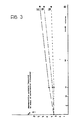
- FIG 1 the course of respectively the temperature of the product, the temperature of the drying plate and the absolute pressure with the time, are indicated from the start of the freezing by the way of a characteristic example of the present process.
- the course of the temperature of the product is indicated by means of curve (a), the course of the temperature of the drying plate by means of curve (b) and the course of the absolute pressure by means of curve (c).
- the point (1) in curve (c) indicates the switch on of the vacuum pump, while the point (2) in curve (b) indicated the switch on of the heating of the drying plate.
- the dryingroom is evacuated after the nitrogen supply has been cut off and the condenser is switched on.
- the cooling of the drying plates is switched off after which these plates are slowly raised in temperature.
- the drying period takes about 24 hours.
- the thermostat for the plate heating is switched on after the product-temperature has been raised above 10°C and has become equal to the plate temperature and after ice in the flasks can no longer be seen.
- the temperature of the thermostat is adjusted to 30 °C and drying is carried out during about 5 hours.
- the thermostat, vacuum pump and the cooling of the condensor are switched off and the vacuum of the drying room is eliminated by supplying of nitrogen filtered through a 0.2 fJ.m filter.
- the flasks are closed in the freeze drying equipment. After removal from the freeze drying equipment the flasks are sealed with aluminium folding capsules by means of Fermpress handcrimper type H-207.
- the so obtained charges are subsequently analyzed with regard to the content of sodium amoxicillin, the content of decomposition products, the water content, the content of sodium chloride, clearness of the solution, pH of the solution, infra red spectrum and PMR spectrum.
- Example 1 Using processes similar to that of Example 1, several charges of the sodium amoxicillin compositions are prepared whereby a number of parameters are varied as to the corresponding ones in Example 1.
- the freeze dried starting preparation as used for figure 3 was prepared by suspending amoxicillin trihydrate in water at room temperature, followed by the addition of a 15 mol% excess of sodium hydroxide, neutralization with a hydrochloric acid solution to a 5 % mol excess of sodium hydroxide, filtration of the obtained solution by means of a 0.2 ⁇ filter and filling into F 20 flasks 10 ml of a 5 % by weight solution of sodium amoxicillin followed by freezing and freeze drying.
- the flasks containing the freeze dried preparation were stored at 5°C for 10 weeks.
- the solution is transmitted under aseptical conditions on sterilized plastic foil which is secured on the drying plates and temperature sensors are fixed and the drying room is closed.
- the foil has previously been secured on the drying plates and has an upstanding rim of a height of 4 cm supported by a sterilized metal frame work, while the foil has been secured in such a way, that an optimal contact is obtained of the solution with the drying plates.
- the drying plates of the freeze drying equipment are preferably previously cooled to a temperature of - 40 °C.
- the cooling capacity of the freeze dryer has to be selected large enough in order to freeze in the solution, having a level of about 1 cm within 60 minutes to -10 °C.
- the time between the suspension of the amoxicillin trihydrate and the closing of the freeze drying equipment after pouring out the solution on the plates does not exceed 30 minutes.
- the cooling of the plates is switched off. Heating of the drying plates is switched on whereby the temperature of the heating equipment is slowly and linearly raising to 25 °C during 60 minutes.
- the temperature of the product, the heater of the plates, the drying plates themselves, and the condensor and the pressure in the drying room and in the condensor are recorded.
- the secondary drying by means of a diffusion pump is started and takes 6 hours.
- the heating of the drying plate is adjusted to 30 °C.
- the vacuo of the drying room is eliminated by sypplying dry nitrogen, filtered through a sterilized 0.2 ⁇ m filter.
- the dried sodium amoxicillin is removed from the drying room and stored under nitrogen at 5 °C under aseptical conditions.
- a batch of 1 kg of freeze dried sodium amoxicillin is prepared according to a process similar to that described in example 4, but which essentially differs from that process in that after the addition of a solution of 118.7 g sodium hydroxide in 2 litres of pyrogen free water at a rate of 350 to 400 ml/minute, a part of the sodium hydroxide is immediately neutralized by the addition of 500 ml of a 0.50 N hydrochloric acid solution in about one minute under vigorous stirring, giving rise to a final excess of sodium hydroxide of 5.3 mol%, and whereafter the clear solution is adjusted to a total weight of 20.3 kg with pyrogen free water.
Landscapes
- Health & Medical Sciences (AREA)
- Chemical & Material Sciences (AREA)
- Life Sciences & Earth Sciences (AREA)
- Medicinal Chemistry (AREA)
- Pharmacology & Pharmacy (AREA)
- Epidemiology (AREA)
- Animal Behavior & Ethology (AREA)
- General Health & Medical Sciences (AREA)
- Public Health (AREA)
- Veterinary Medicine (AREA)
- Dermatology (AREA)
- Inorganic Chemistry (AREA)
- Pharmaceuticals Containing Other Organic And Inorganic Compounds (AREA)
- Medicinal Preparation (AREA)
Priority Applications (1)
| Application Number | Priority Date | Filing Date | Title |
|---|---|---|---|
| AT79200545T ATE1692T1 (de) | 1978-10-03 | 1979-09-27 | Verfahren zur herstellung von natriumoxicillinzusammensetzungen. |
Applications Claiming Priority (4)
| Application Number | Priority Date | Filing Date | Title |
|---|---|---|---|
| NL7809986 | 1978-10-03 | ||
| NL7809986A NL7809986A (nl) | 1978-10-03 | 1978-10-03 | Werkwijze voor het bereiden van natrium amoxicilline geschikt voor injectiepreparaten, alsmede deze verbin- ding bevattende gedoseerde injectiepreparaten en de bereiding ervan. |
| NL7900021 | 1979-01-03 | ||
| NL7900021A NL7900021A (nl) | 1979-01-03 | 1979-01-03 | Werkwijze voor het bereiden van natriumamoxicilline geschikt voor injectiepreparaten, alsmede deze verbin- ding bevattende gedoseerde injectiepreparaten en de be- reiding ervan. |
Publications (3)
| Publication Number | Publication Date |
|---|---|
| EP0009845A1 EP0009845A1 (en) | 1980-04-16 |
| EP0009845B1 EP0009845B1 (en) | 1982-10-27 |
| EP0009845B2 true EP0009845B2 (en) | 1987-11-11 |
Family
ID=26645454
Family Applications (1)
| Application Number | Title | Priority Date | Filing Date |
|---|---|---|---|
| EP79200545A Expired EP0009845B2 (en) | 1978-10-03 | 1979-09-27 | Process for the manufacture of sodium amoxicillin preparations |
Country Status (12)
| Country | Link |
|---|---|
| US (1) | US4607029A (da) |
| EP (1) | EP0009845B2 (da) |
| DE (1) | DE2963947D1 (da) |
| DK (1) | DK157660C (da) |
| ES (1) | ES484698A1 (da) |
| FI (1) | FI68518C (da) |
| FR (1) | FR2437835A1 (da) |
| GR (1) | GR71663B (da) |
| IE (1) | IE48953B1 (da) |
| LU (1) | LU81753A1 (da) |
| NO (1) | NO155009C (da) |
| PT (1) | PT70225A (da) |
Families Citing this family (8)
| Publication number | Priority date | Publication date | Assignee | Title |
|---|---|---|---|---|
| NL8002636A (nl) * | 1980-05-08 | 1981-12-01 | Gist Brocades Nv | Solvaat van amoxicilline, werkwijze ter bereiding hiervan en werkwijze ter bereiding van injectiepreparaten uit dit solvaat. |
| CA1209477A (en) * | 1981-03-26 | 1986-08-12 | Bruce E. Haeger | Composition of matter comprising a lyophilized preparation of a penicillin derivative |
| ES525492A0 (es) * | 1982-09-10 | 1985-02-01 | Glaxo Group Ltd | Un procedimiento para la produccion de un recipiente hermeticamente cerrado que contiene al menos un antibiotico de beta-lactama. |
| GB8919172D0 (en) * | 1989-08-23 | 1989-10-04 | Univ Nottingham | Useful composition |
| WO2006072577A1 (en) * | 2005-01-07 | 2006-07-13 | Sandoz Ag | Process for preparing granulates comprising amoxicillin |
| CN104689302B (zh) * | 2015-02-05 | 2017-06-23 | 通化东宝药业股份有限公司 | 一种地特胰岛素注射液的制备方法及其制备的地特胰岛素注射液 |
| CN113577317A (zh) * | 2021-07-30 | 2021-11-02 | 华北制药集团先泰药业有限公司 | 一种无菌阿莫西林的制备方法 |
| CN116396307A (zh) * | 2023-04-04 | 2023-07-07 | 内蒙古联邦动保药品有限公司 | 一种阿莫西林钠的制备方法 |
Family Cites Families (3)
| Publication number | Priority date | Publication date | Assignee | Title |
|---|---|---|---|---|
| US3969524A (en) * | 1974-08-13 | 1976-07-13 | Hoffmann-La Roche Inc. | Stable amoxicillin dosage form |
| US4024244A (en) * | 1974-09-18 | 1977-05-17 | Beecham Group Limited | Amoxicillin derivatives |
| GB1463563A (en) * | 1974-10-10 | 1977-02-02 | Beecham Group Ltd | Pharmaceutical compositions |
-
1979
- 1979-09-25 PT PT70225A patent/PT70225A/pt unknown
- 1979-09-27 DE DE7979200545T patent/DE2963947D1/de not_active Expired
- 1979-09-27 EP EP79200545A patent/EP0009845B2/en not_active Expired
- 1979-10-02 GR GR60166A patent/GR71663B/el unknown
- 1979-10-02 DK DK413279A patent/DK157660C/da not_active IP Right Cessation
- 1979-10-02 NO NO793164A patent/NO155009C/no unknown
- 1979-10-02 IE IE1875/79A patent/IE48953B1/en not_active IP Right Cessation
- 1979-10-02 FI FI793049A patent/FI68518C/fi not_active IP Right Cessation
- 1979-10-03 FR FR7924654A patent/FR2437835A1/fr active Granted
- 1979-10-03 ES ES484698A patent/ES484698A1/es not_active Expired
- 1979-10-03 LU LU81753A patent/LU81753A1/fr unknown
-
1985
- 1985-04-23 US US06/726,027 patent/US4607029A/en not_active Expired - Fee Related
Also Published As
| Publication number | Publication date |
|---|---|
| ES484698A1 (es) | 1980-06-16 |
| PT70225A (en) | 1979-10-01 |
| US4607029A (en) | 1986-08-19 |
| IE48953B1 (en) | 1985-06-26 |
| IE791875L (en) | 1980-04-03 |
| NO793164L (no) | 1980-04-09 |
| FI68518C (fi) | 1985-10-10 |
| DK157660C (da) | 1990-07-09 |
| FI793049A7 (fi) | 1980-04-04 |
| EP0009845A1 (en) | 1980-04-16 |
| EP0009845B1 (en) | 1982-10-27 |
| FR2437835A1 (fr) | 1980-04-30 |
| NO155009B (no) | 1986-10-20 |
| DK157660B (da) | 1990-02-05 |
| NO155009C (no) | 1987-01-28 |
| FI68518B (fi) | 1985-06-28 |
| GR71663B (da) | 1983-06-20 |
| DK413279A (da) | 1980-04-04 |
| FR2437835B1 (da) | 1983-03-18 |
| LU81753A1 (fr) | 1980-01-24 |
| DE2963947D1 (en) | 1982-12-02 |
Similar Documents
| Publication | Publication Date | Title |
|---|---|---|
| RU1826977C (ru) | Способ получени твердой дисперсной композиции | |
| EP0009845B1 (en) | Process for the manufacture of sodium amoxicillin preparations | |
| US3979520A (en) | Preparation of rapidly resorbable glibenclamide | |
| JPH11507936A (ja) | ラモトリジン含有医薬組成物 | |
| NO174424B (no) | Fremgangsmaate for fremstilling av dinatrium-cefodizim | |
| US4303582A (en) | Spray drying process for preparation of solid sodium amoxycillin | |
| NO842318L (no) | Fremgangsmaate for fremstilling av krystallinsk natrium-amoksycillin | |
| EP1034181B1 (en) | Crystalline amrubicin hydrochloride | |
| US9795695B2 (en) | Process for the preparation of gadobenate dimeglumine complex in a solid form | |
| KR870001071B1 (ko) | 고 결정성 나트륨 세포페라존의 제조방법 | |
| US4913892A (en) | Preparation and use of new solvates of beclomethasone 17,21-dipropionate | |
| US4060634A (en) | Rapidly resorbable glibenclamide | |
| US4863915A (en) | β-lactam antibiotics | |
| EP0531529A1 (en) | Process for preparing aqueous suspension | |
| US4222939A (en) | Process for preparing solid sodium amoxycillin | |
| NO148887B (no) | Fremgangsmaate til fremstilling av det krystallinske anhydrat av natriumcefamandol | |
| JPS646170B2 (da) | ||
| US4130558A (en) | Process for preparation of alkali metal salts of ampicillin | |
| KR880000691B1 (ko) | 세팔렉신의 수용성 유도체의 제조 방법 | |
| US6627642B1 (en) | Quinolinone derivative preparations and process for producing the same | |
| US3947590A (en) | Compositions and methods of increasing renal blood flow with gamma-glutamyl amide of dopamine | |
| EP0012496A1 (en) | A process for the preparation of a solid sodium amoxycillin and aqueous solutions thereof | |
| JPH032862B2 (da) | ||
| US4906748A (en) | Cephem derivative crystals | |
| HK1242293A1 (en) | Process for the preparation of gadobenate dimeglumine complex in a solid form |
Legal Events
| Date | Code | Title | Description |
|---|---|---|---|
| PUAI | Public reference made under article 153(3) epc to a published international application that has entered the european phase |
Free format text: ORIGINAL CODE: 0009012 |
|
| AK | Designated contracting states |
Designated state(s): AT CH DE GB IT NL SE |
|
| 17P | Request for examination filed |
Effective date: 19800814 |
|
| ITF | It: translation for a ep patent filed | ||
| GRAA | (expected) grant |
Free format text: ORIGINAL CODE: 0009210 |
|
| AK | Designated contracting states |
Designated state(s): AT CH DE GB IT NL SE |
|
| REF | Corresponds to: |
Ref document number: 1692 Country of ref document: AT Date of ref document: 19821115 Kind code of ref document: T |
|
| REF | Corresponds to: |
Ref document number: 2963947 Country of ref document: DE Date of ref document: 19821202 |
|
| PLBI | Opposition filed |
Free format text: ORIGINAL CODE: 0009260 |
|
| 26 | Opposition filed |
Opponent name: BEECHAM GROUP P.L.C. Effective date: 19830720 |
|
| PUAH | Patent maintained in amended form |
Free format text: ORIGINAL CODE: 0009272 |
|
| STAA | Information on the status of an ep patent application or granted ep patent |
Free format text: STATUS: PATENT MAINTAINED AS AMENDED |
|
| 27A | Patent maintained in amended form |
Effective date: 19871111 |
|
| AK | Designated contracting states |
Kind code of ref document: B2 Designated state(s): AT CH DE GB IT NL SE |
|
| ITF | It: translation for a ep patent filed | ||
| NLR2 | Nl: decision of opposition | ||
| NLR3 | Nl: receipt of modified translations in the netherlands language after an opposition procedure | ||
| PGFP | Annual fee paid to national office [announced via postgrant information from national office to epo] |
Ref country code: AT Payment date: 19920811 Year of fee payment: 14 |
|
| PGFP | Annual fee paid to national office [announced via postgrant information from national office to epo] |
Ref country code: SE Payment date: 19920814 Year of fee payment: 14 Ref country code: GB Payment date: 19920814 Year of fee payment: 14 Ref country code: CH Payment date: 19920814 Year of fee payment: 14 |
|
| PGFP | Annual fee paid to national office [announced via postgrant information from national office to epo] |
Ref country code: DE Payment date: 19920819 Year of fee payment: 14 |
|
| ITTA | It: last paid annual fee | ||
| PG25 | Lapsed in a contracting state [announced via postgrant information from national office to epo] |
Ref country code: GB Effective date: 19930927 Ref country code: AT Effective date: 19930927 |
|
| PG25 | Lapsed in a contracting state [announced via postgrant information from national office to epo] |
Ref country code: SE Effective date: 19930928 |
|
| PG25 | Lapsed in a contracting state [announced via postgrant information from national office to epo] |
Ref country code: CH Effective date: 19930930 |
|
| PGFP | Annual fee paid to national office [announced via postgrant information from national office to epo] |
Ref country code: NL Payment date: 19930930 Year of fee payment: 15 |
|
| GBPC | Gb: european patent ceased through non-payment of renewal fee |
Effective date: 19930927 |
|
| REG | Reference to a national code |
Ref country code: CH Ref legal event code: PL |
|
| PG25 | Lapsed in a contracting state [announced via postgrant information from national office to epo] |
Ref country code: DE Effective date: 19940601 |
|
| EUG | Se: european patent has lapsed |
Ref document number: 79200545.6 Effective date: 19940410 |
|
| PG25 | Lapsed in a contracting state [announced via postgrant information from national office to epo] |
Ref country code: NL Effective date: 19950401 |
|
| NLV4 | Nl: lapsed or anulled due to non-payment of the annual fee |