EP0020773B1 - Composition polymere sensible a la lumiere - Google Patents
Composition polymere sensible a la lumiere Download PDFInfo
- Publication number
- EP0020773B1 EP0020773B1 EP79901257A EP79901257A EP0020773B1 EP 0020773 B1 EP0020773 B1 EP 0020773B1 EP 79901257 A EP79901257 A EP 79901257A EP 79901257 A EP79901257 A EP 79901257A EP 0020773 B1 EP0020773 B1 EP 0020773B1
- Authority
- EP
- European Patent Office
- Prior art keywords
- group
- formula
- photosensitive
- weight
- polymer composition
- Prior art date
- Legal status (The legal status is an assumption and is not a legal conclusion. Google has not performed a legal analysis and makes no representation as to the accuracy of the status listed.)
- Expired
Links
- 0 [O-][N+](*12[N+]([O-])O[N+]1[O-])O[N+]2[O-] Chemical compound [O-][N+](*12[N+]([O-])O[N+]1[O-])O[N+]2[O-] 0.000 description 16
- KPFALMORZZPMAW-UHFFFAOYSA-N CC(CCC(NC)=O)=O Chemical compound CC(CCC(NC)=O)=O KPFALMORZZPMAW-UHFFFAOYSA-N 0.000 description 1
- IKLZEKBCRTWVAY-QBFSEMIESA-N CCC(CC(C/C1=C2\C=CC=CC2)=O)C1=O Chemical compound CCC(CC(C/C1=C2\C=CC=CC2)=O)C1=O IKLZEKBCRTWVAY-QBFSEMIESA-N 0.000 description 1
Classifications
-
- C—CHEMISTRY; METALLURGY
- C08—ORGANIC MACROMOLECULAR COMPOUNDS; THEIR PREPARATION OR CHEMICAL WORKING-UP; COMPOSITIONS BASED THEREON
- C08G—MACROMOLECULAR COMPOUNDS OBTAINED OTHERWISE THAN BY REACTIONS ONLY INVOLVING UNSATURATED CARBON-TO-CARBON BONDS
- C08G73/00—Macromolecular compounds obtained by reactions forming a linkage containing nitrogen with or without oxygen or carbon in the main chain of the macromolecule, not provided for in groups C08G12/00 - C08G71/00
- C08G73/06—Polycondensates having nitrogen-containing heterocyclic rings in the main chain of the macromolecule
- C08G73/10—Polyimides; Polyester-imides; Polyamide-imides; Polyamide acids or similar polyimide precursors
- C08G73/12—Unsaturated polyimide precursors
- C08G73/121—Preparatory processes from unsaturated precursors and polyamines
-
- C—CHEMISTRY; METALLURGY
- C08—ORGANIC MACROMOLECULAR COMPOUNDS; THEIR PREPARATION OR CHEMICAL WORKING-UP; COMPOSITIONS BASED THEREON
- C08G—MACROMOLECULAR COMPOUNDS OBTAINED OTHERWISE THAN BY REACTIONS ONLY INVOLVING UNSATURATED CARBON-TO-CARBON BONDS
- C08G73/00—Macromolecular compounds obtained by reactions forming a linkage containing nitrogen with or without oxygen or carbon in the main chain of the macromolecule, not provided for in groups C08G12/00 - C08G71/00
- C08G73/06—Polycondensates having nitrogen-containing heterocyclic rings in the main chain of the macromolecule
- C08G73/10—Polyimides; Polyester-imides; Polyamide-imides; Polyamide acids or similar polyimide precursors
- C08G73/1003—Preparatory processes
- C08G73/1007—Preparatory processes from tetracarboxylic acids or derivatives and diamines
- C08G73/1025—Preparatory processes from tetracarboxylic acids or derivatives and diamines polymerised by radiations
-
- C—CHEMISTRY; METALLURGY
- C08—ORGANIC MACROMOLECULAR COMPOUNDS; THEIR PREPARATION OR CHEMICAL WORKING-UP; COMPOSITIONS BASED THEREON
- C08G—MACROMOLECULAR COMPOUNDS OBTAINED OTHERWISE THAN BY REACTIONS ONLY INVOLVING UNSATURATED CARBON-TO-CARBON BONDS
- C08G73/00—Macromolecular compounds obtained by reactions forming a linkage containing nitrogen with or without oxygen or carbon in the main chain of the macromolecule, not provided for in groups C08G12/00 - C08G71/00
- C08G73/06—Polycondensates having nitrogen-containing heterocyclic rings in the main chain of the macromolecule
- C08G73/10—Polyimides; Polyester-imides; Polyamide-imides; Polyamide acids or similar polyimide precursors
- C08G73/1042—Copolyimides derived from at least two different tetracarboxylic compounds or two different diamino compounds
-
- C—CHEMISTRY; METALLURGY
- C08—ORGANIC MACROMOLECULAR COMPOUNDS; THEIR PREPARATION OR CHEMICAL WORKING-UP; COMPOSITIONS BASED THEREON
- C08G—MACROMOLECULAR COMPOUNDS OBTAINED OTHERWISE THAN BY REACTIONS ONLY INVOLVING UNSATURATED CARBON-TO-CARBON BONDS
- C08G73/00—Macromolecular compounds obtained by reactions forming a linkage containing nitrogen with or without oxygen or carbon in the main chain of the macromolecule, not provided for in groups C08G12/00 - C08G71/00
- C08G73/06—Polycondensates having nitrogen-containing heterocyclic rings in the main chain of the macromolecule
- C08G73/10—Polyimides; Polyester-imides; Polyamide-imides; Polyamide acids or similar polyimide precursors
- C08G73/14—Polyamide-imides
-
- G—PHYSICS
- G03—PHOTOGRAPHY; CINEMATOGRAPHY; ANALOGOUS TECHNIQUES USING WAVES OTHER THAN OPTICAL WAVES; ELECTROGRAPHY; HOLOGRAPHY
- G03F—PHOTOMECHANICAL PRODUCTION OF TEXTURED OR PATTERNED SURFACES, e.g. FOR PRINTING, FOR PROCESSING OF SEMICONDUCTOR DEVICES; MATERIALS THEREFOR; ORIGINALS THEREFOR; APPARATUS SPECIALLY ADAPTED THEREFOR
- G03F7/00—Photomechanical, e.g. photolithographic, production of textured or patterned surfaces, e.g. printing surfaces; Materials therefor, e.g. comprising photoresists; Apparatus specially adapted therefor
- G03F7/004—Photosensitive materials
- G03F7/038—Macromolecular compounds which are rendered insoluble or differentially wettable
- G03F7/0387—Polyamides or polyimides
Definitions
- the present invention relates to a new photosensitive polymer composition and to a support having thereon a cured film of this polymer composition.
- photosensitive polyimide there have so far been known (a) the one prepared by coating a base plate with a mixture of 95-99 wt% of a polyamide acid type intermediate and 1-5 wt% of a dichromate, the coating being then irradiated with ultraviolet light, developed, if necessary, with hexamethylphosphoramide, and heated at 250°C (US-A-3623870), and (b) the other one prepared by coating a base plate with a polyamide acid intermediate having a photosensitive group in the molecule, the coating being then cured in the same way as in the case of (a) (DE-A-2308830).
- composition (a) has difficulty of handling due to instability of said mixture and problem of insulating properties due to the remaining dichromate in the cured coating.
- composition (b) it was necessary to use pure materials (1) and (2) below in case, for example, where said photosensitive polyamide acid intermediate is synthesized by addition polycondensation or by polycondensation of an isomeric mixture of dicarboxylic acid dichloride derivatives represented by the following formula (1) having photosensitive groups
- the object of this invention is to provide an inexpensive composition of photosensitive polymer without any of such disadvantages of the prior arts and to provide cured film thereof formed on a supporting material.
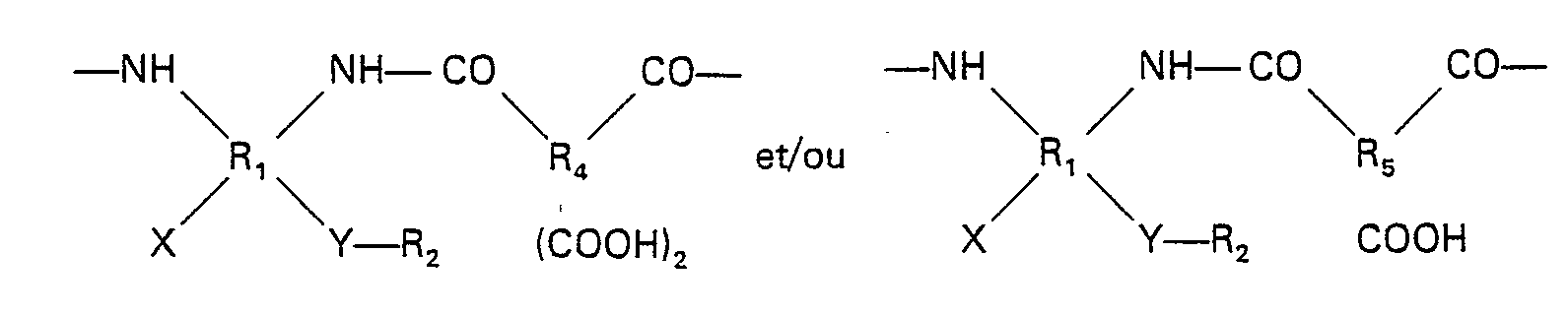
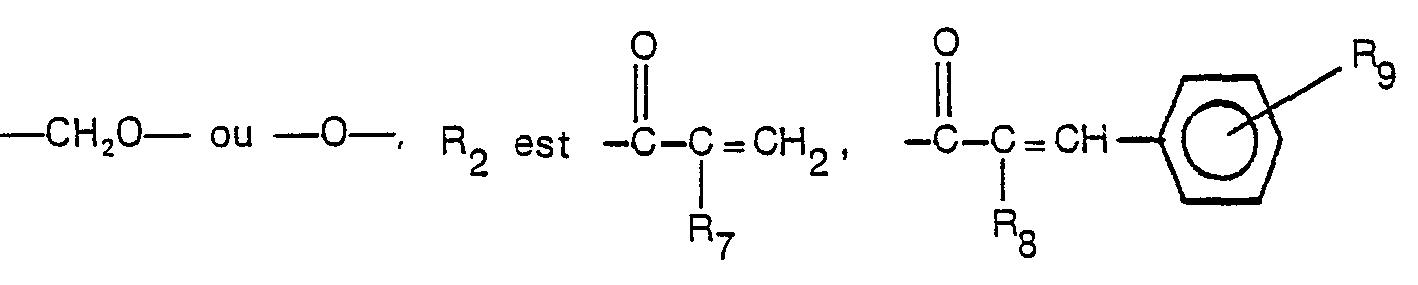
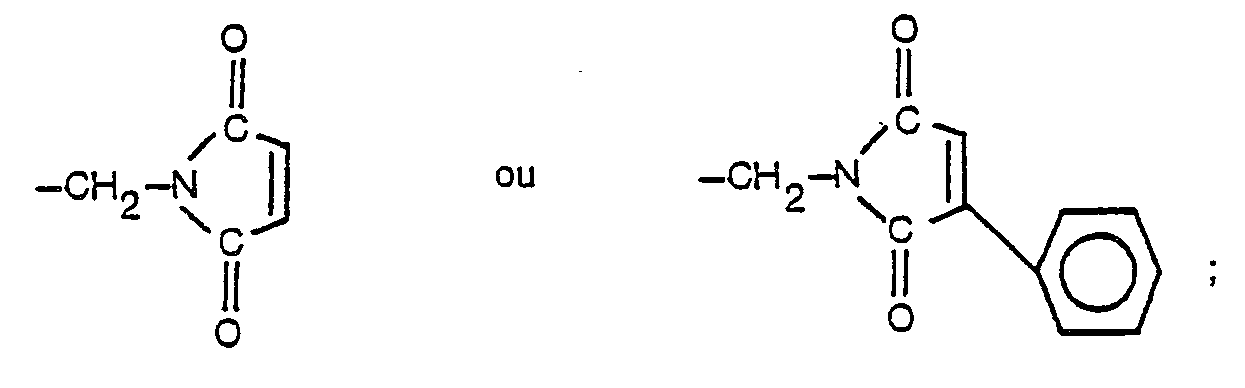
- the photosensitive polymer composition of the present invention is a blend of a photosensitive polyamide acid intermediate solution and a sensitizer therefor, the solution containing 0.1 to 40% by weight of the polyamide acid and 99.9 to 60% by weight of an organic solvent, and the polyamide acid and sensitizer being present in a ratio of 80 to 99.5% by weight of the polyamide acid to 20 to 0.5% by weight of the sensitizer, the polyamide acid having constituent units of the formula:
- the photosensitive polymer composition may be processed by irradiation with ultraviolet light to bind the photosensitive polyamide acid intermediate molecules with one another into crosslinked molecules and further heating the resulting composition to about 200°C or more, preferably at 200-350°C (where heating between 200 and 350°C is carried out in an inert gas), to transform the composition into a polyimide through the intra-molecular dehydrating reaction.
- the intrinsic viscosity of said polyamide acid intermediate used is at least 0.05, preferably 0.1-5.0 wherein the intrinsic viscosity is calculated according to the following equation through the determination of viscosities at 30°C of N,N-dimethylacetamide solution containing 0.5% of the photosensitive polyamide acid intermediate and of N,N-dimethylacetamide (solvent): (where C is the concentration of the photosensitive polyamide acid intermediate in gram/1 00 ml of the solution).
- the melting point of the photosensitive polyamide acid intermediate having such a value of intrinsic viscosity does not indicate a fixed value.
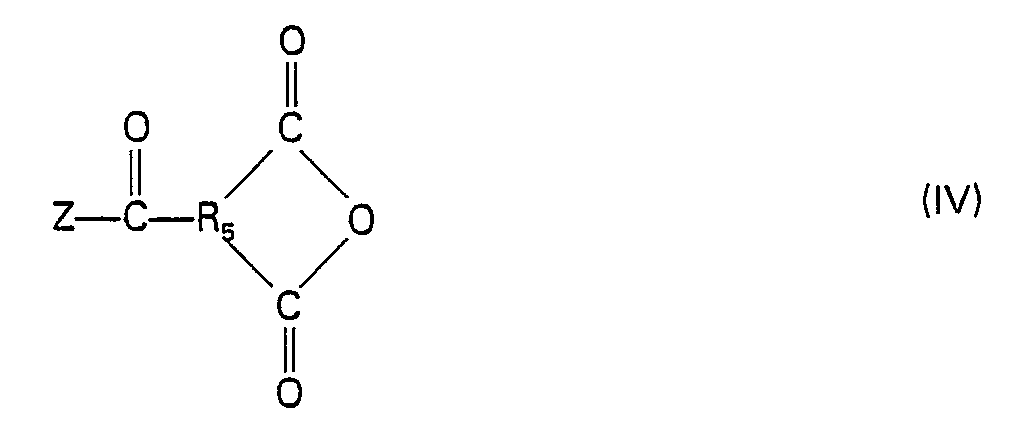
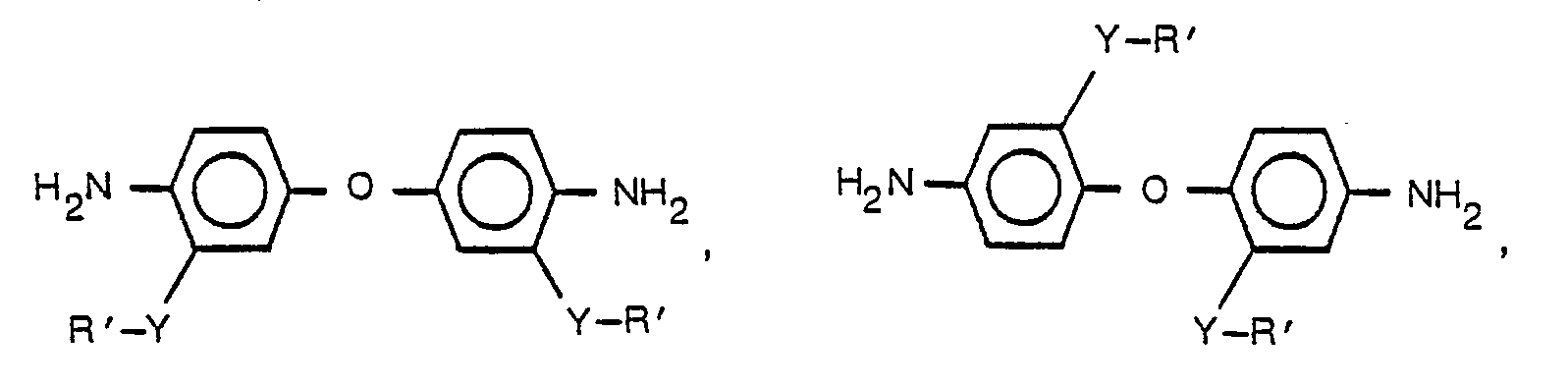
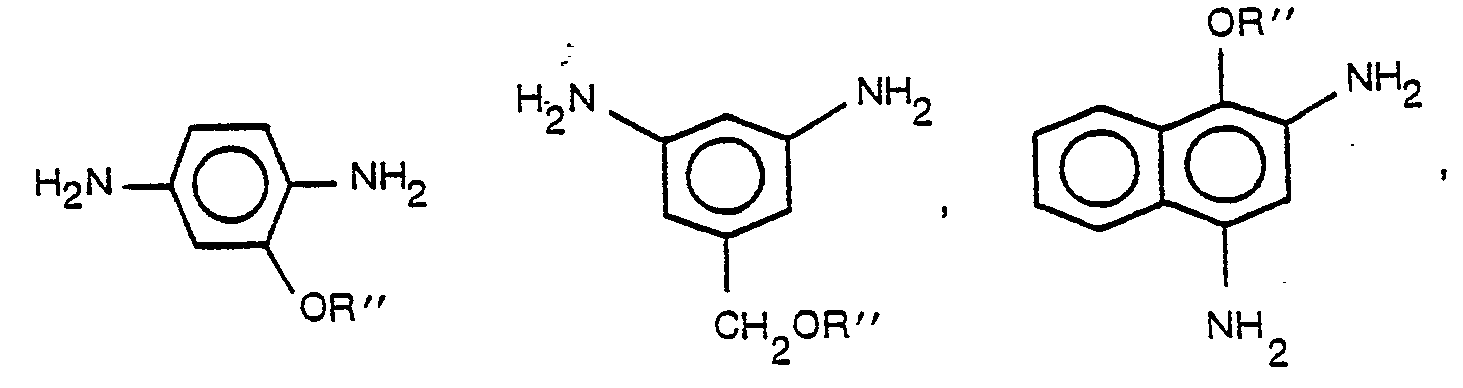
- the photosensitive polymer composition of this invention can be prepared in the following way: Either a mixture (the first compound) of 100-5 wt% of a diamine having a photosensitive group and 0-95 wt% of a diamine having no photosensitive group or at least one compound (the second compound) selected from the tetracarboxylic acid dianhydrides and the tricarboxylic anhydride monohalides is dissolved in an inert organic solvent sufficiently as completely as possible. While the temperature of the reaction system is kept below about 80°C, preferably at room temperature or less, another component is added thereto and the mixture is stirred.
- reaction proceeds fast and the viscosity of the reaction mixture increased gradually with formation of a photosensitive polyamide acid intermediate, giving its solution in an inert organic solvent.
- a sensitizer is added thereto (in a ratio of 80-99.5 wt% of the intermediate to 0.5-20 wt% of the sensitizer) to make up the photosensitive polymer composition.
- a polyamide film-bearing material is prepared according to the invention by applying the photosensitive composition to a support, irradiating the resulting coating with ultraviolet light and heating to transform the irradiated coating into a polyimide film.
- the photosensitive polymer composition applied to the support suitably is dried (preferably at a temperature below 100°C; any heating means can be applied) to vaporize the solvent, and thereafter irradiated with ultraviolet light and further heated at least at 200°C.
- a suitable mask is placed on the coating and the system is irradiated with ultraviolet light, subsequently treated with a developer and a rinsing liquid, and further heated at least at 200°C.
- Irradiation with ultraviolet light can be carried out, for example, by means of 1 kW high-voltage mercury lamp, but any other light source that generates actinic ray can be used.
- the intensity of the incident light suitably is 3-50 mW/cm 2 and the time of exposure can be 30 sec to 10 min.
- the reason for specifying the blending ratio of the diamine having a photosensitive group to the diamine having no photosensitive group as 100-5 wt% of the former to 9-95 wt% of the latter is due to the fact that, when the latter content exceeds 95 wt%, the photosensitive polymer composition is less sensitive to ultraviolet light and at the same time the resistance against a developer, of the portions exposed to ultraviolet irradiation is poorer.
- the reason for specifying the preferred blending ratio of the diamine having a photosensitive group to the diamine having no photosensitive group as 100-60 wt% of the former to 0-40 wt% of the latter is due to the fact that this range gives best sensitivity and best resistance against a developer.
- carboxylic acid dianhydride there are mentioned, for example, dianhydride of pyromellitic acid, 2,2-bis(3,4-dicarboxyphenyl) propane, bis(3,4-dicarboxyphenyi) ether, bis(3,4-dicarboxyphenyl) sulfone, 3,3',4,4'-benzophenone tetracarboxylic acid, 3,3',4,4'-biphenyltetracarboxylic acid, 2,2',3,3'-biphenyltetracarboxylic acid, 1,2,5,6-naphthalene tetracarboxylic acid, 2,3,6,7-naphthalene tetracarboxylic acid, 3,4,9,10-perytene tetracarboxylic acid, 2,2',6,6'-biphenyl tetracarboxylic acid and 1,3-bis(3,4-dicarboxyphenyl) hexafluoro
- tricarboxylic acid anhydride monohalide there are mentioned, for example, monohalides of the following compounds such as trimellitic anhydride, 2,3,6-naphthalene tricarboxylic anhydride, 2,3,5-naphthalene tricarboxylic anhydride, 2,2',3-biphenyl tricarboxylic anhydride, 3,4,4'-biphenyl tricarboxylic anhydride, 2-(3,4-dicarboxyphenyl)-2-(3-carboxyphenyl) propane anhydride, 1,2,4-naphthalene tricarboxylic anhydride, 1,4,5-naphthalene tricarboxylic anhydride, 2-(2,3-dicarboxyphenyl)-2-(3-carboxyphenyl) propane anhydride, 1-(2,3-dicarboxyphenyl)-1-(3-carboxyphenyl) ethane anhydride, 1-(3,4-dicar
- a first compound comprising a diamine having a photosensitive group and a diamine having no photosensitive group in a ratio of 100-5 wt% to 0-95 wt%, preferably 100-60 wt% of the former to 0 ⁇ 40 wt% of the latter is blended with an equivalent amount of a second compound consisting of at least one compound selected from tetracarboxylic dianhydrides and tricarboxylic anhydride monocarboxylic acid halides, the polymerization degree of the photosensitive polyamide acid intermediate is favorably larger, but it is unobjectionable to use either of the first and second compounds in somewhat excess amount.
- the inert organic solvent used is required to be capable of dissolving all components of the first and second compounds mentioned above.
- a particularly favorable one is a solvent capable of dissolving the resulting photosensitive polyamide acid intermediate, such as, for example, N-methyl-2-pyrrolidone, 1,3-dimethyl-2-imidazolidinone, N,N-dimethylacetamide, N-methylformamide, N,N-dimethylformamide, dimethyl sulfoxide, hexamethylphosphoramide, tetramethyjene sulfone, dimethyl sulfone, pyridine, tetramethylurea and N-acetyl-2-pyrrolidone.
- solvents can be used each alone or in combination with one another or with a solvent such as benzene, toluene, nitrotoluene, chlorobenzene or cyclohexanone added.
- a solvent such as benzene, toluene, nitrotoluene, chlorobenzene or cyclohexanone added.
- the amount of the solvent used for the polymerization it should be such that the solute content in the resulting solution is in the range from 0.1 to 40 wt%. In this way a high molecular weight photosensitive polyamide acid intermediate can usually be obtained.
- the photosensitive polymer composition of this invention contains a sensitizer.
- a sensitizer though the stability of the composition depends on the kind of the photosensitive group, the composition is always stable under the light-shielded condition at room temperature. It is also possible to add a stabilizer such as, for example, hydroquinone or tert-butyl catechol, to increase the stability.
- At least one of sensitizers such as the following examples may be used: anthraquinone, 2-methylanthraquinone, 2-ethylanthraquinone, benzoquinone, 1,2-naphthoquinone, 1,4-naphthoquinone, 1,2-benzoanthraquinone, acetophenone, benzophenone, p,p'-diaminobenzophenone, p,p'-dimethylamino benzophenone, p;p'-tetramethyldiaminobenzophenone (Michler's ketone), 2-nitrofluorene, 5-nitroace- naphthene, 4-nitro-l-naphthyiamine, N-acetyl-4-nitro-1-naphthylamine, p-nitroaniline, 2-chloro-4-nitroaniline, pycramide, 2-t-butylanthraquinone, 1,2-benz
- the blending ratio of the sensitizer to the photosensitive polyamide acid intermediate is 0.5-20 wt% of the former to 80-99.5 wt% of the latter.
- the sensitizer content is less than 0.5 wt%, the sensitizing effect does not appear, while, if the content exceeds 20 wt%, an adverse effect appears on the characteristics of the cured film.
- the photosensitive polymer of this invention may be incorporated with a dyestuff, a pigment, or a colorant.
- the supports usable in this invention are, for example, metals, glass, semiconductors (for example, silicon wafer and germanium wafer), ceramics, plastics, paper, conductive films (for example, In 2 O 3 ), metal oxide insulators (for example, TiO z' Ta 2 O 5 , silicon oxides), silicon nitride, and conductors.
- the application of the photosensitive polymer composition on an above-said support is carried out by a usual means such as spinner coating, immersion, spraying, printing or the like.
- Such application means are chosen according to the solid concentration and viscosity of the photosensitive polymer composition.
- the cured film thickness can be controlled by application means, and the solid concentration and viscosity of the photosensitive polymer composition.
- the development after irradiation with ultraviolet light, of the coating on the support is carried out by a polymerization solvent such as, for example, N-methyl-2-pyrrolidone, N,N-dimethylacetoamide or N,N-dimethylformamide.
- a polymerization solvent such as, for example, N-methyl-2-pyrrolidone, N,N-dimethylacetoamide or N,N-dimethylformamide.
- a solvent can optionally be used in incorporation with acetone or ethanol.
- the rinsing liquid serves to wash away the developer solvent and it is preferable to use as the rinsing liquid a solvent such as toluene, acetone or ethanol, which is relatively well compatible with the developer solvent.
- Example 1 does not illustrate the invention but is retained as a Reference Example for Example 2).
- the intrinsic viscosity of the photosensitive polyamide acid intermediate thus obtained was 0.85 (0.5% N,N-dimethylacetamide solution at 30°C).
- the viscosity of said photosensitive polymer composition was adjusted to 1000 m Pa.s (25°C), and the resulting composition was applied on a silicon wafer by means of a spinner.
- the coated wafer was dried at 80°C for 40 minutes to volatilize the solvent away and to complete the coating.
- This coating was covered with a mask having a desired pattern and irradiated with ultraviolet light at an incident beam intensity of 20 mW/cm 2 for 5 minutes by the use of a high-voltage mercury lamp to give a crosslinked polyamide acid coating.
- the crosslinked coating was developed with a mixture of 3 volumes of N-methyl-2-pyrrolidone and 1 volume of ethanol and washed with a rinsing liquid (ethanol). Thereafter, the crosslinked coating was heated at 250°C for 60 minutes to give a polyimide coating pattern.
- This coating was flat and uniform (good coating quality), and the precision of the pattern was also good.
Landscapes
- Chemical & Material Sciences (AREA)
- Health & Medical Sciences (AREA)
- Chemical Kinetics & Catalysis (AREA)
- Medicinal Chemistry (AREA)
- Polymers & Plastics (AREA)
- Organic Chemistry (AREA)
- Physics & Mathematics (AREA)
- Spectroscopy & Molecular Physics (AREA)
- General Physics & Mathematics (AREA)
- Macromolecular Compounds Obtained By Forming Nitrogen-Containing Linkages In General (AREA)
Abstract
Claims (6)











Applications Claiming Priority (6)
| Application Number | Priority Date | Filing Date | Title |
|---|---|---|---|
| JP119218/78 | 1978-09-29 | ||
| JP11921878A JPS5545747A (en) | 1978-09-29 | 1978-09-29 | Photosensitive polymer and its production |
| JP119219/78 | 1978-09-29 | ||
| JP11921978A JPS5545748A (en) | 1978-09-29 | 1978-09-29 | Photosensitive polymer and its production |
| JP54043022A JPS5839447B2 (ja) | 1979-04-11 | 1979-04-11 | 新規感光性重合体 |
| JP43022/79 | 1979-04-11 |
Publications (3)
| Publication Number | Publication Date |
|---|---|
| EP0020773A1 EP0020773A1 (fr) | 1981-01-07 |
| EP0020773A4 EP0020773A4 (fr) | 1981-02-20 |
| EP0020773B1 true EP0020773B1 (fr) | 1984-08-08 |
Family
ID=27291421
Family Applications (1)
| Application Number | Title | Priority Date | Filing Date |
|---|---|---|---|
| EP79901257A Expired EP0020773B1 (fr) | 1978-09-29 | 1980-04-22 | Composition polymere sensible a la lumiere |
Country Status (4)
| Country | Link |
|---|---|
| US (1) | US4321319A (fr) |
| EP (1) | EP0020773B1 (fr) |
| DE (1) | DE2967162D1 (fr) |
| WO (1) | WO1980000706A1 (fr) |
Families Citing this family (33)
| Publication number | Priority date | Publication date | Assignee | Title |
|---|---|---|---|---|
| BR8002860A (pt) * | 1979-05-11 | 1980-12-23 | Minnesota Mining & Mfg | Processo para a cura de uma pelicula de um acido poliamico ou sal deste, processo para a formacao de uma construcao de imagem, artigo que consiste de um substrato tendo areas de imagem de poliimida sobre este e artigo sensivel a luz |
| JPS57168942A (en) * | 1981-04-13 | 1982-10-18 | Hitachi Ltd | Photosensitive polymer composition |
| CA1195039A (fr) * | 1982-01-04 | 1985-10-08 | David L. Goff | Composition pour precurseur a base de polyimide photosensible, derive d'un diaryle fluore |
| JPS58223149A (ja) * | 1982-06-22 | 1983-12-24 | Toray Ind Inc | 感光性ポリイミド用現像液 |
| US5512329A (en) * | 1982-09-29 | 1996-04-30 | Bsi Corporation | Substrate surface preparation |
| US4579809A (en) * | 1982-10-22 | 1986-04-01 | Ciba-Geigy Corporation | Positive image formation |
| DE3246403A1 (de) * | 1982-12-15 | 1984-06-20 | Merck Patent Gmbh, 6100 Darmstadt | Verfahren zur entwicklung von reliefstrukturen auf der basis von strahlungsvernetzten polymervorstufen hochwaermebestaendiger polymere |
| EP0131992B1 (fr) * | 1983-07-01 | 1988-03-02 | Koninklijke Philips Electronics N.V. | Dérivé d'acide polyamique photosensible, méthode pour produire une configuration en polyimide sur un substrat, et dispositif semi-conducteur comprenent une telle configuration. |
| US4587204A (en) * | 1983-08-29 | 1986-05-06 | General Electric Company | Photopatternable dielectric compositions, method for making and use |
| US4515887A (en) * | 1983-08-29 | 1985-05-07 | General Electric Company | Photopatternable dielectric compositions, method for making and use |
| US4694061A (en) * | 1983-10-12 | 1987-09-15 | Ciba-Geigy Corporation | Radiation-sensitive polycondensates, processes for their preparation coated material and its use |
| US4656116A (en) * | 1983-10-12 | 1987-04-07 | Ciba-Geigy Corporation | Radiation-sensitive coating composition |
| CN1004490B (zh) * | 1985-04-27 | 1989-06-14 | 旭化成工业株式会社 | 可固化组合物 |
| US4837126A (en) * | 1985-06-07 | 1989-06-06 | W. R. Grace & Co. | Polymer composition for photoresist application |
| JPS62143929A (ja) * | 1985-07-16 | 1987-06-27 | Kanegafuchi Chem Ind Co Ltd | ポリイミド前駆体薄膜 |
| CA1294731C (fr) * | 1986-04-25 | 1992-01-21 | Masakazu Uekita | Precurseur de polyminide copolymerique et amphiphile, procede pour sa preparation et pellicule mince faite avec celui-ci |
| EP0262446B1 (fr) * | 1986-09-04 | 1993-07-21 | Kanegafuchi Kagaku Kogyo Kabushiki Kaisha | Polymères amphiphiles photosensibles à haut poids moléculaire et leur procédé de production |
| IT1228515B (it) * | 1988-03-03 | 1991-06-20 | Central Glass Co Ltd | Resine poliammidi aromatiche resistenti al calore e fotosensibili e metodo per la loro preparazione |
| US5066770A (en) * | 1988-04-10 | 1991-11-19 | Kanegafuchi Kagaku Kogyo Kabushiki Kaisha | Process and apparatus for manufacturing polymers |
| US4908096A (en) * | 1988-06-24 | 1990-03-13 | Allied-Signal Inc. | Photodefinable interlevel dielectrics |
| US4997908A (en) * | 1989-11-13 | 1991-03-05 | Occidental Chemical Corporation | Solvent resistant polymidesiloxane |
| DE69113900T2 (de) * | 1990-07-05 | 1996-03-28 | Toshiba Kawasaki Kk | Lichtempfindliche Harzzusammensetzung zum Herstellen eines Polyimidfilmmusters. |
| US5177181A (en) * | 1991-06-06 | 1993-01-05 | Occidental Chemical Corporation | Diamines and photosensitive polyimides made therefrom |
| US5310862A (en) * | 1991-08-20 | 1994-05-10 | Toray Industries, Inc. | Photosensitive polyimide precursor compositions and process for preparing same |
| US5241041A (en) * | 1991-12-16 | 1993-08-31 | Occidental Chemical Corporation | Photocrosslinkable polyimide ammonium salts |
| US5472823A (en) * | 1992-01-20 | 1995-12-05 | Hitachi Chemical Co., Ltd. | Photosensitive resin composition |
| JP2635901B2 (ja) * | 1992-03-13 | 1997-07-30 | インターナショナル・ビジネス・マシーンズ・コーポレイション | ポリイミドのネガティブ像形成方法 |
| TW290558B (fr) * | 1994-04-28 | 1996-11-11 | Nissan Chemical Ind Ltd | |
| CN1211418C (zh) | 1997-09-25 | 2005-07-20 | 罗列克股份公司 | 可光交联的聚酰亚胺 |
| TWI265377B (en) * | 2005-12-19 | 2006-11-01 | Ind Tech Res Inst | Negative photoresist composition |
| WO2009080271A1 (fr) * | 2007-12-21 | 2009-07-02 | Rolic Ltd. | Composition pour photo-alignement |
| TWI397546B (zh) * | 2010-01-14 | 2013-06-01 | Chang Chun Plastics Co Ltd | 新穎水溶性聚醯亞胺樹脂、其製法及其用途 |
| KR102087261B1 (ko) * | 2017-02-16 | 2020-03-10 | 삼성에스디아이 주식회사 | 감광성 수지 조성물, 이를 이용한 블랙 화소 격벽층 및 디스플레이 장치 |
Family Cites Families (6)
| Publication number | Priority date | Publication date | Assignee | Title |
|---|---|---|---|---|
| US3623870A (en) * | 1969-07-22 | 1971-11-30 | Bell Telephone Labor Inc | Technique for the preparation of thermally stable photoresist |
| NL177718C (nl) * | 1973-02-22 | 1985-11-01 | Siemens Ag | Werkwijze ter vervaardiging van reliefstructuren uit warmte-bestendige polymeren. |
| DE2437348B2 (de) * | 1974-08-02 | 1976-10-07 | Ausscheidung in: 24 62 105 | Verfahren zur herstellung von reliefstrukturen |
| JPS6021168B2 (ja) * | 1976-07-03 | 1985-05-25 | 大日本印刷株式会社 | 新規ポリアミドイミド・プレポリマ− |
| JPS6046421B2 (ja) * | 1978-03-01 | 1985-10-16 | 東レ株式会社 | 耐熱性感光材料 |
| US4242437A (en) * | 1979-05-11 | 1980-12-30 | Minnesota Mining And Manufacturing Company | Photosensitized polyamic acids curable by exposure to actinic radiation |
-
1979
- 1979-09-26 DE DE7979901257T patent/DE2967162D1/de not_active Expired
- 1979-09-26 WO PCT/JP1979/000246 patent/WO1980000706A1/fr not_active Ceased
-
1980
- 1980-04-22 EP EP79901257A patent/EP0020773B1/fr not_active Expired
- 1980-05-22 US US06/198,952 patent/US4321319A/en not_active Expired - Lifetime
Also Published As
| Publication number | Publication date |
|---|---|
| WO1980000706A1 (fr) | 1980-04-17 |
| EP0020773A1 (fr) | 1981-01-07 |
| US4321319A (en) | 1982-03-23 |
| EP0020773A4 (fr) | 1981-02-20 |
| DE2967162D1 (en) | 1984-09-13 |
Similar Documents
| Publication | Publication Date | Title |
|---|---|---|
| EP0020773A1 (fr) | Composition polymere sensible a la lumiere | |
| JPH02153933A (ja) | 感放射線混合物及びその製造方法 | |
| Hou et al. | Ester-type precursor of polyimide and photosensitivity | |
| JPS606365B2 (ja) | 感光性重合体組成物 | |
| JPS6234052B2 (fr) | ||
| JPH10260531A (ja) | ポリイミド系樹脂組成物 | |
| JPS60133445A (ja) | ホトレジスト組成物 | |
| JPH03186847A (ja) | 感光性樹脂組成物 | |
| JPH0658534B2 (ja) | 化学線感応性重合体組成物 | |
| JP3941556B2 (ja) | 感光性ポリアミドイミド樹脂組成物、パターン製造法及び電子部品 | |
| JP3093055B2 (ja) | 耐熱性ネガ型フォトレジスト組成物および感光性基材、ならびにネガ型パターン形成方法 | |
| JPH034226A (ja) | 耐熱性を有するパターンの形成方法 | |
| JP3378379B2 (ja) | 感光性ポリイミド樹脂組成物 | |
| US4851506A (en) | Photostructurable polyimide mixtures | |
| JP2001019847A (ja) | 感光性ポリイミド前駆体組成物および金属箔−ポリイミド複合体 | |
| JPH0477741A (ja) | 感光性樹脂組成物 | |
| JPS62280736A (ja) | 感放射線性樹脂組成物 | |
| JPH0990629A (ja) | 感光性樹脂組成物及びこれを用いた半導体装置の製造法 | |
| KR100288846B1 (ko) | 감광성폴리이미드전구체조성물 | |
| JPS6337823B2 (fr) | ||
| JP2862620B2 (ja) | 感光性樹脂及びその製造方法 | |
| JPS6347142A (ja) | 特定のジアミノジフエニルメタン単位を有する感放射線性ポリイミド層を含有する被覆物 | |
| JPH03186849A (ja) | 感光性樹脂組成物 | |
| JPH08137105A (ja) | 感光性樹脂組成物およびパターンの製造法 | |
| JPH0145051B2 (fr) |
Legal Events
| Date | Code | Title | Description |
|---|---|---|---|
| PUAI | Public reference made under article 153(3) epc to a published international application that has entered the european phase |
Free format text: ORIGINAL CODE: 0009012 |
|
| 17P | Request for examination filed |
Effective date: 19800527 |
|
| AK | Designated contracting states |
Designated state(s): CH DE FR GB NL |
|
| GRAA | (expected) grant |
Free format text: ORIGINAL CODE: 0009210 |
|
| AK | Designated contracting states |
Designated state(s): CH DE FR GB NL |
|
| REF | Corresponds to: |
Ref document number: 2967162 Country of ref document: DE Date of ref document: 19840913 |
|
| ET | Fr: translation filed | ||
| PLBE | No opposition filed within time limit |
Free format text: ORIGINAL CODE: 0009261 |
|
| STAA | Information on the status of an ep patent application or granted ep patent |
Free format text: STATUS: NO OPPOSITION FILED WITHIN TIME LIMIT |
|
| 26N | No opposition filed | ||
| PGFP | Annual fee paid to national office [announced via postgrant information from national office to epo] |
Ref country code: FR Payment date: 19960625 Year of fee payment: 18 |
|
| PGFP | Annual fee paid to national office [announced via postgrant information from national office to epo] |
Ref country code: GB Payment date: 19960627 Year of fee payment: 18 |
|
| PGFP | Annual fee paid to national office [announced via postgrant information from national office to epo] |
Ref country code: NL Payment date: 19960930 Year of fee payment: 18 Ref country code: DE Payment date: 19960930 Year of fee payment: 18 |
|
| PGFP | Annual fee paid to national office [announced via postgrant information from national office to epo] |
Ref country code: CH Payment date: 19961202 Year of fee payment: 18 |
|
| PG25 | Lapsed in a contracting state [announced via postgrant information from national office to epo] |
Ref country code: GB Free format text: LAPSE BECAUSE OF NON-PAYMENT OF DUE FEES Effective date: 19970926 |
|
| PG25 | Lapsed in a contracting state [announced via postgrant information from national office to epo] |
Ref country code: FR Free format text: THE PATENT HAS BEEN ANNULLED BY A DECISION OF A NATIONAL AUTHORITY Effective date: 19970930 Ref country code: CH Free format text: LAPSE BECAUSE OF NON-PAYMENT OF DUE FEES Effective date: 19970930 |
|
| PG25 | Lapsed in a contracting state [announced via postgrant information from national office to epo] |
Ref country code: NL Free format text: LAPSE BECAUSE OF NON-PAYMENT OF DUE FEES Effective date: 19980401 |
|
| GBPC | Gb: european patent ceased through non-payment of renewal fee |
Effective date: 19970926 |
|
| REG | Reference to a national code |
Ref country code: CH Ref legal event code: PL |
|
| NLV4 | Nl: lapsed or anulled due to non-payment of the annual fee |
Effective date: 19980401 |
|
| PG25 | Lapsed in a contracting state [announced via postgrant information from national office to epo] |
Ref country code: DE Free format text: LAPSE BECAUSE OF NON-PAYMENT OF DUE FEES Effective date: 19980603 |
|
| REG | Reference to a national code |
Ref country code: FR Ref legal event code: ST |