EP0038423B1 - Verfahren zur Herstellung von Benzodiazepin-Derivaten - Google Patents
Verfahren zur Herstellung von Benzodiazepin-Derivaten Download PDFInfo
- Publication number
- EP0038423B1 EP0038423B1 EP81102038A EP81102038A EP0038423B1 EP 0038423 B1 EP0038423 B1 EP 0038423B1 EP 81102038 A EP81102038 A EP 81102038A EP 81102038 A EP81102038 A EP 81102038A EP 0038423 B1 EP0038423 B1 EP 0038423B1
- Authority
- EP
- European Patent Office
- Prior art keywords
- process according
- tetrahydrofuran
- added
- malonic acid
- general formula
- Prior art date
- Legal status (The legal status is an assumption and is not a legal conclusion. Google has not performed a legal analysis and makes no representation as to the accuracy of the status listed.)
- Expired
Links
- 0 *C(*)=C1Nc2ccc(*)cc2C(c2ccccc2*)=*C1 Chemical compound *C(*)=C1Nc2ccc(*)cc2C(c2ccccc2*)=*C1 0.000 description 1
Classifications
-
- C—CHEMISTRY; METALLURGY
- C07—ORGANIC CHEMISTRY
- C07D—HETEROCYCLIC COMPOUNDS
- C07D243/00—Heterocyclic compounds containing seven-membered rings having two nitrogen atoms as the only ring hetero atoms
- C07D243/06—Heterocyclic compounds containing seven-membered rings having two nitrogen atoms as the only ring hetero atoms having the nitrogen atoms in positions 1 and 4
- C07D243/10—Heterocyclic compounds containing seven-membered rings having two nitrogen atoms as the only ring hetero atoms having the nitrogen atoms in positions 1 and 4 condensed with carbocyclic rings or ring systems
- C07D243/14—1,4-Benzodiazepines; Hydrogenated 1,4-benzodiazepines
- C07D243/16—1,4-Benzodiazepines; Hydrogenated 1,4-benzodiazepines substituted in position 5 by aryl radicals
-
- C—CHEMISTRY; METALLURGY
- C07—ORGANIC CHEMISTRY
- C07F—ACYCLIC, CARBOCYCLIC OR HETEROCYCLIC COMPOUNDS CONTAINING ELEMENTS OTHER THAN CARBON, HYDROGEN, HALOGEN, OXYGEN, NITROGEN, SULFUR, SELENIUM OR TELLURIUM
- C07F9/00—Compounds containing elements of Groups 5 or 15 of the Periodic Table
- C07F9/02—Phosphorus compounds
- C07F9/28—Phosphorus compounds with one or more P—C bonds
- C07F9/38—Phosphonic acids [RP(=O)(OH)2]; Thiophosphonic acids ; [RP(=X1)(X2H)2(X1, X2 are each independently O, S or Se)]
- C07F9/40—Esters thereof
- C07F9/4003—Esters thereof the acid moiety containing a substituent or a structure which is considered as characteristic
- C07F9/4006—Esters of acyclic acids which can have further substituents on alkyl
Definitions
- the compounds of the formula are valuable intermediates for the production of imidazobenzodiazepines, which are known sedatives, muscle relaxants, anticonvulsants and anxiolytics. How the compounds of formula 1 above can be converted into these imidazobenzodiazepines is described, for example, in Belgian patent no. 833 248.
- halogen used in this specification refers to the four forms chlorine, fluorine, bromine and iodine.
- the compounds of formula 1 are prepared by diethyl malonate, dimethyl malonate or ethyl cyanoacetate in an inert ether such as tetrahydrofuran or dioxane, or another inert solvent such as dimethylformamide or methylene chloride, in the presence of an alkali metal hydride, e.g. sodium hydride (to form the corresponding anion) , with diethyl chlorophosphate to form the phosphonate anion of the formula II and then react the phosphonate anion of the formula II in situ with a benzodiazepine derivative of the formula III.
- the same solvents can be used for both reaction steps, and the reaction temperature for both steps is between about 0 ° C. and the reflux temperature of the solvent used, preferably around room temperature.
- the solution obtained is shaken for 2 hours and then the pH is adjusted to 5.0 to 5.5. Most of the tetrahydrofuran is removed under reduced pressure (40 ° / 4000 Pa), and then first 600 ml of cold water and then 100 ml of hexane are added. The suspension obtained is filtered and washed with water and hexane. After drying, 7-chloro-5- (2-fluorophenyl) -1,3-dihydro-2 H-1,4-benzodiazepin-2-ylidene-malonic acid diethyl ester is obtained as the end product.
- the pH is then adjusted to 5.0 to 5.5 with acetic acid, and the reaction solution is concentrated under reduced pressure (40 ° / 4000 Pa) to remove the tetrahydrofuran. 600 ml of cold water and 100 ml of hexane are added to the residue. The crystalline solid formed is filtered off and washed with water and hexane. After drying the solid, 7-chloro-1,3-dihydro-5-phenyl-2H-1,4-benzodiazepin-2-ylidene-malonic acid diethyl ester is obtained as the end product.
Landscapes
- Chemical & Material Sciences (AREA)
- Organic Chemistry (AREA)
- Health & Medical Sciences (AREA)
- Life Sciences & Earth Sciences (AREA)
- Biochemistry (AREA)
- General Health & Medical Sciences (AREA)
- Molecular Biology (AREA)
- Pharmaceuticals Containing Other Organic And Inorganic Compounds (AREA)
- Nitrogen- Or Sulfur-Containing Heterocyclic Ring Compounds With Rings Of Six Or More Members (AREA)
- Nitrogen Condensed Heterocyclic Rings (AREA)
Description
- Die vorliegende Erfindung betrifft ein Verfahren zur Herstellung von Benzodiazepinderivaten der allgemeinen Formel

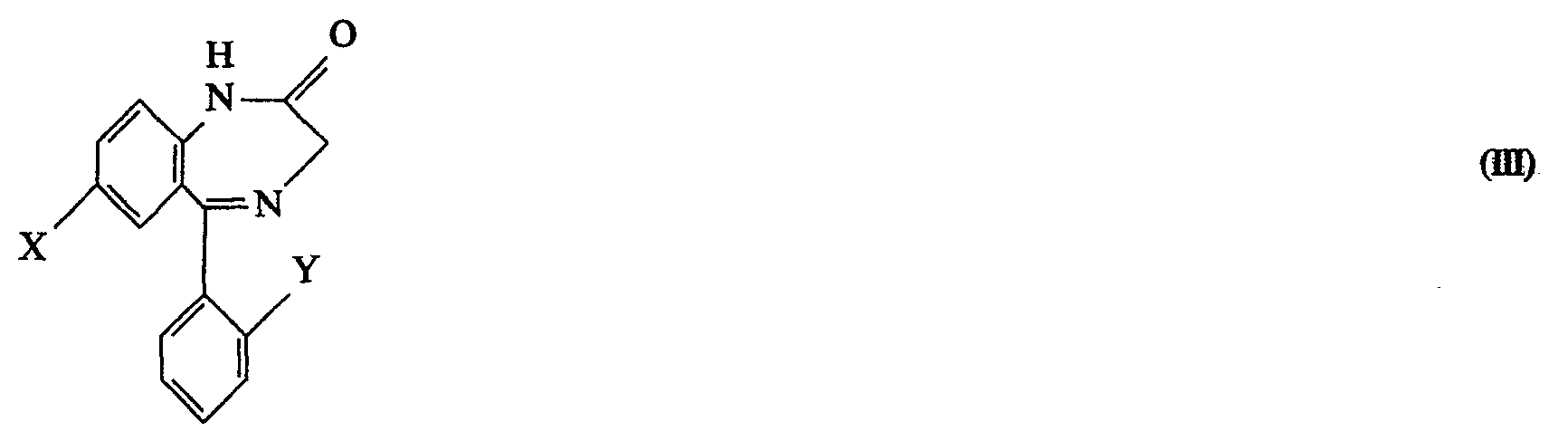
gemäß welchem man ein Benzodiazepin-2-on der allgemeinen Formel
- worin X und Y die oben angegebene Bedeutung besitzen, mit einem Phosphonatanion der allgemeinen Formel

- worin R1 und R2 die oben angegebene Bedeutung besitzen,
- Die Verbindungen der Formel sind wertvolle Zwischenprodukte zur Herstellung von Imidazobenzodiazepinen, welche bekannte Sedativa, Muskelrelaxantien, Antikonvulsiva und Anxiolytika sind. Wie die Verbindungen der obigen Formel 1 in diese Imidazobenzodiazepine übergeführt werden können, ist beispielsweise in der belgischen Patentschrift No. 833 248 beschrieben.
- Aus Tetrahedron Letters, 15, 1161-1162 (1969) ist es bekannt, daß Phthalimide und Succinimide mit Hilfe von Triphenylphosphinäthoxycarbonylmethylen in einer Wittig-Reaktion in die entsprechenden Monoalkyliden-Verbindungen übergeführt werden können. Aus S. Patai, The Chemistry ofthe Carbonyl Group, Interscience Publ. 1966, ist bekannt, daß man die Wittig-Reagenzien, d. h. die Yliden-Phosphorane, durch die Wittig-Horner-Reagenzien, nämlich Phosphonat-Anionen, ersetzen kann.
- Der in dieser Beschreibung verwendete Ausdruck »Halogen« betrifft die vier Formen Chlor, Fluor, Brom und Jod.
- Das Verfahren gemäß vorliegender Erfindung zur Herstellung der Verbindungen der obigen Formel ist eigentlich ein Zweistufenverfahren, wobei das Phosphonatanion der Formel in situ gebildet wird. Im nachstehenden Reaktionsschema wird dieses Verfahren illustriert:

- Die Verbindungen der Formel 1 werden hergestellt, indem man Malonsäurediäthylester, Malonsäuredimethylester oder Cyanessigsäureäthylester in einem inerten Äther, wie Tetrahydrofuran oder Dioxan, oder einem anderen inerten Lösungsmittel, wie Dimethylformamid oder Methylenchlorid, in Gegenwart eines Atkalimetallhydrides, beispielsweise Natriumhydrid (zur Bildung des entsprechenden Anions), mit Diäthylchlorphosphat unter Bildung des Phosphonatanions der Formel II umsetzt und danach das Phosphonatanion der Formel II in situ mit einem Benzodiazepinderivat der Formel III zur Reaktion bringt. Für beide Reaktionsschritte können die gleichen Lösungsmittel verwendet werden, und die Reaktionstemperatur liegt für beide Schritte zwischen etwa 0°C und der Rückflußtemperatur des verwendeten Lösungsmittels, vorzugsweise bei ungefähr Raumtemperatur.
- Die folgenden Beispiele illustrieren die Erfindung, ohne diese zu beschränken. Alle Temperaturen sind in Celsiusgraden angegeben.
- 91 ml (0,6 Mol) Malonsäurediäthylester werden zu 300 ml Tetrahydrofuran gegeben. Das Reaktionsgemisch wird mit einem Eisbad auf Raumtemperatur gehalten, während man innerhalb einer Stunde 32 g Natriumhydrid (60 %ige Dispersion in Öl) zugibt. Zur erhaltenen Suspension werden innerhalb von 50 Minuten 29 ml Diäthylchlorphosphat gegeben. Nach 30minütigem Schütteln wird eine Lösung von 28,85 g 7-Chlor-5-(2-fluorphenyl)-1,3-dihydro-2H-1,4-benzodiazepin-2-on in Tetrahydrofuran innerhalb von 20 Minuten zugetropft. Nach beendeter Zugabe wird die erhaltene Lösung während 2 Stunden geschüttelt, und danach wird der pH-Wert auf 5,0 bis 5,5 eingestellt. Der größte Teil des Tetrahydrofuran wird unter vermindertem Druck (40°/4000 Pa) entfernt, und dann werden zuerst 600 ml kaltes Wasser und dann 100 ml Hexan zugegeben. Die erhaltene Suspension wird filtriert und mit Wasser und Hexan gewaschen. Nach dem Trocknen erhält man als Endprodukt 7-Chlor-5-(2-fluorphenyl)-1,3-dihydro-2 H-1,4-benzodiazepin-2-yliden-malonsäurediäthylester.
- 45,55 ml Malonsäurediäthylester werden zu 200 ml Tetrahydrofuran gegeben. Das Reaktionsgemisch wird bei Raumtemperatur gehalten, während 16 g Natriumhydrid (60 %ige Dispersion in Öl) innerhalb von einer Stunde zugegeben werden. 14,45 ml Diäthylchlorphosphat werden tropfenweise innerhalb von 50 Minuten zur erhaltenen Suspension gegeben. Nach 30minütigem Schütteln und Rühren wird eine Lösung von 13,54 g 7-Chlor-1,3-dihydro-5-phenyl-2 H-1,4-benzodiazepin-2-on in Tetrahydrofuran innerhalb von 20 Minuten tropfenweise zugegeben. Die erhaltene Lösung wird während einer Stunde geschüttelt. Danach wird der pH-Wert mit Essigsäure auf 5,0 bis 5,5 eingestellt, und die Reaktionslösung unter vermindertem Druck (40°/4000 Pa) zur Entfernung des Tetrahydrofuran eingeengt. Zum Rückstand werden 600 ml kaltes Wasser und 100 ml Hexan gegeben. Der dabei gebildete kristalline Festkörper wird abfiltriert und mit Wasser und Hexan gewaschen. Nach dem Trocknen des Festkörpers erhält man 7-Chlor-1,3-dihydro-5-phenyl-2H-1,4-benzodiazepin-2-yliden-malonsäurediäthylester als Endprodukt.
- 45,55 ml Malonsäurediäthylester werden zu 200 ml Tetrahydrofuran gegeben. Das Reaktionsgemisch wird mit einem Eisbad auf Raumtemperatur gehalten, während man 14 g (60 %ige Dispersion in Öl) Natriumhydrid portionenweise innerhalb einer Stunde zugibt. Die erhaltene Suspension wird tropfenweise innerhalb von 50 Minuten mit 14,45 ml Diäthylchlorphosphat versetzt. Nach 30minütigem Schütteln wird eine Lösung von 15,25 g 7-Chlor-5-(2-chlorphenyl)-1,3-dihydro-2 H-1,4-benzo- diazepin-2-on in Tetrahydrofuran innerhalb von 20 Minuten zugetropft. Die erhaltene Lösung wird während einer Stunde geschüttelt. Der pH-Wert wird danach auf 5,0 bis 5,5 eingestellt, und die Reaktionslösung zur Entfernung des Tetrahydrofuran bei 40°/4000 Pa eingeengt. Zum erhaltenen Rückstand werden 600 ml kaltes Wasser und 100 ml Hexan gegeben. Der erhaltene kristalline Festkörper wird abfiltriert und mit kaltem Wasser und Hexan gewaschen. Nach dem Trocknen des Festkörpers bis zur Gewichtskonstanz erhält man 7-Chlor-5-(2-chlorphenyl)-1,3-dihydro-2 H-1,4-benzodiazepin-2-yliden-malonsäurediäthylester als Endprodukt.
- 45,55 ml Malonsäurediäthylester werden zu 200 ml Tetrahydrofuran gegeben. Das Reaktionsgemisch wird mit einem Eisbad auf Raumtemperatur gehalten, während man 16 g (60 %ige Dispersion in ÖI) Natriumhydrid portionsweise innerhalb einer Stunde zugibt. Zur erhaltenen Suspension werden innerhalb von 50 Minuten 14,45 ml Diäthylchlorphosphat getropft. Nach 30minütigem Schütteln wird eine Lösung von 15,8 g 5-(2-Chlorphenyl)-7-nitro-2H-1,4-benzodiazepin-2-on in Tetrahydrofuran innerhalb von 20 Minuten tropfenweise zugegeben. Die erhaltene Lösung wird während einer Stunde geschüttelt. Danach wird der pH-Wert auf 5,0 bis 5,5 eingestellt, und die Reaktionslösung zur Entfernung des Tetrahydrofuran bei 40°/4000 Pa eingeengt. Zum Rückstand werden 600 ml kaltes Wasser und 100 ml Hexan gegeben. Der erhaltene kristalline Festkörper wird abfiltriert und mit kaltem Wasser und Hexan gewaschen. Nach dem Trocknen des Festkörpers bis zur Gewichtskonstanz erhält man 5-(2-Chlorphenyl)-1,3-dihydro-7-nitro-2H-1,4-benzodiazepin-2-yliden-malonsäurediäthylester als Endprodukt.
- 32,13 ml Cyanessigsäureäthylester werden zu 200 ml Tetrahydrofuran gegeben. Danach werden innerhalb einer Stunde 16 g Natriumhydrid in Portionen zugegeben. Zur erhaltenen Suspension werden 14,45 ml Diäthylchlorphosphat gegeben. Nach 30minütigem Schütteln wird eine Lösung von 14,43 g 7-Chlor-5-(2-fluorphenyl)-1,3-dihydro-2H-1,4-benzodiazepin-2-on in Tetrahydrofuran innerhalb einer Stunde zugetropft. Nach einstündigem Schütteln wird die Reaktionslösung mit Essigsäure auf pH 5 eingestellt und mit 500 ml kaltem Wasser und 300 ml Hexan versetzt. Die erhaltene Suspension von Kristallen wird filtriert, und der Rückstand mit Wasser und Hexan gewaschen. Nach dem Trocknen der Kristalle bis zur Gewichtskonstanz erhält man 7-Chlor-5-(2-fluorphenyl)-1,3-dihydro-2 H-1,4-benzo- diazepin-2-yliden-cyanessigsäureäthylester als Endprodukt.
umsetzt.
Claims (6)


umsetzt.
Priority Applications (1)
| Application Number | Priority Date | Filing Date | Title |
|---|---|---|---|
| AT81102038T ATE10369T1 (de) | 1980-04-21 | 1981-03-19 | Verfahren zur herstellung von benzodiazepinderivaten. |
Applications Claiming Priority (2)
| Application Number | Priority Date | Filing Date | Title |
|---|---|---|---|
| US06/142,581 US4335042A (en) | 1980-04-21 | 1980-04-21 | Process to produce imidazobenzodiazepine intermediates |
| US142581 | 1980-04-21 |
Publications (2)
| Publication Number | Publication Date |
|---|---|
| EP0038423A1 EP0038423A1 (de) | 1981-10-28 |
| EP0038423B1 true EP0038423B1 (de) | 1984-11-21 |
Family
ID=22500416
Family Applications (1)
| Application Number | Title | Priority Date | Filing Date |
|---|---|---|---|
| EP81102038A Expired EP0038423B1 (de) | 1980-04-21 | 1981-03-19 | Verfahren zur Herstellung von Benzodiazepin-Derivaten |
Country Status (5)
| Country | Link |
|---|---|
| US (1) | US4335042A (de) |
| EP (1) | EP0038423B1 (de) |
| JP (1) | JPS56166177A (de) |
| AT (1) | ATE10369T1 (de) |
| DE (1) | DE3167269D1 (de) |
Families Citing this family (1)
| Publication number | Priority date | Publication date | Assignee | Title |
|---|---|---|---|---|
| US20010014738A1 (en) * | 1999-06-30 | 2001-08-16 | Madhup K. Dhaon | Process for the preparation of imidazodiazepine intermediates |
Family Cites Families (3)
| Publication number | Priority date | Publication date | Assignee | Title |
|---|---|---|---|---|
| ZA755418B (en) * | 1974-09-11 | 1977-06-29 | Hoffmann La Roche | Diazepine derivatives |
| US4166185A (en) * | 1977-03-11 | 1979-08-28 | Hoffmann-La Roche Inc. | Imidazo[1,5-α][1,4]benzodiazepines |
| DE2754112A1 (de) * | 1977-12-05 | 1979-06-13 | Kali Chemie Pharma Gmbh | 1,4-benzodiazepinderivate, ihre salze und diese verbindungen enthaltende arzneipraeparate |
-
1980
- 1980-04-21 US US06/142,581 patent/US4335042A/en not_active Expired - Lifetime
-
1981
- 1981-03-19 AT AT81102038T patent/ATE10369T1/de not_active IP Right Cessation
- 1981-03-19 EP EP81102038A patent/EP0038423B1/de not_active Expired
- 1981-03-19 DE DE8181102038T patent/DE3167269D1/de not_active Expired
- 1981-04-17 JP JP5725281A patent/JPS56166177A/ja active Granted
Non-Patent Citations (1)
| Title |
|---|
| TETRAHEDRON LETTERS, No. 15, 1161-1162 (1969) * |
Also Published As
| Publication number | Publication date |
|---|---|
| DE3167269D1 (en) | 1985-01-03 |
| ATE10369T1 (de) | 1984-12-15 |
| JPS56166177A (en) | 1981-12-21 |
| EP0038423A1 (de) | 1981-10-28 |
| US4335042A (en) | 1982-06-15 |
| JPS648624B2 (de) | 1989-02-14 |
Similar Documents
| Publication | Publication Date | Title |
|---|---|---|
| DE2845417C2 (de) | ||
| CH633799A5 (de) | Verfahren zur herstellung von diazepinderivaten. | |
| DD140040A5 (de) | Verfahren zur herstellung von 5-alkylthio-pyrimidinen | |
| DE2623226C2 (de) | N-Benzyl-2,2-dimethoxy-acetamide, Verfahren zu ihrer Herstellung und ihre Verwendung | |
| EP0017181A1 (de) | Neues Verfahren zur Herstellung von Imidazobenzodiazepinderivaten sowie Zwischenprodukte zu deren Herstellung | |
| EP0038423A1 (de) | Verfahren zur Herstellung von Benzodiazepin-Derivaten | |
| DE2225149A1 (de) | Neue Oxofurylesterdenvate von Penicillin und Cephalosporin | |
| DE69431537T2 (de) | Verfahren zur Herstellung von 5-Trifluormethyluracil-Derivaten | |
| EP0547411A1 (de) | Verfahren zur Herstellung von 2-substituierten 4,6-Dialkoxypyrimidinen | |
| DE2918161A1 (de) | Phosphonomaleinsaeureester sowie verfahren zu deren herstellung | |
| CH640835A5 (de) | Verfahren zur herstellung von 3-hydroxy-5-halogenpyridinen. | |
| DE2627223A1 (de) | Verfahren zur herstellung von 4-benzoylpyrazol-derivaten | |
| DE2652004C3 (de) | l-Acyl-2-arylamino-2-imidazoline, Verfahren zu ihrer Herstellung und ihre Verwendung | |
| DE3043950C2 (de) | ||
| DE1445073A1 (de) | Verfahren zur Herstellung von fluorhaltigen Benzodiazepin-Derivaten | |
| EP3490972B1 (de) | Verfahren zur herstellung von fluoralkylnitrilen und den entsprechenden fluoralkyltetrazolen | |
| DE3617793C2 (de) | Verfahren zur Herstellung von Cyansubstituierten Enolethern | |
| DE1813240C3 (de) | Verfahren zur Herstellung von 1,3.-Dihydro-2H-1,4-benzodiazepin-2-on-derivaten | |
| DE1770421C3 (de) | Verfahren zur Herstellung von 1,3-Dihydro-2H-1,4-benzodiazepin-2-onderivaten | |
| DD150057A5 (de) | Verfahren zur herstellung von 2-aminopyrazinen | |
| DE1445073C (de) | 3H-l,4-Benzodiazepin-4-oxyde | |
| WO2001077062A1 (de) | Verfahren zur herstellung von 4-brom- und 4-chlor-2-nitro-1-trifluormethoxybenzol | |
| DE3115970A1 (de) | "5-acyloxy-4(5h)-oxazolonium-salze, verfahren zu ihrer herstellung und ihre verwendung als zwischenprodukte zur synthese von herbizid wirksamen triazinonen" | |
| CH633555A5 (de) | Verfahren zur herstellung von 1-(2-(dialkylamino)aethyl)-6-aryl-4h-s-triazolo(4,3-a)(1,4)benzodiazepinen. | |
| DE3735862C2 (de) |
Legal Events
| Date | Code | Title | Description |
|---|---|---|---|
| PUAI | Public reference made under article 153(3) epc to a published international application that has entered the european phase |
Free format text: ORIGINAL CODE: 0009012 |
|
| 17P | Request for examination filed |
Effective date: 19810319 |
|
| AK | Designated contracting states |
Designated state(s): AT BE CH DE FR GB IT NL |
|
| ITF | It: translation for a ep patent filed | ||
| GRAA | (expected) grant |
Free format text: ORIGINAL CODE: 0009210 |
|
| AK | Designated contracting states |
Designated state(s): AT BE CH DE FR GB IT LI NL |
|
| REF | Corresponds to: |
Ref document number: 10369 Country of ref document: AT Date of ref document: 19841215 Kind code of ref document: T |
|
| REF | Corresponds to: |
Ref document number: 3167269 Country of ref document: DE Date of ref document: 19850103 |
|
| ET | Fr: translation filed | ||
| PLBE | No opposition filed within time limit |
Free format text: ORIGINAL CODE: 0009261 |
|
| STAA | Information on the status of an ep patent application or granted ep patent |
Free format text: STATUS: NO OPPOSITION FILED WITHIN TIME LIMIT |
|
| 26N | No opposition filed | ||
| ITPR | It: changes in ownership of a european patent |
Owner name: CESSIONE;F. HOFFMANN - LA ROCHE AG |
|
| NLS | Nl: assignments of ep-patents |
Owner name: F. HOFFMANN-LA ROCHE AG TE BAZEL, ZWITSERLAND. |
|
| REG | Reference to a national code |
Ref country code: FR Ref legal event code: TP |
|
| REG | Reference to a national code |
Ref country code: CH Ref legal event code: PUE Owner name: F. HOFFMANN-LA ROCHE AG |
|
| REG | Reference to a national code |
Ref country code: GB Ref legal event code: 732 |
|
| ITTA | It: last paid annual fee | ||
| REG | Reference to a national code |
Ref country code: FR Ref legal event code: CC Free format text: FRCC 92C0112, 920430 |
|
| REG | Reference to a national code |
Ref country code: FR Ref legal event code: CB Free format text: FRCB 92C0112, 810319 |
|
| REG | Reference to a national code |
Ref country code: FR Ref legal event code: CL |
|
| PGFP | Annual fee paid to national office [announced via postgrant information from national office to epo] |
Ref country code: DE Payment date: 19940319 Year of fee payment: 14 |
|
| PG25 | Lapsed in a contracting state [announced via postgrant information from national office to epo] |
Ref country code: DE Effective date: 19951201 |
|
| PGFP | Annual fee paid to national office [announced via postgrant information from national office to epo] |
Ref country code: FR Payment date: 20000310 Year of fee payment: 20 |
|
| PGFP | Annual fee paid to national office [announced via postgrant information from national office to epo] |
Ref country code: AT Payment date: 20000313 Year of fee payment: 20 |
|
| PGFP | Annual fee paid to national office [announced via postgrant information from national office to epo] |
Ref country code: GB Payment date: 20000315 Year of fee payment: 20 |
|
| PGFP | Annual fee paid to national office [announced via postgrant information from national office to epo] |
Ref country code: CH Payment date: 20000328 Year of fee payment: 20 |
|
| PGFP | Annual fee paid to national office [announced via postgrant information from national office to epo] |
Ref country code: NL Payment date: 20000330 Year of fee payment: 20 |
|
| PGFP | Annual fee paid to national office [announced via postgrant information from national office to epo] |
Ref country code: BE Payment date: 20000518 Year of fee payment: 20 |
|
| BE20 | Be: patent expired |
Free format text: 20010319 F. *HOFFMANN-LA ROCHE A.G. |
|
| PG25 | Lapsed in a contracting state [announced via postgrant information from national office to epo] |
Ref country code: LI Free format text: LAPSE BECAUSE OF EXPIRATION OF PROTECTION Effective date: 20010318 Ref country code: GB Free format text: LAPSE BECAUSE OF EXPIRATION OF PROTECTION Effective date: 20010318 Ref country code: CH Free format text: LAPSE BECAUSE OF EXPIRATION OF PROTECTION Effective date: 20010318 |
|
| PG25 | Lapsed in a contracting state [announced via postgrant information from national office to epo] |
Ref country code: NL Free format text: LAPSE BECAUSE OF EXPIRATION OF PROTECTION Effective date: 20010319 Ref country code: AT Free format text: LAPSE BECAUSE OF EXPIRATION OF PROTECTION Effective date: 20010319 |
|
| REG | Reference to a national code |
Ref country code: GB Ref legal event code: PE20 Effective date: 20010318 |
|
| REG | Reference to a national code |
Ref country code: CH Ref legal event code: PL |
|
| NLV7 | Nl: ceased due to reaching the maximum lifetime of a patent |
Effective date: 20010319 |