EP0039773A1 - Méthode de production de poudre de la série ferrite de baryum - Google Patents
Méthode de production de poudre de la série ferrite de baryum Download PDFInfo
- Publication number
- EP0039773A1 EP0039773A1 EP81102435A EP81102435A EP0039773A1 EP 0039773 A1 EP0039773 A1 EP 0039773A1 EP 81102435 A EP81102435 A EP 81102435A EP 81102435 A EP81102435 A EP 81102435A EP 0039773 A1 EP0039773 A1 EP 0039773A1
- Authority
- EP
- European Patent Office
- Prior art keywords
- aqueous solution
- barium
- precursor
- powder
- ferrite series
- Prior art date
- Legal status (The legal status is an assumption and is not a legal conclusion. Google has not performed a legal analysis and makes no representation as to the accuracy of the status listed.)
- Granted
Links
- 239000000843 powder Substances 0.000 title claims abstract description 57
- AJCDFVKYMIUXCR-UHFFFAOYSA-N oxobarium;oxo(oxoferriooxy)iron Chemical class [Ba]=O.O=[Fe]O[Fe]=O.O=[Fe]O[Fe]=O.O=[Fe]O[Fe]=O.O=[Fe]O[Fe]=O.O=[Fe]O[Fe]=O.O=[Fe]O[Fe]=O AJCDFVKYMIUXCR-UHFFFAOYSA-N 0.000 title claims abstract description 40
- 238000000034 method Methods 0.000 title claims description 31
- 239000002243 precursor Substances 0.000 claims abstract description 40
- 239000007864 aqueous solution Substances 0.000 claims abstract description 35
- 229910052751 metal Inorganic materials 0.000 claims abstract description 7
- 239000002184 metal Substances 0.000 claims abstract description 7
- 150000002739 metals Chemical class 0.000 claims abstract description 6
- 150000002500 ions Chemical class 0.000 claims abstract description 4
- 239000002245 particle Substances 0.000 claims description 31
- HEMHJVSKTPXQMS-UHFFFAOYSA-M Sodium hydroxide Chemical compound [OH-].[Na+] HEMHJVSKTPXQMS-UHFFFAOYSA-M 0.000 claims description 12
- 238000010438 heat treatment Methods 0.000 claims description 10
- 150000001875 compounds Chemical class 0.000 claims description 8
- 239000000243 solution Substances 0.000 claims description 7
- WMFOQBRAJBCJND-UHFFFAOYSA-M Lithium hydroxide Chemical compound [Li+].[OH-] WMFOQBRAJBCJND-UHFFFAOYSA-M 0.000 claims description 6
- KWYUFKZDYYNOTN-UHFFFAOYSA-M Potassium hydroxide Chemical compound [OH-].[K+] KWYUFKZDYYNOTN-UHFFFAOYSA-M 0.000 claims description 6
- 239000003513 alkali Substances 0.000 claims description 5
- 229910001422 barium ion Inorganic materials 0.000 claims description 5
- -1 iron (III) ions Chemical class 0.000 claims description 5
- 229910021645 metal ion Inorganic materials 0.000 claims description 5
- 229910052748 manganese Inorganic materials 0.000 claims description 3
- 229910052719 titanium Inorganic materials 0.000 claims description 3
- 229910052725 zinc Inorganic materials 0.000 claims description 3
- XTEGARKTQYYJKE-UHFFFAOYSA-M Chlorate Chemical class [O-]Cl(=O)=O XTEGARKTQYYJKE-UHFFFAOYSA-M 0.000 claims description 2
- 150000001242 acetic acid derivatives Chemical class 0.000 claims description 2
- 150000001805 chlorine compounds Chemical class 0.000 claims description 2
- 229910052802 copper Inorganic materials 0.000 claims description 2
- 239000012467 final product Substances 0.000 claims description 2
- 150000002222 fluorine compounds Chemical class 0.000 claims description 2
- 229910052732 germanium Inorganic materials 0.000 claims description 2
- 229910052738 indium Inorganic materials 0.000 claims description 2
- 229910052759 nickel Inorganic materials 0.000 claims description 2
- 229910052758 niobium Inorganic materials 0.000 claims description 2
- 150000002823 nitrates Chemical class 0.000 claims description 2
- VLTRZXGMWDSKGL-UHFFFAOYSA-N perchloric acid Chemical class OCl(=O)(=O)=O VLTRZXGMWDSKGL-UHFFFAOYSA-N 0.000 claims description 2
- 150000003467 sulfuric acid derivatives Chemical class 0.000 claims description 2
- VTLYFUHAOXGGBS-UHFFFAOYSA-N Fe3+ Chemical compound [Fe+3] VTLYFUHAOXGGBS-UHFFFAOYSA-N 0.000 claims 2
- 229910052788 barium Inorganic materials 0.000 claims 2
- DSAJWYNOEDNPEQ-UHFFFAOYSA-N barium atom Chemical compound [Ba] DSAJWYNOEDNPEQ-UHFFFAOYSA-N 0.000 claims 2
- 125000001424 substituent group Chemical group 0.000 claims 2
- XLYOFNOQVPJJNP-UHFFFAOYSA-N water Substances O XLYOFNOQVPJJNP-UHFFFAOYSA-N 0.000 claims 1
- 239000000203 mixture Substances 0.000 description 13
- 230000005291 magnetic effect Effects 0.000 description 12
- XEEYBQQBJWHFJM-UHFFFAOYSA-N iron Substances [Fe] XEEYBQQBJWHFJM-UHFFFAOYSA-N 0.000 description 7
- 230000005415 magnetization Effects 0.000 description 7
- TVWHTOUAJSGEKT-UHFFFAOYSA-N chlorine trioxide Chemical compound [O]Cl(=O)=O TVWHTOUAJSGEKT-UHFFFAOYSA-N 0.000 description 6
- 239000002244 precipitate Substances 0.000 description 6
- 229910001914 chlorine tetroxide Inorganic materials 0.000 description 5
- 150000002736 metal compounds Chemical class 0.000 description 5
- 239000010936 titanium Substances 0.000 description 5
- 239000011701 zinc Substances 0.000 description 5
- 239000012670 alkaline solution Substances 0.000 description 4
- WDIHJSXYQDMJHN-UHFFFAOYSA-L barium chloride Chemical compound [Cl-].[Cl-].[Ba+2] WDIHJSXYQDMJHN-UHFFFAOYSA-L 0.000 description 4
- 229910001626 barium chloride Inorganic materials 0.000 description 4
- ORTQZVOHEJQUHG-UHFFFAOYSA-L copper(II) chloride Chemical compound Cl[Cu]Cl ORTQZVOHEJQUHG-UHFFFAOYSA-L 0.000 description 4
- 239000013078 crystal Substances 0.000 description 4
- 238000002425 crystallisation Methods 0.000 description 4
- 230000008025 crystallization Effects 0.000 description 4
- 239000011572 manganese Substances 0.000 description 4
- VLTRZXGMWDSKGL-UHFFFAOYSA-M perchlorate Chemical compound [O-]Cl(=O)(=O)=O VLTRZXGMWDSKGL-UHFFFAOYSA-M 0.000 description 4
- 238000001878 scanning electron micrograph Methods 0.000 description 4
- JIAARYAFYJHUJI-UHFFFAOYSA-L zinc dichloride Chemical compound [Cl-].[Cl-].[Zn+2] JIAARYAFYJHUJI-UHFFFAOYSA-L 0.000 description 4
- 229910021578 Iron(III) chloride Inorganic materials 0.000 description 3
- GVPFVAHMJGGAJG-UHFFFAOYSA-L cobalt dichloride Chemical compound [Cl-].[Cl-].[Co+2] GVPFVAHMJGGAJG-UHFFFAOYSA-L 0.000 description 3
- 230000001747 exhibiting effect Effects 0.000 description 3
- 238000001027 hydrothermal synthesis Methods 0.000 description 3
- RBTARNINKXHZNM-UHFFFAOYSA-K iron trichloride Chemical compound Cl[Fe](Cl)Cl RBTARNINKXHZNM-UHFFFAOYSA-K 0.000 description 3
- VCJMYUPGQJHHFU-UHFFFAOYSA-N iron(3+);trinitrate Chemical compound [Fe+3].[O-][N+]([O-])=O.[O-][N+]([O-])=O.[O-][N+]([O-])=O VCJMYUPGQJHHFU-UHFFFAOYSA-N 0.000 description 3
- 239000013081 microcrystal Substances 0.000 description 3
- PXHVJJICTQNCMI-UHFFFAOYSA-N nickel Substances [Ni] PXHVJJICTQNCMI-UHFFFAOYSA-N 0.000 description 3
- 239000000126 substance Substances 0.000 description 3
- QDZRBIRIPNZRSG-UHFFFAOYSA-N titanium nitrate Chemical compound [O-][N+](=O)O[Ti](O[N+]([O-])=O)(O[N+]([O-])=O)O[N+]([O-])=O QDZRBIRIPNZRSG-UHFFFAOYSA-N 0.000 description 3
- 229910021594 Copper(II) fluoride Inorganic materials 0.000 description 2
- 229910021380 Manganese Chloride Inorganic materials 0.000 description 2
- GLFNIEUTAYBVOC-UHFFFAOYSA-L Manganese chloride Chemical compound Cl[Mn]Cl GLFNIEUTAYBVOC-UHFFFAOYSA-L 0.000 description 2
- UFMZWBIQTDUYBN-UHFFFAOYSA-N cobalt dinitrate Chemical compound [Co+2].[O-][N+]([O-])=O.[O-][N+]([O-])=O UFMZWBIQTDUYBN-UHFFFAOYSA-N 0.000 description 2
- 229910000361 cobalt sulfate Inorganic materials 0.000 description 2
- KTVIXTQDYHMGHF-UHFFFAOYSA-L cobalt(2+) sulfate Chemical compound [Co+2].[O-]S([O-])(=O)=O KTVIXTQDYHMGHF-UHFFFAOYSA-L 0.000 description 2
- 239000010949 copper Substances 0.000 description 2
- XTVVROIMIGLXTD-UHFFFAOYSA-N copper(II) nitrate Chemical compound [Cu+2].[O-][N+]([O-])=O.[O-][N+]([O-])=O XTVVROIMIGLXTD-UHFFFAOYSA-N 0.000 description 2
- GWFAVIIMQDUCRA-UHFFFAOYSA-L copper(ii) fluoride Chemical compound [F-].[F-].[Cu+2] GWFAVIIMQDUCRA-UHFFFAOYSA-L 0.000 description 2
- 239000010419 fine particle Substances 0.000 description 2
- 230000020169 heat generation Effects 0.000 description 2
- 229910000337 indium(III) sulfate Inorganic materials 0.000 description 2
- 229910052742 iron Inorganic materials 0.000 description 2
- SHXXPRJOPFJRHA-UHFFFAOYSA-K iron(iii) fluoride Chemical compound F[Fe](F)F SHXXPRJOPFJRHA-UHFFFAOYSA-K 0.000 description 2
- 239000011565 manganese chloride Substances 0.000 description 2
- 239000011702 manganese sulphate Substances 0.000 description 2
- MIVBAHRSNUNMPP-UHFFFAOYSA-N manganese(2+);dinitrate Chemical compound [Mn+2].[O-][N+]([O-])=O.[O-][N+]([O-])=O MIVBAHRSNUNMPP-UHFFFAOYSA-N 0.000 description 2
- SQQMAOCOWKFBNP-UHFFFAOYSA-L manganese(II) sulfate Chemical compound [Mn+2].[O-]S([O-])(=O)=O SQQMAOCOWKFBNP-UHFFFAOYSA-L 0.000 description 2
- LGQLOGILCSXPEA-UHFFFAOYSA-L nickel sulfate Chemical compound [Ni+2].[O-]S([O-])(=O)=O LGQLOGILCSXPEA-UHFFFAOYSA-L 0.000 description 2
- 229910000363 nickel(II) sulfate Inorganic materials 0.000 description 2
- KBJMLQFLOWQJNF-UHFFFAOYSA-N nickel(ii) nitrate Chemical compound [Ni+2].[O-][N+]([O-])=O.[O-][N+]([O-])=O KBJMLQFLOWQJNF-UHFFFAOYSA-N 0.000 description 2
- 239000010955 niobium Substances 0.000 description 2
- AOLPZAHRYHXPLR-UHFFFAOYSA-I pentafluoroniobium Chemical compound F[Nb](F)(F)(F)F AOLPZAHRYHXPLR-UHFFFAOYSA-I 0.000 description 2
- 229920006395 saturated elastomer Polymers 0.000 description 2
- 239000011592 zinc chloride Substances 0.000 description 2
- NWONKYPBYAMBJT-UHFFFAOYSA-L zinc sulfate Chemical compound [Zn+2].[O-]S([O-])(=O)=O NWONKYPBYAMBJT-UHFFFAOYSA-L 0.000 description 2
- 229910000368 zinc sulfate Inorganic materials 0.000 description 2
- 229910021577 Iron(II) chloride Inorganic materials 0.000 description 1
- 229910002651 NO3 Inorganic materials 0.000 description 1
- XURCIPRUUASYLR-UHFFFAOYSA-N Omeprazole sulfide Chemical compound N=1C2=CC(OC)=CC=C2NC=1SCC1=NC=C(C)C(OC)=C1C XURCIPRUUASYLR-UHFFFAOYSA-N 0.000 description 1
- 238000002441 X-ray diffraction Methods 0.000 description 1
- WNPMJIKMURUYFG-UHFFFAOYSA-N [N+](=O)([O-])[O-].[Ge+2].[N+](=O)([O-])[O-] Chemical compound [N+](=O)([O-])[O-].[Ge+2].[N+](=O)([O-])[O-] WNPMJIKMURUYFG-UHFFFAOYSA-N 0.000 description 1
- MQRWBMAEBQOWAF-UHFFFAOYSA-N acetic acid;nickel Chemical compound [Ni].CC(O)=O.CC(O)=O MQRWBMAEBQOWAF-UHFFFAOYSA-N 0.000 description 1
- ZOIORXHNWRGPMV-UHFFFAOYSA-N acetic acid;zinc Chemical compound [Zn].CC(O)=O.CC(O)=O ZOIORXHNWRGPMV-UHFFFAOYSA-N 0.000 description 1
- ITHZDDVSAWDQPZ-UHFFFAOYSA-L barium acetate Chemical compound [Ba+2].CC([O-])=O.CC([O-])=O ITHZDDVSAWDQPZ-UHFFFAOYSA-L 0.000 description 1
- ISFLYIRWQDJPDR-UHFFFAOYSA-L barium chlorate Chemical compound [Ba+2].[O-]Cl(=O)=O.[O-]Cl(=O)=O ISFLYIRWQDJPDR-UHFFFAOYSA-L 0.000 description 1
- IWOUKMZUPDVPGQ-UHFFFAOYSA-N barium nitrate Chemical compound [Ba+2].[O-][N+]([O-])=O.[O-][N+]([O-])=O IWOUKMZUPDVPGQ-UHFFFAOYSA-N 0.000 description 1
- OOULUYZFLXDWDQ-UHFFFAOYSA-L barium perchlorate Chemical compound [Ba+2].[O-]Cl(=O)(=O)=O.[O-]Cl(=O)(=O)=O OOULUYZFLXDWDQ-UHFFFAOYSA-L 0.000 description 1
- 238000006243 chemical reaction Methods 0.000 description 1
- 239000010941 cobalt Substances 0.000 description 1
- 229910017052 cobalt Inorganic materials 0.000 description 1
- 229940011182 cobalt acetate Drugs 0.000 description 1
- GUTLYIVDDKVIGB-UHFFFAOYSA-N cobalt atom Chemical compound [Co] GUTLYIVDDKVIGB-UHFFFAOYSA-N 0.000 description 1
- 229910001981 cobalt nitrate Inorganic materials 0.000 description 1
- 229940044175 cobalt sulfate Drugs 0.000 description 1
- BSUSEPIPTZNHMN-UHFFFAOYSA-L cobalt(2+);diperchlorate Chemical compound [Co+2].[O-]Cl(=O)(=O)=O.[O-]Cl(=O)(=O)=O BSUSEPIPTZNHMN-UHFFFAOYSA-L 0.000 description 1
- QAHREYKOYSIQPH-UHFFFAOYSA-L cobalt(II) acetate Chemical compound [Co+2].CC([O-])=O.CC([O-])=O QAHREYKOYSIQPH-UHFFFAOYSA-L 0.000 description 1
- IQYVXTLKMOTJKI-UHFFFAOYSA-L cobalt(ii) chlorate Chemical compound [Co+2].[O-]Cl(=O)=O.[O-]Cl(=O)=O IQYVXTLKMOTJKI-UHFFFAOYSA-L 0.000 description 1
- YCYBZKSMUPTWEE-UHFFFAOYSA-L cobalt(ii) fluoride Chemical compound F[Co]F YCYBZKSMUPTWEE-UHFFFAOYSA-L 0.000 description 1
- 238000007796 conventional method Methods 0.000 description 1
- YRNNKGFMTBWUGL-UHFFFAOYSA-L copper(ii) perchlorate Chemical compound [Cu+2].[O-]Cl(=O)(=O)=O.[O-]Cl(=O)(=O)=O YRNNKGFMTBWUGL-UHFFFAOYSA-L 0.000 description 1
- IJCCOEGCVILSMZ-UHFFFAOYSA-L copper;dichlorate Chemical compound [Cu+2].[O-]Cl(=O)=O.[O-]Cl(=O)=O IJCCOEGCVILSMZ-UHFFFAOYSA-L 0.000 description 1
- 229960003280 cupric chloride Drugs 0.000 description 1
- 230000003247 decreasing effect Effects 0.000 description 1
- TWFKOYFJBHUHCH-UHFFFAOYSA-K diperchloryloxyindiganyl perchlorate Chemical compound [In+3].[O-]Cl(=O)(=O)=O.[O-]Cl(=O)(=O)=O.[O-]Cl(=O)(=O)=O TWFKOYFJBHUHCH-UHFFFAOYSA-K 0.000 description 1
- 238000002474 experimental method Methods 0.000 description 1
- 230000005294 ferromagnetic effect Effects 0.000 description 1
- GGJOARIBACGTDV-UHFFFAOYSA-N germanium difluoride Chemical compound F[Ge]F GGJOARIBACGTDV-UHFFFAOYSA-N 0.000 description 1
- PSCMQHVBLHHWTO-UHFFFAOYSA-K indium(iii) chloride Chemical compound Cl[In](Cl)Cl PSCMQHVBLHHWTO-UHFFFAOYSA-K 0.000 description 1
- XGCKLPDYTQRDTR-UHFFFAOYSA-H indium(iii) sulfate Chemical compound [In+3].[In+3].[O-]S([O-])(=O)=O.[O-]S([O-])(=O)=O.[O-]S([O-])(=O)=O XGCKLPDYTQRDTR-UHFFFAOYSA-H 0.000 description 1
- NMCUIPGRVMDVDB-UHFFFAOYSA-L iron dichloride Chemical compound Cl[Fe]Cl NMCUIPGRVMDVDB-UHFFFAOYSA-L 0.000 description 1
- PVFSDGKDKFSOTB-UHFFFAOYSA-K iron(3+);triacetate Chemical compound [Fe+3].CC([O-])=O.CC([O-])=O.CC([O-])=O PVFSDGKDKFSOTB-UHFFFAOYSA-K 0.000 description 1
- JRSGPUNYCADJCW-UHFFFAOYSA-K iron(3+);trichlorate Chemical compound [Fe+3].[O-]Cl(=O)=O.[O-]Cl(=O)=O.[O-]Cl(=O)=O JRSGPUNYCADJCW-UHFFFAOYSA-K 0.000 description 1
- LHOWRPZTCLUDOI-UHFFFAOYSA-K iron(3+);triperchlorate Chemical compound [Fe+3].[O-]Cl(=O)(=O)=O.[O-]Cl(=O)(=O)=O.[O-]Cl(=O)(=O)=O LHOWRPZTCLUDOI-UHFFFAOYSA-K 0.000 description 1
- 229940071125 manganese acetate Drugs 0.000 description 1
- 235000002867 manganese chloride Nutrition 0.000 description 1
- 229940099607 manganese chloride Drugs 0.000 description 1
- 229940099596 manganese sulfate Drugs 0.000 description 1
- 235000007079 manganese sulphate Nutrition 0.000 description 1
- UOGMEBQRZBEZQT-UHFFFAOYSA-L manganese(2+);diacetate Chemical compound [Mn+2].CC([O-])=O.CC([O-])=O UOGMEBQRZBEZQT-UHFFFAOYSA-L 0.000 description 1
- QVRFMRZEAVHYMX-UHFFFAOYSA-L manganese(2+);diperchlorate Chemical compound [Mn+2].[O-]Cl(=O)(=O)=O.[O-]Cl(=O)(=O)=O QVRFMRZEAVHYMX-UHFFFAOYSA-L 0.000 description 1
- 238000002156 mixing Methods 0.000 description 1
- 229940078494 nickel acetate Drugs 0.000 description 1
- QMMRZOWCJAIUJA-UHFFFAOYSA-L nickel dichloride Chemical compound Cl[Ni]Cl QMMRZOWCJAIUJA-UHFFFAOYSA-L 0.000 description 1
- RZLUIDROFNIMHF-UHFFFAOYSA-L nickel(2+);dichlorate Chemical compound [Ni+2].[O-]Cl(=O)=O.[O-]Cl(=O)=O RZLUIDROFNIMHF-UHFFFAOYSA-L 0.000 description 1
- ZLQBNKOPBDZKDP-UHFFFAOYSA-L nickel(2+);diperchlorate Chemical compound [Ni+2].[O-]Cl(=O)(=O)=O.[O-]Cl(=O)(=O)=O ZLQBNKOPBDZKDP-UHFFFAOYSA-L 0.000 description 1
- KUJRRRAEVBRSIW-UHFFFAOYSA-N niobium(5+) pentanitrate Chemical compound [Nb+5].[O-][N+]([O-])=O.[O-][N+]([O-])=O.[O-][N+]([O-])=O.[O-][N+]([O-])=O.[O-][N+]([O-])=O KUJRRRAEVBRSIW-UHFFFAOYSA-N 0.000 description 1
- DCKVFVYPWDKYDN-UHFFFAOYSA-L oxygen(2-);titanium(4+);sulfate Chemical compound [O-2].[Ti+4].[O-]S([O-])(=O)=O DCKVFVYPWDKYDN-UHFFFAOYSA-L 0.000 description 1
- 230000001376 precipitating effect Effects 0.000 description 1
- 238000005245 sintering Methods 0.000 description 1
- 229910000348 titanium sulfate Inorganic materials 0.000 description 1
- XJDNKRIXUMDJCW-UHFFFAOYSA-J titanium tetrachloride Chemical compound Cl[Ti](Cl)(Cl)Cl XJDNKRIXUMDJCW-UHFFFAOYSA-J 0.000 description 1
- XROWMBWRMNHXMF-UHFFFAOYSA-J titanium tetrafluoride Chemical compound [F-].[F-].[F-].[F-].[Ti+4] XROWMBWRMNHXMF-UHFFFAOYSA-J 0.000 description 1
- SOCDLWOJPVKBHF-UHFFFAOYSA-J titanium(4+) tetraperchlorate Chemical compound [Ti+4].[O-]Cl(=O)(=O)=O.[O-]Cl(=O)(=O)=O.[O-]Cl(=O)(=O)=O.[O-]Cl(=O)(=O)=O SOCDLWOJPVKBHF-UHFFFAOYSA-J 0.000 description 1
- 239000004246 zinc acetate Substances 0.000 description 1
- GTQFPPIXGLYKCZ-UHFFFAOYSA-L zinc chlorate Chemical compound [Zn+2].[O-]Cl(=O)=O.[O-]Cl(=O)=O GTQFPPIXGLYKCZ-UHFFFAOYSA-L 0.000 description 1
- 235000005074 zinc chloride Nutrition 0.000 description 1
- ONDPHDOFVYQSGI-UHFFFAOYSA-N zinc nitrate Chemical compound [Zn+2].[O-][N+]([O-])=O.[O-][N+]([O-])=O ONDPHDOFVYQSGI-UHFFFAOYSA-N 0.000 description 1
- 229960001763 zinc sulfate Drugs 0.000 description 1
- RXBXBWBHKPGHIB-UHFFFAOYSA-L zinc;diperchlorate Chemical compound [Zn+2].[O-]Cl(=O)(=O)=O.[O-]Cl(=O)(=O)=O RXBXBWBHKPGHIB-UHFFFAOYSA-L 0.000 description 1
Images

Classifications
-
- H—ELECTRICITY
- H01—ELECTRIC ELEMENTS
- H01F—MAGNETS; INDUCTANCES; TRANSFORMERS; SELECTION OF MATERIALS FOR THEIR MAGNETIC PROPERTIES
- H01F1/00—Magnets or magnetic bodies characterised by the magnetic materials therefor; Selection of materials for their magnetic properties
- H01F1/01—Magnets or magnetic bodies characterised by the magnetic materials therefor; Selection of materials for their magnetic properties of inorganic materials
- H01F1/03—Magnets or magnetic bodies characterised by the magnetic materials therefor; Selection of materials for their magnetic properties of inorganic materials characterised by their coercivity
- H01F1/032—Magnets or magnetic bodies characterised by the magnetic materials therefor; Selection of materials for their magnetic properties of inorganic materials characterised by their coercivity of hard-magnetic materials
- H01F1/10—Magnets or magnetic bodies characterised by the magnetic materials therefor; Selection of materials for their magnetic properties of inorganic materials characterised by their coercivity of hard-magnetic materials non-metallic substances, e.g. ferrites, e.g. [(Ba,Sr)O(Fe2O3)6] ferrites with hexagonal structure
- H01F1/11—Magnets or magnetic bodies characterised by the magnetic materials therefor; Selection of materials for their magnetic properties of inorganic materials characterised by their coercivity of hard-magnetic materials non-metallic substances, e.g. ferrites, e.g. [(Ba,Sr)O(Fe2O3)6] ferrites with hexagonal structure in the form of particles
-
- C—CHEMISTRY; METALLURGY
- C01—INORGANIC CHEMISTRY
- C01G—COMPOUNDS CONTAINING METALS NOT COVERED BY SUBCLASSES C01D OR C01F
- C01G49/00—Compounds of iron
-
- C—CHEMISTRY; METALLURGY
- C01—INORGANIC CHEMISTRY
- C01G—COMPOUNDS CONTAINING METALS NOT COVERED BY SUBCLASSES C01D OR C01F
- C01G49/00—Compounds of iron
- C01G49/0018—Mixed oxides or hydroxides
- C01G49/0036—Mixed oxides or hydroxides containing one alkaline earth metal, magnesium or lead
-
- C—CHEMISTRY; METALLURGY
- C01—INORGANIC CHEMISTRY
- C01G—COMPOUNDS CONTAINING METALS NOT COVERED BY SUBCLASSES C01D OR C01F
- C01G49/00—Compounds of iron
- C01G49/0018—Mixed oxides or hydroxides
- C01G49/0063—Mixed oxides or hydroxides containing zinc
-
- C—CHEMISTRY; METALLURGY
- C01—INORGANIC CHEMISTRY
- C01G—COMPOUNDS CONTAINING METALS NOT COVERED BY SUBCLASSES C01D OR C01F
- C01G49/00—Compounds of iron
- C01G49/0018—Mixed oxides or hydroxides
- C01G49/0072—Mixed oxides or hydroxides containing manganese
-
- C—CHEMISTRY; METALLURGY
- C01—INORGANIC CHEMISTRY
- C01G—COMPOUNDS CONTAINING METALS NOT COVERED BY SUBCLASSES C01D OR C01F
- C01G49/00—Compounds of iron
- C01G49/009—Compounds containing iron, with or without oxygen or hydrogen, and containing two or more other elements
-
- C—CHEMISTRY; METALLURGY
- C01—INORGANIC CHEMISTRY
- C01G—COMPOUNDS CONTAINING METALS NOT COVERED BY SUBCLASSES C01D OR C01F
- C01G51/00—Compounds of cobalt
- C01G51/80—Compounds containing cobalt, with or without oxygen or hydrogen, and containing one or more other elements
- C01G51/82—Compounds containing cobalt, with or without oxygen or hydrogen, and containing two or more other elements
-
- C—CHEMISTRY; METALLURGY
- C01—INORGANIC CHEMISTRY
- C01G—COMPOUNDS CONTAINING METALS NOT COVERED BY SUBCLASSES C01D OR C01F
- C01G53/00—Compounds of nickel
- C01G53/80—Compounds containing nickel, with or without oxygen or hydrogen, and containing one or more other elements
- C01G53/82—Compounds containing nickel, with or without oxygen or hydrogen, and containing two or more other elements
-
- C—CHEMISTRY; METALLURGY
- C04—CEMENTS; CONCRETE; ARTIFICIAL STONE; CERAMICS; REFRACTORIES
- C04B—LIME, MAGNESIA; SLAG; CEMENTS; COMPOSITIONS THEREOF, e.g. MORTARS, CONCRETE OR LIKE BUILDING MATERIALS; ARTIFICIAL STONE; CERAMICS; REFRACTORIES; TREATMENT OF NATURAL STONE
- C04B35/00—Shaped ceramic products characterised by their composition; Ceramics compositions; Processing powders of inorganic compounds preparatory to the manufacturing of ceramic products
- C04B35/01—Shaped ceramic products characterised by their composition; Ceramics compositions; Processing powders of inorganic compounds preparatory to the manufacturing of ceramic products based on oxide ceramics
- C04B35/26—Shaped ceramic products characterised by their composition; Ceramics compositions; Processing powders of inorganic compounds preparatory to the manufacturing of ceramic products based on oxide ceramics based on ferrites
- C04B35/2683—Other ferrites containing alkaline earth metals or lead
-
- C—CHEMISTRY; METALLURGY
- C01—INORGANIC CHEMISTRY
- C01P—INDEXING SCHEME RELATING TO STRUCTURAL AND PHYSICAL ASPECTS OF SOLID INORGANIC COMPOUNDS
- C01P2002/00—Crystal-structural characteristics
- C01P2002/50—Solid solutions
- C01P2002/52—Solid solutions containing elements as dopants
-
- C—CHEMISTRY; METALLURGY
- C01—INORGANIC CHEMISTRY
- C01P—INDEXING SCHEME RELATING TO STRUCTURAL AND PHYSICAL ASPECTS OF SOLID INORGANIC COMPOUNDS
- C01P2004/00—Particle morphology
- C01P2004/01—Particle morphology depicted by an image
- C01P2004/03—Particle morphology depicted by an image obtained by SEM
-
- C—CHEMISTRY; METALLURGY
- C01—INORGANIC CHEMISTRY
- C01P—INDEXING SCHEME RELATING TO STRUCTURAL AND PHYSICAL ASPECTS OF SOLID INORGANIC COMPOUNDS
- C01P2004/00—Particle morphology
- C01P2004/20—Particle morphology extending in two dimensions, e.g. plate-like
- C01P2004/22—Particle morphology extending in two dimensions, e.g. plate-like with a polygonal circumferential shape
-
- C—CHEMISTRY; METALLURGY
- C01—INORGANIC CHEMISTRY
- C01P—INDEXING SCHEME RELATING TO STRUCTURAL AND PHYSICAL ASPECTS OF SOLID INORGANIC COMPOUNDS
- C01P2004/00—Particle morphology
- C01P2004/51—Particles with a specific particle size distribution
-
- C—CHEMISTRY; METALLURGY
- C01—INORGANIC CHEMISTRY
- C01P—INDEXING SCHEME RELATING TO STRUCTURAL AND PHYSICAL ASPECTS OF SOLID INORGANIC COMPOUNDS
- C01P2004/00—Particle morphology
- C01P2004/54—Particles characterised by their aspect ratio, i.e. the ratio of sizes in the longest to the shortest dimension
-
- C—CHEMISTRY; METALLURGY
- C01—INORGANIC CHEMISTRY
- C01P—INDEXING SCHEME RELATING TO STRUCTURAL AND PHYSICAL ASPECTS OF SOLID INORGANIC COMPOUNDS
- C01P2004/00—Particle morphology
- C01P2004/60—Particles characterised by their size
- C01P2004/62—Submicrometer sized, i.e. from 0.1-1 micrometer
-
- C—CHEMISTRY; METALLURGY
- C01—INORGANIC CHEMISTRY
- C01P—INDEXING SCHEME RELATING TO STRUCTURAL AND PHYSICAL ASPECTS OF SOLID INORGANIC COMPOUNDS
- C01P2006/00—Physical properties of inorganic compounds
- C01P2006/42—Magnetic properties
Definitions
- This invention relates to a method of producing barium-ferrite series powders; and more particularly to a method of producing barium-ferrite series microcrystalline powders suitable for use in magnetic recording.
- Barium-ferrite powder is widely used as, for example, a recording medium of a recording tape, magnetic recording-reproducing device, etc. or for forming a permanent magnet, memory device, etc.
- the barium-ferrite powder used in these fields should be high in crystallinity, small in particle size, e.g., 0.5 ⁇ m or less, and narrow in particle size distribution in the light of the required magnetic properties of the powder.
- barium-ferrite powder Two methods of producing barium-ferrite powder are known in this field.
- One of the prior arts is a so-called “hydrothermal synthesis” consisting of heating an aqueous solution containing barium ions and iron ions and having a pH value of 8 or more within an autoclave for producing the desired powder.
- the produced barium-ferrite powder contains particles having a size as large as several microns.
- this prior art fails to provide a microcrystalline barium-ferrite powder consisting of uniform particles having a size of 0.5 ⁇ m or less.
- the barium ions and iron ions contained in an aqueous solution are precipitated at a pH value of 8 or more under room temperature and atmospheric pressure, followed by baking the precipitates at 900°C or more.
- the precipitates obtained in the first step is a simple mixture of the components of the barium-ferrite.
- fine particles of the precipitate are sintered to each other in the subsequent baking step, with the result that it is difficult to obtain a microcrystalline barium-ferrite powder having a narrow particle size distribution.
- An object of the present invention is to provide a method of producing by relatively simple operations a barium-ferrite series powder as small in particle size as 0.5 ⁇ m or less, narrow in particle size distribution, and high in crystallinity.
- the method comprises two stages.
- an alkaline aqueous solution having an alkalinity of 0.01 normal (N) or more and containing barium ions, iron (III) ions and, as required, ions of the substituent component M in amounts sufficient to provide the barium-ferrite of formula (A) is heated at 150 to 300°C at a constant volume to precipitate the precursor of barium-ferrite.
- the precipitated precursor is baked at 700 to 1,000°C.
- the barium-ferrite series powder produced by the method of this invention is small in particle size (0.5 ⁇ m or less), narrow in particle size distribution, and high in crystallinity.
- the powder exhibits satisfactory magnetic properties and is suitable for use as, particularly, a magnetic recording medium.
- the method of this invention produces barium-ferrite series powder having a composition of formula (A). If the formula (A) is not satisfied, a barium-ferrite series microcrystalline powder having a uniform particle size and suitable for providing a magnetic recording medium is unlikely to be obtained.
- the substituent component M included in the formula (A) serves to decrease the coercive force of the barium-ferrite to a level suitable for the head of an ordinary magnetic recording apparatus. Specifically, the barium-ferrite has a coercive force (iHc) of at least 3,000 oersteds. But, the presence of the substituent component M permits decreasing the value to 500 to 1,500 oersteds, which is suitable for the head of an ordinary magnetic recording apparatus. Preferably, cobalt should be used singly or in combination with the other metal or metals as the substituent component M.
- the method of this invention comprises a first stage of heating an alkaline aqueous solution having an alkalinity of at least 0.01 N and containing barium ions, iron (III) ions and, as required, ions of the substituent component M in desired amounts.
- the metal ions contained in the aqueous solution are supplied by water-soluble compounds of the corresponding metals.
- the water-soluble metal compounds mentioned include, for example, nitrates such as barium nitrate (Ba(NO 3 ) 2 ), ferric nitrate (Fe(NO 3 ) 3 ), cobalt nitrate (Co(N0 3 ) 2 ), titanium nitrate (Ti(N0 3 ) 4 ), nickel nitrate (Ni(N0 3 ) 2 ), manganese nitrate (Mn(N0 3 ) 2 ), copper nitrate (Cu(N0 3 ) 2 ), zinc nitrate (Zn(NO 3 ) 2 ), indium nitrate (In(N0 3 ) 3 ), germanium nitrate (Ge(N0 3 ) 2 ) and niobium nitrate (Nb(NO 3 ) 2 ): perchlorates such as barium perchlorate (Ba(Cl0 4 ) 2 ), ferric perchlorate (Fe(ClO 4 )
- the aqueous solution of the metal compound should contain an alkaline compound in a concentration of at least 0.01 N (which corresponds to a p H value of 12). If the pH value of the solution is lower than 12, it is difficult to obtain barium-ferrite powder having a small particle size (0.05 to 0.5 ⁇ m).
- the alkaline compound should be contained in the solution in a concentration of 1 to 6 N. Particularly, where it is intended to obtain a fine powder having an average particle size of 0.1 ⁇ m or less, the concentration mentioned should range between 3 N and 6 N.
- a strong alkali such as sodium hydroxide, potassium hydroxide or lithium hydroxide is used in this invention to provide the desire alkalinity in the aqueous solution.
- any suitable method can be employed for preparing the alkaline aqueous solution mentioned above, though it is convenient to prepare aqueous solutions each containing a desired metal compound, followed by mixing the aqueous solutions prepared first and subsequently adding the mixture to a strong alkaline aqueous solution containing a prescribed amount of the alkaline compound.
- the alkaline aqueous solution containing the metal ions is heated at 150 to 300°C at a constant volume. If the heating temperature does not fall within the range mentioned above, it is difficult to obtain a desired barium-ferrite powder of uniform particle size. It is desirable to use an autoclave in the heating step. Also, the heating temperature should desirably range between 180°C and 250°C. In general, the heating is continued for about 20 minutes to 2 hours.
- the heating permits precipitating a precursor of barium-ferrite powder, said precursor containing metals at a ratio substantially equal to that of the metal ions contained in the alkaline solution.
- the precursor obtained by the heating is not a simple mixture of the components, but is substantially equal to the final product of barium-ferrite microcrystalline powder in chemical structure as well as in particle size and particle size distribution. To be more specific, the precursor already bears a desired crystal contour. However, since the crystallization is not completed, the precursor is very low in coercive force (iHc) and saturated magnetization (Ms).
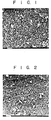
- Fig. 1 is a scanning electron micrograph (magnification of 10,000) showing an example of the precursor.
- the precursor is baked at 700 to 1,000°C in the second stage of this invention.
- the baking permits the precursor to be crystallized completely so as to provide a barium-ferrite series crystalline powder consisting of regular hexagonal plate-shaped microcrystals.
- the crystallization proceeds in the baking step, with the particle size, particle size distribution and crystal contour of the precursor kept substantially unchanged. In other words, there can be obtained fine particles having a particle size, i.e., distance between two parallel sides of the hexagon, of 0.05 to 0.5 pm and a narrow particle size distribution.
- the baking temperature should range between 850°C and 950°C.
- the baking is conducted for a period of time sufficient to complete the crystallization of the precursor and is usually carried out for about 1 hour (or more).
- a rotary kiln or baking furnace of fluidized bed type is used in the baking step.
- Fig. 2 is a scanning electron micrograph (magnification of 10,000) showing an example of barium-ferrite series crystalline powder obtained after the baking step.
- the baked powder is substantially equal to the precursor in the shape of the particle, though the surface of the precursor is more coarse than that of the baked powder.
- What makes the baked powder decisively different from the precursor is the magnetic properties.
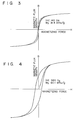
- Figs. 3 and 4 show magnetization curves, i.e., so-called "B-H curves", of the precursor and baked powder, respectively. It is seen from Fig. 3 that the precursor scarcely exhibits a permanent magnetization property, whereas Fig. 4 substantiates that the baked powder sufficiently exhibits a permanent magnetization property.
- the difference in magnetic properties between the two can also be seen from completeness of the microcrystals, e.g., half value width in X-ray diffraction analysis.
- the half value width of the baked powder is very small as compared to that of the precursor: for example, the half value width for (006) plane of the crystal of the baked powder is 1/2 to 1/4 of that of the precursor.
- the baking treatment in the second stage permmits the precursor to be crystallized completely so as to produce a barium-ferrite series microcrystalline powder having desired values of coercive force (iHc) and saturated magnetization (Ms). It is important to note that sintering or reaction does not take place among the particles of the precursor in the baking step, with the result that the baked powder is substantially equal to the precursor in particle size and particle size distribution, as described previously.
- iHc coercive force
- Ms saturated magnetization
- a mixture consisting of 1,000 ml of an aqueous solution containing 2.0 mols/i (M) of FeCl 2 , 210 ml of an aqueous solution containing 1.0 M of BaCl 2 , 154 ml of an aqueous solution containing 1.0 M of CoCl 2 and 154 mi of an aqueous solution containing 1.0 M of TiCi4 was cooled to a temperature lower than 20°C, followed by adding the cooled mixture to 1,000 ml of an aqueous solution containing 10 M of NaOH to prepare an aqueous solution exhibiting a pH value of 13 and containing brown precipitates.
- the resultant aqueous solution was put in an autoclave and heated at 200°C for 1 hour to precipitate a precursor of powder having a chemical composition of BaO ⁇ 6(Fe 0.86 Co 0.07 Ti 0.07 ) 2 O 3 .
- the precursor was water-washed and, then, dried, followed by baking the dried precursor at 900°C for 45 minutes in a rotary kiln to obtain a barium-ferrite series hexagonal microcrystalline powder exhibiting a ferromagnetic property.
- the baked powder was found to consist of regular hexagonal plate-shaped microcrystals having a diameter- to-thickness ratio of at least 10, i.e., ratio of distance between two opposite corners of hexagon with respect to the center of the hexagon to the thickness of the hexagonal plate. Also, the particle size, i.e., distance between two parallel sides of hexagon, of the baked powder was found to fall within the range of 0.1 to 0.3 ⁇ m.
- Fig. 5 shows the particle size distribution of the barium-ferrite series microcrystalline powder obtained in Example 1 in comparison with that of the powder produced by the conventional hydrothermal synthesis.
- Curves a and b shown in Fig. 5 represent the present invention and the prior art, respectively. It is clearly seen that the powder produced by the method of this invention is markedly narrower in the particle size distribution than the powder produced by the conventional method.
- a mixture consisting of 1,000 ml of an aqueous solution containing 2.0 M of FeCl 3 and 160 mi of an aqueous solution containing 1.0 M of BaCl 2 was cooled to a temperature below 20°C, followed by adding the cooled mixture to 1,000 ml of an aqueous solution containing 10 M of NaOH to prepare a solution exhibiting a pH value of 13 and containing brown precipitates.
- the solution thus prepared was put in an autoclave and heated at 200° C for 1 hour to precipitate a precursor of powder having a chemical composition of BaO ⁇ 6Fe 2 O 3 .
- the precursor was water-washed and, then, dried, followed by baking the dried precursor at 920°C for 1 hour in a baking furnace of fluidized bed type so as to obtain a barium-ferrite series hexagonal microcrystalline powder having an average particle size of 0.1 to 0.3 ⁇ m.
Landscapes
- Chemical & Material Sciences (AREA)
- Organic Chemistry (AREA)
- Inorganic Chemistry (AREA)
- Engineering & Computer Science (AREA)
- Ceramic Engineering (AREA)
- Structural Engineering (AREA)
- Materials Engineering (AREA)
- Life Sciences & Earth Sciences (AREA)
- General Life Sciences & Earth Sciences (AREA)
- Geology (AREA)
- Manufacturing & Machinery (AREA)
- Power Engineering (AREA)
- Hard Magnetic Materials (AREA)
- Compounds Of Iron (AREA)
Applications Claiming Priority (2)
| Application Number | Priority Date | Filing Date | Title |
|---|---|---|---|
| JP59943/80 | 1980-05-08 | ||
| JP55059943A JPS6012973B2 (ja) | 1980-05-08 | 1980-05-08 | Ba−フエライト粉末の製造方法 |
Publications (2)
| Publication Number | Publication Date |
|---|---|
| EP0039773A1 true EP0039773A1 (fr) | 1981-11-18 |
| EP0039773B1 EP0039773B1 (fr) | 1985-09-04 |
Family
ID=13127725
Family Applications (1)
| Application Number | Title | Priority Date | Filing Date |
|---|---|---|---|
| EP81102435A Expired EP0039773B1 (fr) | 1980-05-08 | 1981-03-31 | Méthode de production de poudre de la série ferrite de baryum |
Country Status (6)
| Country | Link |
|---|---|
| US (1) | US4414124A (fr) |
| EP (1) | EP0039773B1 (fr) |
| JP (1) | JPS6012973B2 (fr) |
| KR (1) | KR840000960B1 (fr) |
| AU (1) | AU528987B2 (fr) |
| DE (1) | DE3172106D1 (fr) |
Cited By (13)
| Publication number | Priority date | Publication date | Assignee | Title |
|---|---|---|---|---|
| EP0102819A1 (fr) * | 1982-08-31 | 1984-03-14 | Toda Kogyo Corp. | Particules de ferrite de baryum pour milieux d'enregistrement magnétiques |
| FR2549821A1 (fr) * | 1983-07-28 | 1985-02-01 | Central Glass Co Ltd | Procede par voie humide de preparation de particules fines de ferrite ayant une structure de magnetoplumbite |
| EP0141558A1 (fr) * | 1983-10-12 | 1985-05-15 | Toda Kogyo Corp. | Procédé pour la fabrication de particules de ferrite de baryum pour enregistreurs magnétiques. |
| EP0116449A3 (en) * | 1983-02-05 | 1985-12-18 | Toda Kogyo Corp | Barium ferrite particles for magnetic recording media |
| US4561988A (en) * | 1983-10-31 | 1985-12-31 | Toda Kogyo Corporation | Process for production of plate-like barium ferrite particles for magnetic recording |
| FR2574397A1 (fr) * | 1984-12-11 | 1986-06-13 | Centre Nat Rech Scient | Procede de preparation de ferrites hexagonales aimantees - utilisation de ces ferrites comme materiaux de base pour aimants ou pour l'enregistrement magnetique |
| EP0164251A3 (en) * | 1984-05-31 | 1986-12-10 | Toda Kogyo Corp | Barium ferrite particles for magnetic recording media |
| EP0178269A3 (en) * | 1984-10-12 | 1987-01-28 | Consiglio Nazionale Delle Ricerche | Method for the preparation of fine hexagonal ferrite powders, in particular, for magnetic recording |
| EP0137949A3 (en) * | 1983-08-19 | 1987-08-26 | Kabushiki Kaisha Toshiba | Magnetic recording medium |
| EP0223050A3 (fr) * | 1985-10-23 | 1988-11-23 | Bayer Ag | Pigments d'hexaferrite isométriques finement divisés, procédé pour leur préparation et leur utilisation |
| EP0332990A3 (en) * | 1988-03-17 | 1990-08-29 | Bayer Ag | Particulate magnetic hexaferrite pigments containing potassium from precipitated magnetite, process for their production and their use |
| EP0346123A3 (en) * | 1988-06-08 | 1990-11-14 | Toda Kogyo Corp. | Plate-like composite ferrite particles for magnetic recording and process for producing the same |
| WO2022079074A1 (fr) * | 2020-10-13 | 2022-04-21 | Aarhus Universitet | Propriétés magnétiques améliorées par alignement de constituants non magnétiques |
Families Citing this family (24)
| Publication number | Priority date | Publication date | Assignee | Title |
|---|---|---|---|---|
| JPS5964531A (ja) * | 1982-09-30 | 1984-04-12 | Toshiba Corp | Ba―フェライト磁性粉末の製造方法 |
| JPS59102823A (ja) * | 1982-11-30 | 1984-06-14 | Toshiba Corp | 高密度記録用磁性粉の製造方法 |
| JPS59175707A (ja) * | 1983-03-26 | 1984-10-04 | Toda Kogyo Corp | 磁気記録用板状Baフエライト微粒子粉末及びその製造法 |
| JPS6046932A (ja) * | 1983-08-23 | 1985-03-14 | Toshiba Corp | 六方晶系フエライト磁性粉の製造方法 |
| JPS60137002A (ja) * | 1983-12-26 | 1985-07-20 | Toda Kogyo Corp | 磁気記録用板状Baフエライト微粒子粉末の製造法 |
| JPS60158604A (ja) * | 1984-01-27 | 1985-08-20 | Ricoh Co Ltd | 金属酸化物磁性体及び磁性膜 |
| JPS60255629A (ja) * | 1984-05-31 | 1985-12-17 | Toda Kogyo Corp | 磁気記録用板状Baフェライト微粒子粉末及びその製造法 |
| JPS61168532A (ja) * | 1984-08-23 | 1986-07-30 | Sakai Chem Ind Co Ltd | 磁気記録用バリウムフェライト微結晶の製造方法 |
| JPS61101450A (ja) * | 1984-10-24 | 1986-05-20 | 新技術開発事業団 | 非晶質強磁性酸化物 |
| JPH08702B2 (ja) * | 1985-04-04 | 1996-01-10 | 石原産業株式会社 | 磁気記録用強磁性微粉末の製造方法 |
| JPS621123A (ja) * | 1985-06-26 | 1987-01-07 | Sony Corp | 磁気転写方法 |
| US4781852A (en) * | 1986-10-24 | 1988-11-01 | Olin Corporation | Process for making selected doped barium and strontium hexaferrite particles |
| US4781981A (en) * | 1986-12-19 | 1988-11-01 | Toda Kogyo Corp. | Plate-like magnetoplumbite ferrite particles for magnetic recording and process for producing the same |
| DE3702036A1 (de) * | 1987-01-24 | 1988-08-04 | Basf Ag | Feststoff zur herstellung hexagonaler ferrite |
| US4778734A (en) * | 1987-02-03 | 1988-10-18 | Ube Industries, Ltd. | Barium ferrite magnetic powder and magnetic recording medium containing the same |
| US5585032A (en) * | 1987-04-21 | 1996-12-17 | Ishihara Sangyo Kaisha, Ltd. | Ferromagnetic fine powder for magnetic recording |
| EP0310682B1 (fr) * | 1987-04-21 | 1994-03-02 | Ishihara Sangyo Kaisha Ltd. | Poudre ferromagnetique fine pour enregistrement magnetique |
| JPH01305826A (ja) * | 1988-06-01 | 1989-12-11 | Sakai Chem Ind Co Ltd | 板状バリウムフエライト微粉末の製造方法 |
| JPH0620254A (ja) * | 1992-07-03 | 1994-01-28 | Tdk Corp | 磁気記録媒体およびその製造方法 |
| US5268249A (en) * | 1992-10-29 | 1993-12-07 | Eastman Kodak Company | Magnetic carrier particles |
| US5306592A (en) * | 1992-10-29 | 1994-04-26 | Eastman Kodak Company | Method of preparing electrographic magnetic carrier particles |
| JPH06208917A (ja) * | 1993-09-01 | 1994-07-26 | Toshiba Corp | 磁気記録用磁性粉およびそれを用いた磁気記録媒体 |
| JP2796058B2 (ja) * | 1994-03-17 | 1998-09-10 | 株式会社東芝 | 磁気記録媒体 |
| FR2785281B1 (fr) * | 1999-07-05 | 2001-04-27 | Ugimag Sa | Procede de fabrication de poudres ou biscuits d'hexaferrites de type m |
Citations (2)
| Publication number | Priority date | Publication date | Assignee | Title |
|---|---|---|---|---|
| GB908218A (en) * | 1960-05-31 | 1962-10-17 | Ici Ltd | Non-metallic magnetic materials |
| US4025449A (en) * | 1975-10-21 | 1977-05-24 | The Dow Chemical Company | Process to produce barium and strontium ferrite |
Family Cites Families (1)
| Publication number | Priority date | Publication date | Assignee | Title |
|---|---|---|---|---|
| US3634254A (en) * | 1969-06-16 | 1972-01-11 | Gen Motors Corp | Method of coprecipitating hexagonal ferrites |
-
1980
- 1980-05-08 JP JP55059943A patent/JPS6012973B2/ja not_active Expired
-
1981
- 1981-03-26 KR KR1019810000996A patent/KR840000960B1/ko not_active Expired
- 1981-03-31 EP EP81102435A patent/EP0039773B1/fr not_active Expired
- 1981-03-31 DE DE8181102435T patent/DE3172106D1/de not_active Expired
- 1981-04-03 US US06/250,555 patent/US4414124A/en not_active Expired - Lifetime
- 1981-04-07 AU AU69148/81A patent/AU528987B2/en not_active Ceased
Patent Citations (2)
| Publication number | Priority date | Publication date | Assignee | Title |
|---|---|---|---|---|
| GB908218A (en) * | 1960-05-31 | 1962-10-17 | Ici Ltd | Non-metallic magnetic materials |
| US4025449A (en) * | 1975-10-21 | 1977-05-24 | The Dow Chemical Company | Process to produce barium and strontium ferrite |
Non-Patent Citations (3)
| Title |
|---|
| CHEMICAL ABSTRACTS, Vol. 73, No. 4, 27th July 1970, page 373, No. 19816z Columbus, Ohio, U.S.A. L.YA. MODIN: "Selection of the type of Hardening furnace for Ferritization of Barium Ferrite Powders" & Porosh. Met. 1970, 10(2), 98-103 * Abstract * * |
| CHEMICAL ABSTRACTS, Vol. 87, No. 4, 25th July 1977, page 678, No. 32957e Columbus Ohio, U.S.A. L. GIARDA et al.: "Advantages of the Fluidized Bed Technique for the Preparation of Hard Ferrite Powders" & J. Phys. (Paris), Colloq. 1977, (1), 325-328 *Abstract* * |
| Derwent Japanese Patents Report, (Derw. Public. Ltd., England), Vol. T, No. 29, 22nd August 1972, Section L, page 2 & JP-A-47 025796 (Seisan Kai Hatsu KagakuKenkyusho) *complete Abstract* * |
Cited By (17)
| Publication number | Priority date | Publication date | Assignee | Title |
|---|---|---|---|---|
| EP0102819A1 (fr) * | 1982-08-31 | 1984-03-14 | Toda Kogyo Corp. | Particules de ferrite de baryum pour milieux d'enregistrement magnétiques |
| US4539129A (en) * | 1982-08-31 | 1985-09-03 | Toda Kogyo Corp. | Barium ferrite particles and process for producing said particles |
| EP0116449A3 (en) * | 1983-02-05 | 1985-12-18 | Toda Kogyo Corp | Barium ferrite particles for magnetic recording media |
| FR2549821A1 (fr) * | 1983-07-28 | 1985-02-01 | Central Glass Co Ltd | Procede par voie humide de preparation de particules fines de ferrite ayant une structure de magnetoplumbite |
| EP0137949A3 (en) * | 1983-08-19 | 1987-08-26 | Kabushiki Kaisha Toshiba | Magnetic recording medium |
| EP0141558A1 (fr) * | 1983-10-12 | 1985-05-15 | Toda Kogyo Corp. | Procédé pour la fabrication de particules de ferrite de baryum pour enregistreurs magnétiques. |
| US4561988A (en) * | 1983-10-31 | 1985-12-31 | Toda Kogyo Corporation | Process for production of plate-like barium ferrite particles for magnetic recording |
| EP0164251A3 (en) * | 1984-05-31 | 1986-12-10 | Toda Kogyo Corp | Barium ferrite particles for magnetic recording media |
| EP0178269A3 (en) * | 1984-10-12 | 1987-01-28 | Consiglio Nazionale Delle Ricerche | Method for the preparation of fine hexagonal ferrite powders, in particular, for magnetic recording |
| EP0186603A1 (fr) * | 1984-12-11 | 1986-07-02 | Etablissement Public dit: CENTRE NATIONAL DE LA RECHERCHE SCIENTIFIQUE (CNRS) | Procédé de préparation de ferrites hexagonales aimantées - utilisation de ces ferrites comme matériaux de base pour aimants ou pour l'enregistrement magnétique |
| FR2574397A1 (fr) * | 1984-12-11 | 1986-06-13 | Centre Nat Rech Scient | Procede de preparation de ferrites hexagonales aimantees - utilisation de ces ferrites comme materiaux de base pour aimants ou pour l'enregistrement magnetique |
| EP0223050A3 (fr) * | 1985-10-23 | 1988-11-23 | Bayer Ag | Pigments d'hexaferrite isométriques finement divisés, procédé pour leur préparation et leur utilisation |
| EP0332990A3 (en) * | 1988-03-17 | 1990-08-29 | Bayer Ag | Particulate magnetic hexaferrite pigments containing potassium from precipitated magnetite, process for their production and their use |
| EP0346123A3 (en) * | 1988-06-08 | 1990-11-14 | Toda Kogyo Corp. | Plate-like composite ferrite particles for magnetic recording and process for producing the same |
| US5075169A (en) * | 1988-06-08 | 1991-12-24 | Toda Kogyo Corp. | Plate-like composite ferrite particles for magnetic recording and process for producing the same |
| WO2022079074A1 (fr) * | 2020-10-13 | 2022-04-21 | Aarhus Universitet | Propriétés magnétiques améliorées par alignement de constituants non magnétiques |
| KR20230085157A (ko) * | 2020-10-13 | 2023-06-13 | 오르후스 우니베르시테트 | 비자성 성분의 정렬을 통한 증강된 자기적 특성 |
Also Published As
| Publication number | Publication date |
|---|---|
| JPS56160328A (en) | 1981-12-10 |
| KR840000960B1 (ko) | 1984-07-02 |
| US4414124A (en) | 1983-11-08 |
| EP0039773B1 (fr) | 1985-09-04 |
| JPS6012973B2 (ja) | 1985-04-04 |
| AU528987B2 (en) | 1983-05-19 |
| DE3172106D1 (en) | 1985-10-10 |
| AU6914881A (en) | 1981-11-12 |
| KR830005056A (ko) | 1983-07-23 |
Similar Documents
| Publication | Publication Date | Title |
|---|---|---|
| EP0039773A1 (fr) | Méthode de production de poudre de la série ferrite de baryum | |
| US4664831A (en) | Preparation of finely divided ferrite powders | |
| US4425250A (en) | Preparation of finely divided ferrite powders | |
| JPH0261418B2 (fr) | ||
| US4820433A (en) | Magnetic powder for magnetic recording | |
| US4671885A (en) | Process for the preparation of magnetized hexagonal ferrites, use of these ferrites as base materials for magnets or for magnetic recording | |
| KR960002626B1 (ko) | 판상 바륨페라이트 미분말의 제조방법 | |
| US5078984A (en) | Process for producing microcrystalline barium ferrite platelets | |
| JPH0359007B2 (fr) | ||
| JPH025692B2 (fr) | ||
| JPH0359008B2 (fr) | ||
| JPH04362020A (ja) | フェライト磁性粉及びその製造方法 | |
| JP2958370B2 (ja) | 複合フェライト磁性粉の製造方法 | |
| JPS62138330A (ja) | 磁気記録用磁性粉の製造方法 | |
| JPH0581531B2 (fr) | ||
| JP2958369B2 (ja) | 複合フェライト磁性粉の製造方法 | |
| JPH04362019A (ja) | フェライト磁性粉及びその製造法 | |
| JPH05319831A (ja) | フェライト磁性粉及びその製造方法 | |
| JPS63260107A (ja) | 磁気記録用磁性粉 | |
| JPH0669013A (ja) | フェライト磁性粉 | |
| JPH02133323A (ja) | マグネトプランバイト型フェライト磁性粉の製造方法 | |
| JPH04362021A (ja) | フェライト磁性粉及びその製造方法 | |
| JPH05326237A (ja) | 複合フェライト磁性粉及びその製造方法 | |
| JPS63260106A (ja) | 磁気記録用磁性粉 | |
| JPS63260105A (ja) | 磁気記録用磁性粉 |
Legal Events
| Date | Code | Title | Description |
|---|---|---|---|
| PUAI | Public reference made under article 153(3) epc to a published international application that has entered the european phase |
Free format text: ORIGINAL CODE: 0009012 |
|
| AK | Designated contracting states |
Designated state(s): DE FR GB IT NL |
|
| 17P | Request for examination filed |
Effective date: 19810402 |
|
| RAP1 | Party data changed (applicant data changed or rights of an application transferred) |
Owner name: KABUSHIKI KAISHA TOSHIBA |
|
| ITF | It: translation for a ep patent filed | ||
| GRAA | (expected) grant |
Free format text: ORIGINAL CODE: 0009210 |
|
| AK | Designated contracting states |
Designated state(s): DE FR GB IT NL |
|
| REF | Corresponds to: |
Ref document number: 3172106 Country of ref document: DE Date of ref document: 19851010 |
|
| ET | Fr: translation filed | ||
| PLBI | Opposition filed |
Free format text: ORIGINAL CODE: 0009260 |
|
| 26 | Opposition filed |
Opponent name: BASF AKTIENGESELLSCHAFT, LUDWIGSHAFEN Effective date: 19860530 |
|
| NLR1 | Nl: opposition has been filed with the epo |
Opponent name: BASF AKTIENGESELLSCHAFT |
|
| PGFP | Annual fee paid to national office [announced via postgrant information from national office to epo] |
Ref country code: FR Payment date: 19900319 Year of fee payment: 10 |
|
| ITTA | It: last paid annual fee | ||
| PGFP | Annual fee paid to national office [announced via postgrant information from national office to epo] |
Ref country code: NL Payment date: 19900331 Year of fee payment: 10 Ref country code: GB Payment date: 19900331 Year of fee payment: 10 |
|
| PGFP | Annual fee paid to national office [announced via postgrant information from national office to epo] |
Ref country code: DE Payment date: 19900430 Year of fee payment: 10 |
|
| RDAG | Patent revoked |
Free format text: ORIGINAL CODE: 0009271 |
|
| STAA | Information on the status of an ep patent application or granted ep patent |
Free format text: STATUS: PATENT REVOKED |
|
| 27W | Patent revoked |
Effective date: 19900718 |
|
| GBPR | Gb: patent revoked under art. 102 of the ep convention designating the uk as contracting state | ||
| NLR2 | Nl: decision of opposition | ||
| APAH | Appeal reference modified |
Free format text: ORIGINAL CODE: EPIDOSCREFNO |