EP0049697B1 - Verfahren zum Steuern eines steuerbaren Fahrzeuges entlang einer Leitlinie - Google Patents
Verfahren zum Steuern eines steuerbaren Fahrzeuges entlang einer Leitlinie Download PDFInfo
- Publication number
- EP0049697B1 EP0049697B1 EP81850175A EP81850175A EP0049697B1 EP 0049697 B1 EP0049697 B1 EP 0049697B1 EP 81850175 A EP81850175 A EP 81850175A EP 81850175 A EP81850175 A EP 81850175A EP 0049697 B1 EP0049697 B1 EP 0049697B1
- Authority
- EP
- European Patent Office
- Prior art keywords
- vehicle
- steering
- marking
- guide line
- distance
- Prior art date
- Legal status (The legal status is an assumption and is not a legal conclusion. Google has not performed a legal analysis and makes no representation as to the accuracy of the status listed.)
- Expired
Links
Images

Classifications
-
- G—PHYSICS
- G05—CONTROLLING; REGULATING
- G05D—SYSTEMS FOR CONTROLLING OR REGULATING NON-ELECTRIC VARIABLES
- G05D1/00—Control of position, course, altitude or attitude of land, water, air or space vehicles, e.g. using automatic pilots
- G05D1/02—Control of position or course in two dimensions
- G05D1/021—Control of position or course in two dimensions specially adapted to land vehicles
- G05D1/0231—Control of position or course in two dimensions specially adapted to land vehicles using optical position detecting means
-
- G—PHYSICS
- G05—CONTROLLING; REGULATING
- G05D—SYSTEMS FOR CONTROLLING OR REGULATING NON-ELECTRIC VARIABLES
- G05D1/00—Control of position, course, altitude or attitude of land, water, air or space vehicles, e.g. using automatic pilots
- G05D1/02—Control of position or course in two dimensions
- G05D1/021—Control of position or course in two dimensions specially adapted to land vehicles
- G05D1/0259—Control of position or course in two dimensions specially adapted to land vehicles using magnetic or electromagnetic means
-
- G—PHYSICS
- G05—CONTROLLING; REGULATING
- G05D—SYSTEMS FOR CONTROLLING OR REGULATING NON-ELECTRIC VARIABLES
- G05D1/00—Control of position, course, altitude or attitude of land, water, air or space vehicles, e.g. using automatic pilots
- G05D1/02—Control of position or course in two dimensions
- G05D1/021—Control of position or course in two dimensions specially adapted to land vehicles
- G05D1/0268—Control of position or course in two dimensions specially adapted to land vehicles using internal positioning means
- G05D1/0272—Control of position or course in two dimensions specially adapted to land vehicles using internal positioning means comprising means for registering the travel distance, e.g. revolutions of wheels
Definitions
- the invention relates to a method for steering a steerable vehicle along a guide line marking, of the kind recited in the preamble of the claim.
- the present invention also envisages the steering of a steerable vehicle along a guide line marking, which may be an electric wire imbedded in the ground or a line to be sensed by optical means.
- a guide line marking which may be an electric wire imbedded in the ground or a line to be sensed by optical means.
- the steering problem is seen as similar to that of steering a car where the driver can only observe his whereabouts by observing the guide line through a slit made in the floor of the vehicle perpendicular to the orientation of the vehicle and so narrow that the direction of the line cannot be instantaneously determined. Thus, a single observation will not be sufficient for knowing how the steering-wheel should be set.
- this problem is solved, using the concept of measuring two successive lateral deviations as recited in the preamble of the claim, by adding the steps recited in the characterizing clause of the claim.
- the invention may be used for steering a vehicle along a continuous guide line marking, but it may also be used alternatingly with steering along a track programmed into the vehicle itself, as described in our Swedish Patent 7900933-2.
- the linear detector is suitable to arrange the linear detector on the longitudinal centerline of the vehicle, i.e. on the line of symmetry and perpendicular thereto.
- Technical conditions such as steering geometry, control functions, response times of the steering arrangement and space considerations will determine where the linear detector should be placed to produce stable steering with good precision at the speeds to be used.
- the same linear detector can suitably be used to steer the vehicle both forwards and backwards.
- Fig. 1 shows schematically how the intended steering principle can be embodied.
- a line L is marked on a floor on which the vehicle is to be driven.
- the vehicle is provided with a linear detector, schematically represented as D, which is rigidly mounted in the vehicle perpendicular to its forward direction of movement.
- the center point or index point I of the linear detector describes, as the vehicle moves, a curve, the projection of which on the floor forms the curve T.
- the detector finds that the marking L is at a distance ⁇ X 1 , from the index point I.
- the steerable wheels of the vehicle should now be activated so that ⁇ p and Ax approach zero. If sufficiently frequent measurements are made, one can make the assumption that the index point I, which is here identical with the midpoint of the linear detector, follows a circular arc, and that the radius of curvature of the vehicle is virtually constant between three measurements. It is possible to set up a steering equation to compute a setting for a steered wheel for returning the vehicle to follow the path L. It is assumed that at a certain moment the vehicle is found to have the attitude ⁇ 2 , that the preceding attitude was ⁇ 1 , and that the prevailing lateral deviation is ⁇ X 3 . A suitable steering setting 6 can then be computed from the following equation:
- At 2 is the time for covering the distance s 2 in Fig. 1, and a, b, c, d and e o are constants.
- the time-dependent factors provide stable movement at higher speeds, where inertial forces must be taken in account.
- a corresponding compensation can occur if Ax is relatively large and (p is small but has an opposite sign. This is due to the fact that, with suitable normalization of ⁇ and ⁇ , a should be given a larger weighting factor than c in equation (2). For the case where Ax is relatively significant and (p is small, the swinging-in will start with an initially increasing ⁇ .
- the linear detector used can be an optical detector, and in this case what is intended is a unit consisting of a row of photodiodes, onto which a slot-shaped surface on the floor is projected by means of optical instrument components such as lenses and mirrors.
- the light-sensitive photodiodes each read an individual portion of the slot-shaped detection area, and it is preferable to use a commercially available diode arrangement where the response signal of the diodes can be read in series, thus facilitating computerized reading.
- Such a system of optical lines makes the construction of a path very simple.
- a conductor is arranged in the floor in a known manner, and emits electromagnetic signals by alternating current being led through it.
- the linear detector can then consist of two receiving coils (antenna) placed on either side of the longitudinal centreline of the vehicle. When the two coils receive equally strong signals, Ax is zero, while Ax differs more or less from zero if one coil senses the signals more strongly than the other. This also provides a quantitative measure of Ax, albeit as a rule with somewhat poorer precision than that which is possible with optical sensing of a painted line. It is also possible to work analogously with passive electromagnetic markings such as permanent- magnetic elements, magnetic tape etc. if the positions thereof are designed to be measured more or less quantitatively along a linear detector suited thereto.
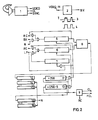
- Fig. 2 shows schematically an example of a device for recognizing the position on the floor of a line pattern.
- a video camera 1 is directed towards the floor, which displays the linear pattern P transverse to the camera.
- the video camera 1 is suitably a single-row photodiode matrix, e.g. manufactured by Reticon, and divides a line image into 256 elements.
- a video signal is emitted, consisting of an analog signal for each element.
- the video signals are conducted to a threshold detector 2, which emits binary signals; i.e. 256 bits are emitted, which are 0 or 1 depending on if the intensity is sufficient to indicate the presence of the marking in the photo-element.
- 3 represents a video signal prior to digitalization, with the threshold value T drawn in, and 4 shows the resulting binary video signal.
- This signal designated BV, is read in via a gate system into a binary shift register 5 with 256 bits.
- An ideal pattern, corresponding to the expected configuration (here two lines of different width) is read into a pattern memory 7. To determine lateral deviation, a correlation operation is now carried out.
- shift register 5 and shift register 7 should in principle contain identical bit series. Through a special comparison which will be described, a lateral deviation can be determined.
- Fig. 2 there are two different clock signals, namely the signal CL coming from the camera 1 and synchronized with the video signal, and a fast clock signal FCL which is used for transferring and coordinating purposes.
- the signal CL is used, which is introduced via the switch 9, and under the control of a shift-pulse counter 11, which shuts off when all of the 256 bits have been read in, and under the control of a control signal R.
- the fast clock signal FCL is led under the control of the shift-pulse counter 11 to the clock input on the shift register 5 and under the control of the shift-pulse counter 10 to the clock input on the shift register 6.
- the signals coming from the shift registers each go to an individual input of a comparator 8, and are also recirculated under the control of a recirculating signal RC, so as to circulate the respective shift registers.
- the comparator sends a signal upon agreement, and the agreement signals are counted in a counter 12, which is provided with parallel outputs coupled to a comparator 14, which is also coupled to a memory 13.
- the shift-pulse counter 10 Due to the fact that the shift-pulse counter 10 has the division factor (256+1), it will send an out-signal one pulse later, so that the shift register 6 will be shifted one pulse for each circulation. This pulse number 257 continues to a pulse counter 15 which counts the number of separate comparisons, and after 256 cycles sends a stop signal.
- the number of agreements signalled from the comparator 8 is counted, and if the number of agreements exceeds the number stored in the memory 13, the circuit 14 will bring the higher numberto the memory 13. At the same time the number in the counter 15 is taken into the memory 16. When the pulse counter 15 is full, when 256 comparisons have been made, there will be a number in the memory 16 which corresponds to the displacement between the shift registers 5 and 6 which produces the best agreement. It is.then known how the pattern P lies in relation to the scanning field of the camera 1, at the same time as a ready-signal N is emitted from the pulse counter 15.
- control signals must be taken from a separate control unit which determines the operational sequence by sending signals R and LP at the beginning of each sampling sequence and then requesting a comparison by the signal RC.
- the sampling result can then be taken from the memory 16 as a measure of the lateral error; for example so that the number 128 designates that the camera/ vehicle is directly over the marking (the position of the index point), a lower number indicating a lateral deviation to the left and a higher number a lateral deviation to the right of the index point.
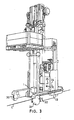
- Fig. 3 shows a steerable wheeled vehicle in the form of a fork-lift truck which runs on wheels 30, 31 and 33, of which wheel 33 is steerable by means of arrangements 34 and 35.
- the linear detector 1 according to the invention is mounted so that it senses the path marking L.
- Sensors 32 are placed at the unsteered wheels, to sense the rotation of the respective wheels.
- the sensors are magnetic and sense the passage of teeth on toothed rims on the wheels, whereby the distance travelled can be determined.
- the steering according to the invention is effected by setting a steering angle, computed according to equation (2), for the wheel 33 by means of the arrangements 34 and 35.
- the rolled-off measurement is arranged on two different wheels, it is suitable to take, as a measure of the distance between two positions of the vehicle, an average between the measured distances from the wheels 30 and 31.
Landscapes
- Physics & Mathematics (AREA)
- Engineering & Computer Science (AREA)
- Electromagnetism (AREA)
- Aviation & Aerospace Engineering (AREA)
- Radar, Positioning & Navigation (AREA)
- Remote Sensing (AREA)
- General Physics & Mathematics (AREA)
- Automation & Control Theory (AREA)
- Control Of Position, Course, Altitude, Or Attitude Of Moving Bodies (AREA)
- Steering Controls (AREA)
- Length Measuring Devices By Optical Means (AREA)
Claims (1)
- Verfahren zum Steuern eines steuerbaren Fahrzeuges entlang einer Leitlinienmarkierung (L), wobei im Fahrzeug ein Lineardetektor (1) angeordnet ist, der im wesentlichen senkrecht zur Hauptbewegungsrichtung des Fahrzeuges starr befestigt ist, wodurch der Detektor die Leitlinienmarkierung abtastet, um die Abweichung der Markierung von einem Indexpunkt im Lineardetektor zu bestimmen, wobei für den Fall des Einsetzens einer Seitenabweichung Ax zwei solcher Bestimmungen ΔX1 und ΔX2 and aufeinanderfolgenden unterschiedlichen Stellen entlang des Weges vorgenommen werden, wodurch ein Abstand S1 zwischen den unterschiedlichen Stellen gemessen wird, und wobei der Lagewinkel ϕ1, zwischen der Markierung und dem Fahrzeug aus der Differenz ΔX2-ΔX1, geteilt durch die gefahrene Wegstrecke S1 berechnet wird, wodurch das Lenken durch Zusammenwirken der seitlichen Abweichung und des Lagewinkels vorgenommen wird, dadurch gekennzeichnet, dass eine dritte Bestimmung ΔX3 der Seitenabweichung bei einer gemessenen Weiterbewegungsstrecke S2 vorgenommen wird, dass der neue Lagewinkel ϕ2 unter Verwendung der Differenz ΔX3-ΔX2 und S2 berechnet wird, und dass die Werte ϕ1, ϕ2, ΔX3, Ax2 und ein Wert At2 für die für für die Bewegungsstrecke s2 benötigte Zeit als Werte in einer Lenkgleichung eingegeben wird.

Applications Claiming Priority (2)
| Application Number | Priority Date | Filing Date | Title |
|---|---|---|---|
| SE8006905 | 1980-10-02 | ||
| SE8006905A SE423839B (sv) | 1980-10-02 | 1980-10-02 | Sett och anordning for styrning av ett styrbart hjulfordon |
Publications (2)
| Publication Number | Publication Date |
|---|---|
| EP0049697A1 EP0049697A1 (de) | 1982-04-14 |
| EP0049697B1 true EP0049697B1 (de) | 1986-08-13 |
Family
ID=20341882
Family Applications (1)
| Application Number | Title | Priority Date | Filing Date |
|---|---|---|---|
| EP81850175A Expired EP0049697B1 (de) | 1980-10-02 | 1981-10-01 | Verfahren zum Steuern eines steuerbaren Fahrzeuges entlang einer Leitlinie |
Country Status (5)
| Country | Link |
|---|---|
| US (1) | US4530057A (de) |
| EP (1) | EP0049697B1 (de) |
| JP (1) | JPS5790267A (de) |
| DE (1) | DE3175112D1 (de) |
| SE (1) | SE423839B (de) |
Cited By (1)
| Publication number | Priority date | Publication date | Assignee | Title |
|---|---|---|---|---|
| US5281901A (en) | 1990-12-03 | 1994-01-25 | Eaton-Kenway, Inc. | Downward compatible AGV system and methods |
Families Citing this family (29)
| Publication number | Priority date | Publication date | Assignee | Title |
|---|---|---|---|---|
| DE3332615C2 (de) * | 1982-10-21 | 1987-01-22 | DAC Engineering Co. Ltd., Kyoto | Optisch geführtes Fahrzeug |
| CH668655A5 (de) * | 1985-03-15 | 1989-01-13 | Jd Technologie Ag | Passivspur-einrichtung zur fuehrung und steuerung von fahrerlosen transport- und montageeinheiten. |
| SE449988B (sv) * | 1985-10-15 | 1987-06-01 | Mecanum Ab | Forfarande for finpositionering av fordon i exakta forhallanden till geografiska referensmarkeringar |
| SE449989B (sv) * | 1985-10-15 | 1987-06-01 | Mecanum Ab | Sett att vid fordon med en lyftanordning kompensera avvikelser hos leget pa last pa lyftanordningen i forhallande till fordonsunderredet |
| JPS62105508U (de) * | 1985-12-20 | 1987-07-06 | ||
| JP2665738B2 (ja) * | 1986-07-11 | 1997-10-22 | 株式会社小松製作所 | 地点追従方式による無人移動機械の誘導方法 |
| JP2572968B2 (ja) * | 1986-07-14 | 1997-01-16 | 株式会社椿本チエイン | 自律走行車の誘導方法 |
| FR2610427B1 (fr) * | 1987-02-04 | 1995-09-29 | Protee | Systeme et procede de controle de la marche d'un vehicule autonome |
| JPH0725307B2 (ja) * | 1987-09-25 | 1995-03-22 | 本田技研工業株式会社 | 前輪転舵角の制御方法 |
| US4846297A (en) * | 1987-09-28 | 1989-07-11 | Tennant Company | Automated guided vehicle |
| US4790402A (en) * | 1987-09-28 | 1988-12-13 | Tennant Company | Automated guided vehicle |
| US4942531A (en) * | 1988-05-16 | 1990-07-17 | Bell & Howell Company | Self-adapting signal detector with digital outputs |
| US5172317A (en) * | 1988-08-10 | 1992-12-15 | Honda Giken Kogyo Kabushiki Kaisha | Automatic travelling apparatus |
| US5172315A (en) * | 1988-08-10 | 1992-12-15 | Honda Giken Kogyo Kabushiki Kaisha | Automatic travelling apparatus and method |
| US5040116A (en) * | 1988-09-06 | 1991-08-13 | Transitions Research Corporation | Visual navigation and obstacle avoidance structured light system |
| JP2579808B2 (ja) * | 1988-10-14 | 1997-02-12 | 株式会社椿本チエイン | 移動体の誘導方法及びその装置 |
| US5155684A (en) * | 1988-10-25 | 1992-10-13 | Tennant Company | Guiding an unmanned vehicle by reference to overhead features |
| US5051906A (en) * | 1989-06-07 | 1991-09-24 | Transitions Research Corporation | Mobile robot navigation employing retroreflective ceiling features |
| FR2656435B1 (fr) * | 1989-12-22 | 1996-07-05 | Commissariat Energie Atomique | Procede de recalage sur une trajectoire theorique pour un vehicule en modifiant la courbure de la trajectoire reelle. |
| US5208914A (en) * | 1989-12-29 | 1993-05-04 | Superconductor Systems Limited Partnership | Method and apparatus for non-sequential resource access |
| US5191528A (en) * | 1990-06-28 | 1993-03-02 | Eaton-Kenway, Inc. | Update marker system for naviagtion of an automatic guided vehicle |
| US5216605A (en) * | 1990-06-28 | 1993-06-01 | Eaton-Kenway, Inc. | Update marker system for navigation of an automatic guided vehicle |
| JPH06300581A (ja) * | 1993-04-15 | 1994-10-28 | Fuji Heavy Ind Ltd | 車輛の軌道追従制御装置 |
| KR970066776A (ko) * | 1996-03-29 | 1997-10-13 | 헨리 D.G. 웰레스 | 차량의 제어장치 |
| US7216024B1 (en) * | 1999-07-27 | 2007-05-08 | Linde Aktiengesellschaft | Industrial truck with a stabilizing device |
| US6445984B1 (en) * | 2001-05-25 | 2002-09-03 | The Raymond Corporation | Steer control system for material handling vehicles |
| JP2016111616A (ja) * | 2014-12-09 | 2016-06-20 | キヤノン株式会社 | 情報処理装置および曲線算出方法、画像表示装置 |
| CN109032129B (zh) * | 2018-06-21 | 2021-07-27 | 昆山华恒工程技术中心有限公司 | 路径纠偏方法及装置、路径导引方法、可读介质 |
| CN112987555B (zh) * | 2019-12-12 | 2022-10-11 | 天津大学 | 一种无人驾驶碾压机后退过程的复合抗扰轨迹跟踪控制算法 |
Citations (2)
| Publication number | Priority date | Publication date | Assignee | Title |
|---|---|---|---|---|
| US3715572A (en) * | 1971-03-05 | 1973-02-06 | D Bennett | Vehicle location and heading computer system |
| EP0001505A1 (de) * | 1977-10-07 | 1979-04-18 | The Raymond Corporation | Induktive Leitvorrichtung für ein Fahrzeug |
Family Cites Families (19)
| Publication number | Priority date | Publication date | Assignee | Title |
|---|---|---|---|---|
| US3009525A (en) * | 1955-12-08 | 1961-11-21 | Liban Robert De | Guidance systems |
| US3172496A (en) * | 1962-01-15 | 1965-03-09 | Rabinow Jacob | Vehicle guidance by optical means |
| DE1808442A1 (de) * | 1968-11-12 | 1970-06-11 | Siemens Ag | Steuerung eines Kraftfahrzeugs entlang eines in der Fahrbahn verlegten Leiters |
| US3638751A (en) * | 1969-04-21 | 1972-02-01 | Maschf Augsburg Nuernberg Ag | Apparatus for automatically steering powered vehicles |
| US3612206A (en) * | 1969-07-07 | 1971-10-12 | Eaton Yale & Towne | Automatic guidance system for warehouse trucks and the like |
| US3714625A (en) * | 1971-03-30 | 1973-01-30 | Minnesota Mining & Mfg | Vehicle guidance track of transverse extent |
| JPS5633758B2 (de) * | 1973-05-08 | 1981-08-05 | ||
| GB1470694A (en) * | 1974-06-08 | 1977-04-21 | Marconi Co Ltd | Vehicle location systems |
| DE2609532A1 (de) * | 1975-03-07 | 1976-12-30 | Gilles Dieter | Verfahren und vorrichtung zur positionierung von fahrzeugen |
| US4040500A (en) * | 1975-11-06 | 1977-08-09 | Logisticon, Inc. | Guidance system for lift truck |
| US4083422A (en) * | 1975-11-06 | 1978-04-11 | Logisticon, Inc. | Bolt-on guidance system for lift truck |
| JPS52101533A (en) * | 1976-02-18 | 1977-08-25 | Hitachi Ltd | Device for detecting reflected light for optical guiding type operater less transport vehicle |
| US4044853A (en) * | 1976-04-05 | 1977-08-30 | Jervis B. Webb Company | Driverless vehicle and guidance system |
| DE2752167A1 (de) * | 1977-11-23 | 1979-06-07 | Bosch Gmbh Robert | Vorrichtung zur spurfuehrung eines fahrzeuges |
| JPS54111423A (en) * | 1978-01-19 | 1979-08-31 | Sato Zoki Co Ltd | Position detecter of farming machine |
| US4278142A (en) * | 1978-05-08 | 1981-07-14 | Agency Of Industrial Science And Technology | Automatic guidance system for vehicles |
| US4307791A (en) * | 1978-12-06 | 1981-12-29 | Bell & Howell Company | Line follower vehicle with scanning head |
| JPS5845042B2 (ja) * | 1979-06-15 | 1983-10-06 | 株式会社日立製作所 | 無軌道な移動体の走行軌道制御装置 |
| DE2941507A1 (de) * | 1979-10-12 | 1980-10-23 | Jungheinrich Kg | Anordnung zur fuehrung eines frei verfahrbaren fahrzeuges entlang einer als fuehrungsdraht ausgefuehrten leitlinie |
-
1980
- 1980-10-02 SE SE8006905A patent/SE423839B/sv not_active IP Right Cessation
-
1981
- 1981-10-01 DE DE8181850175T patent/DE3175112D1/de not_active Expired
- 1981-10-01 EP EP81850175A patent/EP0049697B1/de not_active Expired
- 1981-10-02 JP JP56157368A patent/JPS5790267A/ja active Pending
-
1984
- 1984-06-29 US US06/626,466 patent/US4530057A/en not_active Expired - Fee Related
Patent Citations (2)
| Publication number | Priority date | Publication date | Assignee | Title |
|---|---|---|---|---|
| US3715572A (en) * | 1971-03-05 | 1973-02-06 | D Bennett | Vehicle location and heading computer system |
| EP0001505A1 (de) * | 1977-10-07 | 1979-04-18 | The Raymond Corporation | Induktive Leitvorrichtung für ein Fahrzeug |
Cited By (1)
| Publication number | Priority date | Publication date | Assignee | Title |
|---|---|---|---|---|
| US5281901A (en) | 1990-12-03 | 1994-01-25 | Eaton-Kenway, Inc. | Downward compatible AGV system and methods |
Also Published As
| Publication number | Publication date |
|---|---|
| US4530057A (en) | 1985-07-16 |
| DE3175112D1 (en) | 1986-09-18 |
| EP0049697A1 (de) | 1982-04-14 |
| JPS5790267A (en) | 1982-06-04 |
| SE423839B (sv) | 1982-06-07 |
| SE8006905L (sv) | 1982-04-03 |
Similar Documents
| Publication | Publication Date | Title |
|---|---|---|
| EP0049697B1 (de) | Verfahren zum Steuern eines steuerbaren Fahrzeuges entlang einer Leitlinie | |
| EP0050101A1 (de) | Nachstellmethode in einem mittels Koppelnavigation gesteuerten Fahrzeug mit Rädern | |
| KR100264719B1 (ko) | 차량의위치를테스트하기위한측정시스템 | |
| CA2469652C (en) | Driverless vehicle guidance system and method | |
| CA2824189C (en) | Automatic guided vehicle system and method | |
| EP1046568B1 (de) | Messeinrichtung zum Bestimmen einer Fahrzeugbewegung mit Hilfe von Fahrbahnmarkierungen | |
| EP3379289A1 (de) | Automatisches fahrzeugobjekterkennungssystem mit kamerabild und radardatenfusion | |
| ES2198337T3 (es) | Procedimiento y dispositivo para la deteccion de la posicion de un vehiculo en una zona especificada. | |
| US4866617A (en) | Method of guiding an unmanned vehicle | |
| CN104597905B (zh) | 磁导航agv的路径跟踪方法 | |
| SE503587C2 (sv) | Sätt att lotsa förarlösa fordon | |
| CN115605818B (zh) | 通过导线导航机器人割草机的方法 | |
| EP0472028A2 (de) | Fahrzeugsteuersystem mit mehrzweigigen Spuren | |
| WO1988008961A1 (fr) | Systeme detecteur de position | |
| JP2689357B2 (ja) | 相対方位検出方式 | |
| JP2017167640A (ja) | 自動走行車両 | |
| JP3378843B2 (ja) | 無人搬送車の位置および方位の補正装置 | |
| JP3149661B2 (ja) | 無人搬送車の位置同定方法 | |
| JP4382266B2 (ja) | 移動体の位置計測方法及び計測装置 | |
| JP2002108452A (ja) | 無人搬送車の走行制御装置 | |
| JPH10132560A (ja) | 位置計測方法及びその装置 | |
| JPH03189805A (ja) | 車両の自動操舵方法及びその自動操舵装置 | |
| JPH06332531A (ja) | 無人無軌道車 | |
| JP2002182745A (ja) | 無人搬送車の走行制御装置 | |
| JPH07198349A (ja) | 道路形状及び自車両姿勢の計測装置 |
Legal Events
| Date | Code | Title | Description |
|---|---|---|---|
| PUAI | Public reference made under article 153(3) epc to a published international application that has entered the european phase |
Free format text: ORIGINAL CODE: 0009012 |
|
| AK | Designated contracting states |
Designated state(s): BE CH DE FR GB IT |
|
| 17P | Request for examination filed |
Effective date: 19820923 |
|
| ITF | It: translation for a ep patent filed | ||
| GRAA | (expected) grant |
Free format text: ORIGINAL CODE: 0009210 |
|
| AK | Designated contracting states |
Kind code of ref document: B1 Designated state(s): BE CH DE FR GB IT LI |
|
| REF | Corresponds to: |
Ref document number: 3175112 Country of ref document: DE Date of ref document: 19860918 |
|
| ET | Fr: translation filed | ||
| PLBE | No opposition filed within time limit |
Free format text: ORIGINAL CODE: 0009261 |
|
| STAA | Information on the status of an ep patent application or granted ep patent |
Free format text: STATUS: NO OPPOSITION FILED WITHIN TIME LIMIT |
|
| 26N | No opposition filed | ||
| PGFP | Annual fee paid to national office [announced via postgrant information from national office to epo] |
Ref country code: CH Payment date: 19890127 Year of fee payment: 8 |
|
| PG25 | Lapsed in a contracting state [announced via postgrant information from national office to epo] |
Ref country code: GB Effective date: 19891001 |
|
| PG25 | Lapsed in a contracting state [announced via postgrant information from national office to epo] |
Ref country code: LI Effective date: 19891031 Ref country code: CH Effective date: 19891031 Ref country code: BE Effective date: 19891031 |
|
| BERE | Be: lapsed |
Owner name: A.B. VOLVO Effective date: 19891031 |
|
| GBPC | Gb: european patent ceased through non-payment of renewal fee | ||
| PG25 | Lapsed in a contracting state [announced via postgrant information from national office to epo] |
Ref country code: FR Effective date: 19900629 |
|
| REG | Reference to a national code |
Ref country code: CH Ref legal event code: PL |
|
| PG25 | Lapsed in a contracting state [announced via postgrant information from national office to epo] |
Ref country code: DE Effective date: 19900703 |
|
| REG | Reference to a national code |
Ref country code: FR Ref legal event code: ST |