EP0051879B1 - Pyrimidines substituées, leur synthèse et compositions les contenant, leur usage en médecine et intermédiaires pour leur synthèse - Google Patents
Pyrimidines substituées, leur synthèse et compositions les contenant, leur usage en médecine et intermédiaires pour leur synthèse Download PDFInfo
- Publication number
- EP0051879B1 EP0051879B1 EP81109631A EP81109631A EP0051879B1 EP 0051879 B1 EP0051879 B1 EP 0051879B1 EP 81109631 A EP81109631 A EP 81109631A EP 81109631 A EP81109631 A EP 81109631A EP 0051879 B1 EP0051879 B1 EP 0051879B1
- Authority
- EP
- European Patent Office
- Prior art keywords
- diamino
- pyrimidine
- methoxy
- group
- hydrogen
- Prior art date
- Legal status (The legal status is an assumption and is not a legal conclusion. Google has not performed a legal analysis and makes no representation as to the accuracy of the status listed.)
- Expired
Links
- 0 Cc1cc(*)c(*)c(O)c1 Chemical compound Cc1cc(*)c(*)c(O)c1 0.000 description 6
- FNIBYJJRELPYBB-UHFFFAOYSA-N Cc1c(N)[n-][n+](CN)c1 Chemical compound Cc1c(N)[n-][n+](CN)c1 FNIBYJJRELPYBB-UHFFFAOYSA-N 0.000 description 3
- VCICJNSVCWWBNO-UHFFFAOYSA-N CC1=C(N)N=C(N)NC1 Chemical compound CC1=C(N)N=C(N)NC1 VCICJNSVCWWBNO-UHFFFAOYSA-N 0.000 description 1
- SQFOZARARKQFIG-UHFFFAOYSA-N CC1C(N)=NC(N)=NC1 Chemical compound CC1C(N)=NC(N)=NC1 SQFOZARARKQFIG-UHFFFAOYSA-N 0.000 description 1
- RXYIYUOOCZCTQP-UHFFFAOYSA-N Cc1c(N)nc(N)nc1 Chemical compound Cc1c(N)nc(N)nc1 RXYIYUOOCZCTQP-UHFFFAOYSA-N 0.000 description 1
Classifications
-
- C—CHEMISTRY; METALLURGY
- C07—ORGANIC CHEMISTRY
- C07D—HETEROCYCLIC COMPOUNDS
- C07D405/00—Heterocyclic compounds containing both one or more hetero rings having oxygen atoms as the only ring hetero atoms, and one or more rings having nitrogen as the only ring hetero atom
- C07D405/02—Heterocyclic compounds containing both one or more hetero rings having oxygen atoms as the only ring hetero atoms, and one or more rings having nitrogen as the only ring hetero atom containing two hetero rings
- C07D405/06—Heterocyclic compounds containing both one or more hetero rings having oxygen atoms as the only ring hetero atoms, and one or more rings having nitrogen as the only ring hetero atom containing two hetero rings linked by a carbon chain containing only aliphatic carbon atoms
-
- C—CHEMISTRY; METALLURGY
- C07—ORGANIC CHEMISTRY
- C07D—HETEROCYCLIC COMPOUNDS
- C07D239/00—Heterocyclic compounds containing 1,3-diazine or hydrogenated 1,3-diazine rings
- C07D239/02—Heterocyclic compounds containing 1,3-diazine or hydrogenated 1,3-diazine rings not condensed with other rings
- C07D239/24—Heterocyclic compounds containing 1,3-diazine or hydrogenated 1,3-diazine rings not condensed with other rings having three or more double bonds between ring members or between ring members and non-ring members
- C07D239/28—Heterocyclic compounds containing 1,3-diazine or hydrogenated 1,3-diazine rings not condensed with other rings having three or more double bonds between ring members or between ring members and non-ring members with hetero atoms or with carbon atoms having three bonds to hetero atoms with at the most one bond to halogen, directly attached to ring carbon atoms
- C07D239/46—Two or more oxygen, sulphur or nitrogen atoms
- C07D239/48—Two nitrogen atoms
- C07D239/49—Two nitrogen atoms with an aralkyl radical, or substituted aralkyl radical, attached in position 5, e.g. trimethoprim
-
- A—HUMAN NECESSITIES
- A61—MEDICAL OR VETERINARY SCIENCE; HYGIENE
- A61P—SPECIFIC THERAPEUTIC ACTIVITY OF CHEMICAL COMPOUNDS OR MEDICINAL PREPARATIONS
- A61P31/00—Antiinfectives, i.e. antibiotics, antiseptics, chemotherapeutics
- A61P31/04—Antibacterial agents
-
- C—CHEMISTRY; METALLURGY
- C07—ORGANIC CHEMISTRY
- C07C—ACYCLIC OR CARBOCYCLIC COMPOUNDS
- C07C255/00—Carboxylic acid nitriles
-
- C—CHEMISTRY; METALLURGY
- C07—ORGANIC CHEMISTRY
- C07D—HETEROCYCLIC COMPOUNDS
- C07D215/00—Heterocyclic compounds containing quinoline or hydrogenated quinoline ring systems
- C07D215/02—Heterocyclic compounds containing quinoline or hydrogenated quinoline ring systems having no bond between the ring nitrogen atom and a non-ring member or having only hydrogen atoms or carbon atoms directly attached to the ring nitrogen atom
- C07D215/12—Heterocyclic compounds containing quinoline or hydrogenated quinoline ring systems having no bond between the ring nitrogen atom and a non-ring member or having only hydrogen atoms or carbon atoms directly attached to the ring nitrogen atom with substituted hydrocarbon radicals attached to ring carbon atoms
-
- C—CHEMISTRY; METALLURGY
- C07—ORGANIC CHEMISTRY
- C07D—HETEROCYCLIC COMPOUNDS
- C07D215/00—Heterocyclic compounds containing quinoline or hydrogenated quinoline ring systems
- C07D215/02—Heterocyclic compounds containing quinoline or hydrogenated quinoline ring systems having no bond between the ring nitrogen atom and a non-ring member or having only hydrogen atoms or carbon atoms directly attached to the ring nitrogen atom
- C07D215/16—Heterocyclic compounds containing quinoline or hydrogenated quinoline ring systems having no bond between the ring nitrogen atom and a non-ring member or having only hydrogen atoms or carbon atoms directly attached to the ring nitrogen atom with hetero atoms or with carbon atoms having three bonds to hetero atoms with at the most one bond to halogen, e.g. ester or nitrile radicals, directly attached to ring carbon atoms
- C07D215/38—Nitrogen atoms
- C07D215/40—Nitrogen atoms attached in position 8
-
- C—CHEMISTRY; METALLURGY
- C07—ORGANIC CHEMISTRY
- C07D—HETEROCYCLIC COMPOUNDS
- C07D311/00—Heterocyclic compounds containing six-membered rings having one oxygen atom as the only hetero atom, condensed with other rings
- C07D311/02—Heterocyclic compounds containing six-membered rings having one oxygen atom as the only hetero atom, condensed with other rings ortho- or peri-condensed with carbocyclic rings or ring systems
- C07D311/04—Benzo[b]pyrans, not hydrogenated in the carbocyclic ring
- C07D311/58—Benzo[b]pyrans, not hydrogenated in the carbocyclic ring other than with oxygen or sulphur atoms in position 2 or 4
- C07D311/64—Benzo[b]pyrans, not hydrogenated in the carbocyclic ring other than with oxygen or sulphur atoms in position 2 or 4 with oxygen atoms directly attached in position 8
Definitions
- the present invention relates to novel 2,4-diamino-5-(substituted)pyrimidines, to pharmaceutical compositions containing them, to processes for preparing them and their compositions, to intermediates for making them and to their use in the treatment of microbial infections.
- Trimethoprim 2,4-diamino-5-(3,4,5-trimethoxybenzyl)pyrimidine
- U.K. Patent No. 875,562 is the most active general antibacterial agent amongst the 2,4-diamino-5-benzylpyrimidines known to date. Due to their mode of action, these benzylpyrimidines potentiate the antibacterial activity of the sulphonamides and trimethoprim has been used extensively over the last decade in human therapy in combination with various sulphonamides, and in particular with sulphamethoxazole, for the treatment of bacterial infections.
- U.K. Patent Specification No. 957797 discloses inter alia 2,4-diamino-5-(1-naphthylmethyl)pyrimidine which is described as having useful biological activity. Further investigation revealed that this compound was considerably inferior to trimethoprim.
- trimethoprim has an excellent level of activity against most aerobic bacteria its activity against anaerobic bacteria is less impressive and its activity against certain aerobic bacteria could beneficially be improved upon.
- a novel group of 2,4-diamino-5-substituted pyrimidines has now been found many of the compounds having a general level of activity against aerobic bacteria comparable to that of trimethoprim whilst having a superior level of activity against anaerobic bacteria. Some of these compounds are also considerably superior to trimethoprim against gram positive aerobic bacteria, particularly Staphylococcus aureus and some compounds have a different pharmacokinetic profile, for example, a longer half life, than trimethoprim.
- the present invention provides a compound of the formula (I): or a salt, N-oxide or acyl derivative thereof, wherein is a six membered ring optionally containing a hetero atom, both the phenyl ring the (x being optionally substituted except that when does not contain a hetero atom either or both the phenyl ring or must be substituted other than solely by a hydroxy group at the 4-position of the phenyl ring, and; that there are no substituents attached to the atom of adjacent to the 6-position of the phenyl ring.
- the ring may contain one, two or three double bonds.
- the hetero atom is oxygen, nitrogen or sulphur and most suitably it is oxygen or nitrogen.
- Substitution of the phenyl ring is preferably at the 3- and/or 4-position with substituents suitably selected from halogen, alkenyl, alkenyloxy, nitro, cyano, hydroxy, mercapto, alkylthio, substituted sulphonyloxy, substituted sulphonyl, substituted sulphinyl, or substituted carbonyl, optionally substituted amino, optionally substituted alkyl or optionally substituted alkoxy.
- Suitable substituents of the ring are selected from halogen, alkylthio, optionally substituted alkyl or alkoxy, gem dimethyl, oxygen or sulphur.
- Particularly suitable compounds of the formula (II) include those of the formula (III): or a salt, N-oxide or acyl derivative thereof wherein , R 1 and R 2 are as hereinbefore defined and R 9 and R 10 are the same or different and each is hydrogen, halogen, C 2 - 4 alkenyl, C 2 - 3 alkenyloxy, nitro, a group NR 11 R 12 wherein R" and R 12 are the same or different and each is hydrogen, methyl or ethyl or NR 11 R 12 forms a five or six-membered heterocyclic ring, cyano, hydroxy, a group ⁇ S(O) n R 7 or COR 8 as hereinbefore defined, or C 1-4 alkyl or C 1-4 alkoxy each optionally substituted by halogen, hydroxy or C 1-3 alkoxy, except that R 9 and R 10 are not both hydrogen or halogen, that either R 1 and/or R 2 are not attached to the carbon atom adjacent to the 6-position of the
- R 9 is C 2-3 alkenyl, halogen, a group S(O) n R 7 as hereinbefore defined, cyano, amino, mono-C 1-3 -alkyl substituted amino, or C 1-3 alkyl or C 1-3 alkoxy each optionally substituted by halogen, hydroxy or C 1 - 3 alkoxy.
- R 9 is methoxy, ethoxy, methoxyethoxy, methyl, ethyl, propyl,. vinyl, allyl, propenyl, halogen, methylthio, ethylthio.
- R 9 is methyl, methoxy or ethoxy, particularly methoxy.
- R 10 is hydrogen, hydroxy, amino, mono- or di-C 1-3 alkyl substituted amino, nitro, cyano, pyrrolyl, a group ⁇ S(O) n R 7 or ⁇ COR 8 as hereinbefore defined or R 10 is C 1-3 alkoxy optionally substituted by halogen, hydroxy or C 1-3 alkoxy.
- R 10 is hydrogen, hydroxy, methoxy, ethoxy, nitro, amino, methylamino, dimethylamino, ethylamino, diethylamino, methylthio, ethylthio or pyrrolyl.
- R 10 is methoxy, amino, mono- or dimethylamino or methylthio, particularly methoxy, dimethylamino or methylthio.
- R 1 is hydrogen, gem dimethyl, C 1-3 alkyl optionally substituted by halogen, C 1-3 -alk-ylthio or C 1-3 alkoxy optionally substituted by halogen, hydroxy or C 1-2 alkoxy. Most suitably R 1 is hydrogen, methyl, trifluoromethyl or methoxy and preferably R 1 is hydrogen.
- R 2 is hydrogen, C 1-3 alkyl, optionally substituted by halogen, C 1-3 -alkylthio or C 1-3 -alkoxy optionally substituted by halogen, hydroxy or C 1-2 alkoxy. Most suitably R 2 is hydrogen, methyl, trifluoromethyl or methoxy and preferably R 2 is hydrogen.
- R 1 , R 2 , R 9 and R 10 are as hereinbefore defined except that R 9 and R 10 are not both hydrogen or halogen.
- R 1 is hydrogen or methyl and preferably R 1 is hydrogen.
- R 2 is hydrogen or methyl.
- R 9 is methoxy, ethoxy or methylthio.
- R 6 is methoxy or ethoxy.
- R 10 is hydrogen, methoxy, ethoxy, methylthio or a group NR 13 R 14 in which R 13 and R 14 are the same or different and each is hydrogen, methyl or ethyl or NR 13 R 14 forms a 1-pyrrolyl group.
- R 10 is methoxy, ethoxy, dimethylamino, diethylamino or 1-pyrrolyl.
- R 10 is methoxy or ethoxy.
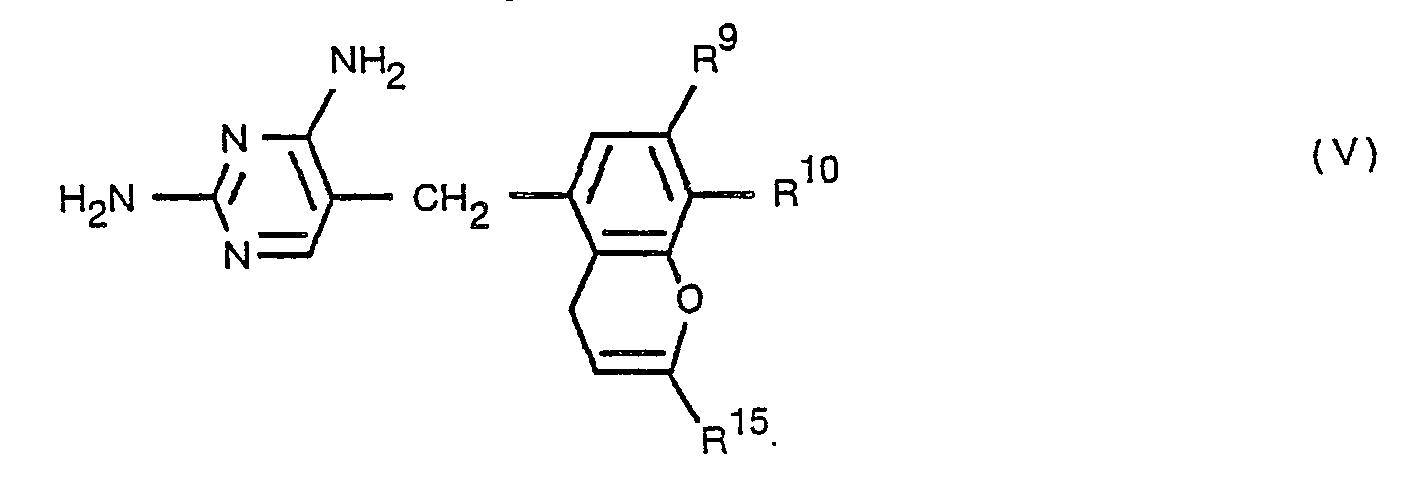
- a further group of preferred compounds of the present invention is that of the formula (V): or a salt, N-oxide or acyl derivative thereof, wherein R 9 and R 10 are as hereinbefore defined except that R 9 and R 10 are not both hydrogen or halogen and R 15 is a hydrogen atom or a C 1-3 alkyl group.
- R 9 and R'° are those defined in formula (IV).
- R 15 is hydrogen or methyl and preferably R 15 is hydrogen.
- a further group of preferred compounds of the present invention is that of the formula (VI): or a salt, N-oxide or acyl derivative thereof, is a six membered heterocyclic ring containing nitrogen and R 2 , R 9 and R 10 are as hereinbefore defined and R 16 is hydrogen, halogen, C 1-3 alkylthio, C 1-3 alkyl or R 16 is C 1-3 alkoxy optionally substituted by halogen, hydroxy or C 1-2 alkoxy except that R 9 and R 10 are not both hydrogen or halogen and that R 2 and R 16 are not attached to the carbon atom adjacent to the 6-position of the phenyl ring.
- R 9 and R 10 are not both hydrogen or halogen and that R 2 and R 16 are not attached to the carbon atom adjacent to the 6-position of the phenyl ring.
- Suitably is an aromatic six membered ring containing nitrogen.
- Suitable compounds of the formula (VI) are those wherein the nitrogen atom is ⁇ , or a to the 5- position of the phenyl ring and most suitably those wherein the nitrogen atom is ⁇ - or ⁇ - to the 5-position of the phenyl ring.
- R 2 is hydrogen, methyl, trifluoromethyl, methylthio or methoxy, most suitably R 2 is hydrogen or methyl and preferably R 2 is hydrogen.
- R 9 is methoxy, ethoxy, C 2 - 3 alkenyl, halogen, C 1 - 3 alkyl or methylthio.
- Suitable values for R 10 are those defined in formula (IV).
- R 16 is hydrogen, methyl, methylthio or methoxy, and preferably R 16 is hydrogen.
- R 9 is methoxy, ethoxy, C 2 - 3 alkenyl, halogen C 1 - 3 alkyl or methylthio.
- R 9 is methyl, methoxy, ethoxy or methylthio and preferably R 9 is methyl, methoxy or ethoxy.
- R 10 is methoxy, ethoxy, methylthio or a group NR 13 R 14 as hereinbefore defined.
- R 10 is methoxy, ethoxy, amino, dimethylamino or methylthio.
- a particularly preferred group of compounds of the formula (VI) is that where nitrogen atom is a-to the 5-position of the phenyl ring, R 2 and R 16 are hydrogen, R 9 is methyl or methoxy and R 10 is amino, dimethylamino or methylthio.
- a further group of preferred compounds of the present invention is that of the formula (VII): or a salt, N-oxide or acyl derivative thereof, wherein R 2 , R 9 , R 10 and R 16 are as hereinbefore defined except that when R 2 , R 9 and R 16 are all hydrogen, R 10 is neither hydrogen nor hydroxy.
- R 9 is hydrogen, methoxy, ethoxy, mono-C 1-3 -alkylamino, C 2-3 alkenyl, C 1-3 alkyl or methylthio. Most suitably R 9 is hydrogen, methoxy, ethoxy, or methylthio.
- R 9 is hydrogen, methoxy or ethoxy.
- R 10 is hydrogen, methoxy, ethoxy, methylthio, or a group NR 13 R 14 as hereinbefore defined. Most suitably R 10 is methoxy, ethoxy, amino or dimethylamino. Preferably R 10 is methoxy, ethoxy or amino.
- R 2 is hydrogen, alkylthio, methoxy, ethoxy or methoxyethoxy.
- R 2 is hydrogen or methoxy.
- R 16 is hydrogen, methylthio or methoxy and preferably R 16 is hydrogen or methoxy.
- One group of compounds within the general formula (I) included within the scope of the present invention is that of the formula (VIII): or a salt or acyl derivative thereof, wherein R 17 and R 18 together form a methylene-dioxy group or R 17 is hydrogen, halogen, C 1-4 alkyl, C 1-4 alkoxy, C 2-4 alkenyl, amino, substituted amino, trifluoromethyl, a group ⁇ COR 21 wherein R 21 is C 1-4 alkyl or C 1-4 alkoxy, or a group ⁇ OSO 2 R 22 wherein R 22 is C 1-4 alkyl; R 18 is halogen, C 1-4 alkyl; C 1-4 alkoxy, C 2-4 alkenyl, hydroxy, amino, mono- or di- C 1-4 alkyl substituted amino, mercapto, C 1-4 alkylthio, trifluoromethyl, a group ⁇ COR 21 or a group ⁇ OSO 2 R 22 wherein R 21 and R 22 are as hereinbefore defined
- Preferred compounds of the present invention include:
- the compounds of the formula (I) to (VIII) are present in the form of the free base of an acid addition salt thereof.
- Some compounds of the formula (I) exist in isomeric forms.
- the present invention includes mixtures of the isomeric forms as well as the individual isomers.
- the compounds of the formula (I) are bases and, as such, form acid addition salts with acids.
- Suitable acid addition salts of the compounds of the formula (I) include those formed with both organic and inorganic acids. Such acid addition salts will normally be pharmaceutically acceptable.
- preferred salts include those formed from hydrochloric, sulphuric, citric, tartaric, phosphoric, lactic, benzoic, glutamic, aspartic, pyruvic, acetic, succinic, fumaric, maleic, oxaloacetic, isethionic, stearic, fumaric, methanesulphonic, toluene p-sulphonic, lactobionic and glucuronic acids.
- alkali metal salts of these compounds may be formed and these salts also comprise part of the present invention.
- Particularly suitable alkali metal salts are those formed with sodium and potassium.
- Suitable acyl derivatives are those wherein an amino group is substituted by a group -COM wherein M is hydrogen or C 1-11 alkyl or C 2-11 alkenyl, preferably C 1-4 alkyl or C 2-4 alkenyl, optionally substituted by carboxy, carb-C I - 4 alkoxy, nitrile, amino, chlorine or phenoxy optionally substituted by halogen, methyl or methoxy, the alkyl or alkenyl groups being optionally interspersed with one or more oxygen atoms or forming part or the whole of a cycloaliphatic ring or M may represent a C 6-10 aromatic or C 6-10 araliphatic residue optionally substituted by one or more chlorine atoms or methyl, OCH 2 COOH, carb-C 1-4 alkoxy or a heterocyclic group containing one or more nitrogen, oxygen or sulphur atoms.
- acyl derivatives are those wherein the amino group at the 2-position of the pyrimidine ring is substituted, particularly those wherein the amino group is substituted by acetyl or by an acyl group derived from an amino acid such as a glycyl group.
- Suitable N-oxides of compounds of the formula (I) include those formed by oxidation of either or both of the nitrogen atoms in the pyrimidine ring or by oxidation of X when this is a nitrogen atom.
- the present invention provides a pharmaceutical composition
- a pharmaceutical composition comprising a compound of the formula (I) in a combination with a pharmaceutically acceptable carrier.
- pharmaceutical composition and “pharmaceutically acceptable carrier” are meant those compositions and carriers suitable for use in human and/or veterinary medicine.
- the compounds of the formula (I) can conveniently by presented in the compositions of the present invention in an effective unit dosage form, that is to say in an amount sufficient to be effective against the bacterial organism in vivo.
- compositions of the present invention are materials recommended for the purpose of administering the medicament. These may be liquid, solid or gaseous materials, which are otherwise inert or medically acceptable and are compatible with the active ingedient.
- compositions may be given parenterally, orally, used as a suppository, applied as an ophthalmic solution, or applied topically as an ointment, cream or powder.
- oral and parenteral administration of the compositions is preferred for human use.
- intramammary as well as oral and parenteral administration is preferred.
- fine powders or granules will contain diluting, dispersing and/or surface active agents, and may be presented in a draught, in water or in a syrup, in capsules or cachets in the dry state or in a non-aqueous suspension wherein suspending agents may be included, or in a suspension in water or syrup.
- suspending agents may be included, or in a suspension in water or syrup.
- flavouring, preserving, suspending, thickening or emulsifying agents can be included.
- the compounds may be presented in sterile aqueous injection solutions which may contain antioxidants or buffers.
- free base or a salt thereof may be administered in its pure form unassociated with other additives in which case a capsule or cachet is the preferred carrier.
- Other compounds which may be included are, for example, medically inert ingredients, e.g. solid and liquid diluents such as lactose, glucose, starch or calcium phosphate for tablets or capsules; olive oil or ethyl oleate for soft capsules; and water or vegetable oil for suspensions or emulsions; lubricating agents such as talc or magnesium stearate; gelling agents such as colloidal clays; thickening agents such as gum tragacath or sodium alginate; and other therapeutically acceptable accessory ingredients such as humectants, preservatives, buffers, and antioxidants which are useful as carriers in such formulations.
- medically inert ingredients e.g. solid and liquid diluents such as lactose, glucose, starch or calcium phosphate for tablets or capsules; olive oil or ethyl oleate for soft capsules; and water or vegetable oil for suspensions or emulsions
- lubricating agents such as tal
- the active compound may be presented in a pure form as an effective unit dosage, for instance, compressed as a tablet or the like.
- formulations for milking cow use will normally be prepared for use in dry cows and for use in milking cows.
- formulations for dry cow use will normally by in an oil, such as peanut oil, gelled with a gelling agent such as aluminium monostearate.
- Formulations for milking cow use will usually contain an emulsifying agent (for example Tween 20 or a polysorbate) and a milk miscible carrier such as peanut oil or a mineral oil.
- the most preferred combinations include those containing Sulfadiazine, Sulfamethoxazole, Sulfadoxine, Sulfamoxole or Sulfadimidine.
- the ratio of the compound of the formula (I) to sulphonamide will normally be from 3:1 to 1:10, for example 1:1 to 1:5.
- a particularly preferred composition of the present invention comprises a compound of formula (I) and a sulphonamide in a ratio of 1:2 to 1:5 preferably together with a pharmaceutically acceptable carrier.
- Tablets or other forms of presentation provided in discrete units may conveniently contain an amount of compound of the formula (I) which is effective at a dosage or as a multiple of the same, for instance for human use, units containing 2.5 to 200 mg usually around 30 to 100 mg for veterinary use units containing 30 to 500 mg.
- compositions of the present invention can be prepared by the admixture of a compound of the formula (I) with a pharmaceutically acceptable carrier.
- Other active ingredients such as a sulfonamide, or conventional pharmaceutical excipients may be admixed as required.
- the compounds of the present invention are useful for the treatment of gram negative aerobic, gram positive aerobic or anaerobic bacterial infections in mammals. They are particulary useful in the treatment of Staphylococcal infections for example mastitis in cattle, Neisseria infections in humans, for example N. gonorrhea, acne in humans, and anaerobic infections. Most compounds also have an excellent level of general antibacterial activity.
- the compounds of the formula (I) are generally useful in treating bacterial infec- . tions by rectal, parenteral, topical or oral administration.
- the compounds of formula (I) are normally administered at a dose from 0.1 mg/kg to 30 mg/kg per day and preferably 1 mg/kg to 10 mg/kg.
- the dose range for adult humans is generally from 25 to 300 mg/kg and preferably 100 to 200 mg/day.
- the dose range for intramammary administration of the compounds of the formula (I) is generallyfrom 100 to 500 mg, preferably 200 mg to 400 mg, per quarter of the udder to dry cows.
- Milking cows will normally receive four to six medications of a composition of the present invention, a dose being conveniently administered at milking time (i.e. twice daily) to each of the desired quarters of the udder.
- Dry cows will normally receive only one medication of a composition of the present invention, one dose being provided to each of the four quarters of the udder.
- the compounds of formula (I) and their pharmaceutically acceptable salts may be prepared by methods known for the synthesis of compounds of analogous structure.
- reaction of guanidine with a compound of the formula (IX) or (X) will take place under conditions analogous to those described in U.K. Patent Nos. 1,133,766 and 1,261,455 respectively for the preparation of structurally related benzylpyrimidines. Conveniently the reaction is carried out in a C 1 - 4 alkanol, for example methanol or ethanol.
- the compounds of the formula (IX) and (X) may be prepared by methods known in the art. It is preferred to avoid the use of aprotic solvents in the preparation of compounds of the formula (IX) when X is oxygen
- R 26 or R 27 are halogen atoms these are suitably chlorine or bromine atoms.
- the reaction may conveniently be carried out under the reaction conditions described in U.K. Patent Nos. 875,562 and 1,132,082.
- the reduction of R27 when this is halogen will suitably be carried out under the conditions described in German Offenlegungschrift 2258238. This is not a preferred method for preparing those compounds wherein R 3 or R° are groups that are susceptible to catalytic hydrogenation.
- the compounds of formula (XII) may be prepared by methods known in the art, for example as described in U.K. Patents No. 875562 and 1132082 or German Offenlegungschrift 2258238.
- the compounds of the formula (XII) wherein R 26 and/or R27 are halogen atoms may conveniently be prepared from the corresponding compounds wherein R 26 and/or R 27 are hydroxy. These compounds may be prepared by methods analogous to these described in the art or by the reaction of a compound of the formula (XVII) with 5-dimethylamino-methyluracil.
- This reaction will normally be carried out in an inert high boiling polar solvent, for example a high boiling C 2 - 6 alkanol such as ethylene glycol, at between 100° and 200°C for example between 130° and 160°C.
- the reaction will normally be carried out under basic conditions when the 4-position of the phenyl ring is substituted by hydroxy, for example in the presence of sodium methoxide, and under neutral conditions when the 4-position of the phenyl ring is substituted by amino or substituted amino.
- Certain compounds of the formula (XII) wherein the 4-position of the phenyl ring is substituted by a hydroxy group may be converted to compounds of the formula (XII) wherein is substituted by an alkoxy or thio C 1 - 4 alkylthio group and certain compounds of the formula (XII) wherein the 4-position of the phenyl ring is substituted by an amino group and R 26 is a hydroxyl group may be converted to compounds of the formula (XII) wherein the 4-position of the phenyl ring is substituted by C 1 - 4 alkyl thio, halogen, cyano substituted amino group or hydrogen by methods well kwown to those skilled in the art.
- Z is a dialkylamino or cyclic amino group containing up to 10 carbon atoms; a dimethylamino group is particularly convenient.
- the reaction will be carried out under conditions well known to those skilled in the art of Mannich reactions. It has been found that the reaction may suitably be carried out at an elevated temperature, suitably between 100° and 200°C in a solvent having a suitably high boiling point, for example a glycol such as ethylene glycol.
- the dethiation is suitably carried out by hydrogenolysis in the presence of a transition metal catalyst; Raney nickel is particularly suitable for this purpose.
- This reaction will normally by carried out in a polar solvent, for example a C 1-4 alkanol such as methanol or ethanol.
- Y is a hydroxy group in which case the elimination reaction will be carried out under acidic conditions.
- Substituted sulphonyloxy groups can also be removed under basic conditions. Halogen atoms are normally removed under basic conditions.
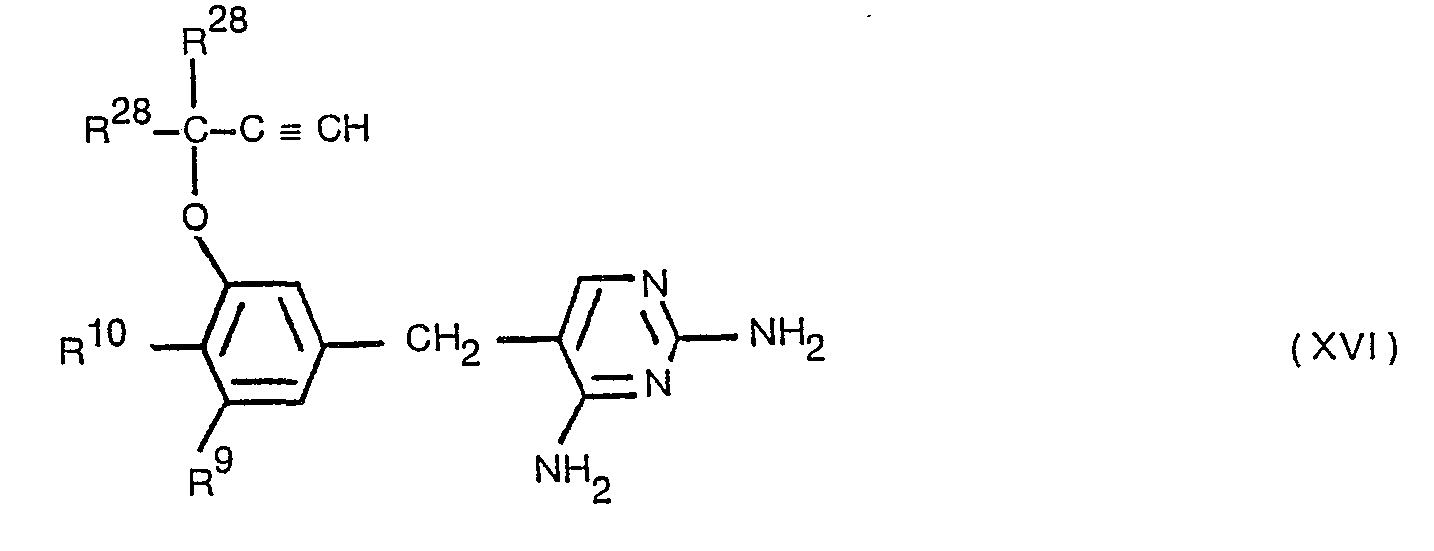
- the compounds of the formula (XVI) may be prepared by conventional methods, for example by the reaction of the appropriate phenol with a halogenated alkyne in the presence of base in a solvating, polar solvent, such as a dipolar aprotic solvent.
- the reaction will conveniently be carried out between 0° and 50°C, and preferably between 20° and 35°C.
- reaction of a compound of the formula (XVII) with 2,4-diamino-5-hydroxymethyl pyrimidine will normally be carried out under the reaction conditions described in U.K. Patent No. 1413471.
- the reaction will conveniently be carried out in a polar non-phenolic solvent capable of dissolving both reactants at a non-extreme temperature, for example between 50°C and 150°C.
- the reaction is preferably carried out in the presence of a strong acid catalyst, such as hydrochloric, acetic, methane sulphonic or toluene-p-sulphonic acids.
- the present invention provides the first use of the compounds of the formula (I) in human and veterinary medicine.
- the preferred human use of the compounds of the formula (I) is in the treatment of propylaxis of bacterial infections.
- the compounds of the present invention were subjected to standard tests in order to determine the minimum inhibitory concentration in pig/ml needed to inhibit a range of bacterial microorganisms in-vitro.
- Example 3A The product of Example 3A (0.71 g, 3.79 mmol) was dissolved in 2 mL of dimethyl sulfoxide along with 0.61 g of 3-anilino-propionitrile. A 0.21 g (3.89 mmol) portion of sodium methoxide was added to this solution, which was then heated at 130°C for 15 min, followed by cooling and dilution with an 8:1 mixture of water-ethanol. The resultant solid was separated, extracted with boiling ethyl acetate and again isolated; weight, 0.28 g, 23% of 3-anilino-2-(8-methoxy-5-quinolylmethyl)acrylonitrile. An additional 0.26 g (22%) was obtained from the filtrate by chromatography on silica gel.
- Example 1C The product of Example 1C (2.10 g, 6.68 mmol), N-tert-butoxycarbonylglycine-p-nitrophenolate (1.98 g, 6.68 mmol) and triethylamine (0.676 g, 6.68 mmol) in chloroform (100 mL) were refluxed 3 hr. The resulting mixture was adsorbed on a silica gel column and title compound eluted with 5% methanol-ethyl acetate as a white powder, after recrystallization from ethyl acetate (1.59 g, 50%); mp 206-208° dec; structure confirmed by 1 H ⁇ NMR. Anal. Calcd. for C 23 H 29 N 5 O 6 : C, 58.59; H, 6.20; N, 14.85. Found: C, 58.66; H, 6.25; N, 14.42.
- Example 4A The product of Example 4A (0.408 g, 0.892 mmole) and isopropyl alcohol (25 mL) were heated (steam bath) while concentrated hydrochloric acid (0.40 mL) was added. The resulting clear solution was refluxed for 30 min and then cooled. The title compound was filtered off as white solid (0.271 g, 65%); mp >230° dec; structure confirmed by 1 H ⁇ NMR. Anal. Calcd. for C 18 H 21 N 5 O 4 ⁇ 2HCl ⁇ 7 / 5 H 2 O: C, 46.04; H, 5.54; N, 14.92; Cl, 15.10. Found: C, 46.69; H, 5.34; N, 14.63; Cl, 14.75.
- Example 6B The product of Example 6B was used in the procedure of Example 1C to give free base of the title compound, after recrystallization from ethanol, identical to that of Example 21 (30% yield).
- the lactate was prepared in 48% yield by the procedure of Example 5A to give white solid, mp 183-185°C dec.
- Anal. Calcd. for C 17 H 20 N 4 O 3 ⁇ C 3 H 6 O 3 C, 57.41; H, 6.26; N, 13.39. Found: C, 57.41; H, 6.29; N, 13.39.
- Example 6A Following the procedure of Example 6A with 3,3-dimethylacrylic acid in place of crotonic acid, the title compound was prepared in low yield (9%). The structure was confirmed by nmr and mass spectrometry.
- Example 7A The product of Example 7A (0.33 g, 0.92 mmol) was used in the procedure of Example 6B to give the title compound as white solid (0.15 g, 45%).
- Example 7B The product of Example 7B (0.15 g, 0.40 mmol) was used in the procedure of Example 6C to give the title compound as the lactate monohydrate (0.078 g, 42%), mp 196.5-198°.
- the structure was confirmed by NMR and mass spectra. Anal. Calcd. for C 18 H 22 N 4 O 3 ⁇ C 3 H 6 O 3 ⁇ H 2 O: C, 55.99; H, 6.71; N, 12.44. Found: C, 55.89; H, 6.70; N, 12.42.
- Example 13C The product of Example 13C (3.00 g, 10.0 mmol) was used in the procedure of Example 8B to give the title compound (2.49 g, 74%), mp 149-151° dec.
- Example 13D The product of Example 13D (2.49 g, 7.4 mmol) was used in the procedure of Example 8C to give the title compound (1.67 g, 61%), mp 287-289° dec.
- Example 16A The product of Example 16A (1.30 g, 3.98 mmol) was converted to the 2,4-dichloropyrimidine by the method of Example 8B. Amination by the procedure of Example 8C gave 2,4-diamino-5-(8-dimethylamino-7-methoxy-5-quinolylmethyl)pyrimidine dihydrochloride (20%), recrystallized from 95% ethanol, mp 242 ⁇ 244° dec. Anal. Calcd. for C 17 H 20 N 6 O ⁇ 2HCl: C, 51.39; H, 5.58; N, 21.15, CI, 17.85. Found: C, 51.39; H, 5.60; N, 21.12; CI, 17.80.
- Example 15A The product of Example 15A (3.73 g, 11.2 mmol) was used in the procedure of Example 8B to give 2,4-dichloro-5-(8-(1-pyrrolyl)-7-methyl-5-quinolylmethyl)pyrimidine (1.63 g, 39%). A portion of this (1.44 g, 3.90 mmol) was used without further purification in the procedure of Example 8C to give the free base of the title compound (1.08 g, 84%). The acetate salt was obtained by lyophilizing a solution of the free base in acetic acid-water. The structure was confirmed by NMR and mass spectrometry; mp-shrinks to a glass at 110°. Anal. Calcd. for C 19 H 18 N 6 ⁇ C 2 H 4 O 2 ⁇ 0.4 H 2 O: C, 63.43; H, 5.78; N, 21.13. Found: C, 63.35; H, 5.34; N, 21.15.
- Example 8A The product of Example 8A (1.41 g, 5.0 mmol) was used in the procedure of Example 14A to give the title compound as a tan solid (0.63 g, 41%). Recrystallization from ethanol gave an analytical sample, mp 267 ⁇ 270° dec.Anal. Calcd. for C 17 H 18 N 4 O 2 : C, 65.79; H, 5.85; N, 18.05. Found: C, 65.54; H, 5.91; N, 17.98.
- Example 16A The product of Example 16A (1.33 g, 4.30 mmol) was used in the procedure of Example 88 to give 2,4-dichloro-5-(8-dimethylamino-7-methyl-5-quinolylmethyl)pyrimidine (0.79 g, 53%). This was used without further purification in the procedure of Example 8C to give the title compound as tan solid (0.32 g, 37%), mp 250 ⁇ 252° dec., after crystallization 95% ethanol containing HCI.
- Example 17A The product of Example 17A (2.70 g, 7.6 mmol) was used in the procedure of Example 11B to give the title compound as a white solid (2.16 g, 77%) mp 216-218° dec., after recrystallization from 95% ethanol.
- Example 17B The product of Example 17B (0.86 g, 2.3 mmol) was heated at reflux with W-2 Raney nickel (10 g) in 95% aqueous 2-methoxyethanol for 2 hr. The catalyst was removed by filtration through Celite®, then washed with hot 2-methoxyethanol. The filtrate-wash was concentrated to give the title compound as white powder (0.56 g, 75%), mp 224-228° dec., after recrystallization from 95% ethanol. Anal. Calcd. for C 18 H 21 N 5 O: C, 66.85; H, 6.55; N, 21.66. Found: C, 66.80; H, 6.55; N, 21.66.
- Example 11B the product of Example 11B (260 mg, 0.84 mmol) was shaken with 10% palladium on carbon in 95% ethanol (25 mL) under hydrogen (50 psi) for 2 hr. Filtration of the catalyst and concentration gave the title compound (0.25 g, 96%).
- Finely ground 7,8-dimethoxyquinoline-2-carboxylic acid (1.00 g, 4.3 mmol) (W. Ried, A. Berg and G. Schmidt, Chem. Ber., 85, 204 (1952)) was heated under nitrogen in a flask submerged in an oil bath at 185° until the evolution of gases had ceased from the melt. The reaction was cooled and 75% aqueous sulfuric acid (8.1 mL) was carefully added. The resulting solution was heated at 105-125° for 2 hr, cooled, poured over ice and taken to pH 5 with 5 N sodium hydroxide. The mixture was filtered, and the filtrate was extracted with methylene chloride (4 x 50 mL).
- Example 18A The product of Example 18A (1.00 g, 5.7 mmol) was used in the procedure of Example 11A to give 2,4-diamino-5-(8-hydroxy-7-methoxy-5-quinolylmethyl)pyrimidine (0.18 g, 11 %), mp 243-245° dec., after recrystallization from 95% ethanol.
- the structure was confirmed by NMR and mass spectrometry.
- Example 18B was used in the procedure of Example 11B to give the title compound (55%), mp 257-259° dec., after recrystallization from 95% ethanol.
- the structure was confirmed by NMR and mass spectrometry. Anal. Calcd. for C 16 H 17 N 5 O 2 ⁇ O.25H 2 O: C, 60.84; H, 5.58; N, 22.17. Found: C, 60.92; H, 5.50; N, 22.13.
- Example 8A The product from Example 8A (1.41 g, 5.0 mmol) was dissolved in 50% aqueous sulfuric acid (10.5 mL) with heating, then cooled to 5° to form a suspension. A solution of sodium nitrite (0.36 g, 5.0 mmol) in water (3.5 mL) was added, keeping the temperature below 10°. After the addition was complete, cold 50% hypophosphorus acid (3.3 mL) was added in one portion. The mixture was slowly allowed to warm to room temperature over 2 hr, and additional 50% hypophosphorus acid (3.3 mL) was added. After 5 days, the mixture was diluted with water, heated to dissolve the solids and carefully taken to pH 8 with solid sodium carbonate.
- Example 19A The product of Example 19A (0.51 g, 1.9 mmol) was used in the procedure of Example 8B to give 2,4-dichloro-5-(7-methyl-5-quinolylmethyl)pyrimidine (0.52 g, 90%). This was used without further purification in the procedure of Example 8C to give the title compound as a pink solid, mp 338-340° dec.
- Example 20B The title compound was prepared in 40% yield from 2,4-diamino-5-[3,4-dimethoxy-5-(2-propynyloxy)benzyl]pyrimidine by the procedure of Example 20B.
- the product was identical by spectral and analytical analyses to that prepared by the procedure of Example 1.
- Example 22A The product of Example 22A (1.50 g, 4.80 mmol) was used in the procedure of Example 8B to give 5-(8-amino-7-ethoxy-5-quinolylmethyl)-2,4-dichloropyrimidine as yellow solid (1.51 g, 90%). This solid was used without further purification in the procedure of Example 8C to give the title compound as yellow solid (1.11 g, 75%), recrystallized from ethanol; mp 218 ⁇ 220° dec. Anal. Calcd. for C 16 H 18 N 6 O: C, 61.92; H, 5.85; N, 27.08. Found: C, 61.68; H, 5.88; N, 26.96.
- a solution of sodium methylmercaptide was prepared by bubbling methyl mercaptan through a cooled (ice bath) solution of sodium (1.1 g, 48 mequiv) in methanol (200 mL). 7-Chloro-8-nitroquinoline (5.00 g, 24.0 mmol) was added and the resulting mixture stirred at room temperature for 2 days. The precipitate was filtered off, washed with methanol and water to give 7-methylthio-8-nitroquinoline as pale yellow solid (4.72 g, 89%); mp 163 ⁇ 164°. Anal. Calcd. for C 10 H 8 N 2 O 2 S: C, 54.33; H, 3.66; N, 12.72; S, 14.56. Found: C, 54.61; H, 3.68; N, 12.68; S, 14.48.
- Example 23B The product of Example 23B (1.84 g, 5.85 mmol) was used in the procedure of Example 8B to give 5-(8-amino-7-methylthio-5-quinolylmethyl)-2,4-dichloropyrimidine as tan powder (1.93 g). This solid was used without further purification in the procedure of Example 8C to give the free base of the title compound as yellow powder (1.54 g), after purification on a silica gel column eluted with methanol-methylene chloride (1:4). Recrystallization from ethanol-water containing hydrochloric acid gave the title compound as red-orange needles (1.26 g, 56% from the product of Example 238); mp >300°. Anal. Calcd.
- Example 13C The product from Example 13C (1.46 g, 4.90 mmol) was suspended in 48% fluoboric acid (15 mL) and cooled to 0°. A solution of sodium nitrite (0.37 g, 5.2 mmol) in water (0.8 mL) was added, keeping the temperature below 5°. A complete solution was obtained, stirred at 0° for 15 min, then poured into ice cold methanol (75 mL) with stirring. The solid that separated was collected, washed with methanol and ether and air dried to give 1.93 g (99%) of the diazonium salt.
- Example 25A The product from Example 25A was refluxed in methanol (150 mL) for 45 min. The deep red solution that formed was cooled, neutralized with concentrated ammonium hydroxide, adsorbed onto silica gel and purified by column chromatography with elution by methanol-methylene chloride (1:9) to give the title compound (0.97 g, 70%); mp 302-304° dec with preliminary darkening.
- Example 25B The product from Example 25B (0.91 g, 3.2 mmol) was converted to the title compound (0.62 g, 60%) by the procedure of Example 8B.
- the product was characterized by 1 H ⁇ NMR and mass spectroscopy and used without further purification.
- Example 25C The product from Example 25C (0.60 g, 1.9 mmol) was converted to the title compound by the procedure of Example 8C.
- the crude free base (0.39 g, 73%) was recrystallized from 95% ethanol to give off-white solid; mp 275° dec with preliminary darkening.
- Example 25A The product from Example 25A (1.89 g, 4.80 mmol) was added portionwise to a warm (80°) solution of thiourea (0.50 g, 6.6 mmol) in water (6 mL). After heating for 30 min, the reaction was cooled and the resulting isothiouronium salt was collected and dried (1.53 g, 72%). Without further purification, the salt was added to a solution of sodium bicarbonate (0.58 g, 6.9 mmol) in water (15 mL) and refluxed for 30 min. The dark purple solid that separated was collected, dried (1.16 g, 100%), characterized as 5-(8-mercapto-7-methoxy-5-quinolylmethyl)uracil contaminated with -20% disulfide.
- Example 26A The product of Example 26A (0.27 g, 0.82 mmol) was used in the procedure of Example 8B to give the title compound (0.14 g, 47%).
- Example 26C The product of Example 26C (0.14 g, 0.38 mmol) was used in the procedure of Example 8C to give the title compound as a light yellow solid (0.05 g, 41%), after recrystallization from 95% ethanol; mp 252 ⁇ 253.5° dec.
- Example 11A The product of Example 11A (1.54 g, 5.01 mmol) and 2-methoxyethyl-p-toluenesulfonate (1.15 g, 4.99 mmol) were reacted as in the procedure of Example 1A to give crude product as tan solid (1.83 g). Chromatography on a silica gel column eluted with methanol-meth'ylene chloride (1:4), followed by crystallization from 95% ethanol, gave title compound as white solid (0.77 g, 42%); mp 196-199.5°. Anal. Calcd. for C 20 H 23 N 5 O 2 : C, 65.74; H, 6.34; N, 19.16. Found: C, 65.61; H, 6.42; N, 19.36.
- Example 31A The product from Example 31A was used in the procedure of Example 17C to give the title compound after recrystallization from ethanol and concentrated hydrochloric acid as a yellow solid; mp 201-206° with foaming.
- Methyl 3,4-dimethoxy-5-hydroxybenzoate (E. Spath and H. R6der, Mon. f. Chem. 1922, 43, 93; G. J. Kapadia, Y. N. Vaishnav, M. B. E. Fayez, J. Pharm. Sci. 1969,9,1157) (0.54 g, 2.54 mmol), propargyl chloride (0.23 g, 3.04 mmol), sodium iodide (3 mg, .02 mmol) and potassium carbonate (.53 g, 3.81 mmol) were refluxed in acetone (10 mL) for 18 hr, cooled, filtered and concentrated.
- Methyl 3,4-dimethoxy-5-(2-propynyloxy) benzoate (390 g, 1.56 mol) in N,N-diethylaniline (0.4 L) was refluxed for 40 min. The solution was cooled and diluted with methylene chloride (2 L). The organic solution was extracted with 1 N hydrochloric acid (5 x 1 L), dried (MgS0 4 ) and concentrated to give title compound (390 g, 100%).
- Methyl 7,8-dimethoxy-2H-1-benzopyran-5-carboxylate (390 g, 1.56 mol) in toluene (1.6 L) was cooled to -15° and a solution of sodium bis(2-methoxyethoxy)aluminum hydride (908 mL, 3.5M in toluene, 3.18 mol) and morpholine (277 g, 3.18 mol) in toluene (900 mL) was added over a 45 min period. After stirring for an additional 30 min, 2N sodium hydroxide solution (2.85 L) was added.
- Guanidine hydrochloride (11.94 g, 0.125 mole) and sodium methoxide (6.81 g, 0.126 mole) were combined in methanol (100 mL) and the resulting sodium chloride removed by filtration.
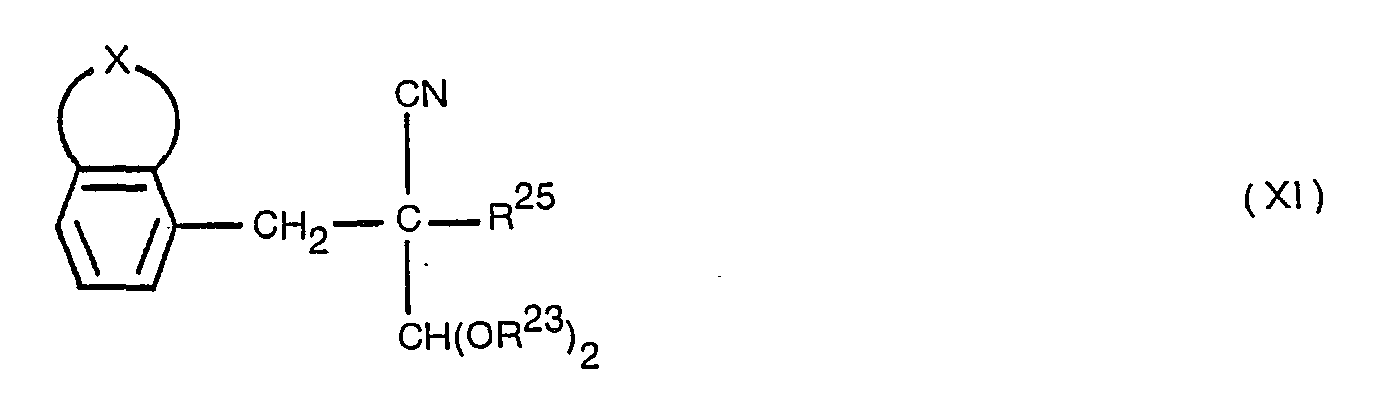
- the methanolic guanidine solution was added to 3-(7,8-dimethoxy-2H-1-benzopyran-5-yl)-2-dimethoxymethylpropane nitrile (15.9 g, 0.05 mole) and the mixture was heated at reflux for 24 hr.
- guanidine which was prepared from guanidine hydrochloride (4.78 g, 0.05 mole) and sodium methoxide (2.72 g, 0.05 mole), in methanol (25 mL) was added and the mixture heated at reflux for 2 hr additional. On cooling 2.85 g (18%) of 2,4-diamino-5-(7,8-dimethoxy-2H-1-benzopyran-5-ylmethyl)pyrimidine separated, was filtered and dried, mp 233 ⁇ 4°C. The filtrate was concentrated until a pot temperature of 70°C was obtained.
- the resultant yellow solid was taken up in ethyl acetate (250 mL) and successively extracted with water (125 mL), saturated sodium bicarbonate (3 x 100 mL) and water (100 mL), then dried over magnesium sulfate. The volatiles were removed under reduced pressure to leave an amber oil, 18.22 g (9.14%) which was used without further purification.
- the gum was dissolved in ethanolic potassium hydroxide (0.66 g [85%], 0.01 mole in 25 mL) and the resultant solution heated at reflux for 2 hr.
- Guanidine which was prepared by combining guanidine hydrochloride (3.34 g, 0.035 mole) in absolute ethanol (20 mL) with sodium methoxide. (1.9 g, 0.035 mole) in absolute ethanol (30 mL) and filtering the resultant sodium chloride, was then added to the hot ethanolic potassium hydroxide solution. Ethanol was boiled out of the mixture until a pottemperature of 85°C was achieved. Reflux was then maintained for 18 hr and the mixture allowed to cool.
- the 2,4-diamino-5-(7,8-dimethoxy-2H-1-benzopyran-5-ylmethyl)pyrimidine, lactose and potato starch (and sulfamethoxazole in the combination formulation) are mixed together and then granulated with aqueous polyvinylpyrrolidone.
- the granules are dried, mixed with the magnesium stearate and then compressed to produce tablets weighing 200 mg each (single active ingredient) or 600 mg each (combination).
- the ingredients are thoroughly mixed and then loaded into hard gelatin capsules containing 400 mg each.
- the 2,4-diamino-5-(8-dimethylamino-7-methoxy-5-quinolylmethyl)pyrimidine dihydrochloride is dissolved in the water and the solution sterilized by ultrafiltration.
- the sterile solution is delivered into sterile capsules and the ampoules sealed, the entire operation being carried out under sterile conditions.
- the 2,4-diamino-5-(3,4-dimethoxy-1-naphthylmethyl)pyrimidine, lactose and potato starch (and sulfamethoxazole in the combination formulation) are mixed together and then granulated with aqueous polyvinylpyrolidone.
- the granules are dried, mixed with the magnesium stearate and then compressed to produce tablets weighing 200 mg each (single active ingredient) or 600 mg each (combination).
- microcrystalline cellulose and sodium carboxymethylcellulose are added to a portion of the water.
- the sucrose is then added and dissolved therein.
- the Polysorbate 80 (a polyethylene oxide sorbitan monooleate) is then mixed into the suspension.
- a solution of the methyl paraben, propyl paraben, flavor and color in a minimal amount of alcohol is then added.
- the finely ground active ingredients (2,4-diamino-5-(8-amino-7-methyl-5-quinolylmethyl)pyrimidine dihydrochloride and sulfamethizole) are then added.
- Sufficient water is then added to bring the volume to 5.0 ml and the suspension is thoroughly mixed.
- Syringes for intra-mammary injection into cows are prepared from the following ingredients:
- the glycerol monostearate, Tween * 65 (a polyethylene oxide sorbitan tristearate) and arachis oil are mixed together and melted at 65°C.
- the active ingredients (2,4-diamino-5-(3,4-dimethoxy-1-naphthylmethyl)pyrimidine and sulfadiazine) are mixed in and the mixture homogenized using a high speed stirrer.
- the resulting mixture is cooled to 50°C and is filled into intra-mammary syringes using a fill weight of 4.0 g ⁇ 5%.
- the manufacture and filling operations are carried out under sterile conditions.
- FIC fractional inhibitory concentration
- Table 1 summarizes the results derived from the two checkerboard experiments indicating the lowest FIC index for each organism tested and the MIC ratio of the drug combinations corresponding to the FIC index.
- SMX appears to potentiate compound 1 as well as it does TMP in an in vitro situation.
- Norden et al. (2) have demonstrated a lack of correlation between the Berenbaum criteria (1) and other methods of assaying synergy. This perse, does not invalidate this analytic approach, however, since there is no absolute standard for establishing synergistic interations (3).
- in vitro potentation can be demonstrated between SMX and compound 1 in the case of four individual gram negative microorganisms and one isolate of S aureus.
- Syringes for intra-mammary injection into cows were prepared from the following ingredients :-
- the glyceryl monostearate, Tween@ and the arachis oil were mixed together and melted at 65°C.
- the active ingredients sulphadiazine and 2,4-diamino-5-(78-dimethoxy-2H-1-benzopyran-5-ylmethyl)pyrimidine were stirred in and the mixture homogenised using a high speed stirrer.
- the resultant mixture was cooled to 50° and was filled into intra-mammary syringes using a 4g fill ⁇ 5%.
- the manufacture and filling were carried out under sterile conditions.
Landscapes
- Chemical & Material Sciences (AREA)
- Organic Chemistry (AREA)
- Health & Medical Sciences (AREA)
- Chemical Kinetics & Catalysis (AREA)
- Life Sciences & Earth Sciences (AREA)
- General Chemical & Material Sciences (AREA)
- Medicinal Chemistry (AREA)
- Nuclear Medicine, Radiotherapy & Molecular Imaging (AREA)
- Communicable Diseases (AREA)
- Pharmacology & Pharmacy (AREA)
- Oncology (AREA)
- Animal Behavior & Ethology (AREA)
- General Health & Medical Sciences (AREA)
- Public Health (AREA)
- Veterinary Medicine (AREA)
- Pharmaceuticals Containing Other Organic And Inorganic Compounds (AREA)
- Plural Heterocyclic Compounds (AREA)
- Agricultural Chemicals And Associated Chemicals (AREA)
- Heterocyclic Carbon Compounds Containing A Hetero Ring Having Oxygen Or Sulfur (AREA)
Claims (22)




ou un sel ou N-oxyde de ce composé.






Priority Applications (1)
| Application Number | Priority Date | Filing Date | Title |
|---|---|---|---|
| KE365086A KE3650A (en) | 1980-11-11 | 1986-07-15 | Substituted pyrimidines,their synthesis and compositions containing them,their use in medicine and intermediates for making them |
Applications Claiming Priority (2)
| Application Number | Priority Date | Filing Date | Title |
|---|---|---|---|
| GB8036135 | 1980-11-11 | ||
| GB8036135 | 1980-11-11 |
Publications (3)
| Publication Number | Publication Date |
|---|---|
| EP0051879A2 EP0051879A2 (fr) | 1982-05-19 |
| EP0051879A3 EP0051879A3 (en) | 1982-08-04 |
| EP0051879B1 true EP0051879B1 (fr) | 1986-02-05 |
Family
ID=10517217
Family Applications (1)
| Application Number | Title | Priority Date | Filing Date |
|---|---|---|---|
| EP81109631A Expired EP0051879B1 (fr) | 1980-11-11 | 1981-11-11 | Pyrimidines substituées, leur synthèse et compositions les contenant, leur usage en médecine et intermédiaires pour leur synthèse |
Country Status (35)
| Country | Link |
|---|---|
| US (4) | US4438267A (fr) |
| EP (1) | EP0051879B1 (fr) |
| JP (1) | JPS57114581A (fr) |
| KR (1) | KR880001736B1 (fr) |
| AR (1) | AR245447A1 (fr) |
| AU (1) | AU549449B2 (fr) |
| CA (1) | CA1186310A (fr) |
| CS (1) | CS273153B2 (fr) |
| CY (1) | CY1419A (fr) |
| DD (1) | DD201896A5 (fr) |
| DE (1) | DE3173752D1 (fr) |
| DK (1) | DK172884B1 (fr) |
| EG (1) | EG16107A (fr) |
| ES (5) | ES506969A0 (fr) |
| FI (1) | FI76333C (fr) |
| GB (1) | GB2087881B (fr) |
| GR (1) | GR81317B (fr) |
| HK (1) | HK23388A (fr) |
| HU (1) | HU188762B (fr) |
| IE (1) | IE52128B1 (fr) |
| IL (1) | IL64256A (fr) |
| IT (1) | IT1210589B (fr) |
| MC (1) | MC1418A1 (fr) |
| MY (1) | MY8600678A (fr) |
| NO (2) | NO160137C (fr) |
| NZ (1) | NZ198932A (fr) |
| PH (2) | PH22654A (fr) |
| PL (4) | PL139427B1 (fr) |
| PT (1) | PT73960B (fr) |
| RU (1) | RU1819264C (fr) |
| SG (1) | SG62686G (fr) |
| SU (4) | SU1424732A3 (fr) |
| YU (5) | YU42444B (fr) |
| ZA (1) | ZA817780B (fr) |
| ZM (1) | ZM9481A1 (fr) |
Families Citing this family (36)
| Publication number | Priority date | Publication date | Assignee | Title |
|---|---|---|---|---|
| US4438267A (en) * | 1980-11-11 | 1984-03-20 | Daluge Susan M | Monoheteroring compounds and their use |
| US4590271A (en) * | 1982-05-01 | 1986-05-20 | Burroughs Wellcome Co. | 2,4-diamino-5-(substituted)pyrimidines, useful as antimicrobials |
| DK190983A (da) * | 1982-05-01 | 1983-11-02 | Wellcome Found | 2,4-diamino-5-(substituerede)pyrimidiner, fremgangsmaade til deres fremstilling og mellemprodukter derfor |
| ZA833067B (en) * | 1982-05-01 | 1984-12-24 | Wellcome Found | Antibacterial compounds |
| US4587341A (en) * | 1982-05-07 | 1986-05-06 | Burroughs Wellcome Co. | 2,4-diamino-5-(1,2,3,4-tetrahydro-(substituted or unsubstituted)-6-quinolylmethyl)pyrimidines, useful as antimicrobials |
| CA1244028A (fr) * | 1983-04-14 | 1988-11-01 | Hans Maag | Derives de pyrimidine |
| GB8603962D0 (en) * | 1986-02-18 | 1986-03-26 | Wellcome Found | Chemical compositions |
| GB8603964D0 (en) * | 1986-02-18 | 1986-03-26 | Cooper Animal Health Ltd | Compositions |
| LU86703A1 (fr) * | 1986-12-08 | 1988-07-14 | Oreal | Composition cosmetique photostable contenant un filtre uv-a et un filtre uv-b,son utilisation pour la protection de la peau contre les rayons uv et procede de stabilisation du filtre uv-a par le filtre uv-b |
| FI895821A7 (fi) * | 1988-12-07 | 1990-06-08 | The Wellcome Foundation Ltd | Farmaseuttisesti aktivisia CNS-yhdisteitä |
| GB8903978D0 (en) * | 1989-02-22 | 1989-04-05 | Coopers Animal Health | Chemical compositions |
| GB9000241D0 (en) * | 1990-01-05 | 1990-03-07 | Coopers Animal Health | Pharmaceutical use |
| RU95113597A (ru) * | 1992-12-02 | 1997-06-10 | ФМК Корпорейшн (US) | Инсектицидная композиция, способы борьбы с насекомыми |
| NO306992B1 (no) * | 1993-01-28 | 2000-01-24 | Takeda Chemical Industries Ltd | Quinolinderivater, farmasoeytiske preparater inneholdende forbindelsene og anvendelsen av forbindelsene |
| US5707996A (en) * | 1995-11-06 | 1998-01-13 | Macleod Pharmaceuticals, Inc. | Pharmaceutical solution and methods for preparation thereof |
| WO1997020839A1 (fr) * | 1995-12-04 | 1997-06-12 | F. Hoffmann-La Roche Ag | Diaminopyrimidines, compositions pharmaceutiques les contenant et utilisation de celles-ci en tant qu'agents antibacteriens |
| RU2141322C1 (ru) * | 1997-08-12 | 1999-11-20 | Голощапов Николай Михайлович | Иммуномодулятор с антимикобактериальной активностью "изофон", способ его получения и применения |
| GB0016877D0 (en) * | 2000-07-11 | 2000-08-30 | Astrazeneca Ab | Chemical compounds |
| WO2002010156A1 (fr) * | 2000-07-29 | 2002-02-07 | Arpida Ag | Derives de benzofuranne et leur utilisation en tant qu'agents antibacteriens |
| US7700610B2 (en) * | 2001-06-29 | 2010-04-20 | Ab Science | Use of tyrosine kinase inhibitors for treating allergic diseases |
| CA2452169A1 (fr) * | 2001-06-29 | 2003-01-09 | Ab Science | Utilisation d'inhibiteurs de tyrosine kinase destines au traitement de maladies inflammatoires |
| EP1434991B1 (fr) * | 2001-06-29 | 2007-10-17 | AB Science | Nouveaux inhibiteurs selectifs puissants et non toxiques de c-kit |
| PT1401416E (pt) | 2001-06-29 | 2007-02-28 | Ab Science | Utilização de inibidores de c-kit para tratar doenças inflamatórias intestinais (dii) |
| JP2005507916A (ja) * | 2001-09-20 | 2005-03-24 | アブ サイエンス | 細菌感染症を治療するための、強力で選択的かつ非毒性のc−kit阻害剤の使用方法 |
| CA2460845A1 (fr) * | 2001-09-20 | 2003-03-27 | Ab Science | Utilisation d'inhibiteurs c-kit puissants, selectifs et non toxiques pour le traitement de la cystopathie interstitielle sous-muqueuse |
| WO2003035050A2 (fr) * | 2001-09-20 | 2003-05-01 | Ab Science | Utilisation d'inhibiteurs de la tyrosine kinase pour stimuler la pousse des cheveux |
| HUP0600114A2 (en) * | 2003-07-11 | 2007-09-28 | Arpida Ag | Benzofuran derivatives and their use in the treatment of microbal infections |
| BRPI0607758A2 (pt) * | 2005-02-18 | 2010-03-23 | Arpida Ag | processos para a fabricaÇço do composto e para a reduÇço do composto, e, composto |
| JP4850912B2 (ja) * | 2005-09-01 | 2012-01-11 | エフ.ホフマン−ラ ロシュ アーゲー | P2x3およびp3x2/3モジュレーターとしてのジアミノピリミジン |
| WO2010003084A2 (fr) * | 2008-07-02 | 2010-01-07 | Memory Pharmaceuticals Corporation | Inhibiteurs de la phosphodiestérase 4 |
| US20120122819A1 (en) * | 2009-06-12 | 2012-05-17 | Socpra - Sciences Et Genie S.E.C. | Guanine riboswitch binding compounds and their use as antibiotics |
| CN102649786B (zh) * | 2011-02-28 | 2014-08-27 | 郑州福源动物药业有限公司 | 一种2,4-二氨基-5-(8-二甲氨基-7-甲基-5-喹啉基甲基)-2,4-(1h,3h)嘧啶的制备方法 |
| CN103755684B (zh) * | 2014-02-10 | 2015-09-09 | 青岛蔚蓝生物股份有限公司 | 一种巴喹普林的制备方法 |
| EP3981765A4 (fr) * | 2019-06-06 | 2023-05-31 | Beijing Tide Pharmaceutical Co., Ltd. | Antagoniste du récepteur p2x3 et/ou p2x2/3, composition pharmaceutique le contenant et son utilisation |
| CN110818694B (zh) * | 2019-11-18 | 2023-04-21 | 上海医药工业研究院有限公司 | 艾拉普林中间体及其应用 |
| WO2022217295A1 (fr) * | 2021-04-09 | 2022-10-13 | The Trustees Of The University Of Pennsylvania | Régulation de l'expression protéique avec des composés de tmp-protac |
Family Cites Families (10)
| Publication number | Priority date | Publication date | Assignee | Title |
|---|---|---|---|---|
| US3049544A (en) * | 1962-08-14 | Method for the preparation of | ||
| DE1303727B (de) | 1959-09-03 | 1976-02-05 | Ausscheidung aus: 14 45 176 The Wellcome Foundation Ltd., London | Alpha-Arylidensubstituierte Propioni-Irile |
| US3956327A (en) * | 1969-03-06 | 1976-05-11 | Burroughs Wellcome Co. | Method of preparing 2,4-diamino-5-benzyl pyrimidines |
| BE792096A (fr) * | 1971-12-01 | 1973-05-30 | Hoffmann La Roche | Nouvelles benzylpyrimidines |
| GB1468374A (en) | 1974-03-06 | 1977-03-23 | Wellcome Found | Process for preparing a pyrimidine derivative |
| US4039543A (en) | 1974-12-24 | 1977-08-02 | Hoffmann-La Roche Inc. | Benzylpyrimidines |
| GB1582245A (en) * | 1976-06-09 | 1981-01-07 | Wellcome Found | Benzyl cyanoacetal derivatives and their conversion to pyrimidine derivatives |
| DE2730467A1 (de) * | 1977-07-06 | 1979-01-18 | Basf Ag | Benzylpyrimidine, verfahren zu ihrer herstellung und diese enthaltende arzneimittel |
| US4258045A (en) * | 1979-11-30 | 1981-03-24 | Merck & Co., Inc. | Inhibitor of dihydrofolate reductase |
| US4438267A (en) * | 1980-11-11 | 1984-03-20 | Daluge Susan M | Monoheteroring compounds and their use |
-
1981
- 1981-11-09 US US06/319,644 patent/US4438267A/en not_active Expired - Lifetime
- 1981-11-10 MC MC811560A patent/MC1418A1/fr unknown
- 1981-11-10 ZA ZA817780A patent/ZA817780B/xx unknown
- 1981-11-10 KR KR1019810004348A patent/KR880001736B1/ko not_active Expired
- 1981-11-10 CA CA000389807A patent/CA1186310A/fr not_active Expired
- 1981-11-10 IL IL64256A patent/IL64256A/xx not_active IP Right Cessation
- 1981-11-10 AU AU77334/81A patent/AU549449B2/en not_active Expired
- 1981-11-10 PT PT73960A patent/PT73960B/pt unknown
- 1981-11-10 IT IT8149676A patent/IT1210589B/it active
- 1981-11-10 GB GB8133833A patent/GB2087881B/en not_active Expired
- 1981-11-10 NZ NZ198932A patent/NZ198932A/en unknown
- 1981-11-10 IE IE2631/81A patent/IE52128B1/en not_active IP Right Cessation
- 1981-11-10 PL PL1981239279A patent/PL139427B1/pl unknown
- 1981-11-10 DD DD81234745A patent/DD201896A5/de not_active IP Right Cessation
- 1981-11-10 FI FI813546A patent/FI76333C/fi not_active IP Right Cessation
- 1981-11-10 CS CS825781A patent/CS273153B2/cs unknown
- 1981-11-10 NO NO813804A patent/NO160137C/no not_active IP Right Cessation
- 1981-11-10 GR GR66482A patent/GR81317B/el unknown
- 1981-11-10 PL PL1981239280A patent/PL139828B1/pl unknown
- 1981-11-10 HU HU813359A patent/HU188762B/hu unknown
- 1981-11-10 PL PL1981233754A patent/PL139523B1/pl unknown
- 1981-11-10 YU YU2663/81A patent/YU42444B/xx unknown
- 1981-11-10 DK DK198104966A patent/DK172884B1/da active Protection Beyond IP Right Term
- 1981-11-10 ES ES506969A patent/ES506969A0/es active Granted
- 1981-11-10 PL PL1981239278A patent/PL139827B1/pl unknown
- 1981-11-10 EG EG653/81A patent/EG16107A/xx active
- 1981-11-10 JP JP56180271A patent/JPS57114581A/ja active Granted
- 1981-11-10 SU SU813358051A patent/SU1424732A3/ru active
- 1981-11-11 EP EP81109631A patent/EP0051879B1/fr not_active Expired
- 1981-11-11 DE DE8181109631T patent/DE3173752D1/de not_active Expired
- 1981-11-11 CY CY141981A patent/CY1419A/xx unknown
- 1981-11-11 ZM ZM94/81A patent/ZM9481A1/xx unknown
-
1983
- 1983-01-27 SU SU833543245A patent/SU1318148A3/ru active
- 1983-01-31 SU SU833547444A patent/SU1306473A3/ru active
- 1983-04-02 ES ES521202A patent/ES8405378A1/es not_active Expired
- 1983-04-02 ES ES521204A patent/ES521204A0/es active Granted
- 1983-04-02 ES ES521203A patent/ES8405379A1/es not_active Expired
- 1983-04-02 ES ES521201A patent/ES8405377A1/es not_active Expired
- 1983-09-07 PH PH29502A patent/PH22654A/en unknown
- 1983-09-07 PH PH29503A patent/PH25053A/en unknown
- 1983-10-03 YU YU01982/83A patent/YU198283A/xx unknown
- 1983-10-03 YU YU1983/83A patent/YU43551B/xx unknown
- 1983-10-03 YU YU01981/83A patent/YU198183A/xx unknown
- 1983-10-31 US US06/546,850 patent/US4587342A/en not_active Expired - Lifetime
- 1983-12-30 US US06/567,248 patent/US4603136A/en not_active Expired - Lifetime
-
1986
- 1986-02-02 RU SU863552053A patent/RU1819264C/ru active
- 1986-03-12 US US06/839,463 patent/US4761475A/en not_active Expired - Lifetime
- 1986-07-17 SG SG626/86A patent/SG62686G/en unknown
- 1986-12-30 MY MY678/86A patent/MY8600678A/xx unknown
-
1987
- 1987-01-14 SU SU874028793A patent/SU1535379A3/ru active
-
1988
- 1988-03-30 HK HK233/88A patent/HK23388A/en not_active IP Right Cessation
- 1988-06-17 AR AR88311165A patent/AR245447A1/es active
- 1988-07-26 YU YU144288A patent/YU46697B/sh unknown
-
1994
- 1994-12-29 NO NO1994029C patent/NO1994029I1/no unknown
Also Published As
Similar Documents
| Publication | Publication Date | Title |
|---|---|---|
| US4761475A (en) | 2,4-diaminopyrimidines substituted with heterobicyclomethyl radicals at the 5 position useful as antibacterials | |
| US3769286A (en) | Trialkoxy quinazolines | |
| US4515948A (en) | 2,4-Diamino-5-(4-amino and 4-dimethylamino-3,5-dimethoxy benzyl)pyrimidines | |
| US4372957A (en) | Treatment with dialkoxy pyridopyrimidines | |
| US4503050A (en) | Substituted imidazo[1,2-c]pyrimidines | |
| US4258045A (en) | Inhibitor of dihydrofolate reductase | |
| US20040248922A1 (en) | Lavendamycin analogs, quinoline-5,8-diones and methods of using them | |
| CA1132137A (fr) | Alcoxybenzylpyridopyrimidines, methodes de preparation, produits derives, et leur emploi en medecine | |
| US4590271A (en) | 2,4-diamino-5-(substituted)pyrimidines, useful as antimicrobials | |
| US4587341A (en) | 2,4-diamino-5-(1,2,3,4-tetrahydro-(substituted or unsubstituted)-6-quinolylmethyl)pyrimidines, useful as antimicrobials | |
| EP0134928A1 (fr) | Dérivés de l'imidazo[1,5-a]pyrimidine et procédé pour leur préparation | |
| EP0096214B1 (fr) | Composés pyrimidiques antibactériens | |
| US4279899A (en) | Benzylpyrimidines, processes for their manufacture, and drugs containing the said compounds | |
| JPH01249757A (ja) | 血糖低下剤としてのピペラジニルアルキルピリミジン | |
| EP0054756B1 (fr) | Benzylpyrimidines antibactériennes | |
| US5990118A (en) | Purine compounds and xanthine oxidase inhibitors | |
| US4565864A (en) | Substituted imidazo[1,2-c]pyrimidines | |
| US4959474A (en) | Dialkoxy pyridopyrimidine compounds | |
| EP0006987A1 (fr) | 2,4-Diamino-5-benzylpyrimidines, notamment pour le traitement médical d'infections microbiennes, compositions pharmaceutiques contenant ces composés et procédé pour la préparation de ces derniers |
Legal Events
| Date | Code | Title | Description |
|---|---|---|---|
| PUAI | Public reference made under article 153(3) epc to a published international application that has entered the european phase |
Free format text: ORIGINAL CODE: 0009012 |
|
| AK | Designated contracting states |
Designated state(s): BE CH DE FR GB LU NL SE |
|
| PUAL | Search report despatched |
Free format text: ORIGINAL CODE: 0009013 |
|
| AK | Designated contracting states |
Designated state(s): BE CH DE FR GB LU NL SE |
|
| 17P | Request for examination filed |
Effective date: 19820831 |
|
| GRAA | (expected) grant |
Free format text: ORIGINAL CODE: 0009210 |
|
| AK | Designated contracting states |
Designated state(s): BE CH DE FR GB LI LU NL SE |
|
| REF | Corresponds to: |
Ref document number: 3173752 Country of ref document: DE Date of ref document: 19860320 |
|
| ET | Fr: translation filed | ||
| PLBE | No opposition filed within time limit |
Free format text: ORIGINAL CODE: 0009261 |
|
| 26N | No opposition filed | ||
| CCPA | Be: application for a complementary protection certificate |
Free format text: 093C0176 |
|
| REG | Reference to a national code |
Ref country code: GB Ref legal event code: CTFF Free format text: GBCTFFSPC/GB93/104, 930625 |
|
| EPTA | Lu: last paid annual fee | ||
| REG | Reference to a national code |
Ref country code: GB Ref legal event code: CTFG Free format text: GBCTFGSPC/GB93/104, 940125, EXPIRES:20060926 |
|
| CCPV | Be: grant of a complementary protection certificate |
Free format text: 093C0176, EXPIRES 20060927 |
|
| EAL | Se: european patent in force in sweden |
Ref document number: 81109631.2 |
|
| REG | Reference to a national code |
Ref country code: GB Ref legal event code: 732E |
|
| REG | Reference to a national code |
Ref country code: CH Ref legal event code: PUE Owner name: THE WELLCOME FOUNDATION LIMITED TRANSFER- MALLINCK |
|
| REG | Reference to a national code |
Ref country code: FR Ref legal event code: CP Free format text: PRODUCT NAME: BAQUILOPRIM; SULFONAMIDE; NAT. REGISTRATION NO/DATE: 10988 19950915; FIRST REGISTRATION: GB - PL5869/4163 19910927 Spc suppl protection certif: 96C0007 Filing date: 19960228 |
|
| NLS | Nl: assignments of ep-patents |
Owner name: MALLINCKRODT VETERINARY, INC. |
|
| REG | Reference to a national code |
Ref country code: FR Ref legal event code: TP |
|
| REG | Reference to a national code |
Ref country code: CH Ref legal event code: SPCF Free format text: CHSPCFOICM 50984/921221, 51803/930401, 960227 |
|
| REG | Reference to a national code |
Ref country code: CH Ref legal event code: SPCC Free format text: OICM 50984/19921221, 19960227 |
|
| REG | Reference to a national code |
Ref country code: CH Ref legal event code: SPCG Free format text: OICM 50984/19921221, 19960227, EXPIRES:20061110 |
|
| PGFP | Annual fee paid to national office [announced via postgrant information from national office to epo] |
Ref country code: FR Payment date: 20001018 Year of fee payment: 20 |
|
| PGFP | Annual fee paid to national office [announced via postgrant information from national office to epo] |
Ref country code: SE Payment date: 20001019 Year of fee payment: 20 Ref country code: DE Payment date: 20001019 Year of fee payment: 20 |
|
| PGFP | Annual fee paid to national office [announced via postgrant information from national office to epo] |
Ref country code: GB Payment date: 20001020 Year of fee payment: 20 Ref country code: CH Payment date: 20001020 Year of fee payment: 20 |
|
| PGFP | Annual fee paid to national office [announced via postgrant information from national office to epo] |
Ref country code: NL Payment date: 20001026 Year of fee payment: 20 |
|
| PGFP | Annual fee paid to national office [announced via postgrant information from national office to epo] |
Ref country code: LU Payment date: 20001106 Year of fee payment: 20 |
|
| REG | Reference to a national code |
Ref country code: FR Ref legal event code: CR Free format text: FRCR 96C0007, 19960228 |
|
| PGFP | Annual fee paid to national office [announced via postgrant information from national office to epo] |
Ref country code: BE Payment date: 20001121 Year of fee payment: 20 |
|
| REG | Reference to a national code |
Ref country code: FR Ref legal event code: CP |
|
| REG | Reference to a national code |
Ref country code: FR Ref legal event code: CY Free format text: FRCY 96C0007, 19960228, EXPIRES: 20060927 |
|
| BE20 | Be: patent expired |
Free format text: 20011111 *MALLINCKRODT VETERINARY INC. |
|
| PG25 | Lapsed in a contracting state [announced via postgrant information from national office to epo] |
Ref country code: LI Free format text: LAPSE BECAUSE OF EXPIRATION OF PROTECTION Effective date: 20011110 Ref country code: GB Free format text: LAPSE BECAUSE OF EXPIRATION OF PROTECTION Effective date: 20011110 Ref country code: CH Free format text: LAPSE BECAUSE OF EXPIRATION OF PROTECTION Effective date: 20011110 |
|
| PG25 | Lapsed in a contracting state [announced via postgrant information from national office to epo] |
Ref country code: NL Free format text: LAPSE BECAUSE OF EXPIRATION OF PROTECTION Effective date: 20011111 Ref country code: LU Free format text: LAPSE BECAUSE OF EXPIRATION OF PROTECTION Effective date: 20011111 |
|
| PG25 | Lapsed in a contracting state [announced via postgrant information from national office to epo] |
Ref country code: SE Free format text: THE PATENT HAS BEEN ANNULLED BY A DECISION OF A NATIONAL AUTHORITY Effective date: 20011129 |
|
| REG | Reference to a national code |
Ref country code: CH Ref legal event code: PL |
|
| REG | Reference to a national code |
Ref country code: GB Ref legal event code: PE20 Effective date: 20011110 Ref country code: GB Ref legal event code: CTFE Free format text: GBCTFESPC/GB93/104: 20011111, EXPIRES: 20060926 |
|
| NLV7 | Nl: ceased due to reaching the maximum lifetime of a patent |
Effective date: 20011111 |
|
| REG | Reference to a national code |
Ref country code: BE Ref legal event code: CCRE Free format text: PRODUCT NAME BAQUILOPRIM/SULPHADIMIDINE; NAT REG NO/DATE 804 IS 3 F 1/19911231; FIRST REG CC/NO/DATE GB/PL5869/4160 19910927 Spc suppl protection certif: 93C0176 Filing date: 19940920 Expiry date: 20011111 Extension date: 20041130 |
|
| REG | Reference to a national code |
Ref country code: GB Free format text: SPC/GB93/104:, EXPIRES: 20060926 Spc suppl protection certif: SPC/GB93/104 Expiry date: 20060926 Ref legal event code: SPCE |
|
| REG | Reference to a national code |
Ref country code: CH Ref legal event code: SPCL Spc suppl protection certif: C00051879/01 |
|
| REG | Reference to a national code |
Ref country code: BE Ref legal event code: CCLA Free format text: PRODUCT NAME: BAQUILOPRIM/SULPHADIMIDINE; MAT. REG.: 804 IS 3 F 1 19911231; FIRST REG.: GB PL 5869/4160 19910927 Spc suppl protection certif: 93C0176 Filing date: 19930701 Expiry date: 20011111 Effective date: 20041130 |