EP0054598A1 - Verfahren zum Untersuchen und automatischen Sortieren von Objekten bestimmter Gestalt mit festen dimensionalen Toleranzen und Einrichtung zur Durchführung des Verfahrens - Google Patents
Verfahren zum Untersuchen und automatischen Sortieren von Objekten bestimmter Gestalt mit festen dimensionalen Toleranzen und Einrichtung zur Durchführung des Verfahrens Download PDFInfo
- Publication number
- EP0054598A1 EP0054598A1 EP80430033A EP80430033A EP0054598A1 EP 0054598 A1 EP0054598 A1 EP 0054598A1 EP 80430033 A EP80430033 A EP 80430033A EP 80430033 A EP80430033 A EP 80430033A EP 0054598 A1 EP0054598 A1 EP 0054598A1
- Authority
- EP
- European Patent Office
- Prior art keywords
- images
- image
- ref
- exa
- inspection
- Prior art date
- Legal status (The legal status is an assumption and is not a legal conclusion. Google has not performed a legal analysis and makes no representation as to the accuracy of the status listed.)
- Granted
Links
Images





Classifications
-
- G—PHYSICS
- G01—MEASURING; TESTING
- G01R—MEASURING ELECTRIC VARIABLES; MEASURING MAGNETIC VARIABLES
- G01R31/00—Arrangements for testing electric properties; Arrangements for locating electric faults; Arrangements for electrical testing characterised by what is being tested not provided for elsewhere
- G01R31/28—Testing of electronic circuits, e.g. by signal tracer
- G01R31/302—Contactless testing
- G01R31/308—Contactless testing using non-ionising electromagnetic radiation, e.g. optical radiation
-
- G—PHYSICS
- G01—MEASURING; TESTING
- G01N—INVESTIGATING OR ANALYSING MATERIALS BY DETERMINING THEIR CHEMICAL OR PHYSICAL PROPERTIES
- G01N21/00—Investigating or analysing materials by the use of optical means, i.e. using sub-millimetre waves, infrared, visible or ultraviolet light
- G01N21/84—Systems specially adapted for particular applications
- G01N21/88—Investigating the presence of flaws or contamination
- G01N21/95—Investigating the presence of flaws or contamination characterised by the material or shape of the object to be examined
- G01N21/956—Inspecting patterns on the surface of objects
-
- G—PHYSICS
- G06—COMPUTING OR CALCULATING; COUNTING
- G06T—IMAGE DATA PROCESSING OR GENERATION, IN GENERAL
- G06T7/00—Image analysis
- G06T7/0002—Inspection of images, e.g. flaw detection
- G06T7/0004—Industrial image inspection
- G06T7/001—Industrial image inspection using an image reference approach
-
- G—PHYSICS
- G06—COMPUTING OR CALCULATING; COUNTING
- G06T—IMAGE DATA PROCESSING OR GENERATION, IN GENERAL
- G06T2207/00—Indexing scheme for image analysis or image enhancement
- G06T2207/10—Image acquisition modality
- G06T2207/10056—Microscopic image
-
- G—PHYSICS
- G06—COMPUTING OR CALCULATING; COUNTING
- G06T—IMAGE DATA PROCESSING OR GENERATION, IN GENERAL
- G06T2207/00—Indexing scheme for image analysis or image enhancement
- G06T2207/30—Subject of image; Context of image processing
- G06T2207/30108—Industrial image inspection
- G06T2207/30141—Printed circuit board [PCB]
Definitions
- the present invention relates to a method of contactless inspection and automatic sorting of objects having fixed dimensional tolerances, and its implementation equipment. It relates more particularly to a method of contactless inspection and automatic sorting of objects having configurations having fixed dimensional tolerances, such as printed circuits, masks, modules and microchips of integrated circuits, used in industry. semiconductor, which uses the basic transformations of mathematical morphology and set theory. It also relates to its implementation equipment produced around a digital computer.
- This patent also describes an apparatus comprising: means for inspecting the reference object according to a determined parameter to generate reference data, ent detecting this parameter, means for inspecting the object. to be examined for the purpose of generating test data by detecting this parameter, means for comparing said reference data and said test data for the purpose of generating. comparison data - in relation to the difference between the reference data and the test data and means for statistically analyzing the comparison data to determine the operational state of the object under inspection.
- this device is intended to detect infrared radiation emitted by an electronic circuit and to analyze this radiation to determine if the circuit is working properly.
- the basic procedure used therefore consists in selecting a correctly functioning reference circuit.
- the reference circuit is installed in a fixing device and is applied to normal bias voltages and selected input signals.
- the surface of the reference circuit is analyzed by a television camera sensitive to infrared rays to generate a video signal proportional to the emitted infrared radiation.
- Video signal samples are taken and each sample is converted to "digital" to generate a first network of digital numbers, the value of each of which is proportional to the infrared radiation emitted by a specific portion of the circuit. These digital numbers are then stored in a digital memory.
- the circuit to be inspected is then placed in the fixing equipment and is connected in the same way as the reference circuit in order to receive a bias voltage and input signals practically identical to those previously applied to it.
- the surface of the circuit to be examined is then analyzed and treated identically and provides a second network of numbers. which are also stored in digital memory.
- a digital processing device reads the first and second arrays of digital numbers in the memory and compares the corresponding elements of said first and second arrays to generate a third array of digital numbers.
- Each element of this third network is proportional to the difference between the corresponding elements of the first and second networks.
- This third network of digital numbers is then analyzed to indicate the zones where the infrared radiation emitted by the circuit under examination is significantly different from that emitted by the corresponding position of the control circuit. The existence of appreciable differences indicates that the circuit to be examined does not work correctly.
- French patent FR-A 71 15069 published under No. 2 095 523 shows an apparatus for detecting defects by optical scanning.
- This device mainly finds application in the field of manufacturing photo masks. This device can only work if the object to be examined has repetitive configurations; moreover, the reference object is a special object, which does not belong to the family of objects to be examined, and which is therefore specially constructed to take account of certain specificities of the object to be examined.
- a first object of the invention is to propose a method and an equipment which allow the inspection and the sorting of objects having configurations with tolerances. Fixed dimensions making it possible to determine whether the object to be examined is operational within prescribed limits, on the basis of previously determined rejection criteria.
- Another object of the invention is to provide a method and equipment which make it possible to automate the inspection and sorting of objects having configurations having fixed dimensional tolerances which avoid resorting to manual optical sorting.
- Yet another object of the invention is to provide a method and equipment for detecting faults, of an object to be examined, from a reference object of the same family.
- the present invention firstly relates to an automatic sorting method for objects having configurations with fixed dimensional tolerances.
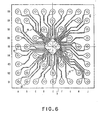
- the present application for the sake of simplification, only the application to sorting the ceramic modules (of the kind shown in FIG. 6) will be detailed.
- the adaptation of the method of the present invention to other objects having fixed tolerances commonly used in the semiconductor industry, such as: masks, reticles, printed circuit boards, microchips of integrated circuits, is without major difficulty for those skilled in the art.
- the present invention is essentially concerned with the geometric configurations of objects, and is therefore not limited to this single field of application.
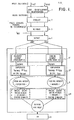
- This method essentially comprises a complex step of highlighting the defects presented by the object to be examined by comparison of the image of the reference object (in real time or previously stored in digital form in a memory) and the image of the object to be examined. This comparison is made using precise digital image processing which implements basic transformations of mathematical morphology and set theory.
- the two images are taken, for example, in black and white with all the gray levels according to an appropriate sampling frame, then quantified with sixteen gray levels.
- the images are then thresholded to appear only in black and white, for example the patterns to be compared are white on a black background. This step can be done using a computer program. Two binary images of the reference object and the sample object are finally obtained.
- the image of the sample must be compared with the maximum and minimum reference images.
- the creation of these two images is done by dilation and erosion (basic transformation of the mathematical morphology), of the nominal reference image.
- the expansion and erosion sizes are a function of the width of the maximum and minimum dimensional tolerances of the circuits. These are fixed for conductors of the same width over the entire surface of the module.
- the comparison of the image of the sample with the minimum reference image gives the defects of the kind "lack", that is to say during the minimum dimensional tolerances.
- the comparison of the images is done by various operations of set theory (union, intersection, etc.) which correspond to the Boolean operations AND, OR, OR EXC, Inversion.
- the operations of comparison as well as those of erosion and expansion can be done using computer programs.
- the step of analysis according to the criteria for rejecting these images of the defects is followed by a sorting step which makes it possible to reject the objects which have unwanted defects. ;
- the present invention also relates to equipment for implementing this method.
- FIG. 6 represents a topology of conductors with fixed width on the surface of a 48-pin ceramic module intended to receive a single chip of integrated circuits.
- the definitions of the various basic transformations used in digital image processing in accordance with the teachings of the present invention are mainly based on the concepts of structuring element and all-or-nothing transformations: erosion or expansion.
- the space on which we are working is the Euclidean space R2 provided with its metric d. 0 indicates the origin of the space considered. If B denotes any set of this space, B x denotes the translate of B by the vector O X , we define
- a and B be two sets of R2, we call expanded from A. by B a new set denoted A ⁇ B such that: in other words a point x of the space R2 belongs to the dilate of A by B if and only if the translate of B by O X meets A.
- the set B is called the structuring element.
- a and B be two sets of R2.
- the distance between a point x and a set X of R2 is defined by the disc with center 0 and radius p, that is D (0, p) is denoted pD.
- the opening it is erosion followed by a dilation either (A ⁇ B) 0 B and
- the closure it is the expansion followed by an erosion either (A ⁇ B) ⁇ B
- erosion removes from the image the parts smaller than the structuring element (it is the same for the expansion on A c ).
- the opening removes from A all the smaller parts of the structuring element without changing the rest of the image (the closing has an identical effect on A C ).
- FIG. 9 This step 5 of highlighting faults will be explained more simply with the aid of FIG. 9.
- a reference image I REF has been shown which represents for example a portion 14 of two conductive lines 10 of the module 9 shown in FIG. 6.
- the image I EXA of the module to be examined is also represented with the two corresponding conductors 15 but which presents, with respect to I REF, both a lack (hole) 16 and an extension (bridge) 17 , that is to say a defect of each kind.
- the pixels have been represented by small circles. The solid circles show the effective image points which therefore correspond to binary "1s".
- the following operation therefore consists in making the comparison according to complex logical operators. We train first which brings up the fault 20 of the bridge type and then which shows the hole type defect 21.
- step 5 consists in analyzing the defect images according to their own rejection criteria. These criteria in the case of objects having constant dimensional tolerances, simply consist of the dimensions of acceptable defects. In practice, this amounts to generating an analysis window, and comparing each fault with this window. The form, the situation, the nature of the defects are not taken into consideration. The rejection criteria in this case are therefore very rudimentary and can be identical for both the shortage and the extension.
- the processing step 5 essentially comprises a first operation 5 ′ of adjusting the configuration of I REF to the dimensional tolerances (expansion and erosion), a second operation 5 ′′ of comparison with I EXA , which provides two images of the defects ( "lack" and “extension” type) and finally a third 5 "operation to analyze the defect images according to previously determined rejection criteria.
- modules are therefore analyzed very quickly.
- the modules which have defects are relatively few in number, for example, they are less than 5%.
- Modules which have faults and which are rejected at this level can be examined or re-examined in more detail by an additional step of recognition and analysis of faults.
- Objects deemed to be good that is to say presenting images of blank defects or whose defects are acceptable in view of the rejection criteria, are accepted at this level.
- the method of digital processing of the images of the reference object and of the object to be examined as described in part II of the present application can find application in very diverse fields as has been written above. above and in particular in the semiconductor industry, where it can in particular be used for the automatic sorting of printed circuits, modules, masks and semiconductor chips (metallurgy control), including certain patterns, such as. conductive lines have fixed dimensional tolerances.
- the masks, and the modules the images are very contrasted (practically black and white), in this case the automatic detection of the threshold can be done without difficulty as well as the cropping.
- a typical 2.5x2.5 cm module has a configuration of conductive lines with a constant width equal to 125 microns with an N tolerance of 25 microns. This means that a conductive line is accepted as soon as its width L satisfies the relationship 100 ⁇ ⁇ L ⁇ 150 p. With a 2 Kbit camera, the distance between two pixels is approximately 12.5 microns.
- the structuring element B in FIG. 9 will correspond perfectly since the tolerance N is also 25 microns. For modules with a conductor width greater than 125p, for example 250p, the most appropriate multiple of 25 ⁇ will be used. In any case, you can choose a camera that has the most appropriate resolution.
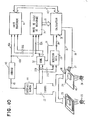
- a digital color camera 22 of 10 bit resolution constitutes the sensor.
- the reference object 23 and the object to be examined 24 are illuminated by two different color sources (red and blue) 25 and 26, two objectives form the two images to be compared while a set of prisms (not shown). superimposes them on the camera lens.
- the two images are therefore captured at the same time, by the color camera which is responsible for separating the two signals of different colors at the output.
- This device has the advantage of preserving the 10 bits of resolution, by avoiding thermal drifts of the camera, imperfections of the vidicon tube as well as optical aberrations.
- the digital signals from the camera are transmitted by the bus 27A to a threshold detection block 28, where they are analyzed.
- This block 28 establishes the intensity histograms of the two images (gray distribution) and supplies them via the bus 29 to the computer 30, the latter determining the respective thresholds of the images I ref and I exa .
- These values are then displayed by the bus 31 at the input of the threshold block 32 which also receives the signals emitted by the camera by the bus 27B.
- the images are thresholded: each image point takes the binary value 0 or 1, after having been compared with the threshold.
- the two thresholded binary images are sent by the bus 33A to the cropping unit 34 (at x, y and possibly 8).
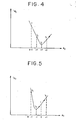
- this unit calculates the areas I (M) of the area of non-overlap of the two images when they are offset.
- the information is transmitted by bus 35 to the computer 30.
- the computer controls the stepping motors 36 and 37 by lines 38 and 39, which move the support 40 of the object to be examined, by analyzing the results of the block of cropping, until obtaining the optimum cropping, which corresponds as we saw above, to the minimum of the functions I (M) (in x and in y).
- the processing unit 41 then receives via the bus 30B, information which corresponds to perfectly framed images.
- This unit performs the various logic operations mentioned above, which are prewired.
- this unit consists of two sets: a first set which analyzes the gaps, another which analyzes the extensions.
- This unit measures horizontal and green projections. of the defect and its position. It contains the erosion and dilation blocks.
- This unit analyzes and compares the images according to the method described in FIG. 1 and transmits: to the computer 30 by a line of the bus 42 the result: the object to be examined is good "or is" to be rejected ".
- the assembly is controlled by a clock 43 (for example 10 MHz) which controls the interface circuit 44 of the camera, the processing unit 41 and the cropping calculation unit 34 respectively by lines 45 and 46 A and B.
- the circuits making up the processing unit 41 are more particularly detailed in FIGS. 11A to 11D
- the block diagram of the processing unit is shown in FIG.
- the erosion block 47 is represented, which essentially comprises three parts: a storage part constituted by shift registers provided with two outputs Q and Q. A part ensuring the generation function of the structuring element B shown on the Figure 9 and an AND gate.
- the number of registers depends on the number of lines to be stored. In the example of the structuring element in the shape of a cross, mentioned above, three lines must be memorized, so three shift registers 48, 49 and 50 have been introduced. The capacity of these registers obviously depends on the number of bits representative of the line: 1024 or 2048 bits for example. Given the cross-shaped structuring element chosen, three 2-bit shift registers, 51, 52 and 53 are therefore necessary.
- the erosion block includes an AND gate 54.
- the operation is as follows.
- the binary input signal representative of the image of the object of reference IREF arrives in the erosion block by line 55.
- the binary data fill the first register 48, then line by line, the other registers.
- the registers 51, 52 and 53 of the structuring element act at all times like a window.
- the ET 54 circuit will only provide a 1 at the output for the points corresponding to (I REF ) min .
- the circuits 47 and 56 can of course be used to carry out the cleaning step 3, it suffices to determine the appropriate structuring element corresponding to the smallest acceptable defect at the level of the electronic images, as has been written above.
- comparison block 66 will be reference 66A.
- FIG. 11D there is shown a circuit 70 capable of carrying out the analysis operation as it is mentioned in FIG. 1 (step 5).
- the rejection criterion is the same whether it is a defect of the "lack" type or of the "extension” type.
- the circuit will detect a defect only from a projection of five steps.
- the analysis window in this case therefore has the dimensions 5 ⁇ 5 pixels.
- the OR circuit 88 gathers the positions Al Bl Cl Dl El or five positions along the X axis. Objects with the defects as referenced in 20 and 21 shown in Figure 9 would therefore be rejected with this criterion, the defect 20 indeed shows that it has a maximum length of 11 pixels along the X axis, while default 21 shows 6 pixels along the Y axis.
- the SX and SY signals from AND gates 86 and 87 attack an OR circuit 93.
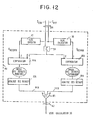
- FIG. 12 there is shown the block diagram of. the processing unit 41 (the interactions with the clock 43 have not been shown) which performs all of the operations appearing in block 5 of FIG. 1 (and possibly in addition the step of cleaning block 3) .
- the processing unit is also under the control of the computer 30 to which it provides the decision elements when the object to be examined by the bus 42 (sorting step, block 6, FIG. 1).
- the circuits shown have been described above with reference to FIGS. 11A to 11D.
- the results provided by the fault analysis circuits 70A and 70B, for the images of the gaps and of the extensions respectively, are processed by an OR circuit 95 which supplies the elements of good / rejection decision to the computer 30 by the bus 42.
- a circuit delay (with adjustable delay t) bearing the reference 96 is also shown in FIG. 12.
- a variant consists in processing by the steps mentioned above: entry and sampling (1), thresholding (2), cleaning (3), and framing (4), only for the image of the object to be examined.
- the image of the reference object has been stored in the computer once and for all.
- the computer may have in memory a large number of electronic images of different reference objects, for example modules having different topologies corresponding to different part numbers, or even masks.
- the binary data corresponding to the images can be those supplied directly by the type configuration generators. Gerber.
- the electronic images of the reference object and of the object to be examined can be framed using markers placed on the objects. This technique is known both for masks and for microchips, where alignment problems are essential.
- Bubble memories can be used due to the large number of bits to memorize (for example 4 megabits) which corresponds to a pixel matrix of 2048 x 2048 bits, a figure which appears sufficient for sorting the masks (10X reticles) and modules.
Landscapes
- Engineering & Computer Science (AREA)
- Physics & Mathematics (AREA)
- General Physics & Mathematics (AREA)
- Health & Medical Sciences (AREA)
- Computer Vision & Pattern Recognition (AREA)
- Analytical Chemistry (AREA)
- Pathology (AREA)
- Toxicology (AREA)
- Life Sciences & Earth Sciences (AREA)
- Chemical & Material Sciences (AREA)
- Electromagnetism (AREA)
- Biochemistry (AREA)
- General Health & Medical Sciences (AREA)
- Immunology (AREA)
- General Engineering & Computer Science (AREA)
- Quality & Reliability (AREA)
- Theoretical Computer Science (AREA)
- Investigating Materials By The Use Of Optical Means Adapted For Particular Applications (AREA)
- Image Processing (AREA)
- Preparing Plates And Mask In Photomechanical Process (AREA)
- Exposure And Positioning Against Photoresist Photosensitive Materials (AREA)
- Testing Or Measuring Of Semiconductors Or The Like (AREA)
- Length Measuring Devices With Unspecified Measuring Means (AREA)
Priority Applications (4)
| Application Number | Priority Date | Filing Date | Title |
|---|---|---|---|
| EP80430033A EP0054598B1 (de) | 1980-12-18 | 1980-12-18 | Verfahren zum Untersuchen und automatischen Sortieren von Objekten bestimmter Gestalt mit festen dimensionalen Toleranzen und Einrichtung zur Durchführung des Verfahrens |
| DE8080430033T DE3070433D1 (en) | 1980-12-18 | 1980-12-18 | Method for the inspection and automatic sorting of objects with configurations of fixed dimensional tolerances, and device for carrying out the method |
| JP14408981A JPS57120807A (en) | 1980-12-18 | 1981-09-14 | Object inspector |
| US06/330,411 US4477926A (en) | 1980-12-18 | 1981-12-14 | Process for inspecting and automatically sorting objects showing patterns with constant dimensional tolerances and apparatus for carrying out said process |
Applications Claiming Priority (1)
| Application Number | Priority Date | Filing Date | Title |
|---|---|---|---|
| EP80430033A EP0054598B1 (de) | 1980-12-18 | 1980-12-18 | Verfahren zum Untersuchen und automatischen Sortieren von Objekten bestimmter Gestalt mit festen dimensionalen Toleranzen und Einrichtung zur Durchführung des Verfahrens |
Publications (2)
| Publication Number | Publication Date |
|---|---|
| EP0054598A1 true EP0054598A1 (de) | 1982-06-30 |
| EP0054598B1 EP0054598B1 (de) | 1985-04-03 |
Family
ID=8187430
Family Applications (1)
| Application Number | Title | Priority Date | Filing Date |
|---|---|---|---|
| EP80430033A Expired EP0054598B1 (de) | 1980-12-18 | 1980-12-18 | Verfahren zum Untersuchen und automatischen Sortieren von Objekten bestimmter Gestalt mit festen dimensionalen Toleranzen und Einrichtung zur Durchführung des Verfahrens |
Country Status (4)
| Country | Link |
|---|---|
| US (1) | US4477926A (de) |
| EP (1) | EP0054598B1 (de) |
| JP (1) | JPS57120807A (de) |
| DE (1) | DE3070433D1 (de) |
Cited By (10)
| Publication number | Priority date | Publication date | Assignee | Title |
|---|---|---|---|---|
| EP0147493A1 (de) * | 1983-12-28 | 1985-07-10 | International Business Machines Corporation | Verfahren und Ausrüstung zur automatischen Ausrichtung eines Objekts bezogen auf eine Referenz |
| EP0147205A3 (en) * | 1983-12-27 | 1987-08-26 | Fujitsu Limited | Pattern inspection |
| EP0117559A3 (en) * | 1983-02-28 | 1987-10-28 | Hitachi, Ltd. | Pattern checking apparatus |
| EP0195161A3 (en) * | 1985-03-14 | 1988-08-10 | Beltronics, Inc. | Apparatus for automatically inspecting objects and identifying or recognizing known and unknown portions thereof, including defects and the like and method |
| EP0332706A4 (de) * | 1987-08-13 | 1989-12-19 | Nippon Telegraph & Telephone | Vorrichtung und verfahren zur schnellen detektion von bildfehlehrn. |
| EP0263473A3 (en) * | 1986-10-03 | 1990-10-10 | Omron Tateisi Electronics Co. | Apparatus for inspecting packaged electronic device |
| EP0475454A3 (en) * | 1990-09-14 | 1992-10-14 | Fuji Photo Film Co., Ltd. | Defect inspection system |
| FR2693813A1 (fr) * | 1992-07-20 | 1994-01-21 | Commissariat Energie Atomique | Procédé de réalisation d'une image de référence synthétisée à partir de données contenues dans une base de données CAO. |
| EP0593183A3 (de) * | 1992-10-16 | 1994-11-17 | Polaroid Corp | System zum Vergleich eines CAD-Bildes mit einem Videobild. |
| WO1997036260A1 (en) * | 1996-03-25 | 1997-10-02 | Focus Automation Systems Inc. | Method, apparatus and system for verification of patterns |
Families Citing this family (40)
| Publication number | Priority date | Publication date | Assignee | Title |
|---|---|---|---|---|
| US4590607A (en) * | 1982-09-17 | 1986-05-20 | Environmental Research Institute Of Michigan | Image correspondence techniques using serial neighborhood processing |
| JPS5961136A (ja) * | 1982-09-30 | 1984-04-07 | Toshiba Corp | マスク欠陥検査装置 |
| JPH0610609B2 (ja) * | 1982-11-12 | 1994-02-09 | 株式会社日立製作所 | 部品位置検査装置 |
| JPH0750664B2 (ja) * | 1983-06-23 | 1995-05-31 | 富士通株式会社 | レチクルの検査方法 |
| GB2152658A (en) * | 1984-01-09 | 1985-08-07 | Philips Electronic Associated | Object sorting system |
| US4581537A (en) * | 1984-03-23 | 1986-04-08 | International Business Machines Corporation | Method for generating inspection patterns |
| US4644585A (en) * | 1985-02-11 | 1987-02-17 | Environmental Research Institute Of Michigan | Method and apparatus for automatic shape recognition |
| US4928313A (en) * | 1985-10-25 | 1990-05-22 | Synthetic Vision Systems, Inc. | Method and system for automatically visually inspecting an article |
| US4733079A (en) * | 1985-12-13 | 1988-03-22 | Lockheed Corporation | Method of and apparatus for thermographic identification of parts |
| JPS63104185A (ja) * | 1986-10-22 | 1988-05-09 | Seiko Instr & Electronics Ltd | 画像の膨張・縮小変換回路 |
| US4837847A (en) * | 1987-02-03 | 1989-06-06 | Canon Kabushiki Kaisha | Image processing apparatus |
| DE3731947A1 (de) * | 1987-09-23 | 1989-04-13 | Kurt Dr Sauerwein | Verfahren und vorrichtung zum feststellen und auswerten von oberflaechenrissen bei werkstuecken |
| US5129009A (en) * | 1990-06-04 | 1992-07-07 | Motorola, Inc. | Method for automatic semiconductor wafer inspection |
| JP2591292B2 (ja) * | 1990-09-05 | 1997-03-19 | 日本電気株式会社 | 画像処理装置とそれを用いた自動光学検査装置 |
| US5214712A (en) * | 1990-09-11 | 1993-05-25 | Matsushita Electric Industrial Co., Ltd. | Pattern inspection system for inspecting defect of land pattern for through-hole on printed board |
| US5204910A (en) * | 1991-05-24 | 1993-04-20 | Motorola, Inc. | Method for detection of defects lacking distinct edges |
| JP3074837B2 (ja) * | 1991-08-23 | 2000-08-07 | ソニー株式会社 | 多値記録データの信号再生装置と信号検出方法 |
| JP3265595B2 (ja) * | 1991-09-27 | 2002-03-11 | オムロン株式会社 | 画像処理方法およびその装置 |
| FR2683926B1 (fr) * | 1991-11-15 | 1994-02-18 | Snecma | Procede et dispositif d'acquisition et de traitement d'images radioscopiques. |
| JPH07117498B2 (ja) * | 1991-12-11 | 1995-12-18 | インターナショナル・ビジネス・マシーンズ・コーポレイション | 検査システム |
| JP3300479B2 (ja) * | 1993-07-19 | 2002-07-08 | 浜松ホトニクス株式会社 | 半導体デバイス検査システム |
| US5544256A (en) * | 1993-10-22 | 1996-08-06 | International Business Machines Corporation | Automated defect classification system |
| JP3445394B2 (ja) * | 1993-12-17 | 2003-09-08 | ゼロックス・コーポレーション | 少なくとも二つのイメージセクションの比較方法 |
| DE4410603C1 (de) * | 1994-03-26 | 1995-06-14 | Jenoptik Technologie Gmbh | Verfahren zur Erkennung von Fehlern bei der Inspektion von strukturierten Oberflächen |
| DE19636949A1 (de) * | 1996-09-11 | 1998-03-12 | Siemens Ag | Verfahren zur Detektion von Kanten in einem Bildsignal |
| US5978501A (en) * | 1997-01-03 | 1999-11-02 | International Business Machines Corporation | Adaptive inspection method and system |
| US6175415B1 (en) | 1997-02-19 | 2001-01-16 | United Technologies Corporation | Optical profile sensor |
| US5972727A (en) * | 1998-06-30 | 1999-10-26 | Advanced Micro Devices | Reticle sorter |
| US6222145B1 (en) | 1998-10-29 | 2001-04-24 | International Business Machines Corporation | Mechanical strength die sorting |
| KR100378988B1 (ko) * | 2000-10-27 | 2003-04-08 | 한국과학기술연구원 | 반도체 패키지의 삼차원 시각 검사방법 |
| US20030072481A1 (en) * | 2001-10-11 | 2003-04-17 | Advanced Micro Devices, Inc. | Method for evaluating anomalies in a semiconductor manufacturing process |
| JP3699960B2 (ja) * | 2003-03-14 | 2005-09-28 | 株式会社東芝 | 検査レシピ作成システム、欠陥レビューシステム、検査レシピ作成方法及び欠陥レビュー方法 |
| US7702157B2 (en) * | 2005-03-30 | 2010-04-20 | Kabushiki Kaisha Toshiba | Pattern evaluation method, pattern matching method and computer readable medium |
| JP4174504B2 (ja) * | 2005-08-31 | 2008-11-05 | アドバンスド・マスク・インスペクション・テクノロジー株式会社 | 試料検査装置、試料検査方法及びプログラム |
| JP5564960B2 (ja) * | 2010-01-25 | 2014-08-06 | 日本電気株式会社 | 湿潤検出装置及び湿潤検出方法 |
| JP2014055789A (ja) * | 2012-09-11 | 2014-03-27 | Nuflare Technology Inc | パターン評価方法およびパターン評価装置 |
| CN102937595B (zh) * | 2012-11-13 | 2015-05-20 | 浙江省电力公司电力科学研究院 | 一种pcb板检测方法、装置及系统 |
| EP3243166B1 (de) * | 2015-01-06 | 2020-07-08 | Sikorsky Aircraft Corporation | Strukturelle maskierung für progressive gesundheitsüberwachung |
| TWI521476B (zh) * | 2015-04-17 | 2016-02-11 | 銘傳大學 | 週期性圖案之自動光學檢測方法 |
| CN106568778A (zh) * | 2015-10-08 | 2017-04-19 | 台达电子工业股份有限公司 | 电子元件外观影像检测方法 |
Citations (7)
| Publication number | Priority date | Publication date | Assignee | Title |
|---|---|---|---|---|
| FR2095523A5 (de) * | 1970-06-15 | 1972-02-11 | Ibm | |
| FR2249520A1 (de) * | 1973-10-30 | 1975-05-23 | Westinghouse Electric Corp | |
| US3956629A (en) * | 1975-06-09 | 1976-05-11 | Inex, Inc. | Inspection method and apparatus |
| FR2321229A1 (fr) * | 1975-08-13 | 1977-03-11 | Cit Alcatel | Procede et appareillage pour controle automatique de graphisme |
| US4123170A (en) * | 1975-11-26 | 1978-10-31 | Nippon Jido Seigyo, Ltd. | Apparatus for detecting defects in patterns |
| EP0004505A2 (de) * | 1978-03-24 | 1979-10-03 | Thomson-Csf | Kontrollvorrichtung für ein auf einem Träger eingeschriebenes Muster |
| US4218142A (en) * | 1978-03-08 | 1980-08-19 | Aerodyne Research, Inc. | Mask analysis |
Family Cites Families (5)
| Publication number | Priority date | Publication date | Assignee | Title |
|---|---|---|---|---|
| JPS4934385A (de) * | 1972-07-28 | 1974-03-29 | ||
| JPS52116175A (en) * | 1976-03-26 | 1977-09-29 | Mitsubishi Electric Corp | Pattern defect recognition device |
| US4056716A (en) * | 1976-06-30 | 1977-11-01 | International Business Machines Corporation | Defect inspection of objects such as electronic circuits |
| DE3013833C2 (de) * | 1979-04-13 | 1986-07-03 | Hitachi, Ltd., Tokio/Tokyo | Vorrichtung zur Prüfung eines auf einem Gegenstand befindlichen Musters auf Fehler |
| US4269515A (en) * | 1979-08-07 | 1981-05-26 | Altman Associates, Inc. | Electro-optical system for inspecting printed circuit boards |
-
1980
- 1980-12-18 DE DE8080430033T patent/DE3070433D1/de not_active Expired
- 1980-12-18 EP EP80430033A patent/EP0054598B1/de not_active Expired
-
1981
- 1981-09-14 JP JP14408981A patent/JPS57120807A/ja active Granted
- 1981-12-14 US US06/330,411 patent/US4477926A/en not_active Expired - Lifetime
Patent Citations (7)
| Publication number | Priority date | Publication date | Assignee | Title |
|---|---|---|---|---|
| FR2095523A5 (de) * | 1970-06-15 | 1972-02-11 | Ibm | |
| FR2249520A1 (de) * | 1973-10-30 | 1975-05-23 | Westinghouse Electric Corp | |
| US3956629A (en) * | 1975-06-09 | 1976-05-11 | Inex, Inc. | Inspection method and apparatus |
| FR2321229A1 (fr) * | 1975-08-13 | 1977-03-11 | Cit Alcatel | Procede et appareillage pour controle automatique de graphisme |
| US4123170A (en) * | 1975-11-26 | 1978-10-31 | Nippon Jido Seigyo, Ltd. | Apparatus for detecting defects in patterns |
| US4218142A (en) * | 1978-03-08 | 1980-08-19 | Aerodyne Research, Inc. | Mask analysis |
| EP0004505A2 (de) * | 1978-03-24 | 1979-10-03 | Thomson-Csf | Kontrollvorrichtung für ein auf einem Träger eingeschriebenes Muster |
Non-Patent Citations (2)
| Title |
|---|
| Computer Graphics and Image Processing, Vol. 4, 1975 L.S. DAVIS "A Survey of Edge Detection Techniques" pages 248 a 270 * |
| Solid State Technology, Vol. 23, No. 10, Octobre 1980 L. ARLAN et al. "Computer Controlled Imaging System for Automatic Hybrid Inspection" pages 123 a 129 * fig. 9 * * |
Cited By (12)
| Publication number | Priority date | Publication date | Assignee | Title |
|---|---|---|---|---|
| EP0117559A3 (en) * | 1983-02-28 | 1987-10-28 | Hitachi, Ltd. | Pattern checking apparatus |
| EP0147205A3 (en) * | 1983-12-27 | 1987-08-26 | Fujitsu Limited | Pattern inspection |
| EP0147493A1 (de) * | 1983-12-28 | 1985-07-10 | International Business Machines Corporation | Verfahren und Ausrüstung zur automatischen Ausrichtung eines Objekts bezogen auf eine Referenz |
| EP0195161A3 (en) * | 1985-03-14 | 1988-08-10 | Beltronics, Inc. | Apparatus for automatically inspecting objects and identifying or recognizing known and unknown portions thereof, including defects and the like and method |
| EP0263473A3 (en) * | 1986-10-03 | 1990-10-10 | Omron Tateisi Electronics Co. | Apparatus for inspecting packaged electronic device |
| EP0332706A4 (de) * | 1987-08-13 | 1989-12-19 | Nippon Telegraph & Telephone | Vorrichtung und verfahren zur schnellen detektion von bildfehlehrn. |
| EP0475454A3 (en) * | 1990-09-14 | 1992-10-14 | Fuji Photo Film Co., Ltd. | Defect inspection system |
| FR2693813A1 (fr) * | 1992-07-20 | 1994-01-21 | Commissariat Energie Atomique | Procédé de réalisation d'une image de référence synthétisée à partir de données contenues dans une base de données CAO. |
| EP0580481A1 (de) * | 1992-07-20 | 1994-01-26 | Commissariat A L'energie Atomique | Verfahren zur Durchführung eines synthesierten Referenzbilds aus in einer CAD-Datenbank gespeicherten Daten |
| EP0593183A3 (de) * | 1992-10-16 | 1994-11-17 | Polaroid Corp | System zum Vergleich eines CAD-Bildes mit einem Videobild. |
| WO1997036260A1 (en) * | 1996-03-25 | 1997-10-02 | Focus Automation Systems Inc. | Method, apparatus and system for verification of patterns |
| US5848189A (en) * | 1996-03-25 | 1998-12-08 | Focus Automation Systems Inc. | Method, apparatus and system for verification of patterns |
Also Published As
| Publication number | Publication date |
|---|---|
| DE3070433D1 (en) | 1985-05-09 |
| EP0054598B1 (de) | 1985-04-03 |
| JPS57120807A (en) | 1982-07-28 |
| US4477926A (en) | 1984-10-16 |
| JPS6239815B2 (de) | 1987-08-25 |
Similar Documents
| Publication | Publication Date | Title |
|---|---|---|
| EP0054598B1 (de) | Verfahren zum Untersuchen und automatischen Sortieren von Objekten bestimmter Gestalt mit festen dimensionalen Toleranzen und Einrichtung zur Durchführung des Verfahrens | |
| EP0054596B1 (de) | Verfahren für die Inspektion und die automatische Sortierung von Objekten, die Konfigurationen mit dimensionellen Toleranzen aufweisen und platzabhängige Kriterien für die Verwerfung, Anlage und Schaltung dafür | |
| BE1017547A6 (fr) | Compression d'images numeriques de documents scannes. | |
| EP0970367B1 (de) | Verfahren zur kontrolle der oberfläche einer laufenden materialbahn mit bildsegmentierung zur umgrenzung von defektbereichen | |
| FR2717925A1 (fr) | Procédé d'identification de défauts lors de l'inspection de surfaces structurées. | |
| EP0627693B1 (de) | Vorrichtung zur Segmentierung von aus Texturen bestehenden Bildern | |
| EP0473476A1 (de) | Verfahren und Vorrichtung zur Realzeit-Lokalisierung von geraden Kanten in einem numerischen Bild, insbesondere für die Mustererkennung in einem Szenenanalyseprozess | |
| FR2791775A1 (fr) | Detection de defauts a base de particularites | |
| FR3113162A1 (fr) | Procédé et dispositif d’imagerie sous-marine | |
| CA3095089A1 (fr) | Methode de detection de cellules presentant au moins une anomalie dans un echantilllon cytologique | |
| EP4377757A1 (de) | Verfahren zur automatischen erkennung von defekten in bauelementen einer leiterplatte | |
| EP0970368B1 (de) | Verfahren zur kontrolle der oberfläche einer laufenden materialbahn mit vorklassifikation von ermittelten unregelmässigkeiten | |
| EP1129432B1 (de) | Verfahren zum vergleich von aus bildpunkten bestehenden gespeicherten bildern, die äquipotentielen mindestens einer integrierten schaltung darstellen | |
| BE1015708A3 (fr) | Procede pour mesurer la hauteur de spheres ou d'hemispheres. | |
| FR2978274A1 (fr) | Procede de traitement differencie de zones d'une image | |
| EP2825995B1 (de) | System zur identifizierung einer digitalkamera von einem bild und entsprechende durchführung verfahren | |
| FR2551210A1 (fr) | Procede de controle d'un reseau | |
| EP0025760A1 (de) | Verfahren zur Identifikation sich auf einer Oberfläche befindender Objekte und zur Bestimmung der Parameter dieser Objekte | |
| JP3609284B2 (ja) | 検出装置 | |
| EP3830789A1 (de) | Analyse von defekten von mindestens einem typ unter einer vielzahl von typen von defekten zwischen mindestens zwei proben | |
| EP0826960B1 (de) | Verfahren zur automatischen Erfassung von Fehlstellen in mechanischen Werkstücken mit komplizierter Geometrie | |
| FR2692059A1 (fr) | Procédé de comparaison de flots de données et dispositif de mise en Óoeuvre. | |
| WO1998044338A1 (fr) | Procede d'inspection de surface d'une bande en defilement et d'analyse de la defectuosite de la bande | |
| WO2025252835A1 (fr) | Procédé d'analyse lithologique d'un échantillon de déblais de forage | |
| FR2910673A1 (fr) | Procede de traitement d'image et dispositif implementant ledit procede |
Legal Events
| Date | Code | Title | Description |
|---|---|---|---|
| PUAI | Public reference made under article 153(3) epc to a published international application that has entered the european phase |
Free format text: ORIGINAL CODE: 0009012 |
|
| AK | Designated contracting states |
Designated state(s): DE FR GB |
|
| 17P | Request for examination filed |
Effective date: 19820713 |
|
| GRAA | (expected) grant |
Free format text: ORIGINAL CODE: 0009210 |
|
| AK | Designated contracting states |
Designated state(s): DE FR GB |
|
| REF | Corresponds to: |
Ref document number: 3070433 Country of ref document: DE Date of ref document: 19850509 |
|
| PLBE | No opposition filed within time limit |
Free format text: ORIGINAL CODE: 0009261 |
|
| STAA | Information on the status of an ep patent application or granted ep patent |
Free format text: STATUS: NO OPPOSITION FILED WITHIN TIME LIMIT |
|
| 26N | No opposition filed | ||
| PGFP | Annual fee paid to national office [announced via postgrant information from national office to epo] |
Ref country code: DE Payment date: 19981215 Year of fee payment: 19 |
|
| PGFP | Annual fee paid to national office [announced via postgrant information from national office to epo] |
Ref country code: GB Payment date: 19991122 Year of fee payment: 20 |
|
| PGFP | Annual fee paid to national office [announced via postgrant information from national office to epo] |
Ref country code: FR Payment date: 19991217 Year of fee payment: 20 |
|
| PG25 | Lapsed in a contracting state [announced via postgrant information from national office to epo] |
Ref country code: DE Free format text: LAPSE BECAUSE OF NON-PAYMENT OF DUE FEES Effective date: 20001003 |
|
| PG25 | Lapsed in a contracting state [announced via postgrant information from national office to epo] |
Ref country code: GB Free format text: LAPSE BECAUSE OF EXPIRATION OF PROTECTION Effective date: 20001217 |
|
| REG | Reference to a national code |
Ref country code: GB Ref legal event code: PE20 Effective date: 20001217 |