EP0061918B1 - Méthode de fabrication de lunettes - Google Patents
Méthode de fabrication de lunettes Download PDFInfo
- Publication number
- EP0061918B1 EP0061918B1 EP19820301629 EP82301629A EP0061918B1 EP 0061918 B1 EP0061918 B1 EP 0061918B1 EP 19820301629 EP19820301629 EP 19820301629 EP 82301629 A EP82301629 A EP 82301629A EP 0061918 B1 EP0061918 B1 EP 0061918B1
- Authority
- EP
- European Patent Office
- Prior art keywords
- lens
- information
- model
- frame
- optometrical
- Prior art date
- Legal status (The legal status is an assumption and is not a legal conclusion. Google has not performed a legal analysis and makes no representation as to the accuracy of the status listed.)
- Expired
Links
Images

Classifications
-
- G—PHYSICS
- G02—OPTICS
- G02C—SPECTACLES; SUNGLASSES OR GOGGLES INSOFAR AS THEY HAVE THE SAME FEATURES AS SPECTACLES; CONTACT LENSES
- G02C13/00—Assembling; Repairing; Cleaning
- G02C13/003—Measuring during assembly or fitting of spectacles
-
- B—PERFORMING OPERATIONS; TRANSPORTING
- B24—GRINDING; POLISHING
- B24B—MACHINES, DEVICES, OR PROCESSES FOR GRINDING OR POLISHING; DRESSING OR CONDITIONING OF ABRADING SURFACES; FEEDING OF GRINDING, POLISHING, OR LAPPING AGENTS
- B24B9/00—Machines or devices designed for grinding edges or bevels on work or for removing burrs; Accessories therefor
- B24B9/02—Machines or devices designed for grinding edges or bevels on work or for removing burrs; Accessories therefor characterised by a special design with respect to properties of materials specific to articles to be ground
- B24B9/06—Machines or devices designed for grinding edges or bevels on work or for removing burrs; Accessories therefor characterised by a special design with respect to properties of materials specific to articles to be ground of non-metallic inorganic material, e.g. stone, ceramics, porcelain
- B24B9/08—Machines or devices designed for grinding edges or bevels on work or for removing burrs; Accessories therefor characterised by a special design with respect to properties of materials specific to articles to be ground of non-metallic inorganic material, e.g. stone, ceramics, porcelain of glass
- B24B9/14—Machines or devices designed for grinding edges or bevels on work or for removing burrs; Accessories therefor characterised by a special design with respect to properties of materials specific to articles to be ground of non-metallic inorganic material, e.g. stone, ceramics, porcelain of glass of optical work, e.g. lenses, prisms
-
- B—PERFORMING OPERATIONS; TRANSPORTING
- B24—GRINDING; POLISHING
- B24B—MACHINES, DEVICES, OR PROCESSES FOR GRINDING OR POLISHING; DRESSING OR CONDITIONING OF ABRADING SURFACES; FEEDING OF GRINDING, POLISHING, OR LAPPING AGENTS
- B24B9/00—Machines or devices designed for grinding edges or bevels on work or for removing burrs; Accessories therefor
- B24B9/02—Machines or devices designed for grinding edges or bevels on work or for removing burrs; Accessories therefor characterised by a special design with respect to properties of materials specific to articles to be ground
- B24B9/06—Machines or devices designed for grinding edges or bevels on work or for removing burrs; Accessories therefor characterised by a special design with respect to properties of materials specific to articles to be ground of non-metallic inorganic material, e.g. stone, ceramics, porcelain
- B24B9/08—Machines or devices designed for grinding edges or bevels on work or for removing burrs; Accessories therefor characterised by a special design with respect to properties of materials specific to articles to be ground of non-metallic inorganic material, e.g. stone, ceramics, porcelain of glass
- B24B9/14—Machines or devices designed for grinding edges or bevels on work or for removing burrs; Accessories therefor characterised by a special design with respect to properties of materials specific to articles to be ground of non-metallic inorganic material, e.g. stone, ceramics, porcelain of glass of optical work, e.g. lenses, prisms
- B24B9/148—Machines or devices designed for grinding edges or bevels on work or for removing burrs; Accessories therefor characterised by a special design with respect to properties of materials specific to articles to be ground of non-metallic inorganic material, e.g. stone, ceramics, porcelain of glass of optical work, e.g. lenses, prisms electrically, e.g. numerically, controlled
Definitions
- the present invention relates in general to a method of manufacturing spetacles, and especially to a method of fabricating glasses or spectacles which method includes the steps of measuring a lens model or pattern representative of the shape and size of a spectacle-frame into which the finished lens is to be fitted, inputting the information obtained from the lens model or pattern and optomertrical information prescribed by an opthalmologist or eye doctor into a computer, processing the information from both of those sources in accordance with a predetermined automatic lens-designing program, preparing the lens on the basis of the design data or processing information thus obtained by cutting, abrading and/or the like processing, and fitting the lens thus finished into a spectacle-frame.
- lens materials or raw lenses in the form of circular blanks having curved faces of predetermined optical powers and predetermined diameters are kept in stock.
- the blanks may be labelled with their diameter to facilitate commercial handling.
- a selected one of the raw lenses is shaped to the correct outline to fit in a selected frame, by using a corresponding lens model, and assembled with the frame.
- an object of the present invention is to provide a method of preparing lenses for spectacles which avoids the drawbacks of previous methods of lens preparation by measuring the configuration and size of the frame selected by a user and processing the measurement information as well as the optometrical information, with the aid of a computer, to produce lenses that have minimum edge thickness and hence spectacles that are light in weight and smart.
- the invention provides a method of manufacturing a lens for spectacles on the basis of an automatic designing program, comprising the steps of: feeding prescribed optometrical information and frame information on a frame into which the finished lens is to be fitted into a computer suitable for running the said program; deriving optimum lens design data with respect to edge thickness through processing of the said optometrical information and the said frame information by running the program; and preparing and finishing a lens by cutting, abrading or the like processing of a lens material in accordance with the said optimum lens design data.
- the required information on the selected frame is preferably obtained by measuring a corresponding model or pattern of the shape of the lens or frame.
- the lens is then prepared in accordance with the frame information and the prescription prepared by an eye doctor in such a way as to produce a lens of minimum edge thickness that can be snugly fitted in the selected frame to assure that the assembled spectacles weigh as little as possible.
- a peripheral edge portion of a lens 1-3 that has previously been ground to the desired optical power and polished, and has a predetermined diameter, is abraded away or otherwise removed to copy the profile of a lens model 1-4, removing portions 1-2 and 1-2' indicated by the hatched areas in Fig. 1, so that the finished lens can be fitted into a rim or frame corresponding to the model.
- the processed lens presents a peripheral edge thicker than that of the raw lens.
- Spectacles prepared from such lenses fitted in a frame are not only lacking in smartness but heavy in weight, imposing a burden on the user.
- the selection of the frame or rim is undesirably restricted, making it difficult or impractical to use the larger frames that are now in fashion.
- the invention to provide apparatus for measuring with a high accuracy the lens model or frame model by which information from the lens model concerning its shape and size are fed into a computer together with optometrical information obtained from an eye-test and examination on the user to determine numerically various optical characteristics such as the spherical power, cylindrical power, prism power, cylinder axis, decentralization and so forth in accordance with a design program stored in the computer.
- the lens is ground to the correct optical curvature and its edge is abraded to the correct profile in accordance with the data thus obtained to prepare a lens having an optimal thickness and thus suited for fitting into a desired frame, as is illustrated in Fig. 2.
- a lens model (usually made of a flat plastics plate) which is then fixed on a lens-model supporting plate (not shown) disposed above a motor 3-5.
- Electromagnetic length-measuring scale instruments 3-2 and 3-3 are then brought into contact with peripheral edge portions of the lens model. In this case, care should be taken that the lens model is positioned in a predetermined starting disposition. Usually, the lens model is located with the side corresponding to the upper side of the lens in use at the top. Subsequently, a power supply circuit shown in Fig.
- the rotation angle of the motor shaft is detected by a rotary encoder 3-4, which is operatively coupled to a gear wheel 3-6 mounted fixedly on the motor shaft by way of an interposed gear wheel 3-7, and is supplied to a computer using an angle counter circuit 3-4.
- the length measuring instruments are held continuously in contact with the periphery of the rotating lens model and are arranged to measure the distance R between the centre and the periphery of the lens model as well as the distance R' between the meridian (A-A') and a scale plate MP connected to the electromagnetic measuring instrument 3-3, as the result of which detection signals representative of the point displacement (R) and the area displacement (R') are produced from the electromagnetic measuring instruments 3-2 and 3-3.
- These detection signals are supplied to a signal processing circuit 3-11 by way of a counter circuit to be combined into a synthesized signal which is then supplied to the computer 3-12 together with the rotation-angle signal mentioned above.
- optometrical information obtained through eye-examination is converted into signals representative of the various optical characteristics mentioned above in accordance with a predetermined program to be used in the computer together with the measurement data derived from the measurements of the lens model for arithmetic operation executed in accordance with a previously prepared lens designing program to obtain data such as convex and concave curvatures, centre thickness eccentricity, diameter and the like required for processing the lens so that the minimum lens thickness can be attained.
- the making-up or processing of the lens is conducted on the basis of the data thus obtained.
- the finished lens then presents a minimum thickness and a minimum diameter and can be snugly fitted in a selected frame with only a minimum quantity of the material of the peripheral portion having to be abraded away.
- the lens can be prepared with greater precision by virtue of the arithmetical processing of the measurement data and the optometrical data by the computer, and a lens is obtained that can fit snugly in the selected frame and is of light weight and smart appearance.
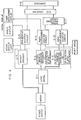
- Fig. 4 shows, by means of a block diagram, a circuit arrangement for carrying out the method according to the invention with emphasis on the circuitry for measuring the lens model.
- the apparatus for measuring the lens model corresponding to a selected frame comprises a lens-model rotating unit, a detecting unit, and a display unit. Ends of movable contact rods of the electromagnetic measuring instruments 3-2 and 3-3 are brought into contact with the lens model in the manner described above, and data as required are read out from a digital display. As the motor is driven, the lens model is rotated slowly, and the contact rods of the electromagnetic measuring scale instruments are displaced as they follow the profile of the lens model.
- the rotation angle of the model with reference to a horizontal centre axis is recorded in multiples of an angular distance of 2° to 5°, while the linear displacements of the contact rods are measured by means of potentiometers or linear encoder.
- information on the lens model such as rotation angle, point displacement and area displacement are obtained in polar coordinate form.
- the circuit includes interfaces for directly loading data into the computer 3-12 in addition to the digital display and a digital printer so that the data processing can be carried out at a high speed in accordance with the automatic lens design program.
- the apparatus for measuring the lens model may be combined with an appropriate computer such as, for example, Model ICUA-AA available from Fujitsu Co. in Japan, by which the lens processing data table is prepared through arithmetic operation on the information obtained by measuring the lens model and the prescription data loaded in the computer.
- the raw lens is then cut and abraded on the basis of the data thus obtained to prepare spectacle-lenses that can be snugly fitted in a desired frame and have a minimum peripheral thickness.
Landscapes
- Engineering & Computer Science (AREA)
- Chemical & Material Sciences (AREA)
- Ceramic Engineering (AREA)
- Inorganic Chemistry (AREA)
- Mechanical Engineering (AREA)
- Physics & Mathematics (AREA)
- Health & Medical Sciences (AREA)
- General Physics & Mathematics (AREA)
- Ophthalmology & Optometry (AREA)
- Optics & Photonics (AREA)
- Eyeglasses (AREA)
- Grinding And Polishing Of Tertiary Curved Surfaces And Surfaces With Complex Shapes (AREA)
Claims (5)
Applications Claiming Priority (2)
| Application Number | Priority Date | Filing Date | Title |
|---|---|---|---|
| JP4477881A JPS57158829A (en) | 1981-03-27 | 1981-03-27 | Production of glasses |
| JP44778/81 | 1981-03-27 |
Publications (2)
| Publication Number | Publication Date |
|---|---|
| EP0061918A1 EP0061918A1 (fr) | 1982-10-06 |
| EP0061918B1 true EP0061918B1 (fr) | 1985-09-18 |
Family
ID=12700867
Family Applications (1)
| Application Number | Title | Priority Date | Filing Date |
|---|---|---|---|
| EP19820301629 Expired EP0061918B1 (fr) | 1981-03-27 | 1982-03-29 | Méthode de fabrication de lunettes |
Country Status (4)
| Country | Link |
|---|---|
| EP (1) | EP0061918B1 (fr) |
| JP (1) | JPS57158829A (fr) |
| AU (1) | AU534193B2 (fr) |
| DE (1) | DE3266291D1 (fr) |
Cited By (4)
| Publication number | Priority date | Publication date | Assignee | Title |
|---|---|---|---|---|
| DE3801384A1 (de) * | 1988-01-19 | 1989-07-27 | Rodenstock Optik G | Verfahren zur auswahl von vorgerandeten, beidseitig fertigen brillenglaesern mit minimaler mittendicke |
| DE3817850A1 (de) * | 1988-05-26 | 1989-12-07 | Loh Kg Optikmaschf | Verfahren fuer die gewichtsminimierung von brillenglaesern |
| DE4127094A1 (de) * | 1991-08-16 | 1993-02-18 | Wernicke & Co Gmbh | Brillenglasschleifmaschine |
| US9724190B2 (en) | 2007-12-13 | 2017-08-08 | Amo Groningen B.V. | Customized multifocal ophthalmic lens |
Families Citing this family (33)
| Publication number | Priority date | Publication date | Assignee | Title |
|---|---|---|---|---|
| EP0092364A1 (fr) * | 1982-04-14 | 1983-10-26 | The Hanwell Optical Co. Limited | Méthode et appareil pour façonner un verre de lunettes pour l'emboîter dans une monture |
| JPS5955411A (ja) * | 1982-09-24 | 1984-03-30 | Hoya Corp | 眼鏡レンズの最適肉厚決定方法 |
| JPS5993420A (ja) * | 1982-11-19 | 1984-05-29 | Hoya Corp | 最適肉厚眼鏡レンズ供給方法 |
| JPS59168413A (ja) * | 1983-03-15 | 1984-09-22 | Hoya Corp | 眼鏡およびその調製法 |
| DE3316619A1 (de) * | 1983-05-06 | 1984-11-08 | Otto 4010 Hilden Helbrecht | Schleifmaschine fuer die raender von brillenglaesern |
| FR2547930B1 (fr) * | 1983-05-06 | 1987-12-24 | Helbrecht Otto | Rectifieuse a commande numerique pour les bords de verres de lunettes |
| DE3348102C2 (en) * | 1983-05-06 | 1989-02-23 | Otto 4010 Hilden De Helbrecht | Device for sensing a template corresponding to the lens opening of a spectacle frame for the purpose of obtaining data reproducing the outline shape of the spectacle lenses |
| JPS6015623A (ja) * | 1983-07-07 | 1985-01-26 | Tokyo Optical Co Ltd | 眼鏡調整装置 |
| DE3472907D1 (en) * | 1983-11-29 | 1988-09-01 | Tokyo Optical | Edge grinding method and apparatus |
| DE3590087T1 (de) * | 1984-03-02 | 1986-06-05 | Hoya Corp., Tokio/Tokyo | Brillengestellform-Datenvorrichtung |
| JPH06103369B2 (ja) * | 1984-04-06 | 1994-12-14 | ホーヤ株式会社 | 眼鏡レンズの外径決定方法 |
| JPS60238264A (ja) * | 1984-05-08 | 1985-11-27 | Tokyo Optical Co Ltd | 玉摺機の未加工レンズ判定方法及びその装置 |
| JPH0611468B2 (ja) * | 1984-06-27 | 1994-02-16 | 株式会社トプコン | 眼鏡レンズの研削方法及びその装置 |
| LU85494A1 (fr) * | 1984-08-10 | 1986-03-11 | Henri Snackers | Procede et appareil destine a faciliter le meulage des verres de lumettes |
| EP0190450B2 (fr) * | 1984-12-25 | 1999-04-28 | Kabushiki Kaisha TOPCON | Dispositif de mesure du profil de montures de lunettes |
| JPH0736980B2 (ja) * | 1985-05-28 | 1995-04-26 | 株式会社トプコン | レンズ研削装置 |
| JPH0639048B2 (ja) * | 1985-05-28 | 1994-05-25 | 株式会社トプコン | レンズ形状測定装置 |
| DE3678678D1 (de) * | 1985-11-25 | 1991-05-16 | Innovative Research Inc | Vorrichtung zur herstellung einer ophthalmischen linse. |
| FR2592496B1 (fr) * | 1985-12-30 | 1990-05-04 | Keller Jean Claude | Dispositif de lecture pour ecrans cathodiques |
| US4724617A (en) * | 1986-08-14 | 1988-02-16 | Gerber Scientific Products, Inc. | Apparatus for tracing the lens opening in an eyeglass frame |
| JPS63174858A (ja) * | 1987-01-12 | 1988-07-19 | Hoya Corp | レンズ周縁加工装置 |
| EP0363281B1 (fr) * | 1988-10-05 | 1997-05-28 | Kabushiki Kaisha TOPCON | Mesureur de lentille |
| CA2160192A1 (fr) * | 1994-10-31 | 1996-05-01 | Susumu Hagiwara | Verre de lunette et procede de fabrication |
| DE69638108D1 (de) * | 1995-11-24 | 2010-02-25 | Seiko Epson Corp | Mehrstärkenglas für Brillen und Brillenglas |
| US6019470A (en) * | 1995-11-24 | 2000-02-01 | Seiko Epson Corporation | Progressive multifocal lens and manufacturing method of eyeglass lens and progressive multifocal lens |
| BR9600543A (pt) * | 1996-02-06 | 1997-12-30 | Samir Jacob Bechara | Sistema computadorizado para escolha e adaptação de óculos |
| JP3276866B2 (ja) * | 1996-12-27 | 2002-04-22 | ホーヤ株式会社 | 眼鏡加工方法及び眼鏡フレーム |
| JP4361254B2 (ja) | 2002-10-08 | 2009-11-11 | 株式会社ニコン・エシロール | 眼鏡レンズの設計方法、眼鏡レンズの製造方法及び計算機プログラム |
| EP2028529B1 (fr) * | 2007-12-28 | 2020-09-09 | Essilor International | Procédé de calcul d'un système optique selon une monture de lunettes donné |
| EP2028531B1 (fr) * | 2007-12-28 | 2016-05-04 | Essilor International (Compagnie Generale D'optique) | Procédé de sélection d'une lentille ophtalmique semi-finie selon un cadre de lunettes donné |
| EP2028533B1 (fr) * | 2007-12-28 | 2020-09-23 | Essilor International | Procédé de calcul d'un système optique selon un cadre de lunettes donné |
| CN103974803B (zh) * | 2011-12-08 | 2016-11-16 | Hoya株式会社 | 眼镜镜片的镜片形状加工系统、眼镜镜片的制造方法及镜片形状加工机 |
| EP3355102B1 (fr) * | 2017-01-27 | 2025-11-26 | Carl Zeiss Vision International GmbH | Procédé mis en uvre par ordinateur destiné à déterminer des paramètres de centrage |
Family Cites Families (8)
| Publication number | Priority date | Publication date | Assignee | Title |
|---|---|---|---|---|
| DE1132745B (de) * | 1954-12-15 | 1962-07-05 | Wernicke & Co Kg | Vorrichtung zum Ermitteln und Anzeichnen des Zentrierpunktes bei Brillenglaesern |
| US3598977A (en) * | 1968-10-11 | 1971-08-10 | James H Clemmons | Special-purpose computing apparatus for determining construction data for wire-wound electrical components |
| DE2332001C3 (de) * | 1972-06-28 | 1980-07-10 | Robert Raymond Maurice Asselin | Randschleifmaschine für Brillengläser |
| JPS5143635A (ja) * | 1974-10-14 | 1976-04-14 | Oki Electric Ind Co Ltd | Purinta |
| GB1559035A (en) * | 1976-10-23 | 1980-01-09 | Proptic | Apparatus for the preparation of eye glass lenses prior tothe shaping and/or bevelling thereof |
| FR2375617A1 (fr) * | 1976-12-22 | 1978-07-21 | Essilor Int | Dispositif de determination du diametre des verres correcteurs bruts devant equiper une monture de lunettes portee par un usager |
| DE2747828A1 (de) * | 1977-10-26 | 1979-05-03 | Rudolf Braren | Verfahren und einrichtung zum messen des verlaufes einer werkstueckflaeche |
| US4228685A (en) * | 1979-06-01 | 1980-10-21 | International Telephone And Telegraph Corporation | Methods for computer assisted optimization of meat cuts from carcasses |
-
1981
- 1981-03-27 JP JP4477881A patent/JPS57158829A/ja active Pending
-
1982
- 1982-03-29 EP EP19820301629 patent/EP0061918B1/fr not_active Expired
- 1982-03-29 DE DE8282301629T patent/DE3266291D1/de not_active Expired
- 1982-03-29 AU AU82124/82A patent/AU534193B2/en not_active Ceased
Cited By (4)
| Publication number | Priority date | Publication date | Assignee | Title |
|---|---|---|---|---|
| DE3801384A1 (de) * | 1988-01-19 | 1989-07-27 | Rodenstock Optik G | Verfahren zur auswahl von vorgerandeten, beidseitig fertigen brillenglaesern mit minimaler mittendicke |
| DE3817850A1 (de) * | 1988-05-26 | 1989-12-07 | Loh Kg Optikmaschf | Verfahren fuer die gewichtsminimierung von brillenglaesern |
| DE4127094A1 (de) * | 1991-08-16 | 1993-02-18 | Wernicke & Co Gmbh | Brillenglasschleifmaschine |
| US9724190B2 (en) | 2007-12-13 | 2017-08-08 | Amo Groningen B.V. | Customized multifocal ophthalmic lens |
Also Published As
| Publication number | Publication date |
|---|---|
| EP0061918A1 (fr) | 1982-10-06 |
| JPS57158829A (en) | 1982-09-30 |
| AU8212482A (en) | 1982-12-23 |
| AU534193B2 (en) | 1984-01-12 |
| DE3266291D1 (en) | 1985-10-24 |
Similar Documents
| Publication | Publication Date | Title |
|---|---|---|
| EP0061918B1 (fr) | Méthode de fabrication de lunettes | |
| US5926247A (en) | Method of manufacuturing spectacles, and spectacle frames used therefor | |
| US6813536B1 (en) | Method and device for computer numerical control of machining of spectacle lenses | |
| US3950082A (en) | Ophthalmic lens for presbyopia and aphakia | |
| US4829715A (en) | Machines for grinding and bevelling ophthalmic glasses | |
| CN103959143B (zh) | 用于制备眼镜片的方法 | |
| JPH0611469B2 (ja) | 粗削りレンズの上にアダプタを中心合わせして設置し、研磨機を操作するための方法および装置 | |
| EP2028533A1 (fr) | Procédé de calcul d'un système optique selon un cadre de lunettes donné | |
| US4002439A (en) | Method of forming an ophthalmic lens for presbyopia and aphakia | |
| CN101300097B (zh) | 眼镜透镜的透镜面切削加工装置、透镜面切削加工方法及眼镜透镜 | |
| JPS60123259A (ja) | レンズ周縁加工機 | |
| US4050192A (en) | Apparatus for farming ophthalmic lens for presbyopia and aphakia | |
| US6382790B1 (en) | Method for producing a multifocal correction lens, and system for implementing same | |
| JP3075870B2 (ja) | ヤゲン付き眼鏡レンズの供給方法 | |
| KR100956545B1 (ko) | 형상 왜곡을 최소화한 3차원 자동 안경테/패턴 형상 측정 방법 | |
| JPH0611467B2 (ja) | レンズ周縁加工機 | |
| EP0479683B1 (fr) | Appareil pour meuler des lentilles | |
| JPH1058294A (ja) | 眼鏡レンズの適合判定装置 | |
| JPS62215814A (ja) | 眼鏡フレ−ムのレンズ玉型形状測定装置 | |
| JPS6022337Y2 (ja) | 瞳孔位置に屈折中心を合致させる眼鏡調製用具 | |
| CN1085068A (zh) | 一种测定人眼角膜的方法和一种适于该方法的角膜曲率计 | |
| JPH09117849A (ja) | 被加工レンズコバ厚測定装置 | |
| JP2892331B2 (ja) | レンズ形状表示装置 | |
| JP2729788B2 (ja) | 玉摺機 | |
| HK1010578B (en) | Method of manufacturing spectacles |
Legal Events
| Date | Code | Title | Description |
|---|---|---|---|
| PUAI | Public reference made under article 153(3) epc to a published international application that has entered the european phase |
Free format text: ORIGINAL CODE: 0009012 |
|
| AK | Designated contracting states |
Designated state(s): BE DE FR GB IT NL SE |
|
| 17P | Request for examination filed |
Effective date: 19830318 |
|
| ITF | It: translation for a ep patent filed | ||
| GRAA | (expected) grant |
Free format text: ORIGINAL CODE: 0009210 |
|
| AK | Designated contracting states |
Designated state(s): BE DE FR GB IT NL SE |
|
| REF | Corresponds to: |
Ref document number: 3266291 Country of ref document: DE Date of ref document: 19851024 |
|
| ET | Fr: translation filed | ||
| PLBE | No opposition filed within time limit |
Free format text: ORIGINAL CODE: 0009261 |
|
| STAA | Information on the status of an ep patent application or granted ep patent |
Free format text: STATUS: NO OPPOSITION FILED WITHIN TIME LIMIT |
|
| 26N | No opposition filed | ||
| PGFP | Annual fee paid to national office [announced via postgrant information from national office to epo] |
Ref country code: NL Payment date: 19870331 Year of fee payment: 6 |
|
| BERE | Be: lapsed |
Owner name: HOYA LENS CORP. Effective date: 19880331 |
|
| REG | Reference to a national code |
Ref country code: GB Ref legal event code: 732 |
|
| PG25 | Lapsed in a contracting state [announced via postgrant information from national office to epo] |
Ref country code: GB Effective date: 19890329 |
|
| PG25 | Lapsed in a contracting state [announced via postgrant information from national office to epo] |
Ref country code: SE Effective date: 19890330 |
|
| PG25 | Lapsed in a contracting state [announced via postgrant information from national office to epo] |
Ref country code: BE Effective date: 19890331 |
|
| PG25 | Lapsed in a contracting state [announced via postgrant information from national office to epo] |
Ref country code: NL Effective date: 19891001 |
|
| NLV4 | Nl: lapsed or anulled due to non-payment of the annual fee | ||
| GBPC | Gb: european patent ceased through non-payment of renewal fee | ||
| PG25 | Lapsed in a contracting state [announced via postgrant information from national office to epo] |
Ref country code: FR Free format text: LAPSE BECAUSE OF NON-PAYMENT OF DUE FEES Effective date: 19891130 |
|
| PG25 | Lapsed in a contracting state [announced via postgrant information from national office to epo] |
Ref country code: DE Effective date: 19891201 |
|
| REG | Reference to a national code |
Ref country code: FR Ref legal event code: ST |
|
| EUG | Se: european patent has lapsed |
Ref document number: 82301629.0 Effective date: 19900124 |