EP0063988B1 - Médicaments anticancéreux contenant la chaîne A de la ricine associée à un anticorps antimélanome et procédé pour leur préparation - Google Patents
Médicaments anticancéreux contenant la chaîne A de la ricine associée à un anticorps antimélanome et procédé pour leur préparation Download PDFInfo
- Publication number
- EP0063988B1 EP0063988B1 EP82400651A EP82400651A EP0063988B1 EP 0063988 B1 EP0063988 B1 EP 0063988B1 EP 82400651 A EP82400651 A EP 82400651A EP 82400651 A EP82400651 A EP 82400651A EP 0063988 B1 EP0063988 B1 EP 0063988B1
- Authority
- EP
- European Patent Office
- Prior art keywords
- chain
- conjugate
- antibody
- ricin
- group
- Prior art date
- Legal status (The legal status is an assumption and is not a legal conclusion. Google has not performed a legal analysis and makes no representation as to the accuracy of the status listed.)
- Expired
Links
Images


Classifications
-
- A—HUMAN NECESSITIES
- A61—MEDICAL OR VETERINARY SCIENCE; HYGIENE
- A61K—PREPARATIONS FOR MEDICAL, DENTAL OR TOILETRY PURPOSES
- A61K39/00—Medicinal preparations containing antigens or antibodies
- A61K39/395—Antibodies; Immunoglobulins; Immune serum, e.g. antilymphocytic serum
- A61K39/44—Antibodies bound to carriers
-
- C—CHEMISTRY; METALLURGY
- C07—ORGANIC CHEMISTRY
- C07K—PEPTIDES
- C07K16/00—Immunoglobulins [IG], e.g. monoclonal or polyclonal antibodies
- C07K16/18—Immunoglobulins [IG], e.g. monoclonal or polyclonal antibodies against material from animals or humans
- C07K16/28—Immunoglobulins [IG], e.g. monoclonal or polyclonal antibodies against material from animals or humans against receptors, cell surface antigens or cell surface determinants
- C07K16/30—Immunoglobulins [IG], e.g. monoclonal or polyclonal antibodies against material from animals or humans against receptors, cell surface antigens or cell surface determinants from tumour cells
- C07K16/3053—Skin, nerves, brain
-
- A—HUMAN NECESSITIES
- A61—MEDICAL OR VETERINARY SCIENCE; HYGIENE
- A61K—PREPARATIONS FOR MEDICAL, DENTAL OR TOILETRY PURPOSES
- A61K39/00—Medicinal preparations containing antigens or antibodies
- A61K39/395—Antibodies; Immunoglobulins; Immune serum, e.g. antilymphocytic serum
-
- A—HUMAN NECESSITIES
- A61—MEDICAL OR VETERINARY SCIENCE; HYGIENE
- A61K—PREPARATIONS FOR MEDICAL, DENTAL OR TOILETRY PURPOSES
- A61K47/00—Medicinal preparations characterised by the non-active ingredients used, e.g. carriers or inert additives; Targeting or modifying agents chemically bound to the active ingredient
- A61K47/50—Medicinal preparations characterised by the non-active ingredients used, e.g. carriers or inert additives; Targeting or modifying agents chemically bound to the active ingredient the non-active ingredient being chemically bound to the active ingredient, e.g. polymer-drug conjugates
- A61K47/51—Medicinal preparations characterised by the non-active ingredients used, e.g. carriers or inert additives; Targeting or modifying agents chemically bound to the active ingredient the non-active ingredient being chemically bound to the active ingredient, e.g. polymer-drug conjugates the non-active ingredient being a modifying agent
- A61K47/68—Medicinal preparations characterised by the non-active ingredients used, e.g. carriers or inert additives; Targeting or modifying agents chemically bound to the active ingredient the non-active ingredient being chemically bound to the active ingredient, e.g. polymer-drug conjugates the non-active ingredient being a modifying agent the modifying agent being an antibody, an immunoglobulin or a fragment thereof, e.g. an Fc-fragment
- A61K47/6801—Drug-antibody or immunoglobulin conjugates defined by the pharmacologically or therapeutically active agent
- A61K47/6803—Drugs conjugated to an antibody or immunoglobulin, e.g. cisplatin-antibody conjugates
- A61K47/6811—Drugs conjugated to an antibody or immunoglobulin, e.g. cisplatin-antibody conjugates the drug being a protein or peptide, e.g. transferrin or bleomycin
- A61K47/6817—Toxins
- A61K47/6819—Plant toxins
- A61K47/6825—Ribosomal inhibitory proteins, i.e. RIP-I or RIP-II, e.g. Pap, gelonin or dianthin
- A61K47/6827—Ricin A
-
- A—HUMAN NECESSITIES
- A61—MEDICAL OR VETERINARY SCIENCE; HYGIENE
- A61K—PREPARATIONS FOR MEDICAL, DENTAL OR TOILETRY PURPOSES
- A61K47/00—Medicinal preparations characterised by the non-active ingredients used, e.g. carriers or inert additives; Targeting or modifying agents chemically bound to the active ingredient
- A61K47/50—Medicinal preparations characterised by the non-active ingredients used, e.g. carriers or inert additives; Targeting or modifying agents chemically bound to the active ingredient the non-active ingredient being chemically bound to the active ingredient, e.g. polymer-drug conjugates
- A61K47/51—Medicinal preparations characterised by the non-active ingredients used, e.g. carriers or inert additives; Targeting or modifying agents chemically bound to the active ingredient the non-active ingredient being chemically bound to the active ingredient, e.g. polymer-drug conjugates the non-active ingredient being a modifying agent
- A61K47/68—Medicinal preparations characterised by the non-active ingredients used, e.g. carriers or inert additives; Targeting or modifying agents chemically bound to the active ingredient the non-active ingredient being chemically bound to the active ingredient, e.g. polymer-drug conjugates the non-active ingredient being a modifying agent the modifying agent being an antibody, an immunoglobulin or a fragment thereof, e.g. an Fc-fragment
- A61K47/6835—Medicinal preparations characterised by the non-active ingredients used, e.g. carriers or inert additives; Targeting or modifying agents chemically bound to the active ingredient the non-active ingredient being chemically bound to the active ingredient, e.g. polymer-drug conjugates the non-active ingredient being a modifying agent the modifying agent being an antibody, an immunoglobulin or a fragment thereof, e.g. an Fc-fragment the modifying agent being an antibody or an immunoglobulin bearing at least one antigen-binding site
- A61K47/6851—Medicinal preparations characterised by the non-active ingredients used, e.g. carriers or inert additives; Targeting or modifying agents chemically bound to the active ingredient the non-active ingredient being chemically bound to the active ingredient, e.g. polymer-drug conjugates the non-active ingredient being a modifying agent the modifying agent being an antibody, an immunoglobulin or a fragment thereof, e.g. an Fc-fragment the modifying agent being an antibody or an immunoglobulin bearing at least one antigen-binding site the antibody targeting a determinant of a tumour cell
- A61K47/6865—Medicinal preparations characterised by the non-active ingredients used, e.g. carriers or inert additives; Targeting or modifying agents chemically bound to the active ingredient the non-active ingredient being chemically bound to the active ingredient, e.g. polymer-drug conjugates the non-active ingredient being a modifying agent the modifying agent being an antibody, an immunoglobulin or a fragment thereof, e.g. an Fc-fragment the modifying agent being an antibody or an immunoglobulin bearing at least one antigen-binding site the antibody targeting a determinant of a tumour cell the tumour determinant being from skin, nerves or brain cancer cell
-
- A—HUMAN NECESSITIES
- A61—MEDICAL OR VETERINARY SCIENCE; HYGIENE
- A61P—SPECIFIC THERAPEUTIC ACTIVITY OF CHEMICAL COMPOUNDS OR MEDICINAL PREPARATIONS
- A61P35/00—Antineoplastic agents
-
- A—HUMAN NECESSITIES
- A61—MEDICAL OR VETERINARY SCIENCE; HYGIENE
- A61K—PREPARATIONS FOR MEDICAL, DENTAL OR TOILETRY PURPOSES
- A61K38/00—Medicinal preparations containing peptides
-
- Y—GENERAL TAGGING OF NEW TECHNOLOGICAL DEVELOPMENTS; GENERAL TAGGING OF CROSS-SECTIONAL TECHNOLOGIES SPANNING OVER SEVERAL SECTIONS OF THE IPC; TECHNICAL SUBJECTS COVERED BY FORMER USPC CROSS-REFERENCE ART COLLECTIONS [XRACs] AND DIGESTS
- Y10—TECHNICAL SUBJECTS COVERED BY FORMER USPC
- Y10S—TECHNICAL SUBJECTS COVERED BY FORMER USPC CROSS-REFERENCE ART COLLECTIONS [XRACs] AND DIGESTS
- Y10S530/00—Chemistry: natural resins or derivatives; peptides or proteins; lignins or reaction products thereof
- Y10S530/806—Antigenic peptides or proteins
-
- Y—GENERAL TAGGING OF NEW TECHNOLOGICAL DEVELOPMENTS; GENERAL TAGGING OF CROSS-SECTIONAL TECHNOLOGIES SPANNING OVER SEVERAL SECTIONS OF THE IPC; TECHNICAL SUBJECTS COVERED BY FORMER USPC CROSS-REFERENCE ART COLLECTIONS [XRACs] AND DIGESTS
- Y10—TECHNICAL SUBJECTS COVERED BY FORMER USPC
- Y10S—TECHNICAL SUBJECTS COVERED BY FORMER USPC CROSS-REFERENCE ART COLLECTIONS [XRACs] AND DIGESTS
- Y10S530/00—Chemistry: natural resins or derivatives; peptides or proteins; lignins or reaction products thereof
- Y10S530/827—Proteins from mammals or birds
- Y10S530/828—Cancer
Definitions
- the subject of the present invention is a medicament a so-called conjugate product obtained from the A chain of Ricine and from the anti-P97 human anti-melanoma monoclonal antibody.
- conjugate is intended to mean an artificial mixed molecule in which the A chain of Ricine is associated, by a covalent bond of disulfide type, with the human antimelanoma antibody P 97, capable of selectively recognizing an antigen associated with cancer cells.
- the proteins to be coupled each carry at least one sulfur atom which is naturally able or artificially made capable of creating the desired disulfide bond.
- the A chain of Ricine naturally has a single sulfur atom allowing the desired coupling. It is that of the thiol function of the cysteine residue included in chain A and which ensured the binding of this chain A to chain B in the complete toxin.
- the anti-P 97 anti-melanoma antibody does not contain any free thiol function or other sulfur atoms capable of being used for coupling. It will therefore be necessary to introduce artificially onto the immunoglobulin molecule one or more sulfur atoms capable of being subsequently engaged in the disulfide bond to be established with one or more molecules of chain A of Ricine.
- the preparation of the conjugate is carried out by bringing the A chain of Ricine carrying its free SH group into contact with the antibody in which the SH group has been artificially introduced in activated form and in particular in the form of a mixed disulfide with a suitable sulfur-containing organic radical.
- R is an alkyl group reacting with the amino groups of the protein according to the reaction:
- X denotes a functional group capable of reacting with a free thiol radical.
- X may denote a pyridyl-2 or pyridyl-4 group optionally substituted by one or more alkyl, halogen or carboxylic radicals.
- X can also denote a phenyl group preferably substituted by one or more nitro- or carboxylic groups.
- X can also represent an alkoxycarbonyl group such as the methoxycarbonyl group.
- the radical R denotes any radical capable of carrying the substituents Y and SSX simultaneously. It should be chosen so as not to contain functions which are likely to interfere during subsequent reactions with the reagents used and the products synthesized.
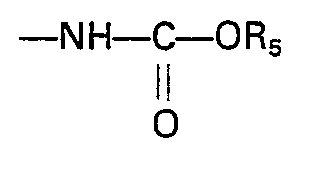
- the group R can be a group - (CH z ) n with n between 1 and 10, or even a group: in which R 4 denotes hydrogen or an alkyl group having from 1 to 8 carbon atoms and R 3 denotes a substituent inert with respect to the reactants used subsequently such as a carbamate group where R 5 denotes a straight or branched alkyl group having from 1 to 5 carbon atoms and in particular the tert-butyl group.
- reaction of the compound Y-R-S-S-X with the immunoglobulin is carried out in a homogeneous liquid phase most often in water or a buffer solution.
- solubility of the reagents it is possible to add to the reaction medium up to 20% by volume of an organic solvent miscible with water such as an alcohol and in particular tertiary butanol.
- the reaction is carried out at room temperature for a time varying from a few hours to 24 hours. After which, dialysis makes it possible to remove the products of low molecular mass and in particular the excess of reagents. This process makes it possible to introduce a number of substituent groups per mole of protein between 1 and 5.
- the coupling with the Ricine A chain is carried out by bringing the two proteins into aqueous solution at a temperature not exceeding 30 ° C. for a time varying from a few hours to a day.
- the solution obtained is dialyzed to remove the low molecular weight products, then the conjugate can be purified by various known methods.
- Conjugate obtained from human antimelanoma antibody (antibody directed against the P 97 antigen) substituted by an activated disulfide group and the A chain of Ricine.
- the A chain of Ricine was prepared and purified as indicated in the applicant's previous applications (patent no. 78 27838 and addition no. 79 24655).
- the solution is then dialyzed continuously for 3 days against 21 liters of PBS buffer at 4 ° C. 4 mg of activated antibody are thus obtained at a concentration of 2.3 mg / ml.
- the reaction mixture is chromatographed on a column of Sephadex @ G 100 gel.
- the antibody concentration is determined by spectrophotometry at 280 nm and that of the A chain by its inhibitory effect on the proteosynthesis measured on a cell-free system.
- Identical fractions containing the conjugate are combined and about 1 mg of the conjugate is obtained at a concentration of 0.2 mg / ml.
- the analytical determinations carried out make it possible to show that the solution contains 50 ⁇ g / ml of biologically active chain A, that is to say approximately 1.4 mole of chain A per mole of antibody.
- the conjugate, according to the invention, obtained previously has been studied with regard to its biological properties and more particularly its anticancer action.
- the fundamental biological property of the Ricine A chain is to inhibit cell proteosynthesis by alteration of the 60 S ribosomal subunit.
- the cells used belong to the cell line M 1477 derived from a human melanoma which carries the P 97 antigen. These cells, after trypsination, are preincubated for at least 24 hours in order to allow the re-expression of the possibly altered surface antigens. After addition of the substance to be studied, a new incubation is carried out. At the end of the incubation, the incorporation rate of '4C-leucine is measured by the cells thus treated.
- FIG. 1 The results obtained with the conjugate prepared in the previous example (ITHM) are represented by FIG. 1.
- the anti-DNP conjugate (DS 10) has no effect on M 1477 cells up to the highest concentration tested (10 -6 M).
- DS 10 is cytotoxic acec shows an IC 50 close to 10- 6 M if it is put in presence of the same cells M 1477 previously rendered artificially carriers of DNP radicals.
- the cells are treated with various concentrations of the conjugate to be studied.
- This method allows the detection of as little as 10 viable cells per dish as has been verified using control cultures. It has also been shown that colony formation is strictly proportional to the initial concentration of cells, at least within the range of 10 1 to 10 4 cells per ml.
- the ITHM conjugate has a high activity since the last melanoma cell is killed at a concentration of approximately 2 ⁇ 10 -9 M in conjugate. This concentration is quite comparable to that of ricin (1 ⁇ 10 -9 M) while for the A chain of ricin must reach 10 -6 M for the same effect.
- the conjugate prepared according to the invention therefore has a high specificity of action with respect to human melanoma cell lines. It can therefore be used in human therapy in the treatment of melanomas and possibly other conditions, cancerous or not, which are sensitive to the antibody used.
- Said conjugate is conditioned for use by injection. It can be used either alone or in combination with another treatment for the cancer condition concerned and, in particular, in combination with other immunosuppressive drugs in order to delay and weaken the patient's natural immune response to the protein foreign to its organism that represents the conjugate.
- the treatment should be carried out with a sufficient dose of conjugate and the duration of treatment should be determined in each case depending on the subject and the nature of the condition to be treated.
Landscapes
- Health & Medical Sciences (AREA)
- Life Sciences & Earth Sciences (AREA)
- Chemical & Material Sciences (AREA)
- Engineering & Computer Science (AREA)
- Bioinformatics & Cheminformatics (AREA)
- Medicinal Chemistry (AREA)
- Immunology (AREA)
- General Health & Medical Sciences (AREA)
- Animal Behavior & Ethology (AREA)
- Pharmacology & Pharmacy (AREA)
- Public Health (AREA)
- Veterinary Medicine (AREA)
- Epidemiology (AREA)
- Cell Biology (AREA)
- Organic Chemistry (AREA)
- Biomedical Technology (AREA)
- Neurology (AREA)
- Toxicology (AREA)
- Molecular Biology (AREA)
- Microbiology (AREA)
- Mycology (AREA)
- Oncology (AREA)
- Proteomics, Peptides & Aminoacids (AREA)
- Neurosurgery (AREA)
- Botany (AREA)
- Biochemistry (AREA)
- Biophysics (AREA)
- Genetics & Genomics (AREA)
- Chemical Kinetics & Catalysis (AREA)
- General Chemical & Material Sciences (AREA)
- Nuclear Medicine, Radiotherapy & Molecular Imaging (AREA)
- Medicines Containing Antibodies Or Antigens For Use As Internal Diagnostic Agents (AREA)
- Peptides Or Proteins (AREA)
- Pyridine Compounds (AREA)
- Pharmaceuticals Containing Other Organic And Inorganic Compounds (AREA)
- Preparation Of Compounds By Using Micro-Organisms (AREA)
- Medicines That Contain Protein Lipid Enzymes And Other Medicines (AREA)
- Nitrogen And Oxygen Or Sulfur-Condensed Heterocyclic Ring Systems (AREA)
Description
- Dans les demandes antérieures FR n° 78 27 838 du 28 septembre 1978 et addition n° 79 24655 du 3 octobre 1979, publiées respectivement sous les n° 2 437 213 et 2 466 252, la demanderesse a décrit la préparation de produits anticancéreux dits conjugués obtenus par couplage par liaison covalente de la chaîne A de la Ricine à une structure protéique telle qu'un anticorps, une immunoglobuline ou un fragment d'immunoglobuline capable de reconnaître sélectivement un antigène donné à la surface des cellules porteuses que l'on veut atteindre telles que les cellules cancéreuses. La propriété principale de ces conjugués est d'être des agents cytotoxiques spécifiques des cellules cibles visées.
- L'utilisation d'anticorps dirigés contre les antigènes de différentiation des cellules cancéreuses avait déjà permis d'obtenir des conjugués présentant une spécificité notable vis-à-vis des cellules cibles. La caractérisation d'antigènes associés aux cellules cancéreuses et l'obtention d'anticorps monoclonaux dirigés contre ces antigènes permettent d'envisager des conjugués présentant une spécificité accrue vis-à-vis des cellules porteuses de ces antigènes.
- La présente invention a pour objet à titre de médicament un produit dit conjugué obtenu à partir de la chaîne A de la Ricine et de l'anticorps monoclonal antimélanome humain anti P97.
- On entend par conjugué, une molécule mixte artificielle dans laquelle la chaîne A de la Ricine est associée, par une liaison covalente de type disulfure, à l'anticorps antimélanome humain P 97, capable de reconnaître sélectivement un antigène associé aux cellules cancéreuses.
- L'obtention, de la chaîne A de Ricine pure a été décrite dans nos brevets antérieurs précités. La préparation d'anticorps monoclonaux dirigés contre des mélanomes humains a été mentionnée dans la littérature scientifique (on peut se reporter en particulier à Proceedings of the National Academy of Sciences 77 (4), 2183-7, (1980))..
- Pour réaliser ledit conjugué, il est nécessaire que les protéines à coupler portent chacune au moins un atome de soufre naturellement apte ou artificiellement rendu apte à créer la liaison disulfure recherchée.
- La chaîne A de Ricine présente naturellement un seul atome de soufre permettant le couplage souhaité. C'est celui de la fonction thiol du résidu de cystéine inclus dans la chaîne A et qui assurait la liaison de cette chaîne A à la chaîne B dans la toxine complète.
- L'anticorps antimélanome anti P 97 ne comporte ni fonction thiol libre ni d'autres atomes de soufre susceptibles d'être utilisés pour le couplage. Il conviendra donc d'introduire artificiellement sur la molécule d'immunoglobuline un ou plusieurs atomes de soufre susceptibles d'être engagés ultérieurement dans la liaison disulfure à étabJir avec une ou plusieurs molécules de chaîne A de Ricine.
- Selon l'invention, la préparation du conjugué est effectuée en mettant en présence la chaîne A de Ricine porteuse de son groupement SH libre avec l'anticorps dans lequel le groupement SH a été artificiellement introduit sous forme activée et notamment sous la forme d'un disulfure mixte avec un radical organique soufré convenable.
- La préparation du conjugué peut être représentée par le schéma:

- . RA désigne la chaîne A de Ricine
- . AC désigne l'anticorps antimélanome anti P 97
- . X désigne le radical activateur.
- L'anticorps substitué par un atome de soufre activé est obtenu à partir de l'anticorps lui-même, par substitution à l'aide d'un réactif lui-même porteur d'un atome de soufre activé selon le schéma:

- . AC désigne l'anticorps antimélanome anti P 97
- . Y représente une fonction permettant la fixation covalente du réactif sur la protéine
- . R désigne un groupement pouvant porter simultanément les substituants Y et -S-S-X
- . X désigne le radical activateur.
- Le groupement fonctionnel Y est une fonction capable de se lier de façon covalente avec l'une quelconque des fonctions portées par les chaînes latérales des aminoacides constitutifs de la protéine à substituer. Parmi celles-ci, les fonctions aminées terminales des radicaux lysyle contenues dans la protéine sont particulièrement indiquées. Dans ce cas, Y pourra notamment représenter:
- - un groupe carboxylique qui pourra se lier aux fonctions aminées de la protéine en présence d'un agent de couplage tel qu'un carbodiimide et notamment un dérivé soluble dans l'eau comme l'éthyl-1 (diéthylamino-3 propyl)-3 carbodiimide,
- - un chlorure d'acide carboxylique qui est susceptible de réagir directement avec les fonctions aminées pour les acyler,
- - un ester dit "activé" tel qu'un ester d'ortho- ou para-, nitro- ou dinitro-phényle ou encore un ester de N-hydroxysuccinimide qui réagit directement avec les fonctions aminées pour les acyler,
- -un anhydride interne d'un diacide carboxylique tel par exemple l'anhydride succinique qui réagit spontanément avec les fonctions amines pour créer des liaisons amides,
- - un groupement imidoester

- où R, est un groupe alkyle réagissant avec les groupes aminés de la protéine selon la réaction:

- X désigne un groupement fonctionnel capable de réagir avec un radical thiol libre. En particulier, X pourra désigner un groupe pyridyl-2 ou pyridyl-4 éventuellement substitué par un ou des radicaux alkyle, halogène, carboxylique. X peut aussi désigner un groupe phényle de préférence substitué par un ou des groupes nitro- ou carboxyliques. X peut encore représenter un groupe alcoxycarbonyle tel que le groupe méthoxycarbonyle.
- Le radical R désigne tout radical capable de porter simultanément les substituants Y et S-S-X. Il devra être choisi de façon à ne pas comporter de fonctions susceptibles d'interférer au cours des réactions ultérieures avec les réactifs utilisés et les produits synthétisés. En particulier, le groupe R peut être un groupe ―(CHz)n avec n compris entre 1 et 10, ou encore un groupe:

- La réaction du composé Y-R-S-S-X avec l'immunoglobuline est effectuée en phase liquide homogène le plus souvent dans l'eau ou une solution tampon. Lorsque la solubilité des réactifs l'exige, il est possible d'ajouter au milieu réactionnel jusqu'à 20 % en volume d'un solvent organique miscible à l'eau tel qu'un alcool et notamment le butanol tertiaire.
- La réaction est effectuée à température ambiante pendant un temps variant de quelques heures à 24 heures. Après quoi, une dialyse permet d'éliminer les produits de faible masse moléculaire et en particulier les excès de réactifs. Ce procédé permet d'introduire un nombre de groupements substituants par mole de protéine compris entre 1 et 5.
- En utilisant de tels composés, le couplage avec la chaîne A de Ricine est réalisé par mise en présence en solution aqueuse des deux protéines à une température ne dépassant pas 30°C pendant un temps variant de quelques heures à un jour. La solution obtenue est dialysée pour éliminer les produits de faible masse moléculaire, puis le conjugué peut être purifié par diverses méthodes connues.
- L'exemple suivant permet de mieux comprendre l'invention sans en limiter la portée.
- Conjugué obtenu à partir d'anticorps antimélanome humain (anticorps dirigé contre l'antigène P 97) substitué par un groupe disulfure activé et la chaîne A de la Ricine.
- Cet anticorps a été obtenu selon la méthode décrite dans Proceedings of National Academy of Sciences 1980, 77 (4), 2183-7.
- Il subit une ultime purification par dialyse contre du tampon PBS (10 mM de phosphate, 140 mM de chlorure de sodium, pH: 7,4).
- La chaîne A de la Ricine a été préparée et purifiée ainsi qu'il a été indiqué dans les demandes antérieures de la demanderesse (brevet n° 78 27838 et addition n° 79 24655).
- A 0,5 ml d'une solution à 20 mg/ml d'acide (pyridyl - 2 disulfanyl) - 3 propionique dans le tertiobutanol, on ajoute 0,2 ml d'une solution à 60 mg/ml d'éthyl - 1 (diméthylamino - 3 propyl) - 3 carbodiimide et laisse 3 minutes à température ambiante.
- On ajoute 30 µl de la solution ainsi obtenue à 1,66 ml d'une solution d'anticorps antimélanome à 2,4 mg/ml dans le tampon PBS. On laisse l'incubation se poursuivre pendant 20 heures à 30°C.
- On dialyse ensuite la solution en continu pendant 3 jours contre 21 litres de tampon PBS à 4°C. On obtient ainsi 4 mg d'anticorps activé à une concentration de 2,3 mg/ml.
- Par dosage spectrophotométrique à 343 nm de la pyridine thione-2 libérée par échange avec le glutathion réduit, on constate que l'on a obtenu un anticorps portant 2,6 groupements activateurs par mole d'anticorps.
- A 1,3 ml d'une solution d'anticorps activé dans le tampon PBS (concentration 2,3 mg/ml, soit 3 mg d'anticorps activé), on ajoute 0,52 ml d'une solution de chaîne A de Ricine dans le même tampon (concentration 5,8 mg/ml) et effectue l'incubation à 25°C pendant 20 heures.
- On chromatographie le mélange réactionnel sur colonne de gel de Sephadex@ G 100. Dans chaque fraction, on détermine la concentration en anticorps par spectrophotométrie à 280 nm et celle de la chaîne A par son pouvoir inhibiteur de la protéosynthèse mesurée sur un système acellulaire. On réunit les fractions identiques contenant le conjugué et on obtient ainsi environ 1 mg du conjugué à la concentration de 0,2 mg/ml.
- Les déterminations analytiques effectuées permettent de montrer que la solution contient 50 µg/ml de chaîne A biologiquement active, soit environ 1,4 mole de chaîne A par mole d'anticorps.
- Une étude effectuée par cytofluorométrie a en outre permis de montrer que l'anticorps antimélanome utilisé, l'anticorps activé correspondant et le conjugué de cet anticorps avec la chaîne A de la Ricine présentent des histogrammes de fluorescence très voisins permettant d'affirmer que l'anticorps n'a subi aucune altération importante au cours des réactions d'activation et de couplage auxquelles il a été soumis et en particulier qu'il reste capable, au sein même du conjugué, de reconnaître l'antigène P 97 contre lequel il est dirigé.
- Le conjugué, selon l'invention, obtenu précédemment a été étudié en ce qui concerne ses propriétés biologiques et plus spécialement son action anticancéreuse.
- La propriété biologique fondamentale de la chaîne A de Ricine est d'inhiber la protéosynthèse cellulaire par altération de la sous-unité ribosomale 60 S.
- On a utilisé ici un modèle cellulaire. Ce test mesure l'effet des substances étudiées sur l'incorporation de '4C-leucine dans les cellules cancéreuses en culture.
- Les cellules utilisées appartiennent à la lignée cellulaire M 1477 issue d'un mélanome humain qui porte l'antigène P 97. Ces cellules, après trypsination, sont préincubées au moins 24 heures afin de permettre la réexpression des antigènes de surface éventuellement altérés. Après addition de la substance à étudier, on effectue une nouvelle incubation. En fin d'incubation, on procède à la mesure du taux d'incorporation de '4C-leucine par les cellules ainsi traitées.
- Cette mesure est effectuée selon une technique adaptée de la technique décrite dans Journal of Biological Chemistry 1974,249 (11), 3557―62 utilisant le traceur 14C-leucine pour la détermination du taux de protéosynthèse. La détermination de la radioactivité incorporée est effectuée ici sur les cellules entières isolées par filtration.
- A partir de ces déterminations, on peut tracer les courbes effets/doses présentant en abscisse la concentration des substances étudiées et en ordonnée l'incorporation de '4C-leucine exprimée en pourcentage de l'incorporation des cellules témoins en l'absence de la substance à étudier.
- On peut ainsi déterminer pour chaque substance étudiée la concentration qui inhibe 50 % de l'incorporation de '4C-leucine ou "concentration inhibitrice 50" (CI 50).
- Les résultats obtenus avec le conjugué préparé dans l'exemple précédent (ITHM) sont représentés par la figure 1. Sur cette figure, sont également représentées les courbes obtenues respectivement avec la Ricine (R), la chaîne A de Ricine (AR) et un conjugué chaîne A de Ricine-anticorps anti radical dinitrophényle (DNP) (DS 10), conjugué qui ne présente aucune affinité pour les cellules testées.
- On peut constater sur cette figure que le conjugué étudié (ITHM) présente une forte activité cytoxique (CI 50=5×10⁻⁹M), environ 400 fois plus importante que celle de la chaîne A de Ricine.
- Par ailleurs, le conjugué anti-DNP (DS 10) n'a pas d'effet sur les cellules M 1477 jusqu'à la plus haute concentration essayée (10-6M). Par contre, ce même conjugué DS 10 se révèle cytotoxique acec une CI 50 voisine de 10-6M s'il est mis en présence des mêmes cellules M 1477 préalablement rendues artificiellement porteuses de radicaux DNP. Ces deux dernières conclusions démontrent le caractère spécifique de l'activité cytotoxique du conjugué ITHM.
- Les cellules en culture de mélanome M 1477 sont décollées de leur support par de la solution de Versene (tampon PBS contenant de l'acide éthylène diamine tètracétique) ou par trypsinisation. Ces cellules sont ensemencées à raison de 2x 10⁴ cellules par boîte de Pétri de 5 cm de diamètre contenant le milieu de culture suivant:
- Milieu RPMI 1640 (Mérieux) additionné de glutamine 2 mM, bicarbonate de sodium 2 g/1, 15% de sérum foetal de veau inactivé (Seromed) et d'antibiotiques (pénicilline, streptomycine et amphotéricine B).
- Après 24 heures, les cellules sont traitées avec des concentrations variées du conjugué à étudier.
- A titre de comparaison la même série d'expériences est effectuée avec de la Ricine, d'une part, avec la chaîne A de Ricine, d'autre part, et enfin avec un conjugué non spécifique de cette lignée cellulaire (conjugué entre la chaîne A de Ricine et une anticorps anti-DNP (DS 10)).
- Après à nouveau 24 heures, le milieu de culture est éliminé et remplacé par le même milieu frais, exempt de toute substance cytotoxique.
- 10 à 15 jours plus tard, le nombre de colonies qui se sont développées est déterminé après coloration avec une solution de cristal violet à l'aide d'un compteur automatique de colonies (système Artek 880).
- Cette méthode permet la détection d'une quantité aussi faible que 10 cellules viables par boîte ainsi que cela a pu être vérifiée en utilisant des cultures de contrôle. Il a été également démontré que la formation de colonies est strictement proportionnelle à la concentration initiale des cellules, au moins dans la limite de 101 à 104 cellules par ml.
- Les résultats obtenus sont présentés dans la figure 2, sur laquelle on a porté, en ordonnée et en coordonnées logarithmiques, le nombre de colonies par boîte et en abscisse la concentration du produit. Les essais ont été effectués pour la Ricine (R), la chaîne A de la Ricine (AR) et le produit conjugué selon l'invention (ITHM).
- Le conjugué ITHM présente une haute activité puisque la dernière cellule de mélanome est tuée à une concentration d'environ 2×10⁻⁹ M en conjugué. Cette concentration est tout à fait comparable à celle de la Ricine (1×10⁻⁹ M) alors que pour la chaîne A de Ricine il faut atteindre 10-6 M pour obtenir le même effet.
- On puet également noter que le conjugué DS 10 n'a aucune activité jusqu'à 2x10⁻⁸ M la plus forte concentration à laquelle il ait été testé.
- Les conclusions de cette expérience confirment entièrement celles de l'expérience d'inhibition de protéosynthèse.
- Le conjugué préparé selon l'invention présente donc une forte spécificité d'action vis-à-vis des lignées cellulaires de mélanome humain. Il peut donc être utilisé en thérapeutique humaine dans le traitement des mélanomes et éventuellement d'autres affections, cancéreuses ou non, qui seraient sensibles à l'anticorps utilisé.
- Ledit conjugué est conditionné pour être utilisé par voie injectable. Il peut être utilisé soit seul soit associé à un autre traitement de l'affection cancéreuse concernée et, en particulier, associé à d'autres médicaments immunodépresseurs afin de retarder et d'affaiblir la réaction immunitaire naturelle du patient vis-à-vis de la protéine étrangère à son organisme que représente le conjugué.
- Visant à éliminer la totalité des cellules cancéreuses, le traitement devra être effectué avec une dose suffisante de conjugué et la durée du traitement devra être déterminée dans chaque cas en fonction du sujet et de la nature de l'affection à traiter.
Claims (4)
Priority Applications (1)
| Application Number | Priority Date | Filing Date | Title |
|---|---|---|---|
| AT82400651T ATE17653T1 (de) | 1981-04-15 | 1982-04-09 | Mit einem antimelanoma-antikoerper verbundene ricin-a-kette enthaltende antikrebs-heilmittel und verfahren zu ihrer herstellung. |
Applications Claiming Priority (2)
| Application Number | Priority Date | Filing Date | Title |
|---|---|---|---|
| FR8107596 | 1981-04-15 | ||
| FR8107596A FR2504010B1 (fr) | 1981-04-15 | 1981-04-15 | Medicaments anticancereux contenant la chaine a de la ricine associee a un anticorps antimelanome et procede pour leur preparation |
Publications (2)
| Publication Number | Publication Date |
|---|---|
| EP0063988A1 EP0063988A1 (fr) | 1982-11-03 |
| EP0063988B1 true EP0063988B1 (fr) | 1986-01-29 |
Family
ID=9257448
Family Applications (1)
| Application Number | Title | Priority Date | Filing Date |
|---|---|---|---|
| EP82400651A Expired EP0063988B1 (fr) | 1981-04-15 | 1982-04-09 | Médicaments anticancéreux contenant la chaîne A de la ricine associée à un anticorps antimélanome et procédé pour leur préparation |
Country Status (30)
| Country | Link |
|---|---|
| US (1) | US4414148A (fr) |
| EP (1) | EP0063988B1 (fr) |
| JP (1) | JPS57179124A (fr) |
| KR (1) | KR880001045B1 (fr) |
| AR (1) | AR228394A1 (fr) |
| AT (1) | ATE17653T1 (fr) |
| AU (1) | AU556641B2 (fr) |
| CA (1) | CA1195248A (fr) |
| CZ (1) | CZ256482A3 (fr) |
| DD (1) | DD204849A5 (fr) |
| DE (1) | DE3268752D1 (fr) |
| DK (1) | DK159277C (fr) |
| EG (1) | EG15718A (fr) |
| ES (1) | ES511433A0 (fr) |
| FI (1) | FI76693C (fr) |
| FR (1) | FR2504010B1 (fr) |
| GR (1) | GR69199B (fr) |
| HU (1) | HU188314B (fr) |
| IE (1) | IE53009B1 (fr) |
| IL (1) | IL65441A0 (fr) |
| MA (1) | MA19429A1 (fr) |
| NO (1) | NO154905C (fr) |
| NZ (1) | NZ200302A (fr) |
| OA (1) | OA07069A (fr) |
| PH (1) | PH20846A (fr) |
| PL (1) | PL135800B1 (fr) |
| PT (1) | PT74741B (fr) |
| SU (1) | SU1329604A3 (fr) |
| YU (1) | YU83082A (fr) |
| ZA (1) | ZA822528B (fr) |
Families Citing this family (147)
| Publication number | Priority date | Publication date | Assignee | Title |
|---|---|---|---|---|
| JPS5843926A (ja) * | 1981-09-08 | 1983-03-14 | Suntory Ltd | 選択性制癌剤 |
| FR2523445A1 (fr) * | 1982-03-17 | 1983-09-23 | Sanofi Sa | Nouveaux conjugues associant, par liaison covalente, une enzyme et un anticorps, et associations medicamenteuses utilisant lesdits conjugues |
| ES522315A0 (es) * | 1982-05-12 | 1984-08-16 | Harvard College | Un procedimiento para obtener una proteina hibrida. |
| US4520226A (en) * | 1982-07-19 | 1985-05-28 | The United States Of America As Represented By The Department Of Health And Human Services | Treatment of graft versus host disease using a mixture of T-lymphocyte specific monoclonal antibody: ricin conjugates |
| JPS5990052A (ja) * | 1982-11-16 | 1984-05-24 | Katsu Taniguchi | モノクロ−ナル特異抗体を用いたメラノ−マ診断薬 |
| US4916213A (en) * | 1983-02-22 | 1990-04-10 | Xoma Corporation | Ribosomal inhibiting protein-immunoglobulin conjugates with specificity for tumor cell surface antigens, and mixtures thereof |
| US4591572A (en) * | 1983-04-01 | 1986-05-27 | Sloan-Kettering Institute For Cancer Research | Pigmentation associated, differentiation antigen of human melanoma and autologous antibody |
| JPS59186924A (ja) * | 1983-04-08 | 1984-10-23 | Kureha Chem Ind Co Ltd | ヒト免疫グロブリン結合抗腫瘍剤 |
| US4664911A (en) * | 1983-06-21 | 1987-05-12 | Board Of Regents, University Of Texas System | Immunotoxin conjugates employing toxin B chain moieties |
| GB2142428A (en) * | 1983-06-23 | 1985-01-16 | Erba Farmitalia | Adenocarcinoma related antigenic determinants and antibodies specific thereto |
| FR2547731A1 (fr) * | 1983-06-27 | 1984-12-28 | Centre Nat Rech Scient | Immunotoxine antitumorale, preparations pharmaceutiques la contenant et son utilisation in vitro |
| GB2148299B (en) * | 1983-09-01 | 1988-01-06 | Hybritech Inc | Antibody compositions of therapeutic agents having an extended serum half-life |
| US4545985A (en) * | 1984-01-26 | 1985-10-08 | The United States Of America As Represented By The Secretary, Dept. Of Health And Human Services | Pseudomonas exotoxin conjugate immunotoxins |
| FR2570278B1 (fr) * | 1984-09-14 | 1987-02-13 | Pasteur Institut | Compositions et procede pour proteger les lymphocytes t contre l'agent etiologique des lymphadenopathies et du syndrome d'immunodepression acquise |
| AU585940B2 (en) * | 1984-09-25 | 1989-06-29 | Xoma Corporation | Lectin immunotoxins |
| US4590071A (en) * | 1984-09-25 | 1986-05-20 | Xoma Corporation | Human melanoma specific immunotoxins |
| EP0232447A1 (fr) * | 1986-02-13 | 1987-08-19 | Xoma Corporation | Immunotoxines de lectine |
| FR2573656B1 (fr) * | 1984-11-29 | 1987-02-27 | Sanofi Sa | Medicament comportant en tant qu'association au moins une immunotoxine et au moins un polymere contenant du mannose |
| US4851510A (en) * | 1984-11-30 | 1989-07-25 | Wadley Technologies, Inc. | Monoclonal antibodies to novel melanoma-associated antigens |
| AT384549B (de) * | 1985-01-08 | 1987-11-25 | Strasser Engelbert | Verfahren zur herstellung einer vaccine |
| US5256413A (en) * | 1985-01-08 | 1993-10-26 | The General Hospital Corporation | Method and use for site-specific activation of substances |
| FR2577135B1 (fr) * | 1985-02-13 | 1989-12-15 | Sanofi Sa | Immunotoxines a longue duree d'action comportant un constituant glycopeptidique inactivant les ribosomes modifie sur ses motifs polysaccharidiques |
| US4744981A (en) * | 1985-10-17 | 1988-05-17 | Neorx Corporation | Trichothecene antibody conjugates |
| ATE87318T1 (de) * | 1985-11-29 | 1993-04-15 | Consolidated Pharmaceuticals L | Ricin-antikoerper-konjugate. |
| US4831122A (en) * | 1986-01-09 | 1989-05-16 | Regents Of The University Of Minnesota | Radioimmunotoxins |
| US4689401A (en) * | 1986-03-06 | 1987-08-25 | Cetus Corporation | Method of recovering microbially produced recombinant ricin toxin a chain |
| USRE38008E1 (en) | 1986-10-09 | 2003-02-25 | Neorx Corporation | Methods for improved targeting of antibody, antibody fragments, hormones and other targeting agents, and conjugates thereof |
| US4771128A (en) * | 1986-10-10 | 1988-09-13 | Cetus Corporation | Method of purifying toxin conjugates using hydrophobic interaction chromatography |
| US5009995A (en) * | 1986-10-27 | 1991-04-23 | Sloan-Kettering Institute For Cancer Research | Monoclonal antibodies to melanoma cells |
| US5372812A (en) * | 1988-04-04 | 1994-12-13 | The General Hospital Corporation | Composition and method for acceleration of clot lysis |
| US5582862A (en) * | 1988-04-04 | 1996-12-10 | General Hospital Corporation | Antibodies that bind to α2-antiplasmin crosslinked to fibrin which do not inhibit plasma α2-antiplasmin |
| US5811265A (en) * | 1988-08-19 | 1998-09-22 | The General Hospital Corporation | Hybrid immunoglobulin-thrombolytic enzyme molecules which specifically bind a thrombus, and methods of their production and use |
| US5609869A (en) * | 1988-08-19 | 1997-03-11 | The General Hospital Corporation | Hybrid immunoglobulin-thrombolytic enzyme molecules which specifically bind a thrombus, and methods of their production and use |
| US5252713A (en) * | 1988-09-23 | 1993-10-12 | Neorx Corporation | Polymeric carriers for non-covalent drug conjugation |
| US5171563A (en) * | 1988-09-30 | 1992-12-15 | Neorx Corporation | Cleavable linkers for the reduction of non-target organ retention of immunoconjugates |
| IE20000918A1 (en) * | 1990-03-22 | 2001-05-30 | Sloan Kettering Inst Cancer | GP75 As a Tumor Vaccine for Melanoma |
| ZA912490B (en) * | 1990-04-19 | 1992-12-30 | Res Dev Foundation | Antibody conjugates for treatment of neoplastic disease |
| US5981194A (en) * | 1992-07-10 | 1999-11-09 | University Of British Columbia | Use of p97 and iron binding proteins as diagnostic and therapeutic agents |
| US5690935A (en) * | 1995-01-13 | 1997-11-25 | Regents Of The University Of Minnesota | Biotherapy of cancer by targeting TP-3/P80 |
| DE69638269D1 (de) | 1995-06-14 | 2010-11-18 | Univ California | Hochaffine humane antikörper gegen tumorantigene |
| CA2266339A1 (fr) * | 1996-09-20 | 1998-03-26 | The General Hospital Corporation | Anticorps chimeres humanises a chaine unique contre l'alpha-2-antiplasmine |
| US6869604B1 (en) * | 1998-03-27 | 2005-03-22 | The United States Of America As Represented By The Secretary Of The Department Of Health And Human Services | Recombinant anti-tumor RNAse |
| DK1075277T4 (da) * | 1998-05-08 | 2012-12-17 | Univ California | Fremgangsmåder til detektion og inhibering af angiogenese |
| US6852318B1 (en) | 1998-05-08 | 2005-02-08 | The Regents Of The University Of California | Methods for detecting and inhibiting angiogenesis |
| EP2085781B2 (fr) | 2000-10-06 | 2020-03-11 | Life Technologies Corporation | Cellules dotées d'une signature spectrale et leurs procédés de préparation et leur utilisation |
| US20050059031A1 (en) | 2000-10-06 | 2005-03-17 | Quantum Dot Corporation | Method for enhancing transport of semiconductor nanocrystals across biological membranes |
| WO2002040874A1 (fr) | 2000-11-16 | 2002-05-23 | California Institute Of Technology | Appareil et procedes pour effectuer des dosages et des criblages a haut rendement |
| ZA200305980B (en) * | 2001-02-12 | 2007-01-31 | Res Dev Foundation | Modified proteins, designer toxins, and methods of making thereof |
| JP4342934B2 (ja) * | 2001-06-11 | 2009-10-14 | キセノポート インコーポレーティッド | Pept−2輸送体を介した薬剤の投与 |
| NZ530582A (en) * | 2001-07-17 | 2008-06-30 | Res Dev Foundation | Therapeutic agents comprising pro-apoptotic proteins, including granzyme, bax and TNF |
| WO2003048295A1 (fr) | 2001-11-30 | 2003-06-12 | Fluidigm Corporation | Dispositif microfluidique et procedes d'utilisation de ce dernier |
| US20030158254A1 (en) * | 2002-01-24 | 2003-08-21 | Xenoport, Inc. | Engineering absorption of therapeutic compounds via colonic transporters |
| US20030158089A1 (en) * | 2002-01-24 | 2003-08-21 | Xenoport, Inc. | Administrative agents via the SMVT transporter |
| US7332585B2 (en) | 2002-04-05 | 2008-02-19 | The Regents Of The California University | Bispecific single chain Fv antibody molecules and methods of use thereof |
| US20030228619A1 (en) * | 2002-06-10 | 2003-12-11 | Xenoport, Inc. | Peptide nucleic acids as tags in encoded libraries |
| JP2006506964A (ja) * | 2002-06-12 | 2006-03-02 | リサーチ ディベロップメント ファンデーション | 治療剤としての免疫毒素及びその利用 |
| MXPA05000778A (es) | 2002-07-18 | 2005-08-29 | Helix Biopharma Corp | Uso de ureasa para inhibir el crecimiento de celulas cancerosas. |
| US20040161424A1 (en) * | 2002-10-08 | 2004-08-19 | Xenoport | Human organic solute transporters |
| WO2004089810A2 (fr) | 2003-04-03 | 2004-10-21 | Fluidigm Corp. | Dispositifs microfluidiques et leurs procedes d'utilisation |
| WO2006102264A1 (fr) | 2005-03-18 | 2006-09-28 | Fluidigm Corporation | Dispositif de reaction thermique et son procede d'utilisation |
| CN103755800B (zh) | 2004-02-02 | 2016-02-24 | Ambrx公司 | 经修饰的人类生长激素多肽与其用途 |
| AU2005319099B2 (en) | 2004-02-02 | 2010-09-16 | Ambrx, Inc. | Modified human growth hormone |
| CN102532321B (zh) | 2004-06-18 | 2018-10-12 | Ambrx公司 | 新颖抗原结合多肽和其用途 |
| US7638299B2 (en) | 2004-07-21 | 2009-12-29 | Ambrx, Inc. | Biosynthetic polypeptides utilizing non-naturally encoded amino acids |
| WO2006053380A1 (fr) * | 2004-11-16 | 2006-05-26 | Sienna Cancer Diagnostics Ltd | Procédés de détection d’une substance à analyser dans un échantillon |
| US7385028B2 (en) | 2004-12-22 | 2008-06-10 | Ambrx, Inc | Derivatization of non-natural amino acids and polypeptides |
| AU2005323106B2 (en) | 2004-12-22 | 2010-07-29 | Ambrx, Inc. | Methods for expression and purification of recombinant human growth hormone |
| KR101224781B1 (ko) * | 2004-12-22 | 2013-01-21 | 암브룩스, 인코포레이티드 | 비천연적으로 코딩된 아미노산을 포함하는 인간 성장호르몬의 조제물 |
| NZ555425A (en) | 2004-12-22 | 2010-04-30 | Ambrx Inc | Compositions of aminoacyl-tRNA synthetase and uses thereof |
| CN101132813A (zh) * | 2005-02-01 | 2008-02-27 | 研究发展基金会 | 靶向blys受体的blys融合蛋白和用于治疗b细胞增殖性疾病的方法 |
| WO2006133088A2 (fr) * | 2005-06-03 | 2006-12-14 | Ambrx, Inc. | Molecules d'interferons humains ameliorees et utilisations de celles-ci |
| CA2618878C (fr) * | 2005-08-18 | 2016-06-28 | Ambrx, Inc. | Compositions d'arnt et leurs utilisations |
| SI1954710T1 (sl) * | 2005-11-08 | 2011-08-31 | Ambrx Inc | Pospeĺ evala za modifikacijo nenaravnih aminokislin in nenaravnih peptidov aminokislin |
| EP1951890A4 (fr) * | 2005-11-16 | 2009-06-24 | Ambrx Inc | Procedes et compositions comprenant des acides amines non naturels |
| KR101423898B1 (ko) * | 2005-12-14 | 2014-07-28 | 암브룩스, 인코포레이티드 | 비-천연 아미노산 및 폴리펩티드를 함유하는 조성물, 비-천연 아미노산 및 폴리펩티드를 포함하는 방법, 및 비-천연 아미노산 및 폴리펩티드의 용도 |
| PT2064333E (pt) * | 2006-09-08 | 2014-06-09 | Ambrx Inc | Supressor híbrido arnt para células de vertebrados |
| ES2457527T3 (es) * | 2006-09-08 | 2014-04-28 | Ambrx, Inc. | ARNt Supresor hibrido en células de vertebrados |
| WO2008030558A2 (fr) * | 2006-09-08 | 2008-03-13 | Ambrx, Inc. | Polypeptide plasmatique humain modifié ou squelettes de fc et leurs utilisations |
| AU2008222678B2 (en) | 2007-03-07 | 2013-01-17 | The General Hospital Corporation | Compositions and methods for the prevention and treatment of autoimmune conditions |
| KR101476472B1 (ko) * | 2007-03-30 | 2015-01-05 | 암브룩스, 인코포레이티드 | 변형된 fgf-21 폴리펩티드 및 그 용도 |
| KR20100019467A (ko) * | 2007-05-02 | 2010-02-18 | 암브룩스, 인코포레이티드 | 변형된 인터페론 베타 폴리펩티드 및 그의 용도 |
| EP2192922A4 (fr) | 2007-09-17 | 2010-09-29 | Univ California | Anticorps monoclonaux humains internalisants ciblant des cellules du cancer de la prostate<i>in situ</i> |
| CN101868246A (zh) | 2007-09-21 | 2010-10-20 | 加利福尼亚大学董事会 | 被导靶的干扰素显示强的细胞凋亡和抗肿瘤活性 |
| ES2632504T3 (es) | 2007-11-20 | 2017-09-13 | Ambrx, Inc. | Polipéptidos de insulina modificados y sus usos |
| NZ602170A (en) | 2008-02-08 | 2014-03-28 | Ambrx Inc | Modified leptin polypeptides and their uses |
| IL198123A0 (en) | 2008-04-18 | 2009-12-24 | Snecma Propulsion Solide | A heat treatment oven with inductive heating |
| EP2304439A4 (fr) | 2008-05-29 | 2012-07-04 | Nuclea Biotechnologies Llc | Anticorps anti-phospho-akt |
| MX2011000859A (es) | 2008-07-23 | 2011-02-24 | Ambrx Inc | Polipeptidos g-csf bovinos modificados y sus usos. |
| PL2342223T3 (pl) | 2008-09-26 | 2017-09-29 | Ambrx, Inc. | Zmodyfikowane polipeptydy zwierzęcej erytropoetyny i ich zastosowania |
| NO2337846T3 (fr) | 2008-09-26 | 2018-06-16 | ||
| ES2626327T3 (es) | 2009-02-06 | 2017-07-24 | The Regents Of The University Of California | Agentes enlazantes de calcio que inducen crecimiento del cabello y/o crecimiento de las uñas |
| EP2516455A4 (fr) | 2009-12-21 | 2013-05-22 | Ambrx Inc | Polypeptides d'hormone de croissance porcine modifiée et leurs utilisations |
| NZ600361A (en) | 2009-12-21 | 2014-06-27 | Ambrx Inc | Modified bovine somatotropin polypeptides and their uses |
| US9782454B2 (en) | 2010-04-22 | 2017-10-10 | Longevity Biotech, Inc. | Highly active polypeptides and methods of making and using the same |
| SMT201900495T1 (it) | 2010-08-17 | 2019-11-13 | Ambrx Inc | Polipeptidi di relaxina modificati e loro usi |
| US9567386B2 (en) | 2010-08-17 | 2017-02-14 | Ambrx, Inc. | Therapeutic uses of modified relaxin polypeptides |
| US11246915B2 (en) | 2010-09-15 | 2022-02-15 | Applied Molecular Transport Inc. | Cholix toxin-derived fusion molecules for oral delivery of biologically active cargo |
| WO2012036746A1 (fr) | 2010-09-15 | 2012-03-22 | Randall J Mrsny | Systèmes et procédés d'administration d'agents biologiquement actifs par le biais de séquences vectrices dérivées de toxine bactérienne |
| TWI480288B (zh) | 2010-09-23 | 2015-04-11 | Lilly Co Eli | 牛顆粒細胞群落刺激因子及其變體之調配物 |
| RU2635537C2 (ru) | 2010-09-29 | 2017-11-13 | Ютиай Лимитед Партнершип | Способ лечения аутоиммунного заболевания с использованием биосовместимых биоабсорбируемых наносфер |
| US9511151B2 (en) | 2010-11-12 | 2016-12-06 | Uti Limited Partnership | Compositions and methods for the prevention and treatment of cancer |
| CN105388287A (zh) | 2011-03-11 | 2016-03-09 | 内布拉斯加大学董事委员会 | 冠状动脉疾病的生物标志物 |
| DK2694095T3 (en) | 2011-04-05 | 2018-05-28 | Longevity Biotech Inc | COMPOSITIONS COMPREHENSIVE GLUCAGON ANALOGS AND METHODS FOR PREPARING AND USING THE SAME |
| EP2714685B1 (fr) | 2011-05-27 | 2016-10-19 | Ambrx, Inc. | Compositions contenant des dérivés de dolastatine liés à des acides aminés non naturel |
| CN103717595A (zh) | 2011-05-27 | 2014-04-09 | Ambrx公司 | 含有非天然氨基酸连接的海兔毒素衍生物的组合物、涉及该海兔毒素衍生物的方法及其用途 |
| CA2866126A1 (fr) | 2012-03-03 | 2013-09-12 | Immungene, Inc. | Molecules de fusion anticorps-mutant d'interferon modifiees |
| US10988516B2 (en) | 2012-03-26 | 2021-04-27 | Uti Limited Partnership | Methods and compositions for treating inflammation |
| MX363116B (es) | 2012-06-07 | 2019-03-11 | Ambrx Inc | Conjugados anticuerpo-farmaco de antigeno de membrana especifico de prostata. |
| AU2013274078A1 (en) | 2012-06-14 | 2015-01-29 | Ambrx, Inc. | Anti-PSMA antibodies conjugated to nuclear receptor ligand polypeptides |
| EP4406612A3 (fr) | 2012-06-19 | 2024-10-16 | Ambrx, Inc. | Conjugués anticorps-médicament anti-cd70 |
| US9603948B2 (en) | 2012-10-11 | 2017-03-28 | Uti Limited Partnership | Methods and compositions for treating multiple sclerosis and related disorders |
| WO2014145718A2 (fr) | 2013-03-15 | 2014-09-18 | Longevity Biotech, Inc. | Peptides comprenant des acides aminés non endogènes et procédés de fabrication et d'utilisation associés |
| HK1216903A1 (zh) | 2013-04-08 | 2016-12-09 | 赫利克斯生物药品公司 | 抗体-尿素酶偶联物在诊断和治疗中的应用 |
| US11559580B1 (en) | 2013-09-17 | 2023-01-24 | Blaze Bioscience, Inc. | Tissue-homing peptide conjugates and methods of use thereof |
| WO2015066543A1 (fr) | 2013-11-01 | 2015-05-07 | Board Of Regents, The University Of Texas System | Ciblage de her2 et her3 avec des anticorps bispécifiques dans des cellules cancéreuses |
| JP2017500285A (ja) | 2013-11-04 | 2017-01-05 | ユーティーアイ リミテッド パートナーシップ | 持続的免疫療法のための方法および組成物 |
| FR3018526B1 (fr) | 2014-03-14 | 2021-06-11 | Herakles | Installation de densification cvi comprenant une zone de prechauffage a forte capacite |
| SG11201610183XA (en) | 2014-05-07 | 2017-01-27 | Applied Molecular Transp Llc | Cholix toxin-derived fusion molecules for oral delivery of biologically active cargo |
| BR112017008157A2 (pt) | 2014-10-24 | 2017-12-19 | Bristol Myers Squibb Co | polipeptídeos de fgf-21 modificados e usos dos mesmos |
| SG10201913957PA (en) | 2015-05-06 | 2020-03-30 | Uti Lp | Nanoparticle compositions for sustained therapy |
| CA3002573A1 (fr) | 2015-11-03 | 2017-05-11 | Ambrx, Inc. | Anticorps anti-cd3 et leurs utilisations |
| ES2975747T3 (es) | 2015-11-30 | 2024-07-12 | Univ California | Administración de carga útil específica de tumor y activación inmunitaria utilizando un anticuerpo humano que se dirige a un antígeno de superficie celular de tumor altamente específico |
| AU2017250507B2 (en) | 2016-04-12 | 2021-05-27 | Blaze Bioscience, Inc. | Methods of treatment using chlorotoxin conjugates |
| CA3021011A1 (fr) | 2016-04-15 | 2017-10-19 | Blaze Bioscience, Inc. | Methodes de traitement du cancer du sein |
| WO2018089829A1 (fr) | 2016-11-10 | 2018-05-17 | Fortis Therapeutics, Inc. | Cellules effectrices spécifiques de cd46 et leurs utilisations |
| WO2018089807A2 (fr) | 2016-11-11 | 2018-05-17 | The Regents Of The University Of California | Anticorps anti-cd46 et méthodes d'utilisation |
| US20180163270A1 (en) | 2016-12-12 | 2018-06-14 | Cepheid | Integrated immuno-pcr and nucleic acid analysis in an automated reaction cartridge |
| CA3049212A1 (fr) | 2017-01-05 | 2018-07-12 | The Regents Of The University Of California | Agonistes du recepteur pac1 (maxcaps) et leurs utilisations |
| US10266578B2 (en) | 2017-02-08 | 2019-04-23 | Bristol-Myers Squibb Company | Modified relaxin polypeptides comprising a pharmacokinetic enhancer and uses thereof |
| JP7436372B2 (ja) | 2017-11-29 | 2024-02-21 | ユーティアイ・リミテッド・パートナーシップ | 自己免疫性疾患を治療する方法 |
| CA3093386A1 (fr) | 2018-03-08 | 2019-09-12 | Applied Molecular Transport Inc. | Constructions d'administration derivees de toxines pour administration orale |
| KR20250174998A (ko) | 2018-03-08 | 2025-12-15 | 어플라이드 몰레큘라 트랜스포트 인크. | 경구 전달용 독소-유래 전달 구조체 |
| WO2019191728A1 (fr) | 2018-03-29 | 2019-10-03 | Ambrx, Inc. | Conjugués médicament-anticorps anti-antigène membranaire prostatique spécifique (psma) humanisé |
| KR20210063351A (ko) | 2018-08-28 | 2021-06-01 | 암브룩스, 인코포레이티드 | 항-cd3 항체 폴레이트 생체접합체 및 이들의 용도 |
| MX2021002575A (es) | 2018-09-11 | 2021-06-08 | Ambrx Inc | Conjugados de polipeptidos de interleucina-2 y sus usos. |
| AU2019361206A1 (en) | 2018-10-19 | 2021-06-03 | Ambrx, Inc. | Interleukin-10 polypeptide conjugates, dimers thereof, and their uses |
| CN119455003A (zh) | 2019-02-12 | 2025-02-18 | Ambrx公司 | 包含抗体-tlr激动剂缀合物的组合物、方法和用途 |
| CN114599665A (zh) | 2019-08-16 | 2022-06-07 | 应用分子转运公司 | 组合物、制剂及白细胞介素产生和纯化 |
| WO2021173889A1 (fr) | 2020-02-26 | 2021-09-02 | Ambrx, Inc. | Utilisations de bioconjugués folate-anticorps anti-cd3 |
| WO2021183832A1 (fr) | 2020-03-11 | 2021-09-16 | Ambrx, Inc. | Conjugués polypeptidiques d'interleukine-2 et leurs procédés d'utilisation |
| AU2021320333A1 (en) | 2020-08-07 | 2023-03-30 | Fortis Therapeutics, Inc. | Immunoconjugates targeting CD46 and methods of use thereof |
| AU2021327396A1 (en) | 2020-08-20 | 2023-03-23 | Ambrx, Inc. | Antibody-TLR agonist conjugates, methods and uses thereof |
| MX2023011480A (es) | 2021-04-03 | 2023-12-06 | Ambrx Inc | Conjugados anticuerpo anti-her2-fármaco y usos de estos. |
| CN120344270A (zh) | 2022-10-07 | 2025-07-18 | Ambrx 公司 | 药物接头及其抗体缀合物 |
| IL322121A (en) | 2023-01-16 | 2025-09-01 | Ambrx Inc | Anti-CD70 antibody-drug conjugates |
| WO2024178310A1 (fr) | 2023-02-23 | 2024-08-29 | Ambrx, Inc. | Conjugués anticorps-médicament dirigés contre trop2 et utilisations associées |
| WO2025041055A1 (fr) | 2023-08-22 | 2025-02-27 | Ambrx, Inc. | Compositions conjuguées anti-psma adc et leurs méthodes d'utilisation |
Family Cites Families (4)
| Publication number | Priority date | Publication date | Assignee | Title |
|---|---|---|---|---|
| FR2437213A1 (fr) * | 1978-09-28 | 1980-04-25 | Cm Ind | Produits cytotoxiques formes par liaison covalente de la chaine a de la ricine avec un anticorps et leur procede de preparation |
| US4315851A (en) * | 1978-12-29 | 1982-02-16 | Kureha Kagaku Kogyo Kabushiki Kaisha | Pharmaceutical composition having antitumor activity |
| JPS5616418A (en) * | 1979-07-20 | 1981-02-17 | Teijin Ltd | Antitumor protein complex and its preparation |
| FR2466252A2 (fr) * | 1979-10-03 | 1981-04-10 | Clin Midy | Nouveaux produits ayant notamment des proprietes anticancereuses a base de chaine a de la ricine et d'une proteine |
-
1981
- 1981-04-15 FR FR8107596A patent/FR2504010B1/fr not_active Expired
-
1982
- 1982-04-01 MA MA19633A patent/MA19429A1/fr unknown
- 1982-04-06 IE IE815/82A patent/IE53009B1/en not_active IP Right Cessation
- 1982-04-06 IL IL65441A patent/IL65441A0/xx not_active IP Right Cessation
- 1982-04-07 CA CA000400606A patent/CA1195248A/fr not_active Expired
- 1982-04-08 AU AU82510/82A patent/AU556641B2/en not_active Ceased
- 1982-04-09 AT AT82400651T patent/ATE17653T1/de not_active IP Right Cessation
- 1982-04-09 EP EP82400651A patent/EP0063988B1/fr not_active Expired
- 1982-04-09 GR GR67862A patent/GR69199B/el unknown
- 1982-04-09 DE DE8282400651T patent/DE3268752D1/de not_active Expired
- 1982-04-09 CZ CS822564A patent/CZ256482A3/cs unknown
- 1982-04-12 AR AR289058A patent/AR228394A1/es active
- 1982-04-13 PT PT74741A patent/PT74741B/fr not_active IP Right Cessation
- 1982-04-13 OA OA57657A patent/OA07069A/fr unknown
- 1982-04-13 NO NO821198A patent/NO154905C/no unknown
- 1982-04-14 ZA ZA822528A patent/ZA822528B/xx unknown
- 1982-04-14 NZ NZ200302A patent/NZ200302A/en unknown
- 1982-04-14 EG EG205/82A patent/EG15718A/xx active
- 1982-04-14 YU YU00830/82A patent/YU83082A/xx unknown
- 1982-04-14 US US06/368,434 patent/US4414148A/en not_active Expired - Fee Related
- 1982-04-14 SU SU823427002A patent/SU1329604A3/ru active
- 1982-04-14 DK DK167482A patent/DK159277C/da not_active IP Right Cessation
- 1982-04-14 FI FI821304A patent/FI76693C/fi not_active IP Right Cessation
- 1982-04-14 HU HU821135A patent/HU188314B/hu not_active IP Right Cessation
- 1982-04-14 DD DD82238983A patent/DD204849A5/de not_active IP Right Cessation
- 1982-04-14 ES ES511433A patent/ES511433A0/es active Granted
- 1982-04-15 PL PL1982235981A patent/PL135800B1/pl unknown
- 1982-04-15 KR KR8201664A patent/KR880001045B1/ko not_active Expired
- 1982-04-15 JP JP57061857A patent/JPS57179124A/ja active Pending
- 1982-04-15 PH PH27142A patent/PH20846A/en unknown
Also Published As
Similar Documents
| Publication | Publication Date | Title |
|---|---|---|
| EP0063988A1 (fr) | Médicaments anticancéreux contenant la chaîne A de la ricine associée à un anticorps antimélanome et procédé pour leur préparation | |
| EP0080401B1 (fr) | Nouveaux médicaments anticancéreux pour le traitement des leucémies T constitués de la chaine A de la ricine et d'un anticorps monoclonal spécifique | |
| EP0089880B1 (fr) | Nouveaux conjugués associant, par liaison covalente, une enzyme et un anticorps, et associations médicamenteuses utilisant lesdits conjugués | |
| EP0169111B1 (fr) | Nouveaux conjugués cytotoxiques utilisables en thérapeutique et procédé d'obtention | |
| CH647411A5 (fr) | Procede de preparation de produits cytotoxiques. | |
| HU210147B (en) | Process for producing antibody-drug conjugates and pharmaceutical compositions containing them | |
| EP0255424B1 (fr) | Immunotoxines, procédé de préparation et compositions pharmaceutiques en contenant | |
| EP0192002B1 (fr) | Immunotoxines à longue durée d'action comportant un constituant glycopeptique inactivant les ribosomes modifié sur ses motifs polysaccharidiques | |
| EP0234151B1 (fr) | Glycoprotéines modifiées par oxydation et formation de base de Schiff, inhibant les ribosomes, procédé d'obtention et immunotoxines comprenant une telle glycoprotéine | |
| EP0172045B1 (fr) | Glycoprotéines antitumorales, modifiées sur leurs motifs glucidiques, procédé d'obtention | |
| FR2466252A2 (fr) | Nouveaux produits ayant notamment des proprietes anticancereuses a base de chaine a de la ricine et d'une proteine | |
| EP0169112B1 (fr) | Imidazolides, procédé d'obtention et application à titre d'intermédiaires de synthèse de conjugués cytotoxiques | |
| EP0229564B1 (fr) | Glycoprotéines modifiées par oxydation puis réduction, inhibant les ribosomes, procédé d'obtention et immunotoxines comprenant une telle glycoprotéine | |
| EP0162781A1 (fr) | Conjugués associant par liaison covalente un ionophore carboxylique monovalent et une macromolécule, leur utilisation comme agents potentialisateurs des immunotoxines et les ionophores activés intermédiaires | |
| FR2564839A1 (fr) | Conjugues associant par liaison covalente un ionophore carboxylique monovalent et une macromolecule et leur utilisation comme agents potentialisateurs des immunotoxines | |
| FR2575160A1 (fr) | Composes ionophores carboxyliques monovalents | |
| EP0283329A1 (fr) | Conjugués d'hydrazide d'alcaloide de vinca lie a une immunoglobuline | |
| FR2567521A1 (fr) | Nouveaux ionophores actives | |
| FR2591894A1 (fr) | Immunotoxines a longue duree d'action in vivo comportant la chaine a de ricine modifiee sur ses motifs polysaccharidiques | |
| FR2602683A1 (fr) | Immunotoxines a longue duree d'action in vivo comportant une glycoproteine inhibant les ribosomes, modifiee par oxydation des motifs osidiques puis reduction | |
| FR2602682A1 (fr) | Immunotoxines a longue duree d'action in vivo comportant une glycoproteine inhibant les ribosomes, modifiee par oxydation des motifs osidiques et formation d'une base de schiff | |
| FR2577137A1 (fr) | Glycoproteines antitumorales, modifiees sur leurs motifs glucidiques |
Legal Events
| Date | Code | Title | Description |
|---|---|---|---|
| PUAI | Public reference made under article 153(3) epc to a published international application that has entered the european phase |
Free format text: ORIGINAL CODE: 0009012 |
|
| AK | Designated contracting states |
Designated state(s): AT BE CH DE FR GB IT LI LU NL SE |
|
| 17P | Request for examination filed |
Effective date: 19830428 |
|
| ITF | It: translation for a ep patent filed | ||
| GRAA | (expected) grant |
Free format text: ORIGINAL CODE: 0009210 |
|
| AK | Designated contracting states |
Designated state(s): AT BE CH DE FR GB IT LI LU NL SE |
|
| REF | Corresponds to: |
Ref document number: 17653 Country of ref document: AT Date of ref document: 19860215 Kind code of ref document: T |
|
| REF | Corresponds to: |
Ref document number: 3268752 Country of ref document: DE Date of ref document: 19860313 |
|
| PLBE | No opposition filed within time limit |
Free format text: ORIGINAL CODE: 0009261 |
|
| STAA | Information on the status of an ep patent application or granted ep patent |
Free format text: STATUS: NO OPPOSITION FILED WITHIN TIME LIMIT |
|
| 26N | No opposition filed | ||
| PGFP | Annual fee paid to national office [announced via postgrant information from national office to epo] |
Ref country code: AT Payment date: 19930326 Year of fee payment: 12 |
|
| PGFP | Annual fee paid to national office [announced via postgrant information from national office to epo] |
Ref country code: GB Payment date: 19930401 Year of fee payment: 12 |
|
| PGFP | Annual fee paid to national office [announced via postgrant information from national office to epo] |
Ref country code: CH Payment date: 19930419 Year of fee payment: 12 |
|
| PGFP | Annual fee paid to national office [announced via postgrant information from national office to epo] |
Ref country code: DE Payment date: 19930423 Year of fee payment: 12 |
|
| PGFP | Annual fee paid to national office [announced via postgrant information from national office to epo] |
Ref country code: SE Payment date: 19930426 Year of fee payment: 12 |
|
| PGFP | Annual fee paid to national office [announced via postgrant information from national office to epo] |
Ref country code: FR Payment date: 19930429 Year of fee payment: 12 |
|
| ITTA | It: last paid annual fee | ||
| PGFP | Annual fee paid to national office [announced via postgrant information from national office to epo] |
Ref country code: NL Payment date: 19930430 Year of fee payment: 12 |
|
| PGFP | Annual fee paid to national office [announced via postgrant information from national office to epo] |
Ref country code: LU Payment date: 19930503 Year of fee payment: 12 |
|
| PGFP | Annual fee paid to national office [announced via postgrant information from national office to epo] |
Ref country code: BE Payment date: 19930513 Year of fee payment: 12 |
|
| EPTA | Lu: last paid annual fee | ||
| PG25 | Lapsed in a contracting state [announced via postgrant information from national office to epo] |
Ref country code: LU Free format text: LAPSE BECAUSE OF NON-PAYMENT OF DUE FEES Effective date: 19940409 Ref country code: GB Effective date: 19940409 Ref country code: AT Effective date: 19940409 |
|
| PG25 | Lapsed in a contracting state [announced via postgrant information from national office to epo] |
Ref country code: SE Effective date: 19940410 |
|
| PG25 | Lapsed in a contracting state [announced via postgrant information from national office to epo] |
Ref country code: LI Effective date: 19940430 Ref country code: CH Effective date: 19940430 Ref country code: BE Effective date: 19940430 |
|
| BERE | Be: lapsed |
Owner name: S.A. SANOFI Effective date: 19940430 |
|
| PG25 | Lapsed in a contracting state [announced via postgrant information from national office to epo] |
Ref country code: NL Effective date: 19941101 |
|
| GBPC | Gb: european patent ceased through non-payment of renewal fee |
Effective date: 19940409 |
|
| NLV4 | Nl: lapsed or anulled due to non-payment of the annual fee | ||
| PG25 | Lapsed in a contracting state [announced via postgrant information from national office to epo] |
Ref country code: FR Effective date: 19941229 |
|
| REG | Reference to a national code |
Ref country code: CH Ref legal event code: PL |
|
| PG25 | Lapsed in a contracting state [announced via postgrant information from national office to epo] |
Ref country code: DE Effective date: 19950103 |
|
| EUG | Se: european patent has lapsed |
Ref document number: 82400651.4 Effective date: 19941110 |
|
| REG | Reference to a national code |
Ref country code: FR Ref legal event code: ST |