EP0072686A2 - Circuit tampon comprenant un montage inverseur - Google Patents
Circuit tampon comprenant un montage inverseur Download PDFInfo
- Publication number
- EP0072686A2 EP0072686A2 EP82304299A EP82304299A EP0072686A2 EP 0072686 A2 EP0072686 A2 EP 0072686A2 EP 82304299 A EP82304299 A EP 82304299A EP 82304299 A EP82304299 A EP 82304299A EP 0072686 A2 EP0072686 A2 EP 0072686A2
- Authority
- EP
- European Patent Office
- Prior art keywords
- mos transistor
- inverter
- mos
- transistors
- output
- Prior art date
- Legal status (The legal status is an assumption and is not a legal conclusion. Google has not performed a legal analysis and makes no representation as to the accuracy of the status listed.)
- Granted
Links
Images



Classifications
-
- H—ELECTRICITY
- H03—ELECTRONIC CIRCUITRY
- H03K—PULSE TECHNIQUE
- H03K19/00—Logic circuits, i.e. having at least two inputs acting on one output; Inverting circuits
- H03K19/02—Logic circuits, i.e. having at least two inputs acting on one output; Inverting circuits using specified components
- H03K19/08—Logic circuits, i.e. having at least two inputs acting on one output; Inverting circuits using specified components using semiconductor devices
- H03K19/094—Logic circuits, i.e. having at least two inputs acting on one output; Inverting circuits using specified components using semiconductor devices using field-effect transistors
- H03K19/0944—Logic circuits, i.e. having at least two inputs acting on one output; Inverting circuits using specified components using semiconductor devices using field-effect transistors using MOSFET or insulated gate field-effect transistors, i.e. IGFET
- H03K19/0948—Logic circuits, i.e. having at least two inputs acting on one output; Inverting circuits using specified components using semiconductor devices using field-effect transistors using MOSFET or insulated gate field-effect transistors, i.e. IGFET using CMOS or complementary insulated gate field-effect transistors
-
- H—ELECTRICITY
- H03—ELECTRONIC CIRCUITRY
- H03K—PULSE TECHNIQUE
- H03K19/00—Logic circuits, i.e. having at least two inputs acting on one output; Inverting circuits
- H03K19/0008—Arrangements for reducing power consumption
- H03K19/0013—Arrangements for reducing power consumption in field effect transistor circuits
Definitions
- the present invention relates to a buffer circuit including inverter circuitry, for example for driving a complementary metal-oxide semiconductor (C-MOS) inverter.
- C-MOS complementary metal-oxide semiconductor
- a conventional C-MOS inverter consists-of a p-channel metal-oxide semiconductor (MOS) transistor (p-MOS) and an n-channel MOS transistor (n-MOS) connected in series between a power supply and a ground.
- MOS metal-oxide semiconductor
- n-MOS n-channel MOS transistor
- a C-MOS inverter can be driven by two buffer circuits for respectively driving the p-MOS transistor and n-MOS transistor in the C-MOS inverter.
- the mutual conductances (gm) of the transistors which constitute the buffer circuits are made different from each other. This makes the timing for driving the p-MOS transistor different from the timing for driving the n-MOS transistor.
- such a buffer circuit provided at the output stage of a semiconductor memory circuit should prevent error operation of the semiconductor memory circuit due to fluctuations of the power supply voltage applied to the semiconductor memory circuit.
- a buffer circuit for driving a C-MOS inverter, the C-MOS inverter comprising a pair of transistors, the buffer circuit comprising a first inverter and a second inverter for inverting an input signal and for driving the pair of transistors in the C-MOS inverter, the first and second inverters each being connected between a power supply line and a ground, the first inverter having a first output connected to one of the pair of transistors, and the second inverter having a second output connected to the other one of the pair of transistors, characterized in that, the first inverter comprises at least one first switching delay transistor inserted in series between the first output and the ground, the second inverter comprises at least one second switching delay transistor inserted in series between the power supply line and the second output, the first and second switching delay transistors operatively receive a delay signal with a predetermined delay time from the input signal, and the predetermined delay time is determined so as to prevent simultaneous conduction of current through the pair
- reference numeral 1 is a C-MOS inverter
- 2 is a conventional buffer circuit for driving the C-MOS inverter 1
- 3 is an input end of the buffer circuit 2
- 4 is an output end of the C-MOS inverter 1.
- Reference symbol SA represents a sense amplifier in a memory circuit.
- the C-MOS inverter 1 consists of a first p-MOS transistor Q 1 and a first n-MOS transistor T 1 connected in series between a power supply line V CC and a ground.
- the buffer circuit 2 consists of a first inverter INV 1 for driving the first p-MOS transis- tor Q1 and a second inverter INV2 for driving the first n-MOS transistor T .
- the first inverter INV 1 consists of a second p-MOS transistor Q 2 and a second n-MOS transistor T 2 connected in series between the power supply line V CC and the ground.
- the second inverter INV 2 consists of a third p-MOS transistor Q 3 and a third n-MOS transistor T 3 connected in series between the power supply line V CC and the ground.
- the gates of the transistors in the buffer circuit 2 are commonly connected to the input end 3.
- the input end 3 is connected through the sense amplifier SA to a memory cell array (not shown).
- the connecting point between the p-MOS transistor Q 2 and the n-MOS transistor T 2 i.e., the output end of the first inverter INV 1 , is connected to the gate of the first p-MOS transistor Q 1 in the C-MOS inverter 1.
- the connecting point between the p-MOS transistor Q 3 and the n-MOS transistor T 3 i.e.., the output end of the second inverter INV 2 , is connected to the gate of the first n-MOS transistor T 1 in the C-MOS inverter 1.
- the connecting point between the first p-MOS transistor Q 1 and the first n-MOS transistor T is connected to the output end 4.
- the mutual conductance gm of the second n-MOS transistor T 2 is made smaller than that of the third n-MOS transistor T 3 , or the mutual conductance gm of the second P-MOS transistor Q 2 is made greater than that of the third P-MOS transistor Q 3 .
- the p-MOS transistors Q 2 and Q 3 are turned from their nonconductive states to their conductive states.
- the n-MOS transistors T 2 and T 3 are turned from their conductive states to their nonconductive states.
- the output voltage A rises earlier than the output voltage B, as illustrated in Fig.2.
- the output voltages A and B are applied to the gates of the p-MOS transistor Q 1 and n-MOS transistor T 1 in the C-MOS inverter, respectively.
- the time lag of the output voltage B from the output voltage A during rising is ⁇ 0 .
- t 1 is the time the output voltage B of the second inverter INV 2 reaches the threshold voltage V TH1 of the n-MOS transistor T 1 in the C-MOS inverter 1 and turns the n-MOS transistor T 1 from a nonconductive state to a conductive state.
- t 2 is the time shortly after the time t 1 when the output voltage A of the first inverter INV 1 reaches the threshold voltage V TH2 of the p-MOS transistor Q 1 in the C-MOS inverter 1 and turns the p-MOS transistor Q 1 from a conductive state to a nonconductive state. Therefore, as shown in Fig. 2, during the period between the times t and t 2 , both the p-MOS transistor Q 1 and the n-MOS transistor T 1 in the C-MOS inverter 1 are in their conductive states. As a result, a large current flows from the power supply line V CC through the C- M OS inverter to the ground.
- a large current flowing through the C-MOS inverter causes fluctuation of the power supply voltage V CC and ground.
- This fluctuation of the power supply voltage can cause errors in internal or outer circuits connected to the same power supply line V CC and ground.
- the problem is especially serious in circuits which require a plurality of C-MOS inverters, for example, in semiconductor memory circuits. In such circuits, the large currents flowing through the C-MOS inverters can accumulate to cause a considerable amount of voltage fluctuation in the power supply line.
- the mutual conductance gm of the p-MOS transistor Q 2 may be greater than that of the p-MOS transistor Q , the mutual conductance gm of the n-MOS transistor T 2 may be made smaller than that of the n-MOS transistor T 3 . This design also results in a time lag between the rising or falling waveforms of the output voltages A and B.
- a buffer circuit 201 for driving the C-MOS inverter 1 is illustrated.
- the C-MOS inverter 1 is the same as that in Fig. 1.
- the buffer circuit 201 of this embodiment comprises a first inverter INV 10 for driving the first p-MOS transistor Q 1 and a second inverter INV 20 for driving the first n-MOS transistor T 1 .
- the first inverter INV 10 comprises three transistors, i.e., a second p- MOS transistor Q 20 , a second n-MOS transistor T 20 , and a third n-MOS transistor T 30 connected in series between the power supply line V CC and the ground.
- the second inverter INV 20 comprises three transistors, i.e., a third p-MOS transistor Q 30 , a fourth p-MOS transistor Q 40 , and a fourth n-MOS transistor T 40 connected in series between the power supply line V CC and the ground.
- a delay circuit 5 is provided between an input end 31 and the gates of the n-MOS transistor T 30 and the p-MOS transistor Q 40 .
- the gates of the p-MOS transistor Q 20 and the n-MOS transistor T 20 in the first inverter INV 10 , and the gates of the p-MOS transistor Q 30 and the n-MOS transistor T 40 in the second inverter INV 20' are commonly connected to the input end 31.
- the gate of the n-MOS transistor T 30 in the first inverter INV 10 and the gate of the p-MOS transistor Q40 are commonly connected to the output of the delay circuit 5.
- the input end 31 may be connected through the sense amplifier SA to a memory circuit (not shown).
- the output of the first inverter INV 10 i.e., the connecting point between the p-MOS transistor Q 20 and the n-MOS transistor T 20 , is connected to the gate of the p-MOS transistor Q 1 in the C-MOS inverter 1.
- the output of the second inverter INV 20 i.e., the connecting point be tween the p-MOS transistor Q 40 and the n-MOS transistor T 40 , is connected to the gate of the n-MOS transistor T 1 in the C-MOS inverter 1.
- the output of the C-MOS inverter 1, i.e., the connecting point between the p-MOS transistor Q 1 and the n-MOS transistor T 1 is connected to an output terminal 41.
- the first inverter INV 10 includes the additional n-MOS transistor T 30 ; the second inverter INV20 includes the additional p-MOS transistor Q 40 ; and the buffer circuit 30 includes the additional delay circuit 5.
- the buffer circuit 30 includes the additional delay circuit 5.
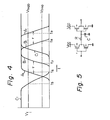
- the p - MOS transistor Q20 is in the conductive state and the n-MOS transistor T 20 is in the nonconductive state. Therefore, the output voltage A 1 of the first inerter INV 1 begins to "rise.
- the p-MOS transistor Q 1 is turned from on to off.
- the p-MOS transistor Q40 is not turned on because its gate receives the delayed input voltage from the delay circuit 5.
- the output voltage B 1 begins to rise with a delay time after the rising of the output voltage A 1 of the first inverter INV 10 .
- the n-MOS transistor T 1 is turned from off to on.
- the output voltage at the output end of the C-MOS inverter 1 is turned from the H level to the L level.
- the p-MOS transistor Q 1 is in the conductive state. In the period between the time t 6 and t 7 , both p-MOS transistor Q 1 and n-MOS transistor T 1 are in the nonconductive state.
- the n-MOS transistor T 30 in the first inverter INV 10 is turned on at the predetermined delay time T after the n-MOS transistor T 40 in the second inverter INV 20 is turned on. Therefore, the output voltage A 1 of the first inverter INV 10 falls with the delay time ⁇ after the fall of the output voltage B 1 of the second inverter INV 20 .
- the n-MOS, transistor T 1 is turned off at a time t 8 .
- the p-MOS transistor Q 1 is turned on at a time t 9 . Before the time t 8 , only the n-MOS transistor T 1 is in the conductive state.
- both p-MOS transistor Q 1 and n-MOS transistor T 1 are in the nonconductive states.
- only the p-MOS transistor Q 1 is in the conductive state. Accordingly, no current flows through the C -MOS inverter 1 during the rising of the input voltage C l .
- Figure 5 shows an example of a well-known delay circuit adaptable to the delay circuit 5 in Fig. 3.
- the delay circuit of Fig. 5 comprises two inverters and a time constant circuit with a resistor R and a capacitor C. The resistance and the capacitance are appropriately determined so as to obtain the desired delay time T .
- the number of transistors in each inverter in the buffer circuit may alternatively be four or more so as to realize three states, i.e., the L level, the H level, and a high impedance state, at the output of the C-MOS inverter 1.
- Figure 6 shows a buffer circuit for realizing the three states at the output of a memory circuit. The main difference between Fig. 3 and Fig. 6 is that, in Fig. 6, additional transistors Q 22 , T 32 , Q 32 , and T 42 are provided.
- the p-MOS transistor Q22 is connected in parallel to the p-MOS transistor Q 20 .
- the n-MOS transistor T 32 is inserted between the n-MOS transistor T 30 and the ground.
- the p-MOS transistor Q 32 is inserted between the power supply line V CC and the p-MOS transistor Q 30 .
- the n-MOS transistor T 42 is connected in parallel to the n-MOS transistor T 40 .
- the gates of the p-MOS transistor,Q 22 and the n-MOS transistor T 32 are commonly connected to a terminal 6 which operatively receives a noninverted output enable signal.
- the gates of the p- MOS transistor Q 32 and the N-MOS transistor T 42 are commonly connected to another terminal 7 which operatively receives an inverted output enable signal.
- the output enable signal OE is at the L level, and the inverted output enable signal OE is at the H level. Therefore, the p-MOS transistor Q22 is on, and the n-MOS transistor T 32 is off, so that the output voltage A 2 is at the H level regardless of the input voltage C 2 . Accordingly, the p-MOS transistor Q l is off regardless of the input voltage C 2 . Also, the p-MOS transistor Q 32 is off and the n-MOS transistor T 42 is on, so that the output voltage B 2 is at the L level regardless of the input voltage C 2 . Consequently, the output of the inverter 1 is at a high impedance.
- the output enable signal OE is at the H level, and the inverted output enable signal OE is at the L level. Therefore, the p-MOS transistor Q22 is off, and the n-MOS transistor T 32 is on, so that the output voltage A 2 is at the H level or the L level depending on the L level or the H level of the input voltage C 1 respectively. Also, the p-MOS transistor Q 32 is on, and the N-MOS transistor T 42 is off, so that the output voltage B 2 is at the H level or the L level depending on the L level or the H level of the input voltage C 2 respectively.
- the delay circuit 5 in Fig. 6 also gives a predetermined delay to the rising and the falling of the output voltages A 2 and B 2 , in a similar way as in the circuit of Fig. 3 .
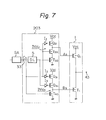
- a buffer circuit is illustrated.
- the buffer circuit 203 is composed of n-MOS transistors. No p-MOS transistor is used in this buffer circuit 203.
- n-MOS transistors Q 21 , Q 31 , and Q 41 are used in Fig. 7, respectively.
- a first inverter I 1 is inserted between the gate of the n-MOS transistor Q21 and the input end 33.
- a second inverter I 2 is inserted.
- a third inverter I3 is inserted.
- the present invention is not restricted to the above--mentioned embodiments.
- the gates of the n-MOS transistors T 20 and T 30 may alternatively be connected to the output of the delay circuit 5 and to the input end 3, respectively.
- the gates of the p-MOS transistors Q30 and Q 40 may alternatively be connected to the output of the delay circuit 5 and to the input end 3, respectively.
- the input signal of the buffer circuit may be supplied not only from a sense amplifier in a memory circuit but also from any other logic circuit.
- each of the two inverters for driving a p-MOS transistor and an n-MOS transistor in a C-MOS inverter consists of at least three transistors and since delay circuit is inserted between an input end and the inverters, a desired delay time can be given to the driving timings of the transistors in the C- MOS inverter.
- a desired delay time can be given to the driving timings of the transistors in the C- MOS inverter.
- simultaneous conduction of current through the transistors in the C-MOS inverter during its transition state can be prevented. Therefore, the voltage fluctuation of the power supply line, to which the C-MOS inverter and internal or outer circuits of the C-MOS inverter are connected, is suppressed. Further, power consumption in the C-MOS inverter can be reduced.
Landscapes
- Engineering & Computer Science (AREA)
- Physics & Mathematics (AREA)
- Computer Hardware Design (AREA)
- Computing Systems (AREA)
- General Engineering & Computer Science (AREA)
- Mathematical Physics (AREA)
- Power Engineering (AREA)
- Logic Circuits (AREA)
- Electronic Switches (AREA)
- Control Of Electrical Variables (AREA)
- Pulse Circuits (AREA)
- Manipulation Of Pulses (AREA)
Applications Claiming Priority (2)
| Application Number | Priority Date | Filing Date | Title |
|---|---|---|---|
| JP56125981A JPS5838032A (ja) | 1981-08-13 | 1981-08-13 | C―mosインバータ駆動用バッファ回路 |
| JP125981/81 | 1981-08-13 |
Publications (3)
| Publication Number | Publication Date |
|---|---|
| EP0072686A2 true EP0072686A2 (fr) | 1983-02-23 |
| EP0072686A3 EP0072686A3 (en) | 1983-06-15 |
| EP0072686B1 EP0072686B1 (fr) | 1986-07-30 |
Family
ID=14923765
Family Applications (1)
| Application Number | Title | Priority Date | Filing Date |
|---|---|---|---|
| EP82304299A Expired EP0072686B1 (fr) | 1981-08-13 | 1982-08-13 | Circuit tampon comprenant un montage inverseur |
Country Status (5)
| Country | Link |
|---|---|
| US (1) | US4518873A (fr) |
| EP (1) | EP0072686B1 (fr) |
| JP (1) | JPS5838032A (fr) |
| DE (1) | DE3272309D1 (fr) |
| IE (1) | IE53406B1 (fr) |
Cited By (5)
| Publication number | Priority date | Publication date | Assignee | Title |
|---|---|---|---|---|
| EP0490752A1 (fr) * | 1990-12-14 | 1992-06-17 | Bull S.A. | Procédé et circuit de déclenchement à seuil |
| DE10002850A1 (de) * | 2000-01-24 | 2001-08-02 | Infineon Technologies Ag | Schaltung zur Umsetzung eines Paars aus differenziellen Signalen in ein Eintaktsignal |
| DE10103052C1 (de) * | 2001-01-24 | 2002-09-12 | Infineon Technologies Ag | Schaltkreis zum Erzeugen eines asynchronen Signalpulses |
| DE10135786A1 (de) * | 2001-07-23 | 2003-02-20 | Infineon Technologies Ag | Ausgangstreibervorrichtung und Verfahren zur Ausgabe eines Ausgangssignals hieraus |
| EP2621090A1 (fr) * | 2012-01-27 | 2013-07-31 | ST-Ericsson SA | Circuit de commutation et procédé |
Families Citing this family (32)
| Publication number | Priority date | Publication date | Assignee | Title |
|---|---|---|---|---|
| JPS59175218A (ja) * | 1983-03-24 | 1984-10-04 | Fujitsu Ltd | Cmosインバ−タ |
| JPS6097726A (ja) * | 1983-11-01 | 1985-05-31 | Mitsubishi Electric Corp | Cmos出力バツフア回路 |
| IT1218845B (it) * | 1984-03-30 | 1990-04-24 | Ates Componenti Elettron | Circuito di interfaccia attenuatore di rumore per generatori di segnali di temporizzazione a due fasi non sovrapposte |
| US4700089A (en) * | 1984-08-23 | 1987-10-13 | Fujitsu Limited | Delay circuit for gate-array LSI |
| JPH0834418B2 (ja) * | 1984-08-23 | 1996-03-29 | 富士通株式会社 | 遅延回路 |
| US4704547A (en) * | 1984-12-10 | 1987-11-03 | American Telephone And Telegraph Company, At&T Bell Laboratories | IGFET gating circuit having reduced electric field degradation |
| US4719369A (en) * | 1985-08-14 | 1988-01-12 | Hitachi, Ltd. | Output circuit having transistor monitor for matching output impedance to load impedance |
| JPS62220026A (ja) * | 1986-03-20 | 1987-09-28 | Toshiba Corp | 出力バツフア回路 |
| JPS635553A (ja) * | 1986-06-25 | 1988-01-11 | Fujitsu Ltd | バツフア回路 |
| US4779010A (en) * | 1986-07-29 | 1988-10-18 | Advanced Micro Devices, Inc. | Monostable logic gate in a programmable logic array |
| US4709162A (en) * | 1986-09-18 | 1987-11-24 | International Business Machines Corporation | Off-chip driver circuits |
| JPS63208324A (ja) * | 1987-02-24 | 1988-08-29 | Mitsubishi Electric Corp | 半導体集積回路装置 |
| US4825106A (en) * | 1987-04-08 | 1989-04-25 | Ncr Corporation | MOS no-leak circuit |
| US5059835A (en) * | 1987-06-04 | 1991-10-22 | Ncr Corporation | Cmos circuit with programmable input threshold |
| US4797579A (en) * | 1987-07-27 | 1989-01-10 | Raytheon Company | CMOS VLSI output driver with controlled rise and fall times |
| US5182479A (en) * | 1988-06-24 | 1993-01-26 | U.S. Philips Corp. | Gate circuit having increased voltage handling capability |
| US4924120A (en) * | 1988-06-29 | 1990-05-08 | Texas Instruments Incorporated | Low noise output circuit |
| US4959563A (en) * | 1988-06-29 | 1990-09-25 | Texas Instruments Incorporated | Adjustable low noise output circuit |
| CA1331214C (fr) * | 1989-01-05 | 1994-08-02 | Kun-Ming Lee | Circuit de commande d'interface a dispositif actif de charge et de decharge |
| US4952818A (en) * | 1989-05-17 | 1990-08-28 | International Business Machines Corporation | Transmission line driver circuits |
| US4943945A (en) * | 1989-06-13 | 1990-07-24 | International Business Machines Corporation | Reference voltage generator for precharging bit lines of a transistor memory |
| JPH03185921A (ja) * | 1989-12-14 | 1991-08-13 | Toshiba Corp | 半導体集積回路 |
| JP2975122B2 (ja) * | 1990-12-26 | 1999-11-10 | 富士通株式会社 | レベル変換回路 |
| JP3556679B2 (ja) | 1992-05-29 | 2004-08-18 | 株式会社半導体エネルギー研究所 | 電気光学装置 |
| US5296766A (en) * | 1992-06-04 | 1994-03-22 | Sharp Microelectronics Technology, Inc. | CMOS circuit with crowbar limiting function |
| US20030189448A1 (en) * | 2002-04-08 | 2003-10-09 | Silicon Video, Inc. | MOSFET inverter with controlled slopes and a method of making |
| US7187227B2 (en) * | 2002-08-07 | 2007-03-06 | Nippon Telegraph And Telephone Corporation | Driver circuit |
| JP4015937B2 (ja) * | 2002-12-06 | 2007-11-28 | 松下電器産業株式会社 | デューティ比補正回路 |
| US20040265499A1 (en) * | 2003-06-24 | 2004-12-30 | Nokia Corporation | Method of forming patterns on articles |
| CN102342006A (zh) * | 2009-12-03 | 2012-02-01 | 松下电器产业株式会社 | 半导体集成电路以及具备该半导体集成电路的升压电路 |
| CN102204105B (zh) * | 2011-05-30 | 2013-08-07 | 华为技术有限公司 | 一种i/o电路和集成电路 |
| CN113054990A (zh) * | 2021-03-12 | 2021-06-29 | 湖南国科微电子股份有限公司 | 一种驱动电路、接口电路和终端 |
Family Cites Families (9)
| Publication number | Priority date | Publication date | Assignee | Title |
|---|---|---|---|---|
| GB1127687A (en) * | 1965-12-13 | 1968-09-18 | Rca Corp | Logic circuitry |
| US3631528A (en) * | 1970-08-14 | 1971-12-28 | Robert S Green | Low-power consumption complementary driver and complementary bipolar buffer circuits |
| US3851189A (en) * | 1973-06-25 | 1974-11-26 | Hughes Aircraft Co | Bisitable digital circuitry |
| JPS5915533B2 (ja) * | 1976-08-20 | 1984-04-10 | シチズン時計株式会社 | 電子装置の駆動回路 |
| DE2737506C2 (de) * | 1977-08-19 | 1979-08-16 | Siemens Ag, 1000 Berlin Und 8000 Muenchen | Ausgangsverstärker mit CMOS-Transistoren |
| JPS5839409B2 (ja) * | 1978-11-17 | 1983-08-30 | 富士通株式会社 | 増幅回路 |
| US4329600A (en) * | 1979-10-15 | 1982-05-11 | Rca Corporation | Overload protection circuit for output driver |
| US4317180A (en) * | 1979-12-26 | 1982-02-23 | Texas Instruments Incorporated | Clocked logic low power standby mode |
| JPS5745726A (en) * | 1980-09-01 | 1982-03-15 | Nec Corp | Transistor switch |
-
1981
- 1981-08-13 JP JP56125981A patent/JPS5838032A/ja active Granted
-
1982
- 1982-08-13 EP EP82304299A patent/EP0072686B1/fr not_active Expired
- 1982-08-13 US US06/407,953 patent/US4518873A/en not_active Expired - Lifetime
- 1982-08-13 DE DE8282304299T patent/DE3272309D1/de not_active Expired
- 1982-08-13 IE IE1970/82A patent/IE53406B1/en not_active IP Right Cessation
Cited By (11)
| Publication number | Priority date | Publication date | Assignee | Title |
|---|---|---|---|---|
| EP0490752A1 (fr) * | 1990-12-14 | 1992-06-17 | Bull S.A. | Procédé et circuit de déclenchement à seuil |
| FR2670633A1 (fr) * | 1990-12-14 | 1992-06-19 | Bull Sa | Procede et circuit de declenchement a seuil. |
| DE10002850A1 (de) * | 2000-01-24 | 2001-08-02 | Infineon Technologies Ag | Schaltung zur Umsetzung eines Paars aus differenziellen Signalen in ein Eintaktsignal |
| DE10002850C2 (de) * | 2000-01-24 | 2002-02-14 | Infineon Technologies Ag | Schaltung zur Umsetzung eines Paars aus differenziellen Signalen in ein Eintaktsignal |
| DE10103052C1 (de) * | 2001-01-24 | 2002-09-12 | Infineon Technologies Ag | Schaltkreis zum Erzeugen eines asynchronen Signalpulses |
| DE10135786A1 (de) * | 2001-07-23 | 2003-02-20 | Infineon Technologies Ag | Ausgangstreibervorrichtung und Verfahren zur Ausgabe eines Ausgangssignals hieraus |
| DE10135786B4 (de) * | 2001-07-23 | 2004-01-29 | Infineon Technologies Ag | Ausgangstreibervorrichtung und Verfahren zur Ausgabe eines Ausgangssignals hieraus |
| US6714055B2 (en) | 2001-07-23 | 2004-03-30 | Infineon Technologies Ag | Output driver devices |
| EP2621090A1 (fr) * | 2012-01-27 | 2013-07-31 | ST-Ericsson SA | Circuit de commutation et procédé |
| WO2013110771A1 (fr) * | 2012-01-27 | 2013-08-01 | St-Ericsson Sa | Circuit et procédé de commutation |
| US9312859B2 (en) | 2012-01-27 | 2016-04-12 | St-Ericsson Sa | Switching circuit and method |
Also Published As
| Publication number | Publication date |
|---|---|
| US4518873A (en) | 1985-05-21 |
| DE3272309D1 (en) | 1986-09-04 |
| EP0072686B1 (fr) | 1986-07-30 |
| EP0072686A3 (en) | 1983-06-15 |
| JPS5838032A (ja) | 1983-03-05 |
| JPS6363134B2 (fr) | 1988-12-06 |
| IE53406B1 (en) | 1988-11-09 |
| IE821970L (en) | 1983-02-13 |
Similar Documents
| Publication | Publication Date | Title |
|---|---|---|
| EP0072686A2 (fr) | Circuit tampon comprenant un montage inverseur | |
| US4959646A (en) | Dynamic PLA timing circuit | |
| US4568842A (en) | D-Latch circuit using CMOS transistors | |
| US4988888A (en) | CMOS output circuit with intermediate potential setting means | |
| US3953839A (en) | Bit circuitry for enhance-deplete ram | |
| US4874971A (en) | Edge-sensitive dynamic switch | |
| US4697105A (en) | CMOS programmable logic array | |
| US4849935A (en) | Semiconductor memory including transparent latch circuits | |
| EP0550216A1 (fr) | Porte à retard CMOS contrôlée numériquement | |
| KR100325025B1 (ko) | 파워온리셋회로 | |
| US4365174A (en) | Pulse counter type circuit for power-up indication | |
| EP0086090B1 (fr) | Circuit d'attaque pour charges capacitives | |
| EP0036743B1 (fr) | Circuit tampon d'adresse convertisseur de niveau TTL en niveau MOS | |
| KR20020034910A (ko) | Vccq 공급 보상을 이용한 집적 회로칩용 출력 구동기 | |
| US5097159A (en) | Delay circuit for delaying an output signal relative to an input signal for a specified time interval | |
| EP0606727A1 (fr) | Commande automatique de la vitesse de commutation d'un circuit tampon | |
| US4894559A (en) | Buffer circuit operable with reduced power consumption | |
| US4742247A (en) | CMOS address transition detector with temperature compensation | |
| US5210449A (en) | Edge triggered tri-state output buffer | |
| US4963774A (en) | Intermediate potential setting circuit | |
| US4465944A (en) | Three state input circuits | |
| US4982117A (en) | Address transition detector circuit | |
| US4420695A (en) | Synchronous priority circuit | |
| JPH0743933B2 (ja) | 遷移検出回路 | |
| US5815464A (en) | Address transition detection circuit |
Legal Events
| Date | Code | Title | Description |
|---|---|---|---|
| PUAI | Public reference made under article 153(3) epc to a published international application that has entered the european phase |
Free format text: ORIGINAL CODE: 0009012 |
|
| AK | Designated contracting states |
Designated state(s): DE FR GB |
|
| PUAL | Search report despatched |
Free format text: ORIGINAL CODE: 0009013 |
|
| AK | Designated contracting states |
Designated state(s): DE FR GB |
|
| 17P | Request for examination filed |
Effective date: 19830729 |
|
| GRAA | (expected) grant |
Free format text: ORIGINAL CODE: 0009210 |
|
| AK | Designated contracting states |
Kind code of ref document: B1 Designated state(s): DE FR GB |
|
| ET | Fr: translation filed | ||
| REF | Corresponds to: |
Ref document number: 3272309 Country of ref document: DE Date of ref document: 19860904 |
|
| PLBE | No opposition filed within time limit |
Free format text: ORIGINAL CODE: 0009261 |
|
| STAA | Information on the status of an ep patent application or granted ep patent |
Free format text: STATUS: NO OPPOSITION FILED WITHIN TIME LIMIT |
|
| 26N | No opposition filed | ||
| PGFP | Annual fee paid to national office [announced via postgrant information from national office to epo] |
Ref country code: DE Payment date: 20010806 Year of fee payment: 20 |
|
| PGFP | Annual fee paid to national office [announced via postgrant information from national office to epo] |
Ref country code: GB Payment date: 20010808 Year of fee payment: 20 |
|
| PGFP | Annual fee paid to national office [announced via postgrant information from national office to epo] |
Ref country code: FR Payment date: 20010810 Year of fee payment: 20 |
|
| REG | Reference to a national code |
Ref country code: GB Ref legal event code: IF02 |
|
| PG25 | Lapsed in a contracting state [announced via postgrant information from national office to epo] |
Ref country code: GB Free format text: LAPSE BECAUSE OF EXPIRATION OF PROTECTION Effective date: 20020812 |
|
| REG | Reference to a national code |
Ref country code: GB Ref legal event code: PE20 Effective date: 20020812 |