EP0073324B1 - Vorrichtung und Verfahren zur Kontrolle der Fixiereinrichtung eines Kopiergerätes - Google Patents
Vorrichtung und Verfahren zur Kontrolle der Fixiereinrichtung eines Kopiergerätes Download PDFInfo
- Publication number
- EP0073324B1 EP0073324B1 EP82106258A EP82106258A EP0073324B1 EP 0073324 B1 EP0073324 B1 EP 0073324B1 EP 82106258 A EP82106258 A EP 82106258A EP 82106258 A EP82106258 A EP 82106258A EP 0073324 B1 EP0073324 B1 EP 0073324B1
- Authority
- EP
- European Patent Office
- Prior art keywords
- fuser
- temperature
- power
- sensor
- time
- Prior art date
- Legal status (The legal status is an assumption and is not a legal conclusion. Google has not performed a legal analysis and makes no representation as to the accuracy of the status listed.)
- Expired
Links
Images




Classifications
-
- G—PHYSICS
- G03—PHOTOGRAPHY; CINEMATOGRAPHY; ANALOGOUS TECHNIQUES USING WAVES OTHER THAN OPTICAL WAVES; ELECTROGRAPHY; HOLOGRAPHY
- G03G—ELECTROGRAPHY; ELECTROPHOTOGRAPHY; MAGNETOGRAPHY
- G03G15/00—Apparatus for electrographic processes using a charge pattern
- G03G15/20—Apparatus for electrographic processes using a charge pattern for fixing, e.g. by using heat
- G03G15/2003—Apparatus for electrographic processes using a charge pattern for fixing, e.g. by using heat using heat
- G03G15/2014—Apparatus for electrographic processes using a charge pattern for fixing, e.g. by using heat using heat using contact heat
- G03G15/2039—Apparatus for electrographic processes using a charge pattern for fixing, e.g. by using heat using heat using contact heat with means for controlling the fixing temperature
- G03G15/205—Apparatus for electrographic processes using a charge pattern for fixing, e.g. by using heat using heat using contact heat with means for controlling the fixing temperature specially for the mode of operation, e.g. standby, warming-up, error
Definitions
- the present invention relates to methods and apparatus for monitoring and/or controlling the temperature of heated fuser structure. More particularly, the present invention relates to methods and apparatus for monitoring the temperature of a heated fuser useful in a xerographic process machine so that appropriate heat levels are applied to the fuser and machine control functions are generated in response to detected temperatures over a period of time. Although not necessarily limited thereto, the present invention is particularly useful for monitoring and controlling the temperature of heated rollers employed for the purpose of fusing images on copy sheets in xerographic processing machines.
- a latent image of a document or object is formed on a photoconductor and developed by application of toner to the photoconductor.
- the image as represented by the toner pattern is subsequently transferred to a copy sheet.
- the copy sheet then passes through a fuser which fixes the image in substantially permanent form on the copy sheet.
- the present invention is concerned with heating such fusing devices and is especially useful in copiers employing heated rollers for the fusing purpose.
- U.S. Patent Specification No. 4,162,847 illustrates one example of a copier environment and hot roll fuser structure.
- Minimizing the warm-up time of a heated fuser in a copier is particularly desirable to allow the operator to use the copier as soon as possible after it has been initially turned on. However, it is important to avoid driving the fuser temperature excessively beyond the desired operating temperature because this results in fusing problems as well as reduced life of the fuser.
- Prior art techniques of fuser temperature control include allowing the fuser temperature to cross an operating point twice before permitting copier use. Full power is applied to the fuser upon power initiation until the temperature sensor reaches the desired operating point. The temperature continues to rise overshooting the desired operating temperature. Power is reapplied once the temperature has descended below the operating point a second time and it is then assumed the copier is ready for use. Overshoot is minimized by this procedure but warm-up time is not significantly reduced.
- Another prior art arrangement employs a thermistor coupled into a bridge for a microprocessor input.
- the fuser is driven to a high level during the warm-up period, a low level during standby and an intermediate level during copying operations. Again this is performable by half cycle controls oftriacs or the like.
- An example of such a system is shown in U.S. Defensive Publication T100804 entitled “Microprocessor Controlled Power Supply for Xerographic Fusing Apparatus" by L. M. Ernst published July 7, 1981.
- the present apparatus permits normal copy operation of a machine after initial power-on conditions with minimum delay and without requiring any memory of the length of time that power has been removed from the machine. It is particularly well suited for microprocessor control of a copier and adds insignificant additional cost to a system which includes a fuser roll temperature sensor and a microprocessor wherein the temperature signals are coupled to the microprocessor input.
- FIG. 1 shows a chart of fuser temperature as a function of time where full heater power is either on or off.
- the preferred operating temperature level 10 is reached by applying full power during the interval at 11 up to the time that equality is sensed at 12. Power is then removed for interval 15 until the operating temperature equality is once again sensed at point 16. In typical prior art arrangements, the copier ready is not indicated until point 16 is reached.
- Full power is applied to the fuser during interval 20 until cross-over 21 is detected.
- a partial power application is employed during interval 22 until the second cross-over 23 occurs which indicates that the fuser temperature has coasted to operating level 19.
- temperature sensing is through a thermistor mounted in a shoe in contact with the aluminum hot roll core. It is known that the temperature of the sensor lags behind the temperature of the hot roll as is shown in FIG. 3. Thus, with a desired operating temperature of 25 and application of full power to the fuser heater, the sensor apparent temperature is illustrated by dashed curve 26 even though the actual fusing surface temperature of the hot roll follows the curve shown at 27. When the apparent cross-over point is detected at 28 and power is switched off of the fuser heater, the actual fuser roll temperature has already exceeded the operating point and will significantly overshoot as illustrated. The present arrangement addresses this problem by varying the point at which fuser power is adjusted so that the temperature overshoot is avoided.
- the point of temperature adjustment is referred to herein as "up to temperature” or UTT.
- the UTT point depends on the beginning value of fuser temperature at machine power-on; it varies depending on whether the machine is turned on after a long power-off period or is repowered after a brief interruption as for clearing jams.
- FIG. 6 illustrates the typical declining level of UTT for fuser temperature sensing using the present arrangement.
- This declining magnitude of UTT reflects recognition that the hot roll temperature reaches the desired operating temperature as a function of its power-on history.
- the magnitude of UTT at any given period also effectively compensates for sensor lag.
- FIG. 6 shows the temperature over time for power to the fuser which is switched at the UTT times.
- the desired operating temperature 30 for the fuser is reached beginning from a relatively high initial temperature as is shown by curve 31.
- the initial temperature level UTT-1 is approached by sensor output 32 and, when UTT-1 is reached, it is known that the fuser will reach the proper operating temperature 30 by the time the fuser is required to perform a copy fusing operation. Therefore power is switched off with the fuser temperature reaching level 30 with minimum overshoot.
- the copier control logic decides when the fuser temperature reaches UTT that the fuser is immediately available for copying. This occurs at the end of time period t1 in FIG. 6.
- a cold copier start is reflected by profile 33 for the actual fuser temperature and profile 34 for the lagging sensor output.
- the controls initially en- deavor to compare the sensor output 34 against UTT-1 level but subsequently reduce the comparison level such as by switching to the lower UTT-2 level.
- the copier is determined as up to temperature at time t2 and is then ready for copier operations.
- the copier controls e.g. a microcomputer or the like) vary the value of UTT with a look-up table whose values satisfy the equation:
- Typical circuitry for implementing the arrangement is illustrated in schematic form in FIG. 4. It includes a conventional microcomputer 40 with outputs coupled to a digital-to-analog converter 41 and a drive circuit 42 which typically includes a triac switch. That is, drive circuit 42 selectively couples electrical power from power source 43 to the lamp 44 located internally to hot roll fuser 45.
- Hot roll fuser 45 includes a hollow core 46 fabricated of heat conducting material such as aluminum, and a coating 48 for performing the function of directly applying the fuser heat to copy sheets as they pass through the nip of roller 45 with a back-up roller (not shown).
- Sensor 50 is positioned to detect the temperature of core 46 and is a conventional thermistor element or the like. Coupling of thermistor 50 onto the end of core 46 as shown is preferred rather than to directly sense the temperature of the surface of roller 48 to prevent wear of that roller and degradation of fusing.
- Comparator 52 has one input coupled to sensor 50 and the other input coupled to the output from digital-to-analog converter 41 through resistor network 53.
- comparator 52 is effectively coupled to a resistance bridge, one side of which is a variable resistance from the microcomputer 40 controls and the other side of which is the temperature sensing element 50.
- FIG. 5 shows a typical application of output 58 from digital-to-analog circuit 41 through network 53 to provide one input to comparator 52.
- Terminals 54-57 represent respective binary outputs of digital-to-analog converter 41 which drive network 53 from the power source +V so that their summation is applied to comparator 52 for comparison against the signal developed in correlation to the resistance of thermistor 50.
- FIG. 8 is a chart of multiple level comparisons against the fuser temperature over a period of time.
- microcomputer 40 outputs a bit pattern to the D/A converter 41 that varies the resistance in the bridge circuit thus creating a varying comparison temperature.
- the preferred fuser roller operating temperature is shown at 60.
- the comparison temperature varies as a series of reducing steps as shown in FIG. 8 to allow for the temperature difference between the temperature sensor 61 and the actual temperature 62 at the fuser. This difference is at least partially the result of the thermal lag between the sensor 50 and the sensing surface, the temperature differential between sensor 50 and fusing surface 48, and/or the thermal resistance of sensor 50 itself.
- FIG. 8 shows how microcomputer 40 reaches a decision as to the actual fusing temperature 62 based on sensor 50 temperature.
- the sensor 50 output reaches UTT at 66, it is known that the actual fusing temperature is approaching operating point 60 so that copying operation start-up is acceptable.
- the time span and temperature level for each step when designing a particular machine is determined as a function of the temperature characteristics of the sensor and fuser structure involved.
- the value of 2 12 is convenient for counting in four-bit binary arithmetic.
- the temperature levels were chosen to approximate the sensor/fuser temperature characteristics wherein the sensor was a commercially available graphite shoe having a thermistor and a thermal fuse mounted therein, and the fuser was constructed with a hollow aluminum core of 49 mm diameter, 256 mm length and 2.8 mm thickness having a 1.27 mm inch thick coating of a silicon rubber thereon and a 510 watt, 127 vac heater element within the core.
- FIG. 9 shows the combination of comparison temperatures and safety checks.
- temperature level 70 is the operating temperature and levels 71 and 72 represent sensing of over-temperature and under-temperature conditions, respectively.
- Failing a safety check results in removal of power from the copier and indication of a machine failure to the operator.
- the check for fuser over-temperature condition verifies the operation of the fuser drive circuit.
- a fuser under-temperature verifies thermal contact of the temperature sensor to the hot roll.
- FIG. 9 is a diagram of both the safety check comparison levels and the moving UTT comparison level. Every 34.1 seconds (offset from the change in UTT every 34.1 seconds), the microcomputer performs a safety check, alternating between over-temperature and under-temperature.
- An over-temperature condition is the fuser temperature exceeding the maximum expected temperature. This results due to a shorted triac, a short in the fuser cabling or a faillure at the microcomputer output.
- An under-temperature condition occurs when the fuser temperature drops from the operating temperature and falls below the minimum expected temperature. This results from an opened fuser triac, an open in the fuser cabling, or lack of thermal feedback from the hot roll. The under-temperature test is not performed until the fuser temperature reaches the operating point.
- the comparison temperature is increased in increments related to T (thermal time constant between hot roll and sensor shoe) until it equals the desired operating point.
- T thermal time constant between hot roll and sensor shoe
- the comparison temperature varies between a standby control point and a copy control point using the circuit of FIGS. 4 and 5. For some machines, only a copy temperature level is maintained and therefore a standby temperature level comparison is not needed.
- FIG. 7 illustrates time division power control for two consecutive time periods P during which the fuser is powered on during T1 and T1 + M. The next value of T is decided at the beginning of each time period P. If the temperature sensed is below the comparison temperature, T is incremented one time unit. In FIG. 7, there is illustrated an added time increment M in the second time period P. If the sensed temperature is above the desired operating level, T is decremented one time unit. The fuser power now can vary between full power and partial power. The value of time incremented or decremented can vary depending on the mode of machine operation (e.g. copy or standby).
- the exemplary preferred embodiment of a hot roll fuser control system is implemented through a microcomputer and variable resistance bridge as shown in FIGS. 4 and 5.
- This system allows a shortened warm-up time of the fuser without incurring temperature overshoot of such a level as to delay copy starting.
- Energy is varied (power x time) to the fuser lamp 44 based on comparisons to a sequence of reference temperatures, the mode of machine operation and fuser temperature history.
- the microcomputer 40 makes decisions based on multiple temperature compari-' sons concerning fuser over-temperature (indicating an unsafe, runaway condition), fuser under-temperature (checking for thermal conductivity of temperature sensor to hot roll), and up to temperature (signaling end of fuser warm-up).
- microcomputer 40 controls the energy to lamp 44 by varying the time during which power is applied. Although P generally remains constant, the values of T in FIG. 7 are adjusted to decrease or increase energy to fuser lamp 44. The microcomputer 40 does this, for example, at the beginning of each P in conformity with the following rules:
- FIG. 12 shows a table of various digital combinations storable in the microcomputer memory.
- the microcomputer selects from this table to enable lines 54-57 of the DAC/comparator circuitry as a function of the status of the machine operation.
- FIG. 12 is a chart of possible comparisons and their meanings taken in con- jection with the following notes:
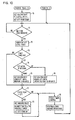
- FIG. 10 is a relatively self-explanatory flowchart of the sequence the microcomputer goes through in deciding to shift from one UTT level to another until the fuser temperature reaches a UTT level.
- the fuser timers are conventional clock pulse counters implemented internally to the microcomputer. A separate timer is used to signal that an excessive time has passed without the fuser temperature ever reaching a UTT level.
- the fuser temperature is tested against UTT-1 for a predetermined time period (e.g. 34.1 seconds in the example described previously) before shifting to UTT-2. Note that the time spans for the UTT level comparison can differ.
- decision block 77 as soon as the fuser temperature equals or surpasses a UTT level, the copier is ready for use.
- the initial value for the UTT level is retrieved from the table, stored in memory and placed on the output lines for comparison purposes.
- the direction of UTT testing is set.
- Decision block 71 provides one pass through code each half cycle of the AC power line (i.e., one pass every 8.33 milliseconds).
- Block 72 controls the UTT level timer. Its purpose is to provide a signal when an excessive time has passed without the fuser temperature reaching the UTT level.
- Block 73 responds to the condition wherein the UTT level timer has timed out to change level. The direction of UTT level change is determined at decision block 74.
- Block 75 a decision is made as to whether the fuser temperature has reached UTT.
- Block 78 indicates the responses when the fuser temperature has reached UTT, namely, set machine ready, change from full power to variable power mode, and set direction of UTT to up.
- the fuser power is controlled (note FIG. 11).
- FIG. 11 is a flowchart describing how power is applied to the fuser lamp. Box 80 reflects that these steps follow the operations of FIG. 10.
- the value of the fuser on comparison value is set equal to P, the power interval timer.
- the power interval timer P is incremented as shown at 81 and the fuser on timer T (how long the fuser is powered on each P) is also incremented at 82.
- the microcomputer proceeds to block 84 where the fuser is now turned off because it has been on long enough.
- decision block 85 the interval timer P is tested to see if the control interval is complete.
- the value of P is 2.1 seconds in a typical operating example.
- the response at 86 when P has timed out is that the microcomputer begins another fuser control interval by turning the fuser on.
- the fuser on timer T is cleared (set to zero) for this control interval.
- decision box 88 the value of the fuser on comparison value is determined based on the fuser temperature at the beginning of each control interval.
- the response at 89 if the fuser temperature is above the operating point (i.e., the fuser is warm and less power is required), is that the value of fuser on comparison is decreased. For example, the time the fuser is on is decreased by increments in multiples of 133 milliseconds.
- Block 91 reflects that the microcomputer proceeds to other machine operations and returns to the "wait for zero- crossing pulse" box of FIG. 10.
Landscapes
- Physics & Mathematics (AREA)
- General Physics & Mathematics (AREA)
- Fixing For Electrophotography (AREA)
- Control Of Temperature (AREA)
Claims (7)
Applications Claiming Priority (2)
| Application Number | Priority Date | Filing Date | Title |
|---|---|---|---|
| US06/295,435 US4415800A (en) | 1981-08-24 | 1981-08-24 | Method and apparatus for monitoring and controlling heated fusers for copiers |
| US295435 | 1981-08-24 |
Publications (3)
| Publication Number | Publication Date |
|---|---|
| EP0073324A2 EP0073324A2 (de) | 1983-03-09 |
| EP0073324A3 EP0073324A3 (en) | 1983-06-22 |
| EP0073324B1 true EP0073324B1 (de) | 1985-06-05 |
Family
ID=23137720
Family Applications (1)
| Application Number | Title | Priority Date | Filing Date |
|---|---|---|---|
| EP82106258A Expired EP0073324B1 (de) | 1981-08-24 | 1982-07-13 | Vorrichtung und Verfahren zur Kontrolle der Fixiereinrichtung eines Kopiergerätes |
Country Status (4)
| Country | Link |
|---|---|
| US (1) | US4415800A (de) |
| EP (1) | EP0073324B1 (de) |
| JP (1) | JPS5835571A (de) |
| DE (1) | DE3264035D1 (de) |
Families Citing this family (36)
| Publication number | Priority date | Publication date | Assignee | Title |
|---|---|---|---|---|
| US4603245A (en) * | 1982-08-23 | 1986-07-29 | Canon Kabushiki Kaisha | Temperature control apparatus |
| US4512649A (en) * | 1983-10-11 | 1985-04-23 | Eastman Kodak Company | Fuser apparatus |
| JPS60123880A (ja) * | 1983-12-09 | 1985-07-02 | Sharp Corp | 複写機 |
| US4551007A (en) * | 1984-05-11 | 1985-11-05 | Xerox Corporation | Controller for a fusing device of an electrophotographic printing machine |
| JPS61290465A (ja) * | 1985-06-18 | 1986-12-20 | Minolta Camera Co Ltd | 定着装置の温度制御装置 |
| US5126537A (en) * | 1986-12-10 | 1992-06-30 | Robertshaw Controls Company | Control unit and method of making the same |
| US4899034A (en) * | 1986-12-10 | 1990-02-06 | Robertshaw Controls Company | Method of operating a control unit |
| US4994653A (en) * | 1986-12-10 | 1991-02-19 | Robertshaw Controls Company | Control unit and method of making the same |
| US4935607A (en) * | 1986-12-10 | 1990-06-19 | Robertshaw Controls Company | Control unit and method of making the same |
| US4782215A (en) * | 1986-12-10 | 1988-11-01 | Robertshaw Controls Company | Control unit and method of making the same |
| JPS63213618A (ja) * | 1987-02-28 | 1988-09-06 | Kurosaki Rokougiyou Kk | ウオ−キングビ−ム式加熱炉における鋼材抽出装置 |
| JPH0774930B2 (ja) * | 1987-10-07 | 1995-08-09 | シャープ株式会社 | ヒートローラ異常検出方法 |
| US5274423A (en) * | 1988-04-08 | 1993-12-28 | Minolta Camera Kabushiki Kaisha | Image forming apparatus having temperature control at a fixing unit |
| JPH0766222B2 (ja) * | 1988-05-17 | 1995-07-19 | 富士通株式会社 | トナー定着器の制御方法 |
| JPH01298385A (ja) * | 1988-05-27 | 1989-12-01 | Ricoh Co Ltd | 定着ヒータ制御方法 |
| US5015827A (en) * | 1988-09-23 | 1991-05-14 | Robertshaw Controls Company | Control system for a cooking oven |
| JPH071413B2 (ja) * | 1988-12-29 | 1995-01-11 | 株式会社精工舎 | 電子写真記録装置における定着器の制御方法および制御装置 |
| US5140132A (en) * | 1988-12-29 | 1992-08-18 | Seikosha Co., Ltd. | Method of and apparatus for controlling fixing device in electrophotographic recording system |
| JP2708867B2 (ja) * | 1989-03-31 | 1998-02-04 | キヤノン株式会社 | 加熱定着装置 |
| US4951096A (en) * | 1989-06-26 | 1990-08-21 | Eastman Kodak Company | Self-calibrating temperature control device for a heated fuser roller |
| EP0443806B1 (de) * | 1990-02-20 | 1996-07-31 | Canon Kabushiki Kaisha | Bilderzeugungsgerät mit Fehlererkennungsdetektor für die Fixiermittel |
| JPH03288867A (ja) * | 1990-04-06 | 1991-12-19 | Fuji Xerox Co Ltd | 画像記録装置 |
| JP3036028B2 (ja) * | 1990-09-10 | 2000-04-24 | ブラザー工業株式会社 | 熱定着装置 |
| US5046166A (en) * | 1990-10-10 | 1991-09-03 | Fuji Xerox Co., Ltd. | Digital electrophotographic copying apparatus |
| JPH04250483A (ja) * | 1991-01-10 | 1992-09-07 | Minolta Camera Co Ltd | 作像装置における定着装置 |
| JPH04235583A (ja) * | 1991-01-11 | 1992-08-24 | Toshiba Corp | 温度制御装置 |
| JP2915615B2 (ja) * | 1991-04-22 | 1999-07-05 | キヤノン株式会社 | 定着装置 |
| US5444521A (en) * | 1991-07-15 | 1995-08-22 | Canon Kabushiki Kaisha | Image fixing device capable of controlling heating overshoot |
| KR960013670B1 (ko) * | 1992-08-18 | 1996-10-10 | 삼성전자 주식회사 | 레이저 프린터의 온도 제어회로 |
| JPH07114287A (ja) * | 1993-10-15 | 1995-05-02 | Fujitsu Ltd | 熱定着機の制御方法及び同制御装置 |
| KR0174699B1 (ko) * | 1996-02-16 | 1999-04-01 | 김광호 | 화상형성장치의 히터온도 제어방법 |
| JP2001034138A (ja) * | 1999-07-19 | 2001-02-09 | Murata Mach Ltd | 画像形成装置 |
| JP3800118B2 (ja) * | 2002-03-27 | 2006-07-26 | ブラザー工業株式会社 | 熱定着装置および画像形成装置 |
| US7068953B2 (en) * | 2004-04-30 | 2006-06-27 | Eastman Kodak Company | Method and apparatus for validating fuser member behavior |
| JP2007199485A (ja) * | 2006-01-27 | 2007-08-09 | Canon Inc | 画像形成装置 |
| EP2832964B1 (de) * | 2012-03-30 | 2017-07-19 | NGK Insulators, Ltd. | Erhitzungsverfahren für eine wabenstruktur |
Citations (3)
| Publication number | Priority date | Publication date | Assignee | Title |
|---|---|---|---|---|
| US4046990A (en) * | 1975-04-07 | 1977-09-06 | Eastman Kodak Company | Temperature sensing and control of a fusing roll |
| US4145599A (en) * | 1976-04-19 | 1979-03-20 | Canon Kabushiki Kaisha | Fixing device of electrophotographic copying machine |
| EP0243913A2 (de) * | 1986-04-28 | 1987-11-04 | New York Blood Center, Inc. | Pre-S Gen codierte peptidische Hepatitis B Immunogene, Impfstoffe, Diagnosemittel und synthetische Lipid Transportvesikel |
Family Cites Families (14)
| Publication number | Priority date | Publication date | Assignee | Title |
|---|---|---|---|---|
| US3526272A (en) * | 1968-07-29 | 1970-09-01 | Tronac Inc | Servo temperature control |
| JPS495038A (de) * | 1972-04-27 | 1974-01-17 | ||
| US3878358A (en) * | 1972-11-16 | 1975-04-15 | Xerox Corp | Digital power control |
| US3821516A (en) * | 1973-01-15 | 1974-06-28 | Laurel Color Inc | Method and apparatus for sensing and regulating the temperature of a fluid |
| US3936658A (en) * | 1974-02-22 | 1976-02-03 | Xerox Corporation | Fuser apparatus for electrostatic reproducing machines |
| US3989370A (en) * | 1975-04-01 | 1976-11-02 | Xerox Corporation | Adaptive fuser controller |
| US4006985A (en) * | 1975-09-05 | 1977-02-08 | Xerox Corporation | Xerographic apparatus having time controlled fusing |
| US4163892A (en) * | 1975-12-15 | 1979-08-07 | Canon Kabushiki Kaisha | Fixing apparatus |
| US4162847A (en) * | 1977-10-06 | 1979-07-31 | International Business Machines Corporation | Hot roll fuser early closure inhibitor |
| JPS5517101A (en) * | 1978-06-08 | 1980-02-06 | Olympus Optical Co Ltd | Recorder provided with heating means |
| EP0006553A1 (de) | 1978-07-03 | 1980-01-09 | International Business Machines Corporation | Verfahren und Vorrichtung zum Betrieb einer Heizquelle in einem Kopiergerät |
| JPS5589879A (en) * | 1978-12-27 | 1980-07-07 | Matsushita Graphic Commun Syst Inc | Temperature control system of fixing device |
| JPS5692558A (en) * | 1979-12-27 | 1981-07-27 | Toshiba Corp | Copying machine |
| US4340807A (en) * | 1980-01-10 | 1982-07-20 | Xerox Corporation | Open loop fuser control |
-
1981
- 1981-08-24 US US06/295,435 patent/US4415800A/en not_active Expired - Lifetime
-
1982
- 1982-07-01 JP JP57112604A patent/JPS5835571A/ja active Granted
- 1982-07-13 DE DE8282106258T patent/DE3264035D1/de not_active Expired
- 1982-07-13 EP EP82106258A patent/EP0073324B1/de not_active Expired
Patent Citations (3)
| Publication number | Priority date | Publication date | Assignee | Title |
|---|---|---|---|---|
| US4046990A (en) * | 1975-04-07 | 1977-09-06 | Eastman Kodak Company | Temperature sensing and control of a fusing roll |
| US4145599A (en) * | 1976-04-19 | 1979-03-20 | Canon Kabushiki Kaisha | Fixing device of electrophotographic copying machine |
| EP0243913A2 (de) * | 1986-04-28 | 1987-11-04 | New York Blood Center, Inc. | Pre-S Gen codierte peptidische Hepatitis B Immunogene, Impfstoffe, Diagnosemittel und synthetische Lipid Transportvesikel |
Also Published As
| Publication number | Publication date |
|---|---|
| US4415800A (en) | 1983-11-15 |
| EP0073324A2 (de) | 1983-03-09 |
| EP0073324A3 (en) | 1983-06-22 |
| JPS5835571A (ja) | 1983-03-02 |
| DE3264035D1 (en) | 1985-07-11 |
| JPH0215074B2 (de) | 1990-04-10 |
Similar Documents
| Publication | Publication Date | Title |
|---|---|---|
| EP0073324B1 (de) | Vorrichtung und Verfahren zur Kontrolle der Fixiereinrichtung eines Kopiergerätes | |
| US4719489A (en) | Recording apparatus having material feed mode dependent fixing control | |
| US7437086B2 (en) | Image forming apparatus with change unit for changing temperature of fixing unit at time of actuating image forming unit | |
| US10001732B2 (en) | Power management and control for a fuser of an electrophotographic imaging device | |
| US5563696A (en) | Image fixing apparatus with power control during sheet passage | |
| EP1811345B1 (de) | Leistungsregelung für eine Heizwalze in einem Bildformungsapparat | |
| JP3298982B2 (ja) | 画像形成装置 | |
| US5317366A (en) | Processing unit and system including plurality of the processing units | |
| EP0222120B1 (de) | Die Umgebung abfühlende Steuerung für die Schmelzeinrichtung in einem xerografischen Kopiergerät | |
| JPS5835549A (ja) | 像形成装置 | |
| US6519427B2 (en) | Apparatus for controlling power supply to an image fixing device | |
| JPH09258601A (ja) | 加熱定着装置の温度制御方法及び装置 | |
| JP2018116187A (ja) | 画像形成装置 | |
| JP4903321B2 (ja) | ヒータ駆動装置、定着装置及び画像形成装置 | |
| JPH11167307A (ja) | 画像形成装置 | |
| US5555074A (en) | Electrophotographic apparatus and electrophotographic method | |
| JP2643303B2 (ja) | 定着温度制御装置 | |
| JP3102448B2 (ja) | 定着装置の温度制御装置 | |
| JP7506015B2 (ja) | 画像形成装置 | |
| JPH0535149A (ja) | 画像形成装置 | |
| JP2774802B2 (ja) | 熱定着装置 | |
| JPH0836323A (ja) | 画像形成装置 | |
| JP2018116186A (ja) | 画像形成装置 | |
| JP3599365B2 (ja) | 画像形成装置におけるヒータ温度制御方法 | |
| JPH10104991A (ja) | 熱定着装置の電力制御装置 |
Legal Events
| Date | Code | Title | Description |
|---|---|---|---|
| PUAI | Public reference made under article 153(3) epc to a published international application that has entered the european phase |
Free format text: ORIGINAL CODE: 0009012 |
|
| AK | Designated contracting states |
Designated state(s): DE FR GB IT |
|
| PUAL | Search report despatched |
Free format text: ORIGINAL CODE: 0009013 |
|
| AK | Designated contracting states |
Designated state(s): DE FR GB IT |
|
| 17P | Request for examination filed |
Effective date: 19830621 |
|
| ITF | It: translation for a ep patent filed | ||
| GRAA | (expected) grant |
Free format text: ORIGINAL CODE: 0009210 |
|
| AK | Designated contracting states |
Designated state(s): DE FR GB IT |
|
| REF | Corresponds to: |
Ref document number: 3264035 Country of ref document: DE Date of ref document: 19850711 |
|
| ET | Fr: translation filed | ||
| PLBE | No opposition filed within time limit |
Free format text: ORIGINAL CODE: 0009261 |
|
| STAA | Information on the status of an ep patent application or granted ep patent |
Free format text: STATUS: NO OPPOSITION FILED WITHIN TIME LIMIT |
|
| 26N | No opposition filed | ||
| ITTA | It: last paid annual fee | ||
| PGFP | Annual fee paid to national office [announced via postgrant information from national office to epo] |
Ref country code: GB Payment date: 19950622 Year of fee payment: 14 |
|
| PGFP | Annual fee paid to national office [announced via postgrant information from national office to epo] |
Ref country code: FR Payment date: 19950704 Year of fee payment: 14 |
|
| PGFP | Annual fee paid to national office [announced via postgrant information from national office to epo] |
Ref country code: DE Payment date: 19950720 Year of fee payment: 14 |
|
| PG25 | Lapsed in a contracting state [announced via postgrant information from national office to epo] |
Ref country code: GB Effective date: 19960713 |
|
| GBPC | Gb: european patent ceased through non-payment of renewal fee |
Effective date: 19960713 |
|
| PG25 | Lapsed in a contracting state [announced via postgrant information from national office to epo] |
Ref country code: FR Effective date: 19970328 |
|
| PG25 | Lapsed in a contracting state [announced via postgrant information from national office to epo] |
Ref country code: DE Effective date: 19970402 |
|
| REG | Reference to a national code |
Ref country code: FR Ref legal event code: ST |