EP0087007A2 - Mémoire RAM dynamique avec mémoire non-volatile de secours et mode de fonctionnement - Google Patents
Mémoire RAM dynamique avec mémoire non-volatile de secours et mode de fonctionnement Download PDFInfo
- Publication number
- EP0087007A2 EP0087007A2 EP83100910A EP83100910A EP0087007A2 EP 0087007 A2 EP0087007 A2 EP 0087007A2 EP 83100910 A EP83100910 A EP 83100910A EP 83100910 A EP83100910 A EP 83100910A EP 0087007 A2 EP0087007 A2 EP 0087007A2
- Authority
- EP
- European Patent Office
- Prior art keywords
- capacitor
- gate
- data
- fet
- floating gate
- Prior art date
- Legal status (The legal status is an assumption and is not a legal conclusion. Google has not performed a legal analysis and makes no representation as to the accuracy of the status listed.)
- Granted
Links
Images



Classifications
-
- G—PHYSICS
- G11—INFORMATION STORAGE
- G11C—STATIC STORES
- G11C14/00—Digital stores characterised by arrangements of cells having volatile and non-volatile storage properties for back-up when the power is down
Definitions
- the invention pertains to an MOS memory device. More specifically, the invention pertains to a dynamic-type MOS RAM (Random Access Memory) which has a non-volatile back-up storage capability.
- MOS RAM Random Access Memory
- a non-volatile memory device fabricated on a single silicon ship is disclosed in "Dual-Electron Injector-Structure Electrically Alterable Read-Only Memory Model Studies", DiMaria et al., IEEE Transactions on Electron Devices, Vol. ED-28, No. 9, September 1981, and in European patent application No. 801064759 (Publication No. 34653).
- This memory device uses a cell structure composed of an n-channel MOS transistor with DEIS (Dual Electron Injector Stack) material positioned between a control gate and a "floating" polycrystalline silicon gate. Writing is performed by applying a negative voltage to the control gate. This negative voltage causes the
- the DEIS material is formed by a layer 42 of insulating 5i0 2 sandwiched between two silicon-rich Si0 2 injector layers 41 and 43. Polysilicon layers are located immediately outside the silicon-rich Si0 2 injector layers, the lower one of which forms the floating gate electrode and the upper one of which is connected to a gate line.
- the log I - V C5 characteristic of this material is shown in Fig. 4B.
- U.S. Patent No. 4,055,837 issued October 25, 1977 to Stein et al., describes a dynamic single transistor memory element which provides for relative-permanent storage.
- the memory cell of the memory array is composed of an MOS.transistor having a gate coupled to a word line and a source and drain coupled in series with a metal dielectric semiconductor capacitor between a write line and a bit line.
- This arrangement suffers from a drawback in that, to recommence normal operations following restoration of power, it is necessary to perform a restore operation.
- This restore operation erases the data from non-volatile storage.
- the device has no latent storage capability. That is, the device is not capable of retaining a primary set of data in its nonvolatile storage cells after a restore operation has been performed.
- a memory array composed of a number of dynamic non-volatile memory cells.
- Each memory cell includes a volatile dynamic memory element composed of a first FET having a source coupled to a bit line and a gate coupled to a word line. The drain of the first FET is coupled to a data node with a drain voltage source being coupled through a data storage capacitor to the data node.
- a non-volatile memory element is also connected to the data node.
- the non-volatile memory element is composed of a dual gate second FET having a floating gate element and a separate control gate element.
- the potential of the floating gate element is controlled by current flowing through a DEIS insulator layer of the type described in the above mentioned article by DiMaria et al.
- the floating gate is insulated from the channel of the second FET by a gate oxide layer with the DEIS material disposed above, the floating gate.
- the second control gate which is insulated from the channel by the gate oxide layer, is supplied with a source of control voltage to turn the channel of the second FET off regardless of the amount of charge stored on or the potential of the floating gate.
- a method for operating such a memory cell To transfer data from the volatile dynamic element to the non-volatile cell, the floating gate'is driven first positive and then negative. In the positive state, a positive charge is stored on the floating gate if the data at the data is a data 0. Otherwise, during the negative state, a negative charge is stored on the floating gate if the data of the data node is a data 1. In either case, the potential of the floating gate is changed by current flowing through the DEIS material layer.
- the,data node of the dynamic cell is first forced to a data 1 state. Then, the second control gate of the dual gate FET is taken to a positive level. The floating gate, if it is then charged with a positive charge, will, in cooperation with the positive level on the second control gate, turn on the channel of the dual gate FET, and hence the charge on the data storage capacitor is discharged through the dual gate FET to ground. If the floating gate is charged negatively, the channel region under the floating gate of the second FET will be off so that the data storage capacitor is not discharged, and hence the data node will remain at the data 1 level. The second control gate voltage is then returned to ground to allow normal operations to commence.
- Fig. lA there is shown therein a schematic representation of the dynamic portion of a memory cell of the invention.
- the dynamic element or portion of the memory cell is composed basically of a first FET transistor 10 and a data storage capacitor C D .
- the source of the transistor 10 is connected to a bit line B/L, the gate 12 to a word line W/L, and the drain to one side of the capacitor C D .
- the other side of the capacitor C D is coupled to a pulsed drain voltage source V DD .
- Fig.1B is a cross-sectional view showing the physical construction of the portion of the memory cell shown in Fig. 1A.
- This dynamic element of the cell is fabricated upon a substrate 20, which is of the P type.
- An N + source region 21 is formed at the left side of the cell.
- the gate is formed by a polysilicon layer 24 which lies above the center part of the transistor.
- an implanted region is formed under a polysilicon layers 23 and 24 are the intervening space between them and the surface of the substrate 20 would be covered by insulating oxide. However, for purposes of clarity, the insulating oxide has been omitted from the view of Fig. 1B.
- the word line W/L is taken to a positive voltage. Then, the capacitor C D is charged either with a positive voltage (the drain-connected side of the capacitor C being positive with respect to the side thereof connected to V DD ) to store a data 1, or, with the word line W/L in the positive state, the bit line B/L and the drain voltage V DD are connected to the same potential to thereby discharge the capacitor C D and hence to store a zero charge representing a data 0. ,
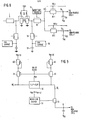
- FIG. 3 A schematic representation of the entire memory cell of the invention is shown in Fig. 3. As shown therein, the dynamic portion of the cell is the same as that of Fig. 1A.
- the non- volatile portion of the cell is connected to the data node D.
- a second FET transistor 30 has a source electrode connected to the data node D, and a drain electrode connected to ground.
- the second FET 30 has a dual gate structure including first and second gates 34 and 35.
- the first gate 34 is connected to one side of a capacitor C C , which is formed utilizing an ordinary dielectric material.
- the other side of the capacitor C is connected to the data node D.
- the first gate 34 is also connected to one side of a second capacitor C S , the other side of which is connected to a source of a pulsed voltage Vp.
- the second gate 35 is connected directly to a source of a pulsed voltage V S .
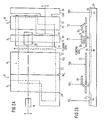
- the physical structure of the cell shown schematically in Fig. 3 is seen in the top view of Fig. 2A and the corresponding cross-sectional view of this cell is the same as that shown in Fig. 1B except that the implant region 22 extends to an N + diffusion 31 which corresponds to the data node D in the schematic representations of the cell.
- a second implant region 37 is formed in the non-volatile portion of the cell below a polysilicon layer 34.
- a segment of DEIS material 32 is formed between the polysilicon layers 33 and 34.
- the second gate 35 is formed as a two-level structure having a first portion in the same plane as the polysilicon layer 34 and a second portion in the plane of the polysilicon layer 33.
- the drain of the second FET transistor 30 is connected to a grounded N + diffusion 36.
- the cross-sectional area of the DEIS material segment 32 is much , smaller than the area of the polysilicon layer 34.
- the capacitance value of the capacitor C S is substantially less than that of the capacitor C C .
- the floating gate of the non-volatile portion of the cell of course corresponds to the polysilicon layer 34.
- the capacitance of the capacitor C s will be two to three times smaller than that in the conductive state.
- insulating oxide the various polysilicon layers, the surface of the substrate 20, and the segment 32 of DEIS material are to be covered with insulating oxide, the insulating oxide being omitted in Figs. 2A and 2B for purposes of clarity. It is believed clear to those of ordinary skill in the art that the device shown in Figs. 2A and 2B can be fabricated utilizing well-known semicondutor processing techniques.
- V S and V P are held at ground potential, and the word line W/L and the bit line B/L are operated as in a normal dynamic random access memory.
- the charge on the floating first gate 34 has substantially no effect upon the operation of the dynamic portion of the cell. This is due to the fact that, althrough the capacitors Cc and C s are in effect connected in the circuit at the data node D and although the capacitor C c is relatively large, because they are connected in series and the capacitor C s is very small, the additional capacitive load imposed upon the data node D is very small.
- Vp is pulsed first positive and then negative.
- the data node D is the data 0 level (corresponding to a zero charge stored on the capacitor C D )
- a large positive voltage drop will appear across the capacitor C S thereby resulting in a current flow through the DEIS material of the capacitor C s which in turn enhances the positive charge on the floating first gate 34.
- the subsequent negative pulse for a data 0 at the data node D, there will be substantially no effect upon the charge on the floating gate 34.
- For a data 1 at the data node D there will be substantially no effect on the charge on the first floating gate 34 during the positive pulse.
- a data 1 at the data node D will result in a large negative voltage drop across the capacitor C S , thereby resulting in a current flow through the DEIS insulator material of the capacitor C S and hence a negative charge on the floating first gate 34.
- the reason why the potential on the floating first gate 34 is substantially unaffected for combinations of a data 1 at the data node D for the positive pulse and a data 0 at the data node D for the negative pulse is that the resulting voltage across the capacitor C S in those conditions is too small to cause conduction in the DEIS material.
- V is held at ground and a data 1 is written into the dynamic portion of the cell by positively charging the capacitor C D using a normal storage operation.
- V S is taken to a positive voltage to thereby turn on the channel of the second F ET 30 if the floating gate also is positive. If the floating first gate 34 has been charged with a positive charge (corresponding to a data 0), the channel region of the second FET transistor 30 under the first gate 34 will be turned on and the capacitor C will be discharged.
- the device is provided with a latent storage or image capability.
- the device can be operated both as a read only memory and a random access memory. For instance, an initializing set of data can be stored in the non-volatile portion of the cell for use at the commencement of some particular operation. After the initial use of this data, the device can then be operated simply as a normal random access memory. When it is again desired to initialize the operation, the same initial data can be transferred from the non-volatile portion of the cells to the dynamic memory.
- the word line W/L will be at zero volts and, thus the capacitors C D , C C and C S will be isolated from the bit line B/L and ground. Therefore, . as the floating gate charges, the voltage at the node D will also change.
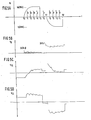
- V P The waveform of V P is shown in Fig. 5A.
- the arrows R indicate refresh times of the capacitor C D .
- V P starts from zero volts at time TO then rises with a controlled slope to attain its maximum value at about time t 3 .
- V P is returned to zero.
- Vp drops with a controlled slope to its minimum value then returns to zero at time t 12 .
- the controlled rate of rise and fall of Vp at the beginning of the positive and negative pulses is to prevent sudden discharge of the capacitor C D . If V P were stepwise changed, the voltage across the capacitor V D may fall below the level at which a refresh operation can successfully be performed.
- V D across the capacitor C D is shown in Fig. 5B for a data 0 and a data 1.
- the voltage V FG on the floating first gate 34 during this operation is shown in Fig. 5C for both a data 0 and a data 1., corresponding to the case illustrated in Fig. 5B.
- the corresponding voltage V CS across the capacitor C S is shown in Fig. 5D.
- V CS (t I ) voltage across C s at the start of the charging interval
- ⁇ V D In order to successfully refresh the data stored in the capacitor C D , ⁇ V D must be restricted such that its maximum excursion does not take it beyond the point where the refresh circuit can detect the correct logic state.
- FIG. 7 A representation of the relative allowable voltage ranges at the data node D is shown in the diagram of Fig. 7.
- FIG. 8 A circuit which is used for refreshing the cell, both during normal random access memory operations and during non-volatile storing operations, is shown in the circuit diagram of Fig. 8. It may be noted that this is a standard type of refresh circuit and a brief description thereof is given herein only for convenience.
- the bit line B/L which interconnects various ones of the cells is connected through an FET 55 to a flip-flop circuit 52.
- the flip-flop circuit 52 is set in a quiescent state halfway between data 0 and data 1 levals.
- the word line driver 51 actuates the transistor 55 at each refresh interval.
- one of the word lines W/L 1 , W/L 2 , .... is also activated, thus coupling one of the transistors 10-1, 10-2 ... and hence one of the capacitors C D1 , C D2' .... to the flip-flop circuit 52.
- the flip-' flop circuit 52 will be set to one state or the other. Because the transistors of the flip-flop circuit 52 are relatively quite large, when the flip-flop circuit 52 is set in one of the definite logic states, it pulls the voltage of the connected capacitor C D with it, thereby refreshing the voltage across the capacitor C D .
- a pre-charge circuit 56 is utilized for setting the flip-flop circuit 52 in the quiescent state.
- Fig. 8 is given only by way of example as other refresh techniques may be utilized.
- Rau et al. and "Peripheral Circuits One-Transistor Cell M OS R AM's, Foss et al., IEEE Journal Of Solid State Circuits, V ol. SC-10, No. 5, October 1975, pp. 255-261, for a further discussion of available refresh circuits and techniques.
- Fig. 9 A circuit for achieving this is shown in Fig. 9.
- transistors 60 through 63 have been added to the flip-flop circuit 52.
- a clock signal is applied to the gates of the transistors 61 and 63.
- the clock is in the off state and the word line driver 51 is powered by the normal V DD level.
- the word line driver 51 is powered by a voltage level V NV-ST to enable the data node D to be charged to the full bit line high voltage level.
- the bit line B/L is taken to its high level by bringing the clock signal to the high state after the flip-flop circuit 52 has sensed the state at the data node D and refreshed the data node D to its normal V DD level.
- the clock signal is utilized to charge the data node D from V DD to V NV-ST .
Landscapes
- Non-Volatile Memory (AREA)
- Dram (AREA)
- Static Random-Access Memory (AREA)
- Read Only Memory (AREA)
- Semiconductor Memories (AREA)
Applications Claiming Priority (2)
| Application Number | Priority Date | Filing Date | Title |
|---|---|---|---|
| US350479 | 1982-02-19 | ||
| US06/350,479 US4449205A (en) | 1982-02-19 | 1982-02-19 | Dynamic RAM with non-volatile back-up storage and method of operation thereof |
Publications (3)
| Publication Number | Publication Date |
|---|---|
| EP0087007A2 true EP0087007A2 (fr) | 1983-08-31 |
| EP0087007A3 EP0087007A3 (en) | 1986-08-27 |
| EP0087007B1 EP0087007B1 (fr) | 1990-07-04 |
Family
ID=23376898
Family Applications (1)
| Application Number | Title | Priority Date | Filing Date |
|---|---|---|---|
| EP83100910A Expired EP0087007B1 (fr) | 1982-02-19 | 1983-02-01 | Mémoire RAM dynamique avec mémoire non-volatile de secours et mode de fonctionnement |
Country Status (4)
| Country | Link |
|---|---|
| US (1) | US4449205A (fr) |
| EP (1) | EP0087007B1 (fr) |
| JP (1) | JPS5952548B2 (fr) |
| DE (1) | DE3381698D1 (fr) |
Cited By (1)
| Publication number | Priority date | Publication date | Assignee | Title |
|---|---|---|---|---|
| EP0147019A3 (en) * | 1983-10-14 | 1988-08-24 | Fujitsu Limited | Semiconductor memory device |
Families Citing this family (41)
| Publication number | Priority date | Publication date | Assignee | Title |
|---|---|---|---|---|
| US4729115A (en) * | 1984-09-27 | 1988-03-01 | International Business Machines Corporation | Non-volatile dynamic random access memory cell |
| US4665417A (en) * | 1984-09-27 | 1987-05-12 | International Business Machines Corporation | Non-volatile dynamic random access memory cell |
| JPS6180866A (ja) * | 1984-09-27 | 1986-04-24 | インタ−ナショナル ビジネス マシ−ンズ コ−ポレ−ション | 不揮発性半導体メモリ・セル |
| US4701858A (en) * | 1984-12-31 | 1987-10-20 | Energy Optics Inc. | Nonvolatile realtime clock calendar module |
| CA1269178A (fr) * | 1987-01-30 | 1990-05-15 | John David Morton | Regeneration automatique des parametres de fonctionnement du materiel a memoire non remanente |
| JPH027289A (ja) * | 1988-06-24 | 1990-01-11 | Sharp Corp | 半導体記憶装置 |
| US7190617B1 (en) | 1989-04-13 | 2007-03-13 | Sandisk Corporation | Flash EEprom system |
| DE69024086T2 (de) | 1989-04-13 | 1996-06-20 | Sundisk Corp | EEprom-System mit Blocklöschung |
| JP2609332B2 (ja) * | 1989-10-19 | 1997-05-14 | シャープ株式会社 | 半導体記憶装置 |
| US5157634A (en) * | 1990-10-23 | 1992-10-20 | International Business Machines Corporation | Dram having extended refresh time |
| US5399516A (en) * | 1992-03-12 | 1995-03-21 | International Business Machines Corporation | Method of making shadow RAM cell having a shallow trench EEPROM |
| US5339270A (en) * | 1993-06-23 | 1994-08-16 | Vlsi Technology, Inc. | AC drain voltage charging source for PROM devices |
| US6696712B1 (en) * | 2000-08-11 | 2004-02-24 | Seiko Epson Corporation | Semicustom IC having adjacent macrocells |
| US6496939B2 (en) * | 1999-09-21 | 2002-12-17 | Bit Microsystems, Inc. | Method and system for controlling data in a computer system in the event of a power failure |
| US7135734B2 (en) * | 2001-08-30 | 2006-11-14 | Micron Technology, Inc. | Graded composition metal oxide tunnel barrier interpoly insulators |
| US7068544B2 (en) | 2001-08-30 | 2006-06-27 | Micron Technology, Inc. | Flash memory with low tunnel barrier interpoly insulators |
| US7012297B2 (en) * | 2001-08-30 | 2006-03-14 | Micron Technology, Inc. | Scalable flash/NV structures and devices with extended endurance |
| US7075829B2 (en) | 2001-08-30 | 2006-07-11 | Micron Technology, Inc. | Programmable memory address and decode circuits with low tunnel barrier interpoly insulators |
| US7132711B2 (en) * | 2001-08-30 | 2006-11-07 | Micron Technology, Inc. | Programmable array logic or memory with p-channel devices and asymmetrical tunnel barriers |
| US6784480B2 (en) * | 2002-02-12 | 2004-08-31 | Micron Technology, Inc. | Asymmetric band-gap engineered nonvolatile memory device |
| US7221586B2 (en) | 2002-07-08 | 2007-05-22 | Micron Technology, Inc. | Memory utilizing oxide nanolaminates |
| US6829166B2 (en) | 2002-09-13 | 2004-12-07 | Ememory Technology Inc. | Method for controlling a non-volatile dynamic random access memory |
| EP1437742A1 (fr) * | 2003-01-09 | 2004-07-14 | eMemory Technology Inc. | Méthode de commande d'une mémoire à accès aléatoire dynamique non volatile |
| US7158410B2 (en) * | 2004-08-27 | 2007-01-02 | Micron Technology, Inc. | Integrated DRAM-NVRAM multi-level memory |
| US8301833B1 (en) | 2007-06-01 | 2012-10-30 | Netlist, Inc. | Non-volatile memory module |
| US8904098B2 (en) | 2007-06-01 | 2014-12-02 | Netlist, Inc. | Redundant backup using non-volatile memory |
| US8874831B2 (en) | 2007-06-01 | 2014-10-28 | Netlist, Inc. | Flash-DRAM hybrid memory module |
| US8064255B2 (en) * | 2007-12-31 | 2011-11-22 | Cypress Semiconductor Corporation | Architecture of a nvDRAM array and its sense regime |
| US8036032B2 (en) * | 2007-12-31 | 2011-10-11 | Cypress Semiconductor Corporation | 5T high density NVDRAM cell |
| US8059458B2 (en) * | 2007-12-31 | 2011-11-15 | Cypress Semiconductor Corporation | 3T high density nvDRAM cell |
| US8050080B2 (en) * | 2008-03-05 | 2011-11-01 | S. Aqua Semiconductor Llc | Random access memory with CMOS-compatible nonvolatile storage element in series with storage capacitor |
| US8000140B2 (en) * | 2008-03-24 | 2011-08-16 | S. Aqua Semiconductor, Llc | Random access memory with CMOS-compatible nonvolatile storage element |
| US7885110B2 (en) * | 2008-03-25 | 2011-02-08 | Rao G R Mohan | Random access memory with CMOS-compatible nonvolatile storage element and parallel storage capacitor |
| US8283730B2 (en) * | 2008-05-27 | 2012-10-09 | Shu-Lu Chen | Negative differential resistance device with high PVCR and fast switching speed and memory using the same |
| US10198350B2 (en) | 2011-07-28 | 2019-02-05 | Netlist, Inc. | Memory module having volatile and non-volatile memory subsystems and method of operation |
| US10380022B2 (en) | 2011-07-28 | 2019-08-13 | Netlist, Inc. | Hybrid memory module and system and method of operating the same |
| US10838646B2 (en) | 2011-07-28 | 2020-11-17 | Netlist, Inc. | Method and apparatus for presearching stored data |
| US10372551B2 (en) | 2013-03-15 | 2019-08-06 | Netlist, Inc. | Hybrid memory system with configurable error thresholds and failure analysis capability |
| US9436600B2 (en) | 2013-06-11 | 2016-09-06 | Svic No. 28 New Technology Business Investment L.L.P. | Non-volatile memory storage for multi-channel memory system |
| US10248328B2 (en) | 2013-11-07 | 2019-04-02 | Netlist, Inc. | Direct data move between DRAM and storage on a memory module |
| KR20230122430A (ko) * | 2022-02-14 | 2023-08-22 | 삼성전자주식회사 | 메모리 장치 |
Family Cites Families (2)
| Publication number | Priority date | Publication date | Assignee | Title |
|---|---|---|---|---|
| DE2450116C2 (de) * | 1974-10-22 | 1976-09-16 | Siemens AG, 1000 Berlin und 8000 München | Dynamisches Ein-Transistor-Speicherelement für nichtflüchtige Speicher und Verfahren zu seinem Betrieb |
| US4175291A (en) * | 1976-08-16 | 1979-11-20 | Ncr Corporation | Non-volatile random access memory cell |
-
1982
- 1982-02-19 US US06/350,479 patent/US4449205A/en not_active Expired - Lifetime
- 1982-12-20 JP JP57222198A patent/JPS5952548B2/ja not_active Expired
-
1983
- 1983-02-01 EP EP83100910A patent/EP0087007B1/fr not_active Expired
- 1983-02-01 DE DE8383100910T patent/DE3381698D1/de not_active Expired - Lifetime
Cited By (2)
| Publication number | Priority date | Publication date | Assignee | Title |
|---|---|---|---|---|
| EP0147019A3 (en) * | 1983-10-14 | 1988-08-24 | Fujitsu Limited | Semiconductor memory device |
| EP0481532A3 (en) * | 1983-10-14 | 1992-09-16 | Fujitsu Limited | Semiconductor memory device |
Also Published As
| Publication number | Publication date |
|---|---|
| EP0087007A3 (en) | 1986-08-27 |
| JPS58142565A (ja) | 1983-08-24 |
| US4449205A (en) | 1984-05-15 |
| EP0087007B1 (fr) | 1990-07-04 |
| JPS5952548B2 (ja) | 1984-12-20 |
| DE3381698D1 (de) | 1990-08-09 |
Similar Documents
| Publication | Publication Date | Title |
|---|---|---|
| EP0087007B1 (fr) | Mémoire RAM dynamique avec mémoire non-volatile de secours et mode de fonctionnement | |
| EP0083386B1 (fr) | Cellule de mémoire | |
| KR0169738B1 (ko) | 집적된 sram과 비휘발성 회로를 갖는 nvram | |
| US5031144A (en) | Ferroelectric memory with non-destructive readout including grid electrode between top and bottom electrodes | |
| US3916390A (en) | Dynamic memory with non-volatile back-up mode | |
| US4907198A (en) | Semiconductor memory device | |
| US4611309A (en) | Non-volatile dynamic RAM cell | |
| EP0086991B1 (fr) | Mémoire RAM statique avec mémoire non-volatile de secours et mode de fonctionnement | |
| US4363110A (en) | Non-volatile dynamic RAM cell | |
| JPH08279297A (ja) | Nand構造の不揮発性半導体メモリとそのプログラム方法 | |
| JPH0237040B2 (fr) | ||
| US3911464A (en) | Nonvolatile semiconductor memory | |
| JPS5858759B2 (ja) | メモリ装置 | |
| US3851317A (en) | Double density non-volatile memory array | |
| US5400279A (en) | Nonvolatile semiconductor memory device with NAND cell structure | |
| US20030185066A1 (en) | Semiconductor memory device having memory cells requiring no refresh operations | |
| US4446535A (en) | Non-inverting non-volatile dynamic RAM cell | |
| US4224686A (en) | Electrically alterable memory cell | |
| US3774177A (en) | Nonvolatile random access memory cell using an alterable threshold field effect write transistor | |
| JPS6322626B2 (fr) | ||
| US4574365A (en) | Shared access lines memory cells | |
| JPS59121694A (ja) | 電力散逸を減少させたmosランダムアクセスメモリ用の交差結合型トランジスタメモリセル | |
| EP0055038A2 (fr) | Contrôle de tension pour un dispositif semi-conducteur | |
| EP0176714A2 (fr) | Cellule de mémoire mémorisant des données logiques sous forme volatile et non volatile | |
| JPH05291534A (ja) | 電荷蓄積素子を有する半導体装置 |
Legal Events
| Date | Code | Title | Description |
|---|---|---|---|
| PUAI | Public reference made under article 153(3) epc to a published international application that has entered the european phase |
Free format text: ORIGINAL CODE: 0009012 |
|
| AK | Designated contracting states |
Designated state(s): DE FR GB |
|
| 17P | Request for examination filed |
Effective date: 19831215 |
|
| PUAL | Search report despatched |
Free format text: ORIGINAL CODE: 0009013 |
|
| AK | Designated contracting states |
Kind code of ref document: A3 Designated state(s): DE FR GB |
|
| 17Q | First examination report despatched |
Effective date: 19870721 |
|
| GRAA | (expected) grant |
Free format text: ORIGINAL CODE: 0009210 |
|
| AK | Designated contracting states |
Kind code of ref document: B1 Designated state(s): DE FR GB |
|
| REF | Corresponds to: |
Ref document number: 3381698 Country of ref document: DE Date of ref document: 19900809 |
|
| ET | Fr: translation filed | ||
| PLBE | No opposition filed within time limit |
Free format text: ORIGINAL CODE: 0009261 |
|
| STAA | Information on the status of an ep patent application or granted ep patent |
Free format text: STATUS: NO OPPOSITION FILED WITHIN TIME LIMIT |
|
| 26N | No opposition filed | ||
| PGFP | Annual fee paid to national office [announced via postgrant information from national office to epo] |
Ref country code: GB Payment date: 19960126 Year of fee payment: 14 |
|
| PGFP | Annual fee paid to national office [announced via postgrant information from national office to epo] |
Ref country code: FR Payment date: 19960131 Year of fee payment: 14 |
|
| PG25 | Lapsed in a contracting state [announced via postgrant information from national office to epo] |
Ref country code: GB Effective date: 19970201 |
|
| PGFP | Annual fee paid to national office [announced via postgrant information from national office to epo] |
Ref country code: DE Payment date: 19970218 Year of fee payment: 15 |
|
| GBPC | Gb: european patent ceased through non-payment of renewal fee |
Effective date: 19970201 |
|
| PG25 | Lapsed in a contracting state [announced via postgrant information from national office to epo] |
Ref country code: FR Effective date: 19971030 |
|
| REG | Reference to a national code |
Ref country code: FR Ref legal event code: ST |
|
| PG25 | Lapsed in a contracting state [announced via postgrant information from national office to epo] |
Ref country code: DE Free format text: LAPSE BECAUSE OF THE APPLICANT RENOUNCES Effective date: 19980218 |