EP0096723B1 - Batteries fabricated with electroactive polymers - Google Patents
Batteries fabricated with electroactive polymers Download PDFInfo
- Publication number
- EP0096723B1 EP0096723B1 EP83900470A EP83900470A EP0096723B1 EP 0096723 B1 EP0096723 B1 EP 0096723B1 EP 83900470 A EP83900470 A EP 83900470A EP 83900470 A EP83900470 A EP 83900470A EP 0096723 B1 EP0096723 B1 EP 0096723B1
- Authority
- EP
- European Patent Office
- Prior art keywords
- poly
- phenylene
- battery
- polymer
- anode
- Prior art date
- Legal status (The legal status is an assumption and is not a legal conclusion. Google has not performed a legal analysis and makes no representation as to the accuracy of the status listed.)
- Expired
Links
- 229920001746 electroactive polymer Polymers 0.000 title claims description 16
- 229920000642 polymer Polymers 0.000 claims description 218
- WEVYAHXRMPXWCK-UHFFFAOYSA-N Acetonitrile Chemical group CC#N WEVYAHXRMPXWCK-UHFFFAOYSA-N 0.000 claims description 117
- -1 polypropylene carbonate Polymers 0.000 claims description 43
- FSEXLNMNADBYJU-UHFFFAOYSA-N alpha-Phenylquinoline Natural products C1=CC=CC=C1C1=CC=C(C=CC=C2)C2=N1 FSEXLNMNADBYJU-UHFFFAOYSA-N 0.000 claims description 38
- 125000000623 heterocyclic group Chemical group 0.000 claims description 33
- 230000002441 reversible effect Effects 0.000 claims description 31
- 125000004429 atom Chemical group 0.000 claims description 26
- WYURNTSHIVDZCO-UHFFFAOYSA-N Tetrahydrofuran Chemical compound C1CCOC1 WYURNTSHIVDZCO-UHFFFAOYSA-N 0.000 claims description 24
- 239000000463 material Substances 0.000 claims description 21
- 125000004432 carbon atom Chemical group C* 0.000 claims description 20
- 239000003792 electrolyte Substances 0.000 claims description 20
- 239000000203 mixture Substances 0.000 claims description 18
- 230000009467 reduction Effects 0.000 claims description 18
- TZMSYXZUNZXBOL-UHFFFAOYSA-N 10H-phenoxazine Chemical compound C1=CC=C2NC3=CC=CC=C3OC2=C1 TZMSYXZUNZXBOL-UHFFFAOYSA-N 0.000 claims description 17
- 230000003647 oxidation Effects 0.000 claims description 16
- 238000007254 oxidation reaction Methods 0.000 claims description 16
- SMWDFEZZVXVKRB-UHFFFAOYSA-N Quinoline Chemical compound N1=CC=CC2=CC=CC=C21 SMWDFEZZVXVKRB-UHFFFAOYSA-N 0.000 claims description 14
- 229910052744 lithium Inorganic materials 0.000 claims description 14
- WHXSMMKQMYFTQS-UHFFFAOYSA-N Lithium Chemical group [Li] WHXSMMKQMYFTQS-UHFFFAOYSA-N 0.000 claims description 13
- 125000005605 benzo group Chemical group 0.000 claims description 13
- 239000003115 supporting electrolyte Substances 0.000 claims description 13
- 150000001768 cations Chemical class 0.000 claims description 12
- 229910052751 metal Inorganic materials 0.000 claims description 12
- 239000002184 metal Substances 0.000 claims description 12
- 229910052757 nitrogen Inorganic materials 0.000 claims description 12
- 229920000128 polypyrrole Polymers 0.000 claims description 12
- 239000002904 solvent Substances 0.000 claims description 12
- 150000001450 anions Chemical class 0.000 claims description 11
- 150000001875 compounds Chemical class 0.000 claims description 11
- 238000009830 intercalation Methods 0.000 claims description 11
- 230000002687 intercalation Effects 0.000 claims description 11
- 150000002500 ions Chemical class 0.000 claims description 11
- 229920001197 polyacetylene Polymers 0.000 claims description 11
- HSFWRNGVRCDJHI-UHFFFAOYSA-N alpha-acetylene Natural products C#C HSFWRNGVRCDJHI-UHFFFAOYSA-N 0.000 claims description 10
- 125000005842 heteroatom Chemical group 0.000 claims description 10
- 229910052709 silver Inorganic materials 0.000 claims description 10
- YLQBMQCUIZJEEH-UHFFFAOYSA-N tetrahydrofuran Natural products C=1C=COC=1 YLQBMQCUIZJEEH-UHFFFAOYSA-N 0.000 claims description 10
- 125000001140 1,4-phenylene group Chemical group [H]C1=C([H])C([*:2])=C([H])C([H])=C1[*:1] 0.000 claims description 9
- 239000002019 doping agent Substances 0.000 claims description 9
- XSCHRSMBECNVNS-UHFFFAOYSA-N benzopyrazine Natural products N1=CC=NC2=CC=CC=C21 XSCHRSMBECNVNS-UHFFFAOYSA-N 0.000 claims description 8
- 229920001577 copolymer Polymers 0.000 claims description 8
- WCPAKWJPBJAGKN-UHFFFAOYSA-N oxadiazole Chemical compound C1=CON=N1 WCPAKWJPBJAGKN-UHFFFAOYSA-N 0.000 claims description 8
- 229920006395 saturated elastomer Polymers 0.000 claims description 8
- 150000003839 salts Chemical class 0.000 claims description 7
- 239000004332 silver Substances 0.000 claims description 7
- ZMXDDKWLCZADIW-UHFFFAOYSA-N N,N-Dimethylformamide Chemical compound CN(C)C=O ZMXDDKWLCZADIW-UHFFFAOYSA-N 0.000 claims description 6
- BQCADISMDOOEFD-UHFFFAOYSA-N Silver Chemical group [Ag] BQCADISMDOOEFD-UHFFFAOYSA-N 0.000 claims description 6
- IOJUPLGTWVMSFF-UHFFFAOYSA-N benzothiazole Chemical compound C1=CC=C2SC=NC2=C1 IOJUPLGTWVMSFF-UHFFFAOYSA-N 0.000 claims description 6
- AWJUIBRHMBBTKR-UHFFFAOYSA-N isoquinoline Chemical compound C1=NC=CC2=CC=CC=C21 AWJUIBRHMBBTKR-UHFFFAOYSA-N 0.000 claims description 6
- 229910052708 sodium Inorganic materials 0.000 claims description 6
- 239000011734 sodium Substances 0.000 claims description 6
- 229910052717 sulfur Inorganic materials 0.000 claims description 6
- VLLMWSRANPNYQX-UHFFFAOYSA-N thiadiazole Chemical compound C1=CSN=N1.C1=CSN=N1 VLLMWSRANPNYQX-UHFFFAOYSA-N 0.000 claims description 6
- DGAQECJNVWCQMB-PUAWFVPOSA-M Ilexoside XXIX Chemical compound C[C@@H]1CC[C@@]2(CC[C@@]3(C(=CC[C@H]4[C@]3(CC[C@@H]5[C@@]4(CC[C@@H](C5(C)C)OS(=O)(=O)[O-])C)C)[C@@H]2[C@]1(C)O)C)C(=O)O[C@H]6[C@@H]([C@H]([C@@H]([C@H](O6)CO)O)O)O.[Na+] DGAQECJNVWCQMB-PUAWFVPOSA-M 0.000 claims description 5
- IAZDPXIOMUYVGZ-UHFFFAOYSA-N Dimethylsulphoxide Chemical compound CS(C)=O IAZDPXIOMUYVGZ-UHFFFAOYSA-N 0.000 claims description 4
- JUJWROOIHBZHMG-UHFFFAOYSA-N Pyridine Chemical compound C1=CC=NC=C1 JUJWROOIHBZHMG-UHFFFAOYSA-N 0.000 claims description 4
- JWLNXHODHNBWPR-UHFFFAOYSA-N [1,3]thiazolo[5,4-f][1,3]benzothiazole Chemical compound C1=C2SC=NC2=CC2=C1N=CS2 JWLNXHODHNBWPR-UHFFFAOYSA-N 0.000 claims description 4
- 125000002496 methyl group Chemical group [H]C([H])([H])* 0.000 claims description 4
- SUSQOBVLVYHIEX-UHFFFAOYSA-N phenylacetonitrile Chemical compound N#CCC1=CC=CC=C1 SUSQOBVLVYHIEX-UHFFFAOYSA-N 0.000 claims description 4
- 229910052785 arsenic Inorganic materials 0.000 claims description 3
- 229910001914 chlorine tetroxide Inorganic materials 0.000 claims description 3
- 229910052802 copper Inorganic materials 0.000 claims description 3
- 230000004927 fusion Effects 0.000 claims description 3
- 229910052742 iron Inorganic materials 0.000 claims description 3
- 239000012528 membrane Substances 0.000 claims description 3
- VLTRZXGMWDSKGL-UHFFFAOYSA-M perchlorate Chemical compound [O-]Cl(=O)(=O)=O VLTRZXGMWDSKGL-UHFFFAOYSA-M 0.000 claims description 3
- 229910052698 phosphorus Inorganic materials 0.000 claims description 3
- 229910052711 selenium Inorganic materials 0.000 claims description 3
- 229910052714 tellurium Inorganic materials 0.000 claims description 3
- GDAXJBDYNVDMDF-UHFFFAOYSA-N 1,2,4-benzotriazine Chemical compound N1=NC=NC2=CC=CC=C21 GDAXJBDYNVDMDF-UHFFFAOYSA-N 0.000 claims description 2
- ZIZMDHZLHJBNSQ-UHFFFAOYSA-N 1,2-dihydrophenazine Chemical compound C1=CC=C2N=C(C=CCC3)C3=NC2=C1 ZIZMDHZLHJBNSQ-UHFFFAOYSA-N 0.000 claims description 2
- AIGNCQCMONAWOL-UHFFFAOYSA-N 1,3-benzoselenazole Chemical compound C1=CC=C2[se]C=NC2=C1 AIGNCQCMONAWOL-UHFFFAOYSA-N 0.000 claims description 2
- BCMCBBGGLRIHSE-UHFFFAOYSA-N 1,3-benzoxazole Chemical compound C1=CC=C2OC=NC2=C1 BCMCBBGGLRIHSE-UHFFFAOYSA-N 0.000 claims description 2
- VMLKTERJLVWEJJ-UHFFFAOYSA-N 1,5-naphthyridine Chemical compound C1=CC=NC2=CC=CN=C21 VMLKTERJLVWEJJ-UHFFFAOYSA-N 0.000 claims description 2
- VSOSXKMEQPYESP-UHFFFAOYSA-N 1,6-naphthyridine Chemical compound C1=CN=CC2=CC=CN=C21 VSOSXKMEQPYESP-UHFFFAOYSA-N 0.000 claims description 2
- MXBVNILGVJVVMH-UHFFFAOYSA-N 1,7-naphthyridine Chemical compound C1=NC=CC2=CC=CN=C21 MXBVNILGVJVVMH-UHFFFAOYSA-N 0.000 claims description 2
- BAPDWOBBGGGGOC-UHFFFAOYSA-N 1,8-naphthyridine;2,6-naphthyridine Chemical compound N1=CC=CC2=CC=CN=C21.N1=CC=C2C=NC=CC2=C1 BAPDWOBBGGGGOC-UHFFFAOYSA-N 0.000 claims description 2
- HCMMECMKVPHMDE-UHFFFAOYSA-N 2,7-naphthyridine Chemical compound C1=NC=C2C=NC=CC2=C1 HCMMECMKVPHMDE-UHFFFAOYSA-N 0.000 claims description 2
- ZCQWOFVYLHDMMC-UHFFFAOYSA-N Oxazole Chemical compound C1=COC=N1 ZCQWOFVYLHDMMC-UHFFFAOYSA-N 0.000 claims description 2
- 229920000265 Polyparaphenylene Polymers 0.000 claims description 2
- 239000004734 Polyphenylene sulfide Substances 0.000 claims description 2
- FZWLAAWBMGSTSO-UHFFFAOYSA-N Thiazole Chemical compound C1=CSC=N1 FZWLAAWBMGSTSO-UHFFFAOYSA-N 0.000 claims description 2
- BDWOQDZGSYLSCZ-UHFFFAOYSA-N [1,3]oxazolo[4,5-f][1,3]benzoxazole Chemical compound C1=C2OC=NC2=CC2=C1OC=N2 BDWOQDZGSYLSCZ-UHFFFAOYSA-N 0.000 claims description 2
- 239000011149 active material Substances 0.000 claims description 2
- 239000000956 alloy Substances 0.000 claims description 2
- 229910045601 alloy Inorganic materials 0.000 claims description 2
- 125000003785 benzimidazolyl group Chemical class N1=C(NC2=C1C=CC=C2)* 0.000 claims description 2
- KVNRLNFWIYMESJ-UHFFFAOYSA-N butyronitrile Chemical compound CCCC#N KVNRLNFWIYMESJ-UHFFFAOYSA-N 0.000 claims description 2
- 229910052792 caesium Inorganic materials 0.000 claims description 2
- JTCXNGLQZYVVBF-UHFFFAOYSA-N cinnoline;quinazoline Chemical compound N1=NC=CC2=CC=CC=C21.N1=CN=CC2=CC=CC=C21 JTCXNGLQZYVVBF-UHFFFAOYSA-N 0.000 claims description 2
- GEAWFZNTIFJMHR-UHFFFAOYSA-N hepta-1,6-diene Chemical compound C=CCCCC=C GEAWFZNTIFJMHR-UHFFFAOYSA-N 0.000 claims description 2
- 229910052759 nickel Inorganic materials 0.000 claims description 2
- NFBOHOGPQUYFRF-UHFFFAOYSA-N oxanthrene Chemical compound C1=CC=C2OC3=CC=CC=C3OC2=C1 NFBOHOGPQUYFRF-UHFFFAOYSA-N 0.000 claims description 2
- 229910052760 oxygen Inorganic materials 0.000 claims description 2
- 229910052763 palladium Inorganic materials 0.000 claims description 2
- 150000005030 phenoxathiins Chemical class 0.000 claims description 2
- LFSXCDWNBUNEEM-UHFFFAOYSA-N phthalazine Chemical compound C1=NN=CC2=CC=CC=C21 LFSXCDWNBUNEEM-UHFFFAOYSA-N 0.000 claims description 2
- 238000006116 polymerization reaction Methods 0.000 claims description 2
- 229920000069 polyphenylene sulfide Polymers 0.000 claims description 2
- 229910052700 potassium Inorganic materials 0.000 claims description 2
- FVSKHRXBFJPNKK-UHFFFAOYSA-N propionitrile Chemical compound CCC#N FVSKHRXBFJPNKK-UHFFFAOYSA-N 0.000 claims description 2
- CPNGPNLZQNNVQM-UHFFFAOYSA-N pteridine Chemical compound N1=CN=CC2=NC=CN=C21 CPNGPNLZQNNVQM-UHFFFAOYSA-N 0.000 claims description 2
- FQOBINBWTPHVEO-UHFFFAOYSA-N pyrazino[2,3-b]pyrazine Chemical compound N1=CC=NC2=NC=CN=C21 FQOBINBWTPHVEO-UHFFFAOYSA-N 0.000 claims description 2
- OUFHXMSGJIYFPW-UHFFFAOYSA-N pyrazino[2,3-c]pyridazine Chemical compound N1=NC=CC2=NC=CN=C21 OUFHXMSGJIYFPW-UHFFFAOYSA-N 0.000 claims description 2
- XFEVEGNEHPLFGK-UHFFFAOYSA-N pyrazino[2,3-d]pyridazine Chemical compound C1=NN=CC2=NC=CN=C21 XFEVEGNEHPLFGK-UHFFFAOYSA-N 0.000 claims description 2
- YXBOXLOZVKXYJZ-UHFFFAOYSA-N pyridazino[3,4-d]pyridazine Chemical compound N1=NC=C2N=NC=CC2=C1 YXBOXLOZVKXYJZ-UHFFFAOYSA-N 0.000 claims description 2
- JBFWVXIWQBWEKM-UHFFFAOYSA-N pyridazino[4,5-d]pyridazine Chemical compound N1=NC=C2C=NN=CC2=C1 JBFWVXIWQBWEKM-UHFFFAOYSA-N 0.000 claims description 2
- UMJSCPRVCHMLSP-UHFFFAOYSA-N pyridine Natural products COC1=CC=CN=C1 UMJSCPRVCHMLSP-UHFFFAOYSA-N 0.000 claims description 2
- GIVUQTUKKWDKHE-UHFFFAOYSA-N pyrido[2,3-d]pyridazine Chemical compound C1=NN=CC2=CC=CN=C21 GIVUQTUKKWDKHE-UHFFFAOYSA-N 0.000 claims description 2
- UDJFFSGCRRMVFH-UHFFFAOYSA-N pyrido[2,3-d]pyrimidine Chemical compound N1=CN=CC2=CC=CN=C21 UDJFFSGCRRMVFH-UHFFFAOYSA-N 0.000 claims description 2
- BWESROVQGZSBRX-UHFFFAOYSA-N pyrido[3,2-d]pyrimidine Chemical compound C1=NC=NC2=CC=CN=C21 BWESROVQGZSBRX-UHFFFAOYSA-N 0.000 claims description 2
- IHYJXEQIZYROGA-UHFFFAOYSA-N pyrido[3,4-d]pyridazine Chemical compound N1=NC=C2C=NC=CC2=C1 IHYJXEQIZYROGA-UHFFFAOYSA-N 0.000 claims description 2
- PAQYIEZTLSDLQO-UHFFFAOYSA-N pyrido[3,4-d]pyrimidine Chemical compound N1=CN=C2C=NC=CC2=C1 PAQYIEZTLSDLQO-UHFFFAOYSA-N 0.000 claims description 2
- PLZDHJUUEGCXJH-UHFFFAOYSA-N pyrido[4,3-d]pyrimidine Chemical compound C1=NC=C2C=NC=CC2=N1 PLZDHJUUEGCXJH-UHFFFAOYSA-N 0.000 claims description 2
- UVGCYMVPDRDDDT-UHFFFAOYSA-N pyrimido[4,5-c]pyridazine Chemical compound N1=CN=C2N=NC=CC2=C1 UVGCYMVPDRDDDT-UHFFFAOYSA-N 0.000 claims description 2
- KXNFMBIDXYJDEP-UHFFFAOYSA-N pyrimido[4,5-d]pyridazine Chemical compound C1=NN=CC2=NC=NC=C21 KXNFMBIDXYJDEP-UHFFFAOYSA-N 0.000 claims description 2
- QGDYVSSVBYMOJN-UHFFFAOYSA-N pyrimido[4,5-d]pyrimidine Chemical compound C1=NC=NC2=NC=NC=C21 QGDYVSSVBYMOJN-UHFFFAOYSA-N 0.000 claims description 2
- MOLVBKBUIUHRRR-UHFFFAOYSA-N pyrimido[4,5-e][1,2,4]triazine Chemical compound N1=NC=NC2=NC=NC=C21 MOLVBKBUIUHRRR-UHFFFAOYSA-N 0.000 claims description 2
- JOZPEVMCAKXSEY-UHFFFAOYSA-N pyrimido[5,4-d]pyrimidine Chemical compound N1=CN=CC2=NC=NC=C21 JOZPEVMCAKXSEY-UHFFFAOYSA-N 0.000 claims description 2
- 229910052701 rubidium Inorganic materials 0.000 claims description 2
- 150000005029 thianthrenes Chemical class 0.000 claims description 2
- 229910052718 tin Inorganic materials 0.000 claims description 2
- 150000003852 triazoles Chemical class 0.000 claims description 2
- 229910052725 zinc Inorganic materials 0.000 claims description 2
- ODIRBFFBCSTPTO-UHFFFAOYSA-N 1,3-selenazole Chemical compound C1=C[se]C=N1 ODIRBFFBCSTPTO-UHFFFAOYSA-N 0.000 claims 1
- LOCUXGFHUYBUHF-UHFFFAOYSA-N 4-phenylquinoline Chemical compound C1=CC=CC=C1C1=CC=NC2=CC=CC=C12 LOCUXGFHUYBUHF-UHFFFAOYSA-N 0.000 claims 1
- 229910003012 LixTiS2 Inorganic materials 0.000 claims 1
- ZLMJMSJWJFRBEC-UHFFFAOYSA-N Potassium Chemical compound [K] ZLMJMSJWJFRBEC-UHFFFAOYSA-N 0.000 claims 1
- TVFDJXOCXUVLDH-UHFFFAOYSA-N caesium atom Chemical compound [Cs] TVFDJXOCXUVLDH-UHFFFAOYSA-N 0.000 claims 1
- 229910021645 metal ion Inorganic materials 0.000 claims 1
- 238000007747 plating Methods 0.000 claims 1
- 229920000379 polypropylene carbonate Polymers 0.000 claims 1
- 239000011591 potassium Substances 0.000 claims 1
- YEYHFKBVNARCNE-UHFFFAOYSA-N pyrido[2,3-b]pyrazine Chemical compound N1=CC=NC2=CC=CN=C21 YEYHFKBVNARCNE-UHFFFAOYSA-N 0.000 claims 1
- TYLGVQVJCVFREB-UHFFFAOYSA-N pyrido[3,4-b]pyrazine Chemical compound C1=NC=CC2=NC=CN=C21 TYLGVQVJCVFREB-UHFFFAOYSA-N 0.000 claims 1
- IGLNJRXAVVLDKE-UHFFFAOYSA-N rubidium atom Chemical compound [Rb] IGLNJRXAVVLDKE-UHFFFAOYSA-N 0.000 claims 1
- BASFCYQUMIYNBI-UHFFFAOYSA-N platinum Chemical compound [Pt] BASFCYQUMIYNBI-UHFFFAOYSA-N 0.000 description 106
- 229910052697 platinum Inorganic materials 0.000 description 42
- 210000004027 cell Anatomy 0.000 description 38
- 239000000243 solution Substances 0.000 description 38
- ZMANZCXQSJIPKH-UHFFFAOYSA-N Triethylamine Chemical compound CCN(CC)CC ZMANZCXQSJIPKH-UHFFFAOYSA-N 0.000 description 36
- LFQSCWFLJHTTHZ-UHFFFAOYSA-N Ethanol Chemical compound CCO LFQSCWFLJHTTHZ-UHFFFAOYSA-N 0.000 description 24
- 239000010405 anode material Substances 0.000 description 24
- 239000010409 thin film Substances 0.000 description 23
- 238000006722 reduction reaction Methods 0.000 description 17
- 238000000034 method Methods 0.000 description 15
- 239000010408 film Substances 0.000 description 13
- IJGRMHOSHXDMSA-UHFFFAOYSA-N Atomic nitrogen Chemical compound N#N IJGRMHOSHXDMSA-UHFFFAOYSA-N 0.000 description 12
- 239000006182 cathode active material Substances 0.000 description 12
- HZAXFHJVJLSVMW-UHFFFAOYSA-N monoethanolamine hydrochloride Natural products NCCO HZAXFHJVJLSVMW-UHFFFAOYSA-N 0.000 description 12
- 238000006386 neutralization reaction Methods 0.000 description 12
- WKHDVHMRMDBUMZ-UHFFFAOYSA-N 2-(1,3-benzoxazol-2-yl)-1,3-benzoxazole Chemical compound C1=CC=C2OC(C=3OC4=CC=CC=C4N=3)=NC2=C1 WKHDVHMRMDBUMZ-UHFFFAOYSA-N 0.000 description 11
- 239000010406 cathode material Substances 0.000 description 10
- OKTJSMMVPCPJKN-UHFFFAOYSA-N Carbon Chemical compound [C] OKTJSMMVPCPJKN-UHFFFAOYSA-N 0.000 description 9
- 238000006243 chemical reaction Methods 0.000 description 9
- 238000007599 discharging Methods 0.000 description 9
- 239000007772 electrode material Substances 0.000 description 9
- 230000002829 reductive effect Effects 0.000 description 9
- 125000004122 cyclic group Chemical group 0.000 description 8
- 230000001590 oxidative effect Effects 0.000 description 8
- 230000008569 process Effects 0.000 description 8
- 229920001940 conductive polymer Polymers 0.000 description 6
- 239000008151 electrolyte solution Substances 0.000 description 6
- 230000007935 neutral effect Effects 0.000 description 6
- QJGQUHMNIGDVPM-UHFFFAOYSA-N nitrogen group Chemical group [N] QJGQUHMNIGDVPM-UHFFFAOYSA-N 0.000 description 6
- RUOJZAUFBMNUDX-UHFFFAOYSA-N propylene carbonate Chemical compound CC1COC(=O)O1 RUOJZAUFBMNUDX-UHFFFAOYSA-N 0.000 description 6
- 241000894007 species Species 0.000 description 6
- AFVFQIVMOAPDHO-UHFFFAOYSA-N Methanesulfonic acid Chemical compound CS(O)(=O)=O AFVFQIVMOAPDHO-UHFFFAOYSA-N 0.000 description 5
- 239000004677 Nylon Substances 0.000 description 5
- 239000012298 atmosphere Substances 0.000 description 5
- 238000006056 electrooxidation reaction Methods 0.000 description 5
- 229920001778 nylon Polymers 0.000 description 5
- QAOWNCQODCNURD-UHFFFAOYSA-N Sulfuric acid Chemical compound OS(O)(=O)=O QAOWNCQODCNURD-UHFFFAOYSA-N 0.000 description 4
- 230000002411 adverse Effects 0.000 description 4
- 125000000217 alkyl group Chemical group 0.000 description 4
- 125000002529 biphenylenyl group Chemical group C1(=CC=CC=2C3=CC=CC=C3C12)* 0.000 description 4
- 229910052799 carbon Inorganic materials 0.000 description 4
- 125000002091 cationic group Chemical group 0.000 description 4
- 238000005516 engineering process Methods 0.000 description 4
- 229910021397 glassy carbon Inorganic materials 0.000 description 4
- SMWDFEZZVXVKRB-UHFFFAOYSA-O hydron;quinoline Chemical compound [NH+]1=CC=CC2=CC=CC=C21 SMWDFEZZVXVKRB-UHFFFAOYSA-O 0.000 description 4
- RLSSMJSEOOYNOY-UHFFFAOYSA-N m-cresol Chemical compound CC1=CC=CC(O)=C1 RLSSMJSEOOYNOY-UHFFFAOYSA-N 0.000 description 4
- 229940100630 metacresol Drugs 0.000 description 4
- 150000002739 metals Chemical class 0.000 description 4
- 125000000843 phenylene group Chemical group C1(=C(C=CC=C1)*)* 0.000 description 4
- ADZWSOLPGZMUMY-UHFFFAOYSA-M silver bromide Chemical compound [Ag]Br ADZWSOLPGZMUMY-UHFFFAOYSA-M 0.000 description 4
- 125000001424 substituent group Chemical group 0.000 description 4
- KAESVJOAVNADME-UHFFFAOYSA-N 1H-pyrrole Natural products C=1C=CNC=1 KAESVJOAVNADME-UHFFFAOYSA-N 0.000 description 3
- LYCAIKOWRPUZTN-UHFFFAOYSA-N Ethylene glycol Chemical compound OCCO LYCAIKOWRPUZTN-UHFFFAOYSA-N 0.000 description 3
- 229920000292 Polyquinoline Polymers 0.000 description 3
- 229910003092 TiS2 Inorganic materials 0.000 description 3
- 239000002253 acid Substances 0.000 description 3
- 125000000129 anionic group Chemical group 0.000 description 3
- 125000003118 aryl group Chemical group 0.000 description 3
- 230000008859 change Effects 0.000 description 3
- MHCFAGZWMAWTNR-UHFFFAOYSA-M lithium perchlorate Chemical compound [Li+].[O-]Cl(=O)(=O)=O MHCFAGZWMAWTNR-UHFFFAOYSA-M 0.000 description 3
- 229910001486 lithium perchlorate Inorganic materials 0.000 description 3
- 125000004433 nitrogen atom Chemical group N* 0.000 description 3
- 229920000620 organic polymer Polymers 0.000 description 3
- 238000003860 storage Methods 0.000 description 3
- 239000000126 substance Substances 0.000 description 3
- JRMUNVKIHCOMHV-UHFFFAOYSA-M tetrabutylammonium bromide Chemical compound [Br-].CCCC[N+](CCCC)(CCCC)CCCC JRMUNVKIHCOMHV-UHFFFAOYSA-M 0.000 description 3
- 229910013462 LiC104 Inorganic materials 0.000 description 2
- PXHVJJICTQNCMI-UHFFFAOYSA-N Nickel Chemical compound [Ni] PXHVJJICTQNCMI-UHFFFAOYSA-N 0.000 description 2
- 229910052783 alkali metal Inorganic materials 0.000 description 2
- 150000001340 alkali metals Chemical class 0.000 description 2
- 125000003342 alkenyl group Chemical group 0.000 description 2
- 125000003545 alkoxy group Chemical group 0.000 description 2
- 125000002837 carbocyclic group Chemical group 0.000 description 2
- 239000004020 conductor Substances 0.000 description 2
- 238000010276 construction Methods 0.000 description 2
- 239000010949 copper Substances 0.000 description 2
- 230000007812 deficiency Effects 0.000 description 2
- 238000004070 electrodeposition Methods 0.000 description 2
- 239000011888 foil Substances 0.000 description 2
- 230000006872 improvement Effects 0.000 description 2
- 239000007788 liquid Substances 0.000 description 2
- 239000011159 matrix material Substances 0.000 description 2
- 239000000155 melt Substances 0.000 description 2
- 230000004048 modification Effects 0.000 description 2
- 238000012986 modification Methods 0.000 description 2
- 125000002950 monocyclic group Chemical group 0.000 description 2
- 229920000447 polyanionic polymer Polymers 0.000 description 2
- 238000006467 substitution reaction Methods 0.000 description 2
- 231100000331 toxic Toxicity 0.000 description 2
- 230000002588 toxic effect Effects 0.000 description 2
- QWNCDHYYJATYOG-UHFFFAOYSA-N 2-phenylquinoxaline Chemical compound C1=CC=CC=C1C1=CN=C(C=CC=C2)C2=N1 QWNCDHYYJATYOG-UHFFFAOYSA-N 0.000 description 1
- 229910017048 AsF6 Inorganic materials 0.000 description 1
- BVKZGUZCCUSVTD-UHFFFAOYSA-L Carbonate Chemical compound [O-]C([O-])=O BVKZGUZCCUSVTD-UHFFFAOYSA-L 0.000 description 1
- RYGMFSIKBFXOCR-UHFFFAOYSA-N Copper Chemical compound [Cu] RYGMFSIKBFXOCR-UHFFFAOYSA-N 0.000 description 1
- XTHFKEDIFFGKHM-UHFFFAOYSA-N Dimethoxyethane Chemical compound COCCOC XTHFKEDIFFGKHM-UHFFFAOYSA-N 0.000 description 1
- QXNVGIXVLWOKEQ-UHFFFAOYSA-N Disodium Chemical class [Na][Na] QXNVGIXVLWOKEQ-UHFFFAOYSA-N 0.000 description 1
- 229920002907 Guar gum Polymers 0.000 description 1
- 229910021607 Silver chloride Inorganic materials 0.000 description 1
- 229920002472 Starch Polymers 0.000 description 1
- NINIDFKCEFEMDL-UHFFFAOYSA-N Sulfur Chemical compound [S] NINIDFKCEFEMDL-UHFFFAOYSA-N 0.000 description 1
- 239000004809 Teflon Substances 0.000 description 1
- 229920006362 Teflon® Polymers 0.000 description 1
- 229910008483 TiSe2 Inorganic materials 0.000 description 1
- PMJNNCUVWHTTMV-UHFFFAOYSA-N [1,3]oxazolo[5,4-f][1,3]benzoxazole Chemical compound C1=C2OC=NC2=CC2=C1N=CO2 PMJNNCUVWHTTMV-UHFFFAOYSA-N 0.000 description 1
- MEJRCKJUWUBSOC-UHFFFAOYSA-N [1,3]selenazolo[5,4-f][1,3]benzothiazole Chemical compound C1=C2SC=NC2=CC2=C1N=C[se]2 MEJRCKJUWUBSOC-UHFFFAOYSA-N 0.000 description 1
- 150000001351 alkyl iodides Chemical class 0.000 description 1
- 125000004414 alkyl thio group Chemical group 0.000 description 1
- 150000001356 alkyl thiols Chemical class 0.000 description 1
- 125000000304 alkynyl group Chemical group 0.000 description 1
- 229910052787 antimony Inorganic materials 0.000 description 1
- 238000013459 approach Methods 0.000 description 1
- 230000015572 biosynthetic process Effects 0.000 description 1
- 229910052797 bismuth Inorganic materials 0.000 description 1
- 238000009835 boiling Methods 0.000 description 1
- 229940075397 calomel Drugs 0.000 description 1
- 150000004770 chalcogenides Chemical class 0.000 description 1
- 238000001311 chemical methods and process Methods 0.000 description 1
- 239000011248 coating agent Substances 0.000 description 1
- 238000000576 coating method Methods 0.000 description 1
- 239000002322 conducting polymer Substances 0.000 description 1
- 125000004093 cyano group Chemical group *C#N 0.000 description 1
- 125000000753 cycloalkyl group Chemical group 0.000 description 1
- 210000001787 dendrite Anatomy 0.000 description 1
- 238000013461 design Methods 0.000 description 1
- 125000004663 dialkyl amino group Chemical group 0.000 description 1
- 238000009792 diffusion process Methods 0.000 description 1
- ZOMNIUBKTOKEHS-UHFFFAOYSA-L dimercury dichloride Chemical compound Cl[Hg][Hg]Cl ZOMNIUBKTOKEHS-UHFFFAOYSA-L 0.000 description 1
- VAYGXNSJCAHWJZ-UHFFFAOYSA-N dimethyl sulfate Chemical compound COS(=O)(=O)OC VAYGXNSJCAHWJZ-UHFFFAOYSA-N 0.000 description 1
- 238000010494 dissociation reaction Methods 0.000 description 1
- 230000005593 dissociations Effects 0.000 description 1
- 238000004090 dissolution Methods 0.000 description 1
- 238000003487 electrochemical reaction Methods 0.000 description 1
- 125000005678 ethenylene group Chemical group [H]C([*:1])=C([H])[*:2] 0.000 description 1
- 239000012530 fluid Substances 0.000 description 1
- 239000007789 gas Substances 0.000 description 1
- 239000003349 gelling agent Substances 0.000 description 1
- PCHJSUWPFVWCPO-UHFFFAOYSA-N gold Chemical compound [Au] PCHJSUWPFVWCPO-UHFFFAOYSA-N 0.000 description 1
- 229910052737 gold Inorganic materials 0.000 description 1
- 239000010931 gold Substances 0.000 description 1
- 229910002804 graphite Inorganic materials 0.000 description 1
- 239000010439 graphite Substances 0.000 description 1
- 229960002154 guar gum Drugs 0.000 description 1
- 235000010417 guar gum Nutrition 0.000 description 1
- 239000000665 guar gum Substances 0.000 description 1
- 229910052736 halogen Inorganic materials 0.000 description 1
- 125000005843 halogen group Chemical group 0.000 description 1
- 150000002367 halogens Chemical class 0.000 description 1
- 239000000383 hazardous chemical Substances 0.000 description 1
- 229910052739 hydrogen Inorganic materials 0.000 description 1
- 125000004435 hydrogen atom Chemical group [H]* 0.000 description 1
- 238000007654 immersion Methods 0.000 description 1
- 230000002401 inhibitory effect Effects 0.000 description 1
- 230000000670 limiting effect Effects 0.000 description 1
- 238000004519 manufacturing process Methods 0.000 description 1
- 229910052960 marcasite Inorganic materials 0.000 description 1
- 230000007246 mechanism Effects 0.000 description 1
- 238000010128 melt processing Methods 0.000 description 1
- 125000000956 methoxy group Chemical group [H]C([H])([H])O* 0.000 description 1
- 239000003607 modifier Substances 0.000 description 1
- 230000000877 morphologic effect Effects 0.000 description 1
- 239000000615 nonconductor Substances 0.000 description 1
- 125000001997 phenyl group Chemical group [H]C1=C([H])C([H])=C(*)C([H])=C1[H] 0.000 description 1
- 229920000553 poly(phenylenevinylene) Polymers 0.000 description 1
- 239000002861 polymer material Substances 0.000 description 1
- 238000010094 polymer processing Methods 0.000 description 1
- 230000002035 prolonged effect Effects 0.000 description 1
- HWFIEDPFDQRJCH-UHFFFAOYSA-N pyrido[2,3-b]pyrazine;pyrido[3,4-b]pyrazine Chemical compound N1=CC=NC2=CC=CN=C21.C1=NC=CC2=NC=CN=C21 HWFIEDPFDQRJCH-UHFFFAOYSA-N 0.000 description 1
- GHKGSHZMWWDYKI-UHFFFAOYSA-N pyrido[2,3-e][1,2,4]triazine Chemical compound N1=CN=NC2=CC=CN=C21 GHKGSHZMWWDYKI-UHFFFAOYSA-N 0.000 description 1
- NIFIFKQPDTWWGU-UHFFFAOYSA-N pyrite Chemical compound [Fe+2].[S-][S-] NIFIFKQPDTWWGU-UHFFFAOYSA-N 0.000 description 1
- 229910052683 pyrite Inorganic materials 0.000 description 1
- 150000003252 quinoxalines Chemical class 0.000 description 1
- 125000001567 quinoxalinyl group Chemical group N1=C(C=NC2=CC=CC=C12)* 0.000 description 1
- 238000011946 reduction process Methods 0.000 description 1
- 238000011160 research Methods 0.000 description 1
- 230000027756 respiratory electron transport chain Effects 0.000 description 1
- 230000004044 response Effects 0.000 description 1
- 238000005201 scrubbing Methods 0.000 description 1
- 238000000926 separation method Methods 0.000 description 1
- HKZLPVFGJNLROG-UHFFFAOYSA-M silver monochloride Chemical compound [Cl-].[Ag+] HKZLPVFGJNLROG-UHFFFAOYSA-M 0.000 description 1
- 239000002002 slurry Substances 0.000 description 1
- 229910052979 sodium sulfide Inorganic materials 0.000 description 1
- GRVFOGOEDUUMBP-UHFFFAOYSA-N sodium sulfide (anhydrous) Chemical compound [Na+].[Na+].[S-2] GRVFOGOEDUUMBP-UHFFFAOYSA-N 0.000 description 1
- 239000007787 solid Substances 0.000 description 1
- 238000010129 solution processing Methods 0.000 description 1
- 235000019698 starch Nutrition 0.000 description 1
- 239000008107 starch Substances 0.000 description 1
- 239000007858 starting material Substances 0.000 description 1
- 239000011593 sulfur Substances 0.000 description 1
- 239000013589 supplement Substances 0.000 description 1
Images
Classifications
-
- H—ELECTRICITY
- H01—ELECTRIC ELEMENTS
- H01M—PROCESSES OR MEANS, e.g. BATTERIES, FOR THE DIRECT CONVERSION OF CHEMICAL ENERGY INTO ELECTRICAL ENERGY
- H01M4/00—Electrodes
- H01M4/02—Electrodes composed of, or comprising, active material
- H01M4/36—Selection of substances as active materials, active masses, active liquids
- H01M4/60—Selection of substances as active materials, active masses, active liquids of organic compounds
-
- H—ELECTRICITY
- H01—ELECTRIC ELEMENTS
- H01B—CABLES; CONDUCTORS; INSULATORS; SELECTION OF MATERIALS FOR THEIR CONDUCTIVE, INSULATING OR DIELECTRIC PROPERTIES
- H01B1/00—Conductors or conductive bodies characterised by the conductive materials; Selection of materials as conductors
- H01B1/06—Conductors or conductive bodies characterised by the conductive materials; Selection of materials as conductors mainly consisting of other non-metallic substances
- H01B1/12—Conductors or conductive bodies characterised by the conductive materials; Selection of materials as conductors mainly consisting of other non-metallic substances organic substances
- H01B1/124—Intrinsically conductive polymers
- H01B1/128—Intrinsically conductive polymers comprising six-membered aromatic rings in the main chain, e.g. polyanilines, polyphenylenes
-
- Y—GENERAL TAGGING OF NEW TECHNOLOGICAL DEVELOPMENTS; GENERAL TAGGING OF CROSS-SECTIONAL TECHNOLOGIES SPANNING OVER SEVERAL SECTIONS OF THE IPC; TECHNICAL SUBJECTS COVERED BY FORMER USPC CROSS-REFERENCE ART COLLECTIONS [XRACs] AND DIGESTS
- Y02—TECHNOLOGIES OR APPLICATIONS FOR MITIGATION OR ADAPTATION AGAINST CLIMATE CHANGE
- Y02E—REDUCTION OF GREENHOUSE GAS [GHG] EMISSIONS, RELATED TO ENERGY GENERATION, TRANSMISSION OR DISTRIBUTION
- Y02E60/00—Enabling technologies; Technologies with a potential or indirect contribution to GHG emissions mitigation
- Y02E60/10—Energy storage using batteries
Definitions
- This invention relates to batteries. More specifically, this invention relates to batteries which incorporate tractable, stable, conductive polymers as the electrodes.
- the battery technologies currently under active study suffer from a variety of drawbacks.
- Many of the new light-weight, secondary batteries under study employ materials which are spontaneously combustible or highly toxic, such as molten lithium, sodium, sulfur and the like.
- Other systems such as the metal-air batteries, utilize molten carbonate electrolytes, which require C0 2 scrubbing of the gas stream fed to the air electrode to avoid acid build-up.
- Many other potentially useful battery electrode materials suffer from dendrite formation upon electrodeposition, and are thus unsuitable for repeated charging and discharging. These factors have resulted in the continued search for alternative battery technologies.
- polyacetylene is an example of an organic polymer which can be rendered conductive by suitable doping procedures.
- the conducting polymers can be used as electrodes in a battery.
- the ability to charge and discharge such polymers repeatedly provides for their use as electrodes in secondary batteries.
- the mode by which charge is incorporated into polyacetylene does not involve electrodeposition or require hazardous materials, thus making this an attractive alternative technology in principle.
- the polyacetylene material suffers from a number of drawbacks. In its charged forms, polyacetylene is chemically stable, thus severely limiting the lifetime of any secondary battery device fabricated from this polymer. In addition, the material is insoluble and infusable and so it cannot be made in a tractable form.
- a tractable polymer is used herein as meaning a polymer which can be readily shaped, formed, molded, pressed, cast, etc. into desired articles from solution after the completion of the polymerization reaction of organic polymeric material or from the liquid state, i.e., either from the melt, fluid glassy state, or from solution.
- Electrochemical stability of a battery refers to the ability to hold the desired level of charge upon prolonged storage (shelf life) and after repeated charge-discharge cycles (cycle life).
- a stable, light-weight, primary or secondary battery comprising electrodes from tractable, electroactive polymers which can be fabricated either from a solution or from a melt into the desired electrode shape.
- the electrodes must be able to be charged electrochemically to produce conductive, stable electrode materials to serve as the cathode or anode of a light-weight, high-energy density, primary battery and reversibly charged to produce a secondary battery.
- the electrodes fabricated from polymers of recurring diradical repeat units whose corresponding monomeric repeat units are capable of forming stable cations or anions upon reversible electrochemical oxidation or reduction.
- a higher power density and energy density than traditional batteries is also desirable.
- a light-weight, primary or secondary battery comprising a plurality of thin polymer electrodes sandwiched together in laminar fashion which can be fabricated into a variety of non-traditional shapes for batteries.
- these non-traditional shapes can occupy any space within the vehicle such as inside door panels, trunks, hoods, under or within seats, etc.
- a battery electrode comprising a current collector and, as the active material of the electrode, a stable electro-conductive linear tractable unsaturated polymer obtained by incorporating charge-compensating ionic dopants into a linear unsaturated polymer which is capable of undergoing reversible oxidation or reversible reduction and which can be formed into a desired electrode shape, said polymer comprising unsaturated diradical repeat units in the polymer backbone selected from a heterocyclic ring system including at least one Group 5B or Group 6B atom, wherein none of the ring carbon atoms is saturated, a heterocyclic ring system including at least one Group 5B or Group 6B atom wherein none of the ring carbon atoms is saturated and a connecting unit, and mixtures thereof, wherein said unsaturated diradical repeat unit in the form of a monomeric repeat unit is capable of repeatedly undergoing reversible oxidation and reversible reduction respectively to form a stable ionic species and wherein said
- the electrode(s) of the invention in their simplest form comprise a current collector, such as metal wire or metal foil or any other electrical conductor, and a linear tractable unsaturated electroactive polymer contacting or surrounding the current collector.
- the linear polymer is capable of undergoing a reversible oxidation or a reversible reduction or both to form a linear charged polymer incorporating charge compensating ionic dopants.
- Reduction of the linear polymer backbone is defined as the process of the addition of electrons to the n system of the linear polymer backbone.
- Oxidation of the linear polymer backbone is defined as the process of the removal of electrons from the n system of the linear polymer backbone.
- Reversible oxidation and/or reduction is defined as an oxidation and/or reduction process wherein, when the direction of the reaction is reversed, only the starting materials are recovered, and no new reactions appear.
- an electroactive polymer is used herein as meaning a polymer having or capable of having a conductivity which has been modified with electron acceptor or electron donor dopants to be greater than the electrical conductivity of the virgin or unmodified state of the polymer.
- the linear polymer comprises diradical repeat units in the polymer backbone selected from a heterocyclic ring system including at least one Group 5B or Group 6B atom (IUPAC), wherein none of the ring carbon atoms is saturated, a heterocyclic ring system including at least one Group 5B or 6B atom wherein none of the ring carbon atoms is saturated and a connecting unit, and mixtures thereof, wherein said diradical repeat unit in the form of a monomeric repeat unit is capable of undergoing reversible oxidation or reversible reduction or both to form a stable ionic species and wherein said connecting unit in the polymer backbone is a conjugated system or atom or group of atoms which maintain the n orbital overlap with the heterocyclic ring system.
- IUPAC Group 5B or Group 6B atom
- a diradical repeat unit is defined as the smallest structural building block of the polymer backbone having two unsatisfied positions available for linking. These are utilized to propagate the backbone.
- the diradical repeat units are selected from the group consisting of a heterocyclic ring system, a heterocyclic ring system and a connecting unit, or mixtures thereof.
- the heterocyclic ring systems include at least one Group 5B or 6B atom (IUPAC System). None of the ring carbon atoms in the heterocyclic ring system is saturated. More specifically, the heteroatoms are selected from the group consisting of N, P, As, Sb, and Bi from the Group 5B atoms and 0, S, Se, and Te from the Group 6B atoms. N, O, S are the preferred heteroatoms.
- heteroatoms are distributed among the ring system such that when the ring system is comprised of fused rings, the heteroatoms preferably do not occupy the ring fusion positions. Furthermore, when more than one heteroatom is selected from a mono or fused heterocyclic system, preferably two heteroatoms can be adjacent to one another unless the heteroatoms are both nitrogen in which case no more than two adjacent nitrogens are permitted.
- a monomeric repeat unit is defined as a diradical repeat unit wherein the unsatisfied positions are substituted by hydrogen atoms.
- the monomeric repeat unit must be capable of undergoing reversible oxidation or reversible reduction or both to a stable ionic species.
- a stable ionic species is defined as a charged atomic or molecular species in the condensed phase which maintains its chemical integrity throughout the course of the chemical process of interest.
- a connecting unit is defined as any atom or group of atoms which can link the heterocyclic ring systems together into a polymer chain without adversely effecting the reversible oxidation or reversible reduction of the polymer.
- the connecting unit must be conjugated or maintain the n orbital overlap with the heterocyclic ring system.
- the tractable virgin polymers can be rendered electroactive by subjecting them to reversible electrochemical oxidation or reversible electrochemical reduction reactions. This is accomplished by immersing the virgin polymer in a suitable electrolyte solution and using the polymer as one electrode of an electrochemical cell. It is preferred that the electrolyte solution swell the polymer matrix. Upon passing of an electric current through such a cell, the polymer becomes either partially or fully reduced or oxidized (depending upon the direction of current flow) and charge-compensating cationic or anionic dopants from the supporting electrolyte become incorporated into the polymer.
- the resulting electroactive polymer is conductive and consists of a charged polymer backbone incorporating charge-compensating ionic dopants.
- the charges of the polymer and the charge-compensating ionic dopants balance so that the electroactive polymer is electrically neutral. Furthermore, the electrochemical oxidation or reduction proceeds solely by an electron transfer.
- the charge-compensating anions or cations are associated with the charged polymer backbone but do not chemically react with or modify said backbone.
- the electroactive polymer has a conductivity which is greater than the conductivity of the virgin polymer.
- the conductivity is several orders of magnitude greater than that of the virgin polymer.
- the process by which the polymer is rendered electroactive can also be used to store charge when the polymer is used as an electrode of a primary or secondary battery.
- Charge is stored in the identical procedure described above wherein the virgin polymer is either oxidized and reduced to form a charged polymer backbone with which charge-compensating anionic or cationic dopants are associated.
- the polymers used in this invention can form either electrode of a battery.
- the polymer is a cathode when anode materials are selected which have a more negative redox potential than the polymer, such as lithium, sodium, and the like.
- the polymer is an anode when cathode materials are selected which have a less negative redox potential than the polymer, such as copper, polypyrrole, and the like.
- the voltage of the battery is determined by the difference in the individual electrode redox potentials of the electrode materials. Therefore, the anode preferably has a negative reduction potential and cathode has a positive oxidation potential.
- n-type polymers Polymers which are reversibly reduceable are known as n-type polymers. These are especially suited for use as anodes.
- An n-type electroactive organic polymer of this invention is obtained by electrochemically reducing the virgin polymer to a polyanion and incorporating into it charge-neutralizing cations.
- Polymers which are reversibly oxidizable are known as p-type polymers. These are especially suited for use as cathodes.
- a p-type electroactive organic polymer is obtained by electrochemically oxidizing the virgin polymer to a polycation and incorporating into it charge-neutralizing anions.
- the polymers as electrodes are stable in,their electroactive or charged states because they are composed of diradical repeat units whose monomeric repeat units form stable cations and anions, respectively, upon electrochemical oxidation or reduction. This imparts electrical stability to the battery which is fabricated therefrom.
- the energy density of a battery fabricated with these polymers as either electrode or both electrodes can be calculated from the molecular weights of the polymer and the redox potentials of the electrochemically active repeat unit. Batteries which exhibit energy densities of which are greater than 50 watt-hours/kg and preferably greater than 100 watt-hours/kg may be fabricated from the aforementioned polymers.
- the electrodes can be closely spaced and fabricated as thin films because the polymers retain their structural and dimensional integrity during the charging and discharging cycles.
- conventional inorganic electrodes require sturdy electrode supports to provide a surface for dissolution and redeposition of the active electrode metal and require larger spacings between the electrodes to avoid short-circuiting of the battery due to uneven growth or dendritic growth of the metallic electrode materials.
- the polymer electrodes require only sufficient electrolyte solution to swell the polymers enough so that the diffusion of charge-compensating ionic dopants into and out of the polymer matrix is sufficiently high to sustain a reasonable discharge rate.
- the electrolyte ions can be present largely in the solid state as a slurry in a minimal volume of a saturated electrolyte solution between the two electrodes.
- the tractable electroactive unsaturated heterocyclic ring system polymers are capable of incorporating ionic conductivity modifiers and said polymers can undergo electrochemical doping and modification. Said polymers are useful as electrode materials in batteries of this invention.
- Preferred diradical units forming said linear polymer backbone include:
- suitable polymers are composed of recurring diradical units of fused, 6,6-membered, nitrogen-containing, heterocyclic ring systems.
- the fused rings contains from 1 through 6 nitrogen atoms and preferably 1-4 nitrogen atoms.
- the nitrogen atoms are distributed between the fused rings with 2 or less nitrogens bonded sequentially in a ring and none of the nitrogens occupying the ring fusion positions.
- These polymers exhibit n-type characteristics and are preferred for use as anode materials of this invention.
- Suitable examples of single-nitrogen, fused-ring systems are any of the diradicals of quinoline and isoquinoline. Preferred quinoline polymers exhibit n-type conductivity.
- Suitable examples of two-nitrogen, fused-ring systems are any of the diradicals of cinnoline; quinazoline; quinoxaline; 2-phenylquinoxaline; phthalazine; 1,5-naphthyridine; 1,6-naphthyridine; 1,7-naphthyridine; 1,8-naphthyridine; 2,6-naphthyridine; copyrine; and the like.
- Suitable examples of three-nitrogen, fused-ring systems are any of the diradicals of 1,2,4-benzotriazine; pyrido[3,2-d]pyrimidine; pyrido[4,3-d]pyrimidine; pyrido[3,4-d]pyrimidine; pyrido[2,3-d]pyrimidine; pyrido[2,3-b]pyrazine; pyrido[3,4-b]pyrazine; pyrido[2,3-d]pyridazine; pyrido-[3,4-d]pyridazine; and the like.
- Suitable examples of four-nitrogen, fused-ring systems are any of the diradicals of pyridazino[4,5-c]pyridazine; pyrimido[5,4-d]pyrimidine; pteridine; pyrimido[4,5-d]pyridazine; pyrimido[4,5-d]pyrimidine; pyrazino[2,3-b]pyrazine; pyrazino[2,3-d]pyridazine; pyridazino[4,5-d]pyrid- azine; pyrimido[4,5-c]pyridazine; pyrazino[2,3-c]pyridazine; pyrido[3,2-d]-as-triazine; pyrido[2,3-e]-as- triazine; and the like.
- Suitable examples of five-nitrogen, fused-ring systems are any of the diradicals of pyrimido[4,5-e]-as-triazine; pyrimido[5,4-d]-as-triazine; and the like.
- Suitable examples of six-nitrogen, fused-ring systems are any of the diradicals of as-triazino[6,5-d]-as-triazine; and the like. All the previously mentioned fused, nitrogen-ring systems are known and disclosed in The Ring Index, 2nd Edition, and Supplements /, Handlll, Patterson et al, American Chemical Society. These polymers are preferred for use as anode materials of this invention.
- the molecules are synthesized into polymers by methods known in the art such as treatment with ZnC1 2 or FeCI 3 and an alkyliodide, or by dichlorination followed by reaction with appropriately disubstituted molecules such as: disodium sulfide, disodium salt of ethylene glycol, and the like.
- the diradicals can be modified with substituents such as electron donating or withdrawing groups by methods known in the art which modify the polymer properties.
- the diradicals can also be separated by one or more connecting units.
- Preferred connecting units are phenylene, biphenylene, vinylene, and wherein Ar is phenylene or biphenylene and R 2 is lower alkyl C l -C 4 .
- Suitable polymers in which the nitrogens of the diradicals are in the ionic form include N-alkyl . quinolinium and the like for the above compounds.
- the electroactive polymers used in the invention generally have the following formula: where a is either 0 or 1; b is either 0 or 1; c is either 0 or 1; n is an integer between 1 and 20,000; d is an integer between 1 and 40,000; S is an integer 1, 2, or 3; R is either an unsubstituted or substituted heterocyclic diradical ring system; R' is an identical diradical ring system or different diradical ring system from R; X is a connecting unit comprised of a single atom, or a group of atoms; Y is a connecting unit which is identical to or different from X; and M is an atom or a group of atoms acting as a charge-compensating ion whose electrical charge is opposite to the charge exhibited by the recurring repeat unit:
- the repeat units form the polyanion or polycation of the electroactive polymer.
- the diradical R group is a substituted or unsubstituted heterocyclic systems previously recited.
- quinoline, isoquinoline, substituted derivatives, or mixtures thereof are preferred.
- Preferred quinoline polymers have the diradicals connected at the 2,6- and 3,6-positions. Substitution in the 4 position is preferred such as poly-2,6-(4-phenylquinoline).
- Another preferred polymer is composed of quinoxaline units, substituted quinoxaline, or mixtures thereof.
- the diradicals can be separated by one or more X or Y connecting units each of which is a conjugated system or an atom or group of atoms which maintains "-orbital overlap with the heterocyclic ring system.
- connecting units X and Y can be selected from the group comprising: wherein R 1 is lower alkyl C 1 ⁇ C 6 , aryl, and cycloalkyl, and R v , R vi and R vii are H or methyl, methoxy, halogen and mixtures thereof; R 2 is lower alkyl C 1 -C 4 and p-substituted phenyl; and Ar is phenylene or biphenylene.
- connecting units are phenylene, -0-, -S-, biphenylene,
- the following structures represent preferred electroactive n-type polymers which are substituted and/or incorporated connecting units. These are preferred for use as anode materials of this invention.
- a preferred polymer has the formula:
- Another preferred polymer has the formula:
- Another preferred polymer has the formula:
- Another preferred polymer has the formula: wherein Z is a connecting unit.
- R and R' are quinoline diradicals with a substituent group Rill in the 4-position selected from the group consisting of H, alkyl of 1 to 4 carbons, alkoxy of 1 to 4 carbon atoms, an alkylthio of 1 to 4 carbon atoms, a cycloaliphatic group of 5 or 6 carbon atoms, an alkenyl group of 2 to 4 carbon atoms, an aryl group of 6 to 10 carbon atoms, an aryl group of 6 to 10 carbon atoms substituted by 1 to 3 alkyl groups of 1 to 4 carbon atoms, alkenyl groups of 2 to 4 carbon atoms, alkynyl groups of 2 to 4 carbon atoms, alkoxy groups of 1 to 4 carbon atoms, 1 to 3 cyano groups, 1 to 3 halogen atoms, dialkyl amino groups of 1 to 4 carbon atoms, an alkylthiol of 1 to 4 carbon atoms, a 5- or 6-member, nitrogen-
- a preferred polymer of poly(phenylquinoxaline) has the formula:
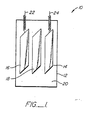
- FIG. 1 illustrates a primary or secondary battery 10.
- the battery 10 has a case 12 which contains the anode 14 and the cathode 16 separated by a separator 18.
- the battery is charged by reducing the anode and oxidizing the cathode while the electrodes 14 and 16 are immersed in a supporting electrolyte dissolved in a solvent.
- the supporting electrolyte refers to a salt or other cation-anion couple, dissolved in a suitable solvent.
- the supporting electrolyte and the solvent are referred to as the electrolyte 20.
- Wires 24 and 22 connect to the anode 14 and cathode 16, respectively, for charging and discharging the battery 10.
- the electrodes 14 or 16 are fabricated from polymers, the electrodes 14 and 16 are fabricated over or contacting a current collector, not shown, such as a platinum wire or foil, or other suitable low- resistance, conductive material which does not adversely react with the polymer. Materials such as carbon felt, graphite, vitreous carbon, platinum, gold, nickel, and the like are also suitable.
- the current collector has a conductivity of about 100 ohm- 1 cm- 1 , or greater.
- the heterocyclic ring system polymers can be used as either the anode 14 or cathode 16.
- n-type polymers are used as anodes and p-type polymers are used as cathodes.
- the anode 14 comprises a polymer such as poly-2,6-quinoline or poly-2,6-(4-phenylquinoline), both being n-type conductive polymers in their electroactive forms
- polymers such as poly-2,5-phenoxazine, poly-3,7-(N-methylphenothiazine)-2,5-(1,3,4-oxadiazole), poly-2,2-(m-phenylene)-6,6'-bibenzoxazole, and the like, all being p-type polymers in their electroactive forms, comprise the cathode 16.
- the batteries of this invention can comprise p-type heterocyclic polymers as cathodes and alkali metals such as lithium, sodium, and the like as the anode.
- alkali metals such as lithium, sodium, and the like
- Another preferred embodiment of this invention comprises the use of n-type heterocyclic polymers as anodes and materials, whose redox potentials are more positive than the redox potentials of the said n-type heterocyclic polymers, can serve as cathodes.
- materials such as Ag, Fe, or other polymeric materials such as polyacetylene or polypyrrole can be utilized as cathodes.
- Yet another preferred embodiment of this invention regards the use of n-type heterocyclic polymers as cathodes and materials, whose redox potential is more negative than the redox potential of the said n-type heterocyclic polymers, can serve as anodes.
- poly-2,6-(4-phenylquinoline) or poly-2,6-(4-phenyl)-N-methylquinolinium can be the cathodes and alkali metals such as lithium and sodium and the like can be the anodes.
- the anode 14 is preferably fabricated from n-type polymers such as poly-2,6-quinoline, poly-2,6-(4-phenylquinoline), polyquinoxaline, their substituted derivatives, and the like
- the anode is charged by electrochemically reducing, i.e., hegatively charging, the polyquinoline in the presence of supporting electrolyte cations dissolved in a solvent.
- the cations associate with the charged polymer.
- the cathode 16 when the cathode 16 is fabricated from p-type polymers such as poly-2,5-phenoxazine, poly-3,7-(N-methylphenothiazine)-2,5-(1,3,4-oxadiazole), poly-2,2'-(m-phenylene)-6,6'-bibenzoxazole, their substituted derivatives, and the like, the cathode is charged by electrochemically oxidizing, i.e., positive charging, said polymers in the presence of supporting electrolyte anions dissolved in a solvent. The anions associate with the charged polymer.
- electrochemically oxidizing i.e., positive charging
- Suitable electrolyte cations are selected from cations such as Li + , Na + , K + , Cs + , Mg ++ , (CH 3 ) 4 N + , (C 2 H 5 ) 4 N + , (C 3 H 7 ) 4 N + , and (C 4 H 9 ) 4 N + , and the like as disclosed in French Patent Publication No. 2,505,854, published November 19, 1982.
- the cation can be any cation, the salt of which can be dissolved in the solvent and will not adversely react with the electrode materials.
- Suitable electrolyte anions can be F-, Cl - , Br-, ClO 4 - , BF 4 - , N0 3 -, PF 6 - , AsF s -, and the like. Mixtures of salts can be employed.
- the cathode 16 can be any material which can be oxidized during the charging of the battery and will not adversely react with the anode.
- Suitable examples of cathode materials include silver coated with a silver halide such as AgBr, AgCl, or Agl; polymers such as polyacetylene, polypyrrole, polyphenylene sulfide, polyphenylene, or poly-1,6-heptadiene; other p-type heterocyclic polymers; or an intercalation compound having a redox potential which is more positive than the redox potential of the anode.
- An intercalation electrode is defined as an electrode material having a host lattice structure, [Z], which participates in an electrochemical reaction via an intercalation mechanism to yield an intercalation compound:
- Li ⁇ T iS 2 is an example of a suitable intercalation compound cathode material.
- Li ⁇ TiS 2 has a reported redox potential of about -0.8 volts.
- intercalation compounds are the chalcogenides of Group IV-B such as TiS 2 , TiSe 2 ; Group V-B metals such as V 2 S 5 , V 2 Se 4 . 6 , (NH 4 ) 3 VS 4 ; Group VI-B metals such as (NH 4 ) 2 MoSe 2 ; and Group VIII metals such as FeS, FeS 2 , CoS, CoS 2 , NiS, NiS 2 ; and the like.
- Group IV-B such as TiS 2 , TiSe 2
- Group V-B metals such as V 2 S 5 , V 2 Se 4 . 6 , (NH 4 ) 3 VS 4
- Group VI-B metals such as (NH 4 ) 2 MoSe 2
- Group VIII metals such as FeS, FeS 2 , CoS, CoS 2 , NiS, NiS 2 ; and the like.
- the cathode can also be a salt form of the polymer or an N-alkylated form of the polymer such as poly-2,6-(4-phenyl)-N-methylquinolinum with an anion.
- Suitable ions are CI - , Br-, F - , I - , BF 4 - , Cl O4 - , PF 6 - , AsF 6 - , N0 3 -, and the like.
- the cathode can be a polypyrrole material, PPy, as taught by A. F. Diaz, J. C. S. Chem. Com., 1979, pp. 685-636. Most preferably, the cathodes are any p-type heterocyclic polymers previously recited. If the cathode is polypyrrole (PPy) with an electrolyte solvent of acetonitrile with the supporting electrolyte of tetrabutylammonium-tetrafluoroborate dissolved therein, the charging of the PP y in the battery is illustrated as follows:
- the separator 18 need only prohibit electrical shorting between the anode and cathode.
- a suitable example would be a fine-mesh nylon grid. Any separator can be used in the invention so long as it is an electrical insulator and is not soluble in the electrolyte solution and does not prevent the free flow of ions. Another example would be a teflon grid.
- the separator must be an ion-selective membrane if a supporting electrolyte or counter electrode is selected which chemically reacts with the polymer electrode. The ion-selective separation would divide the battery 10 into an anode compartment and a cathode compartment. For example, an ion-selective separator is required when the anode is PPQ and the cathode is Ag, Fe, Cu, Zn, Pd, Sn, or other metal which could plate out onto the anode.
- the solvent portion of electrolyte 20 can comprise any liquid which dissolves the supporting electrolyte into its ionic form.
- Suitable solvents can be any material which would not dissolve the electrode, case, or separator such as acetonitrile, propylene carbonate, tetrahydrofuran, propionitrile, butyronitrile, phenylacetonitrile, dimethylformamide, dimethoxyethane, dimethylsulfoxide, pyridine, or mixtures thereof, and the like.
- Any gelling agents known in the art which are suitable for increasing the viscosity of the supporting electrolyte without inhibiting the dissociation of the supporting electrolyte or movement of ions therethrough are suitable, for example, starch, guar gum, and the like.
- the output voltage of the battery is determined by the difference between the redox potential of the anode material and the redox potential of the cathode material.
- poly-2,6-(4-phenylquinoline) reduces at a potential of about -2 volts vs. the Standard Calomel Electrode (SCE), i.e., a redox potential of about -2.0 volts.
- SCE Standard Calomel Electrode
- Polypyrrole oxidizes at a potential of about 0 volts vs. SCE.
- a single-cell battery is constructed using these two polymers as the anode and cathode, respectively, a nylon mesh grid separator between the electrodes, and an electrolyte solution of tetraethylammonium-tetrafluoroborate dissolved in acetonitrile, then the output voltage of the resulting cell is about 2 volts. This compares to the voltage of a single-cell lead/lead oxide-acid battery.
- the series connection of 6 cells of the battery would provide a standard 12-volt system as used in automobiles and the like. Any number of cells could be connected in parallel to obtain the necessary and desired output current.
- the polymer is paired with an electrode material having a more negative redox potential than the polymer.
- the polymer functions as a cathode.
- Suitable materials with more negative redox potentials which can function as the anode are metals such as Li, Na, K, Rb, Cs, or an alloy thereof.
- the anode can also be an intercalation compound having a more negative redox potential than the polymer cathode such as Li x W0 2 .
- LixW02 has a redox potential of about -2.5 volts.
- a battery can be fabricated with a PPQ cathode and Li anode.
- the PPQ cathode is reduced, i.e., negatively charged, and doped with the cationic portion of a lithium-containing electrolyte salt, such as lithium perchlorate dissolved in propylene carbonate.
- the lithium anode is electrochemically oxidized.
- the cathode can be electrochemically oxidized, i.e., positively charged, and doped with the anionic portion of a lithium-containing electrolyte salt such as lithium perchlorate dissolved in propylene carbonate.
- the cathode reaction can be illustrated as follows:
- the anode reaction can be illustrated as follows:
- the use of the previously recited heterocyclic polymers in the construction of the anode and/or cathode represents a significant improvement in the electrochemical stability of the resulting battery over that attained with polyacetylene and other conductive polymer materials reported to date.
- the distinguishing feature of polymers of this invention which provides for this improvement is the fact that they are composed of diradical repeat units, whose corresponding monomeric repeat unit form stable cations or anions, respectively, upon reversible electrochemical oxidation or reduction.
- the battery can undergo repeated deep discharging.
- the battery exhibits an extremely high discharging rate corresponding to a peak power density of about 12 kw/lb.
- the depth of discharge and charge is almost 100%. In 60 cycles of deep charging and discharging, the battery exhibits no appreciable change in its characteristics.
- the battery is not limited to the construction illustrated in the figure.
- the battery may be fabricated in a cylindrical shape wherein alternating layers of polyquinoline anode, a separator incorporating an electrolyte, a cathode such as poly-2,2'-(m-phenylene)-bibenzoxazole, are rolled in a spiral configuration, as seen from a cross-section, and are tubular in length. Any number of alternating layers of anode and cathode materials separated by a separator can be employed to increase the charge storage capacity and power output of the battery.
- a platinum/poly-2,6-(4-phenylquinoline)/tetrabutylammonium-bromide, acetonitrile/silver bromide/ silver battery was fabricated in which the poly-2,6-(4-phenylquinoline) served as the anode material and the silver/silver bromide as the cathode material.
- a 10 cm length of silver wire was anodized in an acetonitrile solution of Bu 4 NBr, passing about 20 coulombs of charge to form an AgBr layer.
- a platinum wire was coated with a thin film of poly-2,6-(4-phenylquinoline) by immersing the wire in 5% meta-cresol/P 2 0 s solution of the polymer, followed by a neutralization in an ethanol/triethylamine bath.
- the resulting film was a few microns in thickness.
- the two electrodes were immersed in a one-molar solution of Bu 4 NBr in acetonitrile and arranged so as to not touch each other.
- the cell was charged by connecting the electrodes to a 2.7-volt dry cell for a few minutes.
- the resulting battery exhibited an open-circuit voltage of 0.75 volts and a short-circuit current of 340 microamps, corresponding to a current density of 3.5 milliamps per square centimeter.
- a platinum/poly-2,6-(4-phenylquinoline)/tetraethylammonium-tetrafluoroborate, acetonitrile/poly- pyrrole/platinum battery was fabricated in which the poly-2,6-(4-phenylquinoline) served as the anode material and the polypyrrole as the cathode material.
- a polypyrrole film was electrodeposited on a 10 cm 2 area platinum-foil electrode according to the published procedures of A. F. Diaz, J. C. S. Chem. Com., 1979, pp. 635-636.
- a film of poly-2,6-(4-phenylquinoline) was cast on a second platinum-foil electrode in the same manner as described in Example 1. These two electrodes were immersed in a 0.5-molar solution of tetraethylammonium-tetrafluoroborate in acetonitrile. The electrodes were separated with a nylon mesh. The cell was charged with a 2.7-volt dry cell in a period of a few minutes. The resulting battery exhibited an open-circuit voltage of 2 volts and a short-circuit current of 250 milliamps, corresponding to a current density of about 12 milliamps per square centimeter. The discharged battery was recharged by connecting it to an external 2.7-volt dry cell for a period of a few minutes. Over 100 charge-discharge cycles were performed in this manner with no change in open-circuit voltage, short-circuit current or battery capacity.
- a lithium/lithium perchlorate, propylene carbonate/poly-2,6-(4-phenylquinoline)/platinum battery was fabricated in which the poly-2,6-(4-phenylquinoline) served as the cathode material and the lithium served as the anode material.
- a lithium anode was prepared by electrodepositing a fresh lithium coating onto a 20 cm 2 platinum-foil electrode from a solution of LiC10 4 in propylene carbonate, passing a total of -58 coulombs of charge.
- a similar platinum-foil electrode was coated with a thin film of poly-2,6-(4-phenylquinoline) as in Example 1.
- the battery was assembled by immersing the two electrodes face to face in a solution of LiC10 4 in propylene carbonate and separating them with a nylon mesh screen to avoid shorting.
- the open-circuit voltage of the battery was 2.37 volts with a short-circuit current of 95 milliamps corresponding to a current density of 5 milliamps per square centimeter.
- the discharged battery was recharged by connecting it to an external 2.7-volt dry cell for a period of about one minute. Subsequent charge-discharge cycles were carried out with similar results, but showing a gradual lowering of the capacity of the battery.
- a carbon/poly-2,6-(4-phenylquinoline)/tetraethylammonium-tetrafluoroborate, acetonitrile/poly-2,5-phenoxazine/carbon battery was fabricated in which the poly-2,6-(4-phenylquinoline) served as the active anode material and the poly-2,5-phenoxazine served as the active cathode material.
- a reticulated vitreous carbon block was coated with poly-2,6-(4-phenylquinoline) by immersion in a 5% meta-cresol/P 2 0 s solution of the polymer, followed by neutralization in an ethanol/triethylamine bath.
- a second reticulated vitreous carbon block was coated with the phenoxazine polymer by electrochemically oxidizing a THF solution of the polymer, resulting in an electrodeposited oxidized poly-2,5-phenoxazine film.
- the electrode was then rinsed with THF and dried in an inert atmosphere.
- the electrode was then immersed in a 0.1-molar solution of tetraethylammonium-tetrafluoroborate in acetonitrile and electrochemically reduced to yield a neutralized vitreous carbon electrode coated with a thin film of neutral poly-2,5-phenoxazine.
- the two coated carbon anode and cathode electrodes were immersed in a 0.5-molar tetraethylammonium-tetrafluoroborate solution in acetonitrile and separated with a thin nylon mesh.
- the battery was charged with two 1.5-volt dry cells to give an open-circuit voltage of 3.0 volts at full charge.
- the short-circuit discharge of this cell showed a current plateau of about 125 milliamps for most of the discharge, followed by a precipitous drop in the current near full discharge.
- the cell was then recharged with the dry cells, yielding a 3.0-volt open-circuit voltage and an identical response upon short-circuit discharge. Repeated charge/ discharge cycles showed no change in this short-circuit discharge curve, cell capacity, or in the open-circuit voltage.
- This battery exhibited greater than 95% coulomb efficiency (i.e., greater than 95% of the charge injected was recovered during discharge).
- a platinum/poly-2,6-(4-phenylquinoline)/tetraethylammonium-tetrafluoroborate, acetonitrile/poly[2,6-(N-methyl-4-phenyl)quinolinium]/platinum battery was fabricated in which the poly-2,6-(4-phenylquinoline) served as the active anode material and the poly-[2,6-(N-methyl-4-phenyl)quinolinium] served as the active cathode material.
- Two platinum wires were coated with poly-2,6-(4-phenylquinoline) as described in Example 1.
- the charged battery thus assembled exhibited an open-circuit voltage of 1.0 volts.
- the cell was then discharged at short circuit, and subsequently recharged with a 1.2-volt dry cell.
- the battery was charged and discharged in this way several times yielding an open-circuit voltage of 1.0 volts each time.
- the coulomb efficiency of the charge/discharge process was 80%. Within experimental error, the battery was repeatedly recharged to 100% of its initial capacity.
- a platinum/poly-2,2'-(p-phenylene)-6,6'-bibenzoxazole/tetraethylammonium-tetrafluoroborate, aceto- nitrile/poly-2,5-phenoxazine/platinum battery was fabricated in which the poly-2,2'-(p-phenylene)-6,6'- bibenzoxazole served as the active anode material, and the poly-2,5-phenoxazine served as the active cathode material.
- a platinum wire was coated with a thin film of the bibenzoxazole polymer by immersing the wire in a 5% methanesulfonic acid solution of the polymer, followed by neutralization in an ethanol/ triethylamine bath.
- a 1 square centimeter platinum flag was coated with a thin film of poly-2,5-phenoxazine by electrochemically oxidizing a solution of the polymer in tetrahydrofuran, resulting in an oxidized, electrodeposited film. This electrode was then rinsed in tetrahydrofuran and dried in an inert atmosphere.
- the electrode was then immersed in a 0.1-molar solution of tetraethylammonium-tetrafluoroborate in acetonitrile and electrochemically reduced to yield a platinum flag coated with a neutral film of poly-2,5-phenoxazine.
- the bibenzoxazole polymer-coated wire anode and the phenoxazine polymer-coated platinum flag cathode were both immersed in a 0.1-molar solution of tetraethylammonium-tetrafluoroborate in acetonitrile.
- the resulting battery was charged with a 3.5-volt dry cell.
- the charged battery exhibited an open-circuit voltage of 3.0 volts.
- the cell was then discharged at short circuit and subsequently recharged.
- the battery was charged and discharged in this way several times yielding an open-circuit voltage of 3.0 volts each time.
- the coulomb efficiency of the charge/discharge process was 80%. Within experimental error, the battery was repeatedly recharged to 100% of its initial capacity.
- a platinum/poly-2,6-(p-phenylene)-benzo[1,2-d:5,4-d']bisoxazole/tetraethylammonium-tetrafluoroborate, acetonitrile/poly-2,5-phenoxazine/platinum battery was fabricated in which the benzobisoxazole polymer served as the active anode material, and the phenoxazine polymer served as the active cathode material.
- a platinum wire was coated with a thin film of the benzobisoxazole polymer by immersing the wire in a 5% methanesulfonic acid solution of the polymer, followed by neutralization in an ethanol/triethylamine bath.
- a 1 square centimeter platinum flag was coated with a thin film of poly-2,5-phenoxazine by electrochemically oxidizing a solution of the polymer in tetrahydrofuran, resulting in an oxidized, electrodeposited film.
- This electrode was then rinsed in tetrahydrofuran and dried in an inert atmosphere. The electrode was then immersed in a 0.1-molar solution of tetraethylammonium-tetrafluoroborate in acetonitrile and electrochemically reduced to yield a platinum flag coated with a neutral film of poly-2,5-phenoxazine.
- the benzo-bisoxazole polymer-coated anode wire and the phenoxazine polymer-coated cathode platinum flag were both immersed in a 0.1-molar solution of tetraethylammonium-tetrafluoroborate in acetonitrile.
- the resulting battery was charged with a 3.5-volt dry cell.
- the charged battery exhibited an open-circuit voltage of 3.1 volts.
- the cell was then discharged at short circuit and subsequently recharged.
- the battery was charged and discharged in this way several times yielding an open-circuit voltage of 3.1 volts each time. Within experimental error, the battery was repeatedly recharged to 65% of its initial capacity.
- a platinum/poly-2,6-(p-phenylene)-benzo[1,2-d:4,5-d'Ibisthiazole/tetraethylammonium-tetrafluoroborate, acetonitrile/poly-2,5-phenoxazine/platinum battery was fabricated in which the benzobisthiazole polymer served as the active anode material, and the phenoxazine polymer served as the active cathode material.
- a platinum wire was coated with a thin film of the benzobisthiazole polymer by immersing the wire in a 5% methanesulfonic acid solution of the polymer, followed by neutralization in an ethanol/triethylamine bath.
- a 1 square centimeter platinum flag was coated with a thin film of poly-2,5-phenoxazine by electrochemically oxidizing a solution of the polymer in tetrahydrofuran, resulting in an oxidized, electrodeposited film.
- This electrode was then rinsed in tetrahydrofuran and dried in an inert atmosphere. The electrode was then immersed in a 0.1-molar solution of tetraethylammonium-tetrafluoroborate in acetonitrile and electrochemically reduced to yield a platinum flag coated with a neutral film of polyphenoxazine.
- the benzobisthiazole polymer-coated wire anode and the phenoxazine polymer-coated platinum flag cathode were both immersed in a 0.1-molar solution of tetraethylammonium-tetrafluoroborate in acetonitrile.
- the resulting battery was charged with a 3.5-volt dry cell.
- the charged battery exhibited an open-circuit voltage of 3.4 volts.
- the cell was then discharged at short circuit and subsequently recharged.
- the battery was charged and discharged in this way several times yielding an open-circuit voltage of 3.4 volts each time. Within experimental error, the battery was repeatedly recharged to 97% of its initial capacity.
- a platinum/poly-p-phenylene-2,5-(1,3,4-oxadiazole/tetraethylammonium-tetrafluoroborate, aceto- nitrile/poly-2,5-phenoxazine/platinum battery was fabricated in which the poly-p-phenylene-2,5-(1,3,4-oxadiazole) served as the active anode material, and the poly-2,5-phenoxazine served as the active cathode material.
- a platinum wire was coated with a thin film of poly-p-phenylene-2,5-(1,3,4-oxadiazole) by immersing the wire in a 5% sulfuric acid solution of the polymer, followed by neutralization in an ethanol/ triethylamine bath.
- a 1 square centimeter platinum flag was coated with a thin film of poly-2,5-phenoxazine by electrochemically oxidizing a solution of the polymer in tetrahydrofuran, resulting in an oxidized, electrodeposited film. This electrode was then rinsed in tetrahydrofuran and dried in an inert atmosphere.
- the electrode was then immersed in a 0.1-molar solution of tetraethylammonium-tetrafluoroborate in acetonitrile and electrochemically reduced to yield a platinum flag coated with a neutral film of poly-2,5-phenoxazine.
- the oxadiazole polymer-coated wire anode and the phenoxazine polymer-coated platinum flag cathode were both immersed in a 0.1-molar solution of tetraethylammonium-tetrafluoroborate in acetonitrile.
- the resulting battery was charged with a 3.5-volt dry cell.
- the charged battery exhibited an open-circuit voltage of 3.4 volts.
- the cell was then discharged at short circuit and subsequently recharged.
- the battery was charged and discharged in this way several times yielding an open-circuit voltage of 3.4 volts each time. Within experimental error, the battery was repeatedly recharged to 99% of its initial capacity
- a platinum/poly-2,6-(p-phenylene)-benzo[1,2-d:4,5-d']bisthiazole/tetraethylammonium-tetrafluoroborate, acetonitrile/poly-2,2'-(m-phenylene)-6,6'-bibenzoxazole/platinum battery was fabricated in which the benzobisthiazole polymer served as the active anode material, and the poly-2,2'-(m-phenylene)-6,6'- bibenzoxazole served as the active cathode material.
- a platinum wire was coated with a thin film of the benzobisthiazole polymer by immersing the wire in a 5% methanesulfonic acid solution of the polymer, followed by neutralization in an ethanol/triethylamine bath.
- a second platinum wire was coated with a thin film of the bibenzoxazole polymer in a similar manner.
- the benzobisthiazole polymer-coated wire anode and bibenzoxazole polymer-coated wire cathode were immersed in a 0.1-molar solution of tetraethylammonium-tetrafluoroborate in acetonitrile.
- the resulting battery was charged with a 4.2-volt dry cell.
- the charged battery exhibited an open-circuit voltage of 4.0 volts.
- the cell was then discharged at short circuit and subsequently recharged.
- the battery was charged and discharged in this way several times yielding an open-circuit voltage of 4.0 volts each time.
- a platinum/poly-2,6-(4-phenylquinoline)/tetraethylammonium-tetrafluoroborate, acetonitrile/poly-2,2'-(m-phenylene)-6,6'-bibenzoxazole/platinum battery was fabricated in which the poly-2,6-(4-phenylquinoline) polymer served as the active anode material, and the bibenzoxazole polymer served as the active cathode material.
- a platinum wire was coated with a thin film of poly-2,6-(4-phenylquinoline) by immersing the wire in a 5% meta-cresol/P 2 0 s solution of the polymer, followed by neutralization in an ethanol/triethylamine bath.
- a second platinum wire was coated with a thin film of the bibenzoxazole polymer in the manner described in Example 6.
- the quinoline polymer-coated wire anode and the bibenzoxazole polymer-coated wire cathode were immersed in a 0.1-molar solution of tetraethylammonium-tetrafluoroborate in acetonitrile.
- the resulting battery was charged with a 4.2-volt dry cell.
- the charged battery exhibited an open-circuit voltage of 3.8 volts.
- the cell was then discharged at short circuit and subsequently recharged.
- the battery was charged and discharged in this way several times yielding an open-circuit voltage of 3.8
- a platinum/poly-p-phenylene-2,5-(1,3,4-oxadiazole/tetraethylammonium-tetrafluoroborate, aceto- nitrile/poly(N-methylphenothiazine)-2,5-(1,3,4-oxadiazole)/platinum battery was fabricated in which the poly-p-phenylene-2,5-(1,3,4-oxadiazole) served as the active anode material, and the poly(N-methylphenothiazine)-2,5-(1,3,4-oxadiazole) served as the active cathode material.
- a platinum wire was coated with a thin film of poly-p-phenylene-2,5-(1,3,4-oxadiazole) by immersing the wire in a 5% sulfuric acid solution of the polymer, followed by neutralization in an ethanol/triethylamine bath.
- a second platinum wire was coated with a thin film of poly(N-methylphenothiazine)-2,5-(1,3,4-oxadiazole) in a similar manner.
- Both polymer-coated wire anode and cathode were immersed in a 0.1-molar solution of tetraethylammonium-tetrafluoroborate in acetonitrile.
- the resulting battery was charged with a 3.0-volt dry cell.
- the charged battery exhibited an open-circuit voltage of 2.7 volts.
- the cell was then discharged at short circuit and subsequently recharged.
- the battery was charged and discharged in this way several times yielding an open-circuit voltage of 2.7
- a platinum/poly-p-phenylene-2,5-(1,3,4-oxadiazole)-p-phenylene-2,5-(1,3,4-thiadiazole) copolymer/ tetraethylammonium-tetrafluoroborate, acetonitrile/poly-2,2'-(m-phenylene)-6,6'-bibenzoxazole/platinum battery was fabricated in which the poly-p-phenylene-2,5-(1,3,4-oxadiazole)-p-phenylene-2,5-(1,3,4-thiadiazole) copolymer served as the active anode material, and the bibenzoxazole polymer served as the active cathode material.
- a platinum wire was coated with a thin film of the copolymer by immersing the wire in a 5% msulfuric acid solution of the polymer, followed by neutralization in an ethanol/triethylamine bath.
- a second platinum wire was coated with a thin film of the bibenzoxazole polymer in the manner described in Example 10. Both polymer-coated wire anode and cathode were immersed in a 0.1-molar solution of tetraethylammonium-tetrafluoroborate in acetonitrile.
- the resulting battery was charged with a 4.0-volt dry cell.
- the charged battery exhibited an open-circuit voltage of 3.5 volts.
- the cell was then discharged at short circuit and subsequently recharged.
- the battery was charged and discharged in this way several times yielding an open-circuit voltage of 3.5 volts each time.
- a platinum/poly-2,6-(4-phenylquinoline)/tetraethylammonium-tetrafluoroborate, acetonitrile/poly-2,2'-(p-phenylene)-6,6'-bibenzoxazole/platinum battery was fabricated in which the poly-2,6-(4-phenylquinoline) served as the active anode material, and the poly-2,2'-(p-phenylene)-6,6'-bibenzoxazole served as the active cathode material.
- a platinum wire was coacted with a thin film of poly-2,6-(4-phenylquinoline) by immersing the wire in a 5% meta-cresol/P 2 0 5 solution of the polymer, followed by neutralization in an ethanol/triethylamine bath.
- a second platinum wire was coated with a thin film of the bibenzoxazole polymer in the manner described in Example 6. Both polymer-coated wire anode and cathode were immersed in a 0.1-molar solution of tetraethylammonium- tetrafluoroborate in acetonitrile. The resulting battery was charged with a 3.5-volt dry cell. The charged battery exhibited an open-circuit voltage of 3.1 volts.
- the cell was then discharged at short circuit and subsequently recharged.
- the battery was charged and discharged in this way several times yielding an open-circuit voltage of 3.1 volts each time.
- the coulomb efficiency of the charge/discharge process was 30%.
- the battery was repeatedly recharged to 30% of its initial capacity.
- a platinum/poly-2,2'-(p-phenylene)-6,6'-bibenzoxazole/tetraethylammonium-tetrafluoroborate, aceto- nitrile/poly-2,2'-(p-phenylene)-6,6'-bibenzoxazole/platinum battery was fabricated in which the poly-2,2'-(p-phenylene)-6,6-bibenzoxazole served as both the active anode material and the active cathode material.
- Two platinum wires were coated with a thin film of the bibenzoxazole polymer by immersing the wires in a 5% methanesulfonic acid solution of the polymer, followed by neutralization in an ethanol/triethylamine bath. Both polymer-coated wire anode and cathode were immersed in a 0.1-molar solution of tetraethylammonium-tetrafluoroborate in acetonitrile. The resulting battery was charged with a 3.5-volt dry cell. The charged battery exhibited an open-circuit voltage of 3.3 volts. The cell was then discharged at short circuit and subsequently recharged. The battery was charged and discharged in this way several times yielding an open-circuit voltage of 3.3 volts each time. The coulomb efficiency of the charge/discharge process was 30%. Within experimental error, the battery was repeatedly recharged to 40% of its initial capacity.
Landscapes
- Physics & Mathematics (AREA)
- Spectroscopy & Molecular Physics (AREA)
- Chemical & Material Sciences (AREA)
- Chemical Kinetics & Catalysis (AREA)
- Electrochemistry (AREA)
- General Chemical & Material Sciences (AREA)
- Battery Electrode And Active Subsutance (AREA)
- Secondary Cells (AREA)
- Polyoxymethylene Polymers And Polymers With Carbon-To-Carbon Bonds (AREA)
- Addition Polymer Or Copolymer, Post-Treatments, Or Chemical Modifications (AREA)
- Compositions Of Macromolecular Compounds (AREA)
- Hybrid Cells (AREA)
Applications Claiming Priority (6)
| Application Number | Priority Date | Filing Date | Title |
|---|---|---|---|
| US33450881A | 1981-12-28 | 1981-12-28 | |
| US33450981A | 1981-12-28 | 1981-12-28 | |
| US334508 | 1981-12-28 | ||
| US44858582A | 1982-12-15 | 1982-12-15 | |
| US334509 | 2002-12-30 | ||
| US448585 | 2003-05-30 |
Publications (2)
| Publication Number | Publication Date |
|---|---|
| EP0096723A1 EP0096723A1 (en) | 1983-12-28 |
| EP0096723B1 true EP0096723B1 (en) | 1988-08-10 |
Family
ID=27406981
Family Applications (1)
| Application Number | Title | Priority Date | Filing Date |
|---|---|---|---|
| EP83900470A Expired EP0096723B1 (en) | 1981-12-28 | 1982-12-28 | Batteries fabricated with electroactive polymers |
Country Status (9)
| Country | Link |
|---|---|
| EP (1) | EP0096723B1 (it) |
| JP (1) | JPS59500033A (it) |
| CA (1) | CA1202072A (it) |
| DE (3) | DE3278898D1 (it) |
| GB (1) | GB2122804B (it) |
| IL (1) | IL67556A (it) |
| IT (1) | IT1155087B (it) |
| NL (1) | NL8220498A (it) |
| WO (1) | WO1983002368A1 (it) |
Families Citing this family (27)
| Publication number | Priority date | Publication date | Assignee | Title |
|---|---|---|---|---|
| WO1984002030A1 (en) * | 1982-11-17 | 1984-05-24 | Chevron Res | Electroactive polymers |
| FR2527843B1 (fr) * | 1982-06-01 | 1986-01-24 | Thomson Csf | Electrode comprenant un film de polymere electrochrome pouvant servir dans un dispositif d'affichage ou de stockage d'energie |
| FR2527844B1 (fr) * | 1982-06-01 | 1986-01-24 | Thomson Csf | Dispositif electrochromique pouvant servir au stockage d'energie et systeme d'affichage electrochromique |
| US4505840A (en) * | 1982-07-13 | 1985-03-19 | Chevron Research Company | Heterocyclic electroactive polymers |
| US4522745A (en) * | 1982-11-17 | 1985-06-11 | Chevron Research Company | Fused 5,6,5-membered heterocyclic electroactive polymers |
| EP0124875B1 (en) * | 1983-05-04 | 1991-04-10 | Showa Denko Kabushiki Kaisha | Battery having an electrode made of a polymeric compound with conjugated double bonds |
| CA1242483A (en) * | 1983-10-26 | 1988-09-27 | Hitachi, Ltd. | Secondary battery |
| US4613211A (en) * | 1983-11-21 | 1986-09-23 | Chevron Research Company | Electrochromic devices |
| US4512855A (en) * | 1984-07-23 | 1985-04-23 | E. I. Du Pont De Nemours And Company | Deposition of metals as interlayers within organic polymeric films |
| US4717673A (en) * | 1984-11-23 | 1988-01-05 | Massachusetts Institute Of Technology | Microelectrochemical devices |
| DE3525271A1 (de) * | 1985-07-16 | 1987-01-29 | Bbc Brown Boveri & Cie | Elektrochemische speicherzelle |
| FR2698631B1 (fr) * | 1992-12-01 | 1995-02-10 | Centre Nat Rech Scient | Copolymères à propriétés rédox et leur utilisation pour l'élaboration de matériaux à conduction mixte. |
| US7538032B2 (en) | 2005-06-23 | 2009-05-26 | Teledyne Scientific & Imaging, Llc | Low temperature method for fabricating high-aspect ratio vias and devices fabricated by said method |
| US7989915B2 (en) | 2006-07-11 | 2011-08-02 | Teledyne Licensing, Llc | Vertical electrical device |
| US7829462B2 (en) | 2007-05-03 | 2010-11-09 | Teledyne Licensing, Llc | Through-wafer vias |
| US8187972B2 (en) | 2008-07-01 | 2012-05-29 | Teledyne Scientific & Imaging, Llc | Through-substrate vias with polymer fill and method of fabricating same |
| US8088667B2 (en) | 2008-11-05 | 2012-01-03 | Teledyne Scientific & Imaging, Llc | Method of fabricating vertical capacitors in through-substrate vias |
| JP5693722B2 (ja) | 2010-08-05 | 2015-04-01 | ビーエーエスエフ ソシエタス・ヨーロピアBasf Se | 橋かけされたビチアゾールコポリマーから製造される半導体材料 |
| TW201236239A (en) | 2010-11-16 | 2012-09-01 | Solvay | Rechargeable metal or metal-ion cell |
| CN103517936A (zh) * | 2011-04-27 | 2014-01-15 | 巴斯夫欧洲公司 | 基于二噻吩并吡啶酮共聚物的半导体材料 |
| CN111509177A (zh) | 2011-06-23 | 2020-08-07 | 索尔维特殊聚合物意大利有限公司 | 二次电池 |
| DE102012200827A1 (de) * | 2012-01-20 | 2013-07-25 | Leibniz-Institut Für Festkörper- Und Werkstoffforschung Dresden E.V. | Verwendung eines Polymernetzwerkes als Kathodenmaterial für wiederaufladbare Batterien |
| DE102012015176A1 (de) * | 2012-08-02 | 2014-02-06 | Technische Universität Braunschweig Carolo-Wilhelmina | Redoxelektrolyt mit redoxaktiver Substanz für Redox-Flow-Batterien |
| NO2751376T3 (it) * | 2014-02-13 | 2018-03-24 | ||
| EP3422450B1 (en) * | 2017-06-26 | 2020-08-05 | RISE Acreo AB | Oxygen associated energy conversion device |
| KR102846661B1 (ko) * | 2020-03-26 | 2025-08-18 | 주식회사 엘지에너지솔루션 | 이차전지용 전해액 첨가제, 이를 포함하는 리튬 이차전지용 비수 전해액 및 리튬 이차전지 |
| CN115353471B (zh) * | 2022-08-26 | 2023-12-05 | 陕西师范大学 | 一种蒽嵌蒽醌聚合物有机电极材料及其制备方法与应用 |
Family Cites Families (7)
| Publication number | Priority date | Publication date | Assignee | Title |
|---|---|---|---|---|
| FR1526657A (fr) * | 1966-06-13 | 1968-05-24 | California Inst Res Found | Pile électro-chimique |
| FR94536E (fr) * | 1967-02-20 | 1969-08-29 | Centre Nat Rech Scient | Électrodes a base de semi-conducteurs organiques et générateurs électrochimiques mettant en oeuvre de telles électrodes. |
| DE2043477C3 (de) * | 1970-07-14 | 1981-11-05 | Bayer Ag, 5090 Leverkusen | Elektrisch leitende Polymere |
| US4182797A (en) * | 1975-09-17 | 1980-01-08 | Matsushita Electric Industrial Co., Ltd. | Primary battery utilizing iodine charge transfer complex having a quaternary ammonium group |
| US4181779A (en) * | 1979-01-30 | 1980-01-01 | Bell Telephone Laboratories, Incorporated | Cell using halogen reactive material such as organo-metallic polymer |
| US4442187A (en) * | 1980-03-11 | 1984-04-10 | University Patents, Inc. | Batteries having conjugated polymer electrodes |
| DE3009350A1 (de) * | 1980-03-12 | 1981-09-24 | Basf Ag, 6700 Ludwigshafen | Verfahren zur herstellung elektrisch leitfaehiger heteropolyaromaten und den verwendung in der elektrotechnik und zur antistatischen ausruestung von kunststo ffen |
-
1982
- 1982-12-24 IL IL67556A patent/IL67556A/xx unknown
- 1982-12-24 CA CA000418618A patent/CA1202072A/en not_active Expired
- 1982-12-28 EP EP83900470A patent/EP0096723B1/en not_active Expired
- 1982-12-28 NL NL8220498A patent/NL8220498A/nl unknown
- 1982-12-28 DE DE8383900470T patent/DE3278898D1/de not_active Expired
- 1982-12-28 IT IT25007/82A patent/IT1155087B/it active
- 1982-12-28 DE DE198383900470T patent/DE96723T1/de active Pending
- 1982-12-28 DE DE19823249282 patent/DE3249282T1/de active Granted
- 1982-12-28 GB GB08320507A patent/GB2122804B/en not_active Expired
- 1982-12-28 JP JP83500581A patent/JPS59500033A/ja active Pending
- 1982-12-28 WO PCT/US1982/001801 patent/WO1983002368A1/en not_active Ceased
Also Published As
| Publication number | Publication date |
|---|---|
| NL8220498A (nl) | 1983-11-01 |
| DE3249282T1 (de) | 1984-12-13 |
| EP0096723A1 (en) | 1983-12-28 |
| IL67556A (en) | 1987-10-20 |
| GB8320507D0 (en) | 1983-09-01 |
| GB2122804A (en) | 1984-01-18 |
| WO1983002368A1 (en) | 1983-07-07 |
| IT8225007A1 (it) | 1984-06-28 |
| CA1202072A (en) | 1986-03-18 |
| IT1155087B (it) | 1987-01-21 |
| IL67556A0 (en) | 1983-05-15 |
| DE3249282C2 (it) | 1992-04-30 |
| GB2122804B (en) | 1986-02-05 |
| DE96723T1 (de) | 1984-07-19 |
| IT8225007A0 (it) | 1982-12-28 |
| DE3278898D1 (en) | 1988-09-15 |
| JPS59500033A (ja) | 1984-01-05 |
Similar Documents
| Publication | Publication Date | Title |
|---|---|---|
| CA1202072A (en) | Batteries fabricated with electroactive polymers | |
| US4917974A (en) | Lithium/organosulfur redox cell having protective solid electrolyte barrier formed on anode and method of making same | |
| Williams et al. | A high energy density lithium/dichloroisocyanuric acid battery system | |
| CA1066763A (en) | Metal-halogen electrochemical cell | |
| Naegele et al. | Electrically conductive polymers as rechargeable battery electrodes | |
| US5840443A (en) | Redox polymer electrodes for advanced batteries | |
| JPH0454350B2 (it) | ||
| US3960594A (en) | Primary or secondary electrochemical cell | |
| US4609600A (en) | Electrochemical cell containing electrode made of polymeric compound and electrolyte containing organic complex ligand | |
| US4613211A (en) | Electrochromic devices | |
| EP2973627B1 (en) | Hetero-ionic aromatic additives for electrochemical cells comprising a metal fuel | |
| JPH0619998B2 (ja) | エネルギー貯蔵のために使用できる電気化学装置 | |
| JPH0438104B2 (it) | ||
| JPH0315175A (ja) | ポリマー電極を有する二次電池 | |
| Reynolds et al. | Primary and secondary room temperature molten salt electrochemical cells | |
| GB1570413A (en) | Halogen cell electrolytes | |
| Kakuta et al. | A rechargeable battery using electrochemically doped poly (N-vinylcarbazole) | |
| KR20020022003A (ko) | 인돌계 화합물을 이용하는 2차 전지 및 콘덴서 | |
| JPS6289749A (ja) | 電極材料 | |
| GB1569397A (en) | Metal-halogen electrochemical cell | |
| KR900003149B1 (ko) | 전기활성을 띈 중합체로 결합된 전지 | |
| EP0239976A2 (en) | Molten salt secondary battery | |
| US4192912A (en) | Cells having cathodes with thiocyanogen-containing cathode-active materials | |
| DE3930804A1 (de) | Festelektrolytbatterie | |
| JPH02174076A (ja) | 固定ドーパントp型導電性高分子正極電池 |
Legal Events
| Date | Code | Title | Description |
|---|---|---|---|
| PUAI | Public reference made under article 153(3) epc to a published international application that has entered the european phase |
Free format text: ORIGINAL CODE: 0009012 |
|
| 17P | Request for examination filed |
Effective date: 19830919 |
|
| AK | Designated contracting states |
Designated state(s): DE FR GB NL |
|
| TCNL | Nl: translation of patent claims filed | ||
| DET | De: translation of patent claims | ||
| GRAA | (expected) grant |
Free format text: ORIGINAL CODE: 0009210 |
|
| AK | Designated contracting states |
Kind code of ref document: B1 Designated state(s): DE FR GB NL |
|
| REF | Corresponds to: |
Ref document number: 3278898 Country of ref document: DE Date of ref document: 19880915 |
|
| ET | Fr: translation filed | ||
| PLBE | No opposition filed within time limit |
Free format text: ORIGINAL CODE: 0009261 |
|
| STAA | Information on the status of an ep patent application or granted ep patent |
Free format text: STATUS: NO OPPOSITION FILED WITHIN TIME LIMIT |
|
| 26N | No opposition filed | ||
| PGFP | Annual fee paid to national office [announced via postgrant information from national office to epo] |
Ref country code: GB Payment date: 19911217 Year of fee payment: 10 |
|
| PGFP | Annual fee paid to national office [announced via postgrant information from national office to epo] |
Ref country code: FR Payment date: 19911227 Year of fee payment: 10 |
|
| PGFP | Annual fee paid to national office [announced via postgrant information from national office to epo] |
Ref country code: NL Payment date: 19911231 Year of fee payment: 10 |
|
| PGFP | Annual fee paid to national office [announced via postgrant information from national office to epo] |
Ref country code: DE Payment date: 19920228 Year of fee payment: 10 |
|
| PG25 | Lapsed in a contracting state [announced via postgrant information from national office to epo] |
Ref country code: GB Effective date: 19921228 |
|
| PG25 | Lapsed in a contracting state [announced via postgrant information from national office to epo] |
Ref country code: NL Effective date: 19930701 |
|
| NLV4 | Nl: lapsed or anulled due to non-payment of the annual fee | ||
| GBPC | Gb: european patent ceased through non-payment of renewal fee |
Effective date: 19921228 |
|
| PG25 | Lapsed in a contracting state [announced via postgrant information from national office to epo] |
Ref country code: FR Effective date: 19930831 |
|
| PG25 | Lapsed in a contracting state [announced via postgrant information from national office to epo] |
Ref country code: DE Effective date: 19930901 |
|
| REG | Reference to a national code |
Ref country code: FR Ref legal event code: ST |