EP0099486B1 - Diamant-Einkristalle, Verfahren zu deren Herstellung und Werkzeuge zum Gebrauch derselben - Google Patents
Diamant-Einkristalle, Verfahren zu deren Herstellung und Werkzeuge zum Gebrauch derselben Download PDFInfo
- Publication number
- EP0099486B1 EP0099486B1 EP83106198A EP83106198A EP0099486B1 EP 0099486 B1 EP0099486 B1 EP 0099486B1 EP 83106198 A EP83106198 A EP 83106198A EP 83106198 A EP83106198 A EP 83106198A EP 0099486 B1 EP0099486 B1 EP 0099486B1
- Authority
- EP
- European Patent Office
- Prior art keywords
- crystal
- solvent metal
- diamond
- diamond single
- cross
- Prior art date
- Legal status (The legal status is an assumption and is not a legal conclusion. Google has not performed a legal analysis and makes no representation as to the accuracy of the status listed.)
- Expired
Links
- 239000010432 diamond Substances 0.000 title claims description 129
- 239000013078 crystal Substances 0.000 title claims description 122
- 229910003460 diamond Inorganic materials 0.000 title claims description 104
- 238000000034 method Methods 0.000 title claims description 21
- 238000004519 manufacturing process Methods 0.000 title claims description 18
- 229910052751 metal Inorganic materials 0.000 claims description 86
- 239000002184 metal Substances 0.000 claims description 86
- 239000002904 solvent Substances 0.000 claims description 72
- OKTJSMMVPCPJKN-UHFFFAOYSA-N Carbon Chemical compound [C] OKTJSMMVPCPJKN-UHFFFAOYSA-N 0.000 claims description 36
- 229910052799 carbon Inorganic materials 0.000 claims description 33
- 238000006243 chemical reaction Methods 0.000 claims description 17
- 238000003786 synthesis reaction Methods 0.000 claims description 8
- 238000010438 heat treatment Methods 0.000 claims description 7
- 229910045601 alloy Inorganic materials 0.000 claims description 5
- 239000000956 alloy Substances 0.000 claims description 5
- 229910052759 nickel Inorganic materials 0.000 claims description 3
- 230000002093 peripheral effect Effects 0.000 claims description 3
- 229910052742 iron Inorganic materials 0.000 claims description 2
- 230000003287 optical effect Effects 0.000 claims 1
- 239000000463 material Substances 0.000 description 11
- 230000015572 biosynthetic process Effects 0.000 description 6
- 230000001788 irregular Effects 0.000 description 6
- 239000000843 powder Substances 0.000 description 6
- 238000005553 drilling Methods 0.000 description 5
- PXHVJJICTQNCMI-UHFFFAOYSA-N nickel Substances [Ni] PXHVJJICTQNCMI-UHFFFAOYSA-N 0.000 description 5
- FAPWRFPIFSIZLT-UHFFFAOYSA-M Sodium chloride Chemical compound [Na+].[Cl-] FAPWRFPIFSIZLT-UHFFFAOYSA-M 0.000 description 4
- 238000004090 dissolution Methods 0.000 description 3
- 239000005337 ground glass Substances 0.000 description 3
- 238000005476 soldering Methods 0.000 description 3
- 238000005162 X-ray Laue diffraction Methods 0.000 description 2
- 239000000853 adhesive Substances 0.000 description 2
- 230000001070 adhesive effect Effects 0.000 description 2
- 239000003054 catalyst Substances 0.000 description 2
- 238000007796 conventional method Methods 0.000 description 2
- 238000005530 etching Methods 0.000 description 2
- 238000002474 experimental method Methods 0.000 description 2
- 229910002804 graphite Inorganic materials 0.000 description 2
- 239000010439 graphite Substances 0.000 description 2
- 238000000227 grinding Methods 0.000 description 2
- 239000000203 mixture Substances 0.000 description 2
- 238000005245 sintering Methods 0.000 description 2
- 239000011780 sodium chloride Substances 0.000 description 2
- 239000010936 titanium Substances 0.000 description 2
- 229910052719 titanium Inorganic materials 0.000 description 2
- 206010053759 Growth retardation Diseases 0.000 description 1
- RTAQQCXQSZGOHL-UHFFFAOYSA-N Titanium Chemical compound [Ti] RTAQQCXQSZGOHL-UHFFFAOYSA-N 0.000 description 1
- 238000004458 analytical method Methods 0.000 description 1
- 229910052796 boron Inorganic materials 0.000 description 1
- 125000004432 carbon atom Chemical group C* 0.000 description 1
- 239000003575 carbonaceous material Substances 0.000 description 1
- 229910052804 chromium Inorganic materials 0.000 description 1
- RKTYLMNFRDHKIL-UHFFFAOYSA-N copper;5,10,15,20-tetraphenylporphyrin-22,24-diide Chemical compound [Cu+2].C1=CC(C(=C2C=CC([N-]2)=C(C=2C=CC=CC=2)C=2C=CC(N=2)=C(C=2C=CC=CC=2)C2=CC=C3[N-]2)C=2C=CC=CC=2)=NC1=C3C1=CC=CC=C1 RKTYLMNFRDHKIL-UHFFFAOYSA-N 0.000 description 1
- 230000003247 decreasing effect Effects 0.000 description 1
- 230000005496 eutectics Effects 0.000 description 1
- 239000010438 granite Substances 0.000 description 1
- 239000012535 impurity Substances 0.000 description 1
- 229910052748 manganese Inorganic materials 0.000 description 1
- 239000011159 matrix material Substances 0.000 description 1
- 150000002739 metals Chemical class 0.000 description 1
- 238000007747 plating Methods 0.000 description 1
- 230000002250 progressing effect Effects 0.000 description 1
- 239000011435 rock Substances 0.000 description 1
- 229910000679 solder Inorganic materials 0.000 description 1
- 229910052726 zirconium Inorganic materials 0.000 description 1
Images


Classifications
-
- C—CHEMISTRY; METALLURGY
- C30—CRYSTAL GROWTH
- C30B—SINGLE-CRYSTAL GROWTH; UNIDIRECTIONAL SOLIDIFICATION OF EUTECTIC MATERIAL OR UNIDIRECTIONAL DEMIXING OF EUTECTOID MATERIAL; REFINING BY ZONE-MELTING OF MATERIAL; PRODUCTION OF A HOMOGENEOUS POLYCRYSTALLINE MATERIAL WITH DEFINED STRUCTURE; SINGLE CRYSTALS OR HOMOGENEOUS POLYCRYSTALLINE MATERIAL WITH DEFINED STRUCTURE; AFTER-TREATMENT OF SINGLE CRYSTALS OR A HOMOGENEOUS POLYCRYSTALLINE MATERIAL WITH DEFINED STRUCTURE; APPARATUS THEREFOR
- C30B13/00—Single-crystal growth by zone-melting; Refining by zone-melting
- C30B13/02—Zone-melting with a solvent, e.g. travelling solvent process
-
- B—PERFORMING OPERATIONS; TRANSPORTING
- B01—PHYSICAL OR CHEMICAL PROCESSES OR APPARATUS IN GENERAL
- B01J—CHEMICAL OR PHYSICAL PROCESSES, e.g. CATALYSIS OR COLLOID CHEMISTRY; THEIR RELEVANT APPARATUS
- B01J3/00—Processes of utilising sub-atmospheric or super-atmospheric pressure to effect chemical or physical change of matter; Apparatus therefor
- B01J3/06—Processes using ultra-high pressure, e.g. for the formation of diamonds; Apparatus therefor, e.g. moulds or dies
- B01J3/062—Processes using ultra-high pressure, e.g. for the formation of diamonds; Apparatus therefor, e.g. moulds or dies characterised by the composition of the materials to be processed
-
- C—CHEMISTRY; METALLURGY
- C30—CRYSTAL GROWTH
- C30B—SINGLE-CRYSTAL GROWTH; UNIDIRECTIONAL SOLIDIFICATION OF EUTECTIC MATERIAL OR UNIDIRECTIONAL DEMIXING OF EUTECTOID MATERIAL; REFINING BY ZONE-MELTING OF MATERIAL; PRODUCTION OF A HOMOGENEOUS POLYCRYSTALLINE MATERIAL WITH DEFINED STRUCTURE; SINGLE CRYSTALS OR HOMOGENEOUS POLYCRYSTALLINE MATERIAL WITH DEFINED STRUCTURE; AFTER-TREATMENT OF SINGLE CRYSTALS OR A HOMOGENEOUS POLYCRYSTALLINE MATERIAL WITH DEFINED STRUCTURE; APPARATUS THEREFOR
- C30B29/00—Single crystals or homogeneous polycrystalline material with defined structure characterised by the material or by their shape
- C30B29/02—Elements
- C30B29/04—Diamond
-
- C—CHEMISTRY; METALLURGY
- C30—CRYSTAL GROWTH
- C30B—SINGLE-CRYSTAL GROWTH; UNIDIRECTIONAL SOLIDIFICATION OF EUTECTIC MATERIAL OR UNIDIRECTIONAL DEMIXING OF EUTECTOID MATERIAL; REFINING BY ZONE-MELTING OF MATERIAL; PRODUCTION OF A HOMOGENEOUS POLYCRYSTALLINE MATERIAL WITH DEFINED STRUCTURE; SINGLE CRYSTALS OR HOMOGENEOUS POLYCRYSTALLINE MATERIAL WITH DEFINED STRUCTURE; AFTER-TREATMENT OF SINGLE CRYSTALS OR A HOMOGENEOUS POLYCRYSTALLINE MATERIAL WITH DEFINED STRUCTURE; APPARATUS THEREFOR
- C30B9/00—Single-crystal growth from melt solutions using molten solvents
-
- B—PERFORMING OPERATIONS; TRANSPORTING
- B01—PHYSICAL OR CHEMICAL PROCESSES OR APPARATUS IN GENERAL
- B01J—CHEMICAL OR PHYSICAL PROCESSES, e.g. CATALYSIS OR COLLOID CHEMISTRY; THEIR RELEVANT APPARATUS
- B01J2203/00—Processes utilising sub- or super atmospheric pressure
- B01J2203/06—High pressure synthesis
- B01J2203/0605—Composition of the material to be processed
- B01J2203/061—Graphite
-
- B—PERFORMING OPERATIONS; TRANSPORTING
- B01—PHYSICAL OR CHEMICAL PROCESSES OR APPARATUS IN GENERAL
- B01J—CHEMICAL OR PHYSICAL PROCESSES, e.g. CATALYSIS OR COLLOID CHEMISTRY; THEIR RELEVANT APPARATUS
- B01J2203/00—Processes utilising sub- or super atmospheric pressure
- B01J2203/06—High pressure synthesis
- B01J2203/0605—Composition of the material to be processed
- B01J2203/062—Diamond
-
- B—PERFORMING OPERATIONS; TRANSPORTING
- B01—PHYSICAL OR CHEMICAL PROCESSES OR APPARATUS IN GENERAL
- B01J—CHEMICAL OR PHYSICAL PROCESSES, e.g. CATALYSIS OR COLLOID CHEMISTRY; THEIR RELEVANT APPARATUS
- B01J2203/00—Processes utilising sub- or super atmospheric pressure
- B01J2203/06—High pressure synthesis
- B01J2203/0605—Composition of the material to be processed
- B01J2203/0625—Carbon
-
- B—PERFORMING OPERATIONS; TRANSPORTING
- B01—PHYSICAL OR CHEMICAL PROCESSES OR APPARATUS IN GENERAL
- B01J—CHEMICAL OR PHYSICAL PROCESSES, e.g. CATALYSIS OR COLLOID CHEMISTRY; THEIR RELEVANT APPARATUS
- B01J2203/00—Processes utilising sub- or super atmospheric pressure
- B01J2203/06—High pressure synthesis
- B01J2203/065—Composition of the material produced
- B01J2203/0655—Diamond
-
- B—PERFORMING OPERATIONS; TRANSPORTING
- B01—PHYSICAL OR CHEMICAL PROCESSES OR APPARATUS IN GENERAL
- B01J—CHEMICAL OR PHYSICAL PROCESSES, e.g. CATALYSIS OR COLLOID CHEMISTRY; THEIR RELEVANT APPARATUS
- B01J2203/00—Processes utilising sub- or super atmospheric pressure
- B01J2203/06—High pressure synthesis
- B01J2203/0675—Structural or physico-chemical features of the materials processed
- B01J2203/068—Crystal growth
Definitions
- the present invention relates to artificial diamond single crystals having a rough surface which are suitable for use in tools, and a process for manufacturing such crystals.
- Bits for drilling rocks and tip material of dressers for repairing grinding wheels have been made of diamond which has the highest hardness of all materials. Diamonds used in these tools must be approximately 1 mm or more in size. Natural diamond called “boart” is used at present since synthetic diamonds having such a size have not been manufactured on an industrial scale.
- An object of the present invention is to increase the adhesive strength of a diamond single crystal to a tool support by providing the crystal with a novel surface condition.
- the diamond single crystal of the present invention is formed by the following process, comprising the steps of: providing a diamond synthesis reaction apparatus comprised of a reaction chamber having positioned therein a carbon source and a solvent metal arranged in contact with the said carbon source; providing a seed crystal in the reaction chamber in contact with the solvent metal; providing temperatures and pressures in the reaction chamber which permit diamond to be maintained thermodynamically stable in the reaction chamber; heating the reaction chamber to provide a temperature gradient in such a way that a portion of the solvent metal in contact with the carbon source is higher in temperature than a portion of the solvent metal in contact with the seed crystal so as to migrate the carbon from the higher temperature portion to the lower temperature portion using the solvent metal as a medium; and allowing the carbon to precipitate and grow as a diamond on the seed crystal due to the difference in solubility caused by the temperature gradient in the reaction chamber, the said manufacturing being conducted under the condition that the crystal growth in the direction perpendicular to the direction of the temperature gradient is suppressed by using a rod-like solvent metal the size of which in this direction
- the disclosed process for manufacturing a diamond single crystal involves a diamond reaction system consisting of a carbon source, a solvent metal (molten catalyst metal) arranged in contact with said carbon source, and a seed crystal.
- the reaction system is held under elevated pressures and temperatures which permit diamond to be maintained in thermodynamically stable condition.
- the reaction chamber housing the reaction system is heated to provide a temperature gradient in such a way that the portion of the solvent metal in contact with the carbon source is higher in temperature than the portion of the solvent metal in contact with the seed crystal so as to migrate the carbon from the higher temperature portion to the lower temperature portion using the solvent metal as a medium. Accordingly, the carbon being precipitated and grown as a diamond on the seed crystal due to the difference in solubility of carbon caused by said temperature gradient.
- the diamond single crystal of this invention is manufactured under the condition of that the crystal growth in the direction perpendicular to the direction of the temperature gradient (i.e. to the longitudinal direction) is suppressed.
- the crystal growth suppression is carried out by using a rod like solvent metal having a shape of the cross section perpendicular to the direction of the temperature gradient such that the crystal growth in direction of the cross section plane is suppressed at the solvent metal surface (the outer surface) due to insufficient size of the metal in this direction.
- a natural diamond has a diameter almost equal to its length as shown in Fig. 14, with its entire configuration close to that of a sphere.
- the surfaces are smooth, and the edges which serve as knives when used in tools are rounded because it has been subjected to dissolution in the process of growth as described herein above.
- a natural diamond is used in a dresser a particular type of diamond tools nearly half of it is embedded in the cementing material on its support as shown in Fig. 15, so that the usable portion becomes very small (only the top portion p in Fig. 15 can be used).
- the surfaces are smooth as described above, the adhering strength to the cementing material is weak. Accordingly, it may fall off during use.
- reference numerals 11, 12, and 13 designate a natural diamond, a support, and a cementing material, respectively.
- the present invention provides diamond dressers and bits which solve the problems encountered with the conventional ones by using the synthetic diamonds of the present invention therein.
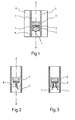
- Fig. 1 shows an arrangement for manufacturing an idiomorphic large diamond single crystal by a known process.
- Components including a diamond seed crystal 1, a solvent metal 2, and a carbon source 3 are arranged in layers in a cylindrical heater 5 interposing a pressure medium 4 of, for example, sodium chloride between the heater and the components.
- the carbon source is arranged at the portion of the higher temperature, generally, at the central portion (in the direction of the axis A-A') and the seed crystal at the portion of the lower temperature in this arrangement, generally, at the portion apart from the center.
- a pressure medium cylinder 6 made of, for example, pyrophylite, etc., which is housed in a superhigh pressure and temperature device. After being pressurized up to a predetermined pressure, they are heated by the heater 5.
- a solvent metal having a diameter larger than that of the growing diamond is used, so that an idiomorphic diamond having smooth surfaces may be obtained.
- This invention has been derived from the finding that, if the diameter of solvent metal is limited to less than the size of the idiomorphic diamond crystal which could be obtained at those conditions, i.e., the pressure, temperature and the carbon concentration in the metal, the diamond obtained has the same outside profile as that of the solvent metal, and has outer surfaces presenting a novel and industrially useful surface condition.
- the surface has a surface texture having a macro projection value (by ASTM) of not more than about 0.5 mm, usually, not more than 0.1 mm.
- the shape of the diamond single crystal of the present invention is not limited to a special shape.
- the diamond may have a variety of cross sections in the direction perpendicular to the axis A-A', such as circle, a polygon, such as triangle, tetragon;or special form including star-shape, etc. as shown in Figs. 10 to 13.
- the polygonal cross section may be such that at least one of angles forms a circular arc.
- the length I (in the direction of the axis A-A') is longer than the diameter of the cross section D, more preferably I?1.5 D.
- the diameter D in the cases of Figs. 11 to 13
- equivalent diameter refers to both “diameter” and “equivalent diameter”).
- a diamond crystal having a predetermined shape for example, as shown in Fig. 10, 11, 12 or 13
- solvent metal having the same shape of the cross section as that of the aimed, predetermined shape is used.
- a seed crystal should be put at the center of the cross section of the end of the solvent metal where it contacts with the seed crystal.
- a solvent metal having a shape such that the crystal growth is suppressed only at a part of the side surface of the crystal is used, or the seed is placed at a position other than or apart from the center.
- the solvent metal has a rodlike shape as shown in Figs. 2 and 3.
- the length in the direction of the axis is not limited.
- a plate of the metal generally in the shape of a disk, which has a larger cross sectional area (in the direction perpendicular to the axis A-A') than that of the rodlike portion ("leg") at the end (top of Figs.) of the rodlike solvent metal so that it contacts with the carbon source.
- the ratio of the equivalent diameter of the plate to the equivalent diameter of the rodlike solvent metal is more than 1, preferably from 2 to 5, and the ratio of the equivalent diameter of the plate to the thickness of the plate is usually 2 to 7. Since the contact area of the solvent metal with the carbon source can be made to be wider than that of the end area of the rodlike solvent metal the amount of carbon dissolved into the metal from the source is greater than that of the solvent metal having no such plate.
- the diamond synthesized includes a great quantity of solvent metal as impurities, which may cause cracks in the diamond attached to the tool support or during operation. For this reason, a growing rate not more than 5 mg/h is preferable.
- the equivalent diameter of solvent metal to be used in the synthesis should be approximately 4 mm or less. Further experiments have indicated that a diameter no more than 3 mm is proper for a growing rate of 1 to 3 mg/h, and a diameter no more than 4 mm is preferable for a growing rate of more than 3 and up to 5 mg/h.
- the solvent metals used include known materials such as Fe, Ni, Co and alloys consisting principally of them.
- Useful alloy elements include Cr, Mn, AI, Ti, Zr and B.
- the conditions for growth of the crystal may be the same as in a conventional method.
- both the seed crystal portion and carbon source are under pressures and temperatures which permit diamond to be stable and that they are at temperatures at which the metal is able to be in a molten state and which is not less than the eutectic temperature for the solvent metal and carbon used. Good results may be obtained when the temperature difference between the seed crystal portion and the carbon source is kept in the range of 10°C to 50°C.
- the heating temperature is usually from about 1300 to 1600°C, and preferably 1400 to 1500°C
- the pressure is usually from 45 to 65 kbar, and preferably 50 to 60 kbar. These conditions are maintained until the crystal grows to the predetermined shape.
- the period of time for growth is generally about 10 to 100 hours.
- the heating is stopped, the reaction system was cooled to about lower than 500°C, and then the pressure is released. The crystal is then taken out of the arrangement.
- the position of the seed crystal at the position contacting with the solvent metal is optional so long as at least a part of the crystal can grow until it reaches the side surface (in Figs. 2 and 3 parallel to the axis A-A') of the solvent metal.
- the seed crystal is placed at the center of the cross sectional area of the solvent metal at the contacting position to obtain a crystal of which all side surfaces have a rough surface, in other words, to obtain a crystal of which crystal growth is suppressed at all side surfaces.
- the seed crystal face which contacts with the solvent metal may have a plane index of (1, 0, 0), (1,1,1) or (1, 0,1).
- two or more faces of a crystal may be contacted with the solvent metal.
- the top face of the crystal is comprised of the same two or more faces to form an edge or edges.
- the face of the side surface may be controlled by selecting the placing position of sides of the seed crystal with respect to the mutual relationship with the sides of the cross sectional shape of the end of the rodlike solvent metal.
- Fig. 2 shows an embodiment of this invention in which one cylindrical diamond single crystal is synthesized.
- a solvent metal 8 which has been formed to a cylindrical shape is used.
- Fig. 4 is the top plan view of the solvent metal.
- the diamond forming arrangement is charged into a superhigh pressure and temperature device to pressurise up to a predetermined pressure and to heat it to a predetermined temperature.
- the high pressure and the high temperature are held for at least a period of time until the growing diamond crystal reaches the side surface of the solvent metal. That is, the conditions are maintained until the growing diamond crystal reaches the contact surface of the solvent metal with the pressure medium.
- a cylindrical (rodlike) diamond as shown in Fig. 10 is obtained when the conditions are maintained for a sufficient period of time.
- the side surface of this cylindrical diamond is rough.
- a rodlike diamond single crystal according to this invention is allotromorphic. It may have an optional cross section such as a circular, triangular, polygonal, or star-shaped cross section.
- the dotted surfaces 10 in the figures represent the irregular condition on surfaces like ground glass.
- Rodlike diamonds having a triangular or tetragonal cross section as shown in Figs. 11 and 12 may be synthesized by the use of solvent metal having a shape as shown in Figs. 5 and 6. The longitudinal sectional views of these shapes are the same as Fig. 2.
- Fig. 3 shows the case where a plurality of rodlike diamonds are synthesized at a time.
- a solvent metal 9 having a form which has a top plan view as shown in Fig. 7, 8 or 9 is preferably used.
- the end of the thus obtained crystal does not form a plane surface as shown in Figs. 10-a, 11-13, but forms a convex surface as shown in Fig. 10-b.
- the diamond single crystal of this invention can be synthesized with the orientation previously selected toward the longitudinal direction (direction of the axis A-A'), so that the necessity for selecting the orientation as mentioned above may be eliminated, and the orientation suited to tools may be easily determined.
- it has an advantage that, when attached to a tool support by soldering or sintering, it has an adhesive strength higher than that of natural diamond having comparatively smooth surfaces because of the larger surface area of the diamond of the present invention due to a surface having irregularities like ground glass so that the chances of the diamonds falling off of the tool support during use are greatly reduced.
- Diamond dressers according to this invention are formed as shown, for example, in Figs. 16 and 17, by joining an artificial rodlike diamond 14 to a support 12 using a cementing material 13.
- an artificial rodlike diamond or diamonds 14 are embedded in a recess 15 provided at the end of the support 12 together with a cementing material 13 such as soldering material, powder sintering material, etc., and joined to the support 12 by heating to 800 to 1000°C.
- Fig. 16 shows a dresser using a single diamond
- Fig. 17 a dresser using a plurality of diamonds.
- a diamond bit according to this invention comprises rodlike synthetic diamonds 14 plated in a ring-shaped sintered matrix 16 being attached to a bit body 17, and joined to the bit body 17 through heat treatment using a soldering material or metal powder.
- the surfaces of said diamonds 14 may be plated with titanium, nickel, etc.
- the diamonds have a sufficient length preferably such that g1.5 D, and, in the case of polygonal diamonds, have long edges over the length, which permits the diamonds to be used to the last extremity resulting in a reduction in costs.
- diamonds of this invention can be embedded deep enough in tools because of their large length, and since they have an increased adhering strength because of their large surface area due to irregular faces, they are much less likely to fall off the support during use.
- metal plating treatment may be easily applied to them because of their rough surfaces.
- orientation of synthetic diamonds is determined at the time of synthesis, it requires no skill to determine the orientation, and it is possible to easily find the orientation in which superior resistance to wear is ensured.
- the diamond forming arrangement as shown in Fig. 2 was used.
- the seed crystal 1 was a synthetic diamond of about 400-600 pm.
- the solvent metal 8 was an alloy of 58 Fe-42 Ni which was worked to a shape having a circular leg as shown in Fig. 4.
- the leg was 2 mm in diameter and 4 mm long, and the top disk was 7 mm in diameter and 1 mm thick.
- the carbon source 3 was a mixture of 160 mg of graphite powder for spectrochemical analysis and 240 mg of synthetic diamond powder of 35-45 ⁇ m pressed to a disk 7 mm in diameter and 4 mm thick, which was placed on said top disk.
- a diamond forming arrangement was formed using a cylindrical graphite heater 5 and a pyropyylite pressure medium 6.
- the arrangement was pressurized up to 54 kbar at which diamond can remain stable using a superhigh pressure and temperature device.
- the heater 5 was used to hold the temperature at 1420°C for 20 hours. Releasing temperature and pressure in this order, a cylindrical synthetic diamond 2 mm in diameter and about 3.5 mm long was obtained.
- the diamond weighed about 30 mg, and was an opaque crystal having irregular outside peripheral surfaces like ground glass. It was found through the identification of the orientation of the crystal using the Laue method that the bottom of the cylinder was (100) as with the seed crystal.
- the solvent metal used was an alloy of Fe-5 AI having a leg with regular triangular cross section with 2 mm sides, as shown in Fig. 5.
- the face of the seed crystal selected for contact with the solvent metal was the face (111).
- the arrangement was held under 56 kbar and 1480°C for 15 hours.
- the other conditions were the same as in Example 1.
- a rodlike diamond having a triangular cross section as shown in Fig. 11 was obtained. It was about 3 mm long, and weighed about 15 mg, having opaque and irregular outer surfaces. It was found by means of the Laue method that the bottom of the triangular prism was (111).
- the arrangement as shown in Fig. 3 was used.
- the solvent metal 9 was pure Ni.
- Four square legs each of 2 mm sides and 5.5 mm length were formed, and a disk of 7 mm diameter and 1 mm thickness was placed on them as shown in Fig. 9.
- a diamond of 400-600 nm was ararnged as the seed crystal 1. Two of them took the face (100) as the seed crystal face, and the others (111).
- the arrangement was held under 56 kbar and 1400°C for 25 hours.
- the other conditions were the same as in Example 1.
- Four rodlike diamonds having a square cross section as shown in Fig. 12 were obtained. Two of the four were about 5 mm long, and the other two about 3.5 mm long. Each of them weighed about 70 mg or about 50 mg.
- the identification of the orientation of crystals indicated that the bottom faces of the longer crystals were (100), and those of the shorter ones (111).
- a rodlike diamond of about 100 mg having a triangular cross section was synthesized.
- the diamond was embedded in the recess 15 having a 6 mm diameter provided in a tool support 12 having a 10 mm diameter together with silver solder powder as in Fig. 16, and soldered to the support by heating to 900°C to make a dresser.
- the dresser When used in dressing a SiC grinding wheel, the dresser could be used without losing its sharpness until the portion projecting from the tool support had been worn out.
Landscapes
- Chemical & Material Sciences (AREA)
- Organic Chemistry (AREA)
- Engineering & Computer Science (AREA)
- Crystallography & Structural Chemistry (AREA)
- Materials Engineering (AREA)
- Metallurgy (AREA)
- Chemical Kinetics & Catalysis (AREA)
- Carbon And Carbon Compounds (AREA)
- Crystals, And After-Treatments Of Crystals (AREA)
Claims (14)
Applications Claiming Priority (4)
| Application Number | Priority Date | Filing Date | Title |
|---|---|---|---|
| JP110398/82 | 1982-06-25 | ||
| JP57110398A JPS593100A (ja) | 1982-06-25 | 1982-06-25 | 棒状ダイヤモンド単結晶及びその製造法 |
| JP141505/82 | 1982-08-13 | ||
| JP14150582A JPS5930668A (ja) | 1982-08-13 | 1982-08-13 | ダイヤモンドドレツサ− |
Publications (2)
| Publication Number | Publication Date |
|---|---|
| EP0099486A1 EP0099486A1 (de) | 1984-02-01 |
| EP0099486B1 true EP0099486B1 (de) | 1987-09-23 |
Family
ID=26450034
Family Applications (1)
| Application Number | Title | Priority Date | Filing Date |
|---|---|---|---|
| EP83106198A Expired EP0099486B1 (de) | 1982-06-25 | 1983-06-24 | Diamant-Einkristalle, Verfahren zu deren Herstellung und Werkzeuge zum Gebrauch derselben |
Country Status (3)
| Country | Link |
|---|---|
| US (2) | US4544540A (de) |
| EP (1) | EP0099486B1 (de) |
| DE (2) | DE99486T1 (de) |
Families Citing this family (38)
| Publication number | Priority date | Publication date | Assignee | Title |
|---|---|---|---|---|
| JPH01224039A (ja) * | 1988-03-03 | 1989-09-07 | Sumitomo Electric Ind Ltd | 立方晶窒化硼素p−n接合体の作製方法 |
| WO1989011897A1 (en) * | 1988-06-03 | 1989-12-14 | Massachusetts Institute Of Technology | Silicon dioxide films on diamond |
| US5006203A (en) * | 1988-08-12 | 1991-04-09 | Texas Instruments Incorporated | Diamond growth method |
| AU634601B2 (en) * | 1989-12-11 | 1993-02-25 | General Electric Company | Single-crystal diamond of very high thermal conductivity |
| CA2030049A1 (en) * | 1989-12-11 | 1991-06-12 | Thomas R. Anthony | Single-crystal diamond of very high thermal conductivity |
| JPH03278463A (ja) * | 1990-03-27 | 1991-12-10 | Canon Inc | ショットキーダイオードの形成方法 |
| JP2940099B2 (ja) * | 1990-08-09 | 1999-08-25 | 住友電気工業株式会社 | 高熱伝導性ダイヤモンド単結晶の合成方法 |
| GB9103691D0 (en) * | 1991-02-21 | 1991-04-10 | De Beers Ind Diamond | Radiation absorbers |
| US5429069A (en) * | 1991-07-11 | 1995-07-04 | Fang; Pao-Hsien | Method for growing diamond crystals utilizing a diffusion fed epitaxy |
| AU647941B2 (en) * | 1991-07-12 | 1994-03-31 | De Beers Industrial Diamond Division (Proprietary) Limited | Diamond synthesis |
| JPH08337498A (ja) * | 1995-04-13 | 1996-12-24 | Sumitomo Electric Ind Ltd | ダイヤモンド粒子、ダイヤモンド合成用粒子及び圧密体並びにそれらの製造方法 |
| US9221154B2 (en) | 1997-04-04 | 2015-12-29 | Chien-Min Sung | Diamond tools and methods for making the same |
| US7323049B2 (en) * | 1997-04-04 | 2008-01-29 | Chien-Min Sung | High pressure superabrasive particle synthesis |
| US7368013B2 (en) * | 1997-04-04 | 2008-05-06 | Chien-Min Sung | Superabrasive particle synthesis with controlled placement of crystalline seeds |
| US9868100B2 (en) | 1997-04-04 | 2018-01-16 | Chien-Min Sung | Brazed diamond tools and methods for making the same |
| US9238207B2 (en) | 1997-04-04 | 2016-01-19 | Chien-Min Sung | Brazed diamond tools and methods for making the same |
| US9463552B2 (en) | 1997-04-04 | 2016-10-11 | Chien-Min Sung | Superbrasvie tools containing uniformly leveled superabrasive particles and associated methods |
| US9409280B2 (en) | 1997-04-04 | 2016-08-09 | Chien-Min Sung | Brazed diamond tools and methods for making the same |
| US9199357B2 (en) | 1997-04-04 | 2015-12-01 | Chien-Min Sung | Brazed diamond tools and methods for making the same |
| US6616725B2 (en) | 2001-08-21 | 2003-09-09 | Hyun Sam Cho | Self-grown monopoly compact grit |
| US20060068691A1 (en) * | 2004-09-28 | 2006-03-30 | Kinik Company | Abrading tools with individually controllable grit and method of making the same |
| US20060128147A1 (en) * | 2004-12-09 | 2006-06-15 | Honeywell International Inc. | Method of fabricating electrically conducting vias in a silicon wafer |
| US8393934B2 (en) | 2006-11-16 | 2013-03-12 | Chien-Min Sung | CMP pad dressers with hybridized abrasive surface and related methods |
| US8622787B2 (en) * | 2006-11-16 | 2014-01-07 | Chien-Min Sung | CMP pad dressers with hybridized abrasive surface and related methods |
| US8398466B2 (en) * | 2006-11-16 | 2013-03-19 | Chien-Min Sung | CMP pad conditioners with mosaic abrasive segments and associated methods |
| US9724802B2 (en) | 2005-05-16 | 2017-08-08 | Chien-Min Sung | CMP pad dressers having leveled tips and associated methods |
| US9138862B2 (en) | 2011-05-23 | 2015-09-22 | Chien-Min Sung | CMP pad dresser having leveled tips and associated methods |
| US8678878B2 (en) | 2009-09-29 | 2014-03-25 | Chien-Min Sung | System for evaluating and/or improving performance of a CMP pad dresser |
| US7435296B1 (en) * | 2006-04-18 | 2008-10-14 | Chien-Min Sung | Diamond bodies grown on SiC substrates and associated methods |
| US20090286352A1 (en) * | 2006-04-18 | 2009-11-19 | Chien-Min Sung | Diamond Bodies Grown on SIC Substrates and Associated Methods |
| GB0704516D0 (en) * | 2007-03-08 | 2007-04-18 | Element Six Ltd | Diamond |
| TWI388402B (en) | 2007-12-06 | 2013-03-11 | Methods for orienting superabrasive particles on a surface and associated tools | |
| US8252263B2 (en) * | 2008-04-14 | 2012-08-28 | Chien-Min Sung | Device and method for growing diamond in a liquid phase |
| CN103221180A (zh) | 2010-09-21 | 2013-07-24 | 铼钻科技股份有限公司 | 具有基本平坦颗粒尖端的超研磨工具及其相关方法 |
| WO2012162430A2 (en) | 2011-05-23 | 2012-11-29 | Chien-Min Sung | Cmp pad dresser having leveled tips and associated methods |
| CN106163652B (zh) * | 2014-10-11 | 2019-02-01 | 河南飞孟金刚石工业有限公司 | 一种表面粗糙金刚石的合成方法 |
| CN107824128B (zh) * | 2017-10-31 | 2024-04-16 | 王国伟 | 一种双碳源合成人造金刚石制备装置及制备方法 |
| CN111304731A (zh) * | 2020-04-20 | 2020-06-19 | 河南黄河旋风股份有限公司 | 异形表面形貌金刚石单晶及其制造方法 |
Family Cites Families (12)
| Publication number | Priority date | Publication date | Assignee | Title |
|---|---|---|---|---|
| US3083080A (en) * | 1960-04-21 | 1963-03-26 | Gen Electric | Method for production of etched diamond |
| US3297407A (en) * | 1962-12-10 | 1967-01-10 | Gen Electric | Method of growing diamond on a diamond seed crystal |
| US3310501A (en) * | 1962-12-31 | 1967-03-21 | Gen Electric | Preparation of elongated needle-like diamond having electrically conductive properties |
| US3423177A (en) * | 1966-12-27 | 1969-01-21 | Gen Electric | Process for growing diamond on a diamond seed crystal |
| US3949062A (en) * | 1972-12-27 | 1976-04-06 | Leonid Fedorovich Vereschagin | Method for producing polycrystalline diamond aggregates of predetermined shape |
| ZA737322B (en) * | 1973-09-14 | 1975-04-30 | De Beers Ind Diamond | Diamond synthesis |
| US4122636A (en) * | 1973-09-14 | 1978-10-31 | Roy Alexander R | Synthetic RD diamond particles |
| US4287168A (en) * | 1975-01-27 | 1981-09-01 | General Electric Company | Apparatus and method for isolation of diamond seeds for growing diamonds |
| US4322396A (en) * | 1975-01-27 | 1982-03-30 | General Electric Company | High pressure reaction vessel for growing diamond on diamond seed and method therefor |
| JPS55136114A (en) * | 1979-02-08 | 1980-10-23 | De Beers Ind Diamond | Diamond grain to which metal is combined and its preparation |
| US4333986A (en) * | 1979-06-11 | 1982-06-08 | Sumitomo Electric Industries, Ltd. | Diamond sintered compact wherein crystal particles are uniformly orientated in a particular direction and a method for producing the same |
| JPS5826017A (ja) * | 1981-08-08 | 1983-02-16 | Sumitomo Electric Ind Ltd | ダイヤモンドの合成方法 |
-
1983
- 1983-06-22 US US06/506,935 patent/US4544540A/en not_active Expired - Fee Related
- 1983-06-24 DE DE198383106198T patent/DE99486T1/de active Pending
- 1983-06-24 DE DE8383106198T patent/DE3373788D1/de not_active Expired
- 1983-06-24 EP EP83106198A patent/EP0099486B1/de not_active Expired
-
1988
- 1988-10-11 US US07/255,249 patent/US4927619A/en not_active Expired - Fee Related
Also Published As
| Publication number | Publication date |
|---|---|
| EP0099486A1 (de) | 1984-02-01 |
| US4927619A (en) | 1990-05-22 |
| DE3373788D1 (en) | 1987-10-29 |
| DE99486T1 (de) | 1984-05-24 |
| US4544540A (en) | 1985-10-01 |
Similar Documents
| Publication | Publication Date | Title |
|---|---|---|
| EP0099486B1 (de) | Diamant-Einkristalle, Verfahren zu deren Herstellung und Werkzeuge zum Gebrauch derselben | |
| US5011515A (en) | Composite polycrystalline diamond compact with improved impact resistance | |
| CA2073613C (en) | Diamond synthesis | |
| US3233988A (en) | Cubic boron nitride compact and method for its production | |
| JP5759903B2 (ja) | 単結晶ダイヤモンドを製造するための高圧高温(hpht)方法 | |
| US4608226A (en) | Method of forming a diamond tooth insert for a drill bit and a diamond cutting element formed thereby | |
| JPS6121974A (ja) | 複合多結晶ダイヤモンド | |
| EP0290044A1 (de) | Herstellungsverfahren eines grossen Diamantes | |
| JPH0732985B2 (ja) | 研摩研削工具 | |
| US3596649A (en) | Abrasive tool and process of manufacture | |
| JPS6020804A (ja) | 高度の表面不規則部を備える多結晶ダイヤモンド体及びそれを製造する方法 | |
| JP4732169B2 (ja) | ダイヤモンド工具および単結晶ダイヤモンドの合成方法 | |
| TWI647299B (zh) | 立方氮化硼之官能化及製造其之方法 | |
| EP0391418B2 (de) | Diamant für Abrichtungsvorrichtung | |
| JPS5930668A (ja) | ダイヤモンドドレツサ− | |
| GB2044146A (en) | Manufacture of diamond and like tools | |
| JPH09150368A (ja) | ドレッサー用単結晶ダイヤモンドチップおよびダイヤモンドドレッサー | |
| US20150013234A1 (en) | Use of surface modified diamond to manufacture polycrystalline diamond | |
| JPS59214561A (ja) | 砥石ツル−イング用ダイヤモンドホイ−ル | |
| EP0014589B1 (de) | Verfahren zur Herstellung von Diamantteilchen und damit hergestelltes Schleifwerkzeug mit Metallbindung | |
| WO2014052068A1 (en) | Single crystal diamond or cbn featuring micro-fracturing during grinding | |
| JPH0442360B2 (de) | ||
| JP3885293B2 (ja) | ダイヤモンド圧子 | |
| JPH0712485B2 (ja) | 線引きダイス用素材および該素材を用いた線引きダイス | |
| JPS5879899A (ja) | ダイヤモンドの合成方法 |
Legal Events
| Date | Code | Title | Description |
|---|---|---|---|
| PUAI | Public reference made under article 153(3) epc to a published international application that has entered the european phase |
Free format text: ORIGINAL CODE: 0009012 |
|
| AK | Designated contracting states |
Designated state(s): BE DE FR GB NL |
|
| EL | Fr: translation of claims filed | ||
| DET | De: translation of patent claims | ||
| 17P | Request for examination filed |
Effective date: 19840405 |
|
| GRAA | (expected) grant |
Free format text: ORIGINAL CODE: 0009210 |
|
| AK | Designated contracting states |
Kind code of ref document: B1 Designated state(s): BE DE FR GB NL |
|
| REF | Corresponds to: |
Ref document number: 3373788 Country of ref document: DE Date of ref document: 19871029 |
|
| ET | Fr: translation filed | ||
| PLBE | No opposition filed within time limit |
Free format text: ORIGINAL CODE: 0009261 |
|
| STAA | Information on the status of an ep patent application or granted ep patent |
Free format text: STATUS: NO OPPOSITION FILED WITHIN TIME LIMIT |
|
| 26N | No opposition filed | ||
| REG | Reference to a national code |
Ref country code: GB Ref legal event code: 746 |
|
| PGFP | Annual fee paid to national office [announced via postgrant information from national office to epo] |
Ref country code: NL Payment date: 19920630 Year of fee payment: 10 |
|
| REG | Reference to a national code |
Ref country code: FR Ref legal event code: DL |
|
| PG25 | Lapsed in a contracting state [announced via postgrant information from national office to epo] |
Ref country code: NL Effective date: 19940101 |
|
| NLV4 | Nl: lapsed or anulled due to non-payment of the annual fee | ||
| PGFP | Annual fee paid to national office [announced via postgrant information from national office to epo] |
Ref country code: FR Payment date: 19950609 Year of fee payment: 13 |
|
| PGFP | Annual fee paid to national office [announced via postgrant information from national office to epo] |
Ref country code: GB Payment date: 19950613 Year of fee payment: 13 |
|
| PGFP | Annual fee paid to national office [announced via postgrant information from national office to epo] |
Ref country code: DE Payment date: 19950617 Year of fee payment: 13 |
|
| PGFP | Annual fee paid to national office [announced via postgrant information from national office to epo] |
Ref country code: BE Payment date: 19950809 Year of fee payment: 13 |
|
| PG25 | Lapsed in a contracting state [announced via postgrant information from national office to epo] |
Ref country code: GB Effective date: 19960624 |
|
| PG25 | Lapsed in a contracting state [announced via postgrant information from national office to epo] |
Ref country code: BE Effective date: 19960630 |
|
| BERE | Be: lapsed |
Owner name: SUMITOMO ELECTRIC INDUSTRIES LTD Effective date: 19960630 |
|
| GBPC | Gb: european patent ceased through non-payment of renewal fee |
Effective date: 19960624 |
|
| PG25 | Lapsed in a contracting state [announced via postgrant information from national office to epo] |
Ref country code: FR Effective date: 19970228 |
|
| PG25 | Lapsed in a contracting state [announced via postgrant information from national office to epo] |
Ref country code: DE Effective date: 19970301 |
|
| REG | Reference to a national code |
Ref country code: FR Ref legal event code: ST |