EP0107511A1 - Elektrisch leitfähige Keramik - Google Patents
Elektrisch leitfähige Keramik Download PDFInfo
- Publication number
- EP0107511A1 EP0107511A1 EP83306508A EP83306508A EP0107511A1 EP 0107511 A1 EP0107511 A1 EP 0107511A1 EP 83306508 A EP83306508 A EP 83306508A EP 83306508 A EP83306508 A EP 83306508A EP 0107511 A1 EP0107511 A1 EP 0107511A1
- Authority
- EP
- European Patent Office
- Prior art keywords
- weight
- ceramics
- electroconductive
- ingredient
- amount
- Prior art date
- Legal status (The legal status is an assumption and is not a legal conclusion. Google has not performed a legal analysis and makes no representation as to the accuracy of the status listed.)
- Granted
Links
- 239000000919 ceramic Substances 0.000 title claims abstract description 67
- PNEYBMLMFCGWSK-UHFFFAOYSA-N aluminium oxide Inorganic materials [O-2].[O-2].[O-2].[Al+3].[Al+3] PNEYBMLMFCGWSK-UHFFFAOYSA-N 0.000 claims abstract description 39
- 229910052593 corundum Inorganic materials 0.000 claims abstract description 22
- 239000000203 mixture Substances 0.000 claims abstract description 22
- 229910001845 yogo sapphire Inorganic materials 0.000 claims abstract description 22
- 238000000465 moulding Methods 0.000 claims abstract description 15
- 238000005245 sintering Methods 0.000 claims abstract description 13
- 229910003468 tantalcarbide Inorganic materials 0.000 claims abstract description 10
- 238000002156 mixing Methods 0.000 claims abstract description 8
- ATJFFYVFTNAWJD-UHFFFAOYSA-N Tin Chemical compound [Sn] ATJFFYVFTNAWJD-UHFFFAOYSA-N 0.000 claims abstract description 4
- 239000011230 binding agent Substances 0.000 claims abstract description 4
- 229910020968 MoSi2 Inorganic materials 0.000 claims abstract 3
- 229910004217 TaSi2 Inorganic materials 0.000 claims abstract 3
- 229910034327 TiC Inorganic materials 0.000 claims abstract 3
- 229910007948 ZrB2 Inorganic materials 0.000 claims abstract 3
- VWZIXVXBCBBRGP-UHFFFAOYSA-N boron;zirconium Chemical compound B#[Zr]#B VWZIXVXBCBBRGP-UHFFFAOYSA-N 0.000 claims abstract 3
- 229910052718 tin Inorganic materials 0.000 claims abstract 3
- QYEXBYZXHDUPRC-UHFFFAOYSA-N B#[Ti]#B Chemical compound B#[Ti]#B QYEXBYZXHDUPRC-UHFFFAOYSA-N 0.000 claims abstract 2
- 229910015425 Mo2B5 Inorganic materials 0.000 claims abstract 2
- 229910033181 TiB2 Inorganic materials 0.000 claims abstract 2
- 239000002245 particle Substances 0.000 claims description 25
- 238000000034 method Methods 0.000 claims description 11
- 229910026551 ZrC Inorganic materials 0.000 claims description 7
- 239000003630 growth substance Substances 0.000 claims description 4
- 150000002484 inorganic compounds Chemical class 0.000 claims description 4
- 229910010272 inorganic material Inorganic materials 0.000 claims description 4
- 239000000126 substance Substances 0.000 claims description 4
- VYPSYNLAJGMNEJ-UHFFFAOYSA-N Silicium dioxide Chemical compound O=[Si]=O VYPSYNLAJGMNEJ-UHFFFAOYSA-N 0.000 claims description 3
- 239000011261 inert gas Substances 0.000 claims description 3
- 150000001247 metal acetylides Chemical class 0.000 claims description 3
- 150000004767 nitrides Chemical class 0.000 claims description 3
- 230000000737 periodic effect Effects 0.000 claims description 3
- 229910021332 silicide Inorganic materials 0.000 claims description 3
- 229910052681 coesite Inorganic materials 0.000 claims description 2
- 229910052906 cristobalite Inorganic materials 0.000 claims description 2
- 239000002075 main ingredient Substances 0.000 claims description 2
- 229910052682 stishovite Inorganic materials 0.000 claims description 2
- 229910052905 tridymite Inorganic materials 0.000 claims description 2
- 239000004615 ingredient Substances 0.000 claims 9
- 229910004531 TaB Inorganic materials 0.000 claims 2
- 229910004166 TaN Inorganic materials 0.000 claims 2
- 229910010055 TiB Inorganic materials 0.000 claims 1
- 229910008322 ZrN Inorganic materials 0.000 claims 1
- 238000007731 hot pressing Methods 0.000 claims 1
- 239000000377 silicon dioxide Substances 0.000 claims 1
- 229910021354 zirconium(IV) silicide Inorganic materials 0.000 claims 1
- 239000000463 material Substances 0.000 abstract description 24
- 230000035939 shock Effects 0.000 abstract description 4
- 239000004020 conductor Substances 0.000 abstract description 2
- 238000000502 dialysis Methods 0.000 abstract description 2
- 239000003350 kerosene Substances 0.000 abstract description 2
- XLYOFNOQVPJJNP-UHFFFAOYSA-N water Substances O XLYOFNOQVPJJNP-UHFFFAOYSA-N 0.000 abstract description 2
- 229910004533 TaB2 Inorganic materials 0.000 abstract 1
- 239000000843 powder Substances 0.000 description 24
- 239000002131 composite material Substances 0.000 description 16
- 229910010293 ceramic material Inorganic materials 0.000 description 14
- XTDAIYZKROTZLD-UHFFFAOYSA-N boranylidynetantalum Chemical compound [Ta]#B XTDAIYZKROTZLD-UHFFFAOYSA-N 0.000 description 9
- NFFIWVVINABMKP-UHFFFAOYSA-N methylidynetantalum Chemical compound [Ta]#C NFFIWVVINABMKP-UHFFFAOYSA-N 0.000 description 7
- 239000011812 mixed powder Substances 0.000 description 6
- MTPVUVINMAGMJL-UHFFFAOYSA-N trimethyl(1,1,2,2,2-pentafluoroethyl)silane Chemical compound C[Si](C)(C)C(F)(F)C(F)(F)F MTPVUVINMAGMJL-UHFFFAOYSA-N 0.000 description 6
- 239000004372 Polyvinyl alcohol Substances 0.000 description 5
- NRTOMJZYCJJWKI-UHFFFAOYSA-N Titanium nitride Chemical compound [Ti]#N NRTOMJZYCJJWKI-UHFFFAOYSA-N 0.000 description 5
- OTCHGXYCWNXDOA-UHFFFAOYSA-N [C].[Zr] Chemical compound [C].[Zr] OTCHGXYCWNXDOA-UHFFFAOYSA-N 0.000 description 5
- 229920002451 polyvinyl alcohol Polymers 0.000 description 5
- MZLGASXMSKOWSE-UHFFFAOYSA-N tantalum nitride Chemical compound [Ta]#N MZLGASXMSKOWSE-UHFFFAOYSA-N 0.000 description 5
- ZVWKZXLXHLZXLS-UHFFFAOYSA-N zirconium nitride Chemical compound [Zr]#N ZVWKZXLXHLZXLS-UHFFFAOYSA-N 0.000 description 5
- 230000007423 decrease Effects 0.000 description 4
- WEAMLHXSIBDPGN-UHFFFAOYSA-N (4-hydroxy-3-methylphenyl) thiocyanate Chemical compound CC1=CC(SC#N)=CC=C1O WEAMLHXSIBDPGN-UHFFFAOYSA-N 0.000 description 3
- MCMNRKCIXSYSNV-UHFFFAOYSA-N Zirconium dioxide Chemical compound O=[Zr]=O MCMNRKCIXSYSNV-UHFFFAOYSA-N 0.000 description 3
- 238000005452 bending Methods 0.000 description 3
- YXTPWUNVHCYOSP-UHFFFAOYSA-N bis($l^{2}-silanylidene)molybdenum Chemical compound [Si]=[Mo]=[Si] YXTPWUNVHCYOSP-UHFFFAOYSA-N 0.000 description 3
- 230000006835 compression Effects 0.000 description 3
- 238000007906 compression Methods 0.000 description 3
- 238000001816 cooling Methods 0.000 description 3
- 238000010438 heat treatment Methods 0.000 description 3
- 230000014759 maintenance of location Effects 0.000 description 3
- 229910021344 molybdenum silicide Inorganic materials 0.000 description 3
- 238000003756 stirring Methods 0.000 description 3
- 229910021355 zirconium silicide Inorganic materials 0.000 description 3
- XKRFYHLGVUSROY-UHFFFAOYSA-N Argon Chemical compound [Ar] XKRFYHLGVUSROY-UHFFFAOYSA-N 0.000 description 2
- OKTJSMMVPCPJKN-UHFFFAOYSA-N Carbon Chemical compound [C] OKTJSMMVPCPJKN-UHFFFAOYSA-N 0.000 description 2
- 239000002253 acid Substances 0.000 description 2
- 239000000654 additive Substances 0.000 description 2
- 230000000996 additive effect Effects 0.000 description 2
- 150000001875 compounds Chemical class 0.000 description 2
- 230000002349 favourable effect Effects 0.000 description 2
- 229910002804 graphite Inorganic materials 0.000 description 2
- 239000010439 graphite Substances 0.000 description 2
- 239000011159 matrix material Substances 0.000 description 2
- 229910052751 metal Inorganic materials 0.000 description 2
- 239000002184 metal Substances 0.000 description 2
- HBMJWWWQQXIZIP-UHFFFAOYSA-N silicon carbide Chemical compound [Si+]#[C-] HBMJWWWQQXIZIP-UHFFFAOYSA-N 0.000 description 2
- IJGRMHOSHXDMSA-UHFFFAOYSA-N Atomic nitrogen Chemical compound N#N IJGRMHOSHXDMSA-UHFFFAOYSA-N 0.000 description 1
- 229920002134 Carboxymethyl cellulose Polymers 0.000 description 1
- RTAQQCXQSZGOHL-UHFFFAOYSA-N Titanium Chemical compound [Ti] RTAQQCXQSZGOHL-UHFFFAOYSA-N 0.000 description 1
- QCWXUUIWCKQGHC-UHFFFAOYSA-N Zirconium Chemical compound [Zr] QCWXUUIWCKQGHC-UHFFFAOYSA-N 0.000 description 1
- RYKWKNGQFAVABI-UHFFFAOYSA-N [B].[B].[B].[B].[B].[Mo].[Mo] Chemical compound [B].[B].[B].[B].[B].[Mo].[Mo] RYKWKNGQFAVABI-UHFFFAOYSA-N 0.000 description 1
- 229910052786 argon Inorganic materials 0.000 description 1
- MANYRMJQFFSZKJ-UHFFFAOYSA-N bis($l^{2}-silanylidene)tantalum Chemical compound [Si]=[Ta]=[Si] MANYRMJQFFSZKJ-UHFFFAOYSA-N 0.000 description 1
- LGLOITKZTDVGOE-UHFFFAOYSA-N boranylidynemolybdenum Chemical compound [Mo]#B LGLOITKZTDVGOE-UHFFFAOYSA-N 0.000 description 1
- 230000007547 defect Effects 0.000 description 1
- 238000010586 diagram Methods 0.000 description 1
- 229910001873 dinitrogen Inorganic materials 0.000 description 1
- DTDCCPMQHXRFFI-UHFFFAOYSA-N dioxido(dioxo)chromium lanthanum(3+) Chemical compound [La+3].[La+3].[O-][Cr]([O-])(=O)=O.[O-][Cr]([O-])(=O)=O.[O-][Cr]([O-])(=O)=O DTDCCPMQHXRFFI-UHFFFAOYSA-N 0.000 description 1
- 239000007789 gas Substances 0.000 description 1
- 238000004519 manufacturing process Methods 0.000 description 1
- 238000002844 melting Methods 0.000 description 1
- 230000008018 melting Effects 0.000 description 1
- 150000002739 metals Chemical class 0.000 description 1
- 239000005078 molybdenum compound Substances 0.000 description 1
- 150000002752 molybdenum compounds Chemical class 0.000 description 1
- 230000003647 oxidation Effects 0.000 description 1
- 238000007254 oxidation reaction Methods 0.000 description 1
- 230000002265 prevention Effects 0.000 description 1
- 229910010271 silicon carbide Inorganic materials 0.000 description 1
- 150000003482 tantalum compounds Chemical class 0.000 description 1
- 229910052719 titanium Inorganic materials 0.000 description 1
- 239000010936 titanium Substances 0.000 description 1
- 150000003609 titanium compounds Chemical class 0.000 description 1
- 229910052726 zirconium Inorganic materials 0.000 description 1
- 150000003755 zirconium compounds Chemical class 0.000 description 1
Images

Classifications
-
- C—CHEMISTRY; METALLURGY
- C04—CEMENTS; CONCRETE; ARTIFICIAL STONE; CERAMICS; REFRACTORIES
- C04B—LIME, MAGNESIA; SLAG; CEMENTS; COMPOSITIONS THEREOF, e.g. MORTARS, CONCRETE OR LIKE BUILDING MATERIALS; ARTIFICIAL STONE; CERAMICS; REFRACTORIES; TREATMENT OF NATURAL STONE
- C04B35/00—Shaped ceramic products characterised by their composition; Ceramics compositions; Processing powders of inorganic compounds preparatory to the manufacturing of ceramic products
- C04B35/515—Shaped ceramic products characterised by their composition; Ceramics compositions; Processing powders of inorganic compounds preparatory to the manufacturing of ceramic products based on non-oxide ceramics
- C04B35/58—Shaped ceramic products characterised by their composition; Ceramics compositions; Processing powders of inorganic compounds preparatory to the manufacturing of ceramic products based on non-oxide ceramics based on borides, nitrides, i.e. nitrides, oxynitrides, carbonitrides or oxycarbonitrides or silicides
-
- C—CHEMISTRY; METALLURGY
- C04—CEMENTS; CONCRETE; ARTIFICIAL STONE; CERAMICS; REFRACTORIES
- C04B—LIME, MAGNESIA; SLAG; CEMENTS; COMPOSITIONS THEREOF, e.g. MORTARS, CONCRETE OR LIKE BUILDING MATERIALS; ARTIFICIAL STONE; CERAMICS; REFRACTORIES; TREATMENT OF NATURAL STONE
- C04B35/00—Shaped ceramic products characterised by their composition; Ceramics compositions; Processing powders of inorganic compounds preparatory to the manufacturing of ceramic products
- C04B35/01—Shaped ceramic products characterised by their composition; Ceramics compositions; Processing powders of inorganic compounds preparatory to the manufacturing of ceramic products based on oxide ceramics
- C04B35/10—Shaped ceramic products characterised by their composition; Ceramics compositions; Processing powders of inorganic compounds preparatory to the manufacturing of ceramic products based on oxide ceramics based on aluminium oxide
-
- C—CHEMISTRY; METALLURGY
- C04—CEMENTS; CONCRETE; ARTIFICIAL STONE; CERAMICS; REFRACTORIES
- C04B—LIME, MAGNESIA; SLAG; CEMENTS; COMPOSITIONS THEREOF, e.g. MORTARS, CONCRETE OR LIKE BUILDING MATERIALS; ARTIFICIAL STONE; CERAMICS; REFRACTORIES; TREATMENT OF NATURAL STONE
- C04B35/00—Shaped ceramic products characterised by their composition; Ceramics compositions; Processing powders of inorganic compounds preparatory to the manufacturing of ceramic products
- C04B35/01—Shaped ceramic products characterised by their composition; Ceramics compositions; Processing powders of inorganic compounds preparatory to the manufacturing of ceramic products based on oxide ceramics
- C04B35/10—Shaped ceramic products characterised by their composition; Ceramics compositions; Processing powders of inorganic compounds preparatory to the manufacturing of ceramic products based on oxide ceramics based on aluminium oxide
- C04B35/111—Fine ceramics
-
- C—CHEMISTRY; METALLURGY
- C04—CEMENTS; CONCRETE; ARTIFICIAL STONE; CERAMICS; REFRACTORIES
- C04B—LIME, MAGNESIA; SLAG; CEMENTS; COMPOSITIONS THEREOF, e.g. MORTARS, CONCRETE OR LIKE BUILDING MATERIALS; ARTIFICIAL STONE; CERAMICS; REFRACTORIES; TREATMENT OF NATURAL STONE
- C04B35/00—Shaped ceramic products characterised by their composition; Ceramics compositions; Processing powders of inorganic compounds preparatory to the manufacturing of ceramic products
- C04B35/515—Shaped ceramic products characterised by their composition; Ceramics compositions; Processing powders of inorganic compounds preparatory to the manufacturing of ceramic products based on non-oxide ceramics
- C04B35/56—Shaped ceramic products characterised by their composition; Ceramics compositions; Processing powders of inorganic compounds preparatory to the manufacturing of ceramic products based on non-oxide ceramics based on carbides or oxycarbides
-
- C—CHEMISTRY; METALLURGY
- C04—CEMENTS; CONCRETE; ARTIFICIAL STONE; CERAMICS; REFRACTORIES
- C04B—LIME, MAGNESIA; SLAG; CEMENTS; COMPOSITIONS THEREOF, e.g. MORTARS, CONCRETE OR LIKE BUILDING MATERIALS; ARTIFICIAL STONE; CERAMICS; REFRACTORIES; TREATMENT OF NATURAL STONE
- C04B35/00—Shaped ceramic products characterised by their composition; Ceramics compositions; Processing powders of inorganic compounds preparatory to the manufacturing of ceramic products
- C04B35/515—Shaped ceramic products characterised by their composition; Ceramics compositions; Processing powders of inorganic compounds preparatory to the manufacturing of ceramic products based on non-oxide ceramics
- C04B35/56—Shaped ceramic products characterised by their composition; Ceramics compositions; Processing powders of inorganic compounds preparatory to the manufacturing of ceramic products based on non-oxide ceramics based on carbides or oxycarbides
- C04B35/5607—Shaped ceramic products characterised by their composition; Ceramics compositions; Processing powders of inorganic compounds preparatory to the manufacturing of ceramic products based on non-oxide ceramics based on carbides or oxycarbides based on refractory metal carbides
-
- C—CHEMISTRY; METALLURGY
- C04—CEMENTS; CONCRETE; ARTIFICIAL STONE; CERAMICS; REFRACTORIES
- C04B—LIME, MAGNESIA; SLAG; CEMENTS; COMPOSITIONS THEREOF, e.g. MORTARS, CONCRETE OR LIKE BUILDING MATERIALS; ARTIFICIAL STONE; CERAMICS; REFRACTORIES; TREATMENT OF NATURAL STONE
- C04B35/00—Shaped ceramic products characterised by their composition; Ceramics compositions; Processing powders of inorganic compounds preparatory to the manufacturing of ceramic products
- C04B35/515—Shaped ceramic products characterised by their composition; Ceramics compositions; Processing powders of inorganic compounds preparatory to the manufacturing of ceramic products based on non-oxide ceramics
- C04B35/56—Shaped ceramic products characterised by their composition; Ceramics compositions; Processing powders of inorganic compounds preparatory to the manufacturing of ceramic products based on non-oxide ceramics based on carbides or oxycarbides
- C04B35/5607—Shaped ceramic products characterised by their composition; Ceramics compositions; Processing powders of inorganic compounds preparatory to the manufacturing of ceramic products based on non-oxide ceramics based on carbides or oxycarbides based on refractory metal carbides
- C04B35/5611—Shaped ceramic products characterised by their composition; Ceramics compositions; Processing powders of inorganic compounds preparatory to the manufacturing of ceramic products based on non-oxide ceramics based on carbides or oxycarbides based on refractory metal carbides based on titanium carbides
-
- C—CHEMISTRY; METALLURGY
- C04—CEMENTS; CONCRETE; ARTIFICIAL STONE; CERAMICS; REFRACTORIES
- C04B—LIME, MAGNESIA; SLAG; CEMENTS; COMPOSITIONS THEREOF, e.g. MORTARS, CONCRETE OR LIKE BUILDING MATERIALS; ARTIFICIAL STONE; CERAMICS; REFRACTORIES; TREATMENT OF NATURAL STONE
- C04B35/00—Shaped ceramic products characterised by their composition; Ceramics compositions; Processing powders of inorganic compounds preparatory to the manufacturing of ceramic products
- C04B35/515—Shaped ceramic products characterised by their composition; Ceramics compositions; Processing powders of inorganic compounds preparatory to the manufacturing of ceramic products based on non-oxide ceramics
- C04B35/56—Shaped ceramic products characterised by their composition; Ceramics compositions; Processing powders of inorganic compounds preparatory to the manufacturing of ceramic products based on non-oxide ceramics based on carbides or oxycarbides
- C04B35/5607—Shaped ceramic products characterised by their composition; Ceramics compositions; Processing powders of inorganic compounds preparatory to the manufacturing of ceramic products based on non-oxide ceramics based on carbides or oxycarbides based on refractory metal carbides
- C04B35/5622—Shaped ceramic products characterised by their composition; Ceramics compositions; Processing powders of inorganic compounds preparatory to the manufacturing of ceramic products based on non-oxide ceramics based on carbides or oxycarbides based on refractory metal carbides based on zirconium or hafnium carbides
-
- C—CHEMISTRY; METALLURGY
- C04—CEMENTS; CONCRETE; ARTIFICIAL STONE; CERAMICS; REFRACTORIES
- C04B—LIME, MAGNESIA; SLAG; CEMENTS; COMPOSITIONS THEREOF, e.g. MORTARS, CONCRETE OR LIKE BUILDING MATERIALS; ARTIFICIAL STONE; CERAMICS; REFRACTORIES; TREATMENT OF NATURAL STONE
- C04B35/00—Shaped ceramic products characterised by their composition; Ceramics compositions; Processing powders of inorganic compounds preparatory to the manufacturing of ceramic products
- C04B35/515—Shaped ceramic products characterised by their composition; Ceramics compositions; Processing powders of inorganic compounds preparatory to the manufacturing of ceramic products based on non-oxide ceramics
- C04B35/58—Shaped ceramic products characterised by their composition; Ceramics compositions; Processing powders of inorganic compounds preparatory to the manufacturing of ceramic products based on non-oxide ceramics based on borides, nitrides, i.e. nitrides, oxynitrides, carbonitrides or oxycarbonitrides or silicides
- C04B35/58007—Shaped ceramic products characterised by their composition; Ceramics compositions; Processing powders of inorganic compounds preparatory to the manufacturing of ceramic products based on non-oxide ceramics based on borides, nitrides, i.e. nitrides, oxynitrides, carbonitrides or oxycarbonitrides or silicides based on refractory metal nitrides
- C04B35/58014—Shaped ceramic products characterised by their composition; Ceramics compositions; Processing powders of inorganic compounds preparatory to the manufacturing of ceramic products based on non-oxide ceramics based on borides, nitrides, i.e. nitrides, oxynitrides, carbonitrides or oxycarbonitrides or silicides based on refractory metal nitrides based on titanium nitrides, e.g. TiAlON
-
- C—CHEMISTRY; METALLURGY
- C04—CEMENTS; CONCRETE; ARTIFICIAL STONE; CERAMICS; REFRACTORIES
- C04B—LIME, MAGNESIA; SLAG; CEMENTS; COMPOSITIONS THEREOF, e.g. MORTARS, CONCRETE OR LIKE BUILDING MATERIALS; ARTIFICIAL STONE; CERAMICS; REFRACTORIES; TREATMENT OF NATURAL STONE
- C04B35/00—Shaped ceramic products characterised by their composition; Ceramics compositions; Processing powders of inorganic compounds preparatory to the manufacturing of ceramic products
- C04B35/515—Shaped ceramic products characterised by their composition; Ceramics compositions; Processing powders of inorganic compounds preparatory to the manufacturing of ceramic products based on non-oxide ceramics
- C04B35/58—Shaped ceramic products characterised by their composition; Ceramics compositions; Processing powders of inorganic compounds preparatory to the manufacturing of ceramic products based on non-oxide ceramics based on borides, nitrides, i.e. nitrides, oxynitrides, carbonitrides or oxycarbonitrides or silicides
- C04B35/58007—Shaped ceramic products characterised by their composition; Ceramics compositions; Processing powders of inorganic compounds preparatory to the manufacturing of ceramic products based on non-oxide ceramics based on borides, nitrides, i.e. nitrides, oxynitrides, carbonitrides or oxycarbonitrides or silicides based on refractory metal nitrides
- C04B35/58028—Shaped ceramic products characterised by their composition; Ceramics compositions; Processing powders of inorganic compounds preparatory to the manufacturing of ceramic products based on non-oxide ceramics based on borides, nitrides, i.e. nitrides, oxynitrides, carbonitrides or oxycarbonitrides or silicides based on refractory metal nitrides based on zirconium or hafnium nitrides
-
- C—CHEMISTRY; METALLURGY
- C04—CEMENTS; CONCRETE; ARTIFICIAL STONE; CERAMICS; REFRACTORIES
- C04B—LIME, MAGNESIA; SLAG; CEMENTS; COMPOSITIONS THEREOF, e.g. MORTARS, CONCRETE OR LIKE BUILDING MATERIALS; ARTIFICIAL STONE; CERAMICS; REFRACTORIES; TREATMENT OF NATURAL STONE
- C04B35/00—Shaped ceramic products characterised by their composition; Ceramics compositions; Processing powders of inorganic compounds preparatory to the manufacturing of ceramic products
- C04B35/515—Shaped ceramic products characterised by their composition; Ceramics compositions; Processing powders of inorganic compounds preparatory to the manufacturing of ceramic products based on non-oxide ceramics
- C04B35/58—Shaped ceramic products characterised by their composition; Ceramics compositions; Processing powders of inorganic compounds preparatory to the manufacturing of ceramic products based on non-oxide ceramics based on borides, nitrides, i.e. nitrides, oxynitrides, carbonitrides or oxycarbonitrides or silicides
- C04B35/5805—Shaped ceramic products characterised by their composition; Ceramics compositions; Processing powders of inorganic compounds preparatory to the manufacturing of ceramic products based on non-oxide ceramics based on borides, nitrides, i.e. nitrides, oxynitrides, carbonitrides or oxycarbonitrides or silicides based on borides
- C04B35/58064—Shaped ceramic products characterised by their composition; Ceramics compositions; Processing powders of inorganic compounds preparatory to the manufacturing of ceramic products based on non-oxide ceramics based on borides, nitrides, i.e. nitrides, oxynitrides, carbonitrides or oxycarbonitrides or silicides based on borides based on refractory borides
-
- C—CHEMISTRY; METALLURGY
- C04—CEMENTS; CONCRETE; ARTIFICIAL STONE; CERAMICS; REFRACTORIES
- C04B—LIME, MAGNESIA; SLAG; CEMENTS; COMPOSITIONS THEREOF, e.g. MORTARS, CONCRETE OR LIKE BUILDING MATERIALS; ARTIFICIAL STONE; CERAMICS; REFRACTORIES; TREATMENT OF NATURAL STONE
- C04B35/00—Shaped ceramic products characterised by their composition; Ceramics compositions; Processing powders of inorganic compounds preparatory to the manufacturing of ceramic products
- C04B35/515—Shaped ceramic products characterised by their composition; Ceramics compositions; Processing powders of inorganic compounds preparatory to the manufacturing of ceramic products based on non-oxide ceramics
- C04B35/58—Shaped ceramic products characterised by their composition; Ceramics compositions; Processing powders of inorganic compounds preparatory to the manufacturing of ceramic products based on non-oxide ceramics based on borides, nitrides, i.e. nitrides, oxynitrides, carbonitrides or oxycarbonitrides or silicides
- C04B35/5805—Shaped ceramic products characterised by their composition; Ceramics compositions; Processing powders of inorganic compounds preparatory to the manufacturing of ceramic products based on non-oxide ceramics based on borides, nitrides, i.e. nitrides, oxynitrides, carbonitrides or oxycarbonitrides or silicides based on borides
- C04B35/58064—Shaped ceramic products characterised by their composition; Ceramics compositions; Processing powders of inorganic compounds preparatory to the manufacturing of ceramic products based on non-oxide ceramics based on borides, nitrides, i.e. nitrides, oxynitrides, carbonitrides or oxycarbonitrides or silicides based on borides based on refractory borides
- C04B35/58071—Shaped ceramic products characterised by their composition; Ceramics compositions; Processing powders of inorganic compounds preparatory to the manufacturing of ceramic products based on non-oxide ceramics based on borides, nitrides, i.e. nitrides, oxynitrides, carbonitrides or oxycarbonitrides or silicides based on borides based on refractory borides based on titanium borides
-
- C—CHEMISTRY; METALLURGY
- C04—CEMENTS; CONCRETE; ARTIFICIAL STONE; CERAMICS; REFRACTORIES
- C04B—LIME, MAGNESIA; SLAG; CEMENTS; COMPOSITIONS THEREOF, e.g. MORTARS, CONCRETE OR LIKE BUILDING MATERIALS; ARTIFICIAL STONE; CERAMICS; REFRACTORIES; TREATMENT OF NATURAL STONE
- C04B35/00—Shaped ceramic products characterised by their composition; Ceramics compositions; Processing powders of inorganic compounds preparatory to the manufacturing of ceramic products
- C04B35/622—Forming processes; Processing powders of inorganic compounds preparatory to the manufacturing of ceramic products
- C04B35/64—Burning or sintering processes
- C04B35/645—Pressure sintering
-
- F—MECHANICAL ENGINEERING; LIGHTING; HEATING; WEAPONS; BLASTING
- F23—COMBUSTION APPARATUS; COMBUSTION PROCESSES
- F23Q—IGNITION; EXTINGUISHING-DEVICES
- F23Q7/00—Incandescent ignition; Igniters using electrically-produced heat, e.g. lighters for cigarettes; Electrically-heated glowing plugs
- F23Q7/22—Details
-
- H—ELECTRICITY
- H01—ELECTRIC ELEMENTS
- H01B—CABLES; CONDUCTORS; INSULATORS; SELECTION OF MATERIALS FOR THEIR CONDUCTIVE, INSULATING OR DIELECTRIC PROPERTIES
- H01B1/00—Conductors or conductive bodies characterised by the conductive materials; Selection of materials as conductors
- H01B1/14—Conductive material dispersed in non-conductive inorganic material
-
- H—ELECTRICITY
- H01—ELECTRIC ELEMENTS
- H01C—RESISTORS
- H01C7/00—Non-adjustable resistors formed as one or more layers or coatings; Non-adjustable resistors made from powdered conducting material or powdered semi-conducting material with or without insulating material
- H01C7/02—Non-adjustable resistors formed as one or more layers or coatings; Non-adjustable resistors made from powdered conducting material or powdered semi-conducting material with or without insulating material having positive temperature coefficient
- H01C7/022—Non-adjustable resistors formed as one or more layers or coatings; Non-adjustable resistors made from powdered conducting material or powdered semi-conducting material with or without insulating material having positive temperature coefficient mainly consisting of non-metallic substances
-
- H—ELECTRICITY
- H05—ELECTRIC TECHNIQUES NOT OTHERWISE PROVIDED FOR
- H05B—ELECTRIC HEATING; ELECTRIC LIGHT SOURCES NOT OTHERWISE PROVIDED FOR; CIRCUIT ARRANGEMENTS FOR ELECTRIC LIGHT SOURCES, IN GENERAL
- H05B3/00—Ohmic-resistance heating
- H05B3/10—Heating elements characterised by the composition or nature of the materials or by the arrangement of the conductor
- H05B3/12—Heating elements characterised by the composition or nature of the materials or by the arrangement of the conductor characterised by the composition or nature of the conductive material
- H05B3/14—Heating elements characterised by the composition or nature of the materials or by the arrangement of the conductor characterised by the composition or nature of the conductive material the material being non-metallic
- H05B3/141—Conductive ceramics, e.g. metal oxides, metal carbides, barium titanate, ferrites, zirconia, vitrous compounds
Definitions
- This invention relates to an electroconductive ceramics having good electroconductivity and a process for the production of the ceramics.
- the materials such as silicon carbide (SiC), lanthanum chromate (ZaCro 3 ) and zirconia (Zr0 2 ) are known as electroconductive ceramic materials. These electroconductive ceramic materials, however, have a relatively high electrical resistance which does not become lower than about 10 -2 ⁇ cm even when heated at a temperature as high as 1,000°C. Also, these ceramic materials have a negative resistance-temperature characteristics, that is, their electrical resistance decreases as the temperature increases, so that when heated at a high temperature, they tend to cause a thermorunaway due to sharp increase of electric current, making the temperature control very difficult. Further, said ceramic materials are usually porous and hence low in mechanical strength.
- electroconductive ceramics comprising ZrB 2 , TiB 2 , TiN, ZrN, TaC, ZnC or etc. and a matrix of SiC is known. This is disclosed in Y . M atsushita et al U.S. Serial No. filed , 1983 (corresponding to Japanese Patent Application No. 89926/82.)
- the object of this invention is to provide novel electroconductive ceramics which is free of the abovementioned defects of conventional electroconductive ceramics and which has a high mechanical strength, a low electrical resistance and a positive resistance-temperature characteristic.
- the inventors have found out the materials which can realize the object of this invention by comprising alumina (A1 2 0 3 ) ceramics and the specified electroconductive substances having a positive resistance-temperature coefficient.
- an electroconductive sintered ceramics which comprises, as main ingredients thereof, (a) alumina only or aluminous ceramics containing 95% by weight or more of A1 2 0 3 , and (b) an inorganic compound which exhibits a positive resistance-temperature coefficient, and a process for producing an electroconductive sintered ceramics, which comprise mixing (a) alumina only or aluminous ceramics containing 95% by weight or more of Al 2 O 3 , and (b) an inorganic compound which exhibits a positive resistance-temperature coefficient, adding to the mixture a molding binder, molding the mixture into a desired shape, and sintering the molding under vacuum or in an inert gas.
- an electroconductive ceramics is provided by dispersing an electroconductive non-oxide material having the properties analogous to those of metals into alumina only or into an aluminous ceramic ph ' se mainly composed of Al 2 O 3 , and densely sintering the mixture.
- electroconductive substances having a positive resistance-temperature coefficient are not effective in this invention.
- an electroconductive ceramics containing a metal powder added thereto has a desired resistance-temperature characteristic but it is poor in oxidation resistance at a high temperature. Therefore, such electroconductive ceramics is not suitable as a heater material for a glow plug.
- the electroconductive non-oxide material used in this invention there can be employed carbides, nitrides, borides and silicides of Groups IVa and Va of the Periodic Table, for example, zirconium compounds such as zirconium boride (ZrB 2 ), zirconium carbide (ZrC), zirconium nitride (ZrN) and zirconium silicide (ZrSi 2 ), tantalum compounds such as tantalum boride (TaB 2 ), tantalum carbide (TaC), tantalum nitride (TaN), tantalum silicide (TaSi 2 ), and titanium compounds such as titanium boride (TiB 2 ), titanium carbide (TiC) and titanium nitride (TiN), and molybdenum compounds such as molybdenum boride (Mo2B 5 ) and molybdenum silicide (MoSi 2 ) ' These compounds are suitable for use
- alumina is known as a typical ceramic material having a negative resistance-temperature coefficient (-4.995 x deg -1 ⁇ 10 3 ).
- the abovementioned electroconductive materials have a melting point of not lower than 2,000°C and a resistivity of not higher than 10 -4 ⁇ cm.
- the addition of the abovementioned electroconductive materials having a positive resistance-temperature coefficient to alumina or aluminons ceramics allows the alumina or aluminous ceramics, which is inherently electrically insulative, to exhibit electrical conductivity. That is, the use of the electroconductive ceramics as a heater material prevents the generation of out-of-control current and makes it easy to control current and maintain the superficial temperature of a heater constantly.
- a sintering aid for alumina and a particle growth regulator in a total amount not exceeding 5% by weight based on the amount of Al 2 O 3 .
- the sintering aid there may be used, for example, at least one of MgO, Si0 2 , CaO, Li 2 0, Tio 2 and etc., and as the particle growth regulator, one may use MgO.
- alumina has a high heat resistance, a high mechanical strength and an excellent acid resistance and also its thermal expansion coefficient is either almost equal to or relatively close to those of said compounds used as the electroconductive material in this invention, such as ZrB 2 , ZrC, ZrN, ZrSi 2 , TaB 2 , TaC, TaN, TaSi 2 , TiB 2 , TiC, TiN, Mo 2 B 5 and MoSi 2 , so that alumina provides a best combination with said electroconductive material, and also when, for instance, the product of this invention is used as a high-temperature heater material, it exhibits a high endurance against heat shock given when instantaneously red heated by supplying electric current.
- the electroconductive ceramics according to this invention can be produced, for example, by first mixing an Al 2 0 3 powder with such an electroconductive material as mentioned above in amounts of 5-70 parts by weight and 30-95 parts by weight, respectively, adding thereto a molding binder such as carboxymethyl cellulose (CMC) or polyvinyl alcohol (PVA), preferably in an amount of 10-20 parts by weight, molding the mixture into a desired shape, and sintering the molding under vacuum or in an inert gas such as argon or nitrogen gas at a temperature within the range of 1,400 to 1,700°C, preferably 1500 to 1600°C, to form a sintered body having a theoretical relative density not less than 80%, especially above 90%.
- a molding binder such as carboxymethyl cellulose (CMC) or polyvinyl alcohol (PVA)
- CMC carboxymethyl cellulose
- PVA polyvinyl alcohol
- the amount of alumina or aluminous ceramics mainly composed of A1 2 0 3 and the amount of an electroconductive material mixed are defined as being in the abovementioned proportion for the following reasons: if the amount of the electroconductive material mixed is less than 30 parts by weight, the electrical resistivity of the produced ceramics will be greater than 1 ⁇ cm and also the resistance-temperature coefficient of the ceramics will be negative, while if the amount of said electroconductive material mixed exceeds 95% by weight, the produced ceramics will prove poor in their properties such as mechanical strength and heat shock resistance.
- the electroconductive composite ceramics having a desired resistivity within the range of 10 3 to 10 -5 ⁇ cm by properly adjusting the amount of the electroconductive material mixed.
- the ceramics has a positive resistance-temperature characteristic so that they have no fear of fusing due to current runaway, i.e., due to generation of out-of-control current, even when brought into a red hot state.
- the ceramics of this invention has a high density and a high mechanical strength and are also excellent in endurance to repeated supply of electric current and in thermal shock resistance.
- the electroconductive ceramics of this invention finds a wide scope of uses; for example, it can be applied to various types of heaters, glow plug heaters or electrical gas ignitors by making use of its quickly heated character, kerosine gasifying burners, electrodes for use in chemical industries, for example, electrodes for water processing or dialysis, electrodes or conductors for high-temperature uses, etc.
- An A1 2 0 3 powder having an average particle size of 0.5 ⁇ m and a ZrB 2 powder having an average particle size of 2 ⁇ m were mixed in various ratios, and to each mixture was added a 3% PVA solution in an amount of 10% based on the whole amount of the mixture, followed by mixing by a stirring kneader. Then the mixed powder was molded under a pressure of 1,000 kg/cm 2 . This molding was then placed in a graphite-made die and subjected to hot press sintering under a vacuum of 10 -3 to 10 -5 Torr under the conditions of 200 kg/cm 2 , 1,700°C and 1 hour.
- the thus obtained Al 2 O 3 /ZrB 2 composite ceramics was the dense sintered bodies having a theoretical relative density above 95%.
- the relation between the resistivity of the ceramics and the amount of ZrB 2 was found as shown by curve A in FIG. 1. From FIG . 1 it is found possible to obtain the ceramics having a desired resistivity within the range of 10 3 to 10 -5 ⁇ cm by properly selecting the mixing amount of ZrB 2 not less than 20 parts by weight.
- the resistance-temperature coefficient as determined from the resistivity/temperature relation of the ceramics was found as shown by curve D in FIG. 2, which indicates that the ceramics has a positive resistance-temperature coefficient when the amount of ZrB 2 mixed is greater than about 30 parts by weight.
- ZrC and ZrN powders each having an average particle size of 2 ⁇ m
- each was mixed in various amounts with Al 2 0 3 as used in Example 1, and the mixtures were molded and hot-press sintered under the same conditions as in Example 1 to prepare the A1 2 0 3 -ZrC and Al 2 O 3 -ZrN composite ceramics.
- the relation between the resistivity and mixed amount of electroconductive material of both the types of composite ceramics was substantially as shown by curve A in FIG. 1. Also, the ceramics having a positive resistance-temperature characteristic could be obtained when the mixed amount of ZrC or ZrN was greater than about 30 parts by weight as in the case of Example 1.
- an Al 2 O 3 powder (average particle size: 0.5 ⁇ m) and 50 parts by weight of a ZrB 2 powder (average particle size: 2 ⁇ m) were mixed, and to this mixture were added an A1N powder (average particle size: 2 ⁇ m) and an MgO powder (average particle size: 2 ⁇ m) in amounts of 2% by weight and 0.5% by weight, respectively, based on the total amount of the mixture.
- the mixed powder was compression molded under 1,000 kg/cm 2 and then hot press sintered under the conditions of 200 kg/cm 2 , 1,600°C and one hour (retention time) to form a composite ceramic material.
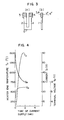
- a U-shaped heater (resistance: 0.1 ⁇ ; resistivity: 4 x 10 -3 Qcm) such as shown in FIG. 3(a) and (b) was made by using the electroconductive ceramic material obtained in Example 3.
- the heater terminal voltage V H current I H and the temperature T H of a heater end (5) - this portion is red heated - at the time of application of a DC voltage of 12 V to the terminals 3 and 4 of this heater are shown in FIG. 4.
- the heater end temperature rose to 900°C in about 0.7 second, 1,200°C in about one second and 1,500°C in about 1.5 second, indicating the quickly heated character of the heater.
- the heater according to this Example showed absolutely no change of resistivity even after 100,000 times repeated current supply, each cycle consisting of 2-second application of DC voltage of 8V to the heater (during this period, the heater temperature reaches 1,100°C maximum) and 10-second pause of the application (during this period, forced air cooling is made).
- the heater had very excellent endurance to repeated current supply and could well stand quick and intermittent heating from room temperature to 1,100°C.
- An Al203 powder having an average particle size of 0.5 ⁇ m and a TaB 2 powder having an average particle size of 2 ⁇ m were mixed in various ratios, and each mixture was further added with a 3% PVA solution in an amount of 10% based on the whole amount of the mixture and mixed by a stirring kneader. Then the mixed powder was molded under a pressure of 1,000 kg/cm 2 , and this molding was placed in a graphite die and hot press sintered under a vacuum of 10 -3 to 10 -5 Torr under the conditions of 200 kg/cm 2 , 1,700°C and one hour. Each of the thus obtained A1 2 0 3/ TaB 2 composite ceramics was a dense sintered body having a relative density above 95%.
- the relation between the resistivity of the ceramics and the mixed amount of TaB 2 was indicated as shown by curve B in FIG. 1. It is thus found possible to obtain the ceramics having a desired resistivity within the range of 10 3 to 10 -5 ⁇ cm by selecting the mixed amount of TaB 2 greater than 20 parts by weight. Also, the resistance-temperature coefficient of the ceramics as determined from the relation between the ceramic resistivity and temperature was indicated as shown by curve C in FIG. 2, which teaches that the ceramics have a positive resistance-temperature coefficient in the region where the mixed amount of TaB 2 is greater than about 30 parts by weight.
- a TaC or TaN powder (each having an average particle size of 2 ⁇ m) was mixed in various amounts with an Al 2 O 3 powder as used in Example 1, and the mixtures were molded and hot press sintered under the same conditions as in Example 1 to make the Al 2 O 3 /TaC and Al 2 O 3 /TaN composite ceramics.
- the relation between the resistivity and mixed amount of electroconductive material of both the types of composite ceramics was substantially as shown by curve B in FIG. 1.
- a ceramics having a positive resistance-temperature coefficient was obtained by mixing TaC or TaN in a greater amount than about 30 parts by weight as in the case of Example 5.
- an Al 2 O 3 powder (average particle size: 0.5 ⁇ m) and 50 parts by weight of a TaB 2 powder (average particle size: 2 ⁇ m) were mixed, and to this mixture were added an Al203 powder (average particle size: 2 ⁇ m) and an MgO powder (average particle size: 2 ⁇ m) in amounts of 2% by weight and 0.5% by weight, respectively, based on the total amount of the mixture, and the mixed powder was compression molded under 1,000 kg/cm 2 and then hot press sintered under the conditions of 200 kg/cm 2 , 1,600°C and one hour (retention time) to form a composite ceramic material.
- This composite ceramic material had a relative density of 95%, a resistivity of 5 x 10 -3 ⁇ cm at room temperature, a resistance-temperature coefficient (20-500°C) of + 1.5%/°C and a bending strength of 20 kg/cm 2 . It was thus dense, high in mechanical strength and low in electrical resistance and hence well electroconductive.
- a U-shaped heater (resistance: 0.1 ⁇ ; resistivity: 4.x 10 -3 ⁇ cm) by using the electroconductive ceramic material obtained in Example 7.
- the heater terminal voltage V H , current I H and heater end temperature T H at the time of application of a DC voltage of 12 V to the heater terminals 3 and 4 are shown in FIG. 4, from which it will be seen that the heater end temperature rose to 900°C in about 0.7 second, 1,200°C in about one second and 1,500°C in about 1.5 second, which indicates the quickly heated character of the heater.
- the heater according to this Example showed no change of resistivity even after continuous 100,000 times repeated current supply, each cycle consisting of 2-second application of DC 8 V to the heater (during this period, the heater temperature reaches 1,100°C maximum) and 10-second pause of the application (during this period, forced air cooling is made).
- this heater has excellent endurance to repeated current supply and can withstand quick and intermittent heating from room temperature to 1,100°C.
- An Al 2 O 3 powder having an average particle size of 0.5 ⁇ m and a TiB 2 powder having an average particle size of 2 ⁇ m were mixed in various ratios, and each mixture was added with a 3% PVA solution in an amount of 10% based on the total amount of the mixture and mixed by a stirring kneader. Then the mixed powder was molded under 1,000 kg/cm 2 , and the molding was placed in a graphite die and subjected to hot press sintering under a vacuum of 10 -3 to 10 -5 Torr under the conditions of 200 kg/cm 2 , 1,700°C and one hour.
- Each of the resultant A1 2 0 3 /TiB 2 composite ceramics was a dense sintered body having a relative density of 95%.
- the relation between the resistivity of the ceramics and mixed amount of TiB 2 was indicated as shown by curve A in FIG. 1. It is thus found possible to obtain the ceramics having a desired resistivity within the range of 10 3 to 10 -5 ⁇ cm by properly selecting the mixed amount of TiB 2 not less than 20 parts by weight.
- the resistance-temperature coefficient as determined from the relation between the ceramic resistivity and temperature was as shown by curve E in FIG. 2, from which it is noted that the ceramics have a positive resistance-temperature coefficient when the amount of TiB 2 mixed is more than about 30 parts by weight.
- a TiC or TiN powder (each having an average particle size of 2 ⁇ m) was mixed in various amounts with an Al 2 O 3 powder as used in Example 9, and the mixtures were molded and hot press sintered under the same conditions as in Example 9 to produce the A1 2 0 3 /TiC and Al 2 O 3 /TiN composite ceramics.
- the relation between the resistivity and mixed amount of the electroconductive material in both the types of composite ceramics was substantially as shown by curve A in FIG. 1.
- the ceramics having a positive resistance-temperature characteristic was obtained by mixing TiC or TiN in an amount greater than about 30 parts by weight as in the case of Example 9.
- This composite ceramic material had a relative density of 95%, a resistivity of 2.5 x 10 -3 ⁇ cm at room temperature, a resistance-temperature coefficient (20-500°C) of + 2.5%/°C and a bending strength of 25 kg/mm2. It was thus dense, high in mechanical strength and low in electrical resistance.
- a U-shaped heater (resistance: 0.1 ⁇ ; resistivity: 4 x 10 -3 ⁇ cm) such as shown in FIG. 3 was made by using the electroconductive ceramic material obtained in Example 11.
- the heater terminal voltage V H , current I H and heater end temperature T H at the time of application of DC 12 V to the heater terminals 3 and 4 were shown in FIG. 4.
- the heater end temperature rose to 900°C in about 0.7 second, 1,200°C in about one second and 1,500°C in about 1.5 second, indicating the quickly heated character of this heater.
- This heater also had a positive resistance-temperature characteristic, that is, the current applied to the heater decreases as the heater temperature increases upon connection to power. This property is found especially advantageous in use of the material of this invention as a heater because such property is helpful to prevent fusing of the heater and other troubles due to thermorunaway.
- the heater according to this Example showed no change of resistivity even after continuous 100,000 times repeated current supply, each cycle consisting of 2-second application of DC 8 V to the heater (during this period, the heater temperature reaches 1,100°C maximum) and 10-second pause of the application (during this period, forced air cooling is made).
- this heater is excellent in endurance to repeated current supply and can withstand quick and intermittent heating from room temperature to 1,100°C.
Landscapes
- Engineering & Computer Science (AREA)
- Chemical & Material Sciences (AREA)
- Ceramic Engineering (AREA)
- Manufacturing & Machinery (AREA)
- Materials Engineering (AREA)
- Structural Engineering (AREA)
- Organic Chemistry (AREA)
- Inorganic Chemistry (AREA)
- Microelectronics & Electronic Packaging (AREA)
- Dispersion Chemistry (AREA)
- Mechanical Engineering (AREA)
- General Engineering & Computer Science (AREA)
- Physics & Mathematics (AREA)
- Electromagnetism (AREA)
- Combustion & Propulsion (AREA)
- Ceramic Products (AREA)
- Resistance Heating (AREA)
- Compositions Of Oxide Ceramics (AREA)
- Conductive Materials (AREA)
Applications Claiming Priority (2)
| Application Number | Priority Date | Filing Date | Title |
|---|---|---|---|
| JP57187598A JPS5978973A (ja) | 1982-10-27 | 1982-10-27 | 導電性セラミツクス |
| JP187598/82 | 1982-10-27 |
Publications (2)
| Publication Number | Publication Date |
|---|---|
| EP0107511A1 true EP0107511A1 (de) | 1984-05-02 |
| EP0107511B1 EP0107511B1 (de) | 1988-01-20 |
Family
ID=16208907
Family Applications (1)
| Application Number | Title | Priority Date | Filing Date |
|---|---|---|---|
| EP83306508A Expired EP0107511B1 (de) | 1982-10-27 | 1983-10-26 | Elektrisch leitfähige Keramik |
Country Status (5)
| Country | Link |
|---|---|
| US (1) | US4528121A (de) |
| EP (1) | EP0107511B1 (de) |
| JP (1) | JPS5978973A (de) |
| KR (1) | KR840006543A (de) |
| DE (1) | DE3375437D1 (de) |
Cited By (8)
| Publication number | Priority date | Publication date | Assignee | Title |
|---|---|---|---|---|
| EP0190557A1 (de) * | 1985-01-11 | 1986-08-13 | Nippondenso Co., Ltd. | Keramisches Heizelement |
| EP0252831A1 (de) * | 1986-07-08 | 1988-01-13 | Commissariat A L'energie Atomique | Hochtemperaturheizelement |
| EP0332082A3 (de) * | 1988-03-07 | 1991-06-05 | Hitachi, Ltd. | Leitfähiges Material und Verfahren zu seiner Herstellung |
| WO1997006118A1 (de) * | 1995-08-03 | 1997-02-20 | Nimtz Guenter | Elektrokeramischer werkstoff mit einstellbarer elektrischer leitfähigkeit |
| EP0798949A3 (de) * | 1996-03-29 | 1998-09-09 | Ngk Spark Plug Co., Ltd | Keramisches Heizelement |
| US7120695B2 (en) | 2001-08-23 | 2006-10-10 | Telefonaktiebolaget Lm Ericsson (Publ) | Method for limiting conveyance information of user profile within mobile Internet transactions |
| EP1846697A4 (de) * | 2005-02-05 | 2009-08-12 | Saint Gobain Ceramics | Keramische zünder |
| CN112930027A (zh) * | 2021-01-18 | 2021-06-08 | 成都宏科电子科技有限公司 | 白色氧化铝陶瓷基板金属化的填孔钨浆料及其制备方法 |
Families Citing this family (48)
| Publication number | Priority date | Publication date | Assignee | Title |
|---|---|---|---|---|
| US4647405A (en) * | 1983-09-06 | 1987-03-03 | Eltech Systems Corporation | Boride-alumina composite |
| US4678760A (en) * | 1984-04-27 | 1987-07-07 | Aluminum Company Of America | Method of forming a substantially interwoven matrix containing a refractory hard metal and a metal compound |
| US4636481A (en) * | 1984-07-10 | 1987-01-13 | Asahi Glass Company Ltd. | ZrB2 composite sintered material |
| JPS61111969A (ja) * | 1984-11-05 | 1986-05-30 | 住友電気工業株式会社 | 放電加工可能な導電性窒化珪素焼結体およびその製造方法 |
| US4645621A (en) * | 1984-12-17 | 1987-02-24 | E. I. Du Pont De Nemours And Company | Resistor compositions |
| JPH062615B2 (ja) * | 1984-12-29 | 1994-01-12 | ティーディーケイ株式会社 | 磁気ヘツドスライダ材料 |
| JPS62158161A (ja) * | 1985-12-28 | 1987-07-14 | 日本タングステン株式会社 | セラミツク発熱素子 |
| JPS62265177A (ja) * | 1986-05-14 | 1987-11-18 | 日立金属株式会社 | 導電性サイアロン焼結体およびその製造方法 |
| JPH02107572A (ja) * | 1988-01-28 | 1990-04-19 | Hitachi Metals Ltd | 導電性サイアロン焼結体とヒータ |
| DE3830174A1 (de) * | 1988-09-06 | 1990-03-15 | Geesthacht Gkss Forschung | Leitfaehige oberflaechenschicht |
| US5094711A (en) * | 1988-09-12 | 1992-03-10 | Gte Valenite Corporation | Process for producing single crystal titanium carbide whiskers |
| JPH04502749A (ja) * | 1989-06-30 | 1992-05-21 | インスティトゥト ストルクトゥルノイ マクロキネティキ アカデミー ナウク エスエスエスアール | セラミック複合材料およびその製造方法 |
| JPH03126659A (ja) * | 1989-10-11 | 1991-05-29 | Onoda Cement Co Ltd | 超硬質セラミックス |
| IT1239221B (it) * | 1990-02-19 | 1993-09-28 | Keramont Italia | Composizioni ceramiche refrattarie ed elettroconduttrici e procedimento per la loro preparazione |
| US5063182A (en) * | 1990-08-31 | 1991-11-05 | The United States Of America As Represented By The United States Department Of Energy | Zirconia-molybdenum disilicide composites |
| US5177037A (en) * | 1991-05-21 | 1993-01-05 | Industrial Ceramic Technology, Inc. | High fracture toughness electro-discharge machineable ceramic whisker reinforced ceramic composites and tooling made therefrom |
| US5498855A (en) * | 1992-09-11 | 1996-03-12 | Philip Morris Incorporated | Electrically powered ceramic composite heater |
| US5324693A (en) * | 1992-10-13 | 1994-06-28 | Mitsubishi Materials Corporation | Ceramic composites and process for manufacturing the same |
| US5485333A (en) * | 1993-04-23 | 1996-01-16 | Eastman Kodak Company | Shorted DMR reproduce head |
| US5427987A (en) * | 1993-05-10 | 1995-06-27 | Kennametal Inc. | Group IVB boride based cutting tools for machining group IVB based materials |
| JP3305053B2 (ja) * | 1993-07-30 | 2002-07-22 | 旭硝子株式会社 | 帯電除去用部材 |
| US5367994A (en) * | 1993-10-15 | 1994-11-29 | Detroit Diesel Corporation | Method of operating a diesel engine utilizing a continuously powered glow plug |
| US5705261A (en) * | 1993-10-28 | 1998-01-06 | Saint-Gobain/Norton Industrial Ceramics Corporation | Active metal metallization of mini-igniters by silk screening |
| CH686888A5 (fr) * | 1993-11-01 | 1996-07-31 | Ufec Universal Fusion Energy C | Matériau composite céramo-métallique à haute tenacité et procédé pour sa fabrication. |
| US5880439A (en) * | 1996-03-12 | 1999-03-09 | Philip Morris Incorporated | Functionally stepped, resistive ceramic |
| US5679611A (en) * | 1996-10-09 | 1997-10-21 | Eastman Kodak Company | Ceramic article containing a core comprising tetragonal zirconia and a shell comprising zirconium nitride |
| US5688731A (en) * | 1996-11-13 | 1997-11-18 | Eastman Kodak Company | Ceramic articles containing doped zirconia having high electrical conductivity |
| US5696040A (en) * | 1996-12-20 | 1997-12-09 | Eastiman Kodak Company | Ceramic article containing a core comprising zirconia and a shell comprising zirconium boride |
| US5702766A (en) * | 1996-12-20 | 1997-12-30 | Eastman Kodak Company | Process of forming a ceramic article containing a core comprising zirconia and a shell comprising zirconium boride |
| US6025579A (en) * | 1996-12-27 | 2000-02-15 | Jidosha Kiki Co., Ltd. | Ceramic heater and method of manufacturing the same |
| US6083641A (en) * | 1998-05-08 | 2000-07-04 | The United States Of America As Represented By The United States Department Of Energy | Titanium carbide bipolar plate for electrochemical devices |
| SE520251C2 (sv) * | 1999-05-20 | 2003-06-17 | Sandvik Ab | Motståndselement av molybdensilicidtyp för sintring av metallpulver |
| AU2004237862B2 (en) * | 1999-12-20 | 2006-06-22 | Saint-Gobain Ceramics And Plastics, Inc. | Compositions for ceramic igniters |
| US6582629B1 (en) * | 1999-12-20 | 2003-06-24 | Saint-Gobain Ceramics And Plastics, Inc. | Compositions for ceramic igniters |
| KR100403843B1 (ko) * | 2001-01-12 | 2003-11-01 | (주)세라코 | 세라믹 재질의 이온화 전극핀 |
| CN100562506C (zh) | 2004-11-29 | 2009-11-25 | 京瓷株式会社 | 氧化铝氮化钛类烧结体及其制造方法、磁头用基板、超声波马达、动压力轴承 |
| US7459105B2 (en) * | 2005-05-10 | 2008-12-02 | University Of Utah Research Foundation | Nanostructured titanium monoboride monolithic material and associated methods |
| KR100768147B1 (ko) * | 2006-05-11 | 2007-10-18 | 한국화학연구원 | 혼합된 코어수단을 이용한 다결정 실리콘 봉의 제조방법과그 제조장치 |
| EP2100525A1 (de) | 2008-03-14 | 2009-09-16 | Philip Morris Products S.A. | Elektrisch beheiztes Aerosolerzeugungssystem und Verfahren |
| EP2110034A1 (de) | 2008-04-17 | 2009-10-21 | Philip Morris Products S.A. | Elektrisch erhitztes Rauchsystem |
| EP2113178A1 (de) | 2008-04-30 | 2009-11-04 | Philip Morris Products S.A. | Elektrisch beheiztes Rauchsystem mit einem Element zur Flüssigkeitsspeicherung |
| US20100176339A1 (en) * | 2009-01-12 | 2010-07-15 | Chandran K S Ravi | Jewelry having titanium boride compounds and methods of making the same |
| EP2253233A1 (de) | 2009-05-21 | 2010-11-24 | Philip Morris Products S.A. | Elektrisch erhitztes Rauchsystem |
| EP2319334A1 (de) | 2009-10-27 | 2011-05-11 | Philip Morris Products S.A. | Rauchsystem mit einem Flüssigkeitsspeicherteil |
| EP2327318A1 (de) | 2009-11-27 | 2011-06-01 | Philip Morris Products S.A. | Elektrisch erhitztes Rauchsystem mit interner oder externer Heizvorrichtung |
| US9854839B2 (en) | 2012-01-31 | 2018-01-02 | Altria Client Services Llc | Electronic vaping device and method |
| CN117700236B (zh) * | 2023-12-13 | 2025-11-21 | 广东工业大学 | 一种高韧性的ZrN陶瓷及其制备方法和应用 |
| CN121573968B (zh) * | 2026-01-29 | 2026-03-31 | 济南大学 | 一种导电陶瓷的制备方法及所得产品和应用 |
Citations (4)
| Publication number | Priority date | Publication date | Assignee | Title |
|---|---|---|---|---|
| GB834739A (en) * | 1957-04-12 | 1960-05-11 | Kanthal Ab | Improvements in or relating to the manufacture of electric resistance elements |
| US3027332A (en) * | 1953-06-10 | 1962-03-27 | Kanthal Ab | Heat resisting materials and methods for their manufacture |
| DE3027401A1 (de) * | 1979-07-20 | 1981-02-05 | Ngk Spark Plug Co | Gesinterter keramikkoerper fuer schneidwerkzeuge und verfahren zu dessen herstellung |
| EP0026750A1 (de) * | 1979-09-03 | 1981-04-08 | Sandvik Aktiebolag | Schneideeinsatz aus einer keramischen Legierung |
Family Cites Families (8)
| Publication number | Priority date | Publication date | Assignee | Title |
|---|---|---|---|---|
| US3895219A (en) * | 1973-11-23 | 1975-07-15 | Norton Co | Composite ceramic heating element |
| US3875746A (en) * | 1974-04-18 | 1975-04-08 | Amf Inc | Electrical control for hydraulic waste compactor |
| JPS564509B2 (de) * | 1974-08-15 | 1981-01-30 | ||
| JPS5141714A (en) * | 1974-10-08 | 1976-04-08 | Ngk Spark Plug Co | Teikofunyutenkasenno jikoshiiruseigarasushitsuteikotaisoseibutsu |
| US3968057A (en) * | 1974-10-25 | 1976-07-06 | Champion Spark Plug Company | Method for producing a semi-conductor body |
| JPS6018081B2 (ja) * | 1975-09-25 | 1985-05-08 | ティーディーケイ株式会社 | 改良された導電性複合セラミツクス |
| JPS54101812A (en) * | 1978-01-27 | 1979-08-10 | Sumitomo Electric Industries | Heat generating ceramics |
| US4443361A (en) * | 1981-02-20 | 1984-04-17 | Emerson Electric Co. | Silicon carbide resistance element |
-
1982
- 1982-10-27 JP JP57187598A patent/JPS5978973A/ja active Pending
-
1983
- 1983-10-25 KR KR1019830005047A patent/KR840006543A/ko not_active Withdrawn
- 1983-10-26 EP EP83306508A patent/EP0107511B1/de not_active Expired
- 1983-10-26 DE DE8383306508T patent/DE3375437D1/de not_active Expired
- 1983-10-27 US US06/546,094 patent/US4528121A/en not_active Expired - Fee Related
Patent Citations (4)
| Publication number | Priority date | Publication date | Assignee | Title |
|---|---|---|---|---|
| US3027332A (en) * | 1953-06-10 | 1962-03-27 | Kanthal Ab | Heat resisting materials and methods for their manufacture |
| GB834739A (en) * | 1957-04-12 | 1960-05-11 | Kanthal Ab | Improvements in or relating to the manufacture of electric resistance elements |
| DE3027401A1 (de) * | 1979-07-20 | 1981-02-05 | Ngk Spark Plug Co | Gesinterter keramikkoerper fuer schneidwerkzeuge und verfahren zu dessen herstellung |
| EP0026750A1 (de) * | 1979-09-03 | 1981-04-08 | Sandvik Aktiebolag | Schneideeinsatz aus einer keramischen Legierung |
Cited By (12)
| Publication number | Priority date | Publication date | Assignee | Title |
|---|---|---|---|---|
| EP0190557A1 (de) * | 1985-01-11 | 1986-08-13 | Nippondenso Co., Ltd. | Keramisches Heizelement |
| US4711990A (en) * | 1985-01-11 | 1987-12-08 | Nippondenso Co., Ltd. | Ceramic heater |
| EP0252831A1 (de) * | 1986-07-08 | 1988-01-13 | Commissariat A L'energie Atomique | Hochtemperaturheizelement |
| FR2601542A1 (fr) * | 1986-07-08 | 1988-01-15 | Commissariat Energie Atomique | Element chauffant a tres haute temperature |
| US4767916A (en) * | 1986-07-08 | 1988-08-30 | Commissariat A L'energie, Atomique | Very high temperature heating element |
| EP0332082A3 (de) * | 1988-03-07 | 1991-06-05 | Hitachi, Ltd. | Leitfähiges Material und Verfahren zu seiner Herstellung |
| WO1997006118A1 (de) * | 1995-08-03 | 1997-02-20 | Nimtz Guenter | Elektrokeramischer werkstoff mit einstellbarer elektrischer leitfähigkeit |
| EP0798949A3 (de) * | 1996-03-29 | 1998-09-09 | Ngk Spark Plug Co., Ltd | Keramisches Heizelement |
| US5948306A (en) * | 1996-03-29 | 1999-09-07 | Ngk Spark Plug Co., Ltd. | Ceramic heater |
| US7120695B2 (en) | 2001-08-23 | 2006-10-10 | Telefonaktiebolaget Lm Ericsson (Publ) | Method for limiting conveyance information of user profile within mobile Internet transactions |
| EP1846697A4 (de) * | 2005-02-05 | 2009-08-12 | Saint Gobain Ceramics | Keramische zünder |
| CN112930027A (zh) * | 2021-01-18 | 2021-06-08 | 成都宏科电子科技有限公司 | 白色氧化铝陶瓷基板金属化的填孔钨浆料及其制备方法 |
Also Published As
| Publication number | Publication date |
|---|---|
| EP0107511B1 (de) | 1988-01-20 |
| JPS5978973A (ja) | 1984-05-08 |
| US4528121A (en) | 1985-07-09 |
| KR840006543A (ko) | 1984-11-30 |
| DE3375437D1 (en) | 1988-02-25 |
Similar Documents
| Publication | Publication Date | Title |
|---|---|---|
| US4528121A (en) | Electroconductive ceramics | |
| US4555358A (en) | Electrically conductive sintered ceramics and ceramic heaters | |
| CA2201627C (en) | High voltage ceramic igniter | |
| US4804823A (en) | Ceramic heater | |
| KR100245978B1 (ko) | 세라믹 히터, 세라믹글로 플러그 및 그 제조방법 | |
| EP0335382B1 (de) | Elektrisch leitfähiger Keramikwerkstoff | |
| EP1054577B1 (de) | Heizwiderstände, Heizwiderstände, die für keramischen Heizelementen bestimmt sind, und keramische Heizelemente, die diegleichen benützen | |
| WO2003092330A1 (fr) | Element de chauffage en ceramique et bougie de prechauffage comprenant ledit element | |
| EP0180928B1 (de) | Feuerfeste Zusammensetzung und daraus hergestellte Körper | |
| JP3889536B2 (ja) | セラミックヒータ及びその製造方法、並びに該セラミックヒータを備えるグロープラグ | |
| US4549905A (en) | Ceramic heater | |
| JP2949586B2 (ja) | 電導材及びその製造法 | |
| US5820789A (en) | High voltage ceramic igniter | |
| JPS632916B2 (de) | ||
| JP2537606B2 (ja) | セラミツクヒ−タ | |
| JPH09213462A (ja) | 炭化珪素質発熱体 | |
| JP2521690B2 (ja) | セラミツクヒ−タ及びその製造方法 | |
| JP2006351446A (ja) | セラミックヒータの製造方法及びグロープラグ | |
| JPH0812435A (ja) | セラミック及びその用途 | |
| JP3813685B2 (ja) | セラミックヒータ | |
| JP4262847B2 (ja) | セラミックヒータ及びそれを備えるグロープラグ | |
| JPH03152893A (ja) | セラミックヒータ | |
| JPH0515751Y2 (de) | ||
| JPH10106728A (ja) | セラミックヒータおよびその製造方法 | |
| JPS6051661A (ja) | 導電性セラミツクス |
Legal Events
| Date | Code | Title | Description |
|---|---|---|---|
| PUAI | Public reference made under article 153(3) epc to a published international application that has entered the european phase |
Free format text: ORIGINAL CODE: 0009012 |
|
| 17P | Request for examination filed |
Effective date: 19831210 |
|
| AK | Designated contracting states |
Designated state(s): DE GB |
|
| GRAA | (expected) grant |
Free format text: ORIGINAL CODE: 0009210 |
|
| AK | Designated contracting states |
Kind code of ref document: B1 Designated state(s): DE GB |
|
| REF | Corresponds to: |
Ref document number: 3375437 Country of ref document: DE Date of ref document: 19880225 |
|
| PLBE | No opposition filed within time limit |
Free format text: ORIGINAL CODE: 0009261 |
|
| STAA | Information on the status of an ep patent application or granted ep patent |
Free format text: STATUS: NO OPPOSITION FILED WITHIN TIME LIMIT |
|
| 26N | No opposition filed | ||
| PGFP | Annual fee paid to national office [announced via postgrant information from national office to epo] |
Ref country code: GB Payment date: 19910808 Year of fee payment: 9 |
|
| PGFP | Annual fee paid to national office [announced via postgrant information from national office to epo] |
Ref country code: DE Payment date: 19911220 Year of fee payment: 9 |
|
| PG25 | Lapsed in a contracting state [announced via postgrant information from national office to epo] |
Ref country code: GB Effective date: 19921026 |
|
| GBPC | Gb: european patent ceased through non-payment of renewal fee |
Effective date: 19921026 |
|
| PG25 | Lapsed in a contracting state [announced via postgrant information from national office to epo] |
Ref country code: DE Effective date: 19930701 |