EP0134909A1 - Styrol-Butadien-Blockcopolymerisate - Google Patents
Styrol-Butadien-Blockcopolymerisate Download PDFInfo
- Publication number
- EP0134909A1 EP0134909A1 EP84106266A EP84106266A EP0134909A1 EP 0134909 A1 EP0134909 A1 EP 0134909A1 EP 84106266 A EP84106266 A EP 84106266A EP 84106266 A EP84106266 A EP 84106266A EP 0134909 A1 EP0134909 A1 EP 0134909A1
- Authority
- EP
- European Patent Office
- Prior art keywords
- block
- butadiene
- copolymer
- styrene
- content
- Prior art date
- Legal status (The legal status is an assumption and is not a legal conclusion. Google has not performed a legal analysis and makes no representation as to the accuracy of the status listed.)
- Granted
Links
- 229920003048 styrene butadiene rubber Polymers 0.000 title claims abstract description 34
- PPBRXRYQALVLMV-UHFFFAOYSA-N Styrene Chemical compound C=CC1=CC=CC=C1 PPBRXRYQALVLMV-UHFFFAOYSA-N 0.000 claims abstract description 62
- 125000000391 vinyl group Chemical group [H]C([*])=C([H])[H] 0.000 claims abstract description 41
- 229920002554 vinyl polymer Polymers 0.000 claims abstract description 41
- KAKZBPTYRLMSJV-UHFFFAOYSA-N Butadiene Chemical compound C=CC=C KAKZBPTYRLMSJV-UHFFFAOYSA-N 0.000 claims abstract description 40
- 229920001577 copolymer Polymers 0.000 claims abstract description 28
- 229920001400 block copolymer Polymers 0.000 claims abstract description 17
- 239000002174 Styrene-butadiene Substances 0.000 claims description 20
- 229920000642 polymer Polymers 0.000 claims description 16
- 238000005859 coupling reaction Methods 0.000 claims description 6
- 238000009826 distribution Methods 0.000 claims description 6
- 230000008878 coupling Effects 0.000 claims description 5
- 239000007822 coupling agent Substances 0.000 claims description 5
- 238000010168 coupling process Methods 0.000 claims description 5
- MTAZNLWOLGHBHU-UHFFFAOYSA-N butadiene-styrene rubber Chemical compound C=CC=C.C=CC1=CC=CC=C1 MTAZNLWOLGHBHU-UHFFFAOYSA-N 0.000 claims description 4
- 239000011115 styrene butadiene Substances 0.000 claims description 4
- 229910052718 tin Inorganic materials 0.000 claims description 3
- 229910052732 germanium Inorganic materials 0.000 claims description 2
- 229920005604 random copolymer Polymers 0.000 claims description 2
- 229910052710 silicon Inorganic materials 0.000 claims description 2
- XUIMIQQOPSSXEZ-UHFFFAOYSA-N Silicon Chemical compound [Si] XUIMIQQOPSSXEZ-UHFFFAOYSA-N 0.000 claims 1
- ATJFFYVFTNAWJD-UHFFFAOYSA-N Tin Chemical compound [Sn] ATJFFYVFTNAWJD-UHFFFAOYSA-N 0.000 claims 1
- GNPVGFCGXDBREM-UHFFFAOYSA-N germanium atom Chemical compound [Ge] GNPVGFCGXDBREM-UHFFFAOYSA-N 0.000 claims 1
- 125000005843 halogen group Chemical group 0.000 claims 1
- 239000010703 silicon Substances 0.000 claims 1
- 238000005096 rolling process Methods 0.000 abstract description 23
- 229920002587 poly(1,3-butadiene) polymer Polymers 0.000 abstract description 2
- 238000006116 polymerization reaction Methods 0.000 description 36
- 239000000203 mixture Substances 0.000 description 21
- 230000000052 comparative effect Effects 0.000 description 12
- 229920002857 polybutadiene Polymers 0.000 description 12
- 239000005062 Polybutadiene Substances 0.000 description 11
- 229920001971 elastomer Polymers 0.000 description 10
- 239000005060 rubber Substances 0.000 description 10
- RTZKZFJDLAIYFH-UHFFFAOYSA-N Diethyl ether Chemical compound CCOCC RTZKZFJDLAIYFH-UHFFFAOYSA-N 0.000 description 9
- 239000003505 polymerization initiator Substances 0.000 description 8
- 239000003795 chemical substances by application Substances 0.000 description 7
- MZRVEZGGRBJDDB-UHFFFAOYSA-N N-Butyllithium Chemical compound [Li]CCCC MZRVEZGGRBJDDB-UHFFFAOYSA-N 0.000 description 6
- WYURNTSHIVDZCO-UHFFFAOYSA-N Tetrahydrofuran Chemical compound C1CCOC1 WYURNTSHIVDZCO-UHFFFAOYSA-N 0.000 description 6
- 150000002900 organolithium compounds Chemical class 0.000 description 6
- 150000001412 amines Chemical class 0.000 description 5
- 150000002170 ethers Chemical class 0.000 description 5
- VLKZOEOYAKHREP-UHFFFAOYSA-N n-Hexane Chemical compound CCCCCC VLKZOEOYAKHREP-UHFFFAOYSA-N 0.000 description 5
- 244000043261 Hevea brasiliensis Species 0.000 description 4
- 150000001875 compounds Chemical class 0.000 description 4
- 229920003052 natural elastomer Polymers 0.000 description 4
- 229920001194 natural rubber Polymers 0.000 description 4
- 239000000047 product Substances 0.000 description 4
- UHOVQNZJYSORNB-UHFFFAOYSA-N Benzene Chemical compound C1=CC=CC=C1 UHOVQNZJYSORNB-UHFFFAOYSA-N 0.000 description 3
- XDTMQSROBMDMFD-UHFFFAOYSA-N Cyclohexane Chemical compound C1CCCCC1 XDTMQSROBMDMFD-UHFFFAOYSA-N 0.000 description 3
- YXFVVABEGXRONW-UHFFFAOYSA-N Toluene Chemical compound CC1=CC=CC=C1 YXFVVABEGXRONW-UHFFFAOYSA-N 0.000 description 3
- ZMANZCXQSJIPKH-UHFFFAOYSA-N Triethylamine Chemical compound CCN(CC)CC ZMANZCXQSJIPKH-UHFFFAOYSA-N 0.000 description 3
- 229910052799 carbon Inorganic materials 0.000 description 3
- 229920003244 diene elastomer Polymers 0.000 description 3
- 230000009477 glass transition Effects 0.000 description 3
- 150000004820 halides Chemical class 0.000 description 3
- 239000000463 material Substances 0.000 description 3
- 125000001979 organolithium group Chemical group 0.000 description 3
- 239000002904 solvent Substances 0.000 description 3
- 239000004094 surface-active agent Substances 0.000 description 3
- YLQBMQCUIZJEEH-UHFFFAOYSA-N tetrahydrofuran Natural products C=1C=COC=1 YLQBMQCUIZJEEH-UHFFFAOYSA-N 0.000 description 3
- XTHFKEDIFFGKHM-UHFFFAOYSA-N Dimethoxyethane Chemical compound COCCOC XTHFKEDIFFGKHM-UHFFFAOYSA-N 0.000 description 2
- IMNFDUFMRHMDMM-UHFFFAOYSA-N N-Heptane Chemical compound CCCCCCC IMNFDUFMRHMDMM-UHFFFAOYSA-N 0.000 description 2
- 229910021627 Tin(IV) chloride Inorganic materials 0.000 description 2
- 125000000129 anionic group Chemical group 0.000 description 2
- 125000003118 aryl group Chemical group 0.000 description 2
- 229910052792 caesium Inorganic materials 0.000 description 2
- 238000006243 chemical reaction Methods 0.000 description 2
- SBZXBUIDTXKZTM-UHFFFAOYSA-N diglyme Chemical compound COCCOCCOC SBZXBUIDTXKZTM-UHFFFAOYSA-N 0.000 description 2
- CFNDRVCFJKQSHT-UHFFFAOYSA-N dodecyl benzenesulfonate;potassium Chemical compound [K].CCCCCCCCCCCCOS(=O)(=O)C1=CC=CC=C1 CFNDRVCFJKQSHT-UHFFFAOYSA-N 0.000 description 2
- 238000005227 gel permeation chromatography Methods 0.000 description 2
- 229910052745 lead Inorganic materials 0.000 description 2
- 229910052751 metal Inorganic materials 0.000 description 2
- 239000002184 metal Substances 0.000 description 2
- 238000000034 method Methods 0.000 description 2
- 239000000178 monomer Substances 0.000 description 2
- 230000000704 physical effect Effects 0.000 description 2
- 229910052700 potassium Inorganic materials 0.000 description 2
- 229910052701 rubidium Inorganic materials 0.000 description 2
- 125000001273 sulfonato group Chemical group [O-]S(*)(=O)=O 0.000 description 2
- 150000003512 tertiary amines Chemical class 0.000 description 2
- HPGGPRDJHPYFRM-UHFFFAOYSA-J tin(iv) chloride Chemical compound Cl[Sn](Cl)(Cl)Cl HPGGPRDJHPYFRM-UHFFFAOYSA-J 0.000 description 2
- IMNIMPAHZVJRPE-UHFFFAOYSA-N triethylenediamine Chemical compound C1CN2CCN1CC2 IMNIMPAHZVJRPE-UHFFFAOYSA-N 0.000 description 2
- RYHBNJHYFVUHQT-UHFFFAOYSA-N 1,4-Dioxane Chemical compound C1COCCO1 RYHBNJHYFVUHQT-UHFFFAOYSA-N 0.000 description 1
- WJVJBXHEMGVIMM-UHFFFAOYSA-N 1-ethoxyoctane Chemical compound CCCCCCCCOCC WJVJBXHEMGVIMM-UHFFFAOYSA-N 0.000 description 1
- VDMXPMYSWFDBJB-UHFFFAOYSA-N 1-ethoxypentane Chemical compound CCCCCOCC VDMXPMYSWFDBJB-UHFFFAOYSA-N 0.000 description 1
- 125000003903 2-propenyl group Chemical group [H]C([*])([H])C([H])=C([H])[H] 0.000 description 1
- VXEGSRKPIUDPQT-UHFFFAOYSA-N 4-[4-(4-methoxyphenyl)piperazin-1-yl]aniline Chemical compound C1=CC(OC)=CC=C1N1CCN(C=2C=CC(N)=CC=2)CC1 VXEGSRKPIUDPQT-UHFFFAOYSA-N 0.000 description 1
- ZCYVEMRRCGMTRW-UHFFFAOYSA-N 7553-56-2 Chemical group [I] ZCYVEMRRCGMTRW-UHFFFAOYSA-N 0.000 description 1
- WKBOTKDWSSQWDR-UHFFFAOYSA-N Bromine atom Chemical group [Br] WKBOTKDWSSQWDR-UHFFFAOYSA-N 0.000 description 1
- 239000002879 Lewis base Substances 0.000 description 1
- KWYHDKDOAIKMQN-UHFFFAOYSA-N N,N,N',N'-tetramethylethylenediamine Chemical compound CN(C)CCN(C)C KWYHDKDOAIKMQN-UHFFFAOYSA-N 0.000 description 1
- SJRJJKPEHAURKC-UHFFFAOYSA-N N-Methylmorpholine Chemical compound CN1CCOCC1 SJRJJKPEHAURKC-UHFFFAOYSA-N 0.000 description 1
- CTQNGGLPUBDAKN-UHFFFAOYSA-N O-Xylene Chemical compound CC1=CC=CC=C1C CTQNGGLPUBDAKN-UHFFFAOYSA-N 0.000 description 1
- 229910021626 Tin(II) chloride Inorganic materials 0.000 description 1
- QWFRFVPEFDDMQD-UHFFFAOYSA-N [Li]CCCCCCCCCC[Li] Chemical compound [Li]CCCCCCCCCC[Li] QWFRFVPEFDDMQD-UHFFFAOYSA-N 0.000 description 1
- QQDSVXYDUMVTSQ-UHFFFAOYSA-N [Li]CCCCC[Li] Chemical compound [Li]CCCCC[Li] QQDSVXYDUMVTSQ-UHFFFAOYSA-N 0.000 description 1
- BZEZSORUWZUMNU-UHFFFAOYSA-N [Li]CCCC[Li] Chemical compound [Li]CCCC[Li] BZEZSORUWZUMNU-UHFFFAOYSA-N 0.000 description 1
- 238000002835 absorbance Methods 0.000 description 1
- 125000000217 alkyl group Chemical group 0.000 description 1
- 125000002947 alkylene group Chemical group 0.000 description 1
- 230000003042 antagnostic effect Effects 0.000 description 1
- GDTBXPJZTBHREO-UHFFFAOYSA-N bromine Chemical group BrBr GDTBXPJZTBHREO-UHFFFAOYSA-N 0.000 description 1
- 229910052794 bromium Inorganic materials 0.000 description 1
- 238000011088 calibration curve Methods 0.000 description 1
- 239000003054 catalyst Substances 0.000 description 1
- 229910052801 chlorine Inorganic materials 0.000 description 1
- 239000000460 chlorine Substances 0.000 description 1
- 125000001309 chloro group Chemical group Cl* 0.000 description 1
- 239000013065 commercial product Substances 0.000 description 1
- 238000013329 compounding Methods 0.000 description 1
- 239000000470 constituent Substances 0.000 description 1
- -1 ester salts Chemical class 0.000 description 1
- BLHLJVCOVBYQQS-UHFFFAOYSA-N ethyllithium Chemical compound [Li]CC BLHLJVCOVBYQQS-UHFFFAOYSA-N 0.000 description 1
- 239000000446 fuel Substances 0.000 description 1
- 229920001519 homopolymer Polymers 0.000 description 1
- 239000003999 initiator Substances 0.000 description 1
- 230000000977 initiatory effect Effects 0.000 description 1
- 239000011630 iodine Chemical group 0.000 description 1
- 229910052740 iodine Chemical group 0.000 description 1
- HWSZZLVAJGOAAY-UHFFFAOYSA-L lead(II) chloride Chemical compound Cl[Pb]Cl HWSZZLVAJGOAAY-UHFFFAOYSA-L 0.000 description 1
- 150000007527 lewis bases Chemical class 0.000 description 1
- UBJFKNSINUCEAL-UHFFFAOYSA-N lithium;2-methylpropane Chemical compound [Li+].C[C-](C)C UBJFKNSINUCEAL-UHFFFAOYSA-N 0.000 description 1
- WGOPGODQLGJZGL-UHFFFAOYSA-N lithium;butane Chemical compound [Li+].CC[CH-]C WGOPGODQLGJZGL-UHFFFAOYSA-N 0.000 description 1
- 230000014759 maintenance of location Effects 0.000 description 1
- 238000004519 manufacturing process Methods 0.000 description 1
- DVSDBMFJEQPWNO-UHFFFAOYSA-N methyllithium Chemical compound C[Li] DVSDBMFJEQPWNO-UHFFFAOYSA-N 0.000 description 1
- 238000002156 mixing Methods 0.000 description 1
- 239000012299 nitrogen atmosphere Substances 0.000 description 1
- NHKJPPKXDNZFBJ-UHFFFAOYSA-N phenyllithium Chemical compound [Li]C1=CC=CC=C1 NHKJPPKXDNZFBJ-UHFFFAOYSA-N 0.000 description 1
- AIFMYMZGQVTROK-UHFFFAOYSA-N silicon tetrabromide Chemical compound Br[Si](Br)(Br)Br AIFMYMZGQVTROK-UHFFFAOYSA-N 0.000 description 1
- 239000005049 silicon tetrachloride Substances 0.000 description 1
- 229910052708 sodium Inorganic materials 0.000 description 1
- 235000011150 stannous chloride Nutrition 0.000 description 1
- VJHDVMPJLLGYBL-UHFFFAOYSA-N tetrabromogermane Chemical compound Br[Ge](Br)(Br)Br VJHDVMPJLLGYBL-UHFFFAOYSA-N 0.000 description 1
- IEXRMSFAVATTJX-UHFFFAOYSA-N tetrachlorogermane Chemical compound Cl[Ge](Cl)(Cl)Cl IEXRMSFAVATTJX-UHFFFAOYSA-N 0.000 description 1
- 150000003568 thioethers Chemical class 0.000 description 1
- AXZWODMDQAVCJE-UHFFFAOYSA-L tin(II) chloride (anhydrous) Chemical compound [Cl-].[Cl-].[Sn+2] AXZWODMDQAVCJE-UHFFFAOYSA-L 0.000 description 1
- YFNKIDBQEZZDLK-UHFFFAOYSA-N triglyme Chemical compound COCCOCCOCCOC YFNKIDBQEZZDLK-UHFFFAOYSA-N 0.000 description 1
- 238000004073 vulcanization Methods 0.000 description 1
- 239000008096 xylene Substances 0.000 description 1
Images
Classifications
-
- C—CHEMISTRY; METALLURGY
- C08—ORGANIC MACROMOLECULAR COMPOUNDS; THEIR PREPARATION OR CHEMICAL WORKING-UP; COMPOSITIONS BASED THEREON
- C08F—MACROMOLECULAR COMPOUNDS OBTAINED BY REACTIONS ONLY INVOLVING CARBON-TO-CARBON UNSATURATED BONDS
- C08F297/00—Macromolecular compounds obtained by successively polymerising different monomer systems using a catalyst of the ionic or coordination type without deactivating the intermediate polymer
- C08F297/02—Macromolecular compounds obtained by successively polymerising different monomer systems using a catalyst of the ionic or coordination type without deactivating the intermediate polymer using a catalyst of the anionic type
- C08F297/04—Macromolecular compounds obtained by successively polymerising different monomer systems using a catalyst of the ionic or coordination type without deactivating the intermediate polymer using a catalyst of the anionic type polymerising vinyl aromatic monomers and conjugated dienes
-
- C—CHEMISTRY; METALLURGY
- C08—ORGANIC MACROMOLECULAR COMPOUNDS; THEIR PREPARATION OR CHEMICAL WORKING-UP; COMPOSITIONS BASED THEREON
- C08G—MACROMOLECULAR COMPOUNDS OBTAINED OTHERWISE THAN BY REACTIONS ONLY INVOLVING UNSATURATED CARBON-TO-CARBON BONDS
- C08G81/00—Macromolecular compounds obtained by interreacting polymers in the absence of monomers, e.g. block polymers
- C08G81/02—Macromolecular compounds obtained by interreacting polymers in the absence of monomers, e.g. block polymers at least one of the polymers being obtained by reactions involving only carbon-to-carbon unsaturated bonds
- C08G81/021—Block or graft polymers containing only sequences of polymers of C08C or C08F
- C08G81/022—Block or graft polymers containing only sequences of polymers of C08C or C08F containing sequences of polymers of conjugated dienes and of polymers of alkenyl aromatic compounds
Definitions
- This invention relates to a styrene-butadiene block copolymer comprising at least two styrene-butadiene copolymer blocks (or one such copolymer block and one butadiene homopolymer block) differing from each other in their styrene content and in their vinyl content in the butadiene portion, and optionally comprising at least one polybutadiene block.
- a blend of styrene-butadiene copolymer rubber containing 10 to 30% by weight of bound styrene and not more than.20%.of vinyl configuration (which has a relatively high wet-skid resistance) with a polybutadiene rubber containing not more than 20% of vinyl configuration (which has a low rollng resistance and high wear resistance) has been used as the rubber for tyre treads of automobiles.
- This blend is unsatisfactory in other characteristics, particularly in its wet skid resistance.
- BR butadiene rubber
- SBR styrene-butadiene rubber
- NR natural rubber
- Blends with NR or high-cis BR have been proposed. Blends with NR or high-cis BR, however, have an inferior balance between the wet skid resistance and the fracture and wear characteristics, while blends with SBR have inferior rolling resistance.
- JP-A 62248/79 there is proposed a way of improving both wet skid resistance and rolling resistance by using a random SBR having a bound styrene content of 20 to 40% by weight and a relatively high vinyl content in the butadiene portion.
- a random SBR certainly has an improved balance of wet skid resistance, rolling resistance, wear resistance, etc., as compared with a conventional emulsion-polymerized SBR or an SBR obtained by using an organolithium polymerization initiator.
- it when it is used alone it is still unsatisfactory in its balance between wet skid resistance and rolling resistance or in its fracture characteristics. Therefore, it must rely on blends with other diene rubbers.
- JP-B 37415/74 proposes an A-B type block BR comprising blocks differing in their vinyl contents and an A-B type block SBR comprising blocks differing in their bound styrene contents and in the vinyl contents of their butadiene portions, in order to improve wet skid resistance.
- this block BR is comparatively well balanced in wet skid resistance and rolling resistance, it has remarkably poor fracture characteristics and is difficult to use alone.
- This block SBR is relatively well balanced in its wet skid resistance, rolling resistance, wear resistance and processability, as compared with conventional SBR obtained with organolithium initiators, but such an improvement is still unsatisfactory in view of the high performance required by the tyre industry. Thus, the use of said block SBR alone for commercial purposes is difficult.
- No. 169030s discloses a styrene-butadiene two-block copolymer having a total bound styrene content of from 35 to 90% and in which the difference between the styrene contents of the two blocks is at least 50%.
- styrene-butadiene block copolymer having excellent wet skid resistance and rolling resistance, a good balance of fracture and wear characteristics and satisfactory processability and cold flow properties (e.g. by using an organolithium polymerization initiator), provided that the total bound styrene content is relatively low (from 10 to 40% by weight), the total vinyl content of the butadiene portion is from 30 to 70%, the polymer blocks differ from one another in the average vinyl content of their butadiene portions and in their styrene contents and that certain other criteria are observed.
- the present invention consists in a styrene-butadiene block copolymer having a Mooney viscosity (ML 1+4 . 100°C) of from 10 to 150, a total vinyl content in the whole of the bound butadiene of from 30 to 70% and a total bound styrene content of from 10 to 40% by weight, said block copolymer comprising a combination of (A) at least one styrene-butadiene random copolymer block having a bound styrene content of from 20 to 50% by weight and a vinyl content of from 40 to 75% in the butadiene portion, and (B) at least one polymer block having a bound styrene content of from 0 to 10% by weight and a vinyl content of more than 20% but not more than 50% in the butadiene portion, block (A) comprising from 10 to 90% by weight of the copolymer.
- Mooney viscosity ML 1+4 . 100°C
- the styrene-butadiene block copolymers of this invention are characterized by excellent wet skid resistance, rolling resistance, fracture resistance and wear resistance and improved processability as compared with conventional SBR.
- the excellent physical properties of the styrene-butadiene block copolymers of this invention result from the specific phenomenon that the two or more blocks having the different characteristics and different solubility parameters are surprisingly rendered compatible through vulcanization.
- the block copolymers according to this invention when in the raw rubber state, show different glass transition points corresponding to the respective blocks, but, when vulcanized, they show a single glass transition point and also the temperature-tan ⁇ distribution curve drawn up by a dynamic measuring method has a single peak and is very broad.
- compositions formed by simply blending said respective blocks (A). (B). etc. are not rendered compatible to such a degree as to give a single glass transition point, so that such compositions are unsatisfactory, particularly in their fracture characteristics, and it is impossible to develop the physical properties of the above block copolymers.
- the vinyl content in the respective blocks of the block copolymer of this invention is within the range of 40 to 75%. preferably 40 to 70%, in the copolymer block (A) and more than 20% but not more than 50%. preferably 25 to 50%, in the polymer block (B).
- the fracture characteristics can be improved without impairing the balance of other characteristics.
- vinyl content distribution breadth is used herein to signify a change of vinyl content along one molecular chain.
- a catalyst consisting of a combination of an organolithium compound and a Lewis base (such as an ether or an amine) as shown in, for example, JP-A 149.413/81
- the vinyl content can be varied by providing a difference between the temperature at the time of initiation of polymerization and that at the time of completion thereof.
- the vinyl content in the copolymer block (A) is more than 75%, the fracture characteristics become inferior, and if said content is less than 40%, difficulties arise in providing a good balance between wet skid resistance and rolling resistance. Also, if the vinyl content in the polymer block (B) is more than 50%, low rolling resistance results, and if said vinyl content is not more than 20%, we have been unable to achieve a good balance between wet skid resistance and rolling resistance.
- the bound styrene content in the respective blocks of the block copolymer is required to be 20 to 50% by weight, preferably 20 to 40% by weight, in the copolymer block (A) and not more than 10% by weight in the polymer block (B). If the bound styrene content in the copolymer block (A) is less than 20% by weight, we have been unable to provide satisfactory wet skid resistance and satisfactory fracture characteristics, while, if said content exceeds 50% by weight, the rolling resistance deteriorates excessively. Also, if the bound styrene content in the block (B) exceeds 10% by weight, the rolling resistance of the block copolymer becomes unsatisfactory.
- the weight ratio of the copolymer block (A) to the polymer block (B) is generally within the range of from 1 : 9 to 9 : 1, preferably 1 : 5 to 5 : 1. Even when the block copolymer is composed of more than two blocks, such as (A)-(B)-(A) or (B)-(A)-(B), excellent properties can be obtained if this total weight ratio is satisfied.
- the total vinyl content of the whole bound butadiene should be 30 to 70%, and the total styrene content should be within the range of 10 to 40% by weight. If said contents are outside the above-defined ranges, it becomes impossible to secure the required balance among the fracture characteristics, the rolling resistance; the wear characteristics and the wet skid resistance.
- Coupling of said block copolymers with a metallic halide results in an improvement in such characteristics as processability, fracture characteristics and the like, and such an improvement is most noticeable when the coupling efficiency is more than 20%.
- a copolymer or homopolymer block (A) or (B) is formed by polymerization and then the other block or blocks are formed by polymerization.
- the vinyl content in the copolymer blocks can be varied by changing the amount of the microstructure controlling agent or by changing the mean polymerization temperature without changing the amount of said microstructure controlling agent in the course of the polymerization of the respective copolymer blocks.
- the bound styrene content can be changed by adjusting the styrene-butadiene monomer feed.
- An organolithium compound may be used as polymerization initiator in the polymerization.
- Various types of ethers and amines may be used as the controlling agent for the vinyl content in the butadiene portion, and various types of ethers, amines and anionic surface active agents having a -S0 3 M or -OSO 3 M group (M representing Na, K, Rb or Cs) may be used as the randomizing agent for styrene.
- organolithium compounds usable as polymerization initiator in this invention are methyllithium, ethyllithium, n-butyllithium, sec-butyllithium, tert-butyllithium, phenyllithium, tetramethylene- dilithium, pentamethylenedilithium and decamethylene- dilithium.
- ether compounds and tertiary amines alone or in combination.
- ether compounds and tertiary amines are diethyl ether or thioether, amyl ethyl ether, octyl ethyl ether, tetrahydrofuran. dioxane, ethylene glycol dimethyl ether, diethylene glycol dimethyl ether, triethylene glycol dimethyl ether, triethylamine, N,N,N',N'-tetramethylethylenediamine, triethylenediamine and N-methylmorphline. These compounds can also serve as a styrene randomizing agent.
- an anionic surface active agent having an -SO 3 M or -OSO 3 M group (M representing Na. K, Rb or Cs).
- surfactants are alkylaryl-sulphonates, amide-bonded sulphonates, ester-bonded sulphonates and ester-bonded sulphuric ester salts such as are disclosed in JP-B 44315/79. Benzene, toluene, xylene, cyclohexane. hexane. heptane and the like may be used as polymerization solvent.
- the polymerization temperature is important for deciding the vinyl content in the butadiene portion.
- the vinyl content is influenced by the polymerization temperature: thus a low polymerization temperature leads to a high vinyl content and a high polymerization temperature leads to a low vinyl content.
- the polymerization is carried out at a temperature within the range of 0° to 150°C. It is desirable to allow a sufficient range of polymerization temperature to provide the required vinyl content distribution breadth in the blocks.
- Metallic halides are used as the coupling agent for the coupling reaction.
- Preferred examples of such metallic halides are the compounds represented by the following formulae (1), (2) and (3): wherein M is Si, Ge. Sn or Pb; M' is Sn or Pb; X is chlorine, bromine or iodine; R is an alkyl. allyl or aryl group; R' is an alkylene or aryl group; and n is 0. 1 or 2.
- Examples of such compounds are silicon tetrachloride, silicon tetrabromide, germanium tetrachloride, germanium tetrabromide, tin tetrachloride, tin dichloride, lead dichloride and dimethyldicyclosilane.
- the mode of bonding between the block copolymer and the metal of the coupling agent is preferably such that a butadienyl-metal bond is formed.
- the molecule terminal of the polymer having metal-carbon bonds in the molecular chain is a copolymer block with a low styrene content because such a structure provides a copolymer with better characterictics such as lower rolling resistance.
- the styrene-butadiene block copolymers of this invention have markedly improved wet skid resistance, rolling resistance, fracture and wear characteristics as well as processability and cold flow characterictics. compared with conventional SBR (obtained by using chiefly an organolithium compound as polymerization initiator), and thus they can serve as an excellent copolymer rubber.
- block copolymers of this invention can be used, either alone or in blends with other rubbers, for the fabrication of tyres and other industrial products.
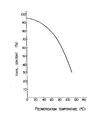
- the drawing is a graph showing the relation between polymerization temperature and microstructure in the polymerization of the copolymer blocks (A) in Example 1.
- wet skid resistance measured by a skid tester was adopted as an index of wet skid resistance of the products, and the impact resilience at 70°C and heat-build-up temperature as measured by a Goodrich flexometer were used as an index of rolling resistance.
- A-5 litre reactor was charged with 2,000 g of a cyclohexane/n-hexane (90/10 by weight) mixture and with predetermined quantities of butadiene, tetrahydrofuran, potassium dodecylbenzenesulphonate and, if necessary, styrene in a nitrogen atmosphere, and the mixture was subjected to isothermic or adiabatic polymerization under the polymerization conditions of the blocks (B) with a vinyl content as shown in Table 1, using n-butyllithium as polymerization initiator.
- the polymerization was started with the block (A), and, in the others, the polymerization was started with the block (B).
- Comparative Examples 6. 7 and 8 were random SBR's which were not subjected to the subsequent block polymerization.
- the microstructure of the butadiene portion of the polymer was observed according to D. Morero's method, and the styrene content in the copolymer was determined from the calibration curve using the absorbance at 699 cm -1 .
- the accompanying drawing shows the relation between polymerization temperature and microstructure under the polymerization conditions of the copolymer blocks (A) in Example 1.
- the polymers were mixed and compounded by an internal mixer and rolls according to the recipe shown in Table 3 and then vulcanized at 145°C for 30 minutes.
- the properties of the resulting vulcanizates are shown in Table 4.
- Comparative Example 7/Comparative Example 8 blend is a simple 50/50 blend of the copolymers of Comparative Examples 7 and 8.
- the block copolymers of Examples 1 - 8 according to this invention have better processability (roll retention) than the random SBR of Comparative Example 6, which has the same levels of vinyl content and bound styrene content.
- the copolymer of Example 1 is superior to that of Comparative Example 6 in its wet skid resistance, wear characteristics and heat build-up.
- the copolymer of Example 3 is inferior to that of Example 1 in its fracture characteristics because the former has no specific vinyl content distribution breadth.
- the copolymer of Comparative Example 1 is relatively well-balanced among such factors as wet skid resistance. impact resilience and wear resistance, but their values are still unsatisfactory in comparison with those of Example 1.
- the copolymers of Comparative Examples 2 - 5 are inferior to those of Examples 1 - 8 in their balance of said factors.
- Simple blends of blocks A and blocks B of this invention are poor in processability, wet skid resistance, wear resistance, impact resilience and fracture characteristics.
- Examples 9 - 18 were obtained according to the polymerization recipe of Table 6.
- Both the styrene content and the vinyl content of the polymer were measured by an infrared spectrophotometer.
- the proportion of metal-carbon bond chains (coupling efficiency) was determined from the ratio of the high molecular weight side component measured by gel permeation chromatography (GPC).
- Examples 9 - 17 showed excellent and well balanced tensile strength. Dunlop impact resilience, Goodrich heat build-up, wet skid resistance and Lambourn wear characteristics and also showed good processability.
- Comparative Example 9 prepared by coupling the random SBR with SnCl 4 , was inferior to those of Examples 9 - 17 in wet skid resistance and tensile strength. Also, the products of Examples 9 - 17 were superior in tensile strength, etc., to the block polymer containing no metal-carbon bond chain (Example 18).
Landscapes
- Chemical & Material Sciences (AREA)
- Health & Medical Sciences (AREA)
- Chemical Kinetics & Catalysis (AREA)
- Medicinal Chemistry (AREA)
- Polymers & Plastics (AREA)
- Organic Chemistry (AREA)
- Inorganic Chemistry (AREA)
- Graft Or Block Polymers (AREA)
- Tires In General (AREA)
- Compositions Of Macromolecular Compounds (AREA)
Applications Claiming Priority (8)
| Application Number | Priority Date | Filing Date | Title |
|---|---|---|---|
| JP17822680A JPS57102912A (en) | 1980-12-17 | 1980-12-17 | Styrene/butadiene block copolymer |
| JP178226/80 | 1980-12-17 | ||
| JP186195/80 | 1980-12-26 | ||
| JP186194/80 | 1980-12-26 | ||
| JP18619580A JPS57109818A (en) | 1980-12-26 | 1980-12-26 | Styrene-butadiene block copolymer |
| JP18619480A JPS57109817A (en) | 1980-12-26 | 1980-12-26 | Styrene-butadiene block copolymer |
| JP85481/81 | 1981-06-03 | ||
| JP8548181A JPH0231731B2 (ja) | 1981-06-03 | 1981-06-03 | Shinkinagomuzairyo |
Related Parent Applications (1)
| Application Number | Title | Priority Date | Filing Date |
|---|---|---|---|
| EP81305931.8 Division | 1981-12-17 |
Publications (2)
| Publication Number | Publication Date |
|---|---|
| EP0134909A1 true EP0134909A1 (de) | 1985-03-27 |
| EP0134909B1 EP0134909B1 (de) | 1988-06-29 |
Family
ID=27467117
Family Applications (2)
| Application Number | Title | Priority Date | Filing Date |
|---|---|---|---|
| EP19810305931 Expired EP0054440B1 (de) | 1980-12-17 | 1981-12-17 | Styrol-Butadien-Blockcopolymerisate |
| EP19840106266 Expired EP0134909B1 (de) | 1980-12-17 | 1981-12-17 | Styrol-Butadien-Blockcopolymerisate |
Family Applications Before (1)
| Application Number | Title | Priority Date | Filing Date |
|---|---|---|---|
| EP19810305931 Expired EP0054440B1 (de) | 1980-12-17 | 1981-12-17 | Styrol-Butadien-Blockcopolymerisate |
Country Status (1)
| Country | Link |
|---|---|
| EP (2) | EP0054440B1 (de) |
Families Citing this family (12)
| Publication number | Priority date | Publication date | Assignee | Title |
|---|---|---|---|---|
| JPS6026045A (ja) * | 1983-07-22 | 1985-02-08 | Toyo Tire & Rubber Co Ltd | タイヤ用ゴム組成物 |
| JPS60192739A (ja) * | 1984-03-15 | 1985-10-01 | Japan Synthetic Rubber Co Ltd | ブロック共重合体 |
| JPS61171714A (ja) * | 1984-07-23 | 1986-08-02 | Japan Synthetic Rubber Co Ltd | 粘着剤組成物 |
| JPH0662727B2 (ja) * | 1984-08-27 | 1994-08-17 | 日本合成ゴム株式会社 | ゴム組成物 |
| JPH0618978B2 (ja) * | 1985-10-30 | 1994-03-16 | 日本合成ゴム株式会社 | ゴム組成物 |
| JPH0674366B2 (ja) * | 1986-04-10 | 1994-09-21 | 住友化学工業株式会社 | ゴム組成物 |
| JPS63112648A (ja) * | 1986-10-30 | 1988-05-17 | Sumitomo Chem Co Ltd | タイヤトレツド用ゴム組成物 |
| JPH0735463B2 (ja) * | 1986-11-29 | 1995-04-19 | 住友ゴム工業株式会社 | タイヤトレツド用ゴム組成物 |
| DE3804547A1 (de) * | 1988-02-13 | 1989-08-24 | Huels Chemische Werke Ag | Abc-blockcopolymerisate auf basis von butadien, isopren und styrol, verfahren zu ihrer herstellung und ihre verwendung |
| US5202387A (en) * | 1992-05-08 | 1993-04-13 | The Goodyear Tire & Rubber Company | Elastomer with outstanding characteristics for use in making tire tread compounds |
| WO1994022951A1 (fr) * | 1993-03-30 | 1994-10-13 | Nippon Zeon Co., Ltd. | Composition de caoutchouc |
| DE10047483A1 (de) * | 2000-09-26 | 2002-04-11 | Bayer Ag | Verwendung von Copolycarbonaten |
Citations (1)
| Publication number | Priority date | Publication date | Assignee | Title |
|---|---|---|---|---|
| AU429728B2 (en) * | 1967-12-04 | 1972-10-31 | Asahi Kasei Kogyo Kabushiki Kaisha | Process for producing thermoplastic elastomers |
Family Cites Families (2)
| Publication number | Priority date | Publication date | Assignee | Title |
|---|---|---|---|---|
| US3778490A (en) * | 1969-04-23 | 1973-12-11 | Phillips Petroleum Co | Polar compound adjuvants for improved block polymers prepared with primary hydrocarbyllithium initiators |
| JPS5936648B2 (ja) * | 1975-12-25 | 1984-09-05 | 旭化成株式会社 | キヨウジユウゴウタイノセイゾウホウホウ |
-
1981
- 1981-12-17 EP EP19810305931 patent/EP0054440B1/de not_active Expired
- 1981-12-17 EP EP19840106266 patent/EP0134909B1/de not_active Expired
Patent Citations (1)
| Publication number | Priority date | Publication date | Assignee | Title |
|---|---|---|---|---|
| AU429728B2 (en) * | 1967-12-04 | 1972-10-31 | Asahi Kasei Kogyo Kabushiki Kaisha | Process for producing thermoplastic elastomers |
Non-Patent Citations (1)
| Title |
|---|
| CHEMICAL ABSTRACTS, vol. 87, no. 22, 28th November 1977, page 46, no. 169030s, Columbus, Ohio, USA; & JP - A - 77 78290 (ASAHI CHEMICAL INDUSTRY CO., LTD.) 01-07-1977 * |
Also Published As
| Publication number | Publication date |
|---|---|
| EP0134909B1 (de) | 1988-06-29 |
| EP0054440B1 (de) | 1985-08-28 |
| EP0054440A1 (de) | 1982-06-23 |
Similar Documents
| Publication | Publication Date | Title |
|---|---|---|
| US4397994A (en) | High vinyl polybutadiene or styrene-butadiene copolymer | |
| US4519431A (en) | Styrene-butadiene copolymers with high styrene content | |
| US4742124A (en) | Rubber composition for use in tire | |
| EP0260325B1 (de) | Dienpolymere, herstellungsverfahren und diese enthaltende kautschukzubereitungen | |
| EP0102045B1 (de) | Dienkautschukmischung und Reifen mit einer Lauffläche auf Basis dieser Mischung | |
| CA1326722C (en) | Elastomeric compositions, process for the preparation thereof and tyres containing them | |
| EP0134909B1 (de) | Styrol-Butadien-Blockcopolymerisate | |
| US4433109A (en) | Styrene-butadiene block copolymer | |
| US4463133A (en) | Rubber compositions suitable for use in tire tread | |
| JPS6155135A (ja) | ゴム組成物 | |
| CA1208838A (en) | Diene rubber blends for tire treads | |
| JPH0380165B2 (de) | ||
| JPS6360768B2 (de) | ||
| JPS6360769B2 (de) | ||
| EP0263885B1 (de) | Kautschukzubereitung für reifenlauffläche | |
| CA1288535C (en) | Rubber composition for tire treads | |
| US5164450A (en) | Butadiene copolymer rubber composition | |
| JPH0231731B2 (ja) | Shinkinagomuzairyo | |
| JPH0627122B2 (ja) | 高スチレン含量のランダムスチレン−ブタジエン共重合体ゴム | |
| EP0153697B1 (de) | Elastomere Copolymere von vinylaromatischen Verbindungen und von Butadien | |
| JPS61120839A (ja) | タイヤトレツド用加硫ゴム組成物 | |
| CA1258549A (en) | Diene elastomer compositions | |
| JPS62135506A (ja) | 共役ジオレフィン系重合体の製造方法 | |
| JPS6360770B2 (de) | ||
| JP2594820B2 (ja) | タイヤ用ゴム組成物 |
Legal Events
| Date | Code | Title | Description |
|---|---|---|---|
| PUAI | Public reference made under article 153(3) epc to a published international application that has entered the european phase |
Free format text: ORIGINAL CODE: 0009012 |
|
| 17P | Request for examination filed |
Effective date: 19840606 |
|
| AC | Divisional application: reference to earlier application |
Ref document number: 54440 Country of ref document: EP |
|
| AK | Designated contracting states |
Designated state(s): FR NL |
|
| 17Q | First examination report despatched |
Effective date: 19870826 |
|
| GRAA | (expected) grant |
Free format text: ORIGINAL CODE: 0009210 |
|
| AC | Divisional application: reference to earlier application |
Ref document number: 54440 Country of ref document: EP |
|
| AK | Designated contracting states |
Kind code of ref document: B1 Designated state(s): FR NL |
|
| ET | Fr: translation filed | ||
| PLBI | Opposition filed |
Free format text: ORIGINAL CODE: 0009260 |
|
| 26 | Opposition filed |
Opponent name: HUELS AKTIENGESELLSCHAFT Effective date: 19890318 |
|
| NLR1 | Nl: opposition has been filed with the epo |
Opponent name: HUELS AG |
|
| PLBN | Opposition rejected |
Free format text: ORIGINAL CODE: 0009273 |
|
| STAA | Information on the status of an ep patent application or granted ep patent |
Free format text: STATUS: OPPOSITION REJECTED |
|
| 27O | Opposition rejected |
Effective date: 19901029 |
|
| NLR2 | Nl: decision of opposition | ||
| PGFP | Annual fee paid to national office [announced via postgrant information from national office to epo] |
Ref country code: FR Payment date: 20001212 Year of fee payment: 20 |
|
| PGFP | Annual fee paid to national office [announced via postgrant information from national office to epo] |
Ref country code: NL Payment date: 20001231 Year of fee payment: 20 |
|
| PG25 | Lapsed in a contracting state [announced via postgrant information from national office to epo] |
Ref country code: NL Free format text: LAPSE BECAUSE OF EXPIRATION OF PROTECTION Effective date: 20011217 |
|
| NLV7 | Nl: ceased due to reaching the maximum lifetime of a patent |
Effective date: 20011217 |