EP0138347A1 - Dispositif de iontophorèse - Google Patents
Dispositif de iontophorèse Download PDFInfo
- Publication number
- EP0138347A1 EP0138347A1 EP84305910A EP84305910A EP0138347A1 EP 0138347 A1 EP0138347 A1 EP 0138347A1 EP 84305910 A EP84305910 A EP 84305910A EP 84305910 A EP84305910 A EP 84305910A EP 0138347 A1 EP0138347 A1 EP 0138347A1
- Authority
- EP
- European Patent Office
- Prior art keywords
- pulse
- iontophoresis device
- skin
- iontophoresis
- electrodes
- Prior art date
- Legal status (The legal status is an assumption and is not a legal conclusion. Google has not performed a legal analysis and makes no representation as to the accuracy of the status listed.)
- Granted
Links
- 230000001225 therapeutic effect Effects 0.000 claims abstract description 42
- 230000028161 membrane depolarization Effects 0.000 claims abstract description 17
- 230000010287 polarization Effects 0.000 claims description 44
- 230000007246 mechanism Effects 0.000 claims description 32
- 239000003990 capacitor Substances 0.000 claims description 12
- 230000001965 increasing effect Effects 0.000 claims description 9
- 230000002441 reversible effect Effects 0.000 claims description 7
- 230000002999 depolarising effect Effects 0.000 claims description 6
- 230000001939 inductive effect Effects 0.000 claims description 2
- 238000007599 discharging Methods 0.000 abstract description 3
- 230000007794 irritation Effects 0.000 abstract description 3
- 239000000499 gel Substances 0.000 description 66
- 229940079593 drug Drugs 0.000 description 41
- 239000003814 drug Substances 0.000 description 41
- 239000003795 chemical substances by application Substances 0.000 description 31
- 238000010586 diagram Methods 0.000 description 31
- FAPWRFPIFSIZLT-UHFFFAOYSA-M Sodium chloride Chemical compound [Na+].[Cl-] FAPWRFPIFSIZLT-UHFFFAOYSA-M 0.000 description 18
- PEDCQBHIVMGVHV-UHFFFAOYSA-N Glycerine Chemical compound OCC(O)CO PEDCQBHIVMGVHV-UHFFFAOYSA-N 0.000 description 14
- 230000000694 effects Effects 0.000 description 13
- 239000000463 material Substances 0.000 description 12
- 239000000203 mixture Substances 0.000 description 12
- 239000000126 substance Substances 0.000 description 11
- XLYOFNOQVPJJNP-UHFFFAOYSA-N water Substances O XLYOFNOQVPJJNP-UHFFFAOYSA-N 0.000 description 11
- 239000000853 adhesive Substances 0.000 description 9
- 238000009826 distribution Methods 0.000 description 9
- 239000011780 sodium chloride Substances 0.000 description 9
- 238000004804 winding Methods 0.000 description 9
- 235000011187 glycerol Nutrition 0.000 description 7
- 238000000034 method Methods 0.000 description 7
- 229920000569 Gum karaya Polymers 0.000 description 6
- DNIAPMSPPWPWGF-UHFFFAOYSA-N Propylene glycol Chemical compound CC(O)CO DNIAPMSPPWPWGF-UHFFFAOYSA-N 0.000 description 6
- 241000934878 Sterculia Species 0.000 description 6
- 230000001070 adhesive effect Effects 0.000 description 6
- 210000004369 blood Anatomy 0.000 description 6
- 239000008280 blood Substances 0.000 description 6
- 239000012153 distilled water Substances 0.000 description 6
- 235000010494 karaya gum Nutrition 0.000 description 6
- 239000000231 karaya gum Substances 0.000 description 6
- 229940039371 karaya gum Drugs 0.000 description 6
- AQHHHDLHHXJYJD-UHFFFAOYSA-N propranolol Chemical compound C1=CC=C2C(OCC(O)CNC(C)C)=CC=CC2=C1 AQHHHDLHHXJYJD-UHFFFAOYSA-N 0.000 description 6
- 239000000243 solution Substances 0.000 description 6
- 206010040880 Skin irritation Diseases 0.000 description 5
- 229920002125 Sokalan® Polymers 0.000 description 5
- 230000003247 decreasing effect Effects 0.000 description 5
- 239000003792 electrolyte Substances 0.000 description 5
- 229920005862 polyol Polymers 0.000 description 5
- 150000003077 polyols Chemical class 0.000 description 5
- 230000036556 skin irritation Effects 0.000 description 5
- 231100000475 skin irritation Toxicity 0.000 description 5
- 229920001817 Agar Polymers 0.000 description 4
- 239000004372 Polyvinyl alcohol Substances 0.000 description 4
- 239000008272 agar Substances 0.000 description 4
- 239000011888 foil Substances 0.000 description 4
- NOESYZHRGYRDHS-UHFFFAOYSA-N insulin Chemical compound N1C(=O)C(NC(=O)C(CCC(N)=O)NC(=O)C(CCC(O)=O)NC(=O)C(C(C)C)NC(=O)C(NC(=O)CN)C(C)CC)CSSCC(C(NC(CO)C(=O)NC(CC(C)C)C(=O)NC(CC=2C=CC(O)=CC=2)C(=O)NC(CCC(N)=O)C(=O)NC(CC(C)C)C(=O)NC(CCC(O)=O)C(=O)NC(CC(N)=O)C(=O)NC(CC=2C=CC(O)=CC=2)C(=O)NC(CSSCC(NC(=O)C(C(C)C)NC(=O)C(CC(C)C)NC(=O)C(CC=2C=CC(O)=CC=2)NC(=O)C(CC(C)C)NC(=O)C(C)NC(=O)C(CCC(O)=O)NC(=O)C(C(C)C)NC(=O)C(CC(C)C)NC(=O)C(CC=2NC=NC=2)NC(=O)C(CO)NC(=O)CNC2=O)C(=O)NCC(=O)NC(CCC(O)=O)C(=O)NC(CCCNC(N)=N)C(=O)NCC(=O)NC(CC=3C=CC=CC=3)C(=O)NC(CC=3C=CC=CC=3)C(=O)NC(CC=3C=CC(O)=CC=3)C(=O)NC(C(C)O)C(=O)N3C(CCC3)C(=O)NC(CCCCN)C(=O)NC(C)C(O)=O)C(=O)NC(CC(N)=O)C(O)=O)=O)NC(=O)C(C(C)CC)NC(=O)C(CO)NC(=O)C(C(C)O)NC(=O)C1CSSCC2NC(=O)C(CC(C)C)NC(=O)C(NC(=O)C(CCC(N)=O)NC(=O)C(CC(N)=O)NC(=O)C(NC(=O)C(N)CC=1C=CC=CC=1)C(C)C)CC1=CN=CN1 NOESYZHRGYRDHS-UHFFFAOYSA-N 0.000 description 4
- WABPQHHGFIMREM-UHFFFAOYSA-N lead(0) Chemical compound [Pb] WABPQHHGFIMREM-UHFFFAOYSA-N 0.000 description 4
- 229920002451 polyvinyl alcohol Polymers 0.000 description 4
- 229920003002 synthetic resin Polymers 0.000 description 4
- 239000000057 synthetic resin Substances 0.000 description 4
- 238000012360 testing method Methods 0.000 description 4
- 229920002554 vinyl polymer Polymers 0.000 description 4
- -1 vitamins B1 Natural products 0.000 description 4
- CIWBSHSKHKDKBQ-JLAZNSOCSA-N Ascorbic acid Chemical compound OC[C@H](O)[C@H]1OC(=O)C(O)=C1O CIWBSHSKHKDKBQ-JLAZNSOCSA-N 0.000 description 3
- LYCAIKOWRPUZTN-UHFFFAOYSA-N Ethylene glycol Chemical compound OCCO LYCAIKOWRPUZTN-UHFFFAOYSA-N 0.000 description 3
- 239000004820 Pressure-sensitive adhesive Substances 0.000 description 3
- 239000002250 absorbent Substances 0.000 description 3
- 230000009471 action Effects 0.000 description 3
- 229910052782 aluminium Inorganic materials 0.000 description 3
- XAGFODPZIPBFFR-UHFFFAOYSA-N aluminium Chemical compound [Al] XAGFODPZIPBFFR-UHFFFAOYSA-N 0.000 description 3
- 239000007864 aqueous solution Substances 0.000 description 3
- 230000008901 benefit Effects 0.000 description 3
- 230000037396 body weight Effects 0.000 description 3
- 239000000470 constituent Substances 0.000 description 3
- 229920001577 copolymer Polymers 0.000 description 3
- 229960001193 diclofenac sodium Drugs 0.000 description 3
- 238000001962 electrophoresis Methods 0.000 description 3
- 150000004676 glycans Chemical class 0.000 description 3
- 239000000017 hydrogel Substances 0.000 description 3
- 150000002500 ions Chemical class 0.000 description 3
- 238000010030 laminating Methods 0.000 description 3
- 238000004519 manufacturing process Methods 0.000 description 3
- 229960001300 metoprolol tartrate Drugs 0.000 description 3
- 210000002381 plasma Anatomy 0.000 description 3
- 239000011505 plaster Substances 0.000 description 3
- 239000004584 polyacrylic acid Substances 0.000 description 3
- 229920000642 polymer Polymers 0.000 description 3
- 229920001282 polysaccharide Polymers 0.000 description 3
- 239000005017 polysaccharide Substances 0.000 description 3
- NLKNQRATVPKPDG-UHFFFAOYSA-M potassium iodide Chemical compound [K+].[I-] NLKNQRATVPKPDG-UHFFFAOYSA-M 0.000 description 3
- 229960003712 propranolol Drugs 0.000 description 3
- 239000011347 resin Substances 0.000 description 3
- 229920005989 resin Polymers 0.000 description 3
- JGMJQSFLQWGYMQ-UHFFFAOYSA-M sodium;2,6-dichloro-n-phenylaniline;acetate Chemical compound [Na+].CC([O-])=O.ClC1=CC=CC(Cl)=C1NC1=CC=CC=C1 JGMJQSFLQWGYMQ-UHFFFAOYSA-M 0.000 description 3
- WUBVEMGCQRSBBT-UHFFFAOYSA-N tert-butyl 4-(trifluoromethylsulfonyloxy)-3,6-dihydro-2h-pyridine-1-carboxylate Chemical compound CC(C)(C)OC(=O)N1CCC(OS(=O)(=O)C(F)(F)F)=CC1 WUBVEMGCQRSBBT-UHFFFAOYSA-N 0.000 description 3
- KWGRBVOPPLSCSI-WPRPVWTQSA-N (-)-ephedrine Chemical compound CN[C@@H](C)[C@H](O)C1=CC=CC=C1 KWGRBVOPPLSCSI-WPRPVWTQSA-N 0.000 description 2
- IAKHMKGGTNLKSZ-INIZCTEOSA-N (S)-colchicine Chemical compound C1([C@@H](NC(C)=O)CC2)=CC(=O)C(OC)=CC=C1C1=C2C=C(OC)C(OC)=C1OC IAKHMKGGTNLKSZ-INIZCTEOSA-N 0.000 description 2
- 208000006820 Arthralgia Diseases 0.000 description 2
- 206010016807 Fluid retention Diseases 0.000 description 2
- RPTUSVTUFVMDQK-UHFFFAOYSA-N Hidralazin Chemical compound C1=CC=C2C(NN)=NN=CC2=C1 RPTUSVTUFVMDQK-UHFFFAOYSA-N 0.000 description 2
- NTYJJOPFIAHURM-UHFFFAOYSA-N Histamine Chemical compound NCCC1=CN=CN1 NTYJJOPFIAHURM-UHFFFAOYSA-N 0.000 description 2
- DGAQECJNVWCQMB-PUAWFVPOSA-M Ilexoside XXIX Chemical compound C[C@@H]1CC[C@@]2(CC[C@@]3(C(=CC[C@H]4[C@]3(CC[C@@H]5[C@@]4(CC[C@@H](C5(C)C)OS(=O)(=O)[O-])C)C)[C@@H]2[C@]1(C)O)C)C(=O)O[C@H]6[C@@H]([C@H]([C@@H]([C@H](O6)CO)O)O)O.[Na+] DGAQECJNVWCQMB-PUAWFVPOSA-M 0.000 description 2
- 102000004877 Insulin Human genes 0.000 description 2
- 108090001061 Insulin Proteins 0.000 description 2
- WHXSMMKQMYFTQS-UHFFFAOYSA-N Lithium Chemical compound [Li] WHXSMMKQMYFTQS-UHFFFAOYSA-N 0.000 description 2
- 208000003351 Melanosis Diseases 0.000 description 2
- NBIIXXVUZAFLBC-UHFFFAOYSA-N Phosphoric acid Chemical compound OP(O)(O)=O NBIIXXVUZAFLBC-UHFFFAOYSA-N 0.000 description 2
- AUNGANRZJHBGPY-SCRDCRAPSA-N Riboflavin Chemical compound OC[C@@H](O)[C@@H](O)[C@@H](O)CN1C=2C=C(C)C(C)=CC=2N=C2C1=NC(=O)NC2=O AUNGANRZJHBGPY-SCRDCRAPSA-N 0.000 description 2
- ABBQHOQBGMUPJH-UHFFFAOYSA-M Sodium salicylate Chemical compound [Na+].OC1=CC=CC=C1C([O-])=O ABBQHOQBGMUPJH-UHFFFAOYSA-M 0.000 description 2
- ZZHLYYDVIOPZBE-UHFFFAOYSA-N Trimeprazine Chemical compound C1=CC=C2N(CC(CN(C)C)C)C3=CC=CC=C3SC2=C1 ZZHLYYDVIOPZBE-UHFFFAOYSA-N 0.000 description 2
- 238000010521 absorption reaction Methods 0.000 description 2
- 230000002378 acidificating effect Effects 0.000 description 2
- NIXOWILDQLNWCW-UHFFFAOYSA-N acrylic acid group Chemical group C(C=C)(=O)O NIXOWILDQLNWCW-UHFFFAOYSA-N 0.000 description 2
- 238000004458 analytical method Methods 0.000 description 2
- 239000002260 anti-inflammatory agent Substances 0.000 description 2
- VQODGRNSFPNSQE-DVTGEIKXSA-N betamethasone phosphate Chemical compound C1CC2=CC(=O)C=C[C@]2(C)[C@]2(F)[C@@H]1[C@@H]1C[C@H](C)[C@@](C(=O)COP(O)(O)=O)(O)[C@@]1(C)C[C@@H]2O VQODGRNSFPNSQE-DVTGEIKXSA-N 0.000 description 2
- 239000011248 coating agent Substances 0.000 description 2
- 238000000576 coating method Methods 0.000 description 2
- 239000002537 cosmetic Substances 0.000 description 2
- 238000001514 detection method Methods 0.000 description 2
- 230000008713 feedback mechanism Effects 0.000 description 2
- 210000000245 forearm Anatomy 0.000 description 2
- 238000001030 gas--liquid chromatography Methods 0.000 description 2
- JYGXADMDTFJGBT-VWUMJDOOSA-N hydrocortisone Chemical compound O=C1CC[C@]2(C)[C@H]3[C@@H](O)C[C@](C)([C@@](CC4)(O)C(=O)CO)[C@@H]4[C@@H]3CCC2=C1 JYGXADMDTFJGBT-VWUMJDOOSA-N 0.000 description 2
- 229940125396 insulin Drugs 0.000 description 2
- 229910052744 lithium Inorganic materials 0.000 description 2
- 238000012544 monitoring process Methods 0.000 description 2
- 239000000025 natural resin Substances 0.000 description 2
- 235000015097 nutrients Nutrition 0.000 description 2
- 230000035515 penetration Effects 0.000 description 2
- 230000000737 periodic effect Effects 0.000 description 2
- 229920001495 poly(sodium acrylate) polymer Polymers 0.000 description 2
- 229920002401 polyacrylamide Polymers 0.000 description 2
- 239000011148 porous material Substances 0.000 description 2
- 238000002360 preparation method Methods 0.000 description 2
- 230000001737 promoting effect Effects 0.000 description 2
- 230000002633 protecting effect Effects 0.000 description 2
- 238000011084 recovery Methods 0.000 description 2
- 239000011369 resultant mixture Substances 0.000 description 2
- YGSDEFSMJLZEOE-UHFFFAOYSA-N salicylic acid Chemical compound OC(=O)C1=CC=CC=C1O YGSDEFSMJLZEOE-UHFFFAOYSA-N 0.000 description 2
- 229910052710 silicon Inorganic materials 0.000 description 2
- 239000010703 silicon Substances 0.000 description 2
- 208000017520 skin disease Diseases 0.000 description 2
- 229910052708 sodium Inorganic materials 0.000 description 2
- 239000011734 sodium Substances 0.000 description 2
- PPASLZSBLFJQEF-RKJRWTFHSA-M sodium ascorbate Substances [Na+].OC[C@@H](O)[C@H]1OC(=O)C(O)=C1[O-] PPASLZSBLFJQEF-RKJRWTFHSA-M 0.000 description 2
- 235000010378 sodium ascorbate Nutrition 0.000 description 2
- 229960005055 sodium ascorbate Drugs 0.000 description 2
- CDBYLPFSWZWCQE-UHFFFAOYSA-L sodium carbonate Substances [Na+].[Na+].[O-]C([O-])=O CDBYLPFSWZWCQE-UHFFFAOYSA-L 0.000 description 2
- NNMHYFLPFNGQFZ-UHFFFAOYSA-M sodium polyacrylate Chemical compound [Na+].[O-]C(=O)C=C NNMHYFLPFNGQFZ-UHFFFAOYSA-M 0.000 description 2
- 229960004025 sodium salicylate Drugs 0.000 description 2
- PPASLZSBLFJQEF-RXSVEWSESA-M sodium-L-ascorbate Chemical compound [Na+].OC[C@H](O)[C@H]1OC(=O)C(O)=C1[O-] PPASLZSBLFJQEF-RXSVEWSESA-M 0.000 description 2
- JWZZKOKVBUJMES-UHFFFAOYSA-N (+-)-Isoprenaline Chemical compound CC(C)NCC(O)C1=CC=C(O)C(O)=C1 JWZZKOKVBUJMES-UHFFFAOYSA-N 0.000 description 1
- XWTYSIMOBUGWOL-UHFFFAOYSA-N (+-)-Terbutaline Chemical compound CC(C)(C)NCC(O)C1=CC(O)=CC(O)=C1 XWTYSIMOBUGWOL-UHFFFAOYSA-N 0.000 description 1
- LNAZSHAWQACDHT-XIYTZBAFSA-N (2r,3r,4s,5r,6s)-4,5-dimethoxy-2-(methoxymethyl)-3-[(2s,3r,4s,5r,6r)-3,4,5-trimethoxy-6-(methoxymethyl)oxan-2-yl]oxy-6-[(2r,3r,4s,5r,6r)-4,5,6-trimethoxy-2-(methoxymethyl)oxan-3-yl]oxyoxane Chemical compound CO[C@@H]1[C@@H](OC)[C@H](OC)[C@@H](COC)O[C@H]1O[C@H]1[C@H](OC)[C@@H](OC)[C@H](O[C@H]2[C@@H]([C@@H](OC)[C@H](OC)O[C@@H]2COC)OC)O[C@@H]1COC LNAZSHAWQACDHT-XIYTZBAFSA-N 0.000 description 1
- UCTWMZQNUQWSLP-VIFPVBQESA-N (R)-adrenaline Chemical compound CNC[C@H](O)C1=CC=C(O)C(O)=C1 UCTWMZQNUQWSLP-VIFPVBQESA-N 0.000 description 1
- 229930182837 (R)-adrenaline Natural products 0.000 description 1
- IXPNQXFRVYWDDI-UHFFFAOYSA-N 1-methyl-2,4-dioxo-1,3-diazinane-5-carboximidamide Chemical compound CN1CC(C(N)=N)C(=O)NC1=O IXPNQXFRVYWDDI-UHFFFAOYSA-N 0.000 description 1
- FRPZMMHWLSIFAZ-UHFFFAOYSA-N 10-undecenoic acid Chemical class OC(=O)CCCCCCCCC=C FRPZMMHWLSIFAZ-UHFFFAOYSA-N 0.000 description 1
- 229920000178 Acrylic resin Polymers 0.000 description 1
- 239000004925 Acrylic resin Substances 0.000 description 1
- 229930003347 Atropine Natural products 0.000 description 1
- 108010006654 Bleomycin Proteins 0.000 description 1
- OKTJSMMVPCPJKN-UHFFFAOYSA-N Carbon Chemical compound [C] OKTJSMMVPCPJKN-UHFFFAOYSA-N 0.000 description 1
- AUNGANRZJHBGPY-UHFFFAOYSA-N D-Lyxoflavin Natural products OCC(O)C(O)C(O)CN1C=2C=C(C)C(C)=CC=2N=C2C1=NC(=O)NC2=O AUNGANRZJHBGPY-UHFFFAOYSA-N 0.000 description 1
- HCYAFALTSJYZDH-UHFFFAOYSA-N Desimpramine Chemical compound C1CC2=CC=CC=C2N(CCCNC)C2=CC=CC=C21 HCYAFALTSJYZDH-UHFFFAOYSA-N 0.000 description 1
- 108010010803 Gelatin Proteins 0.000 description 1
- HTTJABKRGRZYRN-UHFFFAOYSA-N Heparin Chemical compound OC1C(NC(=O)C)C(O)OC(COS(O)(=O)=O)C1OC1C(OS(O)(=O)=O)C(O)C(OC2C(C(OS(O)(=O)=O)C(OC3C(C(O)C(O)C(O3)C(O)=O)OS(O)(=O)=O)C(CO)O2)NS(O)(=O)=O)C(C(O)=O)O1 HTTJABKRGRZYRN-UHFFFAOYSA-N 0.000 description 1
- RKUNBYITZUJHSG-UHFFFAOYSA-N Hyosciamin-hydrochlorid Natural products CN1C(C2)CCC1CC2OC(=O)C(CO)C1=CC=CC=C1 RKUNBYITZUJHSG-UHFFFAOYSA-N 0.000 description 1
- XQFRJNBWHJMXHO-RRKCRQDMSA-N IDUR Chemical compound C1[C@H](O)[C@@H](CO)O[C@H]1N1C(=O)NC(=O)C(I)=C1 XQFRJNBWHJMXHO-RRKCRQDMSA-N 0.000 description 1
- LEVWYRKDKASIDU-IMJSIDKUSA-N L-cystine Chemical compound [O-]C(=O)[C@@H]([NH3+])CSSC[C@H]([NH3+])C([O-])=O LEVWYRKDKASIDU-IMJSIDKUSA-N 0.000 description 1
- NNJVILVZKWQKPM-UHFFFAOYSA-N Lidocaine Chemical compound CCN(CC)CC(=O)NC1=C(C)C=CC=C1C NNJVILVZKWQKPM-UHFFFAOYSA-N 0.000 description 1
- CERQOIWHTDAKMF-UHFFFAOYSA-M Methacrylate Chemical compound CC(=C)C([O-])=O CERQOIWHTDAKMF-UHFFFAOYSA-M 0.000 description 1
- IOVCWXUNBOPUCH-UHFFFAOYSA-N Nitrous acid Chemical compound ON=O IOVCWXUNBOPUCH-UHFFFAOYSA-N 0.000 description 1
- 229920003171 Poly (ethylene oxide) Polymers 0.000 description 1
- 239000002202 Polyethylene glycol Substances 0.000 description 1
- HCBIBCJNVBAKAB-UHFFFAOYSA-N Procaine hydrochloride Chemical compound Cl.CCN(CC)CCOC(=O)C1=CC=C(N)C=C1 HCBIBCJNVBAKAB-UHFFFAOYSA-N 0.000 description 1
- 229920001615 Tragacanth Polymers 0.000 description 1
- XTXRWKRVRITETP-UHFFFAOYSA-N Vinyl acetate Chemical compound CC(=O)OC=C XTXRWKRVRITETP-UHFFFAOYSA-N 0.000 description 1
- 230000002745 absorbent Effects 0.000 description 1
- 239000002253 acid Substances 0.000 description 1
- 239000002390 adhesive tape Substances 0.000 description 1
- 150000001298 alcohols Chemical class 0.000 description 1
- 229960003790 alimemazine Drugs 0.000 description 1
- SHGAZHPCJJPHSC-YCNIQYBTSA-N all-trans-retinoic acid Chemical compound OC(=O)\C=C(/C)\C=C\C=C(/C)\C=C\C1=C(C)CCCC1(C)C SHGAZHPCJJPHSC-YCNIQYBTSA-N 0.000 description 1
- 229960002213 alprenolol Drugs 0.000 description 1
- PAZJSJFMUHDSTF-UHFFFAOYSA-N alprenolol Chemical compound CC(C)NCC(O)COC1=CC=CC=C1CC=C PAZJSJFMUHDSTF-UHFFFAOYSA-N 0.000 description 1
- 229910000147 aluminium phosphate Inorganic materials 0.000 description 1
- 239000003708 ampul Substances 0.000 description 1
- 230000000202 analgesic effect Effects 0.000 description 1
- 239000000730 antalgic agent Substances 0.000 description 1
- 229940121363 anti-inflammatory agent Drugs 0.000 description 1
- 239000003416 antiarrhythmic agent Substances 0.000 description 1
- 238000010420 art technique Methods 0.000 description 1
- 235000010323 ascorbic acid Nutrition 0.000 description 1
- 229960005070 ascorbic acid Drugs 0.000 description 1
- 239000011668 ascorbic acid Substances 0.000 description 1
- 239000000305 astragalus gummifer gum Substances 0.000 description 1
- RKUNBYITZUJHSG-SPUOUPEWSA-N atropine Chemical compound O([C@H]1C[C@H]2CC[C@@H](C1)N2C)C(=O)C(CO)C1=CC=CC=C1 RKUNBYITZUJHSG-SPUOUPEWSA-N 0.000 description 1
- 229960000396 atropine Drugs 0.000 description 1
- 230000009286 beneficial effect Effects 0.000 description 1
- 229950006991 betamethasone phosphate Drugs 0.000 description 1
- 229960004980 betanidine Drugs 0.000 description 1
- NIVZHWNOUVJHKV-UHFFFAOYSA-N bethanidine Chemical compound CN\C(=N/C)NCC1=CC=CC=C1 NIVZHWNOUVJHKV-UHFFFAOYSA-N 0.000 description 1
- 230000015572 biosynthetic process Effects 0.000 description 1
- 229960001561 bleomycin Drugs 0.000 description 1
- OYVAGSVQBOHSSS-UAPAGMARSA-O bleomycin A2 Chemical compound N([C@H](C(=O)N[C@H](C)[C@@H](O)[C@H](C)C(=O)N[C@@H]([C@H](O)C)C(=O)NCCC=1SC=C(N=1)C=1SC=C(N=1)C(=O)NCCC[S+](C)C)[C@@H](O[C@H]1[C@H]([C@@H](O)[C@H](O)[C@H](CO)O1)O[C@@H]1[C@H]([C@@H](OC(N)=O)[C@H](O)[C@@H](CO)O1)O)C=1N=CNC=1)C(=O)C1=NC([C@H](CC(N)=O)NC[C@H](N)C(N)=O)=NC(N)=C1C OYVAGSVQBOHSSS-UAPAGMARSA-O 0.000 description 1
- 229910052799 carbon Inorganic materials 0.000 description 1
- 229940096529 carboxypolymethylene Drugs 0.000 description 1
- ANTSCNMPPGJYLG-UHFFFAOYSA-N chlordiazepoxide Chemical compound O=N=1CC(NC)=NC2=CC=C(Cl)C=C2C=1C1=CC=CC=C1 ANTSCNMPPGJYLG-UHFFFAOYSA-N 0.000 description 1
- 229960004782 chlordiazepoxide Drugs 0.000 description 1
- ZPEIMTDSQAKGNT-UHFFFAOYSA-N chlorpromazine Chemical compound C1=C(Cl)C=C2N(CCCN(C)C)C3=CC=CC=C3SC2=C1 ZPEIMTDSQAKGNT-UHFFFAOYSA-N 0.000 description 1
- 229960001076 chlorpromazine Drugs 0.000 description 1
- YNNUSGIPVFPVBX-NHCUHLMSSA-N clemastine Chemical compound CN1CCC[C@@H]1CCO[C@@](C)(C=1C=CC(Cl)=CC=1)C1=CC=CC=C1 YNNUSGIPVFPVBX-NHCUHLMSSA-N 0.000 description 1
- 229960002881 clemastine Drugs 0.000 description 1
- DGBIGWXXNGSACT-UHFFFAOYSA-N clonazepam Chemical compound C12=CC([N+](=O)[O-])=CC=C2NC(=O)CN=C1C1=CC=CC=C1Cl DGBIGWXXNGSACT-UHFFFAOYSA-N 0.000 description 1
- 229960003120 clonazepam Drugs 0.000 description 1
- 229960001338 colchicine Drugs 0.000 description 1
- 238000010276 construction Methods 0.000 description 1
- 238000007796 conventional method Methods 0.000 description 1
- 239000006071 cream Substances 0.000 description 1
- 238000005520 cutting process Methods 0.000 description 1
- 229960003067 cystine Drugs 0.000 description 1
- KWGRBVOPPLSCSI-UHFFFAOYSA-N d-ephedrine Natural products CNC(C)C(O)C1=CC=CC=C1 KWGRBVOPPLSCSI-UHFFFAOYSA-N 0.000 description 1
- 229960003914 desipramine Drugs 0.000 description 1
- 229960003957 dexamethasone Drugs 0.000 description 1
- UREBDLICKHMUKA-CXSFZGCWSA-N dexamethasone Chemical compound C1CC2=CC(=O)C=C[C@]2(C)[C@]2(F)[C@@H]1[C@@H]1C[C@@H](C)[C@@](C(=O)CO)(O)[C@@]1(C)C[C@@H]2O UREBDLICKHMUKA-CXSFZGCWSA-N 0.000 description 1
- PLCQGRYPOISRTQ-FCJDYXGNSA-L dexamethasone sodium phosphate Chemical compound [Na+].[Na+].C1CC2=CC(=O)C=C[C@]2(C)[C@]2(F)[C@@H]1[C@@H]1C[C@@H](C)[C@@](C(=O)COP([O-])([O-])=O)(O)[C@@]1(C)C[C@@H]2O PLCQGRYPOISRTQ-FCJDYXGNSA-L 0.000 description 1
- 208000037265 diseases, disorders, signs and symptoms Diseases 0.000 description 1
- 208000035475 disorder Diseases 0.000 description 1
- 239000000839 emulsion Substances 0.000 description 1
- 229960002179 ephedrine Drugs 0.000 description 1
- 229960005139 epinephrine Drugs 0.000 description 1
- OFKDAAIKGIBASY-VFGNJEKYSA-N ergotamine Chemical compound C([C@H]1C(=O)N2CCC[C@H]2[C@]2(O)O[C@@](C(N21)=O)(C)NC(=O)[C@H]1CN([C@H]2C(C3=CC=CC4=NC=C([C]34)C2)=C1)C)C1=CC=CC=C1 OFKDAAIKGIBASY-VFGNJEKYSA-N 0.000 description 1
- 229960004943 ergotamine Drugs 0.000 description 1
- XCGSFFUVFURLIX-UHFFFAOYSA-N ergotaminine Natural products C1=C(C=2C=CC=C3NC=C(C=23)C2)C2N(C)CC1C(=O)NC(C(N12)=O)(C)OC1(O)C1CCCN1C(=O)C2CC1=CC=CC=C1 XCGSFFUVFURLIX-UHFFFAOYSA-N 0.000 description 1
- 150000002148 esters Chemical class 0.000 description 1
- 239000004744 fabric Substances 0.000 description 1
- 239000002657 fibrous material Substances 0.000 description 1
- 239000006260 foam Substances 0.000 description 1
- UPBDXRPQPOWRKR-UHFFFAOYSA-N furan-2,5-dione;methoxyethene Chemical compound COC=C.O=C1OC(=O)C=C1 UPBDXRPQPOWRKR-UHFFFAOYSA-N 0.000 description 1
- 239000008273 gelatin Substances 0.000 description 1
- 229920000159 gelatin Polymers 0.000 description 1
- 235000019322 gelatine Nutrition 0.000 description 1
- 235000011852 gelatine desserts Nutrition 0.000 description 1
- 239000011521 glass Substances 0.000 description 1
- 229960004580 glibenclamide Drugs 0.000 description 1
- ZNNLBTZKUZBEKO-UHFFFAOYSA-N glyburide Chemical compound COC1=CC=C(Cl)C=C1C(=O)NCCC1=CC=C(S(=O)(=O)NC(=O)NC2CCCCC2)C=C1 ZNNLBTZKUZBEKO-UHFFFAOYSA-N 0.000 description 1
- 229960003602 guanethidine Drugs 0.000 description 1
- ACGDKVXYNVEAGU-UHFFFAOYSA-N guanethidine Chemical compound NC(N)=NCCN1CCCCCCC1 ACGDKVXYNVEAGU-UHFFFAOYSA-N 0.000 description 1
- 229960002897 heparin Drugs 0.000 description 1
- 229920000669 heparin Polymers 0.000 description 1
- 229960001340 histamine Drugs 0.000 description 1
- 229960002474 hydralazine Drugs 0.000 description 1
- 229960000890 hydrocortisone Drugs 0.000 description 1
- 229960004716 idoxuridine Drugs 0.000 description 1
- BCGWQEUPMDMJNV-UHFFFAOYSA-N imipramine Chemical compound C1CC2=CC=CC=C2N(CCCN(C)C)C2=CC=CC=C21 BCGWQEUPMDMJNV-UHFFFAOYSA-N 0.000 description 1
- 229960004801 imipramine Drugs 0.000 description 1
- 230000006872 improvement Effects 0.000 description 1
- MPGBPFMOOXKQRX-UHFFFAOYSA-N indenolol Chemical compound CC(C)NCC(O)COC1=CC=CC2=C1C=CC2 MPGBPFMOOXKQRX-UHFFFAOYSA-N 0.000 description 1
- 229950008838 indenolol Drugs 0.000 description 1
- 230000006698 induction Effects 0.000 description 1
- 230000000977 initiatory effect Effects 0.000 description 1
- 238000002347 injection Methods 0.000 description 1
- 239000007924 injection Substances 0.000 description 1
- 229960001317 isoprenaline Drugs 0.000 description 1
- 229960004194 lidocaine Drugs 0.000 description 1
- 230000014759 maintenance of location Effects 0.000 description 1
- VZCYOOQTPOCHFL-UPHRSURJSA-N maleic acid Chemical compound OC(=O)\C=C/C(O)=O VZCYOOQTPOCHFL-UPHRSURJSA-N 0.000 description 1
- 229910052751 metal Inorganic materials 0.000 description 1
- 239000002184 metal Substances 0.000 description 1
- NZWOPGCLSHLLPA-UHFFFAOYSA-N methacholine Chemical compound C[N+](C)(C)CC(C)OC(C)=O NZWOPGCLSHLLPA-UHFFFAOYSA-N 0.000 description 1
- 229960002329 methacholine Drugs 0.000 description 1
- 229920000609 methyl cellulose Polymers 0.000 description 1
- 239000001923 methylcellulose Substances 0.000 description 1
- 235000010981 methylcellulose Nutrition 0.000 description 1
- 229960002900 methylcellulose Drugs 0.000 description 1
- 229960004503 metoclopramide Drugs 0.000 description 1
- TTWJBBZEZQICBI-UHFFFAOYSA-N metoclopramide Chemical compound CCN(CC)CCNC(=O)C1=CC(Cl)=C(N)C=C1OC TTWJBBZEZQICBI-UHFFFAOYSA-N 0.000 description 1
- 238000012986 modification Methods 0.000 description 1
- 230000004048 modification Effects 0.000 description 1
- HYIMSNHJOBLJNT-UHFFFAOYSA-N nifedipine Chemical compound COC(=O)C1=C(C)NC(C)=C(C(=O)OC)C1C1=CC=CC=C1[N+]([O-])=O HYIMSNHJOBLJNT-UHFFFAOYSA-N 0.000 description 1
- 229960001597 nifedipine Drugs 0.000 description 1
- 150000002826 nitrites Chemical class 0.000 description 1
- 239000002674 ointment Substances 0.000 description 1
- 239000006174 pH buffer Substances 0.000 description 1
- FJKROLUGYXJWQN-UHFFFAOYSA-N papa-hydroxy-benzoic acid Natural products OC(=O)C1=CC=C(O)C=C1 FJKROLUGYXJWQN-UHFFFAOYSA-N 0.000 description 1
- 230000002093 peripheral effect Effects 0.000 description 1
- 229920002432 poly(vinyl methyl ether) polymer Polymers 0.000 description 1
- 229920001223 polyethylene glycol Polymers 0.000 description 1
- 229920000036 polyvinylpyrrolidone Polymers 0.000 description 1
- 239000001267 polyvinylpyrrolidone Substances 0.000 description 1
- 235000013855 polyvinylpyrrolidone Nutrition 0.000 description 1
- 239000001508 potassium citrate Substances 0.000 description 1
- 229960002635 potassium citrate Drugs 0.000 description 1
- QEEAPRPFLLJWCF-UHFFFAOYSA-K potassium citrate (anhydrous) Chemical compound [K+].[K+].[K+].[O-]C(=O)CC(O)(CC([O-])=O)C([O-])=O QEEAPRPFLLJWCF-UHFFFAOYSA-K 0.000 description 1
- 235000011082 potassium citrates Nutrition 0.000 description 1
- 229960004839 potassium iodide Drugs 0.000 description 1
- 229960001289 prazosin Drugs 0.000 description 1
- IENZQIKPVFGBNW-UHFFFAOYSA-N prazosin Chemical compound N=1C(N)=C2C=C(OC)C(OC)=CC2=NC=1N(CC1)CCN1C(=O)C1=CC=CO1 IENZQIKPVFGBNW-UHFFFAOYSA-N 0.000 description 1
- VJZLQIPZNBPASX-OJJGEMKLSA-L prednisolone sodium phosphate Chemical compound [Na+].[Na+].O=C1C=C[C@]2(C)[C@H]3[C@@H](O)C[C@](C)([C@@](CC4)(O)C(=O)COP([O-])([O-])=O)[C@@H]4[C@@H]3CCC2=C1 VJZLQIPZNBPASX-OJJGEMKLSA-L 0.000 description 1
- 229960002943 prednisolone sodium phosphate Drugs 0.000 description 1
- 229960001309 procaine hydrochloride Drugs 0.000 description 1
- 230000000717 retained effect Effects 0.000 description 1
- 229930002330 retinoic acid Natural products 0.000 description 1
- 229960002477 riboflavin Drugs 0.000 description 1
- 235000019192 riboflavin Nutrition 0.000 description 1
- 239000002151 riboflavin Substances 0.000 description 1
- 229960004889 salicylic acid Drugs 0.000 description 1
- 238000007127 saponification reaction Methods 0.000 description 1
- 235000010413 sodium alginate Nutrition 0.000 description 1
- 239000000661 sodium alginate Substances 0.000 description 1
- 229940005550 sodium alginate Drugs 0.000 description 1
- 229910000029 sodium carbonate Inorganic materials 0.000 description 1
- 159000000000 sodium salts Chemical class 0.000 description 1
- BDHFUVZGWQCTTF-UHFFFAOYSA-M sulfonate Chemical compound [O-]S(=O)=O BDHFUVZGWQCTTF-UHFFFAOYSA-M 0.000 description 1
- 239000003115 supporting electrolyte Substances 0.000 description 1
- 229960000195 terbutaline Drugs 0.000 description 1
- 230000000699 topical effect Effects 0.000 description 1
- VZCYOOQTPOCHFL-UHFFFAOYSA-N trans-butenedioic acid Natural products OC(=O)C=CC(O)=O VZCYOOQTPOCHFL-UHFFFAOYSA-N 0.000 description 1
- 229960001727 tretinoin Drugs 0.000 description 1
- 230000000304 vasodilatating effect Effects 0.000 description 1
- 210000003462 vein Anatomy 0.000 description 1
- 125000000391 vinyl group Chemical group [H]C([*])=C([H])[H] 0.000 description 1
- 239000011782 vitamin Substances 0.000 description 1
- 235000013343 vitamin Nutrition 0.000 description 1
- 229940088594 vitamin Drugs 0.000 description 1
- 229930003231 vitamin Natural products 0.000 description 1
- 239000011691 vitamin B1 Substances 0.000 description 1
- 239000000230 xanthan gum Substances 0.000 description 1
- 235000010493 xanthan gum Nutrition 0.000 description 1
- 229920001285 xanthan gum Polymers 0.000 description 1
- 229940082509 xanthan gum Drugs 0.000 description 1
Images




Classifications
-
- A—HUMAN NECESSITIES
- A61—MEDICAL OR VETERINARY SCIENCE; HYGIENE
- A61N—ELECTROTHERAPY; MAGNETOTHERAPY; RADIATION THERAPY; ULTRASOUND THERAPY
- A61N1/00—Electrotherapy; Circuits therefor
- A61N1/02—Details
- A61N1/04—Electrodes
- A61N1/0404—Electrodes for external use
- A61N1/0408—Use-related aspects
- A61N1/0428—Specially adapted for iontophoresis, e.g. AC, DC or including drug reservoirs
- A61N1/0432—Anode and cathode
- A61N1/044—Shape of the electrode
-
- A—HUMAN NECESSITIES
- A61—MEDICAL OR VETERINARY SCIENCE; HYGIENE
- A61N—ELECTROTHERAPY; MAGNETOTHERAPY; RADIATION THERAPY; ULTRASOUND THERAPY
- A61N1/00—Electrotherapy; Circuits therefor
- A61N1/18—Applying electric currents by contact electrodes
- A61N1/32—Applying electric currents by contact electrodes alternating or intermittent currents
- A61N1/325—Applying electric currents by contact electrodes alternating or intermittent currents for iontophoresis, i.e. transfer of media in ionic state by an electromotoric force into the body
-
- A—HUMAN NECESSITIES
- A61—MEDICAL OR VETERINARY SCIENCE; HYGIENE
- A61N—ELECTROTHERAPY; MAGNETOTHERAPY; RADIATION THERAPY; ULTRASOUND THERAPY
- A61N1/00—Electrotherapy; Circuits therefor
- A61N1/02—Details
- A61N1/04—Electrodes
- A61N1/0404—Electrodes for external use
- A61N1/0408—Use-related aspects
- A61N1/0428—Specially adapted for iontophoresis, e.g. AC, DC or including drug reservoirs
- A61N1/0432—Anode and cathode
- A61N1/0436—Material of the electrode
Definitions
- Iontophoresis has gained increased attention as an effective method for topical application of ionic agents or drugs by promoting absorption through the skin.
- Iontophoresis techniques are disclosed in, for example, Glass JM et al., Int. J. Dermatol. 19,519 (1980); Russo J., Am. J. Hosp. Pharm. 37,843 (1980); Gangarosa LP et al., J. Pharmacol. Exp. Ther. 212,377 (1980); Kwon BS et al., J. Infect. Dis 140,1014 (1979); Hill JM et al., Ann. NY. Acad. Sci. 284,604 (1977), and Tannebaum M. Phys. Ther. 60,792 (1980).
- the iontophoresis disclosed in these prior arts is usaully carried out by connecting the output terminal of a continuous direct current generator or pulsed direct current generator to a first or working electrode composed of a metal plate or other conductive substances covered with a moistened pad of porous material impregnated with an aqueous solution of ionic drug and a second or counter electrode structured similar to the first electrode but not soaked with the drug.
- the iontophoresis is generally applied to the human skin by using a continuous or pulsed direct current having the same polarity as that of the drug to be applied.
- the human skin S has ohmic resistance Rdc and a polarization impedance Z comprising (i) polarization resistance Rpol and (ii) polarization capacity Cpol, as shown in Fig. 1, which illustrates a skin equivalent circuit diagram.
- a high voltage must be applied to the human skin to introduce the necessary amount of the drugs for treatment since the ohmic resistance Rdc is very high.
- the application of a high voltage to the human skin tends to strongly irritate the human skin, which causes burns and rubefaction in the skin. If a low voltage is applied to prevent these problems in the skin, the application of the necessary amount of the drugs becomes very difficult.
- the ohmic resistance Rdc of the human skin S has a value of approximately 10 kn ' cm to 1 M ⁇ cm, which does not depend upon the frequency of the electric source, whereas it is known in the art that the polarization impedance Z substantially converges to zero when the frequency of the electric voltage used is, for example, 10 kHz or more (Yamamoto et. al., Med. & Biol. Eng. & Comput., (1978), 16, 592-594; Yamamoto et. al., Japanese Journal of Medical Electronics and Biological Engineering (1973), 11, No. 5, 337-342).
- the iontophoresis can be carried out under a low voltage since the polarization impedance Z is decreased.
- the polarization impedance Z of the skin S forms a parallel circuit, together with the polarization resistance Rpol and the polarization capacity Cpol, as shown in Fig. 1.
- a direct current pulse as shown in Fig. 2a is applied to the human skin, the electric current to be utilized in the introduction of the drugs is not substantially changed, compared with the case where a continuous direct current is applied as shown in Fig.
- an object of the present invention is to eliminate the above-mentioned problems in the prior art by providing an iontophoresis device capable of sufficiently decreasing the skin impedance, thereby allowing the iontophoresis device to be used under a low voltage and a high electric current and, furthermore, permitting the iontophoresis device to be safely applied to the human skin under a high voltage without causing undesirable irritation in the skin, especially without causing burns and rubefaction in the skin.
- Another object of the present invention is to provide an iontophoresis device having a light weight and capable of direct and very easy application to the patient's skin by a simple operation and over a long period of time.
- an iontophoresis device comprising:
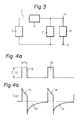
- the iontophoresis device 1 shown as a block diagram in Fig. 3, comprises a power source 2 (e.g., a dry element battery having a voltage of 6 V), a pulse generator 3 capable of generating a direct current pulse having a frequency of about 50 kHz as shown in Fig. 4a, a working electrode 4 containing an ionic agent, a counter electrode 5, a human body 6 connected to the working and counter electrodes 4 and 5, and a switch mechanism 7.
- a power source 2 e.g., a dry element battery having a voltage of 6 V
- a pulse generator 3 capable of generating a direct current pulse having a frequency of about 50 kHz as shown in Fig. 4a
- a working electrode 4 containing an ionic agent e.g., a working electrode 4 containing an ionic agent
- a counter electrode 5 e.g., a counter electrode
- a human body 6 connected to the working and counter electrodes 4 and 5
- a switch mechanism 7 e.
- the switch mechanism 7 is provided, in parallel to the human body 6, for depolarizing the polarized potentials of the electrodes 4 and 5, preferably for bringing the polarized potentials of the electrodes 4 and 5 to an equal level simultaneously with the stoppage of the therapeutic pulses 8, 8, ... generated from the pulse generator 3. That is, according to this mechanism, the residual charge (i.e., polarization) charged in the polarization capacity Cpol of polarization impedance Z of the skin S is discharged or depolarized by short-circuiting the electrodes 4 and 5.
- the current passing through the human body is as shown in Fig. 4b. That is, during output time period T of the therapeutic pulse shown in Fig.
- the current (i.e., pulse current Ia) flows mainly to the polarization impedance Z of the skin S of the human body 6, and the ionic agent contained in the working electrode 4 is mainly endermically absorbed via the polarization resistance Rpol of the skin S.
- the working electrode 4 and the counter electrode 5 are short-circuited by the switch mechanism 7 and, therefore, the residual charge (i.e., polarization) charged in the polarization capacity Cpol of the polarization impedance Z of the skin S of the human body 6 during the output period of the therapeutic pulses 8 is discharged or depolarized as a depolarization current Ib during the period when the therapeutic pulses are stopped.
- the electric potentials of the both electrodes are lowered to the predetermined level or less, preferably to an approximately equal level.
- the iontophoresis device 10 shown as a block diagram in Fig. 5, comprises a power source 2 (e.g., a dry element battery having a voltage of 6 V), a working electrode 4 containing an ionic agent, a counter electrode 5, a human body 6 connected to the working and counter electrodes 4 and 5, and a pulse generator 11.
- the pulse generator 11 is formed in such a.manner that the pulse generator 11 generates therapeutic pulses 12, 12, ... having, for example, a frequency of approximately 100 kHz as shown in Fig. 6a, while it generates pulse components 13, 13, 13, ...
- the reverse pulse components 13, 13, 13, ... are forced to discharge or depolarize the residual charge stored in the skin S of the human body 6 connected to the both electrodes 4 and 5 during the output period of the therapeutic pulses 12, 12, ... simultaneously with the stoppage of the pulses 12, 12, ....
- the current as shown in Fig. 6b flows through the skin S of the human body 6.
- each pulse can be also separately generated from different pulse generators and can be applied to the human body after turning both pulses.
- the present iontophoresis device may also include a mechanism for optionally or automatically controlling the time interval and the voltage of the forced discharge pulse components to effect the depolarization between the working and counter electrodes.
- the switch mechanism is provided for effecting the depolarization between the working and counter electrodes and that the pulse generator is provided for generating the reverse pulse components.
- the pulse generator is provided for generating the reverse pulse components.
- any means capable of effecting similar functions can be also used in the present invention.
- the duty ratio is 0.1 to 0.7, more preferably 0.1 to 0.4, and the frequency is 1 kHz to 500 kHz, more preferably 5 kHz to 200 kHz.
- the extent of the depolarization effected in the present invention is such that the residual polarization voltage constantly applied to the human skin does not cause skin irritation.
- a polarization voltage can be optionally determined depending upon various operating conditions such as the pulse voltage to be used, the preferable residual voltage is 3 V or less, more preferably 1.5 V or less.
- This value can be represented in terms of a ratio of the depolarization current value to the pulse current value by about 50% or more, preferably 60% or more, and more preferably 70% or more. From another point of view, the depolarization current value is preferably a constant value close to a zero level.
- a constant bias voltage can be further applied, in addition to the pulse voltage, within such a range that no skin irritation is caused. That is, the pulse iontophoresis and minute continuous direct current may be used together within the above-mentioned range.
- the current flowing through the human skin may be about a dozen to several dozens times those where the continuous direct current or pulsed direct current are applied at the same electric source voltage. This means that several to several dozens times the ionic agent introduction effect can be obtained, although the loss of the electric current stored in the polarization capacity Cpol (i.e., polarization loss) and the intermission period of the therapeutic pulses must be taken into consideration.
- the loss of the electric current stored in the polarization capacity Cpol i.e., polarization loss
- the intermission period of the therapeutic pulses must be taken into consideration.
- the iontophoresis device capable of introducing the necessary amount of drugs under a low voltage or even under a high voltage (e.g., 50 V) with an extremely weak irritation effect on the human skin, without causing burns and rubefaction in the skin and also capable of being used over a long period of time, can be obtained.
- a high voltage e.g. 50 V
- the pulse components in the reverse direction of the therapeutic pulse are generated simultaneously with the stoppage of the therapeutic pulse, the effect of the above-mentioned time constant due to, for example, the resistance components of the circuit, becomes very low.
- the direct current pulse having a high frequency can be used since the depolarization between both electrodes can be effected simultaneously with the stoppage of the therapeutic pulse.
- the desired iontophoresis can be conducted with a lower skin impedance.
- the periodic pulse is used in the present iontophoresis device
- a non-periodic pulse can be also used in the present invention.
- the pulse waveform is not essentially limited to a rectangular wave.
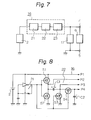
- Figs. 7 to 10 illustrate one example of the circuit of the iontophoresis device in which a pulse generating mechanism 16 is provided with a charge pump type voltage converter circuit for increasing the voltage of the electric source 2 and an output current controlling circuit for controlling the output current.
- the pulse generating mechanism 16 comprises a pulse generator 21, a charge pump type voltage converter circuit 22 for increasing the output voltage of the pulse, and an output current controlling circuit 23.
- the reference numerals 4 and 5 represent the working and counter electrodes, respectively, and the reference numeral 6 represents a human body connected to both electrodes.
- the numeral 17 represent a switch mechanism.
- the electric source 2 which is, for example, a button shaped small and light weight lithium battery having an output of 3 V
- the pulse generator 21 is then connected to the charge pump type voltage converter circuit 22 for increasing the voltage of the electric source to approximately twice the original voltage.
- the charge pump type voltage converter circuit 22 is composed of, for example, switching elements Sl, S2, S3, and S4 in which FET is used, a charge pump capacitor Cl, and a charge reserve capacitor C2.
- the output terminals Pl, P2, P3, and P4 of the charge pump type voltage converter circuit 22 are connected to a current limiting circuit 23 and a switch mechanism 17.
- the current limiting circuit 23 is composed of a resistance Rl, an FET Fl, a resistance R2, and an FET R2.
- the switch mechanism 17 is composed of FETs Fl and F2, which are controlled by the outputs derived from the output terminals P2 and P3 of the above-mentioned charge pump type voltage converter circuit 22.
- the continuous direct current having an output of 3 V discharged from the electric source 2 is first transformed (or converted) to a direct pulse, shown in Fig. 10a, by the pulse generator 21.
- the direct pulse thus transformed is then transformed, by the charge pump type voltage converter circuit 22, to a therapeutic pulse 20 (i.e., doubled voltage direct current pulse) shown in Fig. 10b. That is, when the first half cycle Tl of the direct current pulse is generated, the charge pump capacitor Cl is charged in the polarity shown in Fig. 8 because the switching elements Sl and S3 are conductive. When the next half cycle T2 of the direct current pulse is generated, the switching elements S2 and S4 are conductive and the switching elements Sl and S3 are open. As a result, the full charge of the capacitor Cl is transferred to the charge reserve capacitor C2.
- the polarity becomes negative against the ground and the electric potential between the output terminal Pl and P4 is increased to 6 V, which is approximately twice the voltage of the electric source.
- the therapeutic pulse 20 thus increased is discharged to the working electrode 4 and the counter electrode 5 via the current limiting circuit 23 and the switch mechanism 17, and then applied to the human body 6.
- the source and the drain of the FET Fl of the switch mechanism 17 are conductive when the therapeutic pulse 20 is generated and, therefore, as electric potential difference occurs between the working electrode 4 and the counter electrode (5).
- the ionic drug contained in the working electrode (4) is introduced into the human body 6.
- the source and drain of the FET F2 of the switch mechanism 17 are rendered conductive by the output signal from the output terminal P2, while the FET F2 becomes open by the output signal from the output terminal P3.
- the residual charge (i.e., polarization) stored in the skin S of the human body 6 is short-circuit discharged (or depolarized) and the current as shown in Fig. 10c passes through the human body 6.
- the current waveform of Fig. 10c when the direct current pulse is applied to the human body, large peak currents flow therethrough because the impedance is very low at the leading and trailing edges of the waveform.
- these peak currents can be limited by the function of the output current limiting circuit 23 in the present iontophoresis device.
- the upper and lower peak currents passing through the human body can be cut as shown in Fig. 10d.
- the switch mechanism for effecting the depolarization between the working and counter electrodes during the stoppage of the therapeutic pulse and the pulse generating mechanism provided with the charge pump type voltage converter circuit and the current limiting circuit are used.
- the voltage converter circuit and the output current limiting circuit can be also combined with a circuit that generates the pulse component in the reverse direction of the therapeutic pulse simultaneously with the stoppage of the therapeutic pulse to effect the depolarization between the working and counter electrode, as previously mentioned.
- either or both of the voltage converter circuit and the current limiting circuit may be optionally deleted from the present iontophoresis device.
- the charge pump type voltage converter circuit is used in the above-mentioned embodiment as one example of the voltage converter mechanism of the voltage of the electric source, it should be noted that any other mechanism having the same function, such as a voltage converter based on a transformer or DC-DC converter may be used in the present invention.
- the charge pump type boosting is used at one stage, in the above-mentioned embodiment, for obtaining approximately twice the initial voltage, the charge type boosting can be optionally used at multi stages for obtaining any desired voltage.
- the current limiting circuit and the switch mechanism are explained as an integral form in the above embodiment, these can be used separately or any other mechanisms having the same function can be also used in the present invention. It should be noted that the pulse generator and the switch mechanism are not limited to those specifically illustrated in the above embodiment.
- the desired beneficial treatment effect can be obtained even by using an electric source having a low voltage, since the voltage converter mechanism is provided in the pulse generating mechanism according to the present iontophoresis device.
- an extremely preferable circuit for a plaster type iontophoresis device suitable for use in direct adhesion application to the human skin as a whole can be obtained since the total volume of the device can be minimized.
- the large peak currents at the leading and trailing edges of the therapeutic peak can be effectively limited and, therefore, the amounts of the drugs to be introduced into the human body can be controlled. Furthermore, the desired controlled delivery of the drugs not depending upon individual impedance can be attained by freely controlling the output current when a variable resistance circuit, variable duty ratio circuit or frequency converting circuit is inserted into the output current limiting circuit.
- the first example explained above is formed such that the residual charge stored in the polarization capacity of the skin is depolarized by short-circuiting the charge or by applying the reverse pulse components to the charge.
- the iontophoresis device in which the above-mentioned residual charge is depolarized and simultaneously and effectively recovered to obtain a low electric power consumption type device, will be further explained in detail hereinbelow referring to Figs. 11 to 13.
- the iontophoresis device 31 shown in a block diagram of Fig. 11, comprises a power source 32 (e.g., a day element battery having a voltage of 6 V), a pulse generator 33 capable of generating a direct current pulse having a frequency of about 50 kHz as shown in Fig. 4a, a working electrode 4 containing an ionic agent, a counter electrode 5, a human body 6 connected to the working and counter electrodes 4 and 5, a capacitor 37 for recovering the residual charge, which is connected in parallel to the electric source 32, and an inductor 38, which is connected to a switch mechanism 39.
- the switch mechanism 39 is provided for forming a closed circuit for recovering the residual charge shown in Fig.
- the switch mechanism 39 is connected in parallel to the pulse generator 33.
- the iontophoresis device shown in Figs. 11 to 14 can be used as follows. That is, the working and counter electrodes 4 and 5 are first adhered to the human body 6. Thus, the drug introduction circuit shown in Fig. 12 is formed. That is, the pulse generator generates the pulse 8 shown in Fig. 4a. As a result, during the output time T of the pulse, the current (i.e., pulse current Ia) flows mainly through the polarization impedance Z of the skin S of the human body 6 and, therefore, the ionic drug contained in the working electrode 4 is endermically absorbed mainly via the polarization resistance Rpol of the skin S.
- the current i.e., pulse current Ia
- the current flows mainly through the polarization impedance Z of the skin S of the human body 6 and, therefore, the ionic drug contained in the working electrode 4 is endermically absorbed mainly via the polarization resistance Rpol of the skin S.
- the switch mechanism 39 turns on, whereby the circuit for recovering the residual charge is formed as shown in Fig. 13.
- This circuit allows the recovery of the residual charge stored in the polarization capacity Cpol of the polarization impedance Z of the skin S of the human body 6 while the therapeutic pulse is being generated.
- the residual charge is recovered in the capacitor 37 for recovering the residual charge by the L-C resonance between the polarization capacity Cpol and the inductor 38. The charge thus recovered is discharged in the next cycle at which the therapeutic pulse 8 is generated.
- this residual charge recovery action allows the lowering of the electric potential between both electrodes to the given value, preferably to equal levels, by discharging (or depolarizing) the residual charge (i.e., polarization) stored in the polarization capacity (i.e., depolarization current Ia) during the stoppage of the therapeutic pulse 8.
- the L-C resonance is used as a means for simultaneously depolarizing and recovering the residual charge
- the present invention is not limited to this embodiment.
- a capacitor only can be provided for recovering the residual charge.
- any other means capable of recovering the residual charge for example, a means based on R-C resonance, can also be used in the present invention.
- the electric power consumption necessary for the treatment can be effectively decreased since the extra residual charge, which is stored in the polarization capacity of the human skin and which is not concerned with the drug introduction to the human skin, can be extremely effectively recovered and reused, while the residual charge is depolarized. Furthermore, the small sized and light weight device can be effectively formed since the desired drug introduction can be effected by using a relatively small capacity and small sized battery.
- Fig. 14 illustrates one example of the circuit diagram for simultaneously depolarizing and recovering the residual charge in the load capacity by the L-C resonance between an inductor and the load capacity, in which a transformer for boosting the pulse voltage is provided and the secondary winding of the transformer is utilized as the inductor.
- the reference numeral 32 represents an electric source, which can be, for example, a button shaped small sized and light weight lithium battery having an output of.3V, for obtaining a small-sized and light weight device.
- the electric source 32 is connected to the pulse generator 33.
- the pulse generator 33 is formed by, for example, a free running multivibrator circuit, so that pulse having a frequency of 50 KHz and a duty ratio of 0.2 is generated.
- a transformer 40 is provided for boosting the pulse voltage and is formed in a winding ratio of, for example, 1:3.
- the secondary winding of the transformer 40 is formed so as to function as the inductor 38 for the L-C resonance.
- a switching transistor 39 is provided for turning on and off the primary winding of the transformer 40 by the output from the pulse generator 33.
- the reference numerals 41 and 37 represent a diode for protecting the circuit and a capacitor for recovering the residual charge respectively.
- the working and counter electrodes 4 and 5 are connected to the human body 6. This example of the present invention can function in the same manner as the previously explained example and have the same effects.
- Fig. 15 illustrates a circuit diagram of another example for simultaneously depolarizing and recovering the residual charge in the load capacity by a function of an induced current inducing type transformer 45.
- the primary winding 46 of the transformer 45 is connected in series to both electrodes 4 and 5 and the secondary winding 47 is connected, through a diode 48 for preventing inverse current, to a rechargeable battery 49.
- a pulse generator 33 is connected to the rechargeable battery 49 and is also connected to the gates of the first and second FETs 42 and 43.
- the pulse generator 33 generates a pulse 8 as shown in Fig. 4a by using the rechargeable battery 49 as an electric source. Simultaneously, at the leading edge of the pulse 8, the drain and the source of the FET 42 are rendered conductive. Accordingly, a current (i.e., pulse current Ia) flows mainly to the polarization impedance Z of the skin S of the human body 6 during the output time period T of the pulse 8 and the ionic drug contained in the working electrode 4 is endermically absorbed mainly through the polarization resistance Rpol of the skin S. Simultaneously when the pulse 8 is stopped, the FET 42 is turned off and the FET 43 is conductive.
- pulse current Ia flows mainly to the polarization impedance Z of the skin S of the human body 6 during the output time period T of the pulse 8 and the ionic drug contained in the working electrode 4 is endermically absorbed mainly through the polarization resistance Rpol of the skin S.
- the residual charge stored in the polarization capacity Cpol of the polarization impedance Z is instantaneously depolarized by a closed circuit including the primary winding 46 of the transformer 45, and an induced current is simultaneously induced in the secondary winding by the transformer 45. This induced current is effectively recovered, via the diode 48, in the rechargeable battery 49.
- the residual charge is recovered in the rechargeable battery
- this residual charge can be also recovered in the capacitor.
- the winding ratio of the transformer can be optionally changed, taking into consideration the induction efficiency of the induced current and the charging efficiency to the rechargeable battery or capacitor.
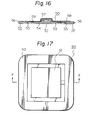
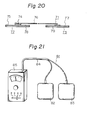
- Figs. 16 and 17 illustrate a first example of the present iontophoresis device.
- an iontophoresis device 50 which is in the form of a plaster (i.e., the entire device is adhered to the human skin), comprises a working electrode 51 and a counter electrode 52.
- the first electrode 51 is formed by laminating a conductive gel layer 53 containing an ionic agent in the form of a flexible sheet or film with a current-distribution conductive member layer 5, which layer is formed by a metallic foil (e.g., an aluminum foil), a conductive rubber or resin film, carbon film, or conductive coating.
- a metallic foil e.g., an aluminum foil
- a conductive rubber or resin film e.g., carbon film, or conductive coating.
- the second electrode 52 is formed by laminating a conductive gel layer 55 in the form of a flexible sheet or film with a current-distribution conductive member layer 54 as in the working electrode.
- a power supply unit 57 is mounted in the approximately center portion of the upper surface of the working electrode 51.
- the power supply unit 57 comprises an electric source (e.g., a button battery), a pulse generator, a means for bringing the electric potential of both electrodes 51 and 52 to an approximately equal level while the therapeutic pulse is stopped, and a means for recovering the residual charge.
- the one output terminal (e.g., negative (-) terminal) of the power supply unit 57 is in contact with the current-distribution conductive member layer 54.
- the other output terminal (e.g., positive (+) terminal) of the power supply unit is connected to the current-distribution member layer 56 of the counter electrode 52 by means of, for example, a lead wire 58 made of an aluminum foil which is applied on the bottom surface except for both end portions by an insulating coating.
- the working and counter electrodes 51 and 52 are separately fixed at a spaced distance by an insulating backing layer 59, which is in the form of a flexible sheet or film of a non-conductive synthetic resin.
- the working electrode 51, the counter electrode 52, and the power supply unit 57 are integrally structured by means of the insulating backing layer 59.
- the present iontophoresis device thus formed can be applied by adhering the device to the human skin in such a manner that the working electrode 51 is in contact with the intended portion of the human body to be treated.
- electrodes 51 and 52 form a closed circuit through the human body, thereby promoting the penetration or absorption of the ionic agent contained in conductive gel layer 53 of the working electrode 51 through the skin.
- the iontophoresis device having a light weight and being capable of very easy and direct application to the human skin, and giving a sample operation and effective drug introduction effect can be obtained.
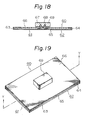
- an iontophoresis device 60 comprises a working electrode 61 and a counter electrode 62.
- the electron-distribution conductive member layers 63 and 64 of the working and counter electrodes 61 and 62 are separated from each other at a distance of approximately 5 mm.
- An ionic agent-containing conductive gel layer 65 having a very thin thickness (e.g., approximately 0.3 mm) is adhered to the bottom surfaces of the electrodes 61 and 62.
- the working and counter electrodes 61 and 62 are separately fixed and integrally supported on an insulating backing layer 66.
- the reference numerals 67 and 68 represent terminals connected to the working and counter electrodes 61 and 62, respectively.
- the top portions of the terminals 67 and 68 are projected through the insulating backing layer 66.
- a power supply unit 69 is electrically and mechanically connected to the terminals 67 and 68.
- This example of the present iontophoresis device can be applied in the same manner as in the first example mentioned above.
- the same conductive gel layer i.e., only one conductive gel layer 65 containing an ionic agent
- some leak current occurs betwen each electrode.
- the conductive gel layer itself possesses some resistance, and since the distance between the conductive member layers 63 and 64 is much larger than the thickness of the conductive gel layer 65, the penetration effect of the ionic agent into the skin is not substantially affected.
- the production of the iontophoresis device can be very simply and effectively conducted. That is, the desired iontophoresis device can be readily produced by cutting a strip sheet, on which a conductive gel layer, a conductive member layer, and an insulating backing layer are laminated, at a predetermined distance, followed by placing the terminals and the power supply. In particular, this production process is very advantageous especially for mass production of the device.
- the effect due to the size of the power supply in the entire device can be minimized and the adhesion of the device to the human body even at a curved portion can be smoothly carried out without impairing the flexibility of the device.
- an iontophoresis device 71 comprises a working electrode 72, a counter electrode 73, and a power supply unit 74.
- the negative (-) terminal cf the power supply unit 74 is connected to the current-distribution conductive member layer 75 of the working electrode 72 and the positive (+) terminal is connected, via a lead wire 76, to an electric- distribution conductive member layer 77 of the counter electrode 73.
- This example of the present iontophoresis device enables the working electrode to be applied to the body separated from the counter electrode at a distance, limited only by the length of the lead wire.
- the . iontophoresis device can be easily applied to the intended portion of patient even when the portion is very small or has a relatively large curvature radius.
- the iontophoresis device is not affected by the electric current flowing on the surface of the skin during application since the two electrodes are separately placed.
- an iontophoresis device 81 comprises a working electrode 82, a counter electrode 83, and a power supply unit 85.
- the power supply unit is connected, via a lead wire 84, to the working and counter electrodes 82 and 83.
- the power supply unit 85 includes an electric source (e.g., four UM-3 (JIS) type dry element batteries), a pulse generator utilizing a transformer, a switch mechanism for bringing the electric potentials of both electrodes 82 and 83 into substantially the equal level during the stoppage of the therapeutic pulse, and a means for recovering the residual charge.
- the power supply unit 85 is provided with an output current variable circuit and a timer circuit.
- the power supply unit is not integrally placed with both electrodes, a large capacity of the dry element battery can be used since there is enough room in the circuit space. Furthermore, since the working and counter electrodes can be composed of an extremely lightweight thin sheet in the form of a simple film, the adhesion of the electrodes to the human skin can be extremely facilitated.
- the use of the output current variable circuit provided at the power supply unit can optionally control the output current amount, depending upon the skin resistance of a patient, the kind of drug to be introduced, and the necessary amount of a drug to be introduced. Furthermore, the use of the timer circuit in the power supply unit can effectively prevent undesirable over application of a drug into the human body.
- the conductive gel containing an ionic agent is used in the working electrode
- various other materials capable of retaining the impregnated ionic agent or electrolyte therein can be also used.
- materials are paper materials such as a water-absorbent paper, fabric materials such as a gauze, fiber materials such as absorbent wadding, sponge or porous materials such as open-cell type synthetic resin foams or water-absorbent resin.
- the ionic agent is already contained in the conductive gel layer of the working electrode in the above-mentioned examples of the present iontophoresis device
- the ionic agent can be applied to the working electrode and/or the skin at the time when the iontophoresis device is applied to the human body. That is, when the iontophoresis device having a conductive layer which does not contain an ionic agent is applied to the human skin, an ionic agent contained in, for example, an ointment or cream can be applied to the working electrode or the intended portion of the skin and, then, the iontophoresis device is applied to the human skin.
- a polarity switching means can be provided in the iontophoresis device in such a manner that the negative or positive polarity can be freely changed depending upon the polarity of the effective drug ion.
- a feedback mechanism can be provided in the iontophoresis device in such a manner that the output current is automatically controlled by monitoring the physical conditions of the patient.
- a sensor for monitoring the blood sugar value in the blood can be advantageously connected to the power supply unit so that a feedback mechanism for controlling the output current and/or output time is operated by detecting the output of the sensor.
- the conductive gel layers of the working and counter electrodes of the present iontophoresis device are composed of various hydrophilic natural or synthetic resins: for example, natural resinous polysaccharides such as karaya gum, tragacanth gum, and Xanthan gum; vinyl resins such as partially saponified polyvinyl alcohol, polyvinyl formal, polyvinyl methyl ether and copolymers thereof, polyvinyl pyrrolidone, and polyvinyl methacrylate; and acrylic resins such as polyacrylic acid and sodium salts thereof, polyacryl amide and partially hydrolyzed products thereof, partially saponified products of polyacrylic acid esters, and copoly (acrylic acid-arylamide).
- natural resinous polysaccharides such as karaya gum, tragacanth gum, and Xanthan gum
- vinyl resins such as partially saponified polyvinyl alcohol, polyvinyl formal, polyvinyl methyl ether and copolymers thereof, polyvinyl
- hydrophilic natural or synthetic resins are softened and plasticized with water and/or polyols such as ethylene glycol, propylene glycol and glycerine and are molded to the form of a flexible sheet or film.
- the resultant gel layer has a shape retention property and good adhesiveness to the skin.
- An ionic agent or drug is further included, or is to be included just before application to the skin, in the conductive gel layer of the working electrode, whereby the conductivity of the gel layer increases.
- a supporting electrolyte is optionally added to the gel layer as in the case of the so-called electrophoresis gel.
- various elecrolytes such as sodium chloride, sodium carbonate, and potassium citrate, can be added to the conductive gel layer of the counter electrode to provide a sufficient conductivity.
- the electrolyte is usually added in an amount of about 1% to 15% by weight, based on the total weight of the gel layer.
- the resultant conductive gel layers suitable for use in the present invention are in the form of a flexible sheet or film and can closely adhere to the skin. Therefore, the skin contact resistance is low. As a result, the ionic agent or drug effectively penetrates into the skin. Furthermore, it is advantageous from the viewpoint of practical application that the iontophoresis device can be directly applied to the intended skin without using an adhesive means such as a pressure-sensitive adhesive tape.
- gel layers having not only electrochemically good conductivity but also desirable skin compatibility or adaptability can be obtained. This is due to the pH buffer action (pH 4-5) or skin protecting property based on the natural high polymer acid structure, remarkably high water-retention characteristics, and moderate skin adhesiveness thereof.
- the gel composition selected is usually 20 to 70 parts by weight of karaya gum and 80 to 30 parts by weight of a polyol, such as glycerine or propylene glycol (containing 0% to 50% by weight of H 2 0 based on the weight of the polyol), depending upon its intended use. Since the resultant gel has sufficient water-retention characteristics, an ionic agent or drug in the form of aqueous solution can be added to the gel layer before usage. The addition of electrolytes to the counter electrode is not necessarily required since gel composed of karaya gum has sufficient conductivity by itself.
- the gel layer is prepared so as to provide the desired ion mobility or conductivity, depending upon the kind of the ionic agent or drug, the administered amount (dose required), the application period, the output power of the battery, the contact area to the skin, and other factors.
- the preparation and composition of the conductive gel layers suitable for use in the present iontophoresis device are given below.
- the examples are given in reference to the conductive gel layers for the counter electrodes, however, the conductive gel layers of the working electrodes can be prepared in the same manner except that all or part of the electrolytes such as sodium chloride is replaced with the desired ionic agent or drug.
- the desired ionic agent or drug can be incorporated into the gel layer at the time when the gel layer is prepared or just before the iontophoresis device is actually applied to the skin.
- the resultant sheet had a sufficient adhesiveness to the skin and a specific resistance of 0.2 k ⁇ cm.
- the resultant sheet had a sufficient adhesiveness to the skin and a specific resistance of 1.0 kn ' cm.
- the resultant sheet had a sufficient adhesiveness to the skin and a specific resistance of 0.75 k ⁇ cm.
- a 20 g amount of sodium polyacrylate having a weight-average molecular weight of 3,000,000 to 5,000,000 was uniformly mixed with 12 g of a 5% NaCl solution in distilled water and 68 g of glycerine.
- the resultant mixture was heated under pressure at a temperature of 80°C for 10 minutes to provide a flexible sheet.
- the sheet thus prepared had a moderate adhesiveness to skin and a specific resistance of 0.5 k ⁇ .cm after being allowed to stand for 1 day.
- a 30 g amount of karaya gum was uniformly mixed with 30 g of 5% NaCl solution in distilled water and 40 g of glycerine and then hot-pressed to form a sheet in the same manner as mentioned above.
- the specific resistance of the resultant sheet was 0.65 k ⁇ cm.
- a 20g amount of sodium polyacrylate having a weight-average molecular weight of 3,000,000 to 5,000,000 was uniformely mixed with 80 g of a 7% NaCl solution in distilled water and then hot pressed to form a sheet in the same manner as mentioned above.
- the specific resistance of the resultant sheet was 0.47 k ⁇ cm.
- an acidic polymer such as polyacrylic acid, methyl vinyl ethermaleic anhydride copolymer (e.g., GANTREZ R AN-169 manufactured by G.A.F. Co.), or carboxypolyethylene (CARBOPOL R manufactured by Goodrich Co.) can be preferably used, as a base material for the gel layer, for obtaining a high drug introduction efficiency.
- a basic polymer such as polyacrylamide can be preferably used.
- gel composition suitable for use as a gel layer for propranolol is as follows:
- composition in the form of a self-adhesive type film having a thickness of approximately 0.1 to 0.5 mm can be extremely preferably used as integral type film working and counter electrodes according to the present invention.
- nonionic polymeric substances such as polyvinyl alcohol and polyvinyl pyrolidone can also provide a gel having an electrochemically relatively high efficiency.
- hydrophilic polymeric substances can be used, in the formation of conductive gel layers suitable for use in the present invention, by softening and plasticizing said substances with water and/or alcohols.
- the gel composition is selected from those containing 10% to 70% by weight of hydrophilic polymeric substances and the remainder of water and/or polyols in order to obtain the desired shape retentiveness.
- additional pressure-sensitive adhesive components such as acrylic type adhesives, and vinyl acetate emulsion type adhesives can be incorporated into the gel layers, if desired.
- the desired ionic agent or agents can be substituted for a portion or all of the electrolyte component (e.g., sodium chloride) in the above-mentioned gel compositions.
- the water-retaining member layer is freely removably structured and, when the iontophoresis device is applied to the human skin, the water-retaining portion previously impregnated with the drug solution may be placed in the predetermined portion of the structure.
- non-adhesive hydrogels such as agar gels and gelatin gels conventionally used in the field of electrophoresis can be used in lieu of the above-mentioned water-absorbable members.
- agar gels is as follows:
- non-adhesive hydrogels such as agar gels can be previously laminated in the device structure or, as mentioned above, placed when the device is used. It should be noted that, when nonadhesive hydrogels such as agar gels are used, skin adhesive means such as pressure-sensitive adhesive tapes should be arranged on, for example, the outer circumferential portion of the present iontophoresis device, as shown in Fig. 1.
- agents or drugs can be used in the present iontophoresis device so long as they can dissociate into ions.
- ionic agents or drugs usable in the present invention are potassium iodide, procaine hydrochloride, methacholine, various skin vitamins such as vitamins B 1 , I B2 , B 6 , and C, histamine, sodium salicylate, dexamethasone, betamethasone phosphate, epinephrine, hydrocortisone, idoxuridine, propranolol, nitrites, bleomycin, undecylenic acid salts, sodium dexamethasone phosphate, sodium prednisolone phosphate, alimemazine, chlorpheninamine maleate, clemastine, glibenclamide, colchicine, diclofenac sodium, chlor- promazine, chlordiazepoxide, clonazepam, desipramine, imipramine, atropine s
- Conductive gel layers for working and counter electrodes having a thickness of 1.5 mm and an area of 48 cm 2 were prepared from a viscoelastic gel composition comprising 20% by weight of the above-mentioned CARBOPOL R 491, 30% by weight of distilled water, and 40% by weight of glycerine.
- the gel layer of the working electrode further contained 5% by weight of sodium salicylate.
- the gel layer of the counter electrode further contained 3% by weight of sodium chloride.
- gel layers were integrally assembled by laminating a power supply unit generating a therapeutic pulse having a frequency of 10 kHz (duty ratio of 30%) connected to a 6 V electric source.
- An aluminum foil was used as a current-distribution conductive member layers.
- the iontophoresis device of this example can be used as an analgesic and antiphlogistic agent.
- galvanization effecting vasodilative function is also conducted by simultaneous application of a bias voltage within the non-skin irritation range or by maintaining a certain amount of the residual polarization voltage within the non-skin irritation range, it should be noted that this iontophoresis device exhibits remarkable synergestic effects on disorders such as neutralgia, arthralgia, and rheumatoid arthralgia.
- Metoprolol tartrate Antiarrhythmic drug
- Electrode sheets having a thickness of each electrode of 1 mm and an area of each electrode of 50 cm 2 and containing 10% of metoprolol tartrate (Ciba-Geigy Co.) in the composition shown in Table 1 were applied to healthy men (I: Age 31, Body weight 75 kg; II: Age 39, Body weight 56 kg).
- the working and counter electrodes were adhered to the left forearms of the test persons with a distance of about 1 cm between the working electrode and the counter electrode.
- the average pulse current was 50 mA.
- Sample of blood in an amount of 20 ml were taken from the right-arm vein by a heparin treated tube at 0 hr, 4 hrs, and 8 hrs from the initiation of the test.
- concentrations of metoprolol tartrate in the blood plasma fraction were determined by a gas-liquid chromatography method according to Degen & Riess (J. Chromat. 121, 72-75 (1976)).
- the analysis was carried out by using a Hitachi model 163 analyzer provided with an ionization detection device (manufactured by Hitachi, Ltd.) under the conditions of an injection temperature of 220°C and an oven temperature of 200°C.
- a QF-1 glass column having a length of 2 m and packed with 2% silicon was used.
- Diclofenac sodium Anti-inflammatory agent
- Electrode sheets each having a thickness of 1 mm and an area of 50 cm 2 and containing 2% of diclofenac sodium (Ciba-Geigy Co.) in the composition shown in Table 3 were applied to a healthy man to be tested having an age of 35 and a body weight of 55 kg.
- the electrode sheets were adhered to the left forearm of the test person with a distance of about 1 cm between the two electrode sheets.
- the iontophoresis was carried out under the same operation conditions as mentioned above. After 5 hours, a 20 ml blood sample was obtained.
- the concentration of dicrofenac sodium in the blood plasma fraction was determined by a gas-liquid chromatography method according to Geiger, Degan, and Sioufi (J. Chromat. 111, 293-298 (1976)), which was modified to a small extent.
- the analysis was carried out by using a Hitachi model 163 analyzer provided with an ionization detection device (manufactured by Hitachi, Ltd.) under the same temperature conditions.
- a QF-1 column having a length of 2 m and packed with 2% silicon was used.
- the dicrofenac sodium level in the blood plasma after 5 hours was about 128 ng/ml.
- plaster type iontophoresis device illustrated in Application Example 1 is effective for curing various skin disorders and for injecting various cosmetic skin nutrients.
- self-adhesive conductive gel layers for both electrodes having a thickness of 1.5 mm and an area of about 1.2 cm 2 are prepared from a viscoelastic gel comprising 20% by weight of GANTREE R AN-169, 15% by weight of a 20% NaCl solution in distilled water, and 65% by weight of glycerine.
- vitamin C ascorbic acid
- the derivatives thereof such as sodium ascorbate are effective for curing chromatodermatosis such as the so-called moth patch, freckle, and various melanosises.
- conventional iontophoresis has not become popular due to the troublesome application although it is known that iontophoresis is a very effective method for curing chromatodermatosis and the like.
- the present iontophoresis device can be very effectively and advantageously used for curing various skin disorders and for injecting various cosmetic skin nutrients by a very simple operation. This constitutes a dramatic progress in this field.
- hydrophilic polymeric substances usable as a gel layer material various known hydrophilic polymeric substances usable as so-called bioelectrode materials can be also used. Such materials are disclosed in, for example, Japanese Unexamined Patent Publication (Kokai) Nos.
- hydrophilic polymeric substances can be used as a basic substance of the gel layer in the present iontophoresis device by appropriately adjusting the water content thereof.
- Typical examples of such materials are polyethylene glycol, carboxy polymethylene, methyl cellulose, sodium alginate, and polyethylene oxides.
- any hydrophilic polymeric substances which can be softened and plasticized with water and/or polyols to form viscoelastic gels, desirably having an adhesiveness to the skin, can be used as the basic gel material of the conductive gel layers of the present iontophoresis device.
- These substances are generally selected taking into consideration the compatibility thereof with the ionic agent or drug to be used, the compatibility with the skin, and the electrical conductivity. These gel layers can be discarded or reused.
Landscapes
- Health & Medical Sciences (AREA)
- Engineering & Computer Science (AREA)
- Biomedical Technology (AREA)
- Nuclear Medicine, Radiotherapy & Molecular Imaging (AREA)
- Radiology & Medical Imaging (AREA)
- Life Sciences & Earth Sciences (AREA)
- Animal Behavior & Ethology (AREA)
- General Health & Medical Sciences (AREA)
- Public Health (AREA)
- Veterinary Medicine (AREA)
- Bioinformatics & Cheminformatics (AREA)
- Electrotherapy Devices (AREA)
Priority Applications (1)
| Application Number | Priority Date | Filing Date | Title |
|---|---|---|---|
| EP88103452A EP0308572B1 (fr) | 1983-09-01 | 1984-08-29 | Dispositif d'iontophorèse |
Applications Claiming Priority (6)
| Application Number | Priority Date | Filing Date | Title |
|---|---|---|---|
| JP15907683A JPS60156475A (ja) | 1983-09-01 | 1983-09-01 | イオントフォレ−ゼ用デバイス |
| JP159076/83 | 1983-09-01 | ||
| JP4144084A JPS60188176A (ja) | 1984-03-06 | 1984-03-06 | イオントフオレ−ゼ用デバイス |
| JP41440/84 | 1984-03-06 | ||
| JP15131084A JPS6131169A (ja) | 1984-07-23 | 1984-07-23 | イオントフォレ−ゼ用デバイス |
| JP151310/84 | 1984-07-23 |
Related Child Applications (1)
| Application Number | Title | Priority Date | Filing Date |
|---|---|---|---|
| EP88103452A Division-Into EP0308572B1 (fr) | 1983-09-01 | 1984-08-29 | Dispositif d'iontophorèse |
Publications (2)
| Publication Number | Publication Date |
|---|---|
| EP0138347A1 true EP0138347A1 (fr) | 1985-04-24 |
| EP0138347B1 EP0138347B1 (fr) | 1989-08-02 |
Family
ID=27290814
Family Applications (1)
| Application Number | Title | Priority Date | Filing Date |
|---|---|---|---|
| EP84305910A Expired EP0138347B1 (fr) | 1983-09-01 | 1984-08-29 | Dispositif de iontophorèse |
Country Status (5)
| Country | Link |
|---|---|
| US (1) | US4764164A (fr) |
| EP (1) | EP0138347B1 (fr) |
| AU (2) | AU575068B2 (fr) |
| CA (1) | CA1262564A (fr) |
| DE (2) | DE3486412T2 (fr) |
Cited By (23)
| Publication number | Priority date | Publication date | Assignee | Title |
|---|---|---|---|---|
| US4689039A (en) * | 1985-07-19 | 1987-08-25 | Ken Hayashibara | Electrotherapeutic apparatus for iontophoresis |
| DE3703321A1 (de) * | 1986-09-01 | 1988-03-10 | Transcutan Gmbh | Therapievorrichtung zur anwendung von elektrischem strom |
| EP0248913A4 (fr) * | 1985-12-04 | 1988-04-27 | Advance Kk | Dispositif therapeutique compact de basse frequence. |
| EP0269246A3 (en) * | 1986-10-20 | 1988-06-08 | Yamanouchi Pharmaceutical Co. Ltd. | Novel plaster structure for iontophoresis |
| US4764164A (en) * | 1983-09-01 | 1988-08-16 | Kabushiki Kaisya Advance Kaihatsu Kenkyujo | Iontophoresis device |
| EP0292930A1 (fr) * | 1987-05-28 | 1988-11-30 | Drug Delivery Systems Inc. | Système pulsatoire de délivrance transdermique de médicament |
| EP0309093A1 (fr) * | 1987-08-27 | 1989-03-29 | Hayashibara, Ken | Dispositif pour électrothérapie à basse fréquence |
| EP0288234A3 (en) * | 1987-04-24 | 1989-04-12 | Minnesota Mining And Manufacturing Company | Biological tissue stimulator with time-shared logic driving output timing and high-voltage step-up circuit |
| EP0348765A1 (fr) * | 1988-06-25 | 1990-01-03 | BASF Aktiengesellschaft | Pansement adhésif à agent thérapeutique |
| EP0290126A3 (en) * | 1987-03-25 | 1990-02-07 | Kabushiki Kaisya Advance | Low frequency curing apparatus applicable directly to organism |
| EP0376903A3 (fr) * | 1988-12-29 | 1991-03-20 | Alberico Benedicenti | Dispositif électronique portable d'ionophorèse |
| EP0337642A3 (fr) * | 1988-04-14 | 1991-09-04 | Inventor's Funding Corp. Ltd. | Dispositif d'administration transcutanée de médicaments |
| EP0429842A3 (en) * | 1989-10-27 | 1992-01-22 | Korea Research Institute Of Chemical Technology | Device for the transdermal administration of protein or peptide drug |
| EP0411146A4 (en) * | 1989-02-06 | 1992-05-06 | Kabushiki Kaisya Advance | Interface for iontophoresis |
| DE4127951A1 (de) * | 1991-08-23 | 1993-03-04 | Boehringer Ingelheim Kg | Kontrollierte transdermale iontophoretische applikation pharmakologisch aktiver wirkstoffe |
| EP0555510A1 (fr) * | 1992-02-14 | 1993-08-18 | Drug Delivery Systems Inc. | Appareil électrique d'application transdermique de médicaments avec un neutralisateur et méthode d'application |
| EP0569634A1 (fr) * | 1989-05-10 | 1993-11-18 | Drug Delivery Systems Inc. | Système électrique à plusieurs signaux pour appliquer des médicaments par voie transdermique |
| US5312325A (en) * | 1987-05-28 | 1994-05-17 | Drug Delivery Systems Inc | Pulsating transdermal drug delivery system |
| US5328452A (en) * | 1989-05-10 | 1994-07-12 | Drug Delivery Systems Inc. | Multi-signal electrical transdermal drug application |
| US5328453A (en) * | 1988-12-21 | 1994-07-12 | Drug Delivery Systems Inc. | Method for enhancing transdermal drug delivery of electrical drug applicators |
| WO2000009203A1 (fr) * | 1998-08-17 | 2000-02-24 | Minnesota Mining And Manufacturing Company | Electrodes |
| US6564092B1 (en) | 1997-06-27 | 2003-05-13 | Hisamitsu Pharmaceutical Co., Inc. | Transdermal or transmucosal drug delivery device |
| RU2271230C2 (ru) * | 1999-06-09 | 2006-03-10 | Антонино Д`АФРИКА | Устройство для ионофореза лекарства и способ приема лекарства с его использованием |
Families Citing this family (122)
| Publication number | Priority date | Publication date | Assignee | Title |
|---|---|---|---|---|
| US5135477A (en) * | 1984-10-29 | 1992-08-04 | Medtronic, Inc. | Iontophoretic drug delivery |
| AU582764B2 (en) * | 1985-06-10 | 1989-04-13 | Drug Delivery Systems Inc. | System and method for controlling rate of electrokinetic delivery |
| US4722726A (en) * | 1986-02-12 | 1988-02-02 | Key Pharmaceuticals, Inc. | Method and apparatus for iontophoretic drug delivery |
| US6956032B1 (en) | 1986-04-18 | 2005-10-18 | Carnegie Mellon University | Cyanine dyes as labeling reagents for detection of biological and other materials by luminescence methods |
| US5042975A (en) * | 1986-07-25 | 1991-08-27 | Rutgers, The State University Of New Jersey | Iontotherapeutic device and process and iontotherapeutic unit dose |
| US5961482A (en) * | 1986-07-25 | 1999-10-05 | Rutgers, The State University Of New Jersey | Iontotherapeutic device and process and iontotherapeutic unit dose |
| US5013293A (en) * | 1987-05-28 | 1991-05-07 | Drug Delivery Systems Inc. | Pulsating transdermal drug delivery system |
| US4942883A (en) * | 1987-09-29 | 1990-07-24 | Newman Martin H | Drug delivery device |
| JP2907342B2 (ja) * | 1988-01-29 | 1999-06-21 | ザ リージェンツ オブ ザ ユニバーシティー オブ カリフォルニア | イオン滲透非侵襲的サンプリングまたは送出装置 |
| US5362307A (en) * | 1989-01-24 | 1994-11-08 | The Regents Of The University Of California | Method for the iontophoretic non-invasive-determination of the in vivo concentration level of an inorganic or organic substance |
| US5006108A (en) * | 1988-11-16 | 1991-04-09 | Noven Pharmaceuticals, Inc. | Apparatus for iontophoretic drug delivery |
| US5135478A (en) * | 1989-05-10 | 1992-08-04 | Drug Delivery Systems Inc. | Multi-signal electrical transdermal drug applicator |
| US5167616A (en) * | 1989-12-14 | 1992-12-01 | Alza Corporation | Iontophoretic delivery method |
| US5047007A (en) * | 1989-12-22 | 1991-09-10 | Medtronic, Inc. | Method and apparatus for pulsed iontophoretic drug delivery |
| DE69133328T2 (de) * | 1990-03-30 | 2004-07-29 | Alza Corp., Palo Alto | Vorrichtung zur iontophoretischen verabreichung |
| US5125894A (en) * | 1990-03-30 | 1992-06-30 | Alza Corporation | Method and apparatus for controlled environment electrotransport |
| US6004309A (en) | 1990-03-30 | 1999-12-21 | Alza Corporation | Method and apparatus for controlled environment electrotransport |
| US5084006A (en) * | 1990-03-30 | 1992-01-28 | Alza Corporation | Iontopheretic delivery device |
| US5162043A (en) * | 1990-03-30 | 1992-11-10 | Alza Corporation | Iontophoretic delivery device |
| US5147297A (en) * | 1990-05-07 | 1992-09-15 | Alza Corporation | Iontophoretic delivery device |
| PT99344A (pt) * | 1990-10-29 | 1993-12-31 | Alza Corp | Dispositivo para aplicacao iontoforetica e metodo para o hidratar |
| US5158537A (en) * | 1990-10-29 | 1992-10-27 | Alza Corporation | Iontophoretic delivery device and method of hydrating same |
| US6235013B1 (en) * | 1990-11-01 | 2001-05-22 | Robert Tapper | Iontophoretic treatment system |
| US6238381B1 (en) * | 1990-11-01 | 2001-05-29 | Robert Tapper | Iontophoretic treatment system |
| US6600950B1 (en) * | 1990-11-01 | 2003-07-29 | Robert Tapper | Iontophoretic treatment system |
| ES2065181T3 (es) * | 1991-03-11 | 1995-02-01 | Alza Corp | Dispositivo de suministro iontoforetico y procedimiento para su fabricacion. |
| US5405317A (en) * | 1991-05-03 | 1995-04-11 | Alza Corporation | Iontophoretic delivery device |
| US5158081A (en) * | 1991-05-29 | 1992-10-27 | Trillion Medical Resources, Inc. | Method for treatment of soft tissue wounds by electrical stimulation |
| US5131403A (en) * | 1991-06-05 | 1992-07-21 | Becton Dickinson And Company | Method for obtaining blood using iontophoresis |
| US5328451A (en) * | 1991-08-15 | 1994-07-12 | Board Of Regents, The University Of Texas System | Iontophoretic device and method for killing bacteria and other microbes |
| US5169384A (en) * | 1991-08-16 | 1992-12-08 | Bosniak Stephen L | Apparatus for facilitating post-traumatic, post-surgical, and/or post-inflammatory healing of tissue |
| US5215520A (en) * | 1991-09-17 | 1993-06-01 | Centre Internationale De Recherches Dermatologiques Galderma (C.I.R.D. Galderma) | Method for delivering an active substance topically or percutaneously |
| AU652494B2 (en) * | 1991-11-15 | 1994-08-25 | Minnesota Mining And Manufacturing Company | Solid state conductive polymer compositions, biomedical electrodes containing such compositions, and method of preparing same |
| US5246418A (en) * | 1991-12-17 | 1993-09-21 | Becton Dickinson And Company | Iontophresis system having features for reducing skin irritation |
| US5256137A (en) * | 1992-03-10 | 1993-10-26 | Becton Dickinson And Company | Biphasic power source for use in an iontophoretic drug delivery system |
| FR2687321B1 (fr) * | 1992-02-14 | 1999-04-16 | Elf Aquitaine | Dispositif d'ionophorese pour l'administration transcutanee d'une quantite totale donnee d'un principe actif a un sujet. |
| US5499967A (en) * | 1992-02-27 | 1996-03-19 | Societe Anonyme Dite: Laboratoires D'hygiene Societe Anonyme Dite: Et De Dietetique (L.H.D.) | Transdermal drug delivery device with waveshape generator |
| DE4217039C2 (de) * | 1992-05-22 | 1995-07-13 | Boehringer Ingelheim Kg | Vorrichtung für die iontophoretische Applikation, bei der der Wirkstofffluß maximiert ist, Vorrichtung zur Bestimmung der zugehörigen Frequenz sowie entsprechendes Iontophoreseverfahren |
| US5310404A (en) * | 1992-06-01 | 1994-05-10 | Alza Corporation | Iontophoretic delivery device and method of hydrating same |
| US5380271A (en) * | 1992-09-24 | 1995-01-10 | Alza Corporation | Electrotransport agent delivery device and method |
| US5306235A (en) * | 1992-09-30 | 1994-04-26 | Becton Dickinson And Company | Failsafe iontophoresis drug delivery system |
| US5409467A (en) * | 1992-10-02 | 1995-04-25 | Board Of Regents, The University Of Texas System | Antimicrobial catheter |
| US5667487A (en) * | 1993-04-07 | 1997-09-16 | Henley; Julian L. | Ionosonic drug delivery apparatus |
| US5533971A (en) * | 1993-09-03 | 1996-07-09 | Alza Corporation | Reduction of skin irritation during electrotransport |
| US5540669A (en) * | 1993-09-30 | 1996-07-30 | Becton, Dickinson And Company | Iontophoretic drug delivery system and method for using same |
| CA2172991A1 (fr) * | 1993-09-30 | 1995-04-06 | Burton H. Sage, Jr. | Dispositif d'administration de medicaments par iontophorese et son procede |
| US20050159699A1 (en) * | 1993-09-30 | 2005-07-21 | Vyteris, Inc. | Iontophoretic drug delivery device and reservoir and method of making same |
| WO1995014118A1 (fr) * | 1993-11-17 | 1995-05-26 | Applied Hydrogel Technology Corporation | Procedes de separation de matieres biologiques |
| DE69532503T2 (de) * | 1994-06-17 | 2004-11-04 | Hisamitsu Pharmaceutical Co., Inc., Tosu | Elektrode für iontophorese und vorrichtung dafür |
| JP3565903B2 (ja) * | 1994-06-25 | 2004-09-15 | 久光製薬株式会社 | イオントフォレーシス用電極構造体 |
| JPH08155041A (ja) * | 1994-12-05 | 1996-06-18 | Advance Co Ltd | イオントフォレシス用新規高能率電極システム |
| DE69530290T2 (de) * | 1995-01-27 | 2004-01-29 | Alessandro Aloisi | Vorrichtung für iontophoretische physiotherapie mit gefrorenen arzneikristallen |
| IE960312A1 (en) * | 1995-06-02 | 1996-12-11 | Alza Corp | An electrotransport delivery device with voltage boosting¹circuit |
| EP0847775B1 (fr) * | 1995-08-31 | 2004-10-27 | Hisamitsu Pharmaceutical Co. Inc. | Dispositif d'iontophorese et procede approprie de regulation du courant |
| EP1762268A1 (fr) | 1995-09-29 | 2007-03-14 | Vyteris, Inc. | Électrodes à prix réduit pour un dispositif iontophoretique |
| JP3459724B2 (ja) * | 1996-03-17 | 2003-10-27 | 久光製薬株式会社 | イオントフォレーシス用電極デバイス |
| AU3404197A (en) * | 1996-06-19 | 1998-01-07 | Becton Dickinson & Company | Iontophoretic delivery of cell adhesion inhibitors |
| US5908400A (en) * | 1996-06-20 | 1999-06-01 | Hisamitsu Pharmaceutical Co., Inc. | Device structure for iontophoresis |
| WO1998002207A1 (fr) * | 1996-07-12 | 1998-01-22 | Empi, Inc. | Electrode d'iontophorese |
| US5941843A (en) * | 1996-07-12 | 1999-08-24 | Empi, Inc. | Iontophoresis electrode |
| US5857993A (en) * | 1996-07-12 | 1999-01-12 | Empi, Inc. | Process of making an iontophoresis electrode |
| US5871461A (en) * | 1996-07-12 | 1999-02-16 | Empi, Inc. | Method of making an iontophoresis electrode |
| US6018679A (en) | 1997-01-29 | 2000-01-25 | Novartis Finance Corp. | Iontophoretic transdermal delivery and control of adverse side-effects |
| US6165484A (en) * | 1997-08-26 | 2000-12-26 | Wake Forest University | EDTA and other chelators with or without antifungal antimicrobial agents for the prevention and treatment of fungal infections |
| US5983133A (en) * | 1997-09-29 | 1999-11-09 | Becton, Dickinson And Company | Iontophoresis system with voltage step-up circuit |
| US6775569B2 (en) * | 1997-11-05 | 2004-08-10 | Hisamitsu Pharmaceutical Co., Inc. | Electroporation device for in vivo delivery of therapeutic agents |
| US6295469B1 (en) * | 1997-11-14 | 2001-09-25 | Alza Corporation | Formulation for electrically assisted delivery of lidocaine and epinephrine |
| EP1047475B1 (fr) | 1997-12-17 | 2007-02-21 | ALZA Corporation | Iontophorese avec reglage programme du courant electrique |
| US6374136B1 (en) | 1997-12-22 | 2002-04-16 | Alza Corporation | Anhydrous drug reservoir for electrolytic transdermal delivery device |
| US5916154A (en) * | 1998-04-22 | 1999-06-29 | Nellcor Puritan Bennett | Method of enhancing performance in pulse oximetry via electrical stimulation |
| US6148231A (en) * | 1998-09-15 | 2000-11-14 | Biophoretic Therapeutic Systems, Llc | Iontophoretic drug delivery electrodes and method |
| US6475514B1 (en) * | 1998-12-03 | 2002-11-05 | Andrew Blitzer | Athletic patch |
| EP1150741A1 (fr) | 1999-02-10 | 2001-11-07 | GMP Drug Delivery, Inc. | Ionophorese, electroporation et dispositifs a patch combines pour administration locale de medicaments |
| US7127285B2 (en) | 1999-03-12 | 2006-10-24 | Transport Pharmaceuticals Inc. | Systems and methods for electrokinetic delivery of a substance |
| US6792306B2 (en) | 2000-03-10 | 2004-09-14 | Biophoretic Therapeutic Systems, Llc | Finger-mounted electrokinetic delivery system for self-administration of medicaments and methods therefor |
| US6477410B1 (en) * | 2000-05-31 | 2002-11-05 | Biophoretic Therapeutic Systems, Llc | Electrokinetic delivery of medicaments |
| CA2369336A1 (fr) | 1999-04-22 | 2000-11-02 | Cygnus, Inc. | Hydrogel dans un dispositif iontophoretique pour mesurer le glucose |
| CA2376877C (fr) * | 1999-06-11 | 2007-06-05 | Cochlear Limited | Circuit de commande et de controle de sortie de stimulus destine a un stimulateur electrique de tissu |
| JP2003522613A (ja) | 2000-02-18 | 2003-07-29 | ユニバーシティ・オブ・ユタ・リサーチ・ファウンデーション | 交流を用いて物質を抽出する方法 |
| CA2400325A1 (fr) | 2000-02-18 | 2001-08-23 | University Of Utah Research Foundation | Procede d'apport d'agents au moyen de courant alternatif |
| US6629968B1 (en) * | 2000-06-30 | 2003-10-07 | Vyteris, Inc. | Shelf storage stable iontophoresis reservoir-electrode and iontophoretic system incorporating the reservoir-electrode |
| US7137975B2 (en) * | 2001-02-13 | 2006-11-21 | Aciont, Inc. | Method for increasing the battery life of an alternating current iontophoresis device using a barrier-modifying agent |
| US7520875B2 (en) * | 2001-04-06 | 2009-04-21 | Mattioli Engineering Ltd. | Method and apparatus for skin absorption enhancement and transdermal drug delivery |
| US7010343B2 (en) | 2001-04-06 | 2006-03-07 | Mattioli Engineering Ltd. | Method and apparatus for skin absorption enhancement and transdermal drug delivery |
| US8116860B2 (en) | 2002-03-11 | 2012-02-14 | Altea Therapeutics Corporation | Transdermal porator and patch system and method for using same |
| CA2478822C (fr) | 2002-03-11 | 2016-07-12 | Passport Technologies, Inc. | Systeme therapeutique transdermique de liberation de medicaments, son procede de fabrication et son procede d'utilisation |
| WO2004007018A1 (fr) * | 2002-07-17 | 2004-01-22 | Remidi (Uk) Limited | Appareil permettant d'appliquer des impulsions electriques sur le corps humain |
| US7150975B2 (en) * | 2002-08-19 | 2006-12-19 | Animas Technologies, Llc | Hydrogel composition for measuring glucose flux |
| US8734421B2 (en) | 2003-06-30 | 2014-05-27 | Johnson & Johnson Consumer Companies, Inc. | Methods of treating pores on the skin with electricity |
| US8016811B2 (en) | 2003-10-24 | 2011-09-13 | Altea Therapeutics Corporation | Method for transdermal delivery of permeant substances |
| US20050226921A1 (en) * | 2004-04-13 | 2005-10-13 | Kortzebom Robert N | Non-invasive analysis and controlled dosage transdermal active patch |
| US7856263B2 (en) * | 2005-04-22 | 2010-12-21 | Travanti Pharma Inc. | Transdermal systems for the delivery of therapeutic agents including granisetron using iontophoresis |
| TWI419717B (zh) * | 2005-06-17 | 2013-12-21 | Altea Therapeutics Corp | 滲透傳送系統及其使用方法 |
| JP2007037868A (ja) * | 2005-08-05 | 2007-02-15 | Transcutaneous Technologies Inc | 経皮投与装置及びその制御方法 |
| US8386030B2 (en) | 2005-08-08 | 2013-02-26 | Tti Ellebeau, Inc. | Iontophoresis device |
| US20070060860A1 (en) * | 2005-08-18 | 2007-03-15 | Transcutaneous Technologies Inc. | Iontophoresis device |
| JPWO2007026671A1 (ja) * | 2005-08-29 | 2009-03-05 | Tti・エルビュー株式会社 | センサからの情報により投与すべき薬剤の選定を行うイオントフォレーシス装置 |
| EP1925336A4 (fr) | 2005-09-15 | 2011-01-19 | Tti Ellebeau Inc | Appareil d'iontophorèse de type à tige |
| US20070078445A1 (en) * | 2005-09-30 | 2007-04-05 | Curt Malloy | Synchronization apparatus and method for iontophoresis device to deliver active agents to biological interfaces |
| US20070232983A1 (en) * | 2005-09-30 | 2007-10-04 | Smith Gregory A | Handheld apparatus to deliver active agents to biological interfaces |
| JP4804904B2 (ja) * | 2005-12-09 | 2011-11-02 | Tti・エルビュー株式会社 | イオントフォレーシス装置包装品 |
| EP1965716A2 (fr) * | 2005-12-29 | 2008-09-10 | Boston Scientific Scimed, Inc. | Électrode en mousse pour résection tissulaire |
| WO2007109745A2 (fr) * | 2006-03-22 | 2007-09-27 | Emotiv Systems, Pty Ltd. | Électrode et casque d'électrodes |
| KR100730582B1 (ko) * | 2006-11-20 | 2007-06-20 | 아람휴비스(주) | 이온토포레시스 장치 |
| US8062783B2 (en) * | 2006-12-01 | 2011-11-22 | Tti Ellebeau, Inc. | Systems, devices, and methods for powering and/or controlling devices, for instance transdermal delivery devices |
| WO2008109699A2 (fr) * | 2007-03-06 | 2008-09-12 | Emotiv Systems Pty Ltd | Casque d'électrodes |
| US8197844B2 (en) | 2007-06-08 | 2012-06-12 | Activatek, Inc. | Active electrode for transdermal medicament administration |
| US8862223B2 (en) | 2008-01-18 | 2014-10-14 | Activatek, Inc. | Active transdermal medicament patch and circuit board for same |
| US8961492B2 (en) | 2009-02-12 | 2015-02-24 | Incube Labs, Llc | System and method for controlling the iontophoretic delivery of therapeutic agents based on user inhalation |
| US8190252B2 (en) | 2009-02-12 | 2012-05-29 | Incube Labs, Llc | Iontophoretic system for transdermal delivery of active agents for therapeutic and medicinal purposes |
| US9008765B2 (en) | 2009-02-12 | 2015-04-14 | Incube Labs, Llc | System and method for biphasic transdermal iontophoretic delivery of therapeutic agents for the control of addictive cravings |
| US20120089232A1 (en) | 2009-03-27 | 2012-04-12 | Jennifer Hagyoung Kang Choi | Medical devices with galvanic particulates |
| WO2011044175A2 (fr) | 2009-10-06 | 2011-04-14 | Incube Labs, Llc | Timbre et ensemble timbre d'administration transdermique par iontophorèse d'agents actifs à des fins thérapeutiques et médicinales |
| EP2498867B1 (fr) * | 2009-11-13 | 2016-12-21 | Johnson & Johnson Consumer Inc. | Dispositif galvanique pour le traitement de la peau |
| US8685038B2 (en) | 2009-12-07 | 2014-04-01 | Incube Labs, Llc | Iontophoretic apparatus and method for marking of the skin |
| US8986279B2 (en) | 2010-02-10 | 2015-03-24 | Incube Labs, Llc | Methods and architecture for power optimization of iontophoretic transdermal drug delivery |
| CN106955415B (zh) | 2011-03-24 | 2019-06-18 | 因卡伯实验室有限责任公司 | 用于治疗剂的两阶段经皮离子电渗递送的系统及方法 |
| GB2513875A (en) * | 2013-05-08 | 2014-11-12 | Gerald Fitzgibbon | Iontophoresis Device |
| US11504348B2 (en) * | 2015-12-15 | 2022-11-22 | L'oreal | Iontophoresis method of delivering vitamin C through the skin and iontophoresis device comprising: an electrode assembly including at least one electrode and an aqueous active agent |
| CO2018007478A1 (es) * | 2018-07-16 | 2020-01-17 | Panacea Quantum Leap Tech Llc | Electrodo de anillos concéntricos |
| CN112691290A (zh) * | 2019-10-23 | 2021-04-23 | 上海钛医医疗科技有限公司 | 离子电渗透给药装置 |
| CN114367036A (zh) * | 2022-01-27 | 2022-04-19 | 浙江宜格企业管理集团有限公司 | 多功能复合电场离子导入系统及导入仪 |
Citations (2)
| Publication number | Priority date | Publication date | Assignee | Title |
|---|---|---|---|---|
| AT364722B (de) * | 1978-10-18 | 1981-11-10 | Tapper Robert | Geraet zur durchfuehrung der iontophoretischen behandlung |
| FR2500689A3 (fr) * | 1981-02-20 | 1982-08-27 | Faiveley Sa | Generateur de courant unidirectionnel pour l'electrologie |
Family Cites Families (16)
| Publication number | Priority date | Publication date | Assignee | Title |
|---|---|---|---|---|
| FR860957A (fr) * | 1939-07-12 | 1941-01-29 | Procédé pour effectuer la pénétration, dans des tissus cellulaires animaux, de substances en solution conductrice de l'électricité | |
| US2695021A (en) * | 1948-12-09 | 1954-11-23 | Touzel Georges | High-frequency apparatus for medical purposes |
| US3805795A (en) * | 1972-03-17 | 1974-04-23 | Medtronic Inc | Automatic cardioverting circuit |
| US3902502A (en) * | 1974-09-13 | 1975-09-02 | Saul Liss | Apparatus for temporarily arresting arthritic pain |
| US4019510A (en) * | 1975-02-10 | 1977-04-26 | Sybron Corporation | Therapeutic method of using low intensity direct current generator with polarity reversal |
| GB1553289A (en) * | 1975-05-23 | 1979-09-26 | Bacchelli S | Instrument for measuring body resistance |
| US4141359A (en) * | 1976-08-16 | 1979-02-27 | University Of Utah | Epidermal iontophoresis device |
| JPS5347192A (en) * | 1976-10-13 | 1978-04-27 | Matsushita Electric Industrial Co Ltd | Device for introducing fluorine ion to tooth |
| SU651805A1 (ru) * | 1977-03-28 | 1979-03-15 | Всесоюзный Научно-Исследовательский Институт Глазных Болезней | Способ лечени заболеваний роговицы |
| US4340047A (en) * | 1978-10-18 | 1982-07-20 | Robert Tapper | Iontophoretic treatment apparatus |
| AU534533B2 (en) * | 1979-11-19 | 1984-02-02 | Tapper, R. | Iontophoresis apparatus |
| US4416289A (en) * | 1981-05-07 | 1983-11-22 | Mccormick Laboratories, Inc. | Circuits for determining very accurately the position of a device inside biological tissue |
| SU1074542A1 (ru) * | 1981-06-05 | 1984-02-23 | Одесский Научно-Исследовательский Институт Курортологии | Способ лечени радикулитов |
| JPS5810066A (ja) * | 1981-07-10 | 1983-01-20 | 株式会社アドバンス | イオントフオレ−ゼ用プラスタ−構造体 |
| SU1146061A1 (ru) * | 1983-05-24 | 1985-03-23 | Киевский Медицинский Институт Им.Акад.А.А.Богомольца | Способ восстановлени функции поврежденного периферического нерва |
| CA1262564A (fr) * | 1983-09-01 | 1989-10-31 | Minoru Sasaki | Dispositif d'iontophorese |
-
1984
- 1984-08-28 CA CA000461979A patent/CA1262564A/fr not_active Expired
- 1984-08-29 DE DE3486412T patent/DE3486412T2/de not_active Expired - Lifetime
- 1984-08-29 AU AU32492/84A patent/AU575068B2/en not_active Expired
- 1984-08-29 EP EP84305910A patent/EP0138347B1/fr not_active Expired
- 1984-08-29 DE DE8484305910T patent/DE3479191D1/de not_active Expired
-
1985
- 1985-10-30 US US06/792,245 patent/US4764164A/en not_active Expired - Lifetime
-
1988
- 1988-06-29 AU AU18506/88A patent/AU599493B2/en not_active Expired
Patent Citations (2)
| Publication number | Priority date | Publication date | Assignee | Title |
|---|---|---|---|---|
| AT364722B (de) * | 1978-10-18 | 1981-11-10 | Tapper Robert | Geraet zur durchfuehrung der iontophoretischen behandlung |
| FR2500689A3 (fr) * | 1981-02-20 | 1982-08-27 | Faiveley Sa | Generateur de courant unidirectionnel pour l'electrologie |
Cited By (28)
| Publication number | Priority date | Publication date | Assignee | Title |
|---|---|---|---|---|
| US4764164A (en) * | 1983-09-01 | 1988-08-16 | Kabushiki Kaisya Advance Kaihatsu Kenkyujo | Iontophoresis device |
| US4689039A (en) * | 1985-07-19 | 1987-08-25 | Ken Hayashibara | Electrotherapeutic apparatus for iontophoresis |
| US4922906A (en) * | 1985-12-04 | 1990-05-08 | Kabushiki Kaisya Advance | Small-sized low frequency curing apparatus |
| EP0248913A4 (fr) * | 1985-12-04 | 1988-04-27 | Advance Kk | Dispositif therapeutique compact de basse frequence. |
| DE3703321A1 (de) * | 1986-09-01 | 1988-03-10 | Transcutan Gmbh | Therapievorrichtung zur anwendung von elektrischem strom |
| EP0269246A3 (en) * | 1986-10-20 | 1988-06-08 | Yamanouchi Pharmaceutical Co. Ltd. | Novel plaster structure for iontophoresis |
| EP0290126A3 (en) * | 1987-03-25 | 1990-02-07 | Kabushiki Kaisya Advance | Low frequency curing apparatus applicable directly to organism |
| EP0288234A3 (en) * | 1987-04-24 | 1989-04-12 | Minnesota Mining And Manufacturing Company | Biological tissue stimulator with time-shared logic driving output timing and high-voltage step-up circuit |
| US5372579A (en) * | 1987-05-28 | 1994-12-13 | Drug Delivery Systems, Inc. | Pulsating transdermal drug delivery system |
| EP0292930A1 (fr) * | 1987-05-28 | 1988-11-30 | Drug Delivery Systems Inc. | Système pulsatoire de délivrance transdermique de médicament |
| US5312325A (en) * | 1987-05-28 | 1994-05-17 | Drug Delivery Systems Inc | Pulsating transdermal drug delivery system |
| US5133351A (en) * | 1987-08-27 | 1992-07-28 | Ken Hayashibara | Low-frequency electrotherapeutic device |
| EP0309093A1 (fr) * | 1987-08-27 | 1989-03-29 | Hayashibara, Ken | Dispositif pour électrothérapie à basse fréquence |
| EP0337642A3 (fr) * | 1988-04-14 | 1991-09-04 | Inventor's Funding Corp. Ltd. | Dispositif d'administration transcutanée de médicaments |
| EP0348765A1 (fr) * | 1988-06-25 | 1990-01-03 | BASF Aktiengesellschaft | Pansement adhésif à agent thérapeutique |
| US5328453A (en) * | 1988-12-21 | 1994-07-12 | Drug Delivery Systems Inc. | Method for enhancing transdermal drug delivery of electrical drug applicators |
| EP0376903A3 (fr) * | 1988-12-29 | 1991-03-20 | Alberico Benedicenti | Dispositif électronique portable d'ionophorèse |
| EP0411146A4 (en) * | 1989-02-06 | 1992-05-06 | Kabushiki Kaisya Advance | Interface for iontophoresis |
| EP0569634A1 (fr) * | 1989-05-10 | 1993-11-18 | Drug Delivery Systems Inc. | Système électrique à plusieurs signaux pour appliquer des médicaments par voie transdermique |
| US5328452A (en) * | 1989-05-10 | 1994-07-12 | Drug Delivery Systems Inc. | Multi-signal electrical transdermal drug application |
| EP0509122A1 (fr) * | 1989-10-27 | 1992-10-21 | Korea Research Institute Of Chemical Technology | Dispositif d'administration transcutanée de médicaments à base de protéine ou de peptide |
| EP0429842A3 (en) * | 1989-10-27 | 1992-01-22 | Korea Research Institute Of Chemical Technology | Device for the transdermal administration of protein or peptide drug |
| DE4127951A1 (de) * | 1991-08-23 | 1993-03-04 | Boehringer Ingelheim Kg | Kontrollierte transdermale iontophoretische applikation pharmakologisch aktiver wirkstoffe |
| EP0555510A1 (fr) * | 1992-02-14 | 1993-08-18 | Drug Delivery Systems Inc. | Appareil électrique d'application transdermique de médicaments avec un neutralisateur et méthode d'application |
| US6564092B1 (en) | 1997-06-27 | 2003-05-13 | Hisamitsu Pharmaceutical Co., Inc. | Transdermal or transmucosal drug delivery device |
| EP1036573B1 (fr) * | 1997-06-27 | 2006-01-18 | Hisamitsu Pharmaceutical Co., Inc. | Dispositif permettant d'administrer un medicament a travers la peau ou une muqueuse |
| WO2000009203A1 (fr) * | 1998-08-17 | 2000-02-24 | Minnesota Mining And Manufacturing Company | Electrodes |
| RU2271230C2 (ru) * | 1999-06-09 | 2006-03-10 | Антонино Д`АФРИКА | Устройство для ионофореза лекарства и способ приема лекарства с его использованием |
Also Published As
| Publication number | Publication date |
|---|---|
| DE3479191D1 (en) | 1989-09-07 |
| AU3249284A (en) | 1985-03-07 |
| AU1850688A (en) | 1988-09-22 |
| EP0138347B1 (fr) | 1989-08-02 |
| DE3486412T2 (de) | 1996-03-28 |
| US4764164A (en) | 1988-08-16 |
| AU599493B2 (en) | 1990-07-19 |
| AU575068B2 (en) | 1988-07-21 |
| CA1262564A (fr) | 1989-10-31 |
| DE3486412D1 (de) | 1995-12-14 |
Similar Documents
| Publication | Publication Date | Title |
|---|---|---|
| US4764164A (en) | Iontophoresis device | |
| US4474570A (en) | Iontophoresis device | |
| EP0308572B1 (fr) | Dispositif d'iontophorèse | |
| US6006130A (en) | Iontophoresis electrode and iontophoresis device using the electrode | |
| AU637674B2 (en) | Method and apparatus for pulsed iontophoretic drug delivery | |
| CA2229185C (fr) | Structure de pansement adhesif pour iontophorese | |
| AU688644B2 (en) | Electrotransport delivery device | |
| JPWO1995035132A1 (ja) | イオントフォレーシス用電極及びそれを用いたデバイス | |
| EP0615461A1 (fr) | Dispositif d'administration iontophoretique et son alimentation. | |
| CA2037545C (fr) | Appareil electrotherapeutique | |
| JPH0245461B2 (fr) | ||
| US5256137A (en) | Biphasic power source for use in an iontophoretic drug delivery system | |
| JPH0852224A (ja) | イオントフォレーシス用デバイス | |
| JP2839279B2 (ja) | イオントフォレーゼ用デバイス | |
| JPS60188176A (ja) | イオントフオレ−ゼ用デバイス | |
| JPS58130054A (ja) | イオントフオレ−ゼ用プラスタ−構造体 | |
| JPH0248262B2 (fr) | ||
| JPH0349589B2 (fr) | ||
| JPS6131169A (ja) | イオントフォレ−ゼ用デバイス | |
| JPH03268768A (ja) | 足面治療フイルム |
Legal Events
| Date | Code | Title | Description |
|---|---|---|---|
| PUAI | Public reference made under article 153(3) epc to a published international application that has entered the european phase |
Free format text: ORIGINAL CODE: 0009012 |
|
| AK | Designated contracting states |
Designated state(s): DE FR GB IT NL |
|
| 17P | Request for examination filed |
Effective date: 19850613 |
|
| 17Q | First examination report despatched |
Effective date: 19870723 |
|
| RAP1 | Party data changed (applicant data changed or rights of an application transferred) |
Owner name: KABUSHIKI KAISYA ADVANCE |
|
| GRAA | (expected) grant |
Free format text: ORIGINAL CODE: 0009210 |
|
| AK | Designated contracting states |
Kind code of ref document: B1 Designated state(s): DE FR GB IT NL |
|
| REF | Corresponds to: |
Ref document number: 3479191 Country of ref document: DE Date of ref document: 19890907 |
|
| ET | Fr: translation filed | ||
| ITF | It: translation for a ep patent filed | ||
| PLBE | No opposition filed within time limit |
Free format text: ORIGINAL CODE: 0009261 |
|
| STAA | Information on the status of an ep patent application or granted ep patent |
Free format text: STATUS: NO OPPOSITION FILED WITHIN TIME LIMIT |
|
| 26N | No opposition filed | ||
| ITTA | It: last paid annual fee | ||
| REG | Reference to a national code |
Ref country code: GB Ref legal event code: 732E |
|
| NLS | Nl: assignments of ep-patents |
Owner name: HISAMITSU PHARMACEUTICAL CO., INC. TE TOSU, JAPAN. |
|
| REG | Reference to a national code |
Ref country code: FR Ref legal event code: TP |
|
| ITPR | It: changes in ownership of a european patent |
Owner name: CESSIONE;HISAMITSU PHARMACEUTICAL CO., INC. |
|
| REG | Reference to a national code |
Ref country code: GB Ref legal event code: IF02 |
|
| PGFP | Annual fee paid to national office [announced via postgrant information from national office to epo] |
Ref country code: FR Payment date: 20030808 Year of fee payment: 20 |
|
| PGFP | Annual fee paid to national office [announced via postgrant information from national office to epo] |
Ref country code: GB Payment date: 20030819 Year of fee payment: 20 |
|
| PGFP | Annual fee paid to national office [announced via postgrant information from national office to epo] |
Ref country code: NL Payment date: 20030829 Year of fee payment: 20 |
|
| PGFP | Annual fee paid to national office [announced via postgrant information from national office to epo] |
Ref country code: DE Payment date: 20030905 Year of fee payment: 20 |
|
| PG25 | Lapsed in a contracting state [announced via postgrant information from national office to epo] |
Ref country code: GB Free format text: LAPSE BECAUSE OF EXPIRATION OF PROTECTION Effective date: 20040828 |
|
| PG25 | Lapsed in a contracting state [announced via postgrant information from national office to epo] |
Ref country code: NL Free format text: LAPSE BECAUSE OF EXPIRATION OF PROTECTION Effective date: 20040829 |
|
| REG | Reference to a national code |
Ref country code: GB Ref legal event code: PE20 |
|
| NLV7 | Nl: ceased due to reaching the maximum lifetime of a patent |
Effective date: 20040829 |