EP0144568A2 - Dispositif de multiplication et sa méthode d'opération - Google Patents
Dispositif de multiplication et sa méthode d'opération Download PDFInfo
- Publication number
- EP0144568A2 EP0144568A2 EP84110830A EP84110830A EP0144568A2 EP 0144568 A2 EP0144568 A2 EP 0144568A2 EP 84110830 A EP84110830 A EP 84110830A EP 84110830 A EP84110830 A EP 84110830A EP 0144568 A2 EP0144568 A2 EP 0144568A2
- Authority
- EP
- European Patent Office
- Prior art keywords
- bits
- accumulator
- unit
- inputs
- arithmetic
- Prior art date
- Legal status (The legal status is an assumption and is not a legal conclusion. Google has not performed a legal analysis and makes no representation as to the accuracy of the status listed.)
- Granted
Links
Images
Classifications
-
- G—PHYSICS
- G06—COMPUTING OR CALCULATING; COUNTING
- G06F—ELECTRIC DIGITAL DATA PROCESSING
- G06F7/00—Methods or arrangements for processing data by operating upon the order or content of the data handled
- G06F7/38—Methods or arrangements for performing computations using exclusively denominational number representation, e.g. using binary, ternary, decimal representation
- G06F7/48—Methods or arrangements for performing computations using exclusively denominational number representation, e.g. using binary, ternary, decimal representation using non-contact-making devices, e.g. tube, solid state device; using unspecified devices
- G06F7/52—Multiplying; Dividing
- G06F7/523—Multiplying only
- G06F7/533—Reduction of the number of iteration steps or stages, e.g. using the Booth algorithm, log-sum, odd-even
- G06F7/5334—Reduction of the number of iteration steps or stages, e.g. using the Booth algorithm, log-sum, odd-even by using multiple bit scanning, i.e. by decoding groups of successive multiplier bits in order to select an appropriate precalculated multiple of the multiplicand as a partial product
- G06F7/5336—Reduction of the number of iteration steps or stages, e.g. using the Booth algorithm, log-sum, odd-even by using multiple bit scanning, i.e. by decoding groups of successive multiplier bits in order to select an appropriate precalculated multiple of the multiplicand as a partial product overlapped, i.e. with successive bitgroups sharing one or more bits being recoded into signed digit representation, e.g. using the Modified Booth Algorithm
- G06F7/5338—Reduction of the number of iteration steps or stages, e.g. using the Booth algorithm, log-sum, odd-even by using multiple bit scanning, i.e. by decoding groups of successive multiplier bits in order to select an appropriate precalculated multiple of the multiplicand as a partial product overlapped, i.e. with successive bitgroups sharing one or more bits being recoded into signed digit representation, e.g. using the Modified Booth Algorithm each bitgroup having two new bits, e.g. 2nd order MBA
Definitions
- the invention relates to a multiplication unit according to the preamble of claim 1 and to a method for its operation.
- the object of the invention is to provide a multiplication unit of this type with which a high operating speed can be achieved and which only requires an n-digit arithmetic unit and an n-digit accumulator for multiplying n-digit binary numbers represented in two's complement. According to the invention this is achieved by designing the multiplication unit according to the characterizing part of patent claim 1.
- the advantage that can be achieved with the invention is, in particular, that only an n-digit multiple sliding mechanism is required to shift the linking results output by the arithmetic unit to the accumulator.
- Claims 2 to 5 relate to advantageous refinements and developments of the multiplication unit according to the invention, while claim 6 is directed to a preferred method for operating the multiplication unit according to the invention.
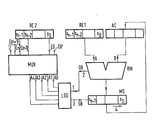
- An n-digit register RE1 is provided, which represents the binary number X as an n-digit binary number with bits x n-1 , x n-2 ... x 0 in two's complement multiplicands.
- x n-1 is the most significant bit, which indicates a negative sign with a value "1" and a positive sign of the binary number with a value "0".
- x 0 represents the least significant bit.
- the output of RE1 is connected to operand input A of an arithmetic logic unit RW, the second operand input B of which is connected to the output of an n-digit accumulator AC.
- the output of RW is connected to the input of a multiple sliding mechanism MS, the output of which is connected to the input of the accumulator AC.
- a register RE2 is used to hold the multiplier Y, also represented as a binary number in two's complement.
- yn-1 means the sign bit, y 0 the bit with the lowest value.
- a multiplexer MUX with n + 3 inputs EO ', EO, E1 ... E (n + 1) selects five immediately adjacent bits, for example y 1 ... y 5 , and switches them to its outputs AO to A4 by. From the bits that can be tapped at AO to A4, an operation command OB is derived via a logic circuit element LSG, which occurs at a first output 1 of LSG and is supplied to the operation command input 2 of the arithmetic logic unit RW.
- the operation command OB causes the arithmetic unit to either subtract the binary number present at operand input A from the binary number present at operand input B, to add the number present at A to the number present at B or to add the binary number present at B to the output of RW to switch through.
- a shift command SB is derived from the bits present at AO to A4 via LSG, which occurs at an output 3 of LSG and is fed to a control input of the multiple shift mechanism MS.
- the shift command SB effects a so-called arithmetic shift of the binary number contained in the n-digit multiple shift mechanism MS by a certain number of digits, ie one or more digits, each to the right, as indicated by arrow 4.
- bits of the binary number contained in MS are denoted by s n-1 , s n-2 .... S 0 , where s n-1 indicates the sign of this number as the most significant bit and s 0 means the bit with the lowest value, if an arithmetic shift of this number by three places to the right, bits s 0 , s 1 and s 2 are dropped, while the three vacant positions at the left end of MS are now each assigned the sign bit sn-1. After this shift, the binary number s n-1 , s n-1 ' s n-1 , s n-1 , s n-2 ... s 3 is in MS.
- s 0 is produced in RW and is fed to the multiple sliding mechanism MS.
- the shift command SB derived via LSG causes MS to arithmetically shift this first link result to the right by a certain number of digits in the manner already described.
- the number now contained in MS which has bits s n-1 , s n-1 , s n-1 , s n-1 , s n-2 .... s 3 , for example, when shifted by three digits then fed to the accumulator AC as the first subtotal.
- the multiplexer MUX switches through the bits y 1 ... y 5 at the inputs offset two positions to the left, ie at E1 ... E5, to AO to A4.
- two new commands, OB and SB are derived, from which OB causes the arithmetic logic unit RW to link the number X present at A with the first subtotal supplied by AC after one of the three possible operations, so that a second Link result is created.
- this is arithmetically shifted to the right by a certain number of digits, a second subtotal being generated in MS in the manner described, which is supplied to AC.
- MUX switches through the bits at the last five inputs E (n-3), E (n-2), E (n-1), En and E (n + 1), the last three inputs each are assigned the same bit as the drawing now shows g. Therefore, the bits y n-3 ... y n-1 , y n-1 , y n-1 can be picked up at the outputs AO ... A4.
- the OB and SB commands derived from this cause in RW. a combination of X with the subtotal located in AC and an arithmetic shift of the combination result in MS according to SB.
- the binary number created in MS then represents the product of the binary numbers X and Y, which consists of the n most significant bits. If n is odd number, then in the last step E (n + 1) is no longer scanned, so that the bits y n-4 ... y n-1 , y n-1 are switched through.
- the OB and SB commands are formed from the bits of the number Y that can be tapped from AO ... A4 according to the following table, in which the first five columns are assigned to the outputs AO ... A4 in the first line, while the sixth and the seventh column each contain the commands OB and SB.
- the bits that occur simultaneously at the inputs and outputs of LSB are each on one line.
- OB 1 means that the operands at A and B are added.
- the numerical values in the column for SB immediately indicate the number of digits by which the link result output from RW to MS is to be shifted arithmetically to the right in MS.
- the multiple sliding mechanism MS is, for example, constructed in the manner of the devices referred to as "barrel shifters", which are described in the book “Introduction to VLSI Systems” by C.Mead and L.Conway, Addison-Wesley Publishing Comp., Reading, Mass ., Oct. 1980, on pages 157 to 161.
- the logic circuit element LSG can consist, for example, of a read-only memory or a logic gate circuit.
Landscapes
- Physics & Mathematics (AREA)
- General Physics & Mathematics (AREA)
- Engineering & Computer Science (AREA)
- Computational Mathematics (AREA)
- Mathematical Analysis (AREA)
- Mathematical Optimization (AREA)
- Pure & Applied Mathematics (AREA)
- Theoretical Computer Science (AREA)
- Computing Systems (AREA)
- General Engineering & Computer Science (AREA)
- Complex Calculations (AREA)
- Executing Machine-Instructions (AREA)
Applications Claiming Priority (2)
| Application Number | Priority Date | Filing Date | Title |
|---|---|---|---|
| DE19833335424 DE3335424A1 (de) | 1983-09-29 | 1983-09-29 | Multiplikationswerk und verfahren zu dessen betrieb |
| DE3335424 | 1983-09-29 |
Publications (3)
| Publication Number | Publication Date |
|---|---|
| EP0144568A2 true EP0144568A2 (fr) | 1985-06-19 |
| EP0144568A3 EP0144568A3 (en) | 1988-01-27 |
| EP0144568B1 EP0144568B1 (fr) | 1992-06-17 |
Family
ID=6210497
Family Applications (1)
| Application Number | Title | Priority Date | Filing Date |
|---|---|---|---|
| EP84110830A Expired - Lifetime EP0144568B1 (fr) | 1983-09-29 | 1984-09-11 | Dispositif de multiplication et sa méthode d'opération |
Country Status (4)
| Country | Link |
|---|---|
| US (1) | US4679165A (fr) |
| EP (1) | EP0144568B1 (fr) |
| JP (1) | JPS6093550A (fr) |
| DE (2) | DE3335424A1 (fr) |
Cited By (1)
| Publication number | Priority date | Publication date | Assignee | Title |
|---|---|---|---|---|
| EP0825523A1 (fr) * | 1996-08-09 | 1998-02-25 | Siemens Aktiengesellschaft | Méthode et circuit à multiplier un multiplicand et un multiplieur par la méthode Booth en pas itératives |
Families Citing this family (5)
| Publication number | Priority date | Publication date | Assignee | Title |
|---|---|---|---|---|
| US4972362A (en) * | 1988-06-17 | 1990-11-20 | Bipolar Integrated Technology, Inc. | Method and apparatus for implementing binary multiplication using booth type multiplication |
| US4970676A (en) * | 1989-04-04 | 1990-11-13 | Rca Licensing Corporation | Digital word-serial multiplier circuitry |
| DE19637369C2 (de) * | 1996-09-13 | 2001-11-15 | Micronas Gmbh | Digitaler Signalprozessor mit Multipliziereinrichtung und -Verfahren |
| US5958000A (en) * | 1996-11-15 | 1999-09-28 | Samsung Electronics, Co. Ltd. | Two-bit booth multiplier with reduced data path width |
| US6991003B2 (en) * | 2003-07-28 | 2006-01-31 | M.Braun, Inc. | System and method for automatically purifying solvents |
Family Cites Families (16)
| Publication number | Priority date | Publication date | Assignee | Title |
|---|---|---|---|---|
| US3192363A (en) * | 1961-05-24 | 1965-06-29 | Ibm | Binary multipler for skipping a string of zeroes or ones |
| DE2647262A1 (de) * | 1975-11-04 | 1977-05-05 | Motorola Inc | Multiplizierschaltung |
| JPS52117893A (en) * | 1976-03-31 | 1977-10-03 | Hiyuuga Seirenshiyo Kk | Water slag apparatus for feronickel slag |
| US4130879A (en) * | 1977-07-15 | 1978-12-19 | Honeywell Information Systems Inc. | Apparatus for performing floating point arithmetic operations using submultiple storage |
| US4238833A (en) * | 1979-03-28 | 1980-12-09 | Monolithic Memories, Inc. | High-speed digital bus-organized multiplier/divider system |
| US4334284A (en) * | 1979-12-31 | 1982-06-08 | Sperry Corporation | Multiplier decoding using parallel MQ register |
| JPS57141753A (en) * | 1981-02-25 | 1982-09-02 | Nec Corp | Multiplication circuit |
| DE3134057A1 (de) * | 1981-08-28 | 1983-03-31 | Siemens AG, 1000 Berlin und 8000 München | Datenverarbeitungsanlage |
| JPS6177648A (ja) * | 1984-09-26 | 1986-04-21 | 新日本製鐵株式会社 | 水スラリ−状粒状物の乾燥方法 |
| JPS61163146A (ja) * | 1985-01-07 | 1986-07-23 | 株式会社 片山化学工業研究所 | 粒状スラグの脱水促進処理方法及び処理剤 |
| JPH0312347A (ja) * | 1989-06-12 | 1991-01-21 | Sumitomo Metal Ind Ltd | セメント瓦用水砕スラグの製造方法 |
| JPH03218952A (ja) * | 1990-01-23 | 1991-09-26 | Nippon Steel Chem Co Ltd | 水砕スラグ粉の製造方法 |
| JPH06183795A (ja) * | 1992-12-17 | 1994-07-05 | Daido Gakuen | フェロニッケルスラグセメント |
| JP2007146223A (ja) * | 2005-11-28 | 2007-06-14 | Hyuga Seirensho:Kk | ロータリーキルンダストの処理方法 |
| JP4777829B2 (ja) * | 2006-06-02 | 2011-09-21 | 日本冶金工業株式会社 | 骨材 |
| JP2008025934A (ja) * | 2006-07-24 | 2008-02-07 | Jfe Steel Kk | 脱珪スラグ粗精鉱の製造方法 |
-
1983
- 1983-09-29 DE DE19833335424 patent/DE3335424A1/de not_active Withdrawn
-
1984
- 1984-07-06 US US06/628,585 patent/US4679165A/en not_active Expired - Fee Related
- 1984-09-11 EP EP84110830A patent/EP0144568B1/fr not_active Expired - Lifetime
- 1984-09-11 DE DE8484110830T patent/DE3485774D1/de not_active Expired - Lifetime
- 1984-09-26 JP JP59201402A patent/JPS6093550A/ja active Pending
Cited By (1)
| Publication number | Priority date | Publication date | Assignee | Title |
|---|---|---|---|---|
| EP0825523A1 (fr) * | 1996-08-09 | 1998-02-25 | Siemens Aktiengesellschaft | Méthode et circuit à multiplier un multiplicand et un multiplieur par la méthode Booth en pas itératives |
Also Published As
| Publication number | Publication date |
|---|---|
| JPS6093550A (ja) | 1985-05-25 |
| US4679165A (en) | 1987-07-07 |
| EP0144568A3 (en) | 1988-01-27 |
| EP0144568B1 (fr) | 1992-06-17 |
| DE3335424A1 (de) | 1985-04-18 |
| DE3485774D1 (de) | 1992-07-23 |
Similar Documents
| Publication | Publication Date | Title |
|---|---|---|
| DE2616717C2 (de) | Digitales Addierwerk | |
| DE2900324C2 (fr) | ||
| DE2353421B2 (de) | Elektronischer rechner | |
| DE2619418A1 (de) | Verfahren und vorrichtung zur umwandlung einer binaerzahl in eine zahl modulo m | |
| DE2911096A1 (de) | Multiplikations-akkumulatorschaltung | |
| EP0049216A2 (fr) | Unité de calcul comportant un dispositif à décalage parallèle bidirectionnel | |
| DE1549508C3 (de) | Anordnung zur Übertragsberechnung mit kurzer Signallaufzeit | |
| EP0265555B1 (fr) | Procédé et dispositif d'addition de nombres à virgule flottante | |
| EP0144568B1 (fr) | Dispositif de multiplication et sa méthode d'opération | |
| DE3434777C2 (fr) | ||
| DE2830334C2 (fr) | ||
| EP0130397A1 (fr) | Appareil de calcul numérique | |
| DE1184122B (de) | Addiervorrichtung | |
| DE2913729C2 (de) | Schaltungsanordnung zur bitparallelen Binäraddition oder zum Shiften von Binärzahlen | |
| DE1774771B2 (de) | Anordnung, um wechselweise eine addition oder eine aus einer anzahl logischer funktionen zwischen den stellenwerten zweier binaerwoerter durchzufuehren | |
| DE2952072A1 (de) | Einrichtung zur verarbeitung binaer codierter dezimalzahlen | |
| DE2000275A1 (de) | Elektronischer Walzenschalter | |
| DE3785467T2 (de) | Programmierbarer gesteuerter verschiebemechanismus in einer programmierbaren einheit mit variablen datenwegbreiten. | |
| DE1549449A1 (de) | Einrichtung zur Verarbeitung von Gleitkommazahlen | |
| DE3134057A1 (de) | Datenverarbeitungsanlage | |
| DE1524197B1 (de) | Aritmetisch-logische einheit | |
| DE2952689A1 (de) | Programmierbarer lesespeicher-addierer | |
| DE2806452A1 (de) | Verarbeitungseinheit fuer daten veraenderlicher laenge | |
| DE19847245A1 (de) | Kombinierte Addierer- und Logik-Einheit | |
| DE2737483A1 (de) | Korrektur-schaltungsanordnung fuer additions- oder substraktionsoperationen mit nicht-hexadezimalen operanden in hexadezimalen rechenwerken |
Legal Events
| Date | Code | Title | Description |
|---|---|---|---|
| PUAI | Public reference made under article 153(3) epc to a published international application that has entered the european phase |
Free format text: ORIGINAL CODE: 0009012 |
|
| AK | Designated contracting states |
Designated state(s): BE DE FR GB IT |
|
| 17P | Request for examination filed |
Effective date: 19850827 |
|
| PUAL | Search report despatched |
Free format text: ORIGINAL CODE: 0009013 |
|
| AK | Designated contracting states |
Kind code of ref document: A3 Designated state(s): BE DE FR GB IT |
|
| 17Q | First examination report despatched |
Effective date: 19891013 |
|
| GRAA | (expected) grant |
Free format text: ORIGINAL CODE: 0009210 |
|
| AK | Designated contracting states |
Kind code of ref document: B1 Designated state(s): BE DE FR GB IT |
|
| REF | Corresponds to: |
Ref document number: 3485774 Country of ref document: DE Date of ref document: 19920723 |
|
| ET | Fr: translation filed | ||
| ITF | It: translation for a ep patent filed | ||
| GBT | Gb: translation of ep patent filed (gb section 77(6)(a)/1977) | ||
| PLBE | No opposition filed within time limit |
Free format text: ORIGINAL CODE: 0009261 |
|
| STAA | Information on the status of an ep patent application or granted ep patent |
Free format text: STATUS: NO OPPOSITION FILED WITHIN TIME LIMIT |
|
| 26N | No opposition filed | ||
| PGFP | Annual fee paid to national office [announced via postgrant information from national office to epo] |
Ref country code: DE Payment date: 19941118 Year of fee payment: 11 |
|
| PGFP | Annual fee paid to national office [announced via postgrant information from national office to epo] |
Ref country code: GB Payment date: 19950821 Year of fee payment: 12 |
|
| PGFP | Annual fee paid to national office [announced via postgrant information from national office to epo] |
Ref country code: BE Payment date: 19950918 Year of fee payment: 12 |
|
| PGFP | Annual fee paid to national office [announced via postgrant information from national office to epo] |
Ref country code: FR Payment date: 19950919 Year of fee payment: 12 |
|
| PG25 | Lapsed in a contracting state [announced via postgrant information from national office to epo] |
Ref country code: DE Effective date: 19960601 |
|
| PG25 | Lapsed in a contracting state [announced via postgrant information from national office to epo] |
Ref country code: GB Effective date: 19960911 |
|
| PG25 | Lapsed in a contracting state [announced via postgrant information from national office to epo] |
Ref country code: FR Effective date: 19960930 Ref country code: BE Effective date: 19960930 |
|
| BERE | Be: lapsed |
Owner name: SIEMENS A.G. Effective date: 19960930 |
|
| GBPC | Gb: european patent ceased through non-payment of renewal fee |
Effective date: 19960911 |
|
| REG | Reference to a national code |
Ref country code: FR Ref legal event code: ST |
|
| REG | Reference to a national code |
Ref country code: FR Ref legal event code: ST |